San Francisco

Film festival organizers call for safer San Francisco streets

Editor’s Note: Aug. 19 marks the Bay Area Global Health Film Festival, hosted by the Institute for Global Orthopaedics and Traumatology. The theme of this year’s festival is “Road Traffic Safety Locally … and Globally,” and is geared toward raising awareness about the need for road traffic safety improvements. In this opinion piece, representatives from the University of California at San Francisco Orthopaedic Trauma Institute, at San Francisco General Hospital, describe how all-too-common accidents can permanently injure pedestrians and bicyclists. And they voice support for Proposition A, the San Francisco Transportation and Road Improvement Bond.

By Amber Caldwell and Nick Arlas

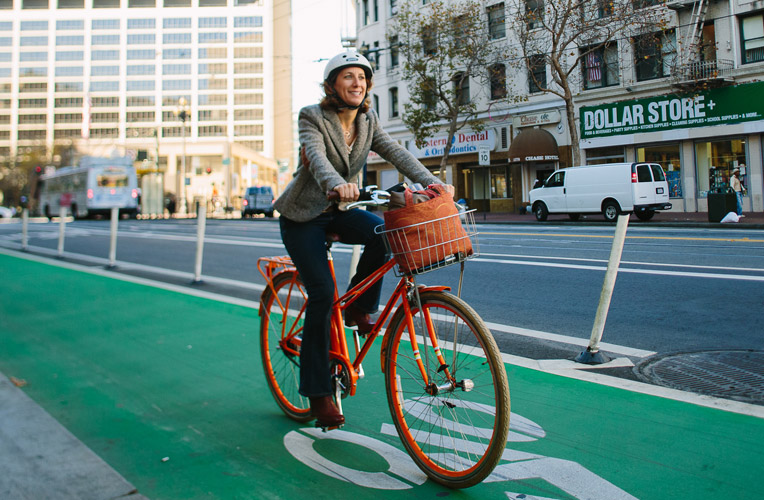
San Francisco is a transit-first city. Everyone shares the need to get safely from point A to point B, preferably quickly. And the various options for doing so span the full spectrum from driving, biking, and walking, to public transit like MUNI and Bart, rideshare programs, taxis, and companies like Uber and Lyft.

As we go about our daily lives, transportation is one of the most important public infrastructure systems that San Francisco relies upon. It encompasses many controversial issues and is linked to other social equity campaigns including housing advocacy and urban gentrification.

Yet the issue of pedestrian and bike safety in San Francisco has made disheartening headlines as of late. 2013 was an especially deadly year, with 21 pedestrian and four bicyclist fatalities. San Francisco General Hospital alone cared for over 1,000 road traffic injuries, with an estimated $60 million annual cost. Organizations like the SF Bicycle Coalition and WalkSF have made biking and walking leading issues in debates over transportation policy and traffic safety. Mayor Ed Lee and our city government have responded by introducing a $500 million transportation bond measure for the Nov. 4th ballot. If it passes, a portion of the funding will be allocated for improving pedestrian and cyclist safety.

Less often discussed, however, is what happens to the pedestrians and bicyclists who are hit while going about their daily routines and permanently affected by all-too-common accidents. At the UCSF SFGH Orthopaedic Trauma Institute (OTI), these patients fill our wards, the operating room schedule and our hearts as we help to heal them from these injuries. We struggle with the balance between doing what we can and what should be done to curb the growing volume of patients we see annually due to preventable accidents.

What is alarming is the socio-economic impact these accidents have, not only on the person affected, but on the hospital and our city as a whole. Even in cases where the driver is at fault, it is rare for them to even be cited for a traffic violation in most cases. More importantly, personal injury insurance and health coverage barely cover the emergency services needed for these accidents, and most services offered at the hospital are subsidized by taxpayer dollars, which means we are paying for this on all sides. This is unacceptable.

There is currently a wave of momentum to address these complex issues and attempt to tease through how we as a city can rebuild, redefine and reinforce the safety in our city. This movement is supported by a global platform addressing road traffic safety as a public health campaign, through the World Health Organization’s Decade of Road Traffic Safety. This campaign tackles the myriad polices and resource investments needed to address the enormous impact road traffic accidents have on the world. 

Injuries, mainly those resulting from road traffic accidents, account for greater disability and death than HIV, TB and Malaria combined.  An average 5.8 million die annually, and for every death caused by these accidents, eight to 10 more are permanently injured.

To bring collective awareness around this issue and to change the landscape, the community needs to stand together not only in San Francisco but also around the world, to demand safer streets. The city is doing its part to outline a roadmap to curbing these alarming statistics, and a greater global campaign is underway to promote awareness and inspire activism.

We must stand up for the injured and for ourselves as local citizens to demand safer streets and protection from when accidents occur.  We may not be able to prevent every accident, but we can improve the choreography of their outcome if we work together.    

Amber Caldwell and Nick Arlas are Director of Development and Community Outreach Coordiator, respectively, at the Institute for Global Orthopaedics and Traumatology, UCSF Orthopaedic Trauma Institute, San Francisco General Hospital.

The Bay Area Global Health Film Festival begins Tue/19 at 6 p.m. at Public Works, 161 Erie, in San Francisco.

San Francisco Democratic Party decides on endorsements for November election

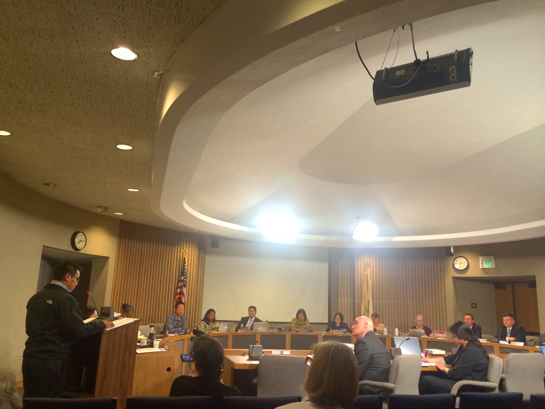
At a meeting lasting about four hours last night [Wed/13], the San Francisco Democratic County Central Committee, the steering committee of the city’s Democratic Party, decided on its endorsements for the Nov. 4 election.

A lengthy round of voting followed nearly two hours of public comment, in which San Franciscans chimed in on everything from school board nominations to Proposition L, a motorist-friendly proposal that amounts to a step backward for the city’s transit-first policy. (The formal oppositional campaign slogan is “No on Gridlock, No on L,” but opponents who spoke at the meeting shortened it to the edgier “’L No.”).

Prop. L went down handily. Prop. E, the sugary-beverage tax, easily won the DCCC’s endorsement, as did Prop. J, the proposal to increase the city’s minimum wage.

But Prop. G – a measure crafted to stem the tide of Ellis Act evictions, known as the anti-speculation tax – was a close contest.

Before the DCCC members got down to the business of voting, many local advocates voiced support for Prop. G.

Housing activists lined up across the room while Dean Preston, executive director of Tenants Together, called for meaningful action on the city’s housing affordability crisis.

But the proponents’ show of support was followed by the opposite plea from a second group, which included a contingent of Asian property owners, who crowded into the front of the room to tell DCCC members that they felt the proposed increase was unfair. “We don’t deserve this!” A speaker said, conveying anger and frustration. “Look at our faces, we work hard for our properties.”

In the end, the vote came down to four abstentions, 13 votes for “no endorsement,” and 15 votes in support, tipping the scales in favor of Prop. G by a tiny margin.

Among those who abstained on that vote were Rep. Nancy Pelosi, Rep. Jackie Speier, and Assemblymember Phil Ting, all of whom voted by proxies. Sup. Scott Wiener voted “no endorsement,” while Sup. Malia Cohen abstained.

Decisions in the races for Board of Education and the city’s Community College Board were time-consuming, since it took several elimination rounds before the final candidate lists were settled.

The school board candidates to emerge with DCCC endorsements were Shamann Walton, Emily Murase, and Trevor McNeil. Notably, that list didn’t include Hydra Mendoza, an incumbent who also serves as education advisor to Mayor Ed Lee.

Endorsements for Community College Board, meanwhile, went to Amy Bacharach for a two-year term, and Thea Selby, Anita Grier, and Rodrigo Santos for four-year terms.

Things got interesting in the contest for BART board of directors, between longtime Republican director James Fang and a well-funded Democrat, Nick Josefowitz, who is in his early 30s.

The vote was complicated since SEIU Local 1021, a labor union with a long history of backing progressive causes in San Francisco, is pulling for Fang, who supported workers during last year’s BART strike. Yet Josefowitz has the backing of other progressive organizations, including the Sierra Club. “I think that BART needs new blood,” Sierra Club representative Rebecca Evans said during public comment.

In the end, the DCCC voted “no endorsement,” with that selection getting 17 votes, five abstaining, and 10 voting in favor of Josefowitz. The votes followed a round of comments.

“The Democratic Party is a means to an end,” DCCC member Rafael Mandelman said. “And the end that we are using the Democratic Party to achieve is a more socially just and better world… There are few local entities [to advance that] than SEIU Local 1021. I think it is acceptable for us to take ‘no’ position in this race.”

Several piped up to say they thought Josefowitz deserved the endorsement of the Democratic Party simply because he’s a viable candidate and registered Democrat in a race against a Republican.

But DCCC member Arlo Hale Smith weighed in to critique of Fang’s performance as a director. “I used to hold this BART Board seat 24 years ago,” Smith said. “He’s missed a third of the meetings and he doesn’t return phone calls. He hasn’t returned my calls in a year. This is not the kind of person who should be reelected. Period.”

In races for the San Francisco Board of Supervisors and citywide offices, endorsements went to incumbents Carmen Chu for assessor-recorder, Jeff Adachi for public defender, Sups. Mark Farrell for District 2, Katy Tang for District 4, Jane Kim for District 6, Wiener for District 8, and Malia Cohen for District 10. No second- or third-place endorsements were made in the Board of Supervisors races despite multiple challengers.

Just before voting for endorsements began, DCCC member Alix Rosenthal admonished her colleagues for scant attendance during the candidate endorsement interviews, which were held the previous Saturday. “Only 12 out of 32 people showed up for interviews,” she noted. Half-jokingly, she added, “I know Outside Lands was happening.”

Lee and Pelosi talk middle class jobs in unequal SF

House minority leader Nancy Pelosi (D-SF) joined Mayor Ed Lee at a press conference yesterday [Tue 12] at Yerba Buena across from the construction site of a Central Subway station. It was billed as an event highlighting how “San Francisco has been in the lead” on creating middle-class jobs, investing in transportation, and ensuring fair wages for workers.

But as these words in the press advisory leapt out at us, we at the Bay Guardian responded with raised eyebrows. Really? It has?

The point of this media appearance, we learned upon arrival, was to promote House Democrats’ newly unveiled Middle Class Jumpstart agenda – a legislative package floated to bolster the middle class, in advance of the upcoming midterm election. Pelosi and Lee also sought to highlight the Central Subway as a transportation infrastructure project that’s spurring middle-class job creation (The $1.6 billion Central Subway project has also spurred mystifying questions as to how the money is actually being spent, but that’s a different story).

Creating middle class jobs

The message was clear: San Francisco Democrats are here to support the middle class. But that’s a tough sell. Everyone knows that the middle class is vanishing from San Francisco as skyrocketing property values make it increasingly untenable for middle-income earners to reside here.

Instead, recent studies have shown that what’s really on the rise is income inequality: Even the San Francisco Chronicle pointed out that the city’s own customized Gini Coefficient, a formula used to measure wealth distribution, puts San Francisco on par with Rwanda in terms of its economic inequality.

Earlier this year, a Brookings Institute report found that the income gap between the city’s rich and poor is growing faster than in any other US city.

We asked Lee about that growing income inequality trend at the press conference.

Here’s what he said in response: “These union jobs – and [Building Trades Council Secretary-Treasurer] Mike Theriault knows this better than anybody else here – are middle class jobs for all workers that just want to earn their way forward. And I think the more projects that we have that are infrastructure related, that are transportation related, that are water infrastructure related … are all part of reestablishing and making sure that we don’t lose that middle class. … I think in San Francisco, we simply need to do more, and part of my responsibility is to build enough housing aimed at that sector, along with helping our low-income families.”

So if you want to be on a public-works construction crew, there may be hope. Except if you live in the Bayview, where unemployment stands at a stark 17 percent as compared with the citywide level of 4.5 percent, where it appears these opportunities still aren’t resulting in job creation.

That Lee mentioned building new housing is interesting, too, given that he recently came under fire by for intervening to weaken an affordable housing measure proposed by Sup. Jane Kim for the November ballot. His agenda has sought to advance a goal of building 30,000 new housing units, but Kim’s proposal would have further strengthened the city’s commitment to building affordable housing.

Investing in transportation 

Central Subway construction may well have created union jobs – but the decision to emphasize transportation funding as a solution for saving San Francisco’s middle class seems to ignore Lee’s backlash against San Francisco Sup. Scott Wiener for advancing a ballot measure to automatically increase funding for Muni in correlation with population growth, a significant public transit investment.

As the Guardian previously reported, Lee went so far as to issue memos calling for possible budget cuts as payback for Wiener’s bid to increase transit funding. But when we asked the mayor what his position was on the measure, which will appear on the ballot as Proposition B, he said he didn’t have a position on it.

“My big focus on transportation is trying to get the $500 million Proposition A because that requires two-thirds, which his does not, and I need to focus my full attention on passing that transportation bond,” Lee told us. “I’m not going to spend a whole lot of time on Proposition B, to be quite candid with you. … At this point, I’m not prepared to [take a position] because I don’t want it to be confusing for the public … and in a few months, I think you’re going to see some departments have to come back with revised budgets, to the non-delight of nonprofits, and programs that we had all agreed to fund.”

Ensuring fair wages for workers

Throughout the press conference, Lee and Pelosi repeatedly trumpeted a November ballot measure that seeks to raise the city’s minimum raise to $15 an hour by 2018. But it should be noted that this measure is a watered-down version of an earlier proposal put forward by a progressive coalition that hoped to get workers $15 an hour a year earlier.

It was scaled back after Lee convened a stakeholder dialogue to hash out a “compromise” measure, ostensibly to avoid a ballot battle between the bolder progressive measure and a competing proposal that business interests had contemplated rolling out to thwart the passage of a wage hike they deemed unacceptable. Technically, the measure headed to the ballot still holds the promise of designating San Francisco as having the highest nationwide minimum wage. But as a point of comparison with other cities where minimum-wage hikes are moving forward, median rent in Seattle is $1,190 – while median rent in San Francisco is $3,200. 

Pelosi: “Income inequality is a reality”

Finally, in response to our question on income inequality, Pelosi also decided to weigh in, delivering a very depressing history lesson.

“The income inequality is a reality, it’s a growing gap, it’s something that must be addressed,” she said, mentioning a proposed change to the federal tax code that would prevent CEOs from taking tax write-offs if they increased CEO pay by $1 million annually without also increasing workers’ wages.  “What’s happening now, it’s important to note, this is structural,” Pelosi said. “It’s not anecdotal. It’s real. Go back 40 years ago, the disparity between the CEO and the workers was about 40 times. … And as productivity rose, CEO pay rose, and workers’ pay rose. … That was called stakeholder capitalism.

“Somewhere around a dozen or so years ago, or maybe nearly 20, it became shareholder capitalism, which only had one thing: The bottom line. And that means that now, as productivity rises, workers’ wages stagnate and the CEO’s goes up like this.” Here Pelosi made a gesture indicating a sharp upward increase. “Now it’s about, I say 350, others say 400 times, the CEO pay versus the worker. It’s a right angle going in the wrong direction. It must be addressed.”

So there you have it, straight from Pelosi: CEOs who used to make 40 times their workers’ pay now earn 10 times more than that, while wages stagnate and the cost of living continues to rise. And leading San Francisco politicians are standing in front of the Central Subway construction site to say that projects like this, coupled with a provision to encourage CEOs to remember the little people when they get million-dollar raises, will restore the middle class.

Thank goodness the Democrats are looking out for the vanishing middle class in San Francisco and other cities. Don’t you feel better?

San Francisco rent explosion: Median rent for two-bedroom apartment tops $4K

84

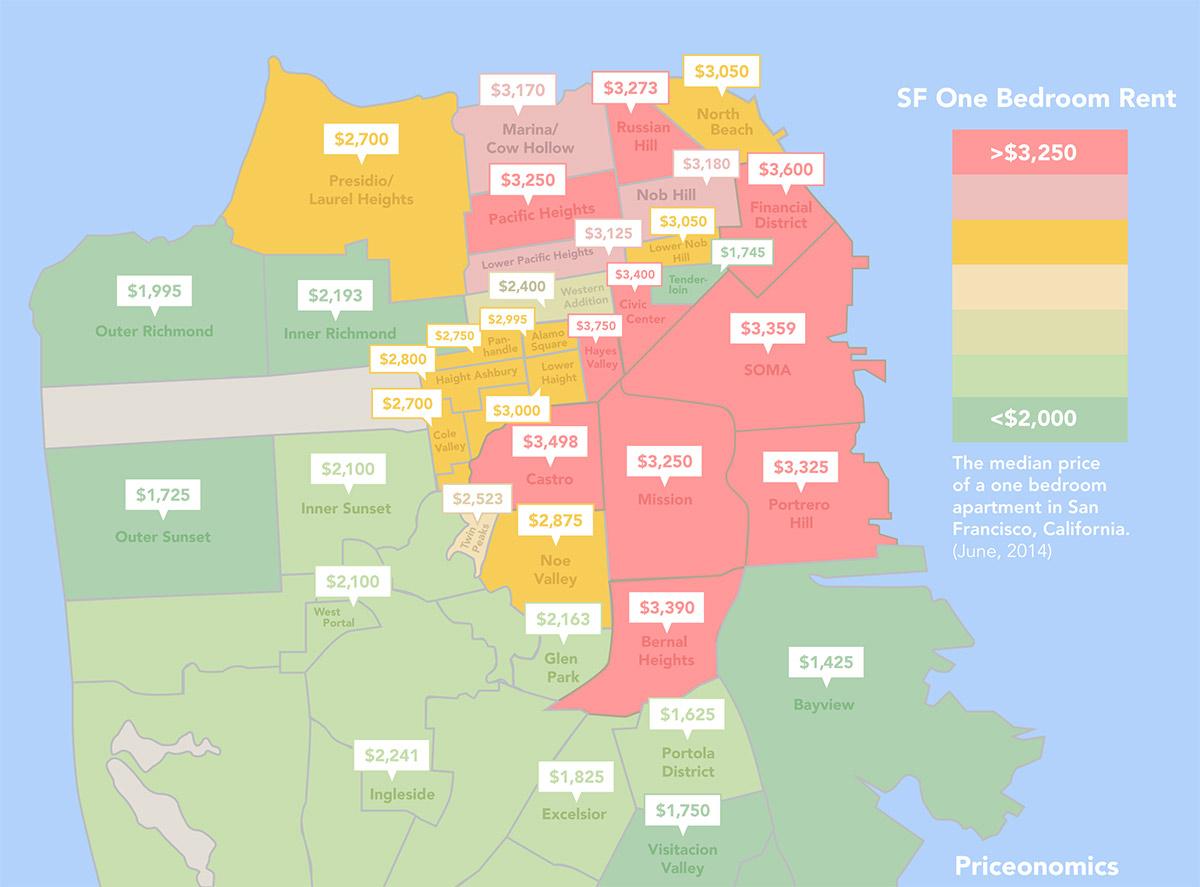
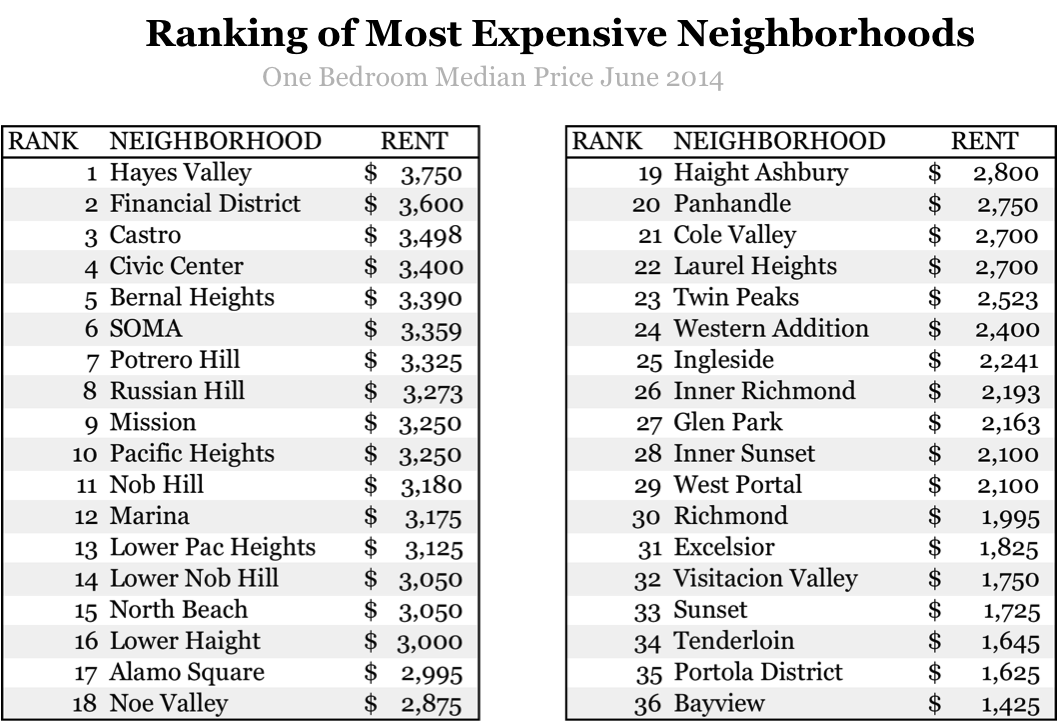
Hold onto your butts, a new study on San Francisco’s rental market (yes another one) reveals the city’s newest most expensive neighborhoods. 

Priceonomics went pretty darn viral last year upon release of its first study of San Francisco’s rental explosion, and round two is certain to blast through SF social media as well. And deservedly so, as the new high rental numbers are staggering.

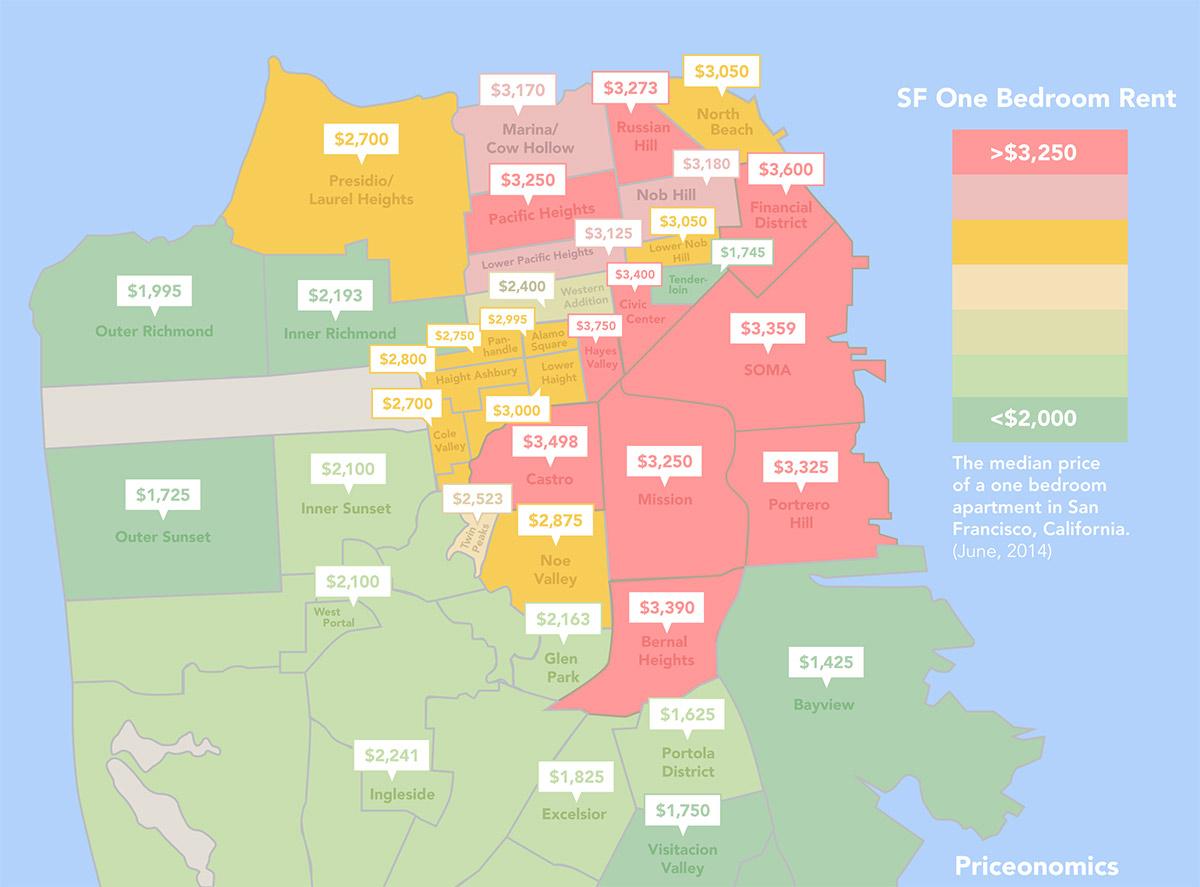
Median rent for a one-bedroom apartment in San Francisco is now $3,120. The median rent for a two-bedroom is now $4,000, and the median rent for a three-bedroom is $4,795, Priceonomics found.

It’s not a wonder widespread evictions are sending protesters onto the streets (and into the offices of real estate agents). The numbers are a good indicator of why any eviction from a rent-controlled unit today is also an eviction from San Francisco entirely: prices are just too damn high to find a new apartment at a comparable rate. 

The study breaks the data down by neighborhood. Hayes Valley topped the list, with a median rent of $3,750 for a one-bedroom apartment. The Financial District and the Castro were second and third most expensive, with the Bayview coming in last at $1,425 a month. 

neighborhoods

The study also noted that historically poor areas (derisively termed “backwaters”) have jumped in price, largely in part due to an influx of tech workers and their shiny UFO-like private shuttles. 

As the rents rise and turmoil bubbles over evictions, city legislation like Supervisor Jane Kim’s Housing Balance Measure was defanged by Mayor Ed Lee during negotiations over the past month. Still, there is some hope on the November ballot for relieving San Francisco’s housing crisis. Proposition G, the Anti-Speculation Tax, would discourage speculators from “flipping” properties for a profit by taxing them harshly. 

Of course that’s no silver bullet, and San Francisco will need to take a hard look at its affordable housing policies to stop these prices from rising, rising, rising. 

It seems like they couldn’t possibly go up higher, but then again, we always think that, don’t we? 

For more on Priconomics’ findings, check out the article here

rental map

Click the map for a higher-res version.

Ruling provides more access to SFPD misconduct files

3

A California appellate court issued a ruling this week [Mon/11] opening up San Francisco Police Department personnel files to prosecutors, who then must disclose to defense attorneys when officers have criminal or other misconduct issues that may affect their credibility when testifying during trials.  

The decision builds on the 1963 Brady v. Maryland US Supreme Court case, which requires police to share all potentially significant evidence with the prosecutors. But the SFPD hasn’t always done so to an extent that passed legal muster, citing officer confidentiality issues, so the court has now found that prosecutors must have direct access and bear the responsibility of disclosure.  

The San Francisco District Attorney’s Office resisted the change, joining with the SFPD to appeal the lower court ruling in Superior Court of San Francisco vs. Daryl Lee Johnson, a defendant whose attorney has sought more information about the officers testifying against him. The appellate court supported the earlier ruling and said that any relevant documents must be shared.

The appellate justices specified that, since the police are part of the prosecution, documents may legally be shared without breaking any officer confidentiality rules. SFPD did not immediately return calls for comment, but we’ll update this post if and when we hear back.

In a press release from the San Francisco Public Defender’s Office, Public Defender Jeff Adachi said, “A fair trial requires that before a police officer testifies, any history of dishonest or abusive behavior is turned over to the defense…[The prosecutors] are ultimately responsible for providing any information about a police officer that could exonerate an innocent person.”

The Guardian spoke to Adachi about the implications of this decision. While the ruling will place fewer obstacles in the way of obtaining evidence and will create a clearer process, Adachi is concerned about accountability since there’s no way to know that the prosecutors are making all relevant documents available. But he said the ruling is still a step in the right direction.

“This decision means that the defense will have access to information to a case where police officers’ credibility is concerned,” Adachi said. “If the officer has been disciplined for lying [or] use of excessive force…that reflects on the police officer’s credibility.”

According to Acachi, around 100 cases have been dismissed due to lack of evidence, and 90 officers involved in various cases had flawed records.

Monday’s ruling will play a role in the case that inspired it. Daryl Lee Johnson was charged with two felonies in November 2012. His investigating officers had records of misconduct, but their files were not available to Johnson’s attorney. This ruling will even out the playing field and help ensure that Johnson trial and others are truly fair.

Adachi told the Guardian that two court decisions were preventing defense attorneys from accessing misconduct files.

“The Johnson case establishes that yes, they can,” Adachi said, noting that the ruling will also help defense attorneys in other cases going forward.

SF school board votes to aid Central American child refugees, hopes to spark national movement

14

Waves of Central American child refugees are landing in San Francisco, fleeing violence in their home countries. A growing number of supporters are lending aid, and now the San Francisco Unified School District is the newest group to join the cause. 

Last night [Tues/12], the SFUSD Board of Education unanimously approved a resolution to bolster services in city public schools for child refugees fleeing Guatemala, El Salvador, and Honduras.

“We are a nation of immigrants, which is often forgotten when we talk about ‘those kids,'” SFUSD Superintendent Richard Carranza said to the board. “These are our children.”

To help them, he said, “we will move heaven and earth.” Carranza then pledged to forward the text of the resolution far and wide, saying he hoped the SFUSD’s efforts would cross the desk of President Barack Obama, and set an example for the rest of the country.

Child refugees coming to San Francisco face language barriers, inadequate city services, and major gaps in their education. The resolution, authored by board member Matt Haney, will beef up teaching resources for child refuegees, connect these children with counseling services, and enroll them in specific classes geared towards new English learners. The district will also soon hire an administrator to coordinate these new and existing services for refugees. This new administrator will need the qualifications of a social worker, the district said, and it’s easy to see why. 

One counselor put the kids’ needs this way: normal teenagers have it hard enough, but adjusting to school with the trauma of near-death behind you can be almost impossible.

“These kids have a set of needs which are at a higher level than any set of kids we deal with,” Haney said. 

Most of these new services will wrap into SFUSD’s Newcomer Pathways program, an already existing framework which bolsters the success of new immigrant children in San Francisco, who often face steep language and cultural barriers.The effort joins a rising tide of SF officials pledging to aid these refugees, including Supervisor David Campos, Mayor Ed Lee, Public Defender Jeff Adachi, and USF School of Law Dean John Trasvina.

The US Department of Health and Human Services reported 175 unaccompanied minors were released into custody of San Franciscans, though federal data shows many hundreds more wait in the wings for aidSome of these refugee children will join school in the new year, which starts Monday, but many are already in attendance.

Dawn Woehl, a counselor with the Newcomer Pathways program at Mission High School, told the board during public comment she started noticing more child immigrants who spent time in detention centers in New York and Texas. 

“We may not know much about each individual family, but we know enough about the trauma they’re facing,” she said. After she spoke to the board, she told the Guardian that wraparound services for mental health are most needed. 

“We take care of the basic needs first,” she said, “but counseling is where we get stretched.”

These children and teenagers often come from towns where gangs recruit new members through high schools. Those that refuse to join up meet violent fates: rape, dismemberment, and death. With those challenges, it’s no wonder that many of these kids show up in San Francisco with gaps in their learning, and significant need of counseling.

“The need for Spanish-speaking therapists is high,” Woehl told us. 

The Newcomer Pathways program is a successful one, and alumni of the program came to the board to laud the proposal to aid the refugees.

“I was born and raised in Guatemala, I emigrated here when I was 14 years old,” Anna Avalos Tizol, now 21, told the Board of Education. “I had to learn the language, the culture, and work to help my family back in Guatemala. It was a culture shock.”

But in the end, the young student found success at Mission High School. She’s now a senior at UC Santa Cruz, and interned in Washington DC, where she witnessed child refugees testifying before Congress, telling them of the cold hard floors and thin sheets of their detention centers.

“When we come here, we give up everything. Our home and our loved ones,” she said. “Remember: all children are sacred.”

Vigil at 3:33pm tomorrow for Feather, faerie found beaten near Duboce Park

45

The life of Bryan Higgins, 31, know among his radical faerie community as Feather, will be celebrated tomorrow at 3:33pm with a vigil at Duboce Park — the exact moment his family wishes to remove him from life support at SF General Hospital.

Feather is the John Doe whom police were attempting to identify this weekend in a viral campaign, whose unconscious, critically injured body was found near Duboce and Church streets at 7:30am on Sunday morning, and who has been sustained through life support at SF General while friends, family, and fellow faeries have streamed through to wish their goodbyes. Until now, Feather has not been identified in the press. In a personal interview today with his husband, Brian Hagerty, I learned more about how this central figure in the faerie community will be ushered into the next life. 

Feather’s family has not been talking to the police or the press — Feather’s husband spoke to me in an effort to get the word out about the vigil tomorrow. Police are now considering Feather’s death an attempted homicide via assault with a deadly weapon; according to sources, they are looking for a white male in a dark-colored hoodie, who was captured on Muni and surrounding businesses’ security footage around the time of the assault. (Anyone with relevant info please contact 415-575-4444 or text TIP411 with “SFPD” at the start of the message.)

 “We haven’t been in contact with anyone other than those immediately involved in Feather’s passing,” Hagerty told me today as we walked near New Rosenberg’s Deli, where Feather worked, and where mourners were gathered wearing “I Believe: Feather 1983-2014” t-shirts sporting Feather’s image.    

Hagerty, visibly shaken but acknowledging tremendous support of family and the faerie community, said he didn’t have any other information about the circumstances of Feather’s horrendous beating. “Right now, we are just concerned with his spirit, and making sure everyone has a chance to say goodbye,” he said. “Too many factors came together in this situation. But the truth is he has left us.”

Hagerty declined to reveal any more medical information, and no more information was available from the police at the time of this writing. The Guardian will be following the case as it develops.

Feather’s case has drawn attention from the media as violent crime in San Francisco seems to be taking an upswing, especially in the gay-friendly Castro District. Supervisors and gay community members are weighing the possibility of radical changes to June’s Pink Saturday celebration, and the area around Church and Duboce has become especially fraught with crime lately, as the surrounding neighborhoods undergo profound changes.

But mostly the shock of such a stalwart of the faerie community — one dedicated to gentleness, peace, and spiritualism — being beaten, possibly to death, is what’s drawing attention and disbelief.

A friend who was in the hospital room as Feather’s husband said goodbye described the scene in a series of texts:

“There are young gay men going in and out of the room holding and kissing his hands; whispering in his ear; family walking in and crying and massaging his feet; relatives encouraging their crying children to say goodbye to him. People meeting each other and hugging, watching TV in the waiting room, handing each other Kleenex in the hospital room. It is so fucking beautiful and sad.

“His husband put a black, white, and tan African dye-print scarf around Feather’s neck, and stretched it out over his shoulders and arms and body with his beautiful face above it…. like he is a bird/spirit preparing to fly.”     

Update 8/14: Photos and coverage of Feather’s memorial can be found here.

Real estate speculators physically push out Ellis Act eviciton protesters

55

Native San Franciscan Benito Santiago, 64, joined a protest Aug. 12 in an attempt to remind his evictors that he’s a human being – not a roadblock to profit.

Santiago is facing an Ellis Act eviction from his 47-year Duboce Triangle home, where his monthly rent is just below $600.

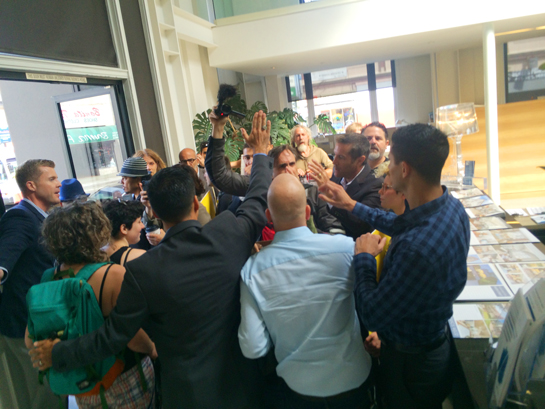
Clad in a stylish blue fedora, Santiago and a dozen or so protesters filed into Vanguard Properties to deliver a letter asking Vanguard co-founder Michael Harrison to rescind his eviction. Harrison initiated an eviction proceeding against Santiago last December through his corporation, Pineapple Boy LLC. But by the end of the protest, Santiago and other tenant activists were physically pushed out of the building by Vanguard representatives in a show of aggression.

Before it got to that point, protesters called out Harrison for exploiting the Ellis Act for profit.

From the letter:

“We do not believe that you, Michael Harrison, are ‘going out of business’ which is the purpose of using the Ellis Act. We know that instead you are exploiting a loophole in state law for your greed.”

Suffice to say, Vanguard representatives didn’t accept the letter. But the message still got across: The protesters brought a bullhorn.

“My name is Benito Santiago,” Santiago blared, standing at the front desk, but was soon interrupted. A young-looking man in a grey suit approached protesters and asked them to leave.

“I’m calling the San Francisco police,” he said. Santiago may have approached the business with a bullhorn, but he has much to lose. 

While Vanguard may perceive Santiago merely as someone who doesn’t offer monetary value, he’s of much value to the developmentally disabled children he teaches at San Francisco Unified School District. 

The protesters intended to make these points to the folks at Vanguard. But before words could be exchanged, a crowd of Vanguard workers (real estate agents or employees, perhaps?) swooped in and physically carried out the protesters.

Fred Sherbun-Zimmer held her protest sign and chanted as one Vanguard agent placed hands on her back and swiftly pushed her out. Peter Menchini, a videographer, held his camera high and away from the snatching hands of real-estate experts turned vigilantes. Poet and activist Tony Robles had a paper slapped out of his hand by a Vanguard employee, before protesters were pushed out in a wave behind him.

Vanguard Properties Employees Assault Photographers & Activists 12 Aug 2014 from Peter Menchini on Vimeo.


As you can see from the video, things turned downright nasty as the real-estate representatives shoved and pushed the anti-eviction protesters as well as journalists there to document the event. (They even tried to yank my phone out of my hand.)

By the time the SFPD arrived, things had settled down. No arrests were made, and after a few sidewalk declarations by bullhorn, the protesters cleared the scene.

Afterwards, Santiago told us his housing prospects aren’t looking good. The Bill Sorro Housing Program helped him file many affordable housing applications, but he hasn’t gotten any word back yet. The rent he pays now eats up a hefty chunk of his paycheck, leaving little for basic expenses by the end of the month.

“I’m getting lots of positivity from family,” he said. And he does have an extension, until December, to find a new apartment. But, he noted, with median rents almost reaching $4,000 in San Francisco (they’re actually at $3,200, but that’s still bad), his chances of staying in the city are slim.

“I might be bad at math,” he told us, “but that seems like shooting for the moon.”

Vanguard Properties co-founder Michael Harrison was dubbed a “property flipper” by the Anti-Eviction Mapping Project. 

From its brief on Harrison:

Michael Harrison is the co-founder of Vanguard Properties, where he specializes in “residential investment properties.” He is a property flipper: his shell company Pineapple Boy LLC bought the building in November 2013 and tried to evict Benito and the two other tenants immediately. Vanguard Properties is currently involved in a number of luxury property developments in the Mission District and Duboce Triangle area including the development at 19th and Valencia that in February 2014 set record sale prices for the neighborhood. 

Santiago did have some flickering hope when an in-law unit behind a garage next door went on the market for rent. His hope was deflated, though, when his friend told him the rent for the single room.

“Eduardo said, ‘guess how much it is?'” Santiago told us. “It’s going for $4,000 a month.” 

Shahum leaving SF Bike Coalition to study Vision Zero

30

San Francisco cyclists are losing a key advocate — but this and other US cities may next year gain a knowledgable new leader for Vision Zero, the ambitious program for eliminating all pedestrian deaths — with today’s announcement by Leah Shahum that she is stepping down as executive director of the San Francisco Bicycle Coalition at the end of the year.

Shahum has been accepted into the German Marshall Fund Fellowship, a four-month program where she will study European success stories in the Vision Zero concept, focusing on cities in Sweden, the Netherlands, and Germany, before returning to the US to work on programs that reduce traffic-related fatalities.

“They’ve made huge progress after they started with Vision Zero in the late ‘90s,” Shahum told the Guardian. “I’m really passionate about the potential of Vision Zero in San Francisco and other US cities.”

At the SFBC, Shahum worked her way up from a volunteer to becoming executive director 12 years ago, presiding over the organization becoming the city’s largest grassroots, member-based advocacy organization, one that has a strong influence at City Hall.

Shahum has also sought to broaden the SFBC’s mission, working closely with organizations such as Livable City and Walk San Francisco to challenge paradigms and funding models that heavily favor the automobile on the streets of San Francisco.

“The work we’ve been doing at the Bike Coalition has long been broader than just biking,” Shahum said. “The work we’re doing benefits all road users and I think it’s important to bring everyone into this discussion.”

Walk SF Director Nicole Schneider said Shahum’s departure is bittersweet news.

“It’s really sad to see her go and we’ll dearly miss her tenacity and leadership in San Francisco,” Schneider told the Guardian. “But I’m thrilled that she’s working on Vision Zero and she’ll be a huge asset in this country.”

While the Board of Supervisors adopted the goals of Vision Zero earlier this year, that program has yet to be fully defined or funded, particularly after Mayor Ed Lee ditched a fall ballot measure that would have increased the local vehicle license fee, which would have dedicated some funding to pedestrian safety improvements.

“We need to really figure out what Vision Zero means for a US city, so we can learn a lot from European cities,” Schneider said. “In order to implement Vision Zero, we’re going to need funding to replace our obsolent traffic infrastructure that valued speed over safety.”

Shahum said it was a good time to make the transition and focus on Vision Zero, which will be the subject of an international conference she’ll attend this November in New York City, which has been leading the way on the concept among major US cities.    

“It’s at the valuable crossroads of injury prevention and sustainable transportation,” Shahum said. “I’m excited to take Vision Zero to the next level, not just in San Francisco, but around the nation.”

SFBC put out a statement commending Shahum for her 17 years of work with the SFBC and announcing it will be conducting a nationwide search for a new director.

“We thank Leah immensely for leading our community’s efforts to make San Francisco a safer, more inviting place to bike and a better place for all of us to live,” SFBC Board of Director President Lawrence Li said in the statement. “Leah leaves behind a legacy of one of the most bike-friendly big cities in America and one of the most well-organized and effective membership groups in the country.”

Shahum said she’s not sure exactly what form her post-fellowship work will take, but that she’s excited about the possibilities of this opportunity.

“I think it’s time for some new adventures,” Shahum told us. “As much as I love what we’re doing in San Francisco, things have to move faster to be meaningful.”

Call the Pope

0

culture@sfbg.com

THE WEEKNIGHTER It’s a funny thing to be filling out a job application and have to put your previous employer as Tony the Pope. But that’s the name I know him by, and truthfully, I don’t wanna know his real last name, anyways. I prefer to have at least a little bit of mystery in my life.

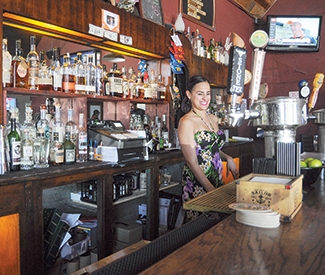
I had been working at The Unresolved Love Life of Evelyn Lee, which may be the longest name for a bar ever, when I got news that the bar had been sold to Tony and would now be called Mission Hill Saloon (491 Potrero, SF. 415-552-5545)… again. It had been Mission Hill before it was Evelyn Lee, and apparently Tony was changing it back. Regardless, I came to love working at the place and didn’t care what it was called as long as I had a shift or two.

Depending on the bar, the regulars can either be the best or worst thing about it. The jury is still out about which category Mission Hill’s falls into. Or at least, that’s the kind of shit I’d talk to them while behind the bar. A bartender’s best weapon is his wit, and working at Mission Hill Saloon was a good test of mine every time I was at the stick. The crowd ranges from hipsters to cooks and construction workers — and all of them are prepared to give you a hard time for absolutely no reason at all. And that’s just how I like it.

I experienced one of my most ridiculous San Francisco moments ever while working there. I’d been chatting with a girl on OkCupid, and we had made plans to grab a drink on Sunday evening. We never discussed where I worked so we were both surprised when she came in on my Thursday night shift. Coincidently, she lived above the bar. That is some serious San Francisco shit right there. We went out once and decided it would be easier to just be friends considering she lived above the bar I worked at. [Good call — Ed.]

The Mission Hill Saloon is in an old building. I’m not sure of its age, but it’s old enough. One night, Raph, one of the regulars, told me — as I was closing the bar at 2am — that the place was seriously haunted and that he wouldn’t want to be in there all by himself at night. He gave me a wink as I ushered him out the door and locked it behind him. The asshole knew I had at least an hour of closing duties, by myself, in that old bar. I didn’t want him to know that his saying that shit really spooked me, and I put at least $5 in the jukebox so I wouldn’t hear any late night creepy old building sounds. Nothing ghostly ended up happening. Or if it did, I couldn’t hear it over the jams.

Unfortunately I only worked at Mission Hill Saloon for a little while. After Tony bought the bar he decided to work as many shifts on his own as he could, just to keep costs down. I completely understood, and I knew he’d be a great reference for whatever my next bar gig would be. Which is why I found myself filling out an application and using Tony the Pope as a previous employer. Tony may not be a religious man, but he sure does pour some strong-ass holy water. Plus, now it’s nice to be on the other side of the bar — so I can join the peanut gallery and give him shit.

P.S. This Weeknighter is dedicated to Ashley Dickinson who loves Mission Hill almost as much as I do.

Stuart Schuffman aka Broke-Ass Stuart is a travel writer, poet, and TV host. You can find his online shenanigans at www.brokeassstuart.com

Innocent bay stander

0

arts@sfbg.com

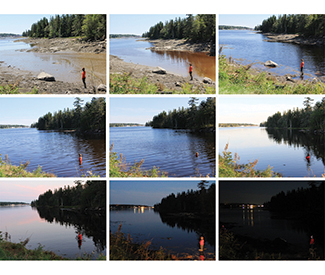
THEATER Sarah Cameron Sunde will be standing in the water at Aquatic Park this Friday. She’ll stand from low tide, at 9:26 that morning, through high tide at 4:09 in the afternoon, and back to low tide again at 10:31 that night. Thirteen hours and five minutes of being still, while everything around her changes.

When it comes to the near and distant impacts in store from sea level rise brought on by the planet’s changing climate, Bay Area residents might be expected to know more than most. The bay’s distinctive shape is already being modified by creeping water levels. New efforts at shoreline protection are underway, but with an expected rise of six feet by the end of the century, the bay and San Francisco are destined to be different places no matter what.

How conscious we are of that fact remains a question. It’s one thing to know the figures and another to “feel the rise,” as Sunde puts it in her invitation to locals. For the New York–based theater director and interdisciplinary artist, the awesome movement of the daily tide shift acts as a visceral metaphor for larger cycles, and momentous changes afoot. Even those who choose to watch from the shore might grasp something of this larger theme, tucked into an ephemeral moment, merely by registering the bay’s embrace of a human tidal gauge.

That, anyway, is Sunde’s hope as she embarks on the third iteration of her 36.5 Water Project. The venture began last August in Maine, while Sunde was at an artist residency near Bass Harbor. But its roots go back a little further, to 2012 and Hurricane Sandy.

“When Hurricane Sandy hit New York,” she says, “it was the first time I truly, deeply understood that everything is temporary.” This despite being married to a water engineer from the Netherlands, whose first impression of New York City was tantamount to a liver specialist encountering Dean Martin. “And I didn’t believe him,” she admits. “Then [the hurricane] hit, and I understood. It changed the way I think about these things.” Sunde realized there was a real and dangerous deficit in long-term vision. “We know how to rally after a disaster but there’s no forward, future thinking.”

Sunde — whose theatrical work has largely revolved around her position as deputy artistic director of New York’s New Georges theater company, as well as her role as the foremost American translator and director of the famed contemporary Norwegian playwright Jon Fosse — was at that time also moving away from new play development toward her roots in more experimental, devised performance-making with a group of interdisciplinary collaborators collectively known as Lydian Junction. Its experiments, informed in part by the writing of Norwegian writer Knut Hamsun and by issues of sustainability in the arts, explore art’s relation to suffering and sacrifice.

“In Maine, I was thinking about all these things. I was thinking about New York sinking. I was thinking about art and sacrifice and suffering, sustainability. And I was on this bay, this tidal bay, where there is a ten-and-a-half foot tidal shift. That meant that it was a mudflat during low tide, and then during high tide it was a bay, a full-on bay of water. I had never seen the environment change so drastically with the tide before. I was watching this huge rock out in the bay get swallowed. There was something really beautiful about this.”

Suddenly, an image came to her director’s eye.

“I thought, I see a human being standing there up to the neck, and then the water going back down again. I thought, I have to do this. How can I create this spectacle? I thought about my collaborators and I thought, shit, they’re not going to do it; I guess I’m going to have to do it myself. I decided to do it three days later because it was my half birthday — I always try to do something that is related to my own tracking of time. I’m a little obsessed with time, the expansion, the contraction of it, the perception, all of it, the routine, the anti-routine. That’s why it’s called 36.5, because I turned 36 and a half that day.”

Since then, Sunde has developed some more thinking around the shape of her piece and its intentionally simple design. She plans to travel to six continents, drawn to places with some personal connection. (Having grown up in Palo Alto, Sunde has roots in the Bay Area that run especially deep.) Each iteration will involve specific local partnerships. Aptly enough, the after party for Friday’s performance takes place at the Long Now Foundation at nearby Fort Mason. And the number in the title ends up being significant in several ways: The average person needs 36.5 cubic meters of water a year; at the current rate of climate change, oceans could rise 36.5 inches by the century’s end; and ditching the decimal point leaves the number of days in a year. The connotations underscore the way the personal and universal remain deeply entwined here.

The invitation to the public to test the waters with her, meanwhile, adds a new wrinkle in this globetrotting project, granting space for direct participation in the experience. At the same time, it means the performance becomes a collective action, however peripheral or absurd it may appear on the surface. Small steps just might sound greater depths. *

36.5 WATER PROJECT

Fri/15, 9:26am-10:31pm, free

Aquatic Park

Hyde at Jefferson, SF

www.365waterproject.org


Boxing lessons

0

arts@sfbg.com

While still a child in early-’80s San Francisco, Boots Riley witnessed something he didn’t quite understand but that would stick with him for the rest of his life. Walking into a theater performance at the venerable Mission District art space Project Artaud, Riley saw actors in body paint writhing around him in apparent agony on all sides. It was meant as a simulation of the AIDS epidemic, with the actors portraying the afflicted. But it didn’t enlighten him much as a kid.

“It just scared the hell out of me,” Riley recalls. “You walk into this place, and it’s like a whole city, with people all around you.”

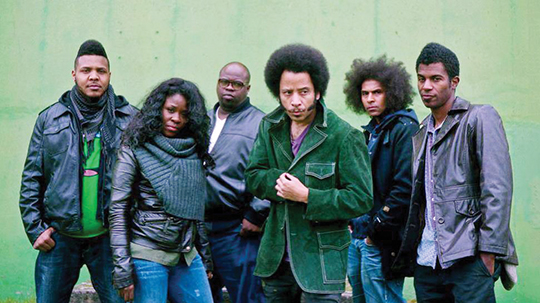
Given how Riley’s own work with long-running hip-hop group The Coup likewise mixes political activism with overwhelming performance energy, it’s fitting he would look back on this experience as the inspiration for The Coup’s new multimedia project, Shadowbox. Featuring the work of street artist Jon-Paul Bail, videographer David Szlasa, and a host of other bands and performers, Shadowbox casts the Coup’s music in the context of an all-encompassing artwork that attacks the audience from all sides. He’s debuting the project at the Yerba Buena Center for the Arts on Aug. 16, but he hopes to eventually take it on the road to wherever an art establishment is willing to fund it.

Riley prefers to remain secretive about what the performance actually entails. He’s described it in the past as featuring puppets, drones and “Guantanamo Bay go-go dancers,” whatever those may be. To Riley, having the audience come in blind is key to maximizing the impact of the show.

“Some of the things that would make people probably want to come to the performance are things I don’t want to talk about before they happen,” Riley says.

What we do know is that it’ll feature multiple stages and a dizzying roster of collaborators, from socialist hip-hop militants Dead Prez to dream-pop duo Snow Angel, comedian W. Kamau Bell, chamber orchestra Classical Revolution, and the New Orleans-style second line unit Extra Action Marching Band. All of it will be encased by Bail’s black-and-white artwork, which will give the audience the impression of being in an actual “box of shadows.”

Bail, a Bay Area street artist perhaps best known as of late for his “Hella Occupy Oakland” poster, was one of Riley’s early heroes on the Bay Area art scene. The two met in the late ’80s amid a wave of neo-Nazi skinhead activity in the Bay Area, which the two of them helped fight to counter.

“When I was in high school I would hang out at Alameda Beach,” Riley recalls. “Back then Alameda was still a navy town and they didn’t like a lot of black folks coming around. Police rolled up to harass us, and the police insignia on the car was covered in a swastika. The first thing I thought was: ‘Who the fuck did that?'”

It turned out to be Bail, and the two artists quickly bonded, putting up anti-Nazi posters around the city. They’ve remained friends through the years, but they haven’t collaborated on a large-scale project until now.

“He was the first artist I ever met who was trying to do something more with art than just make art,” Riley says. “He had a collective at California College of the Arts at the time, which had the slogan — ‘no art for art’s sake.'”

The Yerba Buena Arts Center connected Riley and Bail with videographer (and Theater Artaud collaborator) David Szlasa, who helped design the video elements of the project. Together, they form Shadowbox’s core creative axis, responsible for the aesthetically overwhelming experience Riley hopes the project will be.

Though Shadowbox contains elements of both a gallery exhibition and a theatrical performance, Riley ultimately hopes that Shadowbox will feel more like a show than anything else, in line with the Coup’s high-octane concerts.

“A lot of the time when you’re doing something theatrical people just want to stand around,” Riley says. “But our shows have always been known to be a dance party, and we’re keeping the audience with us and not just watching us.”

The performers and artworks are intended to surround an audience, which will be able to move around and examine the exhibit at first. But as the room fills, Riley hopes the crowd will solidify and focus on the music. The musical element of Shadowbox will mostly consist of Coup songs, but each of the additional musical performers will play one of their own songs in addition to collaborating with the band.

The Coup didn’t write songs specifically for the performance, rather choosing to perform works culled from the band’s six-album, 20-plus-year catalog — including a few unreleased tracks and songs they don’t generally perform live. Though calling Shadowbox an augmented Coup concert would surely sell the event and its collaborators short, it seems as if all the key elements of a Coup show will be there: the songs, the audience-bludgeoning power, and especially the politics.

Though the title Shadowbox primarily refers to the effect Bail’s artwork creates on the performance space, Riley sees multiple meanings to the title. Shadowboxing is the practice in boxing of “fighting” an imaginary opponent to prepare for a match, and Riley sees parallels between this practice and the way in which the Coup “prepares” its listeners to fight real-life injustices. He’s aware political art can’t always change the world on its own, but it can inspire listeners to take action.

This gives rise to a third, even more poignant meaning to the title: that the social issues depicted in the work are only shadows of what’s really happening in the world, contained within the clearly defined “box” of the performance space.

“There are a lot of terrible things happening in the world that we’re talking about in the performance,” Riley said. “But the artwork is just a shadow of what’s really going on.”

THE COUP’S SHADOWBOX

Saturday, Aug. 16, 5 and 9pm, $25-$30

Yerba Buena Center for the Arts

701 Mission, SF

(415)978-2700

www.ybca.org

This Week’s Picks: August 13 – 19, 2014

0

THURSDAY 14


Kevin Morby

If you’re enough of an indie rock fan, you might have heard Kevin Morby’s work without knowing it. He’s played bass for Brooklyn psych-folk crew Woods since that band’s 2009 breakthrough Songs of Shame, and he co-fronts The Babies with Cassie Ramone of Vivian Girls. But after touring with Real Estate and releasing the solo album Harlem River on Woods’ label Woodsist last year, he’s primed to take the spotlight. A fan of Bob Dylan and Neil Young, Morby’s always had a strong Americana streak, from the Western ballads on the Babies’ Our House On The Hill to the New York City love letters on Harlem River. But despite his buzz-band cred, his all-American ethos never seems ironic, and his voice and guitar playing are perfectly suited for his ambitions. (Daniel Bromfield)

7pm, $8

1-2-3-4 Go! Records

420 40th St., Oakland

(510) 985-0325

www.1234gorecords.com


Sir Sly

There’s no need to call these band members “sir.” But you might’ve had to rely on that as a fallback when the musicians adopted anonymous identities at the beginning of their careers. Though that act was certainly mysterious enough to accompany the band’s gloomy sound (sad indie rock tinged with some hip-hop and electronic influences), Sir Sly deserves recognition for last year’s EP, which is enough to appease fans until this September’s release of its debut full-length. If the title track “You Haunt Me” is anything to go by, then yep, the trio’s polished its melancholy music the first album. (Amy Char)

With Thumpers, Mother

9pm, $15

Rickshaw Stop

155 Fell, SF

(415) 861-2011

www.rickshawstop.com


Like Stars We Collide

Playwright Vadenek Ke is ready to unveil his second installment in his “A Series of Collisions.” The enigmatic and elusive playwright, who explores the sexual, cultural, and vocational limitations of relationships, has written three new one acts, titled collectively Like Stars We Collide, that will be performed by his trusty troupe, the Planets Aligned Theatre Company. Known for their quick wit and occasional surreality, Ke’s works are morsels of romantic truth — they certainly don’t attempt to paint idealistic portraits of love, but simultaneously acknowledge the raw beauty and excitement that accompanies the pain. Each of the three works is directed by a different local voice, and features burgeoning SF stars. “Call it Off,” which chronicles a crumbling couple at a theme party, takes on a Rashomon-esque storytelling device to explain the individual experiences of the lovers. The small yet stylish Mojo Theatre provides an evocative locale for Ke’s elegant glimpses into the human condition. (Kurlander)

8pm, $15

Mojo Theatre

2940 16th St. #217, SF

(415) 830-6426

www.mojotheatre.com


GAYmous

San Francisco queer electro duo GAYmous claim to be motivated by the “power of the synthesizer.” On one level, this has to do with sound — their synths pack plenty of sonic oomph. But the self-declared “slut-step” duo is also motivated by synth-driven music’s ability to unite and empower marginalized groups, from the queer synthpop of the ’80s to the relentlessly empowering pop music of the early ’10s. Following those traditions, GAYmous delivers plenty of raunchy and sexually candid humor but ultimately succeeds on the basis of great pop hooks and melodies. They’ll be performing at the Uptown Oakland alongside multimedia drag performance group Daddies Plastik and the amazing Fatty Cakes & The Puff Pastries, an ensemble consisting of multiple vocalists and centered around a dizzying glockenspiel-snare drum-organ setup.

9pm, $8

Uptown Nightclub

1928 Telegraph, Oakland

(510) 451-8100

www.uptownnightclub.com


FRIDAY 15


Joshua Cook and the Key of Now

Joshua Cook made his name as the lead guitarist and sometime-singer of the Soft White Sixties, a local soul-heavy rock outfit that has made a huge splash at festivals (particularly an electric SXSW set) inthe last year. Cook has now formed his own outfit, a bluesier crew called Joshua Cook and the Key of Now. Their debut single, 2013’s “All Bad Things,” has a lick that sounds decidedly Jimmy Page-esque and cynical, frustrated lyrics about romantic near-misses and economic woes. FCC Free Radio, the six year-old internet radio station that champions local artists and opinion, takes over the DNA Lounge to present Cook’s new sound alongside Kitten Grenade, Survival Guide, and I Am Animal. Kitten Grenade, singer Katelyn Sullivan and instrumentalist Ben Manning’s ukelele and drum group, has been churning out sweet yet edgy folk-rock for the last two years and looks to be a nice counter to Cook’s heavier jams. (Kurlander)

8pm, $10

DNA Lounge

375 11th St, SF

(415) 626-1409

www.dnalounge.com


Deadfest

Non-metalheads may not recognize any of the names at the Oakland Metro’s two-day Deadfest. But with four stages and 46 bands from the Bay Area and beyond (including Impaled, Bell Witch, and Negative Standards), Deadfest should have something for anyone even remotely interested in heavy music. Spearheaded by DIY promoter Gregg “Deadface” Paiva, Deadfest also features a food bar with delicious-sounding gourmet tacos, featuring absurdly Bay Area-sounding accoutrements like “key lime crema” and “heritage pepper confit.” The event is only $20 per day, meaning an average of less than a buck per band. If you have even a passing interest in thrash metal, doom metal, hard core, crust punk or any of the other various forms of loud, overdriven, fancy logo-encouraging music that will be on display at Deadfest, there’s no reason not to go. (Bromfield)

7pm, $20 per day

Oakland Metro

630 3rd St., Oakland

(510) 763-1146

www.oaklandmetro.org


SATURDAY 16


The Muppet Movie 35th Anniversary

Muppet fans! It’s time to get “Movin’ Right Along” down to the Castro Theatre to catch a 35th anniversary screening of The Muppet Movie, the feature film that started the big screen careers of Kermit the Frog, Miss Piggy, Fozzie Bear, Animal and the rest of their beloved gang. Presented by SF Sketchfest, today’s event is extra special — Dave Goelz, the voice and puppeteer of The Great Gonzo will be appearing for a talk and Q&A — and he is bringing a real Gonzo Muppet with him! Don’t miss your chance to make a “Rainbow Connection” with the legendary performer (who also worked on The Dark Crystal, Labyrinth and Emmett Otter) and his iconic, chicken-loving creation. (Sean McCourt)

11am, $10

Castro Theatre

429 Castro, SF

www.sfsketchfest.com


Civil War Living History Day

The band called the Civil Wars may have broken up, but the dream of the 1860s is alive in San Francisco. No need to adopt the fashion trends of years past for this American Civil War enactment. (Just dress appropriately for the city’s August weather and be glad you don’t have to deal with the South’s humidity.) In a condensed jump back into time, the day offers regular infantry drills and artillery discussions throughout the day and plenty of demonstrations of soldier and civilian life way back when. Highlights include historical music (characterized by heavy reliance on the drums) and medical treatment (which may not be up to snuff to deal with Ebola). (Amy Char)

10am – 5pm, free

Fort Point National Historic Site

999 Marine, SF

(415) 556-1693

www.nps.gov/fopo


SUNDAY 17


Name Drop Swamp Records + Quiet Lightning

This new collaboration between independent SF record label Name Drop Swamp Records (Fox & Woman, Split Screens) and the long-running lit and spoken word series Quiet Lightning brings together live music, poetry, and performance for an evening that’s sure to draw a crowd full of all kinds of artists — in addition to those being featured on stage. Featured performer Luz Elena Mendoza of Y La Bamba is someone you won’t get to see in a small room for too much longer, thanks to her unique, rich vocals and skilled storytelling through song. The door is sliding scale and the aim is for this evening to be the first in a bimonthly series at the Emerald Tablet (sorry, “Em Tab,”) so get in before it blows up. (Emma Silvers)

5 – 9pm, $10-20; no one turned away for lack of funds

The Emerald Tablet

80 Fresno, SF

(415) 500-2323

www.emtab.org


MONDAY 18


Built To Spill

Boise’s Built To Spill has been churning out heartbreakingly lovely indie rock songs for over 20 years. Doug Martsch, formerly of Treepeople, formed the group in 1992. Since then, the band has gone through a whirlwind of lineup changes with Martsch as the only constant, but have managed to create seven equally beautiful, reverb-heavy studio albums. Martsch’s music has been cited as a major inspiration by such indie rock royalty as Isaac Brock of Modest Mouse and Ben Gibbard of Death Cab for Cutie. Though it’s been five years since they’ve released an album, Built To Spill’s live show hasn’t declined a bit. This three-night run at Slim’s is a very special event, and certainly not to be missed. (Haley Zaremba)

With Slam Dunk, The Warm Hair

8pm, $28

Slim’s 333

11th St, SF

(415) 255-0333

www.slimspresents.com


TUESDAY 19


Fucked Up

Toronto’s Fucked Up might be the most ambitious punk band on the planet. This six-piece hardcore band has been releasing more and more epic and boldly experimental records since their explosive entrance to the scene in 2001. The group has even been recognized by the Canadian government, winning the prestigious Polaris Prize in 2009 for its incredible, sprawling punk-rock opera The Chemistry of Common Life. Their most recent effort, Glass Boys, maintains their hardcore edge while finding more rock depth, borrowing simultaneously from Dinosaur Jr. and Negative Approach. The record asks questions about what it means to be an aging and successful punk band. Known and notorious for their tempestuous relationship and wildly unpredictable live shows, Fucked Up is one of the best hardcore bands and certainly one of the best live acts on the road. (Zaremba)

Tijuana Panthers, The She’s

8pm, $20

The Independent

628 Divisadero, SF

(415) 771-1421

www.independentsf.com

The Guardian listings deadline is two weeks prior to our Wednesday publication date. To submit an item for consideration, please include the title of the event, a brief description of the event, date and time, venue name, street address (listing cross streets only isn’t sufficient), city, telephone number readers can call for more information, telephone number for media, and admission costs. Send information to Listings, the Guardian, 835 Market Street, Suite 550, SF, CA 94103; or e-mail (paste press release into e-mail body — no attachments, please) to listings@sfbg.com. Digital photos may be submitted in jpeg format; the image must be at least 240 dpi and four inches by six inches in size. We regret we cannot accept listings over the phone.

Touch of class

0

culture@sfbg.com


INPUT AS NOISE MUSIC WORKSHOP

Bask in the simplest element of electronic music — noise — and tickle your tech fancies simultaneously. This workshop is described as “not so much, or not only, a software workshop, but rather a composition course in electronic music which takes as its starting point the use of noise.” So treat your ears to the basics of sound and your imagination to the endless possibilities of music, without having to take your fingers off your precious electronics.

Aug. 23, noon, $10 suggested donation. NOHspace, 2840 Mariposa, www.tinyurl.com/noiseworkshop


HOMEMADE FETA

Have you stood in the cheese aisle at your favorite market, marveling at the choices, but feeling a little guilty for buying something you could make? 18 Reasons is offering a class that will give you the skills to finally create homemade creamy deliciousness. Cheese veteran Louella Hill, aka the San Francisco Milk Maid, will teach you everything you need — and want — to know about cheese and making feta.

Aug. 25, 6pm-9pm, $65 for non-members/$55 for members. 18 Reasons, 3674 18th St, www.tinyurl.com/homemadefeta.


LEATHERWORKING

Up your street cred by having your nice leather belt — and making it, too. The class, taught by SF crafter and owner of leather shop Tilt Adornments, will teach you to make a custom leather belt, totally personalized, with perfectly placed holes. All supplies for dyeing and assembling your belt are provided. Bonus points: There will be alphabet stamps and beer.

Sept. 4, 7pm-10:30pm, $68. Workshop SF, 1798 McAllister, www.tinyurl.com/makeabelt.


ACID TEST

Acid isn’t just for hippies. Editor, journalist, and two-time Pulitzer Prize-winner Tom Schroder will discuss psychedelic drugs’ ability to heal and help those with Post Traumatic Stress Disorder, depression, and addiction. Recent trials show that drugs now associated with trippy artwork, the 60s, and Ken Kesey may be the secret to mental health. This lecture will cover the past, present, and future of psychedelic therapy. Far out.

Sept. 25, 7pm-9pm, $20 for non-members, $15 for members at door. CIIS, 1453 Mission, www.tinyurl.com/acidlecture


NINJA ROLLING AND FALLING WORKSHOP FOR CYCLISTS

Cycling past backed-up car traffic in SF feels badass enough, but the danger adds an extra edge. Prepare mentally and physically for accidents, whether they’re car- or pebble-induced, in a padded environment. This workshop is designed to help cyclists save face (and limbs) in the event of a collision. Plus, what motorist would want to mess with a cyclist who has ninja skills?

Sept. 9/Oct. 5, 1pm-3pm, Free. Mission Yoga, 2390 Mission, www.tinyurl.com/ninjacyclist


WINE TASTING FUNDAMENTALS

Award-winning sommelier Eugenio Jardim will lead you through the wafting and sipping and lip smacking of wine tasting. This class promises to provide the necessary skills for enjoying great wines and being able to talk about them. Six wines will be tasted during the class. And after you’ve mastered the fundamentals, you can pour your skills into the SF Cooking School’s region-themed tastings, including New Zealand, France, and Italy.

Oct. 2, 5:30pm-7:30pm, $85. San Francisco Cooking School, 690 Van Ness,

“>

Science of inclusion

1

news@sfbg.com

Tammie Jean Bellinger had been unemployed for 14 years, and when she was 48, she decided to enter the tech industry. “My son told me that if I wanted to start my life over, I should do it in San Francisco,” Bellinger said. “He said no one would notice my age, or anything about me.”

She’s Hispanic, Native American, a little bit Ashkenazi, and female. That doesn’t sound like the tech industry, where data illustrates the lack of workforce diversity. Between 60 and 70 percent of employees at Google, Facebook, LinkedIn, and Yahoo are men, while 91 percent of U.S. employees at Google, Facebook, and LinkedIn are white and Asian.

Bellinger, however, wasn’t setting her sights on the software or programming sectors but rather biotech, where female representation in major companies like Genentech is now over 50 percent, according to Fortune. In 2010, women held 46 percent of all positions in the biological and life sciences. A far cry from the frat boy image often associated with tech, things are different in the science-based field that tinkers with the building blocks of life.

First, though, Bellinger needed a way in. She found it at City College of San Francisco’s Bridge to Bio program, which accepts students who have no prior background in science. And it’s affordable. In-state students pay $46 per unit at City College, far below the $3,000 price tag for a full semester at San Francisco State University. Bellinger found herself learning alongside an eclectic mix of former school bus drivers, cooks, ballerinas, and bartenders. Many were female, people of color, and over 30.

Before long, Bellinger found herself completing internships in science labs where she cataloged human tissue, urine, and blood samples for cancer research.

“I know it sounds stupid, but a light bulb went off. My whole family has been affected by cancer,” Bellinger said. “I’ve been that family member. The doctor is on the other side, and there’s nothing you can do. I just hope that the person reading the tissue has as much passion as I do. That’s all I want.”


FUTURE SCIENTISTS

When Bellinger went to look for jobs, she was concerned about her age, but her worries vanished when she was offered a lab tech position at Genomic Health. “Biotech is different. Pretty much all … the recruiters are all women,” she said. “My knowledge is all new. If I talk the talk, and walk the walk, and it’s all updated, they’ll take me in.”

But even now, she has trouble seeing herself as a scientist. “I feel like an artist,” she said. “If you can stain a perfect nuclei and bring that cell to life when they’re performing cancer treatment, that’s kind of an art. The tissues come alive. They tell a story.”

Bellinger wants all young girls to see themselves as future scientists. This September, she’s going to start a program called Tech Bridge for those in the Livermore area. With a coral reef she built with her son, she’ll teach the Livermore Girl Scouts how to test water and play around with nitrates.

Tech Bridge is mirrored after Nexgene Girls, launched by Bridge to Bio graduates Jeanette Wright and Marlena Jackson. Through Nexgene Girls, young girls in Bayview-Hunters Point complete internships where they work alongside professional scientists and conduct their own experiments, like extracting DNA from bacteria in the salt marshes of Heron’s Head Park. By 2015, Nexgene Girls is looking to take a science field trip to Botswana.

Before Jackson became a scientist, she drove a school bus. In Hunters Point, where she grew up, breast cancer rates among women under age 50 are twice above average.

“I looked around and I thought, ‘I’ve got to do more’,” Jackson said. “You look around at the divisions in Bayview Hunters Point, and science seems like a way you can really change the community. My mother survived breast and cervical cancer. I know the power of medicine.”

After graduating from Bridge to Bio, Jackson got a job at Genentech in 2006. At that time, there weren’t many African Americans employed by the company. “I looked around, and I realized there weren’t many women that even looked like me,” she said. “That was how I started thinking about how I could go and give back to my community. I wanted to inspire young women to see themselves differently.”

Now, when young girls complete NexGene Girls programs, Jackson said, they have a different perception of what a scientist looks like. “They come in with the perception that a scientist is a guy, and he’s white,” Jackson said. “But when they’re done, and they’re asked to draw a scientist, they draw a girl. They’re not even drawing a woman. They’re drawing themselves.”

While Nexgene Girls focuses on inspiring young girls, another women-led biotech organization in the Bay Area — part of a larger, national network — is Women in Bio. For them, the mission is not to introduce more women to biology-related fields, where women already make up a substantial percentage of the workforce, but to bring females to leadership positions. Of the 18 Bay Area life sciences companies that had gone public since the start of 2012, women made up only 12 of the 129 board posts. Ten of the companies have no women on their boards.

Chris Meda, now CEO of medicine consulting firm RxDxLink and the chair of the San Francisco Chapter of Women in Bio, found herself struggling to find female mentors when she entered the industry 30 years ago. “If you look at my resume, you can see how many companies I’ve worked for. I wasn’t willing to wait around. If they didn’t want to give me the opportunity, I would find someone that would,” she said.

Now, her mission is to mentor young women through Women in Bio, which also runs monthly programs including workshops to help women network, start their own companies, and gain technical skills.


CURIOSITY AND GLOWING PLANTS

Others, like Sunny Allen, have found their bridge to biology outside of the industry and within DIY bio hackerspaces, like BioCurious in Sunnyvale. That’s where Allen learned how to make algae glow in the dark.

“I’m the poster child for the kind of girl all these STEM programs are trying to reach,” said Allen, who grew up in Kentucky. “In the seventh grade, I fell in love with the micro-science world. I wanted to be a marine biologist. I applied for this magnet school for high school. I got in. But then I hit a wall. I got kicked out of the program, and I thought, ‘This is too hard for me. I can’t do it.'”

Later, she fell for a programmer and followed him to the Bay Area, where she felt alienated by the male “brogrammer” culture. “You have guys making six figures and taking Adderall to see who can code the most,” Allen said. “And they have these girlfriends who aren’t programmers, because most girls aren’t programmers. Suddenly there’s this imbalance of power. Women take care of them like infants. They’re like coding monkeys.”

But at BioCurious, she said, it was different. “Out there, I finally felt like I could do something. Biology is accessible tech for women,” she said. “For me, what really happened was that a lot of succeeding in biology is not dependent on being able to do the problem sets, like the physics and the math, but a lot of it is reading comprehension. I could get in.”

She soon launched Biomonstaaar, an open source bioreactor project (a bioreactor is an engineered system that supports a biological environment). She now lives in a hacker house in Sunnyvale and has big dreams of escaping the service industry through the world of robotic sex toys. Indeed, she’s now the creative director of a yet-to-be-named robotic sex toy company with a launch date three weeks away and a crowdsourcing campaign on the horizon. She’s in charge of testing the sex toy, and critiquing it. The other two scientists involved are men.

“They needed a woman’s touch,” she said.

This robotic sex toy is like a vibrator that knows exactly what the user wants: It senses pressure and motion, and then reacts to it. After trying out the prototype, Allen wrote to other scientists involved, “Congratulations, we’ve invented a new kind of sex.”

Jihyun Moon is another female scientist who found her place in biology through DIY bio roots. When Moon saw an advertisement calling for scientists who might like to help make a glowing plant, she signed up.

Now, she works at the Glowing Plant Project, a controversial endeavor that uses synthetic biology with DNA laser printing to create plants that glow in the dark. The project raised more than $450,000 on Kickstarter and drew national media coverage, becoming the focal point of a debate over DNA modification. The bioengineered plants are expected to ship later this year. “I’m the scientist here,” Moon proclaimed from her lab in SoMa. “I make DNA.” Her job is to take the enzyme genes from fireflies and marine bacteria, and put those pieces of DNA into plants.

Moon says that as far as she’s concerned, DIY bio is the gateway to biology. For other women, biology is the door to biotech. And that’s the door to a whole lot else.