San Francisco

Waiting for answers

0

rebecca@sfbg.com

As word spread to San Francisco that police in Ferguson, Mo., were taking reporters into custody and firing tear gas at demonstrators outraged by the death of Mike Brown, a small group of writers and organizers with ties to the Mission District was gearing up to hold street demonstrations of its own.

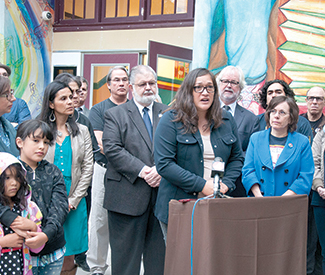
On Aug. 21 and 22, they staged vigils and a march and rally in memory of a different shooting victim: Alejandro (“Alex”) Nieto, who died suddenly in Bernal Heights Park on March 21 after being struck by a volley of police bullets.

Despite palpable anger expressed during the events held to mark five months since Nieto’s death, it was a far cry from the angry demonstrations unleashed on the streets of Ferguson, where it was like something stretched too far and snapped.

People who knew Nieto gathered for a sunset vigil in Bernal Heights Park at the place where he was killed. They returned the following morning for a sunrise vigil, incorporating a spiritual element with Buddhist chanting. Hours later, in a march preceded by dancers who spun in the streets, donning long feathered headdresses and ankle rattles made out of hollowed tree nuts, they progressed from Bernal Hill to the San Francisco Federal Building.

Despite a visible police mobilization, the protests remained peaceful, with little interaction between officers and demonstrators. Instead, the focus remained on the contents of a civil rights complaint filed Aug. 22 by attorney John Burris, famous for his track record of representing victims of police violence.

Burris, who is representing Nieto’s parents, said he rejected the SFPD’s explanation of why officers were justified in discharging their weapons and killing Nieto. “What we will seek to do is to vindicate his interests, his good name, and to show through the evidence that the narrative put forth by the police was just flat-out wrong,” Burris said at the rally.

Nieto’s encounter with police arose because a 911 caller erroneously reported that he had a black handgun, leading police to enter the park in search of a gunman. In reality, Nieto possessed a Taser, not a firearm. On the night he was killed, he’d gone to the park to eat a burrito just before starting his shift as a part-time security guard at a nightclub, where all the guards carry Tasers. In addition to working at that job, Nieto, who was 28, had been studying administration of justice at City College of San Francisco in hopes of becoming a youth probation officer.

Days after the shooting, police said Nieto had pointed his Taser at officers when they approached. At a March 26 town hall meeting convened shortly after the incident, Police Chief Greg Suhr told attendees that Nieto had “tracked” officers with his Taser, emitting a red laser.

“When the officers asked him to show his hands, he drew the Taser from the holster. And these particular Tasers, as soon as they’re drawn, they emit a dot. A red dot,” Suhr said, adding that Nieto had verbally challenged officers when they asked him to drop his weapon. “When the officers saw the laser sight on them, tracking, they believed it to be a firearm, and they fired at Mr. Nieto.”

Yet attorney Adante Pointer, of Burris’s law office, told the Bay Guardian that a person claiming to be an eyewitness to the shooting has come forward with a different account. The witness, whose identity Pointer did not disclose, said he never saw Nieto draw his Taser and did not hear any verbal exchange prior to bullets being fired.

“To suggest that he’d engaged in the most ridiculous outrageous conduct, of pointing a … Taser at the police when they had guns drawn, is insulting,” Burris said at the rally.

The version of events included in the complaint, which Pointer said was based in part on witness accounts, differs greatly from the SFPD account.

“An SFPD patrol car entered the park and drove up a fire trail before stopping approximately 75 to 100 feet away from Mr. Nieto who at that time was casually walking down the jogging trail to the park’s entrance,” Burris’ complaint states. “Two officers emerged from the patrol car and immediately took cover using their car for protection. Several other officers had also gathered on the jogging path, appeared to be carrying rifle-type guns and were positioned behind Mr. Nieto. One of the officers behind the patrol car called out and ordered Mr. Nieto to ‘stop.’ Within seconds a quick volley of bullets were fired at Mr. Nieto. No additional orders or any other verbal communication was heard between the first officer yelling ‘stop’ and the initial volley of gunfire that rang out.”

SFPD spokesperson Albie Esparza told us the department was unable comment on the matter because “anytime there’s a lawsuit, we cease to speak to anybody about that.”

Adriana Camarena, an author and Mission District resident who helped organize the rally, decried the lack of transparency surrounding the Nieto case in comments delivered outside the Federal Building.

“For five months, city officials have kept sealed all records that could explain what happened on March 21 2014,” Camarena charged. “For five months, SFPD, the Police Commission, the District Attorney’s Office, the Medical Examiner’s Office, and the mayor have maintained in secrecy the names of the four officers who killed Alex Nieto, the original 911 calls, eyewitness reports, the number of bullets fired, and the autopsy report. For five months, the Nieto family has been kept in the dark about the facts that could ease some of their trauma about what happened the day that police killed their son.”

Mike Brown was shot and killed by a police officer in Ferguson on Aug. 9. On Aug. 11, following angry demonstrations, police said they would release the name of the officer who shot Brown — but declined to do so Aug. 12, citing fears over the officer’s safety and threats communicated via social media. Yet on Aug. 15, Officer Darren Wilson was identified by officials as the person who shot Brown.

In San Francisco, the names of the four officers who shot Nieto have not been released. Esparza told the Guardian that this was because “there’s specified credible threats against the officers’ lives,” citing a Supreme Court ruling determining that law enforcement agencies can withhold this information under such circumstances.

In addition to the federal civil complaint, friends and supporters of Nieto delivered a petition with almost 1,000 signatures to the U.S. Department of Justice, calling for a federal investigation into the shooting.

Multiple investigations are underway at the local level, but have been stalled due to one missing piece: an autopsy report to be issued by the San Francisco Medical Examiner. Despite the delay in releasing the formal autopsy results, “We did see the body and we did take photographs of it,” Burris noted, referring to his office’s review of the body after it was released to Nieto’s family for burial. Based on that review, Burris said attorneys determined that Nieto had been shot by police more than 10 times.

We placed multiple phone calls to the offices of the Medical Examiner and the District Attorney seeking details about the status of the investigation and to ask about the delay, but received no response.

However Bill Barnes, a spokesperson for the City Administrator’s Office, which the Medical Examiner’s Office reports to, told us the timing of the report is consistent with that of other complex homicide investigations. Barnes added that the Medical Examiner’s Office is waiting on the results of a second toxicology report. The initial results were inconclusive, he said, so another round of testing was initiated.

But that explanation does little to quell the anger of activists who say the SFPD is merely seeking to cover up an unjustified shooting. Pointer said he could see no reason for information being withheld for five months.

“There’s no reason as to why the information that this family deserves as to how their son — our brother, our friend, our leader, our organizer — met his death,” he said at the rally. “There’s just no reason why that story hasn’t been told. If you, the police department, had been justified, why not be transparent? Why not open up your files and let us inspect it so that we can see that what you’re saying is the truth?”

Your official Hardly Strictly Bluegrass lineup is here

0

Ah, fall in San Francisco. The kids go back to school, the pumpkin beers and lattes make their first appearances, the leaves…um, mostly stay the same color, and the weather usually gets a little warmer.

OK, so maybe we don’t really do fall the way most of the country does fall. You know which part we do really well, though? Music. Art. Festivals. Excuses to drink pumpkin beers outside while taking in a live performance. Pick up this week’s big Fall Arts preview issue (on stands now!) for a guide to the best the Bay Area has to offer these next few months in music, theater, film, dance, visual art, and more.

If you want an easy tip, though? The jewel in the Pumpkin IPA Excuse crown is Hardly Strictly Bluegrass, now in its 14th year and free as ever, thanks to the legacy of one mister Warren Hellman. After a month of teaser medleys, the folks from the Slim’s/Great American Music Hall family (who book HSB) announced the full lineup today for this year’s party in Golden Gate Park, which runs Friday, Oct. 3 through Sunday, Oct. 5.

At first glance we’re seeing a lot of big-name veterans (Emmylou, of course, plus the irreplaceable Chris Isaak, Mavis Staples, and more) alongside a number of unexpected but very welcome newcomers, like Sun Kil Moon and LA punk legends X. Other top-shelf indie-folk young’uns adding fresh blood to the scene: Dawes, The Apache Relay, Sharon Van Etten, Waxahatchee. And we’ll never complain about seeing Ryan Adams, Lucinda Williams, Yo La Tengo, or Deltron for free.

We’ll have more to come in the weeks leading up to the fest, but for now — make sure you know where that cooler is. We’re gonna put on some Lucinda Williams. See you in the park.

HARDLY STRICTLY BLUEGRASS 2014

Emmylou Harris

Sister Sparrow & The Dirty Birds

The Apache Relay

The Time Jumpers Featuring Vince Gill

Kenny Sears

Dawn Sears and Ranger Doug Green

Blackie and The Rodeo Kings

Nitty Gritty Dirt Band

X Acoustic

Mavis Staples

Thao & The Get Down Stay Down

Whograss

Jessica Hernandez & The Deltas

Reckless Kelly

Willie Watso

Joe Russo’s Almost Dead

Carlene Carter

The Go To Hell Man Clan

Kevin Welch

Kieran Kane & Fats Kaplin

Sarah Jarosz

Dave Alvin & Phil Alvin with The Guilty Ones

Chris Smither

Justin Townes Earle

Lake Street Dive

Dave Rawlings Machine

Buddy Miller’s Cavalcade of Stars: Kate York

Striking Matches

Nikki Lane

Shawn Colvin

Tony Joe White

Buddy Miller & Friends

Poor Man’s Whiskey (Friday morning middle school program)

Chris Isaak

Robert Earl Keen

Ralph Stanley & The Clinch Mountain Boys

Holler Down The Hollow: A Hardly Strictly Salute To the Masters (Dickens, Hellman, Reed, Scruggs, Seeger, Watson & Winchester)

Built To Spill

John Prine

Ryan Adams

Buckwheat Zydeco

Dry Branch Fire Squad

The McCrary Sisters

Moonalice

Johnnyswim

Hot Rize Featuring Red Knuckles & The Trailblazers

Jerry Douglas Presents Earls of Leicester

The Flatlanders Featuring Joe Ely

Jimmie Dale Gilmore & Butch Hancock

Rising Appalachia

The Mastersons

Peter Rowan’s Twang An’ Groove

Dwight Yoakam

Red Baraat

Bad Luck Jonathan

Lukas Nelson & Promise of The Real

St. Paul & The Broken Bones

Chuck Prophet & The Mission Express ‘Strings In The Temple’

Jesse DeNatale

The Waybacks

The Felice Brothers

Caitlin Rose

Shelly Colvin

Bruce Cockburn

Alison Brown Quintet

Hurray For The Riff Raff

Béla Fleck & Abigail Washburn, Blue Rodeo

Lucinda Williams

The Lone Bellow

Steve Earle & The Dukes

Bill Kirchen & Too Much Fun

Malawi Mouse Boys

Parker Millsap

Rosanne Cash

Deltron 3030 with The 3030 Orchestra

Conor Brings Friends For Friday Featuring: Waxahatchee

The Good Life

Jonathan Wilson

Sharon Van Etten

Dawes

Conor Oberst

Sun Kil Moon

Chuck Cannon

Tweedy

Rose’s Pawn Shop

The Sam Chase

T Bone Burnett

Social Distortion

The High Bar Gang

The Aquabats! (Friday morning middle school program)

Laurie Lewis & The Right Hands

Cibo Matto

Jason Isbell

Robbie Fulks

Yo La Tengo

Evolfo Doofeht


Did Big Soda swing a key endorsement by a progressive democratic club?

0

Did the soda industry buy a prominent progressive political endorsement? Sunday’s San Francisco Chronicle raised the question in a story by Heather Knight, who goes on to air a number of rumors propagated by the soda tax supporters against the Harvey Milk LGBT Democratic Club.

First things first: the sugary beverage tax already has a lot of progressive support. Unions, health groups, and loads of other San Franciscans have backed the two cents per ounce tax on sugary beverages, Proposition E, which is slated to appear on this November’s ballot. The endorsement of “No on E” by the Milk Club is certainly a bit out of left field, and rightfully raised eyebrows in political circles.

That’s the argument Knight uses in her Sunday article, using a few quotes from the soda tax’s paid public relations’ people to take a big swing at Sup. David Campos, alleging this is a big ole scheme he’s orchestrated in order to get Coca Cola’s money to fund the Milk Club’s slate card, which would also feature Campos, giving him a boost in his Assembly race against Sup. David Chiu.

It’s a seemingly convincing scenario, and we’re not soothsayers. Maybe it’s true. But there are a number of reasons to not believe the hype.

First, we at the Guardian heard those same rumors and whispers too, but that wasn’t all we heard. One politico told us the beverage industry might be funding the Milk Club with $300,000 in campaign funds for their November ballot fliers. Our reaction was “um, what?!”

That’s more money than techie-billionaire Ron Conway spent backing Mayor Ed Lee’s major pet projects on the June ballot. Hell, it’s more money than some candidates raise in their entire races. That should’ve been the first red flag for the “soda milking the Milk Club” theory, but it wasn’t the last.

Second, though the club did accept money from the American Beverage Association, it wasn’t anywhere within spitting distance of $300,000. Tom Temprano, co-president of the Milk Club, told us they accepted $5,000 from the beverage industry to put on their annual gala. For context, SEIU Local 1021 donated $4,000 to the dinner. This is all data that would come out publicly in a few months through ethics filings anyhow, but long after the rumor of big beverage industry money would’ve caused its damage.

“All you get for sponsoring our dinner is a mention in the program and a plug on the stage,” Temprano told us. “If the [beverage industry] paid us anywhere near what the rumors are, I would’ve flown out Elton John to serenade [Assemblymember] Tom Ammiano in person.”

Though the $5,000 is not chump change to the Milk Club, its leadership doesn’t make endorsement decisions, which are enacted by a vote of the club’s members. In a heated exchange last week, Milk Club political wonks batted soda tax points back and forth like a beach ball. There was hardly a consensus on the matter.

“They didn’t vote the way I wanted but the process was very democratic,” Sup. Eric Mar told us. Mar was one of the authors of the soda tax, and even he doesn’t believe the Milk Club’s palms were greased by big soda’s big money.

“I feel that there are rumors being spread to undercut the integrity of the Harvey Milk Club, the strongest progressive voice and political leadership in the city right now,” he said. “I stand behind them even though they voted no on [the soda tax].”

Laura Thomas, co-president of the Milk Club, told us she is actually in favor of the soda tax. It’s easy to see why. As Deputy State Director of the Drug Policy Alliance, she has day-to-day experience with public health, and she sees the far reaching affect of soda’s loads of sugar on San Francisco’s kids.

“I do support [the tax], and I’ve spoken passionately for it in our meetings,” Thomas told the Guardian. “I’d say it’s something we’re passionate on all sides about.”

The last stickler in the money-influence theory is a bit trickier. Many we talked to traced some of these rumors back to Chiu’s campaign spokesperson, Nicole Derse. When we spoke to her, she pounced on the subject like a hyena on carrion.

“The Harvey Milk Club has sold out to the soda industry,” she told us. “What would Harvey Milk think of this gross display of hypocrisy? David Campos needs to answer some serious questions on his position on the soda tax and his campaign.”

Notice how she shifted the Milk Club assertion, which we asked her about, straight into a Campos critique. She’s affable, she’s smart, but in that moment, Derse also sounded gleeful.

We then asked Derse if the rumor about the Milk Club and Campos came from her.

“I am not the person that started this rumor. But do you really think it’s a coincidence David Campos is broke and needs a vehicle to fund his campaign? I think it speaks for itself, if it happens,” she said. “If the Milk Club does not take hundreds of thousands of dollars from the American Beverage Association, I will happily be wrong.”

Actually, when it comes to spreading rumors through news outlets, being right or wrong doesn’t really matter. All you need to do is raise the question of impropriety, proof or no. It’s grandma’s classic recipe for a good political smear, as old as the hills, and very, very easy to do.

Update [8/26]: This story stirred up quite a bit of controversy, and folks called, emailed, Facebooked and Tweeted at us with one point: sure the Milk Club didn’t take all that much money from the American Beverage Association for the gala, but what about the future? Would they take a large sum from the ABA? Tom Temprano answered: “I find that completely unlikely. I’m going to say that’s not a situation we’re going to be in. But I haven’t had a conversation with anyone with anybody about money yet. Our entire board and PAC chair make decisions on fundraising.”

So there you are. If a donation in the tens of thousands of dollars should land on the Milk Club’s doorstep, Temprano is now on the record.

Federal complaint filed over death of Alex Nieto as supporters vow to keep fighting

Protests have sprung up throughout the week in San Francisco, Oakland, and nationwide in response to the police shooting of 18-year-old Mike Brown in Ferguson, MO.

This afternoon [Fri/22], at the San Francisco Federal Building, a similar rally took place – only this one was in memory of a different shooting victim, Alejandro (“Alex”) Nieto, who was gunned down by San Francisco police officers five months ago. Nieto, who died at the age of 28, had been pursuing a career as a juvenile probation officer and studying at City College of San Francisco. 

There’s much to say regarding recent developments in this case – Attorney John Burris, who is representing Nieto’s parents, Refugio and Elvira Nieto, filed a federal civil rights lawsuit today alleging wrongful death and violation of civil rights.

Shortly before Nieto was killed on March 21, a person had dialed 911 to report seeing a man in Bernal Heights Park with a gun. In reality Nieto, who worked part-time as a security guard, had a Taser in his holster, not a firearm. But the call sent police vehicles racing into the park in pursuit of a gunman.

What transpired next is in dispute: Police say Nieto pointed his Taser at officers, causing them to mistake it for a firearm and discharge their weapons. Yet Burris offered a very different account in the federal complaint, based on the account of an eyewitness, audio recordings, and other information gathered independently by attorneys and community supporters. “Based upon the witnesses’ accounts there, in fact, was no justification for this unwarranted use of deadly force as contrary to the Defendants’ claims, they did not hear Mr. Nieto threaten anyone or see him attempt to grab or point any object at the officers prior to being shot,” the compaint charges.

Investigations currently underway at the local level have been delayed by a Medical Examiner’s report, according to attorney Adante Pointer, who works with Burris. The Medical Examiner’s office did not return phone calls from the Bay Guardian, but Bill Barnes, a spokesperson for the City Administrator, said in an interview that the Medical Examiner’s office is waiting on the results of a toxicology report. Initial results were inconclusive, Barnes added, so another round of testing is underway.

Look for a more in-depth story in next week’s Bay Guardian.

But for now, give a listen to what activism around issues of police violence sounds like when it’s coming out of the Mission District of San Francisco.

Longtime organizer Roberto Hernandez, who worked alongside his father and Cesar Chavez decades ago in the United Farm Workers’ movement, delivered some comments outside the San Francisco Federal Building today when activists who had marched from Bernal Heights Park gathered for a rally in memory of Nieto. Hernandez was there with his son, Tito, who also led the crowd in some chants.

Koch brothers and other right-wing outsiders challenge Bay Area minimum wage measures

0

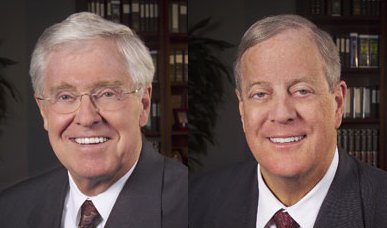
In recent months, San Francisco and Oakland have unveiled ballot measures that would raise minimum wage for workers currently struggling with the Bay Area’s rising cost of living. But as November draws closer, a network of right-wing organizations — with ties to the infamous Koch brothers — have been funding campaigns aimed at convincing workers that low wages are actually better for their livelihoods.

“Two of the richest men in the world are spending millions to hold down low-wage workers and that is just immoral,” said Roxanne Sanchez, President of Service Employee International Union Local 1021, who organized Raise the Bay, a series of efforts to raise minimum wage in cities around the Bay Area. 

SEIU leaders and local journalists have chided the Koch brothers and their right-wing ilk for funding campaigns aimed at dissuading the public from voting on higher minimum wages in the area. The Koch brothers are heirs to an oil fortune and are notorious for influencing national and state politics through so called “dark money” groups, which are not obligated to disclose financial information, including their donors.

An initial $200,000 campaign was launched by the Charles Koch Foundation in July. A well-produced advertisement, which ran in Wichita, Kansas, asserts that people earning $34,000 are already on the “road to economic freedom.” Charles Koch later told the Wichita Eagle newspaper that minimum wage is an obstacle preventing workers on limited income from “rising up.”

In the Bay Area, conservative media outlet CalWatchDog — which is funded by a group of right-wing investors, including the Koch Brothers — criticized Oakland politicians for voting down a diluted alternative to Oakland’s primary minimum wage initiative, Raise Up Oakland. CalWatchDog claimed the local leaders’ decisions were largely influenced by labor union contributions, which was later proven to be a case of political chicanery.

Similarly, in San Francisco, conservative lobby group Employment Policies Institute funded a billboard that reads: “With a new $15 minimum wage, employees will replaced by less costly, automated alternatives.” It also advertises a website called BadIdeaCA.com, which shares similar predictions.

Employment Policies Institute receives donations from Lynne & Harry Bradley Foundation, a Wisconsin nonprofit that also contributes to anti-abortion, anti-environment, and anti-LGBTQ campaigns. The Lynne & Harry Bradley Foundation also donates to CalWatchDog.

In San Francisco, income inequality is growing at an alarming rate, and San Francisco’s ballot initiative hopes to help workers survive in the changing economic landscape.

And leaders of SEIU Local 1021 say they will continue to challenge the Koch brothers and their campaigns to thwart Bay Area wage increases. “The Koch Brothers might be billionaires, but they don’t have enough money to hold us back,” said Pete Castelli, executive director of Local 1021. “We challenge them to crawl out from under their rock, shine a light on their plans, and publicly debate workers about raising the minimum wage.”

Not just an Animal Collective side project: Entering the Slasher House with Avery Tare

0

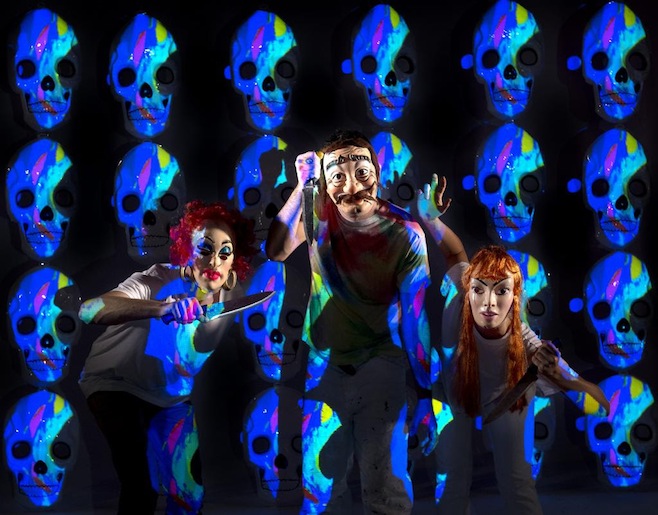
In spite of music videos that are more than vaguely reminiscent of the horror film genre — not to mention the band’s name — the “jazz power trio” of Avey Tare’s Slasher Flicks are far more than some campy side project.

Comprised of multi-instrumentalist and founding Animal Collective member Avey Tare, Angel Deradoorian (of Dirty Projectors, Deradoorian) on keyboard, and drummer Jeremy Hyman (of Ponytail, Dan Deacon), Slasher Flicks aim to make sounds that “come from a place that’s not human.” Live music fans will be happy to hear that the group used only minimal overdubs while recording their debut album Enter the Slasher House (out this past April), which is somewhat of a rarity amongst many of today’s crispy jams — and also something that’s immediately evident when Slasher Flicks take the stage.

Avey Tare, aka Dave Portner, spoke to the SFBG about one of his favorite places to play, letting each band member’s personality shine through, and creating an experience for the audience where they can synonymously get lost in something and feel like part of a collective. Avey Tare’s Slasher Flicks will be playing LA’s FYF fest this weekend before making their second visit to the Great American Music Hall this Sunday the 24th.

San Francisco Bay Guardian You’re clearly a person who likes to stay busy, considering the Slasher Flicks tour and the Animal Collective DJ sets that have been popping up recently. As far as live performances go, do your various projects satisfy different creative needs? I’m thinking about the elaborate stage set up for the Centipede Hz tour, which makes anything else seem minimal, really. Or are the props irrelevant and it’s more about the kind of work you get to produce?

Avey Tare I think the longer I play with Animal Collective or even just make music in the live realm the more interested I become with creating some all encompassing submersible experience. Who knows where this will go next. I’ve reached a point personally and creatively where I want to go beyond just showing up at clubs and playing live. This probably has a lot to do with the fact that my interests are deep in the visual art and film world. That said I have been enjoying the more minimal set up with Slasher Flicks. It’s nice to just set up and jam and have that be that. As long as our fans can get lost in something or feel like they had some unique experience then I’m happy.

SFBG How was it that Jeremy, Angel, and yourself came together to form Slasher Flicks? You’ve been cited as the main songwriter for most of the Animal Collective albums, but for Enter the Slasher House you crafted an outline of sorts for the songs on acoustic guitar, and let Angel create melodic lines to flesh them out.

AT Sort of. All of my songs do start on on a skeletal level.  It really depends on what is needed after that or how I want them to be produced. Each song requires its own place and sounds and atmosphere.  A lot of the melodic lines for Slasher Flicks were actually written by me but when it comes down to playing something with other people, you don’t really know what its going to be like til everyone is playing it. For me it’s crucial that Jeremy’s and Angel’s personality gets to shine through so a lot of the rhythms and melodies are sort of loosely placed and left open for their embellishments or reworking etc. You just sort of know when everything clicks. It’s more of a feeling. That’s what playing music with people is about for me. It’s definitely a collective experience, and when you can make your audience feel a part of that collective, then it’s even more rewarding.

Angel and I have been a couple for awhile now. Because we are around each other in creative situations and so aware of how each of us operate it has always just seemed natural that we would work on something together especially ’cause of the respect we have for each other’s talents. I met Jeremy through Angel, actually, but was immediately into his drumming after seeing him play a bunch over the last few years.  For some reason I just got it in my head that I wanted to do a collection of songs for a three-piece. Once the songs were written it seemed logical to ask Jeremy and Angel to play them. I guess we are lucky in that we melded very easily.

SFBG Last year Slasher Flicks opened up for Deerhunter at the GAMH before Enter the Slasher House was released. Are you looking forward to returning to the venue and headlining this time? I was fortunate enough to attend that first show, but after being able to listen to the album at home I realize all the more how fitting the GAHM is for the music — especially the bouncy, funhouse-feel of “Little Fang.”

AT I love Great American. It’s definitely my favorite place to play in SF and one of my favorite places anywhere. I have great memories from playing shows there. I think this size venue is probably my favorite to play.

SFBG Speaking of “Little Fang,” the video for the song was directed by your sister (Abby Portner) yet it still has that undeniable Animal Collective hallmark — sharing similar aesthetic qualities to ODDSAC (a visual album collaboration between AC and Danny Perez). I know that ODDSAC took over four years to complete. How has the process of marrying the audio and visual changed for you since working on that project?  

AT ODDSAC was unique in that we were trying to write the music and make the sounds as the videos were being created and attempting to piece it together as a whole while we worked. It also took awhile because we were working on other records during the process, as well. It’s always tough putting visuals to my/the groups music because I always have such intense feelings and visuals attached to it that are inside of me.  There is often a moment where I have to just give up the resistance to someone else’s vision of the music. It can be tough, but it’s been really rewarding so far and taught me a lot about what I like and don’t like. 

AVEY TARE’S SLASHER FLICKS

Sun/24, 8pm, $16

Great American Music Hall

859 O’Farrell, SF

www.slimspresents.com

Eyewitness claims victim of officer-involved shooting did not brandish Taser

A person claiming to be an eyewitness to the fatal shooting of Alejandro Nieto has come forward to say he did not see Nieto point a Taser at police officers before they opened fire, according to attorney Adante Pointer, who is representing Nieto’s family.

The eyewitness, whose identity Pointer would not disclose, told the attorney that he “did not see Alex point a Taser at anybody” and “did not see or hear any back-and-forth exchange that police said took place,” Pointer said in a phone interview with the Bay Guardian.

At a March 26 town hall meeting convened shortly after the officer-involved shooting, which occurred on March 21 in Bernal Heights Park, San Francisco Police Chief Greg Suhr told attendees that Nieto, a 28-year-old City College student, had “tracked” officers with his Taser in the moments before police discharged their weapons.

“When the officers asked him to show his hands, he drew the Taser from the holster. And these particular Tasers, as soon as they’re drawn, they emit a dot. A red dot,” the police chief said, adding that Nieto had verbally challenged officers when they asked him to drop his weapon. “When the officers saw the laser sight on them, tracking, they believed it to be a firearm, and they fired at Mr. Nieto,” Suhr said at the time.

Pointer said the person who claims to be an eyewitness did not know Nieto, and had no connection to the incident aside from having been in the park on the night that the shooting occurred.

He said that because the San Francisco Police Department was not forthcoming with information in the months following the shooting, “we launched our own investigation to get to the bottom of this.” The eyewitness came forward after his office initiated a concerted effort to gather information, he added.

Pointer, who works with the Law Offices of John Burris, plans to file a federal civil complaint against the city tomorrow [Fri/22].

Today [Thu/21] marks five months since Nieto’s death. Supporters plan to gather in Bernal Heights Park for a 7pm sunset vigil. They’ll return at 5am the following day for a sunrise vigil, featuring Buddhist chanting and a reading of the names of those killed by the SFPD in past decades, according to an event announcement.

Later that day, also at Bernal Heights Park, friends and supporters of Nieto plan to gather at noon for a non-violent “March for Civil Rights Against Police Killings!” The march will progress from Bernal Heights Park to the Federal Building on Golden Gate Avenue, where Pointer will file the complaint.

Researcher explores police and protester violence in the Occupy movement

0

As the nation’s eyes watch police officers in Ferguson firing rubber bullets and tear gas into crowds of protesters, one UC Berkeley sociologist is exploring how and why such violent conflicts erupt in the first place.

Nicholas Adams and his team call themselves Deciding Force. Its goal? To prevent violence between police and protesters at peaceful demonstrations through deep data analysis of the Occupy movement.

“There’s a misconception that police have a single style or repertoire to approaching protests,” Adams told the Guardian. “They have a range, and they should know better how to use these tools.”

Adams hopes to facilitate free speech by demonstrating best practices in nationwide police tactics, to allow peaceful protesters to trumpet their message without the threat of violence. The study, he said, is made possible by the variety of geographic locations the Occupy movement took place in. The different municipalities and varying levels of police use of force provided a buffet of data for Adams and his fellow researchers to compile and parse.

A video about the project.

They started with news reports of various Occupy movements nationwide, which were then compared to other local and national news articles for accuracy and to help identify bias. Even that process revealed interesting data, he said.

“Media bias is most often a bias of omission,” he told us. “You go to protest events and what happens most often is a news outlet won’t report on it. Fox News outlets across the country reported on the Occupy movement at drastically low rates. If an ABC affiliate reported on an Occupy (encampment) 100 times, Fox News affiliates reported it three times.”

The researchers then handpick relevant data from those news articles and broadcasts. The next step is even trickier (and wonderfully geeky).

Adams and the researchers trained computer programs to pick similar data from the over 8,000 news reports, automating the process. Articles from Boston, Chicago, New York, San Francisco, and more than 200 cities with Occupy movements are parsed for patterns. Did the police wear riot gear? What formations did they use? Were horses present? Assault vehicles? Was the crowd mostly Latino, black, white, Asian, or a mix? Were the Occupiers sitting or standing? These are the few of the hundreds of variables crunched by Adams’ team. 

After the variable compiling, the computer’s usefulness ends and the human element picks up again, as Adams and his sociologists then sift through the patterns to see what elevates conflict between police and protesters. In the end, he hopes to be able to show police departments what specific actions can de-escalate violent situations.

The team has been at it for two years, and already the data is yielding some results. Police skirmish lines, for instance, are a heavy indicator that violence will occur.

“You’re facing off against protesters,” he said. “It’s called a skirmish line for a reason. You’re setting up skirmishes.”

But Adams’ research isn’t just about aiding police forces, it’s about holding them legally accountable for escating violence, he said.

“You can start to, from a legal standpoint, establish liability with research like ours,” he told us. “If we reach out to police departments later on attorneys can hold them accountable for their actions.”

And with that information in hand, maybe future incidents like the clashes in Ferguson may be prevented. At the very least, there may be a stronger legal mechanism with which to hold police accountable for clashes with citizens.

You can read more about Deciding Force’s research here, and support them through their IndieGoGo campaign

American landscapes: a review of SF native Sean Wilsey’s essay collection, ‘More Curious’

0

Midway through the introduction to More Curious (McSweeney’s Books, 342 pp., $22), his recently-published collection of essays from the last 15 years, Sean Wilsey (who appears at the Booksmith Thu/21) reveals his quest to combine the styles of Thomas Pynchon and New Yorker legend Joseph Mitchell — paranoia and precision, respectively.

The introduction itself is a joyfully meta attempt at this very task. The 20-odd pages of often non-sequitorial rumination about the aforementioned authors, the triviality of the 1990s, and the first Obama election can be mistaken as “formless while still astonishingly informative” or “so intricately constructed and fact-filled that the form is too complex to be instantly identified.” The happy reality of all of Wilsey’s essays is somewhere between these two perceptions.

The author, a San Francisco native who now lives in Texas, never entirely abandons the expository air of classic feature writing, but he injects his work with enough personal and manic energy to identify it as decidedly 21st century. While Wilsey recognizes (very humorously) the bombast of comparing oneself to two of the greatest writers of the modern era, his writing does occupy the rarefied territory between Mitchell’s organization and Pynchon’s stream-of-consciousness and is the perfect tone for the frenetic and absurd subjects that make up his collection. 

The primary symptom of Wilsey’s ability to be both informative and emotionally kinetic is how seamlessly he intertwines personal narrative with reference. Never in the collection did I feel jolted when Wilsey inserted a block quote of an email correspondence with a NASA engineer or a quote from Beowulf. To the contrary, Wilsey’s deft research and allusion bolsters his personality — his rabid search for answers would feel anti-climactic without the primary source of his findings.

In this layered memoir about a surreal, Travels With Charley-inspired road trip across the US, WIlsey invokes the social science of George Trow’s “Within the Context of No Context” to discuss America’s obsession with celebrity culture. This graceful quote (which includes the biting “Television is dangerous because it operates according to an attention span that is childish but cold”) is the proverbial Mitchell, a disciplined and timely revelation of a concept that makes a point about the collective. But after Wilsey realizes that the backups he causes in his impossibly slow 1960 Chevy Apache pickup have halted the transport of military and retail goods, he brings the Trow allusion into the paranoid — he is the free spirit holding back the movement of inanimate celebrity, the Pynchonian radical wrench in the machine.

In the majority of Wilsey’s 15 essays he creates a similar dichotomy between colorful reporting and intense feeling. In “Some of Them Can Read,” Wilsey throws together dozens of facts about New York’s rat population (with the titular affirmation only half as disturbing as the most grotesque truisms about the beasts) while waxing philosophical about the special place of paranoia that rats inhabit for new fathers. In his ode to skateboarding, “Using So Little,” Wilsey gives a detailed cultural history of the art (or sport, though he rejects this branding) while discussing the personal escape it allowed for him in the topsy-turvy world of the 1980s San Francisco urban haute bourgeoisie. And in “The Objects of My Obsession,” he breaks down Craigslist culture while revealing his increasingly pagan and obsessive relationship with the site and the epic journeys its resultant acquisitions afford. 

It’s often difficult to tell how Wilsey avoids a simple deductive pattern of conceptual to personal — this tendency plagues an overwhelming majority of confessional and “new” (if we’re in 1968) journalists, though is perfectly reasonable given the desire to adequately prove to the reader that the article has educational value before the author unleashes his idiosyncrasies onto the page. The constant back-and-forth between personal experience and cultural analysis keeps the writing from becoming predictable or repetitive. I got to know Wilsey, assuredly, but he was always capable of surprising me.

Near the end of “The World I Want to Live In,” a dialectic on the quirkiness of World Cup soccer that, unlike almost anything else in the book, feels vaguely dated (it was originally published in 2006) after the recent explosion in domestic popularity of the event, Wilsey digresses into a several-page breakdown of the most memorable aspects of the 1970 World Cup. The shift is so within the narrative but also just so damn trivial — that Wilsey includes it in full (and it is one surprisingly complete digression of many, I assure you) helps him carve out a space beyond Mitchell and Pynchon, where the voracious Wikipedians among us are sated without even having to ask. 

Wilsey’s tendency to elevate his Mitchell-influenced addenda to levels of specificity only possible in the Internet age allows his work, when taken in full, to feel generation-defining. Wilsey, now almost 45, has grown through the advent of the second millennium from being identified as the son of controversial socialites to an ubiquitous magazine contributor to a recognized literary voice. The paranoias that have seemingly driven his modern humanist journey are just as intense as those of any other time — fatherhood, vocation, separation from parents, guilt are pretty timeless fuels.

In fact, in the post-9/11 world they may even be elevated — Wilsey lived near the World Trade Center and constantly invokes his personal fear of the attacks throughout the collection, even including an essay about his attempts to help grieving relatives in the immediate aftermath. Access to anecdotes, minutiae, and statistics, however, is an emotional comfort and storytelling tactic that is far more complete now than it was in the heydays of Wilsey’s literary idols. It is this timeliness of style, alongside self-awareness and acknowledgement of the past, that makes Wilsey’s collection feel unified and a welcome chronicle of our age.  

Check back for an interview with author Sean Wilsey, coming soon!

Sean Wilsey

Thu/21, 7:30pm, free

Booksmith

1644 Haight, SF

www.booksmith.com

Patsy Cline Tribute with Joni Morris at Vallejo’s Historic Empress Theatre

0

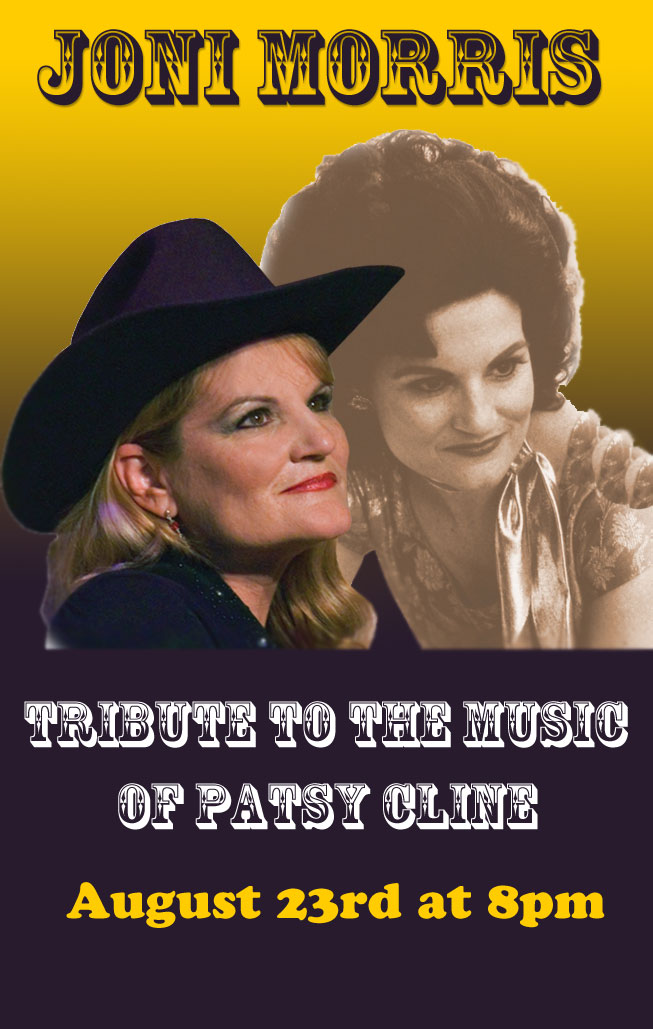
Joni Morris and her stellar band bring to life the music of Patsy Cline at the beautiful, century-old historic Empress Theatre in Vallejo for a night of legendary music in a majestic setting.

Enter to win a pair of tickets by emailing RSVP@sfbg.com with ‘Joni Morris’ in the subject lline.


“It’s almost spooky how Joni Morris conjures up Country Western Legends…with tremendous style and fidelity!” – Edward Guthmann, San Francisco Chronicle


Saturday, August 23

8:00pm; Ticket Price: $20

Empress Theatre, 330 Virginia St., Vallejo  (707) 552-2400


www.empresstheatre.org 

Sixth at the Syc

0

culture@sfbg.com

THE WEEKNIGHTER “This place sucks now. I mean what the fuck is going on in SF?” Chloe was visiting from either Portland or LA or wherever it was she was living that wasn’t San Francisco anymore. A few of us were sitting around, drinking in the 4pm light at the front window of The Sycamore (2140 Mission, SF. www.thesycamoresf.com). A handful of folks had come out to see Chloe since she was just around for a couple days and as usual when you don’t see someone for awhile, it became a “remember when…” conversation.

“I think San Francisco is better off since the Arrow Bar closed down,” I was telling Richie Panic. “Yeah,” he responded, “you didn’t hang out at the Arrow Bar, you did time there.” In the early and mid 2000s The Arrow Bar was the ultimate hipster den of vice and many of the people around the table had all met each other there and somehow survived. Considering the bar had been on Sixth Street near Market, someone at the table made a joke about more blow being done in the bar than crack being smoked outside it, to which we all laughed. It was probably true.

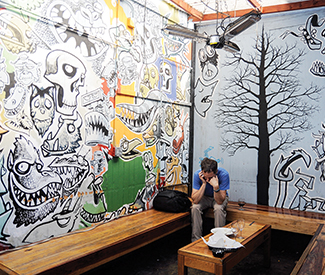
Somebody got up for another round of drinks. Since The Sycamore only has wine and beer he brought back a clutch of Miller High Lifes and we resumed the game of Cards Against Humanity that we weren’t really playing. The Sycamore is perfect for this kind of afternoon. Art lines the walls and beer handles that aren’t being used at the moment hang from the ceiling. Board games are conspicuously stacked so that anyone can play them and a jukebox is stuffed with all the right tunes. It’s good for place to while away an afternoon with friends and watch the wackjobs of Mission Street putter by at a laconic pace.

“Have you been over there lately?” I asked Chloe, bringing the conversation back to The Arrow Bar. “I mean, they’ve by no means cleaned it up, but it is actually getting slightly better.”

“Ha! Could you imagine that?” she laughed. “How many seismic cultural twists would San Francisco have to go through to see a cleaned-up Sixth Street? The day Sixth Street isn’t the shadiest street ever is the day San Francisco is officially dead.” She had a point.

I headed to the bathroom and along the way saw one of my stickers on the water cooler. I didn’t know if I’d put it there or if someone else had. It’s often hard to remember details about the last time you were in a bar. When I got back to the table I was excited to see that the magic trick had worked again. You know the magic trick: It’s when you come back to the table and the food that you’d ordered earlier is miraculously there. We all dived into the fries, sliders, and pork belly doughnuts like the drunk people we were.

After eating and drinking some more, people began to head off in their own directions on whatever adventure their day-drinking would lead them on. I said bye to whomever was still left and gave Chloe a hug. “It’s really weird,” she said. “I basically grew up here, and it’s like every time I come back to visit, it’s so drastically different that I barely recognize it.”

I walked out Sycamore’s door, turned around, and did my best Humphrey Bogart, “At least we’ll always have Sixth Street.” And then I went home.

Stuart Schuffman aka Broke-Ass Stuart is a travel writer, poet, and TV host. You can find his online shenanigans at www.brokeassstuart.com


Rep Clock: August 20 – 26, 2014

0

Schedules are for Wed/20-Tue/26 except where noted. Director and year are given when available. Double and triple features marked with a •. All times pm unless otherwise specified.

ANSWER COALITION 2969 24th St, SF; www.answersf.org. $5-10 donation. A Good Day to Die (Mueller and Salt, 2010), Fri, 7. With film subject and American Indian Movement (AIM) co-founder Dennis Banks in person.

BALBOA 3630 Balboa, SF; cinemasf.com/balboa. $10. “Thursday Night Rock Docs:” Anvil! The Story of Anvil (Gervasi, 2008), Thu, 7:30.

CASTRO 429 Castro, SF; (415) 621-6120, www.castrotheatre.com. $8.50-11. •We Are the Best! (Moodysson, 2013), Wed, 7, and Ladies and Gentlemen, the Fabulous Stains (Adler, 1981), Wed, 9. •Mr. X: A Vision of Leos Carax (Louise-Salomé, 2014), Thu, 6; Mauvais Sang (Carax, 1986), Thu, 7:25; and Before Sunset (Linklater, 2004), Thu, 9:35. Triple-feature, $12. •Streets of Fire (Hill, 1984), Fri, 7:30, and The Warriors (Hill, 1979), Fri, 9:20. “Peaches Christ’s Night of 1,000 Showgirls:” Showgirls (Verhoeven, 1995), Sat, 8. Annual celebration of the camp classic, with a “Volcanic Goddess” pre-show, special guest Rena “Penny/Hope” Riffel, and more; tickets ($25-55) at www.peacheschrist.com. •The Leopard (Visconti, 1963), Sun, 2:30, 7. •The Dance of Reality (Jodorowsky, 2013), Tue, 7, and Jodorowsky’s Dune (Pavich, 2013), Tue, 9:30.

CLAY 2261 Fillmore, SF; www.landmarktheatres.com. $10. “Midnight Movies:” Cannibal Holocaust (Deodato, 1979), Fri-Sat, midnight. With actor Carl Gabriel Yorke in person.

COURTHOUSE SQUARE 2200 Broadway, Redwood City; www.redwoodcity.org. Free. The Croods (De Micco and Sanders, 2013), Thu, 8:45.

EMBARCADERO One Embarcadero Center, SF; www.turkishfilmfestivals-usa.com. Free. “Turkish Film Festival:” Love Me (Gorbach and Bahadir Er, 2013), Wed, 7; Oh Brother (Uzun), Wed, 9; Only You (Yonat), Thu, 7; My World (Yücel, 2013), Thu, 9.

EXPLORATORIUM Pier 15, SF; www.exploratorium.edu. Free with museum admission ($19-25). “Off the Screen:” “Soundwave ((6)) (sub)mersion,” Thu, 7; “Imagine Science Film Festival,” Fri, 7 (this event, $5-10).

GOETHE-INSTITUT SF 530 Bush, SF; www.goethe.de/ins/us/saf/enindex.htm. $5 suggested donation. “100 Years After WWI:” Poll (Kraus, 2009/2010), Wed, 6:30.

JACK LONDON FERRY LAWN Clay and Water, Oakl; www.jacklondonsquare.com. Free. “Waterfront Flicks:” The Lego Movie (Lord and Miller, 2014), Thu, sundown.

NEW PARKWAY 747 24th St, Oakl; http://thenewparkway.com. $10. Mrs. Judo (Romer, 2012), Sun, 3. With filmmaker Yuriko Gamo Romer in person.

PACIFIC FILM ARCHIVE 2575 Bancroft, Berk; (510) 642-5249, bampfa.berkeley.edu. $5.50-9.50. “The Brilliance of Satyajit Ray:” The Home and the World (1984), Wed, 7; Deliverance (1988), Sat, 6:30; An Enemy of the People (1989), Sun, 5. “Martin Scorsese Presents Masterpieces of Polish Cinema:” Man of Iron (Wajda, 1981), Thu, 7. “Over the Top and Into the Wire: WWI on Film:” Paths of Glory (Kubrick, 1957), Fri, 7. “Kenji Mizoguchi: A Cinema of Totality:” Princess Yang Kwei-Fei (1955), Fri, 8:45. “Rude Awakening: American Comedy, 1990–2010:” Zoolander (Stiller, 2001), Sat, 8:15; Knocked Up (Apatow, 2007), Sun, 7.

ROXIE 3117 and 3125 16th St, SF; (415) 863-1087, www.roxie.com. $6.50-11. “Here and Far,” local shorts, Wed, 7. The Dance of Reality (Jodorowsky, 2013), Wed, 9. Kink (Voros, 2013), Wed-Thu, 7, 8:45. “Nippon Nights:” Akira (Otomo, 1989), Thu, 8. “SF Heritage: Reel San Francisco Stories,” screening and lecture, Thu, 6. This event, $10-15. Me and You (Bertolucci, 2012), Aug 22-28, 7, 9 (also Sat-Sun, 3, 5). Rich Hill (Tragos and Palermo, 2014), Aug 22-28, 7, 9 (also Sat-Sun, 3, 5). “Roxie Kids:” Astro Boy (Tezuka, 1980-81), Sun, 2. “This Must Be the Place: End of the Underground 1991-2012,” short films, Mon, call for time.

SMITH RAFAEL FILM CENTER 1118 Fourth St, San Rafael; (415) 454-1222, www.cafilm.org. $6.50-$10.75. Alive Inside (Rossato-Bennett, 2014), Wed-Thu, call for times. Frank (Abrahamson, 2014), Aug 22-28, call for times. “Alec Guinness at 100:” The Lavender Hill Mob (Crichton, 1951), Sun, 4:30, 7.

YERBA BUENA CENTER FOR THE ARTS 701 Mission, SF; www.ybca.org. $8-10. “Invasion of the Cinemaniacs:” The Exile (Ophuls, 1947), Sun, 2. *


20th street soul

0

esilvers@sfbg.com

LEFT OF THE DIAL It’s a common refrain among the bundled, peacoat- and scarf-sporting masses around this time of year that San Francisco doesn’t really have a summer. But those of us who’ve been here a while know this isn’t exactly accurate: Summer just kinda takes place during fall. If seasons were party guests, San Francisco’s summer would be the guy who shows up at 2am, bearing a bottle of good tequila, ready to dance. Unless you’re college-aged or younger and have to go back to school just as the weather turns toasty, only to stare longingly out the classroom window imagining the fun you could be having — my apologies, I’ve been there — there’s something really special, almost secretive-feeling about a warm September late afternoon.

On Saturday, Aug. 23, consider the 20th Street Block Party, brought to you by Noise Pop, to be your gateway — a kickoff, really — to “real summer.” This free annual shindig, now in its second year, will see a mighty fine lineup of local bands (ones that don’t usually play for free, like Rogue Wave, Cayucas, Melted Toys, The Bilinda Butchers, etc.) entertaining all afternoon long, while food from the veritable gourmet wonderland that has sprung up on 20th street in the Mission will be available in wallet-friendly, portable portions. What more you could ask for?

Among the acts we’re most excited for is Myron & E, a soul duo that’s had a pretty big year. After the release of Broadway last year — a 10-track powerhouse of a debut, featuring warm, plaintive vocals dancing the line between neo-soul and R&B from both singers, the Soul Investigators as a backing band, and the overwhelming sense of having arrived in a time machine from another era — the two have gotten used to life on the road during a whirlwind of touring, making fans in some surprising places. Russia, in particular, went well recently, says Eric “E da boss” Cooke.

Still, “[The record’s] been a slow-burner, a lot of people are just finding out about it. Which is great, it still has momentum, people are still discovering us,” says E, a New Jersey native known for his gargantuan record collection, who’s been producing hip-hop records in the Bay for nearly a decade and a half now — alongside DJ Nick Andre, he’s known in the Bay as the producer of more than a dozen on the Slept On label. E also doubles as a member of the Oakland independent hip-hop royal family Blackalicious; members of which guested on his underground 2007 hit, “Go Left,” while signed to the SF-based Om label.

When label heads there were interested in a follow-up using instrumentals instead of samples, he reached out to the Soul Investigators; they asked him to sing on one of their songs in return. E reached out to Myron (Glasper), a dancer-turned-singer who came up in LA (he cut his teeth dancing on In Living Color), another sometime member of Blackalicious, to join him on the track. Something clicked. Broadway had the sound of instant, organic hit when it dropped last summer on Stone’s Throw records, with disco basslines, bright horns, and classic soul grooves for days, anchored by the pair’s call-and-response vocals, which are by turns seductive, goofy, unconcerned with being perfect but somehow, simultaneously, almost too smooth. These are party starters, these are roller disco anthems, these are love ballads; they are everything in between. The live instrumentation gives the tunes an organic sensibility that’s (unfortunately) all too rare in soul/hip-hop hybrids as of late. Whatever the reason, you honestly can’t help but dance.

“Sometimes we write together, sometimes we write separately and come together after,” says E. As for how their relationship’s evolved after the last year of nearly non-stop touring together? Do they ever butt heads while writing?

“That’s maybe the only time we don’t butt heads,” says E with a laugh. “No, we have a certain chemistry. And, you know, we’re having fun. It just works.”

As for the rest of the year, E says they hope to get back into the studio to start working on a follow-up by December. Until then, we’d recommend taking advantage of any chance to see ’em you get.

MYRON & E

1pm on the main stage

Noise Pop’s 20th Street Block Party (with Rogue Wave, Cayucas, many others)

Aug. 23, noon – 6pm, free (unless you opt for the VIP package)

www.20thstreetblockparty.com

Oh, and food-wise? The workshop tent demands that you come both hungry and ready to learn. Maybe it’s because Chino’s bite-size, savory broth-filled soup dumplings have been haunting our dreams lately (in a delicious way), but we especially can’t stop looking at the workshop called “Dumplings with Brandon Jew.” He had us at “cooking secrets” and “techniques of dumpling creation.” That’s at 2:30pm in the Workshop Tent. Education never tasted so good.

Teachers prepared to strike

0

rebecca@sfbg.com

The first day of school was Aug. 18 in the San Francisco Unified School District, but a group of teachers started the day with a press conference announcing the possibility that they could soon go on strike.

The teachers union, United Educators of San Francisco, announced the results of a strike authorization vote held the previous Thursday. The vote, which was the first of two required to authorize a strike, resulted with an overwhelming “yes” with 99.3 percent of teachers saying they would take that step if necessary.

UESF President Dennis Kelly noted that 2,251 teachers had voted, and all but 16 were in favor of authorizing the union to go on strike if contract negotiations with the school district do not result in an acceptable settlement. “It’s pretty unequivocal,” noted UESF spokesperson Matthew Hardy, “and it demonstrates the need for teachers to have a wage that allows them to live in San Francisco.

On Aug. 14, teachers streamed onto the grounds at George Washington High School to cast ballots for the first strike authorization vote. Among them was Kelly Lehman, a first grade teacher at Mira Loma Elementary, who said she’d recently been forced to leave her longtime Mission District residence under threat of eviction.

“I am one of those people who has been ‘Googled’ out of the city,” she said. “I used to be able to afford the city.”

Since she relocated in Marin County, Lehman said her commute has gone from 10 to 40 minutes each way. “It means either less time with my family, or less time with my class,” she noted, adding that she ended up purchasing a car and now drives to work.

Public school teachers’ contract ended June 30, but contract negotiations began months earlier, in February. In June, the negotiations went into impasse, which means the union and district were unable to meet without the presence of a mediator. If mediated negotiations now underway don’t result in a settlement, the process would move to fact finding, where parties on either side of the bargaining table would make presentations to a neutral party, who would in turn prepare a report and make recommendations. If that still doesn’t result in an agreement, the district could impose its last and best contract offer and the union could opt to go on strike, provided it wins approval in a second strike vote.

Hardy said it would likely take weeks before a final outcome is determined, but he stressed that “the goal is to get a settlement.”

While there are several issues of contention, the major point of disagreement comes down to teachers’ salaries. Teachers have demanded a 21 percent pay raise over three years, saying that amount is necessary for educators to be able to provide for themselves in San Francisco. But the district, which has made an offer that would raise pay by 8.5 percent instead, maintained in a statement that it “has not received increases in revenue sufficient to raise salaries enough to keep up with the high cost of living in San Francisco.”

Ken Tray, a UESF organizer and longtime social studies teacher at SFUSD, said he was alarmed by the trend of schoolteachers being forced out of the community. “Today there are many, many teachers facing eviction,” he said. “One of my oldest teacher friends, who was voted best teacher at Galileo High School and then at Lowell High School, is leaving San Francisco because he is losing his apartment. So that is a loss not only to him and his wife, but it’s a loss to his community. What kind of community drives its…best teachers out of town? What about the soul of San Francisco?”

The next mediation session is scheduled for Sept. 2. “We are currently in mediation with UESF and remain hopeful that we can resolve our differences and reach a fair and equitable compensation agreement,” SFUSD Superintendent Richard A. Carranza told the Guardian via email. “We are a public agency and our revenues and expenditures are carefully monitored and audited on a regular basis. Anyone can view our detailed budget and auditors reports online. We are committed to giving our employees much deserved raises but we are also committed to being fiscally responsible which means submitting a balanced three-year budget to the state with a minimum reserve.”

The SFUSD statement indicated that the district expects the total cost of salary and benefits for teachers to increase by at least 18.5 percent over the next three years. But Hardy was skeptical of those figures. “That’s crazy,” he said after reviewing the district statement. “I don’t know how they ran those numbers.”

Claudia Delarios Moran, a former paraprofessional at SFUSD and Restorative Justice coordinator, started her comments at the Aug. 18 press conference by saying she was excited to be taking her kids to their classrooms for the first day of school. “They’re so eager to find out who their teachers are, which of their friends are assigned to their class, and to settle back into the warmth and familiarity of their school site, which is filled with staff who are consistently affectionate toward them and interested in their academic and social development,” she said. “These days, that kind of environment for students and families is more crucial than ever, given what they’re up against. Many of our students and families are living on the margins, due to their immigration status, their language capability, and their limited income. They’re stressed out — due to fear that they’ll be displaced from their homes and never find another place in their neighborhoods that they can afford. … And though the work is hard, educators know that it is a great privilege to serve our children — to help the working families of San Francisco survive here.”


Alerts: August 20 – 26, 2014

0

THURSDAY 21


Forum on Keystone XL Pipeline

The Commonwealth Club of California, 595 Market, SF. 6pm, $20 non-members, $12 members, $7 students (with valid ID). Join David Baker, energy reporter with the San Francisco Chronicle, and John Cushman, author of Keystone & Beyond and former New York Times reporter in this discussion on a controversial national pipeline project that’s given rise to one of the biggest political fights over energy in decades. With American oil production increasing and domestic demand in decline, does it make sense to build the Keystone XL pipeline?


Global Justice and Anti-Capitalism Party

Dr. Teeth & the Electric Mayhem, 2323 Mission, SF. tinyurl.com/globalhappyhour. 5:30-10:30pm, free. Ten percent of bar sales will be donated to Global Exchange. “Global Justice and Anti-Capitalism” might sound like a strange name for a party, but hey, that’s just what happens when you’re partying with international human rights organization Global Exchange.


FRIDAY 22


March against police violence

Alex Nieto Memorial, Bernal Heights Park, north side, SF. justice4alexnieto.org. Noon, free. Family and supporters of Alex Nieto, a Latino youth killed by the San Francisco Police Department earlier this year after his Taser was mistaken for a firearm, will march in his memory on the five-month anniversary of his death. In the wake of the Mike Brown shootings, the ongoing events in Nieto’s memory seek to inspire a new civil rights movement in the Bay Area against police violence. The march will proceed to the San Francisco Federal Building, 450 Golden Gate, where activists will hold a rally at 3pm.


SATURDAY 23


El Tecolote’s 44th Anniversary

Cesar’s Latin Palace, 926 26th St., SF. eltecolate.org. 8pm, $20. Celebrate 44 years of coverage with the San Francisco community newspaper El Tecolote. Featuring food, a raffle, and music from John Santos, Roger Glenn, Tito Gonzalez and Anthony Blea. All proceeds to benefit El Tecolote and community journalism.

SUNDAY 24 350 East Bay celebration and picnic Lake Merritt Amphitheater, Lake Merritt Blvd., Oakl. 350bayarea.org. Noon-3pm, free. Concerned about global warming but unsure how to make a difference? Drop in for 350 East Bay’s Climate Connection Celebration and get involved with a volunteer organization that’s dedicated to reducing carbon pollution in the Bay Area and beyond.

Too many parking tickets in SF

0


By David Hegarty

OPINION San Francisco made $87 million in parking citation revenue in 2012; roughly double what the city made off actual paid parking meter revenue.

Let that sink in for a minute.

It’s become so hard to park a car in San Francisco that its citizens are paying almost $281,500 a day simply to park, and then they’re cited for doing it wrong.

The San Francisco Municipal Transportation Agency should be responsible to the people — to create and maintain clean, orderly streets and transit systems that work for the people who use them.

The responsibility of the SFMTA is not to incentivize government agents to write more tickets and make citizens a passive revenue stream because it’s convenient. Parking citations, in their current form, do not support an ethical citizen-focused approach by the city to parking law and violations.

The simple fact that revenue gained for parking citations is roughly double that of legal, paid parking meter revenue shows an inherent flaw in the system. If it is easier for the city to make money by writing citations, why would it change its systems to create more revenue through meters or alternative means such as license fees or permitting, even if it significantly benefitted citizens of San Francisco? It makes more financial sense to incent its relatively small fleet of parking authority officers to write more tickets.

But is this ethical? Absolutely not. Is this the way a government agency should make decisions? Absolutely not. Purposefully criminalizing citizens and then slapping them with the highest citation rates in the country due to convenience is not how a government agency should be “serving” its people.

Parking ticket fees in San Francisco are the highest in the country by nearly 14 percent and they continue to rise, a punitively expensive bandage on a citywide transit problem. There are 111 ways to violate the parking code, a parking code that is so intentionally opaque and vague that 3.9 tickets are written per registered car per year, nearly 1.5 million tickets total.

Our parking law should not be so confusing that it can’t be followed consistently — including by its own agents. Of the tickets processed by Fixed, we are able to contest 85-90 percent — 75 percent of which due to enforcement error. The city’s own parking authority agents are unable to accurately (and consistently) enforce the existing parking code.

Conflicting rules and regulations between systems are also a common issue in San Francisco — often signs will contradict themselves or other SFMTA systems, with no clear indication of which rules precede the others. Meters are inconsistent with other regulatory systems in use, permanent parking restriction signs are sometimes missing, hidden, or poorly maintained, and temporary restrictions are often inaccurate — creating grossly unfair conditions for people parking, and incorrectly written tickets by parking enforcement officers.

A recent anecdote is a clear example of this problem. A Fixed user’s car was towed after parking in a variable tow away zone — the tow away zone was in effect for only two blocks of the street during specific hours. The street-level parking sign of the spot in question stated “no parking” 4-6 pm, but the meter allowed the user to pay all the way up to 6pm with no indication of a tow away. This error, due to conflicting systems and misleading meter information, cost the user (but netted the city) $500.

Both driver and parking control officer are victims of a system that turns parking infractions into a revenue stream instead of a tactic to discourage behavior that doesn’t benefit the public at large.

Ethical parking law would be a clear, mutually fair system which benefits citizens of San Francisco, creates revenue for the city through legal, noncriminal means, and enables a parking environment where citizens can easily follow the rules. Parking law should be optimized for clean, orderly streets and transit programs that are profitable and reliable — instead of convenient revenue.

There must be another way to achieve SFMTA budget requirements than to make the people this government agency should be serving into unintentional criminals.

David Hegarty is the founder of Fixed (www.getfixed.me), a company that helps customers contest parking tickets.


Guardian Intelligence: August 20 – 26, 2014

0

LIVE AND LET DIE

No one better to close out the cold, remote, history-filled behemoth that is Candlestick Park than Sir Paul McCartney, who played a an energetic three-hour set at the stadium Aug. 14 — nearly 48 years to the day after the Beatles played their final live show there. In a week of depressing headlines, a 45,000-person sing-along to “Hey Jude” was exactly what we needed. Check out our Noise blog at SFBG.com for a full review. PHOTO BY RYAN HOLMES

CROONING FOR A CAUSE

The Help is On the Way gala concerts — put on by the Richmond/Ermet AIDS Foundation to benefit various local AIDS service agencies — have been happening for awhile; Sun/24’s edition at the Palace of Fine Arts marks the series’ 20th anniversary. But this lineup might be the most sparkling of them all, with Florence “Mrs. Brady” Henderson sharing top billing with fellow TV legend Richard Chamberlain. Plus! Maureen “The Morning After” McGovern, and a list of Broadway and cabaret stars you may not recognize by name, but are guaranteed to be possessed of dazzling pipes. www.helpisontheway.org

GROVER NORQUIST’S BUCKET LIST

Burning Man’s most notorious attendee, arch conservative Grover Norquist, has been confirmed as a speaker at a playa camp called Palenque Norte. And get this: Norquist’s scheduled talk will be directly preceded by that of a faux guru, Kumare, star of the eponymous documentary Kumare: The True Story of a False Prophet. Kumare, aka Vikram Gandhi, is a New Jersey-born Indian American who gained a following in the US after posing as a fake swami, according to a New York Times profile, growing his hair long and imitating his grandmother’s voice. Can a fake swami melt Norquist’s ice-cold libertarian heart?

STREET EATS

The sixth annual SF Street Food Festival took place — and lots of plates — on Saturday, Aug. 16. Some highlights: octo okono (fried octopus popsicle) from Stones Throw, aquavit-cured salmon and fennel crostinis from Chef Pelle Nordic, ahi tuna kitfo from Radio Africa Kitchen, Thai iced coffee ice cream from Secret Scoop. Also: gorgeous weather, chill vibes, and shorter lines (except for the ever-popular Nombe ramenburger, of course). More pics on the Pixel Vision blog at SFBG.com

BACTERIAL MIND CONTROL

Your gut is host to millions of bacteria, and they might be controlling your mind. So say researchers from UC San Francisco, Arizona State University, and the University of Mexico, who published an article in the journal BioEssays concluding that microbes influence humans’ eating behavior to favor the nutrients they thrive on. “Bacteria within the gut are manipulative,” said co-author Carlo Maley, who directs UCSF’s Center for Evolution and Cancer. “Our diets have a huge impact on microbial populations in the gut. It’s a whole ecosystem, and it’s evolving on the time scale of minutes.” Armed with this information, ask yourself: Do you really want to chow down on that bacon-wrapped hot dog, or is that just your itty-bitty masters talking?

MOMENT OF SILENCE FOR FERGUSON

As many of us watch in horror as Ferguson, Missouri police lob tear gas grenades and fire rubber bullets into crowds of their own citizens, demonstrations in Oakland and San Francisco sprouted to support victims of police violence. In Frank Ogawa Plaza hundreds gathered for a moment of silence in Thursday, Aug. 14 to honor the death of Mike Brown, as well as those killed by police in the Bay Area: Oscar Grant, Alex Nieto, Andy Lopez, and more.

VIOLENCE ON THE BRAIN

No one is hooking police officers’ brains up to electric diodes, but this is almost as cool. A group of scientists from UC Berkeley are building a massive database of news accounts and social media to find patterns in police and protester interactions, hoping to discover what actions (or even political situations) spur violence on both sides. We don’t know what motivates police, but it’s safe to say when cops roll through a small suburban town in tanks armed with military grade weapons, protesters might be spurred to defend themselves.

TEENS FAST FOR KIDS

If you’ve ever seen teenagers swarm a stack of pizzas, this might shock you: Last week, 10 Bay Area teens (and one 20 year old) finished a five-day fast to bring awareness to the plight of Central American child refugees. Over 1,900 child refugees are in the Bay Area now, according to federal data, and few of them have been placed with families. Nonprofits designed to help them are stretched to the limit. Those that return home are met with violence and potentially, death, in their home countries of Guatemala, El Salvador, and Honduras.


More time, same crime

0

joe@sfbg.com

Roll up a dollar bill, snort a line of coke, sit back and smile: If your cocaine use leads to a conviction, your drug of choice will be spared from the harsher penalties associated with inhaling the substance through a glass pipe. When it comes to busts for cocaine possession and dealing, those caught with a rock instead of the powdered stuff are kept behind bars longer. But that could soon change.

The drug is the same, the punishment is not — and a new bill may soon end that decades-long disparity, one that critics have called racist. But crack cocaine use is now at a historic low in San Francisco, raising a question: What took so long?

The California Assembly voted 50-19 Friday [8/16] to pass the Fair Sentencing Act, which aims to lower the sentence for possession with intent to sell crack cocaine to be on par with that of powder cocaine.

The bill, authored by Sen. Holly Mitchell (D-Los Angeles), is seen as championing racial justice.

“The Fair Sentencing Act will take a brick out of the wall of the failed 1980s drug-war era laws that have devastated communities of color, especially black and Latino men,” Lynne Lyman of the Drug Policy Alliance said in a prepared statement.

Crack cocaine rocks have tended to be more heavily used by African Americans, while powdered cocaine tends to be the province of rich white folks. The bill would lessen the maximum sentence for crack cocaine possession with intent to sell to four years, down from five. It would still constitute a felony.

In California, having a drug-related felony on record can prevent the formerly incarcerated from accessing housing assistance and food stamps, further feeding a cycle of poverty. The Fair Sentencing Act now awaits Gov. Jerry Brown’s pen. But some say this disparity should have been addressed some 30 years ago.

The 1980s gave rise to the “crack epidemic” narrative, a supposedly sweeping addiction promulgated by media reports on crack’s outsized harm to pregnant women and newborn babies. But those health impacts are now understood to be on par with tobacco use during pregnancy, rather than the terrifying danger it was presented to be.

Still, the images and narratives from that era were powerful.

In a television news report that aired in the 1980s, an unnaturally tiny baby quivers and shakes on the screen. Then-First Lady Nancy Reagan appears and hammers the point home: “Drugs take away the dream from every child’s heart, and replace it with a nightmare.” Flash forward to the future, and university researchers have produced studies showing that the babies born to crack-using mothers that so frightened the country were simply prematurely born, and went on to lead healthy lives.

True or not, people were outraged. The change in laws happened “virtually overnight,” Public Defender Jeff Adachi told us. Crack cocaine hit San Francisco hard.

Paul Boden, executive director of the Western Regional Advocacy Project, remembers it well. He had just come out of homelessness in the Tenderloin in the ’80s. Just prior to starting as a staffer at Hospitality House, he saw the worst of it.

“People were killing each other over the stupidest shit. It got really violent,” he said. “What crack cocaine did is it divided a community against itself. I never thought I’d get to a point where I missed heroin.”

But, he added, “I do think the advent of crack and the assumption that every black male was doing crack gave the cops carte blanche for all of their racist patterns.”

According to the Drug Policy Alliance, people of color accounted for over 98 percent of men sent to California prisons for possession of crack cocaine for sale. Two-thirds were black, and the rest were Latino.

Long since the days when cops regularly raided the Tenderloin on a hunt for every glass crack pipe, the SFPD is now a somewhat more lenient beast in the drug realm. Drug arrests in the city dropped by 85 percent in the last five years, according to California Department of Justice data. Police Chief Greg Suhr downsized his narcotics unit, shifting to focus on violent crime.

“People that sell drugs belong in jail because they’re preying upon sick people,” Suhr told the Guardian, although he added, “People with a drug problem need to be treated, as it’s a public health issue.”

Suhr said he supports the lower sentencing for crack cocaine to make it on par with powder.

“Cocaine,” he said, “is cocaine.”

District Attorney George Gascon’s office also prosecutes mostly violent and property crimes as opposed to drug possession, reflecting a rare show of agreement between the Public Defender’s Office, the SFPD, and the DA. San Franciscans battling drug problems are often diverted to drug courts and rehabilitation programs.

Crack cocaine has largely moved on from San Francisco, leaving its ugly legacy. Meanwhile, heroin use is on the rise, but nevertheless carries the same harsh sentence as crack cocaine for possession with intent to sell.

“It’s the pathetic state of politics today that it took this long for this to happen,” Boden told us, on sentencing reform. “Now it won’t cost me anything, I’ll show what a great liberal I am.”