Restaurants

Beer for dinner

0

virginia@sfbg.com

BEER + WINE Craft beers are in their heyday, alongside craft everything else — it only makes sense that they would begin to take prominence on local menus next to intricately prepared and finely sourced dishes. San Francisco beer luminary Dave McLean has been brewing Magnolia beers, among my favorites anywhere, at his Upper Haight brewpub for nearly 15 years, now expanding to a new Dogpatch location. Like Magnolia, modern classic Monk’s Kettle in the Mission has focused since its 2007 opening on serving food to match its beer offerings, and new Maven in Lower Haight is innovative in its extensive beer-food pairings menu. (And we haven’t forgotten more casual beer-and-sausage options like Gestalt and Toronado-Rosamunde.) Now, two new restaurants arrive where food is equally important to beverage, with exciting beer slants.


ST. VINCENT

Opened in May with great wine world buzz, St. Vincent is owned by sommelier David Lynch, known for his impeccable wine list at Quince. Accordingly, the wine list at St. Vincent (named not for the popular indie musician but for a third-century Spanish deacon known as the patron saint of winemakers) is global and excellent, with many bottles in the $30–$50 range, plus affordable by-the-glass pours like a crisp, floral 2011 Domaine de Guillemarine Picpoul de Pinet.

Wisely, Lynch brought on beer director (and certified cicerone) Sayre Piotrkowski, whose brings his beer knowledge and keen eye for the unusual from his former position at Monk’s Kettle. Piotrkowski has made spot-on drink recommendations on every visit, and the friendly staff are well-versed on the menu. I’ve tasted many of the eight rotating beers on draft, like those from Oakland’s Linden Street and Dying Vines breweries, or delightful beers from tiny Pasadena micro-brewery Craftsman Brewing Co., including a Triple White Sage Belgian-Style Tripel or a 1903 Lager, pre-Prohibition style. Splurge for a $22 bottle of fascinating Birrificio del Ducato’s Verdi Russian Imperial Stout, spicy with hot chile from Parma, Italy. ($11 if you can find it at liquor store extraordinaire Healthy Spirits, btw.)

New Jersey native Chef Bill Niles (most recently of Bar Tartine) exhibits a strong dose of New Southern in his California cooking. Although dishes like she-crab soup ($14), utilizing sea urchin, sugar snap peas and Carolina gold rice in a corn-lobster chowder, or rabbit burgoo ($24), a mélange of white turnips, baby green okra, white corn grits, and rabbit loin sausage with unusual lamb’s quarter herb, are nothing like the she-crab soups I’ve loved in South Carolina or the burgoo stews I’ve dined on in Kentucky, Niles has reinterpreted the regional dishes with care — and a distinctly West Coast ethos.

Beet-horseradish or curry pickled eggs ($3 each) are a predictably a good time, while a hand-rolled pretzel with mustard and butter ($5) is a bit small and forlorn. I searched for the listed clothbound cheddar in the baked Vidalia onion soup ($9), where even onions didn’t impart the hoped-for flavor intensity. Rarely-seen, ultra-salty Welsh laverbread ($18) is a hunk of Tartine wheat bread lathered in Pacific sea laver (seaweed), Manila clams, and hen of the woods mushrooms, ideal with beer. Entrees like roasted duck leg ($22), surrounded by buttered rye berries, griddled stonefruit, celery, and pickled mustard are heartier, but, unexpectedly, I preferred a vegetarian entree: an herb-laden spring succotash ($18) of butter beans, white corn, and dandelion, perfected with padron peppers.

Though St. Vincent’s food voice feels like it’s still finding itself, I appreciate that it is not the same iteration of gastropub food we’ve seen a thousand times over.

1270 Valencia, SF. 415-285-1200, www.stvincentsf.com


THE ABBOT’S CELLAR

Abbot’s Cellar opened in July and is Monk’s Kettle sister restaurant. The Lundberg Design (Moss Room, Quince, Slanted Door) space immediately impresses with 24-foot ceilings illuminated by skylights, and a long, 3000-square-foot dining room marked by reclaimed woods for a rustic, urban barn feel. A two-story stone cellar houses beer at proper temperatures, listed in a book that pulls out from the side of each table.

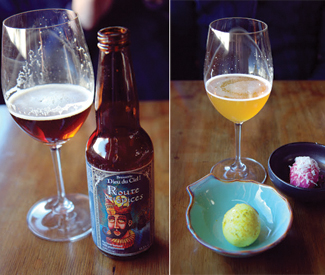
The volume lists more than 120 rotating beers — curated by co-owner and cellarmaster Christian Albertson with co-beer director Mike Reis — grouped by style (sours, saisons, etc.), with two pages dedicated to drafts. There’s a wall of glassware suited to every type of beer served, whether Jolly Pumpkin’s Madrugada Obscura Sour Stout from Dexter, MI, or Italian 2004 Xyauyu Etichetta Rame. A pricey ($14.50 for a six-ounce pour) Belgian Brouwerij De Landtsheer Malheur Brut is a dry, elegant Champagne-style beer served on the stem, one of ten offerings in a by-the-glass selection from large beer bottles rarely available by the pour.

As a temple dedicated to beer, the Cellar succeeds immediately. The bar and chef’s counter are ideal perches from which to sip, accompanied by hand-pump cask engines (sample Firestone Walker’s Unfiltered Double Barrel Ale from these classic pumps), and a reading shelf lined with Dulye’s collection of cookbooks.

Chef, co-owner, and experienced craft beer restaurateur Adam Dulye explores flavors optimal to brews. Dishes — a la carte options or tasting menus: three course $45, $60 with pairing; 5 course $65, $90 with pairing — are well-crafted and artful. As at St. Vincent, some dishes stand well above others, although there’s generally promising possibility. A coon-striped shrimp salad ($11) makes a dramatic presentation but, similar to crawfish, you’ll struggle to pull a tiny bite of meat from the shrimp. Cumin-roasted heirloom carrots ($11), elegantly displayed with quinoa, oyster mushrooms and sprouts, lack distinctive flavor.

Alternately, braised rabbit on tender handkerchief pasta ($23), dotted with English peas and hen of the woods mushrooms, is heartwarming, particularly with beer. “Wow factor” is in play with a unique beef bone marrow ($12) dish. The bone is topped with crispy house pastrami, alongside spicy greens, more pastrami, pickled mustard seeds, and rye croutons — one of the more exciting of countless bone marrow dishes I’ve had. While roast pheasant ($24) with lacinato kale and non-existent (but listed) cauliflower puree was too dry, a generous pork chop ($25) is insanely juicy and satisfying over chewy caraway spaetzle, topped with grilled peaches. A dessert of warm, roasted parsnip cake ($9), co-mingling with whipped cream cheese and a ginger molasses cookie, is a homey highlight, lovely with the coffee-almond malt of Great Divide’s Yeti Imperial Stout.

742 Valencia, SF. 415-626-8700, www.abbotscellar.com


UPCIDER: SF’S FIRST CIDER BAR

Ever since savoring a fantastic New England cider pairing with each course of a fall dinner at NYC’s Gramercy Tavern years ago, I’ve wondered when we might witness the arrival of urban cider bars. SF’s new Upcider and Bushwhacker in Portland are it thus far.

Two aspects of Upcider jump out immediately: Ozgun (Ozzie) Gundogdu and his sister’s warm welcome — Ozzie opened the bar with former roommate and co-worker Omer Cengiz — and a second story upstairs space with floor to ceiling windows overlooking Polk Street. One can sit at the windows, gazing below at a busy street scene, enveloped by low-ceilings and a cozy glow, transported to a European bar or maybe even one in Turkey, Ozzie and Omer’s homeland.

The bar, lined with rustic, reclaimed wood, houses a range of bottled ciders — 19 producers, 40 varieties of cider (and growing) at $5–$26 a bottle, the most expensive being a 750ml of Etienne Dupont Brut De Normandie from Victot-Pontfol, France. You’ll find big brands like Magners or ones we’ve seen often in SF like Fox Barrel, Crispin, and Two Rivers. But you’ll also discover three ciders from Wandering Aengus Ciderworks in Salem, OR, or J.K. Scrumpy Organic, a sweeter cider from Flushing, MI. On the dry side (there’s also a medium-dry option), I liked Hogan’s Cider from Worcestershire, England. A new discovery was Julian Hard Cider from Julian, CA, a small Gold Rush town inland from Escondido and San Diego.

Its tart, dry Cherry Bomb ($11 for 22 oz. bottle) is a fascinating cider with a funky finish. There are Basque ciders, mead, wines, and beers, and bar food from chef Tony Carracci (Cha Cha Cha). For the time being there are no ciders on tap, but that is due to the intensive plumbing rebuild necessary to meet city requirements. Hopefully, there will be a way to provide draft ciders in the future.

Whiling away summer evenings in Upcider feels like traveling. I noticed the neighborhood’s Middle Eastern community gathering below for friendly banter, a refreshing alternative side of a street lined with raucous partiers and bar-hoppers.

1160 Polk, SF. 415-931-1797, www.upcidersf.com

Subscribe to Virgina’s twice-monthly newsletter, The Perfect Spot, www.theperfectspotsf.com
Koi hooey

0

le.chicken.farmer@gmail.com

CHEAP EATS Coach’s dad said it was the best Chinese restaurant in the world. The world being a pretty big place, and one which includes all of China, we went. Him, her, me, Hedgehog, Indiana Jake, and a Random Texan.

Daly City. Koi Palace. Pffft.

I’d retract that last little almost involuntary and entirely uncomplex sentence in deference to Mr. Coach, him being a respected figure among us, but come to find (over appetizers) that he didn’t say it was the best Chinese restaurant in the world; some guy did.

Some guy in an interview on NPR, turns out. He had eaten at 5,000 Chinese Restaurants (which is a lot, by even my standards) and Koi Palace in Daly City was his favorite.

OK. If that guy wants to take me there and order what he ordered, I’ll go back. But I happen to consider myself the High Halushki of Hyperbole, and I’m here to tell you that, no matter what Coach’s dad told Coach he heard some guy tell some interviewer, Koi Palace isn’t even the best Chinese restaurant in Daly Goddamn City, let alone the Bay Area, let alone the big fat world.

Why, it’s not even cheap! The kind of portions and quality you pay $8-10 for at the best Chinese restaurants in my world, you can expect to pay $16-18 for at Koi Palace.

And that, in a nutcase, is why I don’t listen to the radio.

Come to think of it, though, the pork and oysters clay pot…

(continued later this page, after sports section)

CHEAP SPORTS

by Hedgehog

Next week I’ll have an actual pickup baseball game to write up. This week, though, I attended my first ever flag football practice. While it’s true that I already broke my arm at a flag football game, I had never actually practiced before. Which evens out since the practice I attended this week was for a team I don’t play on. I don’t play flag football anymore. Or ever. Since I broke my arm just thinking about playing once. Did I mention my arm is broke? Well it is.

Turns out, once you have a broken arm, there isn’t much you can do at a flag football practice. In the beginning, I tried kicking a soccer ball around, and the team initially joined me but finally got wise to my distractions and pulled out the pigskin.

So then I snapped the ball to Stringbean while the rest of the team ran passing routes. And then the Chicken Farmer and I played defense while the offense ran plays. Every play, one of us would blitz Stringbean and the other would drop into pass coverage. But whichever job I had, I kept putting my broken hand up to block the ball, so I decided it was safer to pull that arm into my shirt and run one-armed.

But when I blitzed Stringbean like that she just stopped and laughed and said I was the most “unintimidating” thing she’d ever seen.

She’ll rue the day.

(continued from before the sports section)

…was pretty good. And the seafood noodles, I thought, were great. But the country vegetables and the eggplant dishes were boring, the pork cheeks were at least as weak, and the spicy chicken wasn’t spicy. At all.

But mostly how I can tell when I really don’t like a restaurant is I wake up in the middle of the night that night, not feeling sick so much as cheated. Or maybe disturbed would be a better way to put it.

I have nightmares.

My mouth gets awful.

I mean no disrespect to Coach’s dad, who I kind of idolize because his whole family pretty much breathes football — with the possible exception of Coach herself, who is in it for the babes — but I’ve been so thrown by Koi Palace that I might need to go find some dollar-fifty steam-table fried rice for lunch. By way of a reset.

KOI PALACE

Lunch: Mon-Fri 11am-2:30pm; Sat 10am-3pm; Sun 9am-3pm; Dinner: Sun-Thu 5-9:30pm; Fri-Sat 5-10pm

365 Gellert Blvd., Daly City

(650) 992-9000

AE,D,MC,V

Full bar


Dixie

1

virginia@sfbg.com

APPETITE A fledgling new restaurant is a work in progress, evolving. Often I’ll visit restaurants in their opening week, then return three to four weeks later, noticing a marked improvement in rhythm and flow, if not a dramatic change in food (often first food impressions prove to be consistent).

Returning a few months into a restaurant’s life, if things are heading the right direction, a distinct voice emerges, reflected in service and menus. Other times, one still searches for a point of view, a compelling enough reason to return. Opening in May with big vision and standouts on the plate, Dixie in the Presidio struggles to find cohesion after three months of visits.

The Southern intention of chef Joseph Humphrey (a Florida native) is just the sort of thing I get excited about: California-fresh with a New Southern ethos, not dissimilar to some of the Southern-influenced mashups I find at the likes of Maverick, the new St. Vincent, or in the best food cities of the South. Humphrey cooked at Michelin-starred Meadowood and Murray Circle, and in New Orleans with none other than Dickie Brennan & Co. South truly meets West in Dixie.

In the former Pres a Vi, Dixie hints at Southern plantation feel on the roomy veranda — ideal for the just-launched brunch — clearly the best area in the roomy restaurant. Though dreamily set in the Presidio, surrounded by trees, the Palace of Fine Arts standing majestically across the lawn, the inside remodel hasn’t quite covered up the space’s corporate feel. Rich wood grains and musical instrument art installations warm slightly, but neutral tones and a subdued air communicate “bland.”

Nearly condescending, cold service on my first visit had me actually dreading a return. Dread should never be on the menu, especially at this price. In another visit, I dined in the back space where at 7:30pm on a Saturday night more than half the tables were filled with thankfully well-behaved children. Here service improved: sweet if unsure.

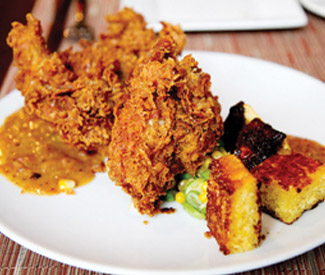
Humphrey’s skill shines in chicken-fried quail on garlic waffles ($15), a twist on my soul food favorite, with cabbage and kale slaw and a subtle kick from Thai chilies in the syrup. Another excellent dish is chicken and dumplings ($24). “Dumplings” are melting-soft ricotta gnudi surrounding tender cuts of chicken draped with baby carrots. This reinterpretation does what it should: it makes you rethink, but still thoroughly enjoy, a classic.

Red miso black cod ($23), silky in apple and bourbon-tinged foam, was so good it was the one dish I reordered. Accompanied by lobster mushrooms, only a mound of farro was flavorless and forlorn. I couldn’t help but long for 4505 Meats and Ryan Farr’s unparalleled, dissolve-in-your-mouth chicharrones when chomping on the harder, overly-salty version ($6) with nori salt here. Abalone and pickled jalapeno peek out of creamy corn soup ($14), while horseradish deviled eggs ($7) are smartly topped with fried chicken liver. Despite the promise of shaved tasso ham (I adore tasso), a Dixie chopped salad ($12) is almost banal, the ham more like two big slices of deli meat draped across an otherwise unadorned salad (merely lettuce in creamy shallot dressing with a smattering of radishes), rather than sliced up and in the mix.

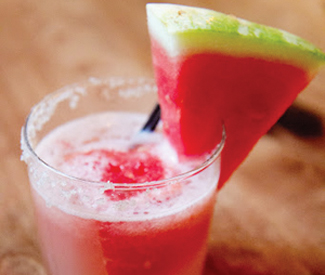
Wine or a pour of whiskey were the more gratifying drink choices. On the cocktail front, a pricey Terroir Fizz ($14) utilizes amazing, local St. George Terroir gin with lemon, lime, Cointreau, lemon verbena, and egg white for froth. Though I commend the move away from sweet, it was so sour (and I’ve been to known suck on lemons, that’s how much I crave sour), balance was lost in what could have been a beautiful aperitif — a bigger blow when this town is packed with excellent cocktails in the $8–$12 range. Dixie Triple S ($12) fared better in balance of sweet-smoky-spicy (the triple “S”) with Espolon silver tequila, lime, watermelon-jalapeno puree, and a hickory-smoked salt rim. 2 Bens is a playful tribute to “what dad and granddad drank” — a pint of Guinness and shot of Jack Daniels — but I cannot fathom paying $16 for a pour of such basic brands.

Dixie’s musical, New Southern vision is among my dream restaurant concepts but in actuality feels incongruent and out-of-sync despite supreme moments of taste. After the bill arrives at well over $100 for two, walking out into misty Presidio air before a green expanse leading to the Bay, our first thought is where to go next to fill up.

DIXIE

One Letterman Dr., SF

(415) 829-3363

www.sfdixie.com


PR problems

0

caitlin@sfbg.com

HERBWISE Though I’ll admit the waves of federally-mandated dispensary closures that have washed over the Bay in recent months make it hard to keep in mind, I can’t shake the feeling that the key to legalization is not burning effigies of US Attorney Melinda Haag and harassing Barack Obama when he comes to town. Though those things can be fun.

These nonsensical days of the government blocking our access to cannabis will only stop when regular old citizens realize that the War on Drugs is not making them any safer.

Which is why I’m talking to Kristina Barnes about her porch rowdies. The mother of two, who is a project manager for an energy conservation company, moved to the Mission a year and a half ago. Along some of her neighbors and an agent from the Mission Miracle Mile Business Improvement District, Barnes wrote a letter in protest of property owner Gus Murad’s plan to put a weed dispensary into part of the Mission Street building that until recently housed his restaurant Medjool.

The letters were sent to the city’s Planning Commission, but also to Haag, causing East Bay Express reporter David Downs to call Barnes and her crew “snitches,” and “clueless, craven, money-hungry carpetbaggers,” whose primary goal was to gentrify the Mission. One of the letters, he reported, even used what I like to call “the g-word,” as a positive term, calling into question the protesters’ basic grasp of SF’s social climate.

Fine, I chortled a little at the snitches part.

But I live really close to Morado Collective’s proposed site. It troubled me that my neighbors thought that “this shop will invite loads more undesirable people to our neighborhood,” as Barnes’ letter put it.

The perception of the pot clubs as a dangerous, disruptive place is sadly, common — Haag has used it as justification for her crusade, even though a UCLA study published in the July issue of the Journal of Studies on Alcohol and Drugs found zero evidence that dispensaries raise crime rates.

I needed to know where the negative image was coming from. So I called Barnes up to find out why she didn’t want high-quality nuggets near her family.

Turns out, Barnes does not support medical marijuana. “There’s a lot of misleading legality about it,” she said. “If I were to guess, 80 percent of the people [who frequent dispensaries] have no reason to be there.” In other neighborhoods, she told me, she’s seen people exit clubs and give joints to friends.

She thinks the Morado Collective will adversely affect her block. “My primary concern is that it’s really selfish,” she told me. “We moved into a neighborhood that has the promise of getting a little cleaner and better.” More saliently, she was concerned that her porch would look like an attractive place to smoke that newly-purchased bud. People use it as a smoke spot already, she said.

Of course, there was no reason to base this conversation on conjecture. Until it was shuttered by the feds earlier this summer, Shambhala Healing Center welcomed patients at 2441 Mission — across the street from the Morado Collective’s future home. (The dispensary is now delivery-only.) Had Barnes’ porch been inundated by Shambhala’s patrons? Had such disruptions diminished in the months since the club closed its doors?

Actually, she was unaware that she’d been living around the corner from a dispensary since she moved to the neighborhood. Granted, Shambhala looked like a yoga studio from the outside. “I can’t believe I didn’t know the other one was there,” Barnes said. It was unclear if this fact was enough to affect her views on disruptive dispensaries, but one hopes it was food for thought.


ALSO, LOGIC PROBLEMS

While researching this column, I also spoke with Philip Lesser of the MMMBID, who told me his neighborhood group was firmly in favor of medical marijuana, likening pot clubs to medical centers. But, he said, the Morado Collective’s spot between fancy restaurants Foreign Cinema and Lolinda “just doesn’t seem like the appropriate place to have a doctor’s office.”

What would be appropriate? “I’m thinking that anything that could better promote the arts and entertainment,” he ventured, adding that Alamo Draft House is set to open a five-screen movie theater in another Murad property across the street.

But — what makes you want to go to the movies more than weed?


Jellyfish, oxtail, and more from the Street Food Festival

0

The annual Street Food Festival enlivens blocks of the Mission every year with many of our great food trucks, booths manned by the kitchen staff of our favorite SF restaurants, and a few visiting guests — which at this year’s fest on August 18 included my favorite Portland food cart Eurotrash, and the adorable Linda Green of Ms Linda’s Catering from New Orleans. The most significant addition to the Street Food lineup this year wasn’t a cart at all,  but rather an entire event — the Friday night before the main festival, the Night Market took over the Alemany Farmers Market. In the whipping winds of South San Francisco we sampled unforgettable bites that were not available at the Street Food Fest. The festive, Chinese lantern-laced outdoor space made the Night Market a stand-out. I hope it becomes a yearly feature.

Subscribe to Virgina’s twice-monthly newsletter, The Perfect Spot, www.theperfectspotsf.com

Full captions: 
1. The star of the Night Market was The Boss Hog, the debut of a new project from the Bone & Gristle Boys (SF’s Ryan Farr  of 4505 Meats and Rhode Island’s Matt Jennings of Farmstead). 
 2. One of the best sandwiches I’ve ever had, The Boss Hog is slow-roasted pork, cornmeal-fried pork cutlet, Vermont cheddar, smoked pickles, red onion, greens, jalapeno ranch dressing, Farr’s chicharrones
3. One of my favorite Portland food carts Eurotrash showed off fresh grilled prawns loaded in a baguette with spicy curry slaw
4. At the Night Market, Fifth Floor chef David Bazirgan’s delicious fava bean falafel wrap 
5. Ken Ken Ramen served jellyfish at Friday’s Night Market
6. Vada Pav (spicy potato puff sandwich) from Juhu Beach Club
7. Friday’s festive Night Market — a tradition I hope continues each year
8. State Bird Stuart – State Bird Provisions’ Chef Stuart Brioza assembles burrata and fried garlic bread
9. The top taste of Saturday’s festival was State Bird Provisions’ (Bon Appetit’s 2012 # 1 New US Restaurant) hand-pulled burrata atop addictive fried garlic bread
10. A Korean favorite from the Inner Richmond, To Hyang’s braised oxtail with daikons, carrots, dates, hard-boiled egg


Nite Trax: The Eagle flies again

41

I hung out yesterday evening with the new occupants of the Eagle Tavern (now known as the SF Eagle, apparently) at a celebration of the lease-signing at the Lone Star Saloon. Alex Montiel and Mike Leon seem perfect to replace the former Eagle operators Joe and John: Tough-looking and leather-bearish, a tad gruff at first but friendly once they warm to you, and a wee bit shy of the press right now.

They’ll be releasing their full plans for the storied queer bar in a couple weeks, but I did manage to squeeze some juicy info out of Alex. They hope to open the bar in time for Halloween, the liquor license has indeed been secured (in fact, they have two!), and they’ll be doing their best to return some of the Eagle’s ambiance to the now-pretty-much-gutted space, with a few slight modifications to the bar layout for code and traffic flow reasons.   

It’s certainly been a long, winding, super-convoluted road to get to this point!

I’m not sure anyone can convey all the twists and turns and backroom mechanations of the whole thing — Jay Barmann at Grubstreet has done some excellent reporting on it all, but there were still many, many balls in the air, shall we say, and the shady politics got slightly out of control. The fight to keep a historically queer space queer — despite the previous occupants’ quasi-abandonment, despite the lucrative offers from upscale restaurants, despite the limited power and will of the city to legislate such things — was a bit of a hot gay potato for the past year. (The Eagle’s infamous, charitable Sunday Beer Busts lived on in monthly form at El Rio in the Mission, at least.)

Even the idea of a “historic queer space” was questioned: if the Sisters of Perpetual Indulgence had sanctified it, and the ashes of multiple queer people were scattered about a place that raised tens of throusands of dollars for amazing local causes and was regarded as the heart of the old school gay leather rock ‘n roll biker community, was it important enough to fight for?

Hats off to Milk Club president and outspoken queer activist Glendon Anna Conda Hyde for saying, “Hell yes!”

Glendon (identified slightly incorrectly in a recent Chron story as the Norm of the Eagle’s “Cheers” — that was actually the frizzy-haired dear in the thong and flip-flops who stood around clutching a goblet of piss) kept the Eagle issue at the forefront of the city’s debate about gentrification and the loss of queer nightlife spaces, angering some fussy queens with his usual passion and stridency, but in the end succeeding in rallying an assortment of powerful players to the Eagle’s defense.

I talked to Glendon today about how the whole thing went down. His basic summation was that Supervisors David Campos and Jane Kim did excellent jobs of making sure the Eagle stayed queer (Sup. Scott Weiner does not get very high marks from him in this regard), and that dubious dealings by the person supposedly representing the owner of the building — who lives north of the city, and who Glendon said had indeed wanted to welcome in new queer owners all along — were what kept screwing everything up. Finally the building owner (actually, the manager of a trust that includes several elderly owners) awarded the lease to Mike and Alex after he realized what was happening with his representation and the reaction of the community.

“I think it’s so great,” Glendon told me. “People keep saying that you can’t revitalize queer nightlife in SoMa — but that’s just a lazy excuse for gentrification. I’m glad we could band together to ensure a future for queer spaces in this city. We should be proud of what happened here. Our shared queer history is a powerful force. 

“We’re still fighting for an officially recognized queer historical district in SoMa that will honor those who came before us, and also help preserve lively alternative queer spaces. Supervisor Christina Olague and CMAC [California Music and Culture Association] is working hard on that. One of the major problems is that it’s illegal to say something has to be or remain ‘gay.’ I think we saw here that it can be done within the limits of current boundaries.”

As for the future of the Eagle? “Mike and Alex have indicated that while they’ll still be preserving the main traditions and atmosphere — as well as probably hiring some of the old staff back — they are hoping it will be a much more open space. Already the Lexington Club is planning to host a fundraiser to help them remodel, so that suggests the Eagle will be more women-friendly, and there may be new parties there from some of the city’s younger promoters as well.”

My favorite part of this whole thing — besides the colorful faux-funeral outside Foreign Cinema restaurant, or the “assless chaps” takeover of the Skylark bar (both at one point identified as villains in the Eagle saga)? Beyond the banding together of the community to save an actually cool place that is a huge and drunken part of my life (also, DJ Don Baird on Sundays was secretly the best DJ in the city)?

At one point it was announced that the Eagle was to become a fancy pizza place with a wood-fired oven on the back patio. Glendon turned to me and hissed: “I always knew the straights wanted to put us in the oven!” 

Mission sandwiched

0

virginia@sfbg.com

APPETITE Two unusual, new Mission sandwich options: one of the city’s best restaurants launches lunch with Scandinavian influence (part of the Nordic culinary wave finally reaching the West Coast that includes new restaurant Pläj) , and a low-key panini shop opens, refreshingly real with Middle Eastern touches.

SMØRREBRØD AND LANGOS AT BAR TARTINE

Nick Balla’s forward-thinking, Eastern European menu at Bar Tartine offers some of the most exciting food in the city right now, so new daytime hours (Wed-Sun, 10:30am-2:30pm) are a gain. Smørrebrød is Danish for “bread and butter”: these open-faced sandwiches (one for $6; three for $15) lead the way on the new menu, though heartier sandwiches are on offer, too, such as beef tongue ($12) generously laden with sauerkraut, onion, and that Hungarian staple, paprika. Or on the vegetarian side, slab bread filled with lentil croquettes, yogurt, cucumber, padron peppers.

On rustic rye bread, smørrebrød toppings evolve. I find two enough, three for those with a bigger appetite. My favorite is bacon, egg, avocado, dill and roasted tomato in a blue cheese sauce blessedly garlic-heavy. Creamy chicken liver pate is a gourmand’s option, although such a generous scoop of pate overwhelms accompanying apricot jam. Another toast is topped with smoked eggplant, white beans, olive, roasted tomato, while a sweeter side is expressed in hazelnut butter and rhubarb compote.

They’re calling it a sandwich counter and you can certainly take out, but Bar Tartine’s rustic tables and expanded space welcome: they’re ideal for lingering with Four Barrel coffee and that divine Hungarian fried bread, langos ($9), you’ve heard me talk about often — it’s on the lunch menu. Now it’s amped up with toppings like lamb, horseradish cream, summer squash, and tomato, or blackberries, peaches, and cream. Langos with fried egg, hollandaise and bacon is a breakfast dish of my dreams.

In the spirit of meggyleves, Balla’s Hungarian sour cherry soup that wowed me last summer, there’s chilled apricot soup ($9) — not as sweet as suspected — smoked almonds, and sour cream adding texture to the savory-fruity broth. Jars of pickled treats line the walls, available in the menu’s snacks section (pickled curried green beans!), refreshing contrasted with a kefir-ginger-strawberry shake ($5).

561 Valencia, SF. 415-487-1600, www.bartartine.com

ZA-ATAR AND HALLOUMI AT HOT PRESS

With a friendly Middle Eastern welcome, the guys at the new Hot Press welcome customers into their humble Mission shop for panini, Caffe Trieste coffee, and Three Twins ice cream by the scoop, waffle cone, or sundae. While American sandwiches like pastrami-loaded Staten Island ($7.75) with Emmentaler cheese, house Dijonaise, cabbage slaw, and sliced pickles are delicious, the Lebanese touches and vegetarian offerings that skew unusual. Dream Cream ($6.50) is soft-yet-crusty ciabatta bread slathered in light cream cheese, sauteed peppers, caramelized walnuts, and cucumbers, za’atar spices perking up the mild, comforting panini. On a French baguette, another vegetarian sandwich with Middle Eastern leanings is Ayia Napa ($6.99), likewise comforting with melted halloumi (a traditional Cypriot cheese from the island of Cyprus), mint leaves, tomatoes and a douse of olive oil. Pollo de la Mission ($7.75) is a neighborhood tribute of free range chicken on ciabatta in creamy chipotle sauce, pressed with peppers, grilled onions, Colby Jack cheese, and corn.

Sides ($2.25 half pint; $4.25 pint) range from coleslaw to a salad of spinach leaves, goat cheese and strawberries, while three bean salad — cannellini, kidney and garbanzo beans tossed with onion, parsley, lemon, olive oil — comes in mini-tasting cups with each sandwich. Local ingredients go beyond ice cream and coffee to sandwich bread from Bordenave’s in San Rafael, with neighborhood goodwill in the form of a kids menu and dessert sandwiches like Peanut Butter & Better ($4.99): creamy or crunchy PB, sliced bananas, lavender honey, or grape jelly.

The space is nondescript in a refreshing way, with sidewalk seating and Middle Eastern music videos playing on a flat screen. Thankfully, not every new opening in the Mission is a hipster, trendy affair.

2966 Mission, SF. (415) 814-3814, www.hotpresssf.com

Subscribe to Virgina’s twice-monthly newsletter, The Perfect Spot, www.theperfectspotsf.com
 

Portable pollution

11

news@sfbg.com

With its decidedly hip aesthetic and clientele, San Francisco’s food truck trend may be naturally assumed to be environmentally sound and health conscious. But the rapidly expanding craze may actually be creating air pollution and endangering the health of their employees in ways that aren’t yet being regulated.

Although the mobile eateries are held to a few of the same standards as their brick and mortar counterparts, such as food hygiene and sanitation, the gas-powered portable generators that provide needed energy to the trucks are a tricky beast to tame. The exhaust-heavy portable generators do not fall under the San Francisco Department of Public Health’s radar of regulation, according to its Food Safety Program Director Richard Lee.

“There are combustion products from the generators being generated while the truck is parked and operating,” he told the Guardian. “The generators are needed to power lights, fans, refrigerators, etcetera. SFDPH does not monitor or regulate the generators.”

The lack of monitoring on the generators may not be due to a lack of need for regulation, but rather the difficulty in doing so. Given that most of the generators are used to power relatively small vehicles, their small size inhibits them from meriting the attention of the California Air Resources Board (CARB) after their initial manufacture.

A CARB-compliant generator has met with the organization’s restrictions on various organic gases, nitrogen oxides, sulfuric oxides, carbon monoxide, carbon dioxide, and particulate matter. However, the generators are only monitored at the point of manufacture, with their in-use emissions going unregulated.

Furthermore, Bay Area Air Quality Management District spokesperson Aaron Richardson tells us that despite the BAAQMD’s 28 air monitor stations, the localization of the fad and the trucks themselves would make it difficult to see the effects of the generators as a regional issue.

“The concern would be they may not all operate in the same ways,” he said. “I think that if the trucks…are running back up generators, it’s going to emit some pollution. It’s something I think we will be doing more research on, but at this point it’s not looking like it’s a dramatic impact on air quality. CARB regulates all mobile sources, and lot of these trucks use individual generators. At this point, we only regulate back up diesel generators…of 50 horse power or above.”

So BAAQMD doesn’t regulate the generators because they’re gas-powered, and they don’t trigger CARB’s post-production attention, despite that agency’s current efforts to reduce the state’s carbon footprint.

CARB spokesperson John Swanton explained that given the small size and localization of the generators, it’s up to the individual communities to decide how to approach the situation.

“It’s up to the community to decide if they can bear the expense of a highly regulated community. In the terms of restaurants — which is what food trucks are — what are the community’s standards and regulations?” he said. “When we sell, say, a Honda generator, we have ideas of how that’s going to be used…We try to make it as clean as practically possible, but the idea is that it’s not gonna run 24/7 at the same location. If it’s going into a food truck and the food truck is going into a particular district, then it becomes the decision of the city and the air quality management [district].”

It seems, then, that no one is really regulating the exhaust emissions coming from the hordes of trucks that travel up Haight, down Market, into Fort Mason, and sit in clusters downtown, in SoMa, around City Hall, and other spots around town.

But at least they aren’t dirty diesel fuel, right? Perhaps the BAAQMD and the city of San Francisco have no need to regulate the teensy-eensy bit of gasoline generator exhaust.

Yet according to SFDPH spokesperson Imelda Rayes, there are now approximately 300 (registered) mobile food facilities in San Francisco. That means the number has nearly tripled since the mere 120 registered MFFs that were scouring the streets in 2009. What they lack in horse power, the generators may make up for in sheer multitude.

“In a period of three years, the number has increased almost 250 percent and [we’re] still getting more applications,” she said.

In addition to cumulative impacts, there are also questions about the health impacts on food truck employees.

Studies like such as the 2009 “Modeling the Effects of Outdoor Gasoline Powered Generator Use on Indoor Carbon Monoxide Exposures” by academics Liangzhu Wang and Steven Emmerich brings up a different concern: gasoline generators create emissions of poisonous carbon monoxide.

“The generators are always positioned outside of the vehicle. The workers are inside,” Lee said. “We would not expect that there is significant employee exposure to the generator exhaust to the employees.”

Yet the U.S. Centers for Disease Control and Prevention (CDC) reported that half of non-fatal carbon monoxide poisoning incidents in the 2004 and 2005 hurricane seasons were due to the gas-powered generators used to heat homes, even when placed outside the homes themselves.

Food truck generators, given their smaller size, are often placed much closer to the trucks and their workers than in the case of houses and their inhabitants. Furthermore, the trucks often idle for long periods to keep the food warm and utilities working.

“At this point, it’s enough of a new thing…We’re interested in finding out more about them, but at this point we are not receiving many complaints,” Richardson said. “A lot of variables are involved. It’s something I think we will be doing more research on.”

After the game of verbal hot potato that was research for this article — it seems every agency deferred to another in terms of exactly who is monitoring these things — Swanton assured us that the danger doesn’t seem imminent.

“In general, small engines [portable generators] are dirtier than an engine providing motor power to a vehicle,” he said. “But the sheer number of these cleaner engines dwarfs everything.”

True, but the food trucks that run for more than a few hours at one location are increasing in numbers at a rapid pace. With the high number of mobile food trucks in operation, most of which utilize some form of generator or another, it may be time to nail down those pesky variables involved and draw some conclusive evidence on the potential environmental and health effects of our city’s seemingly innocent snack time.

Appetite: Delicious new cuisine and cocktail reads

0

Fermentation and distillation, hot plats and sugar cones, sweet creams and brokeasses … These eight books were released this spring, and are among the best of what has landed on my desk this year:

TRADITIONAL DISTILLATION: ART AND PASSION
by Huber Germain-Robin

Anyone who knows US craft distilling knows Hubert Germain-Robin, one of the pioneers in the American craft distilling movement. He was making world class, French-style brandies (he is French, after all) since the early ’80s right here in Northern California at Germain-Robin, which he co-founded, an example to generations after him of what true, elegant brandies should be. As he states in the introduction, “When I came to California in 1981, I realized the unbelievable potential of the New World, with such diversity in grape varietals, microclimates, and less demanding restrictions than there are in France.”

He just released his first book, Traditional Distillation, and, as the inside cover states, it’s an ode to the “passion, art and poetry” behind distillation. I’ve seen a few (there’s really not many) technical distillation books that get into still types or cutting the “heads and tails” of a distillation batch. Germain-Robin’s book (the first in a series of books on brandy production) is a thoughtful essay, covering the technical but doing so in an artistic, poetic way. The book boasts an Old World, classic look, delving into the philosophy behind distillation as much as process. A romantic sensibility pervades this book and passion speaks from the pages – there is even poetry and classic art included, doing justice to the reason people like myself (one who rarely had a drink in younger years), fell in love with the artisan craft and history behind distillation. It’s a short, succinct book, but a unique one. Hubert captures the beauty of the craft, giving concrete advice for would-be distillers everywhere, ensuring that his incredible knowledge and legacy is shared with many more.

THE ART OF FERMENTATION by Sandor Ellix Katz

Just released June 12, The Art of Fermentation (with forward by none other than Michael Pollan) is sure to be the gold standard on fermentation. Katz published Wild Fermentation in 2003, at the time dubbed the “fermenting bible” by Newsweek. As the press release states for his new, elegantly understated book, he now has an additional decade of experimentation behind this one. The first book of its kind, it contains recipes, yes, but ultimately is a 400+ page textbook on all things fermentation, its history and processes, and DIY steps in a range of categories from meads, wines and ciders to meat, fish and eggs. There’s plenty of study material for food and drink folk alike, whether an extensive section on sour tonic beverages (from kombucha to kvass) or details on fermenting beans, seeds and nuts. Katz’ book makes me want to start fermenting my own potato beer immediately.

TAKE AWAY by Jean-Francois Mallet

Take Away is a lovely photo book. Released in the US in April (first released in France in 2009), this beauty of a book is a virtual escape around the world, immersing the reader in street foodscapes and dishes from Shanghai to the Ukraine. Be warned: perusing this book is difficult on an empty stomach. And for those of us who thrive on travel and exploring every nook and cranny of a city or region, Mallet’s approachable, street savvy photography also induces travel lust.

CINDY’S SUPPER CLUB: Meals from Around the World to Share with Family and Friends by Cindy Pawlcyn

Cindy Pawlcyn is one of California’s trailblazing chefs, aiding Napa in becoming a dining destination when opening Mustard’s Grill nearly 30 years ago along with subsequent restaurants, like Cindy’s Backstreet Kitchen. She’s written a few cookbooks, but I particularly enjoy her newest, out this May: Cindy’s Supper Club. A book based on favorite international recipes prepared in her supper clubs with friends, the recipes span the globe from Russia and Hungary to Lebanon, Peru, Korea. Cindy’s intros to each selected country and recipe feel comfortable, like a chef chatting about their travels and technique as you sit with them in their kitchen. Though recipes tend toward the heartwarming, soulful kind, many list more than ten ingredients and aren’t exactly simple. But for cooks ready to try something new yet not fussy, adventure lies within these pages, whether Flemish meatloaf in spicy tomato gravy or white gazpacho (made of white bread, milk, almonds, garlic, olive oil, sherry vinegar) with peeled white grapes.

PLATS DU JOUR: the girl and the fig’s Journey Through the Seasons in Wine Country by Sondra Bernstein

Just see if you don’t long to move to Sonoma after spending time with Plats du Jour, a large, photographic book capturing Sonoma’s vibrancy. With a range of recipes from Sondra Bernstein’s beloved girl and the fig duo and Italian restaurant, Estate, the book journeys well beyond recipes. Sectioned by seasons, there’s highlights on wine, cheese, and produce, pairing possibilities, origins of foods, cocktail hour menus, and seasonal menus to recreate at home. Interspersed throughout are drink recipes, such as the perennially popular lavender mojito from girl and the fig http://www.platsdujour.net/#!home/mainPage. Photos and stories of trailblazing Sonoma farmers keep the reader rooted to a sense of place. Though the variety of info might initially seem disparate, it weaves into an inspiring whole urging one to seek out ingredients from their own farmers markets and entertain or cook inspired by the invigorating spirit behind Bernstein’s book and the artisans of Sonoma.

SWEET CREAM AND SUGAR CONES
by Kris Hoogerhyde, Anne Walker, and Dabney Gough

Bi-Rite’s ice cream essentially needs no introduction. For those in San Francisco, it’s already an institution. For foodies nationally, the beloved market’s ice cream has been written up in most national food magazines, among the best ice creameries in the country. Thankfully this spring, founders Anne Walker and Kris Hoogerhyde, along with writer Dabney Gough, have released a book, Sweet Cream and Sugar Cones, sharing many of Bi-Rite’s lauded recipes (yes, their legendary salted caramel ice cream, which spawned dozens of imitations around the nation, is included), and many more besides, including sweets far beyond ice cream, from cookies to pie. The book is grouped in ingredient-themed sections like chocolate, coffee, vanilla, citrus or nuts. I take to the herbs and spices section with recipes like basil or peach leaf ice cream, picante galia melon pops, and my favorite Bi-Rite flavor of recent years, Ricanelas (cinnamon and Snickerdoodles). Having already tried a couple of the recipes, they are easy to follow, and, of course, delicious.

SUNSET EDIBLE GARDEN COOKBOOK

Sunset has cornered DIY gardening and cooking for decades in their magazine and cookbooks, with recipes and step-by-step gardening instructions. Their latest book, Edible Garden Cookbook, just out this spring, is another winner with accessible recipes, growing-harvesting-storage-cooking tips and varietal lists on a wealth of vegetables (from peas to cucumbers), herbs (mint to thyme), and fruits (melons to stone fruit). Creative recipe twists enliven everyday dishes like an icebox salad layered in a casserole dish or kabocha squash filled with Arabic lamb stew.

THE BROKEASS GOURMET COOKBOOK by Gabi Moskowitz
(Review by Andi Berlin)

Chasing the elusive paycheck is a tiresome routine, but at least it’ll taste good with the new BrokeAss Gourmet cookbook from San Franciscan Gabi Moskowitz (not to be confused with Broke-Ass Stuart.) The former kindergarten teacher-turned-caterer-turned-Internet-celebrity founded the website BrokeAss Gourmet after seeing friends laid off from tech jobs and eating junk. Taking a conversational, gal-pal tone, Gabi guides us through the essentials of running an eclectic kitchen – from stocking a full pantry to boosting cheap proteins with flavorful sauces. Recipes like vegetable lasagna with wonton wrappers demonstrate her craftiness. The book is high on kitsch: rather than photographs, illustrations of animals stand beside cheeky anecdotes (“Because bacon really does make everything better.”) Moskowitz paints a vivid Bay Area landscape, adapting several recipes from ethnic joints and buzzy spots like Bakesale Betty. And if she relies too heavily on sriracha sauce, forgive her. When you’ve got to shove off to work early morning after morning, it’s often the call of the rooster that gets you going.

Subscribe to Virgina’s twice-monthly newsletter, The Perfect Spot, www.theperfectspotsf.com
Appetite: Under the stars in Guerneville

0

Amid towering redwoods, summer heat, and parties along the Russian River is the small town of Guerneville, one of Sonoma’s most unique towns, with its vibrant gay community, laid back river culture, and haunting redwood state park. On a recent idyllic summer weekend, barbecues and live, twanging bands added color to the bustling main street.

Foodies have a destination cafe-restaurant in Guerneville’s Big Bottom Market, which was opened last summer by co-owners Michael Volpatt and Crista Luedtke (the latter owns neighboring boon hotel + spa and boon eat + drink restaurant). Big Bottom draws crowds for breakfasts, lunch, and for anytime cups of my favorite Sonoma County coffee, Flying Goat‘s special blend for the cafe. The cafe’s breakfast biscuits ($3-9) are stuffed with a changing array of goodies like bananas, peanut butter, strawberries and white chocolate, or ham, Swiss, and dill pickle (loved the mustard in the latter but lamentably had to hunt for the ham.) Offerings change daily, but the day’s special is easily ascertained — each biscuit is adorned with a bit of its filling.

Big Bottom Cafe’s superlatively-stuffed biscuits. Guardian photo by Virginia Miller

My recent weekend in Guerneville coincided with the launch of Big Bottom’s dinner service (Thursdays-Saturdays only, 5-9pm). Executive chef Tricia Brown cooked at one of my all-time favorite restaurants, Gramercy Tavern in NYC, moving from Brooklyn to Sonoma for a lifestyle change. With that pedigree, it’s no surprise that she’s cooking an elevated style of cafe food. In the rustic, touch-of-farmhouse shop lined with wood floors and wine and gourmet food items for purchase, dinner means comfort food, like a Moroccan chicken tagine ($18), or apricot-studded couscous laden with Castelvetrano olives and toasted almonds, or green-chile-cheddar turkey meatloaf ($17) over chipotle mashed sweet potatoes.

Unexpectedly, sandwiches ruled: pinot pulled pork covered in spicy BBQ sauce ($16) and garlic aioli smeared on a toasted brioche, both with sides of bourbon-bacon baked beans and cilantro-lime coleslaw ($4 individually or 3 for $11.) There was also a sandwich special of wild salmon that was softly pink, almost medium-rare, topped with slaw on buttery brioche. Both were made with care, blessedly robust in flavors and texture. Chilled cucumber soup spiked with mint and yogurt ($6) was a refreshing summer starter. Only a large pile of dry crostini felt out of place on a mezze platter ($9) of roasted red pepper hummus, lentil walnut pate, cucumber red onion yogurt salad, and olives.

Small, local winemakers are featured on the wine menu, including a few of my go-tos like Thomas George Estates and Unti. It also features different winemakers like Sonoma’s Paul Mathew Vineyards, whose vintages are made by winemaker Mat Gustafson. I sampled all three of Gustafon’s featured wines, like a mineral 2010 Weeks Vineyard Chardonnay that held slight citrus notes from its stainless steel aging, rounded out by a hint of oak. I found the 2011 Knight’s Valley Valdigue most interesting (and the most affordable at $7 glass/$33 bottle.) It’s a chilled wine more akin to a Lambrusco or other chilled red with dry, strawberry notes, earthy yet bright.

Certainly when in Guerneville, one can enjoy the retreat-like (though dated) Applewood Inn, but Big Bottom Market hits at a lower price point, though its obviously more casual. For a sleepy small town in the redwoods, nestled between vineyards and ocean, the Market’s casual-gourmet approach feels appropriate.

End the night at Rio Nido Roadhouse dancing under the stars out back to live music (blues, classic rock, etc.) Were it not for the redwoods and that clean, crisp Sonoma air, the crusty older cowboys, families, and dive bar setting would be enough to convince you you’re in a small Texas town, embracing the warm summer night.

Big Bottom Market

16228 Main St., Guerneville

(707) 604-7295

Subscribe to Virgina’s twice-monthly newsletter, The Perfect Spot, www.theperfectspotsf.com


Worship long-haired handsome at cult-museum on first Thursdays

3

I am used to vegetarian restaurants and churches being cults, but this is something new. I’m loathe to spoil the surprise for you, nonetheless: the International Art Museum of America on Sixth Street and Market? 90 percent full of works by the stunning gentleman-living Buddha pictured. Also, it is free on first Thursdays!

Perhaps you have walked by the place before. Surely, you would have noticed the superlative tree-house-in-moat out front. 

Upon entering the museum, one is escorted through a Rainforest Cafe-like entry room, only to double-back past two large wooden Chinese dragons flanking the entrance to a room that holds only a glass case with a large piece of coral. It is called “Sea Palace Monarch,” says the corresponding metal plaque. You will soon find that these plaques are a highlight of the International Art Museum.

Says plaque:

Presumably, your first feeling was that of surprise. Does such large coral exist in the world? If it is not a genuine coral, then why do its luster, texture, and appearance look so real and natural? From the bottom of your heart, you would happily accept it as genuine coral because it is so truly beautiful, so aesthetically pleasing. How beautiful your living room would be if it contained this sculpture.

It is not real coral. But this truly beautiful, aesthetically pleasing piece of ceramic was created by our man Dorje Chang Buddha the III, who it turns out made roughly 90 percent of all the art you are about to see. Dorje does coral ceramics, massive wax drippings, traditional-looking Japanese drawings of lion prides and pandas, Van Gogh-like sunflowers, psychedelic spacescapes, and even builds his own gingko bilboa-esque frames that often as not house large holograms of cave interiors. He also creates jade-inspired tiling, which is available for purchase in the gift shop. 

Hell yeah that frame is holding a hologram.

Dorje’s yellow period.

It’s not all Dorje — there are occasional works by Flemish masters and oil paintings of sailboats. This is because Dorje is humble. Says the IAMA website, the museum’s board of directors initially only wanted the living Buddha’s works but:

His Holiness the Buddha adamantly disagreed, expressing His opinion that the International Art Museum of America is a site for masters of art worldwide to showcase their artistic accomplishments and should embrace diversity in orde to provide the public with broader aesthetic enjoyment. the Board of Directors yielded to this suggestion of His Holiness the Buddha.  

That’s so Dorje, who has done a million amazing things and totally deserves his own museum if only he wasn’t so humble. He’s the recipient of the ambiguously awesome World Peace Prize and check out the guy’s resume (via this spectacular website):

Examples of such holy phenomena include the following. Both humans and non-humans have prostrated to H.H. Dorje Chang Buddha III and have listened to His Holiness’s discourses on the dharma. Sentient beings, non-sentient things, birds, aquatic animals, land animals, flowers, grass, trees, tiles, and stones have all expressed respect for His Holiness’s dharma discourses either verbally or through physical actions. His Holiness taught a disciple how to transmit dharma on His behalf. When the person who was transmitted dharma by that disciple passed away, that person’s body emitted light. Thunder rumbled in the sky in reaction to the voice of His Holiness. 

Researching Dorje is likely to through you into a k-hole of reincarnation debate and superlative 1990s web design. Tell me this isn’t the best website ever. Wish-fulfilling jewel mirrors, a digital prayer wheel that “sends out this peaceful prayer of compassion to all directions and to all beings, purifying the area.” That’s worth a perma-tab on your Google Chrome. Now compare to the museum’s site. What happened there, Board of Directors?

Still, new favorite museum. It has a treehouse, holograms, and I wasn’t abducted despite the fact that there was maybe one other visitor there on the first Thursday I was waved in from the sidewalk. The other visitor was a guy who talked loudly on his cell phone about how he was “just checking out some museum man, they like said it was free so I was like cool.”

International Art Museum of America

Open Tuesdays-Sundays 10am-7pm, $10

Open until 7pm and free on first Thursdays

1025 Market, SF

www.iamasf.org

Survivor recounts life of rape and abuse by Your Black Muslim Bakery leader

8

Editor’s Note: This story is part of the Chauncey Bailey Project, a collaboration of Bay Area media outlets (including the Guardian) to investigate Bailey’s murder by members of Your Black Muslim Bakery.

By Louise Rafkin, Center for Investigative Reporting

 In 2002, five years before journalist Chauncey Bailey was murdered by members of Your Black Muslim Bakery, a woman identified only as Jane Doe 1 stepped forward to report decades of sexual abuse, welfare fraud and violence by the bakery’s leader, Yusuf Bey Sr.

She was prepared to hand over to Oakland police DNA from three of her children evidence that Bey had impregnated her, the first time when she was 12 years old.

Given the history of violence by members of Your Black Muslim Bakery, this was a risky move. But the woman was fueled by a mother’s anger. Her daughter, then 18, alerted her that Bey was trying to abuse her – his own daughter.

Now a devout Christian, Jane Doe 1 has decided she no longer wants to be the nameless whistle-blower. Her name is Kowana Banks and, in her first public interview, she said she made the decision to come forward to help other children trapped in similar situations. She hopes to publish a book about her experiences.

“Abused people go one of two ways: Either they are going to self-destruct or they’re going to make a difference,” said Banks, 44. “I’m going to make a difference.”

The violent saga of Your Black Muslim Bakery is fading into Oakland history, but wounds remain among Bey’s victims and family members today marks the fifth anniversary of the murder of Bailey, the Oakland Post editor who had been investigating the bakery’s finances.

The facts behind Banks’ story have been outlined in court proceedings and depositions, but her decision to come forward allows her to detail her unique insider’s perspective as a victim and survivor.

Today, Banks is an optimistic, composed woman who has moved on as best she can. One of her three children by Bey, Yusuf V, 25, is in San Quentin State Prison for his part in the 2007 kidnapping of two Oakland women, one who was tortured, a crime related to the bakery’s demise. The other two are doing well.

Banks considers the three to be the “blessing out of what happened to me.”

Married for 18 years to a man she met after leaving the bakery, Banks says the bitterness and anger that grew from her childhood abuse dissolved when she fell in love. The couple have two children together.

“But it’s difficult to look back and know I was just a child then and that no one cared,” she said.

Throughout her childhood at the bakery, Banks said she felt abandoned by the social welfare system, invisible even to those at local hospitals where she – and many other underage girls at the bakery compound – gave birth to multiple children while still children themselves.

She delivered the first of three children by Bey at Alta Bates Hospital in Berkeley at 13. A social worker questioned Banks about the paternity of her son, she said, but under the watchful eye of one of Bey’s “wives,” Banks kept silent. Later, she said she told a child protection worker that she was working long hours and not going to school.

“She told me she would check into it, and I never saw her again,” Banks said.

Bey, a self-appointed minister who gave himself the title of “Dr.,” was formerly a hairdresser. He opened Your Black Muslim Bakery in the late 1970s, espousing black self-reliance and his own interpretation of Islam, which included racist attacks on whites. Nevertheless, in his more than 30 years in North Oakland, Bey gained the support of local business leaders, clergy and politicians eager to align with the underclass.

In 2003, Bey died before facing trial, setting off the struggle for power and control that escalated into mayhem and multiple murders. Banks said she saw the violence coming.

“You cut off the head,” Banks said, “and the body will go crazy.”

Molestations began at age 8

Banks, who was born in the East Bay, said her father was a drug addict who met Bey’s followers while doing jail time for drug-related crimes. Banks can’t remember her mother, who she said abandoned her as a toddler, along with a younger brother and older sister.

In 1976, Banks’ father brought the children to live at the bakery compound, where he’d gotten a job. A hive of single-family homes, retail storefronts and apartments clustered on the corner of San Pablo Avenue and 59th Street in North Oakland, the compound housed bakery workers and Bey’s sprawling family of children and women he called his wives.

One Sunday night in 1976, Bey invited Banks to spend the night in his apartment, telling her she could play with his baby daughter. Banks was nervous and thought it strange to spend time with Bey, then 41. But her older sister had spent the night there and returned toting candy and new clothes. She said that night marked the first time Bey molested her. She was 8.

Bey told her to tell no one, she said. If she did, she would be killed.

“But he didn’t stop with me,” she said. “He told me he’d murder my whole family, everyone.”

Banks believes her father did not know about the incident, but the family moved away soon after that first molestation. They lived in Hayward for a while, and later, Banks’ father left her and her siblings with a grandmother near Monterey.

In 1978, after another arrest, her father brought them back to the bakery and left them with Bey.

Not long after, Banks said, Bey came into her bedroom above the bakery while she was sleeping, and raped her. She was 10 and remembers wearing one-piece pink zip-up pajamas. After the assault, she sought help from Nora Bey, then 23, one of the minister’s many “wives.” Banks’ father had surrendered his paternal rights so Yusuf Bey could receive welfare for their care; the court appointed Nora Bey, later known as Esperanza Johnson, as their legal guardian.

“ ‘I need you to help me because he’s trying to do things to me,’ ” Banks recalls telling Nora Bey. “And her comment was, ‘Oh, girl, he’s not going to do anything to you that he hasn’t done to anyone else.’ ”

Living in various bakery-owned homes, Banks was kept out of public school. She was smart, though, and soon became an integral part of the bakery, which sold pies and sandwiches from its San Pablo Avenue storefront. She learned bookkeeping and taught basic math and reading at the bakery’s school. Her life was regimented; she baked from 4 to 8 a.m., taught in the bakery’s combined school and day care until 6 p.m., and then wrapped bakery products until 10 p.m.

It was not until several years later that Banks even received a wage, just $25 per week.

At the time, Banks remembers not understanding why those living in the compound all were so isolated from outsiders, why they were punished for sneaking out once to see a movie, “The Wiz.”

“But as an adult, I understand now,” she said, “because he had secrets, and he didn’t want those secrets to get out.”

Learning Bey’s doctrine

In the bakery’s school, Yusuf Bey’s doctrine was drilled into the children. Girls were taught to cover their heads; everyone was addressed as “brother” or “sister.” Bey preached the superiority of men over women and of blacks over whites. Whites, he said, were “the devil” and responsible for all the world’s problems.

“The men were the ceiling, and women were the floor,” Banks said, quoting Bey.

She, however, was hardly subservient, growing into a feisty and hardheaded young woman, often chastised for speaking out against unfair treatment.

“I was known for saying whatever was on my brain,” Banks said.

Once when Banks complained about the long hours of work, she said she was forced to get up even earlier. When one of the other women found Bey with Banks in his bedroom late at night, the woman’s questions were silenced with a beating. Banks was then given a beating herself.

Banks said Bey tried to turn others against her and, because her mother was white, called her “nobody but the devil.”

But he continued to rape her repeatedly. At 13, she gave birth to the first of the three children she would have with Bey.

All the while, Banks said, Bey received – and kept for himself – welfare payments and food stamps intended for Banks, her siblings, others and eventually the children born as a result of the rapes. Bey was said to have more than 40 children and called up to 100 women his wives.

The atmosphere of fear was total, Banks said. In 1986, a young man, Peter Kaufman, who’d spoken out about having seen Bey rape a boy in the bakery’s bathroom, turned up dead on a nearby side street, shot in the head. Beatings – for both women and men in the bakery community – were commonplace.

Bey, Banks said, was a persuasive man who used intimidation, violence and a flashy lifestyle to control his mostly down-and-out followers, many of whom were parolees. There were cameras in the bakery and microphones in every room to monitor conversations. Among the women, the abuse was ubiquitous and unspoken. It was some time before Banks realized that Bey was molesting her sister, too.

Banks said she was instructed by Nora Bey not to identify him as the father of her children on their birth certificates. And Banks wasn’t allowed to choose names for her kids. Particularly painful to Banks was that her second son was named Yusuf by Nora Bey.

Banks said she had nowhere to turn. She blames racism, fear and a hands-off attitude for the lack of oversight by welfare officials and police.

“They were fed Brother Bey’s line that he was doing a lot for the black community,” she said. “No one wanted to intervene.”

Escape from bakery life

For years, Banks dreamed of leaving. But under the constant threat of violence, she waited. She planned to leave at 18, but was again pregnant. In 1988, then 20, she became romantically interested in a man her own age she met at the bakery. Bey caught wind of this and held a meeting at which he directed his other women to teach Banks a lesson by beating her.

Warned of her impending punishment, Banks made her escape that night, Aug. 28, 1988. A cousin on her father’s side agreed to pick her up. As she was collecting her children, Bey confronted her and threw her belongings at her.

“I picked up as much as I could that he threw at me and packed it into the car,” said Banks, laughing at the memory. “I don’t think he realized he was helping me.”

At first, she “felt so free” in a world outside the bakery, but soon she began to live in fear that Bey would send someone to harm her.

“My fear was a stranger that I didn’t even know would walk up to me and do something, because of course they had pictures of me,” she said.

Moving forward with her life was difficult, and keeping hold of the children she had with Bey ultimately proved too much of a challenge. Banks found work at restaurants as a server, but money was always tight. Bey wouldn’t pay child support, and the welfare she received never seemed to be enough.

“I was just a child when my kids were born,” she said. “It would be different if today I was having children, or even 20 years ago.”

Soon, Bey, exerting his power, sent for the kids, and they returned to the bakery. The boys spent most of their childhood there. Banks said her daughter, despite spending some time at the bakery and with foster families, mainly grew up with her.

At the bakery, Bey tried to turn her kids against her, Banks said, telling them she wanted them only for their welfare checks. While still a child, her oldest asked why she didn’t live with them at the bakery, like the parents of the other kids. Banks explained to him that “it wasn’t a good place” for her.

“I felt it was a better environment for men than it was for women,” she said, noting that at the time, she assumed Bey would not molest his own children.

In 1989, she met her husband through an acquaintance. The couple had their two children in the ’90s.

More than a decade passed. Banks took community college classes, found work in restaurants, earned her GED diploma and occasionally visited her boys at the bakery. There was constant intimidation; she feared retribution for leaving and was always looking over her shoulder.

Concern for daughter prompts action

Banks never told her kids about her abuse. It was hard to watch her boys be lured in by Bey’s flashy lifestyle – a Mercedes or Cadillac was always parked curbside – but Banks held out hope that she had been right, that it really was a better place for boys than it was for girls.

In June 2002, her 18-year-old daughter, who was working at the bakery but living elsewhere, told Banks a story that suggested Bey had tried to molest her. Banks was devastated, unable to even ask her daughter for details.

“I prayed, asking God who was going to stop him,” said Banks, then 34. “And then, suddenly, I knew it was me.”

With DNA testing available, she could prove Bey’s paternity. It offered the proof she had always hoped to find. In an angry phone conversation with Bey, she told him her plan.

“You, sir, are a rapist and a child molester, and let me tell you what I’m going to do to you,” she recalls saying. “First, I’m going to go to the police, and I’m going to press charges against you, and then, when I’m done, I’m going to sue you and I’m going to take all your money. And then I won’t have to ask you to help your children, my children, with anything else, because I’m going to have all your money.”

Bey, she said, told her she’d soon be “floating in a river.”

To show Bey her determination, she called him again from a phone at the Oakland Police Department. “He knew from that day forth that it was over for him,” she said.

Three months later, Bey was taken into police custody. With DNA test results in hand, Banks pressed felony criminal charges of rape and assault. Bey posted bail, but died in the hospital a year later before facing the criminal trial.

Banks was disappointed that Bey never faced a trial but took pleasure in knowing that he had at least faced the charges.

“He lived a long life of getting away with it,” she said. “By the grace of Jesus, I know he’s boiling in hell.”

Another Jane Doe revealed

Along with two other women, Banks also filed a civil suit, alleging that Alameda County did nothing to protect them. The county eventually settled with Banks and the two other Jane Does, admitting no liability.

Another of the Jane Does in the suits, a former foster child who worked at the bakery between 1994 and 1996 and was raped by Bey, also has decided to publicly identify herself for the first time.

Malikha Hardy said she reported her abuse on three occasions to a county social worker, to a guidance counselor at juvenile hall and, in 1996, to the Oakland police. No one followed up until seven years later, she said, when an Oakland detective working on Banks’ case turned up at her door.

“The people feared Bey,” Hardy, now 32, said in a recent phone interview. “He had people who would do anything for him.”

To protect the two women, California Watch is not providing information about their current whereabouts or employment. During multiple interviews for this story, a family therapist was present to provide support.

Having wrestled with low self-worth, nightmares, and other aftereffects of childhood trauma, Banks is writing a book about her life with the therapist’s help. She credits her conversion to Christianity with making it possible for her to smile again.

“I’m resilient, and I’m positive,” Banks said. “I say, ‘If people are preying on you, God has chosen you.’ ”

Banks remains in contact with her son Yusuf V, who is imprisoned at San Quentin and serving a 10-year sentence as part of a plea agreement in the kidnapping incident.

“I’m trying to reform my son’s way of thinking,” Banks said. “Him sitting in one spot is the best time for me to do it, because his mind is open.”

During a recent visit to the former bakery compound, Banks said she thinks the reign of terror is now over. Many of the buildings have been sold or renovated; little is left to indicate what went on, outside or inside. The old bakery is a beauty supply store. The former school is a martial arts studio.

As Banks walked through memorable rooms and haunted hallways, she recounted stories both benign and horrific.

“I’ve seen stuff here,” she said, “that will scare me for the rest of my life.

This story was edited by Robert Salladay and Amy Pyle and copy edited by Nikki Frick and Christine Lee.


This story was produced by the independent, nonprofit Center for Investigative Reporting in collaboration with the Chauncey Bailey Project. For more, visit www.cironline.org and www.chaunceybaileyproject.org. Rafkin can be contacted at Louise.Rafkin@gmail.com.


Two of SF’s most venerable cannabis dispensaries get shut down

7

Sadness, anger, and confusion hung thick in the fragrant, smoky air of two of San Francisco’s oldest and most prominent medical marijuana dispensaries – HopeNet in SoMa and Vapor Room in Lower Haight – during their last day in business yesterday, the latest victims of an aggressive federal government crackdown on the industry.

Throughout the day, vendors, patients, neighbors, and well-wishers stopped in to say goodbye and commiserate over a trend that just doesn’t make sense to them, or to the local politicians and city officials that have spent years setting up a regulatory structure that had legitimized the cannabis industry, which thrived as the rest of the economy suffered through the recent recession.

“I’ve always treated this as if it were just a nice coffee house. I’m not an outlaw,” said Martin Olive, whose Vapor Room was a friendly community gathering place and active member of the local business community that gave away free bags of vaporized marijuana to low-income patients on a daily basis. “I almost forgot I was breaking federal law. It was so normal, so legitimate.”

Despite previous promises to respect state laws legalizing medical marijuana, President Barack Obama and federal agencies under his control did a sudden about-face last year, with the Drug Enforcement Agency threatening landlords with property seizure, the Justice Department threatening prison sentences, and the Internal Revenue Service doing audits and refusing to allow routine business expenses.

The result has been the forced closure of eight of San Francisco’s 24 licensed dispensaries in the last seven months, with more closures likely in the coming months. Almost all of the remaining clubs have been forced to deal only in cash after the feds threatened their bankers and credit card companies. The industry that grows and sells California’s biggest cash crop is essentially being driven back underground, hurting patients and the sometimes gritty neighborhoods that dispensaries had improved with security systems and a flow of customers that put more eyes on the streets and cash in the pockets of nearby stores and restaurants.

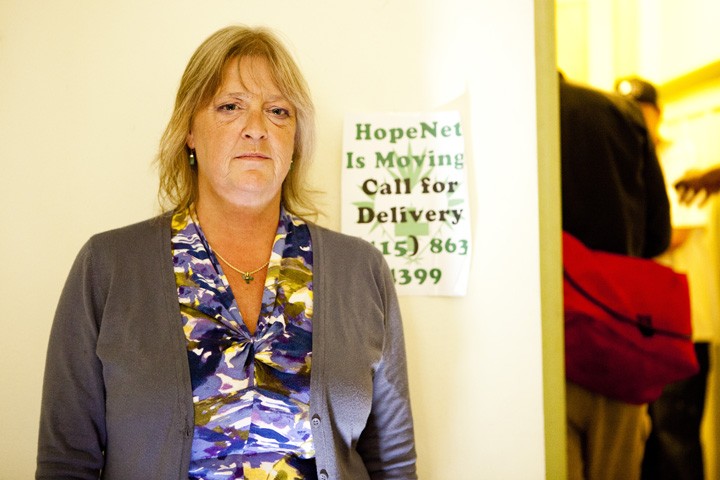
“The people that live here are afraid the neighborhood is going to come back in here. We took care of the entire block. Before us, it was all dealers, so there’s a safety issue,” HopeNet founder Cathy Smith told me as the once-welcoming club on 9th Street near Howard was reduced to bare walls, noting that the owner of the Starbucks on the corner told her he expects his business to drop by 15 percent.

Olive shared the concerns expressed at HopeNet, which he considers “a sister dispensary,” one that also had a generous compassion program for giving cannabis to low-income patients and offering other free services like yoga.

“I’m curious to see what this neighborhood looks like in six months. I know what it was like six months before we got here,” Olive said of his club’s opening in 2004.

But for now, it’s over. Vapor Room continued to do business for most of the day yesterday, but HopeNet was already stripped bare and essentially shut down, and by 3:30pm they removed the cash register and their pot stock. “The signs are down, we’re no longer a pot club, break out the beer,” announced Smith’s son, Bill, a member of the cooperative, referring to one of the many tight restrictions of what the city allowed in clubs. “I’m the only one making light of things today, as a coping mechanism. I laugh so we don’t cry.”

Like the patients, vendors, and local officials we spoke to – who you’ll hear from in an upcoming Guardian cover story looking the end of medical marijuana’s golden age – Olive and Smith are grappling with a federal crackdown they say has myriad downsides and no benefits to anyone but federal agencies that profit from drug-related seizures and the criminal syndicates that now have less competition.

Both Olive and Smith say they voted for Obama in 2008, they believed his statements that he wouldn’t go after businesses that complied with state and local law, and now they feel betrayed.

“I feel fucked by it, betrayed is too easy a word,” Howard said.

“It’s complicated emotions that I’m feeling – let down, confused – at the end of the day, I don’t understand why this is happening,” Olive said. “It’s a community tragedy, it really is.”

Like MediThrive and other recently shuttered clubs, both Vapor Room and HopeNet will still be operating as delivery-only services, but the future seems less certain now that their direct, brick-and-mortar connection to their community has been severed.

They urge those concerned about the crackdown to contact their political representatives, and to turn out today (Wed/1) at 4pm for a funeral march that starts at Haight and Steiner streets near the now-shuttered Vapor Room and goes to the Federal Building on Golden Gate Avenue, where there will be a rally and speeches starting at 5pm.

Maverick

6

virginia@sfbg.com

APPETITE Opened on July 13 way back in 2005, Maverick is a longtimer by modern day restaurant standards. I’d posit that it’s better than ever with new executive chef Emmanual Eng, brought on last year by owners Scott Youkilis and Michael Pierce (who is also the general manager and wine director). In contrast to its more casual, younger sister Hog and Rocks, Maverick’s food has grown more sophisticated and focused over the years.

The menu delights and has evolved slightly at each visit, with whispers of Southern influence (and beyond) married to forward-thinking culinary vision. Traditional Southern ingredients and dishes are a springboard for cutting-edge “New Southern” cuisine, the likes of which I’ve seen in cities such as Charleston and Atlanta in recent years or at San Francisco newcomers like Dixie and St. Vincent.

Maverick hasn’t slowed down with age and, especially with talented young Chef Eng on board, to continue challenging itself. An artist and Portland native, Eng boldly walked into SF’s Indigo in 2000, offering to work for free to learn the ropes. He eventually became line cook at Aqua, Quince, and Foreign Cinema, then sous chef at Boulevard and Sons and Daughters. His experience at some of our top restaurants shows in his bold-yet-refined cooking.

Let’s get the obvious out of the way: the signature fried chicken ($24) is as fantastic as ever. Juicy inside, crispy outside, and not at all greasy, the batter is touched with cinnamon, cayenne, and white pepper. It was recently served with blackened patty-pan squash, succotash, pickled watermelon rind, and cornbread croutons — with ham hock and mustard gravy tying it all together, eliciting sighs of delight. It’s hard not to want to return to this one over and over again — and many diners do.

But you’d be remiss not to branch out. There’s nothing Southern about a squash blossom stuffed with brandade ($10), rosso bruno tomatoes, Calabrian chilis, and basil, but it’s delicious. Italian spirit is also present in burrata cheese, made nearby on 16th Street ($12), but rather than being leaving it as another burrata starter, Eng layers flavors with ashed rind from corn husks, baby leeks, arugula pisto, pickled fiddlehead ferns and zucchini. Just before the foie gras ban — which I am not happy about — a duck butcher plate ($16) impressed with foie, tasso-cured duck breast (there’s your Southern touch: fantastic tasso ham), strawberry mostarda, white peach, lime, and duck rillette croquette. Summery as it was rich, it’s the mostarda I craved more of.

Another inspired Southern reinterpretation is porcini mushroom and Anson Mills grits ($12.50). It’s not remotely a traditional grits dish, in fact, there’s only a smattering of creamy grits amid tender porcinis, pearl onion, snap peas and a smoked soft-poached egg running over ingredients when punctured. For a vegetarian dish, it’s almost meaty and soulful. Massachusetts Dayboat sea scallops ($13) are seared just right, but accents of compressed watermelon, pineapple mint, Padron peppers, dotted with lipstick pimento sauce and ancho chile-pumpkin seed pesto making it memorable. Lobster bread pudding draped in smoked cod ($26) is a brilliant twist on traditional New Brunswick stew — in this case, a creamy mussel chowder touched with jerky-like strips of linguica, clams, corn, and sea beans (seaweed). Dessert is no afterthought. In fact, a chocolate Samoa truffle ($9) feels like vacation, a chocolate mound spiked with chocolate bark in a pool of caramelized coconut accented by crumbled shortbread.

Pierce’s wine pairings and frank, engaging welcome are another key part of what makes Maverick special. (We share a New Jersey past, and you can still sense some of that state about him.) His love of wine has grown since his days at Sociale. The thoughful wine list is inclusive of some of California’s more interesting small labels like Wind Gap and Le P’Tit Paysan. A 2009 Cru Pinot from Monterey is perfection with the grits. The anise hyssop dotting tasso-cured duck “prosciutto” pops when paired with a floral, crisp 2011 Domaine de la Fouquette Grenache-Cinsault-Syrah-Rolle rose from Provence. Ask Pierce about his Junk Food Wine Pairing series — he’ll pair wines with the likes of Slim Jims and Doritos.

I appreciate that even sans hard liquor license, Maverick attempts creative cocktails ($9) using vermouth and sake in low alcohol aperitifs. Some work better than others, but the attentive use of local products like Sutton Cellars vermouth is something I wish more wine and beer only restaurants would do. The most consistent drink is a ginger lemon fizz, utilizing Sutton’s dry vermouth, bright with ginger, Meyer lemon, and dreamy honey foam.

At Maverick, attentive staff, intimate dining room, and unique explorations of a well-known regional cuisine exhibit what makes Southern cooking so beloved in the first place: heart.

MAVERICK

3316 17th St., SF

415-863-3061

www.sfmaverick.com

Subscribe to Virgina’s twice-monthly newsletter, The Perfect Spot, www.theperfectspotsf.com
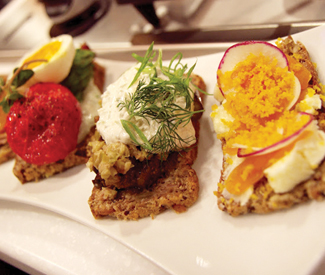
Cheaplicious

1

CHEAP EATS I can’t tell you how beside myself I am to be back in San Francisco. I can tell you, but it will sound like it’s coming from over there. It’s not! I’m right here where I belong, typing at you from the warmth of my very own(ish) clawfoot tub in the bowels of my old dungeon-y hovel at 18th and Guerrero.

Upstairs, in the relative sunshine of our other, airier studio apartment, Hedgehog is pacing back and forth and saying to herself: We live in San Francisco. We live in San Francisco. Until finally she can’t take it anymore and shaves off her eyebrows.

You too, dear reader, must be pretty somewhat goddamn happy to hear this. It means instead of me writing about restaurants in Oakland and Berkeley all the time, not to mention points even farther east, I will likely go right back to hardly ever leaving the Mission.

Just last night for example, because neither of our two refrigerators had any food in it yet, we were stuck in one of those where-to-eat thingies, wherein I kept saying: Sichuan Home! And I kept saying: Halu! No, Sichuan Home. No, Halu. And Hedgehog kept sitting on our pretty red couch, looking daggers at me and altogether having eyebrows.

Then she said, “Let’s just go outside and walk around the neighborhood and find something. You haven’t lived here in almost a year. There will be new things.”

“Yeah sure,” I said.

We grabbed our jackets and stepped out into the hallway of our apartment building just as Scotty the House was walking by with a bass. “What?” we all said.

“We’re back!” I said.

He was going upstairs to get Earl Butter to practice for their cute little bandy. But first he wanted to tell us about where he’d just had dinner, and how awesome it was. New place. Small plates. Outside tables. Tacolicious.

Can there be a dumber name for a restaurant?

Please don’t be in the Mission. Please don’t be in the Mission, I repeated to myself.

Scotty the House is a vegetarian.

“Where is it?” Hedgehog asked.

Scotty the House lives in Oakland. “In the Mission!” he said.

It was just around the corner, on Valencia, he said, between 18th and 19th. So OK so that was where we eventually walked to.

We were not the discoverers of Tacolicious. In fact, there was only one table left, and it was outside.

“The heaters are on,” our hostessperson assured us, and we were sold so she led the way.

Outside is a nice little alleyway between buildings, with a big black-and-white mural of the city along one wall. There are words on the mural, too. And the heat was on and the chips were fresh-made and immediate, the salsa spicy and delicious.

Uh-oh. If I’m not careful, I’m going to like this restaurant, I thought.

I wasn’t careful. At $3.95 a pop, 4 for $13, we ordered one of everything, tacowise, give or take the vegetarian one. Give, to be precise. But to make up for it, we tacked on a taco of the week, which was achiote chicken, and a side of drunken beans that promised us both bacon and “pickled things.” Their words, not mine.

Problem being, we couldn’t find anything at all pickled in those beans. It was either an oversight, or a very subtle drunk.

Neverminding that, though, the tacos were, generally speaking, pretty great. Except I don’t much like mole so I let Hedgehog have almost all of that one. And the shot-and-a-beer braised chicken and chorizo-and-potato ones were also not my favorites.

I loved the carnitas, the cochinita pibil and the braised beef short rib tacos. The fried rock cod one was also especially wonderful: one nice-size lump of white fish delicately breaded and bursting with juiciness. Honestly, at first bite I wondered if they had injected the fish with melted butter or something. It was heavenly.

Oh yeah: bistec adobado, with big chunks of actually rare steak and pickled onions. You have to add a buck, it’s so good. Not cheap. But close enough.

Tacolicious

Daily: 11:30 a.m.-midnight
741 Valencia St., S.F.
(415) 626-1344
AE,D,MC,V
Full bar


Two calls to investigate SF restaurant surcharges as consumer fraud

49

The surcharges that many San Francisco restaurants charge their customers – ostensibly to help cover their employee health care obligations, although in practice it has often just padded their profits – should be investigated by the District Attorney’s Office as consumer fraud, according to Sup. David Campos and San Francisco’s Civil Grand Jury, which recently issued a scathing report scrutinizing the practice.

Campos raised the issue during Tuesday’s Board of Supervisors meeting, calling for a criminal investigation and City Hall hearing. He even questioned whether businesses that have been so hostile to city’s Health Care Security Ordinance – the landmark 2008 measure that created the Health San Francisco universal care program and required businesses to help pay for their employees’ health coverage – should benefit from the tax cuts it would receive under a business tax reform ballot measure the board also considered that day.

“In the restaurant industry, we have an issue that remains unresolved,” Campos said during the business tax debate, after earlier in the meeting calling for the DA “to begin an investigation for fraud against the people of San Francisco by businesses that use this surcharge.”

DA’s Office spokesperson Stephanie Ong Stillman confirmed that the office is looking at the issue: “The Grand Jury report was just released and we are in the process of evaluating the results.”

Mayor Ed Lee last year vetoed legislation by Campos that would have banned the practice and prevented businesses from simply pocketing money from Employer Health Reimbursement Accounts they create to comply with the mandate (federal law bars the city from dictating how businesses cover employee health care) at the end of each year. Lee later signed a watered down version sponsored by Board President David Chiu requiring employers to keep the money in the fund for two years, to let their employees know about the fund on a quarterly basis, and to dedicate surcharge revenue to employee health care.

Rob Black, executive director of Golden Gate Restaurant Association – which unsuccessfully sued the city over the employer mandate and appealed the case all the way to the US Supreme Court – criticized Campos and the Grand Jury, saying they were relying on data from last year and that the situation has improved since Chiu’s legislation went into effect (Chiu told us data collection from his legislation will allow the city to better assess what’s happening).

“Supervisor Campos know this information is based on data that was prior to the new ordinance,” Black told us, acknowledging that many restaurants profited from the surcharges “but that was before the law was changed.” Campos responded by saying the grand jury concluded that the Chiu legislation didn’t go far enough the prevent the abuses, which are tough to detect because they are based on self reporting by the businesses.

The Grand Jury looked at 38 restaurants, of which 25 used the surcharges and 22 use the reimbursement accounts rather than either health insurance or Healthy San Francisco, which health care experts uniformly say are better options for employees. It analyzed data submitted to the city by these 22 restaurants with a total of 1,562 employees, finding that of the more than $2 million earmarked for the health reimbursement funds, just $123,612 was paid to employees and $1.9 million was kept by the employers.

Black said the quarterly noticing requirement in the Chiu legislation is already helping with the low reimbursement rate: “My hope is, and my belief is, we’re going to see significant…improvements in utilization rates in people taking advantage of their benefits, and that’s great.”

The grand jury also looked specifically at the health care surcharges collected by 18 restaurants with almost $64 million in gross revenue. Despite collecting almost $2.2 million in the surcharges it placed on customers bills, they reimbursed their employees for $1.16 million medical expenses and kept the more than $1 million that remained as profits.

Black criticized the grand jury for selectively picking the restaurants in its study and for targetting private sector businesses rather than the public agencies it traditionally investigates. “They’re outside of what the government charter calls for,” he said.

But Mark Busse, the chair of the Grand Jury Health Committee that led the study, told the Guardian that while it’s unusual to look at the private sector, there was a legitimate public policy interest here and its work was approved and overseen by Presiding Judge Katherine Feinstein (who happens to be the daughter of US Sen. Dianne Feinstein, San Francisco’s former mayor).

He also denies hand-picking the restaurants, saying he asked jurors to simply keep the receipts from all restaurants they frequented. While that may not be representative of all restaurants, he said it was a large enough sample to draw some conclusions and that he was more surprised than anyone at their findings.

“I thought our results would be totally different. I didn’t think they would be that abusive, I really didn’t. I thought we would find we have some outstanding restaurants and entrepreneurs,” Busse said, adding that he was alarmed by their actual findings. “It turned our stomachs. It makes us sick. It is not a level playing field. There are legitimate businesses that accept the spirit of the law and are taking care of their employees, but a lot of them aren’t.”

Given that these employees handle the food of city residents, he said that they should get the health care to which they’re entitled. As Busse told us, “The intention of the jury was to make sure the workers are getting health care and the customers aren’t getting deceived.”

7/27 Update: We heard back from the Mayor’s Office, whose Chief Deputy Communications Director Francis Tsang wrote: “Mayor Lee is a strong supporter of the Healthcare Security Ordinance. The Civil Grand Jury surveyed only 38 restaurants and its report restates facts we already know – some businesses add a surcharge and in the past, it was not well regulated.  Working with Supervisors, Mayor Lee strengthened practices effective January 2, 2012 to ensure employees could make better use of the program.  We will know the results in 2013, when we collect and report on 2012 data informed by the new regulations.”

Full-flavored beer talk with Russian River Brewing Co.

1

Over the past 30 years, California microbrew has conquered niche markets and infiltrated the mainstream in its evolution from “social lubricant” to “serious, artisanal product.” Arguably, no individual is more responsible for this spirit of innovation than Vinnie Cilurzo of Russian River Brewing Company, based in Santa Rosa.

Acclaimed for his generously hoppy beers, which possess a cult following of Trekkie-like fervor, Cilurzo is credited with inventing the double IPA early in his career in San Diego; and Russian River’s elusive, seasonally released Pliny the Younger was recently determined, by popular vote, to be the best beer in the world.

However, Cilurzo’s mavericky side is perhaps best reflected in his sour ales: a highly specialized range of Belgian-derived brews, revered in beer-geek circles for their complexity. Aged in wine barrels for years at a time, with the addition of fruit like sour cherries and currants, and often subjected to the risky practice of spontaneous fermentation, sours are as temperamental as they are inefficient in respect to time, cost-effectiveness, and space preservation. Often called “wild ales,” these beers require a knowledgeable, experienced brewer to tame them.

I spoke with Cilurzo over the phone recently about his approach to sour beers, his brand’s esteemed reputation, some recent collaborations with Sierra Nevada and Toronado, and his favorite hops, as well as the various brews gracing his fridge at home. Beer lovers, and novices alike, read on:

SFBG You make a pretty diverse lineup of beers. Is there anything that your beers have in common? Anything that ties them all together?

Vinnie Cilurzo They’re all, for the most part, full-flavored beers. Obviously, we have a pretty eclectic lineup, from our super-hoppy beers [Pliny the Elder; Blind Pig IPA], to the Belgian beers [Damnation; Sanctification], to barrel-aged beers [Supplication; Beatification]. And then we make a lot of session-type beers at the pub. I’m not sure there’s anything that ties them together, other than from a quality standpoint, you know, being Russian River. But we like having the diversity at the brewpub for sure, and the brewpub is hands-down the main part of our operation.

http://www.youtube.com/watch?v=bYzqf0Ukssg

SFBG “Sour” is a pretty popular umbrella term for a whole range of beers. Do you accept that term? Reject that term? How do you classify them?

VC I’m fine if someone wants to call them sour, or barrel-aged, or whatever they want to call them. I think, for the most part, the beer connoisseurs know what they are. You know, on occasion, a non-beer-enthusiast will buy a bottle and be surprised when they find it is sour in flavor. It doesn’t say it on the front of the label, but we don’t make a huge deal out of it, either way. Barrel-aged funky beers… is the term we tend to go with, typically [laughs].

SFBG Looking at opposite ends of the spectrum, what do you think is a good barrel-aged beer to start out with, for someone who’s looking to jump in? What’s a good example of one that goes all the way, and just does something radical?

VC We have three main barrel-aged beers, and then the fourth being Sanctification, which is the 100% brett-fermented, and we add bacteria to it. The Sanctification is probably the mildest. We purposefully make it less sour and less tart, so that, maybe a person that’s new to the funky beers can maybe taste one of these, as sort of an entry level funky, barrel-aged beer…

On the most extreme side, I would definitely go with Consecration, which is 10% alcohol, and we age it in Cabernet Sauvignon barrels. There’s currants added to the barrels, so that provides sugar for the secondary fermentation. That’s definitely got the biggest, boldest flavors, not only from the beer part of it, but the wine contribution, and the barrel contribution, and although it’s not over-the-top sour, there’s just a lot of big, bold, complex flavors there.

SFBG Also, Beatification. That’s the only one that’s completely spontaneously fermented, right?

VC Yeah, it is. That, too, could also be considered, probably on the pretty extreme side of the funky beers, in that we do 100% spontaneous fermentation… In Belgium, a spontaneous beer would originally be called a Lambic, but that’s a protected term that can only be used in Belgium. We obviously respect our friends in Belgium making lambic, so we’ve come up with this kind of playful term called “Sonambic” (a contraction between Sonoma and Lambic.)

So, we have multiple batches of Sonambic aging all the time, and then we take different batches, blending them together to make Beatification. Beatification is, typically, a once-a-year release.

SFBG Since this beer’s picking up these wild yeasts, do you think they have a specific flavor profile that you would not get if you were aging these beers in Belgium, or somewhere else?

VC No, I think they’re wild yeasts that are inherent to brewing these types of beers, in general. So, if you know how to manipulate your environment, you can probably get these types of flavors to come through. But, it certainly takes time.

SFBG You mentioned “manipulating your environment.” These sours, you’ve been making them for a while. Do you feel like you’ve kind of gotten the variables down, and know how to control it, pretty much every step of the way?

VC We have a good handle on it, but the beer is always in control. The time when you start feeling that you know what you’re doing, the yeast and the bacteria will throw a curveball at you, that’s for sure. So, the beer really does tell you when it’s ready. It’s weather dependent; it’s temperature dependent; it’s seasonally dependent; it’s what was in the barrel before; it’s how long you clean the barrel. For the spontaneous beers, specifically, it’s how long we leave the wort in the koelship, which is the open fermenter. There’s so many variables. So, you have to be very, very pliable, and be able to go with the flow, if you will.

http://www.youtube.com/watch?v=q9-umFtNSVE

SFBG Moving on, there’s the Toronado 25th Anniversary collaboration

VC Yeah, we’ve got that in the bottle now. Four-and-a-half years ago, we made Toronado’s 20th anniversary beer, [Toronado owner] Dave Keene liked it a lot and asked me if I’d do the 25th anniversary. We actually started it about a year ago, so by the time the Toronado 25th anniversary happens, which is Aug. 11, it’ll have been about a year-and-a-half project.

We started brewing them in the spring of 2011, and we just bottled it recently. It’s a disproportionate blend of the six beers… Dave and I made the blend ourselves, so he came up here one day a while back. We sat down and tasted through all the beers first, and created the base blend, started tweaking it here and there, and got it to a point where we were happy with it.

SFBG Are there any other San Francisco-centric collaborations going on? Any other collaborations with breweries, in general?

VC We do have a big one coming out, but it was actually brewed at Sierra Nevada, so it was a Russian River / Sierra Nevada collaboration… specifically between Brian Grossman [Sierra Nevada owner Ken Grossman’s son] and I. Brian and I are very close friends so, we wanted to do a beer together.

We didn’t want to do something that we both make already, so hoppy beers were out. Being that we do sour, barrel-aged beers, that was out. And, also, there was no way that Ken was going to allow bacteria at Sierra Nevada. But, they had never used brettanomyces before, and Brian thought his dad would be okay with that. So, I started working on a recipe on our pilot brewery here, and then Brian started working on his dad to get him to sign off on the project. Finally, Ken was okay with it.

We came up with an original recipe here at our brewery, on our little half-barrel pilot system, and then we handed that recipe off to Sierra Nevada, and they brewed it for several months, on their 10-barrel pilot brewery. Then, once we dialed the recipe in, there, and made a couple more tweaks to the recipe, it was ready to go. Earlier this year, January, we brewed it there in Chico on their 100-barrel system, and it got bottled mid-February. They start shipping it out late this month, to all their respective distributors throughout the country.

The beer is called Brux, which is short for bruxellensis: a strain of brettanomyces. You’ve got multiple strains of brett, and so we chose the bruxellensis strain as the one we wanted to use, as it had the best flavor profile. So, it’s bottle-conditioned with the brettanomyces, and that’s one of the flavor components, although there’s contributions from the main yeast, and all kinds of nice, beautiful, round flavors in the beer. I’m really excited about it. It’s probably one of my favorite beers I’ve ever brewed before.

SFBG Given all these American breweries innovating with Belgian beers, is there anything you’d like to see American beer culture pick up from Belgian beer culture?

VC Glassware, to me, is something where we could do a better job. That’s looking internally at ourselves, too. We could do a better job getting pubs and restaurants to use proper glassware, even for our own beers. It’s a little more difficult to do. But yeah, that is a part of the Belgian culture that I do absolutely love.

SFBG Is there a glass that you feel that your sours are particularly well served in?

VC If you’re at home drinking Belgians or sour, barrel-aged beers, I’d say: try a pint glass with half the beer, and put the other half in a wine glass, if you don’t have a stemmed, beer-type glass, and see if you can tell the difference. I think you can tell a big difference, particularly in aroma, and obviously some flavor, as well, by using a non-pint glass. A wine-type glass works a lot better.

http://www.youtube.com/watch?v=kZEISow-vM4

SFBG Moving on to your hoppier beers… Are there any hops in particular that you feel you have an affinity for?

VC Simcoe would be the main hop. If not the first, we were one of the first breweries in America to use Simcoe, back in the late ‘90s when it came out originally. That is kind of the predominant hop that you get in Pliny the Elder, [which] we’ve been making since 1999. I think I first messed around with Simcoe in ‘97 or ‘98 back when it was an experimental hop called YCR-014.

We originally designed the Pliny recipe around Simcoe, and we also use it in Pliny the Younger. A little bit goes into Blind Pig IPA. Then, we have this new beer called Row 2/Hill 56, which is a 100% Simcoe beer. The name Row 2/Hill 56 references the exact location of the very first ever Simcoe vine, up in Yakima, that was grown through the experimental program. So, it was in the second row, and the 56th hill into the hopyard.

It’s sort of a deconstructed pale ale. There’s only three farms in the world that grow Simcoe, and they’re all in Yakima Valley, so… we pelletize the hops separately, and process them separately, [adding] the hops to the brew kettle based on the farm, not just by the variety. Normally, when you’re doing a hop addition, you’re looking at it, saying, ‘I’m gonna add Cascade, or Simcoe, or whatever the recipe is.’ In this case, it’s all Simcoe and it’s farm specific.

We use a ton of other hops, too: CTZ, Amarillo, Chinook, Cascade, Centennial. In the Belgian beers, we use a lot of Styrian Golding, Sterling, Saaz, and Northern Brewer.

SFBG You’re basically credited with inventing the double IPA in San Diego, and it’s developed a lot since then. What do you think about that?

VC To be honest with you, it doesn’t really mean that much to me. If I was the first, then great. If not, then no big deal. It really is amazing, though, to see the amount of hops being used in the craft beer industry right now. I was at the Hop Growers’ Convention earlier this year, and there was a fact that was thrown out, that by the end of 2013, if craft beer grows at the same pace that it is now, craft brewers in general will be using the exact same amount of hops as all the big breweries in America, the big industrial breweries, making industrial lagers. So, it does go to show that we use a lot of hops, and we use them rather inefficiently, as Matt Reynoldson at Firestone Walker says. Anyways, it’s nice for people to recognize me, but it’s not the end-all by any means.

SFBG I read in a previous interview that Orval is your favorite beer.

VC Yeah, you can always find Orval, Duvel, and Sierra Nevada Pale Ale in my fridge at home. Those are my three go-to beers at home. But, there’s some other great little Belgian breweries. There’s a little brewery in West Flanders called De Ranke that makes a beer called XX Bitter, that is a beautiful, hoppy Belgian beer. There’s a small startup brewery (well, they’ve been in business for several years now) in Brussels called De la Senne, and they make a beer called Taras Boulba, that’s just absolutely beautiful, as well.

SFBG Do you think Orval’s rubbed off on the way you make beer? Do you look to it for inspiration?

VC Well, Orval is a brett-finished beer, and until we’ve done this beer with Sierra Nevada, Brux, it was actually the first brett-finished beer we’ve really done on any kind of scale. Although we have made one or two at the pub over the years, they were single, one-off batches, so, we use brettanomyces at Russian River as just a part, just one component of the barrel-aged beers, where Orval is a brett-finished beer. It’s refermented in the bottle with brett, so I would say that Brux is more Orval-esque than anything Russian River has ever done, because we are souring our beers, and brettanomyces doesn’t make the acidity; bacteria makes the acidity in the barrel-aged funky beers. Brett just contributes a funky, earthy flavor and characteristic.

Although I do plan to put more of those style beers out, and I really love that style of beer, it’s actually not something we’ve done a lot of. When we made Brux with Sierra Nevada, it was as much a learning curve for me as it was for Sierra Nevada, who had never used brett before.

SFBG Are there any American brewers who you feel are approaching beer from a similar angle that you are? Or, just some that you feel are doing a really good job?

VC Top of the list is Sierra Nevada. I love what they do. Their commitment to quality is like no one else, and it was really neat to kind of be a part of a process there, with a beer like Brux. And, although they don’t do funky beers, they are my everyday, go-to beer at home. They’re doing a tremendous job, but yeah, there’s lots of breweries.

Although you don’t get it here in California, I love what Brooklyn Brewery is doing. They’re doing some phenomenal Belgian inspired beers. Particularly, they’ve got a beer called Sorachi Ace which is a saison. Just a really beautiful beer. Allagash are some of my favorite Belgians. There’s a little brewery down in Central Valley: Kern River Brewing. They make a really good IPA. The list is too long. I mean, there’s just so much good beer being made in the US right now.

Probably, in the big picture, the US is leading the way in innovation now for beer, whereas in the past, you probably would have said Belgium, or Germany, or something like that. But really, it probably is American breweries doing it. All these little breweries coming up with all these crazy, wacky beer recipes, you know?

Double visions

0

virginia@sfbg.com

APPETITE A strong concentration of cutting-edge American chefs are right here in the Bay Area. Widely acknowledged in food publications and among global diners, Bay Area creativity has been ascendant in recent years. Collaborative dinners between local chefs and with chefs from countries beyond our borders uniquely showcase the forward-thinking cooking coming out of our region. I’ve been privileged to attend recent one-of-a-kind dinners (like the one this week between culinary “it” town Copenhagen chef Christian Puglisi of Michelin-starred Relae and Bar Tartine’s visionary chef Nick Balla).

During a weekend in May, one of Australia’s star chefs, Ben Shewry of Attica in Melbourne (www.attica.com.au), joined the incredible David Kinch at Michelin-starred Manresa in Los Gatos (www.manresarestaurant.com). Both chefs are known foragers, utilizing local bounty in their restaurants in bursts of pure inspiration — Manresa sources its produce from nearby Love Apple Farms (loveapplefarm.typepad.com), which holds classes on urban goat-raising, cidermaking, edible perennials, and more. The hours-long dinner was not just a visual feast of color combinations, it was a dream of freshness in unexpected forms, heartwarming in taste.

Shewry started with walnuts in their shells, unadorned and tender, while Kinch offered carrots, clams, and savory, textural granola dotting vegetable marrow bouillon. Shewry’s fresh crab and artichoke leaves arrived softly layered, dotted with citrus cream. Unlike any crab dish I’ve had before, it nearly dissolved on the tongue, a striking as the sea yet elegantly subtle. A stunner. As was his beauty of diced sweet potato, purslane, and egg doused in a creamy pool of Cabot clothbound Vermont cheddar. Kinch’s gorgeous dessert was a silken, custard-like mound of white chocolate surrounded by crispy quinoa, goat’s milk ice cream, and a strip of rhubarb resembling an elevated fruit roll-up.

Manresa is a destination any time, with garden-fresh cocktails, impeccable service, and excellent wine list. The partnership this particular weekend showcased two world class chefs side-by-side, melding their visions.

As part of SF Chefs’ (www.sfchefsfoodwine.com) current Dinner Party Project, which teams up local chefs in themed dinners leading up to the big food and drink classic swiftly approaching August 2-5, inventive chefs Dominique Crenn of Atelier Crenn (www.ateliercrenn.com) and Jason Fox of Commonwealth (www.commonwealthsf.com) partnered at Dominique’s restaurant, for a special dinner on July 8. Both chefs connect over a similar ethos apparent in their delicate yet bold, often playful, cooking styles. Alternating courses, they produced bright, summer-spirited dishes.

An amuse bouche certainly did amuse: little white chocolate shells dubbed “Campari explosions” actually exploded with vivid, joyously bitter Campari reduction, paired alongside a Campari and blood orange cocktail aperitif. Both chefs rocked the tomato in unexpected ways. Fox played with green tomato in the form of a jelly disc gracefully dotted with silky uni, shiso mint leaves, and refreshing cucumber granita. Crenn saluted the glories of red and yellow tomatoes in varying forms and textures — peeled, sorbet, etc. — in a vibrant bowl accented by goat cheese, edible flowers from her home garden, and a strip of lardo, that beauty of pig fat salume, for rich contrast.

Unpredictable touches jumped out, like Fox’s frozen “white snow” over corn pudding topped with grilled sweetbreads and tempura-fried okra (paired beautifully with a 2006 Pierre Morey Bourgogne Chardonnay), or another Fox hit: bone marrow puree animating hearts of palm, skinned red potato and poached ruby fish, happily paired with a cup of duck consommé tea. The meaty tea seamlessly interacted with the vegetables and bone marrow, highlighting a masculine mischievousness in Fox’s stylish cooking. Besides her truly imaginative take on tomatoes, my other favorite Crenn dish arrived dramatically on a scooped stone slab graced with a chocolate branch and an edible, glistening silk nest filled with dehydrated vanilla pods over sweet corn and porcini mushrooms. Like a treasure found in an enchanted forest, the dish explored both savory and sweet whimsically, a feminine wildness tempered by refinement.

We’ll see more from both skilled chefs — and many others — during SF Chefs days’ long extravaganza, which I look forward to every year in tented Union Square. It’s a pleasure to witness our region’s best collaborate with each other and the finest globally, a reminder as to how the Bay Area is in the midst of yet another culinary renaissance, one of many the past few decades.

Subscribe to Virgina’s twice-monthly newsletter, The Perfect Spot, www.theperfectspotsf.com
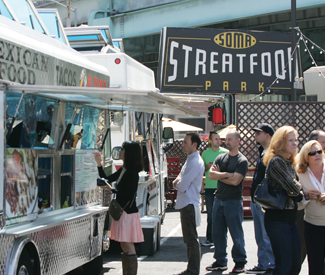
 

The malling of San Francisco

110

steve@sfbg.com

Shopping malls filled with national chain stores and restaurants are in many respects the antithesis of San Francisco. They’re the bane of any metropolis that strives to be unique and authentic. And those just happen to be qualities that make tourism this city’s number one industry.

The logic of modern capitalism, and its relentless growth into new markets, has already placed a Target or a Walmart, and a Nordstrom, Macy’s, Ross, or a JCPenney — along with a bevy of Starbucks, Applebee’s, Jamba Juice, and McDonald’s and myriad other formulaic corporate eateries — in just about every town in the country.

Do people really need them here, too? And in a city renowned worldwide for its scenic beauty and temperate (albeit sometimes foggy) climate, do people want to shop in the enclosed, climate-controlled malls popularized in the small or suburban towns that many residents came here to escape?

For me, the answer is no. Frankly, malls have an aura of artificiality that gives me the creeps — but I freely acknowledge that not everyone feels that way. Some San Franciscans may like malls and chain stores while others don’t.

But it doesn’t really matter what any of us think. Left unchecked, it’s the market that matters — and the logic of the market gives chain stores a huge competitive advantage over the mom-and-pops. Their labor and supply costs are lower, their financial resources are more extensive and appealing to commercial landlords, and their business models are based on constantly opening new stores.

All cities have to do is just say yes. And San Francisco has been increasingly saying yes to malls and chain stores.

The economic desperation that set in since the financial crash of 2008 has overcome the trend of resistance to so-called “formula retail establishments” that had been building in San Francisco during the years before the recession.

So now, rather than dying from neglect, the Metreon mall has been brought back to life by a huge Target store set to open this fall, the second Target (the other one at Masonic and Geary) going into a city that had once eschewed such national mega-retailers.

Just down the street, in the heart of the city’s transit-rich commercial center, the CityPlace mall that had been abandoned by its previous owners after winning city approval two years ago is now being built by new owners and set to open next spring with “value-based” national chain stores like JCPenney.

Projects funded with public money aren’t immune either. The new Transbay Terminal transit center now under construction will have its own mini-mall, with 225,000 square feet of retail, much of it expected to house national chains. Even more retail will be built on the ground floor of the dozen other nearby residential and office buildings connected to the project.

And it isn’t just these new malls going in a stone’s throw from the Westerfield Mall, Crocker Galleria, San Francisco Center, and other central city malls. All over town, national chains like the Whole Foods and Fresh & Easy grocery stores are replacing Cala Foods and other homegrown markets, or going into other commercial shells like the S&C Ford building on Market near the Castro.

Just a few years ago, the approval of Home Depot on Bayshore Boulevard (since then sold and opened as Lowe’s, another national chain) was a hugely controversial project approved by the Board of Supervisors on a closely watched 6-5 vote. Now, Lennar is building an entire suburban-style complex of big box stores on Candlestick Point, hundreds of thousands of square feet — without much controversy at all.

Even Walmart — the dreaded poster child for huge corporations that use their market power to drive down wages or force local stores out of business — is reported to be actively looking to open “a couple” of stores in San Francisco (see “Walmart sets sights on San Francisco,” June 24, San Francisco Chronicle).

To Livable City Executive Director Tom Radulovich and others who have long encouraged San Francisco to embrace the kind of urbanism advocated by famed author and activist Jane Jacobs — which emphasizes unique, neighborhood-based development that enhances public spaces and street life — accepting the malls feels like giving up on more dynamic urban models.

“It’s sort of an admission of failure,” Radulovich said. “It’s the failure of urbanism in San Francisco.”


MID-MARKET SYMBOLISM

Mid-Market Street is a bellwether for the type of city San Francisco may become. Every mayor since at least Dianne Feinstein in the late 1970s has called for the redevelopment of Mid-Market into a more active and inviting commercial and social corridor, and few have done so more fervently than Mayor Ed Lee.

Several city studies have explored a wide variety of ways to accomplish that goal, from eliminating automobiles and transforming Market Street into a lively pedestrian promenade to using redevelopment money, tax breaks, and/or flashy lighted signs to encourage distinctive development projects unique to San Francisco.

“But the city failed, so the market filled the void,” Radulovich said.

It isn’t that all shopping malls or enclosed commercial areas are necessarily bad, Radulovich said, citing the influential work by writer Walter Benjamin on the roles the enclosed “arcades” of Paris played in public life. “They work when they are an extension of public spaces,” Radulovich said.

Yet that isn’t what he sees being built in San Francisco, where what gets approved and who occupies those spaces is largely being dictated by private developers who are more interested in their bottom lines than with the creation of a vibrant urban environment where people are valued as more than mere consumers or workers.

San Francisco isn’t alone in allowing national chains to increasingly dominate commercial spaces. In fact, Stacy Mitchell, a researcher with the Institute for Local Self-Reliance, said that until recently San Francisco was one of the best big US cities in controlling the proliferation of chain stores.

But the city has lost ground since its anti-chain high water mark in 2007, when voters approved Proposition G, which expanded the controls on formula retail outlets — generally requiring them to get a conditional use permit and go through public hearings — that the Board of Supervisors had approved in 2004.

Those controls are only as good as the political will to reject a permit application, and that doesn’t happen very often. A memo prepared last July for the Planning Commission — entitled “Informational Presentation on the Status of Formula Retail Controls” — found that of the 31 formula retails applications the city received since 2007, just three were rejected by the commission, six were withdrawn, and 22 were approved.

It’s gotten even worse since then, as the two Targets and other chains have been courted and embraced by Mayor’s Lee’s administration, whose key representatives didn’t respond to Guardian interview requests by press time.

Mitchell said it’s not nearly as bad in San Francisco as it is in Chicago, New York City, New Orleans, and other iconic US cities whose commercial spaces have been flooded with chains since the recession began.

“It’s nothing compared to the no-holds-barred stuff going on in New York City right now,” Mitchell said. “Walking down Broadway now is like a repeating loop of the stores you just saw further up the street.”

It isn’t that these cities are actively courting the national chains in most cases. It’s just that in the absence of strong local controls, developers and large commercial landlords just prefer to deal with chains, for a variety of reasons.

“If you’re just going with the flow of what developers are doing,” she said, “you always end up with national chains.”

And that’s what San Francisco has started to do.


MALLS LIKE CHAINS

Stephen Cornell, the owner of Brownie’s Hardware and a board member of the nonprofit advocacy group Small Business California, said chains have a huge competitive advantage over local businesses even before either one opens their doors.

“In general, landlords tend to like chains more,” said Cornell, whose business has struggled against Lowe’s and other corporate competitors. “The landlord always worries: is this guy going to make it and do they have the funds to back it up?”

Big corporate chains have lawyers and accountants on staff, and professional systems established for everything from buying goods to opening new stores, whereas most local entrepreneurs are essentially figuring things out as they go along.

“They’re very good at selling themselves,” Cornell said. “They’re going to manipulate the system perfectly, whether it’s the city and its codes or dealing with neighborhood merchants.”

And for large malls, Cornell said the problem is even worse. Brokers that fill malls have standing relationships with the national chains — most of which are publicly traded corporations seeking to constantly expand and gain market share — and no incentive to seek out or take a chance on local entrepreneurs.

“Chains have a lot of advantages,” Cornell said.

Mitchell said there are two main ways in which malls favor national chains over local businesses. In addition to the relationship between mall brokers and national chains, malls are often built with financing from financial institutions that require certain repayment guarantees.

“What they want to see are credit-worthy clients signed onto those places, and that means national chains with a credit rating from Standard & Poors,” Mitchell said, noting how that “automatically locks out” most local businesses.

Cornell also noted that national chains have already figured out how to maximize their efficiency, which keeps their costs down even though that often comes in the form of fewer employees with lower pay — and less reliance on local suppliers, accountants, attorneys, and other professionals — which ends up hurting the local economy. In fact, big chains suck money out of the city and back to corporate headquarters.

“All those people are making money and spending money here, so you have to look at the full circle,” Cornell said.

Mitchell said there are often simple solutions to the problem. For example, she said that city officials in Austin, Texas recently required the developer of a large shopping mall to set aside a certain percentage of the units for locally owned businesses.

So rather than hiring a national broker to find tenants, the developer hired a local broker to contact successful independent businesses in the area who might be interested in expanding, and the project ended up greatly exceeding the city’s minimum requirements.

Mechanisms like that, or like the formula retail controls pioneered in San Francisco, give her some hope. But she said, “Whether the counter-trends will be enough to counter the dominant trend, I don’t know.”


PUBLIC SUBSIDIES

The increased malling of San Francisco isn’t simply the result of official neglect. Often, the city’s policies and resources are actively encouraging the influx of chain stores. A prime example is the massive redevelopment project on Hunters Point and Candlestick Point that city voters approved in 2008 after mega-developer Lennar and most San Francisco political officials pushed the project with a well-funded political campaign.

“If you’re selling the land to Lennar for a dollar, and then building all the automobile infrastructure for people to get there, then that’s a massive public subsidy,” Radulovich said of the big-box mall being built on what was city-owned land on Candlestick Point.

That public subsidy creates a cycle that makes San Francisco less intimate and livable. Creating commercial spaces on the city’s edge encourages more people to drive on congested regional roadways. These spaces are filled with national chain stores that have a direct negative impact on small, locally owned stores in neighborhood commercial districts all over the city, causing some of these businesses to fail, meaning local residents will need to travel further for the goods they once bought down the street.

“Those neighborhoods are going to be less walkable as a result,” Radulovich said, noting how the trend contradicts the lip service that just about every local politician gives to supporting local businesses in neighborhood corridors. “There’s a certain schizophrenia to San Francisco’s economic development strategy.”

Sup. Eric Mar has been working with Jobs with Justice San Francisco and other groups to tweak city policies that have allowed the chains to proliferate. Last year, Mar held high-profile hearings in City Hall on how national chains impact local businesses, which pointed to the need for additional protections (see “Battling big box,” Jan. 3).

This year, he’s working on rolling out a series of legislative initiatives designed to level the playing field between local interests and those of Wall Street and the national chains it champions.

Last month, the Board of Supervisors approved Mar’s legislation to add banks to the city’s formula retail controls, a reaction to Chase Bank and other national banks snapping up vacant stores in neighborhood commercial corridors such as Divisadero Street.

Now he’s working on legislation that would mandate minimum labor and community benefit standards for chain stores — including grocery outlets such as Fresh & Easy — and study how chains affect San Francisco’s overall economy.

“There should be good neighbor policies when they come into a neighborhood,” Mar said. “Some neighborhoods are so distressed they may want a big box grocery story coming in, but we need to try to mitigate its negative impacts.”

One of his partners in that effort is his brother, Gordon Mar of Jobs with Justice, who argues the city needs to have a clearer picture of how national chains impact local communities.

“We’ve definitely seen an increase in corporate chain stores coming into San Francisco in the last year, and nobody has really been tracking it,” he said.

While the Planning Department’s quarterly pipeline report shows that applications for retail outlets has held steady at about 3 million square feet on the way in recent years, it doesn’t break out how much of that is national chains — let alone how that impacts the city’s economy and small business sector.

The city’s Legislative Analyst is now studying the matter and scheduled to release a report later this summer, which Gordon Mar said will be helpful in countering the narrow “jobs” rhetoric that now dominates City Hall.

“They are exploiting the economic recession by saying they’re bringing much needed jobs into the city and serving low-income residents,” he said. “But when you bring out the facts about the impact of these low-road retail stores on neighborhoods and small businesses, there is a net loss of jobs and a lowering of labor standards.”


VALUING MALLS

Yet the fate of those controls is uncertain at best, particularly in a tough economic environment in which the city needs revenue, people are desperate for jobs, and many residents have seen their buying power stagnate, making the cheap goods offered by Target and Walmart more attractive.

“It’s complicated stuff,” Michael O’Connor, a local entrepreneur and former member of the Small Business Commission who favors formula retail controls, told us. “Stores like Target do appeal to lower income families…The progressive agenda needs to understand that working-class families need somewhere to shop.”

O’Connor acknowledges how small businesses like those he owns, including a clothing store, often can’t compete with national chains who buy cheap goods in bulk. So he said he favors protections in some neighborhoods while allowing chains in others, telling us, “I don’t have a problem with the Target going into the Metreon.”

That argument also held sway with city officials when they considered approving the CityPlace project two years ago, which was presented as a mall filled with “value-based” stores that would be affordable to median income San Franciscans.

“At the time, the decision was around whether a value-based retail operation made sense in that location, and the answer was an emphatic ‘yes,'” Barbary Coast Consulting founder Alex Clemens, who represented the project, told us.

On a national or global level, there are good arguments against reliance on national chains selling cheap imported goods, which has created a huge trade deficit between the US and countries such as China that costs American jobs — ironically, the very things that some use as arguments for approving chain stores.

“The recession has created a climate of desperation where cities are more easily swayed by the jobs argument,” Mitchell said, noting the falsity of those arguments by pointing to studies showing that the arrival of chain stores in cities usually creates a net loss in employment. Finally, supporters of chain stores say the cash-strapped city needs the property and sales tax revenue “Because they say they’ll produce a lot sales tax revenue, they’re going to get away with all kinds of shit,” Cornell said, arguing that shouldn’t justify city policies that favor big corporations, such as tax breaks and publicly financed infrastructure. “I certainly don’t think [city officials] should be giving them any advantages.” There are few simple solutions to the complex and interconnected problems that result from the malling of San Francisco and other cities. It’s really a question of balance — and the answer of whether San Francisco can regain its balance has yet to be answered. “Given the mayor’s approach to economic development, it’s inevitable that we’ll have more coming into the city,” Sup. Mar said. “But the ’50s car culture, and the model of malls that came in the ’60s, don’t build communities or strong neighborhoods.”

9 ways to say oui to Bastille Day

1

Unless the tech kings and queens need to start watching their backs, there’s no accounting for the voracity San Francisco consumes all things Bastille Day (Sat/14). Why do we celebrate the anniversary of the storming of a French clink so comprehensively, when Canada Day goes all but unnoticed? Perhaps the answers will be clearer after this weekend — movies, concerts, food cart explosions, and more will be taking place now through Sat/14 in honor of the Bay’s most illogically favorite holiday.

Farewell, My Queen 

Landmark Theatres picked an appropriate time to unveil French director Benoit Jacquot’s film Farewell, My Queen. The flick follows the last three days of Marie Antoinette (Diane Kruger) and her reader (Léa Seydoux, the pale beauty from Midnight in Paris) in the chaos just before the French Revolution.

Showing at Embarcadero Center Cinema, 1 Embarcadero Center, SF; Shattuck Cinemas, 2230 Shattuck Ave, Berk.

www.landmarktheatres.com

Pre-Bastille Musicale with Baguette Quartet and GAUCHO

Peacefully ring in this not-so-peaceful holiday with a musical performance in the UC Berkeley Botanical Garden. Local group Baguette Quartette performs tangos, foxtrots, and more tunes endemic to 1920s and ’30s Paris. It’ll be joined by Gaucho, a Euro-New Orleans-inspired jazz group that prides itself on its ability to inspire foot-tapping. 

Thu/12 5:30-7:30pm, $12

University of California Berkeley Botanical Gardens

200 Centennial, Berk. 

(510) 643-2755 

botanicalgarden.berkeley.edu

“From Geek to Chic: French Fashion and Technology”

SF Fashion + Tech has acquired a collection of Bay Area industry notables to speak at their Bastille Day commemoration “French Technique: From Geek to Chic.” Enrich your intellect and your closet with drinks, music, and fashion tech talk. 

Thu/12 5pm-9pm, $15-$25

Temple

540 Howard, SF. 

f1wfrenchtechnique.eventbrite.com

Mugsy’s Pop-Up Wine Bar

El Rio busts out its new socially-conscious wine bar in honor of Bastille Day, where Francophile — or just plain wine-chugging — Missionaries can celebrate French independence with a cuppa and some patio-side sunshine. Just as the French revolutionaries stormed the Bastille on this monumental day, Mugsy proposes to storm your olfactory senses with a velvety wine with hints of licorice, chocolate, and lavender (and, somehow, plum, olive, and pepper), a 2009 Le Clos du Caillou Côtes du Rhône Vieilles Vignes Cuvee Unique. Quite a way to class up your Friday night happy hour. 

Fri/13 5:30-8:30pm

El Rio

3158 Mission, SF.

mugsywinebar.tumblr.com

Off The Grid Au Francais 

Foodies can rejoice in a Off The Grid’s solution to affordable French cuisine. In honor of the holiday, many of the street truck fair’s vendors will be offering special French-inspired items. Regardless of one’s culinary orientation (cupcake, crepe, and bahn mi, or baguette?), French gypsy jazz will accompany this cart food frenzy throughout the evening. 

Fri/13 5pm-9pm, free entry

Fort Mason Center, SF

www.offthegridsf.com

Bardot-A-Go-Go 

Go-go to the Rickshaw’s no-pretension dance floor for this always-fun Bastille Day pre-party. DJs Brothers Grimm and Pink Frankenstein will be providing the tunes to guide the night, and you can count on some Gainsbourg screenins to provide an appropriately-hazy French ambiance. Go-go girls, drinks, videos — even 1960’s hair-styling for only $10. 

Fri/13 9pm-11pm, $10

Rickshaw Stop

155 Fell, SF 

www.rickshawstop.com

Belden Place Block Party 

Celebrating another nation’s independence day has never felt so authentic. Tucked away in a FiDi alleyway, Belden is a focal point for Francophiles in San Francisco due to its tasty restaurants. Bastille Day turns the nook into a communal fete, with music and other festivities to boot. The festival recently ran into some trouble due to “past insanity” — always a good sign — but it’s pledged to  

Sat/14, check restaurant websites for hours

Belden between Pine and Bush, SF.

www.belden-place.com

KZYX Bastille Day benefit

Holler your support of community radio through a mouthful of crawfish etouffee — today Mendocino indie radio station KZYZ is raising funds for its community tunes with a full spread of French Cajun fare. Live tunes from Americana rockabillies Contino and that band’s fave openers Shaky Jake Blues Band featuring Rag Time Rick will be the perfect side dish to heaping bowls of gumbo, jambalaya, and red beans and rice with sweet corn boiled in Tabasco mash for the vegetarians music fans. 

Sat/14 3pm, $10-$15

Mendocino County fairgrounds

Highway 128, Boonville

www.kzyx.org

Le P’tit Laurent 

What is normally a highfalutin French restaurant is also a fabulous fete for those who want to get their dinner, drinks, and dancing all in one. The restaurant will serve its normal menu a la carte, keep its bar open until 2am, and rumor has it DJs and dancing will enter the scene at around 10:30pm.

Sat/14 5:00pm-10:30pm dinner, 10:30pm-2am drinks and dancing, $23

699 Chenery, SF. 

 www.leptitlaurent.net

Hot catch

1

le.chicken.farmer@gmail.com

CHEAP EATS Yeah, and part of the idea of going to New York City was to escape New Orleans’s heat, which would best be described (for those who haven’t been) as hot.

Hot hot hot hot hot.

As luck would have it, best laid plans and all, it was even hotter than that in New York while we were there, squeak squeak, fuckity fuck. It was hot hot hot hot hot hot hot. So as soon as we got back home to hot hot hot hot hot, we went camping.

In an air-conditioned camper. With our landlordladypersons, an adorable couple name a Pam and Cindy. Now Cindy, being a tried and true in the wool Cajun, has a brother name a Blaine only everybody calls him Bruno. And this Blaine (only everybody calls him Bruno) is my new favorite person because even though he knew we were crazy for camping on the edge of a swamp during mosquito season, he not only loaned us his trailer but drove it there. And parked it. He’s a truck driver.

Our campsite had been under water the previous weekend, and therefore vacant, so the mosquitos were happy to see us.

We heated our dinner in microwaves that first night. S’mores were not discussed. Next day, though, there was a breeze and we were able to sit outside all day and watch a hawk wrestle with a giant catfish that had been trapped in a puddle.

Hawk won.

Hedgehog took pictures, if anyone wants to see them. She also shot some alligators, and a sweet, tiny red parrot that had fallen in love with our friend Cherry’s roof rack.

I went around pulling dead sticks out of trees, and that night’s dinner happened over a fire. Here’s what I grilled: salmon, swordfish, boudin, turnips, tomatoes, peppers, pineapple, peaches, and garlic. The corn I soaked in its husks and threw on the coals.

On Sunday Blaine Only Bruno (or Bob, as I call him for short) came back and took me, Hedgehog, and Cindy to his crawfish pond. So, yeah, so that was how I spent the last part of my last weekend in Louisiana: having a complete pond-to-table crawfish experience.

We piled into this patchy li’l boat and sat on upside-down buckets. The traps are baited with sweet potatoes! Bob putt-putted us around the pond, pulling them up and dumping the crawfish onto a stainless steel sorting table, where we took turns wiping the angry ones through the square hole into net bags, and tossing the half-eaten or otherwise at-peace ones back into the water.

After, driving along the levee in his pickup truck with probably 50 pounds of crawfish for our dinner and then some, Bob told us about his friend’s crawfishing brother who looks like Z.Z. Top and had recently “caught a heart attack.”

Moments later, we ran into him, sitting in a pick-up truck of his own, eating a bag of potato chips and looking indeed like Z.Z. Top — the whole band. Pleasantries were exchanged. Potato chips were not.

Nevertheless, when we got to Bob and Cindy’s mama’s house, where the crawfish were to be boiled, I caught a stomachache — which is a horrible thing to have when you are about to eat 50 pounds of crawfish.

In a desperate attempt to get good again, I guzzled ginger ale. I ate a piece of dry toast. I sat in a recliner and closed my eyes, and missed the part where we boiled them to death.

Hedgehog was there. She said the secret was to not only add the seasoning to the pot, but to plaster them with it afterwards.

Well, they were spicy, and the best crawfish ever. Once I started eating them, I couldn’t stop. In fact, I’m still eating them. Packing up for the long road ahead: New Orleans to Frisco, by way of Pennsylvania and Ohio, or home to home, via home and home.

When I was there — home home — last time, Crawdad de la Cooter kept wanting to go to all these new Cajun restaurants popping up all over the Bay Area, even in Fairfax. I suppose after I’ve been back for a few months I will need these places, but for now I’d rather be eating pho and watching soccer at my new favorite Vietnamese restaurant and sports bar:

ANH HONG

Lunch: Mon-Sat 11am-2pm; Dinner: Mon-Sun 5-10:30pm

2067 University Ave., Berk.

(510) 981-1789

MC,V

Full bar


Appetite: Spring weekend in Los Angeles yields intriguing tastes

0

I recently returned to my old SoCal stomping grounds for yet another long weekend. This time I stayed at funky, restored motel, The Farmer’s Daughter, gazing over a pool filled with giant rubber duckies, the hotel’s birds greeting me each morning in the lobby. Colorful and quirky, the hotel (with welcoming, engaging staff) is a worthwhile home base, ideally located across the street from the original LA Farmers Market. You won’t find farmers here, rather, it’s a permanent, open air mall of food purveyors.

Though not always gourmet, a few newcomers add foodie cred to the market. However, I hope to never see the demise of old school diners, pie shops and vendors selling unnaturally bright red popcorn and the like – it’s a charming slice of LA history.


On the newer side of things, Short Cake is one of the top Farmers Market destinations. I spent every morning there, happily downing shakeratos ($5 – four shots of espresso shaken with ice and simple syrup) and cappuccinos from one of my favorites, Verve Coffee of Santa Cruz. SF local TCHO chocolate shows up in Short Cake’s mochas, while Amy Pressman’s baked goods are among the best in all of LA.

She trained at Spago with friend and partner Nancy Silverton (Mozza, Pizzeria Mozza). At Short Cake she crafts ridiculously good eats like a curry raisin scones or bacon-cheddar-three chili croissant bread pudding. I rarely repeat places, but this one was worth returning to for breakfast three days in a row.

Another pleasing return this trip? A sunny, playful lunch at Roy Choi’s A-Frame, which I reviewed soon after it opened last year and still find an affordable winner.

BIERBEISL, Beverly Hills

I’m a sucker for cuisines done well, particularly the less commonly seen like Scandinavian, Eastern European or Burmese. I don’t get enough Austrian food. The new BierBeisl, just off Rodeo Drive in Beverly Hills (though not at all like Rodeo Drive – instead, it’s casual, spare and cozy), is one of the better Austrian restaurants around.

Starting with a cool BierBeisl carpaccio, thinly sliced pork roast is delicately doused in a Styrian Gold (Austrian pumpkin seed oil) vinaigrette – a unique, elegant starter. Assorted Austrian charcuterie ($18) and cheeses (add $10) are a brilliant example of the best to come out of the country, vivid with house spreads and rustic rye and pretzel breads.

There’s modern, fresh dishes like seared lamb loin with goat cheese polenta (the most expensive dish, a pricey $36), but I veer towards the traditional, like Vienna Schnitzel ($19-25 for pork, turkey or veal) garnished with lemon and lingonberries plus choice of side: potato salad, roasted parsley potatoes, fries, mixed green salad. House sausages from their sausage menu are a highlight, particularly a Swiss cheese-infused Käsekrainer ($10), lightly peppery and similar to a Polish sausage, while a traditional bratwurst with sauerkraut ($9) likewise satisfies.

Sausages come with a slice of rustic bread and dollops of tarragon mustard and fresh horseradish. The bratwurst is particularly zippy with the Radler Grapefruit: half Stiegl Goldbräu beer, half all-natural grapefruit soda ($6 for 10 oz.; $8 for 16.9 oz.)

Something unusual behind the bar? Reisetbauer Austrian Whisky. Yes, Austrian whisky – distilled in copper pot stills from malted barley, aged in Chardonnay and Trockenbeerenauslese oak wine casks. I appreciated the rogue, hearty spirit of this whisky, lively with chocolate, caramel, hazelnut, bread.

FORMOSA, West Hollywood

Formosa is a Hollywood classic bar/restaurant since 1925 with a storied past. There’s John Wayne’s regular booth which was extended a few feet to hold his long frame when he’d crash after a few drinks. Stars like Bette Davis or Dean Martin would take a cocktail break in between filming at the studios next door (once Pickford-Fairbanks Studio and now The Lot), connected to Formosa by underground walkways. Heavy on history and ghost stories of famed patrons whose photographs line the walls, Formosa has not been known for quality food or drink for years.

But this is not your mama’s Formosa. Though still slowly undergoing its transformation (including mischievous new menu offerings like a fried, spicy peanut butter sandwich), visiting the bar a few times in April I witnessed new bar manager Kate Grutman (previously at Sotto) refreshing the menu and bottle selection – not with fussy cocktails but with well-crafted, playful turns on the likes of a banana daiquiri, aka John Cazale ($10), the secret ingredient being a Fernet rinse, adding a minty, herbal layer. Her Bloody Mary twist is brilliant. Duck Down ($11) is Akvinta Vodka washed with duck confit, mixed with Vince’s original Formosa Bloody Mary mix, lime, Siracha hot sauce, and — wait for it — pickled gobo root (crisp, sweet, and earthy, it’s a member of the burdock root family). I tasted the washed vodka on its own: savory confit imparts a meaty, lush, joyously decadent spirit. It makes for a superior Bloody Mary.

Grutman upgrades dive bar favorites with quality ingredients, as with the Formosa Sour ($9), essentially an improved Midori Sour made from her house Midori liqueur: French honeydew, sugar, orange flower water and lychees with a hint of green food coloring to maintain the neon spirit of the junk food liqueur. Start with an aperitif of The Seven Year Itch ($10), referencing Marilyn Monroe’s potato chips and champagne scene in the film – they go one step further serving housemade chips with a cocktail of bubbles, Cynar, sugar, cherry liqueur and lemon. A perfect finish is Joan Crawford’s Chained ($9), essentially a Sherry Flip with Harvey’s Bristol Cream, Punt e Mes sweet vermouth, garnished with cinnamon. Creamy and savory, it’s dessert.

Grutman is clearly having fun with this menu – and drinking it is likewise a pleasure. Her grandfather was once a Formosa regular so she clearly maintains respect for the unique history of the place, studying old menus, celebrity clientele and films they made at the studios next door, which she’s naming cocktails after. Though there are minor updates happening throughout the building, the place retains its musty, classic Hollywood charm with dim lighting, red booths, rooftop bar, and circa 1930’s Chinese decor. You could still call it a dive but one where you don’t have to check taste at the door. I love witnessing one of the remnants of Old Hollywood reinvent itself while retaining its rich character, ready for more decades ahead.

LUKSHON by Sang Yoon, Culver City

Friends and fellow reviewers have found Lukshon http://www.lukshon.com/read uneven. In my experience, there were a couple brilliant dishes intermingled with a couple disappointments, though my overall meal was strong. I’d return.

The outdoor patio is a mellow alternative to a chic but cacophonous dining room. On a gorgeous LA night, the patio, fronted by a modern rock fireplace, becomes an urban respite.

Attentive, relaxed service made me immediately a fan of Lukshon, while a menu of single origin teas (from San Francisco’s special Red Blossom Tea Co.) and expertly-prepared cocktails confirm the restaurant’s “whole package” status. Asian twists on classic cocktails work, like a vividly tart Lukshon Sour ($11 – Michter’s Rye, lemon, tamarind, palm sugar, kumquats), a smoky Fujian Cure ($11 – Isle of Skye 8yr Scotch, lemon, galangal root, lapsang souchong black tea), or the savory, martini-spirited Formosa ($11): Ethereal gin, Lillet Blanc, atomized mizhiu tou (Taiwanese rice wine), and ginger pearl onions.

Green papaya salad ($9) was a less-than-pleasing version of the classic Thai salad, tasting oddly funky though ingredients were fresh. Chiang Mai curry noodles ($13) read as an enticing list of ingredients (coconut, chile, tumeric, lemongrass, chicken, prawn, yu choy, rice noodles), but came off a tad bland though still satisfying.

The kitchen excelled, however, with fantastic sweetbreads fried “orange chicken” style ($11) in a sweet-sour orange sauce, tender and tossed in scallion, ginger, and pickled lettuce. I’m dreaming of returning just for this dish. A side of yu choy ($7 – a Chinese vegetable), cooked in shaoxing wine and garlic with savory, aged ham is quite a pleasurable way to eat your greens. Short rib rendang ($17) is like the ultimate meatloaf, one cooked in malay spices, red chile lemongrass rempah (a spice paste), drizzled with coconut cream. Sigh.

A simple dessert of flan-like palm sugar caramel custard layered with rice krispies is a delicate finish, with a side of candy cap mushroom ice cream. Lukshon is trendy, yes, but talented chef Sang Yoon hints at the joys of California dining, where our dense Asian cultures and year-round, unparalleled produce combine with classic European cooking technique in inventive dishes.

ink.sack, West Hollywood

Top Chef star Michael Voltaggio smartly opened a sandwich shop half block from his casually hip fine dining restaurant ink., cheekily named ink.sack. Sandwiches come on the mini side at a cheap $4-7, though big enough that I’m unable to finish two. I wish all sandwich shops offered mini versions to vary tastes – and had staff as friendly as ink.sack’s.

Miso-cured albacore tuna is dubbed “spicy tuna” though I could have used more Sriracha mayo to make the sandwich actually spicy and offset a bit of dryness to the tuna. I delighted in sandwiches like The Jose Andres, aka “The Spanish Godfather”, a tribute to the man himself (of The Bazaar, one of my top LA restaurants), filled with Serrano ham, chorizo, and Manchego cheese. But my favorite is a twist on a Reuben with thinly shaved corned beef tongue, Swiss, sauerkraut, and Russian dressing.

EVELEIGH, West Hollywood

True: Eveleigh is the moneyed hipster’s hangout, from a bone marrow, charcuterie-heavy food menu to craft cocktails. But it stands out with a gorgeous setting off a trendy stretch of Sunset Boulevard and quality food and drink. You first pass through the front patio, green with trees and astro turf, into an open dining room with a center bar and ubiquitous fireplace, animal heads and book-lined, gastropub décor. The back of the restaurant is a huge patio covered in plastic with LA views. The space enchants, while my perch at the bar interfaced with busy, disengaged (but still professional, mannered) bartenders.

Though I’ve seen the like of these dishes countless times over the years, each one was well-executed and gratifying, whether bright crushed peas, mint, almonds, Arbequina olive oil and burrata cheese ($12) or a juicy, medium-rare Eveleigh burger (expensive at $19) topped with fontina cheese, pickles and tomato-chorizo relish.

Cocktails ($12) likewise are vivid, balanced and worth a stop on their own. Though, like a thousand cocktailian bars these days, they craft fine, spirituous classics, I’m most pleased with the farm fresh, seasonal side of the menu where they shine with fresh California ingredients and drinks like a Lucky Louie: rhum argicole, kumquats, star anise, ginger, fresh lime.

CURRYWURST, Mid-City West

I “heart” currywurst, that Berlin specialty of grilled dogs doused in German curry. Add chips (fries) if you wish. Currywurst, a few steps from my Farmers Daughter hotel base, is an affordable winner in the currywurst realm (like Berlin Currywurst in Silver Lake). With housemade sausages (my tops is the Hungarian pork) topped with satisfying curry (red German curry is akin to an amped-up, curry laden ketchup), friendly staff and cheap prices make this an ideal snack or lunch.

POUR VOUS, Mid-Wilshire

My bar disappointment this visit was Pour Vous, a sexy, French-influenced den with gorgeous décor, particularly a sunken, circular section with fireside seating. I thrilled to a French-heavy spirit menu highlighting Calvados, absinthe, Armagnac, Cognac. In theory, this could be a dream bar – an underdone concept I’d be thrilled to see well-executed. Maybe it is better early on a weeknight or depending on the bartender?

But on a Friday near midnight, it’s cacophonous, mobbed and irritating. The elegant space is dominated by well-dressed, middle-aged guys with young, blonde girlfriends (sporting breast implants, of course) with a pick-up scene of well-heeled 20-40-somethings on the prowl.

Though such a scene is always irritating (that cliché LA, Vegas, Miami feel), the clash of this crowd in such a romantic setting would be slightly lessened if drinks were excellent. At $14-15 a pop for many cocktails, they should be stellar.

Though it sounded amazing, a medicinally sweet, cloying Le Samourai ($14 – Armagnac, framboise, rhubarb, “umami”) was virtually undrinkable, while a Vadouvan Lassi ($15) could have been brilliant with rhum agricole, lime, coconut, falernum, Vadouvan curry and bitters, but ended up tasting like bland, minimally spiced milk on ice, the curry and the agricole lost in the milk. Tasting my friends’ drinks didn’t get me much further, while disengaged bartenders and a costly bill confirmed just how unsatisfying the entire experience was. I left convinced this is not so much a cocktail-spirits aficionado’s destination as a meat market dressed in pretty clothes.

Subscribe to Virgina’s twice-monthly newsletter, The Perfect Spot, www.theperfectspotsf.com
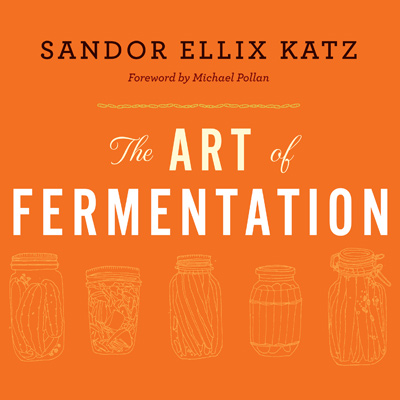
Rio Grande

0

virginia@sfbg.com

APPETITE Who needs menus when the bartenders are this good? The granddaddy of the speakeasy resurgence, New York’s Milk and Honey, has been doing the menu-less thing since 2000, while places like LA’s Library Bar get their inspiration from daily changing, farmers market produce. Two fascinating new SF bars are serving custom cocktails their own way, only able to go sans menu because of strong talent behind the bar. Reviewed online on the Guardian’s Pixel Vision blog is the intimate, amusingly named Big; here is my take on the other menu-less charmer, Rio Grande.

I’ve written about Bon Vivants (cocktail designers Scott Baird and Josh Harris, operations specialist and behind-the-scenes mover Jason Henton) numerous times over the years, from early days at 15 Romolo to recent cocktail menu creation at Berkeley’s new Comal. Anticipating their long-awaited Mission bar Trick Dog, I’ve been having fun in the meantime with multiple visits to Rio Grande, a bar they just launched as part of ATO (A Temporary Offering) in the Kor Group’s Renoir Hotel, a genius pop-up project where local entrepreneurs can test concepts, from FoodLab restaurants to shops and art events.

Using the hotel’s vacant, three-room space, revolving projects invigorate the stretch of Market near Seventh Street. Rio Grande is unlike any other bar in town. Evoking a South of the Border cantina, or what the Vivants dub “Tarantino and Once Upon a Time in Mexico meet border town roadhouse,” here funky kitsch glitz marries laidback ease, as tequila, mezcal, whiskey, and canned beer flow.

Under the gaze of Wild Turkey bourbon and Espolon tequila logos emphasizing the bar’s whiskey-tequila union, the ceiling sports a Virgin of Guadalupe shrine in front of a painting of 1970s adult film actress Vanessa del Rio, a Baird crush after whom he named the Del Rio cocktail (reposado tequila, fino sherry, St. Germain elderflower, orange bitters). The Del Rio will soon be served on tap, while the current on-tap cocktail is an Old Fashioned.

The bar was initially launched as a pop-up, in keeping with ATO’s rotating offerings, but the Renoir folks like it enough to try and find a way for it to stay. If it can’t, the Vivants will move it to various locales as a gypsy bar. Here’s hoping it remains while they launch other nomadic bars — a fine concept.

Rio Grande was, impressively, built out in three weeks: Henton says there were days they’d still be wielding power saws at 5:30am, building high-top tables or implementing one of Harris’ many estate sale-flea market finds. (He stalks local sales for vintage pieces like the bar’s fascinating ceiling fans and the cowhide splayed in the entrance. Harris even gathered Mexican national newspapers from 1945-’47 to became the wallpaper behind the bar.) The bar itself boasts a pole on either end for whatever shenanigans might ensue, while a mini-stage is set for live music. Even without bands, tunes are perfection: a little hard rock, a lot of classic country — think Waylon, Hank I and II, your general outlaw cowboy musicians.)

To exist sans menu, it’s crucial that bartenders be talented, knowledgeable and versatile. Rio Grande couldn’t be more on the right path with hand-chosen barkeeps Morgan Shick and Russell Davis, assisted by Trick Dog chef Chester Watson. Shick is one half of Jupiter Olympus, a bar-restaurant consulting company that throws some crazy, imaginative parties. I’ve judged a number of cocktail contests where Shick (who’s worked at bars from Marzano to Michael Mina) was an entrant: his sense of balance and ingenuity stand out every time. Davis, besides being named Nightclub and Bar’s 2012 Bartender of the Year, recently crafted a brilliant soda fountain menu at Ice Cream Bar and can be found actually igniting flames at Rio Grande for special cocktails.

According to Harris, the Vivants wanted “to take all the pretentiousness out of the bar scene and make it fun”, which is why Tecate and Dos Equis flow just as freely as Del Maguey. During my visits, I’ve sipped a mezcal and yellow chartreuse winner and a bitter amaro beauty on crushed ice (Julep snow cone-style). Speaking of ice, it’s hand-cut here, a pleasure to watch. During one visit, Shick made a mezcal, grapefruit soda drink accented with crème de cassis (black currant liqueur), lime, Luxardo Maraschino liqueur, and salt: smoky, salty and citrusy. Spiced fall notes shine in his mixture of Siete Leguas anejo tequila, made with Averna for a tinge of bitter balance, Angostura orange bitters, sweet vermouth and apple brandy. I’m in love with a finish of Old Bardstown bourbon, Nocino walnut liqueur, Balcones’ rum-like Rumble (made from Texas wildflower honey, Mission figs, turbinado sugar), plus dry vermouth and triple sec. Dry, sweet, full, it’s still bracing enough to put hair on your chest.

“Watch for some potentially interesting surprises musically,” says Harris of the tiny stage, and for Tarantino Tuesdays, when Tarantino films and soundtracks accompany your pour.

RIO GRANDE

1108 Market, SF

Subscribe to Virgina’s twice-monthly newsletter, The Perfect Spot, www.theperfectspotsf.com