Restaurants

Comfort, au courant

0

virginia@bayguardian.com

APPETITE San Francisco doesn’t lack for comfort food. The last decade’s wave of twists on hearty, familiar fare has insured most neighborhoods aren’t without elevated burgers and grown-up childhood favorites. Two new restaurants, opened in September, continue and update the trend.


COMPANY

Guerrero and 22nd Street has long been one of my favorite corners. Whether enjoying a pint at the Liberties, a cocktail at retro fabulous bar Lone Palm, or house charcuterie at Beast and the Hare, at this intersection I feel transported, encouraged to linger and take in my surroundings, as if in Europe. In Company’s big picture windows, vintage red chairs and retro lamps make the space even more welcoming than it was before, as Tao Cafe. Lunch is idyllic: a book, a sandwich, and a bowl of soup becomes a way of spoiling myself.

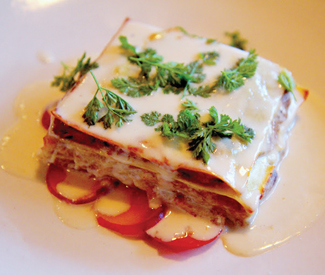
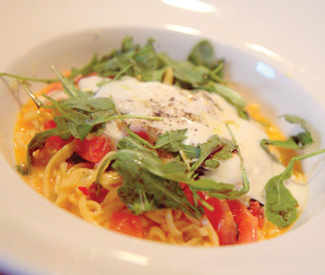
Dinner is likewise mellow, families and couples confirming a local vibe. It’s clear in early months that while Company may not be revolutionary destination dining, chef-owners Karen Hoffman (from Four Seasons Newport Beach and Jardiniere) and Jason Poindexter (Four Seasons Chicago and San Francisco) offer tranquil surroundings and well-executed food. The ubiquitous upscale burger is there: “Breadand Butter” burger ($14), a patty of ground chuck and oxtail, topped with Madeira-glazed pioppini mushrooms and decadent triple creme brie. At lunch, vegetarian stands up to burger and pork offerings: grilled eggplant and house ricotta panini ($11) is layered with rapini/broccoli rabé and romesco sauce. Smoky eggplant and ricotta are in harmony: warm, luxurious, almost healthy. A bowl of squash soup, savory with duck confit, brightened by citrus reduction, is $8 but as an add-on cup to a lunch entree is merely $3.

At dinner, salads are vivid, unlisted vegetables one night in a “crisp vegetable salad” ($9) being beets, cucumber, and avocado over sweet gem lettuce, tossed with feta and toasted pine nuts in a basil mint vinaigrette. House-cured salmon salad ($11) is likewise fresh and silky, with cucumber and beets in yogurt dill dressing. Crispy confit chicken wings ($9) are especially tender, accented with heat (and color) from red jalapenos and fried mint leaves. Syrah-braised short ribs ($23) are cooked in harissa, evoking Middle Eastern intrigue over whipped garnet yams and charred rapini.

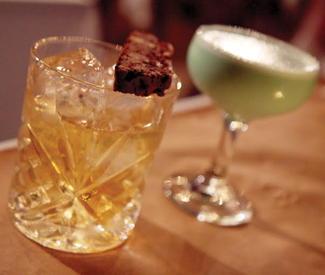
With four beers on draft, like intense peach notes of Widmer Bros. BRRR Seasonal Red Ale from Portland ($6), and a shorter wine list (heavy on France, Italy, California), there are cocktails sans hard liquor from Assistant General Manager Russell Morton. While I don’t get excited about soju and wine cocktails, preferring robust spirits to mild soju, Morton elevates an amaretto sour into an almond cherry sour ($6), keeping house amaretto tart rather than too sweet, with lemon, cherry bitters, and brandied cherries.

1000 Guerrero, SF. (415) 374-7479, www.companysf.com


JAMBER

Midwestern brother-sister duo Jess and Matt Voss opened Jamber, serving gourmet pub food from Chef Peter Baker with California-only wines and beers, all on tap. The siblings’ care shows in hand-assembled tables, chairs made from wine barrels, wines selected from wineries they personally visited, a hip, industrial vibe warmed by woods and graffiti art in the loft-like space with a walled front patio.

Wines (happily, there are options: 2.5 oz. and 5 oz. glasses, 1/2 or full jugs), like Darcie Kent Gruner Veltliner from Monterey or a Margerum Grenache Blanc from Santa Barbara, flow easily from taps, with beers such as Almanac’s Farmhouse Ale or a hibiscus saison, Pacific Brewing Lab’s Nautulis. In my visits, there’s a relaxed welcome from staff best experienced sitting at the rustic wood bar. Jess’ bacon jam recipe is a highlight: a savory, textured pleasure of a spread, no matter what it’s served with. Mr. Meatloaf ($15) is the star, a hefty, tender slab of buffalo meatloaf wrapped in bacon, accompanied by mashed potatoes and roasted carrots. I often find myself bored by big hunks of ground meat. Not so here. Jamber’s meatloaf is about as good as meatloaf gets.

Two more standouts: PB & Jam ($11) is a hunk of pork belly layered in a sandwich with peanut butter and that Jamber bacon jam. Most starters, like pretzels and fried mozzarella, are on the heavy side; the top one is easily Parmesan rosemary mashed potater tots ($8) — warm mashed potatoes oozing out of lightly fried breading — with, yes, Jamber bacon jam. After a decent mac ‘n cheese ($10) or freshly generous salads ($7–$9), a pot pie ($12–$14), namely ratatouille, sounded brilliant but was a soggy, funky mash of vegetables in flavorless crust. Likewise, the beet Jamburger ($10, there is a veal-beef burger for $12) made me sorry I took the vegetarian path. Despite fresh bread, it tasted like slices of beet on a bun rather than the creative beet-veggie patties I’ve had that never replace a “real” burger but can be a worthy sandwich on their own.

Despite a couple difficult dishes, there’s enough here to love at this all-day SoMa spot for a drink and a filling bite.

858 Folsom, SF. (415) 273-9192, www.jambersf.com

Subscribe to Virgina’s twice-monthly newsletter, The Perfect Spot, www.theperfectspotsf.com

Our Weekly Picks: December 5-11

0

WEDNESDAY 5

Jill Tracy

Spooky chanteuse Jill Tracy describes her new holiday release, Silver Smoke, Star of Night, as “the Christmas album for those who prefer the October chill.” She celebrates its release with three festive events, starting with tonight’s “Fragrance: The Allure and Magical History of Perfumes,” an after-hours party at the San Francisco Conservatory of Flowers. The evening is both concert and launch of her limited-edition fragrances (appropriately, devoted to “dark elegance”), created with local perfumers Nocturne Alchemy. Sat/8, the Hypnodrome (where Tracy has been known to perform with the Thrillpeddlers) hosts “Creepshow Christmas” — a family-friendly show mixing ghost stories with live accompaniment. Finally, Silver Smoke‘s official CD release shindig is Dec. 19 at the DNA Lounge. Spirits will be bright! (Cheryl Eddy)

Tonight, 6-10pm, $13

San Francisco Conservatory of Flowers

Golden Gate Park, 100 John F. Kennedy Dr., SF

Sat/8, 8pm, $13–$25

Hypnodrome

575 10th St., SF

www.jilltracy.com


Blue Scholars

The young MCs in Seattle rap duo Blue Scholars met, quite appropriately, in a hip-hop club at the University of Washington. You can hear these academic roots clearly in DJs Sabzi and Geologic’s smart, searing rhymes. The heady lyrical content of their work tackles serious, political issues such as socioeconomic mobility, empowerment, and questioning authority. Even more impressively, these boys don’t just talk the talk. Geologic’s history of activism in the Filipino-American community and the duo’s headquarters in 98118, the country’s most ethnically diverse zip code, is the perfect recipe for the smart, relevant hip-hop that the scene most desperately needs (we’re looking at you, Chris Brown). (Haley Zaremba)

With The Physics, Brothers From Another

8pm, $19.50

Fillmore

1805 Geary, SF

(415) 346-6000

www.thefillmore.com


Get Carter and The Trip

Verrrry clever, Castro Theatre — programming back-to-back screenings of Get Carter (1971) and The Trip (2010). Gritty Get Carter follows a snarling Michael Caine as he prowls around Newcastle, punching his way through the local gangster contingent he holds responsible for his brother’s death. The Trip, a travelogue featuring Steve Coogan and Rob Brydon (playing exaggerated versions of themselves), contains some genius and quotable comedy — ABBA sing-offs, mock-epic speeches — but none more memorable than the two actors going head to head with their Caine impressions: “You were only supposed to blow the bloody doors off!” Truly, an inspired double feature. (Cheryl Eddy)

Get Carter 2:40 and 7pm; The Trip 4:50 and 9:10pm, $8.50–$11

Castro Theatre

429 Castro, SF

www.castrotheatre.com


THURSDAY 6

“Drag Queens on Ice”

It’s a bird! It’s a plane! It’s … er, definitely something, flying at you with the unstoppable momentum of a two-story wig and a pair of birdseed-filled balloons. You already know what’s green and ice skates (Peggy Phlegm) now come find out what’s queen and ice wobbles — all those years in man-stilletos can’t help you out on the rink, honey. This cherished annual hoot features a wealth of San Francisco’s beloved gender clown personalities threading their way through bewildered tourist families in Union Square (who actually get really into it, and by the end it’s a heartwarming family affair, full of squeals of delight). You can even skate with these swanning lovelies! No money back if you end up with a weave in your face. The great Donna Sachet — she of the stunning, form-fitting, fake-fur-trimmed ravishing red holiday dress — mistresses the ceremonies. Grab a warming adult beverage from nearby Emporio Rulli Il Caffe and join in the fun. But don’t you dare judge, or you might get Nancy Kerrigan’d. Skates are blades, remember. (Marke B.)

8-9:30pm, $10 entrance, $5 rentals

Union Square Skating Rink

Post and Geary, SF

www.unionsquareicerink.com


The Family Stone

I’ve had some good times listening to San Francisco’s Sly and the Family Stone — both letting my mind wander the groove of their funky sound and feeling the sense of pride in one’s self that Sly Stone sings so well — and I’d venture a guess that you have too. Though that innovate teacher and leader has opted for life out of the spotlight, three of the original members, Jerry Martini (saxophone), Cynthia Robinson(trumpet), and Greg Errico (drums), are keeping the music alive with the help of a few younger talents. Mostly hailing from the Las Vegas area, these new members are all performers with rich experiences listening to Sly’s music. This new Family Stone recreates the old hits in a fresh show, hoping to bring the music to all generations. (Molly Champlin)

7-8pm, $40–$45

Rrazz Room

222 Mason, SF

(800) 380-3095

www.therrazzroom.com


Streetlight Manifesto

Streetlight Manifesto was pretty late to the ska game, releasing its first album in 2003, well over a decade after the genre’s revival heyday. Though in a way, the band’s timing was actually perfect. Born out of the ashes of previous Jersey ska-punk heroes Catch-22 and One Cool Guy, Streetlight’s catchy tunes and punk rock virility have been nearly single-handedly keeping third-wave ska alive in a world dominated by hip-hop, mainstream pop, and EDM. The band is ringing in the new year with the release of its fifth album, The Hands That Thieve. During this tour, Streetlight Manifesto promises to play new songs, old favorites, and everything in between; so put on your skanking shoes and lace ’em up tight. It’s gonna be a good night. (Zaremba)

With Hostage Calm, Lionize

8pm, $21

Slim’s

333 11th St., SF

(415) 255-0333

www.slimspresents.com


FRIDAY 7

Hope Beyond

Kim Gordon, artist and gallery director at Modern Eden, has curated the one-night-only art show, Hope Beyond, a benefit for the victims of Hurricane Sandy. The assembled line-up includes an impressive selection of artists representing a variety of pop-surreal and contemporary styles. The work ranges from the graffiti style sharpie drawings of Kidlew to intricate fusion of nature images and Hindi symbolism by Inge Vandormael. Personally, I’m excited to see what all of these artists will contribute to the show. Especially Serge Gay Jr. — an artist whose paintings collage and reproduce pop culture images to create dichotomies between what’s real and what’s fake and make you to take a second look at his subjects: beauty, violence, drugs, and race. With all art priced below $100 and the proceeds going to Hurricane Sandy victims, what’s not to love? (Champlin)

6pm, free

Modern Eden Gallery

403 Francisco, SF

(415) 956-3303

www.hope-beyond.com


SFBallet’s Nutcracker

The folks in Imperial Russia loved The Nutcracker and kept it alive during Soviet times. But the West never saw it until some White Russians, who had escaped to San Francisco, nagged then San Francisco Ballet Artistic Director Willam Christensen to choreograph it in 1944. By now there are hundreds of versions all over the world; the oddest one I ever saw had Drosselmeyer arrive on a spaceship. SFB’s, choreographed by Helgi Tomasson in 2004, is set during the 1915 Panama International Exhibition. It lacks the cloying sweetness and sentimentality that infects so many others. Tomasson’s is a love letter to the City — cool, transparent, a little reserved and superbly elegant. (Rita Felciano)

Through Dec. 28, 7pm, 2pm matinees; $20–$270

War Memorial Opera House

301 Van Ness, SF

(415) 865-2000

www.boxofficesanfrancisco.com


SATURDAY 8

Misfit Toy Factory II

Did you ever feel cheated as a kid when you would see cartoons and hear stories about elves making toys from scratch, then you got a Barbie doll or video game that obviously wasn’t cobbled at the North Pole? Well, now is your chance to watch the toys actually being made. Not by elves though, but by local artists. There will be over 35 of them at Root Division Art Space bringing creativity from their various fields (painting, sculpture, and illustration mostly) to the art of toy making. All the work will be sold for a flat rate of $40. Bring cash for some shopping, or just come to enjoy the atmosphere of creativity complete with music by DJ Yukon Cornelius. (Champlin)

6pm, free

Root Division Art Space

3175 17th, SF

(415) 863-7668

www.rootdivision.org


John Prine

I think I need to start with a disclaimer: I love John Prine. Yes, I’m completely biased when I say that he is one of the greatest living lyricists and you’d be lucky to go see him. But why take my word for it? His more than 40 years of successful songwriting can speak for themselves. Starting off as a Chicago-area postman doing open mics in his spare time, Prine eventually got noticed — by a young Roger Ebert. Now, almost 70 years after that glowing review, Prine is still an incredible songwriter and performer, and each song is a charming, witty, and poignant labor of love. In his time as a performer, many trends and genres have come and gone, but a great folk song never goes out of style. (Zaremba)

With Justin Townes Earle

8pm, $39–$59

Warfield

982 Market, SF

(415) 345-0900

www.thewarfieldtheatre.com


SUNDAY 9

San Francisco Crab Fest 2012

Continuing a long-running San Francisco tradition that takes advantage of the fact that the crab fishing season along the California coast coincides with the holiday season, the Fisherman’s Wharf Community Benefit District 2012 Crab Fest will offer up a tasty fete featuring the crustacean prepared in a variety of ways by local restaurants, along with exhibits, cooking demonstrations and more. A host of sustainably-produced regional wines will provide the perfect way to raise a toast to the annual event, which donates all proceeds to the San Francisco Firefighters Toy Program and the San Francisco Police Department’s Youth Fishing Program. (Sean McCourt)

Noon-3pm, $25–$30

Waterfront Terraces, Fisherman’s Wharf

145 Jefferson St., Third Floor, SF

www.visitfishermanswharf.com


Queer Rebels Winter Shindig

Though the weather outside is frightful, the smolderingly creative queers performing tonight at El Rio are more than capable of keeping your toasty warm. The lineup alone is worth the sleigh ride to El Rio — burlesque from the bountiful Ms. Vagina Jenkins, jazzy moves courtesy East Bay punker Brontez Purnell, the release performance of drag king blueser K.B. TuffNStuff’s Trans of Venus album, and so much more hotness. But as if that wasn’t enough to draw you like a moth to flame, this: the evening is a benefit for Queer Rebels’ year-round lineup of genderbending, empowering art events like the Exploding Lineage! experimental film fest, two-day summit of Asian American activists, and the group’s annual eponymous production of queer takes on the Harlem Renaissance and beyond. (Caitlin Donohue)

8-11pm, $7-20 sliding scale

El Rio

3158 Mission, SF

www.elriosf.com


SUNDAY 9

John Cale

Whereas Lou Reed was the primary source of the Velvet Underground’s swagger, and hard-bitten lyricism, John Cale took charge of the group’s more avant-garde leanings. Even 45 years after leaving the band, Cale continues to challenge and surprise his listeners, as evidenced by the title of his latest LP: Shifty Adventures in Nookie Wood. Largely devoid of the splintering bursts of noise that defined his formative years, and the rootsy pastoralism of Paris 1919 and Vintage Violence, Cale’s latest is an art-rock record in the tradition of Peter Gabriel and Kate Bush: affecting in its ability to experiment and take risks while working squarely within the pop template. Another gutsy effort from an aging icon whose renegade streak hasn’t gone anywhere. See him while you can. (Taylor Kaplan)

With Cass McCombs

8pm, $32–$48

Regency

1290 Sutter, SF

(888) 929-7849

www.theregencyballroom.com

The Guardian listings deadline is two weeks prior to our Wednesday publication date. To submit an item for consideration, please include the title of the event, a brief description of the event, date and time, venue name, street address (listing cross streets only isn’t sufficient), city, telephone number readers can call for more information, telephone number for media, and admission costs. Send information to Listings, the Guardian, 225 Bush, 17th Flr., SF, CA 94105; or e-mail (paste press release into e-mail body — no attachments, please) to listings@sfbg.com. Digital photos may be submitted in jpeg format; the image must be at least 240 dpi and four inches by six inches in size. We regret we cannot accept listings over the phone.

Orexi

8

virginia@bayguardian.com

APPETITE West Portal has long warmed my heart. Maybe it’s the removed setting, tucked in the shadow of Twin Peaks where T line ends and the M emerges. Or it’s a sense of stepping back in time to a 1970s San Francisco, a sleepy area unfazed by trends and hipsterization. It’s a family neighborhood, residential and small town in feel — and like any corner of our city, has its food gems, like old school blue cheese buffalo burgers at charmingly dated Bulls Head, or vividly fresh sandwiches and salads at the original location of Market and Rye.

For the past couple months, West Portal residents have been flocking to Orexi, which has quickly made a name for itself and is bustling even on weeknights. It’s Greek… sadly a rarity in the Bay Area despite a plethora of Mediterranean eateries. The upscale Kokkari has long been the Greek queen of San Francisco (sister restaurant Evvia rules Palo Alto) and it has no equal. Downtown’s Ayola also offers Greek favorites, but on the cheaper side. Yet I find myself longing for restaurants like Taverna Kyclades in Astoria, Queens, a mid-range, family-style seafood Greek restaurant typical of New York City’s famed Greek neighborhood, convivial with families, rounds of crisp, Greek white wines, and platters of octopus and grilled fish.

Orexi is a step in the right direction — a comfortable, mid-range neighborhood Greek restaurant using quality ingredients. Owners John and Effie Loufas have created an approachable dining experience — I ate here a couple weeks after opening, returning again one month later to the same waiter who remembered a wine I ordered the month before and a busser who recalled the shirt my husband was wearing last visit. No wonder they’re securing repeat diners.

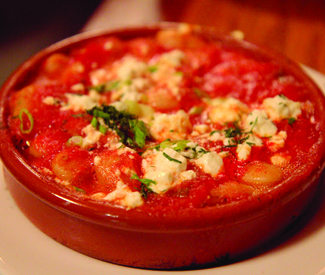
The understated dining room is chic rather than rustic, warm with a honeycomb-like wall hanging and mirrors reflecting the room’s glow. As for the food, first the bad news: grilled octopus ($11 — there’s also an octopus salad for $12.50), typically a favorite of mine, is a bit rubbery over arugula, while gigantes ($7) baked white beans, suffer from blandness but for a dousing of appropriately sweet-savory tomato sauce and crumbled feta on top.

My appetite (the meaning of the Greek word “orexi”) is satiated in unexpected places. House pita bread arrives humbly from the oven, belying its addictive nature, gratifying with small scoops of house dips ($6 each), my favorite being a salty taramosalata, a creamy, fish roe spread laden with olive oil and lemon. The eggplant dip, melitzanosalata, is a balanced expression of the vegetable’s smoky notes, while I wish tyrokafteri, a spicy feta spread dotted with jalapeno, was actually spicy.

Zucchini fritters ($7) with tzatziki (a tangy cucumber yoghurt dip) are a solid starter. Lamb riblets ($9) or lamb carpaccio ($10.75) step it up in tenderness and meaty (not gamey) flavor. In terms of entrees, I’m smitten with homey moussaka ($17). Layers of ground lamb and beef meld with allspice and stewed eggplant under creamy bechamel sauce, reminiscent of the melty, homemade lasagna of my childhood. Simple and also enticing, the “signature” rotisserie chicken ($17) is a generous half-bird (free range, thank you very much), over greens and unremarkable potatoes, marinated in lemon, oil, and spices, tender inside, with slightly crispy, oregano-laced skin.

In the mix with zippy Greek whites and California wines, the wine list holds a rare treat (and I always head straight for the unusual): retsina. Retsina ($6 a glass at Orexi) is a thousands year old Greek tradition of white or rose wine aromatized with pine resin (used to seal ancient wine vessels from excess oxygen). As you might imagine, pine resin gives the wine a foresty flavor, which some describe as turpentine or sap: “Not for everyone,” our waiter clarifies. Its herbal green notes work beautifully with the roasted chicken.

Orexi’s amiable welcome and candelit glow is comfortably gratifying, like slipping on a pair of slippers by the fire. Thankfully not about “the scene” or the next hot trend, the restaurant is about well-executed comfort food in a neglected category with effortless service paramount.

OREXI

Tue.-Thu., 5-9:30pm; Fri.-Sat. 5pm-10:30pm, Sun. 5pm-9:30pm, closed Mon.

243 W. Portal Ave.

415-664-6739

www.orexisf.com

MC, V

Wine

Subscribe to Virgina’s twice-monthly newsletter, The Perfect Spot, www.theperfectspotsf.com

Sea change

1

virgina@sfbayguardian.com

APPETITE Two unrelated seafood restaurants have quietly undergone chef and menu changes in the last year. I was less than impressed with both when they debuted; now they’ve taken a turn for the better. There’s a low-key Mission seafood outpost with vegan accents, Weird Fish (renamed Dante’s Weird Fish), and a Financial District restaurant catering to the FiDi set, Georges, with upscale-casual seafood.

Tiny Weird Fish (2193 Mission, SF. www.weirdfishsf.com) has been around a few years, pleasing vegans and hipsters alike with grilled fish and seitan tacos. Owner Tim Holt left in 2011 to focus on Roshambo Farms (www.roshambofarms.com) in Healdsburg, which still supplies the restaurant with much of its produce. Holt opened Weird Fish with Peter Hood, who is back as owner alongside Ryan Simas, returning to roots of fish and vegan options, infused with new life. Simas knows seafood as chef de cuisine at Farallon, where he’s worked for nine years, now simultaneously co-owner at Dante’s and its neighbor, The Perch, eventually supposed to open next door.

Dante’s all day hours and a playful, affordable menu (discounted during lunch hours) are its selling points. Portions are small, but it’s rare to see enticing fish entrees under $10 — think of it as piecing together a meal. I can’t say the hit-and-miss aspects of the former Weird Fish has entirely changed, but I notice greater consistency and higher “high points” than before. “Pete’s famous clam chowder” ($4.75 cup, $6.75 bowl) is one surprise. Unlike the bland tortilla soup, the creamy chowder is flavor-rich with spanking-fresh clams. Fish and chips ($11 for two pieces, $14 for three), filling all on its own, features fresh fish of the day, flaky and light in Speakeasy’s Big Daddy IPA beer batter. A mix of sweet potato and regular potato fries falls flat, but fried fish dissolves comfortingly.

The vegetarian Waco Taco ($5) is one of their best bites. Though I’m a fish taco fanatic, a tilapia fish taco tasted over-salted and lifeless under mango salsa compared to this lively Waco Taco, packed with mashed yams, spinach, pepitas (pumpkin seeds), and guacamole. Fried calamari ($9.50) is perked up by fried lemon and sage leaves, dipped in lemon aioli and oh! chipotle sauce. Among fish entrees, I’ve fared best with Dijon-almond encrusted rainbow trout ($9.50) alongside buttery mashed yams ($4.75) laced with coconut milk and curry.

Dante’s casual, rock-and-roll (sometimes blaring a bit loud in the small space) attitude is a bright spot on Mission Street, uncommon if not “weird,” amid a sea of taquerias and 99 cent stores. In its Dante’s incarnation since March, Weird Fish captures the quirk of former days with greater focus on the food.

Georges (415 Sansome, SF. www.georgessf.com) took over the Financial District’s classic London Wine Bar in 2010 (which lacked an impressive wine list but boasted dated charm), completely revamping the space from dim, old school to white and airy. I dined during opening weeks — but was immediately turned off by overcooked fish at high prices. I didn’t return until a couple months ago, having heard good things about Chef Michael Bilger who came on in early 2011 from Wayfare Tavern, and now defunct Moose’s and Vivande Porta Via. Bilger’s cooking is a marked improvement since my 2010 visit.

Serving sustainably-sourced seafood per Monterey Bay Aquarium Seafood Watch (www.montereybayaquarium.org) standards, Georges’ focuses on being environmentally responsible in numerous aspects, like crushing raw bar shells into fertilizer for the local farmers who provide its produce.

Lunch is a bustling, convivial time to dine. As with lobster rolls, a Dungeness crab roll is expensive ($21), but a real beauty. Lush white crab is packed between bread with basil, piquillo pepper, and pleasing Southern touches of fried green tomatoes and remoulade, and the whole thing is accompanied by housemade BBQ potato chips. A silky crudo ($15) of albacore tuna cleanses the palate alongside a crisp white wine. Six cuts of tuna rest on hearts of palm, reasonably doused in garum (a fermented fish sauce I’m seeing on many menus lately), McEvoy Ranch olive oil, and vivid Meyer lemon.

Mussels and frites ($16 for mussels, $20 with fries) comfort on a chilly day, particularly with beer. Bilger steams plump mussels in Ommegang Witte beer, the broth exhibiting notes of fall from Rubinstar apples, savory with smoked bacon and leeks. One seafood misstep on a follow-up visit, however, was an overcooked, dry albacore tuna confit in bucatini pasta, tossed with zucchini, Calabrian chilis, Castelvetrano olives, and dose of bread crumbs ($16 lunch, $19 dinner). An affogato, a robust shot of espresso drowning lush vanilla gelato, the glass covered with a waffle cone crisp, is an ideal finish and caffeine boost before returning to work.

Georges is pricey but not out of line with the FiDi or the quality of ingredients. It’s not the same restaurant I dined at when it opened… and for this the entire staff deserves kudos.

Subscribe to Virgina’s twice-monthly newsletter, The Perfect Spot, www.theperfectspotsf.com

Aggressive Warriors

0

steve@sfbg.com

No standard defensive strategy is likely to stop the Golden State Warriors, Mayor Ed Lee, and their huge team of partners and employees from dominating the game of approving construction of a new basketball and concert arena on San Francisco’s central waterfront. That became clear on Nov. 14, as the political operation overcame fire, darkness, and neighborhood-based opposition for the first big score.

The Board of Supervisors Budget and Finance Committee was set to consider declaring the project, which the Warriors want to build on Piers 30-32 by the 2017 basketball season, to be “fiscally feasible,” recommending it move forward with more detailed environmental studies and a term sheet nailing down myriad administrative details.

Before the 11am hearing, the project team held a packed press conference to announce that the Warriors had volunteered to abide by the city’s local-hire standards for public works projects, hiring San Francisco residents or military veterans for at least 25 percent of total construction jobs and 50 percent of apprenticeships. A beaming Lee praised the deal as an “unprecedented” indicator of the Warriors’ willingness to partner with the city.

The event overflowed with union members in hard hats and orange “Build It Now!” T-shirts, as well as a full range of local political pros, from former mayoral and current project spokespersons PJ Johnston and Nathan Ballard to former aides to progressive supervisors, David Owen and David Loyola. Among the agreement’s four signatories were Joshua Arce, the Brightline Defense Project head who last year crusaded for Sup. John Avalos’s local hire ordinance, and building trades chief Michael Theriault.

Strikingly missing at the press conference was Sup. Jane Kim, in whose District 6 the project would be built — over the objections of many residents who are raising concerns about the loss of waterfront views, huge crowds attending what is projected to be more than 200 events per year, high interest rates paid by city taxpayers, the project’s accelerated approval schedule, and other concerns.

Kim is one of the three members of the Budget Committee, which held its meeting despite an electrical fire in the basement of City Hall that knocked out power to the building. Portable photography lighting was brought in to supplement the emergency backup lights, making it bright enough so the televised show could go on but giving a strangely surreal feel to the proceedings and reinforcing the urgency project supporters feel to move this forward without delay.

Kim raised the concerns of her constituents, winning support for amending the resolution to ensure the Citizens Advisory Committee — whose chair was given two minutes to convey how its members feel steamrolled by the accelerated process, asking it be delayed by a month or two — will be given chances to weigh in and pushing the EIR scoping meetings back a few weeks to January.

In the end, Kim and the committee voted to move the project forward. A few days later, on Nov. 19, the process repeated itself with another flashy press conference in the Mayor’s Office — with another important union endorsing the project — followed by the Land Use Committee responding favorably to the project.

The full Board of Supervisors was scheduled to approve the project’s fiscal feasibility the next day, after Guardian press time, but there was little chance that the full board would take any other action than giving the Warriors, Lee, and their huge roster of teammates what they want.

This despite unusual financing and some very real concerns about waterfront development.


JOBS, MONEY, AND SUPPORT

Mayor Lee — who has placed a high priority on this project since announcing his deal with the team in May — emphasized its job creation and contribution to the local economy during the Nov. 19 press conference.

“I remind people, this is a private investment of hundreds of millions of dollars,” Lee said of a project pegged to cost around $1 billion. “It means a lot of jobs, and that is so important to all of us.”

The project is expected to directly create 4,300 jobs: 2,600 construction jobs and 1,700 permanent jobs, including those at the 17,000-seat sports and entertainment arena and the 250-room hotel and 100,000 square feet of retail and restaurants that would be built as part of the project.

“We’ve been spending a lot of these last many months describing what it is we want to build,” Warriors President Rick Welts said at the press conference before casting the project in grander terms. “That’s not really what we’re building. What we’re really building are memories.”

But city residents and workers are looking for more tangible benefits than just the highs of watching big games or concerts. The building trades were already expected to strongly support the project, which only got stronger with last week’s local-hire deal. Labor’s support for the project was broadened on Nov. 19 with the announcement that the Warriors agreed to card-check neutrality for the hotel, making it easier for its employees to join UNITE-HERE Local 2.

“Thank you for being a partner and we’re looking forward to working with you in the future,” Local 2 head Mike Casey, who notably also serves as president of the San Francisco Labor Council, said to Welts at the event before the two signed a formal agreement.

In addition to allowing the hotel workers to easily organize, the Warriors agreed to card-check neutrality for vendors at the arena with at least 15 employees and those outside the arena with more than 45 employees, as well as giving those who now work Warriors’ games at Oracle Arena first dibs on jobs at the new arena.

“I think that speaks a lot about what the project is. It’s not just a San Francisco project, but a Bay Area project,” Casey said. He also said, “I want to thank the mayor for bringing people together and laying all this out.”

While Lee and the Warriors do seem to have this deal pretty well wired, this is still a San Francisco project, a complex one on the politically and environmentally sensitive waterfront that city taxpayers are helping to pay for and one for which the residents there will bear the brunt of its impacts.


PAYING FOR IT

Lee, Office of Economic and Workforce Development head Jennifer Matz, and other key project supporters have repeatedly claimed this project is funded completely with private money, noting how rare that is for urban sports stadiums these days.

But in reality, city taxpayers are spending up to $120 million for the Warriors to rebuild the unstable piers on which the arena will be built, plus an interest rate of 13 percent, an arrangement that has drawn criticism from a key source.

Rudy Nothenberg, who served as city administrator and other level fiscal advisory roles to six SF mayors and currently serves as president of the city’s Bond Oversight Committee, wrote a Nov. 12 letter to the Board of Supervisors urging it to reject the deal.

“Quite simply, I would have been ashamed of such a recommendation,” Nothenberg wrote of the high interest rate. “In today’s markets it is incomprehensible to have such a stunning recommendation brought to your honorable Board in such haste.”

Johnston and Matz each disputed Nothenberg’s characterization, citing a report by the project consultants, the Berkeley-based Economic and Planning Systems Inc. (EPS), that 13 percent is a “reasonable and appropriate market based return.”

Matz told us the rate was based on the risky nature of rebuilding the piers, for which the Warriors are responsible for any cost overruns. And she compared the project to the massive redevelopment projects now underway on Treasure Island and Hunters Point, from which the city is guaranteeing powerful developer Lennar returns on investment of 18.5 percent and 20 percent respectively.

Johnston, who was press secretary to former Mayor Willie Brown and worked with Nothenberg on building AT&T Park and other projects, told us “I have great respect for Rudy.” But then he went on to criticize him for taking a self-interested stand to defend the views from the condo he owns nearby: “They don’t want anything built in their neighborhood. They would rather leave it a dilapidated parking lot.”

But Nothenberg told us his stand is consistent with the work he did throughout his public service career in trying to keep the waterfront open and accessible to the public, rather than blocking those views with a 14-story stadium and hotel complex.

“I have a self-interest as a San Franciscan, and after 20 years of doing the right thing, I don’t want to see this rushed through in an arrogant way that would have been unthinkable even a year ago,” Nothenberg told us. “I spent 20 years of my life trying to deal with waterfront issues.”

He is being joined in his opposition by other neighborhood residents, land use experts such as attorney Sue Hestor, some opponents of the 8 Washington project concerned with the creeping rollback of waterfront development standards, and members of the Citizens Advisory Committee who have felt steamrolled by the rapid process so far and unable to thoroughly discuss the project or the neighborhood’s concerns.

“We would like to slow this process down,” committee Chair Katy Liddell told supervisors on Nov. 14. “Things are going so quickly.”


DETAILS OF THE DEAL

The $120 million plus interest that the city will owe the Warriors would be offset by the $30 million the team would pay for Seawall Lot 330 (the property across from the piers where the hotel would be built), a one-time payment of $53.8 million (mostly in development impact fees), annual rent of nearly $2 million on its 66-year lease of Piers 30-32, and annual tax and mitigation payments to the city of between $9.8 million and $19 million.

Kim raised concerns at the Budget Committee hearing about the more than 200 events a year that the arena will host, but she was told by Matz that’s necessary to make the project pencil out for the Warriors.

Many of the project’s financial and administrative details are still being worked out as part of a term sheet going to the Board of Supervisors for approval, probably in April. Other details will be studied in the project Environmental Impact Report, which is expected to come back to the board in the fall.

The Department of Public Works, Police Department, and — perhaps most critically given its impact on Muni and roadways — Municipal Transportation Agency have yet to estimate their costs.

“We do have a lot of concerns in the neighborhood about this project,” Kim told the Land Use Committee, singling out impacts to the transportation system as perhaps the most important, followed by quality-of-life issues associated with huge crowds of sports fans.

Kim noted that the area already has a problematic transportation infrastructure, with some of the highest rates of motorist-pedestrian collisions in the city and a public transit system that reaches capacity at peak times, and said that many residents worry this project will make things worse. The EIR will deal with the transportation details. But Kim praised how about half the space on the piers, about seven acres, will be maintained as public open space: “I think the open space aspect is incredible and it could actually increase access to the waterfront.” In the end, Kim urged project proponents to heed the input of the CAC and other concerned parties because, “This could be a very valuable project, or it could also be a disaster.”

Millbrae BART development conflict raises ethical questions about Fang

11

BART Director James Fang is coming under fire for his close relationship with a developer who is trying to build a hotel project on BART property next to its Millbrae station, a project that Fang promoted with a misleading presentation to the Millbrae City Council in September. But Fang says the attacks on him are coming from a powerful rival developer and that he’s only trying to get something moving on the long dormant site.

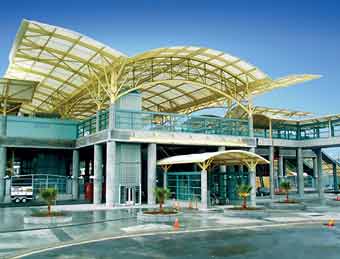
Underlying the conflict are questions about how BART develops the properties it owns around the Bay Area, questions that have increasingly high stakes around the Millbrae station. Critics say the station was badly designed and hasn’t lived up to hopes that it would promote economic development in the area, but that could change if it becomes a California high-speed rail station and the southernmost direct connection into the BART system.

On one side of the conflict is Fang, a longtime director who also owns Asian Week newspaper, and his friend and political supporter Lawrence Lui, who is proposing to build a hotel and office building at the site through his company, Justin Development Corp. The BART Board of Directors voted 6-2 in closed session in May 2011 to enter into an exclusive negotiating agreement with him.

But city officials in Millbrae have refused to share their hotel tax revenue with BART, a key aspect of making the project pencil out as a long-term revenue source for the district (BART’s policy is to lease property rather than sell in order to bolster annual operating revenues and retain control of properties that increase in value). “It turned out the economics of the project didn’t work, they wanted a kickback, for lack of a better word, in the [Transient Occupancy Tax charged to hotels] for the city of Millbrae,” said Adam Alberti with Singer Associates, which is representing the Republic Urban project.

So the BART board earlier this year voted to re-open negotiations Republic Urban Properties, which Lui had beat out in the previous vote, requesting best and final offers from the two rival developers by Sept. 28. They are still being evaluated. Once a project is selected, that developer and BART would essentially become partners in going through the city’s project approval process.

But Fang left out the competing proposal when he appeared with Lui and BART Property Manager Jeff Ordway before the Millbrae City Council on Sept. 25, trying to build support for Lui’s hotel project. “Mr. Fang stated that he is looking for official direction from the City in joining with BART to build a hotel,” according to official minutes from the meeting.

Two days later, BART General Manager Grace Crunican sent the City Council a letter clarifying the status of the property and the two competing bids. “I regret that this information was not made clear during the City Council meeting and I apologize for any confusion that this omission may have caused,” she wrote.  

The Republican Urban proposal calls for 140,000 square feet of office space, 350 housing units (probably rental), and 17,300 square feet of restaurants and retail. It would replace the 851 BART parking spaces now on site with 623 spaces, but it would also include 420 parking spaces for the offices and 410 for the residents. Lui’s project calls for a 200-room hotel, 180,000 square feet of office space, 40,000 square feet of retail, and 200 “corporate service apartments.”

Since negotiations were reopened, Republic has gone on the offensive to overcome that it says is improper and unfair interference by Fang: hiring high-powered PR firm Singer Associates, attorney Scott Emblidge, and a design team with connections to other BART directors.

“I did not expect the venom that Republic Urban has launched against me,” Fang said. “It might be high-speed rail, maybe that’s why Urban is pulling out all the stops….That would be a large part of it. Maybe Urban thinks this is something they’ve got to do.”

Fang admits his friendship with Lui and to having received $3,500 in campaign contributions from him, but he denies doing anything improper or of having a conflict-of-interest in the case, a position BART lawyers have supported, ruling that Fang doesn’t have a direct interest that would keep him from voting on the project.

“You have a piece of property at BART that has just been sitting there for 10 years, doing nothing,” Fang said. “My bottom line is whatever is the best deal for the district, I’m going to go for…If it turns out Urban Republic has the best deal, I’ll vote for it.”

In a letter to the BART, Emblidge said the Republic Urban project is clearly better: “Republic simply wants to play on a level playing field. It has presented BART with the objectively superior proposal. It asks that all further Board decisions about the Property be made in public and without the participation of Director Fang in order to ensure the competing proposals are truly evaluated on their merits. To do otherwise would be to do a disservice to BART, its riders and the general public and community of Millbrae.”

Alberti cast the decision as one of improper political influence pushing a bad project over a rival project that he called a “true transit-oriented development project.” But Tom Radulovich, a BART director who also heads the urban design nonprofit Livable City, doesn’t quite agree with that assessment.

“None of the projects seem very transit-oriented. They’re all very automobile dependent,” Radulovich said. “We should be more focused on what kind of development we want for the site and find the right developer.”

He called on BART to work more closely with Millbrae and other cities earlier in the process, and to pursue projects that are in the best interests of both entities and are smart planning for the region, particularly given the coming high-speed rail improvements.

As Radulovich said, “We’re talking about a very important hub in the regional transit system, and for that reason it’s important to get it right.”


Our Weekly Picks: November 7-13

0

WEDNESDAY 7

Twin Sister

At times romantic and sultry but also plenty psychedelic, Twin Sister will bring its energetic, upbeat dream-pop back to San Francisco this week. Singer, Andrea Estella, an artist who also works in water color and sculpture, is decidedly nymph-like with her hypnotic voice and pixie features. And if that’s not entrancing enough, she’s backed by a collaboration of Brooklyn musicians who handle their instruments (keyboards, synths, and melodica to name a few) with thoughtful precision. If you’re lucky, they may throw in some acoustic versions, but you’ll have to come and find out for yourself. (Molly Champlin)

With Melted Toys, Some Ember, and Yalls (DJ set)

8pm, $10

Rickshaw Stop

115 Fell, SF

(415) 861-2011

www.rickshawstop.com


THURSDAY 8

San Francisco Transgender Film Festival

With Cloud Atlas co-director Lana Wachowski (and her fab pink hair) all over pop culture media these days, trans filmmakers have never enjoyed a higher profile. But the artists who’ve participated in the San Francisco Transgender Film Festival, now in its 11th year, don’t need Hollywood to assure them of their talent. The 2012 fest is the biggest ever, with three nights of globally-sourced short films (“enticing tales of defiance, bullying, relationships, sex, humor, enchantment, romance, and zombies”), plus a performance spectacular (with Sean Dorsey Dance, Eli Conley and the Transcendence Gospel Choir, and more). Previous fests have sold out lickety-split, so buy your tickets ASAP. (Cheryl Eddy)

Thu-Sat, 8pm; Sun, 7pm, $12–$15

CounterPulse

1310 Mission, SF

www.sftff.org


Wet Paint

Contrary to popular belief, the Beats were not just an old boys’ club. Bay Area painter Jay DeFeo stands as a contradiction to the flat female characters you’ll encounter in a Kerouac novel. She pushes boundaries alongside all persuasions of painters. Her work lays the paint thick, looking at light, nature, and the body to find the abstract in the real and vice versa. In conjunction with her retrospective at SFMOMA will be a performance of Wet Paint by Kevin Killian (maybe you know him as a poet, editor, and award-winning author of gay erotic fiction). The play about DeFeo’s life will be performed by the Poets’ Theater and should be a great way to learn the background of her art and ties with the beat movement. (Champlin)

7pm, $10

San Francisco Museum of Modern Art

151 Third St., SF

(415) 357-4000

www.sfmoma.org


Maya Jane Coles

If London producer and DJ Maya Jane Coles has made a statement in her so far short and rapid ascension in the dance music world, it was with the title of her 2011 EP, Don’t Put Me in Your Box. Whether under her own name, dubstep alias Nocturnal Sunshine, or as part of dub duo She Is Danger, Coles has resisted the contrived hooks and familiar samples that promise EDM success, instead forging a path through deep house, delivering independent productions with her personal stamp on everything from vocals to visual design. Noted in the press for being both a breakthrough artist and still quite young, Coles is worth paying attention to as she prepares her eagerly awaited full-length album. (Ryan Prendiville)

With Moniker, Brian Bejarano

9pm, $20

Monarch

101 Sixth St., SF

(415) 284-9774

www.monarchsf.com


FRIDAY 9

“Flamenco en Movimiento”

The emphatic swirl of voluminous skirts, the pounding of heels against the floorboards, the mesmerizing stop-start rhythms, the rose gripped in the teeth, the ache of tight pants … Spanish flamenco dancing and music, bursting with full-throated emotion and thrilling restraint, can be addictive. The Bay Area certainly loves it: flamenco has been eliciting hearty “olé!”s in a new wave of wine bars, beer halls, and Spanish restaurants over the last few years. We’re also home to some incredible flamenco troupes, especially Theatre Flamenco of San Francisco, led by brilliant director Carolyn Zertuche and celebrating its 46th year. Her company’s annual show (this year called “Flamenco in Motion” in English) blew me away last year: the passion, technique, and gorgeous live music emanating from the stage were spellbinding. And I’m no drama queen! If you need a shot of strings-free emotional beauty in these trying times, here’s your best bet. (Marke B.)

8pm (also Sat/10 at 8pm and Sun/11 at 2pm), $20–$40

Cowell Theater, Fort Mason

Marina Blvd, SF.

(415) 826-1305

www.theatreflamenco.org


Christopher Owens

It was only in July that with a few tweets Christopher Owens announced the break up of his breezy, garage rock infused pop band Girls. Owens cited personal reasons — as if there were any other kind — but promised that he would continue to make music in some other form. Just as quickly as that news came, the songwriter has turned around and scheduled a solo date, premiering an entirely new road-trip themed album called Lysandre, at an intimate performance above the Regency Ballroom. A special peek at the album due for release in January, this show will also be filmed for a music video. (Prendiville)

9pm, $20

The Lodge at the Regency Ballroom

1300 Van Ness, SF

(800) 745-3000

www.theregencyballroom.com


“Forever Natalie Wood”

Natalie Wood was a child star (1947’s Miracle on 34th Street) turned teenage Oscar nominee (1955’s Rebel Without a Cause) turned Hollywood legend (1961’s West Side Story; 1961’s Splendor in the Grass) turned celebrity tragedy (after her mysterious 1981 drowning death at age 43). Marc Huestis curates a special tribute to the gone-but-never-forgotten icon with three days of films (all of the above save Miracle, plus 1966’s This Property is Condemned; 1962’s Gypsy; 1963’s Love With the Proper Stranger; 1969’s Bob & Carol & Ted & Alice; and 1965’s Inside Daisy Clover), including an appearance by Natalie’s sister (and Bond girl) Lana Wood before the Saturday night centerpiece screening of Splendor. (Eddy)

Through Sun/11

Castro Theatre

429 Castro, SF

www.castrotheatre.com


SATURDAY 10

Jon Spencer Blues Explosion

Jon Spencer has been pushing the boundaries of modern rock for nearly 30 years now, first with Pussy Galore, which brought new meaning to the union of the words noise and art, and he has continued to light up stages with his electric live presence with several other projects, notably Boss Hog, Heavy Trash, and the Jon Spencer Blues Explosion. With its first new record in eight years, Meat and Bone, dropping earlier this year, Blues Explosion — which also features Judah Bauer and Russell Simins — is hitting the road once again to testify to the power of rock’n’roll. (Sean McCourt)

With Quasi.

9pm $21–$23

Great American Music Hall

859 O’Farrell St., SF

(415) 885-0750

www.slimspresents.com


La Sera

These jangly, melancholic pop songs might sound a bit familiar to you. Brooklyn singer-songwriter Katy Goodman, the woman behind La Sera, is also “Kickball Katy,” one third of the indie rock band Vivian Girls. This year’s Sees the Light is Goodman’s second solo release under the La Sera moniker. It’s a rollicking break-up album that leaves you, after many powerfully emotional highs and lows, feeling not downtrodden, but empowered. Layers of distorted sound create a dreamy, escapist pop landscape, at times blurring the lines between pop and punk rock. La Sera is one of the first indie artists to perform at the Chapel, the Mission’s brand new music venue. (Haley Zaremba)

9:30pm, $10

Preservation Hall West at the Chapel

777 Valencia, SF

www.thechapelsf.com


SUNDAY 11

“Animating Dark Dreams: The Films of Jan Svankmajer”

Some of the creatures by Czech animator and puppeteer, Jan Svankmajer, seem like they were plucked out of David Bowie’s Labyrinth. If you were into the flying gremlins in Magic Dance and Escher-world ending, this double feature should be a no-brainer. Svankmajer’s films are a bit more gruesome than stealing someone’s baby, though, and are deepened with inspiration from classic stories. Lunacy (2000), based on several shorts by Edgar Allen Poe, goes for the philosophical horror while Little Otik (2005), based on a Czech folktale, shockingly captures the gore of child-rearing. A few things to look forward to: dancing slabs of meat, hair eating, and a devious tree-stump baby. (Champlin)

2pm, 4:30 p.m., $10 each

Yerba Buena Center for the Arts

701 Mission, SF

(415) 978-2787

www.ybca.org


MONDAY 12

Titus Andronicus

Titus Andronicus stunned everyone in 2010 when The Monitor, a ridiculously ambitious civil war-themed concept album, turned out not to be meandering celebration of its own complexity, but a powerful, masterfully written opus. Now, with 2012’s Local Business, Titus Andronicus is eschewing high-brow theatrics and multi-instrumental recordings for a simple, down-and-dirty rock album, intended as a marriage of its recorded work and its remarkably energetic, guitar-heavy live sound. In Local Business singer and driving force Patrick Stickles howls about stigmatized subjects relevant to his own life, like deteriorating mental health, and male eating disorders. 2012’s Titus Andronicus may not be grandiose, but it’s definitely badass. (Zaremba)

With Ceremony

8pm, $19

Great American Music Hall

859 O’Farrell, SF

(415) 885-0750

www.slimspresents.com


Napalm Death

Hailing from Birmingham, England — the same industrial city that gave birth to Black Sabbath — British grindcore pioneer Napalm Death has been pummeling listeners since the mid 1980s. Though the band has gone through a multitude of lineup changes over the years, key members, including Shane Embury and Mark Greenway, continue to lead the group to success. Returning to the US in support of its new album, Utilitarian, its 15th release, the quartet joins local rockers Municipal Waste, Exumed, Attitude Adjustment, and Impaled at what is guaranteed to be a most brutal night of extreme music.(McCourt)

7pm, $12–$16

Oakland Metro

630 Third St., Oakl.

www.oaklandmetro.org

The Guardian listings deadline is two weeks prior to our Wednesday publication date. To submit an item for consideration, please include the title of the event, a brief description of the event, date and time, venue name, street address (listing cross streets only isn’t sufficient), city, telephone number readers can call for more information, telephone number for media, and admission costs. Send information to Listings, the Guardian, 225 Bush, 17th Flr., SF, CA 94105; or e-mail (paste press release into e-mail body — no attachments, please) to listings@sfbg.com. Digital photos may be submitted in jpeg format; the image must be at least 240 dpi and four inches by six inches in size. We regret we cannot accept listings over the phone.

Appetite: Latest in New Orleans dining

7

Returning to my beloved New Orleans, a city I’ve explored extensively via a path laden with jazz, Dixieland, Zydeco, Ramos Gin Fizzes, Sazeracs, Cajun and Creole food, there were ever more finds, both new and classic. The sweltering humid heat of July during Tales of the Cocktail is not ideal weather to fill up on po boys and boudin, but I managed, and in so doing, savored more of the soul of this most soulful of places.

Though I returned to modern day favorites like Cochon (rabbit and dumplings, boudin and fried alligator, thank you) or ordered appetizers and drinks at the bar at brand new Criollo in the Hotel Monteleone, following are restaurants I’d add to my already long, Nola neighborhood lists – and only one real disappointment.


Best New Restaurant: Maurepas Foods

Visiting six new hot openings this trip, Maurepas Foods, open since the beginning of the year, was easily the best. I approached the restaurant in the midst of a warm, sultry downpour of summer rain in the mellow, ruggedly hip Bywater neighborhood. Maurepas offers high value (everything is $3-17) in gourmet, quality food prepared with care – of the caliber I’m used to at home in SF. It’s also more playful and forward-thinking than higher priced restaurants around town. Salvaged chandeliers, reclaimed woods, the rustic look of a former printing house, all fit in the neighborhood, while the space is colorful, bright with windows, peaceful during late afternoon. Cocktails shine, artisan but affordable – more on that next issue when I cover the latest in Nola cocktails.

Chef-owner Michael Doyle (formerly of Uptown’s Dante’s Kitchen), keeps the food as funky and fun as the artwork lining the walls with his already beloved goat tacos ($8) accompanied by pickled green tomatoes and cilantro harissa on housemade tortillas. I get good goat tacos at home in Cali. and these are winners. A special of the day, lightly fried soft shell crab, feels nearly decadent in creamy curry, while Summer is glorified in peaches and peppers ($8) tossed in lemon balm with mint and coriander. A green onion sausage ($8) from Mid-City deli favorite Terranova is grilled, served alongside arancini (fried Italian rice balls) and figs with black pepper mustard.

I left Maurepas aglow from the hospitable service, confident I’d eaten at what is not just the Crescent City’s best new restaurant, but one of Nola’s best overall, downhome as it is refreshingly current.

Best Po Boy: Parkway Bakery and Tavern

Like any great regional dish, few agree on who makes it best. Which is why, when it comes to po boy sandwiches in New Orleans, I have to a try a few each visit, checking off the long list of those commonly deemed “best” (past favorites include Domilise’s). This trip, I learned from a local while riding the St. Charles streetcar that longtime Parasol’s owners had moved nearby to Tracey’s Irish Restaurant due to a rent hike, the local said. I rerouted there for a hearty (if a bit dry, despite being “dressed”) beef po boy. Nearby, I also visited the adorable Grocery (not to be confused with legendary Central Grocery in the Quarter) known for their “pressed po boys”, or basically panini. Though I loved the friendly sandwich shop, I couldn’t help but wish for a real Cubano when trying their Cuban sandwich.

But the top po boy thus far – of any of my New Orleans visits – may be obvious: I finally made it to Mid-City’s Parkway Bakery & Tavern. A classic since 1911, po boys have been served here since 1929. Lines are long (and slow) with plenty of menu items. But it’s the Parkway Surf & Turf ($8.10/11.30), slow cooked roast beef and fried shrimp in gravy, that’s a game changer. A local tipped me off to this one, rightly affirming there’s no reason to choose beef or shrimp po boys when you can have both. Adding remoulade and horseradish from the condiments table, I avoided the dryness that seems to plague many a beloved po boy. I could not stop sighing in ecstatic glee with each meaty, shrimp-y bite.

Church Brunch: Redemption

Setting outshines the food, at least at Sunday brunch, but sweet service and friendly locals who chatted with me as I dined solo with a book, a bourbon milk punch and chicory coffee, made my meal at the new Redemption in Mid-City a rewarding excursion via streetcar.

The striking, converted church setting is certainly the main attraction. High ceilings, wood rafters, and a stained glass glow imparted a lasting impression, although alligator sausage on waffles ($9 starter) could be amazing if perfected. Pricier dinner entrees ($22-$33) run the seafood to steak gamut with New Orleans influence.

Classic Ice Cream Parlor: Angelo Brocato

If you’re hitting up Parkway Tavern or Redemption in Mid-City, classic ice cream parlor, Angelo Brocato, is not a far trek from either.

Though I find flavors more interesting at La Divinia Gelateria, Creole Creamery or Sucre, I love Angelo Brocato’s history as a family-run, Sicilian sweets outpost since 1906. Refreshing mint ice cream soothes on an oppressive Summer day.

Best New French Quarter Watering Hole: SoBou

Even if the name SoBou (refering to South of Bourbon Street) feels forced, this newcomer (opened in July just a couple weeks before I twice visited) from New Orleans’ restaurant legends (Commander’s Palace Family of Restaurants) shows promise of succeeding on numerous fronts. Though the place can get obnoxiously loud, it’s multi-roomed, casual, festive, whether at individual or communal tables. A friendly bar staff, run by bar chef Abigail Gullo from NYC, beer taps actually at individual tables in the front room (dangerous!), and a menu from executive chef/partner Tory McPhail and Juan Carols Gonzalez are all reasons to go.

I’ll highlight cocktails next issue, but on the food front, playfulness reigns with blessedly local touches, like a Cajun queso ($5), essentially a pimento cheese fondue with pork cracklins’ to dip, and crispy oyster tacos ($7), a delight of fried oysters, compressed pineapple ceviche, mirliton (aka chayote or pear squash, the poster child of Southern vegetables), and Cajun ghost pepper caviar. The best bite of all?  Butternut duck “debris” beignets in chicory coffee ganache with foie gras fondue. Ridiculous.

My initial take is SoBou works best as a bar hangout (cocktails or beer) with crowd-pleasing bites and with its convenient locale and all day hours it’s just what the Quarter needed.

Sustainable Louisiana Seafood: Borgne

Obviously all of John Besh’s restaurants can’t be August http://www.theperfectspotsf.com/wp02/2010/09/15/wandering-traveler-34/… nor would I want them to be. The great New Orleans’ chef‘s latest is Borgne, with Executive Chef Brian Landry in the kitchen. It’s a bustling, almost cafeteria-like ode to Louisiana seafood, sustainable whenever possible. While the place feels short of greatness and a couple dishes disappointed, it’s a fine lunch outpost for a beer or a solid cocktail and the likes of three deviled blue crabs ($20), hollowed out and stuffed with their own meat, or skewered duck (misleadingly called poppers – $9), wrapped in jalapeno and bacon.

After-Hours Hangout: Delachaise

For late night goose fat fries ($6) with satay peanut sauce for dipping, smoked salmon johnny cakes ($13), and flank steak bruschetta ($10), alongside a bar-length chalkboard marked with an array of beer, wine and spirits (Campari-based aperitifs are a good way to go here, like a Negroni or Americano), Delachaise, with its magical, white light-draped front patio, is a couple steps above a dive and an ideal nighttime hangout with friends in the Garden District.

Business District Coffee Break: Merchant

Though I must be honest and say dry, bland crepes were a letdown, the clean, white design of 2011 newcomer Merchant in the CBD (Central Business District) makes for an inviting breakfast hangout. Serving Illy coffee, the space feels half chic Rome cafe, half Bay Area, as the design was, in fact, inspired by Apple in Silicon Valley.

Though Illy would be far from the most respected bean choice where I come from (more classic Italian chain than modern day coffee haven), what makes Merchant special as a coffee stop is that there’s nothing else around like it. Third Wave coffee hasn’t really hit New Orleans and though there is something strong to be said for a New Orleans iced coffee laced with chicory even from chains like PJs and Community Coffee, there’s a massive gap when it comes to sources for hardcore coffee aficionados. At least Merchant is trying to narrow the gap on the Italian side with a custom-build XP1 espresso machine and appropriately robust coffee.

Subscribe to Virgina’s twice-monthly newsletter, The Perfect Spot, www.theperfectspotsf.com 

One fish, two fish

0

virginia@sfbg.com

APPETITE Sushi bars proliferate around SF, with two more brand new spots opening on Russian Hill and down in the Mission.

ELEPHANT SUSHI

Think of Elephant Sushi as on “island time” (read: chilled out) and you’ll enjoy your experience all the more. Reminiscent of early days at the original Sushi Bistro in the Inner Richmond when it first opened, dreadlocked wait staff and reggae tunes set a relaxed, island vibe at Elephant. It’s soft opening was in late August in the former Sushi Groove space, so Elephant is still in its infancy. Besides the Japan-meets-Jamaica spirit of the cozy space, the restaurant sets itself apart at first glance with real wasabi (which I love eating on its own), housemade soy sauce, and pots of intense, pickled ginger.

Winning points for doing what so few sushi restaurants do, even in our eco-conscious region, Elephant sources mostly wild or sustainably farmed fish, going the funky-fun route in their rolls and appetizers without sacrificing freshness and precision. Walu (Hawaiian term for escolar, the fish occasionally known to cause potentially unpleasant side effects in the… ahem… bathroom) is succulent and buttery here ($5 nigiri/$11 for five-piece sashimi), among the best walu I’ve ever tasted. Sizzling mango seabass ($12) wins on presentation, arriving on fire in a mini-cast iron skillet, thanks to sake and vodka, doused in masago aioli, Japanese chilis, and scallion. Unfortunately, the dish was bland, a let down after the flashy flame of its presentation.

Sipping sake and Sapporo on draft, I ordered crudo ($14) served in four spoons, two of young yellowtail in truffle oil, ponzu sauce, garlic chips and scallions, two of seared scallop in heirloom tomato, pickled wasabi stem, and a tangy yuzu vinaigrette.

If not quite the exquisite bites served at Bar Crudo, this crudo still pops with fresh flavor. Though varying in taste, maki (rolls) seems to be where their whimsical ethos best shines. Spicy king salmon ($9) rolled with cucumber, orange peel, and masago roe in chili sauce is heavy on the orange notes, while the White Out ($15) is a mix of hamachi and avocado draped in more of that luscious walu (seared in this case — I prefer it raw.)

The roll that stayed with me is the Boom Box ($10). I adore raw scallop, served here with avocado, crunchy garlic chips and English cucumber. A ripe banana drape with a sweet soy glaze sets it apart, a spanking fresh, of-the-sea dessert. The banana theme continues in neighboring Swensen’s banana ice cream ($3), all-in-all leaving Elephant Sushi firmly placed in the sleepy Hyde Street ‘hood, a welcome addition that I look forward to watching come into its own.

916 Hyde, SF. (415) 440-1905, www.elephantsushi.com

SUGOI SUSHI

The building formerly housing Spork and pop-up Rice Broker was too cool to stay empty for long. In August, Sugoi Sushi opened in the space serving nigiri ($4.25–$7 for two pieces), five-piece sashimi ($12-15), sushi rolls/maki ($6–$13), and a quite reasonable omakase tasting menu of roughly $40 for a few rounds of sushi. Mini-two person booths remain intact, while red walls, pillows of lime green and red brighten the space.

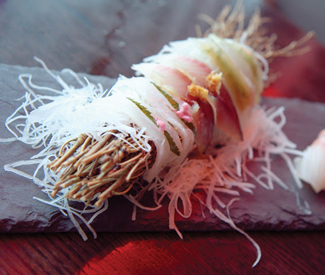
Friendly staff bring out plates that border on works of art — as fine sushi tends to do. In this case, the artistry goes a step beyond. Case in point: a sashimi platter as part of the omakase arrives on a stone slab with a bundle of twigs covered in shredded daikon radish and draped with cuts of fish: masaba, Japanese mackerel ($6); toro. blue fin fatty tuna ($10); and kanpachi, baby yellowtail ($6). Another trio — raw scallops, escolar dotted with lemon seed mustard, and albacore belly bin toro — is presented three ways: in a cup, on a shell, on a pile of daikon.

While presentation immediately impresses, on each of my visits there’s been a funky piece of fish or two, though the restaurant emphasizes sourcing fresh daily. Japanese mackerel on one visit was almost unbearably salty, while Japanese red snapper with truffle oil and sea salt was nearly gummy. Yakitori ($3) at times disappoints, namely the hot dog-like spicy pork sausage. Tender chicken thigh fares better.

Rolls are filling and bright, like the Golden Mountain ($14) packed with toasted salmon, scallop, crab, and avocado, in curry tempura, or the Hot and Cold Tuna ($12), deep-fried spicy tuna covered with maguro roe and seaweed salad. Sashimi-like slices of seared blue fin toro ($18) are a bit salty, but fresh in chili sesame sauce and curry onion tempura, which adds a rich, savory layer to the fish.

While Sugoi is still clearly on the hunt for its identity, suffering from consistency issues, the funky, relaxed space on Valencia Street and the artful eye of its sushi chefs hold promise — it’s still steps beyond the other sushi restaurants lining the street.

1058 Valencia, SF. (415) 401-8442, www.sugoisushisf.com

Subscribe to Virgina’s twice-monthly newsletter, The Perfect Spot, www.theperfectspotsf.com

Feast 2012

0

FEAST 2012 Fall arrives, daisy dukes disappear. This can only mean one thing: it’s time to start eating again. Our guide to autumnal appetite will help you do just that, of course. Marke B. will get you hyped for crab season here in the Bay, George McIntire found some of the most useful local apps for finding haute plates (and goblets). Caitlin Donohue sussed out the Marin-Sonoma Cheese Trail, and Virginia Miller shares her knowledge on all things rum and chocolate. And more! Read on, get hungry. 

>>5 LOCAL FOOD APPS Swipe your way to good eatin’

>>WEDGE ISSUES Happy days on the Sonoma-Marin Cheese Trail

>>TRUFFLE TOUR Yes, chocolate. From fudge at your fingertips to artisan producers, worldwide

>>CLAWS FOR CONSIDERATION Do you know where your Dungeness is? A quick guide, from retail to restaurants

>>CANTONESE COUNTRY COUSIN An interview with the author of The Hakka Cookbook

>>FRESH Food trucks and restaurants new in 2012 — a list of the best by our food writer Virginia Miller 

>>RUM TALES Bars, cocktails, favorite bottles, and the facts you need to be an educated sipper

Cantonese country cousin

8

caitlin@sfbg.com

FEAST “Comfort food for the working man,” is how longtime Sunset Magazine food writer and Hakka Chinese daughter Linda Lau Anusasananan describes the food she grew up watching her grandmother prepare. Anusasananan spent years penning articles on everyone else’s soul foods in her professional career, and finally decided that the earthy — yet at times incredibly complex — eats that have been developed by the diaspora sprung from her nomadic ancestors deserved a cookbook of their own.

She traveled to Hakka hotspots in China, Malaysia, Toronto, Peru, and the Richmond District to explore the various permutations of the plates (and basins) of her ancestors. The result is her appropriately-titled The Hakka Cookbook (University of California Press, $39.95, 293pp), and a long overdue collection of the unique cuisine with hale roots in country eating. We caught up with her via email to learn more about the roots of Hakka cooking, and the path that led Anusasananan — who makes an appearance this week at Omnivore Books — to her most personal project to date.

>>GO HERE FOR A VEGAN RECIPE FROM THE COOKBOOK PERFECT FOR FALL IN THE BAY AREA

SFBG: In the book, there’s an incredibly elaborate recipe for a Hakka basin feast. Where did the basin feast originate?

LLA: There are several stories about how this dish was invented. Basically it is a multi-course banquet layered in a metal wash basin. Diners gather around the big pan and eat their way from top to bottom. This dish is popular in the New Territories of Hong Kong. One story is that when Emperor Bing of Song moved south during the Mongolian invasion, there weren’t enough dishes to hold food for his entire entourage. Inventive villagers filled their wash basins with the army’s banquet. Another story is that when the Qianlong emperor visited Guangdong, he liked to eat the villagers’ banquet leftovers.

SFBG: Where do you go for decent Hakka food in the Bay?

LLA: There are two SF Hakka restaurants mentioned in the book, Ton Kiang (5821 Geary, SF. (415) 387-8273, www.tonkiang.net) and Hakka Restaurant (4401 Cabrillo, SF. (415) 876-6898, www.hakkarestaurantsanfrancisco.com). Both menus also include other types of Chinese cuisine, and the owners of both are Hakka. At the Hakka Restaurant I love chef Jin Hua Li’s Chinese bacon with preserved greens and the chicken with preserved Greens. I also love the Chinese broccoli with rice wine. At Ton Kiang, they serve a fine salt-steamed chicken, it is moist and smooth.

SFBG: What characteristics of the Hakka people are reflected in their food?

LLA: Migration and adaptation. For example: the Hakka originally came from the north. When they arrived in the south, they wanted to make the dumplings they ate in the north. However, they could not find the wheat to make the flour used to make the dumpling wrappers, so they adapted to the available ingredients and stuffed the pork filling into chunks of tofu, creating a Hakka classic, stuffed tofu.

SFBG: What are the most emblematic ingredients in Hakka food?

LLA: Preserved vegetables, cured meats, soy sauce, rice wine and its by-products.

SFBG: What led you to write The Hakka Cookbook?

LLA: To discover my own Hakka identity through what I know best, food. When I was a child, my grandmother, who we called Popo, always told us, “you should be proud you are Hakka.” She would give us Chinese lessons, and sometimes cooks us dinners. Growing up in a small town where we were the only Chinese, we weren’t interested in learning how to be more unique. We just wanted to fit in. So much of her Chinese lessons were lost on us. Decades later, her words haunted me and I decided to research the meaning of those words after I left Sunset Magazine.

SFBG: In your previous food writing career, how did it feel to have limited access to writing about the food you grew up with?

LLA: In the 1970s and ’80s, we were allowed great freedom to explore. In fact, Sunset Magazine sent me on my first trip to China in 1987 to write about the food there. China had just opened up. A photographer and I spent two weeks scouting the food scene and came back with one of the first stories written about home cooking in China.

I wrote about all kinds of food. When I wrote about ethnic food I had to keep in mind that I was writing for a Western audience. So I would choose dishes and ingredients that might appeal to more mainstream tastes. As advertising and issues shrank, it was more difficult to write about ethnic foods because there were far fewer pages. Those few pages needed to appeal to the largest audience. That’s the reality of publishing.

This book is my own personal journey to write what I wanted. It is not a mainstream subject, so it took me a long time to find a publisher. But I feel, it is waste of time to write a book chasing a trend, you should write about what you think is important. Then hope enough people will also be interested enough to read it.

THE HAKKA COOKBOOK READING

Wed/24 6-8pm, free

Omnivore Books

3885A Cesar Chavez, SF

www.omnivorebooks.com


Japanese within reach

0

virginia@sfbg.com

APPETITE The nuances and clean lines of Japanese cuisine have long intrigued me. I grew up on the East Coast with my lifelong best friend, who is of Japanese descent, discovering authentic cuisine in her home and around New York City. I fondly recall the first time I had sushi, okonomiyaki, sake, and shabu-shabu. San Francisco boasts one of few Japantowns in the US — the oldest and largest Japantown in the country, in fact — one of the reasons to love living here. Sushi is one of my greatest cravings, and the izakaya pub-bar food wave seems to hit SF every few years, with a slew of openings.

Outside of these two dominant categories, we’re blessed with Kappou Gomi’s memorable small plates (buttered scallops, tempura crusted in macadamias and almonds), Kare-Ken and Muracci’s Japanese curry, intimate Minako for organic, unusual dishes, Macha Cafe and YakiniQ Cafe for matcha tea and sweet potato lattes, Kitchen Kura for an okonomiyaki menu, Delica for Japanese deli goods… the list goes on. These three younger Japanese restaurants offer comforting food at a reasonable cost.

CAMP BBQ

Opened this summer, Camp BBQ’s Japanese grilling takes its cues from Korea. The long space is lined in rustic Japanese woods, roomy tables surrounding individual grills. Like Korean BBQ, mini-bowls of dipping sauces such as house miso arrive, then platters of vegetables, including a “rainbow mix” ($6) of carrots, bok choy, onions, and garlic cloves wrapped in foil, ready for the grill. Scallops soak in garlic butter ($7), tender and buttery in foil. When it comes to meats, there are many options, sliced thin, generally tender — only the pork cheek, though juicy, was a little tough to bite. Kobe-style Kalbi chuck short rib ($13 for 3.5 ounces) and ox tongue ($8) are two worthy beef options, though I find the cheaper, savory qualities of spicy pork ($4) and pork cheek ($5) even more appealing. Portions are small enough to mix-and-match while sipping sake, Japanese beer, even pineapple or watermelon slushies. Moving away from the grill, cheese pockets ($5), essentially wontons supposedly filled with cream cheese and shrimp, are disappointingly empty. The setting is mellow with families and friends grilling and singing along to somehow appropriate dance pop tunes as backdrop.

4014 Geary, SF. (415) 387-1378, www.campbbqsf.com

SHABUWAY

Hot pot stylings of shabu-shabu are the basis for Shabuway, the first SF location of a local Bay Area chain that began in 2004 in San Mateo, growing to locations in Mountain View, San Jose, Union City, Santa Clara. Eiichi Mochizuki launched Shabuway using meats from animals fed on an all-vegetarian diet: Angus Prime, American Kobe, Niman Ranch lamb, Kurobuta Berkshire pork. The result translates into a fresher-than-average shabu experience. In keeping with the meaning of shabu-shabu (“swish-swish”), one selects thinly-sliced meat of choice, chooses spicy miso or seaweed broths, then swishes raw meats in boiling broth until done. Vegetables (cabbage, carrots, enoki mushrooms, etc.) and mini-bowls of soy and crave-inducing gomadare (an almost creamy sesame sauce) arrive, filled when running low, with add-ons like udon or ramen noodles a mere $1–$1.75. When you’re finished cooking the meats and veggies, flavor-rich broth is poured over rice, eaten soup-like as a finish. There is little besides shabu-shabu on the menu, an appreciated focus — but a special I’d recommend if you see it is takoyaki ($4.50), octopus dumpling balls topped in benito flakes, essentially okonomiyaki (the fantastic Japanese “pancake”) in bread-y ball form, dotted with customary mayo and savory-sweet okonomiyaki sauce.

5120 Geary, SF. (415) 668-6080, www.shabuway.com

KIRIMACHI RAMEN

Ramen is akin to pho in Vietnamese food or other filling soups in Asian cuisine. Maybe it’s my craving for bold, pronounced flavors that have made me not so much averse to basic broth soups as just bored by them. I typically prefer udon or soba noodles when it comes to Japanese soups for more texture and emphasis on the noodles and may never be obsessed with ramen, pho, or the like. But Kirimachi Ramen, a month’s old spot tucked away in North Beach with 1950s diner chairs and laid back vibe, does well by the genre. All bowls are hefty at $10, with veggie, pork, or chicken as a base. The staff told me they haven’t found a reliable organic pork source yet, but use Marin Sun Farms chicken, focusing on fresh ingredients. I took to Sapporo-style miso ramen with chopped pork, Chinese chives, bean sprouts, corn, with additional toppings ($1) including kikurage mushroom, fish cake, and soft-boiled egg.

450 Broadway St., 415-335-5865, www.kirimachi.com

Subscribe to Virgina’s twice-monthly newsletter, The Perfect Spot, www.theperfectspotsf.com

Appetite: Portland cocktailing

5

More than 50 places in one week…  I may not have covered all of Portland this May, but I certainly made a dent. So much so that my Portland reviews are broken up in a four part series. Soaking wet half the week, I biked out to neighborhoods East, West, and North with my usual (if grumpy, cold, and irritable) tenacity to dig in and taste the soul and breadth of a place rather than its veneer. Join me as I drink, and eat, my way through the rainy town up north.

As cocktail bars are required to serve food in Portland, cocktails and food are intertwined – and strong – at many a locale. Though I separate out cocktails and restaurants, there are numerous places where both are worth making your way to so you’ll see some restaurants listed here and in next issue’s Portland restaurant article.

Brendan Wise of Beaker & Flask filled me in on a couple cocktail projects launching just after my visit: Corazon from Chris Israel (chef-owner at Gruner, which I review next issue), and the Beaker & Flask team created a drink menu for popular PIX Patisserie http://www.pixpatisserie.com/ featuring cocktails and sherries to go with their sweets.

RIFFLE NW

Visiting Riffle NW in its opening week, I was struck immediately with fresh seafood, friendly service and some of the best drinks of my Portland week. It was opened by Dave Shenaut (former president of the Oregon Bartender’s Guild) with bartenders Emily Baker (formerly of Rum Club), and Ricky Gomez (formerly of Teardrop Lounge) – SF bartender Brandon Josie of Bloodhound recently moved to Portland to take over as bar manager for Gomez who is moving on to a new project. Riffle’s spare, modern decor displays seafaring inspiration in wood ceiling panels made of reclaimed shipping docks, while the name refers to a rocky shoal or sandbar below the surface of a waterway.

I came for the drinks but was not disappointed in the food. Black bass tartare ($10) is punctuated with dill, squid Carbonara ($17) is meaty with guanciale, while an overflowing, fresh crab roll ($21), and a huge cut of rare Copper River sockeye salmon ($32) is grilled, its salty skin subtly sweet with a bourbon maple glaze.

Emily Baker offered the best service of my entire time in Portland. After I was there a couple hours, we began talking industry connections and drink, but long before she knew I was a writer, she went out of her way to ascertain our taste preferences and make sure we were comfortable at the bar.

On the menu, a Riffle Collins ($11), made of gin, lemon, lime, celery, absinthe, salt, is the perfect starter, garden bright, light and appropriately savory with celery and salt. Room D ($9) delighted with rye whiskey, the spice of Becherovka, while quinine and citrus imparted punch.

Off menu, Baker suggested and created just what I was craving: Art of Choke (a Violet Hour creation by Kyle Davidson), mixing Cynar, mint, Bacardi white rum, and Green Chartreuse. Herbaceous, bitter, and vibrant, it hit all the right notes. Similarly, a Self Starter (a Jamie Boudreau drink) balanced Lillet with Old Tom gin, absinthe and Orchard apricot. Not too musky but crisp, sweet, boozy. All around, hand cut ice perfects each drink.

It was a treat sampling Jack Rudy Tonic from Charleston, a bottle I noticed on ice behind the bar and had to inquire about. A small batch syrup (available in SF at Bi-Rite Market), it makes a lovely tonic, set apart with lemongrass and orange peel.

CLYDE COMMON

So much has been said about Clyde Common and Jeffrey Morgenthaler since opening that it’s almost needless to point it out as a Portland “best”. In fact, for one who almost never repeats places in the same trip (ever with an aggressive agenda), I returned to Clyde Common three times in one week. Morgenthaler was only there one of three stops, offering cheeky, impeccable service. But service was warm and accommodating both evenings I dropped in – only during a weekday visit did I experience lackluster, abrupt service from one bartender.

Cocktails are a reasonable $7-9. Morgenthaler’s famed barrel aged cocktails ($10)  – his Negroni and one of my all time favorite cocktails, an Old Pal – rotate but were completely out all three visits. What pleased most were his bottled and carbonated cocktails ($8).

Though I’ve seen a lot of these the past year  – one was a basic Americano (Campari, Dolin Sweet vermouth, water and orange oil) – the Broken Bike was possibly my top drink on the menu, fizzy and vivaciously bitter with Cynar, white wine, water, lemon oil. Both were well balanced, refreshing and more importantly, fun.

Elsewhere on the menu, a Kingston Club exhibited subtle balance of fruit and herbaceous notes with Drambuie, pineapple, lime, Fernet, Angostura, and orange peel. The Nasturtium cocktail was unexpectedly too sweet for me, Domaine de Canton ginger liqueur hitting heavier than the Dolin Blanc vermouth and Bonal. A Spiced Dark & Stormy is a brilliant idea – and went down all too easy. Rum (Gosling’s dark, in this case) infused with Chinese five-spice, a spicy, house-brewed ginger beer, finished with lime, made for another winning drink.

Clyde Common was the Portland bar that for me most upheld its reputation: centrally located, serving understated drinks, strong on precision.

BEAKER & FLASK

It goes without saying that Beaker & Flask, opened by Kevin Ludwig of Park Kitchen, has been one of Portland’s hottest cocktail bars since debuting in 2009. Despite large groups in the spacious restaurant, bar seats free up often, even on a weekend, and we were able to chat, unhurried, with the bartenders, lingering over drinks.

Menu cocktails ($9) like a soft, woody Walk in the Woods (Old Tom Gin, Stone Pine liqueur, lemon, sage syrup, egg white) and elegant Cricket Club (Pimm’s, rose port, Bonal, amargo bitters, cucumber soda) please but going off menu in the hands of talented Chicago transplant Brandon Wise (now President of Oregon Bartenders Guild) and Neil Kopplin, who also makes Imbue Vermouth, is where the real action is.

Wise mixed a Rose Americano cocktail, bright with Martin Miller’s Westbourne Gin and grapefruit, earthy-sweet with Amontillado sherry. Kopplin goes with a recipe from neighboring Rum Club, the Begonia, utilizing his Imbue vermouth, aged Novo Fogo cachaca, Benedictine and velvet falernum. Sweet, spiced apple notes hit first, with a beautifully subtle bitter on the finish.

Seek out Neil’s new product, Petal & Thorn, a gorgeous gentian liqueur using homegrown beets for Campari color, cinnamon, menthol, and other intriguing elements.

RUM CLUB

Depending on which direction you’re approaching, enter Rum Club either on the front or back side of Beaker & Flask. The cozy bar is roughly one year old, conceived by Beaker & Flask’s Kevin Ludwig and Michael Shea of Doug Fir. Affordable $5-10 cocktails, chic wallpaper, low wood ceiling, the bar in the center, and a small patio you can smoke in if you’re nowhere near the door, make it an appealing place to gather with friends until the wee hours.

Though packed and noisy, I was won over by well-crafted drinks like the Hi-Lo Split ($8), vivid with Old Grand-Dad Bonded whiskey, Cynar, lemon, passion fruit syrup, grapefruit bitters – a stunner, actually. Also by Road to Ruin ($8), with a rye whiskey base, dry vermouth and bitters, set apart by cardamom notes from Cardamaro Amaro and texture from lemon oil.

TEARDROP LOUNGE

Despite the widespread respect garnered for this chic, centrally located bar in downtown Portland, Teardrop Lounge was the one disappointment of my bar excursions. It’s long hyped as being one of PDX’s best, and depending on the bartender, I’m sure it could be. The space centers around a dramatic round bar, open air windows ushering in a gentle breeze on a nice day. Even with well-prepared drinks, I found touristy clientele and disinterested bartenders during my visit soured the experience.

The menu reads well, including a glossary of terms educating non-cocktail geeks on terms like oleo-saccharum (a traditional punch base of lemon peels macerated in sugar to extract oils) and Batavia Arrack (an early 16th century, palm sugar-distilled spirit tasting of spice, citrus, anise – often used in punches).

There’s sections of House Cocktails, Classics (like Sky Rocket from 1919 or a Morning Glory Fizz – from the Savoy Cocktail Book, 1933), and one called Friends highlighting bartenders’ drinks from other cities, including SF locals: Kevin Diedrich’s Whiskey Wallbanger and Ryan Fitzgerald’s Rodriguez).

Though intriguing, a Wanderlust ($12), made of Banks white rum, a house sherry blend, Marolo chamomile grappa, medjool date bitters, orange bitters, and flamed absinthe was musky sweet without the hoped-for layers jumping out. However, Of Praise for Tulips ($9), was a brightly elegant aperitif, floral with Clear Creek pear brandy, dry and bitter with Cocchi Americano, Dolin Dry vermouth, Barenjager, Boston bitters and Pacifique absinthe.

THE DRIFTWOOD ROOM

They had me at ’70s wood-paneled walls, cocktails ($9-12) named after classic actors (e.g. Sydney Poitier, Elizabeth Taylor), and old school, Rat Pack bar vibe. When asking bartenders at “mixology” havens around Portland where they liked to drink off hours, more than one of them said The Driftwood Room. Granted, it’s in Hotel deLuxe (opened in 1912 – the bar opened in the ‘50s) and forget catching a cab from the hotel any time after 11:30pm when the train isn’t running (apparently, neither are cabs), but for a mellow, retro vibe with boozy-but-crafted drinks, Driftwood is a welcome respite.

Both Bittersweet Symphony ($10 – Temperance bourbon, Punt e Mes vermouth, Pelinkovac http://www.wineglobe.com/13047.html, Peychaud’s and Angostura bitters) and Old Tom Cocktail ($11 – Ransom gin, Agwa de Bolivia coca leaf liqueur, Krogstad Aquavit, lime juice, barrel aged bitters) pack a punch while maintaining balance.

CIRCA 33

Another bartender off-hours favorite is Circa 33 in Southeast Portland. For me, flat screens and sports interfered with a vaguely retro, laid back vibe. A library-like wall of American whiskey and bottles line the back wall with wood ladder for easy access. Easy-going bartenders can create cocktail classics, even if they don’t know them. I requested a simple but perfectly classic Old Pal, executed solidly per instruction. It’s the hidden back bar that draws industry folk, an intimate space ideal for conversation.

KASK

Though not overwhelmed with creative vision at Kask, the newer sister bar to neighboring Austrian restaurant Gruner, I enjoyed the corner casual chic in a small space with welcoming bartenders. Here can linger with friends, actually hear each other, and savor solid cocktails ($9-12).

Though my favorite drink was an off menu Del Maguey mezcal/citrus creation, I tasted the gamut, from Rabo de Galo, utilizing Novo Fogo’s barrel aged cachaca (a spirit popping up often on Portland menus), Gran Classico, Carpano Antica sweet vermouth, and Brazilian coffee bitters. The Black Lodge covered the whiskey/vermouth/bitter side with Wild Turkey Rye, Punt E Mes sweet vermouth, Combier Rouge, Cynar, Regan’s orange bitters, while another off menu creation, Leather Canary (a Chevy Chase reference), mixed up that profile with tart/sour: Combier Pamplemousse  – a grapefruit liqueur, rye whiskey, Gran Classico, Punt E Mes vermouth.

Kask’s service and relaxed vibe make it one of the better hangouts for cocktailians in my downtown Portland explorations.

Subscribe to Virgina’s twice-monthly newsletter, The Perfect Spot

SF Stories: Veronica Christina

3

46TH ANNIVERSARY SPECIAL Living in San Francisco means accepting the constant love/hate battle between beauty and the beast, privilege and poverty, art/music/literature and, “Ew, what the hell did I just step in?” It’s balancing the sweeping bayside views against the looming threat that at any minute we could crumble into the sea. Living here means accepting a certain level of hypocrisy, from ourselves, our government, and each other. It’s understanding that you can’t please everyone all of the time so you’d better figure out how to please yourself.

We’re a city that believes the good things in life should cost money, but heaven forbid we raise property taxes or are asked to pay cover at a club when we think we’re “on the list.” We’re sex-positive, frequently hedonistic, and culinarily spoiled. We float easily between roommate potlucks, Napa Valley wine tastings and pop-up restaurants (where bringing your own 6-pack is not only encouraged but another urban validation of just how in-the-know we actually are).

We dedicate our weekends in drunken tribute to America’s Cup/Folsom Street Fair/Bay to Breakers, then shock our livers back to life on Monday with an all-juice cleanse, delivered right to our shared workspaces. We’ll wax poetic about the exhibits at the MOMA and the DeYoung when secretly the Academy of Sciences is the only museum most of us like.

We vehemently fight for the rights of all our residents to know the joy, solace and comfort of family life, but hate waiting behind the poor lady struggling with her stroller on the bus (eyeroll) and why doesn’t she just get a Baby Bjorn already? We hate drivers while we’re bicycling, hate bicyclists while we’re driving, and collectively despise anyone on a motorcycle.

We’re a city that is constantly forgetting which days street sweeping are on and remain almost adorably hopeful that maaaaybe this time our bumper can hang six inches into the red without being noticed by DPT (it can’t). We’re a city that spends too much precious time getting our cars towed/ ticketed/ broken into.

But then there’s the love. We are a city who falls in love all the time; with ourselves, with our chosen urban families, with that girl on the BART, the view from the bridge, Dolores Park movie nights, hikes in the Presidio, with yoga, politics, new ideas, farmer’s markets, the Giants. We’re a city of, “hey, let’s give it a shot,” a destination for people of alternative mindsets to finally belong.

We love this city with a passion akin to a lover you just can’t leave. San Francisco is in our veins and we keep coming back for more. Sure, we flirt with the notion of trading up to some sexy Oakland loft (free parking!) or a peaceful, tree-canopied Marin cottage (we could get a dog!) but the allure never quite goes away. We may fight like crazy, but no matter how mean we get, she always welcomes us home.

Veronica Christina is the editor of Sex + Design magazine, www.sexanddesign.com


Das Racist’s Kool A.D. on hip-hop, baseball, and losing his virginity

0

Self-proclaimed, “second best rapper with glasses after E-40” and Bay Area native by way of Brooklyn Victor Vazquez aka KOOL A.D. of rap group Das Racist has had quite the prolific past year in the hip-hop industrial complex. 

He and his group Das Racist — featuring rapper Heems and hypeman Dapwell (Dap for short) — released their debut LP and critic darling Relax. Soon after that he released not one but two positively received mixtapes in the span of three months, The Palm Wine Drinkard and the Bay Area homage 51. Das Racist plays DNA Lounge this Fri/12. 

KOOL A.D. took time off from his 10-city tour with Das Racist, Leif, Safe, and Lakutis to rhapsodize with the Guardian about playing for the A’s, his punk band, and getting free weed.

San Francisco Bay Guardian Are you for the Giants/ 49ers or A’s/Raiders?

KOOL A.D. I don’t really care. But A’s.

SFBG If you played for the A’s what would be your stepping up to the plate song?

KAD [Long laugh] “Le Freak” by Chic.

SFBG Where in the Bay Area did you live when you were growing up?

KAD Potrero Hill, Hunter’s Point, Alameda, West Oakland.

SFBG I heard a rumor that you lost your virginity in the back of a fruit truck in Alameda? Can you confirm or deny this?

KAD I lost my virginity in the cab of the produce truck at Paul’s Produce (now called Dan’s Produce I think) where I used to work.

SFBG What are your favorite spots in the Bay to kick it at? What places do you take Heems and Dap?

KAD As a youngster, I went to punk shows in warehouses and houses, kicked it at Donut Shops, burger spots, and Mexican restaurants, dollar ten Chinese, drank and smoked weed in parks. Not particularly good at “recommending cool shit” to people.

SFBG The Guardian had a recent cover story entitled “Is Oakland Cooler Than San Francisco” What’s your take on that? As a Brooklyn resident do you think Oakland could be SF’s Brooklyn?

KAD I lived in both and love both and it always bugged me that SF fools don’t want to come to the East Bay and East Bay fools don’t want to go to SF. I think a large part is because BART closes too early. Never understood why BART couldn’t get it together to be 24 hours.

SFBG Who are some Bay Area rappers you’ve been into lately?

KAD Favorite people making music in the Bay are Amaze 88, Trackademicks, 1-O.A.K., The Coup, Main Attrakionz, Davinci, Young L, Lil B, Kreayshawn, Beed Weeda, Too Short, E-40, Droop-E, Issue, YG, Cuzzo Fly, Stone Vengeance, Las Malas Pulgas, Under 15 Seconds, Fracas, Fucktard,  Reivers, @AAANTWON, Nacho Picasso, Mike Baker, Safe.

http://www.youtube.com/watch?v=ZUxLlXikwZU

SFBG Finish this phrase: “Rap Game [blank].”

KAD Keith Morris.

SFBG Das Racist frequently asks fans to throw various objects on stage. What’s the most outlandish or weirdest thing any fan has ever thrown on stage?

KAD Hundreds of Soy Joy snack bars at a festival in Washington was pretty weird. Also hellof weed, cigarettes. One time in Oakland I asked for money and got like 30 bucks in small bills.

SFBG If presented with the opportunity to join the Illuminati, would you accept?

KAD Depends on what’s in it for me.

SFBG What are you currently working on?

KAD I got a lot of tracks recorded, want do a mixtape or two, maybe an album. I got a punk band called Party Animal putting out a record in December. Got rap mixtape called Peaceful Solutions with Seattle jazz man Kassa Overall. Co-writing for a project called Cult Days.

SFBG I see you’ve been tweeting a lot about Bud Light Platinum, are you fan? Would you and the crew let them use a DR song in a commercial?

KAD Never drank it. But yeah, it’s hard to turn down large sums of money.

SFBG What’s your take on the current state of the hyphy movement? Some say it’s peaked, do you agree or disagree?

KAD Hyphy is a feeling.


Das Racist With Le1f, Safe, and Lakutis

Fri/12, 10pm, $25

DNA Lounge

375 11 St., SF

www.dnalounge.com


Rich Table

3

virginia@sfbg.com

APPETITE Not since State Bird Provisions and AQ opened towards the end of 2011 have I been as excited about an opening. Evan and Sarah Rich’s new Rich Table is, kinks and all, even in the first month, well-rounded and satisfying. With efficient, informed service, reasonably priced wine list, few but well-crafted cocktails, a comfortable dining room with rustic-urban decor, and most importantly, a number of exquisite dishes, Rich Table is primed for greatness.

The Riches, a husband-and-wife chef duo, both worked at Bouley in New York and Coi here in San Francisco. Evan was also at Quince, Sarah at Michael Mina — and the couple hosted memorable pop-up dinners at Radius last fall. This fine dining pedigree infuses their mid-range menu. At other restaurants, dishes don’t often surprise beyond a menu reading. But here numerous dishes are more fascinating than their descriptions suggest. At AQ, dishes are works of art unfolding in layers of unexpected flavor. At Rich Table, there’s an approachable comfort elevated with refined nuances.

On the light bites side, everyone (and I mean everyone) has been buzzing about paper-thin potato chips ($7) with sardines interwoven through the center, dipped in horseradish cream. I’m a big sardine fan : these are not overrated, worth ordering every time. I brushed past Castelvetrano olives ($5) as common — thankfully a dining companion ordered them on one visit. Brightened by celery leaves and preserved lemon, the olives pop.

On an early visit, popcorn soup ($10) tasted like buttery, pureed popcorn in a bowl. Yuzu kosho (a fermented paste of chili peppers and yuzu rind) perks up the creamy bowl. Outstanding squid dishes ($14) morph with seasonal ingredients. The first incarnation wowed, the plump squid lively with watermelon yet simultaneously savory in black olive vinaigrette, dotted with crispy onions. This sweet-tangy, fresh-grilled dish was such a joy, I couldn’t help but be a little let down by its successor: squid with figs, crisp onions and lardon draped across the top. The breezy luminosity brought by the melon felt a bit weighted down with figs, though still a winning dish. Crushed peas ($14) with California yellowtail and saltine crackers to scoop up is vivaciously fresh, but comes in a slight (i.e. miniscule) serving.

The menu is not easily categorized nor a copycat of anyone, but is packed with pleasures peeking out in unforseen places. Case in point? The pasta. I could come here for pasta alone (one dinner I ordered all four pasta dishes on the ever-changing menu). None shines more than a divine duck lasagna ($19). A smile crosses my face just thinking of delicate, melting sheets of pasta, layered with braised duck, light béchamel, and tart Santa Rosa plums. It’s a glorious pasta dish with no equal in this town… or in any other. Other pasta dishes may not reach these heights but each is worthwhile, even excellent, whether rigatoni bolognese ($18) elevated by bone marrow and crispy kale or beets, or spaghetti ($18) tossed with Jimmy Nardello peppers and clams.

On the entree front, lichen-poached rabbit ($25) is heartwarming as it is gourmet, mingling with cippolini onions, radicchio leaves and broccoli raabe. Pork belly panzanella ($24) is the classic Italian bread salad of tomato, basil, cucumber and toasted bread cubes tossed with fatty pork belly, though I took to a hearty tomato-braised oxtail on toast ($25) even more. While accompanying grilled octopus and collard greens seemed disparate, the meaty toast alone makes it worthwhile, as satisfying as Southern BBQ.

Sarah Rich’s desserts (all $8) maintain the comfort-meets-craft spirit of the restaurant from a bright melange of chilled melon to caramelized olive oil cake in strawberries, a heightened strawberry shortcake. Panna cotta lovers shouldn’t miss Sarah’s silky rendition with changing seasonal accents.

Wines are priced by glass, carafe or bottle, conveniently grouped in three white and three red price categories, with strong options like 2010 Christian Moreau Chardonnay from Burgundy, or a 2011 COS Frappato from Sicily. The cocktail list ($10 each) is short — no more than four or five at a time — and I’ve sampled six different ones. While some fare better than others (the Barn Wood, with Buffalo Trace bourbon and bitters, was a bit too musky-sweet from stone fruits), most offer understated elegance, actually different than other cocktail menus in simple purity.

The star is the lush, green Big Night, which looks like a healthy, green veggie drink, but is subtly smoky Del Maguey Vida mezcal mixed with nasturtium and ginger, topped with an edible flower. It’s clean, strong, memorable. As is Land’s End, the Riches’ answer to a martini, using the incomparable St. George Terroir Gin, dry vermouth and foraged Monterey cypress. On the light, soft side, Let’s Go is a refreshing sipper of Encanto pisco, coconut water and lime.

Sarah, Evan, and the engaged staff serve a warm vibe at their table in Hayes Valley — and an ever unexpected menu that focuses simultaneously on flavorful comfort and elegant simplicity.

RICH TABLE

199 Gough, SF.

(415) 355-9085

www.richtablesf.com

Subscribe to Virgina’s twice-monthly newsletter, The Perfect Spot, www.theperfectspotsf.com

Aim for these

0

virginia@sfbg.com

APPETITE Most memorable restaurants boasts an overarching standard of quality to their menus. Other times, one dreams of specific items from certain spots. Here are a few places worth trekking out to for unique dream dishes.


LASAGNA BOLOGNESE AT MARCELLA’S

Lasagna… there are few foods as evocative of my childhood. Until now, Gaspare’s in the Outer Richmond was typically where I’d get my old school lasagna fix. Since May, though, Dogpatch now has a lasagneria, of all fantastic things. Marcella’s Lasagneria and Cucina is a humble corner shop selling Chef Massimo’s aioli spreads (like black truffle or spicy Chardonnay) and other housemade food products, paninis, soups, and pizzas for eating in or taking out. Best of all, six kinds of lasagna to choose from.

Jovial Massimo hails from Italy’s Abruzzo region (I’m charmed by the 1980s-looking photo of him above the counter in chef’s hat with a glass of wine), who regales with tales of early kitchen work and family. The shop is named after his daughter, while his friendly son sometimes works the counter. On a typical visit (open weekdays, 11:30am-7pm), lasagna options are butternut squash, bolognese, wild mushroom, spicy eggplant, spicy sausage, and pesto zucchini. I buy a whole lasagna for a family birthday — yes, it’s celebratory-good — and bring home three slices for dinner (8.50 each), reveling in savory-sweet red sauce and ultra-thin pasta sheets redolent with but not overcome by ricotta and mozzarella.

Butternut squash lasagna is typically white, so that the squash shines. Here it still does, while benefiting from a bit of red sauce. Earthy wild mushroom, spicy eggplant or pesto ricotta are winning. I like classic Bolognese best, the version my mother used to make. Massimo corners lassagna balance: there’s never too much of any one ingredient. The entirety melts in your mouth, as heartwarming as your Italian mama’s cookinge.

1099 Tennessee, SF. (415) 920-2225, www.marcellaslasagneria.com


MILLIONAIRE’S BACON AT BLACKWOOD

There are not many Thai joints in the Marina (Yukol Place has been keeping it real for years), and certainly not one like Blackwood. High ceilings and shades of black and grey set a chic tone, while non-traditional dishes like mushroom egg rolls and unfortunately named Marina Strips — Wagyu beef strips wrapped in baby hearts of palm — fill the menu. Many dishes are larger, more artfully arranged, versions of typical Thai dishes, like papaya salad or Pad See Ew (spelled Pad See You). Thai fusion is apparent in a Thai Wagyu burger ($12) on brioche loaded with a Thai salad of cucumber, carrot, cilantro, sesame. Or in generous, sizzling stone pots ($14-16), akin to Koran bibimbap filled with rice, veggies, meat of choice (I like crispy red snapper in plum dressing), topped with a fried egg.

However, the one destination item is merely a $5 add-on to a breakfast platter (served daily, 8am-4pm). And what an add-on! Blackwood’s only been open since June, but the millionaire’s bacon has already been named on the Discovery Channel Destination America’s United States of Food. Two hefty strips of bacon are dense, shimmery, chewy beauties, caramelized and slightly sweet and smoky. Despite bacon burn-out over the past decade, with bacon gracing every dessert and dish possible, these juicy strips renew and refresh the love, reminiscent of Southern ham in gourmet jerky-like form.

2150 Chestnut, SF. (415) 931-9663, www.blackwoodsf.com


CALABRIAN CHILE SPAGHETTINI AT BLUESTEM

Bluestem Brasserie is no run-of-the-mill downtown shopping break. In fact, it has improved since opening in summer 2011, honing in on its menu, house charcuterie, and whole-animal butchery practices (no part goes to waste). With new executive chef Francis Hogan, there is fresh life in the space frequented by tourists, shoppers, and the Moscone Center crowd. While wine on tap, grass-fed beef, and whole-animal practices are common in SF at large, being centrally situated downtown between SoMa and Union Square, Bluestem is exposing a new range of clientele to the delicious taste of sustainability.

Besides satisfying house pâté (on the charcuterie platter) of pork, pistachio, and the like, a whole roasted branzino ($29) is flaky, perked up with roasted summer chilis or your choice of side, while grass-fed six-ounce filet ($31) or 12-ounce ribeye ($34) steaks are appropriately tender, medium rare, with choice of sauce ($3.75), like bourbon espresso or horseradish-roasted garlic cream. The dish I found myself trekking back for whether at lunch or dinner is Calabrian chile spaghettini ($19). Though I would prefer some heat from Calabrian chiles (I detected none), the heaping bowl of pasta is topped with Early Girl tomatoes, arugula, and basil — the pièce de résistance being melted burrata flowing over the pasta in lush waves. A gentle zesting of lemon rind perfects it. Dessert ($9.50) is no afterthought. The Peaches and Herb “Reunited” sundae was a layered summer treat, but the jar filled with mini-cookies baked in-house, including lemon sugar and peanut butter, made me feel like a kid again. There were so many cookies, I finished the rest for breakfast the next day with coffee.

One Yerba Buena Lane, SF. (415) 547-1111, www.bluestembrasserie.com


Mission residents connect at community meeting

7

Police hosted a Mission community meeting yesterday in response to the Sept. 16 death of Jesus Solis, 20, who was shot at Treat Ave and 26th St. But before the meeting could take place on its scheduled date, another shooting took place; police officers shot Oscar Barceñas, 22, Sept. 20. Barceñas has survived his injuries.

The second shooting sparked two nights of late-night demonstrations during which protesters broke the windows of banks and a local business and painted “killers” on the Mission police station.

At last night’s meeting, Police Chief Greg Suhr, district Captain Robert Moser, and district Sup. David Campos spoke to a group of more than 100, then listened as the group asked questions, commented on their experiences and made suggestions. Ricardo Garcia-Acosta, regional director of the Community Response Network, took a seat next to the city officials about halfway through the meeting to address the community as well.
 
Suhr said that Barceñas may have been planning to act in revenge for the death of Solis.

Many at the meeting spoke of their mourning process for Solis, known as Chuy. He had been working, employed with help from the office of Sup. David Campos, before he was killed last week.

“This individual was trying go change his life. He was going to work, we was trying to turn his life around,” Campos said during the meeting.

Long-time Mission resident Roberto Hernandez said that he has been to 50 meetings after deaths of people in the community.

“I’ve buried too many kids in this barrio,” said Hernandez.

How to help?

Some residents at the meeting called for increased police presence, and one requested mounted police at Garfield Park. Others, such as Yaron Milgram, owner of two upscale restaurants in the 24th street area, expressed a desire to be more involved in the community.

“I know that there’s been a lot of change, and I know I’m considered part of that change,” said Milgram.

Many at the meeting had suggestions of how other residents could help.

Some advocated getting to know neighbors.

“For some of you hear who are quick to call the cops, when’s the last time you went outside and said how, how are you guys doing? What are your names?” said Garcia-Acosta.

“It really hurts when you hear people ask for these youth to be pushed out of the neighbrohood,” said Susana Rojas, director of the Mission Clubhouse. “Never forget they’re somebody’s son, they’re somebody’s brother, they might be somebody’s dad.”

She said that, if residents didn’t want to talk to the kids themselves, “talk to the people that are working with them” to learn more about them. She recommended donating to local community centers like the Mission Boys and Girls Club and the Good Samaritan Family Resource Center, where the meeting was held.

“A lot of the people I work with, they’re angry,” said Jae Maldonado, Community School Coordinator at Buena Vista/ Horace Mann. “The community is changing at a pace they don’t have any control over.”

Maldonado suggested that local business owners play an active role in getting resources and jobs to youth, offering Mission Pie as an example of a company that employs local youth and helps prepare employees for careers in catering or baking.

One resident, Anabelle Bolaños, decided to help set up a police and community meeting in Spanish, which she hopes can take place monthly. According to staff at the Mission Police Department, the first such meeting is tentatively scheduled to take place at some point in November. Tonight, police will host their regular community meeting at Mission Police Station meeting, which occur the last Tuesday of every month at 6pm.

Rojas also announced a “peace march,” to leave Thursday from 24th and Mission at 4pm.

Cocktail harvest

0

virginia@sfbg.com

APPETITE Judging a cocktail contest in Calistoga and sampling Wine Country cocktails early in 2011, I witnessed a rise in quality congruent with the cocktail renaissance exploding across the nation, beyond longtime torchbearers like SF and NYC. This is especially notable in tourist-heavy Wine Country, where shaking off the all-consuming culture of the grape is an uphill battle (so local bartenders tell me). Although you won’t see many cocktail bars opening up, restaurants continue to refine their cocktails and spirits selections. You’ll now find a few city-quality drinks among the vineyards. Here are two intriguing spots in Napa, perfect for harvest-time exploration.


GOOSE AND GANDER

Scott Beattie has long been considered the number one talent in Wine Country — he crafted exquisite cocktails in sleepy, chic Healdsburg at Cyrus long before many of the country’s big cities had clued in, leading the way in farm-fresh, artisanal cocktails (see his book, Artisanal Cocktails, www.scottbeattiecocktails.com), torching kumquats and crisping apple slivers from his backyard as garnishes.

When Beattie left Spoonbar to take over the bar at St. Helena’s Goose and Gander, which opened in April, Sonoma’s loss was Napa’s gain. Goose and Gander is in the former Martini House in a 90-year-old craftsman bungalow with idyllic yard and patio. Red walls, bookshelves, brown leather booths, fireplaces, wood ceilings and floors impart a charming hunting lodge feel. Beattie works alongside talent like Michael Jack Pazdon, who previously supervised the bar program at SolBar and has won numerous cocktail contests. Beattie, Pazdon, and crew serve fantastic drinks from a handful of cocktails (all $11) on the regular menu. Ask for “the book” for a more extensive selection — and peruse an impressive spirits collection lining the bar.

The Mellivora Capensis (a.k.a. honey badger) is a prime example of Beattie-style cocktails: Eagle Rare 10 year bourbon, honey, and lemon sound like a classic base, but it gets interesting with a touch of peat from Ardbeg Scotch, pineapple, black cardamom, and chili, with coconut foam contributing texture, and edible flowers the crowning touch. A Cucumber Collins (Square One cucumber vodka, yuzu, lemon, fresh and pickled cucumber, huckleberries, seltzer) is classic Beattie: striking visuals, artfully refreshing.

Executive Chef Kelly McCown’s food is notable. Spicy whole blue prawns ($16) are large and juicy, skillet-roasted brown, swimming in shallot garlic butter, rosemary, and chilis over polenta. A bright crudo of Hawaiian lemon snapper ($17) is lined up next to heirloom tomatoes dotted with shaved tomatillos and sea beans. As a twist on the ever-gratifying wedge salad, a Berkshire pork belly “wedge” ($15) is an understandable hit: a disc of iceberg topped with a hefty chunk of pork belly and Shaft’s blue cheese dressing. Jersey cow’s milk ricotta gnocchi ($18) melt joyously in the mouth, intermingling with cherry tomatoes, basil, and tomato coulis, crowned by a light Parmesan crisp. Goose and Gander is the whole package and works both as a romantic date locale or relaxed stop for bite and drink.

1245 Spring, St. Helena. (707) 967-8779, www.goosegander.com


THE THOMAS

Follow the vintage neon signage of the former Fagiani’s, where The Thomas opened just last month in a 1909 building restored by New York’s AvroKO Hospitality Group. First visiting during opening week, I dined on the partially covered third floor terrace (although housing a second bar, this floor is for diners only) gazing out over downtown Napa. As the sun set over the river below, rooftops and hills peeking above the the deck, I was transported to Europe, a timeless moment on a summer night.

I was immediately hooked, but I’m waiting to see how the place evolves, particularly with just-launched brunch and recently named bar manager Jim Wrigley of London’s Albannach and the Lonsdale. During my visit, AvroKO cocktail director Naren Young was in town serving drinks from the menu he co-created with Linden Pride, with whom he runs Saxon+Parole in NY. Drinks are classic, simple, playful with the ubiquitous (though not so much in Napa) Negroni on tap ($12), and a generous White Manhattan on tap ($15), utilizing Death’s Door white whiskey, white vermouth, kirschwasser, jasmine bitters. An ideal aperitif is Jasmine ($14), made of Campari, Beefeater Gin, Combier triple sec and lemon juice. Dessert was a winning round of a Grasshopper and an elegant whiskey cocktail with biscotti, ideal alongside dreamy dark chocolate pot de creme with cookies or decadent monkey bread.

Though it’s a bit too early to call, there’s plenty to enjoy on Executive Chef Brad Farmerie’s casual, comfortable American food menu. (he’s formerly of The Public in NYC.) On a warm night with an icy-cool White Manhattan, a raw bar seafood tower (mini $22, medium $67, large $125) suited perfectly with a sampling of East and West Coast oysters, smoked mussels, Dungeness crab, and plump shrimp. Grilled chorizo sausage ($13.50) was lively, with txiki cheese, black bean chocolate puree, and padron peppers.

The three-story space has a big city energy, with much of the staff from NY, imparting a welcome cosmopolitan vibe atypical of the area. The bottom floor boasts a vintage oak bar and pressed-tin ceiling, which looks like it’s been there for 100 years, in keeping with the historicity of the building, freshly incarnated.

813 Main, Napa, 707-226-7821, www.thethomas-napa.com

Subscribe to Virgina’s twice-monthly newsletter, The Perfect Spot, www.theperfectspotsf.com


Fall wine, uncorked

0

virginia@sfbg.com

WINE Recommended bottles, fall events in Sonoma, urban wine classes … here are a few wine tips for true autumn flight. Check out my online Appetite column on the Pixel Vision blog at SFBG.com this week for restaurants making some of Napa’s best cocktails, a family vineyards wine-tasting report, and more Wine Country dining reviews.


URBAN EXPLORATIONS

An in-house wine club with storage facilities and a wine school launched in April, SF Wine Center (757 Bryant, SF. 415-655-7300, www.sfwinecenter.com) hosts intimate classes, held in owners Brian and Hillary McGonigle’s inviting City Room. With kitchen, library, and comfy leather chairs, it feels more like a friend’s home than a classroom. This room is available for private parties, as is a wood-lined, speakeasy-like room tucked away above the wine storage area — it feels ready for a cigar, a glass of Pinot, and a round of cards and good friends.

Recently, a class led by James Beard award-winning writer and Burgundy expert Jordan Mackay was a walk through regions and wines of Burgundy in the best way possible: by tasting a wide range side-by-side. We discussed styles and regions as we sipped nine different wines — a steal considering class price (generally $60-75) vs. costs of wines poured. Tastes ranged from a meaty 2009 Dujac Fils & Pere Cambolle Musigny ($65 a bottle) boasting excellent acidity and earthiness, to a rare 1976 Domaine Leroy Romanee St. Vivant Grand Cru ($500), with sediment and funkiness (it’s a whole cluster wine, after all), and notes of black tea, mushroom, leather, smoke, moss, tart cherry. Fall classes start up September 25th and sell out quickly. Watch the website for the fall schedule.

********

Bluxome Street Winery (53 Bluxome, SF. 415-543-5353, www.bluxomewinery.com) wins cool points just for being an urban winery whose product is actually made right here in the city with grapes from various Sonoma plots. It’s already a wine-tasting respite, and some change is afoot with new winemaker Web Marquez, who is also one of three winemakers at Anthill Farms and one of two at C. Donatiello. His early days interning at the excellent Williams Selyem — and in New Zealand and France — give him a balanced perspective on Old and New World wine styles.

While we have to wait until next year’s bottling to see the results of his approach with Bluxome’s wines, in the meantime we can enjoy a tart 2011 Rose of Pinot Noir, or the acidic, balanced 2010 Sauvignon Blanc, or a Chardonnay and three Pinots (all bottles under $45). Taste in the candlelit space while watching winemaking through glass windows under a projected movie (shining on a brick wall) showcasing San Francisco in pre-1906 quake days when winemaking in the city was common — there were no less than 120 wineries and commercial cellars in SoMa alone. Here’s to Bluxome reviving our rich urban wine history.


SUNNY SONOMA EVENTS

A foodie’s dream event: Slow Food’s Fresh Food Picnic (Sun/15, 11am-6pm, $40–$125. Rancho Mark West, Santa Rosa, www.slowfoodrr.org) is a picnic and then some. Carlo Petrini, the founder of Slow Food himself, flies out from Italy for a rare appearance, while Alice Waters and Nikki Henderson (of Oakland’s People’s Grocery) join him as speakers for the event. Then there’s the chef line-up. A family-style picnic will be served by Christopher Kostow (Meadowood), Dennis Lee (Namu Gaji), Ryan Farr (4505 Meats), Christopher Kronner (formerly Bar Tartine, Slow Club), Thomas McNaughton (flour+water, Central Kitchen), Christopher Thompson (A16), and more There will be tastes from farmers, food artisans and winemakers, local bands, a petting zoo, guided hikes and tours of Rancho Mark West, the event’s farm setting. Proceeds benefit A Thousand Gardens in Africa, a Slow Food International project, and California-based Slow Food initiatives focused on food and farm education. As a zero waste event, bring your own plates, flatware, and napkins — provide glassware will be provided.

********

Jordan Winery (1474 Alexander Valley Road, Healdsburg. www.jordanwinery.com) is a pioneer in Sonoma’s wine history, started by Tom and Sally Jordan in 1972. These Bordeaux wine lovers built a Bordelais inspired chateau on their 275-acre Alexander Valley vineyard in 1976, a gorgeous structure overseeing the winery’s soothing grounds (tastings by appointment only). With spectacular chateau apartments reserved for overnight guests, the 1100 acre grounds go beyond winery to full working ranch with cattle, chickens, gardens, olive oil groves, and fishing lake with Tiki bar and hammock. As from the beginning, Jordan stays refreshingly focused on only two varietals, a green apple-inflected Chardonnay ($29) and elegant Cabernet ($52 for a bold but balanced 2008 Cab). It’s a family business with son John as CFO, while Rob Davis has been Jordan’s head winemaker for 35 years, since the inaugural vintage in 1976.

Now is the time to shop for your holiday wine with them to earn a fabulous Jordan Winery harvest lunch. You must sign up for their email newsletter and purchase wines to earn the points which can be used towards winemaker tours, Christmas library tastings, and the coveted harvest lunches, which begin this week and run through mid-October. Harvest season is the most enchanting time in Wine Country, ideal for a family-style, weekday feast alongside winemaking staff and a tour of the grounds during crush season.


FALL BOTTLE RECOMMENDS

Where to shop for the below? K&L Wines, Jug Shop, Bi-Rite, Arlequin, Ferry Plaza Wine Merchant, SF Wine Trading Co., and D&M offer excellent wine selections in the city.

CALIFORNIA

Au Bon Climat “Hildegard” White Table Wine, Santa Maria Valley

Au Bon Climat’s is one of the state’s great, small wineries, and Hildegard ($35) is one of my top California whites. A blend of 55 percent Pinot Gris, 40 percent Pinot Blanc, 5 percent Aligoté, it’s layered and complex, unfolding with apple, almond, violet.

www.aubonclimat.com

Heitz Cellar Cabernet and Sauvignon Blanc, St. Helena

Heitz Cellar is one of my longtime Napa favorites for a beautifully balanced, lively Sauvignon Blanc ($19.75), and splurge-worthy Martha’s Vineyard Cabernet Sauvignon ($110-200) — the far more affordable 2007 Napa Valley Cab ($45) is a worthy substitution. This family-run winery has been going strong since 1964 with Old World balance, one of Napa’s true gems.

www.heitzcellar.com

Lucia Vineyards LUCY, Santa Lucia Highlands

Lucia Vineyards’ LUCY ($18) is a a beauty of a rosé boasting zippy acidity pairs well with a wide range of dishes — another Santa Lucia treasure.

www.luciavineyards.com

Tatomer Riesling Vandenberg, Santa Barbara

2008 Tatomer Riesling Vandenberg ($24.99), named for the neighboring air force base, is easily one of the best wines in the Santa Barbara region. Maintaining an Old World ethos, dry, crisp, it still boasts a New World uniqueness. Incredibly balanced, pear and apple skins shine with minerality that’s gorgeous with food.

www.tatomerwines.com

Amapola Creek’s 2009 Cuvee Alis, Sonoma Valley

Glen Ellen’s Amapola Creek, from Richard Arrowood (who founded Arrowood Winery), is a small, boutique winery. Cuvee Alis ($48) is named after Richard’s wife, a hand-harvested, unfined and unfiltered blend of 55 percent Syrah, 45 percent Grenache, organically grown on a slope of the Mayacamas Mountains on the Arrowood’s 100-acre ranch. The wine gives of a nose of cherry pie, gentle pepper, smoke, tasting of dark berries, spicy meat, with silky tannins and acidic balance.

www.amapolacreek.com

EUROPE

Viña Tondonia Rosé Gran Reserva Rosado, Rioja, Spain One of the best rosés I’ve ever had, 2000 Viña Tondonia Rosé Gran Reserva ($30) is not for novices. At 12 years of age, this blend of 60 percent Garnacha, 30 percent Tempranillo, 10 percent Viura exhibits a velvety, rosy hue, unfolding with damp, funky, mushroom notes dancing alongside bright blood orange, berries, hazelnuts, rhubarb. It’s so unusual, it pairs beautifully with spicy foods from a range of cuisines. Thanks to sommelier Ted Glennon of Restaurant 1833 in Monterey for introducing me to this stunner, available through K&L Wines. Every time I have it, it’s a pleasure.

www.lopezdeheredia.com

Vidal-Fleury Saint Joseph & Muscat, Rhone Valley, France

Vidal-Fleury is produced by winemaker and managing director Guy Sarton du Jonchay, who understands the balance between New and Old World having made wine in France, Chile, Argentina and Australia. “Old world is terroir… New World is winemakers”, he says, as he pursues a balance of both. Stand-outs are a 2007 Vidal-Fleury Saint Joseph Syrah ($28.99), full, bright, earthy, with dark berry, black tea, pepper, and meaty notes (he only releases best vintages so there will not be a 2008 — 2009 releases next); and 2009 Vidal-Fleury Muscat de Beaumes-de-Venise ($18.99), tasting of elderflower, dried apricot, lychee, nuts, with a balanced sweetness and minerality.

www.vidal-fleury.com