Restaurants

Sabor de Oaxaca

4

marke@sfbg.com

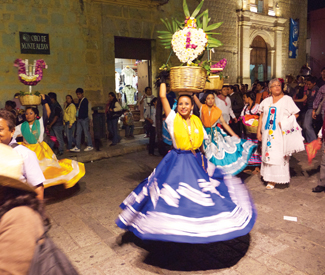
WORLD EATS The first thing you probably need to know about the magical Southern Mexican state of Oaxaca is that sensory overload is always on the menu.

Ancient sci-fi Zapotecan ruins, Technicolor one-story colonial buildings, and an endless stream of live music, whirling dance, outspoken political protest, and eye-popping art justify the eponymous capital city’s reputation as one of the most vibrant crucibles of human culture on the planet. (Seriously, there is live music and dancing, from traditional to punk, outdoors in multiple venues until 3am most nights. San Francisco, where you at?)

The soaring mountains of the countryside host innumerable villages, each with their own dazzling take on local customs and artistic expression. The beaches, like renowned global hippie-nudist beauty Zipolite, expand expectations by drawing a saucy mix of laidback locals, hard-partying city folk, and misfit spiritual wanderers from around the world who greet the golden waves with fire-twirling at sunset and impossible-looking naked yoga at dawn. And for any travelers worried that this land of UNESCO World Heritage Sites has been completely sanitized for first-world tourists, there’s plenty of everyday chaotic Mexican street life and colorful off-the-map adventures in which to satisfactorily immerse oneself.

But all that’s not even talking about the food. Any foodie explorer worth her rock salt knows that Oaxaca is the “land of the seven moles” — rich, fragrant sauces, traditionally poured over roasted turkey, made from a range of pulverized ingredients including chili peppers, chocolate, nuts, cloves, dried fruit, and tomatillos. (A great SF introduction to mole can still sometimes be found at the Mission’s La Oaxaqueña, which has unfortunately been seesawing lately between being one of the city’s best restaurants and a bacon-wrapped hot dog stand on random nights.)

But in an area where dozens of indigenous languages are still spoken and villages are separated by vertiginous, day-long hikes through spruce cloud forests dripping with blooming epiphytes and eerie Spanish moss — by all means take a couple days out of your stay for a eco hike with Expediciones Sierra Norte to blow your nature-loving mind — innovation and improvisation is a way of life. Hunky Beau and I hopped down there for a far-too-affordable March getaway, and here’s what we dug our forks into.


ON THE STREETS

Mole gets all the press, but the backbone of Oaxacan street cuisine is the piping hot tlayuda, a very large grilled tortilla loaded with with bean sauce, guacamole, fresh and stringy Oaxacan cheese, and a hunk of grilled meat or scoop of zesty tinga de pollo stew that’s either served open-faced like a pizza or folded over like a crepe. The best ones we found in the city were at a pair of carts on Calle las Casas, conveniently located just down the street from the historic La Casa del Mezcal, opened in 1935. Ensconced in the Casa’s low light, you can slow-sip several kinds of maguey-derived liquor among baroquely carved wood fixtures, kitschy paintings of Zapotec warrior gods, and a motley assortment of fascinating locals. The mezcal flows until 3am, and the roughly $2.50 tlayudas even later, so you’re set for a good night out.

Oaxaca’s favorite fast food: the tlayuda. Photo by David Schnur

Or snatch a tlayuda for a perfect cheap dinner, paired with a steamy, meaty bowl of pozole from the carts down the block. (Fun fact: pozole is descended from the stew Zapotecs used to make of leftover human sacrifice parts. Now it’s mostly pork and corn.) Cheap breakfastwise, we were blown away by the scrumptious, hefty $2 morning chorizo- and omelet-filled tacquitos toasted on hot rocks by charming women on Calle García Vigil, near the Mercado 20 de Noviembre main market. Self-serve bakery Pan Bamby across from the huge, ever-bustling central zócalo serves a dizzying array of perfectly flaky empanadas for about 30 cents each, including several rare veggie options like creamed spinach and spiced vegetables. And, as always, the market is the best place to acquaint yourself cheaply with the local cuisine: witness the overflowing seafood cocktails at Mariscos Panchos and delectably overloaded roasted pork soft tacos, five for $3, at Carnitas Patlan.

Fascinating traditional drinks served at outdoor cart Nieves Cholito el Tule in the Plazuela de Carmen Alta include tejate (a crazy-sweet maize and cacao Zapotecan drink with a plasticky foam on top), chilacayote (made from a succulent squash with edible seeds as chewy treats), and syrupy tuna, a.k.a. cactus fruit.

And the mole? I want you to look up fabulously dramatic, yodeling folk singer Geo Meneses right now and imagine her backed by a full orchestra (six tubas!) in the open air of Oaxaca suburb Santa Cruz Xoxocotlan, which hosts enchanting, slightly witchy open-air Tuesday evening “Martes de Brujas” concerts, featuring an array of miracle street tamales from local venodors: chicken marinated in chocolaty mole negro, pork in tangy red mole coloradito or zippy mole verde, wrapped in eucalyptus-like yerba santa leaf. Kind of unbelievable.


IN THE SEATS

Mole, of course, also served as an entry into the more experimental cuisine of this tastebud paradise. When you can get a three-course meal for two with a bottle of surprisingly satisfying Mexican wine (Casa Madero of Parras de la Fuente is producing a quality chenin blanc, and Baja’s Cavas Valmar a perky grenache) for around $50, we went and splurged a little.

Intimate and colorful La Olla, near the imposing Santa Domingo church, is where you go for regional authenticity with flair. Wide, thin slices of beef tongue soaked in a mole verde of almonds, raisins, tomatillo, and cilantro; mole negro de fandango, a fantasy-fulfilling 25-ingredient mole negro over roasted chicken; and mole amarillo con pitiona, lively and yellow with corn masa, three kinds of peppers, and lemon verbena vanished from our table in a mad scramble of sauce-sopping tortillas.

La Biznaga is the hip joint, a “very slow regional food” operation named for a portly flowering cactus, its large courtyard decked out in vibrant Cuban hues, with towering chalkboards announcing the fascinating menu and a globe-hopping clientele lapping up pulque cocktails. (Mixing with milky, beer-like pulque, derived from the maguey plant, is super-trendy in Mexico right now, and should hit here any minute.) An appetizer of yerba santa-wrapped bricks of Oaxacan cheese drizzled with citrus liqueur-infused crema came off a lot lighter than it sounds. “El Necio,” a large hunk of flank steak stewed in a mole-like sauce of smoked chili, plums, and mezcal submerged us in flavor world several fathoms deep, while a mushroom and goat cheese-spiked coloradito lifted a fleshy fish fillet to the top of our list.

Jicama taquitos with grasshoppers, corn smut, and quesillo at Casa Oaxaca. Photo by David Schnur

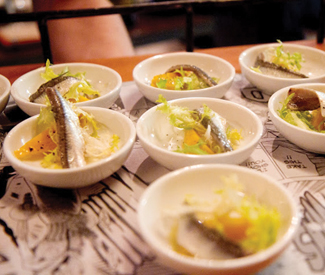
If you’re looking for a true gourmet Oaxacan experience, though, the gorgeous Mission-style Casa Oaxaca, with its upstairs dining patio overlooking the kaleidoscopic downtown street hustle, is where you’ll find some of the most forward-thinking menu items that still pack an authentic local punch. Salsa is mixed and ground to tasted tableside in traditional molcajete mortar. Start with the exquisite, crunchy jicama taquitos filled with fried grasshoppers, cuitlacoche (corn smut), and quesillo cheese. Then, as the candlelight and atmosphere take hold, move on to absurdly tender venison bathed in ethereal mole amarillo and juicy slices of duck breast covered in nutty, deep orange mole almendrado.

Finally, for desert, slip back out into the captivating streets and share the refreshing carrot-apple-pecan ice cream flavor Beso Oaxaqueño, as the hypnotic local marimba music known as son istmeño drifts from the zócalo.

Live Shots: Rich Kidd, Young Galaxy, tween angst, and barbecue at SXSW, Day 3

2

Photos and words by Bowerbird Photography

The surrealists employed a method of drawing called the exquisite corpse, where an artist would create an image on a section of paper, fold it back to conceal the image, and then pass on the paper for another artist’s contribution. The beautiful monstrosity wasn’t revealed until everyone was finished and the paper unfolded.

Walking down South Congress Street during SXSW 2013 yesterday felt like the musical version of an exquisite corpse. Nearly every block had its own outdoor stage, with an alternative country performance across the street from a hard rock band, indie pop music next to honky-tonk, and street musicians in between. It was sonic mayhem.

While some find it enjoyable to be able to sing along along to a familiar band, there is unequaled pleasure and pride in “discovering” a new one – the more obscure, the better. We left our frustratingly fathomless festival handbook at the hotel, letting fortune be our guide, and made for S. Congress. The street is aptly named because it seems that everything comes together there, and has the gentrified, bohemian feel of Valencia Street, with vintage shops, craft fairs, and a good ice cream parlor.

While musicians are turned away at larger venues downtown, it’s virtually open mike in SoCo. That’s not to imply that the music is worse. On the contrary. It is here that we stumbled upon a standout band called Residual Kid, from Austin, with Max Redman (12-years-old), Ben Redman (14), and Deven Ivy (14). Teen/tween angst doesn’t get better than this.

At the Music by the Slice stage, Telekinesis lead singer Michael Lerner sat front and center, singing over the cymbals of his drumset to hipsters holding pizzas. Young Galaxy, from Canada, also performed, it with a ’80s synth-heavy sound, snappy beats, and open-throated vocals.

Moseying down to the St. Vincent De Paul parking lot, Canadian country music band Corb Lund played to a crowd lounging on overstuffed sofas, reminiscent of an impromptu porch concert. Singing straight country with a storytelling bent, he twanged about speeding on the highway with a foot “heavy with redemption” and a “bible on the dash.”

Down another block, adorable duo, Kelly Willis and Bruce Robison, got folks dancing at the South by San Jose stage with romantic country ballads.

While the music may be eclectic, the food is less so, despite the ubiquity of food trucks. While most restaurants serve any combination of Tex Mex (fried burrito anyone?) and BBQ (Austin’s staple food is shredded pork in a white bun), it is possible to find some fresh greens. At the non-profit, Casa de Luz, we sat down to a hippie-cafeteria style prix fixe lunch, piled high with kale and homemade kraut.

But the siren smell of smoked meats is too alluring, and we couldn’t help but splurge on an artery-clogging, three meat BBQ sandwich from the food truck, La Barbecue. Delicious. There was also an offshoot show behind the BBQ parking lot, called the SX704 Showcase, with hip-hop performances by SL Jones from Atlanta, and Rich Kidd from Toronto.

As we walked over the Congress Avenue Bridge in the evening, the famous bats started to leave their hiding places beneath, swarming in search of their sunset meal. They made thousands of shotgun holes in the sky, and moved in tandem like a starling murmuration, adding just one more sight to the wonderful weirdness this town has to offer.

Navigating the wild landscape of music, parties, and food at SXSW is exhausting, but in the end, we’re rewarded with great memories. And it’s a good thing we took photos too, because our eardrums are shot.

Meat and veg

0

caitlin@sfbg.com

IRISH It’s early, even for me, to be in a pub. But cookbook author and Irish chef Larry Doyle requested that I make the trek to meet him at his Taraval and 29th Avenue Parkside Tavern at 9am so we can talk about his kitchens’ plans for St. Patrick’s Day. Sagely, he begins by proposing Americanos and telling me about latchkey kid dinners from growing up in Dublin.

“Whoever got home first in the evening would cook dinner,” he says. That was often Doyle. Starting at 11 years of age, he would work off of the food Mom prepped before leaving for work (she always made dessert first, he remembers), eventually creating the dinners from scratch. “Irish food is rustic, simple,” Doyle tells me, reminiscing about the kitchen gardens from which the family pulled each night’s veggies.

The country’s “Fourth of July,” as Doyle describes St. Patty’s Day celebrations back home, has been adopted by the world as much as its Guinness and Jameson. Dublin hosts a parade akin to the New York City Macy’s Thanksgiving processional and shamrocks and leprechauns rule the day in Eire, just as they decorate tiny hats and novelty t-shirts here in the States.

The only difference between the celebrations, Doyle says, is a slightly less fratty attitude in Ireland towards celebratory green beer bonging.

“Which I don’t have any complaints about,” the bar owner clarifies. Doyle not only owns the four-year-old Parkside, a well-appointed tavern positioned among Korean restaurants, dancewear suppliers, and single family Sunset homes, but works as chef at Johnny Foley’s in Union Square. Both spots get packed out, he says, over the holiday.

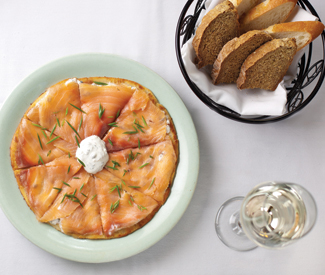
But it is at the Parkside where his smoked salmon boxty (a potato pancake topped with a dill sauce made of sour cream and shallots, and fish) “causes riots” when left off the menu and his Irish soda bread-and-butter pudding, which has been known to incorporate banana and feature a Bailey’s sauce, remains the most-ordered dessert. Should you doubt Doyle’s chops, do know that he wrote the book on Irish cooking (Irish Pub Cooking, Bristol Publishing Enterprises 2006, 139pp, $8.95).

Both boxty and pudding will be available at Parkside this weekend, as well as oysters, a stew made of simmered lamb cubes, and the traditional St. Patrick’s gut bomb of corned beef, white parsley cream sauce, and cabbage. Vegetarians can take solace in the regular menu’s wild mushroom penne, or Dubliner cheddar cheese plate.

Irish breakfast featuring black and white pudding topped with tomato and the starring role sweet, chewy imported bacon is served Friday through Sunday all year long, but Doyle pledges that brunch will be a particularly nice scene during this weekend’s festivities (he counsels coming close to the Fri.-Sat. 11am, Sun. 10am opening of the doors to ensure a spot to sit.)

So eat something in between shot-with-stout-chasers, dammit. There’s hardly an SF neighborhood — side eye, Castro — without an authentic spot that’ll be rolling out the orange-white-and-green flags.

Parkside Tavern 1940 Taraval, SF. (415) 731-8900, www.parksidetavernsf.com

LARRY DOYLE’S TOP PLACES TO REST YOUR PINT THIS WEEKEND

Johnny Foley’s 243 O’Farrell, SF. (415) 954-0777, www.johnnyfoleys.com

Irish Cultural Center 2700 45th Ave., SF. (415) 661-2700, www.irishcentersf.org

Danny Coyle’s 668 Haight, SF. (415) 558-8375, www.dannycoyles.com

Durty Nelly’s 2328 Irving, SF. (415) 664-2555

The Phoenix 811 Valencia, SF. (415) 695-1811, www.phoenixirishbar.com

Chieftain 198 Fifth Ave., SF. (415) 615-0916, www.thechieftain.com


Eats everything

0

culture@sfbg.com

THE BLOB This coming week sees most of our smaller neighborhood farmers markets resuming their merry little trade, the familiar young faces behind the stalls and bushy green produce spilling forth a sunny welcome after grueling — grueling — months of eating only in-season citrus and avocado. OK, this is California, so pretty much everything’s in season all the time, which is great news for an ever-voracious Blob. But it’s nice to meet with your neighbors on the street for reasons other than complaining about dog poop. (The Blob usually just devours its problem neighbors, but the point is farmers markets are nice.) Here are some tasty eats that also have us communing with a spring-like vibe.


ARTICHOKE RAVIOLI, DUARTE’S TAVERN

Recently, the Blob had the occasion to experience a NorCal classic — a warm creamy bowl of artichoke soup at Duarte’s Tavern in Pescadero, about half an hour towards Santa Cruz. The Blob’s in-laws were visiting for a sunny coastal drive, but the Blob did not eat them, much as we may have wished. Instead, we feasted on another of Duarte’s tributes to its famous local vegetable, a spectacular artichoke ravioli ($14). Its enveloping pasta perfectly al dente, the rich, peppery artichoke-ricotta stuffing had an unexpected granular texture that nonetheless melted on the tongue. (The Blob topped it all with zesty marinara, a special request.)

Plentiful deep-fried calimari, baked Pacific oysters erupting with hot butter, local ollieberry pie (think blackberry-meets-raspberry with a pinch of tart), a biker-family clientele, and that famous soup are Duarte’s stock-in-trade. Add a walk around Pescadero’s vintage California-quaint downtown, presto! A day trip to content any in-law.

202 Stage Rd., Pescadero. (650) 879-0464, www.duartestavern.com


MANGO SALAD WITH PRAWNS, KITCHEN STORY

Kitchen Story replaced midrange white tablecloth stalwart Tangerine last November, bringing an Asian fusion sensibility and some comfy decor — granite tile, wood bookshelves — to the Castro spot. (It also brings a hint of panic: “Due to high volume, we respectfully request no substitutions on the menu,” it announces repeatedly.) Although it’s open for Thai-heavy dinner, so far brunch is the name of the game for regulars. And the brunch items of choice are stuffed-to-perfection ricotta pancakes, a sweet yet satisfying banmi panini, and millionaire’s bacon, a sassy little item consisting of thick bacon slices marinated in brown sugar syrup and chiles that’s popular at the owners’ other restaurants, Blackwood and Sweet Maple.

The Blob is a contrarian however, and also a sucker for a good salad, so the mango salad with prawns ($13) was our chosen victim on the most recent visit. It took a few minutes to get some attention, but the food came out of the kitchen fast (1:30pm on Saturday is a great time to go). The Blob’s companion Krispy substituted anyway — gasp! — asking for an extra two poached eggs placed atop his grilled veggie and cilantro aioli “morning melt.” He found the kitchen willing and the combo delicious. The mango salad, a riotous heap of bright color, was brimming with mango. Grilled prawns, however, were scarce, and the smoky-lime dressing a tad too acidic: fruit-based salads need only the merest brightening hint of vinegar; this was over the top.

Nothing a giant mimosa ($8, bottomless $16) couldn’t cut through, but we eagerly await the chance to dive into chapter two of this story: dinner.

3499 16th St., SF. (415) 525-4905, www.kitchenstorysf.com


PISCO SOUR, LIMON ROTISSERIE

Maybe it’s because we ate our way through Peru a few springs ago, but pisco sours always put us in a warmer mood. The Blob defaulted to this classic at Peruvian pioneer Limon’s outpost on South Van Ness when purple corn miracle drink chicha morada had sadly run out. (Weird, since Limon possesses its own house brand, Inca Blu.) SF has a long and passionate relationship with the spunky Peruvian brandy — the pisco punch was invented here around 1893, and there are several versions on Limon’s menu. And to no Blob’s surprise, the basic pisco sour ($8), with lime juice, angostura bitters, and simple syrup was excellently sweet-tart without cloying or spiking. And it came with a smiley face drizzled into its heavenly egg white foam. Unbeatable accompaniment to crispy pollo empanadas and meaty tartara de tuna.

Limon Rotisserie, 1001 S. Van Ness, SF. (415) 821-2134, www.limonsf.com

BLOB TIP: Hey kids, tired of bologna-on-white and bit-sized Snickers in your bag for lunch? Tell your parents that Hayes Valley’s too-cute, newly spiffed Talbot Cafe (244 Gough, SF. 415-553-4945, www.talbotcafe.com) will pack your bagged lunch for them. Simply order from its regular menu — grilled cheese, BLT, chicken and havarti sandwich, mixed greens ($6–$8) — fill out a paper bag with school, name, grade, class, and date, and the Talbots will deliver something fresh and yummy to your school before 10:45am. They can’t deliver spring break early, however, so sorry.


Wiener’s dance mix: more DJs mixed with fines for “bad actors”

7

DJs could proliferate in San Francisco’s bars, restaurants, coffee shops, and plazas under legislation that Sup. Scott Wiener introduced today to include DJs under the city’s limited live music permits, but the legislation also includes new enforcement powers to crackdown on underground parties and other unpermitted events.

Limited live music permits – which are far cheaper and easier to obtain than the city’s full-blown Place of Entertainment permits ($385 compared to around $2,000 for the POE permits) – were created in 2011 by legislation sponsored by then-Sup. Ross Mirkarimi, allowing amplified performances until a 10pm curfew. But DJs were left out, despite their prevalence in San Francisco, something Wiener is now trying to correct.

“Entertainment and nightlife are an essential part of San Francisco’s cultural and economic vibrancy,” Wiener said today in a press release announcing the proposal. “This legislation fosters live entertainment while also heightening our ability to monitor and regulate bad actors.”

It’s that last part that doesn’t sit well with everyone, particularly given San Francisco’s pervasive culture of throwing underground parties, which are key fundraising tools for grassroots efforts such as Burning Man camps but which are the targets of periodic crackdowns by the SFPD and other agencies. It seems that when it comes to nightlife, we always have to take some medicine whenever City Hall offers a spoonful of sugar.

The legislation would give the Entertainment Commission the authority to levy $100 fines to those involved with unpermitted parties, either in established clubs or underground warehouses, whereas now the commission only has the authority to punish those who have permits for violating them.

“Punishing a DJ playing at a party in which the promoter didn’t get the proper permits (perhaps unbeknownst to the DJ), would be unfair and inappropriate, in my opinion,” was how DJ/Promoter Syd Gris from Opel Productions and Opulent Temple reacted to the legislation.

But Entertainment Commission Executive Director Jocelyn Kane told us she doesn’t expect to fine an DJs. While she asked Wiener for those enforcement powers, they are simply a way of encouraging promoters and business owners to get permits. “We’re not into punishment, we’re into compliance,” she said, adding that this is simply seeking authority to do administratively what the SFPD and California Alcoholic Beverage Control Administration can now to criminally and civilly.

Tom Temprano, president of the Harvey Milk LGBT Democratic Club and a DJ/promoter at the popular Hard French parties, told us “where I really want clarification is on the new enforcement powers for the commission,” although he agreed with Kane that the commission generally works cooperatively with the nightlife community, far more than either the SFPD or ABC.

“All in all, it’s a really good step in the right direction,” Temprano said of the Wiener legislation. “It seems really positive. As a DJ, allowing DJs to be used for limited live performances is just common sense.”

Kane said the legislation will allow music to flourish in the city, from outdoor plazas to small venues, many of which have used DJs illegally. “We’ll be able to legalize that and bring them into the fold,” she said. “There always have been places that use a DJ like a jukebox.”

In addition to the relatively cheap application cost compared to POE permits, limited live music perhaps are quick and easy to obtain and don’t necessarily require city inspections paid for by the applicant.

In his press release, Wiener praised the importance of nightlife to the city economy and cited a city study he commissioned last year which found that nightlife has a $4.2 billion impact on San Francisco, employing 48,000 people and furnishing the City with $55 million in tax revenue annually.

“We need to encourage a flourishing nightlife that not only marks San Francisco as a cultural capital, but also creates jobs and brings in revenue for essential City services,” Wiener said. “These amendments are part of that broader strategy.”

Nite Trax: DJ Sprinkles lays it out

32

The phenomenal house DJ and experimental musicmaker on mainstream visibility, transgender globalism, Bay Area queer culture, and the “shopping mall diversity” of the current dance music scene.

Techno has always had room for theorists and intellectuals, from Derrick May to the Mille Plateaux label roster, and social activists, like Moodymann and Underground Resistance. Most of that discourse usually takes place musically, however, with concepts emerging from the vinyl itself. The celebrated DJ Sprinkles, a.k.a. Terre Thaemlitz, the American head of Japan-based label Comatonse, tops all that by making intellectually grounded music glimmering with poetic touches and expounding in interviews and writing on such heady, heated topics as essentialism, gender idenitity, surveillance, and authenticity. She leads workshops, goes on speaking engagements, and isn’t afraid to let loose in interviews. (For example — see below — rather than “born this way” platitudes, she considers her queer identity “beat this way.”) 

It’s a beautiful thing, especially in the rare context of controversial truth and radical opinion pouring from the mouth and keyboard of an outspoken transgender major player on the stubbornly homogenous global house-techno DJ scene. Of course, it all comes down to the music — we’ll get a treat when Sprinkles (who chose the name because he wanted something that sounded “totally pussy” in opposition to macho DJ culture, to buck the testosteronal scene) performs Sun/24 at Honey Soundsystem — and Sprinkles certainly has the goods. He’s released umpteen pieces in an astoundng breadth of genres under multiple pseudonyms over the past 20 years. Masterpiece deep house album “Midtown 120 Blues” siezed the top of several best of 2009 charts and was, typically, followed by Soulnessless, a 30-hour “mp3 album” of music and video. Because why the hell not?

I got a chance to exchange emails with Sprinkles before her appearance here. It’ll be an interesting return to the Bay Area, where she lived for several years before decamping to Japan. Here’s all she had to say.    

http://www.youtube.com/watch?v=UY79cyv8pH8

SFBG It’s been 13 years since you lived in Oakland, is that correct? Can you tell me why you decided to leave and what it was like to live here then, with regards to the music, political, and queer scene?

DJ SPRINKLES Yes, it’s been a long time. I used to live across the street from a hotel where the Unabomber once stayed. Honestly, I can’t say I miss California. I never really connected with any queer or transgendered communities in SF or Oakland. Whenever I tried, they seemed immersed in West Coast spiritualism and zodiac bullshit, which I found completely alienating. Most of the transgendered people I met there were prone to metaphysics — by which I mean they were ideologically (and economically and medically) invested in defining their transgenderism in relation to a perceived split between their “physical bodies” and their “true inner selves.” I’m an anti-essentialist, non-op, materialist, anti-spiritualist… so that clearly wasn’t a match with my own transgendered identity.

There was also a weird conservatism in SF’s queer scenes that I associated with the fact a lot of people in SF had been raised in conservative Midwestern towns, so they were in SF to “live the life.” I felt there was a lot of unacknowledged parody and role play going on — people trying to overcome a life of repression and closets by wrapping themselves in rainbow flag culture. Yet, when going to buy groceries or such, I still found myself being harassed as a “fag” on the street like in any other town in the US. I felt my four years there was all quite standard. I don’t really think of the Bay Area as a “special place” for being queer and transgendered.

US identity politics have a particularly inextricable link to the concept of the ghetto — not only as a place of economic strife and forced communal ostracization from a “white middle-class mainstream,” but also as a self-invested “safe space” for non-mainstream social movements. This is part of migrant culture. For example, after my grandparents passed through Ellis Island, they immediately moved to a place where people spoke the same language as their homeland, etc. The Castro, New York’s West Village, Little Italy, China Town… these are all migrant-based communities formed by people seeking safety in numbers in the face of not being welcome elsewhere — these two dynamics of “safety” and “alienation” are inseparable to most US identity politics. So these communal zones all display the problems and contradictions of cultural identification that plague mainstream US culture as an “immigrant nation” that is simultaneously “anti-immigrant” – because the “immigrant” is a brutal reminder that there are no “real Americans” beyond Native Americans, which the majority are not. And of course, the fact that recent generations of immigrants are primarily people of color does not jibe with conventional black/white US race discourse, which continues to be largely devoid of other browns, as well as the concept of the person of color as a willing immigrant (as opposed to the descendant of a slave). This history and context is peculiar to the US social landscape, and it creates a lot of weird identity essentialisms and hostilities around gender, sexuality, race, ethnicity, class…

Not to say other countries don’t have their own fucked up ways of causing and dealing with social problems, but moving to Japan and realizing that pretty much the entirety of Western identity politics did not function here was a big life experience. It was like leaving the Earth’s gravitational pull — it didn’t mean gravity no longer existed, but almost everything I had internalized and believed I understood about my relationship to gravity was no longer helpful in understanding the dynamics of dominations at work in this other context. I wasn’t freed of gravity, but lost in weightlessness. I had to learn to feel weight in a completely different way. This is why so many of my projects dealing with my own immigration and cultural issues consistently invoke the rather limited and problematic US language of black/white race relations. It is a critical gesture intended to highlight the limitations of my having been raised amidst that US language and social conditioning, yet now living within a non-US context with few tools to work with.

Because music’s value is so often tied to an essentialist concept of racial authenticity, it becomes difficult and risky to ask an audience to question their relationships to the very value systems through which they likely purchased the album – but that is also why I choose to work with audio. Not because of its possibilities, but its all-too-clear limitations. Since I am unable to believe in the authenticity or purity of identities of any kind, when I invoke “identifiable” sounds (a “queer” sound, a “black” sound, etc.) I am doing so to question the social relationships around their construction, proliferation, and distribution. The moment we become lazy about our use of those “identifiable” sounds — the minute we take it for granted that the essentialist associations they have come to carry are unquestionable and real reflections of material social experiences — everything becomes one-dimensional and shallow. This is why almost all music is one-dimensional and shallow! [Laughs.] For example, if I can beat a dead horse, my problem with Madonna’s “Vogue” is not that it was “inauthentic,” but that its terms of discourse misrepresented its relationship to vogueing by actively erasing the very contexts of Latina and African-American transgendered culture that inspired it (via lyrics about “It makes no difference if you’re black or white, a boy or a girl”… it TOTALLY made a difference, and THAT SOCIAL REALITY is where any real discussion on vogueing BEGINS.). So I’m interested in these other directions of audio discourse that cannot even occur if one is preoccupied with conflated essentializations of identity and sound. There is never a true point of origin for anything. It’s all referential and contextual. In my opinion, there is no point in discussions focussing on identifying the source of a sound or style — that is a hopelessly futile exercise, although it is the dominant exercise! It’s a distraction from the real discussions needing to be held, and those are discussions on relations of domination.

As a DJ in the late ’80s and early ’90s, there were a lot of drag queens asking me to play Madonna’s “Vogue” when it first came out. I refused, but I could understand their requests. We all have very complicit and complex relationships to dominations, and a perverse desire to celebrate our visibility within the dominant mainstream, no matter how unfamiliar or distorted that reflection may be… often because we are conditioned to feel so unhappy with what we see in the mirror to begin with. Mainstream visibility is like getting approval of the Father. It’s a mental and abusive process. It is also totally standard. So I get it… But there is also that which remains unrepresented and invisible to most. That which existed, and may have already been lost, but did so without seeking approval of the Father. And again, this is generally not a freed or liberated space, but a space of intense hatred for the Father. These are difficult things to speak of and represent, because any act of representation has the potential to be a violation of the cultural site it wishes to speak of. So to speak of them requires obfuscating or complicating the usual functions of language – not through vague poetry, but unexpected flashes of clarity coming from unexpected vectors.

http://www.youtube.com/watch?v=R2iKF_11WbY

SFBG You left during the first Internet boom I believe, and now SF is in the middle of a second one (although a bit different than the first —  the first wave seemed to have much more geeks and freaks in it, while this one seems much more regimented and Ivy League, even while many longtime residents are still feeling the results of “global recession”). When was the last time you were back here? And what are some of your recent thoughts on how house music is being affected by economic circumstances?

DJ SPRINKLES I was only back once about 10 years ago, visiting friends for a few days. When I moved away at the end of 2000, internet and web development had already undergone a rigid formalization. Years earlier, a web designer did a bit of everything. By 2000, developers were already split into specific teams focussing on interface, coding, page flow, etc… all processes were specialized, departmentalized, corporatized. I hadn’t heard about the “second internet boom” there, but the way you describe it doesn’t surprise me since it would surely be an extension of that regimentation that took place in the first boom.

And in a way, the same can be said of this “second boom” (third?) around house music. In the same way almost all websites have taken on the same continuity and feel, so has electronic dance music. You buy an album, and all the tracks sound similar — as opposed to the old days when an electronic dance track like Donna Summer’s “I Feel Love” was tacked on to the end of an otherwise standard soul-band album that didn’t sonically match it at all. Today’s music consumer experience is much more streamlined and organized, which affects how people produce an album as well. Younger generations — 20-somethings — grew up amidst this homogenization, so I am fairly sure they do not feel what I am speaking of… although they may recognize it as a historical process.

I try to play with discontinuity and mixing things up, like in my K-S.H.E album, “Routes not Roots,” which had monologues and ambient tracks interspersed between house cuts. But I once made the mistake of reading people’s blog comments, and they really seemed upset about this kind of thing. “Way to ruin the mix,” or “Why the fuck didn’t you put that monologue at the end of the album?” They have no patience for non-homogeneity. The same goes for my Comatonse Recordings website itself — people seem utterly confused and helpless. If one doesn’t do everything completely standard and at the same level, people get disoriented. It’s a kind of cultural compression going on, similar to audio compression, where everything has to be “punched up” to the same intensity or people feel lost. What the fuck is so wrong with being lost? Why would you expect — let alone insist — your interactions with non-mainstream media to be completely mainstream in process?

http://www.youtube.com/watch?v=B8iF7JQiz50

SFBG I’ve been hanging out recently with the new, young generation of ACT-UP activists who are transcending mere ’90s revival and undertaking a lot of energizing political discourse and action. Were you involved in the queer activist movement back then — or now? Would you characterize your musical project as a form of activism, especially in its more intellectual and challenging aspects?

DJ SPRINKLES That’s nice to hear. Although you use the term “action,” I assume the real interesting stuff has little to do with demos and “direct actions,” and more to do with communal education initiatives, etc.? My direct action days were mostly during the late ’80s and early ’90s, while living in New York. Most of those activities were in conjunction with various caucuses in ACT-UP, and WHAM! (Women’s Health Action & Mobilization).

I do consider my audio and other projects “political” — in theme, and also in their attempts to (dis)engage with standard industry practices. But clearly this is something different than direct action “activism” or community outreach, because my main social engagements are with people working for labels, distributors, music festivals, museums, and other culture industries. Maybe “culture jamming” is a better way to put this kind of political activity. Personally, I found myself distanced from direct action groups because the terms of identification they cultivated out of strategic necessity so often folded back into essentialisms that excluded me on a personal level. So I was always advocating for the recognition and acceptance of something other than myself (like the way “born this way” ideologies take over discussions of LGBT rights… I consider myself more “beat this way,” my queer identity being primarily informed by material ostracism and harassment than by some mythological self-actualization and pride). That, combined with the mid-’90s move away from direct action toward CBO’s (Community Based Organizations) — largely because the tactics of direct action had been so thoroughly coopted by mainstream media – was pretty much the end of my serious direct action involvements. Over the years, enunciating this process has become the core political act of my projects and activities. I do not do this to discourage people from forms of direct action, but as a simultaneous form of critical analysis that hopefully contributes in other ways to our various attempts to react to dominations.

SFBG Do you feel that, as the means of production and distribution have been more and more democratized in the past decade, house and techno music-making and DJing have been living up to their potential as a form of resistance to mainstream capitalism and culture, or do you feel they’ve become more homogenized and/or annexed by neoliberal, bourgeois culture?

DJ SPRINKLES I do not believe the means of production and distribution have become more democratized. I take issue with the way people always confuse “commercial accessibility” with “democratization.” The breadth and variation of today’s music production strategies is no more than a shopping mall diversity. We are all working with similar software on similar platforms. Mac, Windows, Unix… Banana Republic, Abercrombie & Fitch, The Gap… Having said that, if these musics had a potential, I believe it was lost back in the ’90s when anti-sampling legislation (mostly focusing on hip-hop) laid the groundwork for today’s electronic music. It basically reinvigorated house with “musicianship,” “authorship,” and all that crap which used to play far less of a role in this genre’s early days. And the younger generation – basically, today’s 20-somethings who grew up after the whole sampling debates — really don’t seem to understand how record label legal departments work.

So they list up all the samples they recognize in a track in the comment fields of music websites, which is putting the producers they wish to support at risk. There is no sense of how we can cultivate — let alone protect — “underground” media and information in this online era. Everything is about “sharing,” when in fact we need to be developing a parallel discourse around meaningful information distribution patterns, including strategically withholding information from the web. The cliché idea of making “everything accessible for everyone” is not only naîve, but negates the social and cultural specificities that give certain forms of media their alternative values, in particular collage and sampling. Anyone who has used a random image taken from a Google image search on their blog page, and then gotten an email from Getty Images’ legal department asking for back royalties, knows what I’m talking about. Treating subcultural musics as though they are meant for “everyone” — whether this is being done by fans, or the labels and online distributors themselves — is the biggest sign of people not understanding the media they are dealing with. And since all of that is SOP these days, it’s pretty much a sign that the sample-based genres of house is dead. Is talking about house’s political potential in 2013 really all that different than the trend of talking about the radical politics of ’60s rock during the ’80s?

http://www.youtube.com/watch?v=v4M3-t9lw7o

SFBG I feel like, with parties like Honey Soundsystem, there is a huge resurgence of interest in an underground queer dance music culture — a kind of new underground opposed to corporate or low-quality dance music (yet still taking place in corporate spaces). Is this phenomenon occurring in Japan as well? Do you feel there are specific possibilities with this, not just in terms of opportunity for queer DJs to travel but of transformation of queer discourse and politically actualizing a new generation?

DJ SPRINKLES Hey, low-quality is where it’s at. It’s what it’s all about. What was Chicago house if not low quality? It’s important to place value within the “low” in order to counter conventional associations between the terms “good,” “high quality” and “upper class.” I’m not talking about celebrating kitsch, or that kind of petit-bourgeois trivialization of the “low.” I’m talking about finding other values in the “low” that cannot find expression within a language developed to express everything in terms of “low vs. high.” This is ultimately about the identification of other values amidst class struggle.

I don’t think house resonates as a queer medium anymore. Those days are over. Today it is primarily a white, heterosexual, European phenomenon. That was the case early on. I mean, how many Americans became aware of house music in the ’80s by buying Chicago house sold back to us on UK compilations? The US has always treated its own history of electronic music like utter shit… The US is such a fucking rock’n’roll shithole. So I think for people to appreciate house music’s queer roots, and to actively invest in those themes today, requires people becoming deliberate and explicit about those interests. But whether that deliberate action would focus on “queer visibility” or not is another issue. It doesn’t have to focus on “visibility” — especially since visibility has become such an oppressive aspect of dominant LGBT movements. Explicitness can also be about closets. Not only the usual closets born of heterosexism, but less considered closets around sexuality and gender that have been formed by the actions of the “born this way” LGBT mainstream. Well, that’s the direction I try to take it… reflecting on, and constructing, queer and transgendered histories that are as skeptical of Pride[TM] as they are angry about violence. And I do believe, globally speaking, queer and transgendered experiences are much more informed by violence than pride. So this should be reflected in how and where we make noise. In my opinion, music that functions in completely standard ways – socially and economically – does not have much potential for reflecting queer or transgendered contexts in politically precise, helpful or meaningful ways. You end up with essentialist, humanist shit like Lady Gaga’s, “Born This Way.” She is not somebody I would consider an ally.

You know, American media is so fixated on the idea that sexuality and gender must either be biologically predetermined, or a personal choice. The “it’s not a choice” argument is a common theme in television shows, etc. Both of these options revolve around a fiction of free will. Like, if it’s not a choice, then the only other possibility must be some supra-social, biological reason that cannot be questioned. Both of these conclusions preserve the status quo brutality of how culture forces gender and sexual binaries upon us. The thought that our absence of choice might be rooted in social tyrannies – not biological predispositions – remains unthinkable. The mainstream has it half right when they say, “it’s not a choice,” but it’s a half-truth that has been twisted into a decoy from the real issues at hand – the inescapability of the hetero/homo and female/male paradigms. We are given no other choices through which to understand our genders and sexualities. Sexuality is far greater than two or three. The same goes for gender — and yes, I’m speaking biologically, human bodies are way more diverse than A or B. To argue that the reason you deserve rights under a humanist democratic system is because of genetics is a retreat into feudalist logic. It’s the same as an aristocrat arguing that their rights and privileges were deserved because of their family blood-line and DNA. “Born this way” is antithetical to any democratic argument for rights rooted in a social capacity for understanding and transformation. It is astounding that the majority of people cannot comprehend that any “born this way” argument is a complete obliteration of their social agency. “I can’t help it, so give me the same rights as you…” Fuck that. We shouldn’t be asking to participate in the rights and privileges of those who have oppressed us. We should be trying to divest those groups of privileges. That is the best way to help ourselves and minimize the violence we enact on others.

Humanist legislative practices are still rooted in feudal ideologies, and I am convinced the long-term repercussions of this is a cultural entrenchment that makes any democratic project (including US-brand democracy, socialism or communism) an impossibility. We can already see how the post-Cold War world is retreating into clan-based, privatized, anti-state organization structures. Capitalism is increasingly liberated of democratic agendas because — surprise! — capitalism works better with slavery. Capitalism is not about the distribution of wealth, and everyone’s equal chance to partake in a petit-bourgois lifestyle. It is about the isolation of wealth. There is no doubt in my mind that today’s moral insistence that all people must work at whatever job society throws them, and the accompanying presumption that all lower-class unemployed people are “lazy” (which is perpetuated by many lower-class peoples themselves), is an argument for slavery: forced labor in return for base subsistence at best. How is that not the reality of poverty under globalized capitalism?

…and that’s why I hate Lady Gaga. [Laughs.]

http://www.youtube.com/watch?v=y-JtoRxqK8s

SFBG You have some fascinatingly poetic thoughts about the intersection of transgender issues and immigration, the idea of “living as a ghost” in politicized and police-monitored spaces. Do you have any current thoughts on how globalization continues to affect transgender issues?

DJ SPRINKLES I think the fact that the world’s two largest economies around gender transitioning are in Thailand and Iran, yet the aesthetics of those economies follow largely western models of beauty and body, says a lot about how globalization affects transgendered issues. Thailand’s dominant transgendered culture revolves around the “Ladyboy” — a very essentialist transgendered model that is rooted in heterosexism and the cultural/ideological necessity for some men to “unbecome-man” in order for “straight men” to have sex with other men. Western transgendered discourses love to fetishize the “Ladyboy” as some kind of locally celebrated and accepted third-world transgendered native other, but this is patent orientalism. It refuses to envision how the strict regimentation of social codes for those transgendered people can be oppressive, or how the mythical “transgendered native’s special place at the edge of the village, possibly as a shaman” is a form of segregation. People also never address how such cultures are invariably patriarchies, and their models for transgenderism almost exclusively revolve around the MTF paradigm. And far as I know, Thailand has still not lifted their government prohibition on homosexual government employees, which is relatively new legislation passed just a few years back. This is all part of that context of transgendered production.

Meanwhile, Iran is a country where Islamic law prohibits homosexuality by fatwah. Since the ’70s, gender transitioning has been promoted as a way for men who have sex with men to avoid the death penalty, although many transitioned people still face the possibility of being murdered by their families or local communities. The cost of their procedures is partially subsidized by the Iranian government itself. While some Westerners have attempted to portray that as “progressive,” clearly it is the opposite. Many post-op transsexuals find themselves ghettoized, unemployed and cut off from the family structures that play such important roles in Iran’s social structure.

In both Thailand and Iran one can see how the global growth of gender-transitioning economies is connected to heterosexism and homophobia — something current Western gender analyses attempt to separate from gender transitioning through clear ideological divisions between gender and sexuality. While I believe these divisions between gender and sexuality are important and do have social value in the West, it is clear that the West is not the world. And the West has surely not overcome its heterosexism and homophobia, either. I believe it is more than coincidence that the global proliferation of gender transitioning technologies is happening parallel to medical industries’ attempts to divest of their previously blatant attempts to cure homosexuality, due to such methods falling out of cultural favor in the West and elsewhere. I also believe it is more than coincidence that today’s inescapable “born this way” arguments serve and justify today’s medical agendas so well.

For sure, my stance on medical transitioning has always been that I support peoples’ abilities to transform their bodies as they see necessary. Considering how few options for gender identification are offered to us, I can understand how a person can become no longer able to live within one’s body as it has been defined and shaped by social gender constraints. But, for obvious reasons, I am unable to believe those medical systems which propagated today’s gender binary are capable or willing to offer us a way out of our gender crises. Those industries move us further and further away from cultural environments that enable transgendered people to build medically unmediated relationships to our bodies. I just can’t accept that the medical industry’s methods for mediating our suffering are the only way. It really angers me… particularly since so many transgendered people are impoverished and without health care…

Hmm, you’re probably getting an idea as to why I am never invited to perform my more thematic projects in the US — just to DJ some house and go back home to Japan. [Laughs.]

SFBG Speaking of essentialism, ha: Any food or restaurants you miss from living here?

DJ SPRINKLES Mexican food…! It’s shockingly absent in Japan… and when you do find some, you generally wish you hadn’t. But what a weak note upon which to end this interview. [Laughs.]

Latin highs

0

virginia@sfbg.com

APPETITE Nothing replaces actually experiencing a cuisine served in its place of origin, but regional dinners are one way of traveling vicariously (and, perhaps, with less of a carbon footprint).

Occasionally, you get more than a meal, as with a January 23 dinner at Oakland’s Latin American haven, Bocanova (www.bocanova.com), which hosts the monthly Rick’s Supper Club, highlighting South American cuisine. As a lucky few dug into wild shrimp and lobster ceviche or smoky, steamed mussels, dinner sponsor LAN Airlines surprised attendees with free round trip tickets to fly to any South American destination… a freak out “Oprah moment.” In lieu of that kind of bell and whistle, here are two restaurants fiercely dedicated to uncovering the subtlety of their chosen cuisine.


OLIVETO

Every year I’d anticipate legendary Whole Hog dinners at Oakland’s temple to regional Italian cuisine, Oliveto, which recently celebrated its 25th anniversary. I dropped off after chef of 15 years, Paul Canales departed — he just opened buzzed-about restaurant-bar-music venue Duende. But I returned this year to the warm and stylish upstairs restaurant (there’s a more casual cafe downstairs). Just over a year ago, young chef Jonah Rhodehamel took over. With consummate host-proprietors Bob and Maggie Klein thankfully still running the restaurant, Oliveto maintains its purpose as a culinary community stalwart akin to Chez Panisse (community journal, whole-animal history, food activism), with regional Italian focus and themed dinners.

Rhodehamel honors Oliveto history while unafraid to experiment. Pastas ($15-18), which remain the highlight, might be a traditionally-influenced spaghettini neri of squid ink pasta, shrimp, and chili pepper, but he’ll add chocolate to tomato-braised oxtail corzetti, use red winter wheat in penne alla Bolognese, or infuse Floriani Red Flint corn polenta under duck giblet ragu with intense lavender vanilla notes. The fritto misto ($13) stands out from what is often merely a pile of fried food. Rhodehamel fries up the unusual: scungil (whelk), herring, blood orange, and shirako (cod milt, ahem, I mean, sperm).

The only lackluster starter was miniscule pan-fried frog’s legs ($14) with a parsley sformatino (like savory panna cotta). Charcoal-grilled meats are impeccable: buttery, crispy pork porterhouse ($30) sits amidst cannellini beans and braised chard, while rare Piedmontese ribeye ($36) is crispy on the exterior, radiant pink inside, next to creamed spinach and Yukon Gold potatoes. Espresso chocolate stracciatella ice cream ($8) is a lush, caffeine finish, though after trying all recent desserts, I’d also take fluffy ricotta cheesecake ($8) with candied kumquats.

5655 College Ave., Oakl. (510) 547-5356, www.oliveto.com


GITANE

Since opening in 2008, Gitane is easily one of our sexiest restaurants. Ducking into an alley, down a couple steps into the lush reds, tapestries, and chandelier glow of a tiny, two level space… so begins your seduction by a lover who knows how. Executive chef Bridget Batson has been here since the beginning. In November, the restaurant shifted directions with the addition her husband, co-executive chef Patrick Kelly (of La Folie and Napa’s Angèle), and chef de cuisine David Martinez.

Staying true to the meaning of gitane — gypsy woman — the new menu wanders gypsy-like through Southern Spain, changing cities (Andalusia, Sevilla, Valencia) every few weeks. In keeping with the celebratory setting, the appropriately deemed “passport” tasting menu is $65 for five courses (wine pairings from new wine director, Sarah Knoefler, $45), available in the intimate upstairs dining room. Bar and alley/patio seating offers an a la carte menu ($12-36) or bar bites.

Though they’ve combined Spanish and Moroccan influence since day one, Bridget and Patrick’s recent Spain travels allow them to now dig deeper into regional Spanish cuisine. The first regional focus was Valencia. The tasting menu began with a salad of baby beets, fuyu persimmon, Marcona almonds, citrus, nasturtium paired with honeysuckle notes of a Musva Moscatel from Valencia. Moving on, Dungeness crab and cuttlefish were touched with sea urchin vinaigrette and pineapple. A delight of fatty Iberico pork cheeks, Matsutake mushroom and raw Nantucket Bay scallops sat in a brilliant golden raisin-saffron-mushroom coulis. Fourth course: pan-roasted duck breast in tempranillo chili puree accented by oloroso sherry-compressed pears (yes!) The finish? A winning pumpkin creme caramel.

An à la carte meal yielded an over-salted but beautifully seared scallop with crispy sweetbreads ($16). I preferred crisped, roasted artichokes piled with sunchokes and Manchego cheese ($13), or an entree of rabbit (conejo) two ways ($32): roasted saddle and a dreamy riletta, accompanied by braised snails and caramelized squash. Ramon Garcia remains Bar Manager, still serving refreshing cocktails ($12) like an elegantly smoky Chimenea: mezcal, rye, allspice dram, maple syrup, orange bitters.

6 Claude Lane, SF. (415) 788-6686, www.gitanerestaurant.com

Subscribe to Virginia’s twice-monthly newsletter The Perfect Spot, www.theperfectspotsf.com


Celebrate Black History Month with four days of sf|noir food and drink

0

This month, you can observe Black History Month by attending a filmmaking discussion, a childrens dance class, by going to a lecture at USF — check out this and this event rundown for inspiration. And given how food-oriented we are as a region, it was only natural that eventually you’d be able to eat and drink while celebrating African American heritage, not to mention the black culinary geniuses that add to it here in the Bay. 


Sample wines poured by the Sterlings of Esterlina Vineyards (top) and bites made by Michele Wilson of Gussie’s Chicken & Waffles at sf|noir’s Feb. 23 gala

The organization that is sponsoring the four-day extravaganza was born one afternoon at North Beach Jazz Festival, the nine-day affair that Herve Ernest organized for eight years. He realized that the crowd in attendance was really, really white.

“There was an African American band on stage, but I could count on two hands the amount of black faces I saw,” he tells me in a phone interview. He realized that if African American culture was going to remain a presence in a city where black people were being rapidly displaced, concerted efforts would have to be made.

“That’s when the conceptual idea for what became sf|noir started happening,” Ernest continues. He started the organization, which sponsors read-ins, dance, and concerts, not only to get superlative cultural programming to black audiences, but also to “ensure the presentation of black arts and culture in San Francisco” — a city whose black population has dropped from 12 to less than three percent in the 19 years since Ernest first settled here. 

This year, his group is offering days of events that highlight some of the area’s most successful black food entrepreneurs. “It’s something that is very relevant here,” says Ernest. “It’s a foodie town, food events happen all the time. We thought it was high time to create a food and wine event that looks at African American cuisine.” 

So, belly up. Go here for more info: 

Remixology

Three mixologists — including Otis bartenders Phil Shell and Damon White — present cocktails found throughout the African diaspora. Entry is free, you have to pay for your own drinks though. 

Feb. 21, 6-9pm, free. Otis, 25 Maiden Lane, SF

Wine tasting with Omar White

After 15 years at Chez Panisse, believe that wine consultant White has some knowledge about local vinos. He’s lent his expertise to Pizzaolo and the East Bay’s Hibiscus and is here today to teach about the in’s and out’s of the wine tasting process. Register in advance for this one — participation is limited to 25 thirsty souls. 

Feb. 22, 6-9pm, $20. 18 Reasons, 3674 18th St., SF

http://www.youtube.com/watch?feature=player_embedded&v=U1eW77Pw4PQ

Wine and Food Gala

Food from nine restaurants well-versed in African American cuisine (Farmerbrown, Cedar Hill, and tomorrow’s brunch host Miss Ollie’s for starters), 20 local and international winemakers, and two dessert specialists — The Brown Sugar Lady and PieTisserie — are all serving up at this four-hour dinner party. 

Feb. 23, 7-11pm, $60. The Atrium, 101 Mission, SF

Oakland Jazz Brunch 

Hibiscus’ chef Sarah Minton has a new project in this Old Oakland corner restaurant. She’ll be offering up the place’s Carribean-toned menu for brunch today, while the Marcus Shelby Trio helps you finish the sf|noir series strong.

Feb. 24, 11am-3pm, free entrance, a la carte menu. Miss Ollie’s, 901 Washington, Oakl. 

Can Yan noodle?

0

virginia@sfbg.com

APPETITE Style-over-substance at popular restaurants grew old in my Los Angeles days. A pretty package matters little if food isn’t excellent. In SF, we tend towards the other direction. Thank goodness for places like Gitane, Bix, Foreign Cinema, which manage both — a little style is welcome. With the entry of two new, upscale Chinese restaurants, we get style aplenty. One, the international Hakkasan chain, feels oh-so LA or NY, and the other, M.Y. China, is inside a mall (very Southern California) from famed chef Martin Yan.

Buzz has been nonstop about these two, where I’ve spent a pretty penny, from lunch to dessert. I disagree with the racist-tinged complaint that typically cheaper, ethnic cuisines shouldn’t cost more, but the reason any cuisine should is quality of ingredients and reinvention or reinterpretation of classic dishes. Stir-fry, for example, shouldn’t cost double what it would in a hole-in-the-wall if it’s virtually the same dish. After multiple visits, my assessment is mixed, each restaurant boasts strong points, but neither reinvents Chinese cuisine, which begs the question: are the prices worth it?


HAKKASAN

Early on, Hakkasan succeeds on a number of points: seamless service from a team that seemed to work in sync from opening day. Though the second floor restaurant overlooking Market Street is a bit scene-y, especially around a large, central bar, I can’t help but applaud a space that says “night on the town”… particularly when the food is quite good. Similar to dining at the subterranean London Hakkasan, I find the overall experience satisfying if someone else is paying.

Drinkwise, I’m delighted with a refreshing, elegant Plum Sour of Yamazaki 12 year Japanese whisky, umeshu plum liqueur, lemon, Angostura bitters and egg white, or a robust Smoky Negroni (Rusty Blade, Carpano Antica, Campari, smoke-infused Grand Marnier), but the $12-15 cocktails aren’t superior to or necessarily equal to lower-priced cocktails around town. Similarly, roasted silver cod in a Champagne honey sauce is silky and lush but at $39? Countless Japanese restaurants worth their salt serve a fantastic version of similar miso cod at half that price.

As with M.Y. China below, dim sum is a highlight, but $7–$26 for a few dumplings is a struggle when far cheaper, quality dim sum is plentiful around town. Worthwhile dishes are atypical dim sum, like roasted duck pumpkin puffs or black pepper duck dumplings. Whether noodles ($12–$39) or stir-fry ($12–$58), I haven’t had a bad dish here. But leaving lunch for two over $100 lighter, or the same for drinks and a couple appetizers, I can’t help but conclude: food, drink, and service shine… on someone else’s dime.

1 Kearny, (415) 829-8148, www.hakkasan.com/sanfrancisco


M.Y. CHINA

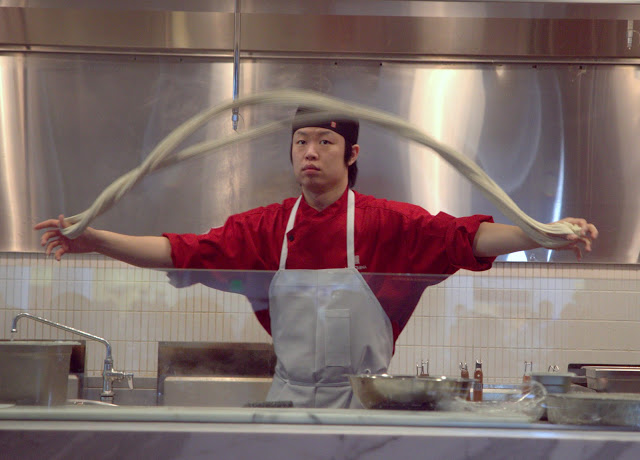
Growing up, I loved watching “Yan Can Cook.” To this day I’m inspired by Martin Yan’s energy and childlike exuberance. His anticipated SF restaurant opening, M.Y. China, is more affordable than Hakkasan, conveniently under the dome at the Westfield Center mall for a post or pre-movie meal. Despite all the noodle attention, including a world-champion noodle puller and noodle pulling stations viewable while dining, spectacle doesn’t necessarily equal stellar noodles. For example, squid ink snap noodles ($18), more like torn pasta squares, tossed with shrimp, scallops and calamari in Shaoxing wine, fail to exude much flavor. Dan Dan noodles ($12) are a stronger choice, and the favorite of everyone I’ve talked to is lush scissor noodles ($14), cut by kitchen scissors then wok-cooked with wild boar.

Wild boar shows up everywhere, a mild version of the robust meat (i.e. inoffensive for those afraid of boar), in lettuce cups ($9), dumplings (four for $8), and more. Every visit yielded disappointingly average wok-tossed dishes, and flavorless small plates like portabello sliders ($8) or mapo tofu ($8), which gets its sole perk from Sichuan peppercorn oil. Teas are a comforting choice, while cocktails ($10-13), which are better but pricier at Hakkasan, have been off balance, like a too sour Three Gorges, with a base of #209 Gin and lemon, lacking absinthe’s nuance or clean bitter structure from Cocchi Americano.

Each meal there’s a singular standout category: dim sum ($6-19). Spicy seafood dumplings (six for $9) are a joy in vivid green spinach wrappers loaded with scallops and shrimp, as are plump, lightly crispy whole wheat potstickers filled with pork and cabbage. Go for decadence with pork and black truffle dumplings ($18). Dessert includes Delise cafe ($4) offerings, among my favorite locally made ice cream, with flavors like Chinese almond, toasted rice or lemongrass.

Despite the mall setting, “under the dome” is the Westfield’s striking feature while chic design and noodle pulling entertainment set the experience apart. As for me, I’ll return for unusual dim sum.

Westfield Center, 845 Market, 4th Floor, (415) 580-3001, www.mychinasf.com

Subscribe to Virgina’s twice-monthly newsletter, The Perfect Spot, www.theperfectspotsf.com 


Continuity

0

le.chicken.farmer@gmail.com

CHEAP EATS Hoolibloo lives next door, where Elsa the Very Very Old Peruvian Woman used to live. I changed light bulbs for Elsa in the ’90s, and reset her clock every time the time changed or the power went out. Or a battery died.

Then, when I moved back into the building 10 years later, she didn’t recognize me. A lot had changed. I tried to explain, but she didn’t understand, but maybe she did and I didn’t understand her understanding. Her ability to speak English started and ended with asking for help and bragging about how very very old she was. And my understanding of Spanish is limited to the meats. So a typical conversation between us would go something like this:

HER: Please can you help me?

ME: (helping her) Carnitas, Elsa. Carnitas!

HER: I am very very old. Very old.

ME: (finishing up with the helping her) Carne asada. Um, pollo.

HER: Thank you. Thank you very mucho.

ME: De nada, Elsa. Hasta lechuga.

And all of us, everyone in the building, would help her up the stairs. Whereas Hoolibloo, my friend who moved in when Elsa (sniff) moved out, takes the stairs by herself — often even briskly.

“Here, let me help you,” I say, out of habit. But she turns me down, arguing that she’s 25.

Fluently! She doesn’t even have to draw the numbers in the air, like Elsa used to do. But I guess that’s the difference between Chicago and Peru, coming-fromwise. Not to mention 50 years.

In spite of her relative youthfulness, Hoolibloo does not play on my football team, or even in a band. Still, she is our closest friend. When Hedgehog and I sit on our couch and she sits on hers, we are only two sheets of drywall and six inches of insulation apart.

She helps Hedgehog make movies, and me find restaurants. Why, just the other day she showed me to Poc-Chuc. We were both working at home, and were craving sandwiches, only when Hooli called up Ike to place our order they said it would take about an hour, that’s how crowded they were.

So then we started to crave empanadas instead.

One thing I love about hanging with people half my age is they talk about interestinger stuff than I do. I’m all, Oh, my knee is gone! I blacked out in the bathroom! What’s wrong with my butt! . . . and meanwhile they’re working out what to do with their life.

Which makes much more lively dinner conversation.

Lunch too, come to think of it.

Over Empanadas we discussed guns, Israel, guns in Israel, and writing. Hoolibloo would like to write something, she said, but not necessarily a whole book.

“You’re talking to the right person,” I said. I start and don’t finish books with a level of expertise seldom seen outside the world of professional bowling.

But that kind of wasn’t what she was talking about.

She had just come back from Israel, where her grandma lives, and was fixing to fly off somewhere else. Her dream job would entail a lot of travel. And autonomy. “But I also really like to be part of a team,” she said.

“I can teach you football,” I said. Ever the recruiter.

Poc chuc, the signature dish of Poc-Chuc, is thinly sliced pork marinated in citrus, grilled, and served with onions, tomatoes, rice, and a small bowl of pureed black beans that I almost forgot to even taste, everything else was so freaking delicious and plentiful.

I don’t normally like empanadas, but I loved Poc-Chuc’s ones. They were less doughy and more flavorful than most, maybe because of the same black bean puree. Which also found its way into the Panuchos. And believe me, as someone who changes diapers for a living . . . black bean puree in the panuchos? That’ll happen.

Really though: really really awesome Mayan food. The Panuchos, which also feature shredded turkey, avocado, and pickled red onions, were fantastic. Kinda somewhat similar to empanadas, only fried.

I can’t wait until Hedgehog comes back from L.A. so I can show this to her.

POC-CHUC

Mon-Wed 10:30am-8:30pm; Thu-Sat 10:30am-10pm; Sun 4-9:30pm

2886 16th St., SF

(415) 558-1583

AE/D/MC/V

No alcohol


Herrera steps up his crackdown on surcharge fraud by restaurants

46

City Attorney Dennis Herrera has stepped up his efforts to ensure San Francisco restaurants aren’t committing consumer fraud with their healthcare surcharges – by pocketing money collected from diners ostensibly to cover their city obligation to provide health coverage to employees – offering an amnesty period for following city law.

At a City Hall press conference on Friday – flanked by Sups. David Campos and David Chiu, Assembly member Tom Ammiano, and local restaurant employees – Herrera announced an investigation and enforcement effort targeting dozens of local business who have reported spending less on employee health care than they collect from customers for that purpose. They will receive letters this week urging voluntarily compliance during an amnesty period, after which they could be hit with lawsuits and civil penalties.

“The enforcement program we’re launching today isn’t simply to protect employees and consumers from surcharge fraud – it’s also to protect the vast majority of competing restaurants that follow the law and provide health care benefits to their workers,” said Herrera. “We San Franciscans take great pride in a vibrant local restaurant scene that enriches our neighborhoods, employs thousands of our residents, and serves millions of tourists each year. And it’s unfortunate that the illegal business practices of a relative handful of bad actors require the creation of this enforcement initiative.”

The City Attorney’s Office is refusing to release the list of restaurants that will receive the letters, calling it an ongoing investigation that exempts the list from public disclosure. But the office did furnish reporters who asked with a spreadsheet from the city’s Office of Labor Standards Enforcement, which ensures compliance with the landmark Health Care Security Ordinance that Ammiano authored as a supervisor, going into effect in 2008 and creating the Healthy San Francisco program.

That list includes many well-known restaurants. Topping the list is Mina Group LLC (which includes restaurants Michael Mina, RN74, Bourbon Steak, and Clock Bar) collecting $539,806 and spending $211,809, Wayfare Tavern collecting $303,207 and spending $68,018, Layers LLC (owners of Paxti’s Pizza, which Herrera’s reached a settlement with two weeks ago), Squat & Gobble collecting $160, 498 and spending nothing on employee health care. Others on the list include Cheesecake Factory, Max’s Opera Cafe, Asia SF, Burgermeister, Folsom Pie, Cafe Bellini, and One Market Restaurant.

Golden Gate Restaurant Association Executive Director Rob Black lashed out at Herrera’s office for releasing that list and media outlets for publishing it, claiming that he’s talked to many of those restaurateurs and that they had filled out the forms wrong or that they simply hadn’t yet spent the surcharges collected even though the funds may be set aside for employee health care.

“They aren’t committing fraud, which is the accusation by the city attorney, just because of errors in filling out a form,” Black said, urging the public to reserve judgment until the investigation is complete.

But it’s hard to feel too bad for GGRA or the member restaurants that aggressively contested and then sued the city over the health care law, appealing it all the way to the Supreme Court, then turned around when they lost and used deceptive (and sometime fraudulent) surcharges to single out those costs for customers.

According to a press release put out by Herrera’s office:

“The City Attorney’s target letter outlined conditions worst-offender restaurants must take steps to meet by a deadline of April 10, 2013 to come into legal compliance, and avoid civil litigation by Herrera’s office for pocketing customer surcharge money intended to fund employee health care benefits.  
* Worst-offenders must provide an accounting to City Attorney investigators for all health care surcharges collected during the period from 2009 to 2011, along with health care expenditures pursuant to the Health Care Security Ordinance, or HCSO, for that time period.
* Worst-offenders must distribute 50 percent of unallocated health care surcharge funds  to employees who worked for the company during the time surcharges were imposed on customers, covering the years 2009 to 2011, in accordance with City Attorney instructions.
* Worst-offenders must remit amounts unredeemed by their eligible employees to the San Francisco City Attorney’s Office for the purpose of funding future enforcement of the HCSO and other consumer protection laws.
* Worst-offenders must attest that they will refrain from committing further consumer fraud and remain in full compliance in good faith with the HCSO going forward, in accordance with City Attorney instructions.”

In his press conference, Herrera emphasized the “relative handful” of restaurants targeted by his office, just a few dozen in a city with thousands of restaurants. But he also said that his office is aware of restaurants that use the surcharge without even reporting to the OLSE as required, so both the amnesty program and his investigation goes beyond just the restaurants who get letters.

“I’m tremendously gratified by this very statesmanlike and generous gesture by the City Attorney’s Office, Mr. Herrera in particular,” Ammiano said. “I feel somewhat parental toward this program, the Health San Francisco program. It was a hard fight to get it and it’s been successful, so any attempts to sully it, minimize it, or water it down get my dander up.”

A shot of warmth

8

virginia@sfbg.com

APPETITE Let’s be clear: the Bon Vivants crew’s newly opened Trick Dog in the Mission — featuring a cocktail menu modeled after a Pantone swatch book — is the hot food and drink destination of the moment (see my early review on the Pixel Vision blog at SFBG.com). But slipping at the bar at these three restaurants, ranging from elegant to festive, offers some of SF’s best cocktails with incredible bites on a long winter’s eve.


RICH TABLE

It’s impossible to get a reservation at Rich Table, one of the most buzzed about restaurants in the country right now, but I find seats at the bar open up often on a Monday, and arriving when they open at 5:30pm is ideal.

With new bar manager Jason “Buffalo” LoGrasso (from Quince and Cotogna), already lovely cocktails expand from four-five offerings to seven on the regular and four on the dessert menu. After tasting every LoGrasso cocktail ($10), I’m in love with the Carnegie Martini. Inspiration is genius — a pastrami sandwich from Carnegie Deli, where my Dad took me for my first reuben as a teenager. LoGrasso combines elements of the ultimate sandwich into a clean, refreshing whole. Wisely using St. George’s Dry Rye Gin as a base, caraway comes in the form of Combier’s Doppelt Kummel Extra liqueur, an aromatic caraway liqueur redolent of cumin. LoGrasso adds drops of mustard oil and a pickle.

Other heights include a lively Shivered Timbers, red with pomegranate touched by ginger and cinnamon, evoking rhum agricole but using Smith & Cross Pot Still Rum. Top aperitif? Figaro Chain — bright, stimulating Swan’s Neck vodka, Averna, lemon, and ginger. Dessert cocktails shine, too. Rich Coffee is a harmonious blend of Fernet, Sightglass coffee, and pistachio cream. Carthusian Hot Cocoa sings with chocolate, Green Chartreuse, mint, and pineapple marshmallow.

Eat with: doughy, savory doughnuts ($7) topped with shaved dried porcini, the clincher being thick raclette dipping sauce. Amuse bouche “Dirty Hippie” elevates granola to gourmet with cool buttermilk panna cotta doused in pumpkin seeds, sprouts, and spices. Divine tajarin ($27) egg noodles (a Piedmont pasta style) in house cultured butter under shaved Perigord black truffles dissolve in the mouth. Sigh.

199 Gough, SF. (415) 355-9085, www.richtablesf.com


MICHAEL MINA

Carlo Splendorini has crafted some of the most elegant, balanced cocktails anywhere. In my travels sampling cocktails the world over, it’s rare to experience the precision and finesse Splendorini brings to drinks ($11-14). Prime example: the way barrel-aged Bols Genever and Beefeater Gin seamlessly weave with pine-y notes of Clear Creek Douglas Fir eau de vie, the earthiness of sencha green tea, brightened by tart yuzu, lemon, and grapefruit foam. This combination could easily go wrong, but it’s exquisitely layered. Similarly, Yamazaki 12-year Japanese whiskey, chamomile tea, and a spoonful of Yellow Chartreuse over a shiso leaf dramatically cast against a giant ice cube in a wine glass make a striking sipper.

Eat with: oysters brilliantly accented by drink sauces (Pimm’s Cup, Elderflower Fizz, Bloody Mary) instead of the usual mignonette, or a meaty Monterey bay abalone ($21) grilled over shiitakes, tokyo turnips, mirin-scented rice in a miso broth. A more affordable bar bite: Mina’s signature ahi tuna tartare starter ($19) doused in ancho chile, sesame oil, and mint is $10 during happy hour.

252 California St., SF. (415) 397-9222, www.michaelmina.net


HOG & ROCKS

With new chef Robin Song (formerly of Haven and Plum) on board, there are elevated touches to Hog & Rocks’ ever-approachable food, like a special of perch crudo ($14), delicate with nasturtium, puffed rice, minced Manila clams, and blood orange. This suits bar manager Michael Lazar’s robust yet refined cocktails just fine. Chef Song’s amuse bouche of buckwheat gougeres topped with warm, salty lardo is divine with Lazar’s Miller’s Meyer ($11), a vivid winter cocktail of Martin Miller’s Gin, Meyer lemon syrup, and herbaceous Elisir M.P. Roux liqueur lending whispers of anise, verbena, and lavender. My drink of choice is house Willett bourbon, a bracing 130 proof but cut with water. Rye spice and sweet corn notes meld perfectly in Lazar’s Old Fashioned with orange and Angostura bitters.

A refreshing Cider Press Buck ($11) showcases one of the most edible garnishes around: a spiced Arkansas black apple (preserved via Cryovac). This delicious garnish evolves with the seasons, atop Old Fitzgerald bourbon, lime, ginger, and Wandering Aengus dry pear cider, confirming the current cider craze. The Buck pairs with H&R’s always pleasurable ham platters ($16), now with Monte Nevado Jamon Serrano from Spain, Greci and Foizani Proscuitto from Italy, and a stunningly smoky ham exemplifying all I love best in Southern hams, Edwards Surryano from Virginia.

3431 19th St., SF. (415) 550-8627, www.hogandrocks.com

Subscribe to Virgina’s twice-monthly newsletter The Perfect Spot, www.theperfectspotsf.com


Herrera takes on restaurants that use bogus healthcare surcharges

66

City Attorney Dennis Herrera fired a warning shot across the bow of San Francisco restaurants that use a customer surcharge ostensibly to pay for employee health care – while in reality, many restaurateurs simply pocket the money and offer substandard health care options to employees – over the weekend when his office announced a settlement with Patxi’s Chicago Pizza.

The tone of the press release announcing the $320,000 settlement was generally positive, with Patxi’s claiming it was an innocent error and Herrera praising the owner’s cooperation in an agreement that improves the health care coverage of Patxi’s employees, compensates employees for the error, and ensures all surcharges tacked onto customers’ bills go to employee health care. Yet Herrera also included a warning to other restaurants.

“But today’s settlement should send a strong message that San Francisco is serious about making sure that restaurants keep their promises to their customers about health care surcharges. I look forward to announcing a larger, more global effort in the coming days to address this issue, to make sure health care surcharge money goes to the workers rather than being pocketed by business owners,” Herrera said in the release, signaling an effort to resolve with civil enforcement something that the political system has failed to do.

This became a hugely contentious issue in 2011 when the Golden Gate Restaurant Association (GGRA) and San Francisco Chamber of Commerce aggressively opposed reform legislation by Sup. David Campos that would have required that all surcharges be spent on health care and prevented employers from raiding health savings accounts at the end of each year. Mayor Ed Lee vetoed that measure but signed a watered down version by Sup. David Chiu – moves that Herrera criticized while running for mayor.

GGRA (whose Executive Director Rob Black didn’t return our call) aggressively fought the city’s Health Care Security Ordinance requirement that employers provide minimal health coverage to their workers, taking it all the way to the US Supreme Court. After losing that battle, many restaurants began adding a 3-5 percent surcharge of customers’ bills, even while offering employees what experts say is the worst form of health coverage, healthcare savings accounts, and often blocking their employees efforts to use them.

An investigative report in the Wall Street Journal showed how many San Francisco restaurants were essentially committing consumer fraud by pocketing the surcharges, elevating the issue, but the District Attorney’s Office has consistently refused to treat this as a criminal matter, despite calls for action by the Civil Grand Jury. So Herrera’s willingness to use civil sanctions, and his warning of more to come, was enthusiastically welcomed by Campos and other advocates.

“I’m very happy with what the City Attorney’s Office is doing,” Campos said. “It’s time for this kind of legal action.”

Campos had already pledged to reevaluate the issue later this year as data comes in about how the compromise regulations by Chiu and Lee are working, threatening to take it to the ballot if necessary and calling it an important issue for all San Franciscans.

“It’s not just about protecting workers and consumers, but also protecting businesses that play by the rules and comply with the law,” said Campos, noting that many restaurants have admirably refused to use the surcharge, shortchange their employees, or support GGRA’s litigation against the city. “It’s about fairness.”

Do we need more luxury condos?

0

There’s no shortage of high-end housing in San Francisco. If you can afford to pay $6,000 a month for your rent or mortgage, you’re going to find a nice place to live. And there’s no study anywhere in any corner of the City Planning Department suggesting that current San Francisco residents really want new luxury condos downtown.

In fact, all evidence suggests the contrary — the market for high-end downtown housing is new residents, people who are moving here to take tech jobs, empty nesters moving from the suburbs, or world travelers looking for a pied-a-terre in one of the greatest cities on Earth.

But when the City Planning Department analyzes a project like 75 Howard, that’s not part of the discussion.

The Dec. 12 preliminary environmental study on the “market-rate” (read: $1 million and up for waterfront views) project never addresses the question of what value this type of housing would bring to the city. Instead, it talks about projections from the Association of Bay Area Governments, which says that San Francisco will grow by 52,000 households by 2030.

So a project that’s creating fewer than 200 housing units, and creating a net of 77 jobs, isn’t big enough to be a factor in the future of either jobs or housing.

But in the process, the study makes a remarkable statement, one that underlines everything wrong with city planning policy. Buried on page 48 of a 151-page preliminary study is the following: “In addition, the demand for housing by the net increase in number of employees would be more than offset by the dwelling units that would be constructed on site under the proposed project or its variants.”

That sounds like bureaucratise, and it is, so allow me to translate: The project will create 186 housing units and 77 jobs. More housing than jobs; what’s there to worry about?

Well: The 77 employees at 75 Howard will work in the restaurants and stores, or in the garage under the building, or in maintenance. Not one of them will make even remotely enough money to afford to buy one of the condo units in the building.

So the project — like so much of the development that happens in San Francisco — will create jobs for people who can’t afford to live here, and housing for people who don’t currently work here. That imbalance is utterly unsustainable, spells disaster for the future of the city — and is pretty much hard-wired into current planning and housing policy.

Appetite: 12 reasons to love Nevada City and Grass Valley

22

Imagine if the Wild West collided with a European village. There might be winding, narrow streets through neighboring towns, plotting through pine trees. Old West saloons, wood sidewalks and columns, classic homes in walkable small towns. Not far from Lake Tahoe, at the foothills of the Sierra Mountains, there are two such tiny towns. The Gold Country towns of Grass Valley, a charming, relaxed Old West town, and its sister merely four miles away, Nevada City, the smaller, more funky-artsy and visually striking of the two. Historically, I’d trek 30 minutes off the 80 on the way back from Lake Tahoe to spend an afternoon in these towns, particularly when fall leaves are at their peak. This fall, I decided to spend the weekend here instead of Tahoe – and a restorative weekend it was.

While you’re in Grass Valley, foodies and cooks don’t miss Tess’ Kitchen Store, three floors of every cooking accoutrement you can think of, and Back Porch Market, a small but well-curated gourmet deli of cheese, salumi, wine and gourmet foods (P.S. inhaling the house pasta sauce cooking as you enter is intoxicating).


In Grass Valley, Big A Drive In may look a little forlorn, a historic drive-in serving freezes, malts, burgers and hot dogs, but their cheeseburger is unexpectedly classic and satisfying – some even say the best in the area. If there in the fall, take the slower but lovely drive along Colfax Highway at least one way to and from the 80 freeway so you can stop off at Bierwagen’s Donner Trail Fruit & Farm Market, an idyllic apple farm selling jams, pies, an array of seasonal produce, and, yes, apples.

Between nature, architecture, food, and even unexpected nightlife, here are just a few reasons to love these Gold Country towns.

1. NEW ENGLAND VIBRANT FALL COLORS AND CHRISTMAS CELEBRATIONS – When friends from New England told me this was THE spot they’d go for equally radiant fall colors, I was skeptical. But from my first visit in November years past, I walked through neighborhoods of old Victorians and 1800s homes, awash in the brilliant reds, yellows and oranges of my favorite season, dramatically cast against the green of mountain pines.

Besides warm fall days, crisp mountain nights and stunning fall colors, winter is a festive time in these two towns that pull out all the stops for Christmas. There’s a Victorian Christmas street festival complete with horse-drawn carriages and wandering carolers, and the Sierra Foothills Christmas Festival, known locally as Cornish Christmas, as the early, late 1800s population of Grass Valley was predominantly Cornish. Now just wish for snow for added magic.

2. ROADHOUSE EXTRAORDINAIRE: THE WILLO The Willo has been around for decades, a roadhouse on Highway 49, about 15 minutes drive from Grass Valley. Part redneck party in the rowdy bar, part retro dream with neon sign shining like a beacon from a dark, two-lane road in the middle of the pines, it is easily my favorite restaurant in the region.

Locavores and dainty eaters beware. This place is about thick cuts of NY steak (you cook or they cook on the big grill between the restaurant and bar) and local character. For less than $20, one can pig out on hearty, old school fare. Although requested “cheese” with a $1.85 baked potato is a deli slice, taste does not suffer here. When you ask for medium rare steak, you get it: juicy, delicious.

In fact, after numerous meals at more modern restaurants in the area, even those with local ingredients and attention to produce and meat sources, most were highly inconsistent and well behind  even average big city standards. With The Willo, I felt like I got exactly what I came for: local flair, delicious food appropriate for bracing mountain air. We brought our own bottle of wine ($10 corkage), well worth it considering what was on offer, although the festive bar was doing just fine with big name liquor brands and country on the jukebox.

The dated, wood-paneled dining room is lined with Elvis, The Duke (John Wayne), and scripture verse clocks, while a Friday night only special of BBQ pulled pork sandwich ($12) is surprisingly good ‘que, and hard-working waitresses ensure you’re right at home with a “hon” and a smile. Dining at this packed roadhouse felt like the kind of meal my grandparents would have enjoyed, of the celebratory, unfussy kind in my childhood.

3. UNEXPECTED NIGHTLIFE AND MUSIC SCENE – Though I struggled to find strong restaurants outside of The Willo or Sushi in the Raw, Nevada City nightlife, though not in the same breath as a big city, can get surprisingly rowdy. Being here days before Halloween meant Day of the Dead parties, concerts at historic Miners Foundry with everyone in costume, revelers wandering the streets, reminiscent of raucous nights in party towns like Savannah and New Orleans.

There wasn’t an evening I didn’t catch street musicians singing along the streets, a few of them exceptional, like a girl with a soulful, R&B voice belting along to one guy beatboxing, the other with a guitar. On sleepier nights, the historic Mine Shaft Saloon is the dive bar in town. Crusty bartenders, chatty locals, plenty of personality, and bowls of hot and sour soup arrive through the swinging door at next door’s Fred’s Szechuan Chinese Restaurant.

4. WINE COUNTRY – As with many parts of California, the Sierra Foothills is home to a strong community of wineries. The best afternoon of my recent weekend was spent driving around local vineyards, off scenic country roads, tucked in between valleys and mountain views. My other afternoon highlight was an hour tasting wine with Alex Szabo of Szabo Vineyards in his downtown Nevada City tasting room. With big personality and opinionated passion for wine, he’s lived in Europe and San Francisco, now winemaking here. He knew every local who came through the door, his friendly repartee and stories of his Hungarian family with winemaking roots back to 1780 particularly engaging – he grew up taking “a few pulls of wine from the jug” in his Grandpa’s basement.

His tasting room is full of hand-crafted pieces like a striking bar made from red gum eucalyptus trees salvaged in Berkeley’s Tilden Park after a fire. Launching Szabo in 2003 with 40 acres (15 of them vines, the rest sustainable forest), Szabo’s winemaking style is “balanced wines that you can still grab onto.” He mentioned being the only winemaker in area growing all his own grapes on premises, and his wines do represent balance rather than merely bold fruit. Tasting through a flight ($6), I noted the pleasant funkiness of a 2010 Grenache ($23 a bottle) which he describes as a “dusty Spanish road”, but was surprised to find I preferred the Zinfandel, a varietal I rarely gravitate towards ($18 a bottle). Though there are intense blackberry notes, there’s no residual sugar and the berry is balanced by tannins and an earthiness. Balance is also found in a sweet dessert wine, an off-dry 2011 Muscat redolent of orange blossom with a creamy mouthfeel. Best of all, his Voila, at $28 a bottle, is the highest priced of any of Szabo wine.

5. GOURMET ICE CREAM – Every time I’m in Nevada City, I don’t miss ice cream at Treats. Gourmet flavors hit the mark, like plum shiso or saffron rose pistachio. Childhood favorites like Swiss orange chip, and a handful of daily gelatos (such as chocolate cherry), are made with big city-quality and standards.

6. CORNISH HISTORY
– With over 60% of Grass Valley’s population being Cornish in the late 1800’s, the influence of Cornwall, England, can be felt in the fact that this small town has more than one pasty shop. But there is only one you need to visit: Marshall’s. These flaky, filled pastries are certainly old school – even the tiny shop evokes 1970’s. Marshall’s has been churning them out for decades, with your choice of vinegar or ketchup alongside a classic beef and potato or sweet, spiced apple in sugary vanilla sauce.

7. CAFFEINE FIX
– Hipsterization has even reached this small foothills town, but it’s a pleasure at Curly Wolf, an espresso house with Victorian wallpaper and couches on Nevada City’s main street. This form of retro/Old World hipster feels right home off wood sidewalks, serving properly prepared cappuccinos, coffees, cold brew iced coffee, even a chocolate orange espresso reminiscent of a Caffe Nico at LA’s Caffe Luxxe.

In Grass Valley, Caroline’s Coffee Roasters is a roaster and shop of the old school kind, not necessarily a coffee geek’s dream. But when in Grass Valley, it’s where locals congregate on a Saturday morning talking arts and sports (the SF Giants, naturally) over bracing cups of coffee.

8. SUSHI HOTSPOT – One doesn’t expect to find a sushi haven in towns this small. In fact, I’ve been to bigger towns around the country that lack a sushi restaurant as good as Sushi in the Raw. The fish is fresh and pristine and the environment in a converted Victorian boasts quirky charm, feeling like a hidden big city gem.

That being said, sushi aficionados and purists, while delighting at house pickled ginger and only sustainable fish will also notice an excess of sauce on or with most sushi, a “no-no” many a hardcore sushi master from Japan has warned us against. Though wishing I could taste the cleanness of fish apart from muddles of sauce (and this is coming from a sauce fanatic), Sushi in the Raw is still one of the better meals to be found in the area, though good luck getting a reservation. You MUST call ahead no matter the night of the week – they book weeks in advance. Husband/wife owners, Susan Frizzle and Executive Chef Kaoru “Ru” Suzuki, have created that small town rarity: a coveted hot spot everyone seems dying to get into.

Octopus/tako salad ($11.50), though thoughtfully presented, was surprisingly bland  drowning in spicy sauce with kelp, carrots and shredded nori, and the popular black truffled sashimi ($10/17), made with “best fish of the day” (each piece was different: salmon, yellowtail, kanpachi, albacore, trout) was overwhelmed by Italian black truffle, truffle salt, soy vinaigrette and French black truffle oil (tasting a number of truffle sashimi dishes over the years, a light hand is needed). While a sashimi platter arrives with five different bright cuts of fish, again, one is served a generous side of three sauces… with sashimi! So the drowning continues.

Rolls/maki are solid, like the Susan Roll ($14.50) of avocado, mango, smelt roe, crab mix, green onion, ginger, while scallop shooters ($3 each or $4 “drunken”) are vividly fresh with green mussel, mango and quail egg, particularly fun ordered drunken with a shot of shochu. On the drink side, a plum refresher ($4) is a lovely way to go with organic plum wine, lightened but not diluted by lemon, ice and sparkling water. “Ru’s pick” for sake, Kikusui KaraKuchi Dry ($5.50 glass/$33 bottle) is a crisp, pleasant accompaniment.

9. JUICE CENTRAL – As with a number of small California towns, you’ll find a healthy dose of hippies and back-to-the-earth folk. In Nevada City, Fudenjuce is a blissed out roadside hut with outdoor picnic tables, serving wraps, salads and rice bowls – but go for the juice. Though you may reek afterwards, a garlic heavy Immune Enhancer is an eye-opener with carrot, apple, parsley, spinach, ginger, while Planet Favorite is tart with lots of lemon, carrot, apple. Unlike most juice shops, everything, even 24 oz. pours, are affordably under $7. Only downside is that wheatgrass shots tasted sickly sweet – I like wheatgrass for that fresh-cut grass taste and wished it had been noted that it was sweetened so I could opt out. http://www.fudenjuce.com

Flour Garden Bakery
is mainly a bakery but also whips up a few fresh (and a couple thankfully green) juices in the Neal Street shopping center location of downtown Grass Valley.

10. GRAB A PINT – Though far from my top California brewery, Ol’ Republic Brewery is the first local brewery in town. The sterile, low ceiling space does have a front patio and Saturday nights draw live bands and crowds. The IPA English Ale strikes a fine balance of hoppy notes, and their range includes Bavarian Black Lager, Dead Canary (German lager), Celtic Red, Schwarzbier and Export Stout. Pretty much across the street from Ol’ Republic, Jernigan’s Tap House & Grill has a rotating draft selection of beers from around California.

11. AND ONE MORE ROADHOUSE: THE OLD 5 MILE HOUSE – Just follow the bikers (motorcycles parked out front) who congregate at The Old 5 Mile House, an 1890 roadhouse and former stagecoach stop off forested Highway 20 just 5 miles out of Nevada City. You’ll find a cozy, dark wood respite with fireplace, bocce area and back patio under massive trees. It’s a bar with decent beer selection and surprisingly tart, tasty margaritas, and a restaurant with far better-than-expected food. Recommended dishes: Piadine (aka pizza crust topped with salad) – the arugula version with tender skirt steak, chimichurri sauce, red onions and blue cheese ($14.99), the pizzas (some are better than others), and hearty 5 Mile Corned Beef Hash ‘n Eggs ($10.99).

12. HOT TUBBING UNDER THE STARS
– Though my room felt a bit cavelike on the bottom floor with only one small window and minimal light at Grass Valley Courtyard Suites (ask for an upstairs room with more windows), the room was otherwise comfortable, the owners and service exceptionally friendly, with an unexpectedly pleasant hotel breakfast in a cozy dining room, a day spa and comfortable gym,  easily walkable in old town Grass Valley, and best of all, the hot tub next to the pool was the ideal way to unwind every night. The stars appeared in all their glory and crisp foothill air invigorated as I relaxed in soothing, hot waters. http://www.gvcourtyardsuites.com

Subscribe to Virgina’s twice-monthly newsletter, The Perfect Spot, www.theperfectspotsf.com

A moratorium on progress

30

My friend Johnny, who lives in Seattle, tells the story of the day years ago when he saw an older woman standing on a hillside near his house, watching while bulldozers knocked down trees and tore up part of the hill to put in a freeway extension. He was pretty new to town, so he asked the woman what was going on.

She shook her head, and with a bitter smile, said: “Progress.”

If you want to look at the environmental history of the United States, you can pretty much define most of our problems as an obsession with that sort of “progress.” In the postwar Bay Area, “progess” meant turning farmland and open space into suburban housing developments, building more freeways to connect the commuters to downtown San Francisco, and erecting tall buildings in the city to fill with workers from the burbs.

At the time, those crazy people who opposed that vision were told they were opponents of progress. Now, we celebrate what they’ve saved.

In other words, not all change is good, not all development is progress, and the march of capitalism doesn’t always take us in the right direction

So please, Chuck Nevius: You can oppose a one-year moratorium on Valencia Street restaurants if you want, but don’t give me crap like this:

The same transition seems to be happening along Valencia Street. My guess is they will learn the same lesson as Noe – you can’t put a moratorium on progress.

Is it progress to turn a diverse shopping district into a monocrop of one type of business? Or is it prudent to do what we pay city planners to do, and … plan? The restaurant limit in Noe Valley worked when it was instituted, a long time ago, when people who lived there wanted to keep shoe repair places and other community-serving merchants on 24th Street. When it was no longer needed or effective, it was repealed. All we’re talking about on Valencia is ONE YEAR, to give people a chance to think about the future of their neighborhood.

Progress. Bah humbug.


http://www.sfgate.com/bayarea/nevius/article/Valencia-restaurant-ban-not-the-answer-4133529.php

Nite Trax: Ana Sia, back on home court

16

For those of you who haven’t been listening: Ana Sia is kind of a big deal. One of those quaintly San Francisco nightlife things — you blink for a hot minute, and someone familiar on the scene blows up, their hard work rewarded with major festival gigs, a large and growing following, and DJ sets being featured on NPR. Heeeey.

I’ve been a fan of the poised yet energetic Ana for a long while, and I must say I’m pleased as punch for her continued success — and to see what she’s got in store for us as she plays again in SF. (She’s one of the headliners, along with the UK’s excellently house and techy Ben UFO, at Friday night’s As You Like It party at Beat Box.) Onstage, the local Frite Nite label head quickly pulls you into her zone, tempering a concentration born of pure appreciation of the music with some playful bouncing and disarming charm. “I’m having a shit-ton of fun!” you can hear her shouting from the decks.

Categorizing her actual sound, however, can prove challenging.

Ana’s been through a few transfomations. I first became aware of her as a member of the underground techno scene, then as a part of the crunk-meets-dubstep-meets-Burning Man Bassnectar touring juggernaut — at one point pimping herself with a wink as playing “global slut psy-hop,” a moniker which went well with the gaudy scene of the late ’00s. Then, as part of Frite Nite, she became a brainier glitch advocate, delving into more adventurous realms of broken bass. But she’s always been courageous, forceful, and fun — even now, when she’s adding full-on house and ravier techno to the mix, as you can hear below.

Love it. She took a minute to email me the answers to some questions in anticipation of her Friday gig. Welcome back, Ana.

SFBG You’ve been playing all over lately — how does it feel when you come back to San Francisco?

ANA SIAReturning home and playing shows with my peers and in front of what very much feels like family is the greatest part of my schedule. What makes San Francisco so tight is the diversity and multi-cultural melange of the people, and those acknowledgments certainly carry through to the art scene. Connecting with listeners is easier on the home court — I feel much more safe and secure introducing more challenging music and unfamiliar sounds because everyone is so open here, They genuinely understand and love music. Ask any touring artist this question and I bet they say the same about our community here!

SFBGYour sound has really evolved since you were playing here regularly. Can you tell me where you’re at now, and what we can expect?

ANA SIA I think the one thing that has not changed about my sound is that it’s always different than the last time — whether that’s a yay or nay thing is another issue though. But right now, people can expect the agenda i’ve been pushing for a minute now; classy yet ratchet bass music, stepping on the toes of techno-house. And yeah, i’ve always tried to stay ahead of the curve for DJ sets, but honestly all the latest trends and best music out right now is re-introducing fundamental dance music. It’s nothing really super-shiny and new. It’s all slightly more modernized revisions of classic sounds which i’m grateful for. Because for me, my young rave days began with house. 

SFBG What equipment are you using lately — and can you tell us about some of your recent or upcoming releases?

ANA SIA Ableton Live is still my bandmate, but I have this new bossy future-midi controller, the QuNeo. I’m working on an EP right now, probably music that no ones’ expecting but all the tunes are in the territory of the above mentioned. 

SFBG In my mind, your sound is always evolving, you’ve always been on the cutting edge — it’s hard for a writer like me to keep up with you! Who are you listening to now? And since you travel so much, do you have any good stories from the road? 

ANA SIA Such a loaded question! Presently in my playlist of the last few months : Kendrick Lamar, Detroit Swindle, Bambounou, George Fitzgerald, Bach, 2 Chains, Dj Spinn, Lukid. And road stories? that’s classified information. Mostly because i fear self-incrimination. But i will say that it is shocking how many really great sushi restaurants there are in the most unsuspected of places in the middle of America. 

AS YOU LIKE IT with ANA SIA and BEN UFO

Fri/14, 10pm-4am, $15, $10 before 10pm, $20 after

Beatbox

314 11th St., SF.

www.ayli-sf.com

Dishing 2012

12

virginia@bayguardian.com

APPETITE The past year saw a number of openings I hope will be around for years to come — here is my list, in order, of my favorites. As ever, my goal is to include more affordable spots alongside midrange or upscale openings, considering range and uniqueness. It being December, I cannot strictly cover the calendar year so, with each choice open at least two months, the opening date range goes back to October 2011 for a full year.


1. AQ

The one California restaurant nominated for Best New Restaurant in the US at this year’s James Beard Awards, AQ is my top selection for “the whole package.” While I find the food at the next two restaurants listed below equally inspiring, AQ combines food from talented young chef Mark Liberman, reinvented in delightfully surprising ways (think flavors of a pastrami sandwich turned on its head as shaved lamb heart “pastrami” with zucchini bread and house Thousand Island dressing), alongside an inventive cocktail list and accomplished bar staff. I’m still dreaming of this summer’s Maeklong Market Cocktail with a base of peanut-infused mekhong — a sugar cane, molasses, and rice-based Thai spirit — creamy with coconut milk, lime and kaffir lime leaves. As if this weren’t enough, the wine list shines and decor is the crowning touch in a two-level space with sexy downstairs lounge for private parties, plus greenery, glassware, and a bar top that changes with the season. When I’m asked (constantly) where to go by locals and visitors, AQ easily fits the bill for delicious, forward-thinking cuisine with warm service: a destination for both food and drink, with thoughtful attention to the environs.

1085 Mission, SF. (415) 341-9000, www.aq-sf.com


2. STATE BIRD PROVISIONS

Since Bon Appetit named State Bird Provisions best new restaurant in America this year, none of us can get a reservation in the small, modest space with pegboard and stone walls (like dining in a funky family garage). What makes State Bird so special, besides efficient, engaging service and husband-wife team Stuart Brioza and Nicole Krasinski’s genuine welcome (they often greet diners themselves as they pass by the kitchen in the entrance), is that it’s something truly different. Affordable, unique, and imaginative plates flowing out dim sum-style on carts and trays, ever playful and satisfying — a prime example of what makes SF’s dining scene so exciting right now.

1529 Fillmore, SF. (415) 795-1272, www.statebirdsf.com


3. RICH TABLE

From another husband-wife duo, Evan and Sarah Rich’s Rich Table could easily be number one for food alongside State Bird and AQ. All three restaurants boast an uncommon vision in their cooking — Rich Table’s is one of an upscale nature in comfort food garb. Presentation can be exquisite, but the dishes gratify and assuage rather than feel fussy. Getting past the (worthy) din about those sardine-laced potato chips to start, pastas are unexpectedly one of the restaurant’s highlights, a duck lasagne layered with braised duck, light béchamel, and tart Santa Rosa plums, easily standing out as one of the best dishes of the year. Though short and sweet, the 4-5 cocktails on offer (now being updated by brand new bar manager Jason “Buffalo” LoGrasso from Cotogna) are clean, simple-yet-vivid stars in their own right.

199 Gough, SF. (415) 355-9085, www.richtablesf.com


4. ICE CREAM BAR

A neighborhood diner and soda fountain, Ice Cream Bar deserves accolades for bringing us the kind of soda fountain menu unmatched in the country, yet sure to be copied. Recipes and practices date back to the 1800s with modern sensibility, showcased in drinks like the Bonne Vie No. 2, a citrus-garden delight of basil leaves, basil ice cream, and pink grapefruit, its sour-fresh qualities glorified with citric acid. There are boozy fountain drinks (like a perfect Angostura Phosphate), ice cream (the tart cherry remains my favorite), and darn good sandwiches (egg salad and tuna) on house brioche, with the soda fountain manned by gifted, friendly soda jerks who live and breathe the history of the craft.

815 Cole, SF. (415) 742-4932, www.theicecreambarsf.com


5. PLÄJ SCANDINAVIAN RESTAURANT AND BAR

With the food world in Scandinavian mode the last few years (the cuisine to take over where the El Bulli world of Spain ruled for so long), it’s a shame we haven’t had much Scandinavian food to speak of here, particularly of the nouveau wave à la Fäviken or Noma. Pläj (pronounced “play”) is gourmet-traditional Scandinavian fare with modern sensibilities from chef-owner Roberth Sundell, a Stockholm native. In the mellow Inn at the Opera, it’s a respite of a dinner with sincere service, shining particularly bright with seafood in the menu’s Fjord section. Herring trios, Swedish meatballs, Norwegian salmon belly gravlax and rounds of aquavit… I’ve been waiting for this one and hope it opens the door for more.

333 Fulton, SF. (415) 294-8925, www.plajrestaurant.com


6. CRAFTSMAN AND WOLVES

Don’t just call it a bakery. Craftsman & Wolves is a heightened sort of cafe where baked goods push boundaries and desserts are works of art. William Werner’s artistic eats, alongside sandwiches and salads, Sightglass Coffee, Naivetea, and dreamy drinking caramel made with salted butter, ensure this is an extraordinary addition to the SF food scene, standing apart from other cafes. Skylights, brick and clean lines make for a modern cafe setting, while items like the Rebel Within, an herb, cheese, sausage-studded muffin with a sous vide egg hidden inside, are already cult classics.

746 Valencia, SF. (415) 913-7713, www.craftsman-wolves.com


7. AND 8. TIE: SARU SUSHI AND ELEPHANT SUSHI

This sushi duo isn’t perfect, nor will either be the best sushi meal of your life. But in their infancy, they both represent the ideal neighborhood sushi outposts: friendly, laid back, almost hip, with spanking fresh fish and consistently interesting maki, nigiri, sashimi, tasting spoons (at Saru), and sizzling mango seabass (at Elephant). With a glass of sake, try firm-yet-silky squid in yuzu juice at Saru or bananas draped beautifully over Elephant’s Boom Box roll with scallop, avocado, and cucumber. Those lucky souls who live near either restaurant have themselves exemplary neighborhood sushi bars at which to unwind.

Saru: 3856 24th St., SF. (415) 440-4510

Elephant: 1916 Hyde, SF. (415) 440-1905, www.elephantsushi.com


9. MISSION BOWLING CLUB

Mission Bowling Club (MBC) is significant: until now no bowling alley served food this good. Hipster, even upscale for a bowling alley, the open, industrial space, large front patio, and downstairs and upstairs dining rooms (the latter oversees the action) add up to a striking setting for Anthony Myint — he of Mission Chinese Food and Mission St. Food, no less — to unleash his beloved Mission Burger, a rich, granulated patty, lathered in caper aioli. Entrees like blackened salmon on a potato latke marked by salmon roe, cucumber, and horseradish are listed alongside a juicy sausage corn dog dipped in habanero crema. Bowling never tasted this sublime.

3176 17th St., SF. (415) 863-2695, www.missionbowlingclub.com


10. FUSEBOX

Despite being open only three days a week for lunch, with just-added Saturday night dinner service (reserve ahead!), FuseBOX is my favorite East Bay addition this year because of its unique approach to Asian cuisine. Such limited hours in a remote West Oakland block makes it a meal you have to work to get to, but the fusion of Korean and izakaya-style Japanese from Sunhui and Ellen Sebastian Chang is a welcoming, tiny haven (with large front patio) for creative Asian fare often in bite-size format allowing ample tasting. There are rotating robata bites or kimchee from bok choy to kale, interesting panchan/banchan (mini-dishes often accompanying a Korean meal), hamachi tartare topped with lime caviar, Tokyo po boys, and an unforgettable bacon mochi. And who else offers kimchee and coffee service with Korean beignets?

2311A Magnolia, Oakl., (510) 444-3100, www.fuseboxoakland.com


HONORABLE MENTION

Gioia Pizzeria (2240 Polk, SF. (415) 359-0971, www.gioiapizzeria.com) for bringing Berkeley’s best NY pizza to SF; CatHead’s BBQ (1665 Folsom, SF. (415) 861-4242, www.catheadbbq.com) for some of the better BBQ in our city (“real deal” Southern BBQ being difficult to come by outside of the South); Abbott’s Cellar (742 Valencia, SF. (415) 626-8700, www.abbotscellar.com) for one of the best beer menus anywhere and elevated food to accompany it in a sleek-rustic dining room; Orexi (243 West Portal, SF. (415) 664-6739, www.orexisf.com) for daring to bring satisfying Greek food to our Greek-deficient dining scene; St. Vincent (1270 Valencia, SF. (415) 285-1200, www.stvincentsf.com) for a wine and beer geek’s dream menu partnered with forward-thinking interpretations of regional American dishes; Machka (584 Washington, SF. (415) 391-8228, www.machkasf.com) for a chic take on Turkish food.

Subscribe to Virgina’s twice-monthly newsletter, The Perfect Spot, www.theperfectspotsf.com

Lee ducks tough questions about Alvarez and diversifying SF’s economy

24

For a career bureaucrat who was appointed mayor supposedly as a sort of straight-shooting un-politician, Mayor Ed Lee today once again demonstrated a real talent for addressing tough questions with a whole lot of words that don’t seem to say much at all. First came his non-responsive answers during Question Time at the Board of Supervisors meeting, followed by the hollow filibuster with reporters asking about the Housing Authority scandal as he briskly walked back to his office.

Asked why he continued to stand by Housing Authority Director Henry Alvarez despite the scandals and accusations of mismanagement and unethical conduct on the job that have placed a cloud over the agency, Lee said he’s just waiting for the investigations and lawsuits to play out, dismissing “the so-called cloud that you referred to.”

Given the obvious problems that Alvarez is now having running an agency whose employees and clients have such a problem with his leadership, I asked whether Lee has considered suspending him, to which he responded that Alvarez hasn’t been convicted of any crimes. So, apparently professional misconduct is a personal matter, but personal misconduct unrelated to one’s job warrants suspension. This is all very confusing.

Even more bewildering was Lee’s answer to the question from Sup. John Avalos. He prefaced his question with one from constituent/comedian Nato Green asking what the city is doing to diversify its economy beyond “the highly paid finance or tech jobs and their low wage servants,” noting that City Economist Ted Egan also recently asked that question in a report calling for “a more balanced distribution of job opportunities.”

So Avalos asked, “What is your plan to create living wage jobs in local-serving industries to prevent the City’s working and middle classes from being displaced by people moving to the city for new upper income jobs in the creative (including high tech), financial, and professional services industries?”

It’s a great and important question that has been increasingly raised by those who understand the risks of placing all our eggs in one economic basket, particularly given this city’s experience with the last dot.com bubble bursting.

But even though Lee had plenty of time to think about the issue and develop an answer, he clearly didn’t have a good one, instead singing the praises of the booming tech industry and his Tech.SF program for training new tech workers, just like his main financier, tech mogul Ron Conway, wants.

Now, Lee did cite industry studies that every tech job sustains four other jobs in the city, mostly in restaurants and tourism-related sectors (ie the “low wage servants” Green mentioned). And Lee touted the construction jobs created by his developer buddies, praising Avalos for his local hire ordinance.

But even the much-praised local hire standard of 25 percent means that 75 percent of those workers are living outside the city. It’s a similar story for the restaurant, retail, and bar jobs that the influx of well-heeled new residents are creating demand for, none of which answers Avalos’ questions about how to diversify our economy and create good jobs for most San Franciscans.

“Trickle down economics can only get us so far and without a specific and far-reaching plan to create local living wage jobs for San Francisco’s working and middle classes, we’ll see us falling behind,” Avalos told the Guardian after hearing the mayor’s “answer.”

But instead of a plan or a direct answer, we got political platitudes from Lee such as, “We’ll be investing in the greatest asset of our city and that’s the residents, our people, and ensuring San Francisco stays a city for the 100 percent.”

To which Avalos responded, “His comment about the 100 percent really means that by favoring the 1 percent, the 99 percent benefit. Well, as a country, we’ve been doing that for years and wealth disparities have only widened.”