Mayor

Ethics Commission undercuts the main witness against Mirkarimi

213

The testimony of the star witness in Mayor Ed Lee’s official misconduct case against suspended Sheriff Ross Mirkarimi came in for harsh criticism by the Ethics Commission last night, with that body striking most of it as prejudicial and unsupported hearsay evidence that should have never been introduced, something that even the city’s attorneys admitted and apologized for.

It was a serious blow to the city’s case that also undercuts the written testimony of the city’s domestic violence expert, attorney Nancy Lemon, who based much of her analysis and judgments on this discredited and disallowed testimony of Ivory Madison, the neighbor and confidante of Mirkarimi’s wife who reported the Dec. 31 domestic violence incident to police.

Meanwhile, Lee was confronted by a large pack of reporters following his monthly appearance before the Board of Supervisors earlier the day, which peppered him with pointed questions about his decision to bring what is evolving into an expensive, complicated, and nasty prosecution of Mirkarimi rather than simply allowing him to be recalled by voters. The exchange made news when Lee characterized Mirkarimi’s arm-grabbing incident as “the beating of his wife.”

Mirkarimi and his attorneys labeled that comment and much of the city’s case as simply a smear campaign that goes well beyond the narrow question of whether Mirkarimi committed official misconduct and should be removed from office, which the commission is still in the process of setting up procedures to answer.

Yesterday’s hearing dealt mostly with deciding whether to exclude or allow the written testimony of nearly two dozen witnesses. The only testimony that was stricken entirely was that of Paul Henderson, Lee’s criminal justice adviser, who testified that Mirkarimi’s guilty plea to misdemeanor false imprisonment for the grabbing incident would hurt his ability to function as the sheriff. The commission found the testimony to be irrelevant and prejudicial, clearly upsetting Deputy City Attorney Sherri Kaiser.

But the big news from last week’s hearing was the dim view that the commission took of Madison’s 22-page declaration, which painted Mirkarimi as domineering and oppressive, a bleak picture that she attributed to his wife, Eliana Lopez, as conveyed during repeated conversations between October and December as the couple was having marital problems. Madison is the main source supporting the city’s most serious allegations: that Mirkarimi abused his wife and then tried to thwart a police investigation

Commissioner Paul Renne – a career litigator appointed to the commission by the District Attorney’s Office – took the lead role in criticizing Madison’s testimony and the city for allowing it, ruing the fact that it was used by the Examiner and other media outlets to paint a defamatory “portrait of verbal abuse and child neglect inside Mirkarimi’s fear-ridden household,” as the Examiner put it on the cover of yesterday’s paper.

“I saw that and I thought maybe this idea of [taking initial testimony through written] declarations is not protective of the interests of everyone,” Renne said.

“I was disappointed by the content of Ivory Madison’s declaration. A first-year lawyer should know that much of it is inadmissible and it should not have been given to us,” Renne told Deputy City Attorney Peter Keith, calling it “clearly hearsay, clearly having the intention of poisoning the well of this hearing.”

Keith didn’t even try to defend most of the declaration, responding to Renne by saying, “We have an independent witness that is represented by [her own legal] counsel and we didn’t have control over everything that was submitted…I think the criticism is well-taken and we didn’t mean to put matters before the commission that are not relevant.”

“But you were the one who submitted the declaration,” Renne responded, telling Keith that the city must avoiding engaging in character assassination that goes beyond the scope of the commission’s inquiry, which will result in a formal recommendation going to the Board of Supervisors near the end of summer.

“My recommendation is we reject the declaration and you bring her in for live testimony,” Renne recommended. The rest of the commission seemed to agree with Renne’s criticism, but it opted to go through the declaration line-by-line, removing most of it from the proceedings. Madison is also expected to testify live and be subjected to a tough cross-examination by Mirkarimi’s attorneys, who say she has blown the incident out-of-proportion and broke the confidence of Lopez, who denies that Mirkarimi was ever abusive.

In arguing unsuccessfully for much of Madison’s written testimony to remain in the record, Keith told the commission that it was the basis for Lemon’s assessment of patterns of behavior by batterers, thus undercutting that testimony as well.

“If they’re untrue, they’re meaningless, right?” Renne asked Keith, referring to the sensational tales Madison told about Mirkarimi’s controlling behavior.

But Keith said that even if the stories Lopez told Madison were untrue or highly embellished – as Lopez’s attorney, Paula Canny, has implied as she characterized her client as building a child custody case in the event the couple divorced – they are still relevant to understanding why Madison reported Mirkarimi to the police.

“Whether or not these actions happened, it’s relevant to her concerns,” Keith said.

But Mirkarimi attorney Shepherd Kopp said that, like much of the city’s case, hearsay testimony based on flawed and prejudicial information should be irrelevant to these proceedings and shouldn’t be allowed as evidence against Mirkarimi.

“Their expert, Ms. Lemon, can believe what she wants, but that doesn’t mean it should come in as evidence,” Kopp said.

The hearing was continued to next week when Mirkarimi, Lee, and other key witnesses are expected to begin giving live testimony before the commission on June 28 and 29. Click here to read the various documents associated with the case.

Why do Lee, Chiu, and others want to stifle economic growth?

16

Why do Mayor Ed Lee, Board of Supervisors President David Chiu, and San Francisco’s two major daily newspapers want to punish success? Because that’s exactly what their proposal to create a new gross receipts tax for businesses – in which corporations would be taxed more as they grow, thus encouraging economic stagnation – would do.

Right now, the city taxes businesses through a payroll tax, levying taxes based on the number of employees the company has. But under a gross receipts tax that would replace the payroll tax, employees have a disincentive to be productive and efficient and increase their companies’ profits because that would expose those companies to more of the city’s onerous tax burden.

Why would investors and employees want to grow a business in San Francisco when that would only submit them to higher taxes. Clearly, this is anti-business measure that is likely to plunge our local economy back into the depths of the recession. Don’t our leaders understand the need to help this fragile economic recovery?

Okay, okay, in case you haven’t guessed it yet, the previous three paragraphs are satire of the ridiculously overblown and misleading political rhetoric used by Lee and other critics of the city’s payroll tax, which they deride as as “job killer” that makes companies not want to hire new employees.

“Mayor Lee and Board President David Chiu proposed a gross receipts tax as an alternative to the City’s current payroll tax, which punishes companies for growing and creating new jobs in San Francisco,” Lee’s office wrote in a press release it distributed last week.

Yet my argument that a gross receipts taxes “punishes companies for growing” is just as logically sound as Lee’s argument that the payroll tax discourages companies from “creating new jobs” – and both arguments are also complete hyperbolic bullshit. But it’s seductively simple and widely parroted bullshit.

“To attract more companies to San Francisco and encourage existing employers to hire more employees, it is past time to do away with this tax,” our new neighbors down the hall, the editors of the Examiner, wrote in their editorial today, a oft-repeatedly refrain from the Chronicle and SF Chamber of Commerce as well. It later added that switching tax methods “wouldn’t penalize companies for employing people or paying them well. And city policy wouldn’t give employers any incentive to shed employees during a downturn.”

But the reality is that the 1.5 percent payroll tax is too small to really be a factor in the decision by corporations to add new employees, something they are already loath to do unless forced to by rising demand. It is simply one imperfect gauge of the size of a company and its ability to pay local taxes, just as the gross receipts tax is.

Health insurance costs, which Lee’s CPMC deal doesn’t adequate contain, is a far bigger factor in a company’s hiring decisions. So is commercial rent, which Lee’s corporate welfare policies are causing to go up downtown and throughout the city.

For decades, conservatives have tried to sell the general public on bogus trickle down economic theories that we all benefit from corporate tax cuts and that people will simply stop working if you tax them, ideas that should have been discarded as they were discredited. But they’re back with a vengeance, in supposedly liberal San Francisco of all places, actively peddled by key Lee supporters like billionaire venture capitalist Ron Conway, who only recently dropped his Republican party affiliation in favor of declined to state.

But it’s time to call out this voodoo economics for what it is: self-serving bullshit that ought to be rejected by citizens of a city that prides itself as being more educated and enlightened than the rubes in the flyover states that have been so thoroughly manipulated by the Republican Party and Blue Dog Democrats, to the detriment of our entire country.

Now, the Examiner’s argument that the business tax reform proposal would broaden and stabilize the tax base is a sound and meaningful argument, which is why the concept enjoys widespread support from across the ideological spectrum and is worth doing (although progressives rightful argue that if the tax base is being broadened then the city should reap some benefits from that, logic that Lee inexplicably resists).

Yet as the City Hall debates that will shape the details of business tax reform begin in a couple of weeks, it’s time to drop this misleading “job killer” label that has been promulgated by Republicans and other fiscal conservatives over the last decade and have an honest debate over what’s best for San Francisco’s private and public sectors.

Free Muni for kids: Tough slog at the MTC

15

There are plenty of reasons I like the David Campos free Muni for youth plan. Anything that gets the next generation used to seeing Muni as the primary form of transportation in town is a good idea. It’s a great benefit for low-income kids (and around SF these days, the only ones who we’re giving any benefits to are businesses that get tax breaks, and those breaks are worth far more than the modest cost of the Campos plan). But it’s particularly important this year, because the school district is in serious financial straights and is probably going to eliminate most school-bus transportation next year. So poor kids and kids whose parents don’t have cars will have a harder time getting to school.

The supervisors approved this, and the mayor signed off on it — but some of the money is supposed to come from the Metropolitan Transportation Commission, made up of regional representatives, and Campos is having a tough battle.

The MTC staff recommended that SF get $4 million in regional transit money for the idea, but not all, or even most, of the 16 members of the panel want to see one city get money for something all of them would love to do.

But: Someone has to try this as a pilot project, and SF, with the highest per-capita transit ridership, is a good place to start.

Sup. Scott Wiener is also on the MTC, representing San Francisco, and he’s totally against the free Muni for youth plan. And when it come up at an MTC committee, he was willing to vote for it — “I realize I lost that battle, and at the MTC I’m representing San Francisco,” he said — but only if MTC stipulated that no additional city money would go to the program.

And that kind of screws the whole thing up, since it will be hard to do with just the $4 million.

Ugh. Such a great idea, for a fraction of the money we’re handing out like hot dogs to everyone who asks for a tax break. Why don’t the poor kids get a break for once?

Bevan Dufty’s all wet and woofy

20

I’ve had issues with Bevan Dufty. Oh, lord, I’ve had issues. He so often voted the wrong way on the Board of Supervisors and was the only major candidate running for mayor who answered No to the affordable housing question at the Guardian mayoral forum.

But I have to say, he’s doing quite the creative job as the mayor’s homeless coordinator. I’ve always liked the idea of the “wet house” — a place where alcoholics can drink in safety. It’s basic harm reduction, something that sometimes conflicts with the prevailing wisdom on sobriety but will almost certainly save lives. He’s taking the right line on panhandling — the other day, he told me, he spoke in front of the Interfaith Council and complained about the notion of refusing to give money to panhandlers because they might use it for drugs and alcohol.

“Well,” he said, “there are people in this room who generate money for drugs and alcohol. What if that principle applied to your paycheck?”

(I always give money to panhandlers. I also spend part of my paycheck on Bud Light and bourbon. Deal with it.)

And now he’s got the puppy plan.

You can laugh at this all you want, and a lot of people will, but I think it’s a fabulous idea. It won’t solve homelessness, and I know that these little side trips can divert attention from the massive social problem that is housing costs and homelessness in this city, but still:

There are dogs that need to be adopted. There are lonely people who are in SROs who can adopt those dogs. It might keep some of them from panhandling. It will certainly make a number of canine and human creatures a lot more happy.

Remember PAWS? (One of my favorite groups.) These folks figured out in the worst days of the AIDS pandemic that having companion animals around made people’s lives better, and they worked to help people with AIDS keep their pets. Now they work with seniors and low-income people, providing support and services.

The dogs don’t care if their owners are living in an SRO; they’re happy to have a home. The people who might be isolated and stressed living alone and with very little money have a bit of light in their lives. Although a lot of SROs don’t take pets (and I get it — pit bulls on crack and fleas and shit), the Community Housing Partnership is working with Dufty on a pilot program, and if it works he cann push it further.

And that’s not the end. Under Sup. Scott Wiener’s recent legislation, dog walkers (thousand of ’em) are supposed to have some basic dog-training skills, and there aren’t that many places that offer those classes — but Dufty tells me he thinks maybe some low-income SRO residents can learn to teach dog training classes and make some money that way.

Again: Little stuff. I still want to tax the rich to provide housing as a human right for all. But things are not good on the streets of San Francisco, and every little bit helps.


Compassion and fervor in Berkeley Rep’s ‘Black n Blue Boys/Broken Men’

0

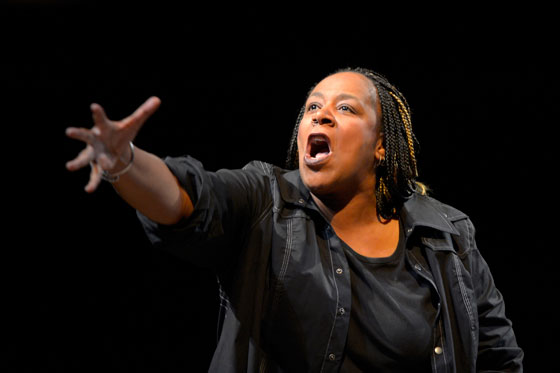
“I want them to look at me, to look me in the eyes,” states Dael Orlandersmith, using a British accent to portray one of at least ten different characters she plays in her tour de force solo show Black n Blue Boys/Broken Men, at Berkeley Rep through June 23.
 
After 90 minutes, the audience was definitely squirming in its seats. Orlandersmith tackles a barrage of characters, each of whom related in some degree to the subjects of mental, physical, and sexual abuse of boys and men. But despite the challenging material, I do not think many viewers would have wanted the play to be any shorter. (“There was hope in it,” I heard an audience member say as we walked out of the theater.)

Orlandersmith, a Pulitzer finalist for her 2002 Yellowman, embodies a variety of people tied to the many facets of violence: onlookers, perpetrators, victims — and those who are perpetrators and victims. She represents a range of ages and ethnicities: children, a Latino father and mother, an African American hustler (aged 13), Irish parents. Her elocution is impeccable.

 Dressed in plain clothing, she remains onstage for the duration, signaling scene changes by turning and walking from the back to the front of the stage — where she resumes with completely different mannerisms. The stage looks a bit like a large ship plank or the abandoned foundation of a small apartment, very broken around the edges.
 
Huge, industrial-looking lights evoke the prisons, foster homes, crack dens, and seedy spots for sex solicitation that background her stories; they raise and lower for different monologues. Character names are projected along the wall after the first few appear, to help the audience keep track when they are revisited.

One character — a boy taunted in the school yard for being a “trick-baby,” a child of a prostitute  — escapes his abusive family life and becomes a writer (a character that Orlandersmith may have been able to draw most from her own experience as a writer who works to give voice to those who are oppressed by violent circumstances). As an adult, the writer works in foster homes, trying to break the cycle of violence and help children in a way he was never assisted in his darkest days.

But even though he understands why these children act out so badly, they still test his patience and he finds out one of the many corruptions in the foster care system — he does not get in trouble for hitting the child because they are allowed to spank children “who are bad.” When he learns about this rule, the character realizes his mistake; his awareness of his own actions and his need to challenge the system and make positive change inspires hope.

In the playbill, Berkeley Rep artistic director Tony Taccone speaks about Orlandersmith’s grace and understanding in approaching such a dark and seemingly impossible subject. He explains she shows us hope amid desperation and brutality. Although certain characters were much harder to handle than others, each one certainly gave the audience much to consider. Orlandersmith shows us how abuse is cyclical, it is a vicious cycle that is hard to break. Hard, but certainly possible.
 
Black n Blue Boys/Broken Men also addresses bureaucratic problems  — compounded by stereotypes and ignorance — that stand in the way of breaking this cycle of violence. A Latino boy growing up in the Brooklyn projects with his mentally ill, sexually abusive mother and in-denial father meets with a social worker, who tells him “It says here in your case file that you were molested by your mother. But you must be mistaken. Men molest men, women, girls, and boys. Women are mothers, mothers do not molest children — women do not molest their sons.”
 
With this example, Orlandersmith shows we still have some fundamental archetypes that need to be broken down, and double standards between the sexes is one of them. Both men and women can be aggressors. Although her play points out this harsh reality (and the frequent denial of it in our society), she also explores how characters break from their abusive pasts.

Thankfully, Orlandersmith provides enough balance in the play to keep the material from getting too uncomfortable and depressing. My personal favorite character was the “unofficial mayor of Central Park,” whose New York accent and physicality was hilarious and completely likeable.
 
I applaud Orlandersmith for her bravery in tackling this subject, and for her ability to explore her characters so deeply. Black n Blue Boys doesn’t engage in finger-pointing; instead, it presents each character openly. Although she knew certain details might cause revulsion, anger, and shock, this talented writer-performer encourages viewers to draw their own conclusions in the end. It is a truthful, compassionate look at a challenging topic, which, in the words of her final character, “doesn’t have to be all black and blue.”

Black n Blue Boys/Broken Men
Through June 23, $14.50-73
Berkeley Repertory Theatre
Thrust Stage, 2025 Addison, Berk.
www.berkeleyrep.org

Guardian voices: The zombie condo converters

28

What is the shelf life of  a really bad public policy concerning housing in  San Francisco?

When it comes to condo conversions of existing rent controlled apartments, the answer is that there is no limit on how many times this bad idea is taken off the shelf. Like a bad summer zombie movie, this undead keeps  walking, no matter what San Franciscans say.

A little history.  In 1982 Supervisor Willie Kennedy, not a bomb-throwing tenant advocate by any stretch, sponsored legislation that limited the  conversion of existing apartments to condos to no more than 200 a year. The measure did not touch new constriction, allowing unlimited condominium construction. Indeed, from 1983 to 2000, some 12,200 new condos were built, an average of some 680 units a year. Since 2000, nearly 100 percent of all new residential constriction is built as condos; there is no limit on renting a condo, but an annual limit in converting an existing apartment. Clearly, condos are a tenure type of housing that is dramatically expanding.

The reason Kennedy and the at-large elected Board of Supervisors voted for the annual limit was to protect rent-controlled apartments, a type of housingthat can’t be expanded. San Francisco’s 1978  rent control ordinance exempted all new construction from being under rent control. So rent-controlled apartments were a fixed number — all apartments built before 1978 — banned by law from ever being expanded. 

Yet those apartments are the largest number of affordable housing units available to moderate and middle income households. Thus, there’s a rational desire to preserve them by a public policy that limits their conversion to condos because they are declining in numbers.

And San Francisco voters understand and support this very rational policy.

In 1989, realtors and speculators tried to overturn the annual limit, proposing a measure that said if 51 percent of a building’s existing tenants voted for a conversion, then the building could be converted with no annual limit. This proposal laid out a future of a Hobbesian society here in San Francisco with one set of well-to-do tenants fighting another set of less-well-off tenants, building by building. San Francisco voters defeated the measure 63-37.

But in the land of the living dead condo converters, no is never the answer.
 
In 2002, Gavin Newsom, Tony Hall and Leland Yee, Plan C, and the Chamber of Commerce placed another measure on the ballot to repeal the annual limit. It too, was  rejected: 60 percent voted no, and 40 percent yes. The measure was defeated in all of the supervisorial districts except  Newsom’s D2, Tony Hall’s D7, and Leland Yee’s D4.

Tenant and affordable housing advocates were not unmoved by the desire of tenants, especially in privately owner rental housing facing Ellis Act and TIC evictions, to seek the protection of home ownership. In 2008 they supported an amendment to the Subdivision Code carving out from the annual limit conversions of apartments by nonprofit, limited equity housing
co-ops.

Now were are confronted again by a desire to allow more conversions of rent controlled units by private buyers who bought into the TIC dodge around the annual condo conversion limit.

Since TIC’s do not require a sub-division map, creating legally recognized separate units, they became “grey market” condos. With hot mortgage money flowing during the bubble, TIC owners could get financing. Now, banks are actually following some laws and will not lend to buy a legally grey TIC.  Thus the move to get them converted to legal condos.
 
This is, in its most basic form, yet another bailout caused by speculative capitalism. We seem to no longer believe in the market as an economic system, in which bad economic decisions result in economic loss for the folks involved. We now seem to believe in the “market society” — in which those with money get to keep it no matter what bad decisions they make.

What this is all about is not really homeownership but about home sales. After all, if you have a TIC you already have a home. You want to convert it to a condo not to live in, but to sell. To make it easier to sell TICs would make it harder to sell the thousands of already approved but stalled new condos.

Mayor Lee administration want to stimulate these stalled condo developments, claiming they will create constriction jobs. The Farrell and Wiener condo conversion plan undercuts these efforts and, of course, will create no jobs for anyone but realtors and moving companies.

This is called a “contradiction of capitalism,” when one set of capitalists seek, to the disadvantage of another group of capitalists, to get the government to intervene on their behalf.  But it does prove once again that Lenin was right when he said that one could count on one set of capitalists to compete with each other to sell rope to hang another set.

It’s really bad economic policy, and even worse housing policy.

PG&E’s latest fire problem

6

Sup. David Campos was at the fire on San Bruno Ave — the one that burned for two hours before PG&E crews managed to shut off a gas pipeline, and he told me the situation was a disaster. “PG&E had apparently done some work on the pipe but hadn’t documented it,” he said. “Nobody was there when we needed to shut it off. Two hours — that’s unacceptable.”

You’d think that after what happened in San Bruno, PG&E would have figured out how to respond to gas fires a little more quickly. You’d think someone in charge of that utterly screwed-up company would have made fire safety a priority. But no: Now PG&E has the normally quiet San Francisco fire chief pissed, has Campos calling for hearings on local gas pipeline safety and is on the proverbial hot seat again.

It’s as if nobody over there cares. What’s going to happen? The CPUC will impose a little fine? The city will demand some changes? So what? The monopoly utility can just ignore it all. The senior execs will still get their huge salaries and bonuses, any additional costs will be passed on to the ratepayers — and one of these days, another pipe will blow up and kill a bunch of people, and PG&E will say: Ooh, sorry about that.

And the next time PG&E throws a couple of dollars at some civic project, the mayor will forgive all the past problems and talk about what a great company it is.

Why do we put up with this?

The 8 Washington embarrassment

16

I wasn’t shocked by the vote on 8 Washington. I knew it was happening; I knew we’d lost when the EIR went through. I knew we couldn’t count on a solid progressive bloc any more. I knew that the lobbying was intense.

But I have to say, at the end of the day I was embarrassed. Because the supervisors sold the city cheap.

In the earlier board discussions, Sup. Christina Olague and Sup. Eric Mar mentioned their concerns about the heigh and bulk of the project and said they would work with the developer, Simon Snellgrove, on changes. But the final project was exactly the same size.

Olague and Sup. Jane Kim were concerned about the amount of parking; the developer agreed to cut 50 spaces. But the actual size of the garage won’t be reduced at all; the only promise: There won’t be valet parking, so maybe not so many cars will fit.

Yes, Snellgrove agreed to set aside some scholarships for low-income kids to swim in the pool, which is a great thing and I fully support it. For a project that, according to available figures, will net the developer $200 million in profit — according to Sup. David Chiu’s analysis, a 72 percent rate of return — the scholarship money is peanuts.

There’s an additional 50 cent parking levy to pay for surface improvements in the area.

But as Chiu asked at the June 12 meeting, “Is the city getting an appropriate level of benefits based on Snellgrove’s profits?” Project foe Brad Paul — a veteran of more than 30 years of the city’s development wars — doesn’t think so. “They got nothing,” he told me.

Here’s how it went down:

Chiu started off by introducing the board’s budget analyis, Harvey Rose. Rose said he’d reviewed the finances of the project, and concluded that the city would get $50 million less out of the project than the developer or the Port of San Francisco, which owns some of the land and is a primary proponent, had originally claimed. Chiu also noted that not all the documents were in the file, but nobody else seemed to care.

In fact, through most of the discussion — limited discussion — and final votes, it was pretty clear that nobody was swayed by any of the facts that Chiu put forward. This deal was done long before the board members took their seats.

Chiu offered a series of amendments, none of them terribly radical. He pointed out that the deal requires the city to pay the developer $5 million for open-space improvements. “That’s an anomaly,” Chiu said, and moved that it be removed.

Kim, who throughout the meeting was the strongest supporter of the project, argued that the city often reimburses developers for open space. More, she said, compared to what the city has asked other major residential developers to give, this project is just dandy. “I would not say this is not a fair deal for the city,” she told her colleagues.

The vote on the $5 million giveaway? Developer 6, SF 5. Siding with Snellgrove: Christina Olague, Scott Wiener, Carmen Chu, Sean Elsbernd, Mark Farrell, and Jane Kim. Siding with Chiu and project opponents: John Avalos, David Campos, Malia Cohen, and Eric Mar. It’s an odd lineup — Cohen doesn’t always vote with the progressives, and I have to say it’s strange to see Kim and Olague siding with the four most conservative supervisors.

Chius’s second proposal: Since the city’s benefits were $50 million less than advertised, why not add $14 million to the affordable housing fee?
Developer: 7. Affordable housing: 4. Voting for the developer: Olague, Wiener, Chu, Elsbernd, Farrell, Kim and Mar.

Okay, one last try. Chiu suggested maybe just $2 million more for affordable housing. Wiener, as is he way, went off on his usual complaint that too much of the affordable housing money is for poor people and not enough for the middle class. The final vote:

Developer: 6. Affordable housing: 5. Voting for the developer: Olague, Wiener, Chu, Elsbernd, Farrell, Kim.

Kim, again, took the lead in promoting the deal on the final vote, saying that a parking lot and a private club were not a good use for the space and that “we are achieving here is a higher and better use for the land.” That’s what every developer talks about, by the way — higher and better use.

She also talked about One Rincon, that hideous tower next to the Bay Bridge that was approved after then-Sup. Chris Daly cut a deal with the developer that the San Francisco Chronicle denounced as a “shakedown.

Kim said that, considering the much-smaller size of the Snellgrove project, the benefits were richer than the Rincon deal.

I never liked the Rincon deal — that tower’s a disaster, an ugly scar on the skyline, and there was nowhere near enough affordable housing money. That’s because I think that the city should be building six affordable units for every four market-rate units, that there’s no need for more housing for the very rich and that our current housing policy is a disaster. (The Guardian wrote an editorial at the time that said it was good that Daly had gotten that much money, but was dubious about the whole project. In retrospect, we were too kind.)

I think all my readers at this point know that. So does Daly.

But I asked the former supervisor anyway to comment on the difference between 8 Washington and One Rincon. His thoughts:

1. The Rincon Hill agreement was negotiated by the district Supervisor working together with the communities most impacted by the development. 8 Washington was opposed by the district Supervisor and many nearby residents.
2. Most people in the South of Market were not diametrically opposed to highrise development in that location. The Planning Department had been working on a Rincon Hill neighborhood plan and was recommending upzoning for the area.
3. Rincon Hill had no waterfront trust issues.
4. The Rincon HIll development impact fee was $25 per square foot (over and above the required inclusionary affordable housing fee even though the Mayor’s Office contended that over $20 per square foot would kill the deal.) According to Kim’s release, her 8 Washington deal netted an additional $2 million for affordable housing and a $.50 parking surcharge. This even though development in Rincon Hill is not as valuable as the northern waterfront.

Folks: I think the city got taken to the cleaners here. I’ll stipulate that I’m against this project for much broader reasons. And maybe I’m just an old commie who thinks that the richer you are, the more you should give back, that the affordable housing fees on the most expensive condos in San Francisco should be higher than normal, that if Snellgrove nets $200 million, then the city by definition left too much on the table.

But I don’t think I’m alone in believing that if you’re going to approve something that will make a developer this rich, and let him use public land to do it, on the waterfront, you ought to get your fair share. And that didn’t happen.

Embarrassing.

No deal yet on business tax reform as competing measure are introduced

21

Mayor Ed Lee and his business community allies failed to reach an agreement with labor and progressives by today’s deadline for submitting fall ballot measures to the Board of Supervisors, leading progressive Sup. John Avalos to introduce a business tax reform measure that would compete with Lee’s proposal.

The Avalos measure would raise $40 million in new General Fund revenue to restore recent cuts to city services while Lee’s would essentially be revenue-neutral, although Lee did tweak the formulas to raise about $13 million in new revenue that would be dedicated to a new Affordable Housing Trust Fund, which would be created by another ballot measure that Lee was having a hard time funding in the face of business community opposition.

“I don’t believe trickle down economics works, except for the 1 percent,” Avalos told the Guardian, arguing the importance of recovering revenue that the city lost when the biggest downtown corporations sued the city in 2001 to invalidate a gross receipts tax. Both the Lee and Avalos measures would gradually convert the current payroll tax into a new version of the gross receipts tax, which is preferred by most of the business community.

So, will voters in the fall be faced with competing ballot measures? Probably not, according to the same sources from the business and progressive sides of the negotiations who told us last week that it appeared a deal was in the offing, something they still believe.

“This is the beginning of the negotiations,” said the business community source, noting that both measures won’t be approved until next month, with discussions about merging them ongoing. “I’m sure this is part of the process and they will agree on a number.”

Our labor source agreed, predicting the two sides will come to an agreement because neither side wants competing ballot measure, but noting that Lee appears to be trying to create divisions between the progressive revenue coalition and the affordable housing advocates. “That’s just positioning on their part, but it doesn’t feel like good faith bargaining,” the source said.

Mayoral Press Secretary Christine Falvey seemed to leave the door open for compromise, telling the Guardian, “The Mayor believes that to be successful, we should continue building consensus around business tax reform and that it’s important that the business community continue to be key partners in that effort.”

Lee is trying to placate an emboldened business community, which has taken a hard line position on opposing new taxes even while seeking ever more tax breaks and public subsidies. In fact, Sup. Mark Farrell had another business tax cut on today’s board agenda, cutting the payroll tax for small businesses at a cost of more than $2 million to city finances.

“I believe we need to do all we can to incentivize job growth in our small business community,” Farrell said.

Avalos said he agrees with helping small businesses – which is why both his and Lee’s business tax reform measure shifts more of the tax burden to the large corporations that have been so profitable in recent years – but that “we should not be putting a hole in the city’s budget to do so.”

In a sign of just how strong the business community has become at City Hall compared to the progressive movement that had a board majority just two years ago, the tax cuts were approved on a 10-1 vote, with only Avalos opposed.

The great car slowdown

49

EDITORIAL It’s going to be hard to reach San Francisco’s official bike transportation goal, which calls for 20 percent of all vehicle trips to be taken by bicycle by 2020. Everyone in town knows that; everyone at City Hall and in the biking community agrees that some profound and radical steps would need to be taken to increase bike trips by more than 500 percent in just eight years.

It starts with safety — you’re not getting anywhere near that number of people on light, two-wheeled vehicles unless, as international bicycling advocate Gil Peñalosa recently told San Franciscans, people between the ages of eight and 80 feel safe riding on the city streets.

At the San Francisco Bicycle Coalition’s 20th Annual Golden Wheel Awards, Peñalosa — executive director of 8-80 Cities, a nonprofit that promotes creation of cycling infrastructure that is safe and inviting — laid out a prescription for designing cities around pedestrians and bicyclists (he sees riding a bike as ” just a more efficient way of walking.”) Peñalosa laid out an agenda for achieving that goal — one that includes a step San Francisco can start taking immediately: Cut vehicle speeds on all city streets to no more than 20 miles an hour.

Even if that were only done in residential areas, it would have a huge impact, and not just on bicyclists. Peñalosa cited statistics showing that only about 5 percent of pedestrians hit by cars driving 20 mph will die — but the fatality rate shoots up to 80 percent when the vehicles are traveling 40 mph.

If there are some streets where it’s impractical to have such a low speed limit, it’s imperative to have bike lanes that are separated from cars by physical barriers.

San Francisco’s Municipal Transportation Agency director, Ed Reiskin, told us after Penalosa’s speech that the notion of reducing speed limits made sense: “The logic is unquestioned that slowing speeds reduces the risk of fatality.”

But the city, it turns out, doesn’t have the power to unilaterally lower speed limits: State law requires speed limits to be set based on formulas determined by median vehicle speeds. That seems awfully old-fashioned and out of touch with modern urban transportation policy, which increasingly emphasizes bikes, pedestrians, and transit, and city officials ought to be asking the state Legislature to review those rules and give more latitude to cities that want to control traffic speed.

In the meantime, Reskin argues that a lot can be done by redesigning streets, using bulb-outs and barriers to discourage speeding. That’s fine, and part of the city’s future bike-lane policy should start with traffic-calming measures (Berkeley, to the chagrin of many nonlocal drivers, has done a great job making residential streets into bike-friendly places where cars can’t travel very fast).

Peñalosa had some other great ideas; he noted that cities such as Guadalajara, Mexico require developers to give free bikes away with each home, a program that has put 102,000 more bikes on the streets. That’s a cheap and easy concept — except that so much of the new housing in the city is so expensive, and comes with so much parking, that it’s hard to believe the millionaires who are moving into these units will be motivated by a free bicycle.

But the notion of working with Sacramento to slow down car traffic makes tremendous sense — and that ought to be one of the transportation priorities of Mayor Ed Lee’s administration.

Hospital standoff

2

steve@sfbg.com

The controversial and long-awaited proposal by California Pacific Medical Center (CPMC) to build a 550-bed luxury hospital atop Cathedral Hill and to rebuild St. Luke’s Hospital has finally arrived at the Board of Supervisors — where it appears to have little support.

So far, not one supervisor has stepped up to sponsor the deal, and board members say it will have to undergo major changes to meet the city’s needs. “There are still a lot of questions that remain,” Sup. David Campos told us, citing labor, housing, community benefits, and a long list of other issues that he doesn’t believe CPMC has adequately addressed. “It tells me there’s still more work to be done.”

CPMC, which is Sacramento-based nonprofit corporation Sutter Health’s most lucrative affiliate, has been pushing the project for almost a decade. Its advocates have subtly used a state seismic safety deadline for rebuilding St. Luke’s — a hospital relied on by low-income residents of the Mission District and beyond — as leverage to build the massive Cathedral Hill Hospital it envisions as the Mayo Clinic of the West Coast.

But the project’s draft environmental impact report shows the Cathedral Hill Hospital would have huge negative impacts on the city’s transportation system and exacerbate its affordable housing crisis. And CPMC has been in a pitched battle with its labor unions over its refusal to guarantee the new jobs will go to current employees or local residents and be unionized. There are also concerns with the market power CPMC will gain from the project, how that will affect health care costs paid by the city and its residents, and with the company’s appallingly low charity care rates compared to other health care providers (see “Lack of charity,” 12/13/11).

CPMC had refused to budge in negotiations with the Mayor’s Office under two mayors, for which Mayor Ed Lee publicly criticized the company’s intransigence last year. But under pressure from the business community and local trade unions who support the project, Lee cut a deal with CPMC in March.

That development agreement for the $2.5 billion project calls for CPMC to pay $33 million for public transit and roadway improvements, $20 million to endow community clinics and other social services, and $62 million for affordable housing programs, nearly half of which would go toward helping its employees buy existing homes.

While those numbers seem large, community and labor leaders from San Franciscans for Healthcare, Housing, Jobs and Justice (SFHHJJ), which formed in opposition to the project, say they don’t cover anywhere near the project’s full impacts. And given that CPMC made about $180 million in profit last year in San Francisco alone — money that subsidizes the rest of Sutter’s operations — they say the company can and should do better.

“This is about standing up to corporate blackmail,” SFHHJJ member Steve Woo, a community organizer with the Tenderloin Neighborhood Development Corporation, told us.


PIVOTAL PROJECT

CPMC is perhaps the most high-profile project the board will consider this year, one that will impact the city for years, so the political and economic stakes are high.

The Planning Commission voted 5-1 on April 26 to approve the deal and its environmental impact report, citing the project’s economic benefits and the looming deadline for rebuilding St. Luke’s. The Board of Supervisors was scheduled to consider the appeal of that decision on June 12 (after Guardian press time), but activists say supervisors planned to continue the item until July 17.

In the meantime, the board’s Land Use Committee has scheduled a series of hearings on different aspects of the project, starting June 15 with a project overview and presentation on the jobs issue, continuing June 25 with a hearing on its impacts to the health care system. Traffic and neighborhood impacts would be heard the next week, and then housing after that.

Calvin Welch, a progressive activist and nonprofit affordable housing developer, said the project’s EIR makes clear just how paltry CPMC’s proposed mitigation measures are. It indicates that the project’s 3,000 new workers will create a demand for at least 1,400 new two-bedroom housing units. Even accepting that estimate — which Welch says is low given that many employees have families and won’t simply be bunking with one another — the $26 million being provided for new housing construction would only create about 90 affordable studio apartments.

“We’re going to end up, if we want to house that workforce, subsidizing CPMC,” Welch told us.

Compounding that shortcoming is the fact that the Cathedral Hill Hospital is being built in a special use district that city officials established for the Van Ness corridor — where there is a severe need for more housing, particularly affordable units. The SUD calls for developers to build three square feet of residential for every square foot of non-residential development.

“That would require building 3 million square feet of residential housing with this project,” Welch said. “We don’t think $26 million meets the housing requirement for this project, let alone what was envisioned by this [Van Ness corridor] plan.”

SFHHJJ is calling for CPMC to provide at least $73 million for affordable housing, with no more than 20 percent of that going to the company’s first-time homebuyer assistance program. That assistance program does nothing to add to the city’s housing stock and critics call it a valuable employee perk that will only increase the demand for existing housing — and thus drive up prices.

But the business community is strongly backing the deal, and the trade unions are expected to turn out hordes of construction workers at the hearing to make this an issue of jobs — rather than a corporation paying for its impacts to the community.

“After a decade of discussion, debate and compromise, the city’s departments, commissions, labor, business and community groups all agree on CPMC,” San Francisco Chamber of Commerce President Steve Falk wrote in a June 8 e-mail blast entitled “Message to the Board of Supervisors: Don’t Stand in the Way of Progress.”

“The fate of our city’s healthcare infrastructure now lies solely with the Board of Supervisors,” the Chamber says. “When it comes time to vote, let’s insist they make the right choice.”

Yet it’s simply inaccurate to say that labor and community groups support the deal, and both are expected to be well-represented at the hearings.


CARE FOR WHOM?

Economic justice issues related to health care access and costs are another potential pitfall for this project. SFJJHH activists note that no supervisors have signed on to sponsor the project yet — which is unusual for something this big — and that even the board’s most conservative supervisors have raised concerns that the city’s health care costs aren’t adequately contained by the deal.

“There’s a significant amount of dissatisfaction with the deal, even among conservatives,” SFJJHH member Paul Kumar, a spokesperson for the National Union of Healthcare Workers, told the Guardian.

On the progressive side, a big concern is that CPMC is proposing to rebuild the 220-bed St. Luke’s with only 80 beds, which activists say is not enough. And even then, CPMC is only agreeing to operate that hospital for 20 years, or even less time if Sutter’s fortunes turn around and the hospital giant begins losing money.

CPMC Director of Communications Kathryn Graham, responding by email to questions and issues raised by the Guardian, wrote generally and positively about CPMC and the project without addressing the specific concerns about whether housing, transportation, and other mitigation payments are too low.

On the jobs issue, she wrote, “Our project will create 1,500 union construction jobs immediately—and preserves and protects the 6,200 health care professional jobs that exist today at the hospitals. Currently, nearly 50 percent of our current employees live in San Francisco. During the construction phase of this project, we are committed to hire at least 30 percent of workers from San Francisco. We will create 500 permanent new jobs in just the next five years—200 are guaranteed to be local hires from underserved San Francisco neighborhoods. We don’t know where you got the ridiculous idea that our employees must reapply for jobs at our new hospitals. That is incorrect.”

Yet CPMC has resisted requests by the California Nurses Association and other unions to be recognized at the new facility or to agree to card-check neutrality that would make it easier to unionize. And union representatives say CPMC has offered few assurances about staffing, pay, seniority, and other labor issues.

As one CNA official told us, “If they aren’t going to guarantee jobs to the existing employees, those are jobs lost to the city.”

“We’re giving Sutter a franchise over San Francisco’s health care system for 30 to 40 years, so we should ensure there are basic worker and community protections,” Kumar said.

Welch and other activists say they believe CPMC is prepared to offer much more than it has agreed to so far, and they’re calling on the supervisors to be tougher negotiators than the Mayor’s Office was, including being willing to vote down the project and start over if it comes down to that.

“They make too much money in this city to just leave town,” Welch said of CPMC’s implied threat to pull out of San Francisco and shutter St. Luke’s. “It’s bullshit.”

Why I hope Sup. Farrell is wrong about condos

213

So Sup. Mark Farrell thinks the Board of Supervisors is ready to turn its back on the tenants movement and vote for legislation that would increase evictions, eliminate rental housing and undermine one of the most important pieces of tenant legislation to come out of City Hall in decades?

Gawd, I hope he’s wrong.

From the Examiner:

Similar proposals have gone nowhere at City Hall. Farrell acknowledged it has been a “third rail,” but he suggested the political climate has shifted. “This is a different Board of Supervisors and this is a different time,” Farrell said.

Yeah, it’s a different Board of Supervisors. Five years ago, the 8 Washington project would never have been approved in its current form. Five years ago, Ed Lee wouldn’t have been elected mayor.

But I don’t think this board is ready to abandon the tenant vote.

Making condo conversions easier is a huge deal. When San Francisco put a limit on condo conversions more than 20 years ago, it was a landmark law that put the preservation of affordable, rent-controlled housing over the needs of speculators. Over the past decade, the single greatest threat to tenants in this city is Ellis-Act evictions done to create tenancies in common. And the only check on more of that happening is the disincentive posed by the limits on condo conversions.

If Farrell gets his way, and TIC owners can bypass the conversion lottery, tenant organizations will be furious. There are, at best, five reliable pro-landlord votes on the board, so It’s not going to happen without either David Chiu, Christina Olague or Jane Kim siding with Farrell. A lot of things suprise me in local politics, but that would be a shocker.


Why does the mayor appoint supervisors?

16

The Alameda County Board of Supervisors just found a replacement for Nadia Lockyer, who resigned in April (“amidst a drug and sex scandal,” the Chronicle notes, and you know how much journalists love to use that phrase). The four remaining members of the board deadlocked for a while, then settled on Union City Council member Richard Valle.

All of which makes me wonder, as I often do: Why does the Mayor of San Francisco get to fill vacancies on the Board of Supervisors?

Other county boards fill the vacancies themselves — and if you don’t think the SFBOS can handle that, remember that every two years the 11 contentious folks choose a president, and it doesn’t take more than a few hours, and not that long ago, they chose a mayor.

I don’t know any other situation where the executive gets to choose legislators. The governor doesn’t fill seats in the state Assembly. The president doesn’t fill vacancies in Congress. There’s an important balance of powers issue here, and it has played out to the detriment of democracy in the past. At one point, more than half of the sitting supervisors had been appointed by Mayor Willie Brown. There was no balance; the mayor called all the shots.

Imagine if, instead of the mayor secretly huddling with advisors and choosing a new supe, the Rules Committee took applications and nominations and then the full board, in open session, debated and discussed and voted. The outcome would reflect the much broader perspectives of 10 district supervisors — and the person chosen would owe a debt to all of his or her colleagues, not to the mayor.

You can make a good case that the mayor ought to fill vancancies in other elected offices (sheriff, city attorney, public defender etc.); those are, at least arguably, executive offices. Although I could also make the case that the 11 district-elected supervisors should make those calls.

But that’s a different issue. The clear and obvious anomaly here is that San Francisco’s chief executive gets to choose his own legislators in the event of a vacancy — and that’s just wrong.

Now, in Alameda if they can’t reach a decision, the governor steps in. In San Francisco, with 10 voting supes, it seems highly unlikely that we’d ever see a long-term deadlock, but the mayor could step in the break the tie in that case — or some other city official could, or you could come up with a dozen other solutions. The bottom line is that most of the time, as in Alameda, the board would come to if not a consensus, then a majority vote.

Who’s up for some Charter reform?


The Mirkarimi case: Did the city want to settle?

132

The real news in the Ross Mirkarimi case isn’t the sheriff attempting to get the city to pay his legal fees; that’s just something he had to try but it was a long shot at best. The story that’s come out in bits and pieces since we broke it is far more interesting:

City Attorney Dennis Herrera, with or without the knowledge of his client the mayor, offered to begin discussions with Mirkarimi around settling the case — and the conflicting accounts of what went on show haw harsh this legal proceding has become.

Whatever you think about Mirkarimi’s actions on New Year’s Eve — and I’ve said many times that what he did was unacceptable — the intensity of the prosecution, particularly in the removal proceding, is unprecedented.

Some of the political fallout is clearly Mirkarimi’s fault. He bruised his wife, got bad advice early on, said the wrong things, and didn’t do enough to repair the damage. But now Mirkarimi’s lawyer is charging that the city attorney used a nasty legal gambit to try to convince the embattled sheriff to resign.

David Waggoner, in a TV interview with KGO’s Dan Noyes, and later in discussions with me, said that City Attorney Dennis Herrera offered to look for a way to keep the video of Mirkarimi’s wife out of the public eye — if Mirkarimi would take a financial settlement and resign from his elected position.

Mirkarimi told me the offer he heard from his lawyer put him in a terrible bind: Franky, the video contains nothing that hasn’t already been out, and won’t be the defining issue in the official misconduct case now before the Ethics Commission. But his wife, Eliana Lopez, was adamant that she didn’t want the 45-second clip on the Internet, where she — and more important, their three-year-old son — will have to live with it forever.

“They were using the needs of my family to pressure me,” Mirkarimi said.

Waggoner was pretty specific about his recollection of the settlement discussions. He said that after Herrera contacted him to say that he was willing to discuss settling the case, Waggoner made it clear that keeping the video sealed had to be part of any deal.

“We hung up, and then he called me back five minutes later to say that his government team was working on it, and he thought they could keep the video under seal,” Waggoner said. “The mayor and the city attorney were using the video as leverage.”

Hererra confirmed that he reached out to Waggoner to see if Mirkarimi’s legal team was interested in settlement discussions. But told me that Waggoner’s story was “absolutely, categorically untrue.” He insisted that he had no choice but to release the video, since several media outlets had requested it under the San Francisco Sunshine Ordinance.

In a statement issued June 8, Hererra attacked not only Mirkarimi but his attorneys:

“Everyone involved in this case was well aware of the City’s legal obligations under the Sunshine Ordinance (which Ross Mirkarimi himself had a hand in drafting).  The City invoked the maximum allowable two-week extension after receiving Sunshine requests for the video, to allow other parties to seek a protective order.  But opposing counsel dropped the ball.  They didn’t get a protective order.  They didn’t seek Supreme Court review.  They didn’t raise the issue at the Ethics Commission hearing.  And as far as I know, [Lopez’s counsel Paula] Canny didn’t even bother to show up at the hearing.  So, I think it’s a little absurd now to be playing martyr.  These are lawyers representing a former lawmaker.  They have no excuse for not knowing the law.”

Wow. Sounds like the usually level-headed Herrera is one pissed-off attorney.

Interestingly, Mayor Lee told Noyes that he didn’t know anything about any settlement discussions. Either that’s false (the mayor could have been instructed by Herrera not to say anything) or Herrera was going ahead without the mayor’s knowledge or permission.

So let’s set aside for the moment the back-and-forth about who’s telling the truth and what was really involved in the negotiations. Here’s what’s not in any serious dispute:

Herrera, representing the mayor, was sufficiently motivated to settle the case before it got to the Ethics Commission that he personally called Mirkarimi’s attorney to see if there was any possibility of finding a way out. Again: Attorneys in the most bitter lawsuits are advised to seek settlement. But this isn’t in court, and no judge mandated a settlement conference.

Which suggests that the city attorney and possibly the mayor would be a lot happier if this case just went away. Maybe Lee doesn’t like the drama. Maybe Herrera thinks it would be best for Mirkarimi and the city to put this in the past and move on.

Or maybe they aren’t sure this case is such a slam-dunk winner.

There’s another interesting twist, too: Mirkarimi told me that he asked the Probation Department for permission to fly to Venezuala to see his son. There were no conditions on his guilty plea barring him from travelling outside of the country (what — they think he won’t come back? That he has run through all of his money and put himself heavily in debt to fight a case that he’s now going to run away from?) But when he made a formal request, it was denied.
That’s right — probation officials refused to let him go visit his son. Forget Mirkarimi — that’s not fair to the three-year-old kid who did nothing wrong at all and is suffering for it.

Mayor Lee’s business tax reform will include new revenue

30

Mayor Ed Lee has acquiesced to labor’s demand that the business tax reform measure being negotiated for the November ballot raise tens of millions of dollars in new revenue, rather than being revenue-neutral as Lee and business leaders had previously insisted, according to Guardian sources in both the business and progressive communities who are involved in the ongoing negotiations.

As we previously reported, SEIU Local 1021 had demanded that the measure – which must be submitted to the Board of Supervisors by Tuesday – raise $30-50 million in additional revenue to prevent cuts to city services and to recapture money the city lost when the largest downtown corporations sued the city in 2001 to invalidate its gross receipts tax. If not, the union threatened to qualify a competing ballot measure that would raise the money, something neither side wants.

Sources say the Mayor’s Office has agreed to structure the tax to raise at least $25 million in new revenue, and some believe they will settle on $30 million, which is being supported by the big technology companies and is probably enough for labor to sign onto the deal.

But a complicating factor is the fact that Lee’s representatives are simultaneously negotiating another ballot measure to create an Affordable Housing Trust Fund that will also need to generate revenue, most likely through an increase in the real estate transfer tax, something the commercial landlords are opposing.

The business community has opposed any tax increases, but it is split between the big technology companies who helped elect Lee and more traditional businesses, including the FIRE (Finance, Insurance, and Real Estate) companies that all observers say are likely to get hit with a higher tax burden whatever the outcome of the current negotiations.

There is an urgency to get this deal done now because of the fast-approaching deadline to introduce ballot measures to the board, and the fact that under state law revenue measure can be passed with only a simple majority of voters only in presidential election years.


Sutter’s CPMC deal isn’t healthy

28

At 10am on Friday, June 15, at the main chambers of the Board of Supervisors, the first of a series of public hearings will be held on specific aspects of the  development agreement governing the $1.9 billion Sutter Health/California Pacific Medical Center proposal to expand and centralize the giant health-care outfit’s health center by building a new 555 bed hospital at Geary and Van Ness. The deal involves demolishing the existing 220-bed hospital at St. Luke’s at Mission and Cesar Chavez and rebuilding a new 80-bed facility, expanding the Ralph K. Davies hospital at Duboce and Noe and closing down the old Children’s Hospital in Laurel Heights.

The hearing will be the first before the Board of Supervisors. Thus far, the project has been before only the executive branch: the Planning Commission and the mayor. After a brief introduction on the overall project the hearing will focus on the issue of jobs.

This is the largest project to be negotiated by the Lee administration — and although the mayor introduced it to the board in May, not one supervisor has yet joined him to sponsor the legislation. That’s an an odd situation given the importance of the project – and the fact that Mayor Lee can usually count on an automatic four votes from the conservative faction of the board. But not this time.

The hearing was requested by a coalition of more than 60 community, neighborhood, labor, and environmental organizations — San Franciscans for Healthcare, Housing, Jobs and Justice (SFHHJJ) — which has been closely following the project for the last two years.  Members of the coalition have already appealed the project’s environmental impact report, passed last month by the Planning Commission, and SFHHJJ has developed a series of amendments to the agreement that it has been pressing on the Board of Supervisors.  Board President David Chiu agreed to set a series of hearings on the project before it voted on, along with the determination of the appeal of the EIR, in  late July.  SGHHJJ hopes to use the hearings to get across the serious shortcoming of the agreement.  In addition, depending upon the appeal of the EIR,  a law suit may well be filed by some members of the Coalition.

In short, what starts next Friday is a big deal.

Not only is it a big deal in the development war that is at the heart of San Francisco politics, but it also is a big deal given what may well be done by the Supreme Court in deciding the constitutionality of all or part of the Affordable Health Care Act. If Obama’s health reform is struck down by the court, in all or in part, which seems almost certain, Sutter/CPMC’s plan will most definitely take on even more importance for the future of health care and its costs in San Francisco.

Sutter currently controls about a third of the market for health care in San Francisco.  With the construction of this project, it will control about 40 percent — a portion most knowledgable observers feel will give it market dominance  and an ability to actually set health care costs in San Francisco. Sutter’s business model — as shown in Berkeley when it took over Alta Bates and elsewhere in the state – demonstrates that  with a dominate market position, it jacks up prices.

As the San Francisco Chronicle noted in 2010: “…Sutter Health Co. has market power that commands prices 40 to 70 percent higher than its rivals per typical procedure — and pacts with insurers that keep those prices secret”.

A US Supreme Court that weakens or strikes down health care reform will simply re-establish the status-quo ante, a situation in which Sutter will thrive.

And that’s why the board’s conservative members are not supporting Mayor Lee’s deal: it simply does not protect the city — itself a major health care consumer for both its workforce and Healthy San Francisco — from Sutter’s history of turning market power into high health care charges.

SFHHJJ want the development agreement amended to place a cap on the costs charged to the city, allowing Sutter no more than 115 percent of the average charged  by  San Francisco’s other private, nonprofit hospitals.  It also wants Sutter/CPMC low charity care payments pegged at an average of what other nonprofit hospitals contribute, and it is calling for rebuilding St. Luke’s in San Francisco medically underserved south east to 180 beds, not the sure-to-fail size of 80 beds.

But there’s even more to deplore about the proposed deal.

In housing, although the EIR showed that a demand would be created for some 1,500 new two-bedroom homes, Sutter/CPMC agreed to only provide funds to build about 90 such homes. Such a massive shortfall will boost housing prices all other San Franciscans will pay.

The project’s impact on public transit at the Geary / Van Ness intersection will be large and ongoing. More than 20,000 new car trips will be generated at that intersection by the new hospital. Plans for a Bus Rapid Transit raised roadway for the 38 Geary — the most used bus line in the city — will have to be altered at an unknown price since the project calls for all auto traffic to enter the site on the Geary Avenue side.

Again, San Francisco taxpayers will be on the hook to pay for these new costs.

But it is the jobs aspect of the deal that is the most distressing. Sutter/CPMC has a long history of labor disputes with its workforce. Last year it replaced nurses who took a day off to protest their working conditions, and a replacement nurse hired by Sutter accidentally killed a patient. Sutter/CPMC refuses to agree to hire all of its 6,000 current employees for the new facilities. It’s requiring them all to apply as new workers, losing all of their seniority, with a real prospect that many currently employed San Francisco residents will lose their jobs once the new facility opens. All that Sutter/CPMC has agreed to do is hire 50 residents a year for four years – 200 new local jobs, total.

The  June 15 hearing will focus on the jobs issue and public comment is sure to be hot on this laughable “commitment” agreed to by the “jobs” administration.

Calvin Welch is a longtime community organizer living in San Francisco. He currently teachs a course in the development history of San Francisco at San Francisco State University and the University of San Francisco.

Mecke joins crowded District 5 supervisorial race

26

Progressive activist Quintin Mecke jumped into the District 5 supervisorial race today, echoing gentrification concerns raised this week by the Guardian and The New York Times and promising to be an independent representative of one of the city’s most progressive districts, a subtle dig at Sup. Christina Olague’s appointment by Mayor Ed Lee.

“The City is at an economic crossroads. As a 15 year resident of District 5, I cannot sit idly by while our City’s policies force out our residents and small businesses, recklessly pursuing profits for big business at whatever cost,” he began a letter to supporters announcing his candidacy, going on to cite the NYT article on the new tech boom that I wrote about earlier this week.

“What we do next will define the future of San Francisco; the city is always changing but what is important is how we choose to manage the change. One path leads to exponential rent increases, national corporate chain store proliferation, and conversion of rent-controlled housing. The other path leads to controlled and equitable growth, where the fruits of economic development are shared to promote and preserve what is great about this City and our district,” Mecke wrote.

Mecke came in second to Gavin Newsom in the 2007 mayor’s race and then served as the press secretary to Assembly member Tom Ammiano before leaving that post last week to run for office. Mecke joins Julian Davis and John Rizzo in challenging Olague from her left, while London Breed and Thea Selby are the leading moderates in a race that has 10 candidates so far, the largest field in the fall races.

Although he never mentioned Olague by name, Mecke closed his message by repeatedly noting his integrity and independence, a theme that is likely to be a strong one in this race as Olague balances her progressive history and her alliance with the fiscally conservative mayor who appointed her.

“Politics is nothing without principles; and it’s time now to put my own principles into action in this race,” Mecke wrote. “District 5 needs a strong, independent Supervisor. I am entering this race to fight for the values that I believe in and to fight to preserve what is great about District 5 and the city. I have brought principled independence to every issue I’ve worked on and that’s what I’ll continue to bring to City Hall.”

In an interview with the Guardian, Mecke said he sees the campaign as a “five-month organizing project” to reach both regular voters and residents of the district who haven’t been politically engaged, including those in the tech sector. He’d like to see the perspective of workers represented in discussions about technology, not simply the narrow view of venture capitalist Ron Conway that Mayor Lee has been relying on.

“Local politics needs new blood,” Mecke said, “it needs to hear from these people.”

Bike advocates have made real progress, but there’s still a long way to go

51

San Francisco Bicycle Coalition Executive Director Leah Shahum mused on how far this influential advocacy group has come during its 20th Annual Golden Wheels Awards last night, noting that the first such award recognized the commercial landlord at 555 Montgomery Street for installing indoor bike parking.

“Back then, that would get you a Golden Wheel Award,” she said, noting that this year’s award to the Building Owners and Managers Association of San Francisco (BOMA) was for its support of legislation requiring all commercial buildings in San Francisco to provide indoor bike parking. “We’ve come a long way in 20 years, clearly.”

In addition to the majority of the Board of Supervisors who showed up to offer their support, Shahum ticked off a long list of other city and regional officials who ride bikes and understand their potential as an increasingly important transportation option during the era of peak oil, traffic gridlock, and public health problems.

“Regularly, we have these top leaders in the city who are biking because they love it, biking because they’ve always biked,” Shahum said, citing the Sunday Streets road closures and the school district going from discouraging cycling to facilitating it as signs of the pro-bike mindset that has taken hold of San Francisco.

The fact that SFBC recognized BOMA – a powerful downtown player that has progressed from seeing cyclists as enemies to embracing them as allies – was telling of the mainstream embrace of bikes.

“We get it, we’re learning,” Meade Boutwell, president of BOMA’s board, told the crowd as he accepted the award, going on to say that “less cars are good for all of us.”

It was a lovely if ungrammatical sentiment and a sign of just how far the business community has come in accepting the imperative of promoting alternatives to the automobile. But there’s still a bit of a disconnect in San Francisco about the role that bikes play in the world’s great pro-cycling cities, evidenced partly by Boutwell’s opening comment, “Under this polyester suit is lycra.”

Keynote speaker Gil Peñalosa – executive director of 8-80 Cities, a nonprofit that promotes creation of cycling infrastructure that is safe and inviting from those 8-80-years-old – mocked the MAMILs (Middle-Aged Men In Lycra) and the notion that people should be athletic or wear special equipment to be able to cycle in cities.

“We dress normally, we act normal, and so on,” Peñalosa said, later arguing that, “Cycling is for everybody.”

In Boutwell’s defense, much of mainstream San Francisco still has a hard time accepting cycling as a normal, safe option. When the San Francisco Chronicle covered Pealosa’s visit to Sunday Streets last weekend – our version of the car-free ciclovias that Peñalosa pioneered as a city official in Bogota, Columbia more than a decade ago – reporter Sam Whiting was jarred by the guest’s casual approach.

“They had come from overseas and were riding in jeans and without helmets, both rookie mistakes,” he wrote of Peñalosa and his wife (“Sunday Streets welcomes its source of inspiration,” 6/4).

But Peñalosa argues that the real mistake is when cities cater primarily to automobiles at the expense of the safety and livability of their neighborhoods, and treat cycling as a dangerous fringe activity. He argues that cities should be built primarily around pedestrians, “but very close to the pedestrians is the cyclists…I think that cycling is just a more efficient way of walking.”

Public transit is important and should be robust, he said, but it’s just not as efficient, user-friendly, economical, or environmentally beneficial as bikes. “We need to walk and bike as a part of everyday life and then we’ll be much healthier,” he said.

Peñalosa urged the crowd to be politically active and push the city to prioritize bikes over automobiles, noting that even in wealthy neighborhoods, only about a third of residents drive cars. And from a design perspective, he said city officials must choose between “Streets for cars or streets for people.”

Once we make the latter choice, Peñalosa laid out an agenda for achieving that goal, starting with slowing vehicle speeds to no more than 20 mph in residential areas.

He cited statistics showing that only about 5 percent of pedestrians hit by cars driving 20 mph will die, whereas the fatality rate shoots up to 80 percent when the vehicles are traveling 40 mph. And for streets in which cars are traveling faster than 20 mph, he said it’s imperative to have bike lanes that are separated from cars by physical barriers, rather than just lines painted on the street.

He noted that Seville, Spain drastically increased its cycling rate in just a few years by committing to building bike infrastructure, and that Chicago Mayor Rahm Emanuel installed that city’s first physically separated bikeway within his first 30 days in office and has perhaps the US’s most ambitious program for installing new bikeways. “San Francisco should not be any less than Chicago,” he said.

In Cogenhagen, which already boasts some of the world’s highest rates of urban bicycle use, Peñalosa said the city has sought to capture more long-distance riders by building 200 miles of “cycle superhighways” – which includes two lanes in each direction to facilitate both fast and slow riders – all for the price it costs to build about a half-mile of subway.

The goal, he said, is to make cycling as “easy, fast, and convenient” as possible, and to apply the political pressure to make that a priority because “if you aren’t doing those things then someone else is and someone else is setting the agenda.”

Supervisors dominate DCCC race, but key newbies join them

5

“I just stopped by on my way to finish campaigning,” Sup. David  Campos told me at the Bike Coalition’s 20th Annual Golden Wheel Awards (more on that tomorrow), the first in more than a majority of the Board of Supervisors at the event.

Campos was campaigning for reelection to the Democratic Party County Central Committee (DCCC) and the polls were still going to be open for almost two more hours. Perhaps he could still reach the one in four registered SF voters who bothered to weigh in on this lackluster election.

“There was nothing really on the ballot that excited voters,” Campos said. “Hopefully November will be different.”

Tonight’s returns — for leadership of a local Democratic Party that hopes for more  voter engagement in the fall races — showed that Campos and fellow supervisors David Chiu, John Avalos, and Scott Wiener expectedly topped the pack, with Bevan Dufty, who moved from the board to the Mayor’s Office this year, in fifth place. And longtime former legislator Carole Migden’s sixth place fininish in the 14-seat eastside DCCC race helped show that it was mostly about name recognition.

But there were a couple of first-time candidates in the winning field: Matt Dorsey and Zoe Dunning, who finished 8th and 12th respectively. Both played key roles in recent LGBT politics: Dorsey as the City Attorney’s Office spokesperson during the same-sex marriage saga of the last eight years, Dunning as a poster lesbian in ending the US military’s “don’t ask, don’t tell” policy.

“I think Zoe and Matt are the ones to watch,” DCCC member Alix Rosenthal told me at the Buck Tavern as she celebrated her reelection, after campaigning hard for both the progressive and women’s slates.     

Unprompted, Dorsey returned the recognition when I stopped by his party down the street at Churchill. “Alix and Rafael [Mandelman, who organized the progressive slate and finished 10th, right after Sup. Malia Cohen] ran other things, so it’s apples and oranges,” Dorsey humbly said of the two former Dist. 8 supervisorial candidates he bested, when I asked about his strong finish.

Dorsey ran an aggressive campaign, targeting high-turnout precincts and working hard to get the full spectrum of political endorsements (and posting all his answers to each group online), what he called “Moneyball politics.” And it translated into an impressive finish for a freshman candidate but longtime politico.  

“Right now, I’m looking to get back to the gym after a year and a half of campaigning,” said Dorsey, the spokesperson for the mayoral campaign of City Attorney Dennis Herrera, who was at the party, along with District Attorney George Gascon. 

Dorsey and his fellow Guardian/progressive slate members did better in Eastside Dist. 17 than Westside Dist. 19, taking 10 of 14 seats compared to four of 10, leaving a near-equal balance with the moderate Democrats once the seats of elected officials are factored in.

But if the spirits count for anything, Dorsey told me he ran especially hard to earn the seat that outgoing DCCC Chair Aaron Peskin appointed him to when long progressive activist Michael Goldstein died last year.

“Knowing that it was his seat,” Dorsey said, “motivated me to work harder.”

Reading Ed Lee’s mind

15

Political reporters love to believe we can read politician’s minds; it makes us feel important. (And Lord knows, these days we need something to make us feel important.) So let me go way out on a limb here and tell you what Mayor Lee is thinking right now:

1. Gotta minimize Prop. B. It was an aberration, a bunch of rich Nimbys from Telegraph Hill, nothing more to see here. Certainly not a public referendum on my Rec-Park director, Phil Ginsburg, and his efforts to make money by renting out city parks for private events. No no no, just ignore it and maybe it will go away.

2. We won back the Democratic Party. Good move to take a page from Aaron Peskin’s book and run a bunch of elected officials and former elected officials with high name recognition in a low-turnout election. Bevan Dufty, who happens to work for me, would make an excellent chair; should be easy to make that happen.

3. What if we look at the DCCC race in the 17th District as a first-pass primary for the 2014 Assembly seat when Tom Ammiano — who’s just way too independent and won’t get with my program — is termed out? Hmmm … David Chiu, who I can mostly deal with, is in first place — but John Avalos and David Campos are more popular than my pal Scott Wiener. And if the progressives get behind Campos, he’ll be tough to beat. Hmmm….

4. That oddball Michael Breyer ran for Assembly pretending he was me. He even put out a mailer with my mustache on the front suggesting that he’ll be just like I am (except that he’s white and has no experience and no credible program and isn’t going to win). But he got a lot of votes with the Ed Lee card and I could totally control him. Can’t support him over Phil Ting, of course, but maybe I can get him some help behind the scenes.

5. This was an unusual election with radically low turnout. I know I can’t read too much into it. If the DCCC were on the ballot in November, or if there were a real presidential primary to bring people out to vote, the results would be very different. But still: All that new housing for rich people that my mentor Willie Brown and my friend Gavin Newsom got started seems to be having an impact. The city’s getting more conservative. Let’s just keep that one going and I’m home free.

6. What’s up with Lincecum? Damn those Padres.

Nah — the mayor’s too nice a guy to be thinking like that. Right?


Mayor Lee’s priorities are wrong

0

By Margaret Brodkin

OPINION There was much back slapping at City Hall last week as officials congratulated themselves on what was described as a welcome “philosophical shift” in San Francisco politics.

The beneficiary of the acclaim and virtual political consensus was Mayor Ed Lee’s proposed budget, the largest in history — including an unexpected windfall of new revenue. The budget’s signature element, described in glowing terms by the San Francisco Chronicle’s C.W. Nevius and warranting its own special mayoral press conference, is the expansion of the police and fire budgets — an $82 million increase over two years.

Amid last week’s ovations was an unsettling silence from voices normally willing to cut through obscure numbers and rhetoric. Not one official commented that the best way to ensure public safety is to build strong children, families, and communities.

The cumulative impact of the devastating state budget and years of inadequate funding on families and children should not permit celebration. In light of millions in unanticipated revenue, politicians should not be satisfied with addressing urgent needs simply by sparing a few city departments from cuts, as appeared to be the case. Here’s what they should be thinking about:

• Our schools face the worst budget cuts ever, with SFUSD preparing to lay off 400 employees, reduce the already-too-short school year, increase class size, eliminate most school bus lines and all high school after-school programs, and under-fund everything from food to special education.

• Our childcare system is being gutted by the state, with $20 million in losses this year on top of $9 million from last year. This will impact thousands of families and result in the closure of centers and family childcare homes. Many fewer parents will be eligible for childcare subsidies (no one with two kids earning more than $37,500 a year will qualify) — pushing parents out of work and onto “welfare,” and children out of quality care and into unsafe settings.

• Support systems for children with disabilities are being eliminated and reduced through simultaneous cuts in multiple agencies.

• Young people entering community colleges or state universities face years of uncertainty — including whether their campuses will even exist. Already, the majority of SF students who enter City College are unable to graduate — stymied by costs, lack of educational support, or the inability to get classes they need.

It appears that little of the new millions will address these problems. The mayor’s budget does not even fully fund the voter-approved Public Education Enrichment Fund, passed in 2004 to provide essential services to public schools and preschools. Funding falls short by more than $10 million. Providing schools the funds to which they are legally entitled is the least we can do when the city lands millions in new resources.

Let’s be clear: crime is at historic lows — and has gotten that way with 200 fewer officers than the mayor is now advancing. There is little rationale to suddenly swell the ranks, at a cost of $140,000 per officer. The Fire Department’s inefficiencies have been well documented by city budget experts, and many cost-saving recommendations have yet to be implemented.

Before signing off on a budget they have not yet discussed in public (as it appeared to last week), the Board of Supervisors must evaluate fiscal options in full view. Private meetings with the mayor are no substitute for a robust debate now that the revenue facts are known. This is the city’s first two-year budget, and its policy direction will impact us all for years to come.

What looks to Nevius like a positive “drama-free, signature moment” for San Francisco, looks to many advocates for children and families like an abdication of responsibility.

Margaret Brodkin is a former executive director of Coleman Advocates for Children, director of the Department of Children, Youth and their Families and New Day for Learning, and a veteran of numerous budget processes

The circus begins

199

steve@sfbg.com

Mayor Ed Lee and his attorneys are presenting a voluminous yet largely speculative case against suspended Sheriff Ross Mirkarimi in their effort to remove him for official misconduct, broadening the case far beyond their most damning core accusation -– that Mirkarimi dissuaded witnesses from telling police that he bruised his wife’s arm during an argument on Dec. 31. And so far, there’s no evidence to support that key allegation.

In fact, Mirkarimi and his attorneys insist there was no effort to dissuade witnesses, one of many unsupported aspects to a case they say should never have been filed without stronger evidence. And they say the mayor’s team is now compensating for the weakness of its case by piling on irrelevant accusations and witnesses in an effort that amounts to character assassination.

There are even signs that the city is nervous about its case. Knowledgeable sources told the Guardian that the City Attorney’s Office last week offered to settle the case with Mirkarimi, offering a substantial financial settlement if he would agree to resign, an offer that Mirkarimi rejected.

It was one of a series of rapidly unfolding developments that also included a raucous Ethics Commission hearing, the disclosure of phone records by Mirkarimi’s side, a new list of charges, and the city’s release of the video Mirkarimi’s wife, Eliana Lopez, made with neighbor Ivory Madison, documenting the bruise in case of a child custody battle over their son.

Lopez has maintained that Mirkarimi never abused her and that she’s been hurt most by the efforts to prosecute him and remove him from office.

“I hope they realize after reflection that what they have done is irreparable and perpetually damaging to me and my family,” Lopez said in a statement condemning the city’s release of a video that she fears will remain online for her children and grandchildren to see.

Yet all indications are this spectacle is only going to grow more sordid, divisive, and sensational as it moves forward — belying the statement Lee made last week as he introduced his annual budget: “As many of you know, I’m a person who does not like a whole lot of drama.”

SIMPLE OR COMPLEX?

The May 29 Ethics Commission hearing to begin setting standards and procedures for the official misconduct proceedings against Mirkarimi illustrated two sharply divergent views on when elected officials should be removed from office. It also displayed the increasingly bitter acrimony and resentments on each side, emotions only likely to grow more pronounced as the hearings drag on for months against the backdrop of election season.

Both sides would like to see the decision as a simple one. Lee and his team of attorneys and investigators say Mirkarimi’s bruising of his wife’s arm and his unwillingness to cooperate with their investigation of what followed make him unfit for office. Mirkarimi and his lawyers admit his crime, but they say that’s unrelated to his official duties and that the rest of Lee’s charges against him are speculative and untrue.

Yet there’s nothing simple about this official misconduct case — or with the implications of how each side is trying to counter the others’ central claims. So despite the stated desires of some Ethics commissioners to narrow the scope of their inquiry and limit the number of witnesses, San Franciscans appear to be in for a long, dramatic, and divisive spectacle, with Mirkarimi’s fate decided by the Board of Supervisors just a month or so before the five supervisors who have been his closest ideological allies face reelection. Nine of 11 votes are required to remove an official.

The Mayor’s Office wants to call the most witnesses and present an elaborate (and expensive) case that includes a number of outside experts on law enforcement and domestic violence, painting a portrait of Mirkarimi as a serious wife-batterer whose past and future actions can be divined from that malevolent distinction, making him obviously unable to continue as San Francisco’s chief law enforcement officer.

“The extent of the abuse was far greater than what Mr. Mirkarimi has testified to,” claimed Deputy City Attorney Peter Keith, going on to say “there were attempts to control what she ate,” an apparent reference to Mirkarimi’s decision not to take Lopez to a restaurant for lunch on Dec. 31 because they were having a heated argument. He also repeatedly referred to Mirkarimi as a batterer and said “batterers behave in a certain way.”

Mirkarimi attorney Shepard Kopp calls that portrayal exaggerated and unfair, ridiculing the Mayor’s Office claims that its domestic violence expert, attorney Nancy Lemon, can predict Mirkarimi’s behavior based on grabbing his wife’s arm once: “Apparently she’s some kind of clairvoyant in addition to being an expert,” Kopp told the commission as he unsuccessfully sought Lemon’s removal from the witness list.

Ethics Commission Chair Benedict Hur took the lead role in trying to limit the witness list, focusing on stripping it of the various law enforcement experts who plan to describe how different agencies might react to dealing with Mirkarimi. “What I don’t understand is how his ability to do his job relates to whether he committed official misconduct,” Hur said.

Mirkarimi’s team says its case could be very simple, with only Lee and Mirkarimi called as live witnesses — but the attorneys reserved the right to offer testimony to counter false or damaging claims made by the Mayor’s Office.

Hur tried to limit the case to just witnesses and arguments that relate to Mirkarimi’s actions, but he was outvoted by those who wanted to let the city argue how those actions would affect perceptions of Mirkarimi by the many people that a sheriff must interact with.

In the end, the commissioners agreed to trim the eight expert witnesses sought by the mayor down to three and to cut its 17 proposed fact witnesses down to 12, calling 15 total witnesses. Mirkarimi’s team will call 10 witnesses, down from an initial 17. All witnesses will submit written declarations and then be subjected to live cross-examination if any of their testimony is disputed.

EVIDENCE AND SPECULATION

The speculative and prejudicial nature of some of the city’s case was attacked at the hearing by Mirkarimi’s attorneys and the large crowd that came to support him.

Commissioner Paul Renne asked the Mayor’s Office attorneys why they hadn’t summarized the expected testimony of their expert witnesses and “How are any of those opinions relevant to the issues in this case?”

“I have not had time to work with the witnesses to see what their opinions are,” replied Deputy City Attorney Sherry Kaiser, prompting Kopp to incredulously note, “The mayor is preparing the expert witnesses without knowing what their testimony will be. How can I respond to that?”

The issues of bias and conflicts of interest also came up surrounding what sources should be called as witnesses. Mirkarimi’s team wanted longtime Sheriff Michael Hennessey, Mirkarimi’s predecessor, while the Mayor’s Office pushed for Acting Sheriff Vicki Hennessy to convey how the Sheriff’s Department should function.

“Vicki Hennessy was a political appoint of Mayor Lee,” Waggoner objected, although the commission decided to use that appointee.

On several critical procedural questions, the commission sided with the Mayor’s Office, ruling that the commission decision needn’t be unanimous, that guilt could be established based on a preponderance of the evidence rather than beyond a reasonable doubt, and that normal rules of evidence won’t apply, with some hearsay evidence allowed on a case-by-case basis.

The pro-mayor decisions angered the roughly 200 Mirkarimi supporters who packed the commission hearing and an overflow room, many bearing blue “We stand with Ross” stickers and flyers, which had “Respect Eliana” on the flip side. There were only a couple of Mirkarimi critics at the hearing wearing white “I support Casa de las Madres” stickers, referring to the domestic violence group that has been calling for Mirkarimi’s removal since shortly after the incident went public.

Mirkarimi got a rousing welcome from the crowd when he arrived at the hearing, his voice choking up and eyes welling with tears as he said, “I cannot tell you, on behalf of me and my family, how grateful we are.”

The crowd was boisterous during the proceedings, loudly reacting to some claims by the deputy city attorneys and offering comments such as “Ed Lee is the one you should put on trial,” with Hur finally recessing the hearing after an hour and having deputies warn audience members that they would be removed for speaking out.

Renne, a career litigator and the District Attorney’s Office appointee to the commission, raised the most doubts about both the standard of guilt and rules of evidence being lower than in criminal proceedings, telling his colleagues, “I have some reservations.”

PHONE LOGS

Mirkarimi’s team also released to the Chronicle and the Guardian redacted phone records from Mirkarimi, Lopez, and Linnette Peralta Haynes — a family friend and social worker who served as Mirkarimi’s last campaign manager. The city has sought to portray Haynes, who has not been cooperating with the investigation, as a conduit to Mirkarimi’s efforts to dissuade Lopez and Madison from going to the police on Jan. 4.

Mirkarimi previously told the Guardian that he was unaware that Lopez had told Madison about the abuse incident or that they had made a video of her injury until several hours after Madison had called the police and they had come to the house to talk to Lopez, during which time Mirkarimi was in a series of meetings at City Hall.

The phone records seem to support that claim. They show that Lopez and Haynes — who is close to Lopez and recently went to Venezuela to visit her — exchanged a series of telephone calls on Jan. 4 starting at 11am. Their longest conversation, nearly 40 minutes, occurred at 11:18am.

Neither woman could be reached to describe the substance of that call. At 12:24pm, Lopez sent Madison — with whom she had been communicating by phone and text over the previous couple days — a text message indicating that she didn’t want Madison to report the incident to police, but that she would instead go to her doctor to document the injury.

A minute later, Madison called the police to report that Lopez had been abused by Mirkarimi.

Starting an hour later, the records show, Haynes and Lopez called each other but didn’t connect until 3:31, when they had a nearly 14-minute phone conversation, presumably discussing the fact that police had visited the house, with Lopez reportedly giving the phone to Madison at one point so Haynes could talk to her.

Yet the phone records indicate that neither Lopez nor Haynes tried to reach Mirkarimi until after that conversation, despite the city’s claims that Mirkarimi “or his agents” used his power to dissuade witnesses, most notably Lopez and Madison. The first attempt to reach Mirkarimi was at 3:46pm when Haynes called him twice but didn’t connect. Lopez then sent Mirkarimi a text message at 3:53pm asking “Where are you and where is the car,” but she got not reply. She texted him again at 4:18pm to say “Call me. It’s an emergency.”

Lopez made one last appeal to Madison in a 4:18pm phone conservation that lasted four minutes and 27 seconds and then she finally reached Mirkarimi by phone at 4:23pm. Mirkarimi and attorney David Waggoner say this is the first time that he became aware that Lopez had talked to neighbors and that the police had been called. Their conversation lasted a little more than five minutes.

Mirkarimi called Haynes at 5:12pm and they spoke for seven minutes. At 5:51pm, an increasingly panicked Lopez sent a text to Mirkarimi saying, “You have to call [Sheriff Michael] Hennessey and stop this before something happen. Ivory is giving the investigators everything. Use your power.” To which Mirkarimi responded 10 minutes later, “I cannot. And neither can he. You have to reject Madison’s actions. We both do. I cannot involve new people.”

NEW CHARGES

On June 1, the city released an amended list of charges against Mirkarimi that was intended to be a more specific list of accusations, as Waggoner requested during the May 29 Ethics Commission hearing. In it, the city asserts that the charter language essentially gives the city two avenues by which to remove officials, defining distinct “wrongful behavior” and “required conduct” clauses. Violation of either, they contend, is enough to remove an official.

“Official misconduct means any wrongful behavior by a public officer in relation to the duties of his or her office, willful in its character, including any failure, refusal or neglect of an officer to perform any duty enjoined on him or her by law…,” begins the charter language. This “wrongful behavior” section has long been in the charter, referring to specific actions by public officials to neglect their duties.

The second “required conduct” clause of this sentence — which was created in 1996, never vetted by the courts, and which Mirkarimi’s attorneys say is unconstitutionally vague — continues, “…or conduct that falls below the standard of decency, good faith and right action impliedly required of all public officers and including any violation of a specific conflict of interest or governmental ethics law.”

In trying to indict Mirkarimi for actions before he was sworn in as sheriff, the city attempts to argue that his official duties really began with his election, claiming that in this interim period he “had the duty and the power in his official capacity as Sheriff-Elect to work with the Sheriff’s Department and its officials to prepare himself to assume the full duties of Sheriff.” And if that’s not enough, the city argues that he was chair of the Board of Supervisors Public Safety Committee during that same Nov. 8-Jan. 8 time period, further subjecting his actions to official misconduct scrutiny.

The “wrongful actions” charges against Mirkarimi were listed in the document as domestic violence, abuse of office, impeding a police investigation, and “crime, conviction, and sentence,” while the “breach of required conduct” charges were listed simply as his sheriff and supervisorial roles.

The document then attempts to paint an expansive portrait of the Sheriff’s official duties, going beyond the narrow construction of the charter to include the general law enforcement duties listed in state law, interactions with various government and nonprofit groups, administrative responsibilities as a city department head, and passing mentions in the California Family Code that police officers “must enforce emergency protective orders in domestic violence cases.”

Yet the promise that the rest of the document would detail Mirkarimi’s wrongful actions with greater specificity than the previous list of official charges doesn’t seem to be met by this document, which repeats the same narrative of actions that Waggoner had criticized for vagueness.

For example, on the pivotal charge that he dissuaded witnesses and impeded the police investigation, the new charges say that during the period from Dec. 31-Jan. 4, “Sheriff Mirkarimi participated in and condoned efforts to dissuade witnesses from reporting this incident to police and/or cooperating with police investigators,” without describing any specific witnesses or actions that he took.

And by the mayor’s team’s own admissions, the prosecutors don’t know what Mirkarimi did to dissuade witnesses, which they hope to learn through future testimony.

The closest the new document comes to directly tying Mirkarimi’s actions to the official misconduct language is with Mirkarimi’s plea to a misdemeanor false imprisonment charge: “False imprisonment of a spouse is a crime of domestic violence. The California Penal Code considers spousal abuse to be a ‘crime against public decency and good morals.'”

Mirkarimi disagrees with that interpretation, noting that he and his attorneys specifically considered whether pleading to false imprisonment -– a general charge with many possible meanings -– would violate the city’s official misconduct provisions, and he told the Guardian that he was assured by his attorneys it didn’t. Mirkarimi told us he would not have entered the plea and would have instead fought the charges in court if he thought it would disqualify him from serving as sheriff.

Waggoner told us that “The Mayor’s Amended Charges are further evidence that this entire ordeal is a political hatchet job reminiscent of a Soviet show trial. Far from being a careful analysis of any actual evidence, the new charges are vague, redundant, and conflate the offices of Sheriff and Supervisor.”

But ultimately, the case against Mirkarimi is a political one, not a legal case subjected to the normal standards of evidence and procedure. And whether Mirkarimi keeps his job will be a decision made by politicians based on a variety of factors, some of which have little relation to whatever happened on Dec. 31 and Jan. 4.

What’s next: the Ethics Commission will meet on June 19 to rule on more of the outstanding issues in the case and begin hearing testimony. To review the long list of documents from the case, visit www.sfethics.org.


Summer of Peace events kick off in Oakland

6

By Natalie Orenstein

Oakland has garnered more attention in the last year for police violence than it has for peace, but a group of activists is hoping to highlight the city’s nonviolence initiatives and traditions later this month during the kickoff for the three-month global Summer of Peace celebration, starting June 22-23 at Oakland’s Scottish Rite Center.

The Summer of Peace was designed as an “effort to create a critical mass of consciousness,” said Jane Elin, the event manager for the Oakland festival.

A few “anchor events” will be sponsored by the Shift Network, a global peace organization based in Petaluma, but international activists and organizations will hold corresponding celebrations throughout the summer, said Production Manager Bill McCarthy. Soon, with hosts able to post events online.

The Voices for Peace festival, about a year in the making, will kick off with a benefit concert on June 22 from 7:30pm to 10:30pm, featuring Maria Muldaur and Friends, Country Joe McDonald, the Vukani Mawethu Choir, and a slew of other performers. At a conference starting at 9am the next day, speakers including peace advocates Marianne Williamson, Barbara Marx Hubbard, and James O’Dea will address peace-building efforts in a variety of spheres. 

More practical components of the conference, such as a seminar on nonviolent communication, “offer tools and awareness – something you can walk away and use,” Elin said. But the general goal of the summer-long effort is to find ways to connect activists, and to keep peace-building in the global consciousness, she said.

“One of the things we’re doing is having people make a pledge during the summer,” McCarthy said. Participants will decide how many “acts of peace” they will commit to on a weekly basis, then share them online.

If all this sounds a bit vague, that actually part of the intention. One goal of the project is to highlight the diverse range of “pathways” one might take to finding personal peace or advocating for peace locally or abroad, said Philip Hellmich, “director of peace” with the Shift Network..

“We’re using ‘peace’ in multiple contexts,” Hellmich said. “We want to acknowledge and celebrate, as well as accelerate, the ways it’s happening.”
Hellmich pointed to a recent study that found more lawyers now do yoga than play golf as an example of people searching for inner peace, an “essential component” of working toward peace on a larger scale, he said.

“There’s been an exponential growth in peace-building. In 1985, only a handful of colleges had peace and conflict resolution programs, and now there are hundreds,” Hellmich said. “This isn’t your parents’ protest movement. It’s about all the different ways emerging to create a culture of peace. We want to move away from the typical polarization that happens: us versus them, Democrats versus Republicans, hawks versus doves. It’s a more sophisticated and nuanced approach.”

Those who want to participate without leaving the house can tune in to a series of interviews on a webcast throughout the summer, and call in with thoughts and questions. Each week of this “telesummit” will focus on a different theme: forgiveness, education, the science of peace, arts and culture, business and economics, and even peace in the military. There are big names on the program for this as well, from Alice Walker to Olympic gold medalists.

All profits from the ticket sales at Voices for Peace will go to Urban Peace Movement, an Oakland organization that aims to combat conditions that lead to violence in the city. The suggestion to hold the opening celebration in Oakland came from one of the Shift Network’s 27 Peace Ambassadors, and the event coordinators quickly warmed to the idea.

“Obviously, the city of Oakland has had its share of having to deal with conflict and violence,” McCarthy said.
“This will highlight peace-building activities and organizations in the city, and let the city shine,” Elin said. “It’s a place that needs more support.”

The morning before the concert, Oakland Mayor Jean Quan, United Nations Association of the East Bay President Jerry Weber, and Shift Network representatives will gather in Willie Wilkins Park to install a Peace Pole. “May Peace Prevail on Earth” will be written in several languages on the handcrafted Peace Pole, a tradition that began in mid-century Japan.

The permanent monument – and the entire weekend’s festivities – will “designate the city as a place of peace,” McCarthy said.