Google

Noise Pop 2013: R. Stevie Moore is cool, plays Bottom of the Hill

1

R. Stevie Moore is cool. When was the last time you saw a 60-odd-year-old* man standing on stage shouting “where my bitches at” and repeated calls of “swag”? That kind of thing never happens.** (Though it did last night at the Noise Pop show at Bottom of the Hill with Moore, Fresh and Onlys, Plateaus, and Burnt Ones).

Whenever anyone not born prior to 1990 tries to even pronounce that word it comes out all wrong, and the best anyone else can guess is that they’ve got some bad weed, are mentioning their recent trade convention experience, or most likely misquoting a 20-year-old SNL sketch, that last one being a closer reference for the age group.

Which is just to point out that while the rest of us seem to inevitably suffer from mental stasis at a certain age, struggling with increasing brain plasticity and self-inflicted memory loss, Moore was doing a pitch perfect Tyler the Creator last night, as he continues to function as a weird pop culture sponge.***

I don’t even know if OFWGKTA is still around or if people say swag unironically at this point without checking Google Trends. And I guess that’s kind of the point, because as the powder-blue-bearded Moore worked through a small part of his extensive catalog (“He covers a lot of ground,” someone in the crowd observed in the understatement of the night), it became clear that one thing the man is isn’t hip, but he is cool.

Fashion becomes passé, quotes become tired, sic transit fucking gloria, but Moore, the consummate outsider, proves that it’s hard to go out of style when you’ve never truly been in, even as a new wave of hipper musicians like Ariel Pink follow in his footsteps.****

While Moore sang that he “likes to stay home” last night as a closer, I couldn’t help but think how little he seems to have changed since the music video*****, and be glad that he’s still out on occasion. Pretty cool.

http://www.youtube.com/watch?v=v1MfeLx6Uds

*emphasis on “odd.”
**outside the world of recent fun.-loving Taco Bell commercials.
***or vampire, which would explain his longevity.
****and have become his collaborators.
*****compared to other iterations.

Nite Trax: DJ Sprinkles lays it out

32

The phenomenal house DJ and experimental musicmaker on mainstream visibility, transgender globalism, Bay Area queer culture, and the “shopping mall diversity” of the current dance music scene.

Techno has always had room for theorists and intellectuals, from Derrick May to the Mille Plateaux label roster, and social activists, like Moodymann and Underground Resistance. Most of that discourse usually takes place musically, however, with concepts emerging from the vinyl itself. The celebrated DJ Sprinkles, a.k.a. Terre Thaemlitz, the American head of Japan-based label Comatonse, tops all that by making intellectually grounded music glimmering with poetic touches and expounding in interviews and writing on such heady, heated topics as essentialism, gender idenitity, surveillance, and authenticity. She leads workshops, goes on speaking engagements, and isn’t afraid to let loose in interviews. (For example — see below — rather than “born this way” platitudes, she considers her queer identity “beat this way.”) 

It’s a beautiful thing, especially in the rare context of controversial truth and radical opinion pouring from the mouth and keyboard of an outspoken transgender major player on the stubbornly homogenous global house-techno DJ scene. Of course, it all comes down to the music — we’ll get a treat when Sprinkles (who chose the name because he wanted something that sounded “totally pussy” in opposition to macho DJ culture, to buck the testosteronal scene) performs Sun/24 at Honey Soundsystem — and Sprinkles certainly has the goods. He’s released umpteen pieces in an astoundng breadth of genres under multiple pseudonyms over the past 20 years. Masterpiece deep house album “Midtown 120 Blues” siezed the top of several best of 2009 charts and was, typically, followed by Soulnessless, a 30-hour “mp3 album” of music and video. Because why the hell not?

I got a chance to exchange emails with Sprinkles before her appearance here. It’ll be an interesting return to the Bay Area, where she lived for several years before decamping to Japan. Here’s all she had to say.    

http://www.youtube.com/watch?v=UY79cyv8pH8

SFBG It’s been 13 years since you lived in Oakland, is that correct? Can you tell me why you decided to leave and what it was like to live here then, with regards to the music, political, and queer scene?

DJ SPRINKLES Yes, it’s been a long time. I used to live across the street from a hotel where the Unabomber once stayed. Honestly, I can’t say I miss California. I never really connected with any queer or transgendered communities in SF or Oakland. Whenever I tried, they seemed immersed in West Coast spiritualism and zodiac bullshit, which I found completely alienating. Most of the transgendered people I met there were prone to metaphysics — by which I mean they were ideologically (and economically and medically) invested in defining their transgenderism in relation to a perceived split between their “physical bodies” and their “true inner selves.” I’m an anti-essentialist, non-op, materialist, anti-spiritualist… so that clearly wasn’t a match with my own transgendered identity.

There was also a weird conservatism in SF’s queer scenes that I associated with the fact a lot of people in SF had been raised in conservative Midwestern towns, so they were in SF to “live the life.” I felt there was a lot of unacknowledged parody and role play going on — people trying to overcome a life of repression and closets by wrapping themselves in rainbow flag culture. Yet, when going to buy groceries or such, I still found myself being harassed as a “fag” on the street like in any other town in the US. I felt my four years there was all quite standard. I don’t really think of the Bay Area as a “special place” for being queer and transgendered.

US identity politics have a particularly inextricable link to the concept of the ghetto — not only as a place of economic strife and forced communal ostracization from a “white middle-class mainstream,” but also as a self-invested “safe space” for non-mainstream social movements. This is part of migrant culture. For example, after my grandparents passed through Ellis Island, they immediately moved to a place where people spoke the same language as their homeland, etc. The Castro, New York’s West Village, Little Italy, China Town… these are all migrant-based communities formed by people seeking safety in numbers in the face of not being welcome elsewhere — these two dynamics of “safety” and “alienation” are inseparable to most US identity politics. So these communal zones all display the problems and contradictions of cultural identification that plague mainstream US culture as an “immigrant nation” that is simultaneously “anti-immigrant” – because the “immigrant” is a brutal reminder that there are no “real Americans” beyond Native Americans, which the majority are not. And of course, the fact that recent generations of immigrants are primarily people of color does not jibe with conventional black/white US race discourse, which continues to be largely devoid of other browns, as well as the concept of the person of color as a willing immigrant (as opposed to the descendant of a slave). This history and context is peculiar to the US social landscape, and it creates a lot of weird identity essentialisms and hostilities around gender, sexuality, race, ethnicity, class…

Not to say other countries don’t have their own fucked up ways of causing and dealing with social problems, but moving to Japan and realizing that pretty much the entirety of Western identity politics did not function here was a big life experience. It was like leaving the Earth’s gravitational pull — it didn’t mean gravity no longer existed, but almost everything I had internalized and believed I understood about my relationship to gravity was no longer helpful in understanding the dynamics of dominations at work in this other context. I wasn’t freed of gravity, but lost in weightlessness. I had to learn to feel weight in a completely different way. This is why so many of my projects dealing with my own immigration and cultural issues consistently invoke the rather limited and problematic US language of black/white race relations. It is a critical gesture intended to highlight the limitations of my having been raised amidst that US language and social conditioning, yet now living within a non-US context with few tools to work with.

Because music’s value is so often tied to an essentialist concept of racial authenticity, it becomes difficult and risky to ask an audience to question their relationships to the very value systems through which they likely purchased the album – but that is also why I choose to work with audio. Not because of its possibilities, but its all-too-clear limitations. Since I am unable to believe in the authenticity or purity of identities of any kind, when I invoke “identifiable” sounds (a “queer” sound, a “black” sound, etc.) I am doing so to question the social relationships around their construction, proliferation, and distribution. The moment we become lazy about our use of those “identifiable” sounds — the minute we take it for granted that the essentialist associations they have come to carry are unquestionable and real reflections of material social experiences — everything becomes one-dimensional and shallow. This is why almost all music is one-dimensional and shallow! [Laughs.] For example, if I can beat a dead horse, my problem with Madonna’s “Vogue” is not that it was “inauthentic,” but that its terms of discourse misrepresented its relationship to vogueing by actively erasing the very contexts of Latina and African-American transgendered culture that inspired it (via lyrics about “It makes no difference if you’re black or white, a boy or a girl”… it TOTALLY made a difference, and THAT SOCIAL REALITY is where any real discussion on vogueing BEGINS.). So I’m interested in these other directions of audio discourse that cannot even occur if one is preoccupied with conflated essentializations of identity and sound. There is never a true point of origin for anything. It’s all referential and contextual. In my opinion, there is no point in discussions focussing on identifying the source of a sound or style — that is a hopelessly futile exercise, although it is the dominant exercise! It’s a distraction from the real discussions needing to be held, and those are discussions on relations of domination.

As a DJ in the late ’80s and early ’90s, there were a lot of drag queens asking me to play Madonna’s “Vogue” when it first came out. I refused, but I could understand their requests. We all have very complicit and complex relationships to dominations, and a perverse desire to celebrate our visibility within the dominant mainstream, no matter how unfamiliar or distorted that reflection may be… often because we are conditioned to feel so unhappy with what we see in the mirror to begin with. Mainstream visibility is like getting approval of the Father. It’s a mental and abusive process. It is also totally standard. So I get it… But there is also that which remains unrepresented and invisible to most. That which existed, and may have already been lost, but did so without seeking approval of the Father. And again, this is generally not a freed or liberated space, but a space of intense hatred for the Father. These are difficult things to speak of and represent, because any act of representation has the potential to be a violation of the cultural site it wishes to speak of. So to speak of them requires obfuscating or complicating the usual functions of language – not through vague poetry, but unexpected flashes of clarity coming from unexpected vectors.

http://www.youtube.com/watch?v=R2iKF_11WbY

SFBG You left during the first Internet boom I believe, and now SF is in the middle of a second one (although a bit different than the first —  the first wave seemed to have much more geeks and freaks in it, while this one seems much more regimented and Ivy League, even while many longtime residents are still feeling the results of “global recession”). When was the last time you were back here? And what are some of your recent thoughts on how house music is being affected by economic circumstances?

DJ SPRINKLES I was only back once about 10 years ago, visiting friends for a few days. When I moved away at the end of 2000, internet and web development had already undergone a rigid formalization. Years earlier, a web designer did a bit of everything. By 2000, developers were already split into specific teams focussing on interface, coding, page flow, etc… all processes were specialized, departmentalized, corporatized. I hadn’t heard about the “second internet boom” there, but the way you describe it doesn’t surprise me since it would surely be an extension of that regimentation that took place in the first boom.

And in a way, the same can be said of this “second boom” (third?) around house music. In the same way almost all websites have taken on the same continuity and feel, so has electronic dance music. You buy an album, and all the tracks sound similar — as opposed to the old days when an electronic dance track like Donna Summer’s “I Feel Love” was tacked on to the end of an otherwise standard soul-band album that didn’t sonically match it at all. Today’s music consumer experience is much more streamlined and organized, which affects how people produce an album as well. Younger generations — 20-somethings — grew up amidst this homogenization, so I am fairly sure they do not feel what I am speaking of… although they may recognize it as a historical process.

I try to play with discontinuity and mixing things up, like in my K-S.H.E album, “Routes not Roots,” which had monologues and ambient tracks interspersed between house cuts. But I once made the mistake of reading people’s blog comments, and they really seemed upset about this kind of thing. “Way to ruin the mix,” or “Why the fuck didn’t you put that monologue at the end of the album?” They have no patience for non-homogeneity. The same goes for my Comatonse Recordings website itself — people seem utterly confused and helpless. If one doesn’t do everything completely standard and at the same level, people get disoriented. It’s a kind of cultural compression going on, similar to audio compression, where everything has to be “punched up” to the same intensity or people feel lost. What the fuck is so wrong with being lost? Why would you expect — let alone insist — your interactions with non-mainstream media to be completely mainstream in process?

http://www.youtube.com/watch?v=B8iF7JQiz50

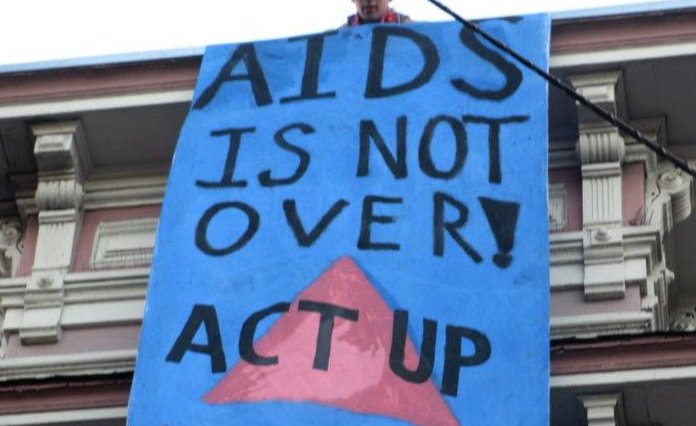
SFBG I’ve been hanging out recently with the new, young generation of ACT-UP activists who are transcending mere ’90s revival and undertaking a lot of energizing political discourse and action. Were you involved in the queer activist movement back then — or now? Would you characterize your musical project as a form of activism, especially in its more intellectual and challenging aspects?

DJ SPRINKLES That’s nice to hear. Although you use the term “action,” I assume the real interesting stuff has little to do with demos and “direct actions,” and more to do with communal education initiatives, etc.? My direct action days were mostly during the late ’80s and early ’90s, while living in New York. Most of those activities were in conjunction with various caucuses in ACT-UP, and WHAM! (Women’s Health Action & Mobilization).

I do consider my audio and other projects “political” — in theme, and also in their attempts to (dis)engage with standard industry practices. But clearly this is something different than direct action “activism” or community outreach, because my main social engagements are with people working for labels, distributors, music festivals, museums, and other culture industries. Maybe “culture jamming” is a better way to put this kind of political activity. Personally, I found myself distanced from direct action groups because the terms of identification they cultivated out of strategic necessity so often folded back into essentialisms that excluded me on a personal level. So I was always advocating for the recognition and acceptance of something other than myself (like the way “born this way” ideologies take over discussions of LGBT rights… I consider myself more “beat this way,” my queer identity being primarily informed by material ostracism and harassment than by some mythological self-actualization and pride). That, combined with the mid-’90s move away from direct action toward CBO’s (Community Based Organizations) — largely because the tactics of direct action had been so thoroughly coopted by mainstream media – was pretty much the end of my serious direct action involvements. Over the years, enunciating this process has become the core political act of my projects and activities. I do not do this to discourage people from forms of direct action, but as a simultaneous form of critical analysis that hopefully contributes in other ways to our various attempts to react to dominations.

SFBG Do you feel that, as the means of production and distribution have been more and more democratized in the past decade, house and techno music-making and DJing have been living up to their potential as a form of resistance to mainstream capitalism and culture, or do you feel they’ve become more homogenized and/or annexed by neoliberal, bourgeois culture?

DJ SPRINKLES I do not believe the means of production and distribution have become more democratized. I take issue with the way people always confuse “commercial accessibility” with “democratization.” The breadth and variation of today’s music production strategies is no more than a shopping mall diversity. We are all working with similar software on similar platforms. Mac, Windows, Unix… Banana Republic, Abercrombie & Fitch, The Gap… Having said that, if these musics had a potential, I believe it was lost back in the ’90s when anti-sampling legislation (mostly focusing on hip-hop) laid the groundwork for today’s electronic music. It basically reinvigorated house with “musicianship,” “authorship,” and all that crap which used to play far less of a role in this genre’s early days. And the younger generation – basically, today’s 20-somethings who grew up after the whole sampling debates — really don’t seem to understand how record label legal departments work.

So they list up all the samples they recognize in a track in the comment fields of music websites, which is putting the producers they wish to support at risk. There is no sense of how we can cultivate — let alone protect — “underground” media and information in this online era. Everything is about “sharing,” when in fact we need to be developing a parallel discourse around meaningful information distribution patterns, including strategically withholding information from the web. The cliché idea of making “everything accessible for everyone” is not only naîve, but negates the social and cultural specificities that give certain forms of media their alternative values, in particular collage and sampling. Anyone who has used a random image taken from a Google image search on their blog page, and then gotten an email from Getty Images’ legal department asking for back royalties, knows what I’m talking about. Treating subcultural musics as though they are meant for “everyone” — whether this is being done by fans, or the labels and online distributors themselves — is the biggest sign of people not understanding the media they are dealing with. And since all of that is SOP these days, it’s pretty much a sign that the sample-based genres of house is dead. Is talking about house’s political potential in 2013 really all that different than the trend of talking about the radical politics of ’60s rock during the ’80s?

http://www.youtube.com/watch?v=v4M3-t9lw7o

SFBG I feel like, with parties like Honey Soundsystem, there is a huge resurgence of interest in an underground queer dance music culture — a kind of new underground opposed to corporate or low-quality dance music (yet still taking place in corporate spaces). Is this phenomenon occurring in Japan as well? Do you feel there are specific possibilities with this, not just in terms of opportunity for queer DJs to travel but of transformation of queer discourse and politically actualizing a new generation?

DJ SPRINKLES Hey, low-quality is where it’s at. It’s what it’s all about. What was Chicago house if not low quality? It’s important to place value within the “low” in order to counter conventional associations between the terms “good,” “high quality” and “upper class.” I’m not talking about celebrating kitsch, or that kind of petit-bourgeois trivialization of the “low.” I’m talking about finding other values in the “low” that cannot find expression within a language developed to express everything in terms of “low vs. high.” This is ultimately about the identification of other values amidst class struggle.

I don’t think house resonates as a queer medium anymore. Those days are over. Today it is primarily a white, heterosexual, European phenomenon. That was the case early on. I mean, how many Americans became aware of house music in the ’80s by buying Chicago house sold back to us on UK compilations? The US has always treated its own history of electronic music like utter shit… The US is such a fucking rock’n’roll shithole. So I think for people to appreciate house music’s queer roots, and to actively invest in those themes today, requires people becoming deliberate and explicit about those interests. But whether that deliberate action would focus on “queer visibility” or not is another issue. It doesn’t have to focus on “visibility” — especially since visibility has become such an oppressive aspect of dominant LGBT movements. Explicitness can also be about closets. Not only the usual closets born of heterosexism, but less considered closets around sexuality and gender that have been formed by the actions of the “born this way” LGBT mainstream. Well, that’s the direction I try to take it… reflecting on, and constructing, queer and transgendered histories that are as skeptical of Pride[TM] as they are angry about violence. And I do believe, globally speaking, queer and transgendered experiences are much more informed by violence than pride. So this should be reflected in how and where we make noise. In my opinion, music that functions in completely standard ways – socially and economically – does not have much potential for reflecting queer or transgendered contexts in politically precise, helpful or meaningful ways. You end up with essentialist, humanist shit like Lady Gaga’s, “Born This Way.” She is not somebody I would consider an ally.

You know, American media is so fixated on the idea that sexuality and gender must either be biologically predetermined, or a personal choice. The “it’s not a choice” argument is a common theme in television shows, etc. Both of these options revolve around a fiction of free will. Like, if it’s not a choice, then the only other possibility must be some supra-social, biological reason that cannot be questioned. Both of these conclusions preserve the status quo brutality of how culture forces gender and sexual binaries upon us. The thought that our absence of choice might be rooted in social tyrannies – not biological predispositions – remains unthinkable. The mainstream has it half right when they say, “it’s not a choice,” but it’s a half-truth that has been twisted into a decoy from the real issues at hand – the inescapability of the hetero/homo and female/male paradigms. We are given no other choices through which to understand our genders and sexualities. Sexuality is far greater than two or three. The same goes for gender — and yes, I’m speaking biologically, human bodies are way more diverse than A or B. To argue that the reason you deserve rights under a humanist democratic system is because of genetics is a retreat into feudalist logic. It’s the same as an aristocrat arguing that their rights and privileges were deserved because of their family blood-line and DNA. “Born this way” is antithetical to any democratic argument for rights rooted in a social capacity for understanding and transformation. It is astounding that the majority of people cannot comprehend that any “born this way” argument is a complete obliteration of their social agency. “I can’t help it, so give me the same rights as you…” Fuck that. We shouldn’t be asking to participate in the rights and privileges of those who have oppressed us. We should be trying to divest those groups of privileges. That is the best way to help ourselves and minimize the violence we enact on others.

Humanist legislative practices are still rooted in feudal ideologies, and I am convinced the long-term repercussions of this is a cultural entrenchment that makes any democratic project (including US-brand democracy, socialism or communism) an impossibility. We can already see how the post-Cold War world is retreating into clan-based, privatized, anti-state organization structures. Capitalism is increasingly liberated of democratic agendas because — surprise! — capitalism works better with slavery. Capitalism is not about the distribution of wealth, and everyone’s equal chance to partake in a petit-bourgois lifestyle. It is about the isolation of wealth. There is no doubt in my mind that today’s moral insistence that all people must work at whatever job society throws them, and the accompanying presumption that all lower-class unemployed people are “lazy” (which is perpetuated by many lower-class peoples themselves), is an argument for slavery: forced labor in return for base subsistence at best. How is that not the reality of poverty under globalized capitalism?

…and that’s why I hate Lady Gaga. [Laughs.]

http://www.youtube.com/watch?v=y-JtoRxqK8s

SFBG You have some fascinatingly poetic thoughts about the intersection of transgender issues and immigration, the idea of “living as a ghost” in politicized and police-monitored spaces. Do you have any current thoughts on how globalization continues to affect transgender issues?

DJ SPRINKLES I think the fact that the world’s two largest economies around gender transitioning are in Thailand and Iran, yet the aesthetics of those economies follow largely western models of beauty and body, says a lot about how globalization affects transgendered issues. Thailand’s dominant transgendered culture revolves around the “Ladyboy” — a very essentialist transgendered model that is rooted in heterosexism and the cultural/ideological necessity for some men to “unbecome-man” in order for “straight men” to have sex with other men. Western transgendered discourses love to fetishize the “Ladyboy” as some kind of locally celebrated and accepted third-world transgendered native other, but this is patent orientalism. It refuses to envision how the strict regimentation of social codes for those transgendered people can be oppressive, or how the mythical “transgendered native’s special place at the edge of the village, possibly as a shaman” is a form of segregation. People also never address how such cultures are invariably patriarchies, and their models for transgenderism almost exclusively revolve around the MTF paradigm. And far as I know, Thailand has still not lifted their government prohibition on homosexual government employees, which is relatively new legislation passed just a few years back. This is all part of that context of transgendered production.

Meanwhile, Iran is a country where Islamic law prohibits homosexuality by fatwah. Since the ’70s, gender transitioning has been promoted as a way for men who have sex with men to avoid the death penalty, although many transitioned people still face the possibility of being murdered by their families or local communities. The cost of their procedures is partially subsidized by the Iranian government itself. While some Westerners have attempted to portray that as “progressive,” clearly it is the opposite. Many post-op transsexuals find themselves ghettoized, unemployed and cut off from the family structures that play such important roles in Iran’s social structure.

In both Thailand and Iran one can see how the global growth of gender-transitioning economies is connected to heterosexism and homophobia — something current Western gender analyses attempt to separate from gender transitioning through clear ideological divisions between gender and sexuality. While I believe these divisions between gender and sexuality are important and do have social value in the West, it is clear that the West is not the world. And the West has surely not overcome its heterosexism and homophobia, either. I believe it is more than coincidence that the global proliferation of gender transitioning technologies is happening parallel to medical industries’ attempts to divest of their previously blatant attempts to cure homosexuality, due to such methods falling out of cultural favor in the West and elsewhere. I also believe it is more than coincidence that today’s inescapable “born this way” arguments serve and justify today’s medical agendas so well.

For sure, my stance on medical transitioning has always been that I support peoples’ abilities to transform their bodies as they see necessary. Considering how few options for gender identification are offered to us, I can understand how a person can become no longer able to live within one’s body as it has been defined and shaped by social gender constraints. But, for obvious reasons, I am unable to believe those medical systems which propagated today’s gender binary are capable or willing to offer us a way out of our gender crises. Those industries move us further and further away from cultural environments that enable transgendered people to build medically unmediated relationships to our bodies. I just can’t accept that the medical industry’s methods for mediating our suffering are the only way. It really angers me… particularly since so many transgendered people are impoverished and without health care…

Hmm, you’re probably getting an idea as to why I am never invited to perform my more thematic projects in the US — just to DJ some house and go back home to Japan. [Laughs.]

SFBG Speaking of essentialism, ha: Any food or restaurants you miss from living here?

DJ SPRINKLES Mexican food…! It’s shockingly absent in Japan… and when you do find some, you generally wish you hadn’t. But what a weak note upon which to end this interview. [Laughs.]

Can we have cool new additions without gentrifying the Mission?

44

Do livability and gentrification go hand-in-hand? In other words, as you improve a neighborhood like the Valencia Street corridor with bike lanes, wide sidewalks, parklets, and other improvements that are part of the so-called “livability agenda,” does that necessarily drive up rents and force out the working class?

That was a contention made to me recently by owner of nightclubs and small business advocate Michael O’Connor, who has been critical of the Valencia Street improvement project and other initiatives supported by the group Livable City and its Executive Director Tom Radulovich. And it’s part of a larger discussion about whether neighborhoods pay a price for their own success.

O’Connor says the toll taken by livability projects is just too high in the form of rising rents and lost diversity, which is why he’s focused on Oakland for his latest business ventures. Radulovich understands the concern, but he says that safety measures like pedestrian-friendly design and lighting improvements shouldn’t be avoided simply because they make a neighborhood more attractive, and that the answer is making sure social justice and equity remain part of these political conversations.

Frankly, as a resident of the Mission, I had to admit O’Connor’s point that the Valencia Street Improvement Project – in combination with condo conversions, the latest dot-com boom (those dreaded Google-busers), and other upward pressures on cost of living – had the the effect of sterilizing and gentrifying that once-vibrant corridor.

Now, those who want to open cool new businesses in the area have turned to Mission Street, where the commercial rents are still reasonable but also rising, and there are some people wringing their hands about that now too. It’s sort of an economic development domino theory in reverse.

The Mission Local blog last month ran a post that mentioned my friend Illy McMahan’s groovy new store on Mission near 20th Street: Carousel SF, a consignment store featuring the stylishly re-purposed furniture, golden flea market finds, and the works of local artists (many from the Burning Man world, where McMahan met her business partner Kelley Wehman among the indie circus freaks of the Red Nose District).

The article presented that and other more upscale new Mission Street businesses – including Hi-Lo BBQ and Mission Oyster Bar – as spilling over from their “saturation” of Valencia Street, and some comments denigrated the “yuppie real estate developers” behind the trend and said, “Will the last Latino left in the Mission please turn off the lights on the way out.”

I understand the sentiment, but I’m still troubled by it in the same way that I am with O’Connor’s belief that livability improvements should be abandoned because they can gentrify an area. As I’ve argued before, it’s up to San Francisco’s political class to find a way to maintain the city’s affordability and diversity and balance that against its relentless economic development promotion.

After all, McMahan is a single mother of modest means, and the fact that she has an opportunity to start a business based on her sense of style and network of contacts with artists should be a good thing for San Francisco. She and Weham went through The Women’s Initiative training program to learn about operating a small business, getting a loan to open through its Working Solutions affiliate.

“Since 1988, Women’s Initiative has been assisting high-potential low-income women who dream of business ownership,” reads a description on its website, noting that 99 percent of participants are low-income women and 78 percent are women of color. Combine that with McMahan and Wehman’s artistic roots in the Burning Man world — and the need for artists to have outlets to sell their works here — and it’s hard to imagine a business that is more quintessentially San Francisco than this one.

“This store represents our take on aesthetics and our mutual love for all things previous and peculiar. It also gives us the opportunity to showcase the incredibly talented artist communities we’re fortunate to be a part of, while keep the pricing at an affordable level throughout the store,” McMahan says in a press release announcing the recent opening of Carousel SF.

Will this cool new business attract other ones near it? I’m sure they hope so. Will that begin to cause Mission Street to go the way of that parallel universe a block away on Valencia, with rising rents and the calls for livability improvements that inevitably follow? I sure hope not. But our challenge now is to facilitate the dreams of low-income women who strive to be small business owners while ensuring that they can remain welcome and stable in the neighborhoods that they’re helping to improve.

Is the trailer for ‘The Internship’ the most cringe-worthy of all time?

2

The answer is yes. “THE INTERNSHIP stars Owen Wilson and Vince Vaughn as salesmen whose careers have been torpedoed by the digital world. Trying to prove they are not obsolete, they defy the odds by talking their way into a coveted internship at Google.” Is this movie from 1998? Eeugh.

On the Cheap Listings

0

Submit items for the listings at listings@sfbg.com. For further information on how to submit items for listings, see Picks.

WEDNESDAY 13

“Art, Money Politics: Making it as an Artist” Pro Arts, 150 Frank H. Ogawa Plaza, Oakl. www.proartsgallery.org. 6pm, free. Supporting yourself as an artist can be hard. Head over to this panel discussion and get some advice from digital artist Camille Utterback, multimedia artist and designer Favianna Rodriguez, and muralist Eduardo Pineda. They’ll share tips on how to make a living in a creative field, bring your hope, dreams, and of course, questions.

“Waypost: Unconventional Travel Stories” Stanza Coffee Bar, 3126 16th St., SF. www.meetup.com/traveltalks. 7-8:30pm, free. A blacked-out Vegas weekend can be a good time but if you’re looking to go somewhere that stimulates a… different side of your spirit on your next vacation you might find the inspiration you’ve been looking for at this series of storytellers reflecting on the meaningful swirls of journeys they’ve taken. If you can’t make it to the event in person, no sweat — you can still participate via Google Hangout.

THURSDAY 14

One Billion Rising performance ritual Presbyterian Church, 2619 Broadway, Oakl. www.bayarearising.org. 7-8:30pm, $10-100 donation suggested. Free for youth under 17. Dedicate your Valentine’s Day to a good cause this year at this fundraiser for International Development Exchange (IDEX), an organization working to empower impoverished women across the globe. The evening will be a mix of spirituality, politics, and performances (flash mob, anyone?) from local groups such as Youth Speaks and Mission Dance Brigade.

Dogpatch Wine Works date night Dogpatch Wine Works, 2455 Third St., SF. www.dogpatchwineworks.com. 6-8pm, $40. Few things spell out romance quite like wine and chocolate. Stroll around Dogpatch Wine Works’ tasting room sipping on some vino and snacking on locally-crafted Recchiuti chocolate. After your palette is satisfied you can tour the 15,000-square foot working winery.

“Returning Cupid’s Fire” Cartoon Art Museum, 655 Mission, SF. www.cartoonart.org. 7-9pm, $10. Valentine-less and planning on having a night in with Ben and Jerry? Change of plans. San Francisco comedians Ivan Hernandez, Colleen Watson, and Mike Capozzola feel your pain and will be performing anti-Valentine’s Day themed stand-up routines tonight. Refreshments will be served.

Tout Sweet Pâtisserie tasting Tout Sweet Pâtisserie in Macy’s Union Square, 170 O’Farrell, third floor, SF. (415) 385-1679, www.toutsweetsf.com. 7-8:30pm, $55 per person. Reservations recommended. Yigit Pura, chef and owner of this sweet shop, is celebrating V-Day with a three-course dessert menu featuring a rotating selection of seasonal offerings, each paired with local artisanal wine and beer. If you already have some sweet Valentine’s Day plans don’t fret, Pura has more tastings scheduled for March 14 and April 11.

Hella Vegan Eats V-Day pop-up dinner Dear Mom, 2700 16th St., SF. www.dearmomsf.com. 5pm-midnight, free. The Oakland–based traveling food vendor will be in the city to once again take over Mission bar Dear Mom. We are hoping their doughnut burger with secret sauce will be on tonight’s menu <3 <3

Valentine’s Day at the Armory The Armory, 1800 Mission, SF. tickets.armorystudios.com. 7:30 and 9:30, $55. Start the evening off on the upper floor of the Kink.com porn palace, then head to a workshop led by porn starlet Rain DeGrey that focuses on teaching couples how to make fantasies reality. Afterward, enjoy specialty cocktails and aphrodisiac-themed appetizers at the luxe Armory Club across the street.

FRIDAY 15

SFIndieFest Roller Disco Party Women’s Building, 3543 18th St., SF. www.sfindie.com. 8pm-midnight, $10. Grab your striped socks and short-shorts because the ’70s are back tonight at this fundraiser for film festival organization SF IndieFest. If your skating skills are rusty, don’t sweat. Prizes will be awarded for best costumes, not for slickest moves.

46th California International Antiquarian Book Fair Concourse Exhibition Center, 635 Eighth St., SF. www.sfbookfair.com. Through February 17. 3-8pm, $25 for a weekend pass, $15 for a Saturday and Sunday pass. The world’s largest rare book fair returns to San Francisco this weekend. You will find one-of-a-kind pieces such as sketches by John Lennon, the first edition of the Federalist Papers, and a Mark Twain autographed manuscript. Before you try to snatch up a John Lennon original, be warned — treasures as fine as these can cost you a pretty penny (up to $362,000 to be exact).

SATURDAY 16

“Opera on Tap” Café Royale, 800 Post, SF. www.caferoyale-sf.com. 8pm, free. Nonprofit organization Opera on Tap wants to prove that opera can be awesome — and not just for those who can afford the cushiony box seats. In Café Royale’s intimate and relaxed space, this group will bust out some popular and some more esoteric pieces for an all-new kind of operatic experience.

Family Lunar New Year Celebration San Francisco Botanical Garden, SF. www.sfbotanicalgarden.org. 9-11:30am, free. In celebration of the Year of the Snake and the abundance of magnolias blooming in the gardens, lion and folk dancers will be performing today. While watching the SF Sunset Recreation Center Dance Troupe bust some moves you can pot a plant or make lanterns using magnolia petals.

SUNDAY 17

Urban bicycling workshop San Francisco Jewish Community Center, 3200 California, SF. www.sfbike.org. 10am-2pm, free. RSVP required. The San Francisco Bike Collation wants you to bike and bike safe — which is why it offers a range of course on everything from urban cycling to how to bike safely with your family. Today’s topic: traffic 101. Beginners welcome, and participants don’t need to bring a bike (though one may be helpful after the class when it comes to putting your newfound knowledge into action.)

TUESDAY 19

Literary salon with Rosie Schaap and Robin Ekiss Tosca Café, 242 Columbus, SF. www.toscacafesf.com. 7-8pm, $5-10 donation suggested. In Rosie Schaap’s memoir Drinking with Men she shares her unending quest for the perfect local haunt, which took her everywhere from LA to Dublin to Manhattan. Robin Ekiss writes the “Drink” column for the NY Times, and is the founder of the Ladies Liquor Union, the first fully female intemperance league for ladies who love books and booze. If you too consider yourself a cocktail connoisseur with a literary edge, head over Tosca Café to hear what the two have to say at this Litquake event.


Historic campaign for trans benefits kicks off

95

A group of LGBT labor activists is launching a nationwide campaign to push unions to bargain for transgender health benefits for their members.

Pride At Work, in collaboration with the Transgender Law Center, the National Center for Transgender Equality, and the SEIU Lavender Caucus, plans to ask labor groups, including local labor councils and state labor federations, to pledge to include trans benefits in future contract negotiations.

The effort is historic — and badly needed: Gabriel Haaland, co-chair of Pride At Work’s Transgender Caucus, estimated that fewer than 10 percent of all union contracts mandate health insurance benefits for transgender people.

The organizing effort will kick off in March with actions and educational programs in at least 10 cities.

Some unions already recognize the importance of the issue — SEIU, for example, endorsed the idea of including trans benefits at a recent national convention. And transgender employees of the 2.1 million-member union are covered.

But “we’re asking, how does that get implement at the local level, as a bargaining priority,” Haaland said.

A growing number of private-sector employers, including Google, Office Depot and Kaiser, cover a broad spectrum of care, including gender-reassignment surgery.

San Francisco made national headlines in 2001 when the city agreed to cover the health costs of transgender employees, and the right-wing nuts of the world went crazy. Headlines announced that the city’s taxpayers would soon be underwriting “sex-change operations.”

As a result, however, local health-care providers that contract with the city began to train their staff on trans sensitivity and began to develop protocols for treating trans patients.

In reality, most trans benefits are fairly inexpensive — hormone treatments, for example, are not terribly costly. And the very concept of organizing around trans issues and pushing benefits in union contracts can help bring a historically underserved and marginalized community into the political discussion.

“It’s just as it was in the past with gay and lesbian issues,” Haaland said. “A lot of people don’t even realize that they know trans people. And when trans workers realize that this is happening, it gets them more involved in their unions.”

Even in San Francisco, trans people face huge obstacles at work. A 2006 study by the Transgender Law Center and the Bay Guardian found that three out of four trans people in the city lack a full-time job — and more than 90 percent earn less than the area’s median income.

The organizing effort came out of a January, 2013 National Gay and Lesbian Task Force “Creating Change” conference in Atlanta, where Pride at Work members brought in transgender leaders from around the country for discussions on political issues and strategies. The issue of benefits was at the top of the list.

“Not just the issue but the process itself was historic,” Haaland said. “We went out and asked community leaders what they wanted, and this is where we ended up.”


Out of place

414

news@sfbg.com 

In his State of the City address last week, Mayor Ed Lee cheerfully characterized San Francisco as “the new gravitational center of Silicon Valley.” He touted tech-sector job creation. “We have truly become the innovation capital of the world,” Lee said, “home to 1,800 tech companies with more than 42,000 employees — and growing every day.”

From a purely economic standpoint, San Francisco is on a steady climb. But not all residents share the mayor’s rosy outlook. Shortly after Lee’s speech, renowned local author Rebecca Solnit published her own view of San Francisco’s condition in the London Review of Books. Zeroing in on the Google Bus as a symbol of the city’s housing affordability crisis, she linked the influx of high-salaried tech workers to soaring housing costs. With rents trending skyward, she pointed out, the dearth of affordable housing is escalating a shift in the city’s cultural fabric.

“All this is changing the character of what was once a great city of refuge for dissidents, queers, pacifists and experimentalists,” Solnit wrote. “It has become increasingly unaffordable over the past quarter-century, but still has a host of writers, artists, activists, environmentalists, eccentrics and others who don’t work sixty-hour weeks for corporations — though we may be a relic population.”

LIMITED OPTIONS

The issue of housing in San Francisco is highly emotional, and there is perhaps no greater flashpoint in the charged debate than Ellis Act evictions.

When the housing market bounces upward, Ellis Act evictions tend to hit long-term tenants whose monthly payments, protected by rent control, are a comparative bargain. Even if they’ve submitted every payment on time and upheld every lease obligation for 20 years, these renters can find themselves in the bind of being forced out.

And they don’t just lose their homes; often they lose their community. San Francisco has become so expensive that many Ellis Act victims are tossed out of this city for good.

Enacted in 1986, the state law allows a landlord to stop renting units, evict all tenants, and sell the building for another purpose. Originally construed as a way for landlords to “go out of business” and move into their properties, the Ellis Act instead gained notoriety as a driving force behind a wave of evictions that slammed San Francisco during the tech boom of the late 90s. Between 1986 and 1995, just 29 Ellis evictions were filed with the San Francisco Rent Board; in the 1999-2000 fiscal year alone, that number ballooned to a staggering 440.

Under the current tech heyday, there are indications that Ellis Act evictions are gaining fresh momentum. The San Francisco Rent Board recorded 81 this past fiscal year, more than double that of the previous year, and there appears to be an upward trend.

TIC CONTROVERSY

Buildings cleared via the Ellis Act are typically repackaged as tenancies-in-common (TIC), where several buyers jointly purchase a multi-unit residence and each occupy one unit. Realtors often market TICs as a path to homeownership for moderate-income individuals, creating an incentive for buyers to enter into risky, high-interest shared mortgages in hopes of later converting to condos with more attractive financing.

The divide between TIC owners and renters came into sharp focus at a contentious Jan. 28 hearing, when a Board of Supervisors committee met to consider legislation that would allow some 2,000 TIC units to immediately convert to condos without having to wait their turn in a requisite lottery system.

One TIC owner said he was financially burdened, but had only entered into the arrangement because “I wanted to stay here and raise my family, but we couldn’t afford a single family home.” Yet tenants brought their own set of concerns to the table, saying the temptation to create TICs was putting a major dent in the city’s finite stock of rent-controlled units — the single greatest source of affordable housing in San Francisco.

“My feeling is, let’s stop doing TICs,” Tommi Avicolli Mecca, a tenants right activist with the Housing Rights Committee, told the Guardian following the hearing. “The city has to just start making sure that the condos that are built are the kind of thing [TIC buyers] can afford. Instead, we cannibalize our rental stock? That’s a reasonable way? You evict one group of people to house another: How does that make sense?”

The grueling five-hour hearing illustrated the sad fact that San Franciscans in a slightly better economic position were being pitted against economically disadvantaged renters. The two groups were bitterly divided, and all seemed weary, furious, and frustrated by their housing situations.

The condo-conversion legislation, co-sponsored by Sups. Scott Wiener and Mark Farrell, did not move forward that day. Instead, Board President David Chiu made a motion to table the discussion until Feb. 25, to provide time for “an intensive negotiation process.” Chiu, who rents his home, added: “While I myself would like to become a homeowner someday … I do not support the legislation in its current form.”

Sup. Jane Kim sought to appeal to the tenants as well as the TIC owners. “It’s very tragic that we have set up a situation where [TICs and renters] are pitted against one another,” she said. She hinted at what a possible alternative to might look like. “We should be looking at a ban of scale,” she said. “If we allow 1,800 potential units to go thru this year, are we willing to do a freeze for the next 8 to 10 years?”

It’s unclear what will happen in the next few weeks, but if this legislation makes it back to the full board in some form, the swing votes are expected to be Sups. London Breed, Malia Cohen and Norman Yee.

CASH OR EVICTION?

New protections were enacted following the late-90s frenzy to discourage real-estate speculators from using the Ellis Act to turn a profit on the backs of vulnerable seniors or disabled tenants. Yet a new wave of investors has discovered they can persuade tenants to leave voluntarily, simply by offering buyouts while simultaneously wielding the threat of an Ellis Act eviction. “The process got more sophisticated,” explains San Francisco Rent Board Deputy Director Robert Collins.

Once a tenant has accepted a check in lieu of eviction, rent-controlled units can be converted to market rate, or refurbished and sold as pricey condos, without the legal hindrances of an eviction blemish. Buyouts aren’t recorded with the Rent Board, and the agency has no real guidance for residents faced with this particular dilemma. “We don’t have the true number on buyouts,” says Mecca. “We don’t know how many people have left due to intimidation.”

Identity-wise, renters impacted by the Ellis Act defy categorization. A contingent of monolingual Chinese residents rallied outside City Hall recently to oppose legislation they believed would give rise to evictions; in the Mission, many targeted tenants are Latinos who primarily speak Spanish. From working immigrants, to aging queer activists, to disabled seniors, to idealists banding together in collective houses, the affected tenants do have one thing in common. When landlords or real-estate speculators perceive that their homes are more valuable unoccupied, their lives are susceptible to being upended by forces beyond their control.

The upshot of San Francisco’s affordability crisis is a cultural blow for a city traditionally regarded as tolerant, forward thinking, and progressive. In the words of Rose Eger, a musician who faces an Ellis Act eviction from her apartment of 19 years, “it changes the face of who San Francisco is.

Out of the Castro

By Tim Redmond

You can’t get much more Castro than Jeremy Mykaels. The 62-year old moved to the neighborhood in the early 1970s, fleeing raids at gay bars in Denver. He played in a rock band, worked at the old Jaguar Books, watched the rise of Harvey Milk, saw the neighborhood transform and made it his home.

He’s lived in a modest apartment on Noe Street for 17 years, and for the past 11 has been living with AIDS. Rent control has made it possible for Mykaels, who survives on disability payments, to remain in this city, in his community, close to the doctors at Davis Hospital who, he believes, have saved his life.

And now he’s going to have to leave.

In the spring of 2011, his longtime landlords sold the building to a real-estate investment group based in Union City — and the new owners immediately sought to get rid of all the tenants. Two renters fled, knowing what was coming; Mykaels stuck around. In September of 2012, he was served with an eviction notice, filed under the state’s Ellis Act.

He’s a senior, he’s disabled, his friends are mostly dead and his life is in his community — but none of that matters. The Ellis Act has no exceptions.

Mykaels spent a fair amount of his life savings fixing up his place. The walls are beige, decorated with nice art. Dickens the cat, who is chocolate brown but looks black, wanders in and out of the small bedroom. Mykaels has been happy there and never wanted to leave; “this,” he told me, “is where I thought I would live the rest of my life.”

There’s no place in the Castro, or even the rest of the city, where he can afford to move. Small studios start at $2,500 a month, which would eat up all of his income. There is, quite literally, nowhere left for him to go.

“A lot of my friends have died, or moved to Palm Springs,” he said. “But this is where my doctors are and where I’m comfortable. I’m not going to find a support system like this anywhere else in the world.”

Mykaels is the face of San Francisco, 2013, a resident who is not part of the mayor’s grand vision for bringing development and high-paying jobs into the city. As far as City Hall is concerned, he’s collateral damage, someone whose life will have to be upended in the name of progress.

But Mykaels isn’t going easily. The former web designer has created a site — ellishurtsseniors.org — that lists not only his address (460 Noe) and the names of the new owners (Cuong Mai, William H. Young and John H. Du) but the addresses of dozens of other properties that are facing Ellis Act evictions. His message to potential buyers: Boycott.

“Do not buy properties where seniors or the disabled have been evicted for profit by real estate speculators using the Ellis Act,” the website states.

Mykaels is a demon researcher — his site is a guide to 31 properties with 94 units where seniors or disabled people are being evicted under the Ellis Act. In some cases, individuals or couples are filing the eviction papers, but at least 14 properties are owned by corporations or trusts.

Mai told me that he knew a disabled senior was living in the building when he and his two partners bought it, but he said his plan all along was to evict all the tenants and turn the three-unit place into a single-family house. He said he hasn’t decided yet whether to sell building; “I might decide to live there myself.” (Of course, if he wanted to live there himself, he wouldn’t need the Ellis Act.)

Mai said he “felt bad about the whole situation,” and he had offered to buy Mykaels out. The offer, however, wouldn’t have covered more than a few months of market rent anyplace else in the Castro.

By law, Mykaels can stay in his apartment until September. If he can’t stave off the eviction by then, San Francisco will lose another longtime member of the city community.


Dark days in the Inner Sunset

By Rebecca Bowe

The living room in Rose and Willie Eger’s Inner Sunset apartment is where Rose composes her songs and Willie unwinds after playing baseball in Golden Gate Park. Faded Beatles memorabilia and 45 records adorn the walls, and a prominently displayed poster of Jimi Hendrix looms above a row of guitar cases and an expansive record collection.

It’s a little worn and drafty, but the couple has called this 10th Ave. apartment home for 19 years. Now their lives are about to change. On Jan. 5, all the tenants in their eight-unit building received notice that an Ellis Act eviction proceeding had been filed against them.

“The music that I do is about social and political things,” explains Rose, dressed from head-to-toe in hot pink with a gray braid swinging down her back. Determined to derive inspiration from this whole eviction nightmare, she’s composing a song that plays with the phrase “tenants-in-common.”

Cindy Huff, the Egers’ upstairs neighbor, says she began worrying about the prospect of eviction when the property changed hands last summer. Realtor Elba Borgen, described as a “serial evictor” in online news stories because she’s used the Ellis Act to clear several other properties, purchased the apartment building last August, through a limited liability corporation. The notice of eviction landed in the mailbox less than six months later. (Borgen did not return Guardian calls seeking comment.)

“With the [average] rent being three times what most of us pay, there’s no way we can stay in the city,” Huff says. “The only option we would have is to move out of San Francisco.” She retired last year following a 33-year stint with UCSF’s human resources department. Now, facing the prospect of moving when she and her partner are on fixed incomes, she’s scouring job listings for part-time work.

The initial notice stated that every tenant had to vacate within 120 days, but several residents are working with advocates from the Housing Rights Committee in hopes of qualifying for extensions. Huff and the Egers are all in their fifties, but some tenants are seniors—including a 90-year-old Cuban woman who lives with her daughter, and has Alzheimer’s disease.

Willie works two days a week, and Rose is doing her best to get by with earnings from musical gigs. Both originally from New York City, they’ve lived in the city 35 years. When they first moved to the Sunset, it resembled something more like a working-class neighborhood, where families could raise kids. The recent tech boom has ushered in a transformation, one that Rose believes “changes the face of who San Francisco is.” Willie doesn’t mince words about the mess this eviction has landed them in. “I call it ‘Scam-Francisco,'” he says.

The trio recently joined tenant advocates in visiting Sup. Norman Yee, their district supervisor, to tell their stories. Yee, who is expected to be one of the swing votes on an upcoming debate about condo-conversion legislation vehemently opposed by tenant activists, reportedly listened politely but didn’t say much.

As for what the next few months have in store for the Egers? “I can’t really visualize the outcome,” Rose says. “I can only visualize the day-to-day fight. And that’s scary.”


Fighting for a home in the Mission

By Tim Redmond

Eleven years ago, Olga Pizarro fell in love with Ocean Beach. A native of Peru who was living in Canada, she visited the Bay Area, saw the water and decided she would never leave.

Fast forward to today and she’s built a home in the Mission, renting a small room in a basement flat on Folsom Street. The 55-year-old has lived in the building for eight years; polio has left her wearing a leg brace and she can’t climb stairs very well, but she still rides her bike to work at the Golden Gate Regional Center. She’s a sociologist by training; the walls in her room are lined with bookshelves, with hundreds of books in Spanish and English.

The place isn’t fancy, and it needs work, but it’s hard to find a ground-floor apartment in the Mission that’s affordable on a nonprofit worker’s salary. Since 2011, when she moved in, she and her three housemates have been protected by rent control. And Pizarro’s been happy; “I love the neighborhood,” she told me.

The letter warning of a pending eviction arrived Jan. 16. A new owner of the building wants to turn the place into tenancies in common and is prepared to throw everyone out under the Ellis Act. There’s no place else in town for Pizarro to go.

“I’ve looked and looked,” she said. “The cheapest places are $2,500 a month or more. Maybe I’ll have to move out of the city.”

Pizarro’s building is owned by Wai Ahead, LLC, a San Francisco partnership registered to Carol Wai and Sean Lundy. I couldn’t reach Wai or Lundy, but their attorney, Robert Sheppard, had plenty to say. “San Francisco is going the way of New York,” he told me. “Manhattan is full of co-ops that used to be rentals, and lower-income people are moving to Brooklyn and Queens. That’s happening here with Oakland and further out.” He argued that TICs, like co-ops, provide home-ownership opportunities for former renters.

Sheppard, who for years represented tenants in eviction cases, said the Ellis Act is law, and America is a capitalist country, and “as long as there is a private housing market, there will be shifts of people as the housing market shifts.” He agreed that it’s not good for lower-income people to lose their homes, but “the poor will always be hurt by a changing economy. It’s called evolution.”

Pizarro told me she’s shocked at how expensive housing has become in the Mission. “It’s gotten so gentrified,” she said. “People show up in their BMWs. It’s starting to feel very isolated.”

She’s fighting the eviction. “I didn’t intend it to be this way,” she explained. “I just want to live here.” Lacking any family in the area, the Mission has become her community — “and I’m frustrated by the violence of how expensive it is.”


Affordability goes out of style

By Rebecca Bowe

Hester Michael is a fashion designer, and her home doubles as a project space for creating patterns, sewing custom clothing, weaving cloth, and painting. She’s lived in her Outer Sunset two-bedroom unit for almost two decades, but now she faces an Ellis Act eviction. Michael says she initially received notice last June. The timing was awful -– that same month, her husband passed away after a long battle with terminal illness.

“I’ve been here 25 years. My friends are here, and my business. I don’t know where else to go, or what else to do,” she says. “I just couldn’t picture myself anywhere else.”

Michael rents the upstairs unit of a split single-family home, a kind of residence that normally isn’t protected by rent control. Yet she leased the property in 1994, getting in under the wire before that exemption took effect. Since she pays below-market-rate rent in a home that could be sold vacant for top dollar, a target was essentially inscribed on her back when the property changed hands in 2004. That’s about when her long battle with the landlords began, she says.

From the get-go, her landlords indicated that she should look for a new place, Michael says, yet she chose to remain. The years that followed brought things falling into disrepair, she says, and a string of events that caused her feel intimidated and to fear eviction. Finally, she consulted with tenant advocates and hired an attorney. A complaint filed in superior court alleges that the property owners “harassed and retaliated [Michael] when she complained about the defective and dangerous conditions …telling [her] to move out of the property if she did not like the dangerous conditions thereat … repeatedly making improper entries into [the] property, and wrongfully accusing [her] of causing problems.”

Records show that Angela Ng serves as attorney in fact for the property owner, Ringo Chung Wai Lee. Steven Adair MacDonald, an attorney who represents both landlords and tenants in San Francisco housing disputes, represents the owners. “An owner of a single family home where the rent is controlled and a fraction of market has virtually no other choice but to terminate the tenancy,” MacDonald said when the Guardian reached him by phone. “They’ve got to empty it, and the only way to empty it is the Ellis Act.”

While Michael received an extension that allows her to remain until June 5, she fears her custom sewing business, Hester’s Designs, will suffer if she has to move. There’s the issue of space. “I have so much stuff in this house,” she says. And most of her clients are currently located close by, so she doesn’t know where her business would come from if she had to relocate. “A lot of my clients don’t have cars,” she says, “so if I live in some suburb in the East Bay, forget it. I’ll lose my business.”

The prospect of eviction has created a major dilemma for Michael, who first moved to San Francisco in 1987. While moving to the East Bay seems untenable, she says renting in San Francisco feels out of reach. “People are renting out small, tiny bedrooms for the same price as I pay here,” she says. With a wry laugh, she adds: “I don’t think there’s any vacant apartments in San Francisco -– unless you’re a tech dude and make seven grand a month.”

Harmon’s way

0

arts@sfbg.com

THEATER Dan Harmon, performing at this year’s SF Sketchfest, is on the phone, talking about therapy. He’s explaining his belief that a person can find a mental illness for anything they can name, with some fetishistic examples. “There are people out there who like to be walked on,” the creator and former show runner of NBC’s Community says. “There’s people who like to eat human fecal matter. There’s people who want to have sex with kites.”

“Hold on, Dan. Are there really?” I ask, making a note to Google it later.

“I guarantee it. I promise you. There are six billion people in the world and there’s gotta be someone who wants to have sex with a kite. But I don’t know if you’d ever find someone that craves the feeling of being alone.”

We’re on the subject because of Harmontown, the comedy show-town hall meeting-podcast Harmon regularly holds in the back of an LA comic shop, based around “one day forming a colony of like-minded misfits.” Harmon’s about to take the show on a daunting cross-country tour, that will stop in SF for Sketchfest before returning to LA. It’s been eight months since Harmon was unceremoniously fired from the much-analyzed, but little-watched sitcom Community by Sony, and had a public feud with actor Chevy Chase that brought a TMZ level of public scrutiny. Subsequently, the Harmontown episodes have frequently taken on the air of a psychiatric session, with the audience filling an important role.

“The whole point of therapy is the therapist doesn’t particularly matter. You’re listening to yourself talk and I think some people are more comfortable talking to one guy holding a clipboard if they’re going to say ‘Hey, I put a Sharpie pen up my ass the other day, does that make me a pervert?’ I feel weirder saying that to one guy with a masters degree and a tiny office who doesn’t laugh than I do telling it to eight people in the back of a comic book store. It feels healthier to do the latter.”

Harmon doesn’t hold much back; after all, this is a guy that earlier in his career broke ground (and insert obvious pun here) with the self-explanatory “Laser Fart” web series for the no-budget, no restrictions, faux-TV network/film festival, Channel101.com (which he co-founded.) A performer only as a hobby, a “self-destructive writer” by trade, there’s no stand-up at Harmontown and ideally little planning. Instead, alcohol-enabled improv and tangents can lead to talking about being hit with a belt by his father, getting dangerously close to breaking up with frequent guest and girlfriend Erin McGathy on stage, or having Ricki Lake Show-styled heart-to-hearts with the audience.

It could be alienating, but Harmon’s uproarious logic, perspective, and self-awareness (an overabundance of which has caused his work to frequently be deemed “meta”) has gained him a following. “Where I tend to go,” says Harmon, “I tend to start asking the question ‘Am I a good person? Am I a good person?’ over and over again, and a kind of family forms around me. Or everyone else gets repelled.”

Channel101.com was at one time the focal point for this quasi-family. “It was like a barn raising, a church, something we did each month,” recalls Harmon. “We had a thing that we did and a belief system, and that was definitely something that I craved and wanted.” But as Community took over his life for three years, Harmon no longer could make the monthly films required, and moved into a fatherly rather than brotherly role.

Harmontown‘s filled that space, in a culty sort of way, with white-boy freestyle raps and live Dungeons and Dragons. The show tends to draw out bright millennials, eager Aspergians, and closeted creatives who find Harmon’s neuroses at least amusing but more often inspiring (also: nerds). It’s a mix that suit-wearing co-host Jeff B. Davis (Whose Line Is It Anyway?) best termed a “mutual anxiety association.” Harmontown isn’t meant for everybody. But that’s clearly by design. And as he hits the road with the show, Harmon’s looking for his people. 

HARMONTOWN

Jan. 31, 8pm, sold out

Punch Line Comedy Club

444 Battery, SF

www.sfsketchfest.com


Spies on the corner

23

rebecca@sfbg.com

In the Netherlands city of Eindhoven, the streetlights lining a central commercial strip will glow red if a storm is coming. It’s a subtle cue that harkens back to an old phrase about a red sky warning mariners that bad weather is on the way. The automated color change is possible because satellite weather data flows over a network to tiny processors installed inside the lampposts, which are linked by an integrated wireless system.

Lighting hues reflecting atmospheric changes are only the beginning of myriad functions these so-called “smart streetlights” can perform. Each light has something akin to a smartphone embedded inside of it, and the interconnected network of lights can be controlled by a central command center.

Since they have built-in flexibility for multiple adaptations, the systems can be programmed to serve a wide variety of purposes. Aside from merely illuminating public space, possible uses could include street surveillance with tiny cameras, monitoring pedestrian or vehicle traffic, or issuing emergency broadcasts via internal speaker systems.

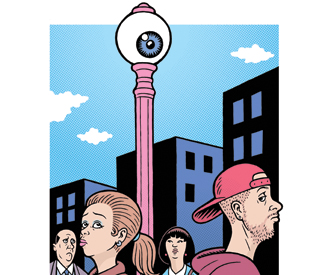
The smart streetlights aren’t just streetlights — they’re data collection devices that have the potential to track anything from pedestrian movements to vehicle license plate numbers. And, through a curious process distinctly lacking in transparency, these spylights are on their way to San Francisco.

BIG PLANS

On Minna between Fourth and Sixth streets in downtown San Francisco, the San Francisco Public Utilities Commission has installed a pilot project to test 14 streetlights that are connected by a wireless control system. The city agency plans to gauge how well this system can remotely read city-owned electric meters, wirelessly transmit data from tiny traffic cameras owned by the Municipal Transportation Agency, and transmit data from traffic signals.

The pilot grew out of San Francisco’s participation in an international program called the Living Labs Global Award, an annual contest that pairs technology vendors with officials representing 22 cities from around the world. At a May 2012 LLGA awards summit in Rio de Janeiro, far outside the scope of the city’s normal bidding processes, a Swiss company called Paradox Engineering won the right to start testing the high-tech lights in San Francisco. Within six months, Paradox Engineering and the SFPUC had the Minna streetlights test up and running.

Meanwhile, the city has issued a separate Request for Proposals for a similar pilot, which will test out “adaptive lighting” that can be dimmed or brightened in response to sensors that register pedestrian activity or traffic volume. The city is negotiating contracts with five firms that will test out this technology in three different locations, according to Mary Tienken, Project Manager for LED Streetlight Conversion Project for the SFPUC.

Under the program, five vendors will be chosen to demonstrate their wireless streetlights on 18 city-owned lights at three test sites: Washington Street between Lyon and Maple streets; Irving Street between 9th and 19th avenues; and Pine Street between Front and Stockton streets.

LED streetlights are energy-efficient and could yield big savings — but the lights do far more than shine. The RFP indicates that “future needs for the secure wireless transmission of data throughout the city” could include traffic monitoring, street surveillance, gunshot monitoring and street parking monitoring devices.

So far, the implications of using this technology for such wide-ranging objectives have barely been explored. “San Francisco thought they were upgrading their 18,000 lamps with LEDs and a wireless control system, when they realized that they were in fact laying the groundwork for the future intelligent public space,” LLGA cofounder Sascha Haselmeyer stated in an interview with Open Source Cities. “Eindhoven is pioneering this with … completely new, intelligent lighting concepts that adapt to the citizen not just as a utility, but a cultural and ambient experience. So many questions remain,” he added, and offered a key starting point: “Who owns all that data?”

LUMINARIES IN LIGHTING

Phillips Lighting, which was involved in installing the Eindhoven smart streetlights system, played a role in launching the San Francisco pilot. Paradox Engineering recently opened a local office. Oracle, a Silicon Valley tech giant, is also involved — even though it’s not a lighting company.

“Oracle, of course, manages data,” Haselmeyer explained to the Guardian when reached by phone in his Barcelona office. “They were the first to say, ‘We need to understand how data collected from lampposts will be controlled in the city.'”

According to a press release issued by Paradox Engineering, “Oracle will help managing and analyzing data coming from this ground-breaking system.” Oracle is also a corporate sponsor of the LLGA program. It has been tangentially involved in the pilot project “because of a longstanding relationship we had with the city of San Francisco,” Oracle spokesperson Scott Frendt told us.

Paradox was selected as the winner for San Francisco’s “sustainability challenge” through LLGA, which is now housed under CityMart.com, “a technology start-up offering a professional networking and market exchange platform,” according to the company website.

In May of 2012, the SFPUC sent one of its top-ranking officials, Assistant General Manager Barbara Hale, to Rio for the LLGA awards summit. There, technology vendors of all stripes showcased their products and mingled with local officials from Barcelona, Cape Town, Glasgow, Fukuoka and other international cities. San Francisco was the only US city in attendance. San Francisco will even host the next summit this coming May at Fort Mason.

In Rio, Paradox was lauded as the winning vendor for San Francisco’s LLGA streetlights “challenge.” It didn’t take long for the company to hit the ground running. “Soon after the Rio Summit on Service Innovation in Cities, where we were announced winners for San Francisco, we started discussing with the SFPUC the objectives and features of the pilot project,” Paradox announced on the LLGA website. “Working closely with the SFPUC, we also had the opportunity to build solid partnerships with notable industry players such as Philips Lighting and Oracle.”

WINNERS’ CIRCLE

On Nov. 15, Paradox hosted an invite-only “networking gala” titled “Smart Cities: The Making Of.” The event brought together representatives from Oracle, the SFPUC, Phillips, LLGA, and the Mayor’s Office of Civic Innovation, “to learn about the challenges of urban sustainability in the Internet of Things era,” according to an event announcement.

“The project we’re piloting with the SFPUC is highly innovative since it puts into practice the new paradigm of the ‘Internet of Things,’ where any object can be associated with an IP address and integrated into a wider network to transmit and receive relevant information,” Gianni Minetti, president and CEO at Paradox, stated in a press release.

The event was also meant to celebrate Paradox’s expansion into the North American urban lighting space, a feat that was greatly helped along by the LLGA endeavor. But how did a Swiss company manage to hook up with a San Francisco city agency in the first place — and win a deal without ever going through the normal procurement process?

San Francisco’s involvement in LLGA began with Chris Vein, who served as the city’s Chief Technology Officer under former Mayor Gavin Newsom. (Vein has since ascended to the federal government to serve as Deputy U.S. Chief Technology Officer for Government Innovation for President Barack Obama.)

To find the right fit for San Francisco’s wireless LED streetlights “challenge” under the LLGA program, a judging panel was convened to score more than 50 applicant submissions received through the program framework. Judges were selected “based upon knowledge and contacts of people in the SFPUC Power Enterprise,” Tienken explained. The scoring system, Haselmeyer said, measures sustainability under a rubric developed by the United Nations.

Jurists for San Francisco’s streetlight program were handpicked from the SFPUC, the San Francisco Department of Technology, Phillips, and several other organizations. An international jurist is designated by LLGA for each city’s panel of jurists, Haselmeyer said, “so as to avoid any kind of local stitch-up.”

He stressed that “the city is explicitly not committing to any procurement.” Instead, vendors agree to test out their technology in exchange for cities’ dedication of public space and other resources. Tienken, who manages the city’s LED Streetlight Conversion Project, noted that “Paradox Engineering is not supposed to make a profit” under the LLGA program guidelines. “We’ll pay them a $15,000 stipend,” she said, the same amount that will be awarded to the firms that are now in negotiation for pilot projects of their own.

“San Francisco is using this to learn about the solution,” Haselmeyer added. “This company will not have any advantage,” when it comes time to tap a vendor for the agency’s long-term goal of upgrading 18,500 of its existing streetlights with energy-saving LED lamps and installing a $2 million control system.

At the same time, the program clearly creates an inside track — and past LLGA participants have landed lucrative city contracts. Socrata, a Seattle-based company, was selected as a LLGA winner in 2011 and invited to run a pilot project before being tapped to power data.SFgov.org, the “next-generation, cloud-based San Francisco Open Data site” unveiled by Mayor Ed Lee’s office in March of 2012.

The mayor’s press release, which claimed that the system “underscores the Mayor’s commitment to providing state of the art access to information,” made no mention of LLGA.

PRIVACY AND PUBLIC SPACE

Throughout this process of attending an international summit in Rio, studying applications from more than 50 vendors, selecting Paradox as a winner, and later issuing an RFP, a very basic question has apparently gone unaddressed. Is a system of lighting fixtures that persistently collects data and beams it across invisible networks something San Franciscans really want to be installed in public space?

And, if these systems are ultimately used for street surveillance or traffic monitoring and constantly collecting data, who will have access to that information, and what will it be used for? Haselmeyer acknowledged that the implementation of such a system should move forward with transparency and a sensitivity to privacy implications.

“Many cities are deploying sensors that detect the Bluetooth signal of your mobile phone. So, they can basically track movements through the city,” Haselmeyer explained. “Like anything with technology, there’s a huge amount of opportunity and also a number of questions. … You have movement sensors, traffic sensors, or the color [of a light] might change” based on a behavior or condition. “There’s an issue about who can opt in, or opt out, of what.”

Tienken and Sheehan downplayed the RFP’s reference to “street surveillance” as a potential use of the wireless LED systems, and stressed that the pilot projects are only being used to study a narrow list of features. “The PUC’s interest is in creating an infrastructure that can be used by multiple agencies or entities … having a single system rather than have each department install its own system,” Tienken said. The SFPUC is getting the word out about the next batch of pilots by reaching out to police precinct captains and asking them to announce it in their newsletters, since “streetlighting is a public safety issue,” as Tienken put it.

Haselmeyer acknowledged that public input in such a program is important: “It’s very important to do these pilot projects, because it allows those community voices to be heard. In the end, the city has to say, look — is it really worth all of this, or do we just want to turn our lights on and off?”

LIGHTS, BUT NO SUNSHINE

One company that is particularly interested in San Francisco pilot is IntelliStreets, a Michigan firm that specializes in smart streetlights. IntelliStreets CEO Ron Harwood told the Guardian that his company was a contender for the pilot through LLGA; he even traveled to Rio and delivered a panel talk on urban lighting systems alongside Hale and a representative from Oracle.

A quick Google search for IntelliStreets shows that the company has attracted the attention of activists who are worried that these lighting products represent a kind of spy tool, and a spooky public monitoring system that would strip citizens of their right to privacy and bolster law enforcement activities.

“It’s not a listening device,” Harwood told the Guardian, when asked about speakers that would let operators communicate with pedestrians, and vice-versa. “So you can forget about the Fourth Amendment” issues.

Harwood seemed less concerned about the activists who’ve decried his product as a modern day manifestation of Big Brother, and more worried about why his company was not chosen to provide wireless LED streetlights in San Francisco. After being passed over in the LLGA process, Harwood said IntelliStreets responded to the RFP issued in the weeks following the Rio summit. Once again, Harwood’s firm didn’t make the cut.

Since his company provides very similar services to those described in the RFP, Harwood said he was “confused” by the outcome of the selection process. IntelliStreets’ Chief Administration Officer Michael Tardif was more direct. “Clearly we think this was an inside deal,” Tardif told the Guardian. Tienken, for her part, declined to discuss why San Francisco had rejected IntelliStreets’ application.

And when a public records request was submitted to the agency last August for details on San Francisco’s participation in LLGA, the response was opaque at best. “After a duly diligent search we find that there are no documents responsive to your request,” an SFPUC public records coordinator responded via email. “The San Francisco Public Utilities Commission is not a participant, nor is involved with Living Labs Global Award. Please know that we take our obligations under the Sunshine Ordinance very seriously.” That was just an honest mistake, Sheehan tells the Guardian now by way of explanation. In the public records division, “Clearly, nobody had any familiarity with LLGA.”

Jerrry Brown and UC

34

So the guv is going to start showing up at UC and CSU board meetings, where he will be able to sit next to his pal Gavin Newsom. And he’s going to tell the administrators that they have to start getting serious about cost-cutting — as if they haven’t whacked billions out of their budgets in the past few years.

I’m with Jerry on one thing: The Number One, absolute, top priority of the institutions of higher education in this state has to be avoiding hikes in tuition and fees. In fact, I’d put a five-year moratorium on anything that would increase costs for students. It’s already too expensive to go to a state school, middle-class parents are getting priced out, and kids are graduating with so much debt that they’re financially paralyzed for years.

The promise of an affordable, quality college education that Jerry’s dad created in this state is gone, and it’s not coming back until the price of a four-year degree comes back into synch with what Californians can pay. (Yes: UC is still a huge bargain compared to private schools. But you can go to college in Canada for half the price of UC, even if you’re an American. If you’re a Canadian citizen, you can go to really great colleges for almost nothing. That’s the way California used to be.

And no question: There’s bloat at UC. Administrators make too much money. I refuse to believe that you have to pay such giant salaries to attract people who can run the schools.

But that’s a small part of the overall UC and CSU budget. And Brown has to understand that higher education isn’t like most businesses. The productivity increases that corporate America (and that many other parts of state government) have seen in the digital era don’t translate directly to colleges. A company can lay off lots of staff that did things like answer phones and replace them with (annoying) voice-mail robots, and accountants can work faster and machines can make cars better than (expensive) labor forces did. But it still takes one full human being to teach English Lit, and he or she can still only teach a certain number of students, and grade a certain number of papers. And if all the smartest physicists and electrical engineers want to go to work for Oracle or Google, you have to pay more to get them to get a few to pursue careers in academia.

Brown’s proposal seems to be online classes, which would allow one prof to reach thousands of students, without anyone showing up in a classroom. Nice idea, but teaching isn’t just giving a lecture. Sure, some classes work fine on the web, but a lot don’t and never will.

Seriously, guv: Would you rather have this bloody fight that could damage your dad’s enduring legacy, or go along with an oil severance tax?


Live Shots: Death Grips at Slim’s

0

When I first saw Sacramento’s Death Grips — about a year or so ago at 1015 Folsom — they had to work especially hard. The room was half full and Stefan Burnett made up the difference, jumping down into the crowd and taunting it into action. The intervening time before a repeat performance was longer than expected (Death Grips suddenly canceled their last scheduled tour to finish their second album of the year) and at Slim’s Monday the crowd seemed prewound, eager to see the sold-out show, jockeying for position near the front, and admiring freshly purchased t-shirts showcasing the attention-baiting cover art for No Love Deep Web.

“This is a dick,” said one guy who looked older than he sounded. “It’s actually a dude’s dick. And I know whose it is.” For the uninitiated (or at work – don’t Google it), the cover is a photo of drummer Zach Hill’s erection, on which the title is scrawled with a Sharpie marker. The guy finished his observation by pointing to the part of the shaft nearest to the testicles and saying, “That’s like, the grossest part.”

Death Grips came on about two hours later, launching into No Love album opener “Come Up and Get Me,” and I didn’t last particularly long up front. Burnett released a lyrical tide of amped aggression, the feeling of being backed into a corner too many times, and the crowds answered in kind. A wave of people swelled across the pit and I ended up beneath half a dozen other people, desperately attempting to hold onto a shoe, a camera, and my default unflappable expression. But clearly I’d been flapped, and having spent a long time between sets staring at the vertical gashes on the wrists of the 15-year-old cutter in front of me, was fairly relieved to head to the back of the room as the band went into “Little Boy.”

Three albums in, I would still describe my interest in Death Grips’s brand of angst-ridden hybrid punk-rap as morbid curiosity. “Ruthless and free, it’s all suicide to me,” Stefan intoned on “Black Dice,” with the same sense of nihlism that elsewhere says “Fuck this world, fuck this body.” Since the only time I cut myself was slicing a grapefruit with a dull knife, the lyrical nihilism only goes so far. But that doesn’t diminish Death Grips as a live band. Burnett, Hill, and a backing production track layer feed into each other, forming a feedback loop of hype.

When “Guillotine” – the best song off their first album – came on, it was instantly recognizable from the clicking hi-hat that continually rides through the song. The programmed hi-hat is one of the band’s most constant features, freeing up Hill to go wild with complicated syncopated snare beats over his doubling kicks. His kit was little more than a three piece setup, and while the broken assortment of cymbals from his Hella days were noticeably absent, he bought the same furious intensity, rising out of his chair and smashing down onto the snare for full intensity.

The production track set the pace for the night. It was nonstop, peaking with “I’ve Seen Footage.” From the band’s other, slightly neglected album this year, The Money Store, the song showcases the playful variety that’s beneath the the Death Grips’ borderline single minded thematics. When the ’80s guitar riff, played out over a sped up “Push It” beat came on, a few people in the back ran forward, clearly wanting to get in on the action.

The end of the set snuck up on me. Burnett spoke for the first time outside of a song: “Thank you,” he said, and walked off. Maybe sensing that Death Grips isn’t much of an encore band — or just exhausted — the room began to file out. But one guy stood by the bar, holding a beer in is hand and noticeably not clapping. “That’s it?” he asked his friends, more of a statement than a question. “That was only a 30-minute set. That’s some bullshit.” A line from “Lock Your Doors” is stuck in my head: “I’ve got some shit to say, just for the fuck of it. Don’t even ask me.”

Opener: “Life is real, life is real,” Cities Aviv said over and over, pacing the stage as a DJ modulated some noise on a laptop, with just the hint of a beat behind the noise. As it went on, puzzled over what I was seeing and hearing, more like a performance art piece than what was billed (probably at this point more for convenience than anything else) as a hip-hop show.

Distracted, I hardly noticed building bass until I was struck by the Memphis performer dropping off the stage next to me, signaling a slam of the audience.“It’s not that I’m anywhere,” Cities Aviv continued to say in his set, toying with contradictions and asking, “Are you real or a simulation?” Could have asked him the same thing.

Sharing the sun

1

news@sfbg.com

Dan Rosen, the co-founder of Solar Mosaic, told us there was an ironic note to the devastation that Hurricane Sandy recently brought to New York City. The same power grid that helps create such fierce hurricanes through the burning of fossil fuels was unable to distribute power to thousands of homes, in mostly low-income neighborhoods, for weeks in the wake of storm.

Sandy brought to the forefront a huge energy challenge: how to move over to renewable energy fast enough to avoid catastrophic climate change and the killer storms in generates, build more efficient and reliable grids, and ensure that everyone can equitably participate in the new renewable energy economy. Bay Area energy entrepreneurs such as Rosen are working on innovative energy models that address those issues.

So far, the solar debate has mostly been between proponents of personal solar projects such as residential rooftop installations, also known as distributed generation, and those who back industrial-scale projects in far away plains and deserts.

But Rosen and other entrepreneurs are championing a middle route: They propose vastly increasing the prevalence of large solar power arrays and other renewable power plants close to where the energy is consumed, and opening up creative new ways for more people to buy into those projects.

This kind of approach to energy has the potential to democratize power production, avoid costly and environmentally unsound transmissions lines, and prevent utilities from monopolizing renewable energy.


CROWD FUNDING SOLAR

One of the barriers to the proliferation of solar is the relatively high upfront cost of purchasing and installing the panels. But with the rising costs of fossil fuel and the government incentives around renewable energy, investments in solar infrastructure can pay off big.

Bloomberg New Energy Finance crunched the numbers and according to a report that came out in June, large solar projects may soon pay a 5-9 percent return on investment. Big financial institutions and other corporate players have taken note of these figures and potential for profit they represent.

For example, Google has invested almost $1 billion in renewable energy that it plans to sell into the grid, including opening a $75 million fund for residential rooftop solar this past September. The problem is that big lenders are only looking for large-scale solar deals in order to cover their costs.

Enter Rosen and Solar Mosaic, who are coming up with a way to harness the power of crowds to fund the local and decentralized projects that big financial institutions tend to overlook. Solar Mosaic specializes in raising seed capital for solar projects by collecting many small investments into one pool.

That idea won Solar Mosaic a $2 million grant from the Department of Energy’s SunShot Initiative, and attracted $3.5 million in venture capital.

“Our job — not just as Mosaic, but as society — is to make sure that the next energy economy has participation and ownership from millions of people and communities around the world,” Rosen said. “Crowd funding is really the beginning of a broader movement to democratize and distribute capital — enabling people to invest in projects they otherwise wouldn’t have had access to.”

This vision proved itself initially with a successful Kickstarter-like crowd funding platform that facilitated the development of five solar projects with the participation of more than 400 small investors and over $350,000 raised. The money went to fund solar panel installations on the roofs of community organizations in California and Arizona, including People’s Grocery in Oakland.

But there’s a catch. As the law currently stands, Solar Mosaic, or any company engaged in crowd funding, cannot offer any interest on the money invested by small online contributors. Since there is only a limited pool of people who believe in an energy revolution enough to shell out money for free, these examples are not entirely replicable. “We chose to start with those ones because they have very strong constituencies and we were using more a philanthropic model,” Rosen said.

The new model the company is developing is “getting people who are not necessarily just environmentalists invested in the clean energy economy,” Rosen said. “I want people who are like, ‘Oh, cool, I can make [a decent return] if I invest in this,’ and that gets more stakeholders than Sierra Club members. Let’s have millions of stakeholders with skin in the game.”

So how to move forward? The controversial federal Jumpstart Our Business Startups (JOBS) Act passed in April by Congress included a much-trumpeted crowd funding provision. The bill charged the Securities and Exchange Commission with the responsibility of putting meat on the legislation’s skeleton.

The SEC has until the Dec. 31 deadline to come up a set of rules allowing start-ups to gather small investments from ordinary people online while still offering provisions to protect the public from fraud. Many are skeptical that the SEC will complete the rule-writing process by the end of year.

Impatient to wait for the SEC and unsure whether the provisions will be practical for their purposes, Solar Mosaic is following a different path. It is using the funds raised already to pay for a lengthy and expensive filing with the SEC to upgrade its financial status.

Rosen said he couldn’t discuss details, but he said the new status should grant Solar Mosaic some leeway on offering financial returns to a wider variety of investors.


ENERGY IN THE CLOUD

Investment opportunities in local solar projects may be a good way to get people financially involved in clean energy but what about Californians who simply wish to purchase renewable energy for their homes or business?

California leads the country in rooftop solar installation, much to the credit of two programs: rebates that offset the cost of the panels through the California Solar Initiative and a program that allows those who own a rooftop with solar panels to offset their utility bills with credit from the energy they produce. California Public Utilities Commission statistics indicate these programs are largely responsible for some 1,379 megawatts of solar that have been installed in California at 131,874 different sites; about as much energy as one large nuclear reactor.

There has been record growth in adoption of solar by homeowners in the past two years, according to the CPUC, including a 364 percent jump in low income areas in since 2007. Yet that’s a far shot from the goal of 12,000 megawatts of local clean energy by 2020 called for by Gov. Jerry Brown in July.

Californians who do not have savings or a high credit score or who have shaded roofs usually can’t participate in the state’s renewable energy programs. But the most significant obstacle to increased participation is that only homeowners are eligible, while renters must contend with whatever power they can get from their utility. In a city like San Francisco, where almost two-third of residents rents, that is the overwhelming majority of citizens.

One solution that would circumvent the property-owning restrictions is allowing people to subscribe to solar gardens and other renewable energy facilities in their area and receive the same credit on their utility bill for their share of energy delivered to the grid. Decoupling where energy is made from who is able to buy it “allows everyone to participate, it makes it so it doesn’t matter if you are rich or poor, the only thing that matters that you have a utility bill,” said Tom Price of CleanPath, a solar project investment firm.

California Senate Bill 843, introduced by Sen. Lois Wolk (D-Davis) and coauthored by Price, attempted to create the legal framework for this kind of virtual transaction. Over the summer, it died in the Assembly Committee on Utilities and Commerce as result of late session lobbying by Pacific Gas & Electric and Southern California Edison. Notably, the state’s other largest utility, San Diego Gas and Electric, supported SB843. Also supporting the bill was a wide and diverse coalition ranging from the US Department of Defense to the Ella Baker Center for Human Rights. Wolk plans to reintroduce SB843 in the next legislative session.

Price and other supporters see the bill’s eventual passage as inevitability: “In an age when so many transaction are virtual [and] we can put so many parts of our lives in the cloud, why can’t we put energy in the cloud and let people virtually subscribe to it? From the grid’s perspective, there is no difference.”


COOPERATIVE ENERGY

Democratizing the green energy industry is about allowing everyone to participate easily, but it is also about empowering those who are typically left out of the conversation.

Low-income and marginalized communities are often the ones most impacted by the environmental and health effects of burning fossils fuels. As the green energy revolution expands, those same communities will potentially be last in line to benefit from or exert influence over the transformation.

Considering that solar can be small scale and still financially sound in the long term, “there is an opportunity to rebuild the energy infrastructure…from the grassroots,” said Shiva Patel who co-founded Energy Solidarity Cooperative. Patel and his partner Dave Ron want to set up multi-stakeholder cooperatives that promote ownership and decision-making by consumers.

In a low-income neighborhood, residents are most likely tenants with little leverage and no eligibility for California’s renewable energy incentives. The cooperative model suggests residents can pool space, financial resources, and labor to become players in small-scale power production.

Normally, consumers considered downstream along the energy supply chain do not have the financial or political means to make decisions about the energy their communities use. “We are flipping that on its head,” said Ron “We want those people to be upstream. We are taking a very horizontal approach.

The nuts and bolts of the coop’s structure may be new, but the distinction between those who own and control the community power project and those who finance it is important. There are three types of members in the cooperative: consumers, workers, and community investors. The consumers initiate the community power project and then maintain ownership of it. They contribute labor and money toward the project according to their ability. The workers are a group of energy experts organized into a collective that provide support and advice for the project. Decisions about the coop and its projects are left to the consumers and workers. Community investors are drawn to the project by crowd funding, but financial support does not buy them a decision making role. Once the upfront costs of the project are paid back to the community investors, consumers can keep the revenue or use it to foster more community power projects.

One source of inspiration for the duo is Co-op Power based in Boston, which has more than 150 full-time green jobs with living wages, spawning 10 businesses in the decade since its founding.

“We had a large number of people trying to solve the puzzle of how communities could come together and create sustainable energy models,” said President and CEO Lynn Benander. “It’s the brain child of many people.”

Man for the moment?

25

steve@sfbg.com

This year’s supervisorial race in District 5 — representing the Haight, Panhandle, and Western Addition, some of the most reliably progressive precincts in the city — has been frustrating for local leftists. But as the long and turbulent campaign enters its final week, some are speculating that John Rizzo, whose politics are solid and campaign lackluster, could be well-positioned to capitalize on this strange political moment.

Appointed incumbent Sup. Christina Olague has been a disappointment to some of her longtime progressive allies, although she’s now enjoying a resurgence of support on the left in the wake of her vote to reinstate Sheriff Ross Mirkarimi. Now two allies of the mayor — tech titan Ron Conway and landlord Thomas Coates — are funding a $120,000 last-minute attack on Olague.

The campaign of one-time left favorite Julian Davis lost most of its progressive supporters following his recent mishandling of accusations of bad behavior toward women (see “Julian Davis should drop out,” 10/16).

The biggest fear among progressive leaders is that London Breed, a well-funded moderate candidate being strongly supported by real estate and other powerful interests, will win the race and tip the Board of Supervisors to the right. The final leg of the campaign could be nasty battle between Breed and Olague and their supporters, who tend to see it as a two-person race at this point.

But in a divisive political climate fed by the Mirkarimi and Davis scandals and the unprecedented flood of hundreds of thousands of dollars in real estate and tech money, it’s hard to say what D5 voters will do, particularly given the unpredictably of how they will use ranked-choice voting to sort through this mess.

Running just behind these three tarnished and targeted candidates in terms of money and endorsements are Rizzo and small business person Thea Selby, who described their candidacies as “the grown-ups in the room, so there’s an opportunity there and I’m hopeful.”

Selby hasn’t held elective office and doesn’t have same name-recognition and progressive history as Rizzo, although she has one of the Guardian’s endorsements. It probably didn’t help win progressive confidence when the downtown-backed Alliance for Jobs and Sustainable Growth recently did an independent expenditure on behalf of both Selby and Breed.

And then there’s Rizzo, who has been like the tortoise in this race, quietly spending his days on the streets meeting voters. Between fundraising and public financing, Rizzo collected about $65,000 as of Oct. 20 (compared to Breed’s nearly $250,000), but he’s been smart and frugal with it and has almost $20,000 in the bank for the final stretch, more than either Olague or Davis.

But perhaps more important than money or retail politics, if indeed D5 voters continue their strongly progressive voting trends, are two key facts: Rizzo is the most clear and consistent longtime progressive activist in the race — and he’s a nice, dependable guy who lacks the oversized ego of many of this city’s leaders.

“I see consistency there and a lack of drama,” Assembly member Tom Ammiano, an early Rizzo endorser, told us. “He’s looking not like a flip-flopper, not like he owes anyone, and he doesn’t have a storied past.”


PROGRESSIVE HISTORY

Rizzo, who was born in New York City 54 years ago, is downright boring by San Francisco standards, particularly given his long history in a local progressive movement known for producing fiery warriors like Chris Daly, shrewd strategists like Aaron Peskin, colorful commenters like Ammiano, bohemian thinkers like Matt Gonzalez, and flawed idealists like Ross Mirkarimi.

Rizzo is a soft-spoken family man who has lived in the same building on Waller Street in the Haight-Ashbury for the last 27 years. Originally, he and Christine, his wife of 25 years, rented their apartment in a tenancy-in-common building before they bought it in the early 1990s, although he’s quick to add, “In all the years we’ve owned it, we never applied for condoship.”

He supports the city’s limits on condo conversions as important to protecting working-class housing, although he said, “The focus should be on building new affordable housing.” That’s an issue Rizzo has worked on since joining the Sierra Club’s San Francisco Bay Chapter more than 20 years ago, an early advocate for broadening the chapter’s view of environmentalism.

He’s a Muni rider who hasn’t owned a car since 1987.

Michelle Myers, director of the Sierra Club’s San Francisco Bay Chapter, said Rizzo brings a wealth of experience, established relationships, and shrewd judgment to his role as the group’s political chair. “We really rely on John’s ability to weigh what is politically feasible, not just what’s ideal in our minds,” she told us.

Yet that political realism shouldn’t be confused for a lack of willingness to fight for big, important goals. Rizzo has been an advocate for public power in San Francisco for many years, strategizing with then-Sup. Ammiano in 2001 to implement a community choice aggregation program, efforts that led to this year’s historic passage of the CleanPowerSF program (with a key vote of support by Olague) over the objections of Mayor Lee and some business leaders.

“CleanPowerSF was carried by John Rizzo, who has been working on that issue for 10 years,” Myers said.

Rizzo is a technology writer, working for prospering computer magazines in the 1990s “until they all went away with the dot.com bubble,” as well as books (his 14th book, Mountain Lion Server for Dummies, comes out soon).

He sees the “positives and the negatives” of the last tech boom and this one, focusing on solving problems like the Google and Genetech buses blocking traffic or Muni bus stops. “On the one hand, these people aren’t driving, but on the other hand, they’re unregulated and using our bus stops,” he said. “We need to find some solution to accommodate them. Charge them for it, but accommodate them.”

That’s typical of how Rizzo approaches issues, wanting to work with people to find solutions. As president of the City College of San Francisco Board of Trustees, Rizzo suffered the bad timing of the district having its accreditation threatened just as his supervisorial race was getting underway, but he’s steadily worked through the administrative problems that predated his tenure, starting with the criminal antics of former Chancellor Phil Day and continuing with “a management structure still in place, and it had calcified.”

Despite being on the campaign trail, Rizzo called the trustees together six times in August to deal with the accreditation problems. “We now have a plan that shows all the things the district needs to do to keep it afloat. City College is back on track.”


WEAKNESS BECOMES STRENGTH

Eileen Hansen — a longtime progressive activist, former D8 supervisorial candidate, and former Ethics Commissioner — gave her early endorsement to Rizzo, who never really seemed to catch fire. “There hasn’t been a lot of flash and I would love for there to be more energy,” she admitted.

So, like many progressive leaders, she later offered her endorsement to Davis, believing he had the energy needed to win the race. But after Davis’ problems, Hansen withdrew that endorsement and sees Rizzo as the antidote to its problems.

“We are in such a mess in D5, and I’m hoping they will say, ‘enough already, let’s find someone who’s just good on the issues, and that’s John,” Hansen said. “As a progressive, if you look at his stands over many years, I’d be hard-pressed to find an issue I don’t agree with him on. He’s a consistent, strong progressive voice, someone you can count on who’s not aligned with some power base.”

Other prominent progressive leaders agree.

“What some people may have viewed as his weak point may end up being his strength,” said former Board President Aaron Peskin, who endorsed Rizzo after the problems surfaced with Davis. “A calm, steady, cool, collected, dispassionate progressive may actually be the right thing for this moment.”

Sup. Malia Cohen, a likable candidate who rose from fourth place on election night to win a heated District 10 supervisorial race two years ago, is a testament to how ranked-choice voting opens up lots of new possibilities.

“Ranked choice voting defies conventional wisdom,” Peskin said. “There may be Julian Davis supporters and Christina Olague supporters and London Breed supporters who all place John Rizzo as their second.”

In fact, during our endorsement interviews and in a number of debates and campaign events, nearly every candidate in the race mentioned Rizzo as a good second choice.

Yet Rizzo doesn’t mince words when he talks about the need for reconstitute the progressive movement after the deceptions and big-money interests that brought Mayor Lee and “his fake age of civility” to power. Lee promised not to seek a full term “and he broke the deal,” Rizzo said. “And it was a public deal he broke, not some backroom deal.” 

That betrayal and the money-driven politics that Lee ushered in, combined with the divisive political climate that Lee’s long effort to remove Mirkarimi from office created, has deeply damaged the city’s political system. “I think the climate is very bad It’s bad for progressives, and just bad for politics because it’s turning voters off,” Rizzo said.

He wants to find ways to empower average San Franciscans and get them engaged with helping shape the city’s future.

“We need a new strategy. We need to regroup and think about things long and hard. I think it’s not working here. We’re doing the same things and it’s not working out. The money is winning.” He doesn’t think the answers lie in continued conflict, or with any individual politicians “because people are flawed, everyone is,” Rizzo said.

Yet Rizzo’s main flaw in the rough-and-tumble world of political campaigns may be that he’s too nice, too reluctant to toot his horn or beat his chest. “That kind of style is not me. That aggressive person is not who I am,” Rizzo said. “But I think voters like that. Voters do want someone who is going to focus on policy and not themselves.”

Can tech be funny? Baratunde Thurston thinks so

0

Baratunde Thurston has probably racked up more frequent flyer miles in the past year than you or me can hope to log in our lifetimes. Just in the last month, the author, comedian, former digital director of The Onion, founder of comedy startup Cultivated Wit, and Brooklyn resident has made trips to Boston, Detroit, Chicago, Dublin, and London. He’s stopped in Maine, Oregon, Boston, Washington DC, and Puerto Rico on the November itinerary. Clearly, his attempts to bring levity to our tech-saturated culture are resonating outside Silicon Valley. 

This week SF will be on his schedule – he’ll be hosting an event on Sat/3 at Public Works.

2012 has been a banner year for this Renaissance man. In February Thurston released the NYT bestseller How to be Black, a work that doubles as an instruction manual on the nuanced aspects of black life in professional and social realms and as a memoir of his adolescent years growing up with a pan-African single mother, in a neighborhood he describes in the book as “just like The Wire. We had the drug dealing, the police brutality, the murders. Well, it was almost a perfect match. We had everything The Wire had except for universal critical acclaim and the undying love of white people who saw it”

>>CHECK OUT BARATUNDE THURSTON NOW ON REDDIT’S “ASK ME ANYTHING” FORUM 

On a Skype call from his hotel room in London with the Guardian, Thurston remarks that in the time since the book’s release, his own “views on blackness have hardened and become much more staunch.” 

He fondly recalls the wide variety of positive reactions the book has elicited from its readers. He says that among black readers, his chapters on being a racial minority in private school and the workplace – not to mention the tribulations of having an unique name (Baratunde comes from the Yoruba Nigerian name Babatunde) have been especially resonant and validating.

The book has also hit home with non-black readers. On a plane ride from New York to Los Angeles, a Colombian woman overheard Thurston discussing the book and asked to borrow a copy. Before the flight even landed, she had already finished the book, and filled in Thurston on her own experience of being a fair-skinned Colombian. 

In another encounter, a white man from a black neighborhood in Chicago was prompted by reading the book to share with Thurston his epiphany of when he realized he was not black. His friends decided to form a rap group and said he wasn’t allowed to rap. Instead, he was designated as the manager.

As for whether or not this book can actually make you black? Thurston reports that he has not heard of any such transformation.

In the past couple months; the central focus of Thurston’s professional life has been shifting from HTBB to his digital humor lab Cultivated Wit, which he launched last June with fellow Onion alums Brian Janosch and Craig Cannon. Cultivated Wit’s raison d’etre is to infuse humor into Silicon Valley. His reasoning behind this move should be clear. Outside of the occasional Google home page gimmick, tech companies aren’t well known for their ace sense of humor.

Cultivated Wit acts as a consulting firm: it aims to help tech companies produce comedy-tinged marketing and outreach operations – sometimes remixing the conventional hack day by adding standup comedy, creating the hybrid “comedy hack day.” The company plans on releasing a torrent of comedic apps “with the aim to push the envelope on where comedy can happen and also on the types of interactions and personality an app can and should have,” says Thurston.

He’s never lived here, but Thurston says he has deep connections to SF and the tech scene, which should prove crucial now that he’s got his own startup. He starred in an episode of Popular Science’s Future of Everything on the Discovery Channel that was filmed in Berkeley, SF, and Palo Alto. He’s been known to do standup at the Punchline.

And as Cultivated Wit continues to expand and go on the hunt for VC cash, Thurston has recognized the expanding role the Bay Area plays in his professional life. 

“The future should be architected not just by engineers but by art as well. So the Bay is essential for us,” he says.

Such is Thurston’s appreciation for the Bay, he’s throwing a How to be Black reading this Saturday at Public Works to go along with the paperback release of his book. Attendees can pay $5 to attend the pre-reading whiskey hour, where you’ll score a free signed copy of HTBB and meet the whiskey-loving author (fyi, Thurston’s is partial to Whiskey Thieves when drinking in the city.) 

Comedians Kevin Camia and Denae Hannah will join the lineup that night for two-and-a-half hours of standup comedy, readings, and a Q&A session. Just don’t queue up to ask Thurston if he plans on writing How to be a Black Best-Selling Author – we did it for you. Thurston’s response: “I plan on living that, but I don’t necessarily plan on documenting that in book format.”

How To Be Black #paperblack book release

with Kevin Camia and Denae Hannah

Sat/3, 3:30-7pm, $20-25

Public Works

161 Erie, SF

www.publicsf.com

Girl on wall

5

caitlin@sfbg.com

STREET SEEN Welcome welcome, friends, to my new column. You’ll wanna check back here for Bay Area style — clothes, weed, art, sex, y’know. But this week, international women’s studies: a Puerto Rican street artist on domestic violence, in her home town.

It may have been the moment of my recent trip to check out San Juan’s first street art festival.

Artist Sofia Maldonado was teaching no less than four high school females how to properly shade the middle fingers extending from two painted yellow fists. Lunchtime traffic whizzes past Maldonado’s mural in San Juan’s Santurce neighborhood, site of the 12-plus walls that would be painted as part of the week-long Los Muros Hablan. Small, wandering packs of street art fans stopped by intermittently, snapping photos, talking among themselves.

The 28-year old Maldonado’s mural is pretty dreamy for anyone overdosed on commercial, overly-testosteroned street art. It addresses domestic violence in Puerto Rico, showing a bashed-but-not-beaten beauty and those fists, which — once properly shaded — were lettered with “basta ya/enough already.” The work’s not soft, despite the bright colors she used to paint it.

Days earlier, when the moderator at a panel discussion at San Juan’s contemporary art museum that was part of the Los Muros Hablan programming asked the all-male panel of artists (Maldonado was south, painting a commission in the town of Ponce) to weigh in on female muralists, one responded that he was in favor. “They’re sexy,” he said, to a hearty laugh from the audience.

The domestic violence mural wasn’t the greatest piece of artwork that was created in San Juan that week. But then, Maldonado had a different intention than many of her male peers at Los Muros Hablan.

“Nowadays, I feel like doing murals is how to give back to the community.” It’s the afternoon and Maldonado and I are eating at a cafe a few blocks from her wall. “Especially for girls in Puerto Rico, it’s important to have a strong female representation.”

Maldonado grew up in San Juan, going to the same art school down the street that her eager assistants attend. She started painting walls with brushes when, inspired by the vivid street art on walls in France and Spain, she tired of the dull color palette available in aerosol on the island. She rolled with the boys, mainly. A few of them, from her San Juan crew, are painting alongside her at Los Muros Hablan.

After high school, she moved to New York City, got her MFA, found artistic success inside the studio too. She’s on the board of Cre8tive YouTH*nk, an organization that facilitates art projects that encourage critical thinking in at-risk youth. The week after Puerto Rico, she was at the Bronx Museum, doing a mural with the help of New York kids.

She’s the only female who had a wall at the festival. She’s also the only artist whose work is currently taking up an entire floor at the contemporary art museum. “She’s one of the best-known women these days, not only in urban art, but in visual art in Puerto Rico,” said Elizabeth Barreto, another San Juan street artist who painted in Los Muros Hablan’s all-female live painting and DJ event.

Along the museum’s open-air hallways, Maldonado’s controversial renderings of bra-less, heavily accessorized women of color are displayed. Google search “Sofia Maldonado 42nd Street mural” for the blowback she incurred when she erected them in Times Square. Maldonado tells me that the hurt the figures dredged up among people of color says more than the piece itself.

Her new canvas work also bears the language of graffiti, the strokes, the characters. But as a medium — her work’s not really about “getting up” anymore. She hasn’t rejected the bold artistic mark that you have to have if you paint in the streets, but you get a sense that Maldonado knows that audacity’s a tool, a microphone you use, not an end in itself.

She won’t really stand for all my editorializing. Actually, she kind of wanted me to shut up about her being a female role model. Her feminism is hard to describe in a 745-word article.

“You have to know it’s a male’s world, like any other profession,” she tells me, shrugging off all my questions about her take on the street art gender divide. “You gotta be strong.”

But one can’t help but read into her focus when it comes to education. “I don’t feel like I’m representing,” she concludes. “But I do feel like I need to set an example.”