Economy

No security

3

rebeccab@sfbg.com

To qualify for his job as a security officer, Jerry Longoria had to obtain a license, undergo a background check, and take a drug test. He’s required to wear a suit to work. He’s stationed at a downtown San Francisco high rise that houses Deloitte, a multinational consulting, finance, and real-estate firm that reported $31.3 billion in revenues last year. His employer is Universal Protection Services, a nationwide security contractor with a slick online marketing pitch emphasizing that all guards are “electronically supervised around the clock,” and “kept accountable on the job through our 24-hour command center.”

If an intruder showed up at his office building brandishing a firearm, it would be Longoria’s problem; that’s the job. Nevertheless, he says he doesn’t earn enough to cover rent for an apartment in San Francisco. Instead, he stays in a single room occupancy hotel near Sixth and Mission streets, an area known for a high rate of violent crime. Walking home still wearing the suit makes him stand out on the street.

He’s lived in the 150-unit building, which has shared bathrooms and a shared basement-level kitchen, for 11 years. “It’s affordable for me, and it allows me to be closer to work,” he explains. He can’t afford a car, and says a public transit delay could prove disastrous if he relocated outside the city. “If you’re late to your post, you get fired.”

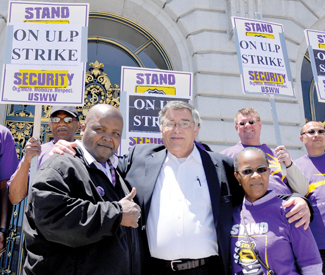
At press time, about 7,000 security officers throughout the Bay Area and Los Angeles were gearing up for a strike that could begin any day. Members of United Service Workers West, affiliated with Service Employees International Union, authorized their bargaining committee to call for the work stoppage because officers have been without a contract since the end of 2012.

The starting wage for a security officer is $14 an hour in the city, which comes to slightly more than $29,000 a year before taxes. In some places that would be sufficient to meet basic needs. In San Francisco, where the median market rate on rental units recently peaked above $3,000 a month, it doesn’t go very far. “With the cost of living here in San Francisco, $14 an hour is simply not enough to make ends meet,” Kevin O’Donnell, a USWW spokesperson, told us.

The security officers’ threats to strike coincided with a second worker action in the Bay Area last week. Despite lacking any form of union representation, Walmart associates from stores in Richmond, Fremont, and San Leandro affiliated with the nationwide organization OUR Walmart joined 100 employees from across the country in walking off the job and caravanning to Bentonville, Arkansas to raise awareness about their poverty-level wages and insufficient benefits at Walmart’s annual shareholders’ meeting. But first, they paid a visit to the Four Seasons in downtown San Francisco, which houses the 38th floor penthouse apartment of Yahoo CEO Marissa Mayer, a Walmart director.

Despite seeking full-time working opportunities and staying with the company for years, a handful of associates we interviewed said they can’t earn enough at Walmart to cover basic needs, so they rely on government assistance or help from extended family to make ends meet. Some said they had witnessed their coworkers get fired after participating in OUR Walmart activities.

Walmart associates in the Bay Area are in a considerably more precarious situation than the security officers, earning lower hourly wages. But in the pricey Bay Area, security officers, Walmart employees, and scores of other low-wage private sector workers all share something in common. Despite reporting to work every day and working long hours in many cases, they’re forced into impoverished conditions due to economic circumstances, while a middle-class existence remains far out of reach.

FIGHTING FOR STABILITY

ABM Security and Universal Protection Services are the largest employers in the private security contractor industry; in the Bay Area, the majority of guards are stationed at office buildings in downtown San Francisco. On May 30, Supervisors John Avalos, David Campos, David Chiu, Jane Kim and Scott Wiener all voiced support for the guards at a rally outside City Hall. “Better working conditions for security officers mean more stable, family-supporting jobs, less turnover, and more ability to handle challenges at work,” Avalos said.

Matt Roberts has been working as a security officer for years, and originally moved into his unit in a San Francisco SRO in a financial pinch. “I figured, I’ll get out of this rut eventually. And here I am, seven years later, still paying $1,000 a month for a space that’s really not much bigger than a walk-in closet,” he told us. Roberts was terminated recently, and believes it’s because he spoke up to his site director about workplace issues his fellow guards felt needed to be addressed.

In Roberts’ view, the situation he’s found himself in is reflective of the broader erosion of the middle class, which is particularly acute in an area with a soaring cost of living. He was born and raised in San Francisco’s Crocker Amazon district, with a father who worked as a firefighter and a mother who worked as a clerk typist at the Cow Palace.

“They were able to achieve the American dream,” he said. “They had a house, they paid their mortgage off in 25 years, they were able to send me and all my three siblings to good schools. I realized when I was still in my 20s that I’m probably going to be a renter the rest of my life. The American dream is totally eclipsing my generation.”

Keven Adams, a security officer of 23 years who lives in Oakland, also attended the City Hall rally on May 30. “We’re fighting for wages, health care, and stability in the workplace,” Adams said. “We’re in a city we love so very much, but the community and the middle class is shrinking.” Adams said he was once held at gunpoint for four hours during a work shift. He’d love to live in San Francisco, he said, but can’t afford it.

According to a June 3 media advisory, unions throughout the Bay Area were preparing to demonstrate support for the security officers as they geared up to strike. “The support could come in the form of workers attending rallies, non-violent civil disobedience or perhaps even non-security workers refusing to cross picket lines,” according to USWW, “and walking off their own jobs in solidarity.”

‘STAND UP, LIVE BETTER’

Among the small group of protesters who had assembled on the sidewalk far below Mayer’s San Francisco penthouse on May 29 were associates who had taken the drastic and unusual step of going on strike from Walmart — the nation’s largest private employer. Clad in bright green shirts and waving signs, they chanted, “stand up, live better,” a play on Walmart’s slogan, and also, “What do we want? Respect.”

Dominic Ware, who works part-time at a Walmart in San Leandro, led chants and sounded off on a megaphone about the need for greater respect in the workplace. Ware, who’s been involved with OUR Walmart activities on a national level, said he earns $8.65 an hour and stays with his grandmother, since his paycheck isn’t enough to cover rent. He estimated that roughly half his earnings go directly back to Wal-Mart, where he purchases groceries and other basic items. Asked what motivated him to strike, Ware mentioned his daughter, who turned eight on June 1. “What if she has to work there some day?”

He added that some elderly colleagues were experiencing problems such as being unable to get a shift changed so as to catch a bus home at the end of the night. Another one of his coworkers was let go after it became clear to management that he was participating in OUR Walmart activities, Ware said.

While only a tiny fraction of Walmart’s 1.4 million workers took action to strike, their campaign appears to resonate in high places. A report recently released by the Democratic staff of the U.S. House Committee on Education and the Workforce seized on Walmart’s low wages, emphasizing that so many of its workers are forced to turn to government assistance that it is resulting in a collective drag on taxpayers.

“Rising income inequality and wage stagnation threaten the future of America’s middle class,” the report notes. “While corporate profits break records, the share of national income going to workers’ wages has reached record lows. Walmart plays a leading role in this story. Its business model has long relied upon strictly controlled labor costs: low wages, inconsiderable benefits and aggressive avoidance of collective bargaining with its employees. As the largest private-sector employer in the U.S., Wal-Mart’s business model exerts considerable downward pressure on wages throughout the retail sector and the broader economy.”

The impending death of American conservatism

55

Gallup released a poll May 24th with some remarkable new data. American liberalism–long thought to be dead and gone and receeding into New Deal memory–is ascendant. 

According to Gallup, 30% of Americans consider themselves social liberals, an all time high. And only 41% of Americans consider themselves economically conservative, an all time low.

Think about the implications of these amazing numbers for a moment. The term “liberal” has been spat out with nothing but contempt by not just right-leaning pundits, but by Republican party apparatchiks for 30 some years at least. Democrats, the “liberal” party, have run away from the tag like it was contaminated with MRSA. Which means that self-proclaimed “moderates” are very likely to be liberal as well, especially on economic issues.

What the poll doesn’t say is why this is. The reasons for the underlying shift. Some are obvious ones–the economy is improving under what is presumed to be a “liberal” presidency, which makes “liberal” synonymous with success. The other likely cause is that as the nation becomes less white, it becomes more liberal. For all the presumed conservatism of Latinos, polls have shown them to be far less conservative on economic and social issues than whites.

But I think those are ephemeral at best. The two real reasons are that in the last 35 years, virtually every Neo-con/neo-liberal/Ayn Rand-esque/Heritage Foundation idea has been tried out and all of them have failed spectacularly. Supply side economics, tried in 1981 and 2001 respectively, turned out to be an unmitigated disaster. “Pre-emptive war” was waged in Iraq with a nightmarish result. ” A two front war” was waged in the last decade, how did that work out? And the deregulation of the banks via Gramm/Leach/Bliley is the proximate cause of 2008’s worldwide meltdown. Odd thing is, the same economic ideas were ruinous in the 1920’s and if Erwin Rommel or Alfred Jodl were alive today, they could tell you how well a two front war works out. That’s reason #1  

Reason #2 has been discussed here already.

With every demographic and logical trend working against them, the American “conservative” will get shriller, louder and like petulant children, dig in their heels that much more. To our detriment as a people, of course, but since when has the well being of the nation ever mattered to them anyway?

Planning for displacement

70

tredmond@sfbg.com

The intersection of Cesar Chavez and Evans Avenue is a good enough place to start. Face south.

Behind you is Potrero Hill, once a working-class neighborhood (and still home to a public housing project) where homes now sell for way more than a million dollars and rents are out of control. In front, down the hill, is one of the last remaining industrial areas in San Francisco.

Go straight along Evans and you find printing plants, an auto-wrecking yard, and light manufacturing, including a shop that makes flagpoles. Take a right instead on Toland, past the Bonanza restaurant, and you wander through auto-glass repair, lumber yards, plumbing suppliers, warehouses, the city’s produce market — places that the city Planning Department refers to at Production, Distribution, and Repair facilities. Places that still offer blue-collar employment. There aren’t many left anywhere in San Francisco, and it’s amazing that this district has survived.

Cruise around for a while and you’ll see a neighborhood with high home-ownership rates — and high levels of foreclosures. Bayview Hunters Point is home to much of the city’s dwindling African American population, a growing number of Asians, and much higher unemployment rates than the rest of the city.

Now pull up the website of the Association of Bay Area Governments, a well-funded regional planning agency that is working on a state-mandated blueprint for future growth. There’s a map on the site that identifies “priority development area” — in planning lingo, PDAs — places that ABAG, and many believers in so-called smart growth, see as the center of a much-more dense San Francisco, filled with nearly 100,000 more homes and 190,000 new jobs.

Guess what? You’re right in the middle of it.

The southeastern part of the city — along with many of the eastern neighborhoods — is ground zero for massive, radical changes. And it’s not just Bayview Hunters Point; in fact, there’s a great swath of the city, from Chinatown/North Beach to Candlestick Park, where regional planners say there’s space for new apartments and condos, new offices, new communities.

It’s a bold vision, laid out in an airy document called the Plan Bay Area — and it’s about to clash with the facts on the ground. Namely, that there are already people living and working in the path of the new development.

And there’s a high risk that many of them will be displaced; collateral damage in the latest transformation of San Francisco.

CLIMATE CHANGE AND “SMART GROWTH”

The threat of global climate change hasn’t convinced the governor or the state Legislature to raise gas taxes, impose an oil-severance tax, or redirect money from highways to transit. But it’s driven Sacramento to mandate that regional planners find ways to reduce greenhouse gas emissions in California cities.

The bill that lays this out, SB375, mandates that ABAG, and its equivalents in the Los Angeles Basin, the Central Coast, the Central Valley and other areas, set up “Sustainable Communities Strategies” — land-use plans for now through 2040 intended to reduce greenhouse gas emissions by 15 percent.

The main path to that goal: Make sure that most of the 1.1 million people projected to live in the Bay Area by 2040 be housed in already developed areas, near transit and jobs, to avoid the suburban sprawl that leads to long commutes and vast amounts of car exhaust.

The notion of smart growth — also referred to as urban infill — has been around for years, embraced by a certain type of environmentalist, particularly those concerned with protecting open space. But now, it has the force of law.

And while ABAG is not a secret government with black helicopters that can force cities to do its will — land-use planning is still under local jurisdiction in this state — the agency is partnering with the Metropolitan Transportation Commission, which controls hundreds of millions of dollars in state and federal transportation money. And together, they can offer strong incentives for cities to get in line.

Over in Contra Costa and Marin counties, at hearings on the plan, Tea Party types (yes, they appear to exist in Marin) railed against the notion of elite bureaucrats forcing the wealthy enclaves of single-family homes to accept more density (and, gasp, possibly some affordable housing). In San Francisco, it’s the progressives, the transit activists, and the affordable housing people who are starting to get worried. Because there’s been almost zero media attention to the plan, and what it prescribes for San Francisco is alarming — and strangely nonsensical.

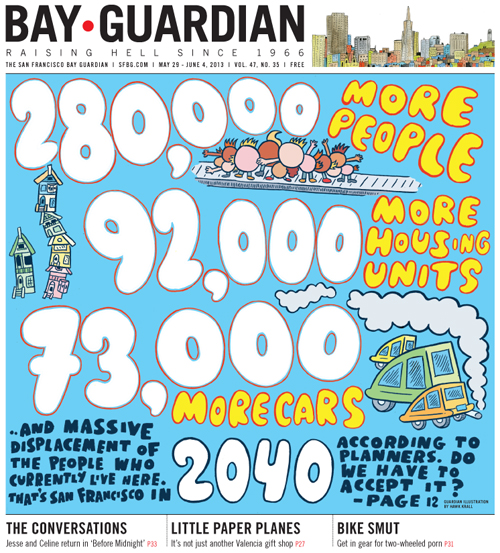
Under the ABAG plan, San Francisco would approve 92,400 more housing units for 280,000 more people. The city would host 190,000 more jobs, many of them in what’s called the “knowledge economy,” which mostly means high tech. Second and third on the list: Health and education, and tourism.

The city currently allows around eight cars for every 10 housing units; as few as five in a few neighborhoods, at least 10 in many others. And there’s nothing in any city or regional plan right now that seeks to change that level of car dependency. In fact, the regional planners think that single-occupancy car travel will be the mode of choice for 48 percent of all trips by 2040 — almost the same as it is today.

And since most of the new housing will be aimed at wealthier people, who are more likely to own cars and avoid catching buses, San Francisco could be looking for ways to fit 73,000 more cars onto streets that are already, in many cases, maxed out. There will be, quite literally, no place to park. And congestion in the region, the planners agree, will get a whole lot worse.

That seems to undermine the main intent of the plan: Transit-oriented development only works if you discourage cars. In a sense, the car-use projections are an admission of failure, undermining the intent of the entire project.

The vast majority of the housing that will be built will be too expensive for much of the existing (and even future) workforce and will do little to relieve the pressure on lower income people. But there is nothing whatsoever in the plan to ensure that there’s money available to build housing that meets the needs of most San Franciscans.

Instead, the planners acknowledge that 36 percent of existing low-income people will be at risk for displacement. That would be a profound change in the demographics of San Francisco.

Of course, adding all those people and jobs will put immense pressure on city services, from Muni to police, fire, and schools — not to mention the sewer system, which already floods and dumps untreated waste into the Bay when there’s heavy rain. Everyone involved acknowledged those costs, which could run into the billions of dollars. There is nothing anywhere in any of the planning documents addressing the question of who will pay for it.

THE NUMBERS GAME

Projecting the future of a region isn’t easy. Job and population growth isn’t a straight line, at best — and when you’re looking at a 25-year window in a boom-and-bust area with everything from earthquakes to sea-level rise factoring in, it’s easy to say that anyone who claims to know what’s going to happen in 2040 is guessing.

But as economist Stephen Levy, who did the regional projections for ABAG, pointed out to us, “You have to be able to plan.” And you can’t plan if you don’t at least think about what you’re planning for.

Levy runs the Center for the Continuing Study of the California Economy, and he’s been watching trends in this state for years. He agrees that some of his science is, by nature, dismal: “Nobody projects deep recessions,” much less natural disasters. But overall, he told me, it’s possible to get a grip on what planners need to prepare for as they write the next chapter of the Bay Area’s future.

And what they have to plan for is a lot more people.

Levy said he started with the federal government’s projections for population growth in the United States, which include births and deaths, immigration, and out-migration, using historic trends to allocate some of that growth to the Bay Area. There’s what appears at first to be circular logic involved: The feds (and most economists) project that job growth nationally will be driven by population — that is, the more people live in the US, the more jobs there will be.

Population growth in a specific region, on the other hand, is driven by jobs — that is, the more jobs you have in the Bay Area, the more people will move here.

“Jobs in the US depend on how many people are in the labor force,” he said. “Jobs in the Bay Area depend on our share of US jobs and population depends on relative job growth.”

Make sense? No matter — over the years it’s generally worked. And once you project the number of people and jobs expected in the Bay Area, you can start looking at how much housing it’s going to take to keep them all under a roof.

Levy projects that the Bay Area’s share of jobs will be higher than most of the rest of the country. “This is the home of the knowledge industry,” he told me. So he’s concluded that population in the Bay Area will grow from 7.1 million to 9.2 million — an additional 2.14 million people. They’ll be chasing some 1.1 million new jobs, and will need 660,000 new housing units.

Levy stopped there, and left it to the planners at ABAG to allocate that growth to individual cities — and that’s where smart growth comes in.

For decades in the Bay Area, particularly in San Francisco, activists have waged wars against developers, trying to slow down the growth of office buildings, and later, luxury housing units. At the same time, environmentalists argued that spreading the growth around creates serious problems, including sprawl and the destruction of farmland and open space.

Smart growth is supposed to be an alternative: the idea is to direct new growth to already-established urban areas, not by bulldozing over communities (as redevelopment agencies once did) but by the use of “infill” — directing development to areas where there’s usable space, or by building up and not out.

ABAG “focused housing and jobs growth around transit areas, particularly within locally identified Priority Development Areas,” the draft environmental impact report on the plan notes.

The draft EIR is more than 1,300 pages long, and it looks at the ABAG plan and several alternatives. One alternative, proposed by business groups, would lead to more development and higher population gains. Another, proposed by community activist groups including Public Advocates, Urban Habitat, and TransForm, is aimed at reducing displacement and creating affordable housing; that one, it turns out, is the “environmentally preferred alternative.” (See sidebar).

But no matter which alternative you look at, two things leap out: There is nothing effective that ABAG has put forward to prevent large-scale displacement of vulnerable communities. And despite directing growth to transit corridors, the DEIR still envisions a disaster of traffic congestion, parking problems, and car-driven environmental wreckage.

THE DISPLACEMENT PROBLEM

ABAG has gone to some lengths to identify what it calls “communities of concern.” Those are areas, like Bayview Hunters Point, Chinatown, and the Mission, where existing low-income residents and small businesses face potential displacement. In San Francisco, those communities are, to a great extent, the same geographic areas that have been identified as PDAs.

And, the DEIR, notes, some degree of displacement is a significant impact that cannot be mitigated. In other words, the gentrification of San Francisco is just part of the plan.

In fact, the study notes, 36 percent of the communities of concern in high-growth areas will face displacement pressure because of the cost of housing. And that’s region wide; the number in San Francisco will almost certainly be much, much higher.

Miriam Chion, ABAG’s planning and research director, told me that displacement “is the core issue in this whole process.” The agency, she said, is working with other stakeholders to try to address the concern that new development will drive out longtime residents. But she also agreed that there are limited tools available to local government.

The DEIR notes that ABAG and the MTC will seek to “bolster the plan’s investment in the Transit Oriented Affordable Housing Fund and will seek to do a study of displacement. It also states: “In addition, this displacement risk could be mitigated in cities such as San Francisco with rent control and other tenant protections in place.”

There isn’t a tenant activist in this town who can read that sentence with a straight face.

The problem, as affordable housing advocate Peter Cohen puts it, is that “the state has mandated all this growth, but has taken away the tools we could use to mitigate it.”

That’s exactly what’s happened in the past few decades. The state Legislature has outlawed the only effective anti-displacement laws local governments can enact — rent controls on vacant apartments, commercial rent control, and eviction protections that prevent landlords from taking rental units off the market to sell as condos. Oh, and the governor has also shut down redevelopment agencies, which were the only reliable source of affordable housing money in many cities.

Chion told me that the ABAG planners were discussing a list of anti-displacement options, and that changes in state legislation could be on that list. Given the power of the real-estate lobby in the state Capitol, ABAG will have to do more than suggest; there’s no way this plan can work without changing state law.

Otherwise, eastern San Francisco is going to be devastated — particularly since the vast majority of all housing that gets built in the city, and that’s likely to get built in the city, is too expensive for almost anyone in the communities of concern.

“This plan doesn’t require affordable housing,” Cindy Wu, vice-chair of the San Francisco Planning Commission, told me. “It’s left to the private market, which doesn’t build affordable housing or middle-class housing.”

In fact, while there’s plenty of discussion in the plan about where money can come from for transit projects, there’s virtually no discussion of the billions and billions that will be needed to produce the level of affordable housing that everyone agrees will be needed.

Does anyone seriously think that developers can cram 90,000 new units — at least 85 percent of them, under current rules, high-cost apartments and condos that are well beyond the range of most current San Franciscans — into eastern neighborhoods without a real-estate boom that will displace thousands of existing residents?

Let’s remember: Building more housing, even a lot more housing, won’t necessarily bring down prices. The report makes clear that the job growth, and population boom that accompanies it, will fuel plenty of demand for all those new units.

Steve Woo, senior planner with the Chinatown Community Development Center, sees the problem. In a letter to ABAG, he notes: “Plan Bay Area and its DEIR has analyzed the displacement of low-income people and explicitly acknowledges that it will occur. This is unacceptable for San Francisco and for Chinatown, where the pressures of displacement have been a constant over the past 20 years.”

Adds the Council of Community Housing Organizations: “It would be irresponsible for the regional agencies to advance a plan that purports to ‘improve’ the region’s communities as population grows while the plan simultaneously presents great risk and uncertainty for many vulnerable communities.”

Jobs are at stake, too — not tech jobs or office jobs, which ABAG projects will expand, but the kind of industrial jobs that currently exist in the priority development areas.

Calvin Welch, who has been watching urban planning and displacement issues in San Francisco for more than 40 years, puts it bluntly: “It is axiomatic that market-rate housing drives out blue-collar jobs,” he said.

Of course, there’s another potential problem: Nobody really knows where jobs will come from in the next 25 years, whether tech will continue to be the driver or whether the city’s headed for a second dot-com bust. San Francisco doesn’t have a good record of building for projected jobs: In the mid-1980s, for example, the entire South of Market area (then home to printing, light manufacturing, and other blue-collar jobs) was rezoned for open-floor office space because city officials projected a huge need for “back-office” functions like customer service.

“Where are all those jobs today?” Welch asked. “They’re in India.”

TOO MANY CARS

For a plan that’s designed to reduce greenhouse gas emissions by moving residential development closer to work areas, Plan Bay Area is awfully pessimistic about transportation.

According to the projections, there will be more cars on the roads in 2040, with more — and much worse — traffic. The DEIR predicts that a full 48 percent of all trips in 2040 will be made by single-occupant vehicles — just slightly down from current rates. The percentage of trips on transit will only be a little bit higher — and there’s no significant increase in projected bicycle trips.

That alone is pretty crazy, since the number of people commuting to work by bike in San Francisco has risen dramatically in the past 10 years, and the city’s official goal is that 20 percent of all vehicle trips will be by bike in the next decade.

Part of the problem is structural. Not everyone in San Francisco 2040 is going to be a high-paid tech worker. In fact, the most stable areas of employment are health services and government — and hospital workers and Muni drivers can’t possibly afford the housing that’s being built. So those people will — the DEIR acknowledges — be displaced from San Francisco and forced to live elsewhere in the region (if that’s even possible). Which means, of course, they’ll be commuting further to work. Meanwhile, if current trends continue, many of the people moving into the city will work in Silicon Valley.

Chion and Levy both told me that the transit mode projections were based on historical trends for car use, and that it’s really hard to get people to give up their cars. Even higher gas prices and abominable traffic delays won’t drive people off the roads, they said.

If that’s the case — if auto culture, which is a top source of global climate change, doesn’t shift at all — it would seem that all this planning is pointless: the seas will rise dramatically, and San Franciscans ought to be buying boats.

“The projections don’t take into account social change,” Jason Henderson, a geography professor at San Francisco State University and a local transportation expert, told me. “And social change does happen.”

Brad Paul, a longtime housing activist who now works for ABAG, said these projections are just a start, and that the plan will be updated every four years. “I think we’re finding that the number of people who want to drive cars will go down,” he said.

Henderson argues that the land-use policy is flawed. He suggests that it would make more sense to increase density in the Bay Area suburbs along the BART lines. “Elegant development in those areas would work better,” he said. You don’t need expensive high-rises: “Four and five stories is the sweet spot,” he explained.

Most of the transportation projects in the plan are already in the pipeline; there’s no suggestion of any major new public transit programs. There is, however, a suggestion that San Francisco adopt a congestion management fee for downtown driving — something that city officials say is the only way to avoid utter gridlock in the future.

SIDELINING CEQA

ABAG and the MTC have a fair amount of leverage to implement their plans. MTC controls hundreds of millions of dollars in transit money; ABAG will be handing out millions in grants to communities that adopt its plan. And under state law, cities that allow development in PDAs near transit corridors can gain an exemption from the California Environmental Quality Act.

CEQA is a powerful tool to slow or halt development, and developers (and some public officials) drool at the prospect of getting a fast-track pass to avoid some of the more cumbersome parts of the environmental review process.

Under SB 375 and Plan Bay Area, CEQA exemptions are available to projects that meet the Sustainable Community Strategy standards and are close to transit corridors. And when you look at the map of those areas, it’s pretty striking: All of San Francisco, pretty much every square inch, qualifies.

That means that almost any project almost anywhere in town can make a case that it doesn’t need to accept full CEQA review.

The most profound missing element in this entire discussion is the cost of all this growth.

You can’t cram 210,000 more residents into San Francisco without new schools, parks, and child-care centers. You can’t protect those residents without more police officers and firefighters. You can’t take care of their water and sewer needs without substantial infrastructure upgrades. And even if there’s state and federal money available for new buses and trains, you can’t operate those systems without paying drivers, mechanics, and support workers.

There’s no question that the new development will bring in more tax money. But the type of infrastructure improvements that will be needed to add 25 percent more residents to the city are really expensive — and every study that’s ever been done in San Francisco shows that the tax benefits of new development don’t cover the costs of public services it requires.

When World War II and the post-war boom in the Bay Area brought huge growth to the region, property taxes and federal and state money were adequate to build things like BART, the freeways, and hundreds of new schools, and to staff the public services that the emerging communities needed. But that all changed in 1978, with the passage of Prop. 13, and two years later, with the election of Ronald Reagan as president.

Now, federal money for cities is down to a trickle. Local government has an almost impossible time raising taxes. And instead of hiking fees for new residential and commercial projects, many communities (including San Francisco) are offering tax breaks to encourage job growth.

Put all that in the mix and you have a recipe for overcrowded buses, inadequate schools, overstressed open space (imagine 10,000 new Mission residents heading for Dolores Park on a nice day), and a very unattractive urban experience.

That flies directly in the face of what Plan Bay Area is supposed to be about. If the goal is to cut down on commutes by bringing new residents into developed urban areas, those cities have to be decent places to live. What would it cost to accommodate this level of new development? Five billion dollars? Ten billion? Nobody knows — because nobody has run those numbers. But they’re going to be big.

Because just as tax dollars have been vanishing, the costs of infrastructure keep going up. It costs a billion dollars a mile to build BART track. It’s costing more than a billion to build a short subway to Chinatown. Just upgrading the sewer system to handle current demands is a $4 billion project.

And if the developers and property owners who stand to make vast sums of money off all of this growth aren’t going to pay, who’s left?

The ABAG planners point out, correctly, that there’s a price for doing nothing. If there’s no regional plan, no proposal for smart growth, the population will still increase, and displacement will still happen — but the greenhouse gas emissions will be even worse, the development more haphazard.

But if the region is going to spend all this money and all this time on a plan to make the Bay Area more sustainable, more livable, and more affordable in 25 years, we might as well push all the limits and get it right.

Instead of looking at displacement as inevitable, and traffic as a price of growth, the planners could tell the state Legislature and the governor that it’s not possible to comply with SB375 — not until somebody identifies the big sums of money, multiples of billions of dollars, needed to build affordable housing; not until there are transit options, taxes, and restrictions on driving.

Because continued car use and massive displacement — the package that’s now facing us — just isn’t an acceptable option.


Alerts

0

WEDNESDAY 29

Protest: Call on Walmart and Gap to protect worker safety tinyurl.com/nfvnslj. Four Seasons, 757 Market, SF. Continue to Gap flagship store, 980 Market, SF. 5pm, free. Activists with Our Walmart and San Francisco Jobs With Justice recently discovered that Walmart made clothing at Rana Plaza, the Bangladesh factory building that collapsed recently, killing more than a 1,100 workers. Activists plan to rally outside the Four Seasons penthouse of Yahoo CEO Marissa Mayer, who also sits on the board of Walmart. Activists will show up to ask Mayer, then Gap, to sign onto a building safety agreement that would prevent future tragedies of this scale. Actions followed by a 6pm gathering at Bayanihan Community Center, 1010 Mission, SF. Dialogue on LGBT-inclusive comprehensive immigration reform SF Public Library, 100 Larkin, SF. www.sf-hrc.org. 5:30-7:30pm, free. The SF Human Rights Commission will host this community conversation on LGBT-inclusive comprehensive Immigration Reform, cosponsored by the Human Rights Commission LGBT Advisory Committee, Our Family Coalition, and Out4Immigration.

THURSDAY 30

San Francisco Green Film Festival Various SF and East Bay locations, Thu/30 thru Wed/5. www.sfgreenfilmfest.org. General admission $12/$11; Festival passes $100–$200. View 50 new films from around the globe, with over 70 visiting filmmakers and guest speakers, on topics ranging from clean energy, to water, to trash, to art in the environment. Events take place at the New People Cinema in Japantown, the SF Public Library, SPUR Urban Center and the David Brower Center in Berkeley.

SATURDAY 1

Moana Nui 2013 two-day teach-in Martin Luther King Jr. Middle School Auditorium, 1781 Rose, Berk. tinyurl.com/nlw34wd. 10am on Sat/1 to 6pm on Sun/2, $10–$20. The International Forum on Globalization and Pua Mohala I Ka Po present this two-day, international gathering featuring 45 speakers from 20 nations. All will present on critical issues facing the Asia-Pacific region, ranging from environment, to militarism, to global trade and resource depletion. Participants include Jerry Mander (dubbed as the "Ralph Nader of the anti-globalization movement" by the New York Times); indigenous actress Q’orianka Kilcher; Anuradha Mittal of the Oakland Institute, and Victoria Tauli-Corpuz, one of the original drafters of the UN Declaration on the Rights of Indigenous People, among others.

SUNDAY 2


Conference on public banking Dominican University, San Rafael. www.publicbanking.org. 1pm on Sun/2 to 6:30pm on Tue/4, $35 to $295. Join the Public Banking Institute in conversation with pioneering policymakers, civic leaders, banking entrepreneurs, innovators and ordinary citizens interested in learning about one of the most critical undertakings of our time: creating a truly prosperous, democratic and sustainable new economy. Attend the conference or just catch the Sun/2, 7pm forum, titled Take Our Economy Back from Wall Street, with Rolling Stone staff writer Matt Taibbi, Web of Debt author Ellen Brown, and guests Birgitta Jonsdottir, a member of Icelandic Parliament, and Gar Alperovitz, author of What Then Must We Do?

Airbnb is still snubbing SF, even after a NY judge rules it illegal there

39

Now that a judge in New York has ruled that Airbnb is illegal there, a model that violates city tenant laws and state law, that should put pressure on the San Francisco-based company to finally stop snubbing cities and find a way to exist within local regulatory frameworks and finally start paying its taxes.   

It was good to hear KQED’s Forum discuss Airbnb this morning – it was getting lonely as the only local reporter highlighting the company’s open defiance of San Francisco’s ruling that it should be paying the city’s Transient Occupancy Tax, just like hotels – and to finally question an Airbnb executive on an issue the company has been refusing to address publicly (yes, they still aren’t returning my calls).

But the answer that David Hantman, Airbnb’s global head of public policy, gave this morning was pretty astounding in its hypocritical arrogance. He acknowledged the tax ruling by San Francisco and the company’s lack of compliance, and said the company was waiting for clarification on the various issues related to the questions of the legality of some of the short-term rentals it facilitates before paying its taxes.

In other words, this company is making tens of millions of dollars annually in San Francisco alone on a business model that it developed – one that often runs afoul of local land use and tenant laws, and in violation of people’s leases – and it’s up to city officials to find a solution to this company’s problems before it will pay taxes?!?

To his credit, Board of Supervisors President David Chiu has been trying to do just that for months, slogging through a number of complex and difficult issues that arise from this business model, and he has been clear throughout that Airbnb should be paying its taxes to the city, which it isn’t.

“It’s reasonable to ask people who benefit from the economic transactions we’re talking about to pay their fair share,” Chiu reiterated on Forum, citing the cost to the city of serving the 16 million tourists who visit the city each year.

Coincidentally, there’s a German television crew from ARD (Germany’s equivilent of the BBC) in San Francisco this week doing a story on Airbnb and the shareable economy, interviewing me about my coverage of the company, as well as others, including Airbnb co-founder Nathan Blecharczyk.

The ARD reporter told me this afternoon that Blecharczyk was animated and expansive when discussing how wonderful his company is and how it’s changing the world, but he became terse and unresponsive when she raised the issue of local taxes and regulations.

As I said on camera today, Airbnb and other shareable economy companies are cool, I’ve used them myself, and they’re certainly here to stay. But I just don’t understand their unwillingness to be good corporate citizens and to pay the taxes they owe to support the city services that their customers use.

Chiu has clearly said that Airbnb should pay the TOT — which my reporting has shown would bring $1.8 million annually into city coffers — and that paying its taxes will be a part of the regulatory package he’s working on. But sources have also told me that negotiations have been hard slog, largely because of Airbnb’s unwillingness to play by the rules and because of the unqualified support the company has from Mayor Ed Lee, whose main political fundraiser, Ron Conway, is also a major investor in Airbnb.

Hopefully the New York ruling and growing media scrutiny will prompt the young executives at Airbnb to finally become good faith partners in a city that has been so good to them — a city whose leaders seem anxious to return the favor and legalize Airbnb’s operations in San Francisco.


No need to drop names: Freak City is the Internet’s IRL cultural center

0

STREET SEEN I like LA because outfits don’t have to be as functional. In San Francisco, you’re always worrying about whether you’ll flash someone disembarking from your single-speed, about what exactly is going to happen to those white platform sandals inside the Montgomery Street BART station. Oh lord, sandals in San Francisco?

In Los Angeles, you can wear whatever the hell you want. After all (just to be SF-bitchy about it), they don’t dance down there, they certainly don’t walk, and you probably won’t broach the waterline at the beach, so the gold braid on your swimsuit? Appropriate, necessary. (Just take it off when you go in the pool.) In Los Angeles, you are allowed to dress like you are at the white-hot center of the hip universe, free of earthly fetters. Buy the dress in midriff.

And in this year of 2013 AD, Freak City is the place to shop for one’s interstellar journey. 

Freak City hosts Rye Rye concerts. Also, it’s a clothing store. 

If you can find it. This is not a store that deals much with walk-in traffic. Located in a dilapidated old department store on Hollywood Boulevard amid stripper stores and concrete stars, a few blocks from a combination health food store-spa where one can buy raw juice and a B12 injection in a single high-powered errand, Freak City encourages the art of the shopping appointment.

After spotting the Day-Glo-tagged interiors in the latest Gucci Mane-Wiz Khalifa spot directed by Video God, we were thrilled to bits when FC co-owner Justin Time responded in the affirmative to our Sunday morning voicemail pleas. 

Soon enough, he was leading us past FC’s Internet-famous club space to the chainlink fence that marked the start of the retail area. 

“I think that was in a Miley video.” 

Full-length fleece hoodie dresses, digital garden wear, frenetic usage of charm bracelet motif. These are the markings of LA Rap!, the in-house Freak City brand designed by Time’s co-owner and partner-in-crime Vally Girl. She sits at the cash register answering our questions politely in front of a short white mock turtleneck dress bedazzled by a hundred plastic toys hanging on the chain-link. She tells us Queen Cyrus picked it up for a video not too long ago.

You get used to those throwaway references to pop culture domination here — the marijuana leaf lab coat you’re crusing on the LA Rap! website is shown modeled by Lady Tragik, sitting on a car hood with a “GURL” beanie-wearing Kreayshawn. The list of in-house performers in the Freak City club is long: Rye Rye, Mykki Blanco, Peaches, M.I.A.

Vally has styled Nicki Minaj on tour. Diplo told Mix Mag back in 2011 that the ramshackle department store, retrofitted with troll doll-decorated fitting rooms and terrifying mannequins that loom over us on our Sunday afternoon visit, was his favorite club in the world.

Freak City is a cultural center for the Internet generation — check the ski masks emblazoned with the arcing wi-fi symbol above the eyesockets that, retailing at $100 a pop, probably show up in more Tumblr feeds than closets.  

Things I cruised at Freak City: a lime green, tightly-knit shirt with strips of mesh an inch wide down the center, side seams, and breastbone. A deadstock purple ‘90s swimsuit, again with mesh where mesh should not be, and duh gold braid. I bought some cross-strap white platform sandals, which have against the odds insinuated themselves in my San Francisco wardrobe. 

Later, I hit up Vally Girl YEP ON THE INTERNET to figure out how hype that hot comes about. 

San Francisco Bay Guardian Tell me how Freak City got started.

Vally Girl It all started when this lil’ school girl met this street boy … fast-forward three years — after living in Hollyhood, playing warehouse shows, throwing underground parties, making artwork and creating a line — to Justin convincing me to go in on a commercial space in East Hollywood off Melrose, which was found accidentally and was offered to us with no credit check due to the poor economy and we set up shop.

We threw a few events there and the space served as our store, gallery, and music studio.

Our psycho neighbor next door hated us for rehearsing for our shows, for beatboxing, rapping, and playing our 808. He “hated hip hop.” How Freak City actually got it’s name is pretty random … Justin wanted to do a party with his friend, and had doodled the logo “Freak City” (which was one of the first of our logos) on a Post-It note that I had seen. At the time we were calling our space the Lipstick Gallery, but when I saw the Post-It note, a light bulb went on, and I announced to everyone, “why don’t we call this place Freak City?” We all agreed and ran with it.  

SFBG What was in your building before you guys? It’s so creepy.

VG This is the third location that we’ve been in, which is also the creepiest. This place was an old department store-fashion graveyard. It was full of old merchandise, alien-like mannequins, men’s ’90s fancy suits and silk shirts, Calvin Klein fixtures, cross-colors displays, tons of Timberlands, and really, really baggy Phat Farm jeans and Ralph Lauren ads. There was also a bunch of tacky club girl and quinceanera dresses. 

SFBG Had you two collaborated on past projects?

VG Our first collaboration was music, our bedroom band The Keyishe. We also worked on art together and painted a few murals. One was with Raven Simone for an orphanage. Then we started the clothing line LA Rap! We also started working on music videos together, music production, set design, and art direction.   

SFBG Describe the Freak City aesthetic. What artists or brands do you see as part of the same school of style?

VG Freak City is Ghetto Tech Hood Couture, bridging the past, present, and future of the underground. There are freaks all around the world, no need to drop names 🙂 

SFBG Please tell me about shooting the Gucci Mane video in the Freak City space.

VG Naked video vixens, a lot of body paint, Ferraris, black lights, and blunts … It was fun, Gucci showed us a lot of love. He was freestyling over some Freak City beats and chilling with his posse. Even his girl copped some custom pieces from the shop. The director Video God is the homie, so it was all love that night. 

SFBG What other kinds of events have you used the space for?

VG We hosted a Fader magazine party with Lil B, had Peaches perform here, Egyptian Lover live, Limelight movie screening, tons of other underground nights, and some baller birthday parties. 

SFBG Who would you want to dress who you haven’t yet?

VG I’d actually like to design some pieces for Bjork. 

Freak City 6363 Hollywood Boulevard, Los Angeles. freakcity.la. To schedule a shopping appointment email freakcityla@gmail.com

Why is the SF housing market “positive?”

81

It’s been a long, long time since anyone said that traffic is terrific. When there are too many cars on the road, it’s considered bad, not healthy — even if the boom in single-occupant auto travel is a sign of a recovering economy and lots of job creation.

So why do newspaper reports still talk about a “positive market trend” when home prices reach levels that no middle-class people can ever afford? Why does the Chronicle run a quote like this …

Steve Berkowitz, CEO of online listing company Move Inc., said the region “is seeing a real stabilization and a really positive market trend. There is a very solid market in all the Bay Area counties.”

… without any indication that soaring housing prices are bad for most people who want to live in the area, bad for businesses, particularly small businesses, that have trouble paying employees enough to afford to live near where they work, bad for the environment (when people have to move further and further from their jobs to find affordable housing) and generally bad for the region?

Yes, it’s good to see that people who were underwater on their homes are getting back into the black. But for the most part, what we’re seeing is the affordability of homes soar way beyond the reach of the vast majority of people who work in San Francisco. That’s not “terrific.” That’s terrifying.

More protests over Willits bypass project

Controversy over the Willits Bypass continued Monday, as Willits protesters sought to block Caltrans contractors from continuing work on the highway construction project. Protester Robert Chevalier, 66, locked himself to a Caterpillar tractor used for hauling felled logs using a steel “lock box.” At another location, four other protesters unfurled a banner to block work trucks that were preparing for pile-driving tests. Chevalier was arrested along with protesters Sara Grusky and Ellen Faulkner, who is 75.

Meanwhile, a new tree-sitter took to the branches of a rare wetland ash earlier this month. The protester, who goes by the name Condor, stationed himself at the northern end of the bypass on May 2. Since then, Condor has been replaced by a tree sitter who goes by the name of Hawk. “Part of the message of the medium is that birds move around,” explained Naomi Wagner, a spokesperson for Redwood Nation Earth First.

Condor was the eighth tree-sitter to protest the bypass. The first five were forcibly removed by CHP with cherry pickers on April 2. Two others decamped more recently before being arrested.

In the meantime, construction on the six-mile, four-lane highway continues, albeit with a few setbacks. On April 9, an inspector for the North Coast Water Quality Control Board visited the site and found that Caltrans had violated its permits by disturbing ground within 50 feet of streams and failing to follow statewide practices designed to prevent streamside runoff.

Critics maintain that it’s typical of Caltrans to go ahead with construction, even if that means violating the conditions of their permits. Jamie Chevalier of Earth First said, “Caltrans will just do what they’re gonna do and pay a fine.”

According to Caltrans spokesperson Phil Frisbie, however, the inspection was “normal routine business.”

“[The infraction] was an oversight on Caltrans and the contractor’s parts because the vegetation is so dense you can’t actually see the creek.” said Frisbie. “It won’t happen again.”

Last week, the California Transportation Commission approved an additional $26 million for the creation and rehabilitation of approximately 2,000 acres of wetlands. Many of those mitigation projects are years down the road, said Frisbie, a fact that alarms Chevalier and other opponents of the bypass.

Frisbie also said they were aware of the new tree-sitter, and were monitoring the situation.

When the Guardian reached Condor by phone last week, the tree sitter said he’d experienced minimal contact with Caltrans employees so far. “Yesterday they limbed an oak tree about a 100 feet from me,” he said. “I guess that was their response to my presence.”

Chevalier, the protester who locked himself to the Caterpillar, is a retired commercial fisherman who worked for years in Alaska.  He said he felt compelled to take a stand: “One thing we learned from fishing is that taking care of our rivers and forests creates a booming economy that will last. These big make-work projects leave the locals and the taxpayers worse off than before. It’s just a waste,” he said. “This project is trashing the land, water, and local jobs that we really do need.”

Small Business Awards 2013: Business Alliance for Local Living Economies

0

The folks at the Business Alliance for Local Living Economies were locavores before the fancy foodies ever created that word. They were talking about a new economy more than a decade ago — and their vision involves networks that are human, not just electronic.

BALLE is the heart of the movement for localism, for building economies based on communities.

Founded in 2001 by Judy Wicks, who owned a restaurant in Philadelphia, and Laury Hammel, who owned a group of sports clubs in Boston, the group has expanded to a national operation with one of its two main offices in Oakland.

BALLE offers resources, training, and connections for businesses that want to build a more sustainable economy.

The main premise of the BALLE model is the notion that businesses are best when they are locally owned, use local suppliers, and operate as part of a local community. The philosophy of the group is ecological: living economies are like all living systems, and they do better when they’re diverse and recycle energy and resources.

Not to mention that BALLE rolled out the concept of crowd-funding long before Kickstarter ever made the scene. Its built businesses that defy the traditional model — and they’ve succeeded. The group’s dedicated to sharing that vision, and the tools they’ve developed, with others.

BALLE conferences, affinity groups, and mentoring programs help individual entrepreneurs and startups — but also play a role in trying to build a more equitable, just, and sustainable economy for everyone. 

www.bealocalist.org

On the Cheap listings

0

Events compiled by Cortney Clift. For information on how to submit events for consideration, see Selector.

WEDNESDAY 15

Information Technology Talk World Affairs Council, 312 Sutter, SF. www.worldaffairs.org. 7-8pm, $15. Will the advancement of technology will solve all of humankind’s problems? One of today’s most respected cyber philosophers Evgeny Morozov doesn’t think so. Join him tonight as he discusses what might happen if we continue on our path that diverges from the natural imperfections of human life toward a digitally standardized age.

Oakland Walking Tour Paramount Theatre, 2025 Broadway, Oakl. www2.oaklandnet.com. 10am, free. RSVP at (510) 238-3234 or aallen@oaklandnet.com. Whether you’re an Oakland resident or looking to get better acquainted with the city, take to the streets and join this 90-minute walking tour of Uptown and Lake Merritt. Volunteers will guide you past sparkly Art Deco landmarks like the Fox and Paramount theaters and the Floral Depot. Finish up atop the Kaiser Center’s secret rooftop garden for a camera-worthy view of Lake Merritt. Because what better way to wrap up a walk than in a perfectly manicured rooftop garden?

THURSDAY 16

Jaron Lanier: "Who Owns the Future?" JCCSF Kanbar Hall, 3200 California, SF. www.jccsf.org/arts. 7pm, $10. Computer scientist, musician, and digital media pioneer Jaron Lanier will be at the Jewish Community Center to discuss his new book Who Owns the Future? Lanier will speak about the effects social media has on the economy and the paths we will take to move toward a new information economy.

FRIDAY 17

Fun Times with Friends Lost Weekend Video 1034 Valencia, SF. www.lostweekendvideo.com. 8pm, $10. So you’ve been to a stand-up show before. But have you been to a stand-up show with free cake? Fun Time with Friends (FTWF) aptly summarizes its event as something like "a comedy show crashing a party, or a party crashing a comedy show." As this is the premiere FTWF event, its hilarious founders will take to the stage. Some of which include: Ron Chapman, Aly Jones, Scott Simpson, and Brandon Stokes.

World Congress on Qigong and Tradition Chinese Medicine Hotel Whitcomb 1231 Market, SF. www.15thworldcongress.eventbrite.com. 9am-9:30pm, free. Register online. Think East this evening at a world-traveling event that aims to educate attendees on the benefits and practices of traditional Chinese medicine and Qigong– physical and breathing exercises related to tai chi. Acupuncturists, herbalists, martial artists, physicians, and clinical researchers will be hosting workshops throughout the day and opening festivities will kick off in the evening at 7pm.

SATURDAY 18

Little Paper Planes store opening 855 Valencia, SF. www.littlepaperplanes.com. 6-9pm, free. Be real, did you get Mom a present worth her love on Mother’s Day? Of course not, but today’s brick-and-mortar opening of this beloved website of goods made by small producers is the perfect opportunity to be a good child again. Little Paper Planes moves onto Valencia Street today, and DJs Jackie Im and Aaron Harbour will be dropping beats to which you can happily peruse the shop’s selection of well-made, quietly gorgeous clothes, housewares, and accessories. (Your momma thanks you in advance.)

Festival of the Silk Road Mexican Heritage Plaza Theatre, 1700 Alum Rock, San Jose. www.festivalsilkroad.com. 2-10pm, $10-45. The 7,000-mile Silk Road trade route extending through Iran, China, Turkey, India, Greece, and Egypt will be recreated today for a cross-cultural extravaganza. During the day take part in various dance and musical workshops, check out a costume exhibit, or snatch up some jewelry and art at the Silk Road Bazaar. In the evening sit back and enjoy performances by an array of ethnic dance groups.

Ferry Plaza Farmer’s Market Birthday Bash Ferry Plaza, Embarcadero at Market, SF. farmersmarketbirthdaybash.eventbrite.com. 9am-noon, free–$20. The best thing about birthday parties is often the food. We think it’s safe to say the food at this party is going to be hard to beat. Celebrate the 20th anniversary of the Ferry Plaza’s market and its contribution to the Bay Area’s farm to table movement. Ticket holders will enjoy a build-your-own shortcake station, a custom beverage and juice bar, and special party favors. Non-ticketed, free activities include a market-wide treasure hunt and presentation by local luminaries.

"The Whole Enchihuahua" Dolores Park, SF. www.sfspca.org. Noon-3pm, free. Be warned: your cuteness tolerance is going to be tested this afternoon. The third annual Whole Enchihuahua — a canine-filled afternoon organized to bring awareness to the high numbers of Chihuahuas in shelters — will consist of a doggie fashion show, adoptable animals, free dental checks for your pup, and food trucks (serving up people food, although we all know that your four-legged friend will get your scraps).

SUNDAY 19

Amgen Tour of California 2013 Marina Green, Marina and Fillmore, SF. www.amgentourofcalifornia.com. 8:15am-noon, free. Whether you are a cycle-to-work or cycle-across-the-country kind of biker, the Amgen Tour of California is sure to stir up some motivation within your little bike-loving skull. Competitors will be biking down from Santa Rose to cross the finish line of the 750-mile California coast race. Where’s the best place to watch? We advise snagging a spot on the Golden Gate Bridge, which will be closed to cars during the event.

TUESDAY 21

Feast of Words SOMArts Cultural Center 934 Brannan, SF. www.feastofwords.eventbrite.com. Doors open 6:30pm, $5 with potluck dish or $12 at the door. Scarf down some literature amongst friends and food at this monthly literary feast. Tonight’s special guest will be author of Birds of Paradise Lost Andrew Lam. Grab a plate of homemade goodies, take part in writing exercises led by Lam, and share your on-the-spot scribbles for a chance to be entered in a drawing for edibles, books, and other prizes.

Ultimate zero

3

rebecca@sfbg.com

In January, Mayor Ed Lee appeared on the PBS NewsHour to talk up the city’s Zero Waste program, an initiative to eliminate all landfilled garbage by 2020 by diverting 100 percent of the city’s municipal waste to recycling or compost. “We’re not going to be satisfied,” with the 80 percent waste diversion already achieved, Lee told program host Spencer Michels. “We want 100 percent zero waste. This is where we’re going.”

But somewhere in Te Anau, New Zealand, an environmental scholar tuning into an online broadcast of the program was having none of it. “I sat there thinking, no, you’re not. It would be great if you were, but you’re not — for obvious reasons,” said Robert Krausz, who’s working toward a PhD in environmental management, describing his reaction during a Skype call with the Bay Guardian.

Krausz, a Lincoln University scholar originally from Canada, spent three years studying municipal zero-waste initiatives internationally, and completed an in-depth, 40-page analysis of San Francisco’s Zero Waste program as part of his doctoral thesis.

He may as well have taken aim at a sacred cow. The city’s Zero Waste program has near-universal support among local elected officials, and has garnered no shortage of glowing media attention. San Francisco’s track record of diverting 80 percent of waste from the landfill is well ahead of the curve nationally, scoring 15 percent higher than Portland, Ore., a green hub of the Pacific Northwest, and 20 percentage points or higher above Seattle, according figures provided by Recology, San Francisco’s municipal waste hauler.

Despite the city’s well-earned green reputation, Krausz arrived at the pessimistic conclusion that “San Francisco’s zero waste to landfill by 2020 initiative is headed for failure.” In seven years’ time, he predicts, the program deadline will be marked with a day of reckoning rather than a celebratory gala. “I think the city is setting itself up,” Krausz told the Guardian. “Somebody’s going to be holding the bag in 2020.”


ANOTHER AFFLUENT CITY

Sporting a goatee and glasses, Krausz comes across as the type you might find locking up his bike outside a natural foods store with canvas bags at the ready. When he visited San Francisco, he said he was ready to be wowed by the example of an ecologically enlightened city, yet ultimately left in disappointment. “It was just another affluent American city, in terms of consumption.”

The problem, he argues, is that people are still buying way too much disposable stuff — and a significant amount can’t be recycled. Plastic bags, food wrapping, pantyhose, plastic film, pet waste, construction materials with resin in them (like the popular Trex decking), and particularly disposable diapers have nowhere to go but into the landfill.

San Francisco produces a total of about six kilograms of trash per person per day before diversion is factored in — three times the U.S. national average. That’s a sobering figure that puts a slight dent in the city’s eco-conscious image. It’s not really fair to denizens of the city by the Bay, because it counts trash generated by 20 million annual visitors, daytime employees, developers, and businesses as well as residents. Nevertheless, the trash output ranks well above the per capita average for the Eurozone, which clocks in at a minimalistic 0.5 kg per person per day.

The city has earned its bragging rights for making strides toward diverting waste from the landfill — yet truckloads of waste still leave the famously green city every day. Since 2003, Krausz notes, San Francisco’s overall waste generation has actually increased, from 1,900 to 2,200 kilograms per person per year. At the same time, the per capita amount of waste going into a landfill has dropped, from about 1,000 to 500 kilograms per year. That’s still a lot of garbage.

Krausz argues that San Francisco has no comprehensive plan for achieving Zero Waste, while at the same time having little control over “top of the pipe” consumption, which generates a glut of trash. “While the city has achieved success at managing waste at the end-of-pipe, it has thus far failed to address the fundamental problem of consumption, which is driving waste generation,” his study notes.

Guillermo Rodriguez and Jack Macy of San Francisco’s Department of the Environment counter that there is a strategy, involving a host of different measures ranging from education, to policy initiatives, to incentive programs aimed at reducing waste. They think zero waste is possible. “We’re probably at 99 percent diversion here in this office,” said Macy, who serves as the city’s Commercial Zero Waste Coordinator. “At least 90 percent of the discard stream is recyclable and compostable,” he added. And as for the last 10 percent, “that pie will be shrinking as we find more markets” for recyclables.

Krausz also raised skepticism about Recology’s bid for a landfill contract that would extend until 2025, five years beyond the deadline for all waste elimination. To that, Recology’s Eric Potashner responded that state law requires 15 years of disposal capacity to guarantee a safety net, regardless of municipal aspirations.

Krausz is critical of San Francisco officials for promising zero waste, but he acknowledges that manufacturers of disposable goods, not city officials, are to blame. Ambitious legislative measures such as San Francisco’s mandatory composting program and a ban on plastic bags have been enacted and achieved tangible results, but for items like ubiquitous thin-film plastics, dirty diapers, synthetic materials, and the like, good solutions have yet to be found.

Krausz’ study also determined that no city on the planet that’s set out to do so has ever actually succeeded at achieving zero waste. “If you are a city that is a member of Western civilization as we know it, you’re not going to be zero waste to landfill, because you participate in the global economy,” Krausz states plainly.


SF’S TRASH PIT

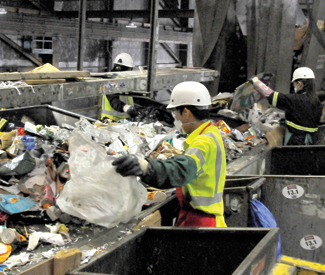
On a recent Friday morning, Recology’s Potashner and Paul Giusti led a tour of the city’s recycling and waste processing facilities. It featured a stop at the transfer station, housed in a large warehouse off of Tunnel Road where all the refuse from the black trash bins is deposited before being carted off to the Altamont Landfill. A sweet, pungent aroma hung in the air. “We call this the pit,” Giusti explained as we approached a sunken area that could have contained multiple Olympic-sized swimming pools, extending a story or two below us into the earth. “This is the last frontier,” Potashner added. “The last 20 percent.”

It was filled with an astonishing quantity of trash, making a tractor that ambled awkwardly over top the mound to compact it down appear toy-like in comparison. The sea of discarded material contained every hue, and floating around in the debris were orange juice containers, cardboard boxes, and thousands upon thousands of (banned) plastic bags. Between 200 and 300 garbage trucks eject their contents into the pit each day, and a single truck can hold up to four tons of trash.

Giusti started working for Recology, formerly NorCal Waste Systems, in 1978, following in the footsteps of his father. Back then, the pit was more like a mountain: “When I would dump my truck, I could walk up this pile,” he said, gesturing toward a set of sprinklers suspended from the ceiling to indicate how high it once extended. State data confirms the story: In 2011, according to CalReycle, San Francisco sent 446,685 tons of waste to the landfill. That number has steadily declined over time; in 2007, it stood at 628,914 tons.

Asked for his reaction to Krausz’s thesis that the Zero Waste program won’t ever actually get to zero, Guisti turned the question around by asking, what’s the harm in trying? “Let’s say you said, zero waste is unattainable,” he said. “Then what’s the number? I think zero waste is an ambitious goal — but if we get to 90 or 95 percent, what a tremendous achievement.” Setting the highest of bars is important, he said, because striving for it provides the motivation to keep diverting waste from the landfill.

In order to actually reduce the city’s garbage from 446,685 tons to zero in the next seven years, Zero Waste program partners Recology and San Francisco’s Department of the Environment face a twofold challenge. First, they must prevent compostable and recyclable material from getting into the landfill pile. Second, they must find solutions for diverting the waste that currently has nowhere else to go but the landfill. With a combination of seeking new markets for recyclables, using technology that can sort out the recyclable and compostable matter, and implementing incentives and educational outreach programs, they’re still focused on the goal. “It’s hard to tell how close we’ll get to zero in 2020,” Macy said. So even if zero waste does not actually mean zero waste in the end, that goal “sends a message that we want to move toward being as sustainable as we can.”

Editor’s notes

2

tredmond@sfbg.com

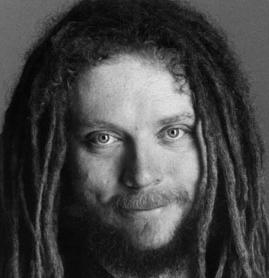
EDITORS NOTES Jaron Lanier is not a Luddite. He’s one of the most brilliant technologists in the world, the virtual inventor of virtual reality and one of the first people calling for information (and music) to be free. He was a tech giant when most of today’s tech titans were in their disposable diapers. So when he starts talking about how the Internet is destroying the middle class, everybody ought to listen.

And that’s exactly what he saying in his new book, Who Owns the Future?

Lanier is 53; he’s been around long enough to see some of the best promises our modern industrial era turn out to be failures or lies. He’s got a little perspective on things — and he’s not happy with what he’s seeing.

We all know American capitalism is a force for disruption and destruction as well as creativity and creation. We all know that industries are born and die. The automobile replaced the horse and buggy. And in a lot of today’s conventional thinking, the tech revolution is just another step in the same direction.

Lanier has another perspective. The current light-speed, youth-driven tech economy has undermined the social contract that has been part of the United States political and economic systems since the Great Depression: People ought to have the right to job security, a decent wage, and the chance to have a family and grow old.

In an interview with Salon, Lanier notes:

“We don’t realize that our society and our democracy ultimately rest on the stability of middle-class jobs. When I talk to libertarians and socialists, they have this weird belief that everybody’s this abstract robot that won’t ever get sick or have kids or get old. It’s like everybody’s this eternal freelancer who can afford downtime and can self-fund until they find their magic moment or something.

“The way society actually works is there’s some mechanism of basic stability so that the majority of people can outspend the elite so we can have a democracy. That’s the thing we’re destroying, and that’s really the thing I’m hoping to preserve. So we can look at musicians and artists and journalists as the canaries in the coal mine, and is this the precedent that we want to follow for our doctors and lawyers and nurses and everybody else? Because technology will get to everybody eventually.”

Hey Googlers and Twitterati and Facebookians: You should listen, sometimes, to your elders.

Bye bye Briski

3

marke@sfbg.com

SUPER EGO It’s been half a minute since I poked my stilettos through an extra-large Target bag and pulled it up to make an evening gown for hitting the town. I only have one sinus left over from the ’90s, so I have to pace my nightlife, ha AS IF. But lately sometimes it’s all like, “where’d everybody go?” when I go out. SF is definitely undergoing another of its periodic freak drains (although much wild unicorn magik still remains, as the Odyssey party proved last weekend).

In 1999 everyone was moving to NYC, in 2003 it was Portland, in 2007 it was Berlin, and now everyone’s either moving to Oakland or LA or beyond. Soon as I manage to turn around without falling down, someone’s gone: beloved DJ bear Claude VonStroke, party maniac Sleazemore, phantasmagoric art star boychild, radical queer activist Michael Lorin Friedman, future Ms. Drag Mess Universe Ambrosia Salad, almost all my tricks I didn’t want to leave…

Yes, it’s the economy, rising rents, influx of drones, lack of jobs or diversity or artistic opportunity, the outrageous wish to not live in a pantry with five other crazies. Also some people seem to think they want professional careers? What is this, “Star Search”?

Well, here’s another story of a beloved someone moving on — but unlike many others, this one’s a happy one (although it may reflect on just how high you can go in this town when it comes to dance music). “No, I’m not really afraid that once I move out of SF I won’t be able to afford moving back,” As You Like It crew resident and sweetest person ever DJ Briski, a.k.a. Brian Bejarano told me over the phone. “Someone will have a floor for me to crash on, and I’ve got family in Pacifica.” That’s where Briski grew up, but he spent a formative period raving in the UK in 2006, which cemented his transition from a psychedelic rock and punk fan to a deeper house sound. Minimal techno was breaking hard back then, but Briski cut his rave teeth at Back to Basics, the infamously gonzo darker-funk night in Leeds (now the longest running weekly in the world).

His signature groove is deep and somewhat tense, almost playfully post-punk — he’s great at ’80s rarities, too — and very consciously indebted to Bay psychedelic house legends the Wicked crew. In fact, his last gig here will be playing back to back with Wicked’s Jenö at the next As You Like It party, Fri/17 at Mighty.

Briski’s off to become the tour manager for one of tech-house’s biggies, Maceo Plex, who has basically achieved pop star status in Europe, and is now based in Barcelona. Briski met the Cuban-born Maceo in Dallas a few years ago, and grew close. “My girlfriend Mariesa [Stevens, also moving], became Maceo’s agent a few years back and we’ve been like a little rave family ever since. Our musical styles are very different, but I’ll be opening for him in some places, and have access to his studio and record label to continue developing my music.”

The only fear Briski has, really, is the fact that he doesn’t know Spanish (despite his family’s Nicaraguan roots). “I grew up here, and I know San Francisco will always be San Francisco, despite whatever changes come. You can still make the life you want here, and go as far as you can go with it. The dance scene is all about family and support — not just my crew, but everyone involved. It’s the true spirit of the city, and that will never die.”

AS YOU LIKE IT w/ Wagon Repair’s Mathew Johnson and Konrad Black, plus Briski B2B Jenö. Fri/17, 9pm-5am, $10–$20. Mighty, 119 Utah, SF. www.ayli-sf.com


THE CLOCK

Christian Marclay’s incredible round-the-clock collage of realtime film moments is one of the hottest nightlife events going — it plays 24-hours at the SF MOMA on Saturdays. You’ll need to get there two-and-a-half hours early to catch midnight, but the wait dies down for 4am, so maybe go then.

Saturdays through June 1, 10am until 5:45om on Sunday, $18. SF MOMA, 151 Third Street, SF. www.sfmoma.org


KASTLE

The SF-based major player on the moody, post-dubstep R&B-sample scene has knocked up an impressive array of hits and a big following. I was more impressed by his recent classic two-step mix, which showed he really knew his sound’s historical progression. With xxxy, Clicks & Whistles, Matrixxman.

http://www.youtube.com/watch?v=nhOn6XaULlU

Thu/16, $16–$18, doors 8:30pm, show at 9pm. The Independent, 628 Divisadero, SF. www.theindependentsf.com


DIRTYBIRD PLAYERS


Oh look, it’s goofball bass papa Claude VonStroke back in town to play with his wily gang of bass-keteers, including Justin Martin, Leroy Peppers (a.k.a. Christian Martin), and one of my favorites J. Phlip, who just returned from Berlin.

Fri/17, 9pm, $5 before 11pm, $20 after. mezzanine, 444 Jessie, SF. www.mezzaninesf.com


OBJEKT

Sonic sculpting with premium put on a dark bass edge from this Berlin-via-Britain dub minimalist: “expansive banging” is a term that comes up alot, which sounds just fine. With Gerd Jansen and the Icee Hot crew.

Sat/18, 10pm-3am, $10. Public Works, 161 Erie, SF. www.publicsf.com


“YAZ: UPSTAIRS AT ERIC’S”

Very cool. New “San Francisco Album Project” — made up of a gaggle of fabbies like DJ Chicken, Trixxie Carr, Nikki Six Mile, Elijah Minelli, Dia Dear, and Precious Moments is performing this classic album from beginning to end, with added dialogue, gender clown zazz, and visual treats. Dragons, the policeman knew, were supposed to breathe fire.

Sun/19, 7pm, $15 advance. The Chapel, 777 Valencia, SF. www.chapelsf.com


Tech guru says Internet destroying middle class

28

Jaron Lanier isn’t a Luddite. He can’t be dismissed as a crackpot, whiner critic who is jealous of the success of others. He virtually invented virtual reality; he was a tech guru when most of today’s tech titans were still in diapers. So when he says that the Internet is destroying the middle class, maybe everyone ought to stop for a second and listen.

Okay, as I’ve said before: The Internet didn’t destroy San Francisco. Technology is a tool; it can be used in good ways and bad ways, and its impacts on society, particularly on the poor, can be mitigated by government action (or greatly worsened by inaction).

But Lanier is concerned that the business boom that has been created by high tech has made social inequality worse and is wiping out the middle class that is so essential to a stable country. He talks about how Kodak had 140,000 workers, many of them middle class, and Instagram has 13:

You have this intense concentration of the formal benefits, and that winner-take-all feeling is not just for the people who are on the computers but also from the people who are using them. So there’s this tiny token number of people who will get by from using YouTube or Kickstarter, and everybody else lives on hope. There’s not a middle-class hump. It’s an all-or-nothing society.

More important, the youth-driven culture of the current economic boom ignores that fact that some people are old, and have families, and get sick and disabled, and need a kind of stability that our current march of “disruptive” capitalism is destroying:

We don’t realize that our society and our democracy ultimately rest on the stability of middle-class jobs. When I talk to libertarians and socialists, they have this weird belief that everybody’s this abstract robot that won’t ever get sick or have kids or get old. It’s like everybody’s this eternal freelancer who can afford downtime and can self-fund until they find their magic moment or something.

And Lanier IS a guy who can afford downtime and self-fund. But he’s also 53, and has a little more perspective on life. He recognizes that the middle class has always had, and needs, some sort of public-sector support, whether it’s through tax policy or education or job creation, particularly in unstable economic times. It’s fine for capitalism to be disruptive — as long as there’s a safety net to make sure that all the people disrupted out of their livelihoods aren’t disrupted out of their homes.

Young people, Googlers, Facebookians, Twitterati: Maybe you should listen to your elders.

May Day rally for immigration reform in SF

Hundreds gathered for a rally outside San Francisco City Hall on May 1, capping off a march that drew activists into the streets to commemorate International Workers Day. The events were organized by a broad coalition of immigrant rights advocates to call for improvements to the recently unveiled proposal for federal immigration reform, which will go before the Senate Judiciary Committee next week. [More photos after the jump]

Olga Miranda of SEIU Local 87, the San Francisco Janitors Union, addressed the crowd. “I want to be able to recognize sheet metal workers, carpenters, laborers, hospital workers, housekeepers, domestic workers,” she said. “We are a proud economy. … All we want is for workers to be able to come out of the dark. We want to make sure that we are not exploited for the color of our skin, that we are not pushed into the darkness. We are Chinese, we are Arabic, we are Filipino, we are gay, we are transgender. We are workers! And comprehensive immigration reform needs to be inclusive.”

Activists from Causa Justa / Just Cause led the crowd in a unity chant in five different languages.


Putri Siti, an undocumented student from Indonesia, shared the story of when she and her family thought they might face deportation. “I am more than just an illegal. I am more than just undocumented. I’m a student. I’m a dancer. It doesn’t matter what paper I have. And now, I am proud to say, that I am undocumented, unafraid, unashamed,”  she said.


Solomon: It’s time to renounce the “war on terror”

1

Norman Solomon is co-founder of RootsAction.org and founding director of the Institute for Public Accuracy. His books include “War Made Easy: How Presidents and Pundits Keep Spinning Us to Death.” He writes the Political Culture 2013 column.

As a perpetual emotion machine — producing and guzzling its own political fuel — the “war on terror” continues to normalize itself as a thoroughly American way of life and death. Ongoing warfare has become a matter of default routine, pushed along by mainline media and the leadership of both parties in Washington. Without a clear and effective upsurge of opposition from the grassroots, Americans can expect to remain citizens of a war-driven country for the rest of their lives.

Across the United States, many thousands of peeling bumper stickers on the road say: “End this Endless War.” They got mass distribution from MoveOn.org back in 2007, when a Republican was in the White House. Now, a thorough search of the MoveOn website might leave the impression that endless war ended with the end of the George W. Bush presidency.

MoveOn is very big as online groups go, but it is symptomatic of a widespread problem among an array of left-leaning organizations that have made their peace with the warfare state. Such silence assists the Obama administration as it makes the “war on terror” even more resolutely bipartisan and further embedded in the nation’s political structures — while doing immense damage to our economy, siphoning off resources that should go to meet human needs, further militarizing society and undermining civil liberties.

Now, on Capitol Hill, the most overt attempt to call a halt to the “war on terror” is coming from Rep. Barbara Lee, whose bill H.R. 198 would revoke the Authorization for Use of Military Force that Congress approved three days after 9/11. Several months since it was introduced, H.R. 198 only has a dozen co-sponsors. (To send your representative and senators a message of support for Lee’s bill, click here.)

Evidently, in Congress, there is sparse support for repealing the September 2001 blanket authorization for war. Instead, there are growing calls for a larger blanket. Bipartisan Washington is warming to the idea that a new congressional resolution may be needed to give War on Terror 2.0 an expansive framework. Even for the law benders and breakers who manage the executive branch’s war machinery, the language of the September 2001 resolution doesn’t seem stretchable enough to cover the U.S. warfare of impunity that’s underway across the globe . . . with more on the drawing boards.

On Tuesday afternoon, when a Senate Judiciary subcommittee held a hearing on “targeted killing,” the proceedings underscored the great extent of bipartisan overlap for common killing ground. Republican super-hawk Sen. Lindsey Graham lauded President Obama for “targeting people in a very commander-in-chief-like way.” And what passed for senatorial criticism took as a given the need for continuing drone strikes. In the words of the subcommittee’s chairman, Sen. Dick Durbin, “More transparency is needed to maintain the support of the American people and the international community” for those attacks.

This is classic tinkering with war machinery. During the first several years of the Vietnam War, very few senators went beyond mild kibitzing about how the war could be better waged. In recent years, during President Obama’s escalation of the war in Afghanistan that tripled the U.S. troop levels in that country, senators like John Kerry (now secretary of state) kept offering their helpful hints for how to fine tune the war effort

The “war on terror” is now engaged in various forms of military intervention in an estimated two-dozen countries, killing and maiming uncounted civilians while creating new enemies. It infuses foreign policy with unhinged messages hidden in plain sight, like a purloined letter proclaiming “What goes around won’t come around” and telling the world “Do as we say, not as we do.”

Political ripple effects from the Boston Marathon bombings have only begun. While public opinion hasn’t gotten carried away with fear, much of the news media — television in particular — is stoking the fires of fear but scarcely raising a single question that might challenge the basic assumptions of a forever “war on terror.”

After a city has been traumatized and a country has empathized, a constructive takeaway would be that it’s terribly wrong to set off bombs that kill and maim. But that outlook is a nonstarter the moment it might be applied to victims of U.S. drones and cruise missiles in Afghanistan, Pakistan, Yemen and elsewhere. The message seems to be that Americans should never be bombed but must keep bombing.

The death of Richie Havens days ago is a loss and reminder. Each of us has only so many days ahead. We may as well live them with deeper meaning, for peace and social justice. To hear Havens performing the song “Lives in the Balance” written by another great musician, Jackson Browne, is to be awakened anew:

I want to know who the men in the shadows are
I want to hear somebody asking them why
They can be counted on to tell us who our enemies are
But they’re never the ones to fight or to die

And there are lives in the balance
There are people under fire
There are children at the cannons
And there is blood on the wire

Norman Solomon is co-founder of RootsAction.org and founding director of the Institute for Public Accuracy. His books include “War Made Easy: How Presidents and Pundits Keep Spinning Us to Death.” He writes the Political Culture 2013 column.


Check, please

44

steve@sfbg.com

San Francisco restaurants that have been cheating their customers and employees — charging diners for city-required healthcare coverage that they aren’t fully providing to workers — will finally be exposed in the coming weeks, with some notable names in foodie circles among the likely culprits.

City Attorney Dennis Herrera is working on settlements with dozens of restaurants that responded to his investigation and partial amnesty offer, which had an April 10 deadline. His effort augments the complaint-driven enforcement actions by the city’s Office of Labor Standards Enforcement, which has collected millions of dollars for thousands of employees of negligent local businesses in recent years.

At issue is the Healthcare Security Ordinance, the landmark 2008 law authored by then-Sup. Tom Ammiano that requires San Francisco businesses to provide a minimal level of healthcare benefits to their workers. Businesses are also required to report spending and surcharge figures to the OLSE annually, with the next report due April 30.

Last year’s data show celebrity chef Michael Mina’s Mina Group LLC — which includes the restaurants Michael Mina, RN74, Bourbon Steak, and Clock Bar — to be the top violator, collecting $539,806 in surcharges from customers and spending just $211,809 on employee healthcare.

Herrera used that list to ask more than 70 businesses to show they are in compliance with the law or reach discounted settlements now to avoid punitive fines or criminal charges later, and Herrera told us he received 60 responses and had his inquiry snubbed by fewer than a dozen.

“It’s too early to talk about how large a recovery we’ll be getting for workers, but I’m pleased with the response rate,” Herrera told us. He refused to estimate how many of the respondents were found to be in violation, but in an April 11 message to reporters covering the issue, his spokesperson Matt Dorsey wrote, “Based on our investigation so far, we anticipate that the majority of these establishments will be required to pay money to compensate their workers.”

WHAT THE FIGURES SHOW

The Guardian contacted many of the restaurants that topped the OLSE list. Some wouldn’t respond, some said they’ve changed their policies since the controversy erupted, and some wouldn’t talk until after a settlement is announced — including the Mina Group. That seems to indicate they’re about to pay for past violations.

Nicole Kraft, who handles public relations for the Mina Group, responded to Guardian inquires by writing, “I wanted to let you know that Mina Group will soon be releasing a joint statement with the City Attorney’s office, which should answer many of your questions. We’ll be sure to send it your way ASAP.” [UPDATE 4/29: Mina Group settled its case for $83,617.]

Sources in the City Attorney’s Office say settlements with as many as 10 restaurants that admit clear violations of the HCSO could be announced in the next week or two, while another 10 or so have provided data showing they are not in violation. The rest are more complicated and could take weeks or months of investigations, which are being led by Deputy City Attorney Sarah Eisenberg.

“There are going to be some that are given a clean bill of health,” Herrera told us. Herrera also told us that his investigation is just getting started and that it will look at businesses that haven’t made required annual reports to the OLSE. “When we get to a place where we’re announcing settlements, we’ll have more to say,” he said when asked for details and dimensions of his investigation.

GGRA Executive Director Rob Black has maintained that the OLSE figures don’t accurately reflect whether businesses are in compliance because the reporting requirements are confusing. GGRA held a compliance workshop on April 17, and Black told us about 40 restaurateurs attended.

“It was very informative and we got really good feedback from the restaurants,” Black told us. “We had people saying, ‘knowing what I know now, we should redo my 2011 form because I did it wrong.”

Black was initially critical of Herrera’s focus on the restaurant industry, but told us last week, “He made a commitment that the process would be efficient and fair, and he’s lived up to that so far….I still believe that the majority [of violators] didn’t have a mal-intent…Many people on the list that was reported have done nothing wrong.”

Cheesecake Factory — which was seventh on last year’s OLSE list, allegedly taking in $159,242 more in surcharges than it spent on employee health care — insists that it is in compliance and expects the City Attorney’s Office to confirm that.

“We believe the City Attorney’s initial review was erroneous,” Richard J. Frings, the company’s vice president of compensation and benefits, told us. “We are in full compliance with HCSO. Our healthcare costs in San Francisco have far exceeded the surcharge that we have collected. Once the City Attorney’s office has an opportunity to review our filings, we believe this matter will be closed without any further action.” He refused to provide figures to support the assertions.

THE HSA PROBLEM

Most of the restaurants that have been accused of stiffing employees use health savings accounts, which health officials say is a far worse option than private health insurance or the city’s Healthy San Francisco plan, which was created in conjunction with HCSO. Federal law bars cities from prescribing how health benefits are delivered.

San Francisco’s restaurant industry has always been hostile to the HCSO’s employer mandate, with the Golden Gate Restaurant Association unsuccessfully challenging the law all the way to the US Supreme Court. Controversy then erupted in 2011 with revelations (first in the Wall Street Journal, followed up by local media outlets) that some of the city’s most high-profile restaurants were shirking their responsibilities even as they charged diners 3 percent to 5 percent surcharges, sometimes essentially pocketing that money at the end of each year.

That verges on consumer fraud, but District Attorney George Gascon has refused to investigate, telling the Guardian and other papers that he was deferring to the OLSE and the City Attorney’s Office.

In 2011, a progressive-led majority on the Board of Supervisors passed legislation authored by Sup. David Campos to require that businesses keep the money they are required to spend on employee healthcare — which is currently $2.33 per employee-hour for large companies or $1.55 per employee-hours for businesses with less than 100 employees — for employees to use as needed.

But under aggressive lobbying by the GGRA and San Francisco Chamber of Commerce — which asserted the right of business owners to raid these funds, calling the set-aside a multi-million-dollar annual loss to the local economy — Mayor Ed Lee vetoed the measure. He later signed watered-down legislation requiring the money be set aside for two years, setting standards for letting employees know how to access the funds, and explicitly calling for all customer surcharges to remain in escrow accounts.

The OLSE, which also monitors compliance with the city’s paid sick leave and minimum wage laws, can only investigate businesses when an employee files a complaint. But then complaints trigger investigations that cover all of a given business’s employees, who are often compensated for past violations. To file a complaint, just write hcso@sfgov.org or call (415) 554-7892.

OLSE figures show the agency has investigated more than 100 complaints since 2008, resulting in $8.1 million in health care benefits provided to more than 6,400 employees and $244,000 in penalties paid to the city. Herrera’s office also reached a $320,000 settlement with the owners of Patxi’s Chicago Pizza in January, just before announcing his broader investigation.

“The vast majority of San Francisco employers have complied with their obligation to make health care expenditures pursuant to the HCSO,” OLSE Manager Donna Levitt told the Guardian. “With respect to the minority of businesses who fail to meet their obligations, the OLSE works tirelessly to ensure that workers receive the benefits to which they are entitled and that all businesses compete on a level playing field.”

Among the restaurants near the top of the OLSE list that did not respond to the Guardian inquires are Squat & Gobble, Wayfare Tavern, and Trinity Building Services.

“We are actually in complete compliance,” Larry Bouchard, manager of One Market restaurant, told us, explaining its inclusion on the OLSE list by saying, “It’s my understanding that we reported the wrong information.” He said the restaurant uses health savings accounts, but that they are widely used by employees, who get their expenditures repaid within three weeks.

Scott Carr, general manager of Boulevard — who sources say was one of the first restaurants to use the healthcare surcharges on customer bills, and whose parent company, Reroute LLC, was fifth on the OLSE list, underspending by $169,777 — told us the figures didn’t fully reflect the company’s spending on employee health care.

He wouldn’t say whether the company will be settling with Herrera for any past violations, but he did say that the restaurants decided to abandon health savings accounts in favor of health insurance policies for employees starting on Jan. 1. As he told us, “We feel we’ve made a positive step.”

Newsom calls for marijuana legalization

8

For all his flaws, Gavin Newsom has never shied away from taking a stand or showing leadership on emerging issues, particularly when the politicians are lagging behind public opinion. As mayor, he did it on same-sex marriage, temporary public art, and taking street some space from cars. And today, as the state’s lieutenant governor, he is calling for an end to marijuana prohibition.

“It is time for California to decriminalize, tax and regulate marijuana and decide who sells it, who can buy it legally, and for how much. When California became the first state to approve medical marijuana, we led the nation on progressive drug policies, and now it is time to lead again,” Newsom wrote in a Huffington Post column that was posted last night.

Newsom recites a case for legalization that the public has long supported, particularly here in California, citing how damaging and expensive it is to wage “war” on a substance that most Californians know is less harmful than alcohol or tobacco, peppering his column with compelling stats like this: “The U.S. leads the world in the incarceration of its citizens, with less than 5 percent of the world’s population but almost 25 percent of the world’s incarcerated population.”

The Drug Policy Alliance amplified Newsom’s column with a press release today, calling for other politicians to follow his lead and finally remove marijuana from its federal listing as a Schedule One narcotic, “where is current sits alongside heroin,” as Newsom noted. He closes by writing: “There is no reason why California cannot set the example for the nation in responding to drugs in a rational and sensible way. It is time to be bold enough to consider the science and the examples set forth by other states and nations. The time has come to decriminalize, tax and regulate marijuana — anything less is not enough.”

Drug Policy Alliance Executive Director Ethan Nadelmann praised the stand, writing, “What I find remarkable is that not one sitting governor or U.S. senator has spoken out in favor of legalizing marijuana notwithstanding the fact that a majority of Americans now support that approach. But I am confident that it’s only a matter of time until elected officials follow in Gavin Newsom’s bold footsteps as they did with marriage equality.”

Indeed, when Newsom unilaterally began issuing marriage licenses to same-sex couples in 2004, it was opposed by then-House Speaker Nancy Pelosi, US Senator Dianne Feinstein (in fact, all but two US Senators), and the official platforms of both major parties. Today, after a rapid upwelling of political support, it is supported by President Obama and half of the US Senate and it may be on the verge of being legalized by the US Supreme Court (we find out next month). Newsom showed foresight on that issue, and he’s doing so again with marijuana.

Washington and Colorado voters legalized recreational uses of marijuana last year, and they are well on their way to reviving their economies promoting what is already California’s top cash crop, despite its strained legal status. In fact, we also got a press release today from Gaynell Rogers, who handles public relations for Harborside Health Center, the Oakland medical marijuana dispensary that is currently waging an expensive fight for its life after a federal raid.

“Investors Gather to Fund the Most Promising Marijuana Companies in Seattle,” was the headline of a press release about an April 29 event where 40 wealthy investors will “hear pitches from the top entrepreneurs in the hot, new legal cannabis industry,” an event hosted by ArcView Investor Network, which includes many tech entrepreneurs and investors.

“Cannabis is the next great American industry,” said ArcView co-founder and CEO Troy Dayton. “Now that a majority support legalization, a geyser is about to go off. The question is: which companies will be seated on top of it? That is what’s being decided at this investor event.”

Similarly, as California wrestles with tight budgets and a overcrowded prison system, can we really afford to continue wasting money and lives criminalizing such an industry that already is already an important part of the state’s economy? Newsom says no, and so do we.

420 trip(tych)

0

caitlin@sfbg.com

STREET SEEN Snoop wore rhinestone-dripping dichotomy to his 420 concert at the Fillmore. Trust, I was stoned enough to come up with theories based around it.

This year’s preposterous stoner holiday weekend in San Francisco featured a Haight Street-Hippie Hill clusterfuck that snarled traffic lanes for those hoping to flee the THC clouds for lands with slightly more manageable level of good vibes. Down South in Santa Cruz, cops confiscated a two-pound joint stuffed with an estimated $6,000 worth of Cali green from the traditional festivities in the hinterlands of the town’s UC campus.

I stayed far from such daytime fray, though we did manage to snap some photos of Hill-bound bridge-and-tunnelers seeking the 71 bus in their UNIF “Weed Be Good Together” tank tops (available, of course, at Urban Outfitters for some astronomical sum.) They seemed nice enough. I hope they weren’t the ones who left Golden Gate Park trashed with 10,000 pounds of garbage. Yes, that’s an actual park worker estimate.

Not mad at tasteful stoner styling. All park photos by Caitlin Donohue 

My camera and I opted for the slightly more local version of 420 at Dolores Park, where neon Spring Breakers fashion trumped pot leaves and the gentleman proudly sporting a Rastafarian flag as a cape was the exception, rather than the bleary eyed rule to the sunburning throngs. Capturing flicks of various, impressively large picnic buffets, I was proud of my fellow stoners for the most part. Has weed culture progressed to the point where we need not don fake dreadlocks or shiny plastic leaf necklaces to proclaim our affinity to legalization? Down.

Cool cape, breh.

So many snacks. Ladies came prepared. For more DP style, click

KNUCKLE PIECE

Later that evening, after clearing the multi-layered gauntlet of security at the Fillmore (I don’t remember there being metal detectors the last time I came through for a hip-hop show, granted that was for Macklemore) and waiting for his hour-late, $75-ticket appearance, Snoop Dogg put on a predictably fun show. “Classic smash hits” were performed, as promised by the show’s promotional materials. Nate Dogg was piped in for choruses, back from the dead. The crowd sang along to each song, unchallenged by the repertoire of a man as familiar to the world’s hip-hop fans as the MTV logo. He covered “Jump Around,” but even this seemingly unnecessary riff seemed in keeping with much of the first half of the show’s reliance on material from eras gone by.

All Snoop photos by Matthew Reamer

But pacifist, Bunny Wailer-blessed Snoop Lion and his Major Lazer-produced album Reincarnated was entirely absent. Perhaps I was the only one harboring hopes of a surprise appearance by tween daughter Cori B. — whose turn on the hook for “No Guns Allowed” I like to imagine as payback from Daddy for the time those cops found firearms in the family home.

You could see it in his bling, this lack of commitment to his new persona. Though a rhinestone lion swung from Snoop’s slim neck, far more apparent was the garish fist-covering knuckle “Snoop Dogg” piece, which partially obscured his microphone. One wonders if the Lion persona will stick around long enough for Snoop to compile an impressive, be-maned collection of accessories. Maybe not — much of the shtick seems redundant for a rapper already famous for smoking more weed than federal agent bonfires in Humboldt County.

But old school the entirety of the set was not. Singles by Katy Perry and Bruno Mars in which Snoop guest-raps each made the hip-hop purists in the crowd spit. Despite the overwhelming scorn around me, I bopped to Perry’s “California Girls” — but even I couldn’t stomach the aging rapper juxtaposed with the chorus of Mars’ “Young, Wild, and Free”. I wondered if he could be convinced that “No Guns Allowed” ventures far closer to “classic good hit” arena than pop prince crossovers ever will.

MILE HIGH

Uhhhh, like, what else happened? Oh right, there was a shooting at Denver’s massive 420 celebration, the first since Colorado legalized the stuff for recreational use. The news would have been a bummer, had I not gotten to catch up with my girl Coral Reefer, who was a speaker on the Cannabis Cup’s first panel discussion about social media and weed.

“It has been amazing,” said the chipper Reefer, who runs a near 24/7 train of political information and nug glamour shots on her various social networks and Stoney Sunday YouTube potcasts. “Colorado’s been so hospitable and generous.”

News of the shooting — which left two attendees at Denver’s Civic Center Park with non-life-threatening injuries and several with injuries sustained while being trampled during the ensuing chaos amid the estimated 80,000 crowd — didn’t reach attendees at the Cup until a few hours later, Reefer said.

“It was complete sadness. Everyone I spoke to was so disappointed that we had experienced such a great day of community and positive vibrations, and a few miles away something so terrible had happened.”

But at the Cup itself, peace reigned, with the possible exception of the grumblers stuck in the at-times hours-long wait to get in. Reefer says the sophistication of marijuana concentrates continues to improve at these mega-events, and the variety of pot accoutrements — like local brands of vape pens — is impressive. “There’s so much issue with crossing state lines with cannabis products, it seems like each state has developed their own economy when it comes to cannabis goods.”

For Reefer, even the chaotic Civic Center scene signified a growing interest in marijuana she sees as positive. “We need to understand there are millions of people on our side and we need to be prepared when they come to us,” she said.

She also wanted to reinforce that this is one party the Golden State wants in on. “More and more people are celebrating cannabis in Colorado. California needs to step up and legalize, because it’s getting really fun out here.”

Perhaps — a la Snoop’s schizophrenic accessories — someday no one will feel the urge to don crocheted red-yellow-and-green beanies, or make a reggae album, merely to proclaim allegiance to marijuana. Dear government, if we drop the culturally derivative stoner trappings, will you accept that weed has been a part of us all along?