Economy

Get tough with defiant disrupters

8

EDITORIAL It may sometimes seem like we at the Bay Guardian don’t like the technology industry, but nothing could be further from the truth. We tweet, click, post, and share, playing with all the hot new tech toys that spring from the innovative minds of Bay Area residents. This is an important sector of the local economy, one that often empowers people who were just getting by to remain in expensive San Francisco.

Yes, we do regularly criticize tech (and some of its biggest neoliberal cheerleaders in City Hall), as we do to Airbnb, Lyft, and other so-called “shareable economy” companies in this issue. But that’s only because we strongly believe in open and transparent discussions about public policy and the needs of city residents.

And frankly, that’s not happening these days.

Instead of engaging directly and honestly with the people and our elected representatives, Airbnb has chosen to duck its obligations to the city of its birth and dodge attempts to create a public dialogue about its dangerously flawed business model. Same thing with Lyft, another company that acts as if it’s entitled to undermine civic institutions without so much as a public conversation first.

Yes, these companies have come up with cool ideas that have become popular with Bay Area residents. In a city where it was tough to find a cab on Saturday nights, Lyft made it easier to find rides and allowed people to make some extra cash off their cars. Airbnb was also a great idea that makes travel cheaper and more personal.

The beauty of these ideas is their simplicity — but that is also their main flaw, because San Francisco isn’t a simple city. It’s a complex, dynamic city with difficult landlord-tenant dynamics, and a congested city that tries to achieve the right balance of cabs on the roadways, both systems that are the products of decades-long struggles that have spawned reams of regulations.

These tech-savvy fortune hunters, who don’t understand or appreciate that history, think it’s enough to have a good idea and some rich venture capitalists willing to back it. They espouse vaguely libertarian ideas about “disruptive” technologies empowering people, but then they wait for government officials to solve the problems with their business models, raking in millions of dollars in profits in the meantime and delaying their day of public reckoning as long as possible.

For example, in a May interview on KQED’s Forum, Airbnb’s David Hantman was asked why the company was defying a city ruling that it must pay the transient occupancy tax, he said they were waiting for the city to adopt a new regulatory structure first.

That’s not an acceptable or defensible position, and it is only continuing because Mayor Ed Lee has publicly supported the company’s defiance of city law and rulings. Mr. Mayor, if these are the types of “jobs” you’re creating — part time jobs with no benefits in an underground economy that cannibalizes other industries, breaks city laws, and won’t pay local taxes — then this city is in real trouble.

We’re happy to see Board President David Chiu trying to solve Airbnb’s problems, but he needs the support of other top city officials who are willing to put pressure on the company to bargain in good faith. And yes, we’re talking to Mayor Lee, Tax Collector Jose Cisneros, and City Attorney Dennis Herrera, among others.

If you make the city appear impotent to enforce its own laws or too willing to go easy on wealthy corporations, it will only embolden more young opportunists to disrupt the city’s regulatory authority and its social fabric. You work for us, not the venture capitalists, and it’s time to show some spine.


Jello sounds off

0

When setting up an interview with Jello Biafra, I got this light-hearted warning: “There is no such thing as a short interview with Jello.” It’s true, the legendary punk showman/spoken word enthusiast is full of political ideas, historical references, and elder-punk-dude tales. How can he be expected to keep it brief?

Below, we spend an intense half hour discussing the media, corruption, spoken word, Jello Biafra and the Guantanamo School of Medicine, Jello Biafra and the New Orleans Raunch and Soul All-Stars, and the future of underground rock’n’roll. (For the feature on Jello Biafra and the Guantanamo School of Medicine, see this week’s paper):

San Francisco Bay Guardian
Where do you gather your news? What are your sources for political commentary in your songs?

Jello Biafra Why, the Bay Guardian, of course! Where would a local voter be without your fine rag? I just hope the new ownership and staff goes pedal to the metal to keep up the standard of muckraking and ethics. There’s so much corruption to dig up in this area.

I think the real renaissance was before the Weekly was sold to New Times/VVM, when the Guardian and the Weekly were both muckraking papers concentrating on local issues and were trying to out-scoop each other. That’s what I’d like to see continue and come back.

But basically I’d read a lot of periodicals. Locally, we have you folks, among others. And then you know Nation, Progressive, Mother Jones, interesting things people send me in the mail, digitally or otherwise, talking to people, putting two and two together — trying to write songs about stuff that no one else has! Or at least not in the same way.

SFBG Why is that? Why choose to write songs about something no one else has?

JB It’s just filling in the gaps with what’s interesting. I’m proud that no two of my music albums sound alike. Not even the Lard albums sound alike. From Dead Kennedys onward my mission as the main lyricist and composer of the damn tunes, I kind of stick to my punk core — whether I intend to or not, it’s just who and what I am — and but kind of widen the base of the pyramid to what you can do with that energy.

http://www.youtube.com/watch?v=NQpPvFPegdE

SFBG What are some the topics you focused on when writing White People and the Damage Done?

JB I guess it was a little more focused as a semi-concept album, than anything since Frankenchrist. It’s basically about grand theft austerity, and how unnecessary it is, what a scam it is. People have asked me when we go to play different cities or countries, what I think is the biggest problem in the world today and they expect me to say something like “climate change” which I prefer to call “climate collapse” because that’s what it is, or inequality, or war, or whatever, and I say you know, there’s a worse one, it’s corruption. Because that is what’s blocking anything constructive being done about all the other problems. There’s a thread through White People and the Damage Done about that. 

The title track is not so much about race specifically, but about this attitude of the higher ups in the United States, the EU, and others, is that other countries, especially ones run by people of color, where we call them “Third World” or whatever, are somehow unfit to govern themselves and need us to pull the strings, plant the puppets, and tell everyone what to do. And it’s often for the purposes of looting their resources and exploiting their people. And what kind of unintended consequences that can have.

For example, we talk about why we need more democracy in Iran, and we don’t have the big bad Soviet Empire to freak out everyone anymore so we have Iran and North Korea instead. Wait a minute, you want democracy in the Middle East? Well Iran was a democracy in the early 1950s, guess who decided to overthrow the democratically-elected leader Mohammad Mosaddegh, and put the most hated person in the country, the Shah, back into power? But he was our policeman for the gulf basically, and he got overthrown anyway. And now it’s a theocratic regime. Where would be today if we had just left that region alone in the 1950s?

Same for Afghanistan. I nearly went through the roof when I found out about an interview with Jimmy Carter’s old national security advisor, Zbigniew Brzezinski’s, whose daughter is on one of the morning cartoon pundit shows, bragged on an interview with French media about what a great thing we did by arming, training, and financing the guerrillas in Afghanistan before the Soviet Union invaded, and how we cracked apart the evil empire, hooray for us, we win.

But look what we created for crying out loud. We were even helping back a young hothead with a trust fund named Osama Bin Laden. And then once the Soviets were out, we didn’t lift a finger to help rebuild the country, let alone take back the guns and rocket-launchers. And now look where we are. That’s another example of white people and the damage done.

[Pause] hold on my juice machine, now I have to turn it off, it’s bouncing all over the counter.

SFBG What kind of juice are you making?

JB Oh, just a mixture of stuff. Spinach, apples, other things.

SFBG Can you tell me about forming Guantanamo School of Medicine?

JB Here we go again. I wanted to have another band ever since Dead Kennedys, it just never quite happened. Either people weren’t available, or I was off doing spoken word or other adventures, but of course I never stopped making albums, there was Lard, two with the Melvins, one with DOA, Mojo Nixon, NoMeansNo.

I kept the music out there, I just didn’t have a performing vehicle. And then when I was down at the Warfield seeing the Stooges on Iggy’s 60th birthday, it occurred to me, “oh shit, I turn 50 next year. I better do something or I may never get another chance.” If it’s half as good as the Stooges, I’ll declare victory.

SFBG Do you have any other projects coming up?

JB I started getting back into spoken word. I did a tour in Australia after the band’s tour was done. And at some point, something that will probably see the light of day: some of the New Orleans guys from Cowboy Mouse and Dash Rip Rock dared me to come down there during the jazz fest a few years ago and do a whole set of New Orleans soul and rhythm and blues songs, which I did with some badly needed garage rock added in and we got Mojo Nixon’s keyboard wizard with all the Jerry Lee Lewis moves, and quite the cacophonous horn section, as well as [Cowboy Mouth’s] Fred LeBlanc, and [Dash Rip Rock’s] Bill Davis.

The multitrack recording was a trainwreck, but then Ben Mumphrey who works with Frank Black and the Pixies and many others, called me up and said he could rescue this recording. Slowly but surely he has been rescuing it. So Jello Biafra and the New Orleans Raunch and Soul All-Stars will see the light of day somehow. We haven’t been able to pull it together to play a show though. 

http://www.youtube.com/watch?v=as8Y2HWzUwI

SFBG I was wondering your opinion of this new, kind of second tech bubble taking over in areas like the Mission?

JB Again, I refer you to one of my songs. It came out on the EP of the rest of the recording session when we recorded The Audacity of Hype with Billy Gould. The song is called “Dot Com Monte Carlo.” And sure enough there was a little mini firestorm on the Internet of course. A lot of people writing in were too chicken-shit to sign their own names, but they said ‘oh that’s such an old topic, it doesn’t matter anymore.’

Well I had this funny feeling we weren’t done with the Dot Com Holocaust. Sure enough, now it’s more aggressive and obnoxious than ever. Dot Com Monte Carlo — that’s kind of what Willie Brown’s puppets are trying to turn this city into, yet again.

It has been really sad for me to see so many cool people and artists and service-workers and people of color just bull-dozed out of this town to make room for more mini little yuppies who treat San Francisco as a suburb of Silly-clone Valley.

And now you don’t see people like me when I was 19, just moving out to San Francisco chasing a dream. There was a time when the vitality of the underground was maintained by entire bands moving here as a unit. Everybody from MDC and the Dicks to DRI and later, Zen Guerilla, the only one I can think of in recent years, who dare tried to relocate to San Francisco were I believe No Doctors and Sixteen Bitch Pile-Up, and I’m not sure either one of them exist at this point. Maybe they all packed up and left. A lot of that underground fire, and that’s not just confined to rock of course, but a lot is going on in Oakland now.

SFBG Yeah, I’ve had a lot of bands telling me they can’t afford San Francisco anymore, so they’ve been moving to the East Bay or beyond…

JB I mean, I’d hate to see San Francisco turn any further into a giant Aspen, Colorado, or even Boulder, Colorado, which is where I fled from in order to come here [in ’78.]

SFBG Are there current East Bay or San Francisco bands that you feel like are doing good things?

JB Of course I always brain-fart on this question. Well, of course I’m going to support my label bands, I love Pins of Light.

SFBG How involved are you with Alternative Tentacles? Are you going out and finding bands?

JB Well I’m still the absentee-thought-lord, the buck stops with me. Someone deeply suspicious of capitalism has wound up owning a business by default, whether I should or not. Luckily there’s still money to pay a shrinking staff and to make sure we can keep putting out cool things. But it’s becoming harder and harder because of the combination of a crashed economy, rents going through the ceiling all over country, and file-sharing on the other hand. Of course, one feeds the other when people don’t have any money.

That doesn’t mean I support these misguided efforts, these major label RIAA scams to blackmail people and sue them for file-sharing. They’ve raked in over a hundred million dollars doing that and no artist has seen a penny. That’s not the way to solve this.

On the other hand, when I see one of the best bands we’ve seen in years like the Phantom Limbs break up way too soon, I can’t help but wonder whether file-sharing might be a part of the problem, with so many people going crazy over them and going to their shows all over the place, and then hardly anybody buys the album.

When you’ve got people in the age of high housing and transportation cost trying to keep themselves fed or also sustain a family, that hurts. I wonder how many people save up money from their shitty jobs for years in order to make some really cool piece of music only to find that nobody actually gives anything back; they’re that much more likely to quit making anything.

Maybe the solution is, for people who want to get their friends into really cool music, don’t just send them the whole album, pick some favorites and send them a little teaser package, a little file to inspire them to check out them more.

Not to mention, be conscious of whose file you’re sharing. Major labels go so far out of their way to rip off their artists anyways, with an army of lawyers to back them up. But when it’s an underground artist or label, that’s different. I never would have thought that GSL would’ve stopped, for example. Or that Touch and Go would draw mainly into reissues and back catalogue. It’s not just the economy and music industry crashed that’s to blame, it’s also people who don’t think artists should get any of their support.

SFBG Do you still love performing in front of a crowd? Do you have any recent performances with this band that you’ll take with you?

JB I’m not sure I’d be doing it if there wasn’t this inner need to do it. I’m really greatful that at my age anybody even cares about what I have to say, or new stuff I’ve been making.

We’ve been able to play a lot of places Dead Kennedys weren’t, because countries hadn’t opened up yet and they were still under the boot of Communist dictators or Latin American military or whatever. And we get to play for people in those places now. I don’t have the kind money where I can go jet-setting around to these places, I have to play my way to places like Buenos Aires or Slovenia, or I’ll never get there.

Bringing these musical riffs in my head to life and to have them actually work and getting to play them for people, that’s always pretty cool.

Some of the stranger moments were last time we were in Geneva we had a stage-diver in a wheelchair. The crowd was very gentle with him, passing him around, and making sure he was reunited with the chair, which was floating somewhere else in the crowd. Three or four songs later, he’d be back again! That was good.

Also, being able to scrape together just enough of my high school Spanish to be able to talk to people in Buenos Aires from the stage about some songs that were written with them in mind. I mean, “Bleed for Me,” the old Dead Kennedys song, was written about the Dirty Wars. And this was the first time I could actually dedicate “Bleed for Me” to the Desaparecidos in Argentina and explain it a little bit.

Jello Biafra and the Guantanamo School of Medicine
With D.I., the Divvys, Girl-illa Biscuits
Fri/26, 9pm, $15
Uptown
1928 Telegraph, Oakl.
www.uptownnightclub.com

Damaged goods

0

emilysavage@sfbg.com

TOFU AND WHISKEY Jello Biafra could be your theatrical political science professor. The still-charismatic frontperson and song-composer has long spewed knowledge deep from the underbelly of political theater, from his influential early 1980s Bay Area punk band Dead Kennedys, and projects like the band Lard, through his nine dense spoken word albums, and up to his newest musical endeavor, louder than ever in his 50s, Jello Biafra and the Guantanamo School of Medicine.

That band, which also includes Victims Family guitarist Ralph Spight, plays the Uptown this weekend with D.I., the Divvys, and Gir-illa Biscuits — an excellent local Gorilla Biscuits tribute act (Fri/26, 9pm, $15. Uptown, 1928 Telegraph, Oakl. www.uptownnightclub.com.)

Given Biafra’s affinity for weaving news-worthy (though oft-overlooked) scandals into contextual lyrics, I have often wondered from where he gathered his news. “Why, the Bay Guardian, of course! Where would a local voter be without your fine rag?” Biafra tells me from his San Francisco home, while finishing up making a juice of apples and greens. Is he mocking me? “I just hope the new ownership and staff goes pedal to the metal to keep up the standard of muckraking and ethics. There’s so much corruption to dig up in this area.” No, his tone is just often sarcastic.

“Locally, we have you folks, among others. And then you know, the Nation, Progressive, Mother Jones, interesting things people send me in the mail, digitally or otherwise, putting two and two together — trying to write songs about stuff that no one else has. Or at least, not in the same way.”

He continues: “It’s just filling in the gaps with what’s interesting. I’m proud that no two of my music albums sound alike. Not even the Lard albums sound alike. From Dead Kennedys onward my mission as the main lyricist and composer of the damn tunes, I kind of stick to my punk core — whether I intend to or not, it’s just who and what I am —but widen the base of the pyramid to what you can do with that energy.”

Guantanamo School of Medicine’s White People and the Damage Done (Alternative Tentacles, 2013) is the group’s most recent album. A semi-concept album, Biafra says it’s about “grand theft austerity, and how unnecessary it is.”

He explains, “People have asked me…what I think is the biggest problem in the world today and they expect me to say something like ‘climate change’… or inequality, or war, or whatever. I say you know, there’s a worse one, it’s corruption. Because that is what’s blocking anything constructive from being done about all those other problems.”

The title track of White People and the Damage Done, a pounding, guitar-heavy, Dead Kennedys-esque song, explicitly points a finger toward attitudes of the higher-ups in the US and EU regarding countries run by people of color, and the need to step in and take control.

Anthemic single “Shock-U-Py!” has a chantable chorus, and moment-in-time impact. In it, Biafra howls “Wake up and smell the noise/We can’t take it any more/Corporate coup must go/We will Occupy/We will Shock-U-py.” The Occupy movement may have left the mainstream radar for now, but Biafra’s song commemorated the moment, much like he did in early career chants calling out yuppies and atrocities in places like Cambodia, in the early ’80s. His lyrics are typically both rooted in the present, and packed with historical references.

A fast-paced earlier released track (still with that Biafra-esque carnivalian breakdown), “Dot Com Holocaust,” recorded at the time of the The Audacity of Hype EP (AT, 2009), touched on problems more local to Biafra and this rag, of gentrification and a new class of tasteless techies coming in to the Bay. Dripping with satire, the song seemed to have touched a nerve when first released, and garnered scores of angry, faceless Internet comments.

“I had this funny feeling we weren’t done with the Dot Com Holocaust. Sure enough, now it’s more aggressive and obnoxious than ever. Dot Com Monte Carlo — that’s kind of what Willie Brown’s puppets are trying to turn this city into, yet again,” he says. “It has been really sad for me to see so many cool people and artists and service-workers and people of color just bulldozed out of this town to make room for more mini little yuppies who treat San Francisco as a suburb of Silly-clone Valley.” Yes, Biafra talks like he sings.

When we discuss newer bands, he notes many acts are fleeing SF for the East Bay, something bands across genre styles and influences have brought up with me during casual conversations and interviews.

“Now you don’t see people like me when I was 19, just moving out to San Francisco [from Boulder, Colo.], chasing a dream. There was a time when the vitality of the underground was maintained by entire bands moving here as a unit. Everybody from MDC and the Dicks to DRI and later, Zen Guerilla.”

But as an underground label owner (Alternative Tentacles) he knows times are tough for both bands and music fans, with a poisonous combination of the crashed economy and rampant file-sharing affecting all involved. “I wonder how many people save up money from their shitty jobs for years in order to make some really cool piece of music only to find that nobody actually gives anything back,” he says. “Maybe the solution for people who want to get their friends into really cool music, don’t just send them the whole album, pick some favorites and send them a little teaser package, a little file to inspire them to check out them more.”

For the complete Jello Biafra Q&A, see SFBG.com/Noise.


YASSOU BENEDICT

Counterpoint, there are still some bands and artist types heading way out west to San Francisco in these turbulent, high-priced times: Yassou Benedict. This band is not in the slightest akin to Biafra’s people, though it is a group of hopeful young dreamers.

The shoegazing dreampop four-piece formed at a small high school in Upstate New York. While most bands from the area would migrate south to New York City, Yassou Benedict made the “fairly random” decision to head to SF. “We all got into a Subaru Forrester with a Great Dane in the back and all our stuff in a trailer and drove across country,” says guitarist James Jackson, who traveled with singer-bassist Lilie Bytheway-Hoy, guitarist-keyboardist A.J. Krumholz, and drummer Patrick Aguirre.

Now in the Bay, they work as servers at Outerlands, a cook at Beauty Bagels and Wise Sons, a bartender at the Boxing Room, and a pizza-dealer at Lanesplitter Pizza and Pub.

But more importantly, the group of 20-somethings recently released its debut EP, In Fits in Dreams, a moody, complex, emotionally fraught record that leaves the listener itching for a full-length, and touches on themes of “anxiety, and wanting to be weightless, the desire to run through wide open spaces.” The album release party was actually a few weeks back, but you can catch the band this week at Milk Bar with Beautiful Machines, Hotel Eden, and NVO (Fri/26, 8:30pm, $10. Milk Bar, 1840 Haight, SF. www.milksf.com).

Led by Bytheway-Hoy’s dramatic, high-ranging vocals, and unconventional song structures (like shifting time signatures) In Fits in Dreams also features guest vocals by Hole’s Melissa Auf Der Maur on track “Cloisters.”

The subtle beats and rolling vocals of “Cloisters” feels like a doomed march toward the unknown, while closer “Last Cicada” ventures more into Radiohead In Rainbows territory (the band has been known to cover “Jigsaw Falling Into Place”). There’s also the church-like pop hymn of “Back Roads that Dead End,” which begins as an anxious vocal solo with faraway chimes, the beats and guitars slowing filtering in.

It’s surely been noted elsewhere on the blogosphere, but there’s something strangely seductive within Yassou Benedict, which I mention to Jackson. “I am not sure why that is. If we are making people feel, whether it is the desire to make love, or children or anything else, than we are succeeding. It is kind of strange though. Our music is fairly depressing. Now I’m just imaging people holding each other and crying while they listen. Lilie’s voice probably has a lot to do with that.” Bytheway-Hoy’s voice is indeed both haunting and captivating.

There’s also a cinematic quality to In Fits in Dreams, likely driven by that high emotional tug. Given the soundtrack capabilities, I asked Jackson what type of film would best be suited to Yassou Benedict and he picked a future Wes Anderson film, also noting that a dream opening slot would be an imaginary Radiohead show in an intimate venue (no arenas!).

While the record was recorded and produced back in Hudson, NY (with Steve Durand at Dioramaland Studios), the band is touring on it from its new homebase in the Bay.


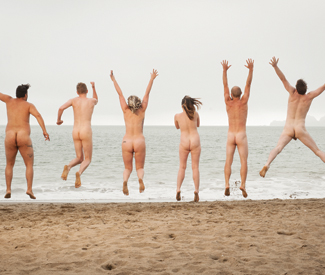
NUDE BEACHES 2013

4

culture@sfbg.com

Below you’ll find our annual update on the state of nude beaches in Northern California, along with detailed guides and directions to some of our favorites. For details on dozens more, please see our complete Nude Beach Guide at www.sfbg.com/nudebeaches, which we are in the process of updating.

While researching clothing-optional beaches in Jamaica in November, my girlfriend and I noticed that native Jamaicans don’t think anything of stripping down to their underwear to take a dip in a waterfall on a hot day — our driver did just that near one of the nation’s biggest cities, Ocho Rios — while visiting tourists can go topless or nude with hardly a complaint on Negril’s seven-mile long shoreline of shimmering white sand, at the west end of the country.

It made me wonder, what if the same tolerance existed here, where each beach has its own traditions and its own set of rules? Sometimes, it takes as little as a person moving some sand or staying after sunset to annoy our cops. In Jamaica and many other parts of the world, that would never happen.

For example, law enforcement actions recently hit two Bay Area nude beaches — Marin’s Red Rock and Steep Ravine — while most access to a third site, fan favorite Muir, near Stinson Beach, has been closed by authorities until November.

The good news: visits by rangers to both skinny dipping coves mentioned above have died back, while anti-nudity patrols at Monterey’s Garrapata Beach, which erupted in 2011, have been discontinued. And the Guardian is publishing three “secret” alternate ways that die-hard visitors can use to reach the nude section of gorgeous Muir Beach.

Red Rock was rocked by a ranger who reportedly used a crowbar to remove part of a sunbathing “terrace” that beach regulars had built by moving sand to create more “towel space.” He also cited two male beachgoers for violating Title 14, Section 4307, of the California Code Of Regulations, which bans removal of “earth” or “sand” from state parks.

The men are appealing their penalties, while their friends at the beach are asking for donations to pay for their legal fees. “We’re going to take up a collection,” says Stinson Beach attorney-teacher Fred Jaggi.

The ranger’s boss, Bill Lutton, a state parks superintendent for the Marin area who visited the beach after the busts, told us that “altering” and “changing the features” of the beach is a serious offense. “We consider ourselves the guardians of seven generations of users of California’s park system,” he says, “so we must protect the parks’ cultural and natural resources.”

Meanwhile, instead of being charged with destroying park property, several people at nearby Steep Ravine Beach, which is open from 7am until dusk, were cited last fall for soaking in its dangerous-to-reach nude hot springs after sunset by the same ranger who raided Red Rock. “A guy was handcuffed after mouthing off to the ranger, so he really deserved it,” says former springs frequent visitor Michael Velkoff, of Lucas Valley. “He almost took a girl away too.”

Citing “safety and lack of lighting” concerns, Lutton says the after-dark curfew at rock-strewn Steep Ravine, where numerous users have slipped and sustained cuts, bruises, and other injuries, “will be strictly enforced.”

And at Muir Beach, which is used by nudists as a gateway to a nude beach that begins on its north end, visiting hours have been officially eliminated until November 15, while crews improve its parking, toilets, and watershed.

“Don’t even think about visiting the beach,” urges Golden Gate National Recreation Area public affairs specialist Alexandra Picavet, who points out that users won’t have access to the beach, ocean, parking, restrooms, or garbage cans. “Find a new experience — the Bay Area has plenty — to try this summer and then you’ll really appreciate Muir Beach when it reopens.”

Because the main portion of Muir is blocked by fencing and being patrolled by rangers, anyone trying to reach Little Beach, as the nude area next to Muir is also known, will have to hike anywhere from 30 minutes to several hours to reach the shore and then continue walking to the naked area. Picavet says that if you stop for any length of time in front of the non-nude part of Muir, even to stand and admire the view or take a dip in the water, you’ll be cited.

While cops are tightening the use of beaches in Marin, they’re relaxing their hold in Monterey County. In fact, nudists at Garrapata Beach, close to Carmel, have something to celebrate: “nudie” patrols by rangers have ended, in part because the state ran out of money to fund them and because not a single complaint has been received in 2013.

“We’ve been complaint free,” says Sean James, who became acting state parks superintendent for the area in April and appears to be fairly tolerant of naturists. “I don’t see how just being nude would be threatening.”

Please be careful at our beaches. Two women in their 30s died June 30 after they were swept into the ocean by a wave near another popular nude beach, Bonny Doon. They were with two men when the wave swept the foursome into the water. The two men were rescued by a Coast guard helicopter after being stranded on some rocks and surrounded by a rising tide.

Of course, you don’t have to go to the sea to be nude. Our listings include naked lakes, rivers, waterfalls, reservoirs, and at least one meadow. Or how about hiking while wearing only your birthday suit? Au naturel “Full Moon Hikes” have been happening for several years. But the world’s first-ever “Supermoon Nude Hike” (named after a new or full moon which occurs with the moon within 90 percent of its closest approach to Earth) took place right here in the Bay Area the night before the brightest moon of 2013.

“I’ll never forget the hike,” said Raj, one of the walkers, after making the trek in the East Bay Hills, near Castro Valley, June 22. “I will think of it every time I see a full moon.”

Agrees Dave Smith, of San Leandro, who led it: “It was spectacular — one of the greatest hikes ever. Keep in mind we did it in moonlight, while even having to scramble on all fours down some rocks. I felt like Gollum in The Lord Of The Rings and The Hobbit.”

Want to join in the fun? More “Full Moon Hikes” will take place July 20 and August 18 (see our online listings below for Las Trampas in Contra Costa County).

Another idea to meet and socialize with fellow naturists: drop by Santa Cruz’s Bonny Doon Beach on September 21 or Lake Tahoe’s Secret Harbor Creek Beach on June 7, 2014, when visitors will be getting together to keep them clean by finding and removing trash.

Finally, you can help beachgoers and the naturist community by sending me your new beach discoveries, trip reports, and improved directions (especially road milepost numbers), along with your phone number to garhan@aol.com or Gary Hanauer, c/o San Francisco Bay Guardian, 71 Stevenson, 2nd Floor, San Francisco, CA 94105.

Our ratings: “A” signifies a beach that is large or well-established and where the crowd is mostly nude; “B” indicates places where fewer than half the visitors are nude; “C” means small or emerging nude areas; and “D” depicts spots that are in use, but not recommended.

SAN FRANCISCO

NORTH BAKER BEACH, SAN FRANCISCO

RATING: A

North Baker’s neo-hippie revival is continuing for a third straight season, with more art work springing up on the USA’s largest urban nude beach. Guitar- and drum-playing was added to the scene last year. This summer, a second so-called “art tree” made of driftwood and festooned with seaweed has appeared. “I call it the Sea Hag,” says Santosh, an organizer of alternative activities at the beach who also produces San Francisco’s annual How Weird Street Faire. “Anybody can add things to it. They bring mementos, flowers, anything you can think of. I tend it, but it attracts a life of its own. Several tourists per day usually drop by. One child looked up at the things dangling from it and asked, ‘Is it some kind of voodoo?'” Baker’s own “beach language” is also evolving. Last year, “duney,” which describes the site’s tent-like, shade-providing structures without walls, and “Baker Day” (when the sun’s out and it’s not too windy) came into usage. “Now, we’ve added ‘rock block’ and ‘cosmic volleyball,'” adds Santosh, who describes the former as any stretch of three Baker Days in a row, while cosmic volleyball allows visitors “to keep playing, even if the ball bounces off one of our driftwood poles.”

Directions: Take the 29 Sunset bus or go north on 25th Avenue to Lincoln Boulevard. Turn right and take the second left onto Bowley Street. Follow Bowley to Gibson Road, turn right, and follow Gibson to the east parking lot. At the beach, head right to the nude area, which starts at the brown and yellow “Hazardous surf, undertow, swim at your own risk” sign. Some motorcycles in the lot have been vandalized, possibly by car owners angered by bikers parking in car spaces; to avoid trouble, motorcyclists should park in the motorcycle area near the cyclone fence. Parking at Lincoln’s 100 or more nearby parking spaces was limited to two hours recently. But through June, there had been no reports of cops actually writing tickets for parking too long.

LAND’S END BEACH, SAN FRANCISCO

RATING: A

One of the better locales in the Bay Area to enjoy a little naked sunning without many people present, a visit to the little cove off Geary Boulevard known as Land’s End may make your worries melt away, at least during a quiet afternoon. Cops only occasionally visit it. But don’t be shocked if you see more clothed visitors than nudists — many locals and tourists who wander down to the sand don’t realize it’s a clothing-optional beach. Tip: on hot days, arrive before noon or there may be no unoccupied sand left on the little, semi-rocky shoreline. If possible, try to use one of the rock-lined windbreaks left by previous sunbathers. Pack a warm covering in case the weather changes.

Directions: Follow Geary Boulevard to the end, then park in the dirt lot up the road from the Cliff House. Take the trail at the far end of the lot. About 100 yards past a bench and some trash cans, the path narrows and bends, then rises and falls, eventually becoming the width of a road. Don’t take the road to the right, which leads to a golf course. Just past another bench, as the trail turns right, go left toward a group of dead trees where you will see a stairway and a “Dogs must be leashed” sign. Descend and head left to another stairway, which leads to a 100-foot walk to the cove. Or, instead, take the service road below the El Camino del Mar parking lot 1/4 mile until you reach a bench, then follow the trail there. It’s eroded in a few places. At the end, you’ll have to scramble over some rocks. Turn left (west) and walk until you find a good place to put down your towel.

GOLDEN GATE BRIDGE BEACH, SAN FRANCISCO

RATING: A

Mostly a gay male cruising scene, “Nasty Boy Beach” is also visited by some straight men and women. Though fairly rocky and packed with people on hot days, everyone seems to enjoy the trio of coves you can find by walking along the shore. Oh, and did I mention the view? If you want to feel immersed in a picture postcard of the famous bridge, then this is the place to plop down. On warm days, some users even swim in the usually chilly, undertow-plagued water. “You can sometimes go out over 100 feet during low tide,” says a woman.

Directions: from the toll booth area of Highway 101/1, take Lincoln Boulevard west about a half mile to Langdon Court. Turn right (west) on Langdon and look for space in the parking lots, across Lincoln from Fort Winfield Scott. Park and then take the beach trail, starting just west of the end of Langdon, down its more than 200 steps to Golden Gate Bridge Beach, also known as Marshall’s Beach. Despite recent improvements, the trail to the beach can still be slippery, especially in the spring and winter.

FORT FUNSTON BEACH, SAN FRANCISCO

RATING: C

Known as Fort Fun by its fans, this Golden Gate National Recreation Area sun spot, located south of Ocean Beach, attracts hang gliders, dogs and their walkers, and even from time to time a few naturists, the latter of which sometimes tuck themselves between the dunes on the shore. But not all is fun on its magnetic sands and the cliffs above them. A few months ago, a tussle between two dogs ended when a canine was stabbed by the owner of one of the pets. Besides pugnacious pooch protectors, watch out too for sharp winds, especially in March and October. And to stave off hassles from rangers, disrobers should stay away on weekends or when families or rangers are near. If anyone seems upset or gripes about you being au naturel, be sure to suit up fast since the authorities will bust naturists if they see them or they receive complaints. The good news: usually, only a few citations a year are issued at Fort Funston, so if you are discreet and stay in the dunes, you may be rewarded with a suntan without lines.

Directions: From San Francisco, go west to Ocean Beach, then south on the Great Highway. After Sloat Boulevard, the road heads uphill. From there, curve right onto Skyline Boulevard, go past one stoplight, and look for signs for Funston on the right. Turn into the public lot and find a space near the west side. At the southwest end, take the sandy steps to the beach, turn right, and walk to the dunes. Find a spot as far as possible from the parking lot.

CONTRA COSTA COUNTY

LAS TRAMPAS REGIONAL WILDERNESS, CASTRO VALLEY

RATING: C

Imagine tromping in the East Bay Hills naked at night, guided only by your flashlight and a representative of the Bay Area Naturists group, plus a few fellow travelers. And yes, mooning during America’s only Full Moon Hikes is permitted. “Those who haven’t experienced these incredibly beautiful, if slightly challenging hikes to the ridge at sunset really ought to put this on their calendar this year,” says organizer Dave Smith, of San Leandro, who’ll be leading trips starting at a Castro Valley nudist club on Saturday, July 20, leaving at 7pm (there will be a potluck earlier), and Sunday, August 18, departing around 6:30pm.

“It’s one of the greatest hikes in the Bay Area, rivaling any I know of,” tells Smith. “It’s right up there with the Palomarin Trail (from the Bolinas area, passing Bass Lake and Pelican Lake, to Alamere Falls, on the coast), the Cascades, and others. The walk is not hard, but it is challenging. We take it slow so everyone can make it. So far, no one has ever been hurt.”

“We usually leave an hour and a half before sunset and hike up to the top to catch the sunset and moonrise and then come back down in the moonlight,” he adds.

“Whether you are clothed or not, participating in the Full Moon Hike is a big treat,” says past hiker Jurek Zarzycki, who suggests walkers bring good hiking shoes, a flashlight (“Most of the time you won’t need it, because of the moonlight”), and bug spray. “And don’t forget to have some baby carrots with you to give to the horses that sometimes come out at night, so close that you may even feel their breath. Don’t worry, though, they’re very friendly.”

Organized by the Sequoians Naturist Club and the Bay Area Naturists, based in San Jose, walkers leave the property of The Sequoians fully clothed at dusk and walk through meadows and up hills until the moon rises, before heading back down the slopes completely nude, with their clothes folded neatly into their backpacks.

Directions: Contact the Sequoians (www.sequoians.com) or the Bay Area Naturists (www.bayareanaturists.org) for details on how to join a walk. Meet at the Sequoians. To get there, take Highway 580 east to the Crow Canyon Road exit. Or follow 580 west to the first Castro Valley off-ramp. Take Crow Canyon Road toward San Ramon .75 mile to Cull Canyon Road. Then follow Cull Canyon Road around 6.5 miles to the end of the paved road. Take the dirt road on the right until the “Y” in the road and keep left. Shortly after, you’ll see The Sequoians sign. Proceed ahead for about another .75 mile to The Sequoians front gate.

SAN MATEO COUNTY

DEVIL’S SLIDE, MONTARA

RATING: A

Despite the opening of the Tom Lantos Tunnels on March 25, 2013, nearby Gray Whale Cove, also known as Devil’s Slide, continues to function — and may, state officials think, soon attract even more visitors than in previous years. The reason: crowds soon will be coming not only to the beach, but also to a mile-long stretch of the old Highway 1 that was circumvented by the tunnels and is being turned into a walking and biking trail; it’s expected to open soon. To handle the larger attendance, workers will build new parking lots on either side of the highway, giving Devil’s Slide a parking area on the ocean side for the first time. The current parking lot on the east side of Highway 1 is still open. “We will also be improving the stairway (leading down to the beach),” says San Mateo coast state parks sector superintendent Paul Keel. Best of all, traditional use of the beach for clothing-optional sunbathing has been continuing, with few problems. “We’re not having an increase in (complaint) calls there,” says Keel.

Directions: Driving from San Francisco, take Highway 1 south through Pacifica. Three miles south of the Denny’s restaurant in Linda Mar, at 500 Linda Mar Blvd., Pacifica, and just past and south of the Tom Lantos Tunnels, turn left (inland or east) on an unmarked road, which takes you to the beach’s parking lot on the east side of the highway and to a 146-step staircase that leads to the sand. Another lot will “eventually” be opened on the ocean side (please see above). Coming from the south on Highway 1, look for a road on the right (east), 1.2 miles north of the old Chart House restaurant in Montara. Most naturists use the north end of the beach, which is separated by rocks from the rest of the shore. Wait until low tide to make the crossing to the nude area.

SAN GREGORIO NUDE BEACH, SAN GREGORIO

RATING: A

Now in its 47th year of operation, America’s oldest nude beach even has its own website and live webcam at www.freewebs.com/sangregoriobeach. The privately-run site is located next to San Gregorio State Beach. The beach often draws a large gay crowd, along with some nude and suited straight couples, singles, and families. On your first visit, though, you may be a little shocked by the provocative behavior that is sometimes happening in the driftwood structures on the slope leading down to the beach. Their walls aren’t completely closed. Some users even want passersby to observe them having sex inside the so-called “sex condos,” including Kerry, from San Francisco, who told us about her October 2012 visit with her partner, Lisa: “It was an exciting time. We’ve been to the beach six times. We have had men wander by and try not to stare. Other times, we have had men that more or less sneak up and peek through the wood at us while we are having sex. One time, we had three men who stood 15 feet away and watched intently as we went at it. We have not met anybody that we consider creepy. In fact, there have never been any words exchanged at all.”

Directions: From San Francisco, drive south on Highway 1, past Half Moon Bay, and, between mileposts 18 and 19, look on the right side of the road for telephone call box number SM 001 0195, at the intersection of Highway 1 and Stage Road, and near an iron gate with trees on either side. From there, expect a drive of 1.1 miles to the entrance. At the Junction 84 highway sign, the beach’s driveway is just .1 mile away. Turn into a gravel driveway, passing through the iron gate mentioned above, which says 119429 on the gatepost. Drive past a grassy field to the parking lot, where you’ll be asked to pay an entrance fee. Take the long path from the lot to the sand; everything north of the trail’s end is clothing-optional (families and swimsuit using visitors tend to stay on the south end of the beach). The beach is also accessible from the San Gregorio State Beach parking area to the south; from there, hike about a half-mile north. Take the dirt road past the big white gate with the Toll Road sign to the parking lot.

SANTA CRUZ COUNTY

GARDEN OF EDEN, FELTON

RATING: C

Are you looking for a gorgeous place to have a picnic? If you’re in the Bay Area, you won’t have to travel far to find the Golden State’s version of the Garden of Eden, a creekside skinny-dipping spot located in Henry Cowell Redwoods State Park, between Santa Cruz and Felton. Used even more by suited swimmers and sunbathers, many hikers are surprised when they come across naturists at the stream. Eden gets mixed reviews by visitors: some parts of the trail may be slippery, so watch your step and keep your eyes out for poison oak. To find Eden and two other clothing-optional swim holes on San Lorenzo River, check for vehicles pulled over on Highway 9, alongside the state park, which forbids nudity but only occasionally patrols the creek with rangers.

Directions: From Santa Cruz, drive north on Highway 9 and look for turnouts on the right side of the road, where cars are pulled over. The first, a wide turnout with a tree in the middle, is just north of Santa Cruz. Rincon Fire Trail starts about where the tree is, according to reader Robert Carlsen, of Sacramento. The many forks in the trail all lead to the river, down toward Big Rock Hole and Frisbee Beach; Carlsen says the best area off this turnout can be reached by bearing left until the end of the trail. Farther up the highway, 1.3 miles south of the park entrance, is the second and bigger pullout, called the Ox Trail Turnout, leading to Garden of Eden. Park in the turnout and follow the dirt fire road downhill and across some railroad tracks. Head south, following the tracks, for around .5 miles. Look for a “Pack Your Trash” sign with park rules and hours and then proceed down the Eden Trail.

Ox Trail, which can be slippery, and Eden Trail both wind down steeply to the creek. “The path continues to the left, where there are several spots for wading and sunbathing,” Carlsen says. The main beach is only 75 feet long and 30 feet wide, but fairly sandy. Carlsen’s favorite hole is accessible from a trail that starts at the third turnout, a small one on the right side of the road, about 4.5 miles from Highway 1 and just before Felton. A gate marks the start of the path. The trail bends left. When you come to the road again, go right. At the railroad tracks, go right. From here, look for the river down the hill on your left; many paths lead to it. Says Mike: “Within 10 yards, you can be in the water.”

BONNY DOON NUDE BEACH, BONNY DOON

RATING: A

Were anti-nudity signs really recently posted at Bonny Doon Beach, whose north end has been used for clothing optional sunbathing for decades? Yes, but officials took the warnings, which were placed at two trailheads leading to the sand, down just two months later. “We’re not planning to change anything,” says Chet Bardo, superintendent of state beaches in the Santa Cruz district. “The truth is that we get complaints on all sides of this issue. It’s not uncommon to get calls from people. This is California, after all, so what to local people might seem not that unusual sometimes turns out to shock people who are visiting from Iowa, who find it (nudity) a bit disconcerting.”

“The way I see it, unless there’s a problem (happening at the beach), it’s not a problem to us,” he adds. In fact, the only problem at Bonny Doon this year is that it has less sand than usual. A 15-foot long rock on the sand, along with a sloping cliff with rocks that jut out, separate the two sides of the cove — one clothed for clothed visitors and the other for nudes — known as Bonny Doon.

“In the short term, things at Bonny Doon are destined to continue the way they are,” says Kirk Lingenfelter, sector superintendent for Bonny Doon and nearby state beaches. “Ultimately it would be nice to see some level of improvement, maybe trail work or stair work,” adds Lingenfelter. “But before we’d even do that, there would need to be a General Plan or an Interim Use Plan, which we don’t have. And we also don’t have any funding for it.”

As for nudity, Lingenfelter says his rangers, who periodically patrol the beach, haven’t issued a single warning or citation for nudity since the state approved the acquisition of the beach in 2006. “We’ll respond to complaints we receive,” he explains, “but I can’t recall (receiving) a single complaint.”

Directions: From San Francisco, go south on Highway 1 to the Bonny Doon parking lot at milepost 27.6 on the west side of the road, 2.4 miles north of Red, White, and Blue Beach, and some 11 miles north of Santa Cruz. From Santa Cruz, head north on Highway 1 until you see Bonny Doon Road, which veers off sharply to the right just south of Davenport. The beach is just off the intersection. Park in the paved lot to the west of Highway 1; don’t park on Bonny Doon Road or the shoulder of Highway 1. If the lot is full, drive north on Highway 1, park at the next beach lot, and walk back to the first lot. Or take Santa Cruz Metro Transit District bus route 40 to the lot; it leaves the Metro Center three times a day on Saturdays and takes about 20 minutes. To get to the beach, climb the berm next to the railroad tracks adjacent to the Bonny Doon lot, cross the tracks, descend, and take a recently improved, sign-marked trail to the sand. Walk north past most of the beach to the nude cove on the north end. Alternately, Dusty suggests parking as far north as possible, taking the northern entrance, and, with good shoes, following a “rocky and steep” walk down to the sand.

2222 BEACH, SANTA CRUZ

RATING: A

Aptly named 2222, a mini-nude beach that takes its title from the house across the street, is still beautiful, still hidden from most passersby, and still attracts a small crowd of regular visitors who are in good enough shape to handle its sketchy, foreboding-looking path.

One of America’s smallest nude beaches, 2222 is so tiny it could probably fit in your yard. And that’s what makes it such a special place. You won’t see many people on the sand, which takes scrambling to reach and isn’t recommended for children or anyone who isn’t a good hiker. However, those who are able to make it down a sharp-angled cliff and past several concrete blocks on the way down may like the quiet and solitude that the beach offers. The most dependable trail begins on the southeast corner of the hillside overlooking the site. Even though there’s a walking path just above it, the beach can’t be seen from there. College students like to hangout here and, if they’re lucky, get a glimpse of a local juggler who sometimes practices his routines on the sand. Tip: for great accommodations, check out the West Cliff Inn, 174 West Cliff Drive, Santa Cruz, a bed and breakfast inn located a few blocks to the south; it’s somewhat pricey, but truly enjoyable.

Directions: The beach is a few blocks west of Natural Bridges State Beach and about 2.5 miles north of the Santa Cruz Boardwalk. From either north or south of Santa Cruz, take Highway 1 to Swift Street. Drive .8 miles to the sea, then turn right on West Cliff Drive. 2222 is five blocks away. Past Auburn Avenue, look for 2222 West Cliff on the inland side of the street. Park in the pullout with eight parking spaces next to the cliff, on the west side of the road. If it’s full, continue straight and park along Chico Avenue. An overlook with two benches facing an interesting obelisk-style sculpture — where my girlfriend and I sat last year — is located between the parking area and the edge of the cliff. Bay Area Naturists leader Rich Pasco suggests visitors use care and then follow the path on the side of the beach closest to downtown Santa Cruz and the Municipal Wharf.

PRIVATES BEACH, SANTA CRUZ

RATING: A

Want to visit a beach with great sand and surf, plus a mix of suited and naked users? This year, the charge remains $100 — or $50 if you live nearby — for all the visits you want to make to Privates, which is one of the county’s best beaches, until May 31. If you go daily for a year, that’s about 27 cents a day. But there are also several ways people have used to circumvent the fee, which we explain below. Visitors include nudists, surfers, families, and local residents. “Everyone gets along,” says Brittney Barrios, manager/buyer of Freeline Design Surf Shop, which sells up to 600 beach passes to Privates a year. “It’s always very peaceful.”

“There’s a great swell happening here,” says a surfer we interviewed this summer. Security guards plus a locked gate keep most troublemakers out. With almost no litter or loud noise, and less wind than most local beaches, the site almost always provides a pleasant atmosphere for users. Do you want to bring your dog? It’s OK too.

To catch a game of Nude Frisbee or to start one, when you reach the bottom of the beach stairs, walk to the left until you see some people who aren’t wearing part or all of their swimsuits.

Directions: 1) Some visitors walk north from Capitola Pier in low tide (not a good idea since at least four people have needed to be rescued). 2) Others reach it in low tide via the stairs at the end of 41st Avenue, which lead to a surf spot called the Hook at the south end of a rocky shore known as Pleasure Point. 3) Surfers paddle on boards for a few minutes to Privates from Capitola or the Hook. 4) Most visitors buy a key to the beach gate for $100 a year at Freeline (821 41st Ave., Santa Cruz, 831-476-2950) 1.5 blocks west of the beach. Others go with someone with a key or wait outside the gate until a person with a key goes in, provided a security guard is not present (they often are there). “Most people will gladly hold the gate open for someone behind them whose hands are full,” says Bay Area Naturists leader Rich Pasco. The nude area starts to the left of the bottom of the stairs.

MARIN COUNTY

BASS LAKE, BOLINAS

RATING: B

“The lake was great,” says regular user Dave Smith, of San Leandro, about his visit to Bass Lake, near Bolinas, this year. “It was during spring break, so there were a lot of people on the trail that day. But we weren’t the only ones who were naked in the water. Several people were skinny dipping besides us.” Others, who don’t necessarily go nude, love Bass too, which, by the way, does not have any bass. San Rafael resident Marie described her November visit as “awe-inspiring” on a message board. She said the walk to get there “was worth every minute … the water while cool was exhilarating. I can’t wait to go back.” And Cindi, of San Anselmo, found the setting to be “rejuvenating, awesome, stunning, orgasmic … I would do it again and again.” Bass doesn’t attract as many nudists as it did 10 years ago. “When I first went, everybody was nude,” says Smith. “Today, though, you have to feel pretty comfortable with your own nudity to swim that way at the lake.”

Directions: Allow about an hour for the drive from San Francisco’s Golden Gate Bridge. From Stinson Beach, go north on Highway 1. Just north of Bolinas Lagoon, turn left on the often-unmarked exit to Bolinas. Follow the road as it curves along the lagoon and eventually ends at Olema-Bolinas Road. Continue along Olema-Bolinas Road to the stop sign at Mesa Road. Turn right on Mesa and drive four miles until it becomes a gravel road and ends at the Palomarin parking lot. On hot days the lot fills quickly, so come early. Says Smith: “We once saw hundreds of cars.” A sign at the trailhead next to the lot will guide you down scenic Palomarin Trail to the lake. For directions to incredibly beautiful Alamere Falls, 1.5 miles past Bass Lake, which empties onto a beach at the sea, please see “Elsewhere In Marin” in our online listings.

RED ROCK BEACH, STINSTON BEACH

RATING: A

The beach is in good shape this year. Warmer than usual weather in spring brought more people — 80 on one day — onto the sand earlier than usual, but, due to higher gas prices and a rough economy, crowd sizes remain down from a decade ago. “We’ve had fewer gawkers too,” says veteran visitor Fred Jaggi. “The beach is the mellowest it’s ever been.” If gawking remains down, then it would bring welcome relief. A 2012 visitor estimated the site had “25 percent nasty creeper grossness.” In another improvement, the trail is getting rave reviews. Foliage along the path has been pruned back since last year. “It’s clean of poison oak,” says Jaggi. “It’s a really easy walk now,” adds another visitor, Michael Velkoff. “You can’t beat it. I wear my sandals down there (instead of hiking shoes) while carrying a chair and backpack. If I can walk back up the trail at the end of the day, anyone can do it.” Rock climbing continues to be popular. Ultimate Frisbee, Double Disc Court (you throw two Frisbees at once), Befuddle (players toss the first disc softer and the second one harder), Nude Hearts, and Naked Scrabble are some of the other favorite pursuits on the sand. Tips: visit when the tide is low or early in the day; come before noon for the best parking. For the most sand space, drop by on a Monday, known as “Club Day” to the repeat visitors who like to gather then. And, if possible, bring a folding beach chair.

Directions: Go north on Highway 1 from Mill Valley, following the signs to Stinson Beach. At the long line of mailboxes next to the Muir Beach cutoff point, start checking your odometer. Look for a dirt lot full of cars to the left (west) of the highway 5.6 miles north of Muir and a smaller one on east side of the road. The lots are at milepost 11.3, one mile south of Stinson Beach. Limited parking is also available 150 yards to the south on the west side of Highway 1. Or from Mill Valley, take the West Marin/Bolinas Stage toward Stinson Beach and Bolinas. Get off at the intersection of Panoramic Highway and Highway 1. Then walk south .6 mile to the Red Rock lots. Follow the long, steep path to the beach that starts near the Dumpster next to the main parking lot.

MUIR NUDE BEACH, MUIR BEACH

RATING: A

Although the public part of Muir Beach has been closed since July 8, the small, quarter-moon shaped, clothing-optional beach just to the north of it is still technically open. This summer, the site was attracting 30-40 people a day, although it may get 100 on hot days. It’s one of the only Bay Area nude beaches that receives nearly as many female visitors as males. A variety of people share the cove, which has a more serene and less social atmosphere than nearby Red Rock. Finding it is usually easy: you park at the main Muir lot, walk north on the sand, cross over some rocks, and you’re there. Now, though, during improvement work lasting until November, visitors can’t park near Muir or enter it by foot. To reach the naked beach, you’ll need to hike up to several hours and not be able to use restrooms or garbage cans, which are ringed with fences. Once there, you must continue to the nude beach without stopping on the main beach, even to admire the view or swim in the water, or you will be cited.

Directions until 11/10: 1) Take the Coastal Trail to Muir Beach from the Tennessee Valley trailhead, then walk north until you come to a line of rocks marking the start of the nude area. Walk over the rocks. The roundtrip loop is just under 8 miles. See our web listings for details. 2) A hike of up to 30 minutes on the Coastal Trail begins at the Green Gulch Farm Zen Center, at 1601 Shoreline Highway, off Highway 1 just south of Muir Beach. But the Center’s parking lot is tiny, costs single-occupant drivers $5 to use on Sundays (when participation in the Center’s program is requested) and isn’t open to the public on weekdays or Saturdays, so staff are strongly discouraging its use for Muir access during the beach’s closure. Our online report has more info. 3) If you live on Cove Lane, near Pacific Way, you can still access the beach from Cove. Nonresidents can’t park on Cove Lane, Pacific Way, or other nearby streets during the closure period. Starting 11/10: From San Francisco, take Highway 1 north to Muir Beach, to milepost 5.7. Turn left on Pacific Way and park in the Muir lot (to avoid tickets, don’t park on Pacific). Or park on the street off Highway 1 across from Pacific and about 100 yards north. From the Muir lot, follow a path and boardwalk to the sand. Then walk north to a pile of rocks between the cliffs and the sea. You’ll need good hiking or walking shoes to cross; in very low tide, try to cross closer to the water. The nude area starts north of it.

RCA BEACH, BOLINAS

RATING: A

In a 1998 movie, visiting Jamaica was How Stella Got Her Groove Back. But if you’d like to revitalize your life, all you may need to do is spend an afternoon at awe-inspiring RCA Beach. Even though the site is isolated, don’t try to have sex on the sand; rangers ticketed at least one person for engaging in public sex here last fall. A single stopover at this relaxing oasis of tranquility will probably inspire you to keep coming back. “It hasn’t changed in decades,” says regular visitor Michael Velkoff. One problem: the cove is exposed to the wind. The good news is that there are lots of nooks that are sheltered from the wind. Some nooks, though, provide good shelter from the periodic breezes. Plus there’s so much driftwood on the sand that many people build windbreaks or even whole forts. Suited and unsuited men and women and families visit the shoreline. The beach seems far bigger than its one mile length because everyone is usually spread out on the sand. Adds Velkoff: “We’ll see six people on a Sunday. Everybody’s 30 yards apart. It’s amazing.”

Directions: From Stinson Beach, take Highway 1 (Shoreline Highway) north toward Calle Del Mar for 4.5 miles. Turn left onto Olema Bolinas Road and follow it 1.8 miles to Mesa Road in Bolinas. Turn right and stay on Mesa until you see cars parked past some old transmission towers. Park and walk .25 miles to the end of the pavement. Go left through the gap in the fence. The trail leads to a gravel road. Follow it until you see a path on your right, leading through a gate. Take it along the cliff top until it veers down to the beach. Or continue along Mesa until you come to a grove of eucalyptus trees. Enter through the gate here, then hike .5 miles through a cow pasture on a path that will also bring you through thick brush. The second route is slippery and eroding, but less steep. “It’s shorter, but toward the end there’s a rope for you to hold onto going down the cliff,” tells Velkoff.


LIMANTOUR BEACH, OLEMA

RATING: B

Would you like to walk a mile wearing nothing but your smile? At lovely Limantour, in Point Reyes National Seashore, you can do just that. Bring a pair of binoculars for watching birds, seals, and other wildlife. “I’ve been going there this year since the spring,” says Lucas Valley’s Michael Velkoff. “There are always whales and dolphins off shore, but recently we’ve been seeing porpoises too. It’s so beautiful at Limantour. I just head away from any people and put my towel down in the dunes or against a wall. A friend went a few days ago. Even though it was windy, she was very comfortable in the dunes. The best thing is that nobody bothers you. Of course, I carry a pair of shorts, just in case I need to put them on. I love it at Limantour. Plus it has tons of nice sand.” The long shoreline is one of America’s most beautiful beaches, yet few visitors realize the narrow spit of sand, between Drakes Bay and an estuary, is clothing-optional. The site is so big — about 2.5 miles in length — you can wander for hours, checking out ducks and other waterfowl, shorebirds such as snowy plovers (if you are lucky enough to see these endangered birds on the north end of the beach), gray whales (including mothers and their calves during spring), and playful harbor seals (offshore and at the north edge of the sand). Dogs are allowed on six-foot leashes on the south end of the beach.

Directions: From San Francisco, take Highway 101 north to the Sir Francis Drake Boulevard exit, then follow Sir Francis through San Anselmo and Lagunitas to Olema. At the intersection with Highway 1, turn right onto 1. Just north of Olema, go left on Bear Valley Road. A mile after the turnoff for the Bear Valley Visitor Center, turn left (at the Limantour Beach sign) on Limantour Road and follow it 11 miles to the parking lot at the end. Walk north a half-mile until you see some dunes about 50 yards east of the shore. Nudists usually prefer the valleys between the dunes for sunbathing. “One Sunday we had 200 yards to ourselves,” Velkoff says. But lately, the dunes have been more crowded.




Beginning on broke

1

news@sfbg.com

Despite signs of economic recovery, many young people still face hard times due to high unemployment, low wages, and a lack of job opportunities. San Francisco Mayor Ed Lee recently sought to tackle this issue locally with the rollout of Summer Jobs + 2013, a public-private partnership with an ambitious goal of providing 6,000 jobs and paid internships for San Francisco’s young adults. It was the most ambitious goal ever pursued in a city jobs initiative, with particular emphasis on low-income youth.

“I’m calling on all San Francisco companies to take on this challenge to support the youth of San Francisco,” Mayor Lee said at a press conference in April, when he joined House Democratic Leader Nancy Pelosi in unveiling the program, the local manifestation of an Obama Administration jobs initiative. “Creating meaningful employment opportunities for our young people today will set them up for success now and in the future.”

But Summer Jobs + is falling far short of its goal, resulting in the creation of only 3,200 summer jobs. The Mayor’s Office is still holding out for a possible influx of hires next month that could bring it closer to the goal before summer’s end, Gloria Chan with the San Francisco Office of Economic and Workforce Development told us.

Last summer, the Mayor’s Office launched a similar initiative aimed at providing 5,000 youth jobs and internships, and ultimately exceeded the goal by 200 positions. Roughly 32 percent of those jobs were in the private sector, predominantly tech. At the end of the day, only about 14 percent of the program’s participants locked down private-sector jobs, with employers ranging from Starbucks to Bank of America to Twilio.

Despite some success in helping young San Franciscans find work, the efforts so far amount to a kind of Band-Aid solution to a problem that goes much deeper and cannot be solved by simply teaching young people to draft polished resumes. Youth unemployment, particularly among low-income and marginalized groups, has worsened over time and is linked to a broader trend of economic inequality.

The Urban Institute, a nonpartisan think tank, recently turned an eye toward economic pressures facing young people with the release of a study titled, “Lost Generations? Wealth Building among Young Americans.” (see “Wealth vs. work,” May 1).

The institute found that among young people, “Average wealth in 2010 was 7 percent below that of those in their 20s and 30s in 1983. Even before the Great Recession, young Americans were on a strikingly different trajectory. Now, stagnant wages, diminishing job opportunities, and lost home values may be merging to paint a vastly different future for Gen X and Gen Y. Despite their relative youth, they may not be able to make up the lost ground.”

In the aftermath of the Great Recession triggered by the economic crash of 2009, millennials ages 16 to 24 have faced dramatically lower employment and income rates in comparison with their elders, according to Bureau of Labor Statistics data.

In California, where unemployment stands at 10.5 percent, the millennial unemployment rate is 20.2 percent. Additionally, the median income of employed young adults in California fell from about $35,000 to $32,000 from 2005 to 2011, while other age groups recovered on average. In San Francisco, the unemployment rate for young people aged 16 to 24 was just shy of 14 percent in 2011, double that of individuals spanning ages 18 to 34.

“We know that there’s been a lot of reporting out there that the recession was particularly hard for young adults, but it’s also important to note that they are in a much bigger hole than everyone else,” Rory O’Sullivan, a policy director for Young Invincibles, told the Guardian.

Young Invincibles is a national organization that works to expand opportunities for young adults in education and employment, and to bring attention to the oft-ignored economic plight of young adults seeking a foothold in the job market.

Young Invincibles found the Great Recession hit young adults harder than any previous recession in recent history. A quarter of job loss experienced by millennials occurred after the recession ended, while the unemployment rate for 18 to 34 year olds has consistently been double that of those 35 and up.

“Young people usually take a big hit in a recession,” said O’Sullivan. “Since they’re often the first fired, last hired in a seniority system. You’re going to let go of recent hires and not the more experienced folks.”

It’s a problem that can potentially have broader effects in the long run. “There are huge consequences for the economy down the road if we have a whole generation out of work,” explained O’Sullivan. “Lack of internships and first jobs can really hurt a young person’s wages. If a young person graduates in a recession, their wages will take a hit for decades afterwards — and that could have huge consequences. We’re still a long way behind.”

There’s no easy fix for the myriad economic pressures surrounding young adults, but O’Sullivan points to public-private partnerships as a way to get young people back in the market, even though that doesn’t seem to be working in San Francisco. O’Sullivan said Young Invincibles would like to see more public service jobs created for young people. “There’s a huge demand,” O’Sullivan said. “Rebuilding after national disasters, building houses, tutoring. We have to do a better job of connecting young people to this workforce.”

Who killed City College?

news@sfbg.com

The day City College of San Francisco heard it would close was the same day, July 3, that 19-year-old Dennis Garcia signed up for his fall classes.

With a manila folder tucked under his arm, he turned the corner away from the registration counter and strode by a wall festooned with black and white sketches of every City College chancellor since 1935, including a portrait of bespectacled founder Archibald Cloud. In a meeting room on the other side of that wall, the college’s current administrators were receiving the verdict from the Accrediting Commission for Community and Junior Colleges.

It was their worst fears of the past year realized: City College’s accreditation was being revoked. Accreditation is necessary for the college to receive state funding, for students to get federal loans, and for the degree to be worth more than the paper it’s printed on.

Unbeknownst to Garcia, he walked out of the building just as the college received its death sentence, which is scheduled to be carried out next July unless appeals now underway offer a reprieve. In the interim, CCSF will essentially be a ward of the state, stripped of the local control it has enjoyed since Cloud’s days.

Just a few blocks down Ocean Avenue is the nerve center of City College’s teachers union. Housed in a flat above a Laundromat, the scent of freshly washed clothes wafted up the staircase to an office that instantly became a flurry of ringing phones and rushed voices.

Only an hour later, 10 or so union volunteers were calling their members, contacting nearly 1,600 City College faculty whose responses ranged from sad to furious. The volunteers read them bulleted factoids about accreditation and a call to join an upcoming protest march.

But the woes of City College reach deeper than a three line script could ever cover, and can be traced back to the oval office itself, leading to a really odd question: Did President Obama kill City College?


PRESSURE FROM THE TOP

When the president trumpeted education in his 2012 State of the Union speech, he sounded an understandable sentiment. “States also need to do their part, by making higher education a higher priority in their budgets,” Obama told the nation. “And colleges and universities have to do their part by working to keep costs down.”

But the specifics of how to cut costs were outlined by years of policymaking and a State of the Union supplement sheet given to the press.

The president’s statement said that they will determine which colleges receive aid, “either by incorporating measures of value and affordability into the existing accreditation system; or by establishing a new, alternative system of accreditation that would provide pathways for higher education models and colleges to receive federal student aid based on performance and results.”

The emphasis is ours, but the translation is very simple: College accreditation agencies can either enforce the administration’s numbers-based plan or be replaced. The president’s college reform is widely known and hotly debated in education circles. Commonly known as the “completion agenda,” with an emphasis on measurable outcomes in job placement, it had its start under President George W. Bush, but Obama carried the torch.

The idea is that colleges divest from community-based programs not directly related to job creation or university degrees, and use a data measurement approach to ensure two-year schools transfer and graduate students in greater numbers. “Community colleges” would quickly become “junior colleges,” accelerating a slow transition that began many years ago.

But its critics say completion numbers are screwy: They discount students who are at affordable community colleges just to learn a single skill and students who switch schools, administrator Sanford Shugart of Valencia College in Florida wrote in an essay titled “Moving the Needle on College Completion Thoughtfully.”

Funding decisions made from completion numbers affect millions of students nationwide — and CCSF has now become the biggest laboratory rat in this experiment in finding new ways to feed the modern economy.

“I think there was a general consensus that the country is in a position that, coming out of the recession, we have diminished resources,” Paul Feist, spokesperson for the California Community College Chancellor’s Office, told us. “Completion is important to the nation — if you talk to economic forecasters, there’s a huge demand for educated workers. Completion is not a bad thing.”

Like dominoes, the federal agenda and Obama’s controversial Secretary of Education Arne Duncan tipped the Department of Education, followed by the ACCJC, and now City College — an activist school in an activist city and an institution that openly defied the new austerity regime.


WINNING THE BATTLE

In the ACCJC’s Summer 2006 newsletter, Brice Harris — then an accreditation commissioner, now chancellor of the state community college system — described the conflict that arose when colleges rallied against completion measurements established by the federal government.

“In the current climate of increased accountability, our regional accrediting associations find that tight spot to be more like a vice,” Harris wrote.

Many of the 14 demands the ACCJC made of City College trace back to the early days of Obama’s administration, when local trustees resisted slashing the curriculum during the Great Recession.

“There’s a logic to saying ‘We don’t want to put students on the street in the middle of a recession,'” said Karen Saginor, former City College academic senate president. “If you throw out the students, you can’t put them in the closet for two years and bring them back when you have the money.”

And they have a lot of students — more than 85,000. Like all community colleges in California, the price of entry is cheap, at $46 a unit and all welcome to attend. But since 2008, the system was hammered with budget cuts of more than $809 million, or 12 percent of its budget.

So programs were cut, including those for seniors, ex-inmates re-entering society, or young people enrolling to learn Photoshop or some other skill without committing to a four-year degree.

“As the recession hit, the Legislature instructed the community college system [to] prioritize basic skills, career technical, and transfer,” Feist said. “That’s to a large extent what we did. That was the reshaping of the mission of that whole system.”

It’s easy to cast the completion agenda as a shadowy villain in a grand dilemma, but as Feist or anyone on the federal level would note, people were already being pushed out of the system, to the tune of more than 500,000 students since the 2008-09 academic year due to the budget crisis. Course offerings have been slashed by 24 percent, according to the state chancellor’s office.

But City College would only go so far. Then-Chancellor Don Q. Griffin raised the battle cry against austerity and the completion agenda at an October 2011 board meeting, his baritone voice sounding one of his fullest furies.

“It was obvious to me when I heard Bush … and then Obama talking about the value of community colleges … they’re going to push out poor people, people of color, people who cannot afford to go anywhere else except the community college,” he said.

But when it came to paying for that pushback, things got tricky.

“No more of this bullshit, that we turn the other way and say it’s fine. We’re going to concentrate the money on the students,” Griffin said at a December 2011 board meeting. “You guys are talking about cutting classes, we don’t believe in that. Cut the other stuff first, cut it until it hurts, and then talk about cutting classes.”

So he slashed his own salary and lost staff through attrition and other means. The college had more than 70 administrators before 2008, and it now has fewer than 40.

“Since the recession in 2009, we’ve been seen as the rebels,” said Jeffrey Fang, a former student trustee on City College’s board. “When most of the colleges went and made cuts in light of the recession, we decided to find ways to keep everything open while doing what we could to eliminate spending.”

But those successes in saving classes put City College on a collision course with its accreditor.


LOSING THE WAR

Seven years ago, the ACCJC found six deficiencies that it asked City College to fix, finding it had too many campuses serving too many students, fiscal troubles, and hadn’t enforced measurement standards. Last year, it faulted City College for resisting those changes and tacked on eight additional demands, threatening to revoke its accreditation.

Speaking on condition of anonymity, an official who worked closely with ACCJC as a member of one of the visiting accreditation teams told us there was pressure to crack down on all the Western colleges.

“The message they’re hearing from (ACCJC President) Barbara Beno is that Washington is demanding, ‘Why are you not being more strict with institutions with deficiencies that have lasted more than two years [and taking action] to revoke their accreditation?'” the source said.

This official said this may soon ripple to other accreditation agencies. “What’s anomalous about California is we’re getting to where everyone will be in a few years.”

The ACCJC’s next evaluation is this December, where it will be reviewed by the Department of Education. It wants to be ready, says Paul Fain, a reporter for Inside Higher Ed, a national trade publication.

“Washington writ large … is pushing very hard on accreditors to drive a harder line,” Fain told us. “There’s a criticism out there that accreditation is weak and toothless.”

The U.S. Department of Education declined to comment on the issue, saying only that it will formally respond to all officially filed complaints about ACCJC.

But the numbers speak volumes. As an ACCJC newsletter first described federal pressure back in 2006, seven community colleges in California were on probation or warning by the ACCJC. By 2012 that number leapt to 28.

But the California Federation of Teachers is fighting back, and recently filed a 280-page complaint about the ACCJC with the Department of Education.

The allegations were many: Business conflict of interest from a commission member, failure to adhere to its own policies and bylaws, and even the commission President Beno’s husband having served on City College’s visiting team, which the unions said is a clear conflict of interest.

Some people think it’s a waste of time, that City College has already lost.

“That process of fighting accreditation won’t succeed, it just forestalls the problem,” said Bill McGinnis, a trustee on Butte College’s board for over 20 years. He’s also served on many ACCJC visiting teams.

But the unions are making some headway. The Department of Education wrote a letter to the ACCJC telling them to respond in full to the complaints by July 8, as this article goes to press. The accreditor will soon be the one evaluated.


WHAT’S NEXT?

In the meantime, City College has exactly one year to reverse its fortunes: The loss of accreditation doesn’t actually kick in until July, 2014. A special trustee appointed by the state will be granted all the powers of the locally elected City College Board of Trustees to get with the federal program. Without voting power, the elected body is effectively castrated.

No one knows what that will mean for the college board, not even Mayor Ed Lee, who issued a statement supporting the state takeover and criticizing local trustees for not cutting enough. “The ACCJC is fundamentally hostile to elected boards and they’ve made that clear,” City College Trustee Rafael Mandelman told us. “The Board of Trustees should and may look at all possible legal options around this.”

Although officials say classes will proceed as normal for the next year, some aren’t waiting around to see if City College will survive.

At its last board meeting, the CCSF Board of Trustees grappled with how to address dwindling enrollment. As news of its accreditation troubles spread, City College has been under-enrolled by thousands of students, exacerbating its problems. Since the state funds colleges based on numbers of students, City College’s funding is plummeting by the millions.

A frightening statistic: When Compton College lost its accreditation in 2005 and was subsequently absorbed by a neighboring district, it lost half its student population, according to state records.

Even the faculty is having a hard time hanging on, said Alisa Messer, the college’s faculty union president.

“People are looking for jobs elsewhere already. Despite everyone’s dedication to see the college through, it has tried everyone and stretched them to the limit,” she told us.

The college has two hopes — that the CFT wins its lawsuit and can reverse the ACCJC decision, or that the new special trustee can somehow turn the college around by next July. But either way, something will be lost. “City College is definitely changing,” Saginor said. “What it will change into, and if those changes will be permanent, that I don’t know.”

Last train

steve@sfbg.com

Last week’s four-day strike by Bay Area Rapid Transit workers dominated the news and made headlines around the country, marking the latest battleground in a national war between public employee unions and the austerity agenda pushed by conservatives and neoliberals.

Of course, that wasn’t how the conflict was framed by BART, most journalists, or even the two BART unions involved, all of whom dutifully reported the details of each sides’ offers and counter-offers, the competing “safety” narratives (new security procedures demands by unions versus spending more on capital improvements than raises), and the strike’s impact on commuters and the local economy.

But once this long-simmering labor standoff seized the attention of a public heavily reliant on BART, fueling the popular anger and resentment increasingly directed at public employee unions in recent years, familiar basic storylines emerged.

At that point, the Bay Area could have been placed in Wisconsin, Ohio, Michigan, or Illinois — the most recent high-profile labor union battlegrounds, with their narratives of greedy public employees clinging to their fully funded pensions and higher than average salaries while the rest of us suffer through this stubbornly lingering hangover from the Great Recession.

Around water coolers and online message boards, there were common refrains: How dare those unions demand the raises that the rest of us are being denied! Pensions? Who has fully funded pensions anymore? Why can’t they just be more realistic?

When Bay Area residents were finally forced to find other ways of getting around, within a transportation system that is already at the breaking point during peak hours thanks to years of austerity budgets and under-investment in basic infrastructure, those seething resentments exploded into outright anger.

And those political dynamics could only get worse in a month. The BART strike could resume full strength on a non-holiday workweek if the two sides aren’t able to come to an agreement before the recently extended contract expires.

This is the Bay Area’s most visible and impactful labor standoff, and it could prove to be a pivotal one for the modern American labor movement.


BART AS BELLWETHER

Chris Daly was a clarion voice for progressive values while serving on the San Francisco Board of Supervisors from 2000-2010. Now, as political director of Service Employee International Union Local 1021, one of the BART unions, he says this standoff is about more than just the issues being discussed at the bargaining table.

“The terms and conditions of workers in the public sector is a buoy for other workers,” Daly told us, explaining how everyone’s wages and benefits tend to follow the gains and setbacks negotiated by unions. “The right understands this, which is why the right has been mercilessly attacking public sector workers.”

Ken Jacobs, chair of the UC Berkeley Labor Center, confirmed that union contracts affect the overall labor market. “When unions improve wages and benefits, it does have a ripple effect,” Jacobs said. He agreed that the outcome at BART could be a bellwether for the question, “As the economy comes back, how much will workers share in that prosperity?”

Demonizing public sector workers as greedy or lazy also serves to undercut the entire labor movement, Daly said, considering that public employees make up a far higher percentage of union members than their private sector counterparts. And during election time, it is union money and ground troops that typically contest wealthy individuals and corporations’ efforts to maintain or expand power.

“Labor is one of the main checks on unbridled corporate power, and public sector unions are the backbone of labor,” Daly told us.

So in that context, BART’s battle is about more than just the wages and benefits of train drivers and station agents, with their average base salary of $62,000, just barely above the area median income, and their demand for raises after accepting wage freezes in recent years.

Daly sees this as part of a much broader political standoff, and he said there are indications that BART management also sees it that way, starting with the $399,000 the transit agency is paying its lead negotiator Thomas Hock, a veteran of union-busting standoffs around the country.

“He has a history of bargaining toward strikes, with the goal of breaking unions,” Daly said, noting that Hock’s opening offer would have taken money from BART employees, with new pension and healthcare contributions outweighing raises. “It was a takeaway proposal when you add it up, while they have a $100 million surplus in their budget and the cost of living in the Bay Area is shooting up.”

But BART spokesperson Rick Rice told us that Hock is simply trying to get the best deal possible for this taxpayer-funded agency, and he denied there is any intention to break the union or connection to some larger anti-worker agenda.

“There is definitely a need to start funding the capital needs of the district,” Rice told us. “I don’t see that we’re pushing an austerity agenda as much as a realistic agenda.”


AUSTERITY AND EXPANSION

But Daly said the very idea that austerity measures are “realistic” excuses the banks and other powerful players whose reckless pursuit of profits caused the financial meltdown of 2008. The underlying expectation is that workers should continue to pay for that debacle, rather than bouncing back with the rebounding economy.

“They get in this austerity mindset, and we see it in every contract we’re negotiating,” Daly said, noting that capital needs and benefits have always needed funding, despite their elevation now as immediate imperatives. “You have good people with good intentions like [BART Board President] Tom Radulovich pushing this austerity mindset.”

Radulovich, a longtime progressive activist, told us he agrees with some of how Daly is framing the standoff, but not all of it. He said that BART is being squeezed into its position by unique factors.

Radulovich said that healthcare and pension costs really are rising faster then ever, creating a challenge in maintaining those benefit levels. And he said that Hock isn’t simply carrying out some larger anti-union agenda. “He’s negotiating what the district wants him to negotiate,” he said.

Radulovich said that while BART’s workers may deserve raises, most of BART’s revenues come from fares. “So it’s taking from workers to give to other workers,” Radulovich said. “It’s a little more complicated because it is a public agency and Chris is aware of that.”

Yet Radulovich acknowledged that BART has opted to pursue an aggressive expansion policy that is diverting both capital and operating expenditures into new lines — such as the East Contra Costa, Oakland Airport, and Warm Springs extensions now underway — rather than setting some of that money aside for workers.

“And for a lot of those, we were being cheered on by the [San Francisco] Labor Council, one of many ironies,” said Radulovich, who favors infill projects over new extensions. “These are some of the conversations I’ve had with labor leaders in the last few weeks, how we think strategically about these things.”

But if BART wanted to defeat the union, it may have miscalculated the level of worker discontent with austerity measures.

“What they didn’t plan on is some high-level Bay Area political pressure,” Daly said, referring to the local uproar over the strike that led Gov. Jerry Brown to send in the state’s two top mediators, who made progress and created a one month cooling off period before the strike can resume.


RETIREMENT SECURITY

One of the hardest issues to overcome in the court of public opinion may be the fully funded pensions of BART employees. “Times are changing, costs are escalating rapidly, and we’re asking for a modest contribution,” Rice said of BART’s demand that employees help fund their pensions.

Daly acknowledges the resentments about the pension issue, even though it was essentially a trap set for public employee unions back in the 1980s, when BART and other public agencies were the ones offering to pay for employee pensions in lieu of raises.

But rather than resenting public employees for having pensions, he said the public should be asking why most workers don’t have retirement security and how to fix that problem.

“At what point do we organize and demand retirement security for all workers?” Daly said, noting that SEIU is now leading that fight on behalf of all workers, not just its members. “What we ought to be talking about is how we restore the social contract.”

Jacobs confirmed that SEIU has indeed been pushing the retirement security issue at the state and federal levels. And it’s a crucial issue, he said, noting that just 45 percent of workers have pensions and that the average retirement savings is just $12,000.

“The retirement problem we have is not the pension crisis, it is the lack of pensions crisis,” Jacobs said.

That’s one reason that he said this standoff has implications that extend far beyond the Bay Area.

“The fight goes beyond these particular workers,” Jacobs said. “It’s an important set of negotiations and an important strike in terms of looking at what happens in this country as the economy improves.”

Daly agrees there’s a lot at stake, for more than just his members.

“Losing on this means we’d be hard pressed to win elsewhere, anytime,” Daly said. “It is important symbolically, and it is important to the strength and morale of the movement.”


Opponents of City College takeover to march through SF

15

Opponents of last week’s decision to revoke the accreditation of City College of San Francisco and place the district under state control until that death sentence becomes official in July 2014 plan to rally and march through San Francisco today [Tues/9] at 4pm.

The procession will begin at the CCSF’s downtown campus at 88 Fourth Street and end outside the U.S. Department of Education — whose policy of coercing colleges to focus on job training and university prep led to the crackdown on CCSF, as we report in tomorrow’s Guardian — at 50 Beale Street.

Among the local officials who will join the march are Assemblymember Tom Ammiano, San Francisco Central Labor Council Executive Director Tim Paulson, and Alisa Messer, president of the American Federation of Teachers Local 2121, who this morning issued statements condemning the decision by the Accrediting Commission for Community and Junior Colleges.

“This decision is nothing less than an attack on the people of San Francisco,” Ammiano said. “All of us benefit from having this great 78-year-old institution, whether we take courses or not. San Francisco voters recognized that at the polls just last fall when they passed Proposition A to support the college financially. In addition, the appointment of a state official to manage the school takes away the local voice of CCSF’s duly elected trustees.”

“The quality of education at City College is not in question,” said Messer, who is also an English teacher at the college. “For the last year this institution has turned itself upside down to address the recommendations of the Commission, with employees putting in thousands of hours of effort and making huge sacrifices. To be told at the end of this process that the effort has had no impact is simply outrageous.”

“City College is vital and has made major progress in turning around many of the shortcomings identified by the Commission,” said Paulson. “The actions of the ACCJC – an organization accountable to no one — have unnecessarily put at risk the livelihoods of the nearly 2,500 hard-working men and women at the college. What’s more, their move to deny CCSF accreditation has imperiled the future of San Francisco’s working people, who rely heavily on a CCSF education for workforce training, language learning, and a pathway to better futures for themselves and their communities.”

“The Accrediting Commission’s handiwork has not improved educational quality at CCSF,” said Messer. “We want a stronger, better college, but in many instances direction from the ACCJC has moved us in the wrong direction. The Accrediting Commission should be accountable for the impact of its actions.”

 “The accrediting agency has only worked half-heartedly to support City College, and instead seems bent on tearing it down,” Ammiano said. “The decision needs to be reversed so we can all go to work building on the successes and fixing the few problems, instead of spending our time starting over from scratch because the school was destroyed by naysayers.”

So now what?

0

EDITORIAL The scene at City Hall on Friday, June 28 could have been a video rewind of 2004’s Winter of Love: a surprise announcement granting same-sex marriage licenses; a breathless rush of couples to the civic altar, led by two brave, symbolic women (lesbian groundbreakers Del Martin and Phyllis Lyon in 2004 and anti-Prop 8 plaintiffs Kris Perry and Sandy Stier in 2013), a city erupting with good will and cheer, dazed by the speed of luck and history. Earlier, Lt. Gov. Gavin Newsom, teeth and hair and all, was making grand pronouncements, strutting about like he was mayor of the place again.

Back in 2004, the city was scarred and drained from the first great Internet bust, and still reeling from the losses of AIDS. San Francisco was a mess, but it was starting to recover. People who had been forced to move out by the city’s skyrocketing rents and evictions in the early 2000s were beginning to trickle back in, and many of those beached by the boom’s collapse were turning into the very freaks, artists, and innovators they had helped displace. When Newsom launched SF’s same-sex marriage rebellion, it was an act of great civic uplift, burnishing SF’s progressive image in the eyes of the world, while boosting the city’s self-confidence. (Not to mention its economy, which benefited greatly from the wedding explosion.)

The act also burnished Newsom’s own reputation. Previously reviled for his “Care Not Cash” policies that demonized the poor and homeless, a significant percentage of LGBTQ people among them, he was suddenly a posterboy for civil rights. Now of course, San Francisco is supposedly on the arc of an economic boom, skyrocketing evictions included, and not in the dregs of a bust. So it was with a regretful shudder that we noticed some more ominous similarities between 2004 and 2013.

A week before this year’s Pride, and right before the wave of marriage elation overtook the festivities, the city’s homeless census was released. Out of the total count of 6,436 homeless people, a figure emerged that stunned many: 29 percent of 1000 people specifically asked identified themselves as LGBTQ, and it’s assumed that the actual percentage of queer homeless people is in fact higher, due to factors like closeting and mental health. A large portion of LGBTQ homeless are youth, still drawn here by San Francisco’s promise of inclusion and shelter from abusive and rejective backgrounds.

While the city celebrates the achievement of grand ideals of equality, we are failing the very people for whom those ideals may be most valuable. Currently, Dolores Street Services, along with help from Sup. David Campos and the city’s “homeless czar” Bevan Dufty, is working towards the building of a 24-bed shelter specific aimed to service LGBTQ homeless people. But that’s just a drop in the bucket. We need much more.

Now that DOMA has been overturned and Prop. 8 kicked to the curb, there’s a lot of discussion about what the powerful, energized “gay lobby” should take on next. Righting the horrible Supreme Court decision gutting the Voting Rights Act and achieving marriage equality in 37 more states are valiant, necessary goals. But turning toward the actual problems in our own backyard is another imperative.

As the Pride celebration in the Civic Center was winding down on the evening of Sunday, June 30, a group of young women emerged seemingly out of nowhere among the trash-strewn streets and beeping trucks being loaded with the party’s massive detritus. The women quietly dispersed among the leftover crowd, hauling sacks of bread on their shoulders. They made their way toward those lying on the street or huddled in doorways, distributing loaves in a matter-of-fact manner to people in need. It was a perfect reminder of the real spirit of Pride — an inclusivity that benefits all, empowered by actions on a one-to-one, human scale.

City budget boosts homelessness spending, but not enough to meet demand

6

The city budget that is now awaiting approval by the Board of Supervisors includes new funding for individuals and families facing homelessness, but community advocates say it doesn’t devote enough of the city’s rebounding revenues to addressing this growing problem.

Last Thursday, the Board of Supervisor’s Budget and Finance Committee approved $2.4 million in “add-backs” to homeless services, on top of the $2.3 million that Mayor Ed Lee pledged to supplement the city’s initiatives to curb the burgeoning number of San Francisco’s individuals and families becoming homeless.

The committee’s proposed budget will go before the full Board of Supervisors’ for a vote this month, devoting at least $2 million for this fiscal year and $1 million the next in to continue the successful Homelessness Prevention and Rapid Re-housing (HPRP) program that provides eviction defense and rent and utility vouchers to residents at-risk of homelessness.

Other homelessness initiatives in the proposed budget include extending the Lower Haight First Friendship shelter for homeless families to a year-round schedule, permanent housing units at 5th and Harrison streets for transitional age youth, 33 Local Operating Subsidy Program (or LOSP) subsidies for low-income homeless individuals and families, and funding to construct 24 shelter beds for the City’s first LGBTQ-focused homeless shelter at Dolores Street Community Center.

But for many residents and families, these initiatives may not be enough to stay in their homes, or re-house themselves after becoming homeless. And as the rent prices continue to drastically rise in San Francisco as the city’s economy heats up, the search for affordable housing or shelter beds has become more and more desperate.

January’s point-in-time homeless count identified 6,436 homeless persons on the streets and in the shelters in the city, a majority of which became homeless as San Franciscans. The current number on the city’s wait list is 220 families with an expected wait of seven to eight months, according to the Human Services Agency, which runs the city’s homeless shelter system. This is slightly down from 268 families earlier this year, then the largest in city history.

As the Guardian reported recently, the number of eviction notices in San Francisco hit a 12-year high this year, indicating an increase in displacement that may compound the number of families on the emergency shelter waiting list.

Bevan Dufty, the mayor’s point person on homelessness, told the Guardian that “the city definitely is not seeking to expand the shelter system,” despite the near-record waiting list.

 “Yes, we have lost shelter beds in recent years, and the 24 we are adding at Dolores Street Community Services is a minimal number,” Dufty added. “But you have to have a toolbox to respond in different ways.” And Dufty claims that re-housing families through programs like HPRP services in the budget has been shown to be the best way to prevent homelessness.

In response, Jennifer Friedenbach of the Coalition on Homelessness told the Guardian that, although the $1 million of HPRP services did prevent 1,300 San Francisco households from becoming homeless last year, it only covered 15 percent of the city’s overall need based on the number of people seeking services through San Francisco’s Eviction Defense Collaborative.

When asked to respond to the Coalition’s estimate, Dufty replied that he could not comment on its accuracy, but he conceded that the HPRP funding is “certainly not going to satisfy all the need.”

Dufty stressed that the city has been able to reduce the number of homeless veterans and has responded to a noticeable outcry in the need for more transitional housing, especially from LGBTQ community activists. Although the version of the budget making it to the Board of Supervisor’s vote this month would not expand the homeless shelter system beyond the Dolores Street Community Services project, it would improve the city’s oft-criticized shelter reservation system for single adults.

Along with Dufty and the Mayor Lee’s support, Friedenbach advocated in the homeless community to change the current line-based system to a lotterized system run through the city’s 311 system.

“The current shelter waitlist system is really archaic,” Friedenbach told the Guardian. “People spend 17 hours a day trying to get a bed at night.” Mayor Lee proposed this change in his budget, especially so the indigent and elderly no longer have to stand for hours waiting in line for a bed.

Though Friedenbach acknowledges the positive in the budget initiatives, she pointed out that there is still only one shelter spot for every six homeless persons in San Francisco, and that she “doesn’t know what standard you can go by to say that is too much.”

The new revenue from November’s business tax reform measure, won through a ballot initiative pushed by on-the-ground community groups like the Coalition on Homelessness, should “go back to low-end communities who are hurt from years of reduced services in mental and public health,” Friedenbach said.

Last month, the Coalition on Homelessness and other advocates pushed the Budget and Finance Committee to double Mayor Lee’s proposed $1 million for HPRP for 2013-2014 and an additional 75 LOSP rental subsidies on top of the 25 the Mayor had already pledged. At its last meeting before the new fiscal year, the Budget and Finance Committee pledged an addition $1 million for HPRP, but only added eight new LOSP subsidies.

Friedenbach attributed the lower number to the city’s logistical problems of trying to find additional service providers for subsidies. The “add-backs” marked “a lot of progress for poor folks,” Friedenbach said, although the city will still have “a situation where a lot of money is coming in, but not trickling down.”

“San Francisco is at a critical juncture,” Friedenbach prefaced her public comment at a Budget and Finance hearing last month. “The influx of wealth is pushing the heart of the city—the working class and poor—out.”

The budget approved by the Budget and Finance Committee last Thursday will likely go to the full Board of Supervisors starting next week, July 9.

Everyone but Mayor Lee sees SF’s worsening “housing affordability crisis”

43

There was a clear theme that ran through yesterday’s Board of Supervisors meeting from beginning to end, something understood equally by renters, homeowners, and politicians from across the political spectrum: San Francisco has a crisis of housing affordability that is forcing people from the city.

And the only person who doesn’t seem to understand or care about that is the person with the most power to deal with the situation, Mayor Ed Lee, who opened the meeting by essentially dismissing both short- and long-term gentrification forces and claiming “our city has some of the toughest anti-displacement laws in the country.”

It was a claim that Lee made twice, first in response to a question by Sup. Eric Mar about Plan Bay Area and the massive displacement of current San Franciscans that it would create by 2040. And it was also how he answered a question by Sup. John Avalos about rents that are now skyrocketing beyond what most San Franciscans can afford.

I followed Mayor Lee back to his office, asking him to explain his claim, and he cited the city’s “elaborate” rent control laws and the Rent Board recently hiring new personnel as he briskly retreated toward his office. But surely he’s aware that displacement is already happening and getting worse, I told him, citing Rent Board figures showing that evictions are now at a 12-year high.

Lee looked at me dubiously and said, “I’ll have to check the figures on that.” I followed up today with Press Secretary Christine Falvey to ask whether Lee did check those figures — which show 1,757 evictions in the last year, up from 1,395 the previous, both numbers representing returns to the mass displacement of the last dot-com boom — and I’ll update this post if/when I hear back.

“It shows he’s out of touch with what’s happening in San Francisco,” Avalos told me in response to the mayor’s remarks.

Lee seemed to bristle at the suggestion that his aggressive economic development policies might have a downside that he’s going to have to deal with at some point. He touts the 44,000 jobs the city has added during his mayoral tenure, even deflecting criticism that he’s too focused on the technology industry by citing estimates that every tech job creates at least four other jobs (seemingly oblivious to the fact that most of these are low-wage service sector jobs, the very people who are being forced from the city).

“I’m just hoping you’re not blaming the 44,000 jobs we helped created,” Lee told Avalos, saying that he understands the concern about the rising cost of living, “but those are 44,000 people drawing a paycheck and taking care of their families.”

Yes, Mr. Mayor, but those paychecks are having an increasingly tough time paying for housing in San Francisco. That concern animated the condo conversion debate that took place later in the meeting, voiced by those focused on the lack of affordable homeownership opportunities and those focused on reducing the city’s rental stock to create those opportunities.

“I don’t think saying ‘it’s good that we have a growing economy’ is enough to address the issue,” Sup. David Campos said during the condo debate, referring to Lee’s earlier remarks.

Speaking near the end that discussion, Campos summarized the concerns expressed by both sides and sought to put the legislation into perspective: while important, the condo deal is a drop in the anti-displacement bucket. “We are only dealing with the issue of affordability in San Francisco on the margins,” he said, later adding, “I don’t think we’re doing enough to deal with the fundamental issue of who gets to live in San Francisco.”

The debate on the condo conversion began with its original author — Sup. Mark Farrell, who represents District 2, the wealthiest and most conservative in the city — explaining his desire to help middle class people who want to own homes remain in the San Francisco.

“This is the most affordable form of home ownership in San Francisco today,” Farrell said of tenancies-in-common, the fiscally and legally precarious middle step between an apartment and condominium. Later, he said, “We need more affordable homeownership opportunities and not less.”

Farrell argued that “this didn’t need to be a zero sum game,” but that’s exactly what the stock of rent-controlled apartments is in San Francisco, where only housing built before 1979 is protected from the market forces that can drive rents up to whatever a landlord demands.

“We have a fixed rent control stock. Every apartment that converts to a a condo is one less unit,” said Board President David Chiu, who worked with Sups. Jane Kim and Norman Yee and tenant group to amend Farrell’s legislation to help both renters and homeowners.  

“These units were once the homes of tenants who were displaced,” Kim said, objecting to the notion that one person’s apartment should be another person’s affordable homeownership opportunity and arguing that the city should be building more condos for first-time homebuyers instead of cannabalizing the homes of the nearly two-thirds of city residents who rent.

Like Chiu and Kim, Yee said that he wanted to help the TIC owners of today without simply clearing out of the backlog and letting the condo lottery continue unabated, which would green-light even more conversion of apartments. “We want to curb the speculation,” Yee said.

That idea that the city should help people who live in the city, without simply feeding the speculative investors who profiteer off of housing in San Francisco, was a strong theme among critics of condo conversion.

A pro-tenant crowd packed the Board Chambers. Although barred by board rules from addressing the condo legislation directly (that occurred at the committee level), one commenter said, “Giving any more power to the real estate market in San Francisco should be considered a crime.”

To help ward off real estate speculators once the annual condo conversion lottery resumes in 2024, the legisation also limited future conversions to buildings of less than four units, instead of the current cap of six units, a change that Farrell resisted.

“This is not an academic exercise anymore,” Farrell said of the condo conversion restrictions that were added to the legislation. “This will negatively impact thousands of TIC owners in the city.”

Farrell’s original co-sponsor, Sup. Scott Wiener, had a more pro-tenant point-of-view, objecting to the changes that Chiu inserted on more narrow grounds. In his comments, he noted how close the two sides were and how they share the same basic goal: preventing displacement of current city residents.  

“The one thing we can all agree with is we have a housing affordability crisis,” Wiener said, praising the city’s rent control and tenant protection laws, but adding, “TIC owners are also part of this city.”

The price of dealing with the rapid growth in the city — whether it comes to infrastructure or housing affordability — was also a point that Wiener made earlier in the meeting as the board approved the term sheet for a massive office and residential development project proposed at Pier 70.

“We are not doing what we need to do to support the public transportation needed for those projects,” Wiener said, also referring to other projects along the waterfront (the Warrior Arena at Pier 30 and the Giants/Anchor Steam project at Pier 46) and in the southeastern part of the city. “We don’t have the transit infrastructure to support our current population, let alone new growth.”

It’s about striking a balance, as Chiu said he did with the condo legislation, and not just a balance between renters and TIC owners. It’s about striking a balance between how to protect the San Francisco of today while planning for the San Francisco of tomorrow.

Yes, that means working with market rate housing developers, and it also means diverting some of their would-be profits into the city’s affordable housing fund and its infrastructure needs. Yes, it means private-sector job creation, but it also means more public sector jobs and providing a safety net for people without jobs or who work as artists or social workers or other professions that are being driven from the city. And it means beefing up our public housing and turning around the exodus of African-Americans, concerns raised at the meeting by Sup. Malia Cohen.

We at the Guardian last year looked at how Oakland has become cooler than San Francisco, largely because of the displacement from here. And now, even many people within the tech community have begun to decry the gentrifiction that is being driven by Mayor Lee’s narrow economic development vision.

“Plan Bay Area is an opportunity to think regionally and strategically about planned growth,” Lee said when addressing Mar’s question, sidestepping the direct answer that Mar sought on a set of specific proposals for mitigating some of the displacement planned for San Francisco and maintaining this city’s diversity.

Yes, we do have an opportunity to think strategically about the city we’re becoming and who gets to live in it, but only if we don’t think “jobs” is the answer to every question.

The Mission ‘douchebags’

88

Okay, you have to read this. When a 1990s tech-startup guy who admits he was part of the last generation of gentrification is now so fed up with the new arrival of high-paid techies that he’s ready to leave, it’s pretty serious.

Chris Tacy makes an excellent point: When you move into the Mission, you need to understand that there are already other people living there, some of whom have been there a long time, and that it isn’t just you’re rich-kids playground:

Be considerate. That little old hispanic lady at the bus stop? Help her onto the bus instead of loudly bitching about how she’s going to make you late to your meeting at The Creamery. Be respectful. This neighborhood was here before you and will be here after you leave. It’s not your trashcan, your toilet or your playground. Understand the history and the culture and the people and act in a manner that isn’t stupidly offensive. Be sensitive. The traditional residents of this neighborhood are not rich and never will be. Flaunting your wealth and your opportunities is a douche move.

A guy I knew in college came from a very wealthy family, and his parents set up a trust fund for him. But he wasn’t going to get a penny until he was 30, and most of it would come to him later in life. His dad’s rationale: People who have a lot of money in theirs 20s become assholes. They don’t have enough life experience to handle the sudden riches. Get a job, live like a normal person, find out what life is like.

That’s how riches used to happen — the great industrial fortunes of the previous American generations tended to come to people who had worked for a while first; there weren’t a lot of 20-something millionaires. I think that’s a big change in the current economy. Some people are just too young to be rich.

I know, I’m an old fart who is not rich and never will be. Sometimes I feel like a curmudgeon. But if you’re lucky enough to be rich in your 20s, show some respect.

Film listings

0

Film listings are edited by Cheryl Eddy. Reviewers are Kimberly Chun, Dennis Harvey, Lynn Rapoport, and Sara Maria Vizcarrondo. For rep house showtimes, see Rep Clock.

OPENING

Becoming Traviata Philippe Béziat’s backstage doc offers an absorbing look at a particularly innovative production of Verdi’s La Traviata, directed by Jean-François Sivadier and starring the luminous Natalie Dessay (currently appearing in SF Opera’s production of Tales of Hoffman). Béziat eschews narration or interviews; instead, his camera simply tracks artists at work, moving from rehearsal room to stage as Sivadier and Dessay (along with her co-stars) block scenes, make suggestions, practice gestures, and engage in the hit-and-miss experimentation that defines the creative process. The film is edited so that La Traviata progresses chronologically, with the earliest scenes unfolding on a spartan set (Dessay’s practice attire: yoga clothes), and the tragic climax taking place onstage, with an orchestra in the pit and sparkly make-up in full effect. Dessay will appear in person at San Francisco screenings Sat/15 at 7pm and Sun/16 at 2pm. (1:53) Opera Plaza, Shattuck, Smith Rafael. (Eddy)

Dirty Wars Subtitled "the world is a battlefield," this doc follows author and Nation magazine writer Jeremy Scahill as he probes the disturbing underbelly of America’s ongoing counterterrorism campaign. After he gets wind of a deadly nighttime raid on a home in rural Afghanistan, Scahill does his best to investigate what really happened, though what he hears from eyewitnesses doesn’t line up with the military explanation — and nobody from the official side of things cares to discuss it any further, thank you very much. With its talk of cover-ups and covert military units, and interviewees who appear in silhouette with their voices disguised, Dirty Wars plays like a thriller until Osama bin Laden’s death shifts certain (but not all) elements of the story Scahill’s chasing into the mainstream-news spotlight. The journalist makes valid points about how an utter lack of accountability or regard for consequences (that will reverberate for generations to come) means the "war on terror" will never end, but Dirty Wars suffers a bit from too much voice-over. Even the film’s gorgeous cinematography — director Rick Rowley won a prize for it at Sundance earlier this year — can’t alleviate the sensation that Dirty Wars is mostly an illustrated-lecture version of Scahill’s source-material book. Still, it’s a compelling lecture. (1:26) Embarcadero, Shattuck. (Eddy)

The Guillotines Why yes, that is Jimmy Wang Yu, director and star of 1976 cult classic Master of the Flying Guillotine, in a small but pivotal role commanding a team of assassins who specialize in dispatching heads with airborne versions of you-know-which weapon. Unfortunately, this latest from Andrew Lau (best-known stateside for 2002’s Infernal Affairs, remade into Martin Scorsese’s 2006 Oscar-winner The Departed) doesn’t have nearly as much fun as it should; dudes be chopping heads off in a flurry of CG’d-up steampunky whirlygigs, but The Guillotines‘ tone is possibly even more deadly, as in deadly serious. When a rebellious prophet-folk hero known as Wolf (Xiaoming Huang) runs afoul of the Emperor’s top-secret Guillotine brotherhood, led in the field by Leng (Ethan Juan), the squad travels in disguise to a rural, smallpox-afflicted village to track him down. Along for the journey is the Emperor’s top operative, ruthless Agent Du (Shawn Yue), a boyhood friend of Leng’s. Leng and Du share a dark secret: the Guillotines have been deemed expendable — yep, in the Stallone sense — and the Emperor has decided to kill them off and replace them with armies toting guns and cannons in the name of progress. Lau is no stranger to tales of men grappling with betrayals, misplaced loyalties, and hidden personal agendas — and as historical martial-arts fantasies go, The Guillotines has higher production values than most, with sweeping, luscious photography. Too bad all the action scenes are punctuated by episodes of moody brooding — replete with slo-mo gazing off into the distance, dramatically falling tears, solemn heart-to-hearts, swelling strings, and the occasional howl of anguish. (1:53) Presidio. (Eddy)

Man of Steel As beloved as he is, Superman is a tough superhero to crack — or otherwise bend into anything resembling a modern character. Director Zack Snyder and writer David S. Goyer, working with producer Christopher Nolan on the initial story, do their best to nuance this reboot, which focuses primarily on Supe’s alien origins and takes its zoom-happy space battles from Battlestar Galactica. The story begins with Kal-El’s birth on a Krypton that’s rapidly going into the shitter: the exploited planet is about to explode and wayward General Zod (Michael Shannon) is staging a coup, killing Kal-El’s father, Jor-El (Russell Crowe), the Kryptonians’ lead scientist, and being conveniently put on ice in order to battle yet another day. That day comes as Kal-El, now a 20-something earthling named Clark Kent (Henry Cavill) — resigned to his status as an outsider, a role dreamed up by his protective adoptive dad (Kevin Costner) — has turned into a bit of a (dharma) bum, looking like a buff Jack Kerouac, working Deadliest Catch-style rigs, and rescuing people along the way to finding himself. Spunky Lois Lane (Amy Adams) is the key to his, erm, coming-out party, necessitated by a certain special someone looking to reboot the Kryptonian race on earth. The greatest danger here lies in the fact that all the leached-of-color quasi-sepia tone action can turn into a bit of a Kryptonian-US Army demolition derby, making for a mess of rubble and tricky-to-parse fight sequences that, of course, will satisfy the fanboys and -girls, but will likely glaze the eyes of many others. Nevertheless, the effort Snyder and crew pack into this lengthy artifact — with its chronology-scrambling flashbacks and multiple platforms for Shannon, Diane Lane, Christopher Meloni, Laurence Fishburne, and the like — pays off on the level of sheer scale, adding up to what feels like the best Superman on film or TV to date — though that bar seems pretty easy to leap over in a single bound. (2:23) Balboa, Marina. (Chun)

Pandora’s Promise Filmmaker Robert Stone has traveled far from his first film, 1988’s Oscar-nominated anti-nuke Radio Bikini, to today, with the release of Pandora’s Promise, a detailed and guaranteed-to-be-controversial examination of nuclear power and the environmentalists who have transitioned from fervently anti- to pro-nuclear. Interviewing activists and authors like Stewart Brand, Gwyneth Cravens, Mark Lynas, and Michael Shellenberger, among others, Stone eloquently visualizes all angles of their discussion with media, industrial, and newly shot footage, starting with a visit to the largest nuclear disaster of recent years, Fukushima, which he visits with the hazmat-suited environmental activist and journalist Lynas and continuing to Chernobyl and its current denizens. Couching the debate in cultural and political context going back to World War II, Stone builds a case for nuclear energy as a viable method to provide clean, safe power for planet in the throes of climate change that will nonetheless need double or triple the current amount of energy by 2050, as billions in the developing world emerge from poverty. In a practical sense, as The Death of Environmentalism author Shellenberger asserts, "The idea that we’re going to replace oil and coal with solar and wind and nothing else is a hallucinatory delusion." Stone and his subjects put together an enticing argument to turn to nuclear as a way forward from coal, made compelling by the idea that designs for safer alternative reactors that produce less waste are out there. (1:27) Embarcadero, Shattuck. (Chun)

This Is the End See "Hell Boys." (1:46) Four Star, Presidio, Shattuck.

ONGOING

After Earth In around a century, we’ll board penitentiary-style ships and evacuate Earth for a sexier planet. Let’s call it a middle-aged migration — we all saw this coming. It’ll be dour, and we’ll feel temporary guilt for all the trees we leveled, bombs we dropped, and oil refineries we taped for 1960s industrial films. Like any body post-divorce, our planet will develop defenses against its ex — us humans — so when Will Smith and son Jaden crash land on the crater it’s toxic to them, full of glorious beasts and free as the Amazon (because it was partly filmed there). Critically wounded General Raige (Will) has to direct physically incredible Kitai (Jaden) through the future’s most dangerous Ironman triathalon. It’s more than a Hollywood king guiding his prince through a life-or-death career obstacle course, it’s a too-aggressive metaphor for adolescence — something real-world Jaden may forfeit to work with dad. Call that the tragedy beneath After Earth: it makes you wonder why the family didn’t make a movie more like 1994’s The Lion King — they had to know that was an option. Director M. Night Shyamalan again courts the Last Airbender (2010) crowd with crazy CG fights and affecting father-son dynamics, but for once, Shyamalan is basically a hired gun here. The story comes straight from Papa Smith, and one gets the feeling the movie exists primarily to elevate Jaden’s rising star. (1:40) 1000 Van Ness, SF Center, Sundance Kabuki. (Vizcarrondo)

Before Midnight Proving (again) that not all sequels are autonomic responses to a marketplace that rewards the overfamiliar, director Richard Linklater and his cowriters Julie Delpy and Ethan Hawke reconnect with the characters Céline and Jesse, whom we first encountered nearly 20 years ago on a train and trailed around Vienna for a night in Before Sunrise, then met again nine years later in Before Sunset. It’s been nine more years since we left them alone in a Paris apartment, Céline adorably dancing to Nina Simone and telling Jesse he’s going to miss his plane. And it looks like he did. The third film finds the two together, yes, and vacationing in Greece’s southern Peloponnese, where the expansive, meandering pace of their interactions — the only mode we’ve ever seen them in — is presented as an unaccustomed luxury amid a span of busy years filled with complications professional and personal. Over the course of a day and an evening, alone together and among friends, the two reveal both the quotidian intimacies of a shared life and the cracks and elisions in their love story. (1:48) Embarcadero, Piedmont, Shattuck, Sundance Kabuki. (Rapoport)

The East In Zal Batmanglij and Brit Marling’s powerful second film collaboration (Batmanglij directs, and the pair co-wrote the screenplay, as in 2011’s Sound of My Voice), Marling plays Sarah, an intelligence agent working for a private firm whose client list consists mainly of havoc-wreaking multinationals. Sarah, presented as quietly ambitious and conservative, is tasked by the firm’s director (Patricia Clarkson) with infiltrating the East, an off-the-grid activist collective whose members, including Benji (Alexander Skarsgård), Izzy (Ellen Page), and Doc (Toby Kebbell), bring an eye-for-an-eye sensibility to their YouTube-publicized "jams." Targeting an oil company responsible for a BP-style catastrophe, they engineer their own spill in the gated-community habitat of the company’s CEO, posting a video that juxtaposes grisly images of oil-coated shorebirds and the unsettling sight of gallons of crude seeping through the air-conditioning vents of a tidy McMansion. A newspaper headline offers a facile framework for understanding their activities, posing the alternatives as "Pranksters or Eco-Terrorists?" But as Sarah examines the gut-wrenching consequences of so-called white-collar crime and immerses herself in the day-to-day practices of the group, drawn in particular to the charismatic Benji, the film raises more complex questions. Much of its rhetorical force flows from Izzy, whom Page invests with a raw, anguished outrage, drawing our sympathies toward the group and its mission of laying bare what should be unbearable. (1:56) California, Embarcadero, Piedmont, Sundance Kabuki. (Rapoport)

Elemental Even those suffering from environmental-doc fatigue (a very real condition, particularly in the eco-obsessed Bay Area) will find much to praise about Elemental, co-directed by Gayatri Roshan and NorCal native Emmanuel Vaughan-Lee (who also co-composed the film’s score). This elegantly shot and edited film approaches the issues via three "eco-warriors," who despite working on different causes on various corners of the planet encounter similar roadblocks, and display like-minded determination, along the way: Rajendra Singh, on a mission to heal India’s heavily polluted Ganges River; Jay Harman, whose ingenious inventions are based on "nature’s blueprints"; and Eriel Deranger, who fights for her indigenous Canadian community in the face of Big Oil. Deranger cuts a particularly inspiring figure: a young, tattooed mother who juggles protests, her moody tween (while prepping for a new baby), and the more bureaucratic aspects of being a professional activist — from defending her grassroots methods when questioned by her skeptical employer, to deflecting a drunk, patronizing Robert F. Kennedy Jr. at a big-ticket fundraiser — with a calm, steely sense of purpose. (1:33) Smith Rafael. (Eddy)

Epic (1:42) Metreon, 1000 Van Ness, Presidio.

Fast and Furious 6 Forget the fast (that’s understood by now, anyway) — part six in this popcorny series is heavy on the "furious," with constant near-death stunts that zoom past irrational and slam into batshit crazy. Agent Hobbs (Dwayne Johnson) lures the gang out of sunny retirement to bust a fast driver with a knack for strategy and an eye on world domination. Sure, Ludacris jokes their London locale doesn’t mean they’re in a Bond movie, but give cold-blooded Luke Evans some time and he’ll work his way up to antagonizing 007. Shaw (Evans) is smaller than our hero Toretto (Vin Diesel), but he’s convincing, throwing his King’s English at a man whose murky dialect is always delivered with a devilish baritone. If Shaw’s code is all business, Toretto’s is all family: that’s what holds together this cast, cobbled from five Fast and Furious installments shot all over the world. Hottie Gal Gadot (playing Sung Kang’s love interest) reassures Han (Kang) mid-crisis: "This is what we are." It’s not for nothing the gang’s main weapon is a harpoon gun that, once shot, leaves an umbilicus from the shooter to whatever’s in the crosshairs. That’s Torreto for you. Meanwhile, the villain’s weapon is a car with a spatula-like front end, that flips cars like pancakes. The climactic battle on a cargo plane has to give a face time to every member of the eight-person team, so naturally they shot it on the world’s longest runway. Of course the parade features less car porn than previous editions but it’s got a wider reach now — it’s officially international intrigue, not just fun for gearheads. For my money, it’s some of the best action in theaters today. Stick around for the inevitable sequel-suggesting coda during the credits. (2:10) Metreon, 1000 Van Ness. (Vizcarrondo)

Fill the Void Respectfully rendered and beautifully shot in warm hues, Fill the Void admirably fills the absence on many screens of stories from what might be considered a closed world: the Orthodox Hasidic community in Israel, where a complex web of family ties, duty, and obligation entangles pretty, accordion-playing Shira (Hada Yaron). An obedient daughter, she’s about to agree to an arranged marriage to a young suitor when her much-loved sister (Renana Raz) dies in childbirth. When Shira’s mother (Irit Sheleg) learns the widower Yochay (Yiftach Klein) might marry a woman abroad and take her only grandchild far away, she starts to make noises about fixing Shira up with her son-in-law. The journey the two must take, in possibly going from in-laws to newlyweds, is one that’s simultaneously infuriating, understandable, and touching, made all the more intimate given director Rama Burshtein’s preference for searching close-ups. Her affinity for the Orthodox world is obvious with each loving shot, ultimately infusing her debut feature with a beating heart of humanity. (1:30) Albany, Clay, Smith Rafael. (Chun)

Frances Ha Noah Baumbach isn’t exactly known for romance and bright-eyed optimism. Co-writing 2009’s Fantastic Mr. Fox with director Wes Anderson is maybe the closest to "whimsy" as he’s ever come; his own features (2010’s Greenberg, 2007’s Margot at the Wedding, 2005’s The Squid and the Whale, 1997’s Mr. Jealousy, and 1995’s Kicking and Screaming) tend to veer into grumpier, more intellectual realms. You might say his films are an acquired taste. But haters beware. Frances Ha — the black-and-white tale of a New York City hipster (Baumbach’s real-life squeeze, Greta Gerwig, who co-write the script with him) blundering her way into adulthood — is probably the least Baumbach-ian Baumbach movie ever. Owing stylistic debts to both vintage Woody Allen and the French New Wave, Frances Ha relies heavily on Gerwig’s adorable-disaster title character to propel its plot, which is little more than a timeline of Frances’ neverending micro-adventures: pursuing her nascent modern-dance career, bouncing from address to address, taking an impromptu trip to Paris, visiting her parents (portrayed by the Sacramento-raised Gerwig’s real-life parents), "breaking up" with her best friend. It’s so charming, poignant, and quotable ("Don’t treat me like a three-hour brunch friend!") that even those who claim to be allergic to Baumbach just might find themselves succumbing to it. (1:26) Embarcadero, Piedmont, Shattuck, Smith Rafael, Sundance Kabuki. (Eddy)

The Great Gatsby Every bit as flashy and in-your-face as you’d expect the combo of "Baz Luhrmann," "Jazz Age," and "3D" to be, this misguided interpretation of F. Scott Fitzgerald’s classic tale is, at least, overstuffed with visual delights. For that reason only, all the fashion-mag fawning over leading lady Carey Mulligan’s gowns and diamonds, and the opulent production design that surrounds them, seems warranted. And in scenes where spectacle is appropriate — Gatsby’s legendary parties; Tom Buchanan’s wild New York romp with his mistress — Luhrmann delivers in spades. The trade-off is that the subtler aspects of Fitzgerald’s novel are either pushed to the side or shouted from the rooftops. Leonardo DiCaprio, last seen cutting loose in last year’s Django Unchained, makes for a stiff, fumbling Gatsby, laying on the "Old Sports" as thickly as his pancake make-up. There’s nothing here so startlingly memorable as the actor and director’s 1996 prior collaboration, Romeo + Juliet — a more successful (if still lavish and self-consciously audacious) take on an oft-adapted, much-beloved literary work. (2:22) California, 1000 Van Ness, Presidio, SF Center, Sundance Kabuki. (Eddy)

The Hangover Part III Even the friendliest little blackout bacchanal can get tiresome the third time around. The poster depicting Bradley Cooper, Ed Helms, and Zach Galifianakis — stern in suits and ties — says it all: it’s grim men’s business, the care and maintenance of this Hangover franchise, this orgy of good times gone bad. Once a bad-taste love letter to male-bonding, Hangover Part III is ready for a chance, primed to sever some of those misbegotten ties. This time around, the unlikely troika — with the always dispensable normal-dude figurehead Doug (Justin Bartha) in tow — are captured by random sketchy figure Marshall (John Goodman, whose every utterance of the offensive "Chinaman" should bring back Big Lebowski warm-and-fuzzies). He holds Doug hostage in exchange for the amoral, cockfighting, coke-wallowing, whore-hiring, leather-wearing Leslie Chow (Ken Jeong), who stole his gold, and it turns out Alan (Galifianakis) might be his only chum. Jeong, who continues to bring the hammy glee, is still the best thing here, even as the conscience-free instigator; he’s the dark counterpart to tweaked man-child Alan, who meets cute with mean-ass pawn-star soulmate Cassie (Melissa McCarthy). Meanwhile, Cooper and Helms look on, puzzled, no doubt pondering the prestige projects on their plates and wondering what they’re still doing here. (1:40) 1000 Van Ness, SF Center, Shattuck. (Chun)

The Internship The dirty little secret of the new economy continues to be the gerbil cycle of free/cheap labor labeled "internships" that propels so many companies — be they corporate or indie, digital or print media. But gee, who’s going to see an intern comedy titled The Exploitation, besides me and my local union rep? Instead, spinning off a Vince Vaughn story idea and a co-writing credit, The Internship looks at that now-mandatory time-suck for so many college students through the filter of two older, not-quite-wiser salesmen Billy (Vaughn) and Nick (Owen Wilson) hoping to make that working guy’s quantum leap from watch sales to Google’s Mountain View campus, which director Shawn Levy casts as a bright and shiny workers wonderland with its free spring rolls and lattes, bikes, and napping pods. Departing from reality: the debugging/coding/game-playing/app-making competition that forces Billy and Nick to bond with their team of castoffs (Dylan O’Brien, Tiya Sircar, Tobit Raphael), led by noob manager Lyle (Josh Brener), in order to win a full-time job. Part of the key, naturally, turns out to be a Swingers-like visit to a strip club, to release those deeply repressed nerd sexualities — nothing like a little retrograde sexism to bring a group together. Still, the moment is offset by the generally genial, upbeat attitude brought to The Internship by its lead actors: Nick and Billy may be flubs at physics and clueless when it comes to geek culture, but most working stiffs who have suffered the slings and arrows of layoffs and dream of stable employment can probably get behind the all-American ideals of self-reinvention and optimism about the future peddled in The Internship, which easily slips in alongside The Great Gatsby among this year’s Great Recession narratives. Blink too fast and you might miss the microcameo by Google co-founder Sergey Brin. (1:59) Four Star, Marina, Metreon, 1000 Van Ness, Vogue. (Chun)

Iron Man 3 Neither a sinister terrorist dubbed "the Mandarin" (Ben Kingsley) nor a spray-tanned mad scientist (Guy Pearce) are as formidable an enemy to Tony Stark (Robert Downey, Jr.) as Tony Stark himself, the mega-rich playboy last seen in 2012’s Avengers donning his Iron Man suit and thwarting alien destruction. It’s been rough since his big New York minute; he’s been suffering panic attacks and burying himself in his workshop, shutting out his live-in love (Gwyneth Paltrow) in favor of tinkering on an ever-expanding array of manned and un-manned supersuits. But duty, and personal growth, beckon when the above-mentioned villains start behaving very badly. With some help (but not much) from Don Cheadle’s War Machine — now known as "Iron Patriot" thanks to a much-mocked PR campaign — Stark does his saving-the-world routine again. If the plot fails to hit many fresh beats (a few delicious twists aside), the 3D special effects are suitably dazzling, the direction (by series newcomer Shane Black) is appropriately snappy, and Downey, Jr. again makes Stark one of the most charismatic superheros to ever grace the big screen. For now, at least, the continuing Avengers spin-off extravaganza seems justified. (2:06) Metreon, 1000 Van Ness. (Eddy)

Kings of Summer Ah, the easy-to-pluck, easy-to-love low-hanging fruit of summer — and a coming of age. Who can blame director Jordan Vogt-Roberts and writer Chris Galletta, both TV vets, for thinking that a juicy, molasses-thick application of hee-hee-larious TV comedy actors to a Stand by Me-like boyish bildungsroman could only make matters that much more fun? When it comes to this wannabe-feral Frankenteen love child of Terrence Malick and Parks and Recreation, you certainly don’t want to fault them for original thinking, though you can understand why they keep lurching back to familiar, reliably entertaining turf, especially when it comes in the form of Nick Offerman of the aforementioned P&R, who gets to twist his Victorian doll features into new frustrated shapes alongside real-life spouse Megan Mullally. Joe (Nick Robinson) is tired of his single dad (Offerman) stepping on his emerging game, so he runs off with neurotic wrestling pal Patrick (Gabriel Basso) and stereotypically "weirdo foreign" kid Biaggio (Moises Arias) to a patch of woods. There, from scrap, they build a cool-looking house that resembles a Carmel boho shack and attempt to live off the land, which means mostly buying chicken from a Boston Market across a freeway. Pipes are pummeled, swimming holes are swum, a pathetically wispy mustachio is cultivated — read: real burly stuff, until the rising tide of testosterone threatens to poison the woodland well. Vogt-Roberts certainly captures the humid sensuality and ripe potential of a Midwestern summer — though some of the details, like the supposedly wild rabbit that looks like it came straight from Petco, look a bit canned — and who can gripe when, say, Portlandia‘s Kumail Nanjiani materializes to deliver monster wontons? You just accept it, though the effect of bouncing back and forth between the somewhat serious world of young men and the surprisingly playful world of adults, both equally unreal, grows jarring. Kings of Summer isn’t quite the stuff of genius that marketing would have you believe, but it might give the "weirdo foreign" art house crowd and TV comedy addicts something they can both stand by. (1:33) Shattuck, Sundance Kabuki. (Chun)

Kon-Tiki In 1947 Norwegian explorer and anthropologist Thor Heyderdahl arranged an expedition on a homemade raft across the Pacific, recreating what he believed was a route by which South Americans traveled to Polynesia in pre-Columbian times. (Although this theory is now disputed.) The six-man crew (plus parrot) survived numerous perils to complete their 101-day, 4300-mile journey intact — winning enormous global attention, particularly through Heyderdahl’s subsequent book and documentary feature. Co-directors Joachim Roenning and Espen Sandberg’s dramatization is a big, impressive physical adventure most arresting for its handsome use of numerous far-flung locations. Where it’s less successful is in stirring much emotional involvement, with the character dynamics underwhelming despite a decent cast led by Pal Sverr Hagen as Thor (who, incredibly, was pretty much a non-swimmer). Nonetheless, this new Kon-Tiki offers all the pleasures of armchair travel, letting you vicariously experience a high-risk voyage few could ever hope (or want) to make in real life. (1:58) Opera Plaza. (Harvey)

Midnight’s Children Deepa Mehta (2005’s Water) directs and co-adapts with Salman Rushdie the author’s Booker Prize-winning 1981 novel, which mixes history (India’s 1947 independence, and the subsequent division of India and Pakistan) with magical elements — suggested from its fairy-tale-esque first lines: "I was born in the city of Bombay, once upon a time." This droll voice-over (read by Rushdie) comes courtesy of Saleem Sinai, born to a poor street musician and his wife (who dies in childbirth; dad is actually an advantage-taking Brit played by Charles "Tywin Lannister" Dance) but switched (for vaguely revolutionary reasons) with Shiva, born at the same moment to rich parents who unknowingly raise the wrong son. Rich or poor, it seems all children born at the instant of India’s independence have shared psychic powers; over the years, they gather for "meetings" whenever Saleem summons them. And that’s just the 45 minutes or so of story. Though gorgeously shot, Midnight’s Children suffers from page-to-screen-itis; the source material is complex in both plot and theme, and it’s doubtful any film — even one as long as this — could translate its nuances and more fanciful elements ("I can smell feelings!," Saleem insists) into a consistently compelling narrative. Last-act sentimentality doesn’t help, though it’s consistent with the fairy-tale vibe, I suppose. (2:20) Smith Rafael. (Eddy)

Much Ado About Nothing Joss Whedon (last year’s The Avengers) shifts focus for a minute to stage an adaptation of the Shakespeare comedy, drawing his players from 15 years’ worth of awesome fantasy/horror/sci-fi TV and film projects. When the Spanish prince Don Pedro (Reed Diamond) pays a post-battle visit to the home of Leonato (Clark Gregg) with his officers Claudio (Fran Kranz) and Benedick (Alexis Denisof), Claudio falls for Leonato’s daughter, Hero (Jillian Morgese), while Benedick falls to verbal blows with Hero’s cousin Beatrice (Amy Acker). Preserving the original language of the play while setting his production in the age of the iPhone and the random hookup, Whedon makes clever, inventive use of the juxtaposition, teasing out fresh sources of visual comedy as well as bringing forward the play’s oddities and darker elements. These shadows fall on Beatrice and Benedick, whose sparring — before they succumb to a playfully devious setup at the hands of their friends — has an ugly, resentful heat to it, as well as on Hero and Claudio, whose filmy romance is unsettlingly easy for their enemies, the malevolent Don John (Sean Maher) and his cohorts, to sabotage. Some of Acker and Denisof’s broader clowning doesn’t offer enough comic payoff for the hammy energy expenditure, but Nathan Fillion, heading up local law enforcement as the constable Dogberry, delivers a gleeful depiction of blundering idiocy, and the film as a whole has a warm, approachable humor while lightly exposing "all’s well that ends well"’s wacky, dysfunctional side. (1:49) Albany, SF Center. (Rapoport)

Mud (2:18) Balboa, Opera Plaza, Shattuck.

Now You See Me Cheese can be a tough factor to quantify, but you get close to the levels Now You See Me strives for when you picture the hopelessly goofy, tragically coiffed Doug Henning lisping, "It’s magic!" somewhere between Bob "Happy Little Tree" Ross and a rainbow sprinkled with Care Bears. Now You See Me, however, is much less likely to be dusted off and adored by a Bronies-style cult. Four seemingly savvy street and stage magicians (Jesse Eisenberg, Woody Harrelson, Isla Fisher, and Dave Franco) are brought together by tarot card invite by a mysterious host. What follows is a series of corny performances by the crew, now dubbed the Four Horseman, that are linked to a series of Robin Hood-like, or not, thefts. Nipping at their heels are a loudly flustered FBI agent (Mark Ruffalo, working an overcooked Columbo impression), a waifish Interpol detective (Mélanie Laurent, as if slouching through a Sorbonne semester), and a professional debunker (Morgan Freeman, maintaining amusement). In the course of the investigation, the Horsemen’s way-too-elaborate and far-from-apocalyptic illusions are taken apart and at least one vigorously theatrical fight scene takes place — all of which sounds more riveting than what actually transpires under the action-by-the-book watch of director Louis Leterrier, who never succeeds in making the smug, besuited puppets, I mean Horsemen, who strut around like they’re in Ocean’s Eighteen 4D, anything remotely resembling cool. Or even characters we might give a magical rabbit’s ass about. For all its seemingly knowing pokes at the truth behind the curtain, Now You See Me lacks much of the smarts and wit of loving deconstructionists like Penn and Teller —glimmers of which can only be made out in the smirk of Harrelson and the knowing twinkle of Freeman — or even the tacky machismo of Criss Angel, as well as a will to get to a truth behind the mystery. Or is the mystery behind the truth? (1:56) California, 1000 Van Ness, Presidio, SF Center, Sundance Kabuki. (Chun)

Oblivion Spoiler alert: the great alien invasion of 2017 does absolutely zilch to eliminate, or at least ameliorate, the problem of sci-fi movie plot holes. However, puny humans willing to shut down the logic-demanding portions of their brains just might enjoy Oblivion, which is set 60 years after that fateful date and imagines that Earth has been rendered uninhabitable by said invasion. Tom Cruise plays Jack, a repairman who zips down from his sterile housing pod (shared with comely companion Andrea Riseborough) to keep a fleet of drones — dispatched to guard the planet’s remaining resources from alien squatters — in working order. But Something is Not Quite Right; Jack’s been having nostalgia-drenched memories of a bustling, pre-war New York City, and the déjà vu gets worse when a beautiful astronaut (Olga Kurylenko) literally crash-lands into his life. After an inaugural gig helming 2010’s stinky Tron: Legacy, director Joseph Kosinski shows promise, if not perfection, bringing his original tale to the screen. (He does, however, borrow heavily from 1968’s 2001: A Space Odyssey, 1996’s Independence Day, and 2008’s Wall-E, among others.) Still, Oblivion boasts sleek production design, a certain creative flair, and some surprisingly effective plot twists — though also, alas, an overlong running time. (2:05) Metreon. (Eddy)

1 Mile Above When his brother dies suddenly, sheltered Taiwanese student Shuhao takes possession of the older boy’s "riding diaries," determined to complete his sibling’s dream of biking to the highest point in Tibet. It’d be a perilous journey even for an experienced cyclist — but Shuhao’s got gutsy determination that (almost) makes up for his wobbly wheels. Fortunately, nearly everyone he meets en route to Lhasa is a kind-hearted soul, including a food-obsessed fellow traveler who doles out advice on how to avoid government checkpoints, prevent "crotch trouble" (from all that riding), and woo women, among other topics. (The cruel weather, steep inclines, and hostile wild dogs he faces, however, aren’t as welcoming.) Jiayi Du’s based-on-true-events drama doesn’t innovate much on similar adventure tales — spoiler alert: it’s the journey, not the destination, that counts — but it admirably avoids melodrama for the most part, and the gorgeous location photography is something to behold. (1:29) Metreon. (Eddy)

The Purge Writer-director James DeMonaco founds his dystopian-near-future tale on the possibly suspect premise that the United States could achieve one percent unemployment, heavily reduced crime rates, and a virtually carb-free society if only it were to sanction an annual night of national mayhem unconstrained by statutory law — up to and including those discouraging the act of homicide. Set in 2022, The Purge visits the household of home security salesman James Sandin (Ethan Hawke), wife Mary (Lena Headey), and their children, Charlie (Max Burkholder) and Zoey (Adelaide Kane), as the annual festivities are about to begin, and the film keeps us trapped in the house with them for the next 12 hours of bloodletting sans emergency services. While they show zero interest in adding to the carnage, James and Mary seem to be largely on board with what a news commentator describes as "a lawful outlet for American rage," not giving too much credence to detractors’ observations that the purge is a de facto culling of the underclass. Clearly, though, the whole family is about to learn a valuable lesson. It comes when Charlie, in an act of baseline humanity, draws the ire of a gang of purgers running around in bathrobes, prep school jackets, and creepy masks, led by a gleaming-eyed alpha-sociopath whom DeMonaco (whose other screenplay credits include 2005’s Assault on Precinct 13 remake) tasks with wielding the film’s blunt-object message alongside his semi-automatic weaponry. (1:25) Metreon, 1000 Van Ness, Shattuck. (Rapoport)

Rebels with a Cause The huge string of parklands that have made Marin County a jewel of preserved California coastline might easily have become wall-to-wall development — just like the Peninsula — if not for the stubborn conservationists whose efforts are profiled in Nancy Kelly’s documentary. From Congressman Clem Miller — who died in a plane crash just after his Point Reyes National Seashore bill became a reality — to housewife Amy Meyer, who began championing the Golden Gate National Recreation Area because she "needed a project" to keep busy once her kids entered school, they’re testaments to the ability of citizen activism to arrest the seemingly unstoppable forces of money, power and political influence. Theirs is a hidden history of the Bay Area, and of what didn’t come to pass — numerous marinas, subdivisions, and other developments that would have made San Francisco and its surrounds into another Los Angeles. (1:12) Smith Rafael. (Harvey)

Renoir The gorgeous, sun-dappled French Riviera setting is the high point of this otherwise low-key drama about the temperamental women (Christa Theret) who was the final muse to elderly painter Auguste Renoir (Michel Bouquet), and who encouraged the filmmaking urges in his son, future cinema great Jean (Vincent Rottiers). Cinematographer Mark Ping Bin Lee (who’s worked with Hou Hsiao-hsein and Wong Kar Wai) lenses Renoir’s leafy, ramshackle estate to maximize its resemblance to the paintings it helped inspire; though her character, Dédée, could kindly be described as "conniving," Theret could not have been better physically cast, with tumbling red curls and pale skin she’s none too shy about showing off. Though the specter of World War I looms in the background, the biggest conflicts in Gilles Bourdos’ film are contained within the household, as Jean frets about his future, Dédée faces the reality of her precarious position in the household (which is staffed by aging models-turned-maids), and Auguste battles ill health by continuing to paint, though he’s in a wheelchair and must have his brushes taped to his hands. Though not much really happens, Renoir is a pleasant, easy-on-the-eyes experience. (1:51) Smith Rafael. (Eddy)

Shadow Dancer Watching the emotions flicker across the exquisitely smooth, pale plane of Andrea Riseborough’s face is one of the central pleasures of Shadow Dancer. Likely the surest step Madonna made in making 2011’s W.E. was choosing the actress as her Wallis Simpson — her features fall together with the sweet symmetry of a, well, Madonna, and even when words, or the script, fail her, the play of thoughts and feelings rippling across her brow can fill out a movie’s, or a character’s, failings admirably. The otherwise graceful, good-looking Shadow Dancer fumbles over a few in the course of resurrecting the Troubles tearing apart Belfast in the 1990s. After feeling responsible for the death of a younger brother who got caught in the crossfire, Collette (Riseborough) finds herself a single mom in league with the IRA. Caught after a scuttled bombing, the petite would-be terrorist is turned by Mac (Clive Owen) to become an informant for the MI5, though after getting quickly dragged into an attempted assassination, Collette appears to be way over her head and must be pulled out — something Mac’s boss (Gillian Anderson) won’t allow. Director James Marsh (2008’s Man on Wire) brings a keen attention to the machinations and tested loyalties among both the MI5 and IRA, an interest evident in his Red Riding: In the Year of Our Lord 1980 (2009), and even imbues otherwise blanked-out, non-picturesque sites like hotel suites and gray coastal walks with a stark beauty. Unfortunately the funereal pacing and gaps in plotting, however eased by the focus on Riseborough’s responses, send the mind into the shadows. (1:44) Opera Plaza. (Chun)

Star Trek Into Darkness Do you remember 1982? There are more than a few echoes of Star Trek II: The Wrath of Khan in J. J. Abrams’ second film retooling the classic sci-fi property’s characters and adventures. Darkness retains the 2009 cast, including standouts Zachary Quinto as Spock and Simon Pegg as comic-relief Scotty, and brings in Benedict "Sherlock" Cumberbatch to play the villain (I think you can guess which one). The plot mostly pinballs between revenge and preventing/circumventing the destruction of the USS Enterprise, with added post-9/11, post-Dark Knight (2008) terrorism connotations that are de rigueur for all superhero or fantasy-type blockbusters these days. But Darkness isn’t totally, uh, dark: there’s quite a bit of fan service at work here (speak Klingon? You’re in luck). Abrams knows what audiences want, and he’s more than happy to give it to ’em, sometimes opening up massive plot holes in the process — but never veering from his own Prime Directive: providing an enjoyable ride. (2:07) Metreon, 1000 Van Ness, Sundance Kabuki. (Eddy)

Stories We Tell Actor and director Sarah Polley (2011’s Take This Waltz) turns the camera on herself and her family for this poignant, moving, inventive, and expectation-upending blend of documentary and narrative. Her father, actor Michael Polley, provides the narration; our first hint that this film will take an unconventional form comes when we see Sarah directing Michael’s performance in a recording-studio booth, asking him to repeat certain phrases for emphasis. On one level, Stories We Tell is about Sarah’s own history, as she sets out to explore longstanding family rumors that Michael is not her biological father. The missing piece: her mother, actress Diane Polley (who died of cancer just days after Sarah’s 11th birthday), a vivacious character remembered by Sarah’s siblings and those who knew and loved her. Stories We Tell‘s deeper meaning emerges as the film becomes ever more meta, retooling the audience’s understanding of what they’re seeing via convincingly doc-like reenactments. To say more would lessen the power of Stories We Tell‘s multi-layered revelations. Just know that this is an impressively unique film — about family, memories, love, and (obviously) storytelling — and offers further proof of Polley’s tremendous talent. (1:48) Smith Rafael. (Eddy)

Violet and Daisy The 1990s revival has already infiltrated fashion and music; Violet and Daisy, the directorial debut of Oscar-winning Precious (2009) screenwriter Geoffrey Fletcher, suggests that cinema may be next. Unfortunately, not enough time has passed since the first wave of Pulp Fiction (1994) knockoffs to make the genre feel particularly interesting again. And yet here comes a pair of assassins dressed as nuns, cracking long-winded jokes before unloading on their targets with guns they’ve concealed in pizza boxes … as an AM radio hit ("Angel of the Morning") swells in the background, and Danny Trejo stops by for a cameo. At least this Tarantino-lite exploration of crime and daddy issues has an appealing cast; besides Trejo, Alexis Bledel (sporting Mia Wallace bangs) and Saoirse Ronan play the jailbait titular killers, and James Gandolfini pops in as a sad-sack who manages to evade their bullets because, like, he’s nice and stuff. Despite their efforts, the over-stylized Violet and Daisy comes off like a plate of leftovers reheated too long after the fact. (1:28) Metreon. (Eddy)

What Maisie Knew In Scott McGehee and David Siegel’s adaptation of the 1897 Henry James novel, the story of a little girl caught between warring, self-involved parents is transported forward to modern-day New York City, with Julianne Moore and Steve Coogan as the ill-suited pair responsible, in theory, for the care and upbringing of the title character, played by Onata Aprile. Moore’s Susanna is a rock singer making a slow, halting descent from some apex of stardom, as we gather from the snide comments of her partner in dysfunctionality, Beale (Coogan). As their relationship implodes and they move on to custody battle tactics, each takes on a new, inappropriate companion — Beale marrying in haste Maisie’s pretty young nanny, Margo (Joanna Vanderham), and Susanna just as precipitously latching on to a handsome bartender named Lincoln (True Blood‘s Alexander Skarsgård). The film mostly tracks the chaotic action — Susanna’s strung-out tantrums, both parents’ impulsive entrances and exits, Margo and Lincoln’s ambivalent acceptance of responsibility — from Maisie’s silent vantage, as details large and small convey, at least to us, the deficits of her caretakers, who shield her from none of the emotional shrapnel flying through the air and rarely bother to present an appropriate, comprehensible explanation. Yet Maisie understands plenty — though longtime writing-and-directing team McGehee and Siegel (2001’s The Deep End, 2005’s Bee Season, 2008’s Uncertainty) have taken pains in their script and their casting to present Maisie as a lovely, watchful child, not the precocious creep often favored in the picture shows. So we watch too, with a grinding anxiety, as she’s passed from hand to hand, forced to draw her own unvoiced conclusions. (1:38) Opera Plaza. (Rapoport)

Developers should pay — on time

7

OPINION San Francisco used to be an eclectic city, filled with working class folks, people of color, lots of artists, and families. But that’s changed dramatically. The black population has dismally plummeted, to 6.3 percent, according to the most recent census. Families of color are streaming out, expensive condos and sky-high rentals are shooting up, and the unique mix that once was the city and made it such a diverse and culturally rich place to live and thrive is changing.

Three years ago, then-Mayor Gavin Newsom decided that private developers in San Francisco needed a local stimulus boost. The housing bubble had burst and taken the economy down with it, but Newsom wanted to ensure that private development in the city continued. So he proposed that private developers be allowed to defer paying the neighborhood impact fees on their projects, thus delaying funding for safety-net programs that help existing residents of working class neighborhoods fight displacement.

His proposal passed in 2010, and since then the Eastern Neighborhoods, SoMa, and the Octavia/Market Area have seen an upswing in private development projects coupled with rising eviction rates and housing costs, while affordable housing throughout the city becomes harder and harder to find. Because neighborhood impact fees were deferred services that would help vulnerable populations were underfunded by a total of almost $53.5 million — in 2011-2012 alone.

That lost money impacted affordable housing construction, affordable child care, development of parks and other types of open spaces, infrastructure and pedestrian-safety measures, neighborhood schools and libraries, and eviction prevention services.

Meanwhile, out-of-town private development companies are set to make millions of dollars building high-end rental units and luxury condominiums that the average San Franciscan can’t afford.

Given that private market-rate residential development in San Francisco is speeding up regardless of displacement dangers, it’s even more necessary today to strengthen and sharpen the tools our neighborhoods have for fighting displacement.

A longstanding question for San Francisco has been how to keep it from becoming a place where only the very wealthy can afford to live while the rest of us have to commute in to the city that we work in and love. Now as we field off another local housing boom fueled by speculation, we are faced again with needing to ensure that we prioritize San Franciscans over profit.

That’s why tenant groups, affordable housing advocates, and San Franciscans fighting for the right to stay in their city will be urging the Planning Commission to end the fee deferrals. The Planning Department staff has studied the issue and recommends that the Newsom program be allowed to expire; that would bring back the funds needed to invest in the vitality and vibrancy of our neighborhoods.

Come join us in helping get San Francisco’s priorities back on track at the Planning Commission meeting Thursday June 13th at 12pm in room 200 of City Hall. Private development is not worth more than the well being of working class communities, immigrants, families, LGBTQ, and tenant communities.

Maria Zamudio is a housing rights organizer for Causa Justa: Just Cause

True tales, Shakespeare, interns, and more: new movies (plus DocFest)!

0

The 12th San Francisco Documentary Film Festival kicked off last night with a screening of Spark: A Burning Man Story (even if you missed the opening event, you can check out Steven T. Jones’ story about the film and changes underway at the Burning Man organization here). It continues through June 23 at venues in San Francisco (mostly the Roxie), Palo Alto, and Oakland; check out my article on the fest here and DocFest’s official website for a full slate of films and ticket information.

Also in this week’s paper: Dennis Harvey’s round-up of “The Vortex Phenomena,” the SOMA venue‘s monthlong series of conspiracy-theory films of the 1970s (Bermuda Triangle! Fog monsters! Yeti!)

And of course, we got all your first-run intel right here. This week’s feast includes the reteaming of tight bros from way back Owen Wilson and Vince Vaughn, playing Google noobs in The Internship; Joss Whedon’s detour from superheroes to Shakespeare, Much Ado About Nothing; and Wish You Were Here, an Aussie thriller about a vacation gone awry starring a very good (and very freaked-out) Joel Edgerton. Plus more, all after the jump.

http://www.youtube.com/watch?v=LJaeMEHVbYE

The East In Zal Batmanglij and Brit Marling’s powerful second film collaboration (Batmanglij directs, and the pair co-wrote the screenplay, as in 2011’s Sound of My Voice), Marling plays Sarah, an intelligence agent working for a private firm whose client list consists mainly of havoc-wreaking multinationals. Sarah, presented as quietly ambitious and conservative, is tasked by the firm’s director (Patricia Clarkson) with infiltrating the East, an off-the-grid activist collective whose members, including Benji (Alexander Skarsgård), Izzy (Ellen Page), and Doc (Toby Kebbell), bring an eye-for-an-eye sensibility to their YouTube-publicized “jams.” Targeting an oil company responsible for a BP-style catastrophe, they engineer their own spill in the gated-community habitat of the company’s CEO, posting a video that juxtaposes grisly images of oil-coated shorebirds and the unsettling sight of gallons of crude seeping through the air-conditioning vents of a tidy McMansion. A newspaper headline offers a facile framework for understanding their activities, posing the alternatives as “Pranksters or Eco-Terrorists?” But as Sarah examines the gut-wrenching consequences of so-called white-collar crime and immerses herself in the day-to-day practices of the group, drawn in particular to the charismatic Benji, the film raises more complex questions. Much of its rhetorical force flows from Izzy, whom Page invests with a raw, anguished outrage, drawing our sympathies toward the group and its mission of laying bare what should be unbearable. (1:56) (Lynn Rapoport)

Fill the Void Respectfully rendered and beautifully shot in warm hues, Fill the Void admirably fills the absence on many screens of stories from what might be considered a closed world: the Orthodox Hasidic community in Israel, where a complex web of family ties, duty, and obligation entangles pretty, accordion-playing Shira (Hada Yaron). An obedient daughter, she’s about to agree to an arranged marriage to a young suitor when her much-loved sister (Renana Raz) dies in childbirth. When Shira’s mother (Irit Sheleg) learns the widower Yochay (Yiftach Klein) might marry a woman abroad and take her only grandchild far away, she starts to make noises about fixing Shira up with her son-in-law. The journey the two must take, in possibly going from in-laws to newlyweds, is one that’s simultaneously infuriating, understandable, and touching, made all the more intimate given director Rama Burshtein’s preference for searching close-ups. Her affinity for the Orthodox world is obvious with each loving shot, ultimately infusing her debut feature with a beating heart of humanity. (1:30) (Kimberly Chun)

http://www.youtube.com/watch?v=bVIipDZCPCU

The Internship The dirty little secret of the new economy continues to be the gerbil cycle of free/cheap labor labeled “internships” that propels so many companies — be they corporate or indie, digital or print media. But gee, who’s going to see an intern comedy titled The Exploitation, besides me and my local union rep? Instead, spinning off a Vince Vaughn story idea and a co-writing credit, The Internship looks at that now-mandatory time-suck for so many college students through the filter of two older, not-quite-wiser salesmen Billy (Vaughn) and Nick (Owen Wilson) hoping to make that working guy’s quantum leap from watch sales to Google’s Mountain View campus, which director Shawn Levy casts as a bright and shiny workers wonderland with its free spring rolls and lattes, bikes, and napping pods. Departing from reality: the debugging/coding/game-playing/app-making competition that forces Billy and Nick to bond with their team of castoffs (Dylan O’Brien, Tiya Sircar, Tobit Raphael), led by noob manager Lyle (Josh Brener), in order to win a full-time job. Part of the key, naturally, turns out to be a Swingers-like visit to a strip club, to release those deeply repressed nerd sexualities — nothing like a little retrograde sexism to bring a group together. Still, the moment is offset by the generally genial, upbeat attitude brought to The Internship by its lead actors: Nick and Billy may be flubs at physics and clueless when it comes to geek culture, but most working stiffs who have suffered the slings and arrows of layoffs and dream of stable employment can probably get behind the all-American ideals of self-reinvention and optimism about the future peddled in The Internship, which easily slips in alongside The Great Gatsby among this year’s Great Recession narratives. Blink too fast and you might miss the microcameo by Google co-founder Sergey Brin. (1:59) (Kimberly Chun)

The Kings of Summer Ah, the easy-to-pluck, easy-to-love low-hanging fruit of summer — and a coming of age. Who can blame director Jordan Vogt-Roberts and writer Chris Galletta, both TV vets, for thinking that a juicy, molasses-thick application of hee-hee-larious TV comedy actors to a Stand by Me-like boyish bildungsroman could only make matters that much more fun? When it comes to this wannabe-feral Frankenteen love child of Terrence Malick and Parks and Recreation, you certainly don’t want to fault them for original thinking, though you can understand why they keep lurching back to familiar, reliably entertaining turf, especially when it comes in the form of Nick Offerman of the aforementioned P&R, who gets to twist his Victorian doll features into new frustrated shapes alongside real-life spouse Megan Mullally. Joe (Nick Robinson) is tired of his single dad (Offerman) stepping on his emerging game, so he runs off with neurotic wrestling pal Patrick (Gabriel Basso) and stereotypically “weirdo foreign” kid Biaggio (Moises Arias) to a patch of woods. There, from scrap, they build a cool-looking house that resembles a Carmel boho shack and attempt to live off the land, which means mostly buying chicken from a Boston Market across a freeway. Pipes are pummeled, swimming holes are swum, a pathetically wispy mustachio is cultivated — read: real burly stuff, until the rising tide of testosterone threatens to poison the woodland well. Vogt-Roberts certainly captures the humid sensuality and ripe potential of a Midwestern summer — though some of the details, like the supposedly wild rabbit that looks like it came straight from Petco, look a bit canned — and who can gripe when, say, Portlandia’s Kumail Nanjiani materializes to deliver monster wontons? You just accept it, though the effect of bouncing back and forth between the somewhat serious world of young men and the surprisingly playful world of adults, both equally unreal, grows jarring. The Kings of Summer isn’t quite the stuff of genius that marketing would have you believe, but it might give the “weirdo foreign” art house crowd and TV comedy addicts something they can both stand by. (1:33) (Kimberly Chun)

http://www.youtube.com/watch?v=jk5kkLNPg8g

Much Ado About Nothing Joss Whedon (last year’s The Avengers) shifts focus for a minute to stage an adaptation of the Shakespeare comedy, drawing his players from 15 years’ worth of awesome fantasy/horror/sci-fi TV and film projects. When the Spanish prince Don Pedro (Reed Diamond) pays a post-battle visit to the home of Leonato (Clark Gregg) with his officers Claudio (Fran Kranz) and Benedick (Alexis Denisof), Claudio falls for Leonato’s daughter, Hero (Jillian Morgese), while Benedick falls to verbal blows with Hero’s cousin Beatrice (Amy Acker). Preserving the original language of the play while setting his production in the age of the iPhone and the random hookup, Whedon makes clever, inventive use of the juxtaposition, teasing out fresh sources of visual comedy as well as bringing forward the play’s oddities and darker elements. These shadows fall on Beatrice and Benedick, whose sparring — before they succumb to a playfully devious setup at the hands of their friends — has an ugly, resentful heat to it, as well as on Hero and Claudio, whose filmy romance is unsettlingly easy for their enemies, the malevolent Don John (Sean Maher) and his cohorts, to sabotage. Some of Acker and Denisof’s broader clowning doesn’t offer enough comic payoff for the hammy energy expenditure, but Nathan Fillion, heading up local law enforcement as the constable Dogberry, delivers a gleeful depiction of blundering idiocy, and the film as a whole has a warm, approachable humor while lightly exposing “all’s well that ends well”’s wacky, dysfunctional side. (1:49) (Lynn Rapoport)

http://www.youtube.com/watch?v=ZUyg78gSZ_A

1 Mile Above When his brother dies suddenly, sheltered Taiwanese student Shuhao takes possession of the older boy’s “riding diaries,” determined to complete his sibling’s dream of biking to the highest point in Tibet. It’d be a perilous journey even for an experienced cyclist — but Shuhao’s got gutsy determination that (almost) makes up for his wobbly wheels. Fortunately, nearly everyone he meets en route to Lhasa is a kind-hearted soul, including a food-obsessed fellow traveler who doles out advice on how to avoid government checkpoints, prevent “crotch trouble” (from all that riding), and woo women, among other topics. (The cruel weather, steep inclines, and hostile wild dogs he faces, however, aren’t as welcoming.) Jiayi Du’s based-on-true-events drama doesn’t innovate much on similar adventure tales — spoiler alert: it’s the journey, not the destination, that counts — but it admirably avoids melodrama for the most part, and the gorgeous location photography is something to behold. (1:29) Metreon. (Cheryl Eddy)

http://www.youtube.com/watch?v=A2bVeqhzuSs

The Purge Writer-director James DeMonaco founds his dystopian-near-future tale on the possibly suspect premise that the United States could achieve one percent unemployment, heavily reduced crime rates, and a virtually carb-free society if only it were to sanction an annual night of national mayhem unconstrained by statutory law — up to and including those discouraging the act of homicide. Set in 2022, The Purge visits the household of home security salesman James Sandin (Ethan Hawke), wife Mary (Lena Headey), and their children, Charlie (Max Burkholder) and Zoey (Adelaide Kane), as the annual festivities are about to begin, and the film keeps us trapped in the house with them for the next 12 hours of bloodletting sans emergency services. While they show zero interest in adding to the carnage, James and Mary seem to be largely on board with what a news commentator describes as “a lawful outlet for American rage,” not giving too much credence to detractors’ observations that the purge is a de facto culling of the underclass. Clearly, though, the whole family is about to learn a valuable lesson. It comes when Charlie, in an act of baseline humanity, draws the ire of a gang of purgers running around in bathrobes, prep school jackets, and creepy masks, led by a gleaming-eyed alpha-sociopath whom DeMonaco (whose other screenplay credits include 2005’s Assault on Precinct 13 remake) tasks with wielding the film’s blunt-object message alongside his semi-automatic weaponry. (1:25) Shattuck. (Lynn Rapoport)

http://www.youtube.com/watch?v=JMsH4kLoWCg

Shadow Dancer Watching the emotions flicker across the exquisitely smooth, pale plane of Andrea Riseborough’s face is one of the central pleasures of Shadow Dancer. Likely the surest step Madonna made in making 2011’s W.E. was choosing the actress as her Wallis Simpson — her features fall together with the sweet symmetry of a, well, Madonna, and even when words, or the script, fail her, the play of thoughts and feelings rippling across her brow can fill out a movie’s, or a character’s, failings admirably. The otherwise graceful, good-looking Shadow Dancer fumbles over a few in the course of resurrecting the Troubles tearing apart Belfast in the 1990s. After feeling responsible for the death of a younger brother who got caught in the crossfire, Collette (Riseborough) finds herself a single mom in league with the IRA. Caught after a scuttled bombing, the petite would-be terrorist is turned by Mac (Clive Owen) to become an informant for the MI5, though after getting quickly dragged into an attempted assassination, Collette appears to be way over her head and must be pulled out — something Mac’s boss (Gillian Anderson) won’t allow. Director James Marsh (2008’s Man on Wire) brings a keen attention to the machinations and tested loyalties among both the MI5 and IRA, an interest evident in his Red Riding: In the Year of Our Lord 1980 (2009), and even imbues otherwise blanked-out, non-picturesque sites like hotel suites and gray coastal walks with a stark beauty. Unfortunately the funereal pacing and gaps in plotting, however eased by the focus on Riseborough’s responses, send the mind into the shadows. (1:44) (Kimberly Chun)

http://www.youtube.com/watch?v=0zdQ_UL5vwg

Violet and Daisy The 1990s revival has already infiltrated fashion and music; Violet and Daisy, the directorial debut of Oscar-winning Precious (2009) screenwriter Geoffrey Fletcher, suggests that cinema may be next. Unfortunately, not enough time has passed since the first wave of Pulp Fiction (1994) knockoffs to make the genre feel particularly interesting again. And yet here comes a pair of assassins dressed as nuns, cracking long-winded jokes before unloading on their targets with guns they’ve concealed in pizza boxes … as an AM radio hit (“Angel of the Morning”) swells in the background, and Danny Trejo stops by for a cameo. At least this Tarantino-lite exploration of crime and daddy issues has an appealing cast; besides Trejo, Alexis Bledel (sporting Mia Wallace bangs) and Saoirse Ronan play the jailbait titular killers, and James Gandolfini pops in as a sad-sack who manages to evade their bullets because, like, he’s nice and stuff. Despite their efforts, the over-stylized Violet and Daisy comes off like a plate of leftovers reheated too long after the fact. (1:28) (Cheryl Eddy)

Wish You Were Here One of few bright spots in The Great Gatsby, Joel Edgerton returns in this Aussie import that doesn’t need to set off 3D glitter bombs to win over its audience — that’s the power of a well-acted, well-written thriller. Under the opening credits we witness married Sydney couple Dave and Alice (Edgerton and Felicity Price, who co-wrote the script with her husband, director Kieran Darcy-Smith), along with Alice’s sister Steph (Warm Bodies’ Teresa Palmer) and new beau Jeremy (Antony Starr), having a blast on their Southeast Asian escape: sampling exotic food, dancing all night, spotting an elephant wandering the streets … oh, and guzzling drinks and gobbling drugs. Next scene: Dave and Alice returning home to their two young children, tension in the air, vacation bliss completely erased. It seems Jeremy is missing, somewhere in remote Cambodia — and that’s not the only lingering fallout from this journey gone terribly awry. Flashbacks mix with present-day scenes, including the police inquiry into Jeremy’s disappearance, to flesh out what happened; the end result is a suspenseful, surprising, precisely-assembled tale that only reveals what it needs to as the minutes tick by. (1:33) (Cheryl Eddy)

Addressing the unspeakable

0

arts@sfbg.com

DANCE Liz Tenuto and Justin Morrison — two dancer-choreographers who’ve made up for their limited time in the Bay Area by being highly, polymorphously productive — share a bill at CounterPULSE this weekend. Tenuto will show a work for three dancers in two parts, the first of which premiered at ODC Theater last December under the title The Darkest Hour Is Just Before Dawn (featuring the trio of Esmeralda Kundanis-Grow, Elizabeth McSurdy, and Rebecca Siegel). Morrison performs in the debut of his new solo work, entitled Weapon.

As performers and performance makers, Tenuto and Morrison are very distinct, but each brings to their work substantial rigor and experience as well as strong connections to local dance-performance work at large, including collaborations with many leading figures in the Bay Area scene. As a dancer, Tenuto has brought her distinctive blend of physical skill, manic humor, and sinuous sensuality to several productions by Laura Arrington Dance, and worked too with Anne Bluethenthal Dance and Scott Wells & Dancers, among others.

Morrison, a graceful and intelligent force on stage, has been a member of Hope Mohr Dance Company, and continues to work with Sara Shelton Mann as well. In fact, it was his first work with Mann (in 2009) that introduced him to San Francisco, which he adopted the following year following three years in Amsterdam as part of Katie Duck’s improvisation-driven Magpie Music Dance Company. (That relationship continues too: Duck was at Kunst-Stoff in April with Crimes and Casualties, performed with Alfredo Genovesi and Morrison, as part of Arts Building Consortium’s Visiting Artist Series Exchange program.)

Tenuto and Morrison share important points of contact in the local scene —for example, in their mutual appreciation for and conversations with contemporary drag, especially as it continues to evolve in the Bay Area’s rich mixture of nightlife performance and contemporary dance. They have both performed as part of Oakland-based SALTA collective’s monthly performance program, PPP (a bright area of experimentation and conversation that celebrates its one-year anniversary in June).

But probably more interesting still is what separates them. Between the new work on display from each artist, Pageantry — as the CounterPULSE program is titled — promises to offer an intriguing contrast, reflecting something of the breadth of styles and formal concerns that make the contemporary dance scene here both dynamic and complex.

This diversity has been an empowering force, notes Tenuto, who comes to dance from a strict ballet context initially and credits her Bay Area contemporary dance peers with a radical development of her outlook and work.

“[In coming to the Bay Area] I was taking in a whole new set of values, and that was very eye-opening for me. It really freed me from this dance past that I’d inherited. As a dancer, you’re trained to be very obedient,” she says. “All of these people stirred me up in a lot of different ways; opened up a whole realm of possibility for me, all these other states of mind that I didn’t normally access when I dance — darker states than I had every been comfortable dancing with before — and feeling the power of the poison, being comfortable expressing that and not feeling shame for it or being afraid of it. I think prior to meeting all these people I was afraid of that. Now I’m able to not only access it but also decide how much I let in, to control it, fine tune it, which is very exciting.”

In her new piece, Tenuto aims at expressing the emotionally and psychologically volatile between-ness that comes with a powerful disruption to one’s everyday equilibrium.

“Both pieces are really about the moments right before you go through a big change,” says Tenuto, “it’s a close reading of such moments. It’s very detailed, [and performed] in a very rich way, a very vibrant and dense way —but also a little bit artificialized and over the top, which is definitely something that I’ve inherited from being a performer in San Francisco and commingling with drag and commingling with theater.”

According to Tenuto, her work plays with the suggestion of narrative rather than a specific storyline (she notes that whereas part one operated tonally as a kind of hyper-drama, on a par with a Mexican soap opera, part two will be more of a mystery-noir). Morrison, by contrast, eschews narrative altogether, in terms that imply a reluctance to imbue dance with the limiting horizon such narrative tropes can form.

“There seems to be a proliferation of works that are, or seek to be, ‘about’ something,” notes Morrison. “Perhaps [that’s] a byproduct of the grant writing process.”

Morrison says he finds this problematic, since “it forces artists to contrive a narrative, often steeped in cliché.” More often than not, this means for Morrison familiar platitudes around identity and politics.

“Work,” he contends, “becomes overtly a narrative about self, about the performers, about the economy, for example; at times, [this means] ignoring the phenomenological, the abstract, or that which cannot otherwise be described, only experienced.”

PAGEANTRY

Fri/7-Sun/9, 8pm, $15

CounterPULSE

1310 Mission, SF

www.counterpulse.org