Economy

Indicator city

74

steve@sfbg.com

When biologists talk about the health of a fragile ecosystem, they often speak of an “indicator species.” That’s a critter — a fish, say, or a frog — whose health, or lack thereof, is a signal of the overall health of the system. These days, when environmentalists who think about politics as well as science look at San Francisco, they see an indicator city.

This progressive-minded place of great wealth, knowledge, and technological innovation — surrounded on three sides by steadily rising tides — could signal whether cities in the post-industrial world will meet the challenge of climate change and related problems, from loss of biodiversity to the need for sustainable energy sources.

A decade ago, San Francisco pioneered innovative waste reduction programs and set aggressive goals for reducing its planet-cooking carbon emissions. At that point, the city seemed prepared to make sacrifices and provide leadership in pursuit of sustainability.

Things changed dramatically when the recession hit and Mayor Ed Lee took office with the promise to focus almost exclusively on economic development and job creation. Today, even with the technology and office development sectors booming and employment rates among the lowest in California, the city hasn’t returned its focus to the environment.

In fact, with ambitious new efforts to intensify development along the waterfront and only lackluster support for the city’s plan to build renewable energy projects through the CleanPowerSF program, the Lee administration seems to be exacerbating the environmental challenge rather than addressing it.

According to conservative projections by the Bay Conservation and Development Commission, the Bay is expected to rise at least 16 inches by 2050 and 55 inches by the end of the century. BCDC maps show San Francisco International Airport and Mission Bay inundated, Treasure Island mostly underwater, and serious flooding the Financial District, the Marina, and Hunters Point.

Lee’s administration has commissioned a report showing a path to carbon reduction that involves promoting city-owned renewable energy facilities and radically reducing car trips — while the mayor seems content do the opposite.

It’s not an encouraging sign for Earth Day 2013.


HOW WE’RE DOING

Last year, the Department of the Environment hired McKinsey and Company to prepare a report titled “San Francisco’s Path to a Low-Carbon Economy.” It’s mostly finished — but you haven’t heard much about it. The department has been sitting on it for months.

Why? Some say it’s because most of the recommendations clash with the Lee administration’s priorities, although city officials say they’re just waiting while they get other reports out first. But the report notes the city is falling far short of its carbon reduction goals and “will therefore need to complement existing carbon abatement measures with a range of new and innovative approaches.”

Data presented in the report, a copy of which we’ve obtained from a confidential source, shows that building renewable energy projects through CleanPowerSF, making buildings more energy-efficient, and discouraging private automobile use through congestion pricing, variable-price parking, and building more bike lanes are the most effective tools for reducing carbon output.

But those are things that the mayor either opposes and has a poor record of supporting or putting into action. The easy, corporate-friendly things that Lee endorses, such as supporting more electric, biofuel, and hybrid vehicles, are among the least effective ways to reach the city’s goals, the report says.

“Private passenger vehicles account for two-fifths of San Francisco’s emissions. In the short term, demand-based pricing initiatives appear to be the biggest opportunity,” the report notes, adding a few lines later, “Providing alternate methods of transport, such as protected cycle lanes, can encourage them to consider alternatives to cars.”

Melanie Nutter, who heads the city’s Department of the Environment, admits that the transportation sector and expanding the city’s renewable energy portfolio through CleanPowerSF or some other program — both of which are crucial to reducing the city’s carbon footprint — are two important areas where the city needs to do a better job if it’s going to meet its environmental goals, including the target of cutting carbon emissions 40 percent from 1990 levels by the year 2025.

But Nutter said that solid waste reduction programs, green building standards, and the rise of the “shareable economy” — with Internet-based companies facilitating the sharing of cars, housing, and other products and services — help San Francisco show how environmentalism can co-exist with economic development.

“San Francisco is really focused on economic development and growth, but we’ve gone beyond the old edict that you can either be sustainable or have a thriving economy,” Nutter said.

Yet there’s sparse evidence to support that statement. There’s a two-year time lag in reporting the city’s carbon emissions, meaning we don’t have good indicators since Mayor Lee pumped up economic development with tax breaks and other city policies. For example, Nutter touted how there’s more green buildings, but she didn’t have data about whether that comes close to offsetting the sheer number of new energy-consuming buildings — not to mention the increase in automobile trips and other byproducts of a booming economy.

Tom Radulovich, executive director of Livable City and president of the BART board, told us that San Francisco seems to have been derailed by the last economic crisis, with economic insecurity and fear trumping environmental concerns.

“All our other values got tossed aside and it was all jobs, jobs, jobs. And then the crisis passed and the mantra of this [mayoral] administration is still jobs, jobs, jobs,” he said. “They put sustainability on hold until the economic crisis passed, and they still haven’t returned to sustainability.”

Radulovich reviewed the McKinsey report, which he considers well-done and worth heeding. He’s been asking the Department of the Environment for weeks why it hasn’t been released. Nutter told us her office just decided to hold the report until after its annual climate action strategy report is released during Earth Day event on April 24. And mayoral Press Secretary Christine Falvey told us, “There’s no hold up from the Mayor’s Office.”

Radulovich said the study highlights how much more the city should be doing. “It’s a good study, it asks all the right questions,” Radulovich said. “We’re paying lip service to these ideas, but we’re not getting any closer to sustainability.”

In fact, he said the promise that the city showed 10 years ago is gone. “Gavin [Newsom] wanted to be thought of as an environmentalist and a leader in sustainability, but I don’t think that’s important to Ed Lee,” Radulovich said.

Joshua Arce, who chairs the city’s Environmental Commission, agreed that there is a notable difference between Newsom, who regularly rolled out new environmental initiatives and goals, and Lee, who is still developing ways to promote environmentalism within his economic development push.

“Ed Lee doesn’t have traditional environmental background,” Arce said. “What is Mayor Lee’s definition of environmentalism? It’s something that creates jobs and is more embracing of economic development.”

Falvey cites the mayor’s recent move of $2 million into the GoSolar program, new electric vehicle charging stations in city garages, and his support for industries working on environmental solutions: “Mayor Lee’s CleantechSF initiative supports the growth of the already vibrant cleantech industry and cleantech jobs in San Francisco, and he has been proactive in reaching out to the City’s 211 companies that make up one of the largest and most concentrated cleantech clusters in the world.”

Yet many environmentalists say that simply waiting for corporations to save the planet won’t work, particularly given their history, profit motives, and the short term thinking of global capitalism.

“To put it bluntly, the Lee administration is bought and paid for by PG&E,” said Eric Brooks with Our City, which has worked for years to launch CleanPowerSF and ensure that it builds local renewable power capacity.

The opening of the McKinsey report makes it clear why the environmental policies of San Francisco and other big cities matter: “Around the globe, urban areas are becoming more crowded and consuming more resources per capita,” it states. “Cities are already responsible for roughly seventy percent of global carbon dioxide emissions, and as economic growth becomes more concentrated in urban centers, their total greenhouse gas emissions may double by 2050. As a result, tackling the problem of climate change will in large part depend on how we reduce the greenhouse gas emissions of cities.”

And San Francisco, it argues, is the perfect place to start: “The city now has the opportunity to crystallize and execute a bold, thoughtful strategy to attain new targets, continue to lead by example, and further national and global debates on climate change.”

The unwritten message: If we can’t do it here, maybe we can’t do it anywhere.


ON THE EDGE

San Francisco’s waterfront is where economic pressures meet environmental challenges. As the city seeks to continue with aggressive growth and developments efforts on one side of the line — embodied recently by the proposed Warriors Arena at Piers 30-32, 8 Washington and other waterfront condo complexes, and other projects that intensify building along the water — that puts more pressure on the city to compensate with stronger sustainability initiatives.

“The natural thing to do with most of our waterfront would be to open it up to the public,” said Jon Golinger, who is leading this year’s referendum campaign to overturn the approval of 8 Washington. “But if the lens you’re looking through is just the balance sheet and quarterly profits, the most valuable land maybe in the world is San Francisco’s waterfront.”

He and others — including SF Waterfront Alliance, a new group formed to oppose the Warriors Arena — say the city is long overdue in updating its development plan for the waterfront, as Prop. H in 1990 called for every five years. They criticize the city and Port for letting developers push projects without a larger vision.

“We are extremely concerned with what’s happening on our shorelines,” said Michelle Myers, director of the Sierra Club’s Bay Chapter, arguing that the city should be embracing waterfront open space that can handle storm surge instead of hardening the waterfront with new developments. “Why aren’t we thinking about those kinds of projects on our shoreline?”

David Lewis, director of Save the Bay, told us cities need to think less about the value of waterfront real estate and do what it can to facilitate the rising bay. “There are waterfront projects that are not appropriate,” Lewis said. Projects he puts in that category range from a scuttled proposal to build around 10,000 homes on the Cargill Salt Flats in Redwood City to the Warriors Arena on Piers 30-32.

“We told the mayor before it was even announced that it is not a legal use of the pier,” Lewis said, arguing it violated state law preserving the waterfront for maritime and public uses. “There’s no reason that an arena has to be out on the water on a crumbling pier.”

But Brad Benson and Diana Oshima, who work on waterfront planning issue for the Port of San Francisco, say that most of San Francisco’s shoreline was hardened almost a century ago, and that most of the planning for how to use it has already been done.

“You have a few seawall lots and a few piers that could be development sites, but not many. Do we need a whole plan for that?” Benson said, while Oshima praises the proactive transportation planning work now underway: “There has never been this level of land use and transportation planning at such an early stage.”

The Bay Conservation and Development Commission was founded almost 50 years ago to regulate development in and around the Bay, when the concern was mostly about the bay shrinking as San Francisco and other cities dumped fill along the shoreline to build San Francisco International Airport, much of the Financial District, and other expansive real estate plans.

Now, the mission of the agency has flipped.

“Instead of the bay getting smaller, the bay is getting larger with this thing called sea level rise,” BCDC Executive Director Larry Goldspan said as we took in the commanding view of the water from his office at 50 California Street.

A few years ago, as the climate change predictions kept worsening, the mission of BCDC began to focus on that new reality. “How do we create a resilient shoreline and protect assets?” was how Goldspan put it, noting that few simply accept the inundation that BCDC’s sea level rise maps predict. “Nobody is talking about retreating from SFO, or Oakland Airport, or BART.”

That means Bay Area cities will have to accept softening parts of the shoreline — allowing for more tidal marshes and open space that can accept flooding in order to harden, or protect, other critical areas. The rising water has to go somewhere.

“Is there a way to use natural infrastructure to soften the effect of sea level rises?” Goldspan asked. “I don’t know that there are, but you have to use every tool in the smartest way to deal with this challenge.”

And San Francisco seems to be holding firm on increased development — in an area that isn’t adequately protected. “The seawall is part of the historic district that the Port established, but now we’re learning the seawall is too short,” Goldspan said.

BCDC requires San Francisco to remove a pier or other old landfill every time it reinforces or rebuilds a pier, on a one-to-one basis. So Oshima said the district is now studying what it can remove to make up for the work that was done to shore up Piers 23-27, which will become a new cruise ship terminal once the America’s Cup finishes using it a staging ground this summer.

Yet essentially giving up valuable waterfront real estate isn’t easy for any city, and cities have both autonomy and a motivation to thrive under existing economic realities. “California has a history of local control. Cities are strong,” Goldspan said, noting that sustainability may require sacrifice. “It will be a policy discussion at the city level. It’s a new discussion, and we’re just in the early stages.”


NEW WORLD

Global capitalism either grows or dies. Some modern economists argue otherwise — that a sustainable future with a mature, stable economy is possible. But that takes a huge leap of faith — and it may be the only way to avoid catastrophic climate change.

“In the world we grew up in, our most ingrained economic and political habit was growth; it’s the reflex we’re going to have to temper, and it’s going to be tough.” Bill McKibben writes in Eaarth: Making a Life on a Tough New Planet. “Across partisan lines, for the two hundred years since Adam Smith, we’ve assumed that more is better, and that the answer to any problem is another burst of expansion.”

In a telephone interview with the Guardian, McKibben discussed the role that San Francisco could and should be playing as part of that awakening.

“No one knows exactly what economy the world is moving toward, but we can sense some of its dimensions: more localized, less material-based, more innovative; these are things that San Francisco is good at,” he told us, noting the shift in priorities that entails. “We need to do conservation, but it’s true that we also need to build more renewable power capacity.”

Right now, CleanPowerSF is the only mechanism the city has for doing renewable energy projects, and it’s under attack on several fronts before it even launches. Most of the arguments against it are economic — after all, renewable power costs more than coal — and McKibben concedes that cities are often constrained by economic realities.

Some city officials argue that it’s more sustainable for San Francisco to grow and develop than suburban areas — thus negating some criticism that too much economic development is bad for the environment — and Radulovich concedes there’s a certain truth to that argument.

“But is it as green as it ought to be? Is it green enough to be sustainable and avert the disaster? And the answer is no,” Radulovich said.

For example, he questioned, “Why are we building 600,000 square feet of automobile-oriented big box development on Hunters Point?” Similarly, if San Francisco were really taking rising seas seriously, should the city be pouring billions of dollars into housing on disappearing Treasure Island?

“I think it’s a really interesting macro-question,” Jennifer Matz, who runs the Mayors Office of Economic Development, said when we asked whether the aggressive promotion of economic development and growth can ever be sustainable, or whether slowing that rate needs to be part of the solution. “I don’t know that’s feasible. Dynamic cities will want to continue to grow.”

Yet that means accepting the altered climate of new world, including greatly reduced fresh water supplies for Northern California, which is part of the current discussions.

“A lot of the focus on climate change has moved to adaptation, but even that is something we aren’t really addressing,” Radulovich said.

Nutter agreed that adapting to the changing world is conversation that is important: “All of the development and planning we’re doing today needs to incorporate these adaptation strategies, which we’re just initiating.”

But environmentalists and a growing number of political officials say that San Francisco and other big cities are going to need to conceive of growth in new ways if they want to move toward sustainability. “The previous ethos was progress at any cost — develop, develop, develop,” Myers said, with the role of environmentalists being to mitigate damage to the surrounding ecosystem. But now, the economic system itself is causing irreversible damage on a global level. “At this point, it’s about more than conservation and protecting habitat. It’s about self-preservation.”


Fracking changes everything

31

In December 2012, the federal Bureau of Land Management held an annual auction for oil and gas development rights on federal territory in California, offering up wild lands in Fresno, Monterey, and San Benito counties. It sold off leases to 15 parcels, totaling nearly 18,000 acres. One bidder was a subsidiary of Occidental Petroleum, an oil company that drilled 675 new wells in California in 2011 alone.

The BLM affair works like any other auction: Bids are made verbally, and leasing rights are awarded to the highest bidder. Every last acre was snapped up, locking companies in for 10-year leases.

The average bid per acre? $4.21. The highest bid per acre? Ten bucks. The total federal government revenue? Just over $100,000.

The fact that oil companies can buy up mining rights to such a vast area of public land, for the price equivalent of about a tenth of a house in San Francisco, is nothing new. But this land auction was significant because BLM turned a blind eye to fracking, an oil and gas extraction technique that’s fueled widespread opposition. BLM green-lighted the leases based on an official assessment projecting that no more than a single acre of land would be disturbed by the anticipated oil drilling, the same argument used to justify the previous year’s auction.

Such a scenario may have been realistic in 2006, when the governmental agency drafted the document it relied on to make such a rosy prediction. But technological advancement has transformed the fossil-fuel sector over the past six years, and the oil industry is buzzing about vast untapped potential contained within the Monterey Shale, a leviathan geologic formation that extends across a major stretch of California, including beneath the federal lands in question.

“The Monterey area has become a focal point,” says Brendan Cummings, “because, but for fracking, these areas would never get tapped for oil.” An attorney with the Center for Biological Diversity, Cummings splits his work between offices in Joshua Tree and San Francisco. He led the Center in a lawsuit against BLM over its 2011 oil-and-gas lease auction, which affected 2,500 acres, arguing that the government should have realistically assessed the environmental threats posed by fracking before it started handing out drilling rights.

“Fracking changes the economics of oil,” Cummings says. “Fracking changes everything.”

And it’s happening all over California, and growing at a rapid rate.


DRILLING ON STEROIDS

Sounding more like an approximate substitute to circumvent a television ban on profanity, “fracking” is short for hydraulic fracturing. It consists of pumping high-pressure fluids up to 15,000 feet underground and into “horizontal wells” that can fan outward for a mile or more, with the aim of smashing up the shale formations. While a form of fracking has been in use for decades to “rework” oil wells, the kind of high-pressure, high-temperature operations now being employed represent a departure from traditional methods.

The exact contents of the proprietary fracking fluids are mostly secret, but they’re known to contain high volumes of water, sand, and a patented blend of toxic chemicals, sometimes incorporating acid to make the rock brittle enough to fracture.

“Once they’ve fracked up the shale,” explains Adam Scow, California campaigns director at San Francisco-based Food and Water Watch, “they can pump indefinitely.” It’s a short-term, expensive operation, Scow says, amounting to “drilling on steroids.”

On April 8, a federal judge ruled that the Obama Administration had violated federal law in the 2011 BLM auction by failing to first conduct an environmental impact study on fracking. It’s too soon to say how this will affect the 18,000 acres auctioned off in December, but Cummings says he expects to be back in court before long.

Yet the ruling has no effect on the oil wells already dotting the landscape in places like Kern County, an area already marked by poor air quality that supports the highest concentration of fracking operations in California. And for every acre of federal land now tied up in court, there are thousands more private parcels susceptible to being radically altered by fracking.

The U.S. Energy Information Administration estimates that the Monterey shale formation, which extends from the northern San Joaquin Valley to Los Angeles County and westward to the coast, holds more than 15 billion barrels of oil.

It’s an astounding quantity that dwarfs that of the Bakken Formation, which has helped light up North Dakota’s economy with a fracking boom, or the Eagle Ford Shale in West Texas, each of which are estimated to contain between 3 and 4 billion barrels.


NO SPECIAL PERMIT REQUIRED

Once a company has obtained a permit to extract oil and gas, “the state doesn’t require companies to get a permit to frack,” explains Scow, so it’s unknown just how much it’s currently happening. Voluntarily reported industry data shows that at least 91 wells were fracked in California between January 2011 and April 2012. Yet in 2011 alone, state records show, 2,294 new wells were drilled, while 3,376 notices were filed to “rework” existing wells.

In California, oil and gas drilling is regulated by the Division of Oil and Gas Resources. Speaking at a forum at the Commonwealth Club hosted by Climate One on April 2, Mark Nechodom, director of the California Department of Conservation, said DOGR never required reporting on fracking because it’s “one short blip” in oil production.

“In our historical use of fracturing in California, we have had no evidence that there is any environmental damage or hazard to human health—no evidence, I am saying—and therefore we have not required reporting,” said Nechodom, whose agency presides over DOGR. “Now we are requiring reporting and we are in the middle of developing a regulation for that.”

Nevertheless, the prospect of a pending California fracking boom on top of the loosely regulated activity already underway has galvanized Bay Area environmentalists. A host of environmental organizations are planning to form a coalition in the next several weeks to push for a permanent ban on fracking, targeting Gov. Jerry Brown.

Unchecked fracking could unleash a host of problems, says Scow, including a high risk of tainted groundwater, harmful air emissions, a spike in atmospheric carbon from the release of underground methane, and possibly even more frequent earthquakes due to wastewater disposal deep below the earth’s surface, which can destabilize faults.

“The process is just too dangerous,” he says. “There’s no safe way to frack. In the long term, we want fracking banned.”


OIL AND WATER

Policy discussions about fracking often arrive at the “Halliburton loophole.” In 2005, the story goes, when the federal Energy Bill was being drafted under the Bush Administration, then-Vice President Dick Cheney orchestrated the inclusion of a perplexing provision exempting “hydraulic fracturing” from the Safe Drinking Water Act.

Cheney famously presided over Halliburton, a company that invented a precursor to modern-day fracking in the 1940s. Few understood what it meant at the time, but the ascendance of fracking has made it clear that the loophole amounted to a munificent gift to the oil industry, clearing the way for rigs to bore downward and outward with toxic underground fluid injections unencumbered by regulatory slowdowns — all to the detriment of safe drinking water.

“The Safe Drinking Water Act loophole has really created a problem for us,” Steve Craig, an olive rancher from Monterey County, noted while speaking at the Commonwealth Club panel.

Craig described the frustrating process of trying to get agencies to intervene in a fracking operation nearby his ranch, right along the Salinas River. “At this point, we don’t know what’s in the fracking fluids. How can you know if it’s a problem if you don’t know the content of the chemistry? It’s not fair to the public to hide behind that trade secret veil and expect us to live with it.”

The risk of groundwater contamination tops Scow’s list of nightmarish scenarios. Fracking fluids can contain benzene and other carcinogens, as well as compounds linked with kidney or nervous system problems. “Once fracking fluid is injected underground, much of it stays underground indefinitely,” a Food and Water Watch issue briefing notes. “There is a network of different pathways through which contaminants … could flow into and contaminate groundwater.”

And since groundwater is drinking water in some places, Scow says this possibility is a major concern. “Prevention is really the key here,” he says. “We’re talking about some nasty stuff that could be irreversible.”


TOUGH FIGHT AHEAD

On April 29, the Assembly Resources Committee is scheduled to take up two nearly identical pieces of legislation that would impose indefinite moratoriums on fracking. The practice has already been subject to moratoriums in New York and New Jersey, and was permanently banned in Vermont and nationwide in France and Bulgaria.

But there’s likely to be stiff resistance, because for oil companies, fracking may as well be California’s modern-day gold mine.

“We’ve been a major petroleum state for a number of years, and the governor has indicated strongly that we want to continue to do that,” Dave Quast, head of an industry association called Energy in Depth, noted at the Climate One panel. “It’s been done safely, and it will continue to be done safely, and we should all be excited about that,” because it’s preferable to importing oil from the Middle East or places with weaker environmental regulations, Quast said.

But there’s a larger question: Do we really want to be burning more oil? If every last barrel of oil were extracted from the Monterey shale, says Scow, it could indeed meet the nation’s total oil needs — but based on current consumption rates, it would be entirely burned up in less than three years.

“Burning the 15 billion barrels of oil — even if that were some kind of achievement,” Scow says with a wry laugh, “is still going to make our climate crisis worse.”

Save the San Francisco Mime Troupe’s summer season!

0

All the world may be a stage, but as San Francisco Mime Troupe fans are finding out, it’s not a free one.

Even as we gleefully contemplate a Fleet Week sans Blue Angels, truly the silver lining of sequestration, the news that the San Francisco Mime Troupe is facing an immediate financial crisis reminds us of its downsides as well. After several anticipated grants failed to be awarded to the acclaimed theatrical collective, including one from longtime funders the National Endowment for the Arts, the Mime Troupe announced that it needs to raise $40,000 by the end of April in order to mount its summer tour of a show about natural resources and climate change tentatively entitled Oil and Water.

By no means is the Mime Troupe alone in facing financial difficulties. Securing arts funding has always been a precarious proposition at best for small theater companies, but one thing that sets the Mime Troupe conspicuously apart from most of their peers is their commitment to providing all of their shows for free  — reaching thousands of people with their often tongue-in-cheek, issue-motivated musicals in public parks across the Bay Area each year.

“I don’t think it’s totally sequester-based but I’m sure that hasn’t helped,” Mime Troupe general manager and collective member Ellen Callas says via email. “Money for arts is not a congressional priority, particularly among the GOP.”

In response to its immediate financial crisis, the Mime Troupe has spoken of downsizing the length of its tour this summer as well as cutting back on its overall production costs, shrinking its carbon footprint as it tightens its belt.

It’s not the first time the Mime Troupe has had to scale back dramatically. After broadly-implemented cuts on the NEA and the California Arts Council in the 1990s, support for the cross-country touring the Mime Troupe specialized in was lost for good, and the company confined itself thereafter to the boundaries of the Bay Area, losing the opportunity to reach out to a national audience, once so central to its mission. The upside to this forced localization, though, has manifested itself in the Mime Troupe’s ability to reach out to its more immediate community, particularly in terms of its youth programs and internships, which are also provided free to participants.

With the summer season in jeopardy, so too are the various youth (and working actor) opportunities to be part of the action, something that Callas makes sure to mention in our correspondence. But she remains optimistic in regards to the Troupe’s reinvigorated commitment to grassroots fundraising, having (at the time of this writing) already raised $15,000, money which will be used to reshape the collective into the “leaner and greener” organization that will be better able to withstand the financial crises of the future.

”We’re seeing this as an opportunity to re-tool our business model so that we can sustain ourselves in the new economy,” promises Callas.

Donate to the San Francisco Mime Troupe at www.sfmt.org.

What cabs really do

0

tredmond@sfbg.com

EDITORS NOTES There are two ways to look at the taxicab industry in San Francisco: Either it’s purely a business, out to serve customers with the products that are most profitable — or it’s part of the city’s public transportation infrastructure, and thus subject to regulations that ensure all parts of the city are properly served.

If you take the first approach, then you’re like the entrepreneurs who founded Lyft, Uber, Sidecar, and Tickengo. They offer a product that the market clearly wants — rides that can be summoned with a smart phone and tracked by geolocation (no more “when the hell is that cab going to get here?”), with both drivers and passengers rated on a Yelp-like system.

The newcomers have no interest in the city’s old-fashioned regulations, which really do, in some ways, date back to the days when cabs were buggies pulled by horses. They’ve got a business model, and they’re going to follow it.

The problem here is that cabs are not just a business. (Housing isn’t just a business, either; that’s why we have, for example, rent control, eviction protections, and code enforcement.) Taxis are an essential part of the transit system in San Francisco. They backfill where buses and trains can’t or don’t go. They provide a lifeline for disabled people and seniors who need a ride, for example, to and from health-care appointments or supermarkets.

They are absolutely essential to the tourist economy, which is the city’s biggest and most lucrative industry (tech is still far behind).

There are problems with this part of the transportation system, as there are problems with Muni and BART and airport shuttles. There need to be more cabs on the streets, particularly at busier times. The existing drivers and operators need better technology and a better dispatch system.

But taxi drivers — the old, traditional type — are required to pick up anyone and drive anywhere; they can’t cherry pick the most attractive rides. They have to go through screening and training that ensures the public is safe.

They are, like many other utilities, almost a part of the public sector. There’s a good reason for that. And it’s what the city and the state regulators should be looking at.

Blue Angels grounding is a victory for sanity, safety, and peace

82

Finally, peace in our time. The Blue Angels’ annual Fleet Week assault on San Francisco has finally, blessedly, mercifully been canceled for 2013, the result of $85 billion in federal budget sequestration cuts divided equally between military expenditures and social service spending.

The Guardian has long called for the cancellation of this wasteful show of military might, citing its inherent danger to a dense urban area, wanton waste of resources and fossil fuels, disturbance of the peace and pets, glamourizing of war and its weapons, and its Soviet-style fetishizing of militarism.

But in the end – appropriately and a little ironically – it was conservative fiscal prudence that finally shot down the Blue Angels. The military is already the biggest item in the federal budget, a massive, unjustifiable expenditure caused by imperial over-reach and the bloat of crony capitalism and pork barrel politics. Spending millions more just to show off their toys over scenic San Francisco was the ridiculous cherry on top of that sloppy sundae.

Real people and the real economy are suffering real harm from reckless sequestration cuts to social programs that have been inflicted by the anti-government ideologues sent to DC by the plutocrats and their minions. To keep the Blue Angels flying high against that backdrop would have been simply obscene, and surely a sign of decadent late empire in decay.

This decision by the Navy to nix the Blue Angels is a small but significant sign of sanity in a country gone mad, and the Guardian proudly salutes this decision.

Class divisions in SF (sorta)

38

Richard Florida, who got famous creating the “creative class,” has a new series of maps out charting class structure in American cities — not on the basis of income or wealth but on the type of work people do. Sfist has a nice copy of the San Francisco version here. It shows, on the surface, that this city has virtually no “working class,” some “service class” and lots of “creative class.”

Overall, it’s a picture of a city in the late stages of terminal gentrification — but it’s also a bit misleading.

San Francisco long ago lost much of it’s traditional blue-collar work — manufacturing, production, distribution, and repair — although there’s still some left. What we don’t have is a lot of unionized blue-collar jobs (like the Port of Oakland offers). That’s pretty clear.

But unionized jobs that don’t require advanced degrees still exist in San Francisco — they’re just in the public sector. I suppose Muni drivers get defined as “service class” by Florida, but that’s really not accurate.

Nor is the notion that “creative class” people all make a lot of money. I suppose there are artists and musicians who are getting rich in San Francisco, but I don’t know any of them.

If anything, Florida’s approach just underscores the changes in the American economy in the past few decades. It doesn’t do much to help understand how the actual demographics of the city have changed, how wealth has become more concentrated and poverty more dire. So I don’t really get the point.

The hawk and the rat: Hugh Leeman’s artistic ‘social experiments’

0

The artist talks about his upcoming exhibit, depictions of the homeless, and art-related capitalism
 
If you’ve walked through the Tenderloin, along Market Street, or around SoMa, there’s a good chance you’ve seen Hugh Leeman’s art. (He’ll be showing new work Thu/4 at SOMArts Gallery as part of the “Dial Collect” show.) Leeman is best known for his drawings of the distinct and arresting faces of Sixth and Market’s homeless, which he used to wheatpaste onto billboards and buildings. His iconic work has been characterized as “street art,” but Leeman views his homeless art project through a more enterprising lens.

The power latent in billboards and marketing campaigns – both to make a statement and to expose vulnerabilities held by the viewer – inspired Leeman to plaster his friends’ faces around town. (Leeman met most of the homeless men he’s depicted by engaging in street-side conversation, usually with the help of a trusty pack of Camel cigarettes.) He aimed to get as many eyes on his work as possible by giving away free posters of his drawings and by allowing people to download posters off his website for free. He also screen printed his drawings onto t-shirts and gave them away to men and women on the street to sell for a 100% profit.


“All along, my thought was, ‘I’m not making street art – I’m making advertisements,'” Leeman says. “It was a social experiment into whether we could use the idea behind selling a product, but do it for the betterment of society as opposed to just for the betterment of a corporation. The high aspiration was that you could connect disparate demographics this way.”

Leeman will be exhibiting a piece as part of Dial Collect – a group show comprised of large-scale interactive installations – at SOMArts Thursday, April 4 through Friday, April 26. Leeman’s exhibit will explore disparate demographics – a concept he has explored during his wheatpasting past – social vulnerability, paranoia, and relationships. Leeman’s best friend Blue, who plays harmonica on the street for cash and lives in an alley near Sixth and Mission, and Leeman’s father, an attorney, will be participating in the interactive exhibit.

Blue and his wife Sam inspired Leeman’s mural concept, which will function as the backdrop of his piece. “Over the past several years, Blue’s been telling me stories about this hawk who lives in the alley,” Leeman says. “The hawk’s been swooping down and eating rats and pigeons out of the alley, and the way Blue always tells the story is like: ‘You know, man, I was just fixing my gear shift then BOOM – the fucking hawk ate a goddamn rat!’”

Leeman’s mural depicts a stern hawk with outstretched talons reaching out to snatch up an anxiety-ridden rat to prey upon. He used white paint to depict the hawk and the rat and painted them against a black background. The hawk represents formality and our society’s flawed concept of strength, whereas the rat represents those who “just put their sail up and go wherever the wind takes them.” Leeman sees himself as both the hawk and the rat at times and considers his father and Blue – two men with whom he has an extremely special yet complex relationship – to represent aspects of the hawk and the rat respectively.

“My father has a more structured, formal process within his being than I have ever had or been capable of. And I think the opposite of him is someone like Blue, who has always ran with the wind. I find myself somewhere in between,” Leeman says.

Leeman’s reflection on his existence as an artist in a capitalistic economy – something he’s been thinking about a lot recently – also ties in with his exhibit. The hawk in him wants to market himself, maintain a style, and gain notoriety, wealth, and fame through his work. As an artist, developing a style – and exposing it, often relentlessly – can be key to success, and Leeman says he’s felt pressure to conform. But his more rat-like sensibilities tell him to be free-spirited in his process; to make whatever he feels like making whenever he feels like making it, regardless of what other people want or expect.

“It all started to become more sport for me than art,” he explains, with regard to becoming established in his homeless, philanthropic art realm. “And the sport was all speaking in quantifiers: ‘what gallery do you show at? Who do you show with? How often are you showing? How much do your pieces sell for?’ But this has nothing to do with the beauty of taking off your fucking clothes and dancing” – one of Leeman’s many metaphors for art and the creative process.

Recently, Leeman has been creating free-form paintings of sea life and skulls and depictions of angelic women via blowtorch and cement. When asked what he’ll do next and where his art is going, Leeman shrugs. “I’m just going to do whatever I feel. I can’t really say what I’ll do in the future. If there is one certainty, it’s that there is no destination. Life is just a constant transition and journey through the gray.”

Dial Collect
Opening reception Thurs/4, 6pm, free
Show runs through April 26
SOMArts
934 Brannan, SF
(415) 863-1414
www.somarts.org

The right wing and same-sex marriage

75

I had lunch with my old friend Johnny Angel Wendell, a musician, actor, and radio personality in LA, who was up here on vacation (and to hype his new vinyl, “My Lesbian Friend,”) and we got to talking about the Supreme Court and same-sex marraige, and Johnny and I have agreed for years that this debate is essentially over. When 80 percent of people under 30 think same-sex marriage is fine, then it’s really only a matter of time before it’s legal and encouraged in every single state.

Johnny knows a lot of folks in talk radio, and a lot of them are on the right-wingy side of things, so he’s a dinosaur watcher, and he had this suggestion: The reason the right wing is all agitated about same-sex marraige, and really wants the Supreme Court to avoid saying that Prop. 8-style laws are all unConstitutional, is that these folks are starting to run out of divisive social issues. The “god, guns, and gays” approach doesn’t have the power it once did — and once that stuff goes away, then they’ll have to start talking about economic issues — where they will always lose.

Thomas Frank figured that out in What’s the Matter with Kansas — social issues have been driving working-class Americans to vote against their economic interests. Imagine if the next generation doesn’t care about gay marriage at all; then maybe those voters will think about taxes and wealth inequality and corporate power. And for a certain segment of American politics, that’s really frightening.


Do we care?

77

steve@sfbg.com

Teresa Molina faced abusive, belittling treatment on the job.

The 52-year-old immigrant from Sinaloa, Mexico, says she was paid $500 a month to provide 24-hour, live-in care to a girl in a wheelchair and her family. She wasn’t allowed regular breaks. She couldn’t eat what she wanted. Even her sleep was disrupted.

“I spoke up a couple times, but when I did, my employer told me I was dumb and good for nothing,” Molina, speaking Spanish through a translator, told us. “She would ask my immigration status, and I said that was not important, but she used that as a threat.”

Molina is a domestic worker — one of the only two professions (the other being farm work) exempt from federal labor standards.

Her experience, a common one among immigrant women in California, prompted Molina to get involved in last year’s California Domestic Worker Bill of Rights campaign, part of national effort that resulted in the first-ever protections being signed into law in New York in 2010.

Gov. Jerry Brown vetoed the California version of the bill late on the night of Sept. 30, 2012, the deadline for signing legislation, citing the paternalistic concern that better pay and working conditions might translate into fewer jobs or fewer hours for domestic workers.

“I was offended by how he did it, in the middle of the night on the last day, and he basically trivialized it,” Assembly member Tom Ammiano (D-SF), who sponsored the measure, told us. “Here in California, it’s a major workforce, but there’s no rules and there’s a documented history of abuses.”

But if anything, Brown’s veto has energized local activists, who say the battle for domestic worker rights is part of a much larger issue that women, children, immigrants, and their supporters are struggling against as they try to get society to value one of the most basic of social and economic functions: caring and caregiving.

Those in the caregiving professions are used to such defeats, but this one seems to be galvanizing and uniting several parallel movements — most of which have a strong presence here in the Bay Area — that want to apply human values and needs to an economic system that has never counted them.

It is, economists and policy experts say, a profoundly different way to measure economic output — and if the domestic workers and their allies succeed, it could have long-term implications for national, state, and local policy.


CARING DOESN’T COUNT

There are endless examples of how society undervalues caring and caregiving and other labor that has long been deemed “women’s work.” They range from nurses fighting for fair contracts to in-home support service workers fighting for their jobs. Many are jobs that have traditionally been done in the home — and in some cases, not counted at all as part of the Gross Domestic Product.

Social work, teaching, administrative support, caring for children or seniors, community organizing, and other jobs held predominantly by women and people of color are consistently among the lowest paid professions.

But the demand for those jobs is increasing — and the price of under-investing in education, caregiving, and child development is decreased productivity and increased crime and other costs for decades to come — so activists say they are critical to the nation’s future.

“It’s a different perspective. Caregiving isn’t transactional the way we think about other jobs,” said Alicia Garza, executive director of People Organized to Win Employment Rights (POWER), which has joined with other organizations nationwide for a Caring Across Generations campaign. “We’re a nation that has a growing aging population with no plan for how we’re going to take care of these people.”

In California today, caregivers find themselves under attack. Despite playing an important role in electing Brown as governor and in keeping Kaiser Hospital in Oakland and CPMC’s St. Luke’s Hospital in San Francisco open to the low-income residents they serve, the California Nurses Association is still stuck in a years-long contract impasse with those huge hospital corporations.

“We don’t think of ourselves first, we think of others first,” says Zenei Cortez, a CNA co-president who has been a registered nurse for 33 years, noting that patient care and advocacy standards have been key sticking points in their negotiations.

During each year with a budget shortfall, in-home support services for the sick, elderly, and disabled have been placed on the budgetary chopping block in California and many of its counties — including San Francisco, which has about 21,000 such workers — saved only by political organizing efforts and a longstanding lawsuit against the state (which was just settled on March 20 and will result in an 8 percent across-the-board cut in services).

“This program has been under assault for a full decade,” says Paul Kumar, a public policy and political consultant for the National Union of Healthcare Workers, calling that attack short-sighted, in both fiscal and human terms. “People get better care in a home setting.”


UNDERVALUED, ACROSS THE BOARD

If people generally act in their financial self interest, as economic theory holds, Oakland resident Lil Milagro Martinez would oppose the Domestic Workers Bill of Rights and its requirement that she pay her nanny at least minimum wage and allow for breaks and sick days.

After all, Milagro and her family are barely scraping by, with her husband working four jobs as she balances care for their infant son with coursework as a theology graduate student. Instead, Milagro said, she offers their nanny a living wage, benefits, and good working conditions.

“I wanted to feel that we were affirming her rights, so she would pass on that level of respect to my son,” Milagro told us. “If I can do this, and there are companies out there saying they can’t afford to do the right thing, that angers me.”

She was also angry when Brown vetoed the Domestic Workers Bill of Rights. She’s been working with a domestic worker employer group called Hand in Hand, a part of the larger National Domestic Worker Coalition.

“Our goal is to bring people together to create the kinds of worker relationships they want with people in their homes,” Danielle Feris, the national director of Hand in Hand, told us. “There will just be more and more people that need care in the home, so this touches all families.”

Milagro and other domestic worker employers say their stand is about much more than enlightened self-interest. They say this is an important step toward recognizing the important contributions that women and minority groups make to society and creating an economy focused on addressing human needs.

“Care, we can say, is undervalued across the board,” Feris said.

In addition to reintroducing the bill in Sacramento this year, the coalition is pushing similar legislation in Massachusetts and Illinois.

“I think the domestic workers have done a fantastic job at organizing across the country,” Ammiano said. “Making a movement of something isn’t easy, but once it gets traction then it’s tough to ignore.”

Like Milagro and Ammiano, Molina said she was bitterly disappointed by Brown’s veto, although all say it only strengthened their resolve to win the fight this year. “I felt very sad, depressed, and betrayed,” Molina said. “But we will win this…And I think the movement for women, workers, and immigrants will only grow from us winning.”

Domestic Workers Coalition campaign coordinator Katie Joaquin noted that the campaign is about triggering a cultural shift as much as it’s about winning legal protections, as important as they may be. “Once this bill passes and we have basic protections doesn’t mean the abuses will stop,” she said, noting that this is really about valuing care work.

“It’s bringing people together around the care we need,” Joaquin said. “These are conversations that are breaking new ground. The bill is really something that gets the ball rolling.”

Once some household work gets recognized, it’s not a big step toward a conversation about valuing all kinds of caring work and including that in our measures of economic progress.

“We definitely support the idea of valuing all care work, both paid and unpaid,” Feris said. “We all have something to gain by valuing each other.”


THE REAL WEALTH OF NATIONS

Author and researcher Riane Eisler has been a leading thinker and advocate for creating a more caring economy for decades, work that resulted in her seminal 1988 book The Chalice and the Blade, which sold half a million copies and was lauded as a groundbreaking analysis of the gender roles in ancient and modern history. She followed that with The Real Wealth of Nations in 2007, and the creation of the Center for Partnership Studies (CPS) and the Caring Economy Campaign.

Eisler takes issue with what most people call “the economy,” a wasteful and incomplete system that doesn’t actually economize in connecting what we have to what we need. She persuasively argues that it makes sense in both human and fiscal terms to value caring and caregiving, for one another and the natural world, providing myriad examples of countries, cultures, and companies that have benefited from that approach.

“In a way, the concepts are very simple. What could be more simple than saying the real wealth of nations isn’t financial? It consists of the contributions of people and nature,” Eisler told us by phone from her home in Monterey.

On March 20, Eisler gave a Congressional Briefing (attended by members and staffers in the Rayburn House Office Building) entitled “The Economic Return From Investing in Care Work & Early Childhood Education,” presenting a report on the issue that CPS and the Urban Institute released in December: “National Indicators and Social Wealth.”

“I think this is extremely timely,” Eisler told us, noting that the Republican Party’s currently aggressive fiscal conservatism must be countered with evidence that meeting people’s real needs is better economic policy than simply catering to Wall Street’s interests.

Her address to Congress followed ones that Eisler has given to the United Nations General Assembly and other important civic organizations around the world, and it was followed the next day by an address she gave to the State Department entitled: “What’s Good for Women is Good for World: Foundations of a Caring Economy.”

While Eisler said “there are people who are very excited about it,” she admits that her ideas have made little progress with the public even as the global economy increasingly displays many of the shortcomings she’s long warned against. “This is still very much on the margins.”

But that could be changing, particularly given the political organizing work that has been done in recent years around the rights of domestic workers and immigrants and on behalf of the interests of children and the poor, some of it drawing on the work of liberal economists such as Paul Krugman and Joseph Stiglitz.

“The Gross Domestic Product is a very poor measure of economic health,” she told us, noting that it perversely counts excessive healthcare spending, rapid resource depletion, and the cleanups of major oil spills as positive economic activity.

Erwin de Leon, a Washington DC policy researcher, opens “National Indicators and Social Wealth” with a quote from a speech that Robert F. Kennedy gave in 1968 criticizing GDP as a bad measure of progress: “It measures neither our wit nor our courage, neither our wisdom nor our learning, neither our compassion nor devotion to our country, it measures everything, in short, except that which makes life worthwhile.”

De Leon then writes: “An urgent need met by measuring a nation’s social wealth is identifying the attributes of a society that make it possible to create and support the development of the full capacities of every individual through the human life span. Social wealth indicators identify these drivers, with special focus on the economic value of caring for and educating children and the contributions of women and communities of color.”

The carefully documented report makes an economic argument that investment in caregiving and early childhood development more than pays for itself over the long run in terms of increased productivity and decreased costs from crime and other social ills, creating a happier and more egalitarian society in the process.

“Nobody talks about the work that immigrant women do and how it contributes to productivity. They free us up to do other things, but we don’t count it,” De Leon told us in a phone interview. “We put lots of value on numbers and the views of economists. The problem with the numbers is it’s an economic number that just values production.”

Eisler’s approach is neither liberal nor conservative, and she takes equal issue with capitalism and socialism as they’ve been practiced, labeling them both “domination-based” systems (as opposed to the “partnership-based” systems she advocates) that devalue caregiving and real human needs.

In fact, she seems to be even harder on progressives than those on the other end of the ideological spectrum, given the Left’s stated concern for women and communities of color. It was a point that Ammiano echoed: “There’s a lot of liberal guilt, but the follow-through has yet to happen.”

“What this entails is re-examining everything,” Eisler told us. “It starts with examining the underlying beliefs and values.”


INSTITUTIONAL SEXISM

Even in supposedly enlightened San Francisco, things are getting worse. On March 26, following a battle with SEIU Local 1021 that began last fall, the city’s Department of Human Resources submitted to a labor mediator its proposal to lower the salaries for new hires in 43 job categories, including vocational nurses, social workers, and secretaries.

The rationale: Those workers were paid more than market rates based on a survey of other counties. But it’s also true that those positions are disproportionately held by women and minorities. In the 1980s, San Francisco made a policy decision to raise the pay of what were traditionally female-dominated professions, part of a nationwide campaign to erase decades of pay inequity.

“The city is rolling back decades of historic work on pay equity in this city,” SEIU Political Director Chris Daly told us. “We were concerned about equal treatment of workers who were disproportionately women and people of color.”

DHS spokesperson Susan Gard told us, “The city is committed to that principal, equal pay for equal work, and we don’t think our proposal erodes that.” But she couldn’t explain why that was true. In reality, the move will lower the salaries for women that come to work for the city.

Those involved in the Domestic Workers Bill of Rights campaign mince no words when it comes to seeing the long history of sexism in political and economic institutions as one of the main obstacles they face.

“In so many ways, domestic work is women’s work, and women’s work has always been undervalued and underpaid,” Milagro said.

She even saw it growing up as child when she accompanied her father when he did housekeeping work, when he was treated “as nonentity, not human,” abuse and mistreatment that was exacerbated by the twin facts that he was an immigrant doing women’s work.

“Sexism has undervalued care work,” Feris said.

Ammiano likened the current struggle to the gay rights movement, and he said that when he started as a teacher back in the 1970s and wanted to teach in the early primary grades, he was told that was for women.

“It’s the feminization of labor,” Ammiano said. “When you have institutional sexism, you have to peel it back layer by layer.”

Eisler is equally direct: “We’ve all been taught to marginalize anything connected to the feminine,” she said.

She noted the vastly disproportionate global poverty rates of women compared to men and said “it’s because most are full or part-time caregivers,” work that isn’t often compensated.

Eisler said the current economic system “marginalizes and dehumanizes half the population,” asking how that could ever be considered ethical or equitable. She dismisses arguments that we can’t afford to value caregiving or work done in the home, noting that “there’s always money for the masculine values” of war and economic expansion.

Ammiano said the cultural blinders that prevent people from seeing how society discriminates against women and the work they do makes the problem more insidious and tougher to solve.

“If they’re doing it deliberately, it’s almost better because you can sink you teeth into it, but if it’s not deliberate then it’s tougher to corral,” he said.

Yet there could be subtle but important changes underway in how people value the roles of men and women in society.

There are indications that substantial majorities of people increasingly see men and masculine values as a big part of the problems the people of the world are facing. Author John Gerzema, whose forthcoming book is entitled Athena Doctrine: How Women (And the Men Who Think Like Them) Will Rule the Future, revealed some of the extensive polling research behind his book in a recent TED Talk.

Much of it points to what he called a “global referendum on men,” with strong majorities in countries around the world — with Canada the only exception — agreeing with the statements “I’m dissatisfied with the conduct of men in my country” and “The world could be better if men thought more like women.”

He and his research partners also had the tens of thousands of people they surveyed rate a list of traits as either masculine or feminine, and then later he had respondents state the traits they most wanted to see in their political leaders, finding that people around the world have begun to strongly prefer feminine traits to male ones in their leaders.

His conclusion: “Femininity is the operating system of 21st Century progress.”


THE SILVER TSUNAMI

The “silver tsunami” — Baby Boomers reaching old age and about to need more care — is about to break.

POWER, Senior Action Network, and many other San Francisco-based organizations in the Caring Across Generations campaign are part of a national push to increase access to and investment in caregiving, from early childhood development through care for those with disabilities to elder care.

“The caregiver industry is something we should invest in,” said POWER’s Garza. “We believe in a society that values care and we want to value that work.”

Yet with short-term, bottom-line thinking guiding the decisions, that requires a bold paradigm shift. Instead, the popular state In-Home Support Services program — which provides some compensation for caregivers of those with disabilities — is now facing an 8 percent cut as part of the recent settlement to lawsuits filed to prevent the 20 percent cut that then-Gov. Arnold Schwarzenegger had proposed.

The SF-based lawyer who filed the lawsuit, Stacey Leyton, told us this was the best settlement possible given the current political climate and the risk of deeper cuts if the Ninth Circuit Court of Appeals ruled in the state’s favor. But she thinks any IHHS cuts are short-sighted: “Any cuts to home care may balance the budget ledger now, but they can cause more costs later in the form of nursing home care and emergency room visits.”

James Chionsini, a community organizer with the Senior and Disability Action (SDA, formerly Senior Action Network), tells us that in addition to the sheer size of the “silver tsunami” coming through — which will require a huge influx of caregivers — efforts by the federal and state governments to contain medical costs could hurt the “upper-poor,” who are required to somehow pay a share of their MediCal health care costs.

That’s one reason why SDA, POWER, and other groups are supporting several campaigns aimed at creating a more caring society, from the Domestic Workers Bill of Rights to Caring Across Generations to basic, bread-and-butter political organizing efforts.

“Organizing is so important,” Garza said, while Chionsini said, “It’s about raising the profile of people who are providing care.”

Milagro said that if the immigrant women who do domestic work score a major victory, that could empower other marginalized groups. “It’s about a change in consciousness,” she said. “This can show a path for other movements to build, strengthen, and work together.”

Garza agrees that important, foundational changes are already underway, even though they will require lots of hard organizing work to bring them to fruition.

“There is a groundswell. This is happening,” she said, noting that it revolves around asking important questions. “How do you look at an economy not rooted in patriarchy? What would it look like if we had to compensate mothers?”

Next week: Part II, Do we care about the natural world?

“It just gets different”: Ali Liebegott on her third book ‘Cha-Ching!’

1

When you’ve spent long, smelly months in a bus traveling the world sharing words with pockets of alternative community, the issue of place takes the fore. As she releases her third book Cha-Ching!, and as her decades-old Sister Spit collective embarks upon yet another tour of spoken word, queer revelry, and cramped living conditions, author Ali Liebegott is getting academic about it.

“I’m kind of obsessed with how artists can live,” she tells me in a SoMa coffeehouse. She had texted me for clarification the night before on whether it was okay to look “scummy” at our interview, but she looks pretty neat in her white tee, motorcycle helmet sitting next to her on a bench. “And how queer people can live. I always think, where would I live if I couldn’t live in San Francisco or New York?”

Liebegott teaches Sarah Schulman’s Gentrification of the Mind — a book that looks at how economic displacement changes our brain’s wiring — in her fiction class at Mills College. And in Cha-Ching!, the economy is an ever-present force, guiding protagonist Theo into shitty apartments in both NY and SF neighborhoods where there are few out gay people. (Not to mention a ludicrously depressing janitor job at a junk mail factory.) The book is Liebegott’s third after The Beautifully Worthless and The IHOP Papers

When I ask whether they’re getting easier to write as time goes on she just laughs. “If I had been a plumber, I’d be able to fix things in my sleep. It doesn’t get easier, it just gets different.”

Liebegott reads from Cha-Ching! at City Lights in October

In an ever-more-caffeinated manner, she and I discuss how those higher rents are coinciding with an era in which publishing houses are more hesitant about what they throw their weight behind. “[Queer literature] is the first to go,” Liebegott says. “All the queer books at Barnes and Noble are behind a potted plant, there’s like four of them, and one of those is Best Lesbian Erotica 1994.”

So it’s good that, as poor queers and creatives and poor creatives and queers get kicked out of their urban homes and prime shelf space, Sister Spit is on the rise. Once restricted to queer female writers, the tour now includes a variety of genders, and different kinds of artists.  

Liebegott’s book is one of the first to come out on the imprint that the group’s founder Michelle Tea was able to start through City Lights Books in the fall of 2012 — The Beautifully Worthless was also released through the imprint, as well as the amazing Sister Spit anthology from earlier this year. Tea’s fantastical young adult novel Mermaid in Chelsea Creek, set to drop this summer, is delicious. The collective’s gig at the main library on Sun/31 is in advance of yet another of its fabled tours. This time the path lies up and down the coasts, up to Canada, and into the Mid-West. 

>>LISTEN TO CITY LIGHTS BOOKS’ RECENT PODCAST INTERVIEW WITH ALI LIEBEGOTT 

Along the way, the Sister Spit artists will meet audience members in places where there is no queer community, places where people fundraised to get them there. 

“I don’t want to say we’re a beacon of hope, but it is nice to give people this connection that they might not have,” Liebegott says. 

And that connection, more and more, may not be associated with any specific urban area. San Francisco, for example, would be beyond Liebegott’s reach as a home if it weren’t for her and her girlfriend’s rent control. “I kind of feel like we’re headed towards hell,” Liebegott muses, taking in our swank, caffeinated surroundings. “I feel like we’re already there.”

Regardless, art. Cha-Ching! deals in gambling addiction, drug addiction, poverty, ennui, animal abuse, powerlessness — but nonetheless, can be laugh out loud funny even, especially, when characters hit their low points.

She’s already planning her next book, about a war vet obsessed with feeding ducks. “I feel like I’m so mired in depressing things!” Liebegott says. “My threshold for that is much higher than most people.”

Cha-Ching!‘s ending, though, leaves room to hope that queers can triumph over today’s adversities. Or does it? At any rate, you have ample chances to buy the book at this week’s readings (Liebegott is one of the featured artists at the Sister Spit reading on Sun/31 as well.)

In other news, Liebegott’s big into Sizzler. She told me to write that.

Ali Liebegott’s Cha-Ching! release party

Wed/27, 7pm, free

City Lights Bookstore

261 Columbus, SF

www.citylights.com


Sister Spit tour kick-off reading

Sun/31, 2-5pm, free

San Francisco Main Library

100 Larkin, SF

www.sfpl.org

Art: It’s like money in the bank

3

The panic that grips you in those moments when you need to open a new checking account, but really needed a double shot of espresso are over. Yes, my moneyed mates, greetings and welcomes to the Financial District’s somewhat recently opened Capital One 360 Cafe.

Within the gleaming walls, one can perform banking transactions and caffiene transactions with well trained bank staff-baristas. You can plan ahead and reserve a workspace at which you will enjoy free WiFi thanks to corporate America’s largess. And for a limited time on those gleaming walls, you can enjoy artist Nick Mancilla‘s commentary on the transience of wealth while you bask in the endless future of your own, unfurling before you like a expensive, woven, cheerful, infinite Stars and Stripes.

Yes, Mancillas’ portraits of our nation’s money men — Lincoln and the rest of his dollar bill brothers — on recycled cardboard from his “Cardboard Currency” series will star in a Capital One 360 Cafe art show that opens on March 28. We got in touch with the Sonoma art teacher via email to chat about how weird the whole thing is.

The cafe bank art gallery art bank cafe. Photo by Yelp user Luis C.

SFBG How did this show come about? Did Capital One contact you or vice versa?

NM It was serendipitous, because a friend told me about an interesting new financial institution in downtown SF (which fit my theme) with a gallery space for artists. I’ve been Sonoma County art educator for over 19 years by day and working artist by night — who’s just completed my MFA – so I’m always looking for venues to show. I went and walked through the space and immediately loved the concept of the marriage of a show like mine about money being at a big bank. Contacted them, gave them my website, and a few months later they gave me the green light.

This is exactly my message — because I have a Capital One account, I’m involved with capitalism, I’m just like every other American … we have to believe in money to live. The pieces are meant to tell the story about the fact that although trying, we have to have faith that even though money is no longer really backed by gold and is re-printed by the government by the billions we still believe (to live our lives) that this money we have in our pockets and bank accounts will still continue to hold value. This act of faith which is so scary is part of what inspired my “Cardboard Currency” collection.

SFBG Have you spent time in the cafe?

NM Yes, before I approached them and I’ve been back several time since to both measure the space and sit for a cup of coffee to witness how folks interact with the space.

SFBG When you were making these pieces, did you have intentions for them to be shown in a bank?

NM The collection was created before the show was booked – it was inspired by the financial calamities of 2007, 2008, 2009, 2010, 2011 … and on. When I saw the space in a bank I thought, “wow that would be an thought-provoking message to have the ‘Cardboard Currency’ show at a banking institution.”

SFBG Do you think that their intended message will come across in that setting?

NM Not sure. People have a variety of responses to seeing them. What’s interesting is two pieces that already sold, both to financial industry professionals.

It’s a subtle yet powerful message. The paintings are on cardboard commercial packaging — [they talk about] the ethereal, transient nature of money.

Ultimately I think the work will be appreciated. If you look closely you can see the message in the materials and work. The cardboard on which each piece is created for example still shows the bar codes, packaging instructions, and transit information that delineates the origins of the piece of cardboard.

This is a message onto itself which I’m very fond of. That these boxes come from Thailand, Malaysia, Mexico, and all across the world in the flow of global commerce. These cardboard boxes in my small town from across the world brings to light how interconnected (our) money is with the world and world-wide economy and community. The vast expansiveness of our world and yet how small a world it is. More importantly, how connected we all are on this very basic level as humans, the human race, and as financial partners. When one family loses a home in California, it’s intrinsically connected to other financial tragedies across the globe and back again. I’ve also got plans for collections depicting presidents/figure heads on other nations currency’s in the near future. 

“Cardboard Currency”

Through April 4

Capital One 360 Cafe

101 Post, SF

cafes.capitalone360.com/san_francisco

www.nickmancillas.com

Vinyl addicts

1

emilysavage@sfbg.com

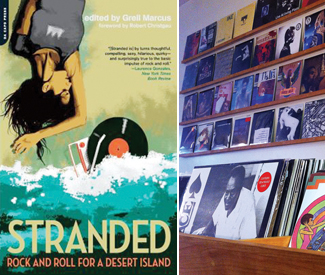
TOFU AND WHISKEY “Rock and roll has never been remotely monolithic,” early Rolling Stone columnist Greil Marcus writes in the introduction to the 1978 book he edited, Stranded: Rock and Roll for a Desert Island (Da Capo Press). “There have always been countless performers to pin your hopes on; though one may have found identity as a member of an audience, one also found it by staking a place in that audience, defining one’s self against it.”

He recalls a time when all rock fans simply had to have an opinion about the Beatles, about Elvis, but notes there’s is no longer a single figure that “one has felt compelled to celebrate or denigrate.”

“The objects of the obsessiveness that has always been a part of being a rock and roll fan…are no longer obvious,” he continues, “which means, for one thing, that while one’s sense of the music may not have perfect shape, it’s probably a lot richer.”

Marcus wrote these words in Berkeley in the late ’70s, though they ring truer today. For Stranded, Marcus invited rock critics such as Lester Bangs, Ellen Willis, and Nick Tosches to answer the basic parlor game question in essay form: “What one rock-and-roll album would you take to a desert island?” He’ll read from the book this Thu/14 at 6pm at a new record shop, also called Stranded, 6436 Telegraph, Oakl. (www.strandedinoakland.com).

The brick-and-mortar Stranded opened about five months ago (in November 2012) and is run by Oakland’s Steve Viaduct, the 36-year-old founder of Superior Viaduct records, an archival label that focused on reissues and archival collections of Bay Area punk and post-punk for its first year and is now in the process of expanding its output. One of those releases was MX-80 Sound’s ’77 album, Hard Attack, which is the record Viaduct says he‘d take to a desert island.

Since the Stranded opened, there have been a handful of shows and author appearances, along with the everyday bustle of record obsessives. “We had pretty modest goals [for Stranded]. We wanted a cool place to hang out and meet other vinyl enthusiasts. With no budget for things like advertising, our biggest milestone has been that we are breaking-even financially and we are having fun doing it.”

I asked Viaduct what bands best exemplified the ethos of the label and shop, and instead he chose a book: “That is a tough question because Superior Viaduct is very much a work in progress. Perhaps the best example of the label’s ethos is our first book, From the Edge of the World: California Punk 1977-81, by photographer Ruby Ray. The photos are amazing. Ruby captures a moment that barely existed in the first place, yet still resonates today.”

Marcus’ appearance came naturally. A noted lover of vinyl, he’d stopped by Stranded a few times and gave the owners of a copy of his book. When Viaduct found out his friend had chosen the book for her Rock N’ Roll Book Club, he decided it was time to invite Marcus to speak at the store. After that, the next events at the shop are Dawn McCarthy and Bonnie “Prince” Billy performing live in-store (March 31), then Rock and the Pop Narcotic author Joe Carducci reading May 3.

Given the crumbling of big box music chains and the US economy as a terrifying whole, it’s a particularly troublesome time to open a store of any kind, let alone one mostly focused on physical music — though there are shining examples to the contrary, such as Burger Records and Amoeba Music — so I was intrigued by the store’s arrival.

“Buying records in stores is more fun for customers and shopkeepers,” Viaduct says, shrugging off the concern. “The personal contact really makes a difference. There is nothing better than to recommend something and a day or two later the person comes back and says, ‘Thanks! That record is great.’ Of course, we know that folks can buy records online, so we do not even try to compete with that.”

1-2-3-4 GO!

One of those shining star examples of making it work in the name of the music you obsessively collect — fellow East Bay record shop and label, 1-2-3-4 Go! (www.1234gorecords.com) is this month celebrating five years in Oakland.

Also noteworthy: the label will be 12 come August (time for a Bar Mitzvah?). It’s notable for discovering and releasing records by trash, thrash, psych, punk, garage, surf, doo-wop, whatever local acts along the lines of Nobunny, Shannon and the Clams, Personal and the Pizzas, Lenz, and Synthetic ID.

With its move to a bigger space, the store is now also noted for its all-ages shows, with many of the above frequenting the location along with out-of-towners from LA and beyond. For the five-year marker, the shop is having a big sale on March 23 and 24, and will celebrate further with its second annual the Go! Go! fest May 16 through 19.

I asked label-store owner Steve Stevenson, a 33-year-old Oakland resident, the same question as Viaduct regarding the problems with opening a store such as this. Stevenson perhaps had it rougher, as his doors first opened in that very tumultuous year of ’08.

“2008 was brutal but there was a ton of support. I had no money to advertise but for the first three weeks I was packed with people who had heard about this record store that was barely bigger than a walk-in closet,” he says. “Honestly, the store struggled for the first three or so years; always making it but always just barely. Since moving in to this new space, things have really taken off. I’m able to hire employees so I don’t have to do everything myself which gives me time to do even more cool stuff for the store and book shows outside of it at places like New Parish.”

“We’re one of the very few record stores in the East Bay and we exist through the support of this community and our mail order customers around the world,” he adds. “We’re always growing, expanding, and trying new things because of this support and there’s no way I can say how much I appreciate it. It’s massive.”

AFROLICIOUS

Is Afrolicious the hardest working world band in the Bay Area? It seems to pop up everywhere. The 12-piece Latin soul-tropical Afrobeat act met at Elbo Room’s energetic weekly Afrolicious party, and is this week playing the Great American Music Hall in celebration of its debut full-length album California Dreaming, released on its own label, Afrolicious Music. With Midtown Social Band, Afrolicious DJs Pleasure Maker and Senor Oz.

Fri/15, 9pm, $15. Great American Music Hall, 850 O’Farrell, SF. www.slimspresents.com

In the blood

0

arts@sfbg.com

FILM Even Fukushima Daiichi-style nuclear meltdowns can’t sever the blood ties that bind a brood of CAAMFest films that focus on family. Modernity nevertheless ushers in a set of unique struggles in these films, not exactly family-friendly fare, though most are fulsome with empathy for these clans under pressure and in the viewfinder.

Throwing the lid back on the Mosuo Chinese ethnic minority, while unveiling the economic and cultural stressors weighing on families struggling to keep up in the soon-to-be world’s largest economy, The Mosuo Sisters documents the lives of two young women from a small village in the Himalayan foothills. Eldest sibling Juma is trying to maintain her role as family breadwinner — she sings in big-city clubs that trot her out like an exotic specimen — while the younger Latso is rooming with her, studying accounting and embracing urban life. It takes a global downturn to tear the two apart, as Latso is encouraged to help out on the farm and Juma finds it harder to remain the de facto matriarch-at-large, while the Mosuos’ way of life — in which “walking marriages” place the power and offspring in the hands of women and their households — is chipped away from afar by the draw of neon-dappled cities, rendered as eloquent, inexorable rivers of headlights by director-cinematographer Marlo Poras.

Two families — one far from home and the other navigating a thicket of cultural, political, and product safety issues — feel the pain of Xmas Without China in Alicia Dwyer and Tom Xia’s gently humorous and humane doc. Chinese-born, California-raised Xia is by all respects American (apart from his green card), but as a firestorm ignites over the lead in Chinese-made toys and the threat of Chinese industrial might, he comes up with the genius plan of finding out just how deeply China and its goods have rooted itself in the US, despite Americans misgivings. He finds a family, the Joneses, who are willing to go without anything made in China through the Christmas season — just to see if they can.

Meanwhile, Xia’s parents, who have set themselves up in their own American dream, a colonial McMansion, are also put under the lens as they struggle to keep up with their own neighboring Joneses, plotting the biggest Christmas-lights display on the block — and coping with homesickness for family back in the old country. As dad Tim Jones sneaks into the stash of verboten Chinese goods for his beloved Xbox, Xia uncovers his own insecurities, as he finds himself lying to the Joneses about his citizenship and hiding behind a facade of assimilation.

Taking the kin out on a pulpy, not-for-youngsters thrill ride, director-writer Ron Morales’ Graceland uncovers a lurid Manila of child sex workers, corrupt politicians and cops, and trash mountains. Chauffeur Marlon (Arnold Reyes) is tasked with enabling the dirty work of his politico boss, Changho (Menggie Cobarrubias), including packing up and paying off the little girls he drugs and rapes. The switch comes when kidnappers come for both their daughters, and the once-powerless servant becomes inextricably embroiled in the crime. Though occasionally threatening to topple over into scene-chomping territory and finally revealing drive-through gaps in its plot, the full-frontal Graceland is still capable of inspiring admiration for its sheer gusto, refusing to flinch at the brutality wrought on young girls’ bodies and likewise daring you to tear your eyes away in complicity.

Blood — whether it pulls a family unit together or rips them apart with fears of radiation contamination — underlies the apocalyptic scenes of The Land of Hope, the first feature film to grapple with the 2011 Fukushima disaster. Life in fictional Nagashima seems idyllic until the arrival of an earthquake and tsunami that ushers in a largely unseen nuclear disaster. Dairy farmer Yasuhiko (Isao Natsuyagi) forces his son Yoichi (Jun Murakami) and daughter-in-law Izumi (Megumi Kagurazaka) to leave him behind, along with wife Chieko (Naoko Ohtani), who suffers from dementia; it’s a sacrificial gesture that evokes 1983’s The Ballad of Narayama‘s mash-up of filial piety and noble embrace of death.

Yoichi denies reality as vigorously as he can, until Izumi becomes pregnant and learns that their new home also reads high in radiation. Writ with an eye to psychological trauma rather than physical dangers, Sion Sono (2002’s Suicide Club) has likely made his most ambitious film to date with Hope. It makes stirring use of exquisitely subtle images that imbue empty towns and blowing wind with dread; eerily surreal sights of a mother-to-be puttering around town in a Hazmat suit; and symbolism made literal, as when Ugetsu-like child phantoms materialize in wreckage from the waves.

Set in a country that prizes purity and conformity — and has a legacy of dealing with the aftermath of nuclear disaster — Hope may not leave you with hope, exactly. But it certainly imparts the expected horrors and unpredicted highs when the safe family home finds itself under siege, leaving on your mind’s eye the shadowy imprint of a woman, dressed in her finest kimono, dancing to festival music only she can hear, in the snow near a contaminated town reduced to tinder.

CAAMFEST

March 14-24, most shows $12

Various venues, SF and Berk.

www.caamedia.org


The Nonconformist

0

arts@sfbg.com

FILM Most observers of last week’s Oscar telecast assumed elegant 86-year-old Emmanuelle Riva was the star of the movie she’d gotten a Best Actress nomination for. Conspicuously absent — from that and most other awards events — was Amour‘s real performing lead, who’d gotten crowded out of the field by the usual surplus of major English-language roles for men. As the dignified elderly husband decreasingly able to care for a longtime spouse’s dignity-robbing failing health, Jean-Louis Trintignant grows more dominant in his character’s helplessness as Riva’s recedes into illness. It’s a powerful performance made all the more so by the simple shock of seeing him. Hasn’t he been, er, away a while? Or to put it bluntly: he’s still alive?!

The last time wide audiences would have seen him was in the large ensemble of Patrice Chéreau’s 1998 Those Who Love Me Can Take the Train. Already nearing 70 then, he remained somewhat active in theater while staying mostly off screen for the next 14 years. In honor of his return, the Pacific Film Archive is providing a retrospective that runs through April 21.

“And God Created Jean-Louis Trintignant” offers a mix of popular hits, agreed-upon masterpieces, and rarities that give fair measure of a long, prolific yet discriminating career. It’s surprising to see the wide range of films he’s played in, since Trintignant is so often the still center of them — he communicates such reserve, thoughtfulness, and economy of craft that it takes seeing numerous roles back-to-back like this to realize how very different his performances are. They’re just not flamboyantly different, in the way of a Daniel Day-Lewis or Meryl Streep. He’s said “The best actors in the world are those who feel the most and show the least,” a rule one could argue with — but it’s certainly true in his case.

Short, slight, handsome in a slightly nondescript way, he couldn’t have struck anyone at first as natural movie star material. But he did intrigue Roger Vadim, when the latter was looking for a newcomer to play off his female discovery in 1956’s …And God Created Woman. The woman was Brigitte Bardot, introduced completely nude (albeit laying on her stomach); it was Bardot and Vadim’s shared gift that though she spent the rest of the story clothed, one imagined with an indolent shrug those rags might tumble at any moment and she’d be starkers again. As the village lad who marries “that little slut” lest she be sent back to the orphanage (!), while she exerts a siren pull toward every other man around, Trintignant sounded a modest note in one of the most garishly silly yet influential films ever made. Yet the global sensation Bardot caused cast a public glare on anyone with a connection, let alone a purported inamorato. He voluntarily fled for military service.

When he returned — with rather less fanfare than Army-sprung Elvis — he set about building a serious actor’s resume with diverse projects and interesting directors. He was suddenly blond and uncharacteristically glamorous as a golden youth of Italy’s fascist elite in Valerio Zurlini’s Violent Summer (1959), so in love with an older woman (Eleanora Rossi Drago) they’re barely aware there’s a World War going on. But more typically he was creating anti-romantic characters typical of the 1960s — variably neurotic, eccentric, conflicted, always with more going on under the surface than one could fully grasp. One lesser-remembered PFA selection is Alain Cavalier’s 1962 New Wave triangle Le combat dans l’ile, in which his marital discord with Romy Schneider is eventually explained by his secretly belonging to a far-right terrorist cell.

https://www.youtube.com/watch?v=0WQhJyse4hg

Trintignant was in two of the most wildly popular “art” export hits of the decade, Claude Lelouch’s gauzy swoonfest A Man and a Woman (1966) and Costa Gavras’ political thriller Z (1969). Yet his race-car driver in the former tempers its Eurokitsch atmosphere with impenetrable cool, while in the hyperbolic latter he’s almost monastically austere as the investigator who patiently picks apart an assassination cover-up. Perhaps his ultimate role as a man of decisive inaction was as The Conformist (1970), again as a Mussolini-era fascist — one who betrays his friends as ruthlessly and usefully as director Bertolucci does the original Moravia novel. Amid that film’s ravishing baroque excesses, he’s as reptilian, quease-making, and pitiable as a Gollum, if better-dressed.

While he continued to make the odd all-star purely commercial project — a good one being rare 1973 American foray The Outside Man — he usually chose riskier fare. Thus he was the first major star to work with Eric Rohmer (as the Catholic fussbudget sorta-seeking romance in 1969’s My Night at Maud’s), and an early ally to figures as disparate as Jacques Demy, Claude Chabrol, Tinto Brass, Umberto Lenzi, Alain Robbe-Grillet, and André Téchiné.

Barely slowing despite the transition to character support, he’d found perhaps a definitive pre-Amour farewell role (and chronological end to the PFA series) as the retired judge busy bending laws for his personal amusement in Krzysztof Kieslowski’s Three Colors trilogy (and career) finale Red (1994). It might have served as a perfect capper — but you’ve got to hand it to any 83-year-old savvy enough to realize Michael Haneke was worth coming out of retirement for. *

“AND GOD CREATED JEAN-LOUIS TRINTIGNANT”

Through April 21

Pacific Film Archive

2575 Bancroft, Berk.

bampfa.berkeley.edu


CCSF board approves report to accreditors amid heavy criticism

164

Windsong, a 21-year-old City College student, held a sign that read “I love CCSF” while standing along Ocean Avenue last evening, as cars rolled by honking their support for the embattled school.

“I love learning while not being bound by the four-year school structure,” she said. She’s an artist in residence at a local elementary school, and was protesting to make sure City College of San Francisco could give her students the same opportunities she had.

“This place is in my heart,” she said. And she wasn’t alone.

Nearly 200 protesters lined the building outside of City College’s board of trustees meeting last night as the CCSF Board of Trustees approved the school’s “Show Cause” report, which is a 220-page document detailing what the college has done to meet its accreditation requirements — accreditation is required for a college degree to have worth, and for a school to receive state funding.

In short, it’s a document arguing what the college has done to improve since it was hit with sanctions last October, and why it should stay open and accredited. The report is due to the accreditation commission on March 15.

The Accrediting Commission of Community and Junior Colleges hit City College with a “show cause” sanction, citing a lack of progress in six problem areas the school was supposed to address since its last accreditation review six years before. When the accrediting commission came back to check on the school, it concluded City College had yet to address key areas, including measuring Student Learning Outcomes, and adequately funding their reserve, a “rainy day fund” the college leans on in hard times.

City College said that it has now met the challenge of those key problem areas. “We were deferring maintenance, and deferring (upgrading) technology,” said board president John Rizzo. “We’re required to spend money, and this gives us a plan going forward.”

But the shouting protesters outside the meeting and the angry students inside disagreed with some points of the plan. Proposition A was a parcel tax measure approved by voters in November that would raise somewhere between $14-16 million City College annually, which the board wanted to use to beef up the college’s reserve fund, one of the key areas where they were knocked by the accrediting commission.

California Federation of Teachers president Joshua Pechthalt implored the board to use Prop A funds for current teachers. “The men and women who work in this college spent many hours taking money out of their pockets to pass Prop A,” Pechthalt said in public comment to the board. The audience of about a hundred or so faculty and students cheered. “I would ask you to work closely with faculty and staff, that you work collaboratively with them.”

Pechthalt was there at the behest of Alisa Messer, the president of City College’s American Federation of Teachers Local 2121. Teachers at City College have had wage freezes for years, and most recently had an 8.8 percent wage reduction just this past month.

Part-time teachers were hit too, as nearly 40 of them were “not rehired” for the current semester, as well as 18 counselors and 30 members of the college’s staff..

Student Martin Madrigal, a 29-year-old mathematics major at CCSF, said he also supported using the Prop A funding to prevent layoffs and wage reductions.

“I missed class to come to this fight,” Madrigal said to the board. “But if I didn’t come here there wouldn’t be a class to miss.”

One by one, faculty and students implored the board to use Prop A funds to buffer the college’s wage reductions and layoffs. At one point, student Eric Blanc, a member of the protest group Save CCSF, came to the podium to speak in public comment and was cut off by the board. Ten or so other students and faculty had yet to speak, and were told there was no longer time.

Blanc then demanded of the board his time to speak. The campus police chief, Andre Barnes, and an officer approached Blanc and tried to remove him from the room. The tension in the room mounted as the audience started chanting “let him speak, let him speak!”

Trustee Rafael Mandelman diffused the situation, asking for silence and calmly explaining that the board needed time to conduct its business. Tensions rose again though as the topic of the college’s reserve fund came up — the reserve is now at $4 million, but the school is planning to boost it to $13 million by 2014, and $18 million by 2019.

It’s a needed safety net, the trustees argued, for a school with a budget hovering at more than $200 million a year and an economy that’s in the tank.

“Tomorrow the sequestration will begin, and it will impact California spending and our communities,” Trustee Steve Ngo said. “This [money] is going to faculty and staff, but in the future. Faculty and staff would not have to take cuts in wages, if we had funded the reserve.”

Ultimately, the board voted to approve its long term reserve fund plan, using Prop A funds to help buffer the reserve for the future. Blanc told the trustees that they had denied themselves other options, like suing the accreditation commission, or asking for emergency funding from City Hall.

“I think behind the rhetoric of this are thousands of people being shut out,” he said.

Vice Chancellor Peter Goldstein, who handles college finance, said that some of the claims of the protesters were inaccurate.

“I keep hearing people talking about cutting classes,but that’s not our plan for [fiscal year] 13-14,” he said. “In fact, this college is putting together a budget for next year that will have more classes than this year.”

The college may not be cutting classes, but it is asking everyone to do more with less. Teachers to teach with less salary, students to fit into larger classrooms, and for classes soon to fit into fewer campuses.

Whether those are improvements or dire straits depends on who you ask.

Video by Joe Fitzgerald:

http://www.youtube.com/embed/pMXeECCvVTs

http://www.youtube.com/embed/L5To6k2uU60


Save CCSF plans to march to City Hall to demand aid to CCSF and to protest austerity cuts at the college on March 14. For more information visit http://www.saveccsf.org/.

Click here to read City College’s 220 page “Show Cause” report: http://www.ccsf.edu/ACC/Preliminary_Final_Draft_Show_Cause_Report_Feb_26.doc.

Public broadband works; why not here?

42

There’s a fascinating new map that the Institute for Local Self Reliance has put together that shows how 342 communities around the United States are now offering publicly owned, cheap, reliable broadband and cable service to local residents and businesses. Check it out here. Then check out why the fastest networks in the nation are built by local governments:

“It may surprise people that these cities in Virginia, Tennessee, and Louisiana have faster and lower cost access to the Internet than anyone in San Francisco, Seattle, or any other major city,” says Christopher Mitchell, Director of ILSR’s Telecommunications as Commons Initiative. “These publicly owned networks have each created hundreds of jobs and saved millions of dollars.”

Then sit back and ask yourself why you’re paying so much money every month for the rotten service you get from Comcast and AT&T. Ask your friends, ask around work; is anyone really happy with their broadband service? Do you think you’re getting a good deal for the price?

When I saw the map I called Mitchell, and he told me that every one of the cities and towns on his map has been successful with public ownership. “Within five years, everyone is either making money for the general fund or breaking even and offering really low rates,” he said. “The real benefit is lower prices, which leaves residents with more money in their pockets, which tends to get spent in their communities where it helps local business.”

Most of the cities that have muni broadband (and cable TV!) also have municipal electric power systems, which makes the whole thing easier. But Santa Monica did it bit by bit, installing fiber every time one of the streets was torn up for plumbing, sewers, etc. and gradually building out a network that so far only connects businesses but can be expanded as the money comes in. San Francisco streets are torn up all the time, and will be torn up regularly as water and sewer lines are replaced. The biggest expense of laying cable is cutting open and repaving streets; the cable itself is fairly cheap.

In some states, the big private telecoms have pushed through state legislation banning muni broadband — but not in California. San Francisco has every legal right to get into this business.

So why aren’t we doing it already? “What’s missing,” Mitchell said, “is the political will to really piss off Comcast and AT&T.”

I was just looking at the map when I got an email alerting me to this lovely discussion between Mayor Ed Lee and the head of PG&E, talking about the private utility’s plans to invest $1.2 billion in local infrastructure (more on that in a future blog post). That’s going to involve a lot of digging up streets. So what does Mayor Lee say? Maybe we could allow PRIVATE companies to lay fiber at the same time.

I want to throw up.


Here, here

1

STREET SEEN As the author of a style column, I spend time trawling the city for innovative new local designers. Clothes that are made here, cute ones. Let me hear about them, I’ll put it in print, swear down.

But there’s not… that much of them. Speaking historically, of course. In the heyday of garment manufacturing, San Francisco churned out mountains of readywear — more than any other city in the country besides New York and Los Angeles.

Then we started to export our business overseas. You’ve heard about how Levi-Strauss used to have a factory on Valencia Street — not just the artsy pop-up shop they opened in 2010? Your jeans aren’t made here anymore guys, unless you’re copping from newbie “Kickstarter brand” Gustin (www.weargustin.com), Holy Stitch (www.juliandash.com), Self Edge (www.selfedge.com), or one of the other small local lines that have popped up in the denim giant’s wake.

These companies cater to locavore customers who “expect their clothing labels to read like restaurant menus,” as Modern Luxury put it in a 2011 article about the state of the SF garment industry. Making clothes locally means less turnaround time, less environmental impact — not to mention the sweet San Francisco cache that locally made palazzo pants hold.

Problem is, the garment factories that the industry needs have been greatly reduced in number.

In a Hayes Valley cafe, Gail Baugh sits at her laptop, shutting it with a morning-time, capable air when I sit at her table. Her outfit says boardroom, accented with exceptions. A beautifully-patterned scarf, and large brooch-like earrings suit this no-nonsense type with a degree in chemistry of textiles, 35 years of experience in the garment industry, and a byline on the book on fashion. Really, Baugh’s The Fashion Designer’s Textile Directory is a best-seller in its particular category on Amazon, she tells me.

She is the president and one of five founding members of PeopleWearSF (www.peoplewearsf.org), a Bay Area garment industry trade association that was formed in 2011 to fill the vacuum left by SF Fashion Industries, which played the role for 75 years before the garment industry collapse. PeopleWearSF’s members flip up to $25 million in yearly sales volume, though it also includes rank beginners in the clothes game.

“If you want a vibrant economy, you have to make stuff,” Baugh tells me matter-of-factly. Her organization — and SFMade (www.sfmade.org), the no-fee membership group who represents local producers and whose cheery stickers adorn a host of local retailers’ windows and product labels here in the city — provide networking opportunities to their members. These include 40-some brands, including outdoor label Triple Aught, longtime Mission District purveyor of pretty Weston Wear, and Babette, the flowing line of neutral-toned women’s wear based out of an Oakland warehouse. Those three manufacture locally, but not all PeopleWearSF members do.

Both trade associations work with public policy — specifically, through the Mayor’s FashionSF Economic Development Initiative — to provide more resources to the garment factories that were once much more prevalent in San Francisco. Efforts to keep the sew-shops open have to operate through a multi-pronged approach. It’s not just soaring rents that close the factories’ doors, but a dwindling high-skilled workforce pool that’s willing to work for the wages typically offered by the factories.

“Sharing resources, communicating issues — it’s a good business policy,” says Steven Pinksy, whose wife started Babette in 1968 and who was also a founding member of PeopleWearSF. Joiners, in other words, are welcome.

Those looking to jumpstart their Bay fashion career could do worse than attend tonight’s Renaissance Entrepreneurship Center’s panel discussion on starting small in fashion, featuring experts from PeopleWearSF, Apparel Wiz, Sheila Moon Apparel, and CBU Productions.

“Manufacturing Micro” Wed/27, 6-9pm, $20. Renaissance Entrepreneurship Center, 275 Fifth St., SF. tinyurl.com/manufacturingmicro

Why labor should oppose the pipeline

0

OPINION As pressure from the fossil-fuel industry, conservative Canadian and US politicians, and some construction unions mounts on President Obama to greenlight the controversial Keystone XL Pipeline project, a growing coalition has a different message.

On February 17, tens of thousands rallied against the pipeline in cities across the US, including San Francisco — a testament to the climate movement, ranchers and farmers, First Nations leaders, most Canadian unions, some US unions (including my nurses’ organization), transport and domestic workers, and young people who are rightfully alarmed over the global impact of Keystone XL.

For nurses, who already see patients sickened by the adverse effects of pollution and infectious diseases linked to air pollutants and the spread of water and food borne pathogens associated with environmental contaminants, Keystone XL presents a clear and present danger.

First, extracting tar sands is more complex than conventional oil drilling, requiring vast amounts of water and chemicals. The discharge accumulates in highly toxic waste ponds and risks entering water sources that may end up in drinking water, as is already occurring.

Second, the corrosive liquefied bitumen form of crude the pipeline would carry is especially susceptible to leaks that can spill into farmland, water aquifers and rivers on route, threatening an array of adverse health outcomes.

Public health costs from fossil-fuel production in the US through contaminants in our air, rivers, lakes, oceans, and food supply are already pegged at more than $120 billion every year by the National Academy of Sciences. The Environmental Protection Agency warns that exposure to particulate matter emitted from fossil fuel plants is a cause of heart attacks, long term respiratory illness including asthma, cancer, developmental delays and reproductive problems. Global-warming inducted higher air temperatures can also increase bacteria-related food poisoning, such as salmonella, and animal-borne diseases like the West Nile virus.

That’s just the tip of the melting iceberg given the planet altering consequences of rising sea levels, intensified weather events including droughts, floods and super storms already in evidence, and mass dislocation of coastal populations and starvation that may well follow our failing to stem climate change.

Far more jobs would be created by converting to a green economy. As economist Robert Pollin put it in his book Back to Full Employment, every $1 million spent on renewable clean energy sources creates 16.8 jobs, compared to just 5.2 jobs created by the same spending on fossil-fuel production.

And, as one person acerbically commented on a recent New York Times article, there are no jobs on a dead planet.

Further, stumping for the pipeline puts labor in league with the many of the most anti-union, far right corporate interests in the U.S., such as the oil billionaire Koch Brothers and energy corporations, abetted by the politicians who carry their agenda.

The future for labor should not be scrambling for elusive crumbs thrown down by corporate partners, but advocating for the larger public interest, as unions practiced in the 1930s and 1940s, the period of labor’s greatest growth and the resulting emergence of a more egalitarian society.

Deborah Burger is a registered nurse and co-president of National Nurses United, the nation’s largest organization of nurses.

Cutting from the bottom

86

news@sfbg.com

While the looming federal budget cuts known as sequestration were designed to equally hit Democratic and Republican party priorities, from social services to the military budget, in the Bay Area they would disproportionately target society’s most vulnerable citizens and strain already-stretched local agency budgets.

If Congress and the White House fail to forge a budget deal by March 1, the cuts could begin to withdraw $9-10 billion of federal support from the California. In the Bay Area, these cuts would have the biggest impact on low-income families, the homeless, victims of domestic violence, adults living with AIDS, and children ages 3-5.

Back in September, San Francisco Mayor Ed Lee signed a U.S. Conference of Mayors’ letter that called on federal lawmakers to resolve the budget conflict before the sequestration cuts could take effect, labeling the budget cuts “a threat” to local economies nationwide. Now, with the deadline looming, city officials and social service providers across the Bay Area are bracing for the impact.

Depending to how the cuts are eventually allocated, San Francisco alone could lose more than $10 million in critical social services. “All across the city, the sequestration hurts those most in need of services and support,” Gentle Blythe, spokesperson with the San Francisco Unified School District, told the Guardian.

San Francisco Unified stands to lose $3.8 million in funding, over 5 percent of the district’s federal education dollars. The cuts would strain an already-tight education budget, which has suffered from the slow economy and the corresponding dip in tax revenue. “We’ve been in a climate of cuts for years,” Blythe said. “There is a definite sense of fatigue.”

The pending round of cuts would force San Francisco district officials to make a series of uncomfortable decisions. The bulk of San Francisco’s federal education funding comes from Title I and Title III grants, money specifically earmarked for low-income students and English-language learners. If the state does not step in to fill the hole, the $3.8 million shortfall will translate into a significant rollback of services for the city’s most at-risk students and potential layoffs of teachers and resource officers.

Early childhood programs are especially vulnerable to the impact of the sequester. San Francisco Head Start Director Marjorie Weiss told us the demand for these federal education programs is spiking as more San Francisco children are living in poverty.

US Census figures show 13.8 percent of San Francisco residents were living below the federal poverty line in 2011, up from 12.2 percent in 2005. Over the last decade, 850 additional children became eligible for SF Head Start, which operates federally funded preschool programs in 19 classrooms at 9 different centers across the city.

These programs significantly improve the long-term employment and educational prospects of children living in or near poverty. But as the need for these early-childhood services grows, the money is drying up. Over the last two years, state and local funding for early-childhood education has be cut by nearly 20 percent.

Now, with the sequestration looming, San Francisco Head Start providers are worried about their ability to continue providing services. “At Head Start, we have already been dealing with years of budget cuts,” Weiss told us. If the sequester comes through, the program will lose an additional $1.1 million and will be forced to eliminate programming for more than 100 low income children ages 3-5.

“This will be devastating. These cuts will have a crippling effect on low-income children in the community and their ability to be ready for school” says Weiss. The funding cuts will take effect June 1st and directly impact the incoming class of 3-year-old preschool students.

Although education will absorb a significant impact from the sequestration, social services across the city will be cut back. San Francisco homeless advocates are forecasting a $1 million cut in federal assistance and AIDS groups have warned that nearly $800,000 dollars in housing vouchers for AIDS patients are on the chopping block. Federal funding for the AIDS Drug Assistance Program (ADAP), which subsidized medical care for AIDS patients, is set to be slashed by nearly 8 percent across the board.

Advocates for the victims of domestic abuse are also worried about the sequester’s impact on local survivors of domestic violence. In San Francisco, federal money provides crucial services for victims of domestic violence through nationally-mandated Family Violence and Prevention Services (FVPS). The city’s three primary domestic violence shelters rely on this revenue stream for outreach programming, translation services, and extended operating hours. The pending sequester would cut nearly 10 percent of FVPS grants, forcing shelters to tighten their belts.

“The sequester is going to dramatically impact the funding for lifesaving services for domestic violence shelters and rape crisis centers, as well as legal service, and children’s programs,” Beckie Masaki, the founder and former executive director of San Francisco’s Asian Women’s Shelter, told the Guardian. Masaki now works with the Asian and Pacific Island Institute (APIDV) on Domestic Violence, where she advocates for more federal funding for domestic violence service providers.

Masaki is worried that the cuts will disproportionately impact the city’s most vulnerable women: low-income and non-English speaking victims of domestic violence, as cash-strapped shelters lay off translators and cut back on outreach and group therapy.

“In the past, when we were facing cuts, we did our best to minimize the impact on survivors,” she explains. “But in this era of constant cuts, it’s going to mean layoffs, and ultimately fewer services for the most vulnerable survivors”. As lawmakers in Washington scramble to pass a budget deal before the March 1 deadline, the climate of uncertainty leaves local service agencies in a state of limbo. With future funding in doubt, long-term planning and strategizing become increasingly difficult. Yet for many local service providers, the most recent threat of sequestration is a familiar consequence of an increasingly fragile social safety net. According to Masaki, the sequestration should motivate Congress to rethink its budgeting priorities: “If they invest in these baseline life-saving services for those that are most vulnerable in our community, in the end that is the path to better economic and social sustainability for our whole nation.”

Wiener’s dance mix: more DJs mixed with fines for “bad actors”

7

DJs could proliferate in San Francisco’s bars, restaurants, coffee shops, and plazas under legislation that Sup. Scott Wiener introduced today to include DJs under the city’s limited live music permits, but the legislation also includes new enforcement powers to crackdown on underground parties and other unpermitted events.

Limited live music permits – which are far cheaper and easier to obtain than the city’s full-blown Place of Entertainment permits ($385 compared to around $2,000 for the POE permits) – were created in 2011 by legislation sponsored by then-Sup. Ross Mirkarimi, allowing amplified performances until a 10pm curfew. But DJs were left out, despite their prevalence in San Francisco, something Wiener is now trying to correct.

“Entertainment and nightlife are an essential part of San Francisco’s cultural and economic vibrancy,” Wiener said today in a press release announcing the proposal. “This legislation fosters live entertainment while also heightening our ability to monitor and regulate bad actors.”

It’s that last part that doesn’t sit well with everyone, particularly given San Francisco’s pervasive culture of throwing underground parties, which are key fundraising tools for grassroots efforts such as Burning Man camps but which are the targets of periodic crackdowns by the SFPD and other agencies. It seems that when it comes to nightlife, we always have to take some medicine whenever City Hall offers a spoonful of sugar.

The legislation would give the Entertainment Commission the authority to levy $100 fines to those involved with unpermitted parties, either in established clubs or underground warehouses, whereas now the commission only has the authority to punish those who have permits for violating them.

“Punishing a DJ playing at a party in which the promoter didn’t get the proper permits (perhaps unbeknownst to the DJ), would be unfair and inappropriate, in my opinion,” was how DJ/Promoter Syd Gris from Opel Productions and Opulent Temple reacted to the legislation.

But Entertainment Commission Executive Director Jocelyn Kane told us she doesn’t expect to fine an DJs. While she asked Wiener for those enforcement powers, they are simply a way of encouraging promoters and business owners to get permits. “We’re not into punishment, we’re into compliance,” she said, adding that this is simply seeking authority to do administratively what the SFPD and California Alcoholic Beverage Control Administration can now to criminally and civilly.

Tom Temprano, president of the Harvey Milk LGBT Democratic Club and a DJ/promoter at the popular Hard French parties, told us “where I really want clarification is on the new enforcement powers for the commission,” although he agreed with Kane that the commission generally works cooperatively with the nightlife community, far more than either the SFPD or ABC.

“All in all, it’s a really good step in the right direction,” Temprano said of the Wiener legislation. “It seems really positive. As a DJ, allowing DJs to be used for limited live performances is just common sense.”

Kane said the legislation will allow music to flourish in the city, from outdoor plazas to small venues, many of which have used DJs illegally. “We’ll be able to legalize that and bring them into the fold,” she said. “There always have been places that use a DJ like a jukebox.”

In addition to the relatively cheap application cost compared to POE permits, limited live music perhaps are quick and easy to obtain and don’t necessarily require city inspections paid for by the applicant.

In his press release, Wiener praised the importance of nightlife to the city economy and cited a city study he commissioned last year which found that nightlife has a $4.2 billion impact on San Francisco, employing 48,000 people and furnishing the City with $55 million in tax revenue annually.

“We need to encourage a flourishing nightlife that not only marks San Francisco as a cultural capital, but also creates jobs and brings in revenue for essential City services,” Wiener said. “These amendments are part of that broader strategy.”

Sequestration cuts would hit the Bay Area’s most vulnerable

31

While the looming federal budget cuts known as sequestration were designed to equally hit Democratic and Republican party priorities, from social services to the military budget, in the Bay Area they would disproportionately target society’s most vulnerable citizens and strain already-stretched local agency budgets.

If Congress and the White House fail to forge a budget deal by March 1, the cuts could begin to withdraw $9-10 billion of federal support from the California. In the Bay Area, these cuts would have the biggest impact on low-income families, the homeless, victims of domestic violence, adults living with AIDS, and children ages 3-5.

Back in September, San Francisco Mayor Ed Lee signed a U.S. Conference of Mayors’ letter that called on federal lawmakers to resolve the budget conflict before the sequestration cuts could take effect, labeling the budget cuts “a threat” to local economies nationwide. Now, with the deadline looming, city officials and social service providers across the Bay Area are bracing for the impact. Depending to how the cuts are eventually allocated, San Francisco alone could lose more than $10 million in critical social services.

“All across the city, the sequestration hurts those most in need of services and support,” Gentle Blythe, spokesperson with the San Francisco Unified School District, told the Guardian.

San Francisco Unified stands to lose $3.8 million in funding, over 5 percent of the district’s federal education dollars. The cuts would strain an already-tight education budget, which has suffered from the slow economy and the corresponding dip in tax revenue. “We’ve been in a climate of cuts for years,” Blythe said. “There is a definite sense of fatigue.”

The pending round of cuts would force San Francisco district officials to make a series of uncomfortable decisions. The bulk of San Francisco’s federal education funding comes from Title I and Title III grants, money specifically earmarked for low-income students and English-language learners. If the state does not step in to fill the hole, the $3.8 million shortfall will translate into a significant rollback of services for the city’s most at-risk students and potential layoffs of teachers and resource officers.

Early childhood programs are especially vulnerable to the impact of the sequester. San Francisco Head Start Director Marjorie Weiss told us the demand for these federal education programs is spiking as more San Francisco children are living in poverty.

US Census figures show 13.8 percent of San Francisco residents were living below the federal poverty line in 2011, up from 12.2 percent in 2005. Over the last decade, 850 additional children became eligible for SF Head Start, which operates federally funded preschool programs in 19 classrooms at 9 different centers across the city.

These programs significantly improve the long-term employment and educational prospects of children living in or near poverty. But as the need for these early-childhood services grows, the money is drying up. Over the last two years, state and local funding for early-childhood education has be cut by nearly 20 percent.

Now, with the sequestration looming, San Francisco Head Start providers are worried about their ability to continue providing services. “At Head Start, we have already been dealing with years of budget cuts,” Weiss told us. If the sequester comes through, the program will lose an additional $1.1 million and will be forced to eliminate programming for more than 100 low income children ages 3-5.

“This will be devastating. These cuts will have a crippling effect on low-income children in the community and their ability to be ready for school” says Weiss. The funding cuts will take effect June 1st and directly impact the incoming class of 3-year-old preschool students.

Although education will absorb a significant impact from the sequestration, social services across the city will be cut back. San Francisco homeless advocates are forecasting a $1 million cut in federal assistance and AIDS groups have warned that nearly $800,000 dollars in housing vouchers for AIDS patients are on the chopping block. Federal funding for the AIDS Drug Assistance Program (ADAP), which subsidized medical care for AIDS patients, is set to be slashed by nearly 8 percent across the board.

Advocates for the victims of domestic abuse are also worried about the sequester’s impact on local survivors of domestic violence. In San Francisco, federal money provides crucial services for victims of domestic violence through nationally-mandated Family Violence and Prevention Services (FVPS). The city’s three primary domestic violence shelters rely on this revenue stream for outreach programming, translation services, and extended operating hours. The pending sequester would cut nearly 10 percent of FVPS grants, forcing shelters to tighten their belts.

“The sequester is going to dramatically impact the funding for lifesaving services for domestic violence shelters and rape crisis centers, as well as legal service, and children’s programs,” Beckie Masaki, the founder and former executive director of San Francisco’s Asian Women’s Shelter, told the Guardian. Masaki now works with the Asian and Pacific Island Institute (APIDV) on Domestic Violence, where she advocates for more federal funding for domestic violence service providers.

Masaki is worried that the cuts will disproportionately impact the city’s most vulnerable women: low-income and non-English speaking victims of domestic violence, as cash-strapped shelters lay off translators and cut back on outreach and group therapy.

“In the past, when we were facing cuts, we did our best to minimize the impact on survivors,” she explains. “But in this era of constant cuts, it’s going to mean layoffs, and ultimately fewer services for the most vulnerable survivors”.

As lawmakers in Washington scramble to pass a budget deal before the March 1 deadline, the climate of uncertainty leaves local service agencies in a state of limbo. With future funding in doubt, long-term planning and strategizing become increasingly difficult. Yet for many local service providers, the most recent threat of sequestration is a familiar consequence of an increasingly fragile social safety net.

According to Masaki, the sequestration should motivate Congress to rethink its budgeting priorities: “If they invest in these baseline life-saving services for those that are most vulnerable in our community, in the end that is the path to better economic and social sustainability for our whole nation.”