

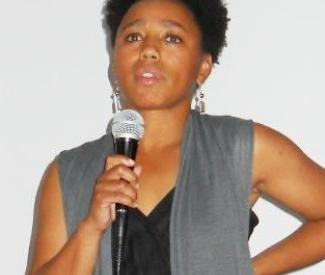
I’m talking to the amazing organizers at Causa Justa:: Just Cause (CJJC) about their work to protect homeowners from foreclosure by the big banks, about their long history of tenants’ rights work, and what they are up to right now. Blanca Solis says they’ve launched a new campaign for what they’re calling the “Hassle-Free Housing” ordinance. She’s a grassroots leader from CJJC, and she’s asking for our support. To protect tenants from unscrupulous landlords. To stop unfair evictions. To stop wringing our hands about gentrification and families leaving the city. She says we can do something very straightforward to keep working families in their homes.
On Tuesday July 31st, Solis will join other tenant leaders, advocates and supporters at city hall to call for an end to tenant harassment by landlords. The San Francisco Tenants Union will be there. Organizers at CJJC have learned from years of experience with Latino tenants struggling to make ends meet in the midst of this rapidly gentrifying city that “one of the quickest and cheapest ways to evict a tenant is by harassing them until the situation becomes unbearable and the tenant moves on their own. Whey they leave, the landlord has an empty unit that they can rent to new tenants at market-rate rent.”
Faced with a pattern of such blatantly unfair practices, tenant activists took the issue to the voters in 2008; when “Prop M” passed, it was an important victory for this still-majority-renter-city. But then, the landlord’s lawyers got hold of it, and sued to stop implementation.
No one seems to be denying that landlords do this, and that it’s wrong. But what can a family do to stop the harassment, hold on to their housing and get some relief? Here’s where the “Hassle-Free Housing” ordinance comes in. It builds on Prop M and addresses the landlords’ legal issue. It would “allow tenants to claim damages from their landlords for each incident of harassment in small claims court to collect statutory damages of up to $2,000 for each incident.”
Sounds good, let’s do it. City Hall – get on it.
All over San Francisco, probably every night, people are sitting around shaking their heads about how expensive the city has become. How families have been pushed and priced out. Folks shrug and say “But, what can you do?”
There is a long, proud, and painful history in San Francisco of everyday people organizing to put a stop to unfair evictions, developer-driven displacement, and the over-production of luxury housing. From the African American community’s fight to save the Fillmore from redevelopment’s “negro removal” in the 1960s, to the Filipino-led struggle to stop the eviction of elderly men at the I-Hotel in the 1970s, and to Mission activists’ campaigns to control land use during the intense gentrification of the 1990’s dot-com boom. (Just this week there’s a big celebration marking the 35th Anniversary of the I-Hotel struggle.)
These “housing justice” fights are ultimately about who has the power to shape the future of our city and who has the power to determine who can and cannot afford to live here. That’s where we all come in – all of us who are renters whose lives will be better with a “Hassle-Free Housing” ordinance; all of us whose housing is insecure – because we fear foreclosure or are a paycheck away from homelessness. This is an issue of people power, and you can do something now – attend the press conference at 10am tomorrow on the steps of City Hall, or go to CJJC’s website to sign up as a campaign supporter. Being right is good, but ultimately it’s people power that matters.
When Solis was asked why she joined the hassle-free housing campaign and why she’s coming to City Hall tomorrow, she said:
“Que los supervisores aseguren que los inquilinos estemos protegidos de los desalojos injustos por parte de los caseros y asi mismo vivamos en lugares dignos, seguros y libres de hostigamiento”
“So that the supervisors can ensure that we, tenants, are protected from illegal and unjust evictions by landlords and be able to live in homes that are dignified, safe and free of harassment”
Solis and the other incredible grassroots leaders at CJJC are full of courage and determination, and have not given up hope that there is a bright future for San Francisco. Let’s join them!
Displacement
Guardian Voices: Hassle-free housing
Guardian Voices: There’s something happening here
There are distinct signs of the rebirth of a grassroots balanced-growth movement in San Francisco, and some small indication that it’s even beginning to shift, ever so slightly, the politics of the Board of Supervisors. This is very good news for the vast majority of San Franciscans.
First, a little history.
Land use and the approval of major development projects lie at the very heart of San Francisco politics. Developers and their allies (the building trades, contractors, bankers, architects, land-use lawyers, consultants, and permit expeditors) are the primary source of political money for candidates for local office. Since the freeway and urban renewal fights of the 1960s, the very definition of progressive politics in San Francisco has been the attempt to build a political base of residents to resist that money. So-called moderates are simply the political extension of the pro-development lobby using its money to consolidate developer control of the public approval process.
In most cities, land-use issues — zoning, permits, urban design — is left to elites. Not so in San Francisco. Here, land use is talked about at neighborhood meetings and on street corners. The heart the reason is our compact size: 46.7 square miles, and the prohibition of filling in any more of the Bay to create new land. There is no vacant land in San Francisco. Any new major development almost always displaces something already there. Development is a zero sum game, with winner and losers. And the losers leave town.
Land-use politics is about staying here — and that creates real interest among San Francisco residents.
The funding for major development in San Francisco has dramatically changed in the 45 years since the freeway and anti-urban-renewal fights of the mid-1960s. Back then, it was public sector money that fueled development. Yet, with that money, due to the actions of progressive politicians like Phil and John Burton and George Moscone, came its own remedy: votes to not accept the public money for freeways (Moscone) and votes creating either laws that either prohibited displacement or funded legal assistance to the poor, empowering them to stop government agencies through litigation (the Burtons at both the state and federal level).
Since the money for freeways and urban renewal was from the government, the focus of the early balanced growth forces was on government itself, through massive lobbying campaigns to affect officials’ votes (the freeway fight), or the use of government-funded lawyers to protect poor people’s interests ( the WACO and TOOR lawsuits against redevelopment).
All of that changed starting in the 1970s, when Richard Nixon and later Ronald Reagan deregulated oversight of urban development by creating a system of block grants and ended funding for legal assistance for the poor. Large-scale development was effectively privatized, moving it from being designed, funded, and approved at public meetings by government officials following regulations to being designed and funded in private — and having a Kabuki-play-like public approval process with little real oversight. With the passage of Prop 13 in 1978, which limited the main source of local government revenue — property taxes — local governments became even more reliant on private developer money to create new revenue.
The popular response to this change in the development process in San Francisco was the emergence of a politics that relied on the old progressive-era reforms of the initiative, referendum, and recall. Through a series of initiatives, the community sought to impose regulations on the development process, culminating in the 1986 Proposition M, which actually limited the amount of high-rise office space developers could build, completely imposing the popular will over a supine set of local officials and politicians. Indeed, ten years earlier, again through the initiative processes, the very nature of the Board of Supervisors was changed from a developer-friendly at-large system to a district-election system. Hotly opposed by real estate and development interests, district elections in its brief three years of existence (repealed in the wake of the Moscone-Milk assassinations, even though they were both strong supporters of the system and their assassin opposed it…ironies abound in San Francisco politics) saw limits placed on condo conversions and the passage of rent control.
In each of these multi-year efforts, a citywide coalition was formed, including an ever-expanding set of communities and neighborhoods. Common interests were defined that cut across race, class, and geography and issues of community (neighborhood) control and funding for essential services like Muni, affordable housing, childcare, and employment training were placed on the table – and developers had to address them if they wanted projects approved.
The point is that balanced growth came from community-based political forces, not elected officials. Broad movements were built — in the end, encompassing elements of labor. These were victories won not by elected officials but by a popular movement.
In 2000, in the wake of the dot-com bust, another balanced-growth measure, Prop. L, aimed at cutting then-Mayor Willie Brown’s power over development, was paired with the new district election system — and a broad coalition of forces including labor, community and neighborhood organizations won a major progressive victory.
Every candidate for supervisor who supported the balanced-growth measure won. Every candidate who opposed it and supported Brown lost. While Prop L narrowly lost, its policies and objectives were passed as ordinances by the new Board of Supervisors (banning live-work lofts, closing loopholes in the planning code, requiring neighborhood-based plans for the Mission, SOMA, and Potrero Hill).
But as is so often the case, the victory of 2000 led to the slow dissolution of the coalition that created it. Folks had won. Our supervisors could handle all these issues; we no longer had to. By the end of the term of the supervisors elected as the class of 2000, very little of that citywide coalition existed any more.
With the Great Recession of 2008, advances were rolled back. Fees on local developers for affordable housing, childcare and transit were deferred in order to stimulate development. A new era of “moderation” was announced by elected officials, led by Mayor Gavin Newsom. Desires to “attract and retain” business saw new tax concessions in the name of “jobs” and a new willingness to use open space and public facilities for “private/public partnerships” was announced.
By 2012 any concept of balanced growth had been replaced with a new era of “cooperation” between city officials and developers.
Until recently, that is.
It should be clear to all that for the last four years, City Hall has been eager to approve any scheme presented by private developers — from the America’s Cup nonsense to highrise luxury condos on the waterfront. The siren song of the developers — more revenue if you approve our project — has been proven false again and again, as the revenue never really matches the real costs of these projects. The city’s essential services continue to shrink. Transit fees are too low to pay for the actual new costs of Muni. The affordable housing fees are too little to actually meet the affordable housing needs of the new, poorly-paid workers employed in the retail and service industry that is always a part of these projects.
More and more of our parks and public open spaces are made available to private users, while few if any new public parks or open spaces are being created. Indeed, the Department of Parks and Recreation often opposes new public parks — because it can’t maintain what it has.
So it is with fondness that these old eyes see the stirring of what appears to be the awakening political giant of a new controlled-growth movement.
Here’s how it’s happening: The formation of a multi-neighborhood coalition to oppose fee increases at the Arboretum leads to a bigger coalition to oppose artificial turf fields in western Golden Gate Park, which leads to an even-bigger coalition placing a policy statement against the privatization of Coit Tower on the ballot and winning.
These are important indications of a broad dissatisfaction with the endless private-public-partnership ( in which all the costs are public and all the profits are private) babble from Rec and Park.
The submission by a broad based coalition of more than 30,000 signatures to place the 8 Washington on the ballot — the first land-use referendum in decades — is an incredibly important achievement, and shows the popular sentiment against much of the City Hall happy talk about development on the waterfront.
But it was the unanimous ( yes, unanimous) vote by the Board of Supervisors last Tuesday to hold California Pacific Medical Center accountable for its constant shape shifting on its massive project at Geary and Van Ness that shows, perhaps, the outline of the potential future of the balanced-growth movement in San Francisco.
Six supervisors stated their willingness to turn down the environmental impact report on the project unless Sutter/CPMC committed to a project that addressed not only the promise to keep St. Luke’s open for at least 20 years but also hired more San Franciscans, corrected the traffic nightmare predicted for Geary and Van Ness, provided more affordable housing for its own low-income new workforce, and committed to cap the city’s health care costs as a result of CPMC’s market control the new project would create.
There is always the possibility that the two-week delay will go nowhere, but this kind of talk from this Board of Supervisors to a huge private developer simply has not occurred in the recent past. No one from Room 200 showed up to twist supervisors’ arms in favor of Sutter. Sutter was on its own and got rolled.
The coalition that fought Sutter to a standstill at the board, that defined the inadequacies of the project listed by the supervisors, was a multi-neighborhood, multi-issues organization composed of community, neighborhoods, and labor. Middle class “Baja” Pacific Heights residents and low income seniors from Bernal Heights, non-profit affordable housing advocates and trade unionists, tenant organizers from the Tenderloin and Sierra Club members from the Haight-Ashbury; single moms from the Bayview and Filipino youth from the South of Market.
It was a San Francisco coalition, one that has been working together for nearly three years, blending issues, making concessions to one another and staying together. A group like this with a set of demands such as these has not prevailed at City Hall for nearly a decade. It still may not, indeed the chances are slim that its full demands will be achieved.
But this group moved the Board of Supervisors in a way not seen in years. If the folks mobilized about our parks and the folks mobilized about our waterfront and the folks mobilized about CPMC get together, we have something very big happening. And it might be just in time to make a real difference.
It reminds me of an old saying: “ The people alone are the makers of world history.”
Brown, Pak, and Olague
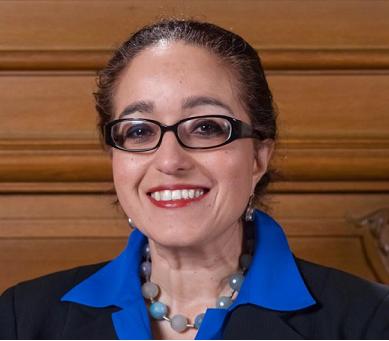
Christina Olague was a great planning commissioner. I’ve always liked her, and when she was appointed we pointed out how strongly she was rooted in the progressive community.
Olague has strong progressive activist credentials, from working with the Mission Anti-Displacement Coalition to protect low-income renters during the last dot-com boom to her more recent community organizing for the Senior Action Network. She co-chaired the 2003 campaign that established the city’s minimum wage and has been actively involved in such progressive organizations as the Milk Club, Transit Riders Union, and the short-lived San Francisco People’s Organization.
She also served two terms on the Planning Commission — appointed by Board of Supervisors then-President Matt Gonzalez in 2004 and reappointed by then-President Aaron Peskin in 2008 — where she was known for doing her homework on complicated land use issues and usually landing on the progressive side of divided votes.
We’ve had some disagreements since she took office — particularly around 8 Washington. (I also disagreed with the Labor Council on that one, and only three of the supervisors agreed with me.) And it’s not the first time an elected official I supported turned around and infuriated me on a development vote.
I want Olague to succeed; I want her to come to us in the fall with a record that makes us want to endorse her for a full four-year term. She’s been talking seriously about violence in the district and about young people, predominantly African Americans, getting killed. I feel like she wants to do the right thing.
But her reelection effort is starting to feature some bad actors.
At a recent fundraiser in Chinatown, former Mayor Willie Brown, who ranks as one of the most corrupt public officials in modern San Francisco history and whose administration was a disaster for poor and working-class people (he once even said that poor people ought to just get out of town because this city is too expensive for them), stood up and made a speech, warmly endorsed Olague and said he would be with her “all the way.” Olague then thanked Rose Pak, the Chinatown power broker, for “all of her support over the last few months.”
This makes me nervous. And it hasn’t helped my nerves that I’ve been trying to talk to Olague about these issues for the last week, and she keeps avoiding the conversation by not returning calls or cutting conversations short when I do reach her.
Willie Brown, with his Chron column, has taken on this funny, warm, man-about-town persona, but when he was running City Hall, everything was about money. He cut deals right and left that destroyed communities and neighborhoods. He oversaw, aided and encouraged what we called the “Economic Cleansing of San Francisco.” Tens of thousands of working-class people, artist, writers, young people … were driven out of the city by a steamroller of gentrification — all with the mayor’s blessing.
Now he’s working as a private attorney, and last time we checked was getting $200,000 a year to represent PG&E. We have no idea what other big corporate clients he has or what he does for them — but it’s clearly not writing legal briefs and handling litigation. He gets paid for being a political fixer. For the bad guys.
And he’s going to be with Olague “all the way.”
Damn.
Light meter

art@sfbg.com
FILM San Francisco Cinematheque artistic director Steve Polta balances familiar names with lesser known for the third annual “Crossroads” festival at the Victoria Theater, though Ken Jacobs’ Occupy-strength Seeking the Monkey King (2011) promises to unseat the image of a mellowing old master.
The festival’s only solo program, besides a tribute to Canyon Cinema co-founder Chick Strand (her 1979 film Soft Fiction is rarely screened and highly recommended), belongs to Laida Lertxundi. A former CalArts student with a sure handle on 16mm as a philosophical instrument, Lertxundi was recently featured in the Whitney Biennial. Where Strand made some of her most beautiful work far from Southern California, Bilbao-born Lertxundi brings an outsider’s eye and sharply turned cadence to the shifting landscape of Los Angeles: one has the sense of desert reclaiming city watching her short films.
A Lax Riddle Unit (2011) opens on the curled lip of James Carr’s soul number “Love Attack” and a cragged landscape view. The long take floods with softening light, but then a terrifically decisive cut deposits us in the flat light of an apartment. The sudden switch bears the imprint of both insight and displacement. Leafy potted plants reach for the natural light framed in a window, and Carr’s wail gives way to Robert Wyatt’s impressionism: a different emotional architecture entirely. The camera turns slow pirouettes through the apartment, passing over an amplifier (always this confusion about the relationship between sight and sound), a woman kneeling to play a keyboard, some records, and then catching up with her again sprawled in bed.
As is often the case in Lertxundi’s films, the composition does not settle on the human form in the usual way. The residue of the apartment, oddly reminiscent of Jean-Luc Godard’s Contempt (1963), develops until a few shots later we end with a bleeding red dusk spreading across Los Angeles — an image pitched on the edge of surrender.
My Tears are Dry (2009) is even more minimalist in its riddling structure. Lertxundi cuts between an image of a woman’s torso on a bed, playing and rewinding the same snip of Hoagy Lands’ title ballad, and another woman sitting on a couch strumming a dissonant chord. Out of this frustrated syntax comes blessed continuity. The song breaks through and sets in motion a weightless daydream borrowed from Bruce Baillie’s 1966 single-shot film, All My Life (included on the same program along with other antecedents by Hollis Frampton and Morgan Fisher): in place of his horizontal pan across flowers, Lertxundi tilts her camera up past palms towards the same pale blue sky. Poignant without object, the film delivers a gentle spiritual plea for persistence.
Several other “Crossroads” films successfully hone in on resonances specific to film stock. Curious Light (2011), Charlotte Pryce’s hand-processed illumination of Lewis Carroll’s Alice in Wonderland, provides a tactile 16mm equivalent to the absorption of reading. Scott Stark’s brilliant collage, One Way to Find Out (2012), stretches Hollywood ‘Scope images of desire like so much taffy. Rei Hayama’s A Child Burying Dead Insects (2009) decelerates a short fragment of film (a girl jogs into a leafy frame, tosses up a ball, kneels for the burial, and exits the frame) until the film itself begins to rebel in the frame. The Lumière-like simplicity of the action and swirling soundtrack music opens up a spry meditation on film’s still-startling capacity for reincarnation.
Ben Russell foregoes his “Trypps” film-series tag for River Rites (2011), but the concept of a single-roll invocation of ritual and trance remains. Curving cultural anthropology into the experience of time, Russell generates ontological fireworks and in situ reflection on filming other people. Ben Rivers builds on the fictive anthropology mode last seen in I Know Where I’m Going (2009) for his ambitious Slow Action (2010). His camera picks over “the ruins of ruins” of four island sites elaborated by voiceover narration (written by novelist and critic Mark von Schlegell) rich in invented ethnographic detail and philosophical speculation as to the true nature of utopia. The two Bens have collaborated on the forthcoming A Spell to Ward off Darkness, a film shot in Norway starring the musician Rob Lowe. Fingers crossed it’s ready for the next “Crossroads.” *
“CROSSROADS 2012”
Fri/18-Sun/20, $10 (festival pass, $50)
Victoria Theatre
2961 16th St., SF
Into new territory

arts@sfbg.com
SFIFF How to account for the desire for difficult terrain that runs through so much contemporary art cinema? Exploring the margins and crevices of what’s readily visible is just what good filmmakers do, but extremes have become commonplace. The irony that these far-flung films live on in the cosmopolitan vapors of the festival circuit cannot be lost on the filmmakers themselves. Remoteness may be a relative matter, with patience revealing islands everywhere, but inaccessible landscapes nonetheless guide a handful of interesting features showing at this year’s San Francisco International Film Festival.
>> Read our complete coverage of the San Francisco International Film Festival here.
The bourgeois couple stripped bare by vacation is a standby of modernist cinema, with Roberto Rossellini’s Viaggio in Italia (1954) still the gold standard and Maren Ade’s Everyone Else (2009) the best in recent memory. Julia Loktev’s The Loneliest Planet is an almost classical work in this mode. An engaged couple (Gael García Bernal and Hani Furstenberg) hire a local guide (Bidzina Gujabidze) to lead them through the magnificent Georgian steppe, and so the psychological roundelay begins. Fraught staging, language difficulties, Gerry-rigged tracking shots, and significant pocks in the Caucasus landscape are all worked out with great expertise but little verve.
Where The Loneliest Planet draws on landscape to reveal repressed instincts, Ulrich Köhler’s Sleeping Sickness drifts towards further occlusion. Joseph Conrad’s Heart of Darkness is the obvious reference point, though here it’s a black European who pursues a white man gone native. In the film’s first half we watch as rueful Dr. Ebbo Velten (Pierre Bokma) prepares to leave Cameroon’s lush danger with his wife and daughter. The imminent departure emboldens him to accuse the local authorities of bilking international aid donors for a nonexistent sleeping sickness crisis. Then Alex Nzila (Jean-Cristophe Folly) arrives in Cameroon to evaluate the medical program and finds Velten changed: he’s in a business partnership with a man he openly despised in the first half of the film, and we hardly hear any mention of his European family. Berlin School director Köhler works displacement as a figure of psychology, politics, and narrative and smartly uses the international aid question as a frame to plunge deeper mysteries of identity.
Conrad is a significant presence in The Rings of Saturn, the peripatetic novel by W.G Sebald that’s also the focus of Grant Gee’s suitably oblique documentary portrait. Patience (After Sebald) offers astute commentary on the moods of Sebald’s prose from thinkers like Adam Phillips, Robert Macfarlane, and Tacita Dean, though Gee succumbs to the spectacle of Google Earth mapping of the novel and some decidedly sub-Sebaldian spiritualism. Still, hearing the author speak his own mind on Virginia Woolf’s moth and the phenomenology of walking is worth the price of admission for fans.
Gonçalo Tocha eschews the Google’s eye view in It’s the Earth Not the Moon, his resplendent study of Corvo (the tiny northernmost island of the Azores, close enough to being in the middle of the ocean and a far outlier of European Union). Tocha and his sound man Dídio Pestana dropped anchor there to capture every face, bird, and rock on the island — a self-consciously grandiose goal with something of the 19th century about it. The film first approaches Corvo with statistical lyricism: dimensions, number of residents, number of roads, and so on. The notion that you could hold the entire island in your head at once is an illusion, of course, but a sustaining one. Corvo is an island such as you might have imagined as a child, which is not to say that It’s the Earth is innocent of the world. As economic math and electoral politics sweep the second part of the film, Tocha proves himself an inheritor of the French essay-film tradition of Chris Marker and Agnès Varda. The film’s three hours pass easily in the intimacy of encounter, but one still admires the desire to give the film experience some qualitative measure of being marooned.
Corvo’s aging population might well feel at home in the timeless Brazilian village of Found Memories, the fable of a young woman born in the wrong time coming to a community of people who have forgotten to die. Along with It’s the Earth and other SFIFF selections Palaces of Pity and Neighboring Sounds, Júlia Murat’s first narrative feature seals a particularly strong year of Portuguese-language films. She delineates time and space through routine, patiently unfolding characterization in the adjoining repetitions. Lucio Bonelli’s cinematography is beautiful work in itself, fearlessly embracing darkness and shadow (the rural village must have seemed like easy street after lensing Lisandro Alonso’s formidable landscapes). Found Memories doesn’t break the mold of slow cinema — its melancholy mingling of photography and myth is especially reminiscent of Manoel de Oliveira’s The Strange Case of Angelica (2010) — but a late passage of clipped post-punk demonstrates that Murat can handle a sudden swerve.
That leaves little space for Davy Chou’s assured debut, Golden Slumbers, and it deserves an article of its own. The remoteness we experience here is that of phantoms: Chou’s film excavates the thriving Cambodian cinema that was rubbed out by the Khmer Rouge. All that remains are fugitive traces of printed ephemera and soundtracks of curling orchestral ballads and psychedelic nuggets — and the memories of those people who made or relished the films and survived Pol Pot. Most of the films discussed in this article use offscreen sound to develop a sense of place beyond the frame, but Golden Slumbers is a special case, with the poverty of archival materials turned to an advantage as elegy. Chou’s gliding Phnom Penh interludes and spaciously staged interviews reflect the influence of Jia Zhangke and Tsai Ming-liang’s Goodbye, Dragon Inn (2003), but these cinephilic touchstones never overwhelm the personal, defiant accounts of moviemaking at the heart of the film. Ever after is the tragic refrain of Chou’s film, but the once upon a time is as golden as he says.
Alerts
FRIDAY 13
Born N Raised in Frisco Eric Quesada Center for Culture and Politics, 518 Valencia, SF, 6:30pm, free www.tinyurl.com/poormagevent. A celebration of the end of the People Skool/Escuela de la Gente Winter 2012 session’s course, entitled Born N Raised in Frisco. This class concerned the “stories, poetry, music and media of people who have undergone the trauma of eviction, removal, gentriFUKation, displacement and/or forced migration out of San Francisco due to poverty, redlining, and/or re-devil-opment” and is part of the Uncle Al Robles Living Library project. People Skool, presented by POOR Magazine, lets the voices of San Francisco be heard, and this graduation party will continue the mission of POOR Magazine- to provide “poor people-led/indigenous people-led, grassroots, arts familia creating media, education and art on poverty, racism, disability, indigenous resistance and im/migraiton locally and globally.”
SATURDAY 14
Just Cause Direct Action Training Lake Merritt United Methodist Church, 1330 Lakeshore, Oakland, 9am-6pm, free. Register at www.tinyurl.com/99springoakland. Around the country, a huge coalition of organizations moveon.org, Green For All, Code Pink, Jobs With Justice, UNITE HERE, and dozens of others have joined forces to present the 99% Spring action training. Their goal is true train 100,000 people in non-violent direct action and this is the week. In the Bay Area, a community-wide training will be led by Causa Justa / Just Cause, Mujeres Unidas y Activas (MUA), the School of Unity and Liberation (SOUL), and the Ruckus Society. The first part of the day will be a lesson on the current political economy, the second part a training in nonviolent direct action “open to people who are organizing with local organizations, Occupy groups, or who want to get involved in actions this Spring.” Smaller trainings in San Francisco will also take place at Million Fishes gallery and the UNITE HERE Local 2 headquarters.
Occupy Oakland Patriarchy BBQ and Speakout Rainbow Park, 5800 International Blvd, 1-5pm, free, www.tinyurl.com./OOpatriarchy. Occupy Oakland continues its weekly Saturday barbecues, meant to engage those who have been occupying with other Oakland residents, share free food, and build community. Last week, they commemorated the anniversary of the death of Black Panther Party icon Lil Bobby Hutton with a celebration of black power; this week, the theme is a speak-out on issues ranging from cuts to schools and services to low wages to racist policing. As organizers say, “the cycle of violence that currently exists attacks poor people, people of color, and women, and is specifically designed to keep us weak so we will passively accept our place in society.”
SUNDAY 15
Youth Theater Project Mission Cultural Center for Latino Arts, 2868 Mission, SF, 4/14 7pm and 4/15 2pm, free, www.tinyurl.com/youththeaterproject. The San Francisco Mime Troupe presents theater written by and about youth in San Francisco. The play comes after an eight-week workshop, and according to the Mime Troupe “The Project promotes artistic expression, discipline, and cross-cultural understanding as creative alternatives to drugs, gangs, prejudice, hostility and violence.”
San Francisco’s loss

news@sfbg.com
San Francisco is increasingly losing its working and creative classes to the East Bay and other jurisdictions — and with them, much of the city’s diversity — largely because of policy decisions that favor expensive, market-rate housing over the city’s own affordable housing goals.
“It’s definitely changing the character of the city,” said James Tracy, an activist with Community Housing Partnership. “It drains a big part of the creative energy of the city, which is why folks came here in the first place.”
>>Is Oakland cooler than San Francisco? Oaklanders respond.
Now, as San Francisco officials consider creating an affordable housing trust fund and other legislative changes, it’s fair to ask: Does City Hall have the political will to reverse the trend?
Census data tells a big part of the story. In 2000, the median owner-occupied home in San Francisco cost $369,400, and by 2010 it had more than doubled to $785,200. Census figures also show median rents have gone from $928 in 2000 up to $1,385 in 2010 — and even a cursory glance at apartment listings show that rents have been steadily rising since then.
Tracy and other affordable housing activists testified at an April 9 hearing before the Board of Supervisors Land Use and Economic Development Committee on a new study by the Budget and Legislative Analyst, commissioned last July by Sup. David Campos, entitled “Performance Audit of San Francisco’s Affordable Housing Policies and Programs.”
“There’s a hearing right now at City Hall about our housing stock and how it’s been skewing upward toward those with higher incomes,” Board President David Chiu told us, noting that it is sounding an alarm that, “Creative individuals that make this place so special are being driven out of the city.”
Oakland City Council member Rebecca Kaplan said that San Francisco’s loss has been a gain for Oakland and other East Bay cities, which are enjoying a new cultural vibrancy that has so far been largely free of the gentrifying impacts that can hurt a city’s diversity.
“You can add more people without getting rid of anybody if you do it right. Most of development is looking at places that are now completely empty like the Lake Merritt BART station parking lot, empty land around the Coliseum, and the West Oakland BART station,” Kaplan told us. “We have to commit to revitalization without displacement.”
Yet the fear among some San Franciscans is that we’ll have just the opposite: displacement that actually hinders the city’s attempts at economic revitalization. “What’s at stake is the economic recovery of the city,” Tracy said. “You can’t have such a large portion of the workforce commuting into the city.”
TOO MANY CONDOS
A big part of the problem is that San Francisco is building plenty of market-rate (read: really expensive) housing, but not nearly enough affordable housing. The report Campos commissioned looked at how well the city did at meeting various housing construction goals it set for itself from 1999 to 2006 in its state-mandated Housing Element, which requires cities to plan for the housing needs of its population and absorb a fair share of the state’s affordable housing needs.
The plan called for 7,363 market-rate units, or 36 percent of the total housing construction, with the balance being housing for those with moderate, low, or very low incomes. Developers built 11,293 market rate units during that time, 154 percent of what was needed and 65 percent of the total housing construction. There were only 725 units built for those with moderate incomes (just 13 percent the goal) and just over half the number of low-income units needed and 83 percent of the very low-income goal met.
“We have to do a better job of monitoring and evaluating each project,” Chiu said. “Every incremental decision we make determines whether this will be a city for just the wealthy.”
The situation for renters is even worse. From 2001-2011, the report showed there were only 1,351 rental units built for people in the low to moderate income range, people who make 50-120 percent of the area median income, which includes a sizable chunk of the working class living in a city where about two-thirds of residents rent.
“The Planning Commission does not receive a sufficiently comprehensive evaluation of the City’s achievement of its housing goals,” the report concluded, calling for the planners and policymakers to evaluate new housing proposals by the benchmark of what kind of housing the city actually needs. Likewise, it concluded that the Board of Supervisors isn’t being regularly given information it needs to correct the imbalance or meet affordable housing needs.
Policy changes made under former Mayor Gavin Newsom also made this bad situation even worse. Developers used to build affordable housing required by the city’s inclusionary housing law rather than pay in-lieu fees to the city by a 3-1 ratio, but since the formulas in that law changed in 2010, 55 percent of developers have opted to pay the fee rather than building housing.
Also in 2010, Newsom instituted a policy that allowed developers to defer payment of about 85 percent of their affordable housing fees, resulting in an additional year-long delay in building affordable housing, from 48 months after the market rate project got permitted to 60 months now.
Tracy and the affordable housing activists say the city needs to reverse these trends if it is to remain diverse. “It’s not even debatable that the majority housing built in the city needs to be affordable,” Tracy said.
Mayor Ed Lee has called for an affordable housing trust fund, the details of which are still being worked out as he prepares to submit it for the November ballot. Chiu said that would help: “I will require a lot of different public policies, but a lot of it will be an affordable housing trust fund.”
GROWTH AND DIVERSITY
San Francisco’s problems have been a boon for Oakland.
“With much love and affection to my dear SF friends, I must say that Oakland is more fun,” Kaplan told us. “Also I think a lot of people are choosing to live in Oakland now for a variety of reasons that aren’t just about price. We have a huge resurgent art scene, an interconnected food, restaurant, and club scene, a place where multicultural community of grassroots artists is thriving, best known from Art Murmur.”
There is fear that Oakland could devolve into the same situation plaguing San Francisco, with rising housing prices that displace its diverse current population, but so far that isn’t happening much. Oakland remains much more racially and economically diverse than San Francisco, particularly as it attracts San Francisco’s ethnically diverse residents.
“We’re not looking at a situation where the people moving into town are necessarily predominantly white,” Kaplan said. “We’re having large growth in quite a range of communities, including growing Ethiopian and Eritrean and Vietnamese populations…If you don’t want to live in a multicultural community, maybe Oakland’s not your cup of tea.”
According to the 2010 census, a language other than English is spoken at home in 40.2 percent of Oakland households, compared to 25.4 percent in San Francisco. “Almost every language in the world spoken in Oakland,” Kaplan said.
African Americans make up 28 percent of Oakland’s population, compared to only 6.1 percent in San Francisco, and 6.2 percent of the population of California. In San Francisco, the number of black-owned businesses is dismal at 2.7 percent, compared to 4 percent statewide and 13.7 percent in Oakland. The census also finds that 25.4 percent Oaklanders are people of Latino origin, compared to San Francisco at 15.1 percent and 37.6 percent statewide. San Francisco is 33.3 percent Asian, compared to Oakland at 16.8 percent and all of California at 13 percent.
Both cities are less white than California as a whole; the state’s white population is 57.6 percent, compared to 34 percent in Oakland and 48.5 percent in San Francisco.
Gentrification shows its face differently depending on the neighborhood. Some say Rockridge, a trendy Oakland neighborhood where prices have recently increased, has gone too far down the path.
“Rockridge has been ‘in’ for a long time, but the prices are staggering and it isn’t as interesting any more,” Barbara Hendrickson, an East Bay real estate agent, told us.
The nationwide foreclosure crisis didn’t spare Oakland and may have sped up its gentrification process. “The neighborhoods are being gentrified by people who buy foreclosures and turn them into sweet remolded homes,” observed Hendrickson.
Yet Kaplan said many of these houses simply remain vacant, driving down values for surrounding properties and destabilizing the community. “I think we need a policy where the county doesn’t process a foreclosure until the bank has proven that they own the note,” said Kaplan, who mentioned that the city has had some success using blight ordinances to hold banks accountable for the empty buildings.
And as if San Francisco didn’t have enough challenges, Kaplan also noted another undeniable advantage: the weather. “The weather is really quite something,” she said. “I have days with a meeting in San Francisco and I always have to remember to bring completely different clothing. Part of why I wanted to live in California was to be able to spend more time outdoors, be healthy, bicycle, things like that. So that’s pretty easy to do over here in Oakland.”
Heading East: The flight from San Francisco
EDITORIAL There is no simple free-market solution to gentrification and displacement. There’s no way a crowded city like San Francisco can simply rely on the forces of supply and demand to protect vulnerable populations. And there’s no way the city’s flawed housing policy can prevent the loss of thousands of San Franciscans — particularly young, creative people who help keep a city lively — from fleeing to a town where they can actually afford the rent.
Richard Florida, the famous social and economic theorist who coined the term “creative class” argues that artists and writers and geeks and musicians are the forces that drive modern economies. His pioneering 2002 essay in the Washington Monthly was titled “Why cities without gays and rock bands are losing the economic development race.”
Florida’s something of an elitist and he ignores the contributions that tens of thousands of others (including retired people, union members and nonprofit workers) make a community. He idolizes tech culture and often ignores issues like class and race.
But he’s got a point: Nobody who’s doing anything cool wants to live in a city where everyone is rich and everything is clean and boring. And that’s the danger San Francisco faces.
Just go over to Oakland for a few days and talk to all the people who were once part of this city’s cultural scene. They’ll tell you what anyone with any sense knows: You don’t attract creative people to a city by giving out tax breaks for corporations and building fancy office space. The rock bands that Florida talks about aren’t going to stay in a city because it has high-end jobs for people with advanced degrees. Artists need a place where they can afford the rent.
San Francisco is still a great urban center, by any possible standard, and has all the qualities of diversity, openness, energy, politics and fun that have made generations of immigrants from all over the world want to make it their home. But at a certain point, housing becomes more important than all of the other development issues that local government can address.
Take Andy Duvall, a musician we interviewed who was part of San Francisco for 15 years before he was literally priced out of town. For half of what he was paying in the Mission, Duvall has more than twice the space in Oakland — and the situation is just getting worse. While most of the country is still mired in a deep housing slump (and parts of San Francisco are facing a foreclosure crisis), rents in this town are soaring, beyond the affordability of almost anyone who currently lives here. According to the city’s own statistics, only about 10 percent of San Franciscans can afford the rent on a median market-rate apartment. That means if they’re evicted or lose their homes, they have to leave town.
The supervisors held a hearing April 9 on affordable housing, and the message was profound: “Affordable housing preserves the neighborhood in more ways than one; residents are the foundation on which the economy is built. From any angle, if we can’t afford to live here, there is no city,” observed Val Sinckler, a Western Addition resident.
But while the mayor is working to attract companies that will pay high-end salaries to people who can afford to pay far more rent than the average San Franciscan, he’s a long way from coming up with the money to even begin to mitigate the problem.
An effective policy to preserve San Francisco requires strict regulation (to prevent evictions and displacement), a mandate that commercial developers build housing for their workforce and that residential developers meet the needs of low- and moderate-income residents — and a large investment of public money in affordable housing. If Lee isn’t willing to talk serious about those three crucial elements, then he’s presiding over the decline of one of the world’s coolest cities.
Editorial: The flight from San Francisco
EDITORIAL There is no simple free-market solution to gentrification and displacement. There’s no way a crowded city like San Francisco can simply rely on the forces of supply and demand to protect vulnerable populations. And there’s no way the city’s flawed housing policy can prevent the loss of thousands of San Franciscans — particularly young, creative people who help keep a city lively — from fleeing to a town where they can actually afford the rent.
Richard Florida, the famous social and economic theorist who coined the term “creative class” argues that artists and writers and geeks and musicians are the forces that drive modern economies. His pioneering 2002 essay in the Washington Monthly was titled “Why cities without gays and rock bands are losing the economic development race.”
Florida’s something of an elitist and he ignores the contributions that tens of thousands of others (including retired people, union members and nonprofit workers) make a community. He idolizes tech culture and often ignores issues like class and race.
But he’s got a point: Nobody who’s doing anything cool wants to live in a city where everyone is rich and everything is clean and boring. And that’s the danger San Francisco faces.
Just go over to Oakland for a few days and talk to all the people who were once part of this city’s cultural scene. They’ll tell you what anyone with any sense knows: You don’t attract creative people to a city by giving out tax breaks for corporations and building fancy office space. The rock bands that Florida talks about aren’t going to stay in a city because it has high-end jobs for people with advanced degrees. Artists need a place where they can afford the rent.
San Francisco is still a great urban center, by any possible standard, and has all the qualities of diversity, openness, energy, politics and fun that have made generations of immigrants from all over the world want to make it their home. But at a certain point, housing becomes more important than all of the other development issues that local government can address.
Take Andy Duvall, a musician we interviewed who was part of San Francisco for 15 years before he was literally priced out of town. For half of what he was paying in the Mission, Duvall has more than twice the space in Oakland — and the situation is just getting worse. While most of the country is still mired in a deep housing slump (and parts of San Francisco are facing a foreclosure crisis), rents in this town are soaring, beyond the affordability of almost anyone who currently lives here. According to the city’s own statistics, only about 10 percent of San Franciscans can afford the rent on a median market-rate apartment. That means if they’re evicted or lose their homes, they have to leave town.
The supervisors held a hearing April 9 on affordable housing, and the message was profound: “Affordable housing preserves the neighborhood in more ways than one; residents are the foundation on which the economy is built. From any angle, if we can’t afford to live here, there is no city,” observed Val Sinckler, a Western Addition resident.
But while the mayor is working to attract companies that will pay high-end salaries to people who can afford to pay far more rent than the average San Franciscan, he’s a long way from coming up with the money to even begin to mitigate the problem.
An effective policy to preserve San Francisco requires strict regulation (to prevent evictions and displacement), a mandate that commercial developers build housing for their workforce and that residential developers meet the needs of low- and moderate-income residents — and a large investment of public money in affordable housing. If Lee isn’t willing to talk serious about those three crucial elements, then he’s presiding over the decline of one of the world’s coolest cities.
Past, present, future

arts@sfbg.com
DANCE This weekend choreographers Robert Moses and Sean Dorsey present new dances. Moses’ Helen, inspired by the myth of the beautiful Greek whose face launched a thousand ships, is at Yerba Buena Center for the Arts; Dorsey’s The Secret History of Love, based on how LGBT people used to meet, plays Dance Mission Theater. Both choreographers started dancing in their hometowns — Philadelphia for Moses, Vancouver for Dorsey — and began choreographing professionally in San Francisco. They recently talked to the Guardian about how they came to be where they are now.
SFBG Do you remember how dance entered your life?
Robert Moses We danced the way kids do. My sister and family members all danced. As teenagers we would get together in clubs where you showed your steps, and you had a contest. You couldn’t just jump around a little bit. You had to be the very best dancer that you could be.
Sean Dorsey My first memory is spinning round the living room in a leotard to “Free to Be … You and Me.” There was a lot of music in my house, lots of artists in my family, and there was a lot of space and encouragement for that kind of activity.
SFBG How did your formal training in dance start?
RM In my last semester in high school, I ended up in a dance class when another class was cancelled. At university, I started training in West African, Haitian, ballet, contemporary, tap, and musical theater. I did all of it because I knew that’s what I wanted to do.
SD My big childhood hero was Carol Burnett; my dream was to go into comedy. I was in graduate school in Community Development when I was invited to audition for the dance department. So I started to study dance at 25. It was going to be recreational, but I found that it was my deepest love.
SFBG We all bring our cultural background and life experiences to our work. If and in what way does that influence what you do?
RM Of course, it influences what you do; there is no way that it couldn’t. You are a member of group but you are also an individual who is changing and maturing. Sure, I have put perspectives on American, African American, and displacement issues. The thing to remember is what you do is not who you are.
SD As a transgendered person, a queer person, and an immigrant person, an outsider’s consciousness charges my art-making, and I hope that brings a heightened awareness and sensitivity to the kind of themes that I explore in my work such as family, love, or searching for a place in the world.
SFBG How does the process of making a new piece start?
RM It’s different each time. Sometimes it starts with a topic; sometimes with just a movement. A work might also tell me to lean more on the music or talk more about a subject. I also consider how a piece will be presented within a particular frame. The movement itself is created in the studio by the dancers and myself.
SD My process feels ridiculously long. All my pieces are accompanied by a sound score of narration and music. It takes four to six hours in the studio to make one minute. It’s always music, music, music and words, words, words. Once that is finished, I take the draft to the dancers and we make the movement together.
SFBG What would you like us to know about the upcoming premieres?
RM We are talking about the Greek Helen and the notion of an idealized woman, but also about the way people are the playthings of the gods. I am a fan of Carl Hancock Rux’s spoken word and music; he alludes to the Iliad but I am really interested in how women react to the situations they are in.
SD The show is based on archival research and features the real-life stories and voices of eight LGBT elders, from 1920s speakeasies to wartime love affairs, and the really repressive 1950s.
ROBERT MOSES’ KIN
Fri/30-Sun/1, 8 p.m., $25-$45
Novellus Theater
Yerba Buena Center for the Arts
700 Howard, SF
SEAN DORSEY DANCE
Thurs/28-Sun/1, 8 p.m. (also Sat/31-Sun/1, 4 p.m.), $10-$25
Dance Mission Theater
3316 24th St., SF
D5 candidates and constituents scrutinize Olague

San Francisco’s political lines are in the process of being redrawn. That’s true literally, with the current reconstitution of legislative districts based on the latest census, but it’s also true figuratively: old alliances based on identity and ideology are being replaced with uncertain new political dynamics. And nowhere is that more true than in District 5.
In a recent Guardian, we explored the implications of Sup. Christina Olague’s dual (and potentially dueling) loyalties between Mayor Ed Lee, who appointed her to the job, and the progressive political community with which Olague has long identified. Those seemed to play out yesterday when Olague bucked progressives to be the sixth co-sponsor of Sup. Mark Farrell’s proposed charter amendment to repeal ranked-choice voting for citywide offices.
Already, many of her progressive constituents – even those who have strongly supported her – have been privately grumbling that Olague hasn’t been accessible and expressing doubts about her ability to lead one of the city’s most progressive districts. Olague, who initially returned our calls immediately but said she’d have to get back to us about supporting Farrell’s legislation (I’ll add an update if/when she calls back), adamantly denied that she’s had a slow start.
“We’ve been working with constituents constantly,” she said, rattling off a list of nightly meetings. “I’m in the community all the time, getting coffee with folks…We’re working on multiple issues here.”
Michael O’Connor – who owns The Independent and other businesses and who ran in D5 in 2004 and may run again this year – supports Olague but questions the conventional wisdom that her progressive roots and mayoral support make her a lock for reelection this year.
“Olague is an awesome person and she would be a great supervisor in District 9,” O’Connor said, citing her strong ties to the Mission District and work with the Mission Anti-Displacement Coalition. “But she’s very beatable in D5 because she doesn’t have the deep connections to the community.”
That’s a belief that is shared by others, including London Breed – the executive director of the African American Art & Cultural Center for the last 10 years – who jumped into the race last week and threatened to cut into Olague’s support among Mayor Lee’s supporters.
With Attorney General Kamala Harris and other Lee supporters by her side, Breed cast herself as a more authentic and grassroots representative for the district where she was raised. Or as Harris said, “London understands the challenges and strengths of the district. She is, bar none, the best voice for District 5.”
Left unsaid was the split that her candidacy created among supporters of Lee, whose ascension to Room 200 was engineered largely by former mayor Willie Brown and Chinatown power broker Rose Pak. Brown (along with some of the city’s most influential African American ministers) strongly backed Breed for the D5 appointment, while Pak wanted her ally Malcolm Yeung, although she reportedly got behind Olague in the end.
Breed told us that she was supportive of Olague and that “I’ve been adamant about people giving her a chance and working with her.” But she said that it’s already become “clear that she just doesn’t have what it takes and was probably not going to get there,” based on “the feedback and phone calls I got with the experience people had in meeting her.”
“She’s familiar with planning, but not necessarily with the neighborhood and all its community groups,” Breed said. As for crossing Mayor Lee with her decision to run, Breed told us, “This was a hard decision for me to make because I work with many of these people and have good relationship with him.”
Progressive D5 candidates, such as City College Board President John Rizzo, are waiting to take advantage of votes on which Olague breaks with the progressives to carry water for the mayor. As he told us, “The mayor doesn’t get to make this decision, it’s the voters of this district that will decide.”
Like Breed, Rizzo also emphasized his long ties to the district. “I respect Christina and like Christina, but my connections are very deep,” he said, citing his 26 years of living and working as an environmental activist in the district. “I have a record of going out and taking the initiative and making things happen.”
Thea Selby, president of the Lower Haight Merchants and Neighbors Association, has also been running an active campaign for the D5 job, including highlighting Olague’s split loyalties. “She literally switched camps to help chair the Run Ed Run committee,” she told us. Julian Davis, who ran for D5 supervisor in 2004 and has been rumored to be mulling another run, said that it’s disconcerting just how many elected officials in San Francisco started off with the advantage of being appointed to the office: “It’s not participatory democracy the way we envision it.”
Selby and others will be closely watching how Olague votes this year, and trying to differentiate when those votes are significant (such as being the swing vote to place the challenge to RCV on the ballot) or not (including Olague’s early vote to override Lee’s veto, which fell two votes short of the eight needed). “We need to look and see how she votes on things – and when it matters and when it doesn’t,” Selby said.
Yet already, even before the really big and controversial votes like the upcoming 8 Washington and CPMC projects, Olague is feeling the polar tugs on issues such as bicycling. Many bike advocates are mad that Lee has delayed promised bike lanes on Oak Street and with a rash of tickets that cyclists on the Wiggle have received.
“I’ve long been an advocate of biking, but I know there are issues related to parking in the neighborhood,” Olague told us, straddling the issue. “Parking for some reason is a very controversial issue in the city.”
And where does she come down on the stepped up enforcement of bikes rolling stop signs on the Wiggle? “I want to sit down with the Bike Coalition and see what they think,” Olague said.
Meanwhile, Breed – who is widely considered a political moderate, which could cause her problems winning in D5 – is also trying to position herself as more independent than Olague. “I’m about being progressive,” she told us, citing her recent hiring of a case worker at the AAACC to help young African Americans work through barriers to success. “To me, that’s what being progressive is.”
Breed readily acknowledged her early political support from Brown, who appointed her to the Redevelopment Commission when he was mayor, but said that she would still take a tough stand against Lennar and other developers to ensure the needs of current San Franciscans are being met by new projects.
“I’ve told people, this does not mean you have my support,” Breed said of her political contributors and her support of Lennar’s massive redevelopment of the southeast part of the city. “As my grandmother used to say, all money ain’t good money.”
On Breed’s entrance into the race, Olague told us, “It was expected, so I’m not surprised.” Olague said that she’s begun to set up her election campaign, but that most of her focus has been on getting up to speed at City Hall and in D5: “I’m just trying to focus on the work of the district.”
Here’s lookin’ at you, kids
arts@sfbg.com
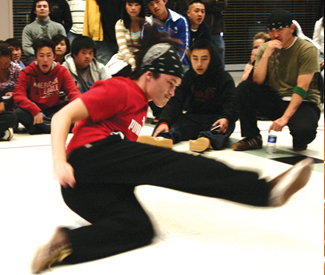
SFIAAFF As the mainstream movie industry undergoes a senior moment and tips toward grandfatherly nostalgia, this year’s San Francisco International Asian American Film Festival seems to be in the throes of a youth movement. You can trace the growth spurt from Eduardo W. Roy Jr.’s reproduction production line Baby Factory and the childhood Xmas fantasy of Kim Sung-Hoon’s Ryang-Kang-Do: Merry Christmas, North! to Wang Xiaoshuai’s coming-of-age snapshot 11 Flowers and the teen gang wars of Byron Q’s Bang Bang. A closer look at three — Christopher Woon’s Hmong hip-hopper doc Among B-Boys, Akira Boch’s girl-band indie The Crumbles, and Takashi Miike’s tot action farce Ninja Kids — finds the disparate troika taking aim at shared themes of bonding and identity.
Among B-Boys gives outsiders an hour-long, respectful immersion in the lives of Hmong breakdancers, here “getting lost” in their impressively athletic moves and speaking for themselves, away from the flinty-eyed filter of Gran Torino (2008). In his quest to follow the Velocity/Soul Rivals and Underground Flow crews, Woon takes his camera from Oklahoma to Left Coast exurbia where the kids are attempting to dream with acrobatic handstands, freezes, and crazy-fancy footwork — and finding their efforts rewarded with trophies.
Their triumphs in gritty gyms and community centers are made that much more poignant in the context of their parents’ memories of war, displacement, and poverty. The elders’ stealth contributions to the CIA’s shadowy adventures in Laos casts a pool of lingering darkness on these hip-hoppers, who are striving to carve out a life for themselves while coping with the unique challenges that the Hmong have encountered in the states. As Joua Xiong, the rare B-girl in the Soul Rivals Crew, explains, “Hmong mean ‘the Free,’ and that’s basically what we are: we don’t have a certain country, but we don’t really know our original customs because we’re so mixed up. We have a lot of Thai, Lao, Chinese in us, and we’ve been running away so much from people trying to destroy our customs and make us conform with them.”
Cast away in a semi-rural Merced, Fresno, and Sacto, these kids appear to be finding another kind of freedom. “It’s not just breaking,” says Soul Rivals’ Kyle Vong. “It’s the culture of hip-hop — it’s about teaching yourself to understand life in general and expressing yourself.”
The awkward slackers and damaged hipsters of The Crumbles seem to be worlds away from the humble, proud B-boys of the Central Valley: theirs is a sun-strafed, paved-over Los Angeles habitat of coffee shops, taco trucks, bookstores, budding filmmakers, and living room-bound band practice. Darla (Katie Hipol) is slouching nowhere fast when her zany, charismatic cool-girl chum Elisa (Teresa Michelle Lee) enters the picture, looking for a place to crash.
Elisa’s wacky, erratic, and unreliable, but she’s also capable of generating real excitement — and a mean little keytar hook — and the girls’ band, the Crumbles, gets off the couch and threatens to get all involved to bust out of their shells. Though director Boch never quite dips into the deep background of his characters’ various dysfunctions — the threatened readings of Darla and Elisa’s psychic friend never quite sheds light — the first-time feature filmmaker has a real feel for the drifting, up-for-anything quality of Cali 20-somethings and an appreciation for their highs and lows that makes this familiar, loving, lets-put-on-show-kids update compelling.
With kindred ultraviolence vet Martin Scorsese throwing himself into his own kiddie roller-coaster of a cinematic ride with last year’s Hugo, it makes some sense that Takashi Miike — whose 2010 13 Assassins might have bested both Ichi the Killer (2001) and 1999’s Audition for sheer bloodletting — would enter the children’s field with such gusto. Manga fans will appreciate Miike’s broadly farcical, spoofy élan with comic book touches — down to the freeze-frame mucus drips, the CGI hatched-background stills denoting way-ramped-up action, and fourth-wall-bust-outs/pop-up trivia interludes by your “friendly ninja trivia commentator.”
http://www.youtube.com/watch?v=HVjoh-jG36o
Rantaro — your archetypal geek toddler, complete with thick glasses and bad haircut — has left the family farm and been sent off to ninja nursery school to learn all about deadly boomeranging stars, big-headed villains with testicular chins, and ninja master-slash-hair stylists. Does Rantaro, er, find himself amid the rigors of class, attacks from dastardly ninja outfits, and a final challenge that has him literally biting the dust? And does it matter when Miike digs in with such glee to lampoon the samurai genre, and kick up dust with the ankle-nibblers in this insanely comical alternate universe of ninja mini-mes?
SAN FRANCISCO INTERNATIONAL ASIAN AMERICAN FILM FESTIVAL
March 8-18, various Bay Area venues, most shows $12
DOCS AND SHOCKS: MORE FROM THE SF INTERNATIONAL ASIAN AMERICAN FILM FESTIVAL
SFIAAFF Documentary fans, prioritize Give Up Tomorrow, Michael Collins’ probing examination of a high-profile murder case in the Philippines. If the Paradise Lost films got your blood boiling, expect to rage even harder at the unbelievably shifty way the events detailed here unfolded.
As with the West Memphis Three, the crime at Tomorrow‘s heart is horrific: in 1997, two sisters in their early 20s were kidnapped, raped, and murdered. Or were they? Only one body was found, and it was never quite confirmed that the dead woman was actually one of the missing sisters. Of course, that didn’t stop authorities (almost all of whom had ties to a local drug lord, who was also connected to the victims’ family) from fingering a group of local teens, including Paco Larrañaga — who became the case’s main target, despite the fact that dozens of his culinary-school classmates swore he was with them, hundreds of miles from the crime scene, at the time of the alleged murders.
Give Up Tomorrow offers a searing study of a corrupt court system, and the heartbreak that happens when a cause célèbre falls victim to the short attention span of the international activist community. Without spoiling all of its twists and turns, know that this story is better than any fictionalized crime drama, and more powerfully wrenching for being true.
Other docs worth checking out include Mr. Cao Goes to Washington, an insightful look at the American political system via Joseph Cao, who was the first Vietnamese American elected to Congress. But that wasn’t the most unique thing about him: he was a Republican, elected amid post-Katrina disarray in one of New Orleans’ traditionally African American and staunchly Democratic districts. S. Leo Chiang’s film follows Cao as he makes hard choices in the year leading up to his battle for re-election, including voting first for, then against, President Obama’s health care reform bill. (Reason for the switch: he’s passionately anti-abortion.) Even if you don’t agree with his views, Cao puts a human (and surprisingly honest) face on the great divide between the political parties in this country.
More hopeful is No Look Pass, Melissa Johnson’s quite enjoyable documentary about first-generation Burmese American Emily Tay, a basketball superstar who turns pro after graduating Harvard (eat your heart out, Jeremy Lin), and, oh yeah — happens to be a lesbian. No Look Pass also screened at the San Francisco Independent Film Festival, and it’s not hard to see why it appeals to a wide range of audiences: Tay is an inspiring figure on the court, and endearingly awkward off it, especially when trying to relate to her deeply traditional parents.
Even more uplifting, and perfectly compressed at 39 minutes, is Lucy Walker’s Oscar-nominated The Tsunami and the Cherry Blossom, which examines the “beauty and terror” of nature, as perceived by Japanese survivors of the recent earthquake and tsunami — and the spiritual significance of the cherry blossom, which is shown to be a key element in the country’s healing process.
Genre fans! I Am a Ghost, the world-premiere latest from prolific local H.P. Mendoza (2006’s Colma: The Musical), starts slowly but — holy ghost! — stick with it, and you’ll be shriekingly rewarded. And another recent IndieFest selection, Marlon N. Rivera’s satirical The Woman in the Septic Tank, returns to delight another wave of crowds with its tale of three ambitious filmmakers (and a hell of a leading lady) determined to make the most popular Filipino movie of all time. Best line: “Fuck Cannes, bro! We’re talking Oscars!” (Cheryl Eddy)
Dame good fun

arts@sfbg.com
FILM What with the internet, the paparazzi, Rupert Murdoch’s CIA-level spy techniques, and the general displacement of actual news by “celebrity news,” it’s pretty hard these days for a star of any sort to keep their debauchery private. Not like the good old days, when Hollywood carefully stage-managed publicity and only those who’d become a real liability risked having their peccadilloes exposed.
Such rare windfalls aside, the public were mostly restricted to watching beautiful people behave badly onscreen — a pastime that took a big blow once the censorious Production Code was instituted in 1934. Elliot Lavine’s latest Roxie retrospective of movies from that golden-shower period of post-silents, pre-Nannywood licentiousness — this time entitled “Hollywood Before the Code: Nasty-Ass Films for a Nasty-Ass World!” — provides plentiful early talkie titillation. Now that the bodies involved are long buried, we also know a few tales of their stars’ off-screen misadventures, too.
The week-long series of double bills sports its share of familiar titles, notably Howard Hawks’ terrific original Scarface (1934); Edgar G. Ulmer’s Karloff vs. Lugosi smackdown The Black Cat (1934); and the first, probably best version of H.G. Welles’ prescient biotech fable Island of Lost Souls (1932). There are women in prison (1931’s Ladies of the Big House), women in Faulkner (1933’s The Story of Temple Drake, a watered-down adaptation of W.F.’s then-notorious Sanctuary), women in everything else (1932’s Three On a Match, whose Depression-era Valley of the Dolls-esque trio includes a very young Bette Davis), and just plain Joan Blondell (1933’s Blondie Johnson).
http://www.youtube.com/watch?v=hzxnEDEY2Hs
It’s a few choice dames in lesser-remembered pictures that provide the biggest “nasty-ass” discoveries this go-round, however. March 4 offers a shocking double dose of pure white femininity finding themselves in, ahem, “Yellow Peril” — miscegenation being something Hollywood could only begin to embrace a few decades later. Frank Capra’s atypically erotic The Bitter Tea of General Yen, with Barbara Stanwyck alllllmost surrendering the white flag to a “charismatic Chinese warlord” (Swede Nils Asther, eyes narrowed), has become a minor classic since flopping in 1933.
No such luck for The Cheat (1931), a remake of Cecil B. DeMille’s 1915 shocker that was part of Paramount’s brief, failed attempt to make stage sensation Tallulah Bankhead a movie star. Her gambling-addicted socialite gets branded (literally) in lieu of repayment not by the original’s Far East businessman (dashing Sessue Hayakawa) but by a mere rich Caucasian perv with Sinophile pretensions (Irving Pichel). The big courtroom climax is a notable howler.
Bankhead remained a Broadway star and a popular “personality,” her throaty voice hinting at a semi-private life that included a great deal of bourbon, a fondness for unexpected nudity, and sexual appetites all along the Kinsey scale. After two decades off screen she arguably found her camp métier as a berserk Bible-clutching hag terrorizing Stefanie Powers in 1965’s Die! Die! My Darling.
Much less of a survivor was poor Clara Bow, who was beloved when she played the wild thing yet unduly punished when it turned out that role had relevance in real life. The quintessential flapper and “It Girl” (“it” meaning sex appeal) was never much of an actress, but an incandescent, live-wire screen presence.
Call Her Savage (1932) is a pre-Code jaw-dropper that was supposedly her personal favorite. Running an A-to-Z gamut of emotions (and hairstyles), her Texas heiress heroine Nasa “Dynamite” Springer is “never two minutes the same” — a nice way of saying she’s nuts. In 88 minutes she rides a horse like it’s something else, plays with her mastiff likewise, is near-raped by an estranged husband, turns streetwalker, causes a brawl in Greenwich Village café catering to “wild poets and anarchists,” gets in two catfights, hits the bottle, and finds peace upon discovering she’s a part Indian “half-breed,” which apparently explains all.
Emotionally unstable, due in part to a pretty horrific upbringing, Bow must have related. At the time she was enduring myriad problems, notably some embarrassing public revelations spilled by a blackmailing secretary. Savage would be her next-to-last film, after which she retired into a deep and troubled seclusion.
Heading thataway as well was Juanita Hansen, a silent star who’d gone down in flames a decade earlier thanks to a “Queen of Thrills” image that unfortunately she enacted a little too enthusiastically in real life. She quit cocaine, got hooked on morphine, quit that, and became an anti-drug crusader — but nothing re-ignited her career. Certainly not lone comeback vehicle Sensation Hunters, a 1933 Poverty Row exploiter in which she was fifth-billed as “Trixie Snell,” manager-slash-madam to a troupe of “Hot-Cha Girls” who kinda dance, kinda sing, but mostly roll customers at Panama City’s “Bull Ring Club.” It was a sad exit. Puffy and peroxided, Hansen is all too convincing as a woman with too many hard miles on her to go anywhere but further downhill.
Waaaay uptown — glittering Broadway via glossy Paramount — 1934’s Murder at the Vanities offered the last hurrah for pre-Code naughtiness. And what a hurrah: chorus girls in pasties and less (at one point they simply clutch boobs as if on a latter-day Vanity Fair cover); production numbers like “The Rape of the Rhapsody” (the “rape” being Duke Ellington’s “colored” jazz musicians and dancers invading a classical orchestra with something called “Ebony Rhapsody” — until a white gangster jokingly machine-guns them all down); plus sexual humor so blunt that Jack Oakie ends the film telling a giggly blonde “Come on, let’s do it,” meaning exactly what you think.
http://www.youtube.com/watch?v=xCoj855Vdo8
On the side of the angels — definitely for losers here — there are numerous horrible songs (excepting standard “Cocktails for Two”), gag-inducingly sweet romantic leads, and kitschy-great ideas like having stage impresario Earl Carroll’s patented “Most Beautiful Girls in the World” pose en masse as tropical waves and cosmetics products. Representing Satan and evening gown-wearing pot smokers everywhere is villainous Gertrude Michael, who infamously sings torch song “Sweet Marijuana.” Michael was an elegant stage and radio star whose own recreational taste leaned more toward cocktails for one. Indeed, she was fictionalized as the hard-drinking love object in one-time lover Paul Cain’s 1932 novel Fast One, an early classic of hard boiled American pulp.
Saving the sleaziest for last, the series will truly flabber your gast with its closer. Normally prim MGM found itself reviled in early 1932 with the fleeting release of Tod Browning’s Freaks (playing the Roxie March 3), a much-misunderstood, now celebrated fable starring actual circus sideshow performers. It was considered so grotesque and unsettling that Freaks was banned in many areas — Britain didn’t see it until 1963.
Yet there’s no evidence of any similar backlash to the infinitely scuzzier Kongo, unleashed by Metro a few months later. A remake of Browning’s 1928 Lon Chaney vehicle West of Zanzibar, it stars Walter Huston as wheelchair-bound “Deadlegs” Flint. He’s used cheap magic tricks to appoint himself fearsome white-man “god” amongst spear-carrying tribesmen in a “dunghill” African outpost, all part of an elaborate, insidious plan to wreak vengeance on the rival who stole his wife and health long ago.
What this revenge eventually encompasses reads like a list of nearly everything the Production Code would soon bar from the screen: depicted or suggested drug addiction, alcoholism, prostitution, rape, sadism, and a convent-bred ingénue (Virginia Bruce) recalling “hot hairy hands pawing and mauling” her unwilling virginal body. Not to mention human sacrifice and a unique substance abuse “cure” using leeches.
One can almost hear the censuring voice of Will Hays, the Code’s original enforcer, when one character tells Deadlegs “The swamp’s wholesome compared to you!” It would arguably be 40 years before MGM distributed another movie so flagrantly perverse — and even then the studio was so ashamed they put it (Paul Bartel’s 1972 Private Parts) out under a fake subsidiary’s auspices.
HOLLYWOOD BEFORE THE CODE: NASTY-ASS FILMS FOR A NASTY-ASS WORLD!
March 2-8, $11
Roxie Theater
3117 16th St., SF
Editor’s Notes
“San Francisco’s economy is moving in the right direction,” Mayor Ed Lee told the Examiner last week. “My economic development and job creation policies are setting San Francisco on a path toward economic recovery.”
The normally modest mayor is making a rather sweeping statement there — the US economy is improving in general, and I don’t think the mayor can take credit for all of it. But he’s absolutely correct that he’s promoted policies that are aimed at bringing more tech companies in to San Francisco, and over the next few years, they will no doubt create a lot of high-paid jobs for people with specific skills that require a high degree of training and education.
Is that “the right direction” for the city? I lived here the last time that San Francisco was part of a tech boom, and I’m not so sure.
See, bringing all sorts of new wealth into town sounds good on the surface, and for some people — particularly real-estate speculators, landlords and purveyors of high-end services — it is. But in a city that has limited space and nearly unlimited demand for housing, lots of new rich people and lots of high-paid people looking for places to live puts pressure on the existing residents, particularly the poor and the working class. It screws the middle class, too — if you’re a teacher or a nurse and you want to buy a house in San Francisco during a boom, you’re S.O.L. You can barely afford to rent — and if you’re already renting, you’re constantly at risk of losing your home, and your ability to live in this city, because your landlord can make more money kicking you out and selling the place as a tenancy in common to someone with more money.
There’s no way to build enough new affordable rental housing, or housing that middle-class families can buy, to keep up with the demand. It’s impossible. Developers won’t do that — there’s too much money to be made in high-end housing for anyone in the private marketplace to waste time on anything else.
The only way to preserve the middle class in the upcoming boom that Lee is promoting is to aggressively protect existing rental housing stock — which means preventing condo conversions and TICs and the stuff that gets promoted as “middle-class housing.” The only way to prevent massive displacement of people and existing businesses is to regulate space in the city more tightly than anyone has ever done — which will, by its nature, make it harder for the newcomers and new millionaires to find places to live.
That’s the tradeoff. That’s the fact that Lee and his allies don’t seem to want to grasp
The bubble is back

steve@sfbg.com
San Francisco’s future is in the process of being written, once again using lines of computer code and blips on the screens of electronic gadgets, the same as during the last dot-com boom. Its proponents insist it will be different this time — that Boom 2.0 won’t displace the working class, that the bubble won’t burst — but critics have their doubts.
After all, the city completely screwed up the last boom by favoring flashy tech development and growth over the needs of existing, often vulnerable residents. There are already signs that displacement is creeping back, rents are soaring, housing prices are driving people out of town — and even the city’s own economist admits that nobody knows whether the tax-cut driven development will pay for itself.
In many ways, Zendesk, which recently moved to the area, is a poster child for the main obsession of Mayor Ed Lee and other city leaders, who are pushing policies that will make San Francisco the center of a new high-tech expansion. They hope to use that economic growth to create good jobs and address challenges such as revitalizing the mid-Market area.
Lee and Sups. David Chiu and Jane Kim a year ago led the creation of a business-tax exclusion zone intended to keep Twitter from leaving town. The company’s planned growth and relocation to mid-Market, they argued, would be a magnet for more tech companies. The city would give up payroll taxes on the new jobs and provide other taxpayer-financed incentives — but big companies in the zone would be required to enter into community benefits agreements that would help low-income residents and small businesses benefit from the influx of well-paid tech workers.
In fact, a Guardian review of documents (“Behind the tweets,” 3/15/11) found that Twitter resisted the city’s efforts to get a substantial community benefits package, and that deal was pushed back to a later time. The agreement isn’t actually due until the company occupies the new site, and Twitter officials are upbeat about their interactions. Twitter spokesperson Robert Weeks told us by email that the company is working with others to improve mid-Market: “Based on early meetings we’re having with various entities, it’s clear there’s great collective energy that can bring positive change to the neighborhood.”
But Zendesk — a Danish company that makes help-desk support software from an airy third floor office near Market and Sixth streets — seems to be offering a lot to the gritty neighborhood where it opened up shop last year. In January, Zendesk became the first company to take advantage of the tax break and sign a community benefits agreement with the city.
“This is about forming a longstanding relationship with the neighborhood,” said Tiffany Maleshefski, the company’s community benefits manager who negotiated with the city.
The agreement has both general goals and a number of specific requirements. The company will contribute $5,000 to mid-Market community gardens, use local businesses for at least 40 percent of its events, hire two paid interns from the neighborhood, donate equipment to local groups, coordinate several specific outreach events a year, help staff the Tenderloin Tech Lab, and participate in local nonprofit organizations and ventures.
Avoiding payroll taxes on the 66 new employees it’s hired will save the company about $30,000 in its first year, Maleshefski said, and the company plans to grow from about 110 employees in San Francisco now up to about 200 employees by the end of the year.
But CEO Mikkel Svane told us the tax break wasn’t a big factor in choosing this location. He knew they wanted to be in San Francisco and he just liked the space. “The people here want to be a part of a dynamic culture and not on a big campus in Silicon Valley,” he said. “For a technology company, being here where everything is happening is important.”
And even though the new bubble has yet to reach its full proportions, small businesses and nonprofits in the area are already finding landlords jacking up rents in anticipation of the well-heeled new arrivals.
As with the last dot-com boom, some people are going to make a lot of money and spend it around town, and some of it will probably trickle down to the rest of us. But what price will the city and its residents pay for that bump, and what kind of city will this become? Have we really learned anything from the disaster of the first tech boom?
DUELING ECONOMISTS
The question of whether this tech bubble — and Mayor Lee’s focus on jobs — is good for San Francisco involves many realms, but at its center is a question of economics. Does it make economic sense to offer public subsidies and other incentives to boost the tech sector?
We consulted three San Francisco economists with expertise on the situation and a range of perspectives: Tapan Munroe, a business-oriented economist and the author of Dot-Com to Dot-Bomb: Understanding the Dot-Com Boom, Bust, and Resurgence; Peter Donohue, a longtime consultant to cities and unions and principal of PBI Associates; and Ted Egan, the city’s economist.
“I think San Francisco is sitting pretty right now,” Munroe said, noting that tech companies and employees are naturally drawn to this vibrant, culturally rich city. “Young people like to be in San Francisco more than the Silicon Valley…It’s such a unique place, we are so fortunate to live here.”
Monroe said San Francisco is in a league of its own and it doesn’t really have any direct competitors in the region, so tax breaks and other incentives to lure businesses here don’t make much of a difference. High rents and living costs are a factor, he said, but “the main thing the city can provide is quality of life.”
He also doesn’t believe this current tech bubble is going to burst like last time, when the Internet was still new and venture capitalists were throwing money at every kid with a good idea or cool URL. “We’re not seeing anything like that this time,” he said. “Last time, people went crazy.”
This time around, the seemingly crazy stock valuations on tech companies might make more sense: “The global economy is very much being guided by mobile technology. The world is moving to mobility so the valuations have some justification,” he said.
But he added: “The market will speak. If they can’t make money in the next five years, they’ll be gone.”
That’s precisely the concern that many people have voiced, that Twitter will avoid paying taxes to the city as it beefs up and goes public — creating another litter of young millionaires in the process — and that it may fold before its six-year tax holiday ends, leaving little in city coffers. And along the way, the bubble will raise rents and displace the working class.
“Rising prices displace people, that’s just a fact of life,” Monroe said. “That’s the way the market works, but it has social impacts.”
More progressive thinkers dispute that kind of fatalism, saying it isn’t some all-powerful “market forces” that are threatening to remake San Francisco but a certain brand of speculative, monopolistic capitalism that is being aggressively pushed by a handful of wealthy investors and their political partners.
In the latest Harper’s Magazine cover story, “Killing the Competition: How the new monopolies are destroying open markets,” writer Barry Lynn argues that the consolidation of wealth and dismantling of fair trade and pro-labor laws has allowed the Bay Area tech industry to unfairly dominate small competitors and control the labor market.
That trend has been masked by political euphemisms that fool the public. “Corporate monopoly? Let’s just call that the ‘free market.’ The political ravages of corporate power? Those could be recast as the essentially benign workings of ‘market forces,'” Lynn wrote.
Donohue has been calling out such rhetoric for decades. He told us the city’s economic development policies are mostly a boon to politically connected landlords and investors, and there’s been remarkably little discussion at City Hall about gentrification, increased demand for city services, or other problems created by economic bubbles.
“People say it’s different this time, but they say that every time. It’s not different,” Donohue told us. He said economic bubbles usually hurt the poor and working class by driving up the cost of living. And he also said, “Even the most conservative economists don’t like the idea of subsidizing businesses because they think it’s a distortion of the market.”
Yet the “jobs” rhetoric and assumption that government should actively promote and subsidize the private sector has broad support in City Hall these days, even though Donohue said few people are stopping to ask whether a new tech bubble is actually good for the city.
“When you bring a lot of people into an area, you’re going to create a demand for public services,” Donohue said. “I don’t think anyone has done a very good assessment of what this will cost the city.”
Donohue worked on a political campaign in the mid-’80s to require a study of the costs to the city of serving commercial growth that was occurring in the Financial District at the time, but he said it was bitterly opposed by then-Mayor Dianne Feinstein and her downtown allies. “Nobody seems to want to know what that figure is,” Donohue said. “Nobody at City Hall is even asking the question.”
City Economist Ted Egan confirmed that his analysis of the mid-Market tax break and other economic development schemes doesn’t include the cost of increased demands on city services. “I’ve never dealt directly with that argument,” Egan told us.
Based on his assumption that Twitter’s move to the SF Mart building (owned by the politically connected Shorenstein family) on Market between Ninth and 10th Streets will fill up commercial vacancies throughout the area and generate increased sales, property, and payroll taxes, Egan concluded the city will more than make up for the lost business tax revenue over the long run.
He minimized the importance of costs to the city, such as increased police or sanitation services, and impacts to city infrastructure from water and sewer to roads and public transit. “It can’t be that running more transit is bad in a transit-first city,” Egan said, noting the relatively fixed cost of operating a Muni station.
Yet Donohue and others say the fact that the city and San Francisco Municipal Transportation Agency have huge budget deficits to close every year, even after years of cutting services and raising fees, indicates the city has a structural budget deficit that will only get worse as growth places more demands on government.
“I don’t think these things are well-thought-through, ever,” Donohue said.
Lee, Kim, and representatives from the Mayor’s Office of Economic and Workforce Development didn’t return our calls, but Chiu did and he said he believes in actively courting the tech industry with public incentives: “My support for these policies is a belief that it will broadly benefit San Franciscans.”
Yet when asked why the city doesn’t consider its costs or the impacts of rising rents and living costs, Chiu spoke only in generalities, saying that he’s been engaged in many recent meetings “to make sure we do heed the lessons of the last tech boom and make sure a rising tide lifts all boats.”
RISING TIDE
One of the most obvious negative impacts of the last tech boom was residents, nonprofits, and small businesses being hurt by rising rents and other costs, and there are some indications that’s already happening again.
The director of a venerable local nonprofit in the mid-Market area that is in the process of renewing its office lease told us their landlord is trying to nearly double the rent of $18 a square foot. “There’s all this venture capital now and people are willing to pay $33 per square foot, so landlords are just seeing green,” said the director, who asked not to be identified because negotiations are ongoing. “The speculation is hitting us big time. The neighborhood is all aTwitter, and they’re treating us like junk mail.”
Egan said he predicted those rising rents, but he didn’t think they would happen so quickly. “In principle, it doesn’t surprise me, but it does surprise me that it’s happened that far and that fast,” Egan said. “The idea was to create employment, rather than rising rents.”
Chiu said he was also surprised. “Jane Kim and I very much want to monitor the situation. We will look into city policies that will mitigate this trend,” he said. When asked what the city can do, he made several vague statements before saying, “If we’re serious about diversity, we may want to talk about rent subsidies at some point.”
That would be one more cost to the city, adding to a toll that Donohue and others say is being ignored. Chiu, Egan, and other city officials seem to think growth is the only way forward. As Egan said, “If we don’t do development in a city like San Francisco, what happens?”
But others say San Francisco should take care of its own first to maintain the city’s diversity. Asked what the city’s approach to economic development should be, Donohue said, “I’d presume you want to serve the people who live here already.”
It was an idea echoed by Chris Daly, who was a housing activist during the last dot-com bubble before being part of wave of progressive politicians its backlash propelled onto the Board of Supervisors. He is now political director for SEIU Local 1021, which represents city workers.
“If your priority is to care for the fabric of the city as it’s been built, you invest in what’s here now,” Daly told us. “My view is when the city courts the high-tech industry to try to jumpstart the city’s economy, there are significant ramifications to what kind of city you’re building.”
Local progressive activists, people who often work to counter the impacts of those who see San Francisco as simply a place to make money, agree that there is a perverse logic at play these days.
“We already have more jobs than people,” said Marc Salomon, a computer programmer and longtime community activist, noting that the city has about 800,000 residents and about 1.3 million people who work here. “And we have lots of unemployed San Franciscans, and we have a budget deficit.”
Tom Radulovich, executive director of Livable City, said the simplistic rhetoric coming out of City Hall masks the more complex realities that the city faces. “When they say ‘jobs,’ everyone’s critical thinking sensibilities are supposed to shut off,” Radulovich said
Rather than focusing solely on whether a proposal creates private sector jobs, he said that a more complete analysis involves what he calls the “three Es: equity, environment, and economy.” In other words, does the proposal have broad, leveling benefits (equity), what are its impacts to the natural and built worlds (environment), and what are its fiscal implications (economy).
“But,” he said, “we’ve been privileging that third ‘e’.”
Meet the new supervisor

Christina Olague, the newest member of the Board of Supervisors, faces a difficult balancing act. She was appointed by Mayor Ed Lee, whom she supported as co-chair of the controversial “Run Ed Run” campaign, to fill the vacancy in District 5, an ultra-progressive district whose voters rejected Lee in favor of John Avalos by a 2-1 margin.
So now Olague faces the challenge of keeping her district happy while staying on good terms with the Mayor’s Office, all while running in her first campaign for elected office against what could be a large field of challengers scrutinizing her every vote and statement.
Olague has strong progressive activist credentials, from working with the Mission Anti-Displacement Coalition to protect low-income renters during the last dot-com boom to her more recent community organizing for the Senior Action Network. She co-chaired the 2003 campaign that established the city’s minimum wage and has been actively involved in such progressive organizations as the Milk Club, Transit Riders Union, and the short-lived San Francisco People’s Organization.
“One of the reasons many of us are so supportive of Christina is she is grounded in the issues of low-income San Franciscans,” said Gabriel Haaland, who works with SEIU Local 1021 and accompanied Olague to a recent interview at the Guardian office.
She also served two terms on the Planning Commission — appointed by Board of Supervisors then-President Matt Gonzalez in 2004 and reappointed by then-President Aaron Peskin in 2008 — where she was known for doing her homework on complicated land use issues and usually landing on the progressive side of divided votes.
“Coming from the Planning Commission, she can do a lot of good,” said Tom Radulovich, executive director of Livable City and a supporter who has worked with Olague for 15 years. “We lost a lot of collective memory on land use issues,” he said, citing the expertise of Chris Daly and Aaron Peskin. “We do need that on the board. There is so much at stake in land use.”
Olague disappointed many progressives by co-chairing Progress for All, which was created by Chinatown power broker Rose Pak to push the deceptive “Run Ed Run” campaign that was widely criticized for its secrecy and other ethical violations. At the time, Olague told us she appreciated how Lee was willing to consider community input and she thought it was important for progressives to support him to maintain that open door policy.
In announcing his appointment of Olague, Lee said, “This is not about counting votes, it’s about what’s best for San Francisco and her district.” Olague also sounded that post-partisan theme, telling the crowd at her swearing-in, “I think this is an incredible time for our city and a time when we are coming together and moving past old political pigeonholes.”
With some big projects coming to the board and the working class being rapidly driven out of the city, progressives are hoping Olague will be a committed ally. There’s some concern, though, about her connections to Progress For All campaign’s secretive political consultant, Enrique Pearce.
Pearce has become a bit of a pariah in progressive circles for his shady campaign tactics on behalf of powerful players. In 2010, his Left Coast Communications got caught running an independent expenditure campaign partly funded by Willie Brown out of Pearce’s office, even though Sup. Jane Kim was both its beneficiary and his client — and that level of coordination is illegal. Last year, Pearce was hired by Pak to create the “Run Ed Run” campaign and write the hagiographic book, The Ed Lee Story, which also seemed to have some connections with Lee’s campaign. The Ethics Commission hasn’t fined Pearce for either incident, and he didn’t return a Guardian call for comment.
Olague told us not to worry. “He’s a friend…and I think it’s an exaggerated concern,” she said, confirming but minimizing his role so far. Yet she hired one of Pearce’s former employees, Jen Low, as one of her board aide. Olague’s other aides are Chris Durazo from South of Market Community Action Network (SOMCAN) and Dominica Henderson, formerly of the SF Housing Authority.
Debra Walker, a progressive activist who served on the Building Inspection Commission and has worked with Olague for decades, said she’s a reliable ally: “She’s from the progressive community and I have no equivocation about that.”
Olague makes no apologies for her alliances, saying that she is both independent and progressive and that she should be judged by her actions as a supervisor. “People will have to decide who I am based on how I vote,” she said, later adding, “I support the mayor and I’m not going to apologize for that.”
OLAGUE’S PRIORITIES
Olague was born in Merced in 1961 to a Mexican immigrant father who fixed farming equipment and a stay-at-home mother. She went to high school in Fresno and moved to the Bay Area in 1982. She attended San Francisco State University but had to drop out to help support her family, working at various stock brokerage firms in the Financial District. She later got a degree in liberal studies from California Institute of Integral Studies.
In 1992, Olague’s mother was in serious car accident that left her a quadriplegic, so Olague spent the next seven years caring for her. After her mother died, Olague left the financial services industry and became a community organizer for the Mission Anti-Displacement Coalition, battling the forces of gentrification and then-Mayor Brown and becoming an active player in the ascendant progressive movement.
But Olague never abided progressive orthodoxy. She backed Mark Leno over the more progressive Harry Britt in their 2002 Assembly race and backed Leno again in 2007 when he ran for state Senate against Carole Migden. She also voted for the Home Depot project on Bayshore Boulevard despite a progressive campaign against the project.
Olague worked with then-Sup. Chris Daly to win more community benefits and other concessions from developers of the Trinity Plaza and Rincon Tower projects, but now she is critical of Daly’s confrontational tactics. “Daly’s style isn’t what I agree with anymore,” Olague said, criticizing the deals that were cut on those projects to approve them with larger than required community benefits packages. “I think we romanticized what we got.”
So how does Olague plan to approach big development proposals, and is she willing to practice the brinksmanship that many progressives believe is necessary to win concessions? While she says her approach will be more conciliatory than Daly’s, she says the answer is still yes. “You push back, you make demands, and if you don’t think it’s going to benefit the city holistically, you just fucking say no,” Olague said.
Walker said Olague has proven she can stand up to pressure. “I think she’ll do as well as she did on the Planning Commission. She served as president and there is an enormous amount of pressure that is applied behind the scenes,” Walker said. “She’s already stood up to mayoral pressure on some issues.”
Yet even some of Olague’s strongest supporters say her dual — and perhaps dueling — loyalties to the Mayor’s Office and her progressive district are likely to be tested this year.
“It’ll be challenging for her to navigate,” Radulovich said. “The Mayor’s Office is going to say I want you to do X and Y, and it won’t always be progressive stuff, so it’ll be interesting to see how that plays out.”
But he said Olague’s land use expertise and progressive background will likely count for more than any bitter pills that she’s asked to swallow. “Sometimes, as a policy maker, you have to push the envelope and say we can get more,” he said. “It helps if you’re willing to say no to things and set boundaries.”
When we asked Olague to lay out her philosophy on dealing with land-use issues, she said that her approach will vary: “I have a very gray approach, project by project and neighborhood by neighborhood.”
Only a couple weeks into her new role, Olague said that she’s still getting a lay of the land: “I’m in information gathering mode, meeting with neighborhood groups to try to figure out what their issues are.”
But Olague said she understands that part of her job is making decisions that will disappoint some groups. For example, after Mayor Lee pledged to install bike lanes on Fell and Oak streets to connect the Panhandle to The Wiggle and lessen the danger to bicyclists, he recently stalled the project after motorists opposed the idea.
“I’m a transit-first person, for sure. I don’t even drive,” Olague said of her approach to that issue, which she has now begun to work on. “We’ll try to craft a solution, but then at some point you have to fall on one side or the other.”
THE “JOBS” FOCUS
One issue on which Olague’s core loyalities are likely to be tested is on the so-called “jobs” issue, which both Lee and Olague call their top priority. “Jobs and economic revitalization are very important,” she told us.
Progressives have begun to push back on Lee for valuing private sector job creation over all other priorities, such as workers’ rights, environmental safeguards, and public services. That came to a head on Jan. 26 at the Rules Committee hearing on Lee’s proposed charter amendment to delay legislation that might cost private sector jobs and require extra hearings before the Small Business Commission. Progressives and labor leaders slammed the proposal as unfair, divisive, unnecessary, and reminiscent of right-wing political tactics.
But when we interviewed Olague the next day, she was reluctant to criticize the measure on the record, even though it seemed so dead-on-arrival at the Board of Supervisors that Mayor Lee voluntarily withdrew it the next week.
Olague told us job creation is important, but she said it can’t squeeze out other priorities, such as protecting affordable rental housing.
“We always have to look at how the community will benefit from things. So if we want to incentivize for businesses, how do we also make it work for neighborhoods and for people so that we don’t end up with where we were in the Mission District in the ’90s?” she said.
Olague also said that she didn’t share Lee’s focus on jobs in the technology sector. “There’s a lot of talk of technology, and that’s fine and I’m not against that, and we can see how it works in the city. But at the same time, I’m concerned about folks who aren’t interested necessarily in working in technology. We need other types of jobs, so I think we shouldn’t let go of the small scale manufacturing idea.”
Making black herstory, every day
news@sfbg.com
Deconstructing the roots of
The black n gray suits
with hands in the Loot
That has buried the truth
About our black, brown and disabled youth
— excerpt from KKKourt by Tiny
OPINION On the first day of Black Herstory Minute (I mean, Month), I practiced black herstory, and walked through activism and breathed organizing and lived resistance by putting my body in the benches belonging to the criminal injustice system (a.k.a. the plantation) at 850 Bryant. I was there to support a struggle against injustice in the case of a young African warrior for truth, Fly Benzo, a.k.a. Debray Carpenter — student, son, media producer, organizer, and hip-hop artist who is facing a felony charge, jail sentence and $95,000 fine for nothing more than exercising his First Amendment right to free speech.
How many among you, overwhelmed with multiple Face-crack postings and a cacophony of tweets, might have missed the story of Fly, who spoke the truth about racism, police brutality and the unjust death of Kenneth Harding Jr. to a cop in a poor-people-of-color neighborhood, Bayview, which is under seize from the occupying army known as the police (or po’lice as we call them at POOR Magazine)?
As a woman criminalized and incarcerated for the sole act of being poor and houseless, the melanin-challenged daughter of a poor black single mother who spent all of her life in poverty and in struggle, I have witnessed first hand unequal justice against people of color and poor people. It’s a fact that remains, in 2012, still a very dire reality.
“They arrested me for exercising my Constitutional right to free speech,” said Benzo, 22.
Benzo’s revolution began when he was born to conscious African-descendant parents who, like many African descendant people in San Francisco, have been under the constant threat of removal, displacement, redlining, and ongoing police harassment for decades. He has been speaking out about injustices since he was a teen, starting with the fact that hardly any Bayview residents were hired to construct the multi-million-dollar T-Train that runs from downtown to Third Street — and the dramatic rise in the violent policing of the T-Train and the Muni bus lines that run through the poor communities of color in S.F.
But the beginning of Benzo’s current battle with the criminal injustice system began when he began to speak up about Harding, murdered by San Francisco police officers for not having a $2 dollar bus transfer. The judge might not admit the video that was taken at the scene of Benzo’s arrest, making his case all the more difficult to fight, and the truth all the more difficult to hear and see, which is where community support comes in.
A lot of people and organizers and politricksters talk about stopping the violence and how to “deal” with the inequities of racism and classism and violence on our youth of color. And yet when this brother spoke out, used his voice for nothing but truth and resistance about injustices he personally experiences everyday, who comes out to support him?
Practicing revolutionaries at POOR Magazine, the Idriss Stelly Foundation, The BayView Newspaper, Education not Incarceration, and United Playaz have been there, as well as his hard-working attorney, Severa Keith, and a few more. But we all need to be there, fighting for a very alive, very revolutionary, young truth-teller who is making black history, every day.
Tiny, a.k.a. Lisa Gray-Garcia, is an editor at POOR Magazine. Opening statements in the trial of Debray Carpenter are expected to begin Feb. 8 in Dept. 27.
Occupy is back — with horns and glitter

yael@sfbg.com
On Jan. 20, hundreds of activists converged on the Financial District in a day that showed a reinvigorated and energized Occupy movement.
The day of action was deemed “Occupy Wall Street West.” Despite pouring rain, the numbers swelled to 1,200 by early evening.
Critics have said that the Occupy movement is disorganized and lacks a clear message. Some have decried its supposed lack of unity. Others have even declared it dead.
But the broad coalition of community organizations that came together to send a message focused on the abuses of housing rights by corporations and the 1 percent sent a clear message:
The movement is very much alive.
A FULL SCHEDULE
Protesters packed the day with an impressive line-up of marches, pickets, flash mobs, blockades, and everything in between.
The action began at 6:30 a.m., when dozens chained and locked themselves together, blocking every entrance to Wells Fargo’s West Coast headquarters at 420 Montgomery Street. The bank didn’t open for business that morning.
Another group of protesters did the same thing at the Bank of America Building around the corner. A dozen blockaded one of the bank’s entrances from 8:30 a.m. to 6 p.m., preventing its opening. A group organized by Act Now to Stop War and End Racism (ANSWER) closed down the Bank of America branch at Powell and Market for several hours.
The Bank of America branch at Market and Main was also closed when activists turned it into “the Food Bank of America.” Several chained themselves for the door, while others set up a table serving donated food to hundreds of people.
Meanwhile, activists with the SF Housing Rights Coalition and Tenants Union occupied the offices of Fortress Investments, a hedge fund that has overseen the destruction of thousands of rent controlled apartments at Parkmerced. Direct actions also took place at the offices of Bechtel, Goldman Sachs, and Citicorp.
Hundreds picketed the Grand Hyatt at Union Square in solidarity with UNITE HERE Local 2 hotel workers.
A group of about 600 left from Justin Herman Plaza at noon and marched to offices of Fannie Mae, Wells Fargo, and the Immigration and Customs Enforcement Agency (ICE) in a protest meant to draw attention to housing and immigrant-rights issues.
“It’s not just a corporate problem. The government has been complicit in these abuses as well,” said Diana Masaca, one of the protest’s organizers.
More than 100 activists from People Organized to Win Employment Rights (POWER) and the Progressive Workers Alliance “occupied Muni,” riding Muni buses on Market Street with signs and chants demanding free transit for youth in San Francisco.
Another 200 participated in an “Occupy the Courts” action at the Ninth Circuit Court of Appeals, in protest of the Citizens United Supreme Court decision and corporate personhood.
GLITTER AND BRASS
Exhausted, soaked protesters managed to keep a festive spirit throughout the day, with colorful costumes, loud music, and glitter — lots of glitter.
The Horizontal Alliance of Very Organized Queers (HAVOQ) and Pride at Work brought the sparkly stuff, along with streamers and brightly colored umbrellas, to several different actions. Many painted protest slogans onto their umbrellas, proclaiming such sentiments as “I’ll show you trickle down” and “Not gay as in happy, queer as in fuck capitalism.”
According to protester Beja Alisheva, “HAVOQ is about bringing fabulosity to the movement with glitter, queerness, and pride. All day we’ve been showing solidarity between a lot of different types of oppression.”
There was also the Occupy Oakland party bus — a decked-out former AC transit bus — and carnival, a roving party that shut down intersections and bank entrances in its path while providing passengers a temporary respite from rain.
The Brass Liberation Orchestra, a radical marching band that has been energizing Bay Area protests for a decade, showed up in full force with trumpets, drums, trombones, and a weathered sousaphone.
The Interfaith Allies of Occupy also used horns to declare their message. About 30 participated in a mobile service, sounding traditional rams’ horns and declaring the need to “lift up human need and bring down corporate greed.”
Said Rabbi David J. Cooper of Kehela Community Synagogue in Oakland: “Leviticus 19 says, do not stand idly by in the face of your neighbor’s suffering. Well, we’re all neighbors here. Ninety-nine percent of us are suffering in some way, economically or spiritually. And maybe that number is 100 percent.”
FOCUS ON HOUSING
A coalition called Occupy SF Housing called for and organized the day of action, but the messages ranged from environmental to anti-war to immigrant rights.
Many groups did focus in on housing-related issues — and a takeover of a vacant hotel building stressed the urgency and need to house homeless San Francisco residents.
Housing protests included an anti wage-theft occupation led by the Filipino Community Center and the National Alliance for Filipino Concerns at the offices of CitiApartments, an action at the offices of Fortress Investments to demand a halt to predatory equity, and an “Occupy the Auction” demonstration in which protesters with Occupy Bernal stopped the day’s housing auction (at which foreclosed homes are sold) at City Hall.
“A lot of the displacement in this city is happening because of banks and because of things that are out of peoples’ control,” said Amitai Heller, a counselor with the San Francisco Tenants Union. “People will live in a rent controlled apartment for 20 years thinking that they have their retirement planned. A lot of the critiques of the movement are, if you couldn’t afford it you should move. But these people moved here knowing they could afford it because of our rent controls.”
LIBERATE THE COMMONS
Most of the early protests drew a few hundred people. But when the 5 p.m. convergence time rolled around, many people got off work and joined the march. A rally at Justin Herman Plaza brought about 600; by the time the march joined up with others at Bank of America on Montgomery and California, the numbers had doubled.
The evening’s demonstration, deemed “liberate the commons,” was also more radical than other tactics throughout the day; organizers hoped to break into and hold a vacant building, the 600-unit former Cathedral Hill Hotel at 1101 Van Ness.
When protesters arrived at the site, police were waiting for them. Wearing riot gear and reinforced by barricades, the cops successfully blocked the Geary entrance to the former hotel.
The darkness, rain, and uncertainty created a chaotic environment as protesters decided how to proceed. Some attempted to remove barricades; others chanted anti-police slogans.
Soon, cries of “Medic! We need a medic!” pierced the air. A dozen or so protesters had been pepper sprayed.
Police Information Officer Carlos Manfredi later claimed that the pepper spray was in response to “rocks, bottles and bricks” thrown by protesters. He also claimed that one officer was struck in the chest by a brick, and another “may have broken his hand.”
But I witnessed the entire incident, and I can say that no rocks, bottles or bricks were thrown at police.
When protesters opted to march down Van Ness, apparently towards City hall, several broke windows at a Bentley dealership at 999 Van Ness.
The march then turned around and headed back up Franklin, ending at the former hotel’s back entrance. There, it became clear that some protesters had successfully entered the building; they unfurled a banner from the roof reading “liberate the commons.”
Soon, many other protesters streamed into the building. They held it, with no police interference, for several hours.
Around 9:30, police entered the building and arrested three protesters for trespassing. About 15 others remained in the building, but left voluntarily by midnight.
This building has been a target of protest campaigns in San Francisco since it was purchased by California Pacific Medical Center, which closed the hotel in 2009. There are plans underway for a hospital to open at the site in 2015.
The project has been met with opposition from unions such as SEIU United Healthcare Workers West and UNITE HERE Local 2. The California Nurses Association (CNA) has also come out against the hospital proposal. In fact, it was the target of a CNA protest earlier in the day Jan. 20, when protesters created a “human billboard” reading “CPMC for the 1 percent.”
At a Jan.18 press conference, CNA member Pilar Schiavo said that at the former Cathedral Hill Hotel site, “A huge hospital is being planned with is being likened by Sutter to a five-star hotel. At the same time, Sutter is gutting St. Lukes Hospital, which is essential to providing healthcare for residents in the Mission, the Excelsior and Bayview- Hunter’s Point.”
Homes Not Jails, a group that finds housing for the homeless, often without regard to property rights, was crucial to planning the “Liberate the Commons’ protest. The group insists that the 30,000 vacant housing units in San Francisco should be used to shelter the city’s homeless, which they estimate at 10,000.
RAINY REBIRTH
Wet and cold conditions were not what Occupy SF Housing Coalition organizers had in mind they spent weeks planning Occupy Wall Street West, which was billed as the reemergence of the Occupy Movement in San Francisco for 2012.
Yet for many, the day was still a success.
“The rain’s a downer. But I think it speaks to the power of the movement, the fact that all these people are still out getting soaked,” said Heller on Jan. 20.
Perhaps hundreds of “fair-whether activists” did forgo the day’s events to stay out of the cold. If that’s the case, then occupy protesters with big plans for the spring should be pleased.
At this rate, it seems that Occupy will survive the winter- and emerge with renewed energy in 2012.
This article has been to corrected. We originally reported that a demonstration at the offices of Citi Apartments was led by the Chinese Progressive Association (CPA). In fact, it was led by the Filipino Community Center and the National Alliance for Filipino Concerns, and supported by a number of organizations including the Progressive Workers Alliance, of which CPA is a member organization. We regret the error.
Protesters climb on Wells Fargo roof to protest evictions
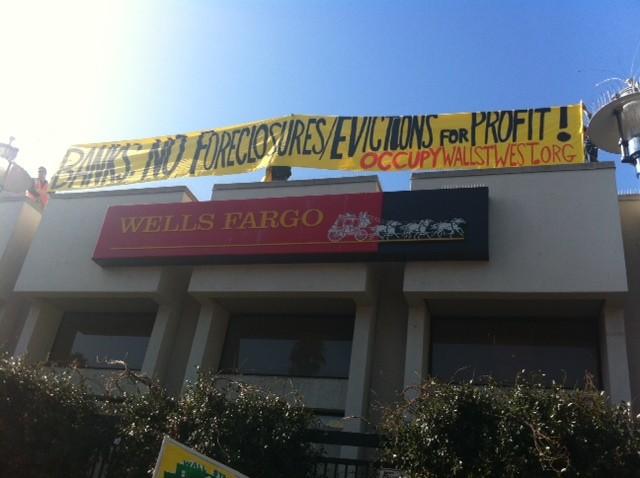
Activists held a massive banner and pitched a tent on the roof of the Wells Fargo branch at 16th and Mission Jan 14, while 150 supporters watched from the parking lot. Seven were arrested.
Organizers say the demonstration was meant to draw attention to the bank’s complicity in unfair foreclosures and evictions.
The protest was planned by a coalition of Bay Area housing rights and homelessness advocacy groups, along with organizers from Occupy San Francisco.
Sarah Shortt, Executive Director of the San Francisco Housing Rights Committee, says that abuses by corporate banks are inextricably linked to issues that her group has been working on for years; “evictions, displacement, affordable housing, and tenants rights.”
After rallying at 16th and Mission, protesters looked up to see that six had climbed to the roof. They unfurled a banner reading “Banks: No Foreclosures/Evictions for Profit!”
A fire truck arrived ten minutes later, and put up a ladder to give the police and firefighters access to the roof.
The Police Department cooperated with protesters, assisting a negotiation with the bank branch’s manager. A letter detailing their demands, including a moratorium on foreclosures and an end to predatory and speculative loans, was apparently faxed to Wells Fargo spokeswoman Holly Rockwood.
Protesters said that they would not leave the roof until they had a meeting scheduled with Wells Fargo CEO John Stumpf. Six were arrested.
According to an SFPD statement, “A bank employee signed a private person’s arrest (citizens arrest) for trespassing.”
After those arrested were painstakingly shuttled down the ladder and into a police van, protesters blocked the van from leaving Hoff street between 16th and 17th for about ten minutes until it sped out through the parking lot. Protesters then marched to the nearby Mission Police Station, where a drummer from the Brass Liberation Orchestra, which often accompanies protest events in the city, was arrested for allegedly assaulting a police officer with her drum.
Those arrested on the roof were cited for trespassing and released within hours. Supporters have put up money to release the drummer, known as Montana; bail was set at $8,100.
While the drama on the roof unfolded, Shortt, along with organizers from Causa Justa: Just Cause and the San Francisco Tenants Union, spoke about abuses committed against tenants and homeowners. They also spoke about Wells Fargo’s investment in private prisons.
In a press release, organizers said that the protest was meant to call attention to “predatory equity scams, Ellis Act evictions, and immoral home loans.”
The Ellis Act allows landlords to evict tenants for any reason, if they don’t re-rent the units at a higher price in the next five years. The act hasno restrictions on selling the units as tenancies in common — a backdoor way to create condos — and that’s a lucrative and common practice in the Mission.
Ellis Act evictions increased by 8% in 2011, According to the San Francisco Rent Board Annual Report.
Jose Morales, a tenant who was evicted based on the Ellis Act and activist with the San Francisco Tenants Union, spoke to the crowd Saturday. Said Morales, “I have osteoporosis, I’m 82 and a half years old, but you still see me walking around with my sign.”
He displayed protest signs declaring that housing is a human right and urging single-payer health care.
Mesha Irizarry also told her story to the protesters. Her Bayview home was sold to Bank of New York, then transferred to Bank of America on September 1, but says that she refuses to leave and is fighting the foreclosure.
“We do not play the blame-the-victim game. We are not alone. We are not ashamed to sat ay what has happened to us. We are fighting back, and we are going to win” said Irizarry, who named several other women who are resisting foreclosures in Bayview.
Irizarry began a San Francisco chapter of Occupy the Hood, a group dedicated to confronting problems that disproportionately affect the poor and people of color within the Occupy Movement. In San Francisco, the branch has focused mainly on defending homes from foreclosure and eviction. Saturday’s protest was part of that effort.
This demonstration was also a part of a series targeting banks, that protesters plan to top off with a day-long “occupation of the financial district” January 20th.
Said Occupy SF Housing Coalition media spokesman Gene Doherty, “The banks and the development companies that have gotten us all into (the foreclosure crisis) are a major part of the problem…it is their ethical duty, moral duty right now to be fixing this. And if that means it’s going to eat into their profit, that means it eats into their profit.”
The 100 percent
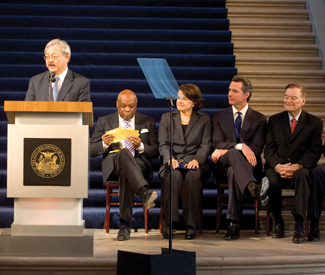
steve@sfbg.com
In his inaugural address on Jan. 8, and then again the next day as he appointed progressive Christina Olague to the District 5 seat on the Board of Supervisors, Mayor Ed Lee signaled an intention to bring all sides together to solve vexing city problems, from job creation to the need for more affordable housing.
“At its best, San Francisco is a city for everyone,” Lee said at his inauguration. “We are a city for the 100 percent.”
But that analysis, with his clever riff off of the Occupy movement’s 99 percent paradigm, masks deep political divisions and challenges that will likely play out repeatedly this year, particularly as he partners with a handful of wealthy individuals and corporations — members of the 1 percent, on which he lavished praise during his speech, such as venture capitalist Ron Conway — to craft his economic agenda.
Lee stressed his focus on creating private-sector jobs and his acceptance that “local government will have to do more with less,” while arguing that he can create broad prosperity by embracing high-tech innovations. “We’re poised to invent the future, right here and right now,” he said, shortly before interrupting his speech to post an employment infographic on Twitter.
The next day, after she was sworn in as supervisor representing one of the city’s most progressive districts (replacing Sheriff Ross Mirkarimi), Olague echoed Lee’s focus on job creation and the belief that “it’s time to roll up our sleeves to get things done” in a fashion that transcends ideology.
“I think this is an incredible time for our city and a time when we are coming together and moving past old political pigeonholes,” Olague said, while Lee said, “This is not about counting votes, it’s about what’s best for San Francisco and her district.”
Yet that optimistic spirit alone won’t provide for the renters and low-income homeowners being squeezed out of this gentrifying city, battles that both fought as activists — Olague with the Mission Anti-Displacement Coalition, Lee with the Asian Law Caucus — before joining city government. “We both came from backgrounds fighting for the rights of tenants and immigrants,” Lee said.
At his inauguration, he said he would take on that challenge directly.
“We need to create a permanent stream of revenue to fund housing in San Francisco,” Lee said, announcing the formation of a working group to craft a measure for the November ballot that would create a “permanent housing trust fund” to help finance low- to middle-income homes. “San Francisco must remain a place every one of us can call home.”
Olague listed her top priorities as job creation, affordable housing, helping shepherd redevelopment projects after the state abolished redevelopment agencies, and public safety. And she pledged to be an independent vote: “Every decision will be based on what’s best for my constituents and the people of San Francisco.”
Progressive political leaders were nonetheless thrilled with the choice. While Olague was an early supporter of Lee’s mayoral bid, she has deep roots in the progressive community and was a consistently good vote during her eight years on the Planning Commission.
“I am surprised by the choice, but I think it’s a good one,” Matt Gonzalez, the former D5 supervisor who appointed Olague to the commission, told us. “It’s an appointment that recognizes that D5 is the most progressive district in the city.”
Activist and building inspection commissioner Debra Walker agreed: “It’s an acknowledgment that District 5 is progressive.”
Green Party activist Susan King noted that Olague used to be a Green, as was new Sheriff Ross Mirkarimi and Sup. Jane Kim, before all switched to the Democratic Party in recent years. “It’s the second former Green sworn in over the last 24 hours,” King said. “It’s very exciting.”
“I’m elated. This is the best political news I’ve heard this year. I’ve known Christina for 15 years and I think she’ll be a fantastic supervisor,” Tom Radulovich, director of Livable City, told us. He also praised Lee for the gesture, saying, “He said he wants to work with everyone and this is a signal that he really means it.”
Sup. David Campos said Olague has good values and a wealth of experience in land use issue. “She brings a lot to the table and I can see why he chose her,” he told us.
Even Sup. Scott Wiener, a moderate, praised the Lee’s pick. “I think it’s an excellent choice. She’s thoughtful and independent,” he said. “I don’t always agree with her, but I respect her and I’ve always enjoyed working with her.”
Gonzalez told us he wonders whether the appointment would clear the field of progressive candidates, a long list of whom have expressed interest in running this year. The answer: probably not. Community College Board member John Rizzo contacted the Guardian shortly after the appointment to say, “I’m still in the race and planning to mount a vigorous campaign.”
So much for the 100 percent.
Millionaires eyeing Potrero Hill

I hate to harp on this (well, no I don’t) but when people tell me that we don’t have to worry so much about gentrification these days, that we’re living in a different world than the days of the dot-com boom, I have to wonder: Am I the only one reading the business pages?
Because in the real world of San Francisco business, the real-estate boom is on and housing prices — particularly in the southeast part of the city — are about to start soaring again.
In fact, according to the Chron, the market is already flying high — and dealing with the influx of new wealth and the continuing change in the demographics of the city will be very much a serious issue for Mayor Lee over the next year:
ZipRealty just completed a study on the millennial home buyer, pointing out that this generation, born after 1982, is the largest in American history, larger even than the Baby Boomer generation. To these buyers, walkability and a vibrant urban community are huge draws in a home purchase. The ZipRealty study seems confirmed by this recent mini-boom in neighborhoods close to SoMa’s flourishing tech industry: newly minted millionaires in their 20s and 30s have the buying power to drive prices up.
Want proof? We’ve got it. The median price of a single-family home in San Francisco County was $745,000 in October, up $10K from October of 2010. In the neighborhoods in question though, the increase is more striking. In Noe Valley this October, the average price-per-square-foot was up 5% from last year for the third month in a row; in SoMa, up 11%; in eastern Potrero Hill, up 16%.
So: When Zynga goes public in a few months, a whole lot of young millionaires will want to buy houses in Potrero Hill. Dogpatch, and the southern end of SOMA. Oh, and the Mission. Rents will go way up. Housing prices will go even further beyond the level that ordinary, non-millionaire working people can afford.
I’m happy for all the Zyngites, and I’m glad the company is here in SF and generating economic activity. But one of the lessons of the dot-com boom is that the city, as a matter of policy, has to protect existing neighborhoods and residents (and existing industrial blue-collar businesses and jobs) from displacement. Otherwise the horrors of the late 1990s will start creeping back.
Avalos campaign revives the progressive movement
As I walked into the John Avalos campaign party in Roccapulco around 11 pm, Sup. David Campos told me, “It’s the best party in town!” And he was right. The speeches were just getting underway on the stage and there was a palpable energy in the large crowd even though many of them had been out campaigning since early in the morning.
Avalos’ wife, veteran progressive organizer Karen Zapata, set the tone. First, she recognized Eric Quezada, the longtime housing rights activist who died in August, and the rest of the progressive leaders, such as Tom Ammiano and Chris Daly, who laid the foundation for a campaign that finished the night strongly in second place, less than 13 percentage points behind with voters’ second and third choices still to be tallied.
If Ed Lee hangs on to win, she said, “We could be screwed unless we work together and organize.” It was a theme and a feeling that would permeate the event, this sense that Avalos and the progressives are enjoying a resurgence in the last month thanks to what’s happening in the streets, both with this campaign and the OccupySF movement that Avalos has taken a lead role at City Hall in supporting.
“We have to stick together and we have to push from outside the system. We have to push John and we have to push everyone in the system,” Zapata said, firing up the young crowd as she introduced her husband.
Avalos praised the campaign for having so much heart and with filling his. “This has been a campaign of the people,” Avalos said, seeming genuinely touched by the energy in the room.
The progressive movement has been fighting for the soul of this city for a long time, he said, citing the anti-displacement movement that became a political force in 2000-01, a struggle that continues today with the latest tech boom. “In a way, we’re embracing change that is accelerating our displacement here in San Francisco,” Avalos said.
But he said people are waking up to the idea that the people need to stand up to the super rich and their political enablers. “The Occupy Wall Street movement is changing the consciousness of this country,” Avalos said, noting how it is echoing themes that progressive San Franciscans have been sounding for years. “Everyone is talking the same language we’ve been talking, because we’ve been talking about the 99 percent for a long time.”
But between that movement and this campaign, he said the battle was just beginning, praising the “new generation of leadership, that’s what this campaign is about. We’re going to take back this city one way or another!”
And he closed with a chant from the streets: “Whose city?” Avalos shouted, and the crowd roared back, “Our city!”
Strength of song

In Cuba, there is just one group that specializes in traditional Haitian songs — the Creole Choir of Cuba. “Some of the songs in our repertoire are those we learned from our parents or grandparents, others we learned during the many visits we have made to Haiti,” says choir director Emilia Diaz Chavez, through translator Kelso Riddell.
Riddell is the group’s tour manager for this journey, which is the choir’s fifth trip through the U.S. The vibrant ensemble — featuring Creole vocals and percussion — appears in San Francisco at the Herbst Theatre on Nov. 3, through the California Institute of Integral Studies’ public programs and performances series.
Diaz Chavez created the group in 1994 in Camagüey, Cuba. The core ten members — Rogelio Torriente, Fidel Miranda, Teresita Miranda, Marcelo Luis, Dalio Vital, Yordanka Fajardo, Irian Montejo, Marina Fernandes, Yara Diaz, and Diaz Chavez — were already part of the Regional Choir of Camaguey, which Diaz Chavez also directs (and has for the past 32 years). “The Haitian descendents of the Regional Choir got together to form the Desandann or the Creole Choir of Cuba with the objective of promoting the songs of our ancestors,” she explains.
Desandann literally translates to “descendents.” The choir is made up of the descendents of a people twice displaced, first from West Africa, then from Haiti. Some of their ancestors escaped slavery in Haiti near the end of the 18th century, others came to Cuba more recently to work in the coffee and sugar plantations.
Diaz Chavez was born in Camagüey, and remembers nights at home singing — she says her whole family enjoys song and dance. She studied music at the School of Arts in Camagüey, then completed her studies in Havana. “After graduating, I became particularly interested Haitian music and bringing it to the rest of the world,” she says.
While the journey of her people may have included displacement and sorrow, the songs the group sings are mostly uplifting — lyrics include messages of love, humor, and happiness, along with struggle. “These make us all laugh and cry and sing and dance,” say Diaz Chavez. And the consistent hand percussion and moving vocal compositions maintain an air of excitement, urgency. Live, the group dresses in colorful prints and engages audiences in participation. On this tour, which includes 30 performances during a six-week period, the choir also has been holding workshops at schools throughout the country.
“We hope people leave our concerts knowing more of our Haitian music, and that they have received our messages of love and friendship,” Diaz Chavez says, “And [we hope] they enjoy a little Cuban music too.” *
CREOLE CHOIR OF CUBA
Nov. 3, 8 p.m., $25–$65 Herbst Theatre
401 Van Ness, SF
(415) 621-6600
ADDITIONAL GLOBAL MUSIC EVENTS
The annual San Francisco World Music Festival, now in its 12th year, will premiere “The Epic Project: Madmen, Heroines & Bards from Around the World.” The performances bring together singers, musicians, and epic chanters from Azerbaijan, Kyrgyzstan, and the Tamil Nadu rivers of India, among other worldwide locations. Performers include Azerbaijani kamancha master Imamyar Hasanov, Chinese nanguan master Wang Xin Xin, North Indian tabla master Swapan Chaudhuri, South Indian carnatic violinist Anuradha Sridhar, and more.
Fri/28-Sun/30, 8 p.m., $20
Jewish Community Center of San Francisco
3200 California, SF
(415) 292-1233
Riffat Sultana, daughter of legendary singer Ustad Salamat Ali Khan, performs traditional and modern music including Sufi, folk, and love songs from Pakistan and India. The vocalist is backed by an ensemble playing tabla, bansuri flute, and 12-string guitar. Sultana, who comes from eleven generations of master vocalists, is the first woman of her lineage to perform publicly and to tour the West. Since moving to the US, she has performed with Shabaz (previously known as the Ali Khan Band) — an acoustic group of world musicians — and more recently, her own Riffat Sultana & Party, a paired down group focused mainly on her velvety vocals.
Fri/28, 8pm, $12–$15
Red Poppy Art House
2698 Folsom, SF
(415) 826-2402