David Campos

Everyone but Mayor Lee sees SF’s worsening “housing affordability crisis”

43

There was a clear theme that ran through yesterday’s Board of Supervisors meeting from beginning to end, something understood equally by renters, homeowners, and politicians from across the political spectrum: San Francisco has a crisis of housing affordability that is forcing people from the city.

And the only person who doesn’t seem to understand or care about that is the person with the most power to deal with the situation, Mayor Ed Lee, who opened the meeting by essentially dismissing both short- and long-term gentrification forces and claiming “our city has some of the toughest anti-displacement laws in the country.”

It was a claim that Lee made twice, first in response to a question by Sup. Eric Mar about Plan Bay Area and the massive displacement of current San Franciscans that it would create by 2040. And it was also how he answered a question by Sup. John Avalos about rents that are now skyrocketing beyond what most San Franciscans can afford.

I followed Mayor Lee back to his office, asking him to explain his claim, and he cited the city’s “elaborate” rent control laws and the Rent Board recently hiring new personnel as he briskly retreated toward his office. But surely he’s aware that displacement is already happening and getting worse, I told him, citing Rent Board figures showing that evictions are now at a 12-year high.

Lee looked at me dubiously and said, “I’ll have to check the figures on that.” I followed up today with Press Secretary Christine Falvey to ask whether Lee did check those figures — which show 1,757 evictions in the last year, up from 1,395 the previous, both numbers representing returns to the mass displacement of the last dot-com boom — and I’ll update this post if/when I hear back.

“It shows he’s out of touch with what’s happening in San Francisco,” Avalos told me in response to the mayor’s remarks.

Lee seemed to bristle at the suggestion that his aggressive economic development policies might have a downside that he’s going to have to deal with at some point. He touts the 44,000 jobs the city has added during his mayoral tenure, even deflecting criticism that he’s too focused on the technology industry by citing estimates that every tech job creates at least four other jobs (seemingly oblivious to the fact that most of these are low-wage service sector jobs, the very people who are being forced from the city).

“I’m just hoping you’re not blaming the 44,000 jobs we helped created,” Lee told Avalos, saying that he understands the concern about the rising cost of living, “but those are 44,000 people drawing a paycheck and taking care of their families.”

Yes, Mr. Mayor, but those paychecks are having an increasingly tough time paying for housing in San Francisco. That concern animated the condo conversion debate that took place later in the meeting, voiced by those focused on the lack of affordable homeownership opportunities and those focused on reducing the city’s rental stock to create those opportunities.

“I don’t think saying ‘it’s good that we have a growing economy’ is enough to address the issue,” Sup. David Campos said during the condo debate, referring to Lee’s earlier remarks.

Speaking near the end that discussion, Campos summarized the concerns expressed by both sides and sought to put the legislation into perspective: while important, the condo deal is a drop in the anti-displacement bucket. “We are only dealing with the issue of affordability in San Francisco on the margins,” he said, later adding, “I don’t think we’re doing enough to deal with the fundamental issue of who gets to live in San Francisco.”

The debate on the condo conversion began with its original author — Sup. Mark Farrell, who represents District 2, the wealthiest and most conservative in the city — explaining his desire to help middle class people who want to own homes remain in the San Francisco.

“This is the most affordable form of home ownership in San Francisco today,” Farrell said of tenancies-in-common, the fiscally and legally precarious middle step between an apartment and condominium. Later, he said, “We need more affordable homeownership opportunities and not less.”

Farrell argued that “this didn’t need to be a zero sum game,” but that’s exactly what the stock of rent-controlled apartments is in San Francisco, where only housing built before 1979 is protected from the market forces that can drive rents up to whatever a landlord demands.

“We have a fixed rent control stock. Every apartment that converts to a a condo is one less unit,” said Board President David Chiu, who worked with Sups. Jane Kim and Norman Yee and tenant group to amend Farrell’s legislation to help both renters and homeowners.  

“These units were once the homes of tenants who were displaced,” Kim said, objecting to the notion that one person’s apartment should be another person’s affordable homeownership opportunity and arguing that the city should be building more condos for first-time homebuyers instead of cannabalizing the homes of the nearly two-thirds of city residents who rent.

Like Chiu and Kim, Yee said that he wanted to help the TIC owners of today without simply clearing out of the backlog and letting the condo lottery continue unabated, which would green-light even more conversion of apartments. “We want to curb the speculation,” Yee said.

That idea that the city should help people who live in the city, without simply feeding the speculative investors who profiteer off of housing in San Francisco, was a strong theme among critics of condo conversion.

A pro-tenant crowd packed the Board Chambers. Although barred by board rules from addressing the condo legislation directly (that occurred at the committee level), one commenter said, “Giving any more power to the real estate market in San Francisco should be considered a crime.”

To help ward off real estate speculators once the annual condo conversion lottery resumes in 2024, the legisation also limited future conversions to buildings of less than four units, instead of the current cap of six units, a change that Farrell resisted.

“This is not an academic exercise anymore,” Farrell said of the condo conversion restrictions that were added to the legislation. “This will negatively impact thousands of TIC owners in the city.”

Farrell’s original co-sponsor, Sup. Scott Wiener, had a more pro-tenant point-of-view, objecting to the changes that Chiu inserted on more narrow grounds. In his comments, he noted how close the two sides were and how they share the same basic goal: preventing displacement of current city residents.  

“The one thing we can all agree with is we have a housing affordability crisis,” Wiener said, praising the city’s rent control and tenant protection laws, but adding, “TIC owners are also part of this city.”

The price of dealing with the rapid growth in the city — whether it comes to infrastructure or housing affordability — was also a point that Wiener made earlier in the meeting as the board approved the term sheet for a massive office and residential development project proposed at Pier 70.

“We are not doing what we need to do to support the public transportation needed for those projects,” Wiener said, also referring to other projects along the waterfront (the Warrior Arena at Pier 30 and the Giants/Anchor Steam project at Pier 46) and in the southeastern part of the city. “We don’t have the transit infrastructure to support our current population, let alone new growth.”

It’s about striking a balance, as Chiu said he did with the condo legislation, and not just a balance between renters and TIC owners. It’s about striking a balance between how to protect the San Francisco of today while planning for the San Francisco of tomorrow.

Yes, that means working with market rate housing developers, and it also means diverting some of their would-be profits into the city’s affordable housing fund and its infrastructure needs. Yes, it means private-sector job creation, but it also means more public sector jobs and providing a safety net for people without jobs or who work as artists or social workers or other professions that are being driven from the city. And it means beefing up our public housing and turning around the exodus of African-Americans, concerns raised at the meeting by Sup. Malia Cohen.

We at the Guardian last year looked at how Oakland has become cooler than San Francisco, largely because of the displacement from here. And now, even many people within the tech community have begun to decry the gentrifiction that is being driven by Mayor Lee’s narrow economic development vision.

“Plan Bay Area is an opportunity to think regionally and strategically about planned growth,” Lee said when addressing Mar’s question, sidestepping the direct answer that Mar sought on a set of specific proposals for mitigating some of the displacement planned for San Francisco and maintaining this city’s diversity.

Yes, we do have an opportunity to think strategically about the city we’re becoming and who gets to live in it, but only if we don’t think “jobs” is the answer to every question.

Supervisors approve condo legislation with veto-proof majority

64

The San Francisco Board of Supervisors today voted to approve compromise legislation that will allow more than 2,000 tenancy-in-common homeowners to convert to condominiums in exchange for a 10-year moratorium on the city’s current condo conversion lottery that now allows 200 conversions annually.

Approved by a veto-proof 8-3 majority after some last amendments were shot down by the six supervisors who most steadfastly supported the version that Board President David Chiu took the lead on crafting, this was a big victory for tenant groups who strongly opposed the original legislation, which did not include the moratorium and other restrictions.

“It’s great. We’re going to see a significant drop in condo conversions in the future. All of us tenants are very happy,” San Francisco Tenants Union head Ted Gullicksen told us after the hearing, which was packed with tenant supporters.

Sup. Mark Farrell, who sponsored the original legislation, decried how divisive the issue had become, criticized the approved version as deviating from his original intent of helping TIC owners in exchange for a fee that would help fund new affordable housing, and said, “This doesn’t need to be a zero sum game.”

But Chiu and the five supervisors who supported his version – Jane Kim, Norman Yee, David Campos John Avalos, and Eric Mar – noted the finite number of rent-controlled apartments in the city and the need to protect them from being converted into condos.

“How do we balance the needs of tenants who fear being evicted with TIC owners looking for relief?” Chiu said of the balance he aimed to strike, which he continued to tweak with new amendments today, including allowing TICs with all owner-occupied units to move forward if the legislation is challenged in court, an event that would otherwise freeze all condo conversions until the lawsuit is resolved.

Sup. London Breed wanted even greater flexibility in that so-called “poison pill” aspect of the legislation, which tenant groups had insisted on to prevent the bypass from going through even if the moratorium was challenged. Breed proposed allowing condo conversion applications to proceed for a year after a lawsuit was filed, but Chiu said that would let TIC owners convert to condos while challenging other aspects of the legislation, such as the lifetime leases for tenants in converted buildings.

Breed and Sup. Malia Cohen, who privately and rather grimly conferred with one another and sometimes Chiu before the item began a little after 4pm, were clearly the two swing votes on the question of whether the legislation would reach the crucial eight-vote threshold needed to override a possible mayoral veto. Mayor Ed Lee has refused to take a position on the issue, leaving both sides in the dark.

But after the motion to insert Breed’s amendments failed on a 5-6 vote, the board voted 8-3 to approve Chiu’s version of the legislation, with Sups. Farrell, Scott Wiener, and Katy Tang opposed. A subsequent vote on a version of the legislation backed by Farrell and Wiener – which contained a weaker poison pill and more flexible owner-occupancy provisions – then failed on a 4-7 vote, with Breed joining the three dissenting supervisors.

Underscoring this legislation was what some supervisors called a “housing affordability crisis” in San Francisco, an issue that Mayor Lee was asked about at the start of the meeting, which he deflected by claiming “our city has some of the toughest anti-displacement laws in the nation.”

We’ll analyze that discussion and offer more details on the condo conversion debate and the politics behind it tomorrow in the space, so check back then.      

Supervisors pose tough but important questions to Mayor Lee

6

There’s a full agenda at the San Francisco Board of Supervisors meeting today, from the condo conversion lottery bypass legislation to approval of the term sheet from the massive development project at Pier 70, but some of the most interesting and potentially newsworthy items are at the very beginning of the agenda, when Mayor Ed Lee will answer questions posed by the supervisors.

Unfortunately, if past is prologue, Lee won’t give direct, substantive answers to the vitally important questions that he’s being asked, just as he dodged a question on the condo conversion debate in February and has kept everyone in the dark of which of the rival measures he supports and which he may veto. Mayoral leadership was desperately needed on that protracted debate, just as it’s needed today on some of the questions he’s being asked.

The first question, posed by Sup. Eric Mar, concerns Plan Bay Area and how it plans to pack 280,000 more people into San Francisco by 2040, which was the subject of a May 28 Bay Guardian cover story and panel dicussion that we’re sponsoring at the LGBT Center tomorrow night.

Mar lays out the massive displacement of existing residents and the traffic gridlock that the plan will create in San Francisco and how the approval process from much of this streamlined development may be given waivers from California Environmental Quality Act review.

Mar notes more than 40 regional groups have come together to try to improve the plan and mitigate its damage, and he plans to ask Lee:

“A consensus has formed around the following recommendations for making Plan Bay Area better:

– Provide $3 billion in additional operating revenue for local transit service and commit to a long-range ‘Regional Transit Operating Program’ to boost transit operating subsidies by another $9 billion over the coming years.

– Move 5 percent of the housing growth from low-income communities (mainly San Francisco, Oakland, and San Jose) to transit-connected suburban job centers.

– Incorporate strong anti-displacement policies for community stabilization measures, such as land banking and preservation of affordable housing in at-risk neighborhoods.

– Director the Planning Department to analyze the impacts of potential CEQA streamling as soon as possible and create strong mitigation measures.

Do you support these measure, and are you committed to a plan with lower displacement level than the current proposal? If you do not support these ideas, why not?”

Excellent  question, and definitely an appropriate one for our chief executive officer, who would have more clout to push for these changes than any of the supervisors.

The second question comes from Board President David Chiu, who makes news by noting that Mayor Lee has continued his predecessor’s underhanded practice of refusing to fill city positions to provide services that the supervisors have decided to fund in the budget, undermining the city’s balance of power and Lee’s rhetoric on collaboration.

“In recent months, Controller data indicates that positions allocated by the Board for librarians, recreation and park staff, building inspection, health and labor enforcement, urban agriculture and other Board priorities were either not filled or only recently hired. Will you commit to ensuring that when the FY 13-14 budget is approved, our Board of Supervisors’ priorities are treated equally to your Administration’s, with positions filled as soon as possible?”

Again, great question about an important current issue, the kind of thing that voters created this question time for, to ensure that there was communication and collaboration between these two branches of government.

The last two questions concern San Francisco’s housing crisis. Sup. David Campos cites the scatching report that he commissioned from the Budget and Legislative Analyst on the dysfunctional and mordibund Housing Authority, which Lee controls, asking “what is your long term vision to save public housing — a significant public asset to San Francisco?”

Sup. John Avalos cites data on the skyrocketing rents in San Francisco and asks, “Are you concerned that your administration’s policies to stimulate economic activity, especially supporting the tech industry, have created one-sided development and only job for high-income ‘appsters,’ and have exacerbated the already extremely limited housing market? Do you have any plans to address the increasing rents, and increasing rate of evictions and displacement of long-time San Francisco renters?”

These are tough questions, but they are central to what kind of city San Francisco is becoming. They were all submitted last week, so the mayor has had time to think about them and he should provide answers and show leadership on these difficult issues. That is his job.

Will he? Check back later and I’ll let you know. The meeting starts at 2pm.

No security

3

rebeccab@sfbg.com

To qualify for his job as a security officer, Jerry Longoria had to obtain a license, undergo a background check, and take a drug test. He’s required to wear a suit to work. He’s stationed at a downtown San Francisco high rise that houses Deloitte, a multinational consulting, finance, and real-estate firm that reported $31.3 billion in revenues last year. His employer is Universal Protection Services, a nationwide security contractor with a slick online marketing pitch emphasizing that all guards are “electronically supervised around the clock,” and “kept accountable on the job through our 24-hour command center.”

If an intruder showed up at his office building brandishing a firearm, it would be Longoria’s problem; that’s the job. Nevertheless, he says he doesn’t earn enough to cover rent for an apartment in San Francisco. Instead, he stays in a single room occupancy hotel near Sixth and Mission streets, an area known for a high rate of violent crime. Walking home still wearing the suit makes him stand out on the street.

He’s lived in the 150-unit building, which has shared bathrooms and a shared basement-level kitchen, for 11 years. “It’s affordable for me, and it allows me to be closer to work,” he explains. He can’t afford a car, and says a public transit delay could prove disastrous if he relocated outside the city. “If you’re late to your post, you get fired.”

At press time, about 7,000 security officers throughout the Bay Area and Los Angeles were gearing up for a strike that could begin any day. Members of United Service Workers West, affiliated with Service Employees International Union, authorized their bargaining committee to call for the work stoppage because officers have been without a contract since the end of 2012.

The starting wage for a security officer is $14 an hour in the city, which comes to slightly more than $29,000 a year before taxes. In some places that would be sufficient to meet basic needs. In San Francisco, where the median market rate on rental units recently peaked above $3,000 a month, it doesn’t go very far. “With the cost of living here in San Francisco, $14 an hour is simply not enough to make ends meet,” Kevin O’Donnell, a USWW spokesperson, told us.

The security officers’ threats to strike coincided with a second worker action in the Bay Area last week. Despite lacking any form of union representation, Walmart associates from stores in Richmond, Fremont, and San Leandro affiliated with the nationwide organization OUR Walmart joined 100 employees from across the country in walking off the job and caravanning to Bentonville, Arkansas to raise awareness about their poverty-level wages and insufficient benefits at Walmart’s annual shareholders’ meeting. But first, they paid a visit to the Four Seasons in downtown San Francisco, which houses the 38th floor penthouse apartment of Yahoo CEO Marissa Mayer, a Walmart director.

Despite seeking full-time working opportunities and staying with the company for years, a handful of associates we interviewed said they can’t earn enough at Walmart to cover basic needs, so they rely on government assistance or help from extended family to make ends meet. Some said they had witnessed their coworkers get fired after participating in OUR Walmart activities.

Walmart associates in the Bay Area are in a considerably more precarious situation than the security officers, earning lower hourly wages. But in the pricey Bay Area, security officers, Walmart employees, and scores of other low-wage private sector workers all share something in common. Despite reporting to work every day and working long hours in many cases, they’re forced into impoverished conditions due to economic circumstances, while a middle-class existence remains far out of reach.

FIGHTING FOR STABILITY

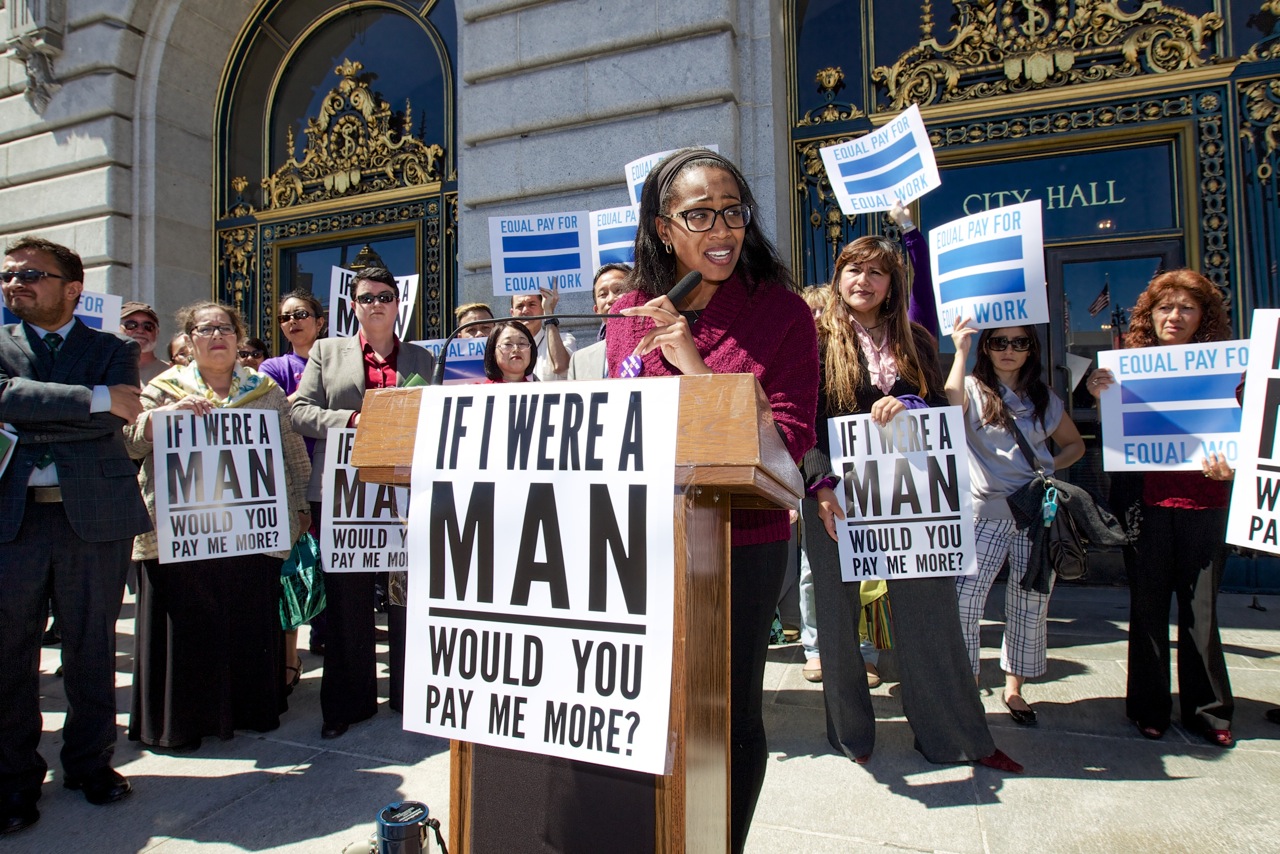
ABM Security and Universal Protection Services are the largest employers in the private security contractor industry; in the Bay Area, the majority of guards are stationed at office buildings in downtown San Francisco. On May 30, Supervisors John Avalos, David Campos, David Chiu, Jane Kim and Scott Wiener all voiced support for the guards at a rally outside City Hall. “Better working conditions for security officers mean more stable, family-supporting jobs, less turnover, and more ability to handle challenges at work,” Avalos said.

Matt Roberts has been working as a security officer for years, and originally moved into his unit in a San Francisco SRO in a financial pinch. “I figured, I’ll get out of this rut eventually. And here I am, seven years later, still paying $1,000 a month for a space that’s really not much bigger than a walk-in closet,” he told us. Roberts was terminated recently, and believes it’s because he spoke up to his site director about workplace issues his fellow guards felt needed to be addressed.

In Roberts’ view, the situation he’s found himself in is reflective of the broader erosion of the middle class, which is particularly acute in an area with a soaring cost of living. He was born and raised in San Francisco’s Crocker Amazon district, with a father who worked as a firefighter and a mother who worked as a clerk typist at the Cow Palace.

“They were able to achieve the American dream,” he said. “They had a house, they paid their mortgage off in 25 years, they were able to send me and all my three siblings to good schools. I realized when I was still in my 20s that I’m probably going to be a renter the rest of my life. The American dream is totally eclipsing my generation.”

Keven Adams, a security officer of 23 years who lives in Oakland, also attended the City Hall rally on May 30. “We’re fighting for wages, health care, and stability in the workplace,” Adams said. “We’re in a city we love so very much, but the community and the middle class is shrinking.” Adams said he was once held at gunpoint for four hours during a work shift. He’d love to live in San Francisco, he said, but can’t afford it.

According to a June 3 media advisory, unions throughout the Bay Area were preparing to demonstrate support for the security officers as they geared up to strike. “The support could come in the form of workers attending rallies, non-violent civil disobedience or perhaps even non-security workers refusing to cross picket lines,” according to USWW, “and walking off their own jobs in solidarity.”

‘STAND UP, LIVE BETTER’

Among the small group of protesters who had assembled on the sidewalk far below Mayer’s San Francisco penthouse on May 29 were associates who had taken the drastic and unusual step of going on strike from Walmart — the nation’s largest private employer. Clad in bright green shirts and waving signs, they chanted, “stand up, live better,” a play on Walmart’s slogan, and also, “What do we want? Respect.”

Dominic Ware, who works part-time at a Walmart in San Leandro, led chants and sounded off on a megaphone about the need for greater respect in the workplace. Ware, who’s been involved with OUR Walmart activities on a national level, said he earns $8.65 an hour and stays with his grandmother, since his paycheck isn’t enough to cover rent. He estimated that roughly half his earnings go directly back to Wal-Mart, where he purchases groceries and other basic items. Asked what motivated him to strike, Ware mentioned his daughter, who turned eight on June 1. “What if she has to work there some day?”

He added that some elderly colleagues were experiencing problems such as being unable to get a shift changed so as to catch a bus home at the end of the night. Another one of his coworkers was let go after it became clear to management that he was participating in OUR Walmart activities, Ware said.

While only a tiny fraction of Walmart’s 1.4 million workers took action to strike, their campaign appears to resonate in high places. A report recently released by the Democratic staff of the U.S. House Committee on Education and the Workforce seized on Walmart’s low wages, emphasizing that so many of its workers are forced to turn to government assistance that it is resulting in a collective drag on taxpayers.

“Rising income inequality and wage stagnation threaten the future of America’s middle class,” the report notes. “While corporate profits break records, the share of national income going to workers’ wages has reached record lows. Walmart plays a leading role in this story. Its business model has long relied upon strictly controlled labor costs: low wages, inconsiderable benefits and aggressive avoidance of collective bargaining with its employees. As the largest private-sector employer in the U.S., Wal-Mart’s business model exerts considerable downward pressure on wages throughout the retail sector and the broader economy.”

Democrats reject 8 Washington

51

The San Francisco Democratic Party has voted to oppose the 8 Washington project and to endorse the ballot measure that would halt it.

By a 15-4 margin, the Democratic County Central Commitee, which makes policy for the local party, endorsed a No vote on the fall referendum that would negate the height limit increase developer Simon Snellgrove says he needs to build the ultra-luxury condos. The units would be the most expensive in San Francisco history.

The supervisors approved the height limit last fall. The referendum puts the issue directly before the voters, and foes of the project need a “no” vote to reject it.

“This was a huge victory,” Jon Golinger, who is running the campaign against the condos, told me. “The Democratic Party is a huge endorsement in San Francisco.”

That’s particularly true in a low-turnout election — and since there aren’t any high-profile races on this November’s ballot, I would guess only the most serious voters will make it to the polls.

The Sierra Club — another group that carries a lot of clout — has already come out against the project.

Snellgrove’s forces first tried to delay the vote until late summer, arguing that the committee needed more time to get all the facts. But Sup. David Chiu, a DCCC member, noted that this project has been discussed and analyzed and fought over for so long already that there’s nothing new anyone could possibly learn by delaying.

The motion to delay failed. Only Bevan Dufty, Sup. Scott Wiener, Sup. Malia Cohen and Kat Anderson voted in favor of the project. Voting against were Bill Fazio, Trevor McNeil, Kelly Dwyer, Leah Pimentel, Hene Kelly, Alix Rosenthal, Carole Migden, Rafael Mandelman, Matt Dorsey, Petra DeJesus, Assemblymember Tom Ammiano, State Senator Leland Yee, Chiu, Sup. David Campos, and Sup. John Avalos.


Party Radar: Save Esta Noche!

3

Many of us barely remember growing up there, meeting our first hot papi, trying out our first cha cha heels on stage, and living the Selena dream. And some of us go back every week to relive those experiences! Now, that many-mirrored treasure trove of characters, Esta Noche, may have to close its doors — forever.  

The city’s only (official) Latin gay bar owes the city $7,000 and may be history if it can’t cough it up in the next two weeks. But you know the fundraising party Sat/18 is gonna be fabuloso.

The whole situation’s due to a silly technicality: Last year, the Board of Supes passed widely supported legislation designed to make it easier for bars and clubs to pay their licensing fees. But there was a catch no one properly understood: bars would now have to pay all fees for the year in one large lump sum. Supervisor David Campos is working to change this, but it may be to late for the fantastic characters of this beloved bar.

So his office, via scenester mover and shaker Nate Albee, is helping organize the big time fundraiser — assisted by an all-star cast including Heklina, Anna Conda, Per Sia, Brown Amy, and DJs Carnita and Taco Tuesday.

http://www.youtube.com/watch?v=jXhKc8ntBOw

Supes worry about 8 Wash shit show

48

The Chronicle seems to have entirely missed the latest installation in the 8 Washington shit show, but the Ex has the story, and, even if it doesn’t mean the project is in the toilet, it’s given opponents another reason to flush it.

Could I possibly use any worse metaphors?

Sups. David Campos and David Chiu are unhappy that city agencies — possibly fast-tracking a project that the mayor’s pal Rose Pak really loves — may not have been fully forthcoming about the fact that there’s a chance the construction (or the shifting of ground after the project is complete) could crack a sewage line that serves about a quarter of the city.

Here’s what makes me nervous:

During construction, liability to pay for damage after a pipe rupture would be on the developer. Simon Snellgrove of the Pacific Waterfront Partners has long fought to build the 134-unit condo development, even hitting the streets himself to try to hamper the signature-gathering effort by the development’s opponents to place the referendum on the November ballot.
Once all the units are sold, damage liability would shift to the homeowners.

What does that mean? It means if there’s a catastrophic sewage rupture after construction is complete, there will be lawsuits aplenty over who is at fault and who pays — and in the meantime, the taxpayers will fork over the money to keep the effluvium out of the streets. Which could be (I’m sorry, can’t help it) a shitload of money.

That, and the fact that the city is willing to let some very serious concerns slide in the name of building condos for the richest of the rich who won’t even really live here most of the time.

More SF restaurants settle with the city over fraudulent employee health surcharges

12

City Attorney Dennis Herrera today announced another batch of settlements with restaurants that have been fraudulently using surcharges on customers’ bills to cover their city-required employee health coverage and using some of that money to simply pad their profits.

Seventeen San Francisco restaurants that took advantage of Herrera’s partial amnesty offer — settlements are half of what the violators should owe, based on voluntarily submitting records by last month’s deadline — will be paying tens of thousands of dollars each to the employees’ they ostensibly collected the money for, joining two other restaurants that had settled with the city earlier this year.

Among this latest batch of restaurants is Burgermeister, whose $134,088 settlement is the largest of this group; and Burma Superstar, whose $10,045 is the smallest. Other restaurants paying up as part of the settlement are 5A5 Steak Lounge, Amber India, B Star, Bix, Cafe Bellini, Calibri Mexican Bistro, Citizen’s Band, Cafe Flore, Fresca, MarketBar, Nob Hill Café, Press Club, Skool, Tony’s Pizza Napoletana, and Venticello Ristorante.

In total, Herrera’s office has recovered about $844,000 that will be split among about 1,500 employees.

Another dozen restaurants suspected of misusing the surcharges were given a clean bill of health: Bluestem Brasserie, Cafe Claude, Cupola Pizzeria, Firefly Restaurant, Gitane Restaurant and Bar, Lark Creek Management LLC, Lark Creek Steak, NOPA, One Market Restaurant, Plant Cafe, Ristobar, and Twenty Five Lusk.

There are still more than 30 restaurants that responded to the amnesty offer that remain in negotiates with Deputy City Attorney Sara Eisenberg, with more settlements expected in the coming weeks and the possibility of lawsuits being filed against restaurants that won’t settle.  

The full press release follows:


Restaurant workers net $844K restitution in 19 surcharge enforcement settlements so far

Herrera praises good faith efforts by restaurants ‘to do right by their employees’; announces ‘clean bills of health’ for 12 other establishments targeted in investigation

SAN FRANCISCO (May 8, 2014) — City Attorney Dennis Herrera today announced settlement agreements with 18 local restaurant businesses that voluntarily took part in his office’s surcharge enforcement and amnesty program, which seeks to remedy shortfalls between amounts collected from customers to cover the cost of complying with San Francisco’s universal healthcare law, and funds actually expended to provide health care benefits to employees.  Together with an earlier settlement announced in January, Herrera’s restaurant surcharge enforcement effort has now netted a total $844,644 to be distributed among approximately 1,500 eligible employees by 19 different companies.

The program announced in January included a one-time 50 percent amnesty offer for establishments with significant shortfalls — provided they fully cooperate with city investigators; agree to good faith compliance with the employer spending requirement of San Francisco’s Health Care Security Ordinance moving forward; and directly compensate their current and former employees who were the intended beneficiaries of the surcharges paid by customers.  All agreements announced today resolve potential disputes with the City over collected surcharges without admissions of liability.  

“I commend these businesses for working cooperatively with us so early in the process, and for understanding our duty to enforce the law even-handedly,” said Herrera.  “Today’s settlements reflect good faith efforts by restaurant owners and managers to do right by their employees, and to honor the intent of fees charged to their customers.  I recognize that complying with groundbreaking programs like Healthy San Francisco can sometimes present new and unique challenges.  So, I’m grateful to these businesses for their cooperation in reaching settlement agreements with us.  I’m glad to continue patronizing these establishments, and I hope other San Franciscans and visitors will join me in doing so, too.”

Some of the 19 establishments that reached settlements under the program include: 5A5 Steak Lounge, Amber India, B Star, Bix, Bugermeister, Burma Superstar, Cafe Bellini, Cafe Flore, MarketBar, Mina Group, Nob Hill Cafe, Patxi’s Chicago Pizza (announced in January), Press Club, Skool, and Tony’s Pizza Napoletana.

Twelve establishments receive ‘Clean Bills of Health’ following investigation
Herrera also announced that 12 businesses targeted for investigation on the basis of the health care expenditure shortfalls they reported to San Francisco’s Office of Labor Standards Enforcement had received “clean bills of health.”  Recipients of such letters were informed by Herrera’s office that after extensive review of additional evidence provided in the course of the City Attorney’s investigation, surcharge-related consumer fraud did not appear to have been committed during the relevant time periods.  In most instances, shortfalls reported to OLSE by businesses that received “clean bills of health” were attributable to their inadvertent reporting or accounting errors.

Establishments so far issued “clean bills of health” are: Bluestem Brasserie, Cafe Claude, Cupola Pizzeria, Firefly Restaurant, Gitane Restaurant and Bar, Lark Creek Management LLC, Lark Creek Steak, NOPA, One Market Restaurant, Plant Cafe, Ristobar, and Twenty Five Lusk.

Surcharge Fraud Enforcement Program background
Herrera announced the program at a City Hall news conference on Jan. 25 with Assemblymember Tom Ammiano, Supervisors David Campos and David Chiu, and representatives from San Francisco restaurants and the Office of Labor Standards Enforcement.  Ammiano first authored legislation in 2005 as a member of the Board of Supervisors that would ultimately lead to the City’s Health Care Security Ordinance, or HCSO, which passed in 2007 with policy input from then-Mayor Gavin Newsom.  Board President Chiu and Supervisor Campos have both been active in subsequent proposed amendments to strengthen and improve the law.  In launching the enforcement and amnesty program, Herrera lauded the Golden Gate Restaurant Association for working productively to share its helpful input, even after years of legal disputes over the law that ultimately ended in the U.S. Supreme Court.  

Status of enforcement efforts and investigation
In addition to the establishments involved with today’s announcement, more than 30 other businesses applied for Herrera’s amnesty program before the April 10, 2013 deadline.  The City Attorney’s Office expects a significant number of additional settlement agreements in the coming weeks, pending further analysis of surcharge funds that establishments collected and expended over the relevant time period.    

Herrera’s one-time offer of 50 percent amnesty has now expired, and the favorable settlement terms are no longer guaranteed to non-participating establishments with significant shortfalls between health care-related collections and expenditures.  Announcing his enforcement and amnesty program in January, Herrera said that restaurants and other businesses found to have committed HCSO-related surcharge fraud during the years 2009 to 2011 that failed to come forward before the deadline voluntarily would risk being sued for full restitution of the amount of surcharges collected during that period, together with potentially substantial penalties, costs and attorneys’ fees.  A small number of defiant, non-participating businesses remain under consideration by the City Attorney for further enforcement action or litigation.

“For restaurants that haven’t yet come forward, it’s still very much in their interest to do so voluntarily,” Herrera said.  “I can’t guarantee the same favorable terms reflected in today’s settlements, but cooperative engagement is better and more cost-effective than lawsuits.”  

Parking breaks

9

steve@sfbg.com

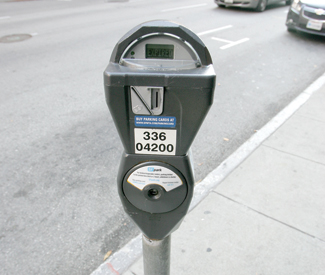
This was the moment these indignant motorists had been waiting for. The elected supervisors were finally going to get the unelected bureaucrats at the San Francisco Municipal Transportation Agency to back off of plans to manage street parking and install new parking meters in their Western SoMa, northeast Mission, Potrero Hill, and Dogpatch neighborhoods.

Anger and frustration over the parking program has been building for more than a year (see "Pay to park," 1/24/12), and when Sup. Mark Farrell called a May 2 hearing before the Neighborhood Services and Safety Committee, SFMTA’s critics put out the call and dozens showed up to voice their displeasure.

Farrell opened the hearing with a clear statement about where he stands on the issue: "I am very much against expanding parking meters into our residential neighborhoods." He also expressed opposition to the SFMTA’s extension of meter hours to evenings and Sundays and said that would be the subject of another upcoming hearing.

"I think we’re frankly on the wrong track," said Sup. Malia Cohen, who isn’t on the committee but showed up just to voice the frustrations of her District 10 constituents and to help grill SFMTA head Ed Reiskin. She repeated the populist criticisms of the SFMTA, calling its goals "unattainable" and its critics "reasonable," and accusing the agency of not having a comprehensive parking management plan.

"I look forward to you saying, ‘I quit, you win, no more parking meters,’" Cohen said to Reiskin, throwing red meat to the seething crowd, which erupted into loud, raucous, sustained applause and shouts of appreciation at the comment.

Those comments frame a defining problem in San Francisco: The city can’t get to its sustainability and climate-change goals without reducing car use (see "Zero-sum future, p. 12) — but even mild attempts to reduce parking create populist furor.

When Reiskin took the podium to deliver his presentation, he struck an even, diplomatic tone, saying that he understands people’s concerns about the issue. "Parking is a challenging, sensitive, and difficult issue. Parking matters to people," he said.

But then he went on to explain that voters and previous supervisors charged the SFMTA with managing the city’s entire transportation system — Muni, cars, bikes, cabs, pedestrians, and parking — in accordance with the city’s Transit-First policy, which calls for active promotion of alternatives to private automobile use in this dense and growing city.

Then he responded directly to Cohen’s challenge: "I would have to respectfully decline the suggestion that we don’t manage parking. We have an obligation under the Charter to do so."

BALANCING ACT


Reiskin rejects the frequent accusation that SFMTA is anti-car — and the suggestion that the agency should focus on improving Muni before it can realistically expect people to rely less on private automobiles. The reality, he said, is that the city can’t make Muni or bicycling more attractive without regulating automobiles in general and parking in particular.

He said drivers who circle the blocks looking for parking spots constitute 20-30 percent of traffic in this highly congested city, and they are the worst sorts of drivers to have on the roads. They clog traffic by stopping frequently or double-parking, they drive in bike lanes, they do dangerous U-turns, and they are often inattentive and distracted, presenting a danger to pedestrians and cyclists.

The agency’s SF Park program tries to alleviate some of that problem by using market-based pricing at meters and garages to promote turnover in high-demand areas and to ensure the availability of parking spots. But in Potrero Hill and the few other parts of the city that still have unregulated street parking, other issues arise, such as out-of-town commuters parking for free all day and limiting availability in a region slated for lots of new development in the coming years.

"Parking management matters," Reiskin said, adding that without it, "we won’t be able to achieve our goals of having an efficient transit system."

He cited policies in the Eastern Neighborhoods Plan that the supervisors approved that call for parking management and noted growth projections that could draw another 100,000 people into San Francisco in the next 20 years.

"The competition we feel today in the public right-of-way will only grow more intense," Reiskin said.

Farrell argued that families and many individuals need cars to get around: "The use of a car is simply necessary." Reiskin acknowledged that cars are still the top transportation choice in San Francisco and they will remain so for the foreseeable future. But he said that each person who opts to use a bike, Muni, or to walk is an important gain in the efficiency of the overall transportation system, given how much space cars take up, so eliminating free parking is an important incentive.

"There is a clear relationship between transportation choices and costs," Reiskin said. "If there is free parking, a lot more people will choose to drive."

Farrell then repeated the other big criticism that gets aimed at the SFMTA over its parking management program, that it’s simply a "revenue grab" that uses meter and parking citation revenue to make Muni and cycling improvements. But Reiskin said the $200 million in revenues from parking have been fairly consistent, with increases in meter revenue being offset by declining revenue from citations (which he attributed to longer meter hours and new payment options) and lowering the rates in city parking garages to make them more competitive with street parking.

"We’re lowering your rates as much as we’re raising them," Reiskin said after noting that, "We’d much rather get the revenue through the meter than through citations."

Finally, Farrell got down to the crux of the criticism from car owners: why can’t everything else wait until the SFMTA makes Muni more efficient and attractive? This is a car-dominant culture, and people won’t take the bus until it’s easy and reliable. Bike advocates make a similar argument, saying completion of a safe system of bike lanes is the only way to substantially increase cycling in the city. But Reiskin said the SFMTA has to do everything at once lest traffic congestion slow the entire system.

"I know it’s a challenge for you, but it’s a challenge for us with how to respond to it as well," Reiskin replied to Farrell. "I don’t think we have the luxury of putting one part on hold while we make up for decades of underinvestment in public transit."

Sup. David Campos said he understands the frustrations of his northeast Mission constituents and he thought the SFMTA was right to delay the implementation of parking management programs there (the revised plan comes out this summer). But he noted that many of his constituents can’t afford to own a car and they need SFMTA to actively promote other transportation options: "We do need to find a way to do everything and balance this out."

FRUSTRATION WITH SFMTA


No neighborhood epitomizes the tricky balancing act on parking polices more than the northeast Mission, with its tight mix of residential and production, distribution, and repair businesses in a neighborhood where growing parking demand will be exacerbated by plans to convert the parking lot at 17th and Folsom streets into a park.

That was where the anger at the SFMTA’s approach to parking reached a fever pitch last year, spawning opposition groups such as the Northeast Mission Coalition. Angela Sinicropi, who heads that group, is calling for new preferential parking permits for local residents and the PDR businesses in the area.

"It’s not a preference or a choice. Vehicles are a necessary part of these businesses," said Sinicropi, who owns a photography business called Syntax Studio. "We need long-term, all-day parking."

She said her members appreciate SFMTA staff working with residents, but they’re still frustrated by the agency’s reliance on parking meters as the main parking management tool. Others simply slammed the SFMTA — which was set up as an independent agency that would be somewhat immune from political pressures — as out-of-control.

"The problem with the MTA is their lack of transparency and accountability," Rob Francis said.

"MTA has lost its way. They shouldn’t be focused on parking. They should focus on transit," said Potrero Hill resident Jim Wilkins. "As taxpayers, we pay for the streets. We pay to maintain those streets. So we should be given priority on those streets."

"Keep things as they are and be respectful of taxpayers," said Walter Bass, a Potrero Hill property owner, blaming the "bike people" for skewing the agency’s priorities. "SFMTA has lost the privilege to manage parking in San Francisco."

Reiskin sat in the front row listening to angry tirades against him and his agency for more than an hour, yet he stuck by his position that managing parking is far from a privilege — it is a difficult duty and one he doesn’t intend to shirk, even as he tries to heed the public’s concerns.

In the end, the supervisors didn’t really chasten the SFMTA, as its critics had hoped for.

Farrell seemed content to declare, "There are no other plans to expand parking meters throughout San Francisco," after Reiskin said he’s not planning to go beyond the five parking management areas now being created.

"I hope MTA was listening to the public comments and concerns," Cohen offered, hoping the hearing will somehow alleviate the shitstorm from some of her car-driving constituents.

And Campos closed with perhaps the only real conclusion that could be drawn from this hearing: "This won’t be the last time we’ll be talking about this issue."


Bay to Breakers will have video surveillance, license plate scans, and secret “FBI assets”

19

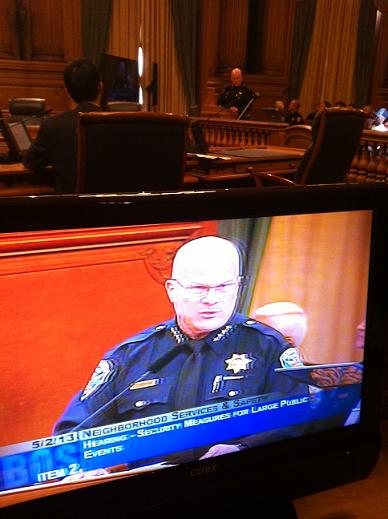
Police video surveillance was in the spotlight during yesterday’s City Hall hearing on security measures at large events, as supervisors voiced a desire to strike the right balance between security and civil liberties. And while they got some reassurance and small signs of restraint from the SFPD, they also learned about secretive new security measures that go beyond what the public was aware of.

San Francisco Police Chief Greg Suhr clarified misleading media reports (a Chronicle story then picked up by Associated Press) that he’s seeking real time video surveillance along Market Street. Right now, Suhr said he just wants an inventory of existing video cameras along Market and downtown that he can request footage from after a crime is committed and that he would make his case to the board if he ever wanted to go beyond that.

“Right now, we only look at footage in retrospect,” Suhr told the Neighborhood Services and Safety Committee hearing, adding that he has no objections to seeking a court warrant to obtain that footage because “we do want it to be admissible.”

Yet Suhr and Deputy Chief James Loftus also revealed that SFPD will be deploying an undisclosed number of temporary real-time video surveillance cameras atop long poles at the Bay to Breakers footrace on May 19, as it did last fall during the World Series and the big parade down Market Street celebrating the Giants victory.

“We always want more video,” Suhr told the Guardian, although he said that he also understands the civil liberties sensitivities of San Franciscans, which is why he isn’t now seeking a permanent increase in SFPD’s real time video surveillance capabilities. “I’m from San Francisco, I get it.”

Other security tools that the SFPD will be employing at Bay to Breakers and other large events are technology that uses video cameras on police cars to capture license plate numbers and run them through a DMV database, what Loftus vaguely described as “specialized resources from surrounding jurisdictions” (watch out for the drones, y’all), and unspecified “FBI assets [that] will be present and assisting in event security.”

When Sup. Eric Mar, who called the hearing, asked about those last two items, Loftus said he wouldn’t discuss them publicly, but “I could talk to you about it offline if you’d like.”

Sup. David Campos said that he doesn’t want San Francisco to be reactionary after incidents like the Boston Marathon bombing and that we should be a model city for balancing security with civil liberties: “I think that’s a very difficult balance to strike, but it anyone can strike that balance, I think San Francisco can.” He also expressed concerns about plans to ban backpacks at Bay to Breakers: “I don’t know if that’s going to address the problem.”

Loftus said the ban only applied to large backpacks (larger than 8.5x11x14 inches) and that runners and spectators will still be allowed to use small backpacks to hold water and changes of clothing. Yet for those concerned about the creeping police state, including several people who spoke during the public comment period, there was little consolation offered in the presentations, and the supervisors said this would be an important ongoing discussion.

“This is a discussion that goes beyond San Francisco,” Campos said. “We as a country need to have this discussion.”

Check, please

44

steve@sfbg.com

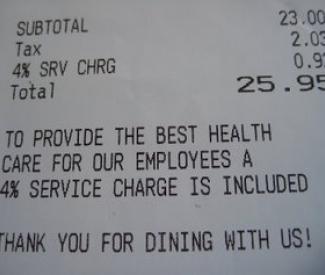
San Francisco restaurants that have been cheating their customers and employees — charging diners for city-required healthcare coverage that they aren’t fully providing to workers — will finally be exposed in the coming weeks, with some notable names in foodie circles among the likely culprits.

City Attorney Dennis Herrera is working on settlements with dozens of restaurants that responded to his investigation and partial amnesty offer, which had an April 10 deadline. His effort augments the complaint-driven enforcement actions by the city’s Office of Labor Standards Enforcement, which has collected millions of dollars for thousands of employees of negligent local businesses in recent years.

At issue is the Healthcare Security Ordinance, the landmark 2008 law authored by then-Sup. Tom Ammiano that requires San Francisco businesses to provide a minimal level of healthcare benefits to their workers. Businesses are also required to report spending and surcharge figures to the OLSE annually, with the next report due April 30.

Last year’s data show celebrity chef Michael Mina’s Mina Group LLC — which includes the restaurants Michael Mina, RN74, Bourbon Steak, and Clock Bar — to be the top violator, collecting $539,806 in surcharges from customers and spending just $211,809 on employee healthcare.

Herrera used that list to ask more than 70 businesses to show they are in compliance with the law or reach discounted settlements now to avoid punitive fines or criminal charges later, and Herrera told us he received 60 responses and had his inquiry snubbed by fewer than a dozen.

“It’s too early to talk about how large a recovery we’ll be getting for workers, but I’m pleased with the response rate,” Herrera told us. He refused to estimate how many of the respondents were found to be in violation, but in an April 11 message to reporters covering the issue, his spokesperson Matt Dorsey wrote, “Based on our investigation so far, we anticipate that the majority of these establishments will be required to pay money to compensate their workers.”

WHAT THE FIGURES SHOW

The Guardian contacted many of the restaurants that topped the OLSE list. Some wouldn’t respond, some said they’ve changed their policies since the controversy erupted, and some wouldn’t talk until after a settlement is announced — including the Mina Group. That seems to indicate they’re about to pay for past violations.

Nicole Kraft, who handles public relations for the Mina Group, responded to Guardian inquires by writing, “I wanted to let you know that Mina Group will soon be releasing a joint statement with the City Attorney’s office, which should answer many of your questions. We’ll be sure to send it your way ASAP.” [UPDATE 4/29: Mina Group settled its case for $83,617.]

Sources in the City Attorney’s Office say settlements with as many as 10 restaurants that admit clear violations of the HCSO could be announced in the next week or two, while another 10 or so have provided data showing they are not in violation. The rest are more complicated and could take weeks or months of investigations, which are being led by Deputy City Attorney Sarah Eisenberg.

“There are going to be some that are given a clean bill of health,” Herrera told us. Herrera also told us that his investigation is just getting started and that it will look at businesses that haven’t made required annual reports to the OLSE. “When we get to a place where we’re announcing settlements, we’ll have more to say,” he said when asked for details and dimensions of his investigation.

GGRA Executive Director Rob Black has maintained that the OLSE figures don’t accurately reflect whether businesses are in compliance because the reporting requirements are confusing. GGRA held a compliance workshop on April 17, and Black told us about 40 restaurateurs attended.

“It was very informative and we got really good feedback from the restaurants,” Black told us. “We had people saying, ‘knowing what I know now, we should redo my 2011 form because I did it wrong.”

Black was initially critical of Herrera’s focus on the restaurant industry, but told us last week, “He made a commitment that the process would be efficient and fair, and he’s lived up to that so far….I still believe that the majority [of violators] didn’t have a mal-intent…Many people on the list that was reported have done nothing wrong.”

Cheesecake Factory — which was seventh on last year’s OLSE list, allegedly taking in $159,242 more in surcharges than it spent on employee health care — insists that it is in compliance and expects the City Attorney’s Office to confirm that.

“We believe the City Attorney’s initial review was erroneous,” Richard J. Frings, the company’s vice president of compensation and benefits, told us. “We are in full compliance with HCSO. Our healthcare costs in San Francisco have far exceeded the surcharge that we have collected. Once the City Attorney’s office has an opportunity to review our filings, we believe this matter will be closed without any further action.” He refused to provide figures to support the assertions.

THE HSA PROBLEM

Most of the restaurants that have been accused of stiffing employees use health savings accounts, which health officials say is a far worse option than private health insurance or the city’s Healthy San Francisco plan, which was created in conjunction with HCSO. Federal law bars cities from prescribing how health benefits are delivered.

San Francisco’s restaurant industry has always been hostile to the HCSO’s employer mandate, with the Golden Gate Restaurant Association unsuccessfully challenging the law all the way to the US Supreme Court. Controversy then erupted in 2011 with revelations (first in the Wall Street Journal, followed up by local media outlets) that some of the city’s most high-profile restaurants were shirking their responsibilities even as they charged diners 3 percent to 5 percent surcharges, sometimes essentially pocketing that money at the end of each year.

That verges on consumer fraud, but District Attorney George Gascon has refused to investigate, telling the Guardian and other papers that he was deferring to the OLSE and the City Attorney’s Office.

In 2011, a progressive-led majority on the Board of Supervisors passed legislation authored by Sup. David Campos to require that businesses keep the money they are required to spend on employee healthcare — which is currently $2.33 per employee-hour for large companies or $1.55 per employee-hours for businesses with less than 100 employees — for employees to use as needed.

But under aggressive lobbying by the GGRA and San Francisco Chamber of Commerce — which asserted the right of business owners to raid these funds, calling the set-aside a multi-million-dollar annual loss to the local economy — Mayor Ed Lee vetoed the measure. He later signed watered-down legislation requiring the money be set aside for two years, setting standards for letting employees know how to access the funds, and explicitly calling for all customer surcharges to remain in escrow accounts.

The OLSE, which also monitors compliance with the city’s paid sick leave and minimum wage laws, can only investigate businesses when an employee files a complaint. But then complaints trigger investigations that cover all of a given business’s employees, who are often compensated for past violations. To file a complaint, just write hcso@sfgov.org or call (415) 554-7892.

OLSE figures show the agency has investigated more than 100 complaints since 2008, resulting in $8.1 million in health care benefits provided to more than 6,400 employees and $244,000 in penalties paid to the city. Herrera’s office also reached a $320,000 settlement with the owners of Patxi’s Chicago Pizza in January, just before announcing his broader investigation.

“The vast majority of San Francisco employers have complied with their obligation to make health care expenditures pursuant to the HCSO,” OLSE Manager Donna Levitt told the Guardian. “With respect to the minority of businesses who fail to meet their obligations, the OLSE works tirelessly to ensure that workers receive the benefits to which they are entitled and that all businesses compete on a level playing field.”

Among the restaurants near the top of the OLSE list that did not respond to the Guardian inquires are Squat & Gobble, Wayfare Tavern, and Trinity Building Services.

“We are actually in complete compliance,” Larry Bouchard, manager of One Market restaurant, told us, explaining its inclusion on the OLSE list by saying, “It’s my understanding that we reported the wrong information.” He said the restaurant uses health savings accounts, but that they are widely used by employees, who get their expenditures repaid within three weeks.

Scott Carr, general manager of Boulevard — who sources say was one of the first restaurants to use the healthcare surcharges on customer bills, and whose parent company, Reroute LLC, was fifth on the OLSE list, underspending by $169,777 — told us the figures didn’t fully reflect the company’s spending on employee health care.

He wouldn’t say whether the company will be settling with Herrera for any past violations, but he did say that the restaurants decided to abandon health savings accounts in favor of health insurance policies for employees starting on Jan. 1. As he told us, “We feel we’ve made a positive step.”

Proposal would halt condo conversions for ten years

San Francisco Supervisors Norman Yee, Jane Kim and Board President David Chiu gathered with a cluster of tenant advocates at City Hall April 15 to unveil a proposal billed as a more equitable alternative to a highly controversial condominium conversion legislation that’s fueled a months-long battle over affordable housing.

Crafted with the input of tenant advocates, the new plan seeks to amend controversial legislation proposed earlier this year by Sups. Scott Wiener and Mark Farrell to allow a backlog of approximately 2,000 housing units to convert immediately from jointly held tenancies-in-common (TICs) to condos.

The proposal would effectively shut down the city’s condo conversion lottery for a minimum of 10 years, a measure aimed toward ending the cycle of real estate speculation that tenant advocates say has given rise to a spike in evictions in San Francisco’s supercharged housing market.

The proposal would still allow a current backlog of TICs to convert to condos without having to wait in a lottery system created to limit the number of units lost from the city’s rental housing stock. The board’s Land Use and Economic Development Committee, which is currently in session, will take up the legislation and proposed amendments later this afternoon.

The 10-year suspension on condo conversions would allow time for permanently affordable units to be built in place of the rental units that would be lost in the one-time conversion, proponents of the alternative legislation said. “If more affordable housing isn’t produced, then units don’t get to convert,” Housing Rights Committee executive director Sara Shortt told the Guardian. 

Chiu stressed that the proposal was crafted to “ensure that as we expedite condo conversions … we protect tenants by suspending the lottery for at least 10 years.”

The 10-year minimum suspension is based on current regulations capping condo conversions at 200 per year. It would last a decade because an estimated 2,000 units would be converted, but could last longer than that.

“For example, if 2,200 units are converted,” Chiu explained, “the suspension would last for 11 years.”

Meanwhile, the proposal would require the conversions that would be intially allowed to be staggered over the course of three years.

The plan “puts the Board of Supervisors on record that we strongly believe in preserving our affordable housing stock,” said Sup. Yee, adding that the package of amendments seeks to “address the risk of speculation that will ensue with a large number of TICs being converted to condominiums.”

The Wiener-Farrell proposal spurred a months-long opposition campaign led by tenant advocates, who said it would permanently remove affordable rental units from the city’s housing stock and incentivize evictions of long-term tenants at a time when Ellis Act evictions are already on the rise. 

“Condo conversions are the number one reason why people are being evicted from the city,” San Francisco Tenants Union executive director Ted Gullicksen said at the April 15 rally and press conference.

Wiener and Farrell’s proposal was presented as a way to remedy TIC owners’ complaints that onerous shared mortgages had left them financially strapped.

But Sup. David Campos, who also appeared at the rally, commented that the real challenge “is for the renters who are finding it very hard to live in San Francisco.”

Campos seemed dubious that a one-time condo conversion should be allowed to move forward at all. “If anything, I think we should be doing more to protect tenants,” he said. “My hope is … if it’s something we cannot live with as a community, we will make sure it dies,” he added, referring to the original condo conversion proposal. 

In an earlier attempt to strike a compromise between TIC owners and tenant advocates, “negotiations broke down quickly,” Shortt said in an interview. At the rally, she said this alternative was “drafted in a way that’s not trying to meet any political agendas.”

For many elderly and low-income tenants who have few options if they are faced with eviction, “there is no price tag that you can put on their units,” said Matt McFarland, a staff attorney at the Tenderloin Housing Clinic, who spoke at the rally. “Their most valuable possession is the long-term rent control on their property. For these tenants, it’s basically a death sentence when you get these eviction notices.”

ABC shows more concern about expanding police video surveillance than Mayor Lee

15

The SFPD has quietly expanded its reach and authority to obtain video surveillance from in and around bars, clubs, and markets through a condition it has begun recommending on new liquor licenses, as I reported in today’s issue, effectively bypassing controls on city-operated surveillance cameras established through extensive public hearings in 2005.

But the Mayor’s Office doesn’t seem concerned about the new trend, echoing SFPD’s point that it is the California Department of Alcoholic Beverage Control that decides whether to heed the SFPD’s request to include the video surveillance condition. “There is no new policy. SFPD makes recommendations as far as I know, not requirements,” Mayoral Press Secretary Christine Falvey wrote to me in an email responses to our questions.

Certainly, everyone from bar owners to the ACLU to Sups. Scott Wiener and David Campos – who have called a hearing on the policy for later this month – consider it a new policy, or at least one that the public has just learned of after it was adopted internally right after the idea was shot down in public hearings in 2011.

ABC spokesperson John Carr had told me the department “routinely denied requests for conditions by SFPD per section 23800(e) of the Californian Business and Professions Code, occasionally these denials include the surveillance condition,” but he wasn’t able to provide me any examples of that happening by press time.

But today, he was able to find one. On Oct. 3, 2012, ABC rejected the SFPD’s request for video surveillance at Bush Market at 820 Bush on a quiet residential block of Nob Hill, noting that state law requires such requests be supported by “substantial evidence” that problems exist at the site that would be mitigated by the condition.

“I regret to inform you that the Department is unable to impose conditions pursuant to your request because no evidence was provided to establish that a problem exists at the premises or in it immediate vicinity,” ABC District Administrator Justin Gebb wrote in what was essentially a form letter.

Carr shared an identical letter that the ABC sent to the SFPD denying some of its requested conditions for another liquor license transfer on Feb. 12, this one for the Space 550 event venue at 550 Barneveld Ave. But in that case, the ABC decided to support the SFPD’s request for video surveillance “that is able to view the inside and outside of the premises” and which must be given to the cops “upon demand.”

As I wrote in this week’s paper, the ACLU considers that kind of extrajudicial expansion of the SFPD’s ability to require and obtain video surveillance to be unconstitutional, and we furnished a copy of the article and the issues it raised to try to get a more substantial comment from the Mayor’s Office, which seems to be less concerned with the civil rights of San Franciscans than the bureaucrats in Sacramento are.

“Balancing public safety with vibrant cultural and nightlife activities is a concern of mayor. He expects the Police Department to work in partnership with the neighborhood and its businesses to lawfully collect evidence that can help keep the public safe and neighborhoods active,” Falvey wrote.

So I had a few follow-up questions, for which I’m still awaiting answers, and I’ll update this post if and when I get them: “The ACLU’s position is that this is not a lawful way to collect evidence, and that it violates the state constitution’s privacy protections and the rules San Francisco established in 2005 regulating when and how the SFPD may request and use video surveillance. Does the mayor reject those concerns and has he sought any legal advice to support his position? In the absence of any judicial review, shouldn’t the city have some guidelines and policies governing this expansion of SFPD’s video surveillance authority? Does the mayor believe the 2005 guidelines should no longer apply? And does the mayor agree with Sups. Wiener and Campos that it would be appropriate to have a public hearing on this issue, particularly given the strong public opposition to requiring expanded video surveillance by bars two years ago?”

Sneaky surveillance

19

steve@sfbg.com

After public outrage stopped the San Francisco Police Department from instituting controversial — and unconstitutional, say civil libertarians — new video surveillance requirements in bars and clubs more than two years ago, the department quietly began inserting that same requirement into new liquor licenses, a move met with concern at City Hall last week.

In late 2010, the SFPD proposed a draconian set of new security requirements for drinking establishments in the city, including requirements that they do video surveillance and take an image of all patrons’ identification cards and make them available to police upon request, without a warrant or any other controls (see “Going to a club — or boarding an airplane?,” 12/7/10).

That proposal ran into a wall of opposition from the American Civil Liberties Union, California Music and Culture Association, progressives on the Board of Supervisors, and others, who said such a blanket policy violates privacy protections in the California Constitution. The Entertainment Commission held a hearing on the proposal in April of 2011 and voted unanimously to reject the proposals.

At that point, they seemed to just disappear, but they didn’t. Instead, SFPD internally decided at that time to begin asking the California Department of Alcoholic Beverage Control to insert a video surveillance requirement in most new liquor licenses in San Francisco, which escaped public notice until Sup. Scott Wiener raised the issue at the April 2 Board of Supervisors meeting.

“If you have an establishment that perhaps has a track record of bad things happening, that’s one thing. But absent that, I don’t believe that this is justified,” Wiener said as he voted against the requirement in a pair of new liquor licenses. Although Wiener was alone in opposing those applications, Sup. David Campos said he shared Wiener’s concern and the pair called an upcoming hearing on the new policy.

Two days later, at the board’s Neighborhood Services and Safety Committee meeting, Wiener again raised the issue and sought to have the new requirement removed from a pair of proposed liquor licenses: Cesar’s Ballroom on 26th and 3rd streets, the latest project of veteran local club owner Cesar Ascarrunz, and Nosa Ria, a market in Hayes Valley that will import gourmet food and wine from Spain.

“It’s the exact opposite of some kind of rowdy bar or nightclub where people are going in and getting drunk and really bad things are happening,” Wiener said of Nosa Ria, for which he persuaded fellow Sups. Eric Mar and Norman Yee to vote to remove the video surveillance condition before approving the application.

That condition stated: “The petitioner shall utilize electronic surveillance and recording equipment that is able to view the outside of the premises, including all entrances and exits, and that is actively monitored and recorded. The electronic surveillance shall be utilized during operating hours. Said electronic recording shall be kept at least 30 days and shall be made available to the Department or Police Department upon demand.”

Mar said he agreed with Wiener that “a broad discussion of electronic surveillance requirements would be important for this committee,” but Mar then voted against removing that condition from the Cesar’s Ballroom application, saying, “I think we need surveillance in certain spots on a case-by-case basis, and I think this is an area that needs surveillance.”

SFPD IS WATCHING

When SFPD first sought new video surveillance tools — back in 2005, when the department asked for 71 video cameras at high-crime intersections around the city — it was rigorously debated in public hearings for months. And when they were finally approved by the Board of Supervisors, they included an extensive set of controls on when SFPD could request footage — the department wasn’t even allowed to control the cameras directly — how it could be used and when it must be erased.

The legislation also required a follow-up study of their effectiveness in deterring and prosecuting crimes. Conducted by the University of California’s Center for Information Technology Research in the Interest of Society (CITRIS) in 2008, the report found the cameras had no impact on violent crime rates but a small deterrent impact on property crimes in the filmed areas.

As a tool for prosecuting crimes after the fact, “There has been limited success with the cameras acting as a ‘silent witness,’ with footage standing in for witness testimony; some anecdotal evidence suggests that the existence of CSC program footage can actually deter witnesses from cooperating under the assumption that the cameras have caught all necessary evidence,” the report said, also noting that twice in the 120 police requests made by 2008, footage resulted in charges being dropped or downgraded.

But today, SFPD apparently believes that times have changed, and that the rigorous oversight and evaluation of video surveillance tactics and their implications on people’s privacy rights — or even the need to notify the public that SFPD is seeking new ways to watch citizens — are no longer necessary.

“Over the last few years, we’ve increased the number of recommendations for video surveillance, for a few reasons,” SFPD spokesperson Gordon Shyy told the Guardian, citing how cheap and ubiquitous the technology has become and the role that video footage can play in solving crimes.

Yet attorney Michael Rischer with the ACLU of Northern California, who actively opposed the SFPD’s proposal in 2011 and was dismayed to hear the department secretly and unilaterally expanded its video surveillance reach after its proposal was rejected, said that reasoning is exactly why there are legal controls on the expanding police state.

“Both of those justifications are exceedingly troubling and they demonstrate why the San Francisco Police Department should not be doing this in some room sealed off from the public,” Rischer said. “The police have this totally backward. The ease and cost of doing this is a reason why these protections are in place.”

PRIVACY PROTECTIONS

Unlike under federal law, Californians have an explicit constitutional privacy guarantee and a body of case law defining that right in great detail. But the SFPD doesn’t seem to be aware of the nuances of that case law, such as the distinction it makes between people’s expectation of privacy on public streets versus in private businesses.

“When you enter a bar or restaurant, you don’t have an expectation of privacy,” Shyy told us.

But Rischer said that just isn’t true under the law. He noted that people do indeed have a reasonable expectation that they can enter a gay bar without being outed, for example, or that police won’t be able to demand video from a gathering in a bar where subversive political ideas are being discussed. And those concerns are exacerbated by SFPD’s policy that bar owners must simply turn over footage “upon demand.”

“The notion that the government is requiring a business to conduct surveillance of its patrons and to turn it over to the Police Department without any judicial oversight or even rules is deeply troubling and probably unconstitutional,” Rischer said.

Shyy said SFPD will “only request them when a crime has been committed,” but he also admitted that the conditions it is requesting on liquor licenses don’t set that limit and the policy hasn’t been reviewed by the Police Commission or other local oversight bodies.

ABC spokesperson John Carr told us his department doesn’t have a position on video surveillance and hasn’t tracked whether other jurisdictions are seeking the condition. As for whether it routinely includes SFPD’s recommended conditions, he said, “ABC reviews each application on a case by case basis.”

There are indications that SFPD sometimes resorts to bullying bar owners into turning over video surveillance without legal authority to do so. Jamie Zawinski with DNA Lounge last month blogged about Officer Simon Chan telling the club that it was required to keep video footage and turn it over upon request, which club operators informed the SFPD wasn’t true. “It’s just another sneaky, backdoor regulation that ABC and SFPD have been foisting on everyone without any kind of judicial oversight, in flagrant violation of the Fourth Amendment,” Zawinski wrote.

Regarding that incident, Shyy would only confirm that most bars aren’t yet required to keep and turn over video footage. And he said SFPD will cooperate with the hearing Campos and Wiener have called. “At this point, we don’t believe we’re violating people’s constitutional rights, but we’re willing to have that discussion,” Shyy said.

Wiener said that on April 3, he discussed the issue with Police Chief Greg Suhr, who indicated a willingness to cooperate with public hearings on the policy. But Wiener said he’s bothered by the fact that SFPD seems to have put this new policy in place right after being unsuccessful in doing this through a public process in 2011.

“I and others expressed opposition to this and I and others thought the Police Department had backed away from it,” Wiener said at the April 4 hearing, noting that “I’m not philosophically opposed to surveillance,” only with how SFPD instituted it. “I have an issue with the Police Department deciding to insert this on its own without a broader policy discussion.”

SF declares Pay Equity Day as it lowers salaries for women’s jobs

87

The Board of Supervisors today declared April 9 Pay Equity Day in San Francisco, in recognition of the persistent national gap between male and female financial compensation. But with the city locked in a dispute with SEIU Local 1021 over pay cuts to jobs dominated by women and workers of color, the day took on special local significance. Ahead of the declaration, union members, activists, and supervisors rallied in front of City Hall, chanting against San Francisco’s wage inequality and the general climate of fiscal austerity.

Women in San Francisco earn just 84 cents for every dollar paid to their male counterparts. Although this figure is slightly higher than the national average of 77 cents per dollar, the discrepancy represents a yearly wage gap of $9,968 per year, according to the National Partnership for Women and Families. At today’s press conference in front of City Hall, Sup. Malia Cohen called the gap “unconscionable in a country as wealthy as ours.”

Cohen was joined by Sups. David Chiu and David Campos, who both spoke out against gender-based wage gaps. “It is important for men to speak out,” Chui said. “It wasn’t women who made the decision for pay to be unequal.” Campos went a step further, promising to vote against any budget that further entrenches unequal pay. “I will not support any budget that reflect this discrepancy,” he said.

SEIU Local 1021, which represents over half of city employees, is currently locked in a budget dispute with the city over pay cuts that would adversely affect women and workers of color. The city Department of Human Resources has recommended that the city cut the salaries of 16 categories of city workers, including personnel clerks and nursing technicians, which are disproportionately females and workers of color. The dispute was recently sent to an arbitrator.

At today’s event, local SEIU leaders and the San Francisco Women’s Political Committee (SFWPC) continued to pressure the city to reconsider the salary cuts. SFWPC President Laura Hahn called persistent pay inequality “embarrassing.”

“If we can’t achieve it here in San Francisco where are we going to do it?” she asked.

Former Supervisor Chris Daly, who now works as political director for SEIU 1021, echoed Hahn’s concerns and charged that the proposal to cut pay for female-dominated categories calls into question the city’s long term commitment to pay equity.

“If you ask Mayor Lee if he supports wage equality, of course he will say yes,” Daly told us. “But in reality, his Department of Human Resources is rolling back progress.” Daly’s repeated requests for Mayor Lee to intervene in the wage-cut arbitration have not yet been answered.
But for the DHR, the recommended cuts have more to do with fiscal reality than gender equality. At a March 7th budget hearing, DHR director Micki Callahan said, “It would be improper to base any decision on demographics.”

She voiced concern over the “root causes” of pay discrepancy, but indicated that these issues fall outside the purview of her department. Spokespeople for the the DHR department have repeatedly assured us that the proposed budget cuts have nothing to do with gender, but rather reflect an effort to bring city salaries in line with market forces.

The truth conquers all

33

I was standing in front of what looked like a semi-vacant office building. I re-checked my maps app — it looked like I had the correct address for the Planned Parenthood clinic. If only this woman would stop shouting about killing babies, maybe I could think.

“Don’t kill your baby! If it could talk it would say ‘Mommy, don’t judge me,'” I turned back to look at career abortion clinic protester Erika Hathaway, and was embarrassed to realize that her wheelchair was parked right in front of the clinic’s door. I had missed it entirely in my zeal to document her interaction with a typical visitor, and had walked right past the door in the chaos.

And I wasn’t even there for a reproductive health appointment. I shivered at the thought of dealing with her while concerned about the results of an HIV test or a weird bump on my labia, much less a tortured decision to end a pregnancy.

I brushed past Hathaway’s exhortations to “ask for the ultrasound!”, a command that echoed around the clinic’s small, otherwise calm waiting room as I closed the door. A young patient looked up with me with tired eyes, shaking her head at the activist’s audacity.

Up for a lecture on respecting life from a guy who has multiple restraining orders from medical clinics?

“I compare it to the offensive foul rule in basketball,” Adrienne Verrilli, director of Planned Parenthood communications, tells me moments later. “You have to have your feet already set to avoid getting the call.” Verrilli’s clinic has been dealing with these protesters for years.

The activists tout bloody posters of aborted babies and bump Christmas music year-round “to remind people that Christ was a baby once,” as Hathaway tells me. They’ve made patients cry, make staff who love their jobs at the clinic want to leave by the back entrance every day.

Recently, a protester actually entered the clinic and woke up a napping patient to tell her why abortion is murder. Only two percent of the visitors to Planned Parenthood come for an abortion.

Hathaway’s setup

Supervisor David Campos, who represents the Mission, has proposed an extension of the current eight-foot “bubble zone,” which Hathaway and her ilk circumvent by pre-stationing themselves in a wheelchair. With their “feet set,” they have no need to approach patients. Verrilli says her staff regularly see Hathaway leave the chair to walk up to Burger King for refreshments. Rumors fly that she has a “day job” as a dogwalker in Belmont, Calif.

Campos wants to extend the no-fly zone to 25 feet from the door and bar protesters from entering, period. I looked at the van that Hathaway’s uncle — a 20-year vet of abortion protesting who has had multiple restraining orders placed against him by the Bay Area abortion clinics he splits his time between — has plastered with violent imagery. It’s parked in the middle of the specially-designated loading zone in front of the clinic, shielded by the handicapped tags that Verrilli says all pro-life protesters seem to have. Given the obvious determination of the anti-choice activists, I hope that the proposed change will be enough to ameliorate their aggression towards vulnerable patients.

Verrilli showed me a letter dropped off at the clinic by a Bernal Heights neighborhood mom of a seven-year-old who was “visibly disturbed” by the protesters’ signs. Unwilling to let me leave on an entirely negative note, she told me about AB 154, a proposed state bill that would allow advanced nurse practitioners to perform first trimester abortions, making family planning services even more available. The fight for reproductive justice continues, despite dedicated opponents.

Her hope lingering in my ears, I braced myself to go back outside and hang with the protesters.

I asked Hathaway why she spends her days in front of reproductive health clinics. “The truth conquers all, as Shakespeare’s Hamlet said,” she said, conquering any adherence to literary fidelity. “Eventually, we will win.”

She told me that Steve Jobs was adopted. “What would the world have been like without him?”

So many babies are being aborted in the United States, she said, that there won’t be enough workers to fund Social Security when it comes time for she and I to retire. This underpopulation theory is a new one for me.

The truth will set you free, right? “Do you need that wheelchair to get around?” I asked her.

“I have arthritis,” she told me. “It’s not a wheelchair, it’s a transport chair.”

A young man wearing a baseball hat exited the clinic and Hathaway shouts, “the Virgin does not want you to abort that baby!” I think about the two percent chance that he’s there to support someone getting an abortion, and the million other reasons why he could have paid the clinic a visit that day.

“It’s her choice,” he replied, and continued on his way.

Planned Parenthood 1650 Valencia, SF. (415) 821-1282, www.plannedparenthood.org

Dirty war over clean power

10

tredmond@sfbg.com

It was supposed to be part of Ed Harrington’s legacy, and the chief of the city’s Public Utilities Commission delayed his retirement to make sure it happened.

But six months after the Board of Supervisors voted 8-3 to move forward with CleanPowerSF, the plan is under attack from all sides. Pacific Gas & Electric Company’s house union is spending big chunks of money to shoot it down. The press is loaded with accounts of how expensive it’s going to be for customers. Advocates on the left are blasting it as too limited.

Critics say Harrington’s replacement, Harlan Kelly, is far less interested in making a program work that clearly lacks the support of a PG&E-friendly mayor.

That’s left Sup. David Campos, City Hall’s chief proponent for CleanPowerSF, trying to move forward with a program that, for all its flaws, is the city’s best chance to put a crack in PG&E’s monopoly.

CleanPowerSF will offer San Franciscans a greener alternative to PG&E power, most of which comes from nonrenewable sources. The city will buy renewable power in bulk, through Shell Energy, and distribute it to customers along PG&E’s lines.

A similar system is working well in Marin County, and communities all over the state are looking to see if a city the size of San Francisco — where PG&E has kept out any hint of competition for a century — can pull it off.

Clean power is more expensive right now, and that’s one sticking point: City officials recognize that not all San Franciscans will be willing to pay a premium (of perhaps $10 to $20 a month) for the option. An SFPUC survey released March 25 showed that about 45 percent of the city’s customers would pay extra for clean power and stick with the new program. Earlier studies suggested that 90,000 customers will remain with CleanPowerSF — enough to make the system financially viable.

(Interestingly, the areas most likely to pay extra to avoid fossil fuels are not the wealthiest parts of town. Most of the customers would be on the Eastside, in communities like the Mission, Potrero Hill, the Haight, and Noe Valley.)

The bigger problem with the current debate is that advocates and city officials can’t agree how much money the city ought to spend, on what schedule, to build its own renewable generation system, which would eventually replace much of the power purchased by Shell.

“In the past we would have figures and claims from all sides, and Ed Harrington would look at the numbers and figure it all out, and everybody trusted him,” Campos said. “But we don’t have Ed any more, and Kelly doesn’t seem to be as strongly behind this.”

Building a green-power infrastructure was always a critical part of the CleanPowerSF plan. And once the city has a system up and running, it can use the revenue stream to float bonds to pay for building solar, wind, and cogeneration facilities.

Over time, the locally generated power would be far cheaper than what anyone can offer today, meaning rates would come down.

“We agreed to move the sales agreement forward to get the system started, then keep working on the build-out,” Campos explained.

But a campaign by International Brotherhood of Electrical Workers Local 1245, which represents PG&E employees and is historically allied with the company’s political goals, is trying to scare customers away with claims of high rates. And in fact, the first rate proposals were above what Campos and others were hoping for.

So the Local Agency Formation Commission, which oversees CleanPowerSF for the supervisors, and the SFPUC, have send staff back to try to find ways to cut rates.

Meanwhile, Kelly wants to de-couple the public build-out from the Shell agreement, in essence launching the program with the most expensive elements in place — and potentially undermining the future of a publicly owned energy infrastructure.

That has some clean-energy advocates furious — and they’ve threatened to withdraw their support for the program.

“Ever since Harlan Kelly took over, the PUC staff has been less supportive of a robust build-out,” Eric Brooks, who works with Our City has been a longtime supporter of CleanPowerSF, told us. “We’re not saying the city should stop moving forward with the Shell deal, but the city has to continue the planning work for the build-out. It can’t be a piecemeal thing.”

The SFPUC hired a Marin-based outfit called Local Power, led by longtime clean-energy advocate Paul Fenn, to do some preliminary work on how a build-out could proceed. Fenn’s conclusion: The city could create 1,500 to 3,000 jobs and build enough renewable energy to power much of the city, over a seven-year period — at a cost of about $1 billion.

That’s a huge tab — and almost certainly more ambitious than this SFPUC and Board of Supervisors could accept.

Fenn told us that his economic analysis, presented to the SFPUC’s Rate Fairness Board Feb. 18, indicates that the city’s cash flow from CleanPowerSF with a renewable build-out would more than cover the payments on the bonds. But he also agreed that he’s suggesting the best possible alternative — and he expects the city would go for a much smaller piece.

“The Board of Supervisors hasn’t made the decision to spend that kind of money,” he said.

Fenn’s contract expired April 1, and the SFPUC hasn’t renewed it. Instead, another consultant will review Local Power’s work, Campos said.

Part of the political challenge is that Local Power has proposed that much of the build-out include what’s known as “distributed generation” — small-scale solar, wind, and cogen projects on private houses and buildings.

Those installations would be “behind the meter” — that is, they would allow households and businesses to generate their own power without buying it through PG&E’s distribution system.

The build-out proposals that the SFPUC staff have discussed are primarily larger solar arrays, some on land the city owns in the East Bay.

“That’s the most expensive way to do this, and it allows PG&E to still control the transmission and distribution,” Brooks said.

[TK-SFPUC comment Monday.]

Meanwhile, PG&E is preparing to roll out its own competing “green energy” plan — while IBEW ramps up it assault on CleanPowerSF.

The IBEW campaign includes robo-calls, mailers, and advertising, all aimed at convincing customers to opt out of the city program.

And now, with advocates from the Sierra Club to Our City criticizing the program on the left, and IBEW trying to undermine it before it gets going, there’s a real chance that a plan more than 10 years in the making could be in trouble.

That concerns Campos. “All I’m hearing from the advocates is negative,” he said. “I want more build-out, too, but unless we move forward with the program, we won’t be able to do that.”

In fact, he said, “you could wind up killing it and have nothing to show for it at all.”

That, of course, would be PG&E’s preferred alternative.

Sutter/CPMC agrees to a contract with its nurses in SF, clearing the path for its hospital deal

10

Ending a long and contentious labor impasse and setting the stage for the city to approve the pair of new hospitals that Sutter Health and its California Pacific Medical Center affiliate want to build in San Francisco, the California Nurses Association today announced that it has reached a tentative contract agreement with the hospital corporations.

As we’ve reported, reaching a deal with its nurses seemed to be the last major hurdle for Sutter/CPMC to overcome before the community-labor coalition would fully support the compromise hospital deal that a city-CPMC negotiating team announced on March 5. The nurses helped force that hard-won deal in part by aggressively advocating for St. Luke’s Hospital to remain financially viable and open to the low-income community it serves.

“We are delighted to finally reach a contract deal. It’s been six years of a very contentious relationship,” Eileen Prendiville, a registered nurse who works at CPMC’s California Campus, told the Guardian. She said that the nurses are thrilled to have attained good job security and patient advocacy standards while ensuring St. Luke’s stays open. “Working with a coalition of labor and community, we were successful at changing the face of healthcare in San Francisco.”

Under a previous agreement reached last year between CPMC and the Mayor’s Office, St. Luke’s would have had just 80 beds and could have been closed if the corporations revenues sagged. But activists and the Board of Supervisors were able to kill it and force the corporations back to the bargaining table.

In today’s print edition of the Guardian, I cover the movement to value caregiving in our uncaring economic system and the key role that CNA has played has in that growing movement. In San Francisco, CNA has faced down lawsuits, lock-outs, and harsh union-busting tactics as it pushed for contracts with strong patient advocacy protections.

Sup. David Campos, who help negotiate the latest hospital deal, said he was “thrilled” to hear Sutter/CPMC reached a deal with CNA. “We’ve always said it’s really important as we finalize the agreement that there is protection for the workers,” Campos told us.

Board President David Chiu, another key negotiator in the recent deal, told us, “I’m tremendously excited that there’s finally an agreement between oru nurses and CPMC, and thank the parties for their hard work in reaching this point. Along with the agreement we recently arrived at for the new Cathedral Hill and St. Luke’s campuses, this is an important moment for our city’s health care futue.”

CPMC spokespersons didn’t immediately respond to our calls for comment, but we’ll update this post if and when we hear back. The CNA press release announcing the deal and its details follows:


Nurses Reach Agreement with Sutter California Pacific

RNs Hail Community Support, Decision to Keep St. Luke’s Open 


Registered nurses at two San Francisco Sutter hospitals, California Pacific Medical Center and St. Luke’s Hospital, have, at long last, reached agreement with hospital officials on a new collective bargaining contract for the 800 RNs who work at the two facilities, the California Nurses Association said today.

The agreement expands patient protections, strengthens the nurses’ bargaining and job security rights, and provides for economic gains. It must still be ratified by CPMC and St. Luke’s nurses who will vote on the pact in membership meetings soon.

The RNs emphasized that they are especially pleased with the overall political and community framework, announced earlier this month, that preserves St. Luke’s after years of uncertainly and threats of closure for the historic hospital that serves a medically underserved community in San Francisco.

CNA Executive Director RoseAnn DeMoro praised the unity of the nurses over the long contract fight and the broad public support for nurses as critical to protecting St. Luke’s and winning a new agreement for the nurses.

“San Francisco nurses have worked extremely hard, with the widespread support of a very broad community coalition and the support of a number of community leaders, including members of the Board of Supervisors, to protect this vital community resource. We are proud of the efforts of everyone who has held the line for maintaining St. Luke’s,” DeMoro said.

For the first time, the RNs at both hospitals will be under one contract with equal job security and seniority rights. The pact includes safe patient handling provisions to stem patient falls and injuries to patients and nurses. Additionally it obligates the employer to provide for meal and rest breaks and stipulates that new technology not supplant RN professional judgment.

On economics, all the RNs will receive across the board pay increases of 6 percent over the next 34 months, as well as additional pay based on years of service in the San Francisco hospitals, at other Sutter facilities, and foreign nursing experience.

“We are delighted to finally reach a contract settlement with Sutter/CPMC,” said California Pacific campus RN Susan Blaschak RN.  “Our contract provides for continued patient advocacy and will keep our professional nursing standards high for years to come.”

“The process has been tumultuous but in the end we had a vision and we were successful in performing the ultimate in patient advocacy – saving St Luke’s,” said Jane Sandoval, a St. Luke’s RN and CNA board member. “In addition, with our collective bargaining agreement we have preserved patient care standards, having a voice in that and in our professional integrity.”

“Working with a coalition of labor and community groups, we have been successful in changing the face of healthcare for San Francisco’s future. St Luke’s will not only remain open it will offer more healthcare services to residents in the community south of Market,” said Eileen Prendiville RN at the California Pacific campus of CPMC.

“Our contract settlement was also made possible by the strong support for the nurses by San Franciscans for Healthcare, Housing, Jobs and Justice as well as elected leaders who knew San Franciscans overall would be best served by a fair collective bargaining agreement,” said Sandoval.

CNA also calls on Sutter officials in its headquarters in Sacramento, and other Sutter regions to view the San Francisco agreement as a new opportunity to resolve outstanding contract fights with RNs in the East Bay and North Bay.

Nurses have now reached agreement with CNA-represented Sutter hospitals in the past nine months at Mills-Peninsula in Burlingame and San Mateo, Sutter Santa Rosa, Sutter Lakeside in Lakeport, and Sutter VNA in Santa Cruz.

Contracts remain unresolved at Alta Bates Summit in Berkeley and Oakland, Eden in Castro Valley and San Leandro, Sutter Delta in Antioch, Sutter Solano in Vallejo, and Sutter Novato.

“Every one of those disputes could also be resolved if those hospital’s officials would approach negotiations with a desire to stop the war on their nurses, remove unwarranted and punitive concessions demands, and show the community served by their hospitals that they desire a cooperative relationship with nurses based on therapeutic healing for their patients,” said Sandoval.

Live Shots: LGBT Community Center celebrates 11 colorful years

0

Photos by Bowerbird Photography

Last Saturday, the disco ball sparkled from above, while below on the dance floor, party-goers glittered in gold. There was much to celebrate, with the SF LGBT Community Center‘s annual gala “Soiree” celebrating 11 years of sercing the community — and even more to drink, with bottomless bottles of champagne. There were also plenty of sights to drink in, including a few bottomless pairs of pants!

Of course, it was partying with a cause: tickets and auction items went to benefit the Center and their programs. With same-sex marriage equality rights in the balance this week at the U.S. Supreme Court, the Center made it clear that the LGBT community can always depend on them, regardless the outcome. District Supervisors David Campos and Scott Weiner also were in attendance and voiced their commitment to the Center.

Tita Aida worked the stage, introducing one great drag act after the other, including performances by Honey Mahogany, Ambrosia Salad, Miss Rahni, and Alotta Boutte. The theme was Studio 11, explaining why Salvador Dali watched haughtily from the VIP section, as boys in golden spanky pants made their rounds turning eyes. It was a night to remember, or at least a night to try to remember (after all that booze!). Congratulations to the LGBT Center for another year of amazing work and for throwing another wonderful gay-la.