David Campos

Due Process For All must wait another week

54

Sup. John Avalos’ Due Process for All ordinance, legislation barring San Francisco law enforcement agencies from honoring detainer requests issued by U.S. Immigrations and Customs Enforcement (ICE) under the federal Secure Communities (S-Comm) program, faced obstacles at the Sept. 17 Board of Supervisors meeting and was ultimately continued to the following week.

The legislation initially had enough support for a veto-proof supermajority, but opposition has surfaced to prevent the legislation from winning approval as written.

In a recent editorial, Police Chief Greg Suhr called for it to be scaled back. Meanwhile, the San Francisco Deputy Sheriffs’ Association came out against it and Mayor Ed Lee threatened to veto the legislation in its current form.

At issue was whether to amend the legislation by including “carve-outs” — exceptions requiring law enforcement to honor ICE requests in cases where offenders are suspected of serious violent crimes, child molestation or human trafficking.

District 6 Sup. Jane Kim, an initial supporter of Avalos’ Due Process for All Ordinance, proposed an amendment that would grant the Sheriff discretion to honor ICE detainer requests in cases where the offender had been convicted of one of the aforementioned crimes in the past seven years.

Kim characterized her amendment as “thoughtful and limited,” but the proposal met with resistance from Avalos and Sup. David Campos. “I am afraid that in the process of trying to do the right thing, we’re going to end up with unintended consequences,” Campos said.

Board President David Chiu indicated that he agreed with including carve-outs in narrow circumstances.

Under S-Comm, if an arrestee shows up in a shared database as an undocumented immigrant, ICE can ask the arresting local law enforcement agency to detain the person in question, even after they would be otherwise eligible for release. Detainer requests, which police have no legal obligation to comply with, are routinely issued without warrants or a requirement to show probable cause.

Avalos’ legislation seeks to extend due process to all San Franciscans by making it illegal for local law enforcement to comply with such requests. In San Francisco, ICE detainer requests issued under S-Comm have resulted in at least 784 deportations since 2010.

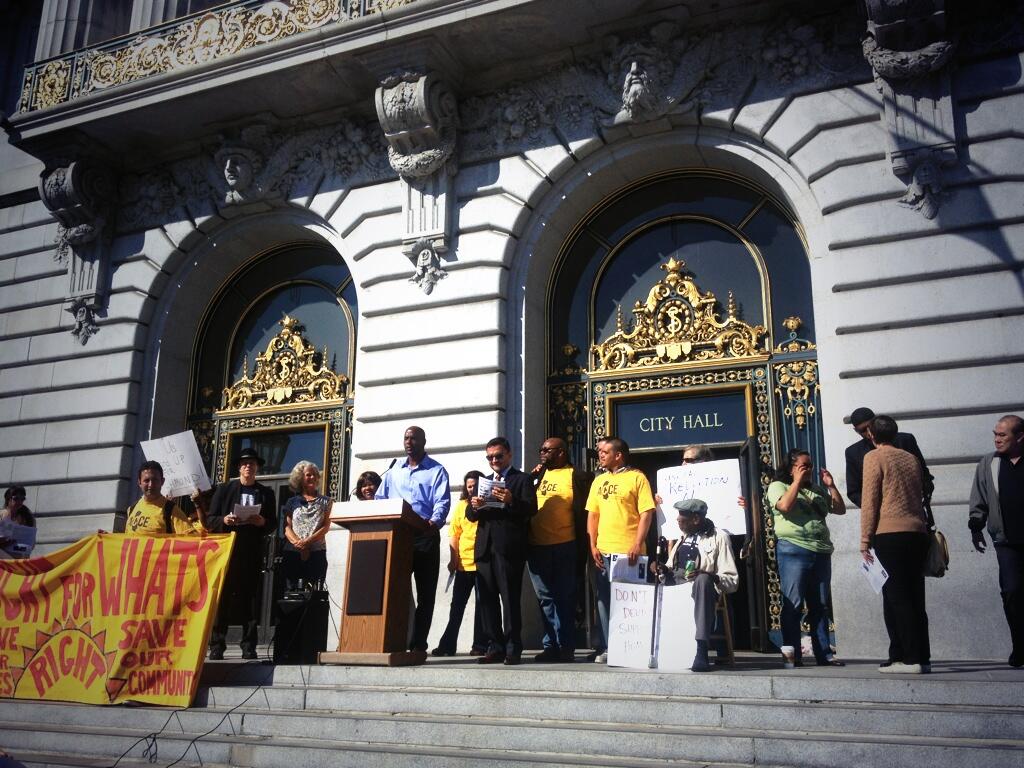
The Board Chamber at City Hall was filled to capacity with supporters of Avalos’ legislation before the hearing even began. The line to get into the main chamber stretched all the way down the hallway to the first overflow room, which had standing room only just five minutes after the meeting began. When Avalos initially stood to speak, the chamber resonated with chants of “Si se puede! Si se puede!”


Cinthya Muñoz, Immigrant Rights Organizer with Causa Justa, remained hopeful despite the setbacks. “We’re excited that we were able to push back on the amendments being proposed because of how they would impact the vast majority of our communities,” she said. “And we’re still hopeful that we’ll be able to get our Due Process for All policy passed next week.”

Up until recently, Lee lacked veto power due to the ordinance’s supermajority approval. But when Avalos lost his supermajority support due to what he called “political pressure,” Lee regained that power. “Whether it’s relationships directly with the police chief, the mayor, the Police Officers Association,” Avalos told the Guardian, “[the pressure] kind of withered eight sponsor support for not having carve-outs.”

Not to be deterred, however, are those groups and individuals fighting for Due Process for All. Following the continuation announcement, the throngs of supporters filed out of the main chamber and down into the lobby of City Hall, where they gathered and prepared for another hearing, same time, same place.

“It’s actually really great because I think it gives us a bigger chance for the supervisors to hear from community members,” Muñoz said. “That what community wants is Due Process for All, everybody to be treated equally and to not make a differentiation between who’s worth it in our communities.”

Power struggle

51

steve@sfbg.com

Jason Fried could barely believe what was coming out of the squawk box in his office at the San Francisco Local Agency Formation Commission on Sept. 10, as he listened to Mayor Ed Lee describe the CleanPowerSF program Fried had spent years helping to develop.

The program would give San Franciscans the choice of buying their electricity from clean, renewable energy sources rather than Pacific Gas & Electric’s oil, coal, hydro, and nuclear dominated power portfolio, a program that was finally able to become competitive with PG&E on price and still fund the creation of local clean energy projects.

But the program that Lee described — which three of his appointees on the San Francisco Public Utilities Commission have recently decided to block, against the wishes of the Board of Supervisors supermajority that approved it (see “Fizzling energy,” Aug. 21) — sounded nothing like the program that Fried, LAFCo’s senior program officer, knows so well.

As Lee described it, CleanPowerSF is “based on vague promises” and has “questionable environmental benefits,” claiming it has “gotten progressively more expensive” and “creates no local jobs.”

“What the San Francisco Public Utilities Commission did was in the best interests of the city,” Lee said. The city has spent untold hours and dollars over the last decade developing and approving CleanPowerSF.

“It was very frustrating to watch, particularly when you see him just making stuff up,” said Fried. “If he wants to be against CCAs [Community Choice Aggregation, that state-created program the CleanPowerSF is a part of], fine, just say that…But he wasn’t even getting his numbers right.”


LIES, DAMN LIES, AND STATISTICS

Questioned by the Guardian following his monthly mayoral policy discussion at the board, where all five questions from frustrated supervisors were about CleanPowerSF, Lee cast himself as sticking to the facts.

“I know that elements of this are somewhat complicated because you have to actually read a lot of volumes of materials to understand the choice aggregation program,” Lee said, claiming, “I’m taking it exactly from facts that were presented.”

But in reality, Lee was cherry-picking facts that were either out-of-date or presented in a misleading way, while ignoring inconvenient questions like how the city can still achieve its clean energy goals without it, or why his appointees are subverting broadly supported public policy on technical grounds that appear to exceed their authority.

Take Lee’s claim that the CleanPowerSF program approved by the board “was 95 percent renewable on day one,” which he used to support his argument that “when the final project is so vastly different than the original intent, the SFPUC has to intervene.”

Lee is referring to the “three buckets” from which the program will draw its energy, as defined by the California Public Utilities Commission. Bucket 1 is the gold standard: juice coming directly from certified renewable energy sources in California. Bucket 2 is renewable energy that isn’t reliable and must be “firmed and shaped” by other energy sources, such as wind or solar farms supplemented by fossil fuels when there’s little wind or sunshine. And Bucket 3 is Renewable Energy Credits, which support creation of renewable energy facilities or green power purchased from other states.

When the board approved the program in September 2012, the SFPUC called for it to secure 10 percent of the power from Bucket 1, 85 percent from Bucket 2, and 5 percent from Bucket 3, although these were just guidelines and the SFPUC was specifically authorized to change that mix.

Lee and other critics of the program decried the program’s cost of more than 14 cents per kilowatt-hour, while supporters worried the price would cause more customers to opt-out, so the SFPUC decided to allow more RECs, while also substantially increasing the amount of guaranteed green power.

“The difference between buckets two and three is not that big a difference,” Fried said, noting the Bucket 2 can actually include a substantial amount of dirty energy. “It really depends on how you’re firming and shaping.”

So the SFPUC increased the size of Bucket 1 to 25 percent and Bucket 3 to 75 percent, with idea being that RECs are only an interim step toward issuance of revenue-bonds to build renewable energy projects that would eventually fill Bucket 1 to overflowing. All for the not-to-exceed rate of 11.5 cents per kilowatt-hour that the SFPUC is refusing to approve.

“Our entire mix would be 100 percent greenhouse-gas-free, but the mayor is ignoring that because it doesn’t fit his ‘green’ argument,” Fried said, also noting that it would be generated in-state by union workers. “PG&E can’t make that same claim.”

CPUC statistics show PG&E derives less than the state-mandated 20 percent of its energy from clean, renewable sources, and that the percentage of its portfolio that is greenhouse gas-free actually dropped in 2012, to 51 percent from 59 percent in 2011. And despite Lee’s emphasis on local jobs, PG&E’s three largest solar projects built in 2012 are outside California.

By contrast, CPSF contractor Shell Energy North America wrote in an Aug. 12 letter that in addition to setting aside $1.5 million for local buildout after its first year, which “should create local jobs,” it is now negotiating in-state wind and hydroelectric (“operated by union labor”) contracts to meet the program’s demands.

But at this point, supporters of the program are running out of options to get that contract approved.


“CHARTER CRISIS”

CleanPowerSF has broad political support in San Francisco, from Sups. David Campos, John Avalos, and other progressives, to moderates including Sup. Scott Wiener and state Sen. Mark Leno, who authored legislation to protect nascent CCAs from PG&E meddling and has been a steadfast supporter of CleanPowerSF.

“There’s a constitutional crisis, or a [City] Charter crisis, of sorts,” Leno said, referring to the standoff. “The legislative body has been unequivocal in its desire to proceed and it’s not for this commission to interfere with that decision.”

Leno said PG&E and its allies have played strong behind-the-scenes roles in sabotaging this program. “They are definitely exerting their influence,” Leno said, “they have never stopped trying to derail this.” SFPUC Chair Art Torres, who is leading the obstruction, didn’t return a Guardian call for comment.

If there is a silver lining, Leno said it’s that “PG&E has had to present its own version of green energy. But the two can coexist. We want competition.”

So does Fried, LAFCo, and all of the supervisors who sit on that commission, which has long tried to break PG&E’s monopoly.

“It’s close to checkmate, but we’re trying to breathe new life into this,” Sup. John Avalos, who sits on LAFCo, told us. “Part of the politics can be seen in the mayor’s statements, which are full of misinformation.”

Sup. David Campos, also on LAFCo, told us CleanPowerSF is “a good program, and it’s consistent with what the Board of Supervisors approved. I think it’s a mistake for the city not to move on this and it’s a bad thing for consumers.”

The newest member of LAFCo, Sup. London Breed, authored a resolution supporting CPSF that the Board of Supervisors was set to consider on Sept. 17, after Guardian press time. It recites a history of strong support for the program by the Board of Supervisors, starting with a unanimous votes in 2004 and 2007 to launch the CCA and continuing through the supermajority approval of CleanPowerSF and a $20 million appropriation to launch it in September 2012.

It noted that the SFPUC held 18 meetings on the program between September 2012 and August 2013, and that its Rate Fairness Board determined that rates for the Phase 1 are “technically fair.”

The resolution emphasizes an important governance issue at stake: “Irrespective of the particular policy decision, the Board of Supervisors must protect and defend its authority to make policy decisions.”

Yet there’s been a concerted effort to undermine CleanPowerSF this summer, led by appointees and allies of Lee and PG&E.

At the Aug. 6 Commission on the Environment meeting, Commissioner Joshua Arce pushed Department of the Environment head Melanie Nutter to renounce CPSF as no longer a green power program, something she refused to do. Arce fell a vote short of approving a resolution characterizing the program as not meeting “all of the commission’s original goals” and urging the SFPUC “to work with the Department of the Environment to craft a program that is acceptable to the San Francisco Environment Commission.”

Breed said she was disappointed in Lee’s approach, although she takes him at his word when he says he’s open to alternatives.

“The questions were answered, but there wasn’t any closure in terms of what this means for the future,” Breed said. “If not this program, what’s the alternative?”

If the city is going to meet its greenhouse gas reduction goals, which call for reducing 1990’s carbon emissions by 25 percent by 2017 and 40 percent by 2025, it’s going to have to offer some alternative.

“We need to be aggressive about moving in this direction,” Breed said, “and we need to make sure the public has an alternative to PG&E.”


Mayor Lee distorts reality in defending CleanPowerSF obstruction by his appointees

151

Mayor Ed Lee yesterday answered a series of five questions from the Board of Supervisors about CleanPowerSF, the renewable energy program it approved last year on a veto-proof 8-3 vote, but which three of Lee’s appointees on the San Francisco Public Utilities Commission are now blocking.

Lee reaffirmed his opposition to the program and support for the three commissioners who are refusing to approve a maximum rate for the program, while making a series of statements that were misleading, contradictory, and, according to Sup. John Avalos, some outright falsehoods.

CleanPowerSF would group tens of thousands of city residents into a renewable energy buying pool, a system called Community Choice Aggregation authorized by state legislation, which would compete against Pacific Gas & Electric’s illegal local monopoly. Initally, the energy would be purchased under a contract with Shell Energy, but the main goal of the program is to build city-owned renewable energy facilities by issuing revenue bonds supported by the program’s ratepayers.

Yet the program Lee described has little resemblance to CleanPowerSF — and his statements of support for the concept belie his longstanding opposition to the program and support for PG&E, whose union is leading the campaign to kill CleanPowerSF.

“I know that many members of the Board of Supervisors are upset,” Lee began in his first answer to similar questions posed by Sups. Eric Mar, David Chiu, London Breed, David Campos, and John Avalos, who all represent the odd-numbered districts whose turn it was to submit questions to the mayor for this month’s appearance.

Lee then explained that one of the duties of  the SFPUC is to protect ratepayers, which he called “the overriding concern they have when faced with any issue,” adding that, “The commission ultimately decided that the rate wasn’t a fair rate.”

Ironically, the top rate that the commission is being asked to approve in order to finally launch CleanPowerSF was just 11.5 cents per kilowatt-hour, only slightly more than current PG&E rates and a substantial reduction from the rate that was discussed last year when supervisors approved the program.

PG&E, Lee, and other critics of the program had attacked its high cost, so SFPUC staffers tweaked the program to allow the initial use of Renewable Energy Credits, which support the creation of renewable energy projects, rather than being purely juice directly from solar, wind, and other renewable sources, which is more expensive.

So Lee criticized that change as a departure from what the board approved last year, telling the supervisors that the program should be at least “95 percent renewable on day one,” saying that, “This is what a green power program should look like.”

Yet when it did look like that, Lee opposed it, something he didn’t mention yesterday. And yet he still made the argument that the SFPUC was simply exercising its fiduciary responsibility in blocking a program that has gotten cheaper than when the board approved it.

“The San Francisco Public Utilities Commission did its job in protecting ratepayers,” Lee said. “I agree with the majority of the PUC.”

So, on one hand, Lee said that CleanPowerSF has “gotten progressively more expensive as time goes on,” citing statements made years ago about the goal of trying to meet-or-beat PG&E’s rates, which have been subsidized by taxpayers over the years.

And when the program then got close to matching those rates, he criticized the use of RECs to get there, saying the climate change benefits “need to be real and tangible and not based on vague promises.”

Yet even city-commissioned studies have shown that San Francisco won’t meet its own greenhouse gas reduction goals without substantially changing the energy portfolio of city residents, and CleanPowerSF is the only plan on the table to get there, except for PG&E’s vague promises to offer more renewable energy in the future.

While Lee touted city efforts to improve the energy efficiency of commercial buildings and the recent launch of a regional bike share program — neither of which will come close to meeting city climate change goals — even he acknowledged the “need to expand our in-city renewable energy generation,” citing the $4 million SolarSF as an example.

But Lee never made reference to CleanPowerSF’s plan to build up to $1 billion in renewable energy projects whose impacts would be far more impactful. Instead, he said the program “creates no local jobs,” which wouldn’t be true during the buildout phase.

While praising PG&E, Lee also glossed over the fact that a majority of supervisors still support CleanPowerSF, and that the SFPUC vote was supposed to be on the rate and not these ancillary issues, raising fundamental democratic issues when three mayoral appointees can override the decision of elected supervisors who represent all city residents.

“When a final project is so vastly different than the original intent, the San Francisco Public Utilities Commission has to intervene,” Lee said.

Avalos called many of Lee’s statements “lies,” so I followed Mayor Lee back to his office after the hearing and we had the following conversation as several reporters from other media outlets listened in:   

SFBG: Supervisor Avalos just said that you’ve made a number of statements that are not factually accurate, and certainly misleading, including saying that the program has changed substantially. Given that you opposed the program initially, and you seem to make statements that criticize those changes, and clearly the majority still supports it, how can you make the argument that the PUC is acting against it because the program has changed?

Mayor Lee: Well, you know, I know that elements of this are somewhat complicated cause you have to actually read a lot of volumes of materials to understand the choice aggregation program, cause it has those three aspects and I would….

SFBG: As guidelines, not as rates….

Mayor Lee: I would point to those numbers that were discussed at the board and presented to the [SF] Public Utilities Commission, because that’s what I’m quoting from. I’m taking it, not from even verbiage, I’m taking it exactly from facts that were presented at the commission at the Board of Supervisors and I specifically lifted quotes from the board about their comments about local jobs and all the other things, so, I don’t think I’m inaccurate at all. I think I’m actually quite on point.

SFBG: But the rates have come down from when they approved it and you made it sound like the rates have gone up.

Mayor Lee: The rates were up and they came down in trade off with less green.

SFBG: Right…

Mayor Lee: That’s about the point I was trying to make is that we wanted these other goals to happen and they couldn’t happen cause people were trading off things in order to set the rates and that was going to become a bigger and bigger gap as to what the original goals were. That’s the way…

SFBG: But the board clearly wants this program. Why, as a matter of policy, as a matter of city procedure, why isn’t the elected body the one to make this decision, instead of your appointees?

Mayor Lee: Well, I think that’s the whole reason why they presented it to the Public Utilities Commission. They’re charter mandated to set these rates. It’s not just an automatic acceptance of what the board says. They also independently review what the board has said. And in their independent review, they said they had gone well beyond what they stated their goals were and so they couldn’t set the rates and still honor all the goals that the board was suggesting.

SFBG: But those rates are less than what the Board has approved. How can they be exercising fiscal oversight… I mean, it doesn’t make any sense.

Mayor Lee: I think we have a big disagreement there. They’re mandated by the charter to set those rates responsibly, not just to follow what the board has stated and so, in their independent review, they went and reviewed all the goals that the board has said and said ‘This is not the program that they have stated should be fulfilled.’

SFBG: Even though the majority of the Board of Supervisors disagree with that statement that you just made?

Mayor Lee: Well, you know, then again, are we not respecting peoples’ right to disagree over what is being done here?

SFBG: But your argument that the program changed from what they approved, a  majority is saying ‘that’s not true,’ that you’re misrepresenting that.

Mayor Lee: No, I don’t think that I’m misrepresenting that. I disagree with that.

SFBG: A majority of the Board of Supervisors who approved it says you are.

Mayor: Well, I disagree with that assessment.


Campos urges SF to explore using Richmond’s eminent domain plan

170

Sup. David Campos is urging the board of supervisors to explore using eminent domain to save San Francisco resident’s underwater mortgages, a plan pioneered by the city of Richmond and its mayor Gayle McLaughlin.

The plan uses the power of eminent domain to seize underwater mortgage loans from banks and investors, saving homeowners from being booted out onto the street when they’re behind on their ballooning payments. The plan is controversial and under attack by Wells Fargo and other Wall Street interests, which we explored in last week’s cover story, “Not For Sale.” They say that the plan puts money into the pockets of Richmond and Mortgage Resolution Partners, the group that engineered the plan. 

Campos plans to introduce his resolution at tomorrow’s board meeting, but importantly it only asks The City to explore whether or not the plan could work in San Francisco. The resolution would not enact a plan at this point in time.

At a press conference this morning, housing activists and Campos trumpeted the plan as a way to save the homes of San Franciscans. Often those targeted with predatory loans have been people of color, they noted. 

“Our strategies have been, lets be honest, ‘Let’s see what the federal government or the banking industry will do to help these folks,’” Campos said at the steps of City Hall. “We’ve waited long enough.”

Campos rattled off surprising numbers, saying 58 homeowners in his district alone had underwater mortgages at risk of foreclosure, and that 16 percent of homeowners in neighborhoods like Visitacion Valley were underwater. 

Bernal Heights homeowner and activist Ross Rhodes was there supporting the action.

“Dave (Campos) helped me save my home when I was getting nowhere with the banks but frustration,” Rhodes said. 

He was making his payments which were up to $3,500 a month, but while on disability and going through a divorce, it was tough. Campos got Rep. Nancy Pelosi’s office involved, and they talked to the banks on his behalf. In the end, he finally got a principal reduction and what he calls a “real good” modification. “I’m not asking for a handout, I’m asking for help,” he said. 

Now his payments are $1,600 a month. “It just shows the banks can do what they want to do, they control it all, they can work with if you if they want to.”

Campos’ resolution also proclaims San Francisco’s support for Richmond’s eminent domain effort.

The bank asked him why he went to Pelosi and Campos for help, instead of going through them. He was incredulous, as he’d been fighting for a principal reduction on his own for two years. “I’ve been trying to work with you for months,” he told them. “It took that political muscle to get you to move. I went through five different loan agents.” 

The victory made him a convert, going to rallies and speaking to help others suffering with their loans. 

The hounds are coming for Richmond though, and the political muscle needed to enact the controversial plan is at risk. 

Wells Fargo already filed suit against Richmond over its use of eminent domain, saying the plan puts money in the pockets of the city and would put a chill on investments. A Richmond bond with an A- rating was already rejected by Wall Street, finding no financiers, putting Richmond in a possible bind when it comes to public works projects. 

In response, Richmond councilmember Nathaniel Bates has a resolution for tomorrow’s Richmond city council meeting to stall the plan. If it’s voted in, Richmond will withdraw all the offers to buy underwater loans and withdraw the plan to use eminent domain to seize them. 

If Bates’ resolution is approved, the whole plan would tank. 

A petition from the Home Defenders League to sand with Richmond’s eminent domain effort has over 7,000 signatures. 

To contact Wells Fargo’s CEO yourself, follow the link here.

The Guardian wrote to the Mayor Ed Lee’s office to see if he is in support of Campos’ plan, but didn’t hear back before press time, which was admittedly quick. 

Update 2:20 pm: We asked supervisor Campos’ aide Hilary Ronen if San Francisco would be at risk for a lawsuit from Wells Fargo, similar to Richmond, if the city enacted an eminent domain plan. In response, she said “All that we’re doing is asking the city attorney’s office as well as the budget and legislative analyst, ‘if we did something similar, what does it look like? What are the financial risks for the city?’ This way we can make an educated assessment. After having that information he’ll have to balance what the risks are. We’re not there yet.”

Manning contingent wins Pride award

25

Ah, the sweet rainbow flavor of comeuppance. As the fascinating and part-tragic, part-inspiring saga of Chelsea Manning continues to unfold, at least one portion of the struggle has reached a satisfying conclusion.

The disastrous move by this year’s Pride Board to negate the election of Bradley Manning as a community grand marshal in the parade — locking out press and protestors, canceling meetings, and kicking up a general shitstorm in the process — only served to bring out three blocks’ worth of marching supporters in the Bradley Manning Supprt Network Contingent this year. Now, that contingent has won the “Best Overall Pride Contingent Award,” voted on by the public.

Sorry, Pride Board :/

Here’s the press release from Grand Marshal, Not Court Martial, a related group:

This past June 30, the Bradley Manning Support Network (BMSN) marched for its third consecutive year in San Francisco’s Pride Parade.

The BMSN was the largest non-corporate contingent in this year’s parade and was named by judges, along with four other groups, as an “Absolutely Fabulous Marching Contingent.” In addition, at last night’s SF Pride’s Check Granting Party, it also won the award for “Absolutely Fabulous Overall Contingent.”

The vote for the “Absolutely Fabulous Overall Contingent” was put out to the community on SF Pride’s web site. BMSN was up against three other groups: Abada Capoeira, Bay Area Youth Summit, and Mormons for Marriage Equality.

The winning of these awards comes on the heels of a two-month debacle in which SF Pride rescinded the nomination of Bradley (now Chelsea) Manning as a Community Grand Marshal. Local LGBT and veteran activists held demonstrations and a teach-in (as well as a Community Meeting called by Pride at the urging of SF Supervisor David Campos) to try to get Manning reinstated.

The contingent featured former military strategist, 82 year old Daniel Ellsberg, who in 1971 leaked secret documents known as the Pentagon Papers to the New York Times. Ellsberg, adorned with a pink boa around his neck, was accompanied in the parade by his wife, Patricia.

Manning was sentenced this past Wednesday to 35 years in prison for releasing thousands of classified documents including the infamous “Collateral Murder” video, which shows a U.S. Army helicopter gunning down Iraqi civilians and two Reuters journalists. This sentence will automatically be sent to the Army Court of Criminal Appeals. Manning’s lawyer and numerous organizations are calling on President Obama to pardon Manning, who could be paroled after 10 years, three of which have already been served.

Following the sentencing, Manning issued a public statement declaring: “As I transition into this next phase of my life, I want everyone to know the real me. I am Chelsea Manning. I am a female. Given the way that I feel, and have felt since childhood, I want to begin hormone therapy as soon as possible. I hope that you will support me in this transition. I also request that, starting today, you refer to me by my new name and use the feminine pronoun (except in official mail to the confinement facility). I look forward to receiving letters from supporters and having the opportunity to write back.”    

Surrounded by kids, David Campos files to run for State Assembly

On the morning of Aug. 1, San Francisco District 9 Sup. David Campos joined a group of parents and kids at the 24th Street BART station, climbed aboard the 49-Mission/Van Ness, and rode to City Hall, where he filed paperwork to run for the California Assembly.

“Running for office is not an easy thing. It’s a very personal decision,” he said. “And thinking about it, I am where I am because I was given a lot of opportunity as a kid coming in, as an undocumented kid. It was the opportunity of getting a quality education, the opportunity to really get a degree,” and to stay motivated by the idea that “if you really work hard and play by the rules, that you can really fulfill your potential.”

Campos was elected to represent San Francisco’s District 9, which spans the Mission, Bernal Heights, and surrounding areas, in November of 2008. The gay Latino elected official is regarded as one of the most progressive members of the Board of Supervisors, and he is credited with spearheading Free Muni for Youth, a city program offering free public transit access to some 40,000 low-income kids.

Campos stressed that many of the policies he’s tackled on the Board of Supervisors have been aimed toward aiding low-income families and youth, “whether it’s helping families who are struggling with free Muni for low-income kids, to improving the quality of schools in the Mission, to focusing on public safety in a progressive way that tries to build a relationship between the police and the community.”

Naturally, Muni took longer than expected.

Some of the kids amused themselves with a clapping game while they waited.

Many of the parents were monolingual Spanish speakers, and their kids were Free Muni for Youth participants. Raul Foneza (pictured in the first shot, with his thumbs up), spoke to the Guardian through a translator and said he had come out for the supervisor that day because he respected Campos’ support for the city’s young people and was there with his friend and her two kids.

When the bus arrived at City Hall, another group of kids was there awaiting Campos’ arrival, with signs. So was Assembly Member Tom Ammiano, who has already granted Campos his endorsement.

Ammiano spent a few moments on the steps of City Hall speaking to the kids. “I hope you tell people to vote for David Campos, I hope you all do your homework, be good to your teachers, and go to college. How does that sound?” After they cheered, “yeeeah!” in unison, Ammiano half-jokingly added something about how then they could all get good-paying jobs, so they could afford an apartment.

Once inside, the crowd of kids and parents squeezed into the basement-level Department of Elections office, where Campos filled out the paperwork to make his candidacy for State Assembly official. He turned to face his supporters, most of whom will have to wait eight years till they’re old enough to vote, and explained that he had decided to run “because we want to make sure our state makes you the top priority.”

Guardian forum sparks lively discussion

26

We had a packed house last night for our community forum on the future of the Bay Guardian and the progressive movement in the Bay Area, with lots of great input, advice, gratitude, and just a bit of acrimony. It was even more informative and inspiring than we had hoped for and we appreciate everyone coming out and speaking so frankly.

As Sup. David Campos (who just announced his candidacy for the California Assembly) said last night, “The Bay Guardian has been the conscience of the [progressive] movement and I think it’s important for the Guardian to continue to play that role,” and that’s a role that the new generation of Guardian leaders will continue playing while also reaching out to a new generation of Guardian readers.  

We’ll have a full rundown in next week’s paper, along with an extended letters to the editor section to make up for shutting down online comments this week, so for now let me just offer a brief overview. In addition to Campos, the crowd of around 100 people included Sup. John Avalos, Sheriff Ross Mirkarimi, and City College of San Francisco Trustees Rafael Mandelman and Chris Jackson.

The crowd also included Todd Vogt, CEO of the San Francisco Print Media Company, who got an earfull from progressive activists Gabriel Haaland, Chris Cook, and others over the abrupt departure of longtime Guardian Editor Tim Redmond in June, with concerns expressed over the Guardian’s credibility and editorial autonomy.

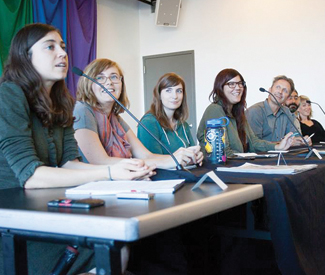
Both Vogt and those on the Guardian’s panel — which included (from right in the photo above) Publisher Marke Bieschke, Editor Steven T. Jones, Music Editor Emily Savage, Senior A&E Editor Cheryl Eddy, Art Director Brooke Robertson, and News Editor Rebecca Bowe — emphasized that the Guardian has full editorial autonomy and control over what we cover and how, and who we endorse. The mission of the paper — “To print the news and raise hell,” and to be an indispensible guide to Bay Area arts and culture — hasn’t changed.

We’re all still digesting everything what was said last night (both at the forum in the LGBT Center and an informal session afterwards at Zeitgeist that went late), and we will be factoring it into what we do and continuing this ongoing conversation with all of you. We also welcome everyone’s input and advice, which you can send to us at news@sfbg.com.

A special thanks to Alix Rosenthal for moderating the public input — and to everyone who came — for somehow keeping the comments and questions clear, concise, and constructive.

Onward!

UPDATE: Journalist Josh Wolf has written an excellent summary of the forum here at on the Journalism That Matters website. Check it out.

8/6 UPDATE: We just turned comments back on after shutting them off for a week-long experiment.

Mayor on local health care policy: “Everything is on the table”

A recent controversy has been brewing around San Francisco’s Health Care Security Ordinance, the 2006 legislation authored by then-Sup. Tom Ammiano that created Healthy San Francisco, the city’s medical services safety net program for the uninsured.

As we explain in greater depth in an article for tomorrow’s issue of the Guardian, influential forces in the business community such as the San Francisco Chamber of Commerce and the Golden Gate Restaurant Association have been publicly raising questions about the Health Care Security Ordinance in light of the federal implementation of the Affordable Care Act, aka Obamacare.

In a recent article in the San Francisco Business Times, Small Business California President Scott Hauge was quoted as saying, “We question whether Healthy San Francisco should continue in its current form with the ACA coming in.” And an article published today suggests that some are continuing to question whether the HCSO can legally coexist alongside the federal requirements under the ACA despite clarification given by Jon Givner of the San Francisco City Attorney’s Office last Thursday stating that the ACA expressly allows jurisdictions like San Francisco to adopt health-care policies such as the HCSO.

Meanwhile, the message from defenders of the city’s health care policy at a hearing called by Sup. David Campos last week was clear: Funding for employee health care generated by employer contribution provisions under the HCSO will be needed more than ever once the ACA is implemented, because many people who now rely on the low-cost Healthy San Francisco for medical care will suddenly find themselves ineligible for that program and automatically funneled into a new system where they are eligible to sign up for subsidized health care, but won’t necessarily be able to afford it.

The ACA will begin enrollment in October, and will take effect in January of 2014. At that point, roughly two-thirds of current enrollees in Healthy San Francisco will either transition to Medi-Cal (if they earn up to 138 percent of the federal poverty level) or qualify for subsidized health care coverage under Covered California, the health benefit exchange created under the ACA. Things are apt to be the most complicated for Healthy San Francisco enrollees who discover they cannot actually afford to take advantage of the options offered under Covered California. 

For this reason, Campos stressed that the HCSO should remain in place without being scaled back or tampered with, because medical reimbursement accounts provided by employer contributions under the ordinance could serve to fill those gaps and help low-wage earners obtain coverage regardless of income. As things stand, Campos and Healthy San Francisco advocates said, gaps created under the ACA will be filled by stronger HCSO provisions, so the programs stand to complement one another.

But the business community, seeking what GGRA executive director Rob Black described to the Guardian as “guidance” from the city on how to move forward given the pending implantation of federal health care reform, wishes instead to open up a new policy dialogue about the HCSO. The mayor has been receptive to their concerns, and recently reconstituted the Universal Healthcare Council, a body that was previously formed to hash out local health care policy.

A key question is who will be appointed serve on that board: Department of Public Health Director Barbara Garcia will chair it, but so far the only indication of who else will be named is that it will consist of “community, healthcare, labor and business stakeholders,” according to a quote attributed to Garcia in the Business Times. Will the makeup include members of the GGRA, the business organization that sued the city to overturn the employer contribution mandate under the HCSO? 

In response to questions about whether the mayor believed the employer spending requirement ought to be revisited in light of ACA implementation, and who would be appointed to the newly convened healthcare council, mayoral spokesperson Christine Falvey responded ot the Guardian with the following statement: “Everything is on the table as the City develops a plan to best implement [the Affordable Care Act]. This is a great opportunity to see how the city can continue to be a leader in making sure San Franciscans have access to quality healthcare. We are currently updating a membership list for the Universal Healthcare Council. More information on that as it becomes available.”

Immigrants vulnerable to domestic violence

0

In San Francisco Sup. John Avalos’ District 11, half of all residents were born outside the U.S. In Sup. Jane Kim’s District 6, more than a third of residents are foreign-born, and almost half speak a language other than English.

Given the sizable immigrant population in San Francisco, it may not come as a surprise that Secure Communities (S-Comm), a federal immigration program administered by the U.S. Immigration and Customs Enforcement (ICE), is highly unpopular. What might not be so obvious is how dramatically S-Comm can impact the lives of foreign-born women who are survivors of domestic violence.

The reason for this is simple. “If you are a victim or a survivor of domestic violence and you call the police, you do not want to end up deported,” Beverly Upton of the San Francisco Domestic Violence Consortium explained at a July 23 rally, where advocates from organizations such as Mujeres Unidas y Activas, Causa Justa, the Filipino Community Center, and others stood and held banners demonstrating opposition to S-Comm. “We want it to be safer to call the police, not less safe.”

A member of Mujeres Unidas y Activas who introduced herself as Lourdes and spoke through a translator delivered a personal account of feeling fearful of police as well as an abusive partner. “Many times, abusers tell us not to call the police, because the police will not believe us. They say the police will probably deport us.”

The domestic violence and immigrant community advocates were there to champion Avalos’ Due Process for All Ordinance, which is being introduced at today’s Board meeting and is co-sponsored by seven other supervisors, essentially guaranteeing its passage. Avalos himself didn’t speak, and Sups. David Campos and Board President David Chiu, co-sponsors of the legislation, sent female staff members to make statements on their behalf as part of the all-female roster of speakers.

The legislation prohibits law enforcement officials from detaining individuals solely in response to immigration detainer requests issued by immigration authorities under S-Comm. As things stand, “the request has been honored in many cases,” Avalos explained in comments to the Guardian, even though California Attorney General Kamala Harris has affirmed that local law enforcement agencies are not obligated to comply with ICE detainers because they are mere “requests” and not legally binding. Since 2010, according to data provided be Avalos’ office, 784 San Franciscans have been deported after being turned over to federal authorities due to ICE detainers.

Sup. Jane Kim called S-Comm “a giant step backward when it comes to equality and fairness,” and added that S-Comm “makes our neighborhoods less safe.”

Legal Counsel Freya Horne read a statement on behalf of San Francisco Sheriff Ross Mirkarimi, stating that the sheriff has reduced the number of ICE detainers leading to deportations, and was supportive of Avalos’ legislation. She added that Mirkarimi had made it a policy to honor immigration detainer requests only in cases of criminal convictions of serious or violent felonies.

Avalos said he was compelled to move the legislation forward because “I’ve talked to so many people whose families have been separated, and have been devastated,” due to deportations under S-Comm. “We want to make sure we’re maintaining a level of due process,” he added, since the detainer requests are routinely issued without warrants or a requirement to show probable cause.

Chiu: centrist compromiser, effective legislator, or both

0

At the start of this year, when I wrote a Guardian cover story profile of Sup. Scott Wiener (which SF Weekly and San Francisco Magazine followed shortly thereafter with their own long Wiener profiles), he seemed like the one to watch on the Board of Supervisors, even though I noted at the time that Board President David Chiu was actually the more prolific legislator.

Now, it’s starting to seem like maybe we all focused on the wrong guy, because it is Chiu and his bustling office of top aides that have done most of the heavy legislative lifting this year, finding compromise solutions to some of the most vexing issues facing the city (ironically, even cleaning up some of Wiener’s messes).

The latest example is Wiener’s CEQA reform legislation, which the board unanimously approved on July 23, a kumbaya moment that belies the opposition and acrimony that accompanied its introduction.

That effort comes on the heels of Chiu’s office solving another big, ugly, seemingly intractable fight: the condominium lottery bypass legislation sponsored by Wiener and Sup. Mark Farrell. To solve that one in the face of real estate industry intransigence, Chiu showed a willingness to play hardball, winning over swing vote Sup. Norman Yee to get six votes using some hostile amendments.

In the end, Chiu won enough support to override a possible veto by the waffling Mayor Ed Lee, who has always echoed Chiu’s rhetoric on seeking compromise and consensus and “getting things done,” but who lacks the political skills and willingness to really engage with all sides. For example, it was Chiu — along with Sups. Farrell and David Campos — who spent months forging a true compromise on the hospital projects proposed by California Pacific Medical Center, replacing the truly awful CPMC proposal that Lee readily accepted.

“It’s been a very long year,” Chiu told the Guardian. “It’s been important for me to not just to seek common ground, but legislative solutions that reflect our shared San Francisco values.”

Next, Chiu will wade into another thorny legislative thicket by introducing legislation that will regulate the operations of Airbnb, the online housing rental corporation with a problematic business model.

After posting the preceding analysis of Chiu on the SFBG.com Politics blog on July 23, we heard lots of back channel concerns and complaints from progressive San Franciscans (and even some from moderates and conservatives who consider Chiu a raving socialist for helping suspend the condo lottery).

Nobody really wanted to speak on the record against Chiu, which is understandable given the powerful and pivotal position that he’s carved out for himself as a swing vote between the two ideological poles and on the Land Use Committee, whose makeup he personally created to enhance that role.

The main issue seems to be that Chiu allows both progressive and anti-progressive legislation to be watered down until it is palatable to both sides, empowering the moderates over the progressives. That’s a legitimate point. It’s certainly true that Chiu’s worldview is generally more centrist than that of the Guardian and its progressive community, and we’ve leveled that criticism at Chiu many times over the years.

The fact that he ends up in a deciding role on controversial legislation is clearly a role that Chiu has carved out from himself, no doubt about it. And that’s certainly why he played the pivotal role that he has this year. But when he uses that role to empower and support tenant groups, as he did on the condo lottery bypass measure, I think that’s something worth noting and praising.

On the CEQA reform legislation, it’s also a valid criticism of Chiu to note that Sup. Jane Kim had five votes for her legislation and that it was only Chiu who stood in the way of its passage (whether Mayor Ed Lee would have vetoed it, necessitating the need for two more votes, is another question).

In the end, Chiu can be seen as an effective legislator, a centrist compromiser, or both. Perspective is everything in politics.

Plan Bay Area: better, but it still gentrifies

0

By Peter Cohen and Fernando Martí

Council of Community Housing Organizations

OPINION On July 18, the Metropolitan Transportation Commission (MTC) and the Association of Bay Area Governments (ABAG) adopted the region’s first so-called “sustainable communities strategy,” as required under new state environmental laws. Plan Bay Area will direct the largest share of the region’s growth to the region’s urban cores — two-thirds of the region’s overall housing production is directed to 15 specific cities.

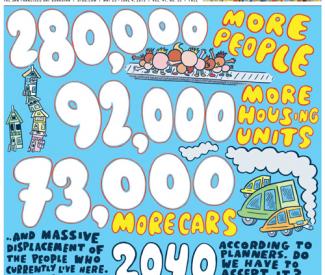
The vision is what environmentalists refer to as “smart growth” — shrinking the footprint of the region’s future development as a more environmentally friendly and geographically efficient pattern to absorb ever-increasing population. San Francisco alone has a very tall order: Our city will absorb 25 percent of new urban development, which equates to 92,000 new housing units and a pace of housing construction averaging around 3,100 units annually (a rate that has been reached only twice over the last 50 years since the era of 1960s urban renewal development).

The question that framed debates through the three-year process in drafting and finally adopting the plan is how that amount of new growth can be “done right;” that is, without gentrifying working class and poor communities and ensuring that infrastructure, including affordable housing and transit service, will keep up with that pace of growth. Tim Redmond’s feature article in the June 4 issue of the Guardian (“Planning for displacement”) and a June 12 forum sponsored by the Guardian, CCHO, and UrbanIDEA very thoroughly laid out the issues and critiques of the Plan Bay Area draft that was released by MTC/ABAG earlier this spring.

With such fundamental flaws when the draft plan was released in April, how did the July 18 adopted final Plan Bay Area fare? First, there is no question this regional “smart growth” plan will make combating gentrification at ground-level harder. But second, the plan could have been worse if not for a tremendous final pushback by progressive advocates from San Francisco and throughout the region loosely united in a “Six Wins for Social Equity” coalition and the committed leadership of a small core of progressive regional leaders — including two of San Francisco’s representatives, David Campos (MTC) and Eric Mar (ABAG) — who championed some final amendments.

Those “wins” (in reality, concessions by MTC/ABAG) achieved in this final push include: adding a public process to develop priorities for the Bay Area’s $3.1 billion share of state cap and trade funding, such as to affordable housing and local transit operations; strengthening the $14 billion transportation block-grant funds program (“OBAG”) to link it directly to local cities’ affordable housing production and displacement-prevention policies; and adding a requirement for MTC to develop a comprehensive strategy to prioritize funding of local transit service and transit maintenance.

Though the details of those amendments are fairly squishy and do not alter the development trajectory of the plan, they are potentially valuable handholds to work with going forward as Plan Bay Area gets implemented (and updated in four years).

That said, San Francisco’s front line working class neighborhoods and communities of color still stand to take the brunt of potential negative impacts from this regional “smart growth” plan. Theoretically they could receive the potential benefits of public infrastructure investments and stimulated economic activity. But while the risks are real, the potential benefits are still illusory.

We must become more engaged if we are to move Plan Bay Area beyond policy statements and promises of future “best-practices” to make sure vulnerable people are not displaced from their neighborhoods in the tide of infill real estate development and are guaranteed a real share of the fruits from “equitable” smart growth.

Under fire again

0

rebecca@sfbg.com

At a recent hearing on San Francisco’s Health Care Security Ordinance — once-controversial legislation that is now in the business community’s crosshairs once again — a nursing student stood at the podium to address members of the Board of Supervisors Neighborhood Services & Safety Committee.

She told them about her mother, who battled illness but did not have access to healthcare for 14 years due to her immigration status, recalling a day when her mother explained why she wasn’t seeking medical attention: “If I go to the hospital, I’ll bury you in debt.”

For the uninsured and undocumented, going without medical care or going into insurmountable debt could be the only options if it weren’t for Healthy San Francisco, a medical services safety net that was created by the HSCO in 2006. The program is expected to continue to provide care for undocumented enrollees who won’t be eligible for federal assistance once the Affordable Care Act, also called Obamacare, takes effect early next year.

The HCSO’s mandate that businesses provide some healthcare coverage for their employees was fiercely opposed by the business community, which challenged it all the way to the US Supreme Court. Now, those same powerful forces are gearing up for a fresh challenge that could jeopardize HCSO’s potential to fill coverage gaps that will be created under Obamacare.

Under federal health care reform, two-thirds of the enrollees in Healthy San Francisco will become ineligible to continue receiving coverage because they will automatically gain eligibility for some form of federal assistance. Those earning up to 138 percent of the federal poverty level will be guaranteed coverage under Medi-Cal. But for low-income earners whose wages hover around $14 an hour, things are far less certain because they will be eligible to enroll in the federally created health benefit exchange, Covered California, although they won’t necessarily be able to afford it. For someone earning around $30,000 per year before taxes, the estimated monthly cost for a health insurance plan under Covered California hovers at more than $200 per month, in many cases making it too much of a stretch.

As things stand, uninsured San Francisco employees who earn too much to qualify for Medi-Cal, but not enough to afford enrollment in Covered California — despite being eligible — can still access funds set aside for them in medical reimbursement accounts under the HCSO. This option may provide enough of a financial boost for low-wage earners to take advantage of federally subsidized health insurance after all.

“For working people, the implementation of the Affordable Care Act actually makes the Health Care Security Ordinance more important,” explains Ian Lewis, research director at UNITE-HERE Local 2. “There are many consequences of the ACA … and the Health Care Security Ordinance is a buffer against them.”

As it stands, the local law “makes Covered California actually work in a high-cost city like ours,” Lewis added.

Under HCSO, San Francisco employers are required to contribute toward employees’ health care on a per-hour basis for each employee working more than eight hours per week, regardless of immigration status or city of residence, amounting to an estimated $255 per participant per month.

This mandate, known as the Employer Spending Requirement, has been the target of multiple lawsuits brought against the city by the Golden Gate Restaurant Association since the landmark health care ordinance, authored by then-Sup. Tom Ammiano, was first enacted in 2006.

That same requirement also makes the local ordinance stronger than the federal law when it comes to worker protections, because the federal mandate only requires employers to offer coverage for workers who put in 30 hours a week or more. That has prompted businesses nationwide to reschedule their workers down to 29 hours per week in a gesture of opposition to health care reform, but no such incentive exists in San Francisco because of the hourly contribution requirement.

Now that federal health care reform is poised for implementation, with enrollment set to begin in October and a transition to the new system slated for early next year, GGRA and the San Francisco Chamber of Commerce are urging the city to open up a new policy dialogue about employer requirements under the local health care law — and Mayor Ed Lee has been receptive.

“We question whether Healthy San Francisco should continue in its current form with the ACA coming in,” Small Business California President Scott Hauge told the San Francisco Business Times (“Healthy San Francisco, related program to shrink dramatically, but not price tag,” July 16). Hauge has met with Jim Lazarus, the Chamber’s senior vice president for public policy, and GGRA Director Rob Black on the issue, the article noted.

Reached by phone, Black emphasized to the Guardian that GGRA employers are merely seeking guidance on how businesses should comply with the local and federal mandates. “It’s important that we really focus on getting together, and getting together quickly,” Black said, to ensure “San Franciscans have access to the full benefits and subsidies of the Affordable Care Act.”

Longtime advocates of Healthy San Francisco and progressive policymakers are watching closely. “They’ve been trying to get out of their responsibility to provide worker’s health care since the law was passed,” Hillary Ronen, a legislative aide for Sup. David Campos, said of business interests who are airing complaints about employer requirements.

Once the federal law takes effect, San Francisco employers will have the option of either providing coverage, or contributing to a city program that establishes medical reimbursement accounts for employees administered by city government, Ronen explained. A third option, “standalone health reimbursement accounts,” under which employers manage reimbursement funds for employees, will be rendered illegal under Obamacare. That system generated controversy in recent years because employers were placing undue restrictions on the use of those funds, and in some cases even pocketing the money after neglecting to inform their workers that it was available (see “Check, please,” 4/23/13).

On July 25, Lee announced that the city’s Universal Health Care Council, a body previously tasked with guiding local health care policy, would be reconvened to “examine San Francisco’s implementation of the Federal Affordable Care Act (ACA) and engage stakeholders in identifying necessary local policies” to support the transition.

In response to signals that the business community is gearing up for a fresh challenge to the city’s health care law using the ACA as ammunition, Campos convened a hearing July 25 to discuss the importance of the HCSO in relation to the federal law.

For several hours, advocates of Healthy San Francisco — many of them members of the immigrant community who would have no other options if it weren’t for the program — delivered passionate defenses of the current program. Campos emphasized that federal health care reform stood to be a great success in combination with the local health care ordinance, which would serve to fill in any gaps in coverage.

Deputy Director of the Department of Public Health Colleen Chawla explained during the hearing that of the 60,000 San Franciscans currently enrolled either in Healthy San Francisco or SF Path, a second medical assistance program, roughly 40,500 will automatically become eligible to enroll either in Medi-Cal or Covered California under federal health care reform come January. The remaining 19,500 won’t be eligible, however, mostly due to immigration status. Healthy San Francisco is expected to continue providing a safety net for those who would otherwise fall through the cracks. But when it comes to the two-thirds who are eligible for federal assistance, but may not be able to actually afford it, things would be thrown into uncertainty if the Employer Spending Requirement were altered or eliminated. “Folks in the business community would be happy to say, the Affordable Care Act is enough, and businesses shouldn’t be complicated with an additional burden,” notes Le Ly, program director at the Chinese Progressive Association. But the HCSO “is an important pillar of the total continuum of care,” he said. “We see it as continuing to complement and strengthen health care coverage.”

After Oscar, after Trayvon…

49

rebecca@sfbg.com

Even before Cephus “Uncle Bobby” Johnson picked up the phone on Feb. 27, 2012, he wasn’t having an easy day. His nephew, Oscar Grant, would have celebrated his 26th birthday on that date if he had not been killed by a gunshot wound on Jan. 1, 2009.

Grant was shot by BART police officer Johannes Mehserle while lying face down on a train platform, an incident that was caught on film, prompted riots in Oakland, drew international scrutiny, and became the subject of the award-winning film Fruitvale Station by Oakland filmmaker Ryan Coogler.

In the years since Grant’s death, Johnson and his wife, Beatrice X, founded the Oscar Grant Foundation to develop a support network for families who’ve lost loved ones due to police violence. It was his involvement in this work that led Johnson to be contacted that day, and informed that a 17-year-old boy named Trayvon Martin had been gunned down in Florida one day earlier.

It wasn’t a police shooting but nevertheless, “We knew at this point that we had to go to Florida,” Johnson recalled. “What we’ve decided is that whenever a family experienced that, we would definitely try and get to them.”

Fast forward to July 13, almost exactly three years after violent protests erupted in Oakland following the news that Mehserle, who was charged with second degree murder, had been convicted of involuntary manslaughter instead. A new wave of demonstrations flared up as word spread that George Zimmerman, the neighborhood watch volunteer who killed Martin, had been acquitted.

“We weren’t surprised,” Johnson, who returned to Florida last month to observe the jury selection process for Zimmerman’s trial, told the Guardian. “But it was still painful.”

The verdict in this high-profile case has brought discussions about racial profiling and unequal treatment in the criminal justice system to the forefront. Even President Barack Obama touched on the theme in comments to White House reporters on July 19, saying, “Trayvon Martin could have been me 35 years ago.”

At the national level, new findings on “implicit bias” — unconscious prejudices that research in psychology has shown can persist in individuals (including poorly trained police officers), even if they consciously reject racial stereotypes — has started to inform policy debates around racial profiling.

“Policy needs to recognize that implicit bias exists,” Maya Wiley, founder and president of the New York City-based Center for Social Inclusion, told us. “Rep. John Conyers introduced a bill last year to prohibit racial profiling in law enforcement. That bill, if made law, would collect data on stops by race, as well as provide resources for training. That is a step in the right direction.”

But things get complicated, Wiley says, because “research shows that people of color, women, the elderly, may all experience discrimination as a result of implicit bias. There is no remedy in the law for this. … I think what is important now is to fight Stand Your Ground Laws which empower people to act on their implicit biases.”

At a July 16 rally held on the steps of San Francisco City Hall, Rev. Malcolm Byrd, pastor of San Francisco’s First A.M.E. Zion Church, illustrated his point about racial profiling by donning a hoodie and sneakers at the rally.

“I wanted to come looking suspicious,” he explained. “I wanted to give you an image that America has of young black men. I look suspicious. This is my country. I love my country. Yet, I look suspicious.”

Last year, Mayor Ed Lee’s proposal to introduce a stop-and-frisk policy, which would have allowed police officers to randomly stop individuals who appeared to be suspicious in an effort to get weapons off the streets, was abandoned in the face of widespread community concern.

Officers who undergo training at the San Francisco Police Department Academy must complete 52 hours of “cultural diversity” training, according to SFPD spokesperson Sgt. Dennis Toomer, which includes a mandatory four-hour intensive geared toward preventing racial profiling. State law mandates just 16 hours for such training for law enforcement agencies, Toomer told us.

But despite supplemental police training and the efforts of grassroots organizations that carefully monitor police activity, the Bay Area has witnessed a number of fatal shootings at the hands of police since Grant’s death, and many draw a link between these cases and the broader issue of racial profiling.

When asked about the outreach efforts of the Oscar Grant Foundation, Johnson began to rattle off a long list of names — mostly young black men, from places ranging from Oakland to Vallejo to Stockton to San Leandro — who were killed by police, and whose families his organization has reached out to.

They have also been in touch with several families in New York City who lost loved ones in similar situations, Johnson said. In many cases, the individuals were killed despite being unarmed, and officers later explained their actions by saying they’d mistakenly believed the shooting victims had firearms.

After several years of taking an up-close look at the investigative and legal proceedings that unfold in the aftermath of officer-involved shootings, Johnson has reached the conclusion that from case to case, “The playbook is pretty much the same. The officer first alleges he felt threatened — it’s all about the thought process of the officer. It’s always found to be justifiable because the officer feared for his life.”

One long-term goal of the Oscar Grant Foundation is to build up a coalition that can mount a meaningful challenge to the California Peace Officers Bill of Rights, a law enacted some 30 years ago that affords special protections for law enforcement officers facing misconduct charges. Johnson and others are critical of provisions such as officers’ rights to keep confidential information out of their personnel files, which can prevent significant information from being disclosed during a criminal trial. Meanwhile, others throughout the Bay Area seem primed to push for change in the wake of the Zimmerman verdict. “On Sunday, every black church in the nation was talking about what? Trayvon Martin, and what we need to do,” Andrea Shorter, a member of the San Francisco Commission on the Status of Women, said during the July 16 rally. “Two weeks ago, and we were all standing here as San Franciscans to rejoice … because we knew that LGBT people could be treated as first class citizens. The job is not done.” San Francisco NAACP President Rev. Amos Brown, who organized the rally, vowed that his organization “will push for a civil suit to bring this Zimmerman gentlemen to justice.” The national NAACP is petitioning U.S. Attorney General Eric Holder to open a civil rights case against Zimmerman. Sups. London Breed, Malia Cohen, Jane Kim, and David Campos also delivered speeches at the rally. “For the first time in my life, after growing up and going to funeral after funeral after funeral after funeral, of all boys and black men throughout my life, I see people in this audience who are not African American, who are just as hurt as I am, who are just as sick of this as I am,” Breed said. “And we are all in this together. We have got to work together if we want to change it.”

Due Process for All ordinance may offer better protection for domestic violence victims

In San Francisco Sup. John Avalos’ District 11, half of all residents were born outside the U.S. In Sup. Jane Kim’s District 6, more than a third of residents are foreign-born, and almost half speak a language other than English.

Given the sizable immigrant population in San Francisco, it may not come as a surprise that Secure Communities (S-Comm), a federal immigration program administered by the U.S. Immigration and Customs Enforcement (ICE), is highly unpopular. What might not be so obvious is how dramatically S-Comm can impact the lives of foreign-born women who are survivors of domestic violence.

The reason for this is simple. “If you are a victim or a survivor of domestic violence and you call the police, you do not want to end up deported,” Beverly Upton of the San Francisco Domestic Violence Consortium explained at a rally this afternoon, where advocates from organizations such as Mujeres Unidas Activas, Causa Justa, the Filipino Community Center and others stood and held banners demonstrating opposition to S-Comm. “We want it to be safer to call the police, not less safe.”

A member of Mujeres Unidas y Activas who introduced herself as Lourdes and spoke through a translator delivered a personal account of feeling fearful of police as well as an abusive partner. “Many times, abusers tell us not to call the police, because the police will not believe us. They say the police will probably deport us.”

The domestic violence and immigrant community advocates were there to champion Avalos’ Due Process for All Ordinance, which is being introduced at today’s Board meeting and is co-sponsored by seven other supervisors, essentially guaranteeing its passage. Avalos himself didn’t speak, and Sups. David Campos and Board President David Chiu, who were co-sponsors of the legislation, sent female staff members to make statements on their behalf as part of the all-female roster of speakers.

The legislation prohibits law enforcement officials from detaining individuals solely in response to immigration detainer requests issued by immigration authorities under S-Comm. As things stand, “the request has been honored in many cases,” Avalos explained in comments to the Guardian, even though California Attorney General Kamala Harris has affirmed that local law enforcement agencies are not obligated to comply with ICE detainers because they are mere “requests” and not legally binding. Since 2010, according to data provided be Avalos’ office, 784 San Franciscans have been deported after being turned over to federal authorities due to ICE detainers.

Sup. Jane Kim called S-Comm “a giant step backward when it comes to equality and fairness,” and added that S-Comm “makes our neighborhoods less safe.” 

Legal Counsel Freya Horne read a statement on behalf of San Francisco Sheriff Ross Mirkarimi, stating that the sheriff has reduced the number of ICE detainers leading to deportations, and was supportive of Avalos’ legislation. She added that Mirkarimi had made it a policy to honor immigration detainer requests only in cases of criminal convictions of serious or violent felonies.

Avalos said he was compelled to move the legislation forward because “I’ve talked to so many people whose families have been separated, and have been devastated,” due to deportations under S-Comm. “We want to make sure we’re maintaining a level of due process,” he added, since the detainer requests are routinely issued without warrants or a requirement to show probable cause.

Chiu becomes City Hall’s go-to guy for solving tough problems

60

At the start of this year, when I wrote a Guardian cover story profile of Sup. Scott Wiener (which SF Weekly and San Francisco Magazine followed shortly thereafter with their own long Wiener profiles), he seemed like the one to watch on the Board of Supervisors, even though I noted at the time that Board President David Chiu was actually the more prolific legislator.

Now, it’s starting to seem like maybe we all focused on the wrong guy, because it is Chiu and his bustling office of top aides that have done most of the heavy legislative lifting this year, finding compromise solutions to some of the most vexing issues facing the city (ironically, even cleaning up some of Wiener’s messes).

The latest example is Wiener’s CEQA reform legislation, which the board is poised to unanimously approve at today’s meeting, a kumbaya moment that belies the opposition and acrimony that accompanied its introduction. Rather than a battle between developers and the coalition of progressives, environmentalists, neighborhood activists, and historic preservationists, Chiu and board aide Judson True transformed the legislation into something that benefited both sides.

[UPDATE: For reactions to this post and another perspective on Chiu, read this.]

That effort comes on the heels of Chiu’s office solving another big, ugly, seemingly intractable fight: the condominium lottery bypass legislation sponsored by Wiener and Sup. Mark Farrell. To solve that one in the face of real estate industry intransigence, Chiu showed a willingness to play hardball and practice a bit of gamesmanship, winning over swing vote Sup. Norman Yee to get six votes using some hostile amendments to the legislation.

In the end, Chiu won enough support to override a possible veto by the waffling Mayor Ed Lee, who has always echoed Chiu’s rhetoric on seeking compromise and consensus and “getting things done,” but who lacks the political skills and willingness to really engage with all sides. For example, it was Chiu — along with Sups. Farrell and David Campos — who spent months forging a true compromise on the hospital projects proposed by California Pacific Medical Center, replacing the truly awful CPMC proposal that Lee readily accepted.

“It’s been a very long year,” Chiu told the Guardian. “It’s been important for me to not just to seek common ground, but legislative solutions that reflect our shared San Francisco values.”

Next, Chiu will wade into another thorny legislative thicket by introducing legislation that will regulate the operations of Airbnb, the online shared housing share corporation whose basic business model often violates local landlord-tenant laws, zoning codes, and lease conditions, in addition to openly defying rulings that it should be paying the city’s transient occupancy tax.      

“This challenge has been particularly difficult,” Chiu told us, referring the many hard-to-solve issues raised by companies such as Airbnb, who Chiu and board aide Amy Chan have been working with for several months. In fact, after originally predicting the legislation would be introduced before the board takes its August recess, Chiu now tells us it may need a bit more time to hammer out the details.

We’ll be watching to see how he sorts through the many tough issues raised by Airbnb’s approach, here and in other big cities with complicated landlord-tenant relations, which I will be exploring in-depth in an upcoming Guardian cover story. But if there’s anyone at City Hall capable of solving this one, it’s probably Chiu.

Street Fight: Plan Bay Area falls short of a worthy goal

20

Last week’s adoption of Plan Bay Area by the Metropolitan Transportation Commission was a watershed moment in regional planning. The plan links regional planning to state policies mandating reductions in greenhouse gas emissions, and aims to limit future sprawl by accommodating 2.1 million people, 1 million jobs, and 660,000 housing units largely within the existing built-up areas of the nine-county region.

Newly designated priority development areas (PDAs) will enable modest-density, walkable development in city and suburb alike, while preserving both existing single-family neighborhoods and open space. In a time of urgent need to address global warming, the Bay Area has once again proved a leader by enabling compact housing around transit, and its supporting studies expect the per capita greenhouse gas emissions from driving to decline by 15 percent in 2040.

This will not save the world and it’s not without some challenging byproducts — such as preventing displacement of low-income residents from San Francisco and other urban centers — but it is a start. And in a nation hell-bent on denying the urgency of global warming, it is refreshing and inspiring that someone, somewhere, is trying to do something.   

Yet the transportation component – the lynchpin and impetus of Plan Bay Area, according to many local leaders –is mediocre, uninspiring, and inadequate.  Despite land use policies enabling compact development, 80 percent of all travel in the Bay Area will still be in cars in 2040, not much different from today, and far short of the real change that is needed in this time of urgency. With 2 million more people, this is a recipe for gridlock, inequity, and ecological disaster – not sound public policy. 

 It should be no surprise that a big part of the problem is funding. The MTC, charged with assessing future regional transit potential, identifies just $289 billion between now and 2040 for roads, bridges, and transit — far short of what’s needed.  At $10.3 billion a year that may seem like a lot, but upwards of 87 percent of this is already committed to maintenance of existing roads and transit– not transit capacity expansion.  New homes and jobs might be focused around BART and Caltrain stations, but because there’s no real capacity expansion, the current iteration of Plan Bay Area can’t even reach its own modest goal of 74 percent of trips by car in 2040. 

With 2 million more people, cumulative emissions from driving will actually increase by 18 percent because so few new residents will be able to squeeze onto our already crowded transit systems.  Today BART is breaking ridership records but it is crowded. Extensions to far flung suburbs might be worthwhile but they don’t expand capacity in the system’s core. What we need is a second BART line and/or Amtrak service between San Francisco and Oakland, but this is absent from the plan. Meanwhile, most mainline Muni buses and railcars are currently jam-packed, yet San Francisco is somehow expected to absorb 92,000 housing units in Plan Bay Area.

Supervisors David Campos and Scott Weiner, representing San Francisco in the Plan Bay Area process, are to be commended for drawing attention to the transit problem and for asking MTC staff to show how to meet future funding gaps. By broaching the subject, they show that San Francisco might be poised to lead on this critical issue. But Campos and Weiner, working within the “fiscally constrained envelope” as framed by MTC planners, were only seeking to cover deficits for existing service – not visionary expanded service.  In the end, there was no real vision for adequate transit capacity expansion.

This foretells a troubling transit future – and one that will likely be more and more private. While many San Franciscans decry the proliferation of Google buses and other private corporate shuttles hogging Muni stops, these buses do lay bare the transit conundrum in the Bay Area. Without well-funded, visionary capacity expansion of public transit, those with the means (and high wage jobs) will shift to private buses while everyone else is left to duke it out on crowded highways, buses, and trains.

This conundrum demands that progressives in the Bay Area ramp up their transit politics to lead locally and nationally. The debate about transit finance needs to be redirected – away from regressive local sales tax measures (which often include more roads) back towards more progressive measures, such as transit assessment districts – which could require developers who profit from Plan Bay Area’s growth incentives to adequately finance transit expansion.

The debate needs to move away from demonizing public transit employees to a discussion of the role and responsibility of corporate health care, banks, and the real estate industry in causing economic instability (which has harmed public transit finance more in the last decade than a bus driver expecting a living wage and healthcare). The debate needs to move away from creating new roadway capacity, such as exclusive toll lanes, and focus on how to convert existing highway lanes into transit-only lanes with fast, frequent, reliable regional bus service open to all.

Plan Bay Area is a living document, a work in progress. Within the next four-five years it will need to be revised and can be improved.  The current version of the plan, weak on transit funding, has been dominated by a loud, irrational mob of Tea Party cranks bent on sabotaging anything that hints of progressive ideas. They were successful in diluting Plan Bay Area. While a smattering of progressive transit activists showed up and attempted to shape the plan, next time the plan needs a broader progressive movement — including housing, social justice, and environmental activists — to demand a truly visionary transportation plan.


Jason Henderson is a geography professor at San Francisco State University and the author of Street Fight: The Politics of Mobility in San Francisco. We’ll be sharing his perspective regularly in the Bay Guardian.

Call to action issued at San Francisco vigil for Trayvon Martin

A group of African American community leaders gathered outside San Francisco City Hall July 16 for a rally and candlelight vigil in memory of Trayvon Martin, the 17-year-old black youth who was gunned down in Sanford, Florida by George Zimmerman. Protests have flared up throughout the nation since Zimmerman was acquitted on a second-degree murder charge this past weekend, spurring renewed dialogue about race.

Rev. Amos Brown, president of the San Francisco NAACP, introduced a host of speakers including pastors from black churches, the San Francisco Interfaith Council, members of the Bayview Hunters Point Community, and others. While speakers touched on a variety of topics including San Francisco’s dwindling black population and the economic pressures facing those unable to find work in an increasingly unaffordable city, much of the discussion revolved around a need to mount a significant challenge against racial profiling and to seek a different outcome in Zimmerman’s case.

The NAACP “will use all of our legal and moral resources at the national level, and will push for a civil suit to bring this Zimmerman gentlemen to justice,” said Brown. The national NAACP has created a petition urging U.S. Attorney General Eric Holder to open a civil rights case against Zimmerman.

Sups. London Breed, Malia Cohen, Jane Kim, and David Campos also delivered speeches at the rally.

“The injustice in Florida is a threat to all of us,” Breed said. “The injustice in Florida is a threat to African American boys. The fact that we have to look our children in the eye and explain why somebody can kill a kid and get away with it and not be charged and walk out of the courtroom a free man, how do you explain that?”

Rev. Malcolm Byrd, pastor of First A.M.E. Zion Church in San Francisco, illustrated his point about racial profiling by wearing a hoodie, jeans, and sneakers to the rally. He opened with comments referencing how Martin was deemed “suspicious” due to his appearance. His comments also alluded to the idea that Zimmerman was allowed to walk free in Florida, the same state where a woman was sentenced to three years in prison for shooting and killing a pit bull.

Despite the very real sense of outrage that many people expressed, some spoke about using the Zimmerman verdict as an opportunity to push for broader social change.

“In San Francisco, we know how to lead the way,” said LGBT activist Andrea Shorter. “On Sunday, every black church in this nation was talking about what? Trayvon Martin.” Shorter added that community members had succeeded in halting a proposal to introduce a stop-and-frisk policing policy that had the potential to increase racial profiling, and that there was momentum in place for a national effort to “dismantle racist profiling policies” and repeal stand-your-ground laws.

“For the first time in my life, after growing up and going to funeral after funeral after funeral after funeral, of all boys and black men throughout my life, I see people in this audience who are not African American, who are just as hurt as I am, who are just as sick of this as I am,” Breed noted. “And we are all in this together. We have got to work together if we want to change it.”

Cohen sounded a similar note. “I think one of the things that have transpired now that the verdict has come out is that there has been a serious call to action,” she said.

“Being black in America is to be the beneficiary of great inheritance,” said Obai Rambo of the San Francisco Black Young Democrats. “History will mark this day as one of the greatest opportunities for building equality and justice.”

Photographs by Justin Benttinen. Audio slideshow by Rebecca Bowe.

Giraudo (and activists) close CPMC deal

18

The takeaway message from a July 11 press conference held in the Mayor’s Office touting legislation authorizing California Pacific Medical Center’s construction of two new San Francisco hospitals was seemingly this: Everyone hearts Lou Giraudo.

A part owner of Boudin Bakery and former president of the San Francisco Police Commission, Giraudo was called in last year to help mediate a deal that seemed doomed when CPMC, city officials, and a coalition of labor and community organizations were unable to hash out an agreement that was acceptable to all sides.

Negotiations have been contentious over the past year due to early indications that CPMC would not guarantee that St. Luke’s, a health care facility relied upon by many low-income San Franciscans, would keep its doors open as a condition of moving forward with the new Cathedral Hill facility, a centerpiece of CPMC’s $2.5 billion project.

Enter Giraudo, who was, according to a not-so-subtle hint dropped by former Mayor Willie Brown in his San Francisco Chronicle column last year, “quietly brought in” by the mayor’s office to fix the half-baked mess that the CPMC deal had evidently devolved into.

Sup. David Campos sang Giraudo’s praises, saying, “I have yet to meet a finer public servant,” and calling Giraudo “a real hero of mine.”

Giraudo himself told the Guardian that his strategy was “to de-politicize the process and get people to think about the community.”

Board President David Chiu, who worked closely with Campos and Sup. Mark Farrell to negotiate with CPMC and other parties on behalf of the Board, went so far as to compare Giraudo to Batman. He even joked that he was going to shine a bat signal the next time a negotiator was needed, in hopes that Giraudo would save the day.

Yet while Giraudo may have provided the catalyst needed for a deal, it was community advocates who ensured that the public at large benefited from the CPMC plan more than they would have otherwise — since the mayor’s office seemed willing to go along with the health care giant’s original terms.

Long before Giraudo’s involvement, a coalition of labor and community organizations waged a campaign to rebuild CPMC “the right way,” holding strong on the issue of St. Lukes and refusing to agree to anything that would leave open the possibility that the hospital, a critically important facility for low-income patients, would be shuttered. “That coalition has been working for quite some time … to save St. Lukes,” Campos said of the diverse coalition of community and labor leaders, who formed under the name San Franciscans for Healthcare, Housing, Jobs and Justice. “It kept working for many years.” Under the terms of the agreement that was ultimately agreed upon, St. Luke’s will have a number of specified services to ensure it remains a full-service hospital, and CPMC will commit to providing services to 30,000 charity care patients and 5,400 Medi-Cal managed care patients per year. CPMC will also contribute $36.5 million to the city’s affordable housing fund, and it will pay $4.1 million to replace the homes it displaces on Cathedral Hill. While many advocates for San Francisco’s most vulnerable populations heralded the deal, some were disheartened that it did not dedicate space for psychiatric care.

A community-based coalition, a trio of supervisors and a very special mediator helped seal CPMC deal

The takeaway message from a July 11 press conference held in the Mayor’s office touting legislation authorizing California Pacific Medical Center’s construction of two new San Francisco hospitals was seemingly this: Everyone hearts Lou Giraudo.

A part owner of Boudin Bakery and former president of the San Francisco Police Commission, Giraudo was called in last year to help mediate a deal that seemed doomed when CPMC, city officials, and a coalition of labor and community organizations were unable to hash out an agreement that was acceptable to all sides.

Negotiations have been contentious over the past year due to early indications that CPMC would not guarantee that St. Luke’s, a health care facility relied upon by many low-income San Franciscans, would keep its doors open as a condition of moving forward with the new Cathedral Hill facility, a centerpiece of CPMC’s $2.5 billion project.

Enter Lou Giraudo, everybody’s favorite public servant who was, according to a not-so-subtle hint dropped by former Mayor Willie Brown in his San Francisco Chronicle column last year, “quietly brought in” by the mayor’s office to fix the half-baked mess that the CPMC deal had evidently devolved into.

“He’s often said he’s just a businessman. A baker, if you will,” Lee said during yesterday’s press conference. But Giraudo came to the table with the right “recipe” and the “main ingredients” for a successful deal, Lee added.

Sup. David Campos also sang Giraudo’s praises, saying, “I have yet to meet a finer public servant,” and calling Giraudo “a real hero of mine.” 

Giraudo himself told the Guardian that his strategy was “to de-politicize the process and get people to think about the community.”

Board President David Chiu, who worked closely with Sups. David Campos and Mark Farrell to negotiate with CPMC and other parties on behalf of the Board, went so far as to compare Giraudo to Batman. He even joked that he was going to shine a bat signal the next time a negotiator was needed, in hopes that Giraudo would save the day.

Presumably, when this happens, Giraudo will dust the flour off his apron after toiling away at some sourdough bread shaped like an alligator, duck into a Boudin Bakery bathroom to squeeze into a superhero costume, strap on his jet pack and take off for the gold-capped dome.

Giraudo may have provided the catalyst needed for a deal, but it was community advocates who ensured that the public at large benefitted from the CPMC plan more than they would have otherwise – since the mayor’s office seemed willing to go along with the health care giant’s original terms.

Long before Giraudo’s involvement, a coalition of labor and community organizations waged a campaign to rebuild CPMC “the right way,” holding strong on the issue of St. Lukes and refusing to agree to anything that would leave open the possibility that the hospital, a critically important facility for low-income patients, would be shuttered.

“That coalition has been working for quite some time … to save St. Lukes,” Campos said yesterday. The diverse coalition of community and labor leaders, who formed under the name San Franciscans for Healthcare, Housing, Jobs and Justice, commissioned studies on the need for health care services for low-income populations, studied housing and transportation impacts, and developed a broad base of support for a better deal than what was originally floated by the healthcare giant. “It kept working for many years,” Campos noted.

Under the terms of the agreement that was ultimately agreed upon, St. Luke’s will have a number of specified services to ensure it remains a full-service hospital, and CPMC will commit to providing services to 30,000 charity care patients and 5,400 Medi-Cal managed care patients per year. CPMC will also contribute $36.5 million to the city’s affordable housing fund, and it will pay $4.1 million to replace the homes it displaces on Cathedral Hill.

But wait, one last thing we’ve just learned about Giraudo: Did you know he also served as chairman at Pabst Brewing Company? The next time you get drunk off PBR while gorging yourself on sourdough baked into the shape of a teddy bear, or for that matter receive emergency medical care at St. Luke’s after an unsuccessful attempt at building a DIY jetpack, you’ll know who to thank.

City College supporters protest state takeover and the agenda behind it

9

By Dalton Amador

Around 350 students, faculty members and other San Franciscans marched from City College’s downtown campus to the U.S. Department of Education Tuesday afternoon to protest the Accrediting Commission for Community and Junior College’s (ACCJC) decision to terminate City College’s accreditation effective July 31, 2014.

The Save CCSF Coalition sponsored the event. “We are not here to mourn, we are here to fight,” Shanell Williams, City College’s newly elected student trustee and one of the leaders of the coalition, told a cheering crowd. “ACCJC is a private, rogue group.”

The coalition sought to convince the Department of Education, which oversees the ACCJC, to immediately reverse the commission’s decision.

Behind Aztec dancers dressed in feathers and loincloths, protesters chanted “No more deception, no more lies, we don’t want to privatize” and held picket signs that read “Stop the corporate overthrow of public education at CCSF” as they marched down Market Street.

The coalition said that revoking City College’s accreditation is part of a systematic effort to undermine affordable education. Eric Blanc, one of the coalition’s leaders and a current City College student, said that the ACCJC’s decision to terminate City College’s accreditation was motivated in part by forcing would-be transfer students to take out student loans for private or for-profit universities.

“It’s clear that from the arbitrary norms the commission is using as its excuse to shut down City College that there is something much bigger going on,” he said. “(Students) are going to go to the University of Phoenix or prison.”

Williams agreed. “Where would I go?” she said, referring to a hypothetical City College student’s hope to transfer to a California State University or University of California campus without first going to a private university.  

City College Board of Trustees members Chris Jackson, Vice President Anita Grier and Rafael Mandelman addressed the crowd in front of the Department of Education.

Grier said that the “democratic process” that elected the Board of Trustees was “replaced by a feudal lord dictator,” referring to the ACCJC-appointed Special Trustee Robert Agrella, who now holds unilateral power over the board following the ACCJC’s decision. He had canceled a meeting scheduled for that day by President John Rizzo.

Supervisors Scott Wiener and David Campos also spoke, both saying that many of their constituents depend on City College. “Where is Ed Lee?” the crowd chanted spontaneously during different speakers’ addresses.

Lee did address the City College situation earlier in the day when he asked about it at the Board of Supervisors meeting, reiterating his previous statements supporting a state takeover. “It’s been a difficult decision and we had been hoping the decision of the accrediting commission would be different,” Lee said, going on to praise California Community College Chancellor Brice Harris, who Lee said, “has agreed to save City College through a state intervention.”

But on the streets, protesters rued the loss of local control and the agenda behind it.

Some independent organizations, not part of the Save CCSF Coalition, participated to show their support. Adam Wood, a firefighter of 18 years, held a sign that said, “San Francisco Firefighters support City College.”

“A lot of aspiring firefighters go through fire academy at City College,” he said. “It would be a real loss if it closed.”

City College will remain open for the following fall and spring semesters. It can ask for a review of the decision to the ACCJC. Should the ACCJC affirm its decisions, the college can appeal. The college would remain open during the appeal process.

So now what?

0

EDITORIAL The scene at City Hall on Friday, June 28 could have been a video rewind of 2004’s Winter of Love: a surprise announcement granting same-sex marriage licenses; a breathless rush of couples to the civic altar, led by two brave, symbolic women (lesbian groundbreakers Del Martin and Phyllis Lyon in 2004 and anti-Prop 8 plaintiffs Kris Perry and Sandy Stier in 2013), a city erupting with good will and cheer, dazed by the speed of luck and history. Earlier, Lt. Gov. Gavin Newsom, teeth and hair and all, was making grand pronouncements, strutting about like he was mayor of the place again.

Back in 2004, the city was scarred and drained from the first great Internet bust, and still reeling from the losses of AIDS. San Francisco was a mess, but it was starting to recover. People who had been forced to move out by the city’s skyrocketing rents and evictions in the early 2000s were beginning to trickle back in, and many of those beached by the boom’s collapse were turning into the very freaks, artists, and innovators they had helped displace. When Newsom launched SF’s same-sex marriage rebellion, it was an act of great civic uplift, burnishing SF’s progressive image in the eyes of the world, while boosting the city’s self-confidence. (Not to mention its economy, which benefited greatly from the wedding explosion.)

The act also burnished Newsom’s own reputation. Previously reviled for his “Care Not Cash” policies that demonized the poor and homeless, a significant percentage of LGBTQ people among them, he was suddenly a posterboy for civil rights. Now of course, San Francisco is supposedly on the arc of an economic boom, skyrocketing evictions included, and not in the dregs of a bust. So it was with a regretful shudder that we noticed some more ominous similarities between 2004 and 2013.

A week before this year’s Pride, and right before the wave of marriage elation overtook the festivities, the city’s homeless census was released. Out of the total count of 6,436 homeless people, a figure emerged that stunned many: 29 percent of 1000 people specifically asked identified themselves as LGBTQ, and it’s assumed that the actual percentage of queer homeless people is in fact higher, due to factors like closeting and mental health. A large portion of LGBTQ homeless are youth, still drawn here by San Francisco’s promise of inclusion and shelter from abusive and rejective backgrounds.

While the city celebrates the achievement of grand ideals of equality, we are failing the very people for whom those ideals may be most valuable. Currently, Dolores Street Services, along with help from Sup. David Campos and the city’s “homeless czar” Bevan Dufty, is working towards the building of a 24-bed shelter specific aimed to service LGBTQ homeless people. But that’s just a drop in the bucket. We need much more.

Now that DOMA has been overturned and Prop. 8 kicked to the curb, there’s a lot of discussion about what the powerful, energized “gay lobby” should take on next. Righting the horrible Supreme Court decision gutting the Voting Rights Act and achieving marriage equality in 37 more states are valiant, necessary goals. But turning toward the actual problems in our own backyard is another imperative.

As the Pride celebration in the Civic Center was winding down on the evening of Sunday, June 30, a group of young women emerged seemingly out of nowhere among the trash-strewn streets and beeping trucks being loaded with the party’s massive detritus. The women quietly dispersed among the leftover crowd, hauling sacks of bread on their shoulders. They made their way toward those lying on the street or huddled in doorways, distributing loaves in a matter-of-fact manner to people in need. It was a perfect reminder of the real spirit of Pride — an inclusivity that benefits all, empowered by actions on a one-to-one, human scale.

From around the Internet: San Franciscans celebrate marriage equality

All around San Francisco yesterday, gay couples, city leaders, and street revelers celebrated the Supreme Court’s rulings striking down Proposition 8 and the Defense of Marriage Act. Here’s a glimpse of the how the city reacted to the news on June 26, as told by San Franciscans who uploaded videos to YouTube (video after the jump):

Our video mashup features (in order of appearance) Jay and Bryan Leffew with their two kids, Daniel and Selena; a crowd reacting with cheers as they attended an early-morning gathering at San Francisco City Hall (video uploaded by Will Kivinski); San Francisco City Attorney Dennis Herrera, Lt. Gov. Gavin Newsom, and District 9 Supervisor David Campos (all featured in a video of the press conference produced by the city); Cindy Sunshine and friends (uploaded by Prana Fitte); and scenes of a street-party celebration in the Castro uploaded by HiWorld798 and Elena Olzark.

Supreme Court same-sex marriage decisions: DOMA invalidated, Prop 8 case dismissed, SF reacts [UPDATED]

27

Watch this space throughout the day for breaking news on the decision and reactions. Tonight there will be a celebration of the Court’s decisions at Castro and Market Streets at 6:30pm. (Join  the Guardian beforehand, 6-9 at the Pilsner in the castro, at its annual pre-Pride event.) 

DOMA INVALIDATED

The Supreme Court released its ruling this morning that the Defense of Marriage Act, which denies federal recognition of same-sex marriage, “is unconstitutional as a deprivation of the equal liberty of persons that is protected by the Fifth Amendment.”

“DOMA singles out a class of persons deemed by a State entitled to recognition and protection to enhance their own liberty,” according to the majority opinion. “DOMA’s principal effect is to identify a subset of state sanctioned marriages and make them unequal.” The Court voted 5-4, with Justice Kennedy, who wrote the majority opinion, as the decisive vote along the usual liberal/conservative lines. You can read the full opinion here

This means that same-sex marriages performed in states that have legalized such marriages will be recognized by federal law.  

PROP 8 DISMISSED ON STANDING

As for Hollingsworth v. Perry, the Prop 8 case, it was dismissed on standing, due to the fact that the State of California refused to defend the case that would uphold Prop 8 (which denied same-sex marriage).That meant private citizens were left to defend a state statute, which was unprecedented, and the Court refused to rule on those grounds.

We have never before upheld the standing of a private party to defend the constitutionality of a state statute when state officials have chosen not to. We decline to do so for the first time here,” the majority Court statement (which broke along the typical 5-4 line) said. That means there is no specific decision from the Court regarding Prop 8, and the previous ruling, by Judge Vaughan Walker and upheld by the Ninth Circuit Court, that invalidated Prop 8 as discriminatory, stands.

This may mean that same-sex marriages in California can resume as early as July.

You can read the full Prop 8 ruling here.

Scene this morrning at SF City Hall, with Mayor Ed Lee and Lt. Gov. Newsom. Photo by Dan Bernal.

[UPDATE] REACTIONS AT CITY HALL

Steven T. Jones reports from SF City Hall:

City Hall was totally packed at 7am when the US Supreme Court convened — tons of journalists, lots of couples, many signs in the crowd. Two screens were set up, one with a live blog from court chamber, the other with the CNN live feed. Huge cheers erupted at 7:11 when the decision was announced striking down DOMA and forcing the federal government to recognize the rights of same-sex married couples.  Then at 7:38, when the Prop 8 statement came down, the room went nuts. 

A moment later, an array of current and former city officials appeared at the top of the City Hall main staircase. Mayor Ed Lee and Lt. Gov. Gavin Newsom escorted a fragile Phyllis Lyon down the stairs — she, along with the late Del Martin, were the first same-sex couple to get legally married in California in 2004 — flanked by the rest of the city family, all with big smiles.

“Welcome to the people’s house of San Francisco,” Mayor Lee said, thanking the crowd “for sharing in this historic moment.”

“It feels good to have love triumph over ignorance,” he said.

At 7:44, City Attorney Dennis Herrera and Chief Deputy City Attorney Terry Stewart, who had been on the City Hall steps addressed reporters’ question on the legal details of the ruling, joined the crew to sustained applause as Lee recognized them. He then introduced Newsom, who in 2004 as San Francisco mayor allowed same-sex marriages to be performed, as “one person who used the power of this office to make history and show his love for the city.”

“San Francisco is not a city of dreamers, but a city of doers,” Newsom said. “Here we don’t just tolerate diversity, we celebrate our diversity.” He thanked Herrera and everyone who contributed to this moment. “It’s people with a true commitment to equality that brought us here.”

Newsom introduced Kate Kendall with the National Center for Lesbian Rights, who has led the coalition of groups that have push for marriage equality. She looked around the crowd and said, “Fuck you, Prop 8!”

The crowd roared, and she said that she had scanned the room for children, and promised to “put a dollar in the swear jar” if necessary. But she said that, “We have lived for too many years under that stigmatizing piece of crap.”

Then Herrera took the podium, turned to Newsom, and said, Now you can say, ‘Whether you like it or not!'” — a joking reference to Newsom’s same-sex marriage rallying cry, which some blamed for boosting the anti-same-sex marriage cause.

“We wouldn’t be here today if it wasn’t for Gavin Newsom’s leadership,” Herrera continued. ““I remember in 2004 when people were saying it was too fast, too soon, too much.”

But today, that long effort has been vindicated, Now, he said, “It’s about changing the hearts and minds of people and educating them.” He also pledged to continue the fight that began here in City Hall more than nine years ago: “We will not rest until we have marriage equality throughout this country.”

Gavin Newsom being interviewed inside City Hall. Photo by Steve Jones

Finally Stewart, who has argued cases related to San Francisco’s stand before both the US and California Supreme Courts, praised both the Prop. 8 and DOMA rulings and the precedents they set. “In the DOMA case decision, the Supreme Court expressed a stong equal protection philosophy…that will help legalize same sex marriage in other states.”

Three members of the Board of Supervisors were also invited by Kendell to address the huge City Hall crowd: Board President David Chiu and Sups. David Campos and Scott Wiener, the only two current supervisors who are gay.

Chiu noted that the bust of slain Sup. Harvey Milk is prominently positioned outside the Board Chambers, a reminder of the long struggle for gay rights that San Franciscans have led. “That work lives on today,” he said.

He added the hope that the work done here will ripple out of across the country because, he said, “As goes San Francisco, so goes California, so goes the rest of the country.”

Campos, an attorney who has long been in a committed relationship, said, “It’s a very emotional moment for those of us who are part of the LGBT community.” He said this Supreme Court ruling is the first time it has really acknowledged “that we are people and we have dignity,” and that the rulings sends a clear message to Congress that legislation like DOMA is unconstitionally discriminatory.

Wiener praised the resilience of the LGBT community, from the early days of enduring the AIDS crisis and fighting for federal support through the current campaign for marriage equality. And he cheered the fact that, “Those marriages that we see under the rotunda [in City Hall] will get a little more diverse.”

11:30 AM UPDATE: Style and substance

While Newsom strutted around like a proud peacock in front of City Hall — clearly the leading man in this epic story with the happy ending, much in demand by the television crews — Herrera and Stewart briefed various reporters on the details of the case that they had just won.

Gavin Newsom outside City Hall. Photo by Steve Jones.

“I wanted a merits ruling, but a standing ruling is a victory too,” Herrera told us, making the distinction between the court ruling that banning same-sex marriage is unconstitutional on the grounds of equal protection under the law — which it did not do — and the 5-4 ruling it did issue: that those who appealed the Ninth Circuit Court ruling invalidating Prop. 8 lack proper legal standing to do so.

The standing ruling leaves same-sex marriage opponents more wiggle room to argue that the ruling might only apply to the couples named in the suit, or in just the counties that took part, which also included Alameda and Los Angeles, positions they were already signaling in press statements.

But Herrera said that he would vigorously contest that kind of challenge, which he considers to be without merit, telling us, “The injunction is not limited in its scope.”

UPDATE: SFPD isn’t worried

Police Chief Greg Suhr, who attended the City Hall event, said the timing on the ruling during Pride Week couldn’t be better. “It’s nice that it all lined up for us,” he told us. “This town is going to rock ‘til the wheels come off.”

Asked whether he has any heightened security concerns about the Pride Parade in the wake of a ruling that is controversial to some, Suhr said that he’s not worried. He said SFPD is now fully staffed and all available personnel working this weekend, although he will try allow many of his gay and lesbian officers to join the celebration if they want.

“We’re going to police what’s likely to be the biggest party this city has ever seen,” Suhr said, adding that his policing philosophy is, “We plan for the worst and hope for the best.”