David Campos

Driving us crazy

209

STREET FIGHT Parking reform is one of the most radically important elements of making San Francisco a more livable and equitable city.

In this geographically constrained city, parking consumes millions of square feet of space that could be used for housing, especially affordable housing in secondary units. Curbside parking in the public right of way impedes plans to make Muni more reliable for hundreds of thousands of transit riders. Parking in new housing and commercial developments generates more car trips on our already congested and polluted streets, slowing Muni further while bullying bicyclists and menacing pedestrians.

Fundamentally, parking is a privatization of the commons, whereby driveway curb cuts and on-street parking hog the public right-of-way in the name of private car storage. The greater public good — such as reducing greenhouse gas emissions and enhancing public safety through bike lanes, wider sidewalks, public green spaces, and transit-first policies — is subsumed to narrow private interests. These are among the many reasons why, for over a decade, parking reform has been a key part of progressive transportation policy.

Yet lately, it has been disappointing to watch progressives, especially on the Board of Supervisors, retreat from that stance. In Potrero Hill and North Mission, a vitriolic reaction has slowed rollout of nationally acclaimed SF Park, which raises revenue for Muni and is a proven sustainable transportation tool. Yet there are murmurings that some progressive supervisors might seek an intervention and placate motorists who believe the public right-of-way is theirs.

On Polk Street, some loud merchants and residents went ballistic when the city and bicycle advocates proposed removing curbside parking to accommodate bicycles. The city, weary of Tea Party-like mobs, ran the other way, tail-between-legs. Progressive supervisors seem to have gone along with the cave-in.

Along Geary, planning for a desperately needed bus rapid transit project drags on. And on. And on. And on. The lollygagging includes bending over backward to placate some drivers who might be slightly inconvenienced by improvements for 50,000 daily bus riders.

One thing that is remarkably disturbing about this backpedaling is that, in an ostensibly progressive city by many measures (civil rights, tolerance, environmentalism), the counterattack is steeped in conservative ideology. That is, conservatives believe that government should require ample and cheap parking, whether in new housing or on the street. This conservative ideology, shared by many car drivers and merchants — and even by some self-professed progressives — is steeped in the idea people still need cars. This despite the evidence that cars are extremely destructive to our environment, socially inequitable, and only seem essential because of poor planning decisions, not human nature.

Progressive backpedaling has become more confusing with the recent debate over 8 Washington, defeated at the polls Nov. 5, and on the same day of a convoluted Board of Supervisors hearing on a proposed car-free housing development at 1050 Valencia. Both of these projects highlight the muddled inconsistency emerging among progressive supervisors.

Enough has been written about how 8 Washington was a symbolic battle for the soul of San Francisco. But during the campaigns, the lack of attention to parking was curious. Notably, progressive-leaning transportation organizations like the San Francisco Bicycle Coalition, Walk SF, and Transform sat out the election despite the project’s excessive 327 underground parking spaces, which violated hard-fought progressive planning efforts to make the waterfront livable. The Council of Community Housing Organizations also sat it out, despite benefitting from the progressive parking policies that 8 Washington violated. It appears that despite their transit-first rhetoric, progressives made a tactical calculation to keep parking out of the campaign.

The progressive victory came with a Faustian bargain which involved ignoring parking. To ensure 8 Washington was defeated, conservative voters were folded into the opposition. Groups like Eastern Neighborhoods United Front (ENUF), the Coalition for San Francisco Neighborhoods, and the Republican Party came out against 8 Washington and yet, ironically, all are opponents of progressive parking reform.

Moving forward, whatever happens at the 8 Washington site must include progressive parking policies. Don’t expect this from the unimaginative leadership at the Port, which speciously demanded the excessive parking. Don’t expect it from the developer, who steadfastly insists that the rich must have parking. And don’t expect conservatives to latch on to a waterfront scheme that is both publicly accessible and genuinely transit-oriented. It is progressives who will need to muster political will for a zero-parking project at the waterfront and set the tone for consensus among the other factions in the waterfront debate.

Meanwhile on the same day 8 Washington went down, 1050 Valencia barely made it out of a tortuous Board of Supervisors hearing in which progressives seemed to be the antagonists. As the first car-free market-rate housing proposal on Valencia under progressive parking reforms, this 12-unit mixed use building seemed an obvious win for progressives. It would be a walkable, bicycle-friendly urban infill mixed-use project with on-site affordable housing, all of which the city needs more of.

Yet since 2010, when the project first went to the Planning Commission, conservative rhetoric has been deployed to stop the project. Significantly, the Liberty Hill Neighborhood Association objected to the transit-oriented characterization of the project. It claimed that the 14 Mission and 49 Mission/Van Ness are filthy, crime-ridden, and unreliable and so 1050 Valencia must have parking.

Unlike progressives, who also decry shortfalls with Muni but propose solutions, the Liberty Hill opponents offered only secession from public transit, insisting on driving in secure armored cocoons instead of addressing Muni reliability, and they also expect free or cheap parking in the public right of way.

You would think that progressives at the Board of Supervisors would see through this thinly veiled bigotry against the 14 and 49 buses. But instead, four self-professed progressive supervisors — John Avalos, David Campos, Jane Kim, and Eric Mar — voted against 1050 Valencia.

They may argue that they were more concerned about the neighboring Marsh Theater, which has concerns about construction noise (and also parking). The noise issue can be worked out, and why the progressive supervisors did not work this out in advance is a mystery. But if you watch the hearing closely, the Marsh basically opposed the development — period — and thus a modest car-free development that included affordable housing at an appropriate location. And so did four progressive supervisors. It’s baffling.

At the end of the day, 1050 Valencia moved forward, barely. But it can still be stopped at the upcoming Board of Appeals hearing. Meanwhile, it’s time for progressives to make a frontal response to the Muni-bashing coming out of Liberty Hill.

The SFMTA is offering a bold and ambitious proposal for these buses on Mission between 13th and Cesar Chavez. This includes a transit-only lane, restricting automobile traffic, rearranging loading zones, and removing curbside parking so that 46,000 daily 14 and 49 passengers have better reliability and less crowding.

This plan will make life easier for San Franciscans who rely on these buses, but will require progressive supervisors to openly and sincerely advocate for removal of on-street parking, to support SF Park, and push for car-free housing development in the Mission, rather than knee-jerk posturing for a few political points in future elections. Progressives, stop screwing around.

Street Fight is a monthly column by Jason Henderson, an urban geography professor at San Francisco State University.

UPDATED: Board narrowly approves closing city parks at night

44

The San Francisco Board of Supervisors today narrowly approved Sup. Scott Wiener’s legislation to close parks and large plazas from midnight to 5am, a measure that Wiener said was about preventing vandalism but which progressive activists called an attack on the homeless.

The vote was 6-5, with Sups. John Avalos, London Breed, David Campos, Jane Kim, and Eric Mar voting against the proposal. The key swing votes in the decision were Breed — who wrote an op-ed for this week’s Guardian (posting soon) explaining her position — and Sup. Norman Yee, who was elected last year in Dist. 7 with progressive support.

To address the homeless issue, Kim asked for an amendment to make an exception for sleeping in the parks. Without the amendment, “we are criminalizing poverty and issuing fines people will never pay, and not getting the results we wanted,” she said. 

Hundreds of homeless lay their heads to rest in the parks of San Francisco every night as the city struggles to meet housing demand, which is already illegal under city law. Kim’s amendment says those sleeping in parks are to be cited under previously existing codes against sleeping in parks and not double-fined under this ordinance. Wiener supported the amendment and it was inserted into the legislation, although that didn’t end the debate over the legislation or win over its main opponents.

As the legislation was first introduced, Wiener made the argument he’s made many times before. Closing the parks at night is about vandalism, he said. 

“We need to establish a clear baseline that establishes hours for the park to combat vandalism and dumping,” Sup. Scott Wiener told the board. He made the case that most major cities in the U.S. have laws closing their parks and playgrounds at night, and that even New York City had them on the books.

Wiener also directly and flatly denied that his legislation was an attack on the homeless. 

“If the police wanted to remove people sleeping and camping in parks, they already have the tools to do that. This legislation does not give them those tools beyond what they have,” he said. 

But opponents of the measure, who have been organizing against it for weeks, said it will target the homeless and be selectively enforced. As Mar said at the hearing, “I think this is a really mean-spirited ordinance.”

And that’s when the avalanche of arguments began. Campos, Mar, Avalos, and Kim all  passionately defended the homeless that sleep in the parks. But no one brought more facts to the argument than Breed.

“We have 1,339 shelter beds and 6,000 people in San Francisco with nowhere to sleep,” she said. “I’ve been told again and again this will not target the homeless. But if it doesn’t target the homeless or the investment banker or the firefighter, who will this law target? Suspicious looking people in hoods? Teenagers?” 

The room took on a chill as she evoked echoes of Trayvon Martin and others who have been selectively targeted in the name of justice. Enforcement was her next bone of contention. There are only a handful of park police, often only two, that patrol over 220 parks in San Francisco, she said. 

If the ordinance is supposed to combat vandalism, it doesn’t even do that effectively, she said to the board: “We don’t have a legislative problem, we have an enforcement problem.”

To that end, Yee amended Wiener’s proposal to identify more funding for the park police. Everyone on all sides of the argument acknowledged that two to three officers to cover over 4,000 acres of San Francisco parks was woefully inadequate. 

It’s still unclear where that funding will come from, and how much it will be. 

After the meeting the Guardian asked Police Chief Greg Suhr, who was present for the meeting, if the homeless would be targeted under the ordinance.

“We’re not that Police Department,” he said. But he also said the controversial Sit/Lie Ordinance doesn’t target homeless people either, a claim that homeless advocates would dispute. “We’re a reasonable suspicion detention department.” 

An audio interview with Police Chief Greg Suhr just after the park closure legislation passed, where we asked Suhr, “Will the homeless be targeted?”

Tom Temprano, president of the Harvey Milk LGBT Democratic Club, disagreed. 

“I think that anyone who tells you the homeless will not be targeted in legislation that closes our parks at night are lying to you. There’s no other way to read this legislation,” he said. Temprano was one of the lead organizers of the sleep-in protest of the ordinance, which we previously covered.

When we asked if the ordinance would spur increased law enforcement in the parks, Suhr referred us elsewhere. 

“I leave the deployments to the station captains… certainly [the captains] have a pulse on what’s going on in the parks,” he said. 

So we called Captain Greg Corrales at Park Station, which oversees one of the most populous sections of Golden Gate Park, filled to the brim with campers. Corrales told us he didn’t imagine this ordinance would spur him to increase patrols or enforcement.

“There will not be more officers. The hours of the park have been posted on signs in the park, and past closing time people were cited for failure to abide by the signs,” he said. 

They cite 10-20 people for sleeping in the park per night, he said. As Kim noted, often these don’t lead to any prosecutions at all. 

But as for vandalism, Corrales said that there was recently a vandal throwing rocks through the windows of the Conservatory of Flowers and McLaren Lodge in Golden Gate Park. Would the ordinance help curb people from that kind of behavior?

“We’re already enforcing park closure,” he said. “It really doesn’t have much impact on us.” 


Red herring or not, park closure vote delayed while supes seek police input

26

There is only one police chief in this town, and no law regarding the usage of public parks shall pass without him. Or so they said yesterday when Sup. Scott Wiener continued for a week consideration by the Board of Supervisors of his controversial proposal to close the city’s parks and plazas at night.

Wiener – champion of the legislation that homeless advocates say specifically target the City’s homeless population — motioned for continuance on the hotly contested agenda item after Police Chief Greg Suhr was unavailable to discuss how the measure might be enforced. The motion was seconded by Sup. Malia Cohen and passed without objection. 

But the continuance request means that Wiener will have to deal with what he calls an “epidemic of vandalism” for another week as well. The legislation would amend the “Park Code to establish hours of operation for City parks from 5am to midnight, with certain exceptions; and make environmental findings.” 

“It’s long been illegal to sleep or camp in parks,” said Sup. Wiener. “[Police] don’t need another law.” 

“This. Is. About. Vandalism,” Recreation and Parks Department General Manager Phil Ginsburg told the Guardian. “The homeless won’t be thrown out. The laws are already on the books, man.”

And while Wiener and those in the RPD have continued their insistence that that the legislation was written explicitly to target late-night vandalism, illegal dumping, and other nefarious activities not related to homelessness, opposition to the legislation say it’s “red herring” legislation that, on its face, claims to combat vandalism, but underneath is actually a bill targeting the homeless.

Wiener disagrees with this stance, however, and actually called the argument made by the legislation’s opposition — that the bill is a “red herring” ostensibly aimed at vandalism, but that really targets the homeless — a “red herring” as well. A red herring, historically, is a distraction. It’s a Trojan Horse, a magician’s assistant, a tool designed to confuse and obfuscate actual information or intent. 

It is a term that first found a foothold in the hunting world, but made it’s transcendental leap into the world of politics. Politicians have employed the use of “red herrings” in the past. But why would a group called the Coalition on Homelessness actually support vandalism, as the supervisor’s “red herring” comments would suggest?

When this fact was pointed out, Wiener told the Guardian that he “wasn’t going to speculate.” (And neither will we, at least as to why the supervisor chose to use the phrase “red herring” to describe the COH’s argument in the first place.)

But regardless of rhetoric, next week’s vote promises to be close. COH Executive Director Jennifer Friedenbach told the Guardian last week that she had the support of the four most progressive supervisors — John Avalos, Jane Kim, David Campos and Eric Mar — and needed just two of the three swing votes to shoot down the legislation. Those three undecided votes rest in the hands of Sups. London Breed, Katy Tang and Norman Yee.

“This is going to be a close vote,” said Wiener.

But a vote that will have to wait a week.


Homeless advocates fight Wiener on park closures

83

The Coalition on Homelessness has launched a campaign to defeat Sup. Scott Wiener’s legislation to close down all city parks and most major plazas from midnight to 5am, which the Board of Supervisors is set to consider on Oct. 29. Activists are targeting three swing votes who could decide the controversial issue: Sups. London Breed, Norman Yee, and Katy Tang.

In an email blast to supporters, COH urged people to contact those three supervisors to raise their concerns, even suggesting a script that includes these arguments, “It further eliminates access to public space for all, it will displace homeless people, and is a waste of city funds.” [UPDATE: To protest the proposal, the Harvey Milk LGBT Democratic Club is hosting a “sleep-in” protest at Dolores Park tonight (Mon/28) starting at 9pm.]

COH Executive Director Jennifer Friedenbach told the Guardian that she has the support of the four most progressive supervisors — John Avalos, David Campos, Jane Kim, and Eric Mar — and that she just needs two of the three swing votes that COH is targeting to kill the measure outright and avoid the kind of compromise that has become Board President David Chiu’s specialty this year.

She said the measure would be particularly harmful to the homeless LGBT community and other vulnerable populations that seek refuge at night in Golden Gate Park and other hidden spots, but that it’s bad for everyone. “It forces them out into the storefronts and streets and neighborhoods and nobody will be happy with that,” she said.

Wiener denies that the measure is aimed at the homeless, telling the Guardian that his intent is to address graffiti, illegal dumping, and damage done to park facilities overnight. “We’ve had an epidemic of vandalism in our parks and it’s getting worse,” Wiener told us. “It’s a significant problem and it absolutely degrades people’s ability to use the parks.”

Friedenbach said she appreciates that Wiener isn’t aiming his rhetoric at the homeless, even though she said that’s who will be most effected by it.

“It’s great in terms of not bashing homeless people, but we know every time something like this comes up, it increases public anger toward homeless people,” she told. And she notes that the measure is being trumpeted by people who do want to use it to go after the homeless, including Mayor Ed Lee, who went off script last month and told the Examiner that he hopes the measure will be a tool to clear the homeless from Golden Gate Park.

“The mayor said it was a great idea because we need to get the homeless people out of the park,” Friedenbach told us, noting also that, “Wiener has had a thing of going after homeless people.”

Wiener denies that this is about the homeless, and he responded to Lee’s comments by telling us, “I can’t speak for anyone else.” He also said that it’s already illegal to sleep in the parks and “to the extent the police want to do sweeps in the parks, they can already do so.”

The measure would apply the closing hours to all property controlled by the Recreation and Parks Department, which includes every city park and the city’s largest plazas, including Civic Center Plaza, Justin Herman Plaza, and Union Square.

“One thing people don’t think about is this also applies to the plazas,” Friedenbach told us. “A lot of our plazas are hangout spots late at night, and there’s no reason they shouldn’t be.”

Wiener said that small plazas, such as Harvey Milk and Jane Warner plazas in the Castro, aren’t under RPD jurisdiction and therefore aren’t effected by his legislation. And he said the ordinance was already modified to allow people to walk through the affected plazas without stopping, and that he’s open to further amendments.

As for his chances of success in the face COH’s activism on the issue, he told us, “I’m not sure what’s going to happen on the 29th.”

Supes approve funding request for jail construction

“A Costco warehouse with metal bunk beds” is how Matt Freeman of the San Francisco Sheriff’s Department described one of the county’s outmoded jail facilities, speaking at a meeting in City Hall today (Tue/22). At its meeting, San Francisco Board of Supervisors cleared the way for the Sheriff and the Department of Public Works to request $80 million in state funding to be put toward the construction of a modernized jail.

The new facility would replace seismically vulnerable 1950s era jails that are slated for demolition as part of a larger Hall of Justice overhaul. However, some supervisors voiced reservations about the plan.

As the Guardian recently reported, plans for the $290 million jail rebuild have drawn criticism from community advocates who question the use of resources that could be spent on programs to help people stay out of the criminal justice system.

Sup. Eric Mar, who refused to endorse the grant application at a recent Budget & Finance Committee meeting, piped up at the beginning of this meeting to say he’d had a change of heart. Evidently, Sheriff Ross Mirkarimi and some others from the Sheriff’s Department took him on a tour of the San Bruno jail, the county’s most modern facility, to show him the difference between an outmoded jail and one designed with rehabilitative programming in mind.

“I see now that the need is really critical, for safety for inmates but also … a seismically safe and modern jail,” Mar said. “I’m convinced now that it’s really about … supporting anti-recidivism and rehabilitation programs. I really appreciate the sheriff and his staff for opening my eyes.”

But Sup. David Campos was not yet entirely sold on the need for a new jail. “I am not in a position to say that I support the building of this facility,” he said, but said he could be open the possibility after studying the details. “I do acknowledge that I have a bias – I would rather spend less money building a jail than building other things that I think are better investments for our city. That’s not to say I don’t want the jail population to be taken care of. I clearly do.” His office has requested a hearing on this topic, which will be held in early December.

Sup. John Avalos said he too had found it “difficult to support a jail altogether,” but noted that a debate on that decision would come at a later time. “This is just making sure that we have an opportunity to receive state funding if we decide to rebuild,” he said.

In the end, the request to submit an $80 million grant application for state funding was approved without opposition. But the preliminary discussion suggests that a broader debate over San Francisco’s jail rebuild is on the horizon, and it’s an issue where typical political allies won’t necessarily see eye-to-eye. At the same time, it’s a big financial commitment. According to City Controller Ben Rosenfield, the total cost could be in excess of $500 million after financing is factored in.

Homeless advocates fight Wiener’s effort to close parks at night

135

The Coalition on Homelessness has launched a campaign to defeat Sup. Scott Wiener’s legislation to close down all city parks and most major plazas from midnight to 5am, which the Board of Supervisors is set to consider on Oct. 29. Activists are targeting three swing votes who could decide the controversial issue: Sups. London Breed, Norman Yee, and Katy Tang.

In an email blast to supporters, COH urged people to contact those three supervisors to raise their concerns, even suggesting a script that includes these arguments, “It further eliminates access to public space for all, it will displace homeless people, and is a waste of city funds.”

COH Executive Director Jennifer Friedenbach told the Guardian that she has the support of the four most progressive supervisors — John Avalos, David Campos, Jane Kim, and Eric Mar — and that she just needs two of the three swing votes that COH is targetting to kill the measure outright and avoid the kind of compromise that has become Board President David Chiu’s specialty this year.

She said the measure would be particularly harmful to the homeless LGBT community and other vulnerable populations that seek refuge at night in Golden Gate Park and other hidden spots, but that it’s bad for everyone. “It forces them out into the storefronts and streets and neighborhoods and nobody will be happy with that,” she said.

Wiener denies that the measure is aimed at the homeless, telling the Guardian that his intent is to address graffiti, illegal dumping, and damage done to park facilities overnight. “We’ve had an epidemic of vandalism in our parks and it’s getting worse,” Wiener told us. “It’s a significant problem and it absolutely degrades people’s ability to use the parks.”

Friedenbach said she appreciates that Wiener isn’t aiming his rhetoric at the homeless, even though she said that’s who will be most effected by it.

“It’s great in terms of not bashing homeless people, but we know everytime something like this comes up, it increases public anger toward homeless people,” she told. And she notes that the measure is being trumpeted by people who do want to use it to go after the homeless, including Mayor Ed Lee, who went off script last month and told the Examiner that he hopes the measure will be a tool to clear the homeless from Golden Gate Park.

“The mayor said it was a great idea because we need to get the homeless people out of the park,” Friedenbach told us, noting also that, “Wiener has had a thing of going after homeless people.”

Wiener denies that this is about the homeless, and he responded to Lee’s comments by telling us, “I can’t speak for anyone else.” He also said that it’s already illegal to sleep in the parks and “to the extent the police want to do sweeps in the parks, they can already do so.”

The measure would apply the closing hours to all property controlled by the Recreation and Parks Department, which includes every city park and the city’s largest plazas, including Civic Center Plaza, Justin Herman Plaza, and Union Square.

“One thing people don’t think about is this also applies to the plazas,” Friedenbach told us. “A lot of our plazas are hangout spots late at night, and there’s no reason they shouldn’t be.”

Wiener said that small plazas, such as Harvey Milk and Jane Warner plazas in the Castro, aren’t under RPD jurisdiction and therefore aren’t effected by his legislation. And he said the ordinance was already modified to allow people to walk through the affected plazas without stopping, and that he’s open to further amendments.

As for his chances of success in the face COH’s activism on the issue, he told us, “I’m not sure what’s going to happen on the 29th.”

BEST OF THE BAY 2013: LOCAL HEROES

0

Bruce Brugmann, Jean Dibble, and Tim Redmond

The San Francisco Bay Guardian — which has had a significant impact on the Bay Area’s cultural and political dynamics and dialogue over the last 47 years — was largely the creation of three people with complementary skills and perspectives, an amalgam that gave the Guardian its voice and longevity.

Although they are no longer involved with running the paper, we’re honoring their contribution and legacy with a form of recognition they created: a Local Hero Award in our Best of the Bay issue, an annual edition that has been adopted by almost every alt-weekly in the country.

Bruce Brugmann and Jean Dibble launched the Guardian in October 1966 after years of planning by the married couple, and they ran it as co-publishers until the paper’s sale to the San Francisco Newspaper Co. last year, with Dibble running the business side and Brugmann in charge of editorial and serving as its most public face.

“We were one of the few husband and wife newspaper teams, a real mom and pop operation,” Brugmann told us. “We couldn’t have done it without the two of us, we needed both of our skill sets.”

They met in 1956 at the University of Nebraska, where Brugmann studied journalism and served as editor of the Daily Nebraskan, starting his long career as journalistic rabble-rouser. Dibble studied business, which she would continue in graduate school at Harvard University’s Radcliffe College while Brugmann got a master’s in journalism at Columbia University.

As graduation neared, they started talking about forming a newspaper together, an idea that percolated while Brugmann served in the US Army, where he wrote for Stars and Stripes, and Dibble moved to San Francisco with their two kids to work in personnel and administrative positions.

After the Army, they settled in Wisconsin, where Brugmann worked as a reporter for the Milwaukee Journal before moving to the Bay Area to work on launching the Guardian while Brugmann supported the family working for the Redwood City Tribune.

“We came out here with the idea of doing it and we immediately started planning. Jean did the prospectus, a damn good prospectus,” Brugmann said.

The Guardian published sporadically in the beginning, but it tapped into a vibrant counterculture that was clashing with the establishment and began publishing important articles highlighting inequities in the Vietnam War draft and exposing local political scandals, including how Pacific Gas & Electric illegally acquired its energy monopoly.

“A lot of it was just keep your head down and keep going,” Dibble said. “We never talked about alternatives, it was just what we were going to do.” The Guardian covered the successful revolts against new freeways in the city and plans to build Manhattan-style skyscrapers, publishing the book The Ultimate Highrise in 1971. In the mid-’70s, the Guardian won a successful unfair competition lawsuit against the Chronicle and the Examiner over their joint operating agreement, allowing the paper to become a free newsweekly. “Eventually, things got better, and we got some large advertisers in the ’80s and they really helped kick us off,” Dibble said. That was also when Tim Redmond, a journalist and activist steeped in radical politics, started writing for the Guardian, going on to serve as the paper’s executive editor and guiding voice for more than 30 years. “Tim was always more radical than I was,” Brugmann said, giving Redmond credit for the Guardian’s groundbreaking coverage of tenant, environmental, and economic justice issues. “Every publisher needs an editor who was more radical than they are to push them.” The two journalists had a prolific partnership, mentoring a string of journalists who would go on to national acclaim, turning the Guardian into a model for alt-weeklies across the country, exposing myriad scandals and emerging arts and cultural trends, and helping to write and pass the nation’s strongest local Sunshine Ordinance. “We always wanted to make things better,” Brugmann said of what drove the Guardian. “Even the battles that we lost, we got major concessions. Yerba Buena is much better because of the stories we did at the time, same thing with Mission Bay…San Francisco is much better that we were here. And we’re really proud and we appreciate the work of the current Guardian staff in keeping the Guardian flame alive.”


LOCAL HEROES: Kate Kendell

The night Proposition 8 passed was one of the hardest of Kate Kendell’s life. She remembers it with startling detail — and she should, because she was one of the most prominent opponents of the measure to overturn marriage equality in California.

“I was hopeful right up until the end that Prop. 8 would be defeated,” she said, speaking slowly as she pulled her thoughts from what sounded like a dark place. “Our initial polling numbers said we’d probably lose, but I really hoped in the deepest heart of my heart that when people got in there that they’d punch their vote in favor of the person they knew.”

But as the voters of California showed in that 2008 election, sometimes the good guys lose.

Kendell, executive director of the National Center for Lesbian Rights, fought the good fight since she started there in 1994. The NCLR litigates, creates policy, and performs outreach for LGBT civil rights on a national level, with headquarters in San Francisco. After years of anticipation, she poured herself into the campaign against the proposition that would make her marriage illegal, and then the measure passed.

That night she hung her head in disbelief. She felt physically ill, and her mind roiled in grief equaled only by the death of one of her parents. “It felt like that,” she said.

Kendell and her wife, Sandy, went home without speaking a word, and when she got in the door she tried to pull it together. Steeling herself to face her family, Kendell walked out of the bathroom and burst into tears. Her son said simply “this just means we have to fight more.”

So she did, and we all won.

That led to the moment for which Kendell may be remembered for a long time to come. When Prop. 8 was overturned by the US Supreme Court this year, a flock of San Francisco politicians descended the steps inside the rotunda at City Hall. Kendell took to the podium and spoke to the nation.

“My name is Kate Kendell with the National Center for Lesbian Rights,” she said, “and fuck you, Prop. 8!” The crowd erupted into cheers.

She regrets saying it now, but history will likely forgive her for being human. For someone whose own marriage’s validity was threatened and who spent two decades fighting for equality, she earned a moment of embarrassing honesty.

Kendell’s infamous declaration may be how she’s known, but one of her key decisions behind the scenes shaped the LGBT equality movement as well. When then-Mayor Gavin Newsom’s administration wanted a couple to be the first in his round of renegade gay marriages in 2004, it was Kendell who suggested Del Martin and Phyllis Lyon.

The two were in a relationship since 1953, pioneers of LGBT activism in San Francisco. Kendell said it was only right that they were first to read their vows in the city they helped shape. “Were it not for their contributions, visibility, and courage in the ’50s and ’60s, we wouldn’t be in that room with Newsom contemplating marriage licenses,” she said. “I’m just happy they said yes. It was absolutely appropriate.” And it’s with that sense of history that she herself pioneers forward, pushing in states across the US what Harvey Milk fought for in California — workplace protections for the LGBT community. “In 38 states, you can be fired from your job or being lesbian, gay, bisexual, or transgender. That has to change,” she said. “When the next chapter of history is written, it will be about a nation that treats the LGBT community as equals.”


Theo Ellington

Last year, when San Francisco Mayor Ed Lee floated the idea of implementing stop-and-frisk, a practice that many civil rights advocates say amounts to racial profiling, Theo Ellington stepped up to create a Change.org petition to oppose the idea — and won.

The policy would have given San Francisco police officers the authority to stop and search any individual who “looks suspicious,” in an effort to get guns off the streets.

“I found it was basically a predatory policing practice that didn’t belong in a city like San Francisco,” Ellington told us. His petition garnered a little more than 2,300 signatures, “enough to show policymakers we were paying attention,” he guesses. Faced with mounting pressure and a community outcry, Lee ultimately abandoned the idea.

“That was a win, I think, for everyone fighting for what’s really a civil right,” the 25-year-old, native San Franciscan told us in a recent phone interview. “It’s not a black issue or a white issue,” but it did strike a nerve and provide Ellington with some momentum for coalition building.

Ellington was born and raised in San Francisco’s Bayview Hunters Point neighborhood, home to a significant portion of the city’s dwindling black population. The campaign against stop-and-frisk helped catalyze his still-evolving political organization, the Black Young Democrats of San Francisco, of which he is president.

Go to BYDSF’s website and you’re confronted with some startling statistics about the experience of black San Franciscans: In the last 20 years, the African American community has dwindled to only 6 percent of the city’s population; meanwhile, the high school dropout rate stands at 38 percent, the unemployment rate is 18 percent, and the level of poverty stands at a disheartening 20 percent.

To tackle these looming challenges, BYDSF now faces the hurdle of getting local elected officials to care. “Since then, we have been trying to build our membership and figure out where we fit in the political climate of SF,” Ellington says.

His group’s chief concerns include closing the achievement gap in San Francisco public schools, doing something about the escalating cost of housing, and finding better solutions for public transit. “There’s the housing need, obviously. It’s a need that working class folks in general are facing,” he said.

He’s pursing a master’s degree in urban affairs at the University of San Francisco, and says he’s taken it upon himself to learn everything he can about how cities operate. To that end, he often ponders vexing questions: “How do you figure out a way to give those same opportunities to everyone? How do you provide opportunities for all income levels?”

His successful opposition campaign to stop-and-frisk didn’t stop Mayor Lee from appointing him to the Commission on Community Investment and Infrastructure, which oversees the successor to the San Francisco Redevelopment Agency. A major project under that body’s purview is the Hunters Point Shipyard development, a massive undertaking led by construction firm Lennar Urban, practically in Ellington’s backyard. Having grown up in the neighborhood, he sees himself as being in a unique position to ensure that the developers are providing jobs for local residents as required under the agreement. “It allows me to speak to both sides — on the community level, and in City Hall,” he said. “There are certain social dynamics you won’t understand unless you have lived in the community.” Ultimately, Ellington says, his goal is to push local politicians to find ways of making San Francisco a place where people of all income levels can find their way. “There’s a lot more work to do,” he said. “I think San Francisco is at a real pivotal point, where we can choose to go in the right direction … or we can choose the opposite.”


LOCAL HEROES: Shanell Williams

Shanell Williams is a chameleon activist, spearheading the effort to save City College of San Francisco from many fronts.

When City College fought off a statewide initiative to save money by stigmatizing struggling students, she defended the school as an Occupy activist. With a banner raised high, she faced down the California Community College Board of Governors, shouting their wrongs aloud at a meeting attended by hundreds. The board was stunned but her fellow activists were not, because that’s who Williams is: an uncompromising defender of San Francisco.

Now, as City College faces a fight for its existence, Williams is defending it again, this time as a duly elected CCSF student trustee.

Williams is at the forefront of Save CCSF, an Occupy-inspired group publicly protesting the Accrediting Commission of Community and Junior Colleges, the body trying to shut down City College. San Francisco is holding its breath until next July to hear if the accrediting commission will close the city’s only community college — and Williams was one of the key organizers helping students’ voices rise up to decry the decision to close the school.

She has reason to fight hard, growing up watching her community ravaged by those in power who purported to do good. She is a black woman and San Francisco native raised in the Fillmore and the long history of redevelopment and its role in the flight of The City’s African American population shaped her ethos. To Williams, there are forces that care about money at the expense of communities and those forces need to be fought.

“How are we supporting people to have a decent quality of life?” she said, and that’s the way she’s approached saving her community since a young age.

In 2003, while in high school, Williams got a taste of politicking as a member of San Francisco’s Youth Commission, appointed by then-Mayor Willie Brown. “I think he’s a very interesting character with a lot of influence over the city,” she said, with just an edge of steel to her voice.

As a teenaged politician, she discovered the work of the Human Rights Commission and was inspired. While a student of Washington High School and then Wallenberg High, she had a tough home life and entered the foster care system, getting a firsthand look at how the state takes care of its youth.

It galvanized her, honed her, and made her yearn for change. “I just innately had a sense of wanting to see justice and fairness,” she said.

Energized, she joined the Center for Young Women’s Development, the Youth Treatment Education Court, Urban Services YMCA, the Youth Leadership Institute, and more. She joined so many organizations and taught so many youth and government officials that even she can’t remember all of them off the top of her head.

At one point, she even taught judges across the country about cultural competency. “We had this whole spoken word performance thing we did,” she said, laughing.

In 2010, as Williams took classes at City College, she waved the banner defending San Francisco’s community college students. She pushed for city-level minimum wage requirements for City College workers, who earned dollars less. She also pushed back against state requirements to cut off priority registrations to those who took too long in the community college system — because she’s been there herself.

“They need a few chances to get it right and become a good student,” she said. When the struggle to save City College is done, win or lose, Williams sees herself remaining an advocate for students for years to come. At 29 years old, she’s still a student herself, and she eagerly awaits the day she’ll transfer to Cal or Stanford as an Urban Studies major. It all comes back to defending her city. “We have to broaden the movement,” she said. “The enemy is not about color, it’s about wealth inequality. It’s not just about City College either. It’s about the austerity regime that doesn’t care about working class people and poor folks.”


San Franciscans for Healthcare, Jobs, and Justice

When the San Francisco Mayor’s Office cut a deal with Sutter Health and its California Pacific Medical Center affiliate for an ambitious rebuild of hospital facilities — which would shape healthcare services in San Francisco for years to come — community activists began to find serious flaws in the proposal.

So they organized and banded together into a coalition to challenge the powerful players pushing the plan, eventually helping to hash out a better agreement that would benefit all San Franciscans. Representing an alliance between labor and community advocates, the coalition was called San Franciscans for Healthcare, Jobs, and Justice.

When the whole affair began, it seemed as if the CPMC rebuild would incorporate a host of community benefits — but those promises evaporated after the healthcare provider walked away from the negotiating table, unhappy with the terms.

Then a second agreement, with much weaker public benefits, came out of a second round of talks between CPMC and the Mayor’s Office. But by then, so much had been given up that “we were stunned,” said Calvin Welch, who joined the coalition on behalf of the Council of Community Housing Organizations. “We met with [Mayor Ed Lee] and told him, this is absolutely unacceptable.”

But the mayor wasn’t willing to address their concerns at that time. When the deal failed to win approval after a series of hearings at the Board of Supervisors, however, “the unacceptable deal that the mayor created melted in the sun of full disclosure,” Welch said.

That plan would have allowed St. Luke’s Hospital, a critically important facility for low-income patients, to shrink to just 80 beds with no guarantee that it would stay open in the long run. CPMC’s commitment to providing charitable care to the uninsured was disappointingly low. And while the project was expected to create 1,500 permanent jobs in San Francisco, the deal only guaranteed that 5 percent of those positions would go to existing San Francisco residents.

Enter the movers and shakers with San Franciscans for Healthcare, Housing, Jobs, and Justice. The coalition took its place at the negotiating table, along with CPMC, a mediator, and an unlikely trio of supervisors that included Board President David Chiu and Sups. David Campos and Mark Farrell. Over several months, the coalition put in some serious time and energy to push for a more equitable outcome.

“We pushed so hard for a smaller Cathedral Hill [Hospital] and a larger St. Luke’s,” Welch said, describing their strategy to safeguard against the closure of St. Luke’s. They also pushed for CPMC to make a better funding contribution toward affordable housing, a stronger guarantee for hiring San Franciscans at the new medical center, and improvements to transit and pedestrian safety measures as conditions of the deal.

Under the terms that were ultimately approved, St. Luke’s will remain a full-service hospital, and CPMC will commit to providing services to 30,000 “charity care” patients and 5,400 Medi-Cal patients per year.

CPMC also agreed to contribute $36.5 million to the city’s affordable housing fund, and promised to pay $4.1 million to replace homes it displaces on Cathedral Hill. Under the revised deal, 30 percent of construction jobs and 40 percent of permanent entry-level positions in the new facilities would be promised to San Francisco residents.

One of the greatest victories of all, Welch said, was how well coalition members worked together. “This was the most straight-up equal collaboration with labor and community people, equally supporting one another, that I’ve ever been involved with,” Welch said. Even though they were motivated to participate by different sets of concerns, the two sides remained mutually supportive, Welch said. During the long, grueling hearings, “The nurses never left,” he noted in amazement. “The nurses stuck around for all the community stuff.”


Photos by Evan Ducharme

Lock-up shake up

21

rebecca@sfbg.com

Should San Francisco spend $290 million on a modernized jail to replace the old ones that will be demolished when the Hall of Justice comes down?

That’s been the plan for years, but the Board of Supervisors Budget & Finance Committee started to ponder that question at its Oct. 9 meeting, setting the stage for a larger debate that hinges on questions about what it means to take a progressive approach to incarceration.

The Department of Public Works, in collaboration with the Sheriff’s Department, is preparing to submit a state grant application for $80 million to help offset the cost of rebuilding County Jails 3 and 4, outmoded facilities that are located on the sixth and seventh floors of the Hall of Justice.

That building is seismically vulnerable, and slated to be razed and rebuilt under a capital plan that has been in the works for the better part of a decade. With a combined capacity of 905 beds, Jails 3 and 4 were built in the 1950s and are in deplorable condition.

At the hearing, when supervisors considered whether to authorize the $80 million grant application, Sheriff Ross Mirkarimi said the current state of affairs is so bad that his department had to convert a bathroom to a visitation area because there was nowhere else for inmates to spend time with their kids in the same room. In other areas of the jail, temporarily vacant holding cells sometimes double as classroom space, since the department lacks dedicated areas for conducting classes.

The new jail would be built with somewhere between 481 and 688 beds, based on a lower calculated projected need, and more space would be devoted to programs like substance abuse education, parenting programs, or counseling.

San Francisco currently has five jails, but only one — a San Bruno facility built in 2006 — has what the Sheriff’s Department considers to be adequate space for rehabilitative services. Inmates there can opt to earn a high school diploma or take a course in meditation, and the department wants to build on that design in the new facilities.

Mirkarimi urged committee members to sanction the funding request as a first step toward that goal. “Whether it’s parenting programs or something that goes much deeper, then we need that space to make it happen,” he said.

At the same time, some community advocates questioned the very premise of spending millions on a new jail, arguing that scarce public resources could be better spent on services to prevent people from winding up in the criminal justice system to begin with.

In late August, the American Civil Liberties Union and the Lawyers’ Committee for Civil Rights of the San Francisco Bay Area called for the plan to be reexamined. “We agree that Jails 3 and 4 in the Hall of Justice should be torn down,” they wrote, “[but] we question the need to replace them with a new facility.”

Micaela Davis, criminal justice and drug policy attorney at the ACLU of Northern California, told the Guardian that advocates are seeking to reframe the debate by questioning why a new jail should even be built, rather than focusing on what kind of jail should replace the old ones.

She and other advocates are pushing for the county to explore alternatives to jailing arrestees who haven’t yet gone to trial, or look at ways of reorganizing housing for existing inmates. Given that the jail has been in the capital plan for so many years, she said, “it just seems necessary to reevaluate before moving forward with this project.”

While Sup. David Campos hasn’t taken a position so far, he submitted a request at the Oct. 1 board meeting for a hearing “to have an open discussion about what is being proposed, and to really examine if what is proposed makes sense,” he said. It’s expected to take place in early December at the Neighborhood Services and Safety Committee.

If San Francisco is awarded the $80 million in state funding, it must agree to dedicate $8.9 million of its own funds toward the project, which would be spent on preliminary designs, studies, environmental review, and other early costs, according to a board resolution approving the request.

Speaking at the Oct. 9 committee hearing, Sup. John Avalos responded to activists’ concerns by saying: “The last thing I want to do is build out the prison industrial complex. … I’ve always wanted to make sure we were minimizing what would lead to incarceration of more people.” While he did support the idea of applying for the grant, he did so with a caveat. “I would certainly want to uphold the right to vote against a jail in the future,” Avalos said.

Sup. Eric Mar, on the other hand, would not consent to allowing the funding request. “I can’t, under clear conscience, support this,” he said. In the end, the committee authorized the grant application with Avalos and Sup. Mark Farrell supporting it, and Mar opposed.

Activists try again to stop Jack Spade

67

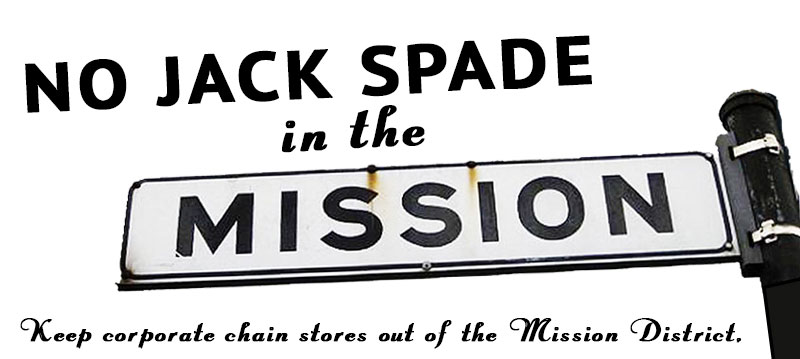
The fight to keep suspected formula retailer Jack Spade out of the Mission resumes this evening (Wed/9) when The Stop Jack Spade Coalition lays out it’s case against the men’s clothing chain before the Board of Appeals in an attempt to force the business to go through a conditional use permit hearing. [UPDATE: Activists say they won a big victory last night, not just winning that vote but maybe convincing Jack Spade to withdraw its application completely. We’re working on confirming things now and we’ll have more details soon.]

The new push against Jack Spade comes less than two months after an original appeal found the retailer not to be in violation of the neighborhood’s formula retail ban, with the opposition campaign getting written support of Sups. Eric Mar, John Avalos, and David Campos. They join a growing list of those opposed to the retailer, one that currently features former Board of Supervisors presidents Matt Gonzalez and Aaron Peskin and Assemblymember Tom Ammiano.

If the coalition is granted a rehearing, it will be the second time an appeal is heard on the matter. On Aug. 21, the Board of Appeals ruled against the retailer in a 3-2 majority decision, but the decision still lacked the four votes required to revoke the building permits.

Jack Spade — currently slated to rent the former Adobe Bookshop storefront at 3166 16th Street — was originally granted its business and building permits sans conditional use hearing, an act that was supposed to be unheard of for a prospective national retailer inside a neighborhood with a formula retail ban.

The 2004 formula retail ordinance requires a businesses to get a conditional use permit before moving into certain San Francisco neighborhoods if they meet the “formula retail” criteria. Part of that criteria states that a store can have no more than 11 “retail sales establishments located in the United States.” Jack Spade, pre-Mission store, has just 10 unique stores, which allowed them to circumvent the hearing process.

But according to 5th & Pacific’s public records, the holding company (formerly known as Liz Claiborne) that owns Jack Spade, the high-end men’s clothing store is not an independent business but rather a sub-brand of Kate Spade; a women’s clothing store with 94 locations in the United States alone.

The coalition opposing Jack Spade’s now-imminent Mission migration is using this piece of information as Exhibit A in their fight against the retailer. The coalition is claiming that by not acknowledging the fact that Jack Spade itself was part of a far larger corporation, the retailer violated the formula retail ban by claiming “independent business” status.

As the move-in date for the Mission’s unwanted addition grows near, the coalition has taken up the cause once again, mustering support from nearly every constituency available.

It will be bringing its revamped case to the Board of Appeals, this time with testimony seemingly focused on the misleading nature of Jack Spade’s classification as an “independent business.” That should prove to be an effective move for the coalition, because Jack Spade isn’t an independent business, and they don’t try to classify themselves as such outside of San Francisco.

In fact, according to 5th & Pacific’s 10-K filings with the SEC, the “Kate Spade brand offers fashion accessories for women under the Kate Spade and Kate Spade Saturday trademarks, and for men under the Jack Spade trademark.” The two brands even share the same CEO: Craig Leavitt. Declaring that the two companies are independent of each other based on product offering is like saying beef and milk are independent of  other because they come from different parts of the cow.

Now, armed with an updated defense, the Coalition is taking a second stab at the appellate process, one they feel good about. In a letter to the Board, executive director of the Valencia Corridor Merchant Association (VCMA) Luis Granados said, “If the findings section were fully taken into account [last time], we believe the Board will see that Jack Spade is formula retail, as set forth under the law.”

Or as Gonzalez wrote in a letter to the Board of Appeals: “Issues of corporate ownership and/or corporate structure have been a matter of debate in previous hearings regarding Jack/Kate Spade’s permits.  While nowhere in the planning code does it require the consideration of corporate ownership/structure, neither does the ordinance forbid a consideration of corporate ownership/structure.  Indeed, in order to fulfill the clear intent of the law in a common sense manner, it will be necessary, in some cases, to consider corporate ownership/structure.

I urge you to grant the VCMA’s request for a rehearing of Jack/Kate Spade’s permits in order to prevent manifest injustice.”

And considering the momentum that the anti-Jack Spade movement is now gaining, the optimism isn’t unreasonable.

Activist Andy Blue, who helped organize the protest, acknowledged the high bar needed to overrule the flawed ruling by the Planning Department, telling us, “We’re cautiously optimistic, but it’s a long shot.”

Cyclists testify to SFPD bias as supervisors call for reforms

66

The cyclists of San Francisco were angry. Sup. Jane Kim was skeptical. Sup. Scott Wiener was unconvinced. Sup. Eric Mar said bikers were “pissed.” Deputy Chief of Police Mike Biel said he was too, but his anger could have just as easily been attributed to the 35 minutes he spent at the stand, acting as a whipping post for frustrations with the SFPD, as it could be to the department’s mistreatment of San Francisco cyclists.

Either way, the cyclists ruled the day.

During Thursday’s (10/3) Board of Supervisors Neighborhood Services and Safety Committee, Sup. David Campos called for a joint Board of Supervisors-Police Commission hearing regarding SFPD investigation protocol for bike accidents, but no immediate timetable has been set for the matter.

Without Police Chief Greg Suhr in attendance — his chiefly presence was required “reading to the children,” as Biel noted multiple times — Biel was left to stand solo in front of both frustrated supervisors and an incensed public.

At one point, following a particularly ambiguous response from Biel regarding accident checklists, Wiener asked bluntly, “Do you think there’s enough traffic cops in San Francisco? I don’t see bike cops, personally.”

To which Biel responded, “I’d like to see more.”

In fact, there was little defense on the part of Biel — and by extension, the Police Department — when it came to the seemingly lax (at best, malicious at worst) approach the SFPD has taken toward bike accidents in the past four years.

He even echoed Mar’s “pissed” comment, saying, “I was pissed too,” in regards to both what Mar called the “supposed investigation” of the Aug. 14 death of 24-year-old Amelie Le Moullac and the flippant attitude some in the department had taken towards cyclists in the days and weeks following. But he also stated that he didn’t think there was a negative bias in the SFPD.

The board’s decision to continue the conversation was bolstered by nearly 40 often-horrific testimonials regarding police treatment of cyclists in the City. And nearly all the stories could make the average person cring with the frustration, anger, and outrage they had the power to illicit.

Leah Shahum, executive director for the San Francisco Bike Coalition, told a story of a woman who was unable to make it to the hearing due to the injuries sustained in an April accident.

The woman, whom she didn’t identify, was biking in Golden Gate Park with her husband and son — the son was on the back of the woman’s bike — when she was hit from behind by a car, while she was stopped in the designated bike lane.

Witnesses stated that the driver was at fault. Her husband said the same thing. The police insisted on questioning the two of them more about their helmet usage — “which they were wearing,” according to Shahum — than they did about the actual events of the accident. Incidentally, adults aren’t required to wear bike helmets in California.

Robin Levitt, a Hayes Valley resident, talked about the strange “culture of blaming the victim” that has seemingly been propagated in the City, and how “in Germany, it’s immediately assumed that the vehicle is at fault, so drivers are safer.”

(And for what it’s worth, when Biel denied that same sentiment’s existence earlier with the committee, supervisors didn’t seem too convinced either. Mar even asked Biel, “Is there a bias or blame-the-victim attitude in the San Francisco Police Department?” which Biel promptly denied.)

And then there was Edward Hasbrouk, a former professional cyclist who has “never owned a motor vehicle.” He was biking home from work one evening when his progress in a Valencia Street bike line was impeded by a double-parked car in line for a valet service.

(Wiener has called for increased police enforcement of laws against double-parking. During today’s (Tues/8) Board of Supervisors meeting, he asked Mayor Ed Lee to support the effort, noting that SFPD rarely issues tickets to double-parkers despite “its impacts on traffic, Muni, cycling, and pedestrians.”)

Hasbrouk said that after a somewhat heated back-and-forth between the valet drivers, he flagged down a police officer to help him resolve the dispute, but the officer instead made Hasbrouk “carry [his] bicycle to the sidewalk.” Hasbrouk then said, “What would I have to do to get you to ticket these cars double-parked?” That comment got him arrested for felony vandalism, according to Hasbrouk. Expunging the arrest cost him nearly $3,000 and a night in jail.

But given the SFPD’s lack of pragmatism when it comes to investigating these accidents (for instance, Biel said SFPD doesn’t require a continuing education for officers assigned to traffic enforcement, despite what Shahum says are complex issues surrounding a rapidly growing population of cyclists), and it’s boorish behavior following the Le Moullac tragedy in August, it’s high time for change.

And a joint hearing could be just the place to start.

Supervisors examine anti-cyclist bias at SFPD

17

The Board of Supervisors Neighborhood Services and Safety Committee held a high-profile and well-attended hearing Oct. 3 to examine how the San Francisco Police Department investigates motorist versus bicyclist collisions. Sup. Jane Kim called the hearing following revelations about shoddy police work and anti-cyclist bias in the Aug. 14 death of cyclist Amelie Le Moullac.

Dozens of cyclists told horror stories of being hit by cars and then treated badly by police, which routinely absolves motorists of responsibility even in cases where they are clearly at fault.

Deputy Police Chief Mike Biel admitted some shortcomings in their investigations and promised to do better, and he apologized for the absence of Police Chief Greg Suhr and Sgt. Richard Ernst, who showed up at an Aug. 21 memorial event for Le Moullac to make inaccurate and insensitive comments criticizing cyclists. Kim had requested testimony from both men. Sup. David Campos pledged to hold another hearing on the issue, this time at a rare joint hearing of the Board of Supervisors and Police Commission.

San Francisco Bicycle Coalition Executive Director Leah Shahum urged the SFPD to, “Focus limited traffic enforcement resources on known dangerous intersections and known dangerous behaviors.” (Read Shahum’s op-ed on the hearing.)

Concerns about selective enforcement and anti-cyclist bias by the SFPD were heightened in the week before the hearing when officers started enforcement stings focused on stop sign-running cyclists riding the Wiggle, one of the city’s most popular and heavily traveled bike routes.

Among those stopped and given a written warning — one of 534 written warnings and 16 citations the SFPD reported giving out to cyclists in September — was Guardian Editor Steven T. Jones, whose Oct. 1 blog post on whether SFPD should strictly enforce laws requiring cyclist to completely stop at stop signs was the most commented SFBG.com post of the last week.

Shahum told us that the Bike Coalition has done education campaigns urging cyclists to yield to pedestrians on the Wiggle, but that none of the seven intersections on the Wiggle meet the SFPD’s own stated goals of focusing enforcement on the five most dangerous intersections in each police district. “When you look at the data on the Wiggle,” Shahum said, “it’s not a high collision area.”

Community not criminalization

8


By María Poblet

OPINION San Francisco is poised to break ground in defense of immigrants, an important step towards turning the tide against the criminalization of communities of color.

In a unanimous vote on September 24, the Board of Supervisors supported a due process ordinance that, after final approval, will reduce deportations by setting strict limits on collaboration between federal immigration enforcement and local authorities. Our city will make history by refusing to implement the federal Secure Communities program, which allows US Immigration and Customs Enforcement (ICE) to request an immigration hold detention without cause, regardless of immigration status, at local expense.

This victory didn’t trickle down like fog from the “progressive Bay Area bubble.” It was hard fought, from the bottom up. Immigrant and undocumented people most impacted by the problems led the fight, and they built a movement too strong to ignore. Causa Justa::Just Cause helped organize the groundswell, as part of the San Francisco Immigrant Rights Defense Committee, a broad grassroots collaboration. We had support from progressive champions John Avalos, Eric Mar, David Campos, and five additional co-sponsors on the board.

This movement builds on the fights in the 1980s to make San Francisco a Sanctuary City, welcoming survivors of the wars in Central America. We build on the fights in the ’90s to re-commit to those values in the face of a new wave of migration, when economic refugees arrived, fleeing the hunger caused by US-imposed Free Trade Agreements. We build on the very personal fights of everyday people, like a woman we’ll call Silvia, a domestic violence survivor who met with the District Attorney repeatedly, demanded that he lead those meetings in Spanish so she could participate fully, advocated for herself and her community, and ultimately won his commitment of support for this ordinance. This victory belongs to the hundreds of community leaders who, like Silvia, overcame intimidation, organized their families and neighbors, and showed our elected officials the way forward.

In a national context, where states like Georgia, Alabama and Arizona hunt down immigrants, we in California, a majority immigrant, majority people of color state, have the opportunity, and the responsibility, to follow Silvia’s leadership. It’s time to reject criminalization, and build community.

Every time there’s a new way to label someone a “criminal,” more families and communities are torn apart. Millions of black and Latino people are behind bars already, thanks to criminalization policies like the war on drugs, structural unemployment, decades of divestment from working class communities, and racial discrimination. Creating new immigration violations only makes that problem worse, trapping whole new sectors of our society in the prison dragnet. This advance in San Francisco should inspire our state as a whole not only to reject S-Comm, but also to take bold action to address the profoundly problematic prison system, and challenge the racism and poverty it depends on.

But, for our state to stand up like that is going to take a serious transformation. Gov. Jerry Brown recently announced plans to expand the prison system with revenues from Prop. 30 — the grassroots progressive tax passed last year to support public schools and social services. Causa Justa::Just Cause, as part of California Calls, through SF Rising and Oakland Rising, was one of hundreds of community groups that helped pass this progressive tax. We are outraged to see the governor literally betting on the criminalization of the next generation, with money that was supposed to support their success.

Policies like S-Comm manufacture the need for more detention facilities, ultimately benefitting corporate interests like the GEO private prison group. Its lucrative business depends on criminalization, and a culture of fear. If politicians aren’t brave enough to survive the accusation that they are “soft on crime” in order to champion real change, then we the people will have to take it into our own hands. Immigrant communities, black communities, communities of color, and poor communities need to keep building the solidarity and the movement that will allow us to win, from San Francisco to Sacramento to DC. There is much more to be done, and we can only do it together.  

María Poblet is executive director of Causa Justa::Just Cause.

Endorsements 2013

125

We’re heading into a lackluster election on Nov. 5. The four incumbents on the ballot have no serious challengers and voter turnout could hit an all-time low. That’s all the more reason to read up on the issues, show up at the polls, and exert an outsized influence on important questions concerning development standards and the fate of the city’s waterfront, the cost of prescription drugs, and the long-term fiscal health of the city.


PROP. A — RETIREE HEALTH CARE TRUST FUND

YES

Note: This article has been corrected from an earlier version, which incorrectly stated that Prop A increases employee contributions to health benefits.

Throughout the United States, the long-term employee pension and health care obligations of government agencies have been used as wedge issues for anti-government activists to attack public employee unions, even in San Francisco. The fiscal concerns are real, but they’re often exaggerated or manipulated for political reasons.

That’s one reason why the consensus-based approach to the issue that San Francisco has undertaken in recent years has been so important, and why we endorse Prop. A, which safeguards the city’s Retiree Health Care Trust Fund and helps solve this vexing problem.

Following up on the consensus pension reform measure Prop. B, which increased how much new city employees paid for lifetime health benefits, this year’s Prop. A puts the fund into a lock-box to ensure it is there to fund the city’s long-term retiree health care obligations, which are projected at $4.4 billion over the next 30 years.

“The core of it says you can’t touch the assets until it’s fully funded,” Sup. Mark Farrell, who has taken a lead role on addressing the issue, told us. “The notion of playing political football with employee health care will be gone.”

The measure has the support of the entire Board of Supervisors and the San Francisco Labor Council. Progressive Sup. David Campos strongly supports the measure and he told us, “I think it makes sense and is something that goes beyond political divides.”

There are provisions that would allow the city to tap the fund in emergencies, but only after it is fully funded or if the mayor, controller, the Trust Board, and two-thirds of the Board of Supervisors signs off, a very high bar. So vote yes and let’s put this distracting issue behind us.


PROP. B — 8 WASHINGTON SPECIAL USE DISTRICT

NO, NO, NO!

Well-meaning people can arrive at different conclusions on the 8 Washington project, the waterfront luxury condo development that was approved by the Board of Supervisors last year and challenged with a referendum that became Prop. C. But Prop. B is simply the developer writing his own rules and exempting them from normal city review.

We oppose the 8 Washington project, as we explain in our next endorsement, but we can understand how even some progressive-minded people might think the developers’ $11 million affordable housing and $4.8 million transit impact payments to the city are worth letting this project slide through.

But Prop. B is a different story, and it’s something that those who believe in honesty, accountability, and good planning should oppose on principle, even if they support the underlying project. Contrary to the well-funded deceptions its backers are circulating, claiming this measure is about parks, Prop. B is nothing more than a developer and his attorneys preventing meaningful review and enforcement by the city of their vague and deceptive promises.

It’s hard to know where to begin to refute the wall of mendacity its backers have erected to fool voters into supporting this measure, but we can start with their claim that it will “open the way for new public parks, increased access to the Embarcadero Waterfront, hundreds of construction jobs, new sustainable residential housing and funding for new affordable housing.”

There’s nothing the public will get from Prop. B that it won’t get from Prop. C or the already approved 8 Washington project. Nothing. Same parks, same jobs, same housing, same funding formulas. But the developer would get an unprecedented free pass, with the measure barring discretionary review by the Planning Department — which involves planners using their professional judgment to decide if the developer is really delivering what he’s promising — forcing them to rubber-stamp the myriad details still being developed rather than acting as advocates for the general public.

“This measure would also create a new ‘administrative clearance’ process that would limit the Planning Director’s time and discretion to review a proposed plan for the Site,” is how the official ballot summary describes that provision to voters.

Proponents of the measure also claim “it empowers voters with the decision on how to best utilize our waterfront,” which is another deception. Will you be able to tweak details of the project to make it better, as the Board of Supervisors was able to do, making a long list of changes to the deal’s terms? No. You’re simply being given the opportunity to approve a 34-page initiative, written by crafty attorneys for a developer who stands to make millions of dollars in profits, the fine details of which most people will never read nor fully understand.

Ballot box budgeting is bad, but ballot box regulation of complex development deals is even worse. And if it works here, we can all expect to see more ballot measures by developers who want to write their own “special use district” rules to tie the hands of planning professionals.

When we ask proponents of this measure why they needed Prop. B, they claimed that Prop. C limited them to just talking about the project’s building height increases, a ridiculous claim for a well-funded campaign now filling mailers and broadcast ads with all kinds of misleading propaganda.

With more than $1 million and counting being funneled into this measure by the developer and his allies, this measure amounts to an outrageous, shameless lie being told to voters, which Mayors Ed Lee and Gavin Newsom have shamefully chosen to align themselves with over the city they were elected to serve.

As we said, people can differ on how they see certain development deals. But we should all agree that it’s recipe for disaster when developers can write every last detail of their own deals and limit the ability of professional planners to act in the public interest. Don’t just vote no, vote hell no, or NO, No, no!


PROPOSITION C — 8 WASHINGTON REFERENDUM

NO

San Francisco’s northeastern waterfront is a special place, particularly since the old Embarcadero Freeway was removed, opening up views and public access to the Ferry Building and other recently renovated buildings, piers, and walkways along the Embarcadero.

The postcard-perfect stretch is a major draw for visiting tourists, and the waterfront is protected by state law as a public trust and overseen by multiple government agencies, all of whom have prevented development of residential or hotel high-rises along the Embarcadero.

Then along came developer Simon Snellgrove, who took advantage of the Port of San Francisco’s desperate financial situation, offered to buy its Seawall Lot 351 and adjacent property from the Bay Club at 8 Washington St., and won approval to build 134 luxury condos up to 12 stories high, exceeding the city’s height limit at the site by 62 percent.

So opponents challenged the project with a referendum, a rarely used but important tool for standing up to deep-pocketed developers who can exert an outsized influence on politicians. San Franciscans now have the chance to demand a project more in scale with its surroundings.

The waterfront is supposed to be for everyone, not just those who can afford the most expensive condominiums in the city, costing an average of $5 million each. The high-end project also violates city standards by creating a parking space for every unit and an additional 200 spots for the Port, on a property with the best public transit access and options in the city.

This would set a terrible precedent, encouraging other developers of properties on or near the waterfront to also seek taller high-rises and parking for more cars, changes that defy decades of good planning work done for the sensitive, high-stakes waterfront.

The developers would have you believe this is a battle between rival groups of rich people (noting that many opponents come from the million-dollar condos adjacent to the site), or that it’s a choice between parks and the surface parking lot and ugly green fence that now surrounds the Bay Club (the owner of which, who will profit from this project, has resisted petitions to open up the site).

But there’s a reason why the 8 Washington project has stirred more emotion and widespread opposition that any development project in recent years, which former City Attorney Louise Renne summed up when she told us, “I personally feel rich people shouldn’t monopolize the waterfront.”

A poll commissioned by project opponents recently found that 63 percent of respondents think the city is building too much luxury housing, which it certainly is. But it’s even more outrageous when that luxury housing uses valuable public land along our precious waterfront, and it can’t even play by the rules in doing so.

Vote no and send the 8 Washington project back to the drawing board.


PROP. D — PRESCRIPTION DRUG PURCHASING

YES

San Francisco is looking to rectify a problem consumers face every day in their local pharmacy: How can we save money on our prescription drugs?

Prop. D doesn’t solve that problem outright, but it mandates our politicians start the conversation on reducing the $23 million a year the city spends on pharmaceuticals, and to urge state and federal governments to negotiate for better drug prices as well.

San Francisco spends $3.5 million annually on HIV treatment alone, so it makes sense that the AIDS Healthcare Foundation is the main proponent of Prop. D, and funder of the Committee on Fair Drug Pricing. Being diagnosed as HIV positive can be life changing, not only for the health effects, but for the $2,000-5,000 monthly drug cost.

Drug prices have gotten so out-of-control that many consumers take the less than legal route of buying their drugs from Canada, because our neighbors up north put limits on what pharmaceutical companies can charge, resulting in prices at least half those of the United States.

The high price of pharmaceuticals affects our most vulnerable, the elderly and the infirm. Proponents of Prop. D are hopeful that a push from San Francisco could be the beginning of a social justice movement in cities to hold pharmaceutical companies to task, a place where the federal government has abundantly failed.

Even though Obamacare would aid some consumers, notably paying 100 percent of prescription drug purchases for some Medicare patients, the cost to government is still astronomically high. Turning that around could start here in San Francisco. Vote yes on D.


ASSESSOR-RECORDER

CARMEN CHU

With residential and commercial property in San Francisco assessed at around $177 billion, property taxes bring in enough revenue to make up roughly 40 percent of the city’s General Fund. That money can be allocated for anything from after-school programs and homeless services to maintaining vital civic infrastructure.

Former District 4 Sup. Carmen Chu was appointed by Mayor Ed Lee to serve as Assessor-Recorder when her predecessor, Phil Ting, was elected to the California Assembly. Six months later, she’s running an office responsible for property valuation and the recording of official documents like property deeds and marriage licenses (about 55 percent of marriage licenses since the Supreme Court decision on Prop. 8 have been issued to same-sex couples).

San Francisco property values rose nearly 5 percent in the past year, reflecting a $7.8 billion increase. Meanwhile, appeals have tripled from taxpayers disputing their assessments, challenging Chu’s staff and her resolve. As a district supervisor, Chu was a staunch fiscal conservative whose votes aligned with downtown and the mayor, so our endorsement isn’t without some serious reservations.

That said, she struck a few notes that resonated with the Guardian during our endorsement interview. She wants to create a system to automatically notify homeowners when banks begin the foreclosure process, to warn them and connect them with helpful resources before it’s too late. Why hasn’t this happened before?

She’s also interested in improving system to capture lost revenue in cases where property transfers are never officially recorded, continuing work that Ting began. We support the idea of giving this office the tools it needs to go out there and haul in the millions of potentially lost revenue that property owners may owe the city, and Chu has our support for that effort.


CITY ATTORNEY

DENNIS HERRERA

Dennis Herrera doesn’t claim to be a progressive, describing himself as a good liberal Democrat, but he’s been doing some of the most progressive deeds in City Hall these days: Challenging landlords, bad employers, rogue restaurants, PG&E, the healthcare industry, opponents of City College of San Francisco, and those who fought to keep same-sex marriage illegal.

The legal realm can be more decisive than the political, and it’s especially effective when they work together. Herrera has recently used his office to compel restaurants to meet their health care obligations to employees, enforcing an earlier legislative gain. And his long court battle to defend marriage equality in California validated an act by the executive branch.

But Herrera has also shown a willingness and skill to blaze new ground and carry on important regulation of corporate players that the political world seemed powerless to touch, from his near-constant legal battles with PG&E over various issues to defending tenants from illegal harassment and evictions to his recent lawsuit challenging the Accreditation Commission of Community and Junior Colleges over its threats to CCSF.

We have issues with some of the tactics his office used in its aggressive and unsuccessful effort to remove Sheriff Ross Mirkarimi from office. But we understand that is was his obligation to act on behalf of Mayor Ed Lee, and we admire Herrera’s professionalism, which he also exhibited by opposing the Central Subway as a mayoral candidate yet defending it as city attorney.

“How do you use the power of the law to make a difference in people’s lives every single day?” was the question that Herrera posed to us during his endorsement interview, one that he says is always on his mind.

We at the Guardian have been happy to watch how he’s answered that question for nearly 11 years, and we offer him our strong endorsement.


TREASURER/TAX COLLECTOR

JOSE CISNEROS

It’s hard not to like Treasurer/Tax Collector Jose Cisneros. He’s charming, smart, compassionate, and has run this important office well for nine years, just the person that we need there to implement the complicated, voter-approved transition to a new form of business tax, a truly gargantuan undertaking.

Even our recent conflicts with Cisneros — stemming from frustrations that he won’t assure the public that he’s doing something about hotel tax scofflaw Airbnb (see “Into thin air,” Aug. 6) — are dwarfed by our understanding of taxpayer privacy laws and admiration that Cisneros ruled against Airbnb and its ilk in the first place, defying political pressure to drop the rare tax interpretation.

So Cisneros has the Guardian’s enthusiastic endorsement. He also has our sympathies for having to create a new system for taxing local businesses based on their gross receipts rather than their payroll costs, more than doubling the number of affected businesses, placing them into one of eight different categories, and applying complex formulas assessing how much of their revenues comes from in the city.

“This is going to be the biggest change to taxes in a generation,” Cisneros told us of the system that he will start to implement next year, calling the new regime “a million times more complicated than the payroll tax.”

Yet Cisneros has still found time to delve into the controversial realm of short-term apartment sublets. Although he’s barred from saying precisely what he’s doing to make Airbnb pay the $1.8 million in Transient Occupancy Taxes that we have shown the company is dodging, he told us, “We are here to enforce the law and collect the taxes.”

And Cisneros has continued to expand his department’s financial empowerment programs such as Bank on San Francisco, which help low-income city residents establish bank accounts and avoid being gouged by the high interest rates of check cashing outlets. That and similar programs are now spreading to other cities, and we’re encouraged to see Cisneros enthusiastically exporting San Francisco values, which will be helped by his recent election as president of the League of California Cities.


SUPERVISOR, DIST. 4

KATY TANG

With just six months on the job after being appointed by Mayor Ed Lee, Sup. Katy Tang faces only token opposition in this race. She’s got a single opponent, accountant Ivan Seredni, who’s lived in San Francisco for three years and decided to run for office because his wife told him to “stop complaining and do something,” according to his ballot statement.

Tang worked in City Hall as a legislative aide to her predecessor, Carmen Chu, for six years. She told us she works well with Sups. Mark Farrell and Scott Wiener, who help make up the board’s conservative flank. In a predominantly Chinese district, where voters tend to be more conservative, Tang is a consistently moderate vote who grew up in the district and speaks Mandarin.

Representing the Sunset District, Tang, who is not yet 30 years old, faces some new challenges. Illegal “in-law” units are sprouting up in basements and backyards throughout the area. This presents the thorny dilemma of whether to crack down on unpermitted construction — thus hindering a source of housing stock that is at least within reach for lower-income residents — look the other way, or “legalize” the units in an effort to mitigate potential fire hazards or health risks. Tang told us one of the greatest concerns named by Sunset residents is the increasing cost of living in San Francisco; she’s even open to accepting a little more housing density in her district to deal with the issue.

Needless to say, the Guardian hasn’t exactly seen eye-to-eye with the board’s fiscally conservative supervisors, including Tang and her predecessor, Chu. We’re granting Tang an endorsement nevertheless, because she strikes us as dedicated to serving the Sunset over the long haul, and in touch with the concerns of young people who are finding it increasingly difficult to gain a foothold in San Francisco.

SF supervisors approve policy of denying federal immigration hold requests

35

The San Francisco Board of Supervisors Chambers erupted in raucous celebration and chants of “Si se puede!” this afternoon as the board gave unanimous approval to a new city policy of refusing most detention hold requests from US Immigration and Customs Enforcement, which has used its controversial Secure Communities program to learn when undocumented immigrants end up in local jails and to have them held for deportation.

The legislation by Sup. John Avalos is intended to build trust between law enforcement and immigrants, which can be reluctant to report crimes such a domestic violence or buglaries for fear of deportation. “People who have to deal with the devastation that Secure Communities causes, they’re the ones who brought this forward,” Avalos said.

Those advocates had to wait a week for this momentus occasion because of amendments that were introduced last week, prompted by opposition to the measure by Mayor Ed Lee and Police Chief Greg Suhr, who expressed concern that it would shield violent felons from deportation.

Those amendments were introduced by Sup. Jane Kim, who had supported the original measure without them but sought to broaden support for the measure. Her amendments make exceptions for those convicted of violent felonies, sex trafficking, child molestation, and use of a gun in commission of a felony, although they call for police to consider factors such as a dependent child before allowing ICE to take custody of an undocumented immigrant.

Avalos opposed the amendments, saying “any carve-outs deter the victims of crimes from reaching out to law enforcement.” The amendments were also criticized by Sup. David Campos, who called them “counterproductive to public safety.” But both accepted them and called the measure an important victory.

“What’s happening in this chamber is a victory for the immigrant communities of San Francisco and all communities in San Francisco,” Campos said in English before repeating it in Spanish. “Let’s emphasize the common ground that we have found.”

The ordinance is set to receive final approval next week when it’s heard on second reading. Sheriff Ross Mirkarimi — who has supported the legislation since its inception and who will oversee its implementation in the jail — said his office had just received the latest amendments and is still reviewing them.

“It’s the unintended consequences that bring me here before you today,” Mirkarimi told his former colleagues at the board, saying he wants to make sure the new policy is clear enough so that even deputies working in the middle of the night would know how to handle ICE requests. “Changes in the legislation do pose some operational concerns.”

Mirkarimi had already instituted policies of resisting many federal immigration hold requests, joining with San Jose, Berkeley, and other cities who oppose the S-Comm program, and this ordinance broadened and codified those policies.

The legislation was strongly supported by the city’s Domestic Violence Consortium, representing an ironic turn of events when Mayor Lee — who waged a protracted and unsuccessful campaign to remove Sheriff Mirkarimi from office for grabbing his wife’s arm last year — threatened to veto it. Avalos also placed second in a crowded field of candidates when Lee was elected mayor in 2011.

It was Lee’s veto threat that ultimately weakened the legislation, a move opposed by activists who work on domestic violence issues. But Kim made clear that despite her amendments, she strongly opposes S-Comm and its local impacts.

“We believe the S-Comm program is deeply flawed,” Kim said, telling the story of a constituent who feared calling the police after their home had been burglarized. “No one should fear calling the police when they need help.”  

Immigration detainer limits watered down

1

Sup. John Avalos’ Due Process for All ordinance, legislation barring San Francisco law enforcement agencies from honoring detainer requests issued by U.S. Immigrations and Customs Enforcement (ICE) under the federal Secure Communities (S-Comm) program, faced obstacles at the Sept. 17 Board of Supervisors meeting.

But an amended version returned to the board on Sept. 24, where it was expected to be approved (after Guardian press time for this issue, so check out the SFBG.com Politics blog to see what happened).

The legislation initially had enough support for a veto-proof supermajority, but opposition has surfaced to prevent the legislation from winning approval as written, most notably from Police Chief Greg Suhr and Mayor Ed Lee, who threatened to veto the legislation.

At issue was whether to amend the legislation by including “carve-outs” — exceptions requiring law enforcement to honor ICE requests in cases where offenders are suspected of serious violent crimes, child molestation or human trafficking. Sup. Jane Kim offered amendments giving the Sheriff’s Department discretion in such cases, which she characterized as “thoughtful and limited,” but which were opposed by Avalos and Sup. David Campos.

In San Francisco, ICE detainer requests issued under S-Comm have resulted in at least 784 deportations since 2010. Avalos’ legislation seeks to extend due process to all San Franciscans by making it illegal for local law enforcement to comply with such requests.

–Reed Nelson

LAFCo should launch CleanPowerSF

14

OPINION Last month, the Mayor’s Office and San Francisco Public Utilities Commission (SFPUC) — largely at the mayor’s behest — refused to launch CleanPowerSF, a program which is absolutely crucial to leading the country and the world to reverse the climate crisis (see “Power struggle,” Sept. 18).

The Board of Supervisors must now use its state-granted authority to activate San Francisco’s Local Agency Formation Commission (LAFCO) to launch CleanPowerSF, regardless of SFPUC.

CleanPowerSF plans currently waiting to be implemented would create 1,500 jobs a year for the next 10 years, and install over 400 megawatts of local clean electricity projects. By 2024, 50 percent of our electricity would be generated by such local clean installations.

The newest proposed rates for CleanPowerSF are now fully competitive with PG&E, and the SFPUC’s staff (before the mayor intervened) was making unprecedented progress on the local clean energy installation plans. So at the SFPUC’s Aug. 13 hearing on CleanPowerSF rate-setting, community and environmental advocates stood unanimously to urge that the program be launched.

For the mayor and SFPUC of what is supposed to be one of the most environmental cities on Earth to completely ignore those community advocates, and throw a monkey wrench into the launching of CleanPowerSF, is simply beyond the pale.

Thankfully, in its wisdom, when the 2002 California Legislature passed the Community Choice law that made CleanPowerSF possible, it put city councils and county boards legally in charge of such programs (not mayors).

So is not up to the Mayor’s Office whether or not CleanPowerSF is launched. It is instead the job of the San Francisco Board of Supervisors. And in a resounding 9-2 vote on Sept. 17, the Board of Supervisors raked the SFPUC (and by extension, the mayor) over the coals for not initiating CleanPowerSF. The vote was in favor of Sup. London Breed’s resolution demanding that the SFPUC obey the will of the board and launch CleanPowerSF immediately.

That’s a great first step, but the board now needs to go beyond resolutions and take decisive action through LAFCo, its most powerful tool for moving CleanPowerSF. LAFCo is independent of city government, is funded and tasked to oversee new enterprise programs like CleanPowerSF, and four of its five members are elected supervisors.


This independent supermajority can check mayoral overreach, and the LAFCo’s current board commissioners are John Avalos, David Campos, Eric Mar, and London Breed, all advocates of CleanPowerSF.

LAFCo was specifically given the budget and authority to act on CleanPowerSF when SFPUC fails to do so, and has already done this successfully in the past. When CleanPowerSF was first created in 2004, SFPUC refused to draft an implementation plan. In response, LAFCo stepped in with its own implementation plan and SFPUC, not wanting to lose influence, got back to work.

In 2011, SFPUC tried to sidetrack CleanPowerSF into only purchasing (but not building) clean power, refusing to fund planning work to establish a local installation and green jobs program. LAFCO stepped in to fund that work itself, and again SFPUC came back to the fold and hired Community Choice experts Local Power to do the work.

Now, yet again, SFPUC is refusing to do its job. Six months ago, it abruptly halted work on the local buildout and green jobs plan, and last month SFPUC put the whole program on hold by not setting rates.

LAFCo must now use its authority and leverage to both remove the rate-setting road block, and get the CleanPowerSF local buildout planning back on track. Eric Brooks is the sustainability chair of the San Francisco Green Party.

Alerts: September 25 – October 2, 2013

0

WEDNESDAY 25

Radical archiving and cataloging as social history 518 Valencia, SF. 518valencia.org. The Shaping San Francisco public talks series continues with a discussion defining a “radical archive,” exploring the role that nontraditional archives play in the interpretation and preservation of peoples’ history, the role of ordinary people in the preservation of these archives and more. Joining the discussion will be Lincoln Cushing of Docs Populi, as well as Claude Marks and Nathaniel Moore, both of the Freedom Archives.


Solar Energy Panel Discussion David Brower Center, 2150 Allston, Berk. https://solarenlightenment.eventbrite.com. 6-9pm, free. Andreas Karelas, the Executive Director of Revolv, and Jackson Koeppel of Soulardarity will lead a panel discussion on the use of solar energy and how it works. They will also attempt to clear up a few common misconceptions about solar power. Doors open at 5:30pm. Those who can’t attend can tune in on Ustream.


THURSDAY 26


Press up! El Rio, 3158 Mission, SF. 6pm, donations $25 and up. tinyurl.com/sfpmccontribute. An independent press is crucial. Join Tim Redmond, former editor-publisher of the Bay Guardian, as he launches the nonprofit San Francisco Progressive Media Center, dedicated to publishing a new online news source and keeping local journalism alive and independent of corporate, non-local interests. Co-hosts include Tom Ammiano, David Campos, Alicia Garza, Giuliana Milanese and Gabriel Haaland.

Syria: Secrets and lies Unitarian Universalist Center, 1187 Franklin, SF. sanfranpda@aol.com. 7-9pm, free. Dr. Steven Zunes, a professor of politics and international studies at the University of San Francisco and Middle Eastern studies program chair, will examine whether the US is about to go to war again on unverifiable or perhaps false pretexts; why the Administration is so committed to this conflict, and how can we understand the actual facts behind the recently documented atrocities in Syria. Sponsored by the Progressive Democrats of American and Unitarian Universalists for Peace, SF.


SATURDAY 28 14th Annual World Veg Festival San Francisco County Fair Building, Lincoln & Ninth, Golden Gate Park, SF. http://worldvegfestival.com. 10am-6:30pm, $10 suggested donation. This festival will feature cooking demonstrations, speakers and live entertainment, including an eco-fashion show. Visitors will have the opportunity to sample and purchase vegetarian cuisine. The event is presented by the SF Vegetarian Society and sponsored by Varnashram, In Defense of Animals and Friends of Animals. An organic vegan dinner will be available each night for $26; sign up online.

SATURDAY 29 Grito De Lares Celebration Mission Cultural Center for Latino Arts, 2868 Mission, SF. tinyurl.com/larescelebration. 4:30-7 p.m., free. Celebrate Grito De Lares, a holiday commemorating the birth of Puerto Rico as a nation, at the MCCLA on Sunday. 145 years ago this past Sept. 23, Puerto Rican revolutionaries entered the town of Lares to proclaim the birth of the Puerto Rican nation. At the bilingual event there will be a commemoration of the revolution, a discussion panel and a poetry reading in addition to Puerto Rican food and music.

Fight to save City College grows teeth and bites back

99

Saving City College of San Francisco became a bigger battle yesterday when the California Federation of Teachers announced a lawsuit in San Francisco Superior Court to keep CCSF open.

The suit is directed against the Accrediting Commission for Community and Junior Colleges, which pronounced the college’s death sentence July 3 by promising to revoke its accreditation in a year, without which a school cannot receive state funding and its students cannot get federal loans. 

Now, the ACCJC finds itself the institution under investigation by the feds and even City Attorney Dennis Herrera, and the CFT lawsuit is the latest legal challenge to the accreditors. 

The CFT charged the accrediting commission with using unfair and illegal business practices in its efforts to abolish City College. When asked for a statement about the impending lawsuit, ACCJC representative Tom Lane declined to comment.

“The ACCJC must be held accountable for their reckless, irresponsible and illegal actions,” CFT President Joshua Pechtalt explained at the Sept. 23 press conference held on the steps of City Hall, where the suit was announced. More importantly, Pechtalt said, winning this lawsuit could potentially stop the closure of CCSF.

A group of students, faculty, and elected officials stood with Pechtalt on the stone steps. One by one, they enumerated the improper activities that will be the basis of their lawsuit against the ACCJC: failing to adhere to its own policies and bylaws, violations of state and federal laws, and sanctioning CCSF without just cause.

Assemblymember Tom Ammiano said that the illegal behavior must stop here and now.

“The blatant lack of transparency, the loose interpretation of the rules, all seen through a lens of hubris and elitism, cannot continue,” he said. “San Francisco is our backyard and the college is our treasure.”

While Ammiano admitted that CCSF is not without its flaws and areas in need of improvement, he was quick to assert that closing the college was not the solution. “Stay out of our backyard unless you have something constructive to say,” he declared.

CCSF Student Trustee Shanell Williams assured the crowd that the lawsuit would be won. “The diverse population of the San Francisco Bay Area, including working families, single parents, new immigrants and others, depends greatly on this college being here,” she said. “If we lose City, we are going to be on our way to being an indentured, working class state.”

If the ACCJC succeeds in San Francisco, it will pave the way for identical treatment of other schools across the state, Williams said. Likewise, CCSF triumphing over the commission would be a victory for every community college in California.

Sup. David Campos also recognized the vital importance of CCSF’s continued existence. “We cannot have the American dream alive in San Francisco if City College closes,” he said. “This fight is about the soul of our city. ”

The US Department of Education has cited the ACCJC for failing to follow its own rules and procedures. A month ago, the Joint Legislative Audit Committee began investigating the commission. The following day, Herrera filed a lawsuit against the ACCJC, claiming it had illegally allowed its advocacy and political bias to prejudice its evaluation of college accreditation standards.

A new report released by the city’s Budget and Legislative Analyst on Sept. 16 detailed the economic impact to San Francisco if City College were to close. The report was requested by Supervisor Eric Mar. We’ve detailed some of the report’s findings in the infographic below. 

ccsf closure infographic 


Is Art Torres helping PG&E, helping his son’s political career, or both?

54

As I’ve been reporting on how CleanPowerSF is being blocked by Mayor Ed Lee and his political appointees on the San Francisco Public Utilities Commission, one piece of the puzzle that I couldn’t quite figure out was why SFPUC President Art Torres took the position he did, offering little public explanation for his stance.

“His opposition to the rate vote was strange because he didn’t give clear reasons,” Eric Brooks, who has been led the grassroots campaign in support of CleanPowerSF, told us. Torres also hasn’t returned Guardian calls on the issue, and he refused a formal request from Sup. John Avalos to explain his position.

As a former state senator and longtime former chair of the California Democratic Party, Torres certainly has connections to Pacific Gas & Electric and the array of politicians that support it, include Willie Brown. But that just didn’t seem like enough for a senior statesman with a decent environmental record to sabotage San Francisco’s only plan for building renewable energy projects.

But some of my political sources have clued me into another possible motive, and it seems to make sense. Art Torres’ son is Joaquin Torres, who works in the Mayor’s Office and who Lee in February appointed to the Housing Commission, where Torres now serves as president.

And here’s the kicker: those sources also say that Joaquin Torres has already started running for the District 9 seat on the Board of Supervisors, which is now held by Sup. David Campos, who is running for Tom Ammiano’s seat in the California Assembly. And if Campos wins that race next year, Mayor Lee will get to fill it, possibly naming Torres to one of the most progressive seats in the city.

So dad gets to score political points with some powerful friends, and help launch his son’s political career in the process. These motives are beginning to add up.

Joaquin Torres is now deputy director of the San Francisco Office of Economic and Workforce Development, “where he leads Mayor Lee’s Invest In Neighborhoods Initiative to leverage City resources across city departments to maximize positive economic and social impact in low-moderate income neighborhoods and throughout San Francisco’s commercial corridors,” the Mayor’s Office wrote in February when Torres got appointed to the Housing Commission.

Sounds like the perfect job for someone being groomed for the Board of Supervisors, where he could have a serious impact on this city’s political dynamic, tipping policies in the neoliberal to moderate direction of expanding corporate welfare programs and speeding up gentrification.

Neither Torres has returned our calls, but I’ll update this post when and if they do. And while this is clearly just political speculation and conjecture, I have a feeling that I’m onto something here. So remember where you read it first.