2012

Power struggle

51

steve@sfbg.com

Jason Fried could barely believe what was coming out of the squawk box in his office at the San Francisco Local Agency Formation Commission on Sept. 10, as he listened to Mayor Ed Lee describe the CleanPowerSF program Fried had spent years helping to develop.

The program would give San Franciscans the choice of buying their electricity from clean, renewable energy sources rather than Pacific Gas & Electric’s oil, coal, hydro, and nuclear dominated power portfolio, a program that was finally able to become competitive with PG&E on price and still fund the creation of local clean energy projects.

But the program that Lee described — which three of his appointees on the San Francisco Public Utilities Commission have recently decided to block, against the wishes of the Board of Supervisors supermajority that approved it (see “Fizzling energy,” Aug. 21) — sounded nothing like the program that Fried, LAFCo’s senior program officer, knows so well.

As Lee described it, CleanPowerSF is “based on vague promises” and has “questionable environmental benefits,” claiming it has “gotten progressively more expensive” and “creates no local jobs.”

“What the San Francisco Public Utilities Commission did was in the best interests of the city,” Lee said. The city has spent untold hours and dollars over the last decade developing and approving CleanPowerSF.

“It was very frustrating to watch, particularly when you see him just making stuff up,” said Fried. “If he wants to be against CCAs [Community Choice Aggregation, that state-created program the CleanPowerSF is a part of], fine, just say that…But he wasn’t even getting his numbers right.”


LIES, DAMN LIES, AND STATISTICS

Questioned by the Guardian following his monthly mayoral policy discussion at the board, where all five questions from frustrated supervisors were about CleanPowerSF, Lee cast himself as sticking to the facts.

“I know that elements of this are somewhat complicated because you have to actually read a lot of volumes of materials to understand the choice aggregation program,” Lee said, claiming, “I’m taking it exactly from facts that were presented.”

But in reality, Lee was cherry-picking facts that were either out-of-date or presented in a misleading way, while ignoring inconvenient questions like how the city can still achieve its clean energy goals without it, or why his appointees are subverting broadly supported public policy on technical grounds that appear to exceed their authority.

Take Lee’s claim that the CleanPowerSF program approved by the board “was 95 percent renewable on day one,” which he used to support his argument that “when the final project is so vastly different than the original intent, the SFPUC has to intervene.”

Lee is referring to the “three buckets” from which the program will draw its energy, as defined by the California Public Utilities Commission. Bucket 1 is the gold standard: juice coming directly from certified renewable energy sources in California. Bucket 2 is renewable energy that isn’t reliable and must be “firmed and shaped” by other energy sources, such as wind or solar farms supplemented by fossil fuels when there’s little wind or sunshine. And Bucket 3 is Renewable Energy Credits, which support creation of renewable energy facilities or green power purchased from other states.

When the board approved the program in September 2012, the SFPUC called for it to secure 10 percent of the power from Bucket 1, 85 percent from Bucket 2, and 5 percent from Bucket 3, although these were just guidelines and the SFPUC was specifically authorized to change that mix.

Lee and other critics of the program decried the program’s cost of more than 14 cents per kilowatt-hour, while supporters worried the price would cause more customers to opt-out, so the SFPUC decided to allow more RECs, while also substantially increasing the amount of guaranteed green power.

“The difference between buckets two and three is not that big a difference,” Fried said, noting the Bucket 2 can actually include a substantial amount of dirty energy. “It really depends on how you’re firming and shaping.”

So the SFPUC increased the size of Bucket 1 to 25 percent and Bucket 3 to 75 percent, with idea being that RECs are only an interim step toward issuance of revenue-bonds to build renewable energy projects that would eventually fill Bucket 1 to overflowing. All for the not-to-exceed rate of 11.5 cents per kilowatt-hour that the SFPUC is refusing to approve.

“Our entire mix would be 100 percent greenhouse-gas-free, but the mayor is ignoring that because it doesn’t fit his ‘green’ argument,” Fried said, also noting that it would be generated in-state by union workers. “PG&E can’t make that same claim.”

CPUC statistics show PG&E derives less than the state-mandated 20 percent of its energy from clean, renewable sources, and that the percentage of its portfolio that is greenhouse gas-free actually dropped in 2012, to 51 percent from 59 percent in 2011. And despite Lee’s emphasis on local jobs, PG&E’s three largest solar projects built in 2012 are outside California.

By contrast, CPSF contractor Shell Energy North America wrote in an Aug. 12 letter that in addition to setting aside $1.5 million for local buildout after its first year, which “should create local jobs,” it is now negotiating in-state wind and hydroelectric (“operated by union labor”) contracts to meet the program’s demands.

But at this point, supporters of the program are running out of options to get that contract approved.


“CHARTER CRISIS”

CleanPowerSF has broad political support in San Francisco, from Sups. David Campos, John Avalos, and other progressives, to moderates including Sup. Scott Wiener and state Sen. Mark Leno, who authored legislation to protect nascent CCAs from PG&E meddling and has been a steadfast supporter of CleanPowerSF.

“There’s a constitutional crisis, or a [City] Charter crisis, of sorts,” Leno said, referring to the standoff. “The legislative body has been unequivocal in its desire to proceed and it’s not for this commission to interfere with that decision.”

Leno said PG&E and its allies have played strong behind-the-scenes roles in sabotaging this program. “They are definitely exerting their influence,” Leno said, “they have never stopped trying to derail this.” SFPUC Chair Art Torres, who is leading the obstruction, didn’t return a Guardian call for comment.

If there is a silver lining, Leno said it’s that “PG&E has had to present its own version of green energy. But the two can coexist. We want competition.”

So does Fried, LAFCo, and all of the supervisors who sit on that commission, which has long tried to break PG&E’s monopoly.

“It’s close to checkmate, but we’re trying to breathe new life into this,” Sup. John Avalos, who sits on LAFCo, told us. “Part of the politics can be seen in the mayor’s statements, which are full of misinformation.”

Sup. David Campos, also on LAFCo, told us CleanPowerSF is “a good program, and it’s consistent with what the Board of Supervisors approved. I think it’s a mistake for the city not to move on this and it’s a bad thing for consumers.”

The newest member of LAFCo, Sup. London Breed, authored a resolution supporting CPSF that the Board of Supervisors was set to consider on Sept. 17, after Guardian press time. It recites a history of strong support for the program by the Board of Supervisors, starting with a unanimous votes in 2004 and 2007 to launch the CCA and continuing through the supermajority approval of CleanPowerSF and a $20 million appropriation to launch it in September 2012.

It noted that the SFPUC held 18 meetings on the program between September 2012 and August 2013, and that its Rate Fairness Board determined that rates for the Phase 1 are “technically fair.”

The resolution emphasizes an important governance issue at stake: “Irrespective of the particular policy decision, the Board of Supervisors must protect and defend its authority to make policy decisions.”

Yet there’s been a concerted effort to undermine CleanPowerSF this summer, led by appointees and allies of Lee and PG&E.

At the Aug. 6 Commission on the Environment meeting, Commissioner Joshua Arce pushed Department of the Environment head Melanie Nutter to renounce CPSF as no longer a green power program, something she refused to do. Arce fell a vote short of approving a resolution characterizing the program as not meeting “all of the commission’s original goals” and urging the SFPUC “to work with the Department of the Environment to craft a program that is acceptable to the San Francisco Environment Commission.”

Breed said she was disappointed in Lee’s approach, although she takes him at his word when he says he’s open to alternatives.

“The questions were answered, but there wasn’t any closure in terms of what this means for the future,” Breed said. “If not this program, what’s the alternative?”

If the city is going to meet its greenhouse gas reduction goals, which call for reducing 1990’s carbon emissions by 25 percent by 2017 and 40 percent by 2025, it’s going to have to offer some alternative.

“We need to be aggressive about moving in this direction,” Breed said, “and we need to make sure the public has an alternative to PG&E.”


How far will $10 an hour stretch in 2016?

112

Earlier this week, just as media reports pointed out that America’s wealthiest 1 percent did better in 2012 than almost any other year in history, Gov. Jerry Brown came out in favor of a bill that would raise the state minimum wage to $10 an hour by 2016.

Last night, the Assembly approved the bill on a 51-25 vote, sending it onto the governor’s office. The development is almost certain to provoke howls from pro-business interests claiming it will wreak havoc on the economy. But what will it mean for minimum wage earners, whose take-home pay currently totals less than $300 a week for a full-time job?

Here are some statistics to put into perspective what it means to be a minimum wage earner in a world of rising costs and a widening gulf between top income earners and the rest.

  • The National Low Income Housing Coalition notes that a household must earn $25.78 per hour to afford fair market rent for a two-bedroom apartment without spending 30 percent of their income. Couples earning California’s current $8 minimum wage can muster only a combined $16 an hour before taxes.
  • Based on this map illustrating San Francisco’s gaping rent affordability gap, a minimum-wage earner (making the 2012 minimum wage of $10.24 an hour) would have to hold down at least 3.4 full-time jobs to rent a two-bedroom apartment at fair market rate – even in the city’s less expensive areas like the Bayview or the Excelsior.
  • Fast food workers around the country are aiming higher than the $10 per hour Californians may have to look forward to by 2016 – organized food service employees have been rallying to be paid $15 an hour, a rate they see as an actual livable wage. According to this nifty calculator created by the Daily Beast, using data from University of Massachusetts economists Jeanette Wicks-Lim and Robert Pollin, the cost of paying McDonald’s workers this much could be recovered by charging 22 cents more for a Big Mac.
  • Finally, it’s worth considering the growing wealth gap between the wealthiest one percent and the rest. From 2007 to 2009, average real income for the bottom 99 percent fell by 11.6 percent, the largest two-year decline since the Great Depression, according to to an analysis by UC Berkeley economist Emmanuel Saez. Meanwhile, the top 1 percent lost an even higher percentage in that time. But then, during the economic recovery from 2009 to 2011, the one percent saw their incomes increase by 11.2 percent, while incomes of the bottom 99 percent shrunk slightly. Then, in 2012, the top one percent scored a 19 percent increase, their collective earnings accounting for 22.5 percent of total U.S. income. As Matthew O’Brien writes in The Atlantic, “it’s the one percent’s economy, and we’re just living in it.”

Alerts: September 11-16, 2013

0

ALERTS

Wednesday 11

Vandana Shiva on biotechnology Goldman Theater, David Brower Center, 2150 Allston, Berk. www.kpfa.org. 7:30pm, free. Join world-renowned environmental philosopher and author Vandana Shiva for a forum on the biotechnology industry. Shiva will illuminate the corporate assault on biological and cultural diversity, in conversation with Gopal Dayaneni of Movement Generation: Justice and Ecology Project. She’ll help concerned activists to connect the dots: What is the East Bay “Green Corridor,” who’s behind it, and what are the implications for communities here and around the globe?

Friday 13

Oil and unions in Iraq SEIU 1021 office, 350 Rhode Island, SF. 1021.seiu.org. 6:30pm, free. Listen as Hassan Juma’a Awad, president of the Iraq Federation of Oil Unions, shares his experience in struggling for basic labor rights for Iraqi workers. Iraq’s public sector workers (including the oil sector) lack the legal right to organize or engage in collective bargaining, more than a decade after the end of the dictatorship. Earlier this year, Hassan faced criminal charges in retaliation for worker strikes, and was accused of undermining Iraq’s economy.

Saturday 14

North by Northwest bike ride Velo Rouge Cafe, 798 Arguello, SF. 1:30pm, free. Interested in street design, bikeways, traffic calming, and other kinds of improvements along San Francisco city streets? Join a group of cyclists on this afternoon ride to learn about the history and current projects that shape the streets on which we walk and bike. This ride will feature a series of stops and information about how the 2009 Bike Plan and other ongoing projects are shaping the northwestern parts of San Francisco.


Monday 16

Mexican Independence Day 2940 16th St., SF. Livingwage-sf.org. 7pm, $10–$15. Join the San Francisco Living Wage Coalition for a concert and celebration of Mexican Independence Day. “Songs of Healing for Juarez” will provide an emergency benefit concert for Las Hormigas, an organization that has been working to address violence and poverty in Ciudad Juarez. The concert will feature Diana Gameros, Francisco Herrera and other guests, as well as a live art auction. For more information, call (415) 863-1225.

Jill Stein on movements vs. money Unite Here Local 2, 209 Golden Gate, SF. 6-9pm, free. Jill Stein, the Green Party Presidential Candidate of 2012, will discuss the creation and intent of The Green Shadow Cabinet, an organization that includes nearly 100 prominent community and labor leaders, physicians, cultural workers, veterans and others with the goal of providing an ongoing opposition and alternative voice to dysfunctional Washington, DC politics. Stein will speak on current political dynamics and strategies for creating good jobs, ending student debt, cultivating democracy and breathing new life into the environmental movement. Hosted by OccupyForum.


Stage listings

0

Stage listings are compiled by Guardian staff. Performance times may change; call venues to confirm. Reviewers are Robert Avila, Rita Felciano, and Nicole Gluckstern. Submit items for the listings at listings@sfbg.com.

THEATER

OPENING

Band Fags! New Conservatory Theatre Center, 25 Van Ness, SF; www.nctcsf.org. $25-45. Opens Fri/13, 8pm. Runs Wed-Sat, 8pm; Sun, 2pm. Through Oct 13. New Conservatory Theatre Center performs the West Coast premiere of Frank Anthony Polito’s coming-of-age tale, set in 1980s Detroit.

“Bay One Acts Festival” Tides Theatre, 533 Sutter, SF; www.bayoneacts.org. $20-40. Opens Sat/14, 8pm. Programs One and Two run in repertory Wed-Sun, 8pm. Through Oct 5. The 2013 BOA fest presents the world premieres of 13 short plays in partnership with 13 Bay Area theater companies.

Buried Child Magic Theatre, Fort Mason Center, Bldg D, Third Flr, SF; www.magictheatre.org. $20-60. Previews Wed/11-Sat/14, 8pm; Sun/15, 2:30pm; Mon/16, 7pm. Opens Tue/17, 8pm. Runs Tue, 7pm; Wed-Sat, 8pm; Sun, 2:30. Through Oct 6. Magic Theatre performs a revival of Sam Shepard’s Pulitzer-winning classic.

The Golden Dragon ACT’s Costume Shop, 1117 Market, SF; www.doitliveproductions.com. $15. Opens Fri/13, 9:30pm. Runs Thu-Sat, 9:30pm. Through Sept 28. Do It Live! Productions presents Roland Schimmelpfennig’s tragicomic take on globalization, set in and around an Asian restaurant.

1776 ACT’s Geary Theater, 415 Geary, SF; www.act-sf.org. $20-160. Previews Wed/11-Sat/14 and Tue/17, 8pm (also Sat/14, 2pm); Sun/15, 7pm. Opens Thu/19, 8pm. Runs Tue-Sat, 8pm (also Wed and Sat, 2pm; Sept 24, show at 7pm); Sun, 2pm. Through Oct 6. American Conservatory Theater performs the West Coast premiere of Frank Galati’s new staging of the patriotic musical.

The Shakespeare Bug Stage Werx Theatre, 446 Valencia, SF; www.killingmylobster.com. $15-30. Previews Thu/12-Fri/13, 8pm. Opens Sat/14, 8pm. Runs Thu-Sun, 8pm. Through Sept 29. Killing My Lobster in association with PlayGround perform Ken Slattery’s world-premiere comedy.

ONGOING

Acid Test: The Many Incarnations of Ram Dass Marsh San Francisco, 1062 Valencia, SF; www.themarsh.org. $15-50. Fri, 8pm; Sat, 8:30pm. Through Oct 12. Lynne Kaufman’s acclaimed play returns to the Marsh, with Warren David Keith reprising the titular role.

American Dream New Conservatory Theatre Center, 25 Van Ness, SF; www.nctcsf.org. $35-45. Wed/11-Sat/14, 8pm; Sun/15, 2pm. A recently divorced and recently out architect falls in love with his Spanish teacher — and tries to bring him from Mexico to California — in this world premiere by Brad Erickson at the New Conservatory Theatre Center.

BoomerAging: From LSD to OMG Marsh San Francisco, 1062 Valencia, SF; www.themarsh.org. $15-50. Tue, 8pm. Extended through Oct 29. Will Durst’s hit solo show looks at baby boomers grappling with life in the 21st century.

Foodies! The Musical Shelton Theater, 533 Sutter, SF; www.foodiesthemusical.com. $30-34. Fri-Sat, 8pm. Open-ended. AWAT Productions presents Morris Bobrow’s musical comedy revue all about food.

In Friendship: Stories By Zona Gale Z Below, 470 Florida, SF; www.zspace.org. $20-50. Wed/11-Thu/12, 7pm (also Wed/11, 3pm); Fri/13, 8pm. Word for Word performs Zona Gale’s “comedy of American manners.”

Hedwig and the Angry Inch Boxcar Theatre, 505 Natoma, SF; www.boxcartheatre.org. $27-43. Thu-Sat, 8pm. Open-ended. John Cameron Mitchell’s cult musical comes to life with director Nick A. Olivero’s ever-rotating cast.

Macbeth Fort Point, end of Marine Dr, Presidio of San Francisco, SF; www.weplayers.org. $30-60. Thu-Sun, 6pm. Through Oct 6. We Players perform the Shakespeare classic amid Fort Point’s Civil War-era fortress.

Macbeth Main Post Parade Ground Lawn, Presidio of San Francisco, SF; www.sfshakes.org. Free. Sat/14-Sun/15, 2pm. In its 31st season, Free Shakespeare in the Park also takes on one of the Bard’s major tragedies.

“San Francisco Fringe Festival” Exit Theatreplex, 156 Eddy, SF; www.sffringe.org. $12.99 or less (passes, $45-75). Through Sept 21. The 22nd SF Fringe presents 36 shows that explore the boundaries of theater and performance.

Sex and the City: LIVE! Rebel, 1760 Market, SF; trannyshack.com/sexandthecity. $25. Wed, 7 and 9pm. Open-ended. It seems a no-brainer. Not just the HBO series itself — that’s definitely missing some gray matter — but putting it onstage as a drag show. Mais naturellement! Why was Sex and the City not conceived of as a drag show in the first place? Making the sordid not exactly palatable but somehow, I don’t know, friendlier (and the canned a little cannier), Velvet Rage Productions mounts two verbatim episodes from the widely adored cable show, with Trannyshack’s Heklina in a smashing portrayal of SJP’s Carrie; D’Arcy Drollinger stealing much of the show as ever-randy Samantha (already more or less a gay man trapped in a woman’s body); Lady Bear as an endearingly out-to-lunch Miranda; and ever assured, quick-witted Trixxie Carr as pent-up Charlotte. There’s also a solid and enjoyable supporting cast courtesy of Cookie Dough, Jordan Wheeler, and Leigh Crow (as Mr. Big). That’s some heavyweight talent trodding the straining boards of bar Rebel’s tiny stage. The show’s still two-dimensional, even in 3D, but noticeably bigger than your 50″ plasma flat panel. (Avila)

BAY AREA

After the Revolution Aurora Theatre, 2081 Addison, Berk; www.auroratheatre.org. $32-60. Tue, 7pm; Wed-Sat, 8pm; Sun, 2 and 7pm. Extended through Oct 6. Aurora Theatre opens its 22nd season with the Bay Area premiere of Amy Herzog’s family drama.

Can You Dig It? Back Down East 14th — the 60s and Beyond Marsh Berkeley, 2120 Allston, Berk; www.themarsh.org. $15-50. Opens Sat/14, 8:30pm. Runs Sat, 8:30pm; Sun, 7pm. Through Oct 27. Don Reed’s new show offers more stories from his colorful upbringing in East Oakland in the 1960s and ’70s. More hilarious and heartfelt depictions of his exceptional parents, independent siblings, and his mostly African American but ethnically mixed working-class community — punctuated with period pop, Motown, and funk classics, to which Reed shimmies and spins with effortless grace. And of course there’s more too of the expert physical comedy and charm that made long-running hits of Reed’s last two solo shows, East 14th and The Kipling Hotel (both launched, like this newest, at the Marsh). Can You Dig It? reaches, for the most part, into the “early” early years, Reed’s grammar-school days, before the events depicted in East 14th or Kipling Hotel came to pass. But in nearly two hours of material, not all of it of equal value or impact, there’s inevitably some overlap and indeed some recycling. Reed, who also directs the show, may start whittling it down as the run continues. But, as is, there are at least 20 unnecessary minutes diluting the overall impact of the piece, which is thin on plot already — much more a series of often very enjoyable vignettes and some painful but largely unexplored observations, wrapped up at the end in a sentimental moral that, while sincere, feels rushed and inadequate. (Avila)

Ella, the Musical Center REPertory Company, 1601 Civic, Walnut Creek; (925) 943-SHOW. $37-64. Wed, 7:30pm; Thu-Sat, 8pm (also Sept 28 and Oct 12, 2:30pm); Sun, 2:30pm. Through Oct 12. Yvette Cason portrays the legendary Ella Fitzgerald in this Center REP presentation.

Good People Marin Theatre Company, 397 Miller, Mill Valley; www.marintheatre.org. $37-58. Wed/11, 7:30pm; Thu/12-Sat/14, 8pm (also Sat/14, 2pm); Sun/15, 2 and 7pm. Marin Theatre Company performs the Bay Area premiere of David Lindsay-Abaire’s Broadway triumph about class and poverty.

Orlando Live Oak Theatre, 1301 Shattuck, Berk; www.theatrefirst.com. $10-30. Thu/12-Sat/14, 8pm; Sun/15, 5pm. TheatreFIRST performs Sarah Ruhl’s gender-shifting comedy, which takes place over a span of 300 years.

PERFORMANCE/DANCE

“Broadway Bingo” Feinstein’s at the Nikko, Hotel Nikko, 222 Mason, SF; www.feinsteinssf.com. Wed, 7-9pm. Ongoing. Free. Countess Katya Smirnoff-Skyy and Joe Wicht host this Broadway-flavored night of games and performance.

Caroline Lugo and Carolé Acuña’s Ballet Flamenco Peña Pachamama, 1630 Powell, SF; www.carolinalugo.com. Sun/15, Sept 21, Oct 6, 12, 20, 26, 6:15pm. $15-19. Flamenco performance by the mother-daughter dance company, featuring live musicians.

“Dancing Poetry Festival” Florence Gould Theater, California Palace of the Legion of Honor, 100 34th Ave, F; (510) 235-0361. Sat/14, noon-4pm. $6-15. Now in its 20th year, this festival combines poetry and dance, with companies from across Northern California lending their talents.

“Faux Queen Pageant 2013: Sisters Grimm” Slim’s, 333 11th St, SF; www.slimspresents.com. Sat/14, 7pm. $20. “Drag Queens trapped in women’s bodies” compete for supremacy at this contest, a benefit for local charities including Mickaboo Companion Bird Rescue, SaveABunny, and Women Organized To Make Abuse Nonexistent, Inc.

“Here and Then” ODC Studio B, 351 Shotwell, SF; www.humanshakes.com. Sat/14-Sun/15, 8-9:30pm (no admission after 8:45pm). $17-20. Tim Rubel Human Shakes performs a dance installation dedicated to Harvey Milk and other human rights workers.

Kathleen Madigan Yoshi’s San Francisco, 1330 Fillmore, SF; www.yoshis.com. Sat/14, 8 and 10pm. $45. The comedian performs.

“Maestros of the Movies” Davies Symphony Hall, 201 Van Ness, SF; www.sfsymphony.org. Mon/16, 8pm. $15-152. John Williams conducts SF Symphony for this tribute to his iconic film scores. Frequent collaborator Steven Spielberg co-hosts the performance.

“A Match Made in Hell” Bindlestiff Studio, 185 Sixth St, SF; www.matchmadeinhellmusical.com. Fri/13-Sat/14, 8pm. $15-20. Max Weinbach’s original musical follows a couple brought together by the Devil.

“Mission Position Live” Cinecave, 1034 Valencia, SF; www.missionpositionlive.com. Thu, 8pm. Ongoing. $10. Stand-up comedy with rotating performers.

“Monkey Gone to Heaven” CounterPULSE, 1310 Mission, SF; www.counterpulse.org. Fri/13-Sat/14 and Sept 19-21, 8pm; Sun/15 and Sept 22, 7pm. $20. EmSpace Dance performs the world premiere of a dance-theater work inspired by the relationship between primates and prayer.

“Okeanos Intimate” Aquarium of the Bay, Pier 39, SF; www.capacitor.org. Sat, 7pm. Through Sept 28. $20-30 (free aquarium ticket with show ticket). Choreographer Jodi Lomask and her company, Capacitor, revive 2012’s Okeanos — a cirque-dance piece exploring the wonder and fragility of our innate connection to the world’s oceans — in a special “intimate” version designed for the mid-size theater at Pier 39’s Aquarium of the Bay. The show, developed in collaboration with scientists and engineers, comes preceded by a short talk by a guest expert — for a recent Saturday performance it was a down-to-earth and truly fascinating local ecological history lesson by the Bay Institute’s Marc Holmes. In addition to its Cirque du Soleil-like blend of quasi-representational modern dance and circus acrobatics — powered by a synth-heavy blend of atmospheric pop music — Okeanos makes use of some stunning underwater photography and an intermittent narrative that includes testimonials from the likes of marine biologist and filmmaker Dr. Tierney Thys. The performers, including contortionists, also interact with some original physical properties hanging from the flies — a swirling vortex and a spherical shell — as they wrap and warp their bodies in a kind of metamorphic homage to the capacity and resiliency of evolution, the varied ingenuity of all life forms. If the movement vocabulary can seem limited at times, and too derivative, the show also feels a little cramped on the Aquarium Theater stage, whose proscenium arrangement does the piece few favors aesthetically. Nevertheless, the family-oriented Okeanos Intimate spurs a conversation with the ocean that is nothing if not urgent. (Avila)

“Signaling Arcana” Z Space, 450 Florida, SF; www.cimimarie.com. Thu/11-Sat/14, 8pm (also Sat/14, 2pm); Sun/15, 5pm. $25. Cinematic shadow theater with 3D effects and original music from director-inventor Christine Marie and composter Dan Cantrell.

“Swingin’ Back Home” Feinstein’s at the Nikko, Hotel Nikko, 222 Mason, SF; www.ticketweb.com. Wed/11 and Fri/13, 8pm; Sat/14-Sun/15, 7pm. $30-65. Michael Feinstein performs his new tribute to popular songs. *


Film Listings

0

Film listings are edited by Cheryl Eddy. Reviewers are Kimberly Chun, Dennis Harvey, Lynn Rapoport, Sam Stander, and Sara Maria Vizcarrondo. For rep house showtimes, see Rep Clock.

OPENING

And While We Were Here This second collaboration between writer-director Kat Coiro and actor Kate Bosworth is a far cry from 2011’s oops-a-baby comedy Life Happens — owing, perhaps, to that film’s co-writer and co-star, Krysten Ritter. There’s no snarky, raunchy Ritter-ness in And While We Were Here, a drama about a brittle woman named Jane (Bosworth) whose marriage to a workaholic viola player (Iddo Goldberg) is more polite than passionate; their relationship has baggage that he’d prefer not to work through, despite the expanding tension between them. On a trip to Naples, Jane meets a free-spirited 19-year-old (Jamie Blackley) who sparks her interest; before long, it’s groove-reclaiming time. Alas, sun-dappled scenery can’t offset a familiar story — with themes heavily underlined by a subplot that has Jane listening to tapes of her grandmother (richly voiced by Claire Bloom) reminiscing about love and loss during wartime. Jane’s too self-centered to be particularly likable (to her husband, mid-argument: “You’re not curious about me!”), but Here deserves some backhanded props for gender-bending a tired plot device. Ready or not, the manic pixie dream boy has arrived. (1:23) Presidio. (Eddy)

The Family Luc Besson directs mob-comedy veterans Robert De Niro and Michelle Pfeiffer in this tale of a mafia family bumbling their way through their new, witness-protection-program lives. (1:51) Presidio, Shattuck, Vogue.

Insidious: Chapter 2 Hot off this summer’s The Conjuring, horror director James Wan turns in a sequel to his 2011 hit, also about a family with big-time paranormal problems. (1:30) California.

Our Nixon Cobbled together from previously unseen footage shot by some of Richard Nixon’s closest aides — the destined-for-infamy trio of H.R. Haldeman, John Ehrlichman, and Dwight Chapin — Penny Lane’s doc, which also uses Oval Office recordings and additional archival material (not to mention the best-ever use of Tracey Ullman’s 1983 pop confection “They Don’t Know”), offers a new perspective on Tricky Dick and White House life during his tumultuous reign. But while Our Nixon brings fresh perspective to notable moments like Nixon’s visit to China and Tricia Nixon’s lavish wedding, and peeks behind the public façade to reveal the “real” Nixon (hardly a spoiler: he’s shown to be bigoted and behind the times), the POTUS is just one of many figures in this inventive collage. The home movies themselves are the real stars here, filled with unguarded moments and shot for no reason other than personal documentation; as a result, and even taking Lane’s editing choices into account, Our Nixon feels thrillingly authentic. (1:25) Roxie. (Eddy)

Populaire Perhaps if it weren’t set in the 1950s, this would be the fluorescent-lit story of a soul-sucking data entry job and the office drone who supplements it with a moonlighting gig. But it is the ’50s — a cheery, upbeat version of the era — and director Régis Roinsard’s Populaire reflects its shiny glamour onto the transformation of small-town girl Rose Pamphyle (Déborah François) from an incompetent but feisty secretary with mad hunting-and-pecking skills into a celebrated and adored speed-typing champion. Her daffy boss, Louis Échard (Romain Duris), is a handsome young insurance salesman who bullies her (very charmingly) into competing against a vast secretarial pool in a series of hectic, nail-biting tourneys, which treat typing as a sporting event for perhaps the first time in cinematic history. (See also: scenes of Rose cranking up her physical endurance with daily jogs and cross-training at the piano.) The glamour slips a touch when Populaire starts to delve into psychological motivations to rationalize some of Louis’s more caddish maneuvers. But meanwhile, back in the arena, bets are made, words-per-minute stats are quoted by screaming, tearful fans in the bleachers, hearts are won and bruised, a jazz band performs that classic tune “Les Secrétaires Cha Cha Cha,” and we find ourselves rooting passionately for Rose to best the reigning champ’s 512(!)-wpm record. (1:51) Opera Plaza, Shattuck. (Rapoport)

ONGOING

Adore This glossy soap opera from director Anne Fontaine (2009’s Coco Before Chanel) and scenarist Christopher Hampton, adapted from a Doris Lessing novella, has had its title changed from Two Mothers — perhaps because under that name it was pretty much the most howled-at movie at Sundance this year. Lil (Naomi Watts) and Roz (Robin Wright) are lifelong best friends whose hunky surfer sons Ian (Xavier Samuel) and Tom (James Frecheville) are likewise best mates. Widow Lil runs a gallery and Roz has a husband (Ben Mendelsohn), but mostly the two women seem to lay around sipping wine on the decks of their adjacent oceanfront homes in Western Australia’s Perth, watching their sinewy offspring frolic in the waves. This upscale-lifestyle-magazine vision of having it all — complete with middle-aged female protagonists who look spectacularly youthful without any apparent effort — finds trouble in paradise when the ladies realize that something, in fact, is missing. That something turns out to be each other’s sons, in their beds. After very little hand-wringing this is accepted as the way things are meant to be — a MILF fantasy viewed through the distaff eyes — despite some trouble down the road. This outlandish basic concept might have worked for Lessing, but Fontaine’s solemn, gauzily romantic take only slightly muffles its inherent absurdity. (Imagine how creepy this ersatz women-finding-fulfillment-at-midlife saga would be if it were two older men boning each others’ daughters.) Lord knows it isn’t often that mainstream movies (this hardly plays as “art house”) focus on women over 40, and the actors give it their all. But you’ll wish they’d given it to a better vehicle instead. (1:50) Sundance Kabuki. (Harvey)

Afternoon Delight It takes about five seconds to suss that Kathryn Hahn is going to give a spectacular performance in Jill Soloway’s charming seriocomedy. Figuring to re-ignite husband Jeff’s (Josh Radnor) flagging libido by taking them both to a strip club, Rachel (Hahn) decides to take on as a home- and moral-improvement project big-haired, barely-adult stripper McKenna (Juno Temple). When the latter’s car slash-home is towed, bored Silver Lake housewife and mother Rachel invites the street child into their home. Eventually she’s restless enough to start accompanying McKenna on the latter’s professional “dates.” Afternoon Delight is a better movie than you’d expect — not so much a typical raunchy comedy as a depthed dramedy with a raunchy hook. It’s a notable representation of no-shame sex workerdom. It’s also funny, cute, and eventually very touching. Especially memorable: a ladies’ round-table discussion about abortion that drifts every which way. (1:42) Albany, Sundance Kabuki. (Harvey)

Ain’t Them Bodies Saints “This was in Texas,” reads the hand-lettered opening of Ain’t Them Bodies Saints. It’s a fittingly homespun beginning to a film that pays painstaking homage to bygone-era cinema. After its Sundance Film Festival premiere, writer-director David Lowery’s first high-profile release earned frequent comparisons to 1970s works by Robert Altman and Terrence Malick. That’s no accident; Saints openly feasts upon the decade’s intimate, sun-burnished neo-Westerns. Though Saints earned praise on the film-fest circuit for its craftsmanship, its big-name cast — Casey Affleck and Rooney Mara as lovers separated by his jail stint; Keith Carradine as a shopkeeper with a dark past; Ben Foster as a cop who pines for Mara’s character — is likely what will pique mainstream interest. But will pre-release hype translate to a Beasts of the Southern Wild-style breakthrough? Saints‘ storytelling keeps to a very deliberate pace, a quality owing to Lowery’s background as a film editor (most notable credit: Upstream Color), and Saints‘ dipped-in-amber, outlaw-chic mise-en-scène — 10-gallon hat tips to cinematographer Bradford Young, production designer Jade Healy, and composer Daniel Hart — is overtly antique-y. But its actors, particularly Affleck and Carradine, ground what could’ve been an overly constructed objet d’cinema in subtle, deep emotions. (1:45) Smith Rafael. (Eddy)

Austenland Jane (Keri Russell) is a Jane Austen fanatic who finds real-life modern romance highly lacking as compared to the fictive Regency Era variety — though having a life-sized cutout of Colin Firth as Mr. Darcy in her bedroom surely didn’t help recent relationships. After yet another breakup, she decides to live her fantasy by flying to England to vacation at the titular theme park-fantasy role play establishment, where guests and staff meticulously act out Austen-like scenarios of well-dressed upper class leisure and chaste courtship. Upon arriving, however, Jane discovers she’s very much a second-class citizen here, not having been able to afford the “platinum premium” package purchased by fellow guests. Thus cast by imperious proprietor Mrs. Wattlesbrook (Jane Seymour) as the unmarriageable “poor relation,” she gets more flirtatious vibes from the actor cast as sexy stable boy (Bret McKenzie) than the one playing a quasi-Darcy (JJ Feild), at least initially. Adapting Shannon Hale’s novel, Jerusha Hess (making her directorial bow after several collaborations with husband Jared Hess, of 2004’s Napoleon Dynamite) has delightfully kitsch set and costume designs and a generally sweet-natured tone somewhat let down by the very broad, uninspired humor. Even wonderful Jennifer Coolidge can’t much elevate the routine writing as a cheerfully vulgar Yank visitor. The rich potential to cleverly satirize all things Austen is missed. Still, the actors are charming and the progress lively enough to make Austenland harmless if flyweight fun. (1:37) Shattuck. (Harvey)

Blackfish The 911 call placed from SeaWorld Orlando on February 24, 2010 imparted a uniquely horrific emergency: “A whale has eaten one of the trainers.” That revelation opens Gabriela Cowperthwaite’s Blackfish, a powerful doc that offers a compelling argument against keeping orcas in captivity, much less making them do choreographed tricks in front of tourists at Shamu Stadium. Whale experts, former SeaWorld employees, and civilian eyewitnesses step forward to illuminate an industry that seemingly places a higher value on profits than it does on safety — skewed priorities that made headlines after veteran trainer Dawn Brancheau was killed by Tilikum, a massive bull who’d been involved in two prior deaths. Though SeaWorld refused to speak with Cowperthwaite on camera, they recently released a statement calling Blackfish “shamefully dishonest, deliberately misleading, and scientifically inaccurate” — read the filmmaker’s response to SeaWorld’s criticisms at film blog Indiewire, or better yet, see this important, eye-opening film yourself and draw your own conclusions. (1:30) Opera Plaza. (Eddy)

Blue Jasmine The good news about Blue Jasmine isn’t that it’s set in San Francisco, but that it’s Woody Allen’s best movie in years. Although some familiar characteristics are duly present, it’s not quite like anything he’s done before, and carries its essentially dramatic weight more effectively than he’s managed in at least a couple decades. Not long ago Jasmine (a fearless Cate Blanchett) was the quintessential Manhattan hostess, but that glittering bubble has burst — exactly how revealed in flashbacks that spring surprises up to the script’s end. She crawls to the West Coast to “start over” in the sole place available where she won’t be mortified by the pity of erstwhile society friends. That would be the SF apartment of Ginger (Sally Hawkins), a fellow adoptive sister who was always looked down on by comparison to pretty, clever Jasmine. Theirs is an uneasy alliance — but Ginger’s too big-hearted to say no. It’s somewhat disappointing that Blue Jasmine doesn’t really do much with San Francisco. Really, the film could take place anywhere — although setting it in a non-picture-postcard SF does bolster the film’s unsettled, unpredictable air. Without being an outright villain, Jasmine is one of the least likable characters to carry a major US film since Noah Baumbach’s underrated Margot at the Wedding (2007); the general plot shell, moreover, is strongly redolent of A Streetcar Named Desire. But whatever inspiration Allen took from prior works, Blue Jasmine is still distinctively his own invention. It’s frequently funny in throwaway performance bits, yet disturbing, even devastating in cumulative impact. (1:38) Albany, Balboa, Clay, Metreon, Piedmont, 1000 Van Ness. (Harvey)

Closed Circuit (1:36) 1000 Van Ness, Piedmont, SF Center, Shattuck, Sundance Kabuki.

Cutie and the Boxer Ushio “Gyu-Chan” Shinohara was a somewhat notorious artist in Japan’s fertile avant-garde scene of the 1960s. In 1969, he decided he needed a bigger stage, so he moved to New York. An early 1970s TV documentary excerpted here calls him perhaps “the most famous of the poor and struggling artists in the city,” noting that while his often outsized work gets a lot of attention, people seldom actually want to buy it. This is a situation that, we soon learn, hasn’t altered much since. Gyu-Chan was 41 when he met wife Noriko, a 19-year-old art student also from Japan. She was swept up in the “purity” of his art and lifestyle; within six months she was pregnant with their only child, Alex (also a talented visual artist). In hindsight, she flatly tells us “I should have married a guy who made a secure living and took responsibility for what he did.” We first meet the protagonists of Zachary Heinzerling’s doc on Gyu-Chan’s 80th birthday. It’s hardly a conventionally comfortable old age — in a tone so weary it can hardly be classified as nagging, Noriko reminds him that they’re late with the rent on their fairly large yet cluttered Brooklyn apartment-studio. It’s a classic dysfunctional-yet-still maintaining marital dynamic: the easygoing, charming, eternal bad boy herded about as successfully as a cat on a leash by the long-suffering wife. Meanwhile Noriko, who one senses has long resented living under the shadow of this larger-than-life figure, feels she’s finally escaped his influence in her own work. A quiet, almost meditative portrait of messy lives, Cutie and the Boxer doesn’t really answer the question of why these two remained together despite all (her) dissatisfaction. But you get the feeling Noriko, while hardly an emotional open book, loves her burdensome, unruly spouse more than she’d admit. Or at least she’s accepted the “struggle” of life with him as her own goading raison d’être. You know the saying: life is short, art is long. (1:22) Smith Rafael. (Harvey)

Elysium By the year 2154, the one percent will all have left Earth’s polluted surface for Elysium, a luxurious space station where everyone has access to high-tech machines that can heal any wound or illness in a matter of seconds. Among the grimy masses in burned-out Los Angeles, where everyone speaks a mixture of Spanish and English, factory worker Max (Matt Damon) is trying to put his car-thief past behind him — and maybe pursue something with the childhood sweetheart (Alice Braga) he’s recently reconnected with. Meanwhile, up on Elysium, icy Secretary of Defense Delacourt (Jodie Foster, speaking in French and Old Hollywood-accented English) rages against immigration, even planning a government takeover to prevent any more “illegals” from slipping aboard. Naturally, the fates of Max and Delacourt will soon intertwine, with “brain to brain data transfers,” bionic exo-skeletons, futuristic guns, life-or-death needs for Elysium’s medical miracles, and some colorful interference by a sword-wielding creeper of a sleeper agent (Sharlto Copley) along the way. In his first feature since 2009’s apartheid-themed District 9, South African writer-director Neill Blomkamp once again turns to obvious allegory to guide his plot. If Elysium‘s message is a bit heavy-handed, it’s well-intentioned, and doesn’t take away from impressive visuals (mercifully rendered in 2D) or Damon’s committed performance. (2:00) Metreon, 1000 Van Ness, Sundance Kabuki. (Eddy)

Fruitvale Station By now you’ve heard of Fruitvale Station, the debut feature from Oakland-born filmmaker Ryan Coogler. With a cast that includes Academy Award winner Octavia Spencer and rising star Michael B. Jordan (The Wire, Friday Night Lights), the film premiered at the 2013 Sundance Film Festival, winning both the Audience Award and the Grand Jury Prize en route to being scooped up for distribition by the Weinstein Company. A few months later, Coogler, a USC film school grad who just turned 27, won Best First Film at Cannes. Accolades are nice, especially when paired with a massive PR push from a studio known for bringing home little gold men. But particularly in the Bay Area, the true story behind Fruitvale Station eclipses even the most glowing pre-release hype. The film opens with real footage captured by cell phones the night 22-year-old Oscar Grant was shot in the back by BART police, a tragedy that inspired multiple protests and grabbed national headlines. With its grim ending already revealed, Fruitvale Station backtracks to chart Oscar’s final hours, with a deeper flashback or two fleshing out the troubled past he was trying to overcome. Mostly, though, Fruitvale Station is very much a day in the life, with Oscar (Jordan, in a nuanced performance) dropping off his girlfriend at work, picking up supplies for a birthday party, texting friends about New Year’s Eve plans, and deciding not to follow through on a drug sale. Inevitably, much of what transpires is weighted with extra meaning — Oscar’s mother (Spencer) advising him to “just take the train” to San Francisco that night; Oscar’s tender interactions with his young daughter; the death of a friendly stray dog, hit by a car as BART thunders overhead. It’s a powerful, stripped-down portrait that belies Coogler’s rookie-filmmaker status. (1:24) Four Star, Metreon, Shattuck. (Eddy)

Getaway (1:29) 1000 Van Ness, SF Center.

The Grandmaster The Grandmaster is dramatic auteur Wong Kar-Wai’s take on the life of kung-fu legend Ip Man — famously Bruce Lee’s teacher, and already the subject of a series of Donnie Yen actioners. This episodic treatment is punctuated by great fights and great tragedies, depicting Ip’s life and the Second Sino-Japanese War in broad strokes of martial arts tradition and personal conviction. Wong’s angsty, hyper stylized visuals lend an unusual focus to the Yuen Woo-Ping-choreographed fight scenes, but a listless lack of narrative momentum prevents the dramatic segments from being truly engaging. Abrupt editing in this shorter American cut suggests some connective tissue may be missing from certain sequences. Tony Leung’s performance is quietly powerful, but also a familiar caricature from other Wong films; this time, instead of a frustrated writer, he is a frustrated martial artist. Ziyi Zhang’s turn as the driven, devastated child of the Northern Chinese Grandmaster provides a worthy counterpoint. Another Wong cliché: the two end up sadly reminiscing in dark bars, far from the rhythm and poetry of their martial pursuits. (1:48) Four Star, Metreon, 1000 Van Ness, Sundance Kabuki. (Stander)

I Give It a Year This glossy feature writing-directing debut from longtime Sacha Baron Cohen collaborator Dan Mazer has been called the best British comedy in some time — but it turns out that statement must’ve been made by people who think the Hangover movies are what comedy should be like world-wide. Rose Byrne and Rafe Spall play mismatched newlyweds (she’s stiff-upper-lippy advertising executive, he’s a manboy prankster novelist) who worry their marriage won’t last, in part because everyone tells them so — including such authorities as her bitchy sister (Minnie Driver), his obnoxious best friend (Stephen Merchant), and their incredibly crass marriage counselor (Olivia Colman). Also, they’re each being distracted by more suitable partners: she by a suave visiting American CEO (Simon Baker), he by the ex-girlfriend he never formally broke up with (Anna Faris). This is one of those movies in which you’re supposed to root for a couple who in fact really don’t belong together, and most supporting characters are supposed to be funny because they’re hateful or rude. There’s plenty of the usual strained sexual humor, plus the now-de rigueur turn toward earnest schmaltz, and the inevitable soundtrack stuffed with innocuous covers of golden oldies. Some wince-inducing moments aside, it all goes down painlessly enough — and Mazer deserves major props for straying from convention at the end. Still, one hopes the future of British comedy isn’t more movies that might just as well have starred Vince Vaughn and Jennifer Aniston. (1:37) Opera Plaza. (Harvey)

In a World… (1:33) Shattuck, Sundance Kabuki.

Instructions Not Included (1:55) Metreon.

Kick-Ass 2 Even an ass-kicking subversive take on superherodom runs the risk of getting its rump tested, toasted, roasted — and found wanting. Too bad the exhilaratingly smarty-pants, somewhat mean-spirited Kick-Ass (2010), the brighter spot in a year of superhero-questioning flicks (see also: Super), has gotten sucker-punched in all the most predictable ways in its latest incarnation. Dave, aka Kick-Ass (Aaron Taylor-Johnson), and Mindy, otherwise known as Hit-Girl (Chloë Grace Moretz), are only half-heartedly attempting to live normal lives: they’re training on the sly, mostly because Mindy’s new guardian, Detective Marcus Williams (Morris Chestnut), is determined to restore her childhood. Little does he realize that Mindy only comes alive when she pretends she’s battling ninjas at cheerleader tryouts — or is giving her skills a workout by unhanding, literally and gleefully, a robber. Kick-Ass is a little unnerved by her semi-psychotic enthusiasm for crushing bad guys, but he’s crushing, too, on Mindy, until Marcus catches her in the Hit-Girl act and grounds her in real life, where she has to deal with some really nasty characters: the most popular girls in school. So Kick-Ass hooks up with a motley team of would-be heroes inspired by his example, led Colonel Stars and Stripes (an almost unrecognizable Jim Carrey), while old frenemy Chris, aka Red Mist (Christopher Mintz-Plasse) begins to find his real calling — as a supervillain he dubs the Motherfucker — and starts to assemble his own gang of baddies. Unlike the first movie, which passed the whip-smart wisecracks around equally, Mintz-Plasse and enabler-bodyguard Javier (John Leguizamo) get most of the choice lines here. Otherwise, the vigilante action gets pretty grimly routine, in a roof-battling, punch-’em-up kind of way. A romance seems to be budding between our two young superfriends, but let’s skip part three — I’d rather read about it in the funny pages. (1:43) 1000 Van Ness, SF Center. (Chun)

Lee Daniels’ The Butler (1:53) Marina, 1000 Van Ness, Opera Plaza, Piedmont, SF Center, Sundance Kabuki.

The Mortal Instruments: City of Bones Adapted from the first volume of Cassandra Clare’s bestselling YA urban fantasy series, The Mortal Instruments: City of Bones follows young Clary Fray (Lily Collins) through her mother’s disappearance, the traumatic discovery of her supernatural heritage, and her induction into the violent demon-slaying world of Shadowhunters. This franchise-launching venture is unlikely to win any new converts with its flimsy acting, stilted humor, and clichéd action. It will probably also disappoint diehard fans, since it plays fast and loose with the mythology and plot of the novel, with crucial details and logical progressions left by the wayside for no clear reason. It’s never particularly awful — except for a few plot twists that fall wincingly, hilariously flat — but it’s hard to care about the perfectly coiffed, emotionally clueless protagonists. Fantastic character actors Jared Harris, Lena Headey, and Jonathan Rhys Meyers are all dismally underused, though at least Harris gets to exercise a bit of his vaguely irksome British charm. (2:00) SF Center. (Stander)

One Direction: This is Us Take them home? The girls shrieking at the opening minutes of One Direction: This Is Us are certainly raring to — though by the closing credits, they might feel as let down as a Zayn Malik fanatic who was convinced that he was definitely future husband material. Purporting to show us the real 1D, in 3D, no less, This Is Us instead vacillates like a boy band in search of critical credibility, playing at an “authorized” look behind the scenes while really preferring the safety of choreographed onstage moves by the self-confessed worst dancers in pop. So we get endless shots of Malik, Niall Horan, Liam Payne, Harry Styles, and Louis Tomlinson horsing around, hiding in trash bins, punking the road crew, jetting around the world, and accepting the adulation of innumerable screaming girls outside — interspersed with concert footage of the lads pouring their all into the poised and polished pop that has made them the greatest success story to come out of The X Factor. Too bad the music — including “What Makes You Beautiful” and “Live While We’re Young” — will bore anyone who’s not already a fan, while the 1D members’ well-filtered, featureless, and thoroughly innocuous on-screen personalities do little to dispel those yawns. Director Morgan Spurlock (2004’s Super Size Me) adds just a dollop of his own personality, in the way he fixates on the tearful fan response: he trots out an expert to talk about the chemical reaction coursing through the excitable listener’s system, and uses bits of animation to slightly puff up the boy’s live show. But generally as a co-producer, along with 1D mastermind Simon Cowell, Spurlock goes along with the pop whitewashing, sidestepping the touchy, newsy paths this biopic could have sallied down — for instance, Malik’s thoughts on being the only Muslim member of the biggest boy band in the world — and instead doing his best undermine that also-oh-so-hyped 3D format and make One Direction as tidily one dimensional as possible. (1:32) Metreon, 1000 Van Ness. (Chun)

Pacific Rim The fine print insists this film’s title is actually Warner Bros. Pictures and Legendary Pictures Pacific Rim (no apostrophe, guys?), but that fussy studio demand flies in the face of Pacific Rim‘s pursuit of pure, dumb fun. One is tempted to picture director/co-writer Guillermo del Toro plotting out the battle scenes using action figures — Godzillas vs. Transformers is more or less what’s at play here, and play is the operative word. Sure, the end of the world seems certain, thanks to an invading race of giant “Kaiju” who’ve started to adapt to Earth’s decades-long countermeasures (giant robot suits, piloted by duos whose minds are psychically linked), but there’s far too much goofy glee here for any real panic to accumulate. Charlie Hunnam is agreeable as the wounded hunk who’s humankind’s best hope for salvation, partnered with a rookie (Rinko Kikuchi) who’s eager, for her own reasons, to kick monster butt. Unoriginal yet key supporting roles are filled by Idris Elba (solemn, ass-kicking commander); Charlie Day (goofy science type); and Ron Perlman (flashy-dressing, black-market-dealing Kaiju expert). Pacific Rim may not transcend action-movie clichés or break much new ground (drinking game idea: gulp every time there’s an obvious reference or homage, be it to Toho or Bruckheimer), but damn if it doesn’t pair perfectly with popcorn. (2:11) Metreon. (Eddy)

Passion The notion of Brian De Palma directing a remake of Alain Corneau’s 2010 hit Love Crime suggested camp guilty pleasure at the very least. The original film was a clever if implausible psychological thriller in which a corporate boss (Kristin Scott Thomas) and junior-executive protegee (Ludivine Sagnier) come to fatal comeuppance blows over a particularly cruel abuse of power in the name of love. It was a stereotypical girlfight par excellance, dressed up via reasonably smart treatment. You’d expect De Palma to ramp up the lurid and tawdry-violent aspects to delightfully tasteless degrees — but what’s most depressing about Passion is that the life has gone out even from his love of violence and sexploitation. It’s a tepid movie, and not even a stylish one. In contrast to Scott Thomas’ formidible strength through-negativity, Rachel McAdams’ villain is just another yuppie princess with a snit fit in store. Sagnier might well be the Gallic answer to Chloe Sevigny, yet her waxy inexpressiveness is still better than another horribly awkward English language performance (see: last year’s Prometheus) by Swedish star Noomi Rapace. Passion (which notably took a full year to secure any US release after a festival debut) commits a sin that De Palma has seldom attained: it is just dull. It promises titillation, yet real people and real sex are so plastic and cartooned here they seem the last call of an old-school playboy horndog who can’t get it up anymore. (1:42) Smith Rafael. (Harvey)

Planes Dane Cook voices a crop duster determined to prove he can do more than he was built for in Planes, the first Disney spin-off from a Pixar property. (Prior to the film’s title we see “From The World of Cars,” an indicator the film is an extension of a known universe — but also not quite from it.) And indeed, Planes resembles one of Pixar’s straight-to-DVD releases as it struggles for liftoff. Dreaming of speed, Dusty Crophopper (Cook) trains for the Wings Around the World race with his fuel-truck friend, Chug (Brad Garrett). A legacy playing Brewster McCloud and Wilbur Wright makes Stacy Keach a pitchy choice for Skipper, Dusty’s reluctant ex-military mentor. Charming cast choices buoy Planes somewhat, but those actors are feathers in a cap that hardly supports them — you watch the film fully aware of its toy potential: the race is a geography game; the planes are hobby sets; the cars will wind up. The story, about overcoming limitations, is in step with high-value parables Pixar proffers, though it feels shallower than usual. Perhaps toys are all Disney wants — although when Ishani (a sultry Priyanka Chopra) regrets an integrity-compromising choice she made in the race, and her pink cockpit lowers its eyes, you can feel Pixar leaning in. (1:32) Metreon, 1000 Van Ness. (Vizcarrondo)

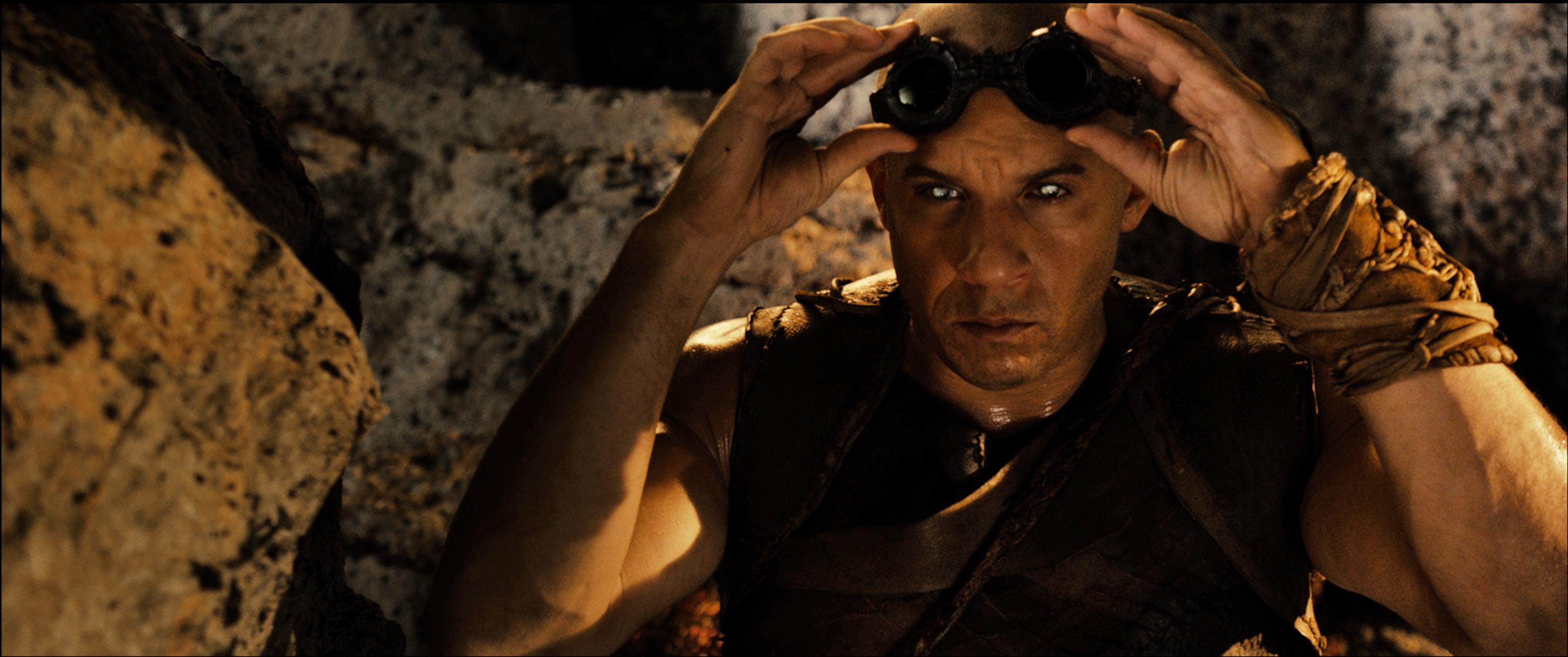
Riddick This is David Twohy’s third flick starring Vin Diesel as the titular misunderstood supercriminal. Aesthetically, it’s probably the most interesting of the lot, with a stylistic weirdness that evokes ’70s Eurocomix in the best way — a pleasing backdrop to what is essentially Diesel playing out the latest in a series of Dungeons & Dragons scenarios where he offers his wisecracking sci-fi take on Conan. Gone are the scares and stakes of Pitch Black (2000) or the cheeseball epic scale of The Chronicles of Riddick (2004); this is a no-nonsense action movie built on the premise that Riddick just can’t catch a break. He’s on the run again, targeted by two bands of ruthless mercenaries, on a planet threatened by an oncoming storm rather than Pitch Black‘s planet-wide night. One unfortunate element leaves a bitter taste: the lone female character in the movie, Dahl (Katee Sackhoff), is an underdeveloped cliché “Strong Female Character,” a violent, macho lesbian caricature who is the object of vile sexual aggression (sometimes played for laughs) from several other characters, including Riddick. (1:59) Metreon, 1000 Van Ness. (Stander)

Short Term 12 A favorite at multiple 2013 festivals (particularly SXSW, where it won multiple awards), Short Term 12 proves worthy of the hype, offering a gripping look at twentysomethings (led by Brie Larson, in a moving yet unshowy performance) who work with at-risk teens housed in a foster-care facility, where they’re cared for by a system that doesn’t always act with their best interests in mind. Though she’s a master of conflict resolution and tough love when it comes to her young chargers, Grace (Larson) hasn’t overcome her deeply troubled past, to the frustration of her devoted boyfriend and co-worker (John Gallagher, Jr.). The crazy everyday drama — kids mouthing off, attempting escape, etc. — is manageable enough, but two cases cut deep: Marcus (Keith Stanfield), an aspiring musician who grows increasingly anxious as his 18th birthday, when he’ll age out of foster care, approaches; and 16-year-old Jayden (Kaitlyn Dever), whose sullen attitude masks a dark home life that echoes Grace’s own experiences. Expanding his acclaimed 2008 short of the same name, writer-director Destin Daniel Cretton’s wrenchingly realistic tale achieves levels of emotional honesty not often captured by narrative cinema. He joins Fruitvale Station director Ryan Coogler as one of the year’s most exciting indie discoveries. (1:36) California, SF Center. (Eddy)

The Spectacular Now The title suggests a dreamy, fireworks-inflected celebration of life lived in the present tense, but in this depiction of a stalled-out high school senior’s last months of school, director James Ponsoldt (2012’s Smashed) opts for a more guarded, uneasy treatment. Charming, likable, underachieving, and bright enough to frustrate the adults in his corner, Sutter (Miles Teller, 2012’s Project X) has long since managed to turn aimlessness into a philosophical practice, having chosen the path of least resistance and alcohol-fueled unaccountability. His mother (Jennifer Jason Leigh), raising him solo since the departure of a father (Kyle Chandler) whose memories have acquired — for Sutter, at least — a blurry halo effect, describes him as full of both love and possible greatness, but he settles for the blessings of social fluidity and being an adept at the acquisition of beer for fellow underage drinkers. When he meets and becomes romantically involved with Aimee (Shailene Woodley), a sweet, unpolished classmate at the far reaches of his school’s social spectrum, it’s unclear whether the impact of their relationship will push him, or her, or both into a new trajectory, and the film tracks their progress with a watchful, solicitous eye. Adapted for the screen by Scott Neustadter and Michael H. Weber (2009’s 500 Days of Summer) from a novel by Tim Tharp, The Spectacular Now gives the quirky pop cuteness of Summer a wide berth, steering straight into the heart of awkward adolescent striving and mishap. (1:35) Balboa, Marina, SF Center, Shattuck, Sundance Kabuki. (Rapoport)

This Is the End It’s a typical day in Los Angeles for Seth Rogen as This Is the End begins. Playing a version of himself, the comedian picks up pal and frequent co-star Jay Baruchel at the airport. Since Jay hates LA, Seth welcomes him with weed and candy, but all good vibes fizzle when Rogen suggests hitting up a party at James Franco’s new mansion. Wait, ugh, Franco? And Jonah Hill will be there? Nooo! Jay ain’t happy, but the revelry — chockablock with every Judd Apatow-blessed star in Hollywood, plus a few random inclusions (Rihanna?) — is great fun for the audience. And likewise for the actors: world, meet Michael Cera, naughty coke fiend. But stranger things are afoot in This Is the End. First, there’s a giant earthquake and a strange blue light that sucks passers-by into the sky. Then a fiery pit yawns in front of Casa Franco, gobbling up just about everyone in the cast who isn’t on the poster. Dudes! Is this the worst party ever — or the apocalypse? The film — co-written and directed by Rogen and longtime collaborator Evan Goldberg — relies heavily on Christian imagery to illustrate the endtimes; the fact that both men and much of their cast is Jewish, and therefore marked as doomed by Bible-thumpers, is part of the joke. But of course, This Is the End has a lot more to it than religious commentary; there’s also copious drug use, masturbation gags, urine-drinking, bromance, insult comedy, and all of the uber-meta in-jokes fans of its stars will appreciate. (1:46) Metreon, 1000 Van Ness, Presidio, Shattuck. (Eddy)

20 Feet From Stardom Singing the praises of those otherwise neglected backup vocalists who put the soul into that Wall of Sound, brought heft to “Young Americans,” and lent real fury to “Gimme Shelter,” 20 Feet From Stardom is doing the rock ‘n’ roll true believer’s good work. Director Morgan Neville follows a handful of mainly female, mostly African American backing vocal legends, charts their skewed career trajectories as they rake in major credits and keep working long after one-hit wonders are forgotten (the Waters family) but fail to make their name known to the public (Merry Clayton), grasp Grammy approval yet somehow fail to follow through (Lisa Fischer), and keep narrowly missing the prize (Judith Hill) as label recording budgets shrivel and the tastes, technology, and the industry shift. Neville gives these industry pros and soulful survivors in a rocked-out, sample-heavy, DIY world their due on many levels, covering the low-coverage minis, Concert for Bangladesh high points, gossipy rumors, and sheer love for the blend that those intertwined voices achieve. One wishes the director had done more than simply touch in the backup successes out there, like Luther Vandross, and dug deeper to break down the reasons Fischer succumbed to the sophomore slump. But one can’t deny the passion in the voices he’s chosen to follow — and the righteous belief the Neville clearly has in his subjects, especially when, like Hill, they are ready to pick themselves up and carry on after being told they’re not “the Voice.” (1:30) Shattuck, Smith Rafael. (Chun)

The Way, Way Back Duncan (Liam James) is 14, and if you remember being that age you remember the awkwardness, the ambivalence, and the confusion that went along with it. Duncan’s mother (Toni Collette) takes him along for an “important summer” with her jerky boyfriend, Trent (Steve Carell) — and despite being the least important guy at the summer cottage, Duncan’s only marginally sympathetic. Most every actor surrounding him plays against type (Rob Corddry is an unfunny, whipped husband; Allison Janney is a drunk, desperate divorcee), and since the cast is a cattle call for anyone with indie cred, you’ll wonder why they’re grouped for such a dull movie. Writer-directors Nat Faxon and Jim Rash previously wrote the Oscar-winning screenplay for 2011’s The Descendants, but The Way, Way Back doesn’t match that film’s caliber of intelligent, dry wit. Cast members take turns resuscitating the movie, but only Sam Rockwell saves the day, at least during the scenes he’s in. Playing another lovable loser, Rockwell’s Owen dropped out of life and into a pattern of house painting and water-park management in the fashion of a conscientious objector. Owen is antithetical to Trent’s crappy example of manhood, and raises his water wing to let Duncan in. The short stint Duncan has working at Water Wizz is a blossoming that leads to a minor romance (with AnnaSophia Robb) and a major confrontation with Trent, some of which is affecting, but none of which will help you remember the movie after credits roll. (1:42) California, Four Star, Presidio. (Vizcarrondo)

We’re the Millers After weekly doses on the flat-screen of Family Guy, Modern Family, and the like, it’s about time movieland’s family comedies got a little shot of subversion — the aim, it seems, of We’re the Millers. Scruffy dealer David (Jason Sudeikis) is shambling along — just a little wistful that he didn’t grow up and climb into the Suburban with the wife, two kids, and the steady 9-to-5 because he’s a bit lonely, much like the latchkey nerd Kenny (Will Poulter) who lives in his apartment building, and neighboring stripper Rose (Jennifer Aniston), who bites his head off at the mailbox. When David tries to be upstanding and help out crust punk runaway Casey (Emma Roberts), who’s getting roughed up for her iPhone, he instead falls prey to the robbers and sinks into a world of deep doo-doo with former college bud, and supplier of bud, Brad (Ed Helms). The only solution: play drug mule and transport a “smidge and a half” of weed across the Mexican-US border. David’s supposed cover: do the smuggling in an RV with a hired crew of randoms: Kenny, Casey, and Rose&sdquo; all posing as an ordinary family unit, the Millers. Yes, it’s that much of a stretch, but the smart-ass script is good for a few chortles, and the cast is game to go there with the incest, blow job, and wife-swapping jokes. Of course, no one ever states the obvious fact, all too apparent for Bay Area denizens, undermining the premise of We’re the Millers: who says dealers and strippers can’t be parents, decent or otherwise? We may not be the Millers, but we all know families aren’t what they used to be, if they ever really managed to hit those Leave It to Beaver standards. Fingers crossed for the cineplex — maybe movies are finally catching on. (1:49) Metreon, 1000 Van Ness, Presidio, Shattuck. (Chun)

The Wolverine James Mangold’s contribution to the X-Men film franchise sidesteps the dizzy ambition of 2009’s X-Men Origins: Wolverine and 2011’s X-Men: First Class, opting instead for a sleek, mostly smart genre piece. This movie takes its basics from the 1982 Wolverine series by Chris Claremont and Frank Miller, a stark dramatic comic, but can’t avoid the convoluted, bad sci-fi plot devices endemic to the X-Men films. The titular mutant with the healing factor and adamantium-laced skeleton travels to Tokyo, to say farewell to a dying man who he rescued at the bombing of Nagasaki. But the dying man’s sinister oncologist has other plans, sapping Wolverine of his healing powers as he faces off against ruthless yakuza and scads of ninjas. The movie’s finest moments come when Mangold pays attention to context, taking superhero or Western movie clichés and revamping them for the modern Tokyo setting, such as a thrilling duel on top of a speeding bullet train. Another highlight: Rila Fukushima’s refreshing turn as badass bodyguard Yukio. Oh, and stay for the credits. (2:06) Metreon. (Stander)

The World’s End The final film in Edgar Wright’s “Blood and Ice Cream Trilogy” finally arrives, and the TL:DR version is that while it’s not as good as 2004’s sublime zombie rom-com Shaun of the Dead, it’s better than 2007’s cops vs. serial killers yarn Hot Fuzz. That said, it’s still funnier than anything else in theaters lately. Simon Pegg returns to star and co-write (with Wright); this time, the script’s sinister bugaboo is an invasion of body snatchers — though (as usual) the conflict is really about the perils of refusing to actually become an adult, the even-greater perils of becoming a boring adult, and the importance of male friendships. Pegg plays rumpled fuck-up Gary, determined to reunite with the best friends he’s long since alienated for one more crack at their hometown’s “alcoholic mile,” a pub crawl that ends at the titular beer joint. The easy chemistry between Pegg and the rest of the cast (Nick Frost, Paddy Considine, Martin Freeman, and Eddie Marsan) elevates what’s essentially a predictable “one crazy night” tale, with a killer soundtrack of 1990s tunes, slang you’ll adopt for your own posse (“Let’s Boo-Boo!”), and enough hilarious fight scenes to challenge This is the End to a bro-down of apocalyptic proportions. (1:49) Metreon, 1000 Van Ness, Presidio. (Eddy)

You’re Next The hit of the 2011 Toronto Film Festival’s midnight section — and one that’s taken its sweet time getting to theaters — indie horror specialist (2010’s A Horrible Way to Die, 2007’s Pop Skull, 2012’s V/H/S) Adam Wingard’s feature isn’t really much more than a gussied-up slasher. But it’s got vigor, and violence, to spare. An already uncomfortable anniversary reunion for the wealthy Davison clan plus their children’s spouses gets a lot more so when dinner is interrupted by an arrow that sails through a window, right into someone’s flesh. Immediately a full on siege commences, with family members reacting with various degrees of panic, selfishness. and ingenuity, while an unknown number of animal-masked assailants prowl outside (and sometimes inside). Clearly fun for its all-star cast and crew of mumblecore-indie horror staples, yet preferring gallows’ humor to wink-wink camp, it’s a (very) bloody good ride. (1:36) Metreon, 1000 Van Ness. (Harvey) *


 

Alerts

0

ALERTS


Wednesday 11

Vandana Shiva on biotechnology Goldman Theater, David Brower Center, 2150 Allston, Berk. www.kpfa.org. 7:30pm, free. Join world-renowned environmental philosopher and author Vandana Shiva for a forum on the biotechnology industry. Shiva will illuminate the corporate assault on biological and cultural diversity, in conversation with Gopal Dayaneni of Movement Generation: Justice and Ecology Project. She’ll help concerned activists to connect the dots: What is the East Bay “Green Corridor,” who’s behind it, and what are the implications for communities here and around the globe?


Friday 13

Oil and unions in Iraq SEIU 1021 office, 350 Rhode Island, SF. 1021.seiu.org. 6:30pm, free. Listen as Hassan Juma’a Awad, president of the Iraq Federation of Oil Unions, shares his experience in struggling for basic labor rights for Iraqi workers. Iraq’s public sector workers (including the oil sector) lack the legal right to organize or engage in collective bargaining, more than a decade after the end of the dictatorship. Earlier this year, Hassan faced criminal charges in retaliation for worker strikes, and was accused of undermining Iraq’s economy.


Saturday 14

North by Northwest bike ride Velo Rouge Cafe, 798 Arguello, SF. 1:30pm, free. Interested in street design, bikeways, traffic calming, and other kinds of improvements along San Francisco city streets? Join a group of cyclists on this afternoon ride to learn about the history and current projects that shape the streets on which we walk and bike. This ride will feature a series of stops and information about how the 2009 Bike Plan and other ongoing projects are shaping the northwestern parts of San Francisco.


Monday 16

Mexican Independence Day 2940 16th St., SF. Livingwage-sf.org. 7pm, $10–$15. Join the San Francisco Living Wage Coalition for a concert and celebration of Mexican Independence Day. “Songs of Healing for Juarez” will provide an emergency benefit concert for Las Hormigas, an organization that has been working to address violence and poverty in Ciudad Juarez. The concert will feature Diana Gameros, Francisco Herrera and other guests, as well as a live art auction. For more information, call (415) 863-1225.

Jill Stein on movements vs. money Unite Here Local 2, 209 Golden Gate, SF. 6-9pm, free. Jill Stein, the Green Party Presidential Candidate of 2012, will discuss the creation and intent of The Green Shadow Cabinet, an organization that includes nearly 100 prominent community and labor leaders, physicians, cultural workers, veterans and others with the goal of providing an ongoing opposition and alternative voice to dysfunctional Washington, DC politics. Stein will speak on current political dynamics and strategies for creating good jobs, ending student debt, cultivating democracy and breathing new life into the environmental movement. Hosted by OccupyForum.


Pumped up

3

marke@sfbg.com

ON THE MOVE The epic Pacific Crest Trail winds 2,650 miles from Mexico to Canada, through sun-roasted desert expanse and snow-covered mountain pass, past rushing waterfalls and over wildflower-studded Alpine plateau, roughly tracing the Sierras and Cascades, always out of sight of civilization. It takes most hikers roughly half a year to make the whole trip, an isolating, immersive communion with nature that foregrounds self-reliance, endurance, and more than a little ingenuity when it comes to where you’re going to sleep and what you’re going to eat.

On June 21, Alex Falcioni, a massage therapist and teacher, took to the 1,230-mile leg of the trail running from Tuolumne Meadow, Yosemite, to Portland. In high heels.

“I’d always dreamed of doing the trail — but the most I could take off would be three months, so I knew I couldn’t do the whole thing” he told me over a “beat-up” phone from Ashland, hitchhiking his way back to the Bay Area after completing his high-heeled hike on Aug. 31st at Cascade Locks, Ore. “And then I heard that my dear friend Sarah had been diagnosed with multiple sclerosis and was having trouble covering her medical bills, so I decided to make the hike a fundraiser.

“I needed a gimmick, though, to draw attention. And that’s where the pumps came in — it really just came to me one day. I’d start in Yosemite, and wear the pumps to Portland. Mostly for the alliteration, ha ha.”

Falcioni’s project, Pumps 2 Portland, was partly inspired by Hiking26, a 2012 performance art piece by Ron Ulrich, who completed the entire PCT wearing 26 wedding dresses along the way. So far, Falcioni has managed to raise over $2,500. (Interested parties can still donate and read firsthand about Falcioni’s adventures at www.pumps2portland.com.)

The first obvious question: What kind of pumps were they? “Oh, a strappy white pair of size-12 slingbacks from a drag queen shoe store. They’re completely destroyed,” Falcioni said. “My toes look like little Vienna sausages. But my calves are rocks.”

The second obvious question: Come on, did he really wear high heels the whole time?

Falcioni laughs. “No way! There are ascents up to 10,000 feet and sometimes I felt afraid for my life in hiking shoes. Plus, often ‘trail’ is a relative word — it’s not like clicking down a paved sidewalk. But I wore them when I could, and I strapped them on my backpack for all the other hikers to see when I couldn’t.

“They were there to keep me inspired and add a little spark when the trail got so monotonous it was like sensory deprivation — like, ‘if I see another Ponderosa pine I’m going to go insane!'” With the heels it all became a outdoor runway.

“The pumps really opened doors, too,” Falcioni continued. “People I’d encounter on the trail would ask about them and that would help along a conversation. Or when I’d go into town… One of the ways you survive the trail is to mail food ahead for yourself. (You learn little tricks, like mixing spicy ramen with a spoonful of peanut butter equals Thai food!) So I’d have to go down into towns to pick that up, and I hadn’t bathed in a week — same shirt, same pants, covered in dirt and smoke. But showing off these huge pumps.

“That not only got the attention of the Trail Angels — people who dedicate themselves to opening their homes and helping out PCT hikers — but of random strangers, too. I made so many real friendships, had so many actual conversations about real things in these places of enormous beauty. Not to mention some free showers.

“It was an incredible experience to just put yourself out there at the mercy of nature, other people, and even yourself. I’d urge anyone to do it, giant man-heels or no.”

Nevertheless: Hey, Rupaul — I think we have your next location for Drag Race.

Waiting for BRT

18

By Joe Fitzgerald Rodriguez

joe@sfbg.com

You’re on Muni’s underground line, the train stalled just shy of your stop, just stuck there, the light at the end of the tunnel right in front of you. It’s a frustrating feeling, right?

With more than six years worth of delays in three major transit overhauls — the Van Ness, Geary and Geneva Bus Rapid Transit Projects — it’s beginning to feel just like that.

The projects are designed to speed up the most trafficked transit routes in the city by making the buses run like trains. For the Van Ness Bus Rapid Transit, the 47 and 49 would drive in dedicated bus-only lanes shuttling riders north and south, reducing travel time by a third, according to project estimates.

Van Ness BRT was initially announced in 2004 with a planned unveiling of 2012. Eight years later, the new debut is set for 2018. The Geary Project is even worse, with a completion date slated for 2020.

The Van Ness BRT is finally getting its wheels turning this month, with the Environmental Impact Report set to be approved by a number of governmental bodies: the Van Ness BRT Citizen’s Advisory Committee, the Transit Authority board, and the San Francisco Municipal Transportation Authority.

Why the hell has this bus project taken nearly a decade to start its engine? As is customary in politics, fingers are pointed at all sides.

At a citizen’s meeting for the Van Ness BRT on Sept. 4, two angry factions gathered in the Old First Church Fellowship Hall on Van Ness. The SFMTA’s spokesperson for the project, Lulu Feliciano, wrapped up her presentation to the crowd of about 100, and that’s when they pounced.

“Van Ness’ three lanes will be limited to two, but it’s a highway, isn’t it?” asked Carole Holt, owner of Russian Hill Upholstery. “Why do cars have no consideration?” She told the Guardian she worried her customers from Marin would have trouble getting to her store.

Another Polk Street activist, Kelly Gerber, walked right up to Feliciano’s face and gestured with his hand like an angry schoolteacher. “Why has no one ever heard of this?” he bellowed, telling us he opposes the loss of parking spaces.

Ironically, transit planners say car traffic would move faster, partially because of the elimination of all left turns along Van Ness except Broadway.

“They’re just angry and zooming in on every little detail,” Mario Tanez, spokesperson for the SF Transit Riders Union, said of BRT’s opponents.

The mostly younger crowd of transit activists showed up in equal force to counter the Polk Street merchants, hoping to stem the tide of NIMBYism.

“We’re the generation that will actually see these improvements,” Teo Wickland told us. He’s an urban planning student who hopes to see Muni running on time.

Feliciano said the project was complicated by having to coordinate multiple city agencies, all with their own goals.

Instead of digging up the same stretch of concrete a dozen times in a decade, San Francisco tries to include as many agencies as possible when cement is broken in any part of the city, she said. Since the Van Ness project is a two-mile stretch between Lombard and Mission streets, many are involved.

infographic showing different city agencies involved in the reconstruction of Van Ness

Graphic by Brooke Robertson

Peter Gabancho, the project manager for Van Ness BRT, said that the San Francisco Public Utilities Commission will put in new water lines, institute a rainwater catch system, and do sewer work. The Department of Public Works plans to repave, and the SFMTA will replace overhead bus lines and light poles.

When asked how much the city would save by combining work, he couldn’t give an exact dollar amount but said it was in the tens of millions, at least.

He also said that the process requires community meetings at many steps in the process. City officials visited Mexico City to see how they planned and built its BRT in just three years, and Gabancho said it’s because that city didn’t really consult the community.

“We can’t do business like that in San Francisco and I don’t think we want to do that in San Francisco,” he said.

All of that governmental insanity had a member of the Geary BRT’s Citizen Advisory Council calling it quits in a fury — he even wrote about it in his blog.

“What I’ve seen in the past six years has been a severe disappointment during which I have lost trust in America’s regulatory framework to enact effective transit improvements,” Kieran Farr, the CEO and co-founder of VidCaster, wrote. He described the process as fraught with starts and restarts, slips and delays, mostly due to a lack of leadership. And that’s the rub: There is no point person on this project with strong political will, according the SFTRU. “The mayor is not saying this is high priority,” Tanez told us. “He’s at all the Central Subway events, but getting political clout behind this by writing to our supervisors is the only way to do this.” The Van Ness project runs through the districts of Sups. Mark Farrell and David Chiu, who were both unavailable at press time. The SFMTA is slated to approve the Van Ness BRT EIR on Tue/17 at 1pm in City Hall, Room 400.

The Performant: Mean Streets and Matchsticks at the Vancouver Fringe

0

Here in Vancouver, the Fringe Festival has been in full swing since Sept. 5, and its early bustle has come as something of a welcome surprise. Shows have been selling out right and left, including those by the five-woman sketch comedy team Strapless, and the manic SNAFU Dance Theatre‘s survivalist romp Kitt & Jane. The buzz hangs as heavy in the air as the morning humidity. It’s interesting to compare the rowdy carnival atmosphere of the Edmonton Fringe, complete with sideshow attractions, tireless street performers, and mountains of cheap fried food and the people who eat it, with Vancouver’s more refined approach and oddience. The Vancouver Fringe is the biggest theater festival in town, I’m told, and therefore attracts a fairly large percentage of mainstream theater-goers.

But despite the fact that each show begins with an overly complicated spiel about sponsorship opportunities, the shows themselves have run the usual fringe-y gamut of content from heartfelt to hilarious, edgy to educational. Here are some of the standouts I’ve seen so far.

One of the bravest shows of the 2012 San Francisco Fringe was not actually a theatre piece at all, but an educational talk entitled The Revolution Will Not Be Circumcised, complete with video footage of infant (male) circumcisions that was decidedly not for the faint of heart. I see a lot of similarity in Tasha Diamant’s equally brave The Human Body Project, because when she takes the stage, naked and unscripted, the audience is immediately forced to examine their own reactions and assumptions around the act, the artist, and the body in general, leading to a tangibly cathartic yet thought-provoking collective experience.

Speaking of San Francisco Fringe, homegrown clown Summer Shapiro, whose Legs and All charmed at the festival in 2009, is here in Vancouver with a fun, interactive work, In the Boudoir; it’s a mostly silent comedy of a first date gone terribly awkward. In the same venue, the wry magic of Travis Barnhardt astounds in his mentalist routine Unpossible, during which he confesses several times that he hasn’t quite mastered the art before revealing that he clearly has.

Canadian storyteller Andrew Bailey, whose show Limbo I enjoyed in Edmonton, knocks one out of the metaphorical ballpark with his smart, compelling The Adversary. Matchstick, a two-person musical centered around a troubled, International love affair with political implications, impresses with its quick wit, inventive staging, and dynamic duo, despite some silly lyrics. Solo clown show Butt Kapinski follows a diminutive, speech-challenged “Pwivate Eye” down the mean streets and aisles of the small theater space, filled with cruel tenements, corrupt cops, and a bevy of working girls and murder victims (all unsuspecting oddience members), while the aforementioned Kitt & Jane wows with its energetic portrayals of a pair of angsty high school misfits who have one hour to save the world from itself.

Still looking forward to so much more, including Little Pussy, Model Wanted, Preacher Man, Kuwaiti Moonshine, Radio:30, The Cruelest Phone Book in the World, Against Gravity, Fools for Love, and 6 Guitars so I’d better get cracking. So little time. So many shows.

Smartphones trigger rise in crime rate as new iPhone features a fingerprint lock

10

Violent crime is on the rise in the Bay Area and the San Francisco Police Department chalks it up to smartphone snatchers, a trend that is being countered by an initiative from the District Attorney’s Office and today’s announcement by Apple of a new iPhone that requires the owner’s fingerprint to unlock.

The FBI’s 2012 Uniform Crime Report, released in June, documented surges in crime in cities across the Bay Area, including Berkeley, Oakland, San Jose, and Richmond. In San Francisco, violent crime increased 7.5 percent in 2012 and property crime spiked 18.3 percent. In 2013, those figures have climbed another 10 and 12 percent, respectively.

Asked for an explanation of the recent trend, SFPD spokesperson Tracy Turner told us that it’s due in large part to “increases in the theft or robbery of cell phones.”

“I can’t think of any other expensive item that people walk around with in their hand in public,” she said. “They’re more available to everybody and yet they’re slightly more expensive.”

Turner also cautioned that it’s not just iPhones that thieves go after, but all types of smartphones and also, more recently, tablets. “Those are the kind of items that people are absorbed in while they’re in a public place and they’re easy targets,” she explained.

Nathan Rapport, a resident of the Lower Haight, had his iPhone, iPod, and wallet stolen shortly before midnight last Wednesday as he approached the intersection of 14th and Sanchez on foot.

“I sent a text probably a block away. Who knows if they saw the light down the street,” he speculated of the pair of thieves who drew a gun on him and demanded his possessions less than a minute later. The responding officers remarked that similar altercations often escalate, ending in physical harm to the victim.

“They said that they were surprised that it wasn’t more violent based on what they’ve been seeing lately in the neighborhood. It’s not usually just a snatch. You get pistol-whipped or there’s something else attached to it,” commented Rapport, who felt fortunate that, in his case, the incident “was strictly a business transaction.”

In San Francisco, “over 50 percent of daily robberies have to do with smartphones and up to 67 percent of robberies include mobile devices of any sort,” said SFPD Officer Danielle Newman.

District Attorney George Gascón has taken these statistics to heart in a newly crafted crime reduction strategy. He is co-chair of the Secure Our Smartphones Initiative, which has been endorsed by law enforcement agencies in 17 states.

In a June press release, the coalition wrote, “It’s time for manufacturers and carriers to put public safety before corporate profits” and he called on them to implement a “kill switch,” which could remotely disable phones reported stolen.

“Unlike other types of crimes, manufacturers and carriers have the ability to end the growing number of smartphone thefts with a technological solution,” the statement continued. A purloined phone’s value “would be equivalent to that of a paperweight. As a result, the incentive to steal them would be eliminated.”

At a hotly anticipated product launch this morning in Cupertino, Apple unveiled two new iPhone models. One, the 5C, is a budget design developed mainly for distribution in overseas markets and the other, 5S, includes fingerprint scan technology in the home button as a security measure. Industry analysts have been abuzz for weeks with speculation as to whether the newly impregnable button would be an innie or an outie.

As expected, the flashy new feature resulted in a minor anatomical change to Apple’s most popular product. Its rollout will have an even broader impact, however, as it alters the distribution of security across different countries and socio-economic classes. In its next major product development, perhaps Apple will take a cue from Gascón and put as much effort into democratizing safety as it does to democratizing its brand.


Action franchise junkie Vin Diesel returns … and more new movies!

0

Who dares to challenge the box-office supremacy of Vin Diesel, who returns yet again to play the titular night vision-gifted (but really socially awkward) escaped con in sci-fi actioner Riddick?

For masochists, there’s Brian De Palma’s latest, Passion, which checks in for a brief Castro run (Dennis Harvey gets bored talking about it here); there are also a couple of docs, a MILF drama, and a South Korean disaster-by-numbers flick about a disease that, shockingly, doesn’t spawn zombies, just bloody coughs and rapid death. Read on for our short takes (and take note of your best-bet new flick: “charming seriocomedy” Afternoon Delight).http://www.youtube.com/watch?v=_KWyEbmKHsY

Adore This glossy soap opera from director Anne Fontaine (2009’s Coco Before Chanel) and scenarist Christopher Hampton, adapted from a Doris Lessing novella, has had its title changed from Two Mothers — perhaps because under that name it was pretty much the most howled-at movie at Sundance this year. Lil (Naomi Watts) and Roz (Robin Wright) are lifelong best friends whose hunky surfer sons Ian (Xavier Samuel) and Tom (James Frecheville) are likewise best mates. Widow Lil runs a gallery and Roz has a husband (Ben Mendelsohn), but mostly the two women seem to lay around sipping wine on the decks of their adjacent oceanfront homes in Western Australia’s Perth, watching their sinewy offspring frolic in the waves. This upscale-lifestyle-magazine vision of having it all — complete with middle-aged female protagonists who look spectacularly youthful without any apparent effort — finds trouble in paradise when the ladies realize that something, in fact, is missing. That something turns out to be each other’s sons, in their beds. After very little hand-wringing this is accepted as the way things are meant to be — a MILF fantasy viewed through the distaff eyes — despite some trouble down the road. This outlandish basic concept might have worked for Lessing, but Fontaine’s solemn, gauzily romantic take only slightly muffles its inherent absurdity. (Imagine how creepy this ersatz women-finding-fulfillment-at-midlife saga would be if it were two older men boning each others’ daughters.) Lord knows it isn’t often that mainstream movies (this hardly plays as “art house”) focus on women over 40, and the actors give it their all. But you’ll wish they’d given it to a better vehicle instead. (1:50) (Dennis Harvey)

http://www.youtube.com/watch?v=DQpXyke3VC4

Afternoon Delight It takes about five seconds to suss that Kathryn Hahn is going to give a spectacular performance in Jill Soloway’s charming seriocomedy. Figuring to re-ignite husband Jeff’s (Josh Radnor) flagging libido by taking them both to a strip club, Rachel (Hahn) decides to take on as a home- and moral-improvement project big-haired, barely-adult stripper McKenna (Juno Temple). When the latter’s car slash-home is towed, bored Silver Lake housewife and mother Rachel invites the street child into their home. Eventually she’s restless enough to start accompanying McKenna on the latter’s professional “dates.” Afternoon Delight is a better movie than you’d expect — not so much a typical raunchy comedy as a depthed dramedy with a raunchy hook. It’s a notable representation of no-shame sex workerdom. It’s also funny, cute, and eventually very touching. Especially memorable: a ladies’ round-table discussion about abortion that drifts every which way. (1:42) (Dennis Harvey)

http://www.youtube.com/watch?v=cQlWgnerTRc

Far Out Isn’t Far Enough: The Tomi Ungerer Story Fairy tales really do come true — even when they’re as strange as the one lived by Hans Christian Andersen Award-winning illustrator, writer, and activist Tomi Ungerer. As a child, he was torn between Nazi Germany and occupied France, growing up in the Alsace region; as an artist, Ungerer possesses a creative fire fueled by the trauma of war and a bisected identity — his native Strasbourg, as he paints it with archetypal vivid colors, “is the sphincter of France. When France has indigestion, we’re the first to feel it.” In keeping with that free spirit, director Brad Bernstein playfully, beautifully captures Ungerer’s early years, from the artist’s preteen renderings of Nazi horrors, to his formative artistic inspirations, to the outpouring that followed during NYC’s golden age of illustration. In Big Apple, children’s classics like Crictor (1958), Adelaide (1959), and The Three Robbers (1961) inspired colleagues like Maurice Sendak (here in one of his last interviews) and Jules Feiffer. No niche branding and self-censorship for Ungerer, who happily fed the midcentury’s appetite for his drawings; imbued his kids tales with absurdity, fear, and his lifelong fascination with death; and created powerful anti-war posters and iconic illustrations reflecting the struggles of the ‘60s (and very adult “Fornicon” erotica as well). The latter finally ushered in a kind of closing chapter to Ungerer’s American success story, when word spread that the “kidso” favorite also did porno and his children’s books were blacklisted from libraries. Bernstein generally hastens through the decades of “exile” that followed — staying so far from some of Ungerer’s personal particulars that we never even get the name of his wife (or is it wives?) — but the time he takes to give the viewer a sense of the witty, quirk-riddled artist’s personality keeps a viewer riveted. (1:38) (Kimberly Chun)

The Flu As a shipping crate stuffed with illegal immigrants creeps into a ritzy Seoul suburb, one poor soul within stifles a cough; before long, everyone’s dead — save a crusty-eyed youth who’s apparently resistant to the disease yet still capable of kick-starting a devastating epidemic. Can the headstrong doctor (Soo Ae) save her sassy tot (Park Min-ha) from certain, blood-spewing death? Will the cocky EMT (Jang Hyuk) be able to help her, and win her heart in the process? Will the muckety-mucks in power get their shit together in time to prevent mass panic and a global outbreak? Zzzzz. Save some gnarly third-act visuals (you won’t believe what the government does with the bodies of the afflicted), this disaster movie from writer-director Kim Sung-su fails to innovate on the template laid down by films like 2011’s Contagion or 1995’s Outbreak. Also, for all the gory drama, the central storyline (re: the sick kid and the nascent couple) is completely devoid of tension, trudging for two hours toward the most predictable ending imaginable. (2:00) (Cheryl Eddy)

http://www.youtube.com/watch?v=Od8DhL1hyfw

I Give It a Year This glossy feature writing-directing debut from longtime Sacha Baron Cohen collaborator Dan Mazer has been called the best British comedy in some time — but it turns out that statement must’ve been made by people who think the Hangover movies are what comedy should be like world-wide. Rose Byrne and Rafe Spall play mismatched newlyweds (she’s stiff-upper-lippy advertising executive, he’s a manboy prankster novelist) who worry their marriage won’t last, in part because everyone tells them so — including such authorities as her bitchy sister (Minnie Driver), his obnoxious best friend (Stephen Merchant), and their incredibly crass marriage counselor (Olivia Colman). Also, they’re each being distracted by more suitable partners: she by a suave visiting American CEO (Simon Baker), he by the ex-girlfriend he never formally broke up with (Anna Faris). This is one of those movies in which you’re supposed to root for a couple who in fact really don’t belong together, and most supporting characters are supposed to be funny because they’re hateful or rude. There’s plenty of the usual strained sexual humor, plus the now-de rigueur turn toward earnest schmaltz, and the inevitable soundtrack stuffed with innocuous covers of golden oldies. Some wince-inducing moments aside, it all goes down painlessly enough — and Mazer deserves major props for straying from convention at the end. Still, one hopes the future of British comedy isn’t more movies that might just as well have starred Vince Vaughn and Jennifer Aniston. (1:37) (Dennis Harvey)

http://www.youtube.com/watch?v=rTw4OHsh9so

Riddick This is David Twohy’s third flick starring Vin Diesel as the titular misunderstood supercriminal. Aesthetically, it’s probably the most interesting of the lot, with a stylistic weirdness that evokes ’70s Eurocomix in the best way — a pleasing backdrop to what is essentially Diesel playing out the latest in a series of Dungeons & Dragons scenarios where he offers his wisecracking sci-fi take on Conan. Gone are the scares and stakes of Pitch Black (2000) or the cheeseball epic scale of The Chronicles of Riddick (2004); this is a no-nonsense action movie built on the premise that Riddick just can’t catch a break. He’s on the run again, targeted by two bands of ruthless mercenaries, on a planet threatened by an oncoming storm rather than Pitch Black’s planet-wide night. One unfortunate element leaves a bitter taste: the lone female character in the movie, Dahl (Katee Sackhoff), is an underdeveloped cliché “Strong Female Character,” a violent, macho lesbian caricature who is the object of vile sexual aggression (sometimes played for laughs) from several other characters, including Riddick. (1:59) (Sam Stander)

http://www.youtube.com/watch?v=JbSUyYXH8hs

Spark: A Burning Man Story A few months after kicking off DocFest — and mere days after the flames of Burning Man ’13 were extinguished — doc Spark: A Burning Man Story opens for a theatrical run. With surprisingly open access to Burning Man’s inner-circle organizers, San Francisco filmmakers Steve Brown and Jessie Deeter chronicle the organization’s tumultuous 2012 season, a time when the group was forced to confront concerns both practical (a stressful ticket-sale snafu) and philosophical (why are they selling tickets in the first place?) Spark doesn’t shy away from showing the less-graceful aspects of Burning Man’s exponential growth and transformation, but at its core it’s a fairly starry-eyed celebration of the event’s allure, reinforced by subplots that focus on artists who view “the playa” as their muse. (1:30) (Cheryl Eddy)

Still secret

22

news@sfbg.com
A high-profile local civil rights ordinance passed last year to shine light on the San Francisco Police Department’s joint activities with the FBI has been undermined by the SFPD’s refusal to disclose its surveillance activities. This comes at a time when the public is learning more than ever about the federal government’s intrusion into the privacy of law-abiding US citizens.

In May 2012, the Board of Supervisors unanimously passed the Safe San Francisco Civil Rights Ordinance, which Mayor Ed Lee signed in a photo-op ceremony with Police Chief Greg Suhr and the activists who supported it. They claimed the board’s passage of the ordinance ushered in a new era of transparency over the SFPD’s previously secretive work with the FBI-led Joint Terrorism Task Force.

“The ordinance basically requires three things,” Nasrina Bargzie, a civil rights attorney at the Asian Law Caucus who worked on the measure, told the Bay Guardian. “The first part requires that the Police Department work with the JTTF has to follow the California constitutional rights of privacy, so they’re not following the lax standards of the [US] Department of Justice. The second part is that they can no longer enter into any secret agreements with the FBI; it has to go before the Police Commission in a public setting. The final part of the ordinance exists to make sure the rules are being followed, so there is a requirement for a yearly report.”

At the time of its passage, activists told the Guardian that the ordinance was only as strong as the SFPD’s willingness to disclose its activities (see “Mayor Lee signs watered-down limits on SFPD spying,” 5/9/12). But the SFPD’s refusal to disclose even minimal, basic information calls into question the ordinance’s value.

After the release of multiple reports earlier this year that activists called inadequate, Suhr is now maintaining silence regarding the JTTF, while claiming the department is in full compliance with the ordinance. According to Bargzie, Suhr told her the FBI is barring him from disclosing the requested information.

Following multiple efforts by the Guardian to get a comment out of SFPD about the ordinance and whether the department was indeed taking a subservient role to the FBI, SFPD Sgt. Dennis Toomer told us, “We’re not talking about that at all.”

LACK OF RESPONSE

Activists have sparred with Chief Suhr over implementation of the ordinance and its required annual report since at least the beginning of 2013.

Deputy Chief John Loftus presented the first report to the Police Commission on Jan. 23, which claimed the SFPD was in “full compliance” with the ordinance without providing any details. Activists and the public quickly demanded a real response.

“The commission presented this short oral report, which was a little short of two minutes long,” Bargzie told us. “There was no data that we were not already aware of. It was just basic statements claiming that they were complying with the ordinance.”

Suhr apologized for the omissions while stating his department was still in compliance with the ordinance’s guidelines, pledging to be more forthcoming. At this time, SFPD Sgt. Michael Andraychak told the Guardian: “The Chief’s Office is in the process of scheduling meetings with Nasrina Bargzie [of the Asian Law Caucus] to develop a report with more detail so those concerned and the public can be as informed as possible. Chief Suhr is committed to remain in compliance with the ordinance.”

The Coalition for Safe San Francisco, an activist group consisting of Muslim Legal Fund of America, Asian Law Caucus, and dozens of other groups, met with Suhr to discuss setting up a template for the reports.

Suhr then released a second report, which contained more relevant information, stating that SFPD officers did not act as informants in 2012 and three full-time SFPD officers were assigned to the JTTF.

But the report still omitted key oversight information, such as whether any prosecutions resulted from JTTF and SFPD investigations, which would allow the Muslim Legal Fund of America and other groups to determine who the SFPD is arresting and why.

Last year, Suhr told a San Francisco Examiner reporter that his officers followed up on 2,000 tips regarding counterterrorism activities. However, this information curiously did not make it into the official report.

“We contacted the chief to let him know we were not okay with this. We had another meeting with him and he said he’d think about it and get back to us and now he is claiming he cannot honor a basic component of the ordinance,” Bargzie told us. “He asserts in writing this is because the FBI will not let him share the basic information.”

WEAKENED LEGISLATION

The weak efforts behind the implementation of the SSFCRO date back to Mayor Lee’s veto of a stronger ordinance in April 2012, which would have codified privacy protections and given the Police Commission more power to stop FBI-SFPD activities that did not comply with Department General Order (DGO) 8.10, the 1990 policy aimed at protecting First Amendment activities. After Lee’s veto, the Board of Supervisors passed a weaker version. Both were sponsored by Sup. Jane Kim.

John Crew, a former police practices expert with the Northern California American Civil Liberties Union, raised concerns to the Guardian about the weakened legislation. “It is a step in the right direction, there’s no doubt it’s progress,” Crew told us at the time. “But whether it’s real progress depends on the implementation. Ultimately, it will come down to political will at the Police Commission to enforce privacy protections.”

Much of the ordinance’s failure stems from the apparent lack of real intent to disclose what the activists sought. Critics painted the SSFCRO signing ceremony as a hollow symbolic act, a way for Mayor Lee and Chief Suhr to publicly promote civil rights and progressive ideals with an ordinance they purposefully weakened.

“My sense is that [the SFPD] is not taking this seriously,” Bargzie told us. “I think they probably believe that they are providing as much information as the FBI will let them and Chief Suhr thinks it’s fine that the FBI can tell him to share what they tell him to.”

The lack of transparency regarding the JTTF’s work with the SFPD requires the public to trust the federal government to safeguard civil liberties. But in the wake of whistleblower Edward Snowden’s leak exposing the expansive surveillance system by the National Security Agency and the SFPD’s notorious history of illegal surveillance and racial profiling, the public has little reason to trust the authorities.

HISTORY OF SPYING
The passage of the SSFCRO is the latest effort to counter a long history of racial profiling, spying on radical political groups, and other constitutional violations, episodes that have been followed by progressive reforms in San Francisco.
Prior to the passage of DGO 8.10 in 1990, the SFPD notoriously participated in the surveillance of non-criminal, pacifist political organizations. During the 1984 Democratic National Convention, the SFPD carried out surveillance on law-abiding organizations and, throughout the 1980s, it created files on civil, labor, and special interest groups in the Bay Area, revelations that led to the adoption of DGO 8.10.
But even after that, disclosures surfaced showing that the SFPD was blatantly violating its own rules. They included then-Police Chief Tony Ribera admitting that files on non-criminal political activity were not destroyed (as required by the ’90s reforms), the selling of confidential intelligence material to foreign governments and private entities, and the actions of SFPD Intelligence Officer Tom Gerad, who informed on local political groups for the FBI.
In the subsequent years following the Gerad scandal, San Francisco sought to strengthen DGO 8.10, requiring more transparency and oversight. But this progress was undercut in 2007 when the SFPD secretly signed a secret JTTF Memorandum of Understanding (MOU) undermining DGO 8.10.
San Francisco’s Human Rights Commission held hearings in which the community voiced concerns over illegal police and federal surveillance. In response, the SFPD said they were unable to discuss arrangements with the JTTF without the permission of the FBI.
In 2011, the previously secret MOU was unearthed by the ACLU (see “Spies in blue,” 4/26/11), prompting Suhr to issue Bureau Order #2011-07, which reinforced that SFPD personnel were under the jurisdiction of local and state privacy protections and did not spy on law-abiding groups. SFPD Public Information Officer Albie Esparza said the order reversed the language of the 2007 memo.
Part of Suhr’s amendment to SFPD policy at the time included the necessity of a predicate offense in all SFPD investigations. Thus, the SFPD could not investigate or spy on those who were not suspected of violating the California Penal Code or federal law.
Activists wanted those protections enshrined in city law, which resulted in last’s vetoed ordinance and passage of the watered down Safe San Francisco Civil Rights Ordinance in 2012, which activists now say they feel duped by.
“We have been extremely disappointed at the lack of information that has been included in the reports,” Summer K. Hararah, Regional Director for the Greater San Francisco Area Muslim Legal Fund of America told us. “If the SFPD is going to violate rights of Arab-Americans, the police chief has a responsibility to stand up to the FBI.”

POST 9/11 WORLD
Lax federal guidelines for counterterrorism have been building since the Bush Administration began implementing emergency measures after 9/11 terrorist attacks in 2001. In San Francisco’s case, the FBI has subjected local law enforcement to these rules.
Since 9/11, both the ACLU of Northern California and the Human Rights Commission have publicized cases of racial profiling and surveillance of pacifist, non-criminal Muslim and Middle-Eastern groups in San Francisco. A 2007 FBI memorandum illustrated a prominent instance of this profiling in which FBI agents attended Ramadan Iftar dinners in San Francisco purportedly as part of the FBI’s mosque outreach program. Under this guise, the agents collected data on certain attendants, including names, the content of conversations, and other information covered by the First Amendment. According to the FBI Domestic Investigations and Operations Guide, the JTTF is permitted to conduct surveillance of this nature, by identifying “locations of concentrated ethnic communities in the Field Office’s domain, if these locations will reasonably aid in the analysis of the potential threats and vulnerabilities, and, overall assist domain awareness for the purpose of performing intelligence analysis.” These policies directly contradict SSFCO, DGO 8.10, and the California Constitution’s privacy protections. In Portland, Ore., the local government successfully fought this issue by bifurcating local law enforcement from the JTTF after the public and the ACLU raised concerns over similar constitutional violations and racial profiling. This Portland model is now a precedent for activist groups nationwide, seeking to end the lack of oversight permeating their local police departments. “Portland has been a great model,” Hararah told us. “When the FBI began to interview Muslim men in mass after 9/11, Portland was one of the few that said ‘absolutely not.'” But in San Francisco, Lee (whose office also didn’t respond to our request for comment) and Suhr’s symbolic promotion of civil rights has diminished into a case of them basically bullshitting the public. “Civil rights is not a symbolic issue,” Hararah told us. “The mayor backed this legislation and we want to see that the commitment is put forth with global insurance. The first step is having info about what the JTTF is doing to be sure it abides by human rights protections and is appropriate.”

Hormone replacement therapy and video games: Anna Anthropy talks Dy5phoria

2

Video games go to alien worlds all the time, but rarely have they explored a transgender person’s identity until Dys4ia. The 2012 Adobe Flash game traced designer Anna Anthropy’s hormone replacement therapy journey, guiding the player through trying on women’s clothing for the first time, dealing with the agony of shaving, and correcting all the people who call you “sir” instead of “ma’am.”

Anthropy was kind enough to let the Guardian interview her in her Oakland home, dodge her energetic cats, and record an audio interview where she walks us through her new game, Dy5phoria, the new chapter and pseudo-sequel to Dys4ia. You can also read a selection from the audio interview below. 

SF Bay Guardian How do you pronounce the new title? 

Anna Anthropy I’ve been calling it Dys-five-ia out loud, but it’s spelled like Dys4ia with a 5 instead of an S. 

SFBG You’re hitting steam now with added content, can you tell us what’s new?

AA Dys4ia is made up of four chapters which represent different times in my life when I was starting to go on hormone replacement therapy. Dy5phoria which will come with Dys4ia is a fifth chapter that follows what’s happened in my life since the place Dys4ia ended.

SFBG Not quite a sequel but downloadable content?

AA Like a fifth chapter, if you will. 

Listen to the full 26 minute interview in the Sound Cloud file above.

SFBG Can you talk about what seperated it from mainstream games?

AA Oh god I’m so sick of talking about Dys4ia, but I will! It’s essentially a collection of short fast scenes, kind of like Wario Ware, that represents the different facets of what happened to me in this part of my life. The frustrations of dealing with gatekeepers and being misgendered. It’s also about the moments of beauty and hope that reassure me that things maybe are getting closer to how I want them to be in my life.

SFBG What were those moments of hope?

AA One of the things that happens to me in Dys4ia is my tits get bigger, and that was nice.

One of the things in Dy5phoria that has changed is the ways I’ve externalized my femininity more and felt prettier and better about being a girl. It was important that mixed in the bullshit I put in the reasons about why this is important to me.

SFBG Can you talk about how Dy5phoria is different than what came before it?

AA In Dys4ia the avatars in the scenes are really inconsistent. Depending on the context I might be a blobby stick figure, or a shield, a razor, a little munchy thing depending on the experience. My body was going through flux at the time, it made sense for the game to represent that by not having a consistent avatar. In Dy5phoria all the levels have a consistent avatar that look like me and who I’ve become comfortable being.

There’s a different motif in the game, there’s some consistency now, some sort of permanence.

SFBG There’s an 8-bit retro style right? It’s like an NES game.

AA Kind of. I don’t want it to be Nintendo retro because I think thats twee and bad, I think that’s overused.

SFBG Omni retro?

AA Sure.

SFBG Tell me where you are in development and what you’re doing today.

AA My process for this game is that every day I sit down and do a single scene. The one I’m working on today is about painting my nails, and the ways I’ve found to externalize my femininity more. The level is just that: a hand with a nail polish brush. Its just that.You paint my nails, and then its over.

Nails painted in screenshot of Dy5phoria

SFBG Well thats the power of videogames right? You carry out the narrative act, as opposed to simply watching it. You mentioned the TSA level earlier. What happened to you and what’s the problem making that read well?

AA There’s a level in Dy5phoria when I was groped by the TSA at the airport. The way that big horrible scanning thing works is there’s a button with a female and a male button. I’ve had it go either way. This particular time I got scanned as male. On the screen parts of me came up as suspicious areas, and there on the screen there were squares around my tits.

My tits came up as an anomaly, and this guy (security) was obliged to grope my breasts. I’m attempting to translate this to a scene in Dy5phoria. I don’t think it’s reading as well as it could because it’s a bit too complicated. 

SFBG Do you think your game designer chops have improved since you did Dys4ia?

AA It’s more like my interests have changed. I’m a lot less interested in making digital games than I used to be. I’ve sort of been envisioning what a fifth chapter of Dys4ia would look like, but when the opportunity came I’m actually more interested in board games than sitting down and coding a game. This is the last game I want to code myself, but I kind of have to because Dys4ia is all mine, all my project. This is kind of a closing of the book for me, in a lot of ways. 

SFBG So you’ll never do digital games again?

AA It’s not that I won’t do digital games again, I’m actually announcing a new game at Indiecade. I just don’t want to do the programming myself. I’ve always learned the coding I needed to do, a mish mash. That’s why I work on Twine games because I don’t have to do any coding. Dy5phoria will be the last project I’ll code myself but it won’t be my last digital game.

SFBG You mentioned you’re sick of talking about Dys4ia, but when I was at GaymerX I met this gal who recently transitioned her gender and was working at your workshop there. She has so completely totally inspired by you. You should have seen her face.

AA I did in fact see her face, she came up to my autograph session, and told me the game was meaningful. Those comments make me feel really good. I’m sick of answering questions about Dys4ia but I’m not sick of hearing it means something to people. That’s why I do anything, I want to make things that will actually connect with people. She told me and other people have told me Dys4ia gave her the confidence to make the decision to start going on hormones.

Hormones have been positioned as the central experience of being trans, which I don’t think is good, because there are trans people who don’t go on hormones. But for those people that are thinking of going on hormones is I hoped Dys4ia would give some sense about what that would be like an the challenges and really really nice things of being on hormones would be like. If it has done that for people I feel accomplished in that regard. 

SFBG And it seems sometimes you’re at the center to this kind of very indie, very LGBT conscious, very different game movement that seems to be happening a lot here in the Bay Area and other places as well. Can you talk about what’s bringing the rise of that about?

AA I think what’s important to outsiders of the mainstream game industry that the industry is mostly pitching to straight cis males. I think what’s making it possible for people to participate are tools like Twine, a hypertext tool where only recently people started realizing they could use it to make games.

Because the tool is so simple if you’re capable of writing you’re capable of making a game with Twine. You can make almost journal style, personal games. There are a lot more autobiographical games coming out with this tool.

The industry is spending millions to make games, they don’t have the liberty to make something risky and personal and weird. If something takes a few hours to make or a few days or a week, you can make what you want.

These avenues of gaming that are barred to queer and marginalized people, people who are barred from making games in this sexist, cisnormative tech culture have found an avenue in making games in Twine and other free game tools. There are avenues for making games for people who the industry don’t think are its mainstream. 

D5phoria is due out on Steam in the fall. You can play the first in the series, Dys4ia, here

Theater Listings: September 4 – 10, 2013

0

Stage listings are compiled by Guardian staff. Performance times may change; call venues to confirm. Reviewers are Robert Avila, Rita Felciano, and Nicole Gluckstern. Submit items for the listings at listings@sfbg.com.

THEATER

OPENING

Acid Test: The Many Incarnations of Ram Dass Marsh San Francisco, 1062 Valencia, SF; www.themarsh.org. $15-50. Opens Fri/6, 8pm. Runs Fri, 8pm; Sat, 8:30pm. Through Oct 12. Lynne Kaufman’s acclaimed play returns to the Marsh, with Warren David Keith reprising the titular role.

“San Francisco Fringe Festival” Exit Theatreplex, 156 Eddy, SF; www.sffringe.org. $12.99 or less (passes, $45-75). Sept 6-21. The 22nd SF Fringe presents 36 shows that explore the boundaries of theater and performance.

BAY AREA

Ella, the Musical Center REPertory Company, 1601 Civic, Walnut Creek; (925) 943-SHOW. $37-64. Previews Fri/6-Sat/7, 8pm; Sun/8, 2:30pm. Opens Tue/10, 7:30pm. Runs Wed, 7:30pm; Thu-Sat, 8pm (also Sept 28 and Oct 12, 2:30pm); Sun, 2:30pm. Through Oct 12. Yvette Cason portrays the legendary Ella Fitzgerald in this Center REP presentation.

Woman in Black — A Ghost Play Douglas Morrison Theatre, 22311 N. Third St, Hayward; www.dmtonline.org. $10-29. Previews Thu/5, 8pm. Opens Fri/6, 8pm. Runs Fri-Sat and Sept 26, 8pm (also Sept 21, 2pm); Sun, 2pm. Through Sept 29. Douglas Morrison Theatre performs Stephen Mallatratt’s adaptation of Susan Hill’s spooky story.

ONGOING

American Dream New Conservatory Theatre Center, 25 Van Ness, SF; www.nctcsf.org. $35-45. Wed-Sat, 8pm; Sun, 2pm. Through Sept 15. A recently divorced and recently out architect falls in love with his Spanish teacher — and tries to bring him from Mexico to California — in this world premiere by Brad Erickson at the New Conservatory Theatre Center.

BoomerAging: From LSD to OMG Marsh San Francisco, 1062 Valencia, SF; www.themarsh.org. $15-50. Tue, 8pm. Extended through Oct 29. Will Durst’s hit solo show looks at baby boomers grappling with life in the 21st century.

Can You Dig It? Back Down East 14th — the 60s and Beyond Marsh San Francisco, 1062 Valencia, SF; www.themarsh.org. $15-50. Sat/7, 8:30pm; Sun/8, 7pm. (Runs Sept 14-Oct 27 at the Marsh Berkeley.) Don Reed’s new show offers more stories from his colorful upbringing in East Oakland in the 1960s and ’70s. More hilarious and heartfelt depictions of his exceptional parents, independent siblings, and his mostly African American but ethnically mixed working-class community — punctuated with period pop, Motown, and funk classics, to which Reed shimmies and spins with effortless grace. And of course there’s more too of the expert physical comedy and charm that made long-running hits of Reed’s last two solo shows, East 14th and The Kipling Hotel (both launched, like this newest, at the Marsh). Can You Dig It? reaches, for the most part, into the “early” early years, Reed’s grammar-school days, before the events depicted in East 14th or Kipling Hotel came to pass. But in nearly two hours of material, not all of it of equal value or impact, there’s inevitably some overlap and indeed some recycling. Reed, who also directs the show, may start whittling it down as the run continues. But, as is, there are at least 20 unnecessary minutes diluting the overall impact of the piece, which is thin on plot already — much more a series of often very enjoyable vignettes and some painful but largely unexplored observations, wrapped up at the end in a sentimental moral that, while sincere, feels rushed and inadequate. (Avila)

Foodies! The Musical Shelton Theater, 533 Sutter, SF; www.foodiesthemusical.com. $30-34. Fri-Sat, 8pm. Open-ended. AWAT Productions presents Morris Bobrow’s musical comedy revue all about food.

In Friendship: Stories By Zona Gale Z Below, 470 Florida, SF; www.zspace.org. $20-50. Wed-Thu, 7pm (also Sept 11, 3pm); Fri-Sat, 8pm; Sun, 3pm. Extended through Sept 13. Word for Word performs Zona Gale’s “comedy of American manners.”

God of Carnage Shelton Theater, 533 Sutter, SF; www.sheltontheater.com. $26-38. Thu/5-Sat/7, 8pm. Shelton Theater performs Yasmina Reza’s award-winning play about class and parenting.

Hedwig and the Angry Inch Boxcar Theatre, 505 Natoma, SF; www.boxcartheatre.org. $27-43. Thu-Sat, 8pm. Open-ended. John Cameron Mitchell’s cult musical comes to life with director Nick A. Olivero’s ever-rotating cast.

Macbeth Fort Point, end of Marine Dr, Presidio of San Francisco, SF; www.weplayers.org. $30-60. Opens Thu/5, 6pm. Runs Thu-Sun, 6pm. Through Oct 6. We Players perform the Shakespeare classic amid Fort Point’s Civil War-era fortress.

Macbeth Main Post Parade Ground Lawn, Presidio of San Francisco, SF; www.sfshakes.org. Free. Sat-Sun, 2pm. Through Sept 15. In its 31st season, Free Shakespeare in the Park also takes on one of the Bard’s major tragedies.

Sex and the City: LIVE! Rebel, 1760 Market, SF; trannyshack.com/sexandthecity. $25. Wed, 7 and 9pm. Open-ended. It seems a no-brainer. Not just the HBO series itself — that’s definitely missing some gray matter — but putting it onstage as a drag show. Mais naturellement! Why was Sex and the City not conceived of as a drag show in the first place? Making the sordid not exactly palatable but somehow, I don’t know, friendlier (and the canned a little cannier), Velvet Rage Productions mounts two verbatim episodes from the widely adored cable show, with Trannyshack’s Heklina in a smashing portrayal of SJP’s Carrie; D’Arcy Drollinger stealing much of the show as ever-randy Samantha (already more or less a gay man trapped in a woman’s body); Lady Bear as an endearingly out-to-lunch Miranda; and ever assured, quick-witted Trixxie Carr as pent-up Charlotte. There’s also a solid and enjoyable supporting cast courtesy of Cookie Dough, Jordan Wheeler, and Leigh Crow (as Mr. Big). That’s some heavyweight talent trodding the straining boards of bar Rebel’s tiny stage. The show’s still two-dimensional, even in 3D, but noticeably bigger than your 50″ plasma flat panel. (Avila)

BAY AREA

After the Revolution Aurora Theatre, 2081 Addison, Berk; www.auroratheatre.org. $32-60. Previews Wed/4, 8pm. Opens Thu/5, 8pm. Runs Tue, 7pm; Wed-Sat, 8pm; Sun, 2 and 7pm. Through Sept 29. Aurora Theatre opens its 22nd season with the Bay Area premiere of Amy Herzog’s family drama.

All’s Well That Ends Well Forest Meadows Amphitheater, 890 Bella, Dominican University of California, San Rafael; www.marinshakespeare.org. $20-37.50. Presented in repertory Fri-Sun through Sept 28; visit website for performance schedule. Marin Shakespeare Company continues its outdoor season with the Bard’s classic romance.

A Comedy of Errors Forest Meadows Amphitheater, 890 Bella, Dominican University of California, San Rafael; www.marinshakespeare.org. $20-37.50. Presented in repertory Fri-Sun through Sept 29; visit website for performance schedule. Marin Shakespeare Company presents a cowboy-themed spin on the Bard’s classic.

Good People Marin Theatre Company, 397 Miller, Mill Valley; www.marintheatre.org. $37-58. Tue and Thu-Sat, 8pm (also Thu/5, 1pm; Sept 14, 2pm); Wed, 7:30pm; Sun, 2 and 7pm. Through Sept 15. Marin Theatre Company performs the Bay Area premiere of David Lindsay-Abaire’s Broadway triumph about class and poverty.

Lady Windermere’s Fan Bruns Amphitheater, 100 California Shakespeare Theater Way, Orinda; www.calshakes.org. $35-62. Wed/4-Thu/5, 7:30pm; Fri/6-Sat/7, 8pm (also Sat/7, 2pm); Sun/8, 4pm. California Shakespeare Theater performs Oscar Wilde’s comedy.

Orlando Live Oak Theatre, 1301 Shattuck, Berk; www.theatrefirst.com. $10-30. Thu-Sat, 8pm; Sun, 5pm. Through Sept 15. TheatreFIRST performs Sarah Ruhl’s gender-shifting comedy, which takes place over a span of 300 years.

Other Desert Cities Mountain View Center for the Performing Arts, 500 Castro, Mtn View; www.theatreworks.org. $19-73. Tue-Wed, 7:30pm; Thu-Sat, 8pm (also Sat, 2pm); Sun, 2 and 7pm. Through Sept 15. TheatreWorks performs Jon Robin Baitz’s family dramedy, a Broadway hit making its regional premiere here.

PERFORMANCE/DANCE

Caroline Lugo and Carolé Acuña’s Ballet Flamenco Peña Pachamama, 1630 Powell, SF; www.carolinalugo.com. Sat/7, Sept 15, 21, Oct 6, 12, 20, 26, 6:15pm. $15-19. Flamenco performance by the mother-daughter dance company, featuring live musicians.

Christine Ebersole Feinstein’s at the Nikko, Hotel Nikko, 222 Mason, SF; www.ticketweb.com. Thu/5-Fri/6, 8pm; Sat/7, 7pm. $40-85. The two-time Tony winner performs classic standards and Broadway favorites.

“Mission Position Live” Cinecave, 1034 Valencia, SF; www.missionpositionlive.com. Thu, 8pm. Ongoing. $10. Stand-up comedy with rotating performers.

“Okeanos Intimate” Aquarium of the Bay, Pier 39, SF; www.capacitor.org. Sat, 7pm. Through Sept 28. $20-30 (free aquarium ticket with show ticket). Choreographer Jodi Lomask and her company, Capacitor, revive 2012’s Okeanos — a cirque-dance piece exploring the wonder and fragility of our innate connection to the world’s oceans — in a special “intimate” version designed for the mid-size theater at Pier 39’s Aquarium of the Bay. The show, developed in collaboration with scientists and engineers, comes preceded by a short talk by a guest expert — for a recent Saturday performance it was a down-to-earth and truly fascinating local ecological history lesson by the Bay Institute’s Marc Holmes. In addition to its Cirque du Soleil–like blend of quasi-representational modern dance and circus acrobatics — powered by a synth-heavy blend of atmospheric pop music — Okeanos makes use of some stunning underwater photography and an intermittent narrative that includes testimonials from the likes of marine biologist and filmmaker Dr. Tierney Thys. The performers, including contortionists, also interact with some original physical properties hanging from the flies — a swirling vortex and a spherical shell — as they wrap and warp their bodies in a kind of metamorphic homage to the capacity and resiliency of evolution, the varied ingenuity of all life forms. If the movement vocabulary can seem limited at times, and too derivative, the show also feels a little cramped on the Aquarium Theater stage, whose proscenium arrangement does the piece few favors aesthetically. Nevertheless, the family-oriented Okeanos Intimate spurs a conversation with the ocean that is nothing if not urgent. (Avila)

“Padme: The Lotus” CounterPULSE, 1310 Mission, SF; www.counterpulse.org. Sat/7, 8pm; Sun/8, 7pm. $15-25. The 25-member Vishwa Shanthi Dance Company, choreographed by Shreelata Suresh, explores the symbolism of the lotus via south Indian classical dance form Bharatantyam.

“Pandora Boxx: Lick This Boxx!” Rebel, 1760 Market, SF; www.brownpapertickets.com. Fri/6-Sun/8, 7:30 and 10pm. $22.50. The RuPaul’s Drag Race alum performs an evening of comedy, stories, and song.

“San Francisco Magic Parlor” Chancellor Hotel Union Square, 433 Powell, SF; www.sfmagicparlor.com. Thu-Sat, 8pm. Ongoing. $40. Magic vignettes with conjurer and storyteller Walt Anthony.

“Traditions” CounterPULSE, 1310 Mission, SF; www.counterpulse.org. Fri/6, 8pm. $20. Dancer Ganesh Vasudeva presents a solo exploration of south Indian classical dance form Bharatantyam.

“Union Square Live” Union Square, between Post, Geary, Powell, and Stockton, SF; www.unionsquarelive.org. Through Oct 9. Free. Music, dance, circus arts, film, and more; dates and times vary, so check website for the latest. *


Snap Sounds

0


KING KRULE  

6 FEET BENEATH THE MOON

(TRUE PANTHER/XL, AUG. 26)

Archy “King Krule” Marshall may look like a callow school-kid, dressed up in his father’s suit, but the South Londoner has the soul and voice of a wise, world-weary bluesman three times his senior. 6 Feet Beneath the Moon — his long-awaited debut LP — is an astonishing achievement, displaying Marshall’s nuanced storytelling, exceptional jazz-based guitar work, and versatility. Over the album’s 14 tracks, he weaves affecting tales of urban ennui, malaise, and disaffection, balanced by fleeting moments of ardent love and nostalgic surrender. Though he wears his influences on his ill-fitting sleeve (Drury, Strummer, Morrissey, Dilla), the finished article sounds like nothing else out now — with dark wave, blues, punk, indie, and electro all thrown into the mix. It is all filtered through Marshall’s singular lens and mature perspective, creating a fresh, cohesive sound while painting an engulfing portrait of his London. — Daniel Alvarez


BELLE AND SEBASTIAN

THE THIRD EYE CENTRE

(MATADOR RECORDS, AUG. 27)

Belle and Sebastian, ’90s twee sweethearts, are at it again — kind of. This time, the band is serving the general public a tray of audible assorted snacks featuring b-sides from the latter half of its career. Dubbed The Third Eye Centre, no song sounds the same — one track will boast a rockabilly twang (“Last Trip”) and another will be a previously unreleased remix of fan-favorite “Your Cover’s Blown (Miaoux Miaoux Remix).” It’s a solid album, but it’s easy to suss out the dated songs, such as “Suicide Girl,” an anxious love song about the object of singer-guitarist Stuart Murdoch’s affections, an alternative girl that wants him to take nudes of her for the famed early-2000s “punky” soft-core porn site of the same name. But in all, the fun of The Third Eye Centre is getting the chance to hear songs you may have not had the chance to listen to from the back end of Belle and Sebastian’s jam-packed catalog. — Erin Dage


KING KHAN & THE SHRINES

IDLE NO MORE

(MERGE, SEPT. 3)

For those who have oft pondered “What if a soul band and a Southern rock group got together and made sweet, beautiful music?” weirdo psychedelic soul band King Khan & the Shrines has the answer with its latest release, Idle No More. Featuring dancey soul numbers like “Luckiest Man,” Stooges-esque songs such as “Thorn in Her Pride,” ditties with ’60s girl group-esque guest spot vocals like “Pray for Lil” — Idle No More combines many genres and musical elements to form a cohesive, well produced album. The album can easily be separated into three acts: dance numbers, slow-ballad interlude, and soul revival resolution. Six years have passed since previous album, What Is!?, and Idle No More has definitely been worth the wait. — Dage


CHELSEA WOLFE

PAIN IS BEAUTY

(SARGENT HOUSE, SEPT. 3)

There’s always been this brutal, animalistic thread woven throughout Chelsea Wolfe’s output, and Pain is Beauty is no exception. The LA-via-Sacramento artist’s otherworldly vocals tend often to translate into a wild creature elegantly whipping through a foggy forest. (Indeed, Wolfe described her newest LP as a “love-letter to nature.”) Her powerful soprano hollers are matched to ethereal whispery echoes, maintaining a balance between lightness and darkness, which has become a common theme in her work, as it is in nature. And this vocal balance is a mainstay in Wolfe’s music, no matter what’s backing it instrumentally. Her previous release, 2012’s Unknown Rooms: A Collection of Acoustic Songs, was, obviously, acoustic, but the sparse record is still deeply unsettling. With Pain is Beauty, the singer-songwriter returns to a darker, grittier sound. And yet, there’s a more electronic twist on her early doomy experimental guitarwork (as with breakout 2011 record Apokalypsis), bursting with both synths and strings this time, without missing the black-hearted emotional core rooted in all living things. — Emily Savage


JOANNA GRUESOME

WEIRD SISTER

(SLUMBERLAND, SEPT. 10)

Jangly noisepop cacophony with pro-feminist and anti-homophobia lyrics — this Cardiff band’s debut full-length, Weird Sister, hits all the right hot spots and makes them tingle. Plus there’s the name, Joanna Gruesome, a cheeky play on a gentle fellow musician. But Weird Sister speaks for itself, with standout tracks like opener “Anti Parent Cowboy Killers” matching dissonant guitars and pounding drums with lovely melodious vocals that rise into screams at the hook, akin to the Vaselines in bed with L7. There’s also classic K Records-evoking twee ode “Wussy Void,” and jagged noiseball “Graveyard,” which starts off with what sounds like helium seeping out of a balloon. The record includes songs from a 2011 EP, “Sugarcrush,” “Madison,” and “Candy,” further deepening the getting-to-know-you state of the Welsh quintet, a group to which you do need to start paying attention. —Savage


Fall, out

1

arts@sfbg.com

GAMER Gamers who’ve grown weary of blasting aliens and other generic supervillains need not worry: the Bay Area’s indie video game designers share your pain. There’s an indie game revolution being birthed right here in our backyard, led by a cadre of designers who really couldn’t give two flying flamethrowers about making another first-person shooter. The best part? The games are all (mostly) free.


DY5PHORIA

By Anna Anthropy, music by Liz Ryerson

Available via Steam Fall/Winter 2013, price TBD


Video games go to alien worlds all the time, but rarely have they explored a transgender person’s identity until Dys4ia. The 2012 Adobe Flash game traced designer Anna Anthropy’s hormone replacement therapy journey, guiding the player through trying on women’s clothing for the first time, dealing with the agony of shaving, and correcting all the people who call you “sir” instead of “ma’am.”

It only takes a moment before you want to slap each pixilated person who blurts out “sir” — and that moment personifies gaming’s unique power to make a player experience someone else’s life. Anthropy (www.auntiepixelante.com) runs with that concept, yanking and pulling the player (willingly) along the transition into her new gender identity.

Anthropy’s new release, Dy5phoria (note the subtle title change), is not quite a sequel to the original, she says. It’s a rerelease of the original game with a brand new chapter, one where she tells the story of finally learning to be comfortable with her new self. The new scenes have more detailed animations than the first release, and though Dy5phoria shares the original’s nebulously retro pixel style, the character you control on screen is a fully formed person. This was a conscious choice, Anthropy explains.

“In (the original) the avatar you controlled changed depending on the context. You might be a blobby thing, a shield, or a little munchie mouth thing,” she says. “My body and identity were going through a lot of flux at the time, and it made sense for the game to represent that by not having a consistent avatar.”

Clearly, this is a new frontier for games; a girl who recently started her journey transitioning told the Bay Guardian that Dys4ia gave her the confidence to make the decision to begin hormone therapy and come out to her parents. Though Anthropy notes that hormones aren’t necessarily the central experience of being trans, she was touched Dys4ia could help people.

D5sphoria will be available via download service Steam “when it’s done,” Anthropy said, which will likely be at the end of fall or slightly later. The original Dys4ia flash game is available at www.newgrounds.com, a website stuffed full of indie games. It’s free to play, and simple enough for even casual gamers to get through in less time than an episode of the Big Bang Theory.

Read our Q&A with Anna Anthropy and hear our audio interview with her here


CLIMBING 208 FEET UP THE RUIN WALL

By Porpentine

Available at aliendovecote.com; free to play in any web browser


“Leave the tomb behind, and with all your stolen riches, return to the land of the living.” Once you click “return,” you’ve started your climb. Where do you go next?

That’s a question most Twine games ask, as the text-based games mostly resemble the choose-your-own-adventure books of a 1980s childhood. Climbing is one of the better, briefer ones, and though the adventure ultimately is linear, the branching paths will make you chuckle and make you think.

Climb. Climb. Climb. And when you’re done, check out twinehub.weebly.com for even more text-based Twine games. You can also learn how to make your own.


HUGPUNX

By Merritt Kopas, music by SCRAPS/Laura Hill

Available at www.mkopas.net; free to play in Flash-enabled web browsers


Have you ever sat with someone playing Halo, and heard the TV calling out “triple kill, KILLING SPREE!” and other lovely hyper-masculine achievements? Well, now’s your chance to go on a hugging spree.

HUGPUNX is described as a “fluoro-pink queer urban hugging simulator” — and indeed, players basically run around doing just that. Hugging. People. Lots of them. The music is fun and light, and you’ll be shimmying in your seat while you play. The game is simple to control — use the arrow keys to move, and Z to hug. Plus, you can hug giant cats. The world needs more games where you can hug giant cats.

CRYPTWORLDS: YOUR DARKEST DESIRES COME TRUE By Cicada Marionette Available at www.cicadamarionette.com; free in PC, MAC, and LINUX versions Missed Burning Man? This game may be a nerdy substitute to the insanity of the desert. Played a bit like The Legend of Zelda, the game (created by a Texas-based developer) begins with the player talking to the folks in surrounding towns and crypts, performing fetch quests and collecting inventory items. Unlike Zelda, though, a crypt filled with human sacrifices (who all sort of look like Indiana Jones), a horse-god, and a “programming hell” await you. Hundreds of nerds in plaid pants stand by their desks around a flame, or a volcano, I can’t quite tell. But don’t worry — once you escape, there’s a pulsating monster that resembles somebody’s liver just above you. Bring your favorite Burning Man party favors and play this game in the dark for hours. * For a podcast interview with Dy5phoria‘s Anna Anthropy, visit www.sfbg.com.

Slipping away

10

By Amy Yannello

Note: This article has been corrected from an earlier version.

As she had done countless times before, Gloria Davidson sat and waited for her son to be brought into the courtroom. His hands and feet were shackled, and his blue uniform branded him as different — someone to be judged apart from the rest of the crowd in this room.

His crime? Aaron Davidson has schizophrenia.

On that day earlier this year, which Gloria recounted and shared with the Guardian in a recent interview, he faced charges for violating one of five restraining orders against him — but he didn’t understand what he’d done to deserve them, his mother said.

“The neurons and synapses in his brain fire inappropriately and he sees and hears things that are not really there,” Gloria explained. “As a result, his responses to his perceived reality are often unwarranted or make no sense,” she continued, “or frighten the people around him.” Aaron could neither speak coherently nor acknowledge that his actions had led to restraining orders, she said.

In his case, the judge deemed Aaron “incompetent to stand trial” and sent him to Napa State Hospital for treatment. He remains there, where he’ll turn 36 later this month.

Davidson is one of three Bay Area mothers with adult sons at NSH to push for full, statewide implementation of Laura’s Law.

Known formally as “assisted outpatient treatment” (AOT), the law is named for Laura Wilcox, a 19-year-old college student who lost her life when Scott Harlan Thorpe, a man with a persistent and severe mental illness who had stopped taking his medication, shot and killed her and a coworker at a Nevada City mental health clinic.

While Thorpe, then 41, was in too deep of a state of psychosis to benefit from AOT at the time of the shootings, his family, psychiatrist, and the Wilcoxes all believed that if the legislation had been in effect even six months earlier, when Thorpe’s family first noticed he’d stopped taking medication, the tragedy could have been averted.


DEBATE ON INVOLUNTARY TREATMENT

Through AOT, an individual’s family, doctor, or trusted third party may advocate to a judge that a patient is at risk of decompensation — serious psychological deterioration making it impossible to function independently — if left untreated. In very narrow circumstances, a judge may order a person to receive AOT as a condition of being allowed to continue living independently.

Currently, only Nevada, Los Angeles and Yolo counties have embraced the law, which allows courts in very limited circumstances to compel into treatment those residents who are too ill to know they are ill.

This “lack of insight” — a neurological condition known as “anosognosia” — is said to affect upward of 40 percent of people with serious mental illnesses.

Gloria Davidson and Teresa Pasquini, another mother of a mentally ill NSH patient, are now pushing for Laura’s Law implementation in Contra Costa County. They’re joined by a third mother, Candy DeWitt, who founded a project called Voices of Mothers Project to bring together parents of people suffering from anosognosia. Alameda County’s Behavioral Health Care Services has issued a report recommending to its Board of Supervisors that it approve a one-year AOT pilot project. The issue is expected to be taken up at the BOS’ Oct. 28 meeting, where it would need a majority vote to be approved, DeWitt said. 

Laura’s Law isn’t without its detractors. “Where does it end?” asked Dan Brzovic, an attorney based in the Oakland office of Disability Rights California. “Pretty soon, we’ll have people saying that anyone with a mental illness cannot think for themselves.”

“The moral issue is that people who are competent to make choices for themselves must be given that right,” he continued. “That’s if they have the capacity. If they don’t, then there are involuntary treatment options already on the books, like conservatorship.”

But the debate surrounding Laura’s Law and mental health service delivery goes deeper, since underlying questions remain about whether dedicated funding has translated to sufficient levels of care. Each of the three mothers told the Guardian that their sons — all deemed to be suffering from “serious mental illness” — never received adequate treatment as they moved through California’s fragmented and broken public mental health system, despite the advent of Proposition 63, the 2004 ballot initiative that created California’s Mental Health Services Act.

A staggering report released in mid-August by State Auditor Elaine Howle brings this claim into focus. According to the audit, the California Department of Mental Health and the Oversight and Accountability Commission have exercised such “minimal oversight” since MHSA went into effect that the state has “little assurance” that $7.4 billion has been used “effectively and appropriately.” That amount represents the total funding generated by the MHSA — which imposes a 1 percent tax on personal income in excess of $1 million — from 2006 to 2012.

In response to these revelations, Rose King, a co-author of Prop. 63 who previously served as a consultant for then-Attorney General Bill Lockyer, stated, “No county has been required to demonstrate its accountability for any spending or program choices. The public — and state officials — have no idea whether counties have improved county mental health systems, whether spending complies with the law, and whether private contractors have delivered promised services.”


“WASTE, FRAUD, MISMANAGEMENT”

The MHSA ramped up services for some 600,000 adults and children in the public mental health system, bringing in $1 billion per year in dedicated funding for the treatment of serious mental illness.

But beyond patients tracked via Medi-Cal, no one tracks the true number of uninsured patients served. There isn’t a data system capturing all the clients or services tied to MHSA funds, making outcomes impossible to track with accuracy.

Some funding has gone to client advocacy groups who actively oppose Laura’s Law. Disability Rights California and the California Network of Mental Health Clients, both opponents of AOT, received $3 million and $1.5 million in MHSA grants respectively. These groups believe voluntary services should be the only programs to receive funding through MHSA and have actively threatened to sue counties that have tried to implement Laura’s Law.

Some of the very people who campaigned hardest for MHSA have since become watchdogs monitoring its implementation. They include King, who lost both a husband and son to suicide due to lack of treatment for their severe mental illnesses, and Pasquini — whose only son is languishing in NSH with a diagnosis of schizophrenia and a felony charge for an alleged assault on a fellow patient while on the incorrect medication.

These embattled mothers say they’ve observed a system awash in “waste, fraud and mismanagement.” They also charge that the system results in disproportionate services for what King terms the “worried well” — people merely experiencing life’s ups and downs — in many cases to the neglect of those struggling with what’s classified as “serious mental illness.”


MISSPENDING OF FUNDS DESIGNATED FOR PREVENTION?

Under the MHSA, only a specified population may receive treatment using these funds. Patients must have been diagnosed with “serious mental illness,” amounting to psychological problems that are severe enough to prevent an individual from functioning independently without assistance should they go untreated.

But critics like King and DJ Jaffe of the Mental Illness Policy Org. (MIPO), a national think tank that has been critical of California’s management of MHSA monies, contend that the 20 percent of MHSA funds designated for Prevention and Early Intervention (PEI) programs are instead being funneled into programs with little connection to mental illness treatment.

The MHSA specifically limits PEI dollars to programs that “prevent mental illnesses from becoming severe or disabling” or that “limit the duration of untreated mental illness.”

Yet King contends that these funds have been used instead to underwrite social service programs ranging from domestic violence prevention and parenting classes, to social skills for disadvantaged youth — all good causes that are nevertheless “not legitimate recipients” of money intended for mental illness treatment, King says.


CONFLICT-OF-INTEREST ALLEGATIONS

Jaffe’s organization has seized on the PEI expenditures as a violation of the MHSA, turning a skeptical eye on the 16-member Mental Health Services Oversight and Accountability Commission.

In 2011, according to a MIPO analysis, more than $23 million in PEI grants went to advocacy organizations and service providers with direct financial ties to both OAC commissioners and committee members. MIPO characterized it as “insider dealing” and a violation of California conflict-of-interest laws.

OAC committee member Rusty Selix, a lobbyist and Prop. 63 co-author, dismissed the MIPO report, saying, “I don’t see any conflict.”

Selix added that unpaid OAC board members recuse themselves from voting whenever it’s deemed to be necessary. And he defended a system where stakeholders, such as consumers and family members, also serve on committees, saying, “You can’t expect to include them in the process without crisscrossing some stakeholders who also receive MHSA grants.”

Jaffe took a different tack. “The problem, besides the blatant conflict-of-interest,” countered Jaffe, “is how these PEI monies are being spent. And they’re not being spent to help the seriously mentally ill,” he continued. “Yet year after year, they’re getting approved. Millions and millions of taxpayer dollars that were supposed to go to treat the sickest among us are being spent on social programs.”


NOT ENOUGH BEDS

Some believe the broad issue of funds not making it to the intended target population might be playing out within the microcosm of San Francisco. In 2010-11, the most recent available data, San Francisco County received $23 million in MHSA funding, 75 percent of which was earmarked for direct services.

But that money hasn’t gone toward ensuring that there are enough beds for treating mentally ill patients, according to Geoff Wilson, president of the Physicians’ Organizing Committee. Wilson’s organization reported that as of August, San Francisco General Hospital had dropped to 19 emergency psychiatric beds, down from 88 two years ago.

“It’s unconscionable. We’ve got the highest 5150 rate in the state,” Wilson told The Guardian, referring to 72-hour psychiatric holds imposed by law enforcement. We’re not saying ‘lock everyone up,’ we’re just saying that for people who need it, the beds need to be there, and there’s barely any left in the city.”

Wilson explained the cuts by saying that when Medi-Cal stopped paying for the care — essentially “raising the bar” for what it took to keep someone in a psychiatric inpatient bed — the county slashed the number of beds because it “simply wasn’t profitable” to keep them open.

Asked to respond to this claim, SFDPH spokesperson Eileen Shields told the Guardian that only Barbara Garcia, the agency director, was in a position to respond. But Garcia was out of town and unavailable for comment.

According to the POC’s Dr. Cameron Quanbeck, it costs $250 per day to house inmates in jail, compared with $1,700 per day for hospital care. In March, Sheriff Ross Mirkarimi testified before the Mental Health Board that the jail system had become the “default” place for people with mental illness, identifying more than 70,000 contacts with Jail Psychiatric Services in 2012 alone.


LAW ENFORCEMENT AND LAURA’S LAW

According to the U.S. Department of Justice, 16 percent of inmates have a severe mental illness, making jails and prisons the largest de facto psychiatric treatment facilities. The National Sheriff’s Association has come out in support of AOT laws in all 50 states.

Pasquini says her son could have benefited from AOT, and she believes that “AOT should be a mandated MHSA program in every county to prevent tragedy and intervene with the criminalization of mental illness.”

Since his initial diagnosis of schizo-affective disorder at 16, Pasquini’s 31-year-old son has had more than 70 emergency contacts with law enforcement and/or ambulance personnel, most of them resulting in 5150 holds.

He is now a patient at NSH, where “he wants to die every day, and I don’t blame him,” continued Pasquini. “It’s a reality for him. His illness has progressed, because every time you have a ‘break,’ you get a little worse. He’s the perfect candidate for Laura’s Law.”