SFBG Blogs

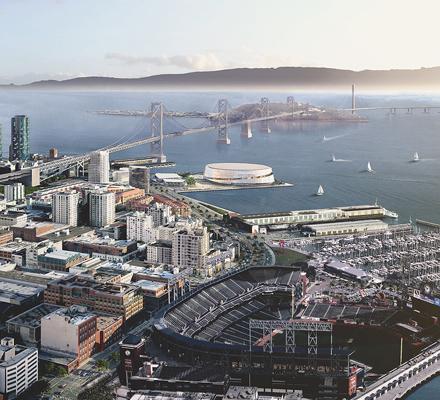
The Chron discovers the lack of waterfront planning

12

So the Chronicle’s John King (who’s generally not a bad architecture critic and really seems to understand city planning) finally discovered something that some of us have been talking about for months: There’s no comprehensive planning on the waterfront. Instead, it’s all developer-driven projects that make little sense as part of a well-thought-out future for the area.

Once again, we are hampered by the Chron’s paywall, so unless you subscribe you can’t read the whole story. But here’s the gist of it:

Instead of mapping out how the next frontiers of growth should be filled in, Mayor Ed Lee’s administration is letting developers frame the debate. They select a site, cook up a proposal and then see what will fly.

He notes that there are good touches in the new Warriors proposal, although:

[N]obody envisioned an 18,000-seat arena on a pier until the Warriors called City Hall. The team loved the glamour of the camera-friendly location. The Lee administration saw a chance to fill a void left open when the America’s Cup organizers shifted gears. …. the whole effort is aimed at soothing objections to what the team owners want. It isn’t connected to a pre-existing vision of what this part of the city could be.

There have been successful community-based planning efforts in other parts of town. But the waterfront — which is unique and immensely valuable — is nothing but a collection of projects that developers want. And Lee is going along:

Today, instead, we have a mayor’s office that wants to make things happen. Progress is measured in terms of construction jobs, housing units and new buildings that might lure the likes of Google up north. Planners on the city and state payrolls are put in the reaction mode, massaging the details the best they can.If this continues, some of what gets built could be terrific.Some of it could also be an alien presence in the city around it. And that’s not a legacy that any mayor should want.

It’s all too reminiscent of Dot-Com Boom I, when Willie Brown was in charge and city planning was driven entirely by campaign money. Highrise office buidlings in the residential Mission? No problem — just wave the dollars in front of the mayor. Not saying Lee is that corrupt — but he’s so excited about building stuff that he can’t bother to take a step back and ask: Is this the city we really want?


The bagpipe squawks for thee: first thoughts on ‘Black Watch’

0

If you thought the theatricalized story of a jaunty and imperiled Scottish regiment in Iraq in 2004 would come off as a sort of “Trainspotting meets Black Hawk Down,” you wouldn’t be too far off the mark — in a very positive way. I’ll leave the nuts and bolts reviewing of full-force National Theatre of Scotland via American Conservatory Theater’s spectacular “Black Watch,” (through June 16) presented at the huge Mission Armory, to my colleague Robert Avila in next Wednesday’s Guardian. But my first thoughts upon emerging from Sunday night’s opening performance, after I cleaned the constant stream of expletives from my ears (and a bit of something from my eye) is that yae fookin’ coonts moost sae this pish, i.e. the production and performances are well worth the gasp-inducing $100 ticket price.

As is, I guess, a reminder of the — hey, ongoing! — sorry state of our “misadventures” in that part of the world. Ten years later, we have to drop a Benjamin for a complex, moving, and engrossing take on what just happened, or any take whatsoever, pretty much. That it also includes a lot of nifty multimedia effects (a surprisingly malleable pool table basically co-stars), affecting and thrillingly performed choreography, a bit of fascinating history, and some old Scottish ballads — oh yes, there will be bagpipes — is icing on the erroneous Occupation. 

Less plot-driven than situation-oriented (within the framing device of a “researcher” interviewing former squadron-mates at a pub, the story of the 300-year-old Black Watch Scottish fighting force’s dissolution in Iraq is told through clever reenactments), Gregory Burke’s play, first performed in 2007, keeps its ideological cards tucked slightly up its sleeve. But it pulls no punches when it comes to the hella screwy “facts” on the ground. It also toys with the Mametian trope that language is a real sharp double-edged sword, especially the language of power in crisis, when all the misogyny, homophobia, sexphobia, and racism comes howling through the seams of ballsy mens’ speech. One wondered how the more delicate members of A.C.T.’s regular subscription audience was taking all the “fucks,” “cunts,” and every other realistically used expletive, all fenced in by a true yet penetrable thicket of brogue.

One also wondered how many of them knew they were sitting in a giant BDSM porn studio — a famous fact left out of the program’s introduction to the “Armory Community Center,” a.k.a. Kink.com HQ, the timeline of which conveniently ends in the late 1970s, and has the gall to state that “plans to convert the building into a full-time film studio did not come to fruition.” Ahem. Aaanyways. For those of us in the know, it made the porn jokes a lot more funny.

The location also resonates with military history, of course. It was built in the early 1900s to help quell any union strikes or labor demonstrations downtown  … with hundreds of troops armed to the teeth. The wee irony of a play about an occupation staged here isn’t lost. But the genius of the location comes through in other ways. On first hearing ACT was hosting the play here, I immediately thought it would involve dozens of extras and a full orchestra. The play, however takes place in a modest (if very large compared to other locations) draped off part of the armory, and the often-eerie backing music is recorded. It is up to the cast, numbering a mere 10, to bring a full war and its aftershocks to a life big enough to fill the physical and mental space, which they do with aplomb.

They’re aided by a panoply of well-executed mulitmedia efects, culminating in a series of tragic explosions that ripple outward into the Armory’s enormous space. Those explosions can’t help but remind of the recent Boston marathon explosions, permanently televised into our senses. So much blood, so many severed limbs, the media and government weren’t afraid to show us in that bombing earlier this year. And yet 10 years ago, I remember seeing hardly any blood at all, let alone any troops’ bodies, in the long, long, then too-short coverage of the “Iraq War.” How far we’ve come, and haven’t come at all since then, “Black Watch” reminds us.      

Hot sexy events: Aliens, etc.

10

You will have to excuse the few weeks that your sexy events column has taken off — our Day-Glo phalanges have been so atwitter over tonight’s extraterrestial sexuality event that every thing else has just seemed… of this planet, shall we say. Check out my interview in this week’s newspaper with Strange Attractors co-editor Suzie Silver, by the way, for talk of sensual delights outside the Earthly realm, including beings comprised mostly of scrotal tissue — and head over to Center for Sex and Culture to see the video and performance lineup of UFO couplings that Silver has put together.

Still, the sex culture train rolls on. Here’s so more hot-and-heavy happenings around the Bay this week: 

“Ask a Ho: Question the Real Professionals”

Gonna go ahead and say that we’d be a lot healthier about sex as a society if we let the pros talk a little more loudly about the subject. Apparently Oakland sex shop Feelmore510 feels the same way — Shannon Williams of the Sex Worker Outreach Project facilitates this Q&A journey into the lives of the pros. Bring your best queries, because you gotta think that these folks are gonna be a lot less squeamish about answering your questions about sex than say, Dr. Phil or your “cool” roommate.

Tue/14, 7-8:30pm, $5. Feelmore510, 1703 Telegraph, Oakl. www.feelmore510.com

Perverts Put Out spring fling

Unthaw, it’s almost summer goddamn it. But the PPO crew is taking you through the rites of spring tonight, with dirty readings by the Guardian’s own Sex-Positive Parent Airial Clark, Jen Cross, horehound stillpoint, Virgie Tovar, and more, hosted by the fingers-in-everything Dr. Carol Queen. 

Sat/11, 8pm, $10-25. Center for Sex and Culture, 1349 Mission, SF. www.sexandculture.org

“How To Create An Effective Online Profile – And How To Write Messages That Will Get Good Responses”

If you’re anything like us, you spend more time scoping people’s online ramblings and photo albums than you do IRL cruising. Lesson: you should probably shape up your online profiles if you want to get laid with minimal footwork, ‘Net junkies. Today’s workshop with M. Christian is a class on how to get sexy through words, pics, and clicks. Attend to learn how to be cute-not-creepy with your online come ons, and some Internet etiquette so you’re not FLAMING when all your online paramour desires is sweet, soft pings. 

Tue/14, 7-10pm, $20. Center for Sex and Culture, 1349 Mission, SF. www.sexandculture.org

“Spanking, Paddling & Pinching: An Introduction to the Sensual Side of Pain”

Does rough play get you all hot and bothered, but you’re still hesitant to jump into BDSM without a little primer first? Good thing you live in San Francisco, because you’re welcome to come down to Good Vibrations for this one-off class taught by kink expert Pepper on safety rules, safe places on the body to apply impact, and the psychological underpinnings of sexy pain. 

Tue/14, 6:30-8:30pm, $20-25. Good Vibrations, 1620 Polk, SF. www.goodvibes.com

Jamaican Queens on major influences, ‘Wormfood,’ and Detroit

0

The Detroit-based trio, Jamaican Queens, makes instantly catchy, hip-hop-influenced, electronic-soaked pop gems and performs them in a dance-inducing glam pop fashion. Although Ryan Spencer, Adam Pressley, and Ryan Clancy have been laying down beats together for less than a year, they have already released a full-length album – Wormfood – hit their hundredth show, and written album number two (which they’ll record once they’ve concluded their lengthy West Coast and summer tours).

I spoke with Jamaican Queens before they opened for Javelin at the New Parish in Oakland last week. After the boys grabbed a few local brews (Anchor Steam, of course), we went up to the roof and talked about their eclectic sound, living in Detroit, and the projects in the works. If you missed the Oakland show, catch them this Sunday at Brick and Mortar as Jamaican Queens could quickly become your favorite new band. (That’s been the case for yours truly.)

SF Bay Guardian How would you describe your sound?

Adam Pressley It’s hip-hop influenced and really abrasive.

Ryan Spencer It’s also experimental, but at the same time in the veil of pop. And lyrically, it’s very glam. We want to make music that makes people feel some sort of emotion – whether it be good or bad.

SFBG Who are some of your chief influences?

RS Most of the vocals I’m influenced by are dramatic – like the way David Bowie sings or the way the London Suede sings or T. Rex.

AP When we were making Wormfood, I started listening to the Magnetic Fields, and I was heavily influenced by what they were doing production-wise.

RS Yeah, they make very exaggerated pop music and can wrap up a huge amount of emotion in a two and a half minute song.

SFBG What type of music do you tend to listen to on your own?

AP I listen to only pop.

RS I listen to some more avant-garde stuff. I like Cambodian music and Jamaican Dancehall. That’s kind of where “Jamaican Queens” came from: Dancehall music. I love that stuff. But I like music that’s all across the board. Reggaeton. Insane punk rock. Everything. As long as it can make you feel something.

SFBG Do you guys have a favorite song to perform?

Ryan Clancy The dexterity and movement our songs require make them all really fun to play.

AP Our songs could be performed by six people, but we’ve got it so that we can all perform two instruments at once, so I’m playing a bass and a drum pad, Ryan Clancy is playing electronic drums and real drums, and Ryan Spencer is playing guitar and sampler. That’s “Water” right there.

SFBG Who’s behind your “Caitlin” video? The cinematography is unbelievable.

RC The cinematographer is our good friend Dan DeMaggio.

RS Our friend Caitlin, who the song is about, is the main character in the video. It’s a really dark story. She was living with Adam at the time, and her great aunt got murdered. A team of con artists started working for her great aunt and then ended up breaking into her house and murdering her. This is the song we wrote for her when she was going through that. It was a really intense time.

SFBG So, what’s it like living in Detroit?

RS I imagine it’s a little bit like Oakland. It’s a really supportive community, and the art and music scenes are very small so everyone knows each other and all of the bands that seem to be cool work together and help each other. Most of our friends don’t really have jobs, so you’ve got a lot of creative people working really hard on their art.

RC Yeah, I think one of the reasons we have such cool videos is because the art and the music scene are very incestuous. Everyone who’s a good photographer is also probably in a band or something.

SFBG What are you guys up to this summer and fall?

RS We’re doing a lot of festivals throughout the summer as well as working on going to Europe for the first time. We’re also making remixes, releasing some vinyl stuff in the UK, and recording a new album, which will be a long time coming because Wormfood just came out last month.

SFBG What do you think of the Bay Area so far?

RS The weather’s amazing, the people are cool, and it’s really liberal. It’s great.

Jamaican Queens
With Maus Haus, Black Jeans
Sun/12, 9pm, $7
Brick and Mortar
1710 Mission, SF
(415) 371-1631
www.brickandmortarmusic.com

Hey, you! “Tech people” are not the douchebags you think we are

I hear a lot of talk, especially from my own queer community, about how “tech people” are ruining San Francisco. From skyrocketing rent prices and disappearing diversity to economic and cultural ruination, the tech community has become the scapegoat for a lot of the problems we are facing in the city as a whole. As a tech worker, I’m writing this to say: wake up and direct your anger at the real sources of these problems.

First of all, let’s get one thing straight. The vast majority of “tech people” in San Francisco don’t make nearly as much money as you think they do. We are not making six-figure salaries, we are not personally driving up rent costs, and we are not killing the cultural community here. Simply put, we are trying to further our careers and make the city we call home a nicer place to live. 

From day one of living in San Francisco, I’ve put blood sweat and tears into building the cultural community in SF (music, mostly), and I’ll never stop doing that. I first moved here with my husband in 2006 from Indiana. We fell deeply in love with the city while visiting several times early on in our relationship, and knew this was where we wanted to call home. Of course queer acceptance came into play, but I loved the fact that the city had a life of its own, an entity with which I felt a kinship. I immediately immersed myself in the music scene here, forming a touring band and quickly becoming a booker and promoter for live shows. It wasn’t until several years into my time here that I snuck my way into the tech industry. Thankfully all those hours spent in my parent’s basement as a child on the computer helped! Here I am, five years into my tenure at Bay Area music tech startup Thrillcall, hustling every day to help build music communities not only in SF, but across the country.

I bust my ass doing this for modest pay just to get ahead and know I’m working in a field (music) that I love. I know many others like myself who have day jobs in the tech community that do the same.

However, accusations that I’ve been hearing lately would have you believe otherwise. Claims that “people like us” are ruining San Francisco by gentrifying everything and pushing out what San Francisco truly is. Protip: the Bay Area has, for quite some time now, been a hub for technology. This is not a new thing. Stop acting like it is. Directing anger towards us for what you consider woes to the community at large here is way off base. Bubbles have happened constantly since the early 1990s (or hey, 1840s), and anyone who has lived here for long can tell you this is true. 

The tipping point for me, to be honest, was the nonsense of people beating up a “Google Bus” piñata in the Mission, shouting epithets about how they’re the bane of San Francisco. The people that ride those buses are not to blame. They are not heading up that company, they don’t make millions of dollars, and they certainly don’t deserve the hatred being directed at them by many people here in San Francisco.

They’re utilizing a method of mass transportation (cutting down on carbon footprint) provided by their employer. If you want to be angry about something, be angry at the company, not the people who work for it. If you want to actually do something about it (beating a piñata in a public place solves nothing), then take your grievances to the heads of the companies you think are responsible for the predicament that San Francisco currently finds herself in.

You know what is ruining San Francisco? Complacency. Apathy. Misguided hate. Inaction. Put some energy into making change, not senseless whining.

If you’re upset about rising rent costs, be angry at the money-hungry landlords that do absolutely nothing to put money back into the city or help build culture. Want SF prices to stop skyrocketing? Let’s organize and drive proposals with our city government. Upset about the recent sanitization of many of the lovely traditions and values of San Francisco? Get mad at a-holes like Scott Weiner, who is actually supported by a lot of longtime, non-tech residents. Want more culture, arts, music? Maybe try reaching out to people that can help in the tech world instead of complaining about everything going downhill. 

A vast majority of the tech workers here in SF are upwardly mobile, culturally involved people. We are not ruining this city. We live here for much more than just the jobs we have. We love it, and it’s where we call home. We have as much control over the cost of living here as everybody else. And we are not the companies we work for, however large or small. Corporations, for the most part, suck. We all know that. Demonizing the people that work for them (while contributing to this wonderful city) is baseless, classless, and makes you look like a total dick.

We’re not the douchebags you think we are. Let’s put our energy toward doing good, instead of just pointing fingers. A great deal can be accomplished if people took an active role toward coexisting, rather than shouting “ENEMY!” to anyone who will listen. 


Supes worry about 8 Wash shit show

48

The Chronicle seems to have entirely missed the latest installation in the 8 Washington shit show, but the Ex has the story, and, even if it doesn’t mean the project is in the toilet, it’s given opponents another reason to flush it.

Could I possibly use any worse metaphors?

Sups. David Campos and David Chiu are unhappy that city agencies — possibly fast-tracking a project that the mayor’s pal Rose Pak really loves — may not have been fully forthcoming about the fact that there’s a chance the construction (or the shifting of ground after the project is complete) could crack a sewage line that serves about a quarter of the city.

Here’s what makes me nervous:

During construction, liability to pay for damage after a pipe rupture would be on the developer. Simon Snellgrove of the Pacific Waterfront Partners has long fought to build the 134-unit condo development, even hitting the streets himself to try to hamper the signature-gathering effort by the development’s opponents to place the referendum on the November ballot.
Once all the units are sold, damage liability would shift to the homeowners.

What does that mean? It means if there’s a catastrophic sewage rupture after construction is complete, there will be lawsuits aplenty over who is at fault and who pays — and in the meantime, the taxpayers will fork over the money to keep the effluvium out of the streets. Which could be (I’m sorry, can’t help it) a shitload of money.

That, and the fact that the city is willing to let some very serious concerns slide in the name of building condos for the richest of the rich who won’t even really live here most of the time.

Gatsby who? Check out these cool rep flicks instead! Plus: more new movies.

2

This week: two, count ’em two, series dedicated to oft-overlooked films produced outside the mainstream, dedicated to the seamier things in life: “I Wake Up Dreaming 2013” at the Roxie (Dennis Harvey’s take here), and “Girls! Guns! Ghosts! The Sensational Films of Shintoho” at the Yerba Buena Center for the Arts (I drool here.)

Short takes on wider releases below, including The Great Gatsby, a film adaptation that finally realizes F. Scott Fitzgerald’s deathbed wish: that one day, his most beloved work would be shot in garish 3D. Clearly, only suckers read books anymore.

Aftershock Dumped into theaters without fanfare or advance screenings, this collaboration between co-scenarist/producer/star Eli Roth and Chilean director Nicolás López deserves better — it’s possibly the most luridly entertaining of numerous recent jokey homages to retro grindhouse cinema. Roth plays a character known only as Gringo, a divorced Yank lawyer on vacation traveling around Chile with two local friends, brash Pollo (Nicolás Martínez) and mopey Ariel (Ariel Levy). Their tour of raves, clubs, drugz, and tail-chasing — the rare warm-up half-hour that’s actually very funny and enjoyable — comes to an abrupt halt in Valparaiso. Partying with three newly met multinational lady friends (Lorenza Izzo, Andrea Osvárt, Natasha Yarovenko) they find themselves caught in a major earthquake — and the carnage that it causes is just the beginning of their woes, as crisis piles upon crisis. Spinning ’70s disaster-flick tropes toward crass gore-horror, Aftershock is gleefully trashy enough to get away with outrageous cruelties, including mortal harm served out to characters shockingly high on the cast list. (1:30) (Dennis Harvey)

The Crumbles The awkward slackers and damaged hipsters of The Crumbles live in a sun-strafed, paved-over Los Angeles habitat of coffee shops, taco trucks, bookstores, budding filmmakers, and living room band practice. Darla (Katie Hipol) is slouching nowhere fast when her zany, charismatic cool-girl chum Elisa (Teresa Michelle Lee) enters the picture, looking for a place to crash. Elisa’s wacky, erratic, and unreliable, but she’s also capable of generating real excitement — and a mean little keytar hook — and the girls’ band, the Crumbles, gets off the couch and threatens to get all involved to bust out of their shells. Though director Akira Boch never quite dips into the deep background of his characters’ various dysfunctions — the threatened readings of Darla and Elisa’s psychic friend never quite sheds light — the first-time feature filmmaker has a real feel for the drifting, up-for-anything quality of Cali 20-somethings and an appreciation for their highs and lows that makes this familiar, loving, lets-put-on-show-kids update compelling. (1:13) Roxie. (Kimberly Chun)

The Great Gatsby Every bit as flashy and in-your-face as you’d expect the combo of “Baz Luhrmann,” “Jazz Age,” and “3D” to be, this misguided interpretation of F. Scott Fitzgerald’s classic tale is, at least, overstuffed with visual delights. For that reason only, all the fashion-mag fawning over leading lady Carey Mulligan’s gowns and diamonds, and the opulent production design that surrounds them, seems warranted. And in scenes where spectacle is appropriate — Gatsby’s legendary parties; Tom Buchanan’s wild New York romp with his mistress — Luhrmann delivers in spades. The trade-off is that the subtler aspects of Fitzgerald’s novel are either pushed to the side or shouted from the rooftops. Leonardo DiCaprio, last seen cutting loose in last year’s Django Unchained, makes for a stiff, fumbling Gatsby, laying on the “Old Sports” as thickly as his pancake make-up. There’s nothing here so startlingly memorable as the actor and director’s 1996 prior collaboration, Romeo + Juliet — a more successful (if still lavish and self-consciously audacious) take on an oft-adapted, much-beloved literary work. (2:22) (Cheryl Eddy)

Kiss of the Damned This first feature by Xan Cassavetes isn’t remotely like the Method-y angstfests her late father John used to direct (although he did act in upscale genre movies like 1968’s Rosemary’s Baby and 1978’s The Fury). Instead, it’s an homage to the erotic European horror movies of the late 1960s through early ’80s, with further nods to Dario Argento, 1983’s The Hunger, and other fan-bait. Mysterious Djuna (Joséphine de La Baume) is immediately attracted to hunky screenwriter Paolo (Milo Ventimiglia), and vice versa. But she’s reluctant to follow through, and when he presses, she explains why: she’s a vampire, albeit the respectable kind who only “hunts” wild animals. When he decides that is a drawback he can deal with, they seem set to spend an undead eternity together. Unfortunately, they soon get an unwelcome guest in Djuna’s sister Mimi (Roxane Mesquida), a classic “bad girl” type who has no such compunctions about feasting on “stupid humans,” and whose recklessness threatens the cover of any associated fellow vampire. Like its models, Kiss drags at times, and probably will seem too arty and slow to those attuned to mainstream current horror cinema. But if you’re a dweeb enough to know who the likes of Jean Rollin and Jess Franco are, this aesthetically slavish (on a faithfully low budget) salute to their sexy-bloody vintage schlock should amuse, with Steven Hufsteter’s original score an encyclopedia of vintage Eurotrash soundtrack tropes. (1:37) (Dennis Harvey)

Love is All You Need Copenhagen hairdresser Ida (Trine Dyrholm) has just finished her cancer treatments — with their success still undetermined — when she arrives home to find her longtime husband Leif (Kim Bodnia) boning a coworker on their couch. “I thought you were in chemo” is the closest he comes to an apology before walking out. Ida is determined to maintain a cheerful front when attending the Italian wedding of their daughter Astrid (Molly Blixt Egelind) — even after emotionally deaf Leif shows up with his new girlfriend in tow. Meanwhile brusque businessman and widower Philip (Pierce Brosnan), the groom’s father, is experiencing the discomfort of returning to the villa he once shared with his beloved late wife. This latest from Danish director Susanne Bier and writing partner Anders Thomas Jensen (2006’s After the Wedding, 2004’s Brothers, 2010’s In a Better World) is more conventionally escapist than their norm, with a general romantic-seriocomedy air reinforced by travel-poster-worthy views of the picturesque Italian coastline. They do try to insert greater depth and a more expansive story arc than you’d get in a Hollywood rom com. But all the relationships here are so prickly — between middle-aged leads we never quite believe would attract each other, between the clearly ill-matched aspiring newlyweds, between Paprika Steen’s overbearing sister in-law and everyone — that there’s very little to root for. It’s a romantic movie (as numerous soundtracked variations on “That’s Amore” constantly remind us) in which romance feels like the most contrived element. (1:50) (Dennis Harvey)

Peeples Kerry Washington and Diahann Carroll star in this Tyler Perry-produced family drama set in the Hamptons. (1:35)

Scatter My Ashes at Bergdorf’s This glossy love letter to posh New York City department store Bergdorf Goodman — a place so expensive that shopping there is “an aspirational dream” for the grubby masses, according to one interviewee — would offend with its slobbering take on consumerism if it wasn’t so damn entertaining. The doc’s narrative of sorts is propelled by the small army assembled to create the store’s famed holiday windows; we watch as lavish scenes of upholstered polar bears and sea creatures covered in glittering mosaics (flanking, natch, couture gowns) take shape over the months leading up to the Christmas rush. Along the way, a cavalcade of top designers (Michael Kors, Vera Wang, Giorgio Armani, Jason Wu, Karl Lagerfeld) reminisce on how the store has impacted their respective careers, and longtime employees share anecdotes, the best of which is probably the tale of how John Lennon and Yoko Ono saved the season by buying over 70 fur coats one magical Christmas Eve. Though lip service is paid to the current economic downturn (the Madoff scandal precipitated a startling dropoff in personal-shopper clients), Scatter My Ashes is mostly just superficial, fan-service fun. What do you expect from a store whose best-selling shoe is sparkly, teeteringly tall, and costs $6,000? (1:33) (Cheryl Eddy)

From Lick to Main: Noah Veltman on his amazing interactive SF street name history map

0

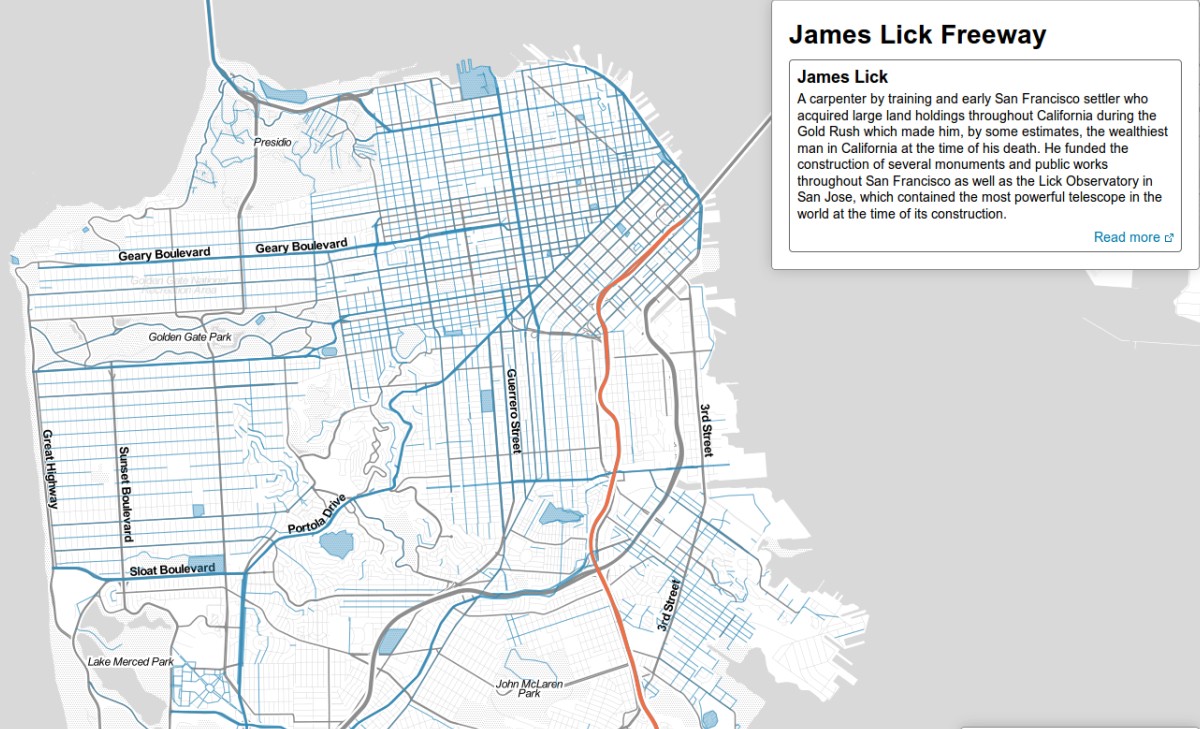
When I saw Noah Veltman’s interactive SF street (and landmark) name history map pop up on feed last week, I was instantly engrossed. (It was especially refreshing after staring at this depressing interactive map of Ellis evictions.) Of course I looked up my own street immediately, duh.

Many of us have encountered various bits of street name history along our travels, but here was a comprehensive aggregator that was fun to play with, and covered James Lick Freeway to Main Street, all in one handy spot. Did you know that Baker street was named after Edward Dickinson Baker, the lawyer who defended accused US Marshal killer Charles Cora, before Cora was lynched by the Vigilance Commitee in 1856? Or that Moraga was named for José Joaquín Moraga, founder of San Jose? Or how about Germania — it’s actually named after German people!

(One thing you do realize after a couple of minutes is that most of the streets are named after dudes, both military and wealthy. Maybe going forward, SF will institute gender parity naming regulations, like Berlin just did.)

I wanted to talk to Noah more about what inspired him to make the map, where he got his info from, and if the SF map — and the mapping project as a whole — would continue to grow. So I sent him an email. Here are the smart, and smartly civic, things he had to say

“I’m a Web developer by trade, I’ve always made interactive graphics like this for fun, although this is probably my most ambitious (you can see some of my other side projects here). I grew up on the peninsula, and lived in San Francisco for the last 4 years, but I moved to London in January for a one-year fellowship doing interactive graphics and data journalism at the BBC.

“I made the map because I thought it would be a neat way to take San Francisco’s colorful history and connect to everyday experience, give you a new sense of your neighborhood and your city. I used to walk down these streets all the time and never had any idea that they all pointed to so many larger-than-life characters and pivotal events. The names tell stories that you couldn’t make up if you tried: duels,
saloon shootouts, mob justice, espionage, overnight millionaires, explorers, tycoons, battles, rebellions. They also give you a lot of insight into people who in some cases literally built the city, people who created its skyscrapers or its railroads or its parks. That kind of local history has an immediacy you don’t get when you’re learning about something like the Founding Fathers. You walk past it on your way to work every day.

“There were a number of surprising histories to me, like the fact that Main Street isn’t a generic name, it’s named after Charles Main. I also never knew Crissy Field used to be a military airfield – I’m sure there’s a plaque explaining that somewhere but I had never come across it. Some other favorites:

Green Street
Broderick Street
Woodward Street
Guerrero Street


“I got the information from lots of places — a few different books, but also old news clippings, military records, historical society sites, that sort of thing. Usually I would start with a claim that a street was named for somebody, and then find as much corroborating evidence as I could, and if it seemed solid, research for other colorful details about the person’s life. Needless to say it was a time-intensive process.

“I’ll definitely be adding more to the map over time, there are lots of histories missing, and I’ve gotten lots of helpful tips from others since posting the map. Some streets are left out by design though. Many are self-explanatory or don’t have a historical component (for example, lots of names are just Spanish words or trees or foreign cities), I wanted to focus on ones that would be interesting and not clutter up the map with the rest. I also had to leave out a lot of ones with potentially interesting histories that were hard to verify. I wanted to be careful about not presenting rumor as fact, and there’s plenty of rumor to go around when it comes to how the streets got their names. It’s a tough balancing act, a lot of judgment calls, and I’m sure I still got a few wrong.

“This wasn’t originally meant to be a larger project, but once I got deeper into it I realized that I’d really like to expand it to other cities, so I’m going to be working on that in the coming weeks. I’d like to work on additional cities myself (maybe LA and London next) but I’d also like to generalize the template and create blank versions for lots of cities in the world and open them up for others to work on. I’ve gotten tons of feedback from folks who would be excited to make something similar for their home cities, and I’d love to help make that happen.

“As far as other upcoming projects, in addition my work at the BBC and taking the street name map beyond San Francisco, I’m hoping to start on a project to visualize diasporas from different countries around the world.”

Commission approves soccer project but pushes the city to restore habitat

43

The California Coastal Commission today upheld San Francisco’s plan to replace the Beach Chalet grass soccer fields at the west end of Golden Gate Park with artificial turf and high stadium lights after an emotional five-hour hearing, but not before voicing concerns about the loss of natural terrain and urging the city to do wildlife habitat restoration work on adjacent land.

The soccer project has been repeatedly approved by city agencies despite strong opposition from some neighbors and environmentalists, who say it conflicts with a Local Coastal Plan that calls for it to be a “naturalistic” setting. Their appeal to the commission — which enforces the California Coastal Act of 1976 and regulates development in the coastal zone statewide — was supported by commission staff, giving hope to opponents.  

But the dearth of playing fields in the city and bad conditions on this often soggy, gopher-ridden site drove the local approvals of the project, and advocates for soccer and youth dominated public testimony at today’s hearing, which was held in San Rafael. Supportive speakers made arguments ranging from the exodus of families from the city to the need to combat youth obesity and diabetes to concerns that the woods surrounding the field is now “a fornication playground for gay men, it’s a shooting gallery for drug users, and it’s a toilet for the homeless,” all ills they say the turf and lights will help dispel.    

“I urge you to reject the appeal and allow San Francisco to manage our park system,” Sup. Scott Wiener testified to the commission, adding, “San Francisco has a crisis in that we are losing our families and losing our children.”

Former Sup. Aaron Peskin took the opposite position, calling the commission’s staff report “well-reasoned” and telling commissioners they have an obligation to protect coastal areas on behalf of all Californians: “It is the role of the commission not to succumb to political pressure.”

After public testimony and before a lunch break when he needed to leave, Commissioner Steve Blank made a motion to adopt staff recommendations and deny the city’s project, rejecting the various arguments made by supporters as irrelevant to whether this project complied with the Coastal Act and should be built so close to the ocean.

“Our review is based on the needs of 38 million Californians. One of the reasons our coastline looks the way is does is because of this commission,” Blank said, later adding, “This project looks like an industrial sports facility which is the antithesis of a naturalistic setting.”

He acknowledged arguments that the site has been soccer fields for more than 60 years and that many San Franciscans want them there. But he analogized it to the city’s one-time embrace of the Embarcadero Freeway before decades later realizing it wasn’t an appropriate waterfront use and tearing it down.

After a lunch break, the commissioner who seconded his motion, Esther Sanchez, continued Blank’s arguments against the project. “Our purview is different than the city and county of San Francisco,” she said. The commission’s role is ensuring compliance with the Coastal Act and LCP — which was developed by the city and approved by the commission decades ago — and its call to “emphasize naturalistic land use qualities of the western part of the park for visitor use,” saying the city should use other parks if it wants artificial turf fields.

But Commissioner Steven Kinsey called for the commission to defer to the city process and argued that turf and lights don’t necessarily violate the vague language in the LCP. “Grass alone does not make the site naturalistic,” Kinsey said, making a motion to approve the city’s project.

Commissioner Martha McClure then strongly sided sided with Kinsey and the city, and Commissioners Robert Garcia and Wendy Mitchell followed suit, saying how they personally liked turf more than grass. “It’s great for the environment, it’s water reducing, it stays green,” Mitchell said, noting that she’s replacing the lawn at her Southern California home with turf, calling the staff report “arrogant,” and saying, “I’m disappointed that we’re hearing this item.”

Garcia said the project will improve the public’s access to the coastal zone, which is something the Coastal Act also encourages.

“Artificial turf has become a savior for us, we can keep all our fields in play,” Commissioner Carole Groom, a member of the San Mateo County Board of Supervisors, later said, making her the fifth solid vote for the city’s project.

That left four swing votes on this 11-member commission who all said this was a difficult decision. They were inclined to let the project go through, but they were bothered by converting seven acres of real grass to artificial turf and wanted to mitigate that loss of wildlife habitat.

Chair Mary Shallenberger took issue with Mitchell’s comments. “I think they is absolutely properly before us,” she said. “This is how the process is supposed to work. Staff ended their presentation by saying this is a judgment call,” commending project opponents for filing the appeal.

“This was a very hard one for me,” Commissioner Dayna Bochco said, raising doubts that “seven acres of plastic would be a natural and healtful condition.”

Commissioner Jana Zimmer shared the concern and seized on a comment that SF Recreation and Parks Director Phil Ginsburg made earlier expressing a desire to restore as a naturalistic setting a long-neglected four-acre site next to Beach Chalet that used to be the city’s old wastewater treatment plant, noting that $6.5 million in the city’s last parks bond was set aside for habitat restoration in Golden Gate Park.

“I’d like to find a way to link the finding here to that requirement,” Zimmer said, asking Ginsburg whether he could make that commitment.

Ginsburg said that would be the top staff recommendation for the bond money, but that a public process and environmental review would be needed and he couldn’t make the commitment.

“I do believe mitigation is required here,” Bochco said. “We’re taking away seven acres of habitat and I want it replaced with something.”

A majority of commissioners, those for and against the project, strongly urged Ginsburg to follow-through on his pledge to pursue habitat restoration on the adjacent site. But with concerns expressed about tying the two projects together — which raised both legal and local control issues — the motion to do so failed on a 5-6 vote.

With Ginsburg’s pledge and the writing on the wall, the commission then voted unanimously to approve the project, clearing the way for the city to break ground as early as this summer.

A boost for Ammiano’s pot bill

1

Assemblymember Tom Ammiano’s bill to create state regulations for pot clubs just got a boost: Although I disagree with the Supreme Court decision allowing towns to ban the dispensaries, it’s kicked local governments into gear. Now mayors from around the state are asking the Legislature to weigh in and craft “sensible marijuana policies.”

It’s tricky: The Department of Consumer Affairs, which might be the logical place for the regs, doesn’t want anything to do with pot, and Gov. Jerry Brown thinks we’re all too stoned to compete with China, so Ammiano’s looking to the Department of Alcoholic Beverage Control to create a new marijuana division. Logically, that makes sense, and it’s what Colorado is doing. Practically, a lot of people don’t like the ABC, but that’s a factor of bad agency leadership and poor priorities. It’s not a structural problem. If we’re ultimately going to legalize pot altogether, and we are at some point soon, then it makes sense to have regs in place — or at least a system for regs in place — that can give cities and counties direction.

And it might help a little with the Reigning Asshole of Prohibition, Melinda Haag.

I suspect this will make it to the governor’s desk. I hope he comprehends that we aren’t going to compete with China if we can’t even solve a simple regulatory problem.

Also: Ammiano’s bill to protect transgender students made it off the Assembly floor.

Live Shots: Marina and the Diamonds at the Warfield

0

I like a little grit. Usually I feel that a great show combines unpredictability, recklessness, and some raw, unpolished vulnerability. That’s what makes live music exciting and dynamic. If we wanted flawless vocals and sonically airbrushed instrumentals, we’d just stay at home and listen to the music on iTunes. So I’m trying to figure out why Marina and the Diamonds’ shiny, choreographed, factory-sealed set at the Warfield Sunday night felt so right.
 
Marina looks like an actual Barbie doll, with the kind of proportions people go under the knife for and a no-hair-out-of-place look straight out of a Bettie Page photo shoot. Her live persona is a hyperbolic take on teen idolhood, oozing confidence as she strutted, posed, and gracefully reclined on the daybed featured in her onstage bedroom set (complete with a coat rack, television, and stuffed animals.)
 
As Marina ripped through a packed setlist studded with costume changes and flawlessly executed pop routines, the sold-out audience — 1/3 tween girls, 1/3 their mothers, 1/3 Castro on a Saturday night — screamed and gushed at every opportunity. Fans wore homemade sashes bearing the Marina slogans “teen idle” and “heartbreaker” and nearly everyone had her trademark little black heart painted on their cheeks. And I can see why.
 
Marina is insanely talented. Her rich, clear voice is pitch-perfect. Her songs are catchy, extremely danceable, and overall just good, old-fashioned fun. She shone brightest when the camp factor was turned up to eleven, as it often was, with prop martini glasses full of glitter and neon lighting. Her more stripped down moments, featuring just Marina and a keyboard, lacked the punch and glamour that makes her presence so awesome.
 
But I think what makes Marina so likeable, despite her unbelievable precision and Mattel-like beauty, is that when she sings “I am not a robot,” you believe her. There is something very genuine about Marina’s hyperfeminine persona. When she said, “San Francisco, are you living in this moment right now? Because I am,” it rings true.
 
Usually my feminist blinkers would be going off at the sight of this woman in a crop top singing to tweenage girls about being a prima donna, but instead I found myself singing along with thousands of devoted fans, “Oh my God, you look just like Shakira/ No, no, you’re Catherine Zeta/ Actually, my name’s Marina!”

The simple fact is that Marina knows what she’s doing. Her image doesn’t seem contrived or commercially driven — it seems like a reclaiming of the femme fatale.
 
Marina may not be redefining dance music or pushing any major envelopes, but she rules at what she does. She absolutely dominates the stage, reminding everyone that there’s no shame in letting yourself enjoy a great pop hook, and that a powerful woman can still totally rock a pink vinyl minidress.

Those overpaid, underworked public employees

49

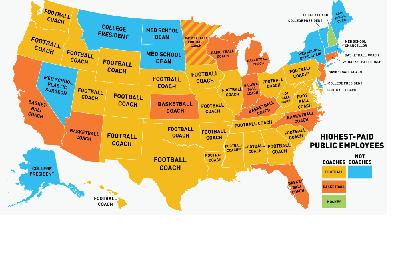
Before you start griping about ovepaid Muni drivers and public employee unions, you might want to take a look at this neat-o map that shows who the highest-paid public employees are in every one of the 50 states. Hint: It’s not a bus driver. Or even a cop or firefighter:

You may have heard that the highest-paid employee in each state is usually the football coach at the largest state school. This is actually a gross mischaracterization: Sometimes it is the basketball coach.

In fact in 40 of the 50 states, the highest-paid person runs a collegiate sports operation. The other ten are doctors running medical centers or, in a couple of places, college presidents.

Oh, but aren’t those people earning their money by bringing in the big bucks? Maybe; maybe not:

In 2011-2012, Mack Brown was paid $5 million to lead a mediocre 8-5 Texas team to the Holiday Bowl. The team still generated $103.8 million in revenue, the most in college football. You don’t have to pay someone $5 million to make college football profitable in Texas.

Just sayin.

(Oh, and what’s up with New Hampshire, where the guy making the most money coaches hockey?)

Take a walk: 4 cultured strolls to guide your feet this week

0

Commuting to work, we speed walk. In the evenings, we run for our girlish figure. After a Saturday night at the bar, some of us may even be ­­prone to a drunken crawl. But whatever happened to the classic, oh­so­romantic afternoon stroll? As the weather begins to heat up across the Bay, outdoor art walks and historical tours are popping up left and right. Whether you want to check out what’s new in the art world or what’s old in the architecture scene, ditch your sacred spot on the couch for a cultured wander.

Divisadero Art Walk

Art, drinks, and ice cream – need we say more? This spring’s annual Divisadero Artwalk returns for its first installation in five months. A few businesses participating in tonight’s walk: Onyx Boutique, Big Umbrella Studios Gallery, the dangerously tasty Bi­-Rite Creamery, and more. This spring’s walk has taken an organizational lead from Madrone Art Bar, which is hosting an art-packed evening. On the agenda is a tap takeover from Calicraft Brewing from 6­:10pm, an art reception for computer scientist and kinetic artist Brent Thorne and “Portrait of America”, a project that traveled nationally capturing Americans in photo booth portraits. After you’ve had your art fix, take to Madrone’s dance floor for some disco tunes. 

Thu/9, 5pm, free. Divisadero between Golden Gate and Haight, SF

Victorian Era Oakland walking tour

Lace up your leather boots and corset to become one with the Victorian architecture of Oakland’s Preservation Park. Home to the First Unitarian Church, East Bay historic building the Pardee Home Museum, and more than a dozen elegantly restored 19th­ century homes, the park stands out as a relic of old Oakland charm. If living near San Francisco has provided you with enough Victorian architecture to last a lifetime, choose from one of the seven other tours happening between now and October which cover the buildings of Old Oakland, Chinatown, and more. 

Sat/11, 10am, free. RSVP at (510) 238-3234 or aallen@oaklandnet.com. Preservation Park, Martin Luther King, Jr. and 13th St., Oakl. www2.oaklandnet.com

Saturday Stroll

So the crowds at Oakland’s First Fridays are a little wild for your taste? Head to Uptown Oakland for the weekly Saturday Stroll – a quieter, yet equally artsy alternative. One exhibit highlighted at this week’s stroll, “Lobbyscapes”, features the work of artist Phil Gaughy who gives inanimate objects a life of their own. McGaughy explains, “I have come to think that certain minerals and elements may be sentient, and can adapt to new environments with their own technologies.” His chameleon­like wall reliefs in the Latham Square Building’s lobby and other ambiguous, abstract pieces are but one exhibit worth checking out among many.

Sat/11, 1-6pm, free. Downtown Oakland. www.oaklandartmurmur.org

Uptown, Lake Merritt and Secret Rooftop Garden Walk

After you’ve been schooled in the Victorian history of Preservation Park, travel north ­– and about 20 years ahead in time – to Uptown’s sparkly, Art Deco landmarks. Throughout the 90-­minute adventure history, savvy volunteers will walk you past the Fox and Paramount theaters, as well as the jazzy, blue-and-silver Floral Depot. The tour will also take you up to the Kaiser Center’s secret rooftop garden for a camera-worthy view of Lake Merritt. Because what better way to wrap up a walk than in a perfectly manicured rooftop garden?

May 15, 10am, free. RSVP at (510) 238-3234 or aallen@oaklandnet.com. Paramount Theatre, 2025 Broadway, Oakl. www2.oaklandnet.com

Aiming for the top of the food chain

The issue of labeling for genetically engineered foods gained fresh momentum last week, when Sen. Barbara Boxer announced she’d be pushing for the U.S. Food and Drug Administration to require this consumer notification on a national level.

It’s sure to be an uphill battle for the organic food movement, which suffered a loss on this issue at the California ballot last year, but a new book calling for a mass restructuring of the nation’s food system might help provide ammunition for proponents of GE food labeling.

Wenonah Hauter’s Foodoply: The Battle over the Future of Food and Farming in America traces decades of little-known history documenting small farmers’ resistance to agricultural consolidation, followed by national and international policy agreements that gave rise to the commercialized agribusiness model that dominates America’s food system today. Hauter, executive director of Food and Water Watch, grew up on a farm.

“It gave me life experience about how difficult farm work is, and how hard farmers have to work, and how under-valued they are in our society,” the author said of that experience in a recent interview with the Bay Guardian. “One of the reasons I wrote Foodopoly was to get at this issue … It’s easy to demonize farmers rather than the systemic causes of the traditional food system.”

Her book is nothing short of a call to arms to take back corporate control of a food system that short-changes small farmers and leaves consumers with limited, unhealthy options.

“If we want to change our food system, we have to reclaim our democracy,” she says. “So many people just think we’re going to create an alternative system, without really doing the political work to address fundamental issues, like the consolidation that allows some companies to have so much power over our political system.” It won’t be achieved with certified sustainable agriculture programs or farmers markets alone, she says – but rather through confronting agribusiness’ influence in the halls of government.

Her meticulously researched work names names, providing detailed lists of the industry’s most influential processers, grocers, and junk-food manufacturers along with the ubiquitous brands they produce. It also sheds light on the ills of factory farming and genetically engineered foods.

“The top 20 processing companies and the grocery industry have benefited from figuring out that fat, sugar and salt actually addicts people to junk food, and is making people sick and overweight,” Hauter told us. “Children see just under 5,000 junk food ads a year. We know that children begin to identify with brands at about the age of two. Lots of junk food is placed at eye level for young children, because they pull on their parents’ shirttails, whining for the junk food.”

While organics may pose a healthier alternative, meanwhile, Hauter’s chapter on the “paradox” of attractively packaged, premium-priced organic food is rather disheartening. “Fourteen of the 20 largest food processing companies actually control many of the organic brands, and organics today are viewed as a rich market, where people can be charged,” Hauter notes, going straight to the heart of the matter. “It’s a lot different from the vision I think many people had in the early 1970s, when the organics movement began.”

Foodopoly also devotes considerable attention to the political influence of the biotech sector. “I think that the biotech industry has a lot of political power,” she told the Guardian, and then revealed that assertion to be a profound understatement: “Over a 10-year period, they spent $572 million on lobbying and campaign contributions, they hired 13 former members of Congress during this period, they hired 300 former staff from the White House … and they have about 100 lobby shops in Washington. … With Prop 37, [of the] the approximately $45 million put towards ads, about $8 million was Monsanto’s.”

This kind of influence doesn’t just carry troubling implications for the democratic process, but makes it less likely that looming questions around the long-term health effects of genetically engineered foods will ever be sufficiently answered.

“With all the new technology coming on – nanotechnology, cloning, genetic engineering – we really need to take a look again at our regulatory system,” Hauter insists. “There’s a lot of new evidence coming out on the problems with these new technologies. There was a review of hundreds of scientific studies around glyphosate, which is a major ingredient in Monsanto’s Roundup herbicide. It shows that there are cellular effects within the human body, and that these could very well be working together with other variables to trigger health problems. We’re talking about everything from gastrointestinal problems, to diabetes, autism, obesity, Alzheimer’s, and a number of different problems.”

Despite these disturbing findings, there’s been a distinct lack of long-term study or precautionary restraints imposed by lawmakers, Hauter says.

“There are a lot of other reasons that we should be concerned about genetic engineering, from the cost and control of foods, to the overuse of this dangerous herbicide, glyphosate, and the fact that it’s creating super weeds,” she says. Further complicating matters, “New pesticides are being developed to address the problems that these co-branded herbicides have caused. That’s the problem with our society,” Hauter adds. “We never look at the unintended consequences.”

The Rolling Stones rock hard, bring surprise guests, almost make up for outrageous ticket prices

0

It’s one of those things about attending a concert – any concert – at HP Pavilion in San Jose: no matter how you approach the venue, you’re likely to run into those hardline Jesus freaks waving signs and condemning you to hell for whatever music you’re about to enjoy. So, like clockwork, last night as I walked towards the ticket office outside the arena, one of them turned his bullhorn on the bunch of us crossing the intersection and, in full brimstone righteousness, shouted – “what are you gonna tell the lord after you die?” To which, a lone voice from the crowd responded – “I’m gonna tell him I saw the Rolling Stones.”
 
It pretty much summed up the enthralled vibe of last night’s crowd, even before the group got into the venue. Neither obscene ticket prices nor the threats of judgment day were going to stop the concert-goers from catching the Stones one last time, and the enthusiasm was clearly palpable (if not heavily intoxicated) inside the arena from the start.
 
I went into HP last night with a million things on my mind about this show, and left with a million more. I could likely write a doctoral thesis about all the issues that surfaced in my brain surrounding the Stones and their half-century legacy: of what it means to grow old in rock’n’roll, or whether there’s any rebellion left in music (“punk rock” gala at the Met, anyone?), and most of all, this time around, of what we’re willing to spend for a concert experience versus the integrity of what we’re actually getting. But if we push all of that to the side for the minute and just attend to the million-dollar question, about the quality of the band’s performance last night, I’d say that the Rolling Stones were (excuse me Jesus freaks) pretty goddamn fantastic.
 
I can’t speak for their show last week in Oakland, or the earlier East Coast dates of this tour, or for that matter….whatever the hell happened to you that night when you went to see them at Madison Square Garden in ’75.  But last night, at the Shark Tank…the Stones seemed like they were out for blood.
 
Kicking off a 22-song set that would run close to two-plus hours, the band quickly blazed through a few big hits – including “Paint It Black” and “Get Off of My Cloud” – with Mick Jagger immediately charging around the length of the stage in dervish-like blurs of energy. The Stones were all smiles when they pulled up guest John Fogerty of Creedence Clearwater fame to turn out a rowdy cover of the Valentinos “It’s All Over Now” early in the set.
 
The show really got traction towards the middle of the night as the band stepped away from its biggest hits and settled into developing lesser known tracks (well…in comparison, at least), including riveting takes on “No Expectations,” “Bitch,” and “Emotional Rescue,” before calling up Bonnie Raitt to play slide guitar and duet with Mick on an epic rendition of “Let It Bleed.”
 
Yet, for however much the band sent the place ape-shit with “Honky Tonk Women,” the show-stopping cold blooded killer of the evening was clearly a ferocious 12-minute version of “Midnight Rambler” with former guitarist Mick Taylor surfacing to add formidable contributions to the already impressive mix. At any other concert, it was the slam dunk moment to shake your head and feel like you’ve officially gotten your money’s worth. But on this tour, the band really upped the ante on when and if that moment could occur.
 
Of all those peripheral issues surrounding the Stones performance, the ticket price was the one that –rightfully – dominated the conversation since this leg of the tour was announced. And since the moment we all realized that the $1200 asking price for a pair of lower tier seats didn’t include a four-night stay in Hawaii, Stones fans began to determine their threshold for paying to see the band, possibly for the last time.

Those prices (officially termed “dynamic pricing,” which really just means institutionalized scalping) were criticized in editorials, and kicked around in chat rooms. It was a horrendous strategy for the band on what really is a victory lap of its 50-year legacy, being both a betrayal of its fans and far cry from what is supposed to be to its roots as a group of bluesmen.
 
But it still brings us back to the same point, anchored off the actual performance, and whether or not the band’s showing could live up to those prices. And last night, Mick and Keith sounded pretty savage on that third verse of “Jumping Jack Flash,” and Ron Wood did more than his share of heavy lifting on some big tracks (in addition to just being the coolest guy on stage), while Charlie’s backbeat kept the house ushers busy all night trying to quell the manic dancing in the aisles from song to song. There was even a local choir (from SJ State) to properly deliver “You Can’t Always Get What You Want.” And maybe most of all, Mick was still moving 900 miles per hour during the last few songs, even as much of the crowd watched the encore half-exhausted from the non-stop energy he exhibited all night.
 
So in this sense, the question regarding the quality of the Stones’ performance seemed to be pretty much a no-brainer to last night’s crowd.
 
But as far as the tour’s big question, of what you’re willing to pay to see such a show, well, I’ll leave you to answer that one for yourself.

Coastal Commission to rule on Beach Chalet soccer project

25

The California Coastal Commission will decide tomorrow (Thu/9) whether San Francisco and its Recreation and Parks Department violated the Coastal Act in approving a renovation of Golden Gate Park’s Beach Chalet soccer fields that uses artificial turf and stadium lights and seating. [UPDATE 3pm: The commission just approved the project. Full story coming soon.]

SF Ocean Edge, a group comprised mostly of environmentalists and neighbors of the site where the park meets the ocean, has been fighting the project since its inception. They got a big boost recently when the Coastal Commission staff recommended rejection of the project, finding that it violated requirements that coastal areas should remain in a naturalistic state and be open to the general public.

“Going into any hearing, you never know what’s going to happen, but the staff report was excellent,” group spokesperson Kathy Howard told the Guardian. “They have a lot of good idea for renovations to the area which would allow more than just organized sports teams to use the area.”

Spokespersons for the Recreation and Park Department didn’t return Guardian calls for comment. The hearing is being held in San Rafael, with this item expected to be heard starting at 9:30-10am, Howard said. Check in here later in the day for a full report.

More SF restaurants settle with the city over fraudulent employee health surcharges

12

City Attorney Dennis Herrera today announced another batch of settlements with restaurants that have been fraudulently using surcharges on customers’ bills to cover their city-required employee health coverage and using some of that money to simply pad their profits.

Seventeen San Francisco restaurants that took advantage of Herrera’s partial amnesty offer — settlements are half of what the violators should owe, based on voluntarily submitting records by last month’s deadline — will be paying tens of thousands of dollars each to the employees’ they ostensibly collected the money for, joining two other restaurants that had settled with the city earlier this year.

Among this latest batch of restaurants is Burgermeister, whose $134,088 settlement is the largest of this group; and Burma Superstar, whose $10,045 is the smallest. Other restaurants paying up as part of the settlement are 5A5 Steak Lounge, Amber India, B Star, Bix, Cafe Bellini, Calibri Mexican Bistro, Citizen’s Band, Cafe Flore, Fresca, MarketBar, Nob Hill Café, Press Club, Skool, Tony’s Pizza Napoletana, and Venticello Ristorante.

In total, Herrera’s office has recovered about $844,000 that will be split among about 1,500 employees.

Another dozen restaurants suspected of misusing the surcharges were given a clean bill of health: Bluestem Brasserie, Cafe Claude, Cupola Pizzeria, Firefly Restaurant, Gitane Restaurant and Bar, Lark Creek Management LLC, Lark Creek Steak, NOPA, One Market Restaurant, Plant Cafe, Ristobar, and Twenty Five Lusk.

There are still more than 30 restaurants that responded to the amnesty offer that remain in negotiates with Deputy City Attorney Sara Eisenberg, with more settlements expected in the coming weeks and the possibility of lawsuits being filed against restaurants that won’t settle.  

The full press release follows:


Restaurant workers net $844K restitution in 19 surcharge enforcement settlements so far

Herrera praises good faith efforts by restaurants ‘to do right by their employees’; announces ‘clean bills of health’ for 12 other establishments targeted in investigation

SAN FRANCISCO (May 8, 2014) — City Attorney Dennis Herrera today announced settlement agreements with 18 local restaurant businesses that voluntarily took part in his office’s surcharge enforcement and amnesty program, which seeks to remedy shortfalls between amounts collected from customers to cover the cost of complying with San Francisco’s universal healthcare law, and funds actually expended to provide health care benefits to employees.  Together with an earlier settlement announced in January, Herrera’s restaurant surcharge enforcement effort has now netted a total $844,644 to be distributed among approximately 1,500 eligible employees by 19 different companies.

The program announced in January included a one-time 50 percent amnesty offer for establishments with significant shortfalls — provided they fully cooperate with city investigators; agree to good faith compliance with the employer spending requirement of San Francisco’s Health Care Security Ordinance moving forward; and directly compensate their current and former employees who were the intended beneficiaries of the surcharges paid by customers.  All agreements announced today resolve potential disputes with the City over collected surcharges without admissions of liability.  

“I commend these businesses for working cooperatively with us so early in the process, and for understanding our duty to enforce the law even-handedly,” said Herrera.  “Today’s settlements reflect good faith efforts by restaurant owners and managers to do right by their employees, and to honor the intent of fees charged to their customers.  I recognize that complying with groundbreaking programs like Healthy San Francisco can sometimes present new and unique challenges.  So, I’m grateful to these businesses for their cooperation in reaching settlement agreements with us.  I’m glad to continue patronizing these establishments, and I hope other San Franciscans and visitors will join me in doing so, too.”

Some of the 19 establishments that reached settlements under the program include: 5A5 Steak Lounge, Amber India, B Star, Bix, Bugermeister, Burma Superstar, Cafe Bellini, Cafe Flore, MarketBar, Mina Group, Nob Hill Cafe, Patxi’s Chicago Pizza (announced in January), Press Club, Skool, and Tony’s Pizza Napoletana.

Twelve establishments receive ‘Clean Bills of Health’ following investigation
Herrera also announced that 12 businesses targeted for investigation on the basis of the health care expenditure shortfalls they reported to San Francisco’s Office of Labor Standards Enforcement had received “clean bills of health.”  Recipients of such letters were informed by Herrera’s office that after extensive review of additional evidence provided in the course of the City Attorney’s investigation, surcharge-related consumer fraud did not appear to have been committed during the relevant time periods.  In most instances, shortfalls reported to OLSE by businesses that received “clean bills of health” were attributable to their inadvertent reporting or accounting errors.

Establishments so far issued “clean bills of health” are: Bluestem Brasserie, Cafe Claude, Cupola Pizzeria, Firefly Restaurant, Gitane Restaurant and Bar, Lark Creek Management LLC, Lark Creek Steak, NOPA, One Market Restaurant, Plant Cafe, Ristobar, and Twenty Five Lusk.

Surcharge Fraud Enforcement Program background
Herrera announced the program at a City Hall news conference on Jan. 25 with Assemblymember Tom Ammiano, Supervisors David Campos and David Chiu, and representatives from San Francisco restaurants and the Office of Labor Standards Enforcement.  Ammiano first authored legislation in 2005 as a member of the Board of Supervisors that would ultimately lead to the City’s Health Care Security Ordinance, or HCSO, which passed in 2007 with policy input from then-Mayor Gavin Newsom.  Board President Chiu and Supervisor Campos have both been active in subsequent proposed amendments to strengthen and improve the law.  In launching the enforcement and amnesty program, Herrera lauded the Golden Gate Restaurant Association for working productively to share its helpful input, even after years of legal disputes over the law that ultimately ended in the U.S. Supreme Court.  

Status of enforcement efforts and investigation
In addition to the establishments involved with today’s announcement, more than 30 other businesses applied for Herrera’s amnesty program before the April 10, 2013 deadline.  The City Attorney’s Office expects a significant number of additional settlement agreements in the coming weeks, pending further analysis of surcharge funds that establishments collected and expended over the relevant time period.    

Herrera’s one-time offer of 50 percent amnesty has now expired, and the favorable settlement terms are no longer guaranteed to non-participating establishments with significant shortfalls between health care-related collections and expenditures.  Announcing his enforcement and amnesty program in January, Herrera said that restaurants and other businesses found to have committed HCSO-related surcharge fraud during the years 2009 to 2011 that failed to come forward before the deadline voluntarily would risk being sued for full restitution of the amount of surcharges collected during that period, together with potentially substantial penalties, costs and attorneys’ fees.  A small number of defiant, non-participating businesses remain under consideration by the City Attorney for further enforcement action or litigation.

“For restaurants that haven’t yet come forward, it’s still very much in their interest to do so voluntarily,” Herrera said.  “I can’t guarantee the same favorable terms reflected in today’s settlements, but cooperative engagement is better and more cost-effective than lawsuits.”  

The Pulitzer Prize Board surrender – and how the New York Times blew the Ed Kennedy story (Part l)

10

In the May 19, 1945 edition of the New Yorker magazine, the legendary press critic A. J. Liebling wrote a prescient article on what happened when Edward Kennedy, an Associated Press combat correspondent, defied military censorship to break one of the century’s biggest and most important stories.

His lead said that “the great row over Edward Kennedy’s Associated Press story of the signing of the German surrender at Reims served to point up the truth that if you are smart enough you can kick yourself in the seat of the pants, grab yourself by the back of the collar and throw yourself out on the sidewalk. This is an axiom that I hope will be taught to future students of journalism as Liebling’s Law.” Liebling titled his piece, “The AP surrender,” because AP, caving in to government pressure, led the attack on its own reporter by publicly censuring and then firing him. He cited the New York Times as leading the charge with a nasty editorial blasting Kennedy only two days after it had splashed Kennedy’s story on the front page with huge heads. Kennedy, the editorial intoned solemnly, had done a “grave disservice to the newspaper profession.”

Liebling, a mid-1920s  student at the Graduate School of Journalism at Columbia University in New York City, was presumably aiming his axiom at his alma mater, which was in a building endowed by Joseph Pulitzer, a crusading liberal publisher in New York at the turn of the century.  Pulitzer also endowed the prestigious Pulitzer Prizes, which are housed in the school and administered by a senior member of the faculty.

I especially enjoyed Liebling’s Law as a Columbia journalism graduate (’58) and as a charter member of the committee working to get Kennedy a posthumous Pulitzer prize this year for his story. The axiom was timely because my wife Jean and I were at the journalism school in April to attend my 55th class reunion and the school’s centennial celebration. The event was full of Pulitzer references and remembrances, highlighted by an address by James McGrath Morris, a respected Pulitzer biographer, speaking in the World room, named after Pulitzer’s newspaper.

The day after the centennial weekend, the Pulitzer Prize Board announced its Pulitzers and rejected the two Kennedy nominations without comment. One nomination was for his story, the other for a previously unpublished book by Kennedy on his career as a WWII foreign correspondent. The rejections demonstrated a serious flaw in the Pulitzer Prize process.

The point of quoting Liebling today, in May of 2013, is that almost seven decades after his article, the Pulitzer Prize Board and the New York Times have once again left Kennedy out on the sidewalk for doing his job as a reporter who, in a favorite Pulitzer phrase, knew “the  right and had the courage to do it.” Since this is a historic story of military censorship for political reasons, it is as timely and relevant now as it was then, since the Pulitzer Board and the Times still do not get the point.

So let me put the issue in context. Let me start by quoting Liebling’s main arguments and link his full six page piece, written in the heat of the censorship battle.

Liebling, who was himself a distinguished World War II correspondent, wrote,  ”The important aspect of the story of the row, I am sure, is not that Kennedy got his dispatch out of Europe before the SHAEF Public Relations bosses wanted him to but that only three representatives of the American press were admitted to one of the memorable scenes in the history of man, and only on condition that they promise not to tell about it until the brigadier general in charge of public relations gave them permission.

“No correspondent of a newspaper published in the United States was invited to the signing; besides Kennedy, Boyd Lewis of United Press, and James Kilgallen, of Hearst’s International News Service, the official list included four radio men, an enlisted correspondent for the Stars and Stripes, and a collection of French, Russian, Australian, and Canadian correspondents.

“Whether a promise extorted as this one was, in an airplane several thousand feet up, has any moral force is a question for theologians…I suppose Kennedy should have refused to promise anything and thus made sure of missing an event that no newspaperman in the world would want to miss, but I can’t imagine any correspondent doing it.

“I do not think Kennedy imperiled the lives of any Allied soldiers by sending the story, as some of his critics   have charged. He probably saved a few, because by withholding the announcement of an armistice you prolong the shooting, and, conversely, by announcing it promptly you make the shooting stop. Moreover, the Germans had broadcast the news of the armistice several hours before Kennedy’s story appeared on the streets of New York, and Alsie, the OWI’s American Broadcasting Station in Europe, broadcast it in 24 languages, including English, within an hour after.”

Liebling noted that the Russians “had their own surrender show in Berlin, and probably had a better publicity break on it than they would have had if the two surrenders has been announced simultaneously… One unconditional surrender of the Reich a day is as much as the public can absorb.” 

Liebling brought out the crucial political censorship point. “Moreover, the row can do a lot of good if it brings into the clear the whole disturbing question of military censorship imposed for political, personal, or merely capricious reasons and reveals the history of the prodigious amount of pure poodle-faking that has gone under the name of Army Public Relations.” Liebling was right on because it later turned out that a secret agreement between Stalin, Roosevelt, and Churchill had imposed a 24 hour embargo on the surrender story so the Russians could announce it the next day in Berlin. Kennedy’s story was in effect the start of the Cold War.

Last year, almost 70 years later,  Tom Curley, as president and CEO of AP,  backed up Liebling’s Law and apologized publicly on behalf of  AP. for the way it treated Kennedy. “tt was a terrible day for AP,” he was quoted as saying on the AP wire.  “It was handled in the worst possible way,.” He wrote a strong  defense of Kennedy in an introduction to a book published last year by the Lousiana State University Press,  titled “Ed Kennedy’s War: V-E Day, Censorship & the Associated Press.” The book was a personal account by Kennedy of his career as a foreign correspondent and a detailed account of his side of the controversy. His daughter, Julia Kennedy Cochran, found Kennedy’s manuscript in his papers after he died in a pedestrian accident in Monterey in 1963 at age 58 where he was editing the Monterey Peninsula  Herald. 

Curley wrote that “Kennedy and his editors performed superbly. They delivered one of the most significant scoops in journalism history. They did four things right. A great correspondent was assigned to the story. He kept reporting even after the censors tried to shut him down. The London desk moved the news without hesitation. The correspondent and editors adhered to the wartime rules as they knew them.  Finally, Kennedy wins the argument on a technicality. With the signing of a surrender treaty, there was no longer a war in Europe and not any excuse to submit to censors.”

Curley said “the book matches the best memoirs by World War II combat reporters for the quality of writing and telling detail, some of it gripping.  And in one way it surpasses the others. Not only does Kennedy give his final, thoughtful explanation for what happened on May 7, 1945. In describing his struggles with censorship and bureaucratic red tape and stupidity over many months, not just on May 7, he provides the fullest first-person account we have of the difficulties World War II correspondents encountered every day trying to do their jobs.

“Perhaps in some small way we bring posthumous recognition to an American hero and embrace – too belatedly – what McClean and Cooper (B3: AP executives) and the AP board could not admit. Edward Kennedy was the embodiment of the highest aspirations of the Associated Press and American journalism.” Curley said his account drew upon newly available records held in the Associated Press Corporate Archives.

Curley’s co-author was John Maxwell Hamilton, founding dean of the Manship School of Mass Communications at LSU.  He is the editor of “From Our Correspondent,” a series of books that features forgotten works and unpublished memoirs by pioneering foreign correspondents and illuminates “the development of foreign news gathering at a time when it has never been more important.” Hamilton, once a foreign correspondent himself, is currently the executive vice chancellor and provost of LSU. The book was submitted by LSU Press for a Pulitzer in the book category but the board rejected the nomination and, in keeping with tradition, rejected it without comment.

Following V-E Day, Kennedy was out at AP and the big  mainstream dailies. He became a managing editor for two years at the Santa Barbara News-Press and then edited the Monterey County Herald, later the Monterey Peninsula Herald.   The Herald won lots of journalism awards under Kennedy and he wrote many international commentaries under the initials E.K. He loved his community and he loved his job. .A memorial to Kennedy stands in the form of a sundial in Laguna Grande Park in nearby Seaside. It reads: “He saved the world an extra day of happiness.”

Meanwhile, Ray March, editor of the Modoc (Calif.) Independent News  and a former reporter under Kennedy on the Herald, decided it was time to nominate Kennedy for a posthumous Pulitzer prize and help right a historic journalistic and public policy wrong. With the help of Eric Brazil, a former Examiner editor and reporter, he put together a committee and petition.  I signed up immediately when Brazil called me.  And I helped put together the first ever panel anywhere on the Kennedy story for last year’s annual meeting of the California Press Association. It featured as moderator Ward Bushee, the Chronicle editor whose father had been recruited by Kennedy to work on the Herald. (He turned down the offer.)  Ward’s father had earlier won a Pulitzer as editor of the Watsonville Register-Pajaronian for exposing corruption involving the local district attorney.

The historic panel included March, Kennedy’s daughter, and Dave Perlman, a Chronicle reporter at 93, who was in Paris as a reporter at the time of the surrender. Jim Ewert, general counsel of the California Newspaper Publishers Association, drafted  a stirring resolution supporting the nomination and the members approved it unanimously.  It was submitted as part of the nomination package, put together by the Chronicle’s promotion department. March, Brazil, and  Frank McCulloch, former bureau chief for Time magazine in Vietnam who later held top editorial positions at the LA Times, the Sacramento Bee, and the old San Francisco Chronicle, wrote the nomination letter. It stressed that Kennedy had been the victim of military censorship for political reasons.  Meanwhile, the nomination got much media coverage, including the Chronicle, Washington Post, Sacramento Bee, Atlantic Magazine, Portland Oregonian, Editor and Publisher, and many other print and online venues.

When the New York Times announced this year’s Pulitzers, the paper gushed that  it got four Pulitzers, giving it a total of 112 Pulitzers, ”far more than any other newspaper,” as trumpeted in full page promotion ads. Margaret Sullivan, the public editor, was even more glowing in her Sunday column (4/21/2013). Her lead:  “The Times, it is safe to say, had a very good week. On Monday, it won four Pulitzer prizes – “the third most in its history and twice a many as any other news organization this year.”  (She also quite properly gave credit to the Times for its coverage of the Boston bombings and in particular for staying on the safe side of the “Rubicon of inaccuracy” by not reporting that an arrest had been made and a suspect was in custody.) She concluded her appraisal by saying that “The Times is far from perfect.  But last week, in its intelligent and restrained handling both of images and facts, it looked like a newspaper worthy of this year’s Pulitzer glory.”

However,  I and many others weren’t as smitten by Pulitzer glory. We were disappointed to see that the Pulitzer Board  not only rejected a Pulitzer for Kennedy, but that it did so without reference or mention of the Kennedy nominations, made no special citation (such as the special citation to the late Chronicle columnist Herb Caen) and gave no reasons nor acknowledgment of any kind for the rejections or to the historic importance of righting a major  journalistic and public policy wrong on one of the most crucial issues of our time:  military censorship for political reasons of news the public needs to know. I couldn’t find any evidence that the Times ever changed its editorial opposition to Kennedy and that it ever properly covered Kennedy’s side of the story. And the Times, unlike AP and so many other papers, didn’t cover the current story of the nominations to award Kennedy a posthumous Pulitzer prize or the censorship issues, before or after the Pulitzer awards were announced. Will it do so now? I am sending this report to the public editor and other Times editors and public  for comment.

I emailed Sig Gissler, the former Milwaukee Journal editor who now administers the Pulitzers.as a journalism professor. I put the above points to him and asked why the committee “instead of coming down on the side of the free press that Pulitzer and his school and prizes represented, the committee in effect came down on the side of government censorship for political reasons and supported a politically charged embargo agreement that would allow Stalin to catch up on the surrender announcement and hold his own press conference in Berlin.” 

Specifically, I asked Gissler  “was there any discussion on the Kennedy nominations, was there a vote and what was it, who voted for and against, what were the reasons for the rejection, was there any real internal debate on the importance and timeliness of this issue, and anything else that you or the Columbia officials (Outgoing Dean Nicholas Lemann or incoming Dean Steve  Coll, President Lee Bollinger) or the committee chairs or member would like to add. Is there a spokeperson I can talk to?”  I also asked for the names and contact information of the full Pulitzer committee and subcommittees and the appropriate Columbia spokespeople.

Gissler is a good man in a tough job burdened with honoring a dated policy. He emailed me back promptly and thanked me for my “interesting note.”  He said that, “regarding Kennedy, your desire for an explanation is testimony to your earnestness. However, each year the Pulitzer process produces many similar situations. Entrants desire to know why they did not become finalists. Finalists desire to know why they didn’t become winners. Petitioners for special citations desire to know why no special citations were bestowed. The Board declines to provide explanatory details, consistent with its tradition of basically not discussing, debating or defending its decisions.

“I understand your disappointment. However, at the risk of eternal irritation, I can only reiterate that the request for a special citation for Ed Kennedy was duly considered and that we do not issue statements when a request does not result in a citation.” He didn’t send me the names or contact information of the board or Columbia spokespeople. 

To give Gissler every opportunity to explain, I emailed him again and asked more questions: “So, after all these years, are you saying that the Pulitzer Board has no way for anyone (entrants or journalists or the public) to comment on the awards or the contest or the process? If not, why not?” I also asked again how the Kennedy nominating committee and others could make comments this year, right now. I ended by saying there was now much interest in “making the Pulitzer process more transparent, representative, and accountable.” I hope you agree, I told Gissler, and that you “at least present the issue to the board and the proper Columbia officials.”  I got no further comment from Gissler.

The Pulitzer School of Journalism and the Pulitzer prizes are endowed by Joseph Pulitzer. The school has the venerable Columbia Journalism Review magazine with a mission to “encourage excellence in journalism in the service of a free society.” And it has the excellent  CJR.org website that “weighs in daily, hosting a conversation that is open to all who share a commitment to high journalistic standards in the U.S. and around the world” and that could, let me suggest,  display the Pulitzer winners properly and host a lively forum for congratulations and comment  on the Pulitzers and the Pulitzer process,  It has a large and distinguished faculty and hosts a wide array of newsworthy panels and programs. It attracts each year an excellent class of students. It has a huge statue of Thomas Jefferson, paid for by Pulitzer, standing as a beacon of press freedom in front of the entrance to the journalism building. It is situated in the media capital of the world and promotes itself as the best journalism school in the country and a source of many of the country’s best journalists. It can do better, much better, with the prizes that the New York Times proclaimed, in its full page ad promoting its four Pulitzers, as “widely considered journalism’s highest honor.” .

And so I recommend that Columbia, the Graduate School of Journalism, and its Pulitzer Prize Board use the rejected nominations of Edward Kennedy, the reporter who was tarred and feathered for the crime of committing journalism, as the catalyst for major Pulitzer reforms. I recommend making the Pulitzer process more transparent, more responsive, and more prepared in our militarized age to fight government censorship and more prepared to promote and defend the First Amendment values of free speech and free press.

I will keep you posted. B3

POSTSCRIPT:  THE RUSSIAN PLAN TO PREEMPT THE SURRENDER STORY:   Ed Kennedy writes in his book that in the turmoil over his dispatch the correspondents overlooked another story almost as big as the surrender story. It came from  “no less august an official spokesman”  than Brig. Gen. Frank A. Allen Jr., the SHAEF commanding officer,  who told the corresponents in a May 8 meeting that “the official announcement might be delayed even further beyond the time set for it–3 p.m., Paris time.  He revealed that the Russians, having induced Washington and London to hold up the announcement, until the hour set for their own ceremony in Berlin, now were asking that news of the real surrender at Reims be suppressed until some hours after the phony surrender of Berlin. HIs disclosure was ‘off the record’ at the moment but could have been legitimately been reported the following day. It never was. 

“The sole purpose of the Soviet request, it was later established–and even then was obvious–was to convince a large part of the world that the Russians had obtained the surrender of Germany, with but contributory help from the Western Allies, whom they had generously invited to share in the final honor.  The Berlin ceremony was staged purely for Soviet propaganda purposes. Although a Russian correspondent was one of those whom General Allen had invited to Reims to the exclusion of any reporter of an American newspaper, no word of the Reims surrender appeared in the Russian press. So far as I know, none has to this day.

“The Russian action was the inauguration of the propaganda build-up for the course of expansion on which the Soviet Union was shortly to embark in Europe. Its importance as news was that it was the first clue to Moscow’s postwar policy.  But it went unreported at that time.”

Bruce B, Brugmann, writing as editor at large of the San Francisco Bay Guardian, as editor and co-founder and co-publisher of the Guardian with his wife Jean Dibble (1966-2012, now  retired), as a graduate of the Columbia Graduate School of Journalism (’58), as a recipient of  the Columbia Journalism School’s  Distinguished Alumnus award (2011), as a former bureau chief of the Korea Bureau of the Pacific edition of Stars and Stripes who encountered milItary censorship  (1959-60), and as a charter member of the Kennedy nominating committee. 



Girls-only hackerspace teaches critical thinking through crafts

7

Get out your glue sticks girls, it’s time to get crafty. Turns out, all that glitters really is gold for summer campers who will wind up at the girls-only craft camps that Curious Jane is hosting in Marin County this summer. Young women aged six to 12 will glean a wealth of knowledge from DIY-centered classes aimed towards not just inspiring creativity, but cultivating critical thinking skills through projects — costume design, storyboarding graphic novels, toy design, and more.

The Brooklyn-based company, which employs all female camp counselors, is bringing its contribution to girl power to the West Coast for the first time this summer. Curious Jane founder and mother of two Samantha Razook Murphy wanted to provide her daughters with a space to create collaboratively in an high-energy, girl-powered environment — so she made it herself. 

Curious Jane is celebrating its cross-coastal arrival with what it’s calling a hackerspace for girls on May 19, followed by a three-week summer camp session at the San Domenico School in San Anselmo starting July 29. That camp will include the workshops, and a place for girls to engage in hands-on, project based classes exploring basics in design, building, and science, fostering a sense of individual empowerment in a group setting.

The camp’s marketing director Melisa Coburn was eager to hype the arts ‘n’ crafts-a-rama. “My daughter attends the programs and I can tell you from the “mom’ perspective that girls LOVE the programs”, she tells the Guardian in email.

Keep your daughters off the couch this summer — this camp looks great, and the May 19 event would be a great chance to give it a test run. 

Make It/Take It hackerspace for girls

May 19, 12:30pm – 4pm, $20 or $15 if you bring a friend

Marin Art and Garden Center

30 Sir Francis Drake Blvd., Ross

www.curiousjanecamp.com

Will SF’s new broadband infrastructure be controlled by the city or Google?

28

Board President David Chiu is calling for San Francisco to add to its broadband fiber network every time a contractor or utility tears up a street, joining other cities in expanding high-speed Internet capacity. But will this new network be a municipal utility or corporate-controlled? An upcoming hearing he has called for could begin to answer that question.

“In the 21st century, cities need access to affordable, high-quality broadband to compete economically, just as access to water, electricity, roads or railways was critical in the 20th century,” Chiu said in a public statement. “We see other cities like Austin, Kansas City and Santa Clara making enormous strides.  My proposal will ensure that San Francisco does better in this area.”

But Austin and Kansas City have opted to take the easy path and let Google install and control the system, which raises a variety of questions and problems that are highlighted “Kansas City Gives it up for Google,” in the current issue of Harper’s Magazine, which looked at how KC is letting corporate interests trump the public interest.

“According to its contract, Kansas City must give Google access to its underground conduits, fiber, poles, rack space, nodes, buildings, facilities, and available land. It cannot charge the company for ‘access to or use of any city facilities . . . nor will it impose any permit and inspection fees.’ And what does the city get in return? It has no say in the pricing of Google’s services, nor can it ensure that Google will deliver fiber-optic service to all of the city’s residents. Google’s offices, meeting spaces, and showroom are provided free of charge, and the city pays the company’s electric bill. The mayor, moreover, is barred from commenting on Google’s activities without the express permission of Google,” the magazine writes.

Chiu is building his proposal from a report that then-Sup. Tom Ammiano commissioned years ago, calling for the city to build a network of fiber as it opens up the streets. Now, Chiu is trying to implement that idea with legislation and an upcoming hearing on the issue, but right now he’s agnostic on whether that network is owned by San Francisco or a corporation that it might contract with.

“My legislation doesn’t dictate who lays the fiber, it just ensures that it happens,” Chiu told the Guardian, although he did add that he’s “more intrigued that it could be the public sector.”   

The Harpers article discusses how public utilities have succeeded in delivering reliable, cost-effective services to millions of Americans since the 1930s when FDR began to use government to deliver electricity to rural areas that lacked it, drawing parallels to the 100 million Americans now who lack access to high-speed Internet service. But the federal government seems to be encouraging corporations to do the work this time, and they’re more than happy to oblige.

“Why does Google feel so at home in Kansas City—rather than in, say, California, where the company is based? Why not build their first citywide fiber-optic network in a nearby community? According to Google vice president Milo Medin, the company has preferred to steer clear of such pesky statutes as the California Environmental Quality Act. ‘Many fine California city proposals . . . were ultimately passed over in part because of the regulatory complexity here,’ Medin told a congressional committee in 2011. ‘In fact, part of the reason we selected Kansas City for the Google Fiber project was [that] the city’s leadership and utility moved with efficiency and creativity in working with us to craft a real partnership,’” the article says.

Yet with Google in charge, the company is only guaranteeing access to neighborhoods where a minimum number of residents pre-register and pay for premium service, redlining out many African-American neighborhoods and forcing community members to go door-to-door essentially selling Google’s services.

And in the end, the corporation will make gains even if it loses money on the project, as the article concludes: “So why would an Internet-search company want to spend a fortune to install fiber-optic cable in Kansas City, Missouri, and neighboring Kansas City, Kansas? Freedom from regulatory headaches is one part of the equation: if such networks are the wave of the future, the time to jump in is now, before legislative oversight can ruin the party. But another explanation might be the treasure trove of user-behavior information that such a network represents. Data of this kind is so prized that a company like Google can afford to give away other services for free, as long as this beneficence opens up new markets. In Kansas City, low-income subscribers to the company’s slower, ‘free’ Internet option will be giving Google details about each URL they visit, even if their accounts remain anonymous. And customers who plunk down $120 a month for the ‘Full Google Experience’ will have their television-viewing habits individually tracked by Google’s data-mining elves. Is this a reasonable bargain? For Kansas City, it’s too late to ask. But history—and the success of municipally owned fiber-optic projects throughout the country—strongly suggest that we should look this gift horse in the mouth.”

Food for thought as San Francisco contemplates whether it wants to build public infrastructure or simply facilitate more corporate infrastructure.

Nice to know our tech friends aren’t paying taxes

9

Since Mayor Ed Lee has decided that tech companies are the future of San Francisco, it’s nice to note that these outfits are often no better than the cheating robber barons of old — or the modern Leona Helmsleys. The Campaign for America’s Future notes that Apple dodged a $9.2 billion tax bill that would have been enough to cover most of the sequester cuts this spring. Notes Isaiah Poole:

Apple makes great products, but the obscenity of its use of the tax code to avoid paying its fair share for the functions of government that make its success possible is only exceeded by the tax code itself and the nexus of ideology and corporate greed that created it.

Only the little people pay taxes.

How SF politics (and journalism) really works

51

The internal report on SF Housing Authority management berates ousted director Henry Alvarez as a jerk and a bully, somone who made racist and homophobic comments and intimidated staff. But the report also shows exactly how the corrupt politics of San Francisco contracting works. You can’t read the whole Chronicle story because of the paywall, but I’ll excerpt the part that matters:

In another instance, Larsen said Alvarez had him resolicit bids three times for a contract to provide security at public housing projects. Alvarez later called Larsen into his office and said he had just returned from lunch with Chronicle columnist and former Mayor Willie Brown where he met Stan Teets, who runs the private security firm Personal Protective Services, which was not poised to win the contract, the report said.

“Larsen said that Alvarez told him, ‘You need to figure this out; you need to figure out a way to get PPS the work,’ ” according to the report. “Larsen said that his belief is that Alvarez saw Brown as an influential person, and that he (Alvarez) therefore needed to get Teets a contract or risk losing his job.”

After PPS failed to win the contract, Larsen said Alvarez told him to start the process over a fourth time, the report said.

Alvarez denied to investigators that ever happened.

Brown, when reached on his cell phone, said: “I can’t talk to you. I’m at a luncheon.”

Check that out: Brown — who works for the Chronicle as a columnist — said he can’t talk to a Chronicle reporter because he’s at a luncheon. BTW, he’s used the exact same excuse with me a bunch of times, including once at 4pm. He has a lot of luncheons. And they seem to last most of the day.

And let’s remember: in his columns, Brown has consistently made excuses for Alvarez and gone out of the way to tell his side of the story.

PPS has had serious problems with its work at the Housing Authority in the past, when Teets was hired by Brown’s hand-picked authority director, Ronnie Davis. Now Brown meets with Alvarez — who he defends in his column — and tries to get a contract for a firm with a shaky history that wasn’t the low bidder.

Is PPS one of Brown’s private law clients? We don’t know — the Chron doesn’t require him to disclose that information.

But we know this is fucking sleazy shit, and it’s exactly how the city worked every day when Brown was mayor — and apparently, it’s how things are working again, now that Brown’s pal Ed Lee is mayor. I give Lee credit for ousting Alvarez and shaking up the Housing Authority Commission, but by the time he did that, he really had no choice — the evidence and the mounting media pressure was overwhelming. And Willie clearly still has his hands in the operations of the city.

All this is happening at the same time that the Columbia Journalism Review has taken up the issue of Brown’s column and the truly shady ethics involved.

I had a lot of gripes with Mayor Gavin Newsom, as all of you know, but when he was mayor, this kind of pay-to-play overwhelming sleaze wasn’t the order of the day at City Hall. Now it’s back.

That’s how it works in San Francisco in 2013. How lovely.


Dirty dialect in a small town: A trip to the Boonville Beer Fest

2

I thought that the booming voice yelling across the backyard of Anderson Valley Brewing Company, hosts of the vaunted Boonville Beer Festival, would be bearing tidings of “shut the hell up and go to sleep.” After all, it was 1am and many of the pros camping in the shady glen designated for brewers had a long day of pouring stouts and ambers in the hot sun ahead at the May 4 festival. 

But I had misjudged the staying power of bearded and hop-obsessed hippiefolk.

“I want to hear some partying!” concluded the voice. We beckoned the rambling brewer who’d dropped by our camp to pour another finger of barleywine, double-checked our Ibuprofen cache, and kept one blurry eye on the 24-year old apple farmer talking about oral sex in Boontling, Boonville’s appealingly vulgar indigenous dialect, by the campfire. I heard later accounts of brewers staying up all night communing with toads in the creek that lined the back edge of the Anderson Valley Brewery’s makeshift campgrounds. 

Boonville is no refined urban pourfest. “This is the beer festival you have to go to,” confirmed a crew member of Concord’s Black Diamond Brewing. If you enjoy sweeping mountain landscapes, 90 degree heat, and beer from across the state, you will agree. Boontville is epic, one-day setting for the 60-some breweries on tap each year.

>>CHECK OUT OUR SLIDESHOW FROM BOONVILLE 2012

Tips gathered around the campfire the night before the one-day festival: drink slowly, don’t drop your tasting cup, don’t get stuck in the fairground’s horse corral, keep an eye out for the actual indoors bathrooms for a break from the Port-a-Pots. 

I’ll admit I fell back on the stalwart Hell or High Watermelon Wheat ale from the home team 21st Amendment Brewery. I am not an ironclad beer drinker and by my way of thinking, the 90 degree heat that ruled May 11 in Anderson Valley was not ideal for coffee stouts no matter how delicious. Pro drinkers avoided joining in on the standard beer fest hollering that hails a dropped tasting cup, and focused their energies on finding the off-menu small-batch specialties being poured, like Black Diamond’s brandy barrel-aged Grand Cru. 

SF’s thriving microbrew scene was well-represented by Speakeasy, Magnolia, Pacific Brewing Lab. The city kids were joined by scores of breweries from across the state — Sacramento’s Rubicon, San Diego’s Societe, and the coastal Pizza Port were a few of the exciting new brews we tried. 

Beer’s great and all, but Boonville’s small-town trappings made a bright day of beer-drinking a cultural event.

The Anderson Valley Lion’s Club was selling BBQ tri-tip sandwitches for $10 ($12 with veggies.) I’m not big on the mammal-eating, so my boozy friend suggested I ask them for a grilled cheese. Larry Lombard, a Lion of 25 years and self-described “wingnut over in Boonville — that makes me a flyboy,” told me I was SOL on veg-friendly eats at the Lion’s tent. No big deal — proceeds from the festival go to fund the Club’s two college scholarships, given out yearly to local high school students, and judging from the tent’s traffic, they were going to make some academic dreams come true this year.

“This year it looks like it’s going to be good,” Lombard said. “We try just as hard on the bad years as the good years, though.”

Tucked away in the shade, the well-coiffed ladies of Anderson Valley Historical Society were working hard selling water bottles and Boontling dictionaries for donations and fending off the advances of dehydrated gentlemen. 

Boontling in action

“A lot of the stuff has sexual connotations.” (Forgive me, gray-haired angel, for not writing down your name! Blame the Watermelon Wheat.) The ladies and I were discussing Boontling, whose origins are debated. Was it created by the local fishermen, as written in the dimunitive Boontling dictionary I took home, or as the apple farmer told us and I prefer to believe, invented as a code used by the local wenches to throw shade at the city wife some poor Boont man brought home with him? 

At any rate, the verbal language was first officially studied by a California State University-Chico professor named Charles Adams. The dialect is largely referential, meaning most words originate from local landmarks. Maybe your cousin Sandy is a little slutty (this being the example used by the apple farmer) — you’ll sub in the word “Sandy” for “floozy.” The adding on of new words to see if your conversation partner will catch it is referred to as “sharking,” making Boontling a dynamic language. 

Maybe. “I think it’s gonna die,” said the Historical Society expert. “However, there seems to be interest in it now.” Mainly from the media, she said. She directed me to town’s two premier Boontling linguists for more info. She had one the guys’ digits memorized. 

Here are some of my fave words from the Boontling mini-dictionary I copped, entitled A Wee Deek on Boont Harpin’s (A Little Look at Boont Talking). I advise memorizing them and trying not to irritate the locals using them when you make the trip up north for next spring’s fest: 

Apple head: girl friend

Burlapper: (not actually in dictionary, but the ladies of the Historical Society urged me to write it down, “burlapper” being some sort of four-letter word serving as both noun and verb)

Jeekus: donkey or mule

Jimheady: confused; unclear mentally; suffering from a bad hangover

Tidrik: a party

Wilk: a wild cat

Pickem up billies: dirty men’s socks (!?)

Pride Board locks out press, protesters at public comment meeting

“Let the press in! Let the press in!” the crowd of about 50-60 Bradley Manning for Grand Marshal supporters chanted yesterday evening at 7pm, packed into the lobby of the Golden Gate Business Association on Pearl Street, after being denied entrance to the elevator leading to the Pride Board meeting on the fourth floor. A hired security guard held the crowd, which included reporters from KTVU and KQED, back and the elevator doors closed for the last time as “No cameras, no justice!” filled the air. 

The word came via the significant police presence outside the building (officers were also posted outside the building’s stairwell) that only 15 people at a time were being allowed into the board meeting, which was held to accept “public comment” on the Bradley manning controversy. The meeting was also supposedly held to address any questions about its official statement, released yesterday afternoon, rescinding Manning’s election as Grand Marshal because he was “not local.”

No one there, it was clear, was getting in. 

Safety hazards were cited. Surely, some protesters put forth, the Pride Board knew it would need a bigger space to address the community’s concern — like, say, the LGBT Community Center across the street? 

Scene inside the lobby after being denied entrance to the Pride Board public comment meeting

(Blogger Michael Petrellis did manage to get into the sparsely occupied meeting by arriving early and begging to use the bathroom. You can read his report here.)

Among the protesters outside were Daniel Ellsberg of Pentagon Papers fame, who spoke eloquently at a previous demonstration defending Manning. (He eventually made it into the meeting, along with a few other high-profile community representatives like Gary Virginia, Carol Queen, Starchild, Lisa Geduldig, and Rainey Reitman of the Bradley Manning Support Network.) Also present outside were members of Code Pink, ACT UP/SF, and the Gray Panthers.

Waiting on the street was attorney David Waggoner, who that day had filed an official discrimination complaint with the city’s Human Rights Commission. The complaint alleges that “the Pride Board syomped on the moral convictions of the grand marshals who voted for Manning. SF Pride — a recipient of City funding — is not allowed to discriminate against people just because they don’t like their moral support of Manning.”

The Pride Board ended its meeting early, and a representative said that it would plan another in a more appropriate — hopefully meaning bigger — venue. 

As usual, queer activist Tommi Avicolli Mecca put everything into perspective.

“I know it’s 40 years ago and I’m old, but I was at the first Gay Freedom march in Philadelphia in 1972 — and we were oficially protesting the war in Vietnam. How did we come to this — standing outside the corporate offices of Pride and shouting for them to let a military protestor, from the military itself, into their parade — into our parade?”

As the Manning supporters took to the streets and shouted “You say court martial, we say grand marshal!” from the nearby F-Market stop, Patricia Jackson, convener of the Gray Panthers, added:

“If Pride is about inclusion, how can they shut us out — of the meeting, of the conversation? The only way to heal any divide in a community is to accept that people have different views, and make things bigger than that.”