SFBG Blogs

Behold! Highlights of ArtPadSF and artMKT

0

In this week’s issue, Guardian visual arts Matt Fisher singled out some highlights of the big ArtPadSF and artMKT shows, which open tonight and run through Sun/19. Here’s a slideshow that shows you what he was talking about. Artist descriptions after the jump: 

ARTPADSF:

Andrew Benson, Johansson Projects

Benson’s sometimes gooey, sometimes crunkly digital video/experimental software work breathes some ragged, frenetic energy into the standard trope of “relationships between the body and technology.” His piece is scheduled to be projected from the Phoenix onto the six-story building next door at 8pm, Thu/16-Sat/18.

Justine Frischmann, Unspeakable Projects

Frischmann’s paintings look like something that one of those spiders on Benzedrine would make. If it lived inside an Etch A Sketch. And used neon spray paint. During a dust storm. Trust me, these are compliments.

David Hevel, Marx & Zavattero

Hevel makes collaged sculptures and sharp pop abstract paintings, usually riffing on American celebrity. His work at the fair will be very MTV 1983.

Scott Hove, Spoke Art

Will Oaklander Hove be showing one of his intensely drugged up fanged wall cakes, a knotted rope work installation, or a surrealism-on-meth painting? Yeah, it all sounds good to me, too.

Jason Kalogiros, Queen’s Nails Gallery

Kalogiros makes edgy, dense, cerebral, photo-based works, lately by manipulating found commercial images. I’m hoping to see a couple from his series of Cartier and Bvlgari watches.

Ed Loftus, Gregory Lind Gallery

Loftus does photorealism pretty much the right way, by marrying intense attention to detail with an obsessive and neurotic subject matter that crawls under your skin ever deeper the more time you spend with it. While you’re in Gregory Lind’s space, also check out Thomas Campbell and Jovi Schnell.

Matt Momchilov, Unspeakable Projects

Momchilov queers punk and rock fandom in the traditional sense of the word, meaning his paintings and sculpture snatch and redirect standard accoutrements of punk fanboys and girls to point that hardcore laser focus in new directions and at more fey subjects.

Gregg Renfrow, Toomey-Tourell

I won’t blame you one bit if you try to lick Renfrow’s luminous, vibrating color field abstractions. His meticulous, precise, wondrous paintings are like visual everlasting gobstoppers, and I fully expect that by the time I see ’em, they’ll have a layer of saliva all over.

Jonathan Runcio, Queen’s Nails Gallery

Runcio makes incisive 2 and 3D work that takes traditional hardedge abstraction in the art concrete vein, shacks it up with remnants of urban architecture, and has a post-formalist lovechild.


ARTMRKT

Johnna Arnold, Traywick Contemporary

The fair’s Collector’s Lounge will be showing Arnold’s video created to accompany the richly saturated, haunting landscape photos that will be showing offsite at the gallery.

Carol Inez Charney, Slate Contemporary

harney’s complex photographs were the single most outstanding thing I saw last year at ArtPad. That’s complex like a personality, not like your taxes. A year later, I’m prepared for the brainfreeze again.

Amanda Curreri, Romer Young

Curreri’s precisely conceived conceptual color and abstract works are subtle in that they tend to yield only small nibbles at first pass, but they’re deceptive that way, and usually end up smacking you around by the time it’s all over.

Lauren DiCioccio, Jack Fischer Gallery

DiCioccio has recently been applying her super-meticulous needlework to fastidiously x-ing out individual letters in pages of books, as an act of both scrutiny and physical redaction of the received, mediated world.

Joshua Hagler, Jack Fischer Gallery

Somewhere in the Hamptons summer home where Glenn Brown and Lucian Freud are renting with Mark Tansey and Matthew Day Jackson, Hagler is stoned on the couch making fart noises with his armpits. That is also a compliment.

Claire Rojas, Gallery Paul Anglim

Sure Gallery Paul Anglim shows Barry McGee, but I’ll be looking at the Rojas paintings, whose hard edge and off-kilter abstractions of interior architectural spaces are spot-on and mesmerizing.

Diane Rosenblum, Slate Contemporary

Rosenblum switches up hyperanalytical and conceptual works that incorporate research, crowdsourced interactions, and photography. I’m hoping to see images from a series of recent photos that work Flickr comments into the image.

Dana Hart Stone, Brian Gross

I can’t wait to examine Hart Stone’s paintings up close, which in the past have been made by repeatedly transferring or printing antique images in rows onto canvas. Also at Brian Gross are Bay Area stalwarts Roy de Forest and Robert Arneson.

Esther Traugot, Chandra Cerrito

Traugot combines found organic objects with crochet. I know what you’re thinking, but this is not a Portlandia skit. She does it the right way, promise.

Googlass: Gatecrashing Google I/O

5

It would be foolish to turn down the offer of cost-free Billy Idol on a Wednesday night, but I could have remembered that I live in San Francisco and high profile rock ‘n’ roll will like as not, come served with a side of goober. 

This is to say, that I went to the Google I/O developer’s conference last night. The buffet’s waffle fries were not great and I heard the mini-chicken pot pies were worse, but I did get a chance to watch DJ Steve Aoki give shout-outs to “technooooology!”, allowing a techie or two who promised to get him a Google bus to clamber on stage and flop about next to his set-up.

Through a complicated and unexplained series of events, my date at Dave’s with a man who owns a VW van turned into a trip to the Moscone Center for what I would later learn was a $900 opportunity to hear about Big Goog’s new answer to Spotify in the yearly conference’s three-hour keynote speech.

Sadly, our posse got there too late to see Idol (Rolling Stone was on time.) But we managed to catch Aoki’s triumphant remixes of Kid Cudi and Kendrik Lamar, and the bitter end of the after-hours portion of the conference, which Google characterized thusly:

Google I/O After Hours will be a hyper-visual, heart pounding journey, providing hands-on interactive experiences and sophisticated recreation and featuring awe-inspiring technology and live musical performances like no other. We’ve teamed up with the best global visionaries to present to you their dynamic experiments, heightened realities, and magical experiences.

There was a mechanical hand that mimicked its user’s motions (these largely entailed “pointing a gun” at Steve Aoki and vaguely heil-like salutes as I watched), fake living room sets you could digitally manipulate from a touchscreen, light-up lilypads, photobooths, IPA on tap, and food offerings that would have made the house cook at any college fraternity mildly proud (three bean salad!) Many people were wearing Google Glasses. At a concert? 

I was not prepared for all the Burning Man in evidence (did that woman wear those chaps for the entire conference or was that special for Idol?), including this man yes, wearing Google Glasses. He also owns a glowing fur company. “It’s called Electro Fur,” he told me, handing me a card. “So, www.electrofur.com?” I asked politely. “You know it.” Check out his “Elegance” collection, and don’t forget a tail to top it all off. If anyone wants to buy me the $250 furkini top promising “a ridiculous amount of fun”, I’m with it.

www.electrofur.com

Party raft, set sail for white guys!

Introspection abounds, as instructed. What color Google Glasses would be best for me?

Also, peep SFist’s Andrew Dalton, who has a Vine of the Googlass

Is Larkin Street Youth Services using public funds to fight a union organizing drive?

57

Larkin Street Youth Services does great and important social work with homeless youth in San Francisco, for which it receives generous support from city taxpayers, as well as federal grants. That’s why its employees and some prominent local officials are questioning the organization’s aggressive, deceptive, and anti-union resistance to the request by a majority of its 88 employees to be represented by Service Employees International Union Local 1021.

A majority of employees submitted an organizing petition on April 8, asking LSYS Executive Director Sherilyn Adams to honor the request and recognize card check neutrality, as other local city-supported nonprofits have done, such as Tenderloin Housing Clinic. But SEIU organizer Peter Masiak said Adams refused to even discuss it, leading the National Labor Relations Board to set a mail-in ballot election that begins May 21.

“That was two months she was able to buy by forcing this election,” he told us.

Adams and LSYS management have used that time to try to undermine the organizing effort with staff meetings and mailers that criticize SEIU in particular and the labor movement in general, using misleading scare tactics about the costs of organizing.  

“In my view, if employees become represented by a union, our organization will be significantly impacted, and not for the better,” Adams wrote in an April 23 email to staff announcing the NLRB election. LSYS management has also posted flyers with inaccurate information on the costs of joining the union and dated information about a contentious contract impasse between Local 1021 and its workers that has [since been settled. CORRECTION: Local 1021 workers rejected that settlement, with negotiations scheduled to restart May 21].

“They have been engaged in an anti-union campaign and hired outside counsel to fight this,” Masiak told us, noting how inappropriate such actions are for an organization that gets the vast majority of its funding from government grants. “I think it’s a misuse of these funds.”

Some public officials agree, including Assembly member Tom Ammiano and Sup. John Avalos, who have written letters to LSYS criticizing the tactics and urging Adams to recognize the union.

“Their desire to have a voice on the job and develop professionally in a supportive environment should be celebrated by LSYS management,” Ammiano wrote to Adams on April 30, noting his long history of advocating for increased city funding of the organization. “Unions are an important voice for employees regarding salary, benefits, working conditions, and many other issues. I strongly encourage you to accept card check recognition, to remain neautral during your employees’ organizing efforts, and not to use public funds on anti-union attorneys or consultants, so that your employees may make their own decision on whether or not to form a union.”

Eva Kersey, who works in LSYS HIV-prevention programs and helped organize the union drive, said it was driven by concerns about low wages, poor benefits, and the belief that “we don’t have a meaningful voice in how our programs are run,” she told us.

Kersey said she was disappointed at how management has reacted to the organizing drive. “What was most surprising is the general lack of respect we’ve gotten as workers and an organizing committee,” Kersey said, citing belittling management statements about how employees were being manipulated by the desperate union. “We’ve put a lot of work into this and put ourselves out there in a lot of ways.”

But Kersey believes support for the union has only grown and that LSYS employees — who are used to cutting through the bullshit they hear from troubled teens — haven’t been swayed by the speeches, flyers, and emails from management.

“I don’t think they’re very effective. They’re pretty one-sided,” Kersey said.  

Adams did not return our calls for comment, but had LSYS spokesperson Nicole Garroutte respond by asking for questions in writing, and we provided a list raising the issues and concerns expressed in this article. She didn’t answer the questions directly but offered this prepared statement: “Thank you for your interest in Larkin Street and, in particular, the election process that is currently underway. Out of respect for all of our employees and to help ensure a fair and independent process, we will confine our response to reaffirming the high degree to which we value our staff and the faith that we have in their ability to make informed individual decisions regarding the election. We recognize that there are expected differences of opinions regarding the preferred labor-management model, but we are confident that we all share a mutual passion for our mission and, most importantly, for assisting to our fullest potential the vulnerable clients we serve. We would be happy to talk further after the election process is concluded.” 

Masiak said the ballots will be mailed out May 21, they must be returned by June 5, and they will counted June 6.

Cryin’ wolf

128

This has been a wretched stretch of brutal press for Barack Obama lately. Battered over and over by revelations of IRS malfeasance, aggressive assaults on press freedom at the AP and Benghazi ad infinitum, the hits keep on coming, amplified by the dual forces of the “Conservative Entertainment Complex” (as exemplified by this great pundit) and a “liberal media” that has realized that Internet hits are their most likely saving grace and revenue stream. It has reached such fevered pitch that the media is making a chilling analogy commonplace!

Thing is, once you get out of the fever swamps of the Internet, where seething Caucasian retirees amped up on Fox n Metamucil dominate debates with wildly incoherent snatches of reactionary-babble that sound like bizarre code to the unintiated, nobody–and I do mean NOBODY–gives a rodent’s anus about any of this. Be it at the laundromat, the gym, the coffee shop, kid’s schools, diner—general talk in my neck of the woods is a smorgasbord of the usual celeb/weather thing. And why?

Not just because none of this impacts anyone directly (certainly not as directly as this, which affects everyone that breathes, namely everyone alive), but in reality, because the Republican Noise Machine’s ceasleless elevation of every Obama falter/failure to a matter of the utmost urgency (requiring Obama’s removal) has rendered the public and even a fair amount of the blogosphere numb to their unending pounding. Benghazi–a bloody mess of a tragedy that left four Americans dead has actually been called by one of the GOP’s most repellant figureheads as more significant than 9/11. Another has called for impeachment. As the same level of outrage never existed during the Bush years (and similar attacks that left 60 people dead), this is transparent nonsense. Not to mention the hearings themselves over Benghazi, which deliberately leave out testimony from any key players that might deviate off script.

http://www.youtube.com/watch?v=b3HTaJJugwc

Of greater importance would be the IRS and AP scandals. But even these are revealed to be borderline ridiculous–the IRS didn’t single out only Tea Party groups and the AP’s claim of political persecution is no more than an attempt to deflect a legitmate inquiry into a serious security breach. Let’s get real: Using the IRS to persecute one’s opponents is serious beyond serious–but when the campaign finance laws have been upended, the IRS making legitimate inquiries into an organization’s status is to be expected.

The real issue at hand here is that for over 20 years, the Republican Party has molehilled into mountains every story that they thought would sway public opinion. And it tends to crest at the same time as well–right after a Democratic incumbent shocks them by trouncing a challenger, as was also the case in 1996. Never mind that the kitchen sink was thrown at both Clinton and Obama, whose policies themselves could barely be described as genuinely progressive, the only thing that mattered was wrecking their approval ratings in time for midterms or for the next presidential election–and as the Democrats gained seats in 1998 and their dreadful candidate outpolled the Republican in the popular vote in 2000, it really doesn’t work.

But they’ll cry wolf forever, because at this point “conservative politics” are a lucrative racket. And by playing this bait and switch game, the public tunes out even the things that are critical to them. So, “Benghazi” and the others replace “ACORN” or “Jeremiah Wright” for a spell and then roll back into the sea of noise like so many barking seals. But as the media lock that existed 15 some years ago disappears, these stories will hopefully carry less gravity in the future and pass along with the embittered folks whose panic over cultural changes has turned them into easy marks. Can’t come fast enough for me.


Why is the SF housing market “positive?”

81

It’s been a long, long time since anyone said that traffic is terrific. When there are too many cars on the road, it’s considered bad, not healthy — even if the boom in single-occupant auto travel is a sign of a recovering economy and lots of job creation.

So why do newspaper reports still talk about a “positive market trend” when home prices reach levels that no middle-class people can ever afford? Why does the Chronicle run a quote like this …

Steve Berkowitz, CEO of online listing company Move Inc., said the region “is seeing a real stabilization and a really positive market trend. There is a very solid market in all the Bay Area counties.”

… without any indication that soaring housing prices are bad for most people who want to live in the area, bad for businesses, particularly small businesses, that have trouble paying employees enough to afford to live near where they work, bad for the environment (when people have to move further and further from their jobs to find affordable housing) and generally bad for the region?

Yes, it’s good to see that people who were underwater on their homes are getting back into the black. But for the most part, what we’re seeing is the affordability of homes soar way beyond the reach of the vast majority of people who work in San Francisco. That’s not “terrific.” That’s terrifying.

Your 2013 Nasty Pig leather fetish club-streetwear lookbook is here

3

Beloved former SF club denizen, fast-forward stylist, and king of fresh Frankie Sharp — who basically won New York in March — has teamed up with director Lil Internet and hot-hot-heat fetishwear producer Nasty Pig to melt our screens.

Here’s the IamNastyPig summer lookbook video, just dropped. We would like all of these, plz. Including the wave-splashed retro-boxing/board shorts. Also this:


Party Radar: Save Esta Noche!

3

Many of us barely remember growing up there, meeting our first hot papi, trying out our first cha cha heels on stage, and living the Selena dream. And some of us go back every week to relive those experiences! Now, that many-mirrored treasure trove of characters, Esta Noche, may have to close its doors — forever.  

The city’s only (official) Latin gay bar owes the city $7,000 and may be history if it can’t cough it up in the next two weeks. But you know the fundraising party Sat/18 is gonna be fabuloso.

The whole situation’s due to a silly technicality: Last year, the Board of Supes passed widely supported legislation designed to make it easier for bars and clubs to pay their licensing fees. But there was a catch no one properly understood: bars would now have to pay all fees for the year in one large lump sum. Supervisor David Campos is working to change this, but it may be to late for the fantastic characters of this beloved bar.

So his office, via scenester mover and shaker Nate Albee, is helping organize the big time fundraiser — assisted by an all-star cast including Heklina, Anna Conda, Per Sia, Brown Amy, and DJs Carnita and Taco Tuesday.

http://www.youtube.com/watch?v=jXhKc8ntBOw

More protests over Willits bypass project

Controversy over the Willits Bypass continued Monday, as Willits protesters sought to block Caltrans contractors from continuing work on the highway construction project. Protester Robert Chevalier, 66, locked himself to a Caterpillar tractor used for hauling felled logs using a steel “lock box.” At another location, four other protesters unfurled a banner to block work trucks that were preparing for pile-driving tests. Chevalier was arrested along with protesters Sara Grusky and Ellen Faulkner, who is 75.

Meanwhile, a new tree-sitter took to the branches of a rare wetland ash earlier this month. The protester, who goes by the name Condor, stationed himself at the northern end of the bypass on May 2. Since then, Condor has been replaced by a tree sitter who goes by the name of Hawk. “Part of the message of the medium is that birds move around,” explained Naomi Wagner, a spokesperson for Redwood Nation Earth First.

Condor was the eighth tree-sitter to protest the bypass. The first five were forcibly removed by CHP with cherry pickers on April 2. Two others decamped more recently before being arrested.

In the meantime, construction on the six-mile, four-lane highway continues, albeit with a few setbacks. On April 9, an inspector for the North Coast Water Quality Control Board visited the site and found that Caltrans had violated its permits by disturbing ground within 50 feet of streams and failing to follow statewide practices designed to prevent streamside runoff.

Critics maintain that it’s typical of Caltrans to go ahead with construction, even if that means violating the conditions of their permits. Jamie Chevalier of Earth First said, “Caltrans will just do what they’re gonna do and pay a fine.”

According to Caltrans spokesperson Phil Frisbie, however, the inspection was “normal routine business.”

“[The infraction] was an oversight on Caltrans and the contractor’s parts because the vegetation is so dense you can’t actually see the creek.” said Frisbie. “It won’t happen again.”

Last week, the California Transportation Commission approved an additional $26 million for the creation and rehabilitation of approximately 2,000 acres of wetlands. Many of those mitigation projects are years down the road, said Frisbie, a fact that alarms Chevalier and other opponents of the bypass.

Frisbie also said they were aware of the new tree-sitter, and were monitoring the situation.

When the Guardian reached Condor by phone last week, the tree sitter said he’d experienced minimal contact with Caltrans employees so far. “Yesterday they limbed an oak tree about a 100 feet from me,” he said. “I guess that was their response to my presence.”

Chevalier, the protester who locked himself to the Caterpillar, is a retired commercial fisherman who worked for years in Alaska.  He said he felt compelled to take a stand: “One thing we learned from fishing is that taking care of our rivers and forests creates a booming economy that will last. These big make-work projects leave the locals and the taxpayers worse off than before. It’s just a waste,” he said. “This project is trashing the land, water, and local jobs that we really do need.”

Woods for you: Best redwood parks for family times, wowwing out-of-towners, quiet reflection

1

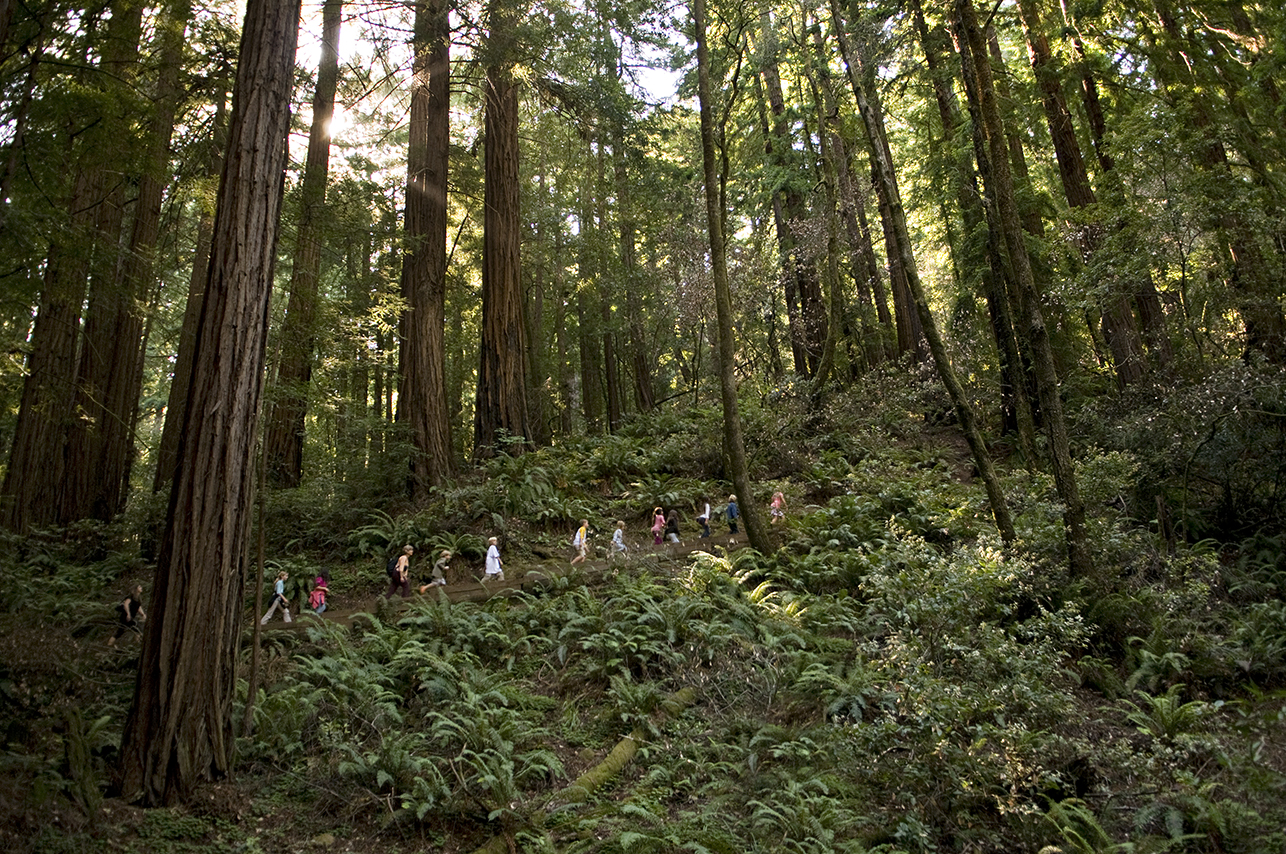
You have no reason not to explore California’s freakishly gorgeous lands now. The treehuggers over at the Redwoods League (who have purchased more than 190,000 acres of the trees for conservation since the group’s inception in 1918) have released their first-ever parent’s guide to the behemoth old-growth beauties. This means day trips sensibly arranged and explained so that even the couch-bound and fresh air-phobic can figure out which woodses are best for them. Which redwood park operates a nursery? A science center? All in the guide, available for the price of your email address.

To aide you even further, Redwoods League director of outreach Jennifer Benito gave us her top picks for redwoods to take the parentals to, the most impressive stands to wow your out-of-towner babes, etc. Click through for the League’s detailed info on visitor centers, trails, and hidden treasures in each of the parks on her list.Here’s Benitos faves:

Best redwoods you can reach by public transit? Muir Woods National Monument, Redwood Regional Park

Secluded spot? I don’t like crowds. Montgomery Woods State Natural Reserve

Most accesible spot for parents and other elders? Muir Woods again, and in other parts of California, these places all feature easy access to trees and trails: Big Basin Redwoods State Park, Jedediah Smith Redwoods State Park, Prairie Creek Redwoods State Park.

Most wow-worthy stand to impress visitors? Prairie Creek, Jedediah Smith (which has the densest old-growth trees in the state), and Del Norte Coast Redwoods State Park (eight coastal miles of gorgeous views). 

For even more redwood adventures, check out the League’s ace interactive map, which lets you search by geographic location for your ideal redwood jaunt. The group will release its guide to sequoias in the fall. 

Can the tech boom solve our housing crisis? No, but it can make it worse

64

 San Francisco Housing Action Coalition and San Francisco Magazine posed an intriguing question at a forum they sponsored last night in the W Hotel: “San Francisco’s Housing Crisis: Can the Tech Boom Help Us?” Unfortunately, it wasn’t a question they ever really addressed at an event of, by, and for developers and their most ardent supporters.

Instead, the event was mostly just pro-development boosterism supporting HAC’s goal of building 100,000 new homes in SF over the next 20 years, and the discussion seems to show that the tech boom will exacerbate the housing crisis without ever addressing it, particularly given the local tax breaks and subsidies Mayor Ed Lee keeps giving the industry.

“San Francisco must radically increase its anemic housing production,” HAC Executive Director Tim Colen said during the introduction.

The pro-development cheerleading was slightly offset by the dose of reality offered by panelist Peter Cohen of the San Francisco Council of Community Housing Organizations, who noted that market rate developers aren’t building for today’s San Franciscans, 61 percent of whom make less than 120 percent of the Area Median Income. 

“We don’t believe the market will ever touch the 120 and lower,” Cohen said, later offering, “How do we build for the kind of San Francisco we have now?”

San Francisco Magazine Editor-in-Chief Jon Steinberg, who moderated the panel, said this event grew out of an important and widely acclaimed story that David Talbot wrote for the magazine last fall, “How Much Tech Can One City Take?” that raised critical questions about the wisdom of the big bet that San Francisco has placed on an industry driven by speculative bubbles.

“We got more responses from readers than anything we published in our history,” Steinberg said of the article, before shamefully expressing second thoughts on publishing it. “I felt the writer had been a little hard on our friends in the tech industry.”

He introduced UC Berkeley Economics Professor Enrico Moretti, whose 2012 book “The New Geography of Jobs” argues for reducing regulations that hinder housing production in cities, by saying that if he’d read it before publishing Talbot’s excellent article, “I think it would have had a little different tenor.”

Yet Moretti’s presentation was an overly simplistic Economics 101 argument that housing prices go up when demand is strong and supply is weak. “It doesn’t take a degree in economics to know those workers will bid up the price of housing,” Moretti said after noting San Francisco added 21,500 job but just 2,548 new housing units last year.

That’s the basic line we hear a lot these days, that only a massive housing construction boom will keep housing prices down and prevent mass displacement. “The only answer is to radically increase the supply,” said SPUR Executive Director Gabriel Metcalf, noting that means tossing out many of the city’s historic preservation and height and density restrictions. “All we have to do is get out of the way and allow housing to increase to make it normal again.”

Metcalf confidently predicted that housing prices and rents would drop if the city pursued that kind of unfettered housing boom, offering to buy Cohen a beer if he was wrong. Yet even Moretti’s research shows that Metcalf would probably lose that bet.

Moretti compared San Francisco to Seattle, which is also experiencing a comparable high-tech job boom that exacerbated a housing supply shortage, which Seattle responded to by following the prescription of HAC and building thousands of new condos in the downtown core.

The result was that rents in Seattle have increased 31 percent less than San Francisco’s, which he called significant, despite the fact that rents are still on the rise there even with a massive influx of new people and condos and all the infrastructure challenges that presents (it’s widely accepted that new development in San Francisco doesn’t pay for the full cost of infrastructure needed to serve it, which is a huge issue in the transportation sector alone).

Nobody had a good answer to Cohen’s point that building tons of market rate housing won’t actually do much to prevent the displacement of a majority of current city residents. As he put it, “What’s missing is who is that housing for, who is it actually serving?”

Metcalf welcomes the wholesale transformation of San Francisco – “It will be a change, a total change, and guess what? That could be great.” – but even he argues for the importance of policies that protect those on the bottom half of the economic scale, from rent control to more government-subsidized affordable housing production.

As Metcalf, one of the biggest market rate development cheerleaders in city, said, “If it were not for rent control, I would have been forced out of the city by now.”

Brown raids cap-and-trade funds, delaying action on climate change

5

Greenhouse gas concentrations in the atmosphere continue to rise to dangerous levels, but still our political leaders delay taking meaningful actions to address the looming crisis. The latest example: Gov. Jerry Brown is borrowing $500 million from the state’s new cap-and-trade program — money designated specifically for efforts to address climate change — to help balance the revised state budget proposal that he released today.

And the worst part was that Brown is raiding these funds even though there was no good reason to do so. “The Governor’s Budget reflected California’s most stable fiscal footing in well over a decade,” was the first sentence in the budget document, which admirably begins to restore education funding, partly because voters approved the Prop. 30 tax package last year.

While Brown said that the $500 million raid is just a loan that will be paid back with interest, the action highlights the short-term thinking that animates our political and business leaders, who seem content with hollow gestures and symbolic actions that fall far short of what’s actually needed to minimize climate change and sea level rise (even the cap-and-trade system itself is a business-friendly half-measure; simply capping then decreasing emmissions would have been far more effective).

There are a multitude of immediate needs for that “borrowed” money that would have big impacts to the carbon emmissions that our state continues to spew into the atmosphere, such as helping Muni and other urban transit systems overcome budget deficits that hamper their ability to provide good alternatives to private automobile use, which is one of the top sources of greenhouse gas emmissions.  

Environmentalists and advocates for social and economic justice — who have fought to direct some of these funds to reducing emmissions in low-income communities, where it is an acute public health issue on top of the long-term climate change threat — immediately criticized the governor’s move.

“The governor is playing a dangerous game that could wreck California’s push toward clean energy,” Greenlining Institute Legal Counsel Ryan Young said in a press release. “Voters of color turned out in force to protect AB 32, the clean energy law, when it was under attack by Prop. 23 [last year’s effort to repeal it], and they did it based on the promise that it would bring clean energy investments to polluted and struggling communities. These are the same voters who provided Jerry Brown’s victory margin when he ran for governor. Seizing these funds for other uses will hurt our state’s neediest communities, and it’s simply not necessary.”

Longtime Sierra Club legislative director Bill Magavern, who works with the Coalition for Clean Air, told Capital Weekly that the money is urgently needed for a variety of programs to reduce pollution in communities of color: “These important goals are now shunted aside as broken promises. The Governor has spoken of the urgency of addressing our climate crisis, but he has not put his money where his mouth is. It’s important to remember that none of the dollars in the Greenhouse Gas Reduction Fund come from taxes, and they were never intended to go to the General Fund.”

Another gauge is also telling: how do the polluters feel about the governor’s new budget? Well, here’s another press release we got on the governor’s new budget, from a conservative business organization that has long opposed meaningful efforts to address climate change: “California Manufacturers & Technology Association president Jack Stewart made the following media statement after Gov. Jerry Brown’s proposed ‘May Revise’ budget: ‘We congratulate Gov. Jerry Brown on a proposed balanced budget that will help California provide important government services. We appreciate that the Governor proposes the addition of a statewide sales tax exemption on the purchase of manufacturing equipment.  This will make California a more competitive place to scale up production.”

Same as it ever was.

4 reasons that spending $150 on Janelle Monae tickets is not 100 percent ridiculous

0

1. Her Thu/16 show is at the symphony It is! The show is at Davies Symphony Hall and features actual symphony musicians playing actual orchestral arrangements to back up android-andro chic Ms. Monae, whose set will include material from her new album even. She’s dropping through the Chicago Symphony later this month as a last-minute stand-in for Aretha Franklin, so you can go to her SF gig and chortle about the Windy City getting our original orchestral arrangement sloppy seconds. This will be a wonderful chance to see the Symphony dames approximate Rocky Horror Picture Show, if Thursday night’s fashion scene is anything like this episode of 106th and Park:

2. It’s a fundraiser Your million dollars are going towards teaching childrens how to play musical instruments. The SF Symphony’s Adventures in Music program reaches all 23,000 kidlets on the 91 SF Unified School District campuses, and exposes them to in-school concerts, musical curriculum, and private concerts at Davies Symphony Hall. Elementary school kids in SF get to go through five years of Adventures in Music programming, and the program also does professional development offerings for teachers and administrators. 

3. Alcohol, mingling Few concerts you will attend this year figure pre-and-post-parties into the ticket prices, but there you are — the Symphony has you covered. Get to the venue at 7pm and you will dive politely into a carefully meted vat of sparkling wine in the well-lit, curving foyer wonderland of Davies Symphony Hall. After the concert, all will reconvene across the street at City Hall to talk about how wonderful everything was during yet another cocktail hour. 

4. Monae’s new single with Erykah Badu You’ve heard this, right? Not guaranteeing that it’ll be performed on Thursday with the full compliment of world-class musicians, but we have heard that Fat Belly Bella has been creeping around the Bay recently, performing at the Bonobo show at the Warfield earlier this month. Manifest it, friends. The video is genius: 

Janelle Monae at SF Symphony

Thu/16, 7pm reception, 8pm show, $150-340

Davies Symphony Hall

201 Van Ness, SF

(415) 864-6000

www.sfsymphony.org

Randy Shaw just loves Capitalism

215

Well: We all know that Randy Shaw, director of the Tenderloin Housing Clinic and editor of BeyondChron, is a loyal, devoted fan of Mayor Ed Lee. We know that he pretty much sees no wrong in the Lee Administration. But his attack on the Chron’s John King for daring to say that there’s a lack of planning on the waterfront is remarkable not only because there IS a lack of planning on the waterfront but because Shaw’s position is essentially that King is (gasp) anti-Captialist.

Seriously:

Ultimately, King’s critique is more directed at the U.S. capitalist system than to Mayor Lee, his predecessors, or other urban mayors. Private developers have long called the shots in urban America because the government does not go into the lucrative business of building and operating office buildings, luxury housing or tourist hotels. In the absence of government development, private interests determine what gets built. And when planners decide, under King’s favored approach, to dictate land use policies for a certain area, success is dependent on attracting private investment.

 Randy: The whole concept of city planning is “dictating land use policies for a certain area.” That’s not just King’s favored approach; it’s the essence of how progressive cities operate. Yes, you (sadly) have to attract private investment, but you don’t have to let the private developers lead the way. You can say: This is the kind of city we want; if you want to build here, build to our terms.

If you don’t do that, you become the wild west.

I’m surprised how far Randy Shaw has moved to the right on development issues in the past year; this piece could have been written by the folks at SPUR. Everything is about serving the needs of the private sector.

So BeyondChron is now the voice of the developers, and the Chronicle is the one raising the critical issues. What an odd world this has become.


Yo La Tengo plays the hits at the Fillmore, covers Black Flag

0

The last time I saw Yo La Tengo, on its fabulously gimmicky Spinning Wheel tour, the trio delivered an abrasive, garage-y opening set under an alter-ego, Dump, and closed with a Jackson Browne cover. This past Friday, the band took the Fillmore stage with a loose, meditative acoustic set, before eventually closing with an incendiary rendition of a Black Flag song. There’s no predicting the content, or structure of a Yo La Tengo show; yet, no matter how vigorously it flips from one genre to the next, it sounds unmistakably like Yo La Tengo.

From its yearly run of Hanukkah shows, to its infamously vast archive of cover songs, the Hoboken, NJ trio of Ira Kaplan, Georgia Hubley, and James McNew has cultivated a rich mythology over nearly three decades as a band. It’s also maintained remarkable consistency and prolificacy within its recorded material, which, like Stereolab, has caused many a fan to take its casual greatness for granted. Alternating between insistently bouncy pop songs, blissfully droned-out jams, and cozy ballads to wear your autumn sweater by, Yo La Tengo has assembled a wildly eclectic back-catalogue that continues to pleasantly surprise, and occasionally confound live audiences.

At Friday’s show, the band threw out a curveball right away, with an understated, acoustic rendition of “Ohm,” the decidedly electric opening track from this year’s Fade: its 13th LP, and arguably its most muted, direct work to date. Kaplan and McNew powered through the drony, hypnotic guitar riff at the song’s center with a quiet, chugging insistence, reinforced by Hubley’s understated, yet undeniably groovy drum brushing. It was a captivating opener, and a shining example of Yo La Tengo’s penchant for elegant simplicity.

The remainder of the opening set showed similar restraint, shuffling through several other new songs (the Beach House-y “Two Trains,” Hubley’s gorgeously vocalized “Cornelia & Jane,” the raga-ish “I’ll Be Around”) intermixed with material from the band’s back-catalogue. One definite highlight was a stripped-down rendition of “Decora” (from 1995’s Electr-o-pura), while “No Water” (from its second LP, 1987’s New Wave Hot Dogs) was easily the night’s most unexpected selection.

After a short break, during which many bespectacled audience members pined for a louder, freakier closing set, Yo La Tengo retook the stage with a full drum kit, and an arsenal of electric guitars, providing a jolt that the first half was missing. “Beanbag Chair” (from 2006’s curiously titled I Am Not Afraid of You and I Will Beat Your Ass) delivered on the band’s talent for effervescently hooky pop songcraft, while “Deeper Into Movies” (a high point from 1997’s seminal I Can Hear the Heart Beating As One) set a darker, angstier mood, foregrounding Kaplan’s fuzzed-out guitar sensibility.

However, a Yo La Tengo show wouldn’t be complete without a sprawling, 10+ minute epic, and the band delivered handsomely with “The Story of Yo La Tengo.” Beginning with ambient washes of guitar and synth, the sprawling jam morphed slowly into a devastating guitar freakout, complete with Hendrix-esque stage theatrics. Given Kaplan’s soft-spoken, dryly funny live persona, watching him attack his fretboard with prog-like dexterity and ferocity was incredibly endearing, in a brain-melting sort of way. Although Hubley and McNew both took turns fronting the band, proving Yo La Tengo as one of the more democratic ensembles around, Kaplan absolutely stole the show.

In true Yo La Tengo tradition, the band came back for an encore set of cover songs: in this case, Black Flag’s “Nervous Breakdown,” and the Scene is Now’s “Yellow Sarong.” Following an uncompromisingly pissy, noisy punk number with a kinder, gentler pop selection, the pairing was perfectly symbolic of the trio’s stylistic range.

Few ensembles can claim Yo La Tengo’s dependability while remaining so utterly unpredictable, and fewer can sustain such a balancing act so unpretentiously. Even after three decades and 13 albums together, Kaplan, Hubley, and McNew continue to record and perform as vitally and infectiously as many bands on the first leg of their journey. If Sonic Youth’s dissolution is for real, we can officially claim Yo La Tengo as the reigning champions of the autumn-sweatered indie set.

The Performant: Forever young

0

Rocky Horror turns 40, still crazy after all these years.

Who doesn’t have fond memories of their first Rocky Horror Picture Show experience? Ok, mine are mixed since the first time I saw it was on an old black-and-white television with my father, avoiding eye contact and trying not to laugh too hard at the ribald bits. It wasn’t until I finally saw it on the big screen in the company of peers — armed with rice, noisemakers, and snarky quips — that the full potential of its subversive pleasures revealed themselves more fully.

Part of the fun of repeated viewings of the Rocky Horror Picture Show is emulating the character you most want to be, and for a curly-haired, goth-inclined teenager, the clear choice was Magenta, whose stone-faced cool and extraterrestrial sensuality were so beyond the straitjacket of smalltown teenhood, that to walk an evening in her spike-heeled shoes was akin to a declaration of, well, something. Call it freedom. Peaches Christ does.


“The Rocky Horror Picture Show was my ‘It Gets Better’ video,’ she told the cheering oddience assembled at the Victoria Theatre for the 40th anniversary of the original Rocky Horror Show, the slapstick, Ed-Wood-meets-Charles-Ludlam Rock Musical that, two years later, became a film destined to be the best known midnight movie of all time.

Deviating from the tried-and-true Midnight Mass formula of movie screenings, this Rocky Horror birthday bash took the form of a tribute concert at a respectable 8pm, with multiple singers cast in the iconic roles of the universes’ best-beloved Transylvanians, live music provided by the Whoa Nellies, and quick-and-dirty narration by Peaches Christ herself, synopsizing the negligee-thin plotline that happens between all of those undeniably catchy songs: “The Time Warp,” “Touch-a Touch-a-Touch Me,” and “Hot Patootie, Bless my Soul”. Channeling her inner Tim Curry, PC also provided the vox and corseted eye candy on “Sweet Transvestite” slyly replacing her planet of origins, “Transsexual, Transylvania,” with “San Francisco, California”.

But by far the highlight was the moment that the original Magenta — Patricia Quinn — stepped onstage in a sleek leather suit and handfuls of glitter, to sing the opening song she’d been cheated out of 38 years ago when Richard O’Brien took it over for the movie version, accompanied by a visual of her bright red “stunt lips.” My still-practically-teenaged heart be still. Quinn’s still got. It. That elusive, effusive cool. As does the whole freaking musical, which, stripped of the mostly laughable dialogue and B-Movie special effects, really rocks. Not bad for a 40-year-old who regularly stays up until 3am and can’t ever seem to remember to wear pants. Oh, Rocky!

Lest a single inch of stage space go wasted, almost every role was played by a minimum of two performers, including Dr. Frank-N-Furter portrayed mainly by seasoned Rocky Horror vet Jef Valentine, with a counter-point appearance by former X Factor contestant, Jason Brock, who sang a soulful “I’m Going Home” to an interstellar techno backing track provided by Marc Kate aka Never Knows. Exceptions were Musical Director Peter Fogel who pulled double duty as the titular boy toy and the imitable Leigh Crow as Eddie, ‘cause there can only be one Eddie, and really, that Eddie can only be Leigh Crow. And now that such a stellar lineup is already in place, here’s hoping Peaches will do a 40-year bash for the film version, too, come 2015. Don’t dream it, darlings. Be it!

Tech guru says Internet destroying middle class

28

Jaron Lanier isn’t a Luddite. He can’t be dismissed as a crackpot, whiner critic who is jealous of the success of others. He virtually invented virtual reality; he was a tech guru when most of today’s tech titans were still in diapers. So when he says that the Internet is destroying the middle class, maybe everyone ought to stop for a second and listen.

Okay, as I’ve said before: The Internet didn’t destroy San Francisco. Technology is a tool; it can be used in good ways and bad ways, and its impacts on society, particularly on the poor, can be mitigated by government action (or greatly worsened by inaction).

But Lanier is concerned that the business boom that has been created by high tech has made social inequality worse and is wiping out the middle class that is so essential to a stable country. He talks about how Kodak had 140,000 workers, many of them middle class, and Instagram has 13:

You have this intense concentration of the formal benefits, and that winner-take-all feeling is not just for the people who are on the computers but also from the people who are using them. So there’s this tiny token number of people who will get by from using YouTube or Kickstarter, and everybody else lives on hope. There’s not a middle-class hump. It’s an all-or-nothing society.

More important, the youth-driven culture of the current economic boom ignores that fact that some people are old, and have families, and get sick and disabled, and need a kind of stability that our current march of “disruptive” capitalism is destroying:

We don’t realize that our society and our democracy ultimately rest on the stability of middle-class jobs. When I talk to libertarians and socialists, they have this weird belief that everybody’s this abstract robot that won’t ever get sick or have kids or get old. It’s like everybody’s this eternal freelancer who can afford downtime and can self-fund until they find their magic moment or something.

And Lanier IS a guy who can afford downtime and self-fund. But he’s also 53, and has a little more perspective on life. He recognizes that the middle class has always had, and needs, some sort of public-sector support, whether it’s through tax policy or education or job creation, particularly in unstable economic times. It’s fine for capitalism to be disruptive — as long as there’s a safety net to make sure that all the people disrupted out of their livelihoods aren’t disrupted out of their homes.

Young people, Googlers, Facebookians, Twitterati: Maybe you should listen to your elders.

DPH: Unaffordable housing is bad for your health

To cover rent on a two-bedroom apartment at “fair market value” in SoMa, a San Francisco minimum-wage earner would have to work 7.4 full-time jobs.

That jaw-dropper of a statistic is just one tidbit in a fascinating dataset featured in a recently published interactive map plotting housing affordability in San Francisco neighborhoods. Combining data from Craigslist and PadMapper, the U.S. Census Bureau’s American Community Survey, and the local minimum wage ($10.24 per hour, widely regarded as generous), the map isn’t the handiwork of affordable housing activists. [Note: this reflects the 2012 minimum wage, the rate now stands at $10.55.]

Instead, it was created by the San Francisco Department of Public Health’s Program on Health, Equity and Sustainability. To view the full map and dig around for data on your neighborhood of interest, go here.

The embedded dataset reveals that the median income in SoMa is $91,000 lower than the $158,000 one would need to afford renting a market-rate two-bedroom. This figure, expressed as $-91,000, is known as the “affordability gap,” and the map plots these gaps neighborhood by neighborhood.

It was rolled out as part of a weeklong effort to raise public awareness about the link between affordable housing and public health, explains Cyndy Comerford, manager of planning and fiscal policy at the Environmental Health division of DPH. The reason? “Unmet housing needs in San Francisco can result in significant public health concerns,” Comerford says.

A lack of affordable rental housing can push more tenants into substandard or overcrowded living situations, she adds. Housing units within reach for lower income residents might be squeezed up against a highway, for instance, putting tenants in close proximity to noise, traffic, or air pollution, thus increasing their risks for experiencing heart or respiratory problems. Substandard housing also makes lead or mold exposure more likely, possibly triggering serious health issues over time.

For residents who fork over a significant percentage of their income for rent, other problems can arise. “It leaves little money for other provisions,” such as healthy food or preventative health care, Comerford adds, so low-income tenants have a higher likelihood of malnourishment or preventable disease related to nutrition.

The map is part of a broader DPH initiative known as the Sustainable Communities Index, which provides datasets for more than 100 health indicators. There’s a whole section on housing, which even covers the negative health effects of eviction: “Involuntary displacement contributes to stress, loss of supportive social networks and increased risk for substandard housing conditions and overcrowding,” DPH points out.

More information is yet to come: “Every day this week, we’ll put out a new bit of information around health and housing,” Comerford says.

Taking a broader view, it appears that sweeping cuts to public programs will present a whole new set of challenges for lower-income populations who have a higher risk of housing-related health problems. As a New York Times opinion piece highlighting the public health ramifications of austerity measures notes, “there are warning signs … that health trends are worsening. Prescriptions for antidepressants have soared. Three-quarters of a million people (particularly out-of-work young men) have turned to binge drinking. Over five million Americans lost access to health care in the recession because they lost their jobs.”

Amid all this, as a consequence of the $85 billion “sequester” that began on March 1, “Public housing budgets will be cut by nearly $2 billion this year,” the New York Times piece continues, “even while 1.4 million homes are in foreclosure.”

Pick-up bball legends tell the tale of the game outside

0

We’re talking about basketball, NYC pick-up announcer legend Bobbitio “Kool Bob Love” and I, but our conversation is hardly hinging on the Warriors-Spurs match-up or LeBron James’ shot at MVP this year. Rather, we’re discussing the power of the men and women ballers on the playground — a culture that Garcia and French filmmaker Kevin Couliau painstakingly documented for their film Doin’ it in the Park, which begins its Bay Area run at the Clay Theatre on Thu/16. 

“There wouldn’t be an NBA without pick-up basketball,” Garcia tells me in the voice made famous by his narration of countless pick-up tournaments, his pioneering ESPN feature on sneaker culture, and his turn as the New York Knicks’ first Latino broadcast team member. “Our culture and movement has informed every level of organized basketball. It’s informed even hip-hop fashion — all the iconic sneakers have taken their cues from pick up basketball.”

Pick-up powerhouse Niki Avery takes it to the boys in a shot from Doin’ it in the Park

Given the subject matter, the DIY style in which the duo shot Doin’ It was fitting. “I was sleeping on Bobbito’s couch,” while filming the movie, says Couliau, checking in via phone from France. The videographer grew up on the ball courts of his homeland, and learned about NYC’s thriving basketball scene — the metropolitan area is home to no less than 700 outside courts — through the Internet. Small wonder that the Frenchman eventually wound up in the Big Apple documenting the game in the gorgeously shot music video for rapper Red Cafe’s “Heart & Soul of New York City”.

Garcia caught wind of the short and proposed a feature-length project that turned into Doin’ it in the Park. To shoot the film, the duo traveled (“90 percent by bike,” says Bobbito) to 180 borough courts.

The film lands candid commentary that assesses playground ball going back decades from court legends like James “Fly” Williams, takes viewers to the court at the Rikers Island jail complex, investigates court-side style (be careful where you wear your NBA jersey, let’s just say), talks to women who’ve found their home under hoop like Niki “the Model” Avery, and documents game from all kinds of players.

Garcia says diversity in age, race, and social standing on court is a trademark of pick-up ball. To illustrate his point, he tells me about a game he ran in which his teammates were, “a Wall Street banker, a priest, and two homeless dudes. Where are you going to find that variety engaging in physical activity anywhere?”

Doin’ it in the Park, Garcia says, is one the most important projects he’s worked on — which is saying something. The man created Bounce Magazine, the first magazine devoted to the art of pick-up. He’s the voice on the NBA Street and NBA 2K videogames, written for Vibe, has turned guest roles in Summer of Sam and Above the Rim. His half-time commentary at Madison Square Garden for the Knicks was a crowd favorite. His hip-hop radio show with Stretch Armstrong in the early ’90s was called the best ever and gave airtime to an unsigned Notorious B.I.G. and Jay-Z. 

Garcia says that pick-up courts in New York dispell the notion that young people eschew sports for smart phones these days. If you’re gotten your fill for the day of Stephan Curry’s three-point percentage, one of this week’s Bay Area screenings of Doin’ It would be a fresh look at the streetside passion for b-ball. 

“It’s hard to say who are the [current pick-up] stars,” says Garcia. “If I go to Staten Island and destroy everybody, it’s not going to show up on ESPN. There’s a lot of great players, but most of them aren’t really known.”

Doin’ it in the Park Bay Area screenings

SF premiere and Q&A:

Thu/16, 8pm, $10-15

Clay Theatre

2261 Fillmore, SF

After-party:

Thu/16, 10pm-2am, free

Social Study

1795 Geary, SF

diitpmovie.eventbrite.com


Fri/17 screening and reception, 7pm; Sat/18, 3:30pm; Mon/20-May 22, 9:15pm; $8-10

New Parkway Theater

474 24th St., Oakl

www.thenewparkway.com

Heads Up: 7 must-see concerts this week

0

This video has been floating around of Canadian astronaut Chris Hadfield floating in space, slowly turning inside his vessel, playing the acoustic guitar and singing Ziggy Stardust-era Bowie (“Space Oddity,” naturally). It’s an arresting image, melding science, sound, nerd culture, and pop culture together in the coolest of ways. And it was his goodbye love letter to space, as he returned back down to earth yesterday.

Outside the spaceship, and also back here on earth (and playing San Francisco this week, naturally) there are bands that are grounded by gravity, though little else — the celestial atmospheric head case of Kisses, larger-than-life Big Boi, otherworldly solo pounder Black Pus (Brian Chippendale of Lightning Bolt), cosmic soul duo Myron and E, and more invade our shores in the coming days. Maintain your curiosity, and greet them live in the flesh, eyes and ears wide with wonder.

Here are your must-see Bay Area concerts this week/end:

Kisses
Los Angeles dream-poppers Kisses (a.k.a Jesse Kivel and Zinzi Edmundson) have sonically stripped down for their sophomore album, Kids in LA. But the electro duo (analog keyboards, drum machines, robot moans) remains dedicated to breezy synth-pop with hints of the bleak LA underbelly peaking through the palm trees in the form of chilly vocals and anxious beats.
With Sister Crayon, Astronauts etc.
Tue/14, 8pm, $10-$12
Rickshaw Stop
155 Fell, SF
www.rickshawstop.com
http://www.youtube.com/watch?v=HO9KZQRZ0H8

Big Boi
“Any lingering notions of Big Boi as the “conventional” half of legendary Atlanta hip-hop duo Outkast should be dispelled by his two solo albums, including his most recent effort Vicious Lies and Dangerous Rumors, released last November. Aided by cameos from Phantogram and Little Dragon in “Vicious,” Big Boi dives into rock guitars, female vocalists, and electronic bass to present a fearless, kaleidoscopic vision of rap.” — Kevin Lee
With Killer Mike, Fishhawk, Goast
Thu/16, 8:30pm, $35
Mezzanine
444 Jessie
www.mezzaninesf.com
http://www.youtube.com/watch?v=CRUVMg6yvCs

Midi Matilda
“Midi Matilda is the embodiment of everything that’s missing from contemporary twee-pop. It has a sense of intimacy, soul, and joy, embodied by great hooks and hilarious choreographed dances that are absolutely infectious. Operating backward from most bands, Midi Matilda wrote and recorded music before it ever established a live presence, gaining attention on the web with its “Day Dreams” music video.” — Haley Zaremba
With OONA, holychild
Fri/17, 8:30pm, $12
Rickshaw Stop
155 Fell, SF
(415) 861-2011
www.rickshawstop.com
http://www.youtube.com/watch?v=GzdyhuhE694

KFJC’s Battle of the Surf Band
Alameda-based trio Aloha Screwdriver will play this yearly event for the second time. And the 16-band battle also includes Beachkrieg, Deadbeats, Mighty Surf Lords, Tomorrowmen, Frankie and the Pool Boys, Meshugga Beach Party, and more surf acts with cheeky names. The event benefits the station itself, and also will be broadcast using Live Cam.
Sat/18, noon, $10, all ages
Surf Spot
4627 Coast Hwy., Pacifica
www.kfjc.org
http://www.youtube.com/watch?v=0RKqyITE7zk

Myron and E
Listen to Myron and E’s single “If I Gave You My Love” and you’ll start to feel some involuntary movements, your head bouncing in agreement, shoulders shimmying side to side. It’s the nature of the solid gold soul beast. The duo was recently signed to tastemaker Stones Throw, and will release newest album Broadway, backed by Timmion Records house band the Soul Investigators, on the label July 2. With a handful of 45s already out there, the two — Bay Area bred Myron Glasper and Eric “E da Boss” Cooke — have successfully maneuvered an authentic soul sound that’s at once smooth and celebratory (with the help of some well-placed horns).
East Bay Soul Stomp 2 with Bang Girl Group Revue, New Love Soul Revue, DJ Derek See, DJ Der.
Sat/18, 8pm, $9–<\d>$12
Starry Plough
3101 Shattuck, Berk
www.starryploughpub.com
http://www.youtube.com/watch?v=pkkCRD0pLnI

Black Pus
The first thing you need to know about Black Pus is that it’s just a looping Brian Chippendale — he of Lighting Bolt fame. For this project, the madman drummer (and forever art-school kid at heart) uses percussion, a triggered oscillator, and those echoing, distorted Lightning Bolt style vocals you’d expect. Most tracks sound like a spaceship lifting off and exploding into starry darkness, repeatedly.
With CCR Headcleaner, Reptilian Shape Shifters.
Sat/18, 9:30, $10
Hemlock Tavern
1131 Polk, SF
www.hemlocktavern.com
http://www.youtube.com/watch?v=sZKJs2tAayg

Gothic Tropic
“For a band that has released so little music — only the 2011 EP Awesome Problems — Gothic Tropic has a developed sense of itself. Part of it is in frontperson Cecilia Della Peruti’s tendency to perform shoeless so as not restrict her dance moves. The primary feature, though, is the band’s sound. As its name suggests, Gothic Tropic plays sunny and exotic psych-pop tinted with some grit and darkness, and it plays it well. See the band in all of it’s fully-formed glory at Brick and Mortar.” — Laura Kerry
With Seatraffic, Cruel Summer
Sun/19, 9pm, $10
Brick and Mortar
1710 Mission, SF
(415) 800-8782
www.brickandmortarmusic.com
http://www.youtube.com/watch?v=gU-QqrMApDQ

Why rent control works

108

I shouldn’t even bother to talk about this, because all it will do is stir up the trolls, but I’m getting sick of all the talk about rent control being a source of San Francisco’s housing problem. The latest is an editorial in the Business Times, which I buy to read J.K. Dineen’s stories about commercial real-estate, among other things. I should treat it like the Wall Street Journal; nobody takes the Journal’s editorial page seriously.

But the BT is just putting in print the argument that I’m hearing from the neo-libertarians who seem to be more and more populous in this town. And it goes like this:

Rent control distorts the market, which should be controlled by supply and demand. When you have rent control, evil tenants can stay in one place a really long time, thus “reducing urban vitality by discouraging mobility.” They can save their money for something other than rent. And it’s deeply unfair to landlords, because, as the BT notes:

By artificially limiting the return a building’s owner can generate on his investment, it discourages him from spending to maintain or upgrade the city’s housing stock. Rent increases are ordained not by supply and demand but by the city’s rent board. Legally, controlled rents can only go up each year by a fraction of the inflation rate. The ability to recoup costs of improvement or maintenance are also tightly curtailed. Costs are subject to no such limitations, so generally as a rent-controlled landlord, the longer you do it, the further behind you get.

Actually, rents go up by the percentage of the inflation rate that’s due to housing. The ability to recoup maintenance costs are not “tightly curtailed.” But more important, this notion that landlords “get further behind” because they can’t raise the rent assumes that most landlords — and their bankers — are idiots.

When you buy a piece of rental property, you typically have to prove to the bank that the rental income from the place is adequate to cover the mortgage, the taxes, the insurance, and upkeep, the same way a person buying a home has to prove that he or she has adequate income to pay the costs. When banks make loans the borrowers can’t repay, you get the mortgage crisis we’ve seen — but most of those units were single-family homes.

If I buy a rental property, the rent that’s coming in TODAY is matched with the price I’m paying TODAY. If the rents are too low to cover the cost, I have no business buying the place. And the bank has no business loaning me the money.

In San Francisco, unless you’re a complete moron, you buy rental property knowing, as the banker does, exactly what the current tenants are paying, and understanding, as the banker does, that the law won’t let me raise those rents by more than a modest amount each year. You’re making a profit at those rent levels; if not, you shouldn’t buy the place.

Now: Under Prop. 13, your property taxes can’t go up by much more than the rent goes up each year. And if you aren’t a speculative gambler (if you are, you have no rights anyway), you almost certainly have a fixed-rate mortgage. So your biggest “costs” are just as constrained as the rents you get. Meanwhile, your property continues to appreciate in value as the tenants pay your mortgage and taxes.

I know a lot of landlords in San Francisco, and the honest ones all say that owning rental property is a great deal — for the owner. There are probably some poor landlords who either (a) made bad business decisions or (b) were subject to some awful disaster and now find themselves unable to make ends meet. But they are not common.

Here’s the bottom line: Rent control prevents landlords from making speculative profits when the housing market booms. It also allows non-wealthy people to live here, for long periods of time, and become part of the San Francisco community. Housing stability INCREASES “urban vitality.” That’s the point.

Real, effective rent control would include limits on rent increases when a property becomes vacant. Berkeley had that in the 1980s. It didn’t cause urban blight or landlords abandoning buildings; instead, it helped create the Gourmet Ghetto and a thriving local business scene because tenants had more money to spend. It was a great success, until the state outlawed it.

Oh, and don’t tell me it discourages new construction: All new construction, since 1979, is exempt from rent control in San Francisco.

Rent control is, I will admit, bad for people who see housing as a speculative commodity, to be traded with little regard for its function as a basic human right. But I see housing more as a regulated utility — private owners have the right to a regular, acceptable return on investment, but not to excessive profits. Tenants have the right to live in the same place their entire lives, as long as they pay the (stable) rent and don’t become a nuisance.

These are good things for a city. The only problem with San Francisco rent control is that it isn’t strong enough.

Attack me, trolls. Or better, make a civil counter-argument that doesn’t start with “The problem with Tim is ….” Cuz we all know about my problems.