SFBG Blogs

Protect pedestrians, crack down on red light runners

36

It’s good to see City Hall finally focusing on pedestrian safety in San Francisco, where the streets are more dangerous than ever for their most vulnerable users, with the number of pedestrians and cyclists killed by motorists spiking last year.

Better streetscape design is part of the solution, and the advocacy group WalkSF will be holding the latest in its series of focus groups this Saturday seeking solutions to the problem. It is working with city agencies on a program called WalkFirst to address the issue.

But there’s another solution that’s even more obvious and immediate, and Sup. Scott Wiener hit on it at yesterday’s Board of Supervisors meeting when he said (according to the Examiner), “It’s remarkable how little traffic enforcement we have…I’ve never been in a place with less traffic enforcement than in this city.”

Actually, it isn’t that the San Francisco Police Department doesn’t do traffic enforcement, as we learned this fall when officers pulled over dozens of cyclists slowly cruising through stop signs on the Wiggle. The problem is that SFPD ignores the most obvious and dangerous violations: motorists running red lights and otherwise driving recklessly.

Everyday on my commute home up Market Street, I see at least three anxious drivers running red lights. Everyday! This morning, on my way to work, a driver ran a red light right in front of an SFPD cruiser, and that officer ignored it. These drivers are speeding up within reach of pedestrians, who often wrongly assume green means they are safe to cross.

So drivers need to take a breath and realize the seconds they save isn’t worth the risk they’re taking with other people’s lives. And the SFPD needs to ticket more of these drivers and start sending the message that such selfishness won’t be tolerated.  

SF food bank short 2,200 volunteers

13

Well, that was fast.

As it does every year, the cheery holiday season brought thousands of volunteers to the San Francisco and Marin Food Banks. Hungry folks were fed (despite some controversy), bellies were filled, hearts were warmed.

So much for that.

The holidays are over, the Christmas songs no longer play in our stores, and the barrage of volunteers is now at a standstill. The food bank is now short 2,200 volunteers, the part time work equivalent of about 60 full time employees, a food bank spokesperson said.

foodstats“Our volunteers are crucial to our mission and on average help us in sorting, bagging, gleaning, and boxing food. They on average help to sort over 1 million pounds (of food) per month,” Volunteer Services Manager Sean Rosas told us. “Heading into January, the Food Bank isn’t as top of mind for people as it was during November and December. We have lots of empty shifts on our calendar.”

Yes, this happens every year, but a new report from the city shows San Franciscans are at greater risk of food insecurity than ever.

One of the most expensive and wealthy cities in the nation still grapples with a hunger problem, highlighted in a recent report from the city’s Food Security Task Force. One in four San Franciscans are “food insecure,” meaning they’re starving or eating dangerously unhealthily due to poverty. 

The food bank fights this every day. It doesn’t need volunteers in its pantries, but for processing food in a giant warehouse nestled on Pennsylvania Avenue, behind Potrero Hill. There, volunteers package dried goods and sort produce.

That food then is shipped to over 200 food pantries in San Francisco and Marin, serving most all of San Francisco’s neighborhoods. From Glide Memorial Church in the Tenderloin to the Women’s Building in the Mission, more than 200,000 hungry San Franciscans are fed by the organization annually. 

Frighteningly, without volunteers, some of their fresh food will go to waste. 

“Currently, we distribute over 60 percent of our produce to nonprofit partners,” Rosas said. “A drop in volunteers would significantly impact our gleaning and distribution of fresh produce like oranges.  Ultimately this would lead to more food waste and composting costs for our organization.” 

For more information on how you can help, visit http://www.sfmfoodbank.org/

Insane Clown Posse and the ACLU vs. the FBI

0

I never thought I’d write this sentence, and I doubt I’ll have cause to write it again, but: Good on ya, Insane Clown Posse.

The inimitable horrorcore-rap duo — best known for their demonic clown makeup, misogynistic lyrics, supposedly tongue-in-cheek love of extreme violence, and their always-charming fan base — filed a lawsuit this morning in Detroit against the FBI and the Justice Department, alleging that the federal government acted unlawfully when it classified Juggalos as gang members, leading to “harassment” of fans by law enforcement officials.

Attorneys from the ACLU of Michigan and attorneys for ICP collaborated on the suit, which concerns a 2011 report by the National Gang Intelligence Center on “emerging trends” that defined fans of the band as a “loosely-organized hybrid gang” that was “rapidly expanding into many US communities.” Four Juggalos listed as plaintiffs (alongside ICP members Joseph Bruce and Joseph Utsler — er, sorry, Violent J and Shaggy 2 Dope) claim the gang designation led to unwarranted harassment by the police.

“We’re not a gang, we’re a family,” said Utsler at a press conference announcing the suit. “We’re a diverse group of men and women, united by our love of music and nothing more. We’re not a threat, a public menace or a danger to society.”

Insane Clown Posse and their assorted devotees remain, of course, for many of us, a public menace to our senses and a danger to good taste everywhere. A gang? Not quite. And organized groups of assholes aren’t exactly an emerging trend.

Besides, don’t our federal security agencies have anything better to do?

Pelosi denounces City College’s accreditors

41

Rep. Nancy Pelosi denounced the accreditors seeking to close City College at a press conference held yesterday at the school’s Chinatown campus.

“You can be sure it will be subjected to harsh scrutiny in terms of how they do what they do, who they are and why is it the Department of Education cannot do more,” she said to the crowd of local luminaries and City College faculty. 

City College of San Francisco is one of the state’s largest community colleges, home to a student body of over 85,000. The school came under fire from its accreditors, the Accrediting Commission for Community and Junior Colleges, last July, who moved to revoke the school’s accreditation. Such a move would force the college to close. 

Since then the ACCJC has been beaten back from many directions: it’s tangled in three lawsuits, as well as a state inquiry from the Joint Legislative Audit Committee. Arguably the highest profile thrashing the agency received was from Congresspeople Anna Eshoo and Jackie Speier in November.

“I think the ACCJC has run amok, they have lost their vision — if they ever had one,” Speier told the Guardian. “They are riddled with conflicts of interest and arbitrariness.”

Pelosi voiced support for those views yesterday.

“I want to associate myself with remarks Congresswoman Jackie Speier and Anna Eshoo,” she told the crowd, to cheers. 

Singing the praises of City College is all well and good, but the Guardian asked her directly: what can you do, and what is your next step?

Pelosi indicated that Congresspersons Speier, Eshoo, and George Miller, would review the role of the Department of Education regarding accreditors at a congressional higher education committee. This is something they’ve looked at before

“We’ll see what is recommended when we go there,” she said. “Suffice to say this is not something that will be ignored.”

New FCC boss coming to Oakland

On Thu/9, Voices for Internet Freedom, Free Press and the Center for Media Justice are hosting Tom Wheeler, the recently installed Federal Communications Commission chairman, for a town hall-style meeting about the state of communication policy, both in the Bay Area and nationally.

The event, which will be held in Nile Hall of Preservation Park, runs from 7-9pm and will feature a panel discussion, commentary from influential community members and remarks from Wheeler. There also will be a lengthy time slot reserved for public comments and questions. While the event has sold out, viewers can catch a live webstream here during the event.

“It’s going to be a fairly short event, but power packed,” said Malkia Cyril, founder and Executive Director of the Center for Media Justice. “We want to bring the frame of consciousness about the role of media and culture to the dialogue with the FCC, [because] that generally isn’t there.

“Generally, when it’s those kind of conversations they have, we are not the kind of people they’re talking to. And we want to make sure that the voices of folks that are usually in the margins of debate really get heard.”

Preceding the main event will be a smaller, more focused meeting between Wheeler and “a few leaders of social justice in the Bay Area,” according to Cyril. The purpose is to give local leaders a chance to share the types of conditions affecting their communities in a small group setting, she added.

But it will be during the main town hall meeting that Wheeler, who was officially named FCC Chairman on Nov. 4 of 2013, will face a litany of questions from Oakland-area community members.

The topics expected to be broached during the meeting range from broad — net-neutrality, ownership of broadband, corporate ownership of broadcast mediums — to specific — like the fact that, according to Cyril, “there are zero African-Americans who own a full power television station in this country.”

And they’ll also want to discuss the abject employment bridge between the FCC and big-money corporations. “Given the fact that previous FCC Chair, [Julius] Genachowski just got a huge Wall Street job, I think they’ll also raise questions about this revolving door at the FCC between companies and policy makers,” said Cyril, who was referring to Genachowski’s transition from FCC Chair to the Carlyle Group, which is (naturally) a global asset management firm.

“I think we see that as a critical issue right now, so that will probably come up.”

For more information about the event, or to be added to the waitlist, visit tinyurl.com/OaklandFCCMeet.

Stealing secret records about government spying used to be way more complicated

In 1971, a group of radicals broke into an FBI office in Media, Pennsylvania and stole a bunch of documents about J. Edgar Hoover’s surveillance program targeting dissidents and antiwar activists.

Thanks to their criminal act, which they followed up by anonymously sending copies of the files to major media outlets, awareness of FBI spying under Cointelpro penetrated mainstream consciousness.

More than 40 years later, the people behind that theft have unmasked themselves in a new book, The Burglary: The Discovery of J. Edgar Hoover’s Secret FBI, authored by Betty Medsger. The former Washington Post reporter convinced some of the burglars to come forward and tell their tale. Medsger previously served as chair of the journalism department at San Francisco State University.

A New York Times piece spotlighting the book describes the historic event and draws a comparison with modern day whistleblower Edward Snowden, who used access granted to him as a National Security Agency contractor to shed light on secret documents detailing NSA surveillance programs.

“Unlike Mr. Snowden, who downloaded hundreds of thousands of digital N.S.A. files onto computer hard drives, the Media burglars did their work the 20th-century way: they cased the F.B.I. office for months, wore gloves as they packed the papers into suitcases, and loaded the suitcases into getaway cars. When the operation was over, they dispersed.”

The burglary also entailed lock picking, opening a window with a crowbar, and memorization of FBI staff’s comings and goings; also, they never again met as a group after making off with the files.

Even as technology has given intelligence agencies the ability to build a once unfathomable surveillance system that regularly sweeps in the communications of millions of law-abiding Americans, it’s also made it easier for information about such activities to be brought into the light of day – with just a few simple keystrokes.

Why Muni won’t earn a dime off the tech buses

174

Every day mammoth private buses squeeze into San Francisco public bus stops, and every day they contribute to the delay of countless Muni buses. Riders walk around the Google, Apple and Genentech luxury rides and into the street to board their grimy, underfunded public transit system. 

Now finally, the mayor has announced the near-approaching implementation of a pilot program to permit and regulate the tech industry’s private coaches. If approved by a vote from the SFMTA Board of Directors on Jan. 21, the pilot will begin. The only catch is, though they’ll charge those companies for the cost of implementing the program, the San Francisco Municipal Transportation Agency won’t make any money off of the tech shuttles.

The chronically underfunded Muni won’t get a lift from Google. Yesterday (Mon/6) we finally got an explanation as to why.

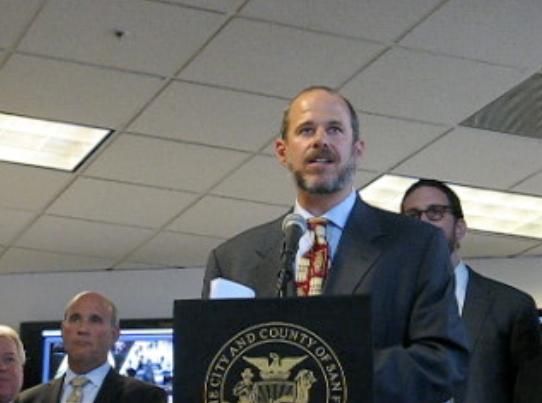
On the 8th floor of the SFMTA offices, the transit agency’s director Ed Reiskin told reporters that his hands were tied by California Proposition 218, which limits what new revenue municipalities can raise without voter approval.

“Only the voters of San Francisco can enact a tax that generates excess revenue,” he said. 

“This isn’t new,” Reiskin said, but he’s only half right. Though Prop. 218 was passed in 1996, this is the first time anyone at the MTA has touted it as a reason not to profit off of the tech shuttles.

We even asked Mayor Ed Lee this question just a month ago, and got a two-minute response that did not once include Prop. 218

Part of this might have to do with the nebulous quality of Prop. 218. An implementation guide from the California Budget Analyst office puts it this way: “Proposition 218’s requirements span a large spectrum, including local initiatives, water standby charges, legal standards of proof, election procedures, and the calculation and use of sewer assessment revenues. Although the measure is quite detailed in many respects, some important provisions are not completely clear.”

The waters of Proposition 218 are murky: is the government charging for the use of Muni stops a fee or a tax? In that grey area lies the answer on whether the city truly can’t charge tech buses to help fix Muni, or if this is just political cover for a government who doesn’t want to piss off tech.

Tellingly, that’s pretty much what Reiskin said.

“There’s a lot of benefit these services (buses) are bringing to San Francisco,” Reiskin told us after the press conference. “We wanted to resolve the conflicts without killing the benefit.”

“I imagine if we sat down with them and said ‘we wanna start taxing you guys’ they’d say ‘screw it, we don’t want to do the shuttles.’”

The 18-month pilot will recoup an estimated $1.5 million, the estimated cost of the project, according to the SFMTA. The project would give approval for use of 200 Muni stops by private shutle providers, out of 2,500 Muni stops in the system. We’ve reached out to California’s budget analyst office to dig into Proposition 218. 


Locals Only: Farallons

0

Locals Only is our weekly shout-out to the musicians who call the Bay Area home. Each week we spotlight an artist/band/music-maker with an upcoming show, album release, or general good news to share.To be considered, email esilvers@sfbg.com.

You know how people who’ve never been to California sometimes think the whole state is a Baywatch set? That we spend our winters in cut-offs and rollerskates, blasting Snoop Dogg while working on our tans?

To be fair, the past few weeks of Bay Area weather have made all of that pretty feasible, if you’re so inclined (thanks, global warming!). Regardless, being a beach bum in San Francisco has its own unique, fog-seeped aesthetic: I didn’t realize that putting on 15 layers to go to the beach wasn’t “normal” until I went away to college in San Diego. It’s only logical that we’d have a slightly different ocean-influenced soundtrack here, as well.

Enter Farallons, an SF five-piece whose dreamy blend of surf-pop and indie folk has been garnering buzz since their July 2013 debut EP, Outer Sun Sets. Singer-songwriters Andrew Brennan and Aubrey Trinnaman are at the helm with honeyed, seemingly effortless harmonies; there’s liberal use of synth and plenty of peppy surf-rock guitar, but there are dark moods here, too, and more than a little salt. Farallons will play at Amnesia every Tuesday in January, accompanied by a different opener each night. Ahead of the first show, Brennan shared a few thoughts on the Bay Area music scene and living at the beach.

SFBG How would you say living in SF — in particular, the Sunset — has shaped your music?

AB In two major ways. First, exposure to fantastic music being created by innovative artists. The musical community here really helps to facilitate an ongoing state of creativity and collaboration.  My friends are some of my absolute favorite musicians; I think it’s fair to say that I am some of my friends’ biggest fans.

Second, the place. The Pacific Ocean and Northern California environ have a huge influence on my spirit and creative output.  I live on the ocean and get to see the sun set every single day.  The ocean is presenting waves and winds that have traveled for thousands of miles across the biggest wilderness on our planet.  I can step out my front door and take all of that in in a breath of air or by getting into the ocean for a surf.  It’s magic here.  

SFBG You surf, and your music obviously has some surf-rock elements — does that just happen naturally? What’s your writing process like?

AB My music is heavily influenced by my sense of place.  This coastline and this ocean are incredibly powerful sources of identity for me, in both how I interact with them (whether it be through surfing or bicycling, etc.) and how they interact with me (weather patterns, growing seasons) and have no doubt influenced my creativity. So there’s an interplay between place, influence, and creativity, and many of my favorite artists also channel that interplay. Whether I’m influenced by peers or by my environment – it’s tough to pin down. It’s a cyclical process, and it’s self-reinforcing. I think that’s part of the reason there’s a coherence to the art coming out of this region. 

SFBG What are the band’s plans for this coming year?

After the January residency at Amnesia, we will be doing a quick California tour in late February that will bring us to Nevada City, Davis, San Francisco, Santa Cruz, and LA.  Then we’ll focus on getting back into the studio to begin work on our first full-length record, which I hope to have completed and released by 2015.  We’ll be launching a Kickstarter within the month to help fund the album.

SFBG Food-wise, what’s the best-kept secret in the Outer Sunset?

No-brainer: Brother’s Pizza on Taraval, right next to The Riptide.  The vegetarian Indian slice can’t be beat, and the folks that work there are super sweet.

Farallons
With Mariee Sioux and Soft Shells
Tues/7, 9:15pm, $7
Amnesia
853 Valencia, SF
www.amnesiathebar.com


Former supervisor displaced after Christmas Day fire

A fire broke out on Christmas night at the home of Christina Olague, a former San Francisco supervisor, and fatally injured her housemate and longtime friend, Randy David Sapp.

Now, Olague’s friends and supporters are holding an online fundraiser to help her get back on her feet in the wake of the tragic event. A benefit has also been planned for Jan. 12 at El Rio.

Olague said she has been staying with friends since the fire, and doesn’t know where she will wind up living in the long run. She said she’d wanted to be respectful of her housemates’ privacy before making any public statements about what happened, and didn’t reach out to many people initially because she was in a state of shock.

She told the Bay Guardian she had lived in the Victorian, located on Baker Street, for more than four years. Her housemates included Sapp, his partner, Patrick Ferry, and Olague’s sister.  She said she’d been friends with Sapp and Ferry for more than 15 years.

When the fire started on the evening of Dec. 25, Olague said, she was downstairs talking to a friend on the phone, and Sapp and Ferry were upstairs. “All of a sudden the commotion started,” she remembered. It was classified as a 3-alarm fire, and both were rushed to the hospital with serious burn injuries. Olague and her sister were unharmed. Sapp died from his injuries the following day.

The cause of the fire remains unknown, Olague said.

Sapp and Ferry were co-owners of a Cole Valley shop, The Sword and Rose, which sells incense, oils, and books. Olague said Sapp was also a musician, and described him as “a kind, understanding human being.” She said, “He gave so much to so many people.”

Ferry is still suffering from burn injuries, but is expected to recover fully.

Gabriel Haaland, a longtime activist and labor organizer, created an online fundraising website to help Olague upon hearing the news. He’d texted her randomly, he said, only to learn that “she’d lost her home and her best friend died. I was just blown away.”

The fundraising page, created on wepay.com, has raised nearly $4,000 so far from 52 donors.

“After a long discussion, she agreed to let people know this happened, and at my urging accepted that she needs financial assistance as well with getting a new apartment and getting back on her feet again,” Haaland wrote in a statement on the fundraising website.

In addition, Haaland said a fundraiser is being coordinated by Sups. David Campos, Jane Kim and Eric Mar. It will be a Salsa Sunday at El Rio and is scheduled to be held from 3 to 8 p.m. on Jan. 12.

No comments, but we’re working on it

12

If you’ve been trying to comment on our site and having trouble, no, I didn’t shut down our comments again. We’ve had some technical difficulties that now appear to be resolved, so you can finally have at The Rise of Candidate X, our cool Year in Evictions timeline, the union threat to go after BART directors, and other red meat that we were sorta surprised to see such silence on. Our bad.

P.S. We thought comments were back, but we hear some are still having trouble. We’re still working on it.  

Hole Lotta Love: Saturday night at SOMArts!

0

A pit under the floor becomes a wellspring for 100 performances over six hours at SOMArts this Saturday night
 
There’s a hole under the gallery floor at SOMArts. And art abhors a vacuum.

This century-old sand casting pit rests under a trap door, a leftover of the 17,000-square-foot venue’s industrial past. But this weekend the hatch is lifted and the hole becomes a generative site of time-based art making. Six hours will see more than 150 local artists delivering two-minute performances “for the hole” in a mini-marathon like no other.


This fourth iteration of SOMArts’ 100 Performances for the Hole features a rowdy roster of artists working their inspiration from across a wide spectrum of disciplinary backgrounds: Guillermo Gómez-Peña with Anja Flower and Jacques LeFemme; Alec White and Baruch Porras-Hernandez; Paige Tighe; Annie Danger; Peter L. Stein; Trina Merry’s Art Alive Gallery; La Chica Boom, DavEnd and Craig Calderwood; Sara Kraft; Mitsu Okubo; the list goes on — and on.
 
It also includes a not-too-pricey VIP lounge featuring complimentary beer from the Ninkasi Brewing Company.

If you can’t be there in person, SOMArts will stream the event live on its website (at least those portions suitable for broadcast under BAVC standards), and public access station SF Commons (Comcast Channel 76, Astound Channel 30) will also broadcast.
 
100 Performances for the Hole

Sat/4, 5:58–midnight, $12-$25
934 Brannan, SF
www.somarts.org

BART approves contract as tensions with its workers continue UPDATED

7

The BART Board of Directors today approved a modified contract with its two biggest labor unions, an action that received faint praise and was followed up with implied threats from both sides, continuing one of the ugliest and most impactful Bay Area labor disputes in recent memory.

The four-year contract approved today resolves a dispute over a paid family leave provision that BART officials say was mistakenly included in the contract that the unions negotiated and approved in November following two strikes and two workers being killed by a train that was being used to train possible replacement drivers on Oct. 19.

Recent negotiations yielded a contract with seven new provisions favorable to workers, including a $500 per employee bonus if ridership rises in the next six months and more pension and flex time options, in exchange for eliminating six weeks of paid leave for family emergencies.

The new contract was approved on a 8-1, with new Director Zakhary Mallett the lone dissenting vote, continuing his staunchly anti-union stance. Newly elected President Joel Keller was quoted in a district statement put out afterward pledging to change the “process” to prevent future strikes.  

“The Bay Area has been put through far too much and we owe it to our riders and the public to make the needed reforms to our contract negotiations process so mistakes are avoided in the future. I will appoint a new Board committee to investigate the policies and practices of labor negotiations and will make recommendations to the Board and the General Manager on how we can improve the process,” Keller said.

But from labor’s perspective, the problem wasn’t the “process,” but the actions taken by the Board of Directors; General Manager Grace Crunican; and Thomas Hock, the union-busting labor negotiator they hired for $400,000 — and the decision by BART to practice bargaining table brinksmanship backed up by a fatally flawed proposal to run limited replacement service to try to break the second strike.

A statement by SEIU Local 1021 Executive Director Pete Castelli put out after the vote began, “Today’s Board vote incrementally restores the faith that the riders and workers have lost in the Board of Directors, but it’s not enough to fix the damage they’ve caused to our communities.”

It goes on the blame the district for the strikes and closes with a vague threat to target the four directors who are up for election this year: Keller, James Fang, Thomas Blalock, and Robert Raburn (whose reelection launch party last month was disrupted by union members).

“Today BART is less safe and less reliable because of the Directors’ reckless leadership,” Castelli said. “Something has to change in order for all of us to regain our confidence in BART, and it starts with having BART Directors who are committed to strengthening the transportation system we all rely on and who prioritize its workers’ and riders’ safety. We look forward to the opportunity to work with our communities and to elect Directors who are committed to improving service and safety to all who depend on BART.”

Asked whether the union was indeed threatening to get involved in those four elections this year, spokesperson Cecille Isidro told the Guardian, “You’re absolutely right, that’s exactly what we’re trying to project.”

Local 1021 Political Director Chris Daly took the threat a step further, singling out Mallett as by far the most caustic and anti-union director, saying the union is currently considering launching a recall campaign against Mallett, although that could be complicated by the fact that he represents pieces of three counties: San Francisco, Alameda, and Contra Costa.

“He is so out-of-touch with the region. When he was elected, people didn’t know what they were getting,” Daly said, noting that voters elected Mallett over longtime incumbent Lynette Sweet in 2012 mostly out of opposition to her and not support for him. The Bay Guardian and others who endorsed Mallett have been critical of Mallett’s erratic actions since then, which included trying to raise fares within San Francisco without required social equity studies before becoming the most dogmattic critic of BART’s employee unions.

Daly was also particularly critical of Keller, who he accused of using today’s vote “to roll out his reelection campaign” with an anti-worker tenor. Neither Keller nor Mallett immediately responded to Guardian requests for comment, but we’ll update this post if and when we hear from them [see UPDATE below].

Daly cited a litany of grievances that could be corrected by new blood on a board that has seen little changeover in the modern era, from hiring Crunican (who Daly called “a terrible hire”) and Hock to conflating the district’s capital and operating budgets during the current negotiations, trying to expand the system on the backs of workers using an aggressive media strategy.

“The experience of the last 8-10 months elevates the importance of these BART Board races,” Daly told us. “They spent about $1 million to basically malign their workers and improve their negotiating position on the contract.”

BART spokesperson Alicia Trost denied that the district has been hostile to it workers, telling the Guardian, “From the beginning, we negotiated in good faith and we always tried to strike a balance between investing in the employees and investing in the system.”

In addition to the unions targeting directors in this November’s election, the district is also awaiting a ruling from the National Transportation Safety Board on its responsibility for the Oct. 19 fatalities, as well as facing scrutiny from the California Legislature, particularly its Joint Legislative Audit Committee and the Assembly Committee on Labor and Employment, whose members criticized BART’s lax safety culture during a Nov. 7 hearing.

Assemblymember Phil Ting (D-SF) called that hearing and criticized BART officials there for failing to provide requested safety information, requiring them to submit that information in writing, which he says still wasn’t adequte. “It was very difficult to decipher,” Ting told the Guardian recently.

Once the Legislature comes back into session on Jan. 6, Ting said that, “We’ll have a clearer idea whether we need more hearings.”

Meanwhile, SEIU Local 1021 members are slated to vote on the latest BART contract on Jan. 13.

UPDATE 1/3: Keller got back to us and admitted that if the unions really target him for removal in a serious way, “they’ll probably be successful.” He was fatalistic about that possibility, repeatedly voicing acceptance of that prospect: “If I lose my seat over this, I lose my seat.”

And by “this,” Keller means the likelihood that he’ll push for prohibiting BART employees from going on strike, which he said is already the case with the country’s four largest systems — Boston, Chicago, New York City, and Washington DC — which have deemed transit an essential service.

“Large transit agencies do not allow their employees to strike,” Keller said, noting that the San Francisco City Charter also bans transit strikes, something he pointed out Daly didn’t alter during his tenure on the Board of Supervisors.

And Keller said he’s willing to risk his seat to make that change: “I feel my responsibility is to use my remaining time to break this dysfunction labor process.”

Keller also said that there were mistakes on both sides during BART’s labor impasse, including BART’s decision to train replacement drivers to offer service between Oakland and San Francisco during a strike. “Maybe the prospect of training replacement drivers was a mistake, and I’ll accept that responsibility,” Keller told us.

He explained the ill-fated decision by saying, “We were in a hardball environment,” which he said both sides contributed to.  

City College saved, for now (update)

0

Update: This post has been updated with new information, after a 5:30 press conference held by City Attorney Dennis Herrera.

City College of San Francisco is safe from closure, for now.

A ruling from San Francisco Superior Court Judge Curtis Karnow issued this afternoon would bar City College’s accreditors from terminating the college’s accreditation until after legal proceedings against it are done. 

The loss of accreditation would make City College’s future degrees basically worthless, resulting in its closure or merger with another district.

“I’m grateful to the court for acknowledging what so far accreditors have refused to, that educational access for tens of thousands of city college students matters,” City Attorney Dennis Herrera said at a press conference announcing the judge’s decision.

Now Herrera and his team have time to save the school, and City College will keep its doors open for the duration of the suit — win or lose.

The ruling was the result of an injunction filed by City Attorney Dennis Herrera on Nov. 25. as part of their suit against the Accrediting Commission for Community and Junior Colleges in August for allegedly using the process to carry out an ideological agenda against CCSF. The ACCJC openly lobbied in public hearings and via public letters for education reform across the state, reforms which City College’s administration believed would harm San Francisco’s most vulnerable students: the poor, certificate seekers, and lifelong learners.

ccsfhearing

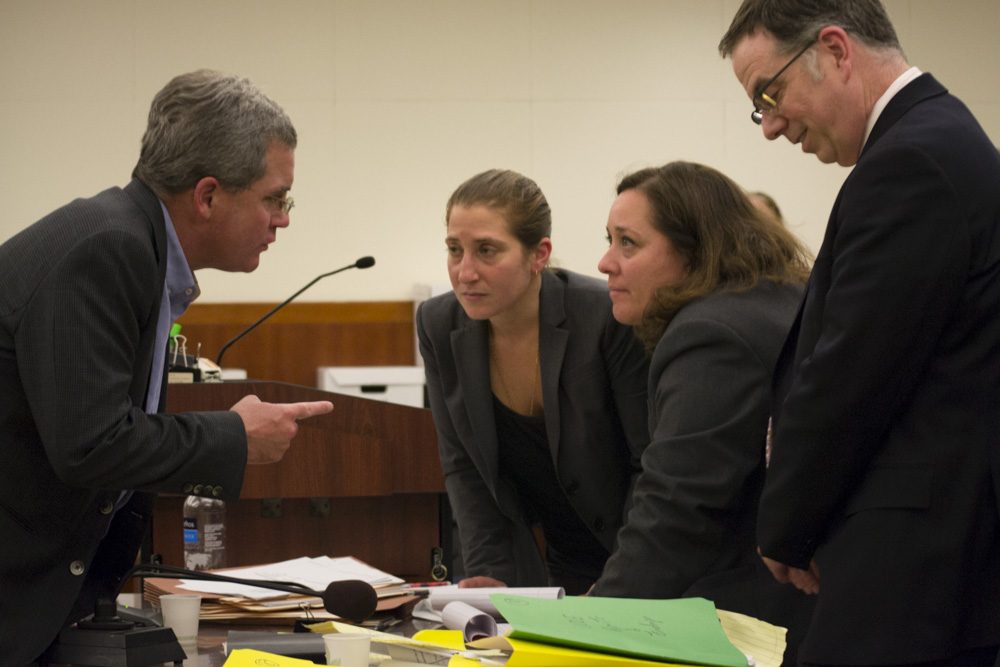
Counsel for the Accrediting Commission for Community and Junior Colleges, Andrew Sclar and Philip Ward, confer during a break at a preliminary injunction hearing regarding City College of San Francisco on Dec. 26, 2013. Photo by Sara Bloomberg

Only part of the injunction was granted by Karnow, however. The ACCJC is barred from shutting down City College, but it can still revoke the accreditation from any of the 112 community colleges it oversees across the state.

The ruling also doesn’t stop it them from making preparations to close the college, Herrera said.

“It does not stop them from continuing their review and analysis and evaluation, it stops them from issuing a final ruling with respect to taking accreditation of City College,” he said. 

Not everyone agrees with Herrera’s efforts though.

“Court intervention is not necessary to keep City College open,” State Community College Chancellor Brice Harris wrote to Herrera in a letter today. 

Harris argues that the lawsuit detracts from the efforts to save the school made by the special trustee Robert Agrella, who was assigned by Harris to replace City College’s board of trustees just after the accreditation crisis broke out.

“Characterizations that the cases before the court are a ‘last-ditch’ effort to ‘save’ City College are inaccurate and will do additional damage to the college’s enrollment,” Harris wrote.

And City College’s enrollment has taken a huge hit, down nearly 30 percent from last year, leading to the college’s new media campaign to get students back in City College seats. 

Though Harris criticized Herrera’s lawsuit as the chancellor of the state community college system, Harris has tangled ties with the accreditors — he was a commissioner on the ACCJC board some years ago

At the hearing to grant the injunction, Sara Eisenberg, the deputy city attorney, argued that real harm hit City College since the news of its closure hit. Students have left the school in droves.

We’re asking, your honor, right now for something that won’t happen until further down the road… but there’s real harm happening right now. Latest numbers show enrollment is down 27 percent,” she told Karnow. 

The ACCJC’s counsel, Andrew Sclar, argued that an injunction to stop City College’s closure would actually harm the ACCJC itself.

 “There certainly would be harm to us,” he told Karnow. “If we do not enforce sanctions or bring a non compliant institution into compliance within a two year period, we would be at risk of losing our recognition with the United States Department of Education.”

Karnow then asked if there was “evidence on the record” of that ever happening. Sclar said no.

The college is slated to lose its accreditation in July 2014. The college is trying to reverse its fortunes and is applying for an appeal with the ACCJC. 

Now, it has a chance to stay open while Herrera fights for its future. Two other lawsuits were filed against the ACCJC as well, one by the California Federation of Teachers and another by the Save CCSF Coalition. 

Lawsuits aren’t the only fire the ACCJC has come under lately. US Rep. Jackie Speier called for a forum on the ACCJC’s alleged misconduct in November, and the beleagured commission was recently reviewed by the federal government, and given one year to come into compliance with federal guidelines.

For our coverage of the court hearing that led to the injunction, click here.

Deputy City Attorney Sara Eisenberg discusses the hearing for the injuncton.

The full text of Herrera’s press release is below.

City College wins reprieve, as court enjoins ACCJC from terminating accreditation

Herrera grateful to court ‘for acknowledging what accreditors callously won’t: that the educational aspirations of tens of thousands of City College students matter’

SAN FRANCISCO (Jan. 2, 2014) — A San Francisco Superior Court judge has granted a key aspect of a motion by City Attorney Dennis Herrera to preliminarily enjoin the Accrediting Commission for Community and Junior Colleges from terminating City College of San Francisco’s accreditation next July.  Under terms of the ruling Judge Curtis E.A. Karnow issued late this afternoon, the ACCJC is barred from finalizing its planned termination of City College’s accreditation during the course of the litigation, which alleges that the private accrediting body has allowed political bias, improper procedures, and conflicts of interest to unlawfully influence its evaluation of the state’s largest community college.  Judge Karnow denied Herrera’s request for additional injunctive relief to prevent the ACCJC from taking adverse accreditation actions against other educational institutions statewide until its evaluation policies comply with federal regulations.  A separate motion for a preliminary injunction by plaintiffs representing City College educators and students was denied.  

In issuing the injunction, the court recognized that Herrera’s office is likely to prevail on the merits of his case when it proceeds to trial, and that the balance of harms favored the people Herrera represents as City Attorney.  On the question of relative harms, Judge Karnow’s ruling was emphatic in acknowledging the catastrophic effect disaccreditation would hold for City College students and the community at large, writing: “There is no question, however, of the harm that will be suffered if the Commission follows through and terminates accreditation as of July 2014.  Those consequences would be catastrophic.  Without accreditation the College would almost certainly close and about 80,000 students would either lose their educational opportunities or hope to transfer elsewhere; and for many of them, the transfer option is not realistic.  The impact on the teachers, faculty, and the City would be incalculable, in both senses of the term: The impact cannot be calculated, and it would be extreme.”

“I’m grateful to the court for acknowledging what accreditors have so far refused to: that the educational aspirations of tens of thousands of City College students matter,” said Herrera.  “Judge Karnow reached a wise and thorough decision that vindicates our contention that accreditors engaged in unfair and unlawful conduct.  Given the ACCJC’s dubious evaluation process, it makes no sense for us to race the clock to accommodate ACCJC’s equally dubious deadline to terminate City College’s accreditation.”

Judge Karnow adjudicated four separate pre-trial motions in today’s ruling following two days of hearings on Dec. 26 and 30.  Herrera filed his motion for preliminary injunction on Nov. 25 — three months after filing his initial lawsuit — blaming the ACCJC for procedural foot-dragging and delay tactics, which included a failed bid to remove the case to federal court and its months-long refusal to honor discovery requests.  Judge Karnow granted in part and denied in part Herrera’s motion, issuing an injunction that applies only to the ACCJC’s termination deadline for City College’s accreditation, and not statewide.

Apart from Herrera’s motion, AFT Local 2121 and the California Federation of Teachers also moved for a preliminary injunction on Nov. 25, citing additional legal theories.  That motion was denied.  A third motion by the ACCJC asked the court to abstain from hearing the City Attorney’s lawsuit for interfering with complex accrediting processes largely governed by federal law; or, failing that, to stay Herrera’s action pending the outcomes of City College’s accreditation proceeding and ACCJC’s own efforts to renew its recognition with the U.S. Department of Education.  A fourth motion, also by the ACCJC, requested that the court strike the AFT/CFT’s case under California’s Anti-SLAPP statute, which enables defendants to dismiss causes of actions that intend to chill the valid exercise of their First Amendment rights of free speech and petition.  (SLAPP is an acronym for “Strategic Lawsuits Against Public Participation.”)  Both of the ACCJC’s pre-trial motions were denied.

The ACCJC has come under increasing fire from state education advocates, a bipartisan coalition of state legislators and U.S. Rep. Jackie Speier for its controversial advocacy to dramatically restrict the mission of California’s community colleges by focusing on degree completion to the detriment of vocational, remedial and non-credit education.  The accrediting body’s political agenda — shared by conservative advocacy organizations, for-profit colleges and student lender interests — represents a significant departure from the abiding “open access” mission repeatedly affirmed by the California legislature and pursued by San Francisco’s Community College District since it was first established.  

Herrera’s action, filed on Aug. 22, alleges that the commission acted to withdraw accreditation “in retaliation for City College having embraced and advocated a different vision for California’s community colleges than the ACCJC itself.”  The civil suit offers extensive evidence of ACCJC’s double standard in evaluating City College as compared to its treatment of six other similarly situated California colleges during the preceding five years.  Not one of those colleges saw its accreditation terminated.  

The City Attorney’s case is: People of the State of California ex rel. Dennis Herrera v. Accrediting Commission for Community and Junior Colleges et al., San Francisco Superior Court No. 13-533693, filed Aug. 22, 2013.  The AFT/CFT case is: AFT Local 2121 et al. v. Accrediting Commission for Community and Junior Colleges et al., San Francisco Superior Court No. 534447, filed Sept. 24, 2013.  Documentation from the City Attorney’s case is available online at: http://www.sfcityattorney.org.

Cage heat: salute the screen icon’s 50th bday!

0

Oscar-winning actor (for 1995’s Leaving Las Vegas), cultural curiosity (for his Superman and Elvis obsessions, tax troubles, hair, etc.), Coppola family member (Francis Ford is his uncle), meme generator, and cult icon Nicolas Cage is about to become a half-century man. And what better way to celebrate the 50th birthday of one of the most predictably unpredictable movie stars of all time than by checking out a pair of his movies?

Tomorrow (NC’s actual bday: Jan. 7), Midnites for Maniacs unspools a pair of Cage classics, starting with his breakout role as a totally tripandicular Hollywood punk mooning after the title character in 1983’s Valley Girl. This movie has it all: a killer soundtrack, terrible-amazing hair and fashions, the immortal EG Daily, and maybe the best prom scene in the 1980s teen-movie canon. We melt with you, Nic.

http://www.youtube.com/watch?v=VSX4YgdKKMk

Second half of the show is the brilliantly bizarre rom-com crime thriller 1987 Raising Arizona, which is not only one of Cage’s best films, but also a top-spot contender from directors the Coen Brothers. Insert your favorite quote here … “Son, you got a panty on your head.”

Also promised: “dozens of Cage trailers!”, so prime yourself for scenes of balls-to-the-wall insanity and greatness. Here’s hoping for high-pitched hilarity from Peggy Sue Got Married (1986); Cher getting feisty in Moonstruck (1987); snakeskin perfection in Wild at Heart; TCB-ing from 30,000 feet in Honeymoon in Vegas (1992) — and a healthy showing from his 1990s action classics (1996’s The Rock, 1997’s Face/Off and Con Air). I’ll even to go bat for National Treasure (2004) if that means extra clips from Adaptation (2002) and Bad Lieutenant: Port of Call New Orleans (2009). SHOOT HIM AGAIN…HIS SOUL IS STILL DANCING!

(Just let’s leave the 2006 Wicker Man remake out of it, OK?)

“Nicolas Cage’s 50th Birthday” Triple Bill
Fri/3, 7:20pm, Valley Girl; 9:20pm, Raising Arizona, $12
Castro Theatre
429 Castro, SF
www.midnitesformaniacs.com

The Performant: Epochalypse Now

6

Embracing the great unknown
 
While it could be argued that every day represents a new year, with each date falling exactly one year after the last, like unconscious clockwork, there’s something comforting in the ritual of observing the change in calendar year en masse. A time to take accounts, and make new goals. A time of psychic housekeeping: ridding oneself of the spiritual and mental detritus of the past, in order to make space for a future as yet undefined.

All of which is on my mind as I prepare to bang out my last Performant, at least for the time being. During the last three-and-a-half years I’ve witnessed hundreds of performances, featuring thousands of performers, in venues large and small, each one a brief, incandescent flame feeding into a bonfire of epic creativity. House concerts, punk shows, spoken word, street festivals, performance art meditations, live comedy, high drag camp, amateur wrestling competitions, robot soccer, battle rap, obscure cinema, alternative dance, home theater, and circus arts have all found a place in the Performant, proving, I hope, that just as borders geographical and psychological can be transcended, so too can artistic ones.

But, point proven, the Performant is going to take a bit of a break to focus on some other projects I’ve been neglecting. Avoiding, really. But I’ll still be out there, an ever-appreciative oddience of one, reveling in our infinity of scenes, influences, disciplines. As a parting gift, here’re a few recommendations I can make for our collective new beginning. It’s been an honor to Performant for you.
 
1) Godwaffle Noise Pancakes: Do you like Noise? Do you like vegan pancakes? Do you like The Lab? Duh, yes, of course you do. Usually Sundays, usually from noon-2pm, usually at The Lab, except when it’s not. By far the best-sounding brunch spot in the Mission, and no line!
 
2) Saturday Write Fever: It’s like a playwriting bootcamp for the broke-ass camp, this monthly event held in the café of the EXIT Theatre brings together budding monologists — writers and actors both — for an evening of spontaneous writing and seat-of-your-pants performance. Writers have 30 minutes to prepare a new piece, riffing off a common theme, and then each mini-script gets a quicky performance treatment by members of the oddience. It’s free, it’s fresh, it’s fearless, and frankly, it sounds like a hell of a lot of fun.
 
3) The Cynic Cave: Actually, it would hardly matter what “the Cynic Cave” was, I’d have to go for its name alone. But the fact that it’s a literally underground comedy club ensconced in the basement of my fave local video store, Lost Weekend, makes it a total win. Hosted by George Chen and Kevin O’Shea, the Cave has quietly hosted some of the Bay Area’s funniest humans for just $10 a pop since 2012.
 
4) Boxcar Theatre’s Speakeasy: Boxcar Theatre has always had a knack for thinking outside of the (black) box, and this totally immersive, three-and-a-half hour-long performance sounds like their most enterprising yet. Like Punchdrunk’s Sleep No More, the interactive show promises to be different for each individual participant, a self-directed foray into the seedy underbelly of a 1920’s Speakeasy, populated by showgirls, war veterans, blackjack dealers, and bootleggers, each of whom has a story arc which can be followed to its end, or abandoned halfway through in favor of another. In short, prepare to go a couple of times to get a real sense of what’s going on, and don’t be shy about eavesdropping. Or playing a round of roulette.
 
Honorable mentions: Katabatik, Ask Dr. Hal, Undercover Presents, DJ Purple Dance Karaoke, Playland Not-at-the-Beach, Shaping San Francisco Public Talks

No decision yet following charged hearing to stall City College closure

35

At a Dec. 26 hearing in San Francisco Superior Court, the City Attorney’s office argued that City College of San Francisco should not be shuttered, as long as San Francisco’s lawsuit against a regional accrediting commission remains in court.

The two-year community college, which serves roughly 85,000 students, was notified earlier this year that the regional Accreditin​g Commission for Community and Junior Colleges would terminate its accreditat​ion in July 2014, rendering the school’s degrees worthless.

It would be forced to close.

In August, City Attorney Dennis Herrera filed suit against the ACCJC, alleging the closure action was improper, unwarranted, and out of line with the agency’s prior actions. 

At yesterday’s court hearing, litigators from Herrera’s office argued for a preliminary injunction against ACCJC, to keep the college open at least for the duration of the court proceedings.

Stop, halt, cease, desist. That was the City Attorney’s goal yesterday: keep City College open until the case is decided.

While yesterday’s hearing was focused on the injunction, the substance of Herrera’s complaint against the ACCJC — alleging that its members were acting improperly as advocates for greater austerity, among other things — came into play many times.

The litigators argued from morning till late afternoon, taking only brief recesses. While Judge Curtis Karnow subjected viewpoints from both sides to microscopic examination, there was no decision by the end.

It’s not yet known when Karnow will issue a ruling. 

“Judge Karnow did not rule from the bench, he issued no tentative order, and he gave no indication of how he intends to rule before concluding today’s hearing,” City Attorney spokesperson Matt Dorsey noted in a statement following the hearing.

In the meantime, a few statements made in court could shed light onto the outcome. We’ve highlighted a few of them below, along with some key questions.

Attorneys Phillip Ward and Andrew Sclar represented the ACCJC, in opposition to Deputy City Attorney Sara Eisenberg and labor lawyer Robert Bezemek, who appeared on behalf of the California Federation of Teachers.

We thought we’d present the case a bit differently, and give background to some of the main arguments and then write the main arguments attorneys made to address them. Each argument is prefaced first, and links are provided for further reading:

1. Herrera’s suit alleges that ACCJC commissioners acted improperly as advocates. That would mean they not only went beyond their role as objective accreditors, but sought to advance a political agenda against CCSF’s inclusive approach to higher education. They address that here.

Judge Curtis Karnow: All of those expression of political views, if you will, by either the staff or the commission itself, are being cited as the “true agenda” that they’re trying to unmask.

ACCJC counsel Philip Ward: There are problems, big problems, at City College of San Francisco…. all of those problems are the product of the so called “open access” mission and the new educational priorities that they’re saying are being shoved down CCSF’s throat.

Innuendo, character assassination … shows us that is what’s being targeted by the plaintiffs allegations.

City College has been kicking the can down the road for six years.

2. Herrera’s motion for an injunction argues that, even as the case is being decided, the school will suffer harm in the interim. How would this injunction soften the blow?

Judge Curtis Karnow: The real thrust of the motion seems to be that the uncertainty has generated behavior by faculty [and] students to depart, and this all stems from uncertainty harm.

When did this uncertainty harm start? How will the actions of this court affect anything? If there’s another hearing in July, won’t there be more uncertainty, even if I issue an injunction?

CFT counsel Robert Bezemek: Declarations filed show that there have already been instances that harm has already been felt. 

For example, (City College’s) radiology program is top in the nation above John Hopkins University. They’ve been given an execution date, everyone knows that. There’s an order to remove the college’s accreditation in July 31. When it got that order, students started to leave the college in droves. 

Deputy City Attorney Sara Eisenberg: We’re asking, your honor, right now for something that won’t happen until further down the road… but there’s real harm happening right now. Latest numbers show enrollment is down 27 percent.

3. Can the ACCJC base its decision to close City College on fiscal issues, rather than educational shortcomings?

CFT counsel Bezemek: We do not deny that they have financial issues… the quality of education is what they’re here (the ACCJC) to measure. But you have to find that the harm from the financial issues warrants shutting the school down the only community college in San Francisco. That it is the fundamental part of accreditation. 

Judge Karnow: So your position is that no matter what bad things the college has done, the commission can’t withdraw its accreditation?

CFT counsel Bezemek: No, we’re saying they have to show substantial evidence. 

(The ACCJC’s) ‘internal review’ is a joke. An injunction would provide huge relief.

accjc counsel

Counsel for the Accrediting Commission for Community and Junior Colleges, Andrew Sclar and Philip Ward, confer during a break at a preliminary injunction hearing regarding City College of San Francisco on Dec. 26, 2013. Photo by Sara Bloomberg

4. Is it within the ACCJC’s power to delay City College’s closure?

Judge Karnow: What if we just dropped the process now? 

ACCJC counsel Sclar: There certainly would be harm to us. If we do not enforce sanctions or bring a non compliant institution into compliance within a two year period, we would be at risk of losing our recognition with the United States Department of Education.

It’s going to have a chilling effect on all accrediting agencies.

Judge Karnow: Is there any evidence of that in the record?

ACCJC counsel Sclar: No, there hasn’t (been). 

Deputy City Attorney Eisenberg: If the people aren’t permitted to seek relief through an (injunctive) action, there’s no other recourse.

The ACCJC has demonstrated a very cavalier attitude in this case. We’re talking about closing the only community college in San Francisco. Many students don’t have access to other colleges otherwise. The relief that we are asking for here is quite modest. It has been granted before… and it didn’t do anything other than hit the pause button.

A look back: The “Candlestick Swindle” in ’68

9

San Francisco spent this week saying goodbye to its beloved foggy stadium, Candlestick Park. Amidst the farewells, the Guardian spotted a post from sports blog Deadspin, which reprinted one of our articles from 1968  titled, “Before We Build Another Stadium… The Candlestick Swindle.” 

When we saw the post, we started thumbing through our archives looking for the article. Though Deadspin said it was from 1972, we found it in Vol. 2, Issue no. 10, May 14, 1968, it’s a down and dirty tale of intimidation, bypassing voters through dummy corporations, profiteering, and racism. Candlestick has a colorful history, to say the least. 

The author, Burton H. Wolfe (Burton, not “Mr. Wolfe,” he wrote via email), gave us permission to re-publish it in full here. Just for fun, we’re also embedding the original issue as a PDF, which can be download and printed. Looking through the issue, it’s heartening (and disheartening) how much, and how little, changes.


The Candlestick Swindle

It all began early in 1953. Mayor Elmer Robinson’s administration—and local businessmen—decided to import big league baseball for San Francisco’s economic and recreational benefit. A downtown stadium was adequate for San Francisco’s AAA minor league club, the Seals, but not for major league fare.

Hence, Robinson asked the Board of Supervisors to approve a $5 million bond proposition to construct a new stadium. Among the supervisors in approval: George Christopher, soon to become mayor; Gene McAteer, headed for the state senate; Francis McCarty, a future judge; Harold Dobbs, restaurateur and budding Republican candidate for mayor, and John Jay Ferdon, future district attorney.

In July of that same year, 1953, a local multi-millionaire contractor named Charles Harney purchased 65 acres of land at Candlestick Point from the city of San Francisco for $2,100 an acre.

Next year, a band of publicists headed by Curley Grieve, S.F. Examiner sports editor, beat the drums and called the natives to pass this bond issue proposition:

To incur a bonded indebtedness in the sum of $5 million for the acquisition, construction and completion of buildings, lands and other works and properties to be used for baseball, football, other sports, dramatic productions and other lawful uses as a recreation center.

Major league baseball, they proclaimed, would bring untold wealth to the city for a mere $5 million, a price that would be returned many times. After voters approved this in November, 1954, the search began for a site. If there were any doubts the stadium would cost more than $5 million, they were dispelled in a personal meeting between Robinson’s successor, Mayor Christopher, and the owner of the New York Giants, Horace Stoneham.

In April, 1957, Christopher and McCarty flew to New York to talk Stoneham into bringing the Giants to San Francisco. The Giants were losing money in New York, and scouting the country for a new home base.

To prove San Francisco’s support for professional baseball, Christopher waved the $5 million stadium bond issue at Stoneham. According to testimony reported by the 1968 grand jury investigation, Stoneham replied contemptuously:

Any figure other than 10 or 11 million dollars shouldn’t even be discussed because there would be no possibility or probability of a major club moving to that particular community.

Back in San Francisco, Christopher reported the need for more money to other city leaders and businessmen. Since the proposition suddenly to double the original bond issue might run into trouble with the voters, they decided to create a non-profit corporation called Stadium, Inc., as a legal arm of the city.

Bypassing the Voters

Operating through this dummy corporation, the Christopher administration could bypass the voters to raise more money.

Harney and two of his employees were selected as the first board of directors of Stadium, Inc. Christopher told Harney that he would be the contractor to build the new stadium, and his 41 acres of Candlestick land would be the heart of the 77-acre location.

In 1957, Harney sold back 41 acres of the parcel he had purchased from the city in 1953 at $2,100 an acre. The 1957 price the city paid to Harney for its own former land was $65,853 an acre. That’s a crisp total of $2.7 million.

The city’s Real Estate Department approved the deal even though other land adjacent to Harney’s was bought at about the same time for just $6,540 an acre. Harney made a profit of $2.6 million on the four-year land ownership switch.

Not so, Christopher and Harney later contended. Harney had graded and filled the land, and so naturally he was paid for his improvements. One fact raised doubts about that explanation: a $7 million fee awarded to Harney to construct the new stadium included $2 million for stadium construction, $2 million for grading and filling and $2.7 million for real estate.

Had it not been for the creation of Stadium, Inc., the Christopher administration would have been required to hold open, competitive bidding for the contract, and voters would have seen the price tags.

By operating through Stadium, Inc., Christopher was able to evade the city charter and arrange the contract in a privately negotiated deal.

Through the same apparatus, his administration was able to float another $5.5 million bond issue without voter approval. The interest rate on these bonds was set at 5% whereas the interest on the original $5 million bond issue was only 2.4%, a difference that would eventually cost the city hundreds of thousands of dollars.

Evading an Investigation

In February, 1958, Harney and his employees were removed from the board of Stadium, Inc., after, as the grand jury report later pointed out, “Three influential men then were substituted to represent the city’s interest—Alan K. Brown, W.P. Fuller Brawne and Frederic P. Whitman.”

The maneuver came too late to prevent Henry E. North from instigating a Grand Jury investigation into the strange transactions.

North, like Christopher, was a Republican and a conservative member of the San Francisco business community. Until his retirement, at 70, he had been executive vice-president of one of the largest property owners in the city: the Metropolitan Life Insurance Company. He had a strong sense of civic duty, however, and the Candlestick Park deal smelled to him of garbage.

The report North issued, as the result of the Grand Jury investigation, was potential dynamite. It showed that, shortly before the city purchased Harney’s land at $65,853 an acre, adjacent pieces of tideland were sold by the city for less that $4,000 an acre. It did not make sense that Harney’s land, partly under water, should have brought $61,000 more from city coffers.

On Dec. 2, 1958, the San Francisco Chronicle carried partial coverage of the Grand Jury report. On page 5, the year Harney purchased the city land was stated as 1933 rather than 1953. Of course, the 20-year difference would provide a reason for the tremendous increase in value, because the initial purchase price would have been at depression levels.

Undoubtedly, it was a typographical error. And no doubt it was by unintentional omission that other salient features of the Grand Jury report were omitted altogether and never printed by the Chronicle or any other major newspaper.

North charged that all bond issues negotiated by Stadium, Inc. were illegal evasions of the city charter. Bond payments had to be made from city funds, not the dummy nonprofit corporation, and so the whole deal amounted to legal subterfuge; a way to make taxpayers foot the bill without letting them vote on it.

The report, drafted by North and signed by 18 other citizens, estimated annual payments on the bonds of $990,000 for the first 15 years of the debt period. Against that, the city was to draw $225,000 a year in rent from the Giants and $225,000 a year from advertising and parking revenues, leaving a balance of $640,000 to be paid annually from taxes or city funds. It was estimated that the city could make up the balance by commanding the juicy television rights; instead, Christopher arranged for rights to go exclusively to the Giants.

Altogether, it was a marvelous deal for the Giants. In their last New York season, attendance at the Polo Grounds plummeted to 684,000. The club had gone broke and it was almost impossible to give away its stock. After the Giants first season in San Francisco in 1958, attendance tripled over its last year in New York, and their stock soared to $1,000 a share. In terms of revenue, the increase in gate receipts alone meant $3 million the first year.

While the Giants were reaping enormous profits at taxpayers expense, City Hall and the local newspapers were trying to make it appear that San Francisco, too, was earning money. The News-Call Bulletin, the now defunct Hearst paper, once stated that when all returns are in, the season just ended (1960) will have yielded the city about $530,000. The fact was that the sole revenue to the city was $50,000 received to maintain buildings and grounds.

The other Hearst paper, the Examiner, stated, on the other hand: City Hall officials said $375,000 of the revenue figure will be used to pay the annual cost of the city’s $5 million bond issue. The Chronicle published this figure: Of the remaining $527,000, the first $375,000 must go toward payment of the city’s $5 million stadium bond issue.

The fact was that all revenues from the ball park and its parking lot had to be used to pay off the $5.5 million worth of bonds issued by Stadium, Inc., with the exception of the $50,000 maintenance income. The other $5 million worth, issued by the city, had to be paid off through real and personal or property taxes collected by the city.

The result: a projected loss, not profit, of $640,000 the city must pay from taxes or other general city revenues (according to the Grand Jury report), and a loss this year of at least $360,000 (according to figures supplied to The Guardian by the city controller’s office and Mike Barrett, the Bank of America executive who handles Stadium, Inc.’s trustee account.)

Some annual loss on Candlestick Park will continue until 1993, when the stadium will finally be free of debt and owned completely by the city—unless, it is torn down before then or reconstructed, which will add more debt.

There was another interesting development at Candlestick: Stevens California Enterprises, which got the food and beverage concession at the ball park, bought all its milk until two seasons ago from Christopher’s milk company, Christopher Dairy Farms. The Borden Co. now has the lucrative contract.

Even though City Hall and the newspapers were misstating facts about the Candlestick story, San Francisco restaurateurs, hotel owners and shopkeepers at least began to realize that they were not making any money from the ball park, as promised by the ballyhooers. Only the Giants, Harney, and Christopher were making money. The Giants were attracting few additional tourists to San Francisco, and area fans who journeyed to isolated Candlestick Point, several miles away, did not stop to patronize downtown establishments. Some downtown business men were angry, and if North’s crusade were given time and publicity, they might cause an uncomfortable controversy.

Christopher sent emissaries to North, but he would not be wooed or pressured from his stand. To the contrary, he made even more vigorous attacks on Christopher and the ball park deal. The lives of future generations had been mortgaged by this shoddy piece of business, he maintained. Christopher was diverting city funds from various departments: $1.4 million from street improvement bonds, $1.2 million from state gasoline taxes given to the city for road improvements, $1.5 million from sewer bonds for services to the Giants ball park.

A Hidden Payoff?

Already the cost was $15 million, and it might exceed $20 million when various exits, entrances, widened access streets and the like were built to handle the anticipated large crowds. Privately, North informed civic and business leaders that there was an underhanded payoff in the deal, and he intended to expose it.

Christopher reacted viscerally to North’s charges. With newspapermen present, he asserted North was drunk, incoherent, and fixable. The description was published in the newspapers.

North went to Nate Cohn, one of the foremost criminal lawyers in California, and they filed a $2 million libel suit against Christopher. In a pre-trial hearing, Christopher’s attorney filed a thick brief with 45 motions for dismissal of the suit, hoping to tie up the case inextricably. In just an hour and a half, Superior Court judge Preston Devine threw out all 45 motions, indicating clearly that Cohn and North had a good case.

Breaking Down North

Christopher’s friends in the business community went to work on North. The publisher of one of the three daily newspapers, North told me, called on him and said, “Henry, why don’t you play ball? You’re giving the city a bad name, stirring things up like this.”

At the Pacific Union Club across the street from the Fairmont Hotel on Nob Hill, where North was already in disfavor for bringing Jewish guests despite the no-Jews-allowed policy, fellow Republican business executives started a snub-North routine. One day, for example, an old business friend greeted North:

“Say, Henry, I see in the papers there’s some fellow named Henry North filing a suit against the mayor and stirring things up. Must be another Henry North in this town, huh?”

“No, that’s me,” North told him.

“Is that so?” the old friend said. He turned his back on North and never spoke to him again.

I talked to North several times during the siege because I was publishing articles about Candlestick Park in my magazine, The Californian (now defunct). In those days he was full of fight, willing to take on City Hall and the entire business establishment even if it meant losing every friend he had. He promised to tell me the names of the men involved in the payoff, and he excoriated Christopher.

“You know what I call men like George Christopher? Black Republicans. Men who never did anything in their lives for the good of the common people. They’ve never realized that this country as a whole is no better off than the great masses of its people.”

The Fateful Fifth

Then they went to work on his wife. Unlike Henry, she was not involved in politics and her life revolved around her friends and social affairs. Her friends snubbed her and she no longer received invitations. She cried, she pleaded, she begged Henry to call off the ball park investigation and the lawsuit, when that did not move him, she threatened him with divorce. Henry began hitting the bottle.

On June 2, 1960, shortly after I published a detailed article by Lewis Lindsay called “The Giants Ball Park: A $15 Million Swindle,” the press broke the story that North had buried the hatchet with Christopher. In its first edition, the Chronicle correctly reported that North and Christopher had drunk a fifth and a half of Scotch together at Christopher’s home, and praised each other for publication. “He’s a great mayor,” North said—and agreed that legal entanglements were finished. The Chronicle dropped mention of the Scotch in later editions that went to most of its readers.

Cohn was outraged. “We had this suit won,” he told me. “North assured me he was going through with this no matter what happened. But they got to him through his wife, the poor old bastard. You see how they do things in this city? It’s so goddamned rotten you can’t believe it.”

When I called on North again, I found a complete transformation in his appearance. The look of a peppery fighter with ruddy cheeks had given way to a physical wreck; a baggy-eyed, tired, meek looking man weighed down by defeat.

The saddest part of the story was that his wife divorced him anyway. Not long afterward, North died of a heart attack. Harney died in December, 1962.

With North out of the way, with the daily newspapers blacking out the most important parts of the Candlestick Park story, with The Californian reaching only a few thousand citizens, it looked as though the scandal would never be investigated. In an effort to stir up something, I personally appeared before the Finance Committee of the Board of Supervisors and urged their help. One committee member, Al Zirpoli, had said before that he would favor an investigation.

No committee member challenged any facts I presented. When I finished, John Jay Ferdon, Committee Chairman, said only that he would not favor an investigation. He did not say why. (Six years later, when he had become District Attorney, he told me I was right about Candlestick.) Zirpoli, later to become a federal judge and the judge to hear draft resistance cases, said, “I agree with what Mr. Ferdon says.” He suggested, “If there is wrongdoing, your best course of action is a taxpayers’ suit.”

I went looking for wealthy liberals to finance a taxpayers suit, but none were in season. Cohn would have taken the suit if I could have found somebody to pay him for his time. All that he could do now was take me to business friends and introduce me.

The typical reaction came from Sam Cohen, owner of a plush restaurant on Maiden Lane said:

“Sorry, Burton, I can’t get involved. Do you know what Christopher can do to me with his power at City Hall? A Health Department inspector can find something wrong with this restaurant any time he wants. A door is too narrow, my stove does not meet regulations, anything to run me out of business. That’s how they do it. You can’t fight them.”

Since nobody in the city would fight, I asked Sen. Estes Kefauver, chairman of the Antitrust and Monopoly Sub-Committee of the Senate Committee on the Judiciary, to investigate. He replied: “As interesting as a study of how the San Francisco ball park deal took place would be, I do not conclude that it is a matter that should be gone into on the federal level. I think that it is entirely a local or state matter, and that the Subcommittee would perhaps be criticized if it moved into this area.”

Now Another Ballpark

Here we are eight years later, with a Candlestick Park that enrages so many people that a new mayor, Joe Alioto, wants to scrap it for a new stadium. His announced philosophy is that great public projects should not be waylaid just because all of the people aren’t getting enough spaghetti and zucchini. And no doubt many San Franciscans believe that a ball park is a great public project, greater than a school, housing complex or a modern transportation system. That attitude could be the most tragic part of this story.


 

Holiday greetings and an early start to the New Year!

12

Special graphic for the Bruce blog by Louis Dunn, former Bay Guardian art director, graphic artist, and cartoonist. Selections from his work can be seen at LouisDunn.com

Gap in the hot seat over horrifying animal rights video

An investigation conducted by People for the Ethical Treatment of Animals (PETA) has revealed flat-out cruelty in the practice of harvesting angora fur. Now PETA is targeting Gap, a San Francisco-based clothing retailer, with a call for it to ban the sale of angora products altogether.

On Dec. 16, PETA aired an online video chronicling the disturbing process by which the popular sweater material, angora, is harvested from rabbits kept in cages in Chinese angora farms. The disturbing video was accompanied by a petition calling on Gap to ban angora sales. With two days, the retailer had responded by suspending its orders for angora, but the animal rights organization was still calling for an outright ban.

Angora is a soft, relatively durable sweater material that’s less expensive than cashmere, and it is possible to harvest it without causing injury to animal, but the vast majority of suppliers do not use humane methods. Roughly 90 percent of the world’s angora comes from suppliers in China, according to PETA, where facilities exposed by an undercover PETA investigation use a violent method of harvesting the rabbit fur with no regard for the pain and suffering it causes.

PETA’s initial post on Monday contained a disturbing video chronicling the investigation and the methods used by third party farms to harvest angora. Two days later, Gap posted this Tweet:

“We appreciate that this issue has been raised, and we share the concerns expressed by our customers about the treatment of angora rabbits. Ensuring the fair and humane treatment of animals has been part of our brand’s history, and we’re committed to seeking to ensure that our policies and procedures are adhered to as products are created.
 
Over the last number of days, we’ve looked carefully at the issue, and Gap is immediately suspending orders for products made with angora. We require that vendors contracted to make our product adhere to our ethical sourcing requirements that include the humane treatment of animals. We understand the importance of this issue and will work with others to advocate for lasting improvements.”

Gap isn’t the only company to purchase angora from ethically questionable producers. Many companies used the material, but retailers like H&M — who announced a company-wide angora ban on Fri/20 — and Phillips-Van Huesen (owner of clothing companies Tommy Hilfiger and Calvin Klein, among others), pulled their angora products immediately after PETA showed them the video.

When PETA initially showed Gap the same video, however, it was slow to respond, prompting PETA to make Gap the focus of its media campaign. Now that Gap has agreed to suspend its angora purchases, PETA continues to pressure the company to impose an outright ban on the sale of these products.

The video, which is difficult to watch, shows the standard practice by which the angora farmers exposed by PETA acquire the fur. The rabbits are tied down, screaming, while the farmworkers painfully and forcibly remove the tiny animals’ fur. After the ostensibly unsanitary and violent process, the rabbits are literally tossed back into tiny, filthy cages looking more like meat than living creatures.

But even after the recent publicity, a depressing question remains: What is to happen to the rabbits still at those angora farms?

As things stand, Chinese law does very little to prevent cruelty at these factories. The farms supply 90 percent of the world’s angora, according to PETA, so even after the loss of major customers such as Gap, H&M, and Phillips-Van Huesen, they will likely continue operating.

“There are no laws protecting the animals on those farms, there are no penalties for abusing those animals,” said PETA spokesperson Ashley Byrne. “So really there isn’t some legal precedent in China for those farms to be shut down.”

The only way to combat angora fur farms, according to Byrne, is to not buy the products.

“The most effective way to stop the kind of cruelty that people can see in this angora video is to simply stop buying it,” she said, “and to stop supporting this industry. Whether a label says one percent angora or 100 percent angora,” said Byrne, “The price paid by the animal is too high.”

The Performant: To Boldly Go

0

Resurrecting the Exquisite Corpse
 
Welcome to the Starship Dental Prize. A vessel so intrepid it dares to probe the darkest, dankest folds of outer space, not to mention the incandescent snarls of surrealistic whimsy. Fish. Squonk. Celine Dion. Her stalwart crew includes a sassy computer powered by illogic (Becky Hirschfeld), a vodka-swilling ensign Anton Anton (Bryce Byerley), psychic science officer Mentoo Fractosa (Chandler White), and a pelvic-thrust obsessed captain Oliver Clozoffe (Jody Frandle). Her mission, undetermined. Her story, as yet unwritten.

The third in an ongoing series of “Exquisite Corpse” theatrical events spearheaded by members of Foul Play Productions and Stage Werx, the evening’s production, entitled Defenders of Intergalactic Donuts: They Dared to Conquer Infinity, admittedly doesn’t have much to do with donuts in the end. Scripted on the spot by oddience members who are given a choice of random props and three minutes to pen a few crucial lines of dialogue without seeing the lines that come before (except the very last), the resultant play dwells at the crossroads of blind chance and organized chaos. Or as host and “Voice of Stage Directions” Mikl-em points out in his welcome speech, it’s a “piece of art … that no one would make on purpose.”  Purpose be damned, let’s play.

The Exquisite Corpse writing game was popularized by the surrealists in the early part of the 1900s, in which a word or series of words would be written on a blank page by the first player then passed on to the next, whose own contribution would follow a previously agreed upon sequence (i.e. noun adverb verb) or spring off of whatever the last line of the previous contribution was. Adapted into a theatrical format by the San Francisco Cacophony Society in the 1980s, the corpse has been recently revived down at Stage Werx as an occasional occurrence, taking on film noir and sci-fi tropes with equal verve. I’m still holding out for a musical (hint to organizers).
 
The first hour of the evening is one part cocktail party, one part scriptwriting boot camp, as attendees are first encouraged to mingle with the cast in order to get a bead on their personalities in order to write lines of dialogue for them. From the outrageous, androgynous intergalactic rock star Lord Lady Chameleon (Gerri Lawlor) to her estranged sister and chanteuse Camilla Chameleon (Christina Shonkwiler), to the television-obsessed Queen Vixxnord! (Dawn Corine) and her evil sidekick Professor Fritzdoctorsteinberg (Brendan Hill), each character has just enough backstory (not to mention improv training) to keep the party patter flowing along with a few choice libations and some groovy, space lounge tunage. After some chit-chat, each oddience member gets a crack at the script, and the results are predictably unpredictable.
 
As the actual play unfolds, part of the fun becomes trying to guess which person is responsible for penning the mort disturbed set of lines which include such gems as “I’ve got glitter in my ass-crack,” “I liked them better when they were dead,” “No tickling for you, I fear,” and “I’m feeling festive, we’re heading to planet Get-down-get-down.” Plot twists are as varied and muddled as the frantic search for the correct props becomes, but some universal truths do still manage to shine through. Rock stardom may have little to do with actual talent but much to do with seduction. Desire is a universal drive. Always look on the bright side of life (whistle, whistle). If you’ve got it, flaunt it … and if you flaunt it, make sure people are wearing sunglasses. Hiccup. Weevil. Splat.

Joy to the stage: Smuin Ballet’s ‘The Christmas Ballet’ is a tradition worth keeping

0

Smuin Ballet’s The Christmas Ballet, which the late choreographer Michael Smuin premiered in 1995, has earned its spot among the myriad of Bay Area holiday entertainments. This year’s opening night at San Francisco’s Yerba Buena Center for the Arts — performances run through Dec. 28 — was packed with a casually dressed yet festive crowd of all ages, including grandparents with their elementary school age charges. (Gratefully absent were the toddlers that flood ballet performances). It was probably the most diverse and receptive audience an evening of ballet can muster these days.

And why not. The late choreographer knew how to entertain a crowd. With this take on the holidays he created a flexible show that changes a little bit every year as new material gets added and some of it is shelved for the time being. Christmas shows Smuin at his best — a broad-based love for music, an excellent sense of how to communicate through dance, and at his not so good —an unwillingness or inability to dig below the surface. Here he offered a mostly well-grown evergreen of what the holidays represent: kitsch and grandeur, sentimentality and sentiment, conviviality and loneliness, all wrapped up in tinsel-covered package.

The ballet is divided into two parts, “Classical Christmas,” with a frontispiece of Renaissance angel musicians blowing away their heavenly songs; the after-intermission introduces “Cool Christmas” with Louis Armstrong’s inimitable reciting of ‘Twas the Night before Christmas, which runs over grade school kids’ illustrations of the poem, including one which disputes the fact that “not even a mouse” was stirring.

The first part’s highlights from great and classical music works remain problematic. These are the sections in which the music has to carry the communicative weight because the choreography too often slithers over the top of the scores. Still, to see Smuin’s men soar in flying jetés and the women kick their legs to the beginning of Bach’s Magnificat suggested what could have been.

When he let himself be guided by simplicity Smuin’s choreography often beguiles. The calm walking patterns for Veni, Veni Emmanuel that evolved into a garland dance grew out of the music’s longing. New company member Eduardo Permuy did his best to convey La Virgen Lava Panãles‘ lilting poignancy, in which nature jubilates while the virgin washes diapers. Another newish dancer, Nicole Haskins, who stood out every time she was on stage, phrased the Zither Carol every so musically.

Also lovely to watch was the gently celebratory Gloucester Wassail, which echoed folk dance traditions. Robert Dekkers’ The Bells, an intricately structured and high-spirited sextet, became a welcome addition this year.

For “Cool Christmas,” the pointe shoes came off, and everybody went to town. The post-intermission segment is filled with popular music: Willie Nelson, Irving Berlin, the Chieftains, Eartha Kitt, and Elvis Presley — where Smuin was most comfortably at home. He also had a special touch with ballads. Blue Christmas, with a pelvis-rolling and grinning Jonathan Dummar plus a bevy of teeny boppers, was on the dot. So were, on a much softer note, Erin Yarbrough and Ben Needham Wood, who turned a ribbon into a cat’s cradle as they wooed each other in Pretty Paper. Twirling his drumsticks ever more expertly, Wood built Drummer Boy into something more expressive than sheer technical expertise.

Popular music has also inspired some non-Smuin additions from previous years. Robert Sund’s jazz-based trio Winter Wonderland (Erica Chipp, Haskin and Yarbrough) still looks fresh. Val Caniparoli’s Jingle Bells Mambo was performed lustily by Aidan DeYoung, Weston Krukow, and Jonathan Powell. And Amy Seiwert’s new, full-company I’ve Got My Love to Keep Me Warm — a romp involving headgear (among other things) — is sure to join the list of perennial favorites.

Still, there are super favorites. Santa Baby, with its oversized boa, was back, but unless the company finds another dancer of Celia Fushille’s sophistication and wit — not to speak of her legs — it might have to be shelved. Shannon Hurlburt, Dummar, and Powell tap-danced through the sad-sack Droopy Little Christmas Tree, which finally hit the dust. Hurlburt also returned in his tap shoes for Bells of Dublin, which he premiered brilliantly quite a few years ago.

Some other numbers work because of how well these dancers realize slapstick. To watch Krukow wobble on that surfboard like a country hick on a Hawaiian vacation in Christmas Island is enough to make you fall in love with every failed body builder. But perhaps the most heartwarming solo in “Cool Christmas” — because you both laugh at and want to embrace her — is Terez Dean in Seiwert’s furiously stomping, yet ever so lonely, Please Come Home for Christmas. Even if you don’t like the holidays, “The Christmas Ballet” is worth seeing. And it just might change your anti-Yule attitude to boot.

XXmas: The Christmas Ballet, 2013 Edition
Tonight and Sat/21, 8pm (also Sat/21, 2pm); Sun/22, 2 and 7pm; Tue/24, 2pm; Dec 26-28, 8pm (also Dec 26, 2pm), $24-64
Yerba Buena Center for the Arts
Lam Research Theater
700 Howard, SF
www.smuinballet.org