Print sections as they appeared in the early 2010s

To find articles by keyword or author, you may want to use our Search function.

Print Sections

Alerts

0

THURSDAY 18

Culture as a weapon: poetry and storytelling SOUL School of Unity and Liberation, 1904 Franklin Suite 904, Oakl; www.schoolofunityandliberation.org, RSVP at info@schoolofunityandliberation.org. 6:30pm, $5-25. The second in a three-part series exploring how art and culture can be a form of political resistance. At this workshop, learn from poet, writer, artist and organizer Erika Vivianna Céspedes about writing that helps build movements. RSVP is required, and if you can’t get into this one, try their next event in the series, an activist printmaking workshop on Oct. 25.

Fall of the I-Hotel film screening New Nothing Cinema, 16 Sherman, SF; newnothing.wordpress.com. 8pm, free. A screening of a film depicting the historic struggle between residents and supporters of the International Hotel and the landlords that wanted it razed and turned into a parking lot. After massive neighborhood “revitalization,” the I-Hotel was one of the last remnants of the once-lively Manilatown neighborhood. See how residents fought for it at a screening presenting by Shaping San Francisco, New Nothing Cinema, and the CIIS Anthropology and Social Change Department.

FRIDAY 19

Say goodbye to condoms as evidence Jane Warner Plaza, 401 Castro, SF; www.tinyurl.com/condommarch. 6-8pm, free. As we reported this week, SFPD has decided to temporarily end the controversial practice of using possession of condoms as evidence in prostitution cases. For a three to six month trial period, condoms will not be seized or photographed if a cop thinks someone might be a sex worker. A group that was planning to march in opposition to the practice will now march in celebration of the decision, and to urge the city to make the trial period permanent.

Disobeying with great love Powell Street Bart station, Powell and Market, SF; www.tinyurl.com/disobeylove. 6pm, free. A flash mob meditation in the middle of the Disneyland-like shopping district. What better way to relax amongst the chaos?

SATURDAY 20

Op Trapwire Department of Homeland Security, 560 Golden Gate Ave, #36127, SF. WikiLeaks let loose information about Trapwire, the now-notorious company that uses surveillance and tracking to monitor people’s movements and aggregate them into patterns. It does this with a network of security cameras across the country, government and law enforcement uses its information, and the whole thing may be illegal. Some Occupy types have called for a national day of action against surveillance on Oct. 20, and San Francisco is joining in.

Picket Mi Pueblo market Mi Pueblo Mercado1630 High, Oakl; dignityandresistance@gmail.com. 1-4pm, free. Mi Pueblo Market is a successful and beloved grocery store chain. Workers were upset to learn that the company signed up to participate in E-Verify, a voluntary program that tracks the immigration status of all new hires. Managers say that the decision was made after serious pressure from ICE and the Department of Homeland Security. Workers and community supporters will picket the store in protest of the new policy.

SUNDAY 21

Amy Goodman speaks First congregational church of Oakland, 2501 Harrison, Oakl; www.kpfa.org/events. 7pm, $15 in advance. Amy Goodman co founded Democracy Now! The War and Peace Report in 1996. Since then, she has consistently brought progressive, hard hitting reporting to television screens and radios, authored a few books, and established herself as a distinctive voice in journalism. She’s also a kick ass speaker. Come hear her share her wisdom at a benefit for KPFA radio, where she’ll be speaking on “The Silenced Majority: Stories of Uprisings, Occupations, Resistance, and Hope”

MONDAY 22

Tasers forum Hamilton Recreation Center, 1900 Geary, SF; www.tinyurl.com/taserforums. 5pm, free. The SFPD has called a public forum to discuss the possible introduction of tasers into the police arsenal. Come to share your thoughts on the idea. And if you want to hear more, show up a half hour early for a community-led forum. “This summer, ACLU delivered a report of 532 documented Taser related deaths in the US since 2001, but that has not stopped SF Police Chief Greg Suhr from pushing the fourth attempt to spend several million dollars to equip SFPD with these deadly weapons,” say organizers.

Happy hunting

0

cheryl@sfbg.com

TV Stainless steel appliances. Hardwood floors. Walk-in closets. The House Hunters drinking game, which lovingly mocks the HGTV program’s predictability, will have even a seasoned lush drunk before the first commercial break. “But there’s nowhere for my man cave!” DRINK.

Brian Balthazar, who is HGTV’s Director of Programming, has a sense of humor about the drinking game (“If I ever played it, I’d be hammered, because I watch a lot of House Hunters!”), and also about some recent online muckraking that revealed that what you see on House Hunters isn’t one hundred percent real. “We’re making a television show, so we manage certain production and time constraints, while honoring the home-buying process,” he explained in a statement to Entertainment Weekly this summer. “To maximize production time, we seek out families who are pretty far along in the process. Often everything moves much more quickly than we can anticipate, so we go back and revisit some of the homes that the family has already seen and we capture their authentic reactions.”

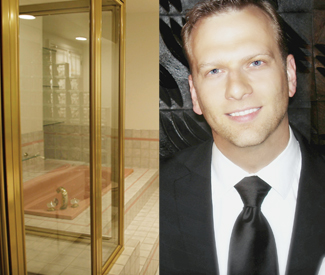
Wait, so reality TV isn’t actually real? Shut the custom-painted front door! “Mostly I was happy that people cared that much about House Hunters,” Balthazar says of the controversy. He’s currently promoting the latest House Hunters spin-off, House Hunters Renovation, which follows buyers as they pursue remodeling projects in their just-purchased homes. The next new episode airs Oct. 21 at 11pm; it follows a couple whose “dream house” (DRINK) contains a pink-and-gold nightmare of a bathroom.

“On this show, we see them buying the homes, and then making all these changes to them. So it’s exciting to be able to show that,” Balthazar says. “But I’m always excited that people are talking about House Hunters and that it has had such longevity. It’s nearing its 1,000th episode this year. That’s more than Law and Order!”

And like Law and Order, every episode of House Hunters is basically the same. “The concept is very clear. You know what’s going to happen on the show,” Balthazar says. “They’re going to see three homes, and we’ll see which one they choose. But what is always different are the homeowners and the homes. That voyeuristic, play-along quality of the show changes every time, which I love. We have some really interesting characters that come along, and everyone has a different reaction to different aspects of a home. I think that’s what makes it such a guilty pleasure among people who love to spy on the real estate process.”

House Hunters International follows the same basic formula, with an obvious difference: instead of a new construction in Indianapolis with a three-car garage (DRINK), the buyer (or renter) is seeking an apartment in a slightly more exotic locale. Like, say, Cambodia. Or Serbia. Or the Arctic Circle.

“I’m amazed at some of the stories the production company we work with on International finds. They’ve developed relationships with real estate agencies all over the world,” Balthazar says. “For a long time we didn’t go to some countries simply because it was too complicated. In some countries, you can’t actually buy a home if you’re not a resident. In others, you have to pay cash completely up front, in full. That was really a daunting thing for us to tackle. And now that the show’s been around for so long a lot of people write in to be on the show. It’s like this grassroots effort in some regards.”

Of course, being so popular has a slight downside. “Everyone that I run into, whether I’m on an airplane or at a party, if I say I work on House Hunters or House Hunters International, inevitably there will be someone saying they want to be on,” Balthazar says. “I actually love that! Though I will admit that occasionally when someone asks me what I do, I just say I’m a writer. [Laughs.] But I’m ultimately so grateful that people want to be on the show.”

Balthazar’s main distraction from an endless parade of buyers seeking open-concept floor plans (DRINK) is his pop-culture website, popgoestheweek.com. He’ll be melding his two interests on a special he’s hosting on HGTV in December.

“It’s called I Bought a Famous House. I go around to homes in Hollywood that were once owned by celebrities,” he says. “It’s interesting see what [the non-famous new owners have] done with them since. In one case, someone kept the house exactly the same as it was when the celebrity owned it. And in another case, with Madonna’s former house in the Hollywood Hills, a guy came in and literally changed almost everything, with the exception of the kitchen. But I think when you buy a seven million dollar house, you probably aren’t as concerned about the kitchen as the rest of the house, because you aren’t doing your own cooking when you have that kind of money!”

Of course, Madonna’s kitchen probably already had granite countertops. DRINK!

www.hgtv.com


Serendipity, with saba

1

le.chicken.farmer@gmail.com

CHEAP EATS The number of severed duck heads in my compost bucket currently stands at eight, but I am open to more. Did anyone else accidentally go to Louisiana and shoot some ducks, bring them back, put them in the fridge, and then not have time to deal with them?

If so, I’m here for you. If you want, I’ll even share the resultant gumbo. Just ask the de la Cooters.

A lot of people don’t like to eat ducks. Especially wild ‘uns, which, in comparison to their domesticational counterparts, tend toward tough and gamey. That’s why you have to gumbo them.

Gumbo, by virtue of being gumbo, is good. Even health-food gumbo, like mine. I used okra and file instead of a roux, Hedgehog being essentially gluten free. I even used chicken-instead-of-pork andouille. From Trader Joe’s! And it was super spicy and delicious, so kudos to them.

Meanwhile, as much as I hate to dis the little guy: boo-hiss to RoliRoti for selling me an inedible half of a chicken yesterday at the Mission Market. What the? Everyone raves about this place, but I’ve had better chickens for half the price at the Safeway Deli. This poor li’l big bird was so dry, even the dark meat, we had to take it home and shred it into our now-giant gumbo.


CHEAP SPORTS

by Hedgehog

Months ago we bought $2 tickets for the A’s final regular season game, guessing it would be an important one. It turned out to be the importantest: not only was it a three-game sweep of the Rangers and a dramatic come-from-behinder, it also left the A’s in sole possession of first place in the AL West for the first and only time all season. Fortunately, it was the only day that first-place matters.

My orthopedist had declared my wrist re-unbroken mere days before that game, which was excellent timing on her part because I can’t even count how many high fives I gave to strangers on our way out of the Coliseum. And this may surprise you but some of the fans had impaired aim, so that the high fives were more like flunges and parries, but with wrists instead of foils. So a big Cheap Sports shout-out to my left radius, for getting its shit together in time for the big game.

Which doesn’t remind me: We made a five-minute movie last weekend. It was a lot of fun! So much so that another one or more will be in the can by the time you read this. We have a club! For making movies! A movie-making club! We are flush with writers and directors but if anyone wants to act, direct the photography, light, picture edit, or fund our endeavors, hit up the Farmer’s email addy above.

To see why we need you, “Finding Dee Dee” is now showing on a YouTube or Vimeo near you.

CHEAP EATS continued

Yeah, well, if Academy Awards were given for catering, I reckon I’d be working on my acceptance speech now. Instead of this.

But I do have a new favorite restaurant. It’s Tokyo Teriyaki, in Daly City, and we wound up there by accident with my Secret Agent Lady, who picked us up from the airport after last week’s column.

At rush hour! So 101 was bad, so we took 280, which was bad, but we were hungry anyway so we aimed ourselves toward Tani’s Kitchen. Which had a line with a 40-minute wait, it’s so cute in there. So we aimed ourselves toward Tokyo Teriyaki.

Which doesn’t sound as good as Tani’s Kitchen, and was only luke-warmly recommended by one of our fellow line-standers, but two-thirds of us were starving on East Coast time, so away we whisked.

Wow. If they’re waiting 40 minutes to eat at Tani’s, and the half-empty joint around the corner is this good … Wow. Daly City is my new favorite city.

Oshitashi made with napa cabbage instead of spinach: fantastic.

Seafood sunomono, which is a cucumber salad with raw shrimp, crab, and octopus: fantastic.

Tokyo Teriyaki is not expensive, precious, or popular; just friendly, great Japanese food, including sushi.

Best. Saba. Ever. I had to order it again, it was so dang good.

TOKYO TERIYAKI

Mon-Sat 11am-2pm; Mon-Thu 4:30-9:30pm; Fri 4:30-10pm; Sat 4-10pm; Sun 4-9pm

25 Southgate Ave., Daly City

(650) 755-3478

AE,D,MC,V

Beer and wine


Overkill

0

Resident Evil 6

(Capcom)

Xbox 360, PS3, PC

GAMER Capcom really wants you to like Resident Evil 6. The Japanese developer has been turning out entries since 1996 in the survival horror franchise that has spawned countless films, games, books, and theme park attractions, and with each success came an increase in fans. Resident Evil 6 suggests Capcom has listened to each and every one of its fans, and instead of using fan feedback to make an informed decision about what type of game players want, they simply shrugged and stuffed four games into one.

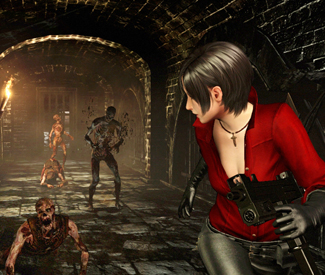
Resident Evil 6 offers four separate story campaigns, each designed to appeal to a different kind of player. For fans of the original games, fan favorite Leon Kennedy gets top billing in a campaign with a tense atmosphere and sense of exploration. Resident Evil 5‘s Chris Redfield heads a combat-heavy campaign focusing on action and gunplay. New character Jake Muller takes on a story that plays like a mixture of the first two, and the unlockable final campaign stars a bizarrely deracialized Ada Wong as she solves puzzles.

Booting up the Leon campaign reveals mechanics and pacing that are baffling. Levels are designed to be played with a partner, but there are moments when one player performs a task while the other stands around with nothing to do. Quicktime events exist solely to make players jam on the sticks and buttons at inopportune times and lead mostly to cheap deaths. Melee combat is so overpowered it makes more sense to kick zombies to death rather than waste ammunition lining up a shot from a pistol. And the game is relentless with explosions and breakneck action sequences.

The schizophrenic design decisions start to fall into place when you begin Chris’ war-shooter themed campaign. The focus on guns, overpowered melee moves, and arena levels are specifically designed to enhance an action experience but have been applied across the board to campaigns that don’t support the play style. Understandably, it’s impossible to change the fundamental design of each campaign without ballooning the developers’ budget, but my response to that would be not to make four different campaigns. Longtime fans of the series were never going to accept Resident Evil 6. It makes the controversially action-packed fifth entry look like Citizen Kane and it’s a far cry from the slow, solitary experiences that made the franchise a hit. But even separating the game from its baggage, the game stumbles in simple mechanics, pacing, and level design. When a single failed release can sink a development company it may seem justifiable to want to focus-group your game, but in dividing their resources Capcom really just made four different bad games. 

Rich Table

3

virginia@sfbg.com

APPETITE Not since State Bird Provisions and AQ opened towards the end of 2011 have I been as excited about an opening. Evan and Sarah Rich’s new Rich Table is, kinks and all, even in the first month, well-rounded and satisfying. With efficient, informed service, reasonably priced wine list, few but well-crafted cocktails, a comfortable dining room with rustic-urban decor, and most importantly, a number of exquisite dishes, Rich Table is primed for greatness.

The Riches, a husband-and-wife chef duo, both worked at Bouley in New York and Coi here in San Francisco. Evan was also at Quince, Sarah at Michael Mina — and the couple hosted memorable pop-up dinners at Radius last fall. This fine dining pedigree infuses their mid-range menu. At other restaurants, dishes don’t often surprise beyond a menu reading. But here numerous dishes are more fascinating than their descriptions suggest. At AQ, dishes are works of art unfolding in layers of unexpected flavor. At Rich Table, there’s an approachable comfort elevated with refined nuances.

On the light bites side, everyone (and I mean everyone) has been buzzing about paper-thin potato chips ($7) with sardines interwoven through the center, dipped in horseradish cream. I’m a big sardine fan : these are not overrated, worth ordering every time. I brushed past Castelvetrano olives ($5) as common — thankfully a dining companion ordered them on one visit. Brightened by celery leaves and preserved lemon, the olives pop.

On an early visit, popcorn soup ($10) tasted like buttery, pureed popcorn in a bowl. Yuzu kosho (a fermented paste of chili peppers and yuzu rind) perks up the creamy bowl. Outstanding squid dishes ($14) morph with seasonal ingredients. The first incarnation wowed, the plump squid lively with watermelon yet simultaneously savory in black olive vinaigrette, dotted with crispy onions. This sweet-tangy, fresh-grilled dish was such a joy, I couldn’t help but be a little let down by its successor: squid with figs, crisp onions and lardon draped across the top. The breezy luminosity brought by the melon felt a bit weighted down with figs, though still a winning dish. Crushed peas ($14) with California yellowtail and saltine crackers to scoop up is vivaciously fresh, but comes in a slight (i.e. miniscule) serving.

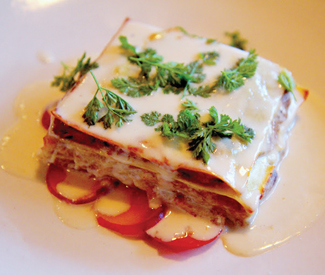
The menu is not easily categorized nor a copycat of anyone, but is packed with pleasures peeking out in unforseen places. Case in point? The pasta. I could come here for pasta alone (one dinner I ordered all four pasta dishes on the ever-changing menu). None shines more than a divine duck lasagna ($19). A smile crosses my face just thinking of delicate, melting sheets of pasta, layered with braised duck, light béchamel, and tart Santa Rosa plums. It’s a glorious pasta dish with no equal in this town… or in any other. Other pasta dishes may not reach these heights but each is worthwhile, even excellent, whether rigatoni bolognese ($18) elevated by bone marrow and crispy kale or beets, or spaghetti ($18) tossed with Jimmy Nardello peppers and clams.

On the entree front, lichen-poached rabbit ($25) is heartwarming as it is gourmet, mingling with cippolini onions, radicchio leaves and broccoli raabe. Pork belly panzanella ($24) is the classic Italian bread salad of tomato, basil, cucumber and toasted bread cubes tossed with fatty pork belly, though I took to a hearty tomato-braised oxtail on toast ($25) even more. While accompanying grilled octopus and collard greens seemed disparate, the meaty toast alone makes it worthwhile, as satisfying as Southern BBQ.

Sarah Rich’s desserts (all $8) maintain the comfort-meets-craft spirit of the restaurant from a bright melange of chilled melon to caramelized olive oil cake in strawberries, a heightened strawberry shortcake. Panna cotta lovers shouldn’t miss Sarah’s silky rendition with changing seasonal accents.

Wines are priced by glass, carafe or bottle, conveniently grouped in three white and three red price categories, with strong options like 2010 Christian Moreau Chardonnay from Burgundy, or a 2011 COS Frappato from Sicily. The cocktail list ($10 each) is short — no more than four or five at a time — and I’ve sampled six different ones. While some fare better than others (the Barn Wood, with Buffalo Trace bourbon and bitters, was a bit too musky-sweet from stone fruits), most offer understated elegance, actually different than other cocktail menus in simple purity.

The star is the lush, green Big Night, which looks like a healthy, green veggie drink, but is subtly smoky Del Maguey Vida mezcal mixed with nasturtium and ginger, topped with an edible flower. It’s clean, strong, memorable. As is Land’s End, the Riches’ answer to a martini, using the incomparable St. George Terroir Gin, dry vermouth and foraged Monterey cypress. On the light, soft side, Let’s Go is a refreshing sipper of Encanto pisco, coconut water and lime.

Sarah, Evan, and the engaged staff serve a warm vibe at their table in Hayes Valley — and an ever unexpected menu that focuses simultaneously on flavorful comfort and elegant simplicity.

RICH TABLE

199 Gough, SF.

(415) 355-9085

www.richtablesf.com

Subscribe to Virgina’s twice-monthly newsletter, The Perfect Spot, www.theperfectspotsf.com

Parsley, sage, rosemary, and timewarp

0

marke@sfbg.com

CULTURE For any of you (guilty!) who have a kneejerk gag-reflex reaction upon hearing the words “Renaissance Faire,” but can’t quite pinpoint the source of your disdain, author Rachel Lee Rubin breaks it down for you three ways: fear of men in tights, fear of voluptuous women squeezed into revealing outfits, and fear of being engulfed by nerd culture. That third category of Renaiphobia includes my own personal terror, being approached by a merry fool and loudly addressed in “castle talk,” that peculiar grammatical melange which embodieth the thithermost in Faire-y frippery. (I would also add another fear: that of hepatitis A, which my husband’s high school friend contracted from a woefully undercooked giant turkey leg.)

“Part of Renaissance Faire culture is inextricably intertwined with this adjacent culture of Renaissance Faire haters,” Rubin told me over the phone from her office in Cambridge, Mass. “I spent so much time among the trolls on Internet message boards, it really hurt my feelings!”

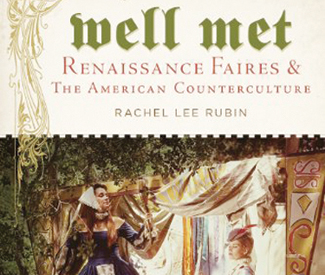
The fascinating, forthcoming Well-Met: Renaissance Faires and the American Counterculture (NYU Press, release date November 19), a study of the phenomenon and its political and cultural echoes by Rubin — a professor of American Studies at the University of Massachusetts, Boston — just might temper any Renaissance indigestion. Its deep and compelling tale of the Faire’s reach, much of it emanating from a specifically Californian aesthetic of soft-golden attitudes and ecstatic liberal expression, certainly had me revisiting some of my own preconceptions, even yearning to be part of the revelry. Somebody polish me a codpiece!

Next year will mark the 50th anniversary of the Faire. (This year’s monthlong Northern California Renaissance Faire in Hollister winds down Sat/13-Sun/14). Amazingly, Well-Met is the first comprehensive historical and anthropological study of the festival, although an official 50th jubilee commemorative album is set to be published next year (www.rpf50book.com).

The Faire’s tale begins with a young Laurel Canyon teacher’s quest to teach her charges at the local community center the history of theater, including the Italian Renaissance form of commedia dell’arte, the rowdy, harlequin-speckled, lute-sountracked populist traveling-theater tradition, a mixed-up version of which the Faire would soon become most identified with. But Phyllis Patterson’s idea of putting on a community festival, dubbed the Renaissance Pleasure Faire, soon became a flashpoint for several cultural and political currents of the time, not least the blacklisting of Hollywood professionals by the House Un-American Activities Committee (with all that out-of-work talent, the first Ren Faire served as both a showbiz bonanza and a backlash to Communist witch hunts); a turning away from mass-produced goods and the harmful effects of global commercialism (with an emphasis on handmade crafts and local community); and the incubation stage of the hippie, including the Faire’s soft-focus, wild-and-free English pastoral style of clothing, soon found donned by top pop minstrels, from the Byrds and the Monkees to the Beatles and the Isley Brothers.

“Even now, the spectre of the long-haired hippie looms in many older conservative minds. And he — it is always a he — belongs to the aesthetic of the Renaissance Faire, guitar in one hand, flower in the other,” Rubin told me.

Also involved in the Faire’s history was the reinvention of theater — the New Vaudeville, including such bigtimers as Firesign Theater, the Flying Karamazov Brothers, Pickle Family Circus, and Bill Irwin — plus the explosion of public community radio (LA’s KPFK and our own KPFA owe much of their golden years to the Faire), and a revisionist historical movement in education. Rubin traces the New Left political movement’s break with the Old Left to the Faire’s liberating effect. But mostly the Faire operated as America’s freak magnet, the most visible manifestation of the counterculture emerging from the conformist 1950s — and a safe space for outsiders of all types.

“Again and again, people told me how the Faire made them feel safe,” Rubin said. “Vietnam veterans told me it was only at Faire that they felt welcome back in the country. There was a huge gay and lesbian presence from the beginning, and the bawdiness encouraged there attracted different sexual expressions. Class difference, too, could be left behind. The costuming echoed that of the masquerade, where a certain amount of anonymity — a shedding of the self at the gates, which is a very important ritual at the Faire — opened up new possibilities.

“The central paradox of the Faire is that it allows you to be more yourself while being someone else.”

Another paradox is the overwhelming anachronism of the Faire — starting with those emblematic turkey legs and continuing through the revealing custom-made chain mail “wench wear” that’s lately become all the rage among female Faire regulars (“playtrons” in castle talk). Somehow, reimagining the historical past makes the Faire more authentic.

“The inspiration to write this book actually came when I took an English friend to one of the fairs,” Rubin said with a laugh. “He was horrified: ‘what have you done to my country’s history?’ And yes, it’s called the Renaissance Faire, but it’s really the idealization of probably 10 years of the whole historical period, in England, and only very select parts of that. But the central notion of the festival is play — even a play on the meaning of ‘renaissance’ itself. It’s almost like steampunk’s relationship with the Victorian era. Except that steampunk starts with one historical period and imagines the future, whereas the Renaissance Faire imagines the past.”

And of course the one constant of every historical endeavor is change. The Faire is now a national institution with a broader appeal than ever. After functioning as an artistic haven in the 1960s and a working class escape in the late ’70s and ’80s (the titillating “freakfest” alternative to Six Flags’ “redneck Disneyland”), it’s lately settled into the role of suburban theme party and gamer-nerd paradise. But that’s changing as well.

“The video game role-players are still there, but the faire doesn’t seem to resonate as much with the current tech crowd, which may be more attracted to material gain than fantasy escapism,” Rubin said. And many regular playtrons are dismayed at what they see as the Disneyfication of the Faire. “Even as a suburban and working class phenomenon, the Faire always functioned as an alternative narrative to everyday life. But now we’re seeing more ‘handmade crafts’ manufactured in China and attempts to corporatize the Faire on larger levels. There has always been an argument about authenticity among playtrons, but now there are more contemporary forces affecting the Faire.”

Yet the original spirit of transformation and togetherness persists. For Well-Met, Rubin visited dozens of Faires across the country, not only documenting several intriguing regional differences but also talking to dedicated playtrons about their personal experiences at the Faire. What emerges is a candid family portrait, full of self-aware whimsy, goofy charm, and awkward situations. (Rubin speaks with playtrons of color about the faire’s often ethnically challenged demographics and writes about the widening of the Faire’s aesthetics to include Islamic World elements, in acknowledgment of the actual Renaissance’s roots.)

Also persistent: the wilder, bawdy side, especially on the last day of many Faires, when parents are warned and much of the self-censorship vanishes, like mead from a sterling goblet gripped by hairy Hobbit knuckles. Profane insults and hilariously vulgarish displays fill the fairgrounds. Will that be the case on Sun/14 at the NorCal Ren Faire? Squeeze yourself into corset and tights and come findeth out.

NORTHERN CALIFORNIA RENAISSANCE FAIRE

Sat/13- Sun/14, $25–$35 (Kids under 12 free), 10am-6pm

Casa de Fruita

10031 Pacheco Pass Hwy, Hollister

www.norcalrenfaire.com

Keep digging

0

arts@sfbg.com

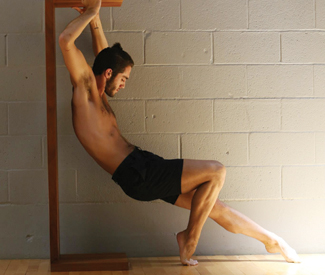
DANCE Once you have learned to ride a bike or tie your shoes, your body will recall the movements and their sequential logic for the rest of your life. It’s called muscle memory and dancers are fantastic at it.

Before videotape and dance notation, it was not uncommon to ask, say, former Martha Graham dancers about an old piece — only to hear them respond that they couldn’t recall it. But if you put them into a studio together, one of them would demonstrate a half-remembered gesture, another would place or correct it, and a third would bring up a sequence or antecedent. Four hours later, these women would have drawn out of their bodies a pretty good approximation of what had been thought to be a forgotten piece of choreography.

Morgan Thorson’s oddly titled and deeply flawed Spaceholder Festival (Oct. 5-7, ODC Theater) took a stab at examining the residue that life imprints on our bodies. Comparing the process of uncovering what is hidden to archeologists’ trying to make sense of what they unearth, Thorson partook in an actual dig and used that experience in her choreography. When it came to evaluating the results, she apparently felt that assigning artifacts to the highest bidder was an accurate reflection of reality. So the work’s middle section also included two dancers as auctioneers.

Spaceholder opened on a quasi-abstract note, evolved into a messy theatricality only to circle back on itself. Screeching machine sounds accompanied uniform dancers being spit out onto the stage as if by an assembly line. They dutifully followed each other, stepping into two against three or horizontal movement patterns. Strangest were their blank faces. They looked as if they were being pulled by something, perhaps an urge to catch what was just out of their reach.

Spreading across the stage, they moved in and out of sync with each other. Many small phrases — a scratch on a leg, a knee opening and closing, a skipping step — held promises that never were fulfilled. Some were clearly dance-derived; a fourth position and jetés, hip rolls, and toe walks were recognizable. But what to make of a wafting hand that approached like a butterfly trying to land? A woman resting on the floor on her side looked like an Odalisque, her smile an invitation to the rest of the group to join her. A finger pointing section, the result of a counting maneuver, evolved into a wheel with the arms being the spokes. Gestures might connect to each other with no apparent logic. With its neutral tone and the dance’s accompanying sense of accumulation for its own sake, it became about as involving as watching falling snow after a while. Yet simultaneously fascinating and frustrating was the clarity that these dancers brought to their tasks.

At one point, the dancers coalesced into a tight group with arms stretched up as they reached for each other’s fingers. That section later returned, except with the dancers passing pieces of foam around. One of them tried to press them into a single shape. The idea of retroactively deciphering meaning may avoid an obvious linear development, but it makes entering a piece very difficult — perhaps impossible, unless seeing it several times.

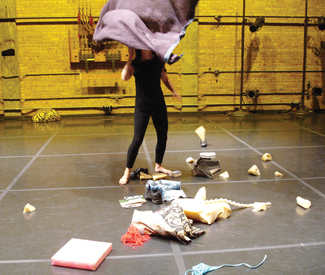
Part two opened with a promising twist. A dancer was ceremoniously carried in on a blanket and started to throw rubbish — old shoes, cans, rags, paper — around the stage as if the items were a goddess’ precious gifts. The stuff got kicked around, swept away, and finally ended up on a table, being sorted into what probably was meant to suggest legible patterns. The gathering and examination of this detritus and using some of it as props may have had its comic elements, but if so most of the humor escaped me. The remembered physicality of the table’s effect on the dancers, however, was a lovely touch.

Perhaps the evening’s most intriguing element came with Max Wirsing, the company’s lone male dancer, who donned silver sandals and paraded around while covered by a tablecloth. Later he repeated the gesture of closing the clasp around his ankle. It was clearly a movement that had entered his body. As for me, I was grateful when the last of this unearthed material — a single dancer — was blanketed by the dark falling onto the stage.

The rescuer

1

cheryl@sfbg.com

FILM A decade or so ago, Ben Affleck was drowning in Bennifer mania and starring in schlock like Daredevil (2003) and Gigli (2003). Rumors percolated that Affleck and Matt Damon hadn’t really written that Oscar-winning script for 1997’s Good Will Hunting — though Damon’s career was bearing more fruit at the time (see: 2002’s The Bourne Identity), the “Jenny From the Block” video was nauseating enough to make anyone question the authenticity of anything Affleck-associated up to that point.

But in 2012, it’s clear the guy who was able to balance being a Kevin Smith muse with getting pumped up to star in Armageddon (1998) was all along plotting the oldest show biz career trajectory in the book: he really wanted to direct. And thank goodness for that.

Argo opens with a vintage Warner Bros. logo and offers a quick history lesson via storyboards and old news footage. If you don’t know the particulars of the 1979 Iranian Revolution, you won’t be an expert after Argo, but the film does a good job of capturing America’s fearful reaction to the events that followed it — particularly the hostage crisis at the US embassy in Tehran. Argo zeroes in on the fate of six embassy staffers who managed to flee to the home of the sympathetic Canadian ambassador (Victor Garber).

Back in Washington, short-tempered CIA agents (including a top-notch Bryan Cranston) cast about for ways to rescue them. Most of the standby “exfil” tactics (give ’em fake identities as English teachers!) are out of the question given the political climate in Iran. Crazier ideas begin to surface. Could the staffers, uh, ride bikes to the Turkish border, maybe? Three hundred miles…in the winter?

Enter Tony Mendez (Affleck), exfil specialist and father to a youngster wrapped up in the era’s sci-fi craze (21st century Jedi will weep at the boy’s mint-condition toy collection). It’s while watching 1973’s Battle for the Planet of the Apes on TV that Tony comes up with what Cranston’s character calls “the best bad idea we have:” the CIA will fund a phony Canadian movie production (corny, intergalactic, and titled Argo) and pretend the six are part of the crew, visiting Iran for a few days on a location shoot. Tony will sneak in, deliver the necessary fake-ID documents, and escort them out. Neither his superiors, nor the six in hiding, have much faith in the idea. (“Is this the part where we say, ‘It’s so crazy it just might work?'” someone asks, beating the cliché to the punch.)

Argo never lets you forget that lives are at stake; we see the Ayatollah’s men scrambling to piece together the identities of the embassy workers even as Tony arrives in Tehran, where he observes a victim of mob justice swinging from a noose over a main street. Every painstakingly forged form, every bluff past a checkpoint official, the anxiety increases, to the point of being laid on a bit thick by the end.

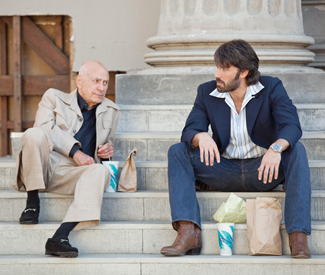
The film has the benefit of being both timely (with US-Iran relations stormy as ever) and entertaining, and though it’s not a masterpiece, it’s Affleck’s best directorial effort to date. He’s capable with the secret-agent suspense stuff, and is careful not to make generalizations about the Iranians depicted in the film. But, appropriately enough given the source, Argo comes alive in its Hollywood scenes. As show-biz veterans who mull over Tony’s plan with a mix of Tinseltown cynicism and patriotic duty, John Goodman and Alan Arkin practically burst with in-joke brio. I could have watched an entire movie just about those two.

Argo is Affleck’s third film — the first not set in Boston, and the second that Affleck himself stars in. Though he cast his brother, Casey Affleck, in 2007’s Gone Baby Gone, he gave himself the lead in 2010’s The Town, a decision that ended up being one of the film’s weak links. (“Oh look,” my movie going companion pointed out during The Town‘s forced-soulful denouement. “He escaped to Beardlandia!”) But his turn in Argo is, refreshingly, more or less vanity-free — just one gratuitous shirtless scene! — a hopeful sign that Affleck the actor may finally be giving Affleck the director the upper hand.


ARGO opens Fri/12 in Bay Area theaters.

The big show

1

cheryl@sfbg.com

FILM/LIT Any horror fan can tell you that John Carpenter directed and co-wrote 1978’s Halloween. But it would require a slightly more credits-obsessed moviegoer to recognize the name of behind-the-scenes maestro Irwin Yablans.

In addition to being Halloween‘s producer, Yablans was also responsible for cult classics like Tourist Trap (1979), Roller Boogie (1979), and Hell Night (1981). His new autobiography, The Man Who Created Halloween: How a Bit of Desperation and Inspiration Gave Birth to the Movie That Changed Hollywood (self-published, 259 pp., $16.95), traces his path from Brooklyn childhood to Hollywood player. Along the way, he served in the army, met the love of his life, feuded with his brother (fellow film producer Frank Yablans), and — on a flight from London to Los Angeles — had a brilliant brainwave about babysitters being stalked by a killer on the scariest night of the year. I spoke with Yablans, who turned 78 this year, over the phone from Southern California.

San Francisco Bay Guardian What inspired you to write a memoir? 

Irwin Yablans I kind of kept quiet about all this stuff through the years because I was only involved in the first three [Halloween films]. I was really not able to gauge the public’s insatiable appetite for Michael Myers! And I got tired of it after awhile. I wanted to do other things. But I came back into the picture because there was a lot of misinformation and revisionist history floating around, and I thought it was time I talked about it. Then, I decided to write a book about my life.

And Halloween is going out into 1,000 theaters on Halloween this year — that’s amazing! When I came up with the little idea on an airplane 35 years ago, little did I know. [Laughs.] There’s a lesson to be learned from that: never underestimate the possibilities of a good idea. Don’t ever assume that because you thought of it, it might not be good. You have to believe in yourself.

[Pauses.] Before I go any further, I have to make a confession: I am a Giants fan. And I have been since 1947, because I was a Giants fan in New York. I was at the Polo Grounds in 1951 and watched Bobby Thomson hit that home run — in case you don’t know what that is, it’s the most famous moment in baseball history. I still watch the Giants every day. And I’ll tell you, they look pretty good this year!

SFBG Why did you decide to go the self-publishing route?

IY Well, I’d never written a book before. I’d always done a little writing for the movies, but about seven or eight years ago I thought I’d sit down with my computer and peck away. The first word I wrote was “cockroaches.” [Laughs.] I wanted to write for my family — I thought I’d leave behind some musings about my life that might be interesting for my kids and my grandchildren. About 50 or 60 pages in, I showed it to some people I respect and they said, “You ought to think about publishing this.”

When I got close to the end, I submitted it to a couple of publishers. I’d never been part of that world before — [and I realized it] was just like how I got into my independent film company. I found a publisher who wanted to publish it, but I found out that if I went with them, not only would they get a large portion of the receipts, but they don’t put any money up, or do any publicity or advertising.

So I said to myself, “Why do I need them?” [I found] CreateSpace on the internet, and I’ve had the most amazing experience. Independence is sort of in my blood. I like doing things myself, [even] my own public relations. You read in the book why we chose Jamie Lee Curtis [for Halloween] — when I met Jamie, I knew she was a fine actress, but I had this vision of getting a photo of her mother, Janet Leigh, and putting Jamie in a similar pose, and submitting it to AP and UPI. We got worldwide publication of that. And that’s the kind of thing I did all the way through with Halloween. You just have to take every opportunity to publicize the picture. Of course, John Carpenter made a very good movie.

SFBG I have to ask about Roller Boogie. It’s a midnight-movie favorite in San Francisco.

IY No kidding! [Laughs.] You know what’s great about that movie? The music! Earth, Wind, and Fire … it’s just a delightful little movie. Just great fun. I think I had more fun making that movie than any other movie I made, because it was so uplifting and so bright — I was on roller skates with my whole family during the shoot. I love the “Boogie Wonderland” number, and Linda Blair was such a charmer.

I tell you, the ’70s and ’80s were a lot of fun for me. I was so busy, making movies, distributing movies, and running all over the world. It was a great experience. I really loved every moment of it.

www.irwinyablans.com


Medical marijuana is over

4

caitlin@sfbg.com

HERBWISE Hey potheads, welcome to what figures to be the last Herbwise column for the time being.

But we’ve had some good sessions together, no? Over the course of a very eventful year in marijuana, we spoke with Roseanne Barr, Black Panthers, oncologists, tax attorneys, Coral Reefer. Snoop Dogg, Fiona Apple, Pat Robertson, the president of Uruguay, and an actress from the Blair Witch Project all made our news call. They all do the weed, or support such things, and that list alone should serve as proof that cannabis has irrevocably entered the mainstream.

We went around the world to see how pot was faring in other corners. Seattle’s medical marijuana champion-DIY pop star Lisa Dank reported back from South By Southwest. I chatted with the author of medical marijuana legislation in Washington, DC, dropped in on a Berlin head shop employee, and took a walk with a small town politician up in the Marin County hills of Fairfax.

Honestly, I didn’t want to write about politics at all when we started the column. Boring! Fake! Politricks! Etcetera. But then last September, the IRS intensified its hounding of several major Bay Area dispensaries, cheating them out of perfectly reasonable tax exemptions. Then, at an October 7 press conference in Sacramento, US Attorneys let us know they were going to start being a bummer.

A year later, we’re short a whole bunch of places to get marijuana, including no less than two of the clubs I personally depended on. Hiss. Against my best intentions, current events necessitated that Herbwise focus on law and order, from time to time.

But there’s been good moments (the week I wrote Herbwise high as hell in my cubicle on Amoré, the cannabis aphrodisiac shot), just like the especially-bad moments (the week I bore the tidings that major credit card companies would no longer process sale of marijuana and that beloved local dispensary Vapor Room was closing due to threatening letters from federal agencies. That week I wrote about Lady Gaga.) I’m privileged to have been able to weigh in on a year that will surely change the future of cannabis, for better or worse.

Some words on words: I got told 800 times to not call it “pot” or “weed.” One person wrote to say “flower” was better terminology. Please don’t mix us up with the recreational users, some card carrying marijuana users told me. You’re hurting our quest to be taken seriously.

But I need my synonyms. Nah, more importantly, I think this not-mixing is the problem. Focusing the movement for increased access to cannabis on the medical marijuana industry isn’t working. Drop the pretense, I say. The notion that weed can only be prescribed by a medical professional is not just dumb, it’s also not gonna get us anywhere. The longer we stigmatize recreational users, the longer people (and by people I mean young men of color, because that’s who our racist prison system is filled with) are going to be sent to jail for a stupid reason. And less people will feel connected enough to the movement to create the kind of buzz that will eventually change public opinion. And prisonmakers and anti-drug warriors will continue to get the money that should be going to our schools and to our public library flag burning sessions where everyone is handed a pink thong to wear at the outset and ordered to chant baby-killing nursery rhymes in Spanish. Broadcast on PBS.

Obviously, I’m not saying that cannabis doesn’t have medical usages. Studies have recently emerged that suggest it stops the spread of cancer in the body, and any patient that has AIDS or another wasting, awful, strength-sapping disease can tell you that cannabis can be a literal life saver when it comes to stimulating appetite and general pain management.

But the ways in which people use cannabis are multitudinous, and the only reason it’s regulated differently than tobacco, wine, liquor, McDonald’s, and the thousand other things you can abuse out of moderation is because of government and corporate control. You smoke to relax after a hard day, you smoke to bond with friends, you smoke to have fun.

Herbwise bids you adieu. We’ll still be covering cannabis in the Guardian, of course, and like a phoenix, I’ll be rising from this spent bowl with Street Seen, a new column focusing on all the rad things happening in street art, and fashion, and other founts of alternative Bay Area culture.

Thanks for being there. Stay high.

Psychic Dream Astrology: October 10-16, 2012

0

Oct. 10-16, 2012

ARIES

March 21-April 19

This is not the time to figure your life out or to ruminate on how things came to be. Look for potential and opportunity all around you instead of wasting energy on wallowing in the past or trying to predict the future. There is much more possible than you are seeing this week, so open up your viewfinder.

TAURUS

April 20-May 20

I would never tell you to risk it all, but this week it’s a good idea to put at least a little bit on the line. Strive to be careful without being overprotective, Taurus. Your life is ready for some heartfelt action, and to pull this off you’re gonna need to be able to act in spite of your fears, no matter how pragmatic they are.

GEMINI

May 21-June 21

The secret to your success this week is in going with the flow. You are meant to put your plans aside and to affix your attention in the direction that your life is pointing you. Be willing to meet your circumstances, relationships or even health where they’re at, instead of trying to force them into someplace “better”.

CANCER

June 22-July 22

Sometimes it’s the stuff that feels like your biggest problems that turn out to be your greatest assets, Cancer. If you can get some perspective on what’s troubling you it’s likely that you’ll see opportunity developing right in front of your eyes. Don’t confuse feeling stuck with actually being trapped this week.

LEO

July 23-Aug. 22

Practice living in the moment this week, Leo. Nothing is permanent, and whether that’s good news or bad, you are meant to stop fiddling with things and just be where you’re at. Don’t let your present circumstances define you; learn from whatever you have going on, and be open to what comes next revealing itself to you.

VIRGO

Aug. 23-Sept. 22

You have to go through it to get to it. Strive to meet your demons head-on, because otherwise they will chase you down, Virgo. You’ll go farther by dealing honestly and directly with your life than by digging your heels in or throwing blame around. Get your hands dirty this week for best results.

LIBRA

Sept. 23-Oct. 22

You have to wrestle with your fears and pin them to the ground, Libra, there’s no way around it. Decide to take control of the part of your life that feels the most chaotic this week. You are capable of change but it won’t happen without a little elbow grease and a whole lot of willingness.

SCORPIO

Oct. 23-Nov. 21

No matter how engaging your relationships are and no matter what you’ve got going on, you need some downtime, Scorpio. Watch out for feeling that creepy crawly feeling that compels you to look for evidence of your life being crappy. Accept your feelings and support yourself through them this week.

SAGITTARIUS

Nov. 22-Dec. 21

Do not try to control, contain or commit to anything new this week, Sagittarius. If you are overwhelmed, the best course to take is to slow down and get a better assessment of what’s happening. If you know the nuances of where you’re at you, you will be better poised to avoid useless drama and pain.

CAPRICORN

Dec. 22-Jan. 19

Lucky you, Capricorn! This week you get to stare the things you’re oh-so-very scared of in the eyes and make them bow down to you. OK, not so much that, but you can make great headway if you deal directly with your troubles. Let your fears point you towards where you need to embody the most courage.

AQUARIUS

Jan. 20-Feb. 18

You should strive to understand what you need instead of expecting others to read your mind, or for the Universe to provide that insight, pal. Look at the places inside of yourself that you feel disconnected from your wants and intentions, Aquarius. Embody your truth without apologies this week.

PISCES

Feb. 19-March 20

Don’t panic! There’s a world of possibility and limitless options, Pisces. You should not try to fix or even make sense of things while you’re feeling anxious this week. Try to sit in whatever you’re feeling, even if it sucks. There is no escaping things, so deal with them only when you can, so you do it smartly.

Jessica Lanyadoo has been a Psychic Dreamer for 18 years. Check out her website at www.lovelanyadoo.com to contact her for an astrology or intuitive reading.


Local censored 2012

0


BEHIND THE MIRKARIMI CASE

In early January, details from the police investigation of then-Sheriff-elect Ross Mirkarimi bruising his wife’s arm during an argument were leaked to the San Francisco Chronicle and other news outlets. The key piece of evidence was a 45-second video that Mirkarimi’s wife, Eliana Lopez, made with her neighbor, Ivory Madison, displaying the bruise and saying she wanted to document the incident in case of a child custody battle. That video convinced many of Mirkarimi’s guilt, and a majority of Ethics Commissioners say they found it to be the main evidence on which Mirkarimi should be removed from office on official misconduct charges (the Board of Supervisors was scheduled to vote on Mirkarimi’s removal on Oct. 9, after Guardian press time).

But that video was only a small part of the overwhelming and expensive case that Mayor Ed Lee brought against Mirkarimi, including the more serious charges of abuse of power, witness dissuasion, and impeding a police investigation, all of which go more directly to a sheriff’s official duties. All of those charges got lots of media coverage and they helped cement the view of many San Franciscans that Mirkarimi engaged in a pattern of inappropriate behavior, rather than making a big momentary mistake. Yet most of the media coverage during the six months of Ethics Commission proceedings ignored the fact that none of the evidence that was being gathered supported those charges. Indeed, all those charges were unanimously rejected by the commission on Aug. 16, a startling rebuke of Lee’s case but one that was not highlighted in many media reports, which focused on the one charge the commission did uphold: the initial arm grab.


THE NEXT DOT-BOMB

In the late 1990s, San Francisco was in a very similar place to where it is now. The first dot-com boom was full bloom, driving the local economy and creating countless young millionaires — but also rapidly gentrifying the city and driving commercial and residential rents through the roof (great for the landlords, bad for everyone else). And then, the bubble popped, instantly erasing billions of dollars in speculative paper wealth and leaving this a changed city. The city’s working and creative classes suffered, but the political backlash gave rise to a decade with a progressive majority on the Board of Supervisors.

The era ended in 2010 when Ed Lee was appointed mayor, and he began ambitious agenda of pumping up a new dot-com bubble using tax breaks, public subsidies, and relentless official boosterism to lure more tech companies to San Francisco. Lee has been successful in his approach, in the process driving up commercial rents and housing prices. By some estimates, about 30 percent of the city’s economy is now driven by technology companies.

Yet there have been few voices in the local media raising questions about this risky, costly, and self-serving economic development strategy. The Bay Citizen did a story about Conway’s self interested advice, the New York Times did a front page story raising these issues, and San Francisco Magazine just last month did a long cover story questioning how much tech is enough. But most local media voices have been silent on the issue, and much of the damage has already been done.


OLD POWERBROKERS RETURN TO CITY HALL

More than a decade ago, then-Mayor Willie Brown and Chinatown power broker Rose Pak worked together to empower big business, corrupt local politics, and clear the path for rampant development — an approach that progressives on the Board of Supervisors repudiated and slowed from 2000-2010. But Brown, Pak, and a new generation of their allies have returned in power in City Hall, and it’s as bad as it ever was.

Many San Franciscans know of their high-profile role appointing Lee to office in early 2011. But their influence and tentacles have extended far beyond what we read in the papers and watch on television, starting in 2010 when their main political operatives David Ho and Enrique Pearce ran Jane Kim’s supervisorial campaign, beating Debra Walker, a veteran of the fights against Brown’s remaking of the city.

Now, this crew has the run of City Hall, meeting regularly with Mayor Lee and twisting the arms of supervisors on key votes. Pearce and Ho persuaded longtime progressive Christina Olague to co-chair the scandal-plagued Run Ed Run campaign last year, she was rewarded this year with Lee appointing her to the Board of Supervisors. Pearce has been her close adviser, and most of her campaign cash has been raised by Brown and Pak. Even progressive Sup. Eric Mar admits that Pak in raising money for him, a troubling sign of things to come.


THE REAL OCCUPY STORY

The Occupy San Francisco camp that was cleared by police last week may have been mostly homeless people. And major news media outlets from the start reported that Occupy was dangerous, filthy, and a civic eyesore.

But last fall, the camps were comprised of a huge variety of people that chose to live part or full time on the streets. Students, people with 9-5 jobs, people with service jobs, and the unemployed were all represented. Wealthy people who lived in the financial districts where camps popped up mixed with working-class people who came from suburbs and small towns. Families came out, welcomed in the “child spaces” set up in many Occupy camps throughout the country. Most camps also boasted libraries, free classes, kitchens, food distribution, and medical tents.

As news media focused on gross-out stories of pee on the streets and graphic descriptions of drunk occupiers, they managed to ignore the complex systems that were built in the camps. Nor did anyone mention that homeless people have the right to protest, too.

East Bay Endorsements 2012

22

The East Bay ballot is crowded, with races for mayor, city council and school board in Berkeley and Oakland, plus a long list of ballot measures. We’re weighing in on what we see as the most important races.


OAKLAND CITY ATTORNEY


BARBARA PARKER

This one’s simple: Progressives on the council like Parker, who’s a pretty unbiased attorney. Her challenger, Jane Brunner, is a supporter of Ignacio De La Fuente. Vote for Parker.


OAKLAND CITY COUNCIL


AT-LARGE


REBECCA KAPLAN

In some ways, this is a replay of the 2010 mayor’s race, where Rebecca Kaplan and Jean Quan, running as allies in a ranked-choice voting system, took on and beat Don Perata, the longtime powerbroker who left town soon after his defeat. This time around, it’s Kaplan, the popular incumbent, facing Ignacio De La Fuente, a Perata ally, for the one at-large council seat.

De La Fuente, who currently represents District 3, would have easily won re-election if he stuck to home. But for reasons he’s never clearly articulated, he decided to go after Kaplan. The general consensus among observers: De La Fuente wants to be mayor (he’s tried twice and failed), thinks Quan is vulnerable, and figures winning the at-large seat would give him a citywide base.

It’s a clear choice: Kaplan is one of the best elected officials in the Bay Area, a bright, progressive, practical, and hardworking council member who is full of creative ideas. De La Fuente is an old Perata Machine hack who wanted to kick out Occupy Oakland the first day, wants curfews for youth, and can’t even get his story straight on cutting the size of the Oakland Police Department.

De La Fuente is all about law and order, and he blasts Kaplan for — literally — “coddling criminals.” But actually, as the East Bay Express has reported in detail, De La Fuente, in a fit of anger at the police union, led the movement to lay off 80 cops. And the crime rate in Oakland spiked shortly afterward. Kaplan opposed that motion, and tried later to rehire many of those cops — but De La Fuente objected.

Public safety is one of the top local issues, and Kaplan not only supports community policing (and more cops) but is working on root causes, including the lack of services for people released into Oakland from state prison and county jail. She’s also a strong transit advocate who’s working on new bike lanes and a free shuttle on Broadway. She helped write the county transportation measure, B1. She richly deserves another term — and De La Fuente deserves retirement.


BERKELEY MAYOR


KRISS WORTHINGTON

It would be nice to have a Berkeley person as mayor of Berkeley again.

The city’s still among the most progressive outposts in the country — and Mayor Tom Bates, for all his history as one of the leading progressive voices in the state Legislature and a key part of the city’s left-liberal political operation, has taken the city in a decidedly centrist direction. Bates these days is all about development. He’s a big supporter of the sit-lie law (hard to imagine the old Tom Bates ever supporting an anti-homeless measure). He didn’t even seek the mayoral endorsement of Berkeley Citizens Action, which he helped build, and instead hypes the Berkeley Democratic Club, which he used to fight. After ten years, we’re ready for a new Berkeley mayor.

Worthington is the voice of the left on the City Council. He’s an aggressive legislator who is never short of ideas. He’s talking about the basics (holding separate council meetings on major issues so people who want to speak don’t have to wait until midnight), to the visionary (a 21-point plan for revitalizing Telegraph Avenue). He’s against sit-lie and wants developers to offer credible community benefits agreements before they build. We’re with Worthington.

Alameda County ballot measures


MEASURE A1


ZOO TAX


YES

The Oakland Zoo does wonders with rescue animals; instead of bringing in creatures from the wild or from other zoos, the folks in Oakland often find ways to take in animals that have been abused or mistreated elsewhere. Measure A1 would impose a tiny ($12 a year) parcel tax to support the public zoo. Critics say the money could go for zoo expansion, but the expansion’s happening anyway. Vote yes.


MEASURE B1


TRANSPORTATION PROGRAMS


YES

Quite possibly the most important thing on the East Bay ballot, Measure B1 creates the funding for a long-term transportation plan. Almost half of the money goes for public transit and only 30 percent goes for streets and road. There’s more bicycle money than in any previous transportation plan. Every city in Alameda County supports it. Vote yes.

Berkeley ballot measures


PROPOSITION M


STREET IMPROVEMENTS BOND


YES

Not our first choice for a street improvement bond, it’s a bit of a hodgepodge that squeaked through a divided council. But the city’s deferred street maintenance is a major problem and this $30 million bond would be a modest step forward.


MEASURE N


POOLS BOND


YES

Berkeley has lost half its public pools in the past two years; the facilities are unusable, and it’s going to take about $20 million to refurbish and rebuild them. This bond measure would allow the city to re-open the Willard Pool and build a new Warm Water Pool — critical for seniors and people rehabbing from injuries. Vote Yes.


MEASURE O


POOL TAX


YES

Berkeley often does things right, and this is a perfect example: Instead of building new facilities that it can’t afford to operate (hell, SF Recreation and Parks Department), Berkeley is asking for two things from the voters: Bond money to rebuild the municipal pools, and a special tax to provide $600,000 a year for operations. We support both.


MEASURE P


REAUTHORIZING SPECIAL TAXES


YES

Measure P doesn’t raise anyone’s taxes. It’s just a housekeeping measure, mandated by state law, allowing the city to keep spending taxes that were approved years ago for parks, libraries, medical services, services for the disabled, and fire services. Vote yes.


MEASURE Q


UTILITY TAX


YES

Berkeley’s been collecting utility taxes on cell phones for some time now, but the law that allows it is based on federal language that has changed. So the city needs to make this modest change to continue collecting its existing tax.


MEASURE R


DISTRICT LINES


YES

The council districts in Berkeley were set when the city adopted district elections in 1986, with a charter amendment saying all future redistricting should conform as closely as possible to the 1986 lines. Nice idea, but the population has changed and it makes sense for the council to have more flexibility with redistricting.


MEASURE S


SIT-LIE LAW


NO, NO, NO

It’s hard to believe that progressive Berkeley, which has spent hundreds of thousands of dollars defending similar laws in court, wants to criminalize sitting on the sidewalk. It hasn’t worked in San Francisco, it won’t work in Berkeley. Vote no.


MEASURE T


AMENDMENTS TO THE WEST BERKELEY PLAN


NO

Council Members Kriss Worthington, Jesse Arreguin, and Max Anderson all oppose this plan, which would open up West Berkeley to more office development — with no guarantee of community benefits. Everyone agrees the area needs updated zoning, but this is too loose.


MEASURE U


SUNSHINE COMMISSION


YES

Berkeley has needed a strong sunshine law for years; this one isn’t the greatest, but it’s not the worst, either; it would mandate better agendas (and allow citizens to petition for items to be put on the agenda) for city boards and commissions, would create a new sunshine commission with the ability to sue the city to enforce the law, and would require elected and appointed officials to make public their appointments calendars.


MEASURE V


CERTIFIED FINANCIAL REPORTS


NO

This sounds like a great idea — mandate that the city present certified financial audits of its obligations before issuing any more debt. In practice, it’s a way to make it harder for Berkeley to raise taxes or issue bonds. Vote no.

Oakland ballot measures


MEASURE J


SCHOOL BONDS


YES

Measure J would authorize $475 million in bonds for upgrading school facilities. This one’s a no-brainer; vote yes.


Dog eat dog

0

arts@sfbg.com

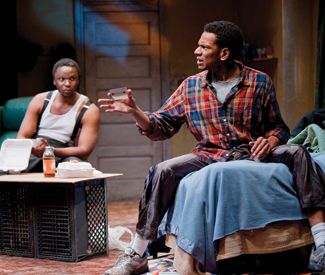
THEATER Audiences arriving at Marin Theatre Company for director Timothy Douglas’ current, beautifully staged revival of Suzan-Lori Parks’ 2001 Pulitzer Prize–winning play, Topdog/Underdog, take in a shabby, dilapidated low-rent studio apartment with its meager and seedy furnishings. But looming overhead the whole time are the red-white-and-blue bunting of some half-forgotten political rally, depending from the flies amid three long strips sheared from the stars and stripes, hung equidistantly across the stage. These thin flags have tightened their belts, and look a bit dingy too, almost sepia-toned, and floating above the impoverished scene below somehow bring to mind that flag behind Ella Watson, the African American cleaning woman in Gordon Parks’ iconic Depression-era photograph, American Gothic, Washington, D.C.

If there’s thus a certain election-year ring to Mikiko Uesugi’s careful scenic design — present before the action even starts — it’s a sonorous and dissonant one, echoing back across a political past with a strange and disorienting nostalgia, a contaminated euphoria. What could be more appropriate?

http://www.youtube.com/watch?v=F0Xll3eZJ8Y

At a time when mainstream political reality seems feverishly bizarre, almost surreal, Parks’ drama endures as a shrewd poetical remix of American history, an elucidating fever dream in a realistic mode: two African American brothers respectively named Lincoln (Bowman Wright) and Booth (Biko Eisen-Martin) by a runaway father who apparently found it funny, share a precarious perch and a tainted patrimony in a poor part of a nameless city — where they act out an overlapping series of fated roles. These mix race, class, sex, family, and money as equal facets of a brutally antisocial system — a racket, in fact, high above (but qualitatively the same as) the Three-card Monte scheme at center of the story.

But in the brothers’ tragic and absurd destinies, half-grasped at best by the protagonists themselves, the play plumbs a deeper understanding too, a historical current churning and moving below everything — and in that understanding opens a sense of possibility.

The apartment is younger brother Booth’s roost, but Linc, as he’s called, is bringing home the bacon (or Chinese food) in exchange for crashing on the La-Z-Boy. Linc has been kicked out by now ex-wife Cookie (an offstage character symbolizing perhaps a kind of standard “fortune” for a married man without economic prospects, something akin to the ambiguous forecast Linc gets with his Chinese takeout: “Your luck will change”). Booth’s offstage love interest is named, with even more symbolic resonance, Grace. Early on, it’s clear she’s pretty much unattainable.

Booth wants knowledge from his brother, more than anything else. Linc was once famous on the streets as a master of the Three-card Monte hustle — which itself has nothing to do with luck — but has given up the cards in the wake of a guilt-ridden incident. Eager brother Booth (played by Eisen-Martin with a nicely coiled energy, dangerous and comically hapless at once) is dying to become a hustler himself, but his efforts to learn the ropes meet with resistance from his jaded, wary older brother (whom Wright imbues with a perfect combination of wistful compassion and alpha-male contempt).

For his part, Linc’s guilty conscience finds a kind of half-bitter contentment in his current job: impersonating his namesake at a carnival sideshow, where he daydreams as sitting duck in white-face Honest Abe drag, before a ready line of customer-assassins. Indeed, Linc’s first appearance onstage comes in the Lincoln get-up, an eerily comic site that already loads the naturalistic performances with dreamy intensity.

If Parks’ drama (which premiered off-Broadway in the summer of 2001) preceded everything from 9/11, the wars on Iraq and Afghanistan, Katrina, the financial crisis, worldwide protest movements against global capitalism and empire, and the advent of the country’s first African American president, MTC’s apt revival shows it more than keeps pace with the times as a gritty and gripping allegory of endemic, convoluted civil wars.

TOPDOG/UNDERDOG

Through Oct. 21, $36-$57

Marin Theatre Company

397 Miller, Mill Valley

www.marintheatre.org


On the cheap

0

Listings compiled by George McIntire. Submit items for the listings at listings@sfbg.com. For further information on how to submit items for the listings, see Picks.

WEDNESDAY 10

“Seeing is Not Believing”: The Art of Barren Storey Room 140, CCSF Ocean Campus, 50 Phelan, SF. (415) 239-3580. 6:30-8:30pm, free. Renowned artist Barren Storey, most famous for his cover design for the 1980 reissue of Lord of the Flies, lectures today at an event hosted by CCSF’s graphic communications department and its concert and lecture series.

THURSDAY 11

“Day of the Dead and Beyond” Mini Bar, 837 Divisadero, SF. (415) 525-3565. 7pm-1am, free. Nopa’s Mini Bar will be hosting a Day of the Dead-themed showcase featuring work from local artists like Gaytha Watley, James McPhee, Janette Lopez, and Neil Motteram.

“My Heart is an Idiot”: Found Magazine’s anniversary celebration Space Lounge at Saturn Café, 2175 Allston, Berk. (510) 845-8505, www.spacelounge.saturncafe.com. 7pm, $5. Davy and Peter Rothbart invite you to celebrate the 10th anniversary of Found Magazine this Thursday. The function will also double as a book release party for Davy’s new book of personal essays My Heart is an Idiot that has garnered significant praise from the likes of Dave Eggers and Elizabeth Gilbert (Eat, Pray, Love).

FRIDAY 12

Adrian Tomine: New York Drawings Pegasus Bookstore, 2349 Shattuck, Berk. (510) 649-1320, www.pegasusbookstore.com. 7:30pm, free. Noted for his cartoons in The New Yorker, cartoonist and illustrator Adrian Tomine will be on hand at Pegasus Bookstore for a presentation of the new collection of his works from that esteemed publication and elsewhere — an ode to an adopted home from an original West Coaster.

“Original Navigations/Navegações Originais” Village Market, 4555 California, SF. (415) 221-0445, www.tinyurl.com/originalnavigations. 6-8pm, free. Billed as San Francisco’s first ever Luso American by those eager to see more Portuguese diaspora events in the Bay, this event will be hosted by Brazilian American and Portuguese American writers, delving into experiences pertaining to their distinct heritage.

SATURDAY 13

Day of the Dead Exhibition SOMArts Cultural Center, 934 Brannan, SF. (415) 863-1414, www.somarts.org. Through Nov.10. Opening reception: 11am-5pm, free. In a rather intimate setting, over 80 local artists continue the tradition of honoring those who have passed. The event, which features altars commemorating dear friends, natural disasters, and deaths that affected society, is curated by father-son artists Rene and Rio Yañez, with the help of architect Nick Gomez.

Life is Living Defremery Park, 1651 Adeline, Oakl. www.lifeisliving.org. 10am-6pm, free. It’s going to be quite the shindig in West Oakland this Saturday. The urban-centric block party will feature everything from a Talib Kweli DJ set to the Hood Games skate competition to a petting zoo. The fest — which looks to unite black communities across the country with the sustainability movement — will also will be balancing out the fun with an assortment of educational activities such an open mic read in and a food first teach-in.

Fall Gallery Walk Various SF locations. www.yerbabuena.org. 4-7pm, free. In a group effort orchestrated through the Yerba Buena Gardens, 15 art galleries in the surrounding SoMa neighborhood will be opening their doors to all comers. 111 Minna, Gallery 4n5, and the Society of California Pioneers are all featured. Plus, get stamps each time you visit a gallery — the more you collect, the better chance you have of winning a prize at the end of the night.

50th Anniversary of a Wrinkle in Time Koret Auditorium, SF Main Library, 100 Larkin, SF. www.sfpl.org. 2pm, free. In conjunction with Litquake, the San Francisco Public Library will be celebrating the 50th anniversary of Madeleine L’Engle much-adored classic A Wrinkle in Time by having writers such as Rebecca Stead, Hope Larson, and Lewis Buzbee discuss how the book served as a muse for them and their writing careers.

SUNDAY 14

Sunday Streets Berkeley Shattuck between Haste and Rose, Berk. www.sundaystreetsberkeley.com. 11am-4pm, free. Everybody’s favorite Sunday car-free block party will be making its way across the Bay, planting itself in North Berkeley this upcoming Sunday. The 17-block festival will be awash with all the fanfare that you’ve been accustomed to such as yoga classes, dodgeball, and a bike rodeo for kiddos.


Stage Listings

0

Stage listings are compiled by Guardian staff. Performance times may change; call venues to confirm. Reviewers are Robert Avila, Rita Felciano, and Nicole Gluckstern. Submit items for the listings at listings@sfbg.com. For further information on how to submit items for the listings, see Picks.

THEATER

OPENING

Love in the Time of Zombies Café Royale, 800 Post, SF; sftheaterpub.wordpress.com. Free ($5 donation suggested). Opens Mon/15, 8pm. Runs Mon-Tue, 8pm. Through Oct 30. San Francisco Theater Pub performs Kirk Shimano’s “rom-zom-com.”

The Scotland Company Exit Theatre, 156 Eddy, SF; www.thunderbirdtheatre.com. $15-25. Opens Thu/12, 8pm. Runs Thu-Sat, 8pm; Sun, 3pm. Through Oct 27. Thunderbird Theatre Company performs Jake Rosenberg’s new comedy.

“Strindberg Cycle: The Chamber Plays in Rep” Exit on Taylor, 277 Taylor, SF; www.cuttingball.com. $10-50 (festival pass, $75). Previews Fri/12-Sat/13, 8pm; Sun/14, 5pm (part one); Oct 25, 7:30pm and Oct 26, 8pm (part two); Nov 1, 7:30pm and Nov 2, 8pm (part three). Opens Oct 18, 7:30pm (part one); Oct 27, 8pm (part two); and Nov 3, 8pm (part three). Runs Thu, 7:30pm; Fri-Sat, 8pm (also Sat, 2pm); Sun, 5pm. Through Nov 18. Cutting Ball performs a festival of August Strindberg in three parts: The Ghost Sonata, The Pelican and The Black Glove, and Storm and Burned House.

BAY AREA

An Iliad Berkeley Repertory Theatre, Roda Theatre, 2015 Addison, Berk; www.berkeleyrep.org. $14.50-77. Previews Fri/12-Sat/13 and Tue/16, 8pm; Sun/14, 7pm. Opens Oct 17, 8pm. Runs Tue and Thu-Sat, 8pm (also Sat, 2pm); Wed and Sun, 7pm (also Sun, 2pm). Through Nov 11. Berkeley Rep performs Lisa Peterson and Denis O’Hare’s Homer-inspired tale.

Richard the First: Part One, Part Two, Part Three Berkeley City Club, 2315 Durant, Berk; www.centralworks.org. $14-25. Previews Fri/12, 8pm (part one); Sat/13, 8pm (part two); and Sun/14, 5pm (part three). Opens Oct 18, 8pm (part one); Oct 19, 8pm (part two); and Oct 20, 8pm (part three). Runs Thu-Sat, 8pm; Sun, 5pm (three-part marathon Sundays, Nov 11 and 18, 2, 5, 8pm). Through Nov 18. This Central Works Method Trilogy presents a rotating schedule of three plays by Gary Graves about the king known as “the Lionheart.”

ONGOING

Elect to Laugh Marsh San Francisco, 1062 Valencia, SF; www.themarsh.org. Tue, 8pm. Through Nov 6. $15-50. Veteran political comedian Will Durst emphasizes he’s watching the news and keeping track of the presidential race “so you don’t have to.” No kidding, it sounds like brutal work for anyone other than a professional comedian — for whom alone it must be Willy Wonka’s edible Eden of delicious material. Durst deserves thanks for ingesting this material and converting it into funny, but between the ingesting and out-jesting there’s the risk of turning too palatable what amounts to a deeply offensive excuse for a democratic process, as we once again hurtle and are herded toward another election-year November, with its attendant massive anticlimax and hangover already so close you can touch them. Durst knows his politics and comedy backwards and forwards, and the evolving show, which pops up at the Marsh every Tuesday in the run-up to election night, offers consistent laughs born on his breezy, infectious delivery. One just wishes there were some alternative political universe that also made itself known alongside the deft two-party sportscasting. (Avila)

Family Programming: An Evening of Short Comedic Plays Shelton Theater, 533 Sutter, SF; www.brownpapertickets.com. $20. Thu/11-Sat/13, 8pm. Left Coast Theatre Company performs short plays about gay and alternative families.

The Fifth Element: Live! Dark Room Theater, 2263 Mission, SF; www.darkroomsf.com. Fri-Sat, 8pm. Through Oct 27. Comedic adaptation of the 1997 Luc Besson sci-fi epic.

Foodies! The Musical Shelton Theater, 533 Sutter, SF; www.foodiesthemusical.com. $30-34. Fri-Sat, 8pm (no show Nov 17). Open-ended. AWAT Productions presents Morris Bobrow’s musical comedy revue all about food.

Geezer Marsh San Francisco, 1062 Valencia, SF; www.themarsh.org. $30-100. Sat, 8pm; Sun, 7pm. Through Nov 18. Geoff Hoyle’s popular solo show about aging returns.

Of Thee I Sing Eureka Theatre, 215 Jackson, SF; www.42ndstmoon.org. $25-75. Wed, 7pm; Thu-Fri, 8pm; Sat, 6pm (also Sat/13, 1pm); Sun, 3pm. Through Oct 21. 42nd Street Moon performs George and Ira Gershwin’s classic political satire.

The Play About the Baby Gough Street Playhouse, 1620 Gough, SF; www.custommade.org. $30. Thu/11-Sat/13, 8pm; Sun/14, 7pm. Custom Made Theatre presents Edward Albee’s devilishly funny 1998 play, an intriguing and gleefully idiosyncratic work about the brutality to which innocence is invariably subjected in this world. In a formal and thematic reshuffling of the Albee deck (from which he drew earlier gems like Who’s Afraid of Virginia Woolf? or The American Dream), the play offers two couples: Boy (Shane Rhoades) and Girl (Anya Kazimierski) — two innocents in the blush of first love who have just had a baby — and Man (Richard Aiello) and Woman (Linda Ayres-Frederick), a quippy, slightly sinister pair who intrude on the younger couple for initially undisclosed reasons. As much propositions as people (albeit lively ones), the characters move around a stage backed by a wall-full of assorted chairs (in Sarah Phykitt’s somewhat enigmatic scenic design) addressing each other and the audience by turns, the older ones prone to digressive monologues, the younger to ingenuous rapture, confusion, and finally (as their predicament becomes clear) anguish. The play’s oddball dialogue and intentional repetition demand a lot from a cast, however, and director Brian Katz gets uneven results from his. While Kazimierski offers a sure, buoyant performance as Girl, Rhodes wavers in his delivery, proving only occasionally convincing as Boy. Ayres-Frederickson exudes a nice, saucy, indomitable air as Woman, and Aiello is a pretty good match for her, despite a somewhat stilted start. But the effect overall is a little too erratic to avoid turning the play’s intentional repetitions into a slow-growing tedium. (Avila)

The Real Americans Marsh San Francisco, 1062 Valencia, SF; www.themarsh.org. $25-50. Fri, 8pm; Sat, 8:30pm. Extended through Oct 27. Dan Hoyle’s hit show, inspired by the people and places he encountered during his 100-day road trip across America in 2009, continues.

Roseanne: Live! Rebel, 1760 Market, SF; www.brownpapertickets.com. $25. Wed, 7 and 9pm (no shows Oct 31). Through Nov 14. Lady Bear, Heklina, D’Arcy Drollinger, and more star in this tribute to the long-running sitcom.

Shocktoberfest 13: The Bride of Death Hypnodrome, 575 10th St, SF; www.thrillpeddlers.com. $25-35. Thu-Sat, 8pm. Through Nov 17. Thrillpeddlers’ annual Halloween horror extravaganza features a classic Grand Guignol one-act and two world premiere one-acts, plus a blackout spook show finale.

The Strange Case of Citizen de la Cruz Bindlestiff Studio, 185 Sixth St, SF; www.bindlestiffstudio.org. Thu/11-Sat/13, 8pm. Bindlestiff Studio presents Luis Francia’s political thriller.

Twelfth Night San Francisco Maritime National Historic Park, Hyde Street Pier, 2905 Hyde, SF; www.weplayers.org. $30-80. Sat/13, 5:30pm. After spending the summer on Angel Island with their epic-scale production of The Odyssey, the We Players have scaled back with a lo-key rendition of Shakespeare’s Twelfth Night on Hyde Street Pier. Of course when it comes to the We Players, “scaled-back” still means a two-and-a-half hour long participatory jaunt taking place mainly along the length of the pier and aboard the historic ferryboat, the Eureka, which serves primarily as the residence of the grieving Illyrian Countess, Olivia (Clara Kamunde) around whose favors much of the plot revolves. Highlights of the experience include the opportunity to visit historic Hyde Street Pier, a gypsy-jazzy score directed by Charlie Gurke (who also plays the lovelorn Duke Orsino), and the rascally quartet of the prankish Maria (Caroline Parsons), jocular drunk Toby Belch (Dhira Rauch), clueless doofus Andrew Augecheek (Benjamin Stowe), and wise fool Feste (John Hadden). But as We Players productions go, this one feels less inspired in its staging, and much of the action merely shuffles back and forth on the Eureka without incorporating many of the intriguing nooks and views the Hyde Street Pier offers, despite a promising opening scene involving a beach and a rowboat. Also, uncharacteristically for We, the comic timing seemed to be off the evening I saw it, although both Stowe and Hadden ably conveyed their wit without a flaw. Dress warmly, carry a big flask, and you’ll be fine. (Gluckstern)

The Waiting Period Marsh San Francisco, 1062 Valencia, SF; www.themarsh.org. $15-50. Thu-Fri, 8pm; Sat, 5pm. Extended through Oct 27. Brian Copeland (comedian, TV and radio personality, and creator-performer of the long-running solo play Not a Genuine Black Man) returns to the Marsh with a new solo, this one based on more recent and messier events` in Copeland’s life. The play concerns an episode of severe depression in which he considered suicide, going so far as to purchase a handgun — the title coming from the legally mandatory 10-day period between purchasing and picking up the weapon, which leaves time for reflections and circumstances that ultimately prevent Copeland from pulling the trigger. A grim subject, but Copeland (with co-developer and director David Ford) ensures there’s plenty of humor as well as frank sentiment along the way. The actor peoples the opening scene in the gun store with a comically if somewhat stereotypically rugged representative of the Second Amendment, for instance, as well as an equally familiar “doood” dude at the service counter. Afterward, we follow Copeland, a just barely coping dad, home to the house recently abandoned by his wife, and through the ordinary routines that become unbearable to the clinically depressed. Copeland also recreates interviews he’s made with other survivors of suicidal depression. Telling someone about such things is vital to preventing their worst outcomes, says Copeland, and telling his own story is meant to encourage others. It’s a worthy aim but only a fitfully engaging piece, since as drama it remains thin, standing at perhaps too respectful a distance from the convoluted torment and alienation at its center. (Avila)

BAY AREA

Acid Test: The Many Incarnations of Ram Dass Marsh Berkeley, 2120 Allston, Berk; www.themarsh.org. $15-50. Thu-Fri, 8pm; Sat, 5pm. Through Nov 24. Lynne Kaufman’s new play stars Warren David Keith as the noted spiritual figure.

Assassins Ashby Stage, 1901 Ashby, Berk; www.shotgunplayers.org. $20-30. Wed-Thu, 7pm; Fri-Sat, 8pm; Sun, 5pm. Through Nov 11. Shotgun Players performs the Sondheim musical about John Wilkes Booth, Lee Harvey Oswald, and other famous Presidential killers (and would-be killers).

Hamlet Bruns Amphitheater, 100 California Shakespeare Theater Way, Orinda; www.calshakes.org. $35-71. Wed/10-Thu/11, 7:30pm; Fri/12-Sat/13, 8pm; Sun/14, 4pm. Liesl Tommy directs this season closer for Cal Shakes, a decidedly uneven and overall surprisingly bland production of one of Shakespeare’s most fascinating, affecting, and endlessly rich works. The best part of Tommy’s less-than-inspired hodgepodge production (summed up by the dry and cluttered swimming-pool set, albeit very nicely designed by Clint Ramos) is lead Leroy McClain, whose Hamlet is a vibrantly intelligent and charismatic force most of the time. He gets some fine support from Dan Hiatt as a comically pedantic but still sympathetically paternal Polonius, but there is precious little chemistry with either Ophelia (a nonetheless striking Zainab Jah) or faithless queen mother Gertrude (Julie Eccles). The rest of the cast is rarely more than dutiful. Meanwhile, the staging comes laden with some awkward and/or tired conceits: a small fish tank-like landscape inset into the back wall for an unraveling Ophelia; a gore-covered zombie-esque ghost (a flat Adrian Roberts, who also plays Claudius); or guards sporting submachine guns, which always looks ridiculous. Moreover, the language comes awkwardly modernized in places —substituting “dagger” for “bodkin” in a rather famous soliloquy, for example, seems unnecessary and is definitely distracting. Why not “submachine gun”? (Avila)

The Kipling Hotel: True Misadventures of the Electric Pink ’80s Marsh Berkeley, 2120 Allston, Berk; www.themarsh.org. $20-50. Sat/13, 8:30pm; Sun/14, 7pm. This new autobiographical solo show by Don Reed, writer-performer of the fine and long-running East 14th, is another slice of the artist’s journey from 1970s Oakland ghetto to comedy-circuit respectability — here via a partial debate-scholarship to UCLA. The titular Los Angeles residency hotel was where Reed lived and worked for a time in the 1980s while attending university. It’s also a rich mine of memory and material for this physically protean and charismatic comic actor, who sails through two acts of often hilarious, sometimes touching vignettes loosely structured around his time on the hotel’s young wait staff, which catered to the needs of elderly patrons who might need conversation as much as breakfast. On opening night, the episodic narrative seemed to pass through several endings before settling on one whose tidy moral was delivered with too heavy a hand, but if the piece runs a little long, it’s only the last 20 minutes that noticeably meanders. And even with some awkward bumps along the way, it’s never a dull thing watching Reed work. (Avila)

Sex, Slugs and Accordion Marsh Berkeley, 2120 Allston, Berk; www.themarsh.org. $10. Wed, 8pm. Through Nov 14. Jetty Swart, a.k.a. Jet Black Pearl, stars in this “wild and exotic evening of song.”

33 Variations TheatreWorks at the Mountain View Center for the Performing Arts, 500 Castro, Mtn View; www.theatreworks.org. $23-73. Tue-Wed, 7:30pm; Thu-Sat, 8pm (also Sat, 2pm); Sun, 2 and 7pm. Through Oct 28. TheatreWorks performs Moisés Kaufman’s drama about a contemporary musicologist struggling to solve one of Beethoven’s greatest mysteries, and a connecting story about the composer himself.

Topdog/Underdog Marin Theatre Company, 397 Miller, Mill Valley; www.marintheatre.org. $36-57. Tue and Thu-Sat, 8pm (also Thu/11, 1pm; Oct 20, 2pm); Wed, 7:30pm; Sun, 2 and 7pm. Through Oct 21. Marin Theatre Company performs Suzan-Lori Parks’ Pulitzer Prize winner about a contentious pair of brothers.

The World’s Funniest Bubble Show Marsh Berkeley, 2120 Allston, Berk; www.themarsh.org. $8-50. Sun, 11am; Nov 23-25, 11am. Through Nov 25. Louis “The Amazing Bubble Man” Pearl brings his lighter-than-air show back to the Marsh.

PERFORMANCE/DANCE

“Bi Curious Comedy Night” Deco Lounge, 510 Larkin, SF; www.decosf.com. Sun/14, 8pm. $10. With Nick Leonard, Kate Willet, Nicole Calasich, and more.

“Comedy Bodega” Esta Noche Nightclub, 3079 16th St, SF; www.comedybodega.com. Thu, 8pm. Ongoing. No cover (one drink minumum). This week: the San Francisco Comedy Burrito Festival.

“Gravity (and other large things)” NOHspace, 2840 Mariposa, SF; www.performancelab.org. Wed/10, Fri/12-Sat/13, and Oct 19-20, 8pm; Sun/14 and Oct 21, 4pm. $12-25. Right Brain Performancelab present this evening-length dance-theater piece.

“A New Anthropology of Asian-Black Relations” Garage, 715 Bryant, SF; www.brownpapertickets.com. Wed-Thu, 8pm. $10-20. Mash-up poetry installation, plus performance, by Kevin Simmonds.

Smuin Ballet Palace of Fine Arts Theatre, 3301 Lyon, SF; www.smuinballet.org. Thu/11-Sat/13, 8pm (also Sat/13, 2pm); Sun/14, 2pm. $25-65. The company performs its fall program, including West Coast premiere Cold Virtues.

“The Spooky Cabaret” Stage Werx, 446 Valencia, SF; www.wilywestproductions.com. Wed/10, 7:30pm. $10. ‘Tis the season for this fest of three full-length and five one-act plays with horror themes.

“Theatecture on UN Plaza” Civic Center, UN Plaza, Seventh St at Market, SF; www.ftloose.org. Tue/16, noon-2pm. Free. Outdoor performance of Mary Alice Fry’s Honeycomb Zone as part of the “24 Days of Central Market Arts Festival.”

PROJECT CENSORED 2012

6

yael@sfbg.com

People who get their information exclusively from mainstream media sources may be surprised at the lack of enthusiasm on the left for President Barack Obama in this crucial election. But that’s probably because they weren’t exposed to the full online furor sparked by Obama’s continuation of his predecessor’s overreaching approach to national security, such as signing the 2012 National Defense Authorization Act, which allows the indefinite detention of those accused of supporting terrorism, even US citizens.

We’ll never know how this year’s election would be different if the corporate media adequately covered the NDAA’s indefinite detention clause and many other recent attacks on civil liberties. What we can do is spread the word and support independent media sources that do cover these stories. That’s where Project Censored comes in.

Project Censored has been documenting inadequate media coverage of crucial stories since it began in 1967 at Sonoma State University. Each year, the group considers hundreds of news stories submitted by readers, evaluating their merits. Students search Lexis Nexis and other databases to see if the stories were underreported, and if so, the stories are fact-checked by professors and experts in relevant fields.

A panel of academics and journalists chooses the Top 25 stories and rates their significance. The project maintains a vast online database of underreported news stories that it has “validated” and publishes them in an annual book. Censored 2013: Dispatches from the Media Revolution will be released Oct. 30.

For the second year in row, Project Censored has grouped the Top 25 list into topical “clusters.” This year, categories include “Human cost of war and violence” and “Environment and health.” Project Censored director Mickey Huff told us the idea was to show how various undercovered stories fit together into an alternative narrative, not to say that one story was more censored than another.

“The problem when we had just the list was that it did imply a ranking,” Huff said. “It takes away from how there tends to be a pattern to the types of stories they don’t cover or underreport.”

In May, while Project Censored was working on the list, another 2012 list was issued: the Fortune 500 list of the biggest corporations, whose influence peppers the Project Censored list in a variety of ways.

Consider this year’s top Fortune 500 company: ExxonMobil. The oil company pollutes everywhere it goes, yet most stories about its environmental devastation go underreported. Weapons manufacturers Lockheed Martin (58 on the Fortune list), General Dynamics (92), and Raytheon (117) are tied into stories about US prisoners in slavery conditions manufacturing parts for their weapons and the underreported war crimes in Afghanistan and Libya.

These powerful corporations work together more than most people think. In the chapter exploring the “Global 1 percent,” writers Peter Phillips and Kimberly Soeiro explain how a small number of well-connected people control the majority of the world’s wealth. In it, they use Censored story number 6, “Small network of corporations run the global economy,” to describe how a network of transnational corporations are deeply interconnected, with 147 of them controlling 40 percent of the global economy’s total wealth.

For example, Philips and Soeiro write that in one such company, BlackRock Inc., “The eighteen members of the board of directors are connected to a significant part of the world’s core financial assets. Their decisions can change empires, destroy currencies, and impoverish millions.”

Another cluster of stories, “Women and Gender, Race and Ethnicity,” notes a pattern of underreporting stories that affect a range of marginalized groups. This broad category includes only three articles, and none are listed in the top 10. The stories reveal mistreatment of Palestinian women in Israeli prisons, including being denied medical care and shackled during childbirth, and the rape and sexual assault of women soldiers in the US military. The third story in the category concerns an Alabama anti-immigration bill, HB56, that caused immigrants to flee Alabama in such numbers that farmers felt a dire need to “help farms fill the gap and find sufficient labor.” So the Alabama Department of Agriculture and Industries approached the state’s Department of Corrections about making a deal where prisoners would replace the fleeing farm workers.

But with revolutionary unrest around the world, and the rise of a mass movement that connects disparate issues together into a simple, powerful class analysis — the 99 percent versus the 1 percent paradigm popularized by Occupy Wall Street — this year’s Project Censored offers an element of hope.

It’s not easy to succeed at projects that resist corporate dominance, and when it does happen, the corporate media is sometimes reluctant to cover it. Number seven on the Top 25 list is the story of how the United Nations designated 2012 the International Year of the Cooperative, recognizing the rapid growth of co-op businesses, organizations that are part-owned by all members and whose revenue is shared equitably among members. One billion people worldwide now work in co-ops.

The Year of the Cooperative is not the only good-news story discussed by Project Censored this year. In Chapter 4, Yes! Magazine‘s Sarah Van Gelder lists “12 ways the Occupy movement and other major trends have offered a foundation for a transformative future.” They include a renewed sense of “political self-respect” and fervor to organize in the United States, debunking of economic myths such as the “American dream,” and the blossoming of economic alternatives such as community land trusts, time banking, and micro-energy installations.

They also include results achieved from pressure on government, like the delay of the Keystone Pipeline project, widespread efforts to override the US Supreme Court’s Citizens United ruling, the removal of dams in Washington state after decades of campaigning by Native American and environmental activists, and the enactment of single-payer healthcare in Vermont.

As Dr. Nafeez Mosaddeq Ahmed writes in the book’s foreword, “The majority of people now hold views about Western governments and the nature of power that would have made them social pariahs 10 or 20 years ago.”

Citing polls from the corporate media, Ahmed writes: “The majority are now skeptical of the Iraq War; the majority want an end to US military involvement in Afghanistan; the majority resent the banks and financial sector, and blame them for the financial crisis; most people are now aware of environmental issues, more than ever before, and despite denialist confusion promulgated by fossil fuel industries, the majority in the United States and Britain are deeply concerned about global warming; most people are wary of conventional party politics and disillusioned with the mainstream parliamentary system.”

“In other words,” he writes, “there has been a massive popular shift in public opinion toward a progressive critique of the current political economic system.”

And ultimately, it’s the public — not the president and not the corporations—that will determine the future. There may be hope after all. Here’s Project Censored’s Top 10 list for 2013:


1. SIGNS OF AN EMERGING POLICE STATE

President George W. Bush is remembered largely for his role in curbing civil liberties in the name of his “war on terror.” But it’s President Obama who signed the 2012 NDAA, including its clause allowing for indefinite detention without trial for terrorism suspects. Obama promised that “my Administration will interpret them to avoid the constitutional conflict” — leaving us adrift if and when the next administration chooses to interpret them otherwise. Another law of concern is the National Defense Resources Preparedness Executive Order that Obama issued in March 2012. That order authorizes the President, “in the event of a potential threat to the security of the United States, to take actions necessary to ensure the availability of adequate resources and production capability, including services and critical technology, for national defense requirements.” The president is to be advised on this course of action by “the National Security Council and Homeland Security Council, in conjunction with the National Economic Council.” Journalist Chris Hedges, along with co-plaintiffs including Noam Chomsky and Daniel Ellsberg, won a case challenging the NDAA’s indefinite detention clause on Sept. 1, when a federal judge blocked its enforcement, but her ruling was overturned on Oct. 3, so the clause is back.


2. OCEANS IN PERIL

Big banks aren’t the only entities that our country has deemed “too big to fail.” But our oceans won’t be getting a bailout anytime soon, and their collapse could compromise life itself. In a haunting article highlighted by Project Censored, Mother Jones reporter Julia Whitty paints a tenuous seascape — overfished, acidified, warming — and describes how the destruction of the ocean’s complex ecosystems jeopardizes the entire planet, not just the 70 percent that is water. Whitty compares ocean acidification, caused by global warming, to acidification that was one of the causes of the “Great Dying,” a mass extinction 252 million years ago. Life on earth took 30 million years to recover. In a more hopeful story, a study of 14 protected and 18 non-protected ecosystems in the Mediterranean Sea showed dangerous levels of biomass depletion. But it also showed that the marine reserves were well-enforced, with five to 10 times larger fish populations than in unprotected areas. This encourages establishment and maintenance of more reserves.


3. US DEATHS FROM FUKUSHIMA

A plume of toxic fallout floated to the US after Japan’s tragic Fukushima nuclear disaster on March 11, 2011. The US Environmental Protection Agency found radiation levels in air, water, and milk that were hundreds of times higher than normal across the United States. One month later, the EPA announced that radiation levels had declined, and they would cease testing. But after making a Freedom of Information Act request, journalist Lucas Hixson published emails revealing that on March 24, 2011, the task of collecting nuclear data had been handed off from the US Nuclear Regulatory Commission to the Nuclear Energy Institute, a nuclear industry lobbying group. And in one study that got little attention, scientists Joseph Mangano and Janette Sherman found that in the period following the Fukushima meltdowns, 14,000 more deaths than average were reported in the US, mostly among infants. Later, Mangano and Sherman updated the number to 22,000.


4. FBI AGENTS RESPONSIBLE FOR TERRORIST PLOTS

We know that FBI agents go into communities such as mosques, both undercover and in the guise of building relationships, quietly gathering information about individuals. This is part of an approach to finding what the FBI now considers the most likely kind of terrorists, “lone wolves.” Its strategy: “seeking to identify those disgruntled few who might participate in a plot given the means and the opportunity. And then, in case after case, the government provides the plot, the means, and the opportunity,” writes Mother Jones journalist Trevor Aaronson. The publication, along with the Investigative Reporting Program at the University of California-Berkeley, examined the results of this strategy, 508 cases classified as terrorism-related that have come before the US Department of Justice since the 9/11 terrorist attacks of 2001. In 243 of these cases, an informant was involved; in 49 cases, an informant actually led the plot. And “with three exceptions, all of the high-profile domestic terror plots of the last decade were actually FBI stings.”


5. FEDERAL RESERVE LOANED TRILLIONS TO MAJOR BANKS

The Federal Reserve, the US’s quasi-private central bank, was audited for the first time in its history this year. The audit report states, “From late 2007 through mid-2010, Reserve Banks provided more than a trillion dollars… in emergency loans to the financial sector to address strains in credit markets and to avert failures of individual institutions believed to be a threat to the stability of the financial system.” These loans had significantly less interest and fewer conditions than the high-profile TARP bailouts, and were rife with conflicts of internet. Some examples: the CEO of JP Morgan Chase served as a board member of the New York Federal Reserve at the same time that his bank received more than $390 billion in financial assistance from the Fed. William Dudley, who is now the New York Federal Reserve president, was granted a conflict of interest waiver to let him keep investments in AIG and General Electric at the same time the companies were given bailout funds. The audit was restricted to Federal Reserve lending during the financial crisis. On July 25, 2012, a bill to audit the Fed again, with fewer limitations, authored by Rep. Ron Paul, passed the House of Representatives. HR459 expected to die in the Senate, but the movement behind Paul and his calls to hold the Fed accountable, or abolish it altogether, seem to be growing.


6. SMALL NETWORK OF CORPORATIONS RUN THE GLOBAL ECONOMY

Reporting on a study by researchers from the Swiss Federal Institute in Zurich didn’t make the rounds nearly enough, according to Censored 2013. They found that, of 43,060 transnational companies, 147 control 40 percent of total global wealth. The researchers also built a model visually demonstrating how the connections between companies — what it calls the “super entity” — works. Some have criticized the study, saying control of assets doesn’t equate to ownership. True, but as we clearly saw in the 2008 financial collapse, corporations are capable of mismanaging assets in their control to the detriment of their actual owners. And a largely unregulated super entity like this is vulnerable to global collapse.


7. THE INTERNATIONAL YEAR OF COOPERATIVE

Can something really be censored when it’s straight from the United Nations? According to Project Censored evaluators, the corporate media underreported the UN declaring 2012 to be the International Year of the Cooperative, based on the coop business model’s stunning growth. The UN found that, in 2012, one billion people worldwide are coop member-owners, or one in five adults over the age of 15. The largest is Spain’s Mondragon Corporation, with more than 80,000 member-owners. The UN predicts that by 2025, worker-owned coops will be the world’s fastest growing business model. Worker-owned cooperatives provide for equitable distribution of wealth, genuine connection to the workplace, and, just maybe, a brighter future for our planet.


8. NATO WAR CRIMES IN LIBYA

In January 2012, the BBC “revealed” how British Special Forces agents joined and “blended in” with rebels in Libya to help topple dictator Muammar Gadaffi, a story that alternative media sources had reported a year earlier. NATO admits to bombing a pipe factory in the Libyan city of Brega that was key to the water supply system that brought tap water to 70 percent of Libyans, saying that Gadaffi was storing weapons in the factory. In Censored 2013, writer James F. Tracy makes the point that historical relations between the US and Libya were left out of mainstream news coverage of the NATO campaign; “background knowledge and historical context confirming Al-Qaeda and Western involvement in the destabilization of the Gadaffi regime are also essential for making sense of corporate news narratives depicting the Libyan operation as a popular ‘uprising.'”


9. PRISON SLAVERY IN THE US

On its website, the UNICOR manufacturing corporation proudly proclaims that its products are “made in America.” That’s true, but they’re made in places in the US where labor laws don’t apply, with workers often paid just 23 cents an hour to be exposed to toxic materials with no legal recourse. These places are US prisons. Slavery conditions in prisons aren’t exactly news. It’s literally written into the Constitution; the 13th Amendment, which abolished slavery, outlaws  slavery nor involuntary servitude, except as a punishment for crime whereof the party shall have been duly convicted.” But the article highlighted by Project Censored this year reveal the current state of prison slavery industries, and its ties to war. The majority of products manufactured by inmates are contracted to the Department of Defense. Inmates make complex parts for missile systems, battleship anti-aircraft guns, and landmine sweepers, as well as night-vision goggles, body army, and camouflage uniforms. Of course, this is happening in the context of record high imprisonment in the US, where grossly disproportionate numbers of African Americans and Latinos are imprisoned, and can’t vote even after they’re freed. As psychologist Elliot D. Cohen puts it in this year’s book: “This system of slavery, like that which existed in this country before the Civil War, is also racist, as more than 60 percent of US prisoners are people of color.”


10. HR 347 CRIMINALIZES PROTEST

HR 347, sometimes called the “criminalizing protest” or “anti-Occupy” bill, made some headlines. But concerned lawyers and other citizens worry that it could have disastrous effects for the First Amendment right to protest. Officially called the Federal Restricted Grounds Improvement Act, the law makes it a felony to “knowingly” enter a zone restricted under the law, or engage in “disorderly or disruptive” conduct in or near the zones. The restricted zones include anywhere the Secret Service may be — places such as the White House, areas hosting events deemed “National Special Security Events,” or anywhere visited by the president, vice president, and their immediate families; former presidents, vice presidents, and certain family members; certain foreign dignitaries; major presidential and vice presidential candidates (within 120 days of an election); and other individuals as designated by a presidential executive order. These people could be anywhere, and NSSEs have notoriously included the Democratic and Republican National Conventions, Super Bowls, and the Academy Awards. So far, it seems the only time HR 347 has kicked in is with George Clooney’s high-profile arrest outside the Sudanese embassy. Clooney ultimately was not detained without trial — information that would be almost impossible to censor — but what about the rest of us who exist outside of the mainstream media’s spotlight? A book release party will be held at Moe’s Books, 2476 Telegraph, in Berkeley, on Nov. 3. You can listen to Huff’s radio show Friday morning at 8pm on KPFA.

All in the call

0

le.chicken.farmer@gmail.com

CHEAP EATS I won’t sleep in a dead man’s bed, but I will use his razor to shave my sweater.

“She walks like a little farmer,” Hedgehog’s gram told Hedgehog while I was not in the room.

Gram, recently widowed, is in a nursing home in Bloomsburg, PA. We visited every day at least once a day while we were there. We brought her fudge from the fair. We brought her caramel corn, corn, “penny candy,” and a pork sandwich. I did her nails.

Then we went back out to the fair and got her another pork sandwich. Above and beyond the call of grandfilial duty-in-law, I know, but if you saw what they were feeding her for lunch! . . . A sorry looking disk of “Swiss steak,” plop of instant mashed potatoes, and chopped beets that reeked of can.

I’m not bragging. Anyone with half a heart in their chest would have sprinted at the sight of such unsavoriness out into the world for something real. Well, Hedgehog and I have at least two full hearts in our combined chests. Ergo: two pork sandwiches for Gram.

Of course, they don’t call them pork sandwiches in Central Pennsylvania. They are “barbecue.” You can indeed get real barbecue at the Bloomsburg Fair, but those vendors come up from Tallahassee, Jacksonville, and other delicious Points South, trailing their pitched-black smokers. The locals tend to shun these in favor of May’s steam-table-cue: either pulled pork, chipped ham, or shredded chicken on an enriched white bun with sweet relish. And the pork one is awesome, by the way, in spite of its apparent lack of relationship to smoke, or even fire.

But being that as it May’s, the Bloomsburg Fair is my new favorite thing. For the food alone. In a small town where what’s-for-dinner is not always necessarily exciting, I got to get down and greasy with my new favorite hot sausage sandwich, Pennsylvania Dutch chicken-and-waffles, venison jerky, not-bad jambalaya, bad Mongolian barbecue, great American barbecue, smoked turkey legs, wedding soup, potato pancakes, pierogies, hot-off-the-press apple cider, cinnamon rolls, sticky buns, and, of course, funnel cakes.

For four days, the closest we came to anything healthy was fire-roasted sweet corn dipped in butter. The only other way to get vegetables was deep fried. Speaking of which, there was a deep fried Oreo in there somewhere, although I promise I only had one bite — oh, and a deep-fried Snickers bar wrapped in bacon.

That comes with its own whole other story, but I’m not going to tell it because it’s time for:

CHEAP SPORTS (Bloomsburg Fair Edition)

by Hedgehog

On the topic of the replacement refs’ absurd botching of that “Fail Mary” last Monday Night Football: What about the bad pass interference call that set up Green Bay’s TD on the drive previous? The Packers may have been robbed, but it was robbing Peter to pay Paul, way I seen it. Reap what you sow, Green Bay. Not to mention get what you pay for, NFL.

Speaking of questionable calls: the fiddle contest Tuesday night at the fair. The last fiddler was going to obviously take first place because she was an adorable sixth grader who played “Danny Boy” like she had a lilt and washed with Irish Spring. Which would drop the amiable fella with two originals and a twangy rendition of Gershwin’s “Summertime” down to Silver. We all agreed: she would win, but he would deserve to.

Sure enough, the cutie took first, but second went to some young buck we didn’t even figure to place. Highway robbery! It was the talk of the entire midway for about a minute. Then, once the formality of the extra point (or in this case, all-star jam of “Orange Blossom Special”) was dispensed with, we all browsed the master pumpkin carver’s work in the farm museum, and it started to seem like a bad dream.

Welcome back, “real” refs!

Cheap Eats continued

Other things we ate included chicken and dumplings (which they call chicken pot pie), and peach pie (which they call peach dumplings). Well, what do you expect from the land where green bell peppers are mangoes, and mangoes are — what, where did you get that?

The reasons I walk like a little farmer, Gram, are twofold. One, I am bow-legged. I don’t know why. I only rode a horse once in my life. And, two, I am a little farmer.