News and Politics | San Francisco Bay Guardian

News & Opinion

OccuPride remembers

6

yael@sfbg.com

QUEER ISSUE “First of all, the parade wouldn’t have barricades, because that immediately creates an us versus them divide, and then you see the parade as just the groups and companies that can afford the fee, which is like $450. Anyone who wanted to march could march, regardless of what the sheriff or Fire Department says. There would be tents for connections to services that people desperately need. I’m not opposed to having companies there, but they shouldn’t be the be-all, end-all of Pride. And there should be more about the history, because people don’t know it. In the Holocaust, anywhere from 10,000 to 100,000 gays were worked to death in Dachau and other work camps. That’s where the pink triangle comes from. But people think Harvey Milk pulled it out of his ass or something.”

That’s what Scott Rossi, one of the organizers of San Francisco’s OccuPride march, told me when I asked him what his ideal SF Pride Parade would look like. The protest’s rallying cry is Community Not Commodity, and the group hopes to bring some rebellious spirit to the parade, which they say has become too watered down with corporate sponsors and assimiliation-lovin’ politics.

Some of the action’s organizers are from Occupy San Francisco and Occupy Oakland, but the majority are a coalition of radical queer groups like HAVOQ, Pride at Work, Act Up, and QUIT (Queers Undermining Israeli Terrorism).

Honestly, it would be weird if there wasn’t a group with an anti-capitalist critique of the parade disrupting Pride this year. It’s been a tradition since 1992 when Act Up members joined the parade and staged intermittent Die-Ins, collapsing every seven minutes, the frequency that people were dying from AIDS that year.

Act Up and related groups staged similar demonstrations practically every year. A decade later, two Gay Shame protesters were arrested when they attempted to enter the parade. That year’s parade was sponsored by Budweiser, and Gay Shame had created a seven-foot-tall cardboard Budweiser can that read “Vomit Out Budweiser Pride and the Selling of Queer Identities,” and other props to confront “the consumerism, blind patriotism and assimilationist agenda of the Pride Parade.”

And radical queers show no sign of stopping. Veteran gay rights warrior Tommi Mecca was at basically all of these disruptions, and he won’t be missing out on this year’s events. Mecca was 21 when he helped organize the first Pride March in Philadelphia in 1972.

“Pride used to be a protest,” Mecca recalls. “It was very free. There were no barricades on the street, there were very few rules. We didn’t have contingents, people just gathered, and at some point there were speeches, usually by activists…I don’t know when it started getting corporate sponsors.”

But the glitz! The glamour! The music enhanced by electricity! Today, Pride is a giant, televised affair — this year, sponsored by Wells Fargo.

“Don’t people in Pride realize how much we’re being used by Wells Fargo?” Mecca said. “It just reeks.”

So if you go to the parade, smell the sweet smell of protesters promoting “pride not profit, a movement not a market, and community not commodity.” After all, if it wasn’t for queer radicals in the ’70s, there wouldn’t be a Pride at all.

They call it gunpowder

13

news@sfbg.com

At needle exchange sites around San Francisco, fliers are handed out to intravenous drug users warning them about a new and very potent form of heroin thought to be responsible for a dramatic increase in recent overdoses.

“Gunpowder heroin,” as it’s often called on the street, began infiltrating the city’s illegal drug market back around February, according to widespread reports from various needle exchange participants. Yet public officials appear to be in the dark about the epidemic, partly because budget cuts have created long backlogs for toxicology tests and partly due to indifference about the safety of drug users.

The reports were gathered by the Drug Overdose Prevention and Education Project from their network of needle exchange programs and analyzed by Project Manager Eliza Wheeler. She noticed the trend in April, and a flood of reports followed through May. It soon became clear that she was witnessing a potentially deadly spike in heroin-related overdoses.

“The whole city is reporting strong stuff,” Wheeler told us. “People are overdosing left and right.”

From January through May, 99 heroin-related overdoses were reported. The largest number of overdoses occurred in May with a staggering 40 reports. Wheeler says that an average month has 12 overdoses.

While those directly involved with San Francisco’s drug-using population seem to know all about the increase in overdoses, city and hospital officials seem to know nothing about it.

After checking with local police precincts in drug zones such as the Mission and Tenderloin, SFPD spokesman Sgt. Michael Andraychak told us officers haven’t come in contact with a strong batch of heroin and they are unfamiliar with the term “gunpowder heroin.”

According to Tenderloin Police Captain John Garrity, undercover and street officers only test controlled substances for positive or negative results. They do not test the drugs’ potency or chemical make-up. Garrity told us that the cops haven’t dealt much with opiate-related overdoses since the widespread availability of naxolone, an opiate overdose antidote commonly known by its brand name Narcan.

“We don’t see the overdoses anymore,” Garrity told us, “not for the last 20 years, not since Narcan came out.”

SF General, St. Mary’s, and St. Francis hospitals all say their emergency rooms haven’t seen an increase in heroin overdoses either and are also unfamiliar with the term “gunpowder heroin.”

It seems the city is content with letting nonprofit needle exchanges and programs like the DOPE Project deal with its opiate-using population. Although the DPH does fund and collaborate with many service providers, it rests the bulk of the responsibility on the drug users themselves.

While needle exchange programs combat blood borne diseases like hepatitis C and HIV, which can be contracted through sharing needles and other paraphernalia, DOPE attempts to educate users and prevent fatal opiate overdoses. The DOPE Project, funded through DPH, works with needle exchange programs to provide opiate users with a take home prescription of naloxone, which can be administered from a nasal spray or injected from a vial. At the exchange, if a returning drug user is re-supplying naxolone, he or she is asked “Did you lose it or use it?” If it was used, a report is made.

All the reports gathered by the DOPE Project are of overdose reversals, none of the reports are fatal, thanks to widespread availability of naxolone and the drug using population who use it. That doesn’t mean people haven’t died. In fact, a rash of fatal overdoses is rumored to have occurred. The suspected culprit: gunpowder heroin.

“There’s a new batch of heroin in town—people are dying,” says Johnny Lorenz, community activist and member of San Francisco Drug Users Union, a members-based organization advocating drug-friendly policies and giving a voice to drug users, who say they are often marginalized and seen as not caring about their community.

Lorenz, a former heroin addict, says a friend recently died from heroin-related causes. Whether it was gunpowder heroin that actually caused his death is unknown.

Wheeler and Lorenz say many people have died from the extra-strength heroin, yet no official records have turned up. The Medical Examiner’s Office hasn’t noticed an increase in heroin-related deaths, but Administrator Bill Ahern admits it was 90 days backlogged on toxicology reports.

The police and medical examiner’s lack of knowledge doesn’t surprise Mary Howe, executive director at Homeless Youth Alliance. She says heroin-related overdoses are indeed a real problem, and she personally knows heroin users who have recently died from overdose, but “unless you actually care about helping drug users you wouldn’t know.” And to receive a toxicology report from the medical examiner’s office takes a couple months, adds Howe.

Wheeler and others are currently waiting on toxicology reports to find out what exactly is in the heroin making it so strong. Without a toxicology report there is no way to be certain about the cause of death or the makeup of the drug.

According to SF Medical Examiner’s 2009-2010 annual report, nine out of the 141 people that died from narcotic analgesics related deaths were found with traces of heroin, down from previous years. However, finding out if heroin is the cause of death can be tricky. According to the report, the unique metabolite that identifies heroin, 6-monoacetamorphine, is very short lived and can metabolize in the body while the person is dying—leaving only traces of morphine or codeine.

Worse, a drug user buying heroin off the street will never know what exactly he or she is shooting.

“No one ever knows what’s in the heroin,” says Lorenz, adding that the label “gunpowder” has become a loose term for a stronger heroin. Lorenz, who spent the majority of his 20s doing heroin, remembers that gunpowder heroin at one time used to be a specific reference to a higher grade heroin from Columbia, off-white or grayish in color and crystal-like—resembling gunpowder.

Others say gunpowder heroin is black tar heroin mixed with fentanyl, a synthetic opiate that can be up to 100 times stronger than morphine. Some disagree entirely and say the overdoses aren’t specific to any one type of heroin.

“Whatever people are calling it—it is strong,” says Wheeler adding that people rarely overdose from of a bad batch of heroin; they overdose from a good, strong batch. “In a world where the drug supplies are unregulated, this is what happens.”

If it is black tar heroin mixed with fentanyl, that could explain why hospitals aren’t reporting an increase in overdoses, says Jan Gurely, doctor at a local homeless clinic. She suggests that the people aren’t making it to the ER’s—they are only making it to the morgues.

“‘Gunpowder is very dangerous,” says Dr. Gurely. “It takes a phenomenal amount of antidote vials to reverse the overdose.”

Naxolone unbinds every molecule of heroin from receptors in the brain, reversing an overdose. The problem with naxolone is when too much is administered the overdose victim goes into withdrawal and comes to sick and vomiting. With a normal heroin overdose only half a vial is needed, but multiple vials are needed when dealing with gunpowder, she adds.

“A person could die on you with a vial in your hand,” Dr. Gurely said. “Most people don’t walk around with six or seven vials of Narcan.”

Pauli Gray believes the type of heroin causing a rash of overdoses and deaths is indeed heroin mixed with fentanyl. However, he doesn’t think it is a pure form of the prescription narcotic, but a homebrewed batch. Gray works for the Syringe Access Services program at the San Francisco AIDS Foundation and also works directly with Eliza Wheeler and the DOPE Program.

“It’s called gunpowder and it’s all over the place,” Gray said, adding that heroin users are now actively seeking the extra-strength street drug. “When they hear dealers yelling ‘gunpowder’ they run and buy it,” he said. The street value has skyrocketed. Normally, a gram of heroin sells for $30, gunpowder is selling for $80 a bag, says Gray, and the bag can weigh as little as a quarter of a gram.

Gray says users have learned to shoot up very small amounts of the drug, although rumors of fatal overdoses are rampant. The other day he saw the drug for the first time. It smelled like vitamins and when cooked up it has small black flecks floating around, he says.

“People are selling it everywhere,” Gray said. “It’s really scary. We’re in overdrive.”

Fixing SF’s sunshine problems

8

EDITORIAL Open-government advocates are circulating a series of amendments to the city’s landmark Sunshine Ordinance, and a lot of them make perfect sense. In general, the changes bring the law up to date — and deal with the ongoing and increasing frustration over the lack of enforcement that has rendered toothless one of the most progressive open-government laws in the nation.

The advocates are trying to find four supervisors to place the measure on the November ballot. It won’t be easy: Already, the City Attorney’s Office has circulated a memo arguing that some of the amendments conflict with state law or the City Charter.

And in the background, Sup. Scott Wiener is looking to take another approach to open-government, asking city departments to examine the costs of complying with the existing law — which could easily become an argument for loosening the rules.

The new disclosure rules are relatively modest. A policy body would have to release all documents relevant to a decision 48 hours in advance of a meeting. Documents that include metadata — tracked changes and other digital information — would have to be released in full. Regulations on closed meetings around pending legal issues would be tightened.

But the bulk of the changes have to do with enforcing the law — and that’s where the battle lines are going to be drawn. The measure would create a powerful supervisor of public records, appointed by the city attorney, who would be directed to review all denials of public records — and who, by law, would be ordered to “not consider as authority any position taken by the city attorney.” That seeks to address a key shortfall in existing law — the City Attorney’s Office, which (like most law firms) is often driven by privacy and confidentiality, advises city agencies on what records can be withheld, and city officials who refuse to release documents simply say they were following the advice of their attorney.

The proposal would turn the Sunshine Task Force into an independent commission, some of whose appointments wouldn’t be subject to any official review. The commission would have extensive new authority to levy fines on city employees who it finds in violation of the sunshine law and to force the Ethics Commission — which routinely ignores sunshine violations — to take action against offenders.

The idea, of course, is to mandate consequences for violating the Sunshine Ordinance, which is flouted on a regular basis by public officials who pay no penalty and thus have no real reason to comply. But increasing the scope and certainty of punishment is one side of the coin — and if there were better ways to ensure compliance, none of that would be necessary.

In Connecticut, a state Freedom of Information Commission has the statutory authority to require any government agency to release a document or open a meeting. The panel doesn’t punish people; it obviates that whole process. And it would be much, much easier to get beyond the penalties and simply create a legal process that allowed the Sunshine Commission full authority to order public agencies to comply with its rulings. The commission rules that a meeting was illegally closed? Tapes of that meeting must be released, at once. Documents improperly withheld? Cough them up, now. The only appeal city officials would have: go to court and seek a secrecy order. If the supervisors and other city officials think the proposed rules go too far, they can refuse to put this measure on the ballot, but that be ducking the clear and obvious problems. And there’s an easy solution: Give the Sunshine Commission the same power as the FOI panel in Connecticut, which has operated just fine for more than 30 years.

Make it better now

1

yael@sfbg.com

Noted queer writer and speaker Dan Savage sent a hopeful message to LGBT youth with his 2010 YouTube video, “It Gets Better.” But many queer youth in the Bay Area say they aren’t willing to wait.

“If my adult self could talk to my 14 year old self and tell him anything, I would tell him to really believe the lyrics from “Somewhere,” from West Side Story. There really is a place for us. There really is a place for you. And that one day you will have friends that love and support you, you will find love, you will find a community. And that life gets better,” Savage said.

Savage and his partner Terry Miller’s message went viral. It inspired hundreds of similar videos and eventually led to the creation of the It Gets Better Project, headquartered in Los Angeles. The videos were a response to a tragic cluster of suicides by children bullied for seeming gay, a trend that was only unusual in that the media picked up on it. And for many teens across the country, the “It Gets Better” videos provided crucial hope and support.

But last week, I was talking to Stephanie, Lolo, Ose, and Mia Tu Mutch, four Bay Area teens, about what its like to be a queer youth today. We were talking at the Lavender Youth Recreation and Information Center (LYRIC), a center for queer youth in the heart of the Castro.

When I asked about the “It Gets Better” videos, they all had the same reaction: “Ugh. I don’t like those videos. I don’t like those at all.”

“Those videos are depressing,” Lolo said.

“Yeah. ‘Just wait ’til you’re an adult?'” Stephanie asked.

“Just wait ’til you’re an adult, and your problems will go away,” Mia said, shaking her head.

“And it’s celebrities, too,” Ose noted. “‘I got thousands of dollars, and it gets better!'”

The four of them are facilitators at LYRIC, leading weekly community-building workshops that deal with issues queer kids face. Between 17 and 21 years old, these youth are not waiting for it to get better. They’re doing it for themselves.


LYRIC’S OUTREACH

LYRIC definitely promotes pride and empowerment. Founded in 1988, LYRIC organizers worked to secure funding for a physical space a few years later. Since then, this purple house on Collingwood has functioned as a crucial center for Bay Area queer youth. It offers counseling, food, clothing, community building workshops that kids teach, and a safe place to hang out.

But LYRIC, like many nonprofits, has felt the impact of the severe government cuts to health and human services. As a result, its budget has suffered steady declines from approximately $1.2 million in 2008 to $954,000 this, year primarily due to shrinking government funding.

But LYRIC refuses to give up offering paid internships, a rarity in the nonprofit world.

“The City has made it clear that they no longer intend to invest significant funding into subsidized employment model programs — they want to serve greater numbers of youth at a much lower unit cost — even if we all understand that some of the most marginalized youth will no longer be getting the intensive level of support they need to make it to a successful adulthood” LYRIC’s Executive Director Jodi Schwartz told me, explaining that the organization is now growing support by more grassroots funding networks.

“We used to hire 60-70 young people per year, now it’s more like 20,” Schwartz says.

The organization still serves about 400 young people per year.

“I would guess we have 6,000 queer youth living in the city,” Schwartz said. “So we’re not reaching everyone. Not to say that all those 6,000 queer youth need a LYRIC, but they need community. We all need community.”

Youth from across the country come to San Francisco seeking that community. Often they have escaped intolerant, abusive, or dangerous situations in their families or hometowns. But when they arrive in this storied city, these youth are often disappointed.

“I was that kid who left a small town in Texas and who got to San Francisco as fast as I could,” Mia told me. “And I was like, you know, I’ll figure it out, I’ll find a job, and I’ll do this and that. And it was really hard.”

” I think that the difference is that there are more LGBT specific languages and policies, and organizations that are affirming. All of that is the best in the US, probably,” Mia said. “And there are all these cultural groups and all of that. But queerphobia and transphobia exist here just like it exists everywhere else.”

“So my big thing is how we have all these systems in place that make us a little more queer friendly,” she said. “But how do we actually get the public to stop hating people, to stop doing hate crimes, to stop bullying?”

Ose, who now lives in the Bayview, grew up closer to the city. But coming from a religious family in Modesto, he says, “I had heard things about the Castro itself. I always thought the Castro was the devil…I was a church boy.”

He remembers fear that someone he knew would recognize him in the forbidden neighborhood, that “my mom would find out and be like, what are you doing in the Castro? So I was scared to death my parents would find out I was coming to the Castro.”

That was two years ago. Now, Ose works in the Castro, and he was dressed in cut-off shorts and a slicked back Mohawk, long painted nails clicking on the table. “I’m hella gayed out,” he happily reports.

When Mia made it to San Francisco, she initially settled into the Tenderloin, rather than the gentrifying Castro.

“As a trans person, a lot of trans history is in the Tenderloin and there’s a lot of trans women who live in the Tenderloin and who work in the Tenderloin,” she explained. “So I feel more at home there. Even though it isn’t technically the gay neighborhood, it’s always been the queer ghetto and that’s where the low income and queer people of color live a lot.”

The Tenderloin is also the site of many of the services that queer youth use. Mia made some of her first local connections at Trans: Thrive, a program of the Asian Pacific Islander Center. And many of the kids at LYRIC, as well as the city’s other queer teens, benefit from Larkin Street Youth Services.

The homeless shelter oversees the only beds reserved for queer youth in the city, all 22 of them, a number Schwartz believes in inadequate. A report from Larkin Street in 2010 found that 30 percent of the homeless youth they serve identify as LGBTQQ (lesbian, gay, bisexual, transgender, queer, or questioning).

LYRIC is part of the Community Partnership for LGBTQQ Youth and the Dimensions Clinic Collaborative, which includes service organizations like the queer-specific health clinic Dimensions, the nearby LGBT Center, the Bay Area Young Positives HIV health and support nonprofit, and the city’s Department of Public Health. But LYRIC is one of only a few organizations that focuses on fun, informative community-building workshops.


ACCEPTANCE NOW

Savage promised queer kids that, in the distant future, they would “have friends that love and support you, you will find love, you will find a community.” But LYRIC’s workshops, largely envisioned and run by the youth themselves, show kids that they don’t need to wait: they can create those supportive networks for themselves, in the here and now.

Another such community-building effort was on display at the LGBT Center on June 15: Youth Speaks’ queer poetry slam Queeriosity. The show, which was preceded by five weeks of free poetry workshops for and by queer youth, brought together young queer people from across the Bay Area, and one could feel the love and support in the air.

“Queeriosity is important because, in the poetry scene, we have so many people with so many different backgrounds,” Milani Pelley, one of the show’s hosts and a poet who works with youth in the workshops, told me. “A lot of times people who get identified in the LGBT category, they don’t have that space where they’re front and center and it’s a space for them. It’s very important that we celebrate everyone.”

Pelley, 24, has been working with Youth Speaks since she was 16. She said the message of the It Gets Better videos might be too simple.

“Thinking about being an adult versus a teenager, adults go through the same things,” she said. “The only difference is it’s not encouraged to speak out about it, you’re supposed to act like you have it together and it’s okay.”

Mia said youthful teasing and bullying are precursors to hate crimes: “Bullying and hate crimes are related because it’s all about people not accepting you, and then violently reacting to who are. So either throwing insults or beating you up.”

On April 29, Brandy Martell, an African American trans woman, was murdered in Oakland in a likely hate crime. CeCe McDonald’s recent case has also exhibited the dangers and injustice trans women of color face. The young Chicago woman defended herself against a bigoted attacker who she ended up killing, only to spend time in solitary confinement while awaiting trial, get convicted on manslaughter, and, last week, be placed in a men’s prison to serve her sentence.

I asked the four LYRIC teachers about the campaigns of national organizations like the Human Rights Committee — such as marriage equity or LGBT soldiers — and they all shook their heads.

“There’s a huge disconnect between the national platforms of the major gay organizations and the actual realities of queer youth,” Mia said. “Like they don’t even have queer youth in the majority of their meetings, but then they act like they’re the ones fighting for our rights, you know.”

For example, she said “marriage equality wouldn’t affect me at all. Yeah, it would be okay, it would be better if it was equal across the board. But when you have people dying because of hate crimes, and dying because of bullying, and dying because they don’t have a place to stay and they’re on the streets, it’s like, I just feel like those are a lot more pressing than getting a piece of paper from the government.”


SETTING THE AGENDA

Mia serves on the city’s Youth Commission, where she’s designing training programs for service providers to work with LGBT youth. Ose is working with Schwartz to create programming for LGBTQ youth who don’t want to take the common path of rejecting religion and spirituality as they come to terms with other parts of their identity.

“I go to church a lot,” Ose explained. “I grew up as a Christian. And I wanted to touch base on that because a lot of times, the youth that I come across, the majority of them are being silenced…I’m still going through some issues with my own church, especially with my pastor because just recently I’ve heard that he dislikes me over the fact of the way I dress, the way I act, my feminine gestures.”

Stephanie sighed and said, “I wish there were more LYRICS around the city. One in Bayview, one in every district. And Oakland too.”

“People who provide counseling, food, clothes, water if you need it,” Lola added. “A safe space to go to, a place where you can make friends, and make connections. There need to be more places like that specifically for queer youth.”

Even in San Francisco, harassment is a reality in youth programs and schools. In 2009, the SFUSD studied Youth Risk Behavior in San Francisco’s elementary through high school public schools, and found that more than 80 percent of students reported hearing anti-gay remarks at school, and more than 40 percent said they had never heard school staff stop others from making those remarks. The survey also found that students who identified as LGBT were significantly more likely than their peers to report skipping school out of concern for their safety.

Queer youth will never stop finding informal networks of support. But structured settings like LYRIC can be vital. At places like LYRIC, youth find the community, the love, and the friends that Savage promised would appear with time — before they turn 18.

“It’s easier to build relationships and to build community when its structured, when it has a little bit of structure like, hey, this is a queer specified setting, we’re going to talk to each other, we’re going to hang out, we’re gonna do this, and then you kind of build community off of that. And because it’s based on identity, you feel more comfortable to talk about that,” Mia explained. “You have to change your reality. And you have to be the one to change it for yourself. Because ain’t nobody gonna make it better for you.”

Suspended state

0

news@sfbg.com

In May, a rip appeared in the social safety net that catches many of the people whose careers have been derailed by the continuing economic crisis when Californians lost eligibility for federal relief money under the Fed-Ed portion of the federal unemployment insurance extension program.

The news of the funding loss came to program recipients in a letter from the California Employment Development Department (EDD). According to data obtained from the EDD by the Bay Guardian, 1,994 San Franciscans were among the more than 92,000 people statewide who were cut from the unemployment roles earlier then expected, as the maximum length of benefits was reduced suddenly from 99 weeks to 79 weeks.

A nuance in the legislation that regulates state-by-state eligibly for Fed-Ed caused California’s early exit from the program, while individuals in other states with lower unemployment rates and stronger employment prospects remain eligible for longer coverage. New York state, with an unemployment rate of 8.5 percent, 2.4 points lower then California’s rate, continues to receive Fed-Ed funding.

Ironically, that’s because the recession has lingered longer here than elsewhere, and unemployed Californians are now being punished for being stuck for so long in such a slow economy.

“In order for a state to qualify for the Fed-Ed extension program you have to have a high unemployment rate and certainty California does have a high unemployment rate,” EDD Deputy Director Loree Levy told us. “It is just not 10 percent higher than what it has been over the last three years, and that is a requirement of the program. So the good news is that California’s economy is improving. It is unfortunate news for a lot of the long-term unemployed individuals who will now be doing without these extension benefits.”

In San Francisco, the economy is definitely improving. The Bureau of Labor Statistics (BLS) reports that the San Francisco metropolitan area, which includes San Francisco and San Mateo counties, saw the second highest 12-month rise in employment nationally, creating more than 25,000 jobs, a 2.7 percent leap in employment. This big jump, the second highest nationally, reduced the city’s unemployment rate to 7 percent in April, leaving San Francisco a rare rose in a sea of briars.

But that’s little consolation to people in industries that have yet to recover, from construction to education to other government jobs.

While the city’s economy has been buoyed by tourism, technology, and a segment of pre-existing affluence that has weathered the economic crisis, the statewide the picture is much different. The state’s “improving economy” left more than two million Californians unemployed in May, 10.9 percent the state’s workforce.

When statewide unemployment ticked up slightly in April, the state’s three-month average registered as 8 percent higher than the three-year average, missing by a statistical sliver the federal program’s threshold 10 percent increase. This triggered the BLC, which tracks unemployment across the nation, to notify the California EDD that funding of the Fed-Ed program would cease.

The trouble with this metric as a benchmark for benefits dispersion is when discouraged workers self identify as having stopped looking for a job, they are no longer included in the unemployment figures used by the BLS to determine Fed-Ed eligibility. If a fraction of these workers had identified themselves as seeking work, the Fed-Ed relief would have continued to flow into California.

If the state edges back across that threshold in the coming months, Fed-Ed money will flow into the state again, but those recently cut from the unemployment roles who did not exhaust their Fed-Ed eligibility time will not qualify to be re-added to the program.

The program’s loss could have a significant impact on the state’s economy going forward.

“In the three years since Fed-Ed was passed, more than 912,00 people in California have relied on the benefits,” Levy says. “That has brought $5 billion of federal funds into the ailing state economy. It has had a tremendous impact on the economy and when you add in a multiplying effect from money spent out there from these benefits on local businesses, it can be almost a $10 billion effect on the economy.”

As the economic crisis drags on, federal stimulus and relief programs that were planned with a short downturn in mind dry up, a political climate of austerity in government spending has taken its place. Individuals caught in the fallout of the economic crisis increasingly find themselves with nowhere to turn.

Only one out of three unemployed workers statewide currently receive any unemployment benefits, and before the end of Fed-Ed, a staggering 700,000 people who had been receiving benefits during the economic crisis exhausted the previous maximum 99 weeks without finding work.

“What happens when we require people to go out and get jobs when there are no jobs? That’s a nightmare. People are being cut off with no place to turn,” Princeton professor of economics Paul Krugman said at the Commonwealth Club of San Francisco last month. “Benefits that are emergency benefits should not depend on some arbitrary timeline for the individual but for the duration of the emergency. If we have a flood, you don’t say ‘We are only going to help flood victims for three days.’ We help them until the flood recedes.”

Of those Californians who still do receive an unemployment check, over half have been out of work for more than six months, the period at which normal state funding ends and federally emergency extension programs take over. The remaining federal unemployment extension program enacted during the economic crisis — the Emergency Unemployment Compensation program — is set to phase out on Dec. 23 of this year. That is bad news for Californians locked out of the labor market who have exhausted the normal six months of state funded benefits.

Responding to the release of May’s week jobs report, House Minority Leader Nancy Pelosi (D-SF) said the report, “Makes clear that we have more work to do to restore security and opportunity for the middle class. The time is now for Republicans to join us in moving forward on behalf of the middle class.”

Without the renewal by Congress of federal unemployment extension deep in the presidential election cycle, another larger surge in people booted from the unemployment roles will be locked in competition for the state’s paltry offering of new job creation — a punishing musical chairs game with real life stakes.

What $40 million buys

5

OPINION I am a diehard and devoted follower of the round-ball. Basketball. If the game did not exist, I wouldn’t spend a minute — hot or cold — planted in front of telly, save the half hour my kids and I watch the new Regular Show. I have no idea who wins the beauty contests or who is villain or hero on reality TV, couldn’t ID you the hit sitcom star of today, don’t know and don’t care.

For this reason, I am intimately aware of the massive anti-Prop 29 campaign waged by the tobacco companies (their target audience is male and of a certain age).

Prop. 29 narrowly lost last Tuesday, almost entirely due to the $40 million plus poured into its defeat from out of state interests, specifically RJ Reynolds.

Without that money, Prop. 29 passes easily, a no-brainer. A dollar-a-pack tax to raise $735 million a year for cancer research, with the secondary effect of smoking reduction (the costlier cigarettes are, the more likely one will quit — also, despite the misinformation, a raised tax on cigarettes doesn’t lead to bootlegging, as is Internet myth).

But at least a half dozen times per NBA playoff game, a grave looking woman in a medical outfit came on the air to warn us of the incipient dangers of this horrible idea — a new bureaucracy, new taxes (well, duh), money going out of state — relentless repetition of talking points ramrodded down the throats of the viewer.

I am told that Lance Armstrong made a pro-29 spot. Never saw it and now, I never will.

In most instances, I would have opposed Prop. 29 myself. I dislike sin taxes. I dislike the idea that one person’s poison is more pernicious than another when less than 15 percent of our state smokes and a much higher percentage is overweight. But the pounding of the tobacco industry — a far more diabolical and lethal group of parasites than even the lowliest dope dealer (but legal, of course and subsidized by the taxpayer) planted enough doubt in the minds of semi-interested sports fans to send a well-meaning and job creating piece of legislation onto the shoals of defeat.

This event, coupled with the Koch family’s purchase of the Wisconsin recall, signals the possible death knell for American democracy. The fact that money is speech and corporations are people has been codified into law doesn’t change the reality that said sentiment is gibberish intended to consolidate a permanent plutocrat class that, on any whim, can simply bury their opposition in an avalanche of half truths and outright lies.

If you own the megaphone, the transmitter, and the mouth, we are not equal — if you are heard and I am not, no one ever hears my side. And that’s where we’re going.

The saddest moment in all of this was taking a trip to a liquor store the other day with my kids to get some sodas and hearing the owner’s justification for supporting No on 29 — “this will wipe me out.” When I pointed out that maybe soon he could sell marijuana in the place of cigarettes when it becomes legal, he turned pale and exclaimed “I don’t want that shit in here”.

Marlboro’s and Jack Daniels, ok. The chronic, no.

And that’s the mindset in America’s most progressive state. I wasn’t made for these times at all.

Johnny Angel Wendell is a talk show host at KTLK-AM1150 and KFI-AM640 in Los Angeles and an American roots musician

The great car slowdown

49

EDITORIAL It’s going to be hard to reach San Francisco’s official bike transportation goal, which calls for 20 percent of all vehicle trips to be taken by bicycle by 2020. Everyone in town knows that; everyone at City Hall and in the biking community agrees that some profound and radical steps would need to be taken to increase bike trips by more than 500 percent in just eight years.

It starts with safety — you’re not getting anywhere near that number of people on light, two-wheeled vehicles unless, as international bicycling advocate Gil Peñalosa recently told San Franciscans, people between the ages of eight and 80 feel safe riding on the city streets.

At the San Francisco Bicycle Coalition’s 20th Annual Golden Wheel Awards, Peñalosa — executive director of 8-80 Cities, a nonprofit that promotes creation of cycling infrastructure that is safe and inviting — laid out a prescription for designing cities around pedestrians and bicyclists (he sees riding a bike as ” just a more efficient way of walking.”) Peñalosa laid out an agenda for achieving that goal — one that includes a step San Francisco can start taking immediately: Cut vehicle speeds on all city streets to no more than 20 miles an hour.

Even if that were only done in residential areas, it would have a huge impact, and not just on bicyclists. Peñalosa cited statistics showing that only about 5 percent of pedestrians hit by cars driving 20 mph will die — but the fatality rate shoots up to 80 percent when the vehicles are traveling 40 mph.

If there are some streets where it’s impractical to have such a low speed limit, it’s imperative to have bike lanes that are separated from cars by physical barriers.

San Francisco’s Municipal Transportation Agency director, Ed Reiskin, told us after Penalosa’s speech that the notion of reducing speed limits made sense: “The logic is unquestioned that slowing speeds reduces the risk of fatality.”

But the city, it turns out, doesn’t have the power to unilaterally lower speed limits: State law requires speed limits to be set based on formulas determined by median vehicle speeds. That seems awfully old-fashioned and out of touch with modern urban transportation policy, which increasingly emphasizes bikes, pedestrians, and transit, and city officials ought to be asking the state Legislature to review those rules and give more latitude to cities that want to control traffic speed.

In the meantime, Reskin argues that a lot can be done by redesigning streets, using bulb-outs and barriers to discourage speeding. That’s fine, and part of the city’s future bike-lane policy should start with traffic-calming measures (Berkeley, to the chagrin of many nonlocal drivers, has done a great job making residential streets into bike-friendly places where cars can’t travel very fast).

Peñalosa had some other great ideas; he noted that cities such as Guadalajara, Mexico require developers to give free bikes away with each home, a program that has put 102,000 more bikes on the streets. That’s a cheap and easy concept — except that so much of the new housing in the city is so expensive, and comes with so much parking, that it’s hard to believe the millionaires who are moving into these units will be motivated by a free bicycle.

But the notion of working with Sacramento to slow down car traffic makes tremendous sense — and that ought to be one of the transportation priorities of Mayor Ed Lee’s administration.

Hospital standoff

2

steve@sfbg.com

The controversial and long-awaited proposal by California Pacific Medical Center (CPMC) to build a 550-bed luxury hospital atop Cathedral Hill and to rebuild St. Luke’s Hospital has finally arrived at the Board of Supervisors — where it appears to have little support.

So far, not one supervisor has stepped up to sponsor the deal, and board members say it will have to undergo major changes to meet the city’s needs. “There are still a lot of questions that remain,” Sup. David Campos told us, citing labor, housing, community benefits, and a long list of other issues that he doesn’t believe CPMC has adequately addressed. “It tells me there’s still more work to be done.”

CPMC, which is Sacramento-based nonprofit corporation Sutter Health’s most lucrative affiliate, has been pushing the project for almost a decade. Its advocates have subtly used a state seismic safety deadline for rebuilding St. Luke’s — a hospital relied on by low-income residents of the Mission District and beyond — as leverage to build the massive Cathedral Hill Hospital it envisions as the Mayo Clinic of the West Coast.

But the project’s draft environmental impact report shows the Cathedral Hill Hospital would have huge negative impacts on the city’s transportation system and exacerbate its affordable housing crisis. And CPMC has been in a pitched battle with its labor unions over its refusal to guarantee the new jobs will go to current employees or local residents and be unionized. There are also concerns with the market power CPMC will gain from the project, how that will affect health care costs paid by the city and its residents, and with the company’s appallingly low charity care rates compared to other health care providers (see “Lack of charity,” 12/13/11).

CPMC had refused to budge in negotiations with the Mayor’s Office under two mayors, for which Mayor Ed Lee publicly criticized the company’s intransigence last year. But under pressure from the business community and local trade unions who support the project, Lee cut a deal with CPMC in March.

That development agreement for the $2.5 billion project calls for CPMC to pay $33 million for public transit and roadway improvements, $20 million to endow community clinics and other social services, and $62 million for affordable housing programs, nearly half of which would go toward helping its employees buy existing homes.

While those numbers seem large, community and labor leaders from San Franciscans for Healthcare, Housing, Jobs and Justice (SFHHJJ), which formed in opposition to the project, say they don’t cover anywhere near the project’s full impacts. And given that CPMC made about $180 million in profit last year in San Francisco alone — money that subsidizes the rest of Sutter’s operations — they say the company can and should do better.

“This is about standing up to corporate blackmail,” SFHHJJ member Steve Woo, a community organizer with the Tenderloin Neighborhood Development Corporation, told us.


PIVOTAL PROJECT

CPMC is perhaps the most high-profile project the board will consider this year, one that will impact the city for years, so the political and economic stakes are high.

The Planning Commission voted 5-1 on April 26 to approve the deal and its environmental impact report, citing the project’s economic benefits and the looming deadline for rebuilding St. Luke’s. The Board of Supervisors was scheduled to consider the appeal of that decision on June 12 (after Guardian press time), but activists say supervisors planned to continue the item until July 17.

In the meantime, the board’s Land Use Committee has scheduled a series of hearings on different aspects of the project, starting June 15 with a project overview and presentation on the jobs issue, continuing June 25 with a hearing on its impacts to the health care system. Traffic and neighborhood impacts would be heard the next week, and then housing after that.

Calvin Welch, a progressive activist and nonprofit affordable housing developer, said the project’s EIR makes clear just how paltry CPMC’s proposed mitigation measures are. It indicates that the project’s 3,000 new workers will create a demand for at least 1,400 new two-bedroom housing units. Even accepting that estimate — which Welch says is low given that many employees have families and won’t simply be bunking with one another — the $26 million being provided for new housing construction would only create about 90 affordable studio apartments.

“We’re going to end up, if we want to house that workforce, subsidizing CPMC,” Welch told us.

Compounding that shortcoming is the fact that the Cathedral Hill Hospital is being built in a special use district that city officials established for the Van Ness corridor — where there is a severe need for more housing, particularly affordable units. The SUD calls for developers to build three square feet of residential for every square foot of non-residential development.

“That would require building 3 million square feet of residential housing with this project,” Welch said. “We don’t think $26 million meets the housing requirement for this project, let alone what was envisioned by this [Van Ness corridor] plan.”

SFHHJJ is calling for CPMC to provide at least $73 million for affordable housing, with no more than 20 percent of that going to the company’s first-time homebuyer assistance program. That assistance program does nothing to add to the city’s housing stock and critics call it a valuable employee perk that will only increase the demand for existing housing — and thus drive up prices.

But the business community is strongly backing the deal, and the trade unions are expected to turn out hordes of construction workers at the hearing to make this an issue of jobs — rather than a corporation paying for its impacts to the community.

“After a decade of discussion, debate and compromise, the city’s departments, commissions, labor, business and community groups all agree on CPMC,” San Francisco Chamber of Commerce President Steve Falk wrote in a June 8 e-mail blast entitled “Message to the Board of Supervisors: Don’t Stand in the Way of Progress.”

“The fate of our city’s healthcare infrastructure now lies solely with the Board of Supervisors,” the Chamber says. “When it comes time to vote, let’s insist they make the right choice.”

Yet it’s simply inaccurate to say that labor and community groups support the deal, and both are expected to be well-represented at the hearings.


CARE FOR WHOM?

Economic justice issues related to health care access and costs are another potential pitfall for this project. SFJJHH activists note that no supervisors have signed on to sponsor the project yet — which is unusual for something this big — and that even the board’s most conservative supervisors have raised concerns that the city’s health care costs aren’t adequately contained by the deal.

“There’s a significant amount of dissatisfaction with the deal, even among conservatives,” SFJJHH member Paul Kumar, a spokesperson for the National Union of Healthcare Workers, told the Guardian.

On the progressive side, a big concern is that CPMC is proposing to rebuild the 220-bed St. Luke’s with only 80 beds, which activists say is not enough. And even then, CPMC is only agreeing to operate that hospital for 20 years, or even less time if Sutter’s fortunes turn around and the hospital giant begins losing money.

CPMC Director of Communications Kathryn Graham, responding by email to questions and issues raised by the Guardian, wrote generally and positively about CPMC and the project without addressing the specific concerns about whether housing, transportation, and other mitigation payments are too low.

On the jobs issue, she wrote, “Our project will create 1,500 union construction jobs immediately—and preserves and protects the 6,200 health care professional jobs that exist today at the hospitals. Currently, nearly 50 percent of our current employees live in San Francisco. During the construction phase of this project, we are committed to hire at least 30 percent of workers from San Francisco. We will create 500 permanent new jobs in just the next five years—200 are guaranteed to be local hires from underserved San Francisco neighborhoods. We don’t know where you got the ridiculous idea that our employees must reapply for jobs at our new hospitals. That is incorrect.”

Yet CPMC has resisted requests by the California Nurses Association and other unions to be recognized at the new facility or to agree to card-check neutrality that would make it easier to unionize. And union representatives say CPMC has offered few assurances about staffing, pay, seniority, and other labor issues.

As one CNA official told us, “If they aren’t going to guarantee jobs to the existing employees, those are jobs lost to the city.”

“We’re giving Sutter a franchise over San Francisco’s health care system for 30 to 40 years, so we should ensure there are basic worker and community protections,” Kumar said.

Welch and other activists say they believe CPMC is prepared to offer much more than it has agreed to so far, and they’re calling on the supervisors to be tougher negotiators than the Mayor’s Office was, including being willing to vote down the project and start over if it comes down to that.

“They make too much money in this city to just leave town,” Welch said of CPMC’s implied threat to pull out of San Francisco and shutter St. Luke’s. “It’s bullshit.”

The biggest burn ever

0

steve@sfbg.com

Burning Man is more popular than ever, judging by a demand for tickets that far exceeded supply this year, after selling out last year for the first time in its 26-year history — and now this year’s event will be far bigger than ever.

The Bureau of Land Management, which manages the Nevada desert where burners build Black Rock City every August, has set a population cap for Burning Man at 60,900, an increase of more than 10,000 over previous events.

For Black Rock City LLC, the San Francisco-based company that stages Burning Man, there was mixed news in BLM’s June 12 permit decision.

BRC was denied the multi-year event permit it sought, but as it struggles to meet demand for this increasingly popular countercultural institution, BLM honored BRC’s late request for more people than the 58,000 it had sought for this year.

“After further discussions, there were requests for a bit more,” Cory Roegner, who oversees the event from BLM’s district office in Winnemucca, told us. Asked why BRC sought the population bump, he said, “The more people they can have, the better.”

BLM has been processing BRC’s lengthy environment assessment and its request for a five-year permit that would allow the event to grow steadily from 58,000 to 70,000 people in 2016. The cap for this year could have been set as low at 50,000, creating some drama around this announcement, but the agency instead issued a single-year permit with a population cap of 60,900.

BRC was placed on probation last fall after violating its 50,000-person cap by a few thousand people each on Sept. 2 and 3, and BLM rules limit groups on probation to a single-year permit. BRC has appealed the status to the Interior Board of Land Appeals, which has not yet acted on it or answered Guardian inquiries.

“Unless we do hear back from them, Black Rock City would be precluded from a multi-year permit,” Roegner told us.

He also said that if BRC violates the population cap for a second year in a row, it could be barred from holding future events, although the high population cap should mean that won’t be a big problem this year, clearing the way for Burning Man’s steady growth through at least 2016.

“Based on the evaluation [of this year’s event], we will consider a multi-year permit going to 2016,” Roegner told us.

BRC has already sold 57,000 tickets and will give away thousands more to art collectives, staff, and VIPs. But the cap is based on a daily population count and BRC board member Marian Goodell said the event never has all attendees there at once.

She said staying below the cap this year shouldn’t be difficult given that many of those who build the city and work on the major art pieces leave before the final weekend when the eponymous Man burns. “Usually at least 6,000 leave before we hit the peak. Sometimes more on dusty, wet, or cold years,” she told us.

It could have been a lot more difficult. BLM officials had told the Guardian in April that they were considering keeping last year’s population cap of 50,000, which could have presented BRC with a logistical nightmare and/or ticket-holder backlash in trying to stay under the cap.

“The issue between us and the BLM continues to be the population cap,” Burning Man founder Larry Harvey told the Guardian.

Harvey, Goodell, and others with BRC took a lobbying trip to Washington DC in late April trying to shore up political support for the event and its culture, arguing that it has become important for artistic and technical innovation and community building rather than just a big party.

Harvey told us he believes that Burning Man could grow to 100,000 participants, although he conceded that would need further study and creative solutions to key problems such as getting people to and from the isolated location accessed only by one highway lane in each direction.

“We think we could go to 100,000 if it was measured growth, carefully planned,” Harvey said.

On the transportation question, he said, “it’s a question of flow.” Right now, participants arriving or leaving on peak days often wait in lines that can take four hours or more.

“We’ve talked to engineers that have proposed solutions to that,” Harvey said of the transportation issue, although he wouldn’t discuss possible solutions except to say, “You could exit in a more phased fashion.”

Roegner said that was one of the big issues identified in the EA. “We are taking a closer look at a couple items this year, traffic being one,” he said. Another one is the use of decomposed granite, which is placed under flaming artworks to prevent burn scars on the playa, and making sure it is properly cleaned up each year.

BRC was facing a bit of a crisis in confidence after this year’s ticket debacle, when a new lottery-based ticket distribution system and higher than expected demand left up to two-thirds of burner veterans without tickets. The resulting furor caused BRC to abandon plans for a secondary sale and instead sell the final 10,000 tickets through established theme camps, art collectives, and volunteers groups.

“It’s pretty obvious that we’ll do something like that again because we don’t expect demand to go down,” Harvey said of that direct distribution of tickets, which was criticized in some burner circles as promoting favoritism and undermining the event’s stated principle of inclusivity.

Yet he also emphasized that much of Burning Man’s growth is occurring off the playa — in cities and at regional events around the world. “All of this is by way of dealing with the capacity problem. I don’t know how much we can grow in the Black Rock Desert,” he said.

Another realm full of both possibilities and perils — depending on one’s perspective — is the ongoing development of The Burning Man Project, a nonprofit that BRC created last year to gradually take on new initiatives, followed by taking over staging of the event, and eventually (probably in five years) full control of Burning Man and its brand and trademarks.

“God knows, we have a lot of opportunities before us,” Harvey said, adding that BMP is now focused on fundraising. “It is the objective before we transfer the event to start transferring the regional events, and that will take more money and staff.”

After that, he sees unlimited potential to grow the culture, not just Black Rock City. “We’ve got to focus on the people. We’re becoming less event-centric,” he said. “We think of this as a cultural movement.”

Guardian City Editor Steven T. Jones is the author of The Tribes of Burning Man: How an Experimental City in the Desert is Shaping the New American Counterculture. For reactions and details on the EA, visit the sfbg.com politics blog.


Alerts

0

yael@sfbg.com

THURSDAY 14

Solitary confinement at Pelican Bay, Audre Lourde Room, Women’s Building, 3548 18th St., SF; www.womensbuilding.org. 6:30pm, free. This panel discussion on the use of solitary confinement in the criminal justice system comes soon after a class action lawsuit challenging solitary confinement in California prisons. The Center for Constitutional Rights filed the lawsuit, Ruiz v. Brown, May 31 on behalf of prisoners at Pelican Bay State Prison. The plaintiffs have spent between 10 and 28 years in solitary confinement, generally spending at least 22 hours per day alone in windowless cells, and often denied letters, visits, any sunlight, or time spent outdoors. Many of the plaintiffs also participated in last year’s hunger strikes against inhumane conditions in prison, including solitary confinement. This lawsuit may be the crucial next step in their fight.

FRIDAY 15

India to Ireland, Sports Basement, 1590 Bryant, SF; www.indiatoireland.org. A brother and sister who rode bicylces12,000 km from India to Ireland are back with photos and stories. See what they saw and hear the tales at this fundraiser for Room to Read. The international nonprofit works “to promote literacy and gender equality in education by establishing libraries, constructing classrooms, publishing local-language children’s books, training educators and supporting girls’ education.”

SATURDAY 16

Art, culture and resistance, Redstone building, 2940 16th St., SF; www.norcalsocialism.org. 6pm, $5-10 suggested donation. What’s the music of today’s social justice movement? If it’s anyone, it’s The Coup, and frontman Boots Riley. Riley has written and performed powerful and revolutionary music for decades, from hip hop edutainment concerts that promoted efforts like the Women’s Economic Project Agenda and Copwatch to traveling guerilla hip hop concerts in protest of Prop 21 in 2000. Recently, he’s been organizing with Occupy Oakland. In July, he’ll be teaching a workshop at the Socialism 2012 conference in Chicago; the next month his book, Lyrics in Context, will be released. On Saturday he’ll discuss a tradition he helps to keep alive in Oakland: how art and resistance work together. Refreshments and mingling to follow.

Juneteenth festival, parade starts at African American Arts & Culture Complex, 762 Fulton St., SF; www.sfjuneteenth.org. Parade at 11am, festival runs through June 17. Start summer off right with the biggest Juneteenth festival on the West Coast. Juneteenth commemorates the announcement of the abolition of slavery and celebrates African American heritage, and this year will mark the 62nd annual Juneteenth in the Fillmore District. The two-day festival kicks off with a parade, followed by a family-friendly weekend complete with a classic car and motorcycle show, basketball games, fashion show, petting zoo, pony rides, live entertainment, community info booths and health fair, and more.

SUNDAY 17

African American veterans and the Civil Rights Movement, Niebyl-Proctor Marxist Library, 6501 Telegraph, Oakl; www.marxistlibr.org. 10:30am-12:30pm, free. Despite growing up in a United States that still had Jim Crow laws, African Americans fought in wars throughout the 20th century. When many of them returned and joined in civil rights and black liberation movements, however, they risked their lives once again. Perhaps best known is Medgar Evers, civil rights leader and World War II soldier who was assassinated by a Ku Klux Klan member in 1963. This event will explore the many veterans who joined civil rights struggles, their reasons for doing so, and how, in many cases, experiences in military service prompted involvement in the struggle back home. It will also feature a screening of the documentary Negroes With Guns, which follows the life of Army and Marine Corps veteran Robert F. Williams, who later took up arms against violent racist groups like the KKK as part of his work with the Black Armed Guard.

Dream not deferred

0

yael@sfbg.com

On Monday, June 4, students at the Meadows-Livingstone School rehearsed for their annual end-of-the-year performance. It was bleak and rainy out, but the small, essentially one-room schoolhouse that houses the private elementary school was bursting with energy.

Twenty kids, first through sixth graders, were practicing: they sang Wade in the Water and a welcoming song in Swahili. During The Greatest Love of All, a seven-year old crooned her solo: “People need someone to look up to, I never found anyone who fulfilled my needs.” But then the kids broke out into the Neville Brothers’ Sister Rosa, (“Thank you Miss Rosa, you are the spark! You started our freedom movement!”) and then a rap about Malcolm X.

At this school, located at Potrero and 25th streets, those needs are fulfilled.

This end-of-the-year performance will showcase what the children have learned all year in an elementary school education built around lessons on African and African American history and culture. As Gail Meadows, the school’s founder and principal, puts it: “We have an Afro-centric school. We have a classical African Civilization class, and have books, videos, games, focused on African Americans. The kids learn African songs, they learn African American field songs.”

Meadows says is offers more than the cursory black history that is usually taught: “At most schools, you’ll learn about Rosa Parks and Martin Luther King, and that’s it.”

All of the children at Meadows-Livingstone are of African descent. “We’re not nationalists,” Meadows says. “The kids understand the world is of many colors, and you can’t live in this world by yourself.”

But spending some crucial elementary school time specifically for African Americans, Meadows believes, does wonders for her students’ abilities to navigate that world.

As Meadows tells it, she’s motivated partly because she didn’t get the same experience as a child. “I lived in a small campus town and went to an all-white school. My mother used to say that she had to undo everything that was done.”

Her education included books shaped by her parents to include black children (“They would search tirelessly for children’s books representing people of color, or they would just change the stories”) and distrust of television (“My father would say, why watch something that doesn’t validate you as a child?”). At her school, she recalls being in “a play that included a line, ‘Don’t drink coffee. It will make you black, and that’s bad.'”

For children in San Francisco today, Meadows says this feeling of belonging is as important as ever. “There’s an exodus of people of color out of San Francisco,” she says. “That means children of color are in classrooms with people who are not educated about African American culture. And they’re educated by a media that gives them a skewed view of who they are.”

This lack of education can often lead to racist bullying. a large reason why many students transfer to Meadows’ school.

“There are students that transfer into my school after having bad experiences, and they don’t know how to confront the person who said something offensive to them,” says Meadows. “In my school they learn to confront. An angry confrontation isn’t productive. It should be direct, they should be able to explain, here’s the real story about that stereotype.”

This education helps when kids leave the Meadows-Livingstone school for middle schools across the city.

“People ask them questions like, are you in a gang? Do you have a house? All these stereotypes they’ve read about, all of a sudden they’re right there,” Meadows says. “If you know who you are, you can live through that. Its easier.”

At a recent visit to the school, some students described their own experiences.

“Sometimes, when I was at my old school, they talked about blacks badly,” said one student. “They said they were stupid and dumb. And I still didn’t believe it, but now I learned about my heritage and I learned that we’re stronger and we have more spirit.”

Or, as he said, “Black power makes me feel strong.”

A 12-year-old who would be leaving the school soon told me a story of how the school influenced. “One of the kids in my neighborhood, he said, ‘We’re all niggers,'” he explained. “I said, ‘No we’re not. We’re regular black kids.'”

As another child put it, “Black power means that you have strength and nobody can push you around, like, like you’re just a little duck and everyone else is a coyote.”

From a long line of teachers, Meadows’ life work has been dedicated to educating and empowering young people. She taught her first class at age 10, before studying education at Kansas State University. She was teaching at Montessori schools when she decided to start her own.

Meadows-Livingstone school came out of a wave of alternative education informed by 1960s liberation movements. The Black Panther party, a part of the history that the children Meadows-Livingstone learn, had a 10-point platform laying out the ways that racism intersects with inequality in education, along with housing, treatment by the justice system, and other facets of society.

Point five says, “We believe in an educational system that will give to our people a knowledge of the self. If you do not have knowledge of yourself and your position in the society and in the world, then you will have little chance to know anything else.”

Meadows-Livingstone continues this part of the Panther legacy, and not just ideologically.

“At one point in our school we had maybe 15 kids whose relatives had been Panthers,” says Meadows.

“We have a grandfather who brings fruit every week,” she says, continuing the spirit of the Free Breakfast Program. “And he was a Panther.”

The children also learn about prominent Panthers. “They play a Panther tag game, and they would cry if they couldn’t be Angela Davis or Huey P. Newton,” she said.

On Fridays, the children read poetry. “They really like to recite poems written by African Americans, it gives them hope. They’re stuck on Langston Hughes, they like Gwendolyn Brooks too.”

The school costs $700 a month, but many of the students are subsidized by The Basic Fund, a private foundation.

Meadows also uses partnerships with city institutions to enhance the curriculum. The children spend time every week swimming at Garfield public pool on Treat Street, and playing tennis, and partnering with Acrosports for tumbling lessons. The swimming lessons hold a particularly strong symbolism, as generations of African Americans in Jim Crow states were denied opportunities to swim.

Tributes to Black historical figures decorate the school’s walls. Children’s art on “Black Inventors” and “Louis Armstrong, the king of jazz” are displayed, along with a large version of the iconic photograph of John Carlos and Tommie Smith doing the Black Power salute at the 1968 Olympics.

When asked about Malcolm X, 20 hands shot up to talk about a figure important to their studies.

As one child explained it: “Malcolm X, he said if somebody’s hits you or hurts your family, he’s not going to turn the other cheek. He’s going to fight back. He’s like, you hurt my family, I’ll hurt yours. Martin Luther King, he said if a white person hits you, don’t fight back, make peace.”

“That’s nonviolence” another chimed in.

When listing their personal heroes, many kids included King and Malcolm. “Muhammad Ali, Yele, and you, Gail!” one exclaimed, the middle hero referring to the school’s drumming and African Civilization teacher, Akinyele Sadiq.

In the summer, most of the students go off to Camp Winnarainbow, the hippie-circus camp that Meadows calls “almost like an extension of our school.” Many of the children have parents who attended the school, and when I ask if they’re excited to graduate, all the kids frown and one says, “I don’t want to leave!” Others are more calm at the question. The school provides a safe haven for bullied kids and a source of ethnic pride. One 12-year-old tells me that when he goes to middle school next year, he’ll make new friends but, “I won’t follow them if they do something bad.” He sighs when I ask if he will be sad to leave. “Yeah,” he says, “But we all have to move on.”

Mayor Lee’s priorities are wrong

0

By Margaret Brodkin

OPINION There was much back slapping at City Hall last week as officials congratulated themselves on what was described as a welcome “philosophical shift” in San Francisco politics.

The beneficiary of the acclaim and virtual political consensus was Mayor Ed Lee’s proposed budget, the largest in history — including an unexpected windfall of new revenue. The budget’s signature element, described in glowing terms by the San Francisco Chronicle’s C.W. Nevius and warranting its own special mayoral press conference, is the expansion of the police and fire budgets — an $82 million increase over two years.

Amid last week’s ovations was an unsettling silence from voices normally willing to cut through obscure numbers and rhetoric. Not one official commented that the best way to ensure public safety is to build strong children, families, and communities.

The cumulative impact of the devastating state budget and years of inadequate funding on families and children should not permit celebration. In light of millions in unanticipated revenue, politicians should not be satisfied with addressing urgent needs simply by sparing a few city departments from cuts, as appeared to be the case. Here’s what they should be thinking about:

• Our schools face the worst budget cuts ever, with SFUSD preparing to lay off 400 employees, reduce the already-too-short school year, increase class size, eliminate most school bus lines and all high school after-school programs, and under-fund everything from food to special education.

• Our childcare system is being gutted by the state, with $20 million in losses this year on top of $9 million from last year. This will impact thousands of families and result in the closure of centers and family childcare homes. Many fewer parents will be eligible for childcare subsidies (no one with two kids earning more than $37,500 a year will qualify) — pushing parents out of work and onto “welfare,” and children out of quality care and into unsafe settings.

• Support systems for children with disabilities are being eliminated and reduced through simultaneous cuts in multiple agencies.

• Young people entering community colleges or state universities face years of uncertainty — including whether their campuses will even exist. Already, the majority of SF students who enter City College are unable to graduate — stymied by costs, lack of educational support, or the inability to get classes they need.

It appears that little of the new millions will address these problems. The mayor’s budget does not even fully fund the voter-approved Public Education Enrichment Fund, passed in 2004 to provide essential services to public schools and preschools. Funding falls short by more than $10 million. Providing schools the funds to which they are legally entitled is the least we can do when the city lands millions in new resources.

Let’s be clear: crime is at historic lows — and has gotten that way with 200 fewer officers than the mayor is now advancing. There is little rationale to suddenly swell the ranks, at a cost of $140,000 per officer. The Fire Department’s inefficiencies have been well documented by city budget experts, and many cost-saving recommendations have yet to be implemented.

Before signing off on a budget they have not yet discussed in public (as it appeared to last week), the Board of Supervisors must evaluate fiscal options in full view. Private meetings with the mayor are no substitute for a robust debate now that the revenue facts are known. This is the city’s first two-year budget, and its policy direction will impact us all for years to come.

What looks to Nevius like a positive “drama-free, signature moment” for San Francisco, looks to many advocates for children and families like an abdication of responsibility.

Margaret Brodkin is a former executive director of Coleman Advocates for Children, director of the Department of Children, Youth and their Families and New Day for Learning, and a veteran of numerous budget processes

The circus begins

199

steve@sfbg.com

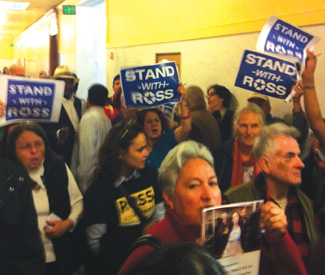
Mayor Ed Lee and his attorneys are presenting a voluminous yet largely speculative case against suspended Sheriff Ross Mirkarimi in their effort to remove him for official misconduct, broadening the case far beyond their most damning core accusation -– that Mirkarimi dissuaded witnesses from telling police that he bruised his wife’s arm during an argument on Dec. 31. And so far, there’s no evidence to support that key allegation.

In fact, Mirkarimi and his attorneys insist there was no effort to dissuade witnesses, one of many unsupported aspects to a case they say should never have been filed without stronger evidence. And they say the mayor’s team is now compensating for the weakness of its case by piling on irrelevant accusations and witnesses in an effort that amounts to character assassination.

There are even signs that the city is nervous about its case. Knowledgeable sources told the Guardian that the City Attorney’s Office last week offered to settle the case with Mirkarimi, offering a substantial financial settlement if he would agree to resign, an offer that Mirkarimi rejected.

It was one of a series of rapidly unfolding developments that also included a raucous Ethics Commission hearing, the disclosure of phone records by Mirkarimi’s side, a new list of charges, and the city’s release of the video Mirkarimi’s wife, Eliana Lopez, made with neighbor Ivory Madison, documenting the bruise in case of a child custody battle over their son.

Lopez has maintained that Mirkarimi never abused her and that she’s been hurt most by the efforts to prosecute him and remove him from office.

“I hope they realize after reflection that what they have done is irreparable and perpetually damaging to me and my family,” Lopez said in a statement condemning the city’s release of a video that she fears will remain online for her children and grandchildren to see.

Yet all indications are this spectacle is only going to grow more sordid, divisive, and sensational as it moves forward — belying the statement Lee made last week as he introduced his annual budget: “As many of you know, I’m a person who does not like a whole lot of drama.”

SIMPLE OR COMPLEX?

The May 29 Ethics Commission hearing to begin setting standards and procedures for the official misconduct proceedings against Mirkarimi illustrated two sharply divergent views on when elected officials should be removed from office. It also displayed the increasingly bitter acrimony and resentments on each side, emotions only likely to grow more pronounced as the hearings drag on for months against the backdrop of election season.

Both sides would like to see the decision as a simple one. Lee and his team of attorneys and investigators say Mirkarimi’s bruising of his wife’s arm and his unwillingness to cooperate with their investigation of what followed make him unfit for office. Mirkarimi and his lawyers admit his crime, but they say that’s unrelated to his official duties and that the rest of Lee’s charges against him are speculative and untrue.

Yet there’s nothing simple about this official misconduct case — or with the implications of how each side is trying to counter the others’ central claims. So despite the stated desires of some Ethics commissioners to narrow the scope of their inquiry and limit the number of witnesses, San Franciscans appear to be in for a long, dramatic, and divisive spectacle, with Mirkarimi’s fate decided by the Board of Supervisors just a month or so before the five supervisors who have been his closest ideological allies face reelection. Nine of 11 votes are required to remove an official.

The Mayor’s Office wants to call the most witnesses and present an elaborate (and expensive) case that includes a number of outside experts on law enforcement and domestic violence, painting a portrait of Mirkarimi as a serious wife-batterer whose past and future actions can be divined from that malevolent distinction, making him obviously unable to continue as San Francisco’s chief law enforcement officer.

“The extent of the abuse was far greater than what Mr. Mirkarimi has testified to,” claimed Deputy City Attorney Peter Keith, going on to say “there were attempts to control what she ate,” an apparent reference to Mirkarimi’s decision not to take Lopez to a restaurant for lunch on Dec. 31 because they were having a heated argument. He also repeatedly referred to Mirkarimi as a batterer and said “batterers behave in a certain way.”

Mirkarimi attorney Shepard Kopp calls that portrayal exaggerated and unfair, ridiculing the Mayor’s Office claims that its domestic violence expert, attorney Nancy Lemon, can predict Mirkarimi’s behavior based on grabbing his wife’s arm once: “Apparently she’s some kind of clairvoyant in addition to being an expert,” Kopp told the commission as he unsuccessfully sought Lemon’s removal from the witness list.

Ethics Commission Chair Benedict Hur took the lead role in trying to limit the witness list, focusing on stripping it of the various law enforcement experts who plan to describe how different agencies might react to dealing with Mirkarimi. “What I don’t understand is how his ability to do his job relates to whether he committed official misconduct,” Hur said.

Mirkarimi’s team says its case could be very simple, with only Lee and Mirkarimi called as live witnesses — but the attorneys reserved the right to offer testimony to counter false or damaging claims made by the Mayor’s Office.

Hur tried to limit the case to just witnesses and arguments that relate to Mirkarimi’s actions, but he was outvoted by those who wanted to let the city argue how those actions would affect perceptions of Mirkarimi by the many people that a sheriff must interact with.

In the end, the commissioners agreed to trim the eight expert witnesses sought by the mayor down to three and to cut its 17 proposed fact witnesses down to 12, calling 15 total witnesses. Mirkarimi’s team will call 10 witnesses, down from an initial 17. All witnesses will submit written declarations and then be subjected to live cross-examination if any of their testimony is disputed.

EVIDENCE AND SPECULATION

The speculative and prejudicial nature of some of the city’s case was attacked at the hearing by Mirkarimi’s attorneys and the large crowd that came to support him.

Commissioner Paul Renne asked the Mayor’s Office attorneys why they hadn’t summarized the expected testimony of their expert witnesses and “How are any of those opinions relevant to the issues in this case?”

“I have not had time to work with the witnesses to see what their opinions are,” replied Deputy City Attorney Sherry Kaiser, prompting Kopp to incredulously note, “The mayor is preparing the expert witnesses without knowing what their testimony will be. How can I respond to that?”

The issues of bias and conflicts of interest also came up surrounding what sources should be called as witnesses. Mirkarimi’s team wanted longtime Sheriff Michael Hennessey, Mirkarimi’s predecessor, while the Mayor’s Office pushed for Acting Sheriff Vicki Hennessy to convey how the Sheriff’s Department should function.

“Vicki Hennessy was a political appoint of Mayor Lee,” Waggoner objected, although the commission decided to use that appointee.

On several critical procedural questions, the commission sided with the Mayor’s Office, ruling that the commission decision needn’t be unanimous, that guilt could be established based on a preponderance of the evidence rather than beyond a reasonable doubt, and that normal rules of evidence won’t apply, with some hearsay evidence allowed on a case-by-case basis.

The pro-mayor decisions angered the roughly 200 Mirkarimi supporters who packed the commission hearing and an overflow room, many bearing blue “We stand with Ross” stickers and flyers, which had “Respect Eliana” on the flip side. There were only a couple of Mirkarimi critics at the hearing wearing white “I support Casa de las Madres” stickers, referring to the domestic violence group that has been calling for Mirkarimi’s removal since shortly after the incident went public.

Mirkarimi got a rousing welcome from the crowd when he arrived at the hearing, his voice choking up and eyes welling with tears as he said, “I cannot tell you, on behalf of me and my family, how grateful we are.”

The crowd was boisterous during the proceedings, loudly reacting to some claims by the deputy city attorneys and offering comments such as “Ed Lee is the one you should put on trial,” with Hur finally recessing the hearing after an hour and having deputies warn audience members that they would be removed for speaking out.

Renne, a career litigator and the District Attorney’s Office appointee to the commission, raised the most doubts about both the standard of guilt and rules of evidence being lower than in criminal proceedings, telling his colleagues, “I have some reservations.”

PHONE LOGS

Mirkarimi’s team also released to the Chronicle and the Guardian redacted phone records from Mirkarimi, Lopez, and Linnette Peralta Haynes — a family friend and social worker who served as Mirkarimi’s last campaign manager. The city has sought to portray Haynes, who has not been cooperating with the investigation, as a conduit to Mirkarimi’s efforts to dissuade Lopez and Madison from going to the police on Jan. 4.

Mirkarimi previously told the Guardian that he was unaware that Lopez had told Madison about the abuse incident or that they had made a video of her injury until several hours after Madison had called the police and they had come to the house to talk to Lopez, during which time Mirkarimi was in a series of meetings at City Hall.

The phone records seem to support that claim. They show that Lopez and Haynes — who is close to Lopez and recently went to Venezuela to visit her — exchanged a series of telephone calls on Jan. 4 starting at 11am. Their longest conversation, nearly 40 minutes, occurred at 11:18am.

Neither woman could be reached to describe the substance of that call. At 12:24pm, Lopez sent Madison — with whom she had been communicating by phone and text over the previous couple days — a text message indicating that she didn’t want Madison to report the incident to police, but that she would instead go to her doctor to document the injury.

A minute later, Madison called the police to report that Lopez had been abused by Mirkarimi.

Starting an hour later, the records show, Haynes and Lopez called each other but didn’t connect until 3:31, when they had a nearly 14-minute phone conversation, presumably discussing the fact that police had visited the house, with Lopez reportedly giving the phone to Madison at one point so Haynes could talk to her.

Yet the phone records indicate that neither Lopez nor Haynes tried to reach Mirkarimi until after that conversation, despite the city’s claims that Mirkarimi “or his agents” used his power to dissuade witnesses, most notably Lopez and Madison. The first attempt to reach Mirkarimi was at 3:46pm when Haynes called him twice but didn’t connect. Lopez then sent Mirkarimi a text message at 3:53pm asking “Where are you and where is the car,” but she got not reply. She texted him again at 4:18pm to say “Call me. It’s an emergency.”

Lopez made one last appeal to Madison in a 4:18pm phone conservation that lasted four minutes and 27 seconds and then she finally reached Mirkarimi by phone at 4:23pm. Mirkarimi and attorney David Waggoner say this is the first time that he became aware that Lopez had talked to neighbors and that the police had been called. Their conversation lasted a little more than five minutes.

Mirkarimi called Haynes at 5:12pm and they spoke for seven minutes. At 5:51pm, an increasingly panicked Lopez sent a text to Mirkarimi saying, “You have to call [Sheriff Michael] Hennessey and stop this before something happen. Ivory is giving the investigators everything. Use your power.” To which Mirkarimi responded 10 minutes later, “I cannot. And neither can he. You have to reject Madison’s actions. We both do. I cannot involve new people.”

NEW CHARGES

On June 1, the city released an amended list of charges against Mirkarimi that was intended to be a more specific list of accusations, as Waggoner requested during the May 29 Ethics Commission hearing. In it, the city asserts that the charter language essentially gives the city two avenues by which to remove officials, defining distinct “wrongful behavior” and “required conduct” clauses. Violation of either, they contend, is enough to remove an official.

“Official misconduct means any wrongful behavior by a public officer in relation to the duties of his or her office, willful in its character, including any failure, refusal or neglect of an officer to perform any duty enjoined on him or her by law…,” begins the charter language. This “wrongful behavior” section has long been in the charter, referring to specific actions by public officials to neglect their duties.

The second “required conduct” clause of this sentence — which was created in 1996, never vetted by the courts, and which Mirkarimi’s attorneys say is unconstitutionally vague — continues, “…or conduct that falls below the standard of decency, good faith and right action impliedly required of all public officers and including any violation of a specific conflict of interest or governmental ethics law.”

In trying to indict Mirkarimi for actions before he was sworn in as sheriff, the city attempts to argue that his official duties really began with his election, claiming that in this interim period he “had the duty and the power in his official capacity as Sheriff-Elect to work with the Sheriff’s Department and its officials to prepare himself to assume the full duties of Sheriff.” And if that’s not enough, the city argues that he was chair of the Board of Supervisors Public Safety Committee during that same Nov. 8-Jan. 8 time period, further subjecting his actions to official misconduct scrutiny.

The “wrongful actions” charges against Mirkarimi were listed in the document as domestic violence, abuse of office, impeding a police investigation, and “crime, conviction, and sentence,” while the “breach of required conduct” charges were listed simply as his sheriff and supervisorial roles.

The document then attempts to paint an expansive portrait of the Sheriff’s official duties, going beyond the narrow construction of the charter to include the general law enforcement duties listed in state law, interactions with various government and nonprofit groups, administrative responsibilities as a city department head, and passing mentions in the California Family Code that police officers “must enforce emergency protective orders in domestic violence cases.”

Yet the promise that the rest of the document would detail Mirkarimi’s wrongful actions with greater specificity than the previous list of official charges doesn’t seem to be met by this document, which repeats the same narrative of actions that Waggoner had criticized for vagueness.

For example, on the pivotal charge that he dissuaded witnesses and impeded the police investigation, the new charges say that during the period from Dec. 31-Jan. 4, “Sheriff Mirkarimi participated in and condoned efforts to dissuade witnesses from reporting this incident to police and/or cooperating with police investigators,” without describing any specific witnesses or actions that he took.

And by the mayor’s team’s own admissions, the prosecutors don’t know what Mirkarimi did to dissuade witnesses, which they hope to learn through future testimony.

The closest the new document comes to directly tying Mirkarimi’s actions to the official misconduct language is with Mirkarimi’s plea to a misdemeanor false imprisonment charge: “False imprisonment of a spouse is a crime of domestic violence. The California Penal Code considers spousal abuse to be a ‘crime against public decency and good morals.'”

Mirkarimi disagrees with that interpretation, noting that he and his attorneys specifically considered whether pleading to false imprisonment -– a general charge with many possible meanings -– would violate the city’s official misconduct provisions, and he told the Guardian that he was assured by his attorneys it didn’t. Mirkarimi told us he would not have entered the plea and would have instead fought the charges in court if he thought it would disqualify him from serving as sheriff.

Waggoner told us that “The Mayor’s Amended Charges are further evidence that this entire ordeal is a political hatchet job reminiscent of a Soviet show trial. Far from being a careful analysis of any actual evidence, the new charges are vague, redundant, and conflate the offices of Sheriff and Supervisor.”

But ultimately, the case against Mirkarimi is a political one, not a legal case subjected to the normal standards of evidence and procedure. And whether Mirkarimi keeps his job will be a decision made by politicians based on a variety of factors, some of which have little relation to whatever happened on Dec. 31 and Jan. 4.

What’s next: the Ethics Commission will meet on June 19 to rule on more of the outstanding issues in the case and begin hearing testimony. To review the long list of documents from the case, visit www.sfethics.org.


Don’t water down campaign laws

2

EDITORIAL The San Francisco Ethics Commission, which is hardly aggressive about cracking down on campaign-finance violations, has suggested some rule changes that would water down the city’s ethics laws. The supervisors should reject most of the suggestions — and start talking about real reform.

The commission has asked Sup. Scott Wiener to bring the changes to the board, and Wiener told us that he has problems with some of them and is going to be working with his colleagues, particularly Sup. David Campos, to fix the package.

It will need a lot of amendments to be acceptable.

The current proposal would make life easier for campaigns and big donors, but would make it harder for the public to figure out who’s putting up the money and where it’s going. For example, it would exempt from the spending cap all money spent complying with the ethics laws. That sounds fair at first glance — but the amounts involved are huge. For a mayoral race, as much as $147,000 would be exempted. That’s a lot of money for “compliance.”

More important, the ethics proposal would eliminate the restrictions on how much a single donor can give in an election season. Right now, the cumulative limit is $500 for each office on the ballot, which limits the impact that a handful of big-money contributors can have on an election. Under the new rule, a wealthy person who wants to make sure that every politician in town owes him or her can donate the maximum to a long list of candidates, giving more power to a few.

Wiener says that under ranked-choice voting, donors should be able to give to more than one candidate for a single office. Fine — but the cap doesn’t have to be eliminated. It could easily be amended to account for RCV.

The plan would somewhat loosen the reporting requirements in the last days of a campaign, eliminating weekend disclosures. It would decrease the transparency rules for campaign committees that shuffle money back and forth to hide its true source. It would aalow more spending by independent committees with less disclosure.

In other words, it would undermine the ability of the voters to know who is funding which candidates and initiative campaigns. There’s no reason to do any of that.

The problem with the current law is not that it requires too much disclosure — it’s that, in many ways, the controls on political money are too weak. And if the supervisors are serious about reform, there’s plenty to be done.

Ethics laws currently bar anyone who is seeking a city contract from donating to local officials. But it’s still perfectly legal for someone seeking a permit or zoning change to throw around cash. And there are endless problems with developers who need city officials on their side. Extending the contribution ban to anyone seeking special zoning or permit approval for any project with construction costs above a certain threshold — say, $10 million — would exclude, say, homeowners who want to build a new deck, but would limit the role of real-estate money in campaigns.

The amendments need eight votes to pass; before it even gets to the full board, the Rules Committee ought to ship this mess back to the Ethics Commission and tell the supposed watchdogs to try again.

THE CLEAN SLATE

0

>>Read our full endorsements here

President
Barack Obama

US Senate
Dianne Feinstein

US Congress, District 2

Norman Solomon

US Congress, District 12
Nancy Pelosi

US Congress, District 12
Barbara Lee

US Congress, District 13
Jackie Speier

State Senate, District 11
Mark Leno

State Assembly, District 17
Tom Ammiano

State Assembly, District 19

Phil Ting

Democratic County Central Committee

District 17 (East Side)

John Avalos
Matt Dorsey
Petra DeJesus
Jamie Rafaela Wolfe
Chris Gembinski
Alix Rosenthal
Leslie Katz
Gabriel Robert Haaland
Rafael Mandelman
Carole Migden
Justin Morgan
David Campos
David Chiu
Leah Pimentel

District 19 (West Side)

Mike Alonso
Wendy Aragon
Kelly Dwyer
Peter Lauterborn
Hene Kelly
Arlo Smith
Eric Mar
Trevor McNeil
Chuck Chan
Kevin Bard

STATE BALLOT MEASURES

Proposition 28
YES

Proposition 29
YES

SAN FRANCISCO BALLOT MEASURES

Proposition A
YES

Proposition B
YES

EAST BAY ENDORSEMENTS

State Senator, 9th District
Loni Hancock

State Assembly, 15th District
Nancy Skinner

State Assembly, 18th District
Abel Guillen

Superior Court, Office Number 20
Tara Flanagan

County supervisor, 5th District
Keith Carson

Oakland gets jilted

0

By Frank Artrage

news@sfbg.com

After a secret whirlwind courtship that lasted a mere five months, Mayor Ed Lee and the Golden State Warriors tied the knot May 22 at Piers 30-32, announcing their unexpected union at the site they intend to occupy with a new basketball arena by 2017.

The Warriors’ entrepreneurial new owners — Joe Lacob and Peter Guber — say they love this “iconic site” and promised to build a “spectacular sports and entertainment complex” that is “architecturally significant.”

But what about Oakland, the team’s unceremoniously jilted current homemaker? The perception from the East Bay is that Lacob and Guber were duplicitous and underhanded in their dealings with city officials that were desperately trying to retain the city’s three main sports franchises — the Oakland Athletics baseball club, the Oakland Raiders football team, and the Golden State Warriors basketballers — all of whom have recently signaled interest in moving.

Several sources told us that the Warriors’ new owners have been lying to Oakland officials about their intentions for months. For example, Oakland City Councilmember Larry Reid told me “that when our staff had conversations with the new owners, they always indicated they hadn’t yet come to a final decision.”

Reid told me what happened next. “I get a call Sunday night at 9:30 telling me about their move like a thief in the night.” Reid said. “It’s upsetting.”

On the fan site GoldenStWarriors, Lacob seemed to belittle Oakland. In an 18-minute video, Lacob predicts that Oakland will be left with only one sports team someday. “I think they’re challenged,” he said when asked what’s wrong with Oakland, adding the city is in “a difficult situation.”

Sports talk radio hosts, fan sites, and bloggers, however, seem to be evenly divided on the move. Even hardcore Oakland and Warriors blogger Ethan Sherwood Strauss prefers the San Francisco site. At his Warriorsworld site, Strauss wrote: “I’d never leave Oakland…. I have everything at arm’s length. There’s food from around the world, teeming farmers markets, lush green hills, Redwood trees, Mosswood Park, Grand Lake Theatre — this is all within two miles.”

But: “Guess which is the better place for the Golden State Warriors? It’s that west bay city national broadcasters keep showing during Warriors games while pretending Oakland doesn’t exist.”

Thus far, neither Oakland Mayor Jean Quan nor Mayor Lee have made any comments regarding the other side’s situation or whether their mutually reported “good relationship” has been strained. But it must be devastating to Quan, given all of her work and hoopla over her recent announcements surrounding her ambitious plans for the “Coliseum City” project.

Not unlike the Warriors’ “world class arena” planned for their new San Francisco home, Coliseum City, according to Quan, will be a “world-class sports and entertainment district.” Ryan Phillips, writing on the Oakland North blog in March, said that the project includes “building hotels, retail, office and residential space in the Coliseum complex…as well as building an Oakland Airport Business Park just across the freeway on the way to the airport. The business park will be developed to attract tech companies.”

Mayor Quan issued a press release following the Warriors’ bombshell to announce that she remains “bullish” on her Coliseum City project. Her new spin is that, “Coliseum City is a long-term development project that was never dependent on any one tenant. It was always a larger project than just one sports team.”

But if there’s even one team missing from the original trinity, then they have no choice but to lower their expectations and scale back their plans. Therefore, the Warriors’ move could trigger a complete unraveling of not only her recent plans to keep the Oakland A’s baseball team in Oakland, but also efforts to keep any team there.

For example, a case study published by the Airport Area Business Association (AABA) in conjunction with Coliseum City principal and manager Oakland-based JRDV Urban International, and students at UC Berkeley’s Haas School of Business found, The Coliseum complex presents a unique opportunity to prepare a pioneering business model that generates revenue for both public and private interests.”

Presciently, in the wake of this announced move by the Warriors and how that hurts Oakland, the study asked: “Are the withdrawal of redevelopment monies, the negative perception of Oakland (and especially Deep East Oakland) by investors and the soft commercial real estate market insurmountable? Can the City of Oakland and Alameda County garner the public support required to approve the necessary public financing and inspire investor confidence?”

Manning up, Councilmember Reid told me that Oakland bears some responsibility for this fiasco. “I’ve been agitating for 10 years to get this Coliseum project going. But let me tell you about two critical mistakes Oakland has made over the last decade,” he said. “One, Oakland has always taken the position that these teams had no place to go. Well, you see where that thinking got us today…Two, 10 years ago the decision was made to invest in the old [Oakland] Army Base. Yet, to this day, not one spade of dirt has been unearthed to symbolize any kind of progress is underway there. In fact, the whole project is at a standstill.”

Maybe, but Oakland and Warriors’ fans should not despair. It is not a done deal because a million things could go wrong. For example, this will be the fifth attempt to develop Piers 30-32 into something spectacular over the last several years.

Also, environmental groups and local activists are already squawking about the site. It has to pass a notoriously tough approval process of at least four major agencies. Financing might fall through, at least until Warriors ownership present to the press, government, and citizens some details: Tuesday’s press conference was basically a pep rally — the only thing missing were the pom-poms. Finally, Pier 30-32 and the site have yet to pass muster over the environmental and safety concerns and myriad other requirements of the California Environmental Quality Act (CEQA).

If any obstacle dooms the Warriors’ plans, Oakland’s Assistant City Administrator Fred Blackwell said they’d keep the door open for these prodigal owners: “And in the end, we will leave a space for the Warriors after they are exhausted from the CEQA litigation and cost increases required to be on the San Francisco Waterfront.”

“In a nutshell,” according to a City Hall press aide, Blackwell “means that waterfront development is expensive and requires an extensive and complex environmental review and permitting process involving review and approval by a number of local, state, and sometimes federal agencies.”

But what if it is a success? Oakland loses even more than just the Warriors. At least one politician pointed out, and I also heard this on 95.7 FM The Game, that what’s to stop circuses, ice shows, and major rock stars from ditching Oakland and following the Warriors to this splashy and scenic new entertainment venue?


Housing and highrise offices

0

EDITORIAL It's something of a civic shame that the only way San Francisco can build a new transit terminal is to sell a private developer the rights to stick a 1,070-foot highrise office tower on public land. In fact, it's a sad statement on the city, state, and local government: Once upon a time — and it wasn't the long ago — tax dollars collected through a progressive system paid for major infrastructure projects.

But there's no easy way to raise $4 billion in tax money for the Transbay Terminal — even though it ought to be seen as part of the high-speed rail project, and the federal and state government ought to be picking up the tab. So San Francisco ambles forward, selling land and lease rights to the highest bidder.

In this case, Gerald Hines of Houston won the right to build the largest highrise west of the Mississippi on property owned by the Transbay Joint Powers Authority. There are all sorts of drawbacks to the deal — among other things, it will cast shadows on a number of city parks, all the way to Portsmouth Square in Chinatown. Like any massive office complex, it will put pressure on Muni, on city streets, on police and fire and other city services — and no commercial office building ever pays its fair share of that burden. And since in this case the major recipient of the money from the project will be the TJPA, the city's General Fund will suffer.

Oh, and the building is ugly.

Meanwhile, city planners want to increase height limits all around the Transbay Terminal and allow hundreds of units of new (luxury) housing and more commercial office space. It's going to be a new highrise neighborhood, complete with a rooftop park and a few little patches of ground-level open space, which won't get a whole lot of sun, particularly in the morning and evening.

And at this point, there's been very little focus on what ought to be the defining issue of this and the other major developments on the city's planning horizon, and that's affordable housing.

This city has a terrible jobs-housing mix. The vast majority of the people who currently work in San Francisco can't afford to buy a house here, and many of them can only rent if they pay for more than the federal standard of one-third of their income for housing. So people who work in hotels and restaurants and city, state and federal offices and hospitals and even financial district companies wind up living far from the city and commuting. Nobody thinks that's a sound environmental policy.

And this kind of full-scale rezoning and development will only make it worse. According to the City Planning Department, the Hines project will pay about $27 million into the city's affordable housing fund, enough to pay for maybe 60 or 70 housing units. That won't even begin to cover the need created by the thousands of employees who will fill that tower. The market-rate housing on the site will almost certainly be beyond the reach of most San Franciscans, and probably many of the office workers who fill the Hines building. And only 35 percent of the new housing — at maximum — will be affordable.

San Francisco has to get a grip. The city can't keep allowing more high-end housing and highrise office space without a plan to meet its housing needs. We're glad to see the mayor talking about a $50 million a year fund, but that will barely meet existing needs; it can't possible keep pace with new development.

So before the supervisors rush ahead to approve this ambitious new downtown district, they need to ask Hines, and the TJPA, and any other developer who comes along, how it intends to meet the demonstrated need for affordable housing that these projects will create — and demand a much higher level of payment that what's currently on the city's books.

Reduce, re-use, replace

1

yael@sfbg.com

Greg Gaar knows the names, characteristics, and birds and butterflies attracted by every plant in the native plant nursery that he tends. Last week, he proudly toured me through the garden, pointing out plants like Yarrow ("great for bees and butterflies") and the beautiful flowers of the Crimson Columbine, of which Gaar believes there are "only two others left in San Francisco."

Gaar has been working at 780 Frederick St., where he now tends the garden, for decades. His mother went to high school on the same block, the old site of Polytechnic High. Before Gaar became the gardener, he ran the recycling center that Haight Ashbury Neighborhood Council (HANC) operates next to the garden. Now, the pioneering green operation he helped build may shut down.

At the center, people can recycle their bottles, cans, paper products, and even used vegetable oil, and make some cash along the way. Those who use the center say it's a green and dignified way to make some money.

But residents in the surrounding area have complained for years that the center is loud and attracts homeless people. They also say that, due to their proximity to the recycling center, the chance that their trash will get rifled through at night is greater than in other parts of the city.

Citing these concerns, the center's landlord, the San Francisco Recreation and Parks Department (RPD), has spent the past few years trying to evict the HANC recycling center. The center got an eviction notice in December 2010. HANC's lawyer, Robert DeVries, successfully challenged the eviction. RPD sued for eviction again in June 2011, and that matter may finally come to a close June 6 when it will be heard by a three-judge panel in SF Superior Court.

DELIVERING THE GARDEN


RPD officials cite neighbor concerns, claims that the recycling center's services are outdated and obsolete, and the idea of planting a community garden in its place. In fact, the Planning Commission approved a community garden in the place of the recycling center last year.

Since then, HANC staff got to work building its own community garden. In just a year, they erected 50 beds from recycled wood, and according to Gaar, about 100 neighbors have plots that they currently tend.

As the recycling center's director, Ed Dunn, tells it, the infrastructure already in place at the recycling center made building the garden come naturally. HANC was able to fund it with income from the recycling operation, and plant it with seeds from the native plant nursery.

Dunn emphasizes that no city money was used to build the current community garden. The city had laid out a $250,000 budget for the garden after it was approved and designed in 2010.

A bundle of documents containing arguments against HANC, provided by RPD, includes details of the Golden Gate Park Master Plan, surveys indicating a great need for community gardens in San Francisco, and letters and statements from neighbors complaining about the recycling center.

A 2004 survey discussed in the documents found that community gardens are among the top "recreation facilities most important to respondent households." Community gardens came in fifth in importance, after walking and biking trails, pools, fitness facilities, and running and walking tracks. The documents include a detailed map of the "Golden Gate Park community garden preliminary plan," imagined at HANC's current site.

The map was drawn up in November 2010, the same month that a meeting of the Recreation and Parks Commission laid out the reasons that HANC had to go. Minutes from the meeting include the city's need for community gardens as well as some neighbors' disdain for the recycling center in that site. It argues that the needs of recyclers can be well met with other recycling centers in the city.

Seventeen other recycling centers operate in San Francisco. Most are located in neighborhoods on the city's edges, with a few in the Outer Sunset and Excelsior, although most are located in Bayview-Hunters Point.

But the commission doesn't seem concerned with potential nuisance to neighbors in directing more traffic to these other recycling centers, or with the difficulty poor recyclers have in getting out there. "The San Francisco Department of the Environment is confident that recyclers that use the facility will take their material to another existing site for proper handling," according to the meeting's minutes.

The commission is, however, concerned about a nuisance that the recycling center creates for Haight-Ashbury neighbors, according to the minutes. The notes cite "neighborhood noise, truck traffic, litter, and public safety concerns as negative impacts related to continuing operations at the site."

AGAINST THE POOR?


But is this really just another case of resentment against people who are poor and homeless?

HANC's Dunn argues that, in fact, much of the material that those who use the center bring in isn't taken from residential waste bins. Besides, it's not technically "HANC's CRV redemption program" that encourages recycling as a revenue source for the less fortunate. State law requires that consumers be able to redeem bottles and cans for cash.

The meeting minutes argue that the recycling center "enables illegal camping and illicit and unhealthy behavior in Golden Gate Parks' eastern end and in neighborhoods in close proximity to the site."

Supposed evidence for the position cites letters to the editor published in the San Francisco Chronicle, a frequent outlet for anger at the homeless. One concerned resident, Karen Growney, asserts that the center "provides no benefit to people living in Haight/Cole Valley."

HANC disputes this, saying that many neighbors use the center. They have beneficial relationships with many nearby businesses, including New Ganges restaurant just across the street. Its website, kezargardens.com, shows many smiling neighbors who use the center to recycle.

Notable among them is actor/activist Danny Glover, a Haight resident since 1957. In a video on the website, Glover — interviewed while in his car dropping off recycling at the center — says, "I would be dismayed and not happy if we close this wonderful recycling center down…It would be a tragedy, and a great loss to this city and this community."

In her letter, Growney also laments that her family "had to pay a considerable amount to build a wrought-iron, locked gate to keep people out of our trash." Another letter, written by neighborhood resident Curtis Lee, asks that the city "eliminate the Haight Ashbury Recycling Center," saying that, "It is a blight on the neighborhood and an attraction to rodents and homeless carts."

Of course, those carts come with people. HANC takes issue with the assertion that their services "enable" or "encourage" homelessness, as well as the assumption that the recycling center only serves the homeless.

Dunn says that many of the recycling center' clientele are elderly immigrants, often housed, who contribute to their family income with cash from recyclables. He also insists that "most of the people that use the recycling center don't camp in the park."

Homeless people certainly do use the center, but it's not clear whether its presence truly "enables illegal camping and illicit and unhealthy activity." Dunn finds it laughable to say that "the center creates homelessness." It's a lot of work to cart around recyclables all day, he says, and the dedicated recyclers are generally not the same people that ask tourists on Haight Street for spare change.

THE RECYCLERS


There is a great diversity in how homeless San Franciscans spend their days, and recycling is in many ways a specialized, committed way of life. In her 2010 ethnography of homeless San Franciscans, Hobos, Hustlers and Backsliders, Teresa Gowan focuses on the "recyclers," the segment of the homeless population who have made a habit of collecting bottles and cans as a way of getting by.

"The phenomenon that captured my interest was the steady stream of shopping carts loaded high with glass, cans, cardboard, and scrap metal rolling past my door," she wrote.

Some of her interview subjects show disdain for the recyclers, who work hard all day and don't get much cash out of it. Dealing drugs, stealing, or panhandling can be more lucrative and less backbreaking. One subject, a man named Del who, according to Gowan, mostly stayed in the Tenderloin, thought the "20, 25 bucks on a big load" that recyclers usually made was pathetic. "'And that's for heaving around a big old rattling buggy all day,' Del said pityingly. 'I can make 15 bucks inside'a two minutes.'"

But many of her interview subjects prefer to recycle anyway. Gowan describes another subject, Sam, as "a champion recycler, muscular and persistent, who often put in nine, ten hours on the trot." She quotes Sam saying, "Without this, I'd kill myself. Couple a days, I'd do myself in…. You get some guys, seems like they can deal with homelessness. I'm not one of them."

The book argues that "pro recyclers" included a "large core group who had created an intense web of meaning around their work as a kind of blue-collar trade."

PIONEERING HANC


Recycling for cash may not be a respected or taxed job "blue collar" job. But it's certainly green.

Since the center began operating in the 1970s, mainstream attitudes towards environmentalism and sustainability have shifted dramatically. The HANC recycling center was a product of the environmental movement, and helped usher in the widespread support for recycling.

Now, with curbside recycling fully functional in San Francisco, many call the recycling center's work obsolete. But HANC argues that the city needs all the help it can get if it is to reach its goal for zero waste in 2020. It also employs 10 people, and Dunn argues that it would be foolish of the city to eliminate those stable green jobs.

HANC has also helped move along the trend towards community gardens that RPD is now embracing so thoroughly that, ironically, it could lead to the recycling center's demise. HANC helped underwrite the Garden for the Environment project as well as the Victory Garden planted outside City Hall in 2008. Dunn says that the staff enjoyed the challenge of building the garden, and would be interested in helping the city by creating more gardens without city money.

Gaar says he's committed to continuing to work for a healthier planet, regardless of what happens to the center. He and the other HANC staff have come to see the eviction process as symbolic of a direction in which the city's heading, that also includes last year's Sit-Lie Ordinance: decisions designed to shuffle homeless people out of wealthy neighborhoods.
The arguments for the community garden, however, seem to indicate a strong desire for a greener city. It's not easy balancing environmental initiatives with NIMBY woes — especially when your backyard is Golden Gate Park.

Sunshine eclipsed

1

As an advocate for the passage of the San Francisco Sunshine Ordinance in the early 1990s, I felt obligated to take my first and only City Hall position and serve as a founding member of the Sunshine Ordinance Task Force. I served for l0 years and helped with many other good members to build the task force into a strong and respected agency for helping citizens get access to records and meetings and hold city officials accountable for suppressing access and information.

The task force is the first and best local sunshine task force of its kind in the country, if not the world. It is the only place where citizens can file an access complaint without an attorney or a fee and force a city official, including the mayor, to come before the task force for questioning and a ruling on whether they had violated sunshine laws. The task force lacked enforcement powers, but it still annoyed city officials, including Mayor Willie Brown.

In fact, Brown spent a good deal of time trying to kick me off the task force. He used one jolly maneuver after another, even getting an agent to make a phony complaint against me for violating the ordinance with an email (The complaint went nowhere). I refused to budge and decided to stay on until Brown left office—on the principle that neither the mayor nor anybody else from City Hall could arbitrarily kick members off the task force.

That principle held until about 3pm last Thursday (May 17) at the meeting of the Board of Supervisors Rules Committee to appoint candidates to the task force. At that meeting, without proper notice, advance warning, explanation, apology, or even a nice word or two, the supervisors suddenly turned a normal drowsy committee meeting into an unprecedented bloodbath for the task force and its independence. Sup. Mark Farrell played the heavy, Jane Kim was the facilitating chair, and David Campos was the reluctant third party, working together to bring Willie Brownism back at the task force with a vengeance.

The committee rejected four qualified candidates from three organizations who are mandated by the Sunshine Ordinance to choose representatives for the task force because of the organizations’ special open government credentials. (Doug Comstock, editor of the West of Twin Peaks Observer; Attorney Ben Rosenfeld from the Northern California chapter of Society of Professional Journalists, sponsor of the ordinance; Allyson Washburn from the League of Women Voters and Suzanne Manneh from America New Media.)

The committee without blushing asked the organizations to come up with a “list of names,” a whiff of grapeshot aimed at members and organizations who had served the public well for years. Who wants to go before the supervisors on a list of names for a bout of public character assassination? Meanwhile, while knocking off the qualified, knowledgeable candidates, the committee approved four neophytes without experience and then unanimously appointed David Pilpel, a former task force member known for delaying meetings with bursts of nitpicking. He almost always comes down on the side of City Hall and against citizens with their complaints.

Farrell also tried to bounce Bruce Wolfe, an excellent member, but Kim and Campos supported him and his name was sent on to the full board for approval.

Then, when Wolfe’s name got to the board on May 22, it was a repeat of Willie Brownism and this time to the max. Sup. Scott Wiener moved to amend the motion and substituted Todd David. Farrell seconded. The vote was 6-5, meaning that Willie Brownism wiped the sunshine slate clean of anybody who would raise a pesky question of city officials and the City Attorney’s Office.

The infamous votes against Wolfe: Wiener (ah, yes, the heir of the Harvey Milk and Harry Britt seat in the Castro), Farrell (where is Janet Reilly when we need her?), Malia Cohen (who comes from the Potrero Hill/Bay View/Hunters Point district that needs all the sunshine it can get in facing an Oklahoma-style land rush of development), David Chiu (who was reportedly angry over the unanimous task force opinion finding he violated the Sunshine Ordinance with late submission of documents before the controversial vote to redevelop Parkmerced), Carmen Chu and Sean Elsbernd (neighborhood supes way out in West Portal and the Sunset who almost always vote the downtown line at City Hall). The good votes for Wolfe: John Avalos, Eric Mar, Cristina Olague, Jane Kim, and David Campos.

Campos told me that the organization candidates were “eminently qualified,” that they should have been appointed, and that he would fight for them. He advised the organizations to “stand by their candidates.” He is urging that the issue of organization candidates come back to the next Rules Committee.

Rick Knee, SPJ’s mandated journalist on the task force surveying the carnage, said the supervisors’ actions stem “partly from a desire by some supervisors to sabotage the task force and ordinance itself, and partly from a vendetta by certain supervisors after the task force found several months ago that the board violated local and state open meeting laws when it railroaded some last minute changes to a contract on the Parkmerced development project without allowing sufficient time for public review and comment.”

Knee is right, and it isn’t just Parkmerced, but all the high-stakes development deals flowing through City Hall these days, with their advocates preferring to cut backroom deals rather than being subjected to the full scrutiny of the public and the task force.

James Chaffee, a former chair of the task force, watched the board proceedings with outrage and fired off a letter to all supervisors later that day. He charged that the board in sacking Wolfe violated the Sunshine Ordinance on several counts. Among them: the board changed the committee recommendation on Wolfe without allowing public comment and it passed over Wolfe even though the ordinance requires at least one member of the task force to be “physically handicapped.” That was Wolfe.

Thus, Chaffee wrote, the orchestrated coup was “the perfect example of a failure to follow the sunshine ordinance that led to the sort of problem that it was intended to forestall, namely the supervisors taking an action without being informed of what they are doing.  If Scott Weiner and David Chiu and the rest of the crew did not consider the citizens the enemy and exercize judgment about whether they were complying with the spirit of open government rather than just shaving off the letter of the law as closely as possible, this could have been avoided.”

Chaffee said he couldn’t tell if David was physically handicapped but he said nothing in his application for the task force nor was any disability apparent from the video of the rules committee meeting.

Chaffee said David’s  application showed he  was “self-employed as an investor, obtained a BA from Stanford in 1993, has never attended a task force meeting, and left the statement of his qualifications blank.”

Chaffee said, “It’s easy to see why Scott Wiener likes him. He said it would be a long road before he would go against the city attorney’s office and when it came to constitutional law, he would place the city attorney’s opinion above his own because the city attorney is an ‘expert.'”

I sent Chaffee’s letter and my Bruce Blog post ( “The return of Willie Brown to the Sunshine Task Force,” 5/21) to City Attorney Dennis Herrera for comment: How can his office sit by while the letter and spirit of the sunshine laws are being violated in the move to sabotage the sunshine ordinance and task force? I also sent Chaffee’s letter, with the Bruce blog, to the supervisors with similar questions: Why  are you violating the sunshine laws to kick out the best candidates? For their answers (coming)  and the latest on this evolving controversy, follow along at  www.sfbg.com/bruce.

There you have it:  the state of sunshine and open government in city hall in San Francisco in May of 2012. Todd David over Bruce Wolfe. David  Pilpel uber alles.  Five inexperienced candidates over five experienced candidates. David Pilpel uber alles. A city attorney who rolls over and over and over again. And a whiff of grapeshot for the three organizations mandated by the charter to have represenatives on the task force  because of their open government and public access credentials (the Northern California chapter of the Society of Professional Journalists, the League of Women Voters, and America New Media.)  On guard,  b3


Outer Mission opposition

1

steve@sfbg.com

HERBWISE Most medical marijuana dispensaries in San Francisco are clustered around the central part of the city, with the heaviest concentration in SoMa, leaving patients in many outlying parts of the city — such as the Outer Mission and Excelsior districts — with long journeys to visit a cannabis club.

That began to change in February when the Planning Commission approved permits for three new dispensaries to open in the Excelsior: venerable delivery service The Green Cross will open its first brick-and-mortar operation on the 4200 block of Mission, while Tree-Med and Mission Organics each won approval to locate on the 5200 block. All three clubs had been in development for years, delayed by a state case challenging new dispensaries that went all the way to the Supreme Court.

But Steve Currier, president of the Outer Mission Merchants and Residents Association, has appealed the building permit for the first of that trio of clubs to apply for one, Mission Organics, and he allegedly whipped up anti-pot hysteria in the neighborhood that included an April 21 protest march spanning the three dispensary sites.

David Goldman, a member of the city’s Medical Cannabis Task Force, said the Feb. 16 appeal hearing and April 21 demonstration — which he said also included supervisorial candidate Leon Chow — were marked by inaccurate statements that dispensaries attract crime and are harmful to children, even though all three dispensaries are more than 1,000 feet from schools.

“People who are ignorant assume we’re all a bunch of hoodlums or stoners looking to get high,” Goldman said. “We want them to realize that dispensaries don’t bring crime to neighborhood. If anything, it’s the opposite,” he said, citing the value of people, video cameras, and security guards on the street as a crime deterrent, particularly on blocks with vacant storefronts, as is the case with these blocks.

Neither Currier nor Chow returned Guardian calls or emails. Attorney Dorji Roberts, who represents Mission Organics owners Eugene Popok and Mike Mekk, said that he’s also had a hard time reaching project opponents to address their concerns before a Board of Permit Appeals hearing set for June 20.

“We’ve asked them for a meeting recently, but he won’t respond and he can’t articulate any real reasons why he has a problem with it,” Roberts said of Currier and his group.

Roberts said that Popok had attended meetings of the OMMRA to try to integrate into the group and address any concerns it might have, but they were surprised when the project got appealed after being approved 5-2 at the Planning Commission (Tree-Med’s vote was also 5-2, while The Green Cross won unanimous approval), where they saw their first hints of opposition.

“They’re saying it will be a density issue, even though no clubs are out there now,” Roberts said. “They say it will increase crime, which also isn’t true…It’s the same kind of fears and phobias that are offered by people who just don’t like [medical marijuana or its legality].”

Goldman, who had people monitoring the April 21 protest march, said the group would praise businesses along the way while condemning the dispensaries, as one point chanting, “Liquor stores, yes, pot stores, no,” a dichotomy he considers telling of the kind of moralism driving the appeal.

“Fundamentally,” he said, “it’s an attack on patients.”


To Yelp at City Hall

1

By Anne Stuhldreher

OPINION If you attended any of the oodles of mayoral debates during last fall’s election, you surely heard every candidate say two things: One, that they’d make city government more accountable to San Franciscans — and two, that they’d harness technology to make city services better.

Now that Mayor Ed Lee is settled into office, there’s an easy and affordable way he can make good on this promise. It would give a megaphone to San Franciscans fed up (or delighted) with city services, letting them tell City Hall — and each other — what is and isn’t working with their tax dollars. It would amplify consumer power, increasing the responsiveness the public sector the way it has the private one.

San Francisco should be the first city to list all municipal services on one of the existing user-review websites that thousands of San Franciscans already rely on to critique restaurants, drycleaners, and auto repair shops. City Hall leaders would encourage all San Franciscans to get online and post reviews, to tell them what happens when they apply for a business license or send their kids to a city camp. Yelp and Citysearch are two user review sites that San Franciscans use right now.

This wouldn’t have a big price tag. Lee would simply mandate that every city service include a prominent icon on its web site asking users to “rate them” on the site. At every window and desk where public servants serve San Franciscans, there’d be a sign encouraging the public to share their experience on the site. Reviews on user review sites aren’t a feedback form sent to nowhere. People’s comments are seen by everyone.

Such open feedback has spurred thousands of businesses—from restaurants and retailers to doctors and dentists — to be more customer-focused and make better decisions with scarce resources.

Public servants and elected politicians are extremely keyed into public sentiment. They just often lack ways to gauge it. Feedback from public reviews would give them a clear picture of what successes they can tout and what problems they need to fix so they can benefit the most people and voters.

Imagine if you could look at online reviews before you went to apply for this permit or pay that fee. People would have written about good and bad times of day to go. They would have written about how much time it takes. They also would have written about which staff were friendly and which were rude.

I know I’d use it. I’d want to see what parks people think are good for toddlers and which ones are better for bigger kids. And what other parents think of different schools, camps, and pools. I’d also use it let the City know when I’ve called 311 three times to get an obscenity painted over in Dolores Park (that my kids walk by every day) but nothing has happened.

For inspiration, city leaders could look to the Family Independence Initiative, a coalition of working-class families in the Bay Area who grew frustrated after bad experiences with local programs. Nothing changed when the parents approached program leaders. So they set up an online rating system so parents could compare notes on services like childcare, job training, or after school-programs.

As decisions are made to dice up the shrinking budget pie to best serve San Franciscans, City Hall needs to hear from San Franciscans. Most city residents don’t have a lobbyist at city hall, but they have a lot to say.

Anne Stuhldreher is a Senior Policy Fellow at the New America Foundation

State of debate

yael@sfbg.com

On May 24, a panel of three Jewish activists and authors from the Bay Area will discuss the historical figures and ancestors that inspire their work today. The event was originally scheduled to take place at the Jewish Community Library, operated by the Bureau of Jewish Education (BJE), which is largely supported by the Jewish Community Federation (JCF, or “the Federation”).

Leaders at the BJE canceled the event in January after discussions about its content with organizers of the panel, who then found another venue: Congregation Sha’ar Zahav. That seemed like a harmless turn of events that has nothing to do with the Israeli-Palestinian conflict, at least not directly.

But with the current state of discourse in the Bay Area’s Jewish community, just beneath the surface are complex dynamics that raise issues of censorship, bonds forged by religion, whether certain criticisms of Israel should be off-limits, and a battle for the hearts of minds of Jews in the diaspora.

Anti-war activist Rae Abileah has found herself at the middle of this battle. She is on the panel to discuss her great uncle Joseph Abileah, an Israeli pacifist who was charged and tried in 1949 after he refused to join the army as part of Israel’s mandatory military service.

Abileah is a member of Code Pink who is outspoken about her opposition to the Israeli occupation in Palestine. The panel is meant to discuss decades-old work, not the current state of affairs domestically or in Israel, but Abileah’s inclusion made it too political for some.

In March, the panelists — which also include Julie Gilgoff and Elaine Elinson — and event organizer Diana Scott wrote an open letter to the Jewish Community Library saying, “We find it particularly troubling that an act of censorship has occurred at the Library — an institution that it supposed to be a symbol of open thought in learning in the Jewish Community.”

David Waksberg, the director of the BJE who was instrumental in the decision-making process, said it was nothing of the sort. “We had very honest, productive, and respectful discussions about why the program wasn’t for us,” he told me.

The letter concludes: “We seek to make clear that Federation policies, designed to foster the appearance of Jewish solidarity by shutting down the vital exchange of ideas in the Jewish community, are divisive and intolerable. They are also ultimately ineffective in suppressing dissent, and, paradoxically, undermine the values and mission of some of our most cherished Jewish institutions.”

“The Jewish Community Federation didn’t tell us whether or not to do this program,” Waksberg insists. “They didn’t pressure us one way or another.”

The open letter also discusses funding guidelines, adopted in 2010 by the Federation. The guidelines restrict funding for events that “endorse the BDS (boycott-divestment-sanctions) movement or positions that undermine the legitimacy of the State of Israel.”


DELEGITIMIZING ISRAEL?

The guidelines have meaning beyond these specific circumstances. They represent a conflict in what counts as diversity of opinion, what counts as dissent, and the incredibly loaded concept of “delegitimizing Israel.”

The guidelines were a response to a controversial 2009 screening of Rachel, a documentary on the life of Rachel Corrie, a 24-year-old who was killed when she stood in front of a bulldozer on its way to level a Palestinian home. The film was screened at the San Francisco Jewish Film Festival followed by speaker Cindy Corrie, Rachel’s mother. The film-going crowd yelled and booed, and the Federation threatened to quit funding the festival.

The next year was declared by some Jewish leaders to be the Year of Civil Discourse. The Jewish Community Relations Council (JCRC), the self-described “central public affairs arm of the organized Bay Area Jewish Community,” organized a year of programming and discussion, with an aim to “elevate the level of discourse in the Jewish community when discussing Israel.” The J Weekly, the magazine of the Jewish Bay Area, reported that “[organizers] agree that the Year of Civil Discourse was a success,” though these organizers acknowledged their work was far from over.

Indeed, the controversies rage on. Two months before the Year of Civil Discourse officially ended Dec. 13, the Museum of Children’s Art in Oakland canceled an exhibit, “A Child’s View from Gaza”, that would have showcased drawings by Palestinian children, after pressure from Jewish organizations.

The director of the JCRC, Doug Kahn, became a spokesperson against the exhibit, butting up against groups like the Middle East Children’s Alliance and Bend the Arc (formerly Progressive Jewish Alliance). In March, an event that would have featured author and journalist Peter Beinart lost support after the JCC of the East Bay learned that one of the event’s moderators was on the board of Bend the Arc. Add this panel to the mix, and the six months since the Year of Civil Discourse ended have proven how taboo topics like BDS and Israeli violence in Palestine remain volatile.

BDS in particular has emerged as an untouchable issue. The campaign is a result of a 2005 Palestinian call for boycott and divestment from Israeli companies, and economic sanctions on Israel. BDSmovement.net, which provides news and background information regarding BDS efforts, lists three goals to the protest: “Ending [Israel’s] occupation and colonization of all Arab lands and dismantling the Wall; recognizing the fundamental rights of the Arab-Palestinian citizens of Israel to full equality; and respecting, protecting and promoting the rights of Palestinian refugees to return to their homes and properties as stipulated in UN resolution 194.”

The campaign has seen effects worldwide. Abileah has organized to promote BDS, in particular working to get Bay Area stores to stop carrying Ahava, skin-care products made in what she calls an illegal Israeli settlement in Palestine.

The BDS campaign is “a tried and true nonviolent tactic to get the Israeli government to uphold international law,” Abileah told me. “We decided to be in solidarity.”

But some Jewish leaders feel BDS goes too far.

“The term delegitimizing Israel refers to the intent to eliminate the Jewish and democratic State of Israel by portraying it as an illegitimate nation,” Kahn wrote in an email. “The boycott/divestment/sanctions movement’s leadership has made clear that this is their ultimate agenda and one of the movement’s explicit objectives would achieve that aim resulting in a dire threat to nearly half of the world’s Jewish population that lives in Israel.”

BDS is mentioned several times in the Federation funding guidelines, and stands out as the only specific example of what it means to “undermine the legitimacy of the state of Israel.”


ISOLATE THE EXTREMISTS

But organizations like the Federation and the JCRC aren’t the only ones interested in the path that Israel-Palestine discourse among Bay Area Jews takes. The Reut Institute, a think tank based in Tel Aviv, “has been committed to responding to the assault on Israel’s legitimacy since 2008,” according to the introduction to its 2011 report: “San Francisco as a Delegitimization Hub.”

The report ranks San Francisco and London among the “few global hubs of delegitimization.” It also warns of the dangers of San Francisco in particular as top-delegitimizing city, noting “the role of the San Francisco Bay Area as a generator and driver of broader trends, or as a hub of social experiments…What won’t pass in San Francisco won’t pass anywhere else, and what happens in San Francisco doesn’t stay in San Francisco.'”

San Francisco gets this attention from Reut because of dissent within its Jewish community, which the institute calls globally unparalleled. “While in London delegitimization is being promoted primarily by groups that are not part of the Jewish community…an increasing number of Jews in the San Francisco Bay Area have become ‘agnostic’ towards Israel, and are fueling the delegitimization campaign.”

The report’s authors, Reut’s “national security team,” do not spend much time explaining what “delegitimizing Israel” means. When it does, BDS again stands out as one of the only concrete examples. According to the report, in the Bay Area “the number of individuals who are willing to stand up for Israel is declining while others have been fueling the delegitimization campaign, many times unintentionally, by engaging in acts of delegitimization — namely, actions or campaigns framed by their initiators as a reaction to a specific Israeli policy, which in practice aim to undermine Israel’s political and moral foundations. Examples include support for the BDS movement and the 2010 Gaza Flotilla,” a protest in which ships full of supporters and cargo tried to make it to Palestinian land in violation of an Israeli embargo.

The report labels those looking to delegitimize Israel “extremists.” It warns, however, that those questioning Israel’s policies, when rebuked by its “tradition defenders,” may be swayed into trusting the extremists. It therefore advocates a “broad tent approach,” advising that Jews in the Bay Area initiate a “community-wide deliberation” with an “aim to…drive a wedge between the extremists and those who principally support the legitimacy of Israel’s existence regardless of policy agreements.”

It’s important, according to the report, to make sure that supporters of BDS are seen as “extremists.” The “broad tent” is supposed to contain all Jews, with a diversity of opinions — except those supporting BDS and other acts of “delegitimization.” In light of this goal, the report praises the Federation’s funding guidelines and the Year of Civil Discourse.

“Through the funding guidelines drafted by a JCRC-JCF Working Group…the San Francisco Bay Area has set the standard nationally as the first American Jewish community to develop guidelines delineating red lines that go hand-in-hand with the broad tent approach,” Reut reports. “Additionally, we regard the Year of Civil Discourse…led by the JCRC, as important best practices that could be emulated in other places.”


ORTHODOXY

The Bay Area’s left-leaning Jewish organizations may be influential, but under such a hot spotlight, they tread carefully. Congregation Sha’ar Zahav is one such organization. Last year, the synagogue surveyed its members to test opinions on Israel.

“In general, the survey shows that we have a liberal left-leaning congregation,” said Terry Fletcher, a member of Sha’ar Zahav who now heads a committee created to follow up on the survey results. “People tend to blame, shall we say, both sides of the conflict, both Israelis and Palestinians, somewhat equally.”

Fletcher’s committee has organized events and discussions in the wake of the survey since January. “One idea was that we would start with something non-controversial,” Fletcher told me. “But we couldn’t think of anything that everyone on the committee considers non-controversial.”

The programming has featured discussions on evolving relationships with Israel and questioned their nuances. But Fletcher says they haven’t been able to venture into BDS territory.

“I would love it if we could get to a place where we could actually address that,” Fletcher reflected. “And we would want to do it from a balanced perspective. But it’s such an emotional issue.”

There are practical concerns as well. According to Fletcher, the Federation gives a small amount of funding for scholarships for Sha’ar Zahav’s religious school. The money that funded Fletcher’s committee’s programming came from Sha’ar Zahav’s general fund, when there was enough of it. She says that the committee is now operating without a budget due to tight finances. Even so, if the committee’s programming were to breech the Federation’s funding guidelines, it might put the program in jeopardy.

“To me, that’s what’s so problematic about these guidelines,” Fletcher said. “The guidelines are saying, if you want money from us, we have restrictions on what your organization can do. Even though our programming is not funded by the Federation, because it funds something completely unrelated, it could get cut.”

Fletcher also questions that paradigm of “delegitimizing Israel.”

“I think this is a term that people who defend Israel use to label people who criticize Israel in a certain way,” she said. “Many of us would answer that it’s Israel’s own policies that are delegitimizing Israel in the eyes of the world. I don’t find it a useful term.”

Sha’ar Zahav will be hosting the Reclaiming Jewish Activism panel. Davey Shlasko, a member of the congregation who helped facilitate the new arrangement, thinks the concern about Abileah’s associations were misplaced.

“I think it is unfortunate that the predicted objection to Rae’s other work was enough of a concern to cancel an event that is actually about drawing inspiration from our ancestors,” Shlasko told me via email.

But it’s in looking back at history that the panel acquires so much meaning. “It is safe to say that living in the United States, Jews have never been more empowered, safe, and connected to the community they live in,” mused one source, who wished to remain anonymous. “It is inevitable that with such success, the need to band together changed. The group identity changes. Sometimes it’s that fight, that need to rally together, that keeps the group intact.”

For Abileah, “the event will be Jewish activists talking about our ancestors.” She’s upset about the event’s cancellation, but not surprised.

“For a lot of Jewish people it can be challenging to speak out against this issue because you don’t know where your friends stand on this, or your synagogue or even your family,” she said. “There are a lot of people who we say are PEP: progressive except Palestine. My family and community have been supportive, but I’ve gotten hate mail and threats of violence.”

“It sounds like these Jewish institutions that are censoring have so much power, like they’re the mainstream Jewish voice. But I think the majority of Jewish Americans want a resolution to the conflict and are opposed to the occupation,” she said.

And how does she think Joseph Abileah would react to this situation? “I’d like to think that he would be shocked and hurt by it,” she said. “It’s sad to see so much fracture in the Jewish community over this issue.”