News and Politics | San Francisco Bay Guardian

News & Opinion

On the Cheap Listings

0

Submit items for the listings at listings@sfbg.com. For further information on how to submit items for the listings, see Picks.

WEDNESDAY 5

Humpday happy hour Good Vibrations, 2504 San Pablo, Berk.; 1620 Polk, SF. www.goodvibes.com. 6:30-7:30pm, free. The strap-on: a necessity to many, mind-boggling to others, both to some. In Berkeley, tool over to your local Good Vibes for this guided shopping event where experts will talk to you about what you need to look for in a falsie friend. At the chain’s Polk Street location, GV employees will demystify the 50 Shades of Grey phenomenon. What will it take for you to recreate a scene with your own Christian Grey? Chances are, you’ll find the tools you need here.

THURSDAY 6

"Captured: Specimens in Contemporary Art" Bedford Gallery, Lesher Center for the Arts, 1601 Civic Dr., Walnut Creek. (925) 295-1417, www.bedfordgallery.org. Through Nov. 18. Opening reception 6-8pm, $5. Trend watch! Throughout our history, humans have appropriated the natural world as raw material for our bizarre artistic impulses. Nowhere is this more true than in Walnut Creek, where a new exhibit opens showcasing reassembled taxidermy, curiosity cabinets, and specimen boxes.

Geoff Manaugh talks applied topology Banatao Auditorium, Sutardja Dai Hall, UC Berkeley. (510) 495-3505, bcnm.berkeley.edu. 5-7pm, free. Things we know: Manaugh used to be a senior editor at Dwell Magazine, and a contributing editor at Wired UK. Currently, he runs a think tank for the Columbia University architecture department. Today’s UC Berkeley talked will be, according to the press release, about "burglary, tunneling, and urban perforation." In other news, UC Berkeley can sometimes create really confusing press releases.

Fillmore Fashion Night

MADison Avenue party Cartoon Art Museum, 655 Mission, SF. www.cartoonart.org. 7-9pm, $5-500. Celebrate the closing of "What, Me Worry?: 60 Years of Mad Magazine" at this little downtown shrine to the drawn and funny. Early 1960s attire is encouraged – in fact, you’ll get your date in for free if you’re both wearing Mad Men-style flair.

FRIDAY 7

Paralympics viewing party LightHouse for the Blind, 214 Van Ness, SF. (415) 694-7350, www.lighthouse-sf.org. 6-8pm, free. RSVP recommended. This center for the visually-impaired is celebrating its brand-new entertainment center with this party for the London 2012 Paralympic Games. Yes, there will be pizza.

"Party Like It’s 1906" One City One Book launch party The Green Arcade, 1687 Market, SF. www.sfpl.org. 7pm, free. It’s always a good idea to celebrate author-sociologist Rebecca Solnit, and no day better than today, when the SF Public Library launches a citywide reading of her community-forged-in-disaster book A Paradise Built in Hell. It’s the eighth time the library’s encouraged the city to read together, and today Solnit will be on hand, and snacks they were noshing around the time of the 1906 SF earthquake will be available like oysters, sourdough bread, and beer.

Night Market Public Works, 161 Erie, SF. www.publicsf.com. 5-9:30pm, $5. "Bacon Crack" chocolates, vegan soul food, and champagne funnel cakes go fabulously with a ukulele chanteuse — as any attendee of Forage SF’s upcoming Night Market will be able to attest. The organization dedicated to promoting ultra-local nourishment has been striking gold with this recurring nightlife-snack event, at which local small vendors rub elbows with the Bay’s musicos, DJs, and of course, party-hard foodies. Check out Uni and Her Ukulele, the 29th Street Swingtet, and Izzy*Wise.

KALX 50th anniversary art exhibit opening Rock Paper Scissors Collective, 2278 Telegraph, Berk. kalx.berkeley.edu. 6-9pm, free. For a half-century, UC Berkeley’s been home to 90.7 FM, a.k.a. KALX, where John Lennon talked People’s Park riots and Green Day crashed when they came to town. Come tonight to check out a collection of KALX paraphernalia, flyers, and historic photos.

SATURDAY 8

All You Can Dance Alonzo King Lines Dance Center, 26 Seventh St., SF. dancecenter.linesballet.org. 1-5pm, $5. Don’t know jack about dancing? Take a four-hour crash course today, with a sampling of mini-courses on ballet, flamenco, Chinese movement, hip-hop, modern, and more. Teachers will be on hand to possibly turn you on to a whole new beat of your heart.

Babylon Salon Cantina, 580 Sutter, SF. www.babylonsalon.com. 7pm, free. Explore the Bay at this evening of readings – you’ll hear tales from a special education classroom, from assassinated journalist Chauncey Bailey’s finals days and ensuing trial, plus words from the "refreshingly off-kilter" (according to the NY Times Book Review) Lysley Tenorio. Cash bar on-site.

SUNDAY 9

The Last Picture Show free screening Berkeley Underground Film Society, The Tannery, 708 Gillman, Berk. berkeleyundergroundfilms.blogspot.com. 7:30, donations suggested. Small town life examined, in this film about Anarene, Texas, and a bunch of kids just trying to get along. High school honey Jacey is the babe every one wants, but will the perfect sweetheart be enough to counteract the slow death of the town she calls home?

TUESDAY 11

Jefferson Graham’s "Video Nation: A DIY Guide to Planning, Shooting, and Sharing Great Video" The Booksmith, 1644 Haight, SF. (415) 863-8688, www.booksmith.com. 7:30pm, free. These days, it’s all about video. Author Graham knows it – that’s why he compiled this book on how to create the best footage for bloggers, web show hosts, and small business owners. The USA Today columnist and tech video host shares how to get your clip to go viral.

Women’s comedy night The Layover, 1517 Franklin, Oakl. www.feelmore510.com. 7pm, free. Sponsored by downtown Oakland’s sex-positive community shop Feelmore510 (a Best of the Bay 2012 winner!), this evening is for female-focused yucksters. Grab a drink, peruse the art that covers the Layover’s walls, and ready yourself for quips.

Alerts

0

WEDNESDAY 29

Bernal Heights outdoor cinema Roccapulco Supper Club, 3140 Mission, SF; www.bhoutdoorcine.org. 7pm, $10 suggested donation. The first of five nights of film screenings in Bernal Heights. At this kickoff party, enjoy drinks, food and music from the Bernal Jazz Quintet before a lineup of short films celebrating community and organizing in the Bay Area. Films include Berkeley High School students on heritage and identity, "Occupy the Auctions Dance Party!" in which Occupy Bernal and ACCE stop evictions on the steps of City Hall, and a tour of Alemany Farm (also the beneficiary of the event’s ticket price), among others. The event also includes the announcement of winners of the Best of Bernal and Spirit of Bernal Awards and the first-year recipients of the Mauricio Vela Youth Film Scholarship.

Occupy, the state of the movement Mediterranean Café, 2475 Telegraph, Berk; www.occupyoakland.org. 7-10pm, free. Einar Stensson, a sociologist at Stockholm University and activist at Occupy Stockholm during the fall of 2011, studied Occupy Oakland for two months. Why did the movement start and spread so quickly around the globe? How is Occupy organized? Who matters in the movement and why? What is the future of Occupy? Come hear his perspectives on where Occupy is, locally and internationally.

FRIDAY 31

Occupy the Bay The 25th Street Collective, 477 25th St., Oakl; www.occupyoakland.org. 6pm, $25. "This week in Oakland, California will go down as a watershed moment. People across America were disgusted by what they saw here. Average Americans trying to stand up and peacefully assemble, to be brutally savaged and attacked by the police department that they pay for." So said Michael Moore to a fired up crowd in the wake of the Oct. 26 Occupy Oakland eviction that rained tear gas and rubber bullets on demonstrators. This is just one of the many historic events caught on tape by filmmakers Jonathan Riley and Kevin Pina, whose documentary Occupy the Bay is screening around the Bay Area before it starts showing in film festivals. On Friday, stick around for special musical performances from Jabari Shaw, Shareef Ali and Super Natural.

Enemies of the state: In their own words Station 40, 3030B 16th St., SF; station40events.wordpress.com. 7pm, free. After a year of Occupy and years more of struggle by people who are not down with the state, there are a lot of people in jail and prison. At this event, organizers will read writing from those locked up. Poems and statements from Truth and Kali of Occupy Oakland and a statement from Jesse Nesbitt, the May Day brick-thrower we profiled ("Who is the Brick Thrower?" 5/8/12). As the event description says, "Any effort at anti-repression in the face of lengthy prison terms must be aimed at bringing down separation at all costs." Come fight the separation and connect.

Original Plumbing birthday celebration Elbo Room, 647 Valencia, SF; www.originalplumbing.com. 10pm, $3-6. Original Plumbing, the trans male quarterly magazine, is throwing a party celebrating its third year on this planet. It now lives in the Brooklyn part of the planet, but it all started in San Francisco, and they’re coming back here to party. "We feel that there is no single way to sum up what it means to be a trans man because we each have different beliefs, life experiences, and relationships to our own bodies," say the organizers, and they started the magazine to document this diversity of experiences. Celebrate with the editors Amos Mac and Rocco Katastrophe, and performances by Rocco Katastrophe with special guests Billie Elizabeth, Nicky Click & Jenna Riot. Birthday cupcakes available!

TUESDAY 4

Rally to save City College City Hall steps, 1 Polk, SF; ProtectOurCityCollege@gmail.com. 12pm, free. A rally in support of Prop A, the local ballot measure that would create a parcel tax for revenue to City College of San Francisco. "If City College is to survive and maintain accessibility, educational quality and the mission of serving low-income and underrepresented students with the best educators and staff, we must pass Prop A," say organizers of the rally, which include students, teachers, staff and supporters.

Feeding a movement

0

yael@sfbg.com

Keith McHenry was in Tampa, feeding fed-up (and hungry) Republican National Convention protesters, when we spoke by phone. Next he’ll head to Charlotte to do the same for those protesting the Democrats, and then to New York for Occupy Wall Street’s anniversary on Sept. 17.

Everywhere he goes, he’ll feed the masses home-cooked vegetarian meals. But unlike the other protesters, McHenry helped invent the system that gets them fed. He helped to found Food Not Bombs, the organization that salvages food that would otherwise be thrown out, cooks it up, and serves free, tasty meals in public squares throughout the world.

McHenry served the first meal in Boston Common in 1980, then moved to San Francisco a few years later, bringing the movement with him. Now, there are 500 chapters in the United States and hundreds more throughout the world.

“We provided food for 100 days at the Orange Revolution in the Ukraine,” McHenry recalls. “We fed a two-year occupation in Sarajevo. We provided food at Camp Casey,” Cindy Sheehan’s anti-war stakeout at then-President George W. Bush’s ranch.

The FNB approach to hunger is pretty simple: There’s enough food to go around, it’s just not distributed right. So activists find ways to distribute food that would otherwise be thrown out. San Francisco FNB gets donations of extra, unsold food from places like Rainbow Grocery and Other Avenues food co-op.

It was started by anti-nuclear activists, thus the “Not Bombs” part. But there’s more to their analysis than a cry for peace. As the group states, “For over 30 years the movement has worked to end hunger and has supported actions to stop the globalization of the economy, restrictions to the movements of people, end exploitation and the destruction of the earth and its beings.”

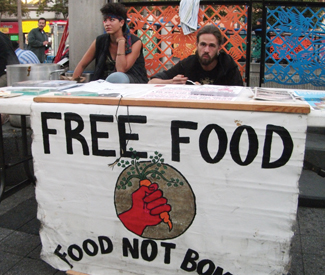
A typical Food Not Bombs operation features a table with a vegetarian or vegan meal, maybe some produce, and anti-war and other leftist literature and banners. In 1988, this is what was on the table when the San Francisco Police Department cracked down on Food Not Bombs, arresting dozens for serving food at the entrance to Golden Gate Park at Haight and Stanyan.

“We had our sign such that when you walked in at the corner of Haight you would see the words Food Not Bombs for a block and a half,” McHenry recalls. “What was good about that was you had tourists, and local business people, and local workers, and you had the people in the Golden Gate Park, all coming together to eat at that place. It was really perfect.”

FNB still serves there on Saturdays, but that perfection was disrupted by a high profile series of arrests in 1988, then again a few weeks ago, when Parkwide, the Recreation and Parks Department’s new bike rental program, set up in their old spot.

Food Not Bombs still runs into conflicts with police and courts. Last year, McHenry was one of 24 arrested in Orlando, Florida, spending 19 days in jail after protesting an ordinance making it a crime to feed the homeless in the city’s downtown.

Last week, FNB held its world gathering at Occupy Tampa’s tent city, serving daily breakfast and dinner while planning the future of the movement. Occupy Tampa has only grown in recent weeks as it hosts people in town to protest the RNC. Sharing food and shelter, making art, and protesting politicians doing the bidding of greedy corporations is McHenry’s vision made reality — and one he got to see bloom last fall with the birth of Occupy.

As McHenry tells it, he and others from Food Not Bombs have been part of a decade-long buildup to the “occupy” tactics that erupted into the world in 2011. “I was promoting the idea of occupation ever since a meeting that was held in 2003 after Cancun,” he said. Protests at the World Trade Organization meeting in Cancun were part of a growing trend of disrupting international conventions in which political and business leaders make agreements that further exploitation and neo-liberalism. But McHenry says that more was needed.

“There was a group of us that got together and said these one-off events, like summits, were just becoming more disempowering rather than successful,” he said.

After years of calling for occupations, the notion clicked last fall. “We had seen the Arab Spring, so that made it that much easier to imagine the occupation concept. And the Spanish occupations were just then happening.”

“That’s a common thing,” McHenry said. “People try all these different ways of organizing and then all at the same time, the same thing will start to click. And there’s no real way to say, ‘oh, it started here, it started there, this person started it.'”

When Occupy encampments sprang up, Food Not Bombs was behind many of the kitchens and food sharing efforts — it even had a guide to building a tent city kitchen at foodnotbombs.net/occupy_supplies.

“In the beginning of some of the first occupations like Chicago, DC, Wall Street, we made peanut butter and jelly sandwiches, because we didn’t know if we would get busted,” McHenry said. “We ended up behind the scenes helping provide free meals to the occupations.”

McHenry said he hopes the spirit of occupying grows again. “It’s so important,” he said. “It would be great if we could regroup and retake public space.”


Portable pollution

11

news@sfbg.com

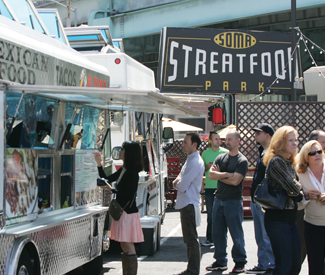
With its decidedly hip aesthetic and clientele, San Francisco’s food truck trend may be naturally assumed to be environmentally sound and health conscious. But the rapidly expanding craze may actually be creating air pollution and endangering the health of their employees in ways that aren’t yet being regulated.

Although the mobile eateries are held to a few of the same standards as their brick and mortar counterparts, such as food hygiene and sanitation, the gas-powered portable generators that provide needed energy to the trucks are a tricky beast to tame. The exhaust-heavy portable generators do not fall under the San Francisco Department of Public Health’s radar of regulation, according to its Food Safety Program Director Richard Lee.

“There are combustion products from the generators being generated while the truck is parked and operating,” he told the Guardian. “The generators are needed to power lights, fans, refrigerators, etcetera. SFDPH does not monitor or regulate the generators.”

The lack of monitoring on the generators may not be due to a lack of need for regulation, but rather the difficulty in doing so. Given that most of the generators are used to power relatively small vehicles, their small size inhibits them from meriting the attention of the California Air Resources Board (CARB) after their initial manufacture.

A CARB-compliant generator has met with the organization’s restrictions on various organic gases, nitrogen oxides, sulfuric oxides, carbon monoxide, carbon dioxide, and particulate matter. However, the generators are only monitored at the point of manufacture, with their in-use emissions going unregulated.

Furthermore, Bay Area Air Quality Management District spokesperson Aaron Richardson tells us that despite the BAAQMD’s 28 air monitor stations, the localization of the fad and the trucks themselves would make it difficult to see the effects of the generators as a regional issue.

“The concern would be they may not all operate in the same ways,” he said. “I think that if the trucks…are running back up generators, it’s going to emit some pollution. It’s something I think we will be doing more research on, but at this point it’s not looking like it’s a dramatic impact on air quality. CARB regulates all mobile sources, and lot of these trucks use individual generators. At this point, we only regulate back up diesel generators…of 50 horse power or above.”

So BAAQMD doesn’t regulate the generators because they’re gas-powered, and they don’t trigger CARB’s post-production attention, despite that agency’s current efforts to reduce the state’s carbon footprint.

CARB spokesperson John Swanton explained that given the small size and localization of the generators, it’s up to the individual communities to decide how to approach the situation.

“It’s up to the community to decide if they can bear the expense of a highly regulated community. In the terms of restaurants — which is what food trucks are — what are the community’s standards and regulations?” he said. “When we sell, say, a Honda generator, we have ideas of how that’s going to be used…We try to make it as clean as practically possible, but the idea is that it’s not gonna run 24/7 at the same location. If it’s going into a food truck and the food truck is going into a particular district, then it becomes the decision of the city and the air quality management [district].”

It seems, then, that no one is really regulating the exhaust emissions coming from the hordes of trucks that travel up Haight, down Market, into Fort Mason, and sit in clusters downtown, in SoMa, around City Hall, and other spots around town.

But at least they aren’t dirty diesel fuel, right? Perhaps the BAAQMD and the city of San Francisco have no need to regulate the teensy-eensy bit of gasoline generator exhaust.

Yet according to SFDPH spokesperson Imelda Rayes, there are now approximately 300 (registered) mobile food facilities in San Francisco. That means the number has nearly tripled since the mere 120 registered MFFs that were scouring the streets in 2009. What they lack in horse power, the generators may make up for in sheer multitude.

“In a period of three years, the number has increased almost 250 percent and [we’re] still getting more applications,” she said.

In addition to cumulative impacts, there are also questions about the health impacts on food truck employees.

Studies like such as the 2009 “Modeling the Effects of Outdoor Gasoline Powered Generator Use on Indoor Carbon Monoxide Exposures” by academics Liangzhu Wang and Steven Emmerich brings up a different concern: gasoline generators create emissions of poisonous carbon monoxide.

“The generators are always positioned outside of the vehicle. The workers are inside,” Lee said. “We would not expect that there is significant employee exposure to the generator exhaust to the employees.”

Yet the U.S. Centers for Disease Control and Prevention (CDC) reported that half of non-fatal carbon monoxide poisoning incidents in the 2004 and 2005 hurricane seasons were due to the gas-powered generators used to heat homes, even when placed outside the homes themselves.

Food truck generators, given their smaller size, are often placed much closer to the trucks and their workers than in the case of houses and their inhabitants. Furthermore, the trucks often idle for long periods to keep the food warm and utilities working.

“At this point, it’s enough of a new thing…We’re interested in finding out more about them, but at this point we are not receiving many complaints,” Richardson said. “A lot of variables are involved. It’s something I think we will be doing more research on.”

After the game of verbal hot potato that was research for this article — it seems every agency deferred to another in terms of exactly who is monitoring these things — Swanton assured us that the danger doesn’t seem imminent.

“In general, small engines [portable generators] are dirtier than an engine providing motor power to a vehicle,” he said. “But the sheer number of these cleaner engines dwarfs everything.”

True, but the food trucks that run for more than a few hours at one location are increasing in numbers at a rapid pace. With the high number of mobile food trucks in operation, most of which utilize some form of generator or another, it may be time to nail down those pesky variables involved and draw some conclusive evidence on the potential environmental and health effects of our city’s seemingly innocent snack time.

Jesus-free food

0

“For I was hungry and you gave me food, I was thirsty and you gave me drink, I was a stranger and you welcomed me,” Jesus supposedly said way back when. In San Francisco, there are a multitude of churches that offer free food to the hungry (find a handy list at www.freeprintshop.org).

But what follows is a list of secular organizations that share food — for the planet, for self-determination and providing for community outside of the system, for healthy food untainted by hormones, pesticides and GMOs, for food not grown by exploited workers, and for many other reasons, these groups bring food straight to the people.

FREE FARM STAND

Where: Parque Niños Unidos, 23rd St. and Treat. When: Sundays, 1-3pm. Numbers given out at around noon. The Free Farm Stand gives out food and flowers grown at the Free Farm on Eddy and Gough, where local volunteers grow and harvest produce. They also share local organic surplus produce left over from several farmer’s markets and produce brought in from neighbors and from locally gleaned fruit trees.

The philosophy of the Free Farm is food sovereignty. Why should anyone go hungry, or go broke, feeding themselves and their kids? Instead, they figure, they should get for free what the earth gives. They facilitate this by offering the farm’s harvest — as well free sprouts and plants, that people can use to grow food themselves.

“The solution to the problem of hunger is to share the abundance that’s out there and to encourage people to grow food and share some with those in need.” said a Free Farm Stand organizer. “We can set up neighborhood networks of people growing food and sharing their surplus.” The Free Farm Stand is a step towards that vision.

BETTER DAYS TO COME

Where: Tuesday, 16th and Mission, Thursday, Turk and Taylor. When: 6pm. Some of the folks at Better Days to Come have God in mind, but the organization’s founder, Leonard Fulgham, came from not the churches but the prisons. As its mission statement says, “Mr. Fulgham began mentoring many of the younger inmates, while having the unique opportunity to hear their stories. Many of their stories outlined how they landed in the prison community and why they continued to return. Being homeless upon release back into society is a commonly known contributing factor to these ex-offenders being hungry while being starved by the lack of job training and vocational skills.” Fulgham passed away March 24, 2012, and in his memory, the organization began serving two hot meals a week.

CURRY WITHOUT WORRY

Where: Civic Center Plaza at Hyde and Market. When: Tuesdays 5:45-7pm. Curry Without Worry serves vegetarian food, mostly Nepali and mostly with five courses, in San Francisco every week. It does the same at its other branch in Kathmandu. Shrawan Nepali once owned a restaurant, Taste of the Himalayas, but used the proceeds to start Curry Without Worry and eventually sold it when “I realized I was not a businessmen.” Instead, he’s a man who feeds people a vegan five-course meal, which includes a sauce made from timur, herbs that grow in his Himalayan hometown but are rare in the US. “Our mantra is healthy food for hungry souls,” says Nepali.

FOOD NOT BOMBS

Where and when: Monday, UN Plaza at 6:30pm and 16th and Mission at 7pm. Wednesday, UN Plaza at 6pm. Thursday: 16th and Mission at 7pm. Saturday: Haight and Stanyan at 5pm. After 30 years, Food Not Bombs still serves almost daily in San Francisco at a few locations throughout the city. Volunteers cook meals then bring them out to the people, bringing home the message that there’s enough to go around and you shouldn’t need money to feed yourself. The Saturday team still shares food at Haight and Stanyan, where Food Not Bombs first parked three decades ago.

FOOD BANK OF AMERICA

Where: In front of the Bank of America at 2701 Mission. When: Thursday, 5pm until food runs out. Occupy-related people, carrying on from the giant Food Bank of America action on Jan. 20, when the Bank of America at the Embarcadero locked its doors after activists set up a food table and hung two interactive banners where passers-by could write what fit under the category “person” and what fit under the category “corporation.” They hung a third banner saying Food Bank of America, hundreds ate a hot meal, and the concept caught on. Now, people who have been gathering food donations for Occupy and otherwise give away fresh produce and hand out information about credit unions weekly in front of the bank.

COMMUNITY FEED

Where: Mendell Plaza, at Third and Oakdale. When: Every third Sunday, 10-2. A few organizations, including the Black Star Riders Coalition and the Kenneth Harding Jr. Foundation, work together to put on this food giveaway every other week. It takes place in Mendell Plaza, the square that some have renamed Kenny’s Plaza after Harding, who was killed in the plaza at 19 years old after a dispute with SFPD officers over bus fare. “First, we definitely want to honor Kenny, that’s why we got there,” said Tracey Bell-Borden, one of the organizers of the Community Feed. “But there’s been a lot of activity in that area for a long time. So it’s really about healing the community,” she said. “We have to take care of our community.”

Parting gift

0

news@sfbg.com

Retirement is knocking at Ed Harrington’s door. But the San Francisco Public Utilities Commission general manager is hesitating, not quite able to muster the will needed to walk out the door. He has something that he wants to finish first.

The sage city veteran has labored for years to launch an historic program so transformative that it would finally allow city residents and businesses to reject a homicidal utility monopoly and the dirty electricity that it sells. Success could be mere weeks away; failure would be a bitter blow.

Twice in the past 27 months, Harrington and his staff have fumbled efforts to launch the city’s long-promised community choice aggregation (CCA) program. The program, CleanPowerSF, would give Pacific Gas & Electric (PG&E) customers the option of switching over to a publicly backed electricity provider selling green, climate-friendly power.

The energy would continue to be ferried into homes and other buildings over PG&E’s electrical grid, and customers who switch would continue to receive their bills from PG&E. Those gas and electricity bills could initially swell by an average of one quarter, but the mix of power that they pay for would jump from 20 percent renewable up to 100 percent renewable.

Harrington’s previous CleanPowerSF launch schemes collapsed in mid-2010 and again early last year without getting off of the ground, largely because nobody — neither the city nor private industry — would shoulder the large financial risks. Unlike those failed efforts, which would have offered a private company virtual carte blanche to sell power to as many PG&E customers as possible, the latest CCA proposal resembles a successful program operating in Marin County. The Marin program started small in early 2010 and is already growing at a rapid clip as it pursues true energy independence.

For the next few weeks, despite having previously planned to retire in August, Harrington will oversee a last-ditch effort to drive approval of his latest iteration of CleanPowerSF by the Board of Supervisors. “I’ve offered to stay into September so that we can have the CCA discussions at the board,” Harrington told the Bay Guardian.

Harrington declined to discuss the latest version of CleanPowerSF, the real and perceived financial risks of which will be hashed out by the Budget and Finance Committee, referring questions to a spokesperson.

But environmentalists and local “green jobs” advocates who just 12 months ago were panning CleanPowerSF, ready to block its passage through the board, are now lauding it. They say the change came about after Harrington met directly with them and seemingly changed his own mind about how the program should be run.

The program would initially see Shell Corp. sell 20 to 30 megawatts of renewable electricity generated in far-flung places to fewer than 100,000 residential customers. Instead of fostering new supplies of renewable energy, San Francisco residents may initially buy power at premium prices from existing wind, solar, and other green facilities. That might make San Franciscans feel warm and fuzzy, but it wouldn’t necessarily reduce the nation’s overall carbon footprint.

The activists agree that it’s a crying shame to get into bed with an evil multinational oil company. But they say it’s an acceptable start, as long as the program evolves into something far more meaningful — into something resembling the Marin Clean Energy model. Like in Marin, the activists want San Francisco to use CleanPowerSF revenues to help build its own solar, wind, and other renewable energy and energy efficiency projects, many of them right here in city limits. They want the city to sell those power and the energy efficiency gains directly to CleanPowerSF customers.

Over the coming years, the SFPUC could gradually add enough clean electricity at competitive rates into the CleanPowerSF mix, generated by its own facilities and purchased off the open energy market, to meet the needs of all the city’s residents and businesses.

The build-out of solar power plants and other renewable energy facilities has always been imagined as an integral element of CleanPowerSF. But until last October, critics say SFPUC officials were treating the build-out as an afterthought, making little effort to lock in plans to move forward with the construction as a structured part of a CCA program.

“The SFPUC staff decided they wanted to do this the easy way and just buy energy,” said Eric Brooks, a regular at City Hall hearings who chairs the San Francisco Green Party’s sustainability committee and has spent years working with the SFPUC on CleanPowerSF. “They wanted to do that because it was easy — you can just declare victory.”

Once the general manager started to meet directly with local activists, Brooks says, “Harrington started hearing what we had been saying to the staff for all these years about how important the build-out is.” Harrington began to understand the importance of a renewable energy build-out that begins as soon as the new program launches. In turn, the activists threw their support behind Harrington and the program.

Brooks said that the build-out of city-owned renewable energy facilities could create thousands of jobs. It could also lead to energy independence in a city where environmentalism is a badge of honor, but where PG&E continues to sell nuclear and polluting fossil fuel energy without facing any competition.

“This is the perfect solution to the climate crisis and the economic crisis,” Brooks said. “We need to create a green New Deal. That’s the depth of crisis that we’re in, economically and environmentally.”

Such a build-out is also expected to build support for the program at the Board of Supervisors. Without it, the City Controller’s Office calculated that the city’s economy could take a hit to the tune of $8 million over five years after CleanPowerSF launches in the spring in additional electricity expenses, potentially jeopardizing about 100 jobs. But that analysis failed to consider the thousands of jobs that could be created laying panels, installing turbines, and performing other tasks if the city develops its own renewable energy supplies as a part of the program.

It’s impossible right now to say precisely what type of renewable energy facilities would be built by San Francisco: A $2 million study that would paint that picture is planned. But Paul Fenn, president of Local Power Inc., which is helping the SFPUC prepare to call for bids from companies interested in building the facilities, said they could include everything from solar panel arrays to customers’ energy efficiency gains to a wave energy plant.

The first CleanPowerSF committee hearing is scheduled Sept. 12, followed at some point thereafter by an historic board vote that will almost certainly prove contentious, likely pitting the board’s progressive members who have long supported public power against some of its fiscal conservatives.

Much of the debate will focus on an initial $19.5 million investment by the city. Of that money, about one-third would be used as collateral — a pool of cash held in escrow and available to reimburse Shell if the program flops. SFPUC spokesperson Charles Sheehan said the $7 million in collateral would gradually be recouped by San Francisco if the program moves forward successfully.

Another $2 million would fund CleanPowerSF customers’ energy efficiency programs; $2 million would help customers install solar panels; and $2 million would be spent on the study to determine how best to build out the portfolio of renewable energy plants owned by San Francisco. The rest of the money would cover operating and startup expenses, and it could be recouped later through power sales.

In a town where PG&E wields tremendous political and financial influence, proposing to gamble public funds establishing a competitor to the company is always sure to be thoroughly scrutinized, if not outright opposed and criticized. Supporters of the program, however, say that the gamble is a safe and necessary one that could have sweeping workforce and economic benefits.

“I don’t think that we can afford not to do CCA,” said Sup. David Campos, the program’s most active supporter on the Board of Supervisors. “So long as something like CCA is not in place, PG&E will continue to be the only game in town. I think it’s important for us to give consumers in San Francisco an alternative to PG&E.”

CleanPowerSF has long suffered an identity crisis that has harmed its prospects of legislative approval. Opponents deride it as a public power scheme and they work on behalf of PG&E to quash it. But ardent public power supporters do not see it that way: They consider CleanPowerSF to be little more than a minor stepping stone toward public power, and they have not rallied around it nearly as much as they have rallied around some of the storied yet unsuccessful public power campaigns of years past.

If Harrington can clinch lawmaker approval for CleanPowerSF before he retires, he will have provided city residents with a lasting choice in what kind of electricity they buy.

“I think that any effort to compete with PG&E is seen as public power,” Campos said. “But this is really about providing a choice.”


Alerts

0


Wednesday 29

Bernal Heights outdoor cinema Roccapulco Supper Club, 3140 Mission, SF; www.bhoutdoorcine.org. 7pm, $10 suggested donation. The first of five nights of film screenings in Bernal Heights. At this kickoff party, enjoy drinks, food and music from the Bernal Jazz Quintet before a lineup of short films celebrating community and organizing in the Bay Area. Films include Berkeley High School students on heritage and identity, “Occupy the Auctions Dance Party!” in which Occupy Bernal and ACCE stop evictions on the steps of City Hall, and a tour of Alemany Farm (also the beneficiary of the event’s ticket price), among others. The event also includes the announcement of winners of the Best of Bernal and Spirit of Bernal Awards and the first-year recipients of the Mauricio Vela Youth Film Scholarship.

Occupy, the state of the movement Mediterranean Café, 2475 Telegraph, Berk; www.occupyoakland.org. 7-10pm, free. Einar Stensson, a sociologist at Stockholm University and activist at Occupy Stockholm during the fall of 2011, studied Occupy Oakland for two months. Why did the movement start and spread so quickly around the globe? How is Occupy organized? Who matters in the movement and why? What is the future of Occupy? Come hear his perspectives on where Occupy is, locally and internationally.

Friday 31

Occupy the Bay The 25th Street Collective, 477 25th St., Oakl; www.occupyoakland.org. 6pm, $25. “This week in Oakland, California will go down as a watershed moment. People across America were disgusted by what they saw here. Average Americans trying to stand up and peacefully assemble, to be brutally savaged and attacked by the police department that they pay for.” So said Michael Moore to a fired up crowd in the wake of the Oct. 26 Occupy Oakland eviction that rained tear gas and rubber bullets on demonstrators. This is just one of the many historic events caught on tape by filmmakers Jonathan Riley and Kevin Pina, whose documentary Occupy the Bay is screening around the Bay Area before it starts showing in film festivals. On Friday, stick around for special musical performances from Jabari Shaw, Shareef Ali and Super Natural.

Enemies of the state: In their own words Station 40, 3030B 16th St., SF; station40events.wordpress.com. 7pm, free. After a year of Occupy and years more of struggle by people who are not down with the state, there are a lot of people in jail and prison. At this event, organizers will read writing from those locked up. Poems and statements from Truth and Kali of Occupy Oakland and a statement from Jesse Nesbitt, the May Day brick-thrower we profiled (“Who is the Brick Thrower?” 5/8/12). As the event description says, “Any effort at anti-repression in the face of lengthy prison terms must be aimed at bringing down separation at all costs.” Come fight the separation and connect.

Original Plumbing birthday celebration Elbo Room, 647 Valencia, SF; www.originalplumbing.com. 10pm, $3-6. Original Plumbing, the trans male quarterly magazine, is throwing a party celebrating its third year on this planet. It now lives in the Brooklyn part of the planet, but it all started in San Francisco, and they’re coming back here to party. “We feel that there is no single way to sum up what it means to be a trans man because we each have different beliefs, life experiences, and relationships to our own bodies,” say the organizers, and they started the magazine to document this diversity of experiences. Celebrate with the editors Amos Mac and Rocco Katastrophe, and performances by Rocco Katastrophe with special guests Billie Elizabeth, Nicky Click & Jenna Riot. Birthday cupcakes available!

Tuesday 4

Rally to save City College City Hall steps, 1 Polk, SF; ProtectOurCityCollege@gmail.com. 12pm, free. A rally in support of Prop A, the local ballot measure that would create a parcel tax for revenue to City College of San Francisco. “If City College is to survive and maintain accessibility, educational quality and the mission of serving low-income and underrepresented students with the best educators and staff, we must pass Prop A,” say organizers of the rally, which include students, teachers, staff and supporters.

Full circle

52

steve@sfbg.com

When Mayor Ed Lee suspended Sheriff Ross Mirkarimi in March, he publicly took the position that it was an act of official misconduct when Mirkarimi grabbed his wife’s arm during a Dec. 31 argument, subsequently pleaded guilty to false imprisonment, and was placed on probation for three years.

Lee and his allies said that under those conditions, Mirkarimi could no longer effectively function as the city’s top elected law enforcement officer and that his actions clearly violated the City Charter’s ban on "conduct that falls below the standard of decency, good faith and right action impliedly required of all public officers."

The City Attorney’s Office, through deputies Peter Keith and Sherri Kaiser, has maintained that position throughout the investigation and Ethics Commission proceedings over the last five months. On August 16, on a 4-1 vote, the commission agreed and recommend the Board of Supervisors find its former colleague guilty of official misconduct, which would almost certainly result in his removal from office.

But that simple set of facts and interpretations belies the ugly spectacle that Lee and the City Attorney’s Office actually decided to create — at great cost to taxpayers, Mirkarimi’s reputation, and the public’s faith in the proceedings — over the last five months.

Instead of sticking by their initial position, Lee and his attorneys decided to pile on a long list of other official misconduct charges: dissuading witnesses to his crime, impeding a police investigation, abusing his authority in several ways, engaging in a pattern of abuse of women, refusing to cooperate with a city investigation, lying to officers in a scheme to keep a gun, and other charges.

Almost all of those accusations were included in the original written charges that Lee filed on March 21 — before the city had actually begun its investigation to learn whether there was any evidence to support them. Keith and Kaiser continued to make all those accusations right up until the end.

When the Ethics Commission finally deliberated on August 16, going through each of the main factual allegations against Mirkarimi, one by one, it unanimously agreed that there wasn’t enough evidence to support any of those other charges, even using the "preponderance of evidence" standard that is lower than the "beyond reasonable doubt" standard used in criminal cases.

So in the end, the case against Mirkarimi ended at the same place where it began: with the question of whether pleading guilty to a misdemeanor act of domestic violence warrants the removal of an elected official. But the implications and repercussions of what has transpired over these last five months could be felt for many years, in ways that it’s impossible to predict today.

WHAT IS OFFICIAL MISCONDUCT?


With very few legal precedents to guide them, the commissioners spent most of the nine-hour hearing on Aug. 16 wrestling with how to interpret the city’s untested new official misconduct language, how directly the wrongful behavior must relate to the office, and whether broadly interpreting those two issues gives too much power to the mayor.

Underlying that discussion is the question of whether the statute and the city’s interpretation of it will eventually be struck down as unconstitutionally vague by the courts, which Mirkarimi will likely turn to if the board removes him from office. But the commission pointedly refused to enter that debate, with Commissioner Jamienne Studley saying, "I don’t think determining constitutionality is what I signed on for as a commissioner."

Chair Benedict Hur, the sole dissenter in recommending a finding of official misconduct, expressed far more concern about the precedent they were setting than with the fate of Mirkarimi, whose actions he strongly condemned as "clearly wrongful and unlawful."

"There has to be a direct relationship of the behavior to the office held," Hur said. "If we don’t find a nexus, we are opening this provision up to abuse down the road."

Commissioner Paul Renne led the charge in interpreting misconduct in the broadest possible way, arguing it didn’t even have to be related to his official duties. "There’s nothing in that clause that says the misconduct has to relate to the office," Renne said.

But Hur called that a "dangerous precedent," saying he has "grave concerns" about how such a broad interpretation could be applied in the future. "I have a lot of concerns about where you draw the line if you don’t relate it to official duties," he said.

For example, could members of the Board of Supervisors be removed after getting arrested at demonstrations — as has happened many times before in connections with labor and other disputes — or even for using colorful language with constituents or colleagues that might violate a future mayor’s "standard of decency?"

Mirkarimi attorney Shepherd Kopp said there’s a good reason why recall is the preferred means of removing an elected officials accused of wrongdoing, calling the charter "an imperfect document" that can’t cover all circumstances — indeed, it doesn’t allow for the removal of mayors, even those who commit serious crimes — noting that "this is a rarely brought proceeding and it can have the effect of contravening the will of the electorate."

"These proceedings," Kopp said, "are far too susceptible to the vagaries of politics."

THE PILE-ON


Lee’s decision to overcharge Mirkarimi could be a costly one. The City Attorney’s Office won’t release expenses associated with ongoing legal actions like this one, but most indications are that it will run into the millions of dollars, perhaps many millions depending on how Mirkarimi fares in the courts if he is removed and challenges the city’s actions.

According to the City Attorney’s Office, the official misconduct proceedings against former Sup. Ed Jew in 2007 cost the city $381,505 in legal fees, but that was a relatively short and simple proceeding, with just one Ethics Commission hearing and couple of state court appearances before the case was settled.

By contrast, the case against Mirkarimi has already entailed five months of detailed exchanges between the two sides’ attorneys, covering a wide array of legal issues, and months-long investigations of matters only tangentially related to the core charge. The city has paid out money for expert witness. Mayor Lee cast a wide net to catch the fish that he had already hooked before setting out to sea.

Even if the Jew case had played out to completion, it would likely have cost just a fraction of what Mirkarimi’s will, for a simple reason: Mayor Lee acted quickly and brought a broad array of charges before investigating them. Then-Mayor Gavin Newsom investigated whether Jew really lived in the city and then brought just that narrow charge.

The simple residency question was enough to warrant Jew’s removal, and Newsom didn’t even need to get into the far more serious corruption charges related to Jew being caught with $80,000 in marked bills as part of an FBI extortion sting, for which Jew is still serving a five-year term in federal prison.

Lee has refused to justify his decision to pile on the charges and introduce defamatory declarations unsupported by direct evidence, such as the long declaration of key witness Ivory Madison, most of which was stricken from the record after Commissioner Paul Renne called it "clearly hearsay, clearly having the intention of poisoning the well" and said "a first-year lawyer should know that much of it is inadmissible and it should not have been given to us."

Even though Keith apologized to Renne and the commission, Lee and his lawyers continued to defend much of that declaration and use it as the basis for many of their most incredible accusations.

"You received a great deal of evidence, most of it from the mayor and most of it unchallenged," Keith said in his closing statement, glossing over the multitude of challenges and the fact that most evidence doesn’t support the city’s charges.

Mayoral Press Secretary Christine Falvey wouldn’t address a list of Guardian questions about overcharging the case and continuing to rely on discredited evidence. Instead, the Mayor’s Office stands by this Aug. 16 prepared statement: "I am pleased that the members of the Ethics Commission, following a careful review of the evidence, and in the face of a sustained campaign to distract and misdirect them from the facts, agreed with me that Ross Mirkarimi’s actions constitute official misconduct and fall below the ethical conduct we expect of the sheriff."

City Attorney’s Office spokesperson Matt Dorsey said his office also stands by the process: "We respect Ethics Commissioners’ differing opinions about the remaining counts. But nothing about the commission’s conclusions would cause us to pursue these charges of official misconduct differently if we had to do it over again."

But Mirkarimi’s team says it is Lee who has repeatedly sought to distract and misdirect the public, whether through unsubstantiated claims in his charging documents or Lee’s public statements that Mirkarimi "beats his wife" and other comments that blow a single arm-grab out of proportion.

"What the commission has effectively done is agreed with us that’s the only issue," Mirkarimi attorney David Waggoner told reporters after the hearing, noting that he had offered to stipulate to those facts from the beginning and avoid a prosecution that his closing brief deemed "a dog and pony show." Mirkarimi also told reporters that "the piling on of these charges has weighted us down" and complicated his defense. He added, "I leave this process concerned that the will of the voters is being undermined."

THE PRICE OF OVERKILL


Perhaps it was understandable for the city to use over-the-top tactics on Mirkarimi, who has certainly been weakened by proceedings that generated reams of fodder to be used against him in future elections if he survives the board’s removal vote. But the tactic also seems to have hardened the stance of Mirkarimi’s supporters and fed their conviction that this was a politically motivated prosecution and misuse of public resources.

During more than three hours of public testimony on Aug. 16, with each speaker strictly limited to less than two minutes each, speakers overwhelmingly favored Mirkarimi and condemned the city case as overkill.

"Some of the things done in this case, and the levels this has gone to, is outrageous," said Brenda Barros, who works in the city’s public health clinic and said these resources could be better applied to help the "seriously abused women" she works with. Barros called the city’s case "a political witch hunt."

"I think Mayor Lee has overstepped his boundaries and I think you should find that as well," said Pedro Fernandez, a private investigator and former San Francisco Police officer.

David Elliott Lewis, a member of the city’s Mental Health Board, noted that the Sheriff’s Department has no civilian oversight, making the role of an elected sheriff who is progressive and independent of the city’s good-old-boy police culture all the more important. "Those who claim otherwise are really politically motivated," he said.

One issue left unresolved by the Ethics Commission is whether Mirkarimi should be removed even though the case against him was substantially whittled down. In fact, several commissioners indicated during the hearing that they thought the findings and punishment were separate issues.

"Do you agree that it is a two-step process we have to deal with?" Renne asked Keith, referring to the official misconduct finding and whether Lee abused his discretion by removing Mirkarimi.

"There is a determination of, are the consequences appropriate to the wrongful action," Keith replied.

But later, when attorney Scott Emblidge — who is volunteering his legal services to both the Ethics Commission and Board of Supervisors on this case — offered his interpretation that the charter language requires removal of officials found to have committed official misconduct, the commission accepted that and opted not to consider recommending a lesser punishment to the Board of Supervisors.

Mirkarimi’s team objected to the commission’s rewriting of new charges based on its evidentiary findings, and things got so confusing by the end that the commission decided to meet one more time in early September to finalize its recommendation.

So the case probably won’t get to the board until mid-September. Nine votes are required to remove Mirkarimi and the charter requires the board act within 30 days, meaning that final vote will be just a few weeks before the Nov. 6 election, timing that will only increase perceptions that politics will largely determine its outcome.

Farmville, for real

11

yael@sfbg.com

In the next few months, San Francisco will lose some of its most beloved urban farms.

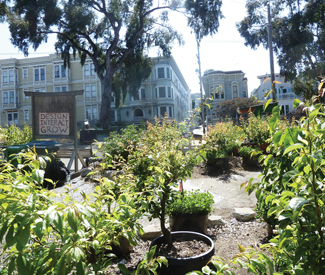
The City Hall victory garden is now reduced to dirt. The grants that kept afloat Quesada Gardens Initiative, which creates community gardens in Bayview, were temporary and are now drying up. Kezar Gardens, funded by the Haight Asbury Neighborhood Council recycling center, is facing eviction by the city.

Time is up for Hayes Valley Farm, on the old freeway ramp, where developers are now ready to build condos.

St. Paulus Lutheran Church has also announced that it wants to sell the land that the Free Farm uses at Eddy and Gough.

“There’s the old joke about developers,” said Antonio Roman-Alcalá, co-founder of Alemany Farm and the San Francisco Urban Agriculture Alliance. “God must be a developer, because they always seem to get their way.”

At the same time, new urban agriculture projects have sprung up across San Francisco. Legislation authored by Sup. David Chiu will create a city Urban Agriculture Program, with the goal of coordinating efforts throughout the city.

So is the movement to grow food in the city progressing? It’s a tricky question that gets down to one of the oldest conflicts in San Francisco: The best use of scarce, expensive land.

THE VALUE OF FARMING

The San Francisco Planning and Urban Research Association lauds the value of community gardens. An April 2012 SPUR report notes that urban agriculture connects people “to the broader food system, offers open space and recreation, provides hands-on education, presents new and untested business opportunities, and builds community.”

According to the report, the city had “nearly 100 gardens and farms on both public and private land (not including school gardens),” two dozen of which started in the past four years.

But that’s nowhere near enough for the demand. “The last time waiting lists were surveyed, there were over 550 people waiting,” Eli Zigas, Food Systems and Urban Agriculture Program Manager at SPUR, told us. “That likely underrepresents demand because some people who are interested haven’t put their name down.”

Changes in zoning last year, and the recent ordinance to create the Urban Agriculture Program, show a measure of city support for urban farming and gardening.

“We have one of the most permissive zoning codes for urban agriculture that I know of in the country,” said Zigas.

One zoning change from 2011 makes it explicit that community gardens and farms less than one acre in size are welcome anywhere in the city, and that projects on larger plots of land are allowed in certain non-residential districts.

More recent legislation is meant to streamline the process of starting to grow food in the city. Applying to use empty public land for a garden can be an arduous process, and every public agency has a different approach. The hoops to jump through for land owned by the Police Department, for example, are entirely different than what the Public Utilities Commission requires. A new Urban Agriculture Program would coordinate efforts.

“The idea is to create a new program that will serve as the main point of entry. Whether it will be managed by existing agency or nonprofit is to be determined,” said Zigas.

If the timeline laid out in the ordinance is followed, the plan will be implemented by Jan.1, 2014.

By then, if all goes according to plan, no San Franciscan looking to garden will wait more than a year for access to a community garden plot.

NO NEW LAND

Roman-Alcalá said that efforts to clear the way for urban agriculture are much less controversial than for affordable housing and other tenets of anti-gentrification. But for all the good the latest legislation does, it doesn’t secure a single square foot of land for urban agriculture.

“If you look at the language, there’s nowhere in it that mandates or prioritizes urban agriculture on any site,” said Roman-Alcalá. “The closest thing is a call for an audit of city owned rooftops. That’s the closest it comes to changing land use.”

And it won’t be easy. “No matter how much support there is for urban agriculture, in the end, developers and their ability to make money is going to be prioritized,'” he said. “The only way to really challenge that right now is cultural. Social change is not an event but a process.”

Janelle Fitzpatrick, a member of the Hayes Valley Farm Resource Council and a neighborhood resident who has been volunteering at the farm since it started, is committed to that process.

“Hayes Valley Farm proves that when the city, developers, and communities come together, urban agriculture projects can be successful,” Fitzpatrick said. She and dozens of other volunteers created the farm, which is now lush with food crops, flowers, and trees. The farm has a bee colony, a seed library, and a green house. It offers yoga and urban permaculture classes.

Hayes Valley Farm started on land that used to be ramps to the Central Freeway before that section was damaged in the Loma Prieta earthquake. The land under the freeway was toxic, but volunteers spent six months layering mulch and cardboard and planting fava beans to create soil. It took less than a year to create a productive farm on a lot that had been vacant and overgrown for nearly two decades.

“We’re producing food, we’re producing community, we’re producing education,” said Zoey Kroll, another volunteer and resource council member.

When they vacate their land in the winter, many Hayes Valley Farm team members will already be knee deep in new urban agriculture projects. These include Bloom Justice, a flower farm in the Lower Haight that Kroll says will teach job skills like forestry and landscaping. The farm has also built a relationship with Hunters Point Family, working together to offer organic gardening and produce at Double Rock Community Garden at the Alice Griffith Housing Development and Adam Rogers Community Garden.

As for the loss of the current site, Kroll says, “It’s an exercise in detachment.” Change in landscapes and ownership is part of urban life, she said — “We’re a city of renters.”

We’re also a city of very limited land. “Securing permanent public land for urban agriculture would be challenging,” said Kevin Bayuk, an instructor at the Urban Permaculture Institute. “And securing long-term tenure on anything significant, an acre or more of land in San Francisco, if it were on private land, would be cost prohibitive.”

Of the city’s three largest farms, only Alemany Farm seems secure in its future. The farm is on Recreation and Parks Department land, and has been working with the department since 2005 to create a somewhat autonomous governance structure.

Community gardens on Rec-Park land are subject to a 60-page rulebook, and according to Roman-Alcalá, Alemany Farm’s operations were restricted by the rules.

Last week, the group’s plan to be reclassified as a farm instead of a garden was approved, eliminating some of the rules and creating an advisory council of community stakeholders that will exert decision making power over the farm, although Rec-Park still has ultimate authority.

“Now it’s more secure,” said Roman-Alcalá. “We’ve finally reached this point where the city acknowledges it as a food production site.”

“I think the urban agriculture movement is still growing and burgeoning in the grassroots sense,” said Bayuk. “And I think some of the grassroots growth is reflected in the policy and code changes. “I’m optimistic for the idea of people putting land into productive use to meet human needs and be a benefit of all life.”

This article has been corrected to reflect information about the location and ownership of the Free Farm.

Alerts

0

WEDNESDAY 22

Lockout ruling victory march Castlewood Country Club, 707 Country Club Circle, Pleasanton; www.endthelockout.org. 5-6pm, free. Castlewood Country Club workers have been out of work and replaced by low-paid, non-union workers for two years. They haven’t stopped fighting to get their jobs back, and on Aug. 17, the National Labor Relations Board ruled that the lockout is illegal and Castlewood Country Club must reinstate their jobs. Come march for victory for the workers. Also, come march for support on the road ahead, as the country club will likely appeal or delay the process.

FRIDAY 24

Heal the Streets graduation celebration Nile Hall, Preservation Park, 668 13th St., Oakl; www.ellabakercenter.org. 5-7pm, free. "If we truly want to address violence, we must engage youth impacted by it so they can heal, have positive alternatives, and take action." That’s the philosophy of the Ella Baker Center’s Heal the Streets program, where young people spend 10 months in theater workshops and conversation, coming up with practical and creative ideas. Friday, they will be graduating from the program, presenting their theater piece and their findings. Come celebrate with them.

SATURDAY 25

American Indian market and pow wow 56 Julian, SF; www.friendshiphousesf.org. 10am-6pm, free. This eighth annual street festival features a pow wow, dance, hand drum contest and dance contests (both with cash prizes), and vendor booths with arts and crafts and food. In 1953, Congress passed a resolution to seize more than a million acres of American Indian land. This resulted in massive displacement and movement of Native Americans to major cities, including the Bay Area. To provide support and a community center, Friendship House was founded in San Francisco. Now, it still provides several programs, including this annual street festival.

SUNDAY 26

National day of action for women’s rights 24th and Mission, SF; www.defendwomensright.org. 12pm, free. On this day in 1920, the 19th Amendment passed, finally giving women the right to vote. This year, attacks on women spread throughout the country. The day before the Republican and Democratic national conventions, protests will be held in several cities nationwide to show that the people will not tolerate attacks on reproductive rights. Women Organized to Resist and Defend asked dozens of women why they will be marching, and the answers, shown in photos on their website, range from "to shut down sexual assault" to "women’s health is not secondary" to "ICE and homeland security perpetuate violence against women." Will you march?

Shifts in feminism in Japan’s anti-nuke movement Omiiroo Gallery, 400 Franklin, Oakl; nonukesaction.wordpress.com. 6pm, free. After the Fukushima nuclear disaster last year, a movement of Japanese parents who no longer trusted the government’s word that the nuclear industry was safe took root. Parents formed study groups on radiation and used their own Geiger counters at home and at their children’s schools. Mari Matsumoto, a Tokyo writer who was in the middle of it, focuses on feminism and reproductive labor in the context of nuclear radiation. She will be speaking at this event, along with a screening of the film "How nukes got to Japan." The event is a potluck, and seating is available, but organizers recommend you bring a pillow to sit on the floor in case it runs out.

MONDAY 27

Eyewitness from Tahrir Square Audre Lorde Room, The Women’s Building, 3543 18th St., SF; www.occupyforumsf.org. 6pm, free. Gihan Abou Zeid had years of experience working to end violence against women and coordinating with various UN efforts before she became involved in the Egyptian Revolution. She has since helped to found Mayadin Al-Tahrir (Liberation Places), an effort to bring the liberation that was found in Tahrir Square to new places all over Egypt. After the successful ousting of Hosni Mubarak, many women have continued to protest sexual assaults and other violence. Zeid will speak on women’s experiences in the revolution and the ongoing fight for gender justice.

Healthy transitions

1

yael@sfbg.com

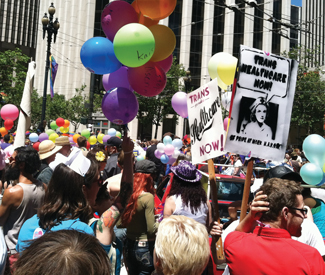
When the Human Rights Campaign, the national LGBT rights group, released its latest scorecard, rating companies by their support for LGBT issues, the healthcare giant Kaiser scored 100 percent. In June, the company’s float in the San Francisco Pride Parade was packed with happy employees.

But as the float passed through the streets, it was met by a group of protesters. Pride at Work complained, loudly, that Kaiser — for all its efforts to work with the community — excludes transgender care from its standard policies.

“We said, let’s push Kaiser,” said Sasha Wright, an organizer with Pride at Work. “They say they’re good for the community. Let’s show them that the queer community demands this.”

It was a perfect sign of the city’s struggle with trans health care. In many ways, San Francisco is exemplary — this is a long ways from Chattanooga, Texas, where state legislator Richard Floyd tried to pass a law instituting steep fines for people who can’t prove their genders match the designated genders of public bathrooms.

And with Healthy San Francisco officials’ recent decision to cover transgender and care, it’s likely this city is leading the nation in trans health.

But that’s a limited distinction — because trans people everywhere, even here, still face sometimes daunting obstacles in getting access even to basic care. And the struggle to change that is becoming a high-profile (and increasingly successful) political fight.

TRANSITIONS AND COSMETIC SURGERY

Kaiser’s insurance plans are typical of the industry. In its 2012-2013 “Traditional Plan,” Kaiser lists “transgender surgeries” among the services excluded from coverage, along with massage therapy and cosmetic surgery.

And Kaiser’s not alone.

Medicare, the federal health plan for low-income people, specifically excludes transgender health care. MediCal, the state version, is required to cover trans care — but will often deny individual applications. And many of the doctors and surgeons who accept MediCal (and many don’t) are unfamiliar with transition-related care.

Then there’s plain old discrimination. A troubling number of people report being denied healthcare — not just healthcare related to their gender identity — because the doctor they saw didn’t want to treat a transgender person.

The State of Transgender California, a 2008 survey by the Transgender Law Center, found that 30 percent of transgender people in California reported that they have “postponed care for illness or preventative care due to disrespect and discrimination from doctors or other healthcare providers. Over 40 percent did so because of economic barriers.”

The study also found that 35 percent of respondents “recount having to teach their doctor or care provider about transgender people in order to get appropriate care.”

To make things worse, American health insurance is overwhelmingly employer-based — and unemployment among trans people is epidemic. A 2011 study from the National Center for Transgender Equality found that trans unemployment was double the national rate and that 47 percent of trans people surveyed had been fired or overlooked for a job.

The World Professional Association for Transgender Health (WPATH) sets the international standard for transgender health care. WPATH states that, for many transgender people, “sex reassignment surgery is effective and medically necessary.” Hormone therapy, voice and communication therapy, as well as non-discriminatory primary and preventative care are also necessary.

But with high rates of poverty and discrimination among transgender people, affording these medically necessary procedures can be nearly impossible. Even in San Francisco, where some politicians and powerful organizations advocate tirelessly for transgender rights, many people are forced to go outside the system altogether to take care of themselves.

“We see transgender folks either not being able to make a transition, or having to spend a lot of money,” said Wright. “I don’t know if you’ve ever been to a top surgery party, but they’re common in San Francisco.”

Mia Tu Mutch, a member of San Francisco’s Youth City Services Committee who advocates for LGBTQ rights inside and outside City Hall, recently started a group that supports and raises funds for people who are transitioning.

“Me and my partner have been shocked at trans incompetency in San Francisco,” said Tu Mutch. “We’ve had several really bad instances of doctors refusing to treat us when they found out that we were trans. There’s still education needed.”

Tu Mutch said that, even though she is covered by a high-quality, trans-inclusive insurance plan, she has spent at least $10,000 out of pocket on transition related expenses.

“People are usually told, ‘get a good job, save all your money,'” she said. “But I’ve been spending 80 percent of my money on transgender related care for the past couple of years. I don’t think the whole ‘pull yourself up by your bootstraps’ thing works.”

HOPE ON THE HORIZON

But the situation is starting to change. In fact, trans organizers say that the medical, insurance and political establishments — particularly in California — are beginning to realize how backward the system is and are open to dramatic changes.

“It is an exciting time,” said Dr. Dawn Harbatkin, executive director or San Francisco’s Lyon Martin Health Center, which offers free and low-cost service to trans people “I didn’t think I would see this during my career.”

Nikki “Tita Aida” Calma, program supervisor at Trans: Thrive, echoed that sentiment. Said Calma, “I’m glad to see this in my lifetime.”

Thanks to groups like Pride at Work and the Transgender Law Center (TLC), city workers in San Francisco and Berkeley are now covered by the trans-inclusive version of Kaiser’s plan. The TLC, along with Lyon Martin and Equality California, came together to form Project Health in 2010, which convinced Healthy San Francisco to drop its transgender exclusions.

Tu Mutch has also worked this year to start FEATHER, or Fundraising Everywhere for All Transitions: a Health Empowerment Revolution.

Meanwhile, lawmakers in Sacramento, and even nationally, are also chipping away at the transgender discrimination that plagues the healthcare system.

Harbatkin told us that there isn’t a specific set of services that make up transgender health care.

“Really good transgender medicine means that you are providing good primary care, that you’re treating a patient as a whole person and taking care of all of their health care needs,” she said.

Lyon Martin provides preventative care like pap smears, breast exams, and prostate exams, treatment for chronic issues like hypertension and diabetes, as well as transition-related care—services that assist transgender people in transitioning to a body that reflects their gender identity.

“The bigger part of providing good medicine is about being culturally competent, culturally sensitive,” Harbatkin said. “Knowing how to address people respectfully and with their appropriate name and pronoun. Knowing about their legal name versus preferred name, or gender markers in terms of billing issues.”

One obstacle transgender patients face is doctors who are unfamiliar with transition-related healthcare, such as hormone therapy and surgeries. But often, trans people are denied care that doctors know well and would perform on cisgender patients, simply because of their gender identity.

Then there’s the challenge low-income people face in finding doctors who accept MediCal.

Harbatkin cited the example of an orchiectomy — surgical removal of the testicles, a procedure done by urologists. Finding a urologist who takes MediCal is fairly routine.

“But finding a surgeon who would do a vaginoplasty who accepts MediCal, that is more challenging,” she said.

And some urologists might perform an orchiectomy for someone with testicular cancer — but refuse to do so for someone who is transitioning from male to female.

That type of discrimination has caught the attention of Assemblymember Tom Ammiano, and his office has been working for several years to change it.

Ammiano aide Wendy Hill has been focusing on eliminating transgender health barriers in California for years. Thanks in part to her efforts, the California Department of Insurance now interprets existing gender equity legislation to include transgender people.

“They’ve clarified a set of recommendations and essentially code sections that spell out that for the purpose of transgender, this law requires gender equity,” Hill said. “If you cover pap smears, you have to cover them for everybody. If you cover breast reconstruction or hysterectomy, you have to cover it for everybody, regardless of gender.”

Now Ammiano’s office is taking on the Department of Managed Health Care and has been documenting cases of discrimination.

“When a citizen calls the Department of Managed Health Care, their helpline, they tag the call so that they know what’s going on,” Hill explains.

“They just tagged the calls based on discrimination. But we got them to tag the calls based on gender discrimination, and then even more specifically, discrimination against transgender people.”

The sort of problem she sees: “A person goes in to be treated for what could potentially be pneumonia, but the physician is having trouble seeing this person because their papers say they’re male but they are trying to see a gynecologist.”

Hill said some of her most interesting moments have been outreach meetings with community members and local businesses.

“I’ve gone in to talk with folks and said, how many of you know someone who’s transgender?” Hill recalls. “And in Sacramento, not that many people raise their hands. And then I say, how many of you identity as transgender? And the transgender people raise their hands. A lot of people don’t know that they already knew transgender people.”

Ammiano, who created Healthy San Francisco, said he was thrilled about the program dropping its transgender exclusions. “This has been in the works for a while,” he said. “We always fully intended to make sure that everyone who needed it was covered.”

Nationally, he said, “I think it’s an uphill battle around eradicating the transphobia and getting services provided without any hassle, but there’s light at the end of the tunnel.”

SUPPORTIVE NETWORK

San Francisco offers plenty of support. Lyon Martin is part of a network of organizations providing health-related services to transgender people.

Trans: Thrive, a project of API, serves as a drop-in center for transgender people, including many who show up there as one of their first stops after coming to San Francisco to escape discrimination and danger in their hometowns. Trans: Thrive provides counseling, computer labs, food, activities, and an all-important clothing closet to cut the extensive costs of a whole new wardrobe that better reflects a person’s gender identity.

Lyon Martin is “a federally qualified health center, so we take MediCal, MediCare, and many commercial insurances and Healthy San Francisco,” said Harbatkin. “And for patients who are uninsured, they are put on a sliding scale based on income and family size. And we continue to see people whether they can afford it or not.”

That means even people with little or no income can access transition-related surgery at Lyon Martin. This can be essential for people who otherwise would rely on MediCal.

The situation will actually be improved with the changes to Healthy San Francisco, as people who access healthcare through the program will have more options for surgeons and specialists.

In the 2008 State of Transgender California report, the TLC made a series of recommendations — and to the surprise of even the TLC staff, many have been adopted.

For example, the Affordable Care Act bars discrimination against people with pre-existing conditions — a term used to deny coverage to trans people. Most medical schools still don’t teach transgender healthcare, but on a local scale, Lyon Martin is working to train healthcare professionals and students to provide quality, culturally appropriate care to transgender patients with a residency program.

But one of the key recommendations — “Enact federal and state legislation prohibiting transgender- and gender-specific exclusions that limit access to comprehensive, quality care in public and private insurance plans” — is still a ways off.

As far as state legislation goes, said Hill, “Assemblymember Ammiano is definitely there. But the Legislature is not there yet. We don’t have enough support for that, to get a bill down to the governor.”

Kristina Wertz, director of Policy and Programs at the TLC, says that significant progress has been made on the recommendations that the 2008 report included.

“We’re really getting there,” said Wertz. “Things have changed. The world of transgender healthcare is very different than it was five. years ago.

“Right now there’s a lot of advocacy to build on the good laws that we already have and make sure they’re effectively implemented.”


The cost of the death penalty

4

OPINION As a retired police officer, I believe deeply in safety and justice. As a father and a person who has devoted more than 30 years to working with young people, I know what our kids need to become positive members of our communities. I’ve seen the positive changes that come from resources, attention and education. I’ve seen it as a precinct service officer in East Harlem, New York, as a police officer and lieutenant in the Oakland Unified School District.

I can no longer stand by while we tell young people that we care about them while simultaneously undermining their future and safety with poor use of our resources. I can’t stay silent as we talk about tough times and budget cuts, but spend billions on death row inmates who will actually die in prison of illness or old age instead of execution. It’s not right, and it’s not effective.

California’s death penalty is suffocating our resources. A June 2011 study by former death-penalty prosecutor and federal judge Arthur L. Alarcón and law professor Paula Mitchell found that California has spent $4 billion dollars on the death penalty since 1978 and that death-penalty trials are 20 times more expensive than trials seeking a sentence of life in prison without the possibility of parole.

That money is wasted, because the system is so dysfunctional that those death row inmates actually end up serving the equivalent of life without the possibility of parole anyway. California is on track to spend $1 billion dollars in the next five years on the death penalty — all of this while risking the execution of an innocent person.

These irresponsible budget choices are undermining the safety of California families. Despite a horrific unsolved murder rate of 46 percent, we fire homicide investigators and take police off the streets. Even though a shocking 56 percent of reported rapes go unsolved, rape kits all over the state remain untested on shelves because of lack of funding. Budget cuts for crime labs and police mean evidence that can help find and convict criminals is sitting on a shelf while we waste millions on a death row that is broken beyond repair.

We also undermine crime prevention by firing teachers and taking away violence intervention programs — two things I know for sure keep kids out of a life of crime.

Proposition 34 will help us put our priorities into action by replacing the death penalty with life in prison without the possibility of parole. That will save California $130 million dollars a year. Prop. 34 would redirect a portion of those savings for three years to solve open murder and rape cases. By solving more cases and bringing more criminals to justice, we can keep our families and communities safer and hold these people accountable for what they have done.

Murderers deserve tough punishment. But I can tell you from my career as a police officer — lifetime incarceration in prison with no chance of parole is real punishment.

There is no fixing the death penalty, but Prop. 34 will help us fix the funding for our priorities. That is justice that works for young people, and for all of us.

Steve Fajardo is a former police officer.


The parking fee’s too low

18

EDITORIAL The San Francisco Municipal Transportation Agency is reviewing its policy on neighborhood parking, which is a positive step: The current system has been in place for more than 30 years and has become an unwieldy mess. But the agency needs to do more than just aggregate districts and set uniform rules; it needs to adjust the concept of preferential parking, meters, and prices to reflect the reality that San Francisco can’t afford (and shouldn’t promote) free parking.

Since 1976, the city has issued permits allowing residents of certain neighborhoods to park for as long as 72 hours on streets that otherwise offer only two-hour parking. The idea was to keep out-of-town commuters from parking near, say, a BART line and leaving their cars all day. The zones also protect neighborhood privileges near busy shopping districts and employment centers.

The zones are designated only when a majority of property owners request it. The fees for the permits are set at $104 a year.

The Examiner reported Aug. 13 that the system is in line for “a major overhaul.” And the first thing the MTA needs to do is look at the price.

Renting a garage in most city neighborhoods runs close to $300 a month. Paid parking in even outlying areas can be as much as $10 a day. A Muni fast pass costs $74 a month.

But the neighborhood parking permits in effect give a piece of the city’s streets — public property — to some residents for $8.60 a month, or about 28 cents a day. At a time when Muni can’t afford to keep its buses rolling, that’s ridiculous.

Easy, cheap on-street parking encourages more residents to buy cars, which is in direct contrast to official city policy. It’s true that the permits also allow people to leave their cars behind and take transit to work — but the cost is so low that the rest of the city’s residents, particularly the lower-income people who pay for Muni rides, are subsidizing car owners.

If the MTA could double the annual fee, it would bring in an additional $6.5 million a year, which could be dedicated to improving Muni. And at $208 a year, the permits would still be an phenomenal bargain. Car owners have been saving money for years (at great cost to the state) from the Schwarzenegger-era reduction in the Vehicle License Fee; paying some of that money back to the city wouldn’t exactly be a brutal hardship.

It’s not easy — the state mandates that local fees be set at the cost of administering the program. But if nothing else, the MTA ought to ask Sacramento for an exemption — and look for creative ways to link subsidized parking to supporting Muni. (Maybe the parking zones get all-day meters that residents can pay for in advance. Maybe create a parking benefit district. There are so many ways around this.)

The MTA screwed up badly the last time it tried to change neighborhood parking rules (in that case, meters), and any new rules will require extensive community outreach. But everyone needs to understand that free on-street parking in a crowded city with far too many cars is not some god-given right. The neighborhood parking program has a lot of benefits and we agree that it helps discourage car commuters from clogging residential streets. But the people who benefit from it ought to pay a fair fee.


When the people lead

0

By Jon Golinger

OPINION Thursday, July 19, 2012 was an especially gorgeous day in San Francisco. On that warm and sunny summer afternoon, a colorful collection of more than 100 citizens from every corner of the city gathered together on the steps of City Hall to announce they had done something political insiders and powerbrokers had just weeks earlier dismissed as “impossible.”

This grassroots coalition of neighborhood leaders, tenant activists, homeowners, seniors, environmentalists, and recreation enthusiasts had just collected more than 31,000 petition signatures in less than 30 days from San Francisco voters. For the first time in more than 20 year, they had just qualified a referendum for the ballot challenging a Board of Supervisors-approved ordinance. They had just stopped in its tracks the seemingly done-deal to dramatically increase height limits on the waterfront for the proposed 8 Washington luxury condo high-rise project.

This citizen activism was made even more difficult by developer Simon Snellgrove, who went to extraordinary lengths to interfere with the petition drive and prevent it from succeeding, including:

• Using crafty legal maneuvers to require the petition to include not just the five-page city ordinance it challenges, but 515 additional pages of charts and addendums. This created a 520-page “book” that was expensive to print and heavy to carry.

• Spending $30,000 to pay hired “blockers” to encircle petition gatherers wherever they could find them and shout, intimidate, and otherwise interfere with their talking to voters.

• Paying an attorney to hover over the shoulders of workers at the Department of Elections as they counted petition signatures, repeatedly challenging their decisions.

While all of these hurdles and questionable tactics certainly had an impact, the citizen activists and volunteers nevertheless persevered. Soon after the 65 boxes overflowing with signed petitions had paraded through the corridors of City Hall, they were certified as sufficiently valid by the San Francisco Department of Elections. The “impossible” was done.

A recent poll by David Binder Research found that voters citywide would overwhelmingly reject the 8 Washington waterfront height limit increase by a vote of 56 percent to 25 percent if the Waterfront Referendum were put to a vote today. However, before it is officially placed on the ballot, the referendum process offers the Board of Supervisors a “second-chance” to make the right decision at its September 4th meeting.

Supervisors Christina Olague, Jane Kim, Eric Mar, and Malia Cohen — who all voted in favor of the waterfront height limit increase in June — now have the opportunity to take some time to talk with their constituents, reexamine their initial decision, and hopefully make a different choice.

But if they fail to do so, the referendum on the proposed 8 Washington project’s “Wall On the Waterfront” will appear on the November 2013 ballot and the people will decide. The people will decide whether a special exemption should be made to give away prime public land to a developer to build multi-million-dollar condos that 99 percent of San Franciscans can’t afford. The people will decide whether to allow the construction of a high-rise luxury condo building on the waterfront that would be 50 feet higher than the old Embarcadero Freeway. The people will decide whether we should protect or neglect our unique and beautiful waterfront. If the leaders fail to lead, the people will lead.

Jon Golinger is the Campaign Director for No Wall on the Northeast Waterfront www.NoWallOnTheWaterfront.com

Creating activist scholars

13

yael@sfbg.com

This semester, the California Institute for Integral Studies (CIIS) will start a new Anthropology Department featuring teachers who are grassroots organizers with decades of experience, including Boots Riley, Roxane Dunbar-Ortiz, Sasha Lilley, and Chris Carlsson.

The program’s goal is to create “activist scholars,” to get students into communities outside the institution, and to use their research and intellectual opportunities at the school to move social justice projects forward. And the man who organized it all is an unrepentant anarchist.

“The most distinguishing character of anarchism for me is prefigurative politics — creating the new within the shell of the old,” Adrej Grubacic, the new department head, told us.

His classes come at a time when anarchism is being more widely discussed in the US than it has been for generations. Non-hierarchical general assemblies and consensus-based “direct democracy,” long practiced in anarchist and other leftist circles, swept across the country along with the Occupy movement last year.

Anarchists have been associated in the public eye with everything from spirit-fingered affirmations to the masked, black-clad protesters smashing bank windows and scrawling anti-corporate messages on walls. But Grubacic says it’s more than that.

As anarchism exploded into practice in Occupy’s tent cities, it was also experiencing a renaissance in the ivory tower. The North American Anarchist Studies Network was founded in November 2009, and since has brought together a growing number of professors who want to explore and teach anarchism through annual conferences.

Big names such as Yale Anthropology Professor James Scott have declared themselves anarchists. In a country where the study of economics is usually code for the study of capitalism, professors longing to talk alternatives are coming forward in droves.

It’s more than a little ironic that, within an ideology focused on a lack of hierarchy, it can be hard for those on the street to connect with those in the lecture halls. So how can the academic-types truly support The People?

From Zapatista schools in Mexico to universities run by the Landless Worker’s Movement in Brazil to popular universities throughout Canada and Europe, people all over the world have developed institutions based on anarchist and Marxist principles.

Now, in San Francisco, Grubacic is hoping to do the same.

A historian who was an anarchist by age 13, Grubacic grew up in socialist Yugoslavia, a country engulfed in brutal civil war by the time he reached his 20s.

“I was raised a Yugoslav,” Grubacic says. “So I was raised to be a citizen of a country that doesn’t exist anymore.”

He was teaching history at the University of Belgrade, but his political beliefs became a problem.

“The political cultures and political groups in power were either Serbian nationalists or these hyper-capitalists,” Grubacic told me. “And going after them, because I was publishing and I was doing a lot of things, was—let’s say, not a smart career choice.”

It was with input from his mentor, famed leftist writer and academic Noam Chomsky, that Grubacic left the crumbling Balkan state for his own safety. After a frustrating stint at University of San Francisco, he found CIIS.

“This is the first place where I think that I was hired because I was an anarchist, or I am an anarchist. It’s kind of funny,” Grubacic says.

Founded in 1968, CIIS grew out of the California Institute of Asian Studies, and has quietly taught holistic approaches to psychology and integrative approaches to psychology, spirituality and the humanities since then . Today 60 percent of CIIS students are studying clinical or counseling psychology. The Anthropology and Social Change program is part of the School of Consciousness and Transformation.

“It’s the only department like it in the United States,” Grubacic says. “This is going to be one of the few places where anarchism is going to be studied.”

“So anarchist social theory, anarchist education, anarchist ideas in general. We are going to study them, seriously, because they need to be recognized seriously. It’s a beautiful history, it’s a beautiful tradition,” he says. “How important it is, I think, is revealed, by the recent rediscovery or reinvention of anarchism at Occupy. So I think that it’s more relevant than ever to create a space where anarchism will be studied.”

A CIIS education doesn’t come cheap. Two years in the masters program costs at least $35,000, and to earn a PhD will cost more than $60,000. Scholarships and financial aid are available, but Grubacic called the question of access to this program “a huge question.”

“It’s troubled me from the very beginning,” he says. “We are creating an experiment. It’s a social justice, community-based program in a private school.”

He hopes, however, that students will learn applicable skills in the program. Classes on radio, film, and writing, Grubacic says, will give students practical skills. “They will be able to continue, either as academics and go to get their PhDs, or to join the non-governmental sector, to work with NGOs, to work with community groups, to work with labor groups.”

Not the most lucrative professions, perhaps, but likely the chosen fields for many Anthropology and Social Change students.

Grubacic calls creating a program based on teaching grassroots and subversive knowledge in an elite institution “a paradox,” and one he’s not alone in. Grubacic got advice on the issue, he said, from Anibal Quihano, a Peruvian scholar known for his theories on colonial power who now teaches sociology at the Binghamton University in New York.

In fact, Grubacic practically convened a conference of post-colonial and anarchist scholars to help develop Anthropology and Social Change. Grubacic sent the program’s description around to everyone from his buddy Chomsky to Immanuel Wallerstein to World Social Forum organizer Boaventura de Sousa Santos. He got advice, too, from organizers at the Popular University of Quebec and the Popular University of Social Movements, a school in São Paulo, Brazil run by the landless workers’ movement there.

“The deciding thing about our own methodology was that we would like to listen, both to the voices coming from the past, so people who are doing similar things before us, and to people who are doing similar things right now,” Grubacic said. “We also went — and this is the third form, let’s say, of listening — to the people in the community.”

He reached out to contacts and friends of professors in the university, as well as hanging out in gathering places and striking up conversations with those who showed up. He told one story of doing this covert outreach in the Tenderloin National Forest, the botanical garden and neighborhood spot just 10 blocks from CIIS’s building on Mission and 11th streets.

“Some people were completely uninterested and thought, what’s the purpose? Who are you, with this weird accent? Go home,” Grubacic laughed. Some, though, were more receptive, including a woman who said the program could help with those fighting against San Francisco’s problem of environmental racism.

“This person told me that she thinks activists can come to a particular community, do an ethnography, do research, and then present that research to people in the city, and show the people who have power in the city to make decisions why such behavior is unjust,” Grubacic said.

In the end, that is essentially how the program will work. Students will partner with local organizations, neighborhood groups, or other affiliated people working on social justice goals, doing research to help further their goals.

“The document they’re going to produce after two years of activist research is going to be written for that community,” Grubacic said. “We are the second readers. We are less important in the process. What they do has to be useful to the community. They have to be passionate about working with that community group. And they have to produce something that’s going to be useful to what that community group does.”

In addition to classes and research projects, students will participate in “convivias,” one of the most unique aspects of the program. People from the public, scholars, and others with special knowledge will hammer out ideas with students in week-long “political laboratories.” Revolutionary art will be practiced in a convivia called “Atelier of Insurrectionary Imagination.” And Grubacic and his students will turn a certain vacant part of the CIIS building into an “Emergency Library,” a place for books as well as what the program description calls “scholars on call, responding to the emergent needs of the communities in struggle, who might be in need of legal advice, activist companionship, scholarly input, or a media suggestion.” The convivias have corresponding student work-study positions — yes, there will be a paid Emergency Librarian.

CIIS spokesperson James Martin said Grubacic brings a lot to the school: “The thing I’m really excited about is that we’re engaging the local community. We live in San Francisco for a reason. This is one of the places in the world where all these intellectuals come together who have the passion to try and change things.”

Despite the paradoxes and problems that come when the elite meets the grassroots, Grubacic has high hopes. “We need to redefine what it means to be an intellectual who works within academia,” he said. “And the only way to do this is to become a part of a larger social movement’s formation, that is aimed at changing society. We cannot offer much. But we can offer something.”

Faces of City College

4

GOING BACK TO SCHOOL: BOUCHRA SIMMONS

The first thing you notice about Bouchra Simmons is her hair. Her black curls are bold and larger than life, much like Simmons herself.

Simmons moved to the United States from Morocco in 2008. A single mother of a nine-year-old daughter, Simmons is taking English as Second Language classes as well as business classes and working towards a certificate in management at City College.

Somehow, she also found time to become Associated Students President at the Downtown Campus. That campus is one of several that the college is now looking at to consolidate. While the analysis isn’t complete, the school might move students out of the valuable downtown property to lease it, which may generate $4-5 million a year for the school.

And the ESL classes which Simmons takes could face cuts, too.

Like many other students, she relies on Muni to get around, even to drop her daughter off at childcare and the Downtown Campus is easier for her to commute to than other campuses around the city.

“We students are not lazy, we have goals, we’re craving education,” Simmons said. She is going to work with one of the college’s new accreditation workgroups and plans on emphasizing the need for the downtown campus in particular.

Her dream is to be able to earn a living wage to support her family. “I’m a single mom, and going back to school empowers me,” Simmons said. (Fitzgerald)


FRESH OUT OF HIGH SCHOOL: ROSA MORALES

When asked to describe her life, Rosa Morales, 18, said, “I was born, I loved the Jonas Brothers, and then I died.”

An SF native who just graduated from the Ruth Asawa School of the Arts, she is passionate about making films. Her work focuses on social issues, often touching on the lives of Latino housekeepers or how toys affect young girls’ body image.

Morales has many achievements, but her math grades weren’t among them. At 18 years old, Morales decided to go to City College, a place she says will allow her to learn basic math skills at her own pace.

“If I were not able to go to community college, I wouldn’t go to school,” Morales said.

She smiles, flashing her braces, as she says that she has registered and gotten all the classes she needed for the semester, including math. Other students her age aren’t as lucky.

Classes at California’s overburdened and underfunded community colleges are becoming harder to get into, including at CCSF. Students like Morales may soon get priority, so they can get the classes they need to transfer to a four-year university on time.

“All of [my counselors] say that I can’t transfer in two years, but I hope I can do it,” she said.

When asked how she feels about the loss of ESL classes and non-credit courses, Morales said that the issue affects more than just her. Out of the 10 extended family members she lives with, five of them (including herself) are enrolled at City College, all for different reasons.

“My uncle takes night English classes,” she said. Morales’ uncle is a housekeeper, and being unable to speak English makes it a lot easier for employers to accuse him of stealing money, and more likely for him not to get hired at all, she said.

“I know that knowing them, they’d give them up for me if they had to. But I know that from a selfish point of view, of course I want classes to be allotted to people like me… I don’t know what I’d do without those classes,” Morales said. But, she added, ” I can’t genuinely say, ‘Give them to me,” without there being a tug in my heart.” (Fitzgerald)

FROM STUDENT TO INSTRUCTOR: GALINA GERASIMOVA

City College doesn’t just churn out degrees. It creates opportunities. For Galina Gerasimova, that opportunity led to a great job with the school.

A part-time instructor at the college for about eight years now, Gerasimova moved to San Francisco from the Ukraine in 1997 and immediately began taking ESL classes at the school. With a teenage son to take care of and not a lot of money to survive on, she not only mastered English but was also inspired by the warmth and dedication of her instructors.

As a recent immigrant, “you’re scared, you’re frustrated, you don’t really know what to expect,” Gerasimova said, explaining that ESL teachers are often the first people English learners really interact with after moving to the United States. “(They) helped me a lot … and of course that actually influenced my decision to become an instructor at City College.”

By 2000, she became an instructional aid, all the while pursuing an Associate’s Degree in computer sciences. She then transferred to San Francisco State University and earned a degree in Human Physiology — a subject that complemented her previous studies in biology, chemistry and physics in the Ukraine, where she worked with war veterans.

Gerasimova remembers how easy it was to enroll in all the classes she needed at CCSF and she laments the steady deterioration of public education in California.

“It just became more intense over the past year,” she said, “and I see how that impacts City College and our services.” (Bloomberg)

Quick facts about City College of San Francisco

1

• CCSF has 10 main campuses: Ocean (Ingleside), Mission, Civic Center, Chinatown, Southeast (Bayview), Evans, Noe Valley, John Adams (on Masonic), Fort Mason, and Downtown.

• CCSF also has single class “instructional sites” littered throughout San Francisco in various office spaces, spare SFUSD classrooms, and other locations. The exact number of these sites isn’t known by the college, but they are estimated at more than 100.

• CCSF’s English as Second Language (ESL) Department serves around 20,000 students annually, compared to an English Department that serves around 7,000.

• Non-credit courses at City College are tuition-free, as mandated by the state, although some charge nominal fees. Credit courses at CCSF are $46 a unit. A semester of full classes (12 units) costs less than a single course at San Francisco State University.

• The neighborhood campuses primarily provide non-credit classes including ESL, certificate training, and enrichment courses. Ocean Campus in Ingleside provides the bulk of credit courses, which are used to attain associates degrees or transfer to a four-year university.

• Tracking exactly how much each campus costs the school is difficult, according to school officials. Faculty and staff serve multiple campuses frequently, and many services aren’t tracked on a campus basis, making campus consolidation or closure something that will take time to evaluate.

• The state funds community colleges based on enrollment, a process known as “apportionment.” The enrollment time is measured in Full Time Equivalent Students (FTES), a measure of instructional time in hours.

• CCSF has been absorbing about $24 million a year in costs to non-credit courses when the state reduced the amount of apportionment it allotted to schools for non-credit courses. The school did not want to reduce classes in light of state cuts, and began paying for them out of pocket.

• Credit classes receive higher rates of apportionment than non-credit classes.

• In order to make up for the unique nature of its campus sites, the state offsets low apportionment at CCSF with money called a “foundational grant.” Essentially, the school receives anywhere from $500,000 to $1.5 million a year for specific campus locations.