Bay Guardian Archives

Projection

26

One of the more hilarious aspects of the back and forth in “Mr Redmond’s Cyber Playpen” is the inevitable scream from Redmond’s adversaries of “envy” every time Redmond posts anything critical of SF’s moneyed class. Imputing motive into why someone says something as a way of derailing a discussion is old hat as is. Who cares why something is written, it’s there, debate its merits. But the automatic assumption that Redmond’s bitterness over his failure in business leads him to muck-rake isn’t even asinine, it’s borderline demented.

As Redmond (and I) came from a relatively privileged background and yet voluntarily chose a profession where getting rich isn’t part of the reward at all, why would we envy those whose ranks we could easily have joined? Journalism, even when print media was thriving, isn’t lucrative. Neither is music/radio work. I can’t speak for him, but as someone that actually turned down a career in brokerage to play rock and roll, accumulating money didn’t seem anywhere near as gratifying. As Earl Butz pointed out many years ago, there are more important things in life.

An investigative reporter in any major city is gonna find lots and lots of sweetheart deals between City Hall and developers or landlords or any business interest. And would be remiss to not report them. It’s part of the gig they love. And lordy be, giving voice to people that don’t have one is satisfying if not fiscally rewarding. Claiming that Redmond must be envious of people he has nothing in common with is like claiming a gay man would envy the straight guy with the beautiful woman on his arm–she isn’t something he’d ever want, so it would never occur to him to be envious.

No, trollsky’s, the “envy of the rich” doesn’t come from Tim, Marke, Steve or I–but from you. All day every day planted on the lefty website hurling puerile broadsides like a cafeteria food fight–the idea that the rich and their government enablers are skeevy enrages you, because you wish so desperately to be part of a group of people that have no need for you (and recognizing that you’re a peon is too painful to accept). How dare anyone knock the people that are living YOUR dream? 

Hate to say it, but this is classic projection, or in layman’s terms “if you spot it, you got it”. Screaming “you’re jealous” at someone else when the big green globs of same are rolling off your brow like algae-laden sweat. It can be sort of funny in a pitiful manner at first but it’s gotten tedious–the hand that has the finger pointing outward has four pointing back at you. Next time you feel the urge to project, take four quarters off mama’s dresser and buy a lottery ticket. It’s healthier. 

Everyone but Mayor Lee sees SF’s worsening “housing affordability crisis”

43

There was a clear theme that ran through yesterday’s Board of Supervisors meeting from beginning to end, something understood equally by renters, homeowners, and politicians from across the political spectrum: San Francisco has a crisis of housing affordability that is forcing people from the city.

And the only person who doesn’t seem to understand or care about that is the person with the most power to deal with the situation, Mayor Ed Lee, who opened the meeting by essentially dismissing both short- and long-term gentrification forces and claiming “our city has some of the toughest anti-displacement laws in the country.”

It was a claim that Lee made twice, first in response to a question by Sup. Eric Mar about Plan Bay Area and the massive displacement of current San Franciscans that it would create by 2040. And it was also how he answered a question by Sup. John Avalos about rents that are now skyrocketing beyond what most San Franciscans can afford.

I followed Mayor Lee back to his office, asking him to explain his claim, and he cited the city’s “elaborate” rent control laws and the Rent Board recently hiring new personnel as he briskly retreated toward his office. But surely he’s aware that displacement is already happening and getting worse, I told him, citing Rent Board figures showing that evictions are now at a 12-year high.

Lee looked at me dubiously and said, “I’ll have to check the figures on that.” I followed up today with Press Secretary Christine Falvey to ask whether Lee did check those figures — which show 1,757 evictions in the last year, up from 1,395 the previous, both numbers representing returns to the mass displacement of the last dot-com boom — and I’ll update this post if/when I hear back.

“It shows he’s out of touch with what’s happening in San Francisco,” Avalos told me in response to the mayor’s remarks.

Lee seemed to bristle at the suggestion that his aggressive economic development policies might have a downside that he’s going to have to deal with at some point. He touts the 44,000 jobs the city has added during his mayoral tenure, even deflecting criticism that he’s too focused on the technology industry by citing estimates that every tech job creates at least four other jobs (seemingly oblivious to the fact that most of these are low-wage service sector jobs, the very people who are being forced from the city).

“I’m just hoping you’re not blaming the 44,000 jobs we helped created,” Lee told Avalos, saying that he understands the concern about the rising cost of living, “but those are 44,000 people drawing a paycheck and taking care of their families.”

Yes, Mr. Mayor, but those paychecks are having an increasingly tough time paying for housing in San Francisco. That concern animated the condo conversion debate that took place later in the meeting, voiced by those focused on the lack of affordable homeownership opportunities and those focused on reducing the city’s rental stock to create those opportunities.

“I don’t think saying ‘it’s good that we have a growing economy’ is enough to address the issue,” Sup. David Campos said during the condo debate, referring to Lee’s earlier remarks.

Speaking near the end that discussion, Campos summarized the concerns expressed by both sides and sought to put the legislation into perspective: while important, the condo deal is a drop in the anti-displacement bucket. “We are only dealing with the issue of affordability in San Francisco on the margins,” he said, later adding, “I don’t think we’re doing enough to deal with the fundamental issue of who gets to live in San Francisco.”

The debate on the condo conversion began with its original author — Sup. Mark Farrell, who represents District 2, the wealthiest and most conservative in the city — explaining his desire to help middle class people who want to own homes remain in the San Francisco.

“This is the most affordable form of home ownership in San Francisco today,” Farrell said of tenancies-in-common, the fiscally and legally precarious middle step between an apartment and condominium. Later, he said, “We need more affordable homeownership opportunities and not less.”

Farrell argued that “this didn’t need to be a zero sum game,” but that’s exactly what the stock of rent-controlled apartments is in San Francisco, where only housing built before 1979 is protected from the market forces that can drive rents up to whatever a landlord demands.

“We have a fixed rent control stock. Every apartment that converts to a a condo is one less unit,” said Board President David Chiu, who worked with Sups. Jane Kim and Norman Yee and tenant group to amend Farrell’s legislation to help both renters and homeowners.  

“These units were once the homes of tenants who were displaced,” Kim said, objecting to the notion that one person’s apartment should be another person’s affordable homeownership opportunity and arguing that the city should be building more condos for first-time homebuyers instead of cannabalizing the homes of the nearly two-thirds of city residents who rent.

Like Chiu and Kim, Yee said that he wanted to help the TIC owners of today without simply clearing out of the backlog and letting the condo lottery continue unabated, which would green-light even more conversion of apartments. “We want to curb the speculation,” Yee said.

That idea that the city should help people who live in the city, without simply feeding the speculative investors who profiteer off of housing in San Francisco, was a strong theme among critics of condo conversion.

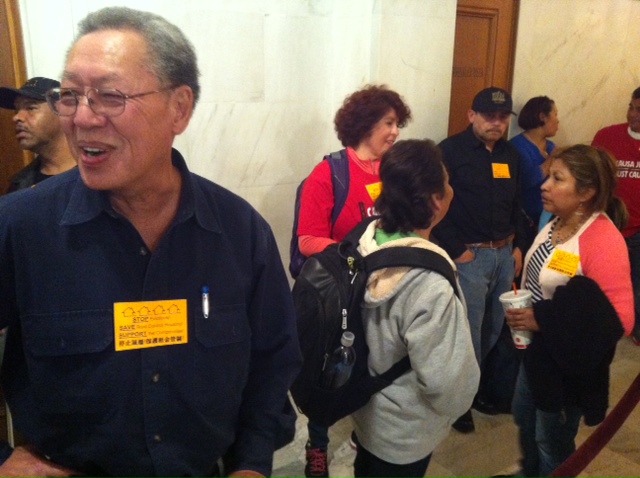
A pro-tenant crowd packed the Board Chambers. Although barred by board rules from addressing the condo legislation directly (that occurred at the committee level), one commenter said, “Giving any more power to the real estate market in San Francisco should be considered a crime.”

To help ward off real estate speculators once the annual condo conversion lottery resumes in 2024, the legisation also limited future conversions to buildings of less than four units, instead of the current cap of six units, a change that Farrell resisted.

“This is not an academic exercise anymore,” Farrell said of the condo conversion restrictions that were added to the legislation. “This will negatively impact thousands of TIC owners in the city.”

Farrell’s original co-sponsor, Sup. Scott Wiener, had a more pro-tenant point-of-view, objecting to the changes that Chiu inserted on more narrow grounds. In his comments, he noted how close the two sides were and how they share the same basic goal: preventing displacement of current city residents.  

“The one thing we can all agree with is we have a housing affordability crisis,” Wiener said, praising the city’s rent control and tenant protection laws, but adding, “TIC owners are also part of this city.”

The price of dealing with the rapid growth in the city — whether it comes to infrastructure or housing affordability — was also a point that Wiener made earlier in the meeting as the board approved the term sheet for a massive office and residential development project proposed at Pier 70.

“We are not doing what we need to do to support the public transportation needed for those projects,” Wiener said, also referring to other projects along the waterfront (the Warrior Arena at Pier 30 and the Giants/Anchor Steam project at Pier 46) and in the southeastern part of the city. “We don’t have the transit infrastructure to support our current population, let alone new growth.”

It’s about striking a balance, as Chiu said he did with the condo legislation, and not just a balance between renters and TIC owners. It’s about striking a balance between how to protect the San Francisco of today while planning for the San Francisco of tomorrow.

Yes, that means working with market rate housing developers, and it also means diverting some of their would-be profits into the city’s affordable housing fund and its infrastructure needs. Yes, it means private-sector job creation, but it also means more public sector jobs and providing a safety net for people without jobs or who work as artists or social workers or other professions that are being driven from the city. And it means beefing up our public housing and turning around the exodus of African-Americans, concerns raised at the meeting by Sup. Malia Cohen.

We at the Guardian last year looked at how Oakland has become cooler than San Francisco, largely because of the displacement from here. And now, even many people within the tech community have begun to decry the gentrifiction that is being driven by Mayor Lee’s narrow economic development vision.

“Plan Bay Area is an opportunity to think regionally and strategically about planned growth,” Lee said when addressing Mar’s question, sidestepping the direct answer that Mar sought on a set of specific proposals for mitigating some of the displacement planned for San Francisco and maintaining this city’s diversity.

Yes, we do have an opportunity to think strategically about the city we’re becoming and who gets to live in it, but only if we don’t think “jobs” is the answer to every question.

Behind the scenes with Magic Fight and the Music Video Race

0

All photos by Chris Stevens

By now you’ve read all about the second annual Music Video Race. No? Well get on that. And then check out these additional photos, all shot on location at the SUB-Mission space by Chris Stevens.

The gist: 20 bands were paired with 20 filmmakers this past weekend, and each team created a brand new music video over the course of 48 hours. This is a peek at just one of those shoots, set up by filmmaker Cory K. Riley, and starring the Bay Area band Magic Fight.

The screening (and winner announcements) with live bands will take place this Sat/15 at the Rickshaw Stop. And there’ll be an additional screening, minus the live acts, Sun/16 at Opera Plaza Cinemas. Check the Music Video Race site for more details.

David Chiu’s flextime

36

I’m not surprised that the folks at the Chamber of Commerce are all agitated about Sup. David Chiu’s proposal to expand family-friendly scheduling at local businesses. The Chamber’s Jim Lazarus is typically out of control:

“At some point, people are not going to want to create businesses in San Francisco when they have to go up to City Hall for a hearing every time an employee doesn’t like their reason for not agreeing to a shorter workweek,” Lazarus said. “Are we going to close for the month of August like France? Is that the next one?”

For the record, I’m all in favor of the French way of thinking about work. But you already know that.

Here’s the crazy thing, though: The Chiu legislation is actually remarkably mild. All it says is that a worker at a company with more than 10 employees has the right to request a different work schedule. The word here is “request.” The company can deny the request if would “create an undue hardship for the company or organization, including an increase in costs or a detrimental effect on the ability to meet customer or client demands.”

Folks: That’s a huge, broad exemption. If giving an employee the right to work at home sometimes (actually, a good idea for lots of reasons, including climate change) or the right to start or end a shift early or late, costs any money or causes any real disruption in the business, then management is exempt and can deny the request.

All the law would really do is elevate the idea of flextime to something that has to be considered if someone asks for it. And you can’t be fired for asking.

If the Chamber is going to go ballistic about this, it’s way out of step. A lot of businesses in the city already comply with at least the spirit of the Chiu law. I don’t see this as a huge issue for anyone.

Explaining Osama and 9/11

10

My oldest son just graduated elemetary school and so my wife and I gave him an IPad as gift. He loves the thing. Unlike his gadget n geegaw loathing father, he takes to that stuff with a vengeance.

As an internet scouring curiosity-laden child, he’s gotta be watched carefully. Sometimes he finds “acceptable” videos on YouTube that scare him, however. Today he saw for the first time the footage of the World Trade Center being hit by plane and collapsing on September 11th, 2001. I was on an errand when his mother called me and told me how upset he’d been, seeing the people jump hand in hand to their deaths. 

When I returned home, I explained to him what had happened. And why New York had been attacked and how it had affected our family directly (his uncle’s boss was flown into the towers killing her). I explained to him that human beings were capable of incredible cold blooded cruelty but also kindness and love. He still wanted to know why Bin Laden had planned and executed the attacks and I replied that the motive may have been to force American troops off the holy Saudi soil or maybe that as a former CIA employee, he’d been stiffed for cash. We don’t really know.

What I do figure, I explained to him, is that Bin Laden had a history of being part of suckering Western powers into unwinnable wars. By knocking down the World Trade Center, America would be dragged into a bloody morass like the Red Army was and we’d collapse like the USSR did. And then something hit me that I’d never thought of.

When Bin Laden was laying out this grand scheme of destruction, how come no one ever said anything like “well, it’s true that the Americans are infidels, dude–but this retaliation of theirs that you’re hoping for? That’s gonna be thousands and thousands of our people that get snuffed in a war that really doesn’t have to take place. Like, they may be imperialistic whatevers, man, but this provocation means lots of dead civilians, kids. That’s not really a great idea–got anything else?”

Of course that never happened and not because of Islamofascism or whatever other completely human trait is laid on one group of people as opposed to all of them. It never seems to keep the Bin Laden’s of the world up at night that they’re responsible for death and carnage nor does anyone ever tell them that this isn’t heroism or martyrdom but murder. 

So I explained this to my boy and he nodded by way of “OK, dad–cool”. I dunno if it sank in but if I ever get word back that he walked away from a fight because he knew it never leads to anything but pain, that’s a job well done.


The Mission ‘douchebags’

88

Okay, you have to read this. When a 1990s tech-startup guy who admits he was part of the last generation of gentrification is now so fed up with the new arrival of high-paid techies that he’s ready to leave, it’s pretty serious.

Chris Tacy makes an excellent point: When you move into the Mission, you need to understand that there are already other people living there, some of whom have been there a long time, and that it isn’t just you’re rich-kids playground:

Be considerate. That little old hispanic lady at the bus stop? Help her onto the bus instead of loudly bitching about how she’s going to make you late to your meeting at The Creamery. Be respectful. This neighborhood was here before you and will be here after you leave. It’s not your trashcan, your toilet or your playground. Understand the history and the culture and the people and act in a manner that isn’t stupidly offensive. Be sensitive. The traditional residents of this neighborhood are not rich and never will be. Flaunting your wealth and your opportunities is a douche move.

A guy I knew in college came from a very wealthy family, and his parents set up a trust fund for him. But he wasn’t going to get a penny until he was 30, and most of it would come to him later in life. His dad’s rationale: People who have a lot of money in theirs 20s become assholes. They don’t have enough life experience to handle the sudden riches. Get a job, live like a normal person, find out what life is like.

That’s how riches used to happen — the great industrial fortunes of the previous American generations tended to come to people who had worked for a while first; there weren’t a lot of 20-something millionaires. I think that’s a big change in the current economy. Some people are just too young to be rich.

I know, I’m an old fart who is not rich and never will be. Sometimes I feel like a curmudgeon. But if you’re lucky enough to be rich in your 20s, show some respect.

Polo in the park

0

le.chicken.farmer@yahoo.com

IN THE GAME The lights at Jose Coronado Playground stay on until 10 p.m. Like most playgrounds, it has a life of its own: a heart, a brain, a bloated liver, and a basketball hoop. In fact: two — but most nights the basketball court is cut in half by an extension of the tennis court to create a bike polo court. Which is cut in half by the slightly grassy crack between tennis-top acrylic and just plain asphalt.

So you don’t always get a clean roll, but that’s life.

Also life: the ragtag collection of drunks and disorderlies congregating on the sidewalk near the 21st St. entrance to the courts most evenings. They bring chairs, or huddle around the trash bin there.

One of their number, long gray hair scare-crowing out from under his hat, saunters onto the empty half-court with a worn black basketball and starts shooting free throws. He’s wearing a suit jacket. After missing four straight from the line, he backs up to almost half court, heaves awkwardly from his rib cage, and finally sinks one.

Nobody cheers.

On the unbicycled part of the next-door tennis court, a couple of much younger folks, a pink-haired woman and a regular ol’ facial-haired man, are riding around in electric-wheelchair-based cardboard robots. They look like something from a sixth-grade science fair, modified boxes with marker-drawn robot features. One has corrugated heating ducts for arms, dangling down to the pavement.

“You go on ahead without me,” I say to Hedgehog.

Jose Coronado is smack between our favorite restaurant (Limon Rotisserie) and our favorite ice cream (Humphry Slocombe).

“Do you want me to bring you something?” she says.

“Your call,” says I. I eat ice cream, but it’s not my thing.

Nor are homemade robots. But I have to ask, so while Hedgehog is walking on to 24th and picking out our flavors, I manage to make my way into the driver’s seat for a test drive. There is a camera mounted high on the chain-link fence surrounding the playground, and you have to drive by video, which is transmitted to a pair of goggles.

It’s like playing a video game from inside the screen. You are the little thing that you’re looking at.

I don’t like video games.

Zipping around pretty much blindly, I get almost immediately dizzy and lost, and almost crash into some bikes.

They’re going to race these funny wheelchair robots next day at SubZERO, San Jose’s annual subcultural festival, and I wish them luck.

While I’m waiting for Hedgehog to get back with our ice cream, I watch a little bike polo on the other side of the tennis net. It’s a pretty intense pick-up scene. Three-on-three, with a basketball hoop and a light pole in the field of play.

Most of them wear helmets. Some, knee pads and elbow pads. They drink beer, they smoke. One girl is playing with a cigarette in her mouth.

Plastic mallets awhirl, they circle and sprint, skid, bounce, and sometimes fall. If your foot touches the ground, you have to touch one of the mid-court posts with your mallet before returning to play.

It looks goddamn fun.

Another woman scores her second goal of the game and a dude against the fence, waiting his team’s turn, hollers, “My nipples are hard!”

“I didn’t know he had nipples,” quips a guy on a bike, racing back to defend his goal.

On the hard-top soccer pitch other side of the fence from all this, a couple of moms are kicking around with their kids. I fantasize about joining them, but here comes Hedgehog with our ice cream: mango and carrot, and basil lime.

The basketball scarecrow has moved on, and now two short guys are playing one-on-one. Someone else is practicing his fancy dribbling in the shadows, and occasionally pulls up and bounces a shot off of a light pole.

Twenty Major League Baseball players face possible suspension for alleged use of performance enhancing drugs, and these moms, kids, kooks, and badasses are out here every time I walk by, which is often.

Between Shotwell and Harrison on 21st Street in the Mission. Jose Coronado Playground. This has been a night in the life. Of it.

Newcomer Nights are on Wednesdays, in case you’re interested in getting in the game, bike polowise.

Otherwise, it’s not a bad spectator sport. Mondays, Thursdays, and Saturdays they play, from seven to ten. Check it out.

www.sfbikepolo.com


Scorning smokers

news@sfbg.com

San Francisco officials are attempting to ban the public use of e-cigarettes under the same laws that restrict smoking cigarettes, which are banned in most public places purportedly because secondhand smoke endangers others. However, the alleged lack of toxic emissions from e-cigarette vapor raises questions about the basis for the crackdown.

Has the crusade against smoking in public really been about protecting the innocent, or is the moralistic motivation to try to save people from their own bad choices also driving the trend? And if so, does that undermine the legal basis for restricting an otherwise lawful product?

Since 2011, the San Francisco Department of Public Health has backed legislation to hold e-cigarettes under the same public smoking laws as traditional tobacco products. Currently, San Francisco’s continually expanding smoke-free ordinance bans cigarette consumption in nearly any public place. This consists of Muni stops, festivals, parks, farmers’ markets, non-smoking apartments and, unfortunately for all you nicotine-addicted bingo lovers, the obscure addition of “charity bingo games.”

San Francisco has yet to pass any regulatory laws regarding e-cigarette consumption, or “vaping.” But Nick Pagoulatos, a legislative aide to Sup. Eric Mar, a staunch sponsor of San Francisco’s many anti-smoking policies, says a plan is in the works.

“Currently there is nothing on the books,” Pagoulatos told the Bay Guardian. “But there has been discussion with the health department [which is] working something up and the Mayor’s Office has been talking with them as well. The timing is unclear, but at some point it will happen.”

California Senate Bill 648, approved in May and currently on its way to the California Assembly, would elevate similar e-cigarette regulations to a state level. So why are California and San Francisco pushing so hard to regulate these products?

“The suspicion is that allowing people to vape these things reinforces the culture of smoking,” Pagoulatos said. “It continues in the tradition of making smoking look cool, even if it’s not actual smoke.”

Traditionally, San Francisco’s smoking ordinances have derived from the hazards of secondhand smoke on innocent bystanders, but the regulation of e-cigarettes evokes an entirely new basis for public smoking laws.

California has an active history of anti-smoking legislation beginning in the 1990s when San Luis Obispo became the first city in the world to ban smoking in all public buildings. In 1998, the public smoking ban elevated to the state level, specifically because of the health risks posed to bar and restaurant employees by secondhand smoke. This year, the San Francisco Board of Supervisors voted to extend the already strict non-smoking laws to cover festivals and street fairs and require landlords to designate their building units as smoking or non-smoking. Now, vapers in California face a similar threat.


VAPING ISN’T SMOKING

E-cigarettes contain a battery operated heating device that vaporizes a combination of nicotine and a binding liquid such as propylene glycol, a substance “generally recognized as safe” by the FDA. Since nicotine is not what kills smokers, e-cigarettes have the potential to exist as a safe alternative for smokers who can feed both the physical and mental habit of smoking without the detrimental effects of tar and the plethora of other chemicals found in traditional cigarettes.

However, conflicting studies exist regarding the safety of e-cigarettes for both users and the public. While the FDA has yet to regulate e-cigarettes, a 2009 evaluation reported the finding of numerous chemicals in e-cigarette liquid, such as those found in antifreeze.

Gregory Conley, legislative director for The Consumer Advocates for Smoke-Free Alternatives Association, told us these reports are misleading.

“Essentially, there is absolutely no evidence that e-cigarette vapor poses any significant threat to public health,” said Conley. “The antifreeze chemical was found in one of the 18 cartridges and tested in an amount that was less than 1 percent. Additionally, the amount of the chemical diethylene glycol found by the FDA would take thousands of cartridges to reach a toxic level.”

Conley cites the publication Tobacco Control, a premier tobacco science journal in the US with no tobacco industry ties, as the leading evidence in the case for e-cigarettes. The study, funded by the National Institute of Health, tested 17 different brands of e-cigarettes for chemicals known to cause harm in secondhand smoke.

“These amounts were nearly identical to the amounts in the control product, or the FDA approved nicotine inhaler,” said Conley. “They are trace levels, and anyone who has been in a room with an e-cigarette knows that there is a vast difference in comparison to a normal cigarette.”

A study by the Fraunhofer Wilhelm-Klauditz-Institut in Braunschweig, Germany found similar results, reporting that the release of toxins from e-cigarettes were marginal to non-existent. In fact, researchers attributed many of the low level chemicals detected in the tests, such as formaldehyde and acetone, to the test subjects, since our lungs naturally exhale these chemicals in small amounts.

Conley says e-cigarettes not only provide a safe alternative, but also offer a public promotion of smoking cessation by illustrating the addicting effects of nicotine.

“It’s a walking advertisement to show how addictive cigarettes are,” Conley said. “The fact that you have to buy one of these things to quit smoking, with a battery and everything, it’s ridiculous.


TARGETTING TOBACCO

Equating e-cigarettes and traditional cigarettes does tend to disregard the potential benefits safer nicotine alternatives can have on addicts. The language of the FDA and the DPH appears to dismiss the advantages of e-cigarettes over smoking. While issues certainly arise with the lack of regulation and quality control of e-cigarettes, much of the discussion from these groups pertains to reversing social views on smoking.

“The major concern for us is about social norms,” Derek Smith, a health program coordinator at the Tobacco Free Project, told us. “People get confused about the use of these products in public where they might think tobacco use is allowed. That’s one of the major concerns because there are limits to where people can safely smoke indoors. It’s the idea of a copycat item.”

According to Smith, AT&T Park, San Francisco General Hospital, and the San Francisco Airport Commission have all already banned the use of e-cigarettes on their premises. Some Bay Area cities, such as Petaluma, have already classified vaping under their smoking ordinances. In Canada, the sale of e-cigarettes is entirely prohibited due to a lack of regulation and quality control, while cigarettes remain legal.

FDA regulation could certainly alleviate much of the pressure e-cigarette companies face from the public. However, if a safe e-cigarette is proven to exist via an official FDA evaluation, organizations like the DPH may still not allow public vaping for the sake of remaining strictly against the use of tobacco related products in public places.

Many of the arguments against the use of e-cigarettes are seemingly arbitrary to the discussion of public use since San Francisco’s public policy holds so much blunt hostility toward anything tobacco related (but, of course, anything marijuana related is okay with the city). Oddly, e-cigarettes continue to get flack from the FDA, while other nicotine delivery systems such as patches and gum are FDA approved.

Under what legal grounds could San Francisco’s government have the right to ban e-cigarette usage in public places if they are proved harmless? If the legislation passes, residents of non-smoking apartments would be unable to legally vape a scentless, allegedly toxin free e-cigarette in the privacy of their own home.


FEDS AND E-CIGS

In March the FDA appointed Mitch Zeller as the new director of the Center for Tobacco Products. According to his FDA profile, Zeller, a lifelong proponent of FDA tobacco regulation, has deep-rooted ties to the anti-smoking movement and is currently an executive of a pharmaceutical consulting firm working closely with sellers of FDA approved, nicotine-replacement pharmaceuticals.

But Zeller has openly advocated the idea of harm reduction through nicotine-replacement systems, much more than his predecessor, Dr. Lawrence Deyton. So hope may yet exist for the plight of vapers who don’t want to be lumped in with smokers. So much of the anti-smoking conversation is drenched in black-and-white thinking, promoting a system of total abolition over harm reduction. Unfortunately for smokers, this could impede their transition to a safe nicotine delivery system that they can use virtually anywhere, and one that may consequently help save lives. As of now, public discourse and education may act as the most important catalyst toward a widespread understanding of e-cigarettes.

For anyone who has seen an e-cigarette, the soft glow of the LED light at the end has little resemblance to a traditional cigarette, which is on fire and emitting a cloud of noxious smoke. If an FDA approved, emission-free e-cigarette eventually hits the market, users in San Francisco could still face a loss of freedom solely backed by the ideological social standards of the anti-smoking movement, which would bar them from vaping in public. But for now, San Francisco’s vapers should enjoy their freedom while it lasts.

CORRECTION: This article was corrected to change the chemical name in Conley’s quote from propylene glycol and to clarify that the FDA studied the liquid in e-cigarettes, not their emissions. 

In his footsteps

0

arts@sfbg.com

DANCE If you are even tangentially connected to San Francisco’s dance community, one name will pop up again and again: Ed Mock. He was part of San Francisco’s awakening as a center for arts on the edge before his death from an AIDS-related illness in 1986.

African American and gay, the performer-choreographer was, above all, a free spirit throughout the two decades he lived in SF. During that time, he influenced and shaped a generation of young artists. For dancers like Wayne Hazzard, Victoria Mata, Shakiri, Joanna Haigood, and Pearl Ubungen, he was crucial to who they became. Mock also collaborated with the young Rhodessa Jones; Ntozake Shange’s For Colored Girls Who Have Considered Suicide When the Rainbow Is Enuf premiered in his studio.

One of the dancers whom Mock profoundly marked is Amara Tabor-Smith. To honor him, she created the multi-venue He Moved Swiftly But Gently Down the Not Too Crowded Street: Ed Mock and Other True Tales in a City That Once Was. The piece will wander through the city Sat/15 and June 21-23.

The SF-born Tabor-Smith encountered Mock when, at 14, she tagged along with a friend who had been told that classes with Mock were a must. She joined his Ed Mock Dance Company at 17 and stopped dancing for a year when he died. Eventually, she joined New York’s Urban Bush Women for a decade before returning to her much-changed hometown in 2006.

Talking with her after a rehearsal in early June, it quickly becomes clear that she not only mourns the passing of a pioneering artist but also a period when San Francisco was place for experimentation, openness, and a sense of the possible. The Beats and the hippies may have put their own stamp on the city, but in the 1970s the gay pride movement filled the air with champagne-like effervescence and expectations — until the AIDS epidemic cut it down. Lately, the tech boom has had a negative effect on SF’s artist population.

“Ed was the most fearless person I ever knew,” Tabor-Smith says, “He was the embodiment of freedom, courage, and mischief. I loved the way he embraced the risk of failure and the way he could create on the spot because the spirit moved him. He knew who he was and where he came from. He was an old soul, and he walked with the ancestors.”

Mock left his primary legacy through his classes, teaching wherever he could find studio space. Tabor-Smith remembers them as always packed with all sizes, colors, body shapes, and orientations — unusual for a time when teaching was much more compartmentalized than it is today.

He choreographed for his company, but as a dancer he improvised — a pioneering act in itself. Unfortunately, little documentation has survived. A YouTube search does turn up a video of Possum Slim, an astounding solo from 1979 performed by a naked and body-painted Mock.

Tabor-Smith (in collaboration with Ellen Sebastian Young) conceived of He Moved — part of Dancers’ Group ONSITE Series — as 11 site-specific performances that journey through Mock’s life. Among others, she is working with Jose Navarette on a section about memory; Jesse Hewitt and Laura Arrington will perform “acts of disruption” for Valencia Street’s 24/7 connected crowd.

Hayes Valley’s Salle Pianos and Events — where Tabor-Smith is rehearsing He Moved‘s “A Room of Black Men” section — happens to be next door to one of the studios in Mock’s peripatetic teaching career. She sees its funky elegance, with crystal chandeliers hanging over metal folding chairs, as “an Ed kind of place.” In stark contrast to the traffic roaring by on Market Street, the nine dancers bring a statuesque dignity and stillness to what is a tribute to black manhood. But they also explode into individual solos and help each other find community. At one point the dance becomes what looks like a ceremonial blessing around a seated elder, whose eloquence emanates simply from his presence.

Tabor-Smith also likes the Salle space because it’s located across the alley from Zuni Café, where her piece’s “Window Seat” section will be shown. Appropriately, “Ed was a fixture there. The people who ran it were wonderful. He never paid for a meal. Or a bottle of wine.” *

HE MOVED SWIFTLY BUT GENTLY DOWN THE NOT TOO CROWDED STREET: ED MOCK AND OTHER TRUE TALES IN A CITY THAT ONCE WAS…

Sat/15 and June 21-23, 3:30-8:30pm, free

Various locations (starts at 32 Page), SF

www.dancersgroup.org


The young master

0

cheryl@sfbg.com

FILM After a banner 2012 and early 2013 — in which his 1958 Vertigo was named the best film of all time by Sight and Sound magazine; a critically-panned but still entertaining-enough biopic hit theaters; and a months-long career retrospective, “The Shape of Suspense,” played the Pacific Film Archive — Alfred Hitchcock’s revival continues. Next up is “The Hitchcock 9,” a San Francisco Silent Film Festival showcase of nine silent films — nearly his entire 1920s output, all made before he turned 30.

His best-known films continue to inspire pop culture (see: A&E’s hit Bates Motel), but Hitchcock’s earliest work isn’t widely circulated. That may change thanks to the British Film Institute’s restoration efforts, the fruits of which are unspooling stateside on a multi-city tour (along with the Silent fest, co-presenters include the Brooklyn Academy of Music and the Academy of Motion Picture Arts and Sciences) launching at the Castro Theatre. Live music by acclaimed musicians will enhance each screening, including the five-piece Mont Alto Motion Picture Orchestra, Bay Area pianist-composer Judy Rosenberg, and British silent-film specialist Stephen Horne.

In movie-crazed San Francisco, where Silent fest screenings regularly sell out (this year’s event is July 18-21; start your engines, Louise Brooks fans), the only dilemma will be deciding which of the Hitchcock 9 to see. Opening night offers a tempting option in 1929’s Blackmail, which Hitchcock — always adventurous with filmmaking technology — shot as a silent/sound hybrid.

Her blonde hair hinting at what would become a Hitchcock trademark, saucer-eyed beauty Alice (Anny Ondra) steps out on her inattentive boyfriend, a Scotland Yard detective, with an artist whose intentions prove shockingly lascivious. Alice has no choice but to stab her attacker (and rip one of his creepy clown paintings) and skulk off into the night, leaving the murder scene for her cop beau to find. What happens next is given away by the film’s title, but no matter — Blackmail is suspenseful to the end.

Another fair-haired lass encounters menace in closing-night film The Lodger (1926), a thriller that takes its stylistic cues from German Expressionist films, particularly 1920’s The Cabinet of Dr. Caligari. Sassy model Daisy (June Tripp, credited as “Miss June”) declares “No more peroxide for yours truly!” when London’s headlines begin shrieking about a serial killer, “The Avenger,” who exclusively targets blondes. Enter a gloomy-yet-dreamy stranger (Ivor Novello), who takes a room at the boarding house run by Daisy’s parents; it doesn’t take long before he makes the landlady uneasy (he does wear a cape, after all), though Daisy finds him intriguing. Naturally, her boyfriend — another cop — becomes highly jealous, not to mention suspicious.

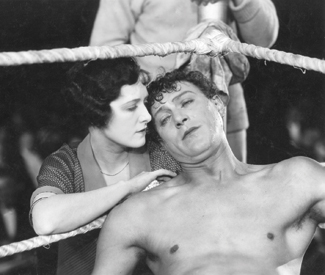
Blackmail and The Lodger are stuffed with elements that would later be easily identifiable as “Hitchcockian” (witness Blackmail‘s high-climbing climax — it ain’t Mount Rushmore, but you see where the idea’s heading). But The Ring, about a love triangle between two boxers and the (dark-haired) temptress that motivates their brawls, is Hitch’s only original script penned without collaborators, and it’s hardly chockablock with psychological terrors. It is, however, a charming sports romance with some nifty technical touches, including an early example of a drunken scene being shot in blurry “booze-o-vision.”

http://www.youtube.com/watch?v=F2T4ZrBel6A

The rest of the Hitchcock 9: 1928’s daffy-heiress tale Champagne; 1927’s Downhill, which also stars The Lodger‘s Novello; 1927’s Isle of Man-set The Manxman; 1928 comedy The Farmer’s Wife, with The Ring‘s Hall-Davis; 1927 Noel Coward adaptation Easy Virtue; and Hitchcock’s feature debut, 1926’s The Pleasure Garden. 

THE HITCHCOCK 9

Fri/14-Sun/16, $15–<\d>$20 (nine-film pass, $135)

Castro Theatre

429 Castro, SF

www.silentfilm.org


Hell boys

1

cheryl@sfbg.com

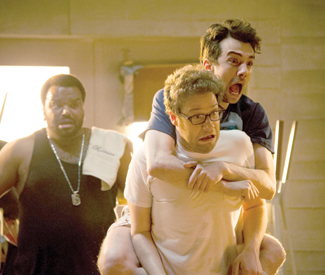
FILM It’s a typical day in Los Angeles for Seth Rogen as This Is the End begins. Playing a version of himself, the comedian picks up longtime pal and frequent co-star Jay Baruchel at the airport. Since Jay hates LA, Seth welcomes him with weed and candy, but all good vibes fizzle when Rogen suggests hitting up a party at James Franco’s new mansion. Wait, ugh, Franco? And Jonah Hill will be there? Nooo!

Jay ain’t happy, but the revelry — chockablock with every Judd Apatow-blessed star in Hollywood, plus a few random inclusions (Rihanna?) — is great fun for the audience. And likewise for the actors: world, meet Michael Cera, naughty coke fiend.

But stranger things are afoot in This Is the End. First, there’s a giant earthquake and a strange blue light that sucks passers-by into the sky. Then a fiery pit yawns in front of Casa Franco, gobbling up just about everyone in the cast who isn’t on the poster. Dudes! Is this the worst party ever — or the apocalypse?

I chatted with Rogen, his co-director and co-writer Evan Goldberg, and co-star Craig Robinson (The Office) when they hit town a few weeks back; their Bay Area visit included stops at multiple social-media HQs (Rogen’s take: “I thought there’d be more Segways.”) Rogen and Goldberg’s often-overlapping, guffaw-laden answers speak to their lifelong friendship — at 13, the Vancouver classmates wrote the first version of what would become the 2007 hit Superbad.

Also in 2007, they made Jay and Seth vs. The Apocalypse, a short film starring Rogen and Baruchel as “two guys arguing in a room, basically,” Rogen says. “The world is ending, but our main problem is that we have to deal with each other, and our histories, and our friendship issues.” The idea expanded and became This Is the End, which marks Rogen and Goldberg’s feature directorial debut. An apocalypse comedy? Well, why not?

“There’s always been apocalyptic movies. It’s the biggest idea you can have: the end of everything. But are there any other funny ones?” Goldberg wonders. “I found moments of Volcano (1997) pretty funny. I suppose Armageddon (1998) would be classified as an apocalypse comedy, by accident.”

It’s important to note that This Is the End relies not on natural disasters, asteroids, aliens, or zombies to signal doomsday. “The whole concept was, full Christian apocalypse,” Rogen says.

“Catholic. Christian. Apocalypse. Book of Revelations. It’s the biggest book ever made,” Goldberg adds. “It’s the most popular version of it, so we might as well ride that gravy train.”

Cult-movie connoisseurs will be familiar with unintentionally hilarious depictions of the Rapture, most famously in “scare films” like 1972’s A Thief in the Night. Rogen’s research was slightly more modern. “Along with two of our producers, I watched all of Kirk Cameron’s Left Behind movies,” he admits. “They are fucking insane. It was one of those things where we were like, “Let’s look at it for five minutes. It’ll be funny!” and we ended up watching the whole trilogy. It was unbelievable.”

Neither Rogen nor Goldberg happens to be Christian, which is part of the joke. “A lot of people think we’re gonna be stuck here as hell comes to earth ’cause we’re Jewish,” Goldberg points out.

“It’s true!” Rogen laughs. “That idea fascinated us. Most people in North America were raised Christian; whether or not they actually believe in it, they’re ingrained from a very young age with the general idea that hell is gonna come to earth one day, and the good people will get sucked up to heaven and the bad people will be laid to waste, basically. Which to us was a fuckin’ disturbing concept, especially since it was implied that we would be the ones left behind. I think that’s really where [the film] came from.”

Goldberg elaborates. “In 11th grade, I had a conversation with a Christian friend, where I asked, ‘Let’s say I save a bus full of children who are falling off a bridge. But there’s this serial killer who believes in the stuff that gets you into heaven, and I don’t. Does he still go to heaven, and I go to hell?’ And she was like, ‘Yeah. Sorry, dude.’ Most Christians don’t really think we’re going to hell. But they all know the story.”

Of course, This Is the End has a lot more to it than religious commentary; there’s also copious drug use, masturbation gags, urine-drinking, bromance, insult comedy, and all of the uber-meta in-jokes fans of its stars will appreciate. (When asked if this is the most self-referential movie ever made, Goldberg cracks, “Maybe … unless, is somebody making a movie about the making of this movie?”)

“You’ve seen people play themselves in a movie before, but not to this level,” Robinson notes. “Though there’s two versions, you know — there’s me, singing ‘Take Your Panties Off,’ which I do in real life, and the me who has killed a man, which is not real. Hopefully the audience will able to differentiate.”

With a large ensemble of funny guys (Rogen, Robinson, Baruchel, Franco, Hill, and Danny McBride), plus a raft of cameos, the filmmakers were careful to split the laughs as evenly as possible.

“For the six main guys, we tried to write the best script we possibly could. But sometimes, the actors won [with their improv], because they’re funnier,” Goldberg laughs. “When it came to the party with all the different deaths and stuff, we had a bunch of ideas and we kind of hashed it out with each actor. We tried to make sure we gave everyone one good bit, and I think we mostly pulled it off.”


THIS IS THE END opens Wed/12 in Bay Area theaters.

Thunder from West Portal: Quentin Kopp savages the Warriors’ Embarcadero Wall and its $220 million taxpayer subsidy

7

(Scroll down to read Kopp’s column from the Westside Observer)

When then State Sen. Quentin Kopp was appointed to the bench in San Mateo County, some of his fellow judges took him out to lunch.  “We hope you realize you have now given up your First Amendment rights,” he was told.

Judge Kopp did as he was told and kept silent for years on the bench on the many issues he felt strongly about and would have taken on in the public arena.   Today, however, he is retired, given up judicial restraint, and is back in action exercising his First Amendment rights with gusto. Operating from a desk in the office of Atty. Peter Bagatelos in West Portal, Kopp blasted the scavengers on behalf of an initiative aimed at upending the scavenger monopoly and controlling rates (he was right.) He has fired away at the RosePak/Willie Brown/Chinatown power structure on the Central Freeway.
He regularly blasts Mayor Lee for “compliancy” on big development, District Attorney for any number of misdemeanors and indiscretions, and former Sup. Sean Elsbernd for being Sean Elsbernd.

Now, in the current edition of the Westside Observer, Kopp has hit his stride with an acidic but well argued column titled appropriately, “The Art of Picking the Public Purse.” 

His lead: “It’s all privately funded!  Those aren’t my words; those are the words of the billionaire owners of the San Francisco Warriors and compliant Mayor Edward Lee respecting the proposed (and financially complicated) Warriors proposal to build a mammoth sports and entertainment arena on San Francisco Piers 30-32.”

Kopp wryly urges his readers to forget that the proposed project, “with Lee as the spear carrier (proudly proclaiming that the wrongly placed arena would be his ‘legacy’) would, if ever built, be higher than the “hated Embarcadero Freeway, which many San Franciscans spent years detesting and attempting to eliminate.”

Instead, he said taxpayers should concentrate on the “taxpayer subsidy of up to $200,000 (including interest) to the Warriors.” And he lays out the arguments and stats that demolish the Warriors’ line that “it’s all privately funded.”  Warming up, Kopp writes that the Warriors demand that Piers 30-32 be fully reconstructed, at Port cost, to a standard that will support the immense 19,000-seat arena.  The reconstruction cost is an estimated $120,000,000. Every single penny of such $120,000,000 is public money, i.e. the Port. The Port must borrow the money to reconstruct those piers.

“From whom? The Warriors, of course, and for the privilege of borrowing such money (for the Warriors’ benefit), the Port will pay the Warriors an exorbitant 13% per year as interest.”

More: “the port must sell the Warriors an enormously valuable piece of public land across the Embarcadero (Seawall 330) for a highrise hotel, condominium and retail development (b3: gulp).” Still more: “under the proposed Warriors’ deal, the $120,000,000 borrowing would be approved by a simple majority of the Board of Supervisors. The San Francisco Giants in 1996 and the San Francisco 49ers in 1971 were not afraid to secure voter/taxpayers approval. Maybe Lee and the Warriors are afraid the truth is that $120,000,000 is needed for the extraordinary cost of bearing the proposed arena’s weight, and supporting facilities the Warriors want to build on a platform over San Francisco Bay (b3: gulp again.)” You get the idea. 

Kopp’s arguments cry for an independent analysis by Harvey Rose, the city’s respected  budget analysis, who did a prescient assessment of the costs of the America’s Cup project. Kopp’s columns, along  with the excellent reporting of Patrick Monette-Shaw on Laguna Honda and George Wooding on the Ethics Commission and others, demonstrate that the Westside Observer under Editor Doug Comstock and Publisher Mitch Bull has become a sharp critic of City Hall from a neighborhood point of view and the best neighborhood paper in town.

Click here to read Kopp in full: http://westsideobserver.com/columns/quentin11.html#jun13
The paper is distributed monthly  West of Twin Peaks but you can see it easily by going to the Observer’s website at westsideobserver.com  b3

(Bruce B. Brugmann, who signs his blogs and emails b3, writes and edits the Bruce blog at the Bay Guardian website at sfbg.com. He is the editor at large of the Bay Guardian and former editor and co-founder with his wife Jean Dibble, 1966-2012.  He is now off to attend his 60th reunion of the dream high school class of 1953 in Rock Rapids, Iowa. He will keep you posted.)

Distance and racism

41

Right now, I’m approximately 116 miles from the Mexican border.

When I was growing up, I was 1600 miles from the same border. I was in Boston–I had a discussion today with some musicians from Boston that are “alarmed” at “the end of America” because of “amnesty”. When I pointed out that in the last 24 years, LA had become more “Latino” (I sussed out that the issue wasn’t illegal immigration as it never really is, when they started in with “press 2 for English”) and that crime and pollution was down and land values up–might as have been talking to my toenails.

I think it’s the same syndrome that crazy white folks in gated communities have about “the end of our way of life”–the further removed they are from the actual human beings that terrify them the more terrified they are.

Why do you think Coeur D’Alene, in Idaho’s northern tip was the capital of white power, hundreds of miles away from non whites?

It’s race.

Supervisors approve condo legislation with veto-proof majority

64

The San Francisco Board of Supervisors today voted to approve compromise legislation that will allow more than 2,000 tenancy-in-common homeowners to convert to condominiums in exchange for a 10-year moratorium on the city’s current condo conversion lottery that now allows 200 conversions annually.

Approved by a veto-proof 8-3 majority after some last amendments were shot down by the six supervisors who most steadfastly supported the version that Board President David Chiu took the lead on crafting, this was a big victory for tenant groups who strongly opposed the original legislation, which did not include the moratorium and other restrictions.

“It’s great. We’re going to see a significant drop in condo conversions in the future. All of us tenants are very happy,” San Francisco Tenants Union head Ted Gullicksen told us after the hearing, which was packed with tenant supporters.

Sup. Mark Farrell, who sponsored the original legislation, decried how divisive the issue had become, criticized the approved version as deviating from his original intent of helping TIC owners in exchange for a fee that would help fund new affordable housing, and said, “This doesn’t need to be a zero sum game.”

But Chiu and the five supervisors who supported his version – Jane Kim, Norman Yee, David Campos John Avalos, and Eric Mar – noted the finite number of rent-controlled apartments in the city and the need to protect them from being converted into condos.

“How do we balance the needs of tenants who fear being evicted with TIC owners looking for relief?” Chiu said of the balance he aimed to strike, which he continued to tweak with new amendments today, including allowing TICs with all owner-occupied units to move forward if the legislation is challenged in court, an event that would otherwise freeze all condo conversions until the lawsuit is resolved.

Sup. London Breed wanted even greater flexibility in that so-called “poison pill” aspect of the legislation, which tenant groups had insisted on to prevent the bypass from going through even if the moratorium was challenged. Breed proposed allowing condo conversion applications to proceed for a year after a lawsuit was filed, but Chiu said that would let TIC owners convert to condos while challenging other aspects of the legislation, such as the lifetime leases for tenants in converted buildings.

Breed and Sup. Malia Cohen, who privately and rather grimly conferred with one another and sometimes Chiu before the item began a little after 4pm, were clearly the two swing votes on the question of whether the legislation would reach the crucial eight-vote threshold needed to override a possible mayoral veto. Mayor Ed Lee has refused to take a position on the issue, leaving both sides in the dark.

But after the motion to insert Breed’s amendments failed on a 5-6 vote, the board voted 8-3 to approve Chiu’s version of the legislation, with Sups. Farrell, Scott Wiener, and Katy Tang opposed. A subsequent vote on a version of the legislation backed by Farrell and Wiener – which contained a weaker poison pill and more flexible owner-occupancy provisions – then failed on a 4-7 vote, with Breed joining the three dissenting supervisors.

Underscoring this legislation was what some supervisors called a “housing affordability crisis” in San Francisco, an issue that Mayor Lee was asked about at the start of the meeting, which he deflected by claiming “our city has some of the toughest anti-displacement laws in the nation.”

We’ll analyze that discussion and offer more details on the condo conversion debate and the politics behind it tomorrow in the space, so check back then.      

Wish you weren’t here

2

arts@sfbg.com

FILM Austrian Ulrich Seidl has been making films since the early 1980s, but didn’t get much attention internationally until 2001’s Dog Days, a bleak and nasty ensemble piece about some seemingly ordinary — but all variably pathetic, ugly and/or perverse — Viennese suburbanites sweating through a heat wave. It was the sort of movie that demanded attention, being grotesque, funny, surprising, meticulously crafted, and arguably just plain mean.

Following decades of mostly documentary work, he’d suddenly joined the ranks of what you might call the New (though not necessarily young) Misanthropes: directors like his fellow countryman Michael Haneke, France’s Gaspar Noé, and the Philippines’ Brillante Mendoza. For some their invariably depressing, often upsetting films illuminate the human capacity for cruelty. For others, they wallow in it.

After taking his time making a Dog Days follow-up (2007’s Import/Export, a predictably grim comment on Europe’s immigration inundation), Seidl is back in atypical bulk with his Paradise Trilogy, three lightly interlocking (there’s no real overall arc) features more tightly focused on hapless individual protagonists. Each are observed — and this director is among the most ruthlessly clinical observers around, as if cinema were a laboratory and characters his test subjects — on vacation. But of course the experience of any earthly paradise is a sour joke in the contexts they find themselves in. Striking if unpleasant, the trio gets its Bay Area debut over the next three weekends at Yerba Buena Center for the Arts.

Paradise: Love (2012) makes the pursuit of pleasure look grim indeed, from the rather cheap-shot opening of Teresa (Margaret Tiesel) overseeing mentally handicapped adults as they enjoy an amusement-park outing on bumper cars — a scene whose “grotesquerie” feels exploitative. But once she’s on her holiday in sunny Kenya, it’s Teresa who does the exploiting. At the urging of a cheerfully horny friend (one among many plus-sized, German-speaking women well into middle age holidaying there), she partakes of the local populace of young men who offer gigolo-type services for a price.

But Teresa wants something more — or at least the illusion of it. Ergo she’s thoroughly suckered when the first seemingly non-predatory beach stud she encounters (Peter Kazungu as Munga) starts asking for money — he’s got no end of needy sick relatives, it seems — once they’ve consummated his declared “love.” Similar disappointments ensue. Teresa’s naiveté isn’t exactly sympathetic, however. She unconsciously brings the full weight of class/racial privilege and condescension with her, and is endlessly, petulantly demanding as a sex tourist who insists on being treated as a lover. (The negotiation around how her breasts should be touched by Munga seem to take half an hour alone.) She just wants to be desired. Yet she acts like a pushy colonialist bargain shopper.

In Paradise: Faith (2012), the spotlight is taken by Teresa’s older sister Anna Maria (Maria Hofstaetter), who most certainly is not looking for romance, let alone sex — without wearing a cowl, this hospital radiologist has become a fervent bride of Christ. She spends her vacation time alone in her over-large house, scrubbing it spotless, flogging herself clean of impure thoughts before Jesus, and singing hymns at the Casio keyboard. She also goes on daily outings to the homes of strangers, frequently immigrants. She barges in with sizable Virgin Mary statues crying “The Mother of God has come to visit you!,” and tries browbeating them into sin-abjuring prayer. Needless to say, this all seems much more about her needs than theirs.

She returns one day to the unwelcome surprise of husband Nabil (Nabil Saleh), an Egyptian Muslim back after an unexplained two-year absence. They’ve both changed greatly — back then he wasn’t yet paralyzed from the waist down, and she wasn’t a born-again fanatic. He’s nonplussed that her vinegary form of “Christian charity” treats him more as a home-nursing burden than a marital partner, and hostilities between them soon escalate to nightmarish proportions.

Ultimately, faith provides no comfort — and that failure induces a crisis of faith. Rigorously controlled in aesthetic terms, Seidl goes over the top content-wise at times — as when Anna Maria stumbles upon a public park orgy, or uses a crucifix à la Linda Blair — yet this cruel portrait of religious fixation has a certain compulsive, often cringe-inducing tension.

Finally, there’s some light at the end of the tunnel with Paradise: Hope (2013). While Teresa is fucking Africans and Anna Maria proselytizing, the former’s teenage daughter Melanie (Melanie Lenz) has been packed off to fat camp, where she and other pudgy youths endure long days of tortuous exercise and other “improving” programs. But the kids have each other; rather surprisingly, Seidl doesn’t rain gloom on their giddy rapport. Melanie also develops a serious crush on the resident doctor, a handsome, friendly, and flirtatious fellow (Michael Thomas) approximately four times her age.

Convinced she’s overdue to lose her virginity, she’s an avid pursuer — and disturbingly, he’s kinda interested. It is the movie’s major failing that seemingly kind, intelligent, grounded Dr. Arzt remains too much of an enigma for us to grasp why he’d even consider taking up a 13-year-old on the offer of herself. Yes, Melanie is cute, vivacious, and likable … but, well, come on. Of course this won’t end well. Still, Hope is indeed the most hopeful of the Paradise trilogy: its main character’s life isn’t ruined already, and she might well survive the hard knocks she’s given here to experience actual happiness.

ULRICH SEIDL’S PARADISE TRILOGY

June 13-30, $8-$10

Yerba Buena Center for the Arts

701 Mission, SF

www.ybca.org


Bully for the ACLU! It went after the real lawbreakers

1

Scroll down to read the ACLU complaint in the New York Times story

For me, the crucial question was not whether Edward J. Snowden broke the law but whether the U.S. government had broken the law in secretly setting up and secretly expanding what the American Civil Liberties Union called its “dragnet”collection of logs of domestic phone calls.

The ACLU, filing on Tuesday one of its most important lawsuits ever, stated that “this practice is akin to snatching every American’s address book, with annotations detailing who we spoke to, when we talked, for how long, and from where.  It gives the U.S. government a comprehensive record of our associations our associations and public movements, revealing a wealth of detail about our familial, political, professional, religious, and intimate associations.”

The suit stated that this mass tracking violates the Patriot Act and the First and Fourth Amendments to the U.S. Constitution.  The ACLU asked for the court to stop the Obama Administration from the practice and expunge the records.


“Every American” needs to read the ACLU suit embedded in the New York Times story. Let’s get our priorities straight and go after the real lawbreakers. Bully for the ACLU. b3

Click here to read the Times story and complaint.

Bruce B. Brugmann, who signs his blogs and emails B3, is the editor at large of the San Francisco Bay Guardian. He writes and edits the Bruce Blog on the Bay Guardian website at sfbg.com. He is the former editor and co-founder and co-publisher of the Bay Guardian with his wife Jean Dibble, 1966-2012.