Bay Guardian Archives

Republicans are just plain daft, part 2

29

One of the most prosaic lines in film history is in 1974’s Godfather II. When Vito Corleone (Robert DeNiro) is asked by Peter Clemenza (Bruno Kirby) if he checked out the package of oily guns Clemenza had left him as the NYPD was hauling Clemenza away, Corleone replies coolly that “I’m not interested in things that don’t concern me”.

At that point, we realize that the future Don was not a Republican.

Today’s GOPster clown cultist is obsessed with things that do not concern them. Embryos and fetuses germinating in women they’ve never met. Same sex couples marrying thousands of miles from them. The well-being of the same plutocracy that do not pay them the same mind back in the least.

Conversely, when it is things that do concern them–Gulf oil spills, rising seas, warrantless searches of emails and phone calls, endless wars—oddly indifferent.

When someone prioritizes the irrelevant over the important, what else can one say?

They’re fucking daft.

Q&A: Vela Eyes on passing out in the studio, taping merch to the car hood, and becoming ‘a real band’

0

Vela Eyes is a relatively new indie-pop act right out of San Francisco that combines a huge, spaciously synthesized sound with the personality and camaraderie one can only find in decades-old friends. It’s a perfect fusion of the rawness of punk influences with the technical proficiency and sampling-song mapping of a DJ set.

The group has been playing packed shows throughout the Bay since its inception mere months ago, most recently an album release party for its first EP, The Pleasure Sunrise, last week at the Elbo Room. Get to know Vela Eyes before the band’s next local gig (you’ve got ‘till July 26):

SFBG So you guys don’t have a van and had to come up with a crazy wacky maneuver to get your gear back from your record release show?

Julia Johari We had to make three trips to get all of our stuff there. But at the end of the night we realized we didn’t want to make multiple trips to get our stuff back. So I just remember Nate being like “I’m going to tape the merch to the hood of my car!”

Ian Zazueta Luckily I brought that big roll of red duct tape. I knew it would come in handy.

SFBG Tell me about playing the Elbo Room for the record release show.

Jef Pauly I actually had the place in mind after playing there a few times. It’s got a very intimate atmosphere and packs a crowd close together.

Nate Higley That’s a P.C. answer. Truth is we knew we couldn’t sell out Mezzanine.

JJ We knew we would be able to pack Elbo Room.

Florie Maschmeyer And the sound was really important, we’ve always felt we sounded really good in the Elbo Room.

IZ It’s kind of a give and take. You want a location that’s a good fit for you, but you don’t want to sacrifice a good on-stage sound or the sound that’s directed at the audience.

SFBG Where does your sound start?

FM We kind of conceptually write. For example, I would call and be like “I just had the weirdest dream, you want to hear me out?”

IZ And I would honestly take notes and stuff while she was talking and start coming up with some things. Then Florie would add some more and we’d build a song around it. Then Nate brings in a lot of creativity and musical contrast and intelligence to it. We’re finally starting to develop our style.

NH Yeah, it doesn’t take like a year to write a song anymore! [Laughs]

JP We’re basically hitting phase two now that we’re a “real band.”

IZ Oh, you mean since you joined the band! [Everyone laughs]

JP Well, did you have any drummer before me?

IZ Yeah we did, it was called Logic Pro and it wouldn’t talk back. [Everyone laughs]

SFBG So Jef, as a drummer, you always play to a click track?

JP Every practice, every show.

IZ For me, who creates a lot of our sequences and samples, having someone who can be able to do that adds so much more to our creativity and allows so much more potential for pushing our product. A lot of people would see playing to a click as being more rigid, but once we establish the right tempo to the song, in terms of manifesting a product, it gives us so much more freedom.

SFBG So any time I see you guys play live anywhere it will have the exact same tempo?

IZ Yep.

FM Especially because we have trigger sequences that happen all throughout the track.

SFBG The trigger sequences are something you’ve designed ahead of time to drop at a specific point with the metronome in the course of the song without physically having to push a button to turn whatever sound on?

FM Yeah, it’s in the song already. So Jef gets the count-in and then the song starts.

JP There really is no room for messing up. There’s just a count-off at the beginning and if I miss the start, it’s all over.

SFBG On multiple occasions I’ve heard you refer to your music as “the product,” what does this mean?

FM We refer to it as product because it takes our music and makes it a sellable package. That’s what you have to do if you want to be in the music industry, you need to have a product, which means your image, your music, your presence. In the end that’s what we pay for, that’s what we record and what we sell. It’s always important that we think of the product as a whole because we’ve got so many different songwriters in this. Egos can battle, but we always agree on what’s good for the project. The music is a separate entity who’s not one individual person. At different points anyone in the band might be leading the song, but it always comes down to what’s right for the product, the band as the whole is separate from us individually at this point.

SFBG What, in one sentence, is the selling point for me to come to your next show?

FM It’ll be a sexy kick in the teeth. I think you’ll love it.

SFBG So let’s close this out with another awesome rock and roll story, shall we?

FM Remember when we got all hammered and passed out in the music studio, sleeping on the floor, spooning? Then I pissed my pants.

IZ No, the funny thing is that she tried to blame me. Like, after she peed all over me. Florie’s like “how do you know it wasn’t you?”

SFBG Were you playing a show beforehand or something?

NH No, this was just a typical Thursday night.

Vela Eyes plays next July 26 at Bottom of the Hill, with the Orange Peels and the Corner Laughers.

The Performant 150: We are the 99% (gay)

0

Celebrating Pride Month in the the-ah-tah

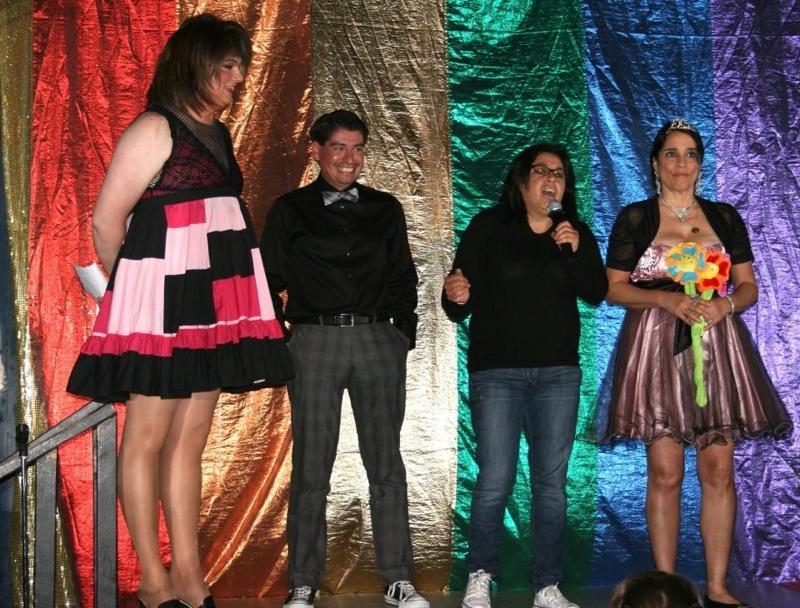
We’re already halfway through Pride Month, but there’s no end in sight for the mad whirl of activities you could be availing yourself of. Proud or not, there’s no excuse for a blank social calendar at this time of year. Hate the club scene? Don’t overlook the très gay possibilities of a night in the theatre (Truman Capote wouldn’t). For starters, you might check out one of the ongoing shows over at the venerable New Conservatory Theatre Center, or one by queer theatre stalwarts Theatre Rhinoceros, but for campier fun, The Performant has a few favorites of her own to recommend (being gay not required).

What’s more gay than Marga Gomez at the Mission’s beloved Latino drag bar, Esta Noche (which thankfully seems to have staved off closing, for now)? It’s Marga Gomez at Esta Noche with a stellar line-up of out-and-proud comedians, a special Pride Month version of her regular weekly “Comedy Bodega” shows she’s entitled The 99% Gay Comedy Fest. I’m not sure who comprises that other one percent — perhaps some asexual socialite who’s slumming on the queer comedy circuit — but as laughter is a universal experience, they’d doubtlessly fit right in. Unlike most other comedy shows around town, Comedy Bodega is totally free, and although there is a one drink minimum (it is a bar, after all), well drinks are only $3.50, leaving you that much more money in your pocket to tip the performers. Everybody wins.

Speaking of wins, psychedelic-era, gender-bending performance troupe the Cockettes have permeated both sides of the Bay with the ongoing (extended to July 27) Thrillpeddlers’ revival of one of their outrageous stage shows, Tinsel Tarts in a Hot Coma, as well as an entire room of historical memorabilia at Mills College Art Museum as part of their “West of Center: Art and the Counterculture Experiment in America, 1965-1977” exhibition, which runs through Sept. 12. Also free to the public, the exhibition includes a June 26 screening of a pair of short films, Palace and Elevator Girls in Bondage, featuring key Cockettes including Rumi Missabu, Fayette Hauser, Hibiscus, and Miss Harlow.

Not free to the public, but always worth the price of admission, Tinsel Tarts is the fourth revived Cockettes’ show at the Hypnodrome, and it’s quite possibly the most outrageous one to date. In 1971, critic Rex Reed described it as “a spangled chaos of flesh, a seething mass of lurching bodies in lavish hock-shop costumes, doing their thing for freedom,” which well describes the Thrillpeddlers’ experience to a tee. If you’re lucky (as I was) you might get a chance to see not one but three original Cockettes strutting their stuff onstage: Missabu, Sweet Pam Tent, and fearless musical director (and “Chico Marx”) Scrumbly Koldewyn.  
 
And on the subject of ongoing revivals, if you’ve yet to see Boxcar Theatre’s rambunctious revamp of Hedwig and the Angry Inch, now is the perfect time to remedy that. Not only has the show scored a float in this year’s Pride parade, but it just celebrated its 100th performance of its high-octane version of the John Cameron Mitchell/Stephen Trask musical, featuring an octet of sexy Hedwigs swarming the stage at the same time. Punks, trollops, glam girls, rocker boys, and soul singers, each more endearing than the last, no matter which performer lurks behind the wig (the cast rotates every few weeks). After numerous extensions, the show will close for good on August 10, so get proud, get drunk, and get a ticket while you still can.

The Performant: (Somewhat) lost in translation

0

“Infinite Closeness” was a little ways off

Reminiscent of Mission parlor-art space The Red Poppy Art House, Subterranean Arthouse in Berkeley, upon entrance, is a lot like entering the living room of an artsy friend. Comfortably mismatched chairs and a few scattered cushions, a kitchenette behind the stage curtains, inviting visitors to endless cups of tea, hardwood floors gleaming below a strand of primitive lighting instruments.

Just four years old as a venue, the Arthouse nonetheless gives off the vibe of a place that’s been around forever, lurking just below the radar, if not actually under the ground (unlike La Val’s Subterranean, it’s actually located at street level). In short, it’s about time I got around to attending an event there.

The piece, “Infinite Closeness” is a solo offering of Hungarian performer Csaba Hernadi, an entirely mimed evocation of the poetess Mari Lukacs, whose life spanned the horrors of the Holocaust, the communist regime, and the usual traumas and blessings of a life lived for poetry.

The stage is set with a few scattered props: couch, table, coat-rack, a cracked and legless mannequin. Some pieces such as a dressmaker’s dummy and what appears to be a kneeling refugee from a carousel menagerie lurk in unclaimed corners of the stage, perhaps conjuring the crowded edges of a mind in turmoil. Truthfully it’s not entirely clear what purpose they serve, which is presumably the point.

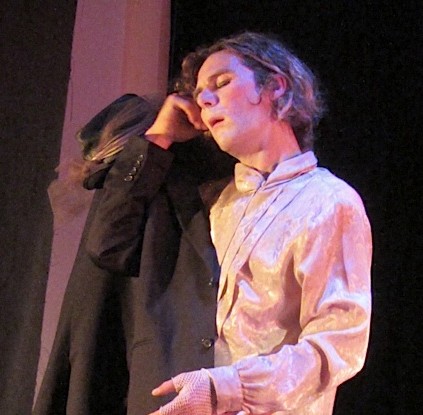
Clad in a modest high-collared blouse of cream and long black skirt that hangs just above unwomanly large bare feet, Hernadi “awakens” on his couch as a swell of sound, murmur and rushing wind, moves him forward. Stiffly seated at a “dressing table,” Hernadi as Lukacs brushes his/her hair and then takes up an onion, peels it, and presses it abruptly to his/her eyes, a visceral pantomime of grief.

Or at least that’s what it appears to be. Even more enigmatic than the unfamiliar strains of Hungarian would be are the broad strokes of silence that shield the piece from easy interpretation. My trusty theatre-companion V. gets restless. “There should be subtitles” he mutters near the end, though as the piece is silent, maybe he means inter-titles. I know what he means, though. Context is everything.

For just as art interprets us, so do we interpret art. And while we are by no means unwilling to follow Harnadi’s Lukacs’ down the various rabbit holes that turbulent times pulled her down throughout the years, lacking any prior knowledge of her biography makes extrapolating it from the raw movement onstage a challenge. Even the presence of a blurb in a program or a single line of her poetry would have served to round out our interpretation of the event in a way that Hernadi’s tender dances with the broken mannequin and an empty suit jacket don’t quite manage.

And while his reverence for his subject is evident and moving, ultimately the focus of the piece remains on him rather than her, as he is in the room with us in a way she is never quite allowed. Still, I’m grateful to Hernadi, and by extension Lukacs, for bringing me to The Subterranean Arthouse at last. I’ll be sure to not let another four year go by before I return.      

Ultimate solution

10

What would happen if all Americans simply paid cash for everything?

Can’t afford it, don’t buy it. And always pay cash for all day to day items so that your purchases do not go into a database.

You say you have had it with a power structure that puts you in debt and tracks your every move? And you don’t wanna go through your life with a hook in your mouth and obligated to remain at a soul-starving day job you despise.

This would do it, wouldn’t it? Of course, if you’re happy being in hock, wage-slaving and a marketer’s dream, carry on, by all means.

Tale of two cities

25

Interesting piece in the LA Times a few days ago, Our new mayor, Eric Garcetti, wants to bring raves back to Los Angeles. After the death of a 15 year old that snuck into the Electric Daisy Carnival event at the Coliseum, the raves have gone to Vegas, where they’re pulling in 100K in attendance. The mayor sees dollar signs in those numbers, not to mention OT for city employees that have been hurting the last five years from budget cuts. A sensible idea.

It got me to thinking, as these things do, about a more general policy of bringing lucrative businesses and events to LA. After all, downtown business rents are cheaper than New York or Tokyo and there is far more space here as well. The city’s soon to be highest high rise will be a Korean owned hotel, so LA has already demonstrated a cooperation with Asian interests that cannot be matched. Not by New York or any other American city, even those on the West Coast. Like Seattle, Portland or erm, San Francisco.

If Garcetti and the city council decided to offer up better deals for high-tech than exist 390 miles to the Northwest, there is precious little Mayor Lee could do to match. LA has a lot more money and of greater importance, much more space. 49 square miles cannot compete with 480 square miles. And with the Internet making high tech jobs doable anywhere, why wouldn’t tech start ups decide to opt for LA?

Let’s face it, San Francisco has priced itself right off the grid. For all of Mayor Lee’s tax incentives, the city is incredibly expensive to rent or buy in. It is still possible to find a decent 1 BR in Silver Lake or Eagle Rock or Highland Park for under 1200 a month–where is that in SF, Bayview (if at all)? And no 82K parking spaces or multi million dollar Manhattan sized condos either–for 3 million bucks, you can buy a reasonable property in the West Side’s swankest hoods–what does that get you in Pacific Heights?

LA is a very expensive city to live in by dint of car ownership as necessity and driving distances. It’s also nowhere near as pretty as San Francisco is. But as SF approaches Tokyo-like exclusivity, it would take very little to pry high tech firms south–where it’s always warm, the beaches and ski resorts both near and best of all–the entertainment business and its attendant pleasures and power are nearby. 

Let’s face it, SF has screwed up–their biggest business for eons is tourism and that would never change were the city not so insistant on wrecking same with crack downs on clubs and “1984”-like scare tactics. Los Angeles–with its money and power can offer incentives that Mr. Lee and his cromies could only dream of–and with a forward thinker like Garcetti at the wheel, this may be inevitable.


Brighten your Monday with the awesome new trailer for “The Wolf of Wall Street”

2

You just gotta watch it, and you’ll agree: November 15 can’t come soon enough. Can Scorsese do what Soderbergh couldn’t and get Matthew McConaughey an Oscar nom? Plus: smarmy Jonah Hill in a polo shirt, a DeLorean (?), decadent yacht parties, DiCaprio cradling a chimp (and not uttering the words “Old Sport”)…

https://www.youtube.com/watch?v=iszwuX1AK6A

Crapitalism

35

Happy Father’s Day! Be good to your dad (assuming he’s alive/you know who he is) and enjoy your kids (assuming you have any/know who they are).

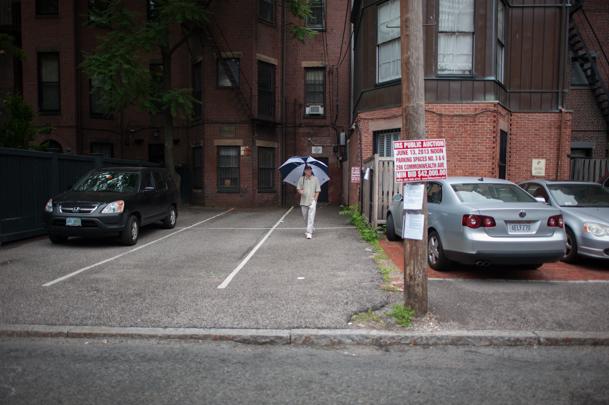
A remarkable story crossed my monitor this week. From back in the sacred Motherland of Massachusetts. Apparently, a pair of tandem parking spaces were auctioned off behind a toney Commonwealth Ave (Boston) condo for a whopping 560K–they’re shown in the photo. That’s over a half a million dollars in prime real estate yer gazing at.

Bid up from a sort of reasonable 42K and sold to a party that allegedly owns three spaces there already, this is the kind of story that makes one’s eyes glaze over in amazement. As primo as the location is, that tiny and stained bit of asphalt you’re looking at is not worth that price under any circumstances.

As that part of Boston is tightly zoned, it isn’t like it was bought to expand a brownstone. Nope, this is conspicuous consumption run completely amok or as a friend of mine back there put it, ”this could only have happened to people for whom money has no meaning”. (I suspect that the purchase was made as a “business expense” for a corporation, more to be revealed).

For 560 grand, you can still buy a modest home in Boston’s most desirable suburbs (all of which have better public schools than Boston and are cleaner and not plagued with unbearable traffic). And the property is but ten minutes on foot from downtown and the business district, cabs and car services are plentiful, therefore, why bother? As a possible long term investment? (Not a great idea as you will see).

This neighborhood, the Back Bay, was the first place I had my own digs. Adjusted for inflation, that apartment should go for about 420.00. It is now a million dollar and up condo and what was it? One gigantic room, likely the dining room of a three story home back in the 1800’s. And I still have friends in that neighborhood. Tellingly, all of them have been there at least 25 years and they could never afford it now.

By pricing all but the top of the top out of what once was an artist friendly neighborhood, the same neighborhood has the ripple effect of driving real estate values in adjacent neighborhoods past reason. Boston and San Francisco–joined at the hip by being the satellite cities to America’s twin powerhouses–are now unaffordable. 

A piece in the same paper that ran this story last year said it all. People aged 35-54 –which used to be an enormous demographic in Boston–no longer live there in large numbers. After university they just up and go because first jobs don’t pay enough to raise the scratch for a down payment. When a slab of concrete not even big enough to be a bedroom in a rooming house goes for 560K, it says that “what the market will bear” is not applicable.

This isn’t “free market capitalism”, it’s “crapitalism”. The laws of supply and demand have been so perverted by so few having so much, they almost don’t apply anymore. And my beautiful hometown–once a funky seaport with the best local music scene outside CB’s/Max’s–is now an overly exclusive playpen for folks that have brought back the Brahmin Age, only on ‘roids. Same as in SF—two small peninsulas whose essential character is being clobbered by venal plutocrats. Crapitalism couldn’t exist without tacit aid from the government–in SF, it’s in the form of tax breaks, in Boston, tax free academia is swallowing their city whole, reducing the amount of living units and artificially raising land value. That isn’t “supply and demand”.

The utlimate irony of this ridiculous transaction is that the Back Bay, like the Marina, is atop a landfill. The Charles River already overflows its banks and floods the basements of these expensive edifices more than it used to–so the parking spaces in question may be useless a fair amount of the time (of course, crapitalism being what it is, MA taxpayers will surely be stuck for the bill of seawalls and the like).

Bailouts, cronyism, loopholes–instead of an economic boom, we have Marie Antoinette style madness in our major cities. Pretty pitiful.


Jerry Garcia Street

19

This spring, me and the missus brought our kids up to the City from LA for the first time, via Big Sur, Monterey and Santa Cruz. It was our best family trip ever–wild turkeys and great hikes in the Sur, hanging on the boardwalk in Cruz and finally, SF. Stayed a few nights in Japantown, climbed Mt Tam, watched the fog envelope the Golden Gate–touristy stuff (I passed on the cable cars, however–they loved them).

Naturally, we had to show our children where we once lived and as we’d been up to Twin Peaks already, the Haight was nice and easy. Plus, I had to make a stop at Amoeba to consign some music.

Our old neighborhood has changed since the middle 90’s, but mostly in subtle ways. Still a bunch of panhandlers about (carrying banjos and ukes now as opposed to guitars), the wonderful Pork Store and the panhandle itself. The biggest change is the proliferation of parents–I don’t recall many strollers back in the Clinton era, but there was much pram pushing down Haight Street (sorry, Mick) all the same. Saw lots of that in SoMa parks, too–kiddie city.

When I was dropping off the discs at Amoeba, me and the counterman started jawing about the changes underway and he shocked me by saying that a great deal of the shop’s foot traffic was tourist based. People that came up to that neck of the woods solely for the history. And I got to thinking and I wondered–why is there almost nothing named after the area’s most famous export and certainly its magnet, John Jerome “Jerry” Garcia?

The Dead and their compatriots made this little corner of SF the most famous place in the world for a spell and yet very little commemorates the fact. That they carried on for 28 years past the “summer of love” spreading their loping groove around the world means that the rest of the world (a lot of it) comes to SF to try and absorb a little of that long gone good feeling. In other words, more tourism and more business.

I wonder, wouldn’t it be something if upper Haight Street–from Divisidero to the terminus at Golden Gate Park (I would say Cala Foods, but that too is gone) be renamed “Jerry Garcia Boulevard?” If Army Street can become Cesar Chavez, why not? 

And please spare me the incoming crapola about “honoring junkies”. Garcia’s personal habits have nothing to do with his work and the idea that he represented the “corruption of youth” gives someone that eschewed being a role model way too much power. 

There’s already a “Joey Ramone Place” in the Bowery in NYC. As there should be. It’s high time (no pun) that San Francisco did the same for the creator of its underground scene as well. 


A statement about the Guardian

Today I named veteran Bay Area journalist Stephen Buel publisher of the San Francisco Bay Guardian.

And following the resignation of Editor and Publisher Tim Redmond, I named longtime Bay Guardian editor Marke Bieschke interim editor of the paper.


Buel, editorial vice president of the San Francisco Newspaper Company, will bolster the paper’s fortunes while upholding its long tradition of investigative journalism, progressive values and cultural coverage. Bieschke, the paper’s managing editor, nightlife columnist and long-time San Francisco resident and activist will help provide vision and leadership on the print and digital editions of the Guardian.

“The Guardian has been losing money, and we were forced to contemplate some editorial layoffs,” Buel said. “Tim decided to resign rather than follow through with what we were discussing. I am dedicated to reversing the Guardian’s fortunes and helping it grow again.

“While we will all miss Tim’s skills as a journalist, I would like to assure the Guardian faithful that it will remain the progressive newspaper of record in San Francisco. I suspect there will be some skepticism about that, but over time, I am confident that readers will not be disappointed.”

— Todd Vogt, president and publisher of the San Francisco Newspaper Company, parent company of the Guardian, SF Weekly and The San Francisco Examiner.

Guardian forum on Plan Bay Area draws big, engaged crowd

72

San Franciscans who want to help shape how this city grows — rather than just leaving it up to regional planners and market forces — packed a large conference room last night for a community forum presented by the Bay Guardian: “Whose Future? What Does the Regional ‘Plan Bay Area’ Really Mean for San Francisco?”

Moderated and organized by Guardian Editor/Publisher Tim Redmond, and co-sponsored by the Council of Community Housing Organizations (CCHO) and Urban Institute for Development and Economic Alternatives (UrbanIDEA), the session began with a overview of what’s now being planned for the San Francisco of 2040.

Gen Fujoika of the Chinatown Community Development Center said that Plan Bay Area, which is being jointly developed by the Association of Bay Area Governments and Metropolitan Transportation Commission (which will hold a hearing on the plan tomorrow, Fri/14, at 9:30am in Oakland), doesn’t pay for itself yet it will include strong incentives that will shape development in the region.

“It is in some sense a plan and I think we need to critique the hell out of that plan,” he said. “As we think of Plan Bay Area as a vision statement, we need to think about whether it’s our vision.”

As illustrated by the Plan Bay Area maps that the lined the walls of the LGBT Center conference room, the plan’s “priority development areas” that are slated for dense, streamlined development are also the same areas identified as “communities of concern” with vulnerable, low-income populations, making the plan a recipe for mass displacement.

Fujoika quoted a comment that Mayor Ed Lee made on Tuesday when asked by Sup. Eric Mar about the issue: “San Francisco has some of the toughest anti-displacements laws in the country.” While that may be true, Fujoika said that the plummeting numbers of African-Americans in the city and Plan Bay Area’s displacement projections for San Francisco show those laws simply aren’t up the challenge.

“If we have the toughest anti-displacement position in the country, then we are in some trouble,” he said, calculating that the affordable housing needed to prevent extreme gentrification in the city would total $6.8 billion, and that the affordable housing fund created by voters last year is only projected to raise $1.3 billion by 2030.

Fujoika said that he and the other panelists aren’t against growth and development, “but we are for equitable growth,” which would involve more community buy-in for the plan, more money for affordable housing and infrastructure needs, and more of the growth burden being shared by other Bay Area communities.

San Francisco Planning Commission Chair Cindy Wu cited growth projections for Chinatown as a good example of the problem, noting that is already a dense, complete neighborhood that would suffer from the greatly increased traffic that would be funneled through it and other negative impacts of unfettered growth.

“It’s not just growth for growth’s sake, it’s who gets to live there and who gets those jobs,” she said. Wu called for more community organizing around this and other development plans, citing as a good example the coalition-building that forced California Pacific Medical Center to agree to a multi-hospital project with far better community benefits than the deal it originally cut with the Mayor’s Office.

It was a point echoed by Maria Zamudio with Causa Justa, who said Plan Bay Area will worsen pressures that are already displacing the Mission District residents she works with, or forcing them to live in unsafe housing. “They’re going to push our families out of the city and maybe out of the region,” she said.

To combat the power that this plan and profit-minded property owners will exert over how San Francisco grows, San Francisco Labor Council President Mike Casey, head of UNITE-HERE Local 2, said that progressive San Franciscans will need to work cooperatively with organized labor, a relationship that has suffered during these tough economic times.

“Unfortunately, I think we’ve become alienated and marginalized from each other,” Casey said, calling on activists to not let differences over individual projects or issues interfere with solidarity over the larger, longer struggle for equity and justice.

“Not everyone agrees that a strong labor movement is the cornerstone of a more progressive vision,” Casey said, arguing that displacement of working class people from the city has a cascading effect in gentrifying the city. “The demographics of a city shape very much what the politics of protest look like.”

And those politics of protest will be more crucial than ever in resisting the demands that powerful capitalists will make on San Francisco in the coming years, a point that all seven panelists seemed to agree on.

Bob Allen of Urban Habitat said the planning research groups represented on the panel need to find ways to funnel more funding into grassroots organizing, both in San Francisco and regionally. Otherwise, we’ll see the “suburbanization of poverty,” with Plan Bay Area funneling the best jobs and most expensive housing into urban areas and leaving everyone else to fend for themselves in communities that don’t have the tenant protections and other hard-won social justice programs that San Franciscans have struggled for.

“Local control can be a way of saying ‘I don’t want black or brown people to live in my suburban community,” Allen said.

Ironically, Plan Bay Area is ostensibly driven by concerns over climate change and the argument that it’s better to concentrate development along transit corridors, which is why almost all of San Francisco and much of Oakland is proposed for development that would be given waivers from some California Environmental Quality Act scrutiny.

Yet the plan doesn’t fund the transit upgrades that would be needed to serve that growth or create restrictions on automobile use that might encourage more transit use. Instead, Fujoika said low-income people who actually use transit would be the diplaced in favor of wealthier residents who might not.

“Transit has become an amenity rather than a necessity,” Wu said.

The forum, which was attended by more than 130 people, included a lively discussion that involved dozens of audience members who offered their own views, ideas, and strategies for how to move forward. Among them was Brian Basinger of the AIDS Housing Alliance, who said that he is working with a coalition to reform the Ellis Act, which allows landlords to evict tenants from rent-controlled apartments.

“We could move this as early as January,” Basinger said of the reform legislation now being developed with allies in the Legislature, urging attendees to get involved.

After the audience discussion, the meeting closed with Peter Cohen of the CCHO summarizing the high points and getting people to sign up on lists that were circulated to be involved with next steps. And Rachel Brahinsky, a former Guardian staff writer who is now a professor at USF’s Leo T. McCarthy Center for Public Service and the Common Good, urged attendees to fight for San Francisco to remain inclusive and diverse: “San Francisco is the place it is because people have kept fighting.”

The Return of the Replacements

11

Word from somewhere outta the Midwest is that the Replacements–in many ways the quintessential American indie band–are reuniting for a trio of festival shows. In Denver, Chicago and Toronto. Whether or not the band will add more dates is uncertain, as is the band’s lineup. The band’s best known living principals, Paul Westerberg and Tommy Stinson are on board. Their last lead guitar player, Slim Dunlap suffered a stroke and is unable to play, drummer Chris Mars is now a fine artist and may be unwilling to play (their notorious feuds ended when they recorded tracks to raise cash for Dunlap). 

Their evolution as a band, detailed in Michael Azzerad’s wonderful tome Our Band Could be Your Life is almost the story of Amerindie itself. Beginning on a tiny Minneapolis independant label Twin Tone as a not really hardcore at all band that played the same circuit as their city mates Husker Du, the Replacements 1984 album Let It Be ranks with any of the great classic blues based rock discs ever made–without any hint of the blues. Signing with Warner Brothers in the wake of the masterpiece, they continued to their evolution into more cerebral roots music. Perched between the underground that birthed them and the commercial success that eluded them, they called it a day 22 years ago.

Whether or not their motives for returning are financial (bassist Stinson has made a good living as Duff McKagan’s “replacement” in Guns N Roses) or artistic (they ain’t sayin’), it is unlikely that they will play enormous festivals with the same shambling, shit-faced style that they were notorious for in the 80’s. Prone to being barely vertical, playing whatever songs came to Westerberg’s pickled cerebellum, from bubblegum oldies to metal, their gigs weren’t even uneven, they were almost upside down–unlike most of their fans from that era, I didn’t really dig the drunken stumble-bunny schtick because I loved their songs. 

I hope they’ll stick to them, from all of their discs and I guess I hope they come to California as well (by way of semi-disclaimer, Stinson and I are former bandmates in a short-lived “punk cover band” called Strap On Baster). At their peak, they were the open and honest bards of the dark ages known as the middle 80’s, at their nadir, comatose. Let’s hope for the former and not the latter from these truly American originals.   

Holding out for a hero…or an antihero…or the Antichrist: this week’s new movies!

0

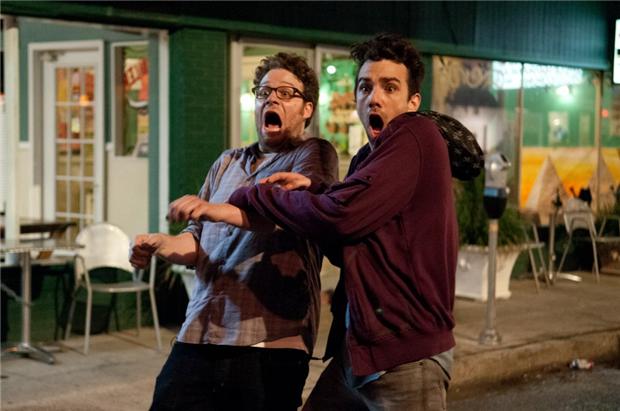
Already in theaters, Seth Rogen and his bro posse take on doomsday in This Is the End. I got the chance to talk with Mr. Rogen, his co-director and co-writer Evan Goldberg, and co-star Craig Robinson when they visited San Francisco a few days back. (Fun fact: Rogen really does laugh like that in real life.) Check the interview here!

In rep news, this weekend at the Castro Theatre heralds the San Francisco Silent Film Festival‘s “Hitchcock 9” event, spotlighting nine silent films by the guy who would later claim the title “Master of Suspense,” direct some of the greatest thrillers of all time, etc. You can’t go wrong with any of the films, but just for kicks, here’s my take on the series here. And at the Yerba Buena Center for the Arts, Austrian director Ulrich Seidl’s dark Paradise Trilogy continues its bummer-summer run this weekend; Dennis Harvey breaks ’em down here.

Plus! That Superman movie you’ve been hearing a thing or two about, and the rest of the week’s new offerings, after the jump.

http://www.youtube.com/watch?v=Sq6ffF8QLsQ

Becoming Traviata Philippe Béziat’s backstage doc offers an absorbing look at a particularly innovative production of Verdi’s La Traviata, directed by Jean-François Sivadier and starring the luminous Natalie Dessay (currently appearing in SF Opera‘s production of Tales of Hoffman). Béziat eschews narration or interviews; instead, his camera simply tracks artists at work, moving from rehearsal room to stage as Sivadier and Dessay (along with her co-stars) block scenes, make suggestions, practice gestures, and engage in the hit-and-miss experimentation that defines the creative process. The film is edited so that La Traviata progresses chronologically, with the earliest scenes unfolding on a spartan set (Dessay’s practice attire: yoga clothes), and the tragic climax taking place onstage, with an orchestra in the pit and sparkly make-up in full effect. Dessay will appear in person at San Francisco screenings Sat/15 at 7pm and Sun/16 at 2pm. (1:53) (Cheryl Eddy)

http://www.youtube.com/watch?v=CWnrk35qYMs

Dirty Wars Subtitled “the world is a battlefield,” this doc follows author and Nation magazine writer Jeremy Scahill as he probes the disturbing underbelly of America’s ongoing counterterrorism campaign. After he gets wind of a deadly nighttime raid on a home in rural Afghanistan, Scahill does his best to investigate what really happened, though what he hears from eyewitnesses doesn’t line up with the military explanation — and nobody from the official side of things cares to discuss it any further, thank you very much. With its talk of cover-ups and covert military units, and interviewees who appear in silhouette with their voices disguised, Dirty Wars plays like a thriller until Osama bin Laden’s death shifts certain (but not all) elements of the story Scahill’s chasing into the mainstream-news spotlight. The journalist makes valid points about how an utter lack of accountability or regard for consequences (that will reverberate for generations to come) means the “war on terror” will never end, but Dirty Wars suffers a bit from too much voice-over. Even the film’s gorgeous cinematography — director Rick Rowley won a prize for it at Sundance earlier this year — can’t alleviate the sensation that Dirty Wars is mostly an illustrated-lecture version of Scahill’s source-material book. Still, it’s a compelling lecture. (1:26) (Cheryl Eddy)

The Guillotines Why yes, that is Jimmy Wang Yu, director and star of 1976 cult classic Master of the Flying Guillotine, in a small but pivotal role commanding a team of assassins who specialize in dispatching heads with airborne versions of you-know-which weapon. Unfortunately, this latest from Andrew Lau (best-known stateside for 2002’s Infernal Affairs, remade into Martin Scorsese’s 2006 Oscar-winner The Departed) doesn’t have nearly as much fun as it should; dudes be chopping heads off in a flurry of CG’d-up steampunky whirlygigs, but The Guillotines‘ tone is possibly even more deadly, as in deadly serious. When a rebellious prophet-folk hero known as Wolf (Xiaoming Huang) runs afoul of the Emperor’s top-secret Guillotine brotherhood, led in the field by Leng (Ethan Juan), the squad travels in disguise to a rural, smallpox-afflicted village to track him down. Along for the journey is the Emperor’s top operative, ruthless Agent Du (Shawn Yue), a boyhood friend of Leng’s. Leng and Du share a dark secret: the Guillotines have been deemed expendable — yep, in the Stallone sense — and the Emperor has decided to kill them off and replace them with armies toting guns and cannons in the name of progress. Lau is no stranger to tales of men grappling with betrayals, misplaced loyalties, and hidden personal agendas — and as historical martial-arts fantasies go, The Guillotines has higher production values than most, with sweeping, luscious photography. Too bad all the action scenes are punctuated by episodes of moody brooding — replete with slo-mo gazing off into the distance, dramatically falling tears, solemn heart-to-hearts, swelling strings, and the occasional howl of anguish. (1:53) (Cheryl Eddy)

http://www.youtube.com/watch?v=T6DJcgm3wNY

Man of Steel As beloved as he is, Superman is a tough superhero to crack — or otherwise bend into anything resembling a modern character. Director Zack Snyder and writer David S. Goyer, working with producer Christopher Nolan on the initial story, do their best to nuance this reboot, which focuses primarily on Supe’s alien origins and takes its zoom-happy space battles from Battlestar Galactica. The story begins with Kal-El’s birth on a Krypton that’s rapidly going into the shitter: the exploited planet is about to explode and wayward General Zod (Michael Shannon) is staging a coup, killing Kal-El’s father, Jor-El (Russell Crowe), the Kryptonians’ lead scientist, and being conveniently put on ice in order to battle yet another day. That day comes as Kal-El, now a 20-something earthling named Clark Kent (Henry Cavill) — resigned to his status as an outsider, a role dreamed up by his protective adoptive dad (Kevin Costner) — has turned into a bit of a (dharma) bum, looking like a buff Jack Kerouac, working Deadliest Catch-style rigs, and rescuing people along the way to finding himself. Spunky Lois Lane (Amy Adams) is the key to his, erm, coming-out party, necessitated by a certain special someone looking to reboot the Kryptonian race on earth. The greatest danger here lies in the fact that all the leached-of-color quasi-sepia tone action can turn into a bit of a Kryptonian-US Army demolition derby, making for a mess of rubble and tricky-to-parse fight sequences that, of course, will satisfy the fanboys and -girls, but will likely glaze the eyes of many others. Nevertheless, the effort Snyder and crew pack into this lengthy artifact — with its chronology-scrambling flashbacks and multiple platforms for Shannon, Diane Lane, Christopher Meloni, Laurence Fishburne, and the like — pays off on the level of sheer scale, adding up to what feels like the best Superman on film or TV to date — though that bar seems pretty easy to leap over in a single bound. (2:23) (Kimberly Chun)

http://www.youtube.com/watch?v=4V1E2IgXeuI

Pandora’s Promise Filmmaker Robert Stone has traveled far from his first film, 1988’s Oscar-nominated anti-nuke Radio Bikini, to today, with the release of Pandora’s Promise, a detailed and guaranteed-to-be-controversial examination of nuclear power and the environmentalists who have transitioned from fervently anti- to pro-nuclear. Interviewing activists and authors like Stewart Brand, Gwyneth Cravens, Mark Lynas, and Michael Shellenberger, among others, Stone eloquently visualizes all angles of their discussion with media, industrial, and newly shot footage, starting with a visit to the largest nuclear disaster of recent years, Fukushima, which he visits with the hazmat-suited environmental activist and journalist Lynas and continuing to Chernobyl and its current denizens. Couching the debate in cultural and political context going back to World War II, Stone builds a case for nuclear energy as a viable method to provide clean, safe power for planet in the throes of climate change that will nonetheless need double or triple the current amount of energy by 2050, as billions in the developing world emerge from poverty. In a practical sense, as The Death of Environmentalism author Shellenberger asserts, “The idea that we’re going to replace oil and coal with solar and wind and nothing else is a hallucinatory delusion.” Stone and his subjects put together an enticing argument to turn to nuclear as a way forward from coal, made compelling by the idea that designs for safer alternative reactors that produce less waste are out there. (1:27) (Kimberly Chun)

Know my desktop, know me: The rise of the screen grab confessional

0

A realization reached this morning while Google (or in this case, Froogal) Hanging with Houston rapper’s Fat Tony video for “Hood Party”: A look at someone’s desktop can tell you more about a certain breed of 2013 person than watching them speed hunt-‘n’-peck their way through their inbox on the other bar stool. Small wonder then, that the screen grab confessional is now a thing. Thanks in part goes to local goth-hop promotor Marco de la Vega’s current video installation, viewable IRL through June 30 at Little Paper Planes‘ Owl Cave Books video installation space. Viewing instructions to my Guardianistas: play loud af in your headphones.

Watch the clip above for the real life daytime dealings of a club promotor, including the inner workings of Ticketfly, kitty cuddles, email inbox exposure, and cameos by some real cute videos-within-video: Mykki Blanco’s latest headturner and a compilation of death drops by vogue legend Erica Kane. Disclosing fully: De la Vega is not only a Guardian posterchild, but also a FB chat buddy of mine. Of course, that’ll be obvious to anyone who makes it to the 4:11 mark in the video. You can check out a whole bunch of other hip-to-the-minute clips made for Owl Cave’s video series on its Youtube channel

Another victory for the champions of the “unborn”

12

In a grand piece of political theater, Wisconsin Republicans passed a measure 17-15 in their senate that would require an ultrasound prior to an abortion. “Theater” because they had the votes already and because it gave them the chance to grandstand “passionately” about this particularly ridiculous law (the idea being that if the uninformed baby vessel got to see what she was killing, no abortions–like she didn’t know what she was doing and wandered into a clinic looking for a bagel and cream cheese and walked out sans fetus).

Or maybe that the idea being that if you make the already ugly and gruesome abortion procedure into a humiliating, painful, degrading and drawn out marathon of misery, the wimmens will be less likely to “kill their babies”. 

OK. That does make sense in its way. But…….

The male half of these pregnancies don’t seem to have a parallel punishment. Why is that? Why not a law that requires that a physician stick a biopsy needle down the ureter to let the “offending party feel the pain of a baby’s death?”

Makes sense to me.


‘Money is a tool’

0

Jack Abramoff says “legalized bribery” is corrupting our political system, and as a lobbyist who went to prison for taking the practice of buying favors from Congress to obscene new depths, he should know. But if we’re relying on him to help reform that system, a cause he’s now taken up, we could be in real trouble.

Watching Abramoff address “public ethics” at a University of San Francisco class of aspiring political professionals on June 6 was a little surreal. Part charming rogue, part penitent reformer, Abramoff told inside tales of how easily money corrupts even well-intended people who work in Congress.

“I didn’t create a new way of lobbying, I just did more of it,” Abramoff told the students, noting that while some lobbyists had a few good tickets to Washington Redskins or Wizards games to give away to members of Congress, he had 72 of them. And while some lobbyists would take members golfing, “I would put them on a Gulfstream and fly them to Scotland. What’s the difference? It’s still playing golf.”

It was particularly strange for someone of Abramoff’s obviously questionable moral fiber to be addressing political students at this Jesuit-run academic institution, whose local advertising slogans include “How to succeed in business and still go to heaven” and “Wicked smart without the wicked part.”

Yet forgiveness is supposed to be divine, and the instructor who lured Abramoff to speak with his class, local lobbyist and political consultant Alex Clemens, was certainly pleased to attract someone with Abramoff’s inside knowledge, avoiding Abramoff’s usual speaking fees of up to $20,000 by piggybacking on a Southern California speech he gave and paying only his airfare.

I was a bit more skeptical of a guy who equates political donations with bribery while hawking a book and narrow reform proposal — while at the same time soliciting corporate lobbying clients and telling the San Francisco Chronicle that Silicon Valley should be spending far more money to influence politicians.

“It needs a much bigger view of political involvement,” Abramoff told the Chron. “It should be spending much more. They’re not playing as smart as they should, and they could lose big.”

That’s part of the muddle of contradictions that defines Abramoff and his advocacy today, which is consistent with the anti-government, wealth-worshipping conservatism he has pushed with missionary zeal since his college days, along with pals Ralph Reed and Grover Norquist, who still play key roles in keeping religious fundamentalists and the rich in the Republican Party fold.

“I’m not against money in the system, I’m against money being used the wrong way in the system,” Abramoff told me after the talk, as I probed the contradictions in his statements and views. My efforts to pin him down caused him to scornfully brand me a “socialist,” the old bully replacing the affable face he showed the students.

“Money is a tool,” Abramoff told me.

Abramoff is also a tool, I decided as I listened to him, although it’s still tough to discern who is wielding him now and where this effort may be headed.

LESSON FOR STUDENTS

Abramoff told the students that even after he got busted in 2005, for a long time he indignantly wondered why he was being prosecuted for the same sorts of actions that were endemic to Washington DC. Eventually, he began to realize he had done something wrong.

“I thought maybe some of this [the charges against him] is right,” he said. “I decided to be honest with myself. Am I the saint I always thought I’d been, or the devil they said I was?”

Yet in the end, Abramoff never did really rethink his own worldview and history — from his early days of shilling for the South African government against efforts to end apartheid to later bribing members of Congress to oppose regulation of sweatshops and sex trafficking in US territories — he just blamed the political system.

“I thought this system is maybe not right,” he told students studying to be a part of that system. “I thought when I got out, I should probably try to help.”

So he wrote a book, Capitol Punishment: The Hard Truth About Corruption From America’s Most Notorious Lobbyist, and he says that he’s been developing political reform legislation that he intends to start pushing next year along with unnamed others.

Abramoff has consulted with Harvard Law School professor Lawrence Lessig, who founded Rootstrikers to push political reforms, but Abramoff doesn’t support many of the central tenets of that and other reform groups, including public financing of elections and overturning “corporate personhood” court rulings that deem political spending by the rich to be a free speech right.

In fact, Abramoff is still a right-winger who shows little interest in limiting the ability of wealthy corporations and individuals to freely spend their money on political candidates and issues, placing him at odds with pretty much the entire political reform movement.

Phillip Ung, a spokesperson for Common Cause — which has been working on these political reform efforts for decades — was a little skeptical about getting help from someone who once embodied the most corrupt and excessive aspects of the current system.

“As much as we enjoy his newfound support for political reform, we also understand that he has a debt to pay, and not just to society,” Ung said of the $44 million in restitution that Abramoff still owes to his victims.

Ung said that a stark example of political corruption like Abramoff represents does help the cause, but that has little to do with his current advocacy. “The reform flag at the federal level goes almost nowhere if there’s not a political scandal,” Ung said, although even that isn’t saying much because, “Congress and DC only have tolerance for political reform one every 10 years or so.”

With Democrats now overwhelmingly controlling California’s Legislature and executive offices, Ung sees opportunities for important reforms here. The most promising is Senate Bill 27, which would require political groups that raise more than $500,000 to disclose their donors.

By contrast, Abramoff’s proposal seems tepid at best, and his strategy for selling it relies on using political spending to elect sympathetic people to Congress, which would seem to undermine his reform message almost as much as pitches to corporate clients to hire him for lobbying consulting services (see www.abramoff.com).

“He seems to be going back to his old ways,” Ung said of Abramoff.

Abramoff said his legislation would broaden the definition of lobbyist, limit their campaign contributions to $500 per election cycle, and prevent public officials from working as lobbyists for 10 years after they leave government.

Then Abramoff said that he and his unspecified “we” will dump money into six contested Congressional races in 2014, trying to elect three Democrats and three Republicans who pledge to support his legislation, following that up in 2016 by targeting 25 to 50 races.

“Then and only then will Congress take it seriously,” Abramoff concluded, arguing that politicians respond to losing their jobs more than other means of persuasion. He’s going to use aggressive political spending to win the reforms he seeks, which don’t really do anything to limit political spending.

When I asked Abramoff how increased political spending can reform a political system corrupted by money, he replied, “You play with the tools and the battlefield you’re on.”

THE SYSTEM, OR ITS SPONSORS?

Abramoff blames Congress for corruption far more than the lobbyists or wealthy special interests who are doing the corrupting, noting how difficult it is to get political reforms approved by legislators who want to later cash in on their public service.

“The lobbyists are a response to the system set up by Congress,” he told the students, building on his earlier point that “99 percent of everything I did was legal, and that’s a bigger deal than the 1 percent that was illegal. That’s what has to change.”

But he acknowledges that reforming the system will be “impossibly difficult” because those who are invested in the current system will always find loopholes to any new regulation. “They’re extremely brilliant people and their goal is to get around things,” he said.

Omitted from Abramoff’s recitation of what’s wrong in Washington are the people doing the corrupting, that other 1 percent, the very rich. When I asked him about how he can really attack institutionalized political corruption without going after the cash that feeds that corruption, he told me, “I tend to be nervous about a political approach that says, ‘It’s the rich.”

Abramoff actually supports the Supreme Court’s controversial Citizens United ruling, which ended controls on the political spending of wealthy individuals and corporations, telling the students, “We all want certain corporations to have the rights that we individuals have.”

Abramoff also seems to dismiss the possibility of a grassroots political reform effort, saying that any change in the system would need support from both the left and the right, and the latter will kill any effort to actually removes private money from political campaigns.

“You’re not going to have federal financing of elections. The right will die before they let that happen,” Abramoff said.

That might have been the most insightful thing that Abramoff said to the students, although he certainly didn’t intend it the way that I heard it: maybe the right needs to die, in the political sense, before the system that Abramoff both decries and supports will change.

NSA surveillance scandal goes full tilt clown

80

The domestic eavesdropping scandal is now entering week three in the news (it’s existed for real a lot longer) and as these things tend to do, the political posturing is headed into Clownland.

Yesterday, Congressman Peter King (R-NY) demanded that UK Guardian journalist (and attorney) Glenn Greenwald be arrested. Not because of anything Greenwald has done, but because Greenwald is threatening to expose CIA assets around the world (Greenwald denies this). Odd that a lawmaker wouldn’t be able to make this distinction and even odder that when a CIA asset was actually exposed in rhe last decade (by an employee of the Bush Administration), King wasn’t this vociferous.Greenwald, fairly consistent on the matter of civil liberties, is a pretty bright guy and snarkily responded that King’s newfound enthusiasm for prosecuting terrorists is somewhat of a joke. King has been a long time supporter of the IRA. You’d think that as a congressman whose Long Island district was impacted hard by 9/11 would be fairly tough on domestic terror, but it hasn’t hurt King electorally at all.

For two reasons. One is the obvious one–The IRA’s membership does bear a strong physical resemblance to King’s constituency, ie, both white and not Muslim, ergo, not terrorists. The second is that the IRA doesn’t bomb New York. London, yes, Manhattan, no. In fact, the US has been a source of IRA cash, donated by people that don’t see the group as terrorists.

Roll that over in your head. The US doesn’t meddle in the affairs of Northern Ireland by planting military bases there (there has been a slight flap over the use of Irish airports for US military purposes). Mostly, American involvement has been muted and even handed, especially in the late 90’s. Therefore the IRA has never attacked the US. Which wouldn’t be all that difficult, given the huge number of Irish-Americans and the ease that an IRA asset or two could fit in.

Because the US doesn’t militarily meddle in Ireland’s affairs, The IRA has no interest in America. 

Perhaps if the same philosophy extended to the Middle East, eh? Nah, better that the clown show go into overdrive, right?


John Dwyer’s Thee Fuzz Warr Overload pedal

4

You can file this under: sure, why not? Spirited Thee Oh Sees frontperson John Dwyer has “inspired” a new custom pedal for Death By Audio, called Thee Fuzz Warr Overload.

The pedal is limited to 500, and so says Death by Audio, once they’re gone, they’re gone. The Brooklyn-based effects pedal company also put out a signature Ty Segall pedal (Sunshine Reverb) which sold out in a day.

Thee Fuzz Warr Overload is available now for pre-order on the Death by Audio site ($225, like whoa), and ships June 30. 

I’ll let Death by Audio excitedly describe the pedal in all its fuzzy glory:

“This pedal is based on the super powerful circuit of the Fuzz War combined with a switchable hot-rodded treble boost. The Fuzz circuit controls include Gain, Level, Tone and the Boost circuit has a Level control. Combining these circuits unlocks new and virtually endless guitar tone possibilities. The specialized Tone knob allows you to sweep between rumbling low end, scooped out mid section and sizzling highs. The Gain knob can go from a smooth overdrive through distortion and up into uncharted territories. Thee Fuzz Warr Overload combines raucous fuzz and a killer treble boost to bring your sound to the next dimension.”

Here’s Dwyer demoing the pedal (plus a real cute turtle and some kids):

http://www.youtube.com/watch?v=CPDYcA9kG1k

The next local Thee Oh Sees show is the Phono Del Sol fest July 13 in Potrero Del Sol Park ($25).