Volumes

Drought legislation would undermine endangered species protection

0

By Mike Lynes

OPINION California’s ongoing drought has brought hardship to nearly every corner of the state, but the Central Valley has been ground zero. Communities are struggling just to fill their taps, farmers are letting fields go unplanted, and dry conditions are decimating habitat for birds and other wildlife.

Clearly, our elected leaders need to pull together, put aside political agendas, and take steps to minimize harm from the drought by improving how we manage our water in California. Sadly, some have chosen to exploit the crisis for political points rather than find reasonable solutions.

As you read this, negotiations are just getting started between backers of drought relief bills from both the House of Representatives and the Senate. These will be difficult negotiations, as each piece of legislation contains an entirely different vision of a future California. We can only hope that common sense prevails.

Earlier this year, several members of the House of Representatives descended on the Central Valley for a series of press conferences at which they blamed the water shortages on environmental protections that placed fish before farmers and habitat before crops. They then returned to Washington and passed a drought relief bill, authored by Rep. David Valadao [R-CA21], which would override the Endangered Species Act, suspend the San Joaquin River Restoration efforts, and divert critically important water from the 19 Central Valley wildlife refuges.

Efforts like endangered species protection, water for the wildlife refuges, and the San Joaquin River Restoration settlement became necessary only after decades of habitat destruction due to water diversions that resulted in the loss of more than 90 percent of the Central Valley’s wetlands and riparian habitats. The changes in California’s water system to benefit cities and farms has resulted in population declines in more than 80 percent of California’s native fish species while migratory shorebirds and waterfowl populations have also endured significant declines.

Drought legislation should not make it even harder to hold on to our last remnants of habitat.

Sen. Dianne Feinstein has proposed legislation for drought relief without gutting environmental protections. While the version of Feinstein’s bill that recently passed the Senate no longer has provisions to actively help birds and habitat that it initially had, it nonetheless preserves several essential environmental protections.

Some in the House are vowing to ensure that any drought legislation will include Valadao’s provisions to gut the Endangered Species Act and disregard management of wildlife and habitat. This effort is really just the same they have made for years under the guise of “drought relief.” It’s cynical opportunism to serve a particular special interest. If successful, this policy shift will have long-term negative impacts without providing any real relief to farmers.

We are already seeing the biological impacts of the drought. Just last week, a report from the California Department of Fish and Wildlife showed a 20 percent decline in the number of breeding mallards over last year. While the survey showed that the total number of breeding ducks was only slightly slower — 448,750, compared to 451,300 last year — this year’s number is nonetheless 23 percent below the long-term average. Department officials cited the degradation of Central Valley habitat due to the ongoing drought as the cause. We’ve seen similar declines in breeding efforts in other birds as well, including pelicans, hawks, and owls.

Hardship due to the drought hasn’t been caused by the Endangered Species Act or the small amounts of water that go to Central Valley wildlife refuges. It’s been caused by an inadequate water infrastructure, decades of poor management worsened by California’s byzantine water laws and policies, and, of course, Mother Nature herself.

The smarter way forward is for the House to adopt Feinstein’s bill without playing political games with the Endangered Species Act, Central Valley wildlife refuges, or the San Joaquin River restoration.

The House’s version of drought legislation will only divide the various interests in the Central Valley, pitting one beneficial use against another, at a time when we need unity and sound, sustainable policy.

We hope that Feinstein will hold firm against that House resolution’s supporters.

Mike Lynes is the Public Policy Director for Audubon California


Cristina Lopez, East Bay Recycler

3

“I first applied for a job at the Select agency in 2000. A lot of people had told me that this job was really bad. At first they put me on the cardboard line. That didn’t seem so bad because it’s not so dirty. It’s just that the cardboard stacks up so fast. But then they put me on the trash line, which was a lot dirtier. But the thing is, I needed the job. So I worked hard, and the years passed, and I was still there.

“The worst position — the one with the heaviest and dirtiest work — is the trash line. All the really terrible things are there. Things like dirty diapers. There are dangers too. Broken glass. Rusty iron.

“I got punctured twice by hypodermic needles, and they sent me to the hospital. I was really scared. You could get HIV. They kept checking my blood at a clinic in Castro Valley for eight months afterwards, for AIDS or hepatitis or other illnesses.

“Afterwards, the agency said the company had checked my papers and found out that they weren’t any good. I wouldn’t be able to work anymore if I couldn’t give them new papers within a month. I told her I wanted to see this in writing, and I’d take it to a lawyer before I signed anything. I told her, ‘With the lousy wages you’re paying us, do you think you’re going to find people with good Social Security numbers?’

“After the month was up they didn’t say anything. I knew three people after that who were called into the office after they’d been punctured by a needle, and the company then checked their papers. But they lost their jobs, because they didn’t speak up the way I did.

“Once I was sorting on the line and a heavy piece of equipment fell on me. It really hurt me bad, but they didn’t pay me anything for that or send me to the doctor. Last November I slipped and fell while I was putting a cylinder on the forklift, and it hit me in the stomach. They didn’t do anything for me that time either.

“We don’t have any medical insurance. No vacations. Nothing. They call us temporary workers … but we’re not really temporary. Many of us have been working at ACI for many years.

“When I started at ACI they were paying me $8 an hour. They made us work 10 or 12 hours every day, standing in one place. If we got sick and asked for time off they’d deny it. Every Saturday was mandatory. If we went to the bathroom, they’d look at their watch to see how much time we were taking.

“Then in 2012 they started two shifts and raised the wages to $8.50 for nights and $8.30 for days. I don’t think that’s a fair wage. In one safety meeting I asked them to give us a raise. Then the manager yelled at me … Afterwards he told me I had to go apologize in the office.

“Once a woman said we’d go on strike and Brenda, the manager, said we’d all be fired if we did.

“Then they decided to motivate us by giving us clocks as presents, but they didn’t work. When I asked why they’d give us broken clocks the company was insulted, but I see better stuff in the trash.

“We never knew that San Leandro had a living wage law. We learned about it when we talked with the union organizer, Agustin. We decided to file a court case to force them to raise the wages.

“Then in February they began calling us in to say they’d started checking our papers. When I asked a manager why, she said it was partly because we’d sued the company and partly because the company had been audited by la migra [immigration authorities]. People have worked here for 14 or 15 years, and no one ever said anything to them before. Now that we filed the suit, we’re getting fired.

“Since I got fired, I’ve been very worried about my situation. I can’t get hired and my sons lost their jobs in Los Angeles and came up to live with me. My PG&E bill is very high, $258. The water bill came — $239. The rent is $1,250. We’re all living in one room and renting out the others just to be able to pay it.

“I’ve been here 14 years, and it’s impossible for me to go back to Apatzingan, in Michoacan, where I was born. I may not have a job right now, but I don’t regret anything. I’m going to struggle, and continue moving ahead.”

Editors’ note: Cristina Lopez’ name has been changed to protect her identity


Luis Valladares, East Bay recycler

0

“My father is a farmer in Chiapas, and grows corn, mangoes, and bananas. Our land wasn’t enough to support our family, though. The little we were able to grow was just to eat.

“When I was 16 I left home and school, and went to Mexico City. Parents never want their children to leave. But we … can’t stay. The majority of young people in my town have left, like me, looking for a way to help their families survive.

“In Mexico City I found work as a musician, because I play the marimba. Then I met my wife. I was the one who suggested to her that we come here. I came first and found a job with this same agency. After five months, I put together enough money to bring my wife.

“We had a daughter we had to leave behind. She was just 3 when we left, and she’s 16 years old now. This was very hard for us. We send money home for her, but she doesn’t want to come live here and leave her grandmother. We don’t want to force her. And now, of course, it’s much harder to come. It’s not just more expensive, but you’re risking your life.

“When we were thinking about coming here, my idea was that we’d stay here for two or three years, save up some money, and then go back and build a house. Now we’ve been here 14 years, and we can’t go back. My children belong here, and there are a lot of benefits for them here.

“I worked at ACI for 12 years. When I started I was a sorter on the line. Then they asked me if I wanted to operate machinery. I ran the packing machine. My job was to watch the line, and calculate the weight of the material going into the machine. If I let too much go in, the machine would seize up. It would be a big headache.

“No one is irreplaceable, but it takes anyone time to learn. You can’t go to sleep on this machine. If you fall in, you’ll wind up in pieces. This is a very dangerous place to work.

“At another company, a friend of my wife reached in to free a piece of metal that had jammed the machine. The machine grabbed his foot. He didn’t lose it, but he’s disabled now.

“When I started at ACI they paid me $6.75 an hour. I left in 2009 because they were only paying me $8.50. But the person they hired to replace me wasn’t very good at the job. After a year, the agency called me and I went back at $10 an hour.

“I didn’t know about the living wage, but some women at work talked with Agustin from the union and decided to file the suit. I never imagined they would fire us for this.

“I thought if we filed a suit, it might lead to having a union. Instead, [the agency managers] said, ‘We want you to re-verify your Social Security number, and bring us proof that you can continue to work here.’

“If we had good numbers we’d never have the kind of problems we have now. By 2001, when I came, you could not get a real Social Security number, although long ago you could.

“At first I was very angry. I felt helpless. And then quickly I began to worry. I have to pay the rent, the bills. The kids have to eat. When you’re working, you only make enough just to live.

“I haven’t been able to find another job. My wife is working, but only part time. Lately I’ve been going out to work with some friends. But it’s just two or three days a week. Every penny I make I’m putting away to pay the rent.

“I don’t believe that what happened to us at ACI is just. We’re looking for the welfare of our families, trying to get a fair wage so we can live better. People need to understand what happened to us — the abuse and low pay that immigrants have to live with.”

Editor’s note: Valladares’ name was changed to protect his identity.


Invisible no more

9

We all want to be responsible for our environment. We sort our trash. We put the right things into the right containers, and feel good when we see them at the curb on trash pickup day.

Then the trash disappears. End of story.

But really, it’s not the end. Not only does the trash go somewhere, but people still have to sort through what we’ve thrown away. In a society full of people doing work that’s unacknowledged, and often out of sight, those who deal with our recycled trash are some of the most invisible of all.

Sorting trash is dangerous and dirty work. In 2012 two East Bay workers were killed in recycling facilities. With some notable exceptions, putting your hands into fast moving conveyor belts filled with cardboard and cans does not pay well — much less, for instance, than the jobs of the drivers who pick up the containers at the curb. And the sorting is done almost entirely by women of color; in the Bay Area, they are mostly immigrants from Mexico and Central America, as well as some African Americans.

This spring, one group of recycling workers, probably those with the worst conditions of all, finally had enough. Their effort to attain higher wages, particularly after many were fired for their immigration status, began to pull back recycling’s cloak of invisibility. Not only did they become visible activists in a growing movement of East Bay recycling workers, but their protests galvanized public action to stop the firings of undocumented workers.


ILLEGAL WAGES FOR “TEMPORARY” WORKERS

Alameda County Industries occupies two big, nondescript buildings at the end of a cul-de-sac in a San Leandro industrial park. Garbage trucks with recycled trash pull in every minute, dumping their fragrant loads gathered on routes in Livermore, Alameda, and San Leandro. These cities contract with ACI to process the trash. In the Bay Area, only one city, Berkeley, picks up its own garbage. All the rest sign contracts with private companies. Even Berkeley contracts recycling to an independent sorter.

At ACI, the company contracts out its own sorting work. A temp agency, Select Staffing, hires and employs the workers on the lines. As at most temp agencies, this means sorters have no health insurance, no vacations, and no holidays. It also means wages are very low, even for recycling. After a small raise two years ago, sorters began earning $8.30 per hour during the day shift, and $8.50 at night.

Last winter, workers discovered this was an illegal wage.

Because ACI has a contract with the city of San Leandro to process its recycling, it is covered by the city’s Living Wage Ordinance, passed in 2007. Under that law, as of July 2013: “Covered businesses are required to pay no less than $14.17 per hour or $12.67 with health benefits valued at least $1.50 per hour, subject to annual CPI [consumer price index] adjustment.”

There is no union for recycling workers at ACI, but last fall some of the women on the lines got a leaflet advertising a health and safety training workshop for recycling workers, put on by Local 6 of the International Longshore and Warehouse Union. There, they met the union’s organizing director, Agustin Ramirez. “Sorting trash is not a clean or easy job anywhere,” he recalls, “but what they described was shocking. And when they told me what they were paid, I knew something was very wrong.”

Ramirez put them in touch with a lawyer. In January, the lawyer sent ACI and Select a letter stating workers’ intention to file suit to reclaim the unpaid wages. ACI has about 70 sorters. At 2,000 work hours per year each, and a potential discrepancy of almost $6 per hour, that adds up to a lot of money in back wages.

The response by ACI and Select was quick. In early February, 18 workers — including all but one who’d signed onto the initial suit — were called into the Select office. They were told the company had been audited by the Immigration and Customs Enforcement agency of the Department of Homeland Security a year before, and that ICE had questioned their immigration status. Unless they could provide a good Social Security number and valid work authorization within a few days, they’d be terminated.

Instead of quietly disappearing, though, about half the sorters walked off the lines on Feb. 27, protesting the impending firings and asking for more time from the company and ICE. Faith leaders and members of Alameda County United for Immigrant Rights joined them in front of the ACI office. Workers came from other recycling facilities. Jack in the Box workers, some of whom were fired after last fall’s fast-food strikes, marched down the cul-de-sac carrying their banner of the East Bay Organizing Committee. Even San Leandro City Councilman Jim Prola showed up.

“The company told us they’d fire anyone who walked out,” said sorter Ignacia Garcia. But after a confrontation at the gate, with trucks full of recycled trash backed up for a block, Select and ACI managers agreed the strikers could return to work the following day. The next week, however, all 18 accused of being undocumented were fired. “Some of us have been there 14 years, so why now?” wondered Garcia.

In the weeks that followed, East Bay churches, which earlier called ICE to try to stop the firings, collected more than $6,500 to pay rent for nine families. According to Rev. Deborah Lee, director of the Interfaith Coalition for Immigrant Rights, “after they had a chance to meet the fired workers and hear their stories, their hearts went out to these hardworking workers and parents, who had no warning, and no safety net.” Money is still coming in, she says.


ONE OF MANY BATTLES

Because cities give contracts for recycling services, they indirectly control how much money is available for workers’ wages. But a lot depends on the contractor. San Francisco workers have the gold standard. Recology, whose garbage contract is written into the city charter, has a labor contract with the Teamsters Union. Under it, workers on its recycle lines are guaranteed to earn $21 an hour.

Across the bay, wages are much lower.

ACI is one battle among many taking place among recycling workers concerning low wages. In 1998, Ramirez and the ILWU began organizing sorters. That year 70 workers struck California Waste Solutions, which received a contract for half of Oakland’s recycling in 1992. As at ACI, workers were motivated by a living wage ordinance. At the time, Oakland mandated $8 an hour plus $2.40 for health insurance. Workers were only paid $6, and the city had failed to monitor the company for seven years, until the strike.

Finally, the walkout was settled for increases that eventually brought CWS into compliance. During the conflict, however, it became public (through the Bay Guardian in particular) that Councilman Larry Reid had a financial interest in the business, and that CWS owner David Duong was contributing thousands of dollars in city election races.

Waste Management, Inc., holds the Oakland city garbage contract. While garbage haulers have been Teamster members for decades, when Waste Management took over Oakland’s recycling contract in 1991 it signed an agreement with ILWU Local 6. Here too workers faced immigration raids. In 1998, sorters at Waste Management’s San Leandro facility staged a wildcat work stoppage over safety issues, occupying the company’s lunchroom. Three weeks later immigration agents showed up, audited company records, and eventually deported eight of them. And last year another three workers were fired from Waste Management, accused of not having legal immigration status.

Today Waste Management sorters are paid $12.50 under the ILWU contract — more than ACI, but a long way from the hourly wage Recology pays in San Francisco. Furthermore, the union contracts with both CWS and Waste Management expired almost two years ago. The union hasn’t signed new ones, because workers are tired of the second-class wage standard.

To increase wages, union recycling workers in the East Bay organized a coalition to establish a new standard — not just for wages, but safety and working conditions — called the Campaign for Sustainable Recycling. Two dozen organizations belong to it in addition to the union, including the Sierra Club, the Global Alliance for Incinerator Alternatives, Movement Generation, the Justice and Ecology Project, the East Bay Alliance for a Sustainable Economy, and the Faith Alliance for a Moral Economy.

ILWU researcher Amy Willis points out, “San Francisco, with a $21 wage, charges garbage rates to customers of $34 a month. East Bay recyclers pay half that wage, but East Bay ratepayers still pay $28-30 for garbage, recycling included. So where’s the money going? Not to the workers, clearly.”

Fremont became the test for the campaign’s strategy of forcing cities to mandate wage increases. Last December the Fremont City Council passed a 32-cent rate increase with the condition that its recycler, BLT, agree to provide raises. The union contract there now mandates $14.59 per hour for sorters in 2014, finally reaching $20.94 in 2019. Oakland has followed, requiring wage increases for sorters as part of the new recycling contract that’s currently up for bid.

Good news for those still working. But even for people currently on the job, and certainly for the 18 workers fired at ACI, raising wages only addresses part of the problem. Even more important is the ability to keep working and earn that paycheck.


CRIMINALIZING IMMIGRANT WORKERS

When ACI and Select told workers they’d be fired if they couldn’t produce good Social Security numbers and proof of legal immigration status, they were only “obeying the law.” Since 1986, U.S. immigration law has prohibited employers from hiring undocumented workers. Yet according to the Pew Hispanic Trust, 11-12 million people without papers live in the U.S. — and not only do the vast majority of them work, they have to work as a matter of survival. Without papers people can’t collect unemployment benefits, family assistance or almost any other public benefit.

To enforce the law, all job applicants must fill out an I-9 form, provide a Social Security number and show the employer two pieces of ID. Since 1986 immigration authorities have audited the I-9 forms in company personnel records to find workers with bad Social Security numbers or other ID problems. Immigration and Customs Enforcement (ICE) then sends the employer a letter, demanding that it fire those workers.

According to ICE, last year the agency audited over 2,000 employers, and similar numbers in previous years. One of the biggest mass firings took place in San Francisco in 2010, when 475 janitors cleaning office buildings for ABM Industries lost their jobs. Olga Miranda, president of Service Employees Local 87, the city’s janitors union, charges: “You cannot kill a family quicker than by taking away their right to find employment. The I-9 audits, the workplace raids, E-Verify, make workers fear to speak out against injustices, that because of their immigration status they have no standing in this country. They have criminalized immigrants. They have dehumanized them.”

One fired janitor, Teresa Mina, said at the time, “This law is very unjust. We’re doing jobs that are heavy and dirty, to help our children have a better life, or just to eat. Now my children won’t have what they need.”

Similar I-9 audits have taken place in the past two years at the Pacific Steel foundry in Berkeley, at Silicon Valley cafeterias run by Bon Appetit, at South Bay building contractor Albanese Construction, and at the Dobake bakery, where workers prepare food for many Bay Area schools. All are union employers.

Sometimes the audits take place where workers have no union, but are protesting wages and conditions. Like the ACI workers, in 2006 employees at the Woodfin Suites hotel in Emeryville asked their employer to raise their wages to comply with the city’s living wage ordinance. Twenty-one housekeepers were then fired for not having papers. Emeryville finally collected over $100,000 in back pay on their behalf, but the workers were never able to return to their jobs.

Last fall, as fast-food workers around the country were demanding $15 an hour, several were fired at an Oakland Jack in the Box for being undocumented. “They knew that when they hired us,” said Diana Rivera. “I don’t believe working is a crime. What we’re doing is something normal — we’re not hurting anyone.” The Mi Pueblo Mexican market chain also fired many workers in an immigration audit, during a union organizing drive.

Because the audits are not public, no exact total of the number of workers fired is available. ICE spokesperson Virginia Kice would not comment on the audit at ACI. In response to an information request, she stated: “To avoid negatively impacting the reputation of law-abiding businesses, we do not release information or confirm an audit unless the investigation results in a fine or the filing of criminal charges.” Neither ACI nor Select Staffing responded to requests for comment.

San Francisco became a leader in opposing the firings in January, when the Board of Supervisors passed unanimously a resolution calling on the Obama administration to implement a moratorium on the audits and on deportations. Other cities, like Los Angeles, have also opposed deportations, but San Francisco added: “End the firings of undocumented workers by ending the I-9 audits and the use of the E-Verify system.”

Gordon Mar, of Jobs with Justice, urged the board to act at a rally in front of City Hall. “When hundreds of workers are fired from their jobs,” he declared, “the damage is felt far beyond the workers themselves. Many communities have voiced their opposition to these ‘silent raids’ because they hurt everyone. Making it a crime to work drives people into poverty, and drives down workplace standards for all people.” Like many Bay Area progressive immigrant rights activists, Mar calls for repealing the section of immigration law that prohibits the undocumented from working.

The Board of Supervisors urged President Obama to change the way immigration law is enforced, in part because Congress has failed to pass immigration reform that would protect immigrants’ rights. The Senate did pass a bill a year ago, but although it might eventually bring legal status to some of the undocumented, other provisions would increase firings and deportations.

Like the Board of Supervisors, therefore, the California Legislature has also passed measures that took effect Jan. 1, to ameliorate the consequences of workplace immigration enforcement: AB 263, AB 524, and SB 666. Retaliation is now illegal against workers who complain they are owed unpaid wages, or who testify about an employer’s violation of a statute or regulation. Employers can have their business licenses suspended if they threaten to report the immigration status of workers who exercise their rights. Lawyers who do so can be disbarred. And threats to report immigration status can be considered extortion.

It’s too early to know how effective these new measures will be in protecting workers like the 18 who were fired at ACI. While a memorandum of understanding between ICE and the Department of Labor bars audits or other enforcement actions in retaliation for enforcing wage and hour laws, ICE routinely denies it engages in such retaliation.

Yet, as difficult as their situation is, the fired recyclers don’t seem to regret having filed the suit and standing up for their rights. Meanwhile, the actions by the cities of Oakland and Fremont hold out the promise of a better standard of living for those still laboring on the lines.


Still hungry

1

arts@sfbg.com

THEATER A figure wanders into the void — a pristine wooden stage, that is, pinpointed by four delicate weights hovering pendulum-like at the corners, alive to the slightest ripple of air. In the back, behind a scrim and awash in crepuscular light, a large and blooming tree floats exquisitely in space. For the wanderer, the time (if such a thing can be said to exist here) is ripe. “This must be bardo, then,” thinks the ghost. “I’m cool with that. I was beginning to think I’d live forever.”

The bardo, the in-between state between one life and another in the Buddhist cycle of reincarnation, affects different people in different ways — our wanderer is only one of 28 characters we come across — but throughout New York playwright Chiori Miyagawa’s witty, dreamy, and discerning Bay Area debut, the bardo becomes a supreme vantage on a reality burdened by desire and that transubstantial baggage known as karma.

Now enjoying a splendid world premiere (in a limited two-week run) as part of Theatre of Yugen’s 35th anniversary season, Miyagawa’s This Lingering Life freely adapts nine 14th-century Noh plays, infusing them with a decidedly present-day sensibility. Under artistic director Jubilith Moore’s expert touch, the production amounts to an exceptional blend of modern Western dramatic style and traditional Noh influences. And at its best, it strikes one as some of the more contemporary theater around.

Miyagawa’s astute grasp of the human comedy of living and dying does not always translate with equal force across the various plots — which include, for instance, a mad woman’s desperate search for her abducted son; a Romeo and Juliet–like tragedy involving two drowned lovers; the suicide of an old man who falls in love with a spoiled young princess; and the fallout between a rich father and his disinherited son, in which the impoverished younger man goes blind but ultimately grows wiser than his father. Nevertheless, the majority of the scenes (underscored by a transporting sound design from Michael Gardiner, sitting with laptop offstage right) are remarkably successful, and cumulatively powerful as characters rub shoulders in the afterlife.

Moreover, the nine-member ensemble (composed of Theatre of Yugen’s Moore, Sheila Berotti, Sheila Devitt, Alexander Lydon, Norman Munoz, and Lluis Valls; joined here by Nick Ishimaru, Hannah Lennett, and Ryan Marchand) does fine work running the gamut of earthbound emotions, from visceral anguish to driving lust and petty cruelty, while freely trading genders too in a hint of the promiscuous cycle of rebirth. Particularly fine comedic performances make the most of the playwright’s hilariously down-to-earth dialogue, while expert Noh-inflected vocal modulations and movement add a frisson to decisive moments.

San Francisco’s dedicated practitioners of classical Noh and Kyogen styles, Theatre of Yugen has long been adept at channeling Western stories in these ancient Japanese dramatic forms, setting them in a highly ritualized context that can set off their content with surprising intensity. In fact, Yugen (which takes its name from the Japanese word meaning “mysterious elegance”) led off its anniversary season last November with a Noh-inspired staging of an enduring American tragedy and Civil Rights Era–case: a beautifully composed, movingly effective meditation entitled Emmett Till, a river. The hour-long poetical-musical treatment by co-writer Judy Halebsky and lead writer and composer Kevin Simmonds not only explored the role of individual action, or inaction, in the perpetuation of systemic racism, but also opened up a space for reflection, communion, and an unsettled yet pointed act of reconciliation with the past.

This Lingering Life in a way takes the opposite tack, and thus is something of a departure for the company, since it mines the contemporary in a Westernized, interlocking set of ancient Japanese stories — supporting it all with a few choice elements of the Noh aesthetic. The hybrid creation, spread over 24 scenes, retains a Buddhist worldview, however, in which a person’s actions in one life determine the nature of the next. This lends a particular moral force to what we see, including an abiding sympathy with the dead that is both affecting and thought provoking. But, as the play suggests, karma is not always destiny. In the in-between space of the bardo, clarity and free will can penetrate the hazy sleepwalking of existence, and even fate can be renegotiated.

THIS LINGERING LIFE

Wed/11-Thu/12, 7pm; Fri/13-Sat/14, 8pm, $15-50

Z Space

450 Florida, SF

www.theatreofyugen.org

Secret passages

0

culture@sfbg.com

THE WEEKNIGHTER Weekends are for amateurs. Weeknights are for pros. That’s why each week Broke-Ass Stuart (www.brokeassstuart.com) will be exploring a different San Francisco bar, bringing you stories about the places and people who make San Francisco one of the most phenomenal cities in the world. Who wants a drink?

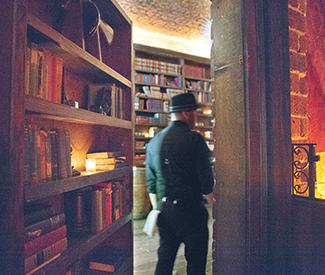
It was weird that Anthony wanted to go to Bourbon & Branch (501 Jones St, SF. 415-346-1735) for his birthday. “But you don’t drink,” I said, hoping to find out why someone who’d never had a drop of booze in his life, due to being born with a bum liver, would want to go to a fancy bar. “I know that, dummy,” he told me. “But I heard they have a secret room that opens up when you pull a book!”

He had me there. Bourbon & Branch has a few secret rooms that open up when you do various Hardy Boys-esque actions. It’s one of the bar’s many charms. When it opened in 2006, there were no mustache bars in San Francisco. You know what I mean by mustache bars — the ones where a bow tie and suspender wearing, mustachioed man squeezes tiny tinctures into your drink from a utensil clearly invented by alchemists. They are omnipresent in current-day San Francisco but when Bourbon & Branch opened, it was the first one in the city.

At this point, anyone who spends a lot of time in bars is pretty tired of cocktails that are too precious and take too much time, and most of us are waiting for the backlash when places go back to specializing in a shot and a beer. But the thing that makes Bourbon & Branch great is that, while it can take a lot of credit for kicking off the pre-Prohibition cocktail craze in San Francisco, it still does it better than any of them. Why? Because of it’s attention to detail.

They say you’ll always remember your first one. But often times your second one is far better. The first speakeasy style bar I went to was Little Branch back when I lived in NYC, and it was cool. But it wasn’t until I moved back to San Francisco that I saw the trope played out to its full potential. Walking into Bourbon & Branch that first time in 2008 made the history nerd in me squeal. It felt like a real speakeasy. It was full of dark wood and was low lit by candles and a chandelier. Bartenders in ties and fedoras shook things vigorously while making cocktails that hadn’t been popular in half a century. People were only served if they were seated and they were encouraged to speak quietly.

And then I got to the backroom where suddenly the bookshelf opened and an entire other bar was laid out before me, filled with people drinking similarly well-made drinks while laughing and talking loudly. “Where the fuck am I,” I asked myself before realizing I couldn’t afford the place and leaving out the backdoor.

So a few years ago when Anthony said he wanted to go here for his birthday my first reaction was, “Motherfucker, why are we gonna go somewhere with $12 cocktails when you don’t even drink?” His answer was relatable to any of us who have ever dreamed of traveling through time or going on the kind of adventures you only see in movies or read about in books. He wanted to go through the secret passageway and spend time in a San Francisco that no longer exists.

So do I.

Stuart Schuffman aka Broke-Ass Stuart, is a travel writer, poet, and TV host. You can find his online shenanigans at www.brokeassstuart.com


Rolling along

0

arts@sfbg.com

THEATER Jerome Kern and Oscar Hammerstein II’s groundbreaking 1927 musical, Show Boat, transformed one of Broadway’s major theatrical forms from a light and episodic operetta-style divertissement into a red-blooded American art form. Wedding spectacular entertainment (its producer was none other than super-showman Florenz Ziegfeld) with a full-fledged drama, Show Boat‘s expanded canvas came nearer the realm of classical opera, as all elements of the production, beginning with the music, orbited tightly around the story — which in addition to humor and hijinx sported complex characters and serious social content.

Since 1927, opera and musical theater have continued to grow closer at various points — most famously in the work of crossover composers like George Gershwin and Leonard Bernstein. San Francisco Opera’s co-production of Show Boat, the first time the company has essayed the legendary musical, turns out to be a wonderfully successful case in point: a crowd-pleasing hybrid of musical-theater style, sharply delineated drama, rousing choreography (from Michele Lynch), and full operatic glory (including an appropriately-sized orchestra and chorus). It’s a muscular production with a light step and buoyant spirit that shows off the best in a story that not only affirmed a common humanity among those up and down the ladder of social status, but also registered the injustice and violence of the American racial caste system in tones boldly progressive for the time.

Of course Show Boat, for all its socially and artistically progressive aspects, was still a product of the 1920s. And while it has been revived many times, the dialogue and other details have also undergone revisions to keep pace with social attitudes, conventions, and sensitivities, especially with regard to race. The SF Opera production under Maestro John DeMain follows DeMain and General Director David Gockley’s former collaboration on the historic 1982 revival for the Houston Grand Opera, which restored for the first time since 1927 significant sections of the original dialogue and score. The opera opens on a beautiful riverside quay awash with Technicolor hues (in perhaps indirect homage to the 1951 MGM film version), while the backside of the ship rises from the stage at the War Memorial Opera House like a delicate three-layer cake in the first of set designer Peter J. Davison and lighting designer Mark McCullough’s consistently atmospheric scenic environments.

Based on the 1926 novel by celebrated author and Algonquin wit Edna Ferber (who with frequent collaborator George S. Kaufman brought The Royal Family to Broadway the same week that the musical version of Show Boat set sail), the story spans the 1880s to the 1920s and revolves around the crew and passengers of the Cotton Blossom, a Mississippi show boat plying the river’s shoreline inhabitants with melodrama and comic fare. The boat’s operator is the warm-hearted Cap’n Andy Hawks (played by Broadway and local legend Bill Irwin in a memorable SF Opera debut) and his wife, the pants-wearing disciplinarian Parthy Ann (a comically fierce and ultimately redeeming Harriet Harris). Their innocent daughter and the story’s heroine, Magnolia (played with affecting pluck by a radiant Heidi Stober, the fine American soprano), falls for a rakish riverboat gambler named Gaylord Ravenal (baritone Michael Todd Simpson in a suave and graceful performance), whom she weds and follows to Chicago.

Magnolia and Gaylord’s doomed marriage, but enduring romance, makes up the central storyline, while a significant secondary plot involves the downward career of the talented actress and singer Julie La Verne (given a sultry and wrenching interpretation by soprano, and esteemed SF Opera regular, Patricia Racette). In an early scene, Julie’s husband, Steve (Patrick Cummings), fights with his wife’s spurned suitor (James Asher) and the latter takes revenge by tipping off the local sheriff (Kevin Blackton) to the illegality of their marriage under the state’s anti-miscegenation law. In this way we learn that Julie is of mixed-race ancestry. A bickering but loving African American couple among the Cotton Blossom‘s crewmembers, Queenie (the regal soprano Angela Renée Simpson) and Joe (bass Morris Robinson in a robust, beautifully measured performance), are also significant supporting characters. Indeed, the most of the show’s great songs are associated with these secondary characters, not least “Ol’ Man River” and “Can’t Help Lovin’ Dat Man.”

The show itself strikes a knowing stance with respect to narrative, making good fun of the stilted melodramas put on by Cap’n Andy while reveling in the backstage intrigue and the characters’ own double-playing onstage (a situation that nicely serves the woo-pitching in the number “Make Believe”). Even the fight that breaks out on the dock between Steve and Pete at the outset of the play gets co-opted by Cap’n Andy, who in a hasty bit of diplomacy tells the crowd it was just a preview of the night’s entertainment onboard. This covering is also an uncovering, however, since it hints at the complex relationship between the stories onstage and real life in all its messiness.

Of course, what “real life” the musical expresses is still very much idealized as well as stylized. But the SF Opera production proves there’s still a pulse to the 1927 narrative, and it’s as vital as the enduring score with which it’s intimately bound. With panache but also keen sensitivity, the show conveys Ferber’s original emphasis on the shared humanity of rich and poor, white and black, and the compassion a bird’s eye perspective on it all can breed. In Show Boat, absurd melodramas and life’s everyday triumphs and failures play out alongside each other as so many ripples on the surface of a deep and indifferent river — a dark and mysterious universe that, in the image of the show’s great recurring theme, just keeps rollin’ along. *

SHOW BOAT

Through July 2, $24-$379

War Memorial Opera House

301 Van Ness, SF

www.sfopera.com


To the desert and back

0

arts@sfbg.com

The early May Sunday afternoon when I meet up with Fresh and Onlys frontman and songwriter Tim Cohen, he’s has just reached a milestone in his career: His firstborn child has just seen his band play for the first time in her life. The day before, Cohen and co. played the Hipnic IV festival in Big Sur to a seated audience. The mainstays of San Francisco’s garage rock scene were able to catch the attention of the one-year-old for a bit before her interest evaporated into the air like pot fumes at a music festival. It’ll likely be years before the child knows she had a profound influence on her dad’s band’s newest album, House of Spirits, due out June 10 on the Mexican Summer label.

Our rendez-vous is set at Cafe Abir on ever-buzzing Divisadero Street, which of course is being consumed with another hot new opening. This time, it’s 4505 Meats, which is making a splash of a debut with its inviting smells wafting over from salacious BBQ concoctions. The unofficial fogline of San Francisco feels foreign to Cohen, who’s been a resident of the adjacent Alamo Square neighborhood for almost 13 years. That’s because he’s just spent 15 months in rural Arizona. When we reach the inevitable topic of San Francisco’s recent changes, Cohen remarks, “I was gone for 15 months and almost everything changed in that time. I can see six places that weren’t here when I left. It’s a culture shock.”

For those 15 months, Cohen decamped with his wife, newborn baby, guitar, Korg keyboard, and drum machine to a horse ranch 10 miles outside of Sedona, Arizona. Later on during his stay, he picked up an eight-track recorder from a kid on Craigslist to record his demos on. “It’s simple and gives me a lower-quality song; it’s my favorite device to record on.” says Cohen.

The storyline behind House of Spirits lends a feeling of concept album, thanks to the songwriting’s foreign backdrop. It’s still very much connected to the feel, themes, and sounds of earlier Fresh and Onlys productions, but the intrigue lies in how noticeable an effect the desert environs had on the record.

Cohen ventured to the desert of Northern Arizona expecting a new jolt of creative energy and a deviation in his songwriting, but underestimated the effect absolute desolation — amplified by its contrast to San Francisco’s bustle — would have on himself and the album. “I went there knowing I would have a lot of time to myself, [but] I didn’t know how much or how dire that solitude would become, which definitely fed into my creative process…If you’ve ever spent any time in the desert or anywhere that’s just your environment, there’s no people walking by, trains, cars, planes, it’s just where you’re at and you. I had no way to contest the silence and openness of it all. I just sat there and took it in. Finally after living there for a months, I figured how to manage my space in the environment, and just dug out my space,” says Cohen.

Part of the reason for Cohen’s retreat was the idea of not raising a baby in a big loud city. He does concede that, in addition to learning how to negotiate the vacuum of the Arizonan desert, the album was significantly influenced by his other major learning experience, that of understanding how to be both “a parent with someone and to someone.”

Like a friend coming back from a sweet vacation, Cohen highly recommends the rural experience for fellow artists. “It made me more of a prolific artist, because I came back with tons and tons of material. I worked. I say if you can afford it, give yourself that emptiness and blank agenda.”

But Cohen’s foray into the desert wasn’t all artistic introspection and exploration. The lack of constant and face-to-face communication with his bandmates exacerbated tensions already simmering in the band. That inevitable and familiar dilemma of young parents trading time with their lifelong friends for time with their nascent families provided another strain.

“People were being pulled in a lot of different directions. It began with me moving away. When your buddy has a kid and moves away, a lot of times you can feel a sense of abandonment. In a lot of ways we think of this band as our own baby,” he says. “It was almost like running off and having a baby with someone else.” Not to mention, other bandmates were dealing with evictions and layoffs.

Did the stress ever seriously threaten the album? “Absolutely, at almost every turn,” says Cohen. “We had a limited amount of recording days when I came back to SF, which created a sense of urgency and contributed to inflammation of the issues afflicting the band. These were my songs and demos. [Normally] I send the demos to guys way in advance, they think ‘How can I hear this and contribute to it?’ and that’s how it pretty much works. This time around it was a little less of that.”

For all his recounting of the hurdles and “external and internal issues,” Cohen presents a stoic demeanor, and seems confident that the band has escaped its stormy period.

“In the end we won the big victory,” he says. “This album is definitely a grower.”

Fresh and Onlys record release show

With Cold Beat, Devon Williams

July 5, 8pm, $15

The Chapel

777 Valencia, SF

www.thechapelsf.com

Nature kids

0

esilvers@sfbg.com

LEFT OF THE DIAL The words “folk music” conjured only cheesy things for me when I was a young teenager. I liked the standard Bob Dylan songs, Arlo Guthrie‘s “Alice’s Restaurant” at Thanksgiving. But to really give in to wind-blown, ocean- and redwood-shaped singer-songwriter stuff just felt like an impossibility to me: That was the music of my parents’ youth, after all. Joni Mitchell was (is) a great songwriter who made quintessential songs about the West Coast, but I just couldn’t quite get over that mental block of an association. Bring on the three-chord punk or bass-thumping hip-hop; anything but the f-word.

About a decade later, of course, I decided that my parents actually had very good taste (a timeless cycle in and of itself) and that I was being an idiot; folk is of course a very simple word for a very wide, complex umbrella of music. But I was thinking on all this recently when I realized that some of the most interesting music coming out of Northern California right now is music that’s for and about California itself — full of words penned by singer-songwriters who’ve been shaped by the coastline, by hikes up Mt. Tam, by the exhilaration of paddling out into the freezing, cleansing Pacific in a salty wetsuit at Ocean Beach. Call it folk, call it surf-pop: Some 46 years after Joni first sang “Song to a Seagull,” at least 20 years after a lot of us rolled our eyes at the stuff our parents wanted to listen to in the car on a family vacation, the nature kids are taking over — and it’s anything but boring.

“The plan is to go down the coast, strap our surfboards to the roof, and do a show one day, surf the next day, the whole way down,” says singer-guitarist Alexi Glickman enthusiastically, of his upcoming tour with Sandy’s. “We only want to go places with waves.”

Glickman has been writing and performing reverb- and sun-drenched love songs for the California coast — both literally lyrics about it and music that just begs to be played while driving down it — for more than a decade now. At the helm of the Botticellis, SF’s reigning surf-pop darlings from 2004 through 2008, he was responsible for the tightly-crafted, intricately composed nature of the band’s dream-moody pop songs.

That band is no longer, but if the Botticellis had to meet their end to get Glickman to sound like he does now, fronting Sandy’s, fans shouldn’t mourn too hard. Possessed of an immersive, wide open space of sound, the band’s debut album, Fourth Dementia, out June 3 on Um Yeah Arts, is just as thoughtfully arranged, but there’s room to breathe around it, maybe a druggier-end-of-the-Beatles-spectrum vibe, a sweet melancholy and nostalgia around shaping the edges of the surf-happy guitar.

“When the band broke up in 2009, I had some songs I’d been working on that just got shelved,” says Glickman, while on a break from his day job — he teaches music lessons at the Proof Lab Surf Shop up in Marin, and he’s happy to report that he just taught two nine-year-olds how to play “Smells Like Teen Spirit” on guitar. Following the Botticellis’ demise, faced with the prospect of rebuilding a musical career from scratch, Glickman went out on the road with fellow surfer-musician Kyle Field, aka Little Wings.

“His approach is very different from mine; he writes these poems, basically, and the music is an accompaniment to that. It’s very lyric-centric, and playing in his group each night was this very spontaneous thing,” he says. “The songs were not super-arranged, not ‘Ok, you hit the crash cymbal three times, then the guitar goes like this and we do a jump-kick,’ none of the preciseness I was used to. So every show was different. A lot of the shows were amazing, a few were total shitshows. But that was a way to do things that had never really crossed my mind, and it had a big influence on me.”

He took the songs he’d shelved and rearranged them, playing them with open tuning, all in D major. “Especially when we play live, I think you can see an openness to the sound that’s new for me,” he says. Certainly it’s reassuring, in part, to have familiar folks at his side for that: The Sandy’s album features includes former Botticellis co-writer Blythe Foster, Zack Ehrlich (of Sonny & the Sunsets and Vetiver), Burton Li (Citay), Ryan Browne (Sonny & the Sunsets and Tortured Genie), Apollo Sunshine‘s Jeremy Black, and Range of Light Wilderness‘ Nick Aive.

As for the pervasive sense of melancholy, Glickman acknowledges that Chris Bell’s I Am the Cosmos — the epically composed folk-power-pop opus by the tortured and underappreciated Big Star songwriter — was on repeat during the year or so after the Botticellis broke up (a time in which Glickman also had a relationship end), during which Glickman was writing these songs.

And yet: “We have a lot of fun at our shows, and I get the sense that the audience comes to shows to smile and have fun, and that’s kinda new for me too,” he says with a laugh. “When I was in my 20s, I had a lot to say and I wanted to make this beautiful music and share this experience with people, but I don’t think anywhere in that experience was the word fun. Now there’s a lighthearted element there.”

Catch Sandy’s at Hickey Fest June 20-22 or at their record release party July 11 at The Mill, which Glickman promises will feature a keg and tacos. Works for me.

ELECTRO-FOREST NYMPH JAMS?

“I think we’re both just naturally more inspired when we can be in nature,” says Emily Ritz, one-half of the psych-folk duo Yesway, who released their self-titled debut June 3. She and bandmate Kacey Johansing, who’ve been moving in musical circles around one another since meeting at the Hotel Utah’s open mic in 2006 (Ritz is in the noir-pop band DRMS, Johansing’s provided vocals for the likes of Geographer, and more recently has enjoyed local success as a solo singer-songwriter) have called from the road — they’re on a mini-tour of the East Coast, with our conversation providing the soundtrack for their drive from Brooklyn to upstate New York.

Though they forged their friendship and musical collaborations in San Francisco, both musicians have since moved to small beach towns in the North Bay, whose lush wilderness and dreamy pace of life unmistakably color songs like “Woahcean” and “Howlin’ Face.” The pair’s voices layer over and call-and-response to one another in unexpected ways over fingerpicked acoustic guitar that flits like light on water; throughout the album, there’s the soothing hush of being surrounded by tall trees as opposed to skyscraper, while electronic elements, vibraphones, odd time signatures, and the odd R&B/hip-hop percussive move keep you wide-awake. This isn’t easy-listening music.

It helps, of course, that they’re strong singers; there’s an easy harmony that feels like they’re letting you in on something. “We do have a really unique musical connection, and I think that comes across to people right away,” says Ritz. “We both have voices that are really different from each other, but they melt together in a way. I think it’s rare to see two front women, two kind of powerhouse vocalists come together, meet each other as equals musically, and create something totally different together.” They’ll headline the Rickshaw Stop June 25, so you can go suss out exactly what that is for yourself.

ALSO: This coming weekend is overwhelmingly packed with good shows, so time to make some decisions. Marcus Cohen & the Congress, who bring their funk-soul-hip-hop-R&B stew to the Great American Music Hall Fri/6, are one option that will not likely disappoint. Last time I saw them live I’m pretty sure no one left without a dancing-tired grin on their face. Check the Noise blog for a conversation with Cohen this week.

Vinegar and salt

0

arts@sfbg.com

FILM The B-movie is alive and well in modern cinema, running the gamut from SyFy dreck like Sharknado (2013) to the populist (and Oscar-winning) entertainment of Quentin Tarantino. But there was a time when an even “lesser” kind of film thrived, something less commercial than the genre film or the indie. These were films experienced communally, in dark, dirty movie theaters, with like-minded cinema adventurers, as well as in the company of perverts, weirdos, and people looking for a cheap place to sleep. Yep, we’re talking about the grindhouse: grade-Z movies and X-rated films.

Vinegar Syndrome knows all about the grindhouse. As one of a small crop of emerging, genre-focused home video releasing companies, VS was born in 2012 when film collectors Joe Rubin and Ryan Emerson raised $10,000 via Kickstarter to restore and release a set of lost H.G. Lewis films. Rubin and Lewis used their profits to keep going, their mission to preserve a number of niche exploitation films that have been forgotten over time, including bizarro action and horror flicks and a good deal of what is basically ’70s and early ’80s porn.

Possessing a preservation spirit similar to that of the late Mike Vraney’s fanatical Something Weird Video, VS shares its Connecticut headquarters with film restoration lab OCN Digital Labs (also run by Rubin and Lewis) and has built its small cult following through delivering consistently high-quality releases of long-forgotten gems, all mastered in-house from original camera negatives. The year ahead bristles with promising releases from San Francisco luminary Alex deRenzy and gay icon Wakefield Poole, as well as a streaming service called Skinaflix, which promises rare erotica in full HD. VS also caters to horror fans, teasing a slew of titles that includes a 4k restoration of Troma’s groovy Graduation Day (1981), as part of a multi-title deal with the company.

Some of these films are tremendously amateur and that’s half the fun. For today’s burgeoning cinephile audience, it’s exciting to see films that give the finger to established tenets of scriptwriting and mise en scène. In many ways, the crazy-passionate filmmakers of the grindhouse circuit were closer to true auteurs than the filmmakers we see today, and they were thriving in a time when low budgets led to some truly inventive shortcuts. Below, some highlights (and/or lowlights, and I mean that in the best way possible).


THE TELEPHONE BOOK (1971)

Alice, a young New York City hippie, receives an obscene phone call and is so taken by the experience that she sets out to find the caller. Along the way she bumps into a number of colorful characters who would impede her quest, and the film culminates in a surreal series of scenes involving a man in a pig mask and hypersexual animation. Shot in black and white, and featuring a magnetic performance from Laugh-In performer Sarah Kennedy, writer-director Nelson Lyon’s film is a quirky and calculated trip into the New York underground.


GOOD LUCK, MISS WYCKOFF (1978)

In 1954 Kansas, Miss Wyckoff (Anne Heywood) is a teacher who discovers that her solitary lifestyle has resulted in early-onset menopause. Her psychiatrist (the ever-delightful Donald Pleasence) suggests she find a lover, and her attempts to embrace the unfamiliar landscape of her femininity result in disappointment, sexual assault, and a thoroughly unhealthy relationship with the school janitor. Based on the novel by William Inge (with a screenplay by Polly Platt, who also wrote that year’s Pretty Baby), it offers a fearless look at sexuality and racism in an era that rarely engaged such hotbed issues.


NIGHT TRAIN TO TERROR (1985)

Horror anthologies were big in the 1980s, but Night Train to Terror came about in an altogether unfamiliar fashion. Director Jay Schlossberg-Cohen took three feature-length films, chopped them down to about 20 minutes each, inserted claymation gore scenes and crude-looking monsters, and filmed a wrap-around story about God and the devil on a train with a New Wave dance band. All these poorly advised decisions came together to create a truly disorienting, hilarious throwback experience that would play well at your favorite bad movie night.


VIRGIN AND THE LOVER (1973)/ LUSTFUL FEELINGS (1978)

There’s no getting around it: a good portion of what VS releases comes from the era known colloquially as “porno chic.” These are full-on hardcore adult pictures, but the stigma of the X rating doesn’t indicate a lack of creativity. Often, the sex scenes were a commercial concession to gain financing. The fact that they attracted raincoaters and other negative attention was merely the price of doing business.

This double feature from notable adult filmmaker Kemal Horulu is a formidable starting point for someone unfamiliar with the genre. Virgin and the Lover is a lighthearted tale of a young man having difficulty with his strange feelings of love for a mannequin, and Lustful Feelings is the downbeat ordeal of a woman who enlists in the sex trade to pay off her drug dealing boyfriend’s debt to the mob. If you’re too young to have seen an adult film with a plot before, prepare to have your assumptions shattered.


A LABOR OF LOVE (1975)

For a deeper look at the adult film industry of the 1970s, A Labor of Love is a fly-on-the-wall documentary about Iranian filmmaker Henri Charr, who ran out of money while making his independent film The Last Affair. Desperate for funding, Charr agreed to shoot a number of adult scenes to increase the likelihood of a profit for his investors, and what follows is an account of a cast and crew with no background in the adult scene attempting to make a professional and meaningful adult film. The actors and crew are brutally honest in their unfamiliarity with the production’s new direction, and a number of the challenges that arise on set are a far cry from Hollywood’s usual horror stories. *

http://vinegarsyndrome.com/


Peculiar thrills

0

arts@sfbg.com

FILM Documentaries are often the best section of any given film festival. But even die-hard fans admit to occasional Social Issue Fatigue — that feeling you get when you’ve just seen too many all-too-convincing portraits of real life injustices, reasons why the planet is dying, etc. “It was great — I’ll just go kill myself now” is a reaction few want to experience, you know, three times in one day. Yet it’s a typical plaint heard on queue at events like Toronto’s Hot Docs, let alone the touring United Nations Association Film Festival (a virtual global wrist-slitting orgy).

You’d be hard-pressed to have such a hard time at our own SF DocFest, however. For 13 years it’s managed to emphasize the entertaining and eccentric over grim reportage. To be sure, the latest edition, opening Thu/5 (with programs primarily at the Roxie and Oakland School for the Arts) has its share of films on topically important subject themes. Centerpiece presentation The Internet’s Own Boy: The Story of Aaron Swartz poignantly recalls the short history of the brilliant young programmer-activist whose fate is especially chilling given the potential imminent death of net neutrality. Of Kites and Borders examines the harsh lives of children in the Tijuana area; Goodbye Gauley Mountain has Bay Area “eco-sexuals” Annie Sprinkle and Beth Stephens uniquely protesting the mountaintop removal industry in the Appalachians. But among 2014 SF DocFest’s 40 or so features, only Ivory Tower — about the increasingly high cost of higher U.S. education — offers straight-up journalistic overview of an urgent social issue.

More typical of DocFest’s sensibility are its numerous portraits of peculiar individuals and even more peculiar obsessions. In the jobs-make-the-man department, there’s An Honest Liar, whose magician subject The Amazing Randi has made it his personal mission to expose those who’d use his profession’s tricks to defraud the vulnerable; The Engineer, profiling the sole criminologist working in gang crime-ridden El Salvador; Bronx Obama, in which one man’s uncanny resemblance to the POTUS sets him on a lucrative but discomfiting career of impersonation for (mostly) audiences of hooting conservatives; and Vessel, whose protagonist Dr. Rebecca Gomperts sails the world trying to make abortions available to women whose countries ban the procedure.

There are no less than three features about people trying to succeed among the professionally tough: Fake It So Real (the South’s independent pro wrestling circuit), Bending Steel (a Coney Island performing strongman) and Glena (struggling mother hopes to hit paydirt as a cage fighter).

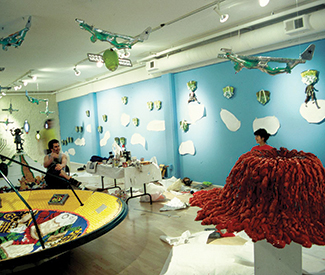
On the obsessive side, Wicker Kittens examines the world of competitive jigsaw puzzling. Jingle Bell Rocks! examines the netherworld of serious Christmas-music aficionados; Vannin’ observes the 1970s customized-van culture still alive today. Magical Universe is Jeremy Workman’s very first-person account of his friendship with an elderly Maine widower who turns out to have secretly created epic quantities of bizarre Barbie-related art. Hairy Who and the Imagists recalls the somewhat less “outsider”-ish achievements of Chicago’s ’60s avant-garde art scene, while Amos Poe’s 1976 The Blank Generation, DocFest 13’s sole archival feature, flashes back to punk’s birth throes at CBGB’s.

Another legendary moment is remembered in Led Zeppelin Played Here, about an extremely early, ill-received 1969 Zep show at a Maryland youth center that few attended, but many claim to have. Portraits of artists expanding their forms in the present tense include Trash Dance (a choreographer collaborates with truckers and their big rigs) and When My Sorrow Died (theremin!).

Exerting a somewhat wacked fascination is the cast of We Always Lie to Strangers, which is somewhat spotty and unfocused as an overall picture of tourist mecca Branson, Mo. — Vegas for people who don’t sin — but intriguing as a study of showboy/girl types stuck in a milieu where gays remain closeted and Broadway-style divas need to keep that bitching hole shut 24/7. Further insight into your entertainment options is provided by Doc of the Dead (on zombiemania) and self-explanatory Video Games: The Movie.

One pastime nearly everyone pursues — looking for love — gets sobering treatment in Love Me, one of several recent documentaries probing the boom in Internet “mail order brides” from former Soviet nations. Its various middle-aged sad sacks pursuing much younger Eastern bombshells mostly find themselves simply ripped off for their troubles. Those looking for quicker, cheaper gratification may identify with Back Issues: The Hustler Magazine Story.

Of particular local interest is the premiere of Rick Prelinger’s No More Road Trips, culled from his collection of nearly 10,000 vintage home movies. A preview screening of First Friday offers a first peek at this forthcoming documentary about tragic violence at the monthly arts festival in Oakland last year. True Son follows 22-year-old Michael Tubbs’ attempt to win a City Council seat and reverse the fortunes of his beleaguered native Stockton. The “Don’t Call It Frisco!” program encompasses shorts about the Bay Bridge troll, a Santa Rosa animal “retirement home,” and a salute to South Bay hardcore veterans Sad Boy Sinister.

DocFest ends June 19 with that rare thing, a documentary about downbeat, hard-to-encapsulate material that’s won considerable attention simply because it’s so beautifully crafted and affecting. Andrew Droz Palermo and Tracy Droz Tragos’ Rich Hill focuses on three kids in worse-than-average circumstances in a generally depressed Missouri town of 1,400 souls. Harley is an alarmingly temperamental teen housed on thin ice with his grandmother while his mother sits in prison for reasons that explain a great deal about him. Potty-mouthed Appachey is a little hellion perpetually setting off his exasperated, multi-job-juggling single mother, living in near-squalor.

Still, both are at least superficially better off than Andrew, an almost painfully resilient and hopeful boy constantly uprooted by an obscurely damaged mother and a father who can’t hold a job to save his life. “We’re not trash, we’re good people,” he tells us early on, later rationalizing his continuing dire straits with “God must be busy with everyone else.” He’s the heartbreaking face of a hardworking, religious, white American underclass that is being betrayed into desperation by the politicians who claim to share its values.

DOCFEST 13

June 5-19

Check website for venues, times, and prices

www.sfindie.com


Movin’ on

2

marke@sfbg.com

SUPER EGO “The Mission has changed so much since we started the party. Just so many strollers and $10 tacos… It’s crazy … ” DJ Oz McGuire (aka Señor Oz) was telling me. Along with his brother Joey (aka Pleasuremaker) and the cutest crew ever, Oz has thrown fantastic panglobal funk weekly Afrolicious at Elbo Room for the past seven years.

Uh oh. This sounds like the start of a break up talk. An “it’s time to move on” soliloquy. An “it’s not you, it’s them” kind of thing. Don’t make me pull out my wet telenovella hysterical dramatics on you, Oz!

“Elbo Room has always been a special place and it will continue to be,” he continued, gently. “But Afrolicious has developed into something bigger than a club night. We got to try out so many things and expand our horizons. We never planned on becoming a live band, but like everything else about Afrolicious it happened organically. We’re now on Thievery Corporation’s label and touring all over.”

Hot tears welling …

“When we started the party, it was truly what we thought the Mission was about. It wasn’t exclusive and it wasn’t exclusionary, it was open to everyone. Every Thursday has been an adventure, full of live music, great guests, and a room full of awesome people. The youngest person in our collective is the rising soul singer Ziek McCarter who started with us at 19. Our oldest member is Baba Duru, who moved to SF in 1970 and toured with Stevie Wonder. Our vocalist is from Trinidad and our drummer is from Brazil. We all congregated in SF over our love of the universal groove. There are rhythms that connect all dance music from the beginning of time to the present day and we believed we could transmit them. Now it’s time to take that original Mission feeling to the world.”

Oh, I see. So now we’re supposed to share you?

“It’s not like we’re leaving SF. Pleasuremaker and Izzy Wise are starting a new night on Thursdays at the Elbo Room called Hi Life, full of Afrolicious regulars. We just wanted to end while Afrolicious was still hot and relevant. We never wanted to have a bad party, we batted 1000 percent. We’ll always love the vibe here.”

Fine then. Go. But I’m keeping the damn dog. And the purple Camaro!

AFROLICIOUS GRAND FINALE Thu/5, 9:30pm,, $10–$15. Elbo Room, 647 Valencia, SF. www.elbo.com


RICK WADE

Seminal Detroit house player will turn the weekly Housepitality party out with his deep and freaky Harmonie Park sound. A midweek must.

Wed/4, 9pm, free before 11pm with RSVP at www.housepitalitysf.com/rsvp, $10 after. F8, 1192 Folsom, SF.


DBX

Original techno ambassador (and exemplary Canadian chap) Daniel Bell brings his live show — which slayed everyone last month at the Detroit Electronic Music Fest — to the As You Like It party.

Fri/6, 9pm-4am, $20. Monarch, 101 Sixth St, SF. www.ayli-sf.com


WORTHY

Longtime dirtybird crewmember and essential SF DJ/troublemaker Worthy is dropping gorgeously funky album Disbehave featuring one of my favorite people in the world, vocalist Audio Angel. This is the party for that. It will be bonkers.

Fri/6, 9pm-3am, $5 before 11pm with RSVP (details at www.mighty119.com). Mighty, 119 Utah, SF.


STEFFI

One of the best selectors brings her great energy from Berlin to the Honey Soundsystem party, bearing rare, groovy, and just plain lovely house and techno cuts galore.

Sat/7, 9pm-4am, $15–$20. Public Works, 161 Erie, SF. www.publicsf.com


J. ROCC

The legendary turntablist (he started the Beat Junkies in 1992, but has been scratching up Cali since the mid-80s) hits F8’s decks with all-star support from Kevvy Kev, Vinroc, Dials, and Napsty. Expect pyrotechnics.

Sat/7, 10pm, $7–$20. F8, 1192 Folsom, SF. www.feightsf.com


WICKED 23: THE MAGICK BALL

So stoked to celebrate 23 years with this genius crew and a dance floor full of true SF underground flavor. It’s a bittersweet party, though: DJ Thomas — who found global fame as one half of Rub N Tug — has announced this will be his final gig.

https://www.youtube.com/watch?v=dkL71qHDjAc

Sat/7, 10pm-6am, $20–$25. Mighty, 119 Utah, SF. www.mighty119.com


Stroll tide

0

arts@sfbg.com

DANCE The third Walking Distance Dance Festival — basically three programs of two pieces over two days — was modest in scale. Audience members may have traveled only half a block between venues for this fringe-style event, yet as curated by ODC Theater Director Christy Bolingbroke, these short trips became adventures.

Running through the festival was a simple question: What do we do with what we have? Dance works used to be considered moments in time that left behind only fading footprints. No longer. Dance historians have unearthed huge chunks of the past, and the Internet, with YouTube at its core, opens much of it at the click of a key. Besides, like it or not, the past is part of who we are. We can’t get away from it.

In the festival’s opener, the question for Lionel Popkin became how he, with an Indian mother, was supposed to look at Ruth St. Denis, the pioneering modern dancer who dabbled in what she saw as Indian dance. With the brilliant and sharp Ruth Doesn’t Live Here Anymore, Popkin attacked the complexities of these issues with humor, much of it self-effacing, and vigorous dancing for himself, Emily Beattie, and Carolyn Hall. They pushed along the floor and rolled over each other; they also dived into the unholy mess of St. Denis’ fixation on veils as they subverted her pedantic instructions for Nautch, her most famous work. Master accordionist Guy Klucevsek’s score, performed live, was superb.

The festival ended with Amy O’Neal’s cheekily titled solo The Most Innovative, Daring, and Original Piece of Dance/Performance You Will See this Decade. O’Neal is a stunningly captivating performer who slides in and out of hip-hop, club, modern, and even some balletic dancing. She may have been alone on stage, but with her are Dorothy’s red slippers and choreography from music videos by Ciara and Janet Jackson, freely adapted but still recognizable. An accompanying projected text addressed issues of influences (borrowed, stolen, honoring, or accidental) on the creative process. Make them your own, O’Neal asserted. She did.

So did Doug Elkins Choreography, Etc.’s high wire comedy act Hapless Bizarre, in which voguing and musical theater ran smack into vaudeville and physical clowning. The superb Mark Gindick played the clueless outsider who wormed his way into an haute monde — in every sense of that term since all but one of the other performers towered over him. Starting with an elaborate hat trick, the dancers marvelously picked up on voguing’s haughty and competitive struts and poses. As Hapless moved on to romance, the intensity of pratfalls, rejections, and increasingly hopeless entanglements become even more frantic. Glad to say that Gindick finally got the girl.

Three local groups also participated in this fine festival. Garrett + Moulton Productions reprised its A Show of Hands, which premiered last October in the Jewish Community Center of San Francisco’s airy lobby. Dan Becker’s excellent score, performed live, still sounded wonderful.

At ODC, Show, inspired by Charles Moulton’s drawing of hand gestures that were projected as a backdrop, looked tighter and more focused. Hand gestures — so often neglected in Western dancing — came into their own. They poked, touched, and reached. With the dancers stacked on pedestals, their fingers resembled trembling butterflies. But the hands also lifted and carried three of the musicians in a funeral procession, leaving an elegiac cellist behind.

Show offered marvelously full-bodied and fluid dancing with phrases that flew, sank, or simply disappeared into the wings. Nol Simonse injected a comedian’s touch into his duet with Dudley Flores. Newly blond Vivian Aragon, a fiercely balletic dancer, attacked every move as if it were her last. No wonder she could grab and lift Simonse like a puppet.

Show was paired with an excerpt of Bhakti: Women’s Liberation of Love by Kathak dancer Rachna Nivas, in which she attempted to portray Hindu mystic and poet Meerabai as a proto-feminist. An exquisite dancer with a refined sense of rhythmic acuity who is well-schooled in male-female roles, Nivas charmed as the girl devoted to Krishna, but her telling of other aspects of Meerabai’s life needed more complexity.

The festival’s most haunting dancing came from Headmistress dancers Amara Tabor-Smith and Sherwood Chen. Shame the Devil explored the process of what Tabor-Smith calls becoming a crone. Hopping in place and becoming very still, her intensity mesmerized as she called up several lifetimes’ worth of states of being. She should, however, ditch her auxiliary performers.

Mummified in layers and layers of clothing, Chen’s Mongrel channeled Dervish dancing — until he stripped down to acquire a more authentic but also more vulnerable identity. Though it’s a borrowed metaphor, Mongrel convinced because of the rigor and consistency that Chen imposed on his dance making. Replacing Moroccan with Brazilian music, however, seemed just a touch too simplistic. *


Standing Up for Children Exposed to Trauma

0

By Suzy Loftus

OPINION Sasha’s only 9 years old, but she has already experienced significant trauma and adversity. Whenever her father drank too much, he would hit and verbally abuse Sasha and her mother. After her father went to jail, Sasha’s mother lost her job, the family became homeless and eventually moved into subsidized housing. Sasha had also witnessed high levels of community violence. Exposure to trauma has taken its toll on Sasha; she has a hard time focusing on assignments in class and struggles with reading and math. She gets frustrated and acts out at home and in class. Her teacher thinks Sasha has learning problems, and has recommended her for special education.

We have often looked at childhood trauma such as Sasha’s as a social problem or a mental health problem — but emerging data provides a more complete picture. At the Center for Youth Wellness, in Bayview Hunters Point, we are part of a growing national movement that is looking at childhood exposure to chronic adversity through a different lens: as a public health threat.

Children, like Sasha, are screened for exposure to chronic adversity and toxic stress during their pediatric visits, through a partnership between the Bayview Child Health Center and the Center for Youth Wellness.

Dr. Nadine Burke Harris discusses ACEs and toxic stress as the next massive public health threat.

In the Bayview and across California, chronic adversity and toxic stress stand in the way of the health and success of many children. Now more than ever, we are beginning to understand the impact of early adversity — known as Adverse Childhood Experiences (ACEs) — on the developing brains and bodies of children like Sasha.

ACEs are traumatic experiences over which a child has no control. Examples include abuse, neglect, household dysfunction, exposure to community violence, homelessness, discrimination, involvement in foster care, and others.

A study conducted by Dr. Burke Harris, founder of the Center for Youth Wellness, found that a majority of the 700 participants, all patients from Bayview with a median age of 8 — 67 percent —were exposed to one or more ACEs.

Beyond the Bayview, exposure to childhood trauma is surprisingly common among Californians. In fact, a San Diego study found that two-thirds of 17,000 participants reported at least one adverse childhood experience, and 20 percent of participants reported three or more ACEs.

ACEs can result in toxic stress, which can affect the fundamental biological functioning of the body and, in many children, the healthy development of their brain architecture. Without support and protection from adults, children who experience toxic stress are at higher risk for health problems, like asthma, diabetes, and obesity. Toxic stress also may make it difficult to sit still in school or to control emotions in challenging situations. If left untreated, toxic stress can lead to increased risk of adult diseases including heart disease and cancer as well as behavior problems such as depression, substance use, and suicide.

That’s why exposure to Adverse Childhood Experiences has been called the greatest unaddressed public health threat of our time. This is a public health crisis with clear implications beyond health — from education to public safety to our economy.

Our approach: screen every child for toxic stress and pilot and evaluate interventions that heal the impact of ACEs. Our goal is to share best practices in ACEs treatment with others around the country. We believe that the pediatric home offers an important entry point into addressing ACEs and toxic stress with families.

Even before a child goes to school or interacts with other systems, he or she usually visits a pediatrician for a routine well-child check. With the ability to touch countless numbers of children exposed to ACEs, pediatricians can be on the frontlines of preventing, screening, and healing toxic stress. Other healthcare professionals who work with children, such as school nurses, also are in a unique position to screen for toxic stress and help families access the services they need.

The science is clear — we must do more to prevent, screen, and heal the impacts of ACEs and toxic stress. A crucial first step in addressing this crisis is raising awareness among parents, pediatricians, educators, and policymakers that ACEs are a public health threat that we cannot afford to ignore. We must do more to identify toxic stress in our kids before it leads to a lifetime of challenges for children, families and our communities.

Suzy Loftus is chief operating officer of the Center for Youth Wellness and a member of the San Francisco Police Commission.

End the open primary experiment

21

EDITORIAL

This week’s primary election on June 3 occurred after Guardian press time for this issue, but there’s one conclusion that we can draw about it without even knowing the results: This is a pretty shabby form of democracy that few voters cared about. California’s experiment in open primaries is a disaster, and it’s time for a new model.

Turnout for this election was expected to hit historic lows, and for good reason: There was nothing of any real significance on this ballot, except perhaps for Proposition B on the San Francisco ballot, to require voter approval for height increases on waterfront development projects.

Even the hotly contested Assembly District 17 race between David Campos and David Chiu was simply a practice run for a rematch in November, thanks to an open primary system that sends the top two primary finishers, regardless of party, to the general election.

The system was approved by voters at Proposition 14 in 2010, placed on the ballot by then-Assemblymember Abel Maldonado as part of a deal with then-Gov. Arnold Schwarzenegger to break a budget stalemate caused by their fellow Republicans. Such horse-trading should have been a bad sign that this change wouldn’t live up to its idealistic hopes.

Its backers promised that it would favor more moderate candidates and reduce negative campaigning, but that hasn’t happened. Indeed, at press time it appeared Gov. Jerry Brown would be facing the most radically right-winger in the race, Tim Donnelly, in November.

What it has instead done is reduce the primary election to a boring and meaningless waste of time and money, turning off voters and creating low-turnout elections that are more prone to manipulation by wealthy special interests.

We at the Guardian are all for greater experimentation in our electoral models. We were big supporters of the ranked-choice voting system that is working well in San Francisco and Oakland. We support even more aggressive models for publicly financing campaigns and reducing the role on private money in electoral politics. Hell, we also support a proportional representation system and other wholesale transformations of our political system.

But while we’d love to see even more electoral experimentation, we also need to recognize when experiments are failing, as California’s open primary system now is. It’s time to try something new.


THE GUARDIAN CLEAN SLATE

0

GOVERNOR
Jerry Brown

LIEUTENANT GOVERNOR
Gavin Newsom

SECRETARY OF STATE
Derek Kressman

CONTROLLER
Betty Yee

TREASURER
John Chiang

ATTORNEY GENERAL
Kamala Harris

INSURANCE COMMISSIONER
Dave JOnes

SUPERVISOR OF SCHOOLS
Tom Torlakson

BOARD OF EQUALIZATION
Fiona Ma

ASSEMBLY, DISTRICT 17
David Campos

ASSEMBLY, DISTRICT 19
Phil Ting

PROPOSITION 41
Yes

PROPOSITION 42
Yes

SF PROPOSITION A
Yes

SF PROPOSITION B
Yes

SF SUPERIOR COURT JUDGE
Daniel Flores

CONGRESS, DISTRICT 12
Nancy Pelosi

CONGRESS, DISTRICT 13
Barbara Lee

CONGRESS, DISTRICT 14
Jackie Speier

To read our full endorsements, click here.

Hold ‘Steady’

0

arts@sfbg.com

DANCE Alonzo King’s The Steady Heart (which opened his spring season at YBCA May 21) is among his most dramatic and, thematically, most explicit works. It also just may be one of the finest he has yet created for his 11 Lines Ballet dancers, three of whom — David Harvey, Caroline Rocher, and Meredith Webster — will retire at the end of this season.

In many of King’s pieces, small, individualized sections accumulate into collage-like structures. There is always flow but not necessarily direction. Steady however, has a trajectory. It starts with a duet for Kara Wilkes and Robb Beresford; King closes the work with the whole ensemble evoking a timeless, pulsating, yet ever-changing cosmos. Lama Gyurme’s “The Lama’s Chant: Songs of Awakening” sets the tone for a huge finale with waves of dancers stumbling, falling, rolling, and rising. Webster streaked through them but was eventually absorbed into something larger than herself. With Axel Morgenthaler’s fluidly shifting light design, the dancers moved in and out of our vision with a screen descending on them right before the final curtain. The falling snow in the background, however, was something of a cliché.

Trying to find balance within the body and outside it is a theme that is fundamental to King’s thinking. In Steady it takes the concrete shape of a small, destructive figure (Anthony S. Finley) in a World War I uniform. We only see him twice but his existence, and what he represents, permeates all of Steady.

The sculpturally elaborate opening duet begins with simple touches by two young people, she in a pretty frock, he bare-chested and in jeans. Handholding evolves into an increasingly intricate and unrelenting struggle. Every body part from necks to limbs (Wilkes hangs off his and dips between Beresford’s legs) is brought into action. They reach, grab and shove; she sinks into his arms, he flips her overhead. Yet there is no sense of violence just a feeling of inevitability and, perhaps, a need to reach out as a process of self-definition. They communicated an Edenic innocence until the soldier figure pointed his gun at them.

Steady‘s middle section explodes into something dark and chaotic. With John Oswald’s score building into frightening intensity, the magisterial Courtney Henry with Rocher and Yujin Kim takes command of the stage. They stride, turn, and extend limbs; yet they also curl and embrace the ground. In a final image they call up Rodin’s three “Shades.”

An eloquently expressive solo for Babatunji, performed in silence, then cleared the air, with the dancer sinking, turning, and opening himself to space. A unison walking section felt calm until individuals broke out, most prominently the powerful Michael Montgomery’s whose whipping turns and isolations shook his body into spasms. David Harvey, with Webster, Wilkes and Kim, looked like catastrophe survivors. Bent over they dragged their broken bodies across the stage. Again and again, they forced themselves into upright positions to keep on struggling. At one point Harvey looked like a boxer responding to an unseen opponent’s thrusts and punches.

A second trio’s intent eluded me. The soldier from the opening section re-appeared against a white screen. He elicited a duet for Harvey and Kim in which he offered himself and a rolling stage light as support for the panic-stricken Kim, who never raised her gaze. In the follow-up, a darkly lit duet, Webster — she of the steady heart — repeatedly faced the soldier’s gun but, turning its nozzle away, shoved him into the wings.

Steady‘s dancers, including the three departing ones, shone at the top of their expressive abilities. They were well-supported by the beautifully chosen music, and Morgenthaler’s majestic employment of light and space.

The evening opened with excerpts from three earlier King choreographies: Klang (1996), The Radius of Convergence (2008), and Koto (2002). It was good to see the women in point shoes, a practice that King rarely makes use of these days. The first two works also played with the traditional ballet soloist-corps format. The most intriguing standalone came in Klang; it contrasted frozen unison images with high-energy individual dancing. In the male trio, Beresford’s strutting and pugnacious stances had an almost comic flavor to them, while the women’s slinking kicks and hip poses dripped with old-fashioned coyness.

The male quintet in Radius featured solos for each dancer with Montgomery the outside observer until he jumped into the assembled quartet’s arms. They finally left him flat on his back. Radius segued without a break into a section from Koto. An ensemble piece, it showcased Jeffrey Van Sciver, a tall reed-thin dancer in his second year with Lines. His whiplash turns and long leaps felt like a storm invading a placid world. Unfortunately, Miya Masaoka’s koto music on tape jarred. It sounded tinny and sharp. Besides, I missed seeing her perform live in that huge red Colleen Quen gown of hers.