Volume 44 [2009–10]

Music Listings

0

Music listings are compiled by Paula Connelly and Cheryl Eddy. Since club life is unpredictable, it’s a good idea to call ahead to confirm bookings and hours. Prices are listed when provided to us. Submit items at listings@sfbg.com. For further information on how to submit items for the listings, see Picks.

WEDNESDAY 18

ROCK/BLUES/HIP-HOP

Actionslacks, Love is Chemicals, Ex-Boyfriends Bottom of the Hill. 9pm, $8.

Cheetahs on the Moon, Bodice Rippers, Sugarbutt Tiger Annie’s Social Club. 9pm, $6.

Collisionville, Control-R, Pomegranate El Rio. 8pm, $5.

Comeback Kid, Gravemaker, Mother of Mercy, Dead Swan Thee Parkside. 8pm, $12.

Confunkshun Rrazz Room, Hotel Nikko, 222 Mason, SF; 1-888-468-3399. 8pm, $30-35.

Elm, Midday Veil, Sequin Trails Hemlock. 9pm, $6.

Frail, Lleggs Harlot, 46 Minna, SF; (415) 777-1077. 9pm, $5.

Joe Krown Trio Biscuits and Blues. 8pm, $18.

*Judgement Day, La Fin du Monde, Grayceon Annie’s Social Club. 8:30pm, $7.

*King Khan and BBQ Show, Those Darlins Independent. 8pm, $15.

Nitzer Ebb, King Loses Crown Slim’s. 8pm, $25.

Chris Pierce, Amber Rubarth, Corb Lund Hotel Utah. 8:30pm, $10.

Julian Plenti, I’m in You Great American Music Hall. 8pm, $16.

Saints of Ruin Red Devil Lounge. 8pm, $8-10.

Society of Rockets, Conspiracy of Beards, Lotus Feet Elbo Room. 9pm, $7.

BAY AREA

Raphael Saadiq, Anjulie, Melanie Fiona Fox Theater. 7:30pm, $39.50.

JAZZ/NEW MUSIC

Ben Marcato and the Mondo Combo Top of the Mark. 7:30pm, $10.

Marcus Shelby Jazz Jam Revolution Café, 3248 22nd St, SF; (415) 642-0474. 8:45pm, free.

Michael Browne Trio Rite Spot, 2099 Folsom, SF; (415) 552-6066. 9pm, free.

Cat’s Corner Savanna Jazz. 7pm, $5-10.

Shana Morrison Yoshi’s San Francisco. 8pm, $14.

Tamika Nicole Yoshi’s San Francisco. 10:30pm, $14.

Tin Cup Serenade Le Colonial, 20 Cosmo Place, SF; (415) 931-3600. 7pm, free.

FOLK/WORLD/COUNTRY

Freddy Clarke, Wobbly World Peña Pachamama, 1630 Powell, SF; (415) 646-0018. 8:30, $10.

Gaucho, Michael Abraham Jazz Session Amnesia. 8pm, free.

Leigh Gregory Plough and Stars. 9pm.

Erin McKeown, Sonya Kitchell Café du Nord. 8:30pm, $15.

Amber Rubarth Hotel Utah. 8pm, $10-12.

DANCE CLUBS

Booty Call Q-Bar, 456 Castro; www.bootycallwednesdays.com. 9pm. Juanita Moore hosts this dance party, featuring DJ Robot Hustle.

Hands Down! Bar on Church. 9pm, free. With DJs Claksaarb, Mykill, and guests spinning indie, electro, house, and bangers.

Jam Wednesday Infusion Lounge. 10pm, free. DJ Slick Dee.

Qoöl 111 Minna Gallery. 5-10pm, $5. Pan-techno lounge with DJs Spesh, Gil, Hyper D, and Jondi.

RedWine Social Dalva. 9pm-2am, free. DJ TophOne and guests spin outernational funk and get drunk.

Respect Wednesdays End Up. 10pm, $5. Rotating DJs Daddy Rolo, Young Fyah, Irie Dole, I-Vier, Sake One, Serg, and more spinning reggae, dancehall, roots, lovers rock, and mash ups.

Synchronize Il Pirata, 2007 16th St.; (415) 626-2626. 10pm, free. Psychedelic dance music with DJs Helios, Gatto Matto, Psy Lotus, Intergalactoid, and guests.

THURSDAY 19

ROCK/BLUES/HIP-HOP

Chris Brown Fillmore. 7pm, $38.50.

Confunkshun Rrazz Room, Hotel Nikko, 222 Mason, SF; 1-888-468-3399. 8pm, $30-35.

*Ensiferum, Hypocrisy, Blackguard DNA Lounge. 8pm, $22.

Hidden Cameras, Gentleman Reg, Winter’s Fall Bottom of the Hill. 9pm, $14.

Kevin Russell Trio Biscuits and Blues. 8pm, $15.

Meta, Ana Lucia, Burnt Thumbs El Rio. 9pm, $6.

Microfiche, Elle Nino, Camp Out, Hey Young Believer Hotel Utah. 9pm, $6.

Neon Indian, Love X Nowhere Rickshaw Stop. 8pm, $10-12.

Peter Bjorn and John, El Perro Del Mer Great American Music Hall. 9pm, $23.

Railcars, Samuelroy, Pregnant, Felt Drawings Thee Parkside. 9pm, $6.

Röyksopp, Jon Hopkins Regency Ballroom. 8pm, $32.

Silian Rail, Grand Lake, Ash Reiter Hemlock Tavern. 9pm, $7.

Tainted Love Red Devil Lounge. 8pm, $15.

0th, Kurione, Paper Legs, William Winat, Weasle Walter, and John Gruntfest Trio Amnesia. 9pm, $6.

BAY AREA

Them Crooked Vultures, Mini Mansions Fox Theater. 8pm, $49.50.

JAZZ/NEW MUSIC

Joe Bagale, Crystal Monee Hall Yoshi’s San Francisco. 10:30pm, $10.

Margie Baker Shanghai 1930. 7pm, free.

Al Coster Trio and jam session Savanna Jazz. 8pm, $5.

Terry Disley Washington Square Bar and Grill, 1707 Powell, SF; (415) 433-1188. 7pm, free.

Eric Kurtzrock Trio Ana Mandara, Ghirardelli Square, 891 Beach, SF; (415) 771-6800. 7:30pm, free.

Laurent Fourgo Le Colonial, 20 Cosmo Place, SF; (415) 931-3600. 7:30pm, free.

Marlina Teich Trio Brickhouse, 426 Brannan, SF; (415) 820-1595. 7-10pm, free.

Stephen Merriman Simple Pleasures, 3434 Balboa, SF; (415) 387-4022. 8pm, free.

Stompy Jones Top of the Mark. 7:30pm, $10.

FOLK/WORLD/COUNTRY

Battlin’ Blue Birds Dolores Park Café. 7:30pm, free.

Bluegrass Old Time Jam Atlas Café. 8pm, free.

Classical Revolution Amnesia. 6pm, free.

Frisky Frolics Rite Spot, 2099 Folsom, SF; (415) 552-6066. 9pm, free.

Jim Lauderdale Noe Valley Ministry, 1021 Sanchez, SF; (415) 454-5238. 8:15pm, $22.

Jueves Flamencos Peña Pachamama, 1630 Powell, SF; (415) 646-0018. 8:15pm, $10; 9:30pm, $12.

Mission 3 Revolution Café, 3248 22nd St, SF; (415) 642-0474. 8:45pm, free.

Tipsy House Plough and Stars. 9pm.

Worried Minds Socha Café, 3235 Mission, SF; (415) 643-6848. 8:30pm.

DANCE CLUBS

Afrolicious Elbo Room. 9:30pm, $5-6. DJs Pleasuremaker, Señor Oz, J Elrod, B Lee, and special guest Beto spin Afrobeat, Tropicália, electro, samba, and funk featuring an album listening party for Tito Rodriguez.

Bingotopia Knockout. 7:30-9:30pm, free. Play for drinks, dignity, and dorky prizes with Lady Stacy Pants.

Caribbean Connection Little Baobab, 3388 19th St; 643-3558. 10pm, $3. DJ Stevie B and guests spin reggae, soca, zouk, reggaetón, and more.

Club Jammies Edinburgh Castle. 10pm, free. DJs EBERrad and White Mice spinning reggae, punk, dub, and post punk.

Drop the Pressure Underground SF. 6-10pm, free. Electro, house, and datafunk highlight this weekly happy hour.

Echo-A-Gogo Knockout. 10pm, free. Vintage dub reggae with DJ Lucky and friends.

Funky Rewind Skylark. 9pm, free. DJ Kung Fu Chris, MAKossa, and rotating guest DJs spin heavy funk breaks, early hip-hop, boogie, and classic Jamaican riddims.

Heat Icon Ultra Lounge. 10pm, free. Hip-hop, R&B, reggae, and soul.

Kick It Bar on Church. 9pm. Hip-hop with DJ Jorge Terez.

Koko Puffs Koko Cocktails, 1060 Geary; 885-4788. 10pm, free. Dubby roots reggae and Jamaican funk from rotating DJs.

Mestiza Bollywood Café, 3376 19th St., SF; (415) 970-0362. 10pm, free. Showcasing progressive Latin and global beats with DJ Juan Data.

Popscene 330 Rich. 10pm, $10. Rotating DJs spinning indie, Britpop, electro, new wave, and post-punk.

Represent Icon Lounge. 10pm, $5. With Resident DJ Ren the Vinyl Archaeologist and guest. Rock Candy Stud. 9pm-2am, $5. Luscious Lucy Lipps hosts this electro-punk-pop party with music by ReXick.

Solid Club Six. 9pm, $5. With resident DJ Daddy Rolo and rotating DJs Mpenzi, Shortkut, Polo Mo’qz and Fuze spinning roots, reggae, and dancehall.

FRIDAY 20

ROCK/BLUES/HIP-HOP

Billy and Dolly with Tell-Tale Hearts, Michael Zapruder, Paul Bertolino Hotel Utah. 9pm, $10.

Confunkshun Rrazz Room, Hotel Nikko, 222 Mason, SF; 1-888-468-3399. 7 and 9:30pm, $30-35.

Disco Biscuits Fillmore. 9pm, $25.

Dolorata, Audrey Howard and the Misters, View from Space Bottom of the Hill. 10pm, $10.

*El Dopa, Cretaceous Annie’s Social Club. 9:30pm, $8.

Eternal Tapestry, Barn Owl, Moon Duo, Real Estate Hemlock Tavern. 9pm, $8.

Fiery Furnaces, Cryptacize, Dent May Slim’s. 9pm, $16.

Girls Swedish American Hall (upstairs from Café du Nord). 8pm, $15.

Houston Jones Noe Valley Ministry, 1021 Sanchez, SF; (415) 454-5238. 8:15pm, $19.

DJ Lebowitz Madrone Art Bar. 6-9pm, free.

*McCabe and Mrs. Miller, Paul and John Make-Out Room. 7pm, $7.

New Thrill Parade, Tape Deck Mountain, Red Pony Clock, Monnone Alone, Borneo Amnesia. 9pm, $8.

Peter Bjorn and John, El Perro Del Mer Great American Music Hall. 9pm, $23.

Sleepytime Gorilla Museum, Faun Fables Independent. 9pm, $18.

Earl Thomas and the Blues Ambassadors Biscuits and Blues. 8 and 10pm, $22.

Zoo Station Red Devil Lounge. 8pm, $10.

JAZZ/NEW MUSIC

Audium 9 1616 Bush, SF; (415) 771-1616. 8:30pm, $15.

Patti Austin Yoshi’s San Francisco. 8 and 10pm, $30-38.

Black Market Jazz Orchestra Top of the Mark. 9pm, $10.

Bryan Girard Quartet Cliff House Restaurant, 1090 Point Lobos, SF; (415) 386-3330. 7pm, free.

Stephanie Crawford Savanna Jazz. 8pm, $8.

Eric Kurtzrock Trio Ana Mandara, Ghirardelli Square, 891 Beach, SF; (415) 771-6800. 8pm, free.

Lucid Lovers Rex Hotel, 562 Sutter, SF; (415) 433-4434. 6-8pm.

T.D. Skatchit and Company Community Music Center, 544 Capp, SF; (415) 647-6015. 8pm, $10.

Terry Disley Experience Shanghai 1930. 7:30pm, free.

FOLK/WORLD/COUNTRY

Seth Augustus Revolution Café, 3248 22nd St, SF; (415) 642-0474. 8:45pm, free.

Andrew Skewes Cox Socha Café, 3235 Mission, SF; (415) 643-6848. 8:30pm.

Toshio Hirano Mercury Café, 201 Octavia, SF; (415) 252-7855. 7:30pm, free.

Forro in the Dark, Nneka, DJ Felina Café du Nord. 9:30pm, $12-15.

49 Special Plough and Stars. 9pm, $6-10 sliding scale.

International Studies Academy (ISA) Concert Dolores Park Café. 7:30pm, free.

Rob Reich and Craig Ventresco Amnesia. 7pm, free.

Rolando Morales and group Peña Pachamama, 1630 Powell, SF; (415) 646-0018. 8pm, 10pm.

Samba Da Elbo Room. 10pm, $15.

Lee Vilenski Rite Spot, 2099 Folsom, SF; (415) 552-6066. 9pm, free.

DANCE CLUBS

Activate! Lookout, 3600 16th St; (415) 431-0306. 9pm, $3. Face your demigods and demons at this Red Bull-fueled party.

Bar on Church 9pm. Rotating DJs Zax, Zhaldee, and Nuxx.

Blow Up Rickshaw Stop. 10pm, $15. With DJs Jeffrey Paradise and Richie Panic spinning dance music.

Conspirator 103 Harriet, 103 Harriet, SF; (415) 431-3609. 10pm, $20. Disco Biscuits after party.

Deep Fried Butter, 354 11th St., SF; (415) 863-5964. DJs jaybee, David Justin, and Dean Manning spinning indie, dance rock, electronica, funk, hip hop, and more.

Exhale, Fridays Project One Gallery, 251 Rhode Island; (415) 465-2129. 5pm, $5. Happy hour with art, fine food, and music with Vin Sol, King Most, DJ Centipede, and Shane King.

Fat Stack Fridays Koko Cocktails, 1060 Geary, SF; (415) 885-4788. 10pm, free. With rotating DJs Romanowski, B-Love, Tomas, Toph One, and Vinnie Esparza.

510’s Finest Presents: King Thee Parkside. 10pm, $4.

Gay Asian Paradise Club Eight, 1151 Folsom, SF; www.eightsf.com. 9pm, $8. Featuring two dance floors playing dance and hip hop, smoking patio, and 2 for 1 drinks before 10pm.

House of Voodoo Medici Lounge, 299 9th St., SF; (415) 501-9162. 9pm, $5. With DJs Voodoo, Purgatory, and more spinning goth, industrial, deathrock, and glam.

Look Out Weekend Bambuddha Lounge. 4pm, free. Drink specials, food menu and resident DJs White Girl Lust, Swayzee, Philie Ocean, and more.

Loose Stud. 10pm-3am, $5. DJs Domino and Six spin electro and indie, with vintage porn visual projections to get you in the mood.

M4M Fridays Underground SF. 10pm-2am. Joshua J and Frankie Sharp host this man-tastic party.

Juan Maclean DJ Set (Tribute to Gerhardt Fuchs), Parallels, DJs Eug and J. Montag Mezzanine. 9pm, $13.

Oldies Night Knockout. 9pm, $2-4. Doo-wop, one-hit wonders, and soul with DJs Primo, Daniel, and Lost Cat.

Pirate Cat Radio Benefit Triple Crown. 8pm, $10. Proceeds to help pay recent fines imposed by the FCC.

Punk Rock and Shlock Karaoke Annie’s Social Club. 9pm-2am, $5. Eileen and Jody bring you songs from multiple genres to butcher: punk, new wave, alternative, classic rock, and more.

The Present Club Six. 9pm, $15. Featuring performances by Luckyiam PSC, The Bayliens, Wordplay, and more with DJs Franky Fresh, Beast, and more spinning hip hop.

SATURDAY 21

ROCK/BLUES/HIP-HOP

"A&R Live: Major Label Showcase" Thee Parkside. 9pm, $15.

Confunkshun Rrazz Room, Hotel Nikko, 222 Mason, SF; 1-888-468-3399. 7 and 9:30pm, $30-35.

Disco Biscuits Fillmore. 9pm, $25.

*Municipal Waste, Off with Their Heads, Phobia, Cauldron Slim’s. 8pm, $15.

Okay-Hole with Sixteens, Sleeping Desires, Soft Shoes and the Socks Amnesia. 9pm, $7.

Old Canes, Top Critters, Mylo Jenkins House of Shields. 9pm, $5.

Perfect Machines, Sassy!!!, Lady Sinatra, Live Evil, Rockfight Hotel Utah. 9pm, $8.

Rod Piazza and the Mighty Flyers Biscuits and Blues. 8 and 10pm, $22.

Pie Rats, Yes Gos, Light Machine Thee Parkside. 3pm, free.

"SFxSD" El Rio. 3pm-2am, $5-7. With Lucky Jesus, Long Live Logos, Butterfly Bones, DJ Calisto John, Lilofee, Transfer, and Music for Animals.

Shuteye Unison, New Trust, Grandchildren Hemlock Tavern. 9:30pm, $7.

Slick 46, Harrington Saints, Memphis Murder Men Annie’s Social Club. 9pm, $8.

Snoop Dogg, DJ Quik, Nipsey Hussle, Hustle Boys Warfield. 8pm, $53-63.

Thao with the Get Down Stay Down, Portland Cello Project, David Schultz Independent. 9pm, $17.

Keller Williams Great American Music Hall. 9pm, $25.

BAY AREA

Keb’Mo’, Solomon Burke Paramount Theatre. 8pm, $20-65.

JAZZ/NEW MUSIC

Audium 9 1616 Bush, SF; (415) 771-1616. 8:30pm, $15.

Patti Austin Yoshi’s San Francisco. 8 and 10pm, $38.

Graham Connah Revolution Café, 3248 22nd St, SF; (415) 642-0474. 8:45pm, free.

Eric Kurtzrock Trio Ana Mandara, Ghirardelli Square, 891 Beach, SF; (415) 771-6800. 8pm, free.

George Cole’s Band Red Poppy Art House. 8pm, $15-20.

"Jazz Jam Session with Uptime Jazz Group" Mocha 101 Café, 1722 Taraval, SF; (415) 702-9869. 3:30-5:30pm, free.

Octomutt, Lily Taylor Rite Spot, 2099 Folsom, SF; (415) 552-6066. 9pm, free.

Sandra Aran Group Shanghai 1930. 7:30pm, free.

Ricardo Scales Top of the Mark. 9pm, $15.

Suzanna Smith and band Savanna Jazz. 8pm, $8.

FOLK/WORLD/COUNTRY

Bossa 5-0 Socha Café, 3235 Mission, SF; (415) 643-6848. 8:30pm.

Culann’s Hounds Plough and Stars. 9pm.

Forro in the Dark, Boca Do Rio, DJ Felina Café du Nord. 9:30pm, $12-15.

George Cole Quintet Red Poppy Art House. 8pm, $15-20. Gypsy swing and American songbook.

Jaguares, Los Cenzontles Regency Ballroom. 9pm, $55.

Outside In Festival Bollyhood Café, 3372 19th St., SF; (415) 643-3558. 7pm, $5. Featuring food, dance arts, and music with a live performance from Mucho Axé and DJs Fausto and EKG.

Peruvian Night Peña Pachamama, 1630 Powell, SF; (415) 646-0018. 7:30pm, 11:45pm. With Lalo Isquierdo, Luis Valverde, Miguel Sisniegas, and Luis Ramos.

BAY AREA

Café Tacuba Fox Theater. 8pm, $35.50-39.50.

DANCE CLUBS

Bar on Church 9pm. Rotating DJs Foxxee, Joseph Lee, Zhaldee, Mark Andrus, and Niuxx.

Booty Bassment Knockout. 10pm-2am, $5. Hip-hop with DJs Ryan Poulsen and Dimitri Dickenson.

Cock Fight Underground SF. 9pm, $6. Locker room antics galore with electro-spinning DJ Earworm and hostess Felicia Fellatio.

Dead After Dark Knockout. 6-9pm, free. With DJ Touchy Feely.

DJ Nu-Mark Mighty. 9pm, $5 before 11pm with canned good. With DJs Haylow, Platurn, and Ant 1.

Black and White Affair Butterfly Lounge, Pier 33, 1400 Embarcadero, SF; www.partywithpure.com. 10pm, $20. DJs spinning mainstream hip hop and top 40s.

Fire Corner Koko Cocktails, 1060 Geary; 885-4788. 9:30pm, free. Rare and outrageous ska, rocksteady, and reggae vinyl with Revival Sound System and guests.

HYP Club Eight, 1151 Folsom, SF; www.eightsf.com. 10pm, free. Gay and lesbian hip hop party, featuring DJs spinning the newest in the top 40s hip hop and hyphy.

M80 Mission Rock Café, 817 Terry Francois, SF; (415) 626-5355. 10pm, $15. Disco Biscuits after party. Shuttle service available from the Fillmore.

P vs M Madrone Art Bar. 7pm, $5. DJs Dave Paul and Jeff Harris spinning a Prince vs. Michael marathon.

Saturday Night Live Fat City, 314 11th St; selfmade2c@yahoo.com. 10:30pm.

Saturday Night Soul Party 10pm, $10. With DJs Lucky, Phengren Oswald, and Paul Paul spinning 60s soul.

Spirit Fingers Sessions 330 Ritch. 9pm, free. With DJ Morse Code and live guest performances.

Villainy DNA Lounge. 9pm, $8-10. Electro, indie, new wave, gothic, and industrial with Tomas Diablo, Party Ben, and Starr.

SUNDAY 22

ROCK/BLUES/HIP-HOP

"Concerts First Next Big Thing" Slim’s. 11am, $15.

Confunkshun Rrazz Room, Hotel Nikko, 222 Mason, SF; 1-888-468-3399. 7pm, $30-35.

Fanfarlo, Freelance Whales, Mumlers Rickshaw Stop. 8pm, $13.

*"Heathenfest" DNA Lounge. 7:30pm, $22. With Eluveitie, Belphegor, Alestorm, Vreid, and Kivimetsan Druidi.

Il Gato, Radio Fantastique, Gerardo Balistreiri Amnesia. 9pm, $7-10.

Lake, Karl Blau, Half-Handed Cloud Hemlock Tavern. 9pm, $8.

Slick 46, Memphis Murder Men, Shootin’ Lucy, Shelby Cobra Thee Parkside. 8pm, $7.

Thrice, Dear Hunter, Polar Bear Club Regency Ballroom. 7:30pm, $24.

BAY AREA

KISS, Buckcherry Oracle Arena, 7000 Coliseum Wy, Oakl; www.ticketmaster.com. 7:30pm, $17.50-125.

JAZZ/NEW MUSIC

Patti Austin Yoshi’s San Francisco. 2 and 7pm, $5-38.

Terry Disley Washington Square Bar and Grill, 1707 Powell, SF; (415) 433-1188. 7pm, free.

Lua Hadar with Jason Martineau Bliss Bar, 4026 24th St, SF; (415) 826-6200. 4:30pm, $10.

Rob Modica and friends Simple Pleasures, 3434 Balboa, SF; (415) 387-4022. 3pm, free.

Savanna Jazz Trio and jam Savanna Jazz. 9:30pm, $5.

FOLK/WORLD/COUNTRY

b Foundation Great American Music Hall. 8pm, $10.

Bone Cootes, Old Hangtown Rite Spot, 2099 Folsom, SF; (415) 552-6066. 6pm, free.

Jack Gilder, Kevin Bemhagen, Richard Mandel, and friends Plough and Stars. 9pm.

Il Gato, El Radio Fantastique, Gerardo Balestrieri Amnesia. 9pm, $7-10.

Halau O Keikiali’I Peña Pachamama, 1630 Powell, SF; (415) 646-0018. 7:30pm, $10.

International Youth Music Initiative Jewish Community Center of San Francisco, 3200 California, SF; (415) 292-1233. 7pm, $15.

Iration, Tomorrow’s Bad Seeds, B Foundation Great American Music Hall. 8pm, $15.

Josh Klipp, Joe Stevens El Rio. 3-6pm, $5-10.

Jay Lingo and the Kick Balers Thee Parkside. 4pm, free.

Lior Tsarfaty and friends Red Poppy Art House. 7pm, $10-15.

DANCE CLUBS

DiscoFunk Mashups Cat Club. 10pm, free. House and 70’s music.

Dub Mission Elbo Room. 9pm, $6. Dub, roots, and classic dancehall with Nickodemus Meets Spy from Cairo, Freyja, Calamity Sam, and DJ Sep.

Gloss Sundays Trigger, 2344 Market, SF; (415) 551-CLUB. 7pm. With DJ Hawthorne spinning house, funk, soul, retro, and disco.

Honey Soundsystem Paradise Lounge. 8pm-2am. "Dance floor for dancers – sound system for lovers." Got that?

Jock! Lookout, 3600 16th; 431-0306. 3pm, $2. This high-energy party raises money for LGBT sports teams.

Kick It Bar on Church. 9pm. Hip-hop with DJ Zax.

Religion Bar on Church. 3pm. With DJ Nikita.

Stag AsiaSF. 6pm, $5. Gay bachelor parties are the target demo of this weekly erotic tea dance.

MONDAY 23

ROCK/BLUES/HIP-HOP

Dir En Gray Fillmore. 8pm, $23.

Holy Shit, Sleeptalks, Quite Polite Knockout. 9pm, $7.

Mr. Gnome, Songs for Snakes, Disastroid Elbo Room. 9pm, $6.

BAY AREA

Wolfmother, Heartless Bastards, Thenewno2 Fox Theater. 7:30pm, $29.50.

JAZZ/NEW MUSIC

Colour Yoshi’s San Francisco. 8pm, $8-12.

Lavay Smith Trio Enrico’s, 504 Broadway, SF; www.enricossf.com. 7pm, free.

Andrew Oliver Socha Café, 3235 Mission, SF; (415) 643-6848. 8:30pm.

Richard Rite Spot, 2099 Folsom, SF; (415) 552-6066. 8pm, free.

FOLK/WORLD/COUNTRY

Barefoot Nellies Amnesia. 8:30pm, free.

Lavay Smith and Her Red Hot Jug Band, Divine’s Jug Band Café du Nord. 8pm, $10.

DANCE CLUBS

Black Gold Koko Cocktails, 1060 Geary; 885-4788. 10pm-2am, free. Senator Soul spins Detroit soul, Motown, New Orleans R&B, and more — all on 45!

Going Steady Dalva. 10pm, free. DJs Amy and Troy spinning 60’s girl groups, soul, garage, and more.

King of Beats Tunnel Top. 10pm. DJs J-Roca and Kool Karlo spinning reggae, electro, boogie, funk, 90’s hip hop, and more.

Krazy for Karaoke Happy Hour Knockout. 5-9pm, free. With host Deadbeat.

Manic Mondays Bar on Church. 9pm. Drink 80-cent cosmos with Djs Mark Andrus and Dangerous Dan.

Monster Show Underground SF. 10pm, $5. Cookie Dough and DJ MC2 make Mondays worth dancing about, with a killer drag show at 11pm.

Network Mondays Azul Lounge, One Tillman Pl; www.inhousetalent.com. 9pm, $5. Hip-hop, R&B, and spoken word open mic, plus featured performers.

Spliff Sessions Tunnel Top. 10pm, free. DJs MAKossa, Kung Fu Chris, and C. Moore spin funk, soul, reggae, hip-hop, and psychedelia on vinyl.

TUESDAY 24

ROCK/BLUES/HIP-HOP

Dirty Penny, Death Valley High, Three Weeks Clean Elbo Room. 9pm, $7.

Glassines, Friendly Skies El Rio. 8pm, free.

Gwar, Job for a Cowboy, Red Chord Regency Ballroom. 8pm, $25.

Lahar Boom Boom Room. 9:30pm, free.

Lilys, Astral, LSD and the Search for Gold Bottom of the Hill. 9pm, $12.

Pale Hoarse, Kathryn Anne Davis, Sweet Chariot, DJ Donnelle Knockout. 9pm, $5.

Them Hills, Neal Morgan Hemlock Tavern. 9pm, $6.

Warren G, Dam-Funk, U-N-I Independent. 9pm, $25.

JAZZ/NEW MUSIC

"Booglaloo Tuesday" Madrone Art Bar. 9:30pm, $3. With Oscar Myers.

Dave Parker Quintet Rasselas Jazz. 8pm.

Euliptian Quartet Socha Café, 3235 Mission, SF; (415) 643-6848. 8:30pm.

Larry Vuckovich New Blue Balkan Ensemble Yoshi’s San Francsisco. 8pm, $14.

Ricardo Scales Top of the Mark. 6:30pm, $5.

Soraya Trio Rite Spot, 2099 Folsom, SF; (415) 552-6066. 8pm, free.

FOLK/WORLD/COUNTRY

Honeycomb Climate Theater, 285 9th St., SF; (415) 704-3260. 8pm, $7-15 sliding scale.

Song Session Plough and Stars. 9pm. With Vince Keehan and friends.

DANCE CLUBS

Death Guild DNA Lounge. 9:30pm, $3-5. Goth, industrial, and synthpop with Decay, Joe Radio, and Melting Girl.

Drunken Monkey Lounge Annie’s Social Club. 9pm, free. Guest DJs and shot specials.

Eclectic Company Skylark, 9pm, free. DJs Tones and Jaybee spin old school hip hop, bass, dub, glitch, and electro.

La Escuelita Pisco Lounge, 1817 Market, SF; (415) 874-9951. 7pm, free. DJ Juan Data spinning gay-friendly, Latino sing-alongs but no salsa or reggaeton.

Rock Out Karaoke! Amnesia. 7:30pm. With Glenny Kravitz.

Share the Love Trigger, 2344 Market, SF; (415) 551-CLUB. 5pm, free. With DJ Pam Hubbuck spinning house.

Stump the Wizard Argus Lounge. 9pm, free. Interactive DJ games with What’s His Fuck and Craigums.

Womanizer Bar on Church. 9pm. With DJ Nuxx.

Events Listings

0

Events listings are compiled by Paula Connelly. Submit items for the listings at listings@sfbg.com. For further information on how to submit items for the listings, see Weekly Picks.

WEDNESDAY 18

"Ancient Book of Hip" Space Gallery, 1141 Polk, SF; (415) 377-3325. 7pm, $10 includes book. A release party for D.W. Lichtenberg’s new book of poetry, a case study about girls, sex, cigarettes, thick-framed glasses, and everything that is the world of hip.

Dining by Design Galleria at the San Francisco Design Center, 101 Henry Adams, SF; (415) 597-4650. 6pm, $100. View three-dimensional dining installations and meet the designers at this preview party to Thursday night’s fine dining gala featuring cocktails, wine, and hors d’oeuvres from the city’s top restaurants.

"Meet the Future" California Academy of Sciences, 55 Music Concourse, Golden Gate Park, SF; (415) 379-8000. 7pm, $15. Attend this Scientific American roundtable debate with people working on world-changing ideas to address pressing issues, such as global health, robotics and artificial intelligence, energy, and environment. Moderated by Scientific American magazine editor Michael Moyer.

Mole to Die For Mission Cultural Center for Latino Arts, 2868 Mission, SF; (415) 643-2775. 7pm, $7. Attend this mole tasting and contest where chef’s judge the mole of professional cooks and the people judge homemade moles of from the community. Cash prizes for all winners. Mole for everyone.

THURSDAY 19

Denialism Commonwealth Club, 2nd floor, 595 Market, SF; (415) 597-6705. 5:30pm, $15. Hear staff writer for the New Yorker Michael Specter talk about his new book Denialism, about how irrational thinking hinders scientific progress, harms the planet, and threatens our lives.

InsideStorytime Iran Café Royale, 800 Post, SF; (415) 505-0869. 6:30pm, $3-10 sliding scale. Hear readings from Iranian-American authors Shahrnush Parsipur, Anita Amirrezvani, Mahbod Seraji, Persis Karim, and others with MC Dorinda Vassigh.

Open Source Embroidery Museum of Craft and Folk Art, 51 Yerba Buena, SF; (415) 227-4888. 7pm, free. Michele Pred discusses her mobile phone interactive art piece. Pred’s piece is a part of the Open Source Embroidery exhibition, which presents artworks that use embroidery and code as a tool for participatory production and distribution.

Isabella Rossellini Herbst Theater, 401 Van Ness, SF; (415) 392-4400. 8pm, $20-25. See the legendary actress, model, and director Isabella Rossellini in conversation with Roy Eisenhardt featuring film clips and a reading from her recent book, Green Porno.

SlideSlam Gallery 291, 5th floor, 291 Geary, SF; (415) 291-9001. 7pm, free. Attend this monthly event that provides aspiring and professional photographers the chance present their work to Fotovision members, a professional from a photo agency, and the general public.

BAY AREA

Sustainability Summit and Green Gathering David Brower Center, 2150 Allston Way, Berk; www.ecologycenter.org. 4pm, $35. Start your evening by attending the Sustainability Summit, a series of brief presentations on a range of Berkeley-centric sustainability projects, followed by the Green Gathering dinner and mingling, featuring keynote speaker Robert Reich.

FRIDAY 20

Art in Storefronts Triple Base, 3041 24th St., SF; www.sfartscommission.org/storefronts . 7pm, free. Attend the opening reception for the Mission District addition to the Art in Storefronts program, where local artists create original installations in vacant storefronts throughout the city. Mission installations will appear along 24th St. between Mission and Potrero.

Bead and Design Show Hotel Whitcomb, 1231 Market, SF; (530) 274-1123. Fri. Noon-8pm, Sat. 10am-6pm, Sun. 10am-5pm; $10 for all three days. Join artists, artisans, and merchants who specialize in handmade beads, ethnographic art, artisan supplies, and more at this design show featuring over 40 workshops where you can make your own jewelry.

MESS Oddball Film and Video, 275 Capp, SF; (415) 558-8117 to RSVP. 8:30pm, $10. As a part of the Media Ecology Soul Salon (MESS), where modern thinkers address the metaphysics of their callings and the nitty-gritty of their crafts, Gerry Fialka interviews writer, teacher, and performer Erik Davis.

Up from Underground D-Structure, 520 Haight, SF; (415) 252-8601. 8pm, $5 suggested donation. Attend this fundraiser to support Roots and Branches, a youth-led community-building collective in Oakland featuring performances by Baybe Champ, Bumpitythump, DJ Basta, and more.

SATURDAY 21

5 Treasures The Family, 545 Powell, SF; (415) 565-0545 x16. 6pm cocktail party, 7pm event; $125 cocktail party, $30 event. Celebrate the innovation of five San Franciscans who have contributed to the fields of printing, bookbinding, book design, creative writing, and publishing at this event . Honorees are Bob Aufuldish, Eleanore Edwards Ramsey, Brenda Hillman, Mary Risala Laird, and Dave Eggers.

SF Bike Expo Cow Palace, 2600 Geneva, SF; www.sfbikeexpo.com. 10am, $10. Calling all bike lovers, check out this all-things-bike expo featuring a bike style fashion show, indoor cross race, dirt jump competition, BMX stunt show, swap, and more.

THREAD Festival Pavilion, Fort Mason, SF; threadshow.com. Sat.-Sun. 11am-6pm, $10. Get some holiday shopping done early at this indie fashion, art, and music event featuring cocktails, a clothing swap, clothing donations, eco designers, and more.

TUESDAY 24

Le Chill du Nord Café du Nord, 2174 Market, SF; (415) 861-5016. 7pm, $15. Hang out in the historic Victorian venue at this fundraiser for SF WAR, RAINN, and Free the Slaves featuring downtempo live music performances, art, and fashion.

What’s hate got to do with it?

0

arts@sfbg.com

FILM Like so many recent it’s-true-if-we-say-so slogans, "A Republican is a Democrat who’s been mugged" is smugly, fundamentally misguided on more levels than can be addressed here, suggesting that only conservatives have the horse sense to grasp that it’s a big, scary world out there. Interpreted another way, however, this catchphrase contains a grain of truth: the sense of victimization can be blindsiding. When you begin to perceive all criticism as persecutorial, you might forget it’s possible to be wrong.

That’s the worry driving Yoav Shamir’s Defamation, which opens Friday following a stormy reception at July’s San Francisco Jewish Film Festival. The documentarian (2003’s Checkpoint) says that as an Israeli Jew he’s never actually experienced anti-Semitism. So he sets out to explore that prejudice’s status quo — or so he claims, somewhat disingenuously. Because Defamation‘s real agenda is positing anti-Semitism as a distorted, exploited, propagandic bludgeon used to taint any critique of Israeli government policies or the foreign lobbies supporting them.

This is a theory bound to inflame angry emotions, not least the "self-hating Jew" accusation. It must be said that Shamir lays himself at risk — à la Michael Moore — of selectively gathering only evidence that supports his agenda. Anti-Semitism certainly does exist today, in many different forms, around the world. But the only folks Shamir finds to spout negative stereotypes are some African American Crown Heights youths — whose complaints about their insular neighbors seem reasonable enough until they cite Nazi best seller The Protocols of the Elders of Zion as an important ethnic expose — and his own granny. (Bizarrely, she opines that Jews are indeed money-hoarding shirkers of "real" work — albeit only foreign Jews, not industrious Israelis like herself.)

Yet if Defamation‘s deliberate omissions and occasional snarky tone hamper its case, Shamir nonetheless makes legitimately troubling points. He views Israeli media as obsessing over any incidents of global anti-Semitism (and ignoring decreases) much as the U.S. media endlessly dwells on certain lurid crime stories — because their public loves to feel indignant.

More than 30,000 Israeli high schoolers now go on field trips each year to European Holocaust sites. But their experience is heavily stage-managed, with Secret Service guards ensuring they have no contact with locals — in Poland a group is kept sequestered in their hotel because (they’re told) this "relatively hostile country" is rife with neo-Nazis.

No wonder when two girls briefly try to bridge the language barrier with some old men in a park, they instantly assume they’re being insulted. (They are not, as the exchange’s subtitled translation reveals.) This thrilling experience of actual, or at least assumed, anti-Semitism reinforces what one student calls "what makes us special: that no one can stand us, but that we are proud of it."

"Everyone knows the Jews are hated. We are raised that way," another proclaims.

Getting ample cooperation (now regretted) from its Manhattan H.Q.’s staff, Shamir suggests the Anti-Defamation League also inflates anti-Semitism’s modern-day realities to exert political muscle, and to dismiss any criticism of Israel as simple Jew-hating "in disguise." When a British academic at an ADL conference rather mildly asserts anti-Semitism and anti-Zionism can indeed be separated — is it racist to think the West Bank settlements and occupation of Palestinian lands unjust? — he’s denounced as an outrageous provocateur.

The most controversial interviewee is Norman Finklestein, whose book The Holocaust Industry got him pilloried as a Holocaust denier (untrue) and quite likely cost him his teaching position. The son of Shoah survivors, he thinks "the Nazi Holocaust is now the main ideological weapon for launching wars of aggression" and that "pathological narcissism" desensitizes many American Jews to other people’s sufferings. (One U.S. rabbi here theorizes that the sense of ongoing historical persecution has replaced religious observance as many Jews’ primarily source of ethnic-cultural identification.)

Finklestein can be persuasively reasonable. To Defamation‘s credit, however, it doesn’t yell "Cut!" when he whips himself into a crank-case frenzy that masochistically self-destructs his credibility. Absolute righteousness ain’t pretty, anywhere on the political spectrum.

DEFAMATION opens Fri/20 at the Roxie.

The call of the weird

0

Consider that ridiculous title. Though its poster and imdb entry eliminate the initial article, it appears onscreen as The Bad Lieutenant: Port of Call New Orleans. That’s the bad lieutenant, not to be confused with Abel Ferrara’s 1992 Bad Lieutenant, starring Harvey Keitel as a nameless New York City cop who gambles and grubs drugs until one harrowing case nudges him in a less wretched direction.

The bad lieutenant has a name: Terence McDonagh, and he’s a police officer of similarly wobbly moral fiber. McDonagh’s tale — inspired by Ferrara and scripted by William Finkelstein, but perhaps more important, filmed by Werner Herzog and interpreted by Nicolas Cage — opens with a snake slithering through a post-Hurricane Katrina flood. A prisoner has been forgotten in a basement jail. McDonagh and fellow cop Stevie Pruit (Val Kilmer) taunt the man, taking bets on how long it’ll take him to drown in the rising waters. An act of cruelty seems all but certain until McDonagh, who’s quickly been established as a righteous asshole, suddenly dives in for the rescue. Unpredictability, and quite a bit of instability, reigns thereafter.

A smidge of The Bad Lieutenant actually concerns police work, as McDonagh investigates the slaying of a Senegalese family. Everyone knows who did it, but there’s no evidence, only a teenage eyewitness who’s reluctant to testify against the neighborhood kingpin. But this is hardly a standard-issue procedural drama. Mostly it’s a journey to the edge and back, multiple times, with an unhinged addict who prowls the streets of New Orleans "to the break of dawn, baby!" The storm-battered city provides an uneasy backdrop — this ain’t The Big Easy (1986), and Herzog keeps his N’Awlins cliché-o-meter in check. He does allow for certain Herzogian indulgences, like an extended close-up of an iguana that may or may not be the product of McDonagh’s drug-frazzled brain.

In a movie like The Bad Lieutenant, where every scene holds the possibility of careening to heights both campy and terrifying, Cage proves an inspired casting choice. Lately he’s become more famous for his hair (which has its own Internet meme) and financial troubles than for his talents. His Oscar (for 1995’s Leaving Las Vegas) capped years of cult success (1990’s Wild at Heart), but after a brief late-’90s reign as action star and his success in the (lame) National Treasure films, he’s kinda been off his game. Who, besides the people he owes money to, thought 2006’s The Wicker Man was a good idea?

Basically Cage has nothing to lose, and his take on Lt. McDonagh is as haywire as it gets. McDonagh snorts coke before reporting to a crime scene; he threatens the elderly; he hauls his star teenage witness along when he confronts a john who’s mistreated his prostitute girlfriend (Eva Mendes); he cackles like a maniac; he lurches around like a hunchback on crack. But he’s not entirely monstrous — he cared enough to save that drowning convict, remember? Not knowing what McDonagh will do next is as entertaining as knowing it’ll likely be completely insane. With Herzog behind the camera and Cage flailing in front of it, The Bad Lieutenant is the most fiendish movie of 2009. That’s a recommendation.

THE BAD LIEUTENANT: PORT OF CALL NEW ORLEANS opens Fri/20 in Bay Area theaters.

Pot in the kettle

0

culture@sfbg.com

Save for the teeny-weeny skirts and gunfights, Sandy Moriarty is like Nancy Botwin, the main character of Showtime’s Weeds. To casual observers, these women may look like regular God-fearing folk, but in their circle of marijuana smokers and edibles-eaters, both are local celebrities. Unlike the activities of her television counterpart, everything Moriarty does is legal.

Known now for best-selling lemon bars — sold exclusively through Oakland’s Blue Sky dispensary and made with her psychedelic 10X cannabutter — and as a cooking professor at Oakland’s Oaksterdam University, Moriarty’s culinary escapades with cannabis began as a personal endeavor to test the plant’s potency.

"I’ve always been interested in cooking and I was intrigued by the process of cooking with cannabis," said the Fairfield resident. "I wanted to push the plant to its limits and see what it could render me."

In the process, Moriarty discovered she could help a larger range of cannabis patients who needed stronger medication in their food. These "extreme case" patients, Moriarty said, include those with spinal injuries, cancer, and multiple sclerosis.

"The need for something stronger [than what was available] intrigued me," said the mother of two. "I wanted to help those people."

So for several years Moriarty sporadically experimented with different cooking techniques. Her aha! moment came in the fall of 2004, when she discovered that slowly simmering a mixture of butter, leaf shake, and water for a few hours would evaporate the water and render all the THC-rich trichomes off the leaves. Unlike the cannabutters she had produced before, she could smell a sweet, rich, and buttery aroma that had a nutty taste.

"I let other people try it, and when they started dropping like flies, I knew that was it," Moriarty said. "It was like — wow!"

The discovery helped the 58-year-old catapult her life in a new direction. Though still a property manager by day, Moriarty now tends simmering stockpots of cannabutter in the kitchen of her ranch-style home at least four times a week (usually in the late evening or near dawn). And since January 2008, she’s been sharing how to make her cannabutter, as well as other ways to cook with pot through oils and alcohol-based tinctures at Oaksterdam cannabis college.

Indeed, her cooking class — which is incorporated into a Oaksterdam weekend and semester curriculum that includes lessons on horticulture and politics/legal issues — is one of the most popular courses at the school. "A lot of students come just for the cooking," says Oaksterdam facilitator Trish Demesmin. "And once she gets to talking about her 10x butter, they’re all ears."

But Moriarty hasn’t stopped there. Feeling that she has conquered the realm of baked edibles — her creations, which are known for packing a potent THC punch without the ganja taste or smell, have gained something of a cult following — Moriarty is now focused on creating savory dishes such as pastas, salad dressings, and sandwiches. And thanks to the super-concentrated butter, Moriarty has been able to incorporate the green herb into dishes like fillet of sole Florentine, Thanksgiving turkey — even fried chicken. She plans to feature these dishes, along with recipes for baked goods, drinks, and vegan- and diabetes-friendly food items, in her upcoming cookbook, tentatively titled Cooking with Cannabis.

Moriarty’s brother Al Wilcox says his big sister has come a long way from her days of baking brownies filled with stems and seeds. Wilcox, who medicates every day to help his arthritis, said the greatest advantage of his sister’s food is that its strong potency means patients can eat less while watching their weight. The proud sibling predicts Moriarty could become the next Brownie Mary. "She’s done this all on her own, and she’s been real gung-ho about it," Wilcox said. "She wanted to help people, and now she is."

To attend Moriarty’s cooking class, enroll at Oaksterdam University, 1776 Broadway, Oakl. (510) 251-1544, www.oaksterdamuniversity.com. Weekend seminars and semester-long courses are available. All students must be 18+. Nonmedical cardholders are welcome.

A CANNABIZED THANKSGIVING

Want to take your Thanksgiving dinner to new heights? Try Moriarty’s recipes below.

CANNABUTTER STUFFING


1 cup cannabutter (plus an extra 1/2 cup or less to rub inside and outside of the turkey)

2 cup chopped onions

1 cup chopped celery

1/4 cup chopped parsley

1 Tbs. fresh sage or 1 tsp. dried sage

1 Tbs. fresh thyme or 1 tsp. dried thyme

3/4 tsp. salt

1/2tsp. pepper

1/4 tsp. nutmeg

1/4 tsp. clove

1 cup chicken stock

2 large eggs

Preheat oven to 350. Mix all the ingredients together, except for the chicken stock and eggs. Blend the mix with the chicken stock and eggs. Rub extra cannabutter on the outside and inside the cavity of the turkey. Stuff the turkey with stuffing mix and bake for 20 minutes per pound. Bake until outside of the turkey is golden brown and stuffing reached 165-degrees.

BLUEBERRY MUFFIN BARS


2 cups all-purpose flour

1 Tbs. baking powder

1/2 tsp. salt

2 large eggs

1 cup milk

2/3 cup packed brown sugar

1 cup cannater melted

1 tsp. vanilla

1 1/2 cup fresh or thawed frozen blueberries

Preheat oven to 350. Grease a 9×12 baking pan. Mix the flour, baking powder, and salt. Blend the eggs, milk, sugar, and cannabutter together. Mix the flour and cannabutter mixtures together, including the blueberries. Bake for 30 minutes or until an inserted knife comes out clean.

Granted

0

le.chicken.farmer@gmail.com

CHEAP EATS Some things in life just smell way better than they taste, Kentucky Fried Chicken being an obvious example. There are two kids named Boink and Popeye the Sailor Baby who will one day wonder why their nanny used to take them to Jackson Park all the time. Alameda has a lot of nice playgrounds featuring state-of-the-art sliding boards and other nice touches, such as other children. What Jackson Park has, besides abandoned shopping carts, riff-raff, and a bus stop, is Kentucky Fried Chicken.

I’ve never been inside, but I’m glad it’s there. And the kids … well, even without all the bright-colored plastic, they find plenty to do. They scrape the bark off of piss-soaked trees with little sticks and look for unusual bugs — while their grownup stands nearby, nose to the Colonel, and dreams.

If there’s one thing I will take from my two years as a nanny — besides neck and shoulder issues, some permanent hearing loss, and an addiction to migraine medicines, I mean — well, wisdomwise, I have learned a lot. But the one lesson that really stands out is this: that, though you show a kid a waterfall, wildlife, redwood trees, and sunset, they will be infinitely more fascinated by leaf blowers.

Mind you, this is not to even mention their fascination of fascinations: the garbage truck. You can take my word for it, because nannies know more kids than most parents do. It’s as true as math: the sweeter the adorable little angel, the more obsessed with garbage trucks they will be. And no amount of exposure to Yosemite will help.

Who knows? Maybe it’s innately wise to take natural wonders for granted. When you are one yourself.

Of course, the reverse is also true: some things in life taste way better than they smell. (Fish sauce. I rest my case.)

The point I want to make about bacon fries is that they smell way better than they taste, and they taste (are you ready for this?) … absolutely insanely wonderfully delicious. Go figure! Who would have guessed that french fries, already one of the best things in life, could be improved on by the best thing in life? And here’s where I wish I had actually invented my dream punctuation, the sarcastic mark, instead of just talking about it for 25 years.

Of course … bacon fries!!!

Where to get them is Broken Record, the great bar with the even greater backroom kitchen, way out in the Excelsior District. I’m pretty sure that people have been telling me about Broken Record for a long time. "Broken Record," they said. "Broken Record … Broken Record … Broken Record," they said and said and said. If only I could think of a way to describe what this sounded like.

Nor am I proud to admit that I didn’t listen. Then: the bar, or the restaurant part of the bar changed hands, or chefs, word was, and alas I had missed the boat. The assumption being that the new people would ruin a good thing, and I, being more than a believer — being an all-out act of entropy, found this reasonable to assume.

But change is change. A good thing can go bad, or vice versa, or a good thing can change into an entirely different good thing. Hold on a second, my estrogen patch is coming loose. Or — I was saying — you can just leave the judgment out of it and say that things change.

All I know is I was playing late-night soccer one night out at Crocker, and afterward some folks were getting a beer, and invited me along, and I said no thank you and they said, "bacon fries."

And just like that a new favorite restaurant was born. All I want to do now is play late-night soccer at Crocker. And I haven’t even tried their burgers yet! Supposedly they trim off all the beef fat and grind it themselves, replacing the beef fat with bacon fat.

Why would anyone ever eat a burger anywhere else, not to mention fries? I can think of reasons. Well, geography, for one. But why would anyone live anywhere but here?

I comfort myself with thoughts of sausages. And the knowledge that technically, I did invent the sarcastic mark. I know exactly what it looks like, and have drawn it many times on cocktail napkins, as well as regular napkins.

Broken Record

Mon.–Sat., 6 p.m.–11 p.m.;

Sun., 6 p.m.–10 p.m.

1166 Geneva, SF

(415) 424-6743

Full bar

Cash only

L.E. Leone’s new book is Big Bend (Sparkle Street Books), a collection of short fiction.

Media res

0

arts@sfbg.com

VISUAL ART/LIT Teresa Hak Kyung Cha isn’t the most famous female representative of conceptual art and the marriage between text and film. But this visual artist and prose lyricist — born in 1951, killed in 1982 — found new zones between film language and the written word. Her body of work, now a hallmark for lesser-known Asian and feminist artists, roughly spans from 1972 to 1981. Cha consciously employs the fragmentation and displacement of text on a page, the flap of an envelope, or carefully selected superimposed images in film, as in the unfinished circa-1980 White Dust From Mongolia.

In White Dust, a young Korean woman experiences physical, cultural, and psychological alienation in China when she is forced to leave Korea during the Japanese occupation. Cha’s purposeful isolation of language and deployment of linguistic breakdowns is instrumental in showing the cultural and geographical dislocation experienced by the film’s main character. In a project proposal, Cha writes that this harrowing experience causes the film’s young woman to "lose all memory and her capacity for speech." The question of whether White Dust‘s female subject can be likened to the artist herself has generated speculation by art historians and museum curators alike.

White Dust superimposes images of Korean women milling through a market and the face of a girl trying to remember. Was Cha creating a story about herself within American society? In 1980’s "Surplus Novel," one of Cha’s lyric poems within Exilee/Temps Morts: Selected Works (University of California Press, 288 pages, $24.95), the author recounts the personal experience of being called a "Yoko Ono," a fraction of one moment within a lifetime of painful cultural estrangement.

On the page, in medias res, are Cha’s deliberately fragmented words evocative of mistaken identity and the splintering of self? In her journals, she notes that she is primarily interested in "how words and meanings are constructed in the language system itself, by function or usage and how transformation is brought about through manipulation, processes such as changing syntax, isolation, removing from context, repetition, and reduction to minimal units."

Cha the conceptual literary artist was interested in showing and interpreting cultural detachment through her art, fueled by examples from the breathing wound of daily life. Even with a grant, Cha never completed White Dust. She was forced off Seoul’s streets due to political unrest in Korea following the October 1979 assassination of President Park Chung Hee. Three years later, she was murdered in New York City by a serial rapist working as a security guard.

The meanings and appearances of words are to the fore as one walks the rounds of "Theresa Hak Kyung Cha: Earth," a Berkeley Art Museum exhibition curated by Constance M. Lewallen, who also edited Exilee/Temps Morts: Selected Works. Words in French, Korean, and English are interspersed with the white space of blank pages that yield no answers. The French word feuilee — which can translate to leaves of a page or literally to "leaf"— is typed in different positions on several sheets of white paper. This gesture may embody the physical movement of falling leaves in autumn, or the structure of Cha’s writing.

Viewers must forge their own interpretations of Cha’s elliptical and occasionally whimsical texts, which sometimes read like song lyrics or chants. Cha’s words lean one toward a growing belief that it is our literary license to break her words down into our own meanings — to shift our attention from the storyteller to the story told. Perhaps then the reality of her murder in the SoHo district’s Puck Building might not be such a slap in the face.

Tethered by her untimely death, the caliber of Cha’s contribution to the art world remains a puzzle. Yet the aesthetic pulse of the day orders one to ignore the conceptual fray. Cha is a thoroughly detail-oriented literary and visual artist. Her methodical work doesn’t entertain or dazzle. It is open-ended in a way that requires its audience to supply part of the vision.

THERESA HAK KYUNG CHA: EARTH

Through Dec. 20, $5–$8 (free for UC students and children)

Berkeley Art Museum

2626 Bancroft, Berk.

(510) 642-0808

www.bampfa.org

Dark mirrors

0

arts@sfbg.com

LIT Recently I was at a meeting with an unnamed arts organization, planning for an AfroSurreal art exhibit. As we were hashing out the details of display, the concept of the black dandy become a bone of contention among my learned colleagues. What was, and is, a black dandy? How does the black dandy differ from the white dandy? What’s the difference between a dandy and fop? Aren’t those terms interchangeable? Why bother looking at or for a black dandy at all? I’m seldom at a loss for words — it just takes me a minute to arrange them properly sometimes. (Ask my editor.) But this time, I had nothing to say. I just directed all queries to Slaves To Fashion: Black Dandyism and the Styling of Black Diasporic Identity (Duke University Press, 408 pages, $24.95).

Monica L. Miller’s book is the first of its kind: a lengthy written study of the history of black dandyism and the role that style has played in the politics and aesthetics of African and African American identity. She draws from literature, film, photography, print ads, and music to reveal the black dandy’s underground cultural history and generate possibilities for the future.

Slaves to Fashion looks at black dandies of the past, beginning with Mungo Macaroni, a freed slave and well-known force within the London social scene in the 18th century. Miller also studies contemporary manifestations, in the vestments of Andre 3000 and Puff Daddy, showing how black dandies have historically used the signature tools of clothing, gesture, and wit to break down limiting definitions and introduce new, fluid concepts of social and political possibility. Though Slaves to Fashion is über-academic and at times weighed down by post-structrualist jargon, Miller more than makes up for it with uncanny feats of scholarship that illustrate ways in which the figure of the black dandy has been an elephant-in-the-room — albeit a particualrly well-dressed one.

A great example is Miller’s citing of the character of Adolph in Harriet Beecher Stowe’s 1852 Uncle Tom’s Cabin. Almost immediately after the publication of this "great abolitionist work," its characters became some of the first American archetypes: Simon Legree and Uncle Tom are two notable examples. In comparison, Adolph — a black dandy pivotal to the story — was excised from the public imagination. Miller sees this as a reaction to what she calls "crimes of fashion," which take place when Africans and African Americans don the clothing of the oppressed to both emulate and satirize the oppressor. Adolph served as a "dark mirror" to both American materialism and the deep fear of the impending gender and race-mixing that would take place after abolition.

This fear, according to Miller, is the difference between the black dandy and the white dandy or the fop. Unlike a Caucasian counterpart, exemplified by the likes of Oscar Wilde, the black dandy comes from a position of underprivilege and uses flair and style as a way to redefine masculinity to include him. In other words, as opposed to a feminine front, it is the black dandy’s fluid masculinity — his "queering" of the term — that threatens to undermine the social order. Adolph is the exact opposite of the static, predictable docility and animalism of "the Big Black Buck" Uncle Tom. When he’s in town, you have to lock up your sons, daughters, wives, mother, father, and yourself because his power of seduction is so great. Think Prince during his Dirty Mind (Warner Bros., 1980) phase and you get the general idea.

Fear, according to Miller, continues to generate a serious backlash in reaction to the idea — let alone reality — of true equality for black people in the west. Images of black cork minstelry that lampoon the black dandy’s aspirations have been around as long as the black dandy. From Zip Coon and Jim Dandy in the early 19th century to present-day manifestations in popular culture, ambivalence — a tool of the black dandy — has served as a double-edged sword. Exactly when and where does "stylin’ out" become "coonin’"? If W.E.B. Du Bois, the quintessential black dandy, couldn’t figure it out, I’m not sure that I can find a definitive answer.

Slaves to Fashion rediscovers its footing in exploring the nature of "otherness." Returning from investigations of the black dandy’s lineage to note his role in contemporary art and culture, Miller shines a light on filmmaker Isaac Julien, editor and photographer Iké Udé, visual artist Yinka Shonibare, and beyond. In the process, she answers a variety of questions regarding what a black dandy is and does. Ultimately, the black dandy’s problem is an AfroSurreal one: by perpetrating these "crimes of fashion," by avoiding and exploding pat definitions of blackness, masculinity, and sexuality, he occupies a realm outside convention, and all too often, recognition. It is from these murky waters of post-postmodernity, I believe, that the black dandy brings a message for us all.

Dutch trick

0

superego@sfbg.com

SUPER EGO Say what you will about trance: it happened.

In fact, it happened two ways. The first, in all its flaming-poi-twirling, shaman-transcendentalist, goa-gamma-psy-matrix glory, is rooted in underground dance movements of the 1980s, and still provides a few subversive, head-pounding kicks. For a local taste, check out the Tantra tribe’s omnipresent DJ Liam Shy (www.liamshy.com), Skills DJ crew honcho Dyloot (www.myspace.com/dyloot), and the new Club S weekly, benefiting SF Food Bank (Thursdays, 9:30 p.m., $3/$1 with nonperishable food item. Paradise Lounge, 1501 Folsom, www.paradisesf.com). This strain of trance gets props both for its hyperactive dedication to melting far-flung cultural influences into its obliterating 155 b.p.m. bam-bam-bam and its surge of female power behind the decks. Holy neon dreads of Gaia, it even has its own store on Haight Street! (Ceiba, 1364 Haight, SF, www.ceibarec.com).

Then there’s the other kind. "Popular trance" ditches the wonky metaphysics and morphs the progressive Euro-house template of build-breakdown-build into a numbing, arena-filling formula that somehow took over the 2000s and gifted us with visions of Ed Hardy dudes spazzing out in Glo-Stick necklaces. Queasy. No one is more representative of this slicked-up genre than Tiësto, the 40-year-old Dutch DJ and producer who started as an underground gabber and rose with laser-like ambition to claim the title of "World’s Biggest DJ." Tiësto’s my favorite "supastar" punching bag — the Reebok shoe, the knighthood by Queen Beatrix, the video-game ubiquity, the sigh-raising "Adagio for Strings" redo, the agro cloud of spiky-haired, wraparound Gucci wannabes. It’s a tad much.

But beating this particular bugbear’s too easy. As his ruthless marketing onslaught suggests, the guy is really on top of his game. Worse, he’s actually quite charming — infectiously enthusiastic about his scene and quick to praise up-and-comers. Although avowedly apolitical, he’s used his clout to raise funds for HIV/AIDS awareness through the Dance4Life project. And with his new album Kaleidoscope (Ultra), Tiësto shows he’s suitably self-aware to know when enough’s enough.

"My brand of trance has evolved," he told me over the phone from Winnipeg, Manitoba, where he was preparing to slay a stadium of Canadian fanatics. ("Canada is 10 years ahead of the U.S. — I don’t have to scale down my tour here," he said.) "It’s kind of freaked me out. It’s not about the drugs or the old communal feeling so much, it’s about this big urge to party. My shows are like rock concerts now — crowd surfing, moshing, singing along. I realized I couldn’t do the same thing I used to, just these long trance sets. It was time for something different."

Kaleidoscope shows a definitive turning away from extended jams. Loaded with guest collaborators and indie darlings like Calvin Harris and Bloc Party’s Kele Okereke, most of the songs are less than five minutes long and stick to a classic pop template. None of it’s particularly mind-blowing — Tegan and Sara number "Feel It in my Bones" is the definite standout — but there’s a refreshing sense of risk and a few nice hooks.

"I’ve been listening to a lot more indie and rock lately, so this transition is a personal one, too," Tiësto said. "I don’t consider myself underground. I’m a pop artist now. I’m even writing songs on the road that could be called Tiësto R&B," he added with a laugh. "But it’s just the way the music is going, toward more pop structure. You can see that with David Guetta’s chart success this year. Everyone’s becoming more song-oriented. I’m a producer more than a DJ. That’s why I don’t call myself DJ Tiësto anymore. Just Tiësto."

But he still tours as a DJ, one famous for delivering nine-hour sets to crowds of 100,000. So how does he fit short pop blasts into the revolving-stage and firework-erupting Tiësto spectacle? "I have this trick where I split the show in two parts, the pop-rock and singing in the beginning and then the classic longer stuff later on. It really works out."

As for his fans’ reaction to the changes? "Look," he said, "I see stuff on the Internet. Some people hate it. Some new people love it. It’s always been the same about me anyway. Love or hate. But like I said — even with trance, you can’t do that same thing forever."

TIËSTO

Sat/21, 8 p.m., $60

Cow Palace

2600 Geneva, Daly City

www.ticketmaster.com

www.tiesto.com

Checkout time

0

news@sfbg.com

Two consecutive three-day strikes by hotel workers signaled a change in strategy for local labor, which is struggling to hold on to past gains in an increasingly bitter contract dispute during this economic downturn.

Hotel employees affiliated with UNITE HERE! Local 2 walked off the job at the Grand Hyatt on Nov. 6, kicking off a 72-hour work stoppage that labor organizers said was centered on the Hyatt but aimed at more than a dozen luxury hotels staffed by Local 2 workers.

Another strike, in front of the Palace Hotel, started Nov. 10 and ended at midnight Nov. 12. In both actions, hundreds of Local 2 members and other supporters expressed frustration at the hotels, claiming the hotel industry is scaling back employee benefits while reaping impressive profits.

"The hotel industry pulled down $110 billion in profits last year," said Mike Casey, president of Local 2, which represents approximately 12,000 hospitality workers in San Francisco and San Mateo. "Despite the so-called down economy, we feel like we should be able to move forward, at least modestly."

Casey and other Local 2 organizers pointed to the recent windfall of the Hyatt chain’s owners, the Pritzger family, who scooped up $950 million in an initial public offering for the company. "One family is getting all this money, and they’re quibbling over $250,000," said Casey, referring to the amount he says it would take to meet all of the local union’s demands.

Meanwhile, stalled negotiations have left workers without a contract since Aug. 14. Key factors in the dispute involve proposed rule changes for new hires and cuts in health care coverage that striking workers called unacceptable.

"We’re seeing an average increase in health care costs of about 12 percent per year," said Jeff Myers, a banquet waiter at the Westin St. Francis, and a member of Local 2’s 125-person negotiating team. "The hotel is paying for 2 percent of that."

"We expect to be in a long fight," said Carlos Narvaez, a 13-year employee at the Palace Hotel, where he works as a purchasing clerk. "But it’s a fight for justice, not only for us, but for new hires, who would be most affected."

Narvaez explained that under the new contract proposed by the hotels, new hires would be ineligible for pensions, and probationary periods for benefits would be extended from months to years. "If they’re planning to replace us, (new employees) don’t know what’s coming."

The tactic of going after one hotel at a time, rather than a blanket work stoppage, indicated the union’s desire to put pressure on hotel owners while limiting economic hardship to the rest of the city, and the potential for negative blowback. The latest round of negotiations broke down Nov. 12 when Hyatt rejected Local 2’s proposal for a one-year contract with some concessions on pay, rather than the customary five-year deal.

"You can’t have it both ways. If you want a cheap contract, fine, we’ll do it for a limited time. You can’t have a cheap long-term contract," Casey said, noting a one-year contract is partly a bet by Local 2 that the economy will be in better shape next year.

It also happens to line up with contract expiration dates for UNITE HERE! hotel workers in several cities throughout the U.S. and Canada, potentially giving the union greater leverage in contract negotiations next year.

At the Grand Hyatt strike, workers marched several blocks to the Westin St. Francis, where they held an impromptu picket for 20 minutes before returning to the Grand Hyatt. "It’s just a taste of what could happen," Casey said, splitting the group into two disciplined forces that filled the sidewalk while leaving the entrance to the St. Francis clear.

"They’re afraid it’s going to turn into 2004," Casey said of hotel owners, referring to a two-week stalemate in 2004 in which hotels reacted to the strike by locking out employees of several hotels and bringing in workers from other locations in an attempt to break the strike. But Casey said new times call for new tactics.

"If we did it the same way each time, [management] would be ready for us," Casey said. "We have to keep them on their toes" while staying visible and building incremental support for strikes. "If the strikes last long enough, a boycott could build that would be truly widespread. But let’s hope the hotels come to their senses before then."

The picket lines were festive and noisy, with union members banging drums and shouting catchy call-and-response slogans into no fewer than six bullhorns.

"What time is it?" the bullhorns blared. "It’s checkout time!" the picket line called back. Valets and bellhops at the Grand Hyatt, most wearing foam earplugs and sunglasses, winced as one man beat a large, ornate kettle drum less than five feet from the lobby entrance.

"This is designed to be measured and escautf8g," Casey said of the single-hotel strike approach. Though the two strikes have ended, Casey said boycotts remain in place for both the Grand Hyatt and the Palace Hotel, whose lavish centennial gala last weekend was marred by an additional Local 2 protest outside.

Hotel representatives have been taciturn about the dispute and its impact, issuing short, carefully-worded responses expressing disappointment at Local 2’s actions, and offering sheepish apologies to surprised guests. No hotel representatives were available to speak on record as of press time

Elena Duran, a server at the Palace Hotel, said behind-the-scenes operations have been thrown into disarray by the strikes. "Yesterday there was a fire in the kitchen," Duran said during the Palace strike, "because the new workers don’t know what they’re doing."

Any hotel labor dispute invariably invites comparisons with the 2004 strike. In that conflict, Mayor Gavin Newsom personally intervened, shaking hands with striking workers and declaring that San Francisco would not do business across picket lines. The mayor’s office did not respond to queries about the latest dispute. Local 2 press coordinator Riddhi Mehta said Casey and other union members, as well as their counterparts from the hotels, met with Newsom Nov. 10 for "informational purposes."

City Attorney Dennis Herrera, a likely mayoral candidate, stopped by the picket lines at the Grand Hyatt to offer words of support, telling the cheering strikers: "We are a world-class city. It’s not about the Golden Gate Bridge. It’s not about the views. It’s not about the cable cars. It’s about the work that you do every day."

While Local 2 organizers would welcome Newsom’s renewed support, they aren’t holding their breath. Rumors that Newsom had cut short his vacation to help defuse the situation were greeted with cautious optimism by negotiating team members.

Myers said the hotels were essentially attempting to externalize their employee’s health care costs, which would impose a burden on the city budget. Because of San Francisco’s universal health care program, Myers said, "If hotel workers can’t pay their co-pay, that cost will go to the city. That is abundantly clear to the mayor."

Editor’s Notes

0

Tredmond@sfbg.com

You can see the city’s next fiscal crisis, and all the bloodshed it will involve, sticking up its ugly head at the Board of Supervisors these days.

The immediate issue on the table is a supplemental appropriation of $7 million to save the jobs of some 500 frontline public health workers who are scheduled to receive pink slips this month. But the deeper issue is how the supervisors are going to deal with the fundamental unfairness of the mayor’s budget — particularly as the issue gets reopened this winter. Because the city’s finances are not improving, and it’s almost certain that there will have to be midyear changes. And — sadly — there’s no indication that Mayor Gavin Newsom is going to be any more willing to work with the board and look for progressive solutions than he was in the summer.

The budget deal the supervisors signed off on in June wasn’t such a good deal at all, in part because it rested on Newsom’s promise to work toward a revenue measure for the November ballot. In retrospect, San Francisco missed an opportunity here — lots of Bay Area cities went to the ballot with tax increases to head off service cuts, and voters approved nearly all of them.

But Newsom never tried very hard to convince his allies on the board to go along with that plan and let the whole thing slide, putting the city in the position where layoffs that will cut deeply into the public health infrastructure are moving forward.

And now seven supervisors — all of the progressives plus Bevan Dufty — are ready to take an emergency step to stop the layoffs. They’re willing to put $7 million in reserve money up front, now. And if they can convince Sophie Maxwell to change her position and join them, the board will put the ball right back in the mayor’s court.

The thing is, the city’s budget crisis never really goes away. It’s a structural imbalance; save for the occasional boom years, San Francisco simply doesn’t bring in enough revenue to cover the costs of services people in this city want and need. It’s much worse in a recession, of course, but it’s always bad. And it’s going to remain an annual problem until the folks at City Hall make some major structural changes.

If, for example, we really want to avoid raising any new taxes — Newsom’s line — then we have to downsize, and the only fair way to do that is to start at the top. There are highly paid managementlevel people all over this city who don’t do nearly as much work in a week as a typical nurse’s aide does every day. The rampant cronyism slowed down after Mayor Willie Brown left office, but it never went away. A lot of Brown appointees still have cush jobs, and Newsom has added to the list. None of those folks ever get laid off.

With the layoffs scheduled this month, more than 1,000 members of SEIU Local 1021 — the union that represents frontline workers — will have been laid off. How many members of the Management Employees Association? Exactly 25.

And if we’re not going to look at radical restructuring, starting with department organization and management, then we have to bring in more money. That’s taxes, Gavin. In fact, to make this city solvent for the future we should probably do both.

Nobody wants to talk about that, though. So the women who hold the public health system together get canned, the wealthy enjoy low taxes, and the crisis goes one, year after year.

I hope Sup. Maxwell realizes what this is about — because if she votes the right way, it might actually force the mayor to make some of those tough choices he loves to talk about.

Fixing police discipline

0

EDITORIAL San Francisco’s new police chief wants more authority to discipline problem officers. He’s been talking about it since the day he arrived, and he’s getting some political traction. Sup. David Chiu has called for a hearing in the next few weeks, and it’s likely that the chief will seek a Charter Amendment next year to redefine how the top cop and Police Commission handle personnel issues.

We have no problem giving the chief the right to fire a bad cop. In fact, if George Gascón wants to quickly rid the force of the small number of violent and unprofessional officers who are responsible for most of the serious discipline problems, more power to him.

But Gascón isn’t stopping there — he wants to reduce the power of the commission and possibly the Office of Citizen Complaints. And that’s a very bad idea.

Police discipline is one of the biggest problems facing the force. The city has paid out hundreds of thousands of dollars in lawsuit settlements in police abuse cases. Rogue cops have beaten, harassed, intimidated, and sometimes killed innocent people. And because so few officers ever face serious penalties, the bad behavior goes on unabated.

Gascón recognizes that. He told us in an interview in October that he thinks there are 10 cops on the force who ought to be fired, right now. That would send a powerful message: in the past 20 years, fewer than five police officers have ever been fired for misconduct.

Right now only the Police Commission can terminate an officer; the most the chief can issue on his own is a 10-day suspension. And there’s a huge backlog of discipline cases. That’s partly the result of the system itself — commissioners are part-time appointees and discipline hearings are time-consuming. It’s also partly the fault of the department — previous chiefs have shown little interest in expediting discipline cases and have worked to thwart the ability of the Office of Citizen Complains to complete investigations.

Gascón told us he’d like to see the commission become an appellate body. The chief would make most discipline decisions, and if an officer thought the ruling was unfair, he or she could take it up with the civilian panel. We understand his frustration with the process, but his proposal doesn’t make sense.

If Gascón is serious about weeding out problem cops (and taking on the politically powerful Police Officers Association to do it), he’d be the first chief in decades to do so. His recent predecessors showed almost no interest in discipline, and even if Gascón turns out to be the toughest chief in history, he won’t be here forever, and his successor might return to the bad old days.

That’s why the current system allows the OCC to take cases directly to the commission if the agency director feels that the chief has failed to act. That ability is central to any civilian oversight process and must remain as part of any reform.

We don’t see why there has to be any conflict here at all. We’re fine with giving the chief the extra authority to fire cops — and leaving the rest of the system intact. Let the chief enact firm discipline — and if he doesn’t, let the OCC and commission do it. That would preserve the checks and balances in the system and allow Gascón to clear up some of the disciplinary backlog and get rid of the worst problem officers.

San Francisco has long operated under the proposition that civilians, not police officers, should conduct investigations of complaints against cops — and should have the final authority on the disposition of those complaints. The supervisors should be open to giving Gascón what he wants — but not if it means dismantling the heart of a civilian-oversight program.

And if Gascón wants the voters to trust him with front-line discipline, let’s see some action. Work with the commission to fire those 10 bad cops — now — and we’ll all have a lot more faith in your reform credentials.

Seizing space

0

steve@sfbg.com; molly@sfbg.com

San Francisco’s streets and public spaces are undergoing a drastic transformation — and it’s happening subtly, often below the radar of traditional planning processes. Much of it was triggered by the renegade actions of a few outlaw urbanists, designers, and artists.

But increasingly, their tactics and spirit are being adopted inside City Hall, and the result is starting to look like a real urban design revolution — one that harks back to a movement that was interrupted back in the 1970s.

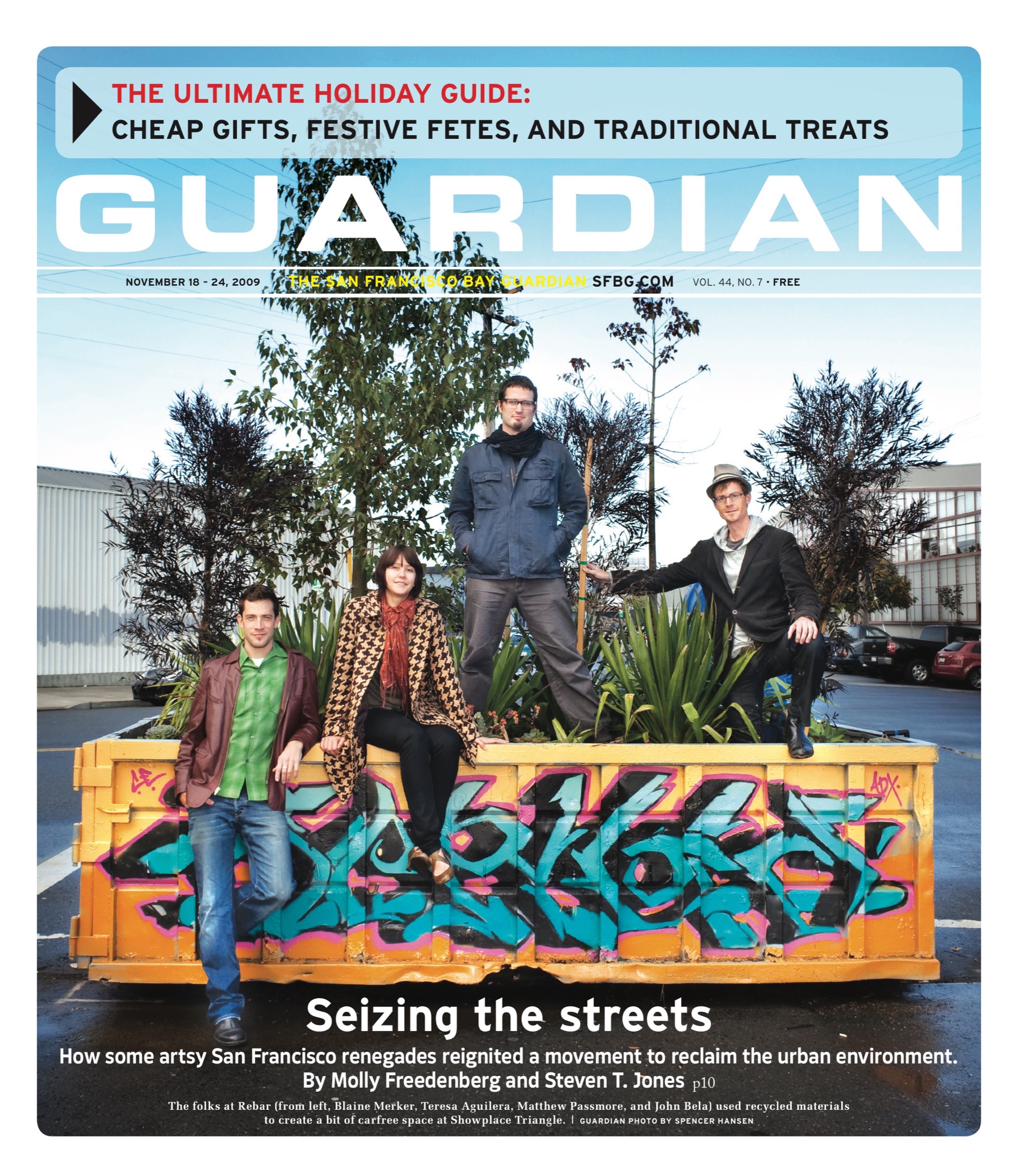
One of the earliest signs of the new approach emerged in 2005 on the first Park(ing) Day, the brainchild of the hip, young founders of the urban design group Rebar. The idea was simple: turn selected street parking spots around San Francisco into little one-day parks. Just plug some coins in the meter to rent the space, then set up chairs or lay down some sod, and kick it.

It was a simple yet powerful statement about how San Franciscans choose to use public space — and the folks at Rebar expected to get in trouble.

“When we did the first Park(ing) Day in 2005, JB [a.k.a. John Bela] and I were just prepared to be arrested and hauled into court,” Rebar’s Matthew Passmore told us at a recent interview in the group’s new Mission District warehouse space. “But nothing like that happened.”

Instead, City Hall called. 079_realcover.jpg Rebar’s Blaine Merker, Teresa Aguilera, Matthew Passmore, and John Bela at their carfreee space at Showplace Triangle

“We got a call from the director of city greening, who said this is great, I want to meet with you guys and talk about how the city can support this kind of activity,” Passmore said. “Much to our surprise, the city was totally responsive as opposed to shutting us down and imprisoning us.”

Bela said the group discovered that Mayor Gavin Newsom’s administration was looking for just the sort of innovative, cool, environmental ideas that were Rebar’s focus. And that connection merged with other people’s efforts — like sidewalk-to-garden conversions being pioneered by Jane Martin, the urban gardening and bicycling movements, and the unique public art that was making its way back from Burning Man. That created a catalyst for a wide array of city initiatives, from the Sunday Streets road closures to temporary art installations that began popping up around the city to the Pavement to Parks program that creates short-term parks in underutilized roadways.

“It was a single interaction five years ago, and now we have things like Sunday Streets,” Bela told us on Sept. 18’s Park(ing) Day, in which various individuals and groups took over more than 50 parking spots around town. “It’s about reclaiming the streets for people.”

Park(ing) Day itself blew up, becoming a worldwide phenomenon that is now in 151 cities on six continents, and one that the Mayor’s Office is planning to turn into a more permanent plan, with the regular conversion of some parking spots on commercial corridors into outdoor seating areas.

“You had a few guys and a girl who had an idea and now it’s an international event,” Mike Farrah, a longtime Newsom lieutenant who now heads the Office of Neighborhood Services and has been the main contact in City Hall for Rebar and similar groups, told the Guardian.

Locally, the success of events like Park(ing) Day have changed San Francisco’s approach to urban spaces, particularly on land left dormant by the economic downturn. Rebar, the permaculture collective Upcycle, and former MyFarm manager Chris Burley plan to turn the old Hayes Valley freeway property near Octavia, between Oak and Fell streets, into a massive community garden and gathering space. Plans are being hatched for temporary uses on Rincon Hill properties approved for residential towers. “Green pod” seating areas are sprouting along Market Street and there are plans to extend the Sunday Streets road closures next year. And, perhaps most amazingly, most projects are being accomplished with very little funding.

How has San Francisco suddenly shifted into high gear when it comes to creating innovative new public spaces? The key is their common denominator: they’re all temporary. As such, they don’t require detailed studies, cumbersome approval processes, or the extensive outreach and input that can dampen the creative spark.

But San Francisco is starting to prove that dozens of short-term fixes can add up to a true transformation of the urban environment and the citizenry’s sense of possibility.


EVOLUTION OF THE PRANK

Rebar began as a group of friends and artists who came together to enter a design contest in 2004. Passmore was a practicing lawyer and Bela was a landscape architecture student at UC Berkeley. They chose the name Rebar for future collaborations, the first of which was Park(ing) Day.

Passmore, who had a background in conceptual art before going to law school, discovered a legal loophole that might allow for anything from a burlesque performance to a temporary swimming pool to be installed in metered parking spaces. Bela recruited Blaine Merker, a fellow landscape architecture student with whom he’d won a design competition, to join the effort.

Park(ing) Day was a hit, getting great press and igniting people’s imaginations. “We realized after we did it, like, oh, people are really getting this,” Merker said. And Rebar was off. In the following years they added a fourth principal, graphic designer Teresa Aguilera, and took on a number of acclaimed projects: planting the Victory Garden in Civic Center Plaza, building the Panhandle Bandshell from old car hoods and other recycled parts, creating COMMONspace events (from “Counterveillance” to the “Nappening”) in privately-owned public spaces, and designing the Bushwaffle (commissioned for the Experimenta-Design biennale in Amsterdam) to help soften paved urban spaces and create a sense of play.

Through it all, the group maintained its prankster spirit. When they were invited to present the Bandshell project at the prestigious Venice Biennale festival, Rebar members showed up costumed as Italian table-tennis players (a joke that mostly baffled other attendees, they said).

They told us every project needed to have a “quotient of ridiculum.” Or as Bela put it, “That’s how we know project has evolved to the right point — when we’re on the floor laughing.”

As Rebar found success, it was still mostly a side project for members who had other full-time jobs. “We were all playing hooky all the time,” said Merker, who, like Bela, joined a landscape architecture firm after he finished school. “It just got worse and worse.”

So now, they’re trying to turn their passion into a profession, recently moving into a cool warehouse office and workspace in the Mission. “We’re shifting our practice a little to have the same sort of spirit but trying to figure out how we can make that an occupation,” Merker said.

It’s also about moving from those short-lived installations to something a little more lasting, even while working within the realm of temporary projects. As Aguilera said, “A lot of the projects we started with were creating moments to maybe think about. But we’re shifting into more permanent ways to interact with the city.”

They may not be sure where they’re headed as an organization, but they have a clear conception of their canvas, as well as the traditions they draw from (including movements like the Situationists and artists such as Gordon Matta-Clark, who worked in urban niche spaces) and the fact that they are part of an emerging international movement to reclaim and redesign urban spaces.

“We’re not the originators of any of this stuff,” Bela said. “It’s like emerging phenomena happening in cities all over the world. We just happened to have plugged into it early on and we continue to push it.”


EXPANDING THE POSSIBLE

Rebar is strongly pushing a reclamation of spaces that have been rather thoughtlessly ceded to the automobile over the last few decades. “Street right-of-way is 25 percent of the city’s land area. A quarter of the city is streets,” Bela said. “And those streets were designed at the time when we wanted to privilege the automobile.

“So basically, there’s all this underutilized roadway,” he continued. “It’s asphalt and it’s pavement, and the city wants to reclaim some of those spaces for people. That’s a thread we’ve been exploring in our work for a long time, and now it’s elevated up to a citywide planning objective.”

The short-term nature of the projects comes in part from political necessity: temporary projects are usually exempt from costly, time-consuming environmental impact reports. Demonstration projects also don’t need the extensive public input that permanent changes do in San Francisco. But there’s more to the philosophy.

“It stands on this proposition that temporary or interim use does actually improve the character of the city,” Passmore said. “People used to think that if something is temporary or ephemeral, what good is it? It’s just here today, gone tomorrow. But I think now people are realizing that the city can be improved like this.”

And it goes even deeper than that. When people see parking spaces turned into parks, vacant lots blossoming with art and conversation nooks, or old freeway ramps turned into community gardens, their sense of what’s possible in San Francisco expands.

“What we’re remodeling is people’s mental hardware. It’s like stretching. You have to bend something a little more than it wants to go, and the next time you do that, it’s that much easier,” Merker said.

“There’s also a psychological aspect to that. When people see a crack in the Matrix open up, if you will, it can open up a whole lot more than just that one moment,” he said.

For those who have been working on urbanism issues in San Francisco for a long time, like Livable City director Tom Radulovich, this new energy and the tactic of conditioning people with temporary projects is a welcome development. “There is a huge resistance to change in San Francisco, no matter what the change is, and a lot of that stems from fear,” Radulovich said. But with temporary projects, he said, “you can establish what success looks like from the outset.”


BUILDING ALLIANCES

The Rebar folks have been fairly savvy in their approach, making key friends inside City Hall, people who have helped them bridge the gap between their idealism and what’s possible in San Francisco.

“We are a process-driven city, and temporary allows you to create change without fear,” Farrah told us. He said the partnership between the Mayor’s Office and community groups that want to do cool, temporary public art really began in the summer of 2005 with the Temple at Hayes Green by longtime Burning Man temple builder, David Best.

Farrah had connections to the Burning Man community, so he facilitated the placement of the temple along Octavia Boulevard, then one of the city’s newest and least developed public spaces. Next came the placement of another Burning Man sculpture, Flock by Michael Christian, in Civic Center Plaza that fall. Both projects got funding and support from the Black Rock Arts Foundation, a public art outgrowth of Burning Man.

“I saw, after some of the temporary art and special events, how it’s changed people’s ideas about what’s possible,” Farrah said. “There has been a change in the way people view the streets.”

That got Farrah thinking about what else could be done, so he approached BRAF’s then-director Leslie Pritchett and Rebar’s Bela, telling them, “I need you to look at San Francisco like a canvas. Tell me the things you want to do, and I’ll tell you if it’s possible or not. And that’s led to a lot of cool stuff.”

Livable city advocates like Radulovich — progressives who are generally not allied with Newsom and who have battled with him on issues from limiting parking to the Healthy Saturdays effort to create more carfree space in Golden Gate Park — give the Mayor’s Office credit for its greening initiatives.

He credits Greening Director Astrid Haryati and DPW chief Ed Reiskin with facilitating this return to urbanism. “He’s really responsive and he gets it,” Radulovich said of Reiskin. “This is really where a lot of energy is going in the mayor’s office. It seems to have captured their imaginations.”

Another catalyst was last year’s visit by New York City transportation commissioner and public space visionary Janette Sadik-Khan, who met with Reiskin and Newsom on a trip sponsored by Livable City and the San Francisco Bicycle Coalition. Radulovich said her message, which SF has embraced, is that, “There are low-cost, reversible ways you can reclaim urban space in the near term.”

The Mayor’s Office, SFBC, and Livable City partnered last year to create Sunday Streets, which involved closing streets to cars for part of the day. The events have proven hugely successful after overcoming initial opposition from merchants who now embrace it.

Then there’s the Pavement to Parks program — which involves converting streets into temporary parks for weeks or months at a time — that grew directly from the Sadik-Khan visit. Andres Power, who directs the program for the Planning Department, told us the visit was a catalyst for Pavement to Parks: “She came to the city a year ago and inspired my director, Ed Reiskin.”

“We’re rethinking what the streets are and what they can be,” Power said. “It’s rewarding to see this stuff happen and to be at the forefront of a national effort to imagine what our streets could be.”


DE-PAVE THE CONCRETE

Pavement to Parks launched last year, a multiagency effort with virtually no budget, but the mandate to use existing materials the city has on hand to turn underutilized streets into active parks. “It looks at areas where we can reclaim space that’s been given over to cars over the decades,” Power told the Guardian.

At the first site, where 17th Street meets Market and Castro, the city and volunteer groups used planters and chairs to convert a one-block stretch of street that was little-used by cars because of the Muni line at the site.

“We bent over backward to make the space look temporary,” Power said, noting the concern over community backlash that never really materialized, leading to two time extensions for the project. “But we’re now ready to revamp that whole space.”

Another Pavement to Parks site at Guerrero and San Jose streets was created by Jane Martin, whom Newsom appointed to the city’s Commission on the Environment in part because of the innovative work she has done in creating and facilitating sidewalk gardens since 2003.

As a professional architect, Martin was used to dealing with city permits. But her experience in obtaining a “minor sidewalk encroachment permit” to convert part of the wide sidewalk near a building she owned on Shotwell Street into a garden convinced her there was room for improvement.

“At that point, I was really jazzed with the result and response [to her garden] and I wanted to make it so we could see more of it,” she said. So she started a nonprofit group called PlantSF, which stands for Permeable Lands As Neighborhood Treasure. Martin worked with city agencies to create a simpler and cheaper process for citizens to obtain permits and help ripping up sidewalks and planting gardens.

“We want to de-pave as much excess concrete as possible and do it to maximize the capture of rainwater,” she said.

Martin said the models she’s creating allow people to do the projects themselves or in small groups, encouraging the city’s DIY tradition and empowering people to make their neighborhoods more livable. More than 500 people have responded, creating gardens on former sidewalks around the city.

“We’ll get farther faster with that model,” she said. “It’s really about engaging people in their neighborhoods and helping them personalize public spaces.”

San Francisco has always been a process-driven city. “We in San Francisco tend to plan and design things to death, so as a result, everything takes a very long time,” Power said.

But with temporary projects under Pavement to Parks, the city can finally be more nimble and flexible. Three projects have been completed so far, and the goal is to have up to a dozen done by summer.

“We’re working feverishly to get the rest of the projects going,” Power said.

One of those projects involves an impending announcement of what Power called “flexible use of the parking lane” in commercial corridors like Columbus Avenue in North Beach. “We’re taking Park(ing) Day to the next level.”

The idea is to place platforms over one or two parking spots for restaurants to use as curbside seating, miniparks, or bicycle parking. “The Mayor’s Office will be announcing in the next few weeks a list of locations,” Power said. “There have been locations that have come to us asking for this.”

“The idea is to do a few of these as a pilot to determine what works and what doesn’t. The goal is to use their trial implementation to develop a permanent process,” Power said. “We want to think of our street space as more than a place for cars to drive through or park.”

Rebar was responsible for the last of the completed Pavement to Parks projects. Known as Showplace Triangle, it’s located at the corner of 16th and Eighth streets in the Showplace Square neighborhood near Potrero Hill. For Rebar, it was like coming full circle.

“We started doing this stuff about five years ago, finding these niches and loopholes and exploring interim use as a strategy for activating urban space,” Bela said. “And to our surprise, what we perceived as a tactical action is now being embodied by strategic players like the Planning Department.”


REUSE, RECYCLE, REINVENT

The Rebar crew was like kids in a candy store picking through the DPW yard.

“These projects are all built with material the city owns already, so we had the opportunity to go down to the DPW yard and inventory all of these materials they had, and figure out ways to configure them to make a successful street plaza,” Bela said.

So they turned old ceramic sewer pipes into tall street barriers topped by planter boxes, and built lower gardens bordered by old granite curbs.

“We are trying to be as creative as possible with the use of materials the city already has on hand,” Power said. In addition to the DPW yard that Rebar tapped for Showplace Triangle, Power said the Public Utilities Commission, Port of SF, and the Recreation and Parks Department all have yards around the city that are filled with materials.

“They each have stockpiles of unused stuff that has accumulated over the years,” he said.

For her Pavement to Parks project on Guerrero, Martin used fallen trees that originally had been planted in Golden Gate Park — pines, cypress, eucalyptus — but were headed for the mulcher. Not only were they great for creating a sense of place, they offered a nod to the city’s natural history.

But perhaps the coolest material that had been sitting around for decades was the massive black granite blocks that Rebar incorporated into Showplace Triangle. “One of the most interesting materials that we used in Showplace Triangle was the big granite blocks from Market Street that were taken off because merchants didn’t like people encamping there. They were too successful as spaces, so they got torn out,” Merker said.

Bela said they couldn’t believe their eyes: “We saw these stacks of five-by-five by one-foot deep black granite. Just extraordinary. If we were to do a public project today, we could never afford that stuff. There’s no way. But the taxpayers bought that stuff back in the ’70s and now it’s just sitting there in the DPW yard. It’s a crime that it’s not being used, so it was great to get it back out on the street.”

Radulovich said the return of the black granite boxes to the streets represents the city coming full circle. He remembers talking to DPW manager Mohammad Nuru as he was removing the last of them from Market Street in the 1970s, citing concerns about people loitering on them.

“To see them put up again in JB’s project was symbolic of where the city went and where it’s coming back from,” Radulovich said. “It’s almost like the livability revolution got interrupted and we lost two decades and now it’s picking up again.”

Back in the 1970s, Radulovich said the city was actively creating new public spaces such as Duboce Triangle. It was also creating seating along Market Street and generally valuing the creation of gathering places. But in the antitax era that followed, public sector maintenance of the spaces lagged and they were discovered by the ever-growing ranks of the homeless that were turned loose from institutions.

“The fear factor took over,” Radulovich said. “We did a lot to destroy public spaces in the ’80s and ’90s.”

But by creating temporary public spaces, people are starting to realize what’s been lost and to value it again. “These baby steps are helping us relearn what makes a good public space,” Radulovich said.

For much of the younger generation, building public squares is a new thing. As Aguilera noted, “We don’t have a lot of public plazas anymore or places for people to gather. When Obama was elected, where did everyone go in the city? Into the streets. So we’re trying to give that back to the city.”


CARS TO GARDENS

Perhaps the most high-profile laboratory for these ideas is the Hayes Valley Farm, a temporary project planned for the 2.5 acres of freeway left behind after the Loma Prieta earthquake. The publicly-owned land between Oak and Fell streets is slated for housing projects that have been stalled by the slow economy.

“The site’s been vacant for 10 years. They came up with a beautiful master plan. And the moment they’re ready to move on the master plan, there’s an economic collapse, so nothing is happening,” Bela said.

In the meantime, the Mayor’s Office and Hayes Valley Neighborhood Association pushed for temporary use of the neglected site. They approached the urban farming collectives MyFarm and Upcycle. Later, Rebar was brought in to design and coordinate the project.

Now the group known as the Hayes Valley Farm Team has an ambitious plan for the area: part urban garden, part social gathering spot, and part educational space. There will be an orchard of fruit trees, a portable greenhouse, demonstrations on urban farming, and a regular farmers market.

“The different topography of ramps allows for different growing conditions. These ramps are prime exposure to the south,” Merker said. “They create these areas that can produce some really great growing conditions, so it’s kind of funny that this freeway is responsible for that. The ramps actually create different microclimates.”

Most remarkably, the whole project is temporary, designed to be moved in three years. “We’re interested in developing infrastructure and tools and machinery and implements that are sort of coded for the scale of the city: a lot of pedal-powered things, a lot of mobile infrastructure, and smaller things that are designed to be useful in a plot that is only 2.5 acres,” Bela said. “Then when we need to move on, we’ll be able to do that. It’s about being strategic with some of the investments so we can take some of the tools we develop here and move it to the next vacant lot down the street.”

The project has lofty goals, ranging from creating a social plaza in Hayes Valley to educating the public about productive landscaping. “We’re getting away from ideas of turning parks into food production — it can be both,” said David Cody of Upcycle. “We want to just crack the awareness that cities can be multi-use and agriculture doesn’t mean farm.”

This is perhaps the most ambitious temporary project the Mayor’s Office has taken on. “Rebar pushed the envelope on what is possible. I told them it would be a tough one,” Farrah said of the project. But he loves the concept: “You can argue that putting gardens in temporary spaces changes attitudes.”

Symbolically, this land seems the perfect place for such an experiment. “This really is a special spot. If you look at a map of the city, Hayes Valley is in the very center, and this is right in the heart of Hayes Valley,” Aguilera said. “And right now, in the heart of a neighborhood in the heart of the city, there’s this vacant, fallow reminder of what used to be there. We’re looking to turn it into a new beating heart that brings together lots of different parts of the community.”


ACTIVATING DORMANT SPACES

Activating dormant spaces in the city isn’t easy, particularly for properties with pending projects. In Hayes Valley, for example, the Rebar crew was required to develop a detailed takedown plan.

“A lot of development is hesitant to get involved with these interim uses because at the end, they’re worried that it’s going to be framed as the evil, money-hungry developer coming in to kick out artists or farmers,” Passmore said. “But the reality is, they are very generously opening up their space is the first place.”

With last year’s crash of the rental estate and credit markets, development in San Francisco stalled, leaving potentially productive land all over the city. “As the city has gone through an economic downturn, like now, the city has a lot of vacant lots with developer entitlements on them, but nothing is being built right now. Those are spaces the public has an interest in,” Merker said, citing Rincon Hill as a key example.

Michael Yarne, who facilitates development projects for the Mayor’s Office of Economic Development, has been working on how developers might be encouraged to adopt temporary uses of their vacant lots.

“How can we credit them to do a greening project on a vacant lot?” Yarne asks, a problem that is exacerbated by the complication that neither the developers nor local government have money to fund the interim improvements.

He looked at the possibility of using developer impact fees on short-term projects, but there are legal problems with that approach. The courts have placed strict limits on how impact fees are charged and used, requiring detailed studies proving that the fees offset a project’s real cost and damage.

“But there is other value we can give as a city without spending a dollar — and that is certainty,” said Yarne, a former developer. He said developers value certainty more than anything else.

Right now, developers have to return to the Planning Commission every year or so to renew project entitlements, something that costs time and money and potentially places the project at risk. But he said the city might be able to enter into developer agreements with a project proponent, waiving the renewal requirement for a certain number of years in exchange for facilitating short-term projects.

“Everyone wins. We get a short-term use, and the developer gets certainty that they won’t lose their rights,” Yarne said, noting that he’s now developing a pilot project on Rincon Hill. “If that works, that could be a template we could use over and over.”

Radulovich is happy to see the new energy Rebar and other groups are infusing into a quest to remake city streets and lots, and with the use of temporary projects to expand the realm of the possible in people’s minds: “Let’s get people reimagining what the streets could be.”

www.rebargroup.org

Holiday Guide 2009

0

Does this time of year leave you mumbling “Bah, humbug!” (or maybe “Holidays schmolidays!”)? We understand. The commercialism of this season can feel crippling, especially in an economy as dismal as this one. But here’s hoping our guide to affordable gifts, uplifting food and spirits, and festive destinations helps put some of the cheer back into a season that has potential for so much of it. And if that still doesn’t work? Buy a batch of barleywine. A few bottles in, you won’t even remember what month this is. (Molly Freedenberg, Holiday Guide Editor)


Drunk on holiday spirit
Events, performances, and places to get you in the mood


Gifts on a shoestring
Cheap and DIY ideas for personal gifts


Season’s eatings
Treats and tipples to tickle your holiday fancy


Presents of mind
Gifts that give back


Holiday hops
Seasonal brews to chase away those cold weather blues


Good work
Ways to give your time


Merry mayhem
Gifts for gamers


That’s a wrap
Gifts for movie geeks


‘Tis the season to be Jewy

MILFbone

0

andrea@mail.altsexcolumn.com

Dear Andrea:

Since you were so good as to weigh in on "cougar" ["Cougar Den," 10/22/08], perhaps you could settle the evident controversy around the correct usage of "MILF?" I think a MILF (Mother I’d Like to Fuck) is the mother of someone in your peer group. If your mom seems as sexual as burnt toast but Jimmy’s mom looks surprisingly hot at the ninth grade bake sale, it makes you reevaluate the sexiness of mothers or, generally, adults over 35. Jimmy’s mother is a MILF, and deserves the special category, only from the intergenerational perspective of a 14-year-old or whatever. It seems, though, that it’s being used to mean any woman who has a kid, which totally gets my back up. I’m 26 with an infant — I’d like to think I’m sexy in my own right and MILF is uncalled for, unless my kid’s friends at play-date start using the term way early. What do you think? Is MILF only referring to women of your parent’s age and above, or does it mean any woman who has (gasp!) had a child?

Love,

Still Hot?

Dear Hot:

I think I’ve weighed in on "cougar" a bunch of times, and fascinated as I am by the way the sexually-not-dead-yet moderately older woman has become the Hottentot Venus of our time — sexualized yet grotesque-ified, exoticized, gawped at, and lampooned — I think I need to leave it alone now. As for "MiLF" and MILFs, we have discussed it and them here, but only once, in passing, when some bozo wrote in about his hot former ex niece-in-law, or something, whom he described as "the very personification of the MILF." And indeed, he did want to F her.

"What does it even mean" I wrote then, "by specifying the ‘mother’ in ‘mother I’d like to fuck?’ Does the speaker intend to make a distinction between the rare mother worth fucking and the unfuckable masses? Or is it really the ‘mother’ part that intrigues, that sexy whiff of fecundity, that milkshake that brings all the boys to our yard? My personal suspicion is that it’s the latter masquerading as the former, that the fascination with the pregnant or baby-toting Heidi Klum or Angelina Jolie is not fueled so much by the fact that they still look ‘hot’ as by the implication that if somebody knocked them up, then so, by extension, could you. But I may be getting a little theory-addled here."

And indeed I think I was. Such subtexts are fun to contemplate, and I do think there’s something to it, but it’s obvious the other element in wanting to F Heidi Klum is simply wanting to F Heidi Klum. And while we’re on Heidi, no pun intended, my husband and I got to teach the "sex and parenting" section at San Francisco Sex Information this past weekend and got to tell my Heidi Klum joke, which is actually no joke, and goes like this:

Q: How do you look like Heidi Klum after you have a baby?

A: Easy. All you have to do is look like Heidi Klum before you have a baby.

Now, on to your specific questions. I’m glad it’s not that you actually aspire to being classified as MILFy and are trying to figure out who has the standing to nominate you. You are more than just musing semantically, though, the way I might while washing dishes or pushing the stroller around. This bugs you! I’m sorry!

I think you have the right of it when you narrow the term to what I’ve always felt was the best use of the (icky anyway) phrase: the mother of one of your friends, a full generation older than you "but" still hot. Stacy’s mom. Or, to hark back to the classics, Anne Bancroft in the leopard-skin coat, coo-coo-ca-choo. And by the way, do you know how old Anne Bancroft was when she played Mrs. Robinson? Thirty-five. Thirty-five! No fairsies playing the hot older woman when you barely qualify as "older," Anna Maria Italiano.

I loved Anne Bancroft.

Since its (fairly recent) inception, the "proper" use of MILF has morphed from "Mrs. Robinson" to, yes, anybody female and parous, of any age, whom the observer, also of any age, deems "fuckable." This is sort of nasty in that it clearly divides the fuckable from the un, probably along the most obvious and cartoonish model (you need to be thin, flat-bellied, big-but-perkily boobed, etc. to qualify). And yes, it also casts those of us who have had kids into a special category, needing to be judged, separate from the nulliparous masses, as still fuckable despite having committed the antisexual sin of reserving much of our time and affection and a good deal of the access of our bodies for (small) people who are not the guys doing the judging. Oops! Sorry, dudes!

It is objectionable. It is kind of gross. But it is also silly and far more their problem than yours.

Love,

Andrea

See Andrea’s other column at carnalnation.com.

Appetite: Food for Thought helps Mission grads, Frescobaldi gets Luce

0

Every week, Virginia Miller of personalized itinerary service and monthly food, drink, and travel newsletter, www.theperfectspotsf.com, shares foodie news, events, and deals. View the last installment here.

foodforthought1109.jpg
Digging into some Food for Thought

11/11-11/23 of the Mission’s best restaurants participate in "Food for Thought" to help Mission grads get to college
Do nothing but eat out at one of your favorite Mission restaurants this Wednesday night and you’ll be helping some of the neediest Mission high school grads get to college. With 23 of the ‘hood’s best restaurants participating, a portion of all dinner sales (restaurants have committed anywhere from 25-100% of that night’s sales) go to Food for Thought. In it for the long haul, Food for Thought offers, among other things, tutoring centers for elementary school kids, academic support groups in junior high, and college prep programs for high school students, working with them through each phase of schooling. There’s even raffle prizes at each restaurant, like a trip for two to Mexico. You don’t have to be told twice to eat out at Range, Mission Beach Cafe, Little Star Pizza, or Bar Bambino, do you?
11/11 regular hours at 23 Mission restaurants
List of participating restaurants: www.missiongraduates.org/foodforthought

————-

rest1109.jpg
A Luce interior

11/11 – Luce celebrates its Michelin Star with the Frescobaldi family
It’s an honor for a chef to receive a Michelin star, especially a French chef like our own Dominique Crenn at Luce in the Intercontinental Hotel (she’s also on this season of The Next Iron Chef). Luce celebrates in a big way by cooking a 6-course Tuscan feast, Inspirations of Tuscany, with Marchesi de’ Frescobaldi’s wine estates’ executive chef, Donatella Zampoli. Frescobaldi, the legendary Italian family who even traded their wines with Michelangelo back in the day, will, naturally, be pairing their wines with dinner. Not only is this a rare, special night, but $10 of every 6-course dinner benefits CUESA, so the focus remains local as it is international. Courses include Thomas Family Farms potato gnocchi with bone marrow and lobster paired with a glass of 2006 Attems Cicinis, or sweetbread and beef tongue with potato espuma (foam to you), slow cooked egg and pancetta jus partnered with a 2005 Nipozzano Riserva Chianti Classico. Can’t make it out Wednesday? The party rolls on all month until November 21, with a 4-course Michelin Star prix-fixe menu available any night for $60 per person.
$75; $30 for wine pairings
11/11 – make a reservation during regular hours, 5-11pm
888 Howard Street
415-616-6566

www.lucewinerestaurant.com

Komeback Kink

0

arts@sfbg.com

MUSIC MLK’s and Bobby Kennedy’s assassinations, shaken confidence in Vietnam after a bloody and vengeful Tet Offensive, Haight-Ashbury’s rapid dissolving into a breeding ground for lost and burned-out hippies pathetically clinging to the idyllic notion of a "Summer of Love," and a free Charles Manson settling in Laurel Canyon to plot the perverse and gruesome murders his "family" would soon commit. Yes, 1968 was the year the darkness had arrived. Certainly flower power had gone wrong, wilting its way toward a strong sense of paranoia that not only seeped its way into society’s psyche and politics, but into popular music as well.

Stripped in tone and oftentimes more raw-sounding than the overly-produced psychedelia that dominated the previous two years, the Kinks’ masterfully produced November 1968 classic The Kinks are the Village Green Preservation Society is a prime example of Ray Davies’ maturing writing skill. It especially shines as an artist’s profound expression of his own insecurities. Village Green is loaded with accounts of Davies’ vain obsessions and his fears. It’s a document of the human condition — in particular, people’s longings to leave a lasting legacy and be remembered.

Thematically, Davies works himself into a frenzy, unable to live for the moment, facing the pressures of fading British tradition (on the title track) and changes in technology ("Last of the Steam-Powered Trains"), both of which symbolize a changing of the guard and uncertainty about how the album’s protagonist fits into the world. Don’t underestimate Davies’ fears of growing old. The bitterness on "Do You Remember Walter?" is almost too much to bear. It fits well, though, making Village Green a cohesive unit. Here he criticizes an old friend who he assumes has grown old, boring, and out of shape. But his disdain stems from Ray’s fear of being Walter (i.e., washed up), and is connected to the fact that Walter has moved on in life and perhaps wouldn’t even recognize or remember his dear old friend.

With its simple and bucolic flair, "Sitting by the Riverside" seems familiar enough. The ditty should be relaxing, with its nice, easy-going melody, but Ray even corrupts something seemingly innocent with a manic "la-da-da" that chimes in on occasion before bursting to a near crescendo during the song’s outro, sounding like a bad drug experience.

Listening to Village Green‘s "All of My Friends Were There," I’ve always imagined it playing at someone’s birthday party, with — of course — all their friends present. But it seems to be more of a performance with all eyes on Davies, because he’s built it in his head to be the biggest day in his life. Once again we see his sick longing to feel love, attention, and validation, this time through the power of numbers. Unfortunately, his gathering backfires to disastrous results. It’s just as well. Somehow I have a feeling that no matter how many people were present, he still feels alone and empty.

Two Village Green songs, "Picture Book" and the album-closing "People Take Pictures of Each Other," focus on how photographs are supposed to fill some sort of void, making us seem more important than we really are — as if a photograph is necessary to validate our feelings of love for one another and emotions from our past. Davies argues that we take pictures of one another to prove our existence. At the same time, he’s caught up in paranoid visions of what his own photograph will look like when he’s an old man: "Picture yourself, when you’re getting old." Finally a bit of optimism peeks through, but in an unsure way, when he sings, "People often change, but memories of people can remain." That is to say, I can remember you however I choose.

RAY DAVIES

Thurs/12, 8 p.m., $40–$57

The Warfield

982 Market, SF

www.ticketmaster.com

Hello, cello

0

molly@sfbg.com

There is something hauntingly beautiful — if not downright sexy — about the cello: a musician straddling the feminine curves of a human-sized instrument, bow sliding slowly and elegantly over the trembling strings, fingers plucking and vibrating in alternately gentle and assertive motions, and tones emitting from the smooth wood that range everywhere from soft whispers to deep moans.

It’s no wonder the cello has been compared to both the human voice and, in the many portraits of women’s backs painted to look like string instruments, the human body.

So perhaps it should also be no wonder that lately, particularly in the Bay Area, the cello has gained new popularity — one outside of the traditional concert hall. Cellists like Zoe Keating, formerly of Rasputina, and Sam Bass, of Loop!Station and Les Claypool, are gaining the kind of recognition formerly reserved for indie rockers. Cello Madness Congress, the monthly improv jam hosted by Joey Chang a.k.a. Cello Joe, regularly draws a crowd of musicians and enthusiasts alike. Cello Bazaar, a monthly cello concert held at Café Bazaar in the Richmond District, has become so popular it might have to expand. And Rushad Eggleston’s punk band Tornado Rider has rock ‘n’roll lovers moshing to cello music at venues like Red Devil Lounge. Not only does cello music seem to be a trend, as Cello Bazaar founder Hannah Addario-Berry says, "it’s a total scene."

Perhaps one reason for the increased visibility of cello in the Bay Area is due to recent developments in classical music. As symphonies get less funding and young musicians become more adventurous, classical musicians are finding new ways to play and new venues to play in. The most visible of these is Classical Revolution, which has taken instruments like violin, piano, and, yes, cello, out of the stuffy concert hall and into Revolution Cafe and SoCha Café for casual weekly concerts.

These gatherings are particularly advantageous for cellists. In an orchestra setting, cello tends to play a supportive roll. But there is a fabulous repertoire of music meant to be played by several cellos together, thanks mostly to the cello’s remarkable range. In a non-symphony setting, the cello can more easily take center stage.

Plus, cellists seem to like to socialize and harmonize together. Perhaps because of their role in larger symphonies, cellists tend not to be particularly competitive (unlike violinists, for example, who often compete for solos). Some musicians say people drawn to cello are naturally more easy-going than those drawn to other instruments. Others say that there is more a group of cellos can do together sonically than, say, a group of flutes. "Brass sections are incredibly social too," says Addario-Berry. "But of the string family, I’ve found cellists to be the ones who most want to hang out together."

But perhaps the largest reason for the cello’s new visibility and popularity is its versatility. The artist most famous for exploring the possibilities for cello is Yo-Yo Ma, but these days all kinds of artists are finding ways to use cello in other in the music of various cultures, in rock, and in electronic music. Indeed, it was the infinite possibilities for layering different cello sounds over each other and over the human voice that inspired the cycle of songs that composer/singer Amy X Neuburg began writing for the three-piece Cello Chixtet in 2005 — the same qualities that make Loop!Station’s sound so rich and varied, even though they’re only two people (and only one instrument).

One of the most exciting new developments, though, is not just using the cello with rock but to rock. According to Eggleston, who straps on his sticker-covered cello and plays it like an electric guitar, the progression is a natural one. With a cello you can play power chords with one finger instead of two, he says. There’s infinite sustain because there’s a bow. You don’t need a wah-wah pedal because you can get different harmonics from one string. Because there are no frets, you can bend notes various ways and get subtle details you can’t get from a guitar. Plus you have the option of sliding and jumping around on the frets. "It’s kind of like a vicious harmonica/slide guitar/ metal guitar/wild cat," he says.

But whatever direction cellists are taking, the Bay Area music community seems supportive. "So many people are intimidated by the concert hall protocol … not knowing when to clap and not to cough," says Addario-Berry. "The idea of taking cello music to people in a comfortable environment is really important."

Or as Eggleston puts it, "Yay! Cello power!"

UPCOMING CELLO EVENTS

CELLO BAZAAR

Tues/17, 7 p.m.

Bazaar Café

5927 California, SF

(415) 831-5620

www.bazaarcafe.com

JOEY CHANG AND THE SHOW

Nov. 18, 7:30 p.m.; $5

Blue Macaw

2565 Mission, SF

(415) 920-0577

thebluemacawsf.com

TORNADO RIDER

Nov. 20, 9 p.m.; $10

The Uptown

1928 Telegraph, Oakl.

www.uptownnightclub.com

CELLO MADNESS CONGRESS

Nov. 25, 8 p.m.; free

Blue Macaw

2565 Mission, SF

(415) 920-0577

thebluemacawsf.com

Gun-derful

0

Borderlands

(Gearbox, 2K Games) XBOX360, PS3, PC
Video games are a remarkably derivative medium, recycling old tropes and exhausting cliches. This is made more frustrating by the industry’s relentless hype machine, which trumpets newer, better, more unfamiliar games, only to deliver tired titles bound up in a patina of pretty, cutting-edge graphical distraction.

Borderlands is one of the rare games that inverts this paradigm. A hybrid of shooter mechanics and RPG-style progression, it wears its influences proudly on its sleeve, borrowing unabashedly from the best to deliver a combination of the loot-hungry avarice of Diablo (Blizzard), the apocalyptic milieu of Fallout 3 (Bethesda), and the user-friendly set-up of World of Warcraft (Blizzard). With a few clever tweaks, the game becomes a Frankenstein of fun, delivering exuberant shoot-em-up gameplay and an avalanche of enticingly ever-increasing numbers.

To call the story icing on the cake is to be a little over-generous. Four adventurers arrive on the planet Pandora, thought to be the home of a mythical vault full of alien treasure. Violence ensues. Exposition is doled out courtesy of the game’s lone adaptive failure, a retread of the angelic "mysterious female voice on the radio" bit that was played out by the second Halo (Bungie/Microsoft).

Such sour notes are quickly forgotten once the action begins. Taking command of one of four archetypal classes — the brawling Berserker, the stealthy Siren, the head-shooting Hunter, and the stolid Soldier — the player is quickly thrown into a desolate world filled with bloodthirsty enemies, simple but not onerous fetch quests, and oceans of loot.

It is in the acquisition of exorbitantly powerful digital swag that any action-RPG lives and dies, and Borderlands delivers with aplomb, paying homage to Diablo’s seminal embrace of procedurally generated items. Nearly all the game’s weapons exist as random concatenations of statistics, gaining potency and usefulness by stringing together adjective-modifiers that mete out verbal hilarity as well as they deliver fiery death.

Want to wield a gun named the "Malevolent Thumper"? Have you dreamed of mowing down cannibalistic midgets with a sniper-scoped shotgun that fires rockets filled with acid? The game provides all this and more, and the player is inexorably egged along by the prospect of bigger, badder firearms with which to kill bigger, badder bad guys.

The developer’s commitment to levity is refreshing in a climate of increasingly self-serious titles. In comparable games, rare, powerful enemies are "elite." In Borderlands, they’re "badass." The voice-acting, though sparse, is littered with satisfying moments, from the exaggerated Southern drawls adopted by Pandora’s natives to the Hunter’s soft chuckle whenever a critical hit turns a rampaging adversary into a pile of bloody goo.

Though the game is at times gorily realistic, its most unique feature is its art style, which blends comic book techniques and cel-shading to add visual spice to what would otherwise be a drab, dusty wasteland. By swathing their adapted gameplay in this inimitable guise, Gearbox performs the important task of creating a game that’s familiar, but not too familiar.

Single-player and two-player splitscreen are both viable options, but the focus is clearly on online co-op, which allows up to four players and adjusts the difficulty on the fly to allow for the profusion of gunslingers. With no built-in loot allocation system, partying with trusted friends is recommended, cutting down on disputes as much as it increases the potential for social, frag-filled fun. While it is likely to be overshadowed by some of fall’s more high-profile titles, Borderlands gleeful gameplay, distinctive look, well-executed homages, and generous dispensation of big guns might just give the big guns a run for their money.

Button pushers

0

arts@sfbg.com

SONIC REDUCER Bend an ear toward Fuck Buttons’ ecstatic second album, Tarot Sport (ATP), and you’re only a card flip away from shuffling the Rider-Waite deck of the mind and coming up with visual corollaries for the tracks. Frenetic opener "Surf Solar" obviously boogie-boards to the freedom-first of the major arcana’s card zero, the Fool, whereas "Rough Steez" burrows into the deep ‘n’ dirty low end of the Tower card, and "The Lisbon Maru" cozies down amid warmly glimmering Doppler synths, akin to the Sun image. The glorious polyrhythmic cluster-fuck of "Phantom Limb" sparkles hard, reading just like the Star, while finale "Flight of the Feathered Serpent" breaks into a mind-expanding, all-encompassing loop, à la the closing picture of the major arcana: a baton-twirling cosmic cheerleader dancing within a circle of completion, or the World. Bring it on.

The tarot of sport — see the Vangelis shout-out of "Olympians" — or the sport of tarot did inform the album, says Fuck Buttons’ Benjamin John Power, by phone from D.C. "We’re both kind of interested in the mystical world in some way," he confesses, referring to bandmate Andrew Hung. But perhaps I’m reading too hard between the cards. Power and Hung didn’t quite rifle through the deck and riff off those airy swords, energetic wands, emotional cups, and earthy pentacles. Rather, they were both intrigued by the idea of formalized competition between psychics, which Hung had been reading about. "I mean, first and foremost, the words themselves were quite resonant for us," Hung says. "They struck a chord — and it’s quite a funny concept."

Battling psychics might conjure thoughts of Criss Angel mind-freaking the ladies of the Psychic Friends Network in Paranormal Activity‘s haunted townhouse, crystals and dowsing rods in fists. But the notion also plugs into Fuck Buttons’ music-making process — as well as the image of Hung and Power hunched diligently over their gadgets, pedals, and toy instruments at their packed, steamy Independent show last year. The hardcore-schooled Power is more serious. Hung, who has an electronic music background, is more puckish and playful. ("We’re based in a car right now," he jokes when asked where the two 27-year-olds live. Ask him what a Fuck Button is, and he quips, "I guess you’re talking to one.")

The Bristol, England, natives started playing together in 2004. "When we converged at the same point, that’s when things started to get quite loud," says Hung. Fuck Buttons’ writing process hinges on a similar sense of give-and-take. "We’ve always written songs the same way," explains Power. "We’ll get together in a room and it’s quite important that we don’t have any ideas brought in, that we approach it like a blank canvas. We’re both messing around with sound together — it’s been very free in that sense."

The beat-driven, less aggro sound of Tarot Sport, informed by the more ambitious musicians once confined to the New Age aisle, was the direct result of the twosome’s new equipment acquisitions — various analog synths, pedals, and "bips and bobs," as Power puts it — since their debut, Street Horrrsing (ATP, 2008). "The sounds are quite a lot richer on this record because we had a lot more stuff to play with," notes Power. "One particular thing that did happen was we got rid of our laptop. When a lot of people see a laptop onstage, they assume you’re a laptop band and just playing things off your laptop, which isn’t the case at all."

That’s where the psychic ability comes in very handy, though Fuck Buttons don’t cop to those powers — or even a good grasp of the Vulcan mind meld. "We’re definitely working on that one," Power deadpans. "We haven’t quite perfected it yet, but it’s something we’ve been trying to do, yeah." *

FUCK BUTTONS

With Growing and Chen Santa Maria

Fri/13, 10 p.m., $10

Bottom of the Hill

1233 17th St., SF

www.bottomofthehill.com

————

LOVER!


Onetime Jay Reatard bandmate Rich Crook turns up the twang with the No Dreams Please EP (Big Legal Mess). With the Splinters and Bass Drum of Death. Fri/13, 9:30 p.m., $7. Hemlock Tavern, 1131 Polk, SF. www.hemlocktavern.com

BURAKA SOM SISTEMA


Way disorderly in the new world and shit-hot to boot — that’s the Lisbon, Portugal, hybridized electro-kuduro party machine. Sun/14, 9 p.m., $16–$18. Mezzanine, 444 Jessie, SF. www.mezzaninesf.com

THE BLACK HEART PROCESSION AND BELLINI


Dusky SoCal fantasies meet Italian-American brutarian post-punk. Sun/15, 8 p.m., $15. Independent, 628 Divisadero, S.F. www.theindependentsf.com

Clean freak

0

Chilean writer-director Sebastián Silva’s newest "house" film, The Maid, swaps customary debates of bedroom politics for the upstairs/downstairs relations of domestic labor. In an upper-middle class subdivision of Santiago, 40-year-old maid Raquel (Catalina Saavedra), perpetually stony and indignant, operates a rigorous dawn-to-dusk routine for the Valdez family, her employers for 20 years. Although Raquel rarely behaves as an intimate of her longtime hosts, she remains convinced that love, not labor, bonds them. Whether the family shares Raquel’s feelings of devotion is highly dubious: father Mundo (Alejandro Goic) often ignores or avoids her except when giving orders; daughter Camila (Andrea García-Huidobro) actively despises her and lobbies for her dismissal from mother Pilar (Claudia Celedón), whose sense of noblesse oblige is a patronage bound by a mix of affection and pity.

When a rotating cast of interlopers is hired to assist Raquel, the paranoid domestic stoops to machinations most vile to scare them away. She dispatches young Peruvian maid Mercedes (Mercedes Villanueva) by cruelly disposing of her adopted kitten and forces the gruff and hot-tempered Sonia (Anita Reeves) into a violent confrontation before she resigns in disgust. But third comer Lucy (Mariana Loyola) is an altogether different challenge. Her unpredictable influence over Raquel sets the narrative of The Maid on a very different psychological trajectory — from moody chamber piece to eccentric slice-of-life.

If Silva’s film taunts the viewer with the possibility of a horrific climax, either as a result of its titular counterpart — Jean Genet’s 1946 stage drama The Maids, about two servants’ homicidal revenge — or from the unnerving "mugshot" of Saavedra on the movie poster, it is neither self-destructive nor Grand Guignol. Rather, it it is much more prosaic in execution. Filmed almost exclusively in the narrow hallways, bathrooms, and parlors of a Santiago McMansion, Sergio Armstrong’s fidgety hand-held camera captures Raquel’s claustrophobic routine. It also accentuates her Sisyphean conundrum: although she completely rules the inner workings of the house, she remains forever a guest. The more she makes the house into a home, the more it becomes a prison she refuses to escape from.

But while Saavedra’s title role is an interesting case study in the political and emotional complexities of the Latin American domestic, her character’s motivations often evoke as much confusion as wonder. In the absence of some much needed exposition, The Maid’s heavy-handed silences, plaintive gazes, and inexplicable eruptions of laughter feel oddly sterile, and a contrived preciousness begins to creep over the film like an effluvial whitewash. Its abundance makes you aware there is a shabbiness hiding beneath the dramatic facade — the various stains and holes of an unrealized third act.

THE MAID opens Fri/13 in Bay Area theaters.

Hell yeah!

0

arts@sfbg.com

FILM Before the Halloween and Friday the 13th series made slasher cinema’s top instruments of unstoppable evil, and after Frankenstein, Dracula, and Werewolf pretty much had their day, there was a brief sunny window of opportunity for Satan. Or rather, Satan and his Satanists — sounds like a garage band, yes? — who dominated horror for a few years highlighted by Rosemary’s Baby (1968), The Exorcist (1973), and The Omen (1976). Not to mention 1975’s Race with the Devil, that same year’s The Devil’s Rain (Ernest Borgnine as Satan’s acolyte? Credible!) and 1973’s Satan’s School for Girls.

Ah, those were the days. Who gives much screen time to Beelzebub now, when the multiplexes are cluttered with routine slasher sequels and Japanese horror remakes?

Somebody called Ti West evidently does. Bringing it all back with extra hugs, his new The House of the Devil is a retro thrillfest quite happy to sacrifice that babysitter to the Dark Lord. Without even a tip for her labor.

"Based on true unexplained events" (uh-huh), the buzzed-about indie horror has fanboy casting both old school (Dee Wallace, Mary Woronov, Tom Noonan — all performing seriously rather than campily) and new (AJ Bowen of 2007’s The Signal and mumblecore regular Greta Gerwig). Its heroine (Jocelin Donahue), a 1980 East Coast collegiate sophomore desperate for rent cash so she can escape her dorm roomie’s loud nightly promiscuity, signs on for a baby- (actually, grandma-) sitting gig advertised on telephone poles. For tonight. During a lunar eclipse. Bad move.

The House of the Devil takes its time, springing nothing lethal until nearly halfway through. Even then, things escalate ever-so-slowly. Its 1980s setting allows for ultratight jeans, feathered hair, rotary dialing, a synth-New Wavey score, and other potentially campy elements the film manages to render respectfully appreciative rather than silly.

All freakdom doesn’t break loose until very late, at which point writer-director West effectively abandons all restraint (and hope), much assisted by The Last Winter (2006) composer Jeff Grace’s suddenly panicked score. The best contemporary horror has understood that potency of waiting. Prolonged development of relatable characters, agonizing our dread for their fates, amplifies standard terror to no end in movies like 2005’s Wolf Creek or Paranormal Activity.

House isn’t significantly better than various fine indie horrors of recent vintage and various nationality that went direct to DVD. (Quality, let alone originality, aren’t necessarily a commercial pluses in this genre.) But it is dang good, and that cuts it above most current theatrical horror releases. Which isn’t to say you shouldn’t be watching 1977’s Suspiria, 2005’s Satan’s Playground, 1994’s Aswang (a.k.a. The Unearthling) or 1981’s Possession instead of this deft throwback: now those surreal visions truly gave the Devil his due.

THE HOUSE OF THE DEVIL opens Fri/20 in San Francisco.

Information

0

superego@sfbg.com

SUPER EGO Apparently there’s some sort of "recession" happening, which explains all the cat-hair wigs, duct-taped platforms, sideways boob-jobs, and flask-filled socks on the dance floor. And yet, peculiarly, new SF clubs continue to open at the rate of one a week. Among the recent delectations: SOM (2925 16th St., SF. www.som-bar.com), club impresario Peter Glickstern’s Brazilian-tinged redo of the Liquid-Pink space in the Mission; Siberia (314 11th St., SF.), an intriguing if somewhat directionless ramp-up of the old Fat City, and a relaunch of the cozy 222 Hyde (222 Hyde, SF. www.222hydesf.com), which is starting to attract some mighty piquant talent. Are there enough crisp bucks to fold and tuck into these newbies’ spangled thongs? Don’t sneeze at my wig!

DEVOTION

Good ol’ seamless sets of throwdown soulful house became a rarity in this fractional decade, and the rest seems to have done a world of good. That full-throated sound of yore is back on the rise, and former Bay Area fave DJ Ruben Mancias is bringing his joyful party back once more, hands up.

Thurs/12, 9:30 p.m., $10. Harlot, 46 Minna, SF. www.harlotsf.com

BEATS IN SPACE

I practically grew up on Beats in Space radio (www.beatsinspace.net), DJ and DFA member Tim Sweeney’s tastily eclectic show on New York’s WNYU. From Carl Craig to Faze Action, Diplo to Shit Robot, BIS’s guestlist has been a crystalline signal through the Web static. Now the 10-year-old show’s on the move, kicking off a monthly here with DJ Brennan Green and Sweeney himself.

Fri/13, 9 p.m., $5. Triple Crown, 1760 Market, SF. www.triplecrownsf.com

CLAUDE VONSTROKE

Mr. Dirty Bird Records should be credited with injecting a sense of humor into minimal techno and producing a signature Bay Area sound. Although he sticks with his usual tricks on his new album, Bird Brain — guttural grunts, jungle calls, tympani rolls, locker room jokes, and ornithological obsession — he’s still hitting a dance floor sweet spot and occasionally breaking through into beauty.

Fri/13, 10 p.m., $10 advance. Mezzanine, 444 Jessie, SF. www.mezzaninesf.com

THE FUTURE 003

Yes, future bass is still happening, and starting to enter its baroque phase. (Luckily, wacky maestro headliner Daedelus was baroque to begin with). The first two gut-rumbling installments of this party focused on more aggressive, dubstep-related variations of the future sound. This one looks a tad jazzier, with electro-boogie aficionado James Pants and progressive warper Free the Robots looking ahead.

Fri/13, 9 p.m., $12 advance. 103 Harriet, SF. www.1015.com

MERCURY LOUNGE

It’s all about Mason Bates, the local composer whose attempts to fuse classical orchestration with laptop electronics are never less than wowza. His Mercury Soul project is mixing up a fizzy Friday happy hour, interspersing live classical performances with house, trip-hop, and jazzy downtempo loveliness.

Fri/13, 5 p.m.-9 p.m., free. 111 Minna, SF. www.111minnagallery.com

BIG IDEA NIGHT

Another lollapalooza of art and nightlife who’s-who at Yerba Buena, this time taking on "The State of the Queer Nation." Yes, that’s far too much to swallow in one tipsy evening, but performances by HOTTUB, Tim Miller, Diamond Daggers, DJ Black, and more will certainly whet your appetite for funky homo-intellectualization.

Sat/14, 9 p.m., free. Yerba Buena Center for the Arts, 701 Mission, SF. www.ybca.org

L-VIS 1990 AND BOK BOK

L-vis 1990’s videos, directed by James Connolly, are little slices of postmodern genius, positing a Soul II Soul meets Jane Fonda Workout era that never existed but kind of should have. His UK Funky sound, however, is definitely of the now, mixing tribal house beats with champagne-rave breakdowns. With fellow funker Bok Bok, he’ll bring the bangin’ Night Slugs party from the UK.

Sat/14, 10 p.m., $10. Elbo Room, 647 Valencia, SF. www.elbo.com

MALL MADNESS

I once jokingly lamented that among all the ’90s grunge revival in the clubs, there wasn’t a complimentary boy-band tribute night. STFU, Marke B.! Here it is in all its glory, a galleria-drag bonanza with a healthy and shockingly unironic dose of Tiffany, Stacey Q., and uncloseted Backstreet Boys. Accessories by Claire’s, Glamour Shots provided.

Sat/14, 10 p.m., $5. UndergroundSF, 424 Haight, SF. *

Keefer of the flame

0

arts@sfbg.com

DANCE Next year it will be 30 years since choreographer and dance maven Krissy Keefer cofounded the radical feminist Wallflower Collective in Oregon, and 25 years since she relocated her social activist Dance Brigade Company to San Francisco. Perhaps those upcoming anniversaries naturally suggested a time for taking stock. Or perhaps it’s that Keefer’s 17-year-old daughter Fredrika (remember the little girl who couldn’t get admitted to the San Francisco Ballet School because she had "the wrong body"?) now dances with the company invited a look at the future — both Keefer’s and the country’s.

The new, full-evening The Great Liberation upon Hearing, Keefer’s largest work in years, is based on the Tibetan Book of the Dead; it runs Nov. 13-22 at Laney College in Oakland. For Keefer, this meant revisiting material she had already worked with in the 1995 Ballet of the Banshees. But her perspective has changed.

"I have been making issue-oriented work for over 20 years," she explains at her home base, Dance Mission Theater. "None of it has actually improved the social environment. The international trafficking of women is worse; the prison system is worse; the abuse of children and women is worse. And the polar cap, something I have made work about for years, is melting. That is no joke."

She admits having been skeptical about the new administration, yet jumped on the Obama bandwagon because "I did not want to be a party pooper." Now she is developing serious doubts. "What will happen in 2012? What if our puffed-up idea of hope doesn’t work out? What do we have left then?"

Strong-willed with a powerful voice and as articulate as she is opinionated, Keefer also has a sense of humor. Describing herself as "a little bit of Paul Revere because I always want to shout ‘wake up, wake up, wake up’!" she figured that theater-based information about that universal leveler — death and dying — might actually be useful in these troubled times.

"Useful" has been a key component in all of Keefer’s work. As an agent for social change in life and art, she may not have seen the hoped-for results. Nevertheless, she still believes that art can become a catalyst for people to "look deeper into our community structures or dig into our own personal hopes, joys, and oppression."

She can also point to at least one area of success where she has made important contributions: "Women’s music and culture have given rise to a whole generation of women who seem themselves reflected in it." Integral to Dance Brigade activities is its all-female taiko group; Grrrl Brigade, a junior ensemble for girls 9-18; and women-focused festivals such as the annual "SkyDancers: Women who Fly Through the Air." So perhaps taking on the taboo of death is just another way to accomplish Keefer’s dual goals of making good art and good social road maps. "We all have to die, and I find the Buddhist way actually liberating. It takes the fear of death away."

Her involvement with the Tibetan way of dying is also deeply personal. "When Nina [Fichter, Keefer’s friend and cofounder of Dance Brigade] died, I read the Tibetan Book of the Dead for 49 days." Thematically, Liberation is probably as big and ambitious a project as she has undertaken.

In a run-through at the company’s Dance Mission Theater, two weeks prior to the premiere, Liberation looked like a pretty straightforward dance theater realization of the process — in Tibetan Buddhist belief — that happens from the moment of death until reincarnation into a new life. Unusual for Dance Brigade, the cast includes a number of men: newcomer Clint Calimlim, the very experienced Jose Navarrete, and the magisterial Ramon Ramos Alayo.

The book is written in the form of a guide talking to the deceased to make the journey as peaceful as possible. The direct speech lends itself to the kind of dramatic dance theater Keefer often embraces. Here her voice weaves in and out of dance passages and speaks as much to the audience ("this is what will happen to you") as to the dead woman (portrayed by Lena Gatchalian).

The gorgeously intertwined Ramos Alayo and Tina Banchero represent the Samantabhadra, the Primordial Buddha who appears to the lucky ones at the moment of death. Recognizing the blinding light of ultimate reality, they enter nirvana. ("They are off the wheel," Keefer laconically observes.) Like most mortals, Gatchalian’s character has to go through "bardo" (transitional states) before being reincarnated. On her journey, she encounters the five Buddha families — in both their supportive and wrathful manifestations. Since they are danced by stylistically very different dancers, Keefer encouraged them to choreograph their own characters. The remaining choreography is by Keefer with contributions by Sara Shelton Mann. *

THE GREAT LIBERATION UPON HEARING

Nov. 13–22

Thurs.–Sat., 8 p.m.; Sun, 7 p.m., $23

Laney College Theater

900 Fallon, Oakl.

(415) 273-4633

www.brownpapertickets.com