Volume 44 [2009–10]

A roar from underground

0

arts@sfbg.com

MUSIC When asked if it’s a good time in history to be in a sludgy, uncompromising heavy metal band, High on Fire’s Matt Pike stifles a chuckle: “It is for me, man!” Reached by phone in Los Angeles as he prepares for a show at the El Rey Theatre, Pike is far from loquacious, but clearly enjoying the arrival of hard-earned, well-deserved success. His band, a thunderous, heavily-distorted power trio, bastard son of St. Vitus and Slayer, just signed on for a string of European dates opening for Metallica.

Before they set off across the Atlantic, High on Fire will appear at Oakland’s Fox Theater to play a concert called the Missing Link, a weighty omnibus of a heavy metal bill that brings together two potent touring packages, their itineraries cleverly fused into one mammoth night of music. Pike’s band is joined by tour-mates Priestess, Bison B.C., and Black Cobra. Headliners Mastodon deploys its own retinue of support: Between the Buried and Me, Baroness, and Valient Thorr.

The bands at the top of the bill are living proof of this epoch’s friendly attitude toward challenging, underground heavy metal. Mastodon charted at No. 11 with 2009’s Crack the Skye (Warner Bros.) and Between the Buried and Me hit No. 36 with The Great Misdirect (Victory). Oakland native sons High on Fire stormed into the limelight in February 2010; Snakes for the Divine (E1 Music) debuted at No. 62. Baroness’ Blue Record (Relapse) was the critical darling of 2009 — Decibel magazine named it album of the year — and it peaked at No. 117.

Those still working their way up from the bottom are no less optimistic. Speaking on the phone while peregrinating around L.A., Jason Landrian, singer/guitarist for crushing S.F. duo Black Cobra, is loving life. “I think it’s a great time to be in a heavy band. There are a lot more people paying attention and taking the music a lot more seriously.” Black Cobra, which was recently signed by legendary label Southern Lord Records, has ample experience with and appreciation for the bands it will share the stage with at the Fox. “For us,” Landrian says, “it’s a thrill to be involved with what seems like a cross-section of what’s going on right now in the underground scene.”

Superficially, the bands on the bill are easy to circumscribe within geographical boxes. Mastodon and Baroness both hail from Georgia, a state that is quickly becoming one of the nation’s most fertile breeding grounds for independent metal. Between the Buried and Me and Valient Thorr are also from Dixie, storming out of North Carolina university towns Greensboro and Chapel Hill, respectively. Priestess was founded in Montreal, and Bison B.C. in Vancouver (in the eyes of American rock critics, everything Canadian seems related). Black Cobra and High on Fire represent the Bay Area.

Yet this sort of convenient compartmentalization is redolent of a scene-based musical analysis that is rapidly becoming obsolete. A generation that came of age during the sodden triumph of the “Seattle sound” has matured into an army of bands that defy physical space. The insidious tentacles of social networking and the exponentially expanding capacity of cheap bandwidth have enabled independent musicians to bridge vast distances, to identify kindred spirits and isolated fans. Early Black Cobra material was written while the band’s two members resided on different coasts, swapped back and forth methodically with the click of a mouse. The Internet has been a boon to concert bookers and promoters as well, allowing them to ferret out undeserved markets and spread the digitized word.

Looking back through lists of past tour dates, the connections and inter-pollinations among this underground army of heavily distorted road warriors are practically infinite. It seems as if every band has toured with every other band on the Missing Link roster at least once. “We’ve known those guys forever,” Pike says when asked about Mastodon, and it’s only partly hyperbole — the members of Mastodon met at an Atlanta High on Fire show in 1999.

Though today’s metal vanguard takes advantage of technological innovations, it’s the relentless touring that reaps rewards. And while life on the road has its costs, the new century’s burgeoning crop of itinerant headbangers can depend on a tight-knit nomadic community — bearded and unwashed — that grows stronger by the day. “It’ll be a reunion with friends, which is a cool thing,” says Landrian. “You end up meeting all these people, touring around, and when you get a show like Missing Link happening, everybody knows each other.”

Armed with vans, smart phones, and arsenals of crushing riffs, the bands of Missing Link have the entire continent at their disposal. It’s a far cry from the specter of the 1980s, poisoned by feuding thrash titans and the internecine, hair-sprayed fist-fight for scraps from the Sunset Strip table. “That’s the thing about this underground metal scene,” Landrian says beatifically. “Everyone’s working together. There’s not a lot of ‘Oh, we’re competing with these bands to be in a position of honor.’ There’s a lot of camaraderie. Everybody sees each other in the same light.”

THE MISSING LINK

Mastodon, Between the Buried and Me, High on Fire

with Baroness, Priestess, Valient Thorr, Black Cobra, Bison BC

Sat/8, 4 p.m., $35

The Fox Theater

1807 Telegraph, Oakl.

(510) 302-2277

www.thefoxoakland.com


Wiped clean

0

le.chicken.farmer@gmail.com

CHEAP EATS You never know where in the world you’re going to be when the time comes to regroup. Or in my case re-re-re-re-re-re-re-regroup. I keep having to have these little sit-downs with myself. Or lie-downs, if I happen to be at home alone or in the woods, where one can assume a fetal position and howl without attracting too much comment. Is it possible she knows what I’m going through?

For example: Greenbrae.

Must stop wondering. But is it a state of mind, or a suburb of San Rafael? Or Larkspur? Or is it Larkspur? Whatever the fuck, a river runs through it, or at least a creek. And there is also the Bon Air Shopping Center.

The best way to forget Angela Kreuz, according to Forgetting Sarah Marshall, is to meet, make, and fall in love with new people. Since Rachel (Mila Kunis) is a fictional character, I decided to focus my attention on men again. Why not? They are reliable and brave, and, if one day Angela Kreuz changes her beautiful mind, I could just tell my future ex-husband, "Oops, I’m a lesbian."

And what could he say? He would just have to sit there and be brave and reliable — while I explained who Angela Kreuz was: some woman who doesn’t respond to my e-mails but does Google herself; someone I’d known many, many years ago who pretended to be a man but wasn’t, but it didn’t matter because I loved her beyond gender, beyond fear, who tore my heart out one New Year’s Day morning in Germany, before coffee. Then wrote to France to tell me, in some of the most poorly worded English I had ever seen in any language, that I was mentally unstable, she’d been afraid to eat with me in the end because she thought I might poison her —

"Wait!" My future ex-husband, having been handpicked by me from all the world’s really top-shelf men for precisely this purpose, would bravely, reliably interrupt me. "Before coffee?"

So, yeah, so that was pretty much "the plan" as I drove my brother’s shitty van to the Bon Air Shopping Center in Greenbrae. To meet a man I’d met online who must, I don’t know, live in Greenbrae or some such something, because why else would you drink your coffee in a shopping center?

Not to mention meeting your future ex-wife there.

But the really depressing thing is — and after this sentence it’s going to be all sunshine not only to the bottom of the page but sideways into next week, I promise — that I find myself willing to overlook all these crap shortcomings (e.g., drinking coffee in shopping centers) to potentially meet the potential doofus-of-my-dreams, because — hey — who knows? Right?

They know. Immediately. She drives … that? Wait, did she just spit getting out of her car? Is that a sunflower seed shell between her teeth? Hay in her hair? And what’s that smell?

My soccer scrapes and bruises don’t show up on photographs. I do let my adoring male public know, before they behold me in actual person, that I am essentially a chicken farmer, but what’s charming in words, and missing from pictures, breaks deals in person. Or in other words: dudes ain’t buyin’ it. Still. And I had to wonder, sitting by myself at the fake fire pit outside on the sidewalk, Bon Air Shopping Center, beautiful Marin County evening, how much longer … Who? … What? … I just had to wonder.

Which you can only do for so long, in my experience, before you need a hamburger. Or better yet a pulled-pork sandwich with fried onions on it. Besides Peet’s, the Bon Air Shopping Center has a goofy surfer restaurant called Wipeout.

Like a good faux cowgirl chicken farmer, I ate at the faux fire, dripping real pork juice and hot sauce all over my favorite jeans, and I swear, just when I started to think, Fuck Angela Kreuz, I’m going to become a man-hating old-school lesbian … my cell phone shook. An accidental poem from a beautiful woman in Hollywood: "I love your punctuation. Your sentence structure turns me on. Especially your use of colons: like this."

WIPEOUT BAR AND GRILL

Mon.–Thurs. and Sun 11 a.m.– 10 p.m.;

Fri.–Sat. 11 a.m.–11 p.m.

302 Bon Air Center, Greenbrae

(415) 461-7400

MC/V

Full bar

Dude, where’s my car share?

2

By Brady Welch


news@sfbg.com

GREEN CITY Owning and storing a car in San Francisco is neither cheap nor efficient, so car-sharing companies have become increasingly popular in recent years. So why can’t individual car owners share or rent their vehicles? Right now, insurance law makes that difficult, but new legislation could make it easier for people to share their cars.

California Assembly Member Dave Jones (D-Sacramento), a candidate for Insurance Commissioner, unveiled the legislation during an April 28 press conference in San Francisco. Flanked by City CarShare CEO Rick Hutchinson and Sunil Paul, chief of a car-sharing start-up called Spride, Jones outlined legislation that would allow car owners to rent their vehicles to car-sharing organizations without risk of losing their individual auto insurance. Think of the idea as a more decentralized — but not quite DIY, at least not yet — version of other successful car-sharing organizations.

Hutchinson said there would likely be little difference between current City CarShare members’ experience and these new ventures. The change would be most significant in less dense areas where economic and logistical conditions prevent companies like City CarShare from expanding. By contracting with individual car owners, Spride is proposing to cut out much of the financial and logistical overhead, bringing the benefits of car sharing to a wider array of people. Folks would still reserve vehicles online or over the phone, and the cars would be maintained and tracked using City CarShare’s technology.

Vehicle owners could potentially earn "hundreds of dollars" per month through Spride, Paul said. Although owners wouldn’t be able to set their own rates under Spride’s pilot program, Paul did mention the possibility of pricing "flexibility" if the model proves successful. Owners would set the hours for the vehicle’s availability.

California law is unclear about the insurance ramifications of individual car sharing. The snags concern commercial use of the vehicle and insurance liability. Currently, if you charge people to borrow your car, insurance companies can technically revoke your insurance. This, in turn, leads to the issue of whose insurance policy covers the person who is driving at any given time.

Jones’ bill would clarify that. "Participating in car sharing is something we want to encourage," he said. The legislation would specifically define personal vehicle sharing in car sharing organizations as noncommercial usage. This is significant because commercial insurance is more expensive than personal insurance. By "expanding what City CarShare has pioneered" with the company’s technology and network of members, Jones said that California can "take it to the next level" by promoting and expanding the practice to new markets and individuals.

Even so, the bill still doesn’t address the ramifications of person-to-person car sharing, so don’t rush off to Craigslist in hopes of renting out your Pinto for some extra scratch. It’s still legal to lend your car to friends and family for free, but if donations are offered, you might want to keep that secret from your insurer.

The Association of California Insurance Companies opposes Jones’ legislation. But according to ACIC vice president Mark Sektnan, amending it could bring the group’s members on board. "We want to make sure that people who put their cars into these operations are protected. And we want to make sure the car sharing organization fixes" the vehicle if it’s involved in a crash. As currently written, the bill only provides the car owner with liability insurance. Sektnan wants something more comprehensive. "The car sharing club has to provide appropriate insurance to the people who lend the cars," he said.

Sarah Moussa, a field representative in Jones’ office, said it’s an issue Jones is working on. "The bill only addresses liability, but they want to see more comprehensive coverage," she said. "Right now, we’re working closely with the insurance industry to make sure those amendments are addressed."

Jones noted that the legislation would play a big role in promoting clean air and mitigating traffic congestion. If this change passes and works well, it could be the first step toward getting the most efficiency out of the least green transportation option.

The voice of fun

0

steve@sfbg.com

In the midst of a crackdown on San Francisco nightlife, club operators, promoters, entertainers, and supporters of a vibrant urban scene have formed a new lobbying group that seeks to offer a united voice in favor of fun.

The California Music And Culture Association (CMAC), a nonprofit advocacy and education group, launches its first chapter in San Francisco this week.

Discussions about the need to organize have been going on for years among the owners of local nightclubs such as Bottom of the Hill, Mighty, DNA Lounge, and Café Du Nord. They were initially triggered by arbitrary enforcement actions by the California Alcoholic Beverage Control (ABC) and persistent noise complaints by a handful of NIMBY neighbors (see “Death of fun,” 5/24/06 and “Death of fun, the sequel,” 4/24/07).

But in recent months, conflicts between the culture-creators and enforcement agencies have come to head, driven by an aggressive crackdown on parties and clubs led by ABC agent Michelle Ott and San Francisco cop Larry Bertrand (see “The new war on fun,” March 23) and efforts by Mayor Gavin Newsom and other officials to blame youth violence on the entertainment industry.

“This is certainly as bad as it’s ever been,” said Guy Carson, owner of Café Du Nord and a CMAC board member who has run San Francisco nightclubs for 26 years. “We needed an organization that can speak for us.”

So dozens of nightlife advocates have pooled their resources to create CMAC. The organization is supported by membership dues and aims to follow a model similar to the San Francisco Bicycle Coalition, which has more than 11,000 members and has been effective at advocating for their interests.

What’s at stake, Carson said, is San Francisco’s reputation as a vibrant, world-class city that nurtures its artists and welcomes those who come into town for parties and events.

“Do we want to look like Walnut Creek?” Carson asked rhetorically. “I came here because I like a vibrant arts scene, and that requires an infrastructure. It doesn’t happen in a void.”

He said City Hall and the enforcement agencies have lost sight of the important role nightlife plays in creating the city’s culture, and how aggressive enforcement efforts can push club owners — many who are “struggling to survive,” Carson said — over the edge.

“There is a void in the political and public perception of nightlife,” said Frieda Edgette, an employee of the politically connected firm Barbary Coast Consulting, which helped launch CMAC. Edgette added that the group’s goal is “to empower and provide a voice for a constituency that hasn’t had a voice.”

Beyond advocating for the interests of members at city and state levels, CMAC will serve as an information clearinghouse on best practices for maintaining good neighborhood relations and research into the importance of the industry to the economy.

“I’m not sure club owners do all they can to foster good relationship with their neighbors,” said Tim Benetti, owner of Bottom of the Hill, a former deputy city attorney, and current CMAC board member. “So we can play a big role in educating our members.”

Yet he said that a far bigger problem has been the polarization between the nightlife community and entities that try to demonize and scapegoat it for problems ranging from noise to drugs to violence. “There is an antagonism that has developed between nightclubs and enforcement agencies, and we want to end that antagonism,” Benetti said. “Right now, there’s no dialogue.”

Or as Edgette said, “We want to bring all the parties to the table to have a holistic discussion about nightlife.”

So far, efforts to open up that dialogue have gone nowhere. Attorney Mark Webb, who represents some of the victims of harassment and brutality by Bertrand and Ott, publicly called on Newsom to mediate the dispute in March. But he was rebuffed, so last month he filed a racketeering case against the city, arguing that police shakedowns of legal activities amount to a criminal enterprise.

“I was quite disappointed at the reaction to this case,” Webb said. “It’s fallen on deaf ears in terms of trying to get Newsom or others in power to deal with it. Now it’s just in the pile of lawsuits.”

Last week the City Attorney’s Office had the case bumped up to federal court, and Webb said he has subpoenaed police records and sought depositions from Bertrand and his supervisors. Another lawsuit, brought by promoter Arash Ghanadan after he was arrested and, he charges, brutalized by Bertrand in retaliation for filing an earlier complaint, is also being contested by the city.

“We are in a battle for Bertrand’s personnel file,” said Ghanadan’s attorney, Steve Sommers, who is also seeking to depose Police Chief George Gascón about the matter.

State Sen. Mark Leno has helped to mediate the disputes and has been in touch with ABC chief Steve Hardy. “I think we’re going to see some improvement,” Leno said. “I don’t know how aware he was of the activities at the local level.”

Those activities include citing nightclubs for not serving enough food, repeatedly harassing customers at certain disfavored clubs, pursuing noise complaints on behalf of particularly sensitive neighbors, and announcing a crackdown on bars serving infused liquors.

Leno welcomed the creation of CMAC and said that it will be an important voice for a vital and under-appreciated industry, both in San Francisco and in Sacramento, where Leno unsuccessfully pushed legislation to extend the operating hours of nightclubs a few years ago.

“I applaud this effort,” Leno said of CMAC. “There is great wisdom to advocating for this on a statewide basis.” 

CMAC LAUNCH PARTY

With DJs J Boogie, Motion Potion, and more

Thu/May 6

7–11 p.m., $10

Mezzanine

444 Jessie, SF

Pension reform: don’t blame workers

8


By Larry Bradshaw and Roxanne Sanchez

OPINION Members of Service Employees International Union Local 1021, who make up about half of all San Francisco city employees — the lowest-paid half — are currently at the negotiating table with the Mayor’s Office working out a deal to give back $100 million toward the city’s deficit over the next two years. Last year our members gave back $48 million.

Now San Francisco Public Defender Jeff Adachi is proposing a new charter amendment to make city workers pay huge increases in their pensions and health care coverage. Never mind that he draws no distinction between the highly paid managers and the lower paid workers, between those feeding at the trough and those who toil to make and fill the trough. It’s all the rage these days to blame the economy’s woes on public workers, whatever the facts are, no matter who the culprit really is.

Wall Street speculators crashed the stock market, causing workers’ pension funds to lose billions and wiping out their other retirement savings. The losses require local and state governments to spend more to keep the funds solvent. So who do Gov. Arnold Schwarzenegger, Republican gubernatorial candidate Meg Whitman — and Adachi — blame? The victims: the workers.

Insurance companies continue to raise premiums on health care coverage, making money hand over fist. They use those funds to lobby against reforms, from single-payer to the public option. When they win, the costs of continuing to cover workers and their families continue to escalate. Who do Schwarzenegger, Whitman — and Adachi — blame? The victims: the workers.

In an op-ed piece published last week in the right-wing Republican blog FlashReport, Schwarzenegger came out in support of a SB 919, a measure that would significantly increase employees’ contribution to the pension fund and decrease their pension payments upon retirement.

Whitman, who is spending millions of dollars of the money she made at Goldman Sachs in quasi-legal transactions, is proposing to not only double employees’ contributions to their pension fund and reduce the benefit, but to increase the retirement age and eliminate the defined pension benefit for new hires.

Into this company comes Adachi. He is concerned with the deficit since budget cuts have meant that his office has been unable to cover all the cases it is mandated to defend, and now some of those are being contracted out. Welcome to our world, Jeff.

Adachi has only two months to gather at least 70,000 valid signatures to get the required number to qualify for the ballot. It’s highly unlikely that can be accomplished without hiring signature-gatherers.

Herein lies the irony. Adachi is going to have to turn to downtown interests, the very financial and corporate interests that tanked the stock market, and the pension funds, for the money to penalize workers for Wall Street’s crimes.

Certainly San Francisco is facing financial problems. But instead of attacking workers, perhaps Adachi and his friends should join us in attacking the real problem. We are working on ideas for ballot measures that can raise new revenue for the city. Now that the city’s unions have stepped up and given back together $200 million, it’s time for downtown financial interests to contribute. *

Larry Bradshaw is a paramedic and Local 1021 vice president. Roxanne Sanchez is president of Local 1021.

A bit of fairness for Prop. 13

1

EDITORIAL Behind the crisis in the San Francisco schools, behind the city’s fiscal nightmare, behind the state’s intractable budget deficit is one gigantic policy mistake that dates back to 1978. It’s almost impossible to talk, even today, about repealing Proposition 13, the measure that limits property taxes. Millions of homeowners love their low taxes, and even the liberals among them are dubious about giving up their cherished perk.

But it’s entirely possible — and absolutely necessary — to look at amending the measure to end the most blatant inequalities and make the state’s property tax system a little more fair. AB 2492, a bill by Assembly Member Tom Ammiano, would do just that — and it deserves the support of every elected official, every community leader, and every voter who wants to save the state’s basic services and prevent the once-vaunted California education system from falling into irreparable collapse.

Ammiano’s bill starts with the basic premise that commercial and residential property should be taxed differently. There’s a good reason for that: Prop. 13 allows tax reassessments only when property changes hands, and residential property turns over far more often than commercial property. So over the past 32 years, homeowners have been taking on more and more of the property-tax burden.

Then there’s the popular scam big companies use to avoid higher assessments. The legal details are complicated, but the basic deal goes like this. A real estate investor or investment group sets up a corporation called, say, Big Building Inc. and buys a commercial office building. A few years later, when the property has doubled in value, the investors sell to a new group — by transferring 51 percent of the stock in Big Building Inc. There’s a new owner of the property, of course — but on the assessment roles, it still reads "Big Building Inc." — and the owners say that means no ownership transfer and no new assessment.

San Francisco Assessor-Recorder Phil Ting has been complaining about this for years, and a few of these investors have been busted and forced to pay the proper taxes. But it’s hard to keep track of every deal — and expensive to fight the legal battles every time some corporation sets up a convoluted structure to hide an ownership transfer.

Ammiano’s bill would put an end to that. AB 2492 would make state law clear: Any time 50 percent or more of the ownership interest in a company changed hands, all of the real property that company owned would be deemed to have changed hands and could be reassessed.

In fact, the bill would create a rebuttable presumption that all property owned by any publicly-traded corporation would be assumed to have changed hands every Jan. 1. If the company wanted to prove that its stock holdings were substantially unchanged in the past 12 months, it could make that case; otherwise, the buildings get reassessed.

The impact on the state’s finances would be massive, in the multiples of billions of dollars. Local governments would see their budget problems diminish; schools would get more money. And the property tax burden would start to shift back off of homeowners, who now pay far more than their fair share.

Ammiano told us that Speaker of the Assembly John Perez is supportive. Even so, passing even such an obvious, fair amendment to Prop. 13 will be a massive struggle. Mayor Gavin Newsom needs to make a strong public statement of support; so do the mayors of every other Bay Area city. School boards, city councils, county supervisors — this is going to be a battle royal, and they all need to be on board. With this reform, an oil severance tax and reinstating the vehicle license fee, California’s budget problems could be nearly solved. What are we waiting for?

Editor’s Notes

0

Tredmond@sfbg.com

I’m glad to see Mayor Gavin Newsom finally opposing the anti-immigrant bill in Arizona, and maybe, kinda, sorta, being willing to support some sort of boycott. He’s right that the Arizona law practically mandates racial profiling; he’s also right that it’s an utterly inappropriate way to address immigration and crime issues.

The problem is that the Arizona policy is awfully close to what Newsom has implemented in his own city.

As Angela Chan, staff attorney at the Asian Law Caucus, points out in an opinion piece at sfbg.com, the mayor’s policy — which mandates that juvenile probation officers report young people to federal immigration authorities if they suspect the youth may not be in the country legally — also pretty much mandates racial profiling. It also tears apart families. And makes no sense.

It’s easy to criticize a state like Arizona, run by right-wing nuts who follow the lead of nativist bigots. And that’s fine; I’m on board. But let’s not forget what’s happening right here in San Francisco, where the Democratic mayor is taking the same essential policy approach as the Republican governor of the Grand Canyon State.

Appetite: 3 blanco tequilas for Cinco de Mayo margaritas

Cinco de Mayo is nearly here, and you know what that means: time to stock up on fine tequilas, kick up your heels, and start mixing margaritas. I taste-tested these tequilas side-by-side, then used each in the very appealing classic margarita recipe from Chronicle Books’ Ultimate Bar Book, a classic tome that came out in 2006:

PAQUI SILVERA TEQUILA BLANCO
Paqui Silvera Tequila has such a smooth, agave-rich profile, with hints of smoke, white pepper, citrus. I’m happy to drink this one neat: a tequila where blue agave properties the spirit is known for are properly showcased. It is complex, robust but entirely drinkable with a gentle finish. No surprise, it worked beautifully in a margarita, presenting itself once again as smooth and all too easily drinkable. This may be my strongest recommend of the three as it is one to please both the tequila aficionado and novice. $45

DULCE VIDA SILVER TEQUILA
From a distillery based in Austin, TX, Dulce Vida is a 100 proof tequila that fires on all cylinders. Receiving top honors in its category in the San Francisco World Spirits Competition this past March, it’s a fiery spirit in all three forms: blanco, reposado, anejo. Made from 100 percent organic blue agave, the Blanco is unaged, crisp, lemony and straight-up boozy. In a margarita, it’s more potent and less smooth than the Paqui, though as the ice in an on-the-rocks margarita melts, it grows increasingly balanced and delicious. $45

CORRIDO “CRISTALINO” BLANCO
Though I am particularly partial to Corrido‘s Anejo, their vibrant, uber smooth blanco tequila makes for a fine margarita. This 2009 International Review of Spirits Gold Medal winner is smooth, citrusy and bracingly astringent. In a margarita, it partners well with lime juice and triple sec, while being the best value of this high-quality threesome at around $35.

Using the elegant Combier triple sec, here’s a margarita recipe also highlighting Dulce Vida:

Combier Margarita
.75 oz fresh lime juice
1 oz Combier Liqueur d’Orange or Combier Royal
1.5 oz Dulce Vida Tequila
Shake with ice; strain over ice in a rocks glass. Garnish with a lime wheel.

Let’s talk

0

SUPEREGO The last time I got on the horn with scaldingly hilarious comedian Sandra Bernhard — one of the few people who can make me blush without pulling down their pants — it was the tail-end of that heady year, 2007. Remember then? Baby electro-hipsters were tiring of Justice, shutter shades caused several horrible traffic accidents, and Sandra was just about to blossom into a full-fledged political scandaleuse, among the first to publicly call out Sarah Palin for her anti-woman stance. (“A turncoat bitch whore in cheap-ass fucking New Vision plastic glasses” — those were fightin’ words back then.) I seem to recall we ranted about tight-fisted lesbians who won’t pay for extra corn bread. Things seemed so innocent …

Sandra’s coming into town to host a star-studded fundraiser for one of my favorite HIV/AIDS charities, Maitri, which cares for people severely debilitated by the disease. Although she’s settled down in New York City with her partner, daughter, and new dog, George, her sharp sense of outrage hasn’t dimmed one whit. This time, our goats were got and blazing over the just-passed, heinous Arizona “immigration law” that effectively criminalizes walking while brown. I love Real America! It’s like a marshmallow with a mullet. And not the hip kind of pony-hair mullet with shaved patches all the kids in Mexico are rocking this year.

“What the fuck is wrong with these people?” Sandra warmed up. “Nobody wants to say that these Teabaggers are racist, but, honey, let there be no question, they are racists. Here we have a handsome, incredibly intelligent black man as president, with a smart, beautiful wife and two great children — and these people are fucking losing their shit over it. They just can’t deal! All these creepy white men in their little super-secret militias who are freaking out because there are so many hot, chic people of color around them.

“Seriously, it makes me want to hurl. ‘Brown people get out!’ All I can say is, they better look into their family tree. We all started brown, honey. You want to take your country back? Back to what? Slavery? When women had to shut up? When we were all sharecroppers? Go have your little fantasy backwards country on the Internet or something. Look, I pay a lot more money in taxes than most of these tea people, and I am just fine with helping people afford health care, helping people get educated, fixing the infrastructure. Whatever happened to compassion? The world is so out of balance. We need to pull together and do what we can to make things better for everyone.”

BLISS

Hosted by Sandra Bernhard

Sunday, May 2, 6 p.m.–10 p.m., $150

Golden Gate Club

135 Fisher Loop, SF

www.maitrisf.org

MEAT VS. DEATH GUILD

Retro madness will surely be the fly on the windscreen, the fetus on your breath when SF’s biggest goth and industrial nights black-celebrate four years of unnerving collaboration. DJs Decay, BaconMonkey, Melting Girl, and more are your skinny puppies.

Fri/30, 8:30 p.m.–late, $8. DNA Lounge, 375 11th St., SF. www.meatsf.com

QUEENSDAY 2010

Did you know that, on one magical day a year, Dutch kids wear bright orange and dance around to Tiësto trance and Hollandaise hip-hop in honor of Queen Beatrix van Oranje-Nassau’s birthday? Neither-lands did I. DJ Marcus brings the hiep hiep hoera.

Fri/30, 8 p.m., $10/$20. Apartment 24, 440 Broadway, SF. www.mjdjevents.com

DEVOTION

Old school househeds will be in soul heaven when this long-awaited reunion of local rhythm giants Ruben Mancias and David Harness smokes out the EndUp, in honor of the ninth anniversary of Mancias’ Devotion party. Peace in the valley, people.

Sunday, May 2, 8 p.m.– 4 a.m., $12. The EndUp, 401 Sixth St., SF. www.theendup.com


Appetite: 3 coffee table books with expert cocktail recipes

0

Aesthetics matter. Beyond quality recipes, fine photography and presentation can make one cocktail recipe book stand out over another. Whether you are a cocktailian who interprets measurements for the modern day from Jerry Thomas’ 1800’s standard-setter, formerly known as The Bon Vivant’s Companion, or a cocktail appreciator who wants to make more than Lemon Drops (or anything “tini”), here are three books with recipes to please a novice or cocktail expert alike… and they’re beautiful to thumb through.

The Modern Mixologist by Tony Abou-Ganim with Mary Elizabeth Faulkner
Just out last month, Tony Abou-Ganim’s The Modern Mixologist is a coffee-table-showcase of a book with a clean, minimalist look. Abou-Ganim made a name for himself back in the day at SF’s own Harry Denton’s Starlight Room, then with Mario Batali (who wrote the book’s forward) in NYC and Steve Wynn in Las Vegas. Half the book is devoted to mixology history and basics, such as mixing methods, glassware, ice and garnishes, while the second half lists 60 “contemporary classic” recipes, like a Bayou Zinger with Southern Comfort, Grand Marnier, lemon juice, and iced sweet tea. Abou-Ganim has a knack for making craft cocktails approachable and crowd-pleasing.

Artisanal Cocktails by Scott Beattie
Scott Beattie put Healdsburg’s fabulous Cyrus on the map for more than food with his cutting edge, garden-fresh cocktails. His book, Artisanal Cocktails, is the standard for creative, seasonal drinks, which are also works of art. It isn’t always for the novice: intricate recipes contain additional instruction for making your own spiced simple syrups or dehydrating fruit for edible garnishes, so it is a welcome challenge for cocktail lovers. Other recipes are simpler and just paging through this book is sheer inspiration for the possibilities and beauty inherent in a glass.

The Essential Cocktail: The Art of Mixing Perfect Drinks by Dale Degroff
Dale DeGroff is often single-handedly credited with initiating the Cocktail Renaissance back in the ’80’s at NYC’s Rainbow Room when he brought classic cocktails and technique back into mainstream consciousness. He’s written two cocktail tomes, The Essential Cocktail being his most recent, with gorgeous photography and a classic elegance. He takes popular classics and elevates them, like Dale’s Hemingway Daiquiri, adding in Maraschino liqueur and grapefruit juice, while expounding with instruction, drink lore and helpful techniques.

North Beach and Chinatown lift forks for Noodlefest 2010

1

I do love me some noodles. As do we all — just ask the cooks carving them from a solid, gyro like block of pasta at the Seattle Chinese restaurant I once blissfully attended, or the happy fettuccine eaters at the sidewalk cafes on Columbus Avenue. The world would be a better place if we could all put down our weapons and pick up our forks and spoons.

Which is roughly what is happening at this weekend’s Noodlefest 2010 (Sun/2). Sure, the days of armed warfare between North Beach and Chinatown may be safely behind us (were they ever in existence), but the two adjacent neighborhoods rarely come together to plan community happenings. Harken to the candlelit dinner scene in The Lady and the Tramp — it takes a pasta strand to break the ice, and bring you snout to snout.

But why eat a strand when you can sample six different pasta meals? Entry to Noodlefest gets you a taste of three steaming mountains of Chinatown noodles, and three from North Beach, in addition to live noodle making demonstrations and entertainment of all stripes.

So grab a fork. And to reinforce what this peaceful coexistence of culinary traditions signifies in the history of our city, two long time residents of the neighborhoods, Reverend Norman Fong of the Chinatown Community Development Center, and Dan Macchiarini of the North Beach Merchants’ Association, sent us their memoirs of growing up in the city’s historically Chinese and Italian ‘hoods. If the following tales of downtown SF life in the ‘50s and ‘60s don’t make you feel all noodley inside, then I don’t know what will.


Noodlefest 2010
Sun/2 3-7pm, $15
Grant, between Pacific & Vallejo, SF

www.chinatowncdc.org
———————-

The yin and yang of Chinese-Italian relationships
By Reverend Norman Fong, Chinatown Community Development Center


During the 1950s and 1960s,  it wasn’t all fine and dandy growing up in Chinatown and North Beach, although I wouldn’t trade my life experience for anything. In my younger elementary school years, I was a Chinatown kid; all my classmates were Chinese-Americans.

Then I had to cross Washington Square to head to Francisco Jr. High, where I learned about other races.  I remember having a crush on one very cute girl who lived in North Beach but I was too shy to ever ask her out and there weren’t too many cross-cultural relations back then. I also remember some very negative moments when groups of Italian boys would harass me.

One time I was chased by these boys who screamed “let’s get the Chinaman” and they tied me to the fence near St. Peter & Paul and they threw water balloons at me. I went home and I told my mom “I hate italians” and explained what happened.

My mom said life was about balance. “Did you know our landlord is Italian? He only charges us $90 rent and never raised the rent?” I didn’t fully understand at the time just how much that meant, but I do now. Years later, when I was about 18 years old, we were evicted from our home — by a Chinese landlord who bought the building.

Life is about balance, the Yin and Yang of life. Dan Macchiarini and Kathleen Dooley of the North Beach Merchants Association are friends because we shared the same block at the Chinatown Community Development Center office at 1525 Grant. I bought my Valentine’s Day flowers from Kathleen for my wife a number of years.

This Noodlefest is not just about noodles, spaghetti versus chow mein… It’s about relationships… and building cultural bridges… and “balance.”

Fireworks and noodles
By Dan Macchiarini, North Beach Merchants’ Association


Back in the day of the day, back when I was around 9 years old in the early 1960’s, I was among a bunch of kids my age from North Beach and Chinatown who would regularly play pick up games of football in Washington Square. Park Saturdays, Sundays, and whenever we could during the summer. We would have played baseball but the adults using the park wouldn’t let us and we could only play softball down at the Joe DiMaggio playground.

This was also a time when there were no real playgrounds at all in Chinatown, so a lot of the Chinese kids would come across Broadway to play in North Beach at Washington Square Park with us Italian kids. Some kids from Chinese ancestry lived in North Beach already. We got along fairly well too, considering the nonsensical historic animosity between a lot of our parents from our two distantly different racial and ethnic backgrounds.

We also hung out and played tennis dodge ball in the alley streets in both communities. These alleys during the day were very safe and were the kind of the place where car drivers looked out for and expected us kids to be.   Chinatown and North Beach both share a network of smallish streets and alleys. We made these “kids turf” when we weren’t in the park.

However, the most fun time for us was around mid February every year. It was always rainy and cold but this is the time of Chinese New Year. None of us Italian kids, even on the fourth of July, had access to fire works like the Chinese kids did. This made for a great trading relationship between us, everything from baseball cards to candy and sometimes even money changed hands for us to get the fireworks and use them. We had great contests blowing up tin cans, setting off stings of fire crackers to see how much noise and smoke we could make, until we got nailed by our parents who would attempt to restrict our alley pyrotechnics antics, commerce and careers on both sides of the ethnic divide.

The Chinese kids seemed to be at greater liberty to get and use these fireworks than we Italian kids were. It didn’t seem fair to me. I asked my father why this was. He said it was part of their culture and explained the “lunar new year.” He and my mother regularly took us to the Chinese New Year parade during the late 1950s and early 1960s. There were massive fireworks and firecrackers there, mostly still in the rain but spectacular at night during the parade of dragons and lions.

Before the parade, my parents would take my sister and I to dinner in their favorite Chinese restaurant and they would order all kinds of exotic dishes.  The restaurant, still there, was up Washington Street just off Grant Ave., three block off of Broadway and, literally, under the building. You walk down concrete steps to the doorway. Very “old school” Chinatown. My father knew all the waiters and the owner would greet us with broad smile.  Somehow, they knew each other back in their day, the 1930s, when everyone was struggling just to survive. So we got the VIP treatment there.

The food was incredibly good, although as a nine year old, I was somewhat picky — which my father had a VERY low tolerance for. I loved the Chinese noodles, all the chow mien dishes, and was okay with the rice dishes, but I had a lot of trouble with egg fu yung types; they tasted runny and raw to me. My mother insisted that my sister and I “try everything” they ordered, and my father would cuff me in the head to get my attention and tell me to “eat all your food.” I evolved a plan through; it involved a conspiracy with my sister because she loved egg fu yung. When my parents were distracted and not looking, we would change plates under the table. This all worked out fairly well until one time when we dropped one of the plates we were exchanging under the table. The food hit the floor and my father hit the ceiling. I was good at ducking, though. Luckily, the waiters and the owner were in fits laughter over this so my father’s temper cooled off fast but my mother made us kids sit through the rest of the meal without ANY more food as well as having to help the waiters picked up the mess.

I complained to my father, asking him why I couldn’t just eat the chow mien, like the pasta we made and ate at home. He told me that he brought me out to a Chinese restaurant so “you can learn” the taste of the way other people make food — and beside, the Chinese invented pasta too.

He said it was part of history, that about 800 years ago Marco Polo, an Italian merchant, went to China from Europe to Asia along the silk road to trade — and brought the idea of pasta to Italy and Europe (along with gunpowder).

He went on about this history, lecturing about how food was part of culture and we, as kids, should experience all kinds of food to learn about all kinds of cultures.  This lasted about ten minutes, but it still didn’t get me to like egg fu yung — although a thought pushed itself into my nine year old mind that those Chinese kids I played and “traded” with in the alleys of North Beach and Chinatown for fireworks were my “Silk Road,” and going between North Beach and Chinatown was truly great adventure.

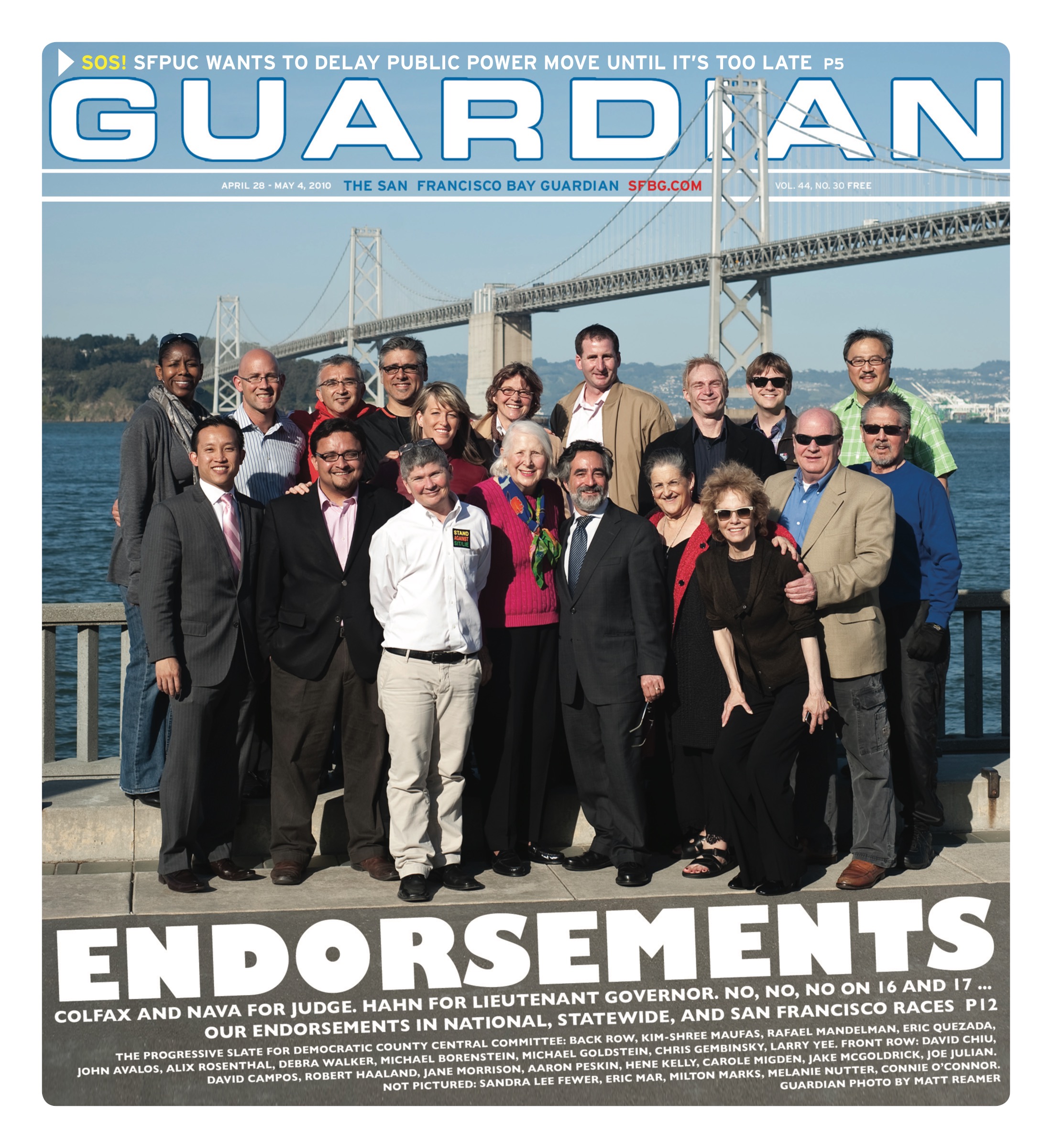
ENDORSEMENTS: Judicial races

2

SUPERIOR COURT JUDGE, SEAT 6


LINDA COLFAX


It’s rare to see an open seat on the Superior Court; judges typically retire midterm and allow the governor to appoint their replacement. And with a Republican governor, the more progressive Democrats have had a hard time getting even close to judicial appointments. Four highly qualified candidates are seeking this seat, and all of them make good cases for election.


Since judicial candidates can’t take stands on most political issues or indicate how they might rule on cases, it’s hard to get a sense of where the candidates stand. But they can talk about their backgrounds and experience — and about how the local courts are run. For example, the Superior Court is managed on a day-to-day basis by a presiding judge, elected by the sitting judges on the San Francisco bench. But those elections are secret; nobody except the judges know who the candidates were; who voted for which one; or what the final tally was. Court administration is done in closed meetings. Most of what happens in the courts is public — but there’s no presumption of cameras in the courtrooms to give the public access to the justice system.


Our choices for judge reflect our interest in a diverse judiciary, judges who have both professional and personal experience that will shape fair decisions — and jurists who believe in open government, including open courts.


Our choice for Seat 6 is Linda Colfax, a deputy public defender with a background in community service (she’s been an ACLU board member) and progressive politics. Like all four candidates, she has impressive legal credentials and trial experience. She also strongly supports sunshine in the courts and told us she would allow the press and public into judges’ meetings when appropriate, supports cameras in the courtrooms (except for cases where a witness or crime victim has to be protected), and efforts to make the courts work more efficiently.


Robert Retana, who grew up in East Los Angeles, has worked in both civil and criminal law, as a prosecutor and a civil litigator. He also has extensive community service with La Raza Centro Legal and the Lawyer’s Committee for Civil Rights. He was awfully vague on cameras in the courtroom and didn’t seem well-informed on open-government issues, but he’s certainly qualified for the job.


Rod Mcleod, a former San Francisco School Board member, told us he won’t raise any money for this race since he thinks judges shouldn’t be captive to special interests. That’s noble, but it also makes it unlikely he’ll be a factor in the end.


Harry Dorfman, a career prosecutor with the District Attorney’s Office, has extensive trial experience but was the least willing of all the candidates we interviewed to expand public access to the courts.


Colfax has the endorsements of Assembly Member Tom Ammiano, Sen. Mark Leno, and Sups. David Campos, John Avalos, and Eric Mar, among others. She would also diversify the bench in a significant way, not just because she’s a lesbian but because she spent her career in the Public Defender’s Office. And since Democratic and Republican governors alike tend not to appoint public defenders to the bench, that background and perspective is rare. Vote for Colfax.


SUPERIOR COURT JUDGE, SEAT 15


MICHAEL NAVA


Another rarity here: a contested race where challengers are taking on a sitting judge. Richard Ulmer, the incumbent, was a Republican living in Hillsborough when Gov. Schwarzenegger appointed him to the bench last year; he quickly changed his registration to independent and took up residence in Park Merced. But two gay men, Michael Nava and Daniel Dean, saw him as potentially vulnerable and, noting the lack of LGBT appointments coming out of the current administration, filed to challenge Ulmer.


Ulmer’s a smart and appealing person with an impressive legal resume, and we see no scandal that would mandate his removal from office. But we also recognize that this is an elected office, and that it’s perfectly acceptable for candidates who think they would better serve the public and the bench to run against an incumbent. In this case, we’re endorsing Michael Nava.


Nava, the grandson of Mexican immigrants, makes the case that judicial appointments can be just as political as elections: out of some 500 judicial appointments, Schwarzenegger has named perhaps five openly LGBT candidates. Nava also would bring a different perspective to the courts. His career has been in the public sector and he currently works as a staff attorney drafting decisions for Superior Court Justice Carlos Moreno. More than anyone else running for judge this year, Nava is an advocate of openness in the judiciary. He told us the courts are the third branch of government and should be held to most of the same sunshine standards at the executive and legislature.


Daniel Dean also makes a compelling case and has extensive courtroom experience as a litigator and judge pro tem. His accessibility and sense of humor would serve him well on the bench, and we hope he continues to seek a judicial slot. But in this race, we’re endorsing Nava.

ENDORSEMENTS: San Francisco ballot measures

0

 PROPOSITION A

SCHOOL FACILITIES SPECIAL TAX

YES

This measure would extend a 1990 parcel tax that expires in 2010 by another 20 years, keeping it at its current rate ($32 a year for single family homes and commercial enterprises, $16 a year per dwelling unit for mixed use buildings). The tax brings in $7 million a year for San Francisco school facilities and would finance seismic upgrades, structural strengthening and related improvements of its facilities, and child care centers. Vote yes.


PROPOSITION B

EARTHQUAKE SAFETY AND EMERGENCY RESPONSE BONDS

YES

It’s hard to argue against a $430 million bond act to upgrade police, fire, and water facilities to prevent a catastrophic collapse of the city’s most basic public safety infrastructure in the event of an inevitable earthquake. Hard — but not impossible: Sup. Chris Daly, the lone vote against Prop. B, points out that the bond money would be used to upgrade police stations but that the old County Jail at 850 Bryant St. wouldn’t get any help. Prisoners, it seems (even those who are awaiting trial and have been convicted of nothing) aren’t worth protecting. And the Fire Department has been very hazy about where it’s going to spend the cash. So we’ve got some concerns here — but on balance, we’re endorsing Yes on B.


PROPOSITION C

FILM COMMISSION

YES

By some accounts, this measure was put together in retaliation for Mayor Gavin Newsom’s November 2009 demand that Film Commission executive director Stefanie Coyote resign — shortly after her husband, actor Peter Coyote, supported Attorney General Jerry Brown over Newsom for governor. But Bill Barnes, who works as a legislative aide for Newsom ally Sup. Michela Alioto-Pier, the author of Prop. C, says Alioto-Pier was working on this measure even before Coyote got ousted.

Either way, it’s a positive step. Prop. C would streamline a convoluted permitting process for shooting films in San Francisco — a process that can involve multiple departments — and would create a one-stop shop. It would also split the power to appoint the film commissioners between the mayor and the board (6-5, respectively), and require that all 11 commissioners have specific qualifications or experience. Vote yes.


PROPOSITION D

RETIREMENT BENEFITS

YES

Prop. D is a compromise. Sup. Sean Elsbernd wanted to reform the city’s pension system by mandating higher employee contributions and an end to what’s known as “spiking” — giving some employees a big raise just before they retire. Under current law, that worker would get a pension based on the inflated salary.

Elsbernd wanted to change the calculation and base pensions on an average of the final three years of salary an employee earned. Labor countered that some lower-paid workers only reach their top pay at the end of their careers. The final deal would base pensions on a two-year average. Prop. D would also require future employees to contribute and extra 2 percent to their pensions and require the city to set aside some money every year for the pension and retiree health care systems. In the end, progressive Sups. David Campos and Eric Mar signed on, and the city employee unions aren’t opposed. Vote yes.


PROPOSITION E

BUDGET LINE ITEM FOR POLICE SECURITY

YES

Prop. E would make one simple tweak to the reporting requirements for San Francisco’s annual city budget: a line-item on how much is spent on security for city officials and visiting dignitaries. As things stand, the amount the police department spends to protect people like, oh, say Mayor Gavin Newsom while he is crisscrossing the state campaigning for (lieutenant) governor is kept secret. That’s information the public has a right to know. Vote yes.


PROPOSITION F

RENTERS’ FINANCIAL HARDSHIP APPLICATIONS

YES

Prop. F would allow a tenant facing a rent increase to file a petition with the Rent Board claiming financial hardship. If the tenant was unemployed, or had his or her wages cut by 20 percent or more, or didn’t get a cost of living increase in government benefits and was paying at least 33 percent of his or her income as rent, the rent hike would be delayed for 60 days pending a hearing. If the renter can establish hardship, the landlord would have to hold off on the increase until the tenant’s employment or benefit situation improved. Few San Francisco landlords would be hurt by the delay in what are typically modest rent hikes — but a lot of tenants could avoid eviction. Vote yes.


PROPOSITION G

TRANSBAY TRANSIT CENTER

YES

Prop. G, a policy statement, became a moot point earlier this year, but it’s still good for San Franciscans to affirm the city’s support for bringing high-speed rail service downtown. The California High-Speed Rail Project is moving to create bullet train service from SF to downtown Los Angeles using bond money approved by voters in 2008. Even though that bond measure named the Transbay Terminal as the northern terminus of the first phase, some officials raised doubts about whether the downtown location was the best choice. That rail service was integral to plans for the transit center, which is currently being rebuilt, so the Board of Supervisors placed this measure on the ballot to support that choice. Earlier this month, the California High-Speed Rail Authority considered other alternatives and voted to stay with the Transbay Terminal. That’s the right way to go; vote yes.

ENDORSEMENTS: State ballot measures

8

PROPOSITION 13

LIMITS ON PROPERTY TAX ASSESSMENT FOR SEISMIC RETROFITS

YES

The primary sponsor of Prop. 13 is Republican Sen. Roy Ashburn, who dominated the news for several days after he was arrested for drunk driving on his way home from a Sacramento gay bar. Needless to say, Ashburn’s dramatic coming out has whipped up far more attention than his noncontroversial ballot initiative.

We’re generally opposed to anything that gives tax cuts or tax deferrals to property owners; thanks to a 1978 measure also called Prop. 13, much of the commercial and residential property in California is badly under assessed. And Prop. 13, 2010 style, is indeed a tax break. But it’s probably justified.

Buildings in this state are typically reassessed for property taxes after they’ve been modified with new construction, except in cases where the modifications are made to comply with earthquake-safety standards. While most buildings that undergo seismic retrofitting are exempt from reassessment until the property is transferred to a new owner, the exemption for unreinforced masonry buildings is limited to 15 years. Prop 13 would remove that 15-year cap.

The fiscal impact on cities is likely to be pretty minor, and the measure might encourage both commercial and residential landlords to bring their buildings up to standard. Vote yes.


PROPOSITION 14

OPEN PRIMARIES

NO

At the height of a royal mess last year when the state budget was long overdue and the two-thirds majority needed to pass it was still out of reach by one vote, Republican Sen. Abel Maldonado struck a deal with Democrats. He said he’d support the budget — if the majority party would meet a few of his demands. One thing he insisted on was Prop. 14 — a ballot measure that would effectively remove political parties from the primary elections process, allowing all voters to cast ballots for any candidate regardless of party affiliation.

Under Maldonado’s plan, all candidates would run on a single primary ballot, and the top two vote-getters would face off in the general election. Heavily funded by the California Chamber of Commerce and marketed by the same spin doctors and corporate lawyers who are rolling in Yes on 16 campaign money, Prop. 14’s backers say it will result in more centrist elected officials.

There are plenty of pitfalls here, the most worrisome being that it would drive up the cost of elections and give more moneyed (and corporate-allied) candidates a sharper competitive edge while elbowing out progressives. It would allow Republicans to play a role in what would normally be Democratic primaries (and vice versa.) The measure would also make it nearly impossible for smaller parties — the Green Party, for example — to offer candidates in the November elections.

Bad idea, bad process, Vote no.


PROPOSITION 15

FAIR ELECTIONS ACT

YES

California desperately needs electoral reform. Corporate campaign spending and lobbyists have poisoned the decision-making process and muzzled the voice of the people. Something radical needs to be done — and while this measure is only a small, measured step in the right direction, it’s an important and promising experiment.

Prop. 15 would create a pilot public financing program for the 2014 and 2018 races for California Secretary of State — and the program would be funded by a tax on lobbyists. Right now lobbyists pay only $12.50 per year to register with the state. This measure would increase that fee to $350 annually and use the money to create a fund of about $6 million that candidates for the crucial office overseeing elections in the state could tap after demonstrating their popular support by gathering a number of small contributions. All candidates who qualify would be given the same amount of money and left to compete on the issues. Ideally this public financing program would prove successful and eventually be expanded to other offices. Public financing of election campaigns, which is currently working well in Arizona and Maine, is certainly worth a try in California. Vote yes.


PROPOSITION 16

MONOPOLY PROTECTION FOR PG&E

NO! NO! NO!

The deceptively titled “Taxpayer’s Right to Vote Act” was dreamed up and funded entirely by Pacific Gas and Electric Co., the monopolistic utility that is worried it could face actual competition here in San Francisco (and elsewhere) from municipal electricity programs that would offer customers a greener energy mix and more accountability than PG&E executives will ever demonstrate.

Rather than accept some healthy competition, this sleazy corporation has opted to spend some $35 million to exterminate all possibilities of municipal electricity programs cropping up anywhere in the state in a bid to preserve its octopus-like grip on the energy market in Northern California. Prop. 16 would require a two-thirds majority vote at the ballot before any community choice aggregation (CCA) program — or any attempt at creating or expanding a public-power system — could move forward. That’s an extreme hurdle — -and PG&E knows it.

In effect, PG&E is trying to buy public policy here, trying to pass a law that will protect its own monopoly interests.

In San Francisco, the CCA being proposed would offer customers 51 percent renewable power by 2017, which means it would blow PG&E out of the water in the green arena and mark S.F. as taking greater strides toward combating climate change than any other major U.S. city. This example could set a precedent for others, which, in turn, could create favorable market conditions for green energy startups that want to harness wind, solar, biomass, geothermal, tidal, and energy efficiency alternatives.

The very existence of Prop. 16 is already threatening the San Francisco CCA; the city’s Public Utilities Commission is trying to delay a final contract until after the June 8 vote on the measure (see editorial, page 5)

Vote no on Prop 16. Not just because it’s an example of a big business single-handedly trying to alter the state constitution for its own economic benefit by pouring millions of dollars into a deceptive advertising campaign. Not just because a two-thirds majority vote requirement is anti-democratic. Not just because there were reports that the signature gatherers who got people to sign on in support of placing Prop. 16 on the ballot were telling people that its purpose was to limit PG&E expansion or encourage solar power. Not just because Senate Pro Tem Darrell Steinberg and a half dozen members of the Legislature sent a letter rebuking PG&E CEO Peter Darbee for disrespecting the democratic process by going straight to the ballot to undermine legislation it initially supported that enabled the creation of CCA programs. Not just because PG&E is using $35 million of ratepayer dollars (that’s the check you wrote them for your electricity bill!) to put out slick TV ads for this campaign when it should have been repairing the pipelines under those manholes that keep exploding and messing up your morning commute. Not even just because with CCA, you already have the right to vote whether or not you want to be part of it, a choice PG&E will never give you. And not just because PG&E keeps trying to raise rates, which is much more difficult for municipal energy agencies to do.

If for no other reason, vote no because Prop. 16 flies in the face of everything environmentalists stand for. It’s a measure that will thwart progress on fighting climate change, brought to you by the company that practically invented green-washing. PG&E is a huge nuclear power player; it purchases coal from mountaintop-removal coal mines in West Virginia that are completely devastating biodiverse landscapes in Southern Appalachia and screwing over poor people by tainting their drinking water; and it’s in the process of building fossil fuel-fired power plants in poor communities of color in California. The CCA programs at least represent a glimmer of hope for an alternative model; Prop. 16 kills off that possibility with one fell swoop motivated by pure greed. For the love of justice, democracy, and the planet, vote no on Prop 16.


PROPOSITION 17

CAR INSURANCE SCHEME

NO, NO, NO!

Mercury Insurance sponsored this measure and is campaigning for it with tens of millions of dollars, betting it can fool voters and make hundreds of millions of dollars in profits by doing so. And if the company is right, insurance rates will skyrocket for new drivers and those who haven’t had continuous insurance coverage, which experts say will increase the number of uninsured drivers on the roadways and end up increasing insurance rates for everyone.

Mercury and its founder George Joseph have been truly malevolent players in California, exploiting their customers to make billions of dollars in profits, attacking California’s landmark insurance reform measure Prop. 103 with lawsuits and corrupting campaign contributions over more than 20 years, and flouting insurance regulators in such brazen fashion that even Insurance Commissioner Steve Poizner, a conservative Republican, recently chastised the company for its “lengthy history of serious misconduct” (see “Buying power,” March 17).

Now, however, the company is hoping its promise to cut the insurance premiums of drivers who have maintained continuous coverage by “as much as $250 per year” will buy their votes and that they’ll overlook the myriad negative impacts of increasing everyone else’s premiums by $1,000 per year or more, based on Mercury’s own estimates.

Think about that. If you’re a driver who missed an insurance payment by even one day, or a soldier returning from boot camp, or someone with a low-income getting insurance for the first time or after ditching your car for a while, what are you going to do when you discover already-expensive car insurance comes with a $1,000 annual surcharge?

Many Californians, those who share our roads, will choose to drive without insurance. Then they’ll be more likely to leave the scene of accidents or declare bankruptcy rather than paying out-of-pocket for their accidents, both of which increase the cost of insurance for everyone else.

That’s how insurance works. If someone pays less, someone else pays more; and the only entity guaranteed to really make money over the long term is the insurance company. Don’t fall for this scam. Vote no on 17.

ENDORSEMENTS: National and state races

15

Editor’s note: the file below contains a correction, updated May 5 2010. 


National races


U.S. SENATE, DEMOCRAT


BARBARA BOXER


The Republican Party is targeting this race as one of its top national priorities, and if the GOP can dislodge a three-term senator from California, it will be a major blow for the party (and agenda) of President Obama. The pundits are happily talking about how much danger Barbara Boxer faces, how the country’s mood is swinging against big-government liberals.


But it’s always a mistake to count out Boxer. In 1982, as a Marin County supervisor with little name recognition in San Francisco, she trounced then-SF Sup. Louise Renne for an open Congressional seat. Ten years later, she beat the odds and won a hotly contested primary and tough general election to move into the Senate. She’s a fierce campaigner, and with no primary opposition, will have a united party behind her.


Boxer is one of the most progressive members of the not-terribly progressive U.S. Senate. She’s been one of the strongest, most consistent supporters of reproductive rights in Washington and a friend of labor (with 100 percent ratings from the AFL-CIO and National Education Association). We’ve had our disagreements: Boxer supported No Child Left Behind, wrote the law allowing airline pilots to carry guns in the cockpit, and was weak on same-sex marriage when San Francisco sought to legalize it (although she’s come around). But she was an early and stalwart foe of the war in Iraq, split with her own party to oppose a crackdown on illegal immigration, and is leading the way on accountability for Wall Street. She richly deserves reelection, and we’re happy to endorse her.


CONGRESS, 6TH DISTRICT, DEMOCRAT


LYNN WOOLSEY


It’s odd that the representative from Marin and Sonoma counties is more progressive by far than her colleague to the south, San Francisco’s Nancy Pelosi. But over the years, Lynn Woolsey has been one of the strongest opponents of the war, a voice against bailouts for the big Wall Street banks, and a foe of cuts in the social safety net. We’re proud to endorse her for another term.


CONGRESS, 7TH DISTRICT, DEMOCRAT


GEORGE MILLER


George Miller has been representing this East Bay district since 1974, and is now the chair of the Education and Labor Committee and a powerhouse in Congress. He’s too prone to compromise (with George W. Bush on education policy) but is taking the right line on California water (while Sen. Dianne Feinstein is on the wrong side). We’ll endorse him for another term.


CONGRESS, 8TH DISTRICT, DEMOCRAT


NANCY PELOSI


We’ve never been terribly pleased with San Francisco’s most prominent Congressional representative. Nancy Pelosi was the author of the bill that created the first privatized national park at the Presidio, setting a horrible standard that parks ought to be about making money. She was weak on opposing the war, ducked same-sex marriage, and has used her clout locally for all the wrong candidates and issues. But we have to give her credit for resurrecting and pushing through the health care bill (bad as it was — and it’s pretty bad — it’s better than doing nothing). And, at a time when the Republicans are trying to derail the Obama presidency, she’s become a pretty effective partner for the president.


Her fate as speaker (and her future in this seat) probably depends on how the Democrats fare in the midterm Congressional elections this fall. But if she and the party survive in decent shape, she needs to take the opportunity to undo the damage she did at the Presidio.


CONGRESS, 9TH DISTRICT, DEMOCRAT


BARBARA LEE


Barbara Lee, who represents Berkeley and Oakland, is co-chair of the Progressive Caucus in the House, one of the most consistent liberal votes in Congress, and a hero to the antiwar movement. In 2001, she was the only member of either house to oppose the Bush administration’s Use of Force resolution following the 9/11 attacks, and she’s never let up on her opposition to foolish military entanglements. We’re glad she’s doing what Nancy Pelosi won’t — represent the progressive politics of her district in Washington.


CONGRESS, 13TH DISTRICT, DEMOCRAT


PETE STARK


Most politicians mellow and get more moderate as they age; Stark is the opposite. He announced a couple of years ago that he’s an atheist (the only one in Congress), opposed the Iraq war early, called one of his colleagues a whore for the insurance industry, and insulted President Bush and refused to apologize, saying: “I may have dishonored the commander-in-chief, but I think he’s done pretty well to dishonor himself without any help from me.” He served as chair of the House Ways and Means Committee for exactly one day — March 3 — before the Democratic membership overruled Speaker Pelosi and chucked him out on the grounds that he was too inflammatory. The 78-year-old may not be in office much longer, but he’s good on all the major issues. He’s also fearless. If he wants another term, he deserves one.


State races


GOVERNOR, DEMOCRAT


EDMUND G. BROWN


Jerry Brown? Which Jerry Brown? The small-is-beautiful environmentalist from the 1970s who opposed Pacific Gas and Electric Co.’s Diablo Canyon nuke and created the California Conservation Corps, the Office of Appropriate Technology, and the Farm Labor Relations Board (all while running a huge budget surplus in Sacramento)? The angry populist who lashed out at corporate power on a KPFA radio talk show and ran against Bill Clinton for president? The pro-development mayor of Oakland who sided with the cops on crime issues and opened a military academy? Or the tough-on-crime attorney general who refuses to even talk about tax increases to solve the state’s gargantuan budget problems?


We don’t know. That’s the problem with Brown — you never know what he’ll do or say next. For now, he’s been a terribly disappointing candidate, running to the right, rambling on about preserving Proposition 13, making awful statements about immigration and sanctuary laws, and even sounding soft on environmental issues. He’s started to hit his stride lately, though, attacking likely GOP contender Meg Whitman over her ties to Wall Street and we’re seeing a few flashes of the populist Brown. But he’s got to step it up if he wants to win — and he’s got to get serious about taxes and show some budget leadership, if he wants to make a difference as governor.


LIEUTENANT GOVERNOR, DEMOCRAT


JANICE HAHN


Not an easy choice, by any means.


Mayor Gavin Newsom jumped into this race only after it became clear that he wouldn’t get elected governor. He sees it as a temporary perch, someplace to park his political ambitions until a better office opens up. He’s got the money, the statewide name recognition, and the endorsement of some of the state’s major power players, including both U.S. Senators and House Speaker Nancy Pelosi. He’s also been a terrible mayor of San Francisco — and some progressives (like Sup. Chris Daly) argue, persuasively, that the best way to get a better person in Room 200 is to ship Newsom off to an office in Sacramento where he can’t do much harm and let the supervisors pick the next mayor.


But it’s hard to endorse Newsom for any higher office. He’s ducked on public power, allowing PG&E to come very close to blocking the city’s community choice aggregation program (See editorial, page 5). His policies have promoted deporting kids and breaking up families. He’s taken an approach to the city budget — no new revenue, just cuts — that’s similar to what the Republican governor has done. He didn’t even bother to come down and talk to us about this race. There’s really no good argument for supporting the advancement of his political career.


Then there’s Janice Hahn. She’s a Los Angeles City Council member, the daughter of a former county supervisor, and the sister of a former mayor. She got in this race way before Newsom, and her nightmare campaign consultant, Garry South, acts as if she has some divine right to be the only Democrat running.


Hahn in not overly impressive as a candidate. When we met her, she seemed confused about some issues and scrambled to duck others. She told us she’s not sure she’s in favor of legalizing pot, but she isn’t sure why she’s not sure since she has no arguments against it. She won’t take a position on a new peripheral canal, although she can’t defend building one and says that protecting San Francisco Bay has to be a priority. She won’t rule out offshore oil drilling, although she said she has yet to see a proposal she can support. Her main economic development proposal was to bring more film industry work to California, even if that means cutting taxes for the studios or locating the shoots on Indian land where there are fewer regulations.


On the other hand, she told us she wants to get rid of the two-thirds threshold in the state Legislature for passing a budget or raising taxes. She supports reinstating the car tax at pre-Gov. Arnold Schwarzenegger levels. She supports a split-roll measure to reform Prop. 13. She wants to see an oil-severance tax to fund education. She’s one of the few statewide candidates who openly advocates higher taxes on the wealthy as part of the solution to the budget crisis.


We are under no illusions that Hahn will be able to use the weak office of lieutenant governor to move on any of these issues, and we’re not at all sure she’s ready to take over the top spot. But on the issues, she’s clearly better than Newsom, so she gets our endorsements.


SECRETARY OF STATE, DEMOCRAT


DEBRA BOWEN


Debra Bowen is the only Democrat running, a sign that pretty much everyone in the party thinks she’s doing a fine job as Secretary of State. She’s run a clean office and we see no reason to replace her.


CONTROLLER, DEMOCRAT


JOHN CHIANG


Like Bowen, John Chiang has no opposition in the primary, and he’s been a perfectly adequate controller. In fact, when Gov. Schwarzenegger tried two years ago to cut the pay of thousands of state employees to the minimum wage level, Chiang defied him and refused to change the paychecks — a move that forced the governor to back down. We just wish he’d play a more visible role in talking about the need for more tax revenue to balance the state’s books.


TREASURER, DEMOCRAT


BILL LOCKYER


Bill Lockyer keeps bouncing around Sacramento, waiting, perhaps, for his chance to be governor. He was attorney general. Now he’s treasurer seeking a second term, which he will almost certainly win. He’s done some good things, including trying to use state bonds to promote alternative energy, and has spoken out forcefully about the governor’s efforts to defer deficit problems through dubious borrowing. He hasn’t, however, come out in favor of higher taxes for the rich or a change in Prop. 13.


ATTORNEY GENERAL, DEMOCRAT


KAMALA HARRIS


There are really only two serious candidates in this race, Kamala Harris, the San Francisco district attorney, and Rocky Delgadillo, the former Los Angeles city attorney. Harris has a comfortable lead, with Delgadillo in second and the others far behind.


Delgadillo is on his second try for this office. He ran against Jerry Brown four years ago and got nowhere. And in the meantime, he’s come under fire for, among other things, using city employees to run personal errands for him (picking up his dry-cleaning, babysitting his kids) and driving his car without insurance. On a more significant level, he made his reputation with gang injunctions that smacked of ethnic profiling and infuriated Latino and civil liberties groups. It’s amazing he’s still a factor in this race; he can’t possibly win the general election with all his baggage.


Harris has a lot going for her. She was among the first California elected officials to endorse Barack Obama for president, and remains close to the administration. She’s a smart, articulate prosecutor and could be one of the few women atop the Democratic ticket this year. We were never comfortable with her ties to Willie Brown, but he’s no longer a factor in state or local politics. These days, she’s more closely allied with the likes of State Sen. Mark Leno.


That said, we have some serious problems with Harris. She’s been up in Sacramento pushing Republican-style tough-on-crime bills (like a measure that would bar registered sex offenders from ever using social networking sites on the Internet) and forcing sane Democrats like Assembly Member and Public Safety Committee Chair Tom Ammiano to try to tone down or kill them (and then take the political heat). If she didn’t know about the problems in the SFPD crime lab, she should have, and should have made a bigger fuss, earlier.


But Harris has kept her principled position against the death penalty, even when it meant taking immense flak from the cops for refusing to seek capital punishment for the killer of a San Francisco police officer. She’s clearly the best choice for the Democrats.


INSURANCE COMMISSIONER, DEMOCRAT


DAVE JONES


Two credible progressives are vying to run for this powerful and important position regulating the massive — and massively corrupt — California insurance industry. Dave Jones and Hector De La Torre are both in the state Assembly, with Jones representing Sacramento and De La Torre hailing from Los Angeles. Both have a record opposing insurance industry initiatives; both are outspoken foes of Prop. 17; and either would do a fine job as insurance commissioner. But Jones has more experience on consumer issues and health care reform, and we prefer his background as a Legal Aid lawyer to De La Torre’s history as a Southern California Edison executive. So we’ll give Jones the nod.


BOARD OF EQUALIZATION, DISTRICT 1, DEMOCRAT


BETTY T. YEE


Betty Yee has taken over a job that’s been a stronghold of progressive tax policy since the days of the late Bill Bennett. She’s done well in the position, supporting progressive financial measures and even coming down, as a top tax official, in favor of legalizing (and taxing) marijuana. We’re happy to endorse her for another term.


SUPERINTENDENT OF PUBLIC INSTRUCTION


TOM TORLAKSON


Two prominent Democratic legislators are running for this nonpartisan post, state Sen. Gloria Romero of Los Angeles and Assembly Member Tom Torlakson of Martinez. It’s a pretty clear choice: Romero is a big supporter of charter schools who thinks parents should be able to move their kids out of one school district and into another (allowing wealthier white parents, for example, to abandon Los Angeles or San Francisco for the suburban districts). She’s been supported in the past by Don and Doris Fisher, who put a chunk of their GAP Inc. fortune into school privatization efforts. Torlakson wants more accountability for charters, opposes the Romero district-option bill, and has the support of every major teachers union in the state. Vote for Torlakson.


STATE SENATE, DISTRICT 8, DEMOCRAT


LELAND YEE


Sen. Leland Yee can be infuriating. Two years ago, he was hell-bent on selling the Cow Palace as surplus state property and allowing private developers to take it over. In the recent budget crisis, he pissed off his Democratic colleagues by refusing to vote for cuts that everyone else knew were inevitable (while never making a strong stand in favor of, say, repealing Prop. 13 or raising other taxes). But he’s always been good on open-government issues and has made headlines lately for busting California State University, Stanislaus over a secret contract to bring Sarah Palin in for a fundraiser — and has raised the larger point that public universities shouldn’t hide their finances behind private foundations.


Yee will have no serious opposition for reelection, and his campaign for a second term in Sacramento is really the start of the Leland Yee for Mayor effort. With reservations over the Cow Palace deal and a few other issues, we’ll endorse him for reelection.


 Correction update: Yee’s office informs us that the senator suports an oil-severance tax and a tax on high-income earners and “believes that Prop. 13 should be reformed,” although he hasn’t taken a position on Assemblymember Tom Ammiano’s reform bill. 


STATE ASSEMBLY, DISTRICT 12, DEMOCRAT


FIONA MA


Fiona Ma’s a mixed bag (at best). She doesn’t like Pacific Gas and Electric Co. and supports public power, but comes up with strange bills that make no sense, like a 2009 measure to limit rent control in trailer parks. Why does Ma, who has no trailer parks in her district, care? Maybe because the landlords who control the mobile home facilities gave her some campaign cash. She faces no opposition, and we’re not thrilled with her record, but we’ll reluctantly back her for another term.


STATE ASSEMBLY, DISTRICT 13, DEMOCRAT


TOM AMMIANO


When the history of progressive politics in modern San Francisco is written, Tom Ammiano will be a central figure. His long-shot 1999 mayoral campaign against Willie Brown brought the left to life in town, and his leadership helped bring back district elections and put a progressive Board of Supervisors in place in 2000. As a supervisor, he authored the city’s landmark health care bill (which Newsom constantly tries to take credit for) and the rainy day fund (which saved the public schools from debilitating cuts). He uses his local influence to promote the right causes, issues, and candidates.


And he’s turned out to be an excellent member of the state Assembly. He forced BART to take seriously civilian oversight of the transit police force. He put the battle to reform Prop. 13 with a split-role measure back on the state agenda. And his efforts to legalize and tax marijuana are close to making California the first state to toss the insane pot laws. As chair of the Public Safety Committee, he routinely defies the police lobbies and the right-wing Republicans and defuses truly awful legislation. We’re glad Ammiano’s still fighting in the good fight, and we’re pleased to endorse him for another term.


STATE ASSEMBLY, DISTRICT 14, DEMOCRAT


NANCY SKINNER


Nancy Skinner has taken on one of the toughest, and for small businesses, most important, battles in Sacramento. She wants to make out-of-state companies that sell products to Californians collect and remit sales tax. If you buy a book at your local bookstore, you have to pay sales tax; if you buy it from Amazon, it’s tax-free. That not only hurts the state, which loses hundreds of millions of dollars in tax revenue, it’s a competitive disadvantage to local shops. Skinner’s a good progressive vote and an ally for Ammiano on the Public Safety Committee. We’re happy to endorse her for another term.


STATE ASSEMBLY, DISTRICT 16, DEMOCRAT


SANDRE SWANSON


Sandre Swanson represents the district where BART police killed Oscar Grant, but he wasn’t the one out front pushing for more civilian accountability; that was left to SF’s Ammiano. And while Swanson was generally supportive of Ammiano’s bill, he was hardly a leader in the campaign to pass it. This is too bad, because Swanson’s almost always a progressive vote and has been good on issues like whistleblower protection (a Swanson bill that passed this year protects local government workers who want to report problems confidentially). We’ll endorse him for another term, but he needs to get tougher on the BART police.

The vision thing

0

arts@sfbg.com

VISUAL ART All artists, to some degree, are visionaries. They envision something the rest of us can’t or haven’t been able to. That “something” can also be the envisioning itself, a way of seeing made manifest. An articulation of that vision should hopefully leave us questioning what it is we see before us, how we have come to see before this encounter, what we haven’t seen or noticed until now. One measure of an artwork’s efficacy, then, could be to what extent we find ourselves continuing to stumble along this line of inquiry, opened up by the work, long after we have left its presence.

In this respect, the art of Morris Graves (1910-2001), which has so often been hailed as “visionary,” is particularly efficacious. The latest testament to this unsung great of midcentury American art is “The Visionary Art of Morris Graves,” Meridian Gallery’s fantastic retrospective curated by Peter Selz. Taking over the first two floors of the former beaux-arts mansion, the 45 works in this comprehensive survey encourage much pleasurable stumbling.

This exhibit takes its title from San Francisco Renaissance man Kenneth Rexroth’s laudatory 1955 essay, “The Visionary Painting of Morris Graves,” which rightfully recognized that Graves’ art could not be reduced to the sum of its influences: whether the Asian calligraphic and brush painting traditions he studied from primary sources, such as the 15th century master Sesshu, as well as their reinterpretation by fellow Northwestern artist Mark Tobey, or the wilds of coastal Washington, a region from which he drew his color palette and which he called home for a great period of his life.

I will admit that all this talk of Graves’ visionary status colored my initial approach to his art. It was hard not to first fixate on the birds, serpents, chalices, and flowers — enough to fill a tarot deck — with their aura of hermetic significance and iconographic associations. But, as Rexroth’s observations underscore, to regard Graves’ work solely as that of a sylvan mystic, as Life magazine did in its famous 1954 spread “Mystic Painters of the Northwest,” is to see it myopically.

Graves’ vision is legible on the surfaces of his paintings. Many bear traces their initial contact with the tempera, oil paint, or ink, like dampened tissue spread out to dry. One has to get close to see how Graves’ intimately imbricates his figures with the sensuous textures in which they are situated. The spermatic flower delicately zig-zagging atop an ombre sea of undulating ink wash in Effort to Bloom (1943), or the bird buried within a calligraphic nest of white hatch-marks and seemingly endlessly retraced filigree in Bird in Moonlight (1939) are just two of the more dramatic examples of how Graves combines figuration and abstraction to create an insistently tactile whole.

Jarrett Earnest, Meridian’s assistant director (and full disclosure, a personal friend), articulates this quality of Graves’ work in his catalog essay when he writes, “[Graves’ paintings] ask you to experience their surface as you would the anatomy of a lover, looking as if caressing.” This tenderness, so markedly displayed in the large color paintings, also comes through in the simpler ink portraits of animals on the second floor. In Untitled (Hibernation) (c.a. 1954) the sleeping, whiskered donut of fur Graves depicts — in just a handful of measured brush strokes — so vividly evokes a deep sense of peace that I wish it were possible to spoon. To be in its presence makes one take stock of one’s own presence.

It would be reductive and essentializing to dovetail Graves’ deep sensitivity with his openness about his homosexuality, remarkable at a time when same-sex desire was criminalized. And yet, as Earnest also concludes, there is something about the sensuality of Graves’ work — one so removed from the masculine athleticism of Graves’ Abstract Expressionist contemporaries — that makes it truly visionary. Graves’ friend John Cage called his paintings “invitations.” Don’t be afraid to accept their offer to get close.

THE VISIONARY ART OF MORRIS GRAVES

Through May 15

535 Powell, SF

(415) 398-7229

www.meridiangallery.org

St. Elvis?

0

TV BIOPIC The John Carpenter-directed biopic Elvis hit network TV airwaves in 1979, ironically enough in the same time slot as that slice of Deep South Americana Gone With the Wind (1939). The Big E had expired just two years previously, and Elvis worship was in full flower. The TV movie thus squeezed out the Gable-Leigh epic to take top spot in the nation’s hearts, for that night anyway.

Released in March on DVD in its full three-hour glory, Elvis was put together by Dick Clark’s production company, which apparently wanted a fairly by-the-numbers hagiography. Kurt Russell does a credible job of capturing the curled lip and intonation of the humble country boy who wore flashy clothes and mixed white country, black blues, and various pop influences until he hit the big time.

Screenwriter Anthony Lawrence worked on several of Elvis’ less than groundbreaking Hollywood vehicles, including Roustabout (1964) and Paradise, Hawaiian Style (1966). Lawrence also penned scripts for both The Outer Limits and Medical Center, which might be even better qualifications for writing about someone who had as many problems with impulse control as Presley.

But, alas, the life we see is oddly squeaky clean. We see nary a caffeine tablet eaten. Lawrence depicts Elvis remaining fairly chaste while waiting to find his true love Priscilla (Season Hubley), not to mention during the additional time spent waiting for her to mature to legal marrying age. (For those jaded souls who need something a bit more salacious, e.g. the skinny on the King’s thing with Tura Satana, check out Alanna Nash’s recent Baby, Let’s Play House: Elvis Presley and the Women Who Loved Him.)

We see Elvis the seeker reading a passage from Khalil Gibran’s The Prophet aloud to Priscilla, but nowhere is there a shot of his other favorite bedside reading, The Physicians’ Desk Reference. According to Elvis biographer Bobbie Ann Mason, he used said volume “like a shopping catalog.”

We do get Shelley Winters as Elvis’ beloved mother Gladys, surely one of the oddest casting choices in the Carpenter ouevre. The black wig Winters sports made me think of Divine, which in turn reminded me of how much more fun I had watching the 1950s rock ‘n’ roll cutting up in John Waters’ Cry-Baby (1990).

Carpenter’s thumping synthesizer soundtrack tunes, so key to the addictive pleasures of his horror pictures — including They Live (1988) and Halloween (1978) — are sadly absent. There are decent versions of early Sun numbers with some guy named Ronnie McDowell doing credible vocals. Maybe the creepy synth would be more appropriate for a follow-up biopic on the final years (this one ends in 1969; Presley’s ended in 1977), including a recreation of Elvis’ legendary 1970 White House meeting with Richard Nixon.

To thrill is divine

0

arts@sfbg.com

THEATER It’s been a different kind of thrill down at the Hypnodrome as Thrillpeddlers enters the 11th month of extensions for its runaway smash hit, The Cockettes’ musical Pearls Over Shanghai. One hundred performances strong (as of May 1) and with no end in sight, Thrillpeddlers has slyly redefined its brand of thrills to embrace a wholly different genre besides the Grand Guignol revivalism for which it is best known; setting aside its usual quotient of twisted naturalism and splattered gore for the rambunctious, over-the-top glitter and glam of Theatre of the Ridiculous.

But the two art forms are not entirely unrelated. After all, a staple of Grand Guignol was the steamy sex farce, a fitting description for the ecstatic nudity, cross-dressing, masturbation, and defloration running wild throughout Pearls. And just as the endangered-species quality of Grand Guignol first prompted Thrillpeddlers artistic director Russell Blackwood to begin mounting performances of it in 1991, so too did the precarious posterity of Theatre of the Ridiculous spark a similar interest.

“I didn’t want it to become a footnote in theatre history, or just something you read about,” Blackwood explains. “It turned me on — the fact that it was as marginalized and as conceivably to be forgotten in the way I was concerned Grand Guignol might be.” In 2008, Thrillpeddlers took the slapstick scripts of Theodora, She-Bitch of Byzantium by Charles Busch and Charles Ludlum’s Jack and the Beanstalk and mounted its first “Theatre of the Ridiculous” festival, eventually taking the whole show on the road — along with an hour-long rendition of Pearls Over Shanghai — to the HOWL festival in New York City’s East Village.

“It went really, really great,” Blackwood said. “We had two full separate bills that played in repertory with each other. And afterward, seeing a videotape of that made me realize just what to do with Pearls.”

Of course it wasn’t just Blackwood’s vision that made the Pearls revival possible; it was also the ongoing collaboration with musical director and original Cockette Scrumbly Koldewyn, who painstakingly brought together songs and scripting from multiple versions of the show despite having scarce archived material — save memories and a few recordings — to work from. Koldewyn also has been an instrumental force behind the upcoming revival of Hot Greeks, the only other “book” musical from the original Cockettes repertoire, (opening at the Hypnodrome May 2). He also accompanies the shows nightly on the piano.

One particularly interesting aspect about Pearls is the way it has brought together multiple generations worth of queer performance fixtures: the original founder of Theatre Rhinoceros, Lanny Baugniet, who performs an opium freakout clad in skintight silver lamé; Jef Valentine, whose Madame Gin Sling drips with Frank N. Furter juice and alternates with original Cockette Rumi Missabau; the eternally robust Steven Satyricon as a rosy-cheeked Naval Captain with a mysterious past; and the role of Russian VIP escort Petrushka, serially portrayed by no fewer than four drag Grand Dames.

But by no means is Theatre of the Ridiculous meant to be viewed solely through a queer lens. Blackwood estimates that slightly less 50 percent of the cast is queer-identified. And the myriad Thrillpeddlers core company members, who started off as ghoulish Grand Guignolians, mesh well with their gaily glittering counterparts.

“What struck me (about Theatre of the Ridiculous) was that it’s a decidedly queer art form, yet always seems to have involved men and women, gays and straights,” Blackwood said. “It’s also a wholly American movement, which you can almost look at as a triangle that goes from New York’s Playhouse of the Ridiculous, to John Waters in Baltimore, and the Cockettes out here.” From French horror-show to all-American glam, Thrillpeddlers has seamlessly expanded its niche: resurrection.

PEARLS OVER SHANGHAI

Through Aug. 1

Through June 26: Fri.–Sat., 8 p.m.; July 10.-Aug. 1: Sat. 8 p.m.; Sun. 7 p.m.

$30–$69

Hot Greeks

May 2– June 27 (Thurs., 8 p.m.; Sun., 7 p.m.), $30–$69

Hypnodrome

575 10th St., SF

www.thrillpeddlers.com

The odd couple

0

arts@sfbg.com

STAGE A man gets off work one hot summer day and stops at the supermarket for an air-conditioned diversion, buys a bag of cherries, and on the way out of the parking lot rolls over a woman with his Toyota Corolla. This is not a good way to meet people. But wham, crash, a relationship is born nevertheless. Not necessarily a romantic one, but then not so far away either. In Lydia Stryk’s An Accident, which closes the current season at the Magic Theater, guilt-ridden driver Anton (Tim Kniffin) and paralyzed patient Libby (Arwen Anderson) dance metaphorically and literally around one another like two lovers in a bad breakup. If only the complex collision between their respective pasts, personalities, and shared trauma angled off in our direction a little more. As drama, An Accident ranks disappointingly as a fender-bender.

This is surprising, not only because Stryk reportedly draws here in part on her own experience as the victim of a similar accident, but given the built-in intensity of the situation, which the playwright aims to heighten by keeping the rest of the world off stage. Her two protagonists have exclusive domain over the hospital room — where Libby remains rooted in bed, unable to move her body, her prognosis uncertain, and Anton slumps in a corner chair or moves frenetically about, trying to please, atone, heal (the both of them). The only other setting, until the very end, is a park bench just outside (set downstage in shadow) where Anton initially sits frozen in contemplation before addressing the audience about the day of the accident.

Moreover, Libby, who also addresses us at the outset, is suffering temporary amnesia, and is thus a "missing person" with no one else in the world as far as she knows. Anton, for his part, is a bit of a loner too, a divorced high school history teacher and Civil War buff, a bookworm and library stalker, with a grown daughter in medical school probably not much younger than Libby. In other words, he’s a guy in his head most of the time, confronted with the broken body of a young woman suddenly trapped in her own thoughts and glaring back angrily at his brazenly healthy physique.

The realism is heavily sculpted by this ideal, almost laboratory-like distillation. Director Rob Melrose and scenic designer Erik Flatmo even forgo the usual hospital equipment, sounds from the corridor, or any view beyond the large wall-size windows, which remain hidden by drawn blinds. Indeed, Flatmo’s set — one of the more impressive transformations of the Magic stage in recent memory — recedes enticingly with sloping ceiling and hard angles into the very idea of institutional isolation, rather than some real-world approximation.

Again, such an intense focus promises us something, namely intensity. But that is decidedly lacking. The actors are very expressive — Anderson’s vigorous, slightly zany performance being all the more impressive given the heavy restrictions on her movement — but the tone is oddly noncommittal, a lightness confounding even the ostensibly heaviest of scenes. The gruesome physicality of their encounter comes across in the dialogue, where the details of Libby’s injuries come to light, but the impact, so to speak, remains marginal. At times it seems as if too much realism were forgone: when Anton, desperately and slightly ridiculously pursuing a healing "life force" energy technique, obeys Libby’s command to remove her hospital gown to maximize his effectiveness, we see her body pristine rather than badly beaten, bruised, and surgically scarred.

One ruefully recalls, in way of contrast, Caryl Churchill’s A Number or David Harrower’s Blackbird. These are similarly distilled two-person dramas where the concentrated isolation of characters locked in deeply traumatic relation to one another comes off to much greater effect, laying both parties bare while digging deeply under our own skin. Unlike the characters in either of those plays, and in an intriguing twist, Libby and Anton have no mutual past predating the collision itself, so their individual pasts come to color and inform this backward relationship that begins in trauma and pain. It’s an opportunity that should have led further, but An Accident plays it all too safe.

AN ACCIDENT

Through May 9

Wed.–Sat., 8pm (also Sat., 2:30 p.m.);

Sun., 2:30 p.m., $25–$55

Magic Theatre, Bldg D,

Fort Mason Center, Marina at Laguna, SF

(415) 441-8822

www.magictheatre.org

Pump you up!

0

kimberly@sfbg.com

MUSIC Follow the heavily pitch-shifted, layered vocals woozily intoning “I love drugs” on “Mind Eraser” from Growing’s new Pumps (Vice). You’ll end up deep in the thicket of the group’s hallucinatory haze, levitating on a cockeyed cloud of bird calls, darting beats, and cries of “It’s my brain!” Welcome to the Brooklyn band’s bristly, growling hoedown, one emulating the sound of the hive mind in a crowded nightclub and pulsing with swooping, strobe-light electronics — though those familiar, whooping party horns refuse to cooperate with any potential dance trance, rarely continuing longer than a few bars.

It’s the sound of a band evolving into some creature poised between an art group that inspires its audience to sit on the floor, cross-legged and spaced-out, and a shadowy outfit toiling behind gear as the crowd grinds and undulates in the foreground. Neither fish nor fowl, neither entirely noise nor dance-pop, those dichotomies, false or no, seem to have dissolved with the entry a year and a half ago of new member Sadie Laska of IUD and Extreme Violence. Laska joined Growing’s seemingly tight two-man collaboration — Joe DeNardo and Kevin Doria have been making music together since 1999 — after playing with the duo during a Growing-IUD tour. And Pumps is the first album the threesome has made together, working amid piles of effect boxes, synths, drum machines, Optigans, and guitars at Brooklyn’s Ocropolis studio.

“It was kind of scary at first for me,” Laska says, from the trio’s car, while in Seattle. “I didn’t know what was going to happen — they didn’t seem to have any strict way of doing anything. Instead they were kind of in this place where they wanted a new perspective, new ideas, so they were like, ‘Do whatever you want.'<0x2009>”

Laska went ahead and added the new vocal elements and samples, amplifying the subtle humor of tracks like the jittery, antically polyrhythmic “Highlight,” which almost suggests a spastic, giggly cousin of the Residents. The wit extends to the title and artwork of the disc, with its 1980s-esque pink lipstick gloss and its pinup girl ready to grotesquely eyeball the viewer.

“The title is supposed to be kind of funny,” Laska explains, “and I think the whole record is really light-hearted, which I don’t think people get at first.” The name directly refers to an instance when Doria’s girlfriend was packing a lot of shoes in a box labeled “Pumps.” “He was like, ‘I hate pumps,'<0x2009>” recalls Laska. “We joked about this being a feminine record, with a girl in the band and this music. After all, we have these beats — we’d say, ‘It’s pumpin’!'<0x2009>”

That’s what happens when you introduce a drum machine into the mix, although that doesn’t mean Growing intends to infiltrate clubland. “I think of it as almost a dance record, but not quite,” observes Laska. “It’s still off-kilter, and maybe you can’t dance to it. [Doria and DeNardo] came from a guitar-driven band, and we all come from these punk roots, so none of us grew up going to dance clubs and listening to dance music — that’s not what we were trying to make.”

Growing is, well, growing — not only in number, but in playful, new elastic directions as the group flips Laska’s vocals and fuses them with the beat. “We’re maybe more light-hearted,” Laska says. “Not that they were super-serious before. But I think now we really want people to have a good time and move around a little bit to it. In some ways we still play a sustained, long set. But now we do have these samples, and it’s kind of like … party music.” She chuckles at the absurdity of it. “Like the end-of-the-night kind of party.” 

GROWING

With Eric Copeland and Birds and Batteries

Wed/28, 8 p.m., $10–>$12

New Parish

579 18th St., Oakl.

(510) 444-7474

www.thenewparish.com


Murder, he filmed

0

arts@sfbg.com

Get your shit peeled/ Check the murder rate, the shit’s real. —Eddi Projex, "Straight from Oakland"

MUSIC/FILM I first met Pretty Black, a member of Yukmouth’s Regime crew, in 2005 at the Mekanix’ studio in Oakland. He arrived with Husalah of the Mob Figaz to record. Goofing off, Hus urged me to get on the song, so I recorded an intro in mangled French, dubbing the pair "les hommes mobs." Black loved the pronunciation (moeb) and thus began one of my least likely rap-world friendships.

For even by rap standards, Black was a live wire. The 25-year-old always had a pistol on him, was always ready to fight, and, with his Range Rover and Lamborghini, clearly made his money off the street, though I didn’t inquire how. He was an angry young man, not someone to piss off. Yet according to Husalah, he had another side.

"Outside the circle, he seemed like the coldest dude on earth," Hus says. "But inside, you knew he was real compassionate. He provided for his niggas. And if you needed something, he was very resourceful."

"Plus," he adds, "if someone tried to fuck with you, he already knocked ’em out before you could even react."

Born in Chicago, Black was christened Ayoola Matthew Odumuyiwa by his Nigerian immigrant parents. When he first came to the Bay, he was known as Verstyle, but soon adopted the more in your face Pretty Black, a pun on the pimp sense of "pretty" (a "gorgeous" man) and his very dark skin. Like albino Jamaican rapper Yellowman, Black transformed a perceived negative — his color placing him on the lowest rung of our country’s caste system — into a defiant positive.

In 2008, on my birthday, May 25 (not, as sometimes reported, on May 30), Black was shot to death at an apartment complex where his relatives lived, a planned assassination. In other words, not random violence or robbery. Except for the killers, no one knows why. I was shocked because, while I could imagine someone wanting to kill him, I’d never known a murder victim. It’s like a candle flame being blown out: one second, fully here; the next, gone. I recalled, too, the last time I’d seen him, at a show featuring the Jacka. As we were catching up, he said, apropos of nothing, "Remember when we met and recorded that song? That was cool. Le moeb!" While ordinary at the time, this circling back to the night we met took on a retrospective uncanniness, as did one of his last songs, also recorded with the Mekanix, on which Black, playing both parts of a phone call, tells himself, "Don’t go outside, nigga. They’re trying to kill you."

BACK TO BLACK


I’ve been thinking about Black lately, in large part due to Land of the Homicide: The Murders in Oakland, CA (HookerBoyFilmz/HBO), a documentary DVD by Oakland filmmaker Dame Hooker. Brought into the game by veteran director Kevin Epps and multimedia journalist JR, Hooker has manned the cameras since 2001, releasing his first DVD, an overview of the local rap scene called The Bay Got Game (HookerBoy), in 2006. He’s also notched artist-oriented flicks like Mistah FAB’s Prince of the Bay (HookerBoy/InYoFace, 2007), among numerous other projects. Camera on shoulder, he’s a ubiquitous presence at any significant function, constantly accumulating footage of anything from a performance to a sideshow to an ass-whupping in high definition.

"I had a camera, but I was just shooting around the hood," Hooker recalls. "I didn’t know how to edit or anything. But FAB, Stalin, Shady Nate — I watched those dudes grow up. I started going to all their shows and they wanted the footage, so I learned how to edit just by watching TV or watching somebody else. Current TV on HBO showed me a lot about how to put it in a format."

Indeed, he nailed the format so well that Current TV licensed some of his footage and hired him and Epps to make content for the program’s Web site, which proved to be the genesis of the Land of the Homicide project.

"We did a pod, a little five-minute segment for Current TV," Hooker says. "It was called Popped in Oakland. I went around to my friends and was like, tell me how you got shot, and they was showing their wounds. HBO wanted me to extend it, and I was doing that already."

Some of the wounds are pretty grisly. One man pulls up a sleeve to display an arm that got sprayed with an AK. The arm is functional but it looks like a tree root, all twisted and gnarled, a permanent symbol of the gun problem in Oakland — which frequently leads the nation in homicides — not to say the entire country. Hooker himself hasn’t been immune to the violence. He shows me some of his own wounds.

"You got to know how to maneuver around here," he says grimly. "You can get shot just by looking at someone wrong. I got shot five times. Somebody thought I looked at them funny. I didn’t have no money on me or nothing."

RANDOM TARGETS


As Hooker’s own story suggests, Oakland’s gun violence often has a random quality to it. People get shot, sometimes killed, by mistake, in addition to intended victims like Pretty Black. One of the more notorious accidental murders was Jesse "Plan Bee" Hall, founder of the classic 1990s crew Hobo Junction, who was shot in 1992 while sitting next to the intended target. Among the interviewees are Plan Bee’s parents, his sister, and his younger brother, Bobby "Blu-Nose" Hall, as Hooker provides an unflinching look at the family’s devastation and grief. Before the end of the film, however, he winds up returning to the Hall residence as Blu-Nose himself is murdered, seemingly, like his brother, a random target.

"I got a large family. None of my family members have passed away like that," Hooker says. "Except my first cousin — we was real close — and my uncle, [and] two uncles, on my mother’s side. All the rest have been friends, but my friends be like my family."

Ordinarily, Blu-Nose’s death would raise a question like what are the odds of someone speaking on camera about gun violence being killed by gun violence shortly afterward? But this being Oakland, the question is: what are the odds of this occurring three times in quick succession? Because this is exactly what happens with Land of the Homicide, separating it from similarly-themed hood documentaries. Another of the main interviewees, a rapper from the East Oakland’s 70s named Hennessey who had many previous wounds to display, is also murdered. Though I hadn’t heard his music, I’d already begun to hear Hennessey’s name here and there; he’d just signed to Thizz for his first major project shortly before his death, and the contrast between his on-camera gregariousness and the extremely dapper corpse we see at his funeral makes a more emphatic argument against the legality of guns than any commentary could.

Pretty Black is the third victim. Although he didn’t have prior wounds himself, Black bumped into Hooker during the filming and agreed to lend his perspective as someone who knew the street life all too well.

"I was going around getting their opinion about the stuff," Hooker recalls. "Most of them was trying to help people, trying to get their hood right. I don’t know if it was a curse doing the DVD or what, but they all died back to back. It was supposed to be about the lives taken in Oakland, but it turned out to be the people that was interviewed."

I don’t think there’s a word for Hooker’s experience here. Obviously the tragic series of murders gives his DVD an authority and authenticity most documentaries couldn’t buy. But the price is not something he would have willingly paid.

"Land of the Homicide, that’s based on really good friends," he said. "DVDs, those don’t matter when it’s someone you know."

The residue

0

arts@sfbg.com

MUSIC “Drug boys steady shooting. The streets don’t give a damn. They’re filled with such pollution,” sings B.o.B on “Kids,” an interpolation of the coda from Vampire Weekend’s self-titled indie-pop gem. “The kids don’t stand a chance.”

But does B.o.B stand a chance? The Adventures of Bobby Ray (Atlantic) is pop, pop and more pop, embracing the current electro-pop-with-a-hip-hop-attitude zeitgeist with a smothering squeeze. If Kid Cudi took notes from Kanye’s 808 and Heartbreak on his intermittently fascinating Man on the Moon: End of Day; then B.o.B seems to channel Lupe Fiasco’s The Cool, with a dollop of Gym Class Heroes and Fall Out Boy thrown in.

B.o.B’s hip-pop excursion flies right into a raging debate over presence in hip-hop music, and whether there’s any left. The mainstream vanguard belongs to those willing to embrace rock and R&B clichés, whether it’s Lil Wayne fake-strumming a guitar on “Prom Queen” or, more nobly, Phonte Coleman crooning on Foreign Exchange’s “Daykeeper.” The hardcore underground belongs to growlers who can spit “16 hot bars” for days over “hit” beats lifted like Just Blaze’s “Exhibit C.” (For the uninitiated: a “bar” is a stanza in a verse.) Each camp seems to disappear into its chosen musical backdrop, driving the beat with narratives and themes, yet rarely emerging with an MC’s distinctly authoritative voice.

The recent death of Keith “Guru” Elam, who passed away April 20 after years spent battling cancer-related illnesses, underscores the stakes. On his work with Gang Starr, Guru not only excelled at storytelling, but at delivering classic lines that burned in your memory. Everyone knows “DWYCK” and “Lemonade is a popular drink and it still is/ I get more props and stunts than Bruce Willis.” Or how about this one (my personal favorite) from “The ? Remains”: “As the world revolves, wack crews lick my balls.”

Peace to one of the best to ever do it. And to be fair, Lil Wayne, DOOM, Mos Def, and a handful of others still deliver those prized “hip-hop quotables.” As for B.o.B? This may seem like a heavy burden for a 21 year-old kid who just released his first official album after years spent hyping himself with mixtapes like The Future and Hi! My Name is B.o.B. Once a hip-hop artist makes a best-seller, he becomes fodder for cruelly dismissive rap addicts clogging up chat boards, snarky rock critics penning capsule reviews for magazine slicks, and old-head journalists who slum down the media mountain to judge the latest craze against their idealized B-boy childhood. Each side will argue noisily and violently whether The Adventures of Bobby Ray spells the death or rebirth of hip-hop.

The turning point is “Nothin’ on You,” a shaggy-dog ballad that reached the summit of the Billboard singles chart. B.o.B leaves the hook to cowriter Bruno Mars, whose production crew the Smeezingtons (Flo Rida’s “Right Round,” K’naan’s “Wavin’ Flag”) aims to be the new-school version of the Neptunes. “Beautiful girls, all over the world/ I could be chasin’ but my time would be wasted/ They got nothin’ on you, baby,” sings Mars in a creamily soft voice.

In conversation, B.o.B is a likeable guy who doesn’t have much to say about the artistic process. Some musicians are erudite Questloves who can philosophize on any and every studio session, while others are Ghostface Killahs who just do it and let the historians sort out the details. B.o.B acknowledges that The Adventures of Bobby Ray is a sharp departure from his early mixtape material.

“I treated the early mixtapes like albums, but I was always holding back. I was holding back the alternative side,” he says, adding that rock bands like Coldplay are an influence. “I don’t want to be in one genre because doing that would be limiting me as an artist, if I was only being exposed to the pop crowd, or just to the urban crowd.”

Growing up Bobby Ray Simmons in Decatur, Ga., he was first discovered at 16 while performing at Club Crucial, a nightclub in Atlanta’s rough Bankhead neighborhood. As he subsequently signed deals with producer Jim Jonsin (Cypress Hill’s “Armada Latina”) and his Rebel Rock imprint, and then T.I.’s Grand Hustle camp, B.o.B toyed with idioms. His breakthrough single, the regional hit “Haterz Everywhere,” matched ATL bravado with a memorable hook. On The Future, he playfully riffed over a loop of Sam Cooke’s “Only Sixteen.” During appearances on the 2008 Rock the Bells tour, he interrupted his brief sets by bringing out a guitar and strumming an acoustic version of his marijuana ode, “Cloud 9.”

By B.o.B vs. Bobby Ray, he graduated to writing full-fledged pop songs, though none were as good as those found on The Adventures of Bobby Ray. Throughout his mixtapes, which were kind of a woodshedding process, B.o.B presented himself as an alien, a prodigal kid who doesn’t quite fit in with the teacher’s pets or the playground thugs. He frequently noted skipping high school to smoke weed and hang out on the streets. On “My Story,” he rapped, “Rebellion is just a side effect. Homicidal? Maybe. Suicidal? Yes.”

Today, B.o.B says, “It’s not as dark as it was. There’s still the residue there; the residue is on all my memories. It makes me who I am. It’s the strikes and blows that carve me as a person.” Finding success with a passion he nurtured since the third grade has undoubtedly helped. And career demands keep him out of trouble. “As I become more successful, it requires me to work more. I’ve got to be on my p’s and q’s. I gotta go to bed earlier. I can’t stay up as late as I used to. Sometimes I do party, but I’m like, alright, I gotta wake up in the morning.”

B.o.B may have grown out of his depression, but the ADD-manic energy remains. On The Adventures of Bobby Ray, the mixtape hiss and “down South” hood raps have been buffed away, leaving charismatic emotion and arena-ready entreaties like “Ghost in the Machine,” “Fame,” and “Airplanes.” A chorus line of high-profile guests, from Rivers Cuomo of Weezer and Hayley Williams of Paramore to Eminem and Lupe Fiasco, appear to ease the transition.

“Everyone listens to everything. Whatever’s going on in the hip-hop community, the pop people can see, and vice versa,” B.o.B says. When everything’s mixed up and genre lines blur, he adds, “Change is inevitable.” *

B.O.B

with Lupe Fiasco

Tues/4, 8 p.m. $34.50

Warfield

982 Market, SF

(415) 345-0900

www.ticketmaster.com

From Cleveland with love

2

johnny@sfbg.com

MUSIC Baby Dee is not your generic person in a band, with dull quotes about the process of recording an album. Baby Dee has something to say, and she says it with light power, ever so occasionally punctuating a comment with a machine-gun laugh that’s love-at-first-hearing. Some would say Baby Dee’s music is more of an acquired taste, but the new A Book of Songs for Anne Marie (Drag City) strips her musicality down to its essence, and the result, while owing a generative debt to German Lieder, is crystalline in a manner that trumps more affectation-laden contemporaries like Joanna Newsom and the musician most often compared to Dee, her friend Antony Hegarty of Antony and the Johnsons. Mabel Mercer comes to mind. On the eve of Dee’s SF visit, I got her on the horn, and the result was good enough that I didn’t want to write or talk around it. So here it is — 100-proof Baby Dee.

On the use of the Baby Dee song “Cavalry” in Joao Pedro Rodrigues’ movie To Die Like A Man: “He told me [it was the heart of the film] when I met him and I thought he was just blowing smoke up my ass. But so many reviews have said that he lavished all his gifts on that one scene.

How truly wonderful. Most people get a song in a movie and just an inconsequential fragment is playing in the background, but here the whole movie stops and everyone listens to the song — you can’t ask for more than that.

On her hometown: “I love Cleveland. It took me a long time to love Cleveland. I hated it all the time growing up. I left when I was 18 years old like a bullet out of a gun and never went back for more than a day at a time for almost 30 years.

The house I actually live in now, my recurring nightmare was to walk into the front door of that house. That was my end-of-the-world dream, instead of a holocaust or a great tsunami.

About ten years ago I went back there and ended up staying because my parents were in such bad shape. I was just experimenting with good behavior. [Laughs]

When they died I was stuck there, I’d lost my apartment in New York. I quit music and had a tree business. Then I woke up one morning and realized that I liked Cleveland. But it took me a lifetime. I’ve loved it ever since.

I never really toured the states, I’d toured Europe, and seeing what the rest of America is like made me love Cleveland. In Cleveland there is zero attitude at all. Nobody is cool in Cleveland, and if they are, it sure as hell isn’t because they live in Cleveland. The cool cities in America are New York, New Orleans — or what’s left of it — and San Francisco. In it’s own crazy way Vegas is cool. And maybe Niagara Falls.

New York is the city that never sleeps. I used to call Cleveland the city that shits the bed.”

On Marc Almond: “I adore, I worship Marc Almond. He’s one of the greatest people in the world in addition to being a great singer. People tend to think he’s a sweetheart, but in his case it’s absolutely true — he’s as good as gold. And we’ve got history — I gave him reasons to not be as good as gold to me. [Laughs] He’s just a prince.”

On German Lieder and classical music: “It had its influence on me, but in strange ways. When I grew up, I would leave the room when people would play Schubert. I couldn’t take it. It was an irrational hatred, and I haven’t had many musical ones. But there was history there — we took piano lessons, and my father had sort of been cast [by life] in the role of the Erl King with the dying child. Ooo, oogedy-boogedy, don’t go there! That kind of thing. We had to play some simple child’s version of Schubert’s Der Erlkönig, and my father was really into it without even having self-awareness why. He’d say “Play that one again” over and over, not even realizing it was about the death of his own soul. Hideous.

I was more at home with really, really old music. As a matter of fact I avoided the entire 19th century. It isn’t that there wasn’t beautiful music — Chopin, Beethoven — but I avoided the whole thing. I discovered Bach and went backwards from there. I was fascinated by Gregorian music and I finally got as a far as the Renaissance and became obsessed with [Giovanni Pieruigi da Palestrina] and the Spanish composer [Juan Evo] Morales [Ayma] and [Tomas Luis de] Victoria.”

On Joey Arias: “It’s not like Joey Arias is underrated. He might be the most beloved living drag singer. But he’s sort of ghettoized, very unfairly. I think he’s one of the greatest vocalists alive. If you’ve ever heard Joey get serious, there’s no greater heartbreaker.”

On her relation to the New York club scene: “The whole time cool things were happening in New York, I was in some dusty old piano loft in the South Bronx playing Palestrina on an organ.”

On her drink of choice: “It depends on when and where. If it’s before dinner, J&B Scotch on the rocks. If it’s after, it would definitely be Armagnac.”

BABY DEE

With Karl Blau, Jeffery Manson

Fri/30, 9 p.m., $12

Amnesia

853 Valencia, SF

(415) 970-0012

www.amnesiathebar.com