Volume 44 [2009–10]

A hologlyphic story

2

arts@sfbg.com

FILM/VISUAL ART The first time I witnessed Walter Funk’s Hologlyphics, I’d spiraled up the whimsical stairs of Jaina Bee’s Granny’s Empire of Art, parted curtains and slipped inside the otherwise dark, slanted-roof attic. A circle floated in the center of the room that slowly morphed into a rhombus, then a rectangle. It was three-dimensional, but not real. Along with its movement, sound spread from keyboards and motion-sensor instruments and bounced off the walls.

Remember when R2-D2 projected Princess Leia’s message “Help me, Obi-Wan Kenobi. You’re my only hope”? What was once just an idea imagined by George Lucas is now Walter Funk’s Hologlyphics — although the images are abstract and more like Leia’s famous coiled buns. Unlike the 3-D technology Avatar is hyping, Hologlyphics requires no glasses and presents a 90-degree view of the object, allowing a viewer to walk around the image and see it from multiple perspectives.

Funk developed a system for live auto-stereoscopic movies along with music and created a family of real-time spatial image synthesis and processing algorithms that he has coined Hologlyphics. The system takes information from keyboards, controllers, motion sensors, and acoustic instruments and projects a 3-D image that interacts with the sound it is simultaneously producing. “So as something gets bigger and smaller, something might get louder or softer or lower or higher in pitch,” Funk explains as we talk over a café americano (him) and black coffee (me) at the Marsh Café. “The sound and the visual are considered one thing. For every visual, there’s an associated sound, just like in the real world.”

Funk has been pursuing holography ever since he went to the now defunct Museum of Holography in New York in the 1980s. In 1987, he ordered his first holography kit and played with graphics on the now-ancient Apple IIe. But he kept running into walls and was frustrated by monetary and technological constraints. He considered abandoning his work. Then, in the early 1990s while doing research in old technical journals, he discovered Homer Tilton’s display system and got in touch with Tilton.

“He [Tilton] was really open to the idea of doing art with his parallactiscope system, even though it wasn’t what he did,” Funk explains. “He actually put together some early hardware for me. Here I was, this freaky artist in California. And he didn’t necessarily share my same visual aesthetic, but just liked the idea that people wanted to do other stuff with his display.” By 1994, with the aide of Tilton, Funk had put together his first prototype.

Currently the display projects green, morphing, 3-D shapes. But Funk has big dreams for the future — although there are still the same two limitations: money and technology. In an ideal future, the system would be “larger, full color, and photo-realistic.” If the system was larger, multiple people could view it at a time — just like Avatar. But for now, Hologlyphics works best as a one-person-at-a-time experience. “Everything I’m doing is pretty much abstract, which is good, since I’m doing a lot of abstract music,” Funk says. “At the same time, I’d like people to incorporate real-world imagery with it.”

Funk has an optimistic view of the latest 3-D craze. “There are some negative aspects because some studios are just going make things 3-D to make money. But there’s a whole new world of storytelling going on. Done right, it can be amazing and even evolve into a different art form beyond film.”

With Funk’s system, viewers witness multiple perspectives while moving, just like the hologlyph, thus integrating it fluidly into the real world. “This is a cheesy example, but everyone knows it,” he says, with more energy than a mere cafe americano can provide. “Imagine Clint Eastwood when he says, ‘Go ahead, make my day.’ What if you were watching that movie for the first time, and right at that scene you’re looking at the back of his head because you can — that takes away a lot of effect and power from the filmmaker. It’s not a bad thing or a good thing. It’s just a different art form.”

Hologlyphics illustrates the potential for enhanced viewing experiences and new ways to tell stories. “The thought of it is very common, but the existence of it is not,” he says. “I think once this stuff does exist, there’s no putting it back. It’s like Pandora’s box — people are gonna love it.”

WALTER FUNK’S HOLOGLYPHICS

Maker Faire

Sat/22, 10 a.m.–8 p.m.; Sun/23, 10 a.m.–6 p.m.; free–$25

San Mateo County Event Center

346 Saratoga Drive, San Mateo (650) 574-3247

www.hologlyphics.com


Shoot ’em up

0

FILM Some people truly love movies, and love making movies, yet a legitimate question arises: for the greater good, should they be stopped? Or at least drastically slowed down?

That worry rumbles just under the surface of Clay Westervelt’s documentary Popatopolis, and the entire oeuvre of the filmmaker it’s about. Jim Wynorski is a onetime Roger Corman protégé who started making his own low-budget movies in the late 1980s, riding out the direct-to-video wave with a mix of sequels nobody was waiting for (1989’s Return of the Swamp Thing, 1994’s Ghoulies IV), the inevitable “erotic thrillers,” miscellaneous action trash, unintentionally funny horror flicks, unintentionally unfunny comedies, and so forth.

Somewhere around the millennium’s turn he started alternating between even cheaper cable softcore cheese (several Bare Wench Project flicks, 2009’s The Devil Wears Nada) and comparatively lavish exercises in genre clock-punching (2005’s Komodo vs. Cobra, 2004’s Sea Ghost). The latter were usually made under pseudonyms — because even the SyFy Channel knows the words “Jim Wynorski” raise a red flag that might send fussy viewers straight to bed with a book.

Popatopolis chronicles the creation of 2005’s The Witches of Breastwick, whose writer-director agreed to make it in just three days as an “experiment” — to the dismay of a cast and crew already fed up by incredible shrinking production schedules. One says Wynorski’s “problem is he keeps saying yes to everybody. If you keep lowering the bar of how quickly and cheaply you can make a film, it’s just not fun anymore.”

Wynorski typically gives actors one take to realize his vision — not that he actually explains what it is. By all accounts a dear man off-set, on the job he throws tantrums, cuts any corner — but does complete a million shots per day. Still, is being this prolific a virtue to anyone besides his financiers? Corman wistfully opines, “Jim is a better director than he thinks he is.” Wynorski counters, “I’m not Picasso. I’m more like the guy who paints Elvis on velvet.”

Well, not Elvis so much as black-light poster babes — the surgically enhanced bombshells he favors, some of them moonlighting hardcore “models.” The ones who aren’t lament the demise of real B movies like those Wynorski used to make, which featured quasi-stellar legitimate thespians like Antonio Sabato Jr., Ice-T, Shannon Tweed, two lesser Baldwins, and both Coreys. Even those folk wouldn’t do a Breastwick. Yet that shoestring epic makes enough cable deals to achieve the kind of profit margin mainstream Hollywood only dreams about.

Its sequel (plus five more features) were in the can before 2005 was out. “He’s like a machine that can only do one thing in the world,” a colleague observes. Popatopolis captures some golden moments you wouldn’t get in any ordinary making-of, as when a new actress says “Whoever wrote this script doesn’t like women very much,” and old-hand actress Julie K. Smith shrugs, “Jim Wynorski wrote it. A couple rum and Cokes, and the anger comes out.” Westervelt will be on hand to answer questions at the Oddball screening and to introduce Wynorski’s 1986 killer-robot epic Chopping Mall. 

POPATOPOLIS WITH CHOPPING MALL

Fri/21, 8 p.m., $10

Oddball Films

275 Capp, SF

(415) 558-8117

info@oddballfilm.com (RSVP required)


Drills, baby, drills

2

rebeccab@sfbg.com

The disastrous Deepwater Horizon oil spill in the Gulf of Mexico should be viewed as a wakeup call for the San Francisco Bay Area, Pacific Environment’s Jackie Dragon noted at a May 11 forum on oil spill preparedness and prevention.

The forum was planned even before the April 20 explosion of BP’s rig, triggering the onset of an out-of-control oil spill that has continued to wreak havoc in the Gulf for nearly a month. Up to 100,000 barrels of oil a day could be gushing from undersea pipeline, according to the highest estimates, which would dwarf the damage caused by the 1989 Exxon Valdez spill in Alaska.

Investigative reports in the New York Times in the wake of the spill revealed that the Minerals Management Service (MMS) had issued deep water drilling permits in the Gulf without obtaining permits from a federal agency that assesses threats to endangered species — in violation of federal law — and that MMS routinely overruled staff biologists’ safety concerns. The reports suggest the failure of not only a mechanical device, but an entire regulatory system, in which oil company interests appeared to take precedent over public safety and environmental concerns.

Here in California, environmentalists breathed a sigh of relief when Gov. Arnold Schwarzenegger withdrew his support for Tranquillon Ridge, a controversial offshore oil drilling project planned off the coast of Santa Barbara. Yet the governor’s change of heart doesn’t safeguard California’s coastal territories from a spill. Millions of gallons of oil are transported in and out of the ports every year, and refinery infrastructure dots the coastline.

“It’s all about the initial timeframe,” noted Fred Felleman, an environmental consultant who spoke at the forum. Shaken by BP’s colossal blunder and wary of the string of failures that led up to last year’s Dubai Star oil spill, environmental groups are now pushing for legislation they hope will slash response time by requiring ships to deploy protective boom before pumping fuel, so potential spills could be sopped up immediately.

The precaution would do little to remedy a major spill, however, and it’s just a small piece of a wider response puzzle that entails coordination among volunteers, community groups, and multilevel government agencies to accomplish everything from containing the slick, to cleaning beaches, to caring for impacted wildlife.

Although established protocols and a chain of command are in place for responding to oil spills, several speakers at the forum noted that vigilance tends to wane between these catastrophes. The environmental devastation in the Gulf could prove to be a catalyst for investing more energy and resources into safeguarding against the worst.


LESSONS LEARNED?

Fortunately, the Bay Area has been spared from the sort of devastating blow that is blackening Gulf of Mexico waters, crippling fisheries, and sending tar balls ashore. However, the bay has weathered two comparatively minor oil spills in the last three years, which could be viewed as learning experiences for a bigger incident.

The Cosco Busan spill occurred in late 2007, when a cargo ship hit the Bay Bridge under foggy conditions and released 58,020 gallons of bunker fuel into the bay. According to a detailed account of the incident response, the vessel collided with the Bay Bridge at 8:30 a.m., and the fuel leaked out in a matter of minutes. Two hours later, the estimated amount spilled was reported at 10 barrels (420 gallons), and hours passed before the actual quantity was revealed. The state official who determined how much had leaked arrived at Yerba Buena Island at 9:45 a.m. to perform an assessment but had to wait more than two hours to be transported to the ship.

Speaking at the forum, Zeke Grader, of the Pacific Coast Federation of Fishermen’s Associations, said fishing boat captains with vessels at Fisherman’s Wharf were ready to be deployed instantly to help contain the spill — but the Coast Guard initially turned them away. “This was a relatively minor spill in a bay, and we were totally unprepared to deal with it,” Grader charged. “That is really egregious.” Commercial fishing vessels were finally deployed to help with efforts, most venturing out on day five — long after the damage had been done.

San Francisco Baykeeper, a pollution watchdog group, was inundated with thousands of phone calls from volunteers, but the lack of an overarching volunteer coordination plan between governmental agencies and community organizations made it difficult to plug people in, executive director Deb Self noted. The Office of Spill Prevention and Response (OSPR) is the state agency under the Department of Fish and Game that works in conjunction with the U.S. Coast Guard and the financially responsible polluter to react when a spill occurs. Carol Singleton, an OSPR spokesperson, acknowledged that better communication during the Cosco Busan would have made the response more effective.

The spill affected the Bay Area’s biologically rich ecosystem. Just 421 of the roughly 1,000 oiled birds recovered by volunteers were successfully rehabilitated and released back into the wild, according to the Golden Gate Audubon Society, while nearly 7,000 are estimated to have died. Even a small drop of oil on the feathers of a bird can destroy the animal’s natural insulation, resulting in hypothermia.

Singleton said a well-established oil-spill response strategy is in place. “Every vessel and every facility has a contingency plan,” she noted. “We’re constantly practicing.” Since the Cosco Busan, a volunteer coordination plan has been crafted, she said. Ecologically sensitive areas are mapped out and prioritized, and a network of wildlife care facilities stand ready to take in oiled animals.

Following the Cosco Busan spill, members of the Legislature put forth a suite of proposals that came to be known as the “spill bills,” resulting in a few stronger protections such as spill-response equipment stationed and ready for deployment in high-risk areas, enhanced funding to care for oiled wildlife, and grants to local governments for oil-spill response tools. However, some ideas for stronger protection got killed by Schwarzenegger’s veto pen.

Former Sen. Carole Migden proposed a mandatory spill response time of two hours, but that was vetoed. Sen. Loni Hancock proposed beefing up the state’s Oil Spill Prevention Administrative Fund, which is derived from fees on barrels of oil transported into California ports, by upping the charge from 5 cents to 8 cents per barrel. That was also struck down, as was Sen. Mark Leno’s proposal to establish grants to develop better containment and cleanup technology.

As the disaster in the Gulf continues to unfold, Dragon of Pacific Environment said grassroots environmental organizations might renew pressure for stricter regulations on some of these fronts.


TIMING IS EVERYTHING

Another piece of legislation, inspired by the Dubai Star oil spill, is expected to go before the Senate Environmental Quality Committee in early June. The Dubai Star mishap occurred last October when at least 400 gallons of bunker fuel was released into open water near Alameda.

Far smaller than the Cosco Busan incident, the Dubai Star spill still resulted in the deaths at least 100 shorebirds. It happened at Anchorage 9, two miles south of the Bay Bridge, during a fuel transfer — a routine fill-up that occurs roughly 800 times per year.

The official investigation report hasn’t been released, but U.S. Coast Guard Captain Paul Gugg noted that a faulty valve was to blame. Some 2,000 gallons of oil overflowed, but went unnoticed until someone aboard a tugboat pointed it out, according to Gugg’s account. Most of the oily mess was contained on board, but between 400 and 800 gallons spilled over the port side, instantly creating a toxic plume.

“This particular vessel is equipped with high-level alarms, and high high-level alarms, which did not activate,” Gugg noted.

Under state regulations, vessels are required to respond to spills by deploying 600 feet of boom within 30 minutes, and 600 more feet more within one hour. In the case of the Dubai Star, that didn’t happen, a report released by the San Francisco Estuary Partnership noted. Instead, the slick was allowed to spread.

Assembly Member Jared Huffman (D-San Rafael) introduced AB 234 to establish a requirement for vessels to deploy boom before beginning a fuel transfer, so that a spill could be contained without losing time. The state of Washington has a similar law, noted legislative aid Paige Brokaw, “and their current conditions are pretty similar to our current conditions.” Booming is only effective at slower currents, which makes things difficult since a fuel transfer can take more than eight hours, and currents may shift in that time.

Huffman’s office received a letter of opposition to the bill from OSPR. “Booming is a good method to contain a spill, but it’s not a foolproof method,” said Singleton, the OSPR spokesperson. “To use that one method, it just may or may not work in certain circumstances.” Nonetheless, proponents of the bill say that even partial oil containment in higher currents is better than having no precautionary measures at all.

While the lessons of the past can be instructive, forum participants noted that continuous coordination, communication, and vigilance is the surest path to being able to respond if another oil spill occurs in the Bay Area. Grader, meanwhile, said he knew the best solution of all. “The ultimate prevention,” he said, “is basically getting off our oil addiction.”

San Francisco gaze

0

arts@sfbg.com

MUSIC On certain mornings in San Francisco, I step outside and feel as if I’m enveloped by clouds. Dew drops slide off of wiry branches, sparkling as they hit the cement sidewalk. Is it pretty or is it dark? It’s pretty and dark. Before I lived here, it wasn’t clear to me that this was even possible. As the day unravels, it reveals both sunny and stormy moments.

Much like a San Francisco day, the no-fi psych-rock of Young Prisms casts sunbeams and rain showers. Sitting with the group on the rooftop of Ruminator Audio, a studio space in the Mission, I ask about the moods it aims to create and receive. I hear the words "dream-state," "California," "tripped-out," "engaging," "engrossing," and, finally, guitarist-vocalist Matthew Allen’s breakdown: "It’s made so you can hear it two different ways. So each time you listen to it, whether at a show or on your headphones, you’ll discover totally different things."

Four-fifths of the group spent their childhoods in all-boy or all-girl schools on the Peninsula, where a strange amalgam of suburbia and house parties drove them to wage war against ennui by making music. Randomly — once — they performed as individual musicians at an improv show at Mills College before they found each other as a band. Bassist-vocalist Giovanni Betteo played a miked typewriter; Allen and guitarist-vocalist Jason Hendardy played guitar.

Eventually, in a desperate attempt to escape the suburban boredom that bubbled outward as they got older, the barely 20-year-olds moved into a house in San Francisco. Here they met Jordan Silbert, a Detroit native, who completed the prism as drummer. As Silbert jokes, "It’s been the worst two years of my life."

In the YP’s Mission house, the friends became a band. The energy of "a crammed, shitty apartment," as Betteo deems it, led to productivity and tomfoolery. "But at least we were able to practice there," Betteo notes. To which vocalist Stefanie Hodapp adds, "And play music how we wanted to."

"We had just started writing songs again for the first time in years, and also had just met Jordan. So things were really weird," Betteo elaborates. "We were trying to understand each other’s personal styles for a while and what we’re into. We would try different techniques, like jamming together or individually bringing in parts of songs."

"One day it all freely came out," he says. And the band’s self-titled EP for Mexican Summer was born. Its combination of shredded chords, dreary drumbeats, and nostalgic crooning is luminous and murky.

SXSW and an accompanying tour forced YP to abandon their San Francisco rental, and on returning, they’ve found themselves scattered across the city — in the closet spaces of their friends in the group Weekend and on borrowed couches. "We are certain there will be a new YP home," the band declares. "Sometime soon, we hope." The house had negative and positive aspects, they explain. Someone on their block was shot in the dick. There was blood on their porch for weeks.

Young Prisms’ upcoming show with Weekend celebrates a new split-single on Transparent. It is the first in a succession of releases from the prolific band: a split 7-inch with Mathemagic on Atelier Ciseaux, a live 12-inch on Under Water Peoples, and a full-length that might be released at the end of the summer.

According to Batteo, the track on the Weekend split, titled "I Don’t Get Much," is a precursor to the sound of the upcoming full-length. The album is being mixed by Monte Vallier beneath the roof where we sit. "It’s the last song we wrote in the apartment," Betteo says. "From there, the songs have become more cohesive. There is more focus and more of a mission."

"I Don’t Get Much" slowly flows in with shoegaze reverb, rises up, and then drags the listener down. The water levels eventually re-rise and plateau. There are echoes, heartbeats, and an apocalyptic romance, as male and female vocals repetitively discuss the end.

When I ask the band to explain the existentialist undercurrent that ripples throughout the song, Allen rhetorically asks: "If you don’t do anything, what does it really matter?" And vocalist-partner Hodapp notes, "It’s about how dying does not matter once you get in the ground."

Can a dark day be textured with the pretty? Or is the sunny sky filled with clouds? Young Prisms have the answers. *

YOUNG PRISMS

With Weekend, Grave Babies, and Swanifant

Sun/30, 9:30 p.m., 8 p.m., $8

Hemlock Tavern

1131 Polk St., S.F.

(415) 923-0923

www.youngprisms.com

Renaissance Man

0

MUSIC/STAGE/LIT When I meet Ise Lyfe in downtown Oakland, the 28-year-old MC is sporting a button-down shirt, slacks, cardigan, and a purple and pink tie. Put a Wall Street Journal under his arm and he might blend in with the lunchtime business crowd. He’s fresh from a meeting with one of the distributors of his company, Lyfe Productives, hence rocking business casual.

Seeing Ise “in character” is appropriate, given his latest endeavor: a theatrical show, Pistols & Prayers, and the book of the same title (available on iUniverse) on which it’s based. After a successful one-off performance at Berkeley Rep — and a tour involving the show, book signings, and rap gigs — Pistols returns for a three-night run at Oakland’s Fox Black Box Theater benefiting nonprofit Youth Movement Records. According to Ise, his pitches of the book to African American studies departments have resulted in 21 course adoptions.

“You have good books in universities, like Can’t Stop, Won’t Stop, but not contemporary texts from a hip-hop artist,” he says . “My book’s a collection of prayers, poems, journal entries, essays, anecdotes. But it’s also palatable for hip-hop heads. You can sit down and blaze through it.”

As Ise suggests, Pistols is an eclectic affair. Its unity comes from the author’s political sensibility. The poems recall the late-1960s explosion of African American poetry documented in anthologies like 1972’s New Black Voices, even as Ise updates the frame of reference. Most compelling are the nonfiction prose meditations, recounting, for example, his visit to Ghana, the murder of Oscar Grant, and his ambivalence about Barack Obama.

Such material might easily prove resistant to dramatic presentation, but Ise is no stranger to the stage; he has performed spoken word since age 17 and rocked HBO’s Def Poetry Jam in 2006. While loosely following the book, the stage version of Pistols is a genuine theatrical experience. Using a minimalist set, spotlights, and a video screen, Ise brings Pistols to life with support from DC of KMEL, folksinger Melanie Demore (who punctuates the proceedings with African pounding sticks) and celloist Michael Fecskes.

“It’s a collage,” Ise says. “We bring together hip-hop, folklore, spirituals, and [Fecskes] playing the cello brings in this Americanized background. You’re able to see the clash of it onstage.”

At many rap-related theatre shows, the cast members are actors who fail miserably at hip-hop. But Ise is a real rapper. When comparing the state of contemporary hip-hop with its golden age, he can rip a verse from KRS-One’s “Ah Yeah” with all the furious swagger of the original before dropping into a comically tepid rendition of Drake’s “Best I Ever Had.” He also has acting chops. Seeing Ise transform into one of his characters, a dope fiend named Uncle Randy based on addicts he knew as a kid in Oakland’s Brookfield neighborhood, is impressive: his eyes go glassy, his face and body contort with tics and twitches as Randy delivers his satirical, cracked-out observations on America.

Artistic ambitions aside, Ise has turned to theatre and books as a way of getting more exposure in the overcrowded, blinged-out rap landscape. Make no mistake: Ise Lyfe gets around. He tours nationally, is a commissioner of arts and cultural Affairs in Oakland, and counts among his fanbase luminaries like Alice Walker and Dave Chappelle. He has two nationally-distributed albums under his belt, spreadtheWord (Hard Knock, 2006) and The Prince Cometh (7even89ine, 2008), which has moved more than 30,000 units. Still, he admits, “We have a hard time getting the same coverage as my counterparts.”

“Normally I’d be recording my next record,” he says when asked about the two years since Prince Cometh. “But I want to put that money and energy into expanding our audience then dropping a record that changes everything.”

“There’s no one here who sells more records, fills more shows, or does anything more provocative than us,” he says. “I keep hearing, ‘Nobody’s trying to hear that shit you’re talking about.’ But the numbers say somebody is. It’s interesting that Ise Lyfe is an afterthought when I run this shit. And I mean that humbly.” 

PISTOLS & PRAYERS

Fri/21–Sat/22, 7:30 p.m.; Sun/23, 4 p.m.; $10–$20

530 19th St., Oakl.

(510) 832-4212 www.iselyfe.com

Garcon!

0

paulr@sfbg.com

DINE When Garçon! succeeded Alma about four years ago, I thought: well, there goes the neighborhood. Alma had been a rather special place, a temple of nuevo Latino cooking, and it had a witty name that meant “soul” in Spanish while slyly referring to the owner-chef, Johnny Alamilla. “Garçon,” by contrast, is a word of near-abuse that gets shouted at servers in French restaurants in dumb movies — or, occasionally, in real life, at real servers by dumb people.

The word “garçon” should probably have an exclamation point appended to it as a matter of routine, and — huzzah! (or voilà?) — the signage at Garçon! includes the exclamation point! In the restaurant’s early days, the signage was dismal, a sharp falling-off from Alma’s, and I took this to be a bad sign: just cheap-looking banners rippling in the breeze, as if they were having a Labor Day clearance sale on washers and dryers.

The improved signage suggests that Garçon! has settled into its rather choice location. There is a certain amount of history to live up to. In addition to (and before) Alma, the nicely windowed corner space at the corner of 22nd and Valencia streets was home to the Rooster, which was interesting in a slightly odd way.

Garçon! isn’t odd, but it is a good, solid French restaurant in a neighborhood that has just about every other kind of restaurant other than. So maybe it’s a little eccentric after all, or maybe just unexpected. Certainly it’s good-looking; the Iberian-grotto look of Alma has been swept away in favor of metropolitan polish; Garçon! might be one of the most Parisian-looking restaurants in the city, with its vintage Dubonnet posters and individual lamps on each table (each fitted with a CFL, for greeniac cred). Their glow warms the dark wood of the tables.

Chef Arthur Wall’s food is of the hearty school. This is not a restaurant you will leave hungry. If you have any doubts about getting your fair share, you might be interested in the prix-fixe, $32 for three courses, which is a little high to provide true economy of scale but does ensure that you get three courses. It brought me, one evening, a substantial coq au vin, a dish I don’t see offered that much any more although, like its close relation boeuf bourguignon, is one of the staples of French country cooking. At Garçon! the coq turned out to be a whole leg (thigh plus drumstick) braised in red wine with bacon, carrots, and pearl onions — a fairly wintry dish to be offering in mild springtime, I thought, but the meat was tender and juicy, and a wonderfully thick sauce had gathered at the bottom of the earthenware crock.

The pork chop ($23) didn’t appear on the prix-fixe menu — maybe because it wouldn’t fit. It was a massive fist of meat, nicely cooked to a hint of rareness and laid atop a bed of symmetrically diced potatoes. A bit less overwhelming in scale, and more stylish, was duck-leg confit ($19 — not a bad price), stylishly presented with a potato mousseline, braised baby leeks, and sections of mandarin orange. Only the duck fiend would have had this after having had duck-liver paté ($9), a creamy, mild square like a thick slice of white cheese, along with toast points, arugula, apple slices, and a red wine syrup that could have passed for some kind of berry coulis.

As a Francophile, it does slightly grieve me to say that French handling of the hamburger can sometimes leave something to be desired. At Garçon! you can have your burger ($12) decorated with a slice of cheese ($2) of your choice — brie, say, to go with the brioche bun for what I thought of as the Frenchburger. The meat turned out to be okay if overcooked (I asked for medium-rare, got well-done), and the bun was fine if a bit puffy. But the cheese! Mon dieu! Brie does not belong on a cheeseburger; it resists melting and acquires an unappealing mustiness from the heat. The fries were decent but could have been more crisp and golden. If you need a rinse aid, you might be interested in the burger and beer ($15).

The dessert menu includes a glimpse of the sublime: a chocolate ganache tart ($9) accompanied by sour cherries, mint, and a puff of whipped cream that one time was made with goat cheese and another with plain sweet cream. The accompaniments are nice, but the tart, with its flaky-crisp pastry crust and voluptuous chocolate filling — like a cross between pudding and fudge — can stand on its own. I’m tempted to add an exclamation point but won’t. 

GARÇON!

Dinner: Tues.–Thurs., Sun. 5–10:30 p.m.; Fri.–Sat., 5:30–11 p.m.

1101 Valencia, SF

(415) 401-8959

www.garconsf.com

Full bar

AE/DC/MC/V

Somewhat noisy

Wheelchair accessible

No-fry zone

0

le.chicken.farmer@gmail.com

CHEAP EATS A loud sound peeled my skin off, strip by strip, top to bottom, like a banana. We had just walked into the restaurant, just walked past the fire alarm, headed toward a cozy corner booth, and … I mean, I know I’m hot, but this was ridiculous. I grabbed the Maze’s arm, turned him around, and slipped back out to the sidewalk, aswirl in electronically piercing shrieks, potassium, instant headache, flashes of white light, and other symptoms of stroke.

Having played three games of soccer earlier that day, running was out of the question. So was eating anything in the world other than chicken and waffles. I had to get the taste of Roscoe’s out of my mouth. So we waited for the fire trucks.

Some people stayed in the restaurant, having dinner, as if it weren’t the end of the world all around them. I took this as an endorsement. Gussie’s was going to be good. It was just going to be impossible to be in there.

Although … the fire alarm had nothing to do with me, or the restaurant. Apparently this happens — I think because the whole block is all one building, so if someone in apartment 937 burns their toast, the poor people minding their own waffles all the way down Eddy Street at Gussie’s have to hear about it. And the clear winner is Excederin.

Luckily we hadn’t sat down yet, let alone ordered, so none of our food was getting cold while we milled about on the sidewalk with one-tenth of the Western Addition, waiting for the fire trucks to come squirt some toast somewhere at the other end of the block. We looked at the menu in the window, wondered what we would order, and talked about love and shin guards.

The Maze doesn’t play soccer. On the other hand, I’ve been threatening for some time now to kick him real hard.

"My mom said to tell you hi," he said. "She asked how you were doing."

Aargh, it was Mother’s Day, and I’d forgotten to call the Maze’s mom! Whom I’ve never met, by the way, or talked to — but we do have this mysterious mutual solicitousness for each other, the Maze’s mom and me. I don’t know why this is, but for many many years — in fact for much longer than I have known the Maze — I have been tempted to go to San Diego and have Thanksgiving dinner with his mom. And dad. Once I did eat peanuts with his brother, and I guess that makes me something like family.

I don’t know.

But I do know about love. I just do. I wish I knew how to write about it, or talk about it, but I don’t, and that’s why I’m going to focus on chicken and waffles for the next couple years.

Gussie’s chickens are about as bad as Roscoe’s, but her waffles are better. But her greens are worse. But if you pour a lot of hot sauce and a little bit of maple syrup into them …

Speaking of which, Gussie’s does have real maple syrup, for only $1 more. Plus they have their own homemade brown sugar syrup concoction, which is also pretty good.

What I don’t understand is how places that specialize in fried chicken can possibly not bother to fry their chickens … you know, to order. This seems like a no-brainer. It doesn’t take that long to fry a piece of chicken. I’m sure they don’t pull the waffle off of a pile of waffles, because waffles are only good if they come hot off a waffle iron. Right?

Well, fried chicken is only good if it comes hot out of the oil. Any amount of time in a basket or bin or bucket, it’s just not going to work. It isn’t. Not if you’ve ever had real fried chicken like at Gravy’s, or Grandma’s, or at Wayway’s, or Rube Roy’s, for that matter.

I have high hopes for next week’s chicken and waffles, but then, I always have high hopes. What I need is a good pair of cowboy boots. Pointy, with a steel toe.

GUSSIE’S CHICKEN AND WAFFLES

Tue.–Thu. and Sun.: 8 a.m.–10 p.m.;

Fri.–Sat.: 8 a.m.–midnight; closed Mon.

1521 Eddy, S.F.

(415) 409-2529

MC/V

Beer & wine

Loving LaHood

0

By Jobert Poblete


news@sbg.com

GREEN CITY U.S. Department of Transportation Secretary Ray LaHood wowed urban cycling advocates at the National Bike Summit in Washington, D.C., in March when he climbed atop a table to praise them for their work promoting livable, bike-friendly communities. LaHood followed up that connection with a blog post in which he announced a "sea change" in federal policy, declaring: "This is the end of favoring motorized transportation at the expense of nonmotorized."

The groundbreaking post was accompanied by a DOT policy statement urging local governments and transportation agencies to treat walking and bicycling as equal to other modes of transportation. The statement concluded that "increased commitment to and investment in bicycle facilities and walking networks can help meet goals for cleaner, healthier air; less congested roadways; and more livable, safe, cost-efficient communities."

Since then, LaHood has come under fire for his pro-bike statements. The National Association of Manufacturers’ blog said that the policy would result in "economic catastrophe." At a House hearing, a representative implied that the secretary was on drugs.

But bike advocates, who were initially wary of having this key post occupied by one of the few Republicans in the Obama administration, have rallied to LaHood’s defense. In San Francisco, bike and livability advocates are optimistic that LaHood’s statements will be backed up with meaningful action.

"LaHood is not just talking the talk," San Francisco Bicycle Coalition program director Andy Thornley told the Guardian. "He seems to be actively moving federal transportation policy toward a broader, more sustainable program."

As DOT secretary, LaHood has enormous influence on how federal money is spent and on the Obama administration’s transportation policies. Thornley is hopeful the new policy direction will free more money for bikeways and other alternatives to the automobile. The federal government doles out billions of dollars for transportation, and beyond some direct funding of bike and transit projects, removing conditions that have forced recipients of federal transportation dollars to spend it on roads and highways could have a big impact on bike and pedestrian-friendly regions like the Bay Area.

"We’re already doing a good job regionally of prioritizing how we spend our money," Thornley said. "But on the federal end, the money comes out already conditioned and has to be spent on highways."

Tom Radulovich, executive director of Livable City, echoed Thornley’s enthusiasm for the DOT’s new policy direction. "If livable, walkable communities become a priority of the federal government, that could be really revolutionary," he said.

But Radulovich acknowledged that much of this depends on the outcome of a new surface transportation bill being drafted in Congress. The bill would allocate hundreds of billions in federal transportation dollars, and bike and transit advocates are already mobilizing to make sure it’s written in a way that promotes livability and sustainability. Transportation for America, a national coalition that includes a number of Bay Area groups, is lobbying Congress and the Obama administration to create a "21st century transportation system" that supports walking, biking, and sustainable development.

To succeed, advocates will have to overcome a number of other challenges. Thornley pointed out that outside of urban centers like the Bay Area and Seattle, bikes aren’t taken seriously as a form of transportation. He also warned that the industries that benefit from automobiles will be pushing back and telling the public that more bikes and transit will cost their industries jobs.

But Thornley is hopeful that other industries are getting the message that sustainable development is good for business. He said people are returning to cities and developers are taking note. "Developers are casting positive votes by investing in the city, building up residential options, and recognizing that the market wants these choices."

If new bike-friendly and pro-livability policies are to gain traction, Thornley said, "it will be about showing folks that spending money on transit, biking, and walking is just as productive for jobs and building communities. In the long run, it’s a much better investment."

East Bay endorsements

0

EDITORIAL There’s not a lot to bring voters out to the polls in Berkeley and Oakland, but two important races deserve attention. Proposition C, a bond act to replace the city’s aging public pools, has widespread support, but needs two-thirds of the vote to pass. And in a race for an open judicial seat, Victoria Kolakowski has the opportunity to become the first transgender person to serve on a trial court in the United States.

OUR ENDORSEMENTS


YES ON PROPOSITION C


Berkeley has four public pools, three outdoors and the indoor Berkeley High School Warm Pool. All four are badly in need of repair, but the Warm Pool faces imminent closure. That would primarily affect the disabled and senior communities, who use the pool for exercise, recreation, and therapy. It’s not a wealthy group overall, and having a place to go year-round to swim (or in some cases, just do physical therapy in the water) is a big deal.

The remaining pools are used by kids, adults, local swim clubs, and Berkeley residents who can’t or don’t want to spend the money on private gyms. Prop. C would provide the money to build a new Warm Pool and fix the cracks and do seismic upgrades and needed repairs on the other facilities. It’s the kind of measure that’s hard to oppose (it would cost the typical homeowner less than $100 a year in increased taxes) and every member of the City Council has endorsed it.

But with no major local issues on the ballot, progressives may not turn out in large numbers, which means the more conservative voters (who tend to dominate low-turnout elections) could account for enough votes to deny Prop. C a two-thirds majority. So Berkeley residents need to get out and vote — yes on C.

KOLAKOWSKI FOR JUDGE


Three people are contending for Seat No. 9 on the Alameda County Superior Court. It’s a rare open seat, and all three candidates have strong legal records and appear to be qualified for the job. But Kolakowski is our pick, in part because she’d make history — but more so because of her long history of public service and her progressive values.

John Creighton, a career prosecutor, has 25 years experience in the Alameda County District Attorney’s Office. He has the support of a lot of local law enforcement groups and a long list of judges. Louis Goodman, a defense lawyer, also served as a deputy D.A. before going into private practice. All the judges who haven’t endorsed Creighton are backing Goodman. We have nothing against either candidate — except that the bench is already full of former prosecutors.

Kolakowski is a different type of candidate. She’s spent much of her career as an administrative law judge, and for two years she helped the state try to recover some of the money that private utilities and energy traders stole during the 2000-01 energy crisis. She also has been deeply involved in community activities, serving as chair of Berkeley’s Human Welfare Commission, working with the city’s Police Review Commission on LGBT sensitivity training for police officers, and sitting on Oakland’s Budget Advisory Committee. She’s been on the Board of San Francisco’s Tenderloin AIDS Resource Center and is currently co-chair of the Transgender Law Center Board.

She’s an advocate for openness in the courts and wants to push for more transparency in how the Administrative Office of the Courts spends its budget. She also wants to make the courts more accessible to people who can’t afford lawyers.

Her election would be more than an historic statement — it might help change the way courts deal with transgender people (who often wind up in court, either for what ought to be simple things like identification changes or for the more serious problems facing a marginalized community with high unemployment). She has the support of Oakland City Attorney John Russo, Alameda County Supervisor Keith Carson, Oakland City Council Member Rebecca Kaplan, and many other progressive leaders. Vote for Kolakowski.

Make hotels pay their share

2

By Martha Hawthorne


OPINION If you ride Muni, educate your children in public schools, or rely on city services, you’ve already felt the impact of cuts to the city budget over the past few years, and it could get worse. San Francisco is facing a $522 million deficit this year. It’s expected to swell above $700 million in the next two years. Current budget balancing proposals include laying off teachers and nurses and cutting after-school programs, youth job training, street cleaning, public safety, recreation, and health services for San Franciscans and visitors alike.

While city residents and employees have sacrificed, certain Internet hotel booking sites are trying to evade more than $70 million in legally required hotel taxes. Additionally, airline companies that use San Francisco hotels to house their flight crews overnight are attempting to escape paying the hotel tax, depriving the city of millions of dollars in revenue annually.

At the same time, 5 million visitors to the city each year are not being asked to shoulder their share of the rising costs for services including public transit, public safety, and infrastructure. In fact, the hotel room surcharge in San Francisco hasn’t increased in 14 years, while costs have skyrocketed. Currently visitors to San Francisco pay the same or lower surcharge than they do in many other large cities, including New York, Los Angeles, Boston, and Houston.

That’s why we have come together to create the Stand up for San Francisco Coalition, a group of teachers, nurses, parents, public employees, and concerned citizens who believe the city needs to find new ways to fund our highest priorities. Together, we are headed to the street to collect signatures to place on the ballot an initiative that would close loopholes and make hotels pay their fair share.

This proposed measure would do three things. It would ensure that Internet hotel booking sites pay the full amount of hotel surcharge they owe — bringing millions of dollars each year into the city. It would end a practice by which airlines are attempting to not pay hotel room taxes they legally owe. And finally, it would impose a temporary visitor surcharge of 2 percent, costing the average visitor $3 per night, to support the infrastructure and services that help draw visitors and serve them during their stay, which would sunset in four years.

We are committed to thinking creatively about ways to fix our city’s budget problems, beginning with ensuring the city collects what it is owed from big hotels. Our initiative asks visitors contribute a few dollars more per night to help guarantee San Francisco is a city that lives up to its progressive values. In order to save the jobs of teachers, protect HealthySF, care for our seniors, stop service cuts to Muni, and hold the line for public safety, hotels and visitors need to pay their fair share.

Martha Hawthorne, a public health nurse, is a founder of Stand up for San Francisco and one of the official proponents of the Hotel Fairness Initiative.

Editor’s Notes

3

Tredmond@sfbg.com

The governor of California released his last official state budget proposal May 14, just a few weeks before Mayor Gavin Newsom releases what might be his last official city budget proposal. The guv’s is truly ugly, so bad it’s almost hard to imagine what would happen if it passes. The mayor’s may not be a whole lot different.

Here’s why Gov. Schwarzenegger’s budget is so hypocritical. In his message, Schwarzenegger said that "employment remains the biggest source of concern" as the state emerges from the Great Recession. Then he moved to guarantee more unemployment.

I remember when a Democratic Assembly Member from San Francisco first proposed the idea that would later become the philosophical basis for the CALWORKS program. Art Agnos, who went on to serve as mayor of this city, suggested that it wasn’t such a bad idea to make welfare recipients work — as long as the state offered education, training, and, most important, affordable child care. A lot of us complained about it, warning that it would never get fully funded; it costs a lot up front to provide the services that allow long-term unemployed to transition into the workforce. Ultimately, however, most states have now created some sort of welfare-to-work program.

Now Schwarzenegger wants that completely eliminated. Along with all state-subsidized child care. So how are low-income people with kids supposed to get a job?

They’re not. They’re supposed to become a permanent underclass in a rich state. That’s exactly what the governor is talking about — destroying opportunities for hundreds of thousands of people, keeping them from joining in the productivity boom we’re going to need to get the economy going again, forcing them to live a third-world existence, at a massive cost to the state’s future. All to avoid modest taxes on the rich. If that’s not class warfare, I don’t know what is.

So how are we going to respond in San Francisco? Will Newsom’s budget — the one he will have to answer for as he runs for lieutenant governor — be cuts only? Or does he have the courage to tell the truth — that the only way the state and the city are ever going to emerge from this recession is if the folks on top of the economic pyramid chip in a little more? Well, I asked his press person, Tony Winnicker, and here’s what he said: "The mayor’s budget will not rely on taxes to achieve balance."

Nice.

ENDORSEMENTS

Our endorsements  for the upcoming election were originally published on April 27. We’re republishing them here for the benefit of absentee voters. Our clip-out guide to take to the polls will appear in our June 2 issue and online.

On the eve of the June 8 election, we’ll be publishing our handy clip-out guide for you to take to the polls. Before then, however, take a minute to read about our decisions — and why they’re important for the future of the country, the state, and San Francisco.

ENDORSEMENTS:

>>NATIONAL AND STATE RACES

>>STATE BALLOT MEASURES

>>SAN FRANCISCO BALLOT MEASURES

>>JUDICIAL RACES


Pictured above: 

OUR CHOICES FOR DCCC

We’ve already endorsed candidates for the Democratic County Central Committee (see “Our endorsements for DCCC,” 3/30). We’re listing them again here for easy reference — in the order they will appear on the ballot. (Since it’s unfair to present candidates in a crowded field in alphabetical order, the state every year does a random alphabetical drawing to set the order in these races.)

The election is crucial — DCCC controls the local Democratic Party endorsements, which can make a huge difference in district supervisorial contests.


ASSEMBLY DISTRICT 13

Debra Walker

Aaron Peskin

Eric Quezada

Joe Julian

Alix Rosenthal

Michael Goldstein

David Campos

David Chiu

Rafael Mandelman

Kim-Shree Maufas

Carole Migden

Robert Haaland


ASSEMBLY DISTRICT 12

Chris Gembinski

Connie O’Connor

Michael Bornstein

John Avalos

Hene Kelly

Melanie Nutter

Sandra Lee Fewer

Eric Mar

Milton Marks

Jane Morrison

Jake McGoldrick

Larry Yee


Mission possibility

1

Meklit Hadero’s voice exudes music. A casual conversation over morning coffee can feel like an impromptu personal performance by the San Francisco jazz musician, because even her speaking voice has rhythm.

Assured with the spoken word, Hadero pauses at all the right times, naturally crafting an underlying melodic or poetic content to her dialogue. The intonation floats up and down like a line from one of her songs, as the buzz of the bean grinder, the clanking ceramic cups, and pings of a cash register replace traditional percussion. Opening and closing her eyes between thoughts, she carefully constructs each sentence.

“There is an art to not saying things too quickly,” she blushes when I call her out on this distinct way of speaking. “You have to be open to letting the words come. If there’s too much conversation in your head, the poetry runs away.”

Hadero is all about feeling out the right tempo. And whether it’s in regard to speech or daily duties, she’s established a beat. But as her musical career has grown in the past couple years due to residencies at both the Red Poppy Art House and the de Young Museum, her to-do list has simultaneously matured into a demanding beast, distracting her creative process and throwing off her internal metronome. When she does get a day off, it’s all about coffee and taking time to breathe.


“I’ll sleep in, enjoy the view from my apartment, and trick myself into not using my computer — I hide it in my car. Well, just kidding … but maybe I should do that.”

It’s on these days that Hadero is able to create music. Soul-filled vocals dance with jazzy, playful bass for a sound that references Nina Simone and suggests a more vibrant Norah Jones. This week she releases her debut album, On A Day Like This … (Porto Franco), a collection of plush, bright songs woven from the world of influences Hadero’s been collecting throughout her 30 years of life.

Hadero was born in Ethiopia, spent her childhood in Brooklyn, and has since lived in a dozen other places, including Germany; Washington, D.C.; Iowa City; Seattle; Miami; and New Haven, Conn., where she earned a degree from Yale. While she’s most comfortable in “nomad mode,” if there’s anywhere that’s home for her in this country, it’s here, Hadero says.

“The artistic community here is not something to take for granted. I’m coming on six years here in San Francisco — that’s the longest I’ve spent anywhere,” she pauses to reflect on this realization. “I will always be a person with multiple homes — because for me, home isn’t a physical place.”

For Hadero, home is made up of the people who inhabit a space and the rich exchanges that happen among them. It’s the diversity. The mountains. The water. The coffee shops and the music. On A Day Like This … is her ode to California.

“All the songs were written in San Francisco — they’re a culmination of my first period here. My Mission community of artists are all on this album, all the people I’ve been working and playing with for years. These are my moments in the Mission.”

MEKLIT HADERO CD RELEASE PARTY

With DJ Jeremiah Kpoh, and art by Great Tortilla Conspiracy

Thurs/13, 8 p.m., $15–$18

Bimbo’s 365 Club

365 Columbus, SF

1 (877) 4FL-YTIX

www.meklithadero.com


Appetite: A couple April openings worth visiting

0

Parada 22 brings some much-needed new blood to the Upper Haight. It’s cheap, tasty Puerto Rican food with Cuban influences in a bright, aquamarine space showcasing an eclectic mix of South American antiques and knick knacks, while Latin jazz plays over the speakers. The concept is current and breezy: order at the counter, eat at picnic tables or stools, or take to go. I’ve been twice so far and the food has been consistently good… it’ll will be even better once they’re serving Sangria from next door neighbor, Cha Cha Cha.

Early menu recommends: Camarones a la Criolla ($11.50): sauteed shrimp, tomato and onions in a light pepper cream sauce. Pernil Asado ($9.50): confit-like roasted pork leg in garlic and oregano sofrito. Cubano ($9): pork, sweet ham, pickle, Swiss cheese, mustard, pressed sandwich. Maduros/Plantains ($4.50).

PARADA 22
1805 Haight, SF.
(415) 750-1111
www.parada22.com


Lafitte’s delectable Iberian pig. Photo by Virginia Miller.

Lafitte comes with revolutionary manifesto and stunning waterside perch along the Embarcadero. The menu is a moving target as it evolves daily, not just due to available ingredients but also inspiration and vision from Dissident Chef Russell Jackson. Jackson leads his team, many who were with him during his Dissident Chef dinner days, in an open kitchen showcasing their creative style. This approach will surely not please everyone, requiring strong vision to execute with room for variance from one meal to the next. Having visited twice, for dinner and their newly launched weekend brunch, I experienced deliciousness and high quality ingredients, even if sizes were too small at brunch. Read more in The Perfect Spot.

Early menu recommends (check the website for a limited menu of the day, ranging from $8-28 – appetizers on the lower end, entrees in the $20’s): any dish with prized Ibérico Pig Jackson has shipped over from Spain; Anchovy Onion Tart;“Bangers and Mash” (sausage over mashed potatoes in duck jus; also available at brunch for $12); Fried Duck Egg over butter-grilled asparagus, Green-Eyed Monster Cocktail ($12): Hendrick’s Gin, green chartreuse, jalapeno, lemon and sage; brunch non-alcoholic drink, The Dandy ($7): lemon, thyme, bergamot zest, cream, egg white, soda.

LAFITTE
The Embarcadero, Pier 5
(415) 839-2134
www.lafittesf.com

Court to Chevron: consider climate change

0

By Adam Lesser

news@sfbg.com

GREEN CITY When a California appellate court rejected Chevron Corporation’s attempt to expand its Richmond refinery without clarifying whether it intends to process heavier, more polluting crude oil two weeks ago, planetary concerns loomed even larger than local impacts.

Environmental and local groups celebrated a ruling against a project that would have fouled Bay Area air, but legal experts have pointed out that the long-term impact of the ruling may have less to do with crude oil refining and more to do with global warming.

Justice Ignacio John Ruvolo took nine pages of the 35-page decision specifically to address the fact that the environmental impact report (EIR) failed to outline how Chevron was going to mitigate the approximately 898,000 metric tons of carbon dioxide emissions the refinery expansion would create. The Richmond refinery is already the largest emitter of CO2 in California, clocking in at just under 4.8 million metric tons annually.

The appellate court’s ruling is the first to state that it is illegal under the California Environmental Quality Act (CEQA) to defer to a later date the mitigation of greenhouse gases. Ruvolo, representing the 3-0 ruling, wrote “incremental increases in greenhouse gases would result in significant adverse impacts to global warming, the EIR was now legally required to describe, evaluate, and ultimately adopt feasible mitigation measures that would ‘mitigate or avoid’ those impacts.”

Ruvolo goes on to point out that if the greenhouse gas mitigation is worked out later, the public wouldn’t have a chance to comment on how best to offset those emissions. Or worse: maybe adequate mitigation isn’t even possible. An amicus brief filed by the Center for Biological Diversity pointed out that mitigating 898,000 tons of greenhouse gases is equivalent to taking 160,000 cars off the road. That’s a tall order, and the appellate court wants a better EIR that lays out adequate measures to offset the added emissions.

“There was absolutely no specificity on whether the mitigation could be accomplished,” said Matt Vespa, who wrote the amicus brief. “There needs to be a clear road map of what will happen.”

Possible mitigation measures include internal efficiencies at the refinery, ranging from improved heat exchangers to carbon sequestration. But Vespa and Earthjustice attorney Will Rostov, who argued the case, are hopeful that a plan could include measures that would aid the Richmond community, such as retrofitting low income homes or installing clean sources of energy like solar panels.

The issue of mitigating greenhouse gases comes as Democrats in the U.S. Senate prepare to introduce a cap-and-trade bill. Rostov expressed concern that mitigation could occur far away from Richmond, where residents could suffer environmental harm and receive no benefits from Chevron.

Chevron has not yet said what its plans are, only that it is reviewing its options. They include cooperating with a new EIR, halting the expansion, or appealing the ruling to the California Supreme Court. On the possibility of appealing, Vespa commented, “I certainly don’t think the decision was a stretch in terms of the law.”

For now, the community waits. Richmond has a 19 percent unemployment rate and there have been mixed reactions to the project ever since a Contra Costa Superior Court halted the expansion last summer. The project had support from trade unions in need of jobs, although many residents are fearful of more pollution from a corporation it views as a bad and untrustworthy neighbor.

The political fight between the city and Chevron got worse this year as a battle over how much utility tax Chevron should pay became irresolvable. The situation is heading for a showdown in November, with both sides authoring competing ballot measures and the potential for the city to lose $10 million in revenue. A proposed 15-year agreement recently has been outlined.

The conflict over taxes is another milestone in a difficult relationship between Chevron and the citizens of Richmond. The near-term victory for those living in Richmond is a legal framework for holding Chevron responsible for pollutants it puts in the air Richmond citizens breathe.

“CEQA has been around for 40 years and it’s been protecting air and water,” Rostov told the Guardian. “This case shows that CEQA is going to protect the public health from greenhouse gases.”

The sound of the city

3

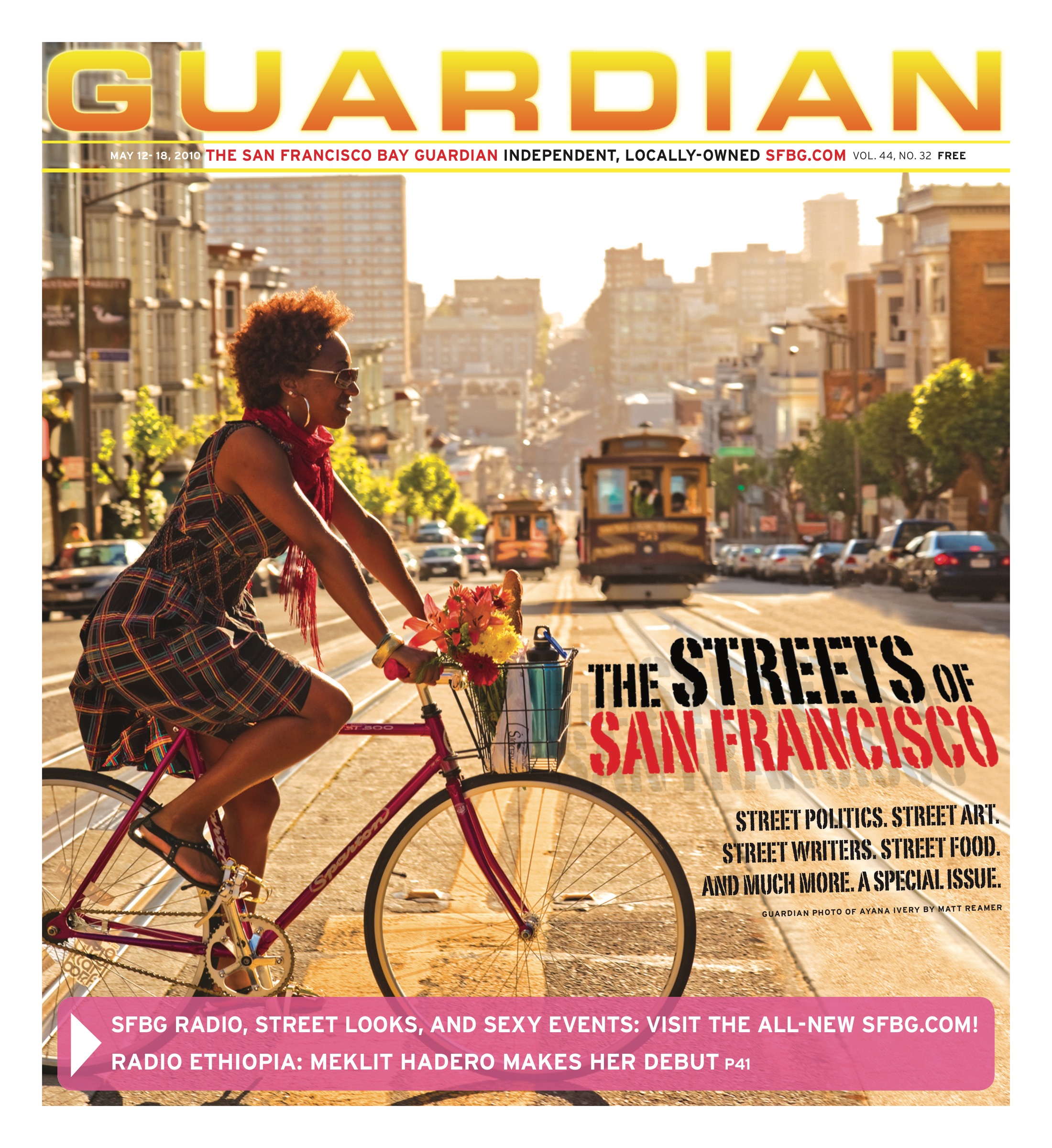
STREETS OF SAN FRANCISCO Do you have a favorite musician who plays outside in San Francisco? I’d name many, if I knew their names. There’s the kid no older than 10 who led a two-piece rock band (himself on voice-guitar) through a great show to a growing crowd at Dolores Park, then played soccer immediately after. There’s the guy at 24th Street BART who sounds like Johnny Cash. There’s the man with the white guitar by San Francisco Center, and the guy who used to sing opera by Macy’s. It’s all too easy to miss the sound of life when your ears are plugged by little headphones. With that in mind, and with Heddy Honigmann’s great 1998 documentary The Underground Orchestra as one inspiration, it seemed right to talk to some of the people who make music for those who listen. Thanks to Elise-Marie Brown, Nicole Gluckstern, D. Scot Miller and Amber Schadewald for their contributions to this piece. (Johnny Ray Huston)


Name: Antone Lee

What styles of music do you play? I play a mix of folk and modern country on my guitar. Most of my music is original.

Where are your favorite places to play? I usually like to play down here (Civic Center BART station) because of the great sound and acoustics in the hallway.

How long have you been gigging on the streets or underground? I’ve been playing on the streets since I quit my job 3 years ago. This is what I do for a living. It’s pure joy.

What do you like about it and why do you do it? I like vibing off of people as they come and go. It’s nice to play whatever I’m feeling at the moment.

What don’t you like about it? Sometimes the people walking by can be sort of distracting. I usually just close my eyes and sink into the song.

Do you have recordings or a Web site? I have a MySpace (www.myspace.com/antoneleemusic) where some of my songs are, but I have about thirty songs that I’m waiting to record.

What street musicians and other musicians do you admire? I really like Fiddle Dave. He’s got a great original bluegrass sound. I also like Federico who plays more gypsy-styled café music.(Elise-Marie Brown)

Name: Ilya Kreymer

What styles of music do you play? I play eastern European music. A lot of Klezmer, Russian and Balkan music.

Where are your favorite sites to play? My favorite places to busk are the BART stations in the Mission, and also farmers’ markets. I usually like to busk two or three times a week.

How long have you been playing on the streets or underground? For five months.

What do you like about it, and why do you do it? I like the fact that it gives me a chance to practice and I get to see how people react to the music. The acoustics in the 16th and 24th BART stations are especially good. It’s also a good way to meet other musicians.

What don’t you like about it? Obviously there’s a lot of outside noise. You never know when you might be interrupted. Sometimes I might be doing really well and no one will be there to listen, but when I mess up more people might be around.

Do you have recordings or a Web site? I’ve actually got some recordings on reverbnation (www.reverbnation.com). But I’m hoping to update it soon with more songs. I’m also working on having a band that plays Russian music, too.

What street musicians or other musicians do you admire? There’s an accordion player that plays down at Civic Center. I think during morning rush hour. He also does magic tricks and wears outfits that match his accordion. He’s a longtime busker who I really admire.

What’s been your best experience playing? I had a really good experience at the Alemany market recently. A friend of mine was working at the farmers’ market. I was busking next to her booth while she danced. People were stopping by and taking notice, so that was really nice. (Brown)


Names: The Haight Street Vagabonds: Peter, Bucky, Crisp and Jack

Where do you play? Fisherman’s Wharf, on the sidewalk next to Cold Stone Creamery.

What styles of music do you play? Gypsy music, folk, Russian Folk. We jam. That’s like asking what kind of music the Grateful Dead play.

What are your usual instruments? Broken mandolin, harmonica, pots and pans, guitar, hand drums, children’s toys, hands, feet.

Why do you play? For fun, to entertain, and to keep our spirits up. I don’t want the money — then I feel like I’m whoring myself out to capitalism. I want food, beer, weed, cigarettes, and the best thing — instruments!

When do you play? Everyday. Sometimes the members change. Sometimes people walking by will join for a few minutes, hours or days.

How many years have you been playing on the street? Crisp has been playing for a year, Bucky since he left home four years ago at age 14.

What’s your philosophy about music? The best music has never been recorded. The best music is played for family and friends, at night, around a campfire. Or when you’re alone. (Amber Schadewald)

Name: Benjamin Barnes

What styles of music do you play? I play guitar and viola, but violin projects better and I know a lot of repertory. I’ve got maybe 3 hours of Bach memorized. It’s a meditative thing. There are six sonatas and six cello suites, and I play the cello suites on viola and violin. They’re nice profound pieces and sometimes people will stop and listen. I was playing Bach’s Chaconne and this guy stopped and listened to the whole piece and tipped me afterward.

Where are your favorite places to play? The Mission BART stations. The acoustics aren’t bad — you get a little reverb like you would in a hall. The first place I played was Powell Street station. It was 1989. I put my can down and basically practiced and made 15 dollars. I packed it all up and went home and threw the money on my bed and laughed. I was working at a coffee shop and putting myself through school.

I had a string quartet (the Rilke String Quartet) and we used to play at Montgomery and Embarcadero. We called it guerrilla musicianship.

What do you like about it, and why do you do it? It’s fulfilling to play these great pieces. I’ve been working on memorizing all these pieces and finding new ways to interpret them.

I was just in NY and saw people busking in Central Park and Greenwich Village. There’s a famous violinist, Joshua Bell, who played in the NY subway for a couple hours, and no one recognized him or that he was playing on a Stradivarius. Most people walked by or gave him a dollar, and one kid played air violin. He made 26 dollars.

Do you have recordings or a Web site? I have a lot of songs and string quartet and solo viola stuff that I’ve written and played on my website (www.benjaminbarnes.com). You can download it for free. There’s a spot where you can make a donation. I’ve gotten about 26 dollars. (Laughs)

I’m playing a free show at Caffeinated Comics on May 16th. We’re going to play an acoustic show, with songs I wrote and Bowie covers, Beatles covers, Led Zep and “The Devil Went Down to Georgia.” (Huston)

Name: Anthony

Where are your favorite places to play? Montgomery Bart Station, sometimes Fisherman’s Wharf.

What styles of music do you play? Love songs.

What are your favorite songs? “All The Woman I Need” by Luther Vandross, and anything Barry White.

How many years have you been playing on the street? 10.

What are your necessary accessories? Sparkly blue nail polish, mini Bible, Newports.

How long do you play? I stay until my dick gets hard and then probably longer.

Why do you do it? To entertain people and make some money. I don’t play for my health. (Schadewald)

Name: Brass Liberation Orchestra

When was the BLO founded? 2002-ish

How many members are there? Probably about 20 at the moment. 50 or more for the life of the band.

Where are your favorite spots to play? How do you get the word out? We play for change: picket lines, street marches, demonstrations. Wherever people want to dance in the street. We mostly play at events that other people are publicizing, (but) when we do our own shows, we use email and word of mouth.

What’s been your most memorable performance? Depends on who you ask! Demos at the start of the Iraq War where the band was arrested en masse? Oakland Oscar Grant marches? Whole Foods “Hey Mackey” pro-healthcare protest?

Are there other street bands you admire? There are many street bands whose music we admire. Some bands with similar political orientation include Rude Mechanical Orchestra (NYC), Chaotic Insurrection Ensemble (Montreal), Cackalack Thunder (Greensboro, NC). We also respect the youth work of Loco Bloco in the Mission, who are currently facing a budget crisis and could use some fundraising support.

What’s your favorite song to play together? A lot of us love New Orleans Second Line, and also Balkan brass music. One song we play at almost every gig is “Roma Rama,” a simplified Balkan-style tune written for us by Axel Hererra. (Nicole Gluckstern)

Name: Federico Petrozzino

What styles of music do you play? I play mostly folk and Beatles covers.

Where are your favorite places to play? I’ve played at Mills College and Ireland’s 32. But I make my living as a street musician playing around here (Powell BART station).

How long have you been playing on the streets or underground? I’ve been out here for about 3 months since I got in to town from Argentina.

What do you like about it, and why do you do it? It’s nice when you feeling like you’re doing good and people will walk by and smile or give you a wink.

What don’t you like about it? To be honest, I love the bums. But sometimes they can be crazy, which can turn some people away. It’s a distraction, but we try to be respectful.

Do you have recordings or a Web site? I have some of my stuff at purevolume (www.purevolume.com/fefon). The next step is to play at more places in the area.

What street musicians and other musicians do you admire? Frank Lynn. He’s been down here for over 30 years and is kind of a father to all of us street musicians. He’s an amazing musician and only plays on two strings. He has such a deep voice and everyone respects him.

What’s been your best experience playing? Just watching parents teach their children to appreciate music and give money. It’s great to see them learn how to be humble and respectful of the arts. (Brown)


Name: Larry “Bucketman” Hunt

How long have you been playing music? I’ve playing drums for 49 years. My first kit was a set of buckets when I was three years old.

I’m not from here. I’m from Kansas and I’ve had the chance to play with some of the greats all across the United States — Jimmy Smith, Pearl Bailey, The Drifters. I played with John Lee Hooker when he opened up the Boom Boom Room. This is what I do.

Where are your favorite places to play? 4th and Market, Powell and Geary (with New Funk Generation).

What don’t you like about playing music on the streets or underground? Old Navy, the Flood Building, their security is chasing me off now. I’ve been out here for fourteen years, was in Pursuit Of Happyness with Will Smith, and now they’re trying to get rid of me. They call the cops. The cops don’t want to do it, but they have to. (D. Scot Miller)


Eyes of the city

0

arts@sfbg.com

STREETS OF SAN FRANCISCO Two packs of beer, five cameras, and a ridiculous amount of camera equipment are hauled up the narrow staircase and onto the Guardian’s sunny rooftop on Potrero Hill. The four members of Caliber, a talented group of Bay Area photographers, immediately strap on their cameras and secure their lenses.

Running to the edge of the roof, spinning in circles, pointing up, down, and side to side, they take snapshots. The sunset, the traffic, the sidewalk below — Caliber shows that it’s possible to find a beautiful angle in every direction.

“It’s like we’ve never taken a picture before,” says Caliber member Julie Michelle, smirking after a series of shots. A couple of minutes of later, beer lures the rest of the pack — Stuart Dixon, Travis Jensen, Troy Holden, and his visiting brother, Dylan — around the picnic table to talk about their love for street photography.

Photo by Julie Michelle

The group met through Flickr in October 2009, after admiring each other’s varied styles. They decided to collaborate in an independent fashion, putting up a Web site filled with genuine San Francisco moments only residents can experience. When they aren’t lurking with a camera in alleyways or roaming along sidewalks and through parking lots, Caliber’s male members work 9-to-5’s, while Michelle races around the city photographing for her own Web site. Caliber’s images are a sheer labor of love.

Dixon is all about using “weird gear” and putting a new spin on classic shots of the bridge, Bay landmarks, and traffic. The group describes Jensen as a legit street photographer who captures kick-flips, drug trades, and intimate portraits of wizened or withered people. Holden “defaults to high buildings,” abandoned warehouses, and construction zones. Michelle loves architectural details and stumbling upon “lonely” timeless moments.

Photo by Travis Jensen

“As a group, we’re not taking Hallmark postcard pictures. This is the San Francisco we live in. It’s not a sunset at Crissy Field or the Painted Ladies,” Michelle says.

“It’s the nitty-gritty city stuff,” Jensen clarifies.

Every day, the Caliber Web site features a minimum of four new photos, a click from each member caught in their digital nets while walking to work, riding the bus, or on a Sunday morning stroll. From intimate portraits to the beautiful cityscapes, Caliber’s photos capture the real San Francisco from the dirty ground up.

Photo by Troy Holden

“Getting the perfect shot is very mathematical. And this is me being nerdy, but it’s recognizing when every element is in its right place,” says Troy, noting that sometimes it takes a hundred snaps of a single scene to get it right.

“It’s like panning for gold, finding the nugget,” adds Michelle. “And all you need is one.”

www.calibersf.com

Street stars

3

rebeccab@sfbg.com

A few crafty, courageous souls have learned to live off of San Francisco’s streets, supporting themselves with tips from random strangers at high-traffic destinations.

Fisherman’s Wharf is such a popular spot that the Port of San Francisco has a map dividing the sidewalk turf into specified performance locations. Between Piers 39 to 41, crowds may encounter break-dancers, spray-paint artists, musicians, or balloon sculptors. Then there are strutters and statues, clad in head-to-toe silver or gold, dancing to tunes blasting out of boom boxes, or frozen still until a tip lands in their tin.

Across the city, a writer has carved out his own street niche. Lynn Gentry pecks away at his Olivetti Lettera 22 typewriter, peering through cat-eyed spectacles at the unevenly inked text. A young black poet sporting an inch or two of vertical hair, seated upon a fold-up wooden chair before a makeshift miniature desk, his gig is summed up in a hand-written sign: “Pick a subject and price then get a poem.”

Gentry isn’t the city’s only busker hocking poems off an old-fashioned typewriter, but he is a regular fixture at the famous corner of Haight and Ashbury. Rather than tailoring his work to a specific style, he spins out spontaneous, lightly punctuated poems and prose, emulating the Beats. Tourists stop often and tip generously, but the locals seem to like him too. One has dubbed him “Professor.” Another seemed excited to pick up a poem he previously ordered, about Libras.

“I chose the Haight because you’ve got a lot of different things going on right here,” Gentry explains. “The longer you sit here, the more you meet the people who live right here, and who were part of the neighborhood’s history.” When not writing, he offers tales and odd historic tidbits. He talks about the 1966 Trips Festival, acid tests, the CIA, and the Summer of Love.

A trio of skinny young women approach, dressed as if they have stepped directly out of that era, and request a poem about “Supercute.” Turns out, it’s their band name.

Gentry first encountered a busking poet when he saw Jacqueline Suskin at the Oregon Country Fair. The son of a poet, he’d written mostly song lyrics before. Now, he says, he’s making ends meet with the street gig. The toughest customer request yet? “Ode to a Menstrual Cycle,” he admits. “It’s the only one that’s taken me three tries.”

Meanwhile, back at Fisherman’s Wharf, a crowd gathers to watch the masked street performer clad in head-to-toe gold. Poised atop a gold milk crate, he shimmies forward, hips swinging, shoulders rolling, and the milk crate shimmies too. He turns a 360-degree spin, and the milk crate spins too. He pauses for a photo with two wide-eyed blond children. Vacationers pause to snap pictures and tip. They might never guess that the man behind the mask is 51 years old.

At Fisherman’s Wharf, everybody sitting on the benches nearby seems to know Shaba, a spry black man who introduces himself as Shabadaba the Gold Man. He wears a gold top hat and an enormous gold clock around his neck. He does his street strutting right across the way from the Bubba Gump Shrimp Co., and says he’s been entertaining at Fisherman’s Wharf since 1977.

“I even beat the Bush Man out here,” he says. (The Bush Man may have the most bizarre self-made gig of all. He conceals himself behind a cluster of bush-like boughs, and then shakes them around, hollering, to scare unsuspecting passersby. It works every time.)

Shaba wasn’t always gold. He used to be silver, but too many others followed suit, so he switched colors. There’s another Gold Man, too, who rolls his tip can up and down his arms, and a few silver performers. One, who calls himself Silver Man, paints his entire head silver — except for an off-center star, which traces across his eyes and down his cheeks — and dances to Michael Jackson tunes wearing star-print pants, a red shirt with wings painted down the back, and one white glove.

“I’m kinda like Father Time out here,” Shaba says. He notes that things have changed over time, and that some performers are now paying the city for permits to be guaranteed a slot, though it isn’t mandated. He springs up suddenly, mumbling something about being unable to sit still.

Back at Haight and Ashbury, Gentry plucks a poem from the typewriter, proofreads it carefully, and hands it over. Here’s an excerpt: “San Francisco keeps trying as I hear the accents of the old neighborhoods that left them behind years ago to start a new life as writers still praise them from afar and the locals hold dying history confused to where they are….”

Democratizing the streets

steve@sbg.com

It’s hard to keep up with all the changes occurring on the streets of San Francisco, where an evolving view of who and what roadways are for cuts across ideological lines. The car is no longer king, dethroned by buses, bikes, pedestrians, and a movement to reclaim the streets as essential public spaces.

Sure, there are still divisive battles now underway over street space and funding, many centered around the San Francisco Municipal Transportation Agency, which has more control over the streets than any other local agency, particularly after the passage of Proposition A in 2007 placed all transportation modes under its purview.

Transit riders, environmentalists, and progressive members of the Board of Supervisors are frustrated that Mayor Gavin Newsom and his appointed SFMTA board members have raised Muni fares and slashed service rather than tapping downtown corporations, property owners, and/or car drivers for more revenue.

Board President David Chiu is leading the effort to reject the latest SFMTA budget and its 10 percent Muni service cut, and he and fellow progressive Sups. David Campos, Eric Mar, and Ross Mirkarimi have been working on SFMTA reform measures for the fall ballot, which need to be introduced by May 18.

But as nasty as those fights might get in the coming weeks, they mask a surprising amount of consensus around a new view of streets. “The mayor has made democratizing the streets one of his major initiatives,” Newsom Press Secretary Tony Winnicker told the Guardian.

And it’s true. Newsom has promoted removing cars from the streets for a few hours at a time through Sunday Streets and his “parklets” in parking spaces, for a few weeks or months at a time through Pavement to Parks, and permanently through Market Street traffic diversions and many projects in the city’s Bicycle Plan, which could finally be removed from a four-year court injunction after a hearing next month.

Even after this long ban on new bike projects, San Francisco has seen the number of regular bicycle commuters double in recent years. Bike to Work Day, this year held on May 13, has become like a civic holiday as almost every elected official pedals to work and traffic surveys from the last two years show bikes outnumbering cars on Market Street during the morning commute.

If it wasn’t for the fiscal crisis gripping this and other California cities, this could be a real kumbaya moment for the streets of San Francisco. Instead, it’s something closer to a moment of truth — when we’ll have to decide whether to put our money and political will into “democratizing the streets.”


RECONSIDERING ROADWAYS

After some early clashes between Newsom and progressives on the Board of Supervisors and in the alternative transportation community over a proposal to ban cars from a portion of John F. Kennedy Drive in Golden Gate Park — a polarizing debate that ended in compromise after almost two acrimonious years — there’s been a remarkable harmony over once-controversial changes to the streets.

In fact, the changes have come so fast and furious in the last couple of years that it’s tough to keep track of all the parking spaces turned into miniparks or extended sidewalks, replacement of once-banished benches on Market and other streets, car-free street closures and festivals, and healthy competition with other U.S. cities to offer bike-sharing or other green innovations.

So much is happening in the streets that SF Streetsblog has quickly become a popular, go-to clearinghouse for stories about and discussions of our evolving streets, a role that the San Francisco Bicycle Coalition — itself the largest grassroots group in the city, with more than 11,000 paid members — recently recognized with its Golden Wheel award.

“I think we are at a tipping point. All these little things have been percolating,” said San Francisco Planning Urban Research Association director Gabriel Metcalf, listing examples such as the creative reuse of San Francisco street space by Rebar and other groups (see “Seizing space,” 11/18/09), experiments in New York and other cities to convert traffic lanes to bicycle and pedestrian spaces, a new generation of more forward-thinking traffic engineers and planning professionals working in government, and more aggressive advocacy work by the SFBC, SPUR, and other groups.

“I think it’s all starting to coalesce,” Metcalf said. “Go to 17th and Valencia [streets] and feel what it’s like to have a sidewalk that’s wide enough to be comfortable. Or go ride in the physically separated bike lane on Market Street. Or take your kids to the playground at Hayes Green that used to be a freeway ramp.”

Politically, this is a rare area of almost universal agreement. “This is an issue where this mayor and this board have been very aligned,” Metcalf said. Winnicker, Newsom’s spokesperson, agreed: “The mayor and the board do see this issue very similarly.”

Mirkarimi, a progressive who chairs the Transportation Authority, also agreed that this new way of looking at the streets has been a bright spot in board-mayoral relations. “It is evolving and developing, and that’s a very good thing,” Mirkarimi said.

Both Winnicker and Mirkarimi separately singled out the improvements on Divisidero Street — where the median and sidewalks have been planted with trees and vegetation and some street parking spaces have been turned into designated bicycle parking and outdoor seating — as an example of the new approach.

“It really is a microcosm of an evolving consciousness,” Mirkarimi said of the strip.

Sunday Streets, a series of events when the streets are closed to cars and blossom with life, is an initiative proposed by SFBC and Livable City that has been championed by Newsom and supported by the board as it overcame initial opposition from the business community and some car drivers.

“There is a growing synergy toward connecting the movements that deal with repurposing space that has been used primarily for automobiles,” Sunday Streets coordinator Susan King told us.

Newsom has cast the greening initiatives as simply common sense uses of space and low-cost ways of improving the city. “A lot of what the mayor and the board have disagreements on, some of that is ideological,” Winnicker said. “But streets, parks, medians, and green spaces, they are not ideological.”

Maybe not, but where the rubber is starting to meet the road is on how to fund this shift, particularly when it comes to transit services that aren’t cheap — and to Newsom’s seemingly ideological aversion to new taxes or charges on motorists.

“We’re completely aligned when it comes to the Bike Plan and testing different things as far as our streets, but that all changes with the MTA budget,” said board President David Chiu, who is leading the charge to reject the budget because of its deep Muni service cuts. “Progressives are focused on the plight of everyday people who can’t afford to drive and park a car and have to rely on Muni. So it’s a question of on whose back will you balance the MTA budget.”


WHOSE STREETS?

The MTA governs San Francisco’s streets, from deciding how their space is allocated to who pays for their upkeep. The agency runs Muni, sets and administers parking policies, regulates taxis, approves bicycle-related improvements, and tries to protect pedestrians.

So when the mayoral-appointed MTA Board of Directors last month approved a budget that cuts Muni service by 10 percent without sharing the pain with motorists or pursuing significant new revenue sources — in defiance of pleas by the public and progressive supervisors over the last 18 months — it triggered a real street fight.

The Budget and Finance Committee will begin taking up the MTA budget May 12. And progressive supervisors, frustrated at having to replay this fight for a second year in a row, are pursuing a variety of MTA reforms for the November ballot, which must be submitted by May 18.

“We’re going to have a very serious discussion about MTA reform,” Chiu said, adding, “I expect there to be a very robust discussion about the MTA and balancing that budget on the backs of transit riders.”

Among the reforms being discussed are shared appointments between the mayor and board, greater ability for the board to reject individual initiatives rather than just the whole budget, changes to Muni work rules and compensation, and revenue measures like a local surcharge on vehicle license fees or a downtown transit assessment district.

Last week Chiu met with Newsom on the MTA budget issue and didn’t come away hopeful that there will be a collaborative solution such as last year’s compromise. But Chiu said he and other supervisors were committed to holding the line on Muni service cuts.

“I think the MTA needs to get more creative. We have to make sure the MTA isn’t being used as an ATM with these work orders,” Chiu said, referring to the $65 million the MTA pays to the Police Department and other agencies every year, a figure that steeply increased after 2007. “My hope is that the MTA board does the right thing and rolls back some of these service reductions.”

Transit riders have been universal in condemning the MTA budget. “The budget is irresponsible and dishonest,” said San Francisco Transit Riders Union project director Dave Snyder. “It reveals the hypocrisy in the mayor’s stated environmental commitments. This action will cut public transit permanently and that’s irresponsible.”

But the Mayor’s Office blames declining state funding and says the MTA had no choice. “It’s an economic reality. None of us want service reductions, but show us the money,” Winnicker said.

That’s precisely what the progressive supervisors are trying to do by exploring several revenue measures for the November ballot. But they say Newsom’s lack of leadership on the issue has made that difficult, particularly given the two-third vote requirement.

“There’s been a real failure of leadership by Gavin Newsom,” Mirkarimi said.

Newsom addressed the issue in December as he, Mirkarimi, and other city officials and bicycle advocates helped create the city’s first green “bike box” and honor the partial lifting of the bike injunction, sounding a message of unity on the issue.

“I can say this is the best relationship we’ve had for years with the advocacy community, with the Bicycle Coalition. We’ve begun to strike a nice balance where this is not about cars versus bikes. This is about cars and bikes and pedestrians cohabitating in a different mindset,” Newsom said.

Yet afterward, during an impromptu press conference, Newsom spoke with disdain about those who argued that improving the streets and maintaining Muni service during hard economic times requires money, and Newsom has been the biggest impediment to finding new revenue sources.

“Everyone is just so aggressive on trying to raise revenue. We’ve been increasing the cost of going on Muni the last few years. I think people need to consider that,” Newsom said. “We’ve increased the cost of parking tickets, increased the cost of using a parking meter, and we’ve raised the fares. It’s important to remind people of that. The first answer to every question shouldn’t be, OK, we’re going to tax people more or increase their costs.

“You have to be careful about that,” he continued. “So my answer to your question is two-fold. We’re going to look at revenue, but not necessarily tax increases. We’re going to look at revenue, but not necessarily fine increases. We’re going to look at revenue, but not necessarily parking meter increases. We’re going to look at new strategies.”

Yet that was six months ago, and with the exception of grudgingly agreeing to allow a small pilot program in a few commercial corridors to eliminate free parking in metered spots on Sunday, Newsom still hasn’t proposed any new revenue options.

“The voters aren’t receptive to new taxes now,” Winnicker said last week. Mirkarimi doesn’t necessarily agree, citing polling data showing that voters in San Francisco may be open to the VLF surcharge, if we can muster the same kind of political will we’re applying to other street questions.

“It polls well, even in a climate when taxation scares people,” Mirkarimi said.


BIKING IS BACK

It was almost four years ago that a judge stuck down the San Francisco Bicycle Plan, ruling that it should have been subjected to a full-blown environmental impact report (EIR) and ordering an injunction against any projects in the plan.

That EIR was completed and certified by the city last year, but the same anti-bike duo who originally sued to stop the plan again challenged it as inadequate. The case will finally be heard June 22, with a ruling on lifting the injunction expected within a month.

“The San Francisco Bicycle Plan project eliminates 56 traffic lanes and more than 2,000 parking spaces on city streets,” attorney Mary Miles wrote in her April 23 brief challenging the plan. “According to City’s EIR, the project will cause ‘significant unavoidable impacts’ on traffic, transit, and loading; degrade level of service to unacceptable levels at many major intersections; and cause delays of more than six minutes per street segment to many bus lines. The EIR admits that the “near-term” parts of the project alone will have 89 significant impacts of traffic, transit, and loading but fails to mitigate or offer feasible alternatives to each of these impacts.”

Yet for all that, elected officials in San Francisco are nearly unanimous in their support for the plan, signaling how far San Francisco has come in viewing the streets as more than just conduits for cars.

City officials deny that the bike plan is legally inadequate and they may quibble with a few of the details Miles cites, but they basically agree with her main point. The plan will take away parking spaces and it will slow traffic in some areas. But they also say those are acceptable trade-offs for facilitating safe urban bicycling.

The city’s main overriding consideration is that we must do more to get people out of their cars, for reasons ranging from traffic congestion to global warming. City Attorney’s Office spokesperson Matt Dorsey said that it’s absurd that the state’s main environmental law has been used to hinder progress toward the most environmentally beneficial and efficient transportation option.

“We have to stop solving for cars, and that’s an objective shared by the Board of Supervisors, and other cities, and the mayor as well,” Dorsey said.

Even anti-bike activist Rob Anderson, who brought the lawsuit challenging the bike plan, admits the City Hall has united around this plan to facilitate bicycling even if it means taking space from automobiles, although he believes that it’s a misguided effort.

“It’s a leap of faith they’re making here that this will be good for the city,” Anderson told us. “This is a complicated legal argument, and I don’t think the city has made the case.”

A judge will decide that question following the June 22 hearing. But whatever way that legal case is decided, it’s clear that San Francisco has already changed its view of its streets and other once-marginalized transportation choices like the bicycle.

Even the local business community has benefited from this new sensibility, with bicycle shops thriving around San Francisco and local bike messenger bag companies Timbuk2 and Rickshaw Bags experiencing rapid growth thanks to a doubling of the number of regular bicyclists in recent years.

“That’s who we’re aiming at, people who bike every day and make bikes a central part of their lives,” said Mike Waffenfels, CEO of Timbuk2, which in February moved into a larger location to handle it’s growth. “It’s about a lifestyle.”

For urban planners and advocates, it’s about making the streets of San Francisco work for everyone. As Metcalf said, “People need to be able to get where they’re going without a car.”


Vandalism Manifesto

1

Editor’s note: An earlier edition of this manifesto was scrawled onto the walls of an abandoned underground Muni tunnel somewhere in the Sunset District.

STREETS ISSUE The magic of the word — VANDALISM — is terribly offensive. Vandalism offends all the right people and launches an offensive against all the wrong people. Wait, vandalism converts our doublemoralspeak to honesty. Vandalism affirms a number of precarious values: freedom, justice, the art of unmediated living, etc.

Vandalism is not just a word. It’s a gaseous engine powering subversion, all saturated in viscous honey. A lifestyle set on boundless hope. A toy monkey you can buy on Haight Street. A self-imagined adventure ride in your Disneyland theme city of choice. A movement determined to strategically undermine deceptive imagery in favor of immediate experience — the sort of primitive amoebic goo that inspires the gorgeous muck of truthfulness. Vandalism lives in dirt and filth — the only organic material left unadulterated.

Vandalism has a healthy diet: iIt devours the monopoly on spectacle and excretes into the vast wastelands of intergalactic oil spills. Vandalism likes thrills: It’s a hyperdérive on the brink of the familiar, gathering as much intensity as possible before fluxing the rules of the game into a vortex of momentous vision. Vandalism wants to hold your hand. Vandalism is so charged that you might already feel an electric rage surging forth while reading this. If you don’t, you will. Does it burn and singe and bend and twist into the antennae of your fingertips? Channel that rage into acts of vandalism.

Vandalism is an awfully new phenomenon. It takes up arms all over the world: in big cities like New York and London, and in not-so-famous towns like Bakersfield and Danville. Well, maybe not Danville. Just wait, Danville.

Vandalism is an awfully old phenomenon. You can see nature desecrated, I mean subliminally mysticized, in the caves of Lascaux. Since we no longer live in pure nature but in concrete labyrinths built on top of iron cage islands, we must bring the caves of Lascaux and beaches of Eden and tornados of Jupiter to bear on today’s jungle city. We must subliminally mysticize the streets. Cue air horn.

Vandalism is so important that there are white wall guardians who repress it with nervous glances and waving arms. Byzantine policies regulate it. Laws have been established to punish transgressors. Yet vandalism doesn’t go away. Too many dreams fuel it. Too many imaginations keep it vital. Word on the street is that Werner Herzog is making a movie about it.

Vandalism doesn’t insist on art. It doesn’t get involved in arguments about whether something is or isn’t art. That conversation is terribly boring. Have you been to a modern museum lately? Didn’t you get the joke? OK, I admit, that conversation is irresistible. Here’s a clarification: Vandalism is an art form even if the graffiti itself is not artistic — a shrouded word meaning ultimately, technically savvy, or educated and properly executed. To this, I summon the ghost of a severe-faced vandal, Norman Mailer: Art is not peace but war! And war ain’t always pretty, or concerned with legality, soljah.

Vandalism would prefer to mark its ephemeral existence on the city skin, gushing down the fermented joys of unsanctioned life, mummifying itself in the cold caverns of a culture mausoleum. It would prefer to make you smile and laugh and wonder mercilessly to what happens in galleries: first confusion, then self-consciousness, and finally, the lingering pain of feeling slightly cheated. (Confession: I kinda stole that from Banksy. VANDALIZED!) No, vandalism doesn’t demand legitimacy in order to die in a sea of sterilized artifacts — all rotten fish skins and busted gall bladders in excessive frames. Museums sanctify the past. Vandalism prophesies the present.

History lesson: Street kids baptized vandalism in the slums, reconfiguring our country’s criminal policies of benign neglect into an acrobatic dance. They spun windmills into the future and set their gaze on the heavens. Among buildings reduced to rubble — a bombed out third world — they flipped the script and defined vandalism as bombing. The kids crucified monotony and sacrificed the crushing industrial rhythm of authority. They called themselves writers and painted their neon-tinted altar egos onto the shining armor of the behemoth subway trains and all over the walls. The names projected a faith in identity among the noise of polluted prayers.

Writers became pseudonymous in an abysmal well of city hustlers trying to make a legacy for themselves — billboard important and newsworthy. Writers preferred this life, fleeting and necessary and beautiful in the quixotic eternity of the now. The indifferent had no choice but to reckon with the writers.

Over 40 years strong, the writers still scour the marrow of their bones to re-enchant the lifeblood of the city. They craft enigmas out of the geometric lines and curves of the alphabet, making ferocious animals out of huge letters, feral and gunning in the jungle. The animals promulgate like bacteria, spawning writers-turned-shamans who cast spells of cryptic iconography wherever they go. Mummies, giraffes, and spaceships populate the jungle. An aura of prophecy emerges in the streets.

Writers wage war against the ubiquitous icons of worship mounted across the empire: those branded images manufacturing a spectacle of insurmountable desire and Sisyphean frustration. The marketers might have the money to buy permission to assault your eyes and make you feel bad about yourself; writers have the courage to forgo bureaucratic approval, stake claim on what rightfully belongs to all of us and conjure up a moveable feast. We believe in innocent pleasures, impulsive and vibrant, in order to dismantle the tyranny of monotony! More air horn, please.

Vandalism is degenerate. It’s not here to promote cleanliness and genteel manners of etiquette. Vandalism will replace honorifics with its own stamp of affirmation: Vandal Basquiat, Vandal Futura 2000, Vandal Taki 183, Vandal Debord, Haring, Burrows and Proudhon. But more than any of that, all the lower-case vandals on Muni set to burn their names on your retina.

Vandalism doesn’t care about rights to property. Vandalism stands by this ancient principle: property is theft. Vandalism doesn’t care about copyright. Copyright smacks of self-indulgence and greed. Quote me on that. Vandalism is universal and limitless, unwieldy and unbalanced, completely unhinged and frighteningly beautiful. It’s dangerous but welcoming. Come on. Give vandalism a try. Vandalism is the new gentrification; everyone’s doing it. It’s pushing emptiness and dullness out of the city and raising the quality of life to unpredictable heights of magnanimity. Your neutral walls do violence to our integrity. Whatcha got against color?

How does one live well and good? By doing vandalism. How does one become anonymously famous? By doing vandalism. With a flick of the wrists and a swagger of the step. Til’ one can’t stop and certainly won’t stop. It’s a terrible habit, an awfully time-consuming obsession. How can one get rid of everything grotesque and in bad taste? Vandalism. How do we reassert ourselves in the midst of corporate homogeny and increasing pressure to normalize? Vandalism. By what means do we establish our will to communicate freely and openly in the public sphere? Vandalism.

Vandalism cannot be bought or sold in your local Walgreens (maybe in Giant Robot, though). No no, vandalism is a nebulous thing, an utterly cosmic thing, dirty and scurrilous and always operating in the shadows, always slipping away from sterilization and appropriation like a rat with rabies on the run. What a charming nuisance. What a credible way to live! Street credible. The streets is a mother, and good ol’ vanguard vandalism — the first lesson.

Vandalism once brought down the Roman empire. We have yet to rebuild the world in its depths. (Wooley Van Dahl)

Time travel

0

arts@sfbg.com

LIT Sometimes when I’m bored walking around Union Square, I wonder how many of the well-heeled white guys heading toward the Financial District are really criminal types who should be followed. Say, maybe some higher-up at Wells Fargo or Citigroup who helped rip off thousands through subprime loans before getting a nice slice of that sweet Wall Street bailout money.

When I’m feeling that way, I’m under the influence of a seminal 20th century writer who spent his most productive years in San Francisco. Here’s a passage that sends me there:

She walked on down Post Street to Kearny, stopping, stopping every now and then to look — or to pretend to look — in store windows; while I ambled along sometimes beside her, sometimes, almost by her side, and sometimes in front.

She was trying to check the people around her, trying to determine whether she was being followed or not. But here, in the busy part of town, that gave me no cause for worry. On a less crowded street it might have been different, though not necessarily so.

There are four rules for shadowing: Keep behind your subject as much as possible; never try to hide from him; act in a natural manner no matter what happens; and never meet his eye. Obey them, and, except in unusual circumstances, shadowing is the easiest thing that a sleuth has to do.

The narrator so hep to the ways of the tail is Dashiell Hammett’s “Continental Op,” an operative for the fictional Continental Detective Agency, whose adventures in print include some of Hammett’s finest San Francisco tales.

Don Herron’s walking tour of landmarks associated with Hammett’s time in San Francisco is well worth making for anyone curious about the history of the author of The Maltese Falcon and The Thin Man, who helped create hardboiled crime fiction and was one its greatest practitioners. At three to four hours of often hilly trekking, it’s a bit of a commitment, but at $10, it’s an affordable way to engage in the next best thing to time travel.

Herron, author of books about pulp actioneer Robert Howard and noir craftsman Charles Willeford, has been informally conducting the tour for three decades. It started in 1977 as part of a “free college” known as Communiversity. The Dashiell Hammett Tour: Thirtieth Anniversary Guidebook (2009), which updates earlier versions, is a nifty package that belongs on the shelf of any self-respecting San Francisco denizen with a passion for our city’s often twisted past. It’s a lively combination of biographical material about Hammett, assorted related trivia that never seems trivial, and Herron’s memories from 30 years of accompanying a broad spectrum of writers, fans, and eccentrics through the former stomping grounds of Hammett and his fictional creations.

The tour starts near the former site of the San Francisco Library Main Branch, now the Asian Art Museum. In an era of economic collapse papered over with massive subsidies to the same financial entities that brought us to collapse in the first place, lessons from earlier belt-tightening eras are useful. Hence it’s only appropriate to tip our fedoras to the memory of an autodidact left-winger who never finished high school but, by devoting years to reading in public libraries, got a better education than most who did. Though Hammett was making good money from writing crime fiction by the late 1920s, when he lived at 620 Eddy St. in the early 1920s, he couldn’t afford books and the library was a lifeline. The 1923 photo on page 66 of the guidebook, of what Heron calls “Hammett’s Reading Room” in the old main library branch at 200 Larkin St., is a beaut.

When Hammett and his family lived at 620 Eddy, their landlady was a bootlegger. Hammett’s wife later recalled cops rousting people in front of their window to the street. As Herron notes, today’s prohibition on hard drugs is about as effective at deterring users as the earlier one on alcohol, and equally effective at creating endless business opportunities for motivated entrepreneurs. If you’re not legally blind and are paying any attention at all, it’s likely you may see one or two such enterprising businesspeople on the streets of the Hammett tour. It’s also a safe bet they might bear a resemblance to the Continental Op’s self-description: “My face doesn’t scare children, but it’s a more or less truthful witness to a life that hasn’t been overburdened with refinement and gentility.”

The 1920s in San Francisco were wild, wide-open years full of fast living and dodgy characters. The late venerable columnist Herb Caen wrote of the period: “The Hall of Justice was dirty and reeked of evil. The City Hall, the D.A., and the cops ran the town as though they owned it, and they did … You could play roulette in the Marina, shoot craps on O’Farrell, play poker on Mason, and get rolled at 4 a.m. in a bar on Eddy.”

Hammett toiled on his used Underwood typewriter late into the night, creating characters and stories based on what he’d seen in that milieu. During World War I, he contracted both Spanish influenza and tuberculosis. When his TB got so bad that it was hazardous to the health of his wife and baby to maintain a family abode, he moved out and lived in a succession of apartments, including one up the hill from Eddy Street at 891 Post St., at the corner of Hyde. In a corner apartment on the fourth floor of that building, Hammett pounded out his first three novels. If you’re lucky, on Herron’s tour you’ll be buzzed in and get to see where Hammett typed, ate, drank, and smoked furiously — and sometimes pulled down the Murphy bed to sleep. The apartment of The Maltese Falcon‘s tough detective Sam Spade was based on the snug little dwelling.

The current occupant is Bill Arney, an architect and Hammett fan. When he showed the tour I was on around the small one-bedroom unit, I noticed a great compilation of “crime jazz,” soundtrack music from black and white crime movies and TV shows, on top of a pile of CDs. Appropriate, since Arney serves as announcer for the Noir City film festival local mover and shaker Eddie Muller puts on at the Castro Theatre every January.

Hammett left a permanent mark on San Francisco. Specifically, on the block-long street that used to be called Monroe, which runs south off Pine in the block between Powell and Stockton. From what is now called Dashiell Hammett Street, walk east on Bush and on the right, at Burritt Street, just before the Stockton tunnel overpass, ponder the plaque that reads: ON APPROXIMATELY THIS SPOT/MILES ARCHER,/PARTNER OF SAM SPADE,/WAS DONE IN BY/BRIGID O’SHAUGHNESSY.

We are lucky to be in a city that commemorates one of its most accomplished past local residents with a plaque honoring a killing that was a product of that writer’s imagination. *

MORE ON SFBG.COM: Johnny Ray Huston’s illustrated look at the Vertigo tour


360-degrees “Muralismo”

0

caitlin@sfbg.com

STREETS OF SAN FRANCISCO In the late 1960s, when the muralismo movement began gaining strength among artists and community organizers in the Mission District, or in the 1970s when pioneer female street artists Mujeres Muralistas first picked up their brushes to trick out Balmy Alley, they probably weren’t thinking about the de Young Museum and slick coffee table books.

But, to appropriate Jay-Z, street art’s got a new bitch — the fine art world. With the 2009 release of Precita Eyes’ eye-popping Street Art San Francisco: Mission Muralismo (www.missionmuralismo.com) and the corresponding year-long event series the picture book of the storied mural hood has spawned at the de Young museum, neighborhood tags and tableaus are gaining a stronger foothold in the world of high art. That is to say, the world of art that people pay big money for.

Banksy’s recent film, Exit Through the Gift Shop, and the attendant media frenzy about several tie-in works appearing around town, is the hyped-out crest of spray-can crazy that’s got San Francisco in its grip. Galleries like Project One, White Walls, and 1AM are selling works for hundreds and thousands of dollars that you once saw on the wall of your neighborhood elementary school or liquor store. High class Union Square Hotel Des Arts offers visitors the chance to sleep in well-appointed rooms designed by “street” artists Apex, Shepard Fairey, and Chor Boogie. It’s hip to be street, stay up to get down, yadda yadda.

So what’s new? After all, Jean-Michel Basquiat zoomed from asphalt to canvas, sparking a meteoric career that collectors loved to cop a piece of in the 1980s. In graffiti’s early days, New York taggers struggled to retain control of their art in the face of soaring price tags, grasping middlemen, and ad execs who recognized the power of the bubble letter to sell. Past generations of SF artists like Twist and Mars One have graduated from the streets entirely. “You need money to do bigger and better things,” White Walls curator Justin Giarla told me. “Galleries are another possible venue to find yourself in history books, museums.”

Mission Muralismo offers a seductively jumbled history. Its pages, a nonlinear whirl of street art celebrated in situ, are perfect for a disparate neighborhood art movement that includes Latin American freedom songs, urban rustic neo-folk, and unapologetic civil disobedience. Editor Annice Jacoby says it took years of “digging through people’s closets” to create.

“You have to find a container that reflects the contradictions and surprises of the street,” Jacoby told me. “This whole place [the Mission] is like a gallery, proliferating and procreating.” To encapsulate the movement’s feel, she took images of temporal art — murals tend to last no more than 12 years before they start to deteriorate — and laid them alongside thoughtful essays by artists and other key Mission figures.

It would be easy to mistake the whirl surrounding Muralismo as another round of outsider art profiteering. Easy, that is, if you didn’t know Precita Eyes’ history of sponsoring social justice-based community murals. Easy, if you forget that the de Young events don’t directly commodify in the murals depicted in the book by swallowing them whole — those murals are pretty well stuck to their walls. Easy, if you’ve never seen the diverse crowds the events draw and the enthusiasm and respect shown by all sides.

“You mention Basquiat, and what happened there is that collectors started recognizing his work and showing it. This is different — we’re not bringing in the art,” de Young director of public programs Renee Baldocchi. Her museum’s First Fridays Mission Muralismo events, part of its Friday night “Cultural Encounters” series, are more than opportunistic book tie-ins. They aim to focus on the culture of the artists themselves. Key figures in the mural movement featured in the book like Juana Alicia, the Billboard Liberation Front, and Jet Martinez (muralist and artistic director of the Clarion Alley Mural Project), come in to lecture — street artists, lecturing? — to packed crowds on what they do, why it’s important, and how you can do it too. “We’re hoping that by inviting them in to talk about their art, it makes more people aware of them in the world,” Baldocchi says.

“The [de Young] events, I see them attracting a lot of young people,” says Jaime Cortez, an artist who coordinated the Galeria de la Raza digital billboard campaign in the 1990s and AIDS awareness mural projects. “I think that’s because of the big name graffiti artists the events draw.” Perhaps these functions are less about changing the meaning of the murals they celebrate than the high art venue they’re being celebrated in.

“It’s not like they’re having a show of muralists [at the de Young],” says Martinez, who has feet in both the street and gallery art worlds. Jet spoke at the Mission Muralismo event highlighting Clarion Alley. “They’re providing a forum where we can speak about this art,” he said.

Hopefully there are some lifted conversations going on, because the color and uniqueness of the Mission’s public art is pretty dope. “You’re dealing with a monumental subject,” Jacoby acknowledges. “You have to find a container that reflects the contradictions and surprises of the street.”

Debates don’t get much weirder than ones about where art “belongs.” But what’s certain is that with all the attention — the de Young events, the Banksy histrionics — more people are seeing the writing on the wall. “Oftentimes we’re in a hurry; we don’t stop to look at the murals,” Baldocchi says. “This is providing a forum so that when we do go down into the Mission, we can look at them and think about what’s being said — especially the social justice side.” *

MISSION MURALISMO

First Fridays, 5 p.m., free

de Young Museum

50 Hagiwara Tea Garden Dr., SF.

(415) 750-3600

www.famsf.org/deyoung