Stage

SFAI’s Gutai exhibit opens with a dirty good time

0

The crowd cheers as a man decked out in stars and stripes makes his way through a packed staircase. He pauses at the landing and raises his arms over head in a salute of glory to the whooping and clapping masses below him.

“San Francisco, we give you the death match of the century,” a voice booms from speakers.

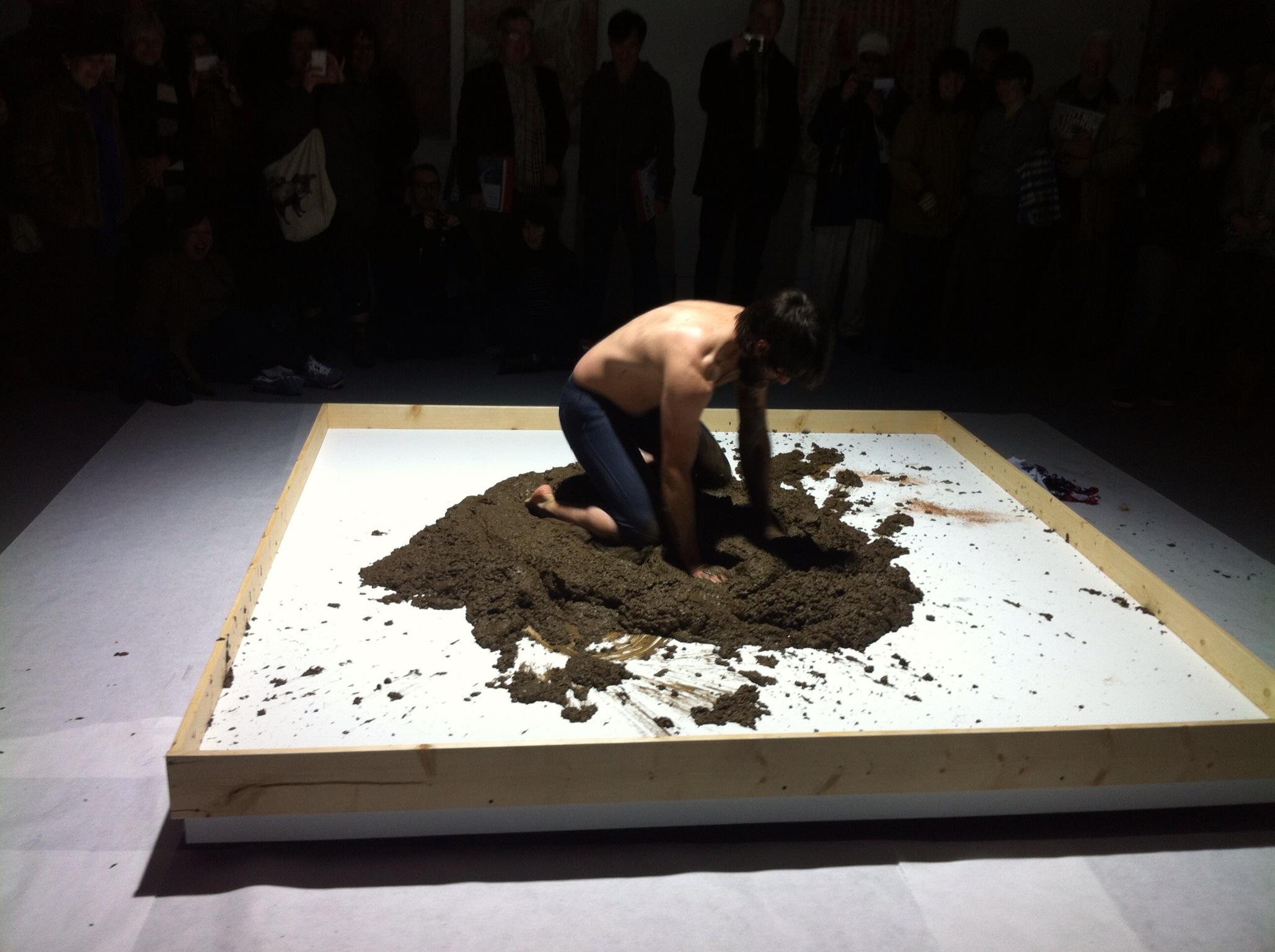
The costumed figure presses through to the opening in the center of the room and circles the white platform where his foe awaits. He slaps the hands of a few children sitting in front before disrobing until he wears only blue knee-length tights and a bushy brown beard. He enters the square and stands above his opponent.

The announcer continues: “Mud versus the man himself, Jeremiah Jenkins.” The man dives into a brown mass that resembles a giant pile of feces.

This was the scene at the San Francisco Institute of Art last Friday, where the Gutai Historical Survey and Contemporary Response exhibition opened with a bang — or rather with the revving of the dirt bike that Guy Overfelt blasted through four paper screens later in the evening. The event, which included the two theatrical pieces by local artists Jenkins and Overfelt, brought the Japanese avant-garde movement to life by recreating the sense of revelation upon which Gutai formed in 1954.
Jiro Yoshihara, the founder of the post-war movement, challenged his followers to “do something no one’s ever done before.” For the members in the Gutai Art Association, originality emerged in the form of a dress comprised of electric lights, earth-toned compositions created by scraping fingernails across the surface of paint, and large-scale records of feet spreading thick paint around canvas. Gutai means “concrete,” or “embodiment,” and the artists physically (and sometimes literally) threw themselves into their work. A range of the resulting pieces hung on walls at SFAI.

Before their temporary plastic coverings heralded flying mud, though, the paintings spoke for themselves; even without the context of their unique creative process, the works convey a sense of kinetic vitality. In one of the most compelling pieces, a 1960 oil painting by Kazuo Shiraga, Chisonsei Isshika, a red mass of paint on the right meets blue-black on the left and both spread outward over a white base in three-dimensional sweeps and splatters that testify to the physical gestures of their creation.

Though some of the works reflect the more whimsical side of the quest for novelty (the side that the performance pieces expanded on to a comic degree), Shiraga’s painting captures something coarser, more intense. The physicality of the paint seemed to manifest raw expression.

Gutai, however, is not the only artistic movement to employ a doctrine of bodily expression. Both the principles and the pieces they produced recall Action Painting of Abstract Expressionism, practiced by artists such as Jackson Pollock and Willem de Kooning. The connection has a historical basis. Though Gutai did not intersect with the New York-based movement, Gutai aligned itself with Abstract Expressionism’s European counterpart, Tachisme, after a French critic visited the Japanese school.

The American school’s rejection of Tachisme partially accounts for why Gutai has largely remained under the radar. Upstairs in the gallery, a display of Gutai books and posters of past exhibitions — taking place in Japan only — demonstrate the lack of awareness in the United States. But the exhibition also shows a shift. Shozo Shimamoto, the Gutai artist who used his bald head as a canvas, died in January, and in order to pay tribute to the man and his “mail art” associations, curator John Held, Jr. sent out a call for mail responses. The many captivating pieces of DIY art Held received show both Shimamoto’s legacy and the expanding legacy of Gutai in America. Last year, an exhibition at the Los Angeles Museum of Contemporary Art featured Gutai, and a Gutai retrospective opens this week at the Guggenheim in New York.

(SFAI’s “Experimental Exhibition of Modern Art to Challenge the Mid-Winter Burning Sun,” whose name borrows from a 1955 Gutai Art Association exhibition, is the only one to include a mud pit and a dirt bike.)

For all of the spectators who experienced the mud pit and dirt bike, who not only saw art but also witnessed Overfelt crash through the panels and Jenkins fight vigorously against a pile of mud, Gutai is more than static paint and the facts on the labels beside the pieces. It is an art of playfulness, of energy, and of innovation. Undertaking the directive to do something that’s never been done before is a greater challenge 41 years after its initial presentation, but by experimenting in the space between parody and earnestness, the exhibition succeeded.

The farcical wrestling match between man and mud yielded more than absurd and gimmicky entertainment. After the artist left through a side door (it was unclear whether in triumph or defeat), several people approached the stage and began photographing the sludge that Jenkins had moved with his body. It had scattered around the square platform, piling up in some places and spreading thinly in others. Then the gallery lights came on and the plastic came off the paintings, revealing that the mud on the stage mirrored the large all-red Shiraga with roughly textured paint behind it. All of a sudden, the mud became more of a work of art and the art became more of a physical work. Only after the comedic performance could we see that we had witnessed an act of creation. A WWE-style act of creation.

“Experimental Exhibition of Modern Art to Challenge the Mid-Winter Burning Sun: Gutai Historical Survey and Contemporary Response”

Through March 30

San Francisco Art Institute

800 Chestnut, SF

www.sfai.edu

Cosmo club: Scenes from the ‘Sex in the City’ takeover at Rebel

1

“I’ve never been to a drag show,” said my friend Cailey last week. “WHAT?!” I shouted.

She had to be kidding me. Attending a drag show belongs in the top 10 things everyone has to do when they move to SF. I got on it and found the next available performance we could get our butts to, which just happened to be the twice-weekly Heklina, Lady Bear, Trixxie Carr, and D’Arcy Drollinger show of Sex and the City.

Let me just say, it was the perfect choice for my drag queen virgin! I came prepared to dodge flying cosmos, since there was an incident a few years back where my camera bag was generously splashed with milk after an especially energetic Trannyshack competition.

But this time I was pleasantly surprised to be able to sit back comfortably, and enjoy a hilarious show with fantastic fashion (costume changes with every new scene) and just the perfect amount of bare man booty.

The show covered two actual SATC episodes, with a few extra flourishes added in for good measure. I loved Carrie’s voiceover moments, just like on the TV show, and all the sweet costume details, flashing a Chanel scarf here and a Gucci bag there. Way to keep it authentic ladies! The whole cast did a fantastic job, but I must give special props to D’Arcy Drollinger for her downright sexy performance as Samantha and of course, to Heklina as Carrie, who was truly fabulous. 

The queens plan to keep the episodes coming, switching things up every few months, so make sure to go check it out!

As we left, Cailey turned to me and said “I need to see more of that!” Let the education continue!

Sex and the City

Wed/20 and Feb. 27, 7pm and 9pm, $20

Rebel

1760 Market, SF

www.trannyshack.com

Heads Up: 7 must-see concerts this week

0

The Grammys are over – did you watch? I was busy with a very important tiki cocktail at Smuggler’s Cove at the time of the actual broadcast, but I got all the pertinent data and watched all the non-lip synced performances post-show. Another year of meh, with some ostentatious pop sprinkled throughout. I’m more excited about Future|Perfect with Holly Herndon, and live shows by Beak>, Graveyard, and EELS, all of which take place in the Bay Area this week.

Go, support oddball creative talent at its finest, and perhaps next year we’ll get the weirdos on the main stage.

Here are your must-see Bay Area concerts this week/end:

Beak>
Beak> is at one once unsettling and charming; its Krautrock backbone and angular guitars create eerie, paranoid grooves, à la Silver Apples — you know the itchy, building beats — but those mumbly vocals soothe the senses. Drummer-singer Geoff Barrow, keys-guitarist Matt Williams, and bassist Billy Fuller, are all members of other bands (including Barrow’s Portishead), so they split their time between acts, but have already released two albums in the few short years they’ve been able to get together, including critically-lauded 2012 full-length, >>.
With Vex Ruffin, Peanut Butter Wolf
Wed/13, 8pm, $20
Independent
628 Divisadero, SF
www.theindependentsf.com
http://www.youtube.com/watch?v=KTeRpmBVPPo

Stone Foxes
“Launching into experimentation from strong roots in blues, the Stone Foxes plays a range from the catchy interpretation of Edgar Allen Poe’s gothic, “The Tell-Tale Heart,” (“Everybody Knows”) to the elegy in minor, “Battles, Blades and Bones,” which repeats, “We need someone to sing/’Cause we’ve turned everything/To battles, blades, and bones.” In their third album, Little Fires (out Tue/12), collaboration with Girls’ producer Doug Boehm proves that polish doesn’t mean sterility, that good production doesn’t mean overproduction, and that good old rock’n’roll lives on.” — Laura Kerry
With Mahgeetah, Black Cobra Vipers
Wed/13, 9pm, free
New Parish
579 18th St., Oakl.
(510) 444-7474
www.thenewparish.com
http://www.youtube.com/watch?v=s9qRW-KMGXw

Holly Herndon
There will be plenty more on experimental electronics manipulator/hushed vocalist Holly Herndon in this coming issue (Feb. 13). But for now, you just need to know this: the “Movement” singer is blowing up, and this party should not be missed.
Future|Perfect with NGUZUNGUZU, DJs Marco de la Vega and Loric Sih
Thu/14, 9pm, $10-$15 (pre-sales)
Public Works
161 Erie, SF
www.publicworkssf.com
https://www.youtube.com/watch?v=kanNN4RPrgY

Graveyard
Scuzzy Swedish foursome Graveyard is playing two nights at Slim’s, in what should be an impossibly loud and raucous weekend – especially considering openers like thrashy LA punk band the Shrine and new local psych band, Golden Void. The fried-’70s-rock-meets-early-heavy-metal band, which sounds Southern, but again, is full of Swedes, returns on its third full-length, Lights Out. This is an actual quote from the Wall Street Journal, forward by Graveyard’s representation, too amusing to ignore: “Wall Street Journal says ‘[Lights Out] rips by like a boulder kicked over a cliff.’ What does that mean? Go find out.
Fri/15-Sat/16, 9pm, $20 ($33 for two-day pass)
Slim’s
333 11th St., SF
www.slimspresents.com
http://www.youtube.com/watch?v=k8jqUHYiSl0

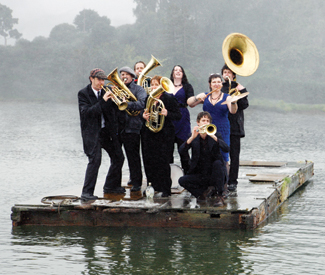
The Dirty Dozen Brass Band
Funky Louisiana jazz ensemble the Dirty Dozen Brass Band – formed way back in ’77 – has been going strong strong for 35-plus years now, and will showcase its stamina with two spirited, wailing-horn-filled shows this weekend at the Independent. Note: Fri/15’s show opens with  Toubab Krewe – which mixes “rock, Malian rhythms, surf-rock and Appalachian folk.”
Fri/15-Sat/16, 9pm, $22
Independent
628 Divisadero, SF
www.theindependentsf.com
http://www.youtube.com/watch?v=sM7TlkksKa4

EELS
When you see E live, you just want to give him a hug. The scruffy leader of long-running poetic indie rock band EELS, E has an openness and vulnerability about him that undeniably draws in listeners with softly croaked classic lyrics like, “you’re such a beautiful freak/I wish there were more just like you.” The band followed up ’96’s Beautiful Freak with deeply personal Electro-Shock Blues (a record about E’s sister’s suicide and his mom’s cancer), Souljacker, a handful of fuzzy, lovely records in between, and most recently, Wonderful, Glorious (Feb. 2013).
With Nicole Atkins
Sat/16, 9pm, $30
Fillmore
1805 Geary, SF
www.livenation.com
http://www.youtube.com/watch?v=_vS_By_ZZ0g

Johnny Render
Johnny Render is: “a longtime Hollywood-based musician and entertainer,” “[The] President of Rock and Roll,” and sounds like “the Ramones meets the Carpenters.” Most importantly, I have a bunch of cardboard coasters with his face on them, if any of you desire such a cockamamie treasure? First person to email me with the sentence “I need Johnny Render coasters,” gets ’em.
Sat/16, 9pm, $7
Hemlock
1131 Polk, SF
www.hemlocktavern.com
http://www.youtube.com/watch?v=jivECvAyRWo

Sundance 2013: what’s NEXT?

0

Earlier fest reports here, here, and here.

At Sundance 2013, no other category could compete with the NEXT programming. NEXT was initiated in 2010; its aim is to highlight “pure, bold works distinguished by an innovative, forward-thinking approach to storytelling. Digital technology paired with unfettered creativity proves the films selected in this section will inform a ‘greater’ next wave in American cinema.”

Matthew Porterfield’s I Used to Be Darker showcases Ned Oldham (brother of indie fave Will Oldham) as a father-husband-musician whose teenage daughter starts to drift away as his marriage dissolves. Wonderfully awkward and trying moments arise from every suburban-hipster angle, making Darker not only a disturbing blueprint of divorce among the indie-rock generation, but — with three fully performed songs — a reminder of why so much music from this time period remains utterly relatable. (Clearly, not everyone agrees; I overheard a group of SLC locals calling Darker their “least favorite movie of all time.”)

Yen Tan’s surprisingly powerful Pit Stop and “Best of NEXT” winner Chad Hartigan’s This is Martin Bonner both showcase quiet and emotionally implosive relationships; both also have such well-earned conclusions that I was confused as to why they weren’t in the Dramatic Competition category instead. Tan’s interwoven structure reminded me of Megan Griffiths’ overlooked gem The Off Hours (2010), while Hartigan’s slow burner was excitingly reminiscent of Paul Thomas Anderson’s Hard Eight (1998). Remember their names, because these filmmakers are about to have major breakthroughs.

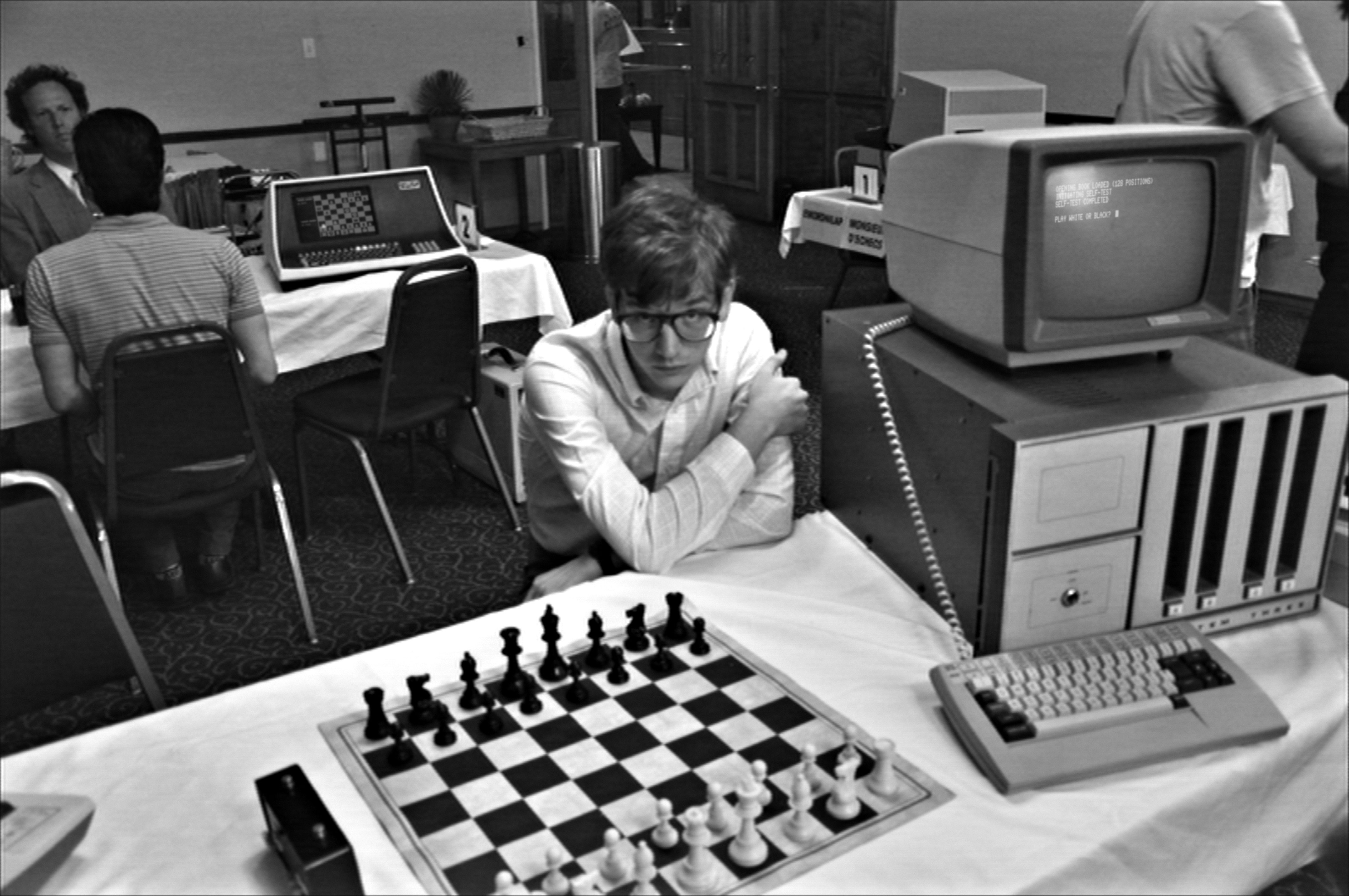
But the two NEXT entries that have already achieved “major” status in my mind already are Andrew Bujalski’s Computer Chess (USA) and Alexandre Moors’s Blue Caprice (discussed in Thu/7’s post). Oddly enough both films inspired extremely aggressive Q&As, in which an audience member attacked the film and filmmaker with the very first question.

Mumblecore master Bujalski, who studied under minimalist Chantal Akerman (1975’s Jeanne Dielman), walked up onto the stage after his mind-numbing, purposefully janky, addictively hilarious, and ultimately transcendental psychedelic mind-fuck. First question right out of the gate: “Would you explain three or four concepts from your film, so I know what I just watched?” Though some audience members groaned, Bujalski made a valiant effort to respond. (After a few moments, he asked, “Is it okay if I come back to that one?” “No!” was the angry response.)

Bujalski shot the film on old Portapak video cameras from the late 1970s he’d purchased on eBay; he meticulously edited the video to look and feel as if it had been made on a linear editing system though it was done on Final Cut Pro. By trading in his beloved 16mm cameras from his previous three films — Funny Ha Ha (2002), Mutual Appreciation (2005), and Beeswax (2008) — he has captured the look and feel of the early video era.

Computer Chess not only gets its techie vocab right, it also captures the spirit of the entire era (aging hippies and emerging New Agers mingling with proto-nerds), and does so without being mean-spirited. In fact, it was so scientifically spot-on it won the Alfred P. Sloan Prize at this year’s festival — an award given to the best feature film that focuses on science or technology as a theme, or depicts a scientist, engineer, or mathematician as a major character. Computer Chess was also my favorite feature at this year’s Sundance Film Festival. I wanted to watch the film again as soon as it was over.

Reflections on last Friday’s Oakland Art Murmur

0

I pictured writing a different sort of response to last Friday’s Oakland Art Murmur and accompanying street festival. The fatal shooting of an 18-year-old, however, taints the memory of the evening and retroactively adds a hint of menace to the crowded streets.

In OAM’s responding statement, what begins as condolence, transitions into a reaffirmation of the monthly festival’s aims: “The Oakland Art Murmur and the First Friday Street Festival are the products of communities coming together to showcase the best of what people create together.” As questions surround the future of the event — most pressingly, can it continue as before? — it is important to remember this.

The mood on the streets before the shooting was celebratory. In the stretch of street closed to traffic, random pockets of activity testified to the joyful and creative possibilities contained within a diverse crowd of thousands.

On Telegraph Avenue, I saw an eclectic group dancing in front of a DJ booth; a block later, a man banged on his bike with drumsticks to accompany a small drum circle (whose members found it as strange as the onlookers did); and a pint-sized child rapped along to music on the back of truck that had been converted into a stage. Another wonderful surprise came in the form of the best pork bun I’ve ever tasted from the food truck, The Chairman (apparently I’m behind on food truck culture). The music, food, and general merriment on the streets occupied much of my time. And it was a great time.

But before I stray too far from the event’s original purpose seven years ago, I should mention that I also saw some compelling art and visited some intriguing spaces. My favorite stop of the evening was the antithesis to the raucousness between 19th and 27th Streets, the store and gallery Umami Mart on Broadway and 8th. Started by high school friends from Cupertino, Yoko Kumano and Kayoko Akabari, the pop-up shop (and hopefully soon-to-be mainstay) exhibits art and sells kitchen-themed goods that all reflect the stark elegance of the Japanese aesthetic.

Brother-sister duo Aya and Sylvan Brackett added to the warmth of the space. Raised in Nevada City, Calif. in a traditional Japanese home, the siblings each filter elements of their background into different arts in the Bay Area — Sylvan through food and his catering business, Peko-Peko, and Aya through her photography. Umami Mart showcased samples of both arts with udon noodles meticulously prepared from scratch at a stand in the corner, and striking photos on the wall surrounding the heading, “Home is Oakland; Home is Japan.”

The familial atmosphere in a store whose every surface revealed a delightful intersection of California and Japanese culture amounted to an excellent example of “the best of people create together.” So did the food trucks, the spontaneous dancing, and the different music flooding the street every half block. After last week’s event, the future of the Oakland Art Murmur raises complicated concerns. But I hope that it will continue to allow more positive examples to arise in the future.

Celebrate Black History Month with four days of sf|noir food and drink

0

This month, you can observe Black History Month by attending a filmmaking discussion, a childrens dance class, by going to a lecture at USF — check out this and this event rundown for inspiration. And given how food-oriented we are as a region, it was only natural that eventually you’d be able to eat and drink while celebrating African American heritage, not to mention the black culinary geniuses that add to it here in the Bay. 


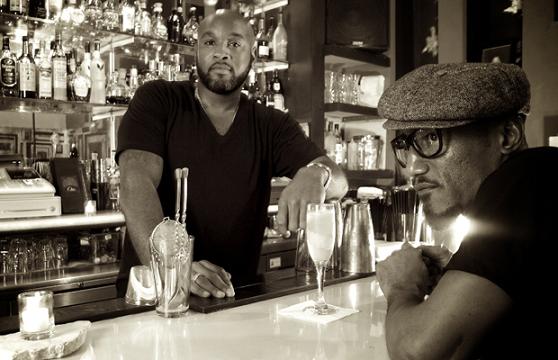
Sample wines poured by the Sterlings of Esterlina Vineyards (top) and bites made by Michele Wilson of Gussie’s Chicken & Waffles at sf|noir’s Feb. 23 gala

The organization that is sponsoring the four-day extravaganza was born one afternoon at North Beach Jazz Festival, the nine-day affair that Herve Ernest organized for eight years. He realized that the crowd in attendance was really, really white.

“There was an African American band on stage, but I could count on two hands the amount of black faces I saw,” he tells me in a phone interview. He realized that if African American culture was going to remain a presence in a city where black people were being rapidly displaced, concerted efforts would have to be made.

“That’s when the conceptual idea for what became sf|noir started happening,” Ernest continues. He started the organization, which sponsors read-ins, dance, and concerts, not only to get superlative cultural programming to black audiences, but also to “ensure the presentation of black arts and culture in San Francisco” — a city whose black population has dropped from 12 to less than three percent in the 19 years since Ernest first settled here. 

This year, his group is offering days of events that highlight some of the area’s most successful black food entrepreneurs. “It’s something that is very relevant here,” says Ernest. “It’s a foodie town, food events happen all the time. We thought it was high time to create a food and wine event that looks at African American cuisine.” 

So, belly up. Go here for more info: 

Remixology

Three mixologists — including Otis bartenders Phil Shell and Damon White — present cocktails found throughout the African diaspora. Entry is free, you have to pay for your own drinks though. 

Feb. 21, 6-9pm, free. Otis, 25 Maiden Lane, SF

Wine tasting with Omar White

After 15 years at Chez Panisse, believe that wine consultant White has some knowledge about local vinos. He’s lent his expertise to Pizzaolo and the East Bay’s Hibiscus and is here today to teach about the in’s and out’s of the wine tasting process. Register in advance for this one — participation is limited to 25 thirsty souls. 

Feb. 22, 6-9pm, $20. 18 Reasons, 3674 18th St., SF

http://www.youtube.com/watch?feature=player_embedded&v=U1eW77Pw4PQ

Wine and Food Gala

Food from nine restaurants well-versed in African American cuisine (Farmerbrown, Cedar Hill, and tomorrow’s brunch host Miss Ollie’s for starters), 20 local and international winemakers, and two dessert specialists — The Brown Sugar Lady and PieTisserie — are all serving up at this four-hour dinner party. 

Feb. 23, 7-11pm, $60. The Atrium, 101 Mission, SF

Oakland Jazz Brunch 

Hibiscus’ chef Sarah Minton has a new project in this Old Oakland corner restaurant. She’ll be offering up the place’s Carribean-toned menu for brunch today, while the Marcus Shelby Trio helps you finish the sf|noir series strong.

Feb. 24, 11am-3pm, free entrance, a la carte menu. Miss Ollie’s, 901 Washington, Oakl. 

High-rise risk

The fate of 8 Washington, a luxury high-rise project planned for San Francisco’s northern waterfront, remains uncertain after landing at the center of a political firestorm last year. Yet a whopping $42 million, invested by the California State Teachers Retirement System (CalSTRS), is currently tied up in the project.

Months from now, in the November 2013 election, San Franciscans will vote on a building height-limit variance crafted for this particular development. If the variance goes down, the luxury development – in spite of winning entitlements last June with an 8-3 vote of the Board of Supervisors – will be toast. That outcome could jeopardize CalSTRS’ $42 million contribution, and some retired teachers are beginning to ask questions.

“We have been watching with particular concern what appears to be an incredibly risky investment by CalSTRS,” four retired CalSTRS members from San Francisco wrote in a letter to the pension fund’s investment committee last October, requesting information about how project developer Pacific Waterfront Partners had made use of the funds.

Investment amount increased 

In response to the teachers’ request for information, CalSTRS indicated that the investment committee had actually increased its contribution up from $31.7 million last March, when final project approval seemed imminent.

The CalSTRS investment committee added the project to its investment portfolio in 2006 with an initial $26.7 million commitment. Prior to that, the pension fund had partnered with Pacific Waterfront Partners in a different venture to refurbish San Francisco Piers 1 ½, 3 and 5. That development was well received by the community, and since CalSTRS earned a healthy return on investment, the 8 Washington project seemed like a safe bet at the time.

But now that it’s frozen for months and faces possible reversal, pressure is mounting on the CalSTRS investment committee.

Earlier this week, a Change.org petition created to ask the CalSTRS board to reconsider its investment garnered 150 online signatures in the first 24 hours. The online petition website lists the initiator as “Lorraine Honig, Retired Teacher,” but could just as easily read No Wall on the Waterfront, the name of the opposition campaign created last year to amass signatures for a voter referendum on 8 Washington. Honig and several retired teachers initially queried the pension fund’s investment committee in league with Jon Golinger, a key driver behind No Wall on the Waterfront and chairman of the Telegraph Hill Dwellers, a neighborhood organization.

Honig, who is actually a retired social worker, explained that she used to be a member of the Golden Gateway Tennis and Swim Club, a community fitness center that would be razed to make way for 8 Washington. She’s since moved away from the neighborhood, but feels the planned 8 Washington waterfront housing complex is the wrong kind of development for San Francisco.

“The thing I object to is, it’s high end luxury housing,” she said. “There’s nothing that’s going to cost under a million. A lot of it is going to be absentee owners.” As for the CalSTRS investment, Honig said she felt worried: “I’m concerned that our money will be used to influence the voting.”

Funding used to counter signature gathering campaign

CalSTRS’ response letter also revealed that project developer Pacific Waterfront Partners had used nearly $31,000 to counter No Wall on the Waterfront’s efforts to gather enough signatures to qualify for a referendum. An expense roster showed that funds were used to cover graphic design, flyer printing, legal and compliance advice and “outreach personnel” costs.

A flurry of news reports from last July, however, indicated that some “outreach personnel” did no more than stand on the streets and physically block signature gatherers from asking passersby to sign the petition against 8 Washington. According to one account, when a signature gatherer approached project principal Simon Snellgrove to complain about this behavior, he responded: “That’s their job.”

At the end of the day, Pacific Waterfront Partners’ $31,000 expenditure to try and derail No Wall on the Waterfront’s bid for the ballot is decimal dust compared with the full investment in a building that has not been constructed, and may never be.

CalSTRS spokesperson Michael Sicilia declined to offer comment to the Guardian, instead pointing to the CalSTRS letter of response to its members. That letter stated in part: “CalSTRS is optimistic that the successful development of the underutilized space along the San Francisco waterfront will provide benefits to CalSTRS members in the form of investment income, as well as many direct benefits to the neighboring community and the city.”

So far, CalSTRS has not provided documents in response to a public records request submitted by the Guardian seeking more information about the investment. And neither CalSTRS nor Pacific Waterfront Partners has answered questions about just what would become of that significant investment if the project were ultimately killed. When we put this question Pacific Waterfront Partners spokesperson PJ Johnston, he responded: “I certainly would not speculate on what happens after the outcome of the election.”

How is the money being spent?

All of this leaves some open questions. Will that investment be washed away if voters effectively reject the project? Is the rest of the money still sitting in Pacific Waterfront Partners’ accounts, or was it eaten up by pre-construction costs? Is Snellgrove’s firm biding its time until November, when some of the funding can be tapped as a war chest to respond to No Wall on the Waterfront’s ballot referendum with an oppositional blitzkrieg?

“I don’t have a breakdown of their investment costs,” Johnston told the Guardian when posed with questions about how the funds had been used. “All pre-development phases require funding,” he added, referencing environmental impact studies, permitting, and other pre-construction hurdles that major developments must clear. “This process was drawn out over a number of years.”

Johnston also criticized the No Wall on the Waterfront campaign, saying, “A small band of corporate and really, really rich neighbors have put this on the ballot.”

And the project opponents who have deep pockets know a thing or two about investment, Golinger suggested in a letter to CalSTRS. He wrote, “The supporters of No Wall on the Waterfront who have experience with institutional investing warn that some money managers resist learning from their mistakes and, instead, double down on them, trying to prove they were right all along. The beneficiaries of the funds with which you are entrusted are sensitive to warning signs … that may be happening here.”

CalSTRS is the nation’s second largest pension fund and a source of financial support for retired educators throughout the state. About 70 percent of the money used to provide benefits is derived from investment income, and the $152.1 billion pension fund had $21.8 billion invested in real estate as of July 2, 2012. The Sacramento Bee reported earlier this week that the pension fund faces a $64 billion deficit, and would need $4.5 billion per year to become fully solvent.

Uncertain outlook

With the fate of 8 Washington now hitched to the unpredictable forces of San Francisco politics and voter sentiment, this luxury high-rise investment looks far riskier than it likely did when Pacific Waterfront Partners approached CalSTRS’ investment committee years ago.

On a broader scale, there are signs that higher-risk investments are becoming problematic for pension funds across the board. An academic study released by researchers from Yale University and Maastricht Univeristy in the Netherlands tracked public pension systems in the U.S. and elsewhere, and determined that major U.S. funds like CalSTRS are trending toward higher risk investments.

“Gradually, U.S. public funds have become the biggest risk-takers among pension funds around the globe,” the authors concluded. “A major worry is that their increased risk-taking is reckless and could lead to substantial future costs to taxpayers or public entities if their more volatile risky investments fail to meet the expected rates of return.” 

At this stage of the game, it’s too soon to say whether CalSTRS’ investment in 8 Washington will ultimately become a statistic backing up that worrisome finding. Early polling results from David Binder Research showed that voters would likely reject the height-limit increase by 56 percent. But November is still many months away.

Win Tickets: MC Zulu and Kush Arora at Dub Mission

0

Dub Mission presents a Bay Area exclusive show and Presidents Day Bash!

Back together on the Dub Mission stage for the first time in four years:

MC Zulu (Perception 2020, FreakEasy Chicago, Foreign Exchange/FEx Global) in a special Sound System set alongside Kush Arora (KAP, Surefire, RecordLabelRecords) plus DJ Sep.

Enjoy a night of dub, dubstep, roots, dancehall, bashment, dread bass, steppers, and more! Find out more here. To win a pair of tickets, email your full name to sfbgpromos@sfbg.com with “Dub Mission” in the subject by Fri/8. Winners will receive confirmation via email while supplies last.

Sunday, February 17 from 9pm to 2am @ Elbo Room, 647 Valencia, SF | $8 Adv./$11 Door 


Ten years after Powell’s U.N. speech, old hands are ready for more blood

1

By Norman Solomon

Norman Solomon is the author of “War Made Easy: How Presidents and Pundits Keep Spinning Us to Death.” He is the founding director of the Institute for Public Accuracy and co-founder of RootsAction.org.

When Secretary of State Colin Powell spoke to the U.N. Security Council on February 5, 2003, countless journalists in the United States extolled him for a masterful performance — making the case that Saddam Hussein’s Iraq had weapons of mass destruction. The fact that the speech later became notorious should not obscure how easily truth becomes irrelevant in the process of going to war.

Ten years later — with Powell’s speech a historic testament of shameless deception leading to vast carnage — we may not remember the extent of the fervent accolades. At the time, fawning praise was profuse across the USA’s mainline media spectrum, including the nation’s reputedly great newspapers.

The New York Times editorialized that Powell “was all the more convincing because he dispensed with apocalyptic invocations of a struggle of good and evil and focused on shaping a sober, factual case against Mr. Hussein’s regime.” The Washington Post was more war-crazed, headlining its editorial “Irrefutable” and declaring that after Powell’s U.N. presentation “it is hard to imagine how anyone could doubt that Iraq possesses weapons of mass destruction.”

Yet basic flaws in Powell’s U.N. speech were abundant. Slanted translations of phone intercepts rendered them sinister. Interpretations of unclear surveillance photos stretched to concoct the worst. Summaries of cherry-picked intelligence detoured around evidence that Iraq no longer had WMDs. Ballyhooed documents about an Iraqi quest for uranium were forgeries.

Assumptions about U.S. prerogatives also went largely unquestioned. In response to Powell’s warning that the U.N. Security Council would place itself “in danger of irrelevance” by failing to endorse a U.S.-led invasion of Iraq, the adulation from U.S. media embraced the notion that the United Nations could only be “relevant” by bending to Washington’s wishes. A combination of cooked intelligence and geopolitical arrogance, served up to rapturous reviews at home, set the stage for what was to come.

The invasion began six weeks after Powell’s tour de force at the United Nations. Soon, a search for Iraqi weapons of mass destruction was in full swing. None turned up. In January 2004 — 11 months after Powell’s U.N. speech — the Carnegie Endowment for International Peace released a report concluding that top officials in the Bush administration “systematically misrepresented the threat from Iraq’s WMD and ballistic missile programs.”

Left twisting in the wind was Powell’s speech to the U.N. Security Council, where he’d issued a “conservative estimate” that Iraq “has a stockpile of between 100 and 500 tons of chemical weapons agent.” The secretary of state had declared: “There can be no doubt that Saddam Hussein has biological weapons and the capability to rapidly produce more, many more.”

Nineteen months after the speech, in mid-September 2004, Powell made a terse public acknowledgment. “I think it’s unlikely that we will find any stockpiles,” he said. But no gingerly climb-down could mitigate the bloodshed that continued in Iraq.

A decade ago,  Powell played a starring role in a recurring type of political dramaturgy. Scripts vary, while similar dramas play out on a variety of scales. Behind a gauzy curtain, top officials engage in decision-making on war that gives democracy short shrift. For the public, crucial information that bears on the wisdom of warfare remains opaque or out of sight.

Among the powerful and not-so-powerful, in mass media and on Capitol Hill, the default position is still to defer to presidential momentum for war. Public candor and policy introspection remain in short supply.

The new secretary of state, John Kerry — like the one he just replaced, Hillary Clinton — voted for the Iraq war resolution in the Senate, nearly four months before Powell went to the U.N. Security Council. During the crucial lead-up months, Senator Kerry was at pains to show his avid support for an invasion. In early October 2002, appearing for an hour on MSNBC’s “Hardball” program live from The Citadel as an audience of young cadets filled the screen, Kerry said: “I’m prepared to go. I think people understand that Saddam Hussein is a danger.”

Since then, Kerry has publicly said that he would have voted for the war resolution even if he’d known that Iraq actually had no weapons of mass destruction. But on the Senate floor, Kerry prefaced his vote for war by rhetorically demanding to know why Saddam Hussein was “attempting to develop nuclear weapons when most nations don’t even try.” The senator emphasized that “according to intelligence, Iraq has chemical and biological weapons.”

Months later, when Powell trumpeted that theme at the United Nations, the landslide of testimonials included this one from a future U.S. ambassador to the U.N., Susan Rice: “I think he has proved that Iraq has these weapons and is hiding them, and I don’t think many informed people doubted that.”

Meanwhile, the Washington Post edition with the editorial headlined “Irrefutable” also included unanimous agreement from each of the opinion columns on the facing page.

Longtime Post columnist Richard Cohen attested to Powell’s unquestionable veracity with these words: “The evidence he presented to the United Nations — some of it circumstantial, some of it absolutely bone-chilling in its detail — had to prove to anyone that Iraq not only hasn’t accounted for its weapons of mass destruction but without a doubt still retains them. Only a fool — or possibly a Frenchman – could conclude otherwise.”

Inches away, another venerable pundit held forth. Powell managed to “present the world with a convincing and detailed X-ray of Iraq’s secret weapons and terrorism programs yesterday,” wrote Jim Hoagland, a Post foreign-policy specialist. He concluded: “To continue to say that the Bush administration has not made its case, you must now believe that Colin Powell lied in the most serious statement he will ever make, or was taken in by manufactured evidence. I don’t believe that. Today, neither should you.”

Fast forward to the current era. What are Richard Cohen and Jim Hoagland writing — about Iran?

On February 6, 2012, exactly nine years after proclaiming that “only a fool” could doubt Iraq had weapons of mass destruction, Cohen’s column declared flatly: “The ultimate remedy is Iranian regime change.” Four months ago, Cohen wrapped up a column by observing “there is still time for Iran to back down before President Obama’s red line — no nuclear weapon — is crossed. This is a war whose time has not yet come.” Not yet.

Hoagland — a decade after telling readers they should put their trust in Colin Powell’s “convincing and detailed X-ray of Iraq’s secret weapons” — is now making clear that his patience with Iran is wearing thin. “Until recently,” Hoagland wrote five weeks ago, “I had been relatively comfortable with Obama’s assertions that there is time to reach a peaceful resolution with Iran.” Hoagland’s column went on to say that military strikes on Iran “threaten disastrous political and economic consequences for the world,” so diplomatic efforts should try to avert the need for such strikes — before they become necessary.

So goes the dominant spectrum of opinionating and policymaking for war, from eagerness to reluctance. Propaganda lead-ups to warfare are as varied as wars themselves; and yet every style of such propaganda relies on deception, and every war is unspeakable horror.

After jumping onto ghastly bandwagons for one war after another, the nation’s media establishment is available to do it again. So is the current U.S. ambassador to the United Nations. So is the new secretary of state. They’re old hands, dripping with blood. They have not had enough.

Norman Solomon is the author of “War Made Easy: How Presidents and Pundits Keep Spinning Us to Death.” He is the founding director of the Institute for Public Accuracy and co-founder of RootsAction.org.

The shape of stage to come, part two

0

Training with foolsFURY for the stage and for life

A couple of weeks ago I wrote a round-up of some of the theatre companies in the Bay Area who offer classes and actor trainings for professionals and non-professionals alike, but since there are far more companies than I had word count with which to cover them, I could only feature a representative few, and therefore focused mainly on smaller, more underground companies specializing in one or two specific disciplines or techniques.

One company I regretted not having space for was foolsFURY, whose devotion to training their own actors has given rise to an extensive schedule of workshops open to the public since 2006. I finally caught up with associate artistic director Debórah Eliezer to get the details.

SFBG: What is foolsFURY’s main goal in offering actor trainings?

Debórah Eliezer: Our trainings offer a window into the world of ensemble-theater creation, which is very process-oriented and specific to those in the room. It’s our hope that the general public and artists alike gain skills they can take away to create their own life as a work of art, back to their own profession to influence team building.

SFBG: How closely do the classes you offer resemble the rehearsal/creation process foosFURY uses in creating its own works?

DE: All the workshops we offer are a “way in” to our signature training process. That is to say that everything we teach we use as a platform for making work. Our Vital Act two-week intensive (June 2013) remains our signature program of foundation skills and includes a compositional element to give students a taste of what it’s like to create work as we do in ensemble.

In rehearsal for a play, foolsFURY will always use the Viewpoints to massage our understanding of character relationships, location, and text, or just plain blow off some steam and get together as a group. We’ve found the Suzuki method to be the single quickest way for actors to get present and focused. It’s also a constant reminder of the theatrical potency of rigorously challenging oneself. We always incorporate vocal training and improvisational circle singing even if there is no singing in the production.

Some by-products of our training reflected in our work would be characterized as very clear body awareness. To us, theater, voice, and dance are very closely connected. By the time we bring a show to production, we’ve made deliberate choreographic choices about our bodies in time and space — what the audience sees is a distilled “best of” our process spent weeks and sometimes years in rehearsal.

SFBG: You mentioned earlier that you felt that performing arts training was “training for life” not just for art. Care to expand on that?

DE: I teach and personally follow the belief that theater training informs how I live my life and, life informs my theater training. The same principles of space, time relationships, and creative strategy are applicable and translatable for both making compelling theatrical experiences and having a rich, satisfying life.

SFBG: Care to hazard a guess as to how many students in total have taken at least one foolsFURY training/workshop?

DE: Our adult programs serve 125-200 students per year, depending on if we’re also teaching workshops outside of SF and if we’re offering a festival that year. That number includes our internship program, which serves about 10-15 young artists per year. Swivel Arts, our youth spring and summer camp program, which ran from 1998-2010, offered two-to-six weeks of camp per year and served about 150 elementary and teen kids each year. In total, over the years? This would have to be well over 2000 students!


Ride ’em

1

le.chicken.farmer@gmail.com

CHEAP EATS “It’s amazing how Ohio still exists,” said Shawn Shine out of the blue. I think it was in Salt Lake City that an old woman, on her birthday, referred to him and my brother Phenomenon as “a couple of real cowboys” — and this made their day.

Phenomenon of course is a real cowboy — as surely as I am a real chicken farmer. It’s what he does, in other words. Puts on a western shirt, a bolo tie, boots, and a hat, and he sings “Home on the Range.” Shawn Shine plays the banjo and stomps his feet or slaps his thighs. He wears flannel shirts and a trucker-style baseball cap with the letters ROY G. BIV embroidered on the back of it.

Couple a real cowboys, yipee-kai-yai-yay.

Technically, Shawn Shine is more of a trail blazer. For real. I’m pretty sure he actually gets paid to blaze trail for National Park Service, sometimes. He gets a job, then he takes a train to somewhere, sleeps out on the trail, under the stars — with his ROY G. BIV hat pulled down over his eyes, as I imagine it.

Hedgehog and I befriended the bejesus out of Shawn Shine while we were all on that cute little tour together last month. In one of his songs he sings the line: “Now I can’t hug you goodbye if you’re covered in bees.”

Every night I’d hear him sing that with his eyes closed and some other place’s light reflecting off his glasses, and I would just squiggle and squish inside with admiration and respect for my new friend, the real damn cowboy, Shawn Shine.

Come to find he wrote that line about Jean Gene the Frenchman, my other brother! Shawn Shine explained the whole thing to me and Hedgehog at Thai House 530, other night.

Like a lot of people I meet here, or even in other parts of the world, Shawn Shine is already in with my whole kooky family in Ohio — where the weird ones stay. See, between trails once (pronounced wunst), he took him a class in cob bench making — I don’t know, I guess because he wanted to make cob benches, or something — and the teacher turned out to be Jean Gene the Frenchman. Then the next thing he knows he is helping my brother tear down some old gangster’s house around the corner from my mom’s. Something historical, from the 1800s, hammered together with what Shawn Shine called “Jesus nails — you know, with four corners.”

Anyway, they were recycling what they could for my other other brother’s house around the other corner from mom’s. Some beams, some posts. But the walls of the house . . . instead of insulation and wires or even dirty money, they were filled with billions of bees. And of course Jean Gene got it into his amazing head to recycle the bees, too. (Hot damn do I love that brother!)

So, yeah, they started a sort of a shuttle service for bees — as best as I can picture it, using their bodies as busses. And every songwriter in the world wishes they were there for that, I would imagine. But only this one was, bless him: Shawn Shine, everybody.

Most of the Bay Area, to think, doesn’t even know yet how happy they are to have him here! When Phenomenon drove back to Ohio after the last show last month, he left Shawn Shine behind. In need of a room in a house, by the way, and work. For between roundups.

Meanwhile, dinner’ll be on us. At Thai House 530, as I was saying. Over and over again, since I’ve latched on to that nasty head cold going around, and duck soup is my medicine. Plus the waitressperson there had the very good sense to compliment Hedgehog’s T-shirt, not knowing Hedgehog was not only wearing her T-shirt but had dreamed it up and had it made! To sell off the stage at our shows, even though it doesn’t say Sister Exister anywhere on it.

“I love her,” Hedgehog whispered to me, when she went to put our order in. I did not feel threatened. Just sick.

Hedgehog’s grilled pork was fantastic. The duck soup cleared my head a little bit, but not enough. Perfect: I would have to go back the next day, and the next. It’s good medicine: deep, dark, and greasy with plenty of duck, cilantro, sprouts, and scallions. In a bowl shaped like a football!

Or a boat, I suppose. Would be another way of looking at it.

Eat here on your way to Lost Church this Friday:

THAI HOUSE 530

Sun-Thu noon-10:30pm; Fri-Sat noon-11pm

530 Valencia, SF

(415) 503-1500

AE/D/MC/V

Beer & wine

Something old, something new

0

arts@sfbg.com

DANCE Once a year, long-time colleagues Todd Eckert and Nol Simonse share an evening showcasing their choreography. Unfortunately, the “Shared Space Six” program, presented last weekend at Dance Mission Theater, was not as promising as one would have hoped. Most dispiriting was that the evening’s best piece, Eckert’s Disparate Affinity, dates back to 2006.

Performed by Eckert and his former colleague at Robert Moses’ Kin, Katherine Wells, Disparate is a sensitively developed exploration of how two different people can inhabit similar universes. Here, they become aware of each other, finally get together only to separate again.

With her long-limbed physique, Wells looks as fragile as a reed, but she has a fierce and versatile technique, making her one of the finest dancers in the Bay Area. She and Eckert — strong, muscular, and sturdy — complemented each other excellently. At first occupying opposite spaces on stage, they engaged in a long-distance conversation. When they finally met, touch became an essential part of their connecting. As Eckert floated away, she was left holding in her hand the space he had occupied.

Unfortunately, Simonse badly misstepped in the premiere of his disappointing Kafka Sex Party, set primarily on himself and four male dancers, with Tanya Bello and Kaitlyn Ebert acting as, perhaps, guides to a netherworld. Referencing the fate of Gregor Samsa in Kafka’s The Metamorphosis, Simonse wiggled in with a giant shell on his back. He repeatedly asserted that this was who he was, and if you wanted to touch him, that’s what you’d get. Bello and Ebert, in black accessorized with aviator sunglasses, cheerfully liberated him, and the scene shifted to a dungeon.

Bathed in murky red light, the men — in black leather dance belts — pumped, stretched, and slid onto each other’s bodies, coupling and retreating. At one point, three of them squeezed themselves into a sandwich. These anonymous encounters occurred as if on cue, as did the periodic group hops and risings from the back like the spokes of a wheel. In the work’s third section, white streamers were lowered from a fan into a maypole for the men to dance around. Was it a dream or a nightmare, or both?

One of Kafka‘s difficulties may be that Simonse took a highly evocative literary reference but didn’t work with it enough (or, at least, not clearly enough). Also, the anonymous erotic encounters he tried to suggest are difficult to translate to the stage. They were both too stilted and too bland. The uncredited musical collage of rumbling drums threatening melodic strains had the kind of complexity that the choreography sadly lacked.

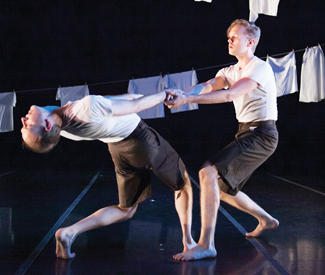
Last year, Simonse danced in a black ruffled skirt with Theatre Flamenco. He looked fabulous. So perhaps, it’s not surprising that for the premiere of I Could Never Make You Stay he donned a white facsimile. His and Eckert’s first try at co-creation yielded an unwieldy but harmless affair with some fine and a lot of meandering dancing. Each choreographer contributed a perspective on impermanence.

Eckert’s duet with handsomely trained newcomer David Schleiffers had the two men locked in a frozen head-to-head collision. It’s an image that would re-occur. They looked like boxers waiting for the referee to step in. But then some mysterious force started to turn and unglue them into luscious encounters with sensuously interlocking arms and a sense of spacious, though temporary, connection between them.

Taking a break from hanging laundry, Simonse’s well-paced solo sent him scurrying along the ground, loping across the stage, curling and shooting his limbs in all directions. Dancing on to his toes with his arms into ballet’s high fifth position, he projected his longing upward. I Could Never‘s most charming sequence, however, came with an unlikely duet for tall, sturdy and visibly pregnant Peta Barrett and a weasel-like Chad Dawson.

The white T-shirts on Simonse’s laundry line may have stood for past loves — but perhaps they were just ordinary white shirts. A quartet of women, in a feminist metaphor, wiped the floor with them, or donned them as accoutrements. The grand finale’s 16 whirling dancers cheerfully asserted as couples the work’s title, and indeed, they couldn’t make each other stay. Dressed in voluminous white wedding gowns, they looked as if they’d been plopped into creampuffs. Rigorously shaking their colorfully clad legs, they metamorphosed into circus artists.

Adam Green and Binki Shapiro pair up at the Chapel

1

Adam Green and Binki Shapiro make an odd couple.

Green is a Manhattanite and acoustic singer-songwriter whose extensive lyrical topics center around black humor, blue language, and one Miss Jessica Simpson. He is best known for his role as half of the Moldy Peaches alongside Kimya Dawson. Shapiro, formerly of Echo Park’s American-Brazilian rockers Little Joy, is a retro-fashion icon in LA. She is perhaps best known for dating rock stars.

So what happens when east meets west and the social elite meets the man who once wrote a song called “Choke on a Cock?” An unexpectedly tender album of heartbroken duets and breakup ballads in a unique style, something we jaded listeners have yet to hear. Green’s humble baritone and Shapiro’s silky timbre blend beautifully, and in the recordings their joined voices soar to poignant, vulnerable heights.

On stage at the Chapel this Saturday, duets like Green’s “Getting Led” were every bit as heart-achingly harmonious. Green’s deep voice was the perfect compliment as Shapiro’s vocals, smooth and warm, carried these quiet moments with ease. As soon as the tempo picked up, however, the pair’s vast differences became readily apparent.

Green’s onstage antics were every bit as playful as one might expect. After touting the merits of Arnold Palmer Lites, he announced his intention to name his band Binki, Adam, and the Turds. Green’s humor, as well as his ill-fitting clothes and screwball dancing, were endearing and suitable for a musician whose tongue is firmly planted in cheek, but gave Shapiro’s juxtaposed stoicism an air of aloofness.

The duo’s stone-faced backup band also didn’t help the situation. As Green danced literal circles around them, bunny hopping and flapping chicken wings, the band trudged on, seemingly disengaged. The Turds indeed.

Shapiro, who is certainly not lacking in stage presence or poise, has a quiet earnestness that should not be mistaken or misrepresented as disinterest. But for all her elegant charm (plus one adorable mid-song burp), she was simply outshined and overshadowed by Green.

If the duo can manage to find the sort of compromise and cohesion in its performance styles that it so successfully established in the studio, it will be a force to be reckoned with. Until then, I recommend buying the album and saving money on the concert tickets.

The Performant: Sexcapades, no ice

0

“SPANK!” and “Sex and the City: Live!” heat things up a little

The Regency Ballroom is awash in estrogen and vodka martinis, overrun by neatly-coifed former sorority sisters sheathed in tasteful rayon suits and drop earrings. The few men in attendance fall into two distinct camps—balding bruisers wrestled into button-down shirts, and fidgety-looking younger men who know they have just been dragged into the theatrical equivalent of a chick flick. One only hopes that a reciprocal arrangement involving the Super Bowl or some racy bedroom activity was reached earlier on, the latter being the most appropriate to the occasion — an evening of E.L. James-inspired comedy, “SPANK! The Fifty Shades parody.”

Apparently not to be confused with “50 Shades! The Musical,” nor “Fifty Shades of Grey: a XXX Adaptation,” “Spank!” bills itself as a musical review, and features just three performers as writer E.B. Janet (Amanda Barker), “smoldering” anti-hero Hugh Hanson (Drew Moerlein) and the painfully two-dimensional ingénue Tasha Woode (Michelle Vezilj).

As Soft Cell blares from the Regency’s imposing bank of speakers stage fog begins to drift across the stage and Moerlein bursts through the giant red curtains, gyrating to the music with the practiced wink-and-nudge finesse of a Chippendale. Eventually the two others join him, Vezilj dancing, and Barker drinking Chardonnay from a giant wineglass, her constant companion. Barker is our narrator and guide into the world of grey we are about to descend into.

She’s also about the best thing in the play — with a flirty dirty attitude and brazen laugh, she controls the stage far better than the supposedly dominant Moerlein, whose “dark” character is likened multiple times to that of Batman, but whose goofy antics including a pitch-perfect Gilbert and Sullivan song, instead bring the Tick to mind. He does get a moment where he strips all the way down to his Wonderoos, by far the raciest vignette in the otherwise bare-bones, vanilla-beige show, which still appears to satisfy its target oddience, who laugh at all the appropriate moments and even inject their own humor into the event during the potentially-awkward participatory bits, ring-led by Vezilj. And isn’t it the potentially-awkward participatory bits what we remember most in life? In love?

Speaking of bits, fan favorite, live action glamour-com “Sex and the City: Live!” is staging a revival down at Rebel, with all-new episodes and plenty of costume changes for all you drag-fashionistas. Dragonistas.

Starring the redoubtable Heklina as Carrie, Lady Bear as Miranda, Trixie Carr as Charlotte, and D’Arcy Drollinger as the best-known cougar since Mrs. Robinson, Samantha, the “Sex” crew promises to be as racy and raucous (if not more so) as the televised version. “Airing” on hump day Wednesdays, at both 7 and 9 p.m. each performance features two episodes, highlighting themes of promiscuity, dirty talk, romantical quandaries, and expensive shoes, a campy cocktail of fun escapism to get you through the week. And for the risk-adverse, fear not, the only participation the “Sex” ladies demand of you is laughter. Now that’s hot!

Sex and the City: Live!, open-ended run
7 p.m. and 9 p.m.
Rebel
1760 Market, SF
$20
www.trannyshack.com

Framing devices

0

VISUAL ART Several recent, notable group exhibitions have me thinking a bit more actively about the roles curators play as artists in the shows they assemble. As much as DJs or editors, curators are present in their shows as artists, sometimes demurely, sometimes not.

As curator of the “Disrupt” two-person show at Highlight Gallery, Kelly Huang has shrewdly assembled a pair of artists whose work reinforces each other. Seen together, the paper-based works of London’s Marine Hugonnier and Cairo’s Taha Belal, create a kind of duet of interrelated working styles. Both artists use silkscreen to recast newspaper and magazine pages with intricate designs and blocks of color. Hugonnier tends to work in series, appropriating several consecutive days worth of front pages from the same newspaper during the course of pivotal political events, then blocking out images with bright primary colors in a way that recalls both Ellsworth Kelly and Piet Mondrian. Belal prefers delicate tiled pattern work overlaid on full color ads, applied in a way that confuses, heightens, and twists the intended message on the page. Through Sat/2, Highlight Gallery, 17 Kearny, SF; www.highlightgallery.com.

When a gallery with considerable reach decides to mount a thematic exhibition, it can be both impressive and almost unruly, as with Fraenkel Gallery’s sprawling “The Unphotographable” show, featuring images by Alfred Stieglitz, Man Ray, Richard Misrach, Glenn Ligon, Wolfgang Tillmans, Diane Arbus, and many others. Truthfully, there’s probably too much here, but there are several gems in the gallery, lightly organized to highlight attempted photographic captures of the sublime, the disembodied, the transcendent, and the elusive. The most potent works in the show — among them Gerhard Richter’s September, an image of his 2005 painting, itself a conceptual model for abstract representation — counteract their own assertions of verisimilitude in favor of something more circumspect and self-aware. Through March 23, Fraenkel Gallery, 49 Geary, SF; www.fraenkelgallery.com.

For logistical and practical reasons, it’s fairly uncommon to hear of curators commissioning works for a gallery show, but the results can be intoxicating, as with “Remembering is Everything” at Alter Space. Bean Gilsdorf and A. Will Brown got six artists to contribute a work based on his or her own remembering of the same original video, which was destroyed after viewing. Befitting the premise, the works in the show contribute to a general field of reverberating feedback, each one in this context providing you incomplete points of view on an unknown experience.

Themes of recursion, repetition, and fugue recur, as in Stephen Slappe and Kate Nartker’s looped video works that both posit unresolved narrative chords, and Nancy Nowacek’s performance Circuit (As I Caught), in which mysterious packages filled with objects recalled from the video appear at the gallery each day of the exhibition. The effect is like an enacted Haruki Murakami dream sequence, and you’re immediately drawn into the activity of fabricating and assembling the show’s affects and objects into a kind of tenuous, vague, and poignant gestalt. Through Feb. 23, Alter Space, 1158 Howard, SF; www.alterspace.co.

Sometimes, the curatorial conceit is basically an excuse, as with “While We Were Away” at 941 Geary, which the press release says is “composed entirely of artists [curator Tova] Lobatz has become aware of while traveling.” Despite the throwaway premise, some of the work — especially by Sten Lex — is impressive. Sten Lex, the Italian stencil duo, makes arresting op-art flavored stencil portraits usually on grand scale on the sides of buildings; here on panels. What differs from the street-art norm in their work, aside from the precise Ben-Day rendering, is the not-really-offhand way they leave the painted stencil affixed to the substrate to let it peel or erode over time, a swerve that makes the painting’s correlation to the original photo more precise as it ages. Their four untitled works in the gallery demonstrate various points in that progression. Through March 2, 941 Geary, SF; www.941geary.com.

LOOKING AHEAD:

For “Silence,” curators Toby Kamps (Menil Collection) and Steve Seid (BAM/PFA) dig deep to assemble almost everybody you can think of — Beuys, Duchamp, Klein, Magritte, Warhol, Broodthaers, Manders, Marclay, Roden, Salcedo, others — to address the representation of silence using John Cage’s 4’33” as a point of departure. Jan. 30-April 28, UC Berkeley Art Museum/Pacific Film Archive, 2575 Bancroft, Berk; bampfa.berkeley.edu.

A new series of muralist group shows launches with work by Apex, Casey Gray, René Garcia Jr., and others. Erotic, anaglyphic 3D glitter wallpaper? Sign me up. Feb. 7-July 1, Project One, 251 Rhode Island, SF; www.p1sf.com.

Kehinde Wiley’s flashy, uber-hip portraits have made him the international go-to darling of both the upmarket and Juxtapoz crowds. Expect high craftsmanship and an eye for drama. “The World Stage: Israel,” Feb. 14-May 27, Jewish Contemporary Museum, 736 Mission, SF; www.thecjm.org.

The word “visionary” is perhaps overused in the world of architecture, but the jarring, psychologically charged work of Lebbeus Woods warrants the use. The recently deceased architect’s work will be represented by 175 drawings, renderings, and models in this career survey. Feb.16-June 2, San Francisco Museum of Modern Art, 151 Third St., SF; www.sfmoma.org.

Festival of festivals

2

arts@sfbg.com

THEATER The chill air had no snow in it. Instead, a particularly nasty outbreak of influenza whipped through the city, leaving a fine coating of mucus on the ground. Still, New York City looked beautiful as the various performing arts festivals that cluster around the annual meeting of APAP (the Association of Performing Arts Presenters) all revved up for a fat two weeks of shows this January.

These festivals, pitched to out-of-town-presenters and general audiences alike, include Under the Radar (an international but New York– and American-heavy program at the Public Theater), PS122’s Coil festival (specializing in theater but including some contemporary dance and performance), American Realness (a concentrated dose of leading contemporary dance/performance on the Lower East Side), Other Forces (a program of new independent theater presented by Incubator Arts Project, itself originally a program of Richard Foreman’s Ontological-Hysteric Theater), and the brand new Prototype festival (whose niche is new, chamber-sized opera-theater).

Under the Radar is the daddy of them all. Founded by longtime new-work maven Mark Russell (formerly of PS122) and now in its ninth year, Under the Radar has become more concentrated of late, partly in reaction to the other specialized festivals that have cropped up alongside it.

Festival director Russell described the trajectory in a recent phone conversation. “It’s a very interesting time, because by the ninth year you’re a fact on the landscape. People are beginning to take you for granted,” he said with a laugh. “Yes, there are a lot of other festivals now; it’s sort of become festival central in these two weeks in January, which is a little crazy, and I don’t recommend it. But it has created its own scene, in a way. I think that’s great. We started out trying to be big and trying to encircle a lot of the work that was going on downtown and around the world. Now, I’ve actually shrunk the festival to be more surgical and specific. Two years ago we were doing 21 things, and this year we’re doing 12, which feels more comfortable and better. We’re trying to go deeper in each of these performances and support them better, and let other people curate their way with the other festivals as well.”

UTR’s program this year included premieres by some leading American new-work companies, including Philadelphia-based Pig Iron (whose Chekhov Lizardbrain came to San Francisco as part of the 2011 FURY Factory Theater Festival). Pig Iron’s Zero Cost House is a simply but shrewdly staged, intriguingly unexpected collaboration with Japanese novelist-playwright Toshiki Okada (founder of theater company Chelfitsch). It unfolds an autobiographical dialogue between the younger and the present-day Okada over Thoreau’s Walden across a shifting set of actors and related characters (including a downbeat and down-at-the-heel Thoreau). Its po-faced humor belies an ultimately serious exploration of enduring ideas about our relation to society, political commitment, and art’s function amid the insanity of a status quo represented by the overwhelming indifference to the Fukushima nuclear disaster. This was a stimulating call to thought and imagination as nothing less than action toward survival.

Questions about art’s social role and power, as well as the lines joining the mundane to the great political and narrative arcs of the age, ran through much more work besides. One of the fresher, quietly unsettling surprises in this respect was Australian company Back to Back’s brilliantly staged Ganesh Versus the Third Reich, a deceptively low-key exploration of power and marginality by a five-member ensemble that includes actors with varying mental and physical disabilities. On a largely bare stage repeatedly transformed by large transparent curtains into a gorgeous shadowbox landscape of mythological proportions, the riveting cast plays out its own inner turmoil along an extremely subtle line separating the ridiculous and the profound, meanwhile complicating our perception of what is in fact real.

In a highly anticipated offering, New York’s Nature Theater of Oklahoma premiered eight hours worth of its Soho Rep–produced opus Life and Times (Episodes 1-4) — more episodes are apparently forthcoming — which channels the verbatim childhood reminiscences (replete with uhs, ums, likes, whatevers, and oh-my-gods) of a middle-class American 30-something (company member Kristen Worrall) through an evolving set of choreographed, highly stylized, mostly-musical ensemble performances. Again, as directed by founders Kelly Copper and Pavol Liska, the banal is elevated to the level of the epic, but in a precious and ironic way that, for all its precision and the seriousness of its core idea, leaves one feeling mostly empty, bored, and frayed by the text’s endless assault of half-articulate and overly familiar riffs on family, friends, awkwardness, first kisses, religion, and so on. With the dialogue divvied up among an entire ensemble in coordinated outfits, vocal harmonies, and group dance steps, we’re being made to hear again what we hear all the time, which invites certain revelations, but they seemed precious little compensation for the tedium of it all.

Further downtown at American Realness, where founder Ben Pryor’s astute gathering of contemporary dance-performance is now in its fourth year, there was much greater and subtler impact to be had from a slim hour spent in a largely unadorned room with performance maker Jeanine Durning. She also set forth a barrage of speech, a continuous stream of consciousness that touched on many subjects and her own self-consciousness, but in that simple score came a powerful emotional encounter and myriad questions about language, communication, reason, madness, art, and subversion that left the audience slightly stunned and reeling in their chairs.

American Realness had its much-hyped disappointments as well, in particular Trajal Harrell’s Antigone Sr., a self-conscious and dull three-hour riff on fashion and voguing that is part of his seven-part opus, Twenty Looks or Paris Is Burning at the Judson Church, which sets out to explore a dialogue between the post-modern dance movement of 1960s Greenwich Village and the voguing scene taking place uptown in the same era. A provocative enough project, but this piece had little to recommend in terms of ideas or movement.

There were more modestly-scaled but far more engaging works to be found at American Realness this year, including Miguel Gutierrez’s collaboration with Mind Over Mirrors (musician Jaime Fennelly), Storing the Winter, a supple, sinewy and raucous solo dance-for-keeps; and Faye Driscoll’s dynamic, ecstatically unhinged duet, You’re Me, which comes to SF’s CounterPULSE in March. While BodyCartography Project’s Super Nature (co-presented with the Coil festival) was a mixed success, it nevertheless made me want to see them again when they bring Symptom (also to CounterPULSE) in February. Another AR offering not to be missed is Frankfurt-based American and former Forsythe dancer Anthony Rizzi’s hilarious, ridiculously reasonable, and super-shrewd An Attempt to Fail at Groundbreaking Theater with Pina Arcade Smith, which plays locally at Kunst-Stoff Arts Feb. 7–9. *


Dynamic duo

0

arts@sfbg.com

DANCE The Bebe Miller Company’s A History at Yerba Buena Center for the Arts last weekend proved to be both exhilarating and frustrating. First, the good: watching two gorgeous dancers engage each other in one encounter after another — both huge and tiny — for over an hour. Gradually, they emerged as two completely different and yet ever-so-compatible characters.

Angie Hauser can look almost demure, but there is such fierceness to her presence that you don’t want to get on the wrong side of that intensity. Darrell Jones, a tall, lanky dancer with limbs that can (and do) shoot in all directions simultaneously, is unstoppable — yet he also has teasing sense of humor about him. If Hauser could be almost earnest in her focus, Jones brought an often relaxed, quasi-casual quality to their work.

In the program notes, Miller says that History is a work about making work, specifically about having worked with Hauser and Jones for the last decade. On video Miller is a tiny figure, planted like a tree in a lush meadow, telling us that her body — and by implication that of her dancers — is "possessed by past dances." So History is a piece about excavating shards, remembering, or as one of the texts says, "remember remembering," everything that goes into the creative process. That’s a tough assignment. While conceptually intriguing, the 70-minute work didn’t completely convince because it didn’t stand as its own artifact with its own parameters. Hence the frustration.

History‘s collaborators, including the choreographer and her long-time dramatist Talvin Wilks, conceived of the work as a multi-media experience in which spoken and projected text, video images, and live dance would collide with each other. Unfortunately, the co-existence of these elements too often didn’t spark, proving to be more distracting than illuminating. Viewing History thus became an exercise in both reveling in and rebelling against the experience.

Even as History continued to slip one’s grasp, it was beautiful to watch. Mimi Lien’s semi-transparent panels enveloped the dancers in a neutral yet luminous space. At its best moments, Lily Skove’s video ran alongside the dancers and sometimes almost reached to grab them. The opening and closing images resonated particularly well. Michael Wall and Darren Morze’s score ranged from soft humming to a dance-y tune that sent the performers into paroxysms of joyous.

But it was Hauser and Jones who carried History. Their rich interactions were in a constant state of flux. Some were funny, some contentious; others were intimate, still others playful. Their sense of ease with each other may have developed over the last decade, but on stage it didn’t make any difference where it came from. Hauser is the verbal dynamo to Jones’ high-speed physicality; when she exploded into one of her speed monologues, he responded with a tease, or by simply rolling off their shared bed. They wearily watched each other using space, but also companionably loped around the periphery and engaged in hand games at the table. They did things as ordinary as taking off a partner’s shoe, or kneading one another like a piece of rising dough. If he came close, she flipped him off with a gesture. In an extended contact-improv inspired section, their bodies attempted to fuse almost to the point of eroticism. But they didn’t go all the way there.

One of History’s ingenuous devices was the use of headphones — the big, old-fashioned kind. The dancers raced to them periodically for a kind of grounding. Were they gateways to the past or did the simple act of listening — or yakking back — offer a respite from the physicality of moving? The headphones also highlighted the differences between the two dancers. Hauser devoured whatever she got from them, while Jones’ reactions were a lot more nonchalant.

Ultimately one walks away from History, imperfect vehicle that it is, with a sense of two dancers whose humanity is so closely integrated with what they do that you couldn’t tell the difference between the person and the persona. It was a rich idea to take home.

Who are you?

3

arts@sfbg.com

MUSIC Can dreams come true or is it all a teenage wasteland? The remains of British mod band (some prefer to call them rockers) the Who are being scraped together for the latest round of nostalgia when original members Pete Townshend and Roger Daltrey perform their second rock opera, 1973’s Quadrophenia, in its entirety at Oakland’s Oracle Arena this Fri/1.

I certainly have a soft spot for the band (despite the ’03 investigation and arrest of Townshend for accessing a child pornography website — he claimed it was for research on a book he was writing, and it was concluded that he never downloaded images), having owned its boxed-set since I was about 17. It’s doubtful this tour, which has been getting mostly positive reviews, needs any hype. After all — it’s the Who.

While ’69’s Tommy is generally regarded as its masterpiece and the standard as far as rock operas are concerned, (essayist Dave Marsh pointed out that mini operas like the Townshend-penned, “A Quick One While He’s Away” and “Rael” are their precursory “rock dramas”) the band continued this concept with a follow-up, even though the pressure of matching previous success reportedly lead to Townshend’s nervous breakdown.

Marsh’s essay The Who In America calls the introspective album a search for “where it all went wrong”: the it being an overly encompassing view of ’60s-rock stardom along with the counterculture; but at the same time, it mainly tells the story of Jimmy, the album’s protagonist, and his identity struggle (the whole violent, London mods vs. rockers thing). Still, Townshend’s self-analysis sounds majestic, but could be criticized as both vain and myopic, considering the band’s initial hits hadn’t even been around for a decade by that time.

The era bred stiff competition among bands and their contemporaries in both songwriting ability and recording technique, but also serves as a reminder that these larger-than-life artists were competing against themselves. Each album was measured against its predecessor. For a glimpse at Townshend’s fragile psyche, we could turn to one of its overshadowed albums, 1967’s The Who Sell Out.

In his book, Revolution In The Head, music critic Ian MacDonald calls Townshend “acid-inflated” during this period. He continues, saying he could barely write focused songs, much less hits. However, it was the Beatles who in 1968 were “provoked by hearing that the Who had gone all out on [its] latest track to achieve the most overwhelming racket imaginable.” This caused a paranoid reaction to outdo the Who (already notorious for impolite stage antics, i.e. toppling over Hiwatt amps, kicking over drum kits, and smashing guitars) by recording something raunchy and thrashing of their own. The result was “Helter Skelter”.

Sir Paul McCartney (widely credited as the song’s main, if not, sole composer) would reveal the Townshend track in question as “I Can See For Miles,” which ended up being a hit single. In fact, it was the only single from Sell Out, despite the album’s heavyweight melodies, intricate Beach Boys harmonies, and a maturing lyrical wit, that ranges from comedic to confessional.

“Sunrise” in particular, is the tale of profound loneliness, or at least, of a man wasting away his reality. He dreams day and night of either a lost love or of one that never existed in the first place. “Each day I spend in an echoed vision of you.”

The plucked acoustic strings throughout the song serve as metaphor for his own heavy heartstrings. He turns down the possibilities of love as he’s haunted by his visions, unable to move beyond them. When he does awake, it’s hopeless. “Then again you’ll disappear/my morning put to shame.” Singing in a haze, or in the tone of a lullaby, he fears everyday will be unfulfilling, just as the last. Meanwhile, his lament for the object of his desire consumes him.

It’s no surprise this feel-bad theme is repeated in the appropriately-titled “Melancholia” (a bonus track from the album’s reissue). The imagery couldn’t be clearer or more succinct when Daltrey and Townshend deliver a call-and-response vocal of one line in particular. Townshend taunts Daltrey in a sing-song voice posing as life itself, singing, “The sun is shining”. Daltrey, the embodiment of depression, screams out in response his tortured realization, “but not for me!”

If MacDonald was critical of Townshend’s acid phase for not producing hits, he should have listened to some of these deeper cuts for content. Unfortunately not every album had the ability to emerge from Tommy’s shadow, but the Who’s sound and focus always remained intact.

THE WHO

Fri/1, 7:30pm, $37.50–$123.25 Oracle Arena 7000 Coliseum Way, Oakl.

www.oraclearena.com


Hello goodbye

0

emilysavage@sfbg.com

TOFU AND WHISKEY While it’ll be hard to say goodbye, Brass Menažeri’s founder Peter Jaques might have the best possible reason for dissolving his decade-old, San Francisco band. He got a Fulbright grant to study traditional Greek music — in Greece.

He’ll be traversing the Grecian island of Crete, coastal Epiros, mountainous Florina, and capitol city Athens, studying with Greek master musicians. So yeah, don’t cry for Jaques. It’ll more be the Bay Area Balkan scene’s loss than his, given the group’s influence on the local set, lo these past 12 years. (Remember that Tofu and Whiskey column on the bumping Bay Balkan scene a few weeks back? That wouldn’t have happened without it.)

With two full sets of Balkan dance music, the band will bid adieu at a final show this Fri/1 (New Parish, 579 18th St., Oakl. www.thenewparish.com. 9pm, $15). That night will include four-part horn melodies, special guest dancer Zoe Jakes of Beats Antiques, and the debut of trumpeter eO’s new DJ set of “glitch-seasoned, heavy Balko-electronic compositions and remixes.”

With that in mind, I asked Jaques to give me the rundown on the highlights — and low points — in the life of Brass Menažeri.

There are those less-than-ideal band situations: “the sound guy who insists he needs to boost the ‘kick drum’ (we don’t have one) in a room with overwhelming bass resonance. We could hear nothing at all aside from the drum; playing an outdoor festival at Civic Center 100 feet from a techno stage; getting stiffed for a measly $200 when a venue said they’d paid our money to the other band (why?) and the other band denied it.”

And then there are the inspiring moments that kept the band humming: “collaborating with Boston MC Mr. Lif at the Seattle Folk Fest in 2010; playing for Ruth Hunter’s 50th birthday party while the sun was setting on a beachfront in Seattle; crowd surfers at Amnesia; the 2008 CD release at Great American Music Hall with Aphrodesia, and returning there for Kafana Balkan last year with Fishtank Ensemble; crowd reactions at the Sebastopol Apple Blossom Festival; chasing Rupa around the Mission during her birthday procession a few years ago; double bill Balkan brass afterparty for the Goran Bregovic show, with Inspector Gadje last year; the first Kafana Balkan at ArtSF in the Mission, with people hanging from the rafters”

Wouldn’t you know it, there’s a Kafana Balkan night this weekend as well. As Jaques mentioned, Brass Menažeri played the first of these raucous Balkan dance parties. This Sat/2 is the club night’s sixth anniversary show, with Inspector Gadje, Jill Parker and Foxglove Sweethearts, and DJ Zeliko (Rickshaw Stop, 155 Fell, SF. www.rickshawstop.com. 9pm, $15).

So yes, you can pretty much spend your whole weekend reveling in the Balkans.


PETRA HADEN

For those more interested in the scores than the moving pictures on the screen, indie rock icon — and master jazz spawn — Petra Haden has done something quite unique with her newest album, Petra Goes to the Movies, released last week on Anti-. She’s rearranged classic film scores — think Psycho, A Fistful of Dollars, Superman, and 8 1/2 — mainly using her extraordinary voice to flesh out the formerly instrumental sections. For “Psycho,” that means high, layered a capella vocals creating that haunting paranoia so associated with the film’s theme. “Goldfinger” is a fun one as it also features Haden’s sultry lyric singing, and bum-da-bum “Hand Covers Bruise” from The Social Network stands out as an unexpected new gem. “When I saw the film Social Network, I thought it was a great movie but it was the music that really drew me in,” Haden said in a statement to her record label. The former That Dog vocalist’s interpretations on this album have minimal instrumental contributions courtesy of her famous father, jazz bassist Charlie Haden, pianist Brad Mehldau, and guitarist Bill Frisell.


PUSSY RIOT LIBERATION NIGHT

To celebrate the release of new book, Pussy Riot! A Punk Prayer for Freedom (Feminist Press), City Lights is hosting an evening of reading, declarations, and manifestos, with Frightwig (Deanna Mitchell, Mia Simmans, Cecelia Kuhn, Eric Drew Feldman), Daphne Gottlieb, Penelope Houston (of the Avengers), Deborah Iyall (of Romeo Void),Sophia Kumin, and Michelle Tea. Pull up some neon tights, tug a hot pink ski mask over your head, and join the movement.

Wed/30, 7pm, free. City Lights, 261 Columbus, SF. www.citylights.com.


JACKIE-O MOTHERFUCKER

Experimental, ’90s-born Portland act Jackie-O Motherfucker live at Mexican restaurant Casa Sanchez, where I can also eat chips and salsa during the set? That’ll do just fine, thank you. With You Nori, Cuttle Buttle, Baus.

Thu/31, 7:30pm, free. Casa Sanchez, 2778 24 St, SF. www.casasanchezfood.com.


BAGEL RADIO ANNIVERSARY SHOW

Ted Leibowitz has been doing Internet radio far longer than the majority of your favorite podcast hosts. His indie rock-oriented Internet radio station, BAGel Radio, is turning 10 this year. So the station founder-music director is throwing this show with local rock bands including Pixies-honoring Mister Loveless, angsty Churches, and tender Birdmonster. A lineup worth showing up early for.

Fri/1, 9:30pm, $12. Bottom of the Hill, 1233 17th St., SF. www.bottomofthehill.com.

It’s the end of Brass Menažeri, the 10th anniversary of BAGel Radio, and the start of Petra Haden’s foray into a capella film scores. Plus: Pussy Riot Night at City Lights!

Stage Listings

0

Stage listings are compiled by Guardian staff. Performance times may change; call venues to confirm. Reviewers are Robert Avila, Rita Felciano, and Nicole Gluckstern. Submit items for the listings at listings@sfbg.com. For further information on how to submit items for the listings, see Picks.

THEATER

OPENING

Not a Genuine Black Man Marsh San Francisco, 1062 Valencia, SF; www.themarsh.org. $25-50. Opens Fri/1, 8pm. Runs Fri, 8pm; Sat, 5pm (Sat/2, show at 8pm). Through Feb 23. What, the unapologetically middle-class Brian Copeland asks, is the real meaning behind the phrase “a genuine black man”? By way of an answer, the stand-up comic and KGO radio host offers up a simultaneously funny and disarmingly frank story about growing up African American in the racist suburb that was San Leandro in the early 1970s. Letting his narrative bounce back and forth between his boyhood memories and a period of depression that overtook him as a parent in 1999 — and interlacing the autobiography with verbatim utterances from both sides of the fight his family joined to desegregate the city — Copeland brings admirable chops as a comedian to bear on some difficult and disturbing, if ultimately hopeful, material. Note: review from an earlier run of the same show. (Avila)

You Know When the Men Are Gone Z Space, 450 Florida, SF; www.zspace.org. $30-55. Previews Wed/30-Thu/31, 7pm; Fri/1, 8pm. Opens Sat/2, 8pm. Runs Wed-Thu, 7pm; Fri-Sat, 8pm; Sun, 3pm. Through Feb 24. Word for Word performs two short stories by Siobhan Fallon (the author, not the film actor): “The Last Stand” and “Gold Star.”

ONGOING

Cat on a Hot Tin Roof Buriel Clay Theater at the African American Art and Culture Complex, 762 Fulton, SF; www.african-americanshakes.org. $10-15. Sat, 8pm; Sun, 3pm. Through Feb 17. African-American Shakespeare Company performs Tennessee Williams’ Pulitzer-winning classic.

Dear Harvey New Conservatory Theatre Center, 25 Van Ness, SF; www.nctcsf.org. $25-45. Wed-Sat, 8pm; Sun, 2pm. Through Feb 24. New Conservatory Theatre Center performs Patricia Loughrey’s play about Harvey Milk, drawn from over 30 interviews.

Foodies! The Musical Shelton Theater, 533 Sutter, SF; www.foodiesthemusical.com. $30-34. Fri-Sat, 8pm. Open-ended. AWAT Productions presents Morris Bobrow’s musical comedy revue all about food.

4000 Miles Geary Theater, 415 Geary, SF; www.act-sf.org. $20-150. Wed-Sat, 8pm (also Sat, 2pm); Sun, 2 and 8pm; Tue, 7pm. Through Feb 10. ACT performs Amy Herzog’s comedy about growing up and growing old, and the moments in between.

Hedwig and the Angry Inch Boxcar Playhouse, 505 Natoma, SF; www.boxcartheatre.org. $25-40. Wed-Sat, 8pm (also Sat, 5pm). Through March 2. Hold onto your hairpiece, Boxcar Theatre is reprising their all-too short summer run of Hedwig and the Angry Inch, and just in case you think you saw it already, be forewarned — you ain’t seen nothing yet. Recast, redesigned, and re-vamped, this outcast-rock musical familiarly follows the misadventures of one Hedwig Robinson (né Hansel Schmidt) with glam, guts, and glitter. But unlike the movie version penned by and starring John Cameron Mitchell as the titular chanteuse, or other staged versions, director Nick A. Olivero splits the larger-than-life, would-be rock sensation into eight different characters, who are each given a solo turn as well as plenty of ensemble harmonizing during the course of the two hour-plus performance. The effect is often electric, and just as frequently hilarious, as when the four female actors playing the role stomp across the stage swinging imaginary dicks in the air to the lyric “six inches forward and five inches back, I got a, I got an angry inch!” Supported by a tight quartet of rock musicians led by Rachel Robinson, and the phenomenal Amy Lizardo as Hedwig’s beleaguered “man Friday” Yitzhak, Hedwig keeps on extending for what appears to be an indefinite run, employing the time-honored Thrillpeddlers’ tradition of rotating cast members and comeback performances, which means you could theoretically go multiple times and never see quite the same show twice. I certainly plan to. (Gluckstern)

The Little Foxes Tides Theatre, 533 Sutter, SF; www.tidestheatre.org. $20-38. Wed-Sat, 8pm. Through Feb 23. Tides Theatre Company performs a modern take on the Lillian Hellman classic.

Se Llama Cristina Magic Theatre, Fort Mason Center, Marina at Laguna, SF; www.magictheatre.org. $22-60. Opens Wed/30, 8pm. Runs Tue, 7pm; Wed-Sat, 8pm (also Sat/2 and Feb 13, 2:30pm); Sun, 2:30pm. Magic Theatre performs the world premiere of Octavio Solis’ multi-layered drama.

Manic Pixie Dream Girl ACT Costume Shop Theater, 1117 Market, SF; www.manicpixiedreamgirl.org. $25-35. Thu-Sun, 8pm. Through Feb 10. Billed as a “graphic-novel” play, first-time playwright Katie May’s Manic Pixie Dream Girl reaches out to a demographic frequently left out of the theatrical conversation — the geek chic, 20-something set. Marrying projected panels of black-and-white graphic novel-style drawings with dialogue and action provided by the actors onstage, this PlayGround co-production attempts to combine two very different mediums into a smooth narrative, a rocky but valiant effort. Much of the live action appears cartoonish rather than nuanced, and the two central protagonists — struggling painter and wannabe graphic novel artist Tallman (Joshua Roberts) and his new muse Lilly (Lyndsy Kail), a waifish mute with pockets full of candy wrappers chance-met in his neighborhood dive bar — are awkwardly incomplete ciphers. If you’re looking for the depth of detail and the visual impact of a Transmetropolitan or a Berlin, you won’t find it in MPDG, but what you will get is a glad eyeful of Rob Dario’s striking graphics, and some impeccable support acting courtesy of Lucas Hatton (who plays several welcome roles including a buttinsky, bro of a bartender and a “evil” real estate agent with all the charm and smarm of an overgrown frat boy), Liz Anderson’s bitch-queen supernova ex-girlfriend, and Michal Barrett Austin’s winsome cynicism as Tallman’s best buddy. (Gluckstern)

Princess Ivona Performance Art Institute, 75 Boardman, SF; www.thecollectedworks.org. $20-30. Thu-Sat, 8pm. Through Feb 9. The first play by the great Polish writer Witold Gombrowicz (1904-1969) receives its first professional Northern California production in this admittedly uneven, sometimes sluggish but always intelligent and frequently inspired staging by newcomers the Collected Works. Set in the foyer and back room of co-presenter Performing Art Institute’s spacious SOMA warehouse, the action — peppered throughout by old-time American ballads enchantingly rendered by musician-singer Meredith Axelrod — initially unfolds amid an audience milling around a pond. There a haughty prince (the sharp, charismatic Ryan Tacata) and his aristo pals make sport of the plebs until the Prince takes things too far by impetuously proposing marriage to a slow, anemic, deeply dull and disheveled young woman, the anti-heroine of the title (played with a moody lethargy and savage intelligence by Tonyanna Borkovi). As the audience and the characters, including the worried King (Barry Kendall) and Queen (Florentina Mocanu-Schendel), all retire to the court, the presence of Ivona becomes a catalyst for the unsettling of ill-feelings, bad memories, and ugly impulses formerly buried beneath a surface of the luxury, grandeur, and privilege of the beautiful people. The absurdity of their lives revealed, how will harmony be restored? Astutely staged by director and company-cofounder Michael Hunter, with excellent design support — including from costumer Latifa Medjdoub — this captivating play makes for a worthwhile outing and a very promising company debut. (Avila)

“Risk Is This…The Cutting Ball New Experimental Plays Festival” Exit on Taylor, 277 Taylor, SF; www.cuttingball.com. Free ($20 for reserved seating; $50 for five-play reserved seating festival pass). Through Feb 9. Three new works (by Sean San José, Dipika Guha, and Basil Kreimendahl) and two new “Risk Translations.”

Sex and the City: LIVE! Rebel, 1760 Market, SF; trannyshack.com/sexandthecity. $25. Wed, 7 and 9pm. Open-ended. Lady Bear, Trixie Carr, Heklina, and D’Arcy Drollinger star in this drag tribute to the long-running HBO show.

SF Sketchfest: The San Francisco Comedy Festival Various venues, SF; www.sfsketchfest.com. Ticket prices vary according to event. Through Feb 10. The popular fest returns for its 12th year, featuring an array of comedy programs including tributes to Portlandia, The Adventures of Pete and Pete, and Bruce Campbell; a series of Reggie Watts performances; film screenings; sketch and improv shows; and more.

The World’s Funniest Bubble Show Marsh San Francisco, 1062 Valencia, SF; www.themarsh.org. $8-50. Sun, 11am. Extended through March 17. The Amazing Bubble Man (a.k.a. Louis Pearl) continues his family-friendly bubble extravaganza.

BAY AREA

Acid Test: The Many Incarnations of Ram Dass Marsh Berkeley, 2120 Allston, Berk; www.themarsh.org. $15-50. Sat, 8pm; Sun, 5pm. Extended through Feb 17. Lynne Kaufman’s new play stars Warren David Keith as the noted spiritual figure.

Hippy Icon, Flower Geezer and Temple of Accumulated Error Marsh Berkeley, 2120 Allston, Berk; www.themarsh.org. $15-50. Fri, 8pm; Sat, 5pm; Sun, 2pm. Through Feb 10. Wavy Gravy holds forth on his legendary life and times.

Our Practical Heaven Aurora Theatre, 2081 Addison, Berk; www.auroratheatre.org. $32-60. Previews Wed/30, 8pm. Opens Thu/31, 8pm. Runs Tue and Sun, 7pm (also Sun, 2pm); Wed-Sat, 8pm. Through March 3. Aurora Theatre Company presents the world premiere of Anthony Clarvoe’s play about a family that gathers in a home they’ll soon lose due to a rising sea.

Somewhere Mountain View Center for the Performing Arts, 500 Castro, Mtn View; www.theatreworks.org. $23-73. Tue-Wed, 7:30pm; Thu-Sat, 8pm (also Sat, 2pm); Sun, 2 and 7pm. Through Feb 10. TheatreWorks performs Matthew Lopez’s play about a 1960s Puerto Rican family caught up in the filming of West Side Story.

Troublemaker, or the Freakin Kick-A Adventures of Bradley Boatwright Berkeley Repertory Theatre, Thrust Stage, 2025 Addison, Berk; www.berkeleyrep.org. $29-77. Wed/30 and Sun/3, 7pm (also Sun/3, 2pm); Thu/31-Sat/2, 8pm (also Sat/2, 2pm). Berkeley Rep presents the world premiere of a play — about a 12-year-old wannabe superhero — it commissioned from writer Dan LeFranc.

Waiting for Godot Marin Theatre Company, 397 Miller, Mill Valley; www.marintheatre.org. $36-52. Tue and Thu-Sat, 8pm (also Sat/2 and Feb 16, 2pm; Feb 7, 1pm); Wed, 7:30pm; Sun, 2 and 7pm. Through Feb 17. Marin Theatre Company performs Samuel Beckett’s modern classic.

The Wild Bride Berkeley Repertory Theatre, Roda Theatre, 2015 Addison, Berk; www.berkeleyrep.org. $35-89. Tue and Thu-Sat, 8pm (also Sat, 2pm); Wed and Sun, 7pm (also Sun, 2pm). Through Feb 17. Berkeley Rep performs a return engagement of Emma Rice’s grown-up fairy tale.

PERFORMANCE/DANCE

“Adult” CounterPULSE, 1310 Mission, SF; www.counterpulse.org. Fri/1-Sun/3, 8pm. $10-30. Performance duo Jarry (Jesse Hewit and Laura Arrington) present a new, two-act work.

“Cabaret Showcase Showdown, Year #4: Contest for Best Comedic Cabaret Act” Martuni’s, 4 Valencia, SF; (415) 241-0205. Sun/3, 7pm. With up-and-coming acts judged by Lisa Geduldig, Trauma Flintstone, and Katya Smirnoff-Skye, plus guest performer Darlene Popovic.

“David Mills is Smart Casual” Stage Werx, 446 Valencia, SF; www.thevisibletheater.org. Sun/3, 8pm. $12. the comedian performs.

“In a Room Full of Strangers” Garage, 715 Bryant, SF; www.brownpapertickets.com. Wed/30-Thu/31, 8pm. $10-20. Erik Wagner presents a new dance-theater work.

“In and Out of Shadow” Marsh, 1062 Valencia, SF; www.themarsh.org. Sat/2, 5pm; Sun/3, 3pm; Feb 8-9, 8pm (also Feb 9, 2pm); Feb 10 and 17, 3pm; Feb 16, 2pm. $12-35. Marsh Youth Theater’s teen troupe performs Gary Soto’s musical play, based on oral histories gathered by the young actors themselves.

“The One Year Anniversary and Sweetheart Edition of The News” SOMArts Cultural Center, 934 Brannan, SF; somarts.org/thenews. Tue/5, 7:30pm. $5. The new and experimental performance works series celebrates its first anniversary with hosts WithLove and Peter Max Lawrence, plus performers Peter Griggs with Aurora Switchblade, Lambert, Erin Malley, and more.

“San Francisco Magic Parlor” Chancellor Hotel Union Square, 433 Powell, SF; www.sfmagicparlor.com. Thu-Sat, 8pm. Ongoing. $40. Magic vignettes with conjurer and storyteller Walt Anthony.

“San Francisco Symphony Lunar New Year Concert and Celebration” Davies Symphony Hall, 201 Van Ness, SF; www.sfsymphony.org. Sat/2, 4pm. $25-72. Celebrate the Lunar New Year and Year of the Snake with pre-concert festivities (3pm) including lion dancing and children’s arts and crafts, followed by a performance of traditional Asian music and orchestral works composed by Asian and Asian American artists.

“[title of show]” Band Candy Theatre Company, 125A Hyde, SF; www.brownpapertickets.com. Fri/1-Sat/2, 8pm; Sun/3, 2pm. $18. Band Candy performs a musical about … two guys writing a musical.

Live Shots: Jessie Ware at the Rickshaw Stop

0

It’s only a matter of time before British R&B-pop sensation Jessie Ware outgrows the small, cozy Rickshaw Stops of the music world. Last Thursday, at her first-ever SF show, Ware’s commanding, poised performance showed massive potential, more befitting of a full-on diva for the 21st century than a blog-popster du jour.

While her stateside popularity hasn’t yet caught up to her reputation across the pond, Ware captured the full attention of the indie-music press with her debut LP, Devotion, released last year. Influenced by her earlier work with producers like SBTRKT, the album demonstrated a level of artfulness and musical nuance, atypical of your average vocal pop album. Much like Katy B and AlunaGeorge, Ware has raised eyebrows by integrating big, upfront, Sade-esque vocals into the music-first world of bloggy electronica.

The integrity of Ware’s productions calls for a solid touring band to bring them to life onstage, which her live ensemble delivered in full. With real drums, guitars, and bass added to her synth-dominated textures, live renditions of “Still Love Me” and “Devotion” were noticeably groovier, funkier, and harder-hitting than their studio counterparts. Vigorous cuts like “Running” and “No to Love” lent themselves perfectly to the live treatment, with robust drum kicks, bass slaps, and guitar stabs punctuating Ware’s soaring vocals to great effect.

“Wildest Moments” and “If You’re Never Gonna Move” (titled “110%” before a recent legal dispute) were slightly less successful, if only due to their live interpretations not deviating much from the originals. Still, they were the biggest crowd-pleasers of the night, working the sold-out crowd into a frenzy.

A cover of Bobby Caldwell’s soul ballad “What You Won’t Do For Love” came about halfway through the set, performed solely by Ware and her guitarist, while Marvin Gaye’s “I Want You” made an appearance, right smack in the middle of her own “No to Love.” Though her hour-long set was never in danger of going stale, these little surprises and dynamic shifts made it all the more engaging.

Despite the steely professionalism of her musical output, and the elegance of her public image, Ware’s stage presence was completely disarming. She seemed awestruck by her success, approaching the audience with endearing modesty and self-deprecation, while never failing to make a compelling case for her talent.

Ware’s vocal delivery was impressive and magnetic, but not the least bit showy, revealing a level of restraint and refinement beyond her years. This, coupled with her engaging persona, and her backing band’s cool competence, resulted in a wholly captivating hour of music, which left little room for criticism or deduction.

It’s quite amazing that Ware has arrived on the scene so fully formed, and with such a righteous vision of pop music’s potential. She is clearly going places, and on Thursday night, 350 lucky fans likely witnessed the start of something big.