Stage

Noise Pop 2013: The Thermals and Dirty Ghosts at Rickshaw Stop, Bender’s happy hour

0

I first learned of the Thermals in 2005 from the DVD series, Burn to Shine, in which bands play a house that’s set to be demolished. In an unlucky Portland, Oreg. home, the pop punk trio – by then together for just under three years – bounding with energy, played exclusive single “Welcome to the Planet.” That particular Burn to Shine installment also featured live, untouched performances by Sleater-Kinney, Mirah, the Decemberists, and the Gossip. A basic slice of life in Portland that year, all under one soon-to-be-gone roof.

Friday’s Noise Pop show at the Rickshaw Stop celebrated the 10th anniversary of the Thermals’ very first album, More Parts Per Million (2003, Sub Pop). And while it’s now all these years later, and the band has since released a decade’s worth of records building to 2013’s Desperate Ground, the Thermals have maintained a joyful, power-pop exuberance and nasally shine. The Rickshaw crowd pogo’d off its feet to every song, nearly in unison, matching the excitement of the band on stage, even causing a brief kerfuffle near the end.

“This week is the 10th anniversary of our first record,” said lead singer-guitarist Hutch Harris, “I hope you like it because we’re going to play most of it.”

http://www.youtube.com/watch?v=uWjeAnnckKs

And the sold-out room did enjoy it. Despite the band’s relative longevity, the audience seemed mostly on the younger side; I’d guess at least half were under 21, and spotted those inked giant Xs on many a pumping fist (maybe they were just straight-edge? Do kids still do that?). That could also be due to the fact that the show was 18 and over, and the Rickshaw generally attracts a younger set.

The show opened with experimental San Francisco pop trio Ev Kain, which had a confusing, dense sound peppered with echoing duel vocal harmonies, expert, off-time drumming, angular guitars, and upbeat ska melodies. At different points, it was reminiscent of the early aughts math-rock and dance punk explosions, a welcome change from standard SF garage acts, at other moments the roaring lead vocals were distracting from the drumming (though I always am drawn to a drummer who sings). I overheard comparisons to both Radio 4 and Fishbone thrown out among the attendees up on balcony. See? Confusing.

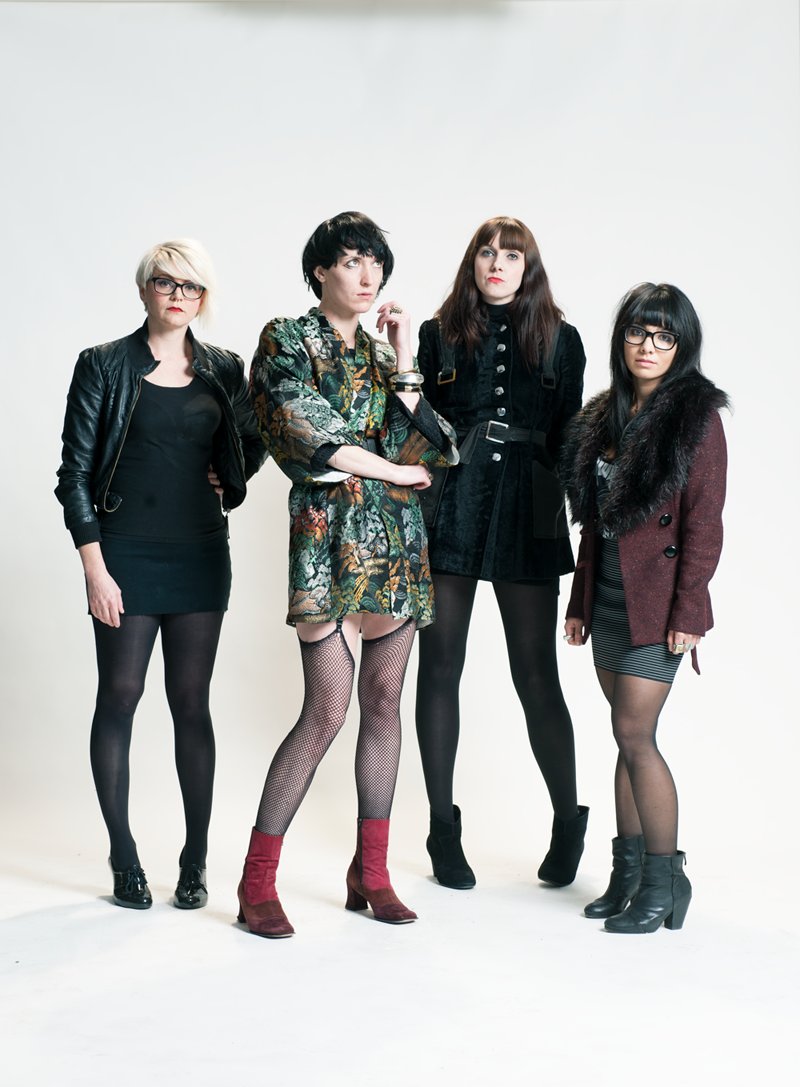
All-teenage, all-girl beach pop group the She’s (ahem, our recent cover stars for the On the Rise issue) followed and impressed with those breezy harmonies and technical skills. The quartet opened with “Picture of Houses,” in which three of the four harmonize, “picture of houses in my life/grey skies and warm sand/it’s al-ri-ght” – that last “it’s alright” being repeated in a dreamy Beach Boys ode.

Pretty much everyone around me was smiling during the She’s set, especially when lead singer-guitarist Hannah Valente dedicated a song to her dad, saying “Happy birthday, dad!” before launching into a brand new track.

Next up, Dirty Ghosts brought out the Flying “V” guitars and classic, hard-hitting rock’n’roll. The band, another trio from San Francisco, seems to be getting tighter and brighter every year – perhaps it has just been too long since I’ve seen them live. They blew my mind like it was the first time.

http://www.youtube.com/watch?v=4Lu9ydAkXzY

Led by the hair-shaking guitarist Allyson Baker and bassist Erin McDermott (who sported a beer tap strap and a Faith No More shirt), Dirty Ghosts played songs off last year’s Metal Moon, and seven-inch “Katana Rock/Eyes of a Stranger” (2012). They killed with “Eyes of a Stranger,” which, as they noted, is in the classic 1980s film, Valley Girl (a.k.a my all-time favorite movie), and also with gritty single “Ropes that Way,” during which Baker and McDermott walked toward each other and did that noodling rock star move they’re so good at.

An audience interaction I dug during the set: whenever Baker mentioned Canada, or talked at all really, a smaller cluster of ladies near me screamed, whooped, danced, and repeatedly called back to the stage banter (old friends from Baker’s native land of Toronto?). Either way, they were feeling it, and it was contagious.

The next day, I stopped by Noise Pop’s free happy hour show at Bender’s and caught the awesomely hard, deep-fried Southern ’70s rock’n’roll act Wild Eyes SF  (with electric singer-tambourine shaker Janiece Gonzalez wearing an American flag denim vest, naturally, and drummer Ben Richardson, who, full disclosure, is a sometimes Guardian contributer), along with “[Black] Sabbath-worshiping” rock band Owl, and some delicious deep-fried tater tots dipped in ketchup. The greasy daytime show, packed with tall dudes with long hair and black shirts, was the perfect antidote to the poppy preceding night, and ended my Noise Pop 2013 week with a bang and a belly ache.

http://www.youtube.com/watch?v=P25oXVQPqYM
(Video shot by Guardian arts editor Cheryl Eddy)

Noise Pop 2013: !!!, White Arrows, the Mallard at Great American Music Hall

0

It’s hard to be Nic Offer. Not because he’s a tortured artist struggling with celebrity or some other cliche, but because he busts it on stage in a way that’s difficult to match. A couple songs into !!!/Chk Chk Chk‘s Noise Pop show at the Great American Music Hall last night, the lead singer and number one dancer hustled along the row of tables between the crowd and the stage. “I need my catwalk,” he said, picking up all the glasses, water cups, and beer bottles along the way.

Anyone who has seen a !!! show knows that Offer is hyperkinetic. (He comes prepared to dance, dressed in a t-shirt and short shorts, a combination that reminds me of drummer Pat Mahoney, who would be similarly attired for endurance pushing set with LCD Soundsystem.)

This time around, Offer seemed especially energized, probably because the band was debuting material from the upcoming album Thr!!!er, including “One Girl / One Boy” and “Except Death.” The funky, acid-house infused “Slyd” was supposedly played by the band for the first time in a live setting, and Offer and company seemed pleased to pull off the sample-heavy track.

The singer made a big deal of it, but it was just one of many things he made look relatively easy. Perhaps a little too easy: near the end of !!!’s performance, the hyped up bass player from White Arrows hopped on stage. As the cocktail table toppled, the stage dive became a corgy flop.

Openers:
White Arrows – its pseudo psychedelic pop is getting better all the time, although the band no longer seems to be coordinating thrift store Hawaiian shirts. The drummer has a nice predilection for irregular, semi-tribal beats, and the keyboardist’s falsetto sounded nice harmonizing with the singer’s drawl near the end of the set.

The Mallard – “hell of a screeching, bass-pumping build for an opener” is what I initially wrote down, seconds after the San Francisco band got going. Then it built and built, with lead singer Greer McGettrick seemingly telling a story in a way reminiscent of “The Gift.” The mix was off in a way that lost the narrative, but sonically it was interesting, complete with a kind of drone I’d never heard before via a live horn.

It was also assaultive; next to the speaker it felt like the back of my throat was full of Rice Crispies and Pop Rocks. By the end, stretching across the Mallard’s whole set, I started to pick up more of the lyrics – 911 calls and sirens – as McGettrick started eerily circling the crowd, intoning “There’s been a muhmuhmuhmuhmuh-murdah.” More Noise than Pop, it was the kind of opening that makes you super excited to hear the second song, and desperately hoping it doesn’t sound like the first. Which was probably why the trio camped out next to the stage with their fingers in their ears looked relieved when it turned out to be the band’s only one for the night. [Ed. note: apparently the Mallard was doing an extended cover of Throbbing Gristle last night]

The Yellow Dogs – the band looked like the Iranian Strokes, sounded like a speedier version of the Rapture crossed with a little Mars Volta, and sang wildly like the B-52s. They supposedly drove four days to get to the show, only to break down an hour away. They said it was worth it to perform with their favorite band, and the way the singer moved, I believe it.

Noise Pop 2013: R. Stevie Moore is cool, plays Bottom of the Hill

1

R. Stevie Moore is cool. When was the last time you saw a 60-odd-year-old* man standing on stage shouting “where my bitches at” and repeated calls of “swag”? That kind of thing never happens.** (Though it did last night at the Noise Pop show at Bottom of the Hill with Moore, Fresh and Onlys, Plateaus, and Burnt Ones).

Whenever anyone not born prior to 1990 tries to even pronounce that word it comes out all wrong, and the best anyone else can guess is that they’ve got some bad weed, are mentioning their recent trade convention experience, or most likely misquoting a 20-year-old SNL sketch, that last one being a closer reference for the age group.

Which is just to point out that while the rest of us seem to inevitably suffer from mental stasis at a certain age, struggling with increasing brain plasticity and self-inflicted memory loss, Moore was doing a pitch perfect Tyler the Creator last night, as he continues to function as a weird pop culture sponge.***

I don’t even know if OFWGKTA is still around or if people say swag unironically at this point without checking Google Trends. And I guess that’s kind of the point, because as the powder-blue-bearded Moore worked through a small part of his extensive catalog (“He covers a lot of ground,” someone in the crowd observed in the understatement of the night), it became clear that one thing the man is isn’t hip, but he is cool.

Fashion becomes passé, quotes become tired, sic transit fucking gloria, but Moore, the consummate outsider, proves that it’s hard to go out of style when you’ve never truly been in, even as a new wave of hipper musicians like Ariel Pink follow in his footsteps.****

While Moore sang that he “likes to stay home” last night as a closer, I couldn’t help but think how little he seems to have changed since the music video*****, and be glad that he’s still out on occasion. Pretty cool.

http://www.youtube.com/watch?v=v1MfeLx6Uds

*emphasis on “odd.”
**outside the world of recent fun.-loving Taco Bell commercials.
***or vampire, which would explain his longevity.
****and have become his collaborators.
*****compared to other iterations.

Noise Pop 2013: Cruel Summer, Lake, and the Blank Tapes at Hemlock

0

It’s a low-key kind of Noise Pop year compared to the past three or four, without the huge, attention-grabbing headliners of yore  (looking at you, Flaming Lips at Bimbo’s), but Wednesday’s show at the Hemlock Tavern could have been nuzzled in nicely in any very early NP lineups, which is what made it feel authentically true to the inherent spirit of the festival.

No pomp or glitz, no big names or sold-out, packed-to-the-gills chaos. I initially went to see Olympia, Wash.’s Lake, a twee, lo-fi indie pop quartet with great hooks, but found much enjoyment out of the two bands that sandwiched that act (Cruel Summer and Blank Tapes), perhaps even more so?

I arrived early in Cruel Summer‘s set; I’m told the jangly San Francisco act had only played a few songs to the neatly packed in Hemlock crowd. There were casually smiling faces stretching from the front of the stage back to the sound guy, however there wasn’t that trademark Hemlock hot stink just yet. You could stretch your legs out without knocking into a sweaty mess. Though I detected a wafting hippie scent. 

Cruel Summer, which consists of two hard-rocking ladies out front (bespectacled lead singer-guitarist Thea Chacamaty and bassist Chani Hawthorn), along with guitarist Josh Yule and bassist Sean Mosley, created a rolling wave of reverb and noise  – so loud it drowned out the vocals – in a “dreamy gazey noisey hazy wavey gravy” way, as the band is wont to describe it. During the loud-sound-wave a few heads in the audience bopped and jerked hard, meeting each thundering drum hit with a nod of approval. Cruel Summer’s been around since 2011, but could easily fit in with ’80s shoegaze scenes or ’90s K Records stock.

The latter goes for second band Lake as well. Actually, Lake is currently on the K roster. And it fits right in. An aside: when I was first learning there was music being made beyond pop radio (‘sup KIIS-FM?) in my early, impressionable tweens, I had a friend with an older sister who was of the super cool girl alternative guild. She and her friends were in to riot grrrl, and twee, and K, and Kill Rock Stars, and the like. They wore cardigans, boat stripes, short skirts with nubby tights, and thick-framed glasses, and had glittery Fenders and drum kits. I feel like the older sis and her crew would’ve dug both Cruel Summer and Lake.

http://www.youtube.com/watch?v=wO4ZA7ezlEg&feature=youtu.be

Anyway, Lake played mostly new songs last night, some that had sexy Bossa nova bass lines – the bass was noticeable after Lake asked the crowd if anything needed to be turned up louder. Some got so funky a few people noodled along to the beat. The four band members switched instruments a few times during the set, and three traded off covering male/female lead vocals, including Eli Moore and his wife, the sweet-voiced Ashley Eriksson, who also played keyboards.

Next up was the Blank Tapes; the trio also traded off male/female harmonies and pop hooks, but with a garage-rooted rock’n’roll edge – that was also due in part to standing drummer Pearl Charles smacking just two drums, a floor tom and a snare, often with a mighty thwack. This is also when the scent changed from hippie to pizza, as someone brought in a delicious-smelling pie, and I got jealous.

The dynamic between Charles and Blank Tapes pied-piper/multi-instrumentalist Matt Adams reminded one of my show-going companions of the famed Lee Hazlewood-Nancy Sinatra collaboration. Though on looks alone, it could’ve been Lindsay Weir and Ginger Baker. The band – which has the advantage of a rotating lineup and addresses in both LA and SF – sounded great, alive and full of energy, pumping up an already pleased crowd with crackling beach garage songs like bubbly “Coast to Coast” (a new single on Oakland’s Antenna Farm Records), a song I feel like must be called “Beach Party,” and tracks off 2012’s Sun’s Too Bright (Burger Records) tape. Live, the songs seemed far less relaxed than recorded versions.

It’s the way I imagine Noise Pop began, 21 years back, with talented, eclectic, lo-fi, noise-pop-genre-specific acts from up and down the West Coast huddled in a favorite little local venue, beating the shit out of their instruments. No fuss, no muss.

I’m your fan

0

arts@sfbg.com

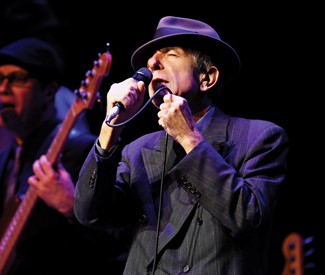
MUSIC Like most love affairs, there was little indication on our first encounter that it would turn into a lifelong infatuation. I was 17, methodically singing my way through a book of folk tunes, one of which was his first real hit, “Suzanne”. Though I admired it for its lyrical content, it weighed heavy on my range, and I soon moved on to other songs.

When I stumbled across him again, years later, it was as if we had never met. He was older, rougher, seemingly more jaded. His brutal ode “The Future” was dominating the indie-radio airwaves, hot on the heels of its appearance in Oliver Stone’s bombastic Natural Born Killers. When my then-roomie confessed a fondness for his music, it turned that single song on the radio into a sort of clarion call — the key, perhaps, to winning my flatmate’s frustratingly platonic heart. From that time, Leonard Cohen became a constant presence in my life, hovering at the periphery of countless triumphs, challenges, and betrayals, a companionship of almost 20 years that has spanned the globe, and almost every kind of circumstance.

There’s no one song or phase of Cohen’s music that seems to universally predicate the shift from uninitiated or fair-weather fan to true believer. For some it is the Cohen of the 1960s, whose laborious finger-picking and reedy, untrained voice lent equal gravitas to meticulously-plotted stories of resistance fighters and blowjobs, transcendence and squalor. For others it’s the synth-infused litanies to the naked body and the painful futility of the excess of the ’80s, or the flintier, world-weary renegade poised for flight of the early ’90s. Even the most contemporary of Cohen’s “masks,” the “lazy bastard in a suit,” currently rides a wave of almost unprecedented popularity, particularly in the US where he has mostly languished on the fringes of recognition until the last few years.

Underpinned by the spare minimalism of poetry written by a man for whom silence has played a pivotal role as much as language has (including a five-year long retreat at the Mt. Baldy Zen Center), his 2012 album Old Ideas brims over with themes that have appeared in almost every Cohen album over the last 40 years — bittersweet entanglement, elevation of the spirit, the struggles of the flesh — and marks a decided turning point in Cohen’s life, both personal and professional. An old Zen master of the music business arguably at the height of his powers: depression vanquished and horizons expanding exponentially.

Local author, rock journalist, and Leonard Cohen biographer (I’m Your Man, Ecco, 2012), Sylvie Simmons had her first encounter with Cohen in her adolescence as well, but for her the attraction was more immediate.

“The day I hit puberty was the day I heard my first Leonard Cohen record,” she confides over the phone when I call to get her side of her most famous subject. And though “it was outside my usual taste,” she found herself listening to his songs again and again, even today. Now deeply immersed in her own exhaustive world book tour, she’s even found a new thing to be impressed by: Cohen’s unflinching dedication to the road. “He’s got the kind of schedule that would kill an 18-year-old,” she says with a laugh. “He’s definitely a better man than I!”

Seeing Leonard Cohen perform at the Montreal Jazz Festival in ’08, after years of worshiping from afar, will always remain one of my most luminous memories. The prodigal son gone good, working the hometown crowd for an epic three-and-a-half hours, holding his hat over his heart as we applauded each song until our hands were sore, bowing his head humbly again and again, prophet as fellow supplicant. By a twist of good fortune, I managed to see him twice more on that tour — in Oakland and in Paris — and each time, though the controlled orchestration of the event revealed itself more and more, so did the sense of sheer joy emanating from both the stage and the audience, an orgy of admiration, and, a real rarity in the business, of gratitude.

Simmons has an explanation for this gracious humility as well. “He just loves life on the road,” Simmons explains. “He told me it was wonderful…’for a man my age to have a feeling of full employment’.” I rather suspect that this weekend’s events will be just as wonderful for us as they will be for him. Thank you, Leonard Cohen, for being our man.

“THE NIGHT BEFORE LEONARD” WITH SYLVIE SIMMONS

Fri/1, 6pm, free

Marsh Berkeley Cabaret

2120 Allston Way, Berk.

(415) 641-0235

www.themarsh.org

LEONARD COHEN

Sat/2 and Sun/2, 8pm, $71.50–$253

Paramount Theatre

2025 Broadway, Oakl.

(510) 465-6400

www.paramounttheatre.com

Game on

1

arts@sfbg.com

DANCE Unlike more commercially competitive markets, the Bay Area is, fortunately, still a place where young choreographers have the freedom to grow. This past weekend, two who are primarily known for dancing other people’s works showed their own promising premieres.

Katharine Hawthorne graduated from college with degrees in physics and dance. On February 22, its opening night at the Joe Goode Annex, you could not possibly miss Analog’s dual pedigree. This startlingly intense quintet opened on the quietest of notes but built its trajectory like a smoldering volcano that finally erupted into a threatening destructive force.

Looking at movement through a scientist’s lens, in conjunction with knowing it to be the dancer’s basic tool, allowed Hawthorne — and her fearlessly athletic dancers — to offer a fascinating perspective on how art and science can elegantly coexist with each other. However, why the dancers repeatedly lugged around an overhead project (and barely used it) remains a mystery.

A 19th century illustration of a mechanical hand, against which Katherine Disenhof wiggled her fingers, set the tone. Those tiny live gestures led other dancers (Hawthorne, Jesse Chin, Luke Taylor, and Megan Wright) to use their arms in almost machine-like ways, as if to demonstrate speed, direction, level, and space. Movements changed with sharp angles, trajectories were linear, and collisions avoided. Dancers also looked like planets circling a sun. Chin and Taylor repeatedly repulsed each other like two positively charged particles. Wright found herself in a whirling circle — a tornado about to take off.

But more and more the movements’ relentless and increasing intensity began to look like threats to the dancers’ well being. Several times I thought Chin was about to collapse though touches and handholds seemed to suggest temporary respite. Yet Analog resembled a nightmarish perpetuum mobile until finally the clock began to slow everything down. We were left with darkness descending on the two dancers left. I couldn’t decide whether that meant peace or the ultimate catastrophe.

As a performer, Tanya Bello brings a ferocious appetite for space, soaring elevations, and dizzying spins to her dancing. So it was almost expected that as a young choreographer she brought many of these characteristics to GamesWePlay(ed), which premiered at the ODC Dance Commons this past weekend. The half-hour piece is a nicely calibrated essay on play as both an innocent activity but also as a means to manipulate those around us. Bello wisely engaged dancers from top local companies: Vilte Bacinskaite, Tristan Ching Hartmann, Kelly Del Rosario, Norma Fong, Chin-chin Hsu, Mei-ling Murray, and Katherine Wells. The work also greatly benefited from Judy Hansen’s costumes, which were elegant, tiny dresses with just a wisp of a tutu suggestion.

GamesWePlay(ed) consisted of a number of distinct episodes which included versions of tag, races, imitation, and mirroring activities, but also pure dance sections. Some looked highly structured only to explode; others involved repeated and fast partner changes. Woven wicker balls were passed around but also hung onto. When Del Rosario curled up on the floor, a tiptoeing Wells gently sent him back into the fracas. I couldn’t help but wonder whether there was a joke here since as the ensemble’s only male, Del Rosario had to do all of the heavy lifts.

Though the work was not particularly fresh in terms of the vocabulary used, Bello showed an already impressive control in the way she used the dancers on stage. The choreography — from solos to septets — flowed and dissolved with almost filmic quality. A mirroring duet opened up into a group, loosing its architecture but gaining breath. Two dancers approaching each other from opposite corners became a double duet. But the piece also had its moments of (ballet?) humor when Fong released a quartet of shadowing women from their monotonous tasks. At another point dancers flopped over received a magic touch to blossom again like those eternal flowers in the Nutcracker.

Towards the end Bello went back to material used earlier in the piece. Was that just to lead up to a finale? There must be better ways to end a show.

Performing on the same program was Karen Reedy Dance from Washington, D.C. Reedy’s Sleepwalking (2008) was a beautifully danced septet, a work that gently yet penetratingly considered what makes us panic and silently scream at night.

Our Weekly Picks: February 27- March 5, 2013

0

WEDNESDAY 27

Lisa Fagan and Alison Williams

At the Garage, you get to see a lot of choreography in progress, which is a pleasure in itself because you can imagine what the final product might be like. Not this time. Lisa Fagan and Alison Williams — friends and colleagues, who first met during that hotbed of incubation, ODC’s Pilot Programs — are offering finished work. The evening, about an hour of choreography, comes with a bonus. Fagan calls her trio, Full Grown Baby Lemon, “a dance work of fiction,” and it has a definitely odd set of characters. Williams’ Edit promises to be rollicking duet between pop and geology. That’s where the bonus comes in. Her music will be live and includes an after-performance dance party where you can dive into dubstep. (Rita Felciano)

8pm, $10–$20

Garage

715 Bryant, SF

www.brownpapertickets.com


Fresh and Onlys

Noise Pop borrows its name from a mid-1980s genre that merges contradictions. Noise is edgy and gritty; pop is sunny and easily digestible. The Fresh and Onlys, a San Francisco band that has taken off since its ’08 formation, represents a ’13 incarnation of these oppositions. In “20 Days and 20 Nights,” the opener of last fall’s Long Slow Dance, “I cry” repeats over and over against bright harmonies and an upbeat piano hook, leaving the listener to bop along to the singer’s misery. It is an intriguing sensation caused by the balanced mix of grit and sunshine that continues throughout the vibrant album. The band invites you to bop along to its Noise Pop contradictions at Bottom of the Hill. (Laura Kerry)

With R. Stevie Moore, Plateaus, Burnt Ones

8pm, $14

Bottom of the Hill

1233 17th St., SF

(415) 621-4455

www.bottomofthehill.com


Ceremony

Through the progression of its three studio albums, Rohnert Park’s Ceremony has evolved from unbridled, no-nonsense bursts of hardcore punk to a more slow-burning and equally devastating aggression. While it’s certainly not unusual for punk bands to shine on stage rather than on recordings, Ceremony’s live show takes the cake. Vocalist Ross Farrar is reminiscent of Ian Curtis as he lurches, jerks, and occasionally collapses across the stage, moaning, howling, and screeching as guitarist Anthony Anzaldo and bassist Andy Nelson leap and high-kick around him. The result is a cacophonous and tightly-coiled energy that is deliciously cathartic and at times transcendent in the pissed-off way only a punk band from the suburbs can produce. (Haley Zaremba)

With Terry Malts, Comadre, Perfect Ruin, Synthetic ID

8pm, $12

Rickshaw Stop

155 Fell, SF

(415) 861-2011

www.rickshawstop.com


THURSDAY 28

Other Minds 18

Noise Pop isn’t the only contemporary music and art festival rolling into town this week. Other Minds, an annual event that invites composers and artists to share their avant-garde work, launches its 18th year on Thursday with performances of music from far-away places such as Denmark and India. Each of the three nights includes a panel discussion and a performance to fully engage the world of music outside the mainstream. Don’t come to Other Minds expecting the same finger-snapping tunes as the other festival in town; do come to hear some innovative music and to learn something along the way. (Kerry)

Through Sat/2, 7pm, $30-$115 (festival pass)

Jewish Community Center

3200 California, SF

(415) 292-1200

www.otherminds.org


Punk in Africa

How much do you know about origins of global underground punk scenes? Beyond the live shows, Noise Pop always shows a handful of creative takes on the usual music doc; Punk in Africa is no exception. It explores a too-infrequently examined continent’s aggressive punk roots, from “the underground rock music of early 1970s Johannesburg, the first multi-racial punk bands formed in the wake of the Soweto Uprising and the militant anti-apartheid hardcore and post-punk bands of the ’80s to the rise of celebratory African-inspired ska bands, which sprang up from Cape Town to Maputo in the democratic era of the ’90s.” It also spotlights current acts battling political bombs with explosive lyrics and pounding drumbeats in Zimbabwe and South Africa. (Emily Savage)

7pm, $10

Artists’ Television Access

992 Valencia, SF

(415) 824-3890

www.atasite.org


FRIDAY 1

Peter

Following last November’s potent For the Love of Emptiness (danced by Jorge De Hoyos), San Francisco-based choreographer Sara Shelton Mann presents the second solo in her fascinating “Eye of Leo Series.” Peter reteams the long esteemed, ever-searching Mann with video-light designer David Slaza, joined by composer Robbie Beahrs and performer Jesse Hewit. In these highly dynamic collaborations, Mann is wont to hover on the fringes, interacting variously with the performance space. “I open the ground and track it as a guide and follow the progress of the terrain chosen by the individual,” explains Mann. “Some chose the difficult path, some chose the surreal dream of extinction, some the practice of perfection. . . . I have chosen and I do not choose. People find me. I have become a hermit in a cage and those who find me have to find the key to the door.” (Robert Avila)

Through Sat/2, 8pm, $15

Joe Goode Annex

499 Alabama, SF

www.brownpapertickets.com

www.sarasheltonmann.org


Shih Chieh Huang: Synthetic Seduction

If a work of art had a spirit soundtrack, what would it be? Considering the use of industrial materials such as plastic bags, electrical sensors, and colored lights, one would expect Shih Chieh Huang’s installations to play to the the robotic pop of Daft Punk. Past pieces, though, including one at the National Museum of Natural History, achieve an organic quality that recalls the sound of being submerged in water. Continuing to explore the creation of technological landscapes while engaging in the theme of psychedelia, the artist’s Yerba Buena Center for the Arts installation conjures the image of a Jimi Hendrix solo played backwards over a heart monitor. Huang’s art certainly dances to the beat of its own drummer. (Kerry)

Through June 30 Noon, $10

Yerba Buena Center for the Arts

(415) 978-2700

www.ybca.org


SATURDAY 2

“Voices of Afghanistan”

Ustad Farida Mahwash and Homayoun Sakhi — both legends in their own right — will return to Cal Performances tonight (for the first time in two years) for a pleasant and educational evening of live traditional and contemporary Afghan music. Mahwash, a popular vocalist in her home country known as “the voice of Afghanistan,” will sing over rubâb virtuoso Sakhi and his ensemble in Wheeler Auditorium. The Sakhi Ensemble is a quartet employing instruments such as the harmonium, tula, doyra, tabla, and Sakhi’s rubâb — a lute-like instrument played with a bow that’s one of Afghanistan’s national instruments; it’s likely the sound you imagine when you think of mesmerizing Middle Eastern music. (Savage)

8pm, $36

Wheeler Auditorium, UC Berkeley Campus

Bancroft Way at Telegraph, Berk.

(510) 642-9988

www.calperformances.org


Sonny and the Sunsets

San Francisco’s Sonny Smith has already done more in the past few years than most of us will accomplish in our lifetime. The singer-songwriter-illustrator-playwright has more side projects than Jack White and a seemingly bottomless reserve of creative energy. In 2010, Smith released 200 songs at once that he had recorded for his 100 Records exhibition, and instead of swearing off music for a period like an exhausted person might, he soon began writing the next Sunsets album, worked on 100 Records: Vol. 3 (released this January) and began planning another exhibition, basing songs off protest signs. This project, tentatively titled “Protest Factory,” is still gestating, but last year saw the release of the Sunsets’ third full-length album, which carried on Smith’s tradition of engaging narrative lyrics, though with a surprisingly fantastic country twist. (Zaremba)

With Magic Trick, Cool Ghouls, Dune Rats

Bottom of the Hill

9pm, $12

1233 17th St., SF

(415) 626-4455

www.bottomofthehill.com


SUNDAY 3

“Balboa Birthday Bash”

San Francisco is all about celebrating the newest, hottest place — that pizza restaurant where you wait a full hour for a gourmet pie; that bar where each drink is hand-crafted using 11 exotic ingredients. So why not tip your top hat to an 87-year-old veteran: the Balboa Theatre, keeping the avenues cinematically rockin’ since Feb. 7, 1926? The party gets started at 4pm today with a 35mm screening of the 1924 silent version of Peter Pan, featuring live accompaniment by Frederick Hodges; come to the evening show for a repeat screening, plus a live vaudeville show, birthday prizes, and treats. Roaring Twenties attire encouraged! (Cheryl Eddy)

4 and 7pm, $10

Balboa Theatre

3630 Balboa, SF

www.cinemasf.com


“Tom Fest” Benefit for Tom Mallon

While he may not be a household name, Tom Mallon had a huge influence and impact on the San Francisco music scene, beginning the mid-1970s. As a musician, Mallon has performed with American Music Club and Toiling Midgets among others, and as a producer and engineer, he provided acts with low-cost studio time and guidance that helped document the work of countless artists. A host of musicians he has worked with over the years are performing tonight at “TomFest,” a special tribute and benefit concert for Mallon and his family (along with the SF Brain Tumor Support Group at UCSF), including Chuck Prophet, Toiling Midgets, Fright Wig, Penelope Houston, Ugly Stick, Peter Case, members of American Music Club, and many more. (Sean McCourt)

7:30pm, $25

Great American Music Hall

859 O’Farrell, SF

(415) 885-0750

www.slimspresents.com

Stage Listings

0

Stage listings are compiled by Guardian staff. Performance times may change; call venues to confirm. Reviewers are Robert Avila, Rita Felciano, and Nicole Gluckstern. Submit items for the listings at listings@sfbg.com. For further information on how to submit items for the listings, see Picks.

THEATER

OPENING

Assistance NOHspace, 2840 Mariposa, SF; www.opentabproductions.com. $20. Opens Sat/2, 8pm. Runs Thu-Sat, 8pm; Sun, 6pm. Through March 30. Leslye Headland’s comedy about assistants is loosely based on her experiences working for Harvey Weinstein.

Inevitable SF Playhouse, 533 Sutter, SF; www.sfplayhouse.org. $20. Previews Thu/27-Fri/1, 8pm. Opens Sat/2, 8pm. Runs Thu-Sat, 8pm. Through March 23. SF Playhouse’s "Sandbox Series," enabling new and established playwrights to stage new works, kicks off its third season with Jordan Puckett’s drama about a woman trying to make sense of her life.

Just One More Game Exit Theatre, 156 Eddy, SF; www.tripleshotprodutions.org. $25. Opens Fri/1, 8pm. Runs Thu-Sat, 8pm; March 10 and 17, 2pm. Through March 30. Triple Shot Productions presents Dan Wilson’s video game-themed romantic comedy.

Pageant: The Musical! Victoria Theatre, 2961 16th St, SF; www.brownpapertickets.com. $25. Opens Thu/28, 8pm. Runs Thu-Sat, 8pm. Through March 9. Robbie Wayne Productions presents this "drag-tastic adventure through the hilarious world of beauty contests."

The Voice: One Man’s Journey Into Sex Addition and Recovery Stage Werx Theater, 446 Valencia, SF; thevoice.brownpapertickets.com. $10-18. Previews Sun/3, 7pm. Opens Tue/5, 8pm. Runs Fri-Sat, 8pm. Through April 6. Ticket sales for David Kleinberg’s autobiographical solo show benefit 12-step sex addiction recovery programs and other non-profits.

ONGOING

Foodies! The Musical Shelton Theater, 533 Sutter, SF; www.foodiesthemusical.com. $30-34. Fri-Sat, 8pm. Open-ended. AWAT Productions presents Morris Bobrow’s musical comedy revue all about food.

God of Carnage Shelton Theater, 533 Sutter, SF; www.sheltontheater.org. $38. Thu-Sat, 8pm. Through March 30. Shelton Theater presents Yasmina Reza’s Tony-winning comedy about upper-middle-class parents clashing over an act of playground violence between their children.

Hedwig and the Angry Inch Boxcar Playhouse, 505 Natoma, SF; www.boxcartheatre.org. $25-40. Wed/27-Sat/2, 8pm (also Sat/2, 5pm). Hold onto your hairpiece, Boxcar Theatre is reprising their all-too short summer run of Hedwig and the Angry Inch, and just in case you think you saw it already, be forewarned — you ain’t seen nothing yet. Recast, redesigned, and re-vamped, this outcast-rock musical familiarly follows the misadventures of one Hedwig Robinson (né Hansel Schmidt) with glam, guts, and glitter. But unlike the movie version penned by and starring John Cameron Mitchell as the titular chanteuse, or other staged versions, director Nick A. Olivero splits the larger-than-life, would-be rock sensation into eight different characters, who are each given a solo turn as well as plenty of ensemble harmonizing during the course of the two hour-plus performance. The effect is often electric, and just as frequently hilarious, as when the four female actors playing the role stomp across the stage swinging imaginary dicks in the air to the lyric "six inches forward and five inches back, I got a, I got an angry inch!" Supported by a tight quartet of rock musicians led by Rachel Robinson, and the phenomenal Amy Lizardo as Hedwig’s beleaguered "man Friday" Yitzhak, Hedwig keeps on extending for what appears to be an indefinite run, employing the time-honored Thrillpeddlers’ tradition of rotating cast members and comeback performances, which means you could theoretically go multiple times and never see quite the same show twice. I certainly plan to. (Gluckstern)

Jurassic Ark Exit Theatre, 156 Eddy, SF; www.theexit.org. $15-25. Fri-Sat, 8pm. Through March 16. Writer-performer David Caggiano’s zany, well-executed solo play centers on a Christian televangelist who is unwaveringly bent on making a big-budget movie about a cowboy-like Biblical Noah, his Ark, and the largely lovable dinosaurs callously left out of the story — a project he sees delivering a decisive blow to the Darwinians, while turning cineplexes across the land into celluloid cathedrals. Brother Dallas and his proselytizing pitch eventually find receptive ears in a trinity of movie-industry heavies, whose collective business acumen demands a few changes to the script. Meanwhile, the intoxicating power of it all leads to a lapse in Brother Dallas’s righteousness and a scandal reminiscent of Hugh Grant’s career. Dallas rebounds from this bout with the Devil and sees his movie made — but surely only he is unaware that the Devil keeps a Hollywood address. Smartly directed by Mark Kenward, this low-frills production relies almost exclusively on Caggiano’s sturdy ability with quick-change characterizations (couched in Dylan West’s modest lighting design and a suggestive soundscape by sound editor–musician John Mazzei). The fitful satire trades in pretty orthodox caricature and, in Brother Dallas, lacks a very compelling or sympathetic central figure; but it unfolds with a very cinematic imagination that, while formulaic, is itself one hell of a movie pitch. (Avila)

The Lisbon Traviata New Conservatory Theatre Center, 25 Van Ness, SF; www.nctcsf.org. $25. Wed-Sat, 8pm; Sun, 2pm. Through March 24. New Conservatory Theatre Center performs Terrence McNally’s play, a mix of comedy and tragedy, about the relationship between two opera fanatics.

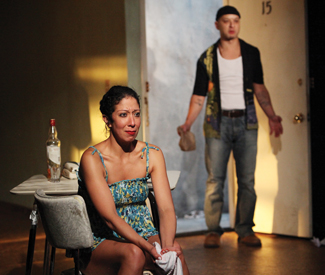
The Motherfucker with the Hat San Francisco Playhouse, 450 Post, SF; www.sfplayhouse.org. $30-70. Tue-Thu, 7pm; Fri-Sat, 8pm (also Sat, 3pm). Through March 16. A fine cast makes the most of Stephen Adly Guirgis’s deceptively coarse, often amusing little play, The Motherfucker with the Hat, which receives its local premiere in a sure and rowdy production from SF Playhouse. Director and designer Bill English’s striking two-tier set almost belies the intimate nature of the quirky story, which concerns a hapless parolee and recovering alcoholic named Jackie (a winningly frazzled, bumptious Gabriel Marin) who retreats to his AA sponsor’s apartment to pine and plot revenge after he discovers a stranger’s hat in the bedroom of his longtime Puerto Rican girlfriend, Veronica (played vividly by an at once edgy and vulnerable Isabelle Ortega). But Ralph, his suave and persuasive sponsor (played with unctuous charm gilded by just a hint of ineptitude by an excellent Carl Lumbly), may not be the guy he wants in his corner. Not that Jackie can see that — he’s got a man-crush on Ralph that dwarfs his already ambivalent affection for much put-upon but stalwart cousin Julio (a sharply funny Rudy Guerrero) and blinds him to the warning signals from Ralph’s own disgruntled wife (a coolly disgusted Margo Hall). Throughout, these working-class New York borough dwellers display their wit and shield their soft underbellies with a rapid-fire barrage of creative swearing. English and cast display a real comfort with this kind of material (this is SF Playhouse’s fourth Girguis play), which drapes its soft heart in the intimations of violence more than the real thing. If the heat and imaginative cursing also seem to cover up for a play with little dramatic purpose beyond a gentle and somewhat pat exploration of loyalty, maturity, and trust, there’s pleasure to be had in the unfolding. (Avila)

Sex and the City: LIVE! Rebel, 1760 Market, SF; trannyshack.com/sexandthecity. $25. Wed, 7 and 9pm. Open-ended. It seems a no-brainer. Not just the HBO series itself — that’s definitely missing some gray matter — but putting it onstage as a drag show. Mais naturellement! Why was Sex and the City not conceived of as a drag show in the first place? Making the sordid not exactly palatable but somehow, I don’t know, friendlier (and the canned a little cannier), Velvet Rage Productions mounts two verbatim episodes from the widely adored cable show, with Trannyshack’s Heklina in a smashing portrayal of SJP’s Carrie; D’Arcy Drollinger stealing much of the show as ever-randy Samantha; Lady Bear as an endearingly out-to-lunch Miranda; and ever assured, quick-witted Trixxie Carr as pent-up Charlotte. There’s also a solid and enjoyable supporting cast courtesy of Cookie Dough, Jordan Wheeler, and Leigh Crow (as Mr. Big). That’s some heavyweight talent trodding the straining boards of bar Rebel’s tiny stage. The show’s still two-dimensional, even in 3D, but noticeably bigger than your 50" plasma flat panel. (Avila)

Steve Seabrook: Better Than You Marsh San Francisco, 1062 Valencia, SF; www.themarsh.org. $15-50. Fri, 8pm; Sat, 8:30pm. Through March 22. Kurt Bodden’s San Francisco Best of Fringe-winning show takes a satirical look at motivational speakers.

The Waiting Period Marsh San Francisco, 1062 Valencia, SF; www.themarsh.org. $25-50. Fri, 8pm; Sat, 5pm. Through March 30. Brian Copeland (comedian, TV and radio personality, and creator-performer of the long-running solo play Not a Genuine Black Man) returns to the Marsh with a new solo, this one based on more recent and messier events` in Copeland’s life. The play concerns an episode of severe depression in which he considered suicide, going so far as to purchase a handgun — the title coming from the legally mandatory 10-day period between purchasing and picking up the weapon, which leaves time for reflections and circumstances that ultimately prevent Copeland from pulling the trigger. A grim subject, but Copeland (with co-developer and director David Ford) ensures there’s plenty of humor as well as frank sentiment along the way. The actor peoples the opening scene in the gun store with a comically if somewhat stereotypically rugged representative of the Second Amendment, for instance, as well as an equally familiar "doood" dude at the service counter. Afterward, we follow Copeland, a just barely coping dad, home to the house recently abandoned by his wife, and through the ordinary routines that become unbearable to the clinically depressed. Copeland also recreates interviews he’s made with other survivors of suicidal depression. Telling someone about such things is vital to preventing their worst outcomes, says Copeland, and telling his own story is meant to encourage others. It’s a worthy aim but only a fitfully engaging piece, since as drama it remains thin, standing at perhaps too respectful a distance from the convoluted torment and alienation at its center. Note: review from an earlier run of the same production. (Avila)

The World’s Funniest Bubble Show Marsh San Francisco, 1062 Valencia, SF; www.themarsh.org. $8-50. Sun, 11am. Extended through March 17. The Amazing Bubble Man (a.k.a. Louis Pearl) continues his family-friendly bubble extravaganza.

BAY AREA

Dostoevsky’s The Grand Inquisitor Berkeley City Club, 2315 Durant, Berk; www.centralworks.org. $15-28. Thu-Sat, 8pm; Sun, 5pm. Through March 31. Central Works performs Gary Graves’ adaptation of the story-within-a-story from The Brothers Karamazov.

The Fourth Messenger Ashby Stage, 1901 Ashby, Berk; www.thefourthmessenger.com. $23-40. Wed-Thu, 7pm; Fri-Sat, 8pm; Sun, 2pm. Through March 10. It’s been some time since a work by local playwright Tanya Shaffer last graced our stages, not since 2005 to be precise, and in keeping with her penchant for multicultural themes, her latest piece, The Fourth Messenger, is a reimagining of the Siddhartha story, written as a musical in collaboration with composer Vienna Teng. Raina (Anna Ishida), a "hungry" journalism intern with a secret agenda, pitches her first scoop — the debunking of a beatific guru named Mama Sid (Annemaria Rajala) — and embeds herself in a meditation retreat where she can get close to the famously private teacher and uncover her past. Neither as humorous or as merciless as Jesus Christ Superstar or as exuberant as Godspell (though the excellent song "Monkey Mind" crackles with wit and trenchant observation, and the tender "Human Experience" genuinely uplifts), Messenger does offer a fairly solid primer to the path of spiritual enlightenment including its all-too-human fallout and sacrifices. The white-on-wood set design by Joe Ragey frames the action in a deceptively delicate layer of gauze and mystery, and the capable ensemble inhabit their multiple roles with ease — from jaded newsies to loyal disciples. Which makes it doubly unfortunate that the jazzy, piano-driven score seems pitched just outside of most of the actor’s ranges, even those of the notably skilled Ishida and Rajala, an admitted distraction for the monkey-minded, which is to say most of us. (Gluckstern)

My Recollect Time South Berkeley Community Church, 1802 Fairview, Berk; (510) 788-6415. $12-25. Thu/28, Sat/2, March 7, and 9, 8pm; Fri/1, March 8, 9pm; Sun/3, 5pm. Through March 9. Inferno Theater performs Jamie Greenblatt’s play about the life of former slave Mary Fields.

Our Practical Heaven Aurora Theatre, 2081 Addison, Berk; www.auroratheatre.org. $32-60. Wed/27-Sat/2, 8pm; Sun/3, 2 and 7pm. Anthony Clarvoe’s new play receives its world premiere as a 2011 prizewinner in Aurora’s Global Age Project (GAP), which cultivates new work addressing life in the 21st century. In the case of this labored and dull effort, the young century and its anxious outlook come refracted through three generations of women who gather for holidays at a seaside home whose own future is threatened by, first, financial and, ultimately, climatic conditions. Neurotic, self-absorbed Sasha (Anne Darragh) and capable businesswoman Willa (Julia Brothers) are middle-aged best friends forever who grew up in the home of Sasha’s mother (Joy Carlin) and late father. Joining Sasha’s two daughters by separate husbands, Suze (Blythe Foster) and Leez (Adrienne Walters), is Willa’s daughter, Magz (Lauren Spencer), who suffers from a debilitating disease. Despite many personal and generational differences — and a rising conflict over the house — all six women share in a traditional bout of bird watching in this fragile nature "refuge" for bird and human alike. While bird watching supplies the play’s operative metaphors, however, it does little to actually bring these characters together in any compelling or convincing way. In fact, respective backstories are pretty sketchy in general, dialogue strained and broadcasting, and performances correspondingly patchy. The three stage veterans in director Allen McKelvey’s cast — Brothers, Carlin, and Darragh — go furthest toward making Clarvoe’s leaden exposition somewhat buoyant, but the momentary pleasure they provide can’t stem the overall tide. (Avila)

PERFORMANCE/DANCE

"Cabaret Showcase Showdown, Year #4: Best Singer/Songwriter" Martini’s, 4 Valencia, SF; (415) 241-0205. Sun/3, 7pm. $5. Contestants compete in front of a panel of judges, including Katy Stephan (who also performs).

"Hand to Mouth Comedy" Dark Room Theater, 2263 Mission, SF; www.handtomouthcomedy.com. Fri/1, 10pm. $8. With stand-up comedians Trevor Hill, James Fluty, Lydia Popovich, Cameron Vannini, Kelly Anneken, and more.

"Mike Tyson: Undisputed Truth" Orpheum Theatre, 1192 Market, SF; www.shnsf.com. Thu/28-Sat/2, 8pm. $50-310. The controversial former boxer performs his Spike Lee-directed solo show.

"The News with Fembot and Friends" SOMArts Cultural Center, 934 Brannan, SF; somarts.org/thenews. Tue/5, 7:30pm. $5. New and experimental queer performance.

Elaine Page Venetian Room, Fairmont San Francisco, 950 Mason, SF; www.bayareacabaret.org. Fri/1, 8pm. $47. The musical theater icon performs.

"Pamtastic’s Comedy Clubhouse Presents: A Comedy Showcase" Mutiny Radio, 2781 21st St, SF; www.mutinyradio.org. Fri/1, 9pm. $5-20. Live podcast recording with Zorba Jevon, Glamis Rory, Luna Malbroux, and more, hosted by DJ Eddie Winters.

"Rotunda Dance Series: ODC/Dance" City Hall, Van Ness at McAllister, SF; www.dancersgroup.org. Fri/1, noon. Free. Dancers’ Group and World Arts West host a monthly free dance performance under City Hall’s rotunda. This month: KT Nelson’s Transit.

"San Francisco Magic Parlor" Chancellor Hotel Union Square, 433 Powell, SF; www.sfmagicparlor.com. Thu-Sat, 8pm. Ongoing. $40. Magic vignettes with conjurer and storyteller Walt Anthony.

BAY AREA

"The Buddy Club Children’s Shows" JCC of the East Bay Theater, 1414 Walnut, Berk; www.thebuddyclub.com. Sun/3, 1pm. $8. Daniel DaVinci, "the Juggling Genius," performs. Also Sun/3, 1pm, $8, Kanbar Center for the Performing Arts, 200 North San Pedro, San Rafael. Juggler and physical comedian Unique Derique performs.

"I Like Everything About You (Yes I Do!)" Taoist Center, 3824 MacArthur, Oakl; ww.crosspulse.com. Sat/2, 10:30am, $5-10 (family, $25). Also Sun/3, 4pm, $6-12, Dance Palace, 503 B St, Point Reyes. Celebrate body music with this kid-friendly show that’s "part international drill team, part polycultural rhythm section."

"One-Off Wednesdays (or sometimes Two-Off)" Marsh Berkeley, 2120 Allston, Berk; www.themarsh.org. Wed/27 and March 6, 8pm. $15-50. This week: Roy Zimmerman in Wake Up Call.

"PoRazone Love Project" Musically Minded Academy, 5776 Broadway, Oakl; www.musicallyminded.com. Sun/3, 3pm. $12-15. Raz Kennedy and Pollyanna Bush present original song, storytelling, theater, video, and dance.

Christmas in February: The Residents come home

0

Bimbo’s was packed to the rafters Sunday night for the triumphal homecoming show of music-and-neo-surrealism group the Residents, which was celebrating 40 years of relative obscurity with a blowout tour.

The stage was set with a whimsically unseasonal Christmas theme — huge inflatable candy canes, Santa, and Frosty the Snowman — draped with a hand-lettered banner emblazoned simply with the band name. 

The days of elaborate sets and 16-piece ensembles are over for the Residents, and their current incarnation — a stripped-down trio of masked musicians known simply as “Randy,” “Chuck,” and “Bob” — relies mostly on electronic sampling and assorted effects to create the unsettling soundscapes and dissonant jangles they’ve been (un)known for since their very first public release in 1972 — the “Santa Dog” single.

In keeping with the general décor and our armchair roadtrip down memory lane, “Santa Dog,” was the second song of the show, after the burst of the first song, an excellent, elongated version of “Kick a Picnic/Picnic in the Jungle,” written originally for now-deceased Residents’ collaborator, Philip Charles “Snakefinger” Lithman.

The almost chirpy “Give it to Someone Else” followed, from The Commercial Album of 1980 — a time period that lead singer “Randy” quipped was when the Residents “were headed straight for the top…we’d die before our day, and we still will.”

The tone of the show thus established, “Randy,” in a Santa suit of his own and old man rubber mask, continued his spoken confessional interludes throughout the evening, concocting more and more detailed tales of tours past, his 11 ex-wives, and his ailing feline companion, Maurice, as the hooded figures of “Chuck” and “Bob” communicated solely through their instruments: electronic keys and guitar, respectively.

There may be a sense of Zappa-esque whimsy about the Residents, particularly in terms of song titles (“The Confused Transsexual,” “Bad Day on the Midway”) but darkness is never far behind, and lyrics such as “if there was no desperation/would we still be alive?” coupled with dirge-worthy layers of electronica and aggressively distorted vocals that appeared at times to be lifted straight from Coil, and soaring power riffs that no ’80s rock band would be ashamed to claim, lent their music a deliberately disjointed flow — hard to sing along to, but impossible to forget.

Even songs with a salacious bent (“Touch Me”) or an hint of vulnerability (“Honey Bear”) contained an undercurrent of open-eyed mortality, exacerbated in no small part by “Randy’s” wrinkled visage. But in the end, whimsy ruled the evening after all, with the sudden “birth” of a towering inflatable Christmas tree topped with an eyeball, that dwarfed the stage as the Jimi Hendrix-worthy strains of “Happy Birthday” rang out from Bob’s guitar, a burst of “Auld Lang Syne,” and finally the last song in the set, “Mahogany Wood” which included the repeated croon: “I wish I was something/I wish I was good.”

https://www.youtube.com/watch?v=pWM47SCZ_zM

No word on whether or not the Residents have found a buyer for their $100,000 boxed set yet, but at least it appears that they can still afford balloons.

Afterwards, it’s like a dream/You can’t remember but it seems/To stay alive inside your mind/And prey upon your leisure time…

Sort of and last

0

arts@sfbg.com

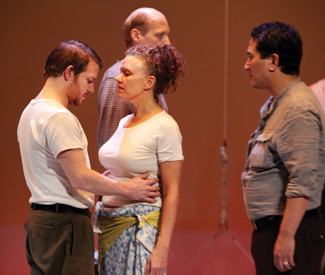
THEATER In a deceptively low-key but major theatrical event, Yerba Buena Center for the Arts last weekend presented the local debuts of both the Wooster Group and the New York City Players, in their collaborative take on three of Eugene O’Neill’s seafaring “Glencairn plays.”

It’s striking and not a little frustrating that San Francisco has never before been a port of call for either of these two world-famous and globetrotting experimental theater companies. Moreover, because this was a first-time collaboration between the two influential groups, Early Plays (as the O’Neill program is titled) was not really representative of either one of them. Rather, it was an intriguing, at times euphoric, at times baffling exploration fusing actors from both companies with relatively bare-bones Wooster design elements — all under the signature directorial style of NYC Players’ playwright-director, Richard Maxwell. Even so, it was a stimulating evening in which the attentive, open curiosity of the audience was palpable.

The triplet of early O’Neill one-acts — all written between 1913 and 1916 and featuring polyglot crew members of the British tramp steamer Glencairn —included, in order of presentation, The Moon of the Caribbees, Bound East for Cardiff, and The Long Voyage Home. In these short and atmospheric plays, O’Neill explores the hard, often brutal lives of sailors and other working-class people swept along by the winds of trade. But in paying attention to their distinct cadences, relationships, and dreams, the playwright also points to the lyrical nature of their lonely yet social lives, as well as flickering moments of transcendent experience amid coarse routines and unruly bursts of energy.

In this sense, they are not all that different from (and nearly as contemporary as) Maxwell’s own plays (like House, Burger King, Boxing 2000, or People Without History), which often delve into the mundane musicality of ordinary, inconsequential lives sideswiped by half-understood forces, churned by bumptious pretentions and bumpy social interactions, bewildered by quiet epiphanies. Indeed, Maxwell’s work comes shaded by his own original songs in which the banal takes unexpected flight.

But whatever their resonances, their plays remain a fat century apart in theatrical worldviews. O’Neill, learning from Europe and especially Stindberg, was inventing an American theatrical vocabulary still not entirely free of a certain melodramatic tradition. Maxwell and the New York City Players, on the other hand, represent a distinct and sustained attack on the stifling affects of the theatrical artifice that has accrued since then. And the Wooster Group has maintained a visionary re-imagining of the stage, its strengths and capacities, for nearly four decades (a project whose power and scope was clearly visible even on video in the three-weekend series of Wooster Group work screened at YBCA in the lead-up to the Early Plays premiere).

And so, what audiences encountered last weekend was a purposively monotone rendering of O’Neill’s rather overwrought dialogue, laden with a variety of archaic-sounding dialects that the actors dutifully articulated as written but, for the most part, without further embellishment or affectation. The action, meanwhile, unfolded with a deliberately subdued, knowing amateurishness on a Wooster-like set (designed by Jim Clayburgh and Wooster leader Elizabeth LeCompte) whose exposed gray-planed design featured a floating stage floor, supported by thin vertical cables, on which a skeletal framework of piping, bulging light bulbs, ropes, and pulleys combined in vaguely nautical abstraction.

Not that theatricality per se was absent: three of Maxwell’s workmanlike yet stirring ditties, for example, stitch together the O’Neill plays with simple, poignant, uninflected harmonies and rhythms as the actors smoothly reconfigure the stage. During Bound East for Cardiff, moreover, the stage was plunged into semi-darkness, sculpted by the warm glow of a few lantern lamps and the looming, slowly dissipating clouds blasted at intervals from a smoke machine, as main characters Yank and Driscoll (played respectively by NYC Players’ Brian Mendes and Wooster veteran Ari Fliakos) conferred at the former’s deathbed in a recessed, beautifully haunted corner of the stage. And in The Long Voyage Home, NYC Players stalwart Jim Fletcher (a riveting presence who is perhaps the quintessence of Maxwell’s forthright aesthetic, deflating and commanding at once) donned a too-tight barman’s vest and a toupee that looked like an animal roosting rump-forward on his head; while beside him Wooster’s luminous Kate Valk burst into and out of tears with a kind of blank perfection.

But it was precisely the melding of the clumsy and the graceful — and the volatile tension that arose between the purposely anti-theatrical and the inescapable pull of the plays themselves — that marked the production’s dissonant, quasi-Brechtian approach. In eschewing the usual cohesion, the production gave itself over to an admittedly not entirely successful but fascinating pursuit of what is much more rare: a sense of raw immediacy and authenticity, and a poetic capacity for unexpected instants of reflection. It’s an approach that wrestled with itself as much as the material or the audience, but it led to a refreshing sense of possibility and inquiry, and in it too there were moments when the lyrical and transcendent were given new life.

Travels well

0

caitlin@sfbg.com

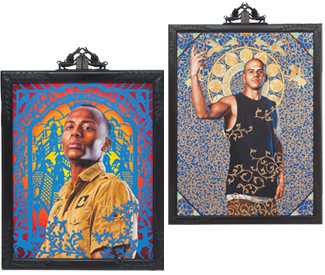
STREET SEEN I was going to write this column about what it was like to be art star Kehinde Wiley’s model. It was supposed to be an eloquent reflection on musedom, and I’d locked down a post-performance chat with Ethiopian Israeli rapper Kalkidan, who stars in several of Wiley’s portraits in the current show at the Contemporary Jewish Museum.

But you know what, Tel Aviv to San Francisco is a long flight and I’ll wager that if you followed up the same journey with two hip-hop sets in front of the opening night Contemporary Jewish Museum hoi polloi — whose hosted-bar pink cocktails gave birth to some very art-world dance moves — you would wind up much the same way Kalkidan did for our chat. Call it jet lag. Our interview veered towards monosyllabic, though I did manage to gather he’d seen the Wiley paintings in which he stars two times before, when the exhibition toured LA and New York. And that he’s an Aquarius.

“Leviathan Zodiac”

… Leaving me to my own devices with you, dear reader. Well, not entirely. I did have a chance to ask Wiley about the direction he gives to his “painfully young and present models,” as he calls them, mere minutes after his flight touched down from New York. (Right before another journalist saw fit to ask him about Frank Ocean? Has a moratorium been decreed on talking to black queers, or anyone even tangentially related to hip-hop, about anything else?)

Insight into Wiley’s models seems central to his gorgeous “World Stage” series, for which he poses young men of color in classic historical poses, with ornate backgrounds and rarified postures mimicking 18th and 19th European portraiture, among other influences. The conceit started when the San Francisco Art Institute grad moved to New York, and he’s painted other chapters of “World Stage” starring men in India, Nigeria, Brazil, China, and elsewhere.

Kalkidan on “World Stage: Israel” opening night at the Contemporary Jewish Museum. Photo by David Schnur

Coupled with his subjects’ vivid streetwear, which Wiley and his assistants (the artist is well-known for employing staff that contribute the pieces’ background, if not more) render faithfully, and region-specific background motif, the series is a gorgeous homage to modern brown and black manhood, with a swagger that is decidedly hip-hop.

“There is an aspect of black American creative culture that has become globalized. Every country finds their own response to this evolving reality,” reads a Wiley quote that greets visitors to the CJM exhibit. How has a culture that’s made its way everywhere still so vilified?

Wiley allowed to our group of arthounds at the preview that he does tend to capture men who are gorgeous — you won’t miss the fact once surrounded by his canvas gods — but that his choice has less to do with his own personal preferences. “You can’t know who’s zooming who,” he said. “Nor is it a particular interest of mine.” I overheard curator Karen Tsujimoto tell another reporter that she didn’t believe sexuality played a role in his work.

I guess I buy that. Wiley said that painting beautiful men is about highlighting factors rarely pulled out to the front in the art world. “Male beauty seems to be the elephant in the room when it comes to the history of painting,” he reflected.

“The World Stage: Israel” Through May 27. Contemporary Jewish Museum, 736 Mission, SF. www.thecjm.org

BOYCHILD DOES BIG APPLE

I’d be wrong if I didn’t laserpoint out that drag (is that term adequate still?) babe boychild for bringing genderphucked Bay Area fierce to the runway for the Hood By Air-New York Fashion Week collection named, yeah, “boychild.” You know you’re the buzz when you’re overshadowing rapper A$AP Rocky, who also walked in the show. The look? Wetsuits and sportswear with glittering detail: canary yellow do-rags with blonde extensions, pearl-headphone earrings, French manicure. Strong, kinda freaky, hella pretty. Just like our child.

Stage Listings

0

Stage listings are compiled by Guardian staff. Performance times may change; call venues to confirm. Reviewers are Robert Avila, Rita Felciano, and Nicole Gluckstern. Submit items for the listings at listings@sfbg.com. For further information on how to submit items for the listings, see Picks.

THEATER

OPENING

The Lisbon Traviata New Conservatory Theatre Center, 25 Van Ness, SF; www.nctcsf.org. $25. Opens Fri/22, 8pm. Runs Wed-Sat, 8pm; Sun, 2pm. Through March 24. New Conservatory Theatre Center performs Terrence McNally’s play, a mix of comedy and tragedy, about the relationship between two opera fanatics.

Steve Seabrook: Better Than You Marsh San Francisco, 1062 Valencia, SF; www.themarsh.org. $15-50. Opens Fri/22, 8pm. Runs Fri, 8pm; Sat, 8:30pm. Through March 22. Kurt Bodden’s San Francisco Best of Fringe-winning show takes a satirical look at motivational speakers.

BAY AREA

Dostoevsky’s The Grand Inquisitor Berkeley City Club, 2315 Durant, Berk; www.centralworks.org. $15-28. Previews Thu/21-Fri/22, 8pm. Opens Sat/23, 8pm. Runs Thu-Sat, 8pm; Sun, 5pm. Through March 31. Central Works performs Gary Graves’ adaptation of the story-within-a-story from The Brothers Karamazov.

My Recollect Time South Berkeley Community Church, 1802 Fairview, Berk; (510) 788-6415. $12-25. Opens Fri/22, 9pm. Runs Sat/23-Sun/24, Feb 28, March 2, 7, and 9, 8pm; March 1, 8, 9pm; March 3, 5pm. Through March 9. Inferno Theater performs Jamie Greenblatt’s play about the life of former slave Mary Fields.

ONGOING

Dear Harvey New Conservatory Theatre Center, 25 Van Ness, SF; www.nctcsf.org. $25-45. Wed/20-Sat/23, 8pm; Sun/24, 2pm. There’s always room in San Francisco for milk — Harvey Milk, that is, our very own out-and-proud crusader for equal rights for all, whose election as city supervisor in 1977 and assassination in 1978 galvanized the LGBT movement on a national level. Part history lesson, part memorial tribute, the Patricia Loughrey-penned Dear Harvey offers details of the extent of his influence, mostly in the realm of the political, collected from interviews with over 30 of Milk’s associates and friends. Interspersing testimonials with Bay Area Reporter headlines, fan mail, and projections of Daniel Nicoletta’s candid photos of the era, each member of the ensemble cast assumes multiple roles throughout the piece including Harvey’s activist nephew Stuart Milk, the "Queen Mother of the Americas" Nicole Murray-Ramirez, openly-gay politician Tom Ammiano, former youthful aide and prominent AIDS activist Cleve Jones, Milk’s spitfire campaign manager Anne Kronenberg, and even Milk himself. At its core, Dear Harvey plays out mainly like a talking head-style documentary, the disparate strands of monologue woven together providing a composite image of a single character. But as endearing in many ways that character is, it’s not enough to sustain the overall piece, which never develops its other, often fascinating, characters enough for the audience to feel much of a connection to the stage, no matter how much, personally, they might feel a connection to Milk himself. (Gluckstern)

Foodies! The Musical Shelton Theater, 533 Sutter, SF; www.foodiesthemusical.com. $30-34. Fri-Sat, 8pm. Open-ended. AWAT Productions presents Morris Bobrow’s musical comedy revue all about food.

God of Carnage Shelton Theater, 533 Sutter, SF; www.sheltontheater.org. $38. Thu-Sat, 8pm. Through March 30. Shelton Theater presents Yasmina Reza’s Tony-winning comedy about upper-middle-class parents clashing over an act of playground violence between their children.

Hedwig and the Angry Inch Boxcar Playhouse, 505 Natoma, SF; www.boxcartheatre.org. $25-40. Wed-Sat, 8pm (also Sat, 5pm). Through March 2. Hold onto your hairpiece, Boxcar Theatre is reprising their all-too short summer run of Hedwig and the Angry Inch, and just in case you think you saw it already, be forewarned — you ain’t seen nothing yet. Recast, redesigned, and re-vamped, this outcast-rock musical familiarly follows the misadventures of one Hedwig Robinson (né Hansel Schmidt) with glam, guts, and glitter. But unlike the movie version penned by and starring John Cameron Mitchell as the titular chanteuse, or other staged versions, director Nick A. Olivero splits the larger-than-life, would-be rock sensation into eight different characters, who are each given a solo turn as well as plenty of ensemble harmonizing during the course of the two hour-plus performance. The effect is often electric, and just as frequently hilarious, as when the four female actors playing the role stomp across the stage swinging imaginary dicks in the air to the lyric "six inches forward and five inches back, I got a, I got an angry inch!" Supported by a tight quartet of rock musicians led by Rachel Robinson, and the phenomenal Amy Lizardo as Hedwig’s beleaguered "man Friday" Yitzhak, Hedwig keeps on extending for what appears to be an indefinite run, employing the time-honored Thrillpeddlers’ tradition of rotating cast members and comeback performances, which means you could theoretically go multiple times and never see quite the same show twice. I certainly plan to. (Gluckstern)

Jurassic Ark Exit Theatre, 156 Eddy, SF; www.theexit.org. $15-25. Fri-Sat, 8pm. Through March 16. Writer-performer David Caggiano’s zany, well-executed solo play centers on a Christian televangelist who is unwaveringly bent on making a big-budget movie about a cowboy-like Biblical Noah, his Ark, and the largely lovable dinosaurs callously left out of the story — a project he sees delivering a decisive blow to the Darwinians, while turning cineplexes across the land into celluloid cathedrals. Brother Dallas and his proselytizing pitch eventually find receptive ears in a trinity of movie-industry heavies, whose collective business acumen demands a few changes to the script. Meanwhile, the intoxicating power of it all leads to a lapse in Brother Dallas’s righteousness and a scandal reminiscent of Hugh Grant’s career. Dallas rebounds from this bout with the Devil and sees his movie made — but surely only he is unaware that the Devil keeps a Hollywood address. Smartly directed by Mark Kenward, this low-frills production relies almost exclusively on Caggiano’s sturdy ability with quick-change characterizations (couched in Dylan West’s modest lighting design and a suggestive soundscape by sound editor–musician John Mazzei). The fitful satire trades in pretty orthodox caricature and, in Brother Dallas, lacks a very compelling or sympathetic central figure; but it unfolds with a very cinematic imagination that, while formulaic, is itself one hell of a movie pitch. (Avila)

The Little Foxes Tides Theatre, 533 Sutter, SF; www.tidestheatre.org. $20-38. Wed/20-Sat/23, 8pm. Tides Theatre Company performs a modern take on the Lillian Hellman classic.

The Motherfucker with the Hat San Francisco Playhouse, 450 Post, SF; www.sfplayhouse.org. $30-70. Tue-Thu, 7pm; Fri-Sat, 8pm (also Sat, 3pm). Through March 16. A fine cast makes the most of Stephen Adly Guirgis’s deceptively coarse, often amusing little play, The Motherfucker with the Hat, which receives its local premiere in a sure and rowdy production from SF Playhouse. Director and designer Bill English’s striking two-tier set almost belies the intimate nature of the quirky story, which concerns a hapless parolee and recovering alcoholic named Jackie (a winningly frazzled, bumptious Gabriel Marin) who retreats to his AA sponsor’s apartment to pine and plot revenge after he discovers a stranger’s hat in the bedroom of his longtime Puerto Rican girlfriend, Veronica (played vividly by an at once edgy and vulnerable Isabelle Ortega). But Ralph, his suave and persuasive sponsor (played with unctuous charm gilded by just a hint of ineptitude by an excellent Carl Lumbly), may not be the guy he wants in his corner. Not that Jackie can see that — he’s got a man-crush on Ralph that dwarfs his already ambivalent affection for much put-upon but stalwart cousin Julio (a sharply funny Rudy Guerrero) and blinds him to the warning signals from Ralph’s own disgruntled wife (a coolly disgusted Margo Hall). Throughout, these working-class New York borough dwellers display their wit and shield their soft underbellies with a rapid-fire barrage of creative swearing. English and cast display a real comfort with this kind of material (this is SF Playhouse’s fourth Girguis play), which drapes its soft heart in the intimations of violence more than the real thing. If the heat and imaginative cursing also seem to cover up for a play with little dramatic purpose beyond a gentle and somewhat pat exploration of loyalty, maturity, and trust, there’s pleasure to be had in the unfolding. (Avila)

Not a Genuine Black Man Marsh San Francisco, 1062 Valencia, SF; www.themarsh.org. $25-50. Fri/22, 8pm; Sat/23, 5pm. What, the unapologetically middle-class Brian Copeland asks, is the real meaning behind the phrase "a genuine black man"? By way of an answer, the stand-up comic and KGO radio host offers up a simultaneously funny and disarmingly frank story about growing up African American in the racist suburb that was San Leandro in the early 1970s. Letting his narrative bounce back and forth between his boyhood memories and a period of depression that overtook him as a parent in 1999 — and interlacing the autobiography with verbatim utterances from both sides of the fight his family joined to desegregate the city — Copeland brings admirable chops as a comedian to bear on some difficult and disturbing, if ultimately hopeful, material. Note: review from an earlier run of the same show. (Avila)

Sex and the City: LIVE! Rebel, 1760 Market, SF; trannyshack.com/sexandthecity. $25. Wed, 7 and 9pm. Open-ended. Lady Bear, Trixie Carr, Heklina, and D’Arcy Drollinger star in this drag tribute to the long-running HBO show.

The World’s Funniest Bubble Show Marsh San Francisco, 1062 Valencia, SF; www.themarsh.org. $8-50. Sun, 11am. Extended through March 17. The Amazing Bubble Man (a.k.a. Louis Pearl) continues his family-friendly bubble extravaganza.

You Know When the Men Are Gone Z Space, 450 Florida, SF; www.zspace.org. $30-55. Wed/20-Thu/21, 7pm; Fri/22-Sat/23, 8pm; Sun/24, 3pm. Word for Word mounts two related short stories from the titular collection by Siobhan Fallon about the home-front impact of warfare on the families of an American army base. In The Last Stand, an injured soldier (Chad Deverman) returns home to his young wife (Roselyn Hallett) to find she has decided to leave him. In Gold Star, a wife (Arwen Anderson) learns of her soldier husband’s (Ryan Tasker) death — the officer who died saving the life of the young soldier in the first story. Reeling from grief, she innocently hangs on the words of the young soldier (Deverman) as he comes to visit her. Beautifully designed — with shrewd use of Z Space’s large, potentially engulfing stage by Jacqueline Scott (set), Drew Yerys (lighting, sound), Delia McDougall (costume, props), and Andrea Weber (choreography) — directors Joel Mullennix (Last Stand) and Amy Kossow (Gold Star) show an imaginative command of the material that has made the company’s trademark verbatim staging of literature a viable theatrical undertaking in its own right, with much to admire and ponder in the juxtaposition of words, blocking, characterization, and imagery. Moreover, the ensemble (rounded out by Marilet Martinez and Armando McClain) is very strong, with standout turns from the mutually sympathetic but achingly at-odds characters played by Deverman and Hallett in the first half, and by Anderson’s shattered, erratic, yet highly attuned new widow in the second. As for the stories themselves, certain details of base life (such as the prime parking spaces eerily and crassly allotted widows of soldiers killed in combat) reveal the author’s firsthand knowledge as the wife of an active-duty soldier, adding a sense of authenticity to these intimate, heartfelt, and movingly told stories. Their essentially everyday tragedies, however, remain tightly focused on the subtleties of grief rather than any larger contextualizing of the immediate political and moral dimensions of the American imperial machine in which all characters ultimately serve. That leaves largely intact and unexamined the usual allusions to sacrifice, service, nationhood, duty, and traditional modes of male and female heroism in war, which is perhaps the most distressing thing about these otherwise quietly troubled stories. (Avila)

BAY AREA

The Fourth Messenger Ashby Stage, 1901 Ashby, Berk; www.thefourthmessenger.com. $23-40. Wed-Thu, 7pm (no show Wed/20); Fri-Sat, 8pm; Sun, 2pm. Through March 10. It’s been some time since a work by local playwright Tanya Shaffer last graced our stages, not since 2005 to be precise, and in keeping with her penchant for multicultural themes, her latest piece, The Fourth Messenger, is a reimagining of the Siddhartha story, written as a musical in collaboration with composer Vienna Teng. Raina (Anna Ishida), a "hungry" journalism intern with a secret agenda, pitches her first scoop — the debunking of a beatific guru named Mama Sid (Annemaria Rajala) — and embeds herself in a meditation retreat where she can get close to the famously private teacher and uncover her past. Neither as humorous or as merciless as Jesus Christ Superstar or as exuberant as Godspell (though the excellent song "Monkey Mind" crackles with wit and trenchant observation, and the tender "Human Experience" genuinely uplifts), Messenger does offer a fairly solid primer to the path of spiritual enlightenment including its all-too-human fallout and sacrifices. The white-on-wood set design by Joe Ragey frames the action in a deceptively delicate layer of gauze and mystery, and the capable ensemble inhabit their multiple roles with ease — from jaded newsies to loyal disciples. Which makes it doubly unfortunate that the jazzy, piano-driven score seems pitched just outside of most of the actor’s ranges, even those of the notably skilled Ishida and Rajala, an admitted distraction for the monkey-minded, which is to say most of us. (Gluckstern)

Our Practical Heaven Aurora Theatre, 2081 Addison, Berk; www.auroratheatre.org. $32-60. Tue and Sun, 7pm (also Sun, 2pm); Wed-Sat, 8pm. Through March 3. Anthony Clarvoe’s new play receives its world premiere as a 2011 prizewinner in Aurora’s Global Age Project (GAP), which cultivates new work addressing life in the 21st century. In the case of this labored and dull effort, the young century and its anxious outlook come refracted through three generations of women who gather for holidays at a seaside home whose own future is threatened by, first, financial and, ultimately, climatic conditions. Neurotic, self-absorbed Sasha (Anne Darragh) and capable businesswoman Willa (Julia Brothers) are middle-aged best friends forever who grew up in the home of Sasha’s mother (Joy Carlin) and late father. Joining Sasha’s two daughters by separate husbands, Suze (Blythe Foster) and Leez (Adrienne Walters), is Willa’s daughter, Magz (Lauren Spencer), who suffers from a debilitating disease. Despite many personal and generational differences — and a rising conflict over the house — all six women share in a traditional bout of bird watching in this fragile nature "refuge" for bird and human alike. While bird watching supplies the play’s operative metaphors, however, it does little to actually bring these characters together in any compelling or convincing way. In fact, respective backstories are pretty sketchy in general, dialogue strained and broadcasting, and performances correspondingly patchy. The three stage veterans in director Allen McKelvey’s cast — Brothers, Carlin, and Darragh — go furthest toward making Clarvoe’s leaden exposition somewhat buoyant, but the momentary pleasure they provide can’t stem the overall tide. (Avila)

PERFORMANCE/DANCE

"Analog: New Work by Katharine Hawthorne" Joe Goode Annex, 401 Alabama, SF; analogdance.eventbrite.com. Fri/22-Sat/23, 8pm. $15-25. A full evening of choreography inspired by the intersection of art and science.

BATS Improv Bayfront Theater, Fort Mason Center, Marina at Laguna, SF; www.improv.org. Sat/23, 8pm. $20. The company performs "Warp Speed: An Improvised Trek!"

"Comedy Night at the Presidio" Presidio Café and Golf Course, 300 Finley, SF; www.presidiocafe.com. Thu/21, 8pm. $10. With Will Durst, Andrew Holmgren, and host Justin Gomes.

"Dance and Diaspora" ODC Theater, 3153 17th St, SF; www.odctheater.org. Fri/22-Sat/23, 8pm. $25-30. Featuring the work of belly dance artist Jill Parker and Afro-Brazilian choreographer Tania Santiago.

"Fabulous Artistic Guys Get Overtly Traumatized Sometimes: The Musical!" CounterPULSE, 1310 Mission, SF; www.counterpulse.org. Thu/21-Sun/24, 8pm. $20-25. DavEnd’s performance extravaganza promises "singing pink cakes, dancing mirrors, and couture genitalia."

"Killing Me Softly With Jazz Hands" Stage Werx Theatre, 446 Valencia, SF; (415) 517-3581. Wed/20, 8pm. $10. Comedian Becky Pedigo performs.

"Megillah 3.0" Intersection for the Arts, 925 Mission, SF; www.killingmylobster.com. Sat/23, 7pm, $20. Killing My Lobster launches its online collection of original videos, music, and performance with a Purim carnival, featuring live sketch shows, KML comedy videos, and more.

"Our Voices, Our Stories Play Reading Festival" San Francisco Playhouse, 450 Post, SF; www.sfplayhouse.org. Mon/25, 7:30pm. Free. Readings of in-development works Without and Opportunity for Defense and Obeah.

"San Francisco Magic Parlor" Chancellor Hotel Union Square, 433 Powell, SF; www.sfmagicparlor.com. Thu-Sat, 8pm. Ongoing. $40. Magic vignettes with conjurer and storyteller Walt Anthony.

"Smack Dab" Magnet, 4122 18th St, SF; www.magnetsf.org. Wed/20, 8pm. Free. Open mic featuring Randy Alford.

"Solo Sundays: Family Blend, the Sweet and the Bitter" Stage Werx Theatre, 433 Valencia, SF; www.brownpapertickets.com. Sun/24, 7pm. $12. With Susan Ito, Lisa Marie Rollins, and Zahra Noorbakhsh.

Tanya Bello’s Project. B. and Karen Reedy Dance ODC Dance Commons, 351 Shotwell, SF; www.odcdance.org. Sat/23, 8pm; Sun/24, 7pm. $22. Featuring the world premiere of Bello’s Games We Play(ed).

BAY AREA

"One-Off Wednesdays (or sometimes Two-Off)" Marsh Berkeley, 2120 Allston, Berk; www.themarsh.org. Wed/20, 8pm. $15-50. This week: Wayne Harris in The Letter: Martin Luther King at the Crossroads.

Small space, big ideas: New City Company debuts

0

Ten years ago, Kim Jiang-Dubaniewicz sat outside the Chinatown gates nursing an existential crisis; she had serious doubts about pursuing her longtime dream of a career in acting. Just then, she looked up and saw a familiar face drinking coffee next to her. It was Sean Penn, and she asked him for a cigarette even though she didn’t smoke. He told her to stick with acting.

Apparently one doesn’t ignore the advice of Sean Penn.

After several years of acting, the discovery of a store that sold 25-cent paperbacks (including the works of playwrights William Saroyan and Eugene O’Neill), and a move to San Francisco, Jiang-Dubaniewicz wanted to try something new. Last October, she embarked on her first production as a director. The resulting work, The Saroyan O’Neill Project, just finished a twoweekend run at the Postage Stamp Theater in the Potrero Hill Neighborhood House.

In a room that hosts senior lunches by day in a building that has served as a community gathering place for a almost a century, her New City Company staged an energetic piece that worked best in the narrowly focused and understated moments when the play made no attempts to disguise the modesty of the production (the simplicity of the set in the second of two one-acts, a panel of bars in the center of the stage, was probably a reflection both of artistic choice and of the fact that practicing for free in the community room of a police station tends to impose some limits). Hello Out There, the starker of the plays with two characters continuing a mostly linear dialogue that builds into romance, came across beautifully. Gift Harris gave a tight and compelling performance as Photo-Finish, taking us with him through the varying shades of desperation, loneliness, and hope in the repeated cry, “Hello out there!” from which the play earns its name. 

The director cast the play well. In the script of Hello Out There, Saroyan describes Photo-Finish simply as “A Young Man,” a phrase that certainly contained an internal set of assumptions about race and ethnicity in 1941 when the play was written. Jiang-Dubaniewicz chose Harris, an African American man who has performed a number of roles on television and stage, because he just seemed to fit. Similarly, she decided to cast The Long Voyage Home, an Irish play from 1917, without regards to race or other qualities that typically account for typecasting in theater.

Discussing what she refers to as “inclusive casting,” the director cites her own experiences struggling with the scarcity of roles for Asian American actors. The same is true with other racial minorities, she says. Many of the African American actors in her cast have opted not to join Actor’s Equity because the number of available roles doesn’t justify the union fee. Not only does Jiang-Dubaniewicz view this as an injustice, but she also sees it as a failure to mirror the reality of the world around us, an aim of theater. “This is our city,” she says. “This is what we look like.”

The “we” implicates the audience, merging the play and the community. The direction of the show emphasized this. Little separated the two rows of guests and the stage, and while this was sometimes unsettling —  the larger cast and chaotic drunken merriment of A Long Voyage Home at times felt too big for the space and distanced the audience — it mostly added to the feeling of intimacy. In the quieter, more finely tuned Hello Out There, the characters spoke facing outward toward the audience, inviting us into the burgeoning love between outcasts.

And the audience participation did not end with the bows. At the end of the performance, Lewis Campbell, the indispensable executive producer, addressed the audience with a half-joking plea for help transforming the space back to its daytime function. In 30 minutes, it would become a senior lunch room once again. 

Will the senior lunch room ever transform back into The Postage Stamp Theater? Jiang-Dubaniewicz is considering a number of future projects for the New City Company, including more of the rich anti-hero tales of Saroyan and O’Neill. After the success of this first project, hopefully she won’t need a fortuitous Sean Penn run-in to make it happen.

Live Shots: Tomahawk at the Great American Music Hall

2

Tomahawk gave two rare live performances this weekend at the Great American Music Hall, the second of which this photographer attended, and — as to be expected from most things involving Mike Patton — it was flawless, aggressive, and there were lots of dudes in the crowd.  

The night started interestingly enough, waiting in line behind Jello Biafra at will-call and hearing him give his name to the woman behind the glass, while a few people behind me whispered, “that’s Jello Biafra.”  I don’t think he remembered me, but he stepped on me during the last Melvins show I photographed at GAMH. That time, I looked up and he said, “sorry” and I was like, “awesome.” 

Anyway, back to the show. Aside from a stricter than usual photo policy forcing me up into the balcony (there was no way I was pushing up front, Patton fans worshippers are rabid), it was spectacular. Tomahawk opened with “Mayday,” from Mit Gas, Patton quickly emerging from behind his computer and drum machines and charging towards the crowd, whipping it up and still giving plenty of attention to the band, often turning to face drummer, John Stanier, to whom he remained precisely, rhythmically locked all night.

The band maintained the same level of energy throughout most of the show, with the occasional pause to simultaneously admonish the audience and make sure everyone was having fun. One audience member who made the mistake of having his iPad out during the show, presumably to take a photo, clearly provoked Patton’s ire, and was called a “fucking idiot” from the stage and told to “put it back in his man purse.”

The set included a healthy dose of songs from every album, culminating in a highly energetic performance of “Laredo,” in which Patton used the repeating line “The cat’s in the bag and the bag’s in the river” to showcase the full range of his vocal, tics, growls, and whispers.

The group returned to the stage for two encores, the first being the jazzy “Rise Up Dirty Waters” off of its new album, appropriately titled Oddfellows. Duane Denison remarked that he was nervous to play this one, as it had not been performed live before, but they all seemed to nail it, with Trevor Dunn’s walking bass line and the Lynchian vocal-guitar melody putting what many thought was a quiet cap on the night.

But no, Tomahawk returned to the stage again, this time Patton in a hockey mask, the eyehole of which he fed his microphone through and proceeded to blast into Bad Brains’ “Pay to Cum” and “How Low Can a Punk Get.”

Vocally, he was a pretty convincing HR and although he didn’t do any backflips, he did manage to get a few stage-dives in, much to the chagrin of security who immediately found themselves engaged in a tug-of-war, Patton as the rope, against the crowd. It was an exciting end to a highly entertaining show. Also, props to the guy that jumped off the balcony on to the speaker stacks.

Setlist:

Mayday

Flashback

Oddfellows

101 north

Stone Letter

Birdsong

Rape This Day

Honeymoon

Capt Midnight

White Hats

God Hates a Coward

IOU

Rotgut

Southpaw

Point and Click

Laredo

Encores:

Rise Up Dirty Water

Pay to Cum

How Low Can a Punk Get


The Performant: Playing in the Sandbox

1

SF Playhouse’s Sandbox Series puts play back into playwriting

It’s getting harder each year to determine when exactly the “off-season” is in terms of things to do in the City, considering that this past, random weekend in February alone saw collisions of three major festivals — SF Sketchfest, SF Indie Fest, and SF Beer Week — on top of all the usual openings and closings and goings on. In fact, it’s been so hectic (albeit muy divertido) that the Performant is going to break protocol and look ahead to an event lingering just on the horizon, to ensure it doesn’t get lost in the onslaught of events to come.

Founded in 2010, SF Playhouse’s Sandbox Series is a play series (beginning Feb. 27) that inhabits a region somewhere between staged reading and full production — offering new plays a full run and technical support, without breaking the bank on design and promotion.

Past playwrights have included William Bivins (“The Apotheosis of Pig Husbandry”), Daniel Heath (“Seven Days”), and Kenn Rabin (“Reunion”). This year, the ladies will take centerstage with Inevitable, penned by SF Playhouse’s own Literary Manager, Jordan Puckett, and the next play in the series a commissioned piece from Lauren Gunderson on the life of artist Rudolf Bauer.

I caught up with SF Playhouse artistic director Bill English and artistic associate Lauren English to get the scoop on playing in the “Sandbox.”

SFBG When you founded the Sandbox Series in 2010 did you anticipate it having this kind of staying power?

SF Playhouse (Initially) we were worried we were taking on too much by starting an alternate season of World Premieres, but this is our fourth year and the funding has miraculously kept up with our needs.

SFBG
What’s the selection process for plays like?

SFP We started by soliciting scripts from the outside and three of our Sandbox plays were commissions of Playground—a new play incubator—that provided part of their funding. Now we are trying to feed our own commissions into the Sandbox, while still accepting scripts from outside SF Playhouse

SFBG It appears that these productions straddle a line between staged reading and full production, care to break down the dynamic a bit.

SFP The gulf between readings and full productions is an area where not many theatres dare to tread, but one where there is a great need. Sandbox offers a unique experience for both the playwright and the audience. It’s not a full production nor is it a staged reading, it’s in that gorgeous “in-between” phase of play development that is not often seen by the public. We look to create simple design gestures to support the story, while keeping the focus on the story itself. We try to stick with scripts that have five or less actors and fairly simple technical demands.

SFBG Have any of these plays gone on to fully staged productions at SF Playhouse or elsewhere? What is the future for a Sandbox series play?

SFP Not yet, but we are still working on some of them and our aim is to have Sandbox plays track to the mainstage or productions at other theatres. We always meet with the playwrights after run closes to do a post mortem and make recommendations.

SFBG Anything you’d like to add?

SFP If theater is to continue to be a part of our culture and thrive into the future, it is essential to develop new voices. Playwrights are the prophets of our culture, with sensitive antennae poised to see, hear, and feel the essentials of being alive in our time and to translate those insights into stories that give us much needed perspective on our lives. We need them and our Sandbox program is our commitment to nurture these voices.

SF Playhouse Sandbox Series
previews begin Feb 27, $20
Unscripted Theatre
533 Sutter, SF
(415) 677-9596
www.sfplayhouse.org

Beyond Frank Ocean: La Peña takes a deeper look at hip-hop inclusivity

4

If I hear another journalist ask anyone involved in hip-hop incredulously, reverently, portentously about Frank Ocean and that Tumblr post someone may lose their digital recorder. Frank I love you, I love your ambiguous Internet warblings, your endearingly awful Grammy performances — and kudos on Willy Carter, damn — but obvs you’re not the first queer person to be involved with your musical genre.

The Bay Area knows this — in 2007 the PeaceOUT World Homo Hop Festival, already six years old at that point, took over deFremery Park with Oakland’s Deep Dickollective and co. And like, Cazwell? Hey.

This list goes on — but this post is more about future, specifically the Hip-Hop: Beyond Gender event series that kicks off at La Peña Cultural Center on Fri/15 with “Here Me Roar”, a lineup of queer and feminist spoken word MCs set to wrecking speed. I caught up with a couple of the artists to talk about how hip-hop came to them, and where they want it to go.

Hopefully, their events in the La Peña series — which include concerts, panel discussions, and breakdance battles — will advance the conversation about hip-hop and gender-sexuality inclusivity that Le1f, Freedia, Nicky, Mykki, Double Duchess, Syd, YES Frank Ocean, and a bajillion other awesome artists are helping to create. 

CHINAKA HODGE

Photo by Bethanie Hines

A child of Oakland, this playwright, poet, and author of Girls With Hips will perform at “Hear Me Roar” at La Peña on Fri/15.

First hip-hop album: The Roots, Illadelph Halflife. Up until that point, I’d just stolen hip-hop music from my parents. The first album of any genre that I learned all of the words to was Arrested Development’s debut, 3 Years, 5 Months & 2 Days in the Life Of… 

First hip hop concert/party: Tough. Hmmm. There’s an MC out of Oakland, originally from Queens, named Rico Pabon. When I was in high school, Rico was probably my favorite act. He used to headline a series of all-ages shows at La Peña called “Collective Soul”, alongside Company of Prophets, Lunar Heights, a bunch of the indie staples in hip-hop at the time. I think those were probably my first parties. Glad to see we’re coming full circle, and I’ll get to rock the stage at La Peña this Friday — I used to beg mom to let me attend back in the day.

First time I thought about what gender meant in hip-hop: Listening to Digable Planets. Everyone used to refer to Ladybug Mecca as “the girl” in the group. I saw that trope carry over as I listened to Blunted on Reality, the Fugees’ first album. To me, sonically, I just identified Ladybug and Lauryn as the best of the three. It wasn’t until older male relatives and friends pointed out gender that I first started to note and notice differences.

One question I’d like to see addressed “Hip-Hop: Beyond Gender”: I’d like to see us address the issue of why female-identified emcees are consistently asked to talk about gender and sex — both onstage and off — when our male identified counterparts are not.

INVINCIBLE 

Photo by B Fresh

In addition to having their own music label — Emergence Media — this Michigan MC is active with Detroit Summer, an intergenational inner-city group that links up community members in projects to change the future of their neighborhood. Invincible’s organizing the “Event Horizon” night on March 15, which promises “transcending the gender binary and entering parallel multiverses of holistic complex identities.” Ooo.

First hip-hop album: First vinyl, Paid In Full (Eric B and Rakim). First tape, Check The Rhime (maxi single!) followed by Low End Theory (A Tribe Called Quest). First CD (in the tall cardboard package): Sleeping With The Enemy (Paris).

First hip hop concert/party: When I was 15 I had a secret knock at the back door of a few local clubs where bouncers got me in to watch shows and get on the open mic. I got caught one too many times so that led to the first show I threw, which was at an abandoned hotel that me and my first DJ transformed into an all-ages venue, ’til the cops broke it up at our second event. I think the first time I actually bought a ticket was for Xzibit and Big Pun but that show sadly got shot up and shut down too soon. 

First time I thought about what gender meant in hip-hop: I remember when “Ladies First” by [Queen] Latifah came out. It made an impression on me, but I was too young to understand the power of it. I first fully saw the role gender justice plays in reviving hip-hop when I met and joined the anti-misogyny all-elements hip hop collective ANOMOLIES. They made me reflect on all the hardships i had witnessed and experienced, and realize how important it is to support each other as people whose voices are marginalized in this culture.

One question I’d like to see addressed “Hip-Hop: Beyond Gender”: How do we create space for more transgender and gender non-conforming hip-hop artists to develop skills, bring new perspectives, and be heard? How can gender justice in this music and culture benefit all marginalized voices in hip-hop?

TRU BLOO

Photo by Ruby Battacharya, logo by Maya el Helou

Tru Bloo started performing hip-hop when they were 11, played Angela Davis’ induction into the La Peña hall of fame in 2011, and has dabbled in classical guitar and piano among a million other projects. They’re curating the May 10 “Wo(MB) Manifest” night of breakdancing, graffiti, and performance at La Peña.

First hip-hop album: I found a 2 Live Crew rap tape on my school bus in fourth grade and memorized the entire album. Also danced a lot to Rob Base & DJ E-Z Rock.

First hip hop concert/party: MC Hammer

First time I thought about what gender meant in hip-hop: When groups like TLC, Salt ‘N Pepa and Queen Latifah’s U.N.I.T.Y. anthem came out in late ’80s/early ’90s, I realized women had a different story to tell via hip-hop.

One question I’d like to see addressed “Hip-Hop: Beyond Gender”: Do female, trans, and gender non-conforming hip-hop artists have the power to change the social discourse around patriarchy, misogyny, homophobia, and transphobia within our communities and mainstream pop culture, if given a voice?

Missing person

0

arts@sfbg.com

THEATER A filthy, forlorn world emerges in surreal half-light at the outset of Magic Theater’s premiere of Se Llama Cristina, the new play by celebrated San Francisco–based playwright Octavio Solis. But almost as quickly, its initially intriguing outlines begin to look artificial, becoming the bloated lines of caricature more than a poetical evocation of real life, as the sentiment at the heart of this sometimes forceful but finally thin and frustrating play steadily takes over.

It’s odd and somehow appropriate that the two wayward characters at the center of the story — an at first nameless Woman (a vital Sarah Nina Hayon) and Man (a sympathetic but inconsistent Sean San José) — so aimless and rootless in their own lives, find themselves confined to the same dingy drug- and trash-strewn apartment (nicely realized by set designer Andrew Boyce and lighting designer Burke Brown), with initially no conception of where they are, who they are, or how they are related — let alone the meaning of the baby crib in the corner with a piece of fried chicken in it.

In this shabby environment, time and memory and biography all collapse and rise again as if within the ether of sleep or a heavy nod. Checkered histories and nervous dispositions slowly present themselves in a compact but oversaturated 80 minutes of dialogue that, at its best, pivots bracingly between horror and hilarity, with a rough lyricism that is a trademark of Solis’s border-town noir aesthetic. Soon a jilted villain named Abel (a very able Rod Gnapp) appears, incarnating the menace in the air. Also in the room is the possibility that the Man and Woman are about to be parents — or are already — which throws further fuel on the fire of their desperate coupling.

When, near the end, a young woman (Karina Gutiérrez) blows into this increasingly claustrophobic and wearying ménage, it’s like a breath of fresh air — and that is almost literally so, since she enters through the window. We could take her monologue as the voice of their daughter, the Cristina of the title, from some not too distant future. But whether or not we do, her impact is transformative in a way more or less synonymous with parenthood: presenting the couple with the possibility of a salvation at once of their own making and a gift from beyond — a kind of daughter ex machina.

If the details of the couple’s situation are better left subject to dream-logic than to a realistic accounting of probabilities and physical possibilities, it’s nevertheless true that the play suffers from an erratic need to fill in gaps. Among other things, that can lead to dialogue overburdened by exposition and back story (as in the Man’s graceless retelling of his self-exile from romantic attachments). Less would have been more. In director Loretta Greco’s staging, the awkward tension between the violence and despair of circumstance and an almost impatient rush toward love and hope is sometimes apparent in performances that can betray an uncertain balance between comedy, violence, and dread. In a scene where the Woman appears about to birth her daughter into the wicked, greedy mitts of Abel, the visceral, sexual, messy heat of the dialogue feels at odds with the somewhat guarded blocking of the actors. That said, there are moments in which a potent balance of elements reigns, as when Abel appears as the Telephone Man, threatening a total domination of the couple’s fate. It’s spooky, funny, surreal, and convincing at once.

In the end, however, the stakes never feel high or real, despite an almost too-insistent ladling on of gory detail, foul language, and teeth bearing. Like the impetuous verse scrawled on the back of Cristina’s sonogram image by her wannabe-writer father, Se Llama Cristina is ultimately a passionate poem to the deliverance that a child can offer her parents. But it’s scribbled too hastily and self-consciously in the hand of a playwright whose best instincts balk at the maudlin habit it encourages. *

SE LLAMA CRISTINA

Wed/13-Sat/16, 8pm (also Wed/13, 2:30pm); Sun/17, 2:30pm, $22-60

Magic Theatre

Fort Mason Center, SF

www.magictheatre.org