Stage

Home for brews

1

culture@sfbg.com

BEER My cab pulled up to an unassuming house on a quiet street in the Mission. An etched sign on the front porch bearing the words “Brewlab San Francisco” was my first greeting to the space. I entered, and after checking me in, a man in a green vintage Adidas tracksuit handed me a customized Mason jar and said, “Enjoy.” It was time for a tasting at Brewlab (www.brewlabsf.com).

This wasn’t my first time at the quickly growing hackerspace for homebrewers. What brings me back is not the brew found at its invite-only tasting events, but the community that produces those pints. It’s a community that is thriving with Brewlab as its hub.

The mission behind Brewlab is very simple: to create a space for home beer makers to gather together, share their creations, and get feedback from each other and beer enthusiasts. Brewlab will soon offer classes, and currently provides equipment-sharing opportunities for aspiring home brewers. It hosts tasting events and competitions where ale makers gain feedback on their work from their community.

“There wasn’t an organization supporting homebrewers at the time, so I decided to start one with my friend Emily Ford,” Sam Gilbert says via email. As Brewlab’s co-founder, he operates the organization with Matt Smith, who joined up when Ford left the group early on in its existence.

“At the time, I was really inspired by what ForageSF was doing for people making food at home, and so [I] wanted to try to do the same thing for home brewers,” Gilbert explains.

In a move that sprang from his interest in cooking, Gilbert started brewing about five years ago while living in Boston. Enticed by the complexities of hops and fermentation, he hasn’t looked back since: “There’s a lot of biology and chemistry to learn about, as well as equipment to build and maintain.” He came to San Francisco to work in the tech industry and started Brewlab soon after, in the spring of 2011.

“I quickly started craving that feeling of community you get from making stuff with like-minded people,” he says. “Home-brewing tends to attract people who are really passionate about the craft, but who also like to have fun. Drinking is built right into the hobby, after all.”

To say that Gilbert’s project has become a presence in the brewing community would be an understatement. Every time I’ve set foot in the Brewlab headquarters, I’ve been bowled over by the sense of friendliness and camaraderie — not to mention by the plain ol’ good times to be had there. People know my face, they know my name, they remember our last conversations — and I don’t even make beer. “There’s nothing like being in the middle of a growing community,” Gilbert writes, and surely he’s in a good position to judge.

“It’s been the most thrilling, exhausting, nerve-wracking, inspiring thing I’ve ever done,” he continues. “Brewlab sits at the intersection of what are probably San Francisco’s three favorite things: beer, tech, and local craftsmanship. So from a very early stage it felt like we had hit a nerve.”

Now in its second year of operation, Brewlab is working on ways to serve the homebrew community. From what I can see, the future is very exciting. At its last tasting event, sensors were placed at the bottom of each taster’s glass. They recorded how many times each beer was ordered. iPad stations in Brewlab’s garage allowed visitors to submit detailed feedback on the flavor profiles of the various pours.

In addition to its tasting events (which are now invite-only to deal with the unexpectedly high level of demand for these rad happenings) Brewlab is currently collaborating with nearly a dozen brewers to make a Belgian tripel that will age for six months in a wine barrel.

Perhaps most exciting of all, the group will be offering basic classes for people like me: wannabes who observe and admire the homebrewing craft but have no idea how to start making their own beer. The classes will be free to the public. No experience is necessary, and Brewlab’s equipment sharing program can help ease you into brewerdom on the cheap.

Throughout my conversations with Gilbert and Smith, it seemed clear that while they’re excited about expanding the Brewlab community and continuing to expand its programming, their primary goal is to nurture a small and strong community that stays true to the craft.

“So many awesome people have come through our doors, tasted our beers, and worked hard to support the organization at this point,” Gilbert writes. Thanks to Brewlab, it’s a good time to be a little guy in the brewing game in San Francisco.

Mathematical certainty

0

arts@sfbg.com

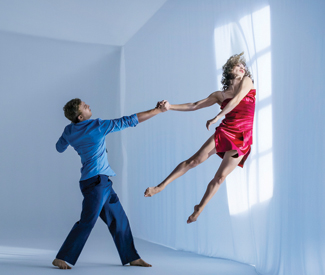
DANCE ODC/Dance started its 42nd season with a party-happy gala and two contrasting but complementary works: Brenda Way’s new Lifesaving Maneuvers and KT Nelson’s redressed and finessed 2012 Transit: Next Stop. Two days later, the season’s major premiere, Triangulating Euclid, co-choreographed by Way, Nelson, and Kate Weare, opened an intriguing perspective on what gifted women can do when they put their heads and hearts together. Of course, women working together is not exactly a fresh idea at ODC — it’s at the core of what this troupe set out to do four decades ago.

Though the dark Lifesaving has its moments of humor, Way’s look at wild excesses and paralyzing paranoia, both as social and personal phenomena, is a tough watch. The piece develops in front of Alexander Nichols’ semi-transparent curtain that closes off some ominous, hinted-at life beyond our vision.

While the sheer clarity and force of its choreographic vision pulls you in, Way’s unsparing look on coping strategies is chilling. Chaotic explosions could distill into social dance sequences where a partner, nonetheless, could be dropped like a rock. Yayoi Kambara looked caught in a tornado from which there seemed to be no exit, while Anne Zivolich darted around like a hunted rabbit.

Way grounds the choreography in an intense, often frantic energy that implodes mid-air. She balances discontinuity with unity processions, starting with battlefield imagery of dancers carrying off fallen comrades, women being pushed into the wings like brooms and vacuously waving men and women that might have stepped out of a Pina Bausch piece.

Still, Way doesn’t want us to feel too gloomy. You can’t help but smile when dancers choke and need Heimlich maneuvers as "Mad About the Boy" plays. In a silent movie melodrama, Natasha Adorlee Johnson throws herself at Corey Brady’s suave villain; he coolly assesses his victim and flips her off.

The piece ends with Justin Andrews cradling a desperately flailing Vanessa Thiessen. He tries to comfort her; she can’t respond. Curtain.

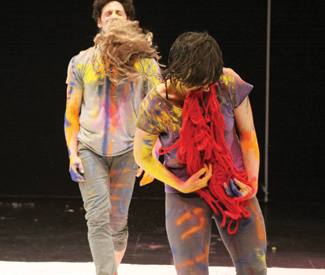
Whatever the process that the three collaborators engaged in for Triangulating, it worked. At first the piece looks like an illustration of basic plane geometry, but it quickly blossoms into an exuberant celebration of the way dancers inscribe themselves into space. From the moment a dancer’s leg smudges the carefully drawn line on the floor, you realize that poetry supersedes science.

The half-hour piece sails through its accumulations and dissolutions of staggered and overlapping encounters with surety and an increasing sense of freedom. The piece grows and finishes with Yayoi Kambara as the single dancer who draws the others onto the stage. Line formations give way to duets — still at the core of how and why we dance. Wonderfully, the cantilevered lifts, upside-down holds, and kicking feet feel thoroughly at home in Schubert’s music. The partnering between Corey Brady and Maggie Stack, contentious and passionate in the way he throws and whips her around, stands out.

Finally, Anne Zivolich sniffs, tiptoes, and encircles an indifferent Jeremy Smith; she breaks into one of her by-now-legendary whiplashing explosions when he takes off with someone else. One by one her colleagues march in and try to stomp her to the ground. The scene was both hilarious and spoke to truth: surely there is more to this dancer than being a female hurricane —something she appears as in just about every choreography that ODC produces.

The simple costumes (by Way and Lisa Claybaugh) of black shorts and bras for the women, and then supplemented by diaphanous white blouses, couldn’t be better. The score’s trajectory from synthesizer to Schubert to grand-style minimalism did its job as well.

Nelson’s Transit: Next Stop has acquired a spectacular set of animations which contextualize her urban dwellers’ attempts to manage their relationships. Yet Barry Steele’s design is so big that it draws undue attention to itself. It works best during a night scene in which life becomes a dream. But I am not sure whether adding a filmic sense of passing and changing habitats brings that much to this funny-yet-tender perspective on what it means to be a contemporary city dweller. *

ODC/DANCE DOWNTOWN 2013

Wed/20-Thu/21, 7:30pm; Fri/22-Sat/23, 8pm; Sun/24, 4pm, $20-$75

Yerba Buena Center for the Arts Theater

700 Howard, SF

www.odcdance.org

Whereabouts of W. Kamau Bell: a Q&A

0

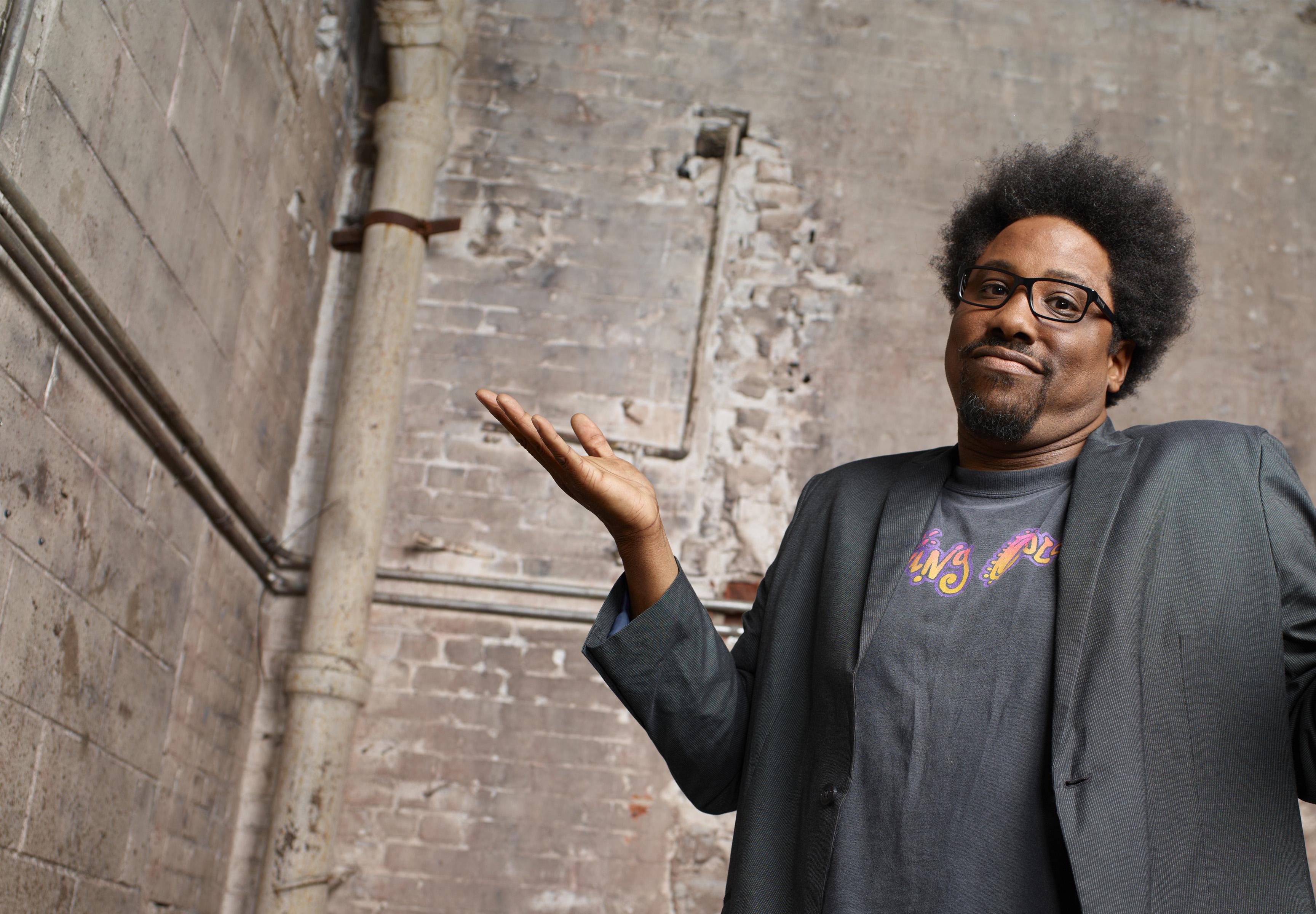
Q Hey, whatever happened to W. Kamau Bell?
 
A Pretty sure the politically astute Bay Area comedian, writer, and director went on to fame in TV land as host of FX’s Totally Biased with W. Kamau Bell.*
 
*True, but he’s back this weekend for two late-night sets at Stage Werx.

The shows are benefit performances for the scrappy venue that served as an early home for many a Bell project, including The W. Kamau Bell Curve: Ending Racism in About an Hour. By request of the performer, most tickets are just $15. But all proceeds from the shows go to Stage Werx, so no one will be turned away for excess of funds.

Sat/23, 10pm; Sun/24, 9:30pm, $15-$25
Stage Werx Theatre
446 Valencia, SF
www.kamau.eventbrite.com

Author (and former strip-club DJ) Dee Simon talks ‘Play Something Dancy’

2

Former SF resident Dee Simon wrote a very funny, very raunchy book of short stories about his experiences spinning tunes at local strip clubs; it’s called Play Something Dancy. Clearly I had to talk to him and get the inside scoop.

San Francisco Bay Guardian Standard first question: how did you become a strip club DJ?

Dee Simon I moved to SF in 2000 to pursue a career in broadcasting. Unable to land a paying radio job, I started hosting Rampage Radio at KUSF 90.3FM and eventually found a job in production at The Industry Standard magazine. The Standard was very successful for about a year and then folded once the crash happened. I was unemployed for about eight months until that fateful day I ran into my weed dealer who hooked me up with an audition at a club on Broadway, which launched my illustrious five-year career as a DJ at clubs across the city.

SFBG When you lived in San Francisco, I used to see you at punk and metal shows all the time. Did you ever get to sneak that kind of music into your playlist?

DS When I first started working as a DJ, I mistakenly assumed that all strippers danced to Motley Crue or Guns n’ Roses. Those bands had loads of strippers in their videos. In reality, they don’t dance to hair metal. There might be a few exceptions but most tend to prefer hip-hop and R&B. In the story “Run to the Hills” I talk about how all strip club DJs reserve a special cache of music for girls who choose not to tip. If a girl tipped me, I would play her anything she wanted. But if she didn’t tip, she’d dance to the music I liked — Iron Maiden, Slayer, Gwar, W.A.S.P., Motorhead, the Dwarves — till she realized it was in her best interest to take care of the DJ.

SFBG What constitutes a good versus bad song for stripper utilization?

DS The managers invariably want the DJ to keep the music uptempo. However, there are a variety of factors involved in selecting a song for a dancer. If it’s a Friday night and the club is packed, you don’t want to play a slower song like Portishead or R. Kelly that will decimate the energy in the room. You’ll risk losing the crowd and invoking the wrath of your manager. But at the same time, the DJ also wants to satisfy the dancer, especially if she’s a good tipper.

I would base my decision on the crowd. If the crowd seemed to be really tipping the dancers on stage during rock songs, then I’d persuade her to dance to Aerosmith or Led Zeppelin or AC/DC because she’ll make a lot of money. Conversely, if the crowd was more into hip-hop, I’d choose something old school like Notorious BIG’s “Hypnotize” or Tupac’s “How Do U Want it.” Both songs are recognizable classics and upbeat.

http://www.youtube.com/watch?v=glEiPXAYE-U

SFBG What was your most-hated song to play? Also, please explain how Weird Al became part of your playlist.

DS I despised the song “Hot In Herre” by Nelly. Try listening to that wretched song 12 times a night, four nights a week, and then see how many times you contemplate suicide. It’s been years and I still cringe when I hear it. Weird Al was only bought out in extreme circumstances when a non-tipping stripper was undaunted by the heavy metal and punk music that I was playing for her. In that case, I had no choice but to play some fine Weird Al tunes such as “Dare To Be Stupid,” “Yoda,” or “Amish Paradise.” Most dancers would usually tip after dancing to “Amish Paradise” two or three times in a night.

SFBG Were you writing down the crazy stories that happened to you all along, or did you compile them later? What inspired you to write a book, and how true to life are the stories?

DS Over the five years I worked at the clubs, I kept a journal to chronicle my mishaps and shenanigans. I had several notebooks filled with amusing stories but never really did anything with them. It wasn’t until two years ago when I moved to Los Angeles and was unpacking some boxes, I found my journals and decided to officially write some of the stories down in book form. Sadly, all of the stories in the book are quite true; however, in order to protect myself from criminal prosecution and civil liability, names, locations, and identifying characteristics had to be changed.

SFBG Strip clubs are often fodder for films (Showgirls, The Wrestler, etc.) In your opinion, which is the most accurate portrayal of what goes on behind the scenes? Which is the worst, and why?

http://www.youtube.com/watch?v=CRbUSIRV6i4

DS I think The Wrestler offered a very accurate portrayal of the depressing reality of a strip club and we got to see Marisa Tomei’s ta-tas. I also thought that Tarantino did an excellent job of showing how much of an asshole strip club owners can be in Kill Bill Vol 2.

I know it’s not a film but The Sopranos delivered a realistic portrayal of strip club life with the Bada Bing! club.

Critically, it might be one of the worst films ever made but Showgirls is a hilarious cult classic that has stood the test of time, and it would be blasphemy to criticize it. In my opinion, the worst strip club movie has to be Striptease with Demi Moore and Burt Reynolds. The name of the strip club where Demi Moore worked was called the Eager Beaver and that’s all I really need to say about that.

SFBG You DIY’d the publication of the book, and are doing your own publicity. How has that process been? How do you get the word out and what has the reaction been?

DS Like the music industry, publishing has radically changed and authors are no longer beholden to literary agents and the “Big 6” publishers to produce their book. Now all an author needs to do is find an editor and a digital conversion tool and he or she can make their own digital book and publish it on Amazon or iTunes.

Instead of spending months collecting rejection letters, an author can put his or her own work out there and see who wants to read it. I’ve found that the most difficult part of self-publishing is publicity and promotion. Since I cannot afford to hire a professional publicist nor purchase ads in the New York Times, I rely on social media, blog posts, podcast interviews, and book reviews to spread the word. From what I can tell, people seem to dig the book. I’ve received a lot of positive feedback and good ratings on Amazon and iTunes, which definitely helps with exposure.

SFBG Have any of the people who figure into your stories read the book and given you feedback? Which story do people respond to the most?

DS Thankfully, none of the people I have written about have recognized themselves in the book, hunted me down, and physically harmed me. I’m rather afraid of one character in particular named Pepper. He was a frightening individual but he didn’t strike me as the type of person who would bother reading a book that didn’t have any titty pics so I’ll probably be all right.

I’ve received the biggest response from the opening story “Lexi” and the final story “Kashmir.” In fact, several people mentioned that after reading “Kashmir,” they have been unable to listen to that Led Zeppelin song again without feeling nauseous.

http://www.youtube.com/watch?v=dwisLnjsOCA

SFBG What do you think of Tucker Max comparisons? Personally I think you are a better writer than he is, but some of the … racier subject matter might speak to similarities between you two.

DS Though I’m not a fan, Tucker Max is a bestselling author who has legions of devoted readers. I’d love to replicate that success. I suppose the subject matter of our books is comparable but the theme is vastly different. Rather than boast about my various sexual exploits and deviant acts, I regret having had to endure them.

A lot of the stories in the book are humiliating and some involve venereal disease and diarrhea. There’s a definite reason the full title of the book is Play Something Dancy: The Tragic Tales of a Strip Club DJ.

SFBG What are you up to these days? What is the Sick and Wrong podcast all about?

DS I live in Los Angeles now and am writing a follow up to Play Something Dancy. I host a weekly comedy podcast called Sick and Wrong where my cohost and I ridicule inept criminals, dish out horrible advice to callers, and interview some colorful guests. At seven years, Sick and Wrong is one of the longest-running podcasts and ranked among the top 100 comedy podcasts on iTunes. I also just started a new vidcast called the Obscenesters, which is recorded at Tradiov.com/LA.

SFBG Bonus question — what’s the best rock show you’ve seen lately?

DS My favorite recent show was Graveyard. Their new record, “Lights Out” is fantastic. I highly recommend it.

Dee Simon’s book Play Something Dancy is available on Amazon.com, iTunes Bookstore, and barnesandnoble.com. Learn more about Simon and his other ventures at his website.

Should bars be open until 4 am?

44

State Sen. Mark Leno is introducing a bill that would allow (not require, allow) cities to designate areas where bars could stay open and serve alcohol until 4 am. It’s not going to lead to a rampage of all-night drinking — the bill calls for a three-stage approval system that would allow public input at every step. But it might allow a handful of clubs in the city to stay open later — something that works just fine in a lot of other places, including most of New York State.

I grew up in a small town north of New York City (it was called North Tarrytown then, Sleepy Hollow now) and all the bars were open until 4. No big deal; even the hard-core people usually left well before that.

Then I went to college in Middletown, Connecticut, where people think it’s still 18th Century Puritan New England and all bars have to close at 1 am. At about 12:30, everyone would hear last call, chug as much as they could, and spill out onto the streets, and the cops never had an easy time of it.

That’s why, when Seattle considered this, the police department was all in favor.

But already, there’s opposition, some of it from people who just think everyone should drink less — and some of it from Bruce Lee Livingston at Alcohol Justice, whoi usually spends his time trying to tax drinks to pay for the costs of treating alcohol problems.

I didn’t get why Livingston was fighting this, so I called him up — and after we talked about whether the later hours at a small number of clubs in a few parts of the city will lead to more drinking and more problems (he thinks so, citing this; I disagree), he started talking about how dense San Francisco has become and how late-night clubs could harm residents who live near them. “San Francisco is becoming a daytime city,” he said. Sunday Streets, hiking, healthy lifestyles … all of those things conflict for Livingston with the notion of late-night drinking. Between 2 am and 4 am, he said, people “are trying to get some rest.”

Which is an argument against having active nightlife in an area where there are also residences, a major battle for years in San Francisco. But I have to say: The clubs in Soma moved into that area long before there was much of any residential use, and the condos came later — and I’m sorry, but when you move into a place next to a nightclub, you can’t expect silence at night.

I think with all of the tech workers who work unusual and long hours, this is becoming MORE of a late-night town. I hope so. We’ll see.


Live Shots: Rich Kidd, Young Galaxy, tween angst, and barbecue at SXSW, Day 3

2

Photos and words by Bowerbird Photography

The surrealists employed a method of drawing called the exquisite corpse, where an artist would create an image on a section of paper, fold it back to conceal the image, and then pass on the paper for another artist’s contribution. The beautiful monstrosity wasn’t revealed until everyone was finished and the paper unfolded.

Walking down South Congress Street during SXSW 2013 yesterday felt like the musical version of an exquisite corpse. Nearly every block had its own outdoor stage, with an alternative country performance across the street from a hard rock band, indie pop music next to honky-tonk, and street musicians in between. It was sonic mayhem.

While some find it enjoyable to be able to sing along along to a familiar band, there is unequaled pleasure and pride in “discovering” a new one – the more obscure, the better. We left our frustratingly fathomless festival handbook at the hotel, letting fortune be our guide, and made for S. Congress. The street is aptly named because it seems that everything comes together there, and has the gentrified, bohemian feel of Valencia Street, with vintage shops, craft fairs, and a good ice cream parlor.

While musicians are turned away at larger venues downtown, it’s virtually open mike in SoCo. That’s not to imply that the music is worse. On the contrary. It is here that we stumbled upon a standout band called Residual Kid, from Austin, with Max Redman (12-years-old), Ben Redman (14), and Deven Ivy (14). Teen/tween angst doesn’t get better than this.

At the Music by the Slice stage, Telekinesis lead singer Michael Lerner sat front and center, singing over the cymbals of his drumset to hipsters holding pizzas. Young Galaxy, from Canada, also performed, it with a ’80s synth-heavy sound, snappy beats, and open-throated vocals.

Moseying down to the St. Vincent De Paul parking lot, Canadian country music band Corb Lund played to a crowd lounging on overstuffed sofas, reminiscent of an impromptu porch concert. Singing straight country with a storytelling bent, he twanged about speeding on the highway with a foot “heavy with redemption” and a “bible on the dash.”

Down another block, adorable duo, Kelly Willis and Bruce Robison, got folks dancing at the South by San Jose stage with romantic country ballads.

While the music may be eclectic, the food is less so, despite the ubiquity of food trucks. While most restaurants serve any combination of Tex Mex (fried burrito anyone?) and BBQ (Austin’s staple food is shredded pork in a white bun), it is possible to find some fresh greens. At the non-profit, Casa de Luz, we sat down to a hippie-cafeteria style prix fixe lunch, piled high with kale and homemade kraut.

But the siren smell of smoked meats is too alluring, and we couldn’t help but splurge on an artery-clogging, three meat BBQ sandwich from the food truck, La Barbecue. Delicious. There was also an offshoot show behind the BBQ parking lot, called the SX704 Showcase, with hip-hop performances by SL Jones from Atlanta, and Rich Kidd from Toronto.

As we walked over the Congress Avenue Bridge in the evening, the famous bats started to leave their hiding places beneath, swarming in search of their sunset meal. They made thousands of shotgun holes in the sky, and moved in tandem like a starling murmuration, adding just one more sight to the wonderful weirdness this town has to offer.

Navigating the wild landscape of music, parties, and food at SXSW is exhausting, but in the end, we’re rewarded with great memories. And it’s a good thing we took photos too, because our eardrums are shot.

Live Shots: Unknown Mortal Orchestra, fornicating turtles, and one Dixie Chick at SXSW, Day 2

0

Photos and words by Bowerbird Photography

Immersing oneself in the SXSW 2013 musical experience feels akin to getting deep fried in a small tub of hot oil, crammed with sundry other dancing meats. The sizzle we hear are our eardrums giving their last scream from last night’s who-knows-where-we-are dance party. Austin is hot with things to do and people to do it with.

To try to cool off in the afternoon, we took a stroll along Lady Bird Lake (a beautiful, dammed section of the Colorado River threading through Austin); however, as hard as it may be to get into a show, one can never really escape the festival either. Floating on the water like giant square speakers, cruise ships blare beats and host bacchanals. Even under the water, the party rocks on. Gazing on with a group of varyingly enthused, bewildered, and disgusted bystanders, we watched (what we think were) two huge turtles get it on. Talk about hardcore. It’s clear, Energizer picked the wrong mascot for endurance.

Multiple venues abut the lake, including the outdoor World Stage, featuring the bubble pop sensation Won Fu, from Taiwan. It could have stepped out of a ’60s children’s show with its wholesome good looks, zany sense of humor, and tight retro outfits. The group has the optimism that comes from playing to audiences packed with kids, and the wry wit that comes from playing to too many audiences packed with kids. Its melodies are short, catchy, and pepped with sugar-high beats. Its lyrics are obsessively constrained to myopic motifs, like short skirts and BBQ. With two foxy ladies backing up the lead singer in his squire cut mop, one can’t help but smile when he advises us to “have a nice day, have a nice year, have a nice life, yaaaa!!!”

World music sometimes just seems synonymous for random. Following this gigglingly cute act, was Daria, from Angers, France, bringing a whopping fist of furious metal rock.

The Seattle indie radio station, KEXP, hosted a party at Lance Armstrong’s bike shop, Mellow Johnny’s. We caught a set by Unknown Mortal Orchestra, where the audience packed the floor, listening with quiet appreciation. It’s easy to imagine oneself coasting on a cloudy day over the 520 bridge into Seattle with UMO’s echoey guitars on the radio before stopping on Capitol Hill for a micro-brew with friends.

The highlight of our night was catching the band, Family of the Year, at the Moody Theater. Its music wraps one with the remembered, condoling comfort of a childhood blankie, and would make the perfect soundtrack to a heartbreaking Sundance film. The band performs like a tight family might, and for the first few songs, it shared the musical load so equally it would have been hard to tell who was the lead singer. This sense of togetherness is one quality that makes its music tender such emotional solace. The build-up of each song is transportive, and after the set, we felt the kind of drained satisfaction that comes after a long cry.

Also at the Moody was Lord Huron, a folk band that parachutes its melodies into vast, open soundscapes, leaving them to explore their way back home.

Many fans also came to hear Natalie Maines, of Dixie Chicks fame, showcase songs from her new album, Mother. Her outspoken directness of yesteryear has found perhaps new stylistic orientation toward introspective candor.  Maines performance, though reserved, was solid, featuring a melancholic cover of Pink Floyd’s political anthem, “Mother.”

Live Shots: The Hush Sound at Great American Music Hall

0

I was introduced to the Hush Sound in high school, when a girlfriend burned “Like Vines” onto a mix CD for me. It was love at first listen. The awkward, adorably fumbling song structures and whimsical lyrics of the Like Vines album were the perfect mirror to my gawky teenage soul. Goodbye Blues, the last album the band released before going on hiatus, showed more advanced songwriting technique and much better production. It was a tragedy. Growing up had made the Hush Sound lose its charm. I kept burning old Hush Sound songs onto mix CDs for a couple of years, and then slowly forgot about it.

You can imagine my surprise when, walking into the Great American last Friday night for a Hush Sound reunion show, I found myself in a nearly sold-out venue. As it turns out, other people had also restlessly waited through the five-year hiatus for this opportunity to relive their youth.

The crowd was predominantly early-20s females — my people. All around me I saw old, faded Hush Sound T-shirts several sizes too small and excited faces screaming at every advancement of set up: drum kit, scream, mic check, scream.

As the Hush Sound took the stage, the energy in the venue was through the roof. To my — and apparently everyone else’s —delight, the first song was “Like Vines.” The floor shook with bouncing bodies and the band nearly drowned out by hundreds of people singing along with every word.

As the set progressed, the audience’s energy plunged ahead undaunted. It screamed for every song, every interlude, and every very bad joke. The band itself was no match for us. Old, beloved songs seemed limp and lifeless. The band seemed tired, and the banter between Greta and Bob was stiff and painfully unfunny.

While the audience clearly had not outgrown its love for the Hush Sound, it seemed as though the band itself has moved on. When the group introduced a few new songs, however, its renewed energy and interest was palpable. Brand new songs like “Scavengers” had a great groove, awesome sing-along vocals, and the kind of enthusiasm that had been missing from the rest of the show.

For the encore, we fans were asked to show out requests. When “Crawling Toward the Sun” was selected, the crowd roared in excitement, to the bands apparent disbelief. As it plunged into one of its oldest songs, everything came together for a brief moment.

The band seemed to enjoy it and the audience was absolutely ecstatic as it sang in chorus and swayed with nostalgia.
This joyful moment was a relief to me. It proved that the Hush Sound is still capable of capturing such moments. I am hopeful that the band’s next album is a return to the simple, earnest melodies its fans will always love it for.

Tough questions asked on America’s Cup fundraising shortfall

At a March 13 subcommittee hearing called by Sup. John Avalos, representatives from the city’s Office of Economic and Workforce Development (OEWD), the America’s Cup Organizing Committee (ACOC) and others were called upon to explain why coordinators of the prestigious yacht race have failed to reach projected fundraising targets to defray city costs. If the fundraising goals aren’t reached, the city’s General Fund could weather a $13 million hit to cover costs for the sailing event.

San Francisco struck an agreement to host the sailing competition in 2010, following negotiations initiated under former Mayor Gavin Newsom with entities associated with Oracle Racing Team, owned by billionaire Larry Ellison. The events will culminate with a sailing match on the San Francisco Bay this coming summer.

Mark Buell, who chairs the board of ACOC, told supervisors original projections had pegged total event revenue at $300 million, with eight to twelve vessels competing in the race. Those projections have decreased dramatically, with only a handful of teams entering and other “unknowns” amounting to the fact that “revenues are not what we had hoped,” Buell explained. Yet he tried to put a good face on it, saying, “All told, I believe that the city will come out whole.”

Kyri McClellan, who became CEO of ACOC just after helping negotiate the deal to bring the America’s Cup to San Francisco at her previous job with OEWD, told supervisors that ACOC had hired a fundraising expert and launched an initiative called ONESF to kick up the fundraising efforts.

She added that Mayor Ed Lee was helping to secure funding commitments for the race, by “holding breakfasts with CEOs” and asking them to commit funding. Lee is “putting in an incredible amount of energy behind this,” McClellan said, “and people are responding.” She said Sen. Dianne Feinstein had also been involved in helping to secure funding for the sailing competition.

San Francisco Controller Ben Rosenfield provided a breakdown of the funding shortfall so far. An economic analysis conducted a year ago found that ACOC had $12 million cash in hand, he said, less than half the $32 million initially projected as what was needed to defray city costs. Only $13.9 million in pledges and documented cash can be accounted for thus far, Rosenfield added, and the committee has raised around $10 million less than it originally planned for at this stage of the game. “We found they’ve fallen short,” he explained. 

McClellan reported that an additional $1.1 million would be coming in, “from donors and pledges, between now and January of 2014.”

Mike Martin, tasked with leading the city’s involvement in the America’s Cup on behalf of OEWD, displayed a slide that seemed to paint a much rosier picture of the fundraising shortfall than the $20 million cited in recent media reports.

The total city budget projection for covering costs of the race is actually closer to $22 million, lower than the initially projected $32 million, according to his slide. So far the city has been reimbursed for $6.8 million of that, he said. But the next line on Martin’s slide subtracted “projected event-related tax revenues” pegged at around $13 million, apparently suggesting that the city would be made whole by increased tax revenue rather than by receiving an actual reimbursement payment to defray city costs. According to OEWD’s calculation, that makes the “remaining fundraising need” only about $2.67 million, according to Martin’s presentation.

“I don’t think it’s been the intent to say, let’s stop there,” Martin explained. “We have a few months to capitalize on the growing awareness and excitement about the event.”

Reached after the hearing, Sup. Avalos did not sound very excited by what he had heard in response to his inquiries. “It seems that the commitments that were made to the board in 2010 … are not being taken seriously,” Avalos said. “Now that they’re coming up short on fundraising efforts, they’re trying to say the General Fund should be subsidizing the cost of the race.”

The Performant: Our selves

1

The body does not lie — Anne Sexton

So often in the arts it seems like we spend an inordinate amount of time focused on how art engages our minds as opposed to our bodies, as if body were a mere vessel whose primary function was to shelter and nourish the brain. In fairness, this is how we treat our bodies in a non-artistic settings too, at best a cumbersome weight which anchors us to the physical world, at worst, a burden we long someday to be free of.

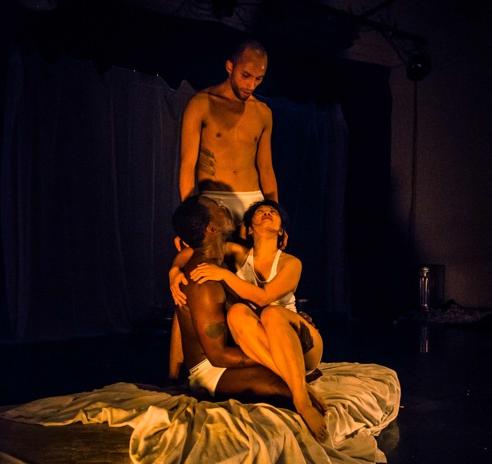
This constant mental disavowal of the body is one of the reasons the art of dance can appear so bold and so transgressive—the encumbrances of the body transformed into its greatest triumphs. In Brontez Purnell Dance Company’s “The Episodes,” playing at the Garage through March 16, everyday routines become ritual, and Purnell, Anthony Lucas, and Sophia Wang explore the mundane with an evening of choreographed mayhem and experiential frolic.

The evening begins with Gary Fembot-Brontez Purnell collaborative dance film “Free Jazz,” a hodge-podge of footage from various dance improvisations and “happenings” organized by Purnell over the course of an unspecified amount of time. In one scene, Punell races shirtless through the city streets carrying an immense tree branch over his head which he lays at the feet of a waiting coterie of fellow dancers, who encircle it solemnly and bend low to the ground.

In another he jumps around, fully clothed, in the midst of a wriggling, ecstatic house party, where dewy youths in hip sunglasses gyrate to the rhythm-heavy soundtrack. Bodies of every shape and size become vehicles of the beat, and the beat becomes a framework to encompass the onslaught of bodies, who strut and leap and cringe and embrace in riotous abandon.

Onstage, seated in galvanized washtubs, the dancers immediately draw attention to their bodies by forcing our brains to imagine the clammy indignity of sitting around in wet jeans. Wordlessly they mimic the functions of cleansing, stripping down and wringing the water out of their sopping denim, before rushing across the stage to put on their dance attire. On the video screen, a hand without a body scrawls chalk circles on the pavement, while the dancers roll deliberately on the ground, contracting and expanding their circle on the floor like breaths. To a cacophony of bells and crashing gongs, they leap into the air and slam themselves back to the ground, embodying the everyday frustration of reaching up only to be dragged back down, the constant tension between the possible versus the probable.

This tension thus established, the piece develops it further in several directions — relationship ruts versus artistic creation, morning rituals versus dreaming, avoidance versus acceptance.

In one scene the stage becomes scattered in drifts of crumpled paper, discarded words, like fallen leaves that can never be completely cleared away. A wave of Sisyphean hopelessness washes over the scene as Lucas doggedly chases every last scrap and Wang continually adds to the disarray. In another, the three sit on a striped couch, stupefied, static playing on the video screen, studio applause ringing hollowly across the stage before they “melt” away from each other and into their own fantasies.

The final scene brings the focus back on human interrelationship, a disembodied voice muses on being “torn between two lovers” while the trio collides in a series of twos and threes on a messy mattress, ending with all of them together in a nurturing cuddle puddle that appears to simultaneously define a connection between the three, without shutting out the oddience which surrounds their stage like a empathetic embrace. A body of bodies in a communion of flesh.

Angels in Budapest

0

arts@sfbg.com

THEATER On two old VHS tapes in the collection of San Francisco’s Museum of Performance and Design you can watch the Eureka Theater’s 1991 world premiere of Tony Kushner’s Angels in America, a response to the AIDS epidemic and the reactionary politics of the Reagan era. It’s a low-fi document, with poor sound quality, but it’s completely riveting. Something more than the play’s words and images, as striking as they are, cling to that worn magnetic tape: there’s the electric excitement of a work of art cracking open its historical moment.

A similar frisson passed through the main auditorium of the National Theatre of Budapest last week, where I joined a group of international guests and a local audience for Romanian-born American director Andrei Serban’s production of Angels in America, starring as Prior Walter the National’s celebrated yet politically embattled artistic director, Robert Alföldi, an award-winning international director in his own right and one of the country’s most famous actors.

The production was the capstone of an impressive weeklong festival featuring some of the best work in contemporary Hungarian independent and state-sponsored repertory theater. Presented by the Hungarian Critics Association, in international partnership with Philip Arnoult’s Center for International Theatre Development and the Trust for Mutual Understanding, the Hungarian Showcase (March 2–9) encompassed a revelatory range of styles and talents. It also highlighted a theater actively responding to a rising tide of reactionary politics — reminiscent (especially in its overt anti-Semitism, homophobia, and anti-Roma racism) of the ultra-nationalism of the 1930s — even as the arts in general and theater in particular reel under the economic strain of the conservative government’s neoliberal agenda and attempted curbs on free expression.

The National’s production of Angels is just one instance of theater’s critical role in public dialogue in Hungary today, but in many ways it was the most poignant instance encountered. That’s in large part owed to Alföldi’s powerhouse performance in the lead — a muscular, charismatic performance, extremely witty and wrenching by turns — and simultaneously to his history as artistic director over the last five years. Since Alföldi’s government appointment in 2008, something extraordinary has been underway at the country’s premier stage. Previously, Budapest’s National Theatre had been better known for its kitschy postmodern edifice (opened in 2002 and made to resemble a rather gaudy ship aimed vaguely at the nearby Danube) than for the unexceptional productions on display inside. Under Alföldi’s brilliant and maverick leadership, the theater has come to be widely regarded as one of the best — if not the best — in the country, and attendance has grown dramatically, including among younger audiences.

Alföldi’s attempts to make the theater a place of inclusion and dialogue, meanwhile, as well as his lively and provocative interpretations of classic Hungarian nationalist texts like The Tragedy of Man and John the Valliant, have earned the disfavor of rightwing politicians — including members of the ultra nationalist Jobbik party, who were not above demonstrating noisily outside the theater to demand his ouster, and slandering Alföldi on the floor of the Parliament. Alföldi, popular and unprecedentedly successful in the post, has managed to stay on for his five-year term, but the government denied his application for a second term in favor of a well-known director with conservative political opinions.

In Serban’s considerably pared down version, Millennium Approaches and Perestroika together come in at just under four hours, separated by a short intermission. There are naturally some sacrifices entailed. The subplot involving Roy Cohn (played by the National’s brilliant János Kulka), for example, takes a big hit in terms of stage time. But whatever the faults of the production, the exuberant, ironical tone feels aptly knowing, as does the rotating stage set up like a cross between a dance floor and a merry-go-round.

In just one example of the production’s winking conversation with the audience, an announcement over the PA system at the outset of Part II reminds patrons in this former Soviet bloc country that the play is set in a far off land bearing little resemblance to anything close by — only to be followed by the familiar twang of an electric guitar as the Beatles’ “Back in the USSR” creates a musical bridge to a speech by the Oldest Living Bolshevik. Like Prior’s heavenly counselors, the Bolshevik urges a halt to history. The significance of the theme is unlikely to be lost on an audience facing the atavistic return to authoritarian models of the past.

While this isn’t the first time a Hungarian theater has essayed Kushner’s play, enough has changed politically in Hungary in the last few years to make this production, in which Alföldi assumes the role of the play’s cross-dressing openly gay hero, an act of brazen defiance as well as solidarity with all “outsiders” in the right wing’s narrow compass of nationhood.

“The world only spins forward. We will be citizens. The time has come,” says Alföldi as Prior. “The great work begins.” In its own call for “more life,” the National’s production captures something of the original life of the play all over again — defining the nation and its theater as a place of empathy and inclusion, of harmony in difference.

Meanwhile, tickets for Angels in America, widely seen as Alföldi’s farewell bow, are completely sold out.


Stage Listings

0

Stage listings are compiled by Guardian staff. Performance times may change; call venues to confirm. Reviewers are Robert Avila, Rita Felciano, and Nicole Gluckstern. Submit items for the listings at listings@sfbg.com. For further information on how to submit items for the listings, see Picks.

THEATER

ONGOING

Assistance NOHspace, 2840 Mariposa, SF; www.opentabproductions.com. $20. Thu-Sat, 8pm; Sun, 6pm. Through March 30. Over the past three years, things we’ve come to expect from plucky OpenTab Productions — whose annual offerings deal in aggressively contemporary themes such as media spin, business fraud, and job (in)security — include tight ensemble acting, minimal tech, and snappy direction, and in all these regards, Assistance does not disappoint. A crew of desperate office drones whose lives basically revolve around the abuse dished out by their unseen employer, Daniel Weisinger (who may or may not resemble playwright Leslye Headland’s old boss, Harvey Weinstein), hold down their airless fort, fielding calls at 11 p.m. and shirking responsibility whenever possible. Though Headland doesn’t do much to make her emotionally and professionally stunted characters palatable, the capable cast and director Ben Euphrat do manage to wring something resembling humanity out of them. From Nick (Tristan Rholl,) the frustrated slacker supervisor, to Nora (Melissa Keith), the-new-girl-turned-cynical-old-hand, to Justin (Nathan Tucker), the unctuous winner of the title of “last man standing,” to Jenny (Michelle Drexler) a pragmatic yet annoyingly bubbly Brit, what stands out in each performance are the perfectly captured quirky nuances and barely-concealed neuroses of people caught in the process of losing their souls. Nothing about Assistance is likely to change your view of the business world, but if you’ve yet to experience the frenetic fun of an OpenTab show, it’s a perfect primer to the madness behind their method. (Gluckstern)

The Chairs Exit on Taylor, 277 Taylor, SF; www.cuttingball.com. $20-45. Thu, 7:30pm; Fri-Sat, 8pm (also Sat, 2pm); Sun, 5pm. Through March 31. Cutting Ball Theater performs Rob Melrose’s new Eugene Ionesco translation.

Dead Metaphor ACT’s Geary Theater, 415 Geary, SF; www.act-sf.org. $20-95. Tue-Sat, 8pm (also Sat, 2pm); Sun, 2 and 7pm. Through March 24. American Conservatory Theater performs George F. Walker’s dark comedy about postwar living.

Foodies! The Musical Shelton Theater, 533 Sutter, SF; www.foodiesthemusical.com. $30-34. Fri-Sat, 8pm. Open-ended. AWAT Productions presents Morris Bobrow’s musical comedy revue all about food.

The Great Big Also Z Space, 450 Florida, SF; www.zspace.org. $15-30. Thu-Sat, 8pm; Sun, 5pm. Through March 24. Mugwumpin performs a world premiere about creating a new world.

God of Carnage Shelton Theater, 533 Sutter, SF; www.sheltontheater.org. $38. Thu-Sat, 8pm. Through March 30. Shelton Theater presents Yasmina Reza’s Tony-winning comedy about upper-middle-class parents clashing over an act of playground violence between their children.

Inevitable SF Playhouse, 533 Sutter, SF; www.sfplayhouse.org. $20. Thu-Sat, 8pm. Through March 23. SF Playhouse’s “Sandbox Series,” enabling new and established playwrights to stage new works, kicks off its third season with Jordan Puckett’s drama about a woman trying to make sense of her life.

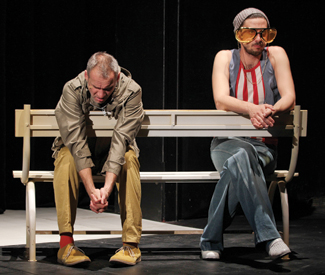
Jurassic Ark Exit Theatre, 156 Eddy, SF; www.theexit.org. $15-25. Fri/16-Sat/16, 8pm. Writer-performer David Caggiano’s zany, well-executed solo play centers on a Christian televangelist who is unwaveringly bent on making a big-budget movie about a cowboy-like Biblical Noah, his Ark, and the largely lovable dinosaurs callously left out of the story — a project he sees delivering a decisive blow to the Darwinians, while turning cineplexes across the land into celluloid cathedrals. Brother Dallas and his proselytizing pitch eventually find receptive ears in a trinity of movie-industry heavies, whose collective business acumen demands a few changes to the script. Meanwhile, the intoxicating power of it all leads to a lapse in Brother Dallas’s righteousness and a scandal reminiscent of Hugh Grant’s career. Dallas rebounds from this bout with the Devil and sees his movie made — but surely only he is unaware that the Devil keeps a Hollywood address. Smartly directed by Mark Kenward, this low-frills production relies almost exclusively on Caggiano’s sturdy ability with quick-change characterizations (couched in Dylan West’s modest lighting design and a suggestive soundscape by sound editor–musician John Mazzei). The fitful satire trades in pretty orthodox caricature and, in Brother Dallas, lacks a very compelling or sympathetic central figure; but it unfolds with a very cinematic imagination that, while formulaic, is itself one hell of a movie pitch. (Avila)

Just One More Game Exit Theatre, 156 Eddy, SF; www.tripleshotprodutions.org. $25. Thu-Sat, 8pm; Sun/17, 2pm. Through March 30. With the rise of the programmer as pop culture hero, it was probably inevitable that we’d start writing plays about them too. In local playwright Dan Wilson’s Just One More Game our programmer protagonist is Kent (Christopher DeJong) whose mission is to find love, and his co-player is Marjorie (Linda-Ruth Cardozo), who wields her own geek credentials like a Mortal Kombat wrath hammer. Where Wilson’s comedy excels is in the witty gamer banter that defines much of their attraction and commonality — references to Zork, Oregon Trail, Dungeons and Dragons, and The Secret of Monkey Island abound, while a series of meticulous video game animations (also Wilson’s) lend colorful counterpoint to the action on the stage. DeJong plays his role of emotionally-inhibited loner with a degree of laconic detachment that unfortunately eliminates all traces of chemistry between him and Cardozo, who is especially good at capturing the cheerfully aggressive awkward of a woman accustomed to being “one of the boys” because there was nothing about “the girls” she could relate to. Both the comedy and pace flag by the time the first NPCs (non-player characters) enter the room, broadly clichéd parents yammering for grandchildren and obnoxious college buddies armed with too many baby photos, who conspire to stunt the growth of Kent and Marjorie’s relationship and wind up stunting the growth of the play. If the quest for love is a game, as the title suggests, it’s one that could use a little more back-end development, and a much greater degree of playfulness. (Gluckstern)

A Lady and a Woman Eureka Theatre, 215 Jackson, SF; www.therhino.org. $15-30. Wed-Sat, 8pm; Sun, 3pm. Through March 24. Life wasn’t easy in the South of the 1890s, particularly for single black women, but in Shirlene Holmes’ A Lady and a Woman the focus is emphatically on rising above circumstance. When itinerant hog-cutter Biddie Higgins (Dawn L. Troupe) swaggers into the village inn run by Miss Flora Devine (Velina Brown) and demands a room, sparks fly almost instantaneously, as the two pragmatic and independent women become drawn to the strength they see in the other. A healer and midwife as well as an innkeeper, Miss Flora has endured enough abuse at the hands of men in her life to make her grateful to be able to live without one around, while Biddie, the only daughter in a household of fourteen, has become accustomed to a life of manual labor and clandestine trysts with willing women, never sticking around one place long enough to run out of either, declaring “it’s been easier to live a hard life then a lie.” Both Brown and Troupe embody their multi-dimensional characters with grace and backbone, never striking a false note as their tender courtship unfolds and they discover that the greatest strength of all is the ability to love freely. (Gluckstern)

The Lisbon Traviata New Conservatory Theatre Center, 25 Van Ness, SF; www.nctcsf.org. $25. Wed-Sat, 8pm; Sun, 2pm. Through March 24. New Conservatory Theatre Center performs Terrence McNally’s play, a mix of comedy and tragedy, about the relationship between two opera fanatics.

The Motherfucker with the Hat San Francisco Playhouse, 450 Post, SF; www.sfplayhouse.org. $30-70. Wed/13-Thu/14, 7pm; Fri/15-Sat/16, 8pm (also Sat/16, 3pm). A fine cast makes the most of Stephen Adly Guirgis’s deceptively coarse, often amusing little play, The Motherfucker with the Hat, which receives its local premiere in a sure and rowdy production from SF Playhouse. Director and designer Bill English’s striking two-tier set almost belies the intimate nature of the quirky story, which concerns a hapless parolee and recovering alcoholic named Jackie (a winningly frazzled, bumptious Gabriel Marin) who retreats to his AA sponsor’s apartment to pine and plot revenge after he discovers a stranger’s hat in the bedroom of his longtime Puerto Rican girlfriend, Veronica (played vividly by an at once edgy and vulnerable Isabelle Ortega). But Ralph, his suave and persuasive sponsor (played with unctuous charm gilded by just a hint of ineptitude by an excellent Carl Lumbly), may not be the guy he wants in his corner. Not that Jackie can see that — he’s got a man-crush on Ralph that dwarfs his already ambivalent affection for much put-upon but stalwart cousin Julio (a sharply funny Rudy Guerrero) and blinds him to the warning signals from Ralph’s own disgruntled wife (a coolly disgusted Margo Hall). Throughout, these working-class New York borough dwellers display their wit and shield their soft underbellies with a rapid-fire barrage of creative swearing. English and cast display a real comfort with this kind of material (this is SF Playhouse’s fourth Girguis play), which drapes its soft heart in the intimations of violence more than the real thing. If the heat and imaginative cursing also seem to cover up for a play with little dramatic purpose beyond a gentle and somewhat pat exploration of loyalty, maturity, and trust, there’s pleasure to be had in the unfolding. (Avila)

Sex and the City: LIVE! Rebel, 1760 Market, SF; trannyshack.com/sexandthecity. $25. Wed, 7 and 9pm. Open-ended. It seems a no-brainer. Not just the HBO series itself — that’s definitely missing some gray matter — but putting it onstage as a drag show. Mais naturellement! Why was Sex and the City not conceived of as a drag show in the first place? Making the sordid not exactly palatable but somehow, I don’t know, friendlier (and the canned a little cannier), Velvet Rage Productions mounts two verbatim episodes from the widely adored cable show, with Trannyshack’s Heklina in a smashing portrayal of SJP’s Carrie; D’Arcy Drollinger stealing much of the show as ever-randy Samantha (already more or less a gay man trapped in a woman’s body); Lady Bear as an endearingly out-to-lunch Miranda; and ever assured, quick-witted Trixxie Carr as pent-up Charlotte. There’s also a solid and enjoyable supporting cast courtesy of Cookie Dough, Jordan Wheeler, and Leigh Crow (as Mr. Big). That’s some heavyweight talent trodding the straining boards of bar Rebel’s tiny stage. The show’s still two-dimensional, even in 3D, but noticeably bigger than your 50″ plasma flat panel. (Avila)

Steve Seabrook: Better Than You Marsh San Francisco, 1062 Valencia, SF; www.themarsh.org. $15-50. Fri, 8pm; Sat, 8:30pm. Through March 22. Kurt Bodden’s San Francisco Best of Fringe-winning show takes a satirical look at motivational speakers.

The Voice: One Man’s Journey Into Sex Addition and Recovery Stage Werx Theater, 446 Valencia, SF; thevoice.brownpapertickets.com. $10-18. Fri-Sat, 8pm. Through April 6. Ticket sales for David Kleinberg’s autobiographical solo show benefit 12-step sex addiction recovery programs and other non-profits.

The Waiting Period Marsh San Francisco, 1062 Valencia, SF; www.themarsh.org. $25-50. Fri, 8pm; Sat, 5pm. Through March 30. Brian Copeland (comedian, TV and radio personality, and creator-performer of the long-running solo play Not a Genuine Black Man) returns to the Marsh with a new solo, this one based on more recent and messier events` in Copeland’s life. The play concerns an episode of severe depression in which he considered suicide, going so far as to purchase a handgun — the title coming from the legally mandatory 10-day period between purchasing and picking up the weapon, which leaves time for reflections and circumstances that ultimately prevent Copeland from pulling the trigger. A grim subject, but Copeland (with co-developer and director David Ford) ensures there’s plenty of humor as well as frank sentiment along the way. The actor peoples the opening scene in the gun store with a comically if somewhat stereotypically rugged representative of the Second Amendment, for instance, as well as an equally familiar “doood” dude at the service counter. Afterward, we follow Copeland, a just barely coping dad, home to the house recently abandoned by his wife, and through the ordinary routines that become unbearable to the clinically depressed. Copeland also recreates interviews he’s made with other survivors of suicidal depression. Telling someone about such things is vital to preventing their worst outcomes, says Copeland, and telling his own story is meant to encourage others. It’s a worthy aim but only a fitfully engaging piece, since as drama it remains thin, standing at perhaps too respectful a distance from the convoluted torment and alienation at its center. Note: review from an earlier run of the same production. (Avila)

The World’s Funniest Bubble Show Marsh San Francisco, 1062 Valencia, SF; www.themarsh.org. $8-50. Sun/17, 11am. The Amazing Bubble Man (a.k.a. Louis Pearl) continues his family-friendly bubble extravaganza.

BAY AREA

Dostoevsky’s The Grand Inquisitor Berkeley City Club, 2315 Durant, Berk; www.centralworks.org. $15-28. Thu-Sat, 8pm; Sun, 5pm. Through March 31. Central Works performs Gary Graves’ adaptation of the story-within-a-story from The Brothers Karamazov.

Fallaci Berkeley Repertory Theatre, 2015 Addison, Berk; www.berkeleyrep.org. $29-89. Opens Wed/13, 8pm. Runs Tue, Thu-Sat, 8pm (also Sat, 2pm); Wed and Sun, 7pm (also Sun, 2pm). Through April 21. Berkeley Rep performs Pulitzer-winning journalist Lawrence Wright’s new play about Italian journalist Oriana Fallaci.

The Mountaintop Lucie Stern Theatre, 1305 Middlefield, Palo Alto; www.theatreworks.org. $23-75. Tue-Wed, 7:30pm; Thu-Sat, 8pm (also Sat, 2pm), through March 31. Starting April 3, runs Wed-Thu, 11am (also Thu, 8pm); Sat, 8pm; Sun, 2pm. Through April 7. TheatreWorks performs Katori Hall’s play that re-imagines the events on the night before Dr. Martin Luther King, Jr.’s assassination.

The Real Americans Marsh Berkeley, 2120 Allston, Berk; www.themarsh.org. $25-50. Fri, 8pm; Sat, 5pm. Through April 6. Dan Hoyle shifts his popular show about small-town America to the Marsh’s Berkeley outpost.

PERFORMANCE/DANCE

“Adventures of a Black Girl: Traveling While Black” Brava Theater Center, 2781 24th St, SF; www.brava.org. Fri/15-Sat/16, 8pm; Sun/17, 3pm. $15. Edris Cooper-Anifowoshe performs the second part of her “Adventures of a Black Girl” trilogy, this time taking a look at the impact of African migration on the black diaspora.

BATS Improv Bayfront Theater, Fort Mason Center, Marina at Laguna, SF; www.improv.org. $20. “Theatresports,” Fri, 8pm. Through March 29. “Double Feature,” Sat, 8pm. Through March 30.

Caroline Lugo and Carolé Acuña’s Ballet Flamenco Peña Pachamama, 1630 Powell, SF; www.carolinalugo.com. Sat/16 and March 24, 6:15pm. $15-19. Flamenco performance by the mother-daughter dance company, featuring live musicians.

“Dream Queens Revue” Aunt Charlie’s Lounge, 133 Turk, SF; dreamqueensrevue@gmail.com (reservations suggested). Wed/13, 9:30pm. Free. Groovy drag with Colette LeGrande, Diva LaFever, Sophilya Leggz, and more.

“Ham Pants Productions presents Sketch Comedy and More!” Stage Werx Theatre, 446 Valencia, SF; www.hampantsproductions.com. Tue/19, 8pm. $10. Sketch comedy, music, and “general chicanery.”

Labayen Dance Dance Mission Theater, 3316 24th St, SF; www.dancemission.com. Fri/15-Sat/16, 8pm; Sun/17, 7:30pm. $25. The company, which blends classical and modern dance with Philippine arts, celebrates its 18th anniversary spring season with the US premiere of Enrico Labayen’s Rites of Spring.

“Laughs at the Lookout” Lookout, 3600 16th St, SF; www.lookoutsf.com. Thu/14, 10pm. $10. Comedy with host Valerie Branch and performers Charlie Ballard, Ronn Vigh, Natasha Muse, and more.

“Mission Position Live” Cinecave, 1034 Valencia, SF; www.missionpositionlive.com. Thu, 8pm. Ongoing. $10. Stand-up comedy with rotating performers.

“The Next Generation of Comedy Tour” Palace of Fine Arts, 3301 Lyon, SF; www.ngoctour.com. Sat/16, 8pm. $25-65. With Ahmed Ahmed (TBS’s Sullivan and Son), Assad Motavasseli, Raj Sharma, Fahim Anwar, and more. “ODC/Dance Downtown 2013” Yerba Buena Center for the Arts Theater, 700 Howard, SF; www.odcdance.org. Thu/14-Sat/16 and March 22-23, 8pm; Sun/17 and March 24, 4pm; March 20-21, 7:30pm. $20. The company celebrates its 42nd season with three world premieres from Brenda Way and KT Nelson.

“Push Dance March Benefit Performance and Party” Terra Gallery and Event Venue, 511 Harrison, SF; marchbenefit.eventbrite.com. Fri/15, 7pm. $25-50. Dance performances plus a silent auction, culinary delights, and a DJ party.

“San Francisco Magic Parlor” Chancellor Hotel Union Square, 433 Powell, SF; www.sfmagicparlor.com. Thu-Sat, 8pm. Ongoing. $40. Magic vignettes with conjurer and storyteller Walt Anthony.

“Unturtled” CounterPULSE, 1310 Mission, SF; www.counterpulse.org. Fri/15-Sat/16, 8pm. $15. The Goethe-Institut presents a conceptual performance by choreographer Isabelle Schad and visual artist Laurent Goldring. (Artist talk Wed/13, 8pm, free.)

Steven Wright Regency Ballroom, 1300 Van Ness, SF; www.theregencyballroom.com. Fri/15, 9pm. $32-47. The deadpan comedian performs.

BAY AREA

“Incarnating for the Evening with the X-plicit Players” East Bay Media Center Performance Space, 1939 Addison, Berk; www.xplicitplayers.com. Fri/15, 8pm. $8-15. Clothing-optional event with an enactment of audience-participatory performance “Group Body,” plus excerpts from the new DVD, Incarnating for an Afternoon: The Ninth Annual Nude and Breast Freedom Parade.


Live Shots: The Robert Glasper Experiment at New Parish

3

It really wasn’t a question whether the Robert Glasper Experiment would be any good at the New Parish on Friday night  – but how it would go about replicating the success of Black Radio, which recently won the Grammy for R&B album of the year.

That’s an album that features notable collaborators on each track – Erykah Badu, Lupe Fiasco, Bilal, Mos Def/Yasiin Bey, etc. – which could leave pianist Glasper a lot to make up for live. Going into the show I had a few theories: maybe the group would use pre-recorded vocal tracks in places, maybe up-and-coming vocalists would be pulled on stage from Oakland’s music scene, or maybe some surprise guest would be introduced. (Singer José James was nearby at the San Jose Jazz Winter Fest. Maybe he’d finish in a timely manner over there and stop by?)

Glasper didn’t do any of that. When he came to the stage close to midnight, he quickly* introduced the rest of the Experiment – Casey Benjamin, Chris Dave [Ed. note — the drummer that night was actually Mark Colenburg], and “newly signed Blue Note recording artist” Derrick Hodge – and asked the completely packed crowd “Are there any Radiohead fans in the house tonight?” Keytar-playing Benjamin began singing “as your life passed before your eyes,” his voice given an alien quality via a vocoder, and Glasper began loosening up, playing the keys with occasional Mifune-esque shoulder shrugs, and taking the song further and further beyond the source materials.

Seemingly 10 minutes later, when I assumed the band had transitioned to some other song besides “Packt Like Sardines in a Crushd Tin Box,” the band collectively seemed to hone in on the familiar melody.

And then they stepped back, Glasper and company stood to the side, as Hodge played a hefty bass solo. Glasper has a bold personality and a clever streak, as was evident a year and a half ago at Sketchfest, where he improvised on level with Reggie Watts, musically and comically.** Yet most of the time, he’s not a domineering figure, and doesn’t demand attention.

The band reformed, moving into a spacy version of Coltrane’s “A Love Supreme” and then Sade’s “Cherish the Day,” a song featured on Black Radio with singer Lalah Hathaway. But the charming, beaming Benjamin provided computerized soul and a really smashing and free saxophone solo.*** Increasingly, Glasper and company provided a showcase for the vocalist, as they did on Black Radio.

Covering a lot of musical territory with album tracks like “Ah Yeah”, and more interpretive covers including Bobby Caldwell’s “Open Your Eyes”/Common’s “The Light” and Nirvana’s “Smells Like Teen Spirit,”**** the crowd embraced it, shouting out “Tell Me, Robert!” and other encouragements. The guy who shouted “Take your time!” midset had the right idea, but I think the band already had that in mind.

*Well, after mentioning the after-party at Legionnaire Saloon. Asked for more specific directions, Glasper said “I don’t know where the fuck it is. Just go.”
**Opposed to this year’s Sketchfest event, where Glasper, Watts, and drummer Chris Dave seemed strangely timid and, well, giggly. Maybe having something to do with this.
***Guy in the back, telling his friend that he could totally play that: full of shit or a talented musical unknown? Based on the girl standing next to him, constantly asking if anyone in the group was hungry, probably the former.
****The best surprise for me was the cover of soul jazz classic “Think Twice” by Donald Byrd, who died last month.

Live Shots: Passion Pit, Icona Pop, Matt and Kim at the Bill Graham

0

Swedish duo Icona Pop made the typical announcement about being really happy to finish up its tour in San Francisco, last Thursday at the Passion Pit/Icona Pop/Matt and Kim show at the Bill Graham Civic Auditorium.

Things likely have changed for Icona Pop, which specializes in bouncy, dubstep-inflected pop about “heartbreak,” particularly since the song “I Love It”* was appropriately included in the episode of HBO’s Girls where TV’s most self-centered character** goes on a coke binge.

Icona Pop received its biggest, swelling crowd response closing its set with the track, essentially the millionth song to say YOLO in recent memory. I’d say it has the potential to be the “song of its generation,” but only if we can all agree that that whole concept needs revising.***

Matt and Kim played Girl Talk (or at least a mega-mashup-mix of Black Sabbath, Timbaland beats, Jay Z 1.0, etc.) while warming up. Matt wore a Big Freedia t-shirt. Just a couple clues that the pair is similarly oriented towards audience response.

Snippets of familiar hits – Alice DeeJay’s “Do You Think You’re Better Off Alone” comes to mind, as well as Dr.Dre and Snoop**** – were occasionally mixed in with their own music, which most often has the same twinkling piano and rudimentary drum beat. Fun often came at the cost of sticking slavishly to trends, which would explain the “Harlem Shake” section of the show.

I want to dislike the duo, but somehow the two members remain really shiny, seemingly unpretentious musicians who have done their best to scale up from fine china-shattering house parties to festival sized performances and still be engaging. (The equipment mounted cameras they use make them seem slightly less like rockstars and more like contestants on a reality TV show, still slightly shocked by the exposure.) Even slightly criticizing them makes me feel like the time I tossed a kitten down a staircase. (I was 6.)

The last time I went to see Passion Pit – at the Warfield during the Manners tour – well, it was on what would retroactively be a first date, and in part because of the lame soul revue opener and my general nervousness, I drank way too much alcohol and ended high up in my balcony seat, where the show on stage seemed to consist of firing strobes lights directly at the audience. So, yeah, it was a lot of fun.

And, of course, I was very interested to see what a Passion Pit concert is actually like. Well, things started off maximally with “I’ll be Alright,” Manners single “The Reeling”, “Carried Away,” and the pretty “Moth Wings.” Then singer Michael Angelakos moved into a slight lull of twee balladry with “Love Is Greed,” a potentially devastating song for anyone that grew up on watching too many Disney movies*****, and “It’s Not My Fault, I’m Happy”, eventually rising back up to peak with the two best songs from sophomore album Gossamer, the R.Kelly-esque “Constant Conversations” and the politipop masterpiece “Take a Walk”******. It was a good performance, with Angelakos stalking the stage throughout and the band actually jamming a little bit on “Mirrored Sea.”

Passion Pit ended with “Sleepyhead” and “Little Secrets” as the encore. There were bubbles and confetti, but ultimately it all may not have been as memorable as forgetting.

*I like to imagine this song is borrowing the chorus structure of 10cc’s “Dreadlock Holiday,” but somehow I doubt it.
**Besides maybe Walter White.
***How can someone three years younger than me not know of Mr. T?
****Or David Axelrod/David McCallum.
*****At one point in the night, Angelakos began singing slowly and for a split second I was expecting this.
******Also on Girls, last night.

Chinese Historical Society celebrates golden anniversary as neighborhood’s memory bank

0

In 1963 a publicist, an art collector, an actor, a newspaper publisher, and a dentist joined forces to form San Francisco’s Chinese Historical Society of America. The group’s mission was simple: to preserve and document Chinese culture in the US. Now celebrating its 50th anniversary this year, it has the same goal it always has had with one major difference: a museum to house the fruits of its labor.

The CHSA moved into its Chinatown digs 12 years ago. The building was built in 1932 by funds raised by a group of Chinese women who traveled up and down the Pacific Coast visiting various Chinese communities to raise funds to construct a small gym and women’s dormitory in Chinatown. In the midst of the Great Depression they somewho drummed up $25,000 for the cause, and the gym provided athletic space to its urban community until it was struck by the 1989 earthquake. 

As the CHSA’s executive director Sue Lee takes me on a tour she speaks with almost an encyclopedia-like knowledge of Chinese history on the West Coast. Her animated descriptions of each and every exhibit make it clear that the enthusiasm for preserving Chinese culture that drove the Historical Society’s original founders hasn’t been lost over the generations. 

In the CHSA’s early days, the founders’ sense of urgency stemmed from the immigration restrictions put in place during the Cold War due to the Chinese’s association with the Soviet Union, which were resulting in a withering Asian population.

Lee explains, “[the founders] thought, ‘this is all we’ve got’. Lee explains. “They were visiting dying Chinese communities up and down the west coast, collecting stuff, interviewing old timers, and picking up stories, and artifacts.” 

That drive to preserve has been augmented by new goals for the Historical Society in the modern era. “We also want to engage local artists to use our history and to be inspired by Chinese-American history for their artistic endeavors,” says Lee.

One direct way the CHSA is putting that plan in action is through its “Creative Spaces” program. Currently in its second year, “Creative Spaces” invites artists, designers, curators, and educators to propose concepts for interpreting and presenting history in the museum. This year Leland Wong, an artist and Chinatown native, has been chosen as one of the featured artists.

A stage inside the museum has been transformed into a working studio for Wong. Visitors can peek in whether Woing is working or not.

A playful collection of intricate Qing Dynasty children’s hats temporarily donated by collector Leslie Selcow in memory of Jade Snow Wong, a Chinese-American ceramic artist and author, fills another exhibition space. In another area, a small suitcase contains the sparse belongings Chinese immigrants commonly brought with them when traveling to America: a notebook, a few pieces of clothing, an umbrella. Visitors are invited to write which items they’d bring on paper luggage tags and attach them to the trunk. History’s tidal changes are visible in the tags that I glimpse on my visit — everything from video games to iPods to the maybe-not-so-portable family cat is scribbled on the tags.

Lee tells me that the lessons learned at the CHSA are certainly not confined to Chinatown residents, or even to Chinese Americans. “Our challenge is always to reach out to our own community as well as to educate the greater community.”  Last year, the Historical Society partnered with the Israeli consulate to honor Dr. Feng Shan Ho, a Chinese diplomat who saved thousands of Jews in Vienna from being deported to Nazi concentration camps during World War II. 

In the over-informed, distracting era we live in, making people care about history is a constant challenge, but it seems clear that Lee and her crew are up for the challenge. “We’re trying to be more active,” she says. “We can’t be a mausoleum, we have to be engaged. We have to try to inspire people.” 

Eats everything

0

culture@sfbg.com

THE BLOB This coming week sees most of our smaller neighborhood farmers markets resuming their merry little trade, the familiar young faces behind the stalls and bushy green produce spilling forth a sunny welcome after grueling — grueling — months of eating only in-season citrus and avocado. OK, this is California, so pretty much everything’s in season all the time, which is great news for an ever-voracious Blob. But it’s nice to meet with your neighbors on the street for reasons other than complaining about dog poop. (The Blob usually just devours its problem neighbors, but the point is farmers markets are nice.) Here are some tasty eats that also have us communing with a spring-like vibe.


ARTICHOKE RAVIOLI, DUARTE’S TAVERN

Recently, the Blob had the occasion to experience a NorCal classic — a warm creamy bowl of artichoke soup at Duarte’s Tavern in Pescadero, about half an hour towards Santa Cruz. The Blob’s in-laws were visiting for a sunny coastal drive, but the Blob did not eat them, much as we may have wished. Instead, we feasted on another of Duarte’s tributes to its famous local vegetable, a spectacular artichoke ravioli ($14). Its enveloping pasta perfectly al dente, the rich, peppery artichoke-ricotta stuffing had an unexpected granular texture that nonetheless melted on the tongue. (The Blob topped it all with zesty marinara, a special request.)

Plentiful deep-fried calimari, baked Pacific oysters erupting with hot butter, local ollieberry pie (think blackberry-meets-raspberry with a pinch of tart), a biker-family clientele, and that famous soup are Duarte’s stock-in-trade. Add a walk around Pescadero’s vintage California-quaint downtown, presto! A day trip to content any in-law.

202 Stage Rd., Pescadero. (650) 879-0464, www.duartestavern.com


MANGO SALAD WITH PRAWNS, KITCHEN STORY

Kitchen Story replaced midrange white tablecloth stalwart Tangerine last November, bringing an Asian fusion sensibility and some comfy decor — granite tile, wood bookshelves — to the Castro spot. (It also brings a hint of panic: “Due to high volume, we respectfully request no substitutions on the menu,” it announces repeatedly.) Although it’s open for Thai-heavy dinner, so far brunch is the name of the game for regulars. And the brunch items of choice are stuffed-to-perfection ricotta pancakes, a sweet yet satisfying banmi panini, and millionaire’s bacon, a sassy little item consisting of thick bacon slices marinated in brown sugar syrup and chiles that’s popular at the owners’ other restaurants, Blackwood and Sweet Maple.

The Blob is a contrarian however, and also a sucker for a good salad, so the mango salad with prawns ($13) was our chosen victim on the most recent visit. It took a few minutes to get some attention, but the food came out of the kitchen fast (1:30pm on Saturday is a great time to go). The Blob’s companion Krispy substituted anyway — gasp! — asking for an extra two poached eggs placed atop his grilled veggie and cilantro aioli “morning melt.” He found the kitchen willing and the combo delicious. The mango salad, a riotous heap of bright color, was brimming with mango. Grilled prawns, however, were scarce, and the smoky-lime dressing a tad too acidic: fruit-based salads need only the merest brightening hint of vinegar; this was over the top.

Nothing a giant mimosa ($8, bottomless $16) couldn’t cut through, but we eagerly await the chance to dive into chapter two of this story: dinner.

3499 16th St., SF. (415) 525-4905, www.kitchenstorysf.com


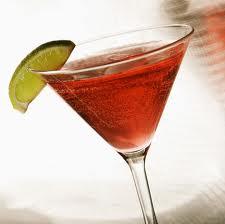
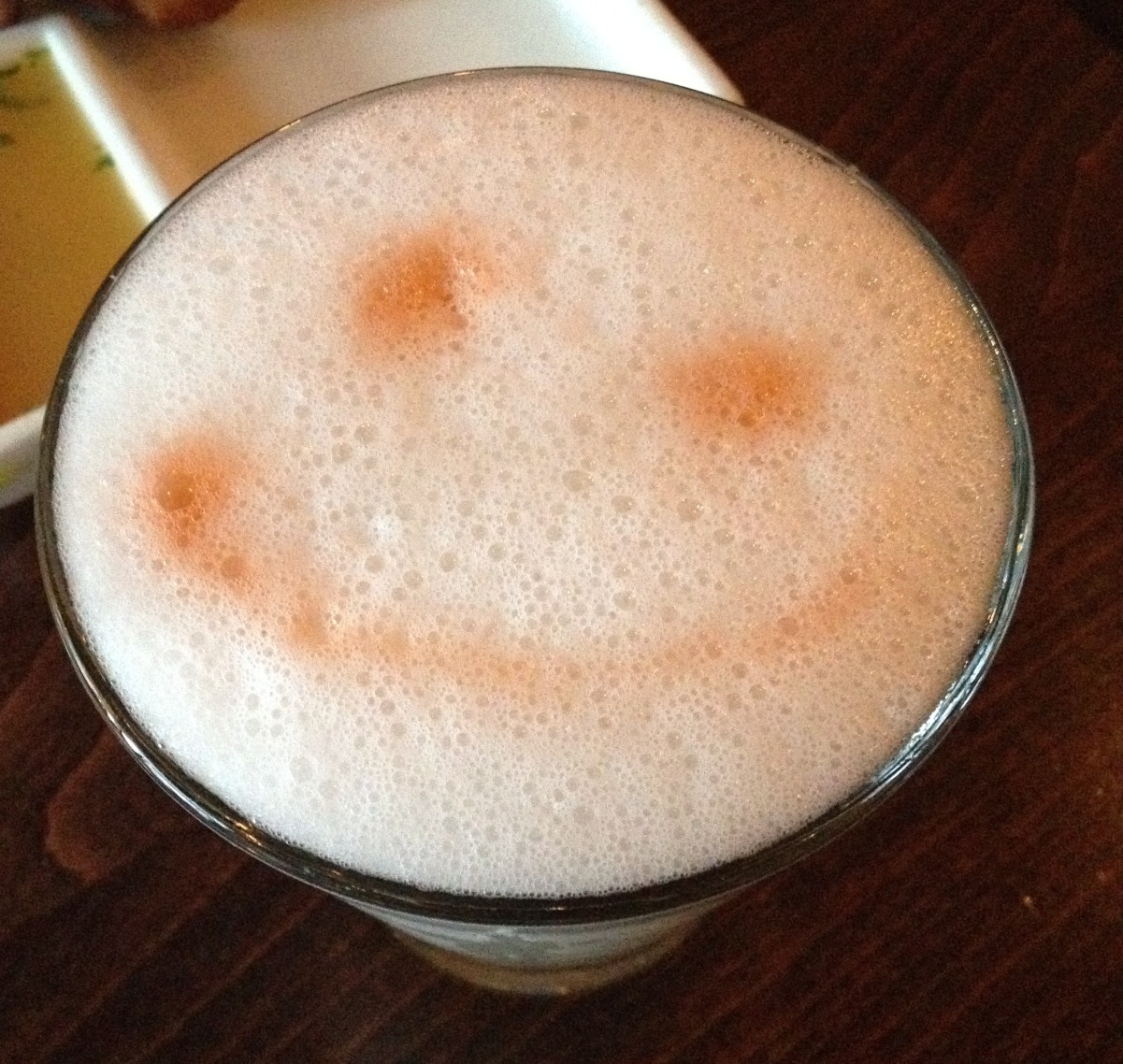
PISCO SOUR, LIMON ROTISSERIE

Maybe it’s because we ate our way through Peru a few springs ago, but pisco sours always put us in a warmer mood. The Blob defaulted to this classic at Peruvian pioneer Limon’s outpost on South Van Ness when purple corn miracle drink chicha morada had sadly run out. (Weird, since Limon possesses its own house brand, Inca Blu.) SF has a long and passionate relationship with the spunky Peruvian brandy — the pisco punch was invented here around 1893, and there are several versions on Limon’s menu. And to no Blob’s surprise, the basic pisco sour ($8), with lime juice, angostura bitters, and simple syrup was excellently sweet-tart without cloying or spiking. And it came with a smiley face drizzled into its heavenly egg white foam. Unbeatable accompaniment to crispy pollo empanadas and meaty tartara de tuna.

Limon Rotisserie, 1001 S. Van Ness, SF. (415) 821-2134, www.limonsf.com

BLOB TIP: Hey kids, tired of bologna-on-white and bit-sized Snickers in your bag for lunch? Tell your parents that Hayes Valley’s too-cute, newly spiffed Talbot Cafe (244 Gough, SF. 415-553-4945, www.talbotcafe.com) will pack your bagged lunch for them. Simply order from its regular menu — grilled cheese, BLT, chicken and havarti sandwich, mixed greens ($6–$8) — fill out a paper bag with school, name, grade, class, and date, and the Talbots will deliver something fresh and yummy to your school before 10:45am. They can’t deliver spring break early, however, so sorry.


Noise Pop 2013: YACHT, Shock, and Future Twin at Slim’s

0

When I went to see YACHT, a couple years ago during the Treasure Island Music Festival, it was playing outdoors in the afternoon, and it seemed like the wrong time and place. Last year at the Fox, the conceptual electropop band seemed stifled by the combination of the large venue and sparse crowd, and also mired by the same lackluster audio conditions that made headliner Hot Chip sound like it was playing underwater. But Saturday at Slim’s, on my last night of Noise Pop, it seemed just…

Fuck, I’ve wandered into the Goldilocks cliché.

Anyway, YACHT likes to keep it personal. Personable? The duo of Jona Bechtolt and Claire L. Evans (bolstered by other band members on tour) affect a borderline cultish air — utopian ideals were all over its last album Shangri-La and lead track, um, “Utopia” — that plays better when the audience is kept close, in a intimate venue.

“Ahhh, your hair is so long!” a woman in the sold out crowd screamed, when singer Evans first appeared on stage during the sound check, dark roots showing under what was previously close cropped and bleached blonde. It struck me as the kind of thing you say to a close friend you haven’t seen in a while. (“She’s much better looking than the last time I saw her,” someone else near me judged later in the show.)

This friendly rapport makes a lot of sense, given how much effort the group makes towards fostering it. Hopping off stage and tangling the crowd up in a mic cord has basically become a rock party trick at this point (probably because it’s an almost foolproof way to charm the crowd). Evans employed it as a starter, but went on to continually flatter fans and solicit questions, indulging in requests for hugs and spare beers. Throughout this course of events, singer, multi-instrumentalist, and YACHT founder Bechtolt competed for the larger cult of personality with a hopped-up glee.

Somewhat listless at the Fox performance, YACHT was nothing but efficient on Saturday. Maybe it was limited on time to begin with, but the set clicked by, highlighted by high-energy renditions of “I Walked Along” and “Utopia” — better than any I’ve heard.

An obvious encore followed (right after Bechtolt assured someone — probably the guy up front waving a sticker sheet and Sharpie since the sound check —that he’d sign anything five minutes after the show was over) with “Ring the Bell,” a super snappy version of shout-along “Psychic City,” and “Second Summer.” It was all done with an intentionality that could be either super endearing to a fan or off-putting viewed as an outsider, but I’m increasingly finding myself group with the former.

Openers

Shock: “We only have two minutes left and our songs are like seven minutes,” singer and bassist Terri Loewenthal of Shock said, after playing three tracks of slinky synth funk with slow vocals and lots of glissando. Five or so minutes later, the ground finished its set and she added, “So that was the short version.” Which was pretty satisfying.

Future Twin: Future Twin was precociously San Francisco, noting that one song was about trying to find affordable housing and cracking dead on delivery jokes about the nudity ban only applying out on the streets. But with dynamic singer and guitarist Jean Yaste  — whose voice recalls equally parts Corin Tucker and Exene Cervenka — and drummer Antonio Roman-Alcala, this band can get away with saying whatever it wants during mic breaks. Its upcoming benefit for the Roxie at the Verdi Club with Thee Oh Sees and Sonny and the Sunsets has it in good company.

Tussle: It’s been three years since I last saw Tussle at Milk Bar, and given the recordings the group released since then I had high expectations to see it much improved. But trouble with setting up a ton of equipment and subsequent delays really hobbled its start, and the group never seemed to quite overcome it. Unintentional tempo shifts seemed common, the double drummers never quite seemed to sync, and the generally structureless songs seemed to only end when every member came to the sudden realization that someone else was cuing them to wrap it up.

Who am I?

0

arts@sfbg.com

DANCE CounterPULSE always makes a point of thanking its volunteers. One can only hope that they’ll turn up en masse to help clean up after Faye Driscoll and Jesse Zaritt step off the stage this coming weekend. Their You’re Me is not exactly what might be called a clean show. Still, if the work-in-progress preview, presented at the end of their residency at the Headlands Center for the Arts almost two years ago, is any indication, the mess is more than worth it. After all, most of us will recognize a mess when we see it.

The Los Angeles-born Driscoll lived in San Francisco from 2003 to 2005. She put in a shift at the ODC/Pilot Program — for on-the-verge choreographers — even though dance was not her primary focus at the time. As she explained in a recent phone conversation from her home in Brooklyn, in San Francisco, “I really was inspired by the music and art scene, hanging out with people who were putting band together that were kind of art bands.” At the time, she was in recovery mode from two years of performing and touring with Doug Varone and Dancers. Apparently it had not been all that happy a match — too much structure, too much energy from the top down.

So San Francisco — where the mantra is “you can do anything you want,” and where you go “to find yourself” — proved to be liberating experience for her, particularly because she had been so “serious and disciplined about dance” since her childhood.

In some ways Driscoll is still trying to find herself. On the most visible level You’re Me is a piece about a relationship — after all, it is performed by a man and a woman. But it’s also a work looking at identity: the one you claim for yourself, that one you are working toward, or the one that is imposed on you by the outside world. For many people that is unstable territory that tends to slide away from under your feet.

Partly because she “had a lot going on in my home that was kind of crazy,” and because she remembered people reflecting an identity back to her that was quite different than the one she experienced herself, Driscoll was drawn to dance early on. “Dance had the structure that allowed me to express what I am in the world,” she says. “It was the place where I could go and practice my movements and make myself open to other people’s bodies.”

You’re Me is inspired by the in-between spaces Driscoll observes in non-verbal human communication, as well as by fixed historic representations she and Zaritt collected in the visual arts, from Renaissance paintings to contemporary magazines. In the process they became fascinated by how ideas of what is masculine and feminine have changed over time. Finding much that resonated but also created dissonance within themselves, the experience fed into their appetites for trying out other identities.

To do that choreographically, in one section of the five-part 80-minute duet, the two performers also draw on one of the earliest ways kids try to tell us something about who they are. A little girl who wobbles around in her mother’s heels is considered cute. A little boy who prefers dresses to pants rings alarm bells. Role-playing, fantasy games, make-believe, dress-up —whether in a playgroup or the theater — are serious business. They present way of talking about being or becoming in the world. But they are also a lot of fun.

Driscoll describes her working process as taking “things and blowing them up, creating them to excess and putting them into rhythmic structure and try to pull them apart and grapple with them.” Here, in addition, to the physically demanding movement interactions, the dancers have to don, strip off, and exchange parts of props and costumes, often at dizzying speed. They rehearsed a lot, she says, and they have a prop master who makes sure that the final mess is nicely controlled.

Pulling You’re Me together, however, was a different challenge. Like many artists, Driscoll is homeless, scurrying around from one studio to another. “I could never rehearse with all that stuff I had to lug around.” That’s why the residency at Headlands became such a respite: they gave her a closet. *

YOU’RE ME

Thu/7-Sun/10, 8pm, $20-$30

CounterPULSE

1310 Mission, SF

www.counterpulse.org


Our Weekly Picks: March 6-12

0

WEDNESDAY 6

Sixth Annual International Juried Plastic Camera Show

These days, every smartphone-toting amateur can create his or her own hazy vignette to remind us of those groovy days before digital photography. But Instagram and its peers always stop short in their quest for that special quality that only real lo-fi technology — cameras constructed of plastic and the occasional piece of tape — can achieve. In its sixth Plastic Camera Show, RayKo Photo center will exhibit the best 90 photos chosen from thousands of international submissions, with a special focus on Los Angeles-based Thomas Alleman’s black-and-white images that his plastic camera manages to render in a mood that is both cinematic and sordid. Instagram has nothing on these photos. (Laura Kerry) Through April 22 6-8pm opening, free RayKo Photo Center

428 Third St., SF

(415) 495-3773

www.raykophoto.com


THURSDAY 7

University Dance Theatre

Student recitals are just one of a number of campus spring rituals. The University Dance Theatre’s at SF State University is no exception. This year’s program, besides showing new works by alumni, faculty, and advanced students, is very much worth trip out into the fog belt. KT Nelson, Co-Artistic Director of ODC/Dance, with whom State has an ongoing relationship, is setting her Transit on student performers. Transit is witty, wistful, and wondrous; sort of a love letter to harried urban lives. Max Chen’s fantastical, multipurpose bikes also pay tribute to the City’s favorite mode of transportation. Nelson knows that spectacular props can steal a show; she didn’t let it happen. Transit focuses its lively energy on where it belongs — the dancing. (Rita Felciano)

Through Sat/9, 8pm, $8–$15

San Francisco State University

Creative Arts Building

1600 Holloway Ave.

(415) 338-2467

creativestate.sfsu.edu


San Francisco International Ocean Film Festival

To celebrate its 10th year, the San Francisco International Ocean Film Festival is assembling the following: a Cousteau (Jean-Michel, son of Jacques, who will be a special guest at the opening-night gala); a documentary about the first lady of surfing (Brian Gillogly’s Accidental Icon: The Real Gidget); and a shark-themed program highlighted by Steve Dilaridan’s adorably-titled animated short I’m Going to Bite Someone. And that ain’t even taking into account the rest of the over 50 ocean-themed films from some 14 countries. Dive in! (Cheryl Eddy)

Through Sun/10, most films $8–$14 (opening gala, $150)

Bay Theater

Aquarium of the Bay

Pier 39, SF

www.oceanfilmfest.org


FRIDAY 8

The Hush Sound

Chicago’s the Hush Sound was “discovered” in 2005 by Pete Wentz via Panic! At the Disco’s Ryan Ross, but don’t hold that against it. The group’s simple boy-girl harmonies and catchy melodies are at once sincere and whimsical, creating a timeless, folk-tinged pop sound. When the band formed, core songwriters Greta Salpeter and Bob Morris were essentially still children, going to school and lifeguarding, respectively. In the years and three albums that followed, the band mercifully never lost its youthful nature. Now, after a five-year hiatus, the Hush Sound is finally back with a new album in the works — and its ready to relive its youth. (Haley Zaremba)

With the Last Royals, Sydney Wayser

8pm, $15

Great American Music Hall

859 O’Farrell

(415) 885-0750

www.slimspresents.com


Pickwick

A Youtube comment on the song “Blackout” from Pickwick’s record, Myths Vol. 3, reads “these fucking albums are nowhere to be found.” Though one should usually ignore Youtube comments, in this case we say, Kamelbutiken, you have a point. For the past year, the band has sold out shows in its native Seattle and earned spots in notable festivals, gaining hype only through the release of a series of seven-inch vinyl records and online videos. It’s hard to believe that with all the recognition they’ve earned, March 12 marks the release of the band’s official debut album. While the soul-and-folk-infused rock the band makes is still nowhere to be found, find Pickwick live at the Independent. (Kerry)

With Radiation City, Sandy’s

9pm, $15

Independent

628 Divisadero, SF

(415) 771-1421

www.theindependentsf.com


Melt! with Machinedrum

Futuristic beats producer Travis Stewart, a.k.a. Machinedrum, takes cues as much from hip-hop and jungle rhythms as from the current dubstep/wobble craze. The American-born Berlin resident has produced for rising Harlem star Azealia Banks and counts rhymesayer Theophilus London and UK-based dream-techno star Lone as collaborators. Machinedrum keeps his productions quick and tightly-woven, typically floating catchy melodies and some sonorous vocal samples alongside shuffling beats. The multi-faceted Stewart has also earned respect for his recent reinterpretations of giants in their respective genres, Scottish electronic duo Boards of Canada and psychedelic jazzist Sun Ra. (Kevin Lee)

With French Fries, Dark Sky, and more

10pm, $17.50–$20

1015 Folsom, SF

(415) 431-1200

www.1015.com


SATURDAY 9

San Francisco Bulgarian Film Festival

With directors like Cristi Puiu (2005’s The Death of Mr. Lazarescu) and Cristian Mungiu (whose latest, Beyond the Hills, opens March 15) leading the charge, the Romanian New Wave is a well-established phenomenon. So it stands to reason that next-door neighbor Bulgaria would also be eager to come into its own, cinematically speaking — and the inaugural San Francisco Bulgarian Film Festival is here to share some of the country’s recent triumphs with local audiences. Included in the two-day fest are Bulgaria’s 2011 Oscar submission, Tilt, about friends who dream of opening a bar amid the country’s tumultuous early 1990s; and contemporary drama Love.Net, a hit at the 2011 Bulgarian National Film Festival. (Eddy)

Through Sun/10, $12

Brava Theater Center

2781 24th St, SF

sfbff.blogspot.com


Garry Winogrand retrospective

Legend has it that Garry Winogrand would shoot an entire roll of film in a single block, barely pausing or taking his eye away from his Leica camera’s viewfinder until he reached the end. As a result, his body of work presents barely mediated views of daily life in postwar America. And it presents a lot of them. Winogrand produced so many rolls of film that he never saw an estimated 250,000 images contained on them before his untimely death in 1984. In a retrospective that will travel the globe after leaving San Francisco, SFMOMA will display about 100 of these never-before-seen prints, adding to an already prolific and important collection. We’re lucky to get to see so many streets through Winogrand’s eyes. (Kerry)

Through June 2

$9–$18

SFMOMA

151 Third St., SF

(415) 357-4000

www.sfmoma.org


Flogging Molly

Don’t let Flogging Molly fool you: everything about the band may seem wonderfully drunk and Irish, but like any other illusion, it actually hails from Los Angeles. Vocalist Dave King, however, is a bona fide Irishman, and his thick brogue is the perfect addition to Flogging Molly’s Celtic-flavored punk madness. Whether or not you want to listen to songs about drunken pirates and whiskey in your free time, its live show is a spectacle that anyone could and should enjoy. Though the band has been together and touring since the ’90s, it hasn’t slowed down one iota. That x-factor that makes some live shows over-the-top fun simply can’t be spoken for. Grab a bottle of Jameson and go see for yourself. You can thank me later. (Zaremba)

With Mariach El Bronx, Donots

7:30pm, $32.50

Fox Theater

1807 Telegraph, Oakland

(510) 302-2250

www.thefoxoakland.com


MONDAY 11

Efterklang The Danish band Efterklang first gained international plaudits with its soaring 2007 LP Parades on the Leaf Label Ltd and such triumphant, symphonic battle cries as “Mirador” and “Caravan.” Since switching labels to 4AD Ltd., Efterklang has (somewhat regrettably) corralled that bright energy and fostered a more direct, intimate sound. Legend has it that the Danish trio wandered through an abandoned Norwegian coal mining settlement near the North Pole formerly operated by the Soviet Union. The band’s journey and field recordings became source material for last year’s Piramida, in which frontperson Clasper Clausen drops his voice an octave and embarks on mysterious stories of exploration and melancholy. (Lee)

With Nightlands

8pm, $15

Great American Music Hall

859 O’Farrell, SF

(415) 885-0750

 www.slimspresents.com


San Francisco Moth StorySLAM: Secrets

The Moth: “True Stories Told Live.” Where else could we listen to strangers, alone on a stage with their words, telling fantastical-but-true personal stories of Jewish mobster uncles, family embezzlement, Montgomery Clift’s wishes from beyond the grave, the whiskey-soaked life of a rookie reporter, the cult of Radical Honesty, and sexual awakenings during midlife crises? The NY-born series — in which reading from notes is a major no-no — has been going strong since 1997, with monthly StorySLAMs (open mics) in LA, Chicago, Louisville, and Seattle, among other cities. The San Francisco Moth StorySLAM launches today at the Rickshaw Stop and will continue on the second Monday of every month. The first round’s theme is “secrets” so come prepared to divulge the dirt. And as podcast host Dan Kennedy always notes, “we hope you have a story-worthy week.” (Full of secrets you’re willing to share.) (Emily Savage)

7pm, $8

Rickshaw Stop

155 Fell, SF

(415) 861-2011

www.rickshawstop.com

The Guardian listings deadline is two weeks prior to our Wednesday publication date. To submit an item for consideration, please include the title of the event, a brief description of the event, date and time, venue name, street address (listing cross streets only isn’t sufficient), city, telephone number readers can call for more information, telephone number for media, and admission costs. Send information to Listings, the Guardian, 225 Bush, 17th Flr., SF, CA 94105; or e-mail (paste press release into e-mail body — no attachments, please) to listings@sfbg.com. Digital photos may be submitted in jpeg format; the image must be at least 240 dpi and four inches by six inches in size. We regret we cannot accept listings over the phone.

Stage listings

0

Stage listings are compiled by Guardian staff. Performance times may change; call venues to confirm. Reviewers are Robert Avila, Rita Felciano, and Nicole Gluckstern. Submit items for the listings at listings@sfbg.com. For further information on how to submit items for the listings, see Picks.

THEATER

OPENING

The Chairs Exit on Taylor, 277 Taylor, SF; www.cuttingball.com. $20-45. Opens Thu/7, 7:30pm. Runs Thu, 7:30pm; Fri-Sat, 8pm (also Sat, 2pm); Sun, 5pm. Through March 31. Cutting Ball Theater performs Rob Melrose’s new Eugene Ionesco translation.

Dead Metaphor ACT’s Geary Theater, 415 Geary, SF; www.act-sf.org. $20-95. Opens Wed/6, 8pm. Runs Tue-Sat, 8pm (also Sat, 2pm; Sun/10, 7pm; Tue/12 show at 7pm); Sun, 2 and 7pm. Through March 24. American Conservatory Theater performs George F. Walker’s dark comedy about postwar living.

The Great Big Also Z Space, 450 Florida, SF; www.zspace.org. $15-30. Previews Thu/7-Fri/8, 8pm. Opens Sat/9, 8pm. Runs Thu-Sat, 8pm; Sun, 5pm. Through March 24. Mugwumpin performs a world premiere about creating a new world.

A Lady and a Woman Eureka Theatre, 215 Jackson, SF; www.therhino.org. $15-30. Previews Thu/7-Sat/8, 8pm. Opens Sat/9, 8pm. Runs Wed-Sat, 8pm; Sun, 3pm. Through March 24. Theatre Rhinoceros performs the Bay Area premiere of Shirlene Holmes’ play about a love affair between two African American women in the late 19th century.

BAY AREA

Fallaci Berkeley Repertory Theatre, 2015 Addison, Berk; www.berkeleyrep.org. $29-89. Previews Fri/8-Sat/9 and Tue/12, 8pm; Sun/10, 7pm. Opens March 13, 8pm. Runs Tue, Thu-Sat, 8pm (also Sat, 2pm); Wed and Sun, 7pm (also Sun, 2pm). Through April 21. Berkeley Rep performs Pulitzer-winning journalist Lawrence Wright’s new play about Italian journalist Oriana Fallaci.

The Mountaintop Lucie Stern Theatre, 1305 Middlefield, Palo Alto; www.theatreworks.org. $23-75. Previews Wed/6-Fri/8, 8pm. Opens Sat/9, 8pm. Runs Tue-Wed, 7:30pm; Thu-Sat, 8pm (also Sat, 2pm), through March 31. Starting April 3, runs Wed-Thu, 11am (also Thu, 8pm); Sat, 8pm; Sun, 2pm. Through April 7. TheatreWorks performs Katori Hall’s play that re-imagines the events on the night before Dr. Martin Luther King, Jr.’s assassination.

The Real Americans Marsh Berkeley, 2120 Allston, Berk; www.themarsh.org. $25-50. Opens Fri/8, 8pm. Runs Fri, 8pm; Sat, 5pm. Through April 6. Dan Hoyle shifts his popular show about small-town America to the Marsh’s Berkeley outpost.

ONGOING

Assistance NOHspace, 2840 Mariposa, SF; www.opentabproductions.com. $20. Thu-Sat, 8pm; Sun, 6pm. Through March 30. Leslye Headland’s comedy about assistants is loosely based on her experiences working for Harvey Weinstein.

Foodies! The Musical Shelton Theater, 533 Sutter, SF; www.foodiesthemusical.com. $30-34. Fri-Sat, 8pm. Open-ended. AWAT Productions presents Morris Bobrow’s musical comedy revue all about food.

God of Carnage Shelton Theater, 533 Sutter, SF; www.sheltontheater.org. $38. Thu-Sat, 8pm. Through March 30. Shelton Theater presents Yasmina Reza’s Tony-winning comedy about upper-middle-class parents clashing over an act of playground violence between their children.

Inevitable SF Playhouse, 533 Sutter, SF; www.sfplayhouse.org. $20. Thu-Sat, 8pm. Through March 23. SF Playhouse’s “Sandbox Series,” enabling new and established playwrights to stage new works, kicks off its third season with Jordan Puckett’s drama about a woman trying to make sense of her life.

Jurassic Ark Exit Theatre, 156 Eddy, SF; www.theexit.org. $15-25. Fri-Sat, 8pm. Through March 16. Writer-performer David Caggiano’s zany, well-executed solo play centers on a Christian televangelist who is unwaveringly bent on making a big-budget movie about a cowboy-like Biblical Noah, his Ark, and the largely lovable dinosaurs callously left out of the story — a project he sees delivering a decisive blow to the Darwinians, while turning cineplexes across the land into celluloid cathedrals. Brother Dallas and his proselytizing pitch eventually find receptive ears in a trinity of movie-industry heavies, whose collective business acumen demands a few changes to the script. Meanwhile, the intoxicating power of it all leads to a lapse in Brother Dallas’s righteousness and a scandal reminiscent of Hugh Grant’s career. Dallas rebounds from this bout with the Devil and sees his movie made — but surely only he is unaware that the Devil keeps a Hollywood address. Smartly directed by Mark Kenward, this low-frills production relies almost exclusively on Caggiano’s sturdy ability with quick-change characterizations (couched in Dylan West’s modest lighting design and a suggestive soundscape by sound editor–musician John Mazzei). The fitful satire trades in pretty orthodox caricature and, in Brother Dallas, lacks a very compelling or sympathetic central figure; but it unfolds with a very cinematic imagination that, while formulaic, is itself one hell of a movie pitch. (Avila)

Just One More Game Exit Theatre, 156 Eddy, SF; www.tripleshotprodutions.org. $25. Thu-Sat, 8pm; Sun/10 and March 17, 2pm. Through March 30. Triple Shot Productions presents Dan Wilson’s video game-themed romantic comedy.

The Lisbon Traviata New Conservatory Theatre Center, 25 Van Ness, SF; www.nctcsf.org. $25. Wed-Sat, 8pm; Sun, 2pm. Through March 24. New Conservatory Theatre Center performs Terrence McNally’s play, a mix of comedy and tragedy, about the relationship between two opera fanatics.

The Motherfucker with the Hat San Francisco Playhouse, 450 Post, SF; www.sfplayhouse.org. $30-70. Tue-Thu, 7pm; Fri-Sat, 8pm (also Sat, 3pm). Through March 16. A fine cast makes the most of Stephen Adly Guirgis’s deceptively coarse, often amusing little play, The Motherfucker with the Hat, which receives its local premiere in a sure and rowdy production from SF Playhouse. Director and designer Bill English’s striking two-tier set almost belies the intimate nature of the quirky story, which concerns a hapless parolee and recovering alcoholic named Jackie (a winningly frazzled, bumptious Gabriel Marin) who retreats to his AA sponsor’s apartment to pine and plot revenge after he discovers a stranger’s hat in the bedroom of his longtime Puerto Rican girlfriend, Veronica (played vividly by an at once edgy and vulnerable Isabelle Ortega). But Ralph, his suave and persuasive sponsor (played with unctuous charm gilded by just a hint of ineptitude by an excellent Carl Lumbly), may not be the guy he wants in his corner. Not that Jackie can see that — he’s got a man-crush on Ralph that dwarfs his already ambivalent affection for much put-upon but stalwart cousin Julio (a sharply funny Rudy Guerrero) and blinds him to the warning signals from Ralph’s own disgruntled wife (a coolly disgusted Margo Hall). Throughout, these working-class New York borough dwellers display their wit and shield their soft underbellies with a rapid-fire barrage of creative swearing. English and cast display a real comfort with this kind of material (this is SF Playhouse’s fourth Girguis play), which drapes its soft heart in the intimations of violence more than the real thing. If the heat and imaginative cursing also seem to cover up for a play with little dramatic purpose beyond a gentle and somewhat pat exploration of loyalty, maturity, and trust, there’s pleasure to be had in the unfolding. (Avila)

Pageant: The Musical! Victoria Theatre, 2961 16th St, SF; www.brownpapertickets.com. $25. Thu/7-Sat/9, 8pm. Robbie Wayne Productions presents this “drag-tastic adventure through the hilarious world of beauty contests.”

Sex and the City: LIVE! Rebel, 1760 Market, SF; trannyshack.com/sexandthecity. $25. Wed, 7 and 9pm. Open-ended. It seems a no-brainer. Not just the HBO series itself — that’s definitely missing some gray matter — but putting it onstage as a drag show. Mais naturellement! Why was Sex and the City not conceived of as a drag show in the first place? Making the sordid not exactly palatable but somehow, I don’t know, friendlier (and the canned a little cannier), Velvet Rage Productions mounts two verbatim episodes from the widely adored cable show, with Trannyshack’s Heklina in a smashing portrayal of SJP’s Carrie; D’Arcy Drollinger stealing much of the show as ever-randy Samantha (already more or less a gay man trapped in a woman’s body); Lady Bear as an endearingly out-to-lunch Miranda; and ever assured, quick-witted Trixxie Carr as pent-up Charlotte. There’s also a solid and enjoyable supporting cast courtesy of Cookie Dough, Jordan Wheeler, and Leigh Crow (as Mr. Big). That’s some heavyweight talent trodding the straining boards of bar Rebel’s tiny stage. The show’s still two-dimensional, even in 3D, but noticeably bigger than your 50″ plasma flat panel. (Avila)

Steve Seabrook: Better Than You Marsh San Francisco, 1062 Valencia, SF; www.themarsh.org. $15-50. Fri, 8pm; Sat, 8:30pm. Through March 22. Kurt Bodden’s San Francisco Best of Fringe-winning show takes a satirical look at motivational speakers.

The Voice: One Man’s Journey Into Sex Addition and Recovery Stage Werx Theater, 446 Valencia, SF; thevoice.brownpapertickets.com. $10-18. Fri-Sat, 8pm. Through April 6. Ticket sales for David Kleinberg’s autobiographical solo show benefit 12-step sex addiction recovery programs and other non-profits.

The Waiting Period Marsh San Francisco, 1062 Valencia, SF; www.themarsh.org. $25-50. Fri, 8pm; Sat, 5pm. Through March 30. Brian Copeland (comedian, TV and radio personality, and creator-performer of the long-running solo play Not a Genuine Black Man) returns to the Marsh with a new solo, this one based on more recent and messier events` in Copeland’s life. The play concerns an episode of severe depression in which he considered suicide, going so far as to purchase a handgun — the title coming from the legally mandatory 10-day period between purchasing and picking up the weapon, which leaves time for reflections and circumstances that ultimately prevent Copeland from pulling the trigger. A grim subject, but Copeland (with co-developer and director David Ford) ensures there’s plenty of humor as well as frank sentiment along the way. The actor peoples the opening scene in the gun store with a comically if somewhat stereotypically rugged representative of the Second Amendment, for instance, as well as an equally familiar “doood” dude at the service counter. Afterward, we follow Copeland, a just barely coping dad, home to the house recently abandoned by his wife, and through the ordinary routines that become unbearable to the clinically depressed. Copeland also recreates interviews he’s made with other survivors of suicidal depression. Telling someone about such things is vital to preventing their worst outcomes, says Copeland, and telling his own story is meant to encourage others. It’s a worthy aim but only a fitfully engaging piece, since as drama it remains thin, standing at perhaps too respectful a distance from the convoluted torment and alienation at its center. Note: review from an earlier run of the same production. (Avila)

The World’s Funniest Bubble Show Marsh San Francisco, 1062 Valencia, SF; www.themarsh.org. $8-50. Sun, 11am. Extended through March 17. The Amazing Bubble Man (a.k.a. Louis Pearl) continues his family-friendly bubble extravaganza.

BAY AREA

Dostoevsky’s The Grand Inquisitor Berkeley City Club, 2315 Durant, Berk; www.centralworks.org. $15-28. Thu-Sat, 8pm; Sun, 5pm. Through March 31. Central Works performs Gary Graves’ adaptation of the story-within-a-story from The Brothers Karamazov.

The Fourth Messenger Ashby Stage, 1901 Ashby, Berk; www.thefourthmessenger.com. $23-40. Wed/6-Thu/7, 7pm; Fri/8-Sat/9, 8pm; Sun/10, 2pm. It’s been some time since a work by local playwright Tanya Shaffer last graced our stages, not since 2005 to be precise, and in keeping with her penchant for multicultural themes, her latest piece, The Fourth Messenger, is a reimagining of the Siddhartha story, written as a musical in collaboration with composer Vienna Teng. Raina (Anna Ishida), a “hungry” journalism intern with a secret agenda, pitches her first scoop — the debunking of a beatific guru named Mama Sid (Annemaria Rajala) — and embeds herself in a meditation retreat where she can get close to the famously private teacher and uncover her past. Neither as humorous or as merciless as Jesus Christ Superstar or as exuberant as Godspell (though the excellent song “Monkey Mind” crackles with wit and trenchant observation, and the tender “Human Experience” genuinely uplifts), Messenger does offer a fairly solid primer to the path of spiritual enlightenment including its all-too-human fallout and sacrifices. The white-on-wood set design by Joe Ragey frames the action in a deceptively delicate layer of gauze and mystery, and the capable ensemble inhabit their multiple roles with ease — from jaded newsies to loyal disciples. Which makes it doubly unfortunate that the jazzy, piano-driven score seems pitched just outside of most of the actor’s ranges, even those of the notably skilled Ishida and Rajala, an admitted distraction for the monkey-minded, which is to say most of us. (Gluckstern)

My Recollect Time South Berkeley Community Church, 1802 Fairview, Berk; (510) 788-6415. $12-25. Thu/7 and Sat/9, 8pm; Fri/8, 9pm. Inferno Theater performs Jamie Greenblatt’s play about the life of former slave Mary Fields.

PERFORMANCE/DANCE

BATS Improv Bayfront Theater, Fort Mason Center, Marina at Laguna, SF; www.improv.org. $20. “Theatresports,” Fri, 8pm. Through March 29. “Double Feature,” Sat, 8pm. Through March 30.

“The Buddy Club Children’s Shows” Randall Museum Theater, 199 Museum Wy, SF; www.thebuddyclub.com. Sun/10, 11am. $8. Family improv with Kevin Adams’ Adventure Theater.

“RAWdance presents the CONCEPT Series: 13” 66 Sanchez Studio, 66 Sanchez, SF; www.rawdance.org. Sat/9-Sun/10, 8pm (also Sun/10, 3pm). Pay what you can. An informal, intimate salon of contemporary dance with Here Now Dance Collective, Mark Foehringer Dance Project SF, Randee Paufve, and more.

“San Francisco Magic Parlor” Chancellor Hotel Union Square, 433 Powell, SF; www.sfmagicparlor.com. Thu-Sat, 8pm. Ongoing. $40. Magic vignettes with conjurer and storyteller Walt Anthony.

“Shylock” Kanbar Hall, JCCSF, 3200 California, SF; www.jccsf.org. Fri/8, 8pm. $32-45. Guy Masterson performs a solo play about Shakespeare’s infamous Merchant of Venice character. *


Noise Pop 2013: Califone, ‘Scene Unseen,’ and DIIV

0

Will 2013 be the year that Noise Pop began downsizing? Or, is the festival simply adjusting its focus towards smaller, rising acts? Either way, this year’s lineup was surprising from the get-go, eschewing the name-brand, Flaming Lips-y headliners in favor of rising, blog-friendly outfits like Toro Y Moi and DIIV. Sadly, I couldn’t occupy nine venues at a time, so here’s a rundown of the Noise Pop shows I did see this past weekend.

CALIFONE
Having listened to Califone‘s records for over a decade, yet never seen it live, I was curious about the band’s strategy in translating its studio material to the stage. From its introductory statement, Roomsound (2001), to the extended freakout-jams of Heron King Blues (2004), to last year’s Sometimes Good Weather Follows Bad People, Califone’s sound has always been production-oriented, augmenting the rustic twang of blues and roots music with an equally faded, rusted, precarious palette of electronic sound. No one merges the old and the new quite like Califone in the studio; the band’s records are visionary, but sadly, its live show didn’t quite measure up.

My first impression: no electronics. Frontperson Tim Rutili’s four-piece band consisted simply of two guitars, bass, and drums, leaving behind a significant part of the Califone identity. While this stripped-down approach isn’t necessarily a bad move, it requires a batch of songs strong enough to resonate after being whittled down to their skeletal forms.

While certain pieces thrived under the minimal treatment (“The Orchids,” “Electric Fence,” “Bottles and Bones”) others began spinning their wheels after a while (“Ape-Like,” “All Tied,” by Rutili’s side project Red Red Meat), without electronic ornamentation to keep the dynamics compelling. Yet, whenever the instrumentation was lacking, Rutili’s raspy voice and slide guitar came to the rescue, and picked up most of the slack.

While I would’ve liked to see them approach their studio material with more ambition and imagination, Rutili and Co. certainly made the trip to Cafe Du Nord worthwhile.

SCENE UNSEEN
After Califone, I headed to 1015 Folsom to catch the last two sets of Scene Unseen, the club’s attempt to piece together the remnants of the “chillwave” scene of summer 2010. NYC’s Washed Out and recent Bay-Area transplant Toro Y Moi played DJ sets, one after the other, both of which seemed to amount to little more than standing in front of a MacBook, and pushing play. So, those seeking a “performance” were likely disappointed. However, both musicians put on competent, engaging sets, showing a deft understanding of flow and dynamics, and putting the crowd into a well-controlled frenzy.

Washed Out‘s crowd-pleasing-est moment was likely Todd Terje’s “Inspector Norse,” the space-disco extravaganza that every critic seemed to embrace in 2012. The best thing I heard for the first time was “Holding On” by Classixx, a house anthem that played like a poor-man’s “Digital Love” by Daft Punk, yet trounced most of the competition.

Toro Y Moi’s set was more diverse, and less reliant on four-on-the-floor percussion than Washed Out’s. Jumping from a Larry Levan remix of Positive Force’s “We Got the Funk,” to Daphni, Purity Ring, Mariah Carey, and most memorably, Ginuwine’s “Pony,” the lack of genre-specificity was reminiscent of Anything in Return, Toro Y Moi’s new LP that rejects the notion of chillwave for something warmer, more personable, and harder to classify.

It seems that Washed Out and Toro Y Moi have differing priorities at this point, with one staying comfortably within the confines of chillwave, and the other exploring beyond its boundaries. As a result, there wasn’t much of a unifying scene to be found at Scene Unseen, but it was a treat to see both artists, in a one-two punch.

DIIV
One of the most promising groups within the current revival of shimmery, glassy dream-pop, NYC’s DIIV put on a truly impressive show for a one-album band. While it simply doesn’t have enough material at this point for an all-killer-no-filler, hour-long set, the band showed a great ability to adapt its recordings for the stage. Upping the tempos on a handful of songs, and veering into some extended jams, it managed to subvert expectations constantly, however slightly, making for a way more compelling show than a note-for-note playthrough of its 2012 debut Oshin would have been.

“Air Conditioning” was a big highlight, rejecting the laid-back swagger of the studio version, for a fast, propulsive, borderline-motorik groove that recalled the Velvet Underground and Ride. “Wait” and “How Long Have You Known?” were similarly impressive, rounding out the slam-dunk middle section of Oshin. The big surprise of the night came with a cover of Stereolab’s “Blue Milk,” (Bradford Cox’ favorite song, perhaps), a number that fit in seamlessly with the band’s glassy, shiny guitar sound, yet pushed its penchant for droney, chugging dynamics to a new extreme.

However, the elephant in the room: a lot of DIIV’s material sounds the same. Tracks like “Past Lives,” “Earthboy,” and “Sometime,” feature slight variations on the same guitar melody, and I’m still not sure how that makes me feel.

Whether its music is modular, lazy, or just underdeveloped this early in the game, there’s no doubt the band has a lot of room for refinement. Despite that, it was pretty thrilling to witness DIIV at (hopefully) the start of its lifespan, hungry to put its potential on display.

Noise Pop 2013: The Crystal Ark at the Mezzanine

0

“Dude, a satchel? That’s the gayest shit I’ve ever seen.”
“What?” I asked.
“Your purse,” he said, pointing to my camera bag, as his apparent girlfriend giggled and tried to cover his mouth. “That’s so fucking gay. Are you from America?”
“Thank you,” I said, as I finished putting in my ear plugs, mostly disinterested but half curious what he made of the two guys making out 10 feet across the dance floor.

Given that the last time I was in this situation, at Mezzanine to see NYC’s disco band the Crystal Ark supported by “San Francisco’s coveted queer DJ collective” Honey Soundsystem, was during Pride weekend, this was an odd encounter. But I’d already expected the crowd to be a little off, given that it was seemingly a late addition to the Noise Pop Festival and had to compete with packed, sold-out events in the vicinity.

Maybe the couple came out for the free Toro y Moi/Washed Out club night/email farm going on over at 1015 Folsom, and got turned off by the massive line. Maybe they were just visiting from out of town, and Mezzanine was close to their hotel. In any case, a short time into the band’s set, I couldn’t see them around, and presumed they left early.

Whatever. The Crystal Ark would be pretty central in a Venn diagram of my musical tastes. Gavin Russom is easily the fifth most significant member of now-defunct LCD Soundsystem, which doesn’t mean much except for obsessives (guilty.) With The Crystal Ark, he combines his synth expertise with Latin percussion and a trio of female singers in a way that recalls both ESG and Fania All-Stars. Plus, an additional utopian/spacey theme that suckers me.

http://www.youtube.com/watch?v=P3X2NAqqUCM

Still, to be honest, the first time I saw the band I was a little disappointed. Mainly because it seemed to take at least a half an hour before it livened up and built into the kind of fluid groove you want from a group like that. Friday, the Crystal Ark seemed much improved. Coming to the stage with the slight awkwardness that comes with being the headlining band with no real opener, Russom proceeded with introductions, saying that they were glad to be back at Mezzanine, noting that “This is a wild city. I’ve only been two blocks, but I’ve seen a lot of wild shit.” (Presumably arriving via Sixth Street rather than Mint Plaza.)

But a few minutes into their new single “Rain,” the band seemed ready to go, with the chorus “C’mon, and show me what’s the best you got,” being an obvious challenge to the small crowd.

This time around the band was also smaller, consisting of Russom, a single percussionist and a group of singers-dancers led by Viva Ruiz. But the performance and connection to the audience was improved.

Throughout the night Ruiz would alternate between English and Spanish, at one point dedicating what I’d failed to realized was a pro-immigration song, “We Came To (Work)” to her father and “We the fucking people.”

Despite the smaller size, the sound was bigger and more synchronized. After finishing with the appropriate “Ascension” and the refrain “the time has come,” it was a little disappointing seeing the club shut down – opposed to last time where the Pride crowd and Honey Soundsystem kept things going – and Russom was packing up his gear. When I complimented him on the show, he attributed it to having released their album and having more time to focus on performing. Now they just have to find the right crowd.