Scene

Independence movement

0

arts@sfbg.com

THEATER/DANCE The crowd outside the Niebyl-Proctor Marxist Library in Oakland was hopping. Fidgeting, really — imperceptibly at first, but soon enough bodies were bouncing and flailing, until the scrum of dancers packed shoulder-to-front-to-back on the sidewalk morphed their collective way through the front door.

June 22 marked one year’s worth of PPP, the monthly performance series instigated by Oakland-based dance collective SALTA. As much a scene as a performance platform, PPP has been building an ethic of serious, unbridled experimentation in a low-key setting where failure is as valid as success, and no one ever encounters a price tag, a door charge, or a gate keeper.

In terms of curation, PPP is equally promiscuous and shrewd, emphasizing a cross-generational perspective. “We try to reach out to people who have paved pathways for us,” says one SALTA member. “And we’ve been a little brazen about cold-emailing, cold-calling people who are in town, like Jeremy Wade.” Meanwhile, PPP has been building a unique audience for contemporary dance-performance and inspiring dialogue about the ethics of art-making in the Bay Area.

As an attribute of its headlong dive into experimentation and openness, PPP never sits still but moves restlessly and freely from one donated space to another. With each space come new networks as well as many PPP diehards. As its members explain, the anniversary installment marked the beginning of a summer hiatus for PPP, so that the collective can better focus on advancing other projects — all geared to creating space, in the widest sense, for dance in Oakland.

SALTA is very much the restive and searching reflection of its monthly series. What began as necessity — a space for dance — has been embraced as ethic. Not that the two were entirely strangers to begin with. As suggested by the conversation below with the members of SALTA (currently seven young women who preferred to speak as members of the collective rather than use their individual names), the realities of dance today imply, more than ever, a confrontation with the values of the dominant culture.

SFBG Which came first, PPP or SALTA, and what’s the relationship?

SALTA It’s funny, we were just talking about this earlier — it’s so confusing!

SALTA I guess we, as a collective, came first.

SALTA And we named that SALTA.

SALTA But the name SALTA didn’t come until after we had the name PPP.

SALTA We all came together in the idea of making space for dance. We were talking a lot about having an actual space and, in the meantime, [we said] let’s do a performance series. So that came second, and then it eclipsed a lot of what we’d been doing. We’re actually going to take a break over the summer and focus on some other stuff.

SALTA We want to have classes, [and start] a dance publication. We want to work on networking. We’ve had some out of town people, but just because the West Coast can be very isolating.

SFBG How did it all start?

SALTA We’re all based in Oakland, and we wanted to have a space for dance to happen here — there are not a lot of venues that are really open for experimental work. That was the big thing: we’re sick of going to San Francisco all the time, and we want to figure out what the community is in Oakland and see what we can build. Something that’s been really cool from the beginning is that a lot of non-dancers come to PPP, a lot of Oakland people who hear about it from different arenas.

SALTA As well as there not being institutions interested in the kind of work we were doing, we were also not interested in institutionalizing art, in the way that it’s done. Also, financially, making it a free event was really important to us as artists and the way we want to make art. Not having to play this whole [“who do you know”] game. It was modeled, or got a lot of guidance from Jmy [Leary] in LA, who started [dance organizers/activists] AUNTS in New York. That’s been a model that we’ve been in dialogue with.

SALTA She’s a mentor of ours, and a benefactor actually, through the Yellow House fund. We originally wanted to create a space here in Oakland similar to Pieter Pasd in LA, but the realities of being who we are as artists and where we are in our lives, as transient people, we thought we’d keep the space moving. We figured out that that worked over the past year.

SFBG I like this ethic of moving around, of asking for a free space each time. It seems a good social ethic to encourage, and it really pushes back against the spirit of the times.

SALTA It’s interesting who said no to the proposal, and who has been really willing to donate space and time — and their art.

SALTA I feel as we continue to exist and assert ourselves into spaces, it opens up more. We have to find a space, ask for a free space, because as dancers we don’t have the resources to be renting all the time. So where there’s this huge scene of First Friday or whatever — “art’s happening all the time in Oakland” — we’re not a part of that. It would be interesting at some point. Well, we WILL be a part of that. [Laughter.] But what does that mean? And how much more legit, in a certain sense, do we have to become? *

For a longer version of this interview, visit www.sfbg.com/pixel_vision; for more information on SALTA, visit www.saltadance.info.

Independence/Movement: extended interview with Oakland’s SALTA dance collective

1

Note: this is an extended version of an article in this week’s Guardian.

The crowd outside the Niebyl-Proctor Marxist Library in Oakland was hopping. Fidgeting, really. Almost imperceptibly at first, while above it a bulging moon hung in the temperate June sky, just itching to go super as it would the following night. But soon enough bodies were bouncing and flailing, until finally the scrum of dancers packed shoulder-to-front-to-back on the sidewalk morphed their collective way through the front door.

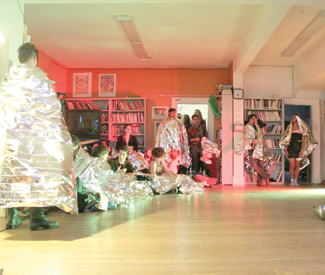
We followed the dancers (choreographed by Abby Crain) inside, swept along by their momentum, and were deposited around the perimeter of the main reading room like dust mice by a strong breeze. On that same floor, a few hours later, choreographer Ronja Ver would be sending her supine audience into dreamland with a couple of Finnish lullabies. Before that, a bowl of liquid nitrogen would send a delicate fog creeping over its wooden surface as the spectators (temporarily wrapped in reflective emergency blankets) braced themselves for a performance by Daniel Stadulis that was part science experiment, part detailed meditation on the fragility of the body.

Much else went on during the event’s roughly four hours, which ended with a dance party. No one stayed put the whole time. Some wandered off to the back rooms to the free bar, or to partake in the desultory clothing swap at the free boutique (both the bar and boutique are voluntarily stocked by the guests). Upstairs, meanwhile, the ebb and flow offered other attractions — a mother and daughter did a duet; a young writer read her first novel aloud for the first time, offering each completed page to anyone who paused to listen…

June 22 marked one year’s worth of PPP, the monthly performance series instigated by Oakland-based dance collective SALTA. As much a scene as a performance platform, PPP has been building a platform for serious, unbridled experimentation in a low-key setting where failure is as valid as success, and no one ever encounters a price tag, a door charge, or a gate keeper.

As an attribute of its headlong dive into experimentation and openness, PPP never sits still but moves restlessly and freely from one donated space to another. Among these have been the Foundry, The Vulcan, The Public School, Subterranean Arthouse, Sri Louise’s Underground Yoga Parlour, private homes, Ellen Webb’s studio, and Zach Houston’s poemstore gallery (site of the inaugural PPP in June 2012). With each space come new networks as well as a growing number of PPP diehards.

Providing room for experimentation and cross-fertilization among artists — from the well known to the unknown, and as disparate as Tere O’Connor (interviewed by Monique Jenkinson), Jmy James Kidd, Peter Max Lawrence, Miriam Wolodorski, Keith Hennessy, Ethan Cowan, Laura Arrington, and Philip Huang, among many others — PPP has also been building a unique audience for contemporary dance/performance, while inspiring dialogue about the nature of art-making in the Bay Area.

The anniversary installment of PPP marked the beginning of a summer hiatus for the series, so that the collective can focus on advancing other projects — all geared to creating space, in the widest sense, for dance in Oakland.

SALTA is very much the restive and searching reflection of its monthly series. What began as necessity — a space for dance — has been embraced as ethic. Not that the two were entirely strangers to begin with. As suggested by the conversation below with the seven women who currently make up SALTA, the realities of dance today imply, more than ever, a confrontation with the values of the dominant culture.

Note: the dancers preferred to speak as members of the collective rather than use their individual names.

SF Bay Guardian Did PPP come first, or SALTA, and what’s the relationship?

SALTA It’s funny, we were just talking about this earlier — it’s so confusing!

SALTA I guess we, as a collective, came first.

SALTA And we named that SALTA.

SALTA But the name SALTA didn’t come until after we had the name PPP.

SALTA We all came together in the idea of making space for dance. We were talking a lot about having an actual space and, in the meantime, [we said] let’s do a performance series. So that came second, and then it eclipsed a lot of what we’d been doing. We’re actually going to take a break over the summer and focus on some other stuff.

SALTA We want to have classes. We would really like a dance publication. We want to work on networking. We’ve had some out of town people, but just because the West Coast can be very isolating. So that’s one of our goals, we’d really like to figure out some way to connect.

SFBG What’s the most urgent or exciting project you’re discussing now?

SALTA I think building a floor.

SALTA And also exploring what it might look like to do a pop-up for one or two months. That would then allow us to do classes and hold performance.

SALTA Yeah, I think classes and workshops and stuff. Not only us — we have a lot of things we’re interested in exploring in teaching — but also, again, people we might invite in from out of town who could come do a workshop and perform. So that kind of thing.

SALTA In that vein of dialogue, it’s important to mention that a lot of our work is multi-generational in curation. We try to reach out to people who have paved pathways for us. And we’ve been a little brazen about cold-emailing, cold-calling people who are in town, like Jeremy Wade.

SFBG I saw his performance at CounterPULSE at that time; really great. What did he do at PPP?

SALTA He tried something new!

SALTA Yeah, he took advantage.

SALTA He did a kind of magic act. He had a crazy magician’s outfit on. Yeah, it was pretty awesome.

SALTA But even he, who is touring at that time with specific ideas, still adhered to this idea of coming and experimenting with us.

SALTA That’s something we’re trying to work more. Inviting people, colleagues, or people whose work we’re interested in that we don’t actually know, from other places but also from the Bay Area. I think last month was a pretty harmonious example of that because we had Ellen Webb. She runs a space for so long and had a company in the ’80s. We didn’t really know her work. We use her space all the time — we’ve actually used it for PPP as well. So we had her come and just share. She showed some video of an amazing piece she did with a hundred dancers on Mandela Parkway, right after the [1989] earthquake. She was there, and then Keith [Hennessy] was there — who’s kind of the next [generation] — and then Jmy [Leary, a.k.a. James Kidd] from LA, who is just a little bit older than us.

SFBG How did you start working together?

SALTA We’re all based in Oakland, and we wanted to have a space for dance to happen here — there are not a lot of venues that are really open for experimental work. That was the big thing: we’re sick of going to San Francisco all the time, and we want to figure out what the community is in Oakland and see what we can build. Something that’s been really cool from the beginning is that a lot of non-dancers come to PPP, a lot of Oakland people who hear about it from different arenas.

SALTA We were also not interested in institutionalizing art, in the way that it’s done. Also, financially, making it a free event — no one is paid, free boutique, free bar  —that was really important to us as artists and the way we want to make art. Not having to play this whole [who do you know] game. It was modeled, or got a lot of guidance from Jmy in LA, who started [dance organizers/activists] AUNTS in New York. That’s been a model that we’ve been in dialogue with.

SALTA She’s a mentor of ours, and a benefactor actually, through the Yellow House fund. So we’ve been working with her. We originally wanted to create a space here in Oakland similar to Pieter Pasd in LA, but the realities of being who we are as artists and where we are in our lives, as transient people, we thought we’d keep the space moving. We figured out that that worked over the past year. We actually made a list before you got here of all the [12] spaces we’ve been in, here in Oakland.

SFBG I like this ethic of moving around, of asking for a free space each time. It seems a good thing to encourage, and it really pushes back against the spirit of the times.

SALTA It’s interesting who has said no, at the proposal, and who has been really willing to donate space and time and their art.

SALTA I feel as we continue to exist and assert ourselves into spaces, it opens up more. We have to find a space, and ask for a free space, because as dancers we don’t have the resources to be renting all the time. So where there’s this huge scene of First Friday or whatever — “art’s happening all the time in Oakland” — we’re not a part of that. It would be interesting at some point. Well, we WILL be a part of that. [Laughter.] But what does that mean? And how much more legit, in a certain sense, do we have to become?

SFBG How did your thinking about a physical space evolve into this broader idea of creating space for dance?

SALTA I live between here and LA. And when I’m in LA I spent a lot of time at Pieter, and I kept asking Jmy questions about how she runs it and how the funding worked. About a year and half ago she asked me to have coffee with her and said, ‘It seems like you really just want to run a space.’ So that planted the seed. I’d danced with some of the people here, so I just brought up the conversation, “Should we start something?” And Ethan [a founding member not currently with SALTA] used to live in New York and we would go to AUNTS events. I think Ethan had an idea to start an event series. So we thought, let’s start an events series and hopefully that will snowball into something bigger.

SALTA Into an actual space.

SALTA Before we even talked about having a performance series, it was very much, “We want a space in Oakland that is about dance/experimental performance.” But, soon we found out: that’s hard!

SALTA I think, too, we like going to different spaces, and we like how that pulls in different people. [We realized] we want to actually make space, however that can happen. One of our ideas — there have been these pop-up spaces; different people have gotten subsidies from the city and empty buildings. We want to see if we can do that kind of thing. Build a moveable floor. So, yeah, it’s just kind of expanded.

SALTA I think too there’s something about the impermanence about it that’s special and that we like. So instead of focusing on the brick-and-mortar — “We’re going to have a space. That’s our jam” — opening it up and being a bit more flexible has allowed us to think a bit more creatively about, “What does it mean to really promote dance and make space for dance in Oakland?”

SALTA All of us are dancers. But something that feels important to us in creating this event is that it’s really not about us, or our agenda as dancers. All of us at some point have performed at a PPP. There’ve been 12, so we’ve all at some point done something. We’ve talked about doing a group dance — there’s this event called Oakland Nights Live that happens once a month. They invited SALTA to perform at it, even though we’ve never made a dance together before. We thought, OK, we’ll go do something there. So there is that fluidity and it definitely feeds into the work that we do, and we’re doing other projects too. But PPP is really about creating space for dance and really trying to open it up to the community.

SFBG It sounds like you’re really creating an audience too. Do you have a lot of return people?

SALTA Yeah! We have diehards.

SALTA We have a following! It’s crazy.

SALTA Our first PPP: Zach Houston had a space in downtown Oakland. It was a poetry space, specifically; he’s a poet…

SALTA That was our first one. And I think because of that we’ve had this nice relationship with the poetry community. And so we’ve had a lot of people from that community that come and watch. So people who are around the arts, or friends of friends — I mean one of the great thing about inviting all these performers is that they bring their people. And their people maybe bring someone else. And they go to the next one. Someone last night was like, “I feel like the more I come to these I get it more, I know how to watch it better.” I thought, wow, that’s a really cool thing.

SALTA It’s very unassuming. We don’t demand a lot. People can come and leave.

SALTA There’s literally an open door policy. Like at Niebyl-Proctor last night, the front door is open and people from the street walk in. That’s happened at a lot of the events we do. And that’s really nice, to have people that are called to it.

SALTA People come to it from so many different places too, which is exciting.

SALTA I think it’s important to us all as dancers, that it is a richer audience with various interests. Because we as dancers are like that, as people, we have varied interests outside of dance that informs our dancing.

SFBG Is performing in this kind of event is more satisfying in some ways? What are the advantages to you and others, as performers, with this kind of format?

SALTA We’ve had performers who are performing on the same night together who maybe have never met each other. There have been connections that have been made there between their work and their interests that might not have happened otherwise.

SALTA It’s a space for experimentation. I think that’s one thing we’re trying to be really intentional about it, how to create a space where people will take experimentation seriously. Not just come do whatever and don’t give a shit. That’s why we were really excited about what Keith [Hennessy] did [at the May PPP at Berkeley’s Subterranean Arthouse]. He was actually late to the pre-performer meeting, saying, “I’m sorry I was late. I was rehearsing!” People come with that mindset often. Not necessarily that they’re creating their masterwork — how can they? We’re not funding them. We don’t have any money. But it’s just a chance to try things out and be able to fail or do something absolutely spectacular, and everything in between. Really, most months, there is something that’s like oh god and also something that’s so inspiring …

SALTA I like that: take experimentation seriously.

SALTA And also it’s not like a critique. We didn’t want that. It’s just a time to try something out, and then you can have conversations about it afterward if you want.

SALTA That said, whenever I’ve performed at PPP there’s always someone who comes up to me who has a really interesting, deep perspective because it’s not your typical dance, performance audience member.

SALTA And I think too that there’s something freeing in that there’s not a whole lot at stake. Oh, you finally got a show at CounterPULSE and you have to make it good if you want to show anywhere else. I think there’s a lot of freedom in knowing that everyone’s there to do the same kind of experiment.

SFBG What’s the financial model that makes possible bringing artists in from out of town, and the other projects you’re looking at?

SALTA I think, at this point, we’re trying to go for the free and grant-supported. That might not be something we continue with.

SFBG So you’ve been getting grants.

SALTA Well, we got one. [Laughter.]

SALTA That’s how it started. It was from Jmy…

SALTA But that’s what we’ve talked about — more than trying to make it a viable business.

SALTA I think it’s really important for it to stay free and non-commodified. [SALTA] has lots of thoughts about the realm of recreation, and dance as recreation rather than something you make money off of.

SALTA One more thing about the name. We had a deadline to submit a fiscal sponsorship application. So there was one meeting where we had to come up with a name. I had the idea of wanting it to be a name, like Pieter, so it could be like a sister or brother [to Pieter Pasd]. But then no one else really liked that idea. So PPP was this compromise where it would be like initials but it wouldn’t refer to a name. But then I was reading a book by Marx and I came across the term, Hic Rhodus, hic salta, which is from an Aesop fable. But Marx translates it as, “Here is the rose, dance here.” Salta is a Latin term that means both to leap and to dance. The way Marx uses it, [the phrase means], “You want to do something? OK, do it. Show the dance. Do the leap.”

So for me it was this nice metaphor for what we were doing. And it’s also something about the dance world, and the disintegration of what it means to be a professional dancer; the eclipse of a company model, where you train and then suddenly there’s this company that will employ you to dance. So it’s also part of this question: What does it mean to dance in this post-Fordist moment when it’s not financially viable to dance? (And also everyone else seemed to like the name SALTA.)

SALTA She even put that on our website: “Hic Oakland, hic salta!”

SFBG In this one year since starting, has the collective or vision changed in ways you didn’t foresee?

SALTA I feel the main change is we’ve let go of trying to have an actual, permanent space. Because a year ago we were looking at Craigslist, and biking around to different buildings, and trying to figure out square footage — and that’s — just the logistics of everyone’s lives …

SALTA And the reality of the rental market right now, it’s insane.

SALTA We were like, “How can we do that with our grant?” The grant is generous but it’s not enough to last over a year of rent.

SALTA And a lot of us do travel a lot, or live in various cities, and we all have different creative projects…

SALTA Originally we had a little flyer saying SALTA is looking for a space. We said that a lot: “PPP is this, a project of SALTA. We are looking for a space. Please contact us.” And we’ve decided we’re just always looking for a space. That’s going to be our new flyer.

Depp stinks but Death rules: new movies!

0

By now you’ve heard how much The Lone Ranger sucks (for more on that, my review here), so what else should you be spending your weekly movie-theater budget on? Well, the Roxie just opened a doc about Detroit band Death (Dennis Harvey breaks it down here), plus there’s a new Pedro Almodóvar joint, a coming-of-age summer flick starring Sam Rockwell and Steve Carell as cool and not-so-cool father figures, and (since one Carell movie ain’t enough) Despicable Me 2  — just the thing for the kidz who’ve already seen Monsters University.

Read on for our takes on these films, and more!
http://www.youtube.com/watch?v=irSSZumpYS4

Augustine When a 19-year-old Parisian kitchen maid (single-named French musician Soko) has a dramatic seizure during dinner service, she makes for Salpêtrière Hospital, where she becomes the superstar patient of Dr. Charcot (Vincent Lindon) — a real-life 19th century professor and neurologist who later mentored Sigmund Freud. There’s no “talking cure” at work here, though; Augustine’s medical treatment consists mostly of naked poking and prodding, as well as hypnosis-induced episodes of her increasingly sexualized “ovarian hysteria.” The tension builds as Charcot struggles against popular disdain for his methods (read aloud to him from newspapers by his coolly elegant wife), as well as his forbidden attraction to Augustine. Occupying the same moody, sensual milieu as David Cronenberg’s too-talky A Dangerous Method (2011), first-time feature writer-director Alice Winocour approaches her tale of misunderstood madness from a point of view that’s more emotionally-driven, with some subtle feminist undercurrents. Points deducted, though, for some obvious symbolism — like costuming Augustine in a brand-new red dress right after she starts her period for the first time. (1:42) (Cheryl Eddy)

http://www.youtube.com/watch?v=KtVEj86Vmzo

Deceptive Practice: The Mysteries and Mentors of Ricky Jay David Mamet fans will recognize Ricky Jay from multiple appearances in the director’s work; he’s also been in films like Boogie Nights and Tomorrow Never Dies (both 1997). But Jay’s true passion is stage magic, specifically card and other sleight-of-hand tricks, performed with a skill so dazzling that it’s tempting to believe he really does have supernatural powers. He’s also a witty, self-deprecating, and sometimes “irascible” (to quote a word used in Molly Bernstein and Alan Edelstein’s doc) character — and has a vast, ever-expanding interest in magic history. Using first-hand interviews, TV and stage-show clips, and some wonderful vintage footage, Deceptive Practice traces Jay’s career (he was a child prodigy in the 1950s, thanks to his supportive grandfather), pausing along the way to pay tribute to the men who influenced him and, in many cases, taught him their top-secret techniques. Throughout, Jay is seen demonstrating his own mind-bending tricks — as “simple” as changing a card’s suit, as elaborate as making it sail across the room and plunge like a knife into a watermelon rind — although never, of course, revealing how he does it. (1:28) (Cheryl Eddy)

Despicable Me 2 The laughs come quick and sweet now that Gru (Steve Carell) has abandoned his super-villainy to become a dad and “legitimate businessman” — though he still applies world-class gravitas to everyday events. (His daughter’s overproduced birthday party is a riot of medieval festoonage.) But like all the best reformed baddies, the Feds, or in this case the Anti-Villain League, recruit him to uncover the next international arch-nemesis. Now a spy, he gets a goofy but highly competent partner (Kristen Wiig) and a cupcake shop at the mall to facilitate sniffing out the criminal. This sequel surpasses the original in charm, cleverness, and general lovability, and it’s not just because they upped the number of minion-related gags, or because Wiig joined the cast; she ultimately gets the short end of the stick as the latecomer love-interest (her spy gadgets are also just so-so). However, Carell kills it as Gru 2 — his faux-Russian accent and awkward timing are more lived-in. Maybe the jokes are about more familiar stuff (like the niggling disappointments of family life) but they’re also sharper and more surprising. And though the minions seemed like one-trick ponies in the first film, those gibberish-talking jellybeans outdo themselves in the sequel’s climax. (1:38) (Sara Maria Vizcarrondo)

I’m So Excited I’m So Excited may be to Pedro Almodóvar what Hairspray (1988) was for director John Waters: a kind of low-intensity, high-fluff gateway drug for a filmmaker who’s otherwise an “acquired taste.” (Note: unlike Hairspray, this is not a family movie.) Almodóvar’s previous pictures were far more explicit about their obsessive thinking: mothers suffered (1999’s All About My Mother); sex was deadly (1990’s Tie Me Up! Tie Me Down!) and men were dishonorable (all of them). But in this drug and booze-addled flame-fest, Almodóvar takes one of his lesser themes (the joy of confinement) and transforms a flight from Madrid to Mexico into the funniest soap opera to ever feature cabaret and S&M talk. Early in the flight we learn the landing gear is shot; this means the flight’s dueling pilots have to find a place to host an emergency landing while Europe is on holiday. They anesthetize all of coach (um…metaphor, anyone?), leaving the rich to bellyache over their lost children, lost happiness, and stubborn virginity. Business class is full of drama queens so the flamboyantly gay attendants spike a cocktail with ecstasy (to make everyone get along) and an orgy ensues, complete with a seemingly victimless rape and multiple change-overs from hetero to homo. Almodóvar does have a knack for make-believe, but his biggest gift for fantasy happens in his stress-free transitions; oh, that coming out could be so liberating — but living in a Catholic country lousy with sexual disorientations, maybe the only place that can happen is at 30,000 feet. (1:35) (Sara Maria Vizcarrondo)

http://www.youtube.com/watch?v=NX9gUw3Kwb4

Kevin Hart: Let Me Explain The comedian (2012’s Think Like a Man) performs in this concert film, shot at Madison Square Garden during his 2012 stand-up tour. (1:15)

Maniac And it came to pass that William Lustig’s trashy classic Maniac (1980) was remade, with Elijah Wood assuming the role of twisted killer Frank, a role closely associated with its originator, the late, great cult actor Joe Spinell. Lustig is credited with a producing credit on this otherwise largely French effort, directed by Franck Khalfoun and co-written by Alejandre Aja and Grégory Levasseur — who also worked together on the 2006 remake of The Hills Have Eyes. Though it’s set in contemporary Los Angeles (complete with dating websites and cell phones), Maniac is shot to mimic the original film’s late-1970s New York (cabs, deserted subways, grimy streetscapes), with a synth-heavy score enhancing the retro vibe. Frank is still obsessed with mannequins, scalps, and his dead mother, with shades of both Psycho (1960) and The Silence of the Lambs (1991) filtering through. When Frank meets Anna (Nora Arnezeder), a beautiful French photographer whose preferred subject is mannequins, he grows ever more confused — and more violent. The entire movie is shot from Frank’s POV (we see Wood’s face only in mirrors and photographs), an off-putting gimmick that fails to add much in the way of suspense or scares. As for the gore, there’s nothing amid the CG enhancements that matches the work of special effects genius Tom Savini, whose memorable exploding-head scene plays just as repulsively effective in 2013 as it did in 1980. If you really wanna be freaked out by a movie maniac, skip this so-so do-over and spend some quality time with Spinell instead. (1:29) Roxie. (Cheryl Eddy)

http://www.youtube.com/watch?v=mK7AS_cITKI

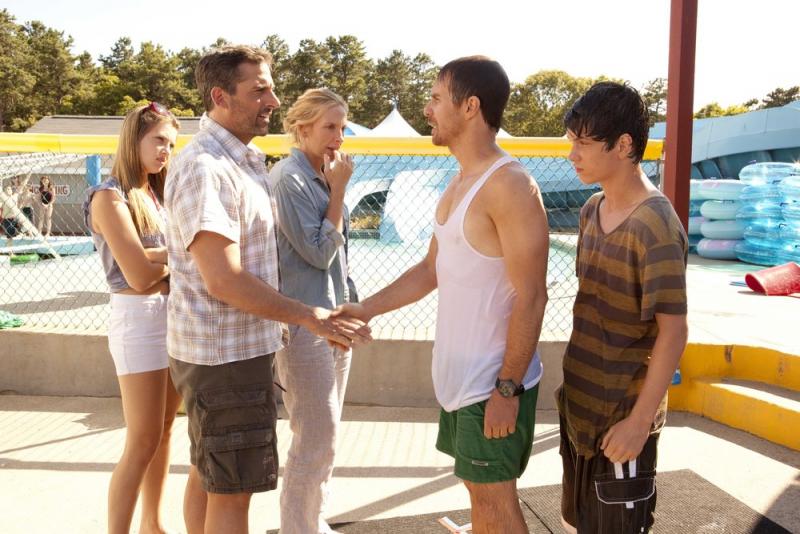
The Way, Way Back Duncan (Liam James) is 14, and if you remember being that age you remember the awkwardness, the ambivalence, and the confusion that went along with it. Duncan’s mother (Toni Collette) takes him along for an “important summer” with her jerky boyfriend, Trent (Steve Carell) — and despite being the least important guy at the summer cottage, Duncan’s only marginally sympathetic. Most every actor surrounding him plays against type (Rob Corddry is an unfunny, whipped husband; Allison Janney is a drunk, desperate divorcee), and since the cast is a cattle call for anyone with indie cred, you’ll wonder why they’re grouped for such a dull movie. Writer-directors Nat Faxon and Jim Rash previously wrote the Oscar-winning screenplay for 2011’s The Descendants, but The Way, Way Back doesn’t match that film’s caliber of intelligent, dry wit. Cast members take turns resuscitating the movie, but only Sam Rockwell saves the day, at least during the scenes he’s in. Playing another lovable loser, Rockwell’s Owen dropped out of life and into a pattern of house painting and water-park management in the fashion of a conscientious objector. Owen is antithetical to Trent’s crappy example of manhood, and raises his water wing to let Duncan in. The short stint Duncan has working at Water Wizz is a blossoming that leads to a minor romance (with AnnaSophia Robb) and a major confrontation with Trent, some of which is affecting, but none of which will help you remember the movie after credits roll. (1:42) (Sara Maria Vizcarrondo)

The Fourth of July: Remembering the good old days in Rock Rapids, Iowa, circa 1940s to 1950s

0

By Bruce B. Brugmann

(Note: In July of 1972, when the Bay Guardian was short a Fourth of July story, I sat down and cranked out this one for the front page on my trusty Royal Typewriter. I now reprint it each year on the Bruce blog, with some San Francisco updates and postscripts.)

Back where I come from, a small town beneath a tall standpipe in northwestern Iowa, the Fourth of July was the best day of a long, hot summer.

The Fourth came after YMCA camp and Scout camp and church camp, but before the older boys had to worry about getting into shape for football. It was welcome relief from the scalding, 100-degree heat in a town without a swimming pool and whose swimming holes at Scout Island were usually dried up by early July. But best of all, it had the kind of excitement that began building weeks in advance.

The calm of the summer dawn and the cooing of the mourning doves on the telephone wires would be broken early on July Fourth: The Creglow boys would be up by 7 a.m. and out on the lawn shooting off their arsenal of firecrackers. They were older and had somehow sent their agents by car across the state line and into South Dakota where, not far above the highway curves of Larchwood, you could legally buy fireworks at roadside stands.

Ted Fisch, Jim Ramsey, Wiener Winters, the Cook boys, Hermie Casjens, Jerry Prahl, Elmer Menage, and the rest of the neighborhood gang would race out of  their houses to catch the action. Some had cajoled firecrackers from their parents or bartered from the older boys in the neighborhood: some torpedoes (the kind you smashed against the sidewalk); lots of 2 and 3-inchers, occasionally the granddaddy of them all, the cherry bomb (the really explosive firecracker, stubby, cherry red, with a wick sticking up menacingly from its middle; the kind of firecracker you’d gladly trade away your best set of Submariner comics for.)

Ah, the cherry bomb. It was a microcosm of excitement and mischief and good fun. Bob Creglow, the most resourceful of the Creglow boys, would take a cherry bomb, set it beneath a tin can on a porch, light the fuse, then head for the lilac bushes behind the barn.

“The trick,” he would say, imparting wisdom of the highest order, “is to place the can on a wood porch with a wood roof. Then it will hit the top of the porch, bang, then the bottom of the porch, bang. That’s how you get the biggest clatter.”

So I trudged off to the Linkenheil house, the nearest front porch suitable for cherry bombing, to try my hand at small-town demolition. Bang went the firecracker. Bang went the can on the roof. Bang went the can on the floor. Bang went the screen door as Karl Linkenheil roared out in a sweat, and I lit out for the lilacs behind the barn with my dog, Oscar.

It was glorious stuff – not to be outdone for years, I found out later, until the Halloween eve in high school when Dave Dietz, Ted Fisch, Ken Roach, Bob Babl, and rest of the Hermie Casjens gang and I made the big time and twice pushed a boxcar loaded with lumber across Main Street and blocked it for hours. But that’s another story for my coming Halloween blog.

Shooting off fireworks was, of course, illegal in Rock Rapids, but Chief of Police Del Woodburn and later Elmer “Shene” Sheneberger used to lay low on the Fourth. I don’t recall ever seeing them about in our neighborhood and I don’t think they ever arrested anybody, although each year the Lyon County  Reporter would carry vague warnings about everybody cooperating to have “a safe and sane Fourth of July.”

Perhaps it was just too dangerous for them to start making firecracker arrests on the Fourth – on the same principle, I guess, that it was dangerous to do too much about the swashbuckling on Halloween or start running down dogs without leashes (Mayor Earl Fisher used to run on the platform that, as long as he was in office, no dog in town would have to be leashed. The neighborhood consensus was that Fisher’s dog, a big, boisterous boxer, was one of the few that ought to be leashed).

We handled the cherry bombs and other fireworks in our possession with extreme care and cultivation; I can’t remember a single mishap. Yet, even then, the handwriting was on the wall. There was talk of cutting off the fireworks supply in South Dakota because it was dangerous for young boys. Pretty soon, they did cut off the cherry bomb traffic and about all that was left, when I came back from college and the Roger boys had replaced the Creglow boys next door, was little stuff appropriately called ladyfingers.

Fireworks are dangerous, our parents would say, and each year they would dust off the old chestnut about the drugstore in Spencer that had a big stock of fireworks and they caught fire one night and much of the downtown went up in a spectacular shower of roman candles and sparkling fountains.

The story was hard to pin down, and seemed to get more gruesome every year – but, we were told, this was why Iowa banned fireworks years before, why they were so dangerous and why little boys shouldn’t be setting them off. The story, of course, never made quite the intended impression; we just wished we’d been on the scene.  My grandfather was the town druggist (Brugmann’s Drugstore, “Where drugs and gold are fairly sold, since 1902″) and he said he knew the Spencer druggist personally. Fireworks put him out of business and into the poorhouse, he’d say, and walk away shaking his head.

In any event, firecrackers weren’t much of an issue past noon – the Fourth celebration at the fairgrounds was getting underway and there was too much else to do. Appropriately, the celebration was sponsored by the Rex Strait post of the American Legion (Strait, so the story went, was the first boy from Rock Rapids to die on foreign soil during World War I); the legionnaires were a bunch of good guys from the cleaners and the feed store and the bank who sponsored the American Legion baseball team each summer.

There was always a big carnival, with a ferris wheel somewhere in the center for the kids, a bingo stand for the elders, a booth where the ladies from the Methodist Church sold homemade baked goods, sometimes a hootchy dancer or two, and a couple of dank watering holes beneath the grandstand where the VFW and the Legion sold Grainbelt and Hamms beer  at 30¢ a bottle to anybody who looked of age.

Later on, when the farmboys came in from George and Alvord, there was lots of pushing and shoving, and a fist fight or two.

In front of the grandstand, out in the dust and the sun, would come a succession of shows that made the summer rounds of the little towns. One year it would be Joey Chitwood and his daredevil drivers. (The announcer always fascinated me: “Here he comes, folks, rounding the far turn…he is doing a great job out there tonight…let’s give him a big, big hand as he pulls up in front on the grandstand…”)

Another year it would be harness racing and Mr. Hardy, our local trainer from Doon, would be in his moment of glory. Another year it was tag team wrestling and a couple of barrel-chested goons from Omaha, playing the mean heavies and rabbit-punching their opponents from the back, would provoke roars of disgust from the grandstand. ( The biggest barrel-chest would lean back on the ropes, looking menacingly at the crowd and yell, “ Aw, you dumb farmers. What the hell do you know anyway? I can beat the hell out of any of you.”   And the crowd  would roar back in glee.)

One year, Cedric Adams, the Herb Caen of Minneapolis Star-Tribune, would tour the provinces as the emcee of local  variety shows. “It’s great to be in Rock Rapids,” he would say expansively, “because it’s always been known as the ‘Gateway to Magnolia.” (Magnolia, he didn’t need to say, was a little town just over the state line in Minnesota which was known throughout the territory for its liquor-by-the-drink roadhouses. It was also Cedric Adams’ hometown: his “Sackamenna,” as Caen would say.  Adams kissed each girl (soundly) who came on the platform to perform and, at the end, hushed the crowd for his radio broadcast to the big city “direct from the stage of the Lyon County Fairgrounds in Rock Rapids, Iowa.”

For a couple of years, when Rock Rapids had a “town team,” and a couple of imported left-handed pitchers named Peewee Wenger and Karl Kletschke, we would have some rousing baseball games with the best semi-pro team around, Larchwood and its gang of Snyder brothers: Barney the eldest at shortstop, Jimmy the youngest at third base, John in center field, Paul in left field, another Snyder behind the plate and a couple on the bench. They were as tough as they came in Iowa baseball.

I can remember it as if it were yesterday at Candlestick, the 1948 game with the Snyders of Larchwood. Peewee Wenger, a gawky, 17-year-old kid right off a high school team, was pitching for Rock Rapids and holding down the Snyder artillery in splendid fashion. Inning after inning he went on, nursing a small lead, mastering one tough Larchwood batter after another, with a blistering fastball and a curve that sliced wickedly into the bat handles of the right-handed Larchwood line-up.

Then the cagey Barney Snyder laid a slow bunt down the third base line. Wenger stumbled, lurched, almost fell getting to the ball, then toppled off balance again, stood helplessly holding the ball. He couldn’t make the throw to first. Barney was safe, cocky and firing insults like machine gun bullets at Peewee from first base.

Peewee, visibly shaken, went back to the mound. He pitched, the next Larchwood batter bunted, this time down the first base line. Peewee lurched for the ball, but couldn’t come up with it. A couple more bunts, a shot through the pitcher’s mound, more bunts and Peewee was out. He could pitch, but, alas, he was too clumsy to field. In came Bill Jammer, now in his late 30’s, but in his day the man who beat the University of Iowa while pitching at a small college called Simpson.

Now he was pitching on guts and beer, a combination good enough for many teams and on good days even good enough  to take on the Snyders. Jammer did well for a couple of innings, then he let two men on base, then came a close call at the plate. Jammer got mad. Both teams were off the bench and onto the field and, as Fred Roach wrote in the Reporter, “fisticuffs erupted at home plate.” When the dust cleared, Jammer had a broken jaw, and for the next two weeks had to drink his soup through a straw at the Joy Lunch cafe, John Snyder, it was said later, came all the way in from center field to throw the punch, but nobody knew for sure and he stayed in the game. I can’t remember the score or who won the game, but I remember it as the best Fourth ever.

At dusk, the people moved out on their porches or put up folding chairs on their lawns. Those who didn’t have a good view drove out to the New Addition or parked out near Mark Curtis’ place or along the river roads that snaked out to the five-mile bridge and Virgil Hasche’s farm.

A hush came over the town. Fireflies started flickering in the river bottom and, along about 8:30, the first puff of smoke rose above the fairgrounds and an aerial bomb whistled into the heavens. BOOM! And the town shook as if hit by a clap of thunder.

Then the three-tiered sky bombs – pink, yellow, white, puff, puff, puff. The Niagara Falls and a gush of white sparks.

Then, in sudden fury, a dazzling display of sizzling comets and aerial bombs and star clusters that arched high, hung for a full breath and descended in a cascade of sparks that floated harmlessly over the meadows and cornfields. At the end, the flag – red, white and blue – would burst forth on the ground as the All-American finale in the darkest of the dark summer nights. On cue, the cheers rolled out from the grandstand and the cars honked from the high ground and the people trundled up their lawn chairs and everybody headed for home.

Well, I live in San Francisco now, and I drive to Daly City with my son, Danny, to buy some anemic stuff in gaudy yellow and blue wrapping and I try unsuccessfully each year to get through the fog or the traffic to see the fireworks at Candlestick. But I feel better knowing that, back where I come from, everybody in town will be on their porches and on the backroads on the evening of the Fourth to watch the fireworks and that, somewhere in town, a little boy will put a big firecracker under a tin can on a wood porch, then light out for the lilacs behind the barn.

P.S. Our family moved in l965 from Daly City to a house in the West Portal area of San Francisco. There are, I assure you, few visible fireworks in that neighborhood. However, down at the bottom of Potrero Hill, the professional and amateur action is spectacular on the evening of the Fourth of July.

From any Potrero Hill height, you can see the fireworks in several directions: the waterfront fireworks in the city, fireworks on the Marin side of the Golden Gate bridge, fireworks at several points in the East Bay, fireworks along the Peninsula coast line.

And for the amateur action, parents with kids, kids of all ages, spectators in cars and on foot, congregate after dusk along Terry Francois Boulevard in San Francisco along the shoreline between the Giants ballpark and the  Mission Rock restaurant.

The action is informal but fiery, fast, and furious: cherry bombs, clusters, spinning wheels, high flying arcs, whizzers of all shapes and sizes. The cops are quite civilized and gingerly patrol the perimeter but don’t bother anybody. I go every year. I think it’s the best show in town. B3.

So now what?

0

EDITORIAL The scene at City Hall on Friday, June 28 could have been a video rewind of 2004’s Winter of Love: a surprise announcement granting same-sex marriage licenses; a breathless rush of couples to the civic altar, led by two brave, symbolic women (lesbian groundbreakers Del Martin and Phyllis Lyon in 2004 and anti-Prop 8 plaintiffs Kris Perry and Sandy Stier in 2013), a city erupting with good will and cheer, dazed by the speed of luck and history. Earlier, Lt. Gov. Gavin Newsom, teeth and hair and all, was making grand pronouncements, strutting about like he was mayor of the place again.

Back in 2004, the city was scarred and drained from the first great Internet bust, and still reeling from the losses of AIDS. San Francisco was a mess, but it was starting to recover. People who had been forced to move out by the city’s skyrocketing rents and evictions in the early 2000s were beginning to trickle back in, and many of those beached by the boom’s collapse were turning into the very freaks, artists, and innovators they had helped displace. When Newsom launched SF’s same-sex marriage rebellion, it was an act of great civic uplift, burnishing SF’s progressive image in the eyes of the world, while boosting the city’s self-confidence. (Not to mention its economy, which benefited greatly from the wedding explosion.)

The act also burnished Newsom’s own reputation. Previously reviled for his “Care Not Cash” policies that demonized the poor and homeless, a significant percentage of LGBTQ people among them, he was suddenly a posterboy for civil rights. Now of course, San Francisco is supposedly on the arc of an economic boom, skyrocketing evictions included, and not in the dregs of a bust. So it was with a regretful shudder that we noticed some more ominous similarities between 2004 and 2013.

A week before this year’s Pride, and right before the wave of marriage elation overtook the festivities, the city’s homeless census was released. Out of the total count of 6,436 homeless people, a figure emerged that stunned many: 29 percent of 1000 people specifically asked identified themselves as LGBTQ, and it’s assumed that the actual percentage of queer homeless people is in fact higher, due to factors like closeting and mental health. A large portion of LGBTQ homeless are youth, still drawn here by San Francisco’s promise of inclusion and shelter from abusive and rejective backgrounds.

While the city celebrates the achievement of grand ideals of equality, we are failing the very people for whom those ideals may be most valuable. Currently, Dolores Street Services, along with help from Sup. David Campos and the city’s “homeless czar” Bevan Dufty, is working towards the building of a 24-bed shelter specific aimed to service LGBTQ homeless people. But that’s just a drop in the bucket. We need much more.

Now that DOMA has been overturned and Prop. 8 kicked to the curb, there’s a lot of discussion about what the powerful, energized “gay lobby” should take on next. Righting the horrible Supreme Court decision gutting the Voting Rights Act and achieving marriage equality in 37 more states are valiant, necessary goals. But turning toward the actual problems in our own backyard is another imperative.

As the Pride celebration in the Civic Center was winding down on the evening of Sunday, June 30, a group of young women emerged seemingly out of nowhere among the trash-strewn streets and beeping trucks being loaded with the party’s massive detritus. The women quietly dispersed among the leftover crowd, hauling sacks of bread on their shoulders. They made their way toward those lying on the street or huddled in doorways, distributing loaves in a matter-of-fact manner to people in need. It was a perfect reminder of the real spirit of Pride — an inclusivity that benefits all, empowered by actions on a one-to-one, human scale.

Get trashed

3

emilysavage@sfbg.com

MUSIC During high school one day in a sleepy Marin County enclave, Tina “Boom Boom” Lucchesi went to a local record shop where Erik Meade of Jackson Saints and the Pukes worked, and he put on a Redd Kross album. “Total obsession,” Lucchesi says now, a few decades later, from her punky, vintage-filled Peewee’s Playhouse home in Oakland. “He was playing the Teen Babes from Monsanto record, and I was like, I’m going to buy that — and I did.”

This week, Lucchesi’s early 1990s-born wild surf-punk group the Trashwomen will play alongside Redd Kross for the first time ever, during the two-day slackfest Burger Boogaloo (Sat/6-Sun/7, noon-9pm, $25/day. Mosswood Park, 3612 Webster, Oakl., www.burgerboogaloo.com). The Boogaloo, a yearly collaboration between Orange County, Calif. label and shop Burger Records, and East Bay promoters Total Trash Booking, is known for bringing an eclectic, sometimes manic mix of surf, punk, garage, doo-wop, and retro rock’n’roll acts commonly associated with both organizers.

This year, for the first time, it’s all outdoors, and the headliners are impressive: Redd Kross, Jonathan Richman, the Zeroes, the Oblivions, Fuzz, the Trashwomen. The rest of the lineup is too, including Audacity, Mean Jeans, Shannon and the Clams, Mikal Cronin, Guantanamo Baywatch, and more.

The Trashwomen immediately stuck out in the stellar lineup, mostly because the other groups are all active bands. The Trashwomen haven’t played together in four years (during a brief reunion for Budget Rock in ’08), and before that, they’d been broken up since ’97. So why now?

For Total Trash’s Marc Ribak, the choice was obvious. “In the Total Trash babe bible, Trashwomen rank number one!”

But for said babes, it was all about Redd Kross. “Redd Kross is playing! We’re all big fans, so we were like,’we’ve got to do it!'” says drummer Lucchesi, sitting on a teal patterned couch in her home next to bassist Danielle “Lead Pedal” Pimm, and guitarist Elka “Kitten Kaboodle” Zolot.

Though they also mention getting stoked to see Mexican punk legends the Zeros, and Portland, Ore. sloppy surf-rock group Guantanamo Baywatch.

“We’ve gotten a lot of offers, but we all have busy lives. There was a time when we were doing it but then you know, it kind of fizzled out,” she adds. “In the early ’90s, when the garage thing was so great in San Francisco, we played with the Mummies, the Phantom Surfers, Supercharger, we all played together. And then it just kind of died out, and we did get sick of it, and each other. But it’s fun, I like getting together and playing with these guys once in awhile.”

While their initial run ended in ’97, the group left a lasting impression on future generations of San Francisco garage groups, particularly girl groups, which has surprised Zolot. “I have my Instagram, and a lot of young bands that are still in high school [post on there] like ‘oh I look up to you,’ ‘you inspire me to write music and be a girl on guitar,’ and I’m like, how did you even hear about us? It’s cool, but sometimes it shocks me that young people know who we are.”

It’s a combination of sound, style, and era that carries on the Trashwomen torch. Likely the Internet accessibility of music had a hand in it too. The music itself, on albums like debut ’93 record Spend the Night with the Trashwomen (Estrus), is a raucous jumble of raunchy original garage anthems (“Cum on Baby,” “I’m Trash”), syrupy rock’n’roll numbers (“Daddy Love”), and surf-punk covers of rare ’60s gems like the Fender Four’s “Mar Guya” and Starfire’s “Space Needle.”

The aesthetic was based in high camp and cheap glamour — also seen on the cover of Spend the Night with the Trashwomen, the trio lounging in bed together, dolled up and looking tough in leopard print bras, red lace crop tops, and black babydoll dresses.

“It came from a lot of pin-up stuff and ’60s go-go girls. We wanted to have a weird persona, I think, like Russ Meyer bad girls,” Lucchesi says.

The group was known to play live in matching outfits, often trashy lingerie. “I don’t know if you’ll see us wearing lingerie on stage again though,” Zolot says.

Though Lucchesi and Pimm do mysteriously mention possible planned outfits for Burger Boogaloo, noting that they’re working on a little something.

“There may be just a little flair,” Pimm says with a laugh.

“No bikinis though!” Zolot again reminds everyone.

The three have an easy rapport, which Pimm says took only about 22 years to master. Each time they get back together in Lucchesi’s garage, it’s like starting over fresh, but the songs eventually come rumbling back to them, she says. They’ve been practicing for about two months this time around, going back through the classic tracks, with no intention of writing new ones. “I get disappointed when I see an older band and they don’t play much of their stuff that we all grow up with,” Zolot says. Everyone nods in agreement.

The group originally came together fresh out of high school. Lucchesi and Pimm had gone to school together in Corte Madera and both moved to San Francisco at age 18, where they met Elka. She’d grown up in Los Angeles, and moved to SF, forming the psychobilly group Eightball Scratch.

The Trashwomen were supposed to be a one-off Trashmen cover band for a New Year’s party at a long-gone venue called the Chameleon, kicking off 1992 in surf garage style. The idea was masterminded by Mike Lucas from the Phantom Surfers, then a popular local surf band.

For NYE, they learned a handful of Trashmen songs, got drunk, and played the set twice.

“After that, people kept calling, so we realized, we better write a bunch of songs,” Zolot says.

Since she’d been in Eightball Scratch, she’d already been playing punk and rockabilly guitar parts, so she continued to do so in the Trashwomen, adding even more surfy reverb.

She’s been playing music since before she can remember, and as a teenager was influenced by the Go-Go’s. “I’d listen to the Go-Go’s and pretend I was on stage.”

“I think every girl did that when that album came out,” says Lucchesi, who since the Trashwomen has gone on to front a dozen bands, including the Bobbyteens. “The Ramones definitely got me more into guitar. Every day after work I would just come home and play to the tape.”

Their personal influences all seem to overlap with those creepy-sexy goth punks, the Cramps. “All the great punk stuff, and new wave, all that stuff was happening. We were lucky we got to see it,” Lucchesi says. Putting on a mock cranky-old-lady accent she adds, “Kids today, they don’t kno-ow.”

In the early days of the Trashwomen, the threesome often played the Chameleon (in the space formerly known as Chatterbox and which is now Amnesia), and also the Purple Onion, frequently popping up at lesbian nights at clubs, warehouse parties, or underground house shows. They once wore bras scrawled with the word “Feminist” to the Faster Pussycat lesbian night at FireHouse 7 in Oakland. Often, fights would break out at their shows at the Purple Onion, just the high drama of the scene.

They also once played Bimbo’s, opening up for Nina Hagen, and they flew to New York to play CBGBs, which was monumental for all three. The day after the show, they went to Coney Island, ate hot dogs, and rode the Cyclone — on which Zolot severely injured her back; she has yet to go on a rollercoaster since. They were also heckled along the boardwalk, Pimm says. “Some of the girls at Coney Island, they were like, ‘excuse me, B-52s!'”

The band also toured Europe and Japan briefly, playing alongside its Japanese equivalent, the 5.6.7.8’s.

“The Germany shows were weird,” Pimm says. “We played somewhere in East Berlin, and all these metalheads walked in and we were like, ‘this is our audience? They’re going to hate us!’ The crowd ended up not letting the Trashwomen leave the stage, standing up front with folded arms, begging them to play more.

From all the stories, it seems like an aggressive, wildly exciting time for the band, but it’s easy to see why it eventually fizzled. Lucchesi has gone on to form acts like the aforementioned Bobbyteens, and is also currently in two-person garage-punk band Cyclops with her boyfriend Jonny Cat, and Midnite Snaxxx, with former Bay Guardian staffer Dulcinea Gonzalez. She also runs Down at Lulu’s a little vintage shop and hair salon in Oakland she opened seven years back with Seth Bogart, a.k.a. Hunx, and now runs solo.

Pimm too opened a salon, Marquee, last year in Oakland, near 1-2-3-4 Go! Records.

Zolot works in catering at wineries in the Napa area, dressing like a pin-up girl and shucking oysters with a mobile oyster bar, and also does photography. She’s not currently in another band, but says she has some secret music projects in the works.

“We didn’t even know that!” Lucchesi says when Zolot reveals this.

“It’s not the same style as people would expect, so I don’t talk about it much,” Zolot says.

“I want to know — is it hip-hop?” Lucchesi jokes.

“No! That’s for Tasha, she’s got that covered,” Zolot says, speaking of her daughter, Natassia Zolot, a.k.a rapper Kreayshawn. (Kreay can be heard at age five screaming the lead on the Trashwomen single “Boys Are Toys.”)

“That’s for the younger generation,” Pimm says.

New Zealand’s Cup

7

news@sfbg.com

A few weeks ago I was walking down the dock in the marina where I live, in Wellington, New Zealand, when I passed a woman and a young boy. I’d never seen them before, which is uncommon here in this municipal marina — about 100 boats — in a small suburb of the country’s capital.

The boy was walking from berth to berth pointing out certain rig and hull features and expounding on them as only a future aficionado can. “Lots of different boats, huh?” I asked as I passed.

“Different than America,” he confirmed in an accent the same as mine.

The kid is sharp, I thought, or maybe it’s just obvious, even to an eight-year-old from Chicago. The New Zealand sailing scene is vastly different than its American counterpart, which is not to say there’s no comparing — they’re not exactly navigating carved logs with gunnysack sails down here.

But the boats in my marina are, in fact, mostly homebuilt from steel, cement, aluminum, and wood. They appear a motley crew compared to the cookie-cutter production fiberglass Beneteaus, Catalinas, and Hunters, with their identical pacific blue sail covers lined up in San Francisco’s South Beach Marina.

In New Zealand, a boat is rarely a status symbol — it’s part of the middle-class way of life, the home base for holidays and weekend fishing trips and lots and lots of competitive racing. If I’ve noticed one thing since I arrived in this country (aboard a sailboat, after leaving San Francisco and my job as a Bay Guardian staff writer), it’s that every little harbor town has a yacht club and an awful lot of Kiwis own boats — and they sail the shit out of them.

Which is part of the reason why the New Zealand government is willing to invest NZ$36 million (US$27 million) to compete in the 34th America’s Cup against some of the richest men in the world in a race that has become so elite there’s barely any competition.

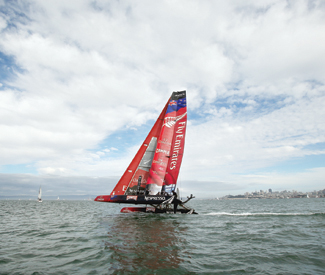
Small as the field is, Emirates Team New Zealand (ETNZ) is quickly shaping up to be the team to beat if you’re on a high-speed, air-catching AC72 catamaran. If they succeed, it will show that developing an America’s Cup team doesn’t have to come from having deep pockets in your Nantucket Red pants — it comes from having the sport ingrained in your culture, filtered through affordable local boat clubs, city-run facilities, volunteer programs, publicly accessible shorefronts, and an innovative marine industry.

In fact, without New Zealand’s maritime way of life, Larry Ellison wouldn’t have much of a team: of the 27 sailors and management crew aboard Oracle, a third are Kiwis. Another third are Australians. If you count Ellison, there are only three Americans aboard. Just one of them — tactician and grinder John Kostecki — grew up sailing on San Francisco Bay.

Ellison’s boat is mostly a Kiwi production, too — the fixed-wing sails and structural components for Oracle’s two AC72s were made in New Zealand, as were the boats, sails, and rigs for ETNZ and Luna Rossa. The only other syndicate competing, Sweden’s Artemis, in the wind since the death of crewmember Andrew Simpson, is the outlier, but they still have eight New Zealanders on board.

America’s Cup is looking more and more like it owes a lot to New Zealand. Is the Cup doing as much for San Francisco as it is for this little island nation, with a population just a tenth of California’s?

“If it wasn’t called Team New Zealand, we wouldn’t get a lot out of it,” says Sven Pannell, a competitive dinghy racer and employee of the economic development agency Grow Wellington. “The numbers of boat builders, carbon fabricators, sail makers, yacht designers coming out of New Zealand are the reason we’re still at the top of the global game. If we can bring the Cup home that means a lot for our country.”

It may also save America’s Cup from becoming even more out of touch with reality.


IT’S THE CULTURE, STUPID

It’s June 8, summer in San Francisco but winter in Wellington. The first race of the 2013 Winter Series at Evans Bay Boat Club hits hypothermic seas beneath steely overcast skies and 20-30 knots of wind — “perfect conditions,” one sailor enthuses. Tame, actually, for Wellington. A week ago, wind blew out the fifth story windows of a building downtown.

Sven Pannell has just finished racing a 12-foot skiff, a super lightweight, often homebuilt boat that probably originated in Australia and is almost exclusively raced in the Southern Hemisphere, though an 18-foot version will be showcased in San Francisco this September alongside the America’s Cup finals. Weighing about 100 pounds, with no class restrictions on sail area, they rooster-tail around Wellington harbor, bow high, barely in the water. They seem to require a similar caliber of nerve as the AC72s.

Which Pannell, who won today, evidently has. He grew up sailing as a kid, as did his crew, Craig Anderson. Neither of them can think of anyone who didn’t get into sailing as a child.

“A lot of people around the world think yachting is a well-heeled sport, but not in New Zealand,” he says. “There’s a reason that half those [America’s Cup] boats are full of Kiwis and Aussies. Go out and see the number of eight-year-olds in Optis in all kinds of weather here. A high number of people sailing at that age creates a deep pool of sailors in demand.”

“America’s Cup is about stretching the limits, but it starts here, when you’re eight years old,” he adds.

Eager to get out of the icy Antarctic wind, I enter the boat club where about 35 people are gathered at the bar, buzzing from adrenalin, barefoot and wet from spray or capsizes, gripping ginger beers and green bottles of Steinlager, the Budweiser of New Zealand. It’s a humble looking crowd — no flash gear or cashmere.

I’m introduced to Mike Rhodes, 26, wearing a blue sweatshirt and camo pants. He’d love to race an America’s Cup boat, but he also satisfies himself with a 12-foot skiff, which he stripped and rebuilt, fashioning the stainless steel fittings himself — he’s a sheet metal worker.

“New Zealand sailing is all about learning and moving forward,” he says. “The boats we’re sailing are always changing. We have set rules for weight, width, and length. After that it’s wide open. You can put up as much rig as you can handle. We went out in 50 knots last weekend. It was insane. We probably had boat speeds of 30 knots.”

The speed and innovations are what appeal to Rhodes and also connect to the America’s Cup, which has been an historic proving ground for leaps forward in boat design. “Who thought New Zealand could make the boat fly first?” he says of ETNZ’s proficiency at foiling the AC72 — going so fast the hull actually lifts off the water.

We’re soon joined by Laura Hutton, a 30-year-old from Cape Cod. She’s raced dinghies, coached and taught sailing for years. Now a speech therapist, she moved to New Zealand three months ago and immediately hooked into the local yachting scene. It’s palpably different than what she’s used to in the States. Here, she says, “It’s a lot more laid back. It’s more inclusive than exclusive. I used to go to events at New York Yacht Club in Newport and I felt so uncomfortable there. It’s the most elite, snobby place.”

“You can’t get coaching in the US unless you’re part of a yacht club or go to a school with a racing team,” she adds, and there’s often a huge cost to enter the sport. “Here, I can join the local yacht club for $35 a month,” she deadpans.

I spend more money riding the bus, I tell her, but I wouldn’t in San Francisco, where it’s cheap to catch a bus but where most people rarely board boats.

The American yacht club tradition has a certain “if you have to ask how much it costs, you can’t afford it” attitude. Ellison is one of 300 members of Golden Gate Yacht Club, official host for the Cup. Its neighbor, St. Francis Yacht Club, 2,300 strong, also has a role in the festivities. Both are exclusive, members-only clubs and neither would tell me what their members pay for the club’s privileges.

However, they’re officially nonprofit organizations and filings with the IRS show St. Francis made nearly $13 million in 2011. Golden Gate Yacht Club took home $660,000 the same year. Ironically, both clubs are on public lands, leased from San Francisco’s Recreation and Parks Department for $231,125 and $64,000 annually respectively.

Both clubs run learn-to-sail programs for kids — $350 for St. Francis and $200 for GGYC — which seem affordable, but what’s the next step? Joining the club, but apparently it’s too rude to query the price.

By contrast, Wellington’s Evans Bay Boat Club charges NZ$281 (US$210) to join and Royal Port Nicholson Yacht Club, which is a sister club to St. Francis, costs NZ$160 (US $120). The Bay Area is lucky — Berkeley and Treasure Island both have affordable clubs, however one could argue that if St. Francis and GGYC are on public lands, they should be paying more in dues to the city.

If there’s a posh club in Auckland, it’s ETNZ’s home — the Royal New Zealand Yacht Squadron. “But it’s a Kiwi version of posh, nothing like some of the yacht clubs I have been to in places like England, where women aren’t allowed to order drinks at the bar,” says Ben Gladwell, a journalist for Boating New Zealand who will be racing an 18 foot skiff in San Francisco in a regatta concurrent with the Cup finals. “At the Squaddy, there are obviously rules, like no cell phones, and dress codes and such like, but the fees are still only a few hundred dollars per year and it is much more inclusive than other yacht clubs around the world.”

Gladwell explored the health of New Zealand’s sailing culture in a story called “State of the Racing Nation” for Boating New Zealand. He found that although there is a drop-off in interest during university years, many yacht clubs have created partnerships to keep kids in the sport, there are mobile learn-to-sail units roaming the country, and lots of accessible city-run programs for kids. Couple that with low lifetime fees to stay in the sport and you see healthy clubs like Evans Bay, where people of all ages are out racing every weekend, all year round.

“Having so many people involved in sailing is a major reason we are successful,” he says. “Children are introduced to it at such a young age…by the time they come to competing at youth international regattas, they are hugely experienced and winning becomes a habit.”


“AMERICA’S CUP IS NOW NEW ZEALAND’S CUP”

In 1995, when Black Magic smoked Dennis Connor’s Stars and Stripes in a five-race shut-out, commentator Peter Montgomery famously quipped “America’s Cup is now New Zealand’s cup,” a line that’s gone down in Kiwi history like the “I have a dream” speech.

For the first time, the Auld Mug would be defended in New Zealand. Back then, Auckland’s Viaduct Harbor probably looked a lot like parts of San Francisco’s waterfront does today — dilapidated piers and old industrial buildings crumbling on their pilings. It would cost of NZ$58 million (US$29 million at the time) to dredge the harbor and spruce up the waterfront for the Cup.

The city made its money back. Hosting for two years, in 2000 and 2003, brought NZ$1 billion (US$500 million, at the time) in economic benefits to the country, about 85 percent of that going to Auckland’s local businesses, mostly from visiting megayachts and the services required for the nine syndicates that competed — twice as many as are in San Francisco today.

And Auckland made a lot less than the US$900 million predicted for San Francisco, already trimmed from the US$1.4 billion initially estimated. What the city actually gains from the $22.5 million investment they’ve been forced to make remains to be seen. Meanwhile, Auckland continues to benefit from the race.

It’s been estimated that the four Cup contenders have collectively spent half a billion on their campaigns and a decent chunk of that has been in Auckland, particularly during the AC72 design, build, and testing phases. Already, taxes paid by ETNZ employees amount to NZ$22.4 million (US$16.5 million). That doesn’t include the employee payroll taxes of all the businesses doing Cup-related activity, like the boat builders, riggers, and sailmakers.

ETNZ CEO Grant Dalton has netted sponsorships from more than 100 companies and argues that the Cup efforts have kept many marine businesses afloat that would have otherwise shuttered. Kiwis have not been immune to the world financial situation: the high New Zealand dollar hurting exports and the NZ$30 billion (US$22.5 billion) price tag for the February 2011 Christchurch earthquake have stressed the country’s coffers.

Because of that, funding ETNZ has been as contentious here as hosting Ellison’s party has been to San Franciscans. The agreement was signed in 2007 by a Labour Party-led government and when National Party’s John Key won the Prime Minister’s seat in 2008, he looked into breaking the contract, a move supported by other parties. “Funding the America’s Cup is surely a ‘nice to have’, rather than essential spending, in the current economic climate,” said Green Party co-leader Metiria Turei at the time.

The government was advised they’d still be legally on the hook for the money if they broke the contract, so ETNZ proceeded, but proof of economic return was a contingency and Dalton has taken pains to keep the public good in the conversation, a sharp contrast to Ellison’s attitude toward San Francisco. Dalton has said if New Zealand wins, the world should expect a sharp scaling back of costs. “We stand for nationality rule and we stand for real budget numbers that real people can raise,” he has said.

There’s definitely a sense that this could be New Zealand’s last chance to bring the Auld Mug home. If they don’t, the America’s Cup also loses. Who else will save it from American-style exclusiveness?

Buddy cops, a one-man army, a boozy doc, and more: new movies!

0

This week: two music docs, a buddy-cop movie starring Sandra Bullock and Melissa McCarthy, and America’s Sweetmeat Channing Tatum saves the White House and, ergo, the world. Plus, more! Read on for takes from our critics.

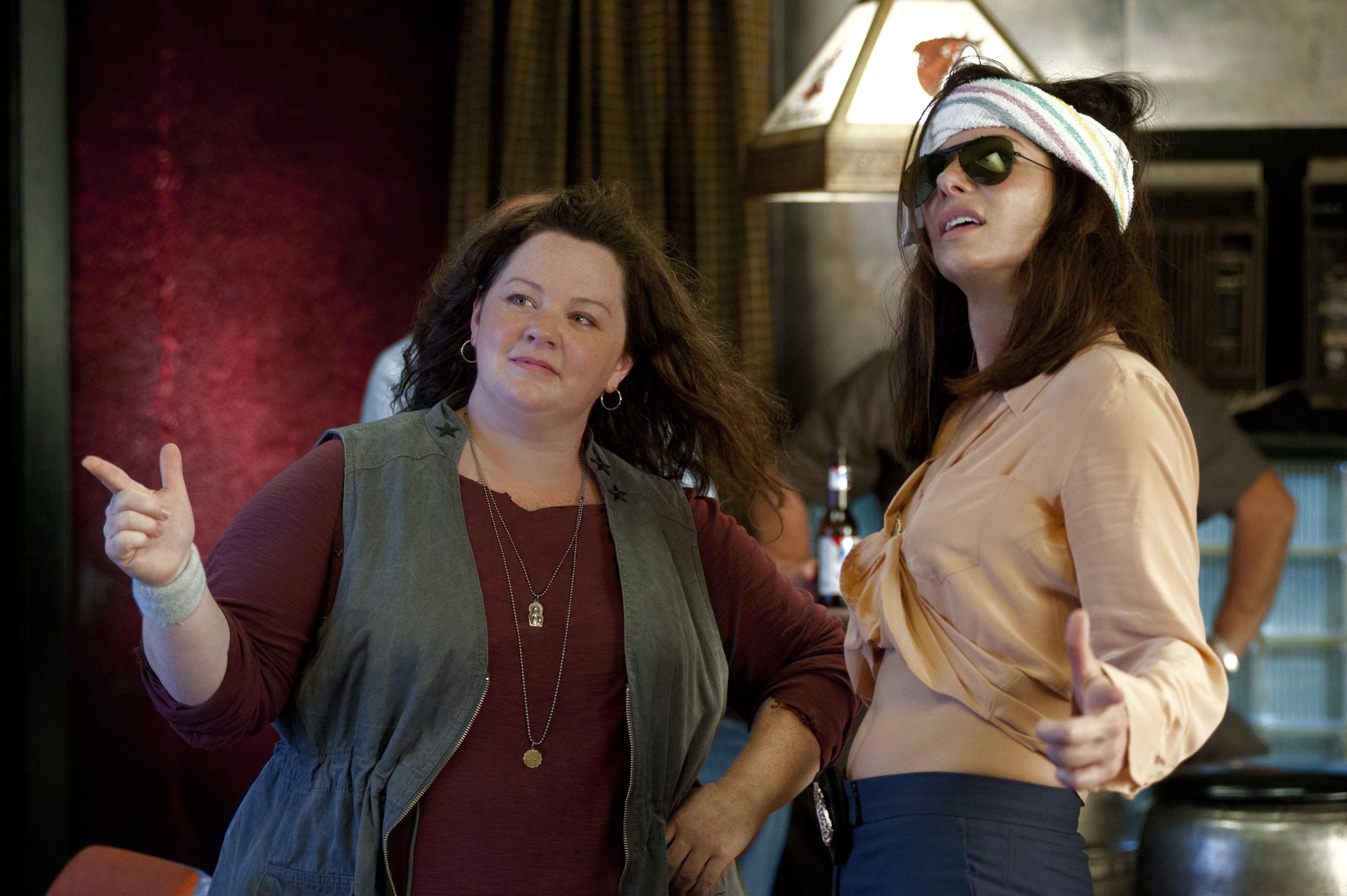
The Heat First things first: I hated Bridesmaids (2011). Even the BFF love fest between Maya Rudolph and Kristen Wiig couldn’t wash away the bad taste of another wolf pack in girl’s clothing. Dragging and dropping women into dude-ly storylines is at best wonky and at worst degrading, but The Heat finds an alternate route. Its women are unlikable; you don’t root for them, and you’re not hoping they become princesses because such horrifying awkwardness can only be redeemed by a prince. In Bridesmaids and Heat director Paul Feig’s universe, friendship saves the day. Sandra Bullock is Murtaugh to Melissa McCarthy’s Riggs, with tidy Bullock angling for a promotion and McCarthy driving a busted hoopty through Boston like she’s in Grand Theft Auto. Circumstances conspire to bring them together on a case, in one of many elements lifted from traditional buddy-cop storylines. But! The jokes are constant, pelting, and whiz by like so much gunfire. In one running gag, a low-rung villain’s worst insult is telling the women they look old — but neither character is bothered by it. It’s refreshing to see embarrassment humor, so beloved by chick flicks, get taken down a peg by female leads who don’t particularly care what anyone thinks of them. (1:57) (Sara Maria Vizcarrondo)

http://www.youtube.com/watch?v=3HUwmDqi2kA

Hey Bartender Hey, have you heard of this trendy thing called craft cocktails? Be warned, sophisticated San Francisco drinkers: Douglas Tirola’s upbeat documentary mentions our fair city in passing only a handful of times; instead, it concentrates on New York City’s relatively recent “cocktail revolution,” interviewing movers and (literal) shakers on the scene while giving a brief history of cocktails in America (again, with an emphasis on NYC). Hey Bartender‘s focal points are well-chosen studies in contrast: ex-Marine Scott — tattooed and scrupulously mustached — who’s working his way up the ranks at hipster lounge Employees Only; and middle-aged Steve, who runs a struggling blue-collar bar just outside the city and is slowly coming around to the idea of adding fancier drinks to his menu. Though dive-bar denizens may roll their eyes at some of Hey Bartender‘s more pretentious trappings (the movie doesn’t mention it, but drinks at Employees Only are in the $15-16 range), it does make the case that today’s superstar “mixologists” deserve just as much recognition as superstar restaurateurs. And the film has a point: can a Top Chef spinoff for bartenders be that far off? (1:32) Roxie. (Cheryl Eddy)

http://www.youtube.com/watch?v=rwDzRzqFaIE

Laurence Anyways Xavier Dolan’s latest is yet another gorgeously-designed love story; it fits perfectly alongside his extremely personal I Killed My Mother (2009) and the devastating Heartbeats (2010). Although some critics have suggested that this young director needs to hire an editor (Laurence Anyways clocks in at two hours and 48 minutes), I would argue that this epic, gender-bending love story needed to take its stylized time to achieve what most films never do: humanize a transgendered lead character. Melvil Poupaud (Raúl Ruiz’s favorite ingénue) is stunning as Laurence; as his longtime lover, Fred, Suzanne Clément performs with a guttural passion that should keep audiences glued to the screen. For those willing to accept a decade’s worth of hypnotic set and costume designs (the film spans 1989-1999); cryptic character development; a crew of campy castaways; and an electric, eclectic soundtrack (Depeche Mode, Celine Dion), Laurence Anyways is well worthy of its epic running time. Could this be the film that elevates Canada’s best-kept secret to being the leader of a post-gender film movement that’s just about to explode? (2:48) Metreon. (Jesse Hawthorne Ficks)

The Secret Disco Revolution Jamie Kaster’s Canadian documentary chronicles the rise and fall of the 70s booty shaking phenomenon — though what with the subsequent developments of house music, rave culture, et al., you might say disco never really went away. It’s got a goldmine of kitschy vintage clips, and plenty of enjoyable interviews with the scene’s erstwhile stars (Thelma Houston, “KC” Casey, etc.), producers, and observers. (The weirdest are scenes with the Village People, who today are staples on the corporate-party circuit and seem bizarrely eager to deny they were ever a subversively gay act.) Unfortunately, Kaster also burdens the film with sometimes overreaching arguments for disco’s sociopolitical radicalism, as mostly articulated by academic Alice Echols. And there’s a labored staged thread in which an arch narrator informs of us the behind-the-scenes mechanizations of three fictive “masterminds” (played by actors) who propagated disco to liberate gays, women and ethnic minorities. It’s a whimsical conceit that falls completely flat. As a result, there’s plenty of fun to be had here, but the conceptual missteps make this less than the definite disco doc it aims to be. (1:25) (Dennis Harvey)

20 Feet From Stardom Singing the praises of those otherwise neglected backup vocalists who put the soul into that Wall of Sound, brought heft to “Young Americans,” and lent real fury to “Gimme Shelter,” 20 Feet From Stardom is doing the rock ‘n’ roll true believer’s good work. Director Morgan Neville follows a handful of mainly female, mostly African American backing vocal legends, charts their skewed career trajectories as they rake in major credits and keep working long after one-hit wonders are forgotten (the Waters family) but fail to make their name known to the public (Merry Clayton), grasp Grammy approval yet somehow fail to follow through (Lisa Fischer), and keep narrowly missing the prize (Judith Hill) as label recording budgets shrivel and the tastes, technology, and the industry shift. Neville gives these industry pros and soulful survivors in a rocked-out, sample-heavy, DIY world their due on many levels, covering the low-coverage minis, Concert for Bangladesh high points, gossipy rumors, and sheer love for the blend that those intertwined voices achieve. One wishes the director had done more than simply touch in the backup successes out there, like Luther Vandross, and dug deeper to break down the reasons Fischer succumbed to the sophomore slump. But one can’t deny the passion in the voices he’s chosen to follow — and the righteous belief the Neville clearly has in his subjects, especially when, like Hill, they are ready to pick themselves up and carry on after being told they’re not “the Voice.” (1:30) (Kimberly Chun)

Unfinished Song A grumpy widower (Terrence Stamp) learns to enjoy life again by joining an unconventional choir group. Vanessa Redgrave, Gemma Arterton, and Christopher Eccleston round out the cast. (1:36)

http://www.youtube.com/watch?v=Wa5aasz5VXg

White House Down Ah, the mid-1990s: a time when two big-budget movies on the same subject were regularly released within months of each other (1997’s Volcano and Dante’s Peak; 1998’s Armageddon and Deep Impact). When a director named Roland Emmerich ascended into the blockbuster pantheon with Independence Day (1996), a film that’s best-remembered for that iconic shot of the White House exploding under alien death rays. The intervening years have seen Emmerich plunge ever-deeper into various flavors of disaster, and White House Down — which reignites that ’90s copycat-rivalry thing by riding the fumes of March’s Olympus Has Fallen — finds its boogeyman in domestic terrorism. It beings on a triumphant day for President James Sawyer (Jamie Foxx), who has just ordered all US troops removed from the Middle East — angering some high-up men in his administration, as well as some ex-military goons with axes of their own to grind. When the White House is compromised, a wannabe Secret Service agent (Channing Tatum), at the Prez’s house for a tour with his precocious daughter, shoulders one-man-army duties. Rockets are launched; there’s a high-speed limo chase across the White House lawn; we learn the truth about Marilyn and JFK; and thanks to evil genius Skip Tyler (Jimmi Simpson), “the greatest hack the world has ever seen” is about to unleash World War III. Yep, that’s right: 17 years after ID4‘s Jeff Goldblum broke into the alien mainframe, thereby saving the White House-less planet, Emmerich has decided that hackers are actually bad guys. It goes with White House Down‘s warning that the enemy is no longer an external threat, but something lurking right under your nose. Better start working out, America — and working on your one-liners. (2:17) (Cheryl Eddy)

Chatting up Daily Kos founder Markos Moulitsas

Chances are, you probably have the Daily Kos blog open on one of your browser tabs right now. The fiercely progressive blog and community hub showcasing an array of liberal activists and organizers has been at the forefront of a number 21st political battles. Markos Moulitsas, founder and publisher of Daily Kos, started Netroots (then known as YearlyKos) as a way to bring an online community together in a shared physical space. Eight years later, Moulitsas attends as a “private citizen.” When I caught sight of him at the conference, I approached him for a conversation on how the conference has changed over the years, the relationship between liberals and Obama, and his take on current voter demographics.

SFBG: What’s your been your experience at Netroots Nation 2013?

Moulitsas: What’s been different than previous ones is, it’s kind of lot younger. There seems to be a sort of a new generation of network activists. And so, we have this new generation of activists that’s emerging, which is to me is kind of cool. Because any movement cannot sustain itself without youth, that new blood and … the skills they’re bringing to the table — this intimate knowledge of social networks — are skills that I can definitely benefit from, and some of these young guys can actually benefit from some of the wisdom that old-timers have.

How has the conference progressed since the first one in 2006?

You know what was amazing about that conference, is that it was organized by the community. I didn’t organize it, it was the community that decided that they wanted to meet in person and then they made it happen. It was truly volunteer and amateur-driven, from day one, but it didn’t feel like an amateur conference. So they accomplished kind of the impossible just by sheer will and desire to make this happen, and so what I would say is … this is going to grow into something much further beyond the Daily Kos community.

What do you say to liberals who are disillusioned and cynical about Obama and other Democratic Party leaders?

You know, change is incremental. It always is in the political realm. A lot of that disappointment with him really stems from the fact that we have a shitty Congress. A lot of that had nothing to do with the shitty Congress. We’re not going to get everything we want and we could never get everything we want. We’ve got to keep creating that space, politically, for people to do so. Obama couldn’t be pro-gay marriage his first term, until the very, very, very end of his first term, when finally the political space has been created, where he could be a better progressive. So to me, that’s what it’s all about, is to continue to create that space and move the American public. I mean, the American public is already there. It’s getting them to realize they’re actually more liberal than they think they are.

It’s making sure that growth demographics that are very democratic are engaged politically, not taken granted but make sure that African Americans, Latino, Asians are engaged politically because there are going to be key components of our future majorities in the direction our nation takes. Conservatives really began their movement, building their movement in 1964, after the Barry Goldwater defeat. From the point, it took them 16 years to win the White house with Ronald Regan. It took him 30 years to win Congress in 1994 with the Newt Gingrich revolution.

But while the Democratic Party has moved left on issues like pot and gay marriage, a lot of people are saying the neoliberals have taken over the Democratic Party.

I actually think some of the most excitement coming from the Democratic Party are people like Elizabeth Warren, who are actually more progressive on economic issues than any democrat I’ve seen on the scene long time.

Do you think the emerging “Democratic Majority” has arrived?

Obama lost the white vote. The white votes were 75 percent of the electorate 2012. Mitt Romney won them 59-39 and Obama didn’t hit 40 percent with white voters. If the election were held in 2016, nothing else changes, same percentages, instead of winning by 5 votes, Obama would win by 9 points. So, not only is it here, but it’s growing at an incredible pace. Right now the only way Republicans can win elections is if our voters stay home. That’s a problem, because our core voters are also the least performing of voters – young people, African-Americans, Latinos, and single women have the worst turnout rates, particularly in midterm elections. 

Still beating

27

cheryl@sfbg.com

FILM/LIT A few weeks before our scheduled interview, Laura Albert mails me copies of 2000’s Sarah and 2001’s The Heart is Deceitful Above All Things. Inscribed on Heart‘s title page is a note: “Thanks for being available to revelation.” The volumes are signed “Yours, LA and JT” — the latter, of course, referring to JT LeRoy, the identity under which Albert penned both books.

That secret’s been out since late 2005, and has been dissected over and over. It even inspired a Law and Order episode. LeRoy, and his fantastically tragic back story (just out of his teens, he’d survived drugs, homelessness, and prostitution en route to becoming the lit world’s hottest wunderkind), were Albert’s creations. She was the true author behind the best-sellers listed above, plus 2004’s Harold’s End, dozens of magazine articles, an early script for Gus Van Sant’s Elephant (2003), and numerous other works. (Meanwhile, the androgynous “JT” that had been appearing in public was actually the half-sister of Albert’s then-partner; she wrote her own tell-all in 2008.) On Albert’s website, there are tabs marked “Who is Laura Albert?” and “Who is JT LeRoy?” Both link to Albert’s biography.

Years have passed since l’affaire LeRoy, and Albert has moved through the experience in her own way. (Her business card lists her as “literary outlaw.”) Later this summer, Sarah will be reissued as an ebook, with a fairy tale-inspired cover by artist Matt Pipes. Albert also is working on her memoirs (though she doesn’t like to use the word “memoirs”), and tells me there’s a documentary forthcoming from Jeff Feuerzeig, who made 2005’s critically-acclaimed The Devil and Daniel Johnston. This weekend, Asia Argento’s 2004 adaptation of The Heart is Deceitful Above All Things screens as part of the Clay Theatre’s midnight-movie series, with Albert and producer Chris Hanley in person, plus Argento via Skype.

Sitting in her San Francisco kitchen, Albert eyes my tape recorder and admits she’d rather focus on the film, not JT — though it’s a topic that inevitably arises. Argento, Albert says, encountered Heart the way many LeRoy readers did, via word-of-mouth recommendation.

“She read the book and she didn’t know anything about JT. At the same time, a small publisher was putting out the book [in Italy], and they wanted to bring JT over,” Albert recalls. “It was a weird coincidence. They were putting on an event, and they wanted to get someone to read. They had contacted Asia, and she already knew about the book, and she wanted not only to do this event, but to make the movie. It’s funny because I thought Sarah would be the first [to become a film], because it was already optioned by Gus [Van Sant]. But Asia moved really fast. We went over to meet her, and I had turned down a lot of people. My feeling was, it’s my baby and I’m giving it up for adoption, and I saw that this was someone I could give my baby to.”

Argento, the daughter of famed Italian horror director Dario Argento, is best-known stateside as an actor; previous to Heart, her directing experience was limited to short films and 2000’s flamboyant Scarlet Diva. Once she decided to helm the movie, her decision to star as the free-spirited, needy, sometimes-cruel single mother of the story’s young protagonist was an obvious choice.

“I had concerns about that, how much she would take on the role, how much it would become her. It’s ironic, because I had given myself over completely to Jeremy, to JT, to Jeremiah,” Albert says. She pauses. “Did you see that French film, about the guy who assumes different characters?”

Holy Motors?”

“Yeah! It really was transformative to me. There’s a scene where someone asks [the main character], ‘Why are you still doing this?’, and he makes reference to the act of giving yourself over completely. And that was it. I gave myself over completely. I did not break character. You know how, in that movie, he’ll do anything? He’ll kill someone! He’s in it. Most people don’t know what that’s like. And that was it. I will never apologize,” she says, firmly. “We’re talking about art. Nobody was harmed in this, really. I didn’t really scribble that far outside the lines. Everything was labeled ‘fiction.'”

At her mention of an apology, I have to ask: does she feel like people demanded one?

“People like to give themselves a lot of credit for how vanguard they are. I can’t tell you how many people I’ve had tell me, ‘Warhol would have loved it!’ — including people who were close with Warhol,” she says. “I think it revealed more about other people and what they could accommodate, and what they put on the work, than it does about me. If you have a personal relationship with JT, then that’s a conversation between you and me. I put my email [in the books], and I really did have a connection with the fans because I grew up in the punk scene, and I wasn’t into hero worship. The problem was — psychologically — I wasn’t able to do that. It wasn’t like [adopts goofy voice], ‘Gee, how do I burst forth onto the literary scene? I know! I’ll create a little boy!’ No. It wasn’t like that.”

As we talk, Albert makes references to her own troubled youth: surviving abuse, living in a group home, being institutionalized. Amid the tumult of her teenage life, she would “call hotlines — I don’t know what I would talk about, but it was the only time I could feel. I would give myself over to another being, and it was always a boy. So when I hear people say, ‘I’m gonna do what you did,’ it’s like, good luck. For me it was created the way an oyster creates a pearl: out of irritation and suffering. It was an attempt to try to heal something. And it actually worked, and it did so for a lot of other people. The amazing thing is, now I can be available to people.”

We’re delving more into her work (“I didn’t do anything new — writers have always been using combinations of pseudonyms and identities,” she points out) when the doorbell rings; it’s a Comcast technician here to see about Albert’s Internet connection. We move to her office, which features a wall collaged with photos and several filing cabinets full of archives — material she’s letting Feuerzeig use in his documentary.

But it’s not a room completely given over to the past. It’s also where Albert works on her new projects (besides her memoirs, she’s writing screenplays — building off her experiences working on Deadwood with David Milch), and stashes new mementos, including a program from a recent Brazilian rock opera entitled JT, A Punk Rock Fairy Tale.

Before I leave, she gives me a copy of a New York Times article from 2010 entitled “Life, In the Way of Art;” its subjects include Joaquin Phoenix, still smarting from the backlash after his faux breakdown in I’m Still Here. The director of that film, Casey Affleck, cites a line from a Picasso quote that Albert emails to me in full the day after we speak: “We all know that art is not truth. Art is a lie that makes us realize truth, at least the truth that is given us to understand. The artist must know the manner whereby to convince others of the truthfulness of his lies.”

She’s just as frank over email as she is in person. “It’s OK with me if someone doesn’t like my writing. But they shouldn’t try to tell me how I’m obliged to present my work,” she writes. “When I talk about my personal background, I’m not attempting to somehow bestow legitimacy to what I’ve written — anyone should be able to do what I did. My life history doesn’t matter and isn’t being offered as any kind of excuse.”

I think back to something she said in her kitchen — a simple, powerful summation of a story that will never not be complicated. “JT was my lifeboat. You loved him? Well, I loved him more.” 

THE HEART IS DECEITFUL ABOVE ALL THINGS

Fri/28, midnight, $10

Clay

2261 Fillmore, SF

www.landmarktheatres.com


Supreme Court same-sex marriage decisions: DOMA invalidated, Prop 8 case dismissed, SF reacts [UPDATED]

27

Watch this space throughout the day for breaking news on the decision and reactions. Tonight there will be a celebration of the Court’s decisions at Castro and Market Streets at 6:30pm. (Join  the Guardian beforehand, 6-9 at the Pilsner in the castro, at its annual pre-Pride event.) 

DOMA INVALIDATED

The Supreme Court released its ruling this morning that the Defense of Marriage Act, which denies federal recognition of same-sex marriage, “is unconstitutional as a deprivation of the equal liberty of persons that is protected by the Fifth Amendment.”

“DOMA singles out a class of persons deemed by a State entitled to recognition and protection to enhance their own liberty,” according to the majority opinion. “DOMA’s principal effect is to identify a subset of state sanctioned marriages and make them unequal.” The Court voted 5-4, with Justice Kennedy, who wrote the majority opinion, as the decisive vote along the usual liberal/conservative lines. You can read the full opinion here

This means that same-sex marriages performed in states that have legalized such marriages will be recognized by federal law.  

PROP 8 DISMISSED ON STANDING

As for Hollingsworth v. Perry, the Prop 8 case, it was dismissed on standing, due to the fact that the State of California refused to defend the case that would uphold Prop 8 (which denied same-sex marriage).That meant private citizens were left to defend a state statute, which was unprecedented, and the Court refused to rule on those grounds.

We have never before upheld the standing of a private party to defend the constitutionality of a state statute when state officials have chosen not to. We decline to do so for the first time here,” the majority Court statement (which broke along the typical 5-4 line) said. That means there is no specific decision from the Court regarding Prop 8, and the previous ruling, by Judge Vaughan Walker and upheld by the Ninth Circuit Court, that invalidated Prop 8 as discriminatory, stands.

This may mean that same-sex marriages in California can resume as early as July.

You can read the full Prop 8 ruling here.

Scene this morrning at SF City Hall, with Mayor Ed Lee and Lt. Gov. Newsom. Photo by Dan Bernal.

[UPDATE] REACTIONS AT CITY HALL

Steven T. Jones reports from SF City Hall:

City Hall was totally packed at 7am when the US Supreme Court convened — tons of journalists, lots of couples, many signs in the crowd. Two screens were set up, one with a live blog from court chamber, the other with the CNN live feed. Huge cheers erupted at 7:11 when the decision was announced striking down DOMA and forcing the federal government to recognize the rights of same-sex married couples.  Then at 7:38, when the Prop 8 statement came down, the room went nuts. 

A moment later, an array of current and former city officials appeared at the top of the City Hall main staircase. Mayor Ed Lee and Lt. Gov. Gavin Newsom escorted a fragile Phyllis Lyon down the stairs — she, along with the late Del Martin, were the first same-sex couple to get legally married in California in 2004 — flanked by the rest of the city family, all with big smiles.

“Welcome to the people’s house of San Francisco,” Mayor Lee said, thanking the crowd “for sharing in this historic moment.”

“It feels good to have love triumph over ignorance,” he said.

At 7:44, City Attorney Dennis Herrera and Chief Deputy City Attorney Terry Stewart, who had been on the City Hall steps addressed reporters’ question on the legal details of the ruling, joined the crew to sustained applause as Lee recognized them. He then introduced Newsom, who in 2004 as San Francisco mayor allowed same-sex marriages to be performed, as “one person who used the power of this office to make history and show his love for the city.”

“San Francisco is not a city of dreamers, but a city of doers,” Newsom said. “Here we don’t just tolerate diversity, we celebrate our diversity.” He thanked Herrera and everyone who contributed to this moment. “It’s people with a true commitment to equality that brought us here.”

Newsom introduced Kate Kendall with the National Center for Lesbian Rights, who has led the coalition of groups that have push for marriage equality. She looked around the crowd and said, “Fuck you, Prop 8!”

The crowd roared, and she said that she had scanned the room for children, and promised to “put a dollar in the swear jar” if necessary. But she said that, “We have lived for too many years under that stigmatizing piece of crap.”

Then Herrera took the podium, turned to Newsom, and said, Now you can say, ‘Whether you like it or not!'” — a joking reference to Newsom’s same-sex marriage rallying cry, which some blamed for boosting the anti-same-sex marriage cause.

“We wouldn’t be here today if it wasn’t for Gavin Newsom’s leadership,” Herrera continued. ““I remember in 2004 when people were saying it was too fast, too soon, too much.”

But today, that long effort has been vindicated, Now, he said, “It’s about changing the hearts and minds of people and educating them.” He also pledged to continue the fight that began here in City Hall more than nine years ago: “We will not rest until we have marriage equality throughout this country.”

Gavin Newsom being interviewed inside City Hall. Photo by Steve Jones

Finally Stewart, who has argued cases related to San Francisco’s stand before both the US and California Supreme Courts, praised both the Prop. 8 and DOMA rulings and the precedents they set. “In the DOMA case decision, the Supreme Court expressed a stong equal protection philosophy…that will help legalize same sex marriage in other states.”

Three members of the Board of Supervisors were also invited by Kendell to address the huge City Hall crowd: Board President David Chiu and Sups. David Campos and Scott Wiener, the only two current supervisors who are gay.

Chiu noted that the bust of slain Sup. Harvey Milk is prominently positioned outside the Board Chambers, a reminder of the long struggle for gay rights that San Franciscans have led. “That work lives on today,” he said.

He added the hope that the work done here will ripple out of across the country because, he said, “As goes San Francisco, so goes California, so goes the rest of the country.”

Campos, an attorney who has long been in a committed relationship, said, “It’s a very emotional moment for those of us who are part of the LGBT community.” He said this Supreme Court ruling is the first time it has really acknowledged “that we are people and we have dignity,” and that the rulings sends a clear message to Congress that legislation like DOMA is unconstitionally discriminatory.

Wiener praised the resilience of the LGBT community, from the early days of enduring the AIDS crisis and fighting for federal support through the current campaign for marriage equality. And he cheered the fact that, “Those marriages that we see under the rotunda [in City Hall] will get a little more diverse.”

11:30 AM UPDATE: Style and substance

While Newsom strutted around like a proud peacock in front of City Hall — clearly the leading man in this epic story with the happy ending, much in demand by the television crews — Herrera and Stewart briefed various reporters on the details of the case that they had just won.

Gavin Newsom outside City Hall. Photo by Steve Jones.

“I wanted a merits ruling, but a standing ruling is a victory too,” Herrera told us, making the distinction between the court ruling that banning same-sex marriage is unconstitutional on the grounds of equal protection under the law — which it did not do — and the 5-4 ruling it did issue: that those who appealed the Ninth Circuit Court ruling invalidating Prop. 8 lack proper legal standing to do so.

The standing ruling leaves same-sex marriage opponents more wiggle room to argue that the ruling might only apply to the couples named in the suit, or in just the counties that took part, which also included Alameda and Los Angeles, positions they were already signaling in press statements.

But Herrera said that he would vigorously contest that kind of challenge, which he considers to be without merit, telling us, “The injunction is not limited in its scope.”

UPDATE: SFPD isn’t worried

Police Chief Greg Suhr, who attended the City Hall event, said the timing on the ruling during Pride Week couldn’t be better. “It’s nice that it all lined up for us,” he told us. “This town is going to rock ‘til the wheels come off.”

Asked whether he has any heightened security concerns about the Pride Parade in the wake of a ruling that is controversial to some, Suhr said that he’s not worried. He said SFPD is now fully staffed and all available personnel working this weekend, although he will try allow many of his gay and lesbian officers to join the celebration if they want.

“We’re going to police what’s likely to be the biggest party this city has ever seen,” Suhr said, adding that his policing philosophy is, “We plan for the worst and hope for the best.”


Party Radar: Disco Daddy, Ed Rush, Dimitri from Paris, James Holden, BiBi, Fake Blood, more

0

There is absolutely no way I am going to shoehorn my bowlful of Jell-O into that sparkly rainbow thong next weekend — and that’s cool, pigging out on Turtle Tower pho and Bob’s crullers is my way of dealing with stress, and Pride season brings no shortage of that! (Also I heart chubbies, so no prob.)

Luckily, Pride also brings a ton of opportunities to dance, on top of the already insane dance card SF scrawls out on the regular, so I’ll be sweatin’ like the oldies and giving you booty for daaaays (no twerking please) at these hella gay and not-so-gay-yet-still-gay-friendly pre-Pride joints:


>>JAMES HOLDEN

The Border Community label head honcho casts a deep electronic spell, charming your feet while binding your mind. At the As You Like It party with Bells and Whistles, MossMoss, more.

Fri/21, 9pm-4am, $20. Monarch, 101 Sixth St., SF. www.monarchsf.com


>>ED RUSH & OPTICAL 

Heck yes, as ’90s retro progresses, drum ‘n bass is having its return-to-jiggly-spotlight moment. These two bigtime old school, hard school daddies will have you jumping for joy. (Can a boy hope that this also augurs the return of actual crazy, arms-waving dancing in clubs? Tired of this slopey-dopey-boppy thing that’s been going.) Supported by the cream of SF’s classic dnb scene, don’t miss.

Fri/21, 9pm-3am, $15-$20. Public Works, 161 Erie, SF. www.publicsf.com


>>INNERSPACE HALFLIFE

Heady, deep ‘n groovy Chicago duo perform live, as does cool-kid extraordinaire Ital (you may know him from a little band called Mi Ami) at the always surprising, consistently yummy Icee Hot party

Fri/21, 10pm-3am, $10-$15. Public Works Loft, 161 Erie, SF. www.publicsf.com


>>FAKE BLOOD

UK funboy Fake Blood was alsways one of the most promising producers at the tail end of hardcore electro era, but lately he’s blasted off into sheer brilliance, making some real poetry of the remains of that party-hearty sound which, alas, was co-opted to death by the pop-EDM crowd. Fake found a way out. Supported by the energetic Alex Metric. 

Sat/22, 10pm-late, $15 advance. Mezzanine, 444 Jessie, SF. www.blasthaus.com


>>DIMITRI FROM PARIS

High on the list of parties that changed my life: The Playboy Mansion party at WMC 2000 in Miami. Upon entrance, someone handed me an egg-shaped maraca, Dimitri hit the decks, and I was gone for six hours. I had never heard disco mixed with house like that — Dimitri was the king of re-edit sophistication long before it became a laptop whip-up thing. I mean, I melt: 

Sat/22, 10pm-late, $20. Mighty, 119 Utah, SF. www.mighty119.com


>>BIBI

Middle Eastern queers (and friends of all rainbow backgrounds) unite: This annual Pride kick-off party is a truly special event, packed with unfamilair hotties, sweet tunes, and drums and belly dancers even. “Shake those hips” with DJs Emancipacion and Nile, and the Shabnam Dace Company. 

Sat/22, 9pm, $10-$12. Club OMG, 43 Sixth St., SF. Advance tickets here.


>>DISCO DADDY

More Pride kick-off shenanigans, this time in the form of beloved rare-find bathhouse disco king DJ Bus Station John taking to the decks all Sunday evening at the Eagle! Disco at the Eagle — somehow it makes sense but breaks the brain. Sweaty tunes (hi-NRG!) ‘n cruisy men — what more could you ask for? Oh yes, cheap beer. And menergy.

Sun/23, 7pm-midnight, $5. SF Eagle, 398 12th St., SF. www.sf-eagle.com


Father’s day

0

arts@sfbg.com

LIT In late-1980s San Francisco, Steve Abbott hosted a gay writer’s workshop at his small apartment at the fabled corner of Haight and Ashbury. One fleeting but reliable occurrence was an appearance by Alysia, the daughter he’d raised since his wife died in a car accident years earlier.

Each week, the teenager stormed about just long enough so we could feel her wrath before slamming the bedroom door. It was funny, but also understandable: at that age, who wants their personal space regularly invaded by strangers? Let alone gay male adults, reinforcing your separation from the heterosexual family norm?

Steve was a significant presence in SF’s literary scene for nearly two decades, publishing his own adventuresome small-press books in various idioms (poems, essays, fiction). He edited small magazines including the influential Poetry Flash; was first to promote such edgy “postmodernist” voices as Kathy Acker and Dennis Cooper; and was an idiosyncratic cultural commentator for local weeklies (including the Bay Guardian). He was unfailingly generous with other fledgling writers, myself included.

He barely kept the rent paid via rote day jobs, while raising a child alone — an awkward match to the carefree gay community he joined upon moving to SF (and coming out) in 1974. As Alysia Abbott writes in her acclaimed new release Fairyland: A Memoir of My Father (W.W. Norton and Company, 352pp., $25.95), there were no role models then for gay single parents. Their very close but turbulent relationship amplified the clash between her often-peevish parental needs and his belated self-discovery in a sexual-artistic bohemia. They found balance as she found her own identity upon leaving for college. But then the AIDS epidemic swept both up in its devastation.

Abbott, now living in Boston with a husband and two children, answered questions in advance of two local appearances this week.

San Francisco Bay Guardian You had an unconventional childhood with an unconventional parent. Has that influenced your own parenting?

Alysia Abbott My father was raised in a strict Catholic household where family members rarely showed affection. He kept his feelings bottled up. By the time he had me, he wanted a completely different family experience, transparent and open. He often shared his romantic and professional woes, sometimes seeking my advice.

I absorbed a lot of my dad’s worry, and sometimes found myself in situations where I had to be more adult than I was ready to be. I want to be my true self with my children. But I also want to protect their innocence to some degree.

SFBG You’re frank about having been an “obnoxious” unhappy teenager. Are there things you or your father could have done differently? Was it a phase you just had to work through?

AA We were trying to create a life with a lot of setbacks, sharing a cramped one-bedroom in the Haight with little money or family help. My father was lonely, and trying to get sober just when I discovered drugs and alternative culture. We did our best under the circumstances. But as often as we clashed, there was a lot of love. This was a period we needed to go through.

SFBG Your father identified so strongly as a writer, but Fairyland doesn’t address how you became one yourself.

AA I’d always wanted to be a writer, or an artist. But after watching him struggle financially, I pursued steady-paycheck work in cushy corporate structures (which I now hate). I also didn’t know if I had his native talent, or could be as intellectually rigorous and pure. I always had our story to tell, but worried I wasn’t worthy of it. The idea of writing Fairyland and having it not meet my own expectations was unbearable. Now I realize perfectionism is the enemy of creativity. To succeed, you have to be willing to fail.

SFBG When Steve was facing mortality, he wrote that you’d probably better appreciate his writing after he’d passed on. What do you think about his literary legacy now?

AA I’m embarrassed to admit I really didn’t read my father’s books until ten years after he died. During his lifetime, the work’s weirdness, its attraction to transgressive figures and ideas threatened me. I accused him of not being a “real writer” because no one had heard of him and he didn’t make any “real money.” What a terrible thing for a daughter to say!

Researching for Fairyland, I came to respect his contributions and integrity. All the writers I know today have to be such master self-promoters. My father was almost embarrassingly naïve in this regard. That may be why few people know his work today. But he was so devoted to writing, and supporting writers that impressed him, even if that effort did nothing for his own career.

I now really love several of his poems and books, especially Lives of the Poets — but some still make me uncomfortable. I’m not sure if it’s because they aren’t good, or still too “out there” for me.

SFBG After so many years, how do you feel about returning to SF? Many of your father’s creative generation are dead. It’s a much yuppie-er burg.

AA San Francisco is very different from the city I knew in 1974, or even 1994. I’ve worried that those who remember the old San Francisco, or appreciate its history, are dwindling — they’ve died or been forced out by Ellis laws. But new residents are attracted by the city’s beauty just as we were. And though much better-heeled, these tech workers and professional types are also trying to reinvent culture, if with much greater odds of profit — and interest in profit.

ALYSIA ABBOTT

Wed/19, 7pm, free

City Lights Books

261 Columbus, SF

www.citylights.com


Thu/20, 6:30pm, free

San Francisco Public Library

100 Larkin, SF

www.sfpl.org