Scene

Counterpoint: an appreciation of ‘The Lone Ranger’

11

Warning: slight spoilers ahead.

I will say it and I will say it loudly: Gore Verbinski’s The Lone Ranger is perhaps the most subversive Hollywood film since Paul Verhoeven’s still misunderstood sci-fi masterpiece, Starship Troopers (1997).

Not only does this sneaky, revisionist epic attempt to recontextualize the history of Western films, screenwriters Justin Haythe, Ted Elliott, and Terry Rossio — working directly from Zane Grey’s 1915 novel The Lone Star Ranger — have designed an ambitious journey through America’s tainted, tattered history. And like Starship Troopers, the combination of ruthless “all-American” violence, ironic historical references, and off-beat slapstick comedy give The Lone Ranger legs that audiences will get to uncover for decades to come. (Sadly it will have to happen after the film leaves US theaters this week.)
http://www.youtube.com/watch?v=Myl32ezlRSo

I watched this uniquely uncompromising popcorn-pleaser three times. By my second viewing, I caught even more references to old Westerns, ranging from the countless scenes set in John Ford’s Monument Valley to the ironic singing of the Christian hymn “Shall We Gather at the River” (as in Sam Peckinpah’s 1969 The Wild Bunch). But what surprised me even more than the homages to, say, the beginning of Sergio Leone’s Once Upon a Time in the West (1966), or the train-chase climax of Buster Keaton’s The General (1926), was the feeling that Verbinski and company were exploring not just the different styles from different decades, but the historical themes of those films.

Consider the nod to Frank Capra’s Mr. Smith Goes To Washington (1939): “Willet Creek” — the name of a corrupt government dam project in the Capra film — is hinted at as a conquest by the corrupt railroad boss played by Tom Wilkinson. Or, during a bank-robbing sequence that’s reminscent of Arthur Penn’s Bonnie & Clyde (1967), the scene suddenly freeze-frames, challenging the morality of the heroes by even having a character in the film stating his own confusion.

Another consistent theme throughout The Lone Ranger‘s big-budget spectacle is “nature is out of balance.”  A spirit horse drinks bottles of alcohol and chooses the “wrong” hero as its master, while innocent fluffy bunnies suddenly sprout fangs and launch attacks on scorpions. While these sudden shifts in tone may feel off-beat or random, I would argue that these screwball comedy moments are in fact motivated allegorical references to the traumatic events that coincided with the building of America’s cross-country railroad.  The film rebounds from an horrific event — as when a very bad dude cuts the heart out of a character we’re rooting for — by leaping right into the Buster Keaton-esque antics of Johnny Depp’s surreally wacked-out Tonto, which are inevitably played for dark comedy laughs.

Consider also the scene in which Tonto and the Lone Ranger (played stupendously stupid by the subtly subdued Armie Hammer) follow a horse, presumably returning to its wanted-outlaw master, through miles of empty desert. At a crucial juncture, the horse suddenly keels over. The cruelty is purposeful, even relentless — and what does Tonto do? He shuffles up to it, gives it a knock (literally, kicking a dead horse), and states to his partner, “He’s dead.”

Another example comes when Tonto and the Lone Ranger have been buried neck-deep in sand. Suddenly, a potential rescuer appears on the horizon. “The US Army! Finally, someone who’ll listen to reason!” our optimistic hero exclaims — only to barely avoid getting his skull hoof-clopped when the military men gallop right over them. The two feel like they are channelling Laurel and Hardy, or perhaps Jack and Wang from John Carpenter’s Big Trouble in Little China (1986).

The film’s unrelenting flair for layered irony regarding “How the West Was (Actually) Won” is solidified with its revisionist narrator in the form of an ancient Tonto, miraculously still alive in Depression-era San Francisco. The true complexity of The Lone Ranger is due to its frame story, in which Old Tonto spins his Wild West yarn for a wide-eyed youngster who represents the audience. Is he sharing truth, or are they all tall tales? Are Tonto’s truth-stretching stories in fact emblematic of how America chooses to interpret its own history?

Often, when the film cuts from the 1860s to 1933, Tonto slips items between the eras: a rock, an arrow, a bag of peanuts. This sort of inconsistency is quite purposeful in its awareness of how often American history is re-written by its storyteller — it’s also a bold attempt of this subversive masterpiece to undo as many of our history’s inaccuracies as possible.

Though a common criticism of The Lone Ranger was its nearly two and a half hour running time, I’m actually curious to know what Verbinski cut from the film. There’s a shocking amount of mindless bloodshed among the film’s innocent bystanders: Chinese railroad workers, American Indians, random townsfolk. This is perfectly punctuated when digging beneath the seemingly irrelevant prostitute played by Helena Bonham Carter (who is cleverly named Red Harrington.) Her ivory leg (which conceals a lascivious leg-gun) is yet another bloodied byproduct of the men who are blazing their train-of-terror across America. Ironically, the train is named The Constitution.

At one point Tonto wonders, “What does the white man kill for?” The Lone Ranger makes it clear: in this case, heartless slaughter is a necessary step in acquiring as much silver as possible. This “gold rush” allegory is perhaps even unpleasant to consider, and even more so to watch on the big screen for 149 minutes. (Remember, The Lone Ranger wasn’t exactly showered with glowing reviews.)

Which brings us to the final shot of this magnus opus of sorts. It arrives — in the fashion of other blockbuster-type movies these days — after the credits have started to roll. Tonto appears, all dressed up in a white-man’s suit and heading back into Monument Valley. This melancholic, even transcendental sequence delivers a different kind of message as opposed to hinting at what characters will appear in the sequel. (Given the film’s disastrous box-office take, Lone Ranger 2 seems nigh impossible, anyway.)

This meditative walk can be interpreted as history (represented by Tonto) slipping back into the past, or perhaps the truth leaving without anyone noticing. For me, it proved how intricately thoughtful The Lone Ranger truly is. Perhaps this film about two old-school heroes (who urge anyone who’d listen never take their own masks off) was a bit too modern for audiences in 2013. Hopefully, eventually, viewers will come to appreciate this inspired, unlikely, uncompromised, maniacal treasure.

Jesse Hawthorne Ficks runs MiDNiTES FOR MANiACS, a series devoted to celebrating dismissed, underrated, and overlooked films. He is also the Film History Coordinator at Academy of Art University.

For further reading, check out Cheryl Eddy’s Guardian review of The Lone Ranger here.

Party Radar: Banjee Report reports on Sat/27

1

Last May I “blew through” the huge International Mr. Leather Competition gathering in Chicago and, after I’d cleaned up a bit, had the pleasure of visiting one of the coolest Boystown spots, Wang’s, a tiny, fog-filled opium den of a gay bar which, back then at least (it’s since seen some upscale hetero incursion) was the place to be, at least if you were looking to somewhat escape the macho IML scene and get down to some sweet, sweet music.

One of the things that made Wang’s pop for me was the totally hot guy at the door. “Oh he’s from Banjee Report,” DJ P-Play told me as we entered. “They’re pretty much going to rule the queer hip-hop world in a couple years.” Oh, hi there!

P-Play’s crew Honey Soundsystem put out a pretty killer (and awesomely challenging) Banjee Report mixtape soon afterwards, introducing them to SF. And now here come the three Banjee rappers themselves, to Marco De La Vega’s great 120 Minutes party at the Elbo Room this Sat.

If you want to see what’s going on in the queer hip-hop world, beyond the incredibly diverse Mykki Blanco (multigender artsy), Le1f (avante-dark musing), Frank Ocean (ambiguous pop soul), and Big Dipper (novelty sex-rap) styles, Banjee’s great combo of vogue sensibility, street delivery, and sexy swagger may turn up your boots.

Also, I’m sorry for objectifying them but they are really cute, so wut. 

Read a neat inteview with Banjee Report here.

BANJEE REPORT

with Matrixxman and oOoOO

at 120 Minutes

Sat/27, 10pm, $5-$10

Elbo Room

647 Valencia

SF Jewish Film Festival, Hugh Jackman, killer whales, and more: new movies!

3

This week: the 33rd San Francisco Jewish Film Festival takes off with screenings all over the Bay Area; check out my take on some of the documentary selections here. Also, the harrowing documentary Blackfish opens, a film that will make you never want to visit SeaWorld again (with good reason). My interview with the film’s director, Gabriela Cowperthwaite, here.

Elsewhere, Hollywood hopes you’re ready for yet more claw-bearing Hugh Jackman (in The Wolverine), Danish actor Mads Mikklesen shines as a falsely-accused man in The Hunt; indie darling Andrew Bujalski delivers what may be his finest film to date with Computer Chess; a majorly great/bad/quotable/mind-blowing cult film plays the Clay’s midnight series; and more. Read on for our short takes.

http://www.youtube.com/watch?v=vnoHSnJsy6Q

Computer Chess Mumblecore maestro Andrew Bujalski (2002’s Funny Ha Ha; 2005’s Mutual Appreciation) makes his first period picture, kinda, with this stubbornly, gloriously retro saga set at an early-1980s computer-chess tournament (with a few ventures into the freaky couples-therapy seminar being held at the same hotel). The technology is dated, both on and off-screen, as hulking machines with names like “Tsar 3.0” and “Logic Fortress” battle for nerdly supremacy as a cameraman, wielding the vintage cameras that were actually used to film the feature, observes. Tiny dramas highlighting the deeply human elements lurking amid all that computer code emerge along the way, and though the Poindexters (and the grainy cinematography) are authentically old-school, the humor is wry and awkwardly dry — very 21st century. Keep an eye out for indie icon Wiley Wiggins, last seen hiding from Ben Affleck’s hazing techniques in 1993’s Dazed and Confused, as a stressed-out programmer. (1:32) (Cheryl Eddy)

http://www.youtube.com/watch?v=qNHPB-dS1t0

Fame High This doc by Scott Hamilton Kennedy (2008’s The Garden) steps behind the doors of the LA County High School for the Arts, where teens toil in (and out of) the classroom to achieve their artistic dreams. There’s the jazz pianist with the overbearing stage dad; the sheltered ballerina whose Juilliard aspirations depend on her learning to loosen up on the dance floor; the sparkplug actress who hails from a theatrical family; and the harpist-singer whose mother moved with her from small-town Wisconsin to nurture her talents. As the year progresses, Fame High tracks each teen’s struggle to negotiate academics and arts, their relationships with their parents, budding romances, and rebellions both tentative and full-blown. In a culture in which insta-fame seems the norm, thanks to reality TV competitions and the internet, Fame High serves as a reminder that most show-biz careers are built on hard work and difficult lessons — with the added bonus of likeable, well-chosen subjects, all of whom happen to be easy to root for. (1:41) Elmwood. (Cheryl Eddy)

http://www.youtube.com/watch?v=ieLIOBkMgAQ

The Hunt Mads Mikkelsen has the kind of face that is at once strikingly handsome and unconventional enough to get him typecast in villain roles. Like so many great foreign-accented actors, he got his big international break playing a bad guy in a James Bond film — as groin-torturing gambler Le Chiffre in 2006 franchise reviver Casino Royale. Currently, he’s creeping TV viewers out as a young Dr. Lecter on Hannibal. His ability to evoke both sympathy and a suspicion of otherness are particularly well deployed in Thomas Vinterberg’s very Danish The Hunt, which won Mikkelsen the Best Actor prize at Cannes last year. He plays Lucas, a lifelong small-town resident recently divorced from his son’s mother, and who currently works at the local kindergarten. One day one of his charges says something to the principal that suggests Lucas has exposed himself to her. Once the child’s misguided “confession” is made, Lucas’ boss immediately assumes the worst. She announces her assumptions at a parent-teachers meeting even before police can begin their investigation. By the time they have, the viral paranoia and suggestive “questioning” of other potential victims has created a full-on, massive pederasty scandal with no basis in truth whatsoever. The Hunt is a valuable depiction of child-abuse panic, in which there’s a collective jumping to drastic conclusions about one subject where everyone is judged guilty before being proven innocent. Its emotional engine is Lucas’ horror at the speed and extremity with which he’s ostracized by his own community — and its willingness to believe the worst about him on anecdotal evidence. Engrossing, nuanced, and twisty right up to the fade-out, The Hunt deftly questions one of our era’s defining public hysterias. (1:45) (Dennis Harvey)

http://www.youtube.com/watch?v=S4uPcFRBJbM

Plimpton! Starring George Plimpton as Himself Tom Bean and Luke Poling’s Plimpton! Starring George Plimpton as Himself, an affectionate portrait of the longtime Paris Review editor and “professional collector of experiences” who wrote books, articles, and made TV specials about his delight in being “the universal amateur.” His endeavors included playing football with the Detroit Lions, hockey with the Boston Bruins, and the triangle with the New York Philharmonic, among even more unusual pursuits. Some called him a dilettante (to his face while he was alive, and in this doc, too), but most of the friends, colleagues, and family members here recall Plimpton — born to an upper-crust New York family, he was friends with the Kennedys and worshipped Hemingway — as an irrepressible adventurer who more or less tailored a journalism career around his talents and personality. (1:29) Roxie. (Cheryl Eddy)

http://www.youtube.com/watch?v=R6OoZNdAQuA

Samurai Cop Terrible movies deserve restoration too! Such is the case with this under-the-radar 1989 direct-to-video atrocity whose slowly accumulated cult audience now has a newly restored print to watch in apt contexts like the Clay’s midnight series. It’s a martial arts movie shot in the US by an Iranian director (Amir Shervan), with at least one porn star (Krista Lane of such classics as Fatal Erection, Days Gone Bi, Mammary Lane, and The Bitches of Westwood) in the cast. Shervan also wrote the script, and to say the dialogue is a tad ESL would be a very kind way of putting it. Low-end Miami Vice-like duo Joe (Matt Hannon) and Frank (Mark Frazer) are cops on the trail of Japanese gangsters led by Mr. Fugiyama (Gerard Okamura), with Robert Z’Dar (from 1988’s Manic Cop) as their main enforcer. Joe acts like the slimiest swingin’-dick stud on the fern bar scene, his spray-tanned, long-feathered-hair vanity just partially excused when he takes off his shirt to reveal Tarzan-worthy musculature. (Hitherto a film-crew carpenter, Hannon understandably never acted again.) Frank is, er, African American. (Black sidekicks never require much character definition in this sort of movie.) Between fight scenes that feature some of the most ludicrous martial-arts howls ever (personal favorite: “Wafu!”), we get numerous gratuitous soft core sex scenes that briefly provide a female full-frontal glimpse. Other highlights include the peppy aerobics-workout synth score, an outrageously swishy “comedy gay” Costa Rican waiter, and the opening credit “Hollywood Royal Pictures presents.” You will laugh, you will cry (from the pain). While Samurai Cop will no doubt be an experience to remember watched on the big screen with an unruly crowd, you might also want to check out its DVD extras, the most memorable of which is an interview with today’s Z’Dar — a huge, burly actor now incongruously hair-dyed, rouge-painted and otherwise completely weird-looking. (1:36) Clay. (Dennis Harvey)

http://www.youtube.com/watch?v=7UrOOoOXLV8

The To Do List Mistress of deadpan Aubrey Plaza stars in this raunchy comedy about a recent high-school grad determined to go all the way (and then some) before she ships off to college. (1:44)

http://www.youtube.com/watch?v=AWemNKXIou4

The Wolverine James Mangold’s contribution to the X-Men film franchise sidesteps the dizzy ambition of 2009’s X-Men Origins: Wolverine and 2011’s X-Men: First Class, opting instead for a sleek, mostly smart genre piece. This movie takes its basics from the 1982 Wolverine series by Chris Claremont and Frank Miller, a stark dramatic comic, but can’t avoid the convoluted, bad sci-fi plot devices endemic to the X-Men films. The titular mutant with the healing factor and adamantium-laced skeleton travels to Tokyo, to say farewell to a dying man who he rescued at the bombing of Nagasaki. But the dying man’s sinister oncologist has other plans, sapping Wolverine of his healing powers as he faces off against ruthless yakuza and scads of ninjas. The movie’s finest moments come when Mangold pays attention to context, taking superhero or Western movie clichés and revamping them for the modern Tokyo setting, such as a thrilling duel on top of a speeding bullet train. Another highlight: Rila Fukushima’s refreshing turn as badass bodyguard Yukio. Oh, and stay for the credits. (2:06) (Sam Stander)

Party Radar: Quick, dirty Dore Alley Fair guide

1

Up Your Alley Fair, happening this Sun/28, is the scruffier, cruisier, gayer (yes, it’s possible) version of Folsom Street Fair. It has a wonderful history, but will forever be known to a certain generation, ahem, as Dore Alley Fair — as it was known in the ’90s, before it expanded into the several-block to-do it is today.

It also, of late, has attracted a filthy halo of fun parties. Besides the huge, official Bay of Pigs fundraiser party on Sat/27 (usually just a mite too shirtless and circuit music-y for me, but hey, whatever floats your rimseat!) here are some tasty-nasty treats for your “manly” perusal. 

Thu/25 (tonight) night sees a special Thursday Night Live: Dore Alley Edition of live bands at the Eagle (Thursday nights at the Eagle are one of the coolest things going, for all sexualities) with “down and dirty” performances by Beard Summit, Dramady, Everyone Is Dirty, and RLLRBLL. Also Thursday night, if you’re more into reliving the gloryhole days of the Miracle Mile cruising and bathhouse scene, Bus Station John’s weekly Tubesteak Connection at Aunt Charlie’s in the Tenderloin brings you steamy underground disco and Hi-NRG classics. Or truss yourself up in your favorite fetish suit and hop to Powerhouse for Gearwear, at which one of our favorite bootblacks, Luna, will shine up your kicks real good.

Speaking of steamy, Fri/26 gives us Steam Goes Up You Alley, in which spunky promoter Walter Gomez’s monthly Steam party takes a turn for dirty disco with DJ Juan Garcia, probably my one gym-going amigo with the biggest pecs. Will he use them to cue up his records? Find out with a couple hundred sexy, cool people. Meanwhile, over at the Eagle, Flag gives you a chance to fly your freak flap according to the ancient signals of the Hanky Code. It’s like the Da Vinci Code, but with more priests and Crisco.

While the big boys are playing at Bay of Pigs on Sat/27, get a little dark electronic action of the dance floor variety at Dark Room, which not only biasts Ladytron DJ Ruben Wu, but a big performance by the fierce chanteuse San Cha, launching her new album Off Her Throne with a full band.

On Sun/28, don’t miss mysterious deep-n-hard techno entity LUTHER‘s set, 2pm-4pm, at the dance area of the Fair itself. LUTHER is excellent. And feel free and breezy to take a break from the fair at Walter Gomez’s nearby awesome-sounding all day party Glory Hole, which has an unlikely and exciting location: Tank 18, the huge new winery and BYOB meeting hall in SoMa. Awesome DJs like Rolo and Robin Malone Simmons of Odyssey will spin, accompanied by some fabulously fucked-up drag performances. Afterward, roll on down to Honey Soundsystem, where one of my favorite people (and DJs), Bil Todd from DC, will spin you right out of your sling, with deep disco edits and cutting edge house.

Truly, it is the time of the season for loving.

For more party picks this week, check this out

.

Soul-savers

0

arts@sfbg.com

MUSIC “That’s it, I’m done. In love.” This is what Erykah Badu had to say, late last year, upon discovering Hiatus Kaiyote: an unsigned “future soul” ensemble from Melbourne, Australia, with a Bandcamp page, a single EP to its name, no marketing budget, and everything to prove.

Now, less than a year later, the band has found itself reissuing its self-released debut LP via Sony (with a newly added guest spot from Q-Tip, no less) and co-headlining a highly anticipated bill with D’Angelo and Badu herself, in Detroit later this summer.

This Sunday, Hiatus Kaiyote will grace the Independent, in its first ever SF appearance, with local R&B powerhouse, the Seshen, featured in the opening slot.

So, how does an unassuming four-piece band, from halfway across the world, find itself on the radar of America’s neo-soul elite?

The answer to that question lies almost entirely in the strength of Tawk Tomahawk: Hiatus Kaiyote’s inaugural statement as a group, which rips through its 30-minute runtime with incendiary force, and a mind-boggling flair for invention and appropriation.

West African polyrhythms intermingle with sludgy, offbeat grooves á la J Dilla. And 1970s electric piano-washes bounce off harsher, synth textures resembling IDM and the LA beat scene as led by Flying Lotus. All the while, the production sound switches between clean lushness, and uncompromising rawness, at the drop of a hat.

Hiatus Kaiyote might identify as a “future soul” ensemble, and Nai Palm’s impassioned, show-stopping vocals surely establish a strong R&B foundation, but in the end, Tawk Tomahawk sounds less like a soul LP than an unfiltered rush of creative energy, heaping countless ideas and influences into an ecstatic vision of musical possibility.

This anything-goes approach is largely the result of all four members’ divergent musical backgrounds, and the varying influences they bring to the table. Vocalist and guitarist Nai Palm is the band’s principal songwriter, whose intricately layered, shapeshifting compositions move with Jeff Buckley-esque vertigo.

Drummer Perrin Moss is an accomplished MC, whose hip-hop background is evident in the lumbering chug of his grooves, often recalling Questlove’s work on D’Angelo’s Voodoo.

Bassist Paul Bender, a former student of University of Miami’s jazz program, lays down basslines as intricately fingerpicked as they are viciously slapped and primally funky.

Keyboardist Simon Mavin has found himself inhabiting a range of scenes, from Latin, to soul, to dub-reggae, which comes through in the lush, diversely textured tonal layering he brings to Hiatus Kaiyote’s sound.

“I think if you listen to our music enough, you sort of start to realize that it’s not just a soul band, or a jazz band… Our influences are pretty vast,” Mavin told the Guardian via Skype, from a hotel room in Mulhouse, France, the night before an eagerly anticipated appearance at the Montreux Jazz Festival in Switzerland. “We’re all in it because we want to be creatively intense, and stimulate each other through our ideas.”

This potency of ideas, and resistance to categorization, is likely what caught the ear of BBC’s tastemaker-in-chief Gilles Peterson, the famed radio DJ and musical ambassador who first brought Hiatus Kaiyote’s sound to international attention.

Not long after, the Twittersphere went abuzz; when everyone from Badu to the Roots’ indispensable Questlove began singing its praises, Palm, Mavin, Bender, and Moss were vindicated (in small circles, anyway) as saviors of soul music, transitioning it from a largely revivalist, wheel-spinning art-form, into a musical attitude with the ability to transcend genres as freely as it consumes them.

After its first American tour this spring, (including stops at SXSW and Questlove’s big-deal club night at Brooklyn Bowl), Hiatus Kaiyote signed a contract with Flying Buddha records, a subsidiary of Sony, which re-released Tawk Tomahawk last week, featuring a guest spot from A Tribe Called Quest’s Q-Tip added to their breakthrough track, “Nakamarra.” A sophomore LP is in the works as well; however, the band doesn’t plan on significantly altering its homegrown, independent recording process.

“Sonically, the reason we signed this record deal is because it enables us 100 percent creative freedom, even down to the point of mixing it,” Palm explained. “So, we’re gonna be recording it in our own setup… same home studio vibe.”

The magic of Hiatus Kaiyote can be found in this balance between the otherworldly thrust of its music, and its insistence on this humble, DIY approach to songcraft. By rejecting the interference of producers, engineers, and other outside forces, Palm, Mavin, Bender, and Moss have generated a sound that bears the single-minded vision of a great auteur, yet with the richness of ideas allowed by the collaboration of harmonious minds.

If Hiatus Kaiyote’s ascent continues, Erykah Badu could end up with some serious competition atop the soul pyramid.

HIATUS KAIYOTE

With the Seshen, Bells Atlas

Sun/28, 9pm, $22

Independent

628 Divisadero, SF

(415) 771-1421

www.theindependentsf.com


The Performant: Roll Out the Barrel

2

At Nerd Nite, beer + nerds = fun

One of beer’s most intriguing qualities is that it’s an incredibly easy elixir to get nerdy about. In fact, it’s almost like a double gateway — attracting regular folk to the wide wonderful world of microbiology and science-minded folk to the bar scene. What’s more, beer as a social catalyst has been bringing people together for possibly over 10,000 years and is the third most popular beverage in the world after water and tea, providing plenty of opportunity for historical insight and cultural exchange.  All of which made hosting a beer-tasting event at San Francisco’s 38th edition of Nerd Nite kind of a no-brainer … except with brains.

Nerd Nite San Francisco has been running strong at the Rickshaw Stop since its local inception in 2010 (Nerd Nite as a phenomenon having been founded in Boston in 2003 by Chris Balakrishnan), regularly packing the place to the literal rafters with fans who flock to witness talks on such phenomena as “The World’s Weirdest Fungus,” the science behind circus sideshow acts, the inevitability of the zombie apocalypse, and the intricacies of video game design. But this month, beer. Ok, and video game design. But mostly beer.

After an informative lecture on the history of beer delivered by Jim Withee of GigaYeast (a company producing and packaging a variety of beer yeast strains for professional and home-brewers) came the beer-tasting portion of the evening. An ingrained beer-brewing rivalry between the Bay Area Science Festival and the Philadelphia Science Festival led to three experimental batches being brewed by local craft brewer (and scientist), Bryan Hermannsson of Pacific Brewing Laboratory, the winner voted on by the crowd to become the beer entered into the official 2013 competition. So not just tasting for the sake of tasting, but a group experiment to determine the beer with the best flavor and presentation. Yay for science!

What made the experiment even more intriguing from a beer science standpoint was the fact that all three batches were brewed with the same base recipe of two-row malt and simcoe hops, and under the same temperature conditions, what made the flavor of each different was strictly the yeast strain used in each (courtesy of GigaYeast, natch).  The first was a pale ale, so reminiscent of the Bay Area they even called it the “Norcal”. This one was my personal favorite, the way it embodied both the beer style and the region that brews some of the best of that style in the country, possibly the world. People were less enthusiastic about the Kölsch-style beer, which one member of the oddience likened to “cat pee” and one of the panel judges, Ken Wever, to “Band-Aids”. I just found the flavor and body flat, uninteresting. But the third brew, a Belgian-style with pear, was definitely more inspired. The nose was the best — fruity, rich, and herbal — plus a creamy mouthfeel and a lingering note of bramble and spice. It was a little sweeter than I usually like, but the crowd response to it was generally positive.

The taster cups were generous and the crowd response to free boozing was as enthusiastic as you might expect. But calling the winner was less easy, although the Bay Area Science Festival’s Kishore Hari attempted to do just that (in favor of the Belgian-style) amid loud protesting coming from the back of the room where votes were still rolling in. So clearly some bugs still remain in the scientific process of vote tallying, but you’ll be glad to know that as far as the science of beer-brewing goes, things appear to be better than ever.

Silent films, racing snails, haunted houses, and more in weekend movies!

2

Those long, well-dressed lines wrapping around the Castro Theatre signal the advent of the annual San Francisco Silent Film Festival, now in its 18th year and popular as ever. Though the fest opened last night, programming continues through the weekend; check out my take on some of the films (including one of tonight’s selections, 1928 rom-com The Patsy) here.

Elsewhere, in first-run and rep theaters, it’s a robust week for openings. There’s something for nearly every age and appetite (plus a few recommendations on what to avoid) in the short reviews below.

Big Star: Nothing Can Hurt Me The ultimate pop-rock cult band’s history is chronicled in Drew DeNicola and Olivia Mori’s documentary. Alex Chilton sold four million copies of 1967 Box Tops single “The Letter,” recorded when he was 15 years old. After years of relentless touring, he quit that unit and returned home just as fellow Memphis native and teenage musical prodigy Chris Bell was looking to accentuate his own as-yet-unnamed band. Big Star’s 1973 debut LP #1 Record, like subsequent years’ follow-ups Radio City and Third/Sister Lovers, got great reviews — but won no commercial success whatsoever, in part due to distribution woes, record-company politics, and so forth. The troubled Bell struggled to get a toehold on a solo career, while barely-more-together Chilton changed his style drastically once invigorated by the punk invasion. At the least the latter lived long enough to see Big Star get salvaged by an ever-growing worshipful cult that includes many musicians heard from here, including Robyn Hitchcock, Matthew Sweet, and Tav Falco, plus members of the Posies, Flaming Lips, Teenage Fanclub, Yo La Tengo, R.E.M., Mitch Easter, the dB’s, and Meat Puppets. Unfortunately the spoken input from Chilton and Bell is mostly limited to audio (didn’t anyone actually film interviews back then?) Still, this semi-tragic story of musical brilliance, commercial failure, and belated “legendary” beknighting is compelling — not to mention a must for anyone interested in the annals of power pop. Now, would somebody please make documentaries about Emitt Rhodes, Game Theory, and SF’s own Oranger? (1:53) Roxie. (Dennis Harvey)

http://www.youtube.com/watch?v=Vjk2So3KvSQ

The Conjuring Irony can be so overrated. Paying tribute to those dead-serious ‘70s-era accounts of demonic possession — like 1973’s The Exorcist, which seemed all the scarier because it were based on supposedly real-life events — the sober Conjuring runs the risk of coming off as just more Catholic propaganda, as so many exorcism-is-the-cure creepers can be. But from the sound of the long-coming development of this project — producer Tony DeRosa-Grund had apparently been wanting to make the movie for more than a dozen years — 2004’s Saw and 2010’s Insidious director James Wan was merely applying the same careful dedication to this story’s unfolding as those that came before him, down to setting it in those groovy VW van-borne ‘70s that saw more families torn apart by politics and cultural change than those ever-symbolic demonic forces. This time, the narrative framework is built around the paranormal investigators, clairvoyant Lorraine Warren (Vera Farmiga) and demonologist Ed Warren (Patrick Wilson), rather than the victims: the sprawling Perron family, which includes five daughters all ripe for possession or haunting, it seems. The tale of two families opens with the Warrens hard at work on looking into creepy dolls and violent possessions, as Carolyn (Lili Taylor) and Roger Perron (Ron Livingston) move into a freezing old Victorian farmhouse. A very eerie basement is revealed, and hide-and-seek games become increasingly creepy, as Carolyn finds unexplained bruises on her body, one girl is tugged by the foot in the night, and another takes on a new invisible pal. The slow, scary build is the achievement here, with Wan admirably handling the flow of the scares, which go from no-budg effects and implied presences that rely on the viewer’s imagination, to turns of the screws that will have audiences jumping in their seats. Even better are the performances by The Conjuring’s dueling mothers, in the trenches of a genre that so often flirts with misogyny: each battling the specter of maternal filicide, Farmiga and Taylor infuse their parts with an empathetic warmth and wrenching intensity, turning this bewitched horror throwback into a kind of women’s story. (1:52) (Chun)

http://www.youtube.com/watch?v=expPMt-TX_k

Crystal Fairy Mysteriously given a tepid reception at Sundance this year, Chilean writer-director Sebastián Silva’s new film is — like his 2009 breakout The Maid — a wickedly funny portrait of repellent behavior that turns unexpectedly transcendent and emotionally generous in its last laps. Michael Cera plays a Yank youth living in Santiago for unspecified reasons, tolerated by flatmate Champa (José Miguel Silva) and his brothers even less explicably — as he’s selfish, neurotic, judgmental, hyper, hyper-annoying, and borderline-desperately in endless pursuit of mind-altering substances. At a party he meets a spacey New Age chick who calls herself Crystal Fairy (Gaby Hoffman). The next morning he’s horrified to discover he’d invited her on a road trip whose goal is to do drugs at an isolated ocean beach, but despite their own discomfort, Champa and company insist he honor his obligation. What ensues is near-plotless, yet always lively and eventually rather wonderful. If you have an allergy to Cera, beware — he plays a shallow (if possibly redeemable) American brat all too well here. But it would be a shame to miss a movie as spontaneous and surprising as this primarily English-language one, which underlines Silva’s stature as a talent likely well worth following for the long haul. (1:40) (Dennis Harvey)

http://www.youtube.com/watch?v=NqNgrsxcwiY

Girl Most Likely Even an above-average cast (Kristen Wiig, Annette Bening, Matt Dillon) can’t elevate this indie entry from Shari Springer Bergman and Robert Pulcini (2003’s American Splendor) above so many life-crisis comedies that have come before. Blame the script by Michelle Morgan (who also cameos), which never veers from the familiar, except when it dips into cliché. After she’s dumped by her suit-wearing boyfriend, failed playwright Imogene (Wiig) realizes her life is superficial and meaningless. Oopsies! A faux suicide attempt forces her to leave the cold sparkle of NYC for the neon glimmer of the Jersey shore, where her batty mother (Bening, in “tacky broad” mode) lives with her says-he’s-a-CIA-agent boyfriend (Dillon) and Imogene’s older brother (Christopher Fitzgerald), an Asperger’s-y sort obsessed with hermit crabs. Also in the mix — because in a movie like this, the adorably depressed lead can only heal with the help of a new romance — is Glee‘s Darren Criss; by the time you realize his character is a Backstreet Boys impersonator who also happens to be a fluent-in-French Yale grad with the patience and kindness to help a bitchy stranger work through her personal drama, you’re either gonna be OK with Girl Most Likely‘s embrace of the contrived, or you’ll have given up on it already. The takeaway is a fervent hope that the talented Wiig will write more of her own scripts in the future. (1:43) (Cheryl Eddy)

http://www.youtube.com/watch?v=JtdYdT17Vuk

The Look of Love Though his name means little in the US, in the UK Paul Raymond was as famous as Hugh Hefner. Realizing early on that sex does indeed sell, he (played by Steve Coogan) began sticking half-naked girls in 1950s club revues, then once the Sexual Revolution arrived, helped pull down a prudish country’s censorship barriers with a variety of cheesy, nudie stage comedies, “members-only” clubs, and girly mags. En route he abandoned a first wife (Anna Friel) for a bombshell actress-model (Tamsin Egerton), all the while continuing to play the field mightily. Nothing — lawsuits, police raids, public denunciations of his smutmongering — seemed to give him pause, save the eventually tragic flailing about of a daughter (Imogen Poots) who was perhaps the only person he ever loved in more than a physical sense. This fourth collaboration between director Michael Winterbottom and actor Coogan is one of those biopics about a driven cipher; if we never quite learn what made Raymond tick, that may be because he was simply an unreflective man satisfied with a rich (he was for a time Britain’s wealthiest citizen), shallow, hedonistic life. But all that surface excess is very entertainingly brought to life in a movie that’s largely an ode to the tackiest decor, fashions, and music of a heady three-decade period. (1:41) Smith Rafael. (Dennis Harvey)

Only God Forgives Julian (Ryan Gosling) and Billy (Tom Burke) are American brothers who run a Bangkok boxing club as a front for their real business of drug dealing. When the latter kills a young prostitute for kicks, then is killed himself, this instigates a chain reaction bloodbath of retribution slayings. Their primary orchestrators: police chief Chang (Vithaya Pansingarm), who always has a samurai-type sword beneath his shirt, pressed against his spine, and incongruously sings the most saccharine songs to his cop subordinates at karaoke; and Crystal (Kristin Scott Thomas, doing a sort of Kabuki Cruella de Vil), who flies in to avenge her son’s death. (When told he’d raped and slaughtered a 16-year-old girl, she shrugs “I’m sure he had his reasons.”) Notoriously loathed at Cannes, this second collaboration between director-scenarist Nicolas Winding Refn and star-producer Gosling certainly isn’t for those who found their 2011 Drive insufferably pretentious and mannered. But that movie was downright gritty realism compared to this insanely stylized action abstraction, which blares its influences from Walter Hill and Michael Mann to Suzuki and Argento. The last-named particularly resonates in Suspira-level useage of garishly extreme lighting effects, much crazy wallpaper, and a great score by Cliff Martinez that duly references Goblin (among others). The performances push iconic-toughguy (and toughmutha) minimalism toward a breaking point; the ultraviolence renders a term like “gratuitous” superfluous. But there’s a macabre wit to all this shameless cineaste self-indulgence, and even haters won’t be able to deny that virtually every shot is knockout gorgeous. Haters gonna hate in the short term, but God is guaranteed a future of fervent cult adoration. (1:30) (Dennis Harvey)

http://www.youtube.com/watch?v=COpJwAeuWHo

An Oversimplification of Her Beauty Terence Nance’s original, imaginative feature is a freeform cinematic essay slash unrequited-love letter. He and Namik Minter play fictionalized versions of themselves — two young, African American aspiring filmmakers in Manhattan, their relationship hovering uneasily between “just friends” and something more. To woo her toward the latter, he makes an hour-long film called How Would You Feel?, and the movie incorporates that as well as following what happens after he’s shown it to Minter. En route, there’s a great deal of animation (in many different styles), endless ruminative narration, and … not much plot. The ephemeral structure and general naval-gazing can get tiresome, but Beauty‘s risk-taking plusses outweigh its uneven qualities. (1:24) Roxie. (Dennis Harvey)

Red 2 Sequel to the 2010 action hit starring Bruce Willis about a squad of “retired, extremely dangerous” secret agents. (1:56)

http://www.youtube.com/watch?v=X07xNrVd7DU

R.I.P.D. Expect to see many reviews of R.I.P.D. calling the film “D.O.A.” — with good reason. This flatly unfunny buddy-cop movie hijacks elements from Ghost (1990), Ghostbusters (1984), and the Men in Black series, but even 2012’s lackluster third entry in the MIB franchise had more zest and originality than this sad piece of work. Ryan Reynolds plays Boston police officer Nick, recruited into the afterlife’s “Rest In Peace Department” after he’s gunned down by his crooked partner (Kevin Bacon). His new partner is Wild West casualty Roy, embodied by a scenery-chomping Jeff Bridges in an apparent parody of both his own turn in 2010’s True Grit and Sam Elliott’s in 1998’s The Big Lebowski. Tasked with preventing ghosts who appear to be human (known as “deados”) from assembling an ancient artifact that’ll empower a deado takeover, Nick and Roy zoom around town cloaked by new physical identities that only living humans can see. In a joke that gets old fast, Roy’s earthly form resembles a Victoria’s Secret supermodel, while Nick is stuck with “Chinese grandpa.” That the latter’s avatar is portrayed by James Hong — deliciously villainous as Lo Pan in 1986’s Big Trouble in Little China, a vastly superior supernatural action comedy — is one bright spot in what’s otherwise the cinematic equivalent of a shoulder shrug. (1:36) (Cheryl Eddy)

http://www.youtube.com/watch?v=Mv_Rl0CBPNs

Still Mine Canadian production Still Mine is based on the true story of Craig Morrison (James Cromwell), an elderly man whose decision to build a new house on his own land — using materials he’d harvested himself, and techniques taught to him by his shipwright father — doesn’t go over well with local bureaucrats, who point out he’s violating nearly every building code on the books. But Craig has a higher purpose than just challenging the system; he’s crafting the home for the comfort of his physically and mentally ailing wife of 61 years (Geneviève Bujold). It’s pretty clear from the opening courtroom scene how Still Mine will end; though it’s well-crafted — and boasts moving turns by Cromwell and Bujold — it ultimately can’t overcome its sentimental, TV-movie vibe. A heartfelt tale, nonetheless. (1:43) (Cheryl Eddy)

http://www.youtube.com/watch?v=ADuKkRTiCfI

Turbo It’s unclear whether the irony of coupling racing — long the purview of white southern NASCAR lovers — with an animated leap into “urban” South Central LA is lost on the makers of Turbo, but even if it is, they’re probably too busy dreaming of getting caught in the drift of Fast and Furious box office success to care much. After all, director David Soren, who came up with the original idea, digs into the main challenge — how does one make a snail’s life, before and after a certain magical makeover, at all visually compelling? — with a gusto that presumes that he’s fully aware of the delicious conundrums he’s set up for himself. Here, Theo (voiced by Ryan Reynolds) is your ordinary garden snail with big, big dreams — he wants to be a race car driver like ace Guy Gagne (Bill Hader). Those reveries threaten to distract him dangerously from his work at the plant, otherwise known as the tomato plant, in the garden where he and brother Chet (Paul Giamatti) live and toil. One day, however, Theo makes his way out of the garden and falls into the guts of a souped-up vehicle in the midst of a street race, gobbles a dose of nitrous oxide, and becomes a miraculous mini version of a high-powered race car. It takes a meeting with another dreamer, taco truck driver Tito (Michael Pena), for Theo, a.k.a. Turbo, to meet up with a crew of streetwise racing snails who overcome their physical limitations to get where they want to go (Samuel L. Jackson, Snoop Dogg, Maya Rudolph, Michael Bell). One viral video, several Snoop tracks, and one “Eye of the Tiger” remix later, the Indianapolis 500 is, amazingly, in Turbo’s headlights — though will Chet ever overcome his doubts and fears to get behind his bro? The hip-hop soundtrack, scrappy strip-mall setting, and voice cast go a long way to revving up and selling this Cinderella tall/small tale about the bottommost feeder in the food chain who dared to go big, and fast; chances are Turbo will cross over in more ways than one. (1:36) (Kimberly Chun)

http://www.youtube.com/watch?v=o2i6gJjzX2Y

V/H/S/2 This surprisingly terrific sequel to last year’s just-OK indie horror omnibus rachets up the tension and energy in each of its four segments, again connected by a thread involving creepy “home videos” found in a seemingly abandoned house. Adam Wingard and Simon Barrett’s Phase 1 Clinical Trials is a straightforwardly scary tale in which the former stars as a wealthy slacker who finds himself victim to predatory ghosts after surgery changes his physiological makeup. Reunited Blair Witch Project (1999) alumni Eduardo Sanchez and Gregg Hale’s A Ride in the Park reinvigorates zombie clichés with gleefully funny bad taste. The most ambitious narrative, Timo Tjahjanto and Gareth Huw’s Safe Haven, wades into a Jonestown type cult and takes it a few steps beyond mere mass suicide. Finally, Hobo With a Shotgun (2011) auteur Jason Eisener’s Slumber Party Alien Abduction delivers on that title and then some, as hearty-partying teens and their spying little brothers face something a whole lot more malevolent than each others’ payback pranks. The found-footage conceit never gets old in this diverse and imaginative feature. Plus, kudos to any horror sequel that actually improves upon the original. V/H/S/3? Bring it on. (1:36) Clay. (Dennis Harvey)

Brutal murder, wrenching trial: HBO’s must-see doc “The Cheshire Murders”

10

It was, people said, Connecticut’s version of the In Cold Blood murders. In July 2007, Jennifer Hawke-Petit and her two daughters, 11-year-old Michaela and 17-year-old Hayley, were murdered by a pair of strangers — Steven Hayes and Joshua Komisarjevsky, who’d picked the family at random — while patriarch William Petit lay bound and beaten in the basement of their suburban home. He survived; the women perished either at the hands of their attackers or in the fire the men set to cover their tracks.

Clearly, the bare facts of the case — which took place in Cheshire, Conn., a bedroom community near New York City — are horrific enough, without considering any of its other elements. But The Cheshire Murders, created for HBO’s Summer Documentary Series by married filmmaking team Kate Davis and David Heilbroner (2010’s Stonewall Uprising), reveals that the deaths may have been preventable if only police had intervened; a frantic bank teller dialed 911 after observing a frightened Jennifer Petit withdrawing a large sum of money for the waiting Hayes. Or, perhaps the family would have been spared if Komisarjevsky and Hayes, men with long rap sheets, had been more closely monitored by their parole officers and drug counselors — or had received better mental-health care during their respective troubled childhoods.

But all the “what if” scenarios in the world can’t restore three lives — or fill the void felt by those they left behind. Using revealing interviews that explore the many facets of the case, deft editing, and a sensitive yet questioning tone, The Cheshire Murders is a both thought-provoking and disturbing viewing experience. I spoke with Davis and Heilbroner ahead of the film’s Mon/22 HBO debut.

SF Bay Guardian A story like The Cheshire Murders, with its many lurid details, could come across as exploitation, but your film manages to avoid that.

David Heilbroner It would have been very easy to go down the “murder-tainment” path. Obviously, we didn’t go there.

SFBG The earliest interviews in the film seem to occur right after the crimes. How did you first hear about the murders, and how did you go about getting access to your subjects?

DH We heard about the murders, I think, like everybody else — in the papers the next day. We’ve been working with Sheila Nevins, who is the President of HBO Documentary Films, for over a decade, and she called us up. I used to be a prosecutor and I’ve written true crime, and she said, “You guys should go to Cheshire and take a look at what’s going on. There might be a movie — I don’t know, but go look.”

So Kate and I went, and what really got us hooked was that nothing about this case screwed together all that logically right from the beginning. It just was a mystery. It didn’t make sense. It was the wrong town: Cheshire, this stuff just doesn’t happen there. It was the wrong family: usually when you have a crime like this, it turns out one of them was dealing drugs after all. Like Breaking Bad or something, the guy’s actually cooking meth in the basement. But everyone in this family was wonderful. They were all just good, upright citizens. The didn’t bring this upon themselves at all.

And the perpetrators weren’t lifelong arsonists, or sexual predators, or people with vicious assaults in their records. They were petty burglars. And then, Mrs. Petit turns out to have been at the bank and alerted the police in a timely fashion, when the perpetrators were separated and the family was still alive. And yet, 35 minutes later, everybody’s dead.

So, it just was full of weird mysteries that got us immediately hooked on what happened, and why.

SFBG It seemed like you had pretty generous access to everyone (except the police, who refused to comment at all). Several family members on both sides give very open interviews. How forthcoming were they really, and how did you get access to them?

KD It was not easy. The town had virtually shut its doors because it was inundated by a tidal wave of media trucks and reporters. It’s a place where people like to keep to themselves, and privacy is considered a really important commodity. So they were shell-shocked and didn’t want to talk, by and large.

But we stuck around, because we had the latitude to do that with HBO’s support. And beyond that, it really took months for people to understand that this would be a story that really would take place over time, and that we would allow people to speak for themselves, and we weren’t trying to squeeze them into our version of the story. We also assured the people in the film that us filming them, before the trial particularly, wouldn’t affect the trial, because nobody would see the material until after both trials were done. But did it take a long time? Yes.

DH It took months. People were shell-shocked by the horror of the crime, and wary of being taken advantage of. They didn’t want their sound bites taken out of context, and they wanted to trust us. So we spent a long time talking to people about what exactly we were trying to do. They’re hard questions to answer when you’d love someone to open up and be part of your film, but you have to earn their trust.

Now that the film is done, we were able to show it to a few of the central characters in the film — I was actually shaking, I was so nervous showing it to them, because I really wanted them to like it and think we hadn’t abused their kindness — and I’m delighted to say that they all really liked the film, and really believe in it. That’s more gratifying than I can say.

SFBG Did you try to interview either of the killers?

DH We did try. Steven Hayes, shortly after his trial, fell apart mentally. He started writing crazy letters to these sort of death row groupies who are out there, and his letters were intercepted. He’d started taking credit for 17 rape-murder-abductions, none of which were true. He was just losing it, and saying all this crazy stuff, and his lawyer said, “You know, I just can’t have you interview him in this state. He’s a mess.” He was falling apart anyway; he was depressed, he was on meds during the trial, he was deeply suicidal.

As for Joshua Komisarjevsky, the prison authorities have not been kind to any reporting. They literally wouldn’t allow us to film any exteriors of the prison in which he was incarcerated, unless we were off the perimeter of the property. Eventually we hit a brick wall with them. And even if Steven had said yes, we probably wouldn’t have gotten in, ultimately. Not unlike what happened with the Cheshire police, we offered any number of compromises and suggestions, and the prison authorities flatly rebuffed all filming requests.

As for the Cheshire police, if you’ve seen the film, you know there is a terrible scandal about the way they treated the family [of Jennifer Hawke-Petit]. I went and had two meetings with the Chief of Police in Cheshire, and I said, “Our film’s going to come out, and it’s going to say X, Y, and Z, and it’s not very flattering to you. I bet you have good answers to this. Please be in our film. We will honor what you have to say and let you give your point of view, and rebut these allegations if you want to.” And they said no. They didn’t want to say anything.

I’m sorry to say, both the Cheshire police and the correctional authorities have lot of unanswered questions. [After his arrest,] Steven Hayes was able to squirrel away days and days of medication, even though he was on suicide watch, so how did that happen? So many mysteries in this case. It just kept getting weirder as the trial wore on.

SFBG The film’s revelation about the timeline of the crime — that the police could have, maybe, intervened while Jennifer Hawke-Petit was at the bank — was something that the mainstream media hadn’t really covered.

DH What was also missed was that they came up with a cover story. Right after the crime, both the state and the local police had this story about how, the minute they arrived at the crime scene, the house was already on fire and the perpetrators were running out of the building. And that was directly contradicted by their own records. It shows that they had a full complement of officers, about 16 of them, surrounding the house for about half an hour.

That was really troubling — this is a crime that took place in small-town America, with a local police force that everyone knows, and you’d think if anyone was going to stand up for me, and protect me, and tell me the truth about what happened, it would be those guys.

SFBG I appreciated how you included the Hartford Courant reporter in the film. It seemed like he encountered some of the same frustrations that you guys did.

DH Yeah. Colin Poitras. He was a model reporter, I thought, because he was very cool-headed, extremely dogged, just wanted the facts. He had to bring a lawsuit to even pry loose heavily redacted [case] documents. He was very gracious to let us into this real-time process of reporting on an ongoing event.

SFBG The film ends up making a pretty strong statement against the death penalty, although for reasons not normally mentioned in death-penalty debates: it was known from the beginning that the trial would be long and costly, and would make the crime’s most traumatic details public knowledge. Plus, the men were willing to plead guilty in exchange for life sentences, but emotions were so high that the quest for death sentences kind of took over. Did you start out making The Cheshire Murders with that theme in mind, or did it emerge while you were filming?

KD David, you have a legal background, so you may have been aware of the two-part stage of death penalty trials. But it was new to me. I went into the film really being quite open-minded. I was historically anti-death penalty, but with this case, I thought — particularly as a filmmaker — that I would learn more, and make a better film, and think more deeply about things if I could set aside my political beliefs and just watch the story unfold.

So if anything, I went into this thinking that this might steer me toward understanding why somebody would want the death penalty, and that I might end up more pro-death penalty than I was. But in watching the re-victimization of the family members on both sides, and what they had to go through — with these protracted displays of the worst evidence you can imagine — even the jurors suffered from PTSD and many of them had to undergo therapy after the trial.

This was all avoidable, had these guys been locked up for life. In the end, in the end, that’s what will happen, because the chances of them actually being put to death is slim to none.

DH There are any number of documentaries that have looked at the death penalty, and I’ve seen a lot of them. Most of them are about cases where guilt is ultimately in question. Maybe they didn’t do it, this was a miscarriage of justice and god forbid we execute somebody who didn’t do it. That’s the worst indictment of the death penalty.

This is the first case that’s the poster child for the death penalty, if you’re going to have a death penalty. These guys definitely did it. They admitted they did it. And what they did is just awful. There’s no conceivable good spin you can put on tying girls to their beds, dousing them with gasoline, and setting them on fire. It’s as bad as it gets.

Then, since guilt isn’t the question, and since the horribleness of the crime isn’t the question, it becomes, “What is the death penalty going to achieve, emotionally, in terms of society, in terms of finances?” It was a chance to document that and it had never been done before. I think it gives you a chance to really look the death penalty squarely in the eye and decide whether you believe in it, not when someone’s innocent, but when someone’s guilty.

KD And guilty of, arguably, one of the worst domestic crimes in US history.

SFBG Somebody in the movie mentions that it’s like a modern-day In Cold Blood.

DH It’s a comparison that gets made often, and with good reason. There’s an uncanny similarity between the crimes. A family of four in a nice rural home. Two perpetrators who barely know each other break in, in the hopes of stealing money, and by morning nearly everybody’s dead. And they’re eventually sentenced to death. The similarities were resonant in my mind as we were making the film.

SFBG Did you try to get a more formal interview with William Petit, or is what’s in the movie all he was willing to share one-on-one?

DH That was what he was willing to share, and that was more than he was willing to share with anybody but Oprah. He did do one sit-down interview with Oprah, although he refused to discuss the crime. To this day, he refuses to discuss the crime publicly. He doesn’t do interviews. We were close with his family and he agreed to talk with us on camera on a couple of occasions, and he was inundated with requests. I think he spent as much time fending off the media as he did being at the trial. He couldn’t walk down the street without this school of fish of cameras and mics following him, just hoping he might say something.

So to get the few intimate moments we got with him — it was hard to find him when he wasn’t surrounded. We were grateful. And I think it gives you a glimpse into his loneliness and his struggle with pain, anger, and frustration, which is completely understandable, given that he is a man who literally lost everything in his life overnight.

SFBG What are the advantages of working with a company like HBO, and making a film for cable rather than theatrical release?

KD First of all, it really reaches millions of people. The audience is built-in. And for such a national story, I think it was important for us to know that it would be seen if we were going to invest that kind of time. Theatrical documentaries are a wonderful way to see films, but the numbers of people who see them are much smaller.

Also, HBO is one of the few places in the world that has the appetite and the financial backing to support long-term stories like this. The fact that the film went on for years, and the trial took a long time, didn’t stop them from wanting to continue to make the film.

DH Having a place like HBO, which will give you a national audience and potentially an international platform, is really amazing. If your goal as a filmmaker is to get your take on a subject into the public zeitgeist, it’s a great way to go. And they’re wonderful to work with, I have to say. At least with Kate and me, they do not have a heavy editorial hand; they’re just helpful and I have always been really grateful to work with them.

THE CHESHIRE MURDERS airs Mon/22 on HBO.

Labors of love

0

arts@sfbg.com

THEATER A white passenger van pulls to the curb in a Santa Rosa neighborhood, discharging a group of Latino men and women at the door of a converted warehouse. The visitors vary by age, class, and education. All hail from Mexico or Central America, but more recently Los Angeles, where they’re among the city’s thousands of jornaleros, or day laborers, making their way job by job, often without secure documentation or security of any kind.

Standing beside the warehouse on this quiet street, they could be mistaken for an ad hoc work crew. But the warehouse is a theater, and this sunny afternoon in June is the culmination of a precious week off. Not that these men and women aren’t here in Santa Rosa to work — just this time, it’s on a play.

Brent Lindsay and Amy Pinto, artistic directors of the Imaginists, greet the visitors as they collect outside the theater and saunter in, joining other members and friends of the Santa Rosa company. It’s the final day of a weeklong artistic exchange between the Imaginists and Teatro Jornalero Sin Fronteras (Day Laborer Theater Without Borders), a Los Angeles–based Spanish-language ensemble theater created by and for the immigrant day laborer population. The ten-member troupe, founded in 2008 under the umbrella of LA’s Cornerstone Theater and led by co–artistic directors Juan José Mangandi and Lorena Moran, has created 15 short plays that they perform mostly at day laborer centers across Los Angeles — although last year saw TJSF tour both Northern California and El Salvador. The plays examine everything from the legal and human rights of immigrant workers to the transnational cultures migrant workers share and foster.

After a light breakfast of coffee and pan dulce, the two companies gather in a circle for warm up exercises led by both Lindsay and Moran. Then they all get back to work on a playlet they’ve been developing from improvisations. It begins with two workers who alternately pay off and slip by a snoozing guard (played by Imaginists company member Eliot Fintushel) to dump toxic waste into a nearby stream. When this causes an environmental disaster, a government spokesperson (Pinto) assures people in the audience that their organic produce is safe. Meanwhile, a cleanup crew of migrant workers is slowly poisoned to death. A news team rushes to the scene of the eco-disaster, but seems to take no notice of the brown bodies sprawled over it. Left alone onstage, the workers rise as ghosts — beginning with one who sings, “They’re carrying me off to the cemetery. Don’t anyone cry for me. Just sing my favorite song…” — and one by one exit the stage.

Throughout, Lindsay directs from a chair audience-side, giving advice or suggestions. All, however, are welcome to chime in with comments and do. An elderly woman named Adela Palacios, for instance, suggests that before departing the stage each ghost can simply state their name and what they did for a living, a suggestion readily embraced by all. Soon the form of the scene has a solid arc, and a tone that makes a virtue of the mix of amateur and professional actors. Combining slapstick, winking asides, an eerie sense of tragedy, and a moving use of direct address, it’s a surprisingly affecting bit of work.

“We come to the theater as older people,” explains Moran. “But we feel we’ve found a company [in the Imaginists] like us. We share the same path.” A native of Guatemala who worked in business administration before fleeing domestic abuse and the country, Moran (translated by Gustavo Servin of the Imaginists) speaks eloquently about the company she joined five years ago amid a dangerous working life both foreign and alienating to her. She acknowledges frankly, “Theater saved my life.”

TJSF is currently developing its first full-length play, Caminos al Paraíso (Paths to Paradise), written by Mangandi and directed by Moran. This exchange in Santa Rosa, made possible by a grant from the Network of Ensemble Theaters, has offered TJSF members the opportunity to learn important technical aspects of crafting a full evening’s production from their more experienced colleagues. At the same time, it’s offered the Imaginists, which has grown into a bilingual company since rooting itself in Santa Rosa, a chance to advance its own mission through contact with a deeply community-driven Latino theater. But neither motive really captures the personal ties and mutual respect that have been forming here, the subtle and profound reciprocity of influence, and the solidarity emerging from it all.

“TJSF is a brave, important theater company that is telling stories that we don’t usually hear,” reflected Pinto by email. “Coming together for a week, we were able to strengthen our own resolve to tell these stories, not to be afraid of being deemed ‘political.’ For the Latino members of the Imaginists, the exchange was a catalyst to be empowered by their histories and stories. This exchange reinforced how necessary it is to have comrades, to share experiences and methods, to have a network of support throughout the country for this work.”

The Imaginists plan to travel to Los Angeles for another face-to-face meeting with TJSF over next steps. Together they hope to develop something that can tour to labor centers across the country.

In the meantime, inspired by the exchange, the Imaginists are concocting a new play, based on a famous children’s story, which will address the plight of undocumented people. Working title: REAL. *

For an extended version of this story, visit www.sfbg.com/pixel_vision.


NUDE BEACHES 2013

4

culture@sfbg.com

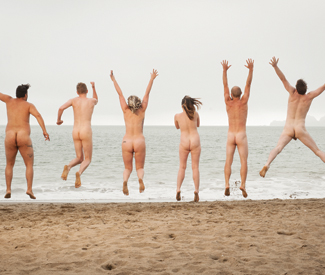
Below you’ll find our annual update on the state of nude beaches in Northern California, along with detailed guides and directions to some of our favorites. For details on dozens more, please see our complete Nude Beach Guide at www.sfbg.com/nudebeaches, which we are in the process of updating.

While researching clothing-optional beaches in Jamaica in November, my girlfriend and I noticed that native Jamaicans don’t think anything of stripping down to their underwear to take a dip in a waterfall on a hot day — our driver did just that near one of the nation’s biggest cities, Ocho Rios — while visiting tourists can go topless or nude with hardly a complaint on Negril’s seven-mile long shoreline of shimmering white sand, at the west end of the country.

It made me wonder, what if the same tolerance existed here, where each beach has its own traditions and its own set of rules? Sometimes, it takes as little as a person moving some sand or staying after sunset to annoy our cops. In Jamaica and many other parts of the world, that would never happen.

For example, law enforcement actions recently hit two Bay Area nude beaches — Marin’s Red Rock and Steep Ravine — while most access to a third site, fan favorite Muir, near Stinson Beach, has been closed by authorities until November.

The good news: visits by rangers to both skinny dipping coves mentioned above have died back, while anti-nudity patrols at Monterey’s Garrapata Beach, which erupted in 2011, have been discontinued. And the Guardian is publishing three “secret” alternate ways that die-hard visitors can use to reach the nude section of gorgeous Muir Beach.

Red Rock was rocked by a ranger who reportedly used a crowbar to remove part of a sunbathing “terrace” that beach regulars had built by moving sand to create more “towel space.” He also cited two male beachgoers for violating Title 14, Section 4307, of the California Code Of Regulations, which bans removal of “earth” or “sand” from state parks.

The men are appealing their penalties, while their friends at the beach are asking for donations to pay for their legal fees. “We’re going to take up a collection,” says Stinson Beach attorney-teacher Fred Jaggi.

The ranger’s boss, Bill Lutton, a state parks superintendent for the Marin area who visited the beach after the busts, told us that “altering” and “changing the features” of the beach is a serious offense. “We consider ourselves the guardians of seven generations of users of California’s park system,” he says, “so we must protect the parks’ cultural and natural resources.”

Meanwhile, instead of being charged with destroying park property, several people at nearby Steep Ravine Beach, which is open from 7am until dusk, were cited last fall for soaking in its dangerous-to-reach nude hot springs after sunset by the same ranger who raided Red Rock. “A guy was handcuffed after mouthing off to the ranger, so he really deserved it,” says former springs frequent visitor Michael Velkoff, of Lucas Valley. “He almost took a girl away too.”

Citing “safety and lack of lighting” concerns, Lutton says the after-dark curfew at rock-strewn Steep Ravine, where numerous users have slipped and sustained cuts, bruises, and other injuries, “will be strictly enforced.”

And at Muir Beach, which is used by nudists as a gateway to a nude beach that begins on its north end, visiting hours have been officially eliminated until November 15, while crews improve its parking, toilets, and watershed.

“Don’t even think about visiting the beach,” urges Golden Gate National Recreation Area public affairs specialist Alexandra Picavet, who points out that users won’t have access to the beach, ocean, parking, restrooms, or garbage cans. “Find a new experience — the Bay Area has plenty — to try this summer and then you’ll really appreciate Muir Beach when it reopens.”

Because the main portion of Muir is blocked by fencing and being patrolled by rangers, anyone trying to reach Little Beach, as the nude area next to Muir is also known, will have to hike anywhere from 30 minutes to several hours to reach the shore and then continue walking to the naked area. Picavet says that if you stop for any length of time in front of the non-nude part of Muir, even to stand and admire the view or take a dip in the water, you’ll be cited.

While cops are tightening the use of beaches in Marin, they’re relaxing their hold in Monterey County. In fact, nudists at Garrapata Beach, close to Carmel, have something to celebrate: “nudie” patrols by rangers have ended, in part because the state ran out of money to fund them and because not a single complaint has been received in 2013.

“We’ve been complaint free,” says Sean James, who became acting state parks superintendent for the area in April and appears to be fairly tolerant of naturists. “I don’t see how just being nude would be threatening.”

Please be careful at our beaches. Two women in their 30s died June 30 after they were swept into the ocean by a wave near another popular nude beach, Bonny Doon. They were with two men when the wave swept the foursome into the water. The two men were rescued by a Coast guard helicopter after being stranded on some rocks and surrounded by a rising tide.

Of course, you don’t have to go to the sea to be nude. Our listings include naked lakes, rivers, waterfalls, reservoirs, and at least one meadow. Or how about hiking while wearing only your birthday suit? Au naturel “Full Moon Hikes” have been happening for several years. But the world’s first-ever “Supermoon Nude Hike” (named after a new or full moon which occurs with the moon within 90 percent of its closest approach to Earth) took place right here in the Bay Area the night before the brightest moon of 2013.

“I’ll never forget the hike,” said Raj, one of the walkers, after making the trek in the East Bay Hills, near Castro Valley, June 22. “I will think of it every time I see a full moon.”

Agrees Dave Smith, of San Leandro, who led it: “It was spectacular — one of the greatest hikes ever. Keep in mind we did it in moonlight, while even having to scramble on all fours down some rocks. I felt like Gollum in The Lord Of The Rings and The Hobbit.”

Want to join in the fun? More “Full Moon Hikes” will take place July 20 and August 18 (see our online listings below for Las Trampas in Contra Costa County).

Another idea to meet and socialize with fellow naturists: drop by Santa Cruz’s Bonny Doon Beach on September 21 or Lake Tahoe’s Secret Harbor Creek Beach on June 7, 2014, when visitors will be getting together to keep them clean by finding and removing trash.

Finally, you can help beachgoers and the naturist community by sending me your new beach discoveries, trip reports, and improved directions (especially road milepost numbers), along with your phone number to garhan@aol.com or Gary Hanauer, c/o San Francisco Bay Guardian, 71 Stevenson, 2nd Floor, San Francisco, CA 94105.

Our ratings: “A” signifies a beach that is large or well-established and where the crowd is mostly nude; “B” indicates places where fewer than half the visitors are nude; “C” means small or emerging nude areas; and “D” depicts spots that are in use, but not recommended.

SAN FRANCISCO

NORTH BAKER BEACH, SAN FRANCISCO

RATING: A

North Baker’s neo-hippie revival is continuing for a third straight season, with more art work springing up on the USA’s largest urban nude beach. Guitar- and drum-playing was added to the scene last year. This summer, a second so-called “art tree” made of driftwood and festooned with seaweed has appeared. “I call it the Sea Hag,” says Santosh, an organizer of alternative activities at the beach who also produces San Francisco’s annual How Weird Street Faire. “Anybody can add things to it. They bring mementos, flowers, anything you can think of. I tend it, but it attracts a life of its own. Several tourists per day usually drop by. One child looked up at the things dangling from it and asked, ‘Is it some kind of voodoo?'” Baker’s own “beach language” is also evolving. Last year, “duney,” which describes the site’s tent-like, shade-providing structures without walls, and “Baker Day” (when the sun’s out and it’s not too windy) came into usage. “Now, we’ve added ‘rock block’ and ‘cosmic volleyball,'” adds Santosh, who describes the former as any stretch of three Baker Days in a row, while cosmic volleyball allows visitors “to keep playing, even if the ball bounces off one of our driftwood poles.”

Directions: Take the 29 Sunset bus or go north on 25th Avenue to Lincoln Boulevard. Turn right and take the second left onto Bowley Street. Follow Bowley to Gibson Road, turn right, and follow Gibson to the east parking lot. At the beach, head right to the nude area, which starts at the brown and yellow “Hazardous surf, undertow, swim at your own risk” sign. Some motorcycles in the lot have been vandalized, possibly by car owners angered by bikers parking in car spaces; to avoid trouble, motorcyclists should park in the motorcycle area near the cyclone fence. Parking at Lincoln’s 100 or more nearby parking spaces was limited to two hours recently. But through June, there had been no reports of cops actually writing tickets for parking too long.

LAND’S END BEACH, SAN FRANCISCO

RATING: A

One of the better locales in the Bay Area to enjoy a little naked sunning without many people present, a visit to the little cove off Geary Boulevard known as Land’s End may make your worries melt away, at least during a quiet afternoon. Cops only occasionally visit it. But don’t be shocked if you see more clothed visitors than nudists — many locals and tourists who wander down to the sand don’t realize it’s a clothing-optional beach. Tip: on hot days, arrive before noon or there may be no unoccupied sand left on the little, semi-rocky shoreline. If possible, try to use one of the rock-lined windbreaks left by previous sunbathers. Pack a warm covering in case the weather changes.

Directions: Follow Geary Boulevard to the end, then park in the dirt lot up the road from the Cliff House. Take the trail at the far end of the lot. About 100 yards past a bench and some trash cans, the path narrows and bends, then rises and falls, eventually becoming the width of a road. Don’t take the road to the right, which leads to a golf course. Just past another bench, as the trail turns right, go left toward a group of dead trees where you will see a stairway and a “Dogs must be leashed” sign. Descend and head left to another stairway, which leads to a 100-foot walk to the cove. Or, instead, take the service road below the El Camino del Mar parking lot 1/4 mile until you reach a bench, then follow the trail there. It’s eroded in a few places. At the end, you’ll have to scramble over some rocks. Turn left (west) and walk until you find a good place to put down your towel.

GOLDEN GATE BRIDGE BEACH, SAN FRANCISCO

RATING: A

Mostly a gay male cruising scene, “Nasty Boy Beach” is also visited by some straight men and women. Though fairly rocky and packed with people on hot days, everyone seems to enjoy the trio of coves you can find by walking along the shore. Oh, and did I mention the view? If you want to feel immersed in a picture postcard of the famous bridge, then this is the place to plop down. On warm days, some users even swim in the usually chilly, undertow-plagued water. “You can sometimes go out over 100 feet during low tide,” says a woman.

Directions: from the toll booth area of Highway 101/1, take Lincoln Boulevard west about a half mile to Langdon Court. Turn right (west) on Langdon and look for space in the parking lots, across Lincoln from Fort Winfield Scott. Park and then take the beach trail, starting just west of the end of Langdon, down its more than 200 steps to Golden Gate Bridge Beach, also known as Marshall’s Beach. Despite recent improvements, the trail to the beach can still be slippery, especially in the spring and winter.

FORT FUNSTON BEACH, SAN FRANCISCO

RATING: C

Known as Fort Fun by its fans, this Golden Gate National Recreation Area sun spot, located south of Ocean Beach, attracts hang gliders, dogs and their walkers, and even from time to time a few naturists, the latter of which sometimes tuck themselves between the dunes on the shore. But not all is fun on its magnetic sands and the cliffs above them. A few months ago, a tussle between two dogs ended when a canine was stabbed by the owner of one of the pets. Besides pugnacious pooch protectors, watch out too for sharp winds, especially in March and October. And to stave off hassles from rangers, disrobers should stay away on weekends or when families or rangers are near. If anyone seems upset or gripes about you being au naturel, be sure to suit up fast since the authorities will bust naturists if they see them or they receive complaints. The good news: usually, only a few citations a year are issued at Fort Funston, so if you are discreet and stay in the dunes, you may be rewarded with a suntan without lines.

Directions: From San Francisco, go west to Ocean Beach, then south on the Great Highway. After Sloat Boulevard, the road heads uphill. From there, curve right onto Skyline Boulevard, go past one stoplight, and look for signs for Funston on the right. Turn into the public lot and find a space near the west side. At the southwest end, take the sandy steps to the beach, turn right, and walk to the dunes. Find a spot as far as possible from the parking lot.

CONTRA COSTA COUNTY

LAS TRAMPAS REGIONAL WILDERNESS, CASTRO VALLEY

RATING: C

Imagine tromping in the East Bay Hills naked at night, guided only by your flashlight and a representative of the Bay Area Naturists group, plus a few fellow travelers. And yes, mooning during America’s only Full Moon Hikes is permitted. “Those who haven’t experienced these incredibly beautiful, if slightly challenging hikes to the ridge at sunset really ought to put this on their calendar this year,” says organizer Dave Smith, of San Leandro, who’ll be leading trips starting at a Castro Valley nudist club on Saturday, July 20, leaving at 7pm (there will be a potluck earlier), and Sunday, August 18, departing around 6:30pm.

“It’s one of the greatest hikes in the Bay Area, rivaling any I know of,” tells Smith. “It’s right up there with the Palomarin Trail (from the Bolinas area, passing Bass Lake and Pelican Lake, to Alamere Falls, on the coast), the Cascades, and others. The walk is not hard, but it is challenging. We take it slow so everyone can make it. So far, no one has ever been hurt.”

“We usually leave an hour and a half before sunset and hike up to the top to catch the sunset and moonrise and then come back down in the moonlight,” he adds.

“Whether you are clothed or not, participating in the Full Moon Hike is a big treat,” says past hiker Jurek Zarzycki, who suggests walkers bring good hiking shoes, a flashlight (“Most of the time you won’t need it, because of the moonlight”), and bug spray. “And don’t forget to have some baby carrots with you to give to the horses that sometimes come out at night, so close that you may even feel their breath. Don’t worry, though, they’re very friendly.”

Organized by the Sequoians Naturist Club and the Bay Area Naturists, based in San Jose, walkers leave the property of The Sequoians fully clothed at dusk and walk through meadows and up hills until the moon rises, before heading back down the slopes completely nude, with their clothes folded neatly into their backpacks.

Directions: Contact the Sequoians (www.sequoians.com) or the Bay Area Naturists (www.bayareanaturists.org) for details on how to join a walk. Meet at the Sequoians. To get there, take Highway 580 east to the Crow Canyon Road exit. Or follow 580 west to the first Castro Valley off-ramp. Take Crow Canyon Road toward San Ramon .75 mile to Cull Canyon Road. Then follow Cull Canyon Road around 6.5 miles to the end of the paved road. Take the dirt road on the right until the “Y” in the road and keep left. Shortly after, you’ll see The Sequoians sign. Proceed ahead for about another .75 mile to The Sequoians front gate.

SAN MATEO COUNTY

DEVIL’S SLIDE, MONTARA

RATING: A

Despite the opening of the Tom Lantos Tunnels on March 25, 2013, nearby Gray Whale Cove, also known as Devil’s Slide, continues to function — and may, state officials think, soon attract even more visitors than in previous years. The reason: crowds soon will be coming not only to the beach, but also to a mile-long stretch of the old Highway 1 that was circumvented by the tunnels and is being turned into a walking and biking trail; it’s expected to open soon. To handle the larger attendance, workers will build new parking lots on either side of the highway, giving Devil’s Slide a parking area on the ocean side for the first time. The current parking lot on the east side of Highway 1 is still open. “We will also be improving the stairway (leading down to the beach),” says San Mateo coast state parks sector superintendent Paul Keel. Best of all, traditional use of the beach for clothing-optional sunbathing has been continuing, with few problems. “We’re not having an increase in (complaint) calls there,” says Keel.

Directions: Driving from San Francisco, take Highway 1 south through Pacifica. Three miles south of the Denny’s restaurant in Linda Mar, at 500 Linda Mar Blvd., Pacifica, and just past and south of the Tom Lantos Tunnels, turn left (inland or east) on an unmarked road, which takes you to the beach’s parking lot on the east side of the highway and to a 146-step staircase that leads to the sand. Another lot will “eventually” be opened on the ocean side (please see above). Coming from the south on Highway 1, look for a road on the right (east), 1.2 miles north of the old Chart House restaurant in Montara. Most naturists use the north end of the beach, which is separated by rocks from the rest of the shore. Wait until low tide to make the crossing to the nude area.

SAN GREGORIO NUDE BEACH, SAN GREGORIO

RATING: A

Now in its 47th year of operation, America’s oldest nude beach even has its own website and live webcam at www.freewebs.com/sangregoriobeach. The privately-run site is located next to San Gregorio State Beach. The beach often draws a large gay crowd, along with some nude and suited straight couples, singles, and families. On your first visit, though, you may be a little shocked by the provocative behavior that is sometimes happening in the driftwood structures on the slope leading down to the beach. Their walls aren’t completely closed. Some users even want passersby to observe them having sex inside the so-called “sex condos,” including Kerry, from San Francisco, who told us about her October 2012 visit with her partner, Lisa: “It was an exciting time. We’ve been to the beach six times. We have had men wander by and try not to stare. Other times, we have had men that more or less sneak up and peek through the wood at us while we are having sex. One time, we had three men who stood 15 feet away and watched intently as we went at it. We have not met anybody that we consider creepy. In fact, there have never been any words exchanged at all.”

Directions: From San Francisco, drive south on Highway 1, past Half Moon Bay, and, between mileposts 18 and 19, look on the right side of the road for telephone call box number SM 001 0195, at the intersection of Highway 1 and Stage Road, and near an iron gate with trees on either side. From there, expect a drive of 1.1 miles to the entrance. At the Junction 84 highway sign, the beach’s driveway is just .1 mile away. Turn into a gravel driveway, passing through the iron gate mentioned above, which says 119429 on the gatepost. Drive past a grassy field to the parking lot, where you’ll be asked to pay an entrance fee. Take the long path from the lot to the sand; everything north of the trail’s end is clothing-optional (families and swimsuit using visitors tend to stay on the south end of the beach). The beach is also accessible from the San Gregorio State Beach parking area to the south; from there, hike about a half-mile north. Take the dirt road past the big white gate with the Toll Road sign to the parking lot.

SANTA CRUZ COUNTY

GARDEN OF EDEN, FELTON

RATING: C

Are you looking for a gorgeous place to have a picnic? If you’re in the Bay Area, you won’t have to travel far to find the Golden State’s version of the Garden of Eden, a creekside skinny-dipping spot located in Henry Cowell Redwoods State Park, between Santa Cruz and Felton. Used even more by suited swimmers and sunbathers, many hikers are surprised when they come across naturists at the stream. Eden gets mixed reviews by visitors: some parts of the trail may be slippery, so watch your step and keep your eyes out for poison oak. To find Eden and two other clothing-optional swim holes on San Lorenzo River, check for vehicles pulled over on Highway 9, alongside the state park, which forbids nudity but only occasionally patrols the creek with rangers.

Directions: From Santa Cruz, drive north on Highway 9 and look for turnouts on the right side of the road, where cars are pulled over. The first, a wide turnout with a tree in the middle, is just north of Santa Cruz. Rincon Fire Trail starts about where the tree is, according to reader Robert Carlsen, of Sacramento. The many forks in the trail all lead to the river, down toward Big Rock Hole and Frisbee Beach; Carlsen says the best area off this turnout can be reached by bearing left until the end of the trail. Farther up the highway, 1.3 miles south of the park entrance, is the second and bigger pullout, called the Ox Trail Turnout, leading to Garden of Eden. Park in the turnout and follow the dirt fire road downhill and across some railroad tracks. Head south, following the tracks, for around .5 miles. Look for a “Pack Your Trash” sign with park rules and hours and then proceed down the Eden Trail.

Ox Trail, which can be slippery, and Eden Trail both wind down steeply to the creek. “The path continues to the left, where there are several spots for wading and sunbathing,” Carlsen says. The main beach is only 75 feet long and 30 feet wide, but fairly sandy. Carlsen’s favorite hole is accessible from a trail that starts at the third turnout, a small one on the right side of the road, about 4.5 miles from Highway 1 and just before Felton. A gate marks the start of the path. The trail bends left. When you come to the road again, go right. At the railroad tracks, go right. From here, look for the river down the hill on your left; many paths lead to it. Says Mike: “Within 10 yards, you can be in the water.”

BONNY DOON NUDE BEACH, BONNY DOON

RATING: A

Were anti-nudity signs really recently posted at Bonny Doon Beach, whose north end has been used for clothing optional sunbathing for decades? Yes, but officials took the warnings, which were placed at two trailheads leading to the sand, down just two months later. “We’re not planning to change anything,” says Chet Bardo, superintendent of state beaches in the Santa Cruz district. “The truth is that we get complaints on all sides of this issue. It’s not uncommon to get calls from people. This is California, after all, so what to local people might seem not that unusual sometimes turns out to shock people who are visiting from Iowa, who find it (nudity) a bit disconcerting.”

“The way I see it, unless there’s a problem (happening at the beach), it’s not a problem to us,” he adds. In fact, the only problem at Bonny Doon this year is that it has less sand than usual. A 15-foot long rock on the sand, along with a sloping cliff with rocks that jut out, separate the two sides of the cove — one clothed for clothed visitors and the other for nudes — known as Bonny Doon.

“In the short term, things at Bonny Doon are destined to continue the way they are,” says Kirk Lingenfelter, sector superintendent for Bonny Doon and nearby state beaches. “Ultimately it would be nice to see some level of improvement, maybe trail work or stair work,” adds Lingenfelter. “But before we’d even do that, there would need to be a General Plan or an Interim Use Plan, which we don’t have. And we also don’t have any funding for it.”

As for nudity, Lingenfelter says his rangers, who periodically patrol the beach, haven’t issued a single warning or citation for nudity since the state approved the acquisition of the beach in 2006. “We’ll respond to complaints we receive,” he explains, “but I can’t recall (receiving) a single complaint.”

Directions: From San Francisco, go south on Highway 1 to the Bonny Doon parking lot at milepost 27.6 on the west side of the road, 2.4 miles north of Red, White, and Blue Beach, and some 11 miles north of Santa Cruz. From Santa Cruz, head north on Highway 1 until you see Bonny Doon Road, which veers off sharply to the right just south of Davenport. The beach is just off the intersection. Park in the paved lot to the west of Highway 1; don’t park on Bonny Doon Road or the shoulder of Highway 1. If the lot is full, drive north on Highway 1, park at the next beach lot, and walk back to the first lot. Or take Santa Cruz Metro Transit District bus route 40 to the lot; it leaves the Metro Center three times a day on Saturdays and takes about 20 minutes. To get to the beach, climb the berm next to the railroad tracks adjacent to the Bonny Doon lot, cross the tracks, descend, and take a recently improved, sign-marked trail to the sand. Walk north past most of the beach to the nude cove on the north end. Alternately, Dusty suggests parking as far north as possible, taking the northern entrance, and, with good shoes, following a “rocky and steep” walk down to the sand.

2222 BEACH, SANTA CRUZ

RATING: A

Aptly named 2222, a mini-nude beach that takes its title from the house across the street, is still beautiful, still hidden from most passersby, and still attracts a small crowd of regular visitors who are in good enough shape to handle its sketchy, foreboding-looking path.

One of America’s smallest nude beaches, 2222 is so tiny it could probably fit in your yard. And that’s what makes it such a special place. You won’t see many people on the sand, which takes scrambling to reach and isn’t recommended for children or anyone who isn’t a good hiker. However, those who are able to make it down a sharp-angled cliff and past several concrete blocks on the way down may like the quiet and solitude that the beach offers. The most dependable trail begins on the southeast corner of the hillside overlooking the site. Even though there’s a walking path just above it, the beach can’t be seen from there. College students like to hangout here and, if they’re lucky, get a glimpse of a local juggler who sometimes practices his routines on the sand. Tip: for great accommodations, check out the West Cliff Inn, 174 West Cliff Drive, Santa Cruz, a bed and breakfast inn located a few blocks to the south; it’s somewhat pricey, but truly enjoyable.

Directions: The beach is a few blocks west of Natural Bridges State Beach and about 2.5 miles north of the Santa Cruz Boardwalk. From either north or south of Santa Cruz, take Highway 1 to Swift Street. Drive .8 miles to the sea, then turn right on West Cliff Drive. 2222 is five blocks away. Past Auburn Avenue, look for 2222 West Cliff on the inland side of the street. Park in the pullout with eight parking spaces next to the cliff, on the west side of the road. If it’s full, continue straight and park along Chico Avenue. An overlook with two benches facing an interesting obelisk-style sculpture — where my girlfriend and I sat last year — is located between the parking area and the edge of the cliff. Bay Area Naturists leader Rich Pasco suggests visitors use care and then follow the path on the side of the beach closest to downtown Santa Cruz and the Municipal Wharf.

PRIVATES BEACH, SANTA CRUZ

RATING: A

Want to visit a beach with great sand and surf, plus a mix of suited and naked users? This year, the charge remains $100 — or $50 if you live nearby — for all the visits you want to make to Privates, which is one of the county’s best beaches, until May 31. If you go daily for a year, that’s about 27 cents a day. But there are also several ways people have used to circumvent the fee, which we explain below. Visitors include nudists, surfers, families, and local residents. “Everyone gets along,” says Brittney Barrios, manager/buyer of Freeline Design Surf Shop, which sells up to 600 beach passes to Privates a year. “It’s always very peaceful.”

“There’s a great swell happening here,” says a surfer we interviewed this summer. Security guards plus a locked gate keep most troublemakers out. With almost no litter or loud noise, and less wind than most local beaches, the site almost always provides a pleasant atmosphere for users. Do you want to bring your dog? It’s OK too.

To catch a game of Nude Frisbee or to start one, when you reach the bottom of the beach stairs, walk to the left until you see some people who aren’t wearing part or all of their swimsuits.

Directions: 1) Some visitors walk north from Capitola Pier in low tide (not a good idea since at least four people have needed to be rescued). 2) Others reach it in low tide via the stairs at the end of 41st Avenue, which lead to a surf spot called the Hook at the south end of a rocky shore known as Pleasure Point. 3) Surfers paddle on boards for a few minutes to Privates from Capitola or the Hook. 4) Most visitors buy a key to the beach gate for $100 a year at Freeline (821 41st Ave., Santa Cruz, 831-476-2950) 1.5 blocks west of the beach. Others go with someone with a key or wait outside the gate until a person with a key goes in, provided a security guard is not present (they often are there). “Most people will gladly hold the gate open for someone behind them whose hands are full,” says Bay Area Naturists leader Rich Pasco. The nude area starts to the left of the bottom of the stairs.

MARIN COUNTY

BASS LAKE, BOLINAS

RATING: B

“The lake was great,” says regular user Dave Smith, of San Leandro, about his visit to Bass Lake, near Bolinas, this year. “It was during spring break, so there were a lot of people on the trail that day. But we weren’t the only ones who were naked in the water. Several people were skinny dipping besides us.” Others, who don’t necessarily go nude, love Bass too, which, by the way, does not have any bass. San Rafael resident Marie described her November visit as “awe-inspiring” on a message board. She said the walk to get there “was worth every minute … the water while cool was exhilarating. I can’t wait to go back.” And Cindi, of San Anselmo, found the setting to be “rejuvenating, awesome, stunning, orgasmic … I would do it again and again.” Bass doesn’t attract as many nudists as it did 10 years ago. “When I first went, everybody was nude,” says Smith. “Today, though, you have to feel pretty comfortable with your own nudity to swim that way at the lake.”

Directions: Allow about an hour for the drive from San Francisco’s Golden Gate Bridge. From Stinson Beach, go north on Highway 1. Just north of Bolinas Lagoon, turn left on the often-unmarked exit to Bolinas. Follow the road as it curves along the lagoon and eventually ends at Olema-Bolinas Road. Continue along Olema-Bolinas Road to the stop sign at Mesa Road. Turn right on Mesa and drive four miles until it becomes a gravel road and ends at the Palomarin parking lot. On hot days the lot fills quickly, so come early. Says Smith: “We once saw hundreds of cars.” A sign at the trailhead next to the lot will guide you down scenic Palomarin Trail to the lake. For directions to incredibly beautiful Alamere Falls, 1.5 miles past Bass Lake, which empties onto a beach at the sea, please see “Elsewhere In Marin” in our online listings.

RED ROCK BEACH, STINSTON BEACH

RATING: A

The beach is in good shape this year. Warmer than usual weather in spring brought more people — 80 on one day — onto the sand earlier than usual, but, due to higher gas prices and a rough economy, crowd sizes remain down from a decade ago. “We’ve had fewer gawkers too,” says veteran visitor Fred Jaggi. “The beach is the mellowest it’s ever been.” If gawking remains down, then it would bring welcome relief. A 2012 visitor estimated the site had “25 percent nasty creeper grossness.” In another improvement, the trail is getting rave reviews. Foliage along the path has been pruned back since last year. “It’s clean of poison oak,” says Jaggi. “It’s a really easy walk now,” adds another visitor, Michael Velkoff. “You can’t beat it. I wear my sandals down there (instead of hiking shoes) while carrying a chair and backpack. If I can walk back up the trail at the end of the day, anyone can do it.” Rock climbing continues to be popular. Ultimate Frisbee, Double Disc Court (you throw two Frisbees at once), Befuddle (players toss the first disc softer and the second one harder), Nude Hearts, and Naked Scrabble are some of the other favorite pursuits on the sand. Tips: visit when the tide is low or early in the day; come before noon for the best parking. For the most sand space, drop by on a Monday, known as “Club Day” to the repeat visitors who like to gather then. And, if possible, bring a folding beach chair.

Directions: Go north on Highway 1 from Mill Valley, following the signs to Stinson Beach. At the long line of mailboxes next to the Muir Beach cutoff point, start checking your odometer. Look for a dirt lot full of cars to the left (west) of the highway 5.6 miles north of Muir and a smaller one on east side of the road. The lots are at milepost 11.3, one mile south of Stinson Beach. Limited parking is also available 150 yards to the south on the west side of Highway 1. Or from Mill Valley, take the West Marin/Bolinas Stage toward Stinson Beach and Bolinas. Get off at the intersection of Panoramic Highway and Highway 1. Then walk south .6 mile to the Red Rock lots. Follow the long, steep path to the beach that starts near the Dumpster next to the main parking lot.

MUIR NUDE BEACH, MUIR BEACH

RATING: A

Although the public part of Muir Beach has been closed since July 8, the small, quarter-moon shaped, clothing-optional beach just to the north of it is still technically open. This summer, the site was attracting 30-40 people a day, although it may get 100 on hot days. It’s one of the only Bay Area nude beaches that receives nearly as many female visitors as males. A variety of people share the cove, which has a more serene and less social atmosphere than nearby Red Rock. Finding it is usually easy: you park at the main Muir lot, walk north on the sand, cross over some rocks, and you’re there. Now, though, during improvement work lasting until November, visitors can’t park near Muir or enter it by foot. To reach the naked beach, you’ll need to hike up to several hours and not be able to use restrooms or garbage cans, which are ringed with fences. Once there, you must continue to the nude beach without stopping on the main beach, even to admire the view or swim in the water, or you will be cited.

Directions until 11/10: 1) Take the Coastal Trail to Muir Beach from the Tennessee Valley trailhead, then walk north until you come to a line of rocks marking the start of the nude area. Walk over the rocks. The roundtrip loop is just under 8 miles. See our web listings for details. 2) A hike of up to 30 minutes on the Coastal Trail begins at the Green Gulch Farm Zen Center, at 1601 Shoreline Highway, off Highway 1 just south of Muir Beach. But the Center’s parking lot is tiny, costs single-occupant drivers $5 to use on Sundays (when participation in the Center’s program is requested) and isn’t open to the public on weekdays or Saturdays, so staff are strongly discouraging its use for Muir access during the beach’s closure. Our online report has more info. 3) If you live on Cove Lane, near Pacific Way, you can still access the beach from Cove. Nonresidents can’t park on Cove Lane, Pacific Way, or other nearby streets during the closure period. Starting 11/10: From San Francisco, take Highway 1 north to Muir Beach, to milepost 5.7. Turn left on Pacific Way and park in the Muir lot (to avoid tickets, don’t park on Pacific). Or park on the street off Highway 1 across from Pacific and about 100 yards north. From the Muir lot, follow a path and boardwalk to the sand. Then walk north to a pile of rocks between the cliffs and the sea. You’ll need good hiking or walking shoes to cross; in very low tide, try to cross closer to the water. The nude area starts north of it.

RCA BEACH, BOLINAS

RATING: A

In a 1998 movie, visiting Jamaica was How Stella Got Her Groove Back. But if you’d like to revitalize your life, all you may need to do is spend an afternoon at awe-inspiring RCA Beach. Even though the site is isolated, don’t try to have sex on the sand; rangers ticketed at least one person for engaging in public sex here last fall. A single stopover at this relaxing oasis of tranquility will probably inspire you to keep coming back. “It hasn’t changed in decades,” says regular visitor Michael Velkoff. One problem: the cove is exposed to the wind. The good news is that there are lots of nooks that are sheltered from the wind. Some nooks, though, provide good shelter from the periodic breezes. Plus there’s so much driftwood on the sand that many people build windbreaks or even whole forts. Suited and unsuited men and women and families visit the shoreline. The beach seems far bigger than its one mile length because everyone is usually spread out on the sand. Adds Velkoff: “We’ll see six people on a Sunday. Everybody’s 30 yards apart. It’s amazing.”

Directions: From Stinson Beach, take Highway 1 (Shoreline Highway) north toward Calle Del Mar for 4.5 miles. Turn left onto Olema Bolinas Road and follow it 1.8 miles to Mesa Road in Bolinas. Turn right and stay on Mesa until you see cars parked past some old transmission towers. Park and walk .25 miles to the end of the pavement. Go left through the gap in the fence. The trail leads to a gravel road. Follow it until you see a path on your right, leading through a gate. Take it along the cliff top until it veers down to the beach. Or continue along Mesa until you come to a grove of eucalyptus trees. Enter through the gate here, then hike .5 miles through a cow pasture on a path that will also bring you through thick brush. The second route is slippery and eroding, but less steep. “It’s shorter, but toward the end there’s a rope for you to hold onto going down the cliff,” tells Velkoff.


LIMANTOUR BEACH, OLEMA

RATING: B

Would you like to walk a mile wearing nothing but your smile? At lovely Limantour, in Point Reyes National Seashore, you can do just that. Bring a pair of binoculars for watching birds, seals, and other wildlife. “I’ve been going there this year since the spring,” says Lucas Valley’s Michael Velkoff. “There are always whales and dolphins off shore, but recently we’ve been seeing porpoises too. It’s so beautiful at Limantour. I just head away from any people and put my towel down in the dunes or against a wall. A friend went a few days ago. Even though it was windy, she was very comfortable in the dunes. The best thing is that nobody bothers you. Of course, I carry a pair of shorts, just in case I need to put them on. I love it at Limantour. Plus it has tons of nice sand.” The long shoreline is one of America’s most beautiful beaches, yet few visitors realize the narrow spit of sand, between Drakes Bay and an estuary, is clothing-optional. The site is so big — about 2.5 miles in length — you can wander for hours, checking out ducks and other waterfowl, shorebirds such as snowy plovers (if you are lucky enough to see these endangered birds on the north end of the beach), gray whales (including mothers and their calves during spring), and playful harbor seals (offshore and at the north edge of the sand). Dogs are allowed on six-foot leashes on the south end of the beach.

Directions: From San Francisco, take Highway 101 north to the Sir Francis Drake Boulevard exit, then follow Sir Francis through San Anselmo and Lagunitas to Olema. At the intersection with Highway 1, turn right onto 1. Just north of Olema, go left on Bear Valley Road. A mile after the turnoff for the Bear Valley Visitor Center, turn left (at the Limantour Beach sign) on Limantour Road and follow it 11 miles to the parking lot at the end. Walk north a half-mile until you see some dunes about 50 yards east of the shore. Nudists usually prefer the valleys between the dunes for sunbathing. “One Sunday we had 200 yards to ourselves,” Velkoff says. But lately, the dunes have been more crowded.


Theater Listings: July 17 – 23, 2013

0


Stage listings are compiled by Guardian staff. Performance times may change; call venues to confirm. Reviewers are Robert Avila, Rita Felciano, and Nicole Gluckstern. Submit items for the listings at listings@sfbg.com.

THEATER

OPENING

Sweet Bird of Youth Tides Theatre, 533 Sutter, Second Flr, SF; www.tidestheatre.org. $20-40. Previews Thu/18, 8pm. Opens Fri/19, 8pm. Runs Wed-Sat, 8pm. Through Aug 24. Tides Theatre performs Tennessee Williams’ Gulf Coast-set drama about an improbable couple.

BAY AREA

A Comedy of Errors Forest Meadows Amphitheater, 890 Bella, Dominican University of California, San Rafael; www.marinshakespeare.org. $20-37.50. Previews Fri/19 and Sun/21, 8pm. Opens July 27, 8pm. Presented in repertory Fri-Sun through Sept 29; visit website for performance schedule. Marin Shakespeare Company presents a cowboy-themed spin on the Bard’s classic.

ONGOING

Betrayal Phoenix Theatre, 414 Mason, Sixth Flr, SF; www.offbroadwaywest.org. $40. Thu/18-Sat/20, 8pm. Off Broadway West Theatre Company performs Harold Pinter’s out-of-sequence drama about an unfaithful married couple.

Can You Dig It? Back Down East 14th — the 60s and Beyond Marsh San Francisco, 1062 Valencia, SF; www.themarsh.org. $15-50. Sat, 8:30pm; Sun, 7pm. Through Aug 25. Solo performer Don Reed returns with a prequel to his autobiographical coming-of-age hits, East 14th and The Kipling Hotel.

Chance: A Musical Play About Love, Risk, and Getting it Right Alcove Theater, 415 Mason, Fifth Flr, SF; www.thealcovetheater.com. $40-60. Thu-Sat, 8pm (also Sat, 3pm); Sun, 5pm. Through July 28. New Musical Theater of San Francisco presents Richard Isen’s world premiere work inspired by the writings of Oscar Wilde.

Endgame Royce Gallery, 2901 Mariposa, SF; www.itetheater.org. $18-24. Thu/18-Sat/20, 8pm. International Theater Ensemble performs Samuel Beckett’s Theatre of the Absurd classic.

Foodies! The Musical Shelton Theater, 533 Sutter, SF; www.foodiesthemusical.com. $30-34. Fri-Sat, 8pm. Open-ended. AWAT Productions presents Morris Bobrow’s musical comedy revue all about food.

God of Carnage Shelton Theater, 533 Sutter, SF; www.sheltontheater.com. $26-38. Thu-Sat, 8pm. Through Sept 7. Shelton Theater performs Yasmina Reza’s award-winning play about class and parenting.

Hedwig and the Angry Inch Boxcar Theatre, 505 Natoma, SF; www.boxcartheatre.org. $27-43. Thu-Sat, 8pm. Open-ended. John Cameron Mitchell’s cult musical comes to life with director Nick A. Olivero’s ever-rotating cast.

How to Make Your Bitterness Work for You Stage Werx Theatre, 446 Valencia, SF; www.stagewerx.org. $15-25. Mon-Tue, 8pm. Through Aug 27. Kent Underwood is a motivational speaker and self-help expert with some obvious baggage of his own in this solo play from former comedy writer and stand-up comedian Fred Raker (It Could Have Been a Wonderful Life). The premise, similar to that of Kurt Bodden’s Steve Seabrook: Better Than You (ongoing at the Marsh), has the audience overlapping with participants in an Underwood seminar. Underwood, however, two years on the seminar circuit and still unable to get his book published, deviates from the script to answer texts related to a possible career breakthrough. Meanwhile, with the aid of some bullet points and illustrative slides, he explains the premise of said manuscript, “How to Make Your Bitterness Work For You,” as the sad truth of his own underdog status emerges between the laugh lines. But where Bodden is careful to make his Seabrook a somewhat believable character despite the absurdity of it all (or rather, while firmly embracing the absurdity of the self-help industry itself), Raker and director Kimberly Richards put much more space between the playwright/performer and his character, which turns out to be a less effective strategy. Verisimilitude might not have mattered much if the comic material were stronger. Unfortunately, despite the occasional zinger, much of the humor is weak or corny and the narrative (interrupted at regular intervals by an artificial tone representing the arrival of a fresh text message) too contrived to sell us on the larger story. (Avila)

Keith Moon: The Real Me Eureka Theatre, 215 Jackson, SF; www.brownpapertickets.com. $40. Thu-Sat, 8pm; Sun, 7pm. Through July 28. Mick Berry performs the world premiere of his solo play about the Who drummer.

A Pinoy Midsummer Bindlestiff Studio, 185 Sixth St, SF; www.bindlestiffstudio.org. $10-25. Thu/18-Sat/20, 8pm. It’s the perfect time of year for Shakespeare’s A Midsummer Night’s Dream, but unless you caught Bindlestiff Studio’s irreverent adaptation A Pinoy Midsummer last September, you’ve probably never seen a version quite like it. Conceptualized and directed by Lorna Velasco, A Pinoy Midsummer combines elements of Philippine culture—traditional music, dress, and language—with a rowdy modernist approach to the tale of tradition-bound lovers and the bawdy fairies who would make sport of them and each other. A live score directed by Ogie Gonzales, choreographed interludes by Gemma Calderon, and otherworldly shadow puppetry designed by Melissa Diaz Infante and Marcius Noceda help to flesh out the bare bones production and enhance the action, in particular the intrigues of the mischievous fairy folk. Of the Athenians, it’s star-crossed Hermia (Aureen Almario) and Helena (Julie Kuwabara) who stand out most particularly, and their cat fight over the  fickle love of the fairy-enchanted Lysander (Tonilyn A. Sideco) is wickedly funny. But the true highlight of the scrappy production is the band of the rudest mechanicals to ever grace a stage, from the scene-stealing Bottom (Joe Cascasan) to the angry butch Flute (Roczane Enriquez), the fact that they deliver their lines almost entirely in Tagalog not detracting one bit from their brilliant buffoonery, whether you speak the language or not. (Gluckstern)

Sex and the City: LIVE! Rebel, 1760 Market, SF; trannyshack.com/sexandthecity. $25. Wed, 7 and 9pm. Open-ended. It seems a no-brainer. Not just the HBO series itself — that’s definitely missing some gray matter — but putting it onstage as a drag show. Mais naturellement! Why was Sex and the City not conceived of as a drag show in the first place? Making the sordid not exactly palatable but somehow, I don’t know, friendlier (and the canned a little cannier), Velvet Rage Productions mounts two verbatim episodes from the widely adored cable show, with Trannyshack’s Heklina in a smashing portrayal of SJP’s Carrie; D’Arcy Drollinger stealing much of the show as ever-randy Samantha (already more or less a gay man trapped in a woman’s body); Lady Bear as an endearingly out-to-lunch Miranda; and ever assured, quick-witted Trixxie Carr as pent-up Charlotte. There’s also a solid and enjoyable supporting cast courtesy of Cookie Dough, Jordan Wheeler, and Leigh Crow (as Mr. Big). That’s some heavyweight talent trodding the straining boards of bar Rebel’s tiny stage. The show’s still two-dimensional, even in 3D, but noticeably bigger than your 50″ plasma flat panel. Update: new episodes began May 15. (Avila)

So You Can Hear Me Marsh San Francisco, 1062 Valencia, SF; www.themarsh.org. $15-50. Thu/18-Fri/19, 8pm; Sat/20, 5pm. A 23-year-old with no experience, just high spirits and big ideals, gets a job in the South Bronx teaching special ed classes and quickly finds herself in over her head. Safiya Martinez, herself a bright young woman from the projects, delivers this inspired accounting of her time not long ago in perhaps the most neglected sector of the public school system — a 60-minute solo play that makes up for its relatively slim plot with a set of deft, powerful, lovingly crafted characterizations. These complex portraits, alternately hysterical and startling, offer their own moving ruminations on a violent but also vibrant stratum of American society, deeply fractured by pervasive poverty and injustice and yet full of restive young personalities too easily dismissed, ignored, or crudely caricatured elsewhere. An effervescent, big-hearted, and very talented performer, Martinez’s own bounding personality and contagious passion for her former students (as complicated as that relationship was), makes this deeply felt tribute all the more memorable. (Avila)

Steve Seabrook: Better Than You Marsh San Francisco, 1062 Valencia, SF; www.themarsh.org. $15-50. Sat, 8:30pm. Extended through August 24. Self-awareness, self-actualization, self-aggrandizement — for these things we turn to the professionals: the self-empowerment coaches, the self-help authors and motivational speakers. What’s the good of having a “self” unless someone shows you how to use it? Writer-performer Kurt Bodden’s Steve Seabrook wants to sell you on a better you, but his “Better Than You” weekend seminar (and tie-in book series, assorted CDs, and other paraphernalia) belies a certain divided loyalty in its own self-flattering title. The bitter fruit of the personal growth industry may sound overly ripe for the picking, but Bodden’s deftly executed “seminar” and its behind-the-scenes reveals, directed by Mark Kenward, explore the terrain with panache, cool wit, and shrewd characterization. As both writer and performer, Bodden keeps his Steve Seabrook just this side of overly sensational or maudlin, a believable figure, finally, whose all-too-ordinary life ends up something of a modest model of its own. (Avila)

Tinsel Tarts in a Hot Coma: The Next Cockettes Musical Hypnodrome, 575 10th St, SF; www.thrillpeddlers.com. $30-35. Thu-Sat, 8pm. Extended through July 27. Thrillpeddlers and director Russell Blackwood continue their Theatre of the Ridiculous series with this 1971 musical from San Francisco’s famed glitter-bearded acid queens, the Cockettes, revamped with a slew of new musical material by original member Scrumbly Koldewyn, and a freshly re-minted book co-written by Koldewyn and “Sweet Pam” Tent — both of whom join the large rotating cast of Thrillpeddler favorites alongside a third original Cockette, Rumi Missabu (playing diner waitress Brenda Breakfast like a deliciously unhinged scramble of Lucille Ball and Bette Davis). This is Thrillpeddlers’ third Cockettes revival, a winning streak that started with Pearls Over Shanghai. While not quite as frisky or imaginative as the production of Pearls, it easily charms with its fine songs, nifty routines, exquisite costumes, steady flashes of wit, less consistent flashes of flesh, and de rigueur irreverence. The plot may not be very easy to follow, but then, except perhaps for the bubbly accounting of the notorious New York flop of the same show 42 years ago by Tent (as poisoned-pen gossip columnist Vedda Viper), it hardly matters. (Avila)

The World’s Funniest Bubble Show Marsh San Francisco, 1062 Valencia, SF; www.themarsh.org. $8-50. Sun/21, 11am. Louis “The Amazing Bubble Man” Pearl returns after a month-long hiatus with his popular, kid-friendly bubble show.

Wunderworld Creativity Theater, 221 Fourth St, SF; www.wunderworld.net. $10-15. Sat-Sun, 2pm (also Sat, 11am; Sun, 5pm). Through Aug 11. In an irresistible boost to the the Children’s Creativity Museum’s new Creativity Theater (formerly Zeum), beloved Bay Area comedian, playwright, and performer Sara Moore (Show Ho) teams up with gifted co-writer and performer Michael Phillis (The Bride of Death) and director Andrew Nance for a largely wordless, but gabble-packed, family-friendly comedy that asks what Alice might find down the rabbit hole were she to tumble down it again as an octogenarian? The 60-minute play showcases the elastic features and sharp comedic instincts of both Moore (as a hilarious and heartfelt Alice, whom no one recognizes these days unless she stretches her face smooth again) and Phillis (who kicks things off with a mimed pre-curtain speech deserving of its own encore, before coming back as the now droopy-eared White Rabbit). Equally endearing are performances by Dawn Meredith Smith (as Caterpillar, Red Queen, and a rest home nurse), choreographer Rory Davis (as the Cheshire Cat), and the inimitable Joan Mankin as Alice’s bored nursing-home roommate and the Mad Hatter. (Avila)

BAY AREA

The Loudest Man on Earth Lucie Stern Theatre, 1305 Middlefield, Palo Alto; www.theatreworks.org. $19-73. Tue-Wed, 7:30pm; Thu-Sat, 8pm (also Sat, 2pm); Sun, 2 and 7pm. Through Aug 4. TheatreWorks presents the world premiere of Catherine Rush’s unconventional romantic comedy starring acclaimed actor Adrian Blue, who is deaf.

Oil and Water This week: Arena Theater, 214 Main, Point Arena; www.sfmt.org. $10-15. Wed, 8pm. Also Thu, 7pm, free, Todd Grove Park, Live Oak at Clubhouse, Ukiah; Sat, 8pm, $20, Mateel Community Center, 59 Rusk, Redway. It’s a rough year for mimes, or at any rate for the San Francisco Mime Troupe who, after presenting 53 seasons of free theater in the parks of San Francisco (and elsewhere), faced a financial crisis in April that threatened to shut down this season before it even started. The resultant show, funded by an influx of last-minute donations, is one cut considerably closer to the bone than in previous years. With a cast of just four actors and two musicians, plus a stage considerably less ornate then usual, even the play has shrunk in scale, from one two-hour musical to two loosely-connected one-acts riffing on general environmentalist themes. In Deal With the Devil, a surprisingly sympathetic (not to mention downright hawt) Devil (Velina Brown) shows up to help an uncertain president (Rotimi Agbabiaka) regain his conscience and win back his soul, while in Crude Intentions adorable, progressive, same-sex couple Gracie (Velina Brown) and Tomasa (Lisa Hori-Garcia) wind up catering a “benefit” shindig for the Keystone XL Pipeline giving them the opportunity to perpetrate a little guerilla direct action on a bombastic David Koch (Hugo E Carbajal) with a “mole de petróleo” and a smartphone. Throughout, the performers remain upbeat if somewhat over-extended as they sing, dance, and slapstick their way to the sobering conclusion that the time to turn things around in the battles over global environmental protection is now — or never. (Gluckstern)

Sea of Reeds Ashby Stage, 1901 Ashby, Berk; www.shotgunplayers.org. $20-35. Wed-Thu, 7pm; Fri-Sat, 8pm; Sun, 5pm. Through Aug 18. The stage comes unusually populated in this latest from well-known Bay Area monologist and red-diaper baby Josh Kornbluth: a four-piece musical ensemble (El Beh, Jonathan Kepke, Olive Mitra, and Eli Wirtschafter) sits stage right, a standing table with some reed-making equipment appears stage left. Front and center is Kornbluth and his oboe, before him a music stand and behind him three “reeds”—freestanding concave walls of a bamboo-hue (designed by Nina Ball). But there’s more: Kornbluth’s physical trainer (Amy Resnick, replaced by Beth Wilmurt beginning August 7), bounding up from her seat in the first row to lend Kornbluth support or, more productively, prod him in the right direction as he takes the long road home to setting up a promised recital of Bach’s Cantata No. 82. That set up hinges on his recent bar mitzvah, at 52, in Israel, and its unexpected connections between his life-long oboe playing, his Communist upbringing in New York, his mixed marriage, his conversations with a local rabbi, and the Book of Exodus (specifically, Moses’s trail-blazing for the Israelites across the Red Sea, a.k.a., the Sea of Reeds). Although the introduction of supporting characters, musicians, and a musical score (by Marco D’Ambrosio) breaks new ground for the longtime soloist, Sea of Reeds is classic — indeed classical (thanks to a final few tenuous bars from the promised Bach cantata) — Kornbluth. Directed by longtime creative partner David Dower, the show features the boyish comedic persona, the intricate storytelling, and the biographical referents that have given him a loyal following over the years. Diehard fans aside, the show’s cheesy, somewhat self-regarding conceit of staging “spontaneous” interactions between Kornbluth and his trainer may not work with everyone. Perhaps more challenging, though, is the persistence of a less than fully examined disjunction between the political values of his parents and his own political and ethical evolution — a disjunction highlighted here in the narrative’s fraught Middle Eastern setting and its vague navigation between the violence of religious zealotry and a plea for tolerance. (Avila)

The Spanish Tragedy Forest Meadows Amphitheater, 890 Bella, Dominican University of California, San Rafael; www.marinshakespeare.org. $20-37.50. Presented in repertory Fri-Sun through Aug 11; visit website for performance schedule. Marin Shakespeare Company performs Thomas Kyd’s Elizabethan revenge tragedy.

This Is How It Goes Aurora Theatre, 2081 Addison, Berk; www.auroratheatre.org. $32-60. Tue and Sun, 7pm (also Sun, 2pm); Wed-Sat, 8pm. Extended through July 28. An awkward love triangle between former high school classmates gets the caustic Neil LaBute treatment in Aurora Theatre Company’s production of This is How it Goes. Not content to merely skewer the familiar battles between the sexes, LaBute further prods his captive audience with the big stick of race relations, and the often unacknowledged prejudices that lurk in the hearts of men. And women. There are no innocents in this play, though each character certainly has moments where they play upon audience sympathies, only to betray them a few inflammatory lines later. As the marriage between the successful yet self-conscious African American alpha male Cody (Aldo Billingslea) and his neurotically placating Caucasian wife Belinda (Carrie Paff) erodes, the mostly affable (and former fat kid) “Man” (Gabriel Marin) insinuates himself in the middle of their troubled relationship, obviously still carrying the torch for Belinda he did 15 years ago — as well as the same wary animosity an unpopular kid carries for the star of the track team, in this case, Cody. All three actors do a very good job of shape-shifting between their middle-class Jekyll and Hyde selves, assisted in part by Marin’s amiable asides, which don’t so much lull the audience as tease them with the idea that things are about to get better, when they can only get worse. (Gluckstern)

The Wiz Julia Morgan Theater, 2640 College, Berk; www.berkeleyplayhouse.org. $17-60. Wed-Thu and Sat, 7pm (also Sat, 2pm); Sun, noon and 5pm. Through Aug 25. Berkeley Playhouse travels to Oz with the Tony-winning musical.

PERFORMANCE/DANCE

BATS Improv Bayfront Theater, B350 Fort Mason, SF; www.improv.org. $20. BATS Improv performs spontaneous shows based on current events (Fri, 8pm, through July 26) and “Improvised Shakespeare” (Sat, 8pm, through July 27).

“Bay Area Playwrights Festival” Thick House Theater, 1695 18th St, SF; www.playwrightsfoundation.org. Fri/19-Sun/21 and July 26-28. $15. Three Bay Area playwrights and three New Yorkers contribute brand-new works to this 36th annual fest. The six plays were chosen from 425 submissions.

“Bitch and Tell: A Real Funny Variety Show” Garage, 715 Bryant, SF; www.ftloose.org. Fri/19-Sat/20, 8pm. $10-20. Tracy Shapiro performs both nights, with guests David Gborie, Mary-Alice McNab, and others.

“Bubbles on Fire Burlesque presents: Mad Women!” Mojo Theatre, 2940 16th St, #217, SF; www.bubblesonfire.com. Fri/19, 8:15pm. $10-20. With MC Patina DeCopper, Alexa Von Kickinface, Candi Fornia, Dolly Dior, and others.

Caroline Lugo and Carolé Acuña’s Ballet Flamenco Peña Pachamama, 1630 Powell, SF; www.carolinalugo.com. Sun/21, July 27, Aug 4, 17, and 25, 6:15pm. $15-19. Flamenco performance by the mother-daughter dance company, featuring live musicians.

“The Dirt on Dorian Gray” CounterPULSE, 1310 Mission, SF; www.counterpulse.org. Fri/19-Sun/21, 8pm. $15-20. Samantha Giron Dance Project presents an examination of “Peter Pan syndrome” via contemporary dance and other elements.

“Dohee Lee: ARA Gut (Ritual of Ocean)” Yerba Buena Center for the Arts, 701 Mission, SF; www.ybca.org. Sat/20, 4-6pm. Free. The artist presents a site-specific performance installation reflecting on the relationship between humans and nature.

“Factory Parts” NOH Space, 2840 Mariposa, SF; www.foolsfury.org. Wed/17-Sun/21 and July 25-28, 8pm. $15. FoolsFURY presents new works-in-progress by 10 cutting-edge theater ensembles, including San Francisco’s Affinity Group and Oakland’s Ragged Wing.

50 Shades! The Musical Marines’ Memorial Theatre, 609 Sutter, SF; www.50shadesmusical.com. July 23-25, 8pm; July 26-27, 6:30 and 9:30pm; July 28, 3pm. $20-65. Musical parody of Fifty Shades of Grey.

“Four Plays” Lam Research Theater, Yerba Buena Center for the Arts, 700 Howard, SF; www.postballet.org. Thu/18-Fri/19, 8pm. $30-50. Post:Ballet presents its fourth annual home season, featuring a world premiere collaboration between choreographer Robert Dekkers, architect Robert Gilson, and other artists.

“Harboring” Fort Mason Center Festival Pavilion, Marina at Buchanan, SF; www.bandaloop.org. Thu/18, 8:30pm; Fri/19-Sun/21, 8:30pm (also Sat/20, 2pm). $25-100. Vertical dance company Bandaloop performs a site-specific, multi-dimensional work inspired by Fort Mason’s maritime past and present.

“Merola Opera’s Schwaber Summer Concert” Everett Auditorium, 450 Church, SF; www.merola.org. Thu/18, 7:30pm. $25-40. Also Sat/20, 2-4pm, free, Yerba Buena Gardens, Mission between 3rd and 4th Sts, SF; www.ybgfestival.com. The company performs scenes from Don Giovanni and other operas.

“Mission Position Live” Cinecave, 1034 Valencia, SF; www.missionpositionlive.com. Thu, 8pm. Ongoing. $10. Stand-up comedy with rotating performers.

“Randy Roberts: Live!” Alcove Theater, 414 Mason, Ste 502, SF; www.thealcovetheater.com. Tue/23, 9pm. $30. The famed female impersonator takes on Cher, Better Midler, and other stars.

Red Hots Burlesque El Rio, 3158 Mission, SF; www.redhotsburlesque.com. Wed, 7:30-9pm. Ongoing. $5-10. Come for the burlesque show, stay for OMG! Karaoke starting at 8pm (no cover for karaoke).

“San Francisco Magic Parlor” Chancellor Hotel Union Square, 433 Powell, SF; www.sfmagicparlor.com. Thu-Sat, 8pm. Ongoing. $40. Magic vignettes with conjurer and storyteller Walt Anthony.

“Union Square Live” Union Square, between Post, Geary, Powell, and Stockton, SF; www.unionsquarelive.org. Through Oct 9. Free. Music, dance, circus arts, film, and more; dates and times vary, so check website for the latest. *


Labors of love

0

Los Angeles’s Teatro Jornalero Sin Fronteras makes common cause with Santa Rosa’s the Imaginists

(Note: what follows is an extended version of a story and interview that appears in this week’s Guardian.)

A white passenger van pulls to the curb in a largely residential Spanish-speaking neighborhood in Santa Rosa, discharging a group of Latino men and women at the door of a converted warehouse. The visitors vary by age, class, and education. All hail from Mexico or Central America, but more recently Los Angeles, where they’re among the cities thousands of jornaleros, or day laborers, making their way job by job, often without secure documentation, or much security of any kind.
Standing beside the warehouse on this quiet street, they could be mistaken for an ad hoc work crew. But the warehouse is a theater, and this sunny afternoon in June is the culmination of a precious week off. Not that these men and women aren’t here in Santa Rosa to work — just this time it’s on a play.

Brent Lindsay and Amy Pinto, founders and artistic directors of the Imaginists, greet the visitors warmly as they collect outside the theater and slowly saunter in, joining other members and friends of the Santa Rosa company inside its spacious single room, together with their small children. The two groups have known each other barely a week, but already seem more than colleagues — more like extended family.

It’s the final day of a weeklong artistic exchange between the Imaginists and Teatro Jornalero Sin Fronteras (Day Laborer Theater without Borders), a Los Angeles–based Spanish-language ensemble theater created by and for the immigrant day laborer population. The ten-member troupe, founded in 2008 under the umbrella of LA’s Cornerstone Theater and led by co-artistic directors Juan José Mangandi and Lorena Moran, has so far created 15 short plays that they perform mostly at day laborer centers across Los Angeles — although this last year saw TJSF tour both Northern California and El Salvador. The plays examine everything from the legal and human rights of immigrant workers to health issues to the transnational cultures migrant workers share and foster.

After some socializing over a light breakfast of coffee and pan dulce, the two companies gather in a circle for some warm up exercises led by both Lindsay and Moran. One particular challenging memory game provokes mild frustration and laughter. “This is why we do this exercise,” explains Moran to her actors, all amateurs and volunteers united by the unique opportunities their theater has offered them. “We need to connect to another person and remember details about them.”

Then they all get back to work on a playlet they’ve been developing from improvisations. It begins with two workers who alternately pay off and slip by a snoozing guard (played by Imaginists company member Eliot Fintushel) to dump toxic waste into a nearby stream. When this causes an environmental disaster, a government spokesperson (played by Pinto) assures people in the audience that their organic produce is safe. Meanwhile, a cleanup crew of migrant workers is slowly poisoned to death. A news team rushes to the scene of the eco-disaster, but seems to take no notice of the brown bodies sprawled over it. Left alone onstage, the workers rise as ghosts — beginning with one who sings, “They’re carrying me off to the cemetery. Don’t anyone cry for me. Just sing my favorite song…” — and one by one exit the stage.

Throughout, Lindsay directs from a chair audience-side, giving advice or suggestions at various points. All, however, are welcome to chime in with comments and do. An elderly woman named Adela Palacios, for instance, suggests that before departing the stage each ghost can simply state their name and what they did for a living, a suggestion readily embraced by all. Soon the form of the scene has a solid arc, and the action gains many subtleties, as well as a tone that makes a virtue of the mix of amateur and professional actors. Combining slapstick, winking asides, an eerie sense of tragedy, and a moving use of direct address, it’s a surprisingly affecting bit of work.

“We come to the theater as older people,” explains Moran. “But we feel we’ve found a company [in the Imaginists] like us. We share the same path.” A native of Guatemala who worked in business administration before fleeing domestic abuse and the country, Moran (translated by Gustavo Servin, a young member of the Imaginists) speaks eloquently about the company she joined five years ago amid a dangerous working life that was both foreign and alienating to her. She acknowledges frankly, “Theater saved my life.”

TJSF is currently developing its first full-length play, Caminos al Paraíso (Paths to Paradise), written by Mangandi and directed by Moran. This exchange in Santa Rosa, made possible by a grant from the Network of Ensemble Theaters, has offered TJSF the opportunity to learn important technical aspects of crafting a full evening’s production from their more experienced colleagues. At the same time, it’s offered the Imaginists, which has grown into a bilingual company since rooting itself in Santa Rosa, a chance to advance their own mission through contact with a deeply community-driven Latino theater. But neither motive really captures the personal ties and mutual respect that have been forming here, the subtle and profound reciprocity of influence, and the solidarity emerging from it all.

“TJSF is a brave, important theater company that is telling stories that we don’t usually hear,” reflected Amy Pinto recently by email. “They tell them with humor, with heartache, in a group, in Spanish. Coming together for a week, we were able to strengthen our own resolve to tell these stories, not to be afraid of being deemed ‘political.’ For the Latino members of the Imaginists, the exchange was a catalyst to take ownership and be empowered by their histories and stories. This exchange reinforced how necessary it is to have comrades, to share experiences and methods, to have a network of support throughout the country for this work.”

The Imaginists plan to travel to Los Angeles for another face-to-face meeting with TJSF over next steps. Together they hope to develop something that can tour to labor centers across the country.

In the meantime, inspired by the exchange, the Imaginists are concocting a new play, based on a famous children’s story, which will address the plight of undocumented people. Working title: REAL.

“For Teatro Jornalero there is no division,” notes Pinto. “They are telling the stories of their lives. They are humanizing a ‘political’ situation. We have to let that sit in us, that uncomfortability — can we turn our politics off and on? No. Everything in art is a choice.”

She adds that the encounter held surprises for them too. “To have an encounter where all your expectations are turned upside down,” she marvels, “theater can do that. We are changed. There was so much laughter the entire week. And a fare share of tears.”

Voices from Teatro Jornalero Sin Fronteras

The following excerpts are from conversations that took place on Saturday, June 22, at the warehouse theater of the Imaginists in Santa Rosa. Members of the Imaginists and Teatro Jornalero Sin Fronteras had just completed their rehearsal, ahead of a public performance that evening, and were seated in a semi-circle to answer a few questions about their collaboration. Translation was provided by Julie Kaiser.

SF Bay Guardian Can I ask a general question of the members of Teatro Jornalero? Anyone who would like to answer please do. What brought you to the company, and why did you join? What does being in the company offer you?

Teatro Jornalero Sin Fronteras My name is Alberto Scareño. I found out about this when some of my friends told me about it. It was really interesting, so I called them up to see if there was a spot for me. They said, sure, come that day. And I went in. I’ve never been an actor. We started with exercises. It was really interesting and relaxing. Sometimes I have a lot of stress, or I’m just mad, and to come to this place that relaxes me — it relieves my stress, and time flies. Now what I hope for is to work with even more verve and learn more about the theater.

SFBG What kind of work do you do to make a living?

TJSF Every morning I go out and look for work at a corner in central Los Angeles. I’m a day laborer.

SFBG And you still find energy after a long day’s work for theater?

TJSF The deal is, I don’t get work everyday. So if I don’t work one day, then I have energy to go. When I work, I’m tired, but I get there, and I get my friends, and we do the exercises and I relax. And it’s fascinating.

SFBG Anyone else?

TJSF My name is Xico [pronounced “Chico”] Salvador Paredes. I was on a workers’ corner in California — I’d joined a battle to have a [day laborer] center made — and the first person that [I met] was Juan José. He had participated in theater as an actor, and he was starting to work on his play about illegals. Then he invited me and Lorena [Paredes is married to artistic director Lorena Moran], and other guys, to work in theater. At first I didn’t like it, because I’m a worker: I just get work, get work, get work — I’m not interested in anything else. I send money [home]. That was my only vision, to have a day of work.

But after I came in, I realized, it’s a weapon for communication and understanding, a means of connecting with other people. We started to create pieces out of our own experience, and to recreate our experience. It serves to take out of us what’s inside of us, and to let us know that we’re not alone. The best part of being in this theater is that we’re getting together with people who don’t know what a day laborer is. A day laborer stands on a corner. In the morning he’s cold. He doesn’t have anything to eat. He doesn’t have the security he’s going to actually get work. People walk by and say, “Oh what a lazy guy,” or they pass by as if you’re just a tree, because you’re just standing there all the time. Nobody understands what you’re doing standing there. But a day laborer has huge hope. And he doesn’t know if he’s going to get work. And that’s us.

With the theater, we’ve told many people about what a day laborer is, and shared with those who don’t know anything about their rights. Now we can say, “This is what it is.” It’s really difficult. I just got into a situation where I’ve gotten into the deportation process. I’m in the struggle, but I also have to go to court. I have to do lots of things. And I might get deported. I came here not just to work; I came here to tell my story. And my story’s big. No bigger than anybody else’s. But it’s very positive for people to hear: Here we are.

TJSF I’m Mario Rivera, and I’m very happy to be here sharing with you all. I’m also, like my friends here, a day laborer and I work in central Los Angeles. I came into the theater because I was invited by Lorena. What I like is learning from my compañeros. I had nerves when people looked at me, and I lost that. I lost that fear, and I really like being here. I’d like to learn more from everybody. And I like the play that we’re doing here [with the Imaginists]. This all suits me. I like all of this.

TJSF I’m Adela Palacios. And I’m not very good for talking. The reason why I’m in the theater is because I don’t have work. I studied nursing. Two times I graduated in nursing. I am a nurse. But I had an accident. Now I can’t find work. In this country there’s a lot of discrimination about age. I looked for work for two years. The only opportunity I’ve found, that opened doors for me without discrimination, was this theater. We are volunteers. We don’t have work. They help us. Sometimes they give us food. I am very grateful to this great person, Lorena. And I’m very grateful to Cornerstone Theater. We have some understanding there. We are not heard as we should be [in society], but they do a little, what they can. They give us a little bit of a normal life. My stress is better than it was. And they’ve done everything possible. They do what they can. They can’t do more. I’m really grateful. You have to accept what there is and not ask for much.

TJSF I’m Heidi Guevara. My problem is I have a fear of being in front of people. But now it’s gone. I didn’t think I’d ever do something like this, because I’m really embarrassed easily. Now I have the courage to be in front of people. Lorena gives us exercises. And they help you to use your voice and express yourself, to overcome your shame. It’s a little complicated, but I’m learning more little by little. And here we go! I’ve been with them one year — you have to keep learning and learning. You know this. You have to keep going and learning. Little by little, but I’m going. Thank you, Lorena.

TJSF My name is Raul Salinas. I’m from northern Mexico. Chihuahua. I have six kids. I’ve been ten years here. Now I’m in the Centro Jornalero for work. I don’t have full-time work. I’ve been with the theater three months. How did I get here? I don’t know. It was just chance. One day Lorena came to the work center. She came to do casting for a play that they’re doing called Ways to Paradise. I wasn’t going to do it. No. But there was another person who wanted to go and I helped him with directions to the place where they were doing the casting. And then I got involved. Now I’m involved with Ways to Paradise, about the problems facing migrant workers, explaining who we are, what we’re doing: Yeah, we’re undocumented, we’re from Central America, Mexico … I started thinking about the work, and I really like it. So I stayed. That’s it. There’s not much more to tell.

SFBG I’d like to ask Lorena: How did you become involved in the theater, and how has your relationship with it evolved over the years?

Lorena Moran I would like to tell you the story of Teatro Jornalero, how the project got created. In 2006, Michael John Garcés, the director of Cornerstone Theater, wrote a play called The Illegals. He went and did castings at all the day laborer centers. [Co–artistic director] Juan José [Mangandi] came out of that. He participated in the work, along with other workers from day laborer centers at the national level. And they were invited to a national congress of day laborers. One day they were bored, just hanging out. And Juan José said, “You know what? I have the script of The Illegals. Why don’t we just do a little piece of it and present it to the congress?” It was a marvelous idea.

We have lots of ideas that are marvelous. We need a reason to do it and we also need people to help us. Nothing is possible without that. This was a great idea of Juan José. And we got a lot of help from Michael Garcés and Cornerstone Theater. Roberta Uno of the Ford Foundation gave us our first grant, a big grant of several thousand dollars for two years. And right now, we’re working on a small grant of $25,000 for two years. It’s not much — it’s a big deal to maintain 21 people on $25,000. But it would not have been possible at all if we didn’t have these workers — gardeners, housekeepers, bouncers, day laborers, nurses — they all have stories and voices. And they can educate others, and educate themselves about the rules of this country, the laws, their status as undocumented people.

In 2008, I was invited to participate in a casting for the first company of Teatro Jornalero Sin Fronteras. We were 12 members, two directors. Ethan Sawyer, an American graduate of Northwestern, helped train Juan José, who didn’t know anything about the technical part of theater but had a big spirit for it. They helped us, and the other 12 members of the company.

And that’s how my story starts. I’d had just a year here. I’m from Guatemala. I suffered domestic violence; that’s something I don’t want to remember. They even have my three kids; they’re still there now. But I’m here. And I’m growing a better life. And my dream is that when I’m a citizen I can bring my kids here. But nevertheless, I’ve had five years in this country, and the theater saved my life. And if I’m well, I want my friends to be well, in spite of the traumas, the economic problems. I was this close to getting deported once. I was this close to getting deported once. I was working on a corner with my husband, Xico. I was working gardening, in construction, cleaning houses. I spent five months making six houses. Twelve men, one woman. I was the only woman building houses.

All that showed me the world of day laborers from the roots up. We’d get up at 5:00 in the morning and be standing next to Home Depot. And somebody would drive up and say, “I need somebody,” and we’d run. It was like trying to play the raffle. In my country I’m actually a business administrator. I have a university degree. It’s a totally different life. And there I am, standing on the day laborer corner. I’ve had to clean bathrooms, deal with sexual harassment, I’ve had to clean, and change floors out, and paint — it was a completely different thing for my life. And I realized this is the moment to find a sense of what it’s like to be a migrant. Separated from our families, from our countries; we’re not raking in money, we just want to live with dignity.

So we did a casting. We had some administrative help from Michael John Garcés. And I was named the managing director. It was a whole process. It didn’t happen immediately. But from the beginning I was a part of this group. There’s a moment when you’re present, and there’s a moment when you leave. I don’t know when I’ll leave. But I want people to love this group. We have a voice, and we have a story. We ourselves are part of this story, and we’re writing it.

For today, I’m grateful for my life, and I share with Brent and Amy and their group. I haven’t stop writing, because each day I want to get down every word that drops out of their mouths. For me, it’s part of my learning. That’s what this exchange is all about. We’re training in technical ways with a group that has a lot of similarity with us. They’re helping our community of day laborers and house cleaners. We’re talking. Not in the same idiom, but the same language. And I’m very grateful.

SFGB Can you say a little more about what it’s been like to work with the Imaginists?

LM This is a dream. It’s a dream. To think it all started those years again with Juan José and Sergio in Washington, DC. Juan José Mangandi, the other artistic director, he dreams all the time. He thinks of all these big ideas. For four years we’ve been looking for funds to do this. And we found a grant. And here we are. And we’re dreaming of a second one. We don’t know when or how, but we have a dream, we’re going to keep going, we want to build a network of theaters nationally in the same line as [Teatro Jornalero]. But even so, we have to talk more. This coming together now is a first pass.

We’re just dreaming — some groups in a bus, in a van, connecting with each other from different cities. We’re empowering our voice as immigrants with respect to the larger population of whites, African American, and other groups. This is the story that we have. We’re trying to remove the barriers to our opportunities. It’s huge that we came together.

SFBG What about for the Imaginists?

Amy Pinto For us, the kind of work we’re doing — in bringing Spanish and English together, the issues of the day laborers, and bringing people who are day laborers and professionals together to perform — sometimes the community doesn’t understand, and we’re not always supported. So you [Teatro Jornalero] coming here gives us strength. You teach us how to be strong and to come together to make this kind of work. I think for [Imaginists company members] Zahira [Diaz], and Sergio [Zavala], and Marcela [Mejia], and Gustavo [Servin], who is young, meeting all of you — they see the road then; and it can empower them to take more leadership.

Brent Lindsay It reminds us of why we do theater.

LM I have one question for Amy and Brent. How did it come about that two white people decided to come so close to our community, and do such magic things and help empower us? There’s migrants and Latinos — how did two white people decide to tell our stories, to live our stories?

BL There was a gentleman in the video that you showed. Close to the end, he said, I want to be proud of what I do in life. Like you, Lorena, theater saved me. And it became my religion because it saved me. My investment in theater now is the investment of human beings, what theater can give to others. Because what it did for us, that gift — now we should become its messenger. We have to invite every person into this art form. For the reasons that you’re finding: It heals us. It’s too easy to let fear divide us. We have to worker harder, to overcome fear and come together. Because so much of that fear is based on nothing. It’s nonsense. And the best way we learn that is to do what we’re doing now.

A conversation with co–artistic director Juan José Magandi [translation by Marcela Mejia]

SFBG Can you tell me about Caminos al Paraíso and your part in the production?

Juan José Mangandi As the dramaturg, I try to put the stories together in a cohesive way, drawing from the experience of the actors and my own — as a day laborer, as a community organizer, as an undocumented person. There was a lot of pressure of impose specific themes or stories, but in the end I put in what I felt was the most appropriate for the story as a whole. I was tempted to tell my own personal story, but I tried to tell the story of our community. it’s the first full-length play of Teatro Jornalero since I’ve been working with them, seven years now.

SFBG What was the starting point for this new project?

JJM I’ve worked for many years on behalf of day laborers, and have heard many stories, experiences, tragedies, dreams, songs. So Caminos al Paraíso is the story of the breakdown of connection, of what it feels like for people to lose their home, their town, their country. For example, Chronic Stress Disorder is something that affects many immigrants. Every time you cross a border, and then another, the syndrome grows worse. You don’t get rid of it. It manifests in the way you behave — in anxiety, fear, even the change in the diet has an effect, in addition to the intrinsic dangers that a journey like that implies.

So we speak about these things, so people know what happens when one cross the border, including the abuses on the Mexican side of the border. Everybody talks about the US and the racism and the discrimination of an imperialistic government, but what happens when our own people are the ones that are doing the discriminating? So the governments from Mexico and Central American countries say they want to protect the rights of our emigrants and yet they are often the first ones to commit abuses. So it’s a critique of the economic, political, and social conditions. It’s an industry, an industry of immigrants, not only here but there as well, where for the ones that benefit — the government, the traffickers, the narcos, everybody — it’s a business, it creates a lot of employment for people.

So there are a lot of tragic events that immigrants experience before they arrive in the US. And then what happens when we arrive in “paradise”? That will be the second half, and that’s a totally different story. We start to mix with other races, and we start to change. I mentioned already the diet, but also the culture, the values, the sense of belonging to a community, not necessarily a country. And chronic health problems can ensue. Many become bipolar or diabetic, suffer from high cholesterol, high blood pressure. It’s like the body is not prepared for all of this processed food. It’s a big shock physically, in addition to all the other aspects impacting the humanity of the immigrant.

We are escaping because we are old, victims of the corruption, the lack of opportunities. But we come here and there are no jobs really, and we don’t have a social identity — just the paper itself makes such a difference. It’s like being invisible. Besides doing dangerous work, we are also breaking with our cultures, with our identities, who we were and where we came from. Some people get really uptight about clinging to their past identities. It can become a big obstacle to making bridges to connection with each other, to understand each other.

SFBG Do you see the theater you’re making as a means of helping forge a new culture, bridging those divides?

JJM I think that the theater is a weapon of social struggle and transformation—not only for the people that are out in the audience but also for the actors themselves. The government teaches us about political borders, and then the poverty and the ignorance help us create another border, another barrier. We want to be different, we want to be better than the other, we want to separate form each other—a Salvadoran has to be better than a Mexican, a Mexican has to be better than a Guatemalan, and so on. For me, in my experience, the great problem is, and my big question is: Why can’t we integrate? This is what Teatro Jornalero is searching and striving for, to break these separations. We’ve had people from Cuba, Mexico, Salvador, Guatemala… Sometimes it gets heavy between the actors. There’s an inner racism. All of these themes that hurt so much, that we don’t want to talk about, are in Caminos al Paraíso. But then there is also a message for the community. That we should get ready to integrate. That we like this country. That we have adopted it as our own. Now we want them to adopt us as well, as members, and let us taste the good of this country so we can practice compassion for the ones that come after us.

Nothing could be more super duper than ‘So Super Duper’

2

On Saturday evening in the Castro at 7pm, quite possibly one of the gayest things ever will occur, as queer comics artist Brian Andersen debuts his colorful new teen-friendly, straight-friendly, unabashedly queer So Super Duper volume, which stars “a little gay empathic hero (he can read emotions) named Psyche who doesn’t quite know he’s gay yet – even though it’s painfully obvious to everyone around him.”

It is so cute. And gloriously upping the pink quotient at the book launch, nationally televised diva Jason Brock will be hitting some high notes (he basically ruled the Bike Music Festival a few weeks back). Comics, superheroes, man-divas: It’s a gaysplosion.

I asked the infectiously smiley Brian to talk a little about the So Super Duper‘s inspiration, and he had some very interesting things to say about being a proud femme-y gay guy in a world of macho stereotypes. 

SF Bay Guardian Can you tell me a bit about what inspired you to create such a “super duper” gay hero?

Brian Andersen I’m inspired by my love of comic books, an everlasting and unwavering love for the medium since I was a skinny, gawky, goobery eight-year-old boy saving his recycling money to pick up the latest issue of the X-Men. I still live, breath, and love comic books 30 years and 100 pounds later. 

As for the hero, Psyche, himself, there does seem to be a backlash in the gay community on femme guys. So much attention is put on being “masculine” that often I get online trolls attacking me because my lead character is too “stereotypically gay.” Which is ironic because he’s based off myself! I’m a fruity gay. And so what? I don’t try to be; I’m not putting on some affectation or playing a role in an effort to be more “gay” (whatever that means).

I’m just me. If people can tell I’m gay from space I don’t care! I like being me and I don’t feel the need to try to put on a false masculine identity in order for me to “fit in” with what’s considered sexy and hot in my community. I’d rather be a sexy and hot slightly effeminate gay dude with a few extra pounds and a heart of gold! Just like Julia Roberts in ‘Pretty Woman.’ (She was a gay dude in that movie, right?)

SFBG Is this a “steamy” comic?

BA Although most local indie gay comics revolve around the erotic side of the spectrum (a side I fully and literally embrace) “So Super Duper” isn’t a gay comic based on gay sex (which I also fully and literally embrace. Often.). In fact, there is nary a sex scene at all in “So Super Duper.” There be smooches, oh yes, there be smooches, but overall the gayness of my character isn’t tied solely on whom he likes to sleep with.

SFBG Psyche is based on yourself — do you consider yourself a bit of a superhero?

BA Well, I’m actually a wanted felon from the Shi’ar interplanetary space system. OK, I grew up in small three-bedroom home in Northern California, I don’t presently have superpowers but as a boy I kept diving into toxic waste in the hopes it would eventually bear fruition, I went to Brigham Young University – so yes, I’m another one of those gay Mormons that keep popping up in SF. I didn’t come out as full-fledged homo until I was 26 (a lifetime in modern gay years), and I’ve been with the same man – my first boyfriend ever – for 12 years and we’re still not sick of each other. Yet.

SFBG That’s definitely something super duper!

SO SUPER DUPER LAUNCH PARTY

Sat/13, 7pm-8:30pm, free

Whatever Comics

548 Castro, SF.

www.sosuperduper.com


Unfinished business

1

THEATER About two years ago, a small band of Brits came on an exploratory mission from the South of England to the Bay Area. They wanted to discover what, if anything, they had in common with their American counterparts in the theater world. The trip ended with a party in the Mission, where UK performance duo Action Hero performed A Western for their new friends way out West.

And that might have been that. But a year later, in 2012, Action Hero (Gemma Paintin and James Stenhouse) was back, this time leading a workshop-residency at CounterPULSE. This collaboration with local artists (six people drawn mostly from the experimental dance and performance world) produced a one-night smorgasbord of performance, complete with a dining area, a menu, and a wait staff to bring you to your performance when it was ready.

The evening was also a lively mixer, in which a friendly, jocular man named Ben Francombe — head of the pedagogically radical theater department at the small arts-focused University of Chichester in West Sussex — was an enthusiastic participant.

As Francombe explained at the time, the school of performing arts at his university was eager to maintain contact with places like CounterPULSE as a partner in creative exchanges. “We share a commitment to the idea of ‘exchange’ in creative processes,” he wrote, in an email correspondence shortly before arriving in San Francisco, “and how artists develop methods of working through sharing ideas that are ‘foreign’ and different from their established practice. As an arts-based university, we are very interested in exploring ways in which our international connections stimulate our cultural ideas.”

He added, “As a department we have a unique commitment to developing small-scale artists, and exploring radical ideas on the nature of theater and performance through facilitating interesting artists in interesting creative contexts.”

That sounds good on paper, but what would it really mean in practice? The Chichester folks were the first to admit they didn’t really know but were seriously interested in finding out, as long as their counterparts here were game to work on it together.

It turned out many were. The call for a joint programs of exchange geared to artist-centered new work found receptive ears among the experimental dance and performance makers gathered around CounterPULSE — whose working methods are already more or less akin to the devised approach facilitated at Chichester — but it also attracted people in the theater scene, where devised work (ensemble-driven theater built from the ground up) has its champions in companies like Mugwumpin and the work of artists like playwright-director Mark Jackson and actor Beth Wilmurt, co-creators of The Companion Piece at Z Space in 2011. Indeed, Z Space was soon onboard for more contact across the pond. Meanwhile, Jackson, Wilmurt, and CounterPULSE’s Julie Phelps all went over to Chichester in February of this year to see the university’s theater-performance MA program in action.

This year, Chichester’s open-ended and open-minded dialogue with San Francisco’s theater and performance scene ramped up considerably with a just completed summer intensive at Z Space. And there’s more just ahead, including a festival of devised performance in October (at CounterPULSE) and, if all goes well, the inauguration sometime in 2014 of an international MFA program in theater-performance making exclusively linked to San Francisco.

“We decided to come here a couple of years ago,” says Louie Jenkins, a solo artist and Chichester faculty member who led the summer intensive in partnership with Mark Jackson. (Jackson has detailed the evolution of his involvement with, and his firsthand experience at, Chichester in an editorial promoting the intensive in Theatre Bay Area magazine.) “[We were] trying to understand what was happening here and whether what we did fit in with the ethos here. So we met with these different people. And the sense we had was that this was a fertile place.”

The summer intensive involved 16 artists, including several Chichester masters students mixed in with the disparate group of local theater, dance, and performance practitioners. It also came with a public component, designed to further introduce this type of work to local audiences. This included a showing of MA student work and a shrewd little piece by Box Tracy Theatre Dance Company (Nixx Strapp-Freeman and Valerie Watkinson) at CounterPULSE.

It also included last Saturday’s completely sold-out showing at ZBelow of work generated during the intensive — four pieces by four groupings of British and local artists. No director, no playwright, no set designers — the artists did everything, being responsible for the whole experience. The title of the evening was “Unfinished Business,” and yet it felt startlingly complete as an evening of performance. Still, the title is both apt and promising. At the same time, it was arguably one of the more exciting things to happen in a local theater for a long time.

“We often talk about accidents,” says Jenkins, whose own history as an artist and resident of San Francisco in the 1990s inspired Chichester’s initial foray into the Bay Area. “Out of this process of trying to make work, an accident will happen, and that becomes what the piece is about. I know it’s a luxury to have time and space to be able to look at the processes, but in [the usual mode of theatrical production] there is very little flexibility for mistakes to happen, for accidents to happen. I think that is when the excitement comes into theater.” 

For information on the MFA program as it emerges and for details on the formal launch in October 2013: www.chi.ac.uk/theatremaking


Summer ghouls

0

emilysavage@sfbg.com

TOFU AND WHISKEY In these past three years, Phono Del Sol has built itself up into a tastemaker midsummer’s indie music fest — and it’s one to watch. It makes sense: the one-day fest is curated by on-the-pulse local blog, the Bay Bridged.

And beyond the interesting (and mostly local) band choices — the first year featured Aesop Rock and Mirah, last year the Fresh and Onlys and Mwahaha, and this year Thee Oh Sees, YACHT, Bleached, and K. Flay will headline — there’s something about the approach and atmosphere that calms the nerves.

It’s in the Mission’s Potrero Del Sol park, a hilly, grassy area bordered by an active skate park. During the fest, skaters whizz by near the bands, and street food vendors offer salty snacks on the other side of the stage.

The event tends to inhabit a particular San Francisco garage scene vibe of yesteryear, apart from current complications brewing in the nearby neighborhood between the old and new, the tech workers and SF lifers.

One of the newest bands on this year’s bill fits this feeling as well, the young garage pop four-piece Cool Ghouls. The psych-inflected group is relaxed and gracious, perhaps not yet jaded by the outlying music community or industry. And they’ll be bringing a horn section to Phono Del Sol this year. (Sat/13, 11:30am-7pm, $20. Potrero Del Sol Park, 25th Street at Utah, SF. www.phonodelsol.com).

Cool Ghouls, named after a phrase George Clinton used in a Parliament Funkadelic concert film, are a bit giggly during our conversation from lead guitarist Ryan Wong’s Duboce Park area apartment. They seem new to this whole recognition thing, and thusly, speak candidly, and nearly in circles. Singer Pat McDonald, bassist Pat Thomas, and Wong all grew up in the Bay Area, attending high school in Benicia together, and met up again in San Francisco after college. Alex Fleshman met the others when he went to San Francisco State University.

They formed in early 2011 and began playing shows almost immediately — in early spring of that year, showing up at brick-and-mortar spots, house shows, even Serra Bowl before it closed, and at Noise Pop. That’s where they first crossed my path, as they began popping up at shows on a frequent basis. “Now, we’re being asked to play more local shows then we can play,” Thomas says. “Pat McDonald seems to know a lot of people somehow, maybe it’s his hair? Or he’s just like, really nice.”

Their self-titled debut full-length, recorded by Tim Cohen of Fresh and Onlys and Magic Trick, saw release this April on Empty Cellar Records. “We thought we could record a whole album by ourselves, so we recorded 90 percent of it on an eight-track recorder,” Wong says. “We showed Arvel [Hernandez], who runs Empty Cellar Records…he told us ‘the songs are really good but the recording is just shitty.'”

He enlisted Cohen to record it, and said he’d release it on Empty Cellar. They were ecstatic with the revelation, and excited to work with the talented Cohen. They spent a few days in his Western Addition home, rerecording the full album while crammed in Cohen’s bedroom at the top of a towering Victorian near Alamo Square.

Cohen’s since become a de facto advocate for the band, writing a glowing press release about Cool Ghouls and the album, in which he defiantly explains “First things first: Cool Ghouls are not a retro act… Truth be told, this being their first official release, they may even be a bit naïve in their dogged pursuit of the true-blue, home-spun, rock and roll lifestyle.”

Though he later concedes, “If one were to ascribe to them a ’60s-reverent description, as one often does in the case of San Francisco bands, one would most likely find an artistic kinship with some of the most inimitable, idiosyncratic, yet unmistakably influential bands of the retro-fitting oeuvre. The Troggs, The Monks, Sir Douglas Quintet come to mind immediately. (Save your Kinks and Rolling Stones references.) Like the aforementioned, the Ghouls are natural heirs to the folkloric lineage which precedes them, adding dashes of weirdness where needed.”

The group laughs when I bring up the Cohen praise, “it’s so funny things people take away from press releases…but he did a really good job of writing that, I didn’t even know he understood us that well,” Thomas says. “He doesn’t give you that much in person, he’s a pretty stoic guy, so it’s been really cool to see that through all of that, he was digging us.”

“We were all kind of intimidated, then that came out, and I didn’t have any idea he was even writing anything,” Wong adds.

The Ghouls are democratic, and all are multi-instrumentalists, with each group member writing songs and bringing the skeletons to the group to flesh out. And many of the tracks on the album do evoke that garage pop weirdness Cohen identified, and also a casual self-awareness.

Thomas wrote joyful first single “Natural Life” quickly and brought it to the band. The perfectly corresponding video by his film student brother Rob Thomas features the band frolicking in the Marin Headlands and Sutro Baths. “That whole organic approach, natural approach, putting your pieces in place and then just winging it, is something that we generally do — it keeps it collaborative,” Thomas says.

Another standout, is mid-tempo “Witches Game,” which singer McDonald wrote, starting with the fuzzy guitar riff that rides strong through the track.

Woozy, surfy “Grace” was one of the first songs they ever played together, and usually closes out their live sets. And they agree that jangly psych-pop “Queen Sophie” was one of the more collaborative songs. There’ll be a proper video for that one out soon too.

“The whole album was a group effort. I think of it as a specific piece of where we were at when we recorded it,” Wong says.

The album artwork is worth noting as well, a collage-painting made by Thomas with a big glittery sun, swirly watercolor images of clouds, snowy mountaintops, red-yellow fire, and a colorful rooster. The images weren’t meant necessarily to reflect the songs on the album, but ended up having some meaning after the fact.

“I was just trying to represent what I lean toward anyway, like if it’s a painting I make, it’ll probably evoke the music I make, just because I’m making both of them,” Thomas says. “But liked the rooster image because I was thinking about the way roosters strut, and this is our first album.”

Wong pipes up, “I feel the way the album is with these songs, [it’s about] the morning, and the ideas of the natural life. It’s appropriate because it’s our first album, but maybe I’m looking too much into it?”

Cool Ghouls will move on soon anyway — they’re currently prepping new songs and plan to record a second album this August.


DAVINCI

Fillmore District-raised emcee DaVinci plays this free show alongside fellow burgeoning local rap duo Main Attrakionz, Young Gully, Shady Blaze, Ammbush, and Sayknowledge. DaVinci has been releasing tracks for a few years, in late 2012 dropping full-length The MOEna Lisa with an ode to SF in track “In My City” with the telling lyric, “Trying to push us out of the city/but we ain’t leaving,” in a hoarse whisper, but also referencing favorite spots like the waffle house at Fillmore and Eddy (Gussies).

Wed/10, 9pm, free. Brick and Mortar Music Hall, 1710 Mission, SF; www.brickandmortarmusic.com.


JAPONIZE ELEPHANTS

The elegant yet spooky old-world-carnival act Japonize Elephants — noted for drawing sounds from eclectic styles like gypsy jazz, bluegrass, and klezmer — will celebrate the vinyl release party for newest album Mélodie fantastique, this week at Amnesia. Go, and witness all the instrumentation you can handle (fiddle, banjo, glockenspiel, vibraphone, accordion, percussion, surf guitar), along with four-part vocal harmonies. A group of waltzing ghosts, like the ones you find on the Haunted Mansion ride, wouldn’t seem out of place here.

Thu/11, 9:30pm, $7–$10. Amnesia, 853 Valencia, SF. www.amnesiathebar.com.