San Francisco

Bye bye Briski

3

marke@sfbg.com

SUPER EGO It’s been half a minute since I poked my stilettos through an extra-large Target bag and pulled it up to make an evening gown for hitting the town. I only have one sinus left over from the ’90s, so I have to pace my nightlife, ha AS IF. But lately sometimes it’s all like, “where’d everybody go?” when I go out. SF is definitely undergoing another of its periodic freak drains (although much wild unicorn magik still remains, as the Odyssey party proved last weekend).

In 1999 everyone was moving to NYC, in 2003 it was Portland, in 2007 it was Berlin, and now everyone’s either moving to Oakland or LA or beyond. Soon as I manage to turn around without falling down, someone’s gone: beloved DJ bear Claude VonStroke, party maniac Sleazemore, phantasmagoric art star boychild, radical queer activist Michael Lorin Friedman, future Ms. Drag Mess Universe Ambrosia Salad, almost all my tricks I didn’t want to leave…

Yes, it’s the economy, rising rents, influx of drones, lack of jobs or diversity or artistic opportunity, the outrageous wish to not live in a pantry with five other crazies. Also some people seem to think they want professional careers? What is this, “Star Search”?

Well, here’s another story of a beloved someone moving on — but unlike many others, this one’s a happy one (although it may reflect on just how high you can go in this town when it comes to dance music). “No, I’m not really afraid that once I move out of SF I won’t be able to afford moving back,” As You Like It crew resident and sweetest person ever DJ Briski, a.k.a. Brian Bejarano told me over the phone. “Someone will have a floor for me to crash on, and I’ve got family in Pacifica.” That’s where Briski grew up, but he spent a formative period raving in the UK in 2006, which cemented his transition from a psychedelic rock and punk fan to a deeper house sound. Minimal techno was breaking hard back then, but Briski cut his rave teeth at Back to Basics, the infamously gonzo darker-funk night in Leeds (now the longest running weekly in the world).

His signature groove is deep and somewhat tense, almost playfully post-punk — he’s great at ’80s rarities, too — and very consciously indebted to Bay psychedelic house legends the Wicked crew. In fact, his last gig here will be playing back to back with Wicked’s Jenö at the next As You Like It party, Fri/17 at Mighty.

Briski’s off to become the tour manager for one of tech-house’s biggies, Maceo Plex, who has basically achieved pop star status in Europe, and is now based in Barcelona. Briski met the Cuban-born Maceo in Dallas a few years ago, and grew close. “My girlfriend Mariesa [Stevens, also moving], became Maceo’s agent a few years back and we’ve been like a little rave family ever since. Our musical styles are very different, but I’ll be opening for him in some places, and have access to his studio and record label to continue developing my music.”

The only fear Briski has, really, is the fact that he doesn’t know Spanish (despite his family’s Nicaraguan roots). “I grew up here, and I know San Francisco will always be San Francisco, despite whatever changes come. You can still make the life you want here, and go as far as you can go with it. The dance scene is all about family and support — not just my crew, but everyone involved. It’s the true spirit of the city, and that will never die.”

AS YOU LIKE IT w/ Wagon Repair’s Mathew Johnson and Konrad Black, plus Briski B2B Jenö. Fri/17, 9pm-5am, $10–$20. Mighty, 119 Utah, SF. www.ayli-sf.com


THE CLOCK

Christian Marclay’s incredible round-the-clock collage of realtime film moments is one of the hottest nightlife events going — it plays 24-hours at the SF MOMA on Saturdays. You’ll need to get there two-and-a-half hours early to catch midnight, but the wait dies down for 4am, so maybe go then.

Saturdays through June 1, 10am until 5:45om on Sunday, $18. SF MOMA, 151 Third Street, SF. www.sfmoma.org


KASTLE

The SF-based major player on the moody, post-dubstep R&B-sample scene has knocked up an impressive array of hits and a big following. I was more impressed by his recent classic two-step mix, which showed he really knew his sound’s historical progression. With xxxy, Clicks & Whistles, Matrixxman.

http://www.youtube.com/watch?v=nhOn6XaULlU

Thu/16, $16–$18, doors 8:30pm, show at 9pm. The Independent, 628 Divisadero, SF. www.theindependentsf.com


DIRTYBIRD PLAYERS


Oh look, it’s goofball bass papa Claude VonStroke back in town to play with his wily gang of bass-keteers, including Justin Martin, Leroy Peppers (a.k.a. Christian Martin), and one of my favorites J. Phlip, who just returned from Berlin.

Fri/17, 9pm, $5 before 11pm, $20 after. mezzanine, 444 Jessie, SF. www.mezzaninesf.com


OBJEKT

Sonic sculpting with premium put on a dark bass edge from this Berlin-via-Britain dub minimalist: “expansive banging” is a term that comes up alot, which sounds just fine. With Gerd Jansen and the Icee Hot crew.

Sat/18, 10pm-3am, $10. Public Works, 161 Erie, SF. www.publicsf.com


“YAZ: UPSTAIRS AT ERIC’S”

Very cool. New “San Francisco Album Project” — made up of a gaggle of fabbies like DJ Chicken, Trixxie Carr, Nikki Six Mile, Elijah Minelli, Dia Dear, and Precious Moments is performing this classic album from beginning to end, with added dialogue, gender clown zazz, and visual treats. Dragons, the policeman knew, were supposed to breathe fire.

Sun/19, 7pm, $15 advance. The Chapel, 777 Valencia, SF. www.chapelsf.com


Get high

3

cheryl@sfbg.com

FILM San Francisco has a lot of film festivals (understatement of the millennium), but none until now can claim to show "films from the roof of the world." The first annual Himalayan Film Festival kicks off this week with screenings in San Francisco, Oakland, and Berkeley. Opening night features the West Coast premiere of Leon Stuparich’s Road to Peace, a doc that follows the Dalai Lama on his 2008 tour of the UK.

The timing of the visit coincides with a period of unrest in Lhasa, so the trip takes on an unexpectedly political tone, with reporters pressing His Holiness to speak about "the Tibetan problem." Which he does (advocating for "meaningful autonomy" instead of complete independence from China, and emphasizing the need for "a realistic approach" to the conflict), though he nudges his message toward broader themes: universal responsibility, religious harmony, cultural preservation, the environment, and so forth.

In his wake, he leaves a trail of teary-eyed, thoroughly chuffed Brits, including Absolutely Fabulous‘ Joanna Lumley, and proves once again to be one of the world’s most laid-back leaders, with an easy chuckle that puts awed audiences at ease. No wonder he’s such a frequent, favorite subject for documentarians like Stuparich; to that end, if you’ve seen a previous film on the Dalai Lama, this genial travelogue is likely to feel somewhat familiar.

More unusual subject matter is explored in Himalayan Gold Rush, which manages to overcome its stiff, National Geographic-ish narration with a gripping narrative and quite a bit of spectacular scenery. Director Eric Valli travels to rural Nepal to investigate the lucrative yartsa gunbu, or "Himalayan Viagra" trade. Derived from a fungus-and-caterpillar situation that only occurs 5,000 meters above sea level, it’s "worth more than gold" to herbal-remedy shops that cater to rich Chinese clients.

Medicinal claims aside, much of its value is due to the fact that it’s incredibly rare, as well as back-breakingly difficult to harvest. Himalayan Gold Rush zeroes in on a few different foot soldiers, including a father with two young sons who worries about the mountains’ rapidly dwindling yartsa supply — even as he gambles away the family’s meager earnings in a dice game — and a man who rides from camp to camp, buying the crop to sell to his boss, an exporter, in Kathmandu. This, too, is perilous work, with armed guards necessary to protect large parcels of the precious stuff, which to the untrained eye resembles dried-up tequila worms.

An entirely different Nepalese story unfolds in The Sari Soldiers, a 2008 film that focuses on the country’s turbulent political unrest in 2005-2006. It begins with a reminder about the 2001 Nepalese royal massacre, in which the country’s crown prince shot and killed nine of his family members, then himself — or so goes the official version of the controversial tragedy (where’s the documentary on that, by the way?) It then explains how the slain king’s unpopular brother ascended to the throne, and a few years later, amid a Maoist insurgency, claimed "absolute power" for himself.

With this chaos forming a potent backdrop, The Sari Soldiers highlights six women whose different viewpoints make for a remarkably even-handed doc. Not only does filmmaker Julie Bridgham make great use of handheld footage taken amid tense, anti-monarchy student demonstrations, she interviews both a Maoist soldier and a Royal Nepalese Army soldier. Most powerfully, she traces the struggles of a human-rights lawyer who advocates for the country’s alarming number of people who’ve been "disappeared" by the government, including the 15-year-old daughter of another of Bridgham’s subjects.

Other intriguing entries in the small but promising Himalayan Film Festival line-up include another doc about the Nepalese civil war, Beneath Everest: Nepal Reform; a doc about Tibetan athletes’ attempts to earn representation at the Beijing Olympics, Leaving Fear Behind — whose director was jailed because of the film; and, among a handful of narrative works, Old Dog, about a family at odds over the treatment of their much-cherished dog (a Tibetan Mastiff, natch).

HIMALAYAN FILM FESTIVAL

Wed/15-Sun/19, $10

Various venues

www.himalayanfilmfest.com

Joyful noise

0

arts@sfbg.com

LIT If the intrinsic value of an ephemeral experience is its very impermanence, then attempting to capture it for posterity is an exercise fraught with peril. No sanitized textbook description of such chaos-driven movements as Dada, Situationism, and Fluxus could ever hope to capture the raw vibrancy of being a part of the action, and the true value of such movements has really never been in spectating, but from the transformation experienced by the participants while pushing their personal boundaries.

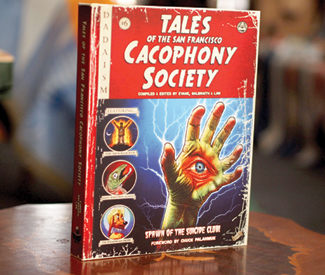
With that caveat in mind, the gorgeously-rendered, scrap-and-patchwork anthology Tales of the San Francisco Cacophony Society (Last Gasp, 300 pp., $39.95) does a pretty good job of conveying not just the external hi-jinks of a group bound together by a yen for the unpredictable, but also the internal philosophical trajectory of many of its members.

Designed to resemble a hardbound EC Comics collection, boldly adorned with a zombie-green, six-fingered hand further deformed by the presences of a bloodshot, unblinking eye smack in the middle of its lined palm, Tales of the San Francisco Cacophony Society is a collaborative effort between key cacophonists Kevin Evans, Carrie Galbraith, John Law, and, in a sense, the whole of the multi-faceted, loosely-knit “society” which ebbed and flowed through the secret pathways and deep underground spaces of the Bay Area and beyond from 1986 through the mid-aughts.

The comprehensive yet quirky tome gathers together an abundance of flyers, photographs, descriptions of momentous pranks and experiential escapades, and newspaper columns documenting such shenanigans as a Thomas Pynchon Walking Tour; the bunker-squatting “Atomic Café”; bridge-climbing; sewer-spelunking; art-car parades; a hide-and-chase game of “Smuggler” at Fisherman’s Wharf; and a rowdy afternoon of shopping cart sled-racing known as the Urban Iditarod. Strewn with colorful collages of ephemerabilia designed by Galbraith and brightly illustrated “Cacophony Factoids” by Evans, the densely-layered visuals bear a whiff of the cheerfully Dada-tastic aesthetic of counter-culture classic The Book of the SubGenius as well as the Cacophony Society’s own former newsletter of events, Rough Draft.

Birthed from the relatively short-lived but highly influential prankster cadre the Suicide Club, which operated from 1977 to 1982, the Cacophony Society itself has “spawned” a veritable pantheon of offbeat occurrences such as SantaCon, the Bay to Breakers Salmon Run, and that bloated megalopolis of arts festivals, Burning Man. In fact, it’s difficult to imagine a San Francisco without the insidious influence of an organization dubbed “the Merry Pranksters of the 1990s.” Even organizations and events (local and national) not specifically born of the society such as Improv Everywhere, Atlas Obscura, the Yes Men, and the Maker Faire bear its imprint: a sense of irreverence combined with a belief in the possible.

“There wasn’t anything that we could think of that we couldn’t figure out how to do,” reminisces Galbraith — who is notably the original instigator of the organizations’ iconic, unmediated Zone Trips (which came to include the first expedition to Black Rock Desert with Larry Harvey’s “man” in tow). This sentiment is echoed by Evans when asked his opinion on the key traits shared by cacophonists, “curiosity, creativity, a deep appreciation of the absurd and the silly, [and] an addiction to making something from nothing”.

Although the idea of a book about Cacophony had been floated around as early as the mid-’90s, it wasn’t until Evans called a meeting between some of his former cacophony comrades in 2010 that the idea began to take a concrete shape. A Bay Area-based fine artist and illustrator, Evans came to the meeting with an already thought-out concept for a “visual history” of the Cacophony Society, and though most of the other people at that first meeting decided against participating, Galbraith, who has a master’s degree in book arts, jumped onboard, eventually spearheading the layout and working most closely with publisher Last Gasp on the final incarnation.

Joining the project soon after Evans and Galbraith got rolling, John Law — a founding member of the Cacophony Society, and a long-time member of the Suicide Club before it — brought his extensive archive of flyers, newsletters, and more to the mix, and, with Galbraith, provided much of the written content. In the end the grueling, three-way editorial process became less about finding enough material for a book, but whittling all the available material down to 300 pages, a process Law likens to lopping off fingers.

“We could have compiled a thousand-page book without repeating anything, or becoming dull,” he muses ruefully by email. “My hope is that others who were involved will write their own books about the period.”

Until that happens, however, pranksters, subversives, free spirits, and urban explorers alike will want to go ahead and splurge on a copy of The Tales of the San Francisco Cacophony Society. And remember, though now technically defunct, the society has always been open to all. You may already be a member. *

TALES OF THE SAN FRANCISCO CACOPHONY SOCIETY

Thu/16, 7pm, free

City Lights

261 Columbus, SF

www.citylights.com


Sun/19, 6pm, free

Green Apple Books

506 Clement, SF

www.greenapplebooks.com

For more readings and related events, including a May 31 party at the Castro Theatre, visit www.lastgasp.com or www.talesofsfcacophony.com.

Yo La Tengo plays the hits at the Fillmore, covers Black Flag

0

The last time I saw Yo La Tengo, on its fabulously gimmicky Spinning Wheel tour, the trio delivered an abrasive, garage-y opening set under an alter-ego, Dump, and closed with a Jackson Browne cover. This past Friday, the band took the Fillmore stage with a loose, meditative acoustic set, before eventually closing with an incendiary rendition of a Black Flag song. There’s no predicting the content, or structure of a Yo La Tengo show; yet, no matter how vigorously it flips from one genre to the next, it sounds unmistakably like Yo La Tengo.

From its yearly run of Hanukkah shows, to its infamously vast archive of cover songs, the Hoboken, NJ trio of Ira Kaplan, Georgia Hubley, and James McNew has cultivated a rich mythology over nearly three decades as a band. It’s also maintained remarkable consistency and prolificacy within its recorded material, which, like Stereolab, has caused many a fan to take its casual greatness for granted. Alternating between insistently bouncy pop songs, blissfully droned-out jams, and cozy ballads to wear your autumn sweater by, Yo La Tengo has assembled a wildly eclectic back-catalogue that continues to pleasantly surprise, and occasionally confound live audiences.

At Friday’s show, the band threw out a curveball right away, with an understated, acoustic rendition of “Ohm,” the decidedly electric opening track from this year’s Fade: its 13th LP, and arguably its most muted, direct work to date. Kaplan and McNew powered through the drony, hypnotic guitar riff at the song’s center with a quiet, chugging insistence, reinforced by Hubley’s understated, yet undeniably groovy drum brushing. It was a captivating opener, and a shining example of Yo La Tengo’s penchant for elegant simplicity.

The remainder of the opening set showed similar restraint, shuffling through several other new songs (the Beach House-y “Two Trains,” Hubley’s gorgeously vocalized “Cornelia & Jane,” the raga-ish “I’ll Be Around”) intermixed with material from the band’s back-catalogue. One definite highlight was a stripped-down rendition of “Decora” (from 1995’s Electr-o-pura), while “No Water” (from its second LP, 1987’s New Wave Hot Dogs) was easily the night’s most unexpected selection.

After a short break, during which many bespectacled audience members pined for a louder, freakier closing set, Yo La Tengo retook the stage with a full drum kit, and an arsenal of electric guitars, providing a jolt that the first half was missing. “Beanbag Chair” (from 2006’s curiously titled I Am Not Afraid of You and I Will Beat Your Ass) delivered on the band’s talent for effervescently hooky pop songcraft, while “Deeper Into Movies” (a high point from 1997’s seminal I Can Hear the Heart Beating As One) set a darker, angstier mood, foregrounding Kaplan’s fuzzed-out guitar sensibility.

However, a Yo La Tengo show wouldn’t be complete without a sprawling, 10+ minute epic, and the band delivered handsomely with “The Story of Yo La Tengo.” Beginning with ambient washes of guitar and synth, the sprawling jam morphed slowly into a devastating guitar freakout, complete with Hendrix-esque stage theatrics. Given Kaplan’s soft-spoken, dryly funny live persona, watching him attack his fretboard with prog-like dexterity and ferocity was incredibly endearing, in a brain-melting sort of way. Although Hubley and McNew both took turns fronting the band, proving Yo La Tengo as one of the more democratic ensembles around, Kaplan absolutely stole the show.

In true Yo La Tengo tradition, the band came back for an encore set of cover songs: in this case, Black Flag’s “Nervous Breakdown,” and the Scene is Now’s “Yellow Sarong.” Following an uncompromisingly pissy, noisy punk number with a kinder, gentler pop selection, the pairing was perfectly symbolic of the trio’s stylistic range.

Few ensembles can claim Yo La Tengo’s dependability while remaining so utterly unpredictable, and fewer can sustain such a balancing act so unpretentiously. Even after three decades and 13 albums together, Kaplan, Hubley, and McNew continue to record and perform as vitally and infectiously as many bands on the first leg of their journey. If Sonic Youth’s dissolution is for real, we can officially claim Yo La Tengo as the reigning champions of the autumn-sweatered indie set.

The Performant: Forever young

0

Rocky Horror turns 40, still crazy after all these years.

Who doesn’t have fond memories of their first Rocky Horror Picture Show experience? Ok, mine are mixed since the first time I saw it was on an old black-and-white television with my father, avoiding eye contact and trying not to laugh too hard at the ribald bits. It wasn’t until I finally saw it on the big screen in the company of peers — armed with rice, noisemakers, and snarky quips — that the full potential of its subversive pleasures revealed themselves more fully.

Part of the fun of repeated viewings of the Rocky Horror Picture Show is emulating the character you most want to be, and for a curly-haired, goth-inclined teenager, the clear choice was Magenta, whose stone-faced cool and extraterrestrial sensuality were so beyond the straitjacket of smalltown teenhood, that to walk an evening in her spike-heeled shoes was akin to a declaration of, well, something. Call it freedom. Peaches Christ does.


“The Rocky Horror Picture Show was my ‘It Gets Better’ video,’ she told the cheering oddience assembled at the Victoria Theatre for the 40th anniversary of the original Rocky Horror Show, the slapstick, Ed-Wood-meets-Charles-Ludlam Rock Musical that, two years later, became a film destined to be the best known midnight movie of all time.

Deviating from the tried-and-true Midnight Mass formula of movie screenings, this Rocky Horror birthday bash took the form of a tribute concert at a respectable 8pm, with multiple singers cast in the iconic roles of the universes’ best-beloved Transylvanians, live music provided by the Whoa Nellies, and quick-and-dirty narration by Peaches Christ herself, synopsizing the negligee-thin plotline that happens between all of those undeniably catchy songs: “The Time Warp,” “Touch-a Touch-a-Touch Me,” and “Hot Patootie, Bless my Soul”. Channeling her inner Tim Curry, PC also provided the vox and corseted eye candy on “Sweet Transvestite” slyly replacing her planet of origins, “Transsexual, Transylvania,” with “San Francisco, California”.

But by far the highlight was the moment that the original Magenta — Patricia Quinn — stepped onstage in a sleek leather suit and handfuls of glitter, to sing the opening song she’d been cheated out of 38 years ago when Richard O’Brien took it over for the movie version, accompanied by a visual of her bright red “stunt lips.” My still-practically-teenaged heart be still. Quinn’s still got. It. That elusive, effusive cool. As does the whole freaking musical, which, stripped of the mostly laughable dialogue and B-Movie special effects, really rocks. Not bad for a 40-year-old who regularly stays up until 3am and can’t ever seem to remember to wear pants. Oh, Rocky!

Lest a single inch of stage space go wasted, almost every role was played by a minimum of two performers, including Dr. Frank-N-Furter portrayed mainly by seasoned Rocky Horror vet Jef Valentine, with a counter-point appearance by former X Factor contestant, Jason Brock, who sang a soulful “I’m Going Home” to an interstellar techno backing track provided by Marc Kate aka Never Knows. Exceptions were Musical Director Peter Fogel who pulled double duty as the titular boy toy and the imitable Leigh Crow as Eddie, ‘cause there can only be one Eddie, and really, that Eddie can only be Leigh Crow. And now that such a stellar lineup is already in place, here’s hoping Peaches will do a 40-year bash for the film version, too, come 2015. Don’t dream it, darlings. Be it!

Tech guru says Internet destroying middle class

28

Jaron Lanier isn’t a Luddite. He can’t be dismissed as a crackpot, whiner critic who is jealous of the success of others. He virtually invented virtual reality; he was a tech guru when most of today’s tech titans were still in diapers. So when he says that the Internet is destroying the middle class, maybe everyone ought to stop for a second and listen.

Okay, as I’ve said before: The Internet didn’t destroy San Francisco. Technology is a tool; it can be used in good ways and bad ways, and its impacts on society, particularly on the poor, can be mitigated by government action (or greatly worsened by inaction).

But Lanier is concerned that the business boom that has been created by high tech has made social inequality worse and is wiping out the middle class that is so essential to a stable country. He talks about how Kodak had 140,000 workers, many of them middle class, and Instagram has 13:

You have this intense concentration of the formal benefits, and that winner-take-all feeling is not just for the people who are on the computers but also from the people who are using them. So there’s this tiny token number of people who will get by from using YouTube or Kickstarter, and everybody else lives on hope. There’s not a middle-class hump. It’s an all-or-nothing society.

More important, the youth-driven culture of the current economic boom ignores that fact that some people are old, and have families, and get sick and disabled, and need a kind of stability that our current march of “disruptive” capitalism is destroying:

We don’t realize that our society and our democracy ultimately rest on the stability of middle-class jobs. When I talk to libertarians and socialists, they have this weird belief that everybody’s this abstract robot that won’t ever get sick or have kids or get old. It’s like everybody’s this eternal freelancer who can afford downtime and can self-fund until they find their magic moment or something.

And Lanier IS a guy who can afford downtime and self-fund. But he’s also 53, and has a little more perspective on life. He recognizes that the middle class has always had, and needs, some sort of public-sector support, whether it’s through tax policy or education or job creation, particularly in unstable economic times. It’s fine for capitalism to be disruptive — as long as there’s a safety net to make sure that all the people disrupted out of their livelihoods aren’t disrupted out of their homes.

Young people, Googlers, Facebookians, Twitterati: Maybe you should listen to your elders.

DPH: Unaffordable housing is bad for your health

To cover rent on a two-bedroom apartment at “fair market value” in SoMa, a San Francisco minimum-wage earner would have to work 7.4 full-time jobs.

That jaw-dropper of a statistic is just one tidbit in a fascinating dataset featured in a recently published interactive map plotting housing affordability in San Francisco neighborhoods. Combining data from Craigslist and PadMapper, the U.S. Census Bureau’s American Community Survey, and the local minimum wage ($10.24 per hour, widely regarded as generous), the map isn’t the handiwork of affordable housing activists. [Note: this reflects the 2012 minimum wage, the rate now stands at $10.55.]

Instead, it was created by the San Francisco Department of Public Health’s Program on Health, Equity and Sustainability. To view the full map and dig around for data on your neighborhood of interest, go here.

The embedded dataset reveals that the median income in SoMa is $91,000 lower than the $158,000 one would need to afford renting a market-rate two-bedroom. This figure, expressed as $-91,000, is known as the “affordability gap,” and the map plots these gaps neighborhood by neighborhood.

It was rolled out as part of a weeklong effort to raise public awareness about the link between affordable housing and public health, explains Cyndy Comerford, manager of planning and fiscal policy at the Environmental Health division of DPH. The reason? “Unmet housing needs in San Francisco can result in significant public health concerns,” Comerford says.

A lack of affordable rental housing can push more tenants into substandard or overcrowded living situations, she adds. Housing units within reach for lower income residents might be squeezed up against a highway, for instance, putting tenants in close proximity to noise, traffic, or air pollution, thus increasing their risks for experiencing heart or respiratory problems. Substandard housing also makes lead or mold exposure more likely, possibly triggering serious health issues over time.

For residents who fork over a significant percentage of their income for rent, other problems can arise. “It leaves little money for other provisions,” such as healthy food or preventative health care, Comerford adds, so low-income tenants have a higher likelihood of malnourishment or preventable disease related to nutrition.

The map is part of a broader DPH initiative known as the Sustainable Communities Index, which provides datasets for more than 100 health indicators. There’s a whole section on housing, which even covers the negative health effects of eviction: “Involuntary displacement contributes to stress, loss of supportive social networks and increased risk for substandard housing conditions and overcrowding,” DPH points out.

More information is yet to come: “Every day this week, we’ll put out a new bit of information around health and housing,” Comerford says.

Taking a broader view, it appears that sweeping cuts to public programs will present a whole new set of challenges for lower-income populations who have a higher risk of housing-related health problems. As a New York Times opinion piece highlighting the public health ramifications of austerity measures notes, “there are warning signs … that health trends are worsening. Prescriptions for antidepressants have soared. Three-quarters of a million people (particularly out-of-work young men) have turned to binge drinking. Over five million Americans lost access to health care in the recession because they lost their jobs.”

Amid all this, as a consequence of the $85 billion “sequester” that began on March 1, “Public housing budgets will be cut by nearly $2 billion this year,” the New York Times piece continues, “even while 1.4 million homes are in foreclosure.”

Heads Up: 7 must-see concerts this week

0

This video has been floating around of Canadian astronaut Chris Hadfield floating in space, slowly turning inside his vessel, playing the acoustic guitar and singing Ziggy Stardust-era Bowie (“Space Oddity,” naturally). It’s an arresting image, melding science, sound, nerd culture, and pop culture together in the coolest of ways. And it was his goodbye love letter to space, as he returned back down to earth yesterday.

Outside the spaceship, and also back here on earth (and playing San Francisco this week, naturally) there are bands that are grounded by gravity, though little else — the celestial atmospheric head case of Kisses, larger-than-life Big Boi, otherworldly solo pounder Black Pus (Brian Chippendale of Lightning Bolt), cosmic soul duo Myron and E, and more invade our shores in the coming days. Maintain your curiosity, and greet them live in the flesh, eyes and ears wide with wonder.

Here are your must-see Bay Area concerts this week/end:

Kisses
Los Angeles dream-poppers Kisses (a.k.a Jesse Kivel and Zinzi Edmundson) have sonically stripped down for their sophomore album, Kids in LA. But the electro duo (analog keyboards, drum machines, robot moans) remains dedicated to breezy synth-pop with hints of the bleak LA underbelly peaking through the palm trees in the form of chilly vocals and anxious beats.
With Sister Crayon, Astronauts etc.
Tue/14, 8pm, $10-$12
Rickshaw Stop
155 Fell, SF
www.rickshawstop.com
http://www.youtube.com/watch?v=HO9KZQRZ0H8

Big Boi
“Any lingering notions of Big Boi as the “conventional” half of legendary Atlanta hip-hop duo Outkast should be dispelled by his two solo albums, including his most recent effort Vicious Lies and Dangerous Rumors, released last November. Aided by cameos from Phantogram and Little Dragon in “Vicious,” Big Boi dives into rock guitars, female vocalists, and electronic bass to present a fearless, kaleidoscopic vision of rap.” — Kevin Lee
With Killer Mike, Fishhawk, Goast
Thu/16, 8:30pm, $35
Mezzanine
444 Jessie
www.mezzaninesf.com
http://www.youtube.com/watch?v=CRUVMg6yvCs

Midi Matilda
“Midi Matilda is the embodiment of everything that’s missing from contemporary twee-pop. It has a sense of intimacy, soul, and joy, embodied by great hooks and hilarious choreographed dances that are absolutely infectious. Operating backward from most bands, Midi Matilda wrote and recorded music before it ever established a live presence, gaining attention on the web with its “Day Dreams” music video.” — Haley Zaremba
With OONA, holychild
Fri/17, 8:30pm, $12
Rickshaw Stop
155 Fell, SF
(415) 861-2011
www.rickshawstop.com
http://www.youtube.com/watch?v=GzdyhuhE694

KFJC’s Battle of the Surf Band
Alameda-based trio Aloha Screwdriver will play this yearly event for the second time. And the 16-band battle also includes Beachkrieg, Deadbeats, Mighty Surf Lords, Tomorrowmen, Frankie and the Pool Boys, Meshugga Beach Party, and more surf acts with cheeky names. The event benefits the station itself, and also will be broadcast using Live Cam.
Sat/18, noon, $10, all ages
Surf Spot
4627 Coast Hwy., Pacifica
www.kfjc.org
http://www.youtube.com/watch?v=0RKqyITE7zk

Myron and E
Listen to Myron and E’s single “If I Gave You My Love” and you’ll start to feel some involuntary movements, your head bouncing in agreement, shoulders shimmying side to side. It’s the nature of the solid gold soul beast. The duo was recently signed to tastemaker Stones Throw, and will release newest album Broadway, backed by Timmion Records house band the Soul Investigators, on the label July 2. With a handful of 45s already out there, the two — Bay Area bred Myron Glasper and Eric “E da Boss” Cooke — have successfully maneuvered an authentic soul sound that’s at once smooth and celebratory (with the help of some well-placed horns).
East Bay Soul Stomp 2 with Bang Girl Group Revue, New Love Soul Revue, DJ Derek See, DJ Der.
Sat/18, 8pm, $9–<\d>$12
Starry Plough
3101 Shattuck, Berk
www.starryploughpub.com
http://www.youtube.com/watch?v=pkkCRD0pLnI

Black Pus
The first thing you need to know about Black Pus is that it’s just a looping Brian Chippendale — he of Lighting Bolt fame. For this project, the madman drummer (and forever art-school kid at heart) uses percussion, a triggered oscillator, and those echoing, distorted Lightning Bolt style vocals you’d expect. Most tracks sound like a spaceship lifting off and exploding into starry darkness, repeatedly.
With CCR Headcleaner, Reptilian Shape Shifters.
Sat/18, 9:30, $10
Hemlock Tavern
1131 Polk, SF
www.hemlocktavern.com
http://www.youtube.com/watch?v=sZKJs2tAayg

Gothic Tropic
“For a band that has released so little music — only the 2011 EP Awesome Problems — Gothic Tropic has a developed sense of itself. Part of it is in frontperson Cecilia Della Peruti’s tendency to perform shoeless so as not restrict her dance moves. The primary feature, though, is the band’s sound. As its name suggests, Gothic Tropic plays sunny and exotic psych-pop tinted with some grit and darkness, and it plays it well. See the band in all of it’s fully-formed glory at Brick and Mortar.” — Laura Kerry
With Seatraffic, Cruel Summer
Sun/19, 9pm, $10
Brick and Mortar
1710 Mission, SF
(415) 800-8782
www.brickandmortarmusic.com
http://www.youtube.com/watch?v=gU-QqrMApDQ

Why rent control works

108

I shouldn’t even bother to talk about this, because all it will do is stir up the trolls, but I’m getting sick of all the talk about rent control being a source of San Francisco’s housing problem. The latest is an editorial in the Business Times, which I buy to read J.K. Dineen’s stories about commercial real-estate, among other things. I should treat it like the Wall Street Journal; nobody takes the Journal’s editorial page seriously.

But the BT is just putting in print the argument that I’m hearing from the neo-libertarians who seem to be more and more populous in this town. And it goes like this:

Rent control distorts the market, which should be controlled by supply and demand. When you have rent control, evil tenants can stay in one place a really long time, thus “reducing urban vitality by discouraging mobility.” They can save their money for something other than rent. And it’s deeply unfair to landlords, because, as the BT notes:

By artificially limiting the return a building’s owner can generate on his investment, it discourages him from spending to maintain or upgrade the city’s housing stock. Rent increases are ordained not by supply and demand but by the city’s rent board. Legally, controlled rents can only go up each year by a fraction of the inflation rate. The ability to recoup costs of improvement or maintenance are also tightly curtailed. Costs are subject to no such limitations, so generally as a rent-controlled landlord, the longer you do it, the further behind you get.

Actually, rents go up by the percentage of the inflation rate that’s due to housing. The ability to recoup maintenance costs are not “tightly curtailed.” But more important, this notion that landlords “get further behind” because they can’t raise the rent assumes that most landlords — and their bankers — are idiots.

When you buy a piece of rental property, you typically have to prove to the bank that the rental income from the place is adequate to cover the mortgage, the taxes, the insurance, and upkeep, the same way a person buying a home has to prove that he or she has adequate income to pay the costs. When banks make loans the borrowers can’t repay, you get the mortgage crisis we’ve seen — but most of those units were single-family homes.

If I buy a rental property, the rent that’s coming in TODAY is matched with the price I’m paying TODAY. If the rents are too low to cover the cost, I have no business buying the place. And the bank has no business loaning me the money.

In San Francisco, unless you’re a complete moron, you buy rental property knowing, as the banker does, exactly what the current tenants are paying, and understanding, as the banker does, that the law won’t let me raise those rents by more than a modest amount each year. You’re making a profit at those rent levels; if not, you shouldn’t buy the place.

Now: Under Prop. 13, your property taxes can’t go up by much more than the rent goes up each year. And if you aren’t a speculative gambler (if you are, you have no rights anyway), you almost certainly have a fixed-rate mortgage. So your biggest “costs” are just as constrained as the rents you get. Meanwhile, your property continues to appreciate in value as the tenants pay your mortgage and taxes.

I know a lot of landlords in San Francisco, and the honest ones all say that owning rental property is a great deal — for the owner. There are probably some poor landlords who either (a) made bad business decisions or (b) were subject to some awful disaster and now find themselves unable to make ends meet. But they are not common.

Here’s the bottom line: Rent control prevents landlords from making speculative profits when the housing market booms. It also allows non-wealthy people to live here, for long periods of time, and become part of the San Francisco community. Housing stability INCREASES “urban vitality.” That’s the point.

Real, effective rent control would include limits on rent increases when a property becomes vacant. Berkeley had that in the 1980s. It didn’t cause urban blight or landlords abandoning buildings; instead, it helped create the Gourmet Ghetto and a thriving local business scene because tenants had more money to spend. It was a great success, until the state outlawed it.

Oh, and don’t tell me it discourages new construction: All new construction, since 1979, is exempt from rent control in San Francisco.

Rent control is, I will admit, bad for people who see housing as a speculative commodity, to be traded with little regard for its function as a basic human right. But I see housing more as a regulated utility — private owners have the right to a regular, acceptable return on investment, but not to excessive profits. Tenants have the right to live in the same place their entire lives, as long as they pay the (stable) rent and don’t become a nuisance.

These are good things for a city. The only problem with San Francisco rent control is that it isn’t strong enough.

Attack me, trolls. Or better, make a civil counter-argument that doesn’t start with “The problem with Tim is ….” Cuz we all know about my problems.


Hot sexy events: Aliens, etc.

10

You will have to excuse the few weeks that your sexy events column has taken off — our Day-Glo phalanges have been so atwitter over tonight’s extraterrestial sexuality event that every thing else has just seemed… of this planet, shall we say. Check out my interview in this week’s newspaper with Strange Attractors co-editor Suzie Silver, by the way, for talk of sensual delights outside the Earthly realm, including beings comprised mostly of scrotal tissue — and head over to Center for Sex and Culture to see the video and performance lineup of UFO couplings that Silver has put together.

Still, the sex culture train rolls on. Here’s so more hot-and-heavy happenings around the Bay this week: 

“Ask a Ho: Question the Real Professionals”

Gonna go ahead and say that we’d be a lot healthier about sex as a society if we let the pros talk a little more loudly about the subject. Apparently Oakland sex shop Feelmore510 feels the same way — Shannon Williams of the Sex Worker Outreach Project facilitates this Q&A journey into the lives of the pros. Bring your best queries, because you gotta think that these folks are gonna be a lot less squeamish about answering your questions about sex than say, Dr. Phil or your “cool” roommate.

Tue/14, 7-8:30pm, $5. Feelmore510, 1703 Telegraph, Oakl. www.feelmore510.com

Perverts Put Out spring fling

Unthaw, it’s almost summer goddamn it. But the PPO crew is taking you through the rites of spring tonight, with dirty readings by the Guardian’s own Sex-Positive Parent Airial Clark, Jen Cross, horehound stillpoint, Virgie Tovar, and more, hosted by the fingers-in-everything Dr. Carol Queen. 

Sat/11, 8pm, $10-25. Center for Sex and Culture, 1349 Mission, SF. www.sexandculture.org

“How To Create An Effective Online Profile – And How To Write Messages That Will Get Good Responses”

If you’re anything like us, you spend more time scoping people’s online ramblings and photo albums than you do IRL cruising. Lesson: you should probably shape up your online profiles if you want to get laid with minimal footwork, ‘Net junkies. Today’s workshop with M. Christian is a class on how to get sexy through words, pics, and clicks. Attend to learn how to be cute-not-creepy with your online come ons, and some Internet etiquette so you’re not FLAMING when all your online paramour desires is sweet, soft pings. 

Tue/14, 7-10pm, $20. Center for Sex and Culture, 1349 Mission, SF. www.sexandculture.org

“Spanking, Paddling & Pinching: An Introduction to the Sensual Side of Pain”

Does rough play get you all hot and bothered, but you’re still hesitant to jump into BDSM without a little primer first? Good thing you live in San Francisco, because you’re welcome to come down to Good Vibrations for this one-off class taught by kink expert Pepper on safety rules, safe places on the body to apply impact, and the psychological underpinnings of sexy pain. 

Tue/14, 6:30-8:30pm, $20-25. Good Vibrations, 1620 Polk, SF. www.goodvibes.com

Jamaican Queens on major influences, ‘Wormfood,’ and Detroit

0

The Detroit-based trio, Jamaican Queens, makes instantly catchy, hip-hop-influenced, electronic-soaked pop gems and performs them in a dance-inducing glam pop fashion. Although Ryan Spencer, Adam Pressley, and Ryan Clancy have been laying down beats together for less than a year, they have already released a full-length album – Wormfood – hit their hundredth show, and written album number two (which they’ll record once they’ve concluded their lengthy West Coast and summer tours).

I spoke with Jamaican Queens before they opened for Javelin at the New Parish in Oakland last week. After the boys grabbed a few local brews (Anchor Steam, of course), we went up to the roof and talked about their eclectic sound, living in Detroit, and the projects in the works. If you missed the Oakland show, catch them this Sunday at Brick and Mortar as Jamaican Queens could quickly become your favorite new band. (That’s been the case for yours truly.)

SF Bay Guardian How would you describe your sound?

Adam Pressley It’s hip-hop influenced and really abrasive.

Ryan Spencer It’s also experimental, but at the same time in the veil of pop. And lyrically, it’s very glam. We want to make music that makes people feel some sort of emotion – whether it be good or bad.

SFBG Who are some of your chief influences?

RS Most of the vocals I’m influenced by are dramatic – like the way David Bowie sings or the way the London Suede sings or T. Rex.

AP When we were making Wormfood, I started listening to the Magnetic Fields, and I was heavily influenced by what they were doing production-wise.

RS Yeah, they make very exaggerated pop music and can wrap up a huge amount of emotion in a two and a half minute song.

SFBG What type of music do you tend to listen to on your own?

AP I listen to only pop.

RS I listen to some more avant-garde stuff. I like Cambodian music and Jamaican Dancehall. That’s kind of where “Jamaican Queens” came from: Dancehall music. I love that stuff. But I like music that’s all across the board. Reggaeton. Insane punk rock. Everything. As long as it can make you feel something.

SFBG Do you guys have a favorite song to perform?

Ryan Clancy The dexterity and movement our songs require make them all really fun to play.

AP Our songs could be performed by six people, but we’ve got it so that we can all perform two instruments at once, so I’m playing a bass and a drum pad, Ryan Clancy is playing electronic drums and real drums, and Ryan Spencer is playing guitar and sampler. That’s “Water” right there.

SFBG Who’s behind your “Caitlin” video? The cinematography is unbelievable.

RC The cinematographer is our good friend Dan DeMaggio.

RS Our friend Caitlin, who the song is about, is the main character in the video. It’s a really dark story. She was living with Adam at the time, and her great aunt got murdered. A team of con artists started working for her great aunt and then ended up breaking into her house and murdering her. This is the song we wrote for her when she was going through that. It was a really intense time.

SFBG So, what’s it like living in Detroit?

RS I imagine it’s a little bit like Oakland. It’s a really supportive community, and the art and music scenes are very small so everyone knows each other and all of the bands that seem to be cool work together and help each other. Most of our friends don’t really have jobs, so you’ve got a lot of creative people working really hard on their art.

RC Yeah, I think one of the reasons we have such cool videos is because the art and the music scene are very incestuous. Everyone who’s a good photographer is also probably in a band or something.

SFBG What are you guys up to this summer and fall?

RS We’re doing a lot of festivals throughout the summer as well as working on going to Europe for the first time. We’re also making remixes, releasing some vinyl stuff in the UK, and recording a new album, which will be a long time coming because Wormfood just came out last month.

SFBG What do you think of the Bay Area so far?

RS The weather’s amazing, the people are cool, and it’s really liberal. It’s great.

Jamaican Queens
With Maus Haus, Black Jeans
Sun/12, 9pm, $7
Brick and Mortar
1710 Mission, SF
(415) 371-1631
www.brickandmortarmusic.com

Hey, you! “Tech people” are not the douchebags you think we are

I hear a lot of talk, especially from my own queer community, about how “tech people” are ruining San Francisco. From skyrocketing rent prices and disappearing diversity to economic and cultural ruination, the tech community has become the scapegoat for a lot of the problems we are facing in the city as a whole. As a tech worker, I’m writing this to say: wake up and direct your anger at the real sources of these problems.

First of all, let’s get one thing straight. The vast majority of “tech people” in San Francisco don’t make nearly as much money as you think they do. We are not making six-figure salaries, we are not personally driving up rent costs, and we are not killing the cultural community here. Simply put, we are trying to further our careers and make the city we call home a nicer place to live. 

From day one of living in San Francisco, I’ve put blood sweat and tears into building the cultural community in SF (music, mostly), and I’ll never stop doing that. I first moved here with my husband in 2006 from Indiana. We fell deeply in love with the city while visiting several times early on in our relationship, and knew this was where we wanted to call home. Of course queer acceptance came into play, but I loved the fact that the city had a life of its own, an entity with which I felt a kinship. I immediately immersed myself in the music scene here, forming a touring band and quickly becoming a booker and promoter for live shows. It wasn’t until several years into my time here that I snuck my way into the tech industry. Thankfully all those hours spent in my parent’s basement as a child on the computer helped! Here I am, five years into my tenure at Bay Area music tech startup Thrillcall, hustling every day to help build music communities not only in SF, but across the country.

I bust my ass doing this for modest pay just to get ahead and know I’m working in a field (music) that I love. I know many others like myself who have day jobs in the tech community that do the same.

However, accusations that I’ve been hearing lately would have you believe otherwise. Claims that “people like us” are ruining San Francisco by gentrifying everything and pushing out what San Francisco truly is. Protip: the Bay Area has, for quite some time now, been a hub for technology. This is not a new thing. Stop acting like it is. Directing anger towards us for what you consider woes to the community at large here is way off base. Bubbles have happened constantly since the early 1990s (or hey, 1840s), and anyone who has lived here for long can tell you this is true. 

The tipping point for me, to be honest, was the nonsense of people beating up a “Google Bus” piñata in the Mission, shouting epithets about how they’re the bane of San Francisco. The people that ride those buses are not to blame. They are not heading up that company, they don’t make millions of dollars, and they certainly don’t deserve the hatred being directed at them by many people here in San Francisco.

They’re utilizing a method of mass transportation (cutting down on carbon footprint) provided by their employer. If you want to be angry about something, be angry at the company, not the people who work for it. If you want to actually do something about it (beating a piñata in a public place solves nothing), then take your grievances to the heads of the companies you think are responsible for the predicament that San Francisco currently finds herself in.

You know what is ruining San Francisco? Complacency. Apathy. Misguided hate. Inaction. Put some energy into making change, not senseless whining.

If you’re upset about rising rent costs, be angry at the money-hungry landlords that do absolutely nothing to put money back into the city or help build culture. Want SF prices to stop skyrocketing? Let’s organize and drive proposals with our city government. Upset about the recent sanitization of many of the lovely traditions and values of San Francisco? Get mad at a-holes like Scott Weiner, who is actually supported by a lot of longtime, non-tech residents. Want more culture, arts, music? Maybe try reaching out to people that can help in the tech world instead of complaining about everything going downhill. 

A vast majority of the tech workers here in SF are upwardly mobile, culturally involved people. We are not ruining this city. We live here for much more than just the jobs we have. We love it, and it’s where we call home. We have as much control over the cost of living here as everybody else. And we are not the companies we work for, however large or small. Corporations, for the most part, suck. We all know that. Demonizing the people that work for them (while contributing to this wonderful city) is baseless, classless, and makes you look like a total dick.

We’re not the douchebags you think we are. Let’s put our energy toward doing good, instead of just pointing fingers. A great deal can be accomplished if people took an active role toward coexisting, rather than shouting “ENEMY!” to anyone who will listen. 


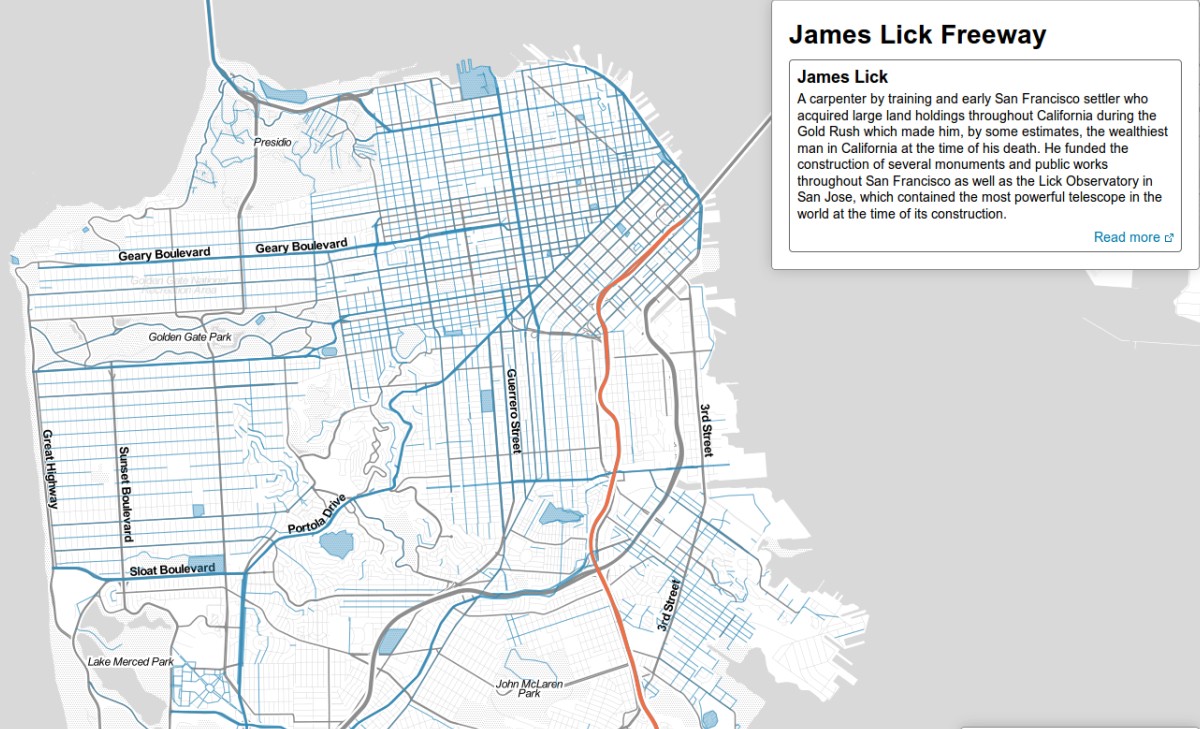
From Lick to Main: Noah Veltman on his amazing interactive SF street name history map

0

When I saw Noah Veltman’s interactive SF street (and landmark) name history map pop up on feed last week, I was instantly engrossed. (It was especially refreshing after staring at this depressing interactive map of Ellis evictions.) Of course I looked up my own street immediately, duh.

Many of us have encountered various bits of street name history along our travels, but here was a comprehensive aggregator that was fun to play with, and covered James Lick Freeway to Main Street, all in one handy spot. Did you know that Baker street was named after Edward Dickinson Baker, the lawyer who defended accused US Marshal killer Charles Cora, before Cora was lynched by the Vigilance Commitee in 1856? Or that Moraga was named for José Joaquín Moraga, founder of San Jose? Or how about Germania — it’s actually named after German people!

(One thing you do realize after a couple of minutes is that most of the streets are named after dudes, both military and wealthy. Maybe going forward, SF will institute gender parity naming regulations, like Berlin just did.)

I wanted to talk to Noah more about what inspired him to make the map, where he got his info from, and if the SF map — and the mapping project as a whole — would continue to grow. So I sent him an email. Here are the smart, and smartly civic, things he had to say

“I’m a Web developer by trade, I’ve always made interactive graphics like this for fun, although this is probably my most ambitious (you can see some of my other side projects here). I grew up on the peninsula, and lived in San Francisco for the last 4 years, but I moved to London in January for a one-year fellowship doing interactive graphics and data journalism at the BBC.

“I made the map because I thought it would be a neat way to take San Francisco’s colorful history and connect to everyday experience, give you a new sense of your neighborhood and your city. I used to walk down these streets all the time and never had any idea that they all pointed to so many larger-than-life characters and pivotal events. The names tell stories that you couldn’t make up if you tried: duels,
saloon shootouts, mob justice, espionage, overnight millionaires, explorers, tycoons, battles, rebellions. They also give you a lot of insight into people who in some cases literally built the city, people who created its skyscrapers or its railroads or its parks. That kind of local history has an immediacy you don’t get when you’re learning about something like the Founding Fathers. You walk past it on your way to work every day.

“There were a number of surprising histories to me, like the fact that Main Street isn’t a generic name, it’s named after Charles Main. I also never knew Crissy Field used to be a military airfield – I’m sure there’s a plaque explaining that somewhere but I had never come across it. Some other favorites:

Green Street
Broderick Street
Woodward Street
Guerrero Street


“I got the information from lots of places — a few different books, but also old news clippings, military records, historical society sites, that sort of thing. Usually I would start with a claim that a street was named for somebody, and then find as much corroborating evidence as I could, and if it seemed solid, research for other colorful details about the person’s life. Needless to say it was a time-intensive process.

“I’ll definitely be adding more to the map over time, there are lots of histories missing, and I’ve gotten lots of helpful tips from others since posting the map. Some streets are left out by design though. Many are self-explanatory or don’t have a historical component (for example, lots of names are just Spanish words or trees or foreign cities), I wanted to focus on ones that would be interesting and not clutter up the map with the rest. I also had to leave out a lot of ones with potentially interesting histories that were hard to verify. I wanted to be careful about not presenting rumor as fact, and there’s plenty of rumor to go around when it comes to how the streets got their names. It’s a tough balancing act, a lot of judgment calls, and I’m sure I still got a few wrong.

“This wasn’t originally meant to be a larger project, but once I got deeper into it I realized that I’d really like to expand it to other cities, so I’m going to be working on that in the coming weeks. I’d like to work on additional cities myself (maybe LA and London next) but I’d also like to generalize the template and create blank versions for lots of cities in the world and open them up for others to work on. I’ve gotten tons of feedback from folks who would be excited to make something similar for their home cities, and I’d love to help make that happen.

“As far as other upcoming projects, in addition my work at the BBC and taking the street name map beyond San Francisco, I’m hoping to start on a project to visualize diasporas from different countries around the world.”

Commission approves soccer project but pushes the city to restore habitat

43

The California Coastal Commission today upheld San Francisco’s plan to replace the Beach Chalet grass soccer fields at the west end of Golden Gate Park with artificial turf and high stadium lights after an emotional five-hour hearing, but not before voicing concerns about the loss of natural terrain and urging the city to do wildlife habitat restoration work on adjacent land.

The soccer project has been repeatedly approved by city agencies despite strong opposition from some neighbors and environmentalists, who say it conflicts with a Local Coastal Plan that calls for it to be a “naturalistic” setting. Their appeal to the commission — which enforces the California Coastal Act of 1976 and regulates development in the coastal zone statewide — was supported by commission staff, giving hope to opponents.  

But the dearth of playing fields in the city and bad conditions on this often soggy, gopher-ridden site drove the local approvals of the project, and advocates for soccer and youth dominated public testimony at today’s hearing, which was held in San Rafael. Supportive speakers made arguments ranging from the exodus of families from the city to the need to combat youth obesity and diabetes to concerns that the woods surrounding the field is now “a fornication playground for gay men, it’s a shooting gallery for drug users, and it’s a toilet for the homeless,” all ills they say the turf and lights will help dispel.    

“I urge you to reject the appeal and allow San Francisco to manage our park system,” Sup. Scott Wiener testified to the commission, adding, “San Francisco has a crisis in that we are losing our families and losing our children.”

Former Sup. Aaron Peskin took the opposite position, calling the commission’s staff report “well-reasoned” and telling commissioners they have an obligation to protect coastal areas on behalf of all Californians: “It is the role of the commission not to succumb to political pressure.”

After public testimony and before a lunch break when he needed to leave, Commissioner Steve Blank made a motion to adopt staff recommendations and deny the city’s project, rejecting the various arguments made by supporters as irrelevant to whether this project complied with the Coastal Act and should be built so close to the ocean.

“Our review is based on the needs of 38 million Californians. One of the reasons our coastline looks the way is does is because of this commission,” Blank said, later adding, “This project looks like an industrial sports facility which is the antithesis of a naturalistic setting.”

He acknowledged arguments that the site has been soccer fields for more than 60 years and that many San Franciscans want them there. But he analogized it to the city’s one-time embrace of the Embarcadero Freeway before decades later realizing it wasn’t an appropriate waterfront use and tearing it down.

After a lunch break, the commissioner who seconded his motion, Esther Sanchez, continued Blank’s arguments against the project. “Our purview is different than the city and county of San Francisco,” she said. The commission’s role is ensuring compliance with the Coastal Act and LCP — which was developed by the city and approved by the commission decades ago — and its call to “emphasize naturalistic land use qualities of the western part of the park for visitor use,” saying the city should use other parks if it wants artificial turf fields.

But Commissioner Steven Kinsey called for the commission to defer to the city process and argued that turf and lights don’t necessarily violate the vague language in the LCP. “Grass alone does not make the site naturalistic,” Kinsey said, making a motion to approve the city’s project.

Commissioner Martha McClure then strongly sided sided with Kinsey and the city, and Commissioners Robert Garcia and Wendy Mitchell followed suit, saying how they personally liked turf more than grass. “It’s great for the environment, it’s water reducing, it stays green,” Mitchell said, noting that she’s replacing the lawn at her Southern California home with turf, calling the staff report “arrogant,” and saying, “I’m disappointed that we’re hearing this item.”

Garcia said the project will improve the public’s access to the coastal zone, which is something the Coastal Act also encourages.

“Artificial turf has become a savior for us, we can keep all our fields in play,” Commissioner Carole Groom, a member of the San Mateo County Board of Supervisors, later said, making her the fifth solid vote for the city’s project.

That left four swing votes on this 11-member commission who all said this was a difficult decision. They were inclined to let the project go through, but they were bothered by converting seven acres of real grass to artificial turf and wanted to mitigate that loss of wildlife habitat.

Chair Mary Shallenberger took issue with Mitchell’s comments. “I think they is absolutely properly before us,” she said. “This is how the process is supposed to work. Staff ended their presentation by saying this is a judgment call,” commending project opponents for filing the appeal.

“This was a very hard one for me,” Commissioner Dayna Bochco said, raising doubts that “seven acres of plastic would be a natural and healtful condition.”

Commissioner Jana Zimmer shared the concern and seized on a comment that SF Recreation and Parks Director Phil Ginsburg made earlier expressing a desire to restore as a naturalistic setting a long-neglected four-acre site next to Beach Chalet that used to be the city’s old wastewater treatment plant, noting that $6.5 million in the city’s last parks bond was set aside for habitat restoration in Golden Gate Park.

“I’d like to find a way to link the finding here to that requirement,” Zimmer said, asking Ginsburg whether he could make that commitment.

Ginsburg said that would be the top staff recommendation for the bond money, but that a public process and environmental review would be needed and he couldn’t make the commitment.

“I do believe mitigation is required here,” Bochco said. “We’re taking away seven acres of habitat and I want it replaced with something.”

A majority of commissioners, those for and against the project, strongly urged Ginsburg to follow-through on his pledge to pursue habitat restoration on the adjacent site. But with concerns expressed about tying the two projects together — which raised both legal and local control issues — the motion to do so failed on a 5-6 vote.

With Ginsburg’s pledge and the writing on the wall, the commission then voted unanimously to approve the project, clearing the way for the city to break ground as early as this summer.

Live Shots: Marina and the Diamonds at the Warfield

0

I like a little grit. Usually I feel that a great show combines unpredictability, recklessness, and some raw, unpolished vulnerability. That’s what makes live music exciting and dynamic. If we wanted flawless vocals and sonically airbrushed instrumentals, we’d just stay at home and listen to the music on iTunes. So I’m trying to figure out why Marina and the Diamonds’ shiny, choreographed, factory-sealed set at the Warfield Sunday night felt so right.
 
Marina looks like an actual Barbie doll, with the kind of proportions people go under the knife for and a no-hair-out-of-place look straight out of a Bettie Page photo shoot. Her live persona is a hyperbolic take on teen idolhood, oozing confidence as she strutted, posed, and gracefully reclined on the daybed featured in her onstage bedroom set (complete with a coat rack, television, and stuffed animals.)
 
As Marina ripped through a packed setlist studded with costume changes and flawlessly executed pop routines, the sold-out audience — 1/3 tween girls, 1/3 their mothers, 1/3 Castro on a Saturday night — screamed and gushed at every opportunity. Fans wore homemade sashes bearing the Marina slogans “teen idle” and “heartbreaker” and nearly everyone had her trademark little black heart painted on their cheeks. And I can see why.
 
Marina is insanely talented. Her rich, clear voice is pitch-perfect. Her songs are catchy, extremely danceable, and overall just good, old-fashioned fun. She shone brightest when the camp factor was turned up to eleven, as it often was, with prop martini glasses full of glitter and neon lighting. Her more stripped down moments, featuring just Marina and a keyboard, lacked the punch and glamour that makes her presence so awesome.
 
But I think what makes Marina so likeable, despite her unbelievable precision and Mattel-like beauty, is that when she sings “I am not a robot,” you believe her. There is something very genuine about Marina’s hyperfeminine persona. When she said, “San Francisco, are you living in this moment right now? Because I am,” it rings true.
 
Usually my feminist blinkers would be going off at the sight of this woman in a crop top singing to tweenage girls about being a prima donna, but instead I found myself singing along with thousands of devoted fans, “Oh my God, you look just like Shakira/ No, no, you’re Catherine Zeta/ Actually, my name’s Marina!”

The simple fact is that Marina knows what she’s doing. Her image doesn’t seem contrived or commercially driven — it seems like a reclaiming of the femme fatale.
 
Marina may not be redefining dance music or pushing any major envelopes, but she rules at what she does. She absolutely dominates the stage, reminding everyone that there’s no shame in letting yourself enjoy a great pop hook, and that a powerful woman can still totally rock a pink vinyl minidress.

Take a walk: 4 cultured strolls to guide your feet this week

0

Commuting to work, we speed walk. In the evenings, we run for our girlish figure. After a Saturday night at the bar, some of us may even be ­­prone to a drunken crawl. But whatever happened to the classic, oh­so­romantic afternoon stroll? As the weather begins to heat up across the Bay, outdoor art walks and historical tours are popping up left and right. Whether you want to check out what’s new in the art world or what’s old in the architecture scene, ditch your sacred spot on the couch for a cultured wander.

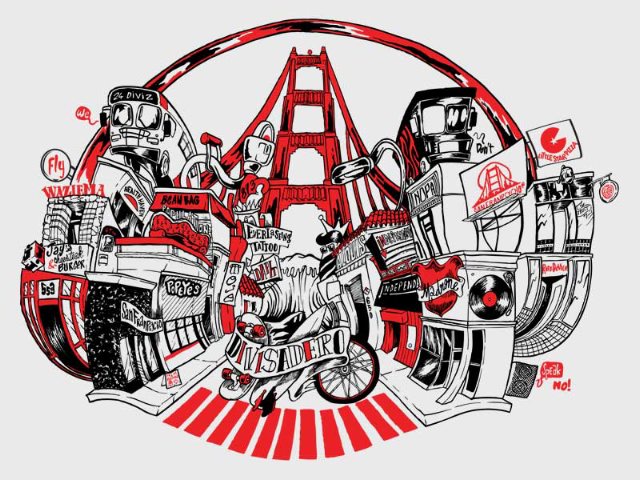
Divisadero Art Walk

Art, drinks, and ice cream – need we say more? This spring’s annual Divisadero Artwalk returns for its first installation in five months. A few businesses participating in tonight’s walk: Onyx Boutique, Big Umbrella Studios Gallery, the dangerously tasty Bi­-Rite Creamery, and more. This spring’s walk has taken an organizational lead from Madrone Art Bar, which is hosting an art-packed evening. On the agenda is a tap takeover from Calicraft Brewing from 6­:10pm, an art reception for computer scientist and kinetic artist Brent Thorne and “Portrait of America”, a project that traveled nationally capturing Americans in photo booth portraits. After you’ve had your art fix, take to Madrone’s dance floor for some disco tunes. 

Thu/9, 5pm, free. Divisadero between Golden Gate and Haight, SF

Victorian Era Oakland walking tour

Lace up your leather boots and corset to become one with the Victorian architecture of Oakland’s Preservation Park. Home to the First Unitarian Church, East Bay historic building the Pardee Home Museum, and more than a dozen elegantly restored 19th­ century homes, the park stands out as a relic of old Oakland charm. If living near San Francisco has provided you with enough Victorian architecture to last a lifetime, choose from one of the seven other tours happening between now and October which cover the buildings of Old Oakland, Chinatown, and more. 

Sat/11, 10am, free. RSVP at (510) 238-3234 or aallen@oaklandnet.com. Preservation Park, Martin Luther King, Jr. and 13th St., Oakl. www2.oaklandnet.com

Saturday Stroll

So the crowds at Oakland’s First Fridays are a little wild for your taste? Head to Uptown Oakland for the weekly Saturday Stroll – a quieter, yet equally artsy alternative. One exhibit highlighted at this week’s stroll, “Lobbyscapes”, features the work of artist Phil Gaughy who gives inanimate objects a life of their own. McGaughy explains, “I have come to think that certain minerals and elements may be sentient, and can adapt to new environments with their own technologies.” His chameleon­like wall reliefs in the Latham Square Building’s lobby and other ambiguous, abstract pieces are but one exhibit worth checking out among many.

Sat/11, 1-6pm, free. Downtown Oakland. www.oaklandartmurmur.org

Uptown, Lake Merritt and Secret Rooftop Garden Walk

After you’ve been schooled in the Victorian history of Preservation Park, travel north ­– and about 20 years ahead in time – to Uptown’s sparkly, Art Deco landmarks. Throughout the 90-­minute adventure history, savvy volunteers will walk you past the Fox and Paramount theaters, as well as the jazzy, blue-and-silver Floral Depot. The tour will also take you up to the Kaiser Center’s secret rooftop garden for a camera-worthy view of Lake Merritt. Because what better way to wrap up a walk than in a perfectly manicured rooftop garden?

May 15, 10am, free. RSVP at (510) 238-3234 or aallen@oaklandnet.com. Paramount Theatre, 2025 Broadway, Oakl. www2.oaklandnet.com

Coastal Commission to rule on Beach Chalet soccer project

25

The California Coastal Commission will decide tomorrow (Thu/9) whether San Francisco and its Recreation and Parks Department violated the Coastal Act in approving a renovation of Golden Gate Park’s Beach Chalet soccer fields that uses artificial turf and stadium lights and seating. [UPDATE 3pm: The commission just approved the project. Full story coming soon.]

SF Ocean Edge, a group comprised mostly of environmentalists and neighbors of the site where the park meets the ocean, has been fighting the project since its inception. They got a big boost recently when the Coastal Commission staff recommended rejection of the project, finding that it violated requirements that coastal areas should remain in a naturalistic state and be open to the general public.

“Going into any hearing, you never know what’s going to happen, but the staff report was excellent,” group spokesperson Kathy Howard told the Guardian. “They have a lot of good idea for renovations to the area which would allow more than just organized sports teams to use the area.”

Spokespersons for the Recreation and Park Department didn’t return Guardian calls for comment. The hearing is being held in San Rafael, with this item expected to be heard starting at 9:30-10am, Howard said. Check in here later in the day for a full report.

More SF restaurants settle with the city over fraudulent employee health surcharges

12

City Attorney Dennis Herrera today announced another batch of settlements with restaurants that have been fraudulently using surcharges on customers’ bills to cover their city-required employee health coverage and using some of that money to simply pad their profits.

Seventeen San Francisco restaurants that took advantage of Herrera’s partial amnesty offer — settlements are half of what the violators should owe, based on voluntarily submitting records by last month’s deadline — will be paying tens of thousands of dollars each to the employees’ they ostensibly collected the money for, joining two other restaurants that had settled with the city earlier this year.

Among this latest batch of restaurants is Burgermeister, whose $134,088 settlement is the largest of this group; and Burma Superstar, whose $10,045 is the smallest. Other restaurants paying up as part of the settlement are 5A5 Steak Lounge, Amber India, B Star, Bix, Cafe Bellini, Calibri Mexican Bistro, Citizen’s Band, Cafe Flore, Fresca, MarketBar, Nob Hill Café, Press Club, Skool, Tony’s Pizza Napoletana, and Venticello Ristorante.

In total, Herrera’s office has recovered about $844,000 that will be split among about 1,500 employees.

Another dozen restaurants suspected of misusing the surcharges were given a clean bill of health: Bluestem Brasserie, Cafe Claude, Cupola Pizzeria, Firefly Restaurant, Gitane Restaurant and Bar, Lark Creek Management LLC, Lark Creek Steak, NOPA, One Market Restaurant, Plant Cafe, Ristobar, and Twenty Five Lusk.

There are still more than 30 restaurants that responded to the amnesty offer that remain in negotiates with Deputy City Attorney Sara Eisenberg, with more settlements expected in the coming weeks and the possibility of lawsuits being filed against restaurants that won’t settle.  

The full press release follows:


Restaurant workers net $844K restitution in 19 surcharge enforcement settlements so far

Herrera praises good faith efforts by restaurants ‘to do right by their employees’; announces ‘clean bills of health’ for 12 other establishments targeted in investigation

SAN FRANCISCO (May 8, 2014) — City Attorney Dennis Herrera today announced settlement agreements with 18 local restaurant businesses that voluntarily took part in his office’s surcharge enforcement and amnesty program, which seeks to remedy shortfalls between amounts collected from customers to cover the cost of complying with San Francisco’s universal healthcare law, and funds actually expended to provide health care benefits to employees.  Together with an earlier settlement announced in January, Herrera’s restaurant surcharge enforcement effort has now netted a total $844,644 to be distributed among approximately 1,500 eligible employees by 19 different companies.

The program announced in January included a one-time 50 percent amnesty offer for establishments with significant shortfalls — provided they fully cooperate with city investigators; agree to good faith compliance with the employer spending requirement of San Francisco’s Health Care Security Ordinance moving forward; and directly compensate their current and former employees who were the intended beneficiaries of the surcharges paid by customers.  All agreements announced today resolve potential disputes with the City over collected surcharges without admissions of liability.  

“I commend these businesses for working cooperatively with us so early in the process, and for understanding our duty to enforce the law even-handedly,” said Herrera.  “Today’s settlements reflect good faith efforts by restaurant owners and managers to do right by their employees, and to honor the intent of fees charged to their customers.  I recognize that complying with groundbreaking programs like Healthy San Francisco can sometimes present new and unique challenges.  So, I’m grateful to these businesses for their cooperation in reaching settlement agreements with us.  I’m glad to continue patronizing these establishments, and I hope other San Franciscans and visitors will join me in doing so, too.”

Some of the 19 establishments that reached settlements under the program include: 5A5 Steak Lounge, Amber India, B Star, Bix, Bugermeister, Burma Superstar, Cafe Bellini, Cafe Flore, MarketBar, Mina Group, Nob Hill Cafe, Patxi’s Chicago Pizza (announced in January), Press Club, Skool, and Tony’s Pizza Napoletana.

Twelve establishments receive ‘Clean Bills of Health’ following investigation
Herrera also announced that 12 businesses targeted for investigation on the basis of the health care expenditure shortfalls they reported to San Francisco’s Office of Labor Standards Enforcement had received “clean bills of health.”  Recipients of such letters were informed by Herrera’s office that after extensive review of additional evidence provided in the course of the City Attorney’s investigation, surcharge-related consumer fraud did not appear to have been committed during the relevant time periods.  In most instances, shortfalls reported to OLSE by businesses that received “clean bills of health” were attributable to their inadvertent reporting or accounting errors.

Establishments so far issued “clean bills of health” are: Bluestem Brasserie, Cafe Claude, Cupola Pizzeria, Firefly Restaurant, Gitane Restaurant and Bar, Lark Creek Management LLC, Lark Creek Steak, NOPA, One Market Restaurant, Plant Cafe, Ristobar, and Twenty Five Lusk.

Surcharge Fraud Enforcement Program background
Herrera announced the program at a City Hall news conference on Jan. 25 with Assemblymember Tom Ammiano, Supervisors David Campos and David Chiu, and representatives from San Francisco restaurants and the Office of Labor Standards Enforcement.  Ammiano first authored legislation in 2005 as a member of the Board of Supervisors that would ultimately lead to the City’s Health Care Security Ordinance, or HCSO, which passed in 2007 with policy input from then-Mayor Gavin Newsom.  Board President Chiu and Supervisor Campos have both been active in subsequent proposed amendments to strengthen and improve the law.  In launching the enforcement and amnesty program, Herrera lauded the Golden Gate Restaurant Association for working productively to share its helpful input, even after years of legal disputes over the law that ultimately ended in the U.S. Supreme Court.  

Status of enforcement efforts and investigation
In addition to the establishments involved with today’s announcement, more than 30 other businesses applied for Herrera’s amnesty program before the April 10, 2013 deadline.  The City Attorney’s Office expects a significant number of additional settlement agreements in the coming weeks, pending further analysis of surcharge funds that establishments collected and expended over the relevant time period.    

Herrera’s one-time offer of 50 percent amnesty has now expired, and the favorable settlement terms are no longer guaranteed to non-participating establishments with significant shortfalls between health care-related collections and expenditures.  Announcing his enforcement and amnesty program in January, Herrera said that restaurants and other businesses found to have committed HCSO-related surcharge fraud during the years 2009 to 2011 that failed to come forward before the deadline voluntarily would risk being sued for full restitution of the amount of surcharges collected during that period, together with potentially substantial penalties, costs and attorneys’ fees.  A small number of defiant, non-participating businesses remain under consideration by the City Attorney for further enforcement action or litigation.

“For restaurants that haven’t yet come forward, it’s still very much in their interest to do so voluntarily,” Herrera said.  “I can’t guarantee the same favorable terms reflected in today’s settlements, but cooperative engagement is better and more cost-effective than lawsuits.”  

The Pulitzer Prize Board surrender – and how the New York Times blew the Ed Kennedy story (Part l)

10

In the May 19, 1945 edition of the New Yorker magazine, the legendary press critic A. J. Liebling wrote a prescient article on what happened when Edward Kennedy, an Associated Press combat correspondent, defied military censorship to break one of the century’s biggest and most important stories.

His lead said that “the great row over Edward Kennedy’s Associated Press story of the signing of the German surrender at Reims served to point up the truth that if you are smart enough you can kick yourself in the seat of the pants, grab yourself by the back of the collar and throw yourself out on the sidewalk. This is an axiom that I hope will be taught to future students of journalism as Liebling’s Law.” Liebling titled his piece, “The AP surrender,” because AP, caving in to government pressure, led the attack on its own reporter by publicly censuring and then firing him. He cited the New York Times as leading the charge with a nasty editorial blasting Kennedy only two days after it had splashed Kennedy’s story on the front page with huge heads. Kennedy, the editorial intoned solemnly, had done a “grave disservice to the newspaper profession.”

Liebling, a mid-1920s  student at the Graduate School of Journalism at Columbia University in New York City, was presumably aiming his axiom at his alma mater, which was in a building endowed by Joseph Pulitzer, a crusading liberal publisher in New York at the turn of the century.  Pulitzer also endowed the prestigious Pulitzer Prizes, which are housed in the school and administered by a senior member of the faculty.

I especially enjoyed Liebling’s Law as a Columbia journalism graduate (’58) and as a charter member of the committee working to get Kennedy a posthumous Pulitzer prize this year for his story. The axiom was timely because my wife Jean and I were at the journalism school in April to attend my 55th class reunion and the school’s centennial celebration. The event was full of Pulitzer references and remembrances, highlighted by an address by James McGrath Morris, a respected Pulitzer biographer, speaking in the World room, named after Pulitzer’s newspaper.

The day after the centennial weekend, the Pulitzer Prize Board announced its Pulitzers and rejected the two Kennedy nominations without comment. One nomination was for his story, the other for a previously unpublished book by Kennedy on his career as a WWII foreign correspondent. The rejections demonstrated a serious flaw in the Pulitzer Prize process.

The point of quoting Liebling today, in May of 2013, is that almost seven decades after his article, the Pulitzer Prize Board and the New York Times have once again left Kennedy out on the sidewalk for doing his job as a reporter who, in a favorite Pulitzer phrase, knew “the  right and had the courage to do it.” Since this is a historic story of military censorship for political reasons, it is as timely and relevant now as it was then, since the Pulitzer Board and the Times still do not get the point.

So let me put the issue in context. Let me start by quoting Liebling’s main arguments and link his full six page piece, written in the heat of the censorship battle.

Liebling, who was himself a distinguished World War II correspondent, wrote,  ”The important aspect of the story of the row, I am sure, is not that Kennedy got his dispatch out of Europe before the SHAEF Public Relations bosses wanted him to but that only three representatives of the American press were admitted to one of the memorable scenes in the history of man, and only on condition that they promise not to tell about it until the brigadier general in charge of public relations gave them permission.

“No correspondent of a newspaper published in the United States was invited to the signing; besides Kennedy, Boyd Lewis of United Press, and James Kilgallen, of Hearst’s International News Service, the official list included four radio men, an enlisted correspondent for the Stars and Stripes, and a collection of French, Russian, Australian, and Canadian correspondents.

“Whether a promise extorted as this one was, in an airplane several thousand feet up, has any moral force is a question for theologians…I suppose Kennedy should have refused to promise anything and thus made sure of missing an event that no newspaperman in the world would want to miss, but I can’t imagine any correspondent doing it.

“I do not think Kennedy imperiled the lives of any Allied soldiers by sending the story, as some of his critics   have charged. He probably saved a few, because by withholding the announcement of an armistice you prolong the shooting, and, conversely, by announcing it promptly you make the shooting stop. Moreover, the Germans had broadcast the news of the armistice several hours before Kennedy’s story appeared on the streets of New York, and Alsie, the OWI’s American Broadcasting Station in Europe, broadcast it in 24 languages, including English, within an hour after.”

Liebling noted that the Russians “had their own surrender show in Berlin, and probably had a better publicity break on it than they would have had if the two surrenders has been announced simultaneously… One unconditional surrender of the Reich a day is as much as the public can absorb.” 

Liebling brought out the crucial political censorship point. “Moreover, the row can do a lot of good if it brings into the clear the whole disturbing question of military censorship imposed for political, personal, or merely capricious reasons and reveals the history of the prodigious amount of pure poodle-faking that has gone under the name of Army Public Relations.” Liebling was right on because it later turned out that a secret agreement between Stalin, Roosevelt, and Churchill had imposed a 24 hour embargo on the surrender story so the Russians could announce it the next day in Berlin. Kennedy’s story was in effect the start of the Cold War.

Last year, almost 70 years later,  Tom Curley, as president and CEO of AP,  backed up Liebling’s Law and apologized publicly on behalf of  AP. for the way it treated Kennedy. “tt was a terrible day for AP,” he was quoted as saying on the AP wire.  “It was handled in the worst possible way,.” He wrote a strong  defense of Kennedy in an introduction to a book published last year by the Lousiana State University Press,  titled “Ed Kennedy’s War: V-E Day, Censorship & the Associated Press.” The book was a personal account by Kennedy of his career as a foreign correspondent and a detailed account of his side of the controversy. His daughter, Julia Kennedy Cochran, found Kennedy’s manuscript in his papers after he died in a pedestrian accident in Monterey in 1963 at age 58 where he was editing the Monterey Peninsula  Herald. 

Curley wrote that “Kennedy and his editors performed superbly. They delivered one of the most significant scoops in journalism history. They did four things right. A great correspondent was assigned to the story. He kept reporting even after the censors tried to shut him down. The London desk moved the news without hesitation. The correspondent and editors adhered to the wartime rules as they knew them.  Finally, Kennedy wins the argument on a technicality. With the signing of a surrender treaty, there was no longer a war in Europe and not any excuse to submit to censors.”

Curley said “the book matches the best memoirs by World War II combat reporters for the quality of writing and telling detail, some of it gripping.  And in one way it surpasses the others. Not only does Kennedy give his final, thoughtful explanation for what happened on May 7, 1945. In describing his struggles with censorship and bureaucratic red tape and stupidity over many months, not just on May 7, he provides the fullest first-person account we have of the difficulties World War II correspondents encountered every day trying to do their jobs.

“Perhaps in some small way we bring posthumous recognition to an American hero and embrace – too belatedly – what McClean and Cooper (B3: AP executives) and the AP board could not admit. Edward Kennedy was the embodiment of the highest aspirations of the Associated Press and American journalism.” Curley said his account drew upon newly available records held in the Associated Press Corporate Archives.

Curley’s co-author was John Maxwell Hamilton, founding dean of the Manship School of Mass Communications at LSU.  He is the editor of “From Our Correspondent,” a series of books that features forgotten works and unpublished memoirs by pioneering foreign correspondents and illuminates “the development of foreign news gathering at a time when it has never been more important.” Hamilton, once a foreign correspondent himself, is currently the executive vice chancellor and provost of LSU. The book was submitted by LSU Press for a Pulitzer in the book category but the board rejected the nomination and, in keeping with tradition, rejected it without comment.

Following V-E Day, Kennedy was out at AP and the big  mainstream dailies. He became a managing editor for two years at the Santa Barbara News-Press and then edited the Monterey County Herald, later the Monterey Peninsula Herald.   The Herald won lots of journalism awards under Kennedy and he wrote many international commentaries under the initials E.K. He loved his community and he loved his job. .A memorial to Kennedy stands in the form of a sundial in Laguna Grande Park in nearby Seaside. It reads: “He saved the world an extra day of happiness.”

Meanwhile, Ray March, editor of the Modoc (Calif.) Independent News  and a former reporter under Kennedy on the Herald, decided it was time to nominate Kennedy for a posthumous Pulitzer prize and help right a historic journalistic and public policy wrong. With the help of Eric Brazil, a former Examiner editor and reporter, he put together a committee and petition.  I signed up immediately when Brazil called me.  And I helped put together the first ever panel anywhere on the Kennedy story for last year’s annual meeting of the California Press Association. It featured as moderator Ward Bushee, the Chronicle editor whose father had been recruited by Kennedy to work on the Herald. (He turned down the offer.)  Ward’s father had earlier won a Pulitzer as editor of the Watsonville Register-Pajaronian for exposing corruption involving the local district attorney.

The historic panel included March, Kennedy’s daughter, and Dave Perlman, a Chronicle reporter at 93, who was in Paris as a reporter at the time of the surrender. Jim Ewert, general counsel of the California Newspaper Publishers Association, drafted  a stirring resolution supporting the nomination and the members approved it unanimously.  It was submitted as part of the nomination package, put together by the Chronicle’s promotion department. March, Brazil, and  Frank McCulloch, former bureau chief for Time magazine in Vietnam who later held top editorial positions at the LA Times, the Sacramento Bee, and the old San Francisco Chronicle, wrote the nomination letter. It stressed that Kennedy had been the victim of military censorship for political reasons.  Meanwhile, the nomination got much media coverage, including the Chronicle, Washington Post, Sacramento Bee, Atlantic Magazine, Portland Oregonian, Editor and Publisher, and many other print and online venues.

When the New York Times announced this year’s Pulitzers, the paper gushed that  it got four Pulitzers, giving it a total of 112 Pulitzers, ”far more than any other newspaper,” as trumpeted in full page promotion ads. Margaret Sullivan, the public editor, was even more glowing in her Sunday column (4/21/2013). Her lead:  “The Times, it is safe to say, had a very good week. On Monday, it won four Pulitzer prizes – “the third most in its history and twice a many as any other news organization this year.”  (She also quite properly gave credit to the Times for its coverage of the Boston bombings and in particular for staying on the safe side of the “Rubicon of inaccuracy” by not reporting that an arrest had been made and a suspect was in custody.) She concluded her appraisal by saying that “The Times is far from perfect.  But last week, in its intelligent and restrained handling both of images and facts, it looked like a newspaper worthy of this year’s Pulitzer glory.”

However,  I and many others weren’t as smitten by Pulitzer glory. We were disappointed to see that the Pulitzer Board  not only rejected a Pulitzer for Kennedy, but that it did so without reference or mention of the Kennedy nominations, made no special citation (such as the special citation to the late Chronicle columnist Herb Caen) and gave no reasons nor acknowledgment of any kind for the rejections or to the historic importance of righting a major  journalistic and public policy wrong on one of the most crucial issues of our time:  military censorship for political reasons of news the public needs to know. I couldn’t find any evidence that the Times ever changed its editorial opposition to Kennedy and that it ever properly covered Kennedy’s side of the story. And the Times, unlike AP and so many other papers, didn’t cover the current story of the nominations to award Kennedy a posthumous Pulitzer prize or the censorship issues, before or after the Pulitzer awards were announced. Will it do so now? I am sending this report to the public editor and other Times editors and public  for comment.

I emailed Sig Gissler, the former Milwaukee Journal editor who now administers the Pulitzers.as a journalism professor. I put the above points to him and asked why the committee “instead of coming down on the side of the free press that Pulitzer and his school and prizes represented, the committee in effect came down on the side of government censorship for political reasons and supported a politically charged embargo agreement that would allow Stalin to catch up on the surrender announcement and hold his own press conference in Berlin.” 

Specifically, I asked Gissler  “was there any discussion on the Kennedy nominations, was there a vote and what was it, who voted for and against, what were the reasons for the rejection, was there any real internal debate on the importance and timeliness of this issue, and anything else that you or the Columbia officials (Outgoing Dean Nicholas Lemann or incoming Dean Steve  Coll, President Lee Bollinger) or the committee chairs or member would like to add. Is there a spokeperson I can talk to?”  I also asked for the names and contact information of the full Pulitzer committee and subcommittees and the appropriate Columbia spokespeople.

Gissler is a good man in a tough job burdened with honoring a dated policy. He emailed me back promptly and thanked me for my “interesting note.”  He said that, “regarding Kennedy, your desire for an explanation is testimony to your earnestness. However, each year the Pulitzer process produces many similar situations. Entrants desire to know why they did not become finalists. Finalists desire to know why they didn’t become winners. Petitioners for special citations desire to know why no special citations were bestowed. The Board declines to provide explanatory details, consistent with its tradition of basically not discussing, debating or defending its decisions.

“I understand your disappointment. However, at the risk of eternal irritation, I can only reiterate that the request for a special citation for Ed Kennedy was duly considered and that we do not issue statements when a request does not result in a citation.” He didn’t send me the names or contact information of the board or Columbia spokespeople. 

To give Gissler every opportunity to explain, I emailed him again and asked more questions: “So, after all these years, are you saying that the Pulitzer Board has no way for anyone (entrants or journalists or the public) to comment on the awards or the contest or the process? If not, why not?” I also asked again how the Kennedy nominating committee and others could make comments this year, right now. I ended by saying there was now much interest in “making the Pulitzer process more transparent, representative, and accountable.” I hope you agree, I told Gissler, and that you “at least present the issue to the board and the proper Columbia officials.”  I got no further comment from Gissler.

The Pulitzer School of Journalism and the Pulitzer prizes are endowed by Joseph Pulitzer. The school has the venerable Columbia Journalism Review magazine with a mission to “encourage excellence in journalism in the service of a free society.” And it has the excellent  CJR.org website that “weighs in daily, hosting a conversation that is open to all who share a commitment to high journalistic standards in the U.S. and around the world” and that could, let me suggest,  display the Pulitzer winners properly and host a lively forum for congratulations and comment  on the Pulitzers and the Pulitzer process,  It has a large and distinguished faculty and hosts a wide array of newsworthy panels and programs. It attracts each year an excellent class of students. It has a huge statue of Thomas Jefferson, paid for by Pulitzer, standing as a beacon of press freedom in front of the entrance to the journalism building. It is situated in the media capital of the world and promotes itself as the best journalism school in the country and a source of many of the country’s best journalists. It can do better, much better, with the prizes that the New York Times proclaimed, in its full page ad promoting its four Pulitzers, as “widely considered journalism’s highest honor.” .

And so I recommend that Columbia, the Graduate School of Journalism, and its Pulitzer Prize Board use the rejected nominations of Edward Kennedy, the reporter who was tarred and feathered for the crime of committing journalism, as the catalyst for major Pulitzer reforms. I recommend making the Pulitzer process more transparent, more responsive, and more prepared in our militarized age to fight government censorship and more prepared to promote and defend the First Amendment values of free speech and free press.

I will keep you posted. B3

POSTSCRIPT:  THE RUSSIAN PLAN TO PREEMPT THE SURRENDER STORY:   Ed Kennedy writes in his book that in the turmoil over his dispatch the correspondents overlooked another story almost as big as the surrender story. It came from  “no less august an official spokesman”  than Brig. Gen. Frank A. Allen Jr., the SHAEF commanding officer,  who told the corresponents in a May 8 meeting that “the official announcement might be delayed even further beyond the time set for it–3 p.m., Paris time.  He revealed that the Russians, having induced Washington and London to hold up the announcement, until the hour set for their own ceremony in Berlin, now were asking that news of the real surrender at Reims be suppressed until some hours after the phony surrender of Berlin. HIs disclosure was ‘off the record’ at the moment but could have been legitimately been reported the following day. It never was. 

“The sole purpose of the Soviet request, it was later established–and even then was obvious–was to convince a large part of the world that the Russians had obtained the surrender of Germany, with but contributory help from the Western Allies, whom they had generously invited to share in the final honor.  The Berlin ceremony was staged purely for Soviet propaganda purposes. Although a Russian correspondent was one of those whom General Allen had invited to Reims to the exclusion of any reporter of an American newspaper, no word of the Reims surrender appeared in the Russian press. So far as I know, none has to this day.

“The Russian action was the inauguration of the propaganda build-up for the course of expansion on which the Soviet Union was shortly to embark in Europe. Its importance as news was that it was the first clue to Moscow’s postwar policy.  But it went unreported at that time.”

Bruce B, Brugmann, writing as editor at large of the San Francisco Bay Guardian, as editor and co-founder and co-publisher of the Guardian with his wife Jean Dibble (1966-2012, now  retired), as a graduate of the Columbia Graduate School of Journalism (’58), as a recipient of  the Columbia Journalism School’s  Distinguished Alumnus award (2011), as a former bureau chief of the Korea Bureau of the Pacific edition of Stars and Stripes who encountered milItary censorship  (1959-60), and as a charter member of the Kennedy nominating committee. 



Will SF’s new broadband infrastructure be controlled by the city or Google?

28

Board President David Chiu is calling for San Francisco to add to its broadband fiber network every time a contractor or utility tears up a street, joining other cities in expanding high-speed Internet capacity. But will this new network be a municipal utility or corporate-controlled? An upcoming hearing he has called for could begin to answer that question.

“In the 21st century, cities need access to affordable, high-quality broadband to compete economically, just as access to water, electricity, roads or railways was critical in the 20th century,” Chiu said in a public statement. “We see other cities like Austin, Kansas City and Santa Clara making enormous strides.  My proposal will ensure that San Francisco does better in this area.”

But Austin and Kansas City have opted to take the easy path and let Google install and control the system, which raises a variety of questions and problems that are highlighted “Kansas City Gives it up for Google,” in the current issue of Harper’s Magazine, which looked at how KC is letting corporate interests trump the public interest.

“According to its contract, Kansas City must give Google access to its underground conduits, fiber, poles, rack space, nodes, buildings, facilities, and available land. It cannot charge the company for ‘access to or use of any city facilities . . . nor will it impose any permit and inspection fees.’ And what does the city get in return? It has no say in the pricing of Google’s services, nor can it ensure that Google will deliver fiber-optic service to all of the city’s residents. Google’s offices, meeting spaces, and showroom are provided free of charge, and the city pays the company’s electric bill. The mayor, moreover, is barred from commenting on Google’s activities without the express permission of Google,” the magazine writes.

Chiu is building his proposal from a report that then-Sup. Tom Ammiano commissioned years ago, calling for the city to build a network of fiber as it opens up the streets. Now, Chiu is trying to implement that idea with legislation and an upcoming hearing on the issue, but right now he’s agnostic on whether that network is owned by San Francisco or a corporation that it might contract with.

“My legislation doesn’t dictate who lays the fiber, it just ensures that it happens,” Chiu told the Guardian, although he did add that he’s “more intrigued that it could be the public sector.”   

The Harpers article discusses how public utilities have succeeded in delivering reliable, cost-effective services to millions of Americans since the 1930s when FDR began to use government to deliver electricity to rural areas that lacked it, drawing parallels to the 100 million Americans now who lack access to high-speed Internet service. But the federal government seems to be encouraging corporations to do the work this time, and they’re more than happy to oblige.

“Why does Google feel so at home in Kansas City—rather than in, say, California, where the company is based? Why not build their first citywide fiber-optic network in a nearby community? According to Google vice president Milo Medin, the company has preferred to steer clear of such pesky statutes as the California Environmental Quality Act. ‘Many fine California city proposals . . . were ultimately passed over in part because of the regulatory complexity here,’ Medin told a congressional committee in 2011. ‘In fact, part of the reason we selected Kansas City for the Google Fiber project was [that] the city’s leadership and utility moved with efficiency and creativity in working with us to craft a real partnership,’” the article says.

Yet with Google in charge, the company is only guaranteeing access to neighborhoods where a minimum number of residents pre-register and pay for premium service, redlining out many African-American neighborhoods and forcing community members to go door-to-door essentially selling Google’s services.

And in the end, the corporation will make gains even if it loses money on the project, as the article concludes: “So why would an Internet-search company want to spend a fortune to install fiber-optic cable in Kansas City, Missouri, and neighboring Kansas City, Kansas? Freedom from regulatory headaches is one part of the equation: if such networks are the wave of the future, the time to jump in is now, before legislative oversight can ruin the party. But another explanation might be the treasure trove of user-behavior information that such a network represents. Data of this kind is so prized that a company like Google can afford to give away other services for free, as long as this beneficence opens up new markets. In Kansas City, low-income subscribers to the company’s slower, ‘free’ Internet option will be giving Google details about each URL they visit, even if their accounts remain anonymous. And customers who plunk down $120 a month for the ‘Full Google Experience’ will have their television-viewing habits individually tracked by Google’s data-mining elves. Is this a reasonable bargain? For Kansas City, it’s too late to ask. But history—and the success of municipally owned fiber-optic projects throughout the country—strongly suggest that we should look this gift horse in the mouth.”

Food for thought as San Francisco contemplates whether it wants to build public infrastructure or simply facilitate more corporate infrastructure.

Nice to know our tech friends aren’t paying taxes

9

Since Mayor Ed Lee has decided that tech companies are the future of San Francisco, it’s nice to note that these outfits are often no better than the cheating robber barons of old — or the modern Leona Helmsleys. The Campaign for America’s Future notes that Apple dodged a $9.2 billion tax bill that would have been enough to cover most of the sequester cuts this spring. Notes Isaiah Poole:

Apple makes great products, but the obscenity of its use of the tax code to avoid paying its fair share for the functions of government that make its success possible is only exceeded by the tax code itself and the nexus of ideology and corporate greed that created it.

Only the little people pay taxes.

Nice builds

5

marke@sfbg.com

STREETS ISSUE “Oh, we’re doing pretty well right now,” a hunky contractor with Cahill Construction said with a wink at a chic party a couple weeks ago. He was referring to the building boom that’s hitting SF, its slender cranes teetering across our skyline like a stilettoed bacherorette party drinking its way down Polk Street. In terms of new build, 2010s SF is the new 1990s Berlin (somebody wrap our Reichstag, already). And while some of the design is surprisingly gorgeous, and we thankfully haven’t fallen yet for too much trendy starchitect stuff, a lot of it is a bit perfunctory to say the least. For a region that produced visionary architects from A.G Rizzoli to Ant Farm (and the often gorgeous infrastructure of your personal computer), you’d think we could push beyond stacked glass boxes lined in travertine and looming USB-like forms a tad more.

Practicality intrudes, of course, and while we wait for this, one of the richest and most creative places on earth, to develop a contemporary street vernacular to replace those awful ’90s SoMa live/work lofts, there’s a lot of loveliness hitting our streets, This year’s American Institute of Architecture SF Awards, which took place April 25, were abuzz with great, recently completed projects that focused on ground-up design that was practical, sustainable, inventive, and just plain neato. Here are a few winners that caught my eye, mostly because I had seen them in action on my weekly walks through the city and beyond. Their worth a closer look on your own jaunts. (See more winners at www.aiasf.org.)

RICHARDSON APARTMENTS

Designed by David Baker + Partners (snappy sage of green design Baker is SF’s closest thing to a starchitect) and run by Community Housing Partnership, this Hayes Valley supportive housing complex is named for Drs. Julian and Raye Richardson, who started Marcus Books in the Fillmore, the country’s oldest black book store. It houses 120 formerly homeless tenants as well as several businesses, and its swoop of natural materials and neighborhood-brightening color “seek to repair the site of a collapsed freeway with homes.”


OAKLAND MUSEUM ENTRY PLAZA

You usually go to a museum to see (worship?) others’ creativity: Oakland Museum’s interactive entry plaza and event space, designed by Jensen Architects, allows you to express your own. Usable white garden furniture hangs from a giant blackboard — make a space to chill, and write out your thoughts. Simple and stunning.


OURCADIA

The parklet movement began in San Francisco in 2010 and has now spread throughout the world, decommissioning parking spaces for more humanely amenable uses. (Maybe parklets are our new native architectural vernacular? Hope so.) Now some of the sharper ones are being institutionally recognized, like this nifty zag outside farm:table restaurant in the Tenderloin, designed by Ogrydziak/Prillinger Architects and Reynolds-Sebastiani landscape architects. Funding by, duh, Kickstarter.


HAYES VALLEY PLAYGROUND

Hayes Valley has gotten so congested at this point, its need for some space to breathe is critical — and with patricia’s Green being pretty much overrun and Hayes Valley Farm about to disappear under a cloud of construction, it’s only getting worse. This groovy clubhouse and playground design by WRNS Studio (in association with the Trust for Public Land) updates the 1958 Parks and Rec space with some bright color, fun contraptions, and spacious feel, creating a safe space for kids to “foster an appreciation of nature and social gathering.”


LAND’S END LOOKOUT

Perched above Sutro Baths, on a cliff exploding right now with colorful blooms, this exceedingly graceful 4,050 sq. ft. National Park Service visitor center is one of my new favorite places in the world. It contains a smart little cafe, oodles of info on the natural surroundings and nearby historical hot spots, and a superfriendly staff. But the design itself, by EHDD, fits so perfectly into its Point Lobos surroundings (and puts further to shame the industrial barn-like Cliff House next door) that you may find yourself lingering beyond a cappuccino to enjoy the light and light-filled space, waves frothing on the rocks far below.


ONE KEARNY LOBBY

A walk through the Financial District at night is a journey into Mad Men nostalgia — further back, even, as elaborately sculpted Neo-Gothic lintels from the early 1900s beckon over entranceways, lit dramatically by the spacious lobbies within. Contemporary takes are worth searching out as well. Redeveloped century-old beauty One Kearny’s tiny new lobby, designed by IwamotoScott Architecture and entitled Lightfold (because we brand our lobbies now), is a wee swooner of luminescent stalactites, a.k.a. “an array of digitally-fabricated wood veneer lanterns” and bright, odd angles. Like all good entryways, it draws you fully in.


SFO T2

The glistening, organic-futuristic San Francisco International Airport Terminal Two “elevates the passenger experience with design strategies that reduce traveler stress, promote progressive sustainability measures and highlight the airport’s art installations.” It also kind of makes me not want to leave.

C who we R

0

arts@sfbg.com

DANCE When Charles Anderson returned from a performing and choreographing career in New York 11 years ago to start a chamber-size contemporary ballet company, it seemed fair to wonder whether the Bay Area really needed another one. In the intervening years he certainly, and justifiably, has put his Company C Contemporary Ballet on the map. He assiduously assembles contemporary choreography that, at the very least, has a tenuous relationship to ballet. If there are missteps, and there are some in almost in every program, he nonetheless manages to offer a generous and broad spectrum of perspectives. You walk away glad that you came.

In the most recent program — which was performed in San Francisco May 2-4 and travels to Walnut Creek this week — his dancers dove into a smorgasbord of world and company premieres with gusto. Only Anderson’s own 2007 Boléro, choreographed to you-know-what, has been previously danced by this well-trained troupe.

What Anderson has not yet found is a good (and affordable) San Francisco venue to showcase his fine company. This season he tried out Z Space, an inviting theater, albeit one that could benefit from updating its lighting system. And for ballet dancers, who often have flying exits, Z Space’s lack of wing space is a problem. Momentum needs to be truncated to avoid crashing into the brick walls.

Company dancer David Van Ligon’s world premiere, Natoma, in particular needs to be seen on a more suitable stage. Set to an odd assemblage of scores by iconoclast composer Zoe Keating, Natoma runs out of steam about halfway through. Yet this is an honest attempt to deal with traditional structures seen through contemporary eyes. Laura Hazlett’s simple costumes (black bathing suits for the women, tights and white top for the men) nicely highlighted the dancers’ lines.

Van Ligon bowed to convention with a central pas de deux (for gorgeous Edilisa Armendariz and Connolly Strombeck), and three couples and a female duo (Laura Dunlop and Kristin Lindsay) that also framed the pas de deux. Yet he reconfigured this set-up into a number of ever-changing variations that gave Natoma a satisfying sense of elasticity. Wisely, perhaps influenced by Keating’s stab at minimalism, he pared down his vocabulary to basic steps and unisons in conjunction with flowing arms. Still, at times one wanted more richly textured choreography. Pleasing was the design’s clarity, though it put in relief both the dancers’ strengths and their weaknesses.

The appropriately-named A Modest Proposal, from John Bohannon (concept and text) and Carl Flink (direction and choreography), was a fresh, clever, and amusing smashing of verbosity against the succinctness of art, entertained without a whiff of Swiftian sarcasm. Trying to explain complex scientific facts with more and more words, and worse, with PowerPoint, is useless, narrator Ryan Drummond. Do it through dance. When the ensemble, having swirled around Drummond, stepped out of their overalls and into Hazlett’s diaphanous white for an airy, fluid finale, you could almost believe him.

Dennis Nahat’s 1970 Ontogeny — named for the process of life forms’ individuation, in case you slept through biology class — received a stunning interpretation. Using Karel Husa’s densely-layered, Pulitzer-winning String Quartet No. 3, Nahat excellently drew on the resources of modern dance and ballet to suggest eroticism and struggle as a biological necessity. With a powerful and nuanced Jacqueline McConnell and a vulnerable and athletic Tian Tan in the leads, Nahat’s angular yet expansive choreography looked as vibrant and edgy as it must been over 40 years ago.

A surprise addition was Anderson For Your Eyes Only, a splendid duet, originally performed for a hearing-impaired audience. Chantelle Pianetta and Bobby Briscoe, he a head taller than she, sensitively explored the give and take of an on/off relationship. Performed in silence, you heard their footfalls, the exertion of their breath, even the swish of their pants.

Anderson’s Boléro closed the program. It’s a good enough Spanish-flavored work for an over-used score. But perhaps it’s one that choreographers just have to get out of their systems.

COMPANY C CONTEMPORARY BALLET

Thu/9-Sat/11, 8pm; Sun/12, 1pm, $23-$45

Lesher Center for the Arts

1601 Civic, Walnut Creek

www.companycballet.org