San Francisco

New BART director wants to raise fares in San Francisco and end “A” Fast Pass

34

Are BART passengers in San Francisco being subsidized by Muni riders and by BART customers from the suburbs? Or is it the other way around? And does it really matter, or should we just be thankful that people are choosing BART over clogging the roadways in this transit-first city?

These are some of the questions arising from an aggressive effort by the newest, youngest member of the BART Board of Directors, Zakhary Mallett, who has proposed severing BART’s partnership with the San Francisco Municipal Transportation Authority to end their joint “A” Fast Pass program that allows unlimited rides on both systems for $74 per month.

And after he’s done with that, Mallett says he’ll take aim at the BART fare structure that charges $1.75 for rides of six miles or less, saying that San Francisco residents shouldn’t be able to access BART’s relatively luxurious trains for less than the $2 it costs to catch a Muni bus.

These are arguments that the 25-year-old Mallet started making last year when he successfully ran against longtime Director Lynette Sweet of San Francisco, with the El Sobrante resident snatching the District 7 seat that represents slivers of San Francisco, Alameda, and Contra Costa counties.  

Mallett, who has a master’s degree in city planning from UC Berkeley, claims his stand is about “fairer fares” and ending “cross subsidies” among various transit riders. But BART  President Tom Radulovich — the Livable City executive director who has represented San Francisco on the board for more than 16 years — said his new colleague is simply wrong in his assessment, and that’s he’s pushing it in inappropriate ways.

“I think the Fast Pass works,” Radulovich told us. “I’d love to see us go in the opposite direction [that Mallett is proposing], with more passes for more parts of the system.”

Mallett’s basic argument concerns the difference between the “M” Fast Pass, which allows unlimited rides on Muni for $64 per month, and the “A” Fast Pass, which lets riders also use BART for an extra $10 per month. SFMTA pays BART $1.02 for each of those rides, so Mallett believes that riders who take more than 10 trips per month on BART are being subsidized by other Muni riders. Nevermind the fact that the reason people buy Fast Passes is precisely because they are a bargain for heavy users of the transit system.

“My ultimate goal is equity in fares,” Mallett told us. “My concern is certainly subsidies. I’m guessing that there are subsidies.”

Yet Radulovich said that some simple, back-of-the-envelope math shows that Mallett is wrong, as he believes the more detailed fare study now underway will also show. Radulovich said that given Muni fare-box recovery rates of less than 25 percent, it would cost the agency more than $4 to pay for the trips it is paying BART just over $1 to provide.

“If [Fast Pass A] didn’t exist, Muni would need to pull buses off of other lines and put them on the BART lines,” Radulovich said. “What I told Muni is that if BART carried all your passengers, you’d make money. So that argument [being made by Mallet] is really absurd to me.”

Plus, there’s the simple fact that all transit is subsidized by taxpayers because of the public good it does, both as a direct service and as a diversion for people who might otherwise add congestion to the roadways. So we asked Mallett: What’s the harm? Isn’t it good that people are using public transit?

Mallett responded that, “The harm is who is paying for the subsidies, and it is other transit riders.” In fact, he even makes the racial argument that African-American Muni riders from Bayview shouldn’t be subsidizing white BART riders from Glen Park.  

Yet for all his concern about fare equity, Mallet seems to have tried to avoid doing the federal Title VI analysis that would look at whether low-income individuals and certain ethnic or geographic groups of citizens are being hurt by changes in the fare structure.

In late February, Mallett began contacting officials with the Federal Transportation Administration with a series of phone calls and emails to get information and debate the issue, and that written correspondance was obtained by the Bay Guardian.

“BART needs a way out of this agreement and the agreement stipulates that its way out is to provide a ninety (90) day notice, period.  But depending on how Title VI requirements are interpreted, it can greatly hinder our ability to impose a termination of this agreement,” Mallett wrote to Jonathan Ocana of the FTA’s Office of Civil Rights in a March 5 email, apparently following up on their phone conversation.

Mallett tells the Guardian that he wasn’t trying to avoid a Title VI analysis, only to clarify which agency was required to perform it and to let BART move forward with termination if the SFMTA drags its feet on the study. But he also did seem to make arguments that such a study shouldn’t be required.

“I want to point out that, should this agreement be terminated, the ‘value’ of the FastPass is only impacted in that it would no longer work on BART.  That is, the price of the FastPass would remain the same and could still be used on SFMTA/MUNI services at that same price.  The only change is that the convenience of using it on a third party’s service (i.e., BART’s service) would be discontinued,” Mallett wrote.

Marci Malaster, deputy director of the FTA’s Office of Civil Rights, didn’t agree with Mallett’s analysis, as she told him in a March 14 email: “Once a transit rider enters the BART system, he/she is a BART fare-paying customer, regardless of the fare media used.  From the passenger’s perspective, a fare media currently available for use on BART (the Muni Adult “A” FastPass) would no longer be available for use on BART.  Since this effectively results in a fare increase, BART would need to conduct a fare equity analysis to determine whether elimination of this fare media would result in a disparate impact.  In addition to Title VI concerns, Federal transit law requires a public participation process when a fare is increased.”

That seems clear enough, but Mallett didn’t let it go, responding to Malaster by writing, “the mixed messages I have received in my discussions with FTA staff prior to receiving the below response from you makes this determination somewhat suspect in my mind. Among other things I suspect is that my arguments/viewpoints that I articulated to Mr. Ocana telephonically were not properly relayed for your consideration.  I requested that he allow me to speak to whomever the decision maker is and that request was never granted.”

BART General Manager Grace Crunican was apparently not pleased with Mallett for the tenor and content of his communications with FTA staff, particularly after BART got in trouble with the agency last year for avoiding Title VI analysis on its Oakland Airport connection.

She became aware of the correspondance when Mallett CCed her on one of his emails — which he apparently forget about, writing to her on March 19 that “I am not sure where or from whom you received information about my communications” — and when she was contacted by the FTA with concerns about what BART was up to.

“A plain reading of your inquiry could easily lead the FTA to conclude that BART was looking for a way to avoid doing a Title VI analysis in its haste to terminate the FastPass Agreement with SFMTA.  Furthermore, you called into question the integrity of FTA staff in your correspondence.  My letter to the FTA was intended to clearly express to them BART’s intent to comply with whatever determination is made by the FTA and to nip in the bud any impression that we were less than committed to Title VI compliance,” Crunican wrote to Mallett in March 20 email. “I acted because the issue seemed to be escalating quickly, involving both the S.F. and D.C. offices of the FTA.  As you must be aware, the FTA is critical to our success and we are in repair mode following past Title VI issues.  We work very hard to maintain a good relationship with the FTA and anything that appears to be inconsistent coming from the District could be damaging to maintaining that relationship.”

But Mallett told the Guardian that his comments have been misinterpreted. “It is incorrect that I don’t want to do that analysis,” Mallett said, maintaining that it was simply a question of who does the analysis. “I was confused who does what. I understand now that BART and SFMTA have to work together.”

Yet he’s showing no signs of backing off of pushing for San Francisco BART riders to pay higher fares. Mallett made a detailed argument on his campaign website that San Francisco BART riders are being subsidized by other BART and Muni riders. He is hoping the current fare study supports raising fares on short BART trips in San Francisco.  

“I’m of the opinion it is an inefficiently low price. You get more for less, that’s why it’s an inefficient fare,” Mallett told us of BART being cheaper than Muni in San Francisco. “My goal is to efficiently price transportation.”

But Radulovich said that since BART’s inception, the heavy ridership in the system’s core has helped hold down fares for longer trips, which use more energy and staff time and create more wear-and-tear on the system, necessarily making them significantly more expensive than the average San Francisco trip.

“He’s making the opposite argument and it’s not substantiated in my mind,” Radulovich said. “The heavy usage in San Francisco subsidizes the rest of the system.”

Beyond just this issue, Radulovich said he’s bothered by the larger neoliberal ideology that Mallett is representing, which treats transit as a commodity that should use pricing to achieve maximum efficiency, rather than a vital public service that should be available to all income brackets in roughly equal measure, which is the progressive position.

“There is a danger of this neoliberal argument that ignores equity,” Radulovich said of Mallett’s focus on fare efficiency, particularly as it tries to privilege BART use over Muni. “People who are relatively rich will stay on BART and there’s something unsettling about that. Let’s push the poor people onto the bus.”

BART spokesperson Alicia Trost said the agency is currently working on renewing its FastPass agreement with SFMTA and that they are pleased with the arrangement: “We are working with SFMTA to get a new agreement pass and that’s separate from what Director Mallett has said publicly,” she said. “It helps comply with the city’s transit-first policies and we’re supportive of that intent.”

SFMTA spokesperson Paul Rose told us the new Fast Pass agreement woud increase what SFMTA pays for each BART ride from $1.02 now up to $1.19 in the new agreement, but other than that, “We don’t have any specific plans to make any changes.”

Radulovich said BART has come a long way from its early days, that were characterized by the mantra “the rich ride, the poor pay,” because San Francisco and Oakland paid a disproportionate amount of money to become accessible by white people in the suburbans of Contra Costa and San Mateo counties.  

“For the first time in our history, we’re really looking at these equity issues,” Radulovich said, a study that Mallett said he also supports and looks forward to reviewing. But when that involves pitting transit riders against one another, Radulovich said, “We send the wrong message to people who want to use transit.”


Housing for the rootless superrich

61

When San Francisco looks at building ultra-luxury housing — places like 8 Washington — and some city officials and “experts” say it’s going to help meet the housing needs of the city, we ought to look at what’s happening in Manhattan. There, high-end housing is being flooded with people who don’t live in Manhattan, won’t live in Manhattan, and will at best hang out there a few weeks a year.

Only 10 floors have been completed in what is intended to be the tallest residential building in the Western Hemisphere — a slender, 84-story tower on Park Avenue at 56th Street in Manhattan. But the top penthouse is already under contract for $95 million. Other buyers have snapped up apartments on lower floors for prices that are almost as breathtaking. While their identities are not known, it is likely that many are the rootless superrich: Russian metals barons, Latin American tycoons, Arab sheiks and Asian billionaires.

Why does that matter? Other than the fact that, according to developers, “Only about a quarter of the units will be occupied at any one time,” which doesn’t make for street life, community or even much in the way of economic benefits? Here’s the problem:

The growth in high-end projects in Manhattan comes as housing for the working and middle class is in increasingly short supply in the city. These buildings are proving so profitable that they are warping the local real-estate market, making it more difficult to put up more-affordable housing.

Developers have long complained that the prices of land, construction materials and labor are high in New York, even if they are somewhat less expensive than in London or Hong Kong.

But builders of ultraluxury apartments have much more latitude on costs because they are securing spectacular prices for their projects.

As a result, the luxury building trend is driving up the overall cost of land in the city. Several developers maintained that they could build moderately priced housing only if they could get significant tax breaks.

Sound familiar? There is, one New York architects say, “only two markets, ultraluxury and subsidized housing.” San Francisco is also an international city, and prices here are even better than New York. So don’t be surprised if, in a city that doesn’t seem a bit concerned about how much new housing costs or who the buildings are designed for, we reach Manhattan-like levels of insanity.


Heads Up: 7 must-see concerts this week

4

Bjork is coming! She’ll bring Biophilia’s ambitiously in-the-round and touch screen app-filled show to Richmond, Calif. this week. Plus, the educational component of that tour will make its way to the Exploratorium via a handful of science and sound experiments.

The sparkly avant-pop star is the major music news this week in the Bay, however there also is the annual (and reliably well-curated) SF Popfest, plus a bunch of other shows you should be checking out as well, like Japanese doom masters Boris, Swedish indie popsters the Shout Out Louds, the gritty B-side soul goodness of the Detroit Cobras, and local rock’n’roller Mikal Cronin — high on the release of a celebrated new solo album, MCII.

Here are your must-see Bay Area concerts this week/end:

Boris
The experimental Japanese drone legends are playing two shows at the Rickshaw Stop this week — only one of those is sold out (that would be Tuesday). At Wednesday’s show, Boris will perform the four song, 70-minute masterpiece/“cult classic” album Flood, in its entirety. The ‘00 sludge-rock album hovers between psychedelic and doomy in all the right ways.
With deafheaven
Wed/22, 8pm, $18
Rickshaw Stop
155 Fell, SF
www.rickshawstop.com
http://www.youtube.com/watch?v=CvCLhq8okxc

Mortar and Pestle
On its self-titled new full-length, Oakland’s Mortar and Pestle sounds something like a trippier Little Dragon. There are bouncy keyboard lines and scattered upbeat found-sound touches boosted by the lush and dreamy vocals of lead singer Janaysa Lambert. On first single “U.V” there’s even the familiar ping-ping-ping of a classic pinball game, forcing you to picture the full Mortar and Pestle set-up placed neatly between games in a 1980s arcade. The tropical synth-pop trio is also one of the first acts to see release on Metal Mother’s new label-collective, Post Primal, so you know it has her stamp of approval.
With the Visibles (Record Release), Great Spirits
Wed/22, 9pm, $8
Brick and Mortar
1710 Mission, SF
www.brickandmortarmusic.com
http://www.youtube.com/watch?v=wqEGK6li2rE

Bjork
Can you even recall your first run-in with the mythic, boundary-less creature that is Björk? Perhaps it was bounding through the forest with crystals underneath her eyes as a giant paper-mache bear chased her through Michel Gondry’s video for “Human Behaviour,” off 1993 solo album Debut. Or maybe it was poised for the tabloids in an elegant swan dress, holding a large egg purse at the ’01 Academy Awards after her devastating performance in Dancer in the Dark (2000). Those long obsessed will likely point to first hearing ’88’s “Birthday” by the Sugarcubes, her early Icelandic act (post teenage punk bands), on international radio. Whenever — and however — it went down, it left a lasting impression, the stunning shock of that otherworldly voice tends to permeate memories. Solo, Bjork has long coupled that voice with innovation, always grasping at new objects and sounds, or as she described it to me in conversation, she’s “like a kid in a toy shop.”
Wed/22, Sat/25, Tue/28, 8:30pm, $75
Craneway Pavilion
1414 Harbour Way, Richmond
www.craneway.com
http://www.youtube.com/watch?v=MvaEmPQnbWk

Shout Out Louds
“My favorite songs by this Swedish pop group have clear antecedents in ’80s New Wave. With Our Ill WIlls (2007) opener “Tonight I Have To Leave It” singer Adam Olenius was a ringer for Robert Smith at his most ebullient (read: “Just Like Heaven”) and “Impossible” hit on the Human League and Simple Minds. It could be derivative, but with the Joy Division via Interpol meets the B-52s sound of “Glasgow” on its latest album Optica, the system the group has is working, particularly the sparkling production. Opening band Haerts seems a perfect match, as its slick debut single “Wings” sees the SOLs referent for referent, and adds in some Spandau Ballet and Stevie Nicks vocals to great effect.” — Ryan Prendiville
With Haerts
Wed/22, 8pm, $19
Great American Music Hall
859 O’Farrell, SF
(415) 885-0750
www.slimspresents.com
http://www.youtube.com/watch?v=4dXpmbZDnRk

The Detroit Cobras
“Some bands you’ll just never be able to judge by their album cover(s). Some bands just don’t have time for all that studio nonsense. They wanna rock — and they wanna rock with you. Up close and personal. In your face. Get it? That pretty much describes the rough-and-ready Detroit Cobras method, after releasing a scant handful of albums, they’ve continued to tour extensively, bringing the husky, tough-girl vocals of Rachel Nagy and the gritty, jangling guitar riffs of Mary Ramirez to the people. Their reinterpretations of vintage, B-side rock, soul, and Motown give songs that could have been contenders a brash new life, while their relentless stage show gives their adoring fans a good, old-fashioned, foot-stomping workout.” — Nicole Gluckstern
With Pangea, the Chaw
Thu/23, 9pm, $16
Slims
333 11th St., SF
(415) 255-0333
www.slimspresents.com
http://www.youtube.com/watch?v=v8ZhLBO9NZY

Sea Lions
The pizza-loving Sea Lions (think a more beachy Vaselines) come to the Bay via Oxnard, Calif. courtesy of this weekend’s SF Popfest. And that fest lineup for the evening is rather ingenious, bookended with the awesome “stoner-punk” LA shredder Colleen Green — go now and check fuzzy “Heavy Shit” — along with distorted-pop maker Permanent Collection, and more.
With Still Flyin’, Burnt Palms
Fri/24, 9pm, $12
Café Du Nord
2170 Market, SF
www.cafedunord.com
http://www.youtube.com/watch?v=ko_FxbKq9PM

Mikal Cronin
“Mikal Cronin has been bouncing around the San Francisco music scene for a couple of years as an unsung hometown hero, collaborating with Thee Oh Sees, recording with Ty Segall and performing in the Ty Segall Band, while quietly releasing his own solo records and singles. Finally, Cronin is no longer sidekicking. This year’s full-length MCII has received rave reviews from major music publications (SPIN and Pitchfork have labeled it among the best new music of the year) and Cronin is enjoying a headlining slot on a national tour. Tonight’s gig at the Rickshaw Stop is a much-deserved album release-party, and I wouldn’t be too surprised if Cronin pulls up some old friends to help him celebrate.”  — Haley Zaremba
With Audacity, Michael Stasis
Sat/25, 9pm, $12
Rickshaw Stop
155 Fell, SF
(415) 861-2011
www.rickshawstop.com
http://www.youtube.com/watch?v=0S2eTV2v3V0

“One powerful newsroom” pulls back from its San Francisco roots

22

Locally focused journalism in San Francisco took another big hit today with the announcement that The Bay Citizen — which was founded by the late Warren Hellman in 2009 specifically to augment declining reporting on San Francisco and the Bay Area — is being folded into Center for Investigative Reporting [Updated below].

When the two entities merged last year, Bay Guardian and others raised concerns that local accountability journalism in San Francisco would suffer and that the strong donor base that Hellman developed to support Bay Citizen was being used to support CIR, whose board is chaired by former San Francisco Chronicle Editor Phil Bronstein, who engineered the deal.

“It’s exciting for us to be able to address what has been a vacuum in San Francisco for a long time,” CIR Executive Director Robert Rosenthal, addressing the need to strengthen local coverage, told us last year.

But today, in an upbeat press release and blog post announcing The Bay Citizen’s demise entitled “One Powerful Newsroom,” Rosenthal seems to dismiss the importance of San Francisco City Hall coverage and other locally based reporting in justifying CIR’s flip to a more national focus.  

“We know that as long as we are telling the right stories – the stories that no one else is covering, the stories that reveal deeply hidden information, the stories that actually make a difference in people’s lives – it doesn’t matter if they are about San Francisco or Sacramento or Washington, D.C.,” wrote Rosenthal, who has not yet returned our call to discuss the issue [see below].

For anyone who cares about journalism and accountability in San Francisco, where wealthy interests have essentially partnered with the Mayor’s Office on an ambitious agenda that is changing the face and future of the city, it does matter where reporters focus their time and energies.

CIR Editorial Director Mark Katches also wrote today that in addition to less coverage of San Francisco, the merged organization will do fewer overall stories: “First and foremost, we have rededicated ourselves to high-impact investigative reporting – stories that matter. We’ve largely stopped covering routine stories and breaking news, which got in the way of this core mission. Last year, we generated about 1,000 stories. By choice, we expect to produce about 200 stories this year. But the stories we go after will be the ones we think can make a difference.

“The newsroom will also rethink the scope of its coverage: Last year, about 95 percent of the stories generated out of this newsroom were either focused on the Bay Area or the state of California. That left a small fraction of our work focused on national or international issues or produced in a way that would appeal to an audience outside California’s borders,” wrote Katches, who also hasn’t yet returned our call (we’ll update this post if and when we hear back from Rosenethal and Katches).

While it’s always good to have more quality journalism focused on national and international issues, San Francisco needs more accountability journalism, not less, particularly when the Chronicle newsroom has been decimated and the stories that its reporters are doing are now stuck behind an online paywall, further reducing readership.

That dearth of San Francisco-based reporting is why Hellman created The Bay Citizen, as he told me while he was conceiving the concept and shortly after it was created. “It will focus on local news events, including politics and the arts, the kind of thing that is just dying at the Chronicle,” Hellman told me.

And now, just as we feared, two of the Chronicle editors who oversaw that demise — Bronstein and Rosenthal — are killing off the once-successful local newsroom that was created to shine a critical light on what’s happening in San Francisco and around the Bay Area.

We certainly wish CIR well and we hope that this “one powerful newsroom” will continue to devote some reporting resources to San Francisco, as they did most recently in exposing radioactive contamination at Treasure Island. But this is still a sad day for the Fourth Estate in the rapidly evolving city of St. Francis.

Update: Rosenthal just got back to me and expressed the hope that San Francisco won’t suffer from this latest move: “We’re going to continue doing what we hope will be stories that make a difference in San Francisco and the Bay Area.”

But as a longtime newspaper editor who also values local reporters working beats to hold powerful people and entities accountable and to inform local citizens about issues that affect them, Rosenthal said that he understands the Guardian’s concerns.

“I love beat reporting, and yes, beat reporting will suffer,” Rosenthal said, decrying the newsroom cutbacks in communities across the country. “At the same time, we’re the only news organization, if you can call us that, in the country that has been adding staff in the last five years.”

Rosenthal emphasized that there were no layoffs during last year’s merger or as part of this current move, and in the always challenging modern media environment, he said the question he wrestles with is: “How do we keep the whole organization alive?”

Rosenthal also said CIR plans to expand its investigative reporting on the technology industry and its impact on San Francisco and other cities, which should benefit the need for accountability journalism here.

“We don’t want to abandon the Bay Area or the Bay Area media,” he said, citing recent coverage of Bay Area pedestrian deaths as an example the kind of stories that can make a difference locally.

As for Hellman’s vision of The Bay Citizen as a local news outlet, Rosenthal said, “It evolved.”

Do falling jobless numbers mean we’re smart and focused, or rich and exclusive?

73

The unemployment rate continues to drop in San Francisco and all over California, according to new numbers released today by the California Employment Development Department, which were trumpeted by Mayor Ed Lee as vindication for his economic development policies.

“San Francisco’s steady economic recovery is the result of our continued focus on job creation, education and training residents for the demands of the 21st century workforce. San Franciscans are getting back to work across the spectrum of job sectors – from hospitality to construction to technology to service industry jobs and we will continue to help these sectors grow in our City,” Lee said in a press release.

But are Lee’s neoliberal policies of promoting technology and other corporations with tax breaks and city-subsidized training programs and financing mechanisms really creating the rosy economic picture he’s painting? And even if it is helping to promote boom times, at what point have we essentially reached full employment, the point at which we should maybe turn our focus and resources to addressing the rising cost of living here?

After all, San Francisco’s unemployment rate of 5.4 percent is third only to Marin County (4.6 percent) and San Mateo County (5.1 percent). Those three counties also just happen to be the three counties with the highest per capita incomes in the state, a fact that explains our jobless rate more than the mid-Market payroll tax exemption and other taxpayer giveaways.

“Unemployment rates tend to be lowest in areas with high education attainment,” Ruth Kavanagh, EDD’s labor market consultant for this area, told us when we called to discuss the disparties among counties.

What about the rising cost of living in San Francisco? Clearly, this is becoming a much more difficult city for the unemployed and marginally employed to remain living in. How much are gentrification, evictions, and the exodus to the East Bay (Alameda County’s rate is 7 percent, still better than the statewide rate of 8.5 percent) and other locales a factor in our low jobless rate?

Kavanagh said the EDD doesn’t directly track that and so she couldn’t address the question. But she did say that the Bay Area was indeed experiencing the fastest job growth in the state, driven largely by the tech industry. In the last year, this three-county area has added 9,600 jobs in Professional Business Services (which includes tech) and 4,600 each in Leisure & Hospitality and Construction.

Indeed, in his State of the City speech in January, Lee touted the 23 construction cranes on the city skyline as the best gauge of the state of the city. And if counting jobs is one’s only measure of success, San Francisco is doing as well as can be expected. Kavanagh said most economists consider “full employment” within the capitalist system to be somewhere between 4-5 percent.     

Yet Lee says he’s not backing off from his full-throttle focus on economic development. “San Francisco’s unemployment rate today stands at a five-year low and I will continue to pursue policies that get people back to work, support San Francisco families and invest in our City’s future,” he said. “This Summer through San Francisco Summer Jobs +, we are setting an aggressive goal of putting 6,000 youth to work in paid jobs and internships, and I will continue working hard to make sure all San Franciscans have access to good paying jobs.”

Now if only we all had access to reasonably priced housing, health care, food, entertainment, and a transportation system built to handle a growing population.

-sigh-

Now get back to work!

Forget Bay to Breakers — it’s time for a Thong Parade!

39

Well, OK — if you’re a nudist you’ll probably be doing Bay to Breakers on Sunday. It’s one of the few sanctioned city events you’re allowed to attend in your birthday suit.

On Saturday, however, in order to draw attention to the absurdity of banning nudity in the city while still keeping it legal on its most crowded and family friendly days, the organizers of “Bare as You Dare: Thong Parade” are encouraging people to don their best mankini or panties and join them at Jane Warner Plaza in the Castro, noon-2pm tomorrow, Sat/18. “Come hang out with us!” Press release after the jump:

Saturday, May 18, 2012 From Noon to 2pm
Starts at Jane Warner Plaza, San Francisco

DON’T BE LATE!

The THONG PARADE happens the day before the Bay to Breakers, so you have two great reasons to be in SF that weekend!

Some city officials claim the nudity ban was implemented to protect public safety by totally eliminating the huge crowds that gather because of the naked people. Leathermen, drag queens, tattooed persons and lots of other citizens draw attention.

WHO WILL BE BANNED NEXT?

Tell your city leaders you don’t want San Francisco sanitized!

Wear a thong, a jock strap, a g-string, a cock sock, panties, briefs, boxers. Organizers have applied for a sidewalk parade permit.

Bring a sign or paint a message on your body for a group march around the Castro neighborhood, along Market Street and the City Hall/downtown area. Route maps will be provided at the event.

Be a part of the resurgence of fun and quirkiness in the Castro and beyond!

Parade group meets in JWP at noon. Parade will take place on the sidewalk and we’ll be walking through the Castro and surrounding areas and then return to conclude at Harvey Milk Plaza under the Pride Flag. Come hang out with us!   

New designers show their stuff at this weekend’s Asian Heritage Street Celebration

2

The annual Asian Heritage Street Celebration and fashion fever may not be automatically associated in the brains of Bay Areans. But then, most Bay Areans probably are unacquainted with the work of Runway Couturier — the group behind this year’s festival finale, featuring local designers from all across the SF fashion world, on Sat/18.

The show is what Runway’s executive producer Fritz Lambandrake dubs a “little fashion show that could.” But in actually, this is one catwalk that’ll help small-scale fashionistas to realize large-scale dreams. Presenting various Bay Area designers, Runway Couturier promotes young hopefuls free of charge — and even supplies them with fabric, courtesy of sponsor Linda Blake of Discount Fabrics. It is Lambandrake’s goal to “to use fashion as a bridge between cultures and communities”, as he told the Guardian, which explains the show’s presence at this weekend’s Asian Heritage Street Celebration. The fair will also feature cooking demos, live musical performances, a car show, craft market, a blessing by Thai monks, and food galore.  

Although Lambandrake’s heritage lies elsewhere than the Asian continent, he says he feels honored to be a part of the event. San Francisco supervisor Jane Kim was the one responsible for hooking up Lambandrake and Asian Week Foundation, who produces the yearly street fair. “You should see her stiletto heels!” says Lambandrake of his well-shod politician connection.

Making their debut at the show three new designers: Sam Shan, Tina Maier, and Huab Vue. Shan, a 21-year-old Burmese political refugee, shows a collection inspired by the folktales of his homeland. Maier, a self-educated fiber artist, is a master manipulator of materials, and her collection is sure to be high-minded yet grounded, with a mishmash of thrift store finds, unique textiles., and re-purposed upholstery. Check out the AHSC site for a full list of designers. 

A preview of Tomboy Tailors‘ highly anticipated genderqueer debut collection will stalk the catwalk, and there will be a competition for the best designs of the day, judged by a discerning panel including drag mistress Donna Sachet and Supervisor Kim.

Runway Couturier at the Asian Heritage Street Celebration

Sat/18, 3:30pm

Larkin and Eddy, SF

www.runwaycouterier.com


Googlass: Gatecrashing Google I/O

5

It would be foolish to turn down the offer of cost-free Billy Idol on a Wednesday night, but I could have remembered that I live in San Francisco and high profile rock ‘n’ roll will like as not, come served with a side of goober. 

This is to say, that I went to the Google I/O developer’s conference last night. The buffet’s waffle fries were not great and I heard the mini-chicken pot pies were worse, but I did get a chance to watch DJ Steve Aoki give shout-outs to “technooooology!”, allowing a techie or two who promised to get him a Google bus to clamber on stage and flop about next to his set-up.

Through a complicated and unexplained series of events, my date at Dave’s with a man who owns a VW van turned into a trip to the Moscone Center for what I would later learn was a $900 opportunity to hear about Big Goog’s new answer to Spotify in the yearly conference’s three-hour keynote speech.

Sadly, our posse got there too late to see Idol (Rolling Stone was on time.) But we managed to catch Aoki’s triumphant remixes of Kid Cudi and Kendrik Lamar, and the bitter end of the after-hours portion of the conference, which Google characterized thusly:

Google I/O After Hours will be a hyper-visual, heart pounding journey, providing hands-on interactive experiences and sophisticated recreation and featuring awe-inspiring technology and live musical performances like no other. We’ve teamed up with the best global visionaries to present to you their dynamic experiments, heightened realities, and magical experiences.

There was a mechanical hand that mimicked its user’s motions (these largely entailed “pointing a gun” at Steve Aoki and vaguely heil-like salutes as I watched), fake living room sets you could digitally manipulate from a touchscreen, light-up lilypads, photobooths, IPA on tap, and food offerings that would have made the house cook at any college fraternity mildly proud (three bean salad!) Many people were wearing Google Glasses. At a concert? 

I was not prepared for all the Burning Man in evidence (did that woman wear those chaps for the entire conference or was that special for Idol?), including this man yes, wearing Google Glasses. He also owns a glowing fur company. “It’s called Electro Fur,” he told me, handing me a card. “So, www.electrofur.com?” I asked politely. “You know it.” Check out his “Elegance” collection, and don’t forget a tail to top it all off. If anyone wants to buy me the $250 furkini top promising “a ridiculous amount of fun”, I’m with it.

www.electrofur.com

Party raft, set sail for white guys!

Introspection abounds, as instructed. What color Google Glasses would be best for me?

Also, peep SFist’s Andrew Dalton, who has a Vine of the Googlass

Is Larkin Street Youth Services using public funds to fight a union organizing drive?

57

Larkin Street Youth Services does great and important social work with homeless youth in San Francisco, for which it receives generous support from city taxpayers, as well as federal grants. That’s why its employees and some prominent local officials are questioning the organization’s aggressive, deceptive, and anti-union resistance to the request by a majority of its 88 employees to be represented by Service Employees International Union Local 1021.

A majority of employees submitted an organizing petition on April 8, asking LSYS Executive Director Sherilyn Adams to honor the request and recognize card check neutrality, as other local city-supported nonprofits have done, such as Tenderloin Housing Clinic. But SEIU organizer Peter Masiak said Adams refused to even discuss it, leading the National Labor Relations Board to set a mail-in ballot election that begins May 21.

“That was two months she was able to buy by forcing this election,” he told us.

Adams and LSYS management have used that time to try to undermine the organizing effort with staff meetings and mailers that criticize SEIU in particular and the labor movement in general, using misleading scare tactics about the costs of organizing.  

“In my view, if employees become represented by a union, our organization will be significantly impacted, and not for the better,” Adams wrote in an April 23 email to staff announcing the NLRB election. LSYS management has also posted flyers with inaccurate information on the costs of joining the union and dated information about a contentious contract impasse between Local 1021 and its workers that has [since been settled. CORRECTION: Local 1021 workers rejected that settlement, with negotiations scheduled to restart May 21].

“They have been engaged in an anti-union campaign and hired outside counsel to fight this,” Masiak told us, noting how inappropriate such actions are for an organization that gets the vast majority of its funding from government grants. “I think it’s a misuse of these funds.”

Some public officials agree, including Assembly member Tom Ammiano and Sup. John Avalos, who have written letters to LSYS criticizing the tactics and urging Adams to recognize the union.

“Their desire to have a voice on the job and develop professionally in a supportive environment should be celebrated by LSYS management,” Ammiano wrote to Adams on April 30, noting his long history of advocating for increased city funding of the organization. “Unions are an important voice for employees regarding salary, benefits, working conditions, and many other issues. I strongly encourage you to accept card check recognition, to remain neautral during your employees’ organizing efforts, and not to use public funds on anti-union attorneys or consultants, so that your employees may make their own decision on whether or not to form a union.”

Eva Kersey, who works in LSYS HIV-prevention programs and helped organize the union drive, said it was driven by concerns about low wages, poor benefits, and the belief that “we don’t have a meaningful voice in how our programs are run,” she told us.

Kersey said she was disappointed at how management has reacted to the organizing drive. “What was most surprising is the general lack of respect we’ve gotten as workers and an organizing committee,” Kersey said, citing belittling management statements about how employees were being manipulated by the desperate union. “We’ve put a lot of work into this and put ourselves out there in a lot of ways.”

But Kersey believes support for the union has only grown and that LSYS employees — who are used to cutting through the bullshit they hear from troubled teens — haven’t been swayed by the speeches, flyers, and emails from management.

“I don’t think they’re very effective. They’re pretty one-sided,” Kersey said.  

Adams did not return our calls for comment, but had LSYS spokesperson Nicole Garroutte respond by asking for questions in writing, and we provided a list raising the issues and concerns expressed in this article. She didn’t answer the questions directly but offered this prepared statement: “Thank you for your interest in Larkin Street and, in particular, the election process that is currently underway. Out of respect for all of our employees and to help ensure a fair and independent process, we will confine our response to reaffirming the high degree to which we value our staff and the faith that we have in their ability to make informed individual decisions regarding the election. We recognize that there are expected differences of opinions regarding the preferred labor-management model, but we are confident that we all share a mutual passion for our mission and, most importantly, for assisting to our fullest potential the vulnerable clients we serve. We would be happy to talk further after the election process is concluded.” 

Masiak said the ballots will be mailed out May 21, they must be returned by June 5, and they will counted June 6.

Why is the SF housing market “positive?”

81

It’s been a long, long time since anyone said that traffic is terrific. When there are too many cars on the road, it’s considered bad, not healthy — even if the boom in single-occupant auto travel is a sign of a recovering economy and lots of job creation.

So why do newspaper reports still talk about a “positive market trend” when home prices reach levels that no middle-class people can ever afford? Why does the Chronicle run a quote like this …

Steve Berkowitz, CEO of online listing company Move Inc., said the region “is seeing a real stabilization and a really positive market trend. There is a very solid market in all the Bay Area counties.”

… without any indication that soaring housing prices are bad for most people who want to live in the area, bad for businesses, particularly small businesses, that have trouble paying employees enough to afford to live near where they work, bad for the environment (when people have to move further and further from their jobs to find affordable housing) and generally bad for the region?

Yes, it’s good to see that people who were underwater on their homes are getting back into the black. But for the most part, what we’re seeing is the affordability of homes soar way beyond the reach of the vast majority of people who work in San Francisco. That’s not “terrific.” That’s terrifying.

Can the tech boom solve our housing crisis? No, but it can make it worse

64

 San Francisco Housing Action Coalition and San Francisco Magazine posed an intriguing question at a forum they sponsored last night in the W Hotel: “San Francisco’s Housing Crisis: Can the Tech Boom Help Us?” Unfortunately, it wasn’t a question they ever really addressed at an event of, by, and for developers and their most ardent supporters.

Instead, the event was mostly just pro-development boosterism supporting HAC’s goal of building 100,000 new homes in SF over the next 20 years, and the discussion seems to show that the tech boom will exacerbate the housing crisis without ever addressing it, particularly given the local tax breaks and subsidies Mayor Ed Lee keeps giving the industry.

“San Francisco must radically increase its anemic housing production,” HAC Executive Director Tim Colen said during the introduction.

The pro-development cheerleading was slightly offset by the dose of reality offered by panelist Peter Cohen of the San Francisco Council of Community Housing Organizations, who noted that market rate developers aren’t building for today’s San Franciscans, 61 percent of whom make less than 120 percent of the Area Median Income. 

“We don’t believe the market will ever touch the 120 and lower,” Cohen said, later offering, “How do we build for the kind of San Francisco we have now?”

San Francisco Magazine Editor-in-Chief Jon Steinberg, who moderated the panel, said this event grew out of an important and widely acclaimed story that David Talbot wrote for the magazine last fall, “How Much Tech Can One City Take?” that raised critical questions about the wisdom of the big bet that San Francisco has placed on an industry driven by speculative bubbles.

“We got more responses from readers than anything we published in our history,” Steinberg said of the article, before shamefully expressing second thoughts on publishing it. “I felt the writer had been a little hard on our friends in the tech industry.”

He introduced UC Berkeley Economics Professor Enrico Moretti, whose 2012 book “The New Geography of Jobs” argues for reducing regulations that hinder housing production in cities, by saying that if he’d read it before publishing Talbot’s excellent article, “I think it would have had a little different tenor.”

Yet Moretti’s presentation was an overly simplistic Economics 101 argument that housing prices go up when demand is strong and supply is weak. “It doesn’t take a degree in economics to know those workers will bid up the price of housing,” Moretti said after noting San Francisco added 21,500 job but just 2,548 new housing units last year.

That’s the basic line we hear a lot these days, that only a massive housing construction boom will keep housing prices down and prevent mass displacement. “The only answer is to radically increase the supply,” said SPUR Executive Director Gabriel Metcalf, noting that means tossing out many of the city’s historic preservation and height and density restrictions. “All we have to do is get out of the way and allow housing to increase to make it normal again.”

Metcalf confidently predicted that housing prices and rents would drop if the city pursued that kind of unfettered housing boom, offering to buy Cohen a beer if he was wrong. Yet even Moretti’s research shows that Metcalf would probably lose that bet.

Moretti compared San Francisco to Seattle, which is also experiencing a comparable high-tech job boom that exacerbated a housing supply shortage, which Seattle responded to by following the prescription of HAC and building thousands of new condos in the downtown core.

The result was that rents in Seattle have increased 31 percent less than San Francisco’s, which he called significant, despite the fact that rents are still on the rise there even with a massive influx of new people and condos and all the infrastructure challenges that presents (it’s widely accepted that new development in San Francisco doesn’t pay for the full cost of infrastructure needed to serve it, which is a huge issue in the transportation sector alone).

Nobody had a good answer to Cohen’s point that building tons of market rate housing won’t actually do much to prevent the displacement of a majority of current city residents. As he put it, “What’s missing is who is that housing for, who is it actually serving?”

Metcalf welcomes the wholesale transformation of San Francisco – “It will be a change, a total change, and guess what? That could be great.” – but even he argues for the importance of policies that protect those on the bottom half of the economic scale, from rent control to more government-subsidized affordable housing production.

As Metcalf, one of the biggest market rate development cheerleaders in city, said, “If it were not for rent control, I would have been forced out of the city by now.”

Small Business Awards 2013: Babette

0

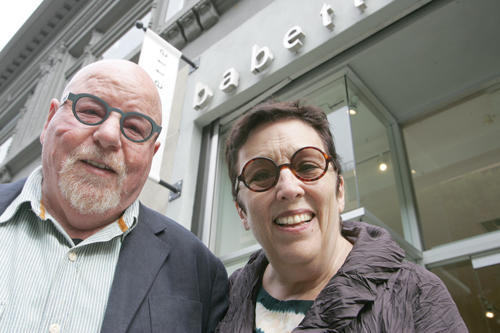
I cannot help but insert italics into Babette Pinsky quotes, bear with me.

“It didn’t dawn on me that I shouldn’t open a business by myself.”

“It was sort of survival for a really long time.”

“We have to show things the way we want them.”

Perhaps such signs of effusiveness are befitting for one of the Bay’s more experienced purveyors of fashion.

Pinsky started her line of comfortable, elegant items most often worn by town’s over-40 set of museum and travel-inclined doyennes back in 1968. She considers the eponymous line’s signature piece a pleated cream or white button-down shirt.

Her retail locations — there are eight Babette stores across the country with a ninth in the works for the Mid-West, and the company recently launched a thriving e-commerce site — is filled with outfits for “the woman who wants to look good without looking like her daughter,” says Pinsky, sitting for our interview with husband and co-owner of the company Steven in their Union Square shop.

But the Pinskys’ sartorial sense is but one of the reasons we’re honoring them with a Small Business Award. Perhaps just as importantly, the two provide healthcare and 401k’s for all of their 100-plus employees, and have always manufactured their clothes right here in the Bay Area, currently at their Oakland factory.

The two attribute their buoyancy in the fashion industry, in fact, to their local production line. Trade policies like NAFTA, they say, decimated the Bay Area’s fashion industry, once one of San Francisco’s biggest job sources. Their ability to continue producing quality product right here in California, they say, distinguished them from the thousands who lost their jobs over the last few decades.

Now, having survived the worst of times, Babette (the company and its founder) can be a role model company to those who would make beautiful clothes.

“The most rewarding part of this business?” asks Babette (the person this time, over a pair of round glasses that go nicely with those that Steven wears alongside her). “A big part of that is how happy [the clothes] make our customer. I’ll come into one of our stores and a woman will tell me ‘you’ve changed my life!’ I’m a clothing designer! It’s just clothes.”

361 Sutter, SF. (415) 837-1442, www.shopbabette.com

Small Business Awards 2013: It’s-It

0

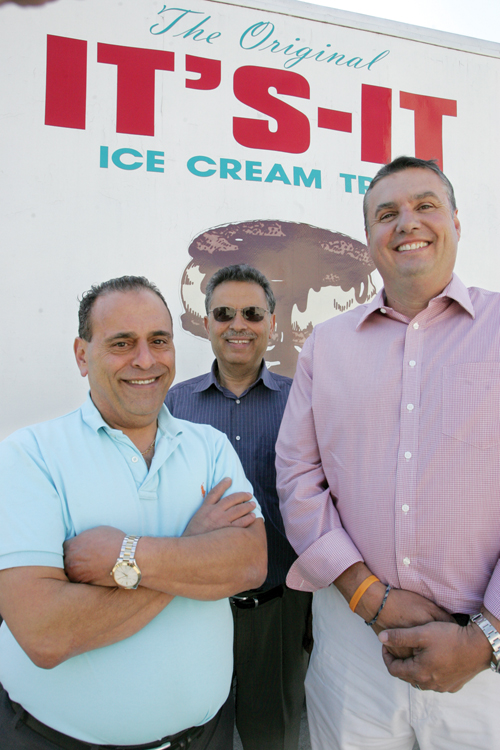
What’s been San Francisco’s go-to cold ‘n creamy treat for the past 85 years? No, its not Dianne Feinstein. It’s It’s-It, that native warm weather snack, created on a deliciously fateful day in 1928 when George Whitney squished a scoop of vanilla ice cream between two big oatmeal cookies and dipped the resulting sandwich into dark chocolate. For more than four decades, Whitney sold his It’s-Its at Playland-at-the-Beach, until that legendary local amusement park was demolished in the 1970s. Fortune intervened, and the brand was reinvigorated — soon to travel beyond the Bay, throughout California, and into pretty much every western state, spreading yumminess up and down the coast.

The Shamieh family now operates It’s-It (the company, based in Burlingame, is headed by Charles Shamieh) and continues to uphold the tasty tradition of “the official food of San Francisco.” (Take that, cioppino!)

“Sure it’s always a tough to be the little guy — when you’ve got your Nestles and your Unilevers out there as competition,” vice president of sales Jim Shamieh told us. “But we have an amazing built-in fan base that includes parents, grandparents, great-grandparents … it’s the best kind of loyalty. And we keep it current by introducing different flavors.” (Those flavors include the Big Daddy — a “chunk of ice cream between two chocolate wafers” — and the Super Sundae, an ice cream dipped in dark chocolate and rolled in roasted peanuts). “And we distribute to Denver, Seattle, Portland … pretty much everywhere this side of the Rocky Mountains.” Sweet.

www.itsiticecream.com

Small Business Awards 2013: R&G Lounge

1

The R & G Lounge has been a fixture in San Francisco’s Chinatown for 28 years. Taking up three floors with a seating capacity of 225, it’s served as the backdrop for many a wedding rehearsal dinner, birthday celebration, and other special occasion bashes. But it isn’t just heartwarming memories of being surrounded by friends and family with a pleasant Tsingtao buzz that linger in diners’ minds. Just as often, it’s the taste of the establishment’s signature seafood plate: salt and pepper live Dungeness crab.

“It was love at first bite,” a 25-year-old Yelper gushes about the first time she tried the specialty, back when she was in the seventh grade. The dish is available year-round, sourced locally when in season.

The R & G Lounge is known for dishing up traditional Cantonese cuisine from the Guangdong province of southern China. Most of the workers are originally from mainland China, and live in the city.

“We have a low turnover,” manager Frank Wong says of his staff, which is 70 strong. Rather than puffing up any star chefs, Wong describes the working atmosphere as decidedly “team-oriented.” Conversations in Cantonese and Mandarin float through the air, mingling with the savory aromas of ox tail stew, chow mein, Peking duck, or steamed fish plucked straight from the tank. Chinatown activist groups laud the restaurant for its exemplary treatment of workers, and efforts to extend benefits to them rarely seen in the neighborhood.

The restaurant has deep roots in the Chinatown community, regularly donating to schools in the area. When hosting community-based functions, “we work a lot through the San Francisco Chinese Chamber of Commerce,” says Wong, adding that multiple family members and investors own the popular restaurant, including Kinson Wong.

This connection helps drive a steady stream of “locals, business people, and tourists” through R & G’s doors, and since its located along the route of the Chinese New Year Parade, the sound of drums and the sight of a dragon procession can make for delicious accompaniment for your meal. 

631 Kearny, SF. (415) 982-7877, www.rnglounge.com

Selector: May 15-21, 2013

0

WEDNESDAY 15

Appleseed Cast

Change seems to be the only constant for Lawrence, Kansas’ meandering Appleseed Cast. Chris Crisci’s 14-year-old band has produced eight albums, dabbled in about as many different genres, and has a revolving-door lineup that would exhaust any frontperson. But Crisci shows no signs of tiring. In fact, the lyrics for the band’s most recent album, this year’s Illumination Ritual, were written over the course of three nights, between the hours of midnight and 4am. Though the band’s career has arced far from its oldschool emo beginnings, the vespertine Illumination Ritual gets back to its moody roots. With a fresh lineup and a nostalgic new sound, the Appleseed Cast’s tender instrumentals and Crisci’s earnest vocals have never sounded so good. (Haley Zaremba)

With Hospital Ships, the Dandelion War

8:30pm, $14

Bottom of the Hill

1233 17th St, SF

(415) 626-4455

www.bottomofthehill.com


THURSDAY 16

ArtPad

Here’s an idea for a surrealist film: enter one hotel room and find metal hands that respond to their viewers, enter another and find a strange light sculpture, then cut to a performance of a synchronized swimming team in a pool in the courtyard. This is no film plot, but a description of ArtPad, the arts fair that will take over the entire Phoenix Hotel for three days. With galleries from the Bay Area and beyond filling every room with experimental exhibitions, while food, drink, and performances contribute to the festive vibe, the event promises to be surreally epic. (Laura Kerry)

Through May 19

$15–$40

Phoenix Hotel

601 Eddy, SF

www.artpadsf.com


Liss Fain

It was almost exactly a year ago that Liss Fain Dance premiered her luminous The Water is Clear and Still at Z Space. It’s perhaps her must successful collaboration with her longtime designer Matthew Antaky, who created a translucent multi-level space that welcomed Fain’s choreography and her fine dancers. It was one of those wondrous installation pieces that you could walk around in, but most of us stayed glued to our spots in an attempt to catch everything. Water is steeped in Jamaica Kincaid’s lyrical memories of a Caribbean childhood, both painful and exotic. Fain now has added a prologue. Solid Ground, based on Kincaid’s latest book, in which she revisits those childhood memories from a mature woman’s perspective. The piece is also moving from Z Space to YBCA’s Forum, which has successfully hosted other Liss Fain Dance installations. (Rita Felciano)

Thu/16-Sat/18, 8pm; Sun/19, 5pm forum, $15–$30

Yerba Buena Center for the Arts

700 Howard, SF

www.lissfaindance.org


Sandra Bernhard

It’s hard to pinpoint the moment when one learned that Sandra Bernhard was amazing. The stand-up comedian has been doing the damn thing for so long (since the ’70s), that she’s always just — been around, a fixture of the alternative culture firmament. A foulmouthed, straightforward, erudite queer back when they never made it network TV, she languidly lent cameos to Isaac Mizrahi’s Stripped and Madonna’s Truth or Dare, turned in seam-busting rants for her epic performance art-concert films like 1990’s Without You, I’m Nothing, and yes, was the first regular-appearing gay character on a network sitcom on Roseanne. To miss Bernhard’s first run in San Francisco in two years would be a revocation of your cool card, don’t do it. (Caitlin Donohue)

Also Fri/17

9pm, $45

Bimbo’s 365 Club

1025 Columbus, SF

(415) 474-0365

www.bimbos365club.com


Big Boi

Any lingering notions of Big Boi as the “conventional” half of legendary Atlanta hip-hop duo Outkast should be dispelled by his two solo albums, including his most recent effort Vicious Lies and Dangerous Rumors, released last November. Aided by cameos from Phantogram and Little Dragon in “Vicious,” Big Boi dives into rock guitars, female vocalists, and electronic bass to present a fearless, kaleidoscopic vision of rap. Track “Objectum Sexuality” sees Big Boi wax lyrical about women in between Phantogram’s Sarah Barthel’s floating vocals, a French interlude, and samples of atmospheric harp plucking. And just when you think he has slipped too far into moody, indie-fusion territory, Big Boi snaps you back with a devastating, horns-laden, proudly Atlantan club banger “In the A” with T.I. and Ludacris. (Kevin Lee)

With Killer Mike, Fishhawk, Goast

8:30pm, $35

Mezzanine

444 Jessie

(415) 625-8880

www.mezzaninesf.com


Janelle Monae at the SF Symphony

“Is it peculiar that she twerk in the mirror?” You can’t really blame her if you’ve caught R&B andro-angel Janelle Monae’s newest single with Erykah Badu “Q.U.E.E.N.” — the ode to iconoclasm, with its simple, catchy bass line is the perfect soundtrack to strutting and popping in front of reflective surfaces. Catch the singer’s turn with the SF Symphony tonight — the musicians have prepared original arrangements for her songs, and you’ll get tunes from her new album to boot. The ticket price is fairly astronomical, but the evening is a fundraiser for the Symphony’s educational programs, so there’s that. Plus attendees are granted access to a pre-show sparkling wine reception and after-party at City Hall. (Donohue)

7pm reception, 8pm concert, $90-$275

Davies Symphony Hall

201 Van Ness, SF

www.sfsymphony.org


FRIDAY 17

Midi Matilda

The first time I was confronted with local pop duo Midi Matilda, I was not-so-patiently waiting for Starfucker to take the stage at the Regency Lodge last September. Not expecting much from an electronic duo that was playing one of its very first shows, I was dumbstruck by the second song. Midi Matilda is the embodiment of everything that’s missing from contemporary twee-pop. It has a sense of intimacy, soul, and joy, embodied by great hooks and hilarious choreographed dances that are absolutely infectious. Operating backward from most bands, Midi Matilda wrote and recorded music before it ever established a live presence, gaining attention on the web with its “Day Dreams” music video. The duo’s catchy, dreamy pop songs make for a nice listen, but it is its goofy antics and blissful onstage presence that make a great new addition to the San Francisco music scene. (Zaremba)

With OONA, holychild

8:30pm, $12

Rickshaw Stop

155 Fell, SF

(415) 861-2011

www.rickshawstop.com


Dale Earnhardt Jr. Jr.

“You’re Supposed To Roll Your Hips In Time/ You’re Supposed To See Your Age Rewind” intones Dale Earnhardt Jr. Jr. on the bright electronic pop track “If You Didn’t See Me (Then You Weren’t On The Dancefloor),” off its new Patterns EP. On its albums, the Detroit duo of Daniel Zott and Joshua Epstein alternate between aw-shucks folksiness and the party-hearty synth-and-rock of MGMT and Phoenix. While firmly rooted in the here and now, DEJJ have shown respect to its musical inspirations with covers to classics by Madonna and the Beach Boys. The duo paid homage to Gil-Scott Heron with a shimmering, upbeat take on his funk classic “We Almost Lost Detroit,” resplendent with a video showcasing authentic locals and establishments from the Motor City. (Lee)

9pm, $16

Independent

628 Divisadero

(415) 771-1421

www.theindependentsf.com


SATURDAY 18

Disappears

A 16-minute song has to do a lot of work to keep its listeners invested, but the strange thing about Disappears’ “Kone” off of the band’s April EP is that it is compelling because it doesn’t seem to make too much of an effort. An experiment in Kraut and psych-rock, the song harkens back to the very beginnings of proto-punk; though it involves less muddy intensity, it recalls those stretches in some Velvet Underground songs that don’t feel the need to arrive anywhere, but simply relish the ride. And isn’t that the aim of any good concert? It certainly will be at the Disappears’ Bottom of the Hill show. (Kerry)

With LENZ, the Tambo Rays

10pm, $12

Bottom of the Hill

1233 17th St., SF

(415) 626-4455

www.bottomofthehill.com


Exrays and Mwahaha

Going to the Lab is like a weekly, weekend celebration of “the other.” You might see any combination of drag, performance art interludes, or Sunday’s ritual Godwaffle Noise Pancakes, but should definitely count on some underground, experimental shit. Hidden among the crowded club corridor along 16th and Mission, at times it becomes a mini-rave cave. This Sat/18 should be no exception to those guidelines when Exrays (members of THEMAYS and Maus Haus) bring their old-school Atari-sounding glitchiness. The band hangs on to fun melodies while the frontperson delivers mopey vocals (it could just be that his voice is deep). Oakland’s Mwahaha headlines and goes for more of a sensory overload approach. It’s collaborated with tUnE-yArDs and will open for Sigur Ros in London this summer. (Andre Torrez)

With Seventeen Evergreen, Mohani

9pm, $7–$15 (sliding scale)

Lab

2948 16th St., SF

(415) 864-8855

www.thelab.org


Hunx and His Punx

It was a dark day here in the Bay when Seth Bogart, a.k.a Hunx, packed up his bags and moved to Los Angeles, leaving the city’s burgeoning garage rock scene a little less gay in every way. Despite this tragic loss, Bogart hasn’t slowed down at all since his relocation, with a variety web TV show (Hollywood Nailz), his own novelty record label (Wacky Wacko), a new solo album, and a brand new Hunx and His Punx record on the way. Despite the 2011 dissolution of the Punkettes, Hunx still rocks a deliciously genderqueer persona and is backed by some truly kickass ladies. This intimate show, featuring bandmate Shannon Shaw’s own group Shannon and the Clams as well as fellow SF ex-pat Ty Segall’s Fuzz is like a big, happy Bay Area reunion — and everyone’s invited! (Zaremba)

With Shannon and the Clams, Fuzz, Peach Kelli Pop, Twin Steps

8pm, $15

New Parish

579 18th St, Oakl.

(510) 444-7474

www.thenewparish.com


SUNDAY 19

Gothic Tropic

For a band that has released so little music — only the 2011 EP Awesome Problems — Gothic Tropic has a developed sense of itself. Part of it is in frontperson Cecilia Della Peruti’s tendency to perform shoeless so as not restrict her dance moves. Another aspect arises in her nickname for the trio, “the Sacred Three.” The primary feature, though, is the band’s sound. As its name suggests, Gothic Tropic plays sunny and exotic psych-pop tinted with some grit and darkness, and it plays it well. See the band in all of it’s fully-formed glory at Brick and Mortar. (Kerry)

With Seatraffic, Cruel Summer

9pm, $10

Brick and Mortar

1710 Mission, SF

(415) 800-8782

www.brickandmortarmusic.com


TUESDAY 21

“Eating Nose-to-Tail: The Whole Animal Movement”

Let’s face it, Americans loves meat. But everyday consumers and informed connoisseurs are grappling with an increasing number of unanswered health and environmental questions with their meat, questions that an increasingly centralized food industry has left mostly unanswered. Unsatisfied with the growing gaps along the production chain, farmers, butchers, and chefs have banded together under the Whole Animal movement, which emphasizes using all of an animal for preparation and consumption. At this talk, four of the Bay Area’s meat authorities slice into how the movement stresses conservation and connects local producers, preparers, and eaters. After the talk, Dave the Butcher gives a whole animal butchery lesson while diners delve into delectables at the Ferry Building, with proceeds going to the Center for Urban Education about Sustainable Agriculture. (Lee)

With Chris Cosentino, Ryan Farr, John Fink and Tia Harrison

6:30pm program, $12–$20; 8pm butchering demo, $80–$100

Commonwealth Club

95 Market

(415) 597-6700

www.commonwealthclub.org


The Guardian listings deadline is two weeks prior to our Wednesday publication date. To submit an item for consideration, please include the title of the event, a brief description of the event, date and time, venue name, street address (listing cross streets only isn’t sufficient), city, telephone number readers can call for more information, telephone number for media, and admission costs. Send information to Listings, the Guardian, 225 Bush, 17th Flr., SF, CA 94105; or e-mail (paste press release into e-mail body — no attachments, please) to listings@sfbg.com. Digital photos may be submitted in jpeg format; the image must be at least 240 dpi and four inches by six inches in size. We regret we cannot accept listings over the phone.

Rep Clock

0

Schedules are for Wed/15-Tue/21 except where noted. Director and year are given when available. Double and triple features marked with a •. All times pm unless otherwise specified.

ARTISTS’ TELEVISION ACCESS 992 Valencia, SF; www.atasite.org. $6. "Other Cinema:" "Notebook Filmmaking," book release party and screening with Bill Brown, Sat, 8:30.

BALBOA 3630 Balboa, SF; www.cinemasf.com/balboa. $7.50-10. Rockshow: Paul McCartney and Wings (1980), Thu, 7:30.

CASTRO 429 Castro, SF; (415) 621-6120, www.castrotheatre.com. $8.50-13. "Harvey Milk 2013: Living the Legacy," free discussion and performance by the SF Gay Men’s Chorus, Wed, 7. •Happy Together (Wong, 1997), Thu, 7, and Fallen Angels (Wong, 1996), Thu, 8:55. "Midnites for Maniacs: Dirty Little Munchkins Triple Bill:" •The Bad News Bears (Ritchie, 1976), Fri, 7:30; Gummo (Korine, 1997), Fri, 9:30; and The Garbage Pail Kids Movie (Amateau, 1987), Fri, 11:30. Tickets are $13 for one or all three films. •Rear Window (Hitchcock, 1954), Sat, 2, 4:30, 7, and Body Double (De Palma, 1984), Sat, 9:10. Oz: The Great and Powerful (Raimi, 2013), Sun, 2, 5, 8. •Stoker (Park, 2013), Tue, 7, and Shadow of a Doubt (Hitchcock, 1943), Tue, 8:55.

CHRISTOPHER B. SMITH RAFAEL FILM CENTER 1118 Fourth St, San Rafael; (415) 454-1222, www.cafilm.org. $6.75-$10.25. The Angels’ Share (Loach, 2012), call for dates and times. Blancanieves (Berger, 2012), call for dates and times. In the House (Ozon, 2012), call for dates and times. The Reluctant Fundamentalist (Nair, 2012), call for dates and times. Renoir (Bourdos, 2012), call for dates and times. Rockshow: Paul McCartney and Wings (1980), Thu, 7, and Sat, 1. This event, $15. Midnight’s Children (Mehta, 2012), May 17-23, call for times. Stories We Tell (Polley, 2012), May 17-23, call for times. "World Ballet on the Big Screen:" Giselle, from the Royal Ballet, London, Sun, 1; Tue, 6:30.

"HIMALAYAN FILM FESTIVAL" Various SF and East Bay venues; www.himalayanfilmfest.com. $8-25. First annual festival featuring narrative and documentary "films from the roof of the world," Wed-Sun.

JOE GOODE ANNEX 401 Alabama, SF; www.rawdance.org. $5-10. "One Night, Three RAWdance Films," dance films, Thu, 7:30.

MECHANICS’ INSTITUTE 57 Post, SF; (415) 393-0100, milibrary.org/events. $10 (reservations required as seating is limited). "CinemaLit Film Series: Paddy Chayefsky: Scenes from American Lives:" The Goddess (Cromwell, 1958), Fri, 6.

NEW PARKWAY 474 24th St, Oakl; www.thenewparkway.com. $6-10. "New Parkway Classics:" Shaun of the Dead (Wright, 2004), Thu, 9pm. "Thrillville:" Foxy Brown (Hill, 1974), Sun, 6.

NINTH STREET INDEPENDENT FILM CENTER 145 Ninth St, SF; www.thespaceinvaders.org. $10. The Space Invaders: In Search of Lost Time (Von Ward, 2012), Sat, 8.

"PLAYGROUND FILM FESTIVAL" Various Bay Area venues; playground-sf.org/filmfest. $10-25. Showcasing Bay Area filmmakers and writers and their short work. Through May 25.

PACIFIC FILM ARCHIVE 2575 Bancroft, Berk; (510) 642-5249, bampfa.berkeley.edu. $5.50-9.50. PFA closed through June 5.

ROXIE 3117 and 3125 16th St, SF; (415) 863-1087, www.roxie.com. $6.50-11. The Source Family (Demopoulos and Wille, 2012), Wed-Thu, 7. Upstream Color (Carruth, 2013), Wed-Thu, 9. "I Wake Up Dreaming 2013:" •Bewitched (Oboler, 1945), Wed, 6:30, 9:45, and Five (Oboler, 1951), Wed, 8; •Undertow (Castle, 1949), Thu, 6:30, 9:40, and Shakedown (Pevney, 1950), Thu, 8; •Pickup (Haas, 1951), Fri, 6:15, 9:45, and Wicked Woman (Rouse, 1953), Fri, 8; •All Night Long (Dearden, 1961), Sat, 1:30, 5:30, 9:30, and Sweet Smell of Success (Mackendrick, 1957), Sat, 3:30, 7:30; •Female on the Beach (Pevney, 1955), Sun, 1:15, 5:30, 9:30, and Autumn Leaves (Aldrich, 1956), Sun, 3:15, 7:30; •Killer at Large (Beaudine, 1947), Mon, 6:40, 9:30, and Key Witness (Lederman, 1947), Mon, 8; •The Tattooed Stranger (Montagne, 1950), Tue, 6:40, 9:45, and My Gun is Quick (Victor and White, 1957), Tue, 8. Sun Don’t Shine (Seimetz, 2012), May 17-23, 7:15, 9:15 (also Sat-Sun, 5).

SAN FRANCISCO STATE UNIVERSITY McKenna Theater, Creative Arts Building, 1600 Holloway, SF; www.sffilmfinals.com. Free. "53rd Film Finals," Fri, 7. Award ceremony and reception follows.

YERBA BUENA CENTER FOR THE ARTS 701 Mission, SF; www.ybca.org. $8-10. "Girls! Guns! Ghosts! The Sensational Films of Shintoho:" The Horizon Glitters (Doi, 1960), Thu, 7:30; •Vampire Bride (Namiki, 1960), Sun, 2, and Ghost Cat of Otama Pond (Ishikawa, 1960), Sun, 3:45.

Stage listings

0

Stage listings are compiled by Guardian staff. Performance times may change; call venues to confirm. Reviewers are Robert Avila, Rita Felciano, and Nicole Gluckstern. Submit items for the listings at listings@sfbg.com.

THEATER

OPENING

Arcadia ACT’s Geary Theater, 415 Geary, SF; www.act-sf.org. $20-95. Previews Thu/16-Sat/18, 8pm (also Sat/18, 2pm); Sun/19, 2pm. Opens Wed/22, 8pm. Runs Tue-Sat, 8pm (also Wed and Sat, 2pm; May 28 show at 7pm); Sun, 2pm (additional show May 26, 8pm). Through June 9. American Conservatory Theater performs Tom Stoppard’s literary romance.

Birds of a Feather New Conservatory Theatre Center, 25 Van Ness, SF; www.nctcsf.org. $25-45. Previews Fri/17-Sat/18, 8pm (also Sat/18, 2pm); Sun/19, 2pm. Opens Fri/24, 8pm. Runs Fri-Sat, 8pm (also Sat, 2pm); Sun, 2pm. Through June 29. New Conservatory Theatre Center performs the San Francisco premiere of Marc Acito’s tale inspired by two gay penguins at the Central Park Zoo.

Burqavaganza Brava Theater Center, 2781 24th St, SF; www.brava.org. $20. Opens Thu/16, 8pm. Runs Thu-Sat, 8pm; Sun, 3pm. Through June 2. Brava! For Women in the Arts and RasaNova Theatre present Shahid Nadeem’s Bollywood-style “love story in the time of jihad.”

Krispy Kritters in the Scarlett Night Exit on Taylor, 277 Taylor, SF; www.cuttingball.com. $10-50. Previews Fri/17-Sat/18, 8pm; Sun/19, 5pm. Opens May 23, 7:30pm. Runs Thu, 7:30pm; Fri-Sat, 8pm (also Sat, 2pm; no shows June 8); Sun, 5pm. Through June 16. Cutting Ball Theater performs Andrew Saito’s Howl-inspired portrait of San Francisco.

ONGOING

Acid Test: The Many Incarnations of Ram Dass Marsh San Francisco, 1062 Valencia, SF; www.themarsh.org. $15-50. Fri/17, 8pm; Sat/18, 5pm. Playwright Lynne Kaufman invites you to take a trip with Richard Alpert, a.k.a. Ram Dass (Warren David Keith), as he recounts times high and low in this thoughtful, funny, and sometimes unexpected biographical rumination on the quest for truth and meaning in a seemingly random life by one of the big wigs of the psychedelic revolution and (with his classic book, Be Here Now) contemporary Eastern-looking spirituality. Directed by Joel Mullennix, the narrative begins with Ram Dass today, in his Hawaiian home and partly paralyzed from a stroke, but Keith (one of the Bay Area’s best stage actors, who is predictably sure and engagingly multilayered in the role) soon shakes off the stiff arm and strained speech and springs to his feet to continue the narrative as the ideal self perhaps only transcendental consciousness and theater allow. Nevertheless, Kaufman’s fun-loving and extroverted Alpert is no saint and no model of perfection, which is the refreshing truth explored in the play, but rather a seeker still, ever imperfect and ever trying for greater perfection or at least the wisdom of acceptance. As the privileged queer child of a wealthy Jewish lawyer and industrialist, Alpert was both insider and outsider from the get-go, and that tension and ambiguity makes for an interesting angle on his life as well as the complexities of his relationships with a homophobic Leary, for instance, and his conservative but ultimately loving father. Perfection aside, the beauty in the subject and the play is the subtle, shrewd cherishing of what remains unfinished. (Avila)

Black Watch Drill Court, Armory Community Center, 333 14th St, SF; www.act-sf.org. $100. Tue-Sat, 8pm (also Wed and Sat, 2pm); Sun, 2pm. Through June 16. American Conservatory Theater presents the National Theatre of Scotland’s internationally acclaimed performance about Scottish soldiers serving in Iraq.

Boomeraging: From LSD to OMG Marsh San Francisco, 1062 Valencia, SF; www.themarsh.org. $15-50. Tue, 8pm. Through May 28. Comedian Will Durst performs his brand-new solo show.

Dirty Dancing: Live! Dark Room, 2263 Mission, SF; dirtydancinglive-fbe.eventbrite.com. $20. Fri-Sat, 8pm. Through May 25. Watermelons will be carried, lifts will be attempted, eyes will be hungry, and nobody better put Baby in a corner.

Foodies! The Musical Shelton Theater, 533 Sutter, SF; www.foodiesthemusical.com. $30-34. Fri-Sat, 8pm. Open-ended. AWAT Productions presents Morris Bobrow’s musical comedy revue all about food.

Last Love Mojo Theatre, 2940 16th St, SF; www.mojotheatre.com. $17-30. Thu/16-Sun/19, 8pm. Will the apocalypse save us from ourselves? Mojo Theater again raises that question as it presents the second installment in director-playwright Peter Papadopoulos’ Love-Gone-Wrong-at-the-End-of-the-World trilogy, the follow-up to last season’s fertile and funny Lost Love. The story centers on a George and Martha-esque couple, Charles (Jonathan Bender) and Lucida (Kimberly Lester), who on the eve of their fifth wedding anniversary declare all-out war, lobbing younger lovers at each other only to find their new partners (played by an increasingly endearing Michael Saenz and an unexpectedly powerful Gloria McDonald) have a past together and unresolved issues of their own. The grimly romantic comedy returns to, without greatly elaborating on, a familiar fantasy: blowing away the haze of our fractious, insecure, and muddled love lives in the clarifying immediacy of disaster. That this may be more than pure fantasy — that the seemingly discrete realms of personal and political trauma may be in some subtle and profound way connected — is an animating dimension of the trilogy, but here in a more superficial and perfunctory fashion than in Lost Love. The strength of the production lies less in its premise than in the penetrating humor and emotional veracity in Papadopoulos’ sure, heightened dialogue, which is played generally well by the cast and exceptionally so by a vibrantly intelligent Lester, Mojo’s co–artistic director. The staging also benefits, albeit inconsistently, from a stylized approach that revels in self-conscious artifice (including a trio of stage managers from “Command Center Communications,” a video-backdrop by Micah Stieglitz, and some light choreography by Lester). These strengths lend a restless, occasionally inspired production a slow-burning charm, but leave one wondering what might be left when all the dust settles. (Avila)

Little Me Eureka Theatre, 215 Jackson, SF; www.42ndstreetmoon.org. $25-75. Wed/15, 7pm; Thu/16-Fri/17, 8pm; Sat/18, 6pm; Sun/19, 3pm. 42nd Street Moon performs Neil Simon’s outrageous musical.

The Lost Folio: Shakespeare’s Musicals Un-Scripted Theater, 533 Sutter, Second Flr, SF; www.un-scripted.com. $10-20. Thu/16-Sat/18, 8pm. Un-Scripted Theater Company performs a fully-improvised, full-length musical inspired by Shakespeare.

The Merry Wives of Windsor Buriel Clay Theater, African American Art and Culture Complex, 762 Fulton, SF; www.african-americanshakes.org. $10-35. Sat, 8pm; Sun, 3pm. Through May 26. They might be two of the town’s most respectable matrons, but Mistresses Page (Safiya Fredericks) and Ford (Leontyne Mbele-Mbong), the titular Merry Wives of Windsor, at the African-American Shakespeare Company, are nobody’s fools. When the bawdy, ne’er-do-well Falstaff (a cross-dressing Beli Sullivan) tries to woo the two at the same time (as much for money as lust), they easily turn the tables on his plotting, and further dampen his ardor by having him tossed in a ditch. Their husbands, in particular the suspicious yet constantly flummoxed Master Ford (Armond Edward Dorsey), fare not much better against the wonder-twin powers of their BFF wives, and for anyone keeping score, the entire female population of Windsor generally makes out better than their slow-on-the-uptake menfolk, and they do it in style thanks to Linda Tucker’s astute, 50s-era costume design. Under Becky Kemper’s direction, the attitude skews sassy, and each character — from the befuddled town elite to the simplest servant — is a broadly-painted stroke of buffoonery, one part Desperate Housewives melodrama and one part Marx Brother’s farce. Kemper calls her rowdy take on this battle-of-the-sexes comedy “a guilty pleasure,” reminding us that however hallowed the name of Shakespeare might remain in posher circles, a good portion of his canon was written not for the austere glory of posterity, but for the base enjoyment of the general populace. (Gluckstern)

“PlayGround Festival of New Works” Various venues, SF and Berk; www.playground-sf.org. $15-40. Through May 26. The long-running short-play contest and development lab marks its 17th season with an evening showcasing the best of the previous year. The six plays come from six (familiar and new) playwrights out of a pool of 36 new short plays developed by PlayGround since October (and those were drawn from over 190 new original scripts created). The best of the best receives a rotating cast of strong Bay Area actors under six accomplished directors (including PlayGround founder Jim Kleinmann) but is a mixed affair, nevertheless. Katie May’s The Spherical Loneliness of Beverly Onion is a sometimes funny but generally tepid short story about a lonely mortician’s assistant (Carla Pantoja) who confronts her handlers, the natural forces of Fate (Jomar Tagatac) and Luck (Anne Darragh). Simple and Elegant, by Evelyn Jean Pine, is an ocean-side fairytale whose themes don’t sound too deeply, about the titular pair of sisters (Rebecca Pingree and Pantoja) who have a near-fatal falling out over a gold coin salvaged from the belly of a fish (Dao) who may be a handsome prince for one of them or just a nice hideaway bed. In Ruben Grijalva’s Value over Replacement, a major league player (Tagatac) confronts a career-jeopardizing accusation from a journalist-guest (Delzell) on his talk radio show in a somewhat prosaic but dramatically compact, carefully written and well-acted piece. Significant People, by Amy Sass, follows two docents (Darragh and Delzell) through the preserved home of two significant others who seem to be the same people. It’s a quirky conceit that doesn’t quite produce the necessary dramatic tension, the stakes feeling too low. In My Better Half, by Jonathan Spector, quirkiness goes full-bore as a wife (Pingree) with a justifiable complaint against her obliviously self-centered, what-me husband (Dao) looks to have him rubbed out by a reluctant hit man (Tagatac) and his couples-therapist colleague (Darragh). Finally, Symmetrical Smack-Down is William Bivins’ funny and nicely orchestrated foursome, in which the dynamic between two antagonists in the wrestling ring (Tagatac and Delzell) overlaps (literally and dramatically) with that between a long-term lesbian couple (Pingree and Pantoja) on the brink of a break-up and/or rumble. (Avila)

Sex and the City: LIVE! Rebel, 1760 Market, SF; trannyshack.com/sexandthecity. $25. Wed, 7 and 9pm. Open-ended. It seems a no-brainer. Not just the HBO series itself — that’s definitely missing some gray matter — but putting it onstage as a drag show. Mais naturellement! Why was Sex and the City not conceived of as a drag show in the first place? Making the sordid not exactly palatable but somehow, I don’t know, friendlier (and the canned a little cannier), Velvet Rage Productions mounts two verbatim episodes from the widely adored cable show, with Trannyshack’s Heklina in a smashing portrayal of SJP’s Carrie; D’Arcy Drollinger stealing much of the show as ever-randy Samantha (already more or less a gay man trapped in a woman’s body); Lady Bear as an endearingly out-to-lunch Miranda; and ever assured, quick-witted Trixxie Carr as pent-up Charlotte. There’s also a solid and enjoyable supporting cast courtesy of Cookie Dough, Jordan Wheeler, and Leigh Crow (as Mr. Big). That’s some heavyweight talent trodding the straining boards of bar Rebel’s tiny stage. The show’s still two-dimensional, even in 3D, but noticeably bigger than your 50″ plasma flat panel. (Avila)

Steve Seabrook: Better Than You Marsh San Francisco, 1062 Valencia, SF; www.themarsh.org. $15-50. Thu/16, 8pm; Sat/18, 8:30pm. Self-awareness, self-actualization, self-aggrandizement — for these things we turn to the professionals: the self-empowerment coaches, the self-help authors and motivational speakers. What’s the good of having a “self” unless someone shows you how to use it? Writer-performer Kurt Bodden’s Steve Seabrook wants to sell you on a better you, but his “Better Than You” weekend seminar (and tie-in book series, assorted CDs, and other paraphernalia) belies a certain divided loyalty in its own self-flattering title. The bitter fruit of the personal growth industry may sound overly ripe for the picking, but Bodden’s deftly executed “seminar” and its behind-the-scenes reveals, directed by Mark Kenward, explore the terrain with panache, cool wit, and shrewd characterization. As both writer and performer, Bodden keeps his Steve Seabrook just this side of overly sensational or maudlin, a believable figure, finally, whose all-too-ordinary life ends up something of a modest model of its own. (Avila)

Talk Radio Actors Theatre of San Francisco, 855 Bush, SF; www.actorstheatresf.org. $26-38. Wed-Sat, 8pm. Through June 15. Actors Theatre of San Francisco performs Eric Bogosian’s breakthrough 1987 drama.

Tinsel Tarts in a Hot Coma: The Next Cockettes Musical Hypnodrome, 575 10th St, SF; www.thrillpeddlers.com. $30-35. Thu-Sat, 8pm. Extended through June 29. Thrillpeddlers and director Russell Blackwood continue their Theatre of the Ridiculous series with this 1971 musical from San Francisco’s famed glitter-bearded acid queens, the Cockettes, revamped with a slew of new musical material by original member Scrumbly Koldewyn, and a freshly re-minted book co-written by Koldewyn and “Sweet Pam” Tent — both of whom join the large rotating cast of Thrillpeddler favorites alongside a third original Cockette, Rumi Missabu (playing diner waitress Brenda Breakfast like a deliciously unhinged scramble of Lucille Ball and Bette Davis). This is Thrillpeddlers’ third Cockettes revival, a winning streak that started with Pearls Over Shanghai. While not quite as frisky or imaginative as the production of Pearls, it easily charms with its fine songs, nifty routines, exquisite costumes, steady flashes of wit, less consistent flashes of flesh, and de rigueur irreverence. The plot may not be very easy to follow, but then, except perhaps for the bubbly accounting of the notorious New York flop of the same show 42 years ago by Tent (as poisoned-pen gossip columnist Vedda Viper), it hardly matters. (Avila)

The Waiting Period Marsh San Francisco, 1062 Valencia, SF; www.themarsh.org. $25-50. Fri/17, 8pm; Sat/18, 5pm. Brian Copeland (comedian, TV and radio personality, and creator-performer of the long-running solo play Not a Genuine Black Man) returns to the Marsh with a new solo, this one based on more recent and messier events` in Copeland’s life. The play concerns an episode of severe depression in which he considered suicide, going so far as to purchase a handgun — the title coming from the legally mandatory 10-day period between purchasing and picking up the weapon, which leaves time for reflections and circumstances that ultimately prevent Copeland from pulling the trigger. A grim subject, but Copeland (with co-developer and director David Ford) ensures there’s plenty of humor as well as frank sentiment along the way. The actor peoples the opening scene in the gun store with a comically if somewhat stereotypically rugged representative of the Second Amendment, for instance, as well as an equally familiar “doood” dude at the service counter. Afterward, we follow Copeland, a just barely coping dad, home to the house recently abandoned by his wife, and through the ordinary routines that become unbearable to the clinically depressed. Copeland also recreates interviews he’s made with other survivors of suicidal depression. Telling someone about such things is vital to preventing their worst outcomes, says Copeland, and telling his own story is meant to encourage others. It’s a worthy aim but only a fitfully engaging piece, since as drama it remains thin, standing at perhaps too respectful a distance from the convoluted torment and alienation at its center. Note: review from an earlier run of the same production. (Avila)

Vital Signs: The Pulse of an American Nurse Marsh San Francisco, 1062 Valencia, SF; www.themarsh.org. $15-50. Sun, 7pm. Through June 16. Registered nurse Alison Whittaker returns to the Marsh with her behind-the-scenes show about working in a hospital.

The World’s Funniest Bubble Show Marsh San Francisco, 1062 Valencia, SF; www.themarsh.org. $8-50. Sun, 11am. Through July 21. Louis “The Amazing Bubble Man” Pearl returns after a month-long hiatus with his popular, kid-friendly bubble show.

BAY AREA

The Dead Girl Avant Garde, 1328 Fourth St, San Rafael; www.altertheater.org. $25. Wed/15, 7:30pm; Fri/17-Sat/18, 8pm; Sun/19, 3pm. AlterTheater performs 90-year-old playwright Ann Brebner’s new family drama.

A Killer Story Marsh Berkeley, 2120 Allston, Berk; www.themarsh.org. $20-50. Thu/16-Sat/18, 8pm (pre-show cabaret at 7:15pm). Dan Harder’s film noir-inspired detective tale premieres at the Marsh Berkeley.

Pericles, Prince of Tyre Berkeley Repertory Theatre, 2025 Addison, Berk; www.berkeleyrep.org. $29-77. Tue, Thu-Sat, 8pm (also Sat and May 23, 2pm; no show May 24); Wed and Sun, 7pm (also Sun, 2). Through May 26. Mark Wing-Davey directs Berkeley Rep’s take on the Bard.

PERFORMANCE/DANCE

ACT Master of Fine Arts Program performances ACT’s Hastings Studio Theater, 77 Geary, SF, and ACT’s Costume Shop Theater, 1117 Market, SF; www.act-sf.org. $30 (two shows for $40; three shows for $50). American Conservatory Theater’s acclaimed grad program presents Caryl Churchill’s Cloud 9 (Wed/15 and Fri/17, 7:30pm; Sat/18, 2pm); Bertolt Brecht’s Galileo (Thu/16-Sat/18, 7:30pm); and August Wilson’s Seven Guitars (Thu/16 and Sat/18, 7:30pm; Sun/19, 2pm) in repertory.

Ananta Project Z Space, 450 Florida, SF; www.theanantaproject.org. Fri/17-Sat/18, 8pm. $20. The dance company presents its spring season performances, including two world premieres: The Hush Hush Chronicles and Kittleslip.

“Asia on Stage” SOMArts Cultural Center, 934 Brannan, SF; gapashow@yahoo.com. Sat/18, 7pm. $20. Performance program featuring LIKHA Pilipino Folk Ensemble’s Pilgrim, a dance theater work about gay Asian immigrants.

Sandra Bernhard Bimbo’s 365 Club, 1025 Columbus, SF; www.bimbos365club.com. Thu/16-Fri/17, 8pm. $45. The comedian performs her latest show, I Love Being Me, Don’t You?

Caroline Lugo and Carolé Acuña’s Ballet Flamenco Peña Pachamama, 1630 Powell, SF; www.carolinalugo.com. Sat/18, 6:15pm. $15-19. Flamenco performance by the mother-daughter dance company, featuring live musicians.

“Cirque de l’Arc” Arc San Francisco, 1500 Howard, SF; cirque2013.eventbrite.com. Thu/16, 6-9pm. $100. Help raise money for the Arc San Francisco, serving adults with developmental disabilities, at this circus-themed party featuring an all-star drag performance and the San Francisco Gay Men’s Chorus.

“The Fantasticks” Mission Dolores Academy Auditorium, 3371 16th St, SF; www.16thstreetplayers.org. Sat/18, 7:30pm; Sun/19, 3pm. Free. The 16th Street Players perform the classic musical.

“The Gospel of Mary Magdalene” Kanbar Hall, JCCSF, 3200 California, SF; www.jccsf.org. Sun/19, 7pm. $25. Live musical excerpts from a San Francisco Opera world premiere by Mark Adamo.

“Improvised Murder Mystery” Bayfront Theater, B350 Fort Mason Center, SF; www.improv.org. Sat/18 and May 25, 8pm. $20. BATS Improv performs one of its most popular shows.

“Kunst-Stoff Arts Fest 2013” Kunst-Stoff Arts, One Grove, SF; www.kunst-stoff.org. May 15-June 7. Most events $10-15. Morning classes, afternoon workshops, and evening performances are the focus of this festival of dance, film, music, and more.

Lenora Lee Koret Auditorium, de Young Museum, Golden Gate Park, 50 Hagiwara Tea Garden Dr, SF; www.deyoungmuseum.org. Fri/17, 7pm. Museum admission $6-10.The multi-disciplinary dance artist and de Young Artist fellow presents a live performance by composer Frances Wong (Miyoshi Sketches) and an excerpt from her own The Escape.

Liss Fain Dance Yerba Buena Center for the Arts, 701 Mission, SF; www.lissfaindance.org. Thu/16-Sat/18, 8pm; Sun/19, 5pm. $15-30. The company presents an encore showing of The Water is Clear and Still, a performance installation that combines dance, music, and spoken text from stories by Jamaica Kincaid.

Ross Matthews Regency Ballroom, 1300 Van Ness, SF; www.theregencyballroom.com. Thu/16, 8pm. $32.50. The TV personality performs stand-up and celebrates the launch of his new book, Man Up! Tales of My Delusional Self-Confidence.

“Mission Position Live” Cinecave, 1034 Valencia, SF; www.missionpositionlive.com. Thu, 8pm. Ongoing. $10. Stand-up comedy with rotating performers.

“Mutant Creatures and Unlikely Teachers: Short Plays by Short People” Brava Theater Center, 2781 24th St, SF; www.stagewright.org. Thu/16, 6:30pm, $10; and Fri/17, 7pm, $50 (fundraiser for StageWright program). StageWright presents plays by fifth graders at Starr King Elementary School, performed by professional actors and museums.

Red Hots Burlesque El Rio, 3158 Mission, SF; www.redhotsburlesque.com. Wed, 7:30-9pm. Ongoing. $5-10. Come for the burlesque show, stay for OMG! Karaoke starting at 8pm (no cover for karaoke).

“San Francisco Magic Parlor” Chancellor Hotel Union Square, 433 Powell, SF; www.sfmagicparlor.com. Thu-Sat, 8pm. Ongoing. $40. Magic vignettes with conjurer and storyteller Walt Anthony.

Smuin Ballet Yerba Buena Center for the Arts, 701 Mission, SF; www.smuinballet.org. Thu/16-Sat/18, 8pm (also Sat/18, 2pm); Sun/19, 2pm. $24-65. Also May 22-25, 8pm (also May 25, 2pm); May 26, 2pm. $52-68. Mountain View Center for the Performing Arts, 500 Castro, Mtn View. Also May 31-June 1, 8pm (also June 1, 2pm). $54-70. Lesher Center for the Arts, 1601 Civic, Walnut Creek. The company presents the West Coast premiere of Helen Pickett’s Petal and Darrell Grand Moultrie’s JAZZIN’, among other works.

“Union Square Live” Union Square, between Post, Geary, Powell, and Stockton, SF; www.unionsquarelive.org. Through Oct 9. Free. Music, dance, circus arts, film, and more; dates and times vary, so check website for the latest.

“Yerba Buena Gardens Festival” Yerba Buena Gardens, Mission between 3rd and 4th Sts, SF; www.ybgfestival.org. Through Oct 15. Free. This week: “Let’s Go Salsa@Jessie” with Anthony Blea y su Charanga (Thu/16, 6-7:30pm); Gamelan Sekar Jaya (Sat/18, 1-2pm).

BAY AREA

“Swearing in English: Tall Tales at Shotgun” Ashby Stage, 1901 Ashby, Berk; www.shotgunplayers.org. June 3 and 17, 8pm. $15. Shotgun Cabaret presents John Mercer in a series of three stranger-than-fiction dramatic readings.

Changing the metaphor

2

news@sfbg.com

With my partner-in-crime Keith Chandler at the wheel, we’re driving through San Francisco on our way to Stanford University Law School for the Three Strikes Summit, a deeply personal topic to both of us. Three Strikes is partly why I served 15 years in prison, and Stanford’s Three Strikes Project is a big reason why I was released earlier this year.

Chandler is a renowned activist, ex-lifer, and my comrade in the struggle to reintegrate inmates back into life in the outside world. I have become a fanatic on a mission, and this May 2 event will feature many of the top criminal justice players responsible for last year’s Three Strikes reform measure, from Attorney General Kamala Harris to San Francisco District Attorney George Gascon.

So the path we carve through the City takes us deep into the heart of the reform movement that changed my life. Change is in the air, and I’m following the scent back to its roots.

POSTER CHILD

Three Strikes as a metaphor made perfect sense. In the 1980s, the justice system was a revolving door. Relatively short sentences for serious and/or violent crimes were the norm, sentences often cut in half by parole. Lengthy records of arrests and convictions fueled a movement to get tough on crime.

As per usual, bad things happened. In 1993, sexual predator Richard Allen Davis killed Polly Klaas, a 12-year-old girl from Petaluma. A general consensus formed that repeat offenders needed to be punished to the fullest. So prison industrialists came up with a catchy solution: three strikes and you’re out. Commit three violent crimes, the authors sold to the public in 1994, and you’ll serve 25 years to life.

However, the fine print expanded the concept to any third felony — even crimes that would be misdemeanors to non-parolees — and California’s prisons swelled.

In many ways, I was a Three Strikes poster child. As a wild youngster in Sacramento, I was a menace. At 18 in 1984, I began a four-year spree of crimes that included armed robbery, assault with a deadly weapon, and residential burglary. For those transgressions, among others, I received a 12-year sentence in 1988.

I embraced sobriety, college, and writing as I served six discipline-free years. Back then, we had a right to participate in rehabilitative endeavors. Effective programs like cognitive restructuring and life-skills classes might have been foreign concepts, but I benefitted from college, weight training, and family visiting.

But I was still trapped by my criminal thinking — plagued by my nefarious associations. Though I hid it well, I was all fucked up.

In 1994, I was paroled into a whole new ball game: the era of three strikes. As soon as the law passed, the horror stories began to amass. Guys were being struck out for stealing from stores or possessing small amounts of drugs. California became the republic of the intolerant. Mired by myriad imperfections, I stepped up to the plate and swung for the fences.

A 28-year-old undergraduate with a range of goals, I started a construction company and contemplated graduate school. And instead of taking my construction company seriously, or even finishing my undergraduate education, I started using and selling meth — partying like there was no tomorrow.

In my broken way of thinking, I convinced myself that supplementing my income made perfect sense. In reality, it was an excuse to get high for free and it all fell apart. Two parole violations for drug cases seamlessly lead to a felony drug case in 1999. I went from baller to squalor, and hit a line drive right to the catcher. I struck out and faced a lifetime behind bars.

When my life came to an end, I chose to change the rules of my game. I found purpose by advocating for my demographic. As the system began to shift towards smart-on-crime principles in the mid-’00s, I managed to shift with it. My two-pronged litigious and literary activism — a lifestyle that regularly put me at odds with my captors — morphed into rehabilitative advocacy.

As a result of voters approving Prop 36 last fall, my life sentence was lifted on March 22. The merits of my rehabilitative record coalesced with a successful one-time review. As I walked out of prison a week later and jumped into the arms of my childhood sweetheart, I told Charlotte, “Let’s get the hell out of here before they change their minds.”

ROAD TO REFORM

After all the craziness of 15 years of incarceration, I have been decompressing in a transitional housing program. With a bachelor’s degree and multiple drug counseling certifications, I’m establishing myself as rehabilitative consultant. Moreover, I received the ultimate welcome home gift when The Sacramento Bee covered my reentry.

As we arrived on the Stanford campus, I thought of the friends and foes I left behind in prison. To me, this is serious business, a personal progression of nonstop advocacy. Keith’s gig as a criminal justice consultant now includes a new task — delivering me into the apex of reform.

Stanford Law School started the Three Strikes Project in 2006. The human lessons learned from securing the release of 26 three strikers motivated project director and law professor Mike Romano to shift tactics. He decided to take a bigger swing at a very bad law. By avoiding the mistakes from a catastrophic 2004 reform initiative, Romano could secure the release of thousands rather than dozens.

The project decided a narrowly drafted initiative would have the best chance for success. To qualify for a reduced sentence, minor third strikers without murder or sex offenses in their backgrounds would be vetted by the courts to determine whether they currently posed an unreasonable risk to public safety. He took down one of the nation’s toughest laws with 69 percent of the vote.

Of the 9,000 three strikers in California prisons, Prop. 36 made nearly 3,000 eligible for review. On the day of the summit, a prison official reported 460 had already been released — a number that will climb daily. While most counties have over 100 candidates — and some hotly contested cases are on the horizon — Los Angeles has a staggering 1,325 cases. San Francisco, by contrast, only has two, the result of SF’s sober, compassionate approach to charging three strikes cases.

Hearing the statewide cries from their landmark measure, Stanford invited all relevant parties to discuss how to move forward. Harris, the keynote speaker, wrapped her entire speech around a unique prosecutorial career that began in San Francisco.

As the author of Smart on Crime: A Career Prosecutor’s Plan To Make Us Safer, Harris models cutting-edge thinking as the state’s top cop. She pursued data-driven policies as she learned to look at “other issues through the lens of public safety.” By doing so, Harris avoided the sensationalism mentality that leads to hyper-incarceration.

Her successor, Gascon, followed her approach. Research showed Gascon that “higher levels of incarceration don’t translate into increased public safety.” So he teamed up with Stanford, the NAACP, and other like-minded officials as early supporters of the Three Strikes Reform Act of 2012.

Overall, the summit included a range of panelists who discussed a number of relevant topics. But how to adjudicate all these cases was juxtaposed by the need to find resources for reentry services. Stanford professor Joan Petersilia has been instrumental in every recent criminal justice policy change in California, and she warned of the need for more reentry programs.

“What goes down can easily go up,” Petersilia said, warning the crowd about prison populations and crime rates. “Roughly $1 million is being spent on the average three striker, and zero is being spend on their reentry.”

FREEDOM

Most of us are being released without any supervision or any type of state or county funds associated with probation or parole. Since we have far exceeded our sentences, the average three striker is leaving prison with little to no resources, let alone being able to tap into existing programs. I’m paying for my program out of my own pocket.

While it took decades to create the worst justice and prison system in the country, it’s definitely going to take years to correct. I advocated for more than a decade while buried under draconian measures buttressed by dreadful prison policies. Thus, I am excited groundbreaking issues are being discussed by people like this.

For those officials still trapped in their broken thinking, I also know how hard it is to abandon criminal thinking. However, like Gascon said, “Prop 36 is changing the metaphor.”

Seated in Keith’s sports car with the top down, we are making our way up 280 towards the city. Heading back home to Sacramento, I felt like a passenger on the Titanic with an alternate ending. While I am still in the honeymoon stage of my reentry — and reluctant to let this feeling go — I am at the beginning of a new era. We all have work to do.

My life of crime and activism has been an open book — and so is my reentry. After spending the day with journalists and actors in the field of justice, now I feel an even greater obligation to repay my debts. For the first time the light at the end of the tunnel is no longer blurred by the cold hard steel of the penitentiary, or maintained by tone-deaf policy-makers.

I still can’t believe it — I am free.

Tech workers aren’t all evil

59

Read the full original blog post this op-ed was drawn from here.

OPINION I hear a lot of talk, especially from my own queer community, about how “tech people” are ruining San Francisco. From skyrocketing rent prices and disappearing diversity to economic and cultural ruination, the tech community has become the scapegoat for a lot of the problems we are facing in the city as a whole. As a tech worker, I’m writing this to say: wake up and direct your anger at the real sources of these problems.

First of all, let’s get one thing straight. The vast majority of “tech people” in San Francisco don’t make nearly as much money as you think they do. We are not all making six-figure salaries, we are not personally driving up rent costs, and we are not killing the cultural community here. Simply put, we are trying to further our careers and make the city we call home a nicer place to live.

From day one of living in San Francisco, I’ve put blood sweat and tears into building the cultural community in SF (music, mostly), and I’ll never stop doing that. I first moved here with my husband in 2006 from Indiana. I immediately immersed myself in the music scene here, forming a touring band and quickly becoming a booker and promoter for live shows. It wasn’t until several years into my time here that I snuck my way into the tech industry. Here I am, five years into my tenure at Bay Area music tech startup Thrillcall, hustling every day to help build music communities not only in SF, but across the country.

The tipping point for me, to be honest, was the nonsense of people beating up a Google bus piñata in the Mission, shouting epithets about how they’re the bane of San Francisco. The people that ride those buses are not to blame. They are not heading up that company, they don’t make millions of dollars, and they certainly don’t deserve the hatred being directed at them by many people here in San Francisco.

You know what is ruining San Francisco? Complacency. Apathy. Misguided hate. Inaction. Put some energy into making change, not senseless whining.

If you’re upset about rising rent costs, be angry at the money-hungry landlords that do absolutely nothing to put money back into the city or help build culture. Want SF prices to stop skyrocketing? Let’s organize and drive proposals with our city government. Upset about the recent sanitization of many of the lovely traditions and values of San Francisco? Get mad at Sup. Scott Weiner, who is actually supported by a lot of longtime, non-tech residents. Want more culture, arts, music? Maybe try reaching out to people that can help in the tech world instead of complaining about everything going downhill.

We are not the companies we work for, however large or small. Corporations, for the most part, suck.

We’re not the douche bags you think we are. Let’s put our energy toward doing good, instead of just pointing fingers. We all know that. Demonizing the people that work for them (while contributing to this wonderful city) is baseless, classless, and makes you look like a total dick.

A great deal can be accomplished if people take an active role toward coexisting, rather than shouting “ENEMY!” to anyone who will listen.

Johnny Koch is promotional manager, artist management, and site administrator at Thrillcall.

Ultimate zero

3

rebecca@sfbg.com

In January, Mayor Ed Lee appeared on the PBS NewsHour to talk up the city’s Zero Waste program, an initiative to eliminate all landfilled garbage by 2020 by diverting 100 percent of the city’s municipal waste to recycling or compost. “We’re not going to be satisfied,” with the 80 percent waste diversion already achieved, Lee told program host Spencer Michels. “We want 100 percent zero waste. This is where we’re going.”

But somewhere in Te Anau, New Zealand, an environmental scholar tuning into an online broadcast of the program was having none of it. “I sat there thinking, no, you’re not. It would be great if you were, but you’re not — for obvious reasons,” said Robert Krausz, who’s working toward a PhD in environmental management, describing his reaction during a Skype call with the Bay Guardian.

Krausz, a Lincoln University scholar originally from Canada, spent three years studying municipal zero-waste initiatives internationally, and completed an in-depth, 40-page analysis of San Francisco’s Zero Waste program as part of his doctoral thesis.

He may as well have taken aim at a sacred cow. The city’s Zero Waste program has near-universal support among local elected officials, and has garnered no shortage of glowing media attention. San Francisco’s track record of diverting 80 percent of waste from the landfill is well ahead of the curve nationally, scoring 15 percent higher than Portland, Ore., a green hub of the Pacific Northwest, and 20 percentage points or higher above Seattle, according figures provided by Recology, San Francisco’s municipal waste hauler.

Despite the city’s well-earned green reputation, Krausz arrived at the pessimistic conclusion that “San Francisco’s zero waste to landfill by 2020 initiative is headed for failure.” In seven years’ time, he predicts, the program deadline will be marked with a day of reckoning rather than a celebratory gala. “I think the city is setting itself up,” Krausz told the Guardian. “Somebody’s going to be holding the bag in 2020.”


ANOTHER AFFLUENT CITY

Sporting a goatee and glasses, Krausz comes across as the type you might find locking up his bike outside a natural foods store with canvas bags at the ready. When he visited San Francisco, he said he was ready to be wowed by the example of an ecologically enlightened city, yet ultimately left in disappointment. “It was just another affluent American city, in terms of consumption.”

The problem, he argues, is that people are still buying way too much disposable stuff — and a significant amount can’t be recycled. Plastic bags, food wrapping, pantyhose, plastic film, pet waste, construction materials with resin in them (like the popular Trex decking), and particularly disposable diapers have nowhere to go but into the landfill.

San Francisco produces a total of about six kilograms of trash per person per day before diversion is factored in — three times the U.S. national average. That’s a sobering figure that puts a slight dent in the city’s eco-conscious image. It’s not really fair to denizens of the city by the Bay, because it counts trash generated by 20 million annual visitors, daytime employees, developers, and businesses as well as residents. Nevertheless, the trash output ranks well above the per capita average for the Eurozone, which clocks in at a minimalistic 0.5 kg per person per day.

The city has earned its bragging rights for making strides toward diverting waste from the landfill — yet truckloads of waste still leave the famously green city every day. Since 2003, Krausz notes, San Francisco’s overall waste generation has actually increased, from 1,900 to 2,200 kilograms per person per year. At the same time, the per capita amount of waste going into a landfill has dropped, from about 1,000 to 500 kilograms per year. That’s still a lot of garbage.

Krausz argues that San Francisco has no comprehensive plan for achieving Zero Waste, while at the same time having little control over “top of the pipe” consumption, which generates a glut of trash. “While the city has achieved success at managing waste at the end-of-pipe, it has thus far failed to address the fundamental problem of consumption, which is driving waste generation,” his study notes.

Guillermo Rodriguez and Jack Macy of San Francisco’s Department of the Environment counter that there is a strategy, involving a host of different measures ranging from education, to policy initiatives, to incentive programs aimed at reducing waste. They think zero waste is possible. “We’re probably at 99 percent diversion here in this office,” said Macy, who serves as the city’s Commercial Zero Waste Coordinator. “At least 90 percent of the discard stream is recyclable and compostable,” he added. And as for the last 10 percent, “that pie will be shrinking as we find more markets” for recyclables.

Krausz also raised skepticism about Recology’s bid for a landfill contract that would extend until 2025, five years beyond the deadline for all waste elimination. To that, Recology’s Eric Potashner responded that state law requires 15 years of disposal capacity to guarantee a safety net, regardless of municipal aspirations.

Krausz is critical of San Francisco officials for promising zero waste, but he acknowledges that manufacturers of disposable goods, not city officials, are to blame. Ambitious legislative measures such as San Francisco’s mandatory composting program and a ban on plastic bags have been enacted and achieved tangible results, but for items like ubiquitous thin-film plastics, dirty diapers, synthetic materials, and the like, good solutions have yet to be found.

Krausz’ study also determined that no city on the planet that’s set out to do so has ever actually succeeded at achieving zero waste. “If you are a city that is a member of Western civilization as we know it, you’re not going to be zero waste to landfill, because you participate in the global economy,” Krausz states plainly.


SF’S TRASH PIT

On a recent Friday morning, Recology’s Potashner and Paul Giusti led a tour of the city’s recycling and waste processing facilities. It featured a stop at the transfer station, housed in a large warehouse off of Tunnel Road where all the refuse from the black trash bins is deposited before being carted off to the Altamont Landfill. A sweet, pungent aroma hung in the air. “We call this the pit,” Giusti explained as we approached a sunken area that could have contained multiple Olympic-sized swimming pools, extending a story or two below us into the earth. “This is the last frontier,” Potashner added. “The last 20 percent.”

It was filled with an astonishing quantity of trash, making a tractor that ambled awkwardly over top the mound to compact it down appear toy-like in comparison. The sea of discarded material contained every hue, and floating around in the debris were orange juice containers, cardboard boxes, and thousands upon thousands of (banned) plastic bags. Between 200 and 300 garbage trucks eject their contents into the pit each day, and a single truck can hold up to four tons of trash.

Giusti started working for Recology, formerly NorCal Waste Systems, in 1978, following in the footsteps of his father. Back then, the pit was more like a mountain: “When I would dump my truck, I could walk up this pile,” he said, gesturing toward a set of sprinklers suspended from the ceiling to indicate how high it once extended. State data confirms the story: In 2011, according to CalReycle, San Francisco sent 446,685 tons of waste to the landfill. That number has steadily declined over time; in 2007, it stood at 628,914 tons.

Asked for his reaction to Krausz’s thesis that the Zero Waste program won’t ever actually get to zero, Guisti turned the question around by asking, what’s the harm in trying? “Let’s say you said, zero waste is unattainable,” he said. “Then what’s the number? I think zero waste is an ambitious goal — but if we get to 90 or 95 percent, what a tremendous achievement.” Setting the highest of bars is important, he said, because striving for it provides the motivation to keep diverting waste from the landfill.

In order to actually reduce the city’s garbage from 446,685 tons to zero in the next seven years, Zero Waste program partners Recology and San Francisco’s Department of the Environment face a twofold challenge. First, they must prevent compostable and recyclable material from getting into the landfill pile. Second, they must find solutions for diverting the waste that currently has nowhere else to go but the landfill. With a combination of seeking new markets for recyclables, using technology that can sort out the recyclable and compostable matter, and implementing incentives and educational outreach programs, they’re still focused on the goal. “It’s hard to tell how close we’ll get to zero in 2020,” Macy said. So even if zero waste does not actually mean zero waste in the end, that goal “sends a message that we want to move toward being as sustainable as we can.”

Alerts

0

WEDNESDAY 15

Bike ride for fallen cyclists Justin Herman Plaza, SF. ramona.wheelright@gmail.com. tinyurl.com/bq623vg. 6:30pm, free. On the third Wednesday of May each year, the Ride of Silence is held in cities throughout the world to honor cyclists injured or killed while riding. The ride is also intended to advocate for safe streets for all users. The San Francisco 2013 contingent will visit nine locations, where ten bicyclists have been killed since 2001, to honor their memories.

THURSDAY 16

Sportswriter Dave Zirin in conversation with KALW’s Rose Aguilar Mission Cultural Center for Latino Arts, 2868 Mission, SF. tinyurl.com/cyujal2. 7pm, $10. The Center for Political Education (CPE) and Solespace present Rose Aguilar, the host of KALW’s “Your Call,” for a special on-stage discussion with noted author Dave Zirin, an author who writes regularly for The Nation and whose commentaries decode the political messages and messaging embedded in sports. Aguilar has hosted Your Call, a daily public affairs radio show on KALW, since 2006. This the only chance to catch Zirin in SF; he’ll appear a second time on May 17 in Oakland (visit link for details).

SATURDAY 18

Yogathon to raise awareness of HIV Madison Square Park, 849 Madison, Oakl. asianhealthservices.org/0518/ 8:30am-1pm, $10. Join Asian Health Services’ HIV/AIDS program for its Fourth Annual Strike a Pose! Yogathon, held in observance of National Asian and Pacific Islander (API) HIV Awareness Day. The event was created to raise awareness and resources for HIV/AIDS prevention within the Asian American, Native Hawaiian, and Pacific Islander (AANHPI) community in Alameda County.

Bay Area Debtors’ Assembly. Unite Here, Local 2, 209 Golden Gate, SF. strike-debt-bay-area.tumblr.com. (415) 568-6037. 2-5pm, free. Strike Debt Bay Area, a local chapter of an international movement formed to resist unjust debt, will host its second Debtors’ Assembly, with the goal of rethinking debt as a political platform for collective resistance and action. Come to the Assembly to learn about tools for escaping debt, sharing resources, skills and experiences, and brainstorming.

MONDAY 20

Eve Ensler reads from her memoir First Congregational Church, 2501 Harrison, Oakl. tinyurl.com/brcvovn. 7:30pm, $35 advance / $38 door. KPFA Radio, Code Pink and Pegasus Books present “Eve Ensler: In the Body of the World,” hosted by Erica Bridgeman. Internationally renowned playwright, activist and author Eve Ensler is the founder of V-Day, the global movement to end violence against women and girls. Ensler will discuss her memoir, In the Body of the World, taking readers through her personal history of sexual abuse, her travels to the Congo, her diagnosis with cervical cancer, and her reflections on the resilience of humanity.

TUESDAY 21

An Evening with Eduardo Galeano First Congregational Church of Oakland, 2501 Harrison, Oakl. tinyurl.com/bl8mb4z. 7:30-9:30pm, $15 advance. One of Latin America’s most distinguished writers, journalists and historians, Eduardo Galeano is the author of the Memory of Fire Trilogy, Open Veins of Latin America, Days and Nights of Love and War, and many other works. Born in Montevideo in 1940, Galeano lived in exile in Argentina and Spain for many years before returning to Uruguay. In his latest work, Children of the Days: A Calendar of Human History, each page has an illuminating story that takes inspiration from that day of the calendar year. Hosted by KPFA Radio.