Republicans

Summer of Peace events kick off in Oakland

6

By Natalie Orenstein

Oakland has garnered more attention in the last year for police violence than it has for peace, but a group of activists is hoping to highlight the city’s nonviolence initiatives and traditions later this month during the kickoff for the three-month global Summer of Peace celebration, starting June 22-23 at Oakland’s Scottish Rite Center.

The Summer of Peace was designed as an “effort to create a critical mass of consciousness,” said Jane Elin, the event manager for the Oakland festival.

A few “anchor events” will be sponsored by the Shift Network, a global peace organization based in Petaluma, but international activists and organizations will hold corresponding celebrations throughout the summer, said Production Manager Bill McCarthy. Soon, with hosts able to post events online.

The Voices for Peace festival, about a year in the making, will kick off with a benefit concert on June 22 from 7:30pm to 10:30pm, featuring Maria Muldaur and Friends, Country Joe McDonald, the Vukani Mawethu Choir, and a slew of other performers. At a conference starting at 9am the next day, speakers including peace advocates Marianne Williamson, Barbara Marx Hubbard, and James O’Dea will address peace-building efforts in a variety of spheres. 

More practical components of the conference, such as a seminar on nonviolent communication, “offer tools and awareness – something you can walk away and use,” Elin said. But the general goal of the summer-long effort is to find ways to connect activists, and to keep peace-building in the global consciousness, she said.

“One of the things we’re doing is having people make a pledge during the summer,” McCarthy said. Participants will decide how many “acts of peace” they will commit to on a weekly basis, then share them online.

If all this sounds a bit vague, that actually part of the intention. One goal of the project is to highlight the diverse range of “pathways” one might take to finding personal peace or advocating for peace locally or abroad, said Philip Hellmich, “director of peace” with the Shift Network..

“We’re using ‘peace’ in multiple contexts,” Hellmich said. “We want to acknowledge and celebrate, as well as accelerate, the ways it’s happening.”
Hellmich pointed to a recent study that found more lawyers now do yoga than play golf as an example of people searching for inner peace, an “essential component” of working toward peace on a larger scale, he said.

“There’s been an exponential growth in peace-building. In 1985, only a handful of colleges had peace and conflict resolution programs, and now there are hundreds,” Hellmich said. “This isn’t your parents’ protest movement. It’s about all the different ways emerging to create a culture of peace. We want to move away from the typical polarization that happens: us versus them, Democrats versus Republicans, hawks versus doves. It’s a more sophisticated and nuanced approach.”

Those who want to participate without leaving the house can tune in to a series of interviews on a webcast throughout the summer, and call in with thoughts and questions. Each week of this “telesummit” will focus on a different theme: forgiveness, education, the science of peace, arts and culture, business and economics, and even peace in the military. There are big names on the program for this as well, from Alice Walker to Olympic gold medalists.

All profits from the ticket sales at Voices for Peace will go to Urban Peace Movement, an Oakland organization that aims to combat conditions that lead to violence in the city. The suggestion to hold the opening celebration in Oakland came from one of the Shift Network’s 27 Peace Ambassadors, and the event coordinators quickly warmed to the idea.

“Obviously, the city of Oakland has had its share of having to deal with conflict and violence,” McCarthy said.
“This will highlight peace-building activities and organizations in the city, and let the city shine,” Elin said. “It’s a place that needs more support.”

The morning before the concert, Oakland Mayor Jean Quan, United Nations Association of the East Bay President Jerry Weber, and Shift Network representatives will gather in Willie Wilkins Park to install a Peace Pole. “May Peace Prevail on Earth” will be written in several languages on the handcrafted Peace Pole, a tradition that began in mid-century Japan.

The permanent monument – and the entire weekend’s festivities – will “designate the city as a place of peace,” McCarthy said.

Meister: Another presidential step against anti-gay bias

1

By Dick Meister

Dick Meister, former labor editor of the SF Chronicle and KQED-TV Newsroom, has covered labor and politics for more than a half-century. Contact him through his website, www.dickmeister.com, which includes more than 350 of his columns.

President Obama’s bold endorsement of same-sex marriage should be only the first of his key acts in behalf of gay Americans. It’s now past time for him to redeem a 2008 campaign promise to issue an executive order barring federal contractors from discriminating against gay workers.

Such discrimination is already banned in Washington, D.C., and 21 states, including California. A presidential order would cover the millions of federal contractor employees in the other states. Building roads, bridges and dams are among the many essential tasks they perform throughout the country.

Previous executive orders, first issued seven decades ago, have made it illegal for contractors to discriminate on the basis of race or religion. Recent investigations by the San Francisco Chronicle and the gay publication Metro Weekly noted that Obama made his promise to add a ban on anti-gay discrimination during a meeting with a gay rights group in Houston four years ago.

The Chronicle quoted Heather Cronk, director of the gay rights group Get Equal, as noting that a non-discrimination order “would give concrete, real-life workplace protections to people who work for federal contractors like ExxonMobil that refuse, year after year, to add those protections on their own.”

Cronk recalled that former Bay Area activist Cleve Jones recently presented Obama with a binder containing more than 40 accounts of workplace discrimination in hopes of making a decisive case for a presidential order. The president accepted the binder, Cronk said, without saying a word. But later, Obama adviser Valerie Jarrett said the president had no immediate plans to ban contractor discrimination on his own.

That was confirmed a day later by Jay Carney, Obama’s press secretary. Carney claimed the president nevertheless “is committed to securing equal rights” for lesbian, gay, bisexual and transgender Americans. He cited Obama’s long-time support for the proposed Employment Non-Discrimination Act that would give federal protection to LGBT workers in government as well as private employment.

Instead of issuing an executive order, Carney added, the president’s plans are to take “a comprehensive approach” by pushing for passage of the non-discrimination act.

But, as the Chronicle noted, “the legislation has no chance of passing in the current Congress,” whereas congressional approval is not needed for an executive order to go into effect. In any case, there seems to be only a slight chance that Obama would suffer serious political harm for issuing an order, since polls show strong public support for him doing so.

The president has in fact been losing support because of his refusal to act. The Chronicle, for instance, noted the anger of Log Cabin Republicans, the gay rights group that led the legal fight against the “don’t ask, don’t tell” policy that had excluded gays and lesbians from military service. The GOP group complained that Obama has “turned his back on 1.8 million LGBT workers” and failed to deliver on a policy that has broad, bipartisan support among the American peopl

Harsh criticism came, too, from a former congressional staffer, Tico Almeida, who helped draft the Employment Non-Discrimination Act and now heads a group called Freedom to Work. He called Obama’s refusal to act “a political calculation that cannot stand” as he announced that his organization was launching a campaign to increase pressure on Obama to issue an order.

One prominent – and wealthy – activist who’s pledged to contribute $100,000 to the drive to get Obama to change his mind called his refusal to sign an order “craven election-year politics.”

Pretty strong language, but Obama’s inaction on such a vital issue rightly opens him to such harsh judgment. His endorsement of same-sex marriage took genuine political courage. It proved he has the strength, the will and the ability to take the country another step closer to granting true equality to all Americans. Now the president needs to take that next essential step.

Dick Meister, former labor editor of the SF Chronicle and KQED-TV Newsroom, has covered labor and politics for more than a half-century. Contact him through his website, www.dickmeister.com, which includes more than 350 of his columns.

The really bad news about the state budget

24

There’s no way to put a good spin on the new budget figures released by the Guv. No matter what happens in November, people who need help are going to get screwed in this state. Public schools will lose money. Health-care for the poor will be near collapse. Cities and counties will struggle to preserve the local safety nets. It’s just a disaster, and there’s no other way to look at it.

Of course, if we don’t approve Jerry’s tax plan in November, it will all be much, much worse. And he seems to be doing the right thing to promote the idea, making it clear just how deep the cuts will be and where they will hit.

But the tax plan is nowhere near enough, not even enough to keep the state at its current austerity level, much less to repair some of the damage and replace the funding that’s already been eliminated. And while the notion of cutting state workers back to a four-day week, or of mandatory furloughs, may sound better than cutting specific services, think about what it means:

First, all that money that the state workers give up will instantly disappear from the economy. Most of these folks aren’t wealthy, and they spend what they earn. That’s a hit to already-depressed demand. Then there’s the impact on the rest of us. Try getting an appointment at the DMV. (You think it’s bad now? Take away 20 percent of the employees.) Try getting a court date if you’ve been injured. (Oh, but if you’re a landlord, don’t worry — evictions won’t be slowed down at all.) This is going to be awful.

Here’s what I would say to Jerry: Push not only for your tax measure but to elect enough Democrats to pass taxes without going to the ballot. There’s no reason this current measure needs a vote of the public; the Legislature has every legal ability to pass all of those taxes. And if it weren’t for a handful of Republicans who drink the no-tax Kool Aide, it would be happening.

Closing a few corporate loopholes and instituting an oil-severance tax would solve much of the remaining deficit. Reinstating Schwarzenneger’s cuts to the vehicle license fee would solve the rest. And all of that can be done without a ballot fight.

The moderate Democrats in Sacto annoy me as much as the Republicans sometimes, but if Brown and Legistlative leaders make it clear that they’re helping candidates in swing districts, but that they expect them not to be obstructionist on taxes, there could be much better news in the years ahead.


Obama’s evolution

58

Other than a few Mitt Romney supporters, most of us view evolution as a wonderful biological mechanism to which we owe our supposed higher intelligence. So Obama’s “evolution” from a foe to a supporter of same-sex marriage deserves tremendous praise. But before we go all ga-ga over the president, let’s remember:

He didn’t evolve on his own. In this case, the evolution needed a push, from generations of LGBT activists and supporters, who put the issue in front of the world, made it a basic matter of civil and human rights, and forced Obama to realize that he could no longer duck and had to take a stand.

Remember FRD’s famous statement to activists? “Now you have to make me do it.” That’s what happened here. Obama made the political calculation, of course, and it’s a good one — energizing his base is more important than angering a bunch of people who weren’t going to vote for him anyway. But there’s more to it, and I think Paul Hogarth has the right line:

Biden’s statement may have been the final trigger, but the LGBT movement deserves the credit – despite the odds – to hold firm on getting the President to take this historic stance. And it’s a lesson that other progressive constituencies should take heart in, as we strive to make Barack Obama the President we hoped he would be.

Let’s also remember that this really started in San Francisco, with an act of what I like to call civic disobedience. At the time, a lot of critics said that Mayor Gavin Newsom was hurting the Democratic Party by making a move before the rest of the nation was ready for it. But what he did eight years ago was force the rest of the nation to get ready for it — and the subsequent legalization of gay unions in a growing number of states has shown America what the Boston Phoenix referred to as “the utter, mundane normality” of same-sex marriage.

We all knew this moment was coming. The demographics can’t be denied. Almost everyone younger than 30, and most people younger than 40, supports same-sex marriage. The country is changing — in this case, in a very positive way — and Obama was risking being on the wrong side of history. Even the Republicans seem to get that — they’re running away from this issue as fast as they can.

So now it’s likely that L.A. Mayor Antonio Villaraigosa will have his way and the Democratic Party platform will have a same-sex marriage component. Romney will be on the defensive on a key social issue – a huge change from the past. The Supreme Court will be more likely to uphold Judge Vaughn Walker’s decision on Prop. 8 (yes, the high court is political and changes with the norms of society, sometimes slowly, but the president’s statement will have a clear impact.)

So this is huge — not just because of the impact but because of what it says about the power of progressive movements. Now let’s make the president raise taxes on the rich.


Low taxes are bad for business

29

The teachers at San Francisco’s public schools are talking about going on strike. The contracts talks with the district are at an impasse. Things look bleak.

Well, they don’t look as bleak as things in Philadelphia, but that’s not really much in the way of good news.

Part of the issue: The district wants the teachers to accept up to nine furlough days next year. Even if the governor’s tax measure passes, four furlough days are still on the schedule.

The teachers are complaining — with good reason — that the forced days off and other concessions cost them money, as much as $5,000 a year. But there’s another issue here: Furlough days are horrible for working parents — and for the businesses that employ them.

Ron Leuty has a nice column on this in the San Francisco Business Times, which doesn’t let you read all the stories unless you subscribe, but here’s the gist:

For parents, SFUSD parents who already have barely managed through four furlough days each of the past two school years, nine each year becomes intolerable. That totals up to nearly two school weeks for which we must find some sort of childcare or one-day mini-camps — and it’s cash out of our pocket. Or it means time off. For businesses, that means lost productivity, down work time and employees who are paying more for — and worrying more about — childcare.

For low-income parents who have to miss a day’s work and a day’s pay every time the kids are out of school, it’s a serious economic issue. And the local businesses, particularly small businesses which aren’t equipped to deal with excess employee absenteeism, it’s a nightmare.

Leuty doesn’t place any blame or explain how we got to this situation, so I will: Prop. 13 (and later, Prop. 218) made it really hard to raise local taxes, and a handful of Republicans are making it hard to raise state taxes, so there’s not enough money for the schools. Americans today, particularly wealthy Americans and corporations, are taxed far less than they were for most of the century, certainly the post-War era.

Local business leaders love to talk about the value of public schools. I don’t think many serious people who have looked at the finances believe that the SFUSD is fat, bloated, or wasting a lot of money; these days, even the anti-government folks have to admit it’s a pretty lean operation.

So why won’t those business folks (and, for the matter, the Business Times) start campaigning for changes in Prop. 13 to allow communities to fund the schools and avoid these debilitating furlough days? What, is this problem supposed to get fixed by magic?


Why austerity sucks

8

European nations are starting to take some of the same steps that Republicans are suggesting for the US — reductions in the public sector, cuts in benefits, etc. And Joseph Stiglitz, an economist who actually knows what he’s talking about, argues that it’s a terrible idea — and that goes for the United States, too. Check out this fascinating interview.:

When you look at America, you have to concede that we have failed. Most Americans today are worse off than they were fifteen years ago. A full-time worker in the US is worse off today than he or she was 44 years ago. That is astounding – half a century of stagnation. The economic system is not delivering. It does not matter whether a few people at the top benefitted tremendously – when the majority of citizens are not better off, the economic system is not working.

More:

The European: What do you say to someone who argues thus: Demographic change and the end of the industrial age have made the welfare state financially unsustainable. We cannot expect to cut down on our debt without fundamentally reducing welfare costs in the long run.
Stiglitz: That is absurd. The question of social protection does not have to do with the structure of production. It has to do with social cohesion or solidarity. That is why I am also very critical of Draghi’s argument at the European Central Bank that social protection has to be undone. There are no grounds upon which to base that argument.

The thing about Stiglitz is that, unlike many academic economists, he’s been right most of the time over a stellar career. And he’s right now.

Guardian endorsements for June 5 election

34

>>OUR ONE-PAGE “CLEAN SLATE” PRINTOUT GUIDE IS HERE. 

As usual, California is irrelevant to the presidential primaries, except as a cash machine. The Republican Party has long since chosen its nominee; the Democratic outcome was never in doubt. So the state holds a June 5 primary that, on a national level, matters to nobody.

It’s no surprise that pundits expect turnout will be abysmally low. Except in the few Congressional districts where a high-profile primary is underway, there’s almost no news media coverage of the election.

But that doesn’t mean there aren’t some important races and issues (including the future of San Francisco’s Democratic Party) — and the lower the turnout, the more likely the outcome will lean conservative. The ballot isn’t long; it only takes a few minutes to vote. Don’t stay home June 5.

Our recommendations follow.

PRESIDENT

BARACK OBAMA

Sigh. Remember the hope? Remember the joy? Remember the dancing in the streets of the Mission as a happy city realized that the era of George Bush and The Gang was over? Remember the end of the war, and health-care reform, and fair economic policies?

Yeah, we remember, too. And we remember coming back to our senses when we realized that the first people at the table for the health-policy talks were the insurance industry lobbyists. And when more and more drones killed more and more civilian in Afghanistan, and the wars didn’t end and the country got deeper and deeper into debt.

Oh, and when Obama bailed out Wall Street — and refused to spend enough money to help the rest of us. And when his U.S. attorney decided to crack down on medical marijuana.

We could go on.

There’s no question: The first term of President Barack Obama has been a deep disappointment. And while we wish that his new pledge to tax the millionaires represented a change in outlook, the reality is that it’s most likely an election-year response to the popularity of the Occupy movement.

Last fall, when a few of the most progressive Democrats began talking about the need to challenge Obama in a primary, we had the same quick emotional reaction as many San Franciscans: Time to hold the guy accountable. Some prominent left types have vowed not to give money to the Obama campaign.

But let’s get back to reality. The last time a liberal group challenged an incumbent in a Democratic presidential primary, Senator Ted Kennedy wounded President Jimmy Carter enough to ensure the election of Ronald Reagan — and the begin of the horrible decline in the economy of the United States. We’re mad at Obama, too — but we’re realists enough to know that there is a difference between moderate and terrible, and that’s the choice we’re facing today.

The Republican Party is now entirely the party of the far right, so out of touch with reality that even Reagan would be shunned as too liberal. Mitt Romney, once the relatively centrist governor of Massachusetts, has been driven by Newt Gingrich and Rick Santorum so deeply into crazyland that he’s never coming back. We appreciate Ron Paul’s attacks on military spending and the war on drugs, but he also opposes Medicare and Social Security and says that people who don’t have private health insurance should be allowed to die for lack of medical care.

No, this one’s easy. Obama has no opposition in the Democratic Primary, but for all our concerns about his policies, we have to start supporting his re-election now.

U.S. SENATE

DIANNE FEINSTEIN

The Republicans in Washington didn’t even bother to field a serious candidate against the immensely well-funded Feinstein, who is seeking a fourth term. She’s a moderate Democrat, at best, was weak-to-terrible on the war, is hawkish on Pentagon spending (particularly Star Wars and the B-1 bomber), has supported more North Coast logging, and attempts to meddle in local politics with ridiculous ideas like promoting unknown Michael Breyer for District Five supervisor. She supported the Obama health-care bill but isn’t a fan of single-payer, referring to supporters of Medicare for all as “the far left.”

But she’s strong on choice and is embarrassing the GOP with her push for reauthorization of an expanded Violence Against Women Act. She’ll win handily against two token Republicans.

U.S. CONGRESS, DISTRICT 2

NORMAN SOLOMON

The Second District is a sprawling region stretching from the Oregon border to the Golden Gate Bridge, from the coast in as far as Trinity County. It’s home to the Marin suburbs, Sonoma and Mendocino wine country, the rough and rural Del Norte and the emerald triangle. There’s little doubt that a Democrat will represent the overwhelmingly liberal area that was for almost three decades the province of Lynn Woolsey, one of the most progressive members in Congress. The top two contenders are Norman Solomon, an author, columnist and media advocate, and Jared Huffman, a moderate member of the state Assembly from Marin.

Solomon’s not just a decent candidate — he represents a new approach to politics. He’s an antiwar crusader, journalist, and outsider who has never held elective office — but knows more about the (often corrupt) workings of Washington and the policy issues facing the nation than many Beltway experts. He’s talking about taxing Wall Street to create jobs on Main Street, about downsizing the Pentagon and promoting universal health care. He’s a worthy successor to Woolsey, and he deserves the support of every independent and progressive voter in the district.

U.S. CONGRESS, DISTRICT 12

NANCY PELOSI

Nancy Pelosi long ago stopped representing San Francisco (see: same-sex marriage) and began representing the national Democratic party and her colleagues in the House. She will never live down the privatization of the Presidio or her early support for the Iraq war, but she’s become a decent ally for Obama and if the Democrats retake the House, she’ll be setting the agenda for his second term. If the GOP stays in control, this may well be her last term.

Green Party member Barry Hermanson is challenging her, and in the old system, he’d be on the November ballot as the Green candidate. With open primaries (which are a bad idea for a lot of reasons) Hermanson needs support to finish second and keep Pelosi on her toes as we head into the fall.

U.S. CONGRESS, DISTRICT 12

BARBARA LEE

This Berkeley and Oakland district is among the most left-leaning in the country, and its representative, Barbara Lee, is well suited to the job. Unlike Pelosi, Lee speaks for the voters of her district; she was the lone voice against the Middle East wars in the early days, and remains a staunch critic of these costly, bloody, open-ended foreign military entanglements. We’re happy to endorse her for another term.

U.S. CONGRESS, DISTRICT 13

JACKIE SPEIER

Speier’s more of a Peninsula moderate than a San Francisco progressive, but she’s been strong on consumer privacy and veterans issues and has taken the lead on tightening federal rules on gas pipelines after Pacific Gas and Electric Company killed eight of her constituents. She has no credible opposition.

STATE SENATE, DISTRICT 11

MARK LENO

Mark Leno started his political career as a moderate member of the Board of Supervisors from 1998 to 2002. His high-profile legislative races — against Harry Britt for the Assembly in 2002 and against Carole Migden for the Senate in 2008 — were some of the most bitterly contested in recent history. And we often disagree with his election time endorsements, which tend toward more downtown-friendly candidates.

But Leno has won us over, time and again, with his bold progressive leadership in Sacramento and with his trailblazing approach to public policy. He is an inspiring leader who has consistently made us proud during his time in the Legislature. Leno was an early leader on the same-sex marriage issue, twice getting the Legislature to legalize same-sex unions (vetoed both times by former Gov. Arnold Schwarzenegger). He has consistently supported a single-payer health care system and laid important groundwork that could eventually break the grip that insurance companies have on our health care system. And he has been a staunch defender of the medical marijuana patients and has repeatedly pushed to overturn the ban on industrial hemp production, work that could lead to an important new industry and further relaxation of this country wasteful war on drugs. We’re happy to endorse him for another term.

STATE ASSEMBLY, DISTRICT 17

TOM AMMIANO

Ammiano is a legendary San Francisco politician with solid progressive values, unmatched courage and integrity, and a history of diligently and diplomatically working through tough issues to create ground-breaking legislation. We not only offer him our most enthusiastic endorsement — we wish that we could clone him and run him for a variety of public offices. Since his early days as an ally of Harvey Milk on gay rights issues to his creation of San Francisco’s universal health care system as a supervisor to his latest efforts to defend the rights of medical marijuana users, prison inmates, and undocumented immigrants, Ammiano has been a tireless advocate for those who lack political and economic power. As chair of Assembly Public Safety Committee, Ammiano has blocked many of the most reactionary tough-on-crime measures that have pushed our prison system to the breaking point, creating a more enlightened approach to criminal justice issues. We’re happy to have Ammiano expressing San Francisco’s values in the Capitol.

STATE ASSEMBLY, DISTRICT 19

PHIL TING

Once it became abundantly clear that Assessor-Recorder Phil Ting wasn’t going to get elected mayor, he started to set his eyes on the state Assembly. It’s an unusual choice in some ways — Ting makes a nice salary in a job that he’s doing well and that’s essentially his for life. Why would he want to make half as much money up in Sacramento in a job that he’ll be forced by term limits to leave after six years?

Ting’s answer: he’s ready for something new. We fear that a vacancy in his office would allow Mayor Ed Lee to appoint someone with less interest in tax equity (prior to Ting, the city suffered mightily under a string of political appointees in the Assessor’s Office), but we’re pleased to endorse him for the District 19 slot.

Ting has gone beyond the traditional bureaucratic, make-no-waves approach of some of his predecessors. He’s aggressively sought to collect property taxes from big institutions that are trying to escape paying (the Catholic Church, for example) and has taken a lead role in fighting foreclosures. He commissioned, on his own initiative, a report showing that a large percentage of the foreclosures in San Francisco involved some degree of fraud or improper paperwork, and while the district attorney is so far sitting on his hands, other city officials are moving to address the issue.

His big issue is tax reform, and he’s been one the very few assessors in the state to talk openly about the need to replace Prop. 13 with a split-role system that prevents the owners of commercial property from paying an ever-declining share of the tax burden. He wants to change the way the Legislature interprets Prop. 13 to close some of the egregious loopholes. It’s one of the most important issues facing the state, and Ting will arrive in Sacramento already an expert.

Ting’s only (mildly) serious opponent is Michael Breyer, son of Supreme Court Justice Breyer and a newcomer to local politics. Breyer’s only visible support is from the Building Owners and Managers Association, which dislikes Ting’s position on Prop. 13. Vote for Ting.

DEMOCRATIC COUNTY CENTRAL COMMITTEE

You can say a lot of things about Aaron Peskin, the former supervisor and retiring chair of the city’s Democratic Party, but the guy was an organizer. Four years ago, he put together a slate of candidates that wrenched control of the local party from the folks who call themselves “moderates” but who, on critical economic issues, are really better defined as conservative. Since then, the County Central Committee, which sets policy for the local party, has given its powerful endorsement mostly to progressive candidates and has taken progressive stands on almost all the ballot issues.

But the conservatives are fighting back — and with Peskin not seeking another term and a strong slate put together by the mayor’s allies seeking revenge, it’s entirely possible that the left will lose the party this year.

But there’s hope — in part because, as his parting gift, Peskin helped change state law to make the committee better reflect the Democratic voting population of the city. This year, 14 candidates will be elected from the East side of town, and 10 from the West.

We’ve chosen to endorse a full slate in each Assembly district. Although there are some candidates on the slate who aren’t as reliable as we might like, 24 will be elected, and we’re picking the 24 best.

DISTRICT 17 (EAST SIDE)

John Avalos

David Campos

David Chiu

Petra DeJesus

Matt Dorsey

Chris Gembinsky

Gabriel Robert Haaland

Leslie Katz

Rafael Mandelman

Carole Migden

Justin Morgan

Leah Pimentel

Alix Rosenthal

Jamie Rafaela Wolfe


DISTRICT 19 (WEST SIDE)

Mike Alonso

Wendy Aragon

Kevin Bard

Chuck Chan

Kelly Dwyer

Peter Lauterborn

Hene Kelly

Eric Mar

Trevor McNeil

Arlo Hale Smith

State ballot measures

PROPOSITION 28

YES

LEGISLATIVE TERM LIMITS

Let us begin with a stipulation: We have always opposed legislative term limits, at every level of government. Term limits shift power to the executive branch, and, more insidiously, the lobbyists, who know the issues and the processes better than inexperienced legislators. The current system of term limits is a joke — a member of the state Assembly can serve only six years, which is barely enough time to learn the job, much less to handle the immense complexity of the state budget. Short-termers are more likely to seek quick fixes than structural reform. It’s one reason the state Legislatures is such a mess.

Prop. 28 won’t solve the problem entirely, but it’s a reasonable step. The measure would allow a legislator to serve a total of 12 years in office — in either the Assembly, the Senate, or a combination. So an Assembly member could serve six terms, a state Senator three terms. No more serving a stint in one house and then jumping to the other, since the term limits are cumulative, which is imperfect: A lot of members of the Assembly have gone on to notable Senate careers, and that shouldn’t be cut off.

Still, 12 years in the Assembly is enough time to become a professional at the job — and that’s a good thing. We don’t seek part-time brain surgeons and inexperienced airline pilots. Running California is complicated, and there’s nothing wrong with having people around who aren’t constantly learning on the job. Besides, these legislators still have to face elections; the voters can impose their own term limits, at any time.

Most of the good-government groups are supporting Prop. 28. Vote yes.

PROPOSITION 29

YES

CIGARETTE TAX FOR CANCER RESEARCH

Seriously: Can you walk into the ballot box and oppose higher taxes on cigarettes to fund cancer research? Of course not. All of the leading medical groups, cancer-research groups, cancer-treatment groups and smoking-cessation groups in the state support Prop. 29, which was written by the American Cancer Society and the American Heart Association.

We support it, too.

Yes, it’s a regressive tax — most smokers are in the lower-income brackets. Yes, it’s going to create a huge state fund making grants for research, and it will be hard to administer without some issues. But the barrage of ads opposing this are entirely funded by tobacco companies, which are worried about losing customers, particularly kids. A buck a pack may not dissuade adults who really want to smoke, but it’s enough to price a few more teens out of the market — and that’s only good news.

Don’t believe the big-tobacco hype. Vote yes on 29.

San Francisco ballot measures

PROPOSITION A

YES

GARBAGE CONTRACT

A tough one: Recology’s monopoly control over all aspects of San Francisco’s waste disposal system should have been put out to competitive bid a long time ago. That’s the only way for the city to ensure customers are getting the best possible rates and that the company is paying a fair franchise fee to the city. But the solution before us, Proposition A, is badly flawed public policy.

The measure would amend the 1932 ordinance that gave Recology’s predecessor companies — which were bought up and consolidated into a single behemoth corporation — indefinite control over the city’s $220 million waste stream. Residential rates are set by a Rate Board controlled mostly by the mayor, commercial rates are unregulated, and the company doesn’t even have a contract with the city.

Last year, when Recology won the city’s landfill contract — which was put out to bid as the current contract with Waste Management Inc. and its Altamont landfill was expiring — Recology completed its local monopoly. At the time, Budget Analyst Harvey Rose, Sup. David Campos, and other officials and activists called for updating the ordinance and putting the various contracts out to competitive bid.

That effort was stalled and nearly scuttled, at least in part because of the teams of lobbyists Recology hired to put pressure on City Hall, leading activists Tony Kelley and retired Judge Quentin Kopp to write this measure. They deserve credit for taking on the issue when nobody else would and for forcing everyone in the city to wake up and take notice of a scandalous 70-year-old deal.

We freely admit that the measure has some significant flaws that could hurt the city’s trash collection and recycling efforts. It would split waste collection up into five contracts, an inefficient approach that could put more garbage trucks on the roads. No single company could control all five contracts. Each of those contracts would be for just five years, which makes the complicated bidding process far too frequent, costing city resources and hindering the companies’ ability to make long-term infrastructure investments.

It would require Recology to sell its transfer station, potentially moving the waste-sorting facility to Port property along the Bay. Putting the transfer station in public hands makes sense; moving it to the waterfront might not.

On the scale of corrupt monopolies, Recology isn’t Pacific Gas and Electric Co. It’s a worker-owned company and has been willing to work in partnership with the city to create one of the best recycling and waste diversion programs in the country. For better or worse, Recology controls a well-developed waste management infrastructure that this city relies on, functioning almost like a city department.

Still, it’s unacceptable to have a single outfit, however laudatory, control such a massive part of the city’s infrastructure without a competitive bid, a franchise fee, or so much as a contract. In theory, the company could simply stop collecting trash in some parts of the city, and San Francisco could do nothing about it.

As a matter of public policy, Prop. A could have been better written and certainly could, and should, have been discussed with a much-wider group, including labor. As a matter of real politics, it’s a messy proposal that at least raises the critical question: Should Recology have a no-bid, no contract monopoly? The answer to that is no.

Prop. A will almost certainly go down to defeat; Kopp and Kelly are all alone, have no real campaign or committee and just about everyone else in town opposes it. Our endorsement is a matter of principle, a signal that this longtime garbage deal has to end. If Recology will work with the city to come up with a contract and a bid process, then Prop. A will have done its job. If not, something better will be on the ballot in the future.

For now, vote yes on A.

PROPOSITION B

YES

COIT TOWER POLICY

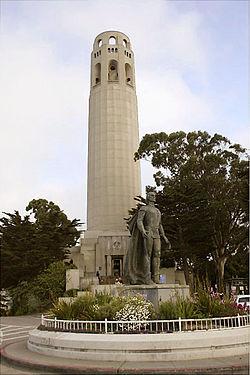
In theory, city department heads ought to be given fair leeway to allocate resources and run their operations. In practice, San Francisco’s Department of Recreation and Parks has been on a privatization spree, looking for ways to sell or rent public open space and facilities as a way to balance an admittedly tight budget. Prop. B seeks to slow that down a bit, by establishing as city policy the premise that Coit Tower shouldn’t be used as a cash cow to host private parties.

The tower is one of the city’s most important landmarks and a link to its radical history — murals painted during the Depression, under the Works Progress Administration, depict local labor struggles. They’re in a bit of disrepair –but that hasn’t stopped Rec-Park from trying to bring in money by renting out the place for high-end events. In fact, the tower has been closed down to the public in the past year to allow wealthy patrons to host private parties. And the city has more of that in mind.

If the mayor and his department heads were acting in good faith to preserve the city’s public spaces — by raising taxes on big business and wealthy individuals to pay for the commons, instead of raising fees on the rest of us to use what our tax dollars have already paid for — this sort of ballot measure wouldn’t be necessary.

As it is, Prop. B is a policy statement, not an ordinance or Charter amendment. It’s written fairly broadly and won’t prevent the occasional private party at Coit Tower or prevent Rec-Park from managing its budget. Vote yes.


 

Happy Tax Day, suckers

18

It’s Tax Day, the deadline for filing income tax returns, which seems like an appropriate time for Senate Republicans to kill President Barack Obama’s proposed Buffett Rule, which would have required the richest Americans to pay at least a 30 percent tax rate rather than using various tax dodges to pay a lower tax rate than most of us.

Honestly, it’s hard to even summon the outrage or indignation anymore over the latest example of life under plutocracy. Most Americans seem resigned to accept being ruled by the rich in crass, obvious, and incredibly short-sighted ways – even on Tax Day, when our class resentments should be finely tuned.

Sure, California voters will probably get a chance to increase taxes on millionaires this November – a proposal that consistently polls well – but even that has now been tied to a sales tax increase. Whatever happened to good ole economic populism? Why has the Occupy Wall Street movement’s brilliant “We are the 99 percent” paradigm faded so quickly from the national stage?

Despite mountains of evidence that the richest individuals and corporations have written tax codes to their benefit, and that the tax code is fundamentally unfair to most Americans and damaging to this country’s long-term economic prospects, Americans seem to accept their lowly fate and role serving the greedy rich.

The latest examples of solid reporting on our corrupt and inequitable tax system come from the New York Times’ David Kocieniewski, whose year-long series “But Nobody Pays That” just won the Pulitzer Prize for explanatory reporting, with the committee calling it a “lucid series that penetrated a legal thicket to explain how the nation’s wealthiest citizens and corporations often exploited loopholes and avoided taxes.”

And yet today, Tax Day, the greedy rich still paid lower tax rates than most of us, and then used their Republican Party enablers to prevent that situation from changing anytime soon. But rather than heeding that simple fact or clicking on my links that explain the problem in more detail, the blog commenters will probably say I’m just jealous. Ugh, I think it’s my nap time.

Calvin Trillin: The situation

0

So Mitt’s officially an Etch A Sketch,

And Rick says JFK’s speech made him retch.

Ron Paul’s a ditz, and Gingrich is a letch.

Though nets are flung as far as tthey will stretch,

There isn’t any white knight there to fetch.

Republicans thus sit around and kvetch.

Calvin Trillin: Deadline Poet: The Nation (4/16/2012)

The slate controversy at the DCCC

30

There’s nothing like a combination of insider politics, a struggle for control of the local Democratic Party and the ongoing discussion about the need for progressives and moderates to get along better to make for a complicated political story.

Which is exactly what’s going on with Alix Rosenthal’s effort to put together a Women’s Slate for the Democratic County Central Committee.

I’ve spend way too much time trying to figure it all out, but it raises enough interesting issues to make it worth discussion in the progressive community.

The background: For four years, the progressives have controlled the DCCC – and thus the powerful local endorsements for the local Democratic Party. That’s taken considerable organizing – and it’s worked to a great extent because of a remarkable degree of unity among a famously fractious bunch.
In the past two elections, every progressive group, the Harvey Milk Club, the Tenants Union, the teacher’s union, the nurses, the Sierra Club — and the Bay Guardian – has endorsed essentially the slate of candidates. There are problems with that approach – it’s easy for some people or some groups to get excluded, and you get complaints of machine politics – but in reality, there weren’t a lot of people who identified as progressive getting left out. Quite the opposite – the slate organizers were working hard to recruit people to run. Serving on the DCCC isn’t glamorous and it’s a lot of work. (It’s also at times unpleasant — the arguments are harsh, sometimes more so than necessary.)

In 2012, we have a different problem: The people who are called moderates have convinced a lot of high-profile canidates (former Sup. Bevan Dufty, Sup. Malia Cohen, School Board member Hydra Mendoza) – people who will win on name-recognition alone – to run. Combined with the retirement of Aaron Peskin, and the all-but certain re-election of incumbents like Scott Wiener and Leslie Katz (who remains to this day the only member of the DCCC who refuses ever to take my phone calls) and you have the makings of a conservative victory.

Let me take a second on this “moderate” tag. Moderates in San Francisco are people who are liberal on social issues – like, frankly, 80 or 90 percent of the city – but conservative on economic issues. Conservative is the right word here: The moderates don’t typically support higher taxes on the rich and big business, don’t support development controls, are weak on tenant issues, don’t think that housing should be a right of all people and pretty much buy into what in the Clinton era we called neo-liberalism.

The progressives (who have economic policies more like the Democratic Party of FDR and Lyndon Johnson) and the moderates (who have economic policies more like the Democratic Party of  Walter Shorenstein, Dianne Feinstein and Bill Clinton) have been fighting for decades over the future of a city where there aren’t a whole lot of Republicans.

So when I say conservative I’m not talking about Reagan or Santorum — but I’m talking about a very different economic vision than mine.

And while I’m all in favor of being civil and polite to everyone and respecting friends and colleagues who disagree with you, I guess I’m enough of an old commie (with a lower case “c”) to believe deeply in class struggle and the idea that the rich and powerful don’t give up without a fight.

And having a good working relationship with the conservative Democrats (hey, I’m on great terms with Scott Wiener – we talk all the time and I respect him and like him personally) doesn’t mean I’m ready to give up the notion that in the United States and California and San Francisco, 2012, there’s a class war going on. We didn’t start the war, but we have to fight it to survive — and to keep the city from becoming an ossified playground of the very wealthy.

Okay, enough background and rhetoric. On March 29, Rosenthal – who is also my friend and I respect and often support – sent out an email that announced that all of the women running for DCCC were going to work together on a slate:

“The female candidates for the San Francisco Democratic County Central Committee (DCCC) have banded together to form a slate of our own. It’s called Elect Women 2012, and it includes all women running this June in both Assembly districts in San Francisco, moderates and progressives alike. The slate is intended to provide a support network for both new and seasoned candidates, to develop an amicable working relationship between moderate and progressive candidates, and above all to get more women elected to public office.”

 
That’s all good. More women in politics is good. Supporting new candidates is good. A working relationship between progressives and moderates is good.
But here’s the question, and it’s not a new one in San Francisco: Is it a good idea, both politically and as a matter of strategy, to promote the interests of people who largely disagree with you on issues? If a slate of women helps knock off a progressive man in favor of a conservative woman, is that a positive change?

Rosenthal doesn’t think that’s going to happen. We’ve had a couple of long discussions about this, and she’s looked at the math and the current list of candidates, and she thinks her slate is more likely to help a couple of progressive women (Petra DeJesus, for example) who might not otherwise win.
“You need to touch the voters three or four times before they know who you are,” she told me. “The winners will be people who are on several slates, and the progressives have more slates than the moderates.”

The guys who she agrees should really be on the DCCC and might have a close call (Matt Dorsey, for example, a gay man, or Dr. Justin Morgan, an African American man) won’t win or lose on the basis of a competing women’s slate.

Rosenthal ran for office on a pledge to bring more women into the DCCC and into public office, and that’s an important goal – right now, there’s not a single woman among the citywide elected officials in San Francisco. (That hasn’t always been the case — the mayor for 10 (awful) years was Dianne Feinstein, and in the past decade or so we’ve had a female treasurer, assessor, district attorney, city attorney and public defender. But right now: All guys.

The Board of Supes is a bit lopsided, too – seven men, four women.

And for the same reason that putting people of color into office almost by definition changes the perspective of politics, electing women is a progressive value. No matter how sympathetic the straight white men are, there are things we never had to experience and will never really understand.

That said, I would much rather have (mostly progressive) white guy Aaron Peskin run the Democratic Party than (mostly conservative) Asian woman Mary Jung – and so would Rosenthal. “No question, no doubt about it,” she told me.

Now that Jung has all but announced that she wants to be the next party chair, and since a number of the women on the slate will support her over a progressive (and would support her over Rosenthal) – is this doing the movement any good?

Gabriel Haaland, a transgender man and former president of the Harvey Milk Club, points out that “the Milk Club could simply endorse all LGBT candidates for our slate, and there are some who have argued for that over the years. But we don’t — because we work in coalitions, and that kind of slate undermines the whole concept of coalition politics.”

Hene Kelly, who is on the women’s slate but has insisted that the mailings make it clear she isn’t supporting some of the other candidates who will be connected with her, thinks the Rosenthal plan is a bad idea.

“There are people on this slate I could not and would not support because they don’t share my beliefs,” Kelly told me. “These are nice people, but they don’t see San Francisco the way that I do. Mary Jung and I don’t believe in the same things.”

Rosenthal says that the very fact that so many people who disagree on issues can work together on a slate shows that women can get along and end some of the divisiveness on the DCCC. Kelly – who is a passionate and often fierce fighter – disagrees: “I’m not that easy to get along with.”

Kelly is part of what will be a progressive coalition slate – including women and yes, men – and Latinos, African Americans, LGBT people, young people, older people … a mix. An imperfect but generally San Francisco mix. And all of them share the same political values.

Some of the people who don’t like the women’s slate are, indeed, men – and Rosenthal is at least a little proud of that. In another email talking about a Chronicle story, she notes:

“I have already received panicked calls from some male candidates and leaders, it seems there is quite a buzz about us and about Heather’s article. Which is great.  I hear that Malia said some good things, as did Supervisor Wiener.”

Wait — Scott Wiener and Malia Cohen are happy about the slate? This is supposed to be good news? I like Scott and we’ve worked together on issues we agree on, but I didn’t endorse him for office; on the most critical things, we don’t agree at all. And interestingly, there is not one progressive woman quoted as opposing the idea in the Heather Knight piece in the Chron.

I think the panic is not, alas, about men fearing the power of women. There isn’t a progressive man I know who would be unhappy with Hene Kelly running the party.

The question is about whether this effort might help shift the balance of  power away from the progressives – and, frankly, whether all this talk about getting along together is an excuse for watering down what we want to do and what we believe in.

Maybe Alix Rosenthal is right, and her slate — which will spend about $25,000 in what amounts to co-op advertising — will help bump a couple of progressive women to the top and help the left hold on (narrowly, because it will be close) to the DCCC. Maybe the moderate/conservative crew will win a majority, and some of the moderate women will be impressed by the help Rosenthal gave them and elect her chair (which would be a lot better than some of the alternatives).

Maybe politics should be less rancorous and we should all get along better – except that, in my 30 years of experience, getting along with the moderates has always, always, always, led to a watering down of the progressive program and agenda. 

Maybe I’m just a straight white guy who doesn’t get it – and I’m happy to cop to that possibility.

I agree that there aren’t enough women in local political office, that we need to encourage and promote progressive women candidates, that much of the leadership (such as it is) on the left is male — and that needs to change.

But I’m not sure that working to help elect people who disagree with you on the key economic and political issues is good for the values that I think Alix Rosenthal and I share.

It’s tricky, but at least we should be thinking and talking about it. Nicely. I promise.

Hot sexy events: March 22-29

3

Perhaps you caught Soojin Chang’s review of the first month’s edition of Cum and Glitter (my god, the trolls from SFGate sure did!), the Mission’s new alt-queer live sex show that had Ava Solanos squirting, yes squirting, the to thrums of a cello perched mere feet away from her audience-spritzing climax. Yes! Well even if you didn’t, you will note from that description that C&G is the classiest thing that an experienced exhibitionist could be possibly be involved in, in the city these days. And so it is with pleasure that we announce that the show is currently holding auditions. Will you don baby bloomers and molest your babysitter onstage? Sexy ribbon-dance? Those were actually last month’s ideas, babe, but we know you can think of something great. Now, the week’s sex events from lectures to slutty cigar parties.

“Pink Japan: Contemporary Sex Culture”

An expert in Japanese bondage (in fact, she wrote the first English language book on shibari), sex worker Midori brings a unique perspective on the sexual mores and more!s of that particular island nation. Come to her presentation today on her voyages in the East — if you come early you can check out her collection of dirty mags and other goodies from her trips. 

Thu/22 7:30 p.m., $10-$30

Center for Sex and Culture

1349 Mission, SF

www.sexandculture.org

The League

Here’s a great reason to start volunteering at town’s premier pansexual playspace: cheese, chocolate, cigars, cabaret music, and sexy time with all the dappers and dandies of the Mission Control community. Live tunes provided by This Can’t End Well, hotness provided by you. 

Thu/22 8 p.m.-midnight, only open to Mission Control allies, volunteers, and crew

Mission Control

www.missioncontrolsf.org

Sacred Grounds: A kinky sexuality munch

Remember when Wicked Grounds shut down? Yeah, we’d rather forget that time too. But SF’s best-and-only kink coffeeshop has been re-opened long enough to get back into the swing of things, and we’re excited to see that it’s hosting its standard line-up of pervy-perfect community happenings. Come tonight to talk O with other om-ers — kinky sexuality takes the conversational stage at this meet-and-greet (typically used to hunt down future play partners, lucky you.)

Sun/25 7 p.m.-9:30 p.m., free

Wicked Grounds

289 Eighth St., SF

(415) 503-0405

www.wickedgrounds.com

“Sex, Race, and Class: The Perspective of Winning”

Author Selma James has a sexy theory and it is this: capitalism is a ware waged against human life — life that is driven by reproduction. (Small wonder that the Republicans want to take the fun out of sex.) Learn all about it on this stop of her book tour, which is happily timed to coincide with Shaping SF public lecture series. She’ll bring with her Andaiye, the founder of the Guyana’s Red Thread movement for female financial autonomy and community connectedness. 

Wed/28 7:30 p.m., free

CounterPULSE 

1310 Mission, SF

(415) 626-2060

www.counterpulse.com

“Girl Talk”: A trans and cis woman dialouge

Could be hard to hear, could be heart-warming, will probably be both, this spoken word event has sold out to the gills online, and with good reason. Gina de Vries, Elena Rose, and Julia Serano have crafted an evening of performances that will center around the theme of sisterhood between trans and cis-gendered women. They’re hoping it will be the jumping-off point for a dialouge that really doesn’t get enough play in the queer community (or anywhere, for that matter). 

Thu/29 7-10 p.m., $12-$20 (sold-out on line, but limited standing room-only tickets remain)

LGBT Community Center

1800 Market, SF

www.queerculturalcenter.org

Calvin Trillin: Contraception is the big issue

0

Contraception (of all things)

Republicans are bashing birth control,

As candidates far-rightward scurry.

The voters haven’t heard such talk in years.

We’re going backward in a hurry.

Calvin Trillin: Deadline Poet (The Nation 3/26/2012)


Dick Meister: Labor’s David vs. GOP’s Goliath

0

By Dick Meister

 Dick Meister, former labor editor of the SF Chronicle and KQED-TV Newsroom, has covered labor and politics for more than a half-century. Contact him through his website, www.dickmeister,com, which includes more than 350 of his columns.

Organized labor is doing exactly what it must do to combat the onslaught against unions being waged by Republican politicians nationwide, throwing lots of money and lots of ground troops into the election campaigns of Democrats – most especially President Obama’s campaign for re-election.

The AFL-CIO made it official with a ringing endorsement of Obama. Federation President Rich Trumka declared that “as president, Barack Obama has placed his faith in America’s working men and women to lead our country to economic recovery and our full potential. So we’re putting our faith in him.”

Trumka acknowledged that the AFL-CIO has sometimes disagreed with Obama and “often pushed his administration to do more – and do it faster.” But he said there never has been any doubt about Obama’s commitment to working families.

On the other hand, Trumka noted, the Republicans seeking their party’s presidential nomination have all “pledged to uphold the special privileges of Wall Street and the 1% that have produced historic economic inequality and drowned out the voices of working people.”

Trumka characterized working people as “the Davids standing up to Goliath in today’s politics. Our strength is in our numbers, our values and plain hard work. When we come together, we are formidable.”

Labor’s political forces have indeed been formidable in past elections, putting millions of dollars and millions of union members into the campaigns of labor-friendly Democrats such as Obama. The AFL-CIO pledges to do even more for Obama’s re-election bid, aided in part by a 2010 Supreme Court ruling that allows unions to go door-to-door to solicit support from non-union voters as well as union members.

Unions expect to spend $400 million this year on national, state and local elections, fully one-fourth of it coming from a key AFL-CIO affiliate, the American Federation of State, County and Municipal Employees. The Service Employees International Union expects to mobilize 100,000 of its members, many of them public employees. The AFL-CIO itself anticipates spending nearly $7 million it has collected primarily for campaigning among non-union voters.

The federation aims to outdo its extraordinary campaign for Obama’s election in 2008. A quarter-million union volunteers took part in that effort, knocking on 14 million doors, making 76 million phone call, sending out 57 million pieces of mail and distributing 29 million leaflets at work sites.

It’s certainly true that Obama has generally been a good friend to organized labor. But what, specifically, has he done for working people and their unions? Why do unionists feel he’s deserving of so much union money and so much union effort?

Why? The AFL-CIO’s Trumka cites, for example, Obama’s American Recovery and Reinvestment Act which “saved or created 3.6 million jobs” and averted a second Great Depression. There’s also Obama’s championing of comprehensive health insurance reform which “set the nation on a path toward health security,” and Wall Street reform that will eventually lead to reversal of the financial deregulation “that put our entire economy at risk.”

Re-electing a labor-friendly president will be only a part of labor’s election-day mission. Unions will be campaigning at least as hard to defeat the many anti-union Republicans who are running at the local, state and national level and threatening the very existence of unions.

As AFL-CIO Political Director Michael Podhorzer notes, “they’ve clearly tried to weaken unions and drain our treasuries. But the consequence has been more like kicking a hornets’ nest than draining our resources.”

Unions hope to repeat their success of last November in Ohio, where they waged a major campaign that repealed a Republican-sponsored law that greatly weakened the collective bargaining rights of the state’s public employees. It was an overwhelming victory with 62 percent voting for repeal, only 38 percent for retaining the law, which was similar to those proposed elsewhere, along with other anti-union measures.

The AFL-CIO is confident that it can rally millions of voters for Obama in Ohio and other battleground states, including Michigan, Pennsylvania and Wisconsin. Unions have already had a major impact in Wisconsin, where voters have approved the holding of recall elections for Gov. Scott Walker, his lieutenant governor and four Republican state senators because of their support for legislation that stripped public employees of their collective bargaining rights. Previous labor campaigns led to the recall of two other Republican state senators.

Obama would seem to need unions as much as they need him. The latest polls indicate that only about half the citizenry approves of the job he’s doing. He’s going to have to work hard to win over the large body of Americans who apparently don’t share labor’s view of him, but who could be convinced to at least give him another four years to meet their expectations.

Labor’s election–year role, in short, will be to do much of the convincing needed to help rally millions of voters behind their friend in the White House. That would be highly rewarding to labor and to millions of Americans, union and non-union alike.

Dick Meister, former labor editor of the SF Chronicle and KQED-TV Newsroom, has covered labor and politics for more than a half-century. Contact him through his website, www.dickmeister,com, which includes more than 350 of his columns.

Millionaires Tax merger is a risk and opportunity

40

My first reaction to today’s news that the popular Millionaires Tax measure was merging with Gov. Jerry Brown’s broad-based tax measure was “What the fuck!?!?” Taxing millionaires had over two-thirds support in recent polls and seemed to clearly tap the tax-the-rich zeitgeist that animated and was amplified by the Occupy movement.

Now, it’s being married to a measure that increases the regressive sales tax and brings the income taxes increases down to those making $250,000 per year, possibly turning more self-interested voters against it. This just seemed to blow a golden opportunity to do the one simple thing that most Californians agree we need to do to address the state’s perpetual and deepening fiscal crisis: tax the rich.

But then I talked to Assembly member Tom Ammiano, someone with longstanding and unwavering progressive values, and he said, “It’s the art of the deal. It’s acceptable to me, not because it’s perfect.” While he’s not a fan of sales tax increases, he explained how it improves upon the Millionaires Tax in a couple key ways, and that is finally represents some new political cooperation after years of frustrating dysfunction in Sacramento.

“This is something we can build on,” Ammiano told me. “It’s a pretty good coming together.”

Clearly, there is value in creating a functional center-left coalition to counteract the inflexible conservatism that a shrinking minority of Republicans has used to mindlessly block all revenue measures, defund education, and plunge the state into a serious fiscal crisis. And it is good strategy  to reduce the number of competing tax measures on the ballot, and to broaden the coalition of supporters.  

But beyond those tactical benefits, the new measure is worth supporting on its merits. Ammiano notes that it actually raises more money than the Millionaires Tax (about $2 billion per year more) and frees up how that money can be spent (rather than limiting it solely to education).

“We raise more money over more years and we cut back his sales tax increase,” said Steve Hopcraft, a spokesperson for the campaign, noting that Brown’s proposed half-cent sales tax increase is now a quarter-cent increase and the measure now raises $3.3 billion per year from the top 2 percent of wage earners. “It’s a progressive measure that has almost a consensus now…It’s basically what we were proposing but with a quarter percent increase in the sales tax.”

And a expiration date that the Millionaires Tax didn’t have. But while the sales tax increase sunsets in four years, the income tax increases — which range from a 1 percent bump for $250,000 earners to 3 percent for those making more than $1 million — last for seven years.

So Brown’s measure, which had broad institutional support, gets better. And the Millionaires Tax — developed by the California Federation of Teachers and others and receiving strong popular support — gets watered down just a bit. I suppose that alright, if they can still make the ballot and win over voters in November.

That’s a big “if,” perhaps bigger today than it was yesterday. And if supporters of this measure blow this important opportunity — after all, the threshold for approving tax increases drops to a simple majority only during presidential elections, so the stakes now are high — then we’ll all pay a heavy price for this decision. 

Occupying the Capitol

5

It’s an unseasonably hot day at UC Davis, and student activists are milling around a tent city, set up especially for 100 people arriving from a four-day March on Education. The school, one of the hubs of the Occupy movement, gained notoriety when public safety Officer John Pike casually pepper sprayed a line students during a sit-in back in November. Now, officers bike through the idyllic scene, smiling and chatting up occupiers.

Everyone is preparing for the next day, March 5, the statewide day to defend education that will bring thousands of students and teachers to Sacramento to demand an end to budget cuts and fee hikes at California’s schools, community colleges, and universities.

Those on the march hope to highlight the importance of this issue, marching 79 miles from the Bay Area. The first night, the march stayed in Richmond, and the next day Richmond’s Mayor Gayle McLaughlin came out to welcome them.

Students march annually on Sacramento, and say they won’t stop until education is affordable (or, as some would demand, free). A climate of worldwide protest over disparities in wealth and opportunity, including Occupy protests in the United States, helped fuel a larger than usual turnout this year.

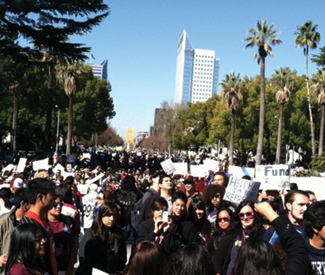
More than 5,000 people converged in Sacramento March 5 and marched to the Capitol building, occupying the Rotunda all day. Many chanted “no cuts, no fees, education must be free.”

Community college student throughout the state are reeling from the cuts, and resulting fee hikes—course units, once free, were raised from $26 to $36 per unit last year, and will be increased another $10 this summer. These costs go towards closing the state budget deficit, and not toward a bigger course catalogue; classes continue to be slashed.

Frances Gotoh of San Bernardino Valley College is back at school after being laid off from her longtime job at Bank of America. She said she desperately needs the retraining; without it her job prospects look dim. She needs to support her family—her 20-year-old son is also a college student—but says she can’t afford the increasing fees. “Why is education being taken away?” asked Gotoh. “It belongs to the people.”

Josselyn Torres, a psychology major at Sonoma State University, felt similarly. “Every year, the fees are getting higher but the class size is getting bigger,” said Torres, who noted that many of her friends won’t be graduating with her because so many of the classes they needed were cut. “The politicians have all gone to college. If they keep cutting our education, how can we make it as far as them?”

When the march reached the Capitol, student and state government leaders spoke on the importance of education. Students demanded an end to fee hikes and budget cuts. Assembly Speaker John Perez (D-Los Angeles) and Senate President Pro Tem Darrell Steinberg (D-Sacramento) praised student activists and expounded on the necessity of accessibility to education. Almost all speakers decried the two-thirds majority needed to raise taxes, allowing just a few Republicans to block them.

Lt. Gov. Gavin Newsom also spoke, describing the need to support education in staunchly free-market terms: “You can’t have an economic development strategy without a workforce development strategy.”

Periodically, the crowd interrupted Newsom and other politicians in the midst of making promises with chants of “show us.” They also chanted this election year threat: “You’ll hear us out or we’ll vote you out!”

Around 12:30 p.m., the permitted rally ended and thousands dispersed. About 400 stayed to “Occupy the Capitol.” The group streamed into the building and into the rotunda. California Highway Patrol officers, responsible for policing the Capitol, blocked more than 150 from entering the central area. So, communicating via the Peoples Mic with several rounds of crowd repetition for every sentence spoken, the group participated in a statewide general assembly.

Some building employees showed support, but the only politician to sit down with the protesters was Newsom, who sits on the UC Board of Regents and CSU Board of Trustees. He chatted with students, some of whom requested that he ask police to stop blocking students from meeting in the same area; he didn’t do so, but was able to convince them to give protesters in the rotunda access to bathrooms.

The group managed to collectively decide on demands of the state: support the Millionaire’s Tax ballot initiative, repeal Prop. 13, cancel all student debt, fund all education through college, and democratize the Board of Regents. When building closed at 6 p.m., officers declared the assembly unlawful and arrested 70 who refused to disperse.

Meanwhile, another 400 or so attended a permitted rally on the Capitol lawn called by several Sacramento labor unions to support Occupy the Capitol.

Over the past five years, education funding in California has been cut drastically. Spending per K-12 student per year has gone down by almost $2,000 and higher education has seen program cuts and tuition hikes. Gov. Jerry Brown’s latest budget proposal includes still more cuts to California colleges and universities.

Several proposed ballot initiatives are designed to address this. An initiative sponsored by Brown would bring spending per student per year up by $1,000, stabilizing at $7,658 (it was $7,096 in 2011-12) and reversing a five-year slide. But it would still be less than 2007-08, according to a report from the California Budget Project (CBP).

That report shows K-12 education spending is the biggest piece of the state budget, although California ranks dismally low compared to other states for spending on K-12 education: 47th in the country.

The governor’s proposal would raise funds with a combination of a tax increase for those earning $250,000 and over per year and a sales tax increase. But critics say the increase in the sales tax, which is notoriously regressive, would hurt lower and middle income families.

The measure is up against other potential ballot initiatives that would raise revenue strictly from the wealthiest Californians. The so-called Millionaire’s Tax, for example, would raise funds for education by increasing taxes on those making $1 million or more per year. The Millionaire’s Tax also has the advantage of resulting in a permanent change in the law, while Brown’s measure would apply only for the next five years.

“California’s problems have also been exacerbated by tax cuts, one-time ‘solutions,’ overly optimistic assumptions, and the fact that the two-thirds vote requirement for the legislature to approve any tax measure has blocked adoption of a balanced approach towards bridging the budget gap,” according to the CBP report.

Teachers’ unions are divided over the best ballot measure. The California Teachers’ Association has endorsed Brown’s measure, emphasizing that it includes a plan to close the budget deficit.

“The governor’s initiative is the only initiative that provides additional revenues for our classrooms and closes the state budget deficit, and guarantees local communities will receive funds to pay for the realignment of local health and public safety services that the Legislature approved last year,” said Dean Vogel, CTA president, in a press release.

But the Millionaire’s Tax was sponsored by the California Federation of Teachers, and it has now been endorsed by this student general assembly. John Rizzo, president of the City College of San Francisco Board of Trustees, also endorsed the measure.

“We’ve got to tell the state of California that we cannot continue this. We cannot continue the cuts to our community colleges, to UCs, to the California State Universities,” said Rizzo, speaking at a March 1 rally in San Francisco.

According to a recent report, of five polls conducted throughout California, each initiative has majority support, but voter prefer the Millionaire’s Tax, with a recent Field Poll showing 63 percent support.

Legislators are also at work trying to increase education funding. Assembly Speaker Perez has introduced a bill that would slash tuition fees by two-thirds at CSU and UC schools for students of families making less than $150,000 per year. The bill would also allocate funding to city colleges throughout the state, for them to determine how to best use the money.

The cost of the plan, about $1 billion, would be paid by eliminating a corporate tax loophole that the Legislature approved in 2009, which would allow companies to choose the cheaper of two formulas for calculating their taxes. Critics have called the legislation bad for business, saying that removing tax incentives would hurt California companies.

“The California Middle Class Scholarship Act is very simple,” Perez told students at UC Davis when he unveiled the bill on Feb. 3. “Too many families are getting squeezed out of higher education. For students whose families make $150,000 a year or less, too much to qualify for our current financial aid system, but not enough to be able to write a check for the cost of education, without feeling that pinch, the Middle Class Scholarship Act reduces fees at the UC system and at the CSU system by two-thirds, giving tremendous assistance to those families to make college affordable again.”

Education advocates say California needs to do something to reverse the spiraling cost of higher education in California, which could do long-term damage to the state, affecting young people and businesses that need skilled workers and spiraling out from there. And these advocates say this short-sighted strategy is easily preventable if there is the political will to address it.

“There are a lot of sources of revenue that are not being taken advantage of,” Lisa Schiff, a member of Parents for Public Schools of San Francisco, told us.

Even if tuitions were lowered or—as the most ambitious of protesters demand—higher education was made free, most former students would still be saddled with massive debt. As costs have risen, debts of hundreds of thousands of dollars are commonplace. With the job market recovery slow and painful, graduates often feel helpless to pay back their debt.

Robert Meister, a professor of Political and Social Thought at UC Santa Cruz and president of the Council of UC Faculty Associations, has long argued that the state’s higher education systems ought to focus on keeping tuitions low and student debt in check (see “In the red,” 1/11/11).

Yet he told us that growing income inequality makes people even more desperate for a college education and willing to accept levels of student debt that limit their ability to become anything more than corporate cogs after graduation. “Their ability to raise tuition is a function of the growth of income inequality,” he told us.

In his speech at UC Davis, Perez cast the issue as one of a disinvestment in the state’s future: “California’s public colleges and universities has been one of our most prestigious institutions, and, unfortunately, because of the collapse of the economy, we’ve moved away from fully investing in those universities and colleges.”

A month later, the school again served as a backdrop for illustrating the problem and calling for reform. Dani Galietti, a MFA student at UC Davis who was setting up a performance art piece when I arrived, greets everyone cheerfully and is thrilled about the Occupy movement.

“I wanted to share myself and my work with the movement,” Galietti tells me while taping a “paper trail” to the sidewalk; she plans to walk on it with home-made stamps attached to the bottoms of her shoes.

But her mood darkens when I ask about her student debt. “I came out of five years of education $100,000 in debt,” says Galietti, “and I’m not the only one.”

She is a first generation college student, she explains, who helped pay for school with McNair scholarships.

“I grew up one of five, with a single mother,” Galietti explains. “We struggled my whole life, as a lot of people have, financially.”

“So many people are graduating with so much debt. There’s this looming fear, fear and hopelessness. The economy’s bad, the job market sucks. I’m so thankful that they’re out here. People are active, they’re making a difference.”

“We need education,” Galietti says. “I mean, knowledge is power.”


How much hot gay tail are the rabid conservative gentlemen of America getting at CPAC?

0

Hooray, it’s time for our favorite blog post of the year. Every year Wonkette goes to the huge Conservative Political Action Convention in DC, and trolls Craigslist for attendees looking for gay sex. Then Wonkette posts the ads. This installment features Dan Savage scanning the CPAC crowd with Grindr! Check it out here.

Coit Tower battle: How do we fund the parks?

59

The emerging battle over whether San Francisco should allow private parties at Coit Tower is really part of a much larger political debate: How do we fund public parks? Is public space something that resources are put into, something that’s paid for by tax money and preserved and made available for everyone — or should part of the role of parks be to generate cash?

The Republicans in Congress, with the help of San Francisco’s own Rep. Nancy Pelosi, came down clearly on the side of self-funding around the Presidio, and it’s been a disaster.

I have friends who work at Rec-Park, and they tell me that at least the new revenue initiatives have prevented layoffs and kept some programs going. Which is true. But it’s the wrong question.

Parks are public commons. They’re not supposed to be private space (yeah, they rent out space for weddings in the park, but that’s a pretty minor deal). The city ought to be funding the parks. The city ought to be raising taxes enough to do it. Yeah, I know — you’re bored. I’m tired of saying it, too.


Some reality about the jobs report

6

The Obama Administration is thrilled with the new employment figures, and it’s clear the president will use this as a key part of his campaign (as long as the recovery keeps going and doesn’t sputter again). The Republicans, of course, are complaining that it’s not enough, that “we could do better,” but that sounds awfully hollow and fits into the narrative that the GOP doesn’t want anything to improve this year because the entire goal of the party is to defeat Obama in the fall.

But really, while it’s encouraging, the new unemployment figures are still bogged down by two things: The labor force is growing faster than the nation is creating jobs — and layoffs in the public sector are still a drag on the recovery.

There’s a pretty good analysis on DailyKos, talking about the labor force issue. But there’s more: Among people without a college education, the jobs picture is still really bleak. Same for people who have been unemployed for a while now and for youth. I could go on and on about the failure of trickle-down spending, but the reality is that the economy is still far too top heavy to all for a real recovery. Income inequality isn’t just a political and moral issue; it’s an economic downer. The U.S. economy depends overwhelmingly on consumer spending, and since all of the new new wealth of the past 20 years has gone to the very rich, most consumers don’t have enough money to spend enough to keep the economy buzzing. And a few new IPOs that make a few more people rich isn’t going to solve the problem.

Note that the one sector of the economy that is still losing jobs is government. That’s a result of low taxes that can’t fund public services (and can’t provide the generally decent unionized jobs, including jobs for people without college degrees, that exist in the public sector).

I was intrigued by the Congressional Budget Office report comparing federal and private-sector workers, which the Republicans (and, I’m sure, some of my beloved trolls on this blog) will use as evidence that government is bloated and public-sector workers are overpaid. But that’s not exactly what the report says:

CBO found that those without a college degree fared better as federal employees, since their pay was 36% higher than that of private-sector employees–particularly when it came to benefits. Those with advanced degrees such as doctorates, however, were generally better off in private industry, strictly from a monetary viewpoint–government pay was 18% lower than that of comparable individuals in the private sector.

In other words, federal pay is a lot more like the private sector used to be, back before the United States became one of the most socially stratifed societies in the developed world. The folks at the bottom do better, and the folks at the top don’t get as rich, and the gap between the highest paid and the lowest paid is a lot smaller.

Which is one reason that Republicans hate public-sector unions and government employment — it’s better for the 99 percent.

Occupy and the State of the Union

2

Have all of the Occupy actions made any difference? Gee — I wonder.


I wonder if a president who acted a year ago as if economic justice wasn’t even an issue in this country would have devoted a substantial part of his State of the Union speech to fairness in tax policy. I wonder if he would have said this:


Right now, we’re poised to spend nearly $1 trillion more on what was supposed to be a temporary tax break for the wealthiest 2 percent of Americans. Right now, because of loopholes and shelters in the tax code, a quarter of all millionaires pay lower tax rates than millions of middle-class households. Right now, Warren Buffett pays a lower tax rate than his secretary.


Do we want to keep these tax cuts for the wealthiest Americans? Or do we want to keep our investments in everything else –- like education and medical research; a strong military and care for our veterans?


Or this:


Tax reform should follow the Buffett Rule. If you make more than $1 million a year, you should not pay less than 30 percent in taxes. And my Republican friend Tom Coburn is right: Washington should stop subsidizing millionaires. In fact, if you’re earning a million dollars a year, you shouldn’t get special tax subsidies or deductions. On the other hand, if you make under $250,000 a year, like 98 percent of American families, your taxes shouldn’t go up. You’re the ones struggling with rising costs and stagnant wages. You’re the ones who need relief.


Now, you can call this class warfare all you want. But asking a billionaire to pay at least as much as his secretary in taxes? Most Americans would call that common sense.


or this:


No American company should be able to avoid paying its fair share of taxes by moving jobs and profits overseas. From now on, every multinational company should have to pay a basic minimum tax.


Now: Not saying any of that is going to happen right away, or even that Obama will put tax reform at the top of the agenda. And changing the tax code to charge people like Mitt Romney 30 percent is nowhere near enough; in the 1960s, those people paid 80 percent of their marginal dollars in federal taxes. The Repubs in Congress won’t let any of this happen anyway.


But all of the major newspapers (which a year ago didn’t even know how to spell economic injustice) made his pitch for greater fairness in the economy the lead of their reports and all of the headlines talked about it. And when pollster Stan Greenberg tracked the responses of Democrats, Republicans and independents to the speech, the vast majority were pleased by and agreed with the commments that I cited above. That’s not just 80 percent of the Dems but 70 percent of the GOP voters.


The other thing Obama said — in indirectly — is that government is important. Beyond the flag-waving salute to the troops and the talk about the Navy Seals (Yay! We killed a guy! No arrest, no trial, just summary execution!), Obama was setting the tone for a debate over the role of the public sector in America. He talked about building the Hoover Dam, the Golden Gate Bridge and the interstate highway system. He talked about the importance of public support for research. That’s a direct contradiction to what the Republicans are saying about making government much smaller and less significant in people’s lives. I wonder what happens if the Republican candidate and Obama get out of the platitudes are actually have that discussion this fall.


Of course, he also said the solution to most business problems was tax cuts and incentives, which is not only GOP dogma but silly, since tax cuts for business almost never have the intendent effect. Tax penalties won’t keep companies from moving offshore (although I still support the idea), and tax cuts won’t bring them back.


It’s notable that Obama didn’t mention corporate personhood, which is going to be a huge part of the Occupy agenda this year. And that’s something that could actually change business behavior. Corporate charters are granted by the government — and with a few changes in law, could be revoked by the government, too. Screw your workers, cheat on taxes and move jobs to low-wage non-union areas where children work 14 hours a day making your products? Guess we’ll have to revoke your corporate charter. No more protection for personal liability for the owners and shareholders. Too bad.


And while his populist stuff struck a chord, the energy and environmental policy suggestions were just horrible. Yeah, I’m for ending tax breaks for oil companies — but opening up 75 percent of the potential offshore areas to drilling? Encouraging more natural gas drilling? Not much in the way of serious talk about investing a fraction of that money in renewables?


Oh, and I love this: Obama’s going to force natural gas drillers to “disclose the chemicals they use.” That’s going to keep us safe, yesiree. Thank you, mister driller, for telling me how your poisoning my water. Not that I can do anything about it, of course; you can keep right on going. But now, thanks to our bold president, I know about it.


Occupy the natural gas wells. I’m ready to go.


Will Obama bring the populist fire in tonight’s speech?

13

President Barack Obama has a choice for how he uses his State of the Union speech this evening. He could follow the advice of Blue Dog Democrats like Mark Penn, who wrote in The Hill today that Obama should avoid “rhetoric that could be interpreted as class warfare.” Or he can find his inner populist and give the speech that the 99 percent needs to hear by announcing that the rich and the Right have already declared that war, and now he intends to win it on behalf of the people.

I’m rooting for the latter, but fearful that Obama is no William Jennings Bryant – or either of the Presidents Roosevelt – and that he is just not up for seizing this moment and going to war with the powerful plutocrats who are ruining this country.

But there are signs that Obama is at least prepared to “double down on taxing the rich,” as the Christian Science Monitor put it today. Certainly, all signs indicate that he will at least raise the economic inequity issue again tonight, and it’s a positive sign that the invited audience will include Debbie Bosanek, the secretary to billionaire investor Warren Buffet that he famously complained shouldn’t be paying his same tax rate. Certainly, Obama intends to push for his “Buffet rule” that would tax investment returns as income rather than at lower capital gains rates.

But those sorts of reasonable arguments aren’t enough. Obama has been calling for higher taxes on the rich throughout his presidency, albeit never as forcefully as he did on the presidential campaign trail in 2008. And since then, he’s repeatedly betrayed that pledge in cutting deals with Republicans in Congress, exacerbating historically high concentrations of wealth and betraying his own stated principles.

The Occupy movement and most of the left – and even segments of the Tea Party right that complain about the economic elites – no longer trust Obama and the Democrats to fight for the interests of the commoner. We’ve become cynical about putting any hopes in a president poised to shatter campaign fundraising records this year.

Yet as Obama prepares to run for reelection against either a vulture capitalist or hypocritical moralist – both of whom will be openly shilling for the 1 percent – he should realize that it’s both good policy and good politics to capitalize on the opportunity that the Occupy movement has opened up, join the class war, and help us finally win it and seize the resources we need to deal with this country’s myriad problems.

Today’s Chronicle includes a front page story about Rep. Nancy Pelosi’s hopes that Democrats will pick up the 25 seats needed to retake the House of Representatives this year – along with analysts poo-pooing that possibility. The only hope they offered for Pelosi’s plan is a meltdown by the Republican presidential nominee.

But that sort of clear contrast between Democrats and Republicans won’t simply happen on its own, it is something that Obama and the Democrats will need to force by finally relying more on populist ire than using campaign contributions from the wealthy to tarnish their opponents. Simply winning the presidential election won’t help Obama break this country’s political gridlock, he needs to make this race about the undue power of the rich and the Right and win it on those terms.

Pelosi acknowledged that her best hopes for gaining a substantial number of Congressional seats are in California, but they don’t seem to realize that the real potential here is with changing the political dialogue and tapping the 58 percent of California voters who said in a November Field Poll that they agree with the economic critiques that sparked the Occupy movement (and even higher percentages have supported taxing millionaires). Even those who didn’t join the Occupy movement agree with its basic analysis that the few are exploiting the many.

There is a simmering populist discontent that will play out in unpredictable ways this year. And it’s possible that many of the left will never trust Obama until his deeds finally match his words. But there is no larger mainstream political podium in this country than the State of the Union speech, and if Obama misses this opportunity to declare his allegiance with the 99 percent – and his willingness to fight for us – then we may all just be in for the nastiest yet most meaningless presidential election in modern history.

The GOP primary: Enjoy the show

6

The 49ers game isn’t until Sunday, but in the meantime, I hope everyone’s enjoying the spectacle that is the Republican primary in South Carolina. First off, we have John King asking His Newtness about allegations that he wanted an “open marriage” and setting off a classic Newtron bomb. Then we have all the discussion on CNN about Mitt Romney’s (allegedly) huge penis. And of course, the SuperPac ads accusing Romney of being a serial killer (“Mitt the Ripper.”) Oh, and by the way: Did anybody actually win the Iowa Caucuses? Does anybody actually care?


Party on, Repubs. You’re doing better every day.

Staying on track

0

steve@sfbg.com

After weeks of attacks from critics of the high-speed rail system now being built in California — a campaign that even came home to San Francisco City Hall last week, when Sup. Sean Elsbernd challenged Mayor Ed Lee on the issue and called for a hearing — Gov. Jerry Brown and other supporters have stepped up efforts to keep the train from being derailed.

With seed money from a $10 billion bond measure that California voters approved in 2008 and an initial federal grant of $3.3 billion to help build the Central Valley section of the track, the California High Speed Rail Authority is working on construction of a bullet train that would carry riders from San Francisco to downtown Los Angeles in about 2.5 hours, traveling at speeds of up to 220 mph. That project is slated to cost nearly $100 billion, and the next phase would extend service to Sacramento and San Diego.

But Republicans in Congress and the California Legislature began to balk at funding the project last year. Earlier this month, a report by the California High-Speed Peer Review Group recommended that the Legislature indefinitely delay issuing $2.7 billion in rail bonds, citing the uncertainty of future funding sources and problems with the project’s business plan.

“It does not take a rocket scientist to see the future of high-speed rail is in serious doubt,” Elsbernd said at the Jan. 10 Board of Supervisors meeting, where he used the monthly mayoral question time to ask Lee, “What is Plan B with Transbay Terminal if the high-speed rail money does indeed go away? What do we do?”

The Transbay Terminal is now being rebuilt downtown. The first phase includes a $400 million “train box” being built with high-speed rail funds, and the next phase will require billions of dollars more to build train tunnels into the station from the current Caltrain terminus at 4th and King streets.

“I’m committed to seeing the full implementation of high speed rail, which includes having a northern terminus at the Transbay center,” Lee replied, refusing to entertain the idea that the bullet trains won’t be coming into San Francisco, a stand he communicated to state officials in a recent letter. “I want to state my unwavering support for the notion of high-speed rail. It is the future of transportation in this state.”

Lee acknowledged that cost estimates for the project have gone up and there are uncertainties over future funding, but he said the state will need to make the investment either way. “California is growing and those people need to move up and down the state. The question is do we make transportation investments on bigger, wider highways and airport runways? I’d say no, that this perpetuates a car-dependent culture.”

Instead, Lee says the state must find a way to build high-speed rail, whatever the obstacles. But Elsbernd called for a hearing on the issue before the Board of Supervisors, telling the Guardian that he supports the project, “but high-speed rail is in trouble and we need to acknowledge that.”

Meanwhile Gov. Brown — who has rejected calls to delay issuing the rail bonds — was working behind-the-scenes to get the project back on track. Sources say he asked for CHSRA Executive Director Roelof van Ark and CHSRA Board Chair Tom Umberg to resign, which they did at the Jan. 12 meeting, with Brown appointee Dan Richard becoming the new chair.

Richard and fellow new Brown appointee Mike Rossi spearheaded the creation of a proposed new business plan for the project that was unveiled in November. While it addresses some of the criticisms of the project, it raises fresh concerns about whether the bullet trains will arrive in Transbay Terminal.

In fact, it calls for high-speed rail service to end in San Jose, where S.F.-bound riders would have to transfer to Caltrain, largely to placate citizens and politicians on the peninsula who have objected to trains rocketing through their communities and filed lawsuits challenging the project.

“That business plan is unrealistic and unreasonable,” said Quentin Kopp, the former state senator from San Francisco who authored of the original legislation to create high-speed rail and has helped shepherd the project. He said having to transfer twice from S.F. to L.A. would discourage riders and hurt the project.

Kopp isn’t a fan of the Transbay Terminal rebuild, which he derides as “a real estate project” because its funding plan relies on significant private residential and commercial development; he’s called for the trains to stop at the current Caltrain station for financial reasons. But Elsbernd — who also chairs the Peninsula Corridor Joint Powers Authority, which operates Caltrain — wants to ensure the Transbay project is completed and worth the investment.

“I’m terrified that we continue moving along and then we end up with that being just a big, beautiful bus terminal,” he told us.

Adam Alberti, a spokesperson for the TJPA, said California needs to have improved rail service to handle a growing population and the Transbay Terminal is being build to accommodate that, whether it be Amtrak, Caltrain, or high-speed rail trains coming into the station.

“We are steadfast in our belief that it makes sense to have high-speed rail in California,” he said. “When it does happen, we will have the infrastructure already in place to receive it.”

Furthermore, he expects that the CHSRA business plan, which is the subject of a public comment period that ends Jan. 17, will extend the service beyond San Jose. “They’ll lose significant ridership and revenues if they don’t bring it into San Francisco,” Alberti said.

Sen. Mark Leno, who chairs the Senate Budget Committee, also expressed confidence that current efforts to derail high-speed rail won’t be successful.

“What is the alternative if we don’t do this? California will grow by 10-20 million people in the next decade. There’s no way we could build enough freeways and airport expansions to handle that,” Leno told us. “I don’t think we have the option not to make this work.” Leno also said he was pleased to see top political leaders stepping up to defend the project: “I’m impressed by the governor’s steadfastness, as well as President Obama’s stand. Leadership from the top is important, particularly during difficult times like this.”

Newt Gingrich, commie radical

11

Actually, more likely Newt Gingrich, Scorched Earth Opportunist, but whatever, we’ll take it: Newt — he the friend of plutocrats and one-time lobbyist for predatory lenders — is launching an assault on Mitt Romney, calling him, in essence, a capitalist pig who exploits the workers.

The fact that it’s true makes the story even more fun. As does the fact that Romney has run so far to the right in the primaries that Obama — by any standard in serious trouble — now has a natural line of attack against the candidate most likely to offer him a credible challenge.

Here’s CalBuzz:

The Occupy Wall Street movement has succeeded in pushing the issue of the nation’s vast wage and wealth disparity onto the agenda of the 2012 campaign. While Republicans in the past have been successful in dismissing discussion and debate about the Third World levels of wealth concentration in the U.S. as unpatriotic “class warfare,” the inarguable facts about the massive gap between the wealthiest Americans and everyone else are now well-known by many mainstream voters, at a time when Romney stands as a central casting character representing the 1%.

Paul Hogarth at BeyondChron says that ” many of us wish that Democrats had the chutzpah to be this scathing and direct,” and I can’t argue with that. The good news is that the Newtclear Bombs in South Carolina will probably work: Romney’s going to win the nomination, and everybody knows it, but the blitz of revenge ads may wound Romney enough to convince the Obama folks that this is the line of attack to use during the general election.

In other words, Newt is pushing the Democratic party to the left, legitimizing the class warfare that the Republicans so love to denounce as unAmerican.

How much do we love this?

Stuck in reverse

18

Some days, you wake up, check the news, and wonder just what the hell happened to this country. And I’m not talking about that nutty right-wing view that we’ve strayed from the original vision laid out for us by the authors of the Constitution or the Bible. I have just the opposite view: I’m wondering why those people seem so intent on dragging us back into the bad old days of bygone centuries, when white male property owners ran things as they saw fit.

A dangerously intolerant religious fundamentalist who longs for the Puritan days, Rick Santorum, essentially tied for first place in the Iowa Republican presidential caucuses. And he was part of an entire field of candidates that wants to revoke women’s reproductive and LGBT rights, deny that industrialization has affected the environment and should be addressed, dismantle already decimated government agencies, simply let the strong exploit the weak, and hope that Jesus comes back to save us from ourselves. Their strange reverence for the Constitution apparently stems from wanting to drag us back into the 18th century.

And don’t even get me started on President Barack Obama and his worthless Democratic Party, which is only a bit better than the truly heinous Republicans. At least Obama says some of the right things – like wanting to raise taxes on millionaires, reverse Bush-era attacks on civil liberties, respect states’ medical marijuana laws, and use diplomacy rather than only bellicosity with concerning countries like Iran – even though he acts in contradiction of those statements, over and over again.

It’s no better in the Golden State, where the yestercentury crowd now wants to abandon plans for a high-speed rail system that has already been awarded $3.5 billion in federal transportation funding and for which California voters authorized another $10 billion in bond funding. Why? Because a panel headed by an Orange County douchebag says the business plan isn’t detailed enough and the money for the entire $100 billion buildout isn’t nailed down yet. Well guess what? California also doesn’t have a plan for when its highway and airport systems get overwhelmed by population growth over the next 20 years. And criticizing the viability of high-speed rail – something most other advanced countries figured out how to build decades ago – isn’t exactly going to help secure private equity commitments. It’s a super fast train, folks – not some scary satanic iron horse from the future – people will pay to ride it.

But the situation must be better here in liberal San Francisco, right? Wrong! Mayor Ed Lee, the San Francisco Chronicle, and all their business community allies continue to relentlessly push their belief that the main job of government is to create private sector jobs, even though most economists say a politician’s ability to do so is limited at best.

Lee is pushing for all city legislation to be measured by whether it creates private sector jobs, as if protecting the environment, preserving public sector jobs, or safeguarding the health, welfare, and workers’ rights of citizens weren’t also under the purview of local government. A Chronicle editorial today called Lee the most “realistic city leader in memory. He’s all about creating jobs, repaving streets, sprucing up faded Market Street and fixing Muni’s flaws,” the same goals the paper was focused on a century ago.

But the main trust of the editorial was calling for Lee to also focus on homelessness. Not poverty, mind you, but homelessness. “A decrease in jobless numbers is important, but so are fewer shopping carts pushed along sidewalks and a drop in the numbers of mentally ill in doorways and on park benches,” they wrote. In other words, they just don’t want to see poor people on the streets, because that newspaper and its fiscally conservative editorial writers and base of readers certainly haven’t been calling for a fairer distribution of this city’s wealth, or even higher taxes on the rich that might fund more subsidized housing programs or mental health treatment. I get the feeling they’d be content to just allow shanty towns on our southern border where our low-wage workers can live, just like the Third World cities that they seem to want to emulate.

Ugh, so depressing, so ridiculous, so regressive. I think I’m going back to bed now.