Planning

Hearing on event security as SFPD pushes police state

17

Just a few weeks ago, Sup. Scott Wiener, civil libertarians, and I were raising concerns here about the SFPD unilaterally expanding its video surveillance reach. Then came the bombings at the Boston Marathon, which the SFPD used to seriously up the ante in the police state pot, asking for real time video surveillance up and down Market Street and banning backpacks at Bay to Breakers.

Now, I’m not one to stand in the way of reasonable security precautions. But we shouldn’t just defer to the SFPD on whatever it says it wants because then we’ll have cameras on every corner, spy drones overhead, stop-and-frisk, and an ever-greater portion of our tax dollars going to expand the police state. Because the cops will always want more tools to police us, tools they will always say they need to protect us – it’s just in their nature. But it’s up to the rest of us to strike the right balance and not lose our heads every time some whack-job resorts to violence.

That’s why it’s good to see that Sup. Eric Mar has called a Neighborhood Service and Safety Committee hearing for this Thursday at 2pm on security measures for large events, to which he’s invited the SFPD, Planning Department, Recreation and Parks Department, and Entertainment Commission. Let’s talk about this before acting too rashly.

For example, is it really reasonable to ban backpacks at Bay to Breakers just because the Tsarnaev brothers allegedly carried their homemade bombs in backpacks? Is it possible for police to ensure that nobody in or around an event that draws more than 100,000 people has a backpack? Is it even legal to prevent me from riding my bike near a race that bisects San Francisco if I happen to be wearing a backpack?

I’m always amazed at Americans’ capacity for fear and overreaction. One nut decides to put a crude explosive in his shoe and suddenly we all have to remove our shoes every time we board an airplane (a silly measure most other countries don’t require). Even as horrible as the 9-11 attacks were, the 2,977 people they killed that day is a small fraction of the death toll that we inflicted in response (6,693 US troops killed in Afghanistan and Iraq, and at least hundreds of thousands of Iraqis and Afghanis killed), and I don’t think anyone can credibly claim that we’re any safer today as a result.

Fearful people will accept anything police say will make them safer, and that’s how the slide into police states throughout history always begin, pushed by tyrants of all ideological stripes. But isn’t that just giving in to terrorism? After all, we’re all far more likely to be killed by a distracted motorist than we are a terrorist, but I’m not hearing calls for big crackdowns on drivers, even in the face of good evidence this would keep us safer than banning backpacks.

Our country was founded by people who were more wary of soldiers and cops than they were random kooks, and I think we’d do well to remember what people like Benjamin Franklin had to say about irrational fears: “Those who would give up essential liberty to purchase a little temporary safety deserve neither liberty nor safety.”

The vultures of greed

129

A small but enthusiastic crowd marched through the Castro April 20 to bring some attention to the rash of Ellis Act evictions that are forcing seniors and disabled people out of the city. The activists stopped at the home of Jeremy Mykaels, whose plight is symbolic of the state of housing in San Francisco today. Mykaels insists he’s not a public speaker, but his remarks were poignant; we’ve excerpted them here:

I have AIDS and I am being evicted through the use of the Ellis Act. I want to welcome you to my home for the past 18 years, and to my Castro neighborhood where I’ve spent the last four decades, or two-thirds of my life.

I was there at some of the earliest Gay Pride Parades and Castro Street Fairs, listening to speakers like Harvey Milk and seeing entertainers like Sylvester with Two Tons ‘O Fun and Patrick Cowley. I proudly voted for Harvey to become the city’s first openly gay supervisor. I participated in the fight against the Briggs amendment, which would have outlawed gay teachers in California schools. I walked in the candlelight march honoring the lives of Harvey Milk and Mayor Moscone after their assassinations by Supervisor Dan White. And I’ve been here for many other protests and for many other celebrations.

And like most of you, I’ve seen how HIV and AIDS have devastated this community over the years and I have lost most of my closest friends and lovers to this disease. Until 12 years ago I thought I had somehow miraculously escaped it’s clutches, but that was not to be and I have been dealing with that reality as best as I can ever since, with mixed results. And now on top of the great losses this disease has cost our gay community, even more losses are occurring in the form of more and more long-term tenants with HIV/AIDS living in rent-controlled apartments being forced to move out of their homes and/or out of the city after being evicted through the use of the Ellis Act, or who have been scared and bullied by just the threat of an Ellis eviction into accepting low buyout offers to vacate.

I had always thought that I would spend the rest of my life living in this neighborhood and city that I love. Now I know that, like so many others before me who found themselves in similar situations, I will have no choice but to move out.

Tech boom 2.0 has brought out what I call the Vultures of Greed, a de facto alliance of banks, the real estate lobby, and, whether unwittingly or not, city officials like the mayor and several supervisors and the Planning Commission. But the worst Vultures of Greed have been the real estate speculators, many of whom I have listed on my website.

And here I would like to call out my own personal vultures as a prime example of how uncaring real estate speculators can be. The new owners of this property are Cuong Mai, William H. Young and John H. Du, and their business entity is 460Noe Group LLC, based in Union City. These are truly callous individuals who knew from the very beginning that they had a person with AIDS living in the building, and soon after they bought the place they began threatening me with an Ellis eviction if I didn’t accept their low-ball buyout offer and vacate. On September 10th, 2012 they subsequently Ellised the building and served me with eviction papers which means that I will only have until September 10th of this year to legally occupy my apartment. All these men want is the highest profit they can get after they remodel and re-sell this building. They could care less what happens to me when I am forced to move out of the city and no longer have access to all my HIV specialists who have kept me alive for this long. A prospect I’ll admit that, yes, scares me. But these guys, they won’t lose even a seconds sleep over my fate.


Yes, the Vultures of Greed are soaring high with sharpened talons ready to feed upon our city’s seniors and disabled, and on what’s left of our already decimated San Francisco gay community. But we don’t have to allow it. Together with our growing number of allies, we can change minds and we can eventually reclaim this city from the Vultures of Greed.

BTW, we couldn’t reach Mai, Young, or Du, and their lawyer, Saul Ferster, did not return a call seeking comment.

Chiu and Herrera roll up their sleeves for spring cleaning in City Hall

For some time now, oft-labeled “power brokers” with undue influence in San Francisco city government have taken heat for failing to register as lobbyists. At the same time, politically connected insiders are often criticized for manipulating the permitting process for major real estate developments far outside the public gaze.

It’s said that sunshine is the best disinfectant. Yesterday, City Attorney Dennis Herrera and Board of Supervisors President David Chiu introduced a package of reforms designed to shed more light on lobbyists’ practices.

The new set of rules would tighten up lobbying regulations, create new disclosure rules for developers and their lobbyists, create more oversight around city contracting and grant-making, and require the publication of a guide for campaign donors spelling out Ethics laws regarding campaign contributions.

“We’re not demanding of anybody else anything different than we would demand of ourselves,” Herrera said, adding that he and Chiu had been working on drafting the proposal for months.

Chiu and Herrera both vied for the city’s highest office in competition with Mayor Ed Lee in 2011. Since beginning his term as mayor, Lee has drawn sharp criticism for his cozy relationships with former San Francisco Mayor Willie Brown, Chinatown consultant Rose Pak and a handful of others who are not registered as lobbyists.

Without mentioning anyone by name, Chiu noted, “I do think there are individuals who have not registered as lobbyists who probably should.”

The proposed rules would broaden the definition of “lobbyist” under the city’s Ethics regulations. The new definition would include “any individual who makes contact with” an elected official on behalf of an employer or anyone else paying them “for lobbyist services.” If someone makes $1,000 or more per month for lobbying, that person would be considered a lobbyist under the law.

The new legislation would also create new disclosure requirements for “permit expediters,” who work on behalf of developers to hasten the permitting process for major real estate construction. They would have to register with the city’s Ethics Commission and file regular reports about their contacts with city officials. Developers with major planning projects in the pipeline would also have to disclose donations of $5,000 or more to city-based nonprofits.

Chiu noted that he and Herrera had consulted with Friends of Ethics, a group of government accountability advocates that’s been pushing for Ethics reform, for help drafting the proposal.

Chiu and Herrera also acknowledged that better enforcement of existing laws was needed in addition to the proposed legislative reforms. “Our city could be more proactive in enforcing our Ethics laws to the fullest,” Chiu said. “Not just the letter of the law, but the spirit of the law.”

Bay Area groups critical of immigration reform proposal

Olga Miranda, secretary treasurer of the San Francisco Labor Council and president of SEIU Local 87, did not mince words when sharing her initial reaction to the proposed federal immigration reform bill, which was unveiled April 16 by a bipartisan group of senators.

“If it was myself and our members at the bargaining table, we would walk away,” Miranda said. “This proposal is nothing more than an offense to the community.”

Miranda was speaking at an April 17 press conference held by the San Francisco Bay Coalition for Immigrant Justice, staged at the Asian Law Caucus’ San Francisco headquarters. While many speakers said they welcomed the immigration reform bill as an important “starting point,” all were clear that they saw serious flaws in the proposal and planned to spend the next several months pushing for improvements.

“We applaud the inclusion of a path to citizenship in the bipartisan legislation for millions of undocumented people currently living as second class citizens,” said Francisco Ugarte, senior immigration attorney at Dolores Street Community Services. “However, there are problems with the bill, which creates long waiting periods to adjust, excessive fines and unclear language and employment requirements.”

In a statement, coalition members described the bill’s proposed path to citizenship as “long and onerous” due to provisions such as a decade-long wait for a green card, and ineligibility for any undocumented immigrants who arrived in the U.S. after 2011.

Concerns were raised that families would continue to be separated, a frequent consequence of deportation. “The bill, as it is, does not put an end to the deportations,” said Cinthya Muñoz of Causa Justa / Just Cause. “In California, close to 94,000 people were deported” last year, she added. “As Californians, our representatives need to stand strong to call for an end to deportations before negotiations continue.”

Miranda was critical of a proposal to require the use of the federal E-Verify system. “Forcing employers to check all workers’ immigration status against flawed databases like E-Verify reduces the power of all workers,” she said. “And it would threaten the jobs and privacy of many citizens and work-authorized immigrants.”

Anoop Prasad of the Asian Law Caucus criticized proposed changes to the existing process for legal, family-based immigration, saying the elimination of visas for entire groups of family members would particularly impact Asian communities, such as those residing in San Francisco’s Chinatown. The overwhelming majority of Chinatown residents came to the U.S. as sons and daughters or siblings of employment-based immigrants, he explained, but under the proposed rules, meeting the qualifications for a visa would be more difficult due to a the elimination of certain family immigration categories.

Instead of placing emphasis on the presence of a family member in the U.S., a proposed “merit based” visa would be scored on factors like higher education, English proficiency, and employment, Prasad added. But activists also raised concerns that requirements for English language proficiency would inevitably exclude many monolingual immigrants.

Amos Lim, representing Out 4 Immigration, said LGBT couples would face particular challenges too, because no specific language was included to allow same-sex partners the same immigration privileges as heterosexual married couples. “Immigration law in this country has always been about excluding people,” Lim told the Guardian. “We need to make sure that we are included.”

The coalition is planning a May 1 march and rally in San Francisco to call for improvements to the immigration reform bill. It will begin at 24th and Mission at 3pm and proceed to Civic Center for a 5pm rally.

Follow @byRebeccaBowe

Indicator city

74

steve@sfbg.com

When biologists talk about the health of a fragile ecosystem, they often speak of an “indicator species.” That’s a critter — a fish, say, or a frog — whose health, or lack thereof, is a signal of the overall health of the system. These days, when environmentalists who think about politics as well as science look at San Francisco, they see an indicator city.

This progressive-minded place of great wealth, knowledge, and technological innovation — surrounded on three sides by steadily rising tides — could signal whether cities in the post-industrial world will meet the challenge of climate change and related problems, from loss of biodiversity to the need for sustainable energy sources.

A decade ago, San Francisco pioneered innovative waste reduction programs and set aggressive goals for reducing its planet-cooking carbon emissions. At that point, the city seemed prepared to make sacrifices and provide leadership in pursuit of sustainability.

Things changed dramatically when the recession hit and Mayor Ed Lee took office with the promise to focus almost exclusively on economic development and job creation. Today, even with the technology and office development sectors booming and employment rates among the lowest in California, the city hasn’t returned its focus to the environment.

In fact, with ambitious new efforts to intensify development along the waterfront and only lackluster support for the city’s plan to build renewable energy projects through the CleanPowerSF program, the Lee administration seems to be exacerbating the environmental challenge rather than addressing it.

According to conservative projections by the Bay Conservation and Development Commission, the Bay is expected to rise at least 16 inches by 2050 and 55 inches by the end of the century. BCDC maps show San Francisco International Airport and Mission Bay inundated, Treasure Island mostly underwater, and serious flooding the Financial District, the Marina, and Hunters Point.

Lee’s administration has commissioned a report showing a path to carbon reduction that involves promoting city-owned renewable energy facilities and radically reducing car trips — while the mayor seems content do the opposite.

It’s not an encouraging sign for Earth Day 2013.


HOW WE’RE DOING

Last year, the Department of the Environment hired McKinsey and Company to prepare a report titled “San Francisco’s Path to a Low-Carbon Economy.” It’s mostly finished — but you haven’t heard much about it. The department has been sitting on it for months.

Why? Some say it’s because most of the recommendations clash with the Lee administration’s priorities, although city officials say they’re just waiting while they get other reports out first. But the report notes the city is falling far short of its carbon reduction goals and “will therefore need to complement existing carbon abatement measures with a range of new and innovative approaches.”

Data presented in the report, a copy of which we’ve obtained from a confidential source, shows that building renewable energy projects through CleanPowerSF, making buildings more energy-efficient, and discouraging private automobile use through congestion pricing, variable-price parking, and building more bike lanes are the most effective tools for reducing carbon output.

But those are things that the mayor either opposes and has a poor record of supporting or putting into action. The easy, corporate-friendly things that Lee endorses, such as supporting more electric, biofuel, and hybrid vehicles, are among the least effective ways to reach the city’s goals, the report says.

“Private passenger vehicles account for two-fifths of San Francisco’s emissions. In the short term, demand-based pricing initiatives appear to be the biggest opportunity,” the report notes, adding a few lines later, “Providing alternate methods of transport, such as protected cycle lanes, can encourage them to consider alternatives to cars.”

Melanie Nutter, who heads the city’s Department of the Environment, admits that the transportation sector and expanding the city’s renewable energy portfolio through CleanPowerSF or some other program — both of which are crucial to reducing the city’s carbon footprint — are two important areas where the city needs to do a better job if it’s going to meet its environmental goals, including the target of cutting carbon emissions 40 percent from 1990 levels by the year 2025.

But Nutter said that solid waste reduction programs, green building standards, and the rise of the “shareable economy” — with Internet-based companies facilitating the sharing of cars, housing, and other products and services — help San Francisco show how environmentalism can co-exist with economic development.

“San Francisco is really focused on economic development and growth, but we’ve gone beyond the old edict that you can either be sustainable or have a thriving economy,” Nutter said.

Yet there’s sparse evidence to support that statement. There’s a two-year time lag in reporting the city’s carbon emissions, meaning we don’t have good indicators since Mayor Lee pumped up economic development with tax breaks and other city policies. For example, Nutter touted how there’s more green buildings, but she didn’t have data about whether that comes close to offsetting the sheer number of new energy-consuming buildings — not to mention the increase in automobile trips and other byproducts of a booming economy.

Tom Radulovich, executive director of Livable City and president of the BART board, told us that San Francisco seems to have been derailed by the last economic crisis, with economic insecurity and fear trumping environmental concerns.

“All our other values got tossed aside and it was all jobs, jobs, jobs. And then the crisis passed and the mantra of this [mayoral] administration is still jobs, jobs, jobs,” he said. “They put sustainability on hold until the economic crisis passed, and they still haven’t returned to sustainability.”

Radulovich reviewed the McKinsey report, which he considers well-done and worth heeding. He’s been asking the Department of the Environment for weeks why it hasn’t been released. Nutter told us her office just decided to hold the report until after its annual climate action strategy report is released during Earth Day event on April 24. And mayoral Press Secretary Christine Falvey told us, “There’s no hold up from the Mayor’s Office.”

Radulovich said the study highlights how much more the city should be doing. “It’s a good study, it asks all the right questions,” Radulovich said. “We’re paying lip service to these ideas, but we’re not getting any closer to sustainability.”

In fact, he said the promise that the city showed 10 years ago is gone. “Gavin [Newsom] wanted to be thought of as an environmentalist and a leader in sustainability, but I don’t think that’s important to Ed Lee,” Radulovich said.

Joshua Arce, who chairs the city’s Environmental Commission, agreed that there is a notable difference between Newsom, who regularly rolled out new environmental initiatives and goals, and Lee, who is still developing ways to promote environmentalism within his economic development push.

“Ed Lee doesn’t have traditional environmental background,” Arce said. “What is Mayor Lee’s definition of environmentalism? It’s something that creates jobs and is more embracing of economic development.”

Falvey cites the mayor’s recent move of $2 million into the GoSolar program, new electric vehicle charging stations in city garages, and his support for industries working on environmental solutions: “Mayor Lee’s CleantechSF initiative supports the growth of the already vibrant cleantech industry and cleantech jobs in San Francisco, and he has been proactive in reaching out to the City’s 211 companies that make up one of the largest and most concentrated cleantech clusters in the world.”

Yet many environmentalists say that simply waiting for corporations to save the planet won’t work, particularly given their history, profit motives, and the short term thinking of global capitalism.

“To put it bluntly, the Lee administration is bought and paid for by PG&E,” said Eric Brooks with Our City, which has worked for years to launch CleanPowerSF and ensure that it builds local renewable power capacity.

The opening of the McKinsey report makes it clear why the environmental policies of San Francisco and other big cities matter: “Around the globe, urban areas are becoming more crowded and consuming more resources per capita,” it states. “Cities are already responsible for roughly seventy percent of global carbon dioxide emissions, and as economic growth becomes more concentrated in urban centers, their total greenhouse gas emissions may double by 2050. As a result, tackling the problem of climate change will in large part depend on how we reduce the greenhouse gas emissions of cities.”

And San Francisco, it argues, is the perfect place to start: “The city now has the opportunity to crystallize and execute a bold, thoughtful strategy to attain new targets, continue to lead by example, and further national and global debates on climate change.”

The unwritten message: If we can’t do it here, maybe we can’t do it anywhere.


ON THE EDGE

San Francisco’s waterfront is where economic pressures meet environmental challenges. As the city seeks to continue with aggressive growth and developments efforts on one side of the line — embodied recently by the proposed Warriors Arena at Piers 30-32, 8 Washington and other waterfront condo complexes, and other projects that intensify building along the water — that puts more pressure on the city to compensate with stronger sustainability initiatives.

“The natural thing to do with most of our waterfront would be to open it up to the public,” said Jon Golinger, who is leading this year’s referendum campaign to overturn the approval of 8 Washington. “But if the lens you’re looking through is just the balance sheet and quarterly profits, the most valuable land maybe in the world is San Francisco’s waterfront.”

He and others — including SF Waterfront Alliance, a new group formed to oppose the Warriors Arena — say the city is long overdue in updating its development plan for the waterfront, as Prop. H in 1990 called for every five years. They criticize the city and Port for letting developers push projects without a larger vision.

“We are extremely concerned with what’s happening on our shorelines,” said Michelle Myers, director of the Sierra Club’s Bay Chapter, arguing that the city should be embracing waterfront open space that can handle storm surge instead of hardening the waterfront with new developments. “Why aren’t we thinking about those kinds of projects on our shoreline?”

David Lewis, director of Save the Bay, told us cities need to think less about the value of waterfront real estate and do what it can to facilitate the rising bay. “There are waterfront projects that are not appropriate,” Lewis said. Projects he puts in that category range from a scuttled proposal to build around 10,000 homes on the Cargill Salt Flats in Redwood City to the Warriors Arena on Piers 30-32.

“We told the mayor before it was even announced that it is not a legal use of the pier,” Lewis said, arguing it violated state law preserving the waterfront for maritime and public uses. “There’s no reason that an arena has to be out on the water on a crumbling pier.”

But Brad Benson and Diana Oshima, who work on waterfront planning issue for the Port of San Francisco, say that most of San Francisco’s shoreline was hardened almost a century ago, and that most of the planning for how to use it has already been done.

“You have a few seawall lots and a few piers that could be development sites, but not many. Do we need a whole plan for that?” Benson said, while Oshima praises the proactive transportation planning work now underway: “There has never been this level of land use and transportation planning at such an early stage.”

The Bay Conservation and Development Commission was founded almost 50 years ago to regulate development in and around the Bay, when the concern was mostly about the bay shrinking as San Francisco and other cities dumped fill along the shoreline to build San Francisco International Airport, much of the Financial District, and other expansive real estate plans.

Now, the mission of the agency has flipped.

“Instead of the bay getting smaller, the bay is getting larger with this thing called sea level rise,” BCDC Executive Director Larry Goldspan said as we took in the commanding view of the water from his office at 50 California Street.

A few years ago, as the climate change predictions kept worsening, the mission of BCDC began to focus on that new reality. “How do we create a resilient shoreline and protect assets?” was how Goldspan put it, noting that few simply accept the inundation that BCDC’s sea level rise maps predict. “Nobody is talking about retreating from SFO, or Oakland Airport, or BART.”

That means Bay Area cities will have to accept softening parts of the shoreline — allowing for more tidal marshes and open space that can accept flooding in order to harden, or protect, other critical areas. The rising water has to go somewhere.

“Is there a way to use natural infrastructure to soften the effect of sea level rises?” Goldspan asked. “I don’t know that there are, but you have to use every tool in the smartest way to deal with this challenge.”

And San Francisco seems to be holding firm on increased development — in an area that isn’t adequately protected. “The seawall is part of the historic district that the Port established, but now we’re learning the seawall is too short,” Goldspan said.

BCDC requires San Francisco to remove a pier or other old landfill every time it reinforces or rebuilds a pier, on a one-to-one basis. So Oshima said the district is now studying what it can remove to make up for the work that was done to shore up Piers 23-27, which will become a new cruise ship terminal once the America’s Cup finishes using it a staging ground this summer.

Yet essentially giving up valuable waterfront real estate isn’t easy for any city, and cities have both autonomy and a motivation to thrive under existing economic realities. “California has a history of local control. Cities are strong,” Goldspan said, noting that sustainability may require sacrifice. “It will be a policy discussion at the city level. It’s a new discussion, and we’re just in the early stages.”


NEW WORLD

Global capitalism either grows or dies. Some modern economists argue otherwise — that a sustainable future with a mature, stable economy is possible. But that takes a huge leap of faith — and it may be the only way to avoid catastrophic climate change.

“In the world we grew up in, our most ingrained economic and political habit was growth; it’s the reflex we’re going to have to temper, and it’s going to be tough.” Bill McKibben writes in Eaarth: Making a Life on a Tough New Planet. “Across partisan lines, for the two hundred years since Adam Smith, we’ve assumed that more is better, and that the answer to any problem is another burst of expansion.”

In a telephone interview with the Guardian, McKibben discussed the role that San Francisco could and should be playing as part of that awakening.

“No one knows exactly what economy the world is moving toward, but we can sense some of its dimensions: more localized, less material-based, more innovative; these are things that San Francisco is good at,” he told us, noting the shift in priorities that entails. “We need to do conservation, but it’s true that we also need to build more renewable power capacity.”

Right now, CleanPowerSF is the only mechanism the city has for doing renewable energy projects, and it’s under attack on several fronts before it even launches. Most of the arguments against it are economic — after all, renewable power costs more than coal — and McKibben concedes that cities are often constrained by economic realities.

Some city officials argue that it’s more sustainable for San Francisco to grow and develop than suburban areas — thus negating some criticism that too much economic development is bad for the environment — and Radulovich concedes there’s a certain truth to that argument.

“But is it as green as it ought to be? Is it green enough to be sustainable and avert the disaster? And the answer is no,” Radulovich said.

For example, he questioned, “Why are we building 600,000 square feet of automobile-oriented big box development on Hunters Point?” Similarly, if San Francisco were really taking rising seas seriously, should the city be pouring billions of dollars into housing on disappearing Treasure Island?

“I think it’s a really interesting macro-question,” Jennifer Matz, who runs the Mayors Office of Economic Development, said when we asked whether the aggressive promotion of economic development and growth can ever be sustainable, or whether slowing that rate needs to be part of the solution. “I don’t know that’s feasible. Dynamic cities will want to continue to grow.”

Yet that means accepting the altered climate of new world, including greatly reduced fresh water supplies for Northern California, which is part of the current discussions.

“A lot of the focus on climate change has moved to adaptation, but even that is something we aren’t really addressing,” Radulovich said.

Nutter agreed that adapting to the changing world is conversation that is important: “All of the development and planning we’re doing today needs to incorporate these adaptation strategies, which we’re just initiating.”

But environmentalists and a growing number of political officials say that San Francisco and other big cities are going to need to conceive of growth in new ways if they want to move toward sustainability. “The previous ethos was progress at any cost — develop, develop, develop,” Myers said, with the role of environmentalists being to mitigate damage to the surrounding ecosystem. But now, the economic system itself is causing irreversible damage on a global level. “At this point, it’s about more than conservation and protecting habitat. It’s about self-preservation.”


Fracking changes everything

31

In December 2012, the federal Bureau of Land Management held an annual auction for oil and gas development rights on federal territory in California, offering up wild lands in Fresno, Monterey, and San Benito counties. It sold off leases to 15 parcels, totaling nearly 18,000 acres. One bidder was a subsidiary of Occidental Petroleum, an oil company that drilled 675 new wells in California in 2011 alone.

The BLM affair works like any other auction: Bids are made verbally, and leasing rights are awarded to the highest bidder. Every last acre was snapped up, locking companies in for 10-year leases.

The average bid per acre? $4.21. The highest bid per acre? Ten bucks. The total federal government revenue? Just over $100,000.

The fact that oil companies can buy up mining rights to such a vast area of public land, for the price equivalent of about a tenth of a house in San Francisco, is nothing new. But this land auction was significant because BLM turned a blind eye to fracking, an oil and gas extraction technique that’s fueled widespread opposition. BLM green-lighted the leases based on an official assessment projecting that no more than a single acre of land would be disturbed by the anticipated oil drilling, the same argument used to justify the previous year’s auction.

Such a scenario may have been realistic in 2006, when the governmental agency drafted the document it relied on to make such a rosy prediction. But technological advancement has transformed the fossil-fuel sector over the past six years, and the oil industry is buzzing about vast untapped potential contained within the Monterey Shale, a leviathan geologic formation that extends across a major stretch of California, including beneath the federal lands in question.

“The Monterey area has become a focal point,” says Brendan Cummings, “because, but for fracking, these areas would never get tapped for oil.” An attorney with the Center for Biological Diversity, Cummings splits his work between offices in Joshua Tree and San Francisco. He led the Center in a lawsuit against BLM over its 2011 oil-and-gas lease auction, which affected 2,500 acres, arguing that the government should have realistically assessed the environmental threats posed by fracking before it started handing out drilling rights.

“Fracking changes the economics of oil,” Cummings says. “Fracking changes everything.”

And it’s happening all over California, and growing at a rapid rate.


DRILLING ON STEROIDS

Sounding more like an approximate substitute to circumvent a television ban on profanity, “fracking” is short for hydraulic fracturing. It consists of pumping high-pressure fluids up to 15,000 feet underground and into “horizontal wells” that can fan outward for a mile or more, with the aim of smashing up the shale formations. While a form of fracking has been in use for decades to “rework” oil wells, the kind of high-pressure, high-temperature operations now being employed represent a departure from traditional methods.

The exact contents of the proprietary fracking fluids are mostly secret, but they’re known to contain high volumes of water, sand, and a patented blend of toxic chemicals, sometimes incorporating acid to make the rock brittle enough to fracture.

“Once they’ve fracked up the shale,” explains Adam Scow, California campaigns director at San Francisco-based Food and Water Watch, “they can pump indefinitely.” It’s a short-term, expensive operation, Scow says, amounting to “drilling on steroids.”

On April 8, a federal judge ruled that the Obama Administration had violated federal law in the 2011 BLM auction by failing to first conduct an environmental impact study on fracking. It’s too soon to say how this will affect the 18,000 acres auctioned off in December, but Cummings says he expects to be back in court before long.

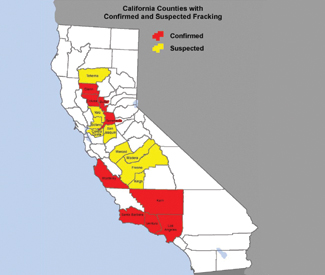
Yet the ruling has no effect on the oil wells already dotting the landscape in places like Kern County, an area already marked by poor air quality that supports the highest concentration of fracking operations in California. And for every acre of federal land now tied up in court, there are thousands more private parcels susceptible to being radically altered by fracking.

The U.S. Energy Information Administration estimates that the Monterey shale formation, which extends from the northern San Joaquin Valley to Los Angeles County and westward to the coast, holds more than 15 billion barrels of oil.

It’s an astounding quantity that dwarfs that of the Bakken Formation, which has helped light up North Dakota’s economy with a fracking boom, or the Eagle Ford Shale in West Texas, each of which are estimated to contain between 3 and 4 billion barrels.


NO SPECIAL PERMIT REQUIRED

Once a company has obtained a permit to extract oil and gas, “the state doesn’t require companies to get a permit to frack,” explains Scow, so it’s unknown just how much it’s currently happening. Voluntarily reported industry data shows that at least 91 wells were fracked in California between January 2011 and April 2012. Yet in 2011 alone, state records show, 2,294 new wells were drilled, while 3,376 notices were filed to “rework” existing wells.

In California, oil and gas drilling is regulated by the Division of Oil and Gas Resources. Speaking at a forum at the Commonwealth Club hosted by Climate One on April 2, Mark Nechodom, director of the California Department of Conservation, said DOGR never required reporting on fracking because it’s “one short blip” in oil production.

“In our historical use of fracturing in California, we have had no evidence that there is any environmental damage or hazard to human health—no evidence, I am saying—and therefore we have not required reporting,” said Nechodom, whose agency presides over DOGR. “Now we are requiring reporting and we are in the middle of developing a regulation for that.”

Nevertheless, the prospect of a pending California fracking boom on top of the loosely regulated activity already underway has galvanized Bay Area environmentalists. A host of environmental organizations are planning to form a coalition in the next several weeks to push for a permanent ban on fracking, targeting Gov. Jerry Brown.

Unchecked fracking could unleash a host of problems, says Scow, including a high risk of tainted groundwater, harmful air emissions, a spike in atmospheric carbon from the release of underground methane, and possibly even more frequent earthquakes due to wastewater disposal deep below the earth’s surface, which can destabilize faults.

“The process is just too dangerous,” he says. “There’s no safe way to frack. In the long term, we want fracking banned.”


OIL AND WATER

Policy discussions about fracking often arrive at the “Halliburton loophole.” In 2005, the story goes, when the federal Energy Bill was being drafted under the Bush Administration, then-Vice President Dick Cheney orchestrated the inclusion of a perplexing provision exempting “hydraulic fracturing” from the Safe Drinking Water Act.

Cheney famously presided over Halliburton, a company that invented a precursor to modern-day fracking in the 1940s. Few understood what it meant at the time, but the ascendance of fracking has made it clear that the loophole amounted to a munificent gift to the oil industry, clearing the way for rigs to bore downward and outward with toxic underground fluid injections unencumbered by regulatory slowdowns — all to the detriment of safe drinking water.

“The Safe Drinking Water Act loophole has really created a problem for us,” Steve Craig, an olive rancher from Monterey County, noted while speaking at the Commonwealth Club panel.

Craig described the frustrating process of trying to get agencies to intervene in a fracking operation nearby his ranch, right along the Salinas River. “At this point, we don’t know what’s in the fracking fluids. How can you know if it’s a problem if you don’t know the content of the chemistry? It’s not fair to the public to hide behind that trade secret veil and expect us to live with it.”

The risk of groundwater contamination tops Scow’s list of nightmarish scenarios. Fracking fluids can contain benzene and other carcinogens, as well as compounds linked with kidney or nervous system problems. “Once fracking fluid is injected underground, much of it stays underground indefinitely,” a Food and Water Watch issue briefing notes. “There is a network of different pathways through which contaminants … could flow into and contaminate groundwater.”

And since groundwater is drinking water in some places, Scow says this possibility is a major concern. “Prevention is really the key here,” he says. “We’re talking about some nasty stuff that could be irreversible.”


TOUGH FIGHT AHEAD

On April 29, the Assembly Resources Committee is scheduled to take up two nearly identical pieces of legislation that would impose indefinite moratoriums on fracking. The practice has already been subject to moratoriums in New York and New Jersey, and was permanently banned in Vermont and nationwide in France and Bulgaria.

But there’s likely to be stiff resistance, because for oil companies, fracking may as well be California’s modern-day gold mine.

“We’ve been a major petroleum state for a number of years, and the governor has indicated strongly that we want to continue to do that,” Dave Quast, head of an industry association called Energy in Depth, noted at the Climate One panel. “It’s been done safely, and it will continue to be done safely, and we should all be excited about that,” because it’s preferable to importing oil from the Middle East or places with weaker environmental regulations, Quast said.

But there’s a larger question: Do we really want to be burning more oil? If every last barrel of oil were extracted from the Monterey shale, says Scow, it could indeed meet the nation’s total oil needs — but based on current consumption rates, it would be entirely burned up in less than three years.

“Burning the 15 billion barrels of oil — even if that were some kind of achievement,” Scow says with a wry laugh, “is still going to make our climate crisis worse.”

CEQA change moves faster in SF than Sacto

13

So the Guv says he doesn’t think he’s going to be able to gut CEQA this year. I think he’s right: The party he supposedly leads (but doesn’t tend to follow him) won’t go for it, any more than the party Obama leads will got for cuts to Social Security.

It’s partly that both are hard-fought pieces of progressive history. The late 1960s and early 1970s were a good time for the environmental movement — Congress passed both the National Environmental Policy Act and the Endangered Species Act, and Nixon signed both. The California Legislature passed CEQA in 1970, and Gov. Reagan signed it. Back then, even Republicans thought it was a good thing to be on the side of protecting the planet.

But there’s more — and it’s interesting that the state Leg, typically not known as a bastion of progressive thought, is better on this issue than San Francisco, where some sort of changes to CEQA are almost inevitable.

Some background:

What NEPA and CEQA did, first and foremost, was eliminate the problem of “standing” that had plagued environmental lawyers for years. If I couldn’t prove that a horrible development project on the San Francisco waterfront would personally injure me (which would typically mean I had to own adjacent property), I had no right to go to court to oppose it. CEQA mandates a valid, complete environmental review of any major project, which gives anyone the right to sue; I may not be able to describe specific financial damages from a project, but as a citizen, I have a legal right to an adequate Environmental Impact Report.

Likewise, anyone can appeal a development in San Francisco to the Board of Supervisors on the grounds that the EIR was inadequate.

CEQA review slows down projects and costs money. If you “streamline” the process, you make life easier for developers. But there’s a hefty price to pay — because while Sup. Scott Wiener talks about homeowners fixing rotting handrails, very few CEQA suits or appeals are ever filed over that kind of thing. Yeah, there are exceptions; year, one lone bike-hater slowed down the city’s bicycle plan. Yeah, NIMBYs will sometimes slow down affordable housing projects.

But most major CEQA lawsuits and appeals are over big projects, ones that, in San Francisco, tend to slide through the official approval process no matter how horrible they are. Mayors of this city for most of the past half-century have liked developers; mayors appoint the majority of the Planning Commission, and they appoint commissioners who like developers. There’s big money in San Francisco real-estate development, and the savvy builders spread enough of it around that they typically get their way.

CEQA gives the rest of us a way to fight back. Most of the time, it doesn’t work: A CEQA appeal, for example, didn’t stop the atrocious 8 Washington project. CEQA hasn’t stopped developers from building about 50 million square feet of office space in the city since the 1970s. CEQA didn’t stop that hideous Rincon Hill tower. Oh, and it hasn’t stopped a single affordable housing project.

In a city where developers rule and bad decisions are made all the time, for all the wrong reasons, you have to look at tradeoffs. Is it worth accepting a delay in the bike plan and the Dolores Park plan because lone nuts are using CEQA — if that means we can force big commerical projects to mitigate some of the damage their doing? CEQA isn’t perfect, but “reforming” it to make appeals harder is, on balance, a bad idea.

Have at me, trolls. I am a backward-thinking luddite who hates success and never wants anything in the city to change. I am an old curmudgeon. I am whatever you come up with next.

Or maybe I’ve just lived here long enough to see that much of what passes for “progress” in this town does more damage than good.


Warriors Arena proposal rouses supporters and opponents

72

UPDATED Rival teams have formed in the last week to support and oppose the proposed Warriors Arena at Piers 30-32 as the California Legislature considers a new bill to approve the project, a new design is about to be released, and a trio of San Francisco agencies prepares to hold informational hearings.

Fresh off the collapse of two of the city’s biggest development deals, Mayor Ed Lee and his allies are pushing hard to lock in what he hopes will be his “legacy project.” A new group of local business leaders calling itself Warriors on the Waterfront held a rally on the steps of City Hall today, emphasizing the project’s job creation, community partnerships, and revitalization of a dilapidated stretch of waterfront.

That launch event followed last week’s creation of the San Francisco Waterfront Alliance, made up mostly of area residents and environmental organizations that oppose the project, including the Sierra Club and Save the Bay. The group today released a press release and artist’s rendering of how the 13-story arena and two condo towers may block views of the bay.

Last week, SFWA put out a press release criticizing Assembly Bill 1273 by Assembly member Phil Ting, claiming it would allow the project to avoid scrutiny by the Bay Conservation and Development Commission, which oversees and issues permits for waterfront projects. “One of the primary reasons we have regulatory agencies like the BCDC is so that local jurisdictions don’t run roughshod over the Bay and the waterfront,” group President Gayle Cahill said in the release. “The San Francisco Waterfront Alliance strongly believes that BCDC should retain its jurisdiction in this project to ensure independent oversight for the Bay and for all of us.”

Yet Ting and supporters of the project say the legislation doesn’t change BCDC’s oversight of the project, pointing to language that explicitly acknowledges the agency’s authority. While the legislation would remove the need for the three-member State Lands Commission to approve the project, proponents said approval by the full Legislature is a higher bar that ensures more public scrutiny and accountability.

“It does not waive BCDC. It goes through the same BCDC process,” Ting told us. “By going through the Legislature, you do have more hearings and public process. The idea was to make this more thoroughly vetted.”

The Port’s Brad Benson told us that State Lands staff is also still actively scrutinizing the project. “We’ve been working closely with State Land and BCDC staff to incorporate their concerns,” Benson said. For example, the arena configuration has already been moved closer to shore than originally proposed because of BCDC concerns about maritime access to a deep-water berth at the site.

In addition to approval by the Legislature and BCDC, the project must also be approved by the Port Commission and Board of Supervisors. The latest design for the project is scheduled to be released on May 6 and will be discussed by the Board of Supervisors Land Use and Economic Development Committee that day, said Gloria Chan of the Mayor’s Office of Economic and Workforce Development. The Planning Commission will then hold an informational hearing on the new design May 9, following by a May 14 hearing before the Port Commission. 

The project is proposed to include a 17,500-seat arena that would host more than 200 Warriors games, concerts, and other events per year, starting in 2017, on 13 acres of rebuilt piers. The adjacent, 2.3-acre Seawall Lot 330 would include up to 130 new condos, a hotel of up to 250 rooms, and 34,000 square feet of restaurants and retail space.

The whole project would include just 830-930 parking spaces, making its still-unfolding transportation plan key to the project’s approval. Opponents of the project also criticize the project’s height and its financing package and say this intensive development isn’t consistent with city plans or state laws that protect waterfront lands for maritime and public uses.

“We told the mayor before it was even announced that it is not a legal use of the pier,” Save the Bay Executive Director David Lewis told the Guardian. “There’s no reason that an arena has to be out on the water on a crumbling pier.”

Yet proponents tout the project’s economic benefits to the city and the need for an arena that size to host concerts and conventions, beyond the prestige of luring the Warriors away from Oakland and back to its original home city. “It will be privately financed and turn a crumbling pier and unsafe parking lot into a state-of-the-art venue that generates new revenue for the region and provides a spectacular new facility for the Bay Area’s NBA team.”Jim Wunderman, CEO of the Bay Area Council and an honorary co-chair of Warriors on the Waterfront, said in the press release.

UPDATE: Rudy Nothenberg, who served five SF mayors financing big civic projects and helped found SF Waterfront Alliance, disputes several assertions made by project proponents. “The first version of [AB 1273] unquestionably moved BCDC out of the way,” he said, claiming that bill language was altered after input from BCDC and the consultant to the Assembly Natural Resources Committee. BCDC has not yet returned a call from the Guardian on the issue. Nothenberg also says AB 1273 turns the deliberate fact-finding process required for the State Lands Commission to make its public trust determination into a political process that is a less thorough vetting of the project.

He also took issue with the statements by Wunderman and others that this is a privately funded project, noting that taxpayers will be paying $120 million to rebuild these piers and will give up future property taxes on the site, which will be diverted by a special tax district to help repay the bonds. Nothenberg told us, “Their continued assertion that there is no public money involved in blatantly untrue.”


Why CEQA matters

3

By Arthur Feinstein and Alysabeth Alexander

OPINION Is now the time to significantly weaken San Francisco’s most important environmental law? When our world is facing the greatest environmental threats ever experienced, why is there a rush to diminish our hard won environmental protections?

That’s the question we should all ask Supervisor Scott Wiener, who has proposed legislation that would significantly weaken the city’s regulations that enforce the California Environmental Quality Act.

Global climate change and extreme weather events are sending a clear message that the world is in trouble. Unprecedented droughts threaten our food supply and drinking water, while floods and sea level rise threaten our homes (the Embarcadero now floods where it never has before). The ozone hole still exists, threatening us with skin cancer, and the critters with whom we share this world are experiencing an unprecedented extinction rate.

Recent region-wide planning efforts, such as One Bay Area, expect San Francisco to provide housing for more than 150,000 new residents, bringing even more impacts to our city.

The best tool available to city commissioners, supervisors, and the public to understand and effectively reduce negative environmental effects of new projects is CEQA, which requires analysis and mitigation of unavoidable environmental project impacts. CEQA mandates that the public be informed of such impacts, and requires decision-makers to listen to the public’s opinions about what should be done to address them. It allows the people to go to court if decision-makers ignore their concerns.

Without an effective CEQA process, the public is helpless in the face of poor planning, and planning based only on the highest corporate-developer-entrepreneur return on the dollar with no regard for environmental consequences, including noise, night-lighting, aesthetics, and transportation — all issues of concern to urban residents. And with current tight real-estate economics, worker safety is at risk if developers cut corners on environmental review, especially with projects built on toxic and radioactive waste sites like Treasure Island, which potentially endanger construction workers and service employees who will work in these areas after projects are completed.

Wiener’s legislation, introduced at the Land Use Committee April 8, makes it much harder for the public to appeal potentially damaging permit decisions, by shortening timelines and establishing more onerous requirements for such appeals. In many instances it would also steer appeals away from being heard by the entire Board of Supervisors, instead allowing small committees to rule on these crucial issues.

A broad coalition of environmental, social justice, neighborhood, parks protection and historic preservation groups, allied with labor unions, is challenging Wiener’s attack on our environmental protections.

Supervisor Jane Kim recently stepped forward to champion these efforts, and work with these groups to draft a community alternative to make the CEQA process more fair and efficient while carefully protecting our rights to challenge harmful projects.

The supervisors need to reject Wiener’s damaging legislation and consider Kim’s community-based alternative in seeking to truly improve our local California Environmental Quality Act process.

Arthur Feinstein is chair of the Sierra Club Bay Chapter. Alysabeth Alexander is vice-president of politics for SEIU Local 1021.


TRUST Act clears committee as immigration reform heats up nationally

It was late at night by the time New Latthivongskorn, then 22, finally started to make his way home from the University of California Berkeley campus after a long night of studying for midterm exams.  A third year molecular and cell biology major who was trying to keep up his grades in preparation for med school applications, Latthivongskorn said he noticed a man in a black hooded sweatshirt walking toward him as he approached his home. At first he didn’t think much of it – but just as he was about to unlock the door to his apartment, the young Thai student heard a voice. “Give me everything you’ve got,” the man commanded.

“I looked at him, and I looked down, and I saw a gun pointed straight at me,” Latthivongskorn recounted. Terrified, he tried to stay calm and simply cooperated; handing over his backpack and cell phone, silently feeling relieved that he hadn’t been carrying his laptop. Fortunately, Latthivongskorn was able to proceed into his apartment unscathed after the man who robbed him at gunpoint vanished down the street.

When his concerned housemate asked if he wanted to file a police report, Latthivongskorn faced a dilemma. “Yes, I wanted to report it,” he told the Guardian in a phone interview, “for me, but also for the community. That same man ended up mugging another individual later that night.”

But there was a problem. Latthivongskorn had moved with his family from Bangkok to Sacramento when he was just nine years old – and despite the fact that his entire life was rooted in California, he’d never obtained U.S. citizenship. Any interaction with police, he feared, could place him in jeopardy – even if he was approaching law enforcement as a crime victim.

“In the end, I couldn’t call,” he said. “What was going through my mind was thinking of all the sacrifices that my family had made for me … and I worked so hard to get to this point, and I’m still not there yet.” His decision not to report the armed robbery came down to “the simple fact that it could all end – that I could get deported.”

Fast-forward to today, and Latthivongskorn has graduated and earned a spot on the waitlist at Stanford while he awaits responses from a number of other med schools. He’s also active with ASPIRE, Asian Students Promoting Immigrant Rights through Education.

On April 9, he shared his experience of being mugged with California legislators at a hearing of the Public Safety Committee, and urged lawmakers to approve the TRUST Act.

Authored by Assembly Member Tom Ammiano, the bill seeks to “limit harmful deportations often stemming from trivial or discriminatory arrests,” according to a statement from Ammiano’s office.

As things stand, all arrestees have their fingerprints recorded and submitted to ICE, or U.S. Immigration and Customs Enforcement. Under the federal Secure Communities program, ICE can then direct local law enforcement to hold arrestees without bail, beyond the time they’d be detained under normal circumstances, for the purposes of immigration proceedings.

The idea is to hold and deport dangerous criminals, but in practice it’s proved problematic. “More than 90,000 Californians have been deported, with 70 percent not convicted of anything, or only of lesser crimes,” Ammiano’s office points out. “Some were never charged with crimes, and some were crime victims.”

The TRUST Act would “establish a statewide policy that says if the person has not been convicted of a serious or violent felony, they would no longer be held any longer than authorities would hold them otherwise,” explained Carlos Alcalá, a spokesperson for Ammiano. The idea is to draw a distinction between violent or serious offenders, and anyone else who could be swept up in the system and needlessly held without bail.

Also on hand to testify at the April 9 hearing was Ruth Montaño, a Bakersfield woman who was arrested and nearly deported after someone complained that her dog was barking too loud.

Alcalá recounted other horror stories that had made their way to the Capitol. There was the day laborer whose employer reported him to immigration authorities at the end of his shift when all he was expecting was a day’s wage, and the woman who was arrested outside of Walmart for trespassing – and nearly deported – for selling tamales. Then there were women who reported incidents of domestic violence only to be subjected to immigration proceedings (and their counterparts, who stayed mum about abuse because they feared deportation).

Members of the Public Safety Committee approved the TRUST Act 4-2, clearing the way for the bill to go to the floor of the Assembly as early as next week. An earlier version made its way to the desk of Gov. Jerry Brown last year, but was ultimately vetoed, leading to a revised version. “Because of last session’s history, we’re hoping to have more substantive discussions with the governor beforehand,” Alcalá told the Guardian.

The timing is significant. “Immigration changes are moving quickly at the national level,” Ammiano noted, “and California needs to make changes here to keep pace.”

Advocates expect a national proposal for immigration reform to be introduced in the Senate any day now, according to Jon Rodney of the California Immigrant Policy Center. West Coast activists are planning an event April 10 to mirror a mass rally and march for immigration reform planned in D.C.

In San Francisco, the march will begin outside Sen. Dianne Feinstein’s office on Post Street and then proceed to Civic Center, where a rally is planned for 5 p.m. Latthivongskorn plans to participate along with other organizers from ASPIRE, and a host of local and regional immigration reform advocates are getting involved.

Those joining the march “will carry 1,000 paper flowers,” Rodney said, “to represent 1,000 deportations that happen every day in the U.S. That’s one piece of Wednesday’s rally, is stopping deportations.”

Oakland’s first outdoor sculpture park opens tonight!

2

Last Tuesday, in the parcel of land off of Telegraph Avenue between 19th and 20th Streets in Oakland, Randy Colosky discussed the orientation of his wooden sculpture, The Pressure to Hold Together That Which Held Things Back Part 2. Three assistants and two arts commissioners weighed in. The word of the hour, it seemed, was “dialogue.” 

“It’s about starting a dialogue,” Steven Huss, the city’s Cultural Arts Manager, said on the phone earlier that day. He reiterated the same on site as he moved a portable chain-link fence aside to enter the Uptown ArtPark, a large-scale temporary sculpture garden that will open to the public tonight during Art Murmur. His favorite part of the park’s construction, he told me, was talking to people who stopped to ask questions.

Huss is experienced in the art of dialogue. Over the past three years, he has witnessed and participated in the many that have transpired between the community, the city, and developers during the planning of the space’s use.

As a part of a redevelopment effort to enliven Oakland’s uptown area, the city bought the parcel in 2005 and began to lay out plans for an apartment complex and Henry J. Kaiser Memorial Park, which now hosts the monument, Remember Them: Champions for Humanity, which honors a wide array of humanitarians such as Frederick Douglass, Elie Wiesel, and Harvey Milk. The piece of land adjacent to Telegraph, known as Parcel 4, was slated to become a parking lot, but members of the community objected.

After an blogging effort, an exhaustive campaign at city council, and a plan that aligned with an initiative to promote public art in Oakland, a proposal began to crystallize in the summer of 2009. In October 2010, after searching for funding, Huss earned a Creative Placemaking grant from the National Endowment for the Arts, which the city agreed to match. Other sponsors stepped in, including Burning Man offshoot Black Rock Arts Foundation, which was eager to exhibit work in an urban setting.

On the phone and in the park, though, Huss’s tone flattened as he discussed the years of bureaucratic coordination and lightened as he talked about the art and the space that had almost reached completion. For the time-being, the logistics had been settled and he was relieved and excited that he could look forward to filling the space. In the empty back-alley of the three-sided lot perimeter that comprises the ArtPark, Huss enthusiastically described the potential dance and theater events that could enliven the space. In what he called “immersive theater,” the audience would participate in the production.

Programming will focus on “dialogue, not didacticism,” added Kristen Zaremba, Senior Public Art Manager for Oakland, as Huss went to talk through the fence to a passerby who had shouted a question about how long the project had been underway.

As they talked, Zaremba spoke to a woman who was drilling into the concrete pad at the base of Karen Cusolito’s Dandelion, then pointed out the steel wool tufts that the artist recently added to compose the anther of the giant flower.

The 20-foot tall sculpture, the final in the row along 19th Street, complements the other nine works in the park in the play between the organic and the industrial that adheres to the exhibition’s theme, “repurposed.” In ascending height order from Telegraph back along 19th, the pieces form an oversized garden of welded steel, recycled bicycle parts, and in the case of Colosky’s second piece, Barbican, engineered ceramic honeycomb, a material found in the catalytic combustor of a car. The effect is both whimsical and striking.

When we returned to the plot along Telegraph, Colosky’s piece had assumed its arch-like form that he envisioned. Though a completed version of Pressure had already been exhibited before it came to the Art Park (all except one by Eric Powell were finished work), the artist enjoyed the process of revising the reclaimed redwood retaining wall pieces to fit the circular base. “In remaking things, you get to explore all the possibilities,” he said. He and his assistants agreed that the new configuration worked well, and they bolted it down then cheered. “That ain’t going nowhere,” Colosky proclaimed with a grin.

As the group sat down to lunch, a man on the sidewalk shouted, “Making our city look good! Welcome.”

On Friday, the chain-link fence will depart and the Uptown ArtPark will receive its official welcome in a ceremony that will include speeches by Mayor Jean Quan and city council members, an organized bike ride, and because above all, Huss wants to celebrate the artists of Oakland and the vibrant scene they have created, it will also include conversations with the artists, most of whom will be on site.

At a certain point, though, serious dialogue will end. “Friday will be fun,” Huss said. After years of planning, Parcel 4 will open as a community gathering place. “It’s a party.”

Fri/5, 6:30-8:30pm, free
Telegraph and 19th St., Oakl.
www2.oaklandnet.com

The truth conquers all

33

I was standing in front of what looked like a semi-vacant office building. I re-checked my maps app — it looked like I had the correct address for the Planned Parenthood clinic. If only this woman would stop shouting about killing babies, maybe I could think.

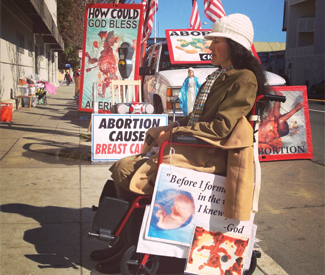
“Don’t kill your baby! If it could talk it would say ‘Mommy, don’t judge me,'” I turned back to look at career abortion clinic protester Erika Hathaway, and was embarrassed to realize that her wheelchair was parked right in front of the clinic’s door. I had missed it entirely in my zeal to document her interaction with a typical visitor, and had walked right past the door in the chaos.

And I wasn’t even there for a reproductive health appointment. I shivered at the thought of dealing with her while concerned about the results of an HIV test or a weird bump on my labia, much less a tortured decision to end a pregnancy.

I brushed past Hathaway’s exhortations to “ask for the ultrasound!”, a command that echoed around the clinic’s small, otherwise calm waiting room as I closed the door. A young patient looked up with me with tired eyes, shaking her head at the activist’s audacity.

Up for a lecture on respecting life from a guy who has multiple restraining orders from medical clinics?

“I compare it to the offensive foul rule in basketball,” Adrienne Verrilli, director of Planned Parenthood communications, tells me moments later. “You have to have your feet already set to avoid getting the call.” Verrilli’s clinic has been dealing with these protesters for years.

The activists tout bloody posters of aborted babies and bump Christmas music year-round “to remind people that Christ was a baby once,” as Hathaway tells me. They’ve made patients cry, make staff who love their jobs at the clinic want to leave by the back entrance every day.

Recently, a protester actually entered the clinic and woke up a napping patient to tell her why abortion is murder. Only two percent of the visitors to Planned Parenthood come for an abortion.

Hathaway’s setup

Supervisor David Campos, who represents the Mission, has proposed an extension of the current eight-foot “bubble zone,” which Hathaway and her ilk circumvent by pre-stationing themselves in a wheelchair. With their “feet set,” they have no need to approach patients. Verrilli says her staff regularly see Hathaway leave the chair to walk up to Burger King for refreshments. Rumors fly that she has a “day job” as a dogwalker in Belmont, Calif.

Campos wants to extend the no-fly zone to 25 feet from the door and bar protesters from entering, period. I looked at the van that Hathaway’s uncle — a 20-year vet of abortion protesting who has had multiple restraining orders placed against him by the Bay Area abortion clinics he splits his time between — has plastered with violent imagery. It’s parked in the middle of the specially-designated loading zone in front of the clinic, shielded by the handicapped tags that Verrilli says all pro-life protesters seem to have. Given the obvious determination of the anti-choice activists, I hope that the proposed change will be enough to ameliorate their aggression towards vulnerable patients.

Verrilli showed me a letter dropped off at the clinic by a Bernal Heights neighborhood mom of a seven-year-old who was “visibly disturbed” by the protesters’ signs. Unwilling to let me leave on an entirely negative note, she told me about AB 154, a proposed state bill that would allow advanced nurse practitioners to perform first trimester abortions, making family planning services even more available. The fight for reproductive justice continues, despite dedicated opponents.

Her hope lingering in my ears, I braced myself to go back outside and hang with the protesters.

I asked Hathaway why she spends her days in front of reproductive health clinics. “The truth conquers all, as Shakespeare’s Hamlet said,” she said, conquering any adherence to literary fidelity. “Eventually, we will win.”

She told me that Steve Jobs was adopted. “What would the world have been like without him?”

So many babies are being aborted in the United States, she said, that there won’t be enough workers to fund Social Security when it comes time for she and I to retire. This underpopulation theory is a new one for me.

The truth will set you free, right? “Do you need that wheelchair to get around?” I asked her.

“I have arthritis,” she told me. “It’s not a wheelchair, it’s a transport chair.”

A young man wearing a baseball hat exited the clinic and Hathaway shouts, “the Virgin does not want you to abort that baby!” I think about the two percent chance that he’s there to support someone getting an abortion, and the million other reasons why he could have paid the clinic a visit that day.

“It’s her choice,” he replied, and continued on his way.

Planned Parenthood 1650 Valencia, SF. (415) 821-1282, www.plannedparenthood.org

Localized Appreesh: Sunbeam Rd.

0

Localized Appreesh is our thank-you column to the musicians that make the Bay. To be considered, contact emilysavage@sfbg.com

I’m a lover of past treasures. I like my music vinyl, and I like my mail snail. Sure, I download thousands (millions would be hyperbolic, right?) of tracks a year, send hundreds of emails a day, tweet with the rest of them, and then some. Technology is still my friend, but vintage pleasures will always be my lover. Hence, my delight with the arrival of a colorfully confetti’d physical postcard from psychedelia-minded local fuzz-pop trio Sunbeam Rd., announcing the group’s 50th show.

The  San Francisco band’s debut LP, Breathers, came out last October, and I slept on it then, so I’m not making the same mistake twice. And while its psychedelic guitars, tender melodies, and fuzz-layered pop hooks may be blissfully of another era, Sunbeam Rd. also knows how to harness modern technology – it raised enough money through Kickstarter last year to press the record on vinyl. 

The band is made up of brothers Trevor Hacker and Clive Hacker, along with Harrison Pollack – all graphic design graduates from California College of the Arts (you might get a sense of that in the cat-filled video for swirling “Lucy”).

Check it out below and then see the trio live this weekend at Bottom of the Hill, celebrating 50 performances on the Sunbeam Rd.
http://www.youtube.com/watch?v=Z8ziAxlNZa4

Year and location of origin: TREVOR: We formed in early 2009 after setting up a drumset and some amps in the kitchen of the flat where Harrison and I used to live near Glen Park. Our roommates must have hated us.

Band name origin: HARRISON: In the ’80s, NASA was planning to build a big spaceport near the Air Force base in our hometown. It was slated to be like the West Coast Cape Canaveral but NASA pulled out at the last minute for some reason relating to the Challenger disaster, leaving the town in a severe recession.

One time my friend that worked on the base took me to the hangars that NASA built and never used. “The Sunbeam Road” was the nickname give to one of the landing strips, which had been gradually falling apart over the last 20-30 years. It was a super eerie place in contrast to the overly optimistic name. It kind of stuck with me for some reason.

Band motto: CLIVE: Wise men say forgiveness is divine, but never pay full price for late pizza.

Description of sound in 10 words or less: Hook-laden, fuzz-saturated trance states.

Instrumentation: CLIVE: Drums; TREVOR: Vox/Guitar; HARRISON: Bass.

Most recent release: BREATHERS (our debut LP) and BREATHERS Remixed.

Best part about life as a Bay Area band:
TREVOR: Road trips to Mt. Diablo, Big Sur, Point Reyes, and course all of the live music & great record stores.

HARRISON: Close proximity to the Based God.

CLIVE: What Harrison said; Also, it’s certainly never boring being a band in the Bay Area. There’s constantly something new and/or different happening that has yet to be explored.

Worst part about life as a Bay Area band:

TREVOR: It aint cheap!

HARRISON: The feeling that the Based God is so close, yet so far away.

CLIVE: What Harrison said; Also, it’s too easy to be complacent here in San Francisco.  

First album ever purchased:

CLIVE: I believe it was Whatever and Ever Amen by Ben Folds Five.

TREVOR: Blur, Blur.

HARRISON: Smash, The Offspring.

Most recent album purchased/downloaded:

CLIVE:  Acquiring the Taste, Gentle Giant.

TREVOR: Stone Shift, Larry Ochs Sax and Drumming Core.

HARRISON: Jack The Tab/Tekno Acid Beat, Psychic TV.

Favorite local eatery and dish:

CLIVE: #19 on the menu at Evergreen Garden (pho with five-spice chicken). It’s just great!

TREVOR: Little Yangon in Daly City. Pork and sour bamboo shoot curry with coconut rice

HARRISON: Taqueria Vallarta’s street tacos are basically the only things I like to eat.

Sunbeam Rd.
With Halsted
Sun/7, 9pm, $9
Bottom of the Hill
1233 17 St., SF
www.bottomofthehill.com

Tech Bubble 2.0

58

OPINION We all remember the first dot-com bubble, right? Web technology start-ups flocked to San Francisco in the late 1990s. Thousands of would-be entrepreneurs and techies filled up the city. Gentrification of Central City neighborhoods accelerated sharply. Apartment rents jumped, followed by the condo boom. Demand for commercial office space, especially South of Market, quickly grew red-hot. Rents zoomed, and office developers rushed dozens of proposed new projects forward.

The leaders of Mayor Willie Brown’s gutless Planning Department rubber-stamped all they could, and decried the annual limit imposed on their approvals by the 1986 community-activist-sponsored Proposition M ballot measure.

The activists and the mayor put two competing measures on the November 2000 ballot in response. Both lost, but the progressive slate for the Board of Supervisors swept that election, defeating most of the mayor’s candidates.

And then Tech Bubble 1.0 popped. The peak year was 2000. The big dot-com bust, 9/11, and finally the Great Recession all followed.

The city’s office market crashed. Some new office buildings were foreclosed by their lenders. Many approved office developments went unbuilt. Overall office market vacancies approached 20 percent by 2010.

Ah, but here we go again — Tech Bubble 2.0! A new wave of recent technology industry start-ups — like Twitter and Yelp — are joining the growing survivors of Bubble Number 1 — like Salesforce. And San Francisco has become a premiere national media venue for the tech industry.

Thousands of would-be entrepreneurs and techies are again filling up the city. Apartment rents are going through the roof. Gentrification of Central City neighborhoods is accelerating even faster. Demand for commercial office space, still in SoMa, is red-hot again.

But by 2011 so much vacant space was on the market, and so many approved buildings were waiting for anchor tenants to start construction, that there has been room for them all so far. Several new buildings got underway. Mayor Ed Lee strategically took advantage of this market boom to target economic expansion to the Central Market District, the last disinvested zone of San Francisco’s Downtown.

Even today though, city office vacancies still exceed 5 percent. And according to the most recent Planning Department report, more than a dozen already-approved new buildings, totaling more than 4.5 million square feet, are waiting to start construction in the Transbay Transit District, South of Market, and Mission Bay. Another 5 million feet of office space is proposed for more than a dozen more pipeline projects for those areas. Plus another 2.5 million feet is planned for projects on Port property — including the San Francisco Giant’s huge project — that are not even on the Planning Department’s list yet!

How does this total of 12 million square feet of pending new San Francisco office buildings compare to historic demand? Going back to 1986, the amount of new office space actually built — true long-term market demand through the boom/bust business cycles — averages out to about only 750,000 square feet a year. The city’s old-school corporate headquarters dramatically downsized or even moved out of San Francisco — like Chevron and Bank of America — and that’s still ongoing. The new tech industry is mostly replacing them. So these 30+ identifiable current projects would provide a 16-year supply of office space at historic rates.

But even in the face of this evident market glut of future office buildings, the usual civic development hypsters are once again muttering about gutting Proposition M, and radically upzoning Soma for even greater office expansion. Is that who City Hall will listen to this time too?

Bubble? What Bubble? [Pop!]

John Elberling is executive director of the Tenants and Owners Development Corporation.

Dirty war over clean power

10

tredmond@sfbg.com

It was supposed to be part of Ed Harrington’s legacy, and the chief of the city’s Public Utilities Commission delayed his retirement to make sure it happened.

But six months after the Board of Supervisors voted 8-3 to move forward with CleanPowerSF, the plan is under attack from all sides. Pacific Gas & Electric Company’s house union is spending big chunks of money to shoot it down. The press is loaded with accounts of how expensive it’s going to be for customers. Advocates on the left are blasting it as too limited.

Critics say Harrington’s replacement, Harlan Kelly, is far less interested in making a program work that clearly lacks the support of a PG&E-friendly mayor.

That’s left Sup. David Campos, City Hall’s chief proponent for CleanPowerSF, trying to move forward with a program that, for all its flaws, is the city’s best chance to put a crack in PG&E’s monopoly.

CleanPowerSF will offer San Franciscans a greener alternative to PG&E power, most of which comes from nonrenewable sources. The city will buy renewable power in bulk, through Shell Energy, and distribute it to customers along PG&E’s lines.

A similar system is working well in Marin County, and communities all over the state are looking to see if a city the size of San Francisco — where PG&E has kept out any hint of competition for a century — can pull it off.

Clean power is more expensive right now, and that’s one sticking point: City officials recognize that not all San Franciscans will be willing to pay a premium (of perhaps $10 to $20 a month) for the option. An SFPUC survey released March 25 showed that about 45 percent of the city’s customers would pay extra for clean power and stick with the new program. Earlier studies suggested that 90,000 customers will remain with CleanPowerSF — enough to make the system financially viable.

(Interestingly, the areas most likely to pay extra to avoid fossil fuels are not the wealthiest parts of town. Most of the customers would be on the Eastside, in communities like the Mission, Potrero Hill, the Haight, and Noe Valley.)

The bigger problem with the current debate is that advocates and city officials can’t agree how much money the city ought to spend, on what schedule, to build its own renewable generation system, which would eventually replace much of the power purchased by Shell.

“In the past we would have figures and claims from all sides, and Ed Harrington would look at the numbers and figure it all out, and everybody trusted him,” Campos said. “But we don’t have Ed any more, and Kelly doesn’t seem to be as strongly behind this.”

Building a green-power infrastructure was always a critical part of the CleanPowerSF plan. And once the city has a system up and running, it can use the revenue stream to float bonds to pay for building solar, wind, and cogeneration facilities.

Over time, the locally generated power would be far cheaper than what anyone can offer today, meaning rates would come down.

“We agreed to move the sales agreement forward to get the system started, then keep working on the build-out,” Campos explained.

But a campaign by International Brotherhood of Electrical Workers Local 1245, which represents PG&E employees and is historically allied with the company’s political goals, is trying to scare customers away with claims of high rates. And in fact, the first rate proposals were above what Campos and others were hoping for.

So the Local Agency Formation Commission, which oversees CleanPowerSF for the supervisors, and the SFPUC, have send staff back to try to find ways to cut rates.

Meanwhile, Kelly wants to de-couple the public build-out from the Shell agreement, in essence launching the program with the most expensive elements in place — and potentially undermining the future of a publicly owned energy infrastructure.

That has some clean-energy advocates furious — and they’ve threatened to withdraw their support for the program.

“Ever since Harlan Kelly took over, the PUC staff has been less supportive of a robust build-out,” Eric Brooks, who works with Our City has been a longtime supporter of CleanPowerSF, told us. “We’re not saying the city should stop moving forward with the Shell deal, but the city has to continue the planning work for the build-out. It can’t be a piecemeal thing.”

The SFPUC hired a Marin-based outfit called Local Power, led by longtime clean-energy advocate Paul Fenn, to do some preliminary work on how a build-out could proceed. Fenn’s conclusion: The city could create 1,500 to 3,000 jobs and build enough renewable energy to power much of the city, over a seven-year period — at a cost of about $1 billion.

That’s a huge tab — and almost certainly more ambitious than this SFPUC and Board of Supervisors could accept.

Fenn told us that his economic analysis, presented to the SFPUC’s Rate Fairness Board Feb. 18, indicates that the city’s cash flow from CleanPowerSF with a renewable build-out would more than cover the payments on the bonds. But he also agreed that he’s suggesting the best possible alternative — and he expects the city would go for a much smaller piece.

“The Board of Supervisors hasn’t made the decision to spend that kind of money,” he said.

Fenn’s contract expired April 1, and the SFPUC hasn’t renewed it. Instead, another consultant will review Local Power’s work, Campos said.

Part of the political challenge is that Local Power has proposed that much of the build-out include what’s known as “distributed generation” — small-scale solar, wind, and cogen projects on private houses and buildings.

Those installations would be “behind the meter” — that is, they would allow households and businesses to generate their own power without buying it through PG&E’s distribution system.

The build-out proposals that the SFPUC staff have discussed are primarily larger solar arrays, some on land the city owns in the East Bay.

“That’s the most expensive way to do this, and it allows PG&E to still control the transmission and distribution,” Brooks said.

[TK-SFPUC comment Monday.]

Meanwhile, PG&E is preparing to roll out its own competing “green energy” plan — while IBEW ramps up it assault on CleanPowerSF.

The IBEW campaign includes robo-calls, mailers, and advertising, all aimed at convincing customers to opt out of the city program.

And now, with advocates from the Sierra Club to Our City criticizing the program on the left, and IBEW trying to undermine it before it gets going, there’s a real chance that a plan more than 10 years in the making could be in trouble.

That concerns Campos. “All I’m hearing from the advocates is negative,” he said. “I want more build-out, too, but unless we move forward with the program, we won’t be able to do that.”

In fact, he said, “you could wind up killing it and have nothing to show for it at all.”

That, of course, would be PG&E’s preferred alternative.

Airbnb’s tax and tenant law violations headed for hearings

80

As Airbnb continues to avoid making any public comment on the $1.8 million annual Transient Occupancy Tax obligation to the city that it appears to be dodging, with the complicity of the Mayor’s Office, Board of Supervisors President David Chiu is getting closer to introducing legislation to regulate so-called “shared housing” and holding public hearings on the issues it raises.

In addition to the tax issue, there are concerns that Airbnb, VRBO.com, and other Internet-based sites that facilitate short-term rentals of San Francisco apartments are increasingly being used to circumvent local tenant protections, often after evicting tenants from the apartments using the Ellis Act. That state law allows owners to leave the rental business and convert to other uses, and landlords can argue that Airbnb is a commercial use and not a residential use.

“I’ve been deep into a lot of these issues in my conversations with a lot of community stakeholders around Airbnb and the area of shareable housing and I’m hoping very soon to have a package of proposals in this area. And at that point, we’ll have public hearings on the topics that you describe,” Chiu told us when we asked about the tax and tenants issues.

Among those involved in Chiu’s negotiations with Airbnb is Ted Gullicksen, executive director of the San Francisco Tenants Union, who says the negotiations have been slow-going but he’s generally happy with how they’re proceeding and hopeful that the resulting legislation will rein in rampant current abuses of zoning, tax, and other regulations that city officials have been ignoring.

“All you have to do is sit in front of the computer for a few hours and you can identify a lot of the lawbreakers. But there’s no enforcement by the city,” he said, noting that the Tax Collector’s Office is the notable exception among city departments, such as the Planning and Building departments. “The taxes shouldn’t even be an issue because they’re illegal uses.”

For example, while landlords may be able to get around rental restrictions triggered by an Ellis Act eviction by calling the use for shared housing websites “commercial,” that’s usually a violation of local planning codes prohibiting commercial use of residential property. Chiu’s legislation approved late last year banning “hotelization,” in which entire apartment buildings are cleared of tenants and rented out on a short-term basis, allows nonprofit groups like the Tenants Union to help enforce the ban.

“We’ve been researching the buildings we want to go after with complaints and lawsuits,” Gullicksen said. “It’s a pretty widespread problem.”

He said the VRBO.com appears to be a bigger culprit in terms of being used by landlords to avoid tenant protections than Airbnb, whose hosts are evenly split between tenants and landlords. But as the biggest shared housing service in San Francisco, the tax issues are bigger for Airbnb and the city.

“We don’t mind the limited use of someone’s principal residence for short-term rental, where we’re concerned is about the whole buildings,” Gullicksen said.

Whether the issue is avoiding taxes or circumventing tenant protections, the complicated issues surrounding shared housing are long overdue for some public discussions and scrutiny, and it sounds like that’s what we’re see later this spring or summer.

Alerts

0

Submit political events to be listed in Alerts at alert@sfbg.com or tweet us @SFBG_alerts.

WEDNESDAY 3

Protest Obama fundraiser outside the Getty mansion 2870 Broadway, SF. tinyurl.com/c2mkope. 5:30pm, free. Environmentalists opposing the Keystone XL oil pipeline will protest in San Francisco’s wealthy Pacific Heights neighborhood, where President Barack Obama will dine with the city’s upper crust for a Democratic Party fundraiser. Credo Action – the advocacy arm of telecom Credo Mobile – is mobilizing the protest in tandem with the Sierra Club, 350.org and Friends of the Earth.

Community meeting to save City College Pitcher Room, City College Southeast Campus, 1800 Oakdale, SF. info@saveccsf.org. 6pm, free. Students and community supporters who are engaged in the ongoing fight to save City College of San Francisco as an affordable and accessible educational resource are planning major actions in coming weeks. Join them for this informational and strategy session to preserve this important institution.

THURSDAY 4

Public forum with David Graeber Namaste Hall, California Institute for Integral Studies, 1453 Mission, SF. 7pm, free. An anthropologist from the University of London, author David Graeber is credited with helping to lay the intellectual framework underlying the Occupy Wall Street movement. His work includes Debt: The First 5000 Years, a tome exploring wealth inequality through the ages. Graeber’s talk will be on “Austerity and its Discontents.”

FRIDAY 5

Panel talk on global affirmative action Room 132, UC Berkeley School of Law, 215 Boalt Hall, Berk. tinyurl.com/ckc6qdu. 4-6pm, free. RSVP. Many fear that an upcoming Supreme Court ruling will spell the end of affirmative action admission programs for public colleges and universities. This panel will discuss global affirmative action law, with presenters from the European Commission, the University of Sydney School of Law, and Berkeley Law.

Forum with Dr. Ignacio Chapela Niebyl Proctor Library, 6501 Telegraph Ave, Oakl. SpeakOut-Now.org. 7pm, $3 donation. Dr. Ignacio Chapela, Associate Professor of Microbial Ecology at UC Berkeley, has been studying the impact of genetically modified plants and the misuse of science and its impact on our planet. Join this Speak Out Now forum to hear Chapela’s vision for how science could be used for more positive ends.

SUNDAY 7

Book talk: Beyond Walls and Cages Modern Times Bookstore Collective, 2919 24th St, SF. www.occupyu.org. 6pm, free. As part of Modern Times’ ongoing Occupy U workshop series, this book discussion will explore how prisons, criminalization and militarization facilitate wealth and power inequalities. Join editors Jenna M. Loyd, Matt Mitchelson, and Andrew Burridge in discussion of their book, Beyond Walls And Cages: Prisons, Borders, and Global Crisis.


“It just gets different”: Ali Liebegott on her third book ‘Cha-Ching!’

1

When you’ve spent long, smelly months in a bus traveling the world sharing words with pockets of alternative community, the issue of place takes the fore. As she releases her third book Cha-Ching!, and as her decades-old Sister Spit collective embarks upon yet another tour of spoken word, queer revelry, and cramped living conditions, author Ali Liebegott is getting academic about it.

“I’m kind of obsessed with how artists can live,” she tells me in a SoMa coffeehouse. She had texted me for clarification the night before on whether it was okay to look “scummy” at our interview, but she looks pretty neat in her white tee, motorcycle helmet sitting next to her on a bench. “And how queer people can live. I always think, where would I live if I couldn’t live in San Francisco or New York?”

Liebegott teaches Sarah Schulman’s Gentrification of the Mind — a book that looks at how economic displacement changes our brain’s wiring — in her fiction class at Mills College. And in Cha-Ching!, the economy is an ever-present force, guiding protagonist Theo into shitty apartments in both NY and SF neighborhoods where there are few out gay people. (Not to mention a ludicrously depressing janitor job at a junk mail factory.) The book is Liebegott’s third after The Beautifully Worthless and The IHOP Papers

When I ask whether they’re getting easier to write as time goes on she just laughs. “If I had been a plumber, I’d be able to fix things in my sleep. It doesn’t get easier, it just gets different.”

Liebegott reads from Cha-Ching! at City Lights in October

In an ever-more-caffeinated manner, she and I discuss how those higher rents are coinciding with an era in which publishing houses are more hesitant about what they throw their weight behind. “[Queer literature] is the first to go,” Liebegott says. “All the queer books at Barnes and Noble are behind a potted plant, there’s like four of them, and one of those is Best Lesbian Erotica 1994.”

So it’s good that, as poor queers and creatives and poor creatives and queers get kicked out of their urban homes and prime shelf space, Sister Spit is on the rise. Once restricted to queer female writers, the tour now includes a variety of genders, and different kinds of artists.  

Liebegott’s book is one of the first to come out on the imprint that the group’s founder Michelle Tea was able to start through City Lights Books in the fall of 2012 — The Beautifully Worthless was also released through the imprint, as well as the amazing Sister Spit anthology from earlier this year. Tea’s fantastical young adult novel Mermaid in Chelsea Creek, set to drop this summer, is delicious. The collective’s gig at the main library on Sun/31 is in advance of yet another of its fabled tours. This time the path lies up and down the coasts, up to Canada, and into the Mid-West. 

>>LISTEN TO CITY LIGHTS BOOKS’ RECENT PODCAST INTERVIEW WITH ALI LIEBEGOTT 

Along the way, the Sister Spit artists will meet audience members in places where there is no queer community, places where people fundraised to get them there. 

“I don’t want to say we’re a beacon of hope, but it is nice to give people this connection that they might not have,” Liebegott says. 

And that connection, more and more, may not be associated with any specific urban area. San Francisco, for example, would be beyond Liebegott’s reach as a home if it weren’t for her and her girlfriend’s rent control. “I kind of feel like we’re headed towards hell,” Liebegott muses, taking in our swank, caffeinated surroundings. “I feel like we’re already there.”

Regardless, art. Cha-Ching! deals in gambling addiction, drug addiction, poverty, ennui, animal abuse, powerlessness — but nonetheless, can be laugh out loud funny even, especially, when characters hit their low points.

She’s already planning her next book, about a war vet obsessed with feeding ducks. “I feel like I’m so mired in depressing things!” Liebegott says. “My threshold for that is much higher than most people.”

Cha-Ching!‘s ending, though, leaves room to hope that queers can triumph over today’s adversities. Or does it? At any rate, you have ample chances to buy the book at this week’s readings (Liebegott is one of the featured artists at the Sister Spit reading on Sun/31 as well.)

In other news, Liebegott’s big into Sizzler. She told me to write that.

Ali Liebegott’s Cha-Ching! release party

Wed/27, 7pm, free

City Lights Bookstore

261 Columbus, SF

www.citylights.com


Sister Spit tour kick-off reading

Sun/31, 2-5pm, free

San Francisco Main Library

100 Larkin, SF

www.sfpl.org

Localized Appreesh: Swells

0

Localized Appreesh is our thank-you column to the musicians that make the Bay. To be considered, contact emilysavage@sfbg.com. 

When you grow up around surfers (I didn’t), you often hear talk of swells (or so I’m told). The swell conjures dreamy images of magical, mythical, perfectly curled waves and poses struck on glossy retro surfboards with the sunset soft and orangey behind it all. When you hear San Francisco trio, Swells, you might feel the same. 

The relatively new garage rock act may be based in the Mission, but up here (points to brain), the band is forever floating out at Ocean Beach, or likely some warmer coastal region. Check indie love story “Ships Set Sail,” with its bouncy drums, surf guitar riffs, and Strokes-like vocals, or reverby “Lost at Sea” for a peek into that state of mind. 

This week, Swells – made up of vocalist-bassist Ian Bruce, guitarist Diana Salier, drummer Rob Justesen – plays the Hemlock. But first, the band (which, full disclosure, is friendly with recent Localized Appreeshers Magic Fight) took our survey: 


Year and location of origin: October 2011, San Francisco.

Band name origin: Rob suggested Swells and everybody vetoed…then he brought it up again and we forgot that we’d vetoed. I think we were almost called Merchants or Polar Ghost. But Swells was a cool blend of our retro thing and beachiness. 

Band motto: “It’s not whatever, but fuck it.”  

Description of sound in 10 words or less: Chilled out garage rock with said retro and beachiness.

Instrumentation: Ian “Dad” Bruce – vocals, bass, soccer mom; Diana Salier – guitar player with mystique; Rob Justesen –  just plays drums.

Most recent release: We wrote a Christmas song called “Xmas Lights” and released it back in December. We’re planning to record some of our newer tunes this spring. 

 Best part about life as a Bay Area band: Lots of great venues to play in a small area. Also Karl the Fog

Worst part about life as a Bay Area band: Planning a West Coast tour is like doing figure eights across state lines — whereas Northwest bands can just straight shoot down to LA and back, and vice versa. 

First album ever purchased: Ian — Tom Petty Greatest Hits; Led Zeppelin II (on the same day); Diana — Green Day, NimrodRob — Outkast, Aquemini.

Most recent album purchased/downloaded: Ian — Mike Hurley, First SongsDiana — Beach Fossils, Clash the TruthRob– Local Natives, Hummingbird.

Favorite local eatery and dish: St. Francis! Ian — hog cakes; Diana — two egg breakfast+coffee; Rob — country breakfast.

Swells
With Torn ACLs, Sunrunner
Thu/21, 8:30pm, $6
Hemlock Tavern
1131 Polk, SF
www.hemlocktavern.com


Our Weekly Picks: March 20-26, 2013

0

WEDNESDAY 20

Mr. Marina Competition

Why would you pay $50 for an hour of hosted Skyy vodka and Peronis? Why, when it’s preceding what may well be the most self-aware (we hope) SF bro moment of the year: the two-year-old Mr. Marina competition. The winner among 10 brah-ly contestants will become VIP at various Marina businesses for 2013 and will be proud that he slapped cancer, as goes the moniker for the Leukemia and Lymphoma Society booster club through which this event’s proceeds are donated to fighting disease. Swimwear competition, talent portion, and impromptu question fielded in stereotypically “Marina” outfits will help judges pick a dude-gem. (Caitlin Donohue)

7pm-11pm, $50

Ruby Skye

420 Mason, SF

mrmarina-fb.eventbrite.com

www.slapcancer.org


Chelsea Light Moving

Kim Gordon’s new band, Body/Head, was just here for a Noise pop show, so….let’s just get this out of the way: yes, Sonic Youth’s Thurston Moore is the guitarist-vocalist-songwriter behind Chelsea Light Moving. And no, Sonic Youth does not have plans to reunite. Chelsea Light Moving is now on its first official tour, in support of its self-titled debut album, which came out March 5 on Matador Records, and has the bloggers buzzing. The post-rock foursome, named for an actual moving company run by Philip Glass and Steve Reich, maintains Moore’s jagged guitar work and tendency towards the fuzz, but some tracks hold a quieter calm, and lean more toward pop than Sonic Youth ever did, which is an interesting departure. San Francisco’s harmonious post-punk trio Grass Widow opens. (Emily Savage)

With Grass Widow

8pm, $21

Great American Music Hall

859 O’Farrell, SF

www.slimspresents.com


THURSDAY 21

“Growing Pains: Business of Cannabis”

Where have the federal intervention of past years and the more recent steps forward in legalizing marijuana across the country left us in the fair city of San Francisco? At this talk, hear thoughts from long-haired news contributor to fellow SF Newspaper Company-owned publication SF Examiner, Chris Roberts, and ex-marijuana grower Heather Donahue who yes, also starred in the swervy shots of 1999’s Blair Witch Project. More relevant for the purpose of this blurb, Donahue wrote a book about her experience in small town NorCal weed country, and coupled with Roberts’ knowledge of Bay Area weed businesses, their thoughts should make interesting discussion. If you’ve already got a burning question for the duo, send it in advance of the event to growingpains@sfappeal.com. (Donohue)

6:30-7:30pm, free

RSVP recommended at info@ybcd.org

San Francisco Planning and Urban Research Association (SPUR)

645 Mission, SF

www.visityerbabuena.org


Shen Wei Dance Arts: “Undivided Divided”

The Opening Ceremonies of the 2008 Beijing Olympics presented stunning artistic spectacles (minus that whole unfortunate thing with the lip-syncing scandal), and Shen Wei, their choreographer, played a large role. The Ceremonies offers a good example of the artist’s work, which is known for its bridging of cultures and melding of the traditions of dance with innovative contemporary techniques. Shen Wei comes to YBCA with a long list of credentials — including a MacArthur Award and Guggenheim Fellowship — and a spectacular performance, “Undivided Divided,” that involves dancers moving in grids of different mediums such as sculpture and paint. (Laura Kerry)

Through March 24

8pm, $25

Yerba Buena Center for the Arts

701 Mission, SF

(415) 978-2700

www.ybca.org


Mohani

“Chillwave” or “chill-vibe” music. Are those terms en vogue or just plain nauseating? Whatever your opinion, there’s no escaping the fact that this Mashi Mashi Presents show will be an evening of electronic, dream-pop, and synth. When Mohani (Oakland’s own Donghoon Han) unleashes his own brand of K-Pop meets Joe Meek’s version of outer space, the soundscape will in fact leave you mellowed out. (This is his album release show.) Deliciously, atmospheric synth blips will rule this night featuring some truly emerging artists, while a good hook for the sake of song structure will not be forgotten. Keep your ears tuned in between acts as the DJ interweaves some carefully selected tracks to keep things moody. (Andre Torrez)

With Li Xi, THEMAYS, DJ Mashi Mashi

9pm, $7 Knockout

3223 Mission, SF

(415) 550-6994

www.theknockoutsf.com


FRIDAY 22

Murs

This ubiquitous LA-based rapper has eight solo albums out, one in the mix, and a hand in half a dozen side projects and collectives, often featuring in three or four different albums per year. Whether he’s going solo, rapping with Atmosphere’s Slug in their duo Felt, or getting indie-licious with Living Legends, Murs’ smart and surefooted rhymes stand out. He recently stirred up some controversy in the hip-hop community for featuring a gay kiss in one of his videos to highlight his support of marriage equality, a bold move both atypical of rappers and extremely fitting of Murs. He seems to have taken his own advice to heart when he raps on “Everything”, “Be original/Be different/Be the one to stand up and shock this system.” (Haley Zaremba)

With Prof, Fashawn, Black Cloud

9pm, $21

Slim’s

333 11th St, SF

(415) 255-0333

www.slimspresents.com


Ducktails

Ducktails produces summery rock. The band’s third album, The Flower Lane, released this past January, could span a lazy day at the beach; the low-key but bright album opener, “Ivy Covered House,” provides the soundtrack to a short drive with windows down, while the breezy love song, “Letter of Intent,” underscores the last embers of nighttime bonfire. The side project of Real Estate’s Matt Mondanile, what started as a solo act has developed into a tight band that performs upbeat pop songs to full audiences. Ducktails brings to these, along with a bit of premature summer, to the Chapel tonight. (Kerry)

With Mark McGuire

9pm, $15

Chapel

777 Valencia, SF

(415) 551-5157

www.thechapelsf.com


SATURDAY 23

The Specials

Let’s begin with pick-it-up, pick-it-up songs “A Message to You, Rudy,” and “Nite Klub,” and upbeat haunter “Ghost Town” — British two-tone legends the Specials released now-classic ska gems early in their career, beginning in ’79 with their self-titled debut. The band inched up through the early ’80s with followup, More Specials and more danceable two-tone tracks like anti-work anthem “Rat Race” and foggy “Stereotype/Stereotypes, Pt. 2.” Over the decades the band has broken up, gotten back together, gained and lost members, experience shiny revival popularity, and remained that of checkerboard legend. See the Specials live now, while you still have the joint strength to skank in the pit. (Savage)

With Little Hurricane, DJ Harry Duncan

Warfield

928 Market, SF

(415) 345-0900

www.thewarfieldtheatre.com


Christopher Owens

For most singer-songwriters who break big, life becomes a wild ride. For Christopher Owens, the critical and commercial success of his band Girls was just another event in a lifetime of crazy trips. He’s been, among other things, a cult member, a drug addict, a knife salesman, and a punk rocker. With such experiences, he has enough material for a lifetime of therapeutic songwriting. But Owens only seems to be able to write about one thing — love. While Girls tried their hardest to perfect the indie love song, Owens’ new solo album Lysandre tries harder. The record itself is one huge love story about a girl he met while on tour with Girls in France, and the duo’s subsequent rise and fall. The music and the lyrics are earnest, simple, and heart-achingly relatable. While the loss of Girls is a blow to the San Francisco music scene, one listen to Lysandre certainly eases the pain. (Zaremba)

8pm, $25

Palace of Fine Arts

3301 Lyon, SF

(415) 567-6642

www.apeconcerts.com


MONDAY 25

Half the Sky

Nicholas Kristof and Sheryl WuDunn’s best-selling book Half the Sky: Turning Oppression into Opportunity for Women Worldwide inspired many of its readers to become activists. Its message has been further shared thanks to a four-hour PBS documentary highlighting international women’s rights issues, with a little celebrity help from Diane Lane, Meg Ryan, Gabrielle Union, and others. In honor of Women’s History Month, the Guardian’s own Caitlin Donohue hosts an abridged screening of this important film, followed by what’s sure to be a lively discussion about San Francisco’s role in advancing women’s rights worldwide. (Cheryl Eddy)

7pm, free

Artists’ Television Access

992 Valencia, SF

www.atasite.org


Iceage

This band of young ruffians out of Copenhagen has had a whirlwind adolescence. After two albums and international acclaim, the gents in Iceage are still teenagers at 19-years-old. 2011’s New Brigade and this year’s You’re Nothing add up to one searing hour of punk rock fueled by the sort of unbridled, unfiltered fury that only coming of age can produce. Their particular sound mashes in elements of post-punk, hardcore, and industrial to create a delicious sonic mess. The group recently came under fire after a blogger posted a conspiracy theory-esque article about Iceage’s “chic racism.” Though the claims were unfounded and the research woefully incomplete, the allegations just won’t disappear. But hey, the rage and confusion stemming from this sort of injustice and abuse of modern forms of communication seems like a recipe for a great follow-up album. (Zaremba)

With Merchandise, Wet Hair, DJ Omar

8pm, $12

Rickshaw Stop

155 Fell, SF

(415) 861-2011

www.rickshawstop.com


TUESDAY 26

Caveman

It’s not just that Caveman’s music is dreamy, but it also shares qualities with dreams. The band’s first album, CoCo Beware (2011) simultaneously sounds close and ambiently distant. Caveman’s self-titled second album, released April 2, will build on these effects, which have produced compelling performances and earned the band impressive recognition in the past couple of years. With beautifully pure vocals and beats that are funkier than expected, the band plays folk-pop with a vividness of a daydream or the last images before waking. Get swept up in the momentum of Caveman’s reverie at the Independent. (Kerry)

With Pure Bathing Culture

8pm, $15

Independent

628 Divisadero, SF

(617) 771-1421

www.theindependentsf.com


The Guardian listings deadline is two weeks prior to our Wednesday publication date. To submit an item for consideration, please include the title of the event, a brief description of the event, date and time, venue name, street address (listing cross streets only isn’t sufficient), city, telephone number readers can call for more information, telephone number for media, and admission costs. Send information to Listings, the Guardian, 225 Bush, 17th Flr., SF, CA 94105; or e-mail (paste press release into e-mail body — no attachments, please) to listings@sfbg.com. Digital photos may be submitted in jpeg format; the image must be at least 240 dpi and four inches by six inches in size. We regret we cannot accept listings over the phone.

On the Cheap listings

0

Submit items for the listings at listings@sfbg.com. For further information on how to submit items for the listings, see Picks.

WEDNESDAY 20

1960’s Go-Go Groove Make-out Room, 3225 22nd St., SF. www.1960sgo-go.com. 7pm, free. Bust out those white go-go boots and learn some standard ’60s dance moves like the twist, jerk, pony, watusi, hully gully — even the tighten up! If you’re in need of some liquid courage before you shake it, head over to the Make-out Room at 6pm for some sweet happy hour deals.

THURSDAY 21

“Bold Local NightLife” California Academy of Sciences, 55 Music Concourse, SF. www.calacademy.org. 6-10pm, $12. Art and science converge as the Bold Italic website takes over this week’s Nightlife at the Academy of Sciences. Meet the local merchants, designers, artists, and producers from the ‘hoods we know and love. Folks from Misdirections Magic Shop, bakery co-op Arizmendi, wine delivery service Rewinery, and more will all have tables alongside the alligators, jellyfish, and penguins.

“Growing Pains, The Business of Cannabis in San Francisco” San Francisco Planning and Urban Research Association, 654 Mission, second floor, SF. www.visityerbabuena.org/events 6:30-7:30pm, free. RSVP suggested. SF Appeal editor Eve Batey and writers Heather Donahue and Chris Roberts will explore the state of marijuana in SF, and possible impacts of proposed cannabis legislative reforms. If you have a specific topic or question you would like addressed, email growingpains@sfappeal.com before tonight’s talk.

FRIDAY 22

“Dance Anywhere” Various locations throughout the Bay Area. www.danceanywhere.org. Noon, free. Why wait until tonight to get your groove on? In this global event — offshoots are taking place in major cities around the globe — participants are encouraged to stop whatever they’re doing when the clock strikes 12, and bust a move. Performances by professional dancers will take place at the SFMOMA, City Hall, and Yerba Buena Center.

“PhotographsPlus” Dogpatch Café and Art Gallery, 2295 Third St., SF. www.dogpatchcafe.com. Through May 10. Opening reception 6-8pm, free. This exhibit features local artist Shawn Ray Harris includes three distinct series of works created over the last 15 years. Endowed with a whimsical charm, Harris’ work offers a look into urban landscapes and the creatures that inhabit them.

“Game On” 1AM Gallery, 1000 Howard, SF. www.1amsf.com. Through April 20. Opening reception: 6:30-9:30pm, free. We need not remind you that nerds are the new cool kids. Instead, we’ll let the new show at street art-centric 1AM Gallery lend more evidence to prove the point. Its new group show highlights videogame characters rendered in vinyl doll and canvas by graf artists like Vogue TDK, Estria, and Mike “Bam” Tyau.

SATURDAY 23

Easter egg hunt for dogs Golden Gate Park, Marx Meadow, SF. www.waghotels.com. Noon-2pm, $15. Purchase tickets online. Help your pup sniff out some of the 2,000-plus plastic eggs containing treats and prizes at dog and cat resort, Wag Hotel’s fourth annual fundraiser benefiting local animal rescue organizations. Attendees will also enjoy complimentary hor d’oeuvres and beverages, have a chance to see how their doggie bud feels about the Easter Bunny.

Art Explosion spring open studio Art Explosion Studios, 2425 17th St., SF. www.artexplosionstudios.com. 7-11pm, free. Also Sun/24, noon-5pm. One of San Francisco’s largest art collectives will be holding its 13th annual spring open studio this weekend. Check out work from over 140 artist, painters, photographers, fashion designers, jewelers, and textile designers from around the city.

SUNDAY 24

Backyard Foraging book signing Omnivore Books, 3885A Cesar Chavez, SF. www.omnivorebooks.com. 3-4pm, free. You don’t need to trek into the forest to forage edible plants. Ideal for first-time foragers, Backyard Foraging: 65 Familiar Plants You Didn’t Know You Could Eat by Ellen Zachos features 70 edible weeds, flowers, mushrooms, and ornamental plants typically found in urban or suburban neighborhoods. Head over to Omnivore Books today to meet Zachos, listen to her speak about her book, and get a signed copy.

SF Mixtape Society exchange The Make-Out Room, 3225 22nd St., SF. www.sfmixtapesociety.com. 4-6pm, free. The San Francisco Mixtape Society is dedicated to the art of making and exchanging music mixes. Attendees are invited to assemble a mix according to the theme (this month is “anchors and sails”) in cassette, CD, or USB form. Come ready for newness: a magically random raffle will send you home with someone else’s mix at the end of the night. Record yours in cassette form and score yourself a free drink.

MONDAY 25

Izzies Awards Ceremony Z Space, 450 Florida, SF. www.zspace.org. 6-8pm, free. The Oscars may be over but award season has not come to a close just yet. The 27th Annual Izzies awards will take place tonight, honoring outstanding achievements in dance across the Bay Area. Hosting the ceremony is AileyCamp director David McCauley, and CounterPULSE executive and artistic director Jessica Robinson. After the ceremony, mingle with some dance big shots over dessert and coffee.

TUESDAY 26

French cinema class Alliance Française, 1345 Bush, SF. alliance-francaise-sf.weebly.com. 6:45pm, $5. To help non-French speakers discover French cinema, the Alliance Française of San Francisco is offering this weekly Tuesday night class, which includes a French film screening followed by a discussion. The class will take place in the Alliance Française’s intimate theatre where free wine, refreshments, popcorn (and English subtitles) will be provided.

“Remnants of San Francisco: Pieces of the Bygone City” St. Philip’s Catholic Church, 725 Diamond, SF. www.sanfranciscohistory.org. 7:30pm, $5. San Francisco’s architecture is decorative, meticulous, and often begs the question of passers-by: “what is the story here?” Get that tale tonight as historian Christopher Pollock will present before and after photos of significant architecture around the city, explaining the buildings’ significance and why they were built the way they were.