Oakland

Rearview mirror

0

emilysavage@sfbg.com

Year in Music “Out of all the records I’ve recorded, that was the worst experience,” says prolific Dinosaur Jr. bassist and Sebadoh guitarist Lou Barlow. He’s speaking of Bug, the classic, feedback opening alternative rock album Dinosaur Jr. released on SST in 1988.

Why then, did the band tour the East Coast during the spring of 2011, playing the album start to finish, and why does it continue to play it now — appearing at the Fillmore this week? “All the negative associations I had with it are gone. What I hear now is a really great batch of songs that J [Mascis] wrote.” He goes on to describe the early days of Dinosaur Jr., “when we formed it was my first textured, creatively ambitious band — and that was at the age of 17 — so it’s a real part of my DNA now. Musically, it’s a very familiar spot to be at.”

There, in a history-rich bed with a familiar texture, is the spot where aging rock fans crave to be. According to Simon Reynold’s exhaustive and polarizing 2011 tome Retromania, it’s also the space in which we all now inhabit, new listeners and old. His introductory words are harsh, if provoking. “The 2000s [was] the decade of rampant recycling: bygone genres revived and renovated, vintage sonic material, reprocessed and recombined. Too often with new young bands, beneath their taut skin and rosy cheeks, you could detect the sagging grey flesh of old ideas.” Brutal.

In some sections, Reynolds is dead on, and his methodology applies equally to the year in rock that was 2011 (though the book was written in the summer of 2010). We couldn’t possibly look back at these twelve months without including the grander trail of rock’n’roll, and how it was again repackaged throughout the year.

Given the retro-crazed times we live in, to judge the year, we must also fall deeper down the nostalgia inkwell, in part due to the onslaught of monster reunion tours, complete album trips, rereleased records, anniversary celebrations, and retro reverential new rock/garage/punk acts of 2011. One point Reynolds makes, is that the span of time elapsed between creative endeavor and nostalgia for said endeavor is rapidly fading.

Just recently the Weakerthans — which formed in 1997 — spent four power-pop nights at the Independent, playing one whole album from its catalogue each night. Earlier this year, Archers of Loaf launched a reunion tour (13 years after its demise) and the reissue of four of its studio albums on Merge. There were also reunion shows and tours from the Cars, Kyuss, Pulp, Cibo Matto, Masters of the Hemisphere, Death From Above 1979 (big up to Treasure Island Music Festival), and strangely, J. Geils Band, the Monkees, and System of a Down.

There were rereleased Smashing Pumpkins albums, a Throbbing Gristle greatest hits, and a Hot Snakes one-off (at press time) at All Tomorrow’s Parties’ Nightmare Before Xmas in Minehead, England — a fest also headlined by Archers of Loaf.

There was Nirvana’s Nevermind 20 year anniversary celebration, and Metallica’s 30 years strong, though the output for these celebrations was obviously disparate given the nature of the acts. Nirvana’s label released a series of singles and special edition anniversary batches. Metallica took perhaps the most surprising turn a no-frills metal act could — it paired with Lou Reed and released a confusing collaboration, Lulu, though the real anniversary celebration was yet to come — a four-night, devil-horned, juicy guest-starred tête-à-tête for hardcore fans at the Fillmore.

There were also the bands that just felt retro, or at least, stood with one foot in rock’s not-so-distant past. But the good ones were more reverent than carbon vintage copy, acts like Dum Dum Girls and Cults, played on romantic ideals of ’60s garage and slipped in some doo-wop and girl group-esque vocals, but neither directly mimics a particular era. In its debut follow-up, Only In Dreams (Sub Pop), Dum Dum Girls also referenced a distinct ’90s Mazzy Star vibe. Meanwhile, Canadian chanteuse Austra looped back to the ’80s with prominent synth and operatic love songs, and the Beets happily alluded to its own ’60s garage-meets-Ramones influences on fourth album Let The Poison Out (Hardly Art), like something out of a Nuggets boxset; a modern, bilingual Seeds.

Locally, longtime Ty Segall band member Mikal Cronin finally made the move to San Francisco in 2011. Raised on surf and garage rock down south, he brought with him a distinctive nostalgic sound; his solo self-titled record — released this year on Trouble in Mind — was one of the most intriguing of the year. Like many now living and playing in SF, he’s drawn to vintage rock’n’roll and garage, but his style stands out above the pack.

This year he released a multifarious record of crusted garage-punk and swirling psych-pop, glamorized with the hazy, sand-swept beach days pictured in vintage Polaroids. Opening track “Is It Alright” could be plucked from a psychedelic Beach Boys LP, laid thicker with grime. And Cronin, when pressed, reveals a long history of influences — along with current bands such as Thee Oh Sees and Strange Boys — mentioning longtime favorites “Emitt Rhodes, Del Shannon, the Beatles, the Beach Boys,” adding “I’ve been trying to relisten to the classics” And yes, the remaining Beach Boys were said to be planning yet another reunion for next year, a thrill for likely a few young fans (though the same can not be said for Brian Wilson’s 2011 Disney covers album).

Here’s another spot where Reynolds and I tend to split: I’m an unabashed rearview mirror fan. And while I agree that the “re-s” in our sonic world are sometimes overwhelmingly dull, the opportunity to see live bands that broke up before I was cognizant has just too strong a pull on my psyche. Even Reynolds seems to consent to that last bit, stating in Retromania, “The exceptions to my ‘no reunions’ policy are a few bands that I loved as a youth but never managed to see live.” So wouldn’t that be the case for someone in every audience? The giant pink headphones-wearing toddler I saw at the Iggy Pop show undoubtedly missed the punk singer’s first 40 odd years of shows. Now, will somebody please reunite Operation Ivy, Minor Threat, and Neutral Milk Hotel for complete album tours, or is that too sacrilegious for your precious memories? It’d just be for my own comfort, obviously. *


EMILY SAVAGE’S TOP 10 SHOWS OF 2011

Feb. 26: No Age, Grass Widow, and Rank/Xerox at Rickshaw Stop

April 27: Steve Ignorant plays Crass songs at Slim’s

June 1: Gayngs at Independent

July 13: King Khan & Gris-Gris, Shannon & the Clams, King Lollipop/1-2-3-4 Go! Records Showcase at Oakland Metro Opera House

Sept. 22: Hightower, Black Cobra, and Walken at Yerba Buena Center for the Arts

Oct. 6: CSS at Fillmore

Oct. 13: Gardens & Villa at Bottom of the Hill

Nov. 5: Wild Flag at Great American Music Hall

Dec. 4: Iggy Pop at Warfield

Dec. 10: Tycho at Independent

OccupyOakland extends Port blockade into second day

0

Early this morning, the protesters carrying out Oakland’s part in yesterday’s national “West Coast Port Shutdown” declared victory after 24 hours of demonstrations. After picketing during both the 8am and 6pm shifts at the Port of Oakland yesterday, protesters decided to extend the day of action to the 3 am shift today (Tues/13). 

Occupy Oakland’s General Assembly had voted to extend the shut-down if there was police violence against Occupy protesters in other participating cities; Occupy groups from Anchorage to San Diego participated, and protesters were tear-gassed in Houston and Seattle.

After a successful morning action, thousands of protesters arriving on a march to picket the 6pm shift were surprised to find that it had already been canceled. In an emergency General Assembly, protesters exchanged information about solidarity actions across the country and chose to continue the shutdown.

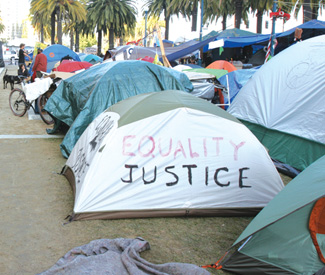
Protesters marched to Gate 60, where they commenced what one long-time OccupySF protester called a “festival in the streets.” Sound trucks with live music and DJs entertained the crowd while others played live music; a handful of tents were pitched.
At 1:20 am, the picket began again. Demonstrators circled in front of the gate entrance, chanting “Oakand is a union town!” and slogans against Export Grain Terminal (EGT), a grain elevator operator with which the ILWU has been in dispute since 2009.

Port workers began to arrive around 1:30 am, and many were surprised to see that the picket had been extended. One man, one of the earliest to arrive, seemed exasperated, saying “This is still going on? I didn’t show up yesterday, but I drove here from Fairview today.”
Others reacted differently. When a protester greeted one man and explained the reason for the continued protest, he responded, “Listen, I’m from (ILWU) Local 10. We’re a militant union. I’m used to this kind of thing.”

Clarence Thomas, past secretary-treasurer of ILWU Local 10 and third generation Oakland longshoreman, expressed a similar sentiment of solidarity in a recent interview with Workers World, saying, “If ILWU members don’t honor the community picket lines, it will cause an irreparable breach with the community. If the ILWU can’t support the community, why should the community support the ILWU in 2014 contract negotiations or when the new grain agreement is up next year?”

At 1:45 am, dozens of Occupy supporters, many of whom had left the “port shutdown” action to get some rest with plans to return in the early hours of the morning, began marching to the port from 7th and Adeline streets to join the picket lines.

By 2:30 am, protesters were marching in community picket lines at gates 60, 63, 67 and 68, with over 100 at the first three locations and about 20 in an all-bike picket line at the fourth. A handful of workers crossed the picket line and went to work. The majority who arrived for work – a light turnout, as news of the picket traveled quickly – did not cross the picket line. Many did stay, however, and engage in political conversations with Occupy protesters.

By 3:15 am, the shift had been officially canceled. A general assembly of Occupy protesters and representatives from the ILWU met to discuss next steps.  ILWU steward Anthony Lavierge addressed the group, saying, “This was called in solidarity with the Longshoremen, and in my opinion another day would harm that relationship. However, this is a community picket, and in the end it’s up to you what you decide to do.

Though some protesters wanted to continue to extent the blockade, they were overwhelmingly voted down by those who felt the time was right to declare victory. Samantha Levins, an Alameda/Oakland ferry worker and organizer with the Inland Boatmans Union/ILWU, stayed until the protest dispersed at 3:45am. She told the Guardian, “Today was great. It was extremely well organized and everybody was really respectful.”

Levins saw the day of action as a step forward for Occupy in the direction of working more closely with unions. She said, “It really opens up possibilities (for Occupy) to work more with unions. They’ve proven they can do it in a respectful way. ”

The Hangover: Dec. 8-11

1

**Environmental concerns aside, there is something satisfying about delving into the lost art of film photography. Or maybe I was thrilling to analogue on account of all the pretty cameras that were on sale at the opening of Union Square’s new Lomography store on Thursday, Dec. 8. Pretty patterns, candy colors — coupled with the hand-infused vodkas in flavors like sasparilla, orange peel, and bayleaf being churned out by experimental mixers Cocktail Lab, the creative possibilities were intoxicating. The store specializes in cameras that produce Instagram-esque shots, check out the thousands of color-soaked photos that have been uploaded to its website by film freaks around the country. (Caitlin Donohue)

**A couple words used (and possibly made up) to describe Jose James’ show at New Parish on Friday night: swoontastic and babymakingmusic. The rising neo-crooner gigged in San Jose and SF the preceding two  evenings, but for our money it’s hard to beat the intimacy of the small Oakland venue. Whereas James’s previous shows in the Bay Area featured more traditional jazz with restrained piano accompaniment, on this tour he was backed up with a full band capable of illustrating his range. It made for a super talented quintet including keyboardist Kris Bowers (who appeared on Kanye and Jay Z’s Watch the Throne album), bassist Solomon Dorsey, trumpet player Takuya Kuroda (a familiar collaborator of James’s), and standout drummer Nate Smith. (Ryan Prendiville) 

**If there was one cohesive thread linking the entirety of the sold-out Tycho show at the Independent on Saturday night, it would be water. Basic H20. Though, more to the truth, water spruced up with rolling waves, psychedelic cuts, vintage surfers, and a hazy orangeish moon on the horizon — the latter a constant in the current Tycho aesthetic, gracing the cover of the recently released album, Dive (Ghostly International). Behind the live three-piece, there was a running stream of visuals with a few shots that appeared to be out of surfer-cinematographer George Greenough’s groundbreaking 1975 surf film, Crystal Voyager. Tycho’s ebb and flow rose with its backdrop; there was silvery synth and acid-popped live drum hits laced together with smooth, wandering guitar and rippling bass. With shots of giant kohl-rimmed eyes and warming balls of sun, the performance was complete. And what better night to see Tycho (a.k.a. SF’s Scott Hanson, a.k.a graphic designer ISO50) than the evening of the blood-red lunar eclipse? (Emily Savage)

**It’s been over a year since Dave Portner – the yelping member of Animal Collective better known as Avey Tare – released his crocodile-inspired solo debut Down There (Paw Tracks). Maybe Tare needed to spend some time away from the songs that dealt with divorce, death, and illness, as he only recently set out on tour in support of the album. He finished his brief solo tour on Sunday night at Oakland’s New Parish, and I couldn’t wait to finally check him out. The dismal grey weather was well-suited to Tare’s dark and murky debut. A youthful crowd clad in an unsettling amount of lumberjack plaid filled the venue. Onstage was a creepy Yoda skeleton and a white sequined cloth-draped table with a few baby crocodiles placed around several electronic instruments. (Frances Capell) 

Occupy shuts down morning shift at Port of Oakland

Usually, when significant events related to the Occupy movement occur in the pre-dawn hours, it means an encampment has been raided. But this morning, Occupy protesters were the ones carrying out a strategic plan before the sun came up.

A main objective of today’s Port of Oakland shutdown — the second in two months initiated by Occupy Oakland — was to strike back against the police raids that dismantled their camps.

Protesters led by Occupy Oakland effectively shut down the morning shift at the Port of Oakland today, Dec. 12, as part of a Coordinated West Coast Port Blockade that Occupy groups from San Diego to Anchorage have been planning since Nov. 18, when Occupy Oakland’s General Assembly unanimously approved the call to action.

Several hundred activists met up at the West Oakland BART station at 5:30 a.m. and proceeded to march down Seventh Street to the sprawling shipping hub, where they formed picket lines outside terminal entrances to prevent workers from entering the gates for the 7 a.m. shift. Shortly after they began picketing, truckers waiting to load or unload cargo began turning around to exit port property.

There were several busloads of protesters in addition to those who traveled to the port on foot, as well as a bicycle contingent. While most protesters filed through the streets in an uncharacteristically quiet march that seemed muted due to a lack of sleep, a few displayed gusto with a sound system, shiny homemade flags, and flashy outfits. Some showed up toting a life-sized cut-out of Lt. John Pike, the University of California Davis officer who became notorious for dispersing teargas into student protesters’ eyes, with the face cut out so people could pose for photos.

Police arrived on the scene clad in riot gear, but did not attempt to prevent protesters from circling up around the gate entrances and forming picket lines. They stood in formations in front of the gates weilding batons and teargas launchers, though protesters had no intention of entering the gates and only sought to block them. Alameda County Sheriff buses circled the area as well.

Around 7 a.m., when the morning shift would have typically started, two ILWU dockworkers (who declined to give their names) stood near the Hanjin Shipping gate at berths 55 and 56, surveying the picket line. Past the gate, a cargo vessel which had likely come from Japan was berthed and waiting to unload.

“Ain’t nobody going to cross it,” one of the men offered. The other gestured toward protesters and said, “These are Americans wanting American jobs.” Asked how he felt about the picket, he responded, “We don’t support it, because it’s not in our contract — but I do see some issues, like we’re hurting, too.” The ILWU members said longshoremen turned away because of the picket line wouldn’t be paid for the day, because they’re only registered as having reported to work if they’re physically on the terminal. They also noted that there was a relatively light workload at Oakland terminals on this particular day.

The official objectives of the port blockade, aside from showing resistance against crackdowns on Occupy encampments, were to demonstrate Occupy’s solidarity with longshore workers and port truckers. The International Longshore & Warehouse Union (ILWU) Local 21, based in Longview, Wash., has been locked in a legal dispute with Export Grain Terminal (EGT) stemming from what workers characterize as union-busting practices.

Port truckers, particularly in Los Angeles, have been unable to unionize due to their employment classification as independent contractors, and protesters sought to highlight their struggle as well. Picketers held signs declaring solidarity with the ILWU and truckers against the one percent — global shipping companies owned in part by agribusiness giant Bunge, Ltd. and Goldman Sachs, respectively, who profit from their labor.

Speaking into a megaphone, organizer Barucha Peller announced that occupiers in southern Washington had shut down the Port of Longview, according to a text message from ILWU Local 21. Union members wanted to thank the movement for the show of support.

By around 10 a.m., an independent arbitrator had ruled that the picket posed a health and safety risk to longshore workers, so the dockworkers were sent home, effectively halting port activity for the first part of the day. “I’m really impressed that so many people got up at five o’clock in the morning,” Anthony Lavierge, a steward with ILWU, said into the megaphone. “It’s officially shut down. The longhshore labor is officially going home.” However, protesters planned to return to the port later on to prevent the start of an evening shift.

Following the announcement that workers had gone home for the day, protesters marched back to West Oakland BART station. A second march to the port is planned for 4 p.m., leaving from 14th and Broadway streets in downtown Oakland following a 3 p.m. rally. A third march to the port is scheduled to leave the West Oakland BART station at 5 p.m.

Live Shots: José James at New Parish

0

A couple of phrases used (and possibly made up) to describe José James’s show Friday night: swoontastic and baby-making-music. The rising neo-crooner gigged in San Jose and SF the preceding two evenings, but it’s hard to beat the intimacy of Oakland’s the New Parish, which has a certain bohemian vibe.

Whereas James’s previous shows in the Bay Area were more traditional jazz with restrained piano accompaniment, on this tour he was backed up with a full band capable of illustrating his range. It made for a super talented quintet including keyboardist Kris Bowers (who appeared on Kanye/Jay Z’s Watch the Throne album), bassist Solomon Dorsey, trumpet player Takuya Kuroda (a familiar collaborator of James’s), and standout drummer Nate Smith.

Known for pulling hip-hop and electronic sounds into the vocal jazz tradition, James is as much influenced by John Coltrane as he is in line with the legend’s nephew, Flying Lotus (who did production on 2010’s Black Magic) and gave a respective shout-out to each.

Most impressively, the group collectively had a relaxed, pretension-free quality, with James on point, cuing Kuroda to take a solo or setting a mic stand in front of the seemingly reserved Dorsey, wordlessly indicating that it was his turn to sing. Previewing a significant amount of material from the upcoming album Trouble, James closed the show with an encore of the title track. Reiterating that it was his first time in Oakland, it was clear from the smile on his face (and the crowd’s) that it probably wouldn’t be the last.

Should Occupy pull back and reinvent itself?

14

Maybe it’s time for the Occupy movement to simply take a bow, step off the national stage for now, and start planning its next big production. Because at this point, Occupy has been a smashing success – winning over its audiences and key critics, influencing the national debate – but it’s in danger of losing that luster if its lingers too long in its current form.

Consider the events of this week. When OccupySF’s long-standing encampment was finally removed by police and city workers, the general public barely noticed or reacted. Unlike during previous police raids, hundreds of supporters didn’t pour in to defend the camp and social media sites didn’t light up with messages of indignation and solidarity.

Why? Well it’s not because people don’t support the movement. Polls have consistently shown most people back Occupy, and even higher percentages support its basic message that the 99 percent are being screwed over by the 1 percent. Top political leaders at every level – Mayor Ed Lee, Gov. Jerry Brown, and President Barack Obama – made statements and speeches this week that echo the themes and ideas that Occupy has injected into the national dialogue.

But the tactic of occupation was only going to get us so far. It was a great way to start a conversation and demonstrate a broad discontent with this country’s inequities and plutocratic excess. Finally, the people have started to challenge those who are exploiting them, and it’s been particularly exciting to see young people fighting to reclaim their stolen futures.

That energy hasn’t dissipated, and it’s interesting to see it morphing into other campaigns, such as the recent takeovers of vacant foreclosed homes, the human rights march planned for tomorrow, and West Coast port shutdown scheduled for Monday. But I predict the crowds blockading the Port of Oakland will be a fraction of the size of the tens of thousands who took to the streets during the Oakland General Strike on Nov. 2.

Then, people were reacting to police violently crushing Occupy Oakland’s peaceful political assembly on Oct. 25, a galvanizing event, much like the raid on Occupy Wall Street and the abusive police tactics against occupiers on the UC Berkeley and UC Davis campuses. Each example showcased the police state’s willingness to use a heavy hand against peaceful protesters, demonstrating for a global audience what an important struggle this is and what we’re up against.

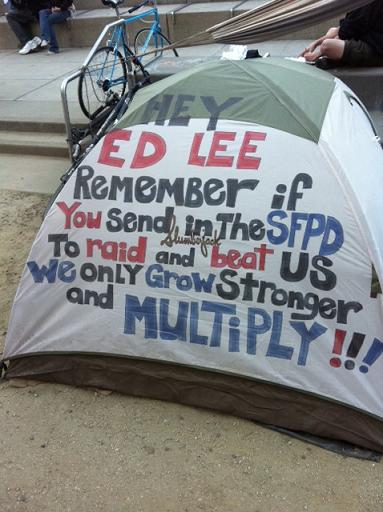
Yet it was hard to summon up much indignation over this week’s raid on OccupySF, even as protesters complained about being given just five minutes to get out and having their belonging seized and destroyed. Mayor Lee had been threatening the raid for weeks and had offered the group a free new home in the Mission – an offer they probably should have taken, one that would have allowed the group to declare victory and have a base of operations throughout the winter.

But unlike my cranky, “you kids get off my lawn” colleagues in the mainstream press, who have consistently derided the movement and valued anti-camping laws over the core constitutional right to peaceably assemble to petition for a redress of grievances, I think Occupy has been extremely important and effective. My desire is to see it evolve and continue.

Mayor Lee and other city officials have praised the goals and worldview of Occupy at every turn, even as they oppose the tactic of camping. As Police Chief Greg Suhr raided OccupySF, he told reporters that “part of the 99 percent removed part of the 99 percent to give the other part of 99 percent some relief,” tipping his hat to Occupy’s basic paradigm. Gov. Brown echoed Occupy’s economic inequity language in his call for higher taxes on the rich this week.

“I’m here in Kansas to reaffirm my deep conviction that we’re greater together than we are on our own. I believe that this country succeeds when everyone gets a fair shot, when everyone does their fair share, when everyone plays by the same rules. These aren’t Democratic values or Republican values. These aren’t 1 percent values or 99 percent values. They’re American values. And we have to reclaim them,” Obama said in his big speech this week, embracing the Occupy paradigm even as he tried to transcend it. But go back and read the whole speech and you’ll see that it would have fit right in during any Occupy General Assembly, with its regular calls to tax the rich, something this movement has given him the political cover to more forcefully advocate.

So the conversation has now begun, thanks largely to this movement. But, as most supporters of Occupy already know, our elected officials won’t simply enact the reforms we need on their own. They will need to be pushed and prodded relentlessly by a restive public, so the supporters of Occupy still have a lot of work to do.

How will they do that and what will it look like? I don’t know, but after watching these smart, creative, courageous, and committed young people and their supporters change the political dynamics of this country over the last three months, I’m anxious to see what they come up with and I stand read to chronicle and support the next phase, whatever it’s called and whenever it begins.

The Performant: Cheap thrills

0

Bargain Basement Mondays and Amoebapalooza

The upside to living in a city as notoriously pricey as San Francisco is that despite the myriad opportunities to blow too much cash on a mediocre time out, there are plenty of options for cheaper entertainments, keeping the broke-ass among us from being eternally housebound. This weekend in particular, a couple of low-budge music showcases offered those too skint to make it to Iggy Pop a way to afford more beer by charging less cover, and one even threw in the pizza! Sure, rocking out with the godfather of punk would have been quite a bang for its buck, but at least Bottom of the Hill and Café du Nord offered economical alternatives to hanging out in a drafty San Francisco flat Google-stalking Mike Watt. Not that I’d know anything about that.

If free’s your price, then Bargain Basement Mondays at Bottom of the Hill is your place. A once-monthly showcase of local musicians with no cover charge, the attitude is chummy and freewheeling. This week’s lineup was intriguing in that it was not just a random assortment of strangers, but instead a loose coalition of one-man bands gathered together to put on a show subdued only in decibels, but certainly not in invention.

I made it just in time to catch Andrew Goldfarb “The Slow Poisoner” halfway through a cluster of bug-themed songs, such as the instrumental “Spastic Maggot” (a personal fave). Goldfarb’s musical sensibility is one part Southern Gothic, one part B-movie creature feature, and one part swampy psychobilly, and in addition to accompanying himself on the electric guitar and kick drum, he also provides a visual “slideshow” of oversized flashcards with the names of each song painted in Goldfarb’s distinctive cartooning style, deceptively simple lines, skewed perspectives, and boneless, Piraro-esque physiology.     

Sean Lee’s 1manbanjo act followed, in which he led a spontaneous conga line of oddience members around the dance floor, beating time on a snare drum strapped to his back while strumming his mandolin-sized banjo, a hobo pied piper in a rumpled suit. A member of Thee Hobo Gobbellins, about half of Lee’s set was comprised of songs from their Alice in Wonderland-themed “Cheshire Rock Opera”—next slated to play the Oakland Metro on Jan 27, 2012. Last but certainly not least, Jordan B. Wilson debuted his very interesting music-making machine, which the other musicians kept referring to as a “squid”. An elaborate array of cables , computers, mixing boards, and drumsticks snaked around an entire drum kit’s worth of percussion, additionally Wilson played a double-necked guitar with keys, and sang, a triumph of multi-tasking, to say nothing of the three-year creation process of his singular contraption. 

Sunday’s Amoebapalooza, the annual open-to-the-public holiday party of Amoeba Music employees, was as quirky and varied as the music selection at our favorite converted bowling alley, during which the employees rocked the stage, and the aforementioned pizza was distributed like the modern equivalent to a Dickenson turkey. With a couple of exceptions (Vanishing Breed being one), most of the bands gave the impression of being hastily assembled for the purpose of playing this one show, but for five bucks, and all-you-can eat, it basically paid for itself, which was ultimately the desired effect..

Give The Performant a reason to Twit. Follow @enkohl for of-the-minute updates from the underground


ILWU attitudes toward port blockade aren’t so simple

The Chronicle’s Andrew Ross describes Occupy organizers as “brilliant” in a sarcastic tone for vowing to move ahead with the Dec. 12 West Coast port blockade, despite public statements from the longshore union’s president criticizing the plan. But Ross’ article misses the mark, and seems to ignore alliances that have been forged between various sectors of labor and the Occupy movement in recent months.

“Trouble is, the folks they purport to be in solidarity with don’t seem hot on the idea to ‘effectively shutdown the hubs of commerce’ at all,” Ross writes. The Chronicle’s narrative is clear: Here you have some everyday working people trying to do their jobs, make ends meet, and put food on the table. They don’t want to see business as usual disrupted by a bunch of out-of-touch radicals who claim to speak for them.

But in reality, workers’ attitudes toward the port shutdown are far more nuanced. After all, longshore and warehouse workers are feeling the pinch as advances in technology reduce the number of jobs to be filled along waterfront shipping facilities, and many truck drivers who haul cargo to and from West Coast ports are barely able to make ends meet since they’re employed as independent contractors and paid low hourly wages without union representation.

The president of the International Longshore and Warehouse Union (ILWU), Robert McEllrath, issued a statement Dec. 6 in which he criticized the plan for a west coast port blockade, which occupiers in Oakland, Los Angeles, Seattle, Portland, Vancouver, and Anchorage have all vowed to participate in on Dec. 12.

The official aim of the Occupy port shutdown is to demonstrate solidarity with longshore workers engaged in a labor dispute against EGT in Longview, Wash., and to stand with port truckers in Los Angeles whose attempts to unionize have been thwarted. The action is also meant as payback for raids against Occupy encampments in Portland, Oakland, Los Angeles, and other major cities, which were carried out in the wake of coordinated teleconferences between metropolitan mayors and a powerful organization of former police chiefs engaged in shaping law enforcement practices.

“Support is one thing,” wrote McEllrath, the ILWU president. “Organization from outside groups attempting to co-opt our struggle in order to advance a broader agenda is quite another and one that is destructive to our democratic process and jeopardizes our over two year struggle in Longview.”

ILWU spokesperson Craig Merrilees echoed McEllrath’s statement, telling the Guardian, “The Occupy Oakland group failed to respect the ILWU’s democratic decision-making structure. It’s unfortunate — it could’ve been handled differently.”

Dan Coffman, president of ILWU Local 21 in Longview, Washington, had just gotten out of a court hearing with grain terminal operator EGT when the Guardian caught up with him by phone. His union has been locked in an ongoing struggle against EGT, stemming from the multinational corporation’s attempts hire non-union workers and erode standard worker benefits such as overtime pay at a new grain terminal built on Port of Longview property.

“The ILWU has no involvement in [the port blockade] whatsoever,” Coffman explained. “We are not organizing this, and we are not promoting it.”

Yet he emphasized that, speaking as individual, “I’m a 99 percenter. Things have got to change. We’ve got to get some sanity back in this country. It’s obscene what they’re doing to working people and poor people in this country.”

Some rank and file members of ILWU said they agreed with the principles of the Occupy movement.

“Longshoremen had a good response to the [Nov. 2 general strike and port blockade],” Anthony, a longshoreman who’s worked at the Port of Oakland for more than a decade, told the Guardian in a phone interview. “It was empowering to a lot of people that so many people came out.” He added, “The rank and file do support the principles of the community and Occupy.”

The Port of Oakland ran full-page ads in major newspapers last week condemning plans for a port blockade, yet incorporating a key phrase of the Occupy movement into its message. “Port of Oakland is where the 99% work,” the ad proclaimed. “Occupy groups have called for a ‘total west coast ports shutdown’ on December 12th. Port of Oakland maritime operations were partially shut down on November 2nd. What did that accomplish? Lost work hours, lost shifts, and lost wages for workers and their families.”

Asked about the ad, Anthony called it “a lot of propaganda.”

Tremaine Waters, another longshoreman at the Port of Oakland, told the Guardian, “The majority of ILWU workers are supportive of what’s going on. They understand the situation occurring in America right now.” He added that if community members organize a picket line on Dec. 12, “I would say, yes, the ILWU members will respect it.”

Clarence Thomas, a third generation Oakland longshoreman, discussed the planned port shutdown in an interview with Worker’s World. Thomas emphasized that ILWU traditions and practices dictate that union members do not cross community picket lines.

“A picket line is a public demonstration — whether called by organized labor or not,” Thomas said in the interview. “It is legitimate. There are established protocols in these situations. To suggest to longshoremen that they shouldn’t follow them demands clarification. It is one thing to state for the record that the union is not involved, but another thing to erase the historical memory of ILWU’s traditions and practices included in the Ten Guiding Principles of the ILWU adopted at the 1953 biennial convention in San Francisco,” Thomas said. He added, “Labor is now officially part of the Occupy movement. That has happened.”

Occupy movement targets foreclosed homes

14

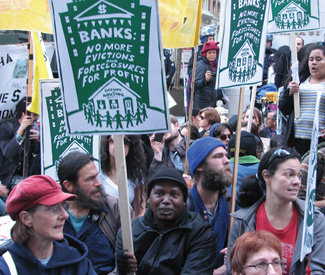
Throughout the Bay Area on Tuesday (Dec. 6), Occupy activists and housing advocates launched what they said will be an ongoing effort to place families back into their foreclosed homes, seizing bank-owned homes to put pressure on the banking industry to cooperate with homeowners in loan trouble.

In San Francisco, San Jose, and Oakland, activists highlighted the nation’s foreclosure crisis by occupying foreclosed homes as part of the Occupy movement’s national day of action against foreclosures. Occupy Oakland activists said the tents are gone in downtown Oakland, but the move toward house occupations represents a new phase for the movement.

“I am here fighting for my home,” said Margarita Ramirez, addressing a crowd of 150 supporters at the West Oakland BART station. Ramirez said her family fell behind on their mortgage payments after her husband was laid off at the onset of the recession. The Ramirez family applied for a loan modification under the federally subsidized Home Affordable Modification Program(HAMP) hoping for some relief, but their lender, Bank of America, denied their request. Though HAMP is a federal program, it is administered though individual mortgage lenders.

According to Ramirez, with time left before her foreclosure, Bank of America urged them to explore other options to save their home. Then, inexplicably, Bank of America sold her home to Fannie Mae, leaving her family out of options despite what Ramirez says is Bank of America’s later admission to the error and willingness to work with the family. Fannie Mae however has held firm that the sale was valid, leaving the Ramirez family in an uncomfortable comprise of renting their own home.

In order to pressure Fannie Mae on behalf of the Ramirez family, activists with Occupy Oakland and Just Cause seized a vacant Fannie Mae owned foreclosure at 1417 Tenth street in West Oakland.

“This house is owned by the federal government, who we pay taxes to,” said Occupy Oakland activist Thaddeus Guidry, who said that he had struggled hard to get by during the recession. As he stood over a grill cooking hotdogs for the crowd gathered in the yard of the newly occupied house, he said he had found new inspiration and hope after becoming part of Occupy Oakland.

“Tonight will be the first night here in the house,” said Guidry. “This is my home now. We hope to house eight people here.”

Fannie Mae, which was effectively foreclosed on by the U.S. Treasury in 2008 under a process know as conservatorship, has received $169 billion in federal bailout money and remains under federal control.

The house on Tenth street is modest but spacious, with electricity and water. Downstairs, Just Cause is getting ready to start an eviction defense clinic. Just Cause organizer Maria Zamudio told the Bay Guardian that the group holds regular eviction defense clinics in San Francisco and Oakland, but the freshly occupied house in West Oakland would serve as a community space that people can drop into to learn their rights.

“We have been doing eviction defense for a long time. Since the recession, we have seen a change to tenants being pressured to leave by banks after landlords lose a house to foreclosure,” said Zamudio. “It is important for tenants to know that they do not need to leave a foreclosed property. The tenant has more rights in these situations then the homeowner.”

Only blocks away, Gayla Newsome stood in front of her house at 1536 Adeline St with another crowd of supporters from Occupy Oakland, and housing advocates from the Alliance of Californians for Community Empowerment(ACCE). She has been out of the house for six months after the foreclosure, leaving her and her children to stay with family in an overcrowded situation as the house sat vacant.

“This is the moment I take my house back. I’m a little scared, a little nervous, but I have to do this for my kids and grandkids. I have to do this for the other people who are going through this,” said Newsome.

Newsome said Chase Bank repeatedly denied receiving her HAMP loan modification paperwork. When she finally sent a copy by certified mail, they acknowledged the application and denied her eligibility in the program.

The eviction came swiftly. Unaware of the looming eviction, and believing she still had time to save her house even though Chase was outside the HAMP program, Newsome was called by her children while at work the morning of July 19.

“The kids were given 10 minutes to grab what they could before they were put on the sidewalk in their pajamas by the bank representative and the sheriff. They called me frantic,” recalled Newsome.

The recession has been hard on West Oakland. One out of 236 houses in West Oakland are in foreclosure, with many more families hard-pressed to hang on. Housing advocates say that foreclosures destabilize entire neighborhoods, as surrounding property values plummet and blight spreads.

“I’m not just here personally to reclaim my house, I’m here to say it is time to reclaim this neighborhood,” said Newsome, who laid the blame for the neighborhood’s sharp decline at the feet of the banks.

Residents of the neighborhood gathered for the rally shared stories of realtors cruising the neighborhood stopping to photograph even properties that are not in foreclosure or for sale.

“This was not an accident, this is redlining,” said Nell Myhand of Just Cause about West Oakland’s housing troubles.

“It’s time to take this to the politicians,” said ACCE organizer Shirley Burnell. “If they are not willing to help us, then they got to go. We will take them to the streets.”

Outside, activists signed up for shifts to help defend Newsome’s home from eviction, and started an emergency phone tree in case of trouble.

“The tents are gone but we are still here!” yelled an Occupy activist from the crowd as home defense clipboards circulated.

“I appreciate everyone doing this with me,” said Newsome. “That’s what Occupy is all about. We will take our homes back one at a time – no, five at a time.”

Cruel revolution

0

cheryl@sfbg.com

LIT “As one survivor told me,” author Julia Scheeres writes in her introduction to A Thousand Lives: The Untold Story of Hope, Deception, and Survival at Jonestown (Free Press, 320 pp., $26), “nobody joins a cult.”

I remembered this refrain, possibly spoken by the same survivor, from Stanley Nelson’s 2006 Jonestown: The Life and Death of Peoples Temple. Recent works like Nelson’s film and Scheeres’ book suggest perceptions about Jonestown are shifting away from sensationalism. The broad strokes are well-known: a charismatic, maniacal preacher; a jungle settlement; over 900 people dead, including a Congressman; a vat of poisoned punch. But the story — explored in A Thousand Lives as a deeply disturbing human tragedy on a nearly unthinkable scale — neither starts nor ends there.

Scheeres, who keeps an office in the San Francisco Writers’ Grotto, pored through recently-released FBI files while researching A Thousand Lives. “The FBI released its files on three CDs, without a real index. So a letter that started on CD one, page 20, could end on CD three, page 350,” she remembers. “Organizing the material — 50,000 pages of documents — a lot of it was really boring shipping manifests. Crop reports. But then, oh, hey! Here’s a memo from the camp doctor discussing with [Jim] Jones how they’re gonna kill everyone.” Building from this material, the book focuses on five Peoples Temple members and views the experience of Jonestown through their eyes.

“[I chose my subjects] based on whether they were still alive, and I was able to interview them at length, or whether they had left a lot of primary source documents behind,” she says. “I also wanted to talk about the different demographics of the church, so you have old, young, black, white. A woman who has an MFA from San Francisco State, and a young black man with a GED from Oakland.”

Though A Thousand Lives does offer some background on Peoples Temple founder Jim Jones, “I wanted to know what it was like to be a rank-and-file member of the church,” Scheeres says. She uncovered powerful evidence that Jonestown was not a mass suicide, as the unfortunate phrase “drinking the Kool-Aid” suggests. Instead, she says, “it was a mass murder.”

As suggested by that sinister memo from the camp doctor, A Thousand Lives’ most startling revelation is that Jones had been fixated on killing his followers long before the events of November 18, 1978. According to Scheeres, he considered loading his congregation onto buses and plunging them off the Golden Gate Bridge, or onto a plane “and having someone shoot the pilot.” (Eerily, he even sent one of his followers to flight school in preparation.)

Soon, though, he was consumed by the idea of Jonestown: “a new society in the middle of the virgin jungle, a utopia that would be free of sexism, racism, elitism, and all other evil-isms,” Scheeres writes. The promises of Jonestown echoed Jones’ seemingly progressive message of equality, which is what attracted most Peoples Temple members to the church in the first place. It was also what had endeared Jones to San Francisco politicians, who were in awe of his ability to “mobilize thousands of people to vote,” according to Scheeres.

But in reality, “he had no desire to see his followers flourish in South America. He was already fantasizing about their deaths. Would his people die for him if he asked them to?” Turns out they had no choice. While she was writing A Thousand Lives, Scheeres took a trip to Guyana and visited what’s left of Jonestown.

“It’s remote, dense jungle,” she says. “Everything looks the same. It would be so easy to get lost. And as you’re walking through, you can hear things slithering in the leaves. Jim Jones told [his followers] that if they tried to escape, they’d be killed by ‘mercenaries’ — really, his sons that were [hiding and] shooting on the camp — or they would be killed by the jungle animals.”

Of course, when they left San Francisco, more or less willingly, Peoples Temple members — like Scheeres subject Hyacinth Thrash, an elderly African American woman who dreamed of a place where racism didn’t exist — expected to find a “utopia,” as they’d been promised.

“[Jones] was so suave and gentle in San Francisco, and would tell you what you wanted to hear, like the ultimate caring father figure. Then once he got down to Jonestown and had everyone trapped there, he just turned. You can hear him on those tapes just screaming, you know. ‘You old bitch, you’re gonna die!’,” Scheeres shudders. “The rank-and-file had no idea that he had this ideation of ‘revolutionary suicide’ until it was too late. They couldn’t escape. They were surrounded by guards holding crossbows, and behind them, a circle of guards with guns, and basically told, ‘If you don’t drink the poison, we’re going to shoot you.'”

Though she has no direct personal connection to Jonestown, Scheeres’ own background, detailed in her 2005 memoir Jesus Land, made her an unusually sympathetic outsider. “The interests aligned: race, religion, seclusion. When I was a teen, my brother and I were sent to this religious reform school in the Dominican Republic, where all of our communications with the outside world were censored, where all of these horrible things were happening that we couldn’t let anybody know about,” she says. “Obviously my situation wasn’t as bad [as Jonestown]. The head of the school wasn’t goading us toward revolutionary suicide. But the whole sense of powerlessness and feeling trapped and helpless — I could identify with that.”

Decades later, Jonestown continues to fascinate; dozens of books have been written by survivors, relatives of survivors, conspiracy theorists, cult experts, and scholars of macabre history. A Thousand Lives — meticulously researched, and written with clear-eyed, sensitive perspective — is a valuable resource for readers seeking truth, not misinformation, about the tragedy.

“Most people under 40 probably don’t remember Jonestown well, if at all. But most people have heard the phrase ‘drinking the Kool-Aid.’ I find that phrase very offensive, because they didn’t drink the Kool-Aid. First of all, it wasn’t Kool-Aid, it was Flavor Aid. Second of all, they were forced to drink the poison. ‘Drinking the Kool-Aid’ implies naïve, stupid, not thinking, kind of dumb, following the leader, and not questioning. And they were questioning. That’s what my book argues throughout,” the author says. “They argued with Jones: ‘We didn’t come down here to die. We came down here for a better life for ourselves and our kids.’ So I think ‘drinking the Kool-Aid’ needs to be excised from the cultural lexicon.”

What’s more, “I hope people will reconsider the conclusions of Jonestown after reading the book,” Scheeres says. “I think it’s a tremendously compelling tale; 918 people died that day, as a result of Jim Jones, and younger generations need to be cognizant of that. Again, he had his people trapped in Guyana, so by the time they were saying, ‘I want to go home’ — and that’s another heartbreaking thing, was finding all these notes from people to Jim Jones, saying ‘I want to go home. I want to go back to San Francisco. I hate it here. I’m miserable. My children are afraid and I don’t know how to tell them that death is a good thing’ — [it was too late]. Reading all of those notes, these voices have been silenced. Now, finally, I feel like I am the loudspeaker, or their medium for letting their voices be heard. It’s too late [to save them]. They’ve been dead for 33 years. But for the record — they did not want to die.”

www.juliascheeres.com


Occupy hip-hop

3

caitlin@sfbg.com

LIT The Occupy movement, though it’s been criticized by many for the lack of racial diversity among protesters, has certainly attracted its share of black rappers. Here in the Bay, Boots Riley has been a vocal supporter, participating in Oakland’s November 2 general strike. On the other side of the country Occupy Wall Street has met Kanye West, not to mention music mogul Russell Simmons (okay, he’s not a rapper) making space in his predatory debit card-selling schedule to stage rants over the influence of lobbyists on the federal government. And how could forget the furor that erupted over Jay-Z’s line of OWS-inspired Rocawear T-shirts?

The admirable efforts of Boots notwithstanding, there was a time when all of hip-hop was going to save the world, not just sell its most vital revolutions for $22 a shirt. The time is ripe, it seems, for some books to pay homage to that fact. And although they vary in the specifics, there are a few that are doing just that.

THE PLOT AGAINST HIP HOP

By Nelson George

(Akashic Books, 176pp, paper, $15.95)

Hip hop academic par excellence Nelson George is occupying the bottom half of a computer screen for a Skype-conducted interview with the Guardian.

George’s latest novel (his third, though he’s better known for his non-fiction, including the seminal Death of Rhythm and Blues) follows the adventures of D. Hunter, a security guard from the projects of Brownsville, Brooklyn. Hunter is embroiled in the murder of Dwanye Robinson, a hip hop academic who bears more than a passing resemblance to George himself. To solve the crime, Hunter must plunge into the untoward world of the hip-hoperati — the movers and shakers and producers and makers that may or may not be out to annihilate the culture’s populist powers.

George isn’t an adherent of all the conspiracy theories in the book. But he is concerned about a “chill factor” that has artists considering the views of corporate sponsors before penning lyrics that speak truth to power.

“This stuff they’re making,” he says, speaking of today’s radio stars in his characteristically familiar tone (he is, after years of writing about them and producing VH1’s Hip Hop Honors awards show, on a first name basis with many of the big guns). “They’re not even hoping for art. They’re just hoping to sell sugar water, T-shirts — whatever Jay(-Z)’s selling this week. I don’t think people were feeling that way about L.L., Eazy E.

“There was a whole period when every success, every commercial was a cause for celebration,” he says. “Now, the whole game has to change.”

And in Occupy, he sees an opportunity. Emcees have made their way down to Zuccotti Park — and not just Simmons and Jigga. Talib Kweli, Lupe Fiasco, and David Banner (of “Whisper Song” fame) have performed and listened at their local Occupy encampment. “I think this will goose people to deal with a lot of things that are going on,” says George.

Reading the rife-with-history Plot Against Hip-Hop can’t hurt one’s knowledge of the institutional forces behind what we hear on the radio. Says George before signing off: “Every book I write is a tool of education.”

THE LEGENDS OF HIP HOP

By Justin Bua

(Harper Design, 160pp, hardcover, $34.99)

Of course, not every one believes in the institutional approach to social change. Hip-hop artist and author Justin Bua follows the personal habit gospel. “Veganism, that would really change the world,” he says. “Everyone should have a garden if they can. When people lead, the leaders follow.”

This individualized vision of change makes sense in relation to Bua’s art. He is a portraitist, famous for “The DJ,” a print of which went viral in the college-dorm-room-poster sense of the word. Though he started out by painting jazz scenes, he created “The DJ” after convincing his distributor that there was a chance that hip-hop images would sell just as well. He was right — that initial foray turned out to be one of the top selling posters of all time.

His most recent project is a love ode to similarly meteoric rises: to the B-boys, graffiti artists, emcees, and producers that made it to the top of the pack. In Legends of Hip-Hop, Bua pairs his trademark expressive faces and limbs with kind-of journal entries that sum up what they to him, or to the world of hip-hop at large. Veganism doesn’t make an appearance — but that’s not to say the book is without social significance for him.

“These people are part of our history,” Bua says during his Guardian interview at vegan Mexican restaurant Gracias Madre. “It’s really in the tradition of the Grecos, the Raphaels, the Rubins.”

And where the old masters painted kings and queens, Bua paints Biggie and Queen Latifah. To Bronx-bred Bua, they are royalty and more than that, the meter sticks of our time. Hip-hop’s effects can even be seen in the Oval Office (President Obama’s is the face that concludes Legends of Hip-Hop).

Bua thinks this power can be harnessed. “If you look at all the money generated by hip-hop — that could change the world.” And by no means does he think that the animal-product-free lifestyle and that of beats and breaks are unrelated.

“I think being vegan is the ultimate expression of hip-hop,” he says before rattling off a list of dairy-free icons. (KRS-ONE, Russell Simmons, Dead Prez, DJ Qbert, and famous breakdancer Mr. Wiggles the are all vegans.) “It’s irreverent, subversive, truth — it’s about having a clear head and mind. The ultimate form of respect is to not eat each other. That’s fucking weird.”

SOME DAY, IT’LL ALL MAKE SENSE

By Common

(Atria Books, 320pp, hardcover, $25)

Common’s autobiography (which he penned with the help of ghostwriter Adam Bradley) debuted in the 20th spot of the New York Times’ hit parade. The book itself is heartrendingly earnest — you’ll find none of the sly jabs of Bua or George hidden among its pages. But in a way, it is the more personal ode to the curative powers of hip-hop than either of those authors’ tomes.

Putting aside the namedropping of ex-lovers (Erykah Badu) and current brothers (Kanye West), Some Day exposes a shocking truth. Common, he himself insists, is no more godly than the rest of us — he just chose the music as the rope that would pull him to that level. Sure, he wrote the woman-worshipping “The Light,” but don’t you still hear him using the word ‘bitch’?

Common has perhaps the most call of the three authors to strike out against Tea Party tomfoolery and mechanized mediocrity in American government. (Lest we forget, when Obama invited him to perform at the White House, the Fox News Palin-Hannity-O’Reilly cabal screeched he was a “vile rapper” in part due to his song for Assata Shakur — something he speaks frankly about.) He also seems to have realized something that many haven’t: hip-hop can be, in fact has proven itself to be, a tool towards whatever ends an artist has in mind.

The player shapes the game. Which is something, I fear, that will take a long time to start making sense to some.

State of the occupations

0

news@sfbg.com, rebeccab@sfbg.com


STUDENTS TARGET THE 1 PERCENT

Another Occupy offshoot sprung up at San Francisco State University Dec. 1 when about 150 students attended a march and rally that culminated at Malcolm X Plaza, now the site of the San Francisco’s newest Occupy camp.

Students symbolically blocked off ATMs, wrapped Chase Bank machines in cellophane and plastered nearby Wells Fargo and Bank of America ATMs with “meet the one percent” flyers profiling wealthy University of California Trustee Monica Lozano and California State University Regent Bill Hauck.

The highlight of the action came when SF State President Robert Corrigan arrived on the scene. The group was using the people’s mic to read a letter addressed to Corrigan, penned by the Occupy SF State General Assembly, demanding that he write two letters. One should be directed to the school’s chancellor and CSU Board of Trustees, “urging them to repeal the 9 percent tuition fee increase” that the board passed Nov. 16, and another should go to “the presidents of every other CSU campus asking them to also contact the chancellor and Board of Trustees regarding a repeal of the 9 percent tuition fee increase.”

Corrigan listened, then participated in a frank question-and-answer session with protesters, urging them to contact Sacramento legislators. Yet he refused to write those letters or declare support for Occupy SF State.

Afterwards, the students returned to Malcolm X Plaza and erected about 15 tents, which organizers said would contain “books, food, and homework help” along with providing shelter for sleeping protesters.


OCCUPY LA MISIÓN

In the Mission, where city officials have been encouraging OccupySF to relocate from its current home in the Financial District, a separate new Occupy effort could be underway.

Organizer Enrique Del Valle says he and other organizers have been distributing flyers and talking to people and organizations throughout the neighborhood. “We’re getting it together to have a General Assembly,” he told us.

The effort is unrelated to the OccupySF General Assembly’s Nov. 29 decision to decline the city’s offer to utilize an abandoned lot at 1950 Mission Street, he added. Before the city made that offer, Del Valle, a community volunteer with connections with many Mission groups, says he was already working on forming a neighborhood occupation.

If Occupy SF had set up shop in the space offered by the city, “We would have worked with them,” he explained, “but set up somewhere else.”

Meanwhile, Mayor Ed Lee and OccupySF are still waiting for one another’s next moves. On the evening of Dec. 1, when San Francisco Police officers surrounded the camp in steel barricades, protesters felt another raid was underway. But they resisted and took down some barricades, causing police to suddenly back down and remove the rest.

“They’ve just been mindfucking us,” OccupySF protester Markus Destin told us. “As soon as they spend all that money breaking us down, we’ll just come back in a week and re-encamp.”

Mayoral Press Secretary Christine Falvey said Lee wasn’t aware OccupySF rejected his offer: “We haven’t heard back one way or another from the group. The offer is still out there and the group has all of the information they need from us. We are awaiting a decision. Mayor Lee has made it very clear to the group that he supports their first amendment rights and their right to assemble, but that overnight camping at Justin Herman Plaza is not an option for the long term because of the health and safety problems it creates.”


OCCUPY AGAINST FORECLOSURE

Community members rallied outside a foreclosed Visitacion Valley home Dec. 1 before moving their protest to the offices of the company that purchased the property.

At 11 a.m., dozens gathered in front of the residence where 75-year-old Josephine Tolbert had lived for nearly 40 years. A day earlier, Tolbert had arrived home with three young grandchildren in tow to find her locks changed. Organizers say the evicted resident needs to access the house to retrieve food and medicine.

The crowd — which included neighbors, friends, and members of Alliance of Californians for Community Empowerment (ACCE), Service Employees International Union (SEIU), OccupySF, and Occupy the Hood — demanded that Tolbert be let back in. According to Bayview resident and self-proclaimed “foreclosure fighter” Vivian Richardson, “They would not let her in to get food, diapers, or her diabetes medicine.”

Tolbert had run a daycare business from her home for 20 years. One of her regular clients, a mother with two young children, arrived during the rally. She was surprised to find that Tolbert was locked out of her home and unable to care for her children that day.

“I want to get in my home so I can resume my business,” Tolbert said. “That’s my occupation there, I don’t have any other way of caring for myself.”

The group then headed to the offices of True Compass Loan Services, LLC, the new owners of Tolbert’s home. About 20 supporters gathered at the Ocean Ave office, where ACCE organizer Grace Martinez singled out True Compass owner Ashok Gujral, who owns a $2.75 million home and multiple restaurants, according to a press release from a group calling itself the Foreclosure Fighters.

“The man is worth $10 million, and he has a bunch of limited liability companies,” said Martinez. “Everyone has been shocked at how this man could do this, he knows she is a senior.”

According to Martinez, Gujral personally refused to let Tolbert into her home Nov. 30. He and others from the company “don’t want her in there because they say she’ll refuse to leave,” Martinez added. Calls to Gujral’s office were referred to attorney Jak Marques, who did not return Guardian requests for comment.

A True Compass representative informed protesters “there’s no one here to talk to you,” then swiftly shut the door. But when a few protesters went around through a side entrance and let everyone else in, the group took their protest to the hallway inside.

They remained there for almost an hour, chanting, pounding rhythmically on the walls, and flooding the office on the other side of a locked door with phone calls, demanding Tolbert be allowed to return to her home to retrieve her medicine and belongings.

Five police officers arrived almost immediately as protesters entered company offices. One explained to the protesters that if they didn’t leave, they would face arrest for trespassing. A heated but measured back-and-forth ensued, in which protesters insisted that if Tolbert was his mother, the officer would feel differently. The officer, Lieutenant C. Johnson, responded, “If it was my mother — I don’t know. I have a house for my mother. But I feel for Josephine, and for the millions of other Americans in the same situation.”

Martinez quieted groans from protesters, replying, “You’re part of the 99 percent, and we’re not going to shoot the messenger.”

Organizers conferred and decided to leave the building voluntarily. Sergeant R. Young, who was also at the scene, told the Guardian, “It’s heartbreaking to do this. Their freedom of speech is a constitutional right that we take a sworn oath to protect.”


THE SEEDS OF A NEW AMERICA?

Does the Occupy movement signify a new beginning for America? Is history repeating itself? Is violence inevitable? These were some of the big questions pondered by a handful of prominent Bay Area writers, thinkers, artists, and activists Dec. 1 during a panel discussion organized by Salon.com.

Dan Siegel, who most recently made headlines for resigning as Oakland Mayor Jean Quan’s legal advisor because he disagreed with her decision to order a police raid of the Occupy Oakland encampment, was a panelist. “The perspective of Mayor Quan and other mayors, besides reflecting the 1 percent, reflects a misguided paradigm,” Siegel said. “The nation’s clearly in an economic crisis that this country has not seen since the 1930s. The mayors should be on the side of the 99 percent. They ought not be the lapdogs of Wall Street.”

Renowned author Rebecca Solnit also participated in the panel discussion. Asked if she thought Occupy symbolized a new beginning, she reflected on the past. “Huge mistakes were made on the left,” in past social movements, she said. “It was supposed to be the revolution, but the women were still expected to make the coffee.” She offered that Occupy represented an evolved manifestation that had benefitted from lessons learned over the years.

“It’s a culmination of decades of refining, searching, and building coalitions,” Solnit said. “It’s the beginning in the sense that summer’s the beginning. We’re reaping the fruit of … what’s been imagined.”

It’s also provided a spark for campus-based organizing. “The Occupy movement has given a tremendous amount of wind to the sails of the student movement and had a consciousness-raising aspect,” said Matt Haney, executive director of the University of California Student Association. “Now they are prepared in a new way to join all of those other folks who are also suffering.”

A key question put to panelists was whether Occupy ought to consider running candidates for office. In response, panelist Melanie Cervantes, an artist and activist, got to the heart of the issue. “What is political power? Is it just representation?” she asked.

Cervantes pointed out that autonomous social movements in Latin America have given rise to leftist political leaders, and she spoke of the past successes of mass-based organizations. “There were things that preceded us generationally, and they worked,” she pointed out. “There’s a lot of different ways people are experienced in trying to change things.”

Panelist Peter Coyote, an actor, activist, and founder of a radical underground group called The Diggers, offered an analogy in response to the idea of Occupy running candidates for office. “If you take a healthy goldfish and throw it into polluted water, it’s gonna get sick,” he said.

Solnit framed her answer as an analogy, too. “We live in a really crummy house with roaches and a leaky roof … Occupy is saying, let’s try to build a better house,” she said. “Our demand is for a better world, isn’t that obvious? We’re building a whole new political vocabulary, a whole new sense of possibility.”

As to the question of whether violence is inevitable as the movement continues to unfold, some panelists discussed nonviolence as a protest tactic, while others focused on the violent behavior of law enforcement officers against protesters. “You don’t hear students talk about using violence,” Haney said. “It’s more like how do we deal with violence that’s being used against us?”

Siegel stressed that the protests ought to be disruptive, yet nonviolent. “The question for our society is, who has the power?” he said. “At the end of the day, we live in a nation state, and people control things. And if they continue to control things, we’re screwed.”


WEST COAST PORT BLOCKADE

Occupy Oakland organizers have been engaged in planning yet another shutdown of the Port of Oakland on Dec. 12, which will coincide with attempts to shut down West Coast ports in San Diego, Los Angeles, Portland, Seattle, Longview, Tacoma, and Anchorage. “On December 12, the Occupy movements in different cities will … effectively shutdown the hubs of commerce, in the same fashion that Occupy Oakland shut down the Port of Oakland on November 2nd, the day of our general strike,” according to a Call to Action on WestCoastPortShutdown.org. “The message to you from Occupy Oakland in the face of police raids and continued disruptions of workers lives by the 1 percent is the following: The Occupy movement will strike back and rise again! We will blockade all of the West Coast Ports on December 12th in solidarity with longshoremen, port workers and truckers in their struggle against the 1 percent!” Steven T. Jones contributed to this report.

Homes for the 99 percent

0

news@sfbg.com

Pressed by foreclosures, evictions, and an economic crisis with the gnawing tenacity of an early winter flu, San Franciscans protested in neighborhoods throughout the city on Saturday, Dec. 3. Marches from four of the city’s most impacted neighborhoods merged in the Financial District to pressure landlords, banks, and what the Occupy movement has dubbed the 1 percent to ease the spreading hardship surrounding housing in San Francisco.

“The 99 percent tenants and homeowners can no longer let the 1 percent banks and real estate speculators destroy our city and our lives so we’re marching in the neighborhoods and on the streets today,” asserted the statement read by the Occupy SF Housing coalition to the crowd gathered in the Financial District. The message echoed through the glass and granite corridors in front of Wells Fargo, passed along in a thousand voices by the now ubiquitous “mic check” style of Occupy crowd communication.

Housing advocates warned that a steady stream of foreclosures, climbing rents, and lagging job opportunities are driving even native San Franciscans out of the city for the relatively affordable housing in the East Bay or forcing them out of the region altogether, transforming the face of San Francisco into an older, whiter, wealthier demographic.

Throughout the economic crisis, San Francisco as a whole has posted lower foreclosure rates than surrounding counties. At first glance, San Francisco, with one in 880 homes facing foreclosure, looks like a safe harbor in the state’s troubled residential real estate market compared with the statewide foreclosure rate of one home in 243, according RealtyTrac. That represents 55,312 residential units across the state. Nationally, one in 563 homes was in some stage of foreclosure as of October 2011, the most recently released numbers.

However, a near absence of foreclosures in affluent, stable, San Francisco neighborhoods like Pacific Heights and Noe Valley hide troubling foreclose rates in the city’s blue collar ZIP codes that far exceed national and statewide levels. In the 94124 zip code that includes the Bayview and Hunters Point, one in 180 homes received foreclosure filings, higher then Oakland’s overall average rate of one in 245 homes — levels that reflect the experience of some of the nation’s most hard hit areas.

Of the 1,513 homes currently listed on the San Francisco housing market, 1,255 were in the pre-foreclosure, auction, or bank-owned stages of the foreclosure process, representing roughly 82 percent of the available housing stock.

At the downtown headquarters of Wells Fargo, Occupy protesters were placing some of the blame for the deepening hardship at the feet of the big banks. According to the Occupy SF Housing coalition, Wells Fargo is the mortgage lender for 226 homes in San Francisco that are in some stage of foreclosure. That represents about 18 percent of the total homes in San Francisco under foreclosure.

In neighborhoods like Hunters Point, these evictions have turned into an economic cascade of household wealth in decline, even for those who have managed to hold onto their homes.

With foreclosures flooding the market, the median sales price for homes in Hunters Point from Aug. 11 to Oct. 11 was $167,500. This represents a decline of 13.2 percent, or $25,500 per home on average, compared to the prior quarter. Sales prices have depreciated 62.6 percent over the last five years in Hunters Point, wiping out equity families have built over years, and leaving those who hang on stuck in underwater mortgages, where their debt far exceeds the value of their home.

“Predatory equity loans make a quick profit (for the lender) at the expense of home owners in the Bayview,” said Grace Martinez of the Alliance of Californians for Community Empowerment (ACCE). “There are 11 homeowners on a two-block stretch of Quesada in default or have already lost their homes.”

While the Obama administration has tried to ease the foreclosure crisis through the federally subsidized Home Affordable Modification Program (HAMP), only a small percentage of people who apply through their mortgage holder for relief under the program receive a loan adjustment. At Wells Fargo, only one in five borrowers applying for HAMP relief have received a loan modification.

Protesters sitting in the streets in front of Wells Fargo demanded that the company establish a moratorium on all foreclosures until it reforms its loan modification practices, halts the eviction of homeowners who have faced foreclosure, and instead offers them a rental option to keep them in their homes — a solution they say will ease the suffering of those caught in the middle of the banking crisis.

The banking and real estate driven economic crash has lead to the largest drop in home ownership nationally since the Great Depression. At the same time that home ownership has become increasingly out of reach for many San Franciscans, increases in rental rates and high competition for rental units are driving out many blue collar San Franciscans from the transit-friendly Mission District, in favor of a generally younger, wealthier, more educated, tech-savvy population.

As rallies took place across the city Saturday in the lead up to the afternoon’s Wells Fargo protest, a group of concerned residents and community groups gathered at 24th and Mission to highlight San Francisco’s other housing crisis — the rental market. The other marches started in the Castro, the Bayview, and the Tenderloin.

Much of the turnover of long-occupied rent controlled housing units in San Francisco comes as a result of the Ellis Act, a state law that allows evictions when an owner’s family wants to move in or when the unit is taken off the rental market. Brenda Nedina’s family is facing an Ellis Act eviction at 874 Shotwell Street.

“I’ve lived in that unit my whole life. My family has lived in the unit for 28 years,” said the tearful, 25-year-old San Franciscan native. “We would love to stay here, but with rents so high, it is not likely that we would find a place in San Francisco.”

Nedina, who works a service industry job at Pier 39, says the economic crisis has made it more difficult for her survive in San Francisco. She has had to cut down her college course load to get by in the tough economy. The troubles will get more complicated if her family is priced out of the city, as critical health services that they rely on are available through their San Francisco residency.

“A lot of people suffer through this as a private problem, but we are making it a public problem, and if the problem belongs to all of us then so does the solution,” said Maria Poblet of Just Cause, hugging a tearful Nedina as she addressed a crowd gathered at 24th and Mission streets.

Latino families like Brenda’s continue to be forced out of the Mission District by rising rent, and less economic opportunity for them in the recession. According to the 2010 U.S. Census, the past decade has seen a 22 percent decrease in the Mission’s Latino population.

“Landlords often abuse the Ellis Act as a way to remove tenants from rent controlled units,” Just Cause organizer Maria Zamudio told the Guardian. “I’m occupying Kaleidoscope free speech zone art space on 24th and Folsom. My slumlord landlord is not down with that mission,” said artist and gallery proprietor Sara Powell, also facing a Ellis Act eviction after pressuring her landlord to address substandard building maintenance issues. Powell’s landlord withdrew a standard eviction process that housing advocates said was unlikely to succeed before launching the Ellis Act eviction.

“With the help off the 99 percent and with right on our side we are going to fight this and we are going to win,” said Powell, whose gallery next door to Philz Coffee is a cornerstone of the neighborhood’s multi-ethnic arts scene. The San Francisco Rent Board has received more than 4,000 petitions to remove rental units from the real estate market since 1999 through the Ellis Act. While Ellis Act evictions have seen some decline during the economic crisis, more Ellis Act evictions are now concentrated in the Mission District, where 40 percent of all Ellis Act petitions are now filed. At the same time, evictions based on breach of lease throughout the city are on track to double pre-recession numbers this year as more and more San Franciscans are have trouble earning enough to keep up with the city’s exorbitant rental rates. According to Just Cause, the average rent for a two-bedroom apartment in the Mission District is now $2,497. “The only way to keep our Chinese, Latino, Arabic, English speaking neighborhood is to fight like hell for our homes,” said Poblet. “Even before Wall Street was occupied, we have been defending this neighborhood. This is the neighborhood of the 99 percent.”

Stage Listings

0

Stage listings are compiled by Guardian staff. Performance times may change; call venues to confirm. Reviewers are Robert Avila, Rita Felciano, and Nicole Gluckstern. Submit items for the listings at listings@sfbg.com. For further information on how to submit items for the listings, see Picks.

THEATER

ONGOING

Absolutely San Francisco Alcove Theater, 414 Mason, Ste 502, SF; (415) 992-8168, www.thealcovetheater.com. $32-50. Schedule varies, through Dec 29. Not Quite Opera Productions presents Anne Nygren Doherty’s musical about San Francisco, with five characters all portrayed by Mary Gibboney.

Cinderella Buriel Clay Theater, African American Art and Culture Complex, 762 Fulton, SF; 1-800-838-3006, www.african-americanshakes.org. $10-35. Fri-Sat, 8pm (also Sat/10, 3pm); Sun, 3pm. Through Dec 18. African-American Shakespeare Company opens its season with a re-telling of the fairy tale set in the bayous of Louisiana.

Dr. Strangelove: LIVE Dark Room, 2263 Mission, SF; www.darkroomsf.com. $20. Thurs-Sat, 8pm. Through Dec 17. Stage adaptation of Stanley Kubrick’s classic cold war comedy.

*Fela! Curran Theatre, 445 Geary, SF; www.shnsf.com. $31-200. Wed/7-Sat/10, 8pm (also Wed/7 and Sat/10, 2pm); Sun/11, 2pm. Director-choreographer Bill T. Jones’s highly successful Off-Broadway to Broadway musical (with book by Jones and Jim Lewis; additional lyrics by Lewis; and additional music by Aaron Johnson and Jordan McLean) proves worth the hype. With a prodigious performance at the center of it all by Sahr Ngaujah (rotating in the title role with Adesola Osakalumi), this is less a biography than euphoric and vehement musical party, sermon, and political rally at once. At the same time, enough of the career and times of Fela Anikulapo-Kuti (1938–1997) come through — amid a gorgeous video-enhanced street-art design scheme, and ecstatic live music and choreography deployed with contagious bravado — that there is no missing the contemporary relevance in the Nigerian Afrobeat legend and popular activist-outlaw who stood up for a devastated population against the Western imperialism and international corporate tyranny fronted by Nigeria’s oil-trading military regime. The only thing that would make this show better would be seeing it down at an Occupy encampment. (Avila)

The Golden Girls: The Christmas Episodes Victoria Theatre 2961 16th St, SF; www.trannyshack.com. $30. Thurs-Sat, 8pm. Through Dec 23. Despite the unseasonably warm weather last week, it was beginning to feel a lot like Christmas, circa 1987, thanks to the return of four luminous drag queens and a little TV-to-stage holiday special that, after six years, can safely be called a San Francisco tradition. Heklina (Dorothy), Pollo Del Mar (Rose), Matthew Martin (Blanche), and Cookie Dough (Sophia) are the older ladies of Miami, delivering verbatim two episodes of the famed sitcom, each with a special gay yuletide theme — fleshed out by special guests Laurie Bushman (as Blanche’s gay kid brother Clayton) and Manuel Caneri (as thinly disguised lesbian Jean). (Opening night also saw special appearances by morning-radio personalities and emcees Fernando Ventura and Greg Sherrell.) Of course, a Word for Word production this isn’t. Knowing drag mischief and unflappable performances allow a certain welcome latitude in attitude, not to mention costuming, which is wonderful in that Pasadena estate sale way: a veritable bazaar of ’80s bizarre. (Avila)

*The Kipling Hotel: True Misadventures of the Electric Pink ’80s Marsh San Francisco, 1062 Valencia, SF; (415) 282-3055, www.themarsh.org. $15-50. Sat, 8:30pm; Sun, 7pm. Extended through Dec 18. This new autobiographical solo show by Don Reed, writer-performer of the fine and long-running East 14th, is another slice of the artist’s journey from 1970s Oakland ghetto to comedy-circuit respectability — here via a partial debate-scholarship to UCLA. The titular Los Angeles residency hotel was where Reed lived and worked for a time in the 1980s while attending university. It’s also a rich mine of memory and material for this physically protean and charismatic comic actor, who sails through two acts of often hilarious, sometimes touching vignettes loosely structured around his time on the hotel’s young wait staff, which catered to the needs of elderly patrons who might need conversation as much as breakfast. On opening night, the episodic narrative seemed to pass through several endings before settling on one whose tidy moral was delivered with too heavy a hand, but if the piece runs a little long, it’s only the last 20 minutes that noticeably meanders. And even with some awkward bumps along the way, it’s never a dull thing watching Reed work. (Avila)

Ladies in Waiting Exit Stage Left, 156 Eddy, SF; www.horrorunspeakable.com. $20. Thurs-Sat, 8pm. Through Dec 17. No Nude Men Productions presents three one-acts by Alison Luterman, Claire Rice, and Hilde Susan Jaegtnes.

Language Rooms Thick House, 1695 18th St, SF; www.brownpapertickets.com. $20-28. Thurs/8-Sat/10, 8pm; Sun/11, 7pm. The immigrant experience has some familiar familial dynamics across the board. Parents, for instance, can easily discover their Americanized children becoming embarrassed by the older generation’s “foreign” ways. Allegiances potentially strain much further, however, when the immigrant story gets entwined with a little narrative called the “war on terror.” That’s the volatile mixture at the center of Yussef El Guindi’s Language Rooms, a somewhat uneven but ultimately worthwhile new play that leverages absurdist comedy to interrogate the perversion of basic human sympathies post-9/11. Seattle-based playwright El Guindi (whose other Bay Area productions include Back of the Throat and the hilarious Jihad Jones and the Kalashnikov Babes) well knows that the transformation of nightmare into bureaucratic routine is a reality sometimes best broached in a comic vein. (Avila)

The Last Five Years Boxcar Playhouse, 505 Natoma, SF; www.brownpapertickets.com. $20-35. Thurs-Sat, 8pm; Sun, 2pm. Through Dec 18. Poor Man’s Players performs Jason Robert Brown’s relationship drama as its inaugural production.

Mommy Queerest Bindlestiff Studio, 185 Sixth St, SF; www.brownpapertickets.com. $15-25. Thurs-Sat, 8pm. Through Dec 17. Kat Evasco performs her autobiographical show about being the lesbian daughter of a lesbian mother.

Not Getting Any Younger Marsh San Francisco, Studio Theater, 1062 Valencia, SF; (415) 826-5750, www.themarsh.org. $15-50. Thurs-Fri, 8pm; Sat, 8:30pm; Sun, 3pm. Extended through Dec 17. Marga Gomez is back at the Marsh, a couple of too-brief decades after inaugurating the theater’s new stage with her first solo show — an apt setting, in other words, for the writer-performer’s latest monologue, a reflection on the inevitable process of aging for a Latina lesbian comedian and artist who still hangs at Starbucks and can’t be trusted with the details of her own Wikipedia entry. If the thought of someone as perennially irreverent, insouciant, and appealingly immature as Gomez makes you depressed, the show is, strangely enough, the best antidote. (Avila)

*On the Air Pier 29 on the Embarcadero (at Battery), SF; (415) 438-2668, love.zinzanni.org. $117 and up (includes dinner). Showtimes vary, through Dec 31. Teatro ZinZanni’s final production at its longtime nest on Pier 29 is a nostalgia-infused banquet of bits structured around an old-time radio variety show, featuring headliners Geoff Hoyle (Geezer) and blues singer Duffy Bishop. If you haven’t seen juggling on the radio, for instance, it’s pretty awesome, especially with a performer like Bernard Hazens, whose footing atop a precarious tower of tubes and cubes is already cringingly extraordinary. But all the performers are dependably first-rate, including Andrea Conway’s comic chandelier lunacy, aerialist and enchanting space alien Elena Gatilova’s gorgeous “circeaux” act, graceful hand-balancer Christopher Phi, class-act tapper Wayne Doba, and radio MC Mat Plendl’s raucously tweeny hula-hooping. Add some sultry blues numbers by raunchy belter Bishop, Hoyle’s masterful characterizations (including some wonderful shtick-within-a-shtick as one-liner maestro “Red Bottoms”), a few classic commercials, and a healthy dose of audience participation and you start to feel nicely satiated and ready for a good cigar. Smoothly helmed by ZinZanni creative director Norm Langill, On the Air signals off-the-air for the popular dinner circus — until it can secure a new patch of local real estate for its antique spiegeltent — so tune in while you may. (Avila)

*Period of Adjustment SF Playhouse, 533 Sutter, SF; (415) 677-9596, www.sfplayhouse.org. $20-50. Tues-Thurs, 7pm (also Dec 21-22, 2pm); Fri-Sat, 9pm (also Sat, 3pm; no show Dec 24). Through Jan 14. A nervous young man with an unaccountable tremor, George Haverstick (a compellingly manic Patrick Alparone) has waited until his honeymoon to finally call on his old Korean War buddy, Ralph (a stout but tender Johnny Moreno) — only to drop his new bride, Isabel (the terrifically quick and sympathetic MacKenzie Meehan), at the doorstep and hurry away. As it happens, Ralph’s wife of five years, Dorothea (an appealing Maggie Mason), has just quit him and taken their young son with her, turning the family Christmas tree and its uncollected gifts into a forlorn monument to a broken home — which, incidentally, has a tremor of its own, having been built atop a vast cavern. Tennessee Williams calls his 1960 play “a serious comedy,” which is about right, since although things end on a warm and cozy note, the painful crises of two couples and the lost natures of two veterans — buried alive in two suburbs each called “High Point” — are the stuff of real distress. SF Playhouse artistic director Bill English gets moving but clear-eyed, unsentimental performances from his strong cast — bolstered by Jean Forsman and Joe Madero as Dorothea’s parents—whose principals do measured justice to the complex sexual and psychological tensions woven throughout. If not one of Williams’s great plays, this is an engaging and surprisingly memorable one just the same, with the playwright’s distinctive blend of the metaphorical and concrete. As a rare snowfall blankets this Memphis Christmas Eve, 1958, something dark and brooding lingers in the storybook cheer. (Avila)

A Tale of Two Genres SF Playhouse, 533 Sutter, SF; (415) 869-5384, www.un-scripted.com. $10-20. Thurs-Sat and Dec 20-21, 8pm (also Sat, 3pm). Through Dec 21. Un-Scripted Theater Company presents an improvised musical inspired by Charles Dickens.

The Temperamentals New Conservatory Theatre Center, 25 Van Ness, SF; (415) 861-8972, www.nctcsf.org. $25-45. Wed-Sat, 8pm; Sun, 2pm. Through Dec 18. New Conservatory Theatre Center performs Jon Marans’ drama about gay rights during the McCarthy era.

Three Sisters Eureka Theatre, 215 Jackson, SF; (415) 255-8207, www.42ndstmoon.org. $20-50. Wed, 7pm; Thurs-Fri, 8pm; Sat, 6pm (also Sat/10, 1pm); Sun, 3pm. Through Dec 18. 42nd Street Moon performs Jerome Kern and Oscar Hammerstein II’s World War I-set musical.

Totem Grand Chapiteau, AT&T Park, Parking Lot A, 74 Mission Rock, SF; cirquedusoleil.com/totem. $58-248.50. Tues-Sun, schedule varies. Extended through Dec 18. Cirque Du Soleil returns with its latest big-top production.

The Treasure of the Himawari Shrine: Another Mr. YooWho Adventure NOHspace, 2840 Mariposa, SF; 1-800-838-3006, www.brownpapertickets.com. $5-18. Fri-Sat, 7pm; Sun, 3pm. Through Dec 18. Master clown Moshe Cohen’s creation Mr. YooWho returns with a Japan-set adventure.

*Working for the Mouse Exit Theatre, 156 Eddy, SF; www.brownpapertickets.com. $22. Thurs-Sat, 8pm. Through Dec 17. It might not come as a surprise to hear that even “the happiest place on earth” has a dark side, but hearing Trevor Allen describe it during this reprise of 2002’s Working for the Mouse will put a smile on your face as big as Mickey’s. With a burst of youthful energy, Allen bounds onto the tiny stage of Impact Theatre to confess his one-time aspiration to never grow up — a desire which made auditioning for the role of Peter Pan at Disneyland a sensible career move. But in order to break into the big time of “charactering,” one must pay some heavy, plush-covered dues. As Allen creeps up the costumed hierarchy one iconic cartoon figure at a time, he finds himself unwittingly enmeshed in a world full of backroom politics, union-busting, drug addled surfer dudes with peaches-and-cream complexions, sexual tension, showboating, job suspension, Make-A-Wish Foundation heartbreak, hash brownies, rabbit vomit, and accidental decapitation. Smoothly paced and astutely crafted, Mouse will either shatter your blissful ignorance or confirm your worst suspicions about the corporate Disney machine, but either way, it will probably make you treat any “Casual Seasonal Pageant Helpers” you see running around in their sweaty character suits with a whole lot more empathy. (Note: review from the show’s recent run at La Val’s Subterranean in Berkeley.) (Gluckstern)

Xanadu New Conservatory Theatre Center, 25 Van Ness, SF; (415) 861-8972, www.nctcsf.org. $25-45. Previews Wed/7-Fri/9, 8pm. Opens Sat/10, 8pm. Runs Wed-Sat, 8pm; Sun, 2pm. Through Jan 15. New Conservatory Theatre Center performs the retro roller-skating musical.

BAY AREA

*The Glass Menagerie Marin Theatre Company, 397 Miller, Mill Valley; www.marintheatre.org. $34-55. Runs Tues, Thurs-Sat, 8pm (also Dec 17, 2pm); Wed, 7:30pm; Sun, 2 and 7pm. Through Dec 18. Marin Theatre Company performs the Tennessee Williams classic.

God’s Plot Ashby Stage, 1901 Ashby, Berk; (510) 841-6500, www.shotgunplayers.org. $18-27. Thurs, 7pm; Fri-Sat, 8pm; Sun, 5pm (starting Dec 15, also runs Wed, 7pm). Through Jan 15. Writer-director Mark Jackson’s historical drama, set in 1665 Virginia, closes out Shotgun Players’ 20th anniversary season.

Rambo: The Missing Years Cabaret at Marsh Berkeley, 2120 Allston, Berk; (415) 282-3055, www.themarsh.org. $15-50. Thurs/8-Fri/9, 7pm; Sat/10, 8:30pm. Howard “Hanoi Howie” Petrick presents his solo show about being an anti-war demonstrator — while also serving in the Army.

The Secret Garden TheatreWorks at Lucie Stern Theatre, 1305 Middlefield, Palo Alto; (650) 463-1960, www.theatreworks.org. $19-72. Tues-Wed, 7:30pm; Thurs-Sat, 8pm (also Sat, 2pm; Dec 24, shows at 1 and 6pm); Sun, 2 and 7pm. Through Dec 31. TheatreWorks performs the Tony Award-winning musical adaptaion of Frances Hodgson Burnett’s novel.

The Soldier’s Tale Aurora Theatre, 2081 Addison, Berk; (510) 843-4822, www.auroratheatre.org. $10-55. Tues, 7pm; Wed-Sat, 8pm; Sun, 2 and 7pm. Through Dec 18. It has all the hallmarks of greatness: puppetry, finely-honed chamber music, a noteworthy composer, a fresh translation, a prima ballerina, a note-worthy cast and crew, and an enviable collaboration with one of the consistently pitch-perfect directors in the Bay Area. Even so “The Soldier’s Tale,” at the Aurora Theatre, doesn’t quite feel like a fully-realized theatrical production, but rather an highly-ambitious workshop. The relatively straightforward storyline, narrated by L. Peter Callender—a soldier strikes an ill-fated Faustian bargain with the smooth-talking Devil, a gleefully wicked Joan Mankin—becomes bogged down in its staging, principally between the soldier, a four-foot tall puppet, and his mostly-puppeteer Muriel Maffre, a six-foot tall dancer. Not only does it become quickly apparent that Maffre’s puppeting skills, while earnest, don’t impart the vital spark of life into her shuffling charge, but she then abandons him to the  stage crew halfway through the show in order to portray the ailing daughter of the king. Her short but sweet, balletic interpretation of the role is definitely the evening’s highlight, and while it is commendable for her to also choose to serve in the role of puppeteer, it doesn’t quite transport the imagination. However, the Stravinsky score, inventively performed by a quartet of Earplay ensemble players, directed by Mary Chun, does. (Gluckstern) The Wild Bride Berkeley Repertory Theatre, Roda Theatre, 2015 Addison, Berk; (510) 647-2949, www.berkeleyrep.org. $14.50-73. Opens Wed/7, 8pm. Runs Tues, Thurs-Sat, 8pm (also Thurs and Sat, 2pm; no matinees Thurs/8 or Dec 15); Wed and Sun, 7pm (also Sun, 2pm; no matinee Jan 1). Through Jan 1. Britain’s Kneehigh Theatre Company returns to Berkeley Rep with the American premiere of Emma Rice’s grown-up fairy tale.

The World’s Funniest Bubble Show Marsh Berkeley, TheaterStage, 2120 Allston, Berk; (415) 826-5750, www.themarsh.org. $8-50. Sun and Dec 26-30, 11am (no show Dec 25). Through Dec 31. Louis “The Amazing Bubble Man” Pearl returns with this kid-friendly, bubble-tastic comedy.

PERFORMANCE/DANCE

“Cut the Crap! With Semi-Motivational Guru, Clam Lynch” Dark Room, 2263 Mission, SF; www.darkroomsf.com. Dec 16, Jan 6, Jan 13, 10:30pm. $15. Get motivated with self-help-guru-satirizing comedian Clam Lynch.

“Dance-Along Nutcracker: Clara’s Magical Mystery Tour” Yerba Buena Center for the Arts, 701 Mission, SF; (415) 978-ARTS, www.dancealongnutcracker.org. Sat, 7pm; Sun, 11am and 3pm. $16-50. The annual tradition returns, as the San Francisco Lesbian/Gay Freedom Band presents a tribute to the Summer of Love.

“The Dog Show” Z Space, 450 Florida, SF; www.brownpapertickets.com. Thurs-Sun, 8pm. $20. New performance work by Laura Arrington and Jesse Hewit/Strong Behavior.

Kunst-Stoff Kunst-Stoff Arts, One Grove, SF; www.kunst-stoff.org. Thurs-Sat, 8:30pm. $15. The contemporary dance company performs its home season, divided into three programs featuring guests and multiple premieres.

Mark Foehringer Dance Project | SF Children’s Creativity Museum, 221 Fourth St, SF; www.brownpapertickets.com. Sat-Sun, 11am, 2pm, 4pm; Dec 20-23, 11am and 2pm. Through Dec 23. $20-35. The contemporary ballet company performs Mark Foehringer’s Nutcracker Sweets.

“The Nutcracker” Palace of Fine Arts Theater, 3301 Lyon, SF; www.cityboxoffice.com. Sat-Sun, 2pm (also Sat, 7). $20-35. City Ballet School, featuring performers ages 6-19, presents the holiday classic.

ODC/Dance Novellus Theater, Yerba Buena Center for the Arts, 700 Howard, SF; (415) 978-2787, www.odcdance.org. Thurs-Fri, 11am; Sat, 1 and 4pm; Sun, 2pm. $15-45. The company presents the 25th

anniversary of KT Nelson’s The Velveteen Rabbit.

“Previously Secret Information” Stage Werx, 445 Valencia, SF; www.brownpapertickets.com. Sun, 7pm, $15. Joel Selvin, Will and Deb Durst, Sammy Obeid, and Joe Klocek tell true tales.

“The Revolutionary Nutcracker Sweetie: The Kidz Version” Brava Theater, 2781 24th St, SF; www.brownpapertickets.com. Sat, 2 and 6pm; Sun, 1 and 5pm. $15-17. The traditional ballet performed with a twist: Taiko drumming, hip-hop, trapeze artists, and more. Presented by Dance Brigade.

“Why Is the Fat One Always Angry” Dark Room, 2263 Mission, SF; www.kellidunham.com. Sat, 10pm, $10-20. The genderqueer Brooklynite performs her solo comedy show.

Alerts

0

alert@sfbg.com

THURSDAY 8

Feminist Occupiers

Eyewitness accounts from women in the Bay Area and London have attested to sexual harassment in Occupy camps and struggles to be heard at Occupy General Assembly meetings. Join in a vibrant discussion about women’s issues within the Occupy and other protest movements.

Light supper served at 6:15 p.m. for a suggested $7.50 donation

747 Polk, SF

Contact: Norma Gallegos

415-864-1278

baradicalwomen@earthlink.net

www.radicalwomen.org


SATURDAY 10

Occupy Education organizing

Help plan the next steps in the campaign to get funding for the public university system at this organizing meeting for Occupy Education NorCal. The discussion will include the demands in an open letter to state officials approved Nov. 15 by Occupy Cal General Assembly and plans for a direct action campaign in the spring.

Noon, free

UAW Local 2865

2070 Allston #205, Berk

caloccupation@gmail.com


International Human Rights March

Participate in International Human Rights Day by marching from the OccupySF encampment to United Nations Plaza, where a series of speakers will address the need to strengthen efforts to protect and expand basic human rights at home and abroad.

3-5 p.m., free

Justin Herman/Bradley Manning Plaza

Market and Steuart, SF

www.occupysf.org


MONDAY 12

West Coast Port Shutdown

To hit business where it hurts and swat away union busting, OccupyOakland and OccupyLA are working hand-in-hand to protest EGT (an international grain exporter whose practices have detrimental effects on the working class) and Goldman Sachs (the investment banking giant that supports EGT and has fired port truckers) through a port blockade along the West Coast. Come help demonstrate the power of people to cut into the profits of entities hostile to the 99 percent.

5:30 am, West Oakland BART station, march to Port of Oakland

3 p.m., Rally at 14th and Broadway, Oakl, then march to Port

5 p.m., West Oakland BART station, march to Port

www.westcoastportshutdown.org

wcportshutdownmedia@gmail.com


TUESDAY 13

Steve Williams Roast

After 15 years of helping lead People Organized to Win Employment Rights (POWER), Steve Williams is moving on. But before he goes, he’ll be subjecting himself to the Steve Williams Roast & Toast, with the goal of raising more than $5,000 for POWER. To help meet that goal, the Unitarian Universalist Veatch Program has agreed to match every donated dollar up to that amount.

7-10 p.m., $25-$40

SEIU Local 1021 HQ

350 Rhode Island, SF

peopleorganized.givezooks.com/events/steve-williams-toast-roast


Mail items for Alerts to the Guardian Building, 135 Mississippi St., SF, CA 94107; fax to (415) 437-3658; or e-mail alert@sfbg.com. Please include a contact telephone number. Items must be received at least one week prior to the publication date.

Live Shots: Dan Deacon at New Parish

0

You go to Dan Deacon in a bad mood – a no-good-reason sort of bad mood, where you’ve been sleeping a lot just to turn it off. (Works for a while, until the stress dreams start.) And even though you’d seen this guy a few times before, you have doubts about the show. Do you really enjoy the music, the high-pitched, manic indie electronics with screeching chipmunk vocals over it? Has he progressed enough as an artist to make a return worthwhile, or enough to brave the crush of an amped up, teenage and hyper crowd?

And once inside the New Parish, Deacon’s fan base seems even younger than last time. There are even old stone-faces seated in comfy chairs along the balcony, obvious school-night-in-Oakland chaperones for the giddy kids below. Peter O’Connell — one of the openers along with locals Chasms and Nero’s Day at Disneyland — plays off this crowd, asking and answering, “You know what I hate?” “Parents.”

A lovably buffoonish, intentionally bad comedian who comes to the stage pre-doused with sweat and proceeds to spill pocket change at every opportunity, O’Connell hails from Deacon’s Wham City performer collective, and shares the inept genius DIY-crap aesthetic. As with the late night oeuvre of Tim and Eric, there’s a silly, winking method to the mindlessness that appeals alternately to both the perma-stoned and a simple pre-pube/acid sense of cartoonish fun. 
 

To stand outside, it’s easy to dismiss much of what’s going on as gimmicky. (Or to look down from above, and think somebody needs to have that D.A.R.E. talk when they get home.) Deacon, a grizzly hipster geek king of a man, performs down in the crowd, an array of multicolored controllers and keys set up on a folding table. At one side is a precariously rigged tower of brilliant strobes capped by a neon green skull, lights that don’t seem to just accompany the music but race it to a more spastic tempo (a one-two punch that knocks every concrete thought out of your head.)

Sometimes these lights are all that can be made out, as the crowd, in full on mob mode crushes closer. “I can see this is going to be one of those shows,” Deacon says, narrowly avoiding being crushed between the stage and his equipment, another night of hurt legs and resorting to performing on the other side, equipment turned upside down, until security shows up to give him some space.  

There’s not much room around him, and nowhere for a jaded observer to stand. Deacon — more happy cult leader than the pious religious figure that his name and the location suggests — lays out the performance with interactive elements: contests and interpretive dance numbers led by audience members (a couple of costumed gnomes, tonight,) telepathic renditions of “Happy Birthday,” multiple requests to “take a knee for a sec.”

It’s basically peer pressure. Give in and before you know it you’ve crawled/danced through a human tunnel — stretching out the door, through the patio, back across the floor and upstairs to the balcony — and come out the other end, where you’re holding hands in the air with a red-headed woman you’ve never seen before as the two of you giggle like school children. An old, forgotten feeling, and refreshingly better than sleeping.

Students forage in SF park for weekend Fungus Fair

0

Late fall is the time for the fleshy bodies of fungi to find their way to the moist, earthy surface.

This time of year, mushroom specialist and biology teacher JR Blair can be found at McClaren Park with students from San Francisco State University collecting hundreds of species of mushrooms for the much-anticipated Fungus Fair (check Caitlin Donohue’s piece on last year’s fair here). 

“All of the mushrooms are collected the Friday before the fair,” Blair said. ”Between 100 and 200 species of mushrooms are sorted and brought to (the exhibit) by Friday night.”

Blair was featured on KQED’s video series Science on the Spot, foraging around McClaren Park sniffing, tasting, and delicately handling the mushrooms to identify the species.

“It’s like an Easter egg hunt,” said Blair in the Quest video. “You hear squeals of delight off in the woods.”

The collected mushrooms are spread over several tables and meticulously labeled, providing an elaborate mushroom gallery of all shapes, sizes, colors and smells.

The Fungus Fair has been an annual event for 41 years with exhibits that show mushroom hunters how to identify edible species and workshops that demonstrate how to grow your own on pieces of wet newspaper.

Around 200 volunteers, comprised of UC Berkeley and SF State students, help to gather mushrooms and run the different exhibit stations. The fair includes live cooking demonstrations, informational exhibits on poisonous, hallucinogenic, medicinal, and microscopic mushrooms and family-friendly workshops on how to make spore prints.

“I think everyone should go to the fungus fair,” said volunteer coordinator Stephanie Wright. “But I’m biased.”

This is Wright’s fourth year helping out with the Fungus Fair and her job wrangling college students is not one she takes lightly. An incredible amount of planning goes into the fair each year, but the rewards of the fair are worth it to those dedicated to spreading the mushroom love.

“Foraging for mushrooms puts me in touch with nature, slows me down,” said mushroom enthusiast and Fungus Fair coordinator Lisa Gorman. “I’m stopping, breathing more deeply and observing. The process compels me to attend to a world and kingdom other than my own.”

The fair takes place Dec. 3 and 4 at the Lawrence Hall of Science in the Oakland Hills from 10 a.m. to 5 p.m. and costs $15 at the door. For more information you can visit the Mycological Society of San Francisco website or the museum event site.


Morrissey’s show at the Fox is canceled

1

It is with a heavy heart that we must give you this news, Morrissey’s show at the Fox in Oakland tonight has been canceled.

If you read this week’s issue, you know that we were worried this might happen, given his track record here, yet remained positively optimistic that he’d show. No excuse for the cancellation was given as of yet, but we’ll update as we learn more.

UPDATE: The cancellation was due to an eye injury sustained by Morrissey’s drummer, Matt Walker.


OccupySF awaits police raid after rejecting city ultimatum

5

A police raid that could wipe out OccupySF, one of the country’s largest remaining Occupy camps, now seems imminent after the protest group rejected the city’s ultimatum to either voluntarily move to school district property at 1950 Mission Street or face forced eviction.

OccupySF received a written document laying out the terms of this potential agreement yesterday. After a long day of discussion, including a General Assembly meeting last night, OccupySF is refusing to sign the agreement, largely because of concerns about autonomy, as well as visibility and livability at the new site.

This marks the end of almost a week of talks with the city during which no raids were threatened on the camp. Now that OccupySF has rejected the ultimatum, police are expected to enter the camp and attempt to clear it out tonight or tomorrow night. That could destroy the longest continuous large Occupy encampment in the country. Protesters have been sleeping in public spaces in the Financial District under the name OccupySF since Sept. 17, enduring two previous police raids that only increased support for the group.

After last night’s General Assembly, a working group is meeting to form a defense plan in case of a raid, and it’s still unclear how the standoff will unfold.

The rejection of the offer comes after days of debate at the camp, including a session that took place after the city made clear the exact terms of their proposed contract yesterday afternoon. Around 3:30 p.m., OccupySF liaisons to the city handed out photocopies of a document entitled “Facility License Agreement: 1950 Mission Street.”

If signed, the agreement would have allowed the group to use the former school site until May 31, 2012. There were 17 expectations listed, including no animals or pets, no minors, “no sound/noise greater than 45dBA between 10:00pm and 7:00am,” “no panhandling or loitering,” and “no stoves, flammable liquids, wood storage or gases, open flames allowed on the site.”

What the city called an “agreement” and an “offer,” protesters saw as an ultimatum and, for some, a “veiled threat.” Katt Hobin, one of OccupySF’s key organizers, told the group, “We are operating under violent coercion. They are threatening violence if we don’t evacuate this space.”

Under the agreement, the city would have been the tenants, renting the space from the school board for $2500 per month. The space is a lot surrounded by a 15-foot chain link fence and has several portable buildings. Protesters would have had access to toilets, electricity, and indoor space at the site.

At the current camp at Justin Herman Plaza, which they renamed Bradley Manning Plaza, protesters debated how accepting the agreement would affect their branch of the Occupy movement in terms of autonomy, ability to expand and grow, inclusivity, and long-term viability.

Around 4 pm, hundreds paced camp, talking to each other about how to move forward. Some were interested in the possibility of a deal with the city but felt they could not accept the terms, especially prohibitions on minors and animals.

There seemed to be an understanding that the police would attempt to clear out the current camp in the coming days. Yet many seemed assured that the OccupySF network would stick together even after such a raid. One organizer invoked George Washington, saying, “He knew his army didn’t have to win battles, they just had to stick together. They would lose and they would retreat to a new place, but everyone would know that revolutionary army is still out there.”

Others saw the group’s place in revolutionary history differently. One protester reflected, “I think this is history being made right now. We can take the space and do so much with it. There are inside spaces for the sick and the elderly.”

Dozens of protesters had made up their minds to take the space. They waited with their belongings on the Steuart St and Don Chee Way corner of the plaza. “Jerry the Medic” Selness, who had been acting as OccupySF liaison to the city and speaking with Director of Public Works Mohammed Nuru, had relayed the message that DPW trucks would be coming to pick up those who wanted to move to the new site that afternoon.

One protester said that he and about 30 others had signed a symbolic petition stating that they wanted to accept the space. “We don’t need to sign it as OccupySF,” he said. “We’re Occupy Mission.”

Some had been waiting since the early morning. Around 5 pm, Selness got a call that no trucks would be coming that day because the city was awaiting the General Assembly’s response to its offer. About 100 people convened for the daily General Assembly at 6 pm. Around 9 pm, it was clear that OccupySF would not be signing the agreement as it stood.

The assembly did not object to any individuals or autonomous groups who might want to sign the document. They planned to write a response letter detailing their reasons for the rejection, the text of which will be discussed in a General Assembly tonight (Wed/30) at 6 pm.

Many came and went during the General Assembly, including dozens of people who were coming through OccupySF for the first time. Many organizers and supporters who had been there since the beginning but who not attended for days or weeks came back to discuss this issue, which many believed was important “for Occupy movements across the country.” Representatives from Occupy San Rafael, Occupy Santa Rosa, Occupy Berkeley, Occupy Oakland, Occupy USF, and Occupy Gainesville, FL spoke up, expressing solidarity, requesting support, and giving advice.

One homeless woman who had been living in the camp but had never spoken in GA expressed the opinion that to move would be to get out of the public eye and to concede to the city’s attempts to contain the movement, a much-expressed sentiment at the meeting. She cried, “You can’t move and live limited with their rules and regulations. You’re an eyesore, that’s why they want you to move. It’s political.”

Another woman agreed, declaring, “They can’t tell us how to protest or where to protest.”

Others cautioned against accepting the offer for different reasons. One man who spoke up at GA said that he was a teacher at Civic Center Secondary, formerly Phoenix Continuation School, the previous tenants of the offered space. He warned that the school had moved because of instability and health issues surrounding the flow of Mission Creek underground. Another worker familiar with the area recounted a tale of power-washing the sidewalk on the proposed site only to be confronted with “thousands of rats who poured up from the streets”; an OccupySF member who had surveyed the site earlier that day confirmed that the buildings had several holes in the walls, seeming to indicate a rat infestation.

One of the attendees, a young child, expressed the opinion that “we should stay strong and stay here,” amplified by the Peoples Mic. She also helped keep the meeting’s energy high and going in the right direction, showing aggressive “downward twinkle fingers” that signal disagreement at the proposed prohibition of minors on the site, and yelling “there are children present!” when adults used curse words in their impassioned statements.

Many agreed with Diamond Dave Whitaker, local celebrity in the poetry and radical communities and OccupySF organizer, when he stated: “OccupySF is citywide. We’re an autonomous entity as part of a worldwide network. We’re going to see a number of autonomous occupations arising.”

Whitaker mentioned a planned Occupy USF action to take place Dec. 1, as well as the small contingent that is currently “occupying” outside of Wells Fargo at 1 California Street, across from the former occupation site at 101 Market Street. That site is still blocked off by police barricades.

Occupy LA issued a similar rejection letter November 23, which might form the basis of OccupySF’s letter (Link: http://losangelesga.net/2011/11/assembly-authored-city-response/ ). That camp was raided and disbanded last night.

OccupySF plans to put out a formal response to the proposal and explanation of their decisions tonight.

Stage Listings

0

Stage listings are compiled by Guardian staff. Performance times may change; call venues to confirm. Reviewers are Robert Avila, Rita Felciano, and Nicole Gluckstern. Submit items for the listings at listings@sfbg.com. For further information on how to submit items for the listings, see Picks.

THEATER

OPENING

Cinderella Buriel Clay Theater, African American Art and Culture Complex, 762 Fulton, SF; 1-800-838-3006, www.african-americanshakes.org. $10-35. Opens Fri/2, 8pm. Runs Fri-Sat, 8pm (also Sat/3 and Dec 10, 3pm); Sun, 3pm. Through Dec 18. African-American Shakespeare Company opens its season with a re-telling of the fairy tale set in the bayous of Louisiana.

The Golden Girls: The Christmas Episodes Victoria Theatre 2961 16th St, SF; www.trannyshack.com. $30. Opens Thurs/1, 8pm. Runs Thurs-Sat, 8pm. Through Dec 23. Heklina, Cookie Dough, Matthew Martin, and Pollo Del Mar star in this drag-tastic holiday tribute to the classic sitcom.

Dr. Strangelove: LIVE Dark Room, 2263 Mission, SF; www.darkroomsf.com. $20. Opens Thurs/1, 8pm. Runs Thurs-Sat, 8pm. Through Dec 17. Stage adaptation of Stanley Kubrick’s classic cold war comedy.

Ladies in Waiting Exit Stage Left, 156 Eddy, SF; www.horrorunspeakable.com. $20. Opens Thurs/1, 8pm. Runs Thurs-Sat, 8pm. Through Dec 17. No Nude Men Productions presents three one-acts by Alison Luterman, Claire Rice, and Hilde Susan Jaegtnes.

The Last Five Years Boxcar Playhouse, 505 Natoma, SF; www.brownpapertickets.com. $20-35. Previews Fri/2, 8pm. Opens Sat/3, 8pm. Runs Thurs-Sat, 8pm; Sun, 2pm. Through Dec 18. Poor Man’s Players performs Jason Robert Brown’s relationship drama as its inaugural production.

Mommy Queerest Bindlestiff Studio, 185 Sixth St, SF; www.brownpapertickets.com. $15-25. Opens Thurs/1, 8pm. Runs Thurs-Sat, 8pm. Through Dec 17. Kat Evasco performs her autobiographical show about being the lesbian daughter of a lesbian mother.

Three Sisters Eureka Theatre, 215 Jackson, SF; (415) 255-8207, www.42ndstmoon.org. $20-50. Previews Wed/30, 7pm; Thurs/1-Fri/2, 8pm. Opens Sat/3, 6pm. Runs Wed, 7pm; Thurs-Fri, 8pm; Sat, 6pm (also Dec 10, 1pm); Sun, 3pm. Through Dec 18. 42nd Street Moon performs Jerome Kern and Oscar Hammerstein II’s World War I-set musical.

The Treasure of the Himawari Shrine: Another Mr. YooWho Adventure NOHspace, 2840 Mariposa, SF; 1-800-838-3006, www.brownpapertickets.com. $5-18. Previews Thurs/1, 7pm. Opens Fri/2, 7pm. Runs Fri-Sat, 7pm; Sun, 3pm. Through Dec 18. Master clown Moshe Cohen’s creation Mr. YooWho returns with a Japan-set adventure.

Xanadu New Conservatory Theatre Center, 25 Van Ness, SF; (415) 861-8972, www.nctcsf.org. $25-45. Previews Fri/2-Sat/3 and Dec 7-9, 8pm; Sun/4, 2pm. Opens Dec 10, 8pm. Through Jan 15. New Conservatory Theatre Center performs the retro roller-skating musical.

BAY AREA

God’s Plot Ashby Stage, 1901 Ashby, Berk; (510) 841-6500, www.shotgunplayers.org. $18-27. Previews Thurs/1, 7pm; Fri/2, 8pm. Opens Sat/3, 8pm. Runs Thurs, 7pm; Fri-Sat, 8pm; Sun, 5pm (starting Dec 15, also runs Wed, 7pm). Through Jan 15. Writer-director Mark Jackson’s historical drama, set in 1665 Virginia, closes out Shotgun Players’ 20th anniversary season.

The Secret Garden TheatreWorks at Lucie Stern Theatre, 1305 Middlefield, Palo Alto; (650) 463-1960, www.theatreworks.org. $19-72. Previews Wed/30, 7:30pm; Thurs/1-Fri/2, 8pm. Opens Sat/3, 2 and 8pm. Runs Tues-Wed, 7:30pm; Thurs-Sat, 8pm (also Sat, 2pm; Dec 24, shows at 1 and 6pm); Sun, 2 and 7pm. Through Dec 31. TheatreWorks performs the Tony Award-winning musical adaptaion of Frances Hodgson Burnett’s novel.

The Wild Bride Berkeley Repertory Theatre, Roda Theatre, 2015 Addison, Berk; (510) 647-2949, www.berkeleyrep.org. $14.50-73. Previews Fri/2-Sat/3 and Tues/6, 8pm; Sun/5, 7pm. Opens Wed/7, 8pm. Runs Tues, Thurs-Sat, 8pm (also Thurs and Sat, 2pm; no matinees Dec 8 or 15); Wed and Sun, 7pm (also Sun, 2pm; no matinee Jan 1). Through Jan 1. Britain’s Kneehigh Theatre Company returns to Berkeley Rep with the American premiere of Emma Rice’s grown-up fairy tale.

ONGOING

Absolutely San Francisco Alcove Theater, 414 Mason, Ste 502, SF; (415) 992-8168, www.thealcovetheater.com. $32-50. Schedule varies, through Dec 29. Not Quite Opera Productions presents Anne Nygren Doherty’s musical about San Francisco, with five characters all portrayed by Mary Gibboney.

Annapurna Magic Theatre, Bldg D, Fort Mason Center, Marina at Laguna, SF; (415) 441-8822, www.magictheatre.org. $20-60. Wed/30-Sat/3, 8pm (also Sat/3, 2:30pm); Sun/4, 2:30pm. Magic Theatre artistic director Loretta Greco helms this new two-hander by playwright Sharr White about a dying man named Ulysses (Rod Gnapp) who gets an unexpected visit by his ex-wife, Emma (Denise Cormier), who took their young son and left him some 20 years earlier when he was still an alcoholic. Ulysses, a once respected poet living a reclusive life in his trailer home (a cluttered stick-figure set by Andrew Boyce) in a tiny Colorado town, is now dry of drink and published verse — and normally naked too (at the moment Emma shows up he happens to be frying some sausages, so he’s got a little apron on as well as an oxygen tube for his dire emphysema). But he has continued to write unanswered letters to his son and composed over years an epic work comparing love to the alluring but deadly mountaintop that gives the play its title. For her part, Emma has left her second husband in another middle-of-the-night flight, but her reasons are a little different this time. We sense she never got over Ulysses either, but there’s a nagging urgency to her arrival too related to their now grown-up son, which is gradually revealed in the course of their sometimes too glib or forced interactions. There’s more than a whiff of Sam Shepard about this lonely cowboy poet and his estrangement, but the story is not nearly as compelling or suspenseful as a Shepard play, in part because characters and plot are not very believable and the story is bluntly sentimental to boot. (Avila)

*Fela! Curran Theatre, 445 Geary, SF; www.shnsf.com. $31-200. Wed-Sat, 8pm (also Wed and Sat, 2pm); Sun, 2pm. Through Dec 11. Director-choreographer Bill T. Jones’s highly successful Off-Broadway to Broadway musical (with book by Jones and Jim Lewis; additional lyrics by Lewis; and additional music by Aaron Johnson and Jordan McLean) proves worth the hype. With a prodigious performance at the center of it all by Sahr Ngaujah (rotating in the title role with Adesola Osakalumi), this is less a biography than euphoric and vehement musical party, sermon, and political rally at once. At the same time, enough of the career and times of Fela Anikulapo-Kuti (1938–1997) come through — amid a gorgeous video-enhanced street-art design scheme, and ecstatic live music and choreography deployed with contagious bravado — that there is no missing the contemporary relevance in the Nigerian Afrobeat legend and popular activist-outlaw who stood up for a devastated population against the Western imperialism and international corporate tyranny fronted by Nigeria’s oil-trading military regime. The only thing that would make this show better would be seeing it down at an Occupy encampment. (Avila)

*The Kipling Hotel: True Misadventures of the Electric Pink ’80s Marsh San Francisco, 1062 Valencia, SF; (415) 282-3055, www.themarsh.org. $15-50. Sat, 8:30pm; Sun, 7pm. Extended through Dec 18. This new autobiographical solo show by Don Reed, writer-performer of the fine and long-running East 14th, is another slice of the artist’s journey from 1970s Oakland ghetto to comedy-circuit respectability — here via a partial debate-scholarship to UCLA. The titular Los Angeles residency hotel was where Reed lived and worked for a time in the 1980s while attending university. It’s also a rich mine of memory and material for this physically protean and charismatic comic actor, who sails through two acts of often hilarious, sometimes touching vignettes loosely structured around his time on the hotel’s young wait staff, which catered to the needs of elderly patrons who might need conversation as much as breakfast. On opening night, the episodic narrative seemed to pass through several endings before settling on one whose tidy moral was delivered with too heavy a hand, but if the piece runs a little long, it’s only the last 20 minutes that noticeably meanders. And even with some awkward bumps along the way, it’s never a dull thing watching Reed work. (Avila)

Language Rooms Thick House, 1695 18th St, SF; www.brownpapertickets.com. $20-28. Thurs-Sat, 8pm; Sun, 7pm. Extended through Dec 11. The immigrant experience has some familiar familial dynamics across the board. Parents, for instance, can easily discover their Americanized children becoming embarrassed by the older generation’s “foreign” ways. Allegiances potentially strain much further, however, when the immigrant story gets entwined with a little narrative called the “war on terror.” That’s the volatile mixture at the center of Yussef El Guindi’s Language Rooms, a somewhat uneven but ultimately worthwhile new play that leverages absurdist comedy to interrogate the perversion of basic human sympathies post-9/11. Seattle-based playwright El Guindi (whose other Bay Area productions include Back of the Throat and the hilarious Jihad Jones and the Kalashnikov Babes) well knows that the transformation of nightmare into bureaucratic routine is a reality sometimes best broached in a comic vein. (Avila)

Not Getting Any Younger Marsh San Francisco, Studio Theater, 1062 Valencia, SF; (415) 826-5750, www.themarsh.org. $15-50. Thurs-Fri, 8pm; Sat, 8:30pm; Sun, 3pm. Extended through Dec 17. Marga Gomez is back at the Marsh, a couple of too-brief decades after inaugurating the theater’s new stage with her first solo show — an apt setting, in other words, for the writer-performer’s latest monologue, a reflection on the inevitable process of aging for a Latina lesbian comedian and artist who still hangs at Starbucks and can’t be trusted with the details of her own Wikipedia entry. If the thought of someone as perennially irreverent, insouciant, and appealingly immature as Gomez makes you depressed, the show is, strangely enough, the best antidote. (Avila)

*On the Air Pier 29 on the Embarcadero (at Battery), SF; (415) 438-2668, love.zinzanni.org. $117 and up (includes dinner). Showtimes vary, through Dec 31. Teatro ZinZanni’s final production at its longtime nest on Pier 29 is a nostalgia-infused banquet of bits structured around an old-time radio variety show, featuring headliners Geoff Hoyle (Geezer) and blues singer Duffy Bishop. If you haven’t seen juggling on the radio, for instance, it’s pretty awesome, especially with a performer like Bernard Hazens, whose footing atop a precarious tower of tubes and cubes is already cringingly extraordinary. But all the performers are dependably first-rate, including Andrea Conway’s comic chandelier lunacy, aerialist and enchanting space alien Elena Gatilova’s gorgeous “circeaux” act, graceful hand-balancer Christopher Phi, class-act tapper Wayne Doba, and radio MC Mat Plendl’s raucously tweeny hula-hooping. Add some sultry blues numbers by raunchy belter Bishop, Hoyle’s masterful characterizations (including some wonderful shtick-within-a-shtick as one-liner maestro “Red Bottoms”), a few classic commercials, and a healthy dose of audience participation and you start to feel nicely satiated and ready for a good cigar. Smoothly helmed by ZinZanni creative director Norm Langill, On the Air signals off-the-air for the popular dinner circus — until it can secure a new patch of local real estate for its antique spiegeltent — so tune in while you may. (Avila)

*Period of Adjustment SF Playhouse, 533 Sutter, SF; (415) 677-9596, www.sfplayhouse.org. $20-50. Tues-Thurs, 7pm (also Dec 21-22, 2pm); Fri-Sat, 9pm (also Sat, 3pm; no show Dec 24). Through Jan 14. A nervous young man with an unaccountable tremor, George Haverstick (a compellingly manic Patrick Alparone) has waited until his honeymoon to finally call on his old Korean War buddy, Ralph (a stout but tender Johnny Moreno) — only to drop his new bride, Isabel (the terrifically quick and sympathetic MacKenzie Meehan), at the doorstep and hurry away. As it happens, Ralph’s wife of five years, Dorothea (an appealing Maggie Mason), has just quit him and taken their young son with her, turning the family Christmas tree and its uncollected gifts into a forlorn monument to a broken home — which, incidentally, has a tremor of its own, having been built atop a vast cavern. Tennessee Williams calls his 1960 play “a serious comedy,” which is about right, since although things end on a warm and cozy note, the painful crises of two couples and the lost natures of two veterans — buried alive in two suburbs each called “High Point” — are the stuff of real distress. SF Playhouse artistic director Bill English gets moving but clear-eyed, unsentimental performances from his strong cast — bolstered by Jean Forsman and Joe Madero as Dorothea’s parents—whose principals do measured justice to the complex sexual and psychological tensions woven throughout. If not one of Williams’s great plays, this is an engaging and surprisingly memorable one just the same, with the playwright’s distinctive blend of the metaphorical and concrete. As a rare snowfall blankets this Memphis Christmas Eve, 1958, something dark and brooding lingers in the storybook cheer. (Avila)

Savage in Limbo Actors Theatre of San Francisco, 855 Bush, SF; (415) 345-1287, www.actorstheatresf.org. $26-38. Wed/30-Sat/3, 8pm. Actors Theatre of San Francisco performs John Patrick Shanley’s edgy comedy.

SexRev: The José Sarria Experience CounterPULSE, 1310 Mission, SF; (415) 552-4100, www.therhino.org. $10-25. Fri/2-Sat/3, 8pm (also Sat/3, 10:30pm); Sun/4, 3pm. Theatre Rhinoceros performs John Fisher’s musical celebration of America’s first queer activist — a hit for the company in 2010.

A Tale of Two Genres SF Playhouse, 533 Sutter, SF; (415) 869-5384, www.un-scripted.com. $10-20. Thurs-Sat and Dec 20-21, 8pm (also Sat, 3pm). Through Dec 21. Un-Scripted Theater Company presents an improvised musical inspired by Charles Dickens.

The Temperamentals New Conservatory Theatre Center, 25 Van Ness, SF; (415) 861-8972, www.nctcsf.org. $25-45. Wed-Sat, 8pm; Sun, 2pm. Through Dec 18. New Conservatory Theatre Center performs Jon Marans’ drama about gay rights during the McCarthy era.

Totem Grand Chapiteau, AT&T Park, Parking Lot A, 74 Mission Rock, SF; cirquedusoleil.com/totem. $58-248.50. Tues-Sun, schedule varies. Extended through Dec 18. Cirque Du Soleil returns with its latest big-top production.

*Working for the Mouse Exit Theatre, 156 Eddy, SF; www.brownpapertickets.com. $22. Thurs-Sat, 8pm. Through Dec 17. It might not come as a surprise to hear that even “the happiest place on earth” has a dark side, but hearing Trevor Allen describe it during this reprise of 2002’s Working for the Mouse will put a smile on your face as big as Mickey’s. With a burst of youthful energy, Allen bounds onto the tiny stage of Impact Theatre to confess his one-time aspiration to never grow up — a desire which made auditioning for the role of Peter Pan at Disneyland a sensible career move. But in order to break into the big time of “charactering,” one must pay some heavy, plush-covered dues. As Allen creeps up the costumed hierarchy one iconic cartoon figure at a time, he finds himself unwittingly enmeshed in a world full of backroom politics, union-busting, drug addled surfer dudes with peaches-and-cream complexions, sexual tension, showboating, job suspension, Make-A-Wish Foundation heartbreak, hash brownies, rabbit vomit, and accidental decapitation. Smoothly paced and astutely crafted, Mouse will either shatter your blissful ignorance or confirm your worst suspicions about the corporate Disney machine, but either way, it will probably make you treat any “Casual Seasonal Pageant Helpers” you see running around in their sweaty character suits with a whole lot more empathy. (Note: review from the show’s recent run at La Val’s Subterranean in Berkeley.) (Gluckstern)

BAY AREA

Annie Berkeley Playhouse, Julia Morgan Center for the Arts, 2640 College, Berk; (510) 845-8542, www.berkeleyplayhouse.org. $17-35. Thurs/1-Sat/3, 7pm; Sun/4, noon and 5pm. Berkeley Playhouse performs the classic musical.

Rambo: The Missing Years Cabaret at Marsh Berkeley, 2120 Allston, Berk; (415) 282-3055, www.themarsh.org. $15-50. Thurs-Fri, 7pm; Sat, 8:30pm. Through Dec 10. Howard “Hanoi Howie” Petrick presents his solo show about being an anti-war demonstrator — while also serving in the Army.

The Soldier’s Tale Aurora Theatre, 2081 Addison, Berk; (510) 843-4822, www.auroratheatre.org. $10-55. Tues, 7pm; Wed-Sat, 8pm; Sun, 2 and 7pm. Through Dec 18. Aurora Theatre presents a re-imagined version of Igor Stravinsky’s 1918 musical by Tom Ross and Muriel Maffre.

The World’s Funniest Bubble Show Marsh Berkeley, TheaterStage, 2120 Allston, Berk; (415) 826-5750, www.themarsh.org. $8-50. Sun and Dec 26-30, 11am (no show Dec 25). Through Dec 31. Louis “The Amazing Bubble Man” Pearl returns with this kid-friendly, bubble-tastic comedy.

PERFORMANCE/DANCE

“Camino Real” Exit on Taylor, 277 Taylor, SF; (415) 419-3584, www.cuttingball.com. Sun, 1pm. Free. Cutting Ball Theater’s “Hidden Classics Reading Series” takes on Tennessee Williams.

“Cut the Crap! With Semi-Motivational Guru, Clam Lynch” Dark Room, 2263 Mission, SF; www.darkroomsf.com. Fri/2, Dec 16, Jan 6, Jan 13, 10:30pm. $15. Get motivated with self-help-guru-satirizing comedian Clam Lynch.

“An Evening With Amy Sedaris” Roxie, 3117 16th St, SF; (415) 431-3611. Sun, 7:30. $100. One more reason to love Amy Sedaris: she’s performing to benefit the Roxie Theater.

“Help Is On the Way for the Holidays X” Marines Memorial Theatre, 600 Sutter, SF; (415) 273-1620, www.helpisontheway.org. Mon, 7:30pm. $40-100. AIDS benefit concert and gala with Mary Wilson, Sheryl Lee Ralph, Sally Struthers, and other stars.

Kunst-Stoff Kunst-Stoff Arts, One Grove, SF; www.kunst-stoff.org. Thurs-Sat, 8:30pm. Through Dec 10. $15. The contemporary dance company performs its home season, divided into three programs featuring guests and multiple premieres.

“Left Coast Leaning” Yerba Buena Center for the Arts, 701 Mission, SF; (415) 978-2787, www.ybca.org. Thurs-Sat, 8pm. $15. YBCA and Youth Speaks’ Living Word Project present this performance festival, featuring slam poet Rafael Casal, tap dancer Jason Samuels Smith, and others.

“Make Drag Not War 3” Dance Mission Theater, 3316 24th St, SF; www.veteranartists.org. Sun, 8pm. $5-20. Veteran Artists and Iraq Veterans Against the War present this benefit pairing drag queens with recent military veterans to tell their stories through drag performances.

Mark Foehringer Dance Project | SF Children’s Creativity Museum, 221 Fourth St, SF; www.brownpapertickets.com. Sat-Sun, 11am, 2pm, 4pm; Dec 20-23, 11am and 2pm. Through Dec 23. $20-35. The contemporary ballet company performs Mark Foehringer’s Nutcracker Sweets.

ODC/Dance Novellus Theater, Yerba Buena Center for the Arts, 700 Howard, SF; (415) 978-2787, www.odcdance.org. Thurs/1-Fri/2 and Dec 8-9, 11am; Sat/3 and Dec 10, 1 and 4pm; Sun/4 and Dec 11, 2pm. $15-45. The company presents the 25th anniversary of KT Nelson’s The Velveteen Rabbit.

“Picklewater Clown Cabaret Adult Xmas Pageant” Stage Werx, 446 Valencia, SF; www.picklewater.com. Mon, 7 and 9pm. $15. A variety show that celebrates all the winter holidays in one.

Printz Dance Project Z Space, Theater Artaud, 450 Florida, SF; www.brownpapertickets.com. Wed-Sat, 8pm. $22-25. The company performs its evening-length dance performance Hover Space. 2


 

The ones you love

1

arts@sfbg.com

MUSIC There are certain people in your life that you will always forgive. No matter how noxious or unreasonable their actions, you’ll always find the silver lining, like a delusional Sam Spade. They could be responsible for defiling a gaggle of farm animals, and you’d convince yourself that the roosters were asking for it.

Generally, you are either bonded to these people by blood or have been friends with them for years. However, if you are tragic enough, sometimes this extends to people that you have never met. These are not symbiotic relationships. They don’t care about you, but for whatever reason, you care enough about them to defend them to the death. It’s called being a fanatic.

In April of 2009, I made an absurd decision. When roughly 60% of your monthly income goes into paying for your crappy apartment, spending $100 dollars on a concert ticket — ANY concert ticket — is an impossibility. If Jesus Christ and Alexander the Great were in town performing In The Aeroplane Over the Sea in its entirety for a hundred bones, I’d probably settle for watching the clips on YouTube. But this was different. The Moz was in town, and I had to go. Even if it meant eating nothing but ramen for the next 47 days, I had to go see him.

Those who had tickets to that Oakland show know what happened next. The day before the gig, Morrissey canceled, claiming that he had returned to England because he had been “sickened” at the smell of barbecue at his recent Coachella performance. As absurd as that excuse was, it turns out that it wasn’t even true. He was photographed hanging out at the DNA Lounge the night of the scheduled gig. Reports later surfaced that he really bagged the show because the Fox Theater wasn’t close to sold out. Maybe it was because tickets were 100 FUCKING DOLLARS a pop. I don’t know. I’m not a concert promoter.

As angry as I should have been about this, I wasn’t. In fact, I kind of understood. This is Morrissey. As he’s said a million times over, he’s not sorry. And, you know what? He shouldn’t be. How dare the brutes at Coachella infect his air with the smell of murder? How dare the unwashed masses criticize where the great Mozilla spends his evenings? He will play for us when he’s damn well ready.

And ready he is (we hope). And like a battered wife, here I am again, prepared to make the exact same absurd decision. Maybe he’ll break my heart again, but I’m willing to take that risk just to see the frontperson from my favorite ever band roll through a couple of his old classics (even if it’s just a couple). Why? It’s because I am a fanatic. And I’m not sorry either.

MORRISSEY

Thurs/1, 8 p.m., sold out

Fox Theater,

1807 Telegraph, Oakl.

(510) 302-2277

www.thefoxoakland.com