Oakland

Ongoing research

0

caitlin@sfbg.com

HERBWISE The Multidisciplinary Association for Psychedelic Studies (MAPS) is better known for its scientific research on hallucinogenic drugs than on marijuana. That’s because the federal government is holding, but it won’t share with the decades-old nonprofit.

“The National Institute of Drug Abuse is ‘the National Institute of Drug Abuse,'” said MAPS director of field development Brian Wallace in a recent phone interview with the Guardian. “It’s not ‘the National Institute of Drug Research’. Its members are focused on the abuse of drugs, not their potential applications.”

Wallace — who was in the midst of preparing for “Cartographie Psychedelica,” next week’s MAPS 25th Anniversary Conference in downtown Oakland — was speaking about the NIDA’s decades of refusal to sell clinical study-grade cannabis to his organization. MAPS’ mission is to learn more about the potential of psychedelics and marijuana in treating ailments that Western medicine has proven ineffective in mitigating.

“It’s a conflict of interest that they have the monopoly on that cannabis,” said Wallace, adding that a farm located on the outskirts of the University of Mississippi is the only enterprise legally permitted by the federal government to produce buds.

The continued rebuff means that studies that could potentially prove the medicinal properties of cannabis are impossible to conduct. Not that there aren’t better buds out there. “Any medical marijuana patient has access to better weed in California’s dispensaries,” says Wallace, noting that government-approved weed isn’t available with the same diversity of cannabinoid levels.

Ironically, MAPS has had more luck obtaining MDMA for its clinical studies than marijuana, which they hope someday to test in post-traumatic stress disorder among veterans.

But the group has had its share of victories to celebrate over the last few decades. Enter the anniversary conference, five days of lectures, workshops, and parties that will assemble drug experts to speak on the past, present, and future of drug research. The event will feature a banquet to honor the progenitors of holotropic breathwork, a self-healing technique that involves quickened breathing and music engineered to take listeners to another stage of consciousness. The conference’s “most festive occasion,” according to Wallace, will be Saturday, Dec. 10’s late-night “Medicine Ball,” featuring glitchy DJs like LA’s Sugarpill and Canadian soul vocalist Ill-Esha.

Of course, it won’t be all fun and games at the Oakland City Center Marriott. The days’ programs are filled with hallucinogenic and marijuana-themed lectures and workshops. Cannabis enthusiasts will be stoked on opportunities to learn about the cutting-edge of research theories, even if the government is being prohibitive about testing the theories out. A full day’s workshop on the science and politics of medical marijuana is planned featuring doctors and activists for Friday, Dec. 9. Those unwilling to sit through that many hours of dishing on dank can check out University of California San Francisco Osher Center’s Donald Abrams, who will be giving a run-down of the past two decades of medical marijuana research in a lecture on the afternoon of Saturday, Dec. 10.

Wallace hopes that the conference will provide a learning opportunity — even to those who are not died-in-the-wool drug users.

“We have people that come dressed in a suit and tie and we have people that come dressed in tie-dye,” he says of his organization’s reach. “The MAPS community is expanding and growing to be much more expansive, to the point that a veteran who is affected with PTSD will know about the work that we do.”

“CARTOGRAPHIE PSYCHEDELICA: MAPS 25TH ANNIVERSARY CONFERENCE”

Dec. 8-12, all access conference pass $310–$455

Medicine Ball Party

Dec. 10, 8 p.m., $25–$35

Oakland Marriott Civic Center

www.maps.org/25


Hungry much?

4

By Hugh Biggar

news@sfbg.com

Here’s something to chew on with your bagel and coffee—assuming you can afford that in these trying times. Roughly, 2.3 million Californians are receiving official help getting enough to eat, but nearly 3 million others who qualify are not.

In fact, California’s low enrollment in the federal food stamp program, known officially as the Supplemental Nutrition Assistance Program or in California, CalFresh, is costing the state both socially and economically.

“There’s a deepening crisis,” Matthew Sharp, a senior advocate with the nonprofit California Food Policy Advocates, said. “California’s high housing costs and extreme unemployment are two forces that have put pressure on households.”

Despite increasing need, however, less than half of those eligible for Cal Fresh assistance receive it, placing California next to last nationally. In other states, about 75 percent of those eligible for federal food stamp help take part, and some states are well above that threshold. Oregon, for instance, reaches about 90 percent of those who qualify.

In California, though, just about 43 percent of those eligible take part.

Socially, this means, of course, that millions of people are not getting enough to eat, leading to a range of other issues including health problems and hungry children underperforming at school. (In California, about 17 percent of children live in poverty, including roughly 3 million who qualify for free or reduced price meals.)

Economically, low participation in CalFresh also leaves money on the table at time when businesses and California’s tax bureau are badly in need of funds. While the money per day may seem small, $4.50 for individual or about the cost of that bagel and coffee, it can still go a long way. Weekly CalFresh assistance equals $31 for an individual, or $325 monthly for a family of four.

“Food stamps stimulate the economy in a variety of ways,” explained Chris Wimer, associate director of the Stanford Center for the Study of Poverty and Inequality.

For instance, the U.S. Department of Agriculture—the federal administrator of the food stamp program—has found that every $5 spent from food stamps generates about $9 in related economic activity.

Additionally, CFPA has found that boosting California’s food stamp participation to the 75 percent level would generate about $131 million in sales tax revenue, including $27 million for non-general fund expenses.

But instead, low enrollment means California’s loses out on about $5 billion annually or nearly $9 billion in related economic activity. On the county level, this includes losses as well. Los Angeles County is estimated to lose out on $1.3 billion in direct assistance and $2.4 billion in related activity; Alameda County, $106 million and $191 million; San Diego County, $354 million and $634 million.

At the same time, the level of need continues to increase due to a stalled economy and flat wages.

“Overall wages have dramatically declined, particularly in the services industries such as hotel workers,” Sharp said from CFPA’s Los Angeles office, noting that falling incomes have made Cal Fresh an increasingly common supplement to family’s budgets.

In addition, the type of person in need of help has also shifted, and can include college students, those with jobs but not making enough to get by, and senior citizens.

“The variety of households taking part has increased astronomically,” Sharp said. “This includes families that have never struggled with unemployment before and it has had a staggering effect on them.”

Elizabeth Kneebone, a senior research associate at the Brookings Institution, also said the changing face of poverty now increasingly includes the suburbs as well as inner-city neighborhoods. In California, inland cities such as Riverside and Fresno have seen rapid spikes in suburban poverty, she said, sometimes double the levels in urban areas. (In a report published this month, Kneebone also determined that Fresno ranked fifth nationally for neighborhoods with extreme poverty.)

Despite this grim news, California is making some strides towards helping those in need.

In October, for example, Gov. Jerry Brown signed into law several bills that eliminated obstacles to CalFresh enrollment. Assembly Bill 6, for example, ended California’s unusual requirement that mandated that everyone 18 and over in a household receiving CalFresh be finger printed. New laws have also ended a rule requiring CalFresh participants to file quarterly reports. Instead, California will switch to simplified semi-annual, or roughly twice a year reporting, beginning in 2013.

But there are still challenges and threats ahead.

“The recession has erased a lot of the social gains made during the 1990s, so it will take a number of years to make that up,” said Caroline Danielson of the Public Policy Institute of California in Oakland. She also points to a need for smarter policies such as placing jobs closer to communities and public transit.

There is also concern that the current deficit reduction talks at the federal level could also add to the burden on households, increasing their need for supplemental help.

“The [deficit reduction talks] could reduce support for low-income families,” Stanford’s Wimer said. While the food stamp program may not be target, he added, related services such as a women and child component known as WIC could be on the chopping block.

“We’ll have to see how it plays out,” added CFPA’s Sharp. “But right now there is extreme pressure on households and they are struggling to find adequate resources. It is certainly not unreasonable to try to close that 50 percent [CalFresh] gap.”

This story was funded by a grant from the Sierra Health Foundation to do independent reporting on the topic of food access in California.

The problem of the UC police

0

EDITORIAL Twenty years from now, when people look back on the Occupy movement, one of the indelible images will be the video of the University of California police officer casually dousing a group of peaceful, seated students in Davis with pepper spray. It’s a video that’s been seen millions of times around the world. It reflects a serious problem not just with one officer but with the way officials at all levels have responded to the protests — and with the way institutional police forces operate in this state.

In the video, a group of students involved in the OccupyUC movement are seated on the ground with arms linked. Lt. John Pike walks up and down the row, indiscriminately shooting the orange spray — which causes severe pain and breathing problems — over the students, who make no move to resist. It’s horrifying and stunning, the sort of thing that you wouldn’t believe unless you saw it yourself.

The Davis chancellor, Linda Katehi, has been reeling from the incident and is facing calls for her resignation. Pike and the chief of the U.C. Davis police have been put on administrative leave pending an investigation.

But now Assemblymember Tom Ammiano of San Francisco wants to go a step further — he wants to hold hearings in Sacramento not just on this incident but on how police agencies across the state have dealt with mostly nonviolent protesters. He’s absolutely right — and his hearings should also raise a critical question: Why does the University of California need its own armed police force?

The problems with the police at Davis mirror problems with the behavior of the UC Berkeley police — which mirror problems with the BART police. And all of them stem from a central problem: These little police fiefdoms have poor supervision, poor training and limited civilian oversight.

The chancellor of UC Davis doesn’t know anything about running a police department; she’s an electrical engineer and an academic. If she resigns, she’ll be replaced by another academician who knows nothing about law enforcement. And if the UC police misbehave, where do people go to complain? There’s no independent auditor, no office of citizen complaints.

If the Oakland police ran rampant — and they have been known to do exactly that — at least the elected mayor can be held accountable. Same for any city that has a municipal force. But when campus and transit security operations turn into armed paramilitary agencies, it’s a recipe for trouble.

At the very least, the UC police — like the BART police — need an independent oversight agency to handle complaints. But it might be time to discuss whether campuses can best be protected with unarmed security guards supported by local municipal police. The University of California will never take that step on its own, so the state Legislature needs to evaluate whether lawmakers should force the issue.

Alerts

0

alert@sfbg.com

WEDNESDAY, NOV. 30


Protesting Muni firings

Transport Workers Solidarity Committee hosts a press conference to highlight Muni operators who have recently been fired. The group claims SF politicians, the MTA, and the current Transit Workers Union Local 250A leaders are culpable in unfair and unjustified dismissals. TWSC — with support from the NAACP and United Public Workers for Action — says it hopes to spur the TWU to speak out against unfair contracts and bosses.

11 a.m., free

San Francisco Chronicle 5th & Mission, SF

415-867-3320

www.transportworkers.org


Occupying foreclosed homes

Occupy Santa Cruz is taking opposition to the 1 percent a step further. Congregate and picket in front of corporate banks in downtown Santa Cruz to show contempt for unfair capitalistic practices. A march toward the foreclosed homes in Santa Cruz will protest against banks and highlight how many properties are left empty and unused despite many citizens who struggle to find affordable shelter.

2-6 p.m., free

Meet at the Courthouse on Water Street March to banks at *:30 p.m.

www.occupysantacruz.org


SATURDAY, DEC. 3


OccupySF Housing

OccupySF Housing, a coalition comprised of the Housing Rights Committee, OccupySF, Asian Law Caucus, San Francisco Tenants Union, Eviction Defense Collaborative, Tenants Together, and other groups leads a protest to protect San Franciscans from predatory banks and landlords who degrade the 99 percent’s access to affordable housing. The protest will highlight equity loans designed to turn a fast profit at the expense of homeowners and illegal evictions financed by big banks and their role in contributing to the city’s affordable housing crisis. Delegations from four of the most affected SF neighborhoods will converge on the banks most responsible for foreclosures in the city.

11 am, 3rd and Palou (Bayview)

Noon, Market and Castro (Castro)

1 p.m., Mission and *4th (The Mission)

1 p.m., Civic Center (Tenderloin)

March will end @ 3 p.m. in Justin Herman Plaza

Contact Amitai Heller at 415-971-9664

amitai@sftu.org

SUNDAY, DEC. 4


Occupy Oakland Self Defense

Occupy Oakland ensures that the 99 percent can protect itself. Girl Army spearheads community development as a self-defense collective, run through Suigetsukan Dojo, a nonprofit martial arts school in Oakland. Women and queer people are especially welcome, but the class is also geared toward those who are occupying foreclosed homes and camping in protest of the 1 percent.

1-2:30 p.m., free

Oscar Grant Park/Frank Ogawa Plaza, Oakland

Meet at North Plaza near the flower shop

Contact Melissa at girlarmyoakland@gmail.com

www.girlarmy.org

Mail items for Alerts to the Guardian Building, 135 Mississippi St., SF, CA 94107; fax to (415) 437-3658; or e-mail alert@sfbg.com. Please include a contact telephone number. Items must be received at least one week prior to the publication date.

Guardian editorial: The problem of U.C. police

7

GUARDIAN EDITORIAL Twenty years from now, when people look back on the Occupy movement, one of the indelible images will be the video of the University of California police officer casually dousing a group of peaceful, seated students in Davis with pepper spray. It’s a video that’s been seen millions of times around the world. It reflects a serious problem not just with one officer but with the way officials at all levels have responded to the protests — and with the way institutional police forces operate in this state.

In the video, a group of students involved in the OccupyUC movement are seated on the ground with arms linked. Lt. John Pike walks up and down the row, indiscriminately shooting the orange spray — which causes severe pain and breathing problems — over the students, who make no move to resist. It’s horrifying and stunning, the sort of thing that you wouldn’t believe unless you saw it yourself.

The Davis chancellor, Linda Katehi, has been reeling from the incident and is facing calls for her resignation. Pike and the chief of the U.C. Davis police have been put on administrative leave pending an investigation.

But now Assemblymember Tom Ammiano of San Francisco told us he  wants to go a step further — he  he plans  to hold hearings in Sacramento not just on this incident but on how police agencies across the state have dealt with mostly nonviolent protesters. He’s absolutely right — and his hearings should also raise a critical question: Why does the University of California need its own armed police force?

The problems with the police at Davis mirror problems with the behavior of the U.C. Berkeley police — which mirror problems with the BART police. And all of them stem from a central problem: These little police fiefdoms have poor supervision, poor training,  and limited civilian oversight.

The chancellor of U.C. Davis doesn’t know anything about running a police department; she’s an electrical engineer and an academic. If she resigns, she’ll be replaced by another academician who knows nothing about law enforcement. And if the U.C. police misbehave, where do people go to complain? There’s no independent auditor, no office of citizen complaints.

If the Oakland police ran rampant — and they have been known to do exactly that — at least the elected mayor can be held accountable. Same for any city that has a municipal force. But when campus and transit security operations turn into armed paramilitary agencies, it’s a recipe for trouble.

At the very least, the U.C. police — like the BART police — need an independent oversight agency to handle complaints. But it might be time to discuss whether campuses can best be protected with unarmed security guards supported by local municipal police. The University of California will never take that step on its own, so the state Legislature needs to evaluate whether lawmakers should force the issue.

Postscript: STOP SHOOTING STUDENTS:  The real problem for U.C. Davis’s Kotehi and other U.C. chancellors was illustrated by  this classic J’Accuse open letter by Nathan Brown,  U.C/Davis.assistant professor in the Department of English.

Occupy standoffs continue as poll finds public support for the movement

11

As OccupyOakland moves to reoccupy Frank Ogawa/Oscar Grant Plaza today and the burgeoning OccupySF encampment braces for another long-threatened raid by police, a new Field Poll finds that about half of registered California voters identify with the Occupy movement and support its goals, which include taxing the rich and limiting the ability of large corporations to corrupt the political and economic systems.

As the San Francisco Chronicle reports, 46 percent of respondants said they identified with the Occupy movement and 58 percent agree with the cause that prompted it, compared with 32 percent who say they disagree with it. Unsurprisingly, those on the left were more likely to support Occupy while those on the right were more likely to oppose it. A previous Field Poll at the height of the right-wing Tea Party movement found it had only about half as much support as Occupy now enjoys.

Still, as it enters its third month and winter descends on the encampments, Occupy faces myriad challenges. In San Francisco, the mainstream media — particularly curdmugeonly Chronicle columnist CW Nevius — has regularly highlighted conflicts and other conditions in the camps and pushed Mayor Ed Lee to follow-through on his threats to clear the tents from Justin Herman/Bradley Manning Plaza. Rumors abound that a raid could come on Wednesday night, when SFPD beefs up its staffing for training exercises.

In Oakland, the site of some of the most violent police crackdowns on Occupy encampments, OccupyOakland members are right now (noon, Tues/29) marching back into their former home and pledging to set up a 24/7 protest in defiance of city officials. While they seem to be stopping short of a full-blown occupation and tent city, they claim to be setting up a model for the next phase of the Occupy movement.

The group’s press release follows:


FOR IMMEDIATE RELEASE:

Contact:

Phil Horne, Esq., Occupy Oakland Vigil Committee

415-874-9800; occupylaw@riseup.net

www.occupyoakland.org

OCCUPY OAKLAND— RE-OCCUPYING OSCAR GRANT a.k.a. FRANK OGAWA PLAZA

On Tuesday, November 29, 2011 at noon, Occupy Oakland activists will retake Frank Ogawa a.k.a. Oscar Grant Plaza in downtown Oakland with a 24-hour, 7 day-a-week vigil.  Occupiers hope to create a model for a new wave of “Occupation” protest throughout the United States. With the vigil, Occupiers will continue asserting rights guaranteed by the United States Constitution to assemble, speak, and petition government for redress of grievances.  The vigil is not the product of a bargain with Mayor Quan, nor is it negotiated with law enforcement–permission from the city is not required to exercise these constitutionally guaranteed rights.

The structures in the plaza will be symbolic and part of the vigil protest. A teepee will remind the public of the former Occupy camp and historic struggles of the Sioux Indians on the Plains of the U.S.; homeless workers in Hoovervilles during the Great Depression; the “Bonus March” to Washington D.C. by unpaid and unemployed veterans in 1932; Resurrection City following the assassination of Martin Luther King; the AIDS vigil of 1980s San Francisco; and the redwood occupations of Judi Bari and Running Wolf.

Occupy Oakland continues its occupation because residents of Oakland and across the US are still fighting for food, shelter, medical care, school, childcare, and other necessities.  The 1% enjoy 40% of U.S. wealth and 50% ownership of Wall Street stocks and bonds.  The bottom 80% split 7% of the former and just 5% of the latter.  The average 35-year-old in the 99% has a net worth less than $3,000.00.  Occupiers ask the public to consider, “How long does it take an unemployed member of the 99% to go through $3,000.00 and become homeless.” In Oakland, the unemployment rate is nearly double that of the national average. These are issues of crucial relevance to our city.

Occupy Oakland’s vigil declares, “If the 1% won’t share voluntarily through a sense of morality and concern for the well-being of all, then through protest and direct action, we will force change!  Occupy the Plaza!  De-colonize the 99%!”

Occupy Oakland will have sign-up sheets starting Tuesday at 11 am. at the Plaza, but sign up is not a prerequisite for participation in the vigil. Supporters are encouraged to come out day or night to participate.  The Plaza is fully accessible to the differently-abled.

About OccupyOakland:

Occupy Oakland is an emerging social movement without leaders or spokespeople. It is one of 1,570 occupations currently occurring around the world in solidarity with Occupy Wall St. For more information about the other occupations, see: http://www.occupytogether.org/

An up-to-date calendar announcing Oakland actions, and more information can be found at:

http://www.occupyoakland.org/


Our Weekly Picks: November 23-29

0

WEDNESDAY 23

Immortal Technique

“So now that it’s proven, that a soldier of revolution/ Or head of an empire, disguised in a constitution/ Can not escape the retribution or manipulation/ Of the self-appointed rulers of the planet’s corporations.” So says Afro-Peruvian rapper Immortal Technique on new mixtape The Martyr (Viper Records). Born Felipe Coronel, Tech seizes every opportunity to eviscerate American class warfare and excoriate the United States government’s complicity. Tech’s angry sermons get a little lost in the first half of Martyr because of distracting riffs taken from the Beatles, Aerosmith, and The Goonies soundtrack, though there is a clever reworking of ABBA’s “Money, Money, Money” in reference to this generation’s “Rich Man’s World (1%).” Pure, undiluted Tech shines through on the mixtape’s second half. Swill with care. (Kevin Lee)

With Chino XL, Da Circle, DJ GI Joe

8 p.m., $32.50

Fillmore

1805 Geary, SF

(415) 346-6000

www.thefillmore.com


MOM’s Family Funk’tion

Before you indulge in caloric binges, first endear yourself to the soulful 1960s sound that has always sounded sweeter during the holidays: Motown. No one knows and appreciates this more than the masterminds behind MOM (Motown on Mondays) who bring originals, remixes, and “close relatives” of Motown label songs to venues and events across San Francisco, including Madrone Art Bar, Public Works, SF Funk Fest, even the Treasure Island Music Festival. The first MOM’s Family Funk’tion goes down the night before the turkey funeral that is Thanksgiving at Brick & Mortar, with DJs Gordo, Timo, Phleck, and Matteo spinning the tracks that get the tail-feathers shaking. The crew from MOM promises to provide “toasty soul and fresh funk jams.” (Emily Savage)

10 p.m., $5

Brick & Mortar Music Hall

1710 Mission, SF

(415) 800-8782

www.brickandmortarmusic.com


tUnE-YarDs

Before her set at Pitchfork Music Festival last summer, we were all given tubes of neon yellow warpaint so we could emulate tUnE-YarDs’ Merrill Garbus. Though we may have resembled her, it was no use. We would never be as badass as the woman on stage looping ukulele, smashing drums, and wailing something fierce. With help from additional saxophonists and drummers, the playful jams of Garbus’ quirky hit album w h o k i l l (4AD) burst forth into the calculated cacophony that is tUnE-YarDs. (Frances Capell)

With Pat Jordache

8 p.m., $23

Regency Ballroom

1300 Van Ness, SF

(415) 673-5716

www.theregencyballroom.com


FRIDAY 25

“Sing-A-Long Sound of Music”

Chances are “Sing-A-Long Sound of Music,” the classic musical from 1964 with lyric subtitles so the whole theater can burst into song, is your mother’s dream come true — unless I am the only one who has watched their mom caper around the house, singing “My Favorite Things” (a possibility). It’s fortunate that “Sing-A-Long Sound of Music” should show the weekend after Thanksgiving. If mom’s in town, it’s your best bet. Additionally, the theater hands out goody bags, holds a pre-film concert featuring organist David Hegarty, as well as a costume contest. Your mom can dress up as Maria, of course, and you can dress as one of the Von Trapp children. Come on, do it for family. (James H. Miller)

7 p.m., $15

Castro Theater

429 Castro, SF

(415) 621-6120

www.castrotheater.com


Nadastrom

Are there a lot of orphans in the DJ community? Why are they active the weekend after Thanksgiving, when touring bands are presumably in food comas? Thankfully, there’s still down and dirty shows like this to sweat the gravy out, featuring a big lineup of international and SF DJs including Nadastrom, the progenitors of the bastard toddler of Dutch house and reggaeton: moombahton. Put on by Soundpieces, Camp?, and Irie Cartel, the proceeds of the event will benefit DJs Bogl and Benjammin Taylor, who lost their home in the fire above the Haight and Fillmore Walgreens a couple months back.(Ryan Prendiville)

With Truth (NZ), Stylust Beats (CAN), Lorne B (CAN), Tuffist (SP), Dnae Beats and more

10 p.m., $15 advance

103 Harriet, SF

(415) 431-1200

www.1015.com


“Velveteen Rabbit”

There is a lovely tradition in English children’s books that dresses issues around growing up with imagination and a gentle but firm hold on reality. Winnie the Pooh and Wind in the Willows are two of them. Marjorie Williams’ 1922 The Velveteen Rabbit is another. ODC/Dance’s KT Nelson, a young mother at the time, choreographed it 24 years ago. Today, it’s as fresh and imaginative as ever, with wonderfully colorful costumes, Benjamin Britten’s splendid score and Geoff Hoyle’s intimate narration. The two-person high Nana has just a touch of Victorian strictness about cleaning up the nursery but her efficiency is more than held in check by the toys who have minds of their own. Opening performance is Grandparents’ (20 percent off) and photo day (Rita Felciano)

Through Dec. 11, times vary, $15–$45

Novellus Theater

Yerba Buena Center for the Arts

700 Howard, SF

(415) 978-2787

www.ybca.org


“Great Dickens Christmas Fair”

Do not discount the Dickens Fair’s potential for holiday weekend shenanigans. Opportunities for hijinx abound, and not just because the fair’s 800 performers — from dirty-overcoated “guvnah!” drunks to crinoline-encased ladies who tea — are encouraged to interact in character with passers-by (mess with them gently! They love it!) The fair fills the cavernous Cow Palace, and houses a corsetry with live models coordinated by local cinchers Dark Garden, an adventurer’s salon where you can share your rollicking tales of shot glass exploration with fantastically mustached gents — and yes, you can booze your face off. Four bars, people! Including an absinthery in an alley, where you can mix chemically-induced hallucinations in with your environment-induced ones. (Caitlin Donohue)

Through Dec. 18, $22–$25

Cow Palace

2600 Geneva, SF

1-800-510-1558

www.dickensfair.com


Boys Noize

Here’s a great way to shed those new extra turkey (or Tofurkey) pounds — waddle into the Mezzanine Saturday night in your most comfortable tight jeans and dance your ass off. Boys Noize throws down the kind of relentlessly squelchy music that might make pioneers of Detroit’s minimal techno scene wince. Noize, actually the moniker of German DJ Alex Ridha, has been busy as of late, pushing releases on his record label, BoysNoize Records and its digital offshoot BNR Trax. The label’s sounds range from acidy techno to sinister electro, with a sprinkle of wobbly dubstep and a dash of oddball, leftfield sounds — much like the label’s creator himself. (Lee)

10 p.m., $30

Mezzanine

444 Jessie, SF

415) 625-8880

www.mezzaninesf.com


SUNDAY 11/27

Jeffrey Luck Lucas and Nebulous Orchestra

The Mission District’s Episcopal Church of St. John the Evangelist is no ordinary church — sure, it holds regular worship services, but it is also highly progressive (vocally supportive of LGBT rights, for example), boasts a colorful mural on one of its exterior walls, and is staunchly community-oriented, welcoming the occasional secular event into its historic (circa 1910, after being rebuilt post-1906 quake) building. Tonight’s performance features Mission troubadour Jeffrey Luck Lucas, heading up an “orchestra” (pipe organ, oboes, clarinets, strings, and more) comprised of other local musicians. You can bet that the acoustics in the church — itself known for a strong music program — will render the experience even more amen-worthy. (Cheryl Eddy)

With Gloaming Boys

6 p.m., $8–$20 (no one turned away for lack of funds)

Episcopal Church of St. John the Evangelist

1661 15th St., SF

www.saintjohnsf.org


MONDAY 11/28

“You Are All Captains”

A beguiling and beautiful meta-fiction, You All Are Captains grew out of Oliver Laxe’s experience teaching film workshops to local kids in Tangiers. Everyone plays themselves in this reflexive movie, though Laxe casts himself as the fool — a presumptuous European director guiding students to his own ends. The disguise allows him to realize sly but substantive reflections upon the ontology and ethics of filming. It’s fitting that You All Are Captains is making its local premier in a classroom: a U.C. Berkeley student group flying under the banner of “Picturing Neo-Imperialism” has invited Laxe to present his debut in person more than a year after it won the FIPRESCI critics’ award at Cannes. (Max Goldberg)

7 p.m., free

UC Berkeley

Dwinelle B-4, Berk.

www.pnwg.wordpress.com/events


TUESDAY 11/29

Metal Mother

By some standards, Oakland’s Tara Tati came into music fairly late: she didn’t take up the piano seriously until she was 23. But you wouldn’t guess as much listening to her ethnic fusion project, Metal Mother. On the debut album Bonfire Diaries, the singer-songwriter builds up a bold and elemental sound. With its trudging percussion and distinctly dark temper, Metal Mother invokes ’80s goth rock, ethnic fusion bands like Dead Can Dance, and at times, world ambient soundscapes. And yet, at heart, Tati sounds like a pop artist in the same vein as Björk circa Homogenic, and that alone implies talent. (Miller)

With Horns of Happiness, Mortar and Pestle, Birdseye

8 p.m., $10

Cafe Du Nord

2170 Market, SF

(415) 861- 5061

www.cafedunord.com


Retox

Is the Locust a joke? With its speedy deliver, high vocals, beepy attack synth, and masked personas, I never could quite decide. And yet, who cares? The energy level was always high, the shows always masterful absurdist romps. Justin Pearson and Gabe Serbian from the screamy ’90s-born Three One G act have now formed Retox — like Locust 2.0. Masks now off, and sounds a bit filled in (but really, just a smidge — its new album clocks in at 13 minutes total), it’s shinier, thicker, less jokey. It’s helter-skelter rock’n’roll, minus the screeching buzz-saw, the painful intro to “Boredom is Counter-Revolutionary” notwithstanding. The band is matched well with frantic experimental Japanese noise-punk act Melt-Banana. Anticipate high-energy, non-medical spasms. (Savage)

With Melt-Banana, Peace Creep

9 p.m., $14

Bottom of the Hill

1233 17th St., SF

(415) 621-4455

www.bottomofthehill.com

Stage Listings

0

Stage listings are compiled by Guardian staff. Performance times may change; call venues to confirm. Reviewers are Robert Avila, Rita Felciano, and Nicole Gluckstern. Submit items for the listings at listings@sfbg.com. For further information on how to submit items for the listings, see Picks.

THEATER

ONGOING

Absolutely San Francisco Alcove Theater, 414 Mason, Ste 502, SF; (415) 992-8168, www.thealcovetheater.com. $32-50. Schedule varies, through Dec 29. Not Quite Opera Productions presents Anne Nygren Doherty’s musical about San Francisco, with five characters all portrayed by Mary Gibboney.

Annapurna Magic Theatre, Bldg D, Fort Mason Center, Marina at Laguna, SF; (415) 441-8822, www.magictheatre.org. $20-60. Showtimes vary, through Dec 4. Magic Theatre artistic director Loretta Greco helms this new two-hander by playwright Sharr White about a dying man named Ulysses (Rod Gnapp) who gets an unexpected visit by his ex-wife, Emma (Denise Cormier), who took their young son and left him some 20 years earlier when he was still an alcoholic. Ulysses, a once respected poet living a reclusive life in his trailer home (a cluttered stick-figure set by Andrew Boyce) in a tiny Colorado town, is now dry of drink and published verse — and normally naked too (at the moment Emma shows up he happens to be frying some sausages, so he’s got a little apron on as well as an oxygen tube for his dire emphysema). But he has continued to write unanswered letters to his son and composed over years an epic work comparing love to the alluring but deadly mountaintop that gives the play its title. For her part, Emma has left her second husband in another middle-of-the-night flight, but her reasons are a little different this time. We sense she never got over Ulysses either, but there’s a nagging urgency to her arrival too related to their now grown-up son, which is gradually revealed in the course of their sometimes too glib or forced interactions. There’s more than a whiff of Sam Shepard about this lonely cowboy poet and his estrangement, but the story is not nearly as compelling or suspenseful as a Shepard play, in part because characters and plot are not very believable and the story is bluntly sentimental to boot. (Avila)

*Fela! Curran Theatre, 445 Geary, SF; www.shnsf.com. $31-200. Wed-Sat, 8pm (also Wed and Sat, 2pm; no show Thurs/24); Sun, 2pm (also Sun/27, 7:30pm). Through Dec 11. The life and music of Nigerian superstar Fela Kuti is captured in this show with choreography by Bill T. Jones.

*The Kipling Hotel: True Misadventures of the Electric Pink ’80s Marsh San Francisco, 1062 Valencia, SF; (415) 282-3055, www.themarsh.org. $15-50. Sat, 8:30pm; Sun, 7pm. Extended through Dec 18. This new autobiographical solo show by Don Reed, writer-performer of the fine and long-running East 14th, is another slice of the artist’s journey from 1970s Oakland ghetto to comedy-circuit respectability — here via a partial debate-scholarship to UCLA. The titular Los Angeles residency hotel was where Reed lived and worked for a time in the 1980s while attending university. It’s also a rich mine of memory and material for this physically protean and charismatic comic actor, who sails through two acts of often hilarious, sometimes touching vignettes loosely structured around his time on the hotel’s young wait staff, which catered to the needs of elderly patrons who might need conversation as much as breakfast. On opening night, the episodic narrative seemed to pass through several endings before settling on one whose tidy moral was delivered with too heavy a hand, but if the piece runs a little long, it’s only the last 20 minutes that noticeably meanders. And even with some awkward bumps along the way, it’s never a dull thing watching Reed work. (Avila)

Language Rooms Thick House, 1695 18th St, SF; www.brownpapertickets.com. $20-28. Thurs-Sat, 8pm (no show Thurs/24); Sun, 7pm. Extended through Dec 11. Golden Thread Productions and Asian American Theater Company present the West Coast premiere of Yussef El Guindi’s dark comedy.

Making Porn Box Car Theatre Studios, 125A Hyde, SF; www.brownpapertickets.com. $25-50. Fri/25-Sat/26, 9pm; Sun/27, 7pm. Ronnie Larsen brings back his crowd-pleasing comedy about the gay porn industry.

Not Getting Any Younger Marsh San Francisco, Studio Theater, 1062 Valencia, SF; (415) 826-5750, www.themarsh.org. $15-50. Thurs-Fri, 8pm; Sat, 8:30pm; Sun, 3pm. Extended through Dec 17. Marga Gomez is back at the Marsh, a couple of too-brief decades after inaugurating the theater’s new stage with her first solo show — an apt setting, in other words, for the writer-performer’s latest monologue, a reflection on the inevitable process of aging for a Latina lesbian comedian and artist who still hangs at Starbucks and can’t be trusted with the details of her own Wikipedia entry. If the thought of someone as perennially irreverent, insouciant, and appealingly immature as Gomez makes you depressed, the show is, strangely enough, the best antidote. (Avila)

*On the Air Pier 29 on the Embarcadero (at Battery), SF; (415) 438-2668, love.zinzanni.org. $117 and up (includes dinner). Showtimes vary, through Dec 31. Teatro ZinZanni’s final production at its longtime nest on Pier 29 is a nostalgia-infused banquet of bits structured around an old-time radio variety show, featuring headliners Geoff Hoyle (Geezer) and blues singer Duffy Bishop. If you haven’t seen juggling on the radio, for instance, it’s pretty awesome, especially with a performer like Bernard Hazens, whose footing atop a precarious tower of tubes and cubes is already cringingly extraordinary. But all the performers are dependably first-rate, including Andrea Conway’s comic chandelier lunacy, aerialist and enchanting space alien Elena Gatilova’s gorgeous “circeaux” act, graceful hand-balancer Christopher Phi, class-act tapper Wayne Doba, and radio MC Mat Plendl’s raucously tweeny hula-hooping. Add some sultry blues numbers by raunchy belter Bishop, Hoyle’s masterful characterizations (including some wonderful shtick-within-a-shtick as one-liner maestro “Red Bottoms”), a few classic commercials, and a healthy dose of audience participation and you start to feel nicely satiated and ready for a good cigar. Smoothly helmed by ZinZanni creative director Norm Langill, On the Air signals off-the-air for the popular dinner circus — until it can secure a new patch of local real estate for its antique spiegeltent — so tune in while you may. (Avila)

*Pellas and Melisande Cutting Ball Theater, Exit on Taylor, 277 Taylor, SF; 1-800-838-3006, www.cuttingball.com. $10-50. Fri/25-Sat/26, 8pm (also Sat/26, 2pm); Sun/27, 5pm. The Frog Prince, Rapunzel, the Swan Maiden: shimmering strands of each timeless tale twist through the melancholy tapestry of the Maurice Maeterlinck play Pelleas and Melisande, which opens Cutting Ball Theater’s 12th season. Receiving a lushly atmospheric treatment by director and translator Rob Melrose, this ill-fated Symbolist drama stars Joshua Schell and Caitlyn Louchard as the doomed lovers. Trapped in the claustrophobic environs of an isolated castle at the edge of a forbidding forest and equally trapped in an inadvertent love triangle with the hale and hearty elder prince Golaud (Derek Fischer), Pelleas’ brother and Melisande’s husband, the desperate, unconsummated passion that builds between the two youngsters rivals that of Romeo and Juliet’s, and leads to an ending even more tragic — lacking the bittersweet reconciliation of rival families that subverts the pure melodrama of the Shakespearean classic. Presented on a spare, wooden traverse stage (designed by Michael Locher), and accompanied by a smoothly-flowing score by Cliff Caruthers, the action is enhanced by Laura Arrington’s haunting choreography, a silent contortionism which grips each character as they try desperately to convey the conflicting emotions which grip them without benefit of dialogue. Though described by Melrose as a “fairy tale world for adults,” the dreamy gauze of Pelleas and Melisande peels away quickly enough to reveal a flinty and unsentimental heart. (Gluckstern)

Savage in Limbo Actors Theatre of San Francisco, 855 Bush, SF; (415) 345-1287, www.actorstheatresf.org. $26-38. Wed-Sat, 8pm (no show Thurs/24). Through Dec 3. Actors Theatre of San Francisco performs John Patrick Shanley’s edgy comedy.

SexRev: The José Sarria Experience CounterPULSE, 1310 Mission, SF; (415) 552-4100, www.therhino.org. $10-25. Fri/25-Sat/26, 8pm (also Sat/26, 10:30pm); Sun/27, 3pm. Theatre Rhinoceros performs John Fisher’s musical celebration of America’s first queer activist — a hit for the company in 2010.

Shoot O’Malley Twice StageWerx, 446 Valencia, SF; www.viragotheatre.org. Fri/25-Sat/26, 8pm. Virago Theater Company performs Jon Brooks’ world-premiere existential comedy.

A Tale of Two Genres SF Playhouse, 533 Sutter, SF; (415) 869-5384, www.un-scripted.com. $10-20. Thurs-Sat and Dec 20-21, 8pm (no show Thurs/24; additional shows Sat, 3pm). Through Dec 21. Un-Scripted Theater Company presents an improvised musical inspired by Charles Dickens.

The Temperamentals New Conservatory Theatre Center, 25 Van Ness, SF; (415) 861-8972, www.nctcsf.org. $25-45. Wed-Sat, 8pm; Sun, 2pm. Through Dec 18. New Conservatory Theatre Center performs Jon Marans’ drama about gay rights during the McCarthy era.

Totem Grand Chapiteau, AT&T Park, Parking Lot A, 74 Mission Rock, SF; cirquedusoleil.com/totem. $58-248.50. Tues-Sun, schedule varies. Extended through Dec 18. Cirque Du Soleil returns with its latest big-top production.

Two Dead Clowns Box Car Theatre Studios, 125A Hyde, SF; www.brownpapertickets.com. $20. Fri/25-Sat/26, 7pm. Ronnie Larsen’s new play explores the lives of Divine and John Wayne Gacy.

The Waiting Period MainStage, Marsh San Francisco, 1062 Valencia, SF; (415) 282-3055, www.themarsh.org. $15-35. Fri/25, 8pm; Sat/26, 5pm. Brian Copeland (Not a Genuine Black Man) presents a workshop production of his new solo show.

*Working for the Mouse Exit Theatre, 156 Eddy, SF; www.brownpapertickets.com. $22. Thurs-Sat, 8pm (no performances Thurs/24-Sat/26). Through Dec 17. It might not come as a surprise to hear that even “the happiest place on earth” has a dark side, but hearing Trevor Allen describe it during this reprise of 2002’s Working for the Mouse will put a smile on your face as big as Mickey’s. With a burst of youthful energy, Allen bounds onto the tiny stage of Impact Theatre to confess his one-time aspiration to never grow up — a desire which made auditioning for the role of Peter Pan at Disneyland a sensible career move. But in order to break into the big time of “charactering,” one must pay some heavy, plush-covered dues. As Allen creeps up the costumed hierarchy one iconic cartoon figure at a time, he finds himself unwittingly enmeshed in a world full of backroom politics, union-busting, drug addled surfer dudes with peaches-and-cream complexions, sexual tension, showboating, job suspension, Make-A-Wish Foundation heartbreak, hash brownies, rabbit vomit, and accidental decapitation. Smoothly paced and astutely crafted, Mouse will either shatter your blissful ignorance or confirm your worst suspicions about the corporate Disney machine, but either way, it will probably make you treat any “Casual Seasonal Pageant Helpers” you see running around in their sweaty character suits with a whole lot more empathy. (Note: review from the show’s recent run at La Val’s Subterranean in Berkeley.) (Gluckstern)

BAY AREA

Annie Berkeley Playhouse, Julia Morgan Center for the Arts, 2640 College, Berk; (510) 845-8542, www.berkeleyplayhouse.org. $17-35. Thurs-Sat, 7pm; Sun, noon and 5pm. Through Dec 4. Berkeley Playhouse performs the classic musical.

Rambo: The Missing Years Cabaret at Marsh Berkeley, 2120 Allston, Berk; (415) 282-3055, www.themarsh.org. $15-50. Thurs-Fri, 7pm; Sat, 8:30pm. Through Dec 10. Howard “Hanoi Howie” Petrick presents his solo show about being an anti-war demonstrator — while also serving in the Army.

Sam’s Enchanted Evening TheaterStage at Marsh Berkeley, 2120 Allston, Berk; (415) 282-3055, www.themarsh.org. $15-50. Fri/25, 8pm; Sat/26, 8:30pm. The Residents wrote the script and did the musical arrangements for this musical, featuring singer Randy Rose and pianist Joshua Raoul Brody.

The Soldier’s Tale Aurora Theatre, 2081 Addison, Berk; (510) 843-4822, www.auroratheatre.org. $10-55. Tues, 7pm; Wed-Sat, 8pm; Sun, 2 and 7pm. Through Dec 18. Aurora Theatre presents a re-imagined version of Igor Stravinsky’s 1918 musical by Tom Ross and Muriel Maffre.

The World’s Funniest Bubble Show Marsh Berkeley, TheaterStage, 2120 Allston, Berk; (415) 826-5750, www.themarsh.org. $8-50. Sun and Fri/25-Sat/26 and Dec 26-30, 11am (no show Dec 25). Through Dec 31. Louis “The Amazing Bubble Man” Pearl returns with this kid-friendly, bubble-tastic comedy.

PERFORMANCE/DANCE

Russell Brand Palace of Fine Arts, 3301 Lyon, SF; www.slimstickets.com. Tues, 8pm. $50-125. The bawdy comedian performs to benefit the David Lynch Foundation.

Carolina Lugo and Carolé Acuña’s Ballet Flamenco Peña Pachamama, 1630 Powell, SF; www.brownpapertickets.com. Sun, 6:15pm. $15-19. Spain comes to North Beach with footwork, song, castanets, hand-clapping, and guitar.

Mark Foehringer Dance Project | SF Children’s Creativity Museum, 221 Fourth St, SF; www.brownpapertickets.com. Sat-Sun, 11am, 2pm, 4pm (no 4pm show Sun/27); Dec 20-23, 11am and 2pm. Through Dec 23. $20-35. The contemporary ballet company performs Mark Foehringer’s Nutcracker Sweets.

ODC/Dance Novellus Theater, Yerba Buena Center for the Arts, 700 Howard, SF; (415) 978-2787, www.odcdance.org. Fri/25-Sun/27, Dec 4, and 11, 2pm; Dec 1-2 and 8-9, 11am; Dec 3 and 10, 1 and 4pm; $15-45. The company presents the 25th anniversary of KT Nelson’s The Velveteen Rabbit.

“San Francisco Theater Pub” Café Royale, 800 Post, SF; (415) 641-6033. Mon, 7:30pm. Free. A new play by Brian Markey. 


Gifts with grace

1

culture@sfbg.com

HOLIDAY GUIDE 2011 It’s the gift-giving season, and each foil-wrapped bauble tells a tale. There’s the love-you-this-much of a parent’s infamous peach cobbler pie, the damn-I-just-took-your-breath-away of a winter getaway to the Bahamas. There is the who-are-you-again? of Aunt Shirley’s yearly package of black dress socks. But then there are the let’s-change-the-world gifts, the ones that are not just about the recipient but that nonetheless land in the giftee’s hands with a heft that speaks of their worth to the community. Toasty as a chestnut roasting on an open fire, no? Giving that warmth can be as simple as copping a T-shirt, book, or card from one of the do-gooder nonprofits and shops listed below. And remember, even if you’re not the thin sock-loafer type, you can always improve your own karma by snail-mailing a heartfelt thank you note to Shirley. 


NIROGA CENTER

Everyone seems to make the same tired New Year’s resolution: lose weight, live healthier, blah blah blah. At the Niroga Center, however, you can spring for a yoga package for that uncreative loved one that will not just help brighten their inner light, but will go to stoke the spark of others who are struggling to make ends meet. The center offers affordable, high-quality yoga instruction, and puts particular focus on at-risk and underserved individuals, teaching yoga to incarcerated youth, high school children, and cancer survivors. For the holidays, you can donate any amount of money to the center, which will fund their donation-based classes and classes that teach yoga to the underprivileged. You can also purchase yoga classes to start someone’s year anew for as low as $10.

1808 University, Berk. (510) 704-1330, www.nirogacenter.org


CASA BONAMPAK

With a salesfloor awash in papel picado and other crafts from Chiapas, Casa Bonampak believes in preserving Mexican traditions, and that reconnecting with culture can transform and heal. All in all, it’s a feel-good (and community-building) place to do your holiday shopping. The shop’s all-woman staff works directly with Mexican and Latin American artists to sell unique jewelry, luchador masks, and handmade cards, with most items ranging from $4 to $13. The store has also been dedicated to promoting local Latin artists in the Bay Area for 15 years. With so many gorgeous handicrafts crammed into the Valencia Street storefront, Casa Bonampark is a great place to support culture on either sides of the border.

1051 Valencia, SF. (415) 642-4079, www.casabonampak.com


GUARDSMEN CHRISTMAS TREE LOT

The Guardsmen, a group of Bay Area men who work together to help at-risk children and organize educational and outdoor activities for inner-city youth have organized this forest of fir every year since 1947. Now as way back then, the proceeds from the lot support the organization’s doing-good year-round. Post-Thanksgiving, a corner of Fort Mason is transformed into a winter wonderland with trees as tall as 15 feet decorated with ornaments and wreaths. The all-volunteer guardsmen staff can assist you in picking the perfect holiday tree with which to surprise your apartmentmates — you can even arrange to have one delivered to your home. Coupled with events like crab feeds, wine tastings, and opportunities to take photos with Santa, picking up some beautiful boughs for the family never felt so good.

Festival Pavilion, Fort Mason Center, 38 Fort Mason, SF. www.guardsmentreelot.com


LIBERATION INK

Do you have a friend who has been dying for a “Brown and Proud” T-shirt ($24)? Perhaps they’re jonesing for an organic tote with a picture of Assata Shakur ($16)? Liberation Ink, an all-volunteer, worker-owned apparel printing and design collective, believes in a sustainable movement for social justice that is funded from within. It prints revolutionary faces and sayings on shirts made organically and/or without the use of sweatshop labor. All profits go directly to support grassroots social justice organizations like the May 1st Alliance for Land, Work and Power, and the Deporten a la Migra Coalition. The brand’s comfy, stylin’ T-shirts will have your lucky giftee looking fly and spreading the word of social equality in one fell swoop.

www.liberationink.org


COMMUNITY THRIFT STORE

A nonprofit secondhand store, Community Thrift relies entirely upon donations of clothes, knick-knacks, kitchen supplies, and furniture to keep its doors open. And they stay open, too: the Mission District shop is open to browsing and donations from 10 a.m. to 5 p.m. daily. Shopping here — and if your boyfriend’s been searching for that perfect yet affordable leather bomber jacket or snazzy armchair, this should be your first stop — supports local non-profits like the San Francisco LGBT Center and the San Francisco Child Abuse Prevention Center, just two of almost 200 organizations that benefit from Community Thrift’s largess.

623 Valencia, SF. (415) 861-4910, www.communitythriftsf.org


SAN FRANCISCO ZOO

Has the kid you nanny been yapping about adopting a Magellanic penguin? Maybe your friend has always admired Chilean flamingos? You can sponsor their love of the wild by donating $50 in their name to the Adopt-an-Animal program at the San Francisco Zoo. The donation will help to provide veterinary care for the furred and feathered, not to mention support educational programs for tomorrow’s wildlife champions. Once you’ve dropped the dough your loved one will receive a certificate of adoption — very official! — as well as a fact sheet and photo of the critter they’re sponsoring. Feeling flush? Your other option is the zoo’s Guardian program, which for a minimum annual contribution of $1000 will help provide further support to the zoo. It supports high-quality animal care, and all kinds of incidentals that keep the family destination open to the public. Give the gift of Guardianship and your buddy will receive free admission, carousel rides, and free parking near their furry for an entire year.

San Francisco Zoo, 1 Zoo Road, SF. (415) 753-7080, www.sfzoo.org


THE BOOKMARK STORE

Sure, the money from your holiday purchase here will go to a good cause — but it’s also the perfect place to browse and spend your lunch hour while you shop down your holiday list. The Bookmark is a non-profit that’s run by the Friends of the Oakland Public Library. It houses everything from science fiction to cooking to non-fiction, an inexpensive place where you don’t have to scour shelves to find those hard-to-find, out-of-print books your favorite bibliophile will flip to receive. Plus, all proceeds from your sale will keep libraries in Oakland with their pages open to the public.

721 Washington, Oakl. (510) 444-0473, www.thebookmarkstore.org


The faces and voices of Occupy

33

Who are the 99 percent — and what are they saying? It’s not what you read in the daily papers

To read some of the accounts in the daily papers in San Francisco, and hear some of the national critics, you’d think the people in the local Occupy movement were mostly filthy, drunk, violent social outcasts just looking for a place to party. Or that they’re mad-eyed anarchists who can’t wait to break windows and throw bottles at the police. Or that they’re a confused and leaderless band that can’t figure out what it wants.

When you actually go and spend time at Occupy SF and Occupy Cal and Occupy Oakland, as our reporters have done, you get a very different picture.

The Occupy movement is diverse, complex and powerful. It’s full of people with different backgrounds and perspectives. And they all agree that economic injustice and inequality are at the root of the major problems facing the United States today.

Here are some of those people, the faces and the voices of Occupy — and a celebration of the lives they’re living and the work they’re doing.


The student

Jessica Martin reflects on the First Amendment

Guardian photo by Rebecca Bowe

Jessica Martin stood and held her sign high on the steps of Sproul Hall, at the University of California at Berkeley, while a jubilant crowd of students jammed to classic dance party tunes and set up tents. They were invigorated by a general assembly that had attracted thousands following a Nov. 15 student strike and Day of Action called as part of the Occupy movement. (Their tents were cleared in a police raid two days later, yet students responded with flair, suspending tents high in the air with balloons.)

Martin’s sign proclaimed, “Remember the First Amendment,” and she’d written the text of the Constitutional right to free speech on the other side.

“My mother stood on the steps [of the Lincoln Memorial] in D.C. with Martin Luther King as part of the ‘I Have a Dream’ speech,” said the graduating senior, who’s majoring in Japanese and Linguistics. “And now I stand on the steps of Sproul Hall,” — the birthplace of Berkeley’s Free Speech Movement — “in front of the Martin Luther King Student Union, to defend my First Amendment rights.”

She expressed solidarity with students who were brutalized by police Nov. 9 following their first attempt to establish an occupation.

“Part of what [police] are here to serve and protect is the First Amendment,” Martin said. But on that day, “They met the First Amendment with violence.” (Rebecca Bowe)


The artist

Ernest Doty responds to police brutality

Guardian photo by Rebecca Bowe

In Oakland, a young veteran named Scott Olsen suffered a fractured skull and brain injuries after being hit with a police projectile at an Oct. 25 Occupy Oakland protest. Ernest Doty was one of several who ran to Olsen’s aid and carried him to safety.

“Immediately after I saw Scott go down … I knew I had to get him, and get him out of there,” Doty recounted. “I whistled at another guy, and we both ran in. The cops were shooting at us with rubber bullets.” As they ran up, he said, a flash grenade blew up next to Olsen’s face, just inches from his head injury.

Doty, 32, recently moved to the Bay Area from Albuquerque, New Mexico. An artist who also does spoken word performances, he’s camped overnight at Occupy Oakland and has incorporated words and images from the Occupy movement into his artwork and poetry.

He’s also been personally impacted by tragedies arising from police interactions: Both his stepbrother and his cousin — a veteran who suffered from post-traumatic stress disorder — were shot and killed by police in New Mexico.

Occupy Oakland “has managed to create a community out of chaos,” Doty said. “I think that this movement is going to continue to grow. It’s the 1960s all over again, but it’s broader. It’s going to be a long road. I think encampments, marches, and protests are going to continue into the next year.”(Bowe)

Ernest Doty’s next art show is Dec. 2 from 7 to 11 p.m. at Sticks + Stones Gallery, 815 Broadway, in Oakland.


The peacekeeper

Nate Paluga deals with camp conflict

Guardian photo by Mirissa Neff

Does this man look like he’s an occupier? Depends on your perception of the movement. He’s not homeless — he’s a bike mechanic who lives in Nob Hill and whose girlfriend only tentatively accepts that he’s camping in Justin Herman Plaza. He is young, blunt, and possesses the intense gaze of an activist, belied by a snug red-white-and-blue biker’s cap with “USA” emblazoned on the underbelly of its brim.

Paluga, a self-proclaimed philosopher, has grabbed upon the concepts of “fairness and equality” as the core values of Occupy. “This movement means something different to different people, but I haven’t found anyone that disagrees with those being some core values,” he said as he showed off the bike he uses to move as much as 100 pounds of food and equipment for the camp.

His core values are his guidelines in his other role at Occupy SF: peacekeeper. Paluga said he and others often intervene in the disagreements that can arise in a group-run housing situation populated by diverse socioeconomic and cultural backgrounds.

He said that with aggressive individuals it’s important to reinforce why they’re all there. “They’re coming from places where there wasn’t a lot of equality and justice and they’re bringing that with them. You gotta step in and tell them it’s gonna be okay.” (Caitlin Donohue)


The nester

Two Horses’ permanent protest

Guardian photo by Mirissa Neff

Two Horses might have the most welcoming tent at Occupy SF. Brightly stocked flowerboxes and a welcome mat are outside; inside, the one-time property manager and current homeless man has arranged an air mattress, carpet, and princess accommodations for his 12-year-old blind white cat Luna. There’s even a four-foot tall kitty tower.

The agile feline moves toward the sound of his hand tapping on the floor. “I like the idea of a 24-hour protest,” said Two Horses. He came to the camp a few weeks ago and was impressed by the quality and availability of food available in the encampment’s kitchen, where he said donations come from all over (“it comes from the 99 percent”) at all hours of the day and night.

“I knew I had to do something, so I started volunteering.” He now works the late shift, a core kitchen staffer.

When Michael Moore came by the plaza, Two Horses was impressed. “It wasn’t so much what he said but how he came shuffling up with no entourage, no security, no assistant with a clipboard.” He would, however, like to see more communication between Occupy camps, maybe a livestream video screen to see other cities.

He seems quite at home in his surroundings. “My goal is to look as permanent as I can,” he said, the corners of his mouth turning up crookedly, happily. (Donohue)


The healers

Med tent volunteers from the nurses’ union do it for the patients

Guardian photo by Mirissa Neff

Melissa Thompson has a kid who’s looking at college options; she hopes her family can figure out a way to afford education in a state where public university tuition continues to rise.

But that’s not the only reason she’s at Occupy SF. On a cloudy Friday morning, Thompson sat outside the encampment’s med tent, where she tended to cuts, changed the dressing on wounds, and provided socks, blankets, and tools for basic hygiene. It’s her trade — she’s a nurse, one of the many California Nurses Association members sick of cuts to the country’s public and private health options who were eager to lend their services to the movement.

She’s also one of the determined crew that enlivens Occupy Walnut Creek. What’s it like out there? “It’s been good,” she assured us, brightly. “We’re on the corner, by the Bank of America? We’ve had great reactions at Walnut Creek.”

Thompson said she got involved because “I love being a nurse, number one.” Corporate greed, she said, has led to cuts in her patients’ insurance, leaving them to make tough decisions between feeding their family and filling the prescription for their post-dialysis medications.

She said he hopes the politicians are listening to Occupy. “I don’t understand what the problem is. They need to open up their eyes and see how they’ve damaged us.” (Donohue)


The fabulous

Li Morales and Molly Goldberg talk about Queer Occupy

Queers have long been resisting the ravages of the one percent on the 99 percent. Resistance has looked like coming together on our own, on our own terms, with our own names, genders, and chosen families. Like the (decolonize) occupations in San Francisco, Oakland, around the country and world, our resistance is made out of a stubborn imagination, and can be messy. We are a menagerie of magnificent beasts, with all of our struggles and limitations firmly at the center of the fabulous and fucked-up world we make for ourselves.

In HAVOQ/ SF Pride at Work, we imagine queerness not as a What, an identity whose boundaries we seek to police, a platform from which to put forth our One Demand. Rather, we imagine it as a How: a way of being with one another. We call it Fabulosity. And Fabulosity means drawing on queer histories of re-imagining family as a way of expanding circles of care and responsibility. Fabulosity is to affirm the self-determination of every queer to do queer just exactly how they do. It affirms that under the banner of the 99 percent, we are all uniquely impacted by the ravages of the 1 percent and we come with a diversity of strategies and tactics to resist and survive.

In the gray areas lives our emerging autonomy and interdependence — an autonomy not contingent on capitalism’s insistence on utility. We are not useful. We are not legible. And in that lack of utility and that illegibility, we are not controllable. Because we do not have one demand, but rather a cornucopia of desire. We’re making our fabulous fucked-up world for ourselves, with each other. We always have. (Morales and Goldberg)

Li Morales and Molly Goldberg are members of SF Pride at Work/HAVOQ, a San Francisco-based collective of queers organizing for social and economic justice.


The mechanic

reZz keeps Occupy’s tires filled

Photo by David Martinez

On a Sunday afternoon at Occupy SF, Bike Kitchen volunteer reZz exported the education-oriented bike shop’s mission — and its tools — to Justin Herman Plaza. There he stood, fixing alignment on the wheels of passers-by and occupiers — for free. “Occupy Bike Shop,” as he and other volunteers have come to call the service, has been tinkering out in the plaza two to three times a week.

“It’s been lovely,” he said later in a phone interview with the Guardian. “I’ve purposefully been in a place where it’s open to people in the encampment and people who are passing by. People who stop want to see the occupation in it’s most positive light.” reZz wouldn’t consider camping out at Occupy, but that’s not to say that he doesn’t truck with the movement’s message that public space can — and should — be repurposed.

An avid biker himself, he thinks public bike repair is a great re-envisioning tactic. And fixing poor people’s bikes sends its own message. “This year’s junk is an invented need,” he said. “We’re falling into debt because we think we need a new car every year. Part of the idea of fixing people’s bikes and showing them how to do it brings us away from the artificial scarcity whereby the robber barons and capitalists insist we have to struggle against each other instead of working with each other.” (Donohue)


The medic

Miran Istina has cancer — and helps others

Guardian photo by Yael Chanoff

It had grown dark, and the OccupySF camp was restless as many signs pointed to a raid that night at 101 Market Street. But 18-year-old Miran Istina sat calmly on the sidewalk, medical supplies spread over her lap. “As a medic for OccupySF,” said Istina, “It’s my job to have a well-supplied, well-organized medical kit.”

The tall, wide-eyed teenager, who spends some of the time in a wheelchair, is not just a medic at camp. She has done police liaison and media work as well. And she has a remarkable story.

When she was 14, Istina was diagnosed with chronic myelogenous leukemia. Her family had purchased her health insurance only three months before, and the cancer was in stage two, indicating that she had been sick for at least one year. So the company denied her treatment, which would include a bone-marrow transplant, radiation therapy and chemotherapy, on the basis of a pre-existing condition.

Her family bought a van, left Sisters, Oregon, and started searching for somebody who would treat her. They traveled around the country three years, desperate for the life-saving treatment but unable to pay for it.

Just after her 17th birthday, Istina left her parents in New York and began hitchhiking back to Oregon. “That was my way of saying, I’m done looking for treatment. I’m going to do what makes my heart happy.”

After a little over a year of traveling and exploring her interests, Istina made her way to San Francisco. She was sleeping in Buena Vista Park when she “heard some protesters walking by, going ‘occupy San Francisco! Occupy San Francisco. I figured they were a bunch of radicals and that a street kid like me really wouldn’t be welcome.'”

A few nights later, she did go check it out, looking for a safe place to sleep. “They explained to me what it’s about, and why we’re here, and my story directly sat inside of that.”

She has been living and organizing with OccupySF ever since. She got involved with the medic team after spending a night in the hospital for kidney failure, then being treated for nine days, free, in the camp’s medical tent. “They realized I had a lot of skill as a medic, and gave me a kit.”

In the midst of recent media attacks on the OccupySF community, Istina is defensive: “Every community has its assholes. Every community has that pit that no one goes into because it’s just yucky. For some people in San Francisco it’s the Haight, for the the Haightians- you know, the Haight people- it’s the financial district. For other people it’ll be somewhere else. But I love the community here. “I’ve been hurt by a lot of people in my life,” said Istina. “But I think I can make that right by holding to this pure-hearted motto of universal and unconditional love, for everyone. No exceptions.” (Yael Chanoff)

Tradition!

3

emilysavage@sfbg.com

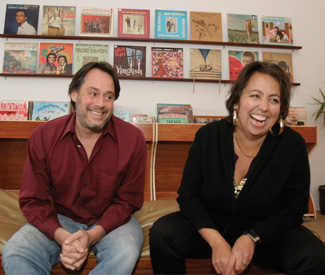
MUSIC Row after row of sentimental — sometimes kitschy, sometimes renowned — vinyl albums are lining pristine white walls in a small storefront, waiting for the opening of a record store that will exist for just one month.

Quite possibly the world’s first Jewish pop-up record shop, it’s in San Francisco on the edge of Mission and Bernal, in rotating art-music space, Queens Nails.

Like flashes of nostalgic dreams, each cardboard cover at the shop is its own piece of art: there’s the colorful impressionist style square enclosing Fred Katz’s trippy 1958 klezmer-meets-folk record Folk Songs for Far Out Folk, the shelf above holds Johnny Mathis’ breathtaking Kol Nidre, along with the campy Mickey Katz album, Mish Mosh — the cover of which depicts the artist as a (hopefully kosher) butcher posing with both meat-links and brass instruments.

There also are brand new copies of the recently released Songs for the Jewish American Jet Set, a compilation of wildly varying tracks (surf rock from the Sabras, deep soul Morrocan-born singer Jo Amar doing “Ani Ladodi”) culled from the archives of now-defunct Tikva Records, a Jewish label that was around from 1950 through 1973.

The Idelsohn Society for Musical Preservation released Songs for the Jewish American Jet Set, and is hosting the pop-up store, also dubbed Tikva Records. The group, whose mission focuses on preserving the 20th century Jewish experience through recorded sound, also has put out a number of reissues and hosted live music events in the past — this store will encompass both.

“When we initially did the reissues, we went out and found a lot of the artists on these records and we realized we really wanted to tell the stories of the music,” explains David Katznelson, the music biz veteran behind Birdman Records, president of the San Francisco Appreciation Society, and one of four Idelsohn Society co-founders.

So, in addition to selling vintage records and reissues, the store also will play host to a series of Jewish and Hebraic-themed live acts. Beginning Dec. 1 with the official opening party, artists will drop by for free, by donation performances: on Dec. 2, founding Los Lobos member Steve Berlin will original score a silent film, Los Angeles band Fool’s Gold will celebrate the release of its second LP with an in-store performance Dec. 7, classic duo the Burton Sisters will perform live for only the second time in the past five decades on Dec. 8, members of Dengue Fever will play live Dec. 10. And plenty more follow.

The Chanukah candle lighting ceremonies will begin with a performance by Zach Rogue — the leader of Oakland’s Rogue Wave who recently released Come Back To Us under the name Release the Sunbird. While some of the others acts were a natural fit in the Tikva lineup, Rogue was one that surprised me — his music has always seemed rather secular to me, so I asked him about it. Turns out, it will be his first time playing a Chanukah event. So will he play Rogue Waves songs, Release the Sunbird jams, or traditional Chanukah melodies? “I’m trying to figure that out now. I wouldn’t say that Chanukah songs are necessarily the top my repertoire.”

He explained his reasoning for participating in the event, “When I think back in terms of what got me into wanting to play the guitar, my parents raised me on psychedelic, ’60s British invasion stuff, but in terms of the actual acoustic guitar, a lot of it was Jewish summer camp — Camp Swig in Saratoga,” adding, “I was fascinated with the song leaders and the cadence of Jewish folk songs and Eastern European sound.”

Weaving around the ’50s epoch furniture (solid hand carved shelves and credenzas that look like wet bars, record players) of the newly constructed pop-up shop with “Tikva Records” in red lettering on the window front, I got a sense of a cozy, hangout for record lovers, Jewish or not, which lead me to again question: what exactly makes music Jewish?

Vibrant, and clearly enamored with these albums, Katznelson was on hand with some helpful thoughts. “I think, like all music, it’s open to interpretation. What we do is use this music to look at Jewish history — it’s beyond Jewish music, it’s music that has affected the Jewish experience.”

Jewlia Eisenberg, leader of SF group Charming Hostess, was also previewing the store — it was her first time taking a peek around too, and she seemed ecstatic, slipping records out of the shelves and commenting, “oh my god, look at this one!” Along with the help of a few volunteers, Eisenberg will be running the shop during the month of December.

Katznelson and Eisenberg pulled out records to examine, including the classic Fiddler on the Roof, but more so albums that recently came back to light, like the Latin-tinged Bagels and Bongos — another album the Idelsohn Society reissued. Says Katznelson, “Hybrids happened, and it created new sounds — so what are those new sounds called?”

An example of the modern Jewish hybrid: Jeremiah Lockwood, New York-based bandleader of the Sway Machinery and grandson of legendary cantor Jacob Konigsberg, who will light the final two nights of Chanukah candles at the store, and perform live.

During his second appearance, Ethan Miller of Howling Rain and Luther Dickinson of the North Mississippi All Stars will join Lockwood in performance. He met Dickinson back in 1998 when they worked on a friend’s album together. Says Lockwood. “It was my first trip to the South after spending my adolescence obsessed with country blues and it made a big impression on me.”

The rest of his performances will be a mixed bag, reflecting decades of the Jewish — and American — music experience. “I’m most comfortable playing blues-oriented material when I play solo, but I definitely plan to hit some tunes from the new Sway Machinery album,” he says, “I will certainly dig out some of my family’s Chanukah standards…very beautiful bits of Jewish folklore I grew up on and that were a part of the family Chanukah lighting ceremony.”

And just like that, after a month of record-selling and live performances culminating with holiday revelry, the pop-up will end, and it’ll be on to the next great idea for the Idelsohn Society. Like it was all some nostalgic, far-out folk dream. 

TIKVA JEWISH POP-UP RECORD STORE

Dec. 1-Dec. 28, times vary, free (donations suggested)

3191 Mission, SF

www.idelsohnsociety.com/tikvastore

www.tikvarecords.eventbrite.com


Anonymous targets cop group that coordinated calls on Occupy

9

The hacker group Anonymous has targeted the Police Executive Research Forum (PERF), taking down the website and publicly releasing home phone numbers, addresses, emails, and other personal information of directors and staff.

PERF became an activist target after media outlets, including the Guardian, highlighted the nonprofit think tank’s role in coordinating conference calls with mayors of major metropolitan cities about how to deal with Occupy encampments. Weeks after the conference calls were convened, a series of police raids targeted encampments in major U.S. cities such as New York, Oakland, and Portland.

On Nov. 19, Anonymous Operations tweeted, “A private NGO called #PERF is helping to train & coordinate #Occupy raids nationally … PERF, Expect us!”

The attack occurred the next day, and PERF staff and directors’ personal information was posted online. A screen shot tweeted by Anonymous showed an error message which read: PoliceForum.org seems to be down. 🙁

Reddit posted a hacker conversation about the action. Apparently, not everyone was impressed.

The executive director of PERF is Sherwin B. Chuck Wexler, a member of the Advisory Council for the U.S. Department of Homeland Security. PERF board members include an assortment of police chiefs known for their track records of using heavy-handed tactics against protesters of the anti-globalization movement and mass demonstrations organized around Republican party national conventions. According to a bio for Wexler, “PERF’s research has a direct impact on policy and practice in policing around the world.”

PERF’s website is back up now. Before the attack occurred, the organization responded to the recent media attention with a public statement. “Over the last few days, the Police Executive Research Forum has been the subject of several false articles and blog postings alleging that we have been coordinating police crackdowns on Occupy protests,” the message reads. “This is not true. PERF conducted two conference calls for the sole purpose of allowing police chiefs to compare notes about their experiences with ‘Occupy’ protests.”

Anonymous is famous for releasing YouTube videos about its actions. Here’s the one C@b!nCr3w, the anonymous hackers taking credit for the attack, created about the PERF stunt. (“Don’t dox and drive” refers to “doxing,” hacker slang for releasing individuals’ personal data.)

Localized Appreesh: G-Eazy

0

Localized Appreesh is our weekly thank-you column to the musicians that make the Bay. Each week a band/music-maker with a show, album release, or general good news is highlighted and spotlit. To be considered, contact emilysavage@sfbg.com.

With his razor-sharp cheekbones, stiff pomp, and creamy skin, it’d be easy to hate on East Bay-bred producer G-Eazy (see what I did there?). But musically, what’s to dislike? In his most recent release, the appropriately titled Endless Summer – available free on his website – G-Eazy samples classic doo-wop and mixes it well with bouncy beats, layering it thick with casual cool flow and lyrics that make it once again pop.

His words tend to reflect his personal story (touring/performing) and an appreciation of pop culture. On the title track he makes mention of chopping up the Beach Boys and making it into a jam, and later drops that he’s inspired by Yeezy, Keith Haring, the Beatles, Banksy, Jean-Michel Basquiat, the Meters, and Johnny Cash, all in one couplet.

In a style that is very much his own, G-Eazy’s played shows with Girl Talk and Chiddy Bang, and toured with the likes of megastars Lil’ Wayne, Big Sean, and (juuust right?) Drake. While he currently is “chilling” in New Orleans, he was born and raised in raised in Oakland and Berkeley. Tonight, he opens up the Independent.

Year and location of origin:
The back row of my 9th grade geometry class. I realized I liked writing raps better than taking notes
Name origin: My friend suggested the name. He actually sat next to me in that same class. I needed a name, he suggested it, and it stuck.
Personal motto: Do what you love and love what you do.
Description of sound in 10 words or less: A vintage pop sound, modernized and put into a rap formula. Oops that was 11.
Instrumentation: Well when I’m not playing with my 18 piece band, I’m playing with a DJ. When I’m not playing with a DJ I’m playing with my awesome drummer who also cues the track and does it all himself. I actually haven’t ever played with an 18 piece band, but that would be dope!
Most recent release: The Endless Summer.
Best part about life as a Bay Area rapper/producer: The Bay Area can be really supportive of our own. We have a strong local scene here.
Worst part about life as a Bay Area rapper/producer: The fact that it’s such an isolated, unique market – kinda makes it hard for some rappers to make it out of here and gain recognition elsewhere.
First record/cassette tape/or CD ever purchased: Yellow Submarine. It’s the greatest.
Most recent record/cassette tape/CD/or Mp3 purchased/borrowed from the Web: A$AP Rocky’s project. It’s ok.
Favorite local eatery and dish: Gordo’s on College Ave in Berkeley, without a doubt.

G-Eazy
With Shwayze & Cisco Adler, Mod Sun
Tues/22, 8 p.m., $20
Independent
628 Divisadero, SF
www.theindependentsf.com

Check the video for his reworked version of “Runaround Sue.”
http://www.youtube.com/watch?v=T-dxZ3_3oBs&feature=player_embedded

Occupy Oakland’s short-lived new camp (VIDEO)

0

Police raided Occupy Oakland’s new encampment at Fox Square Park at 19th and Telegraph streets early Nov. 20. Some 30 tents had been set up at the park, which protesters entered Saturday evening after tearing down a chain-link fence surrounding the perimeter.

The camp was created following a Saturday afternoon march meant to highlight cuts to education which passed through the downtown Oakland banking district and stopped Lakeside Elementary School, one of five Oakland public schools that are slated for closure at the end of the school year due to budget cuts.

Occupy Oakland has called for general assembly at Frank Ogawa Plaza (renamed Oscar Grant Plaza by protesters) on Nov. 20 at 6 p.m. to talk about next steps.

Although Occupy Oakland’s home was short-lived, the Guardian was on hand to capture the moment when the fence came down and occupiers rushed in.

Earlier in the afternoon, an Oakland school teacher sounded off against the budget cuts.

Videos by Shawn Gaynor

Occupy Oakland reestablishing camp at 19th and Telegraph

0

By Shawn Gaynor and Rebecca Bowe

Following a rally and march from downtown Oakland’s Frank Ogawa Plaza that may have been more than 2,000 strong, activists with Occupy Oakland tore down a fence that had been erected around Fox Square Park at 19th and Telegraph, the site organizers had announced would be the home of their new encampment, and began setting up tents.

The fence was in place when activists reached the park, and a line of police were positioned nearby. However, activists managed to tear down the fence, and police moved away from the park but were still standing by.

As of 5:45 p.m. Nov. 19, there were more than a dozen tents set up. Music was playing and occupiers were holding a dance party in the park. Shouts of “we need more tents!” could be heard.

The former site of the Occupy Oakland encampment — Frank Ogawa Plaza, which was renamed Oscar Grant Plaza by occupiers — has been muddied by sprinklers that are spraying water on the bare ground in frequent intervals. Police removed the encampment in a pre-dawn raid Nov. 14.

Speaking at a 2 p.m. rally, International Longshore and Warehouse Union (ILWU) Local 21 president Dan Coffman said, “The hedge fund managers and the bankers have been getting away with robbery. Where are the Justice Department indictments? The recession will only worsen unless we fight.”

ILWU Local 21 is engaged in a struggle against international grain exporter EGT in Longview, Washington. Occupy Oakland voted Nov. 18 to call for a port shutdown along the entire West Coast on Dec. 12.

According to the proposal that was passed unanimously by the Occupy Oakland general assembly last night, “The EGT is an international grain exporter led by Bunge LTD, a company constituted of 1% bankers whose practices have ruined the lives of the working class all over the world, from Argentina to the West Coast of the US. During the November 2nd General Strike, tens of thousands shutdown the Port Of Oakland as a warning shot to EGT to stop its attacks on Longview. Since the EGT has disregarded this message, and continues to attack the Longshoremen at Longview, we will now shut down ports along the entire West Coast.”

In terms of the still relatively young and action-packed life of the Occupy movement, Dec. 12 is ages from now. For today, Nov. 19, the question will be whether the activists can hold their ground at the new encampment.


OccupySF is worth the investment

30

Thirteen labor and community leaders wrote to Mayor Ed Lee Nov. 17 asking him not to evict the OccupySF protesters. The message of the hand-delivered letter: It’s worth the time and effort the city will have to make to allow the encampment to remain. It was signed by Conny Ford, OPEIU Local 3, Bob Offer-Westord, Coalition on Homelessness, Pilar Sciavo, California Nurses Association, Elizabeth Alexander, SEIU 1021, Rev. Carol Been, Clergy and Laity United for Economic Justice, Steve Williams, POWER, Gabriel Haaland, SEIU 1021, Tim Paulson, San Francisco Labor Council, Kate Huge, La Raza Centro Legal, Gordon Mar, Jobs with Justice, Forrest Schmidt, ANSWER, Shaw-San Liu, Chinese Progressive Association, and Mike Casey, UNITED-HERE Local 2.

Here’s the full letter:

Dear Mr. Mayor:

Occasionally a movement takes hold of the imagination of a people, resulting in major social and economic shifts in public policy. Thirty to forty years ago, such a movement driven by a coalition of the religious right and corporate America and spearheaded by the National Chamber of Commerce and the National Association of Manufacturers, changed the course of our nation for the worse.

With the election of Ronald Reagan and scores of corporate-backed politicians since then, our nation has seen a reversal of the progressive gains made in the decades immediately preceding 1980, from the New Deal to the War on Poverty.

In yesterday’s meeting, you and several city department heads questioned whether it is “worth the investment” to meet and work with the SF Occupy movement to address certain health and safety issues. We think it is.

The national Occupy Wall Street movement has brought dramatic focus to the disproportionate concentration of wealth and power held by the top 1% of America.  They have drawn broad attention to the devastation wrought by Wall Street upon communities throughout the country:  home foreclosures, record unemployment, attacks on immigrants, union busting, school closures, social service cutbacks, etc.

Over the years, in our own city, a number of legendary movements and causes have led to meaningful and lasting progressive change. The 1934 General Strike and the I-Hotel are but two examples. These and other struggles such as the Civil Rights movement are iconic not based on whether they resulted in victory or defeat, but because these struggles inspired and trained a new generation of organizers and activists committed to economic and social change.

Whether the Occupy movement is helping usher in yet another shift remains to be seen. But of this we are certain: the City of San Francisco working with Occupy SF to support their vision and work is “worth the investment.”

Provocative police actions in Oakland resulted in unnecessary injuries and threatened the very safety of the community they’ve sworn to protect.

We appeal that you not shut down the occupation of Justin Herman Plaza and continue to meet, daily if necessary, in order to work through the issues connected with Occupy SF.

Occupy SF: Chron, Ex set the eviction stage

29

The OccupySF camp is filthy. There’s violence, drugs and disease. Half the protesters are just drunken thugs who are there to party and make a mess. It’s a public-health hazard. Jeez, it looks like the message is lost and the place has to go.

That’s what the Chron and the Ex are saying — and it’s a perfect setup, a ready-made public excuse for Mayor Ed Lee to send the cops in with riot gear and an eviction notice. It could happen tonight, or tomorrow night.

Frankly, Lee needs the bad (for Occupy) press. The movement’s goals are popular in this city, and when he came very close to evicting the campers, with cops running around the city in buses, his popularity dropped. He saw what happened to Jean Quan in Oakland; her tear-gas assault on Occupy Oakland may have been the end of her political career.

But hey, it’s different now: The daily papers are proclaiming that the encampment isn’t about economic inequality any more. It’s devolved into an unruly mob that can’t be tolerated. Who can blame Lee for cleaning it up?

That also happens to be an utterly unfair characterization of what’s going on. Sure, there are homeless people in the camp, and yes, some of them have mental health issues. But OccupySF is talking about the 99 percent, some of whom have suffered greatly in this economy — and it’s no surprise that some of them part of the occupation. Yes, it’s a challenge, but it something that OccupySF is taking on. Oh, and by the way — the homeless people and people with mental health issues (that sometimes lead to violence) will still be on the streets of San Francisco is they evict the Occupy encampment. But they’ll be worse off than they are today.

Yael Chanoff just filed her report on what’s really going on at OccupySF:

At last night’s General Assembly, OccupySF organizer Philip Oje debriefed on that days meeting with Mayor Ed Lee, and participants in the 150-person meeting debated the best next steps. Several different viewpoints were discussed. Many were indignant about reorganizing camp to appease the city, saying that “I didn’t come her to comply with city ordinances that change every day. I came here to do what I think is right.”
Others believed believed that the camp should do everything possible to comply with the city in order to hopefully avoid a raid (and maintain credibility if one does occur.) It was generally acknowledged that the situation was a Catch-22: The camp could not comply with requirements such as maintaining four feet of space between tents without expanding past Justin Herman Plaza, but the city refused to allow any expansion to stand until their requirements were met. In general, those assembled agreed that regardless of the city’s difficult to follow guidelines, a clean-up would benefit the health and well-being of campers, and got to work.

This comes after a hard week of dealing with the frustrating realities of human interaction in a cramped space. The encampment has grown steadily since its start, and in recent weeks has been home to upwards of 300 people on a regular basis. Many campers would agree that in the past two weeks that tensions have built as high as they did. When Examiner Reporter Mike Aldax spent 24 hours at camp, it was during the peak of conflict.

Indeed, many at OccupySF are frustrated. There is a general feeling that there is not enough time in the day to maintain a safe and caring community that does not exclude anyone as well as progress with the political agenda that the movement stands for. However, there is also a basic agreement that those with addiction, mental illness, and other causes of suffering are affected directly by an unjust society in which a small percentage hoards vast majority of wealth while the masses struggle to afford food, shelter, health care and education; to attempt to exclude those who are in desperate situations, the most in need of emergency action to change our system and our lives, would be morally intolerable hypocrisy.

As famed radical environmentalist Derrick Jensen put it when he came to speak at the encampment November 12, “At the same time you’re building a resistance movement, you’re being put in the position of dealing with the needs of those who have been dispossessed and damaged by the system.”

It’s true: according to Connie Ford, a member of OPEIU Local 3 which represents many on the city’s Homeless Outreach Team, “The homeless come there because it’s safer than the shelters.”

This has caused difficulties in the past few weeks that the camp has been struggling to deal with. The solution is starting to come together. After physical fights began to become a major problem last week, the camp stepped up the process of enacting a culture of community policing. The night of November 15, when “Instigator Jimmy” was involved in an altercation during a general assembly, about 50 formed a mass between him and camp and slowly pushed him off the site, chanting “Whose park? Our park.” As one camper put it, “Jimmy’s individual will was extinguished by our collective will.” This is an experiment in radically non-violent coercion.

Since then, this tactic has been employed to greater and greater success. Last night, when one camper began to instigate conflict, it only took 10 or so others to cause him to leave in the same way, and hardly disrupted the peaceful mood at the site.

In addition, despite starting out completely unequipped to provide medical and mental health to the masses for free, OccupySF has set up a medical tent run by nurses from the National Nurses Association and several “emotional assistance” spaces, one of which has been facilitated by the Icarus Project and other groups with alternative approaches to mental health. According to an OccupySF press release today:
“Forty clergy, including bishops, have recently formed as ‘San Francisco Interfaith Allies of Occupy’ because we share the concerns of the ninety-nine percent,” said Rev. Carol Been of CLUE California, “and they have asked us for help because they were not prepared to handle homelessness, mental illness, people attracted for unseemly reasons not associated with the occupation. Resources have recently begun to be put into place.”

It seems that all of this grappling with difficult issues and hard work on the part of OccupySF has begun to pay off. Last night after General Assembly, campers worked to clear off the Bacci Ball courts as per the city’s request, take down tarps, and space out tents to the extent that they could without expanding past Justin Herman Plaza (renamed by some Bradley Manning Plaza.) Camp was clean and vastly quieter than it had been in previous days.

Around midnight, there were about 30 people awake, talking and playing mellow drums on the outskirts of camp while hundreds more slept in the approximately 180 tents. One man who had been sleeping there three weeks said, “There’s a new energy. After we cleaned, a lot of the riff-raff left.” With a grin he added “It looks like there’s still some, but they’ve been over there having some kind of profound conversation all night,” gesturing to the camp east side.

I pitched my tent about 10 feet from the “profound conversation” and drifted off easily, though I admittedly prefer a nice buzz of humanity while I sleep. I was, however, woken up around 6:00, when others began waking up and excitedly discussing the fact that the camp had made it through the night without a police raid.

It remains to be seen if the same will be said for tonight.


Editor’s notes

0

tredmond@sfbg.com

Occupy Oakland has been very good at exposing one local problem — police brutality. The first raids, and the tear gas and rubber bullets that flew afterward — showed the world how poorly trained the Oakland cops are and how unprepared they were for a largely peaceful demonstration.

But overall, the Occupy movement has been about national issues — or rather, The National Issue, which is income inequality. Nothing else going on in the United States compares. On an economic level, I could argue that nothing else matters — until we resolve the wealth and income gap, the recession will never end, the deficit will never improve, the unemployment rate won’t stabilize, the nation will grow weaker and weaker and more and more unstable … basically, we’re doomed.

But while there have been marches on local banks and corporations, not a lot of Occupy attention has gone to local inequality — to what the folks at San Francisco City Hall, and Oakland City Hall are doing to make the one percent in our own backyards pay its fair share for the services that most impact many of our lives. Mayor Jean Quan got booed for calling in the riot cops, but Mayor Ed Lee isn’t getting booed for corporate tax breaks.

The OccupySF people came out in force to a Board of Supervisors hearing to demand that their camp be left alone. But they aren’t out in force to demand, say, a local fee on bank foreclosures.

That’s not a criticism of a movement that continues to inspire me every day; it’s just a statement about tactics and strategy. And it’s one we all ought to be thinking about.

In a brilliant opinion piece this week, Raj Jayadev, director of Silicon Valley Debug, notes:

“In San Jose, the city that used to promote itself as the capitol of Silicon Valley, city budget cuts have either eliminated or dramatically slashed hours for youth sanctuaries like libraries and community centers. … For us, the one percent are just up the street -– the 101 to be precise. Those tech giants exist in the same Silicon Valley that cannot even keep its library doors open. Why have they not given? Why have we not demanded?”

Good question.