Media

Functional hyphy

0

arts@sfbg.com

MUSIC Here, in the depths of the pot smoke-drenched green room of Slim’s, the muffled chants of an insatiable gathering of Bay Area hip-hop fiends grows louder and more forceful by the second. The crowd is brazen in its vocal yearning for the show’s main act of IamSu! and Compton rapper Problem.

This show, which took place at the end of last month, was a de facto homecoming spot on the Million Dollar Afro mixtape tour and the leader of the HBK (Heart Break Kids) Gang was keen to give his fans what they wanted, and then some.

After a quick team prayer, IamSu! and Problem make their way up the back stairs towards the stage, giving the ceremonial daps to the homies along the way. Then amid a torrent of blaring horn drops courtesy of HBK Gang DJ Azure, IamSu! and Problem leap out on stage like they’re t-shirts being launched from a cannon, the kind you’d traditionally see at baseball games.

IamSu!’s lumbering 6-foot-something frame is rocking a dashiki and a slim leather jacket. The duo commandeers the performance with the skills of a group of season veterans and dutifully maintains the hype level two clicks above organized calamity for the majority of the show. Between each track, someone or some group out there is getting a shout-out, but the biggest shout-out of them all is reserved for the completely unexpected appearance of Juvenile, who is trotted out to perform his verse on “100 Grand.”

If IamSu! had followed the conventional hip-hop career path, he would have quickly spat out an album following his 2011 potty-mouthed, Gold-certified single “Up” and filmed the all-too-common hip-hop club music video with Lil Wayne. But for all his youthful cheerfulness, IamSu!, or Su for short (his real name is Sudan Williams), embodies a dexterous patience when it comes to decisions regarding his budding career.

He has plans for an album but no specific date. He frankly would rather kick it in the studio with his HBK crew laying down tracks on tracks on tracks than strut it out on the national stage, at least for the time-being. Su cheerfully remarks that “with or without music, HBK Gang would be having fun together,” but, almost conversly, holds high aspirations for his crew: “I want it to be a brand like Nike and you see our logo and you already know it’s from the Bay Area. That bond is what keeps us so humble right now, the fact that people will check me when I’m being an asshole, I’ll check somebody else and vice versa.”

A handful of major labels have courted Su and he has rejected generous offers from at least one. In fact, he’s still residing at home because he admits he “just hasn’t had the time to find a new spot”, but he did confirm to me that his pockets “are on sumo.” It was there in his childhood room/makeshift studio that he recorded his incredibly slippery and jolting verse on E-40’s “Function,” while recovering from a cold.

Su, who raps and talks with an undeniable East Bay twang, is just as adept in the studio as he is on the mic and just like the Kanye-model, Su produces nearly every track he raps on. Like East Bay hip-hop stalwarts Trackademiks and Kool A.D., Su explored and absorbed the craft of beat-making at the Oakland nonprofit media center, Youth Radio. Starting at the age of 15, he spent three days a week immersing himself in knobs, keyboards, and drum pads. The first poignant moment of his time there — and of his rap career — occurred when he performed for his peers at Youth Radio, which was the result of a weeklong competition. Su fondly recalls it was “one of the best feelings ever” when he observed the positive reactions of the crowd at Youth Radio.

Su now does the bulk of his production at a small and almost claustrophobic studio tucked away in a nondescript office on the border of Emeryville and Berkeley. There in that studio, I caught a glimpse of the process of constructing a slap.

Starting with a simple synth riff and voice sample, Su gradually and artfully added layers of drum hits, hi-hats, and bass jabbed while twisting and warping the voice sample. Operating the keyboard drums with his left hand, Su maneuvered the mouse to dig in the sample database and drop in instrument clips, all while methodically bobbing his head like a metronome. It wouldn’t be an IamSu! joint if he wasn’t also testing out some indistinguishable lyrics under his breath. Around 15 minutes later, the result was a rough draft of what will likely be a banger, which had the overwhelming approval of his crew present in the studio. Though Su affirmed for me that this joint won’t be hitting speakers “for at least a while”.

While in the studio, Su couldn’t help but bug out with giddiness every time he listened to one of his unfinished tracks, he seemed playful yet focused, relaxed yet determined. That brimming combination of curiosity and enthusiasm remains the driving force behind his dozen or so mixtapes.

Overarching questions pertaining to the status of hyphy or Bay Area hip-hop don’t apply to Su. Whether or not he brings back hyphy or becomes the first rap superstar of the decade from the Bay Area, the self-described “laid back friendly kid who likes to make music, go shopping, and listen to ’80s music,” is going be having the time of his life in the studio, with the full support of his crew.


Airbnb is still snubbing SF, even after a NY judge rules it illegal there

39

Now that a judge in New York has ruled that Airbnb is illegal there, a model that violates city tenant laws and state law, that should put pressure on the San Francisco-based company to finally stop snubbing cities and find a way to exist within local regulatory frameworks and finally start paying its taxes.   

It was good to hear KQED’s Forum discuss Airbnb this morning – it was getting lonely as the only local reporter highlighting the company’s open defiance of San Francisco’s ruling that it should be paying the city’s Transient Occupancy Tax, just like hotels – and to finally question an Airbnb executive on an issue the company has been refusing to address publicly (yes, they still aren’t returning my calls).

But the answer that David Hantman, Airbnb’s global head of public policy, gave this morning was pretty astounding in its hypocritical arrogance. He acknowledged the tax ruling by San Francisco and the company’s lack of compliance, and said the company was waiting for clarification on the various issues related to the questions of the legality of some of the short-term rentals it facilitates before paying its taxes.

In other words, this company is making tens of millions of dollars annually in San Francisco alone on a business model that it developed – one that often runs afoul of local land use and tenant laws, and in violation of people’s leases – and it’s up to city officials to find a solution to this company’s problems before it will pay taxes?!?

To his credit, Board of Supervisors President David Chiu has been trying to do just that for months, slogging through a number of complex and difficult issues that arise from this business model, and he has been clear throughout that Airbnb should be paying its taxes to the city, which it isn’t.

“It’s reasonable to ask people who benefit from the economic transactions we’re talking about to pay their fair share,” Chiu reiterated on Forum, citing the cost to the city of serving the 16 million tourists who visit the city each year.

Coincidentally, there’s a German television crew from ARD (Germany’s equivilent of the BBC) in San Francisco this week doing a story on Airbnb and the shareable economy, interviewing me about my coverage of the company, as well as others, including Airbnb co-founder Nathan Blecharczyk.

The ARD reporter told me this afternoon that Blecharczyk was animated and expansive when discussing how wonderful his company is and how it’s changing the world, but he became terse and unresponsive when she raised the issue of local taxes and regulations.

As I said on camera today, Airbnb and other shareable economy companies are cool, I’ve used them myself, and they’re certainly here to stay. But I just don’t understand their unwillingness to be good corporate citizens and to pay the taxes they owe to support the city services that their customers use.

Chiu has clearly said that Airbnb should pay the TOT — which my reporting has shown would bring $1.8 million annually into city coffers — and that paying its taxes will be a part of the regulatory package he’s working on. But sources have also told me that negotiations have been hard slog, largely because of Airbnb’s unwillingness to play by the rules and because of the unqualified support the company has from Mayor Ed Lee, whose main political fundraiser, Ron Conway, is also a major investor in Airbnb.

Hopefully the New York ruling and growing media scrutiny will prompt the young executives at Airbnb to finally become good faith partners in a city that has been so good to them — a city whose leaders seem anxious to return the favor and legalize Airbnb’s operations in San Francisco.


Björk plays the part of stunning mad scientist at the Craneway Pavilion

19

With purple lightning bolts of electricity jagging toward one another in a steel cage center-stage, powerful pipes that reverberated through the pavilion and rippled out onto the sea, and a fuzzy Snow Cone wig of every color — cherry red, orange, lime green — Björk seemed like the mad scientist of the natural world last night at the relatively intimate Craneway in Richmond, Calif.

She also thanked the audience often, ‘t-ank you, Bay Area, gggrrrratitude!” (she rolls her Rs beautifully) and offered up a 16-piece coven of sequined and hooded Icelandic choir princesses, so you can assume she’s the benevolent type of creator.

The vibe was weird to start, with most of the audience confused as to where to go, do we sit or stand, what is this place, will she come out before dark even though the whole place is encased by floor-to-ceiling windows? Will I cry when she appears? There were a few poofy pink or orange wigs dotting the crowd, and at least one swan costumed fella, who, also benevolent, took time to pose for photos with fans after the show.

The Craneway only holds 4,000 people, which still seems like a lot until you realize that when Björk’s Volta tour came through, it went to the Shoreline Amphitheatre in Mountain View, which holds 22,500. And with the stage in the dead center and the aforementioned ripply waters just outside the windows, it did feel like the smallest possible way to view Björk. “Did she just look directly at me?” It must have been thought dozens of times throughout the night during this Biophilia stop.

The show itself began auspiciously enough, with a young woman stepping out onto the stage to patiently ask the crowd to put away its cell phones and cameras, to live in the moment for the night. People cheered, as concert-goers are sick of the constant interruption at shows (or maybe I’m projecting). Most got the point — hello, we were about to be in the presence of a legendary elf and sonic genius, live in the now — but plenty decided to shirk the suggestion, just too giddy with social media attention. (Full disclosure: I posted a photo of the empty stage long before the show started, but still, I admit to that tugging need to let people know I was there, near her.)

At 9pm, a National Geographic documentary-style voice (actually British broadcaster David Attenborough, narrating Biophilia‘s intro) came over the loudspeaker and explained the night would be about “NATURE, MUSIC, AND TECHNOLOGY.” It also asked us to expand our minds, and a few other ideas that I missed due to excitement. Just listen to the album introduction, it’s all there.

http://www.youtube.com/watch?v=MvaEmPQnbWk

The cloaked Icelandic choir — all blonde, Viking-esque, and vaguely Kirsten Dunst-looking, wearing oversized smocks of glittery green or velvety amber-brown with large hoods — marched out and stood in a hunched and humble circle on the already circular stage and began chanting. A sea of impressive vocals rose with immediacy.

And then Björk rose up like a bewigged phoenix from the ashes, and lightly shuffled near the Tesla coils as they crackled with purple electricity inside a human-sized bird cage (technically, a Faraday shield). She later called the Tesla coils her “fun new toy.” The set began with “Oskasteinar,” then electrifying “Thunderbolt,” which teetered between grinding techno thanks to arpeggios timed to the coils and passionate love song, given Björk’s leaping vocals. This was followed by “Moon” (large moons floating and shifting on the circle of TV screens surrounding the stage) and “Chrystalline” (crystal gems dance across said screens). Most songs had a visual component on those screens, a natural element growing and twisting like a video game or early web screen-saver. The image of the earth’s mantle cracking open looked straight out of a biology book.

Björk and the hooded Kirsten Dunsts sang their way through most of Biophilia — the main star of this tour — but also revisited old favorites like “Hidden Place,” which was matched to a neat video of colorful starfish frolicking underwater, and incredibly sexy Vespertine hit “Pagan Poetry,” which burst out of Bjork’s mouth like fire, filling the room with warmth. That powerful “I love him/I love him/I love him/I love him” breakdown felt almost too personal in such a small place. But then the choir piped up with that tender backup “She loves him,” and it brought us all back to the present.

While she sang, Björk one-two shuffled around in platform glitter shoes and a glittery beige haute couture dress that looked like it was covered in 3-D alien breasts. She pushed her body forward and back. She shot her hands out and spread her fingers like she was casting spells to the beats. She pulled out the iPad to play during a handful of songs, and was also backed by a live drummer, a musician on “computers and shit,” and a truly epic harpist, also wearing a glittery oversized smock. Large pendulums swung to and fro just off the stage.

http://www.youtube.com/watch?v=oZmMTonROmU

Björk and the Dunsts left the stage after an hour, returning a few short minutes later with “Possibly Maybe” off 1995’s Post“Nattura,” and finally, closing with Volta’s “Declare Independence.” For that last song, she asked that everyone stand (VIP area was seated) and sing-along, “Declare independence/Don’t let them do that to you” and everyone obliged, hoping to please their mad scientist master with repeated declarations of independence. Make your own flag, raise your flag higher, higher. 

Set list:
1. “Oskasteinar”
2. “Thunderbolt”
3. “Moon”
4. “Crystalline”
5. “Hollow”
6. “Dark Matter”
7. “Hidden Place”
8. “Heirloom”
9. “Virus”
10. “Sacrifice”
11. “Generous Palmstroke”
12. “Pagan Poetry”
13. “Mutual Core”
14. “Cosmogony”
15. “Solstice”
Encore
16. “Possibly Maybe”
17. “Nattura”
18. “Declare Independence”

For No God’s Sake

21

The nightmarish aftermath of the Moore, Oklahoma EF-5 tornado is in rebuilding and rebounding mode. People are digging out of the mess. Survivors located. Businesses re-opening.

And the stories emanating from the Prairie are running the gamut. From heart warming to predictably dire. The human spirit seems both undaunted and inexplicable. 

But because the world we live in now has around the clock news cycles and a plethora of channels devoted to same, sometimes the mavens of media reveal themselves to be a sorry lot. So was the case of Wolf Blitzer–a CNN talking head of much experience–and his interview with a local named Rebecca Vitsmun whose response to a question posed by Blitzer threw him.

Blitzer asked Vitsmun if she thanked the Lord for presumably sparing her life and that of her baby. She replied (nervously) that she didn’t as she was an atheist, quickly adding that she didn’t blame people that did.  

It was quick and she was good humored about it. But there’s something really rancid about Blitzer’s question. The subtext isn’t theological or even sociological. It’s bigotry–Oklahoma is a deeply religious state with an enormous Evangelical community, so Blitzer assumed without asking that this woman must be one of those people.

This is no different than asking someone with an Irish surname what beer they drink, or a Mexican their favorite recipe for salsa or any number of stereotypes. The presumption that this woman is religious without asking (did the same question arise in New Jersey after Sandy?) pigeonholes Oklahomans as one-dimensional fanatics.

If you are a person over a certain age (40 say), ask yourself if newsmen asked these questions in our long gone youths. They didn’t. It would have been seen as trivial, leading and out of place. But because our culture has been “Tebowed” to death by loud public declarations of fealty to the Lord, this kind of piffle is not only manistream, it’s encouraged.

The moment passed, but it seems to have ignited the standard back and forth over the existance of a God or not. Not the issue (although asking someone whose home was razed if they thank the presumable force behind the razing does seem a little absurd). Religion is a matter of faith, conjecture and wishful thinking/culture. The news is supposed to be facts. I know that Blitzer has to filibuster to fill space, but c’mon, man–everything has its place. 


Growth potential

8

arts@sfbg.com

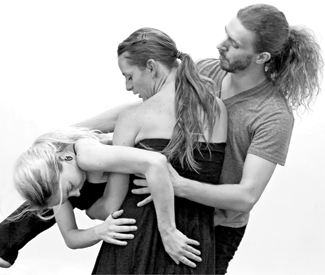
DANCE For all of the hype about the communicative power of social media, the energy that flows from one body to another has yet to be beat. Dancers know that. That’s why they keep searching for new ways to make this silent language speak.

The Garage on Folsom is one place where they do it; the studio is run on a first-come, first-served basis with a compulsory performance component, so a lot of what you will see there is unfinished. Yet the other night, two Finnish-born choreographers presented pieces as refined and polished as anything shown in bigger venues.

Another venue that fosters innovation is Yannis Adoniou’s Kunst-Stoff Arts, above a Burger King across from the San Francisco Main Library. It takes a more focused approach by inviting similarly-minded artists (who don’t care about the occasional whiff of fried food making its way upstairs). The recent opening of Kunst-Stoff Arts Fest 2013 showcased three choreographers who pushed the dancing body to the edge of what seems humanly possible.

But first, back to the Garage — where Raisa Punkki’s punkkiCo world premiere, Other Space, took command. Some lengths could be edited to keep the trajectory better on track. Also, the image of a dancer emerging from a kind of subterranean existence in the shape of a raincoat didn’t ring true. But overall, this quartet (for three women and one man) was finely crafted dance making that explored states of being with a rich, multi-faceted vocabulary and formal controls that allowed for flux and even spontaneity.

Other is designed along the concept of making connections that could be in unison pirouettes or jumbled limbs of labyrinthine complexity. Densely layered encounters gave way to stillness or something as simple as a walk or sitting quietly. The spatial thinking pulsated against the stage’s perimeter, enlarged in a couple of places by mirrors. For the most part the dancing was fierce and full out, yet still had room for small gestures: hands that turned into claws, fists that pushed the dancers into relevé and down again. The idea of balance — and lack thereof — lay below much of Other, sharply brought to life by Jennifer Meek, Sarah Keeney, Meegan Hertensteiner, and Derek Harris.

The Bay Area premiere of Alpo Aaltokoski’s 2004 astounding Deep showed a dancer who seemed to exist simultaneously inside and outside his body. Gaunt with a shaven head, he whipped himself into a tornado, engaged in turns that layered his body horizontally, and stretched his frame beyond his height only to squat again and again. Crawling, he looked pre-human; howling, he became Everyman. At one point, he was on all fours and sucked in his spine to turn his shoulder blades into wings. Yet none of these physical feats were self-serving; there were stories aplenty in them. Mila Moilnan’s subsequent video, based on Deep, felt like an afterthought.

First-week performances at the Kunst-Stoff Arts Fest included three works, two of them in progress, and clearly presented as such. What I saw made me want to follow them because both choreographers seemed to think intriguingly about time.

Christina Bonansea’s Floaters #2, set on identical twin dancers Michaela and Liane Burns with excellent live music by Zachary Watkins, started as an installation in the basement. At first resembling statues of saints, the silver-gowned women came to life, slithering and scraping. Upstairs, they ripped into waves of frenzy that threatened to tear them inside out.

For Portraiture, the forbiddingly prodigious Lindsey Renee Derry, as much a gymnast as a dancer, assembled a linear structure from thematically distinct solos that ranged from lyrical to ferocious. In the future, she wants to extend this trajectory by inviting other choreographers, perhaps to evoke something like Andy Goldsworthy’s Wood Line installation in the Presidio.

Adoniou and the gorgeous Constantine Baecher, a former Royal Danish Ballet dancer, paired up for The Excruciating Death of St. Sebastian. One is dark and older, the other blond and tall, so the tracing of their relationship started on a note of difference. Their give and take began intertwined, as if they were asleep, and grew into teasing and tenderness, shot through with exploration and exuberance. Finally, with the help of a cane, the piece moved into darker territory. My tolerance for watching pain — real or pretend, received or given — is just about zero. Still, this was fine work. 

KUNST-STOFF ARTS FEST 2013

Through June 7, most events $10-$15

Kunst-Stoff Arts

One Grove, SF

www.kunst-stoff.org

NATIONAL QUEER ARTS FESTIVAL

May 31-July 3 (various curated events)

Garage

715 Bryant, SF

www.715bryant.org

Visit queerculturalcenter.org/NQAF for NQAF events at different venues.

Selector: May 22-28, 2013

0

WEDNESDAY 22

God Loves Uganda

One of the most memorable docs to play this year’s San Francisco International Film Festival, Roger Ross Williams’ God Loves Uganda offers a remarkably all-access look at evangelical Christians who travel from America to Uganda. In Africa, these bright-eyed youths build medical clinics, teach school, and preach their ultra-conservative religion — directly influencing a rise in hate crimes and draconian anti-gay laws. To mark both Harvey Milk Day and the International Day Against Homophobia, American Jewish World Service and the Horizons Foundation host a screening of this important film. Since it’s bound to stir emotions (outrage is a big one), there’ll be a post-show discussion with human rights advocates and religious leaders. (Cheryl Eddy)

6pm, free (seating is limited, so RSVP is required)

SFJAZZ Center

201 Franklin, SF

gc.ajws.org/rsvpmaker/film-screening-god-loves-uganda


Shout Out Louds

My favorite songs by this Swedish pop group have clear antecedents in ’80s New Wave. With Our Ill WIlls (2007) opener “Tonight I Have To Leave It” singer Adam Olenius was a ringer for Robert Smith at his most ebullient (read: “Just Like Heaven”) and “Impossible” hit on the Human League and Simple Minds. It could be derivative, but with the Joy Division via Interpol meets the B-52s sound of “Glasgow” on its latest album Optica, the system the group has is working, particularly the sparkling production. Opening band Haerts seems a perfect match, as its slick debut single “Wings” sees the SOLs referent for referent, and adds in some Spandau Ballet and Stevie Nicks vocals to great effect. (Ryan Prendiville)

With Haerts

8pm, $19

Great American Music Hall

859 O’Farrell, SF

(415) 885-0750

www.slimspresents.com


THURSDAY 23

“A Gathering of Angels: opening event for Beat Memories

Let’s get it out of the way: A picture tells a thousand words. Though this doesn’t exactly apply to Allen Ginsberg, whose poetry portrayed imagery as vividly as any picture could, the many photos he took capture a different dimension. While his words express a Beat mythology that continues to resonate, his pictures freeze isolated moments that bring the figures surrounding Ginsberg alive in a profound and intimate way. We see Kerouac smoking coolly against a brick wall in 1953, then again in 1964, frowning and slumped in a chair; there’s Burroughs up close in a dark room, and Corso in an attic. The photos, beautiful works of art in themselves, show us the living people comprising the cultural history and because of that, they’re fascinating. This opening event includes a pop-up poetry salon, drop-in zine making with Rad Dad creators, and a “typewriter petting zoo.” (Laura Kerry)

Through September 8

6:30pm, $5

Contemporary Jewish Museum

736 Mission, SF

(415) 655-7800

www.thecjm.org


Philip Glass at 75

Philip Glass is no ordinary composer. Having collaborated with everyone from Ravi Shankar to David Bowie, while writing stacks of of symphonies, operas, and film scores in the process, Glass has shifted the direction of classical music as wildly, and influentially, as any living figure. In celebration of his 75th birthday, SF will be treated to screenings of two Glass-scored films, accompanied live by the Philip Glass Ensemble: Godfrey Reggio’s famously plotless multimedia extravaganza, Koyaanisqatsi (1982), and Jean Cocteau’s early film adaptation of The Beauty and the Beast, La Belle et la Bête (1946). Punctuating the weekend-long festival is a Q&A session with Glass himself, moderated by SF’s own Brad Rosenstein. (Taylor Kaplan)

Philip Glass Ensemble: La Belle et la Bête

Thu/23-Sat/25, 8pm, $40–$65 (Sat/25 includes Q&A)

Lam Research Theater at YBCA

700 Howard, SF

(415) 495-6360

www.ybca.org


Koyaanisqatsi

Sun/26, 7pm, $40-65

Davies Symphony Hall

201 Van Ness, SF

(415) 864-6000

www.sfperformances.org


Detroit Cobras

Some bands you’ll just never be able to judge by their album cover(s). Some bands just don’t have time for all that studio nonsense. They wanna rock — and they wanna rock with you. Up close and personal. In your face. Get it? That pretty much describes the rough-and-ready Detroit Cobras method, after releasing a scant handful of albums, they’ve continued to tour extensively, bringing the husky, tough-girl vocals of Rachel Nagy and the gritty, jangling guitar riffs of Mary Ramirez to the people. Their reinterpretations of vintage, B-side rock, soul, and Motown give songs that could have been contenders a brash new life, while their relentless stage show gives their adoring fans a good, old-fashioned, foot-stomping workout. (Nicole Gluckstern)

With Pangea, the Chaw

9pm, $16

Slims

333 11th St., SF

(415) 255-0333

www.slimspresents.com


“Project Open Walls”

What’s a gallery when none of its art is for sale? Project One, the Potrero gallery and art bar is exploring the concept in 2013, for which it is asking its artists not to contribute paintings or sculpture to their exhibitions, but rather to paint the walls of the gallery itself. “Project Open Walls” enjoyed its first opening in February with numerous artists (street and not) contributing murals of busy vase tableaus, color-forward twirls of 3D tags, and luminous flower designs. Now, those walls will be gradually painted over. This month, the grizzly bear-focused muralist Chad Hasegawa gets up, in addition to one of last year’s Goldies award winners, dreamy minimalist painter Brett Armory. (Caitlin Donohue)

Opening reception: 7pm, free

Project One Gallery

251 Rhode Island, SF

www.p1sf.com


FRIDAY 24

Performance Research Experiment #2: Paradox of the Heart

Scientists frequently ask for volunteers on which to test the hypothesis their research suggests. Artists rarely get that kind of concrete response to what they are working on. In come Jess Curtis and Jörg Müller — and a bevy of artist and scientist collaborators — who will help them get scientifically measurable information that we the audience provide through our responses to what happens around us. The data will be translated into what Curtis calls an “interactive mash-up of dance/performance and physical science,” also called Performance Research Experiment #2: Paradox of the Heart. In case you care, the 2003 Experiment #1, also by the team of Curtis and Müller, drew on the duo’s background in circus arts and involved a lot of brooms and balls. (Rita Felciano)

8om, $20

CounterPULSE

1310 Mission, SF

www.eventbrite.com


Black Moth Super Rainbow

Black Moth Super Rainbow is nothing if not mysterious. The five enigmatic band members perform under whimsical stage names — Tobacco, the Seven Fields of Aphelion, Power Pill Fist, Iffernaut, and Father Hummingbird — that speak volumes about the fantastical and wonderfully absurd psychedelic pop they produce. The band, formed in Pittsburgh in 2002 originally gained attention from a run of buzz-building shows as SXSW. The band’s liberal use of analog electronics like a vocoder, Rhodes piano, and Novatron gives its music a sunny, retro sound. Underneath the barrage of strange instruments and layers of synth, Black Moth Super Rainbow sneaks in solid pop hooks and tight songwriting. Through its decade of existence, the band has continuously improved with each new release, and the sixth and most recent full-length Cobra Juicy certainly continues this evolution. (Haley Zaremba)

With the Hood Internet, Oscillator Bug

9pm, $19.50

Fillmore

1805 Geary, SF

www.thefillmore.com


TSOL

First gaining notoriety for songs such as “Code Blue,” an ode to the joys of necrophilia, along with the infamous riots that would break out at its early shows, T.S.O.L — or True Sounds of Liberty — was among the earliest and best of the Southern California punk bands to emerge in the late 1970s. While singer Jack Grisham has found other outlets for stirring up the social pot over time, including a 2003 gubernatorial run and as an author (his newest book, Untamed comes out next month) he and guitarist Ron Emory are still keeping the group going strong more than 30 years after their inception in Long Beach, Calif. (Sean McCourt)

With VKTMS, Rush and Attack

9pm, $13

Thee Parkside

1600 17th St., SF

(415) 252-1330

www.theeparkside.com


SATURDAY 25

“Sex Worker Sinema”

The cinema, er, sinema portion of the San Francisco Sex Worker Film and Arts Festival — focusing on “the lives, the art, and the struggle for workers’ and human rights of people employed in sex work industries” — is highlighted by several intriguing-sounding documentaries. Alexander Perlman’s Lot Lizard explores the lives of prostitutes who conduct business out of truck stops; James Johnson’s American Courtesans widens the scope, following 11 different sex workers in various situations; and a legendary NYC trans activist and Stonewall icon gets her due in Pay It No Mind: The Life and Times of Marsha P. Johnson. Also on tap: a full slate of shorts, both doc and narrative. The $35 pass scores entry into all films in the fest. (Eddy)

2pm-midnight, $35

Roxie Theater

3117 16th St, SF

www.sexworkerfest.com


Mikal Cronin

Mikal Cronin has been bouncing around the San Francisco music scene for a couple of years as an unsung hometown hero, collaborating with Thee Oh Sees, recording with Ty Segall and performing in the Ty Segall Band, while quietly releasing his own solo records and singles. Finally, Cronin is no longer sidekicking. This year’s full-length MCII has received rave reviews from major music publications (SPIN and Pitchfork have labeled it among the best new music of the year) and Cronin is enjoying a headlining slot on a national tour. Tonight’s gig at the Rickshaw Stop is a much-deserved album release-party, and I wouldn’t be too surprised if Cronin pulls up some old friends to help him celebrate. (Zaremba)

With Audacity, Michael Stasis

9pm, $12

Rickshaw Stop

155 Fell, SF

(415) 861-2011

www.rickshawstop.com


TUESDAY 28

Radiation City

A quiet, practical friend of mine who nevers speaks in hyperbole just declared that Radiation City is his favorite band. It is a strong statement, but not surprising considering the band’s near-magical wooing ability. Comprised of two couples, even the band can’t resist its own magnetism. Maybe it’s a result of chemistry that extends offstage, but Radiation City has arrived at an enchanting formula the combines dreamy pop, some ’60s girl band flare, a shadow of psych-rock, and the occasional hint of bossa nova. After the May 21 release of its third album, Animals in the Median, Radiation will play new music to an enchanted crowd at Rickshaw Stop. My picky friend will be among those dancing, shouting, and bewitched. (Kerry)

With Cuckoo Chaos

8pm, $12

Rickshaw Stop

155 Fell, SF

(415) 861-2011

www.rickshawstop.com

The Guardian listings deadline is two weeks prior to our Wednesday publication date. To submit an item for consideration, please include the title of the event, a brief description of the event, date and time, venue name, street address (listing cross streets only isn’t sufficient), city, telephone number readers can call for more information, telephone number for media, and admission costs. Send information to Listings, the Guardian, 225 Bush, 17th Flr., SF, CA 94105; or e-mail (paste press release into e-mail body — no attachments, please) to listings@sfbg.com. Digital photos may be submitted in jpeg format; the image must be at least 240 dpi and four inches by six inches in size. We regret we cannot accept listings over the phone.

New BART director wants to raise fares in San Francisco and end “A” Fast Pass

34

Are BART passengers in San Francisco being subsidized by Muni riders and by BART customers from the suburbs? Or is it the other way around? And does it really matter, or should we just be thankful that people are choosing BART over clogging the roadways in this transit-first city?

These are some of the questions arising from an aggressive effort by the newest, youngest member of the BART Board of Directors, Zakhary Mallett, who has proposed severing BART’s partnership with the San Francisco Municipal Transportation Authority to end their joint “A” Fast Pass program that allows unlimited rides on both systems for $74 per month.

And after he’s done with that, Mallett says he’ll take aim at the BART fare structure that charges $1.75 for rides of six miles or less, saying that San Francisco residents shouldn’t be able to access BART’s relatively luxurious trains for less than the $2 it costs to catch a Muni bus.

These are arguments that the 25-year-old Mallet started making last year when he successfully ran against longtime Director Lynette Sweet of San Francisco, with the El Sobrante resident snatching the District 7 seat that represents slivers of San Francisco, Alameda, and Contra Costa counties.  

Mallett, who has a master’s degree in city planning from UC Berkeley, claims his stand is about “fairer fares” and ending “cross subsidies” among various transit riders. But BART  President Tom Radulovich — the Livable City executive director who has represented San Francisco on the board for more than 16 years — said his new colleague is simply wrong in his assessment, and that’s he’s pushing it in inappropriate ways.

“I think the Fast Pass works,” Radulovich told us. “I’d love to see us go in the opposite direction [that Mallett is proposing], with more passes for more parts of the system.”

Mallett’s basic argument concerns the difference between the “M” Fast Pass, which allows unlimited rides on Muni for $64 per month, and the “A” Fast Pass, which lets riders also use BART for an extra $10 per month. SFMTA pays BART $1.02 for each of those rides, so Mallett believes that riders who take more than 10 trips per month on BART are being subsidized by other Muni riders. Nevermind the fact that the reason people buy Fast Passes is precisely because they are a bargain for heavy users of the transit system.

“My ultimate goal is equity in fares,” Mallett told us. “My concern is certainly subsidies. I’m guessing that there are subsidies.”

Yet Radulovich said that some simple, back-of-the-envelope math shows that Mallett is wrong, as he believes the more detailed fare study now underway will also show. Radulovich said that given Muni fare-box recovery rates of less than 25 percent, it would cost the agency more than $4 to pay for the trips it is paying BART just over $1 to provide.

“If [Fast Pass A] didn’t exist, Muni would need to pull buses off of other lines and put them on the BART lines,” Radulovich said. “What I told Muni is that if BART carried all your passengers, you’d make money. So that argument [being made by Mallet] is really absurd to me.”

Plus, there’s the simple fact that all transit is subsidized by taxpayers because of the public good it does, both as a direct service and as a diversion for people who might otherwise add congestion to the roadways. So we asked Mallett: What’s the harm? Isn’t it good that people are using public transit?

Mallett responded that, “The harm is who is paying for the subsidies, and it is other transit riders.” In fact, he even makes the racial argument that African-American Muni riders from Bayview shouldn’t be subsidizing white BART riders from Glen Park.  

Yet for all his concern about fare equity, Mallet seems to have tried to avoid doing the federal Title VI analysis that would look at whether low-income individuals and certain ethnic or geographic groups of citizens are being hurt by changes in the fare structure.

In late February, Mallett began contacting officials with the Federal Transportation Administration with a series of phone calls and emails to get information and debate the issue, and that written correspondance was obtained by the Bay Guardian.

“BART needs a way out of this agreement and the agreement stipulates that its way out is to provide a ninety (90) day notice, period.  But depending on how Title VI requirements are interpreted, it can greatly hinder our ability to impose a termination of this agreement,” Mallett wrote to Jonathan Ocana of the FTA’s Office of Civil Rights in a March 5 email, apparently following up on their phone conversation.

Mallett tells the Guardian that he wasn’t trying to avoid a Title VI analysis, only to clarify which agency was required to perform it and to let BART move forward with termination if the SFMTA drags its feet on the study. But he also did seem to make arguments that such a study shouldn’t be required.

“I want to point out that, should this agreement be terminated, the ‘value’ of the FastPass is only impacted in that it would no longer work on BART.  That is, the price of the FastPass would remain the same and could still be used on SFMTA/MUNI services at that same price.  The only change is that the convenience of using it on a third party’s service (i.e., BART’s service) would be discontinued,” Mallett wrote.

Marci Malaster, deputy director of the FTA’s Office of Civil Rights, didn’t agree with Mallett’s analysis, as she told him in a March 14 email: “Once a transit rider enters the BART system, he/she is a BART fare-paying customer, regardless of the fare media used.  From the passenger’s perspective, a fare media currently available for use on BART (the Muni Adult “A” FastPass) would no longer be available for use on BART.  Since this effectively results in a fare increase, BART would need to conduct a fare equity analysis to determine whether elimination of this fare media would result in a disparate impact.  In addition to Title VI concerns, Federal transit law requires a public participation process when a fare is increased.”

That seems clear enough, but Mallett didn’t let it go, responding to Malaster by writing, “the mixed messages I have received in my discussions with FTA staff prior to receiving the below response from you makes this determination somewhat suspect in my mind. Among other things I suspect is that my arguments/viewpoints that I articulated to Mr. Ocana telephonically were not properly relayed for your consideration.  I requested that he allow me to speak to whomever the decision maker is and that request was never granted.”

BART General Manager Grace Crunican was apparently not pleased with Mallett for the tenor and content of his communications with FTA staff, particularly after BART got in trouble with the agency last year for avoiding Title VI analysis on its Oakland Airport connection.

She became aware of the correspondance when Mallett CCed her on one of his emails — which he apparently forget about, writing to her on March 19 that “I am not sure where or from whom you received information about my communications” — and when she was contacted by the FTA with concerns about what BART was up to.

“A plain reading of your inquiry could easily lead the FTA to conclude that BART was looking for a way to avoid doing a Title VI analysis in its haste to terminate the FastPass Agreement with SFMTA.  Furthermore, you called into question the integrity of FTA staff in your correspondence.  My letter to the FTA was intended to clearly express to them BART’s intent to comply with whatever determination is made by the FTA and to nip in the bud any impression that we were less than committed to Title VI compliance,” Crunican wrote to Mallett in March 20 email. “I acted because the issue seemed to be escalating quickly, involving both the S.F. and D.C. offices of the FTA.  As you must be aware, the FTA is critical to our success and we are in repair mode following past Title VI issues.  We work very hard to maintain a good relationship with the FTA and anything that appears to be inconsistent coming from the District could be damaging to maintaining that relationship.”

But Mallett told the Guardian that his comments have been misinterpreted. “It is incorrect that I don’t want to do that analysis,” Mallett said, maintaining that it was simply a question of who does the analysis. “I was confused who does what. I understand now that BART and SFMTA have to work together.”

Yet he’s showing no signs of backing off of pushing for San Francisco BART riders to pay higher fares. Mallett made a detailed argument on his campaign website that San Francisco BART riders are being subsidized by other BART and Muni riders. He is hoping the current fare study supports raising fares on short BART trips in San Francisco.  

“I’m of the opinion it is an inefficiently low price. You get more for less, that’s why it’s an inefficient fare,” Mallett told us of BART being cheaper than Muni in San Francisco. “My goal is to efficiently price transportation.”

But Radulovich said that since BART’s inception, the heavy ridership in the system’s core has helped hold down fares for longer trips, which use more energy and staff time and create more wear-and-tear on the system, necessarily making them significantly more expensive than the average San Francisco trip.

“He’s making the opposite argument and it’s not substantiated in my mind,” Radulovich said. “The heavy usage in San Francisco subsidizes the rest of the system.”

Beyond just this issue, Radulovich said he’s bothered by the larger neoliberal ideology that Mallett is representing, which treats transit as a commodity that should use pricing to achieve maximum efficiency, rather than a vital public service that should be available to all income brackets in roughly equal measure, which is the progressive position.

“There is a danger of this neoliberal argument that ignores equity,” Radulovich said of Mallett’s focus on fare efficiency, particularly as it tries to privilege BART use over Muni. “People who are relatively rich will stay on BART and there’s something unsettling about that. Let’s push the poor people onto the bus.”

BART spokesperson Alicia Trost said the agency is currently working on renewing its FastPass agreement with SFMTA and that they are pleased with the arrangement: “We are working with SFMTA to get a new agreement pass and that’s separate from what Director Mallett has said publicly,” she said. “It helps comply with the city’s transit-first policies and we’re supportive of that intent.”

SFMTA spokesperson Paul Rose told us the new Fast Pass agreement woud increase what SFMTA pays for each BART ride from $1.02 now up to $1.19 in the new agreement, but other than that, “We don’t have any specific plans to make any changes.”

Radulovich said BART has come a long way from its early days, that were characterized by the mantra “the rich ride, the poor pay,” because San Francisco and Oakland paid a disproportionate amount of money to become accessible by white people in the suburbans of Contra Costa and San Mateo counties.  

“For the first time in our history, we’re really looking at these equity issues,” Radulovich said, a study that Mallett said he also supports and looks forward to reviewing. But when that involves pitting transit riders against one another, Radulovich said, “We send the wrong message to people who want to use transit.”

“One powerful newsroom” pulls back from its San Francisco roots

22

Locally focused journalism in San Francisco took another big hit today with the announcement that The Bay Citizen — which was founded by the late Warren Hellman in 2009 specifically to augment declining reporting on San Francisco and the Bay Area — is being folded into Center for Investigative Reporting [Updated below].

When the two entities merged last year, Bay Guardian and others raised concerns that local accountability journalism in San Francisco would suffer and that the strong donor base that Hellman developed to support Bay Citizen was being used to support CIR, whose board is chaired by former San Francisco Chronicle Editor Phil Bronstein, who engineered the deal.

“It’s exciting for us to be able to address what has been a vacuum in San Francisco for a long time,” CIR Executive Director Robert Rosenthal, addressing the need to strengthen local coverage, told us last year.

But today, in an upbeat press release and blog post announcing The Bay Citizen’s demise entitled “One Powerful Newsroom,” Rosenthal seems to dismiss the importance of San Francisco City Hall coverage and other locally based reporting in justifying CIR’s flip to a more national focus.  

“We know that as long as we are telling the right stories – the stories that no one else is covering, the stories that reveal deeply hidden information, the stories that actually make a difference in people’s lives – it doesn’t matter if they are about San Francisco or Sacramento or Washington, D.C.,” wrote Rosenthal, who has not yet returned our call to discuss the issue [see below].

For anyone who cares about journalism and accountability in San Francisco, where wealthy interests have essentially partnered with the Mayor’s Office on an ambitious agenda that is changing the face and future of the city, it does matter where reporters focus their time and energies.

CIR Editorial Director Mark Katches also wrote today that in addition to less coverage of San Francisco, the merged organization will do fewer overall stories: “First and foremost, we have rededicated ourselves to high-impact investigative reporting – stories that matter. We’ve largely stopped covering routine stories and breaking news, which got in the way of this core mission. Last year, we generated about 1,000 stories. By choice, we expect to produce about 200 stories this year. But the stories we go after will be the ones we think can make a difference.

“The newsroom will also rethink the scope of its coverage: Last year, about 95 percent of the stories generated out of this newsroom were either focused on the Bay Area or the state of California. That left a small fraction of our work focused on national or international issues or produced in a way that would appeal to an audience outside California’s borders,” wrote Katches, who also hasn’t yet returned our call (we’ll update this post if and when we hear back from Rosenethal and Katches).

While it’s always good to have more quality journalism focused on national and international issues, San Francisco needs more accountability journalism, not less, particularly when the Chronicle newsroom has been decimated and the stories that its reporters are doing are now stuck behind an online paywall, further reducing readership.

That dearth of San Francisco-based reporting is why Hellman created The Bay Citizen, as he told me while he was conceiving the concept and shortly after it was created. “It will focus on local news events, including politics and the arts, the kind of thing that is just dying at the Chronicle,” Hellman told me.

And now, just as we feared, two of the Chronicle editors who oversaw that demise — Bronstein and Rosenthal — are killing off the once-successful local newsroom that was created to shine a critical light on what’s happening in San Francisco and around the Bay Area.

We certainly wish CIR well and we hope that this “one powerful newsroom” will continue to devote some reporting resources to San Francisco, as they did most recently in exposing radioactive contamination at Treasure Island. But this is still a sad day for the Fourth Estate in the rapidly evolving city of St. Francis.

Update: Rosenthal just got back to me and expressed the hope that San Francisco won’t suffer from this latest move: “We’re going to continue doing what we hope will be stories that make a difference in San Francisco and the Bay Area.”

But as a longtime newspaper editor who also values local reporters working beats to hold powerful people and entities accountable and to inform local citizens about issues that affect them, Rosenthal said that he understands the Guardian’s concerns.

“I love beat reporting, and yes, beat reporting will suffer,” Rosenthal said, decrying the newsroom cutbacks in communities across the country. “At the same time, we’re the only news organization, if you can call us that, in the country that has been adding staff in the last five years.”

Rosenthal emphasized that there were no layoffs during last year’s merger or as part of this current move, and in the always challenging modern media environment, he said the question he wrestles with is: “How do we keep the whole organization alive?”

Rosenthal also said CIR plans to expand its investigative reporting on the technology industry and its impact on San Francisco and other cities, which should benefit the need for accountability journalism here.

“We don’t want to abandon the Bay Area or the Bay Area media,” he said, citing recent coverage of Bay Area pedestrian deaths as an example the kind of stories that can make a difference locally.

As for Hellman’s vision of The Bay Citizen as a local news outlet, Rosenthal said, “It evolved.”

Cryin’ wolf

128

This has been a wretched stretch of brutal press for Barack Obama lately. Battered over and over by revelations of IRS malfeasance, aggressive assaults on press freedom at the AP and Benghazi ad infinitum, the hits keep on coming, amplified by the dual forces of the “Conservative Entertainment Complex” (as exemplified by this great pundit) and a “liberal media” that has realized that Internet hits are their most likely saving grace and revenue stream. It has reached such fevered pitch that the media is making a chilling analogy commonplace!

Thing is, once you get out of the fever swamps of the Internet, where seething Caucasian retirees amped up on Fox n Metamucil dominate debates with wildly incoherent snatches of reactionary-babble that sound like bizarre code to the unintiated, nobody–and I do mean NOBODY–gives a rodent’s anus about any of this. Be it at the laundromat, the gym, the coffee shop, kid’s schools, diner—general talk in my neck of the woods is a smorgasbord of the usual celeb/weather thing. And why?

Not just because none of this impacts anyone directly (certainly not as directly as this, which affects everyone that breathes, namely everyone alive), but in reality, because the Republican Noise Machine’s ceasleless elevation of every Obama falter/failure to a matter of the utmost urgency (requiring Obama’s removal) has rendered the public and even a fair amount of the blogosphere numb to their unending pounding. Benghazi–a bloody mess of a tragedy that left four Americans dead has actually been called by one of the GOP’s most repellant figureheads as more significant than 9/11. Another has called for impeachment. As the same level of outrage never existed during the Bush years (and similar attacks that left 60 people dead), this is transparent nonsense. Not to mention the hearings themselves over Benghazi, which deliberately leave out testimony from any key players that might deviate off script.

http://www.youtube.com/watch?v=b3HTaJJugwc

Of greater importance would be the IRS and AP scandals. But even these are revealed to be borderline ridiculous–the IRS didn’t single out only Tea Party groups and the AP’s claim of political persecution is no more than an attempt to deflect a legitmate inquiry into a serious security breach. Let’s get real: Using the IRS to persecute one’s opponents is serious beyond serious–but when the campaign finance laws have been upended, the IRS making legitimate inquiries into an organization’s status is to be expected.

The real issue at hand here is that for over 20 years, the Republican Party has molehilled into mountains every story that they thought would sway public opinion. And it tends to crest at the same time as well–right after a Democratic incumbent shocks them by trouncing a challenger, as was also the case in 1996. Never mind that the kitchen sink was thrown at both Clinton and Obama, whose policies themselves could barely be described as genuinely progressive, the only thing that mattered was wrecking their approval ratings in time for midterms or for the next presidential election–and as the Democrats gained seats in 1998 and their dreadful candidate outpolled the Republican in the popular vote in 2000, it really doesn’t work.

But they’ll cry wolf forever, because at this point “conservative politics” are a lucrative racket. And by playing this bait and switch game, the public tunes out even the things that are critical to them. So, “Benghazi” and the others replace “ACORN” or “Jeremiah Wright” for a spell and then roll back into the sea of noise like so many barking seals. But as the media lock that existed 15 some years ago disappears, these stories will hopefully carry less gravity in the future and pass along with the embittered folks whose panic over cultural changes has turned them into easy marks. Can’t come fast enough for me.


Small Business Awards 2013: Mothership HackerMoms

0

It should be no surprise that here in the veritable center of the tech universe, we hear the word “hackerspace” and flash on a roomful of programmers, busily coding the building blocks of our Internet universe.

But a group of East Bay women have taken the term’s original meaning (as codified by Germany’s Chaos Communication Club in the 1990s) and applied the concept of open community lab to the experience of professional mamas.

“A hackerspace is not an office,” says Sho Sho Smith, co-founder of HackerMoms. “It’s a blank canvas. When you walk into it, it becomes the thing you want it to be.”

For freelance writer Smith and co-founder, film set decorator Karen Agresti, who opened their 1,000 square foot space in April 2012, HackerMoms was to be a place for self-employed mothers to come for community, to share inspiration, to help each other achieve professional and artistic dreams.

Today, about 25 women and a handful of men contribute to the space, where they hold social media workshops, teach each other about mom-specific workplace ergonomic issues, sell their art — many of the HackerMoms once had tech careers and now are “makers,” and bring families together for kids’ “mini-maker” classes and BBQ hang-out sessions. Members include spoken word artists, graphic designers, animators, software engineers, and nonprofit workers.

If you go, stuff bills into the mannequin wearing the vintage lace bra — that’d be where the group collects donations towards keeping the space running.

The space, Smith says, is an important hub for women who might otherwise feel isolated at home with the kids and their work.

“What binds our membership is less our income, or social status, or color, or sexual orientation,” says Smith. “It’s an attitude where you must create or die. That is a core characteristic of a hacker mom.”

3288 Adeline, Berk. (415) 295-0742, mothership.hackermoms.org

No justice, no piece

0

caitlin@sfbg.com

SEX Speaking as a media professional who has been subject the past month to her PR push for this year’s Sex Worker Film and Arts Festival (Sat/18-May 26), let me tell you that Carol “Scarlet Harlot” Leigh will stop at nothing to raise awareness about sex worker’s rights.

But she has a lot to talk about. The festival’s eighth incarnation is one of the biggest yet, featuring films curated by Laure McElroy, member of POOR Magazine’s board of directors, and “Whore’s Bath”, a spa day for sex workers (Sun/19) that was the brain child of Leigh’s co-organizer Erica Fabulous. Film screenings (including a mini-film fest May 25 at the Roxie), panel discussions, empowerment workshops, and performance events abound.

Poster illustration for this year’s festival by Finley Coyl

Leigh says the festival, inspired in part by the sex worker events organized by India’s Durbar Mahila Samanwaya Committee, is meant as a repository for the formidable creative output by members of the world’s oldest profession, but also as a bid for greater visibility for sex workers.

“I look around me and see lots of people with so much to be proud of in their skills, talents, wisdom, persistence, and generosity,” says Leigh.

www.sexworkerfest.com

TOP PICKS AT THE SEX WORKER FEST

“Whorecast” Live! Sat/18, 8pm, $10-50 sliding scale. Center for Sex and Culture, 3149 Mission, SF. Ira Glass may have effectively barred sex activist Siouxsie Q from calling her sex worker podcast “This American Whore”, but under its current moniker the show is just as smart and sparkling. In this live edition, our host interviews queer porn stars James Darling, Courtney Trouble, and more.

“Oral Services” Thu/16, 7pm, $5-20 sliding scale. Center for Sex and Culture, 3149 Mission, SF. Author of vaunted sex work novel Sub Rosa Amber Lynn will use her ginger locks to seduce you into acquiescence at this night of spoken word — the fest’s first ever — by sexy pros. She’s joined onstage by Brontez Purnell, Rhiannon Argo, Juba Kalamka, and other authors who’ve turned a trick or two thousand on their life’s path.

Take a ride with Mariko Passion May 24

Whorrific Popcorn Theatre Bus May 24, 7pm cabaret $15, 9:30pm bus $30, both $35-50. Meet at Center for Sex and Culture, 3149 Mission, SF. “We did decide not to be too wild, so there is no sex on the bus, because Mariko’s dad will be there,” clarifies Leigh about this performance cabaret followed by a three-hour mystery tour around the city hosted by Mariko Passion (whose one-woman Modern Day Asian Sex Slavery: The Musical played the festival back in 2011.) “Well, maybe a little lap dancing would be okay.” We can tell you that after this evening, you’ll be a lot more familiar with the local habitués of SF sex workers, and perhaps someone’s lap.

Selector: May 15-21, 2013

0

WEDNESDAY 15

Appleseed Cast

Change seems to be the only constant for Lawrence, Kansas’ meandering Appleseed Cast. Chris Crisci’s 14-year-old band has produced eight albums, dabbled in about as many different genres, and has a revolving-door lineup that would exhaust any frontperson. But Crisci shows no signs of tiring. In fact, the lyrics for the band’s most recent album, this year’s Illumination Ritual, were written over the course of three nights, between the hours of midnight and 4am. Though the band’s career has arced far from its oldschool emo beginnings, the vespertine Illumination Ritual gets back to its moody roots. With a fresh lineup and a nostalgic new sound, the Appleseed Cast’s tender instrumentals and Crisci’s earnest vocals have never sounded so good. (Haley Zaremba)

With Hospital Ships, the Dandelion War

8:30pm, $14

Bottom of the Hill

1233 17th St, SF

(415) 626-4455

www.bottomofthehill.com


THURSDAY 16

ArtPad

Here’s an idea for a surrealist film: enter one hotel room and find metal hands that respond to their viewers, enter another and find a strange light sculpture, then cut to a performance of a synchronized swimming team in a pool in the courtyard. This is no film plot, but a description of ArtPad, the arts fair that will take over the entire Phoenix Hotel for three days. With galleries from the Bay Area and beyond filling every room with experimental exhibitions, while food, drink, and performances contribute to the festive vibe, the event promises to be surreally epic. (Laura Kerry)

Through May 19

$15–$40

Phoenix Hotel

601 Eddy, SF

www.artpadsf.com


Liss Fain

It was almost exactly a year ago that Liss Fain Dance premiered her luminous The Water is Clear and Still at Z Space. It’s perhaps her must successful collaboration with her longtime designer Matthew Antaky, who created a translucent multi-level space that welcomed Fain’s choreography and her fine dancers. It was one of those wondrous installation pieces that you could walk around in, but most of us stayed glued to our spots in an attempt to catch everything. Water is steeped in Jamaica Kincaid’s lyrical memories of a Caribbean childhood, both painful and exotic. Fain now has added a prologue. Solid Ground, based on Kincaid’s latest book, in which she revisits those childhood memories from a mature woman’s perspective. The piece is also moving from Z Space to YBCA’s Forum, which has successfully hosted other Liss Fain Dance installations. (Rita Felciano)

Thu/16-Sat/18, 8pm; Sun/19, 5pm forum, $15–$30

Yerba Buena Center for the Arts

700 Howard, SF

www.lissfaindance.org


Sandra Bernhard

It’s hard to pinpoint the moment when one learned that Sandra Bernhard was amazing. The stand-up comedian has been doing the damn thing for so long (since the ’70s), that she’s always just — been around, a fixture of the alternative culture firmament. A foulmouthed, straightforward, erudite queer back when they never made it network TV, she languidly lent cameos to Isaac Mizrahi’s Stripped and Madonna’s Truth or Dare, turned in seam-busting rants for her epic performance art-concert films like 1990’s Without You, I’m Nothing, and yes, was the first regular-appearing gay character on a network sitcom on Roseanne. To miss Bernhard’s first run in San Francisco in two years would be a revocation of your cool card, don’t do it. (Caitlin Donohue)

Also Fri/17

9pm, $45

Bimbo’s 365 Club

1025 Columbus, SF

(415) 474-0365

www.bimbos365club.com


Big Boi

Any lingering notions of Big Boi as the “conventional” half of legendary Atlanta hip-hop duo Outkast should be dispelled by his two solo albums, including his most recent effort Vicious Lies and Dangerous Rumors, released last November. Aided by cameos from Phantogram and Little Dragon in “Vicious,” Big Boi dives into rock guitars, female vocalists, and electronic bass to present a fearless, kaleidoscopic vision of rap. Track “Objectum Sexuality” sees Big Boi wax lyrical about women in between Phantogram’s Sarah Barthel’s floating vocals, a French interlude, and samples of atmospheric harp plucking. And just when you think he has slipped too far into moody, indie-fusion territory, Big Boi snaps you back with a devastating, horns-laden, proudly Atlantan club banger “In the A” with T.I. and Ludacris. (Kevin Lee)

With Killer Mike, Fishhawk, Goast

8:30pm, $35

Mezzanine

444 Jessie

(415) 625-8880

www.mezzaninesf.com


Janelle Monae at the SF Symphony

“Is it peculiar that she twerk in the mirror?” You can’t really blame her if you’ve caught R&B andro-angel Janelle Monae’s newest single with Erykah Badu “Q.U.E.E.N.” — the ode to iconoclasm, with its simple, catchy bass line is the perfect soundtrack to strutting and popping in front of reflective surfaces. Catch the singer’s turn with the SF Symphony tonight — the musicians have prepared original arrangements for her songs, and you’ll get tunes from her new album to boot. The ticket price is fairly astronomical, but the evening is a fundraiser for the Symphony’s educational programs, so there’s that. Plus attendees are granted access to a pre-show sparkling wine reception and after-party at City Hall. (Donohue)

7pm reception, 8pm concert, $90-$275

Davies Symphony Hall

201 Van Ness, SF

www.sfsymphony.org


FRIDAY 17

Midi Matilda

The first time I was confronted with local pop duo Midi Matilda, I was not-so-patiently waiting for Starfucker to take the stage at the Regency Lodge last September. Not expecting much from an electronic duo that was playing one of its very first shows, I was dumbstruck by the second song. Midi Matilda is the embodiment of everything that’s missing from contemporary twee-pop. It has a sense of intimacy, soul, and joy, embodied by great hooks and hilarious choreographed dances that are absolutely infectious. Operating backward from most bands, Midi Matilda wrote and recorded music before it ever established a live presence, gaining attention on the web with its “Day Dreams” music video. The duo’s catchy, dreamy pop songs make for a nice listen, but it is its goofy antics and blissful onstage presence that make a great new addition to the San Francisco music scene. (Zaremba)

With OONA, holychild

8:30pm, $12

Rickshaw Stop

155 Fell, SF

(415) 861-2011

www.rickshawstop.com


Dale Earnhardt Jr. Jr.

“You’re Supposed To Roll Your Hips In Time/ You’re Supposed To See Your Age Rewind” intones Dale Earnhardt Jr. Jr. on the bright electronic pop track “If You Didn’t See Me (Then You Weren’t On The Dancefloor),” off its new Patterns EP. On its albums, the Detroit duo of Daniel Zott and Joshua Epstein alternate between aw-shucks folksiness and the party-hearty synth-and-rock of MGMT and Phoenix. While firmly rooted in the here and now, DEJJ have shown respect to its musical inspirations with covers to classics by Madonna and the Beach Boys. The duo paid homage to Gil-Scott Heron with a shimmering, upbeat take on his funk classic “We Almost Lost Detroit,” resplendent with a video showcasing authentic locals and establishments from the Motor City. (Lee)

9pm, $16

Independent

628 Divisadero

(415) 771-1421

www.theindependentsf.com


SATURDAY 18

Disappears

A 16-minute song has to do a lot of work to keep its listeners invested, but the strange thing about Disappears’ “Kone” off of the band’s April EP is that it is compelling because it doesn’t seem to make too much of an effort. An experiment in Kraut and psych-rock, the song harkens back to the very beginnings of proto-punk; though it involves less muddy intensity, it recalls those stretches in some Velvet Underground songs that don’t feel the need to arrive anywhere, but simply relish the ride. And isn’t that the aim of any good concert? It certainly will be at the Disappears’ Bottom of the Hill show. (Kerry)

With LENZ, the Tambo Rays

10pm, $12

Bottom of the Hill

1233 17th St., SF

(415) 626-4455

www.bottomofthehill.com


Exrays and Mwahaha

Going to the Lab is like a weekly, weekend celebration of “the other.” You might see any combination of drag, performance art interludes, or Sunday’s ritual Godwaffle Noise Pancakes, but should definitely count on some underground, experimental shit. Hidden among the crowded club corridor along 16th and Mission, at times it becomes a mini-rave cave. This Sat/18 should be no exception to those guidelines when Exrays (members of THEMAYS and Maus Haus) bring their old-school Atari-sounding glitchiness. The band hangs on to fun melodies while the frontperson delivers mopey vocals (it could just be that his voice is deep). Oakland’s Mwahaha headlines and goes for more of a sensory overload approach. It’s collaborated with tUnE-yArDs and will open for Sigur Ros in London this summer. (Andre Torrez)

With Seventeen Evergreen, Mohani

9pm, $7–$15 (sliding scale)

Lab

2948 16th St., SF

(415) 864-8855

www.thelab.org


Hunx and His Punx

It was a dark day here in the Bay when Seth Bogart, a.k.a Hunx, packed up his bags and moved to Los Angeles, leaving the city’s burgeoning garage rock scene a little less gay in every way. Despite this tragic loss, Bogart hasn’t slowed down at all since his relocation, with a variety web TV show (Hollywood Nailz), his own novelty record label (Wacky Wacko), a new solo album, and a brand new Hunx and His Punx record on the way. Despite the 2011 dissolution of the Punkettes, Hunx still rocks a deliciously genderqueer persona and is backed by some truly kickass ladies. This intimate show, featuring bandmate Shannon Shaw’s own group Shannon and the Clams as well as fellow SF ex-pat Ty Segall’s Fuzz is like a big, happy Bay Area reunion — and everyone’s invited! (Zaremba)

With Shannon and the Clams, Fuzz, Peach Kelli Pop, Twin Steps

8pm, $15

New Parish

579 18th St, Oakl.

(510) 444-7474

www.thenewparish.com


SUNDAY 19

Gothic Tropic

For a band that has released so little music — only the 2011 EP Awesome Problems — Gothic Tropic has a developed sense of itself. Part of it is in frontperson Cecilia Della Peruti’s tendency to perform shoeless so as not restrict her dance moves. Another aspect arises in her nickname for the trio, “the Sacred Three.” The primary feature, though, is the band’s sound. As its name suggests, Gothic Tropic plays sunny and exotic psych-pop tinted with some grit and darkness, and it plays it well. See the band in all of it’s fully-formed glory at Brick and Mortar. (Kerry)

With Seatraffic, Cruel Summer

9pm, $10

Brick and Mortar

1710 Mission, SF

(415) 800-8782

www.brickandmortarmusic.com


TUESDAY 21

“Eating Nose-to-Tail: The Whole Animal Movement”

Let’s face it, Americans loves meat. But everyday consumers and informed connoisseurs are grappling with an increasing number of unanswered health and environmental questions with their meat, questions that an increasingly centralized food industry has left mostly unanswered. Unsatisfied with the growing gaps along the production chain, farmers, butchers, and chefs have banded together under the Whole Animal movement, which emphasizes using all of an animal for preparation and consumption. At this talk, four of the Bay Area’s meat authorities slice into how the movement stresses conservation and connects local producers, preparers, and eaters. After the talk, Dave the Butcher gives a whole animal butchery lesson while diners delve into delectables at the Ferry Building, with proceeds going to the Center for Urban Education about Sustainable Agriculture. (Lee)

With Chris Cosentino, Ryan Farr, John Fink and Tia Harrison

6:30pm program, $12–$20; 8pm butchering demo, $80–$100

Commonwealth Club

95 Market

(415) 597-6700

www.commonwealthclub.org


The Guardian listings deadline is two weeks prior to our Wednesday publication date. To submit an item for consideration, please include the title of the event, a brief description of the event, date and time, venue name, street address (listing cross streets only isn’t sufficient), city, telephone number readers can call for more information, telephone number for media, and admission costs. Send information to Listings, the Guardian, 225 Bush, 17th Flr., SF, CA 94105; or e-mail (paste press release into e-mail body — no attachments, please) to listings@sfbg.com. Digital photos may be submitted in jpeg format; the image must be at least 240 dpi and four inches by six inches in size. We regret we cannot accept listings over the phone.

On the Cheap listings

0

Events compiled by Cortney Clift. For information on how to submit events for consideration, see Selector.

WEDNESDAY 15

Information Technology Talk World Affairs Council, 312 Sutter, SF. www.worldaffairs.org. 7-8pm, $15. Will the advancement of technology will solve all of humankind’s problems? One of today’s most respected cyber philosophers Evgeny Morozov doesn’t think so. Join him tonight as he discusses what might happen if we continue on our path that diverges from the natural imperfections of human life toward a digitally standardized age.

Oakland Walking Tour Paramount Theatre, 2025 Broadway, Oakl. www2.oaklandnet.com. 10am, free. RSVP at (510) 238-3234 or aallen@oaklandnet.com. Whether you’re an Oakland resident or looking to get better acquainted with the city, take to the streets and join this 90-minute walking tour of Uptown and Lake Merritt. Volunteers will guide you past sparkly Art Deco landmarks like the Fox and Paramount theaters and the Floral Depot. Finish up atop the Kaiser Center’s secret rooftop garden for a camera-worthy view of Lake Merritt. Because what better way to wrap up a walk than in a perfectly manicured rooftop garden?

THURSDAY 16

Jaron Lanier: "Who Owns the Future?" JCCSF Kanbar Hall, 3200 California, SF. www.jccsf.org/arts. 7pm, $10. Computer scientist, musician, and digital media pioneer Jaron Lanier will be at the Jewish Community Center to discuss his new book Who Owns the Future? Lanier will speak about the effects social media has on the economy and the paths we will take to move toward a new information economy.

FRIDAY 17

Fun Times with Friends Lost Weekend Video 1034 Valencia, SF. www.lostweekendvideo.com. 8pm, $10. So you’ve been to a stand-up show before. But have you been to a stand-up show with free cake? Fun Time with Friends (FTWF) aptly summarizes its event as something like "a comedy show crashing a party, or a party crashing a comedy show." As this is the premiere FTWF event, its hilarious founders will take to the stage. Some of which include: Ron Chapman, Aly Jones, Scott Simpson, and Brandon Stokes.

World Congress on Qigong and Tradition Chinese Medicine Hotel Whitcomb 1231 Market, SF. www.15thworldcongress.eventbrite.com. 9am-9:30pm, free. Register online. Think East this evening at a world-traveling event that aims to educate attendees on the benefits and practices of traditional Chinese medicine and Qigong– physical and breathing exercises related to tai chi. Acupuncturists, herbalists, martial artists, physicians, and clinical researchers will be hosting workshops throughout the day and opening festivities will kick off in the evening at 7pm.

SATURDAY 18

Little Paper Planes store opening 855 Valencia, SF. www.littlepaperplanes.com. 6-9pm, free. Be real, did you get Mom a present worth her love on Mother’s Day? Of course not, but today’s brick-and-mortar opening of this beloved website of goods made by small producers is the perfect opportunity to be a good child again. Little Paper Planes moves onto Valencia Street today, and DJs Jackie Im and Aaron Harbour will be dropping beats to which you can happily peruse the shop’s selection of well-made, quietly gorgeous clothes, housewares, and accessories. (Your momma thanks you in advance.)

Festival of the Silk Road Mexican Heritage Plaza Theatre, 1700 Alum Rock, San Jose. www.festivalsilkroad.com. 2-10pm, $10-45. The 7,000-mile Silk Road trade route extending through Iran, China, Turkey, India, Greece, and Egypt will be recreated today for a cross-cultural extravaganza. During the day take part in various dance and musical workshops, check out a costume exhibit, or snatch up some jewelry and art at the Silk Road Bazaar. In the evening sit back and enjoy performances by an array of ethnic dance groups.

Ferry Plaza Farmer’s Market Birthday Bash Ferry Plaza, Embarcadero at Market, SF. farmersmarketbirthdaybash.eventbrite.com. 9am-noon, free–$20. The best thing about birthday parties is often the food. We think it’s safe to say the food at this party is going to be hard to beat. Celebrate the 20th anniversary of the Ferry Plaza’s market and its contribution to the Bay Area’s farm to table movement. Ticket holders will enjoy a build-your-own shortcake station, a custom beverage and juice bar, and special party favors. Non-ticketed, free activities include a market-wide treasure hunt and presentation by local luminaries.

"The Whole Enchihuahua" Dolores Park, SF. www.sfspca.org. Noon-3pm, free. Be warned: your cuteness tolerance is going to be tested this afternoon. The third annual Whole Enchihuahua — a canine-filled afternoon organized to bring awareness to the high numbers of Chihuahuas in shelters — will consist of a doggie fashion show, adoptable animals, free dental checks for your pup, and food trucks (serving up people food, although we all know that your four-legged friend will get your scraps).

SUNDAY 19

Amgen Tour of California 2013 Marina Green, Marina and Fillmore, SF. www.amgentourofcalifornia.com. 8:15am-noon, free. Whether you are a cycle-to-work or cycle-across-the-country kind of biker, the Amgen Tour of California is sure to stir up some motivation within your little bike-loving skull. Competitors will be biking down from Santa Rose to cross the finish line of the 750-mile California coast race. Where’s the best place to watch? We advise snagging a spot on the Golden Gate Bridge, which will be closed to cars during the event.

TUESDAY 21

Feast of Words SOMArts Cultural Center 934 Brannan, SF. www.feastofwords.eventbrite.com. Doors open 6:30pm, $5 with potluck dish or $12 at the door. Scarf down some literature amongst friends and food at this monthly literary feast. Tonight’s special guest will be author of Birds of Paradise Lost Andrew Lam. Grab a plate of homemade goodies, take part in writing exercises led by Lam, and share your on-the-spot scribbles for a chance to be entered in a drawing for edibles, books, and other prizes.

Ultimate zero

3

rebecca@sfbg.com

In January, Mayor Ed Lee appeared on the PBS NewsHour to talk up the city’s Zero Waste program, an initiative to eliminate all landfilled garbage by 2020 by diverting 100 percent of the city’s municipal waste to recycling or compost. “We’re not going to be satisfied,” with the 80 percent waste diversion already achieved, Lee told program host Spencer Michels. “We want 100 percent zero waste. This is where we’re going.”

But somewhere in Te Anau, New Zealand, an environmental scholar tuning into an online broadcast of the program was having none of it. “I sat there thinking, no, you’re not. It would be great if you were, but you’re not — for obvious reasons,” said Robert Krausz, who’s working toward a PhD in environmental management, describing his reaction during a Skype call with the Bay Guardian.

Krausz, a Lincoln University scholar originally from Canada, spent three years studying municipal zero-waste initiatives internationally, and completed an in-depth, 40-page analysis of San Francisco’s Zero Waste program as part of his doctoral thesis.

He may as well have taken aim at a sacred cow. The city’s Zero Waste program has near-universal support among local elected officials, and has garnered no shortage of glowing media attention. San Francisco’s track record of diverting 80 percent of waste from the landfill is well ahead of the curve nationally, scoring 15 percent higher than Portland, Ore., a green hub of the Pacific Northwest, and 20 percentage points or higher above Seattle, according figures provided by Recology, San Francisco’s municipal waste hauler.

Despite the city’s well-earned green reputation, Krausz arrived at the pessimistic conclusion that “San Francisco’s zero waste to landfill by 2020 initiative is headed for failure.” In seven years’ time, he predicts, the program deadline will be marked with a day of reckoning rather than a celebratory gala. “I think the city is setting itself up,” Krausz told the Guardian. “Somebody’s going to be holding the bag in 2020.”


ANOTHER AFFLUENT CITY

Sporting a goatee and glasses, Krausz comes across as the type you might find locking up his bike outside a natural foods store with canvas bags at the ready. When he visited San Francisco, he said he was ready to be wowed by the example of an ecologically enlightened city, yet ultimately left in disappointment. “It was just another affluent American city, in terms of consumption.”

The problem, he argues, is that people are still buying way too much disposable stuff — and a significant amount can’t be recycled. Plastic bags, food wrapping, pantyhose, plastic film, pet waste, construction materials with resin in them (like the popular Trex decking), and particularly disposable diapers have nowhere to go but into the landfill.

San Francisco produces a total of about six kilograms of trash per person per day before diversion is factored in — three times the U.S. national average. That’s a sobering figure that puts a slight dent in the city’s eco-conscious image. It’s not really fair to denizens of the city by the Bay, because it counts trash generated by 20 million annual visitors, daytime employees, developers, and businesses as well as residents. Nevertheless, the trash output ranks well above the per capita average for the Eurozone, which clocks in at a minimalistic 0.5 kg per person per day.

The city has earned its bragging rights for making strides toward diverting waste from the landfill — yet truckloads of waste still leave the famously green city every day. Since 2003, Krausz notes, San Francisco’s overall waste generation has actually increased, from 1,900 to 2,200 kilograms per person per year. At the same time, the per capita amount of waste going into a landfill has dropped, from about 1,000 to 500 kilograms per year. That’s still a lot of garbage.

Krausz argues that San Francisco has no comprehensive plan for achieving Zero Waste, while at the same time having little control over “top of the pipe” consumption, which generates a glut of trash. “While the city has achieved success at managing waste at the end-of-pipe, it has thus far failed to address the fundamental problem of consumption, which is driving waste generation,” his study notes.

Guillermo Rodriguez and Jack Macy of San Francisco’s Department of the Environment counter that there is a strategy, involving a host of different measures ranging from education, to policy initiatives, to incentive programs aimed at reducing waste. They think zero waste is possible. “We’re probably at 99 percent diversion here in this office,” said Macy, who serves as the city’s Commercial Zero Waste Coordinator. “At least 90 percent of the discard stream is recyclable and compostable,” he added. And as for the last 10 percent, “that pie will be shrinking as we find more markets” for recyclables.

Krausz also raised skepticism about Recology’s bid for a landfill contract that would extend until 2025, five years beyond the deadline for all waste elimination. To that, Recology’s Eric Potashner responded that state law requires 15 years of disposal capacity to guarantee a safety net, regardless of municipal aspirations.

Krausz is critical of San Francisco officials for promising zero waste, but he acknowledges that manufacturers of disposable goods, not city officials, are to blame. Ambitious legislative measures such as San Francisco’s mandatory composting program and a ban on plastic bags have been enacted and achieved tangible results, but for items like ubiquitous thin-film plastics, dirty diapers, synthetic materials, and the like, good solutions have yet to be found.

Krausz’ study also determined that no city on the planet that’s set out to do so has ever actually succeeded at achieving zero waste. “If you are a city that is a member of Western civilization as we know it, you’re not going to be zero waste to landfill, because you participate in the global economy,” Krausz states plainly.


SF’S TRASH PIT

On a recent Friday morning, Recology’s Potashner and Paul Giusti led a tour of the city’s recycling and waste processing facilities. It featured a stop at the transfer station, housed in a large warehouse off of Tunnel Road where all the refuse from the black trash bins is deposited before being carted off to the Altamont Landfill. A sweet, pungent aroma hung in the air. “We call this the pit,” Giusti explained as we approached a sunken area that could have contained multiple Olympic-sized swimming pools, extending a story or two below us into the earth. “This is the last frontier,” Potashner added. “The last 20 percent.”

It was filled with an astonishing quantity of trash, making a tractor that ambled awkwardly over top the mound to compact it down appear toy-like in comparison. The sea of discarded material contained every hue, and floating around in the debris were orange juice containers, cardboard boxes, and thousands upon thousands of (banned) plastic bags. Between 200 and 300 garbage trucks eject their contents into the pit each day, and a single truck can hold up to four tons of trash.

Giusti started working for Recology, formerly NorCal Waste Systems, in 1978, following in the footsteps of his father. Back then, the pit was more like a mountain: “When I would dump my truck, I could walk up this pile,” he said, gesturing toward a set of sprinklers suspended from the ceiling to indicate how high it once extended. State data confirms the story: In 2011, according to CalReycle, San Francisco sent 446,685 tons of waste to the landfill. That number has steadily declined over time; in 2007, it stood at 628,914 tons.

Asked for his reaction to Krausz’s thesis that the Zero Waste program won’t ever actually get to zero, Guisti turned the question around by asking, what’s the harm in trying? “Let’s say you said, zero waste is unattainable,” he said. “Then what’s the number? I think zero waste is an ambitious goal — but if we get to 90 or 95 percent, what a tremendous achievement.” Setting the highest of bars is important, he said, because striving for it provides the motivation to keep diverting waste from the landfill.

In order to actually reduce the city’s garbage from 446,685 tons to zero in the next seven years, Zero Waste program partners Recology and San Francisco’s Department of the Environment face a twofold challenge. First, they must prevent compostable and recyclable material from getting into the landfill pile. Second, they must find solutions for diverting the waste that currently has nowhere else to go but the landfill. With a combination of seeking new markets for recyclables, using technology that can sort out the recyclable and compostable matter, and implementing incentives and educational outreach programs, they’re still focused on the goal. “It’s hard to tell how close we’ll get to zero in 2020,” Macy said. So even if zero waste does not actually mean zero waste in the end, that goal “sends a message that we want to move toward being as sustainable as we can.”

Psycho beach party

0

emilysavage@sfbg.com

TOFU AND WHISKEY Why don’t more surfers listen to surf music? I found myself in one of those fuzzy-eyed, web-based black holes, frustrated, rhetorically asking the question through the endless prism of social media a few months back. And furthermore, why don’t surfer-musicians play authentic surf rock? While the sound was born in Southern California in the early 1960s, most of the early musicians who incorporated it weren’t active participants in the sport for which it was named, save for Dick Dale. The oft-repeated story is that Dale wanted to reflect the sounds he heard in his mind while surfing. And around that time, Santa Ana, Calif. based guitar-maker Fender even ran ads with beach babes and the tag “Fender makes music to surf by.”

But in the past few decades at least, the more prominent surfer-musicians seem to mostly vacillate between producing pop-punk, reggae, or more commonly, your ubiquitous, folky, banana pancake-loving Jack Johnson boredom block.

Tom Curren is in an elite class, a world champion surfer and son of legendary big-wave rider Pat Curren, he’s an athlete who took all his souped-up energy, and left his sport to pursue…folk rock. He released first album In Plain View in March.

During an ancient ritual in which I participated last week — that would be my honeymoon on Oahu — the bus drivers, tour leaders, cabbies, and general friendly tourist industry folks kept offering up slice-of-life songs for our listening pleasure. You like music? Well, get a load of this beach-ready sound. Cue soft rock (Hawaiian-born) Jack Johnson, or, the late Honolulu singer-ukulele musician Israel “Iz” Kamakawiwo’ole. We heard Iz’s “Somewhere Over The Rainbow/What A Wonderful World” medley no fewer than 15 times in seven days. I asked my husband, who grew up surfing on the Central Coast, what was up with the surfer/surf rock divide and he quietly responded, “I’ve never participated in surf culture, I have no idea.”

When I returned to work this week, I asked local surf musician Donald Bell of Aloha Screwdriver a similar question, and he shut it down more academically, “I can’t speak for surfers. I don’t surf. I grew up skateboarding. I don’t know a single one of our fans who surf. What’s funny is that our biggest fans live in the gloomiest climates. We have a bunch of fans in Seattle.” He added, “I think that Californians have a kind of cultural cringe when they hear surf music, because it’s the kind of thing that always gets played in the background whenever a California beach scene is shown on TV. It can feel cliché. But once you get outside of California, that baggage tends to disappear and you get treated like an exotic import.”

Bell got it though, what I was after. I wanted the explosive electric guitar of Dale and the Trashmen, the wet noodling power of ’90s revival acts like Phantom Surfers and Man Or Astro-Man?, or powerful throwback shock of Guantanamo Baywatch or Trashwomen (those last two, by the way, will play the Burger Boogaloo fest July 6-7 in Oakland). OK, so Hawaii wasn’t technically the place to find the thriving surf rock stuff; if I’m being fair, I knew the style I desired wasn’t based there. Plus, I didn’t exactly plow through underground punk shows while visiting, being buried deep in the sand and fruity alcohol-based beverages and all.

So maybe it doesn’t matter if professional surfer-musicians are out there playing the music of their cultural ancestors, there’s still an avid fan base.

A week earlier, the husband and I walked down the aisle to the Ventures, “Walk Don’t Run” (“Pipeline” was considered but ultimately dismissed). See, this was the music I grew up loving. The vroom-vroom-vroom of wild guitar riffs, heavy reverb, Eastern scales, rapid and escalating drumming peaking, crescendoing, wiping out. Proto-beach punk.

“People forget that before the Beatles hit, surf music was once pop music in this country. Right now, pop music is very focused on a synthetic sound, but everything comes back around,” Bell says.

And there will be a fix of the good stuff nearby this weekend, at radio station KFJC’s Battle of the Surf Bands benefit (Sat/18, noon, $10, all ages. The Surf Spot, 4627 Coast Hwy., Pacifica. www.kfjc.org). Bell’s Alameda-based trio will play the yearly event for the second time. And the 16-band battle also includes Beachkrieg, Deadbeats, Mighty Surf Lords, Tomorrowmen, Frankie and the Pool Boys, Meshugga Beach Party, and more surf acts with cheeky names. The event benefits the station itself, and also will be broadcast using Live Cam.

Given that it does often feel like a maligned art form, the abundance of traditional surf bands participating every year at KFJC’s event (now in its sixth year) seems surprising.

“There are probably more surf rock groups in the Bay Area than any other location in the world,” Bell says, naming off many that will play the battle, and beyond. “A lot of that has to do with the continued support of KFJC and DJs like Phil Dirt and Cousin Mary who really championed the genre…I formed my first surf band when I was 16, and Dirt brought us into the studio to play live on the air for 30 minutes. It was crazy to have that kind of outlet. It’s unheard of.”

Now in his early 30s, Bell has continued to play in surf bands with his musician friends from high school — drummer Steve Slater and bassist Grant Shellen. They grew up together in Fremont and that’s where they formed that first band: Chachi, Boba Fett and the Wookiee. Bell says he initially found the genre through the surf revival acts of the ’90s like the Phantom Surfers and Shadowy Men on a Shadowy Planet, but then, once he was hooked, he tumbled backward toward the Ventures, Link Wray, the Shadows, and of course, Dale.

Aloha Screwdriver began in ’09, and the trio plays all instrumental music. “Sometimes it veers into rockabilly or like a Ennio Morricone spaghetti western vibe, or even like a Disney Haunted Mansion feel, but I’m always holding our songs up to this idea that they could carry a Tarantino-worthy action sequence.”


MYRON AND E

Listen to Myron and E’s single “If I Gave You My Love” and you’ll start to feel some involuntary movements, your head bouncing in agreement, shoulders shimmying side to side. It’s the nature of the solid gold soul beast. The duo was recently signed to tastemaker Stones Throw, and will release newest album Broadway, backed by Timmion Records house band the Soul Investigators, on the label July 2. With a handful of 45s already out there, the two — Bay Area bred Myron Glasper and Eric “E da Boss” Cooke — have successfully maneuvered an authentic soul sound that’s at once smooth and celebratory (with the help of some well-placed horns). The duo, which met on tour with Blackalicious, stops by Berkeley this weekend for the East Bay Soul Stomp 2. With Bang Girl Group Revue, New Love Soul Revue, DJ Derek See, DJ Der.

Sat/18, 8pm, $9–$12. Starry Plough, 3101 Shattuck, Berk.www.starryploughpub.com.


BLACK PUS

The first thing you need to know about Black Pus is that it’s just a looping Brian Chippendale — he of Lighting Bolt fame. For this project, the madman drummer (and forever art-school kid at heart) uses percussion, a triggered oscillator, and those echoing, distorted Lightning Bolt style vocals you’d expect. Most tracks sound like a spaceship lifting off and exploding into starry darkness, repeatedly. With CCR Headcleaner, Reptilian Shape Shifters.

Sat/18, 9:30, $10. Hemlock Tavern, 1131 Polk, SF. www.hemlocktavern.com.


Brown raids cap-and-trade funds, delaying action on climate change

5

Greenhouse gas concentrations in the atmosphere continue to rise to dangerous levels, but still our political leaders delay taking meaningful actions to address the looming crisis. The latest example: Gov. Jerry Brown is borrowing $500 million from the state’s new cap-and-trade program — money designated specifically for efforts to address climate change — to help balance the revised state budget proposal that he released today.

And the worst part was that Brown is raiding these funds even though there was no good reason to do so. “The Governor’s Budget reflected California’s most stable fiscal footing in well over a decade,” was the first sentence in the budget document, which admirably begins to restore education funding, partly because voters approved the Prop. 30 tax package last year.

While Brown said that the $500 million raid is just a loan that will be paid back with interest, the action highlights the short-term thinking that animates our political and business leaders, who seem content with hollow gestures and symbolic actions that fall far short of what’s actually needed to minimize climate change and sea level rise (even the cap-and-trade system itself is a business-friendly half-measure; simply capping then decreasing emmissions would have been far more effective).

There are a multitude of immediate needs for that “borrowed” money that would have big impacts to the carbon emmissions that our state continues to spew into the atmosphere, such as helping Muni and other urban transit systems overcome budget deficits that hamper their ability to provide good alternatives to private automobile use, which is one of the top sources of greenhouse gas emmissions.  

Environmentalists and advocates for social and economic justice — who have fought to direct some of these funds to reducing emmissions in low-income communities, where it is an acute public health issue on top of the long-term climate change threat — immediately criticized the governor’s move.

“The governor is playing a dangerous game that could wreck California’s push toward clean energy,” Greenlining Institute Legal Counsel Ryan Young said in a press release. “Voters of color turned out in force to protect AB 32, the clean energy law, when it was under attack by Prop. 23 [last year’s effort to repeal it], and they did it based on the promise that it would bring clean energy investments to polluted and struggling communities. These are the same voters who provided Jerry Brown’s victory margin when he ran for governor. Seizing these funds for other uses will hurt our state’s neediest communities, and it’s simply not necessary.”

Longtime Sierra Club legislative director Bill Magavern, who works with the Coalition for Clean Air, told Capital Weekly that the money is urgently needed for a variety of programs to reduce pollution in communities of color: “These important goals are now shunted aside as broken promises. The Governor has spoken of the urgency of addressing our climate crisis, but he has not put his money where his mouth is. It’s important to remember that none of the dollars in the Greenhouse Gas Reduction Fund come from taxes, and they were never intended to go to the General Fund.”

Another gauge is also telling: how do the polluters feel about the governor’s new budget? Well, here’s another press release we got on the governor’s new budget, from a conservative business organization that has long opposed meaningful efforts to address climate change: “California Manufacturers & Technology Association president Jack Stewart made the following media statement after Gov. Jerry Brown’s proposed ‘May Revise’ budget: ‘We congratulate Gov. Jerry Brown on a proposed balanced budget that will help California provide important government services. We appreciate that the Governor proposes the addition of a statewide sales tax exemption on the purchase of manufacturing equipment.  This will make California a more competitive place to scale up production.”

Same as it ever was.

The bagpipe squawks for thee: first thoughts on ‘Black Watch’

0

If you thought the theatricalized story of a jaunty and imperiled Scottish regiment in Iraq in 2004 would come off as a sort of “Trainspotting meets Black Hawk Down,” you wouldn’t be too far off the mark — in a very positive way. I’ll leave the nuts and bolts reviewing of full-force National Theatre of Scotland via American Conservatory Theater’s spectacular “Black Watch,” (through June 16) presented at the huge Mission Armory, to my colleague Robert Avila in next Wednesday’s Guardian. But my first thoughts upon emerging from Sunday night’s opening performance, after I cleaned the constant stream of expletives from my ears (and a bit of something from my eye) is that yae fookin’ coonts moost sae this pish, i.e. the production and performances are well worth the gasp-inducing $100 ticket price.

As is, I guess, a reminder of the — hey, ongoing! — sorry state of our “misadventures” in that part of the world. Ten years later, we have to drop a Benjamin for a complex, moving, and engrossing take on what just happened, or any take whatsoever, pretty much. That it also includes a lot of nifty multimedia effects (a surprisingly malleable pool table basically co-stars), affecting and thrillingly performed choreography, a bit of fascinating history, and some old Scottish ballads — oh yes, there will be bagpipes — is icing on the erroneous Occupation. 

Less plot-driven than situation-oriented (within the framing device of a “researcher” interviewing former squadron-mates at a pub, the story of the 300-year-old Black Watch Scottish fighting force’s dissolution in Iraq is told through clever reenactments), Gregory Burke’s play, first performed in 2007, keeps its ideological cards tucked slightly up its sleeve. But it pulls no punches when it comes to the hella screwy “facts” on the ground. It also toys with the Mametian trope that language is a real sharp double-edged sword, especially the language of power in crisis, when all the misogyny, homophobia, sexphobia, and racism comes howling through the seams of ballsy mens’ speech. One wondered how the more delicate members of A.C.T.’s regular subscription audience was taking all the “fucks,” “cunts,” and every other realistically used expletive, all fenced in by a true yet penetrable thicket of brogue.

One also wondered how many of them knew they were sitting in a giant BDSM porn studio — a famous fact left out of the program’s introduction to the “Armory Community Center,” a.k.a. Kink.com HQ, the timeline of which conveniently ends in the late 1970s, and has the gall to state that “plans to convert the building into a full-time film studio did not come to fruition.” Ahem. Aaanyways. For those of us in the know, it made the porn jokes a lot more funny.

The location also resonates with military history, of course. It was built in the early 1900s to help quell any union strikes or labor demonstrations downtown  … with hundreds of troops armed to the teeth. The wee irony of a play about an occupation staged here isn’t lost. But the genius of the location comes through in other ways. On first hearing ACT was hosting the play here, I immediately thought it would involve dozens of extras and a full orchestra. The play, however takes place in a modest (if very large compared to other locations) draped off part of the armory, and the often-eerie backing music is recorded. It is up to the cast, numbering a mere 10, to bring a full war and its aftershocks to a life big enough to fill the physical and mental space, which they do with aplomb.

They’re aided by a panoply of well-executed mulitmedia efects, culminating in a series of tragic explosions that ripple outward into the Armory’s enormous space. Those explosions can’t help but remind of the recent Boston marathon explosions, permanently televised into our senses. So much blood, so many severed limbs, the media and government weren’t afraid to show us in that bombing earlier this year. And yet 10 years ago, I remember seeing hardly any blood at all, let alone any troops’ bodies, in the long, long, then too-short coverage of the “Iraq War.” How far we’ve come, and haven’t come at all since then, “Black Watch” reminds us.      

The Pulitzer Prize Board surrender – and how the New York Times blew the Ed Kennedy story (Part l)

10

In the May 19, 1945 edition of the New Yorker magazine, the legendary press critic A. J. Liebling wrote a prescient article on what happened when Edward Kennedy, an Associated Press combat correspondent, defied military censorship to break one of the century’s biggest and most important stories.

His lead said that “the great row over Edward Kennedy’s Associated Press story of the signing of the German surrender at Reims served to point up the truth that if you are smart enough you can kick yourself in the seat of the pants, grab yourself by the back of the collar and throw yourself out on the sidewalk. This is an axiom that I hope will be taught to future students of journalism as Liebling’s Law.” Liebling titled his piece, “The AP surrender,” because AP, caving in to government pressure, led the attack on its own reporter by publicly censuring and then firing him. He cited the New York Times as leading the charge with a nasty editorial blasting Kennedy only two days after it had splashed Kennedy’s story on the front page with huge heads. Kennedy, the editorial intoned solemnly, had done a “grave disservice to the newspaper profession.”

Liebling, a mid-1920s  student at the Graduate School of Journalism at Columbia University in New York City, was presumably aiming his axiom at his alma mater, which was in a building endowed by Joseph Pulitzer, a crusading liberal publisher in New York at the turn of the century.  Pulitzer also endowed the prestigious Pulitzer Prizes, which are housed in the school and administered by a senior member of the faculty.

I especially enjoyed Liebling’s Law as a Columbia journalism graduate (’58) and as a charter member of the committee working to get Kennedy a posthumous Pulitzer prize this year for his story. The axiom was timely because my wife Jean and I were at the journalism school in April to attend my 55th class reunion and the school’s centennial celebration. The event was full of Pulitzer references and remembrances, highlighted by an address by James McGrath Morris, a respected Pulitzer biographer, speaking in the World room, named after Pulitzer’s newspaper.

The day after the centennial weekend, the Pulitzer Prize Board announced its Pulitzers and rejected the two Kennedy nominations without comment. One nomination was for his story, the other for a previously unpublished book by Kennedy on his career as a WWII foreign correspondent. The rejections demonstrated a serious flaw in the Pulitzer Prize process.

The point of quoting Liebling today, in May of 2013, is that almost seven decades after his article, the Pulitzer Prize Board and the New York Times have once again left Kennedy out on the sidewalk for doing his job as a reporter who, in a favorite Pulitzer phrase, knew “the  right and had the courage to do it.” Since this is a historic story of military censorship for political reasons, it is as timely and relevant now as it was then, since the Pulitzer Board and the Times still do not get the point.

So let me put the issue in context. Let me start by quoting Liebling’s main arguments and link his full six page piece, written in the heat of the censorship battle.

Liebling, who was himself a distinguished World War II correspondent, wrote,  ”The important aspect of the story of the row, I am sure, is not that Kennedy got his dispatch out of Europe before the SHAEF Public Relations bosses wanted him to but that only three representatives of the American press were admitted to one of the memorable scenes in the history of man, and only on condition that they promise not to tell about it until the brigadier general in charge of public relations gave them permission.

“No correspondent of a newspaper published in the United States was invited to the signing; besides Kennedy, Boyd Lewis of United Press, and James Kilgallen, of Hearst’s International News Service, the official list included four radio men, an enlisted correspondent for the Stars and Stripes, and a collection of French, Russian, Australian, and Canadian correspondents.

“Whether a promise extorted as this one was, in an airplane several thousand feet up, has any moral force is a question for theologians…I suppose Kennedy should have refused to promise anything and thus made sure of missing an event that no newspaperman in the world would want to miss, but I can’t imagine any correspondent doing it.

“I do not think Kennedy imperiled the lives of any Allied soldiers by sending the story, as some of his critics   have charged. He probably saved a few, because by withholding the announcement of an armistice you prolong the shooting, and, conversely, by announcing it promptly you make the shooting stop. Moreover, the Germans had broadcast the news of the armistice several hours before Kennedy’s story appeared on the streets of New York, and Alsie, the OWI’s American Broadcasting Station in Europe, broadcast it in 24 languages, including English, within an hour after.”

Liebling noted that the Russians “had their own surrender show in Berlin, and probably had a better publicity break on it than they would have had if the two surrenders has been announced simultaneously… One unconditional surrender of the Reich a day is as much as the public can absorb.” 

Liebling brought out the crucial political censorship point. “Moreover, the row can do a lot of good if it brings into the clear the whole disturbing question of military censorship imposed for political, personal, or merely capricious reasons and reveals the history of the prodigious amount of pure poodle-faking that has gone under the name of Army Public Relations.” Liebling was right on because it later turned out that a secret agreement between Stalin, Roosevelt, and Churchill had imposed a 24 hour embargo on the surrender story so the Russians could announce it the next day in Berlin. Kennedy’s story was in effect the start of the Cold War.

Last year, almost 70 years later,  Tom Curley, as president and CEO of AP,  backed up Liebling’s Law and apologized publicly on behalf of  AP. for the way it treated Kennedy. “tt was a terrible day for AP,” he was quoted as saying on the AP wire.  “It was handled in the worst possible way,.” He wrote a strong  defense of Kennedy in an introduction to a book published last year by the Lousiana State University Press,  titled “Ed Kennedy’s War: V-E Day, Censorship & the Associated Press.” The book was a personal account by Kennedy of his career as a foreign correspondent and a detailed account of his side of the controversy. His daughter, Julia Kennedy Cochran, found Kennedy’s manuscript in his papers after he died in a pedestrian accident in Monterey in 1963 at age 58 where he was editing the Monterey Peninsula  Herald. 

Curley wrote that “Kennedy and his editors performed superbly. They delivered one of the most significant scoops in journalism history. They did four things right. A great correspondent was assigned to the story. He kept reporting even after the censors tried to shut him down. The London desk moved the news without hesitation. The correspondent and editors adhered to the wartime rules as they knew them.  Finally, Kennedy wins the argument on a technicality. With the signing of a surrender treaty, there was no longer a war in Europe and not any excuse to submit to censors.”

Curley said “the book matches the best memoirs by World War II combat reporters for the quality of writing and telling detail, some of it gripping.  And in one way it surpasses the others. Not only does Kennedy give his final, thoughtful explanation for what happened on May 7, 1945. In describing his struggles with censorship and bureaucratic red tape and stupidity over many months, not just on May 7, he provides the fullest first-person account we have of the difficulties World War II correspondents encountered every day trying to do their jobs.

“Perhaps in some small way we bring posthumous recognition to an American hero and embrace – too belatedly – what McClean and Cooper (B3: AP executives) and the AP board could not admit. Edward Kennedy was the embodiment of the highest aspirations of the Associated Press and American journalism.” Curley said his account drew upon newly available records held in the Associated Press Corporate Archives.

Curley’s co-author was John Maxwell Hamilton, founding dean of the Manship School of Mass Communications at LSU.  He is the editor of “From Our Correspondent,” a series of books that features forgotten works and unpublished memoirs by pioneering foreign correspondents and illuminates “the development of foreign news gathering at a time when it has never been more important.” Hamilton, once a foreign correspondent himself, is currently the executive vice chancellor and provost of LSU. The book was submitted by LSU Press for a Pulitzer in the book category but the board rejected the nomination and, in keeping with tradition, rejected it without comment.

Following V-E Day, Kennedy was out at AP and the big  mainstream dailies. He became a managing editor for two years at the Santa Barbara News-Press and then edited the Monterey County Herald, later the Monterey Peninsula Herald.   The Herald won lots of journalism awards under Kennedy and he wrote many international commentaries under the initials E.K. He loved his community and he loved his job. .A memorial to Kennedy stands in the form of a sundial in Laguna Grande Park in nearby Seaside. It reads: “He saved the world an extra day of happiness.”

Meanwhile, Ray March, editor of the Modoc (Calif.) Independent News  and a former reporter under Kennedy on the Herald, decided it was time to nominate Kennedy for a posthumous Pulitzer prize and help right a historic journalistic and public policy wrong. With the help of Eric Brazil, a former Examiner editor and reporter, he put together a committee and petition.  I signed up immediately when Brazil called me.  And I helped put together the first ever panel anywhere on the Kennedy story for last year’s annual meeting of the California Press Association. It featured as moderator Ward Bushee, the Chronicle editor whose father had been recruited by Kennedy to work on the Herald. (He turned down the offer.)  Ward’s father had earlier won a Pulitzer as editor of the Watsonville Register-Pajaronian for exposing corruption involving the local district attorney.

The historic panel included March, Kennedy’s daughter, and Dave Perlman, a Chronicle reporter at 93, who was in Paris as a reporter at the time of the surrender. Jim Ewert, general counsel of the California Newspaper Publishers Association, drafted  a stirring resolution supporting the nomination and the members approved it unanimously.  It was submitted as part of the nomination package, put together by the Chronicle’s promotion department. March, Brazil, and  Frank McCulloch, former bureau chief for Time magazine in Vietnam who later held top editorial positions at the LA Times, the Sacramento Bee, and the old San Francisco Chronicle, wrote the nomination letter. It stressed that Kennedy had been the victim of military censorship for political reasons.  Meanwhile, the nomination got much media coverage, including the Chronicle, Washington Post, Sacramento Bee, Atlantic Magazine, Portland Oregonian, Editor and Publisher, and many other print and online venues.

When the New York Times announced this year’s Pulitzers, the paper gushed that  it got four Pulitzers, giving it a total of 112 Pulitzers, ”far more than any other newspaper,” as trumpeted in full page promotion ads. Margaret Sullivan, the public editor, was even more glowing in her Sunday column (4/21/2013). Her lead:  “The Times, it is safe to say, had a very good week. On Monday, it won four Pulitzer prizes – “the third most in its history and twice a many as any other news organization this year.”  (She also quite properly gave credit to the Times for its coverage of the Boston bombings and in particular for staying on the safe side of the “Rubicon of inaccuracy” by not reporting that an arrest had been made and a suspect was in custody.) She concluded her appraisal by saying that “The Times is far from perfect.  But last week, in its intelligent and restrained handling both of images and facts, it looked like a newspaper worthy of this year’s Pulitzer glory.”

However,  I and many others weren’t as smitten by Pulitzer glory. We were disappointed to see that the Pulitzer Board  not only rejected a Pulitzer for Kennedy, but that it did so without reference or mention of the Kennedy nominations, made no special citation (such as the special citation to the late Chronicle columnist Herb Caen) and gave no reasons nor acknowledgment of any kind for the rejections or to the historic importance of righting a major  journalistic and public policy wrong on one of the most crucial issues of our time:  military censorship for political reasons of news the public needs to know. I couldn’t find any evidence that the Times ever changed its editorial opposition to Kennedy and that it ever properly covered Kennedy’s side of the story. And the Times, unlike AP and so many other papers, didn’t cover the current story of the nominations to award Kennedy a posthumous Pulitzer prize or the censorship issues, before or after the Pulitzer awards were announced. Will it do so now? I am sending this report to the public editor and other Times editors and public  for comment.

I emailed Sig Gissler, the former Milwaukee Journal editor who now administers the Pulitzers.as a journalism professor. I put the above points to him and asked why the committee “instead of coming down on the side of the free press that Pulitzer and his school and prizes represented, the committee in effect came down on the side of government censorship for political reasons and supported a politically charged embargo agreement that would allow Stalin to catch up on the surrender announcement and hold his own press conference in Berlin.” 

Specifically, I asked Gissler  “was there any discussion on the Kennedy nominations, was there a vote and what was it, who voted for and against, what were the reasons for the rejection, was there any real internal debate on the importance and timeliness of this issue, and anything else that you or the Columbia officials (Outgoing Dean Nicholas Lemann or incoming Dean Steve  Coll, President Lee Bollinger) or the committee chairs or member would like to add. Is there a spokeperson I can talk to?”  I also asked for the names and contact information of the full Pulitzer committee and subcommittees and the appropriate Columbia spokespeople.

Gissler is a good man in a tough job burdened with honoring a dated policy. He emailed me back promptly and thanked me for my “interesting note.”  He said that, “regarding Kennedy, your desire for an explanation is testimony to your earnestness. However, each year the Pulitzer process produces many similar situations. Entrants desire to know why they did not become finalists. Finalists desire to know why they didn’t become winners. Petitioners for special citations desire to know why no special citations were bestowed. The Board declines to provide explanatory details, consistent with its tradition of basically not discussing, debating or defending its decisions.

“I understand your disappointment. However, at the risk of eternal irritation, I can only reiterate that the request for a special citation for Ed Kennedy was duly considered and that we do not issue statements when a request does not result in a citation.” He didn’t send me the names or contact information of the board or Columbia spokespeople. 

To give Gissler every opportunity to explain, I emailed him again and asked more questions: “So, after all these years, are you saying that the Pulitzer Board has no way for anyone (entrants or journalists or the public) to comment on the awards or the contest or the process? If not, why not?” I also asked again how the Kennedy nominating committee and others could make comments this year, right now. I ended by saying there was now much interest in “making the Pulitzer process more transparent, representative, and accountable.” I hope you agree, I told Gissler, and that you “at least present the issue to the board and the proper Columbia officials.”  I got no further comment from Gissler.

The Pulitzer School of Journalism and the Pulitzer prizes are endowed by Joseph Pulitzer. The school has the venerable Columbia Journalism Review magazine with a mission to “encourage excellence in journalism in the service of a free society.” And it has the excellent  CJR.org website that “weighs in daily, hosting a conversation that is open to all who share a commitment to high journalistic standards in the U.S. and around the world” and that could, let me suggest,  display the Pulitzer winners properly and host a lively forum for congratulations and comment  on the Pulitzers and the Pulitzer process,  It has a large and distinguished faculty and hosts a wide array of newsworthy panels and programs. It attracts each year an excellent class of students. It has a huge statue of Thomas Jefferson, paid for by Pulitzer, standing as a beacon of press freedom in front of the entrance to the journalism building. It is situated in the media capital of the world and promotes itself as the best journalism school in the country and a source of many of the country’s best journalists. It can do better, much better, with the prizes that the New York Times proclaimed, in its full page ad promoting its four Pulitzers, as “widely considered journalism’s highest honor.” .

And so I recommend that Columbia, the Graduate School of Journalism, and its Pulitzer Prize Board use the rejected nominations of Edward Kennedy, the reporter who was tarred and feathered for the crime of committing journalism, as the catalyst for major Pulitzer reforms. I recommend making the Pulitzer process more transparent, more responsive, and more prepared in our militarized age to fight government censorship and more prepared to promote and defend the First Amendment values of free speech and free press.

I will keep you posted. B3

POSTSCRIPT:  THE RUSSIAN PLAN TO PREEMPT THE SURRENDER STORY:   Ed Kennedy writes in his book that in the turmoil over his dispatch the correspondents overlooked another story almost as big as the surrender story. It came from  “no less august an official spokesman”  than Brig. Gen. Frank A. Allen Jr., the SHAEF commanding officer,  who told the corresponents in a May 8 meeting that “the official announcement might be delayed even further beyond the time set for it–3 p.m., Paris time.  He revealed that the Russians, having induced Washington and London to hold up the announcement, until the hour set for their own ceremony in Berlin, now were asking that news of the real surrender at Reims be suppressed until some hours after the phony surrender of Berlin. HIs disclosure was ‘off the record’ at the moment but could have been legitimately been reported the following day. It never was. 

“The sole purpose of the Soviet request, it was later established–and even then was obvious–was to convince a large part of the world that the Russians had obtained the surrender of Germany, with but contributory help from the Western Allies, whom they had generously invited to share in the final honor.  The Berlin ceremony was staged purely for Soviet propaganda purposes. Although a Russian correspondent was one of those whom General Allen had invited to Reims to the exclusion of any reporter of an American newspaper, no word of the Reims surrender appeared in the Russian press. So far as I know, none has to this day.

“The Russian action was the inauguration of the propaganda build-up for the course of expansion on which the Soviet Union was shortly to embark in Europe. Its importance as news was that it was the first clue to Moscow’s postwar policy.  But it went unreported at that time.”

Bruce B, Brugmann, writing as editor at large of the San Francisco Bay Guardian, as editor and co-founder and co-publisher of the Guardian with his wife Jean Dibble (1966-2012, now  retired), as a graduate of the Columbia Graduate School of Journalism (’58), as a recipient of  the Columbia Journalism School’s  Distinguished Alumnus award (2011), as a former bureau chief of the Korea Bureau of the Pacific edition of Stars and Stripes who encountered milItary censorship  (1959-60), and as a charter member of the Kennedy nominating committee. 



How SF politics (and journalism) really works

51

The internal report on SF Housing Authority management berates ousted director Henry Alvarez as a jerk and a bully, somone who made racist and homophobic comments and intimidated staff. But the report also shows exactly how the corrupt politics of San Francisco contracting works. You can’t read the whole Chronicle story because of the paywall, but I’ll excerpt the part that matters:

In another instance, Larsen said Alvarez had him resolicit bids three times for a contract to provide security at public housing projects. Alvarez later called Larsen into his office and said he had just returned from lunch with Chronicle columnist and former Mayor Willie Brown where he met Stan Teets, who runs the private security firm Personal Protective Services, which was not poised to win the contract, the report said.

“Larsen said that Alvarez told him, ‘You need to figure this out; you need to figure out a way to get PPS the work,’ ” according to the report. “Larsen said that his belief is that Alvarez saw Brown as an influential person, and that he (Alvarez) therefore needed to get Teets a contract or risk losing his job.”

After PPS failed to win the contract, Larsen said Alvarez told him to start the process over a fourth time, the report said.

Alvarez denied to investigators that ever happened.

Brown, when reached on his cell phone, said: “I can’t talk to you. I’m at a luncheon.”

Check that out: Brown — who works for the Chronicle as a columnist — said he can’t talk to a Chronicle reporter because he’s at a luncheon. BTW, he’s used the exact same excuse with me a bunch of times, including once at 4pm. He has a lot of luncheons. And they seem to last most of the day.

And let’s remember: in his columns, Brown has consistently made excuses for Alvarez and gone out of the way to tell his side of the story.

PPS has had serious problems with its work at the Housing Authority in the past, when Teets was hired by Brown’s hand-picked authority director, Ronnie Davis. Now Brown meets with Alvarez — who he defends in his column — and tries to get a contract for a firm with a shaky history that wasn’t the low bidder.

Is PPS one of Brown’s private law clients? We don’t know — the Chron doesn’t require him to disclose that information.

But we know this is fucking sleazy shit, and it’s exactly how the city worked every day when Brown was mayor — and apparently, it’s how things are working again, now that Brown’s pal Ed Lee is mayor. I give Lee credit for ousting Alvarez and shaking up the Housing Authority Commission, but by the time he did that, he really had no choice — the evidence and the mounting media pressure was overwhelming. And Willie clearly still has his hands in the operations of the city.

All this is happening at the same time that the Columbia Journalism Review has taken up the issue of Brown’s column and the truly shady ethics involved.

I had a lot of gripes with Mayor Gavin Newsom, as all of you know, but when he was mayor, this kind of pay-to-play overwhelming sleaze wasn’t the order of the day at City Hall. Now it’s back.

That’s how it works in San Francisco in 2013. How lovely.


Dirty dialect in a small town: A trip to the Boonville Beer Fest

2

I thought that the booming voice yelling across the backyard of Anderson Valley Brewing Company, hosts of the vaunted Boonville Beer Festival, would be bearing tidings of “shut the hell up and go to sleep.” After all, it was 1am and many of the pros camping in the shady glen designated for brewers had a long day of pouring stouts and ambers in the hot sun ahead at the May 4 festival. 

But I had misjudged the staying power of bearded and hop-obsessed hippiefolk.

“I want to hear some partying!” concluded the voice. We beckoned the rambling brewer who’d dropped by our camp to pour another finger of barleywine, double-checked our Ibuprofen cache, and kept one blurry eye on the 24-year old apple farmer talking about oral sex in Boontling, Boonville’s appealingly vulgar indigenous dialect, by the campfire. I heard later accounts of brewers staying up all night communing with toads in the creek that lined the back edge of the Anderson Valley Brewery’s makeshift campgrounds. 

Boonville is no refined urban pourfest. “This is the beer festival you have to go to,” confirmed a crew member of Concord’s Black Diamond Brewing. If you enjoy sweeping mountain landscapes, 90 degree heat, and beer from across the state, you will agree. Boontville is epic, one-day setting for the 60-some breweries on tap each year.

>>CHECK OUT OUR SLIDESHOW FROM BOONVILLE 2012

Tips gathered around the campfire the night before the one-day festival: drink slowly, don’t drop your tasting cup, don’t get stuck in the fairground’s horse corral, keep an eye out for the actual indoors bathrooms for a break from the Port-a-Pots. 

I’ll admit I fell back on the stalwart Hell or High Watermelon Wheat ale from the home team 21st Amendment Brewery. I am not an ironclad beer drinker and by my way of thinking, the 90 degree heat that ruled May 11 in Anderson Valley was not ideal for coffee stouts no matter how delicious. Pro drinkers avoided joining in on the standard beer fest hollering that hails a dropped tasting cup, and focused their energies on finding the off-menu small-batch specialties being poured, like Black Diamond’s brandy barrel-aged Grand Cru. 

SF’s thriving microbrew scene was well-represented by Speakeasy, Magnolia, Pacific Brewing Lab. The city kids were joined by scores of breweries from across the state — Sacramento’s Rubicon, San Diego’s Societe, and the coastal Pizza Port were a few of the exciting new brews we tried. 

Beer’s great and all, but Boonville’s small-town trappings made a bright day of beer-drinking a cultural event.

The Anderson Valley Lion’s Club was selling BBQ tri-tip sandwitches for $10 ($12 with veggies.) I’m not big on the mammal-eating, so my boozy friend suggested I ask them for a grilled cheese. Larry Lombard, a Lion of 25 years and self-described “wingnut over in Boonville — that makes me a flyboy,” told me I was SOL on veg-friendly eats at the Lion’s tent. No big deal — proceeds from the festival go to fund the Club’s two college scholarships, given out yearly to local high school students, and judging from the tent’s traffic, they were going to make some academic dreams come true this year.

“This year it looks like it’s going to be good,” Lombard said. “We try just as hard on the bad years as the good years, though.”

Tucked away in the shade, the well-coiffed ladies of Anderson Valley Historical Society were working hard selling water bottles and Boontling dictionaries for donations and fending off the advances of dehydrated gentlemen. 

Boontling in action

“A lot of the stuff has sexual connotations.” (Forgive me, gray-haired angel, for not writing down your name! Blame the Watermelon Wheat.) The ladies and I were discussing Boontling, whose origins are debated. Was it created by the local fishermen, as written in the dimunitive Boontling dictionary I took home, or as the apple farmer told us and I prefer to believe, invented as a code used by the local wenches to throw shade at the city wife some poor Boont man brought home with him? 

At any rate, the verbal language was first officially studied by a California State University-Chico professor named Charles Adams. The dialect is largely referential, meaning most words originate from local landmarks. Maybe your cousin Sandy is a little slutty (this being the example used by the apple farmer) — you’ll sub in the word “Sandy” for “floozy.” The adding on of new words to see if your conversation partner will catch it is referred to as “sharking,” making Boontling a dynamic language. 

Maybe. “I think it’s gonna die,” said the Historical Society expert. “However, there seems to be interest in it now.” Mainly from the media, she said. She directed me to town’s two premier Boontling linguists for more info. She had one the guys’ digits memorized. 

Here are some of my fave words from the Boontling mini-dictionary I copped, entitled A Wee Deek on Boont Harpin’s (A Little Look at Boont Talking). I advise memorizing them and trying not to irritate the locals using them when you make the trip up north for next spring’s fest: 

Apple head: girl friend

Burlapper: (not actually in dictionary, but the ladies of the Historical Society urged me to write it down, “burlapper” being some sort of four-letter word serving as both noun and verb)

Jeekus: donkey or mule

Jimheady: confused; unclear mentally; suffering from a bad hangover

Tidrik: a party

Wilk: a wild cat

Pickem up billies: dirty men’s socks (!?)

Let it all out

0

VISUAL ART Dottie Guy had a difficult time in 2006. In addition to the death of her grandfather, she was recovering from surgery for an injury to her ankle and foot that she had sustained on duty in Iraq. She started taking pictures as motivation to walk around and to reclaim a sense of purpose.

This year, Guy is one of the artists participating in a one-night art exhibition presented by Shout!, an initiative to support female veterans in the Bay Area. Primary organizer Star Lara asked Guy to submit a photo to an event that, in its fifth year, will include several different media — photography, painting, sculpture, drawing, writing, and music — made by 22 vets. As a result of Lara’s outreach efforts, this year’s event has grown so much that she had to turn artists away.

Lara is the Women Veterans Coordinator at Swords to Plowshares, a nonprofit that helps veterans transition back to civilian life. Leaving the military in 2007 after serving on active duty for 12 years, she knows the hardships of adapting, particularly those that affect women. As more women enlist, she explains, the gender-specific problems become increasingly defined. Female veterans now represent the fastest growing homeless population, yet they seek help through Veteran Affairs at far lower rates than men do.

Issues also stem from public perception. People understand what it means when they see a man with a military pin, but Lara often hears the question, “Is your dad in the military?” Society resists the idea of a female veteran.

And when civilians do know about a woman’s military service, another problem arises: the tendency to reduce all aspects of her persona to her veteran identity. For Guy, the exhibition provides an opportunity to showcase another side of herself. Though her life revolves around veterans — she works at the VA — she is also a photographer, and her photography does not directly address military service.

Guy snapped her Shout! photo at Bay to Breakers a couple of years ago when she stumbled across a woman in a top hat and fake moustache shouting into a bullhorn next to a man wearing a polar bear mask. It is a quirky image one could find in few places besides San Francisco. “I embrace the ridiculous stuff,” says Guy. “Being in the military, there’s not much room to celebrate that. You’d never see somebody walking around in a mask like that, unless it meant trouble.”

Another Shout! artist, JoAnn Martinez, has only recently begun to experiment with military subjects. For her second year in the show, she has submitted comics derived from dialogues she has heard within the female veteran community. By undertaking this new comedic mode of art, she hopes she can not only share a creation she’s proud of besides her family and work (she started the nonprofit Women Veterans Connect), but also communicate a digestible message to the non-veteran community. “Instead of complaining, let’s laugh about it,” she says.

Not only do Martinez’s comics convey a therapeutic levity, but they also contain an expressive subtext; they are printed on homemade paper created in response to the Combat Paper Project, in which workshops instruct veterans how to create paper pulp from their shredded military uniforms.

Extending the practice beyond Shout!, Martinez is seeking female veterans to submit stories about their uniforms for a Shotwell Paper Mill limited-edition book created using the same fabric-turned-paper method. So far, the stories range in tone, some reflecting a similar lightness to Martinez’s comics; one woman tells how after she painted her toenails, the Iraqi heat melted the polish and she had trouble removing her socks.

Lara has also participated in the project, an experience she found restorative in part because it involved breaking down and reclaiming an object laden with intense experiences, but primarily because of the work’s collectivity. After talking with fellow female veterans while their hands were busy cutting, she says, “It was no longer about the trauma that brought you to the table — it was about what you took from the table.” (The Combat Paper Project also inspired Lara’s contribution to this year’s Shout!, a piece that involved her “painting the shit out of” her last uniform.)

Though Lara does not consider herself a fine artist, Shout! presents an opportunity to share the voice of her small group within a greater context. In the Women’s Building, a hub of action in the Mission, the event will enact her idea that women veterans comprise a subset of larger existing communities and should be reached as such.

Lara says that without focusing on trauma, without involving policy, services, or outreach, Shout! offers a chance for artists like Guy and Martinez to declare, “I am a woman and a veteran, and here’s how I express myself.”

SHOUT!: ART BY WOMEN VETERANS

Wed/8, 6-9pm, free

San Francisco Women’s Building

3543 18th St, SF

swords-to-plowshares.org/shout