Live

Reel pride

0

The Case Against 8 (Ben Cotner and Ryan White, US) This documentary follows the successful fight to have Proposition 8 overturned as unconstitutional and restore legality to gay marriage in California. There’s way too much time spent on the couples chosen as plaintiffs, a Berkeley lesbian pair and two Los Angeles male partners — we get it, they’re nice people — and the decisions to disallow broadcast of the eventual court proceedings means we get laborious recitations of what people have already said on record. Frameline has shown so many documentaries about gay marriage already that festival regulars may find this one covers too much familiar ground at excessive length. (It also doesn’t bother giving much screentime to the anti-gay forces, which might have livened things up a bit.) Still, it’s a duly inspirational tale, with real entertainment value whenever the focus turns to the case’s very unlikely chief lawyers: mild-mannered Ted Olson and boisterous David Boies, the latter a longtime leading conservative attorney who’d argued the other side against Olson in the Bush v. Gore presidential election decision. Nonetheless, he’s all for marriage equality, and these otherwise widely separated figures are great fun to watch as they work, taking considerable pleasure in each other’s company. Thu/19, 7pm, Castro. (Dennis Harvey)

Bad Hair (Mariana Rondón, Venezuela, US) Living in a Caracas tenement, Marta (Samantha Castillo) has no husband, no romance in her life, and now no job after she’s fired from a security company. She turns her frustrations on the older of her two fatherless children, 10-year-old Junior (Samuel Lange Zambrano), whose insistence on straightening his hair like the people he sees on TV strikes her as incipiently gay — and that is something she is not willing to tolerate. Mariana Rondón’s prize-winning feature is a small, subtle drama about the poisoning effects of economic pressure and homophobia within the family unit. It’s also quietly devastating about something you don’t often see in movies: The real-world truth that, sometimes, deep down, parents really don’t love their children. Sat/21, 1:30pm, Roxie. (Harvey)

Floating Skyscrapers (Tomasz Wasilewski, Poland, 2013) Competitive swimmer Kuba (Mateusz Banasiuk) has moved girlfriend Sylwia (Marta Nieradkiewicz) into the Warsaw apartment he shares with his possessive divorced mother (Katarzyna Herman), but the two women don’t get along and Kuba doesn’t seem very committed to the relationship anyway. So Sylwia immediately worries her days are numbered when Kuba — who already indulges in the occasional furtive public gay sex — shows unusual interest in out Michal (Bartosz Gelner). As the two young men grow closer, it becomes clear that this is something neither of the women in Kuba’s life will stand for. Tomasz Wasilewski’s Polish drama has a crisp widescreen look and a minimalist air, with little dialogue articulating emotions the characters are wrestling with. Though its protagonist isn’t particularly likable, the film’s simultaneous confidence and ambivalence lends its eventually depressing progress real punch. Sat/21, 9:30pm, Victoria; June 26, 9:30pm, Roxie. (Harvey)

I Am Happiness On Earth (Julián Hernández, Mexico, 2013) When young dancer Octavio is picked up by well-known filmmaker Emiliano, he’s instantly smitten — not realizing yet that the latter is the kind of serial seducer allergic to fidelity. Rich, famous, and gorgeous, he can have anyone he wants, and he does. That’s about it for story in Julián Hernández’s latest, which features some of his characteristically lush camerawork and poetical romanticism. But it’s one of his weaker efforts, basically turning into one sex scene after another with even less attention to character and plot development than usual. This sexy, aesthetically sensual eye candy sports the odd enchanting moment, as when two men after a quickie are suddenly transfixed by the TV and begin singing a pop ballad along with it, to each other. But Hernández (2006’s Broken Sky, 2003’s A Thousand Peace Clouds Encircle the Sky) is a highly talented filmmaker who here seems to be running out of ideas. Sat/21, 9:30pm, Castro. (Harvey)

The Foxy Merkins (Madeleine Olnek, US, 2013) Writer-director Madeleine Olnek of Codependent Lesbian Space Alien Seeks Same (2011) hits a bit of a sophomore slump with this similarly loopy but less inspired absurdist comedy. Lisa Haas returns as Margaret, a sad-sack new arrival to Manhattan who — apparently like most holders of Women’s Studies degrees — ends up homeless and prostituting herself to a large available client base of better bankrolled lesbians. She gets schooled in the ways of the street and kink-for-pay by veteran Jo (Jackie Monahan), who’s a good business partner if also a somewhat unreliable ally. After a hilarious first half hour or so, the movie runs out of steam but keeps plodding on to diminishing returns, despite scattered moments when Olnek and cast hit the comedic bull’s-eye. She’s got a unique sensibility, at once deadpan and utterly nonsensical, but it’s fragile enough to need a stronger narrative structure to sustain than it gets here to sustain feature length. Sun/22, 9:15pm, Castro. (Harvey)

Winter Journey (Sergei Taramaev and Luba Lvova, Russia, 2013) This stylish Russian drama depicts the paths-crossing and eventual unlikely friendship of two extremely different young men in Moscow. Keanu-looking Eric (Aleksey Frandetti) is a bratty, lieder-singing voice student who escapes pressures at home and school by getting drunk and hanging out with a circle of older gay artistic types. Lyokha (Evgeniy Tkachuk) is homeless and unstable, inclined toward picking fights and stealing stuff. Their not-quite-romance — a bit like a below-zero My Own Private Idaho (1991) with lots of Schubert — isn’t particularly credible, but it’s directed with confident panache by Sergei Taramaev and Luba Lvova, to ultimately quite poignant effect. Mon/23, 9:15pm, Victoria. (Harvey)

Violette (Martin Provost, France, 2013) Taking on another “difficult” woman artist after the excellent 2008 Séraphine (about the folk-art painter), Martin Provost here portrays the unhappy life of Violette Leduc (Emmanuelle Devos), whose fiction and autobiographical writings eventually made her a significant figure in postwar French literature. We first meet her waiting out the war with gay author Maurice Sachs (Olivier Py), one of many unrequited loves, then surviving via the black market trade before she’s “discovered” by such groundbreaking, already-established talents as Jean Genet (Jacques Bonnaffé) and Simone de Beauvoir (Sandrine Kiberlain). It is the latter, a loyal supporter who nonetheless retains a chilly emotional distance, who becomes bisexual Violette’s principal obsession over the coming 20 years or so. Devos does her best to portray “a neurotic crazy washed-up old bag” with an “ugly mug” — hardly! — who is perpetually broke, depressed, and awkward, thanks no doubt in part to her mean witch of a mother (Catherine Hiegel). “Screaming and sobbing won’t get you anywhere,” Simone at one point tells her, and indeed Leduc is a bit of a pill. For the most part lacking the visual splendors of Séraphine (this character’s environs weren’t so pastoral), Violette is finely acted and crafted but, like its heroine, hard to love. Note: Frameline is also showing Violette Leduc: In Pursuit of Love, a documentary on the same subject. Mon/23, 9:15pm, Castro. (Harvey)

To Be Takei (Jennifer Kroot, US) The erstwhile and forever Mr. Sulu’s surprisingly high public profile these days no doubt sparked this documentary portrait by SF’s own Jennifer Kroot (2009’s It Came From Kuchar). But she gives it dramatic heft by highlighting the subject’s formative years in World War II Japanese-American internment camps, and finds plenty of verite humor in the everyday byplay between fairly recently “out” gay celebrity George and his longtime life and business partner Brad Altman — the detail-oriented, pessimistic worrywart to his eternally upbeat (if sometimes tactlessly critical) star personality. We get glimpses of them in the fan nerdsphere, on The Howard Stern Show, at Takei’s frequent speaking engagements (on internment and gay rights), and in his latter-day acting career both as perpetual TV guest and a performer in a hopefully Broadway-bound new musical (about internment). Then of course there’s the Star Trek universe, with all surviving major participants heard from, including ebullient Nichelle Nichols, sad-sack Walter Koenig, thoughtfully distanced Leonard Nimoy, and natch, the Shat (who acts like a total asshat, dismissing Takei as somebody he sorta kinda knew professionally 50 years ago.) We also hear from younger Asian American actors who view the subject as a role model, even if some of his actual roles weren’t so trailblazing (like a couple “funny Chinaman” parts in Jerry Lewis movies, and in John Wayne’s 1968 pro-Vietnam War film The Green Berets). Even if you’ve tired of Takei’s ubiquity online and onscreen, this campy but fond tribute is great fun. Tue/24, 6:30pm, Castro. (Harvey)

Back on Board: Greg Louganis (Cheryl Furjanic, US) For most Americans, the words “famous diver” conjure up only one name: Greg Louganis, the charismatic, record-breaking Olympian who dominated the sport in the 1980s. But as Cheryl Furjanic’s doc reveals, athletic perfection did not spell easy livin’ for Louganis. Though he hid the fact that he was gay (and HIV positive) from the public for years, his sexuality was an open secret in the diving world, and likely cost him lucrative endorsement deals. Louganis’ tale is not being shared for the first time (see also: the best-selling autobiography, which became a made-for-TV biopic), but Furjanic goes in deep, revealing Louganis’ considerable financial woes even as he finally finds personal happiness — and recharges his sports career when he’s asked to mentor 2012 Olympians. He’s clearly a good-hearted guy, and it’s hard not to root for him, particularly when we’re treated to so much footage of “the consummate diver” in his prime. He made it look easy, when clearly (in so many ways) it was not. June 25, 4pm, Castro. (Cheryl Eddy)

Regarding Susan Sontag (Nancy Kates, US) This excellent documentary by Nancy D. Kates (2003’s Brother Outsider: The Life of Bayard Rustin) places more emphasis on the subject’s life — particularly her lesbian relationships — than on the ideas expressed in her work as a novelist, essayist, filmmaker, and cultural theorist. But it’s still a fine overview of a fascinating, often divisive figure. Extremely precocious (she began college at 15), she abandoned an early marriage for freedom in late 1950s Paris, then became a charismatic cultural theorist at the center of all 60s avant-gardisms. Her lovers included playwright Maria Irene Fornes, painter Jasper Johns, choreographer Lucinda Childs, and finally photographer Annie Liebovitz. A terrific diversity of archival footage and contemporary interviewees contribute to this portrait of a very complicated, difficult (both personally and as an artist/intellect) woman perpetually “interested in everything.” June 25, 7pm, Victoria; June 26, 7pm, Elmwood. (Harvey)

Lady Valor: The Kristin Beck Story (Sandrine Orabona and Mark Herzog, US) “I don’t do anything halfway,” admits Kristin Beck, a 20-year, highly-decorated veteran of the Navy SEALs. During her time in the military, she was known as Christopher — and she admits now, as a trans woman “trying to be the real person that I always knew I was, and always wished I could be,” that her willingness to embrace danger was a coping mechanism as she struggled to realize her true identity. In this moving, well-crafted doc, we follow along as Kristin travels to visit with family (some more accepting than others, and some, like her aging dad, making a heartfelt effort even as they stumble over pronouns and still call her “Chris”) and former Navy colleagues and fellow veterans, many of whom have put aside their initial confusion and embrace Kristin as she is. And who is she? A badass who survived multiple tours of Iraq and Afghanistan, with a wry sense of humor and an easygoing, thoughtful personality, Beck is also an inspiration — an American hero on multiple levels. June 27, 1:30pm, Castro. (Eddy)

Appropriate Behavior (Desiree Akhavan, US) First seen packing her belongings under the malevolent eye of her newly ex–girlfriend, then walking unabashedly down the street with a harness and dildo in hand, Brooklyn-dwelling twentysomething Shirin (played by writer-director Desiree Akhavan) doesn’t seem like a person who has trouble owning her sexuality. And indeed, in the parts of her life that don’t require interacting with her close-knit Iranian American family, Shirin is an out, and outspoken, bisexual. Brash, witty, self-involved, and professionally unmoored, she has a streak of poor impulse control that leads her into situations variously hilarious, awkward, painful, and disastrous. Through a series of flashbacks, Akhavan walks us back through the medium highs and major lows of Shirin’s defunct relationship, while tracking her floundering present-day attempts to wobble back to standing. Akhavan’s first feature, Appropriate Behavior has a comic looseness that occasionally verges on shapelessness, but the stray bits are entertaining too. June 27, 7pm, Castro. (Lynn Rapoport)

Of Girls and Horses (Monika Treut, Germany) A semi-delinquent teenager named Alex (Ceci Chuh) is sent away to work on a horse farm as a sort of last-ditch effort to shift her onto a more salutary path. Under the care of thirtysomething Nina (Vanida Karun), who is taking time apart from urban life in Hamburg, where her girlfriend lives, Alex comes to fall under the quiet spell of the horses, and when another young girl, Kathy (Alissa Wilms), shows up to vacation at the farm with her horse, Alex falls for her as well. Director Monika Treut (1999’s Gendernauts) favors long, lyrical shots of horses grazing or gazing soulfully into the lens, of Nina and Kathy cantering over flat green expanses of countryside, and of Alex forking hay into the stalls. A few small dramas take place, but Of Girls and Horses is more of a sketch than a story, and whether it holds your interest may depend on how many Marguerite Henry horse stories you consumed in your youth. June 27, 9:15pm, Roxie. (Rapoport)

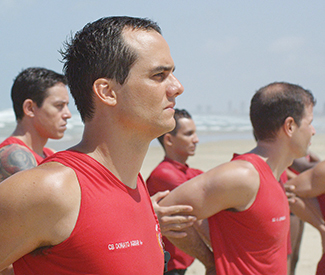
Futuro Beach (Karim Ainouz, Brazil) When two German men globe-trotting on their motorcycles go for a dip off the Brazilian coast, they’re pulled under by the current — only Konrad (Clemens Schick) is saved by local lifeguard Donato (Wagner Moura), his companion lost. The two men console one another with sex. Then in the first of several disorienting jumps forward in time here, suddenly Donato has moved to Europe in order to continue their relationship, leaving his old life (including a dependent mother and younger brother) behind. There are further narrative leaps ahead — director Karim Ainouz (2002’s Madame Satã) is all about bold gestures here, but his visual and sonic assertiveness don’t necessarily fill the blanks in narrative and character development. The resulting exercise in style will leave you either dazzled or emotionally untouched. June 27, 9:30pm, Castro. (Harvey)

Cupcakes (Eytan Fox, Israel, 2013) After a run of politically tinged features, Eytan Fox (2002’s Yossi & Jagger, 2004’s Walk on Water) goes the Almodóvar-lite route with this flyweight comedy about a Eurovision-style song contest. Gay Ofer (Ofer Shechter) and various girlfriends who all live in the same Tel Aviv apartment building decide to enter the Universong competition, becoming Israel’s official entry with improbable ease despite never having performed publicly before. Their mild travails (fighting the creative inference of professional handlers, Ofer’s attempts to drag his boyfriend out of the closet) fill time pleasantly enough before the inevitable triumphant telecast climax. This candy-colored fluff, its mainstreamed camp sensibility predictably reflected in corny vintage hits (“Love Will Keep Us Together,” “You Light Up My Life”), is aptly named — it’s as colorful, easily digested, and about as nutritious as a tray of cupcakes. June 28, 8:30pm, Castro. (Harvey)

I Feel Like Disco (Axel Ranisch, Germany, 2013) When housewife Monika (Christina Grobe) suffers a stroke and falls into a coma she may never come out of, her chubby teenage son Flori (Frithjof Gawenda) and junior high swim coach husband Hanno (Heiko Pinkowski) are forced to depend on each other without mom as a buffer. Things tentatively look up when Flori develops an unlikely friendship — and possibly something more — with dad’s star diver, Romanian émigré Radu (Robert Alexander Baer). Axel Ranisch’s gentle seriocomedy doesn’t make much of an impression for a while, springing few surprises (despite occasional deadpan fantasy sequences) along its moderately amusing path. But as father and son struggle to rise to the occasion of their shared crisis, we grow to like them more — and likewise this ultimately quite disarming feature. June 29, 7pm, Castro. (Harvey) *

Frameline 38, the San Francisco International LGBT Film Festival, runs June 19-29 at the Castro Theatre, 429 Castro, SF; Roxie Theater, 3117 16th St, SF; Victoria Theatre, 2961 16th St, SF; and Rialto Cinemas Elmwood, 2966 College, Berk. For tickets (most shows $10-15) and schedule, visit www.frameline.org. For even more Frameline 38 short takes, visit www.sfbg.com.

Get up

0

marke@sfbg.com

SUPER EGO Fellow freakazoids, I’m disturbed. There’s an alarming new microtrend in nightlife: daylife. More specifically: morninglife. Halp!

First NYC’s Daybreaker party hit our shores a couple weeks ago, enticing hundreds of people to line up outside Audio at 8am for two hours of pre-work dancing ($15-$20) that apparently involved giant jellyfish costumes, a brass band (just to make sure you were awake?), and Four Barrel coffee — no alcohol here. I didn’t make it, because fuck that. But I was intrigued! Daybreaker’s AM disc jockey DJ Bradley P is a quality cutie, and the after-vids were rad. I’m waiting to hear if more are in the works.

Now comes Morning Gloryville from London (Wednesday, June 25, 6:30am-10:30am, $20. Heron Arts, 7 Heron, SF. www.morninggloryville.com), which places itself at the nexus of Burning Man, Ministry of Sound, and 24-Hour Fitness. Kind of a spiritual neon-flashmob throwdown, with wigs, massages, and smoothies. “Rave your way into the day!” It looks real cute. And exhausting.

I should have seen this coming the moment fluorescent Fitbits and post-ironic ’80s “Get Physical” dance routines started hitting the dance floors. Of course, SF has a long, glorious, deranged history of morning parties, from 6am Sunday Church at the End Up in the ’70s to recent blasts at North Beach’s Monroe and our own occasional Morning Glory party. I’ve loved dancing in the wee hours ever since I hung out in West Berlin in the ’80s and discovered high school kids hit the clubs before going to school.

But this new wave is just so darn wholesome — complete with slick marketing campaigns, relentless cheerfulness, and franchise ambitions. Despite my liver’s squeaky pleas, I’m not quite ready to come over to the “nightlife as workout routine” side, let alone sans cocktails. At least not yet. Yes, this fantastic ass came from tripping the light fantastic four-six nights a week. But these massive biceps? Grasping my vodkas, dear. Perhaps one day I’ll see the light.


BAIKAL

Sound Department continues to delve monthly into the more thought-provoking side of electronic music. This 11th installment features Berlin multi-layerist Baikal, who’s been building a body of impeccable (yet quite danceable) tech-work.

https://www.youtube.com/watch?v=roAxi8EQ6dk

Fri/20, 9pm-3am, $10. Monarch, 101 Sixth St., SF. www.monarchsf.com


GRIT & GLAMOUR

New show “Gorgeous” at the Asian Art Museum challenges and redefines the notion of beauty in “Eastern” art: Fantastic-sounding opening party makes it all come to life, with deep techno tunes from Dr. Sleep and Robot Hustle, bounce jams from DavO and Natalie Nuxx, vogue extravaganza from House of Nu Benetton, milky tea, fresh nail designs, full bar, and an afterparty at the Stud.

Fri/20, 7pm-11pm, $20–$25. Asian Art Museum, 200 Larkin, SF. www.asianart.org


LEE BANNON

Based-goth monthly funhole 120 Minutes presents this brilliant, trip-hoppy Ninja Tuner, drifting on gorgeous, post-glitch waves to the darker side.

Fri/20, 10pm, $8–$10. Elbo Room, 647 Valencia, SF. www.elbo.com


LOCO DICE

Maestro of that muscular quasi-minimal Ibiza sound — and not bad to look at, either — Mr. Dice blew me away last time he touched down, a couple years back. He’ll be on the 1015 system this time: All aboard the silver spaceship.

Fri/20, 9pm-4am, $20–$25. 1015 Folsom, SF. www.1015.com


LOUIE VEGA

Here’s a “flashback” night for ya: Master at Work and Latin house legend. He’ll be stretching back into his roots with some Afrobeat, samba, disco, and soul at Mighty. With old school heroes David Harness and Jayvi Velasco.

Fri/20, 10pm-4am, $20 advance. Mighty, 119 Utah, SF. www.mighty119.com


KAFANA BALKAN

“Join us for wild brass, abandon, and reverberating floors” — you can say that again, as this whirling, stomping Balkan delight returns to its Rickshaw Stop home. DJ Zeljko, Fanfare Zambaleta live band, Elizabeth Strong, and the Foxglove Sweethearts belly dancers bring gypsy joy to an adoring crowd.

Sat/21, 9pm, $15. Rickshaw Stop, 155 Fell, SF. www.rickshawstop.com


MAYA JANE COLES

The superfly UK whiz kid with a knack for connecting dance music history dots continues to thrill in the spotlight. She’s headlining a powerhouse night featuring NYC early-’90s fantasist Kim Ann Foxman, Alex Arnout, Young Marco, Bells & Whistles, and more at the As You Like It party.

https://www.youtube.com/watch?v=eV4ZiUSFvIQ

Sat/21, 9pm-5am, $20–$25 advance. Public Works, 161 Erie, SF. www.ayli-sf.com


WERD.

The classic Sunday weekly ran at now-closed Otis Lounge for more than seven years — now it’s at Monarch and sweeter than ever. This week’s ace tech-house guest Peter Blick helps break things in.

Sun/22, 9pm, $5. Monarch, 101 Sixth St., SF. www.monarchsf.com


Eight up

0

arts@sfbg.com

DANCE The 36th annual San Francisco Ethnic Dance Festival opened with an ambitious agenda: presenting India’s eight classical dances in one program. Yet this first weekend — EDF continues at Yerba Buena Center for the Arts through June 28 — didn’t quite meet the high expectations the festival had set for itself.

In part, this was because a shadow fell on the show. Last week, great kathakali practitioner K.P. Kunhiraman, who was to make his farewell appearance, died unexpectedly in India. With his wife, Katherine Kunhiraman, he had directed Kalanjali: Dances of India, one of the Bay Area’s oldest Indian dance schools, teaching both folk and classical Indian dance.

While bringing these classic forms together was a noble idea, EDF should have presented them on equal footing. This is particularly true because while bharatanatyam, kathak, and to a lesser extent odissi and kuchipudi are well known to Bay Area audiences, kathakali, manipuri, mohiniattam, and sattriya may have been unfamiliar even to many of the Southeast Asian families who attended the festival.

Performed by guest artists from out of town, these new-to-us genres were set to music that came out of loudspeakers. For a first exposure to an art, which so intimately depends on instruments and the human voice, recorded music was a disservice to both the practitioners and the audience.

One only had to look and listen to tabla player Samrat Kakkeri (and his colleagues) with the first-rate Chitresh Das Dance Company, which closed the program, to realize that the subtle give-and-take that flows between dancers and musicians should not be given up to expediency. No wonder the Chitresh dancers managed the intricacies of the multiple rhythmic patterns in Das’ kathak yoga with such confidence and joy. Many dance genres do just fine with unrelated music or no music at all. Indian dance, as this program proved, does not.

Also, while some of the less familiar dance forms might have been given more stage time — some others could easily have been shortened. What intrigued most in these first EDF appearances was how little use was made of the sophisticated rhythms that we have come to know as Indian dance.

More drama than dance, kathakali’s spectacular performances can last all night. The excellent Sunanda Nair gave us a glimpse of a work in which an evil demon — in the shape of a seductive woman, wouldn’t you know — gets her comeuppance from baby Krishna. She returned later in an example of mohiniattam which highlighted articulate arms and feathery hands. It was thrilling to see how her torso contrasted with her legs planted into wide plies, from which she smoothly sank into and rose from the ground.

Sohini Ray’s snippet of manipuri, however, disappointed because it looked stiff, and didn’t really develop those wonderfully gentle whipping turns that make the dancers look prayer wheels. She communicated much better in what seemed a more folkloric form of manipuri in which leaping, running, and turning on the knees conversed with a dual head drum.

Intriguing in its use of unisons and rolling wrists, sattriya — performed by two women, one in pants — conveyed the gently rocking geniality of two friends on the road. I have to assume that the one with a hat was Lord Krishna. For those familiar with the mudras, Indian dance’s gestural language, they were so beautifully clear that they were easy to follow. I recognized three for sure: a welcoming gesture, shooting an arrow, and riding a horse.

In its first appearance at the EDF, San Francisco’s Nava Dance Theatre proved itself a fresh, spunky, and musically-aware bharatanatyam company. In its piece, a love-struck young man (a dreamily handsome Arun Mathai) was comforted by a bevy of young maidens. A spectacular, theatrically savvy soloist, Bhavajan Kumar, may yet do for bharatanatyam what Joaquín Cortés did for flamenco.

In their celebratory kuchipudi — bharatanatytam’s younger, looser sister — the nine young women of San Jose’s Natyalaya school of dance handled the rigors of their geometries with considerable grace. Maybe one day we’ll see them perform to live music.

Charming, yet very serious in odissi were Maya Lochana Devalcheruvu (age 11) and Akhil Shrinivasan (10). Young as they are, they already showed odissi’s curved body position and light footwork. With good stage presence, they knew what they were aiming for. The duo then welcomed Sujata Mohapatra, an exquisite odissi dancer light but firm on her feet, floating on her toes, and her rippling neck enhancing the facial expressions.

Though in mourning, Kalanjali: Dances of India performed Tillana, the final section in a bharatanatyam performance, for which the dancers pull together everything they learned. These women probably did. *

SAN FRANCISCO ETHNIC DANCE FESTIVAL

Through June 29, $18-$58

Yerba Buena Center for the Arts Theater

700 Howard, SF

www.worldartswest.org


American revolution: Smith Henderson talks ‘Fourth of July Creek’

0

Smith Henderson is all smiles. His debut novel, Fourth of July Creek, has been receiving rave reviews since its release two weeks ago, has a 100,000 copy pressing from HarperCollins, and was recently called “the best book I’ve read so far this year” by Washington Post critic Ron Charles.

“I was not expecting the Ron Charles thing … that was amazing,” Henderson says, sipping his beer on the outdoor patio of Farley’s East in Oakland. (He’ll be reading from the book Tue/17 at San Francisco’s Book Passage.) While the degree of success that the book is receiving tickles Henderson, he doesn’t pretend to be shocked that people are enjoying his work. “When people tell me ‘I love your book,’ I’m happy, but not chagrined. I wrote the book toward my interests, so of course I like my book.” Henderson smokes a cigarette as he chuckles. 

His novel explores the plight of Pete Snow, a Montana social worker who discovers a feral boy, Benjamin, and his survivalist father Jeremiah Pearl. While dealing with the dissolution of his own family, several other cases, and a tumultuous romance, Snow uncovers Pearl’s revolutionary ideas and begins to question his own safety and that of his entire community, the rural town of Tenmile. Henderson’s intertwining plot confronts a plethora of contemporary societal ailments, including alcoholism, suspicion of government, child neglect, cultural polarization, and the gift and curse of religion. 

Much of our conversation concerned the intricate plot points that Henderson somehow manages to sew together seamlessly. Such a combination of topicality and technical flourish has led Charles and several other high-profile critics to throw around words like “Great American Novel,” meaning work consistent enough and broad enough in  political scope to say something profound and lasting about the nation. 

Henderson isn’t one to label his own work, but he doesn’t entirely laugh off the potential hyperbole either. “I think it’s tricky to use words like ‘Great American Novel’ because it’s set in Montana — it’s a very white state. There’s a lack of diversity that I think is necessary in talking about the whole country.” After a moment of rumination, however, he offers a partial refutation of his own point. “That being said, the novels that come to mind are pretty regional as well; Beloved is pretty focused on a single location and group.”

While Montana might not be the optimal mirror for America, it’s a place that Henderson knows quite well. A native son, he grew up in the state and went to college, like Pete Snow, in Missoula. (He now lives in Portland, Ore.) “My whole family are cowboys and loggers. My dad is still a logger,” he says proudly. “Montana is a weird place … there’s a libertarian streak that is pretty unique in how it manifests itself.” 

Henderson cites the 2004 election, in which Montana voted for George W. Bush, legalized medical marijuana, and constitutionally banned gay marriage all on the same ballot. The odd mix between “live free or die” and socially conservative practices in the state provided an ideal climate for the confrontation between Snow, a government employee with the Department of Family Services, and the fiercely anti-authority Pearl. The eventual escalation between the government and the community is easy to believe. 

“Things are always liable to get a bit wacky and out of control up there,” says Henderson. 

Yet Henderson, while by no means conservative or religious, isn’t trying to write a book about extreme zealots. “At first it’s possible to look at Pearl and think he’s completely insane. But a lot of his paranoia is not entirely unfounded.” 

Near the end of the book, Pearl uses an example of government agencies  replenishing the Montana wolf population as an example of how dangerous Federalism can become. “Pearl basically suggests, ‘You may think your wolves are pretty, but they are liable to eat me.’ That lack of practicality is real.” 

While Henderson set Fourth of July Creek in the early 1980s, he was inspired by the rhetoric going on in national politics today. “Arguments like those of Pearl’s are all over the place right now, and initially they may seem just as paranoid. But when you have unmitigated drone strikes and NSA surveillance it isn’t impossible to see where people are coming from.” 

He does, however, see the value of government intervention — Helena pays his ultimately heroic (or at least likeably anti-heroic) protagonist, after all. “On the other hand, you have health care, gay rights, the environment, all receiving meaningful support.”

Though informed and interested in the modern state of affairs, Henderson was very intentional in his chronological setting of the book. He leans forward and takes on a quieter, more intense tone as he talks about the era directly succeeding Carter’s economic and military failures. “1980 was an inflection point. Obviously Carter, while getting a lot right, struggled a ton in the implementation. And the backlash to that, coming in the form of the Reagan Revolution, has really defined modern society … We learned how to make wealth out of thin air — at least for some people.” 

Reagan’s election and the surrounding rhetoric takes center stage in the book. Judge Dyson, an aging and alcoholic Democrat, openly weeps as he watches the election results with Snow. “It was the death of the LBJ, rural-big-government Democrat. And that’s something I’m not sure we’ll ever get back.” 

In addition to highlighting the philosophical shifts that have led to the urbanization of liberal thought, Henderson also uses the relatively unorganized pre-digital bureaucracy as a major plot device. “There was no concept of secondary trauma in 1980 Montana. There was no social worker to help Pete deal with the horrific things that he sees on a daily basis.” 

The dearth of support systems fuel Snow’s drinking bouts, depression, and difficulty in handling his daughter’s disappearance and ex-wife’s instability; he may be a great social worker, but the state’s inability to track his emotional progress and casework eats away at his life.

A fascinating storyteller and political force, Henderson is also often  technically experimental. The portion of the book that details Snow’s daughter’s descent is done in the form of an anonymous question and answer. “When I write, I almost always write questions to myself: ‘Where is Pete Snow from?’ ‘Choteau.’ ‘Why Choteau?’ For the Rachel section, I just left it in that form.” 

But the section is far from unfinished. Henderson left the section as is because of the intensity of its content — in a pure third-person narrative it felt too stilted. “The voices are full of an anxiety and intensity that couldn’t be captured with the more impartial voice in the rest of the book.”

The frenetic 90 minutes that we spent discussing Fourth of July Creek further convinced me that the book cannot be distilled to one message, but is rather a varied rumination on insecurity, suspicion, and government. When I asked Henderson what he thinks the primary takeaway is, however, he was remarkably candid and quick in his response. He pointed me to the Thoreau quotation that opens the book: “If I knew for a certainty that a man was coming to my house with the conscious design of doing me good, I should run for my life.” 

Henderson then highlighted a passage in which Snow is likened to a priest for how much he gives up to help dysfunctional families. “America in the ‘80s was losing trust for institutions, and continues to. Despite all of his flaws, Pete is worthy of our trust, and hopefully represents a powerful refutation of Thoreau’s instant suspicion for government or those who come to help us.”

Henderson’s creation, while transcending political ideology, powerfully shows the potential for altruism even in a country as broken as the US.


Smith Henderson

Tue/17, 12:30pm, free

Book Passage

1 Ferry Building, SF

www.bookpassage.com

Extra! Extra! Sunshine advocates beat the Anti-Sunshine Gang in City Hall

27

 By Bruce B. Brugmann

And so the  Anti-Sunshine Gang in City Hall, which for two years has been conducting a nasty vendetta against the Sunshine Ordinance Task Force,  capitulated quietly at Tuesday’s Board of Supervisors meeting without a fight or even a whimper.

The capitulation came in a two line phrase  buried in item 28 in the middle of the board’s agenda.  It was a report from the rules committee recommending  the Board of Supervisors approve a motion for  unnamed nominees to the Sunshine Ordinance Task Force. “Question:  Shall this Motion be approved.”

Board Chair David Chiu asked for approval in his usual board meeting monotone. And the approval came unanimously, with no dissent and no roll call vote and not a word spoken by anybody.  He banged the gavel and that was that. And only a few veteran board watchers knew that this was the astonishing  end to a crucial battle that pitted the powerfuf Anti-Sunshine Gangs against the sunshine forces and the citizens of San Francisco. It was a battle that would decide whether the task force would remain an independent people’s court that would hear and rule on public access complaints.  Sunshine won.

It was ironic and fitting that Chiu presided over the capitulation. For it was Chiu as board president who orchestrated  the deal to demolish Park Merced and then orchestrated the  infamous 6-5 board vote  in September 2010 approving  a monstrous redevelopment  project that would evict lots of tenants, and destroy most of the affordable housing. This was a big deal because the housing crisis was heating up and Park Merced was the largest affordable community in the city and one of the largest In the nation. This is where tens of thousands of young people, young married couples, students and faculty at nearby San Francisco State, older people, and middle class people had come for generations with their families to live in affordable housing in an  “urban park,” as Park Merced promo once put it.

And it was Chiu as board president who was charged by the Sunshine Task Force, along with Supervisors Scott Wiener, Malia Cohen, and Eric Mar with violating the Sunshine Ordinance and the state’s open meeting law (Brown Act) when they approved the project with blazing speed.. 

Wiener, Cohen, and Mar were on the board’s Land Use and Economic Development Committee when they voted on the contract. Literally minutes before the committee vote, Chiu introduced 14 pages of amendments to the contract. The deputy city attorney at the meeting blessed the amendments by saying, gosh, golly, gee, no problem, the amendments do  not substantially alter the contract and therefore the description of the item on the agenda was still apt and the committee could act on it. Bombs away! The full board approved the contract the same day by one vote.

This sleight of hand and pellmell approval process meant that Park Merced was going,going, gone and in its place would be a project that “has no hindsight, no insight, or foresight,” as Planning Commissioner Kathryn Moore was quoted as saying in a scathing Westside Observer column by landscape architect Glenn Rogers. “It is not a project of the 21st century.  It is the agenda of a self-serving developer.”

 The Observer, to its immense credit, was the only media in town to blast away at the project. (Read its coverage and weep, starting with a June piece by Pastor Lynn Gavin who wrote that the Park Merced owners did not disclose to her or her family that they “were going to demolish the garden apartment that was our home.”)  Gavin and her neighbors took the formal complaint to the Sunshine Ordinance Task Force and got a unanimous 8-0  ruling condemning Chiu, Wiener, Cohen, and Mar for open government violations.

It was a historic ruling by the task force and demonstrated once again in 96 point tempo bold the irreplaceable value of the people’s court.  The ruling also had impact because it amounted to a stinging  expose of how government often works in San Francisco with big money and big development and how one vote can add gallons of high octane petrol to the housing crisis. It angered the hell out of the six supervisors who voted for the project.

 And in effect, it gave rise to what I call the Anti-Sunshine Gang in City Hall whose response to the ruling was, not to apologize and change their illegal ways, but to start a vicious vendetta against the task force for doing the right thing at the right time.  The six votes were David Chiu, Scott Wiener, Malia Cohen, Mark Farrell, Sean Elsbernd, and Carmen Chu. Elsbernd has gone on to Sen. Diane Feinstein’s office in San Francisco and Chu to becoming assessor. But the gang picked up other allies along the way, notably the city attorney’s office.

Two years ago, when the task force members came to the board for reappointment, the Anti-Sunshine Gang retaliated and swung into action by “launching a smear campaign aimed at purging the eight task force members who had unanimously voted to find the violations,” according to Richard Knee, a 12 year veteran of the task force, in a June column in the Observer.  Knee, who represents the local chapter of the Society of Professonal Journalists, also wrote that “the mayor and the Board of Supervisors…made sure that the panel gets minimal funding, staffing and resources, and the board has refused to fill two long standing vacancies, making It difficult at times to muster a quorum since task force members are volunteers with outside responsibilities such as family and work.

“Two year ago, the board’s failure to appoint a physically disabled member forced the task force to take a five month hiatus, exacerbating a backlog of complaints filed by members of the public.This year, Knee wrote,  the start of the appointment process was “farcical and ominous.”  He explained that, at the May 15 meeting of the board’s rules committee, which vets applicants for city bodies, the two supervisors present chair Norman Yee and Katy Tang (David Campos had an excused absence) “complained that there weren’t enough racial/ethnic diversity among the 13 candidates. “That didn’t deter them from recommending the reappointments of Todd David, Louise Fischer, and David Pilpel, all Anglos.”

Before the full board five days later, Yee complained again, “this time that lack of a regular schedule and frequent switching of meeting dates were making attendance difficult for task force members. Either Yee had no clue of the facts or he was lying.” Knee explained that the task force normally meets the first Wednesday of each month and its subcommittees usually meet during the third week of the month.

“Meeting postponements and cancellations are the result, not the cause, of difficulties in mustering a quorum, due to the vacancies—which now number three.

“In gushing over David, Fischer, and Pilpel, at the board’s May 20 meeting, Wiener offered no evidence or detail of their alleged accomplishments and ignored the fact that David has missed six task force meetings since March 2013, including those of last February and April. Until the board fills the other seats, the five remaining incumbents—Chris Hyland, Bruce Oka, David Sims, Allyson Washburn, and yours truly—stay on as ‘holdover’ members.”

Meanwhile, by the next session of the Rules Committee on June 5, the sunshine advocates had rallied and put together an impressive mass of sunshine power. Testifying at the hearing were representatives from SPJ and the journalism community, the League of Women Voters, the ACLU, the sunshine posse, the Library Users Association, the Bay Area News Group, the Inter-American Press Asociation, the Center for Investigative Reporting, the UC-Berkeley Graduate School of Journalism, the First Amendment Coalition, the  Electronic Frontier Foundation, the Observer and neighborhood activists, and other sunshine allies and FOI groupies. It was quite a show of force. 

SPJ placed a pointed, timely op ed in the Chronicle (“SF Supervisors block Sunshine Ordinance Task Force,” good of the Chron/Hearst to run it but better if the paper didn’t black out local sunshine issues.) Members of the posse peppered the gang with public record requests aimed at tracking skullduggery and they found it. Reps from the groups lobbied the supervisors by email, phone, and personal office visits. And the word that the Anti-Sunshine Gang was back and on the gallop shot through the neighborhoods and around town and into election campaigns and among constituents of the gang.

SPJ and its vigorous Freedom of Information Committee under co-chairs Journalist Thomas Peele, of Chauncey Bailey fame, and Attorney Geoff King  were particularly effective. Peele is an investigative reporter with the Bay Area Newspaper Group, a lecturer on public records at the UC-Berkeley Graduate School of Journalism, and author of a respected book on Chauncey Bailey, a black journalist murdered on his way to work.

The word got around that the supervisors were blocking strong pro-sunshine candidates for the task force and that their first three nominees were the weakest of the lot. Campos, a stellar sunshine advocate, was back at the committee meeting, making the right calls and shepherding the strong nominees along through the committee and the Board of Supervisors.  Great job.

The cumulative weight and force  of the presentations of the nominees and the sunshine advocates made the proper political point:  any supervisor who voted with the Anti-Sunshine Gang was going to face their constituents and voters with the brand of being anti-sunshine and anti- government accountability.  More: they would have to answer some embarrassing questions: Who lost Park Merced? Who voted to turbo charge evictions and middle class flight from the city for years to come? Who tried to cover up the outrage and who did it? And who led the retaliatory vendetta against the Sunshine Ordinance Task Force for doing the right thing on behalf of sunshine in San Francisco?

And so the Board of Supervisors was dragged kicking and screaming into the sunshine of June 2014 and beyond. The supervisors ended up nominating what looks to be one of the strongest pro-sunshine task forces: Attorney  Mark Rumold and journalist Ali Winston from SPJ, Allyson Washburn from the League of Women Voters, Attorney Lee Hepner, Journalist Josh Wolf, and holdover Chris Hyland. Plus Bruce Oka who looks to be a late holdover in the disabled seat. Congratulations for hanging in and winning, hurray for the power of sunshine, on guard,  B3

P.S. l: PG&E institutionalizes City Hall secrecy and corruption:  The pernicious influence of the Anti-Sunshine gang hung heavy over the rules committee.  Tang tried to force every candidate to take a pledge of allegiance to the city attorney. Tang is the kind of neighborhood supervisor (Sunset) who has a 100 per cent Chamber of Commerce voting record. Her city attorney pledge demand was laughable on its face, given the fact that the city attorney refuses to move on the PG&E/Raker Act scandal and thus has helped institutionalize secrecy and corruption in City Hall on a multi-million dollar scale for decades. Which is reason enough for the city to always maintain a strong, enduring Sunshine Ordinance Task Force, to help keep tabs on how PG&E keeps City Hall safe for PG&E and its allies. (See Guardian stories and editorials since 1969.)  

Tang and Yee continued the gang’s hammering on Bruce Wolfe, a worthy candidate for the disabled seat whose main sin was that he was one of the Honorable Eight who voted condemnation.  The gang knocked out Wolfe as a holdover candidate the first time around and they were at it again at the committee meeting. Oka says he wants to resign from the task force but only when the board finds a good replacement. Wolfe, who was an effective and knowledgeable sunshine task force member, is the obvious replacement but he is still on the purge list.  Stay tuned on this one. . 

There are three things that no one can do to the entire satisfaction of anyone else: make love, poke the fire, and run a newspaper. William Allen White, 1917, line atop the editorial page of the Durango Herald, Durango, Colorado. 

Fogged in

1

THE WEEKNIGHTER Weekends are for amateurs. Weeknights are for pros. That’s why each week Broke-Ass Stuart (www.brokeassstuart.com) will be exploring a different San Francisco bar, bringing you stories about the places and people who make San Francisco one of the most phenomenal cities in the world. Who wants a drink?

We decided to walk around the Tenderloin. I had my computer, Gene had his bike, and Sabrina had a bag of things I’m sure she didn’t want taken from her as well. We were coming from my weekly Wednesday gig at Monarch where I do a coloring book happy hour.

“It’s very San Francisco out,” I said as we came up Taylor and saw the fog sliding its fingers down the sides of Nob Hill’s buildings. “I love summer in San Francisco,” I mused. “Me too,” Sabrina said, “I hate when people bitch about it. It’s part of San Francisco and loving it is part of being a San Franciscan.”

As we got to the entrance of Jones (620 Jones, SF. www.620-jones.com), the three of us landed on something we felt was important at the moment, that before this current gold rush, it was San Francisco’s summers that weeded out who would stay and who would go. You couldn’t take the mist and the fog? Then you got the fuck out of town. That fog is our inheritance and our merit badge and such a part of The City that you have to love it to live here.

Walking out onto the patio at Jones we were surprised there were no heat lamps. The entirely of the joint’s drinkers were crammed into the little sidebar adjacent to the patio, and as we sat down at the short end of the bar, the three of us gave each other a knowing glance. It said: How many of these people are experiencing their first San Francisco summer? How many would be considering packing up and heading back to wherever they’re from if they weren’t here for the gold rush? How many are living in apartments recently vacated by people whose love for the fog, and all it represents, just wasn’t enough to be able to keep them here?

Gene tipped the barman with a two-dollar bill. “Oh wow,” the bartender said, “you’re still doing that after all this time?” Gene told us he’d met him years before, during the first dot com boom, when the guy tended bar at 111 Minna. “Back then Minna was just a small one room space, not like it is now, Gene explained. “And I remember being there and learning for the first time how badly cocaine got on top of some people when these two girls, up from LA, were offering to blow people for blow.” As I looked around the room at all the pretty and well-dressed people, I wondered what they’d all be willing to do to get something they really wanted. I wondered the same thing about myself. What was I willing to do to stay in San Francisco if push came to shove and shove came to eviction.

Across the bar I noticed a friend who was obviously on a date and even more obviously drunk. “Hey look who it is,” I said to Sabrina who was also friends with the girl, and our conversation changed to the fact that, another integral part of living here is being ok with your past. “You can’t burn bridges,” Gene said, “since you’re bound to run into that person on a barstool sometime soon.” To which I replied, “If you burnt San Francisco’s bridges, all we’d be left with was the Peninsula…” The joke hit all three of us harder than expected. We looked around, looked at each other, and then left the bar. We felt more at home amid the fog anyways. 

Stuart Schuffman aka Broke-Ass Stuart is a travel writer, poet, and TV host. You can find his online shenanigans at www.brokeassstuart.com  

Housing crisis requires creative thinking

10

EDITORIAL Does the construction of brand new high-end towers represent the only possible opportunity for new affordable housing in San Francisco? To hear the arguments of those bemoaning the passage of Proposition B, the ballot measure overwhelmingly approved June 3 requiring voter approval for increased building heights along the waterfront, one would think so.

Shortly after Prop. B had been decided, the Washington Post ran a headline proclaiming: “Voters in one of America’s most expensive cities just came up with another way to block new housing.” The idea seems to be that by making it harder for developers to build waterfront towers incorporating a small percentage of affordable units, San Francisco has sealed itself off from any new affordable housing, forever.

To buy this argument, you must resign yourself to a world where the only conceivable pathway for housing average-income people is to hope high-end developers decide to incorporate them into massive complexes for the wealthy on a narrow strip of waterfront property. Which just isn’t a terribly creative solution.

Surely, alternatives exist. The city is brimming with clever people who are skilled at creative thinking and aren’t afraid to dream big. Why not apply some brainpower to the housing crisis? Here are a few ideas.

• Change city law to allow people to build their own backyard cottages to rent out at affordable prices. Here we must holler at the Public Press, which is hosting a conference Fri/13 called “Hack the Housing Crisis,” and recently calculated that San Francisco could theoretically add another residence to each of its 124,000 single-family lots if the city were to legalize backyard cottages. That would increase the total number of households by 33 percent; no luxury towers required.

• Make the most of public land holdings. A Budget and Legislative Analyst’s report dating back to March of 2012 determined that city agencies have in their possession at least 27 underutilized “surplus” properties. Under the Administrative Code, the top priority for such lands is affordable housing, yet they go unused. Why not prioritize the transfer of these parcels for 100 percent affordable projects?

• Figure out some alternative financing schemes. Recent changes to federal law sanction crowdfunding for real-estate projects, an option that didn’t previously exist. Say some affordable housing people got together, started an online fundraising campaign, bought vacant properties for conversion into affordable units, and secured public funding to make the whole thing pencil out. Real estate investors won’t give a project a green light unless they’re guaranteed a stupidly high return; maybe under this scenario, thousands of nontraditional investors who care about the city they live in could reap small bonuses for pitching in.

And by the way, developers are still free to propose highly affordable projects under Prop B. In fact, voters might be much happier to sign off on that idea than high-end luxury condo towers.


Anxious art

0

arts@sfbg.com

FILM Poland had not been a major hub of film production in the early decades of the medium, and its industry stabilized without getting very interesting in the years after World War II, when a Soviet-backed Stalinist regime founded state-controlled Film Polski. This shotgun wedding of art and bureaucracy wasn’t ideally conducive to creative expression, however. By the mid-1950s younger filmmakers, many graduates from the recently founded National Film School in Lodz, agitated for more independence — which, surprisingly, they won.

The resulting United Groups of Film Production almost immediately began producing work that won international attention and came to be known as the “Polish Film School” of cinema. Then in the 1970s a second wave of distinctive talents arrived, their troubled and ambivalent movies coming to be known as the Cinema of Moral Anxiety movement. Presented by Martin Scorsese, the touring “Masterpieces of Polish Cinema” retrospective playing Berkeley’s Pacific Film Archive offers 13 features spanning three decades.

https://www.youtube.com/watch?v=3-CQj8n3Rek&feature=kp

The series kicks off this weekend with perhaps the most famous films by two polar (ahem) opposites of the school’s first wave: fantasist Wojciech Has and sober, socially conscious realist Andrzej Wajda. The latter sounded a new Polish cinema’s opening salvo with 1955’s A Generation, and is still at it 60 years later. Last year he continued his never-ending project of dramatizing 20th century Polish history with the biographical Walesa: Man of Hope (as yet unreleased in the US), and might yet be active when he hits 90 in 2016.

An honorary Oscar winner, Wajda has been the most imposing presence in Polish cinema for nearly his entire career, even if he’s not the nation’s most fabled cinematic son — that would be Roman Polanski, a sensibility as slippery as Wajda is solid (and sometimes stolid), as well as a director who fled to the West at his first opportunity. (Polanski made a rare return after the fall of Communism, acting the lead in Wajda’s atypical period comedy Zemsta in 2002.) The four features representing Wajda in the PFA series see his development from an edgy young voice to the master artisan of large-canvas, often polemical works on subjects of official import.

Ashes and Diamonds (1958) introduced the striking screen presence of Zbigniew Cybulski — one consciously modeled on the magnetic malcontents of James Dean, and Marlon Brando in 1953’s The Wild One — as one of two resistance fighters tasked with assassinating a Communist official just days after the end of World War II. While his partner copes with this now-pointless mission by going on an epic drunk, Cybulski’s Maciek expresses his ambivalence in distracted pursuit of a barmaid (Ewa Krzyzewska). His iconic death scene would influence many others, notably those in Godard’s Breathless and Truffaut’s Shoot the Piano Player (both 1960). The actor coped with his subsequent international stardom by doing everything to excess; there was grief but not much surprise among those who knew him when he died in a drunken fall at a train station in 1967, not yet 40 but looking much older.

He also has supporting roles in Jerzy Kawalerowicz’s 1959 slice-of-life demi-thriller Night Train, and in Wajda’s Innocent Sorcerers from the next year — both long journeys toward dawn, the second set in a jazz-soaked, raffishly disillusioned Warsaw where it’s “harder to catch a taxi than a girl.” The two other Wajda titles here are later epics: 1975’s The Promised Land, a long, lavish and shrill indictment of worker-exploitative Industrial Revolution capitalism; and 1981’s Man of Iron, dramatizing the rise of the Solidarity movement. Man won the Golden Palm at Cannes, but also angered Polish officials sufficiently to drive its director abroad for some years, making films in Germany and France.

By contrast, political — or any — reality is infrequently found in the works of the late Has, whose best films are hothouse phantasmagorias rich in surreal imagery and dreamlike illogic. The PFA series kicks off with his 1964 The Saragossa Manuscript, perhaps that decade’s first “head” film, and duly named by Jerry Garcia as his favorite film. (The musician was involved in the PFA acquiring a print before his death.) Its picaresque maze of tall stories, with beautiful available women ornamenting most of them, remains a stoner’s delight. In a similar vein, Has’ The Hour-Glass Sanatorium a decade later is a triumph of Gothic jumble-sale production design, its own hapless hero pulled down a richly colored rabbit’s hole of dress-up role playing and various perversities at the titular institution.

A much more straightforward costume extravaganza is 1960’s Black Cross, aka Knights of the Teutonic Order, about the 15th century struggle between Poles and Christian invaders that led to the Battle of Grunwald. Its director Aleksander Ford was a major figure in establishing the post-war state film industry, yet not long after this expensive epic he was purged in a late-decade anti-Semitic campaign, and his unsuccessful attempts at a career overseas ended with suicide in 1980 Florida. A very different historical piece is Kawalerowicz’s 1961 Mother Joan of the Angels, a treatment of the same 17th century alleged convent demon infestation that inspired Ken Russell’s 1971 The Devils, and one that’s as quiet and stark as the latter film is hysterical.

The leading lights of the later Cinema of Moral Anxiety movement—which mostly eschewed such grand gestures and bizarre subjects for small, disquieting modern narratives — are represented in three films toward the series’ end. Krzysztof Zanussi’s 1976 Camouflage and 1980 The Constant Factor are terse, bitter portraits of institutional corruption. The late Krzysztof Kieslowski’s pre-Three Colors series breakout A Short Film About Killing (1987) is, if anything, bleaker: Drawn together by chance and then by tragedy, its protagonists live in a Warsaw where injustice is practically in the air — thanks to the oppressively tinted cinematography — and the climactic events of a murder and an execution have their existential pointlessness underlined by each being excruciatingly prolonged. *

MARTIN SCORSESE PRESENTS MASTERPIECES OF POLISH CINEMA

June 14-Aug 21, $5.50-$9.50

Pacific Film Archive

2575 Bancroft, Berk

www.bampfa.berkeley.edu

Dark/light

0

marke@sfbg.com

SUPER EGO Vampires beware, or at least grab a pair of killer shades. A recent, very late walk of shame (both heels broken but my rep intact) revealed that afternoon outdoor parties are currently raging full-tilt. So invite me to your dang retro-fidget-yacht-goth-IDM BBQ already! I promise not to spill anything. Everybody looks great in hot sauce, anyway.

Soundtracks for this week: infamous local synth-dance act The Soft Pink Truth’s brain-melting return Why Do the Heathens Rage: Electronic Profanations of Black Metal Classics, Quivver’s groovy (and timely) extended rework of “Ain’t Nothin’ Going On But the Rent,” and DJ Greg Wilson’s psychedelic-funk mixtape Blind Arcade Meets Super Weird Substance In The Morphogenetic Field. OK, let’s go.


HI LIFE

Glorious global soul weekly Afrolicious may have moved on to conquer the world as a touring act, but don’t cry: In its place is this tropical beats and live funk jams showcase from key Afrolicious members. “Expect elevation,” say DJs Pleasuremaker and Izzy Wise.

Thursdays starting Thu/12, 9pm, $6. Elbo Room, 647 Valencia, SF. www.elbo.com


RANDOM RAB

Beautifully constructed, all-encompassing post-Orb grooves that hit a global ambient-funk sweetspot from this San Franciscan. Support from local bass-tech heroes Justin Martin and J. Phlip (and a dozen more), plus mindbending décor and organic treats from the Symbiosis crew.

Thu/12, 9pm-3am, $15–$20. 1015 Folsom, SF. www.1015.com


ADULT.

Live Detroit art-tech darlings were lumped in with electroclash back in the day, but they cut oh so much deeper. With brainy-cute goth-raver Pictureplane, ghostly White Ring, and evil siren/playmate Tamara Sky, this will certainly be an edgy night of stylish Friday 13 dread.

Fri/13, 9pm-late, $15–$20. Mezzanine, 444 Jessie, SF. www.mezzaninesf.com


DANNY KRIVIT

Body and Soul legend (and my eternal DJ crush) brings his rare Latin house and gorgeously smooth mixing style to the Salted party, with Miguel Miggs, Julius Papp. and much-loved Naked Music vocalist Lisa Shaw.

Sat/14, 10pm-late, $10–$20. Mighty, 119 Utah, SF. www.mighty119.com


JACQUES RENAULT

Beam me up! The DFA disco-funk addict possesses one of the sharpest sensibilities out there, sending dancers to truly cosmic places. Hosted by the fantastic, female-powered Isis party.

Sat/14, 9:30pm-3:30am, $10 advance. Public Works, 131 Erie, SF. www.publicsf.com


SUNSET ISLAND

Our incomparable summer nightlife season continues, marked by the Sunset crew’s passing annual parties. Time for this “electronic music picnic” on Treasure Island, which — squee!!! — features Phuture, the dudes from Chicago who basically invented acid house. Also on hand: Detroit whiz kid Kyle Hall and Awesome Tapes From Africa, which is exactly what it sounds like. Acid sunshine, y’all.

Sat/14, noon-9pm, $10–$30. Great Lawn, Treasure Island. www.tinyurl.com/sunsetisland2014


DAYTIME REALNESS

I admit it, I had my doubts about this monthly afternoon party at first — everyone seemed to be smiling so hard in the pics, I thought they’d eat me. Especially towering drag hostess Heklina (who just bought the old club Oasis at 11th and Folsom, btw.) Then I went and got completely sucked in, in a non-oral way. Gorgeous mixed crowd, insanely good beats from DJs Stanley and Carnita — special guests this month Guy Ruben and beloved Trannyshack regular Pinky Ring — synchronized dance numbers, wild drag shenanigans, and Sneaky’s BBQ. Shit got real.

Sun/15, 2pm-8pm, $6 before 3pm, $8 after. El Rio, 3158 Mission, SF. www.elriosf.com


DISCO DADDY

Who knew a gay leather biker bar could get this steamy? If you’re looking for an authentic homosexual disco experience (who isn’t), DJ Bus Station John and his crate of vinyl 12-inches will put some soul in your gloryhole at this monthly get-down.

Sun/15, 7pm-2am, $5. SF Eagle 398 12th St, SF. www.sf-eagle.com


The dual

0

arts@sfbg.com

DANCE Circus Automatic’s In the Tree of Smoke is a fun and greatly entertaining show that aims to place circus acts, traditionally viewed as club and variety show entertainments, into a more mainstream theatrical context. Tree‘s organizers could not have chosen a better place than Chinatown’s recently resurrected Great Star Theater, an old-time movie house that had fallen on hard times.

In the spirit of its venue, the show was interspersed with newsreel-like video collages that proposed a perspective of the world more inclusive than the one we tend to encounter. They included vast landscapes suggesting hunters and foragers, an homage to Blade Runner (1982), and depictions of catastrophes both natural and man-made. They created a dreamy, perhaps phantasmagoric environment — one in which a contortionist feels just at home as a would-be stripper wielding claws instead of fans, or a lusciously adorned queen dragging a bunch of black balloons behind her. On opening night the connection between the narrated video clips and the live show was not yet well enough established. Yet it is hoped that by the time this ambitious but low-budget performance closes June 27, the kinks will have been ironed out.

Circus artists face a conundrum. Because what they ask of their bodies is often so extreme, it is tempting to not look beyond their sheer physical accomplishments. But Tree‘s performers tried to go deeper, via technique, discipline, and the sheer bravado of it all. Jewel-encrusted contortionist Inka Siefker ritualistically rearranged her body parts until she finally shaped them into an eerily beautiful image involving two feet and a bow and arrow. When ballet dancer Micah Walters played with verticality and gravitational pull, he seemed to transcend and affirm his own humanity. You couldn’t miss the dance elements in Katie Scarlett’s dramatic give-and-take between her and her silk apparatus; at times the silk appeared to control her as much as she did it. When Chloe Axelrod, in white, brilliantly “danced” with, in, and around her hoop, she was highly controlled, yet ever so free. But freest of all was Fleeky Flanco, a superb apparatus juggler, varied contortionist, and clown — not to mention the brains and heart behind this brave and much-welcome artistic endeavor.


LAST WALTZ?

In its seventh incarnation, Nol Simonse and Todd Eckert’s “Shared Space” became a celebration of dance, dancers, and two fine choreographers. Eckert is heading for the Midwest, and the future of what has become a popular showcase may be in doubt. Both choreographers have long and distinguished performance careers, which may account for the superb dancers they have been able to enlist for a long time, but they were particularly fine in this program.

Simonse’s new trio Mistakes and Gifts is an intimate yet translucent meditation on what it means to live as a gay man, with James Graham swinging the proverbial about-to-drop other shoe like a Damocles sword, and Christy Funsch as a haunted, fearful, but ultimately embracing spirit.

Eckert’s problematic Previously Published Or I Could Never Make You Stay — Revisited is a synthesis of four earlier pieces. It traces the relationship between two couples, Crystaldawn Bell with Eckert and Norma Fong with Victor Talledos. The men find each other in glorious dancing by Talledos and Eckert; they leave the women contemplating their own futures as they are holding the T-shirts the men left behind. Previously looked like both a movie romance and a soap opera, though the quartet engaged in its tasks with such passion, competence, and individuality that I almost bought into the premise.

No such reservations came with Eckert’s mesmerizing Yaw, for which Bell, Fong, and Talledos returned in a work of pure dance that explored physical forces that affect an object in motion. Light on their feet, comfortable in the air, and close to the ground, they listened to their bodies, and then followed their impulses wherever they went.

Not every episode in Simonse’s infectiously exuberant yet thoughtful What’s Important is Not Always convinced equally. The high-intensity, unison trio (Dudley Flores, Juliann Witt, and Simonse) of money-chasing business types was brilliantly comedic and scary. However, the quartet of pole-dancing males (with one ending up as a carcass) needed more complexity. Simonse also engaged a white-clad Hannah Rose in a ghoulish courting duet. But then the pace picked up with Stella Adelman and Jerry Lin exploding into a Lindy Hop-inspired duet that segued into a large-scale beach party in which couples hooked up but just as quickly dissolved. What’s closed with a stunningly beautiful solo for 17-year-old Mia Chong that explored the dancer’s relationship not with others but with her own body, carefully, curiously, and completely. *

IN THE TREE OF SMOKE

Through June 28

Thu-Sat, 8pm, $25

Great Star Theater

636 Jackson, SF

www.circusautomatic.com

www.sharedspacesf.org


Event Listings: June 18-24, 2014

0

Listings are compiled by Guardian staff. Submit items for the listings at listings@sfbg.com. For further information on how to submit items for the listings, see Selector.

WEDNESDAY 18

“Exploding Stars, Dark Energy, and the End of the Universe” Randall Museum Theater, 199 Museum Way, SF; www.randallmuseum.org. 7:30pm, free (donations encouraged). UC Berkeley astrophysicist and cosmologist Brad Tucker leads this lecture presented by the San Francisco Amateur Astronomers.

Susan Jane Gilman Book Passage, 1 Ferry Bldg, SF; www.bookpassage.com. 6pm, free. The author reads from her debut novel, The Ice Cream Queen of Orchard Street.

“Peter Orlovsky, A Life in Words” City Lights Bookstore, 261 Columbus, SF; www.citylights.com. 7pm, free. The late poet is remembered with Peter Orlovsky, a Life in Words: Intimate Chronicles of a Beat Writer, read by Bill Morgan, Joanne Kluger, and Michael McClure.

Tom Spanbauer Books Inc., 2275 Market, SF; www.booksinc.net. 7:30pm, free. The author reads from his first novel in seven years, I Loved You More.

THURSDAY 19

“Ink: The Enduring Art of Tattoos” Creativity Explored Gallery, 3245 16th St, SF; www.creativityexplored.org. Opening reception tonight, 7-9pm. Free. Exhibit through Aug 6 (Mon-Fri, 10am-3pm; Thu, 10am-7pm; Sat-Sun, noon-5pm). Creativity Explored artists present works inspired by tattoo art in this group exhibition.

FRIDAY 20

Community of Writers at Squaw Valley benefit reading Starr King Room, First Unitarian Universalist Church, 1187 Franklin, SF; www.squawvalleywriters.org. 7pm, $12-24. Readings by poets Don Mee Choi, Robert Hass, Harryette Mullen, C.D. Wright, and Matthew Zapruder.

SATURDAY 21

“Action and Adventure: The Beginning of Modern Comics” Escapist Comic Bookstore, 3090 Claremont, Berk; www.escapistcomics.com. 3-5pm, free. Gerard Jones (Men of Tomorrow: Geeks, Gangsters, and the Birth of the Comic Book) and Nicky Wheeler-Nicholson (granddaughter of the founder of DC Comics) discuss the early days of comics.

“Step Back” Meet in front of City Lights Bookstore, 261 Columbus, SF; www.radarproductions.org. 4pm, free. Radar presents this walking tour (with performances!) through the queer origins of North Beach with author and historian Nan Alamilla Boyd (Wide Open Town: A History of Queer San Francisco to 1965).

San Mateo SummerFest B Street between Tilton and Sixth Aves, San Mateo; www.sresproductions.com. 10am-6pm, free. Also Sun/22. Historic downtown San Mateo hosts this summer fair, with arts and crafts, cooking demos, live entertainment, and more.

“Sexy Summer Dance Party” One Grove Street, SF; www.ftloose.org. 7-11pm, $20-50 donation. Raise money for nonprofit art group Footloose at this event, featuring live music by Stephanie Teel Band and Rasa Vitalia, plus raffles, a silent auction, and more.

“What the Truck?” Jack London Square, Broadway at Embarcadero, Oakl; www.jacklondonsquare.com. 11am-5pm, free. Not just food trucks, though there’ll be plenty of those; this event also boasts art trucks, toy trucks, a mobile photo bus, and fashion boutiques on wheels.

SUNDAY 22

“Sunday Storytime Hour” Cartoon Art Museum, 655 Mission, SF; www.cartoonart.org. 11am-noon, included with museum admission ($4-8). Reading for kids spotlighting the John Klassen books This is Not My Hat and I Want My Hat Back, plus treats from Arizmendi Bakery. Wear your favorite hat!

“We Shape Our City” Old Mint, 88 Fifth St, SF; www.sfhistory.org. 1-4pm, $5-10. Ongoing every Sunday. The San Francisco Museum and Historical Society hosts docent-led tours of the historic landmark, as well as showcasing a number of exhibits, including photographic explorations of various SF neighborhoods and the new “We Shape Our City,” dedicated to local innovators.

MONDAY 23

Kenneth Turan Book Passage, 1 Ferry Bldg, SF; www.bookpassage.com. 6pm, free. The veteran film critic reads from Not to Be Missed.

TUESDAY 24

Jeffrey Renard Allen Booksmith, 1644 Haight, SF; www.booksmith.com. 7:30pm, free. The author reads from Song of the Shank.

Joanna Smith Rakoff Book Passage, 1 Ferry Bldg, SF; www.bookpassage.com. 6pm, free. The author shares her memoir, My Salinger Year.

Adam Wilson and Lucy Corin City Lights Bookstore, 261 Columbus, SF; www.citylights.com. 7pm, free. The authors share What’s Important Is Feeling and One Hundred Apocalypses. *


Cristina Lopez, East Bay Recycler

3

“I first applied for a job at the Select agency in 2000. A lot of people had told me that this job was really bad. At first they put me on the cardboard line. That didn’t seem so bad because it’s not so dirty. It’s just that the cardboard stacks up so fast. But then they put me on the trash line, which was a lot dirtier. But the thing is, I needed the job. So I worked hard, and the years passed, and I was still there.

“The worst position — the one with the heaviest and dirtiest work — is the trash line. All the really terrible things are there. Things like dirty diapers. There are dangers too. Broken glass. Rusty iron.

“I got punctured twice by hypodermic needles, and they sent me to the hospital. I was really scared. You could get HIV. They kept checking my blood at a clinic in Castro Valley for eight months afterwards, for AIDS or hepatitis or other illnesses.

“Afterwards, the agency said the company had checked my papers and found out that they weren’t any good. I wouldn’t be able to work anymore if I couldn’t give them new papers within a month. I told her I wanted to see this in writing, and I’d take it to a lawyer before I signed anything. I told her, ‘With the lousy wages you’re paying us, do you think you’re going to find people with good Social Security numbers?’

“After the month was up they didn’t say anything. I knew three people after that who were called into the office after they’d been punctured by a needle, and the company then checked their papers. But they lost their jobs, because they didn’t speak up the way I did.

“Once I was sorting on the line and a heavy piece of equipment fell on me. It really hurt me bad, but they didn’t pay me anything for that or send me to the doctor. Last November I slipped and fell while I was putting a cylinder on the forklift, and it hit me in the stomach. They didn’t do anything for me that time either.

“We don’t have any medical insurance. No vacations. Nothing. They call us temporary workers … but we’re not really temporary. Many of us have been working at ACI for many years.

“When I started at ACI they were paying me $8 an hour. They made us work 10 or 12 hours every day, standing in one place. If we got sick and asked for time off they’d deny it. Every Saturday was mandatory. If we went to the bathroom, they’d look at their watch to see how much time we were taking.

“Then in 2012 they started two shifts and raised the wages to $8.50 for nights and $8.30 for days. I don’t think that’s a fair wage. In one safety meeting I asked them to give us a raise. Then the manager yelled at me … Afterwards he told me I had to go apologize in the office.

“Once a woman said we’d go on strike and Brenda, the manager, said we’d all be fired if we did.

“Then they decided to motivate us by giving us clocks as presents, but they didn’t work. When I asked why they’d give us broken clocks the company was insulted, but I see better stuff in the trash.

“We never knew that San Leandro had a living wage law. We learned about it when we talked with the union organizer, Agustin. We decided to file a court case to force them to raise the wages.

“Then in February they began calling us in to say they’d started checking our papers. When I asked a manager why, she said it was partly because we’d sued the company and partly because the company had been audited by la migra [immigration authorities]. People have worked here for 14 or 15 years, and no one ever said anything to them before. Now that we filed the suit, we’re getting fired.

“Since I got fired, I’ve been very worried about my situation. I can’t get hired and my sons lost their jobs in Los Angeles and came up to live with me. My PG&E bill is very high, $258. The water bill came — $239. The rent is $1,250. We’re all living in one room and renting out the others just to be able to pay it.

“I’ve been here 14 years, and it’s impossible for me to go back to Apatzingan, in Michoacan, where I was born. I may not have a job right now, but I don’t regret anything. I’m going to struggle, and continue moving ahead.”

Editors’ note: Cristina Lopez’ name has been changed to protect her identity


Stage Listings: June 11-17, 2014

0

Stage listings are compiled by Guardian staff. Performance times may change; call venues to confirm. Reviewers are Robert Avila, Rita Felciano, and Nicole Gluckstern. Submit items for the listings at listings@sfbg.com.

THEATER

OPENING

“The Bakla Show 3” Bindlestiff Studio, 185 Sixth St, SF; http://baklashow3.bpt.me. $10-20. Opens Thu/12, 8pm. Runs Thu-Sat, 8pm. Through June 28. Three short works focusing on the struggles of Pinoy LGBT youth.

Body of Water Southside Theater, Fort Mason Center, Bldg D, Third Flr, Marina at Laguna, SF; www.brownpapertickets.com. $15-35. Opens Fri/13, 7:30pm. Runs Fri-Sat, 7:30pm; Sun, 2:30pm. Through June 28. A Theatre Near U presents an original indie-rock teen musical, with songs by Jim Walker.

The Weir Shelton Theater, 533 Sutter, SF; www.sheltontheater.org. $38. Opens Thu/12, 8pm. Runs Thu-Sat, 8pm. Through July 12. Shelton Theater performs Conor McPherson’s acclaimed tale about a spooky night in an Irish pub.

BAY AREA

American Buffalo Aurora Theatre, 2081 Addison, Berk; www.auroratheatre.org. $32-60. Previews Fri/13-Sat14 and June 18, 8pm; Sun/15, 2pm; Tue/17, 7pm. Opens June 19, 8pm. Runs Tue and Sun, 7pm (also Sun, 2pm); Wed-Sat, 8pm. through July 13. Aurora Theatre closes its 22nd season with David Mamet’s powerful drama.

ONGOING

Brahmin/I: A One-Hijra Stand-Up Comedy Show Thick House, 1695 18th St, SF; www.crowdedfire.org. $15-35. Wed-Sat, 8pm. Through June 28. Crowded Fire Theater presents Aditi Brennan Kapil’s “outrageous play masquerading as a stand-up comedy routine.”

The Crucible Gough Street Playhouse, 1620 Gough, SF; www.custommade.org. $10-35. Thu/12-Sat/14, 8pm; Sun/15, 7pm. Custom Made Theatre Co. performs Arthur Miller’s drama.

Devil Boys From Beyond New Conservatory Theatre Center, 25 Van Ness, SF; www.nctcsf.org. $25-45. Wed-Sat, 8pm; Sun, 2pm. Through June 28. New Conservatory Theatre Center performs Buddy Thomas and Kenneth Elliot’s campy sci-fi saga.

Each and Every Thing Marsh San Francisco Main Stage, 1062 Valencia, SF; www.themarsh.org. $20-50. Previews Thu/12-Fri/13, 8pm. Opens Sat/14, 8:30pm. Runs Thu-Fri, 8pm; Sat, 8:30pm. Through July 12. Dan Hoyle presents his latest solo show, about the search for real-world connections in a tech-crazed world.

Feisty Old Jew Marsh San Francisco Main Stage, 1062 Valencia, SF; www.themarsh.org. $25-100. Sat-Sun, 5pm. Extended through July 13. Charlie Varon performs his latest solo show, a fictional comedy about “a 20th century man living in a 21st century city.”

Foodies! The Musical Shelton Theater, 533 Sutter, SF; www.foodiesthemusical.com. $32-34. Fri-Sat, 8pm. Open-ended. AWAT Productions presents Morris Bobrow’s musical comedy revue all about food.

God Fights the Plague Marsh San Francisco Studio Theater, 1062 Valencia, SF; www.themarsh.org. $15-100. Previews Sat/14, 8:30pm; Sun/15, 7pm. Opens June 21, 8:30pm. Runs Sat, 8:30pm; Sun, 7pm. Through Aug 10. The Marsh presents a solo show written by and starring 18-year-old theater phenom Dezi Gallegos.

Homo File CounterPULSE, 1310 Mission, SF; www.counterpulse.org. $20-35. Fri/13-Sat/14, 8pm; Sun/15, 7pm. Writer-designer-director Seth Eisen’s homage to queer rebel Samuel Stewart (1909–1993), whose polymorphous career spanned the better part of the 20th century, was last seen at CounterPULSE in a trim and appealing 40-minute version that capped his artistic residence there in 2012. Since then the work has ballooned across two acts and, unfortunately, lost its focus. What was a compact but meaningful exploration of a polymath and sexual rebel, boldly negotiating the social hierarchies of a deeply repressive and homophobic culture, has become a vague, sometimes difficult to follow story with little more to recommend it than a hedonistic joie de vivre (though even the raunch feels listless and somewhat perfunctory). The expanded production still sports the playful puppetry (shadow and otherwise), overhead and video projections, and aerial choreography of the original — and these do produce some interesting or enjoyable moments — but the show’s polyphonic elements get drastically watered down in a sprawling, lumbering, and unevenly performed dramatic narrative. This is marked by a lot of leaden dialogue and underwhelming songs in scenes that feel either unnecessary or under-explored. The subject (played dutifully but without much illumination by Brian Livingston), along with a seven-actor ensemble of supporting characters, traverses the mutually exclusive worlds of academia and the literary avant-garde (where Michael Soldier as both sexologist Alfred Kinsey and Gertrude Stein is a notable treat); the working-class homosexual underworld of sailors and tattoo parlors; and even the conventionality of a part-time heterosexual romance (where a nicely understated Katharine Otis as Emmy Curtis begins to cast an intriguing angle on Stewart’s complex makeup). But the import of Stewart’s unique vantage and influence on it all as well as his peculiar aloofness in the midst of everything are fuzzily evoked at best. For all the media employed to depict him and his world, we come away with little sense of either. (Avila)

The Homosexuals New Conservatory Theatre Center, Decker Theatre, 25 Van Ness, SF; www.nctcsf.org. $25-45. Wed-Sat, 8pm; Sun, 2pm. Through June 28. This mildly intriguing and fitfully engaging drama from rising Chicago playwright Philip Dawkins (whose Failure: A Love Story is currently having its Bay Area debut at Marin Theater Company) explores the tensions — sexual, generational, and otherwise — among a small circle of mostly gay friends via a central figure, Evan (a sharp Robert Rushin), who ends up in relationships with almost everyone. Beginning in 2010, as 29-year-old Evan breaks up with older histrionic theater director Peter (a drolly world-weary Matt Weimer), each successive scene jumps back two years and one relationship, until the final scene unites the entire circle as they welcome naïve Iowa teen Evan out of the closest and to the big city. It’s also a new millennium, of course, some distance now from Stonewall and the first wave of the AIDS crisis, and one of the more interesting aspects of the drama (which benefits from an overall strong cast under the direction of Arturo Catricala) is the generational divide between Evan and his circle. This divide feels downright political in the aggressive showdown between Evan and the apathetic art teacher and predatory libertine Mark (a persuasive Keith Marshall), but there’s a political edge at the outset, in Evan’s pointed refusal to join Peter in referring to himself as a “homosexual,” insisting instead on the word “gay” tout court. Despite this underlying issue and some witty dialogue, however, there’s little of interest in most of the dynamics between Evan and his circle. The play’s structure accordingly becomes a slightly tedious countdown, at least until the final scene, which cashes in on the power of hindsight to produce a limited, wistful tremor of reflection. (Avila)

In the Tree of Smoke Great Star Theater, 636 Jackson, SF; www.brownpapertickets.com. $25. Thu-Sat, 8pm. Through June 28. Circus Automatic performs an new evening of immersive, experimental circus.

Macbeth Fort Point (beneath the Golden Gate Bridge), SF; www.weplayers.org. $30-75. Thu-Sun, 7pm. Through June 29. We Players’ latest site-specific undertaking is nothing less than the Scottish play at San Francisco’s historic Civil War-era Fort Point, under the southern base of the Golden Gate Bridge. And a better location for Shakespeare’s brooding, bloody, and spooky civil war drama is hard to imagine. The grandeur of the multi-story red-brick edifice with its mammoth steel doors, magnificent inner courtyard, graceful arches, spiral stairwells, mysterious passageways, canon casemates looking onto the Pacific — as well as old canons and cannonballs — add up to a deeply atmospheric setting. Moreover, directors Ava Roy and John Hadden and their production team make good use of it, moving the audience around the grounds for the better part of three hours amid picturesque staging of scenes, a wonderfully powerful quartet of musicians (made up of percussionist Brent Elberg, trumpeter Aaron Priskorn, saxophonist Charlie Gurke, and trombonist Mara Fox alternating with Rick Brown), and reverberant cries from the weyard sisters (Julie Douglas, Maria Leigh, Caroline Parsons), the enraged MacDuff (Dixon Phillips), or usurper Macbeth’s hapless victims. As the titular hero-villain, John Hadden is generally imposing if not always convincing, while Ava Roy’s forceful Lady M cuts an elegant, at times ethereal figure in her magnificent black gown (the admirable costumes throughout are by Julia Rose Meeks and Master Seamstress Dana Taylor). In general, the acting proves the weakest link, but the overall spectacle makes this a unique and rather compelling outing. (Avila)

The Orphan of Zhao ACT’s Geary Theater, 415 Geary, SF; www.act-sf.org. $20-120. Opens Wed/11, 8pm. Runs Wed-Sat and June 24, 8pm (also Wed and Sat, 2pm); Tue/17, 7pm. Through June 29. Tony winner BD Wong stars in James Fenton’s acclaimed Chinese-legend adaptation at American Conservatory Theater.

Pearls Over Shanghai Hypnodrome Theatre, 575 10th St, SF; www.thrillpeddlers.com. $30-35. Thu-Sat, 8pm. Extended through June 28. Five years ago, Thrillpeddlers breathed new life into a glitter-dusted piece of Sixties flotsam, beautifully reimagining the Cockettes’ raunchy mock-operetta Pearls Over Shanghai (in collaboration with several surviving members of San Francisco’s storied acid-drag troupe) and running it for a whopping 22 months. Written by Cockette Link Martin as a carefree interpretation of a 1926 Broadway play, the baldly stereotyped Shanghai Gesture, it was the perfectly lurid vehicle for irreverence in all directions. It’s back in this revival, once again helmed by artistic director Russell Blackwood with musical direction by Cockette and local favorite Scrumbly Koldewyn. But despite the frisson of featuring some original-original cast members — including “Sweet Pam” Tent (who with Koldewyn also contributes some new dialogue) and Rumi Missabu (regally reprising the role of Madam Gin Sling) — there’s less fire the second time around as the production straddles the line between carefully slick and appropriately sloppy. Nevertheless, there are some fine musical numbers and moments throughout. Among these, Zelda Koznofsky, Birdie-Bob Watt, and Jesse Cortez consistently hit high notes as the singing Andrews Sisters-like trio of Americans thrown into white slavery; Bonni Suval’s Lottie Wu is a fierce vixen; and Noah Haydon (as the sultry Petrushka) is a class act. Koldewyn’s musical direction and piano accompaniment, meanwhile, provide strong and sure momentum as well as exquisite atmosphere. (Avila)

Seminar San Francisco Playhouse, 450 Post, Second Flr, SF; www.sfplayhouse.org. $20-100. Wed/11-Thu/12, 7pm; Fri/13-Sat/14, 8pm (also Sat/14, 3pm). San Francisco Playhouse performs Theresa Rebeck’s biting comedy.

“Sheherezade 14” Exit Theater, 156 Eddy, SF; www.playwrightscentersf.org. $25. Thu-Sat, 8pm. Through June 21. The Playwrights’ Center of SF and Wily West Productions host this annual festival of fully-produced short plays.

Shit & Champagne Rebel, 1772 Market, SF; shitandchampagne.eventbrite.com. $25. Fri-Sat, 8pm. Open-ended. D’Arcy Drollinger is Champagne White, bodacious blond innocent with a wicked left hook in this cross-dressing ’70s-style white-sploitation flick, played out live on Rebel’s intimate but action-packed barroom stage. Written by Drollinger and co-directed with Laurie Bushman (with high-flying choreography by John Paolillo, Drollinger, and Matthew Martin), this high-octane camp send-up of a favored formula comes dependably stocked with stock characters and delightfully protracted by a convoluted plot (involving, among other things, a certain street drug that’s triggered an epidemic of poopy pants) — all of it played to the hilt by an excellent cast that includes Martin as Dixie Stampede, an evil corporate dominatrix at the head of some sinister front for world domination called Mal*Wart; Alex Brown as Detective Jack Hammer, rough-hewn cop on the case and ambivalent love interest; Rotimi Agbabiaka as Sergio, gay Puerto Rican impresario and confidante; Steven Lemay as Brandy, high-end calf model and Champagne’s (much) beloved roommate; and Nancy French as Rod, Champagne’s doomed fiancé. Sprawling often literally across two buxom acts, the show maintains admirable consistency: The energy never flags and the brow stays decidedly low. (Avila)

The Speakeasy Undisclosed location (ticket buyers receive a text with directions), SF; www.thespeakeasysf.com. $65-100 (gambling chips, $7-10 extra; after-hours admission, $10). Wed-Sat, 7:30, 7:40, 7:50, 8pm, and 9pm admittance times. Extended through June 21. Boxcar Theater’s most ambitious project to date is also one of the more involved and impressively orchestrated theatrical experiences on any Bay Area stage just now. An immersive time-tripping environmental work, The Speakeasy takes place in an “undisclosed location” (in fact, a wonderfully redesigned version of the company’s Hyde Street theater complex) amid a period-specific cocktail lounge, cabaret, and gambling den inhabited by dozens of Prohibition-era characters and scenarios that unfold around an audience ultimately invited to wander around at will. At one level, this is an invitation to pure dress-up social entertainment. But there are artistic aims here too. Intentionally designed (by co-director and creator Nick A. Olivero with co-director Peter Ruocco) as a fractured super-narrative — in which audiences perceive snatches of overheard stories rather than complete arcs, and can follow those of their own choosing — there’s a way the piece becomes specifically and ever more subtly about time itself. This is most pointedly demonstrated in the opening vignettes in the cocktail lounge, where even the ticking of Joe’s Clock Shop (the “cover” storefront for the illicit 1920s den inside) can be heard underscoring conversations (deeply ironic in historical hindsight) about war, loss, and regained hope for the future. For a San Francisco currently gripped by a kind of historical double-recurrence of the roaring Twenties and dire Thirties at once, The Speakeasy is not a bad place to sit and ponder the simulacra of our elusive moment. (Avila)

36 Stories by Sam Shepard Z Below, 470 Florida, SF; www.36stories.org. $35-55. Wed-Thu, 7pm; Fri-Sat, 8pm; Sun, 3pm. Through June 22. Word for Word has been at the business of putting literature on the stage, verbatim, for some time, and far from slowing down, this new production shows the company operating at the height of its powers. Among the best manifestations of the company’s particular concerns and talents, 36 Stories by Sam Shepard not only shows off the considerable virtues of Shepard’s short-story writing (usually overshadowed by his justly acclaimed plays) but unfolds as a stellar piece of theater in its own right. Shrewdly adapted and directed by company charter member Amy Kossow, the production repeatedly finds opportunities in the writing for dramatic transmission and exchange among the performers — a kick-ass ensemble composed of Patrick Alparone, Carl Lumbly, Delia MacDougall, JoAnne Winter, and Rod Gnapp as “The Writer” — the latter a sleepless wanderer crisscrossing the country by car, from whose head and manual typewriter the low characters, tall tales, and electrical encounters issue forth with sharp, sometimes zany humor; smoldering sexual heat; and a shapeless foreboding. Word for Word’s loyal fans need little encouragement, but all interested in a gratifying night in the theater will want to catch this one before it goes. (Avila)

Too Much Light Makes the Baby Go Blind Boxcar Theatre, 505 Natoma, SF; www.sfneofuturists.com. $11-16. Fri-Sat, 9pm. Ongoing. The Neo-Futurists perform Greg Allen’s spontaneous, ever-changing show that crams 30 plays into 60 minutes.

Triassic Parq Eureka Theater, 215 Jackson, SF; www.rayoflighttheatre.com. $25-36. Wed-Sat, 8pm (also June 21 and 28, 2pm). Through June 28. Ray of Light Theatre presents the Bay Area premiere of Marshall Pailet’s musical involving “dinosaurs, show tunes, and sex changes.”

Walk Like A Man Costume Shop, 1117 Market, SF; www.therhino.org. $15-35. Wed/11-Sat/14, 8pm; Sun/15, 3pm. Falling in love with your boss, surviving child abuse, losing a loved one in war, dealing with your straight daughter’s shame around her mom’s butch wardrobe — these are only a few of the circumstances encountered in a raucous and affecting evening of celebrating desire and being true to yourself, as Theatre Rhinoceros presents 10 stories of love and sex among a diverse set of African American women. Culled from the titular collection of erotic fiction by Atlanta-based author Laurinda D. Brown, the evening unfolds with a pert and playful finesse thanks to director John Fisher and a strong, charismatic five-women ensemble (made up of Alexaendrai Bond, Kelli Crump, Nkechi Emeruwa, Daile Mitchum, and Desiree Rogers). Sexy and brazen, raunchy and wrenching, this series of vignettes, spread out over two acts, comes with nary a dull moment and plenty of climaxes. (Avila)

BAY AREA

Candida Town Hall Theatre, 3535 School, Lafayette; www.townhalltheatre.com. $20-32. Thu/12-Sat/14, 8pm. Town Hall Theatre performs the Shaw classic.

The Crazed Berkeley City Club, 2315 Durant, Berk; www.centralworks.org. $15-28. Thu-Sat, 8pm; Sun, 5pm. Through June 23. Central Works performs Sally Dawidoff’s play, based on Ha Jin’s novel about coming of age in Communist China.

Daylighting: The Berkeley Stories Project Ashby Stage, 1901 Ashby, Berk; www.shotgunplayers.org. $20-35. Wed-Thu, 7pm; Fri-Sat, 8pm; Sun, 5pm (June 22, show at 2pm). Through June 22. Shotgun Players present Dan Wolf’s new play inspired by real-life tales from Berkeley residents past and present.

Dead Man’s Cell Phone Masquers Playhouse, 105 Park Place, Point Richmond; www.masquers.org. $22. Fri-Sat, 8pm; Sun, 2pm. Through June 28. Masquers Playhouse performs Sarah Ruhl’s imaginative comedy.

Failure: A Love Story Marin Theatre Company, 397 Miller, Mill Valley; www.marintheatre.org. $37-58. Tue and Thu-Sat, 8pm (also Sat/14 and June 28, 2pm; June 19, 1pm); Wed, 7:30pm; Sun, 2 and 7pm. Through June 29. Marin Theatre Company performs Philip Dawkins’ play about love and loss, with puppets and live music.

Hershey Felder as Leonard Bernstein in Maestro Berkeley Repertory Theatre, Thrust Stage, 2025 Addison, Berk; www.berkeleyrep.org. $29-87. Tue and Thu-Sat, 8pm (also Sat, 2pm); Wed and Sun, 7pm (also Sun, 2pm). Through June 22. Juno-winning actor and musician Hershey Felder (George Gershwin Alone) performs his latest solo show.

The Intelligent Homosexual’s Guide to Capitalism and Socialism with a Key to the Scriptures Berkeley Repertory Theatre, Roda Theatre, 2015 Addison, Berk; www.berkeleyrep.org. $14.50-89. Tue, Thu-Sat, 7:30pm (also Sat and June 26, 2pm); Wed and Sun, 7pm (also Sun, 2pm). Through June 29. Berkeley Rep’s Tony Taccone, a comrade of Tony Kushner’s from way back in the Angels in America days, directs this revised version of the playwright’s 2009 play, whose long title is a riff on an earlier one by George Bernard Shaw. It concerns the fractured Italian American family of a diehard Communist longshoreman named Gus (Mark Margolis in an impressive, anchoring performance), now retired, who has announced his intention to kill himself and leave his Brooklyn brownstone to the grown children to sell and divide among themselves. In today’s inflated real estate market, that’s not chump change either. His announcement plunges the family into chaos, though truth be told they were all kind of a mess already. Son Pill (Lou Liberatore) is a married gay high school history teacher having a torrid affair with a young hustler (Jordan Geiger), which has already cost him $30,000 of his sister’s hard-earned money. His sister, Empty (Deidre Lovejoy), meanwhile couldn’t care less about the baby to whom her partner (Liz Wisan) is about to give birth, courtesy of the donated sperm from her kid brother Vito (Joseph J. Parks) — who comes across as the contrarian of the family: he’s neither gay nor a Communist. Other significant others are on hand, as well as Gus’s sister Clio (an effective, comically deadpan Randy Danson), a onetime nun who later became a Maoist in Peru and now seems some sloshy mix of the two. And for that reason she, along with Gus, symbolizes more than most the real dilemma here: a lack of something to believe in, of a structure for explaining and shaping experience and modeling action toward a better (post-capitalist) world. At nearly four hours, the play is Kushner’s version of the great American three-act family drama — those personal yet prophetic portraits by your O’Neills, your Millers, your Shepards. Tracy Letts made a similar bid with 2007’s August: Osage County. I don’t think either play really makes it into the pantheon, but while Letts’ play was ultimately slicker, more entertaining, Kushner’s has more in it, more to talk about of real relevance. Not that the production isn’t also entertaining — stage business with pregnant lesbians and mysterious briefcases buried in the wall are deployed to elating effect. But the play’s various subplots and characters are not equally interesting and the machinations of the plot and the sometimes-overlapping dialogue can be overwrought. But despite the tedium this produces, the political questions opened up here are liable to continue rattling around the brain after the curtain comes down, leaving one with a small but worthwhile buzz. (Avila)

Marry Me A Little Mountain View Center for the Performing Arts, 500 Castro, Mtn View; www.theatreworks.org. $19-73. Tue-Wed, 7:30pm; Thu-Sat, 8pm (also Sat, 8pm); Sun, 2 and 7pm. Through June 29. TheatreWorks performs Stephen Sondheim’s intimate musical.

Nantucket Marsh Berkeley MainStage, 2120 Allston, Berk; www.themarsh.org. $25-100 (all tickets include a picnic dinner). Thu and Sat, 7pm. Extended through July 19. Nantucket Island, a wisp of shifting sand 30 miles off the coast of Cape Cod, Mass., is the evocative setting for this autobiographical story from writer-performer Mark Kenward — less the tourists’ Nantucket of summer holidays, mind you, than the inhabitants’ gray and isolated winter. And just as its bleak weather stood for the tempestuous mood of Herman Melville’s Ishmael before he sets sail again in Moby Dick, so the environment for Kenward’s coming-of-age darkly foreshadows a terrible downward spiral. The only son and oldest child of two in a nuclear family from Normal, Ill., that really seemed to fit the bill — complete with a dad who, “in his entire life, only missed four days of shaving” — Mark becomes the odd-boy out upon the Kenwards’ relocation to the remote island. An affable, poised, physically demonstrative performer with a residual Midwestern charm, Kenward describes an upbringing in a household overshadowed by a high-strung, controlling, deeply unhappy mother who, as luck would have it, also becomes his high school English teacher. This relationship is the ground for much of the play’s humor, but also a trauma that blows in like a winter squall. Directed keenly, if perhaps a little too stiffly, by Rebecca Fisher, and accompanied at points by a watery island backdrop (courtesy of video designer Alfonso Alvarez), Nantucket discharges some of its messy human themes a bit too neatly but maintains an inescapable pull. (Avila)

Other Desert Cities Barn Theatre, 30 Sir Francis Drake, Ross; www.rossvalleyplayers.com. $10-26. Thu/12, 7:30pm; Fri/13-Sat/14, 8pm; Sun/15, 2pm. Ross Valley Players perform Jon Robin Baitz’s Pultizer-nominated drama about a tense family holiday.

South Pacific Cushing Memorial Amphitheater, 801 Panoramic Hwy, Mill Valley; www.mountainplay.org. $20-60. Sun/15, 2pm (arrive one hour prior to show time). Mountain Play Association performs the classic Rodgers and Hammerstein musical.

The 25th Annual Putnam County Spelling Bee Lesher Center for the Arts, 1601 Civic, Walnut Creek; www.centerrep.org. $37-65. Wed, 7:30pm; Thu-Sat, 8pm (also Saturdays in June, 2:30pm); Sun, 2:30pm. Through June 21. Center REP performs the Tony-winning musical by William Finn and Rachel Sheinkin.

PERFORMANCE/DANCE

“Bitch and Tell: A Real Funny Variety Show” Kunst-Stoff Arts, One Grove, SF; www.brownpapertickets.com. Fri/13-Sat/14, 8pm. $8-10. Footloose presents this variety show with Bob McIntyre, Nick Stargu, Carolina “CoiCoi” Duncan, and others.

Caroline Lugo and Carolé Acuña’s Ballet Flamenco Peña Pachamama, 1630 Powell, SF; www.carolinalugo.com. June 22, 29, July 12, 19, and 27, 6:30pm. $15-19. Flamenco performance by the mother-daughter dance company, featuring live musicians.

“Dash: Improv in a Flash” Un-Scripted Theater Company, 533 Sutter, Second Flr, SF; www.un-scripted.com. Sat, 10pm. $15. Ongoing through Aug 30. A late-night, free-form improv show with Un-Scripted Theater Company.

“Dream Queens Revue” Aunt Charlie’s Lounge, 133 Turk, SF; www.dreamqueensrevue.com. Wed/11, 9:30pm. Free. Drag with Collette LeGrande, Ruby Slippers, Sophilya Leggz, Bobby Ashton, and more.

Feinstein’s at the Nikko 222 Mason, SF; www.feinsteinssf.com. This week: “Judy Kaye Sings Bernstein and Sondheim,” Thu/12-Fri/13, 8pm, $35-50; Christine Ebersole in “Strings Attached,” Sat/14-Sun/15, 7pm, $60-85.

“Global Dance Passport Showcase” ODC Dance Commons Studio B, 351 Shotwell, SF; www.odctheater.org. Sat/14, 8pm; Sun/15, 4 and 7pm. $10. ODC presents a sampler of world dance.

“Hubba Hubba Revue’s Burlesque Nation” DNA Lounge, 375 11th St, SF; www.dnalounge.com. Fri/13, 9:30pm. $15-30. Burlesque performers from NY, Miami, LA, Germany, Australia, and more.

“Imaginary Activism: The Role of the Artist Beyond the Art World” Modern Times Bookstore Collective, 2919 24th St, SF; (415) 282-9246. Sat/14, 8pm. Free. A new monologue by acclaimed performance artist Guillermo Gomez Peña.

“Magic at the Rex” Hotel Rex, 562 Sutter, SF; www.magicattherex.com. Sat, 8pm. Ongoing. $25. Magic and mystery with Adam Sachs and mentalist Sebastian Boswell III.

Natasha Carlitz Dance Ensemble Dance Mission Theater, 3316 24th St, SF; www.carlitzdance.org. Fri/13-Sat/14, 8pm. $15-18. Performing Momentum, dance works exploring the magic of mathematics.

“Out of Line Improv” Stage Werx, 446 Valencia, SF; outoflineimprov.brownpapertickets.com. Sat, 10:30pm. $12. Ongoing. A new, completely improvised show every week.

“Rites and Passages” Nourse Theatre, 275 Hayes, SF; www.cityboxoffice.com. Sat/14, 8pm. $18-36. The San Francisco Girls Chorus closes its season with a concert of music by Eastern European composers (Bartók, Stravinsky), plus performances by the Joe Goode Performance Group and pianists Kanoko Nishi and Sarah Cahill.

“San Francisco Comedy College” Purple Onion at Kells, 530 Jackson, SF; www.purpleonionatkells.com. $5-10. “New Talent Show,” Wed-Thu, 7. Ongoing. “The Cellar Dwellers,” stand-up comedy, Wed-Thu, 8:15pm and Fri-Sat, 7:30pm. Ongoing.

“Sojourners” Commonwealth Club of California, 595 Market, SF; www.magictheatre.org. Mon/16, 6pm. Free. Staged reading of Nigerian storyteller Mfoniso Udofia’s new work. Presented as part of the Magic Theatre’s Martha Heasly Cox Virgin Play Series.

“This Lingering Life” Z Space, 450 Florida, SF; www.theatreofyugen.org. Previews Thu/5, 7pm. Opens Fri/6, 8pm. Wed/11-Thu/12, 7pm; Fri/13-Sat/14, 8pm. $15-50. Theatre of Yugen performs the world premiere of Chiori Miyagawa’s drama, inspired by nine Japanese Noh plays from the 14th century.

“Yerba Buena Gardens Festival” Yerba Buena Gardens, 760 Howard, SF; www.ybgfestival.org. Free. Through Oct 26. This week: Destani Wolf, Thu/12, 12:30-1pm; Venezuelan Music Project, Fri/13, 11-11:30am; “The Art of the Descarga” with the John Santos Sextet, Sat/14, 1-2:30pm; Native Contemporary Arts Festival, Sun/15, noon-3pm; “Poetic Tuesday,” Tue/17, 12:30-1:30pm.

BAY AREA

“Immigrant Stories: Personal Stories Honoring the Immigrant Experience” La Peña Cultural Center, 3105 Shattuck, Berk; www.livingartsplayback.com. Sat/14, 8pm. $18-20. Playback Theater presents an evening dedicated to honoring the experiences of immigrants, with audience input guiding the performance.

“MarshJam Improv Comedy Show” Marsh Berkeley, 2120 Allston, Berk; www.themarsh.org. Fri, 8pm. Ongoing. $10. Improv comedy with local legends and drop-in guests.

“The Next Big Thing” Laney College Theater, 900 Fallon, Oakl; www.bigmoves.org. Sat/14, 8pm; Sun/15, 2pm. $18. Big Moves presents its all-new dance and music spectacular, featuring residence dance company emFATic DANCE.

“Precious Drop: Our Relationship to Water” Malonga Casquelourd Theater, 1428 Alice, Oakl; www.afriquesogue.com. Sat/14, 7pm; Sun/15, 2pm. $10-15. Live music, dance, and multimedia elements contribute to this contemplation of water and culture, inspired by African folklore.

“Virago Theatre Company New Play Reading Series” Flight Deck, 1540 Broadway, Oakl; www.theflightdeck.org. Wed/11, 5:30pm; June 18, 25, and July 2, 7pm. Wed/11, $10-25; other dates free. This week: Danii Kharms: A Life in One Act and Several Dozen Eggs by Nancy Cooper Frank. *


Luis Valladares, East Bay recycler

0

“My father is a farmer in Chiapas, and grows corn, mangoes, and bananas. Our land wasn’t enough to support our family, though. The little we were able to grow was just to eat.

“When I was 16 I left home and school, and went to Mexico City. Parents never want their children to leave. But we … can’t stay. The majority of young people in my town have left, like me, looking for a way to help their families survive.

“In Mexico City I found work as a musician, because I play the marimba. Then I met my wife. I was the one who suggested to her that we come here. I came first and found a job with this same agency. After five months, I put together enough money to bring my wife.

“We had a daughter we had to leave behind. She was just 3 when we left, and she’s 16 years old now. This was very hard for us. We send money home for her, but she doesn’t want to come live here and leave her grandmother. We don’t want to force her. And now, of course, it’s much harder to come. It’s not just more expensive, but you’re risking your life.

“When we were thinking about coming here, my idea was that we’d stay here for two or three years, save up some money, and then go back and build a house. Now we’ve been here 14 years, and we can’t go back. My children belong here, and there are a lot of benefits for them here.

“I worked at ACI for 12 years. When I started I was a sorter on the line. Then they asked me if I wanted to operate machinery. I ran the packing machine. My job was to watch the line, and calculate the weight of the material going into the machine. If I let too much go in, the machine would seize up. It would be a big headache.

“No one is irreplaceable, but it takes anyone time to learn. You can’t go to sleep on this machine. If you fall in, you’ll wind up in pieces. This is a very dangerous place to work.

“At another company, a friend of my wife reached in to free a piece of metal that had jammed the machine. The machine grabbed his foot. He didn’t lose it, but he’s disabled now.

“When I started at ACI they paid me $6.75 an hour. I left in 2009 because they were only paying me $8.50. But the person they hired to replace me wasn’t very good at the job. After a year, the agency called me and I went back at $10 an hour.

“I didn’t know about the living wage, but some women at work talked with Agustin from the union and decided to file the suit. I never imagined they would fire us for this.

“I thought if we filed a suit, it might lead to having a union. Instead, [the agency managers] said, ‘We want you to re-verify your Social Security number, and bring us proof that you can continue to work here.’

“If we had good numbers we’d never have the kind of problems we have now. By 2001, when I came, you could not get a real Social Security number, although long ago you could.

“At first I was very angry. I felt helpless. And then quickly I began to worry. I have to pay the rent, the bills. The kids have to eat. When you’re working, you only make enough just to live.

“I haven’t been able to find another job. My wife is working, but only part time. Lately I’ve been going out to work with some friends. But it’s just two or three days a week. Every penny I make I’m putting away to pay the rent.

“I don’t believe that what happened to us at ACI is just. We’re looking for the welfare of our families, trying to get a fair wage so we can live better. People need to understand what happened to us — the abuse and low pay that immigrants have to live with.”

Editor’s note: Valladares’ name was changed to protect his identity.


Invisible no more

9

We all want to be responsible for our environment. We sort our trash. We put the right things into the right containers, and feel good when we see them at the curb on trash pickup day.

Then the trash disappears. End of story.

But really, it’s not the end. Not only does the trash go somewhere, but people still have to sort through what we’ve thrown away. In a society full of people doing work that’s unacknowledged, and often out of sight, those who deal with our recycled trash are some of the most invisible of all.

Sorting trash is dangerous and dirty work. In 2012 two East Bay workers were killed in recycling facilities. With some notable exceptions, putting your hands into fast moving conveyor belts filled with cardboard and cans does not pay well — much less, for instance, than the jobs of the drivers who pick up the containers at the curb. And the sorting is done almost entirely by women of color; in the Bay Area, they are mostly immigrants from Mexico and Central America, as well as some African Americans.

This spring, one group of recycling workers, probably those with the worst conditions of all, finally had enough. Their effort to attain higher wages, particularly after many were fired for their immigration status, began to pull back recycling’s cloak of invisibility. Not only did they become visible activists in a growing movement of East Bay recycling workers, but their protests galvanized public action to stop the firings of undocumented workers.


ILLEGAL WAGES FOR “TEMPORARY” WORKERS

Alameda County Industries occupies two big, nondescript buildings at the end of a cul-de-sac in a San Leandro industrial park. Garbage trucks with recycled trash pull in every minute, dumping their fragrant loads gathered on routes in Livermore, Alameda, and San Leandro. These cities contract with ACI to process the trash. In the Bay Area, only one city, Berkeley, picks up its own garbage. All the rest sign contracts with private companies. Even Berkeley contracts recycling to an independent sorter.

At ACI, the company contracts out its own sorting work. A temp agency, Select Staffing, hires and employs the workers on the lines. As at most temp agencies, this means sorters have no health insurance, no vacations, and no holidays. It also means wages are very low, even for recycling. After a small raise two years ago, sorters began earning $8.30 per hour during the day shift, and $8.50 at night.

Last winter, workers discovered this was an illegal wage.

Because ACI has a contract with the city of San Leandro to process its recycling, it is covered by the city’s Living Wage Ordinance, passed in 2007. Under that law, as of July 2013: “Covered businesses are required to pay no less than $14.17 per hour or $12.67 with health benefits valued at least $1.50 per hour, subject to annual CPI [consumer price index] adjustment.”

There is no union for recycling workers at ACI, but last fall some of the women on the lines got a leaflet advertising a health and safety training workshop for recycling workers, put on by Local 6 of the International Longshore and Warehouse Union. There, they met the union’s organizing director, Agustin Ramirez. “Sorting trash is not a clean or easy job anywhere,” he recalls, “but what they described was shocking. And when they told me what they were paid, I knew something was very wrong.”

Ramirez put them in touch with a lawyer. In January, the lawyer sent ACI and Select a letter stating workers’ intention to file suit to reclaim the unpaid wages. ACI has about 70 sorters. At 2,000 work hours per year each, and a potential discrepancy of almost $6 per hour, that adds up to a lot of money in back wages.

The response by ACI and Select was quick. In early February, 18 workers — including all but one who’d signed onto the initial suit — were called into the Select office. They were told the company had been audited by the Immigration and Customs Enforcement agency of the Department of Homeland Security a year before, and that ICE had questioned their immigration status. Unless they could provide a good Social Security number and valid work authorization within a few days, they’d be terminated.

Instead of quietly disappearing, though, about half the sorters walked off the lines on Feb. 27, protesting the impending firings and asking for more time from the company and ICE. Faith leaders and members of Alameda County United for Immigrant Rights joined them in front of the ACI office. Workers came from other recycling facilities. Jack in the Box workers, some of whom were fired after last fall’s fast-food strikes, marched down the cul-de-sac carrying their banner of the East Bay Organizing Committee. Even San Leandro City Councilman Jim Prola showed up.

“The company told us they’d fire anyone who walked out,” said sorter Ignacia Garcia. But after a confrontation at the gate, with trucks full of recycled trash backed up for a block, Select and ACI managers agreed the strikers could return to work the following day. The next week, however, all 18 accused of being undocumented were fired. “Some of us have been there 14 years, so why now?” wondered Garcia.

In the weeks that followed, East Bay churches, which earlier called ICE to try to stop the firings, collected more than $6,500 to pay rent for nine families. According to Rev. Deborah Lee, director of the Interfaith Coalition for Immigrant Rights, “after they had a chance to meet the fired workers and hear their stories, their hearts went out to these hardworking workers and parents, who had no warning, and no safety net.” Money is still coming in, she says.


ONE OF MANY BATTLES

Because cities give contracts for recycling services, they indirectly control how much money is available for workers’ wages. But a lot depends on the contractor. San Francisco workers have the gold standard. Recology, whose garbage contract is written into the city charter, has a labor contract with the Teamsters Union. Under it, workers on its recycle lines are guaranteed to earn $21 an hour.

Across the bay, wages are much lower.

ACI is one battle among many taking place among recycling workers concerning low wages. In 1998, Ramirez and the ILWU began organizing sorters. That year 70 workers struck California Waste Solutions, which received a contract for half of Oakland’s recycling in 1992. As at ACI, workers were motivated by a living wage ordinance. At the time, Oakland mandated $8 an hour plus $2.40 for health insurance. Workers were only paid $6, and the city had failed to monitor the company for seven years, until the strike.

Finally, the walkout was settled for increases that eventually brought CWS into compliance. During the conflict, however, it became public (through the Bay Guardian in particular) that Councilman Larry Reid had a financial interest in the business, and that CWS owner David Duong was contributing thousands of dollars in city election races.

Waste Management, Inc., holds the Oakland city garbage contract. While garbage haulers have been Teamster members for decades, when Waste Management took over Oakland’s recycling contract in 1991 it signed an agreement with ILWU Local 6. Here too workers faced immigration raids. In 1998, sorters at Waste Management’s San Leandro facility staged a wildcat work stoppage over safety issues, occupying the company’s lunchroom. Three weeks later immigration agents showed up, audited company records, and eventually deported eight of them. And last year another three workers were fired from Waste Management, accused of not having legal immigration status.

Today Waste Management sorters are paid $12.50 under the ILWU contract — more than ACI, but a long way from the hourly wage Recology pays in San Francisco. Furthermore, the union contracts with both CWS and Waste Management expired almost two years ago. The union hasn’t signed new ones, because workers are tired of the second-class wage standard.

To increase wages, union recycling workers in the East Bay organized a coalition to establish a new standard — not just for wages, but safety and working conditions — called the Campaign for Sustainable Recycling. Two dozen organizations belong to it in addition to the union, including the Sierra Club, the Global Alliance for Incinerator Alternatives, Movement Generation, the Justice and Ecology Project, the East Bay Alliance for a Sustainable Economy, and the Faith Alliance for a Moral Economy.

ILWU researcher Amy Willis points out, “San Francisco, with a $21 wage, charges garbage rates to customers of $34 a month. East Bay recyclers pay half that wage, but East Bay ratepayers still pay $28-30 for garbage, recycling included. So where’s the money going? Not to the workers, clearly.”

Fremont became the test for the campaign’s strategy of forcing cities to mandate wage increases. Last December the Fremont City Council passed a 32-cent rate increase with the condition that its recycler, BLT, agree to provide raises. The union contract there now mandates $14.59 per hour for sorters in 2014, finally reaching $20.94 in 2019. Oakland has followed, requiring wage increases for sorters as part of the new recycling contract that’s currently up for bid.

Good news for those still working. But even for people currently on the job, and certainly for the 18 workers fired at ACI, raising wages only addresses part of the problem. Even more important is the ability to keep working and earn that paycheck.


CRIMINALIZING IMMIGRANT WORKERS

When ACI and Select told workers they’d be fired if they couldn’t produce good Social Security numbers and proof of legal immigration status, they were only “obeying the law.” Since 1986, U.S. immigration law has prohibited employers from hiring undocumented workers. Yet according to the Pew Hispanic Trust, 11-12 million people without papers live in the U.S. — and not only do the vast majority of them work, they have to work as a matter of survival. Without papers people can’t collect unemployment benefits, family assistance or almost any other public benefit.

To enforce the law, all job applicants must fill out an I-9 form, provide a Social Security number and show the employer two pieces of ID. Since 1986 immigration authorities have audited the I-9 forms in company personnel records to find workers with bad Social Security numbers or other ID problems. Immigration and Customs Enforcement (ICE) then sends the employer a letter, demanding that it fire those workers.

According to ICE, last year the agency audited over 2,000 employers, and similar numbers in previous years. One of the biggest mass firings took place in San Francisco in 2010, when 475 janitors cleaning office buildings for ABM Industries lost their jobs. Olga Miranda, president of Service Employees Local 87, the city’s janitors union, charges: “You cannot kill a family quicker than by taking away their right to find employment. The I-9 audits, the workplace raids, E-Verify, make workers fear to speak out against injustices, that because of their immigration status they have no standing in this country. They have criminalized immigrants. They have dehumanized them.”

One fired janitor, Teresa Mina, said at the time, “This law is very unjust. We’re doing jobs that are heavy and dirty, to help our children have a better life, or just to eat. Now my children won’t have what they need.”

Similar I-9 audits have taken place in the past two years at the Pacific Steel foundry in Berkeley, at Silicon Valley cafeterias run by Bon Appetit, at South Bay building contractor Albanese Construction, and at the Dobake bakery, where workers prepare food for many Bay Area schools. All are union employers.

Sometimes the audits take place where workers have no union, but are protesting wages and conditions. Like the ACI workers, in 2006 employees at the Woodfin Suites hotel in Emeryville asked their employer to raise their wages to comply with the city’s living wage ordinance. Twenty-one housekeepers were then fired for not having papers. Emeryville finally collected over $100,000 in back pay on their behalf, but the workers were never able to return to their jobs.

Last fall, as fast-food workers around the country were demanding $15 an hour, several were fired at an Oakland Jack in the Box for being undocumented. “They knew that when they hired us,” said Diana Rivera. “I don’t believe working is a crime. What we’re doing is something normal — we’re not hurting anyone.” The Mi Pueblo Mexican market chain also fired many workers in an immigration audit, during a union organizing drive.

Because the audits are not public, no exact total of the number of workers fired is available. ICE spokesperson Virginia Kice would not comment on the audit at ACI. In response to an information request, she stated: “To avoid negatively impacting the reputation of law-abiding businesses, we do not release information or confirm an audit unless the investigation results in a fine or the filing of criminal charges.” Neither ACI nor Select Staffing responded to requests for comment.

San Francisco became a leader in opposing the firings in January, when the Board of Supervisors passed unanimously a resolution calling on the Obama administration to implement a moratorium on the audits and on deportations. Other cities, like Los Angeles, have also opposed deportations, but San Francisco added: “End the firings of undocumented workers by ending the I-9 audits and the use of the E-Verify system.”

Gordon Mar, of Jobs with Justice, urged the board to act at a rally in front of City Hall. “When hundreds of workers are fired from their jobs,” he declared, “the damage is felt far beyond the workers themselves. Many communities have voiced their opposition to these ‘silent raids’ because they hurt everyone. Making it a crime to work drives people into poverty, and drives down workplace standards for all people.” Like many Bay Area progressive immigrant rights activists, Mar calls for repealing the section of immigration law that prohibits the undocumented from working.

The Board of Supervisors urged President Obama to change the way immigration law is enforced, in part because Congress has failed to pass immigration reform that would protect immigrants’ rights. The Senate did pass a bill a year ago, but although it might eventually bring legal status to some of the undocumented, other provisions would increase firings and deportations.

Like the Board of Supervisors, therefore, the California Legislature has also passed measures that took effect Jan. 1, to ameliorate the consequences of workplace immigration enforcement: AB 263, AB 524, and SB 666. Retaliation is now illegal against workers who complain they are owed unpaid wages, or who testify about an employer’s violation of a statute or regulation. Employers can have their business licenses suspended if they threaten to report the immigration status of workers who exercise their rights. Lawyers who do so can be disbarred. And threats to report immigration status can be considered extortion.

It’s too early to know how effective these new measures will be in protecting workers like the 18 who were fired at ACI. While a memorandum of understanding between ICE and the Department of Labor bars audits or other enforcement actions in retaliation for enforcing wage and hour laws, ICE routinely denies it engages in such retaliation.

Yet, as difficult as their situation is, the fired recyclers don’t seem to regret having filed the suit and standing up for their rights. Meanwhile, the actions by the cities of Oakland and Fremont hold out the promise of a better standard of living for those still laboring on the lines.


New minimum wage proposal less ambitious, has broader support

San Francisco bears the unfortunate distinction of having the fastest-growing income inequality nationwide. At the same time, the city may retain its more progressive status as having the highest nationwide minimum wage — if voters approve a November ballot measure unveiled today by Mayor Ed Lee and 10 members of the Board of Supervisors.

The consensus measure would increase the minimum wage for all San Francisco employees to $15 an hour by 2018. Currently, the city’s lowest-paid workers earn $10.74 per hour under the existing minimum wage ordinance.

The proposed increase, announced at a June 10 press conference held in Mayor Lee’s office, calls for minimum wage workers to earn $12.25 per hour by May Day of next year, followed by paycheck increases amounting to $13 an hour in 2016, $14 an hour in 2017, and $15 an hour in 2018.

Crafted by representatives from labor, business, and the nonprofit sector in conjunction with Mayor Lee and Sup. Jane Kim, this November ballot measure proposal is less ambitious than an earlier minimum wage increase floated by the Campaign for a Fair Economy, although both guarantee workers an eventual $15 an hour.

The earlier proposal, backed by a coalition that included city employee union SEIU Local 1021, the Progressive Worker’s Alliance, San Francisco Rising, and other progressive organizations, sought to increase the minimum wage to $13 an hour by 2015, $14 by 2016, and $15 by 2017.

So at the end of the day, the newly unveiled consensus proposal would leave minimum wage earners with $0.75 less per hour in 2015 and $1 less in 2017 than what the Campaign for a Fair Economy originally called for, but the broader support for this measure might mean brighter prospects for lowest-paid workers in the long run. The consensus proposal also eliminates the idea of an enforcement committee tasked with holding employers to the mandatory wage increases, yet continues to allocate resources for this purpose.

Shaw San Liu of the Campaign for a Fair Economy, who was part of the negotiations for the consensus measure, noted that this piece was especially important: “It is meaningless to raise the minimum wage if they’re not going to enforce it,” she said. The Office of Labor Standards and Enforcement, tasked with upholding the minimum wage, is currently experiencing a backlog due to case volume.

Shaw San Liu speaks about the importance of the proposed wage increase.

Moderates’ strong opposition to the more ambitious wage increase posed the threat of having two competing measures going to voters in November. Now that a single unified measure is headed to the ballot, there may be less of a risk that workers will end up with an inadequate increase or none at all.

The across-the-board increase to $15 an hour makes this a stronger proposal than a similar wage increase moving forward in Seattle, although that city has a lower cost of living than San Francisco, so the wage will stretch a lot farther. San Francisco has a notoriously high cost of living; former Mayor Willie Brown once famously quipped that anyone earning less than $50,000 simply shouldn’t try to live in the city, and rents were much lower then. Under this proposal, minimum wage workers can hope to earn $31,200 before taxes by 2018, with wages continuing up from there in correlation with Consumer Price Index adjustments.

The San Francisco Chamber of Commerce was adamantly opposed to the earlier ballot measure proposal, but is now on board. “We think that with consensus built up around this measure, which residents will be voting on, we’ve reached that compromise,” Wade Rose, co-chair of the Public Policy Committee of the SFCOC, said at the press event.

However, the SFCOC played a minimum role in the negotiations, with the key players being labor leader Mike Casey, Liu of the Progressive Workers Alliance, Sup. Kim and her staff, and Mayor Lee and his staff, with input from a variety of minimum wage earners, employers, and other stakeholders.

Kim called the measure “the most progressive and strongest minimum wage proposal in the country,” and later clarified that unlike a similar proposal in Seattle, this measure guarantees a $15 wage across the board regardless of business size or additional benefits. “There will be no tip credit or health care credit – this will be pure wages that San Francisco workers will be bringing home to their families,” Kim said. “Despite setting a successful precedent in 2003, which set the highest minimum wage in the country then, in the last years in particular we’ve been seeing a widening income gap between our lowest paid workers and our highest paid workers. In times of economic prosperity, no one should be left behind.”

“We’ve heard input from all of the different affected sectors of our community – earners, and people who pay the minimum wage, we’ve heard from nonprofits as well as small businesses and large businesses,” Mayor Lee said at a June 10 press conference. “And today, with the current minimum wage at $10.74, there’s been an across the board agreement that that just doesn’t cut it; that’s not enough.”

Lee emphasized that with the unveiling of the consensus proposal, “there are no two measures. There is one measure,” destined for the November ballot. He added that in the course of negotiations between opposing sides, “there was reality that needed to be checked in on all sides.”

Still hungry

1

arts@sfbg.com

THEATER A figure wanders into the void — a pristine wooden stage, that is, pinpointed by four delicate weights hovering pendulum-like at the corners, alive to the slightest ripple of air. In the back, behind a scrim and awash in crepuscular light, a large and blooming tree floats exquisitely in space. For the wanderer, the time (if such a thing can be said to exist here) is ripe. “This must be bardo, then,” thinks the ghost. “I’m cool with that. I was beginning to think I’d live forever.”

The bardo, the in-between state between one life and another in the Buddhist cycle of reincarnation, affects different people in different ways — our wanderer is only one of 28 characters we come across — but throughout New York playwright Chiori Miyagawa’s witty, dreamy, and discerning Bay Area debut, the bardo becomes a supreme vantage on a reality burdened by desire and that transubstantial baggage known as karma.

Now enjoying a splendid world premiere (in a limited two-week run) as part of Theatre of Yugen’s 35th anniversary season, Miyagawa’s This Lingering Life freely adapts nine 14th-century Noh plays, infusing them with a decidedly present-day sensibility. Under artistic director Jubilith Moore’s expert touch, the production amounts to an exceptional blend of modern Western dramatic style and traditional Noh influences. And at its best, it strikes one as some of the more contemporary theater around.

Miyagawa’s astute grasp of the human comedy of living and dying does not always translate with equal force across the various plots — which include, for instance, a mad woman’s desperate search for her abducted son; a Romeo and Juliet–like tragedy involving two drowned lovers; the suicide of an old man who falls in love with a spoiled young princess; and the fallout between a rich father and his disinherited son, in which the impoverished younger man goes blind but ultimately grows wiser than his father. Nevertheless, the majority of the scenes (underscored by a transporting sound design from Michael Gardiner, sitting with laptop offstage right) are remarkably successful, and cumulatively powerful as characters rub shoulders in the afterlife.

Moreover, the nine-member ensemble (composed of Theatre of Yugen’s Moore, Sheila Berotti, Sheila Devitt, Alexander Lydon, Norman Munoz, and Lluis Valls; joined here by Nick Ishimaru, Hannah Lennett, and Ryan Marchand) does fine work running the gamut of earthbound emotions, from visceral anguish to driving lust and petty cruelty, while freely trading genders too in a hint of the promiscuous cycle of rebirth. Particularly fine comedic performances make the most of the playwright’s hilariously down-to-earth dialogue, while expert Noh-inflected vocal modulations and movement add a frisson to decisive moments.

San Francisco’s dedicated practitioners of classical Noh and Kyogen styles, Theatre of Yugen has long been adept at channeling Western stories in these ancient Japanese dramatic forms, setting them in a highly ritualized context that can set off their content with surprising intensity. In fact, Yugen (which takes its name from the Japanese word meaning “mysterious elegance”) led off its anniversary season last November with a Noh-inspired staging of an enduring American tragedy and Civil Rights Era–case: a beautifully composed, movingly effective meditation entitled Emmett Till, a river. The hour-long poetical-musical treatment by co-writer Judy Halebsky and lead writer and composer Kevin Simmonds not only explored the role of individual action, or inaction, in the perpetuation of systemic racism, but also opened up a space for reflection, communion, and an unsettled yet pointed act of reconciliation with the past.

This Lingering Life in a way takes the opposite tack, and thus is something of a departure for the company, since it mines the contemporary in a Westernized, interlocking set of ancient Japanese stories — supporting it all with a few choice elements of the Noh aesthetic. The hybrid creation, spread over 24 scenes, retains a Buddhist worldview, however, in which a person’s actions in one life determine the nature of the next. This lends a particular moral force to what we see, including an abiding sympathy with the dead that is both affecting and thought provoking. But, as the play suggests, karma is not always destiny. In the in-between space of the bardo, clarity and free will can penetrate the hazy sleepwalking of existence, and even fate can be renegotiated.

THIS LINGERING LIFE

Wed/11-Thu/12, 7pm; Fri/13-Sat/14, 8pm, $15-50

Z Space

450 Florida, SF

www.theatreofyugen.org