Jobs

Selector: May 29-June 4, 2013

0

WEDNESDAY 29

John Hodgman

John Hodgman has parlayed his starring role as the awkward PC in Apple Computer commercials into a multifaceted comedy career. The humorist typically portrays the authoritative know-it-all, dispensing faux expertise on Comedy Central’s The Daily Show with Jon Stewart and through his trilogy of satirical almanacs titled Complete World Knowledge. Unsatisfied with conveying pseudo-information to the masses, quasi-legal expert (fake) Judge John Hodgman also adjudicates over everyday silly disputes on a weekly Internet podcast. His thoughtful, goofy, non-legally binding rulings are a regular feature in the New York Times Magazine. Adam Savage of Mythbusters‘ fame provides a clever and fitting foil. (Kevin Lee)

In conversation with Adam Savage

7:30pm, $27

Nourse Theatre

275 Hayes, SF

(415) 392-4400

www.cityarts.net


“Drinking/Songs: A Night of Beer and the Music That Goes With It”

I feel a beer coming on! Dogfish Head Craft Brewery and public radio’s VoiceBox have joined forces for an “inter-active beer-tasting and live music event,” i.e., a night of singing and musical revelry the way nature intended — with frothy steins of that beloved thirst quencher known to barstool Pavarottis everywhere as a brewski. With musical entertainment from the Fill A Steins a cappella vocal music ensemble and a live discussion on the cultural history of this love affair between pipes and pints with cicerone Sayre Piotrkowski, the Fill A Steins, and VoiceBox‘s Chloe Veltman, there’s even an added touch of class with your glass. (Robert Avila)

8pm, $20

50 Mason Social House, SF

(415) 608-0133

drinkingsongs2.eventbrite.com


THURSDAY 30

Skull and Bones NightLife

Like Halloween in springtime, the Cal Academy’s popular Thursday evening nightlife event this time explores the creepier side of life — animal insides. At Skull and Bones, you can play like Indiana Jones — or at least, an amateur archaeologist — and watch volunteers assemble the bones of a skeleton, those of a juvenile offshore orca whale. Plus, Lee Post and Academy field associate/bone collector Ray “Bones” Bander will be on hand to answer the thorny questions, Icee Hot DJs Rollie Fingers and Ghosts on Tape will be spinning spooky tracks, and Paxton’s Gate will have a station of treasures; if you’ve ever visited the Mission curiosities-flora-and-fauna shop, you know they’ll have some good stuff on hand. This time, they’ll show Jason Borders’ skull art, and conduct a hands-on owl pellet dissection. SCRAP will have crafts at the ready, EndGames Improv will tickle your funny bone (ha! laughing already), and the planetarium will have a presentation on the “bones’ of the Milky Way. It’ll be a great way to bone up on the galaxy (sorry). (Emily Savage)

6pm, $10–<\d>$12

California Academy of Sciences

55 Music Concourse Dr., SF

(415) 379.8000

www.calacademy.org


San Francisco Green Film Festival

The third San Francisco Green Film Festival opens tonight with a tale of true Bay Area environmental heroes. Nancy Kelly’s doc Rebels With a Cause — first seen locally at the 2012 Mill Valley Film Festival and opening at the Roxie Fri/31 — offers an inspiring look at the Marin County activists who fought to preserve the NorCal coastline at a time when “conservation” was a dirty word. The rest of the Green fest’s over 50 films include Bidder 70, about climate activist Tim DeChristopher; Jon Bowermaster’s “fracktivist” tale Dear Governor Cuomo; and Kalyanee Mam’s Cambodia-set doc A River Changes Course, which just picked up a much-deserved Golden Gate Award for Best Documentary at the San Francisco International Film Festival. (Cheryl Eddy)

Through June 5, $12 per film (passes, $100–<\d>$200)

Various venues, SF and Berk.

www.sfgreenfilmfest.org


Cheap Girls

Call them loud, reckless, naïve — but don’t call them cheap. Though cranking out a big garage rock is something Cheap Girls could do in their sleep — and well — they’ve been known to slow it down on the few tracks that showcase their pop side and tight vocals. Like on earworm “Her and Cigarettes,” for example, it’s hard to believe this self-ascribed power pop rock group from Lansing, Mich. is not a small acoustic trio. “I love her and cigarettes/we took the long way, so we could have another,” whimpers vocalist Ian Graham in the song, embodying the wayward insecurities and heightened drama of adolescence itself. The group doesn’t present its songs; it relives every single one right there on stage. (Hillary Smith)

With Make Do and Mend, Diamond Youth

9pm, $12

Bottom of the Hill

1233 17th St., SF

(415) 626-4455

www.bottomofthehill.com


FRIDAY 31

Walking Distance Dance Festival

Building on last year’s Walking Distance Dance Festival, featuring local dance, ODC Theater Director Christy Bolingbroke has changed the formula. With a sure touch for vision leavened with reality, she has assembled a line-up that, with the exception of opening night, pairs locals with visitors. First up, however, will be Rachael Lincoln and Leslie Seiters, and Kate Weare and Company — once they were local, now they are visitors. Other fab choices are Nicole Klaymoon’s House of Matter and ODC/Dance’s Cut-Out Guy. New in town will be Brian Brooks (NY), and casebolt and smith (LA). You see each program in Studio B at ODC Commons and the B’way Theater across the Street. Amazing how much fun last year the simple act of walking from one venue to the other was. (Rita Felciano)

Fri/31, 7pm; Sat/1, 4pm, $20

ODC/Commons and B’way/ODC Theater, SF.

(415) 863-9834

www.odcdance.org/walkingdistance


Hi Ho Silver Oh

The LA-based band Hi Ho Silver Oh converts even the toughest of listeners with its harmonies. Frontperson Casey Trela’s vocals communicate a yearning I’m not sure I’ve felt before. The group’s humor will lure you in almost as much as its sometimes giddy, occasionally melancholic sound. The band’s affinity for good times shines through while performing great tracks, which makes for a set worth checking out. The video for the band’s “My Confessor” displays just this. It profiles a spelling bee gone wrong, starring a washed out principal, juxtaposed with clean vocals, attractive guitar rhythms, and evocative lyrics — it’s an encompassing reflection of the group. Hi Ho Silver Oh opens tonight for Mice Parade. (Smith)

9pm, $12

Brick and Mortar

1710 Mission, SF

(415) 800-8782

www.brickandmortarmusic.com


Jazzanova’s Jurgen von Knoblauch

“This is one of Jazzanova’s major talents: to combine pieces from very different musical genres. And the linchpin holding them together is generally soul.” That’s how Jurgen von Knoblauch describes his German supergroup Jazzanova, now approaching two decades of producing and performing a blend of jazz, boss nova, soul, Latin, deep house, and electronica. The collective’s versatility means it can shift from individual DJs like founding member von Knoblauch spinning at nightclubs across Europe to a nine-person live performance band performing around the world. Von Knoblauch also maintains a music show on German radio with two of his fellow Jazzanova DJs and helps select new talent for the group’s record label Sonar Kollektiv. (Lee)

With Fred Everything, Joey Alaniz

9pm, $10–<\d>$15

Monarch

101 Sixth St, SF

(415) 284-9774

www.monarchsf.com


SATURDAY 1

Ludovico Einaudi

Ludovico Einaudi avoids describing his music any one way; he likely wouldn’t call it classical or modernist, because he feels a plethora of influences inform his pieces. It’s likely if you attend one of his performances you too will have a tough time describing it in one phrase anyway. He offers viewers a cathartic experience — one that is felt on many levels — and takes them through the big emotions of ecstasy and doom, the same emotions Rothko was interested in conveying in his paintings. Like the famous painter, Einaudi’s work is presented on a grand scale. He plays with a raw emotion seldom seen in similar pianists. The intrinsically deep, emotional tones presented in his performances are emphasized by his 11-piece band that includes a string section.(Smith)

7:30 p.m., $40–<\d>$85

Warfield

982 Market, SF

(415) 345-0900

www.thewarfieldtheatre.com


No Regular Play

If you haven’t heard of ‘Play,’ a monthly party put on by Listed Productions and the End Up, all you really know is that it’s described as “recess for adults.” Which is perfect if you, like me, have the Peter Pan syndrome that’s particular to the Bay Area, holding down jobs but still holding onto acting like a kid the rest of the time. When I’ve been hula-hooping recently — on breaks, in the handicapped bathroom stall at work — I’ve been listening to Endangered Species by Wolf + Lamb compatriots No Regular Play, whose playful shows mix funky house with live vocals and fresh trumpet blasts. (Ryan Prendiville)

With Butane (Crosstown Rebels), Bells & Whistles (AYLI), Alex Blackstock (Less is More)

10pm-6am, $15 advance

End Up

401 Sixth St., SF

(415) 357-0827

www.theendup.com


SUNDAY 2

“The Globalization Trilogy”

For the last 12 years, local filmmaker Micha X. Peled’s documentaries have exposed the human toll of corporate greed around the world.

The Rafael is showing the completed trilogy over the next week, with the filmmaker present at each screening. 2001’s Store Wars: When Wal-Mart Comes to Town chronicles the decimating impact America’s favorite retailer (and arguably worst employer) has on local businesses. 2005’s China Blue provides a rare, clandestine peek inside a Chinese garment sweatshop-factory. His latest Bitter Seeds ponders the epidemic of small-farmer suicides in India — over a quarter-million in 16 years — due to the impoverishing effect of genetically modified seeds from US agri-giant/villain Monsanto. (Dennis Harvey)

Through June 9, $6.50-10.75

Rafael Film Center

1118 Fourth St., San Rafael


www.cafilm.org 2 The Guardian listings deadline is two weeks prior to our Wednesday publication date. To submit an item for consideration, please include the title of the event, a brief description of the event, date and time, venue name, street address (listing cross streets only isn’t sufficient), city, telephone number readers can call for more information, telephone number for media, and admission costs. Send information to Listings, the Guardian, 225 Bush, 17th Flr., SF, CA 94105; or e-mail (paste press release into e-mail body — no attachments, please) to listings@sfbg.com. Digital photos may be submitted in jpeg format; the image must be at least 240 dpi and four inches by six inches in size. We regret we cannot accept listings over the phone.

Editor’s notes

57

tredmond@sfbg.com

EDITORS NOTES I know you’re getting a lot of shit these days, and it’s not entirely fair. You’re not the ones making a killing in overpriced real estate. You came here looking for a job, and the jobs you get pay well enough that landlords and speculators can extract wealth that you ought to be able to save or spend in town, creating more jobs for everyone. I can’t blame you for wanting to live in one of the world’s greatest cities; I came here too, from the East Coast, in 1981, looking for work as a writer but mostly looking to live in San Francisco. So did waves of immigrants before me.

But we all have to remember something: There were people living here when we arrived. It was their city before it was ours. And they had, and have, the right to live here, too.

In fact, the people who have been here for 20 or 30 years, who have worked to build this community, have — in a karmic sense — even more right to be here than you. Trite as it sounds, they were here first.

Americans have a bad record when it comes to moving into established populations. Ask any American Indian. Ask the Mexicans about the treaty of Guadalupe Hidalgo.

The hippies who arrived in San Francisco in the 1960s — attracted, among other things, by really cheap rent in the Haight Asbury — weren’t always terribly polite to, or concerned about, the natives who lived there, and had fun teasing the straights and fouling their parks. But they didn’t force anyone else to leave; there was lots of empty space in San Francisco. The city wasn’t kind to them, either — official San Francisco may celebrate the Summer of Love now, but back then, the cops went after the hippies with gusto.

Gay people who arrived in the 1970s — attracted, among other things, by cheap rent in Eureka Valley — faced harassment, discrimination, and brutality.

You, on the other hand, are officially welcomed — the mayor thinks you’re the city’s future. You face no barriers to renting or buying a home, no police crackdowns. The only people unhappy about your presence are the ones who are getting forced out of town to make room for you.

It’s not your fault that the city lacks eviction protections or effective rent control — but it is your fault if you act as if it doesn’t matter. Building community means more than spending money. It means getting involved.

Many of you are tenants. You may be richer than the people who you displaced, but your landlord will cheat you just the same. The Tenants Union needs support. You can be a part of making it stronger. Some of you will have kids at some point; there are great public schools in San Francisco, and I hope you support them.

Meanwhile, you can help keep longtime residents from being forced out. Jeremy Mykaels, a former web designer disabled by AIDS, has set up a site listing all the properties that have been cleared through the eviction of a senior or disabled person (ellishurtsseniors.com). Check it out. Don’t buy those units. If that means you have to live with lesser housing for a while, you can deal. For generations, the rest of us did.

Yeah, we were here first. Show a little humility and a little respect, and perhaps we’ll all get along fine.


Planning for displacement

70

tredmond@sfbg.com

The intersection of Cesar Chavez and Evans Avenue is a good enough place to start. Face south.

Behind you is Potrero Hill, once a working-class neighborhood (and still home to a public housing project) where homes now sell for way more than a million dollars and rents are out of control. In front, down the hill, is one of the last remaining industrial areas in San Francisco.

Go straight along Evans and you find printing plants, an auto-wrecking yard, and light manufacturing, including a shop that makes flagpoles. Take a right instead on Toland, past the Bonanza restaurant, and you wander through auto-glass repair, lumber yards, plumbing suppliers, warehouses, the city’s produce market — places that the city Planning Department refers to at Production, Distribution, and Repair facilities. Places that still offer blue-collar employment. There aren’t many left anywhere in San Francisco, and it’s amazing that this district has survived.

Cruise around for a while and you’ll see a neighborhood with high home-ownership rates — and high levels of foreclosures. Bayview Hunters Point is home to much of the city’s dwindling African American population, a growing number of Asians, and much higher unemployment rates than the rest of the city.

Now pull up the website of the Association of Bay Area Governments, a well-funded regional planning agency that is working on a state-mandated blueprint for future growth. There’s a map on the site that identifies “priority development area” — in planning lingo, PDAs — places that ABAG, and many believers in so-called smart growth, see as the center of a much-more dense San Francisco, filled with nearly 100,000 more homes and 190,000 new jobs.

Guess what? You’re right in the middle of it.

The southeastern part of the city — along with many of the eastern neighborhoods — is ground zero for massive, radical changes. And it’s not just Bayview Hunters Point; in fact, there’s a great swath of the city, from Chinatown/North Beach to Candlestick Park, where regional planners say there’s space for new apartments and condos, new offices, new communities.

It’s a bold vision, laid out in an airy document called the Plan Bay Area — and it’s about to clash with the facts on the ground. Namely, that there are already people living and working in the path of the new development.

And there’s a high risk that many of them will be displaced; collateral damage in the latest transformation of San Francisco.

CLIMATE CHANGE AND “SMART GROWTH”

The threat of global climate change hasn’t convinced the governor or the state Legislature to raise gas taxes, impose an oil-severance tax, or redirect money from highways to transit. But it’s driven Sacramento to mandate that regional planners find ways to reduce greenhouse gas emissions in California cities.

The bill that lays this out, SB375, mandates that ABAG, and its equivalents in the Los Angeles Basin, the Central Coast, the Central Valley and other areas, set up “Sustainable Communities Strategies” — land-use plans for now through 2040 intended to reduce greenhouse gas emissions by 15 percent.

The main path to that goal: Make sure that most of the 1.1 million people projected to live in the Bay Area by 2040 be housed in already developed areas, near transit and jobs, to avoid the suburban sprawl that leads to long commutes and vast amounts of car exhaust.

The notion of smart growth — also referred to as urban infill — has been around for years, embraced by a certain type of environmentalist, particularly those concerned with protecting open space. But now, it has the force of law.

And while ABAG is not a secret government with black helicopters that can force cities to do its will — land-use planning is still under local jurisdiction in this state — the agency is partnering with the Metropolitan Transportation Commission, which controls hundreds of millions of dollars in state and federal transportation money. And together, they can offer strong incentives for cities to get in line.

Over in Contra Costa and Marin counties, at hearings on the plan, Tea Party types (yes, they appear to exist in Marin) railed against the notion of elite bureaucrats forcing the wealthy enclaves of single-family homes to accept more density (and, gasp, possibly some affordable housing). In San Francisco, it’s the progressives, the transit activists, and the affordable housing people who are starting to get worried. Because there’s been almost zero media attention to the plan, and what it prescribes for San Francisco is alarming — and strangely nonsensical.

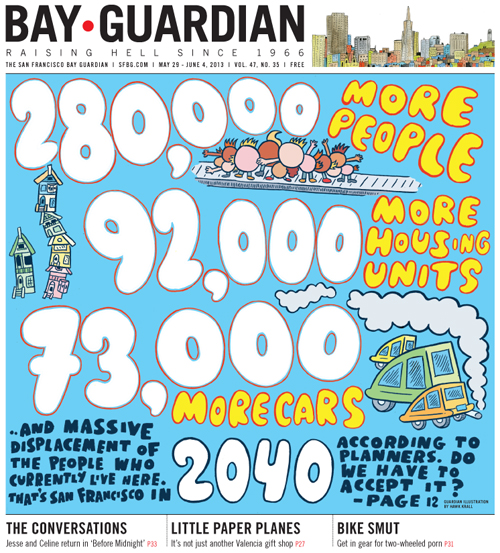
Under the ABAG plan, San Francisco would approve 92,400 more housing units for 280,000 more people. The city would host 190,000 more jobs, many of them in what’s called the “knowledge economy,” which mostly means high tech. Second and third on the list: Health and education, and tourism.

The city currently allows around eight cars for every 10 housing units; as few as five in a few neighborhoods, at least 10 in many others. And there’s nothing in any city or regional plan right now that seeks to change that level of car dependency. In fact, the regional planners think that single-occupancy car travel will be the mode of choice for 48 percent of all trips by 2040 — almost the same as it is today.

And since most of the new housing will be aimed at wealthier people, who are more likely to own cars and avoid catching buses, San Francisco could be looking for ways to fit 73,000 more cars onto streets that are already, in many cases, maxed out. There will be, quite literally, no place to park. And congestion in the region, the planners agree, will get a whole lot worse.

That seems to undermine the main intent of the plan: Transit-oriented development only works if you discourage cars. In a sense, the car-use projections are an admission of failure, undermining the intent of the entire project.

The vast majority of the housing that will be built will be too expensive for much of the existing (and even future) workforce and will do little to relieve the pressure on lower income people. But there is nothing whatsoever in the plan to ensure that there’s money available to build housing that meets the needs of most San Franciscans.

Instead, the planners acknowledge that 36 percent of existing low-income people will be at risk for displacement. That would be a profound change in the demographics of San Francisco.

Of course, adding all those people and jobs will put immense pressure on city services, from Muni to police, fire, and schools — not to mention the sewer system, which already floods and dumps untreated waste into the Bay when there’s heavy rain. Everyone involved acknowledged those costs, which could run into the billions of dollars. There is nothing anywhere in any of the planning documents addressing the question of who will pay for it.

THE NUMBERS GAME

Projecting the future of a region isn’t easy. Job and population growth isn’t a straight line, at best — and when you’re looking at a 25-year window in a boom-and-bust area with everything from earthquakes to sea-level rise factoring in, it’s easy to say that anyone who claims to know what’s going to happen in 2040 is guessing.

But as economist Stephen Levy, who did the regional projections for ABAG, pointed out to us, “You have to be able to plan.” And you can’t plan if you don’t at least think about what you’re planning for.

Levy runs the Center for the Continuing Study of the California Economy, and he’s been watching trends in this state for years. He agrees that some of his science is, by nature, dismal: “Nobody projects deep recessions,” much less natural disasters. But overall, he told me, it’s possible to get a grip on what planners need to prepare for as they write the next chapter of the Bay Area’s future.

And what they have to plan for is a lot more people.

Levy said he started with the federal government’s projections for population growth in the United States, which include births and deaths, immigration, and out-migration, using historic trends to allocate some of that growth to the Bay Area. There’s what appears at first to be circular logic involved: The feds (and most economists) project that job growth nationally will be driven by population — that is, the more people live in the US, the more jobs there will be.

Population growth in a specific region, on the other hand, is driven by jobs — that is, the more jobs you have in the Bay Area, the more people will move here.

“Jobs in the US depend on how many people are in the labor force,” he said. “Jobs in the Bay Area depend on our share of US jobs and population depends on relative job growth.”

Make sense? No matter — over the years it’s generally worked. And once you project the number of people and jobs expected in the Bay Area, you can start looking at how much housing it’s going to take to keep them all under a roof.

Levy projects that the Bay Area’s share of jobs will be higher than most of the rest of the country. “This is the home of the knowledge industry,” he told me. So he’s concluded that population in the Bay Area will grow from 7.1 million to 9.2 million — an additional 2.14 million people. They’ll be chasing some 1.1 million new jobs, and will need 660,000 new housing units.

Levy stopped there, and left it to the planners at ABAG to allocate that growth to individual cities — and that’s where smart growth comes in.

For decades in the Bay Area, particularly in San Francisco, activists have waged wars against developers, trying to slow down the growth of office buildings, and later, luxury housing units. At the same time, environmentalists argued that spreading the growth around creates serious problems, including sprawl and the destruction of farmland and open space.

Smart growth is supposed to be an alternative: the idea is to direct new growth to already-established urban areas, not by bulldozing over communities (as redevelopment agencies once did) but by the use of “infill” — directing development to areas where there’s usable space, or by building up and not out.

ABAG “focused housing and jobs growth around transit areas, particularly within locally identified Priority Development Areas,” the draft environmental impact report on the plan notes.

The draft EIR is more than 1,300 pages long, and it looks at the ABAG plan and several alternatives. One alternative, proposed by business groups, would lead to more development and higher population gains. Another, proposed by community activist groups including Public Advocates, Urban Habitat, and TransForm, is aimed at reducing displacement and creating affordable housing; that one, it turns out, is the “environmentally preferred alternative.” (See sidebar).

But no matter which alternative you look at, two things leap out: There is nothing effective that ABAG has put forward to prevent large-scale displacement of vulnerable communities. And despite directing growth to transit corridors, the DEIR still envisions a disaster of traffic congestion, parking problems, and car-driven environmental wreckage.

THE DISPLACEMENT PROBLEM

ABAG has gone to some lengths to identify what it calls “communities of concern.” Those are areas, like Bayview Hunters Point, Chinatown, and the Mission, where existing low-income residents and small businesses face potential displacement. In San Francisco, those communities are, to a great extent, the same geographic areas that have been identified as PDAs.

And, the DEIR, notes, some degree of displacement is a significant impact that cannot be mitigated. In other words, the gentrification of San Francisco is just part of the plan.

In fact, the study notes, 36 percent of the communities of concern in high-growth areas will face displacement pressure because of the cost of housing. And that’s region wide; the number in San Francisco will almost certainly be much, much higher.

Miriam Chion, ABAG’s planning and research director, told me that displacement “is the core issue in this whole process.” The agency, she said, is working with other stakeholders to try to address the concern that new development will drive out longtime residents. But she also agreed that there are limited tools available to local government.

The DEIR notes that ABAG and the MTC will seek to “bolster the plan’s investment in the Transit Oriented Affordable Housing Fund and will seek to do a study of displacement. It also states: “In addition, this displacement risk could be mitigated in cities such as San Francisco with rent control and other tenant protections in place.”

There isn’t a tenant activist in this town who can read that sentence with a straight face.

The problem, as affordable housing advocate Peter Cohen puts it, is that “the state has mandated all this growth, but has taken away the tools we could use to mitigate it.”

That’s exactly what’s happened in the past few decades. The state Legislature has outlawed the only effective anti-displacement laws local governments can enact — rent controls on vacant apartments, commercial rent control, and eviction protections that prevent landlords from taking rental units off the market to sell as condos. Oh, and the governor has also shut down redevelopment agencies, which were the only reliable source of affordable housing money in many cities.

Chion told me that the ABAG planners were discussing a list of anti-displacement options, and that changes in state legislation could be on that list. Given the power of the real-estate lobby in the state Capitol, ABAG will have to do more than suggest; there’s no way this plan can work without changing state law.

Otherwise, eastern San Francisco is going to be devastated — particularly since the vast majority of all housing that gets built in the city, and that’s likely to get built in the city, is too expensive for almost anyone in the communities of concern.

“This plan doesn’t require affordable housing,” Cindy Wu, vice-chair of the San Francisco Planning Commission, told me. “It’s left to the private market, which doesn’t build affordable housing or middle-class housing.”

In fact, while there’s plenty of discussion in the plan about where money can come from for transit projects, there’s virtually no discussion of the billions and billions that will be needed to produce the level of affordable housing that everyone agrees will be needed.

Does anyone seriously think that developers can cram 90,000 new units — at least 85 percent of them, under current rules, high-cost apartments and condos that are well beyond the range of most current San Franciscans — into eastern neighborhoods without a real-estate boom that will displace thousands of existing residents?

Let’s remember: Building more housing, even a lot more housing, won’t necessarily bring down prices. The report makes clear that the job growth, and population boom that accompanies it, will fuel plenty of demand for all those new units.

Steve Woo, senior planner with the Chinatown Community Development Center, sees the problem. In a letter to ABAG, he notes: “Plan Bay Area and its DEIR has analyzed the displacement of low-income people and explicitly acknowledges that it will occur. This is unacceptable for San Francisco and for Chinatown, where the pressures of displacement have been a constant over the past 20 years.”

Adds the Council of Community Housing Organizations: “It would be irresponsible for the regional agencies to advance a plan that purports to ‘improve’ the region’s communities as population grows while the plan simultaneously presents great risk and uncertainty for many vulnerable communities.”

Jobs are at stake, too — not tech jobs or office jobs, which ABAG projects will expand, but the kind of industrial jobs that currently exist in the priority development areas.

Calvin Welch, who has been watching urban planning and displacement issues in San Francisco for more than 40 years, puts it bluntly: “It is axiomatic that market-rate housing drives out blue-collar jobs,” he said.

Of course, there’s another potential problem: Nobody really knows where jobs will come from in the next 25 years, whether tech will continue to be the driver or whether the city’s headed for a second dot-com bust. San Francisco doesn’t have a good record of building for projected jobs: In the mid-1980s, for example, the entire South of Market area (then home to printing, light manufacturing, and other blue-collar jobs) was rezoned for open-floor office space because city officials projected a huge need for “back-office” functions like customer service.

“Where are all those jobs today?” Welch asked. “They’re in India.”

TOO MANY CARS

For a plan that’s designed to reduce greenhouse gas emissions by moving residential development closer to work areas, Plan Bay Area is awfully pessimistic about transportation.

According to the projections, there will be more cars on the roads in 2040, with more — and much worse — traffic. The DEIR predicts that a full 48 percent of all trips in 2040 will be made by single-occupant vehicles — just slightly down from current rates. The percentage of trips on transit will only be a little bit higher — and there’s no significant increase in projected bicycle trips.

That alone is pretty crazy, since the number of people commuting to work by bike in San Francisco has risen dramatically in the past 10 years, and the city’s official goal is that 20 percent of all vehicle trips will be by bike in the next decade.

Part of the problem is structural. Not everyone in San Francisco 2040 is going to be a high-paid tech worker. In fact, the most stable areas of employment are health services and government — and hospital workers and Muni drivers can’t possibly afford the housing that’s being built. So those people will — the DEIR acknowledges — be displaced from San Francisco and forced to live elsewhere in the region (if that’s even possible). Which means, of course, they’ll be commuting further to work. Meanwhile, if current trends continue, many of the people moving into the city will work in Silicon Valley.

Chion and Levy both told me that the transit mode projections were based on historical trends for car use, and that it’s really hard to get people to give up their cars. Even higher gas prices and abominable traffic delays won’t drive people off the roads, they said.

If that’s the case — if auto culture, which is a top source of global climate change, doesn’t shift at all — it would seem that all this planning is pointless: the seas will rise dramatically, and San Franciscans ought to be buying boats.

“The projections don’t take into account social change,” Jason Henderson, a geography professor at San Francisco State University and a local transportation expert, told me. “And social change does happen.”

Brad Paul, a longtime housing activist who now works for ABAG, said these projections are just a start, and that the plan will be updated every four years. “I think we’re finding that the number of people who want to drive cars will go down,” he said.

Henderson argues that the land-use policy is flawed. He suggests that it would make more sense to increase density in the Bay Area suburbs along the BART lines. “Elegant development in those areas would work better,” he said. You don’t need expensive high-rises: “Four and five stories is the sweet spot,” he explained.

Most of the transportation projects in the plan are already in the pipeline; there’s no suggestion of any major new public transit programs. There is, however, a suggestion that San Francisco adopt a congestion management fee for downtown driving — something that city officials say is the only way to avoid utter gridlock in the future.

SIDELINING CEQA

ABAG and the MTC have a fair amount of leverage to implement their plans. MTC controls hundreds of millions of dollars in transit money; ABAG will be handing out millions in grants to communities that adopt its plan. And under state law, cities that allow development in PDAs near transit corridors can gain an exemption from the California Environmental Quality Act.

CEQA is a powerful tool to slow or halt development, and developers (and some public officials) drool at the prospect of getting a fast-track pass to avoid some of the more cumbersome parts of the environmental review process.

Under SB 375 and Plan Bay Area, CEQA exemptions are available to projects that meet the Sustainable Community Strategy standards and are close to transit corridors. And when you look at the map of those areas, it’s pretty striking: All of San Francisco, pretty much every square inch, qualifies.

That means that almost any project almost anywhere in town can make a case that it doesn’t need to accept full CEQA review.

The most profound missing element in this entire discussion is the cost of all this growth.

You can’t cram 210,000 more residents into San Francisco without new schools, parks, and child-care centers. You can’t protect those residents without more police officers and firefighters. You can’t take care of their water and sewer needs without substantial infrastructure upgrades. And even if there’s state and federal money available for new buses and trains, you can’t operate those systems without paying drivers, mechanics, and support workers.

There’s no question that the new development will bring in more tax money. But the type of infrastructure improvements that will be needed to add 25 percent more residents to the city are really expensive — and every study that’s ever been done in San Francisco shows that the tax benefits of new development don’t cover the costs of public services it requires.

When World War II and the post-war boom in the Bay Area brought huge growth to the region, property taxes and federal and state money were adequate to build things like BART, the freeways, and hundreds of new schools, and to staff the public services that the emerging communities needed. But that all changed in 1978, with the passage of Prop. 13, and two years later, with the election of Ronald Reagan as president.

Now, federal money for cities is down to a trickle. Local government has an almost impossible time raising taxes. And instead of hiking fees for new residential and commercial projects, many communities (including San Francisco) are offering tax breaks to encourage job growth.

Put all that in the mix and you have a recipe for overcrowded buses, inadequate schools, overstressed open space (imagine 10,000 new Mission residents heading for Dolores Park on a nice day), and a very unattractive urban experience.

That flies directly in the face of what Plan Bay Area is supposed to be about. If the goal is to cut down on commutes by bringing new residents into developed urban areas, those cities have to be decent places to live. What would it cost to accommodate this level of new development? Five billion dollars? Ten billion? Nobody knows — because nobody has run those numbers. But they’re going to be big.

Because just as tax dollars have been vanishing, the costs of infrastructure keep going up. It costs a billion dollars a mile to build BART track. It’s costing more than a billion to build a short subway to Chinatown. Just upgrading the sewer system to handle current demands is a $4 billion project.

And if the developers and property owners who stand to make vast sums of money off all of this growth aren’t going to pay, who’s left?

The ABAG planners point out, correctly, that there’s a price for doing nothing. If there’s no regional plan, no proposal for smart growth, the population will still increase, and displacement will still happen — but the greenhouse gas emissions will be even worse, the development more haphazard.

But if the region is going to spend all this money and all this time on a plan to make the Bay Area more sustainable, more livable, and more affordable in 25 years, we might as well push all the limits and get it right.

Instead of looking at displacement as inevitable, and traffic as a price of growth, the planners could tell the state Legislature and the governor that it’s not possible to comply with SB375 — not until somebody identifies the big sums of money, multiples of billions of dollars, needed to build affordable housing; not until there are transit options, taxes, and restrictions on driving.

Because continued car use and massive displacement — the package that’s now facing us — just isn’t an acceptable option.


Alerts

0

WEDNESDAY 29

Protest: Call on Walmart and Gap to protect worker safety tinyurl.com/nfvnslj. Four Seasons, 757 Market, SF. Continue to Gap flagship store, 980 Market, SF. 5pm, free. Activists with Our Walmart and San Francisco Jobs With Justice recently discovered that Walmart made clothing at Rana Plaza, the Bangladesh factory building that collapsed recently, killing more than a 1,100 workers. Activists plan to rally outside the Four Seasons penthouse of Yahoo CEO Marissa Mayer, who also sits on the board of Walmart. Activists will show up to ask Mayer, then Gap, to sign onto a building safety agreement that would prevent future tragedies of this scale. Actions followed by a 6pm gathering at Bayanihan Community Center, 1010 Mission, SF. Dialogue on LGBT-inclusive comprehensive immigration reform SF Public Library, 100 Larkin, SF. www.sf-hrc.org. 5:30-7:30pm, free. The SF Human Rights Commission will host this community conversation on LGBT-inclusive comprehensive Immigration Reform, cosponsored by the Human Rights Commission LGBT Advisory Committee, Our Family Coalition, and Out4Immigration.

THURSDAY 30

San Francisco Green Film Festival Various SF and East Bay locations, Thu/30 thru Wed/5. www.sfgreenfilmfest.org. General admission $12/$11; Festival passes $100–$200. View 50 new films from around the globe, with over 70 visiting filmmakers and guest speakers, on topics ranging from clean energy, to water, to trash, to art in the environment. Events take place at the New People Cinema in Japantown, the SF Public Library, SPUR Urban Center and the David Brower Center in Berkeley.

SATURDAY 1

Moana Nui 2013 two-day teach-in Martin Luther King Jr. Middle School Auditorium, 1781 Rose, Berk. tinyurl.com/nlw34wd. 10am on Sat/1 to 6pm on Sun/2, $10–$20. The International Forum on Globalization and Pua Mohala I Ka Po present this two-day, international gathering featuring 45 speakers from 20 nations. All will present on critical issues facing the Asia-Pacific region, ranging from environment, to militarism, to global trade and resource depletion. Participants include Jerry Mander (dubbed as the "Ralph Nader of the anti-globalization movement" by the New York Times); indigenous actress Q’orianka Kilcher; Anuradha Mittal of the Oakland Institute, and Victoria Tauli-Corpuz, one of the original drafters of the UN Declaration on the Rights of Indigenous People, among others.

SUNDAY 2


Conference on public banking Dominican University, San Rafael. www.publicbanking.org. 1pm on Sun/2 to 6:30pm on Tue/4, $35 to $295. Join the Public Banking Institute in conversation with pioneering policymakers, civic leaders, banking entrepreneurs, innovators and ordinary citizens interested in learning about one of the most critical undertakings of our time: creating a truly prosperous, democratic and sustainable new economy. Attend the conference or just catch the Sun/2, 7pm forum, titled Take Our Economy Back from Wall Street, with Rolling Stone staff writer Matt Taibbi, Web of Debt author Ellen Brown, and guests Birgitta Jonsdottir, a member of Icelandic Parliament, and Gar Alperovitz, author of What Then Must We Do?

Sarah Palin = REO Speedwagon

38

One of the more remarkable components of the so-called “Right Wing Entertainment Complex” (Fox/AM Radio/a gazillion reactionary websites) is the agonizing and complete predictability of its content. Barack Obama is the most evil, traitorious, illegal usurper, Muslim, Kenyan Socialist dictator alive and the besieged heroes of American patriotism are outnumbered and will be outgunned when Obama seizes their weapons, Obamacare will kill every member of your family assuming they haven’t committed suicide after it bankrupted them, Benghazi was worse than 9/11, Iraq and the 1962 Mets combined and the IRS only hates the brave and fierce Republican Party. Who are the only ones that can keep you safe against the fifth column of baby-killing Hollywood liberals that will brainwash your son into marrying a barnyard animal.

(Also remarkable is however much you try to lampoon their cray-cray, they’re inevitably more out there than even a parodist can dream of).

Flip on any of these mediums and this is what you get and if I know this in advance, so do their fans and they like it that way. Like a soothing wash of a New Age mixtape in the foyer of a yoga studio.Except that the whoosh of the mixtape is familiar in form and not content.

Nope, the real parallel between the RW Entertainment Complex and its musical equivalent would be the aging classic rock dinosaurs of the 70’s and 80’s and the state fair/shitty casino/low rent rally circuit. Glenn Beck, Bill O’Reilly, the battery of Sunday morning news show dildolatry and especially the Mega MILF of Moosery Sarah Palin are completely and totally identical to the slog it out warriors of faceless corporate FM rock–Foreigner, Journey, Styx, Nightranger and REO Speedwagon.

Think about it–what do Kevin Cronin (REO), Mick Jones (Foreigner, not the Clash’s Mick Jones) and whomever is left in the other bands do for a living? They mount the boards and play their hits–period. And vamoose off to the next hellhole whose main fiscal purpose at this point is alimony, child support and back taxes. 12 tunes, maybe, paycheck and screw. They try not to think about their better days, one imagines, and just do their jobs–which consist now of rote recitation. In that, they are exactly like Palin or Glenn Beck–who hit all the talking points, massage the prejudices of their chosen audience and remind them that only they understand their plight (and then batter them with ads for merchandise and books). Like peas in a pod.  

Except that at one time, these bands were cranking out hit songs and even if you don’t like their hits, writing a hit is hard to do. Regurgitating “the best of Joe McCarthy” only replacing “Communists” with “Muslims” or “libs” is all these verbal midgets need do to cash in. “Hot Blooded” or “Don’t Let Him Go” or “Babe” may sound trite and brittle and overwrought to some, but they had to be concocted, recorded with care and sung in tune. That is a hell of a lot more than these repulsive mountebanks on the right are capable of. 

(And there is, of course, the gent that straddles both worlds with ham-handed, blockheaded glory, the Nuge himself–except he’s third on the bill beneath REO and Styx this summer and is but a mere guest on FOX at best. Sorry, Ted).

Lastly, the rock bands who are on rickety stages this summer outside Lincoln NE or Bakersfield or Dothan Alabama next to livestock and ferris wheels are fucking honest men and women. They travel endless hours for vastly less pay than they used to get. They have seen their expected annuities disappear via digital downloading and YouTube. They look into the smaller crowds and see their reflections in the once fist pumping but now worn looking fans. And they still have enough pride to deliver the goods, because that’s what they do–not chauffered from their expensive mansions to TV and radio studios to spew out the party line that has been focus group and poll tested to perfection. And then home to mansion. I may not like the dino bands but I respect ’em–I have no respect for these reactionary carny barkers at all.


Former planning director explains 8 Washington lies

19

Nice oped piece in the Examiner by former City Planning Director Allan Jacobs about the lies behind the campaign to save 8 Washington from ignominous ballot-box defeat. Jacobs, who knows what he’s talking about, explains the problem with spot-zoning, which is pretty common now in San Francisco.:

San Francisco’s now-famous urban design plan addressed issues of height and bulk of buildings citywide, very much including the waterfront. Those matters became law. The piecemeal game playing that is central to what we are being asked to approve is a terrible way to make public policy — all the more so because it benefits a few high-end developers.

He also debunks some of the lies in the “Open Up the Waterfront” campaign, which is paid for by Developer Simon Snellgrove and his partners (who stand to make a fortune on this deal). Among the claims that signature-gatherers are making:

The project will create more public parks, a more accessible waterfront, and more jobs or a toxic asphalt parking lot and an obstructing 1,735 foot fence with a “members only” club.

Now: Jacobs argues that the “more public space” will include space that will be public only to the owners of the condos. But I also want to say something about this “members only” club.Yeah: The Golden Gate Swim and Tennis Club is restricted to people who pay dues. The new athletic club that Snellgrove is promising to build will also be “members only.” So, by the way, is the YMCA, just down the street. It’s “public” in the sense that anyone can join, “private” in the sense that only dues-paying members are allowed to use it.Anyone can join the current club on the site, for a price. It’s not cheap, but it’s not over-the-top expensive.

We have no idea what the dues at the new club will be, but we know this: The GGSTC has in its bylaws a requirement that it be open to anyone, not just to people who live at Golden Gateway. There is as of now no such requirement for Snellgrove’s new “private” club, which could be limited to the (very) rich owners of the new condos.It won’t be “public” in the way that city rec centers are public, open on a daily basis to anyone who comes in the door (although sometimes you have to pay a few bucks to swim.” So really, the difference between the existing club and the replacement club isn’t relevant to this discussion.

Every developer-driven campaign comes up with some misinformation and claims that don’t survive serious scrutiny. Glad Allan Jacobs is on the case.

Da Mayor, local hire advocate

Even as Sup. John Avalos continues to be raked over the coals by San Francisco Examiner columnist Melissa Griffin for his so-called “peacocking, disrespectful demeanor” and “flexible hate speech standards,” the progressive District 11 supervisor nevertheless earned something akin to praise May 22 from an unlikely figure: former San Francisco Mayor Willie Brown.

The San Francisco Chronicle columnist, attorney (Brown mentioned in his speech that he paid $50 a semester for law school), sometimes PG&E consultant, self-proclaimed “buddy” of former California Gov. Arnold Schwarzenegger, and all-around power broker delivered his Annual Lecture on Political Trends at the Commonwealth Club yesterday. He plugged his own column, saying, “On Sunday, you can read a column that can’t be disputed. Because it’s my version of the facts.”

Brown is known for his cozy relationship with Mayor Ed Lee and is politically at odds with Avalos, who ran against Lee in 2011. Emphasizing his support for Lee, Brown lauded him for clinching the city’s right to host Super Bowl 2016 events in San Francisco. He pointed out, “That Super Bowl is going to be exactly when he’s possibly seeking reelection.”

Brown also mentioned accompanying the mayor on a recent trip to China, where Lee was reportedly “treated as if he was the president of America instead of just the mayor of San Francisco.”

However, Da Mayor had a bone to pick. He launched into a tale of how he often wanders down to the city’s bustling construction sites, marked by “these 24 or 25 cranes that you see around town” (presumably he finds time for this aimless wandering this between international excursions, dining with the Gettys in North Beach, and palling around with his “buddy” Schwarzenegger?). “Invariably I take a look at the cars, the crews,” he said, and has concluded that “they’re not San Franciscans.” Not only are private development projects being built by out-of-towners, he said, no local hire requirement was imposed upon the city’s Central Subway contractors. 

Giving voice to a cause long championed by Avalos, a progressive who fought doggedly to enact a local hire ordinance, Brown expressed frustration that locals aren’t the ones scoring gigs in the city’s construction bonanza.  

Then he gave Avalos a sort of backhanded compliment, calling him “the strongest advocate for local hire,” but saying “he hasn’t followed up the way he should follow up, to ensure that people who live here get the jobs.”

It seems unfair to lay the blame for this at Avalos’ feet, but Da Mayor seems to be on the money as far as this point is concerned: As long as SF has embarked on a building frenzy, shouldn’t it be residents who reap the benefits of decent paying construction gigs?

Björkphilia

0

MUSIC Can you even recall your first run-in with the mythic, boundary-less creature that is Björk? Perhaps it was bounding through the neon blue forest with tiny crystals underneath her eyes as a giant paper-mache bear chased her through Michel Gondry’s video for “Human Behaviour,” off 1993 solo album Debut. Or maybe it was poised for the tabloids in an elegant swan dress, holding a large egg purse and preening for the worst dressed lists at the ’01 Academy Awards after her devastating performance in Dancer in the Dark (2000). Those long obsessed will likely point to first hearing ’88’s “Birthday” by the Sugarcubes, her early Icelandic act (post teenage punk bands), on international radio.

Whenever — and however — it went down, it left a lasting impression, the stunning shock of that otherworldly voice tends to permeate memories. Solo, Bjork has long coupled that voice with innovation, always grasping at new objects and sounds, or as she described it to me in conversation, she’s “like a kid in a toy shop.”

Her latest triumph was Biophilia, the ’11 album that paired science, nature, iPads, Tesla coils, and tinkling church bells. Since its release, she’s hopped the planet with her sonic education in tow, spreading pixie dust and learning tools at schools and museums along the way. Next up, she’ll play a trio of shows at the Craneway Pavilion in Richmond (Wed/22, Sat/25, and Tue/28). Also during that time, her Biophilia Education Program comes to the Exploratorium, which means interactive workshops exploring connections between music and technology, Wed/22 through Tue/28.

In her unassuming but confident way — with the most endearing accent I’ve ever heard — the avant-pop megastar opened up to the SF Bay Guardian about her song writing process (yes, there’s a new project in the works), early punk career, natural musicology, and how to keep it all DIY:

SF Bay Guardian How did you initially come up with idea to include apps for every song on Biophillia?

Björk It started in 2008. I wanted to use touch screens…though the iPads weren’t out ’till 2010 or something. But I’d been using touch screens on my Volta tour, but more just to perform on stage. When I started doing Biophillia, I was very determined that I wanted to write with [touch screens], not just perform. That’s when I started to map out, to visualize. I had to decide, what did I want to hear on the touch screen when I’m writing this song. That sent me back to my own music education as a child, when I felt the way they explained scales and rhythms and those basic musicology themes, was way too academic. It was like reading a book to learn to dance.

Music is something that doesn’t work that well in the written word, you know? Especially not explaining to kids. So I started making my own map…this is how I would I like to have scales and this is how I would like to have chords and this is how I would like to have arpeggios and this is how I would like to have counterpoint, and so on. This project became naturally educational. I was kind of like, repairing my own education. I was trying to cover what I thought was lacking when I was in music school. In that way, I was able to share it.

We [created] a different program for each song. For example, one song would feature arpeggios, and then I would pick an actual element that would be the simplest way for a kid to understand what an arpeggio is, to visualize it. So we took a pendulum to explain counterpoint, a little bit like how church bells swing back and forth, and that’s like a bass line that swings.

I wrote 10 songs and we did different programs for each song, and it came together using natural elements. For example, one song is called is called “Crystalline” and there are crystals kind of growing as the song changes.

In 2010, when we were programming this and were kind of almost done, the iPad arrived, so we were like, ‘wow!’ It’d be silly just to record these songs and put them on a CD because we’d already written all these programs, we might as well share the programs, and put them with some more poetic, natural things — the moons, the tides, things like this. It was a very gradual thing.

SFBG And now it’s been brought in to educate children at schools throughout Iceland, but also there are related events where you’re touring, as well?

Björk It differs from city to city. So far it’s been in Manchester, Iceland, New York, Buenos Aires, and Paris, and now it’s going to be in California. Some places, like for example, New York Library and the Children’s Museum of Manhattan, took on the curriculum for a few months, and the middle school of Reykjavik, the 10 to 12-year-olds, they have it now in their curriculum for the next three years. It’s looking like it’s going to go to more countries. It sort of keeps growing.

SFBG It seems like you’ve long been ahead of the curve, as far as creating music with new technology, is that something you grew up with as well?

Björk I’m actually really bad with technology. I think that’s why I’m so excited about, for example, the touch screen, because it’s like I waited until technology caught up with me, for it to be simple enough. You have your imagination, and whatever helps you express yourself, I’m all for it, if it’s the violin or piano or singing. Or what has been really helpful for me, since I started doing my own solo albums, the computer has made me a lot more self-sufficient. I guess that comes from being in bands for 10 years, where things are more democratic. It was always drums and bass and keyboards and guitars in every single song [laughs], which is great. But then when I started doing my own album, I was like a kid in a toy shop, I wanted to have every single noise. And this is great, using the computers to do this yourself. It’s quite empowering, especially for a girl. You don’t have to go through this whole hierarchy of whatever, you can just be self-sufficient.

SFBG Some of your early groups were punk bands [Tappi Tíkarrass, and KUKL, which toured with Crass], I was wondering how you discovered punk as a teen, and ended up working with Crass?

Björk I was hanging out with kids that were older than me, like the other guy who used to sing in the Sugarcubes and another guy who was friends with Crass. They played our country, and then we would go and visit them at their farm [Dial House in Essex], and for me what was most important was that one of the bands that was on Crass’ label, a band called Flux of Pink Indians, had a bass player called Derek Birkett and he helped the Sugarcubes release their first album, just from his bedroom. And he’s my manager still today. So I’ve worked with him for like, 30 years now.

It’s pretty much DIY, especially now when the labels are not really functional like they used to be. It’s pretty much just three of us that do most of my stuff.

SFBG Do you have any other long-term goals with Biophillia, or are you working on your next project?

Björk I think I will be doing that on the side, but when it comes to writing my own stuff, I always like the first couple of years to be kind of mysterious. It’s important to play around in the dark, blind-folded, not really knowing what you’re doing. Biophillia was very much like that the first two years, it was very intuitive and impulsive and having no idea what would come out of it. And I’m at that stage with my next album. I really enjoy that. As much as it’s rewarding when [an album] first sees the daylight, I think I even enjoy more the first half of the process, when it’s all still a mystery.

SFBG Were you living in New York during the early playing stage of Biophillia? It seems to have a real connection to natural elements, and science, so I assumed you were in Iceland?

Björk I’ve been living half the year in New York and half in Iceland. I think Biophillia addresses my life in Iceland and the financial crises in a direct way because it’s sort of very DIY. And one of my first dreams was that Biophillia would be a music house and each room would be a song — eventually these rooms became the apps. But it might be that we would be able to go back and make a musical house in Iceland that would serves also as a children’s’ museum and we would use one of the buildings that got kind of half-built in the financial crises and create jobs that way.

But also Biophillia is also about urban areas, because you could stay connected with the moon through your iPad, or to nature and natural structures with your phone.

SFBG My time is almost up but may I ask a few of your favorite things? Like your favorite songs currently, or music that’s helping inspire you creatively now?

Björk At the moment I’ve been listening to the new James Blake album a lot. These things change all the time!

SFBG Favorite mythological story or creature?

Björk I like Icelandic mythology, there’s a lot of amazing tales there.

SFBG And a favorite tour snack?

Björk Um, I like berries.

SFBG Any kind in particular?

Björk Mmmm, no, I like all of them.

BJÖRK

Wed/22, Sat/25, Tue/28, 8:30pm, $75

Craneway Pavilion

1414 Harbour Way, Richmond

www.craneway.com

Urbicide

53

Every point on the map (click here for the detailed, interactive version) is a building where the landlord has used the state’s Ellis Act to evict all the tenants. (The points typically involve multi-unit buildings, so the number of tenants displaced is even worst than it looks). Some tenants have been here for decades, living in rent-controlled apartments, contributing to the community. And when the eviction notice arrives, they have nowhere else to go.

>>TO SEE A PROPERTY-BY-PROPERTY SPREADSHEET TRANSLATING OUR COVER’S EVICTION MAP — THAT INCLUDES LANDLORD NAMES –CLICK HERE

It feels as if all of crazy, radical, artistic, and unconventional San Francisco is under attack, as if a city that once welcomed waves of weirdos and malcontents — who, in turn, gave the city its attractive reputation and flavor — is changing forever. It’s as if there’s no longer any room for the working class — the people who, for example, keep the city’s number one industry (that’s hospitality and tourism, not tech) functioning.

It’s terrifying. Neighborhood after neighborhood is losing affordable rental housing as landlords cash in on soaring prices. And there’s a huge human cost.

In the end, if trends continue, this will soon be a very different city. We all know that change is part of life (and certainly part of hyper-capitalism) but the notion that there’s a value to a city culture that needs low rent housing and cheap commercial space has been all-but abandoned by the administration of Ed Lee, which wants high-paying jobs at all costs.

And it’s hard to imagine how the best of San Francisco — the city whose culture and sense of madness attracted all these creative folks in the first place — will ever survive. Call it Urbicide — because as Rebecca Bowe reports here, it goes way beyond residential evictions.

Thou Shalt Not Speak Ill Of The Lord God Oil

31

Every Monday, Wednesday and Friday morning, I take a brutal boot-camp type class at the Hollywood YMCA here in LA. 45 minutes of sheer hell, but as these things are measured, surely worth it. I’ve been going for the last year and a half at the prodding and urging of my friend Stacy “Beano” Johnson, a lively and lovely woman and an ex-pat Okie from outside Tulsa. Yesterday, I walked in to find her strecthing and she seemed, as you would imagine, distraught. Her state is devastated. Despite downward revisions of casualties, at least 24 people were killed by the storm and the cost to insurers will be over 1 billion dollars. Luckily, none of her family or friends were among the dead or wounded.

Because we are 1) good friends and 2) I am by nature very inquisitve, I asked her if her people back there were putting some of the cause on this particularly violent and early in the year twister on man-made climate change. Beano turned kind of reddish and responded “hell yeah they do. And why wouldn’t they? Summers are getting hot as hell there and it feels like it’s headed to 120 degrees when we go back for vacation. I know damned well it is”.

She isn’t a scientist and is also a self-proclaimed “California liberal” (by way of disclaimer). But this is nothing new to anyone with kin in “flyover country”–my younger brother has been telling me for ten years that the farmers in “Tornado Alley” where he is in Western Illinois talk about the heating and extremes and the effect on crops–and, as Beano has said, why wouldn’t they? 2010 was one of the hottest years on record, another freak tornado devastated Joplin MO in 2011, a drought nearly destroyed the entire Midwest’s crop output last year and now this. Yes–this is where tornadoes happen and they have been happening forever. But scientists warned us that “weather patterns are going to get more extreme and more violent” as the planet heats up and yes it has, and according to 97% of said scientists, the culprit is fossil fuels.

That no peer-reviewed publication has said otherwise and that the only “scientists” that claim that the jury is out tend to be on oil company payrolls isn’t exactly a new revelation. But in Oklahoma, were any politician to claim that the destruction in Moore was because of man-made climate change, they’d be demolished in the next election like so many of the homes were a few days ago.

And why? Because oil is one of the state’s biggest employers, in refining and extraction and logistics. Koch is king in the Sooner State. And even though the average Okie is beginning to see the light, they are willing to look the other way when their livelihood is concerned–their jobs are, in a way, literally to die for.

It is disgusting and sad and vile, but as Louisiana governor Bobby Jindal could tell you, there’s no percentage to ever attack the mighty hand of the petro-oligarchy. Despite the cheapskate idiocy by British Petroleum that nearly ruined that state’s fishing and tourism industries, at no point did Jindal demand that BP pay for all the damage they’d wreaked.

And so the oil companies continue their version of bullshit, as their exec’s declare that to destroy the planet is “God’s will” and their paid shills in broadcasting claim zero culpability, the planet roasts and the people of Moore are wondering where they’re gonna live. And if you think this is just far fetched lefty hand wringing, even the almighty insurance industry knows climate change is real and are changing their rates accordingly. These people play the “life and death odds” for a living in actuarial tables. They know.

Meanwhile, Oklahoma’s two Republican senators are asking for the same federal aid that they denied to Jersey and New York, “God’s will” is again invoked (by America’s #1 publicity hound family) and no one dares speak the truth, that black gold and natural gas are slowly cooking its users and that these same people will battle renewable and clean power with every trick in their arsenal even as it makes their grand-kids lives sheer misery. You might say that the denial is as high as an elephant’s eye in O-kla-Homa……


Do falling jobless numbers mean we’re smart and focused, or rich and exclusive?

73

The unemployment rate continues to drop in San Francisco and all over California, according to new numbers released today by the California Employment Development Department, which were trumpeted by Mayor Ed Lee as vindication for his economic development policies.

“San Francisco’s steady economic recovery is the result of our continued focus on job creation, education and training residents for the demands of the 21st century workforce. San Franciscans are getting back to work across the spectrum of job sectors – from hospitality to construction to technology to service industry jobs and we will continue to help these sectors grow in our City,” Lee said in a press release.

But are Lee’s neoliberal policies of promoting technology and other corporations with tax breaks and city-subsidized training programs and financing mechanisms really creating the rosy economic picture he’s painting? And even if it is helping to promote boom times, at what point have we essentially reached full employment, the point at which we should maybe turn our focus and resources to addressing the rising cost of living here?

After all, San Francisco’s unemployment rate of 5.4 percent is third only to Marin County (4.6 percent) and San Mateo County (5.1 percent). Those three counties also just happen to be the three counties with the highest per capita incomes in the state, a fact that explains our jobless rate more than the mid-Market payroll tax exemption and other taxpayer giveaways.

“Unemployment rates tend to be lowest in areas with high education attainment,” Ruth Kavanagh, EDD’s labor market consultant for this area, told us when we called to discuss the disparties among counties.

What about the rising cost of living in San Francisco? Clearly, this is becoming a much more difficult city for the unemployed and marginally employed to remain living in. How much are gentrification, evictions, and the exodus to the East Bay (Alameda County’s rate is 7 percent, still better than the statewide rate of 8.5 percent) and other locales a factor in our low jobless rate?

Kavanagh said the EDD doesn’t directly track that and so she couldn’t address the question. But she did say that the Bay Area was indeed experiencing the fastest job growth in the state, driven largely by the tech industry. In the last year, this three-county area has added 9,600 jobs in Professional Business Services (which includes tech) and 4,600 each in Leisure & Hospitality and Construction.

Indeed, in his State of the City speech in January, Lee touted the 23 construction cranes on the city skyline as the best gauge of the state of the city. And if counting jobs is one’s only measure of success, San Francisco is doing as well as can be expected. Kavanagh said most economists consider “full employment” within the capitalist system to be somewhere between 4-5 percent.     

Yet Lee says he’s not backing off from his full-throttle focus on economic development. “San Francisco’s unemployment rate today stands at a five-year low and I will continue to pursue policies that get people back to work, support San Francisco families and invest in our City’s future,” he said. “This Summer through San Francisco Summer Jobs +, we are setting an aggressive goal of putting 6,000 youth to work in paid jobs and internships, and I will continue working hard to make sure all San Franciscans have access to good paying jobs.”

Now if only we all had access to reasonably priced housing, health care, food, entertainment, and a transportation system built to handle a growing population.

-sigh-

Now get back to work!

The “Do Nothing” Solution to “Illegal Immigration”

114

Both sides of the political aisle have made a major issue out of the problem of the 11 million people inside the US illegally or presently undocumented. The president has said this is a priority and Florida senator Marco Rubio has agreed. They are theoretically opposed to each other, yet Rubio’s proposals entailed in the Border Security, Economic Opportunity, and Immigration Modernization Act of 2013 don’t differ a great deal from Obama’s. In a nutshell, Rubio has suggested that the wholesale eviction of 11 million people is impossible and that the bill offers them an opportunity for legalization and permanent residence and citizenship. Naturally, the “jump through hoops” process begins here: Fines and background checks and no federal bennies.

Sounds completely reasonable, but you’d think Rubio had suggested that the government was handing out lollipops and bon-bons, making Spanish the new “official language” and changing the “Star Spangled Banner” to “Guantanmera” by the reaction of his “conservative” peers. A cursory Google reveals an enraged base represented by such intellectual heavweights as Townhall.com and Ann “To Hell With Palin, I Was Here First” Coulter. Any concessions to the teeming masses of south of the border is treasonous amnesty and in their hardly humble opinions, this will lead to “de-Europeanization” (ie less white).

As far as what the generally pitiful Democrats are offering, it is only marginally different than Rubio’s idea. Which is also reasonable, but overlooks the crux of the issue, because no one anywhere has to unmitigated gall (until now) to say it: “Illegal Immigration reform” is a solution in search of a problem, because in reality, it isn’t a problem at all!

The way I see it, a problem means an aggrieved party and in this instance, there isn’t one. People want to hire help for whatever the task is, other people agree to do it for a price, end of story. The idea that “illegal immigrants are stealing American workers jobs” sounds fairly solid on its face unless you happen to live in the American Southwest and notice that wherever day laborers congregate, there aren’t a whole hell of a lot of white folks. As far as “taking away jobs that union carpenters/plumbers/electricians do”, isn’t it the union’s job to protect their own for one and for two, a skyscraper isn’t built and wired with dudes from the Lowe’s parking lot. It is not worth a major contractor’s license to screw with E-Verify (I passed an E-Verify check myself a few months ago for my radio show!).

Assuming you “legalized” every man, woman in child in the US tomorrow, what happens? The working person’s price rises. Which means that they will be replaced by new people from Central America or Asia that will remain invisible. See, we are a free country with open borders–people can come and go as they please, this isn’t a gulag (yet) (The irony of the most virulent anti-USSR voices being the loudest for a border fence is astounding). Not only is there no way to stop it, there isn’t even a real reason to stop it–as China and Japan might tell you, an aging and shrinking worker base is starting to hurt them and hard.

Fact is, both major political parties support and oppose it for a pair of reasons of their own. Democrats love this, as it accelerates the “Bluing” of the Southwest with millions of new voters beholding and grateful to them, making a Republican national electoral victory mathematically impossible. The other reason they love it is because it replenishes their most loyal and organized base, labor. Republicans hate it for two reasons as well–newly legal workers will have more rights, bargaining power and higher pay, which means that a new cheap labor era is gonna take a while. The other reason is the one they vehemently deny but is as obvious as the honkers on their maps–their base’s great unifier isn’t economics or even social issues, but race. That the Dixiecrats of the last century are now almost entirely Republican. The glue that holds them intact, whether they’d care to admit it or not, is white supremacy. And a sea of legal Americans that are a deeper shade of soul galls them to the cores of their rancid selves. Were they serious about “sending all of these people back to where they came from”, they’d boycott every and any business that employs them, which means they’d pretty much have to stop eating. I’ve seen what the average reactionary looks like--that ain’t happening.

In fact, when the “illegals” are white, they say nothing.

Obama and Rubio both cry out that the system is “broken” but it isn’t. Undocumenteds pour billions into the coffers of state and federal and don’t get it back and whatever their costs are to health or schools, they’re balanced off by what the public saves in lower food and service costs. They’re a wash. Which means that any changes to the laissez-faire system only make everyone’s life harder and more complex. If there is a solution, the easiest one would be a “seven year rule”–you prove you’ve actually been here 7 years, no criminal record, you take a citizenship test, that’s it. 

We have undocumented people in this very neighborhood. They want the same things we do. That’s good enough for me.


JAW


Why is the SF housing market “positive?”

81

It’s been a long, long time since anyone said that traffic is terrific. When there are too many cars on the road, it’s considered bad, not healthy — even if the boom in single-occupant auto travel is a sign of a recovering economy and lots of job creation.

So why do newspaper reports still talk about a “positive market trend” when home prices reach levels that no middle-class people can ever afford? Why does the Chronicle run a quote like this …

Steve Berkowitz, CEO of online listing company Move Inc., said the region “is seeing a real stabilization and a really positive market trend. There is a very solid market in all the Bay Area counties.”

… without any indication that soaring housing prices are bad for most people who want to live in the area, bad for businesses, particularly small businesses, that have trouble paying employees enough to afford to live near where they work, bad for the environment (when people have to move further and further from their jobs to find affordable housing) and generally bad for the region?

Yes, it’s good to see that people who were underwater on their homes are getting back into the black. But for the most part, what we’re seeing is the affordability of homes soar way beyond the reach of the vast majority of people who work in San Francisco. That’s not “terrific.” That’s terrifying.

More protests over Willits bypass project

Controversy over the Willits Bypass continued Monday, as Willits protesters sought to block Caltrans contractors from continuing work on the highway construction project. Protester Robert Chevalier, 66, locked himself to a Caterpillar tractor used for hauling felled logs using a steel “lock box.” At another location, four other protesters unfurled a banner to block work trucks that were preparing for pile-driving tests. Chevalier was arrested along with protesters Sara Grusky and Ellen Faulkner, who is 75.

Meanwhile, a new tree-sitter took to the branches of a rare wetland ash earlier this month. The protester, who goes by the name Condor, stationed himself at the northern end of the bypass on May 2. Since then, Condor has been replaced by a tree sitter who goes by the name of Hawk. “Part of the message of the medium is that birds move around,” explained Naomi Wagner, a spokesperson for Redwood Nation Earth First.

Condor was the eighth tree-sitter to protest the bypass. The first five were forcibly removed by CHP with cherry pickers on April 2. Two others decamped more recently before being arrested.

In the meantime, construction on the six-mile, four-lane highway continues, albeit with a few setbacks. On April 9, an inspector for the North Coast Water Quality Control Board visited the site and found that Caltrans had violated its permits by disturbing ground within 50 feet of streams and failing to follow statewide practices designed to prevent streamside runoff.

Critics maintain that it’s typical of Caltrans to go ahead with construction, even if that means violating the conditions of their permits. Jamie Chevalier of Earth First said, “Caltrans will just do what they’re gonna do and pay a fine.”

According to Caltrans spokesperson Phil Frisbie, however, the inspection was “normal routine business.”

“[The infraction] was an oversight on Caltrans and the contractor’s parts because the vegetation is so dense you can’t actually see the creek.” said Frisbie. “It won’t happen again.”

Last week, the California Transportation Commission approved an additional $26 million for the creation and rehabilitation of approximately 2,000 acres of wetlands. Many of those mitigation projects are years down the road, said Frisbie, a fact that alarms Chevalier and other opponents of the bypass.

Frisbie also said they were aware of the new tree-sitter, and were monitoring the situation.

When the Guardian reached Condor by phone last week, the tree sitter said he’d experienced minimal contact with Caltrans employees so far. “Yesterday they limbed an oak tree about a 100 feet from me,” he said. “I guess that was their response to my presence.”

Chevalier, the protester who locked himself to the Caterpillar, is a retired commercial fisherman who worked for years in Alaska.  He said he felt compelled to take a stand: “One thing we learned from fishing is that taking care of our rivers and forests creates a booming economy that will last. These big make-work projects leave the locals and the taxpayers worse off than before. It’s just a waste,” he said. “This project is trashing the land, water, and local jobs that we really do need.”

Can the tech boom solve our housing crisis? No, but it can make it worse

64

 San Francisco Housing Action Coalition and San Francisco Magazine posed an intriguing question at a forum they sponsored last night in the W Hotel: “San Francisco’s Housing Crisis: Can the Tech Boom Help Us?” Unfortunately, it wasn’t a question they ever really addressed at an event of, by, and for developers and their most ardent supporters.

Instead, the event was mostly just pro-development boosterism supporting HAC’s goal of building 100,000 new homes in SF over the next 20 years, and the discussion seems to show that the tech boom will exacerbate the housing crisis without ever addressing it, particularly given the local tax breaks and subsidies Mayor Ed Lee keeps giving the industry.

“San Francisco must radically increase its anemic housing production,” HAC Executive Director Tim Colen said during the introduction.

The pro-development cheerleading was slightly offset by the dose of reality offered by panelist Peter Cohen of the San Francisco Council of Community Housing Organizations, who noted that market rate developers aren’t building for today’s San Franciscans, 61 percent of whom make less than 120 percent of the Area Median Income. 

“We don’t believe the market will ever touch the 120 and lower,” Cohen said, later offering, “How do we build for the kind of San Francisco we have now?”

San Francisco Magazine Editor-in-Chief Jon Steinberg, who moderated the panel, said this event grew out of an important and widely acclaimed story that David Talbot wrote for the magazine last fall, “How Much Tech Can One City Take?” that raised critical questions about the wisdom of the big bet that San Francisco has placed on an industry driven by speculative bubbles.

“We got more responses from readers than anything we published in our history,” Steinberg said of the article, before shamefully expressing second thoughts on publishing it. “I felt the writer had been a little hard on our friends in the tech industry.”

He introduced UC Berkeley Economics Professor Enrico Moretti, whose 2012 book “The New Geography of Jobs” argues for reducing regulations that hinder housing production in cities, by saying that if he’d read it before publishing Talbot’s excellent article, “I think it would have had a little different tenor.”

Yet Moretti’s presentation was an overly simplistic Economics 101 argument that housing prices go up when demand is strong and supply is weak. “It doesn’t take a degree in economics to know those workers will bid up the price of housing,” Moretti said after noting San Francisco added 21,500 job but just 2,548 new housing units last year.

That’s the basic line we hear a lot these days, that only a massive housing construction boom will keep housing prices down and prevent mass displacement. “The only answer is to radically increase the supply,” said SPUR Executive Director Gabriel Metcalf, noting that means tossing out many of the city’s historic preservation and height and density restrictions. “All we have to do is get out of the way and allow housing to increase to make it normal again.”

Metcalf confidently predicted that housing prices and rents would drop if the city pursued that kind of unfettered housing boom, offering to buy Cohen a beer if he was wrong. Yet even Moretti’s research shows that Metcalf would probably lose that bet.

Moretti compared San Francisco to Seattle, which is also experiencing a comparable high-tech job boom that exacerbated a housing supply shortage, which Seattle responded to by following the prescription of HAC and building thousands of new condos in the downtown core.

The result was that rents in Seattle have increased 31 percent less than San Francisco’s, which he called significant, despite the fact that rents are still on the rise there even with a massive influx of new people and condos and all the infrastructure challenges that presents (it’s widely accepted that new development in San Francisco doesn’t pay for the full cost of infrastructure needed to serve it, which is a huge issue in the transportation sector alone).

Nobody had a good answer to Cohen’s point that building tons of market rate housing won’t actually do much to prevent the displacement of a majority of current city residents. As he put it, “What’s missing is who is that housing for, who is it actually serving?”

Metcalf welcomes the wholesale transformation of San Francisco – “It will be a change, a total change, and guess what? That could be great.” – but even he argues for the importance of policies that protect those on the bottom half of the economic scale, from rent control to more government-subsidized affordable housing production.

As Metcalf, one of the biggest market rate development cheerleaders in city, said, “If it were not for rent control, I would have been forced out of the city by now.”

Small Business Awards 2013: Babette

0

I cannot help but insert italics into Babette Pinsky quotes, bear with me.

“It didn’t dawn on me that I shouldn’t open a business by myself.”

“It was sort of survival for a really long time.”

“We have to show things the way we want them.”

Perhaps such signs of effusiveness are befitting for one of the Bay’s more experienced purveyors of fashion.

Pinsky started her line of comfortable, elegant items most often worn by town’s over-40 set of museum and travel-inclined doyennes back in 1968. She considers the eponymous line’s signature piece a pleated cream or white button-down shirt.

Her retail locations — there are eight Babette stores across the country with a ninth in the works for the Mid-West, and the company recently launched a thriving e-commerce site — is filled with outfits for “the woman who wants to look good without looking like her daughter,” says Pinsky, sitting for our interview with husband and co-owner of the company Steven in their Union Square shop.

But the Pinskys’ sartorial sense is but one of the reasons we’re honoring them with a Small Business Award. Perhaps just as importantly, the two provide healthcare and 401k’s for all of their 100-plus employees, and have always manufactured their clothes right here in the Bay Area, currently at their Oakland factory.

The two attribute their buoyancy in the fashion industry, in fact, to their local production line. Trade policies like NAFTA, they say, decimated the Bay Area’s fashion industry, once one of San Francisco’s biggest job sources. Their ability to continue producing quality product right here in California, they say, distinguished them from the thousands who lost their jobs over the last few decades.

Now, having survived the worst of times, Babette (the company and its founder) can be a role model company to those who would make beautiful clothes.

“The most rewarding part of this business?” asks Babette (the person this time, over a pair of round glasses that go nicely with those that Steven wears alongside her). “A big part of that is how happy [the clothes] make our customer. I’ll come into one of our stores and a woman will tell me ‘you’ve changed my life!’ I’m a clothing designer! It’s just clothes.”

361 Sutter, SF. (415) 837-1442, www.shopbabette.com

Editor’s notes

2

tredmond@sfbg.com

EDITORS NOTES Jaron Lanier is not a Luddite. He’s one of the most brilliant technologists in the world, the virtual inventor of virtual reality and one of the first people calling for information (and music) to be free. He was a tech giant when most of today’s tech titans were in their disposable diapers. So when he starts talking about how the Internet is destroying the middle class, everybody ought to listen.

And that’s exactly what he saying in his new book, Who Owns the Future?

Lanier is 53; he’s been around long enough to see some of the best promises our modern industrial era turn out to be failures or lies. He’s got a little perspective on things — and he’s not happy with what he’s seeing.

We all know American capitalism is a force for disruption and destruction as well as creativity and creation. We all know that industries are born and die. The automobile replaced the horse and buggy. And in a lot of today’s conventional thinking, the tech revolution is just another step in the same direction.

Lanier has another perspective. The current light-speed, youth-driven tech economy has undermined the social contract that has been part of the United States political and economic systems since the Great Depression: People ought to have the right to job security, a decent wage, and the chance to have a family and grow old.

In an interview with Salon, Lanier notes:

“We don’t realize that our society and our democracy ultimately rest on the stability of middle-class jobs. When I talk to libertarians and socialists, they have this weird belief that everybody’s this abstract robot that won’t ever get sick or have kids or get old. It’s like everybody’s this eternal freelancer who can afford downtime and can self-fund until they find their magic moment or something.

“The way society actually works is there’s some mechanism of basic stability so that the majority of people can outspend the elite so we can have a democracy. That’s the thing we’re destroying, and that’s really the thing I’m hoping to preserve. So we can look at musicians and artists and journalists as the canaries in the coal mine, and is this the precedent that we want to follow for our doctors and lawyers and nurses and everybody else? Because technology will get to everybody eventually.”

Hey Googlers and Twitterati and Facebookians: You should listen, sometimes, to your elders.

Bye bye Briski

3

marke@sfbg.com

SUPER EGO It’s been half a minute since I poked my stilettos through an extra-large Target bag and pulled it up to make an evening gown for hitting the town. I only have one sinus left over from the ’90s, so I have to pace my nightlife, ha AS IF. But lately sometimes it’s all like, “where’d everybody go?” when I go out. SF is definitely undergoing another of its periodic freak drains (although much wild unicorn magik still remains, as the Odyssey party proved last weekend).

In 1999 everyone was moving to NYC, in 2003 it was Portland, in 2007 it was Berlin, and now everyone’s either moving to Oakland or LA or beyond. Soon as I manage to turn around without falling down, someone’s gone: beloved DJ bear Claude VonStroke, party maniac Sleazemore, phantasmagoric art star boychild, radical queer activist Michael Lorin Friedman, future Ms. Drag Mess Universe Ambrosia Salad, almost all my tricks I didn’t want to leave…

Yes, it’s the economy, rising rents, influx of drones, lack of jobs or diversity or artistic opportunity, the outrageous wish to not live in a pantry with five other crazies. Also some people seem to think they want professional careers? What is this, “Star Search”?

Well, here’s another story of a beloved someone moving on — but unlike many others, this one’s a happy one (although it may reflect on just how high you can go in this town when it comes to dance music). “No, I’m not really afraid that once I move out of SF I won’t be able to afford moving back,” As You Like It crew resident and sweetest person ever DJ Briski, a.k.a. Brian Bejarano told me over the phone. “Someone will have a floor for me to crash on, and I’ve got family in Pacifica.” That’s where Briski grew up, but he spent a formative period raving in the UK in 2006, which cemented his transition from a psychedelic rock and punk fan to a deeper house sound. Minimal techno was breaking hard back then, but Briski cut his rave teeth at Back to Basics, the infamously gonzo darker-funk night in Leeds (now the longest running weekly in the world).

His signature groove is deep and somewhat tense, almost playfully post-punk — he’s great at ’80s rarities, too — and very consciously indebted to Bay psychedelic house legends the Wicked crew. In fact, his last gig here will be playing back to back with Wicked’s Jenö at the next As You Like It party, Fri/17 at Mighty.

Briski’s off to become the tour manager for one of tech-house’s biggies, Maceo Plex, who has basically achieved pop star status in Europe, and is now based in Barcelona. Briski met the Cuban-born Maceo in Dallas a few years ago, and grew close. “My girlfriend Mariesa [Stevens, also moving], became Maceo’s agent a few years back and we’ve been like a little rave family ever since. Our musical styles are very different, but I’ll be opening for him in some places, and have access to his studio and record label to continue developing my music.”

The only fear Briski has, really, is the fact that he doesn’t know Spanish (despite his family’s Nicaraguan roots). “I grew up here, and I know San Francisco will always be San Francisco, despite whatever changes come. You can still make the life you want here, and go as far as you can go with it. The dance scene is all about family and support — not just my crew, but everyone involved. It’s the true spirit of the city, and that will never die.”

AS YOU LIKE IT w/ Wagon Repair’s Mathew Johnson and Konrad Black, plus Briski B2B Jenö. Fri/17, 9pm-5am, $10–$20. Mighty, 119 Utah, SF. www.ayli-sf.com


THE CLOCK

Christian Marclay’s incredible round-the-clock collage of realtime film moments is one of the hottest nightlife events going — it plays 24-hours at the SF MOMA on Saturdays. You’ll need to get there two-and-a-half hours early to catch midnight, but the wait dies down for 4am, so maybe go then.

Saturdays through June 1, 10am until 5:45om on Sunday, $18. SF MOMA, 151 Third Street, SF. www.sfmoma.org


KASTLE

The SF-based major player on the moody, post-dubstep R&B-sample scene has knocked up an impressive array of hits and a big following. I was more impressed by his recent classic two-step mix, which showed he really knew his sound’s historical progression. With xxxy, Clicks & Whistles, Matrixxman.

http://www.youtube.com/watch?v=nhOn6XaULlU

Thu/16, $16–$18, doors 8:30pm, show at 9pm. The Independent, 628 Divisadero, SF. www.theindependentsf.com


DIRTYBIRD PLAYERS


Oh look, it’s goofball bass papa Claude VonStroke back in town to play with his wily gang of bass-keteers, including Justin Martin, Leroy Peppers (a.k.a. Christian Martin), and one of my favorites J. Phlip, who just returned from Berlin.

Fri/17, 9pm, $5 before 11pm, $20 after. mezzanine, 444 Jessie, SF. www.mezzaninesf.com


OBJEKT

Sonic sculpting with premium put on a dark bass edge from this Berlin-via-Britain dub minimalist: “expansive banging” is a term that comes up alot, which sounds just fine. With Gerd Jansen and the Icee Hot crew.

Sat/18, 10pm-3am, $10. Public Works, 161 Erie, SF. www.publicsf.com


“YAZ: UPSTAIRS AT ERIC’S”

Very cool. New “San Francisco Album Project” — made up of a gaggle of fabbies like DJ Chicken, Trixxie Carr, Nikki Six Mile, Elijah Minelli, Dia Dear, and Precious Moments is performing this classic album from beginning to end, with added dialogue, gender clown zazz, and visual treats. Dragons, the policeman knew, were supposed to breathe fire.

Sun/19, 7pm, $15 advance. The Chapel, 777 Valencia, SF. www.chapelsf.com


Tech guru says Internet destroying middle class

28

Jaron Lanier isn’t a Luddite. He can’t be dismissed as a crackpot, whiner critic who is jealous of the success of others. He virtually invented virtual reality; he was a tech guru when most of today’s tech titans were still in diapers. So when he says that the Internet is destroying the middle class, maybe everyone ought to stop for a second and listen.

Okay, as I’ve said before: The Internet didn’t destroy San Francisco. Technology is a tool; it can be used in good ways and bad ways, and its impacts on society, particularly on the poor, can be mitigated by government action (or greatly worsened by inaction).

But Lanier is concerned that the business boom that has been created by high tech has made social inequality worse and is wiping out the middle class that is so essential to a stable country. He talks about how Kodak had 140,000 workers, many of them middle class, and Instagram has 13:

You have this intense concentration of the formal benefits, and that winner-take-all feeling is not just for the people who are on the computers but also from the people who are using them. So there’s this tiny token number of people who will get by from using YouTube or Kickstarter, and everybody else lives on hope. There’s not a middle-class hump. It’s an all-or-nothing society.

More important, the youth-driven culture of the current economic boom ignores that fact that some people are old, and have families, and get sick and disabled, and need a kind of stability that our current march of “disruptive” capitalism is destroying:

We don’t realize that our society and our democracy ultimately rest on the stability of middle-class jobs. When I talk to libertarians and socialists, they have this weird belief that everybody’s this abstract robot that won’t ever get sick or have kids or get old. It’s like everybody’s this eternal freelancer who can afford downtime and can self-fund until they find their magic moment or something.

And Lanier IS a guy who can afford downtime and self-fund. But he’s also 53, and has a little more perspective on life. He recognizes that the middle class has always had, and needs, some sort of public-sector support, whether it’s through tax policy or education or job creation, particularly in unstable economic times. It’s fine for capitalism to be disruptive — as long as there’s a safety net to make sure that all the people disrupted out of their livelihoods aren’t disrupted out of their homes.

Young people, Googlers, Facebookians, Twitterati: Maybe you should listen to your elders.

DPH: Unaffordable housing is bad for your health

To cover rent on a two-bedroom apartment at “fair market value” in SoMa, a San Francisco minimum-wage earner would have to work 7.4 full-time jobs.

That jaw-dropper of a statistic is just one tidbit in a fascinating dataset featured in a recently published interactive map plotting housing affordability in San Francisco neighborhoods. Combining data from Craigslist and PadMapper, the U.S. Census Bureau’s American Community Survey, and the local minimum wage ($10.24 per hour, widely regarded as generous), the map isn’t the handiwork of affordable housing activists. [Note: this reflects the 2012 minimum wage, the rate now stands at $10.55.]

Instead, it was created by the San Francisco Department of Public Health’s Program on Health, Equity and Sustainability. To view the full map and dig around for data on your neighborhood of interest, go here.

The embedded dataset reveals that the median income in SoMa is $91,000 lower than the $158,000 one would need to afford renting a market-rate two-bedroom. This figure, expressed as $-91,000, is known as the “affordability gap,” and the map plots these gaps neighborhood by neighborhood.

It was rolled out as part of a weeklong effort to raise public awareness about the link between affordable housing and public health, explains Cyndy Comerford, manager of planning and fiscal policy at the Environmental Health division of DPH. The reason? “Unmet housing needs in San Francisco can result in significant public health concerns,” Comerford says.

A lack of affordable rental housing can push more tenants into substandard or overcrowded living situations, she adds. Housing units within reach for lower income residents might be squeezed up against a highway, for instance, putting tenants in close proximity to noise, traffic, or air pollution, thus increasing their risks for experiencing heart or respiratory problems. Substandard housing also makes lead or mold exposure more likely, possibly triggering serious health issues over time.

For residents who fork over a significant percentage of their income for rent, other problems can arise. “It leaves little money for other provisions,” such as healthy food or preventative health care, Comerford adds, so low-income tenants have a higher likelihood of malnourishment or preventable disease related to nutrition.

The map is part of a broader DPH initiative known as the Sustainable Communities Index, which provides datasets for more than 100 health indicators. There’s a whole section on housing, which even covers the negative health effects of eviction: “Involuntary displacement contributes to stress, loss of supportive social networks and increased risk for substandard housing conditions and overcrowding,” DPH points out.

More information is yet to come: “Every day this week, we’ll put out a new bit of information around health and housing,” Comerford says.

Taking a broader view, it appears that sweeping cuts to public programs will present a whole new set of challenges for lower-income populations who have a higher risk of housing-related health problems. As a New York Times opinion piece highlighting the public health ramifications of austerity measures notes, “there are warning signs … that health trends are worsening. Prescriptions for antidepressants have soared. Three-quarters of a million people (particularly out-of-work young men) have turned to binge drinking. Over five million Americans lost access to health care in the recession because they lost their jobs.”

Amid all this, as a consequence of the $85 billion “sequester” that began on March 1, “Public housing budgets will be cut by nearly $2 billion this year,” the New York Times piece continues, “even while 1.4 million homes are in foreclosure.”

The Chron discovers the lack of waterfront planning

12

So the Chronicle’s John King (who’s generally not a bad architecture critic and really seems to understand city planning) finally discovered something that some of us have been talking about for months: There’s no comprehensive planning on the waterfront. Instead, it’s all developer-driven projects that make little sense as part of a well-thought-out future for the area.

Once again, we are hampered by the Chron’s paywall, so unless you subscribe you can’t read the whole story. But here’s the gist of it:

Instead of mapping out how the next frontiers of growth should be filled in, Mayor Ed Lee’s administration is letting developers frame the debate. They select a site, cook up a proposal and then see what will fly.

He notes that there are good touches in the new Warriors proposal, although:

[N]obody envisioned an 18,000-seat arena on a pier until the Warriors called City Hall. The team loved the glamour of the camera-friendly location. The Lee administration saw a chance to fill a void left open when the America’s Cup organizers shifted gears. …. the whole effort is aimed at soothing objections to what the team owners want. It isn’t connected to a pre-existing vision of what this part of the city could be.

There have been successful community-based planning efforts in other parts of town. But the waterfront — which is unique and immensely valuable — is nothing but a collection of projects that developers want. And Lee is going along:

Today, instead, we have a mayor’s office that wants to make things happen. Progress is measured in terms of construction jobs, housing units and new buildings that might lure the likes of Google up north. Planners on the city and state payrolls are put in the reaction mode, massaging the details the best they can.If this continues, some of what gets built could be terrific.Some of it could also be an alien presence in the city around it. And that’s not a legacy that any mayor should want.

It’s all too reminiscent of Dot-Com Boom I, when Willie Brown was in charge and city planning was driven entirely by campaign money. Highrise office buidlings in the residential Mission? No problem — just wave the dollars in front of the mayor. Not saying Lee is that corrupt — but he’s so excited about building stuff that he can’t bother to take a step back and ask: Is this the city we really want?


Jamaican Queens on major influences, ‘Wormfood,’ and Detroit

0

The Detroit-based trio, Jamaican Queens, makes instantly catchy, hip-hop-influenced, electronic-soaked pop gems and performs them in a dance-inducing glam pop fashion. Although Ryan Spencer, Adam Pressley, and Ryan Clancy have been laying down beats together for less than a year, they have already released a full-length album – Wormfood – hit their hundredth show, and written album number two (which they’ll record once they’ve concluded their lengthy West Coast and summer tours).

I spoke with Jamaican Queens before they opened for Javelin at the New Parish in Oakland last week. After the boys grabbed a few local brews (Anchor Steam, of course), we went up to the roof and talked about their eclectic sound, living in Detroit, and the projects in the works. If you missed the Oakland show, catch them this Sunday at Brick and Mortar as Jamaican Queens could quickly become your favorite new band. (That’s been the case for yours truly.)

SF Bay Guardian How would you describe your sound?

Adam Pressley It’s hip-hop influenced and really abrasive.

Ryan Spencer It’s also experimental, but at the same time in the veil of pop. And lyrically, it’s very glam. We want to make music that makes people feel some sort of emotion – whether it be good or bad.

SFBG Who are some of your chief influences?

RS Most of the vocals I’m influenced by are dramatic – like the way David Bowie sings or the way the London Suede sings or T. Rex.

AP When we were making Wormfood, I started listening to the Magnetic Fields, and I was heavily influenced by what they were doing production-wise.

RS Yeah, they make very exaggerated pop music and can wrap up a huge amount of emotion in a two and a half minute song.

SFBG What type of music do you tend to listen to on your own?

AP I listen to only pop.

RS I listen to some more avant-garde stuff. I like Cambodian music and Jamaican Dancehall. That’s kind of where “Jamaican Queens” came from: Dancehall music. I love that stuff. But I like music that’s all across the board. Reggaeton. Insane punk rock. Everything. As long as it can make you feel something.

SFBG Do you guys have a favorite song to perform?

Ryan Clancy The dexterity and movement our songs require make them all really fun to play.

AP Our songs could be performed by six people, but we’ve got it so that we can all perform two instruments at once, so I’m playing a bass and a drum pad, Ryan Clancy is playing electronic drums and real drums, and Ryan Spencer is playing guitar and sampler. That’s “Water” right there.

SFBG Who’s behind your “Caitlin” video? The cinematography is unbelievable.

RC The cinematographer is our good friend Dan DeMaggio.

RS Our friend Caitlin, who the song is about, is the main character in the video. It’s a really dark story. She was living with Adam at the time, and her great aunt got murdered. A team of con artists started working for her great aunt and then ended up breaking into her house and murdering her. This is the song we wrote for her when she was going through that. It was a really intense time.

SFBG So, what’s it like living in Detroit?

RS I imagine it’s a little bit like Oakland. It’s a really supportive community, and the art and music scenes are very small so everyone knows each other and all of the bands that seem to be cool work together and help each other. Most of our friends don’t really have jobs, so you’ve got a lot of creative people working really hard on their art.

RC Yeah, I think one of the reasons we have such cool videos is because the art and the music scene are very incestuous. Everyone who’s a good photographer is also probably in a band or something.

SFBG What are you guys up to this summer and fall?

RS We’re doing a lot of festivals throughout the summer as well as working on going to Europe for the first time. We’re also making remixes, releasing some vinyl stuff in the UK, and recording a new album, which will be a long time coming because Wormfood just came out last month.

SFBG What do you think of the Bay Area so far?

RS The weather’s amazing, the people are cool, and it’s really liberal. It’s great.

Jamaican Queens
With Maus Haus, Black Jeans
Sun/12, 9pm, $7
Brick and Mortar
1710 Mission, SF
(415) 371-1631
www.brickandmortarmusic.com