Jobs

More ill winds

8

EDITORIAL After years of hype, the 34th America’s Cup finally got underway on the San Francisco Bay this past week — with a single boat formally winning in a match against itself, a fitting metaphor for this whole disappointing affair.

Emirates Team New Zealand sailed solo while its Italian would-be competitor, Luna Rossa, stayed ashore to protest a rule change on rudder design that had been unilaterally decided by regatta director Iain Murray. The third competitor with Larry Ellison’s Oracle Racing team that is defending the cup and hosting the event, Swedish team Artemis, was still trying to rebuild its vessel after a tragic accident resulted in the death of a renowned sailor in May.

It was a lame kickoff. The anticipated hordes of race-goers have yet to materialize, with the once-regal America’s Cup reduced to just another Fisherman’s Wharf tourist trap. In a display that might as well have been used to entice tourists to the Wax Museum, a barker outside the event’s sprawling Pier 27 spectator area fruitlessly tried to lure passersby: “See the fastest boats in the world!”

In an interview with ABC7 news, Oracle Racing CEO Russell Coutts declared the Italians to be “acting like a bunch of spoiled babies,” adding that if they didn’t want to race, they should just leave. You could practically hear the event’s corporate sponsors burying their faces in the palms of their hands.

It wasn’t supposed to be this way. In 2010, when software tycoon Larry Ellison of the Oracle Racing Team hinted to city officials that he might want to stage the next Cup on the Bay, if not Italy or some other exotic destination, economists with the Bay Area Council trumpeted the economic gain that stood to be reaped if Ellison’s plan was realized.

Since a dozen teams competed during the last America’s Cup, the authors of the study reasoned, at least as many could be expected to join this time around. Those initial projections — $1.4 billion in economic activity (like three Super Bowls!, the analysts enthused), thousands of new jobs, a tourism windfall — sounded so rosy in part because 15 syndicates were expected to compete.

But in time, this optimism faded and the city is arguably on the hook for millions in race-related costs. Fortunately, then-District 6 Sup. Chris Daly scuttled an initial plan to cede vast swaths of city-owned waterfront property to Ellison in exchange for the expected economic gain, thus averting an even greater loss.

Meanwhile, Oracle is weathering accusations that it cheated by slipping a design change into a list of safety recommendations, conveniently granting itself a competitive edge. An international jury’s decision on whether to honor the rule change was still up in the air at press time. While we at the Guardian find ourselves rooting for the Kiwis, we remind Ellison that it isn’t too late to right this ship — and cutting a check to the city to cover its losses would be a great place to start.

Who killed City College?

news@sfbg.com

The day City College of San Francisco heard it would close was the same day, July 3, that 19-year-old Dennis Garcia signed up for his fall classes.

With a manila folder tucked under his arm, he turned the corner away from the registration counter and strode by a wall festooned with black and white sketches of every City College chancellor since 1935, including a portrait of bespectacled founder Archibald Cloud. In a meeting room on the other side of that wall, the college’s current administrators were receiving the verdict from the Accrediting Commission for Community and Junior Colleges.

It was their worst fears of the past year realized: City College’s accreditation was being revoked. Accreditation is necessary for the college to receive state funding, for students to get federal loans, and for the degree to be worth more than the paper it’s printed on.

Unbeknownst to Garcia, he walked out of the building just as the college received its death sentence, which is scheduled to be carried out next July unless appeals now underway offer a reprieve. In the interim, CCSF will essentially be a ward of the state, stripped of the local control it has enjoyed since Cloud’s days.

Just a few blocks down Ocean Avenue is the nerve center of City College’s teachers union. Housed in a flat above a Laundromat, the scent of freshly washed clothes wafted up the staircase to an office that instantly became a flurry of ringing phones and rushed voices.

Only an hour later, 10 or so union volunteers were calling their members, contacting nearly 1,600 City College faculty whose responses ranged from sad to furious. The volunteers read them bulleted factoids about accreditation and a call to join an upcoming protest march.

But the woes of City College reach deeper than a three line script could ever cover, and can be traced back to the oval office itself, leading to a really odd question: Did President Obama kill City College?


PRESSURE FROM THE TOP

When the president trumpeted education in his 2012 State of the Union speech, he sounded an understandable sentiment. “States also need to do their part, by making higher education a higher priority in their budgets,” Obama told the nation. “And colleges and universities have to do their part by working to keep costs down.”

But the specifics of how to cut costs were outlined by years of policymaking and a State of the Union supplement sheet given to the press.

The president’s statement said that they will determine which colleges receive aid, “either by incorporating measures of value and affordability into the existing accreditation system; or by establishing a new, alternative system of accreditation that would provide pathways for higher education models and colleges to receive federal student aid based on performance and results.”

The emphasis is ours, but the translation is very simple: College accreditation agencies can either enforce the administration’s numbers-based plan or be replaced. The president’s college reform is widely known and hotly debated in education circles. Commonly known as the “completion agenda,” with an emphasis on measurable outcomes in job placement, it had its start under President George W. Bush, but Obama carried the torch.

The idea is that colleges divest from community-based programs not directly related to job creation or university degrees, and use a data measurement approach to ensure two-year schools transfer and graduate students in greater numbers. “Community colleges” would quickly become “junior colleges,” accelerating a slow transition that began many years ago.

But its critics say completion numbers are screwy: They discount students who are at affordable community colleges just to learn a single skill and students who switch schools, administrator Sanford Shugart of Valencia College in Florida wrote in an essay titled “Moving the Needle on College Completion Thoughtfully.”

Funding decisions made from completion numbers affect millions of students nationwide — and CCSF has now become the biggest laboratory rat in this experiment in finding new ways to feed the modern economy.

“I think there was a general consensus that the country is in a position that, coming out of the recession, we have diminished resources,” Paul Feist, spokesperson for the California Community College Chancellor’s Office, told us. “Completion is important to the nation — if you talk to economic forecasters, there’s a huge demand for educated workers. Completion is not a bad thing.”

Like dominoes, the federal agenda and Obama’s controversial Secretary of Education Arne Duncan tipped the Department of Education, followed by the ACCJC, and now City College — an activist school in an activist city and an institution that openly defied the new austerity regime.


WINNING THE BATTLE

In the ACCJC’s Summer 2006 newsletter, Brice Harris — then an accreditation commissioner, now chancellor of the state community college system — described the conflict that arose when colleges rallied against completion measurements established by the federal government.

“In the current climate of increased accountability, our regional accrediting associations find that tight spot to be more like a vice,” Harris wrote.

Many of the 14 demands the ACCJC made of City College trace back to the early days of Obama’s administration, when local trustees resisted slashing the curriculum during the Great Recession.

“There’s a logic to saying ‘We don’t want to put students on the street in the middle of a recession,'” said Karen Saginor, former City College academic senate president. “If you throw out the students, you can’t put them in the closet for two years and bring them back when you have the money.”

And they have a lot of students — more than 85,000. Like all community colleges in California, the price of entry is cheap, at $46 a unit and all welcome to attend. But since 2008, the system was hammered with budget cuts of more than $809 million, or 12 percent of its budget.

So programs were cut, including those for seniors, ex-inmates re-entering society, or young people enrolling to learn Photoshop or some other skill without committing to a four-year degree.

“As the recession hit, the Legislature instructed the community college system [to] prioritize basic skills, career technical, and transfer,” Feist said. “That’s to a large extent what we did. That was the reshaping of the mission of that whole system.”

It’s easy to cast the completion agenda as a shadowy villain in a grand dilemma, but as Feist or anyone on the federal level would note, people were already being pushed out of the system, to the tune of more than 500,000 students since the 2008-09 academic year due to the budget crisis. Course offerings have been slashed by 24 percent, according to the state chancellor’s office.

But City College would only go so far. Then-Chancellor Don Q. Griffin raised the battle cry against austerity and the completion agenda at an October 2011 board meeting, his baritone voice sounding one of his fullest furies.

“It was obvious to me when I heard Bush … and then Obama talking about the value of community colleges … they’re going to push out poor people, people of color, people who cannot afford to go anywhere else except the community college,” he said.

But when it came to paying for that pushback, things got tricky.

“No more of this bullshit, that we turn the other way and say it’s fine. We’re going to concentrate the money on the students,” Griffin said at a December 2011 board meeting. “You guys are talking about cutting classes, we don’t believe in that. Cut the other stuff first, cut it until it hurts, and then talk about cutting classes.”

So he slashed his own salary and lost staff through attrition and other means. The college had more than 70 administrators before 2008, and it now has fewer than 40.

“Since the recession in 2009, we’ve been seen as the rebels,” said Jeffrey Fang, a former student trustee on City College’s board. “When most of the colleges went and made cuts in light of the recession, we decided to find ways to keep everything open while doing what we could to eliminate spending.”

But those successes in saving classes put City College on a collision course with its accreditor.


LOSING THE WAR

Seven years ago, the ACCJC found six deficiencies that it asked City College to fix, finding it had too many campuses serving too many students, fiscal troubles, and hadn’t enforced measurement standards. Last year, it faulted City College for resisting those changes and tacked on eight additional demands, threatening to revoke its accreditation.

Speaking on condition of anonymity, an official who worked closely with ACCJC as a member of one of the visiting accreditation teams told us there was pressure to crack down on all the Western colleges.

“The message they’re hearing from (ACCJC President) Barbara Beno is that Washington is demanding, ‘Why are you not being more strict with institutions with deficiencies that have lasted more than two years [and taking action] to revoke their accreditation?'” the source said.

This official said this may soon ripple to other accreditation agencies. “What’s anomalous about California is we’re getting to where everyone will be in a few years.”

The ACCJC’s next evaluation is this December, where it will be reviewed by the Department of Education. It wants to be ready, says Paul Fain, a reporter for Inside Higher Ed, a national trade publication.

“Washington writ large … is pushing very hard on accreditors to drive a harder line,” Fain told us. “There’s a criticism out there that accreditation is weak and toothless.”

The U.S. Department of Education declined to comment on the issue, saying only that it will formally respond to all officially filed complaints about ACCJC.

But the numbers speak volumes. As an ACCJC newsletter first described federal pressure back in 2006, seven community colleges in California were on probation or warning by the ACCJC. By 2012 that number leapt to 28.

But the California Federation of Teachers is fighting back, and recently filed a 280-page complaint about the ACCJC with the Department of Education.

The allegations were many: Business conflict of interest from a commission member, failure to adhere to its own policies and bylaws, and even the commission President Beno’s husband having served on City College’s visiting team, which the unions said is a clear conflict of interest.

Some people think it’s a waste of time, that City College has already lost.

“That process of fighting accreditation won’t succeed, it just forestalls the problem,” said Bill McGinnis, a trustee on Butte College’s board for over 20 years. He’s also served on many ACCJC visiting teams.

But the unions are making some headway. The Department of Education wrote a letter to the ACCJC telling them to respond in full to the complaints by July 8, as this article goes to press. The accreditor will soon be the one evaluated.


WHAT’S NEXT?

In the meantime, City College has exactly one year to reverse its fortunes: The loss of accreditation doesn’t actually kick in until July, 2014. A special trustee appointed by the state will be granted all the powers of the locally elected City College Board of Trustees to get with the federal program. Without voting power, the elected body is effectively castrated.

No one knows what that will mean for the college board, not even Mayor Ed Lee, who issued a statement supporting the state takeover and criticizing local trustees for not cutting enough. “The ACCJC is fundamentally hostile to elected boards and they’ve made that clear,” City College Trustee Rafael Mandelman told us. “The Board of Trustees should and may look at all possible legal options around this.”

Although officials say classes will proceed as normal for the next year, some aren’t waiting around to see if City College will survive.

At its last board meeting, the CCSF Board of Trustees grappled with how to address dwindling enrollment. As news of its accreditation troubles spread, City College has been under-enrolled by thousands of students, exacerbating its problems. Since the state funds colleges based on numbers of students, City College’s funding is plummeting by the millions.

A frightening statistic: When Compton College lost its accreditation in 2005 and was subsequently absorbed by a neighboring district, it lost half its student population, according to state records.

Even the faculty is having a hard time hanging on, said Alisa Messer, the college’s faculty union president.

“People are looking for jobs elsewhere already. Despite everyone’s dedication to see the college through, it has tried everyone and stretched them to the limit,” she told us.

The college has two hopes — that the CFT wins its lawsuit and can reverse the ACCJC decision, or that the new special trustee can somehow turn the college around by next July. But either way, something will be lost. “City College is definitely changing,” Saginor said. “What it will change into, and if those changes will be permanent, that I don’t know.”

8 Washington opponents try to torpedo counter-initiative

Opponents of 8 Washington, a hotly contested development project that would erect 134 new condos priced at $5 million apiece and up along the San Francisco waterfront, are seeking to thwart a counter-initiative developers have launched to solicit voter approval for the project on the November ballot.

In a July 1 letter from The Sutton Law Firm to Hanson Bridgett LLP, a firm representing the project proponents, political lawyer and fixer Jim Sutton highlights “fatal legal flaws” he claims would invalidate each and every signature collected in support of the 8 Washington initiative. It’s likely a precursor to a lawsuit. Apparently, Sutton got involved through his connection with former City Attorney Louise Renne, who opposes the 8 Washington plan.

Organized under No Wall on the Northeast Waterfront, opponents circulated petitions of their own earlier this year to challenge San Francisco Board of Supervisors’ approval of 8 Washington, asking voters to weigh in on the Board’s waiver of building height limit restrictions. Polling has indicated they’ll succeed (a win in their case is a majority of “no” votes), effectively sinking the project. That prompted 8 Washington proponents to generate their own counter-initiative.

Sutton’s letter demands that 8 Washington proponents not submit the initiative to the Department of Elections for signature verification, unless they first re-circulate the petitions. Of course, that would torpedo the whole endeavor, since there’s no way proponents could gather enough signatures in time for the imminent filing deadline.

The aforementioned “fatal legal flaws,” meanwhile, seem to illustrate why high-powered attorneys like Sutton rake in the big bucks. Apparently, the initiative proponents neglected to attach a few maps detailing the height limit increases, in violation of a requirement that proponents present the “full text” of a proposal to voters. And then there’s this:

Whether it’s a photocopying error or an attempt at obfuscation, the map on the left (circulated by the pro-development camp) makes it impossible to read the height limit increase. (The map on the right was circulated by opponents.) This seemingly minute detail matters, according to No Wall on the Northeast Waterfront spokesperson Jon Golinger, because “the whole point of this is the height increase.”

David Beltran, a spokesperson for the pro- 8 Washington folks, responded to a Guardian request for comment by saying, “Our opponents are offering up yet another baseless claim.” He called it a distraction “from having to justify why they are asking our City to give up new parks, jobs, and housing and millions of dollars in city benefits that includes $11 million for new affordable housing—to protect an asphalt parking lot and private club,” referencing a recreational center that’s served a predominantly middle class clientele for years that would be razed to make way for 8 Washington.

Beltran also attached a complaint Hanson Bridgett had filed with the San Francisco Ethics Commission, charging that No Wall on the Northeast Waterfront had failed to meet campaign filing deadlines, and urging city officials to “immediately investigate the delay” and impose fines of $5,000 per violation.

Community awaits benefits as Lennar finally breaks ground in Hunters Point

26

More than five years after San Francisco voters approved a massive redevelopment plan for the Hunters Point Shipyard and much the southeast part of the city — giving Lennar Corp., the country’s biggest home builder, the largest tracts of open land in the city — that project is now finally, slowly, getting underway.

But activists who have been following the project say the city is getting played by Lennar because of an agreement that lacks performance standards and has allowed the company to drag its feet to maximize its profits despite an affordable housing crisis in the city. And some community members say Lennar hasn’t lived up to promises of jobs and other benefits.

“The modus operandi of Lennar is bait and switch and delay,” Saul Bloom of Arc Ecology, who consulted on this development deal for the Redevelopment Agency before his contract was dropped in 2010 after publicly raising concerns, told us. Bloom and his firm have decades of experience analyzing complex development deals, and he has been tracking Lennar’s pattern of behavior around the country. 

Bloom said that when Lennar cut its initial deals with then-Mayor Willie Brown and other local officials in 1997, the company said it needed no external financing and that it would build housing affordable to Hunters Point residents, including rentals. Since then, the deal has gotten steadily better for the company and worse for San Francisco, and the groundbreaking date has been repeatedly pushed back.

“The city was not smart enough to build in liquidated damage and a performance schedule and that kind of thing,” Bloom said. “Lennar tells them what they want and the city tends to roll over, and there’s been no pushback.”

When Lennar ended up needing financing after all, the project stood by while a $1.7 billion deal with the China Development Bank Corp. was structured in 2012. Despite Mayor Lee personally participating in the quest for capital in China alongside the developer, the deal quickly collapsed. It is yet to be seen how Lennar will satisfy its commitments in the Bayview and at its separate Treasure Island site since the plug was pulled on the loan deal.

Lennar Urban Director of Community Affairs Cheryl Smith referred our questions to communications consultant David Satterfield of G.F. Bunting, who said that he passed them on to Lennar officials and, “They don’t have anything to say.” The Mayor’s Office also has not responded to our request for comment on the issues that Bloom is raising.

With a weak agreement and a lack of political will to push the company to expedite construction of affordable housing, Bloom said Lennar has simply waited for housing prices to increase and for other developers to lead the way in gentrifying Bayview Hunters Point before moving forward on the nearly 1,400 acres of land it controls in San Francisco — an area equivalent in size to the Presidio.

“Their incentive is to wait for the property values to rise…Lennar understands how much this land is worth,” Bloom said. “What Lennar has done is crafted a strategically smart box that the city is in.”

Yet after years of delays, the project did officially get underway last week (Wed/27), with a well-attended hilltop ceremony.  Mayor Ed Lee, former Mayor Willie Brown, District 10 Sup. Malia Cohen, and Cohen’s predecessor, Sophie Maxwell, joined Lennar Urban President Kofi Bonner to speak at the long-anticipated event.

Lennar’s local subsidiary, Lennar Urban, unveiled a master plan to convert the land to a brand new mixed-use community. At the ceremony, Brown remarked that “there is no other piece of soil that is as lucrative” as the Bayview Hunters Point peninsula and that it promises to be the “ideal place to live.”

The Hunters Point Shipyard, occupies roughly 500 acres of southeastern San Francisco and when taken together with neighboring Candlestick Point and parts of Bayview, it is the largest single tract of land in San Francisco designated for redevelopment. The other big redevelopment site in the city, Treasure Island, is also controlled by Lennar and its partners.

A former naval base, the shipyard was transferred to the city in 2004. Most naval operations there had ceased in 1974 and commercial uses declined in the 20 years that followed, steadily displacing black workers employed on the premises.

Affordable housing and job creation for neighborhood locals were two major stipulations in the ballot measure San Francisco voters approved in 2008. The “Bayview Jobs, Parks, and Housing Initiative,” however, entrusted that goal fulfillment almost wholly to Lennar and Bloom now questions whether that trust was well placed.

Phase 1 of the project will consist of construction of 1,400 new residential units in the shipyard, approximately 30 percent of which will one day be affordable housing. But Bloom said that Lennar has delayed construction of the affordable units until after much of the more lucrative market rate housing is done.

At the event, Bonner enthusiastically outlined the goal of having 800 of 1,100 market rate homes in this first phase constructed and occupied within 36 months time and Mayor Lee opened his remarks with the celebratory chant “Welcome to The Bayview! We need housing for everybody!”

But Bloom said that the city is rapidly gentrifying as Lennar waits to meet its affordable housing obligations, noting that the city was 11 percent African-American when Lennar cuts its first deal to develop Hunters Point in 1997, and that population is now 4 percent and falling.

Reconstruction of the Alice Griffith Public Housing Project will help Lennar to satisfy its affordable housing quota. Announcements of these plans garnered large applause from community activists in attendance, though they are slated for the project’s second phase, which likely won’t begin for years.

“They could build all of Alice Griffith on Parcel A, but they’re not going to do it,” Bloom said. “When is this community going to get what was promised to them?”

A group of picketers from Aboriginal Blackman United (ABU) was contained by SFPD at the bottom of the hill during the afternoon’s proceedings. As black town cars chauffeured officials to the event site, the protesters’ cries were drowned out by the music of Miles Davis playing from stage speakers.

ABU was protesting non-inclusive hiring practices at the shipyard site. Members, who were outnumbered by police 2-to-1, argued that they were being wrongfully barred access to the ceremony above and by the event’s conclusion, they had been relocated from the main intersection at Innes Avenue and Donahue Street to a side access road.

Job creation was trumpeted generally in the afternoon’s speeches, with Sup. Cohen applauding the public-private partnership between Lennar and Bayview organizations and Mayor Lee praising the project for “honoring labor and honoring local residents.” However, ABU’s founder and president, James Richards, said “we’re not getting the jobs or the contracts that the community people are supposed to get and that’s why we’re out here.”

Though ABU wants to see local residents of color placed in many of the new positions opening up, workers in the community have only been promised good faith consideration rather than actual job guarantees by the San Francisco Building and Construction Trades Council, which is in charge of staffing the project. Attempts to reach Michael Theriault, Secretary-General of the Council, were unsuccessful.

Bloom said Lennar has insulated itself from community criticism with an agreement that promises money to community groups that refrain from publicly criticizing Lennar or the project. He said Lennar has followed a similar pattern here as it has elsewhere, using its clout and political contacts to get lucrative redevelopment deals, then using delay and bait-and-switch tactics to make those projects more lucrative. He cited Lennar’s Mare Island project, which is now in bankruptcy, and its massive Newhall Ranch project north of Los Angeles.

In that latter deal, the California Public Employees’ Retirement System lost the $970 million it paid Lennar in 2007 for part of its stake in Newhall Land Development Co., which went bankrupt when the housing market crashed the next year. But Lennar built in an option to reclaim the shares, which a bankruptcy judge allowed Lennar to do in 2009 for just $138 million.

Bloom said that deal is typical behavior for a manipulative company that has a history of acting contrary to the public interest, but in which local political officials have given tremendous control over the city’s future.

“We remain skeptical about their commitment to getting it done,” Bloom said of the affordable housing that Lennar has promised. “What we’d like to see is some real action on the promises that were made to the public.”

Wrongfully terminated Oakland Airport workers still fighting to get their jobs back

A year ago, Hakima Arhab, a former Subway employee at Oakland International Airport, spoke up about the restaurant breaking living wage laws that guarantee paid sick days for employees. For this, she believes she was fired.

Since then, a campaign has been launched to raise awareness about Subway and Jamba Juice workers at the Oakland airport who say they were terminated for speaking out. This afternoon, June 27, members of service workers’ union Unite Here will join with Arhab and other terminated employees in picketing outside the Port of Oakland’s Port Commission meeting, from 4 to 6 p.m. 

According to Arhab, “I left for a vacation for a month and a half, and I had told my employers four months before the fact. They were fine with it.” Nevertheless, “When I came back, they said they had no hours for me, and I was fired. I then knew they had fired me not because I took a vacation, but I had complained about them breaking living wage laws.” 

Arhab said Subway had not given paid sick days since 2009. The Port of Oakland’s living wage law requires employers to provide 12 paid sick days per year. 

Last year, the National Labor Relations Board charged the operators of the airport Subway and Jamba Juice with breaking labor laws by terminating workers who had made complaints to the Port of Oakland. According to a report in the East Bay Express, the port conducted its own investigation, and also concluded that the store operators were in violation.

Unite Here representatives filed an appeal earlier this year to demand that Arhab and Diamond Ford, a former Jamba Juice employee, be reinstated to their jobs. Following an appeals hearing, the port agreed and ordered the operators to reinstate the terminated employees. 

But that still hasn’t happened. Though Arhab has participated in the campaign to shed light on unfair labor practices at the Oakland Airport, she says she still feels powerless. 

“I feel mad and un-powerful that these companies were breaking laws, and they had the power to fire me just because I complained,” Arhab said. “I did the right thing. When will they?”

Picketers who plan to gather outside the Port Commission today aim to pressure the agency to compel the fast food restaurants to comply with orders to reinstate the terminated employees.

Sarah Norr, an Organizer for Unite Here, feels that Arhab and the other employees are being served an injustice. “The airport is on public land and is a public resource,” Norr said. “When workers don’t have sick days or job security, there’s something wrong with that.” 

Desperate for support, 8 Washington developers run ads proclaiming: “Stop the 1%”

With a July 8 deadline fast approaching, the developers behind the 8 Washington project are taking steps to ensure their measure to approve one of the priciest condo projects ever contemplated in San Francisco ends up on the November ballot.

David Beltran, a spokesman for 8 Washington’s campaign “Open Up the Waterfront,” says they are “on track” to collect the 9,000 signatures needed to place their measure – which would counter a measure opposing the project – on the ballot. But in a seemingly desperate move, the project proponents are paying a higher-than-average rate of $3 per signature. According to a voicemail left for petition gatherers, they’re trying to gather all the signatures by June 30, less than a week away.

“They have spent $220,000 on the campaign trying to qualify the counter measure for the ballot,” according to Jon Golinger, who ran the referendum campaign opposing the project.

Meanwhile, an online ad circulated by “Open Up the Waterfront” reads: “Stop the 1%. Don’t let the 1% prevent open access to the waterfront.” The ad makes no mention of the condos at the heart of the project. Apparently the deep-pocketed project proponents believe the best way to garner popular support is through vague messaging that sounds aligned against the superrich. “A corporate developer is posing as an Occupy activist and attacking the millionaires he is trying to build his luxury condos for,” Golinger says. “What’s next, Larry Ellison walking the picket line to protest the America’s Cup fiasco?”

Beltran, however, counters that “Open Up the Waterfront” is supporting the 99 Percent. “The 8 Washington plan will provide $11 million for the creation of new affordable housing, create 250 good paying construction jobs and 140 permanent jobs and generate over $100 million in benefits to the city,” he said. “Opponents of 8 Washington are selfishly asking San Franciscans to give all of this up, in order to protect the status quo: an asphalt parking lot and a private club that provides zero benefits to working families.”

In the end, Golinger says the developers will most likely obtain the signatures that are needed to land their measure on the ballot. “They have a harder road, but they have enough money and bodies on the street to get signatures,” he said.

Father’s day

0

arts@sfbg.com

LIT In late-1980s San Francisco, Steve Abbott hosted a gay writer’s workshop at his small apartment at the fabled corner of Haight and Ashbury. One fleeting but reliable occurrence was an appearance by Alysia, the daughter he’d raised since his wife died in a car accident years earlier.

Each week, the teenager stormed about just long enough so we could feel her wrath before slamming the bedroom door. It was funny, but also understandable: at that age, who wants their personal space regularly invaded by strangers? Let alone gay male adults, reinforcing your separation from the heterosexual family norm?

Steve was a significant presence in SF’s literary scene for nearly two decades, publishing his own adventuresome small-press books in various idioms (poems, essays, fiction). He edited small magazines including the influential Poetry Flash; was first to promote such edgy “postmodernist” voices as Kathy Acker and Dennis Cooper; and was an idiosyncratic cultural commentator for local weeklies (including the Bay Guardian). He was unfailingly generous with other fledgling writers, myself included.

He barely kept the rent paid via rote day jobs, while raising a child alone — an awkward match to the carefree gay community he joined upon moving to SF (and coming out) in 1974. As Alysia Abbott writes in her acclaimed new release Fairyland: A Memoir of My Father (W.W. Norton and Company, 352pp., $25.95), there were no role models then for gay single parents. Their very close but turbulent relationship amplified the clash between her often-peevish parental needs and his belated self-discovery in a sexual-artistic bohemia. They found balance as she found her own identity upon leaving for college. But then the AIDS epidemic swept both up in its devastation.

Abbott, now living in Boston with a husband and two children, answered questions in advance of two local appearances this week.

San Francisco Bay Guardian You had an unconventional childhood with an unconventional parent. Has that influenced your own parenting?

Alysia Abbott My father was raised in a strict Catholic household where family members rarely showed affection. He kept his feelings bottled up. By the time he had me, he wanted a completely different family experience, transparent and open. He often shared his romantic and professional woes, sometimes seeking my advice.

I absorbed a lot of my dad’s worry, and sometimes found myself in situations where I had to be more adult than I was ready to be. I want to be my true self with my children. But I also want to protect their innocence to some degree.

SFBG You’re frank about having been an “obnoxious” unhappy teenager. Are there things you or your father could have done differently? Was it a phase you just had to work through?

AA We were trying to create a life with a lot of setbacks, sharing a cramped one-bedroom in the Haight with little money or family help. My father was lonely, and trying to get sober just when I discovered drugs and alternative culture. We did our best under the circumstances. But as often as we clashed, there was a lot of love. This was a period we needed to go through.

SFBG Your father identified so strongly as a writer, but Fairyland doesn’t address how you became one yourself.

AA I’d always wanted to be a writer, or an artist. But after watching him struggle financially, I pursued steady-paycheck work in cushy corporate structures (which I now hate). I also didn’t know if I had his native talent, or could be as intellectually rigorous and pure. I always had our story to tell, but worried I wasn’t worthy of it. The idea of writing Fairyland and having it not meet my own expectations was unbearable. Now I realize perfectionism is the enemy of creativity. To succeed, you have to be willing to fail.

SFBG When Steve was facing mortality, he wrote that you’d probably better appreciate his writing after he’d passed on. What do you think about his literary legacy now?

AA I’m embarrassed to admit I really didn’t read my father’s books until ten years after he died. During his lifetime, the work’s weirdness, its attraction to transgressive figures and ideas threatened me. I accused him of not being a “real writer” because no one had heard of him and he didn’t make any “real money.” What a terrible thing for a daughter to say!

Researching for Fairyland, I came to respect his contributions and integrity. All the writers I know today have to be such master self-promoters. My father was almost embarrassingly naïve in this regard. That may be why few people know his work today. But he was so devoted to writing, and supporting writers that impressed him, even if that effort did nothing for his own career.

I now really love several of his poems and books, especially Lives of the Poets — but some still make me uncomfortable. I’m not sure if it’s because they aren’t good, or still too “out there” for me.

SFBG After so many years, how do you feel about returning to SF? Many of your father’s creative generation are dead. It’s a much yuppie-er burg.

AA San Francisco is very different from the city I knew in 1974, or even 1994. I’ve worried that those who remember the old San Francisco, or appreciate its history, are dwindling — they’ve died or been forced out by Ellis laws. But new residents are attracted by the city’s beauty just as we were. And though much better-heeled, these tech workers and professional types are also trying to reinvent culture, if with much greater odds of profit — and interest in profit.

ALYSIA ABBOTT

Wed/19, 7pm, free

City Lights Books

261 Columbus, SF

www.citylights.com


Thu/20, 6:30pm, free

San Francisco Public Library

100 Larkin, SF

www.sfpl.org

Tale of two cities

25

Interesting piece in the LA Times a few days ago, Our new mayor, Eric Garcetti, wants to bring raves back to Los Angeles. After the death of a 15 year old that snuck into the Electric Daisy Carnival event at the Coliseum, the raves have gone to Vegas, where they’re pulling in 100K in attendance. The mayor sees dollar signs in those numbers, not to mention OT for city employees that have been hurting the last five years from budget cuts. A sensible idea.

It got me to thinking, as these things do, about a more general policy of bringing lucrative businesses and events to LA. After all, downtown business rents are cheaper than New York or Tokyo and there is far more space here as well. The city’s soon to be highest high rise will be a Korean owned hotel, so LA has already demonstrated a cooperation with Asian interests that cannot be matched. Not by New York or any other American city, even those on the West Coast. Like Seattle, Portland or erm, San Francisco.

If Garcetti and the city council decided to offer up better deals for high-tech than exist 390 miles to the Northwest, there is precious little Mayor Lee could do to match. LA has a lot more money and of greater importance, much more space. 49 square miles cannot compete with 480 square miles. And with the Internet making high tech jobs doable anywhere, why wouldn’t tech start ups decide to opt for LA?

Let’s face it, San Francisco has priced itself right off the grid. For all of Mayor Lee’s tax incentives, the city is incredibly expensive to rent or buy in. It is still possible to find a decent 1 BR in Silver Lake or Eagle Rock or Highland Park for under 1200 a month–where is that in SF, Bayview (if at all)? And no 82K parking spaces or multi million dollar Manhattan sized condos either–for 3 million bucks, you can buy a reasonable property in the West Side’s swankest hoods–what does that get you in Pacific Heights?

LA is a very expensive city to live in by dint of car ownership as necessity and driving distances. It’s also nowhere near as pretty as San Francisco is. But as SF approaches Tokyo-like exclusivity, it would take very little to pry high tech firms south–where it’s always warm, the beaches and ski resorts both near and best of all–the entertainment business and its attendant pleasures and power are nearby. 

Let’s face it, SF has screwed up–their biggest business for eons is tourism and that would never change were the city not so insistant on wrecking same with crack downs on clubs and “1984”-like scare tactics. Los Angeles–with its money and power can offer incentives that Mr. Lee and his cromies could only dream of–and with a forward thinker like Garcetti at the wheel, this may be inevitable.


Crapitalism

35

Happy Father’s Day! Be good to your dad (assuming he’s alive/you know who he is) and enjoy your kids (assuming you have any/know who they are).

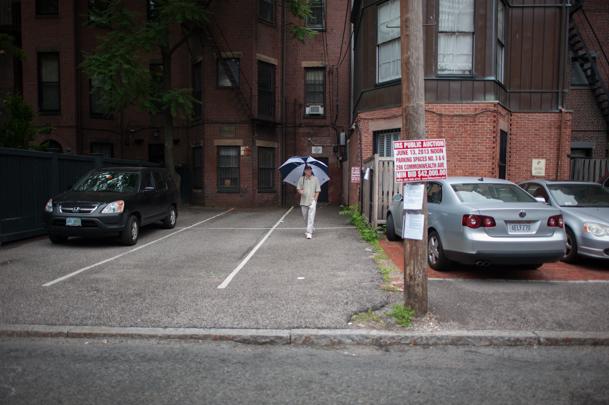
A remarkable story crossed my monitor this week. From back in the sacred Motherland of Massachusetts. Apparently, a pair of tandem parking spaces were auctioned off behind a toney Commonwealth Ave (Boston) condo for a whopping 560K–they’re shown in the photo. That’s over a half a million dollars in prime real estate yer gazing at.

Bid up from a sort of reasonable 42K and sold to a party that allegedly owns three spaces there already, this is the kind of story that makes one’s eyes glaze over in amazement. As primo as the location is, that tiny and stained bit of asphalt you’re looking at is not worth that price under any circumstances.

As that part of Boston is tightly zoned, it isn’t like it was bought to expand a brownstone. Nope, this is conspicuous consumption run completely amok or as a friend of mine back there put it, ”this could only have happened to people for whom money has no meaning”. (I suspect that the purchase was made as a “business expense” for a corporation, more to be revealed).

For 560 grand, you can still buy a modest home in Boston’s most desirable suburbs (all of which have better public schools than Boston and are cleaner and not plagued with unbearable traffic). And the property is but ten minutes on foot from downtown and the business district, cabs and car services are plentiful, therefore, why bother? As a possible long term investment? (Not a great idea as you will see).

This neighborhood, the Back Bay, was the first place I had my own digs. Adjusted for inflation, that apartment should go for about 420.00. It is now a million dollar and up condo and what was it? One gigantic room, likely the dining room of a three story home back in the 1800’s. And I still have friends in that neighborhood. Tellingly, all of them have been there at least 25 years and they could never afford it now.

By pricing all but the top of the top out of what once was an artist friendly neighborhood, the same neighborhood has the ripple effect of driving real estate values in adjacent neighborhoods past reason. Boston and San Francisco–joined at the hip by being the satellite cities to America’s twin powerhouses–are now unaffordable. 

A piece in the same paper that ran this story last year said it all. People aged 35-54 –which used to be an enormous demographic in Boston–no longer live there in large numbers. After university they just up and go because first jobs don’t pay enough to raise the scratch for a down payment. When a slab of concrete not even big enough to be a bedroom in a rooming house goes for 560K, it says that “what the market will bear” is not applicable.

This isn’t “free market capitalism”, it’s “crapitalism”. The laws of supply and demand have been so perverted by so few having so much, they almost don’t apply anymore. And my beautiful hometown–once a funky seaport with the best local music scene outside CB’s/Max’s–is now an overly exclusive playpen for folks that have brought back the Brahmin Age, only on ‘roids. Same as in SF—two small peninsulas whose essential character is being clobbered by venal plutocrats. Crapitalism couldn’t exist without tacit aid from the government–in SF, it’s in the form of tax breaks, in Boston, tax free academia is swallowing their city whole, reducing the amount of living units and artificially raising land value. That isn’t “supply and demand”.

The utlimate irony of this ridiculous transaction is that the Back Bay, like the Marina, is atop a landfill. The Charles River already overflows its banks and floods the basements of these expensive edifices more than it used to–so the parking spaces in question may be useless a fair amount of the time (of course, crapitalism being what it is, MA taxpayers will surely be stuck for the bill of seawalls and the like).

Bailouts, cronyism, loopholes–instead of an economic boom, we have Marie Antoinette style madness in our major cities. Pretty pitiful.


Guardian forum on Plan Bay Area draws big, engaged crowd

72

San Franciscans who want to help shape how this city grows — rather than just leaving it up to regional planners and market forces — packed a large conference room last night for a community forum presented by the Bay Guardian: “Whose Future? What Does the Regional ‘Plan Bay Area’ Really Mean for San Francisco?”

Moderated and organized by Guardian Editor/Publisher Tim Redmond, and co-sponsored by the Council of Community Housing Organizations (CCHO) and Urban Institute for Development and Economic Alternatives (UrbanIDEA), the session began with a overview of what’s now being planned for the San Francisco of 2040.

Gen Fujoika of the Chinatown Community Development Center said that Plan Bay Area, which is being jointly developed by the Association of Bay Area Governments and Metropolitan Transportation Commission (which will hold a hearing on the plan tomorrow, Fri/14, at 9:30am in Oakland), doesn’t pay for itself yet it will include strong incentives that will shape development in the region.

“It is in some sense a plan and I think we need to critique the hell out of that plan,” he said. “As we think of Plan Bay Area as a vision statement, we need to think about whether it’s our vision.”

As illustrated by the Plan Bay Area maps that the lined the walls of the LGBT Center conference room, the plan’s “priority development areas” that are slated for dense, streamlined development are also the same areas identified as “communities of concern” with vulnerable, low-income populations, making the plan a recipe for mass displacement.

Fujoika quoted a comment that Mayor Ed Lee made on Tuesday when asked by Sup. Eric Mar about the issue: “San Francisco has some of the toughest anti-displacements laws in the country.” While that may be true, Fujoika said that the plummeting numbers of African-Americans in the city and Plan Bay Area’s displacement projections for San Francisco show those laws simply aren’t up the challenge.

“If we have the toughest anti-displacement position in the country, then we are in some trouble,” he said, calculating that the affordable housing needed to prevent extreme gentrification in the city would total $6.8 billion, and that the affordable housing fund created by voters last year is only projected to raise $1.3 billion by 2030.

Fujoika said that he and the other panelists aren’t against growth and development, “but we are for equitable growth,” which would involve more community buy-in for the plan, more money for affordable housing and infrastructure needs, and more of the growth burden being shared by other Bay Area communities.

San Francisco Planning Commission Chair Cindy Wu cited growth projections for Chinatown as a good example of the problem, noting that is already a dense, complete neighborhood that would suffer from the greatly increased traffic that would be funneled through it and other negative impacts of unfettered growth.

“It’s not just growth for growth’s sake, it’s who gets to live there and who gets those jobs,” she said. Wu called for more community organizing around this and other development plans, citing as a good example the coalition-building that forced California Pacific Medical Center to agree to a multi-hospital project with far better community benefits than the deal it originally cut with the Mayor’s Office.

It was a point echoed by Maria Zamudio with Causa Justa, who said Plan Bay Area will worsen pressures that are already displacing the Mission District residents she works with, or forcing them to live in unsafe housing. “They’re going to push our families out of the city and maybe out of the region,” she said.

To combat the power that this plan and profit-minded property owners will exert over how San Francisco grows, San Francisco Labor Council President Mike Casey, head of UNITE-HERE Local 2, said that progressive San Franciscans will need to work cooperatively with organized labor, a relationship that has suffered during these tough economic times.

“Unfortunately, I think we’ve become alienated and marginalized from each other,” Casey said, calling on activists to not let differences over individual projects or issues interfere with solidarity over the larger, longer struggle for equity and justice.

“Not everyone agrees that a strong labor movement is the cornerstone of a more progressive vision,” Casey said, arguing that displacement of working class people from the city has a cascading effect in gentrifying the city. “The demographics of a city shape very much what the politics of protest look like.”

And those politics of protest will be more crucial than ever in resisting the demands that powerful capitalists will make on San Francisco in the coming years, a point that all seven panelists seemed to agree on.

Bob Allen of Urban Habitat said the planning research groups represented on the panel need to find ways to funnel more funding into grassroots organizing, both in San Francisco and regionally. Otherwise, we’ll see the “suburbanization of poverty,” with Plan Bay Area funneling the best jobs and most expensive housing into urban areas and leaving everyone else to fend for themselves in communities that don’t have the tenant protections and other hard-won social justice programs that San Franciscans have struggled for.

“Local control can be a way of saying ‘I don’t want black or brown people to live in my suburban community,” Allen said.

Ironically, Plan Bay Area is ostensibly driven by concerns over climate change and the argument that it’s better to concentrate development along transit corridors, which is why almost all of San Francisco and much of Oakland is proposed for development that would be given waivers from some California Environmental Quality Act scrutiny.

Yet the plan doesn’t fund the transit upgrades that would be needed to serve that growth or create restrictions on automobile use that might encourage more transit use. Instead, Fujoika said low-income people who actually use transit would be the diplaced in favor of wealthier residents who might not.

“Transit has become an amenity rather than a necessity,” Wu said.

The forum, which was attended by more than 130 people, included a lively discussion that involved dozens of audience members who offered their own views, ideas, and strategies for how to move forward. Among them was Brian Basinger of the AIDS Housing Alliance, who said that he is working with a coalition to reform the Ellis Act, which allows landlords to evict tenants from rent-controlled apartments.

“We could move this as early as January,” Basinger said of the reform legislation now being developed with allies in the Legislature, urging attendees to get involved.

After the audience discussion, the meeting closed with Peter Cohen of the CCHO summarizing the high points and getting people to sign up on lists that were circulated to be involved with next steps. And Rachel Brahinsky, a former Guardian staff writer who is now a professor at USF’s Leo T. McCarthy Center for Public Service and the Common Good, urged attendees to fight for San Francisco to remain inclusive and diverse: “San Francisco is the place it is because people have kept fighting.”

‘Money is a tool’

0

Jack Abramoff says “legalized bribery” is corrupting our political system, and as a lobbyist who went to prison for taking the practice of buying favors from Congress to obscene new depths, he should know. But if we’re relying on him to help reform that system, a cause he’s now taken up, we could be in real trouble.

Watching Abramoff address “public ethics” at a University of San Francisco class of aspiring political professionals on June 6 was a little surreal. Part charming rogue, part penitent reformer, Abramoff told inside tales of how easily money corrupts even well-intended people who work in Congress.

“I didn’t create a new way of lobbying, I just did more of it,” Abramoff told the students, noting that while some lobbyists had a few good tickets to Washington Redskins or Wizards games to give away to members of Congress, he had 72 of them. And while some lobbyists would take members golfing, “I would put them on a Gulfstream and fly them to Scotland. What’s the difference? It’s still playing golf.”

It was particularly strange for someone of Abramoff’s obviously questionable moral fiber to be addressing political students at this Jesuit-run academic institution, whose local advertising slogans include “How to succeed in business and still go to heaven” and “Wicked smart without the wicked part.”

Yet forgiveness is supposed to be divine, and the instructor who lured Abramoff to speak with his class, local lobbyist and political consultant Alex Clemens, was certainly pleased to attract someone with Abramoff’s inside knowledge, avoiding Abramoff’s usual speaking fees of up to $20,000 by piggybacking on a Southern California speech he gave and paying only his airfare.

I was a bit more skeptical of a guy who equates political donations with bribery while hawking a book and narrow reform proposal — while at the same time soliciting corporate lobbying clients and telling the San Francisco Chronicle that Silicon Valley should be spending far more money to influence politicians.

“It needs a much bigger view of political involvement,” Abramoff told the Chron. “It should be spending much more. They’re not playing as smart as they should, and they could lose big.”

That’s part of the muddle of contradictions that defines Abramoff and his advocacy today, which is consistent with the anti-government, wealth-worshipping conservatism he has pushed with missionary zeal since his college days, along with pals Ralph Reed and Grover Norquist, who still play key roles in keeping religious fundamentalists and the rich in the Republican Party fold.

“I’m not against money in the system, I’m against money being used the wrong way in the system,” Abramoff told me after the talk, as I probed the contradictions in his statements and views. My efforts to pin him down caused him to scornfully brand me a “socialist,” the old bully replacing the affable face he showed the students.

“Money is a tool,” Abramoff told me.

Abramoff is also a tool, I decided as I listened to him, although it’s still tough to discern who is wielding him now and where this effort may be headed.

LESSON FOR STUDENTS

Abramoff told the students that even after he got busted in 2005, for a long time he indignantly wondered why he was being prosecuted for the same sorts of actions that were endemic to Washington DC. Eventually, he began to realize he had done something wrong.

“I thought maybe some of this [the charges against him] is right,” he said. “I decided to be honest with myself. Am I the saint I always thought I’d been, or the devil they said I was?”

Yet in the end, Abramoff never did really rethink his own worldview and history — from his early days of shilling for the South African government against efforts to end apartheid to later bribing members of Congress to oppose regulation of sweatshops and sex trafficking in US territories — he just blamed the political system.

“I thought this system is maybe not right,” he told students studying to be a part of that system. “I thought when I got out, I should probably try to help.”

So he wrote a book, Capitol Punishment: The Hard Truth About Corruption From America’s Most Notorious Lobbyist, and he says that he’s been developing political reform legislation that he intends to start pushing next year along with unnamed others.

Abramoff has consulted with Harvard Law School professor Lawrence Lessig, who founded Rootstrikers to push political reforms, but Abramoff doesn’t support many of the central tenets of that and other reform groups, including public financing of elections and overturning “corporate personhood” court rulings that deem political spending by the rich to be a free speech right.

In fact, Abramoff is still a right-winger who shows little interest in limiting the ability of wealthy corporations and individuals to freely spend their money on political candidates and issues, placing him at odds with pretty much the entire political reform movement.

Phillip Ung, a spokesperson for Common Cause — which has been working on these political reform efforts for decades — was a little skeptical about getting help from someone who once embodied the most corrupt and excessive aspects of the current system.

“As much as we enjoy his newfound support for political reform, we also understand that he has a debt to pay, and not just to society,” Ung said of the $44 million in restitution that Abramoff still owes to his victims.

Ung said that a stark example of political corruption like Abramoff represents does help the cause, but that has little to do with his current advocacy. “The reform flag at the federal level goes almost nowhere if there’s not a political scandal,” Ung said, although even that isn’t saying much because, “Congress and DC only have tolerance for political reform one every 10 years or so.”

With Democrats now overwhelmingly controlling California’s Legislature and executive offices, Ung sees opportunities for important reforms here. The most promising is Senate Bill 27, which would require political groups that raise more than $500,000 to disclose their donors.

By contrast, Abramoff’s proposal seems tepid at best, and his strategy for selling it relies on using political spending to elect sympathetic people to Congress, which would seem to undermine his reform message almost as much as pitches to corporate clients to hire him for lobbying consulting services (see www.abramoff.com).

“He seems to be going back to his old ways,” Ung said of Abramoff.

Abramoff said his legislation would broaden the definition of lobbyist, limit their campaign contributions to $500 per election cycle, and prevent public officials from working as lobbyists for 10 years after they leave government.

Then Abramoff said that he and his unspecified “we” will dump money into six contested Congressional races in 2014, trying to elect three Democrats and three Republicans who pledge to support his legislation, following that up in 2016 by targeting 25 to 50 races.

“Then and only then will Congress take it seriously,” Abramoff concluded, arguing that politicians respond to losing their jobs more than other means of persuasion. He’s going to use aggressive political spending to win the reforms he seeks, which don’t really do anything to limit political spending.

When I asked Abramoff how increased political spending can reform a political system corrupted by money, he replied, “You play with the tools and the battlefield you’re on.”

THE SYSTEM, OR ITS SPONSORS?

Abramoff blames Congress for corruption far more than the lobbyists or wealthy special interests who are doing the corrupting, noting how difficult it is to get political reforms approved by legislators who want to later cash in on their public service.

“The lobbyists are a response to the system set up by Congress,” he told the students, building on his earlier point that “99 percent of everything I did was legal, and that’s a bigger deal than the 1 percent that was illegal. That’s what has to change.”

But he acknowledges that reforming the system will be “impossibly difficult” because those who are invested in the current system will always find loopholes to any new regulation. “They’re extremely brilliant people and their goal is to get around things,” he said.

Omitted from Abramoff’s recitation of what’s wrong in Washington are the people doing the corrupting, that other 1 percent, the very rich. When I asked him about how he can really attack institutionalized political corruption without going after the cash that feeds that corruption, he told me, “I tend to be nervous about a political approach that says, ‘It’s the rich.”

Abramoff actually supports the Supreme Court’s controversial Citizens United ruling, which ended controls on the political spending of wealthy individuals and corporations, telling the students, “We all want certain corporations to have the rights that we individuals have.”

Abramoff also seems to dismiss the possibility of a grassroots political reform effort, saying that any change in the system would need support from both the left and the right, and the latter will kill any effort to actually removes private money from political campaigns.

“You’re not going to have federal financing of elections. The right will die before they let that happen,” Abramoff said.

That might have been the most insightful thing that Abramoff said to the students, although he certainly didn’t intend it the way that I heard it: maybe the right needs to die, in the political sense, before the system that Abramoff both decries and supports will change.

Everyone but Mayor Lee sees SF’s worsening “housing affordability crisis”

43

There was a clear theme that ran through yesterday’s Board of Supervisors meeting from beginning to end, something understood equally by renters, homeowners, and politicians from across the political spectrum: San Francisco has a crisis of housing affordability that is forcing people from the city.

And the only person who doesn’t seem to understand or care about that is the person with the most power to deal with the situation, Mayor Ed Lee, who opened the meeting by essentially dismissing both short- and long-term gentrification forces and claiming “our city has some of the toughest anti-displacement laws in the country.”

It was a claim that Lee made twice, first in response to a question by Sup. Eric Mar about Plan Bay Area and the massive displacement of current San Franciscans that it would create by 2040. And it was also how he answered a question by Sup. John Avalos about rents that are now skyrocketing beyond what most San Franciscans can afford.

I followed Mayor Lee back to his office, asking him to explain his claim, and he cited the city’s “elaborate” rent control laws and the Rent Board recently hiring new personnel as he briskly retreated toward his office. But surely he’s aware that displacement is already happening and getting worse, I told him, citing Rent Board figures showing that evictions are now at a 12-year high.

Lee looked at me dubiously and said, “I’ll have to check the figures on that.” I followed up today with Press Secretary Christine Falvey to ask whether Lee did check those figures — which show 1,757 evictions in the last year, up from 1,395 the previous, both numbers representing returns to the mass displacement of the last dot-com boom — and I’ll update this post if/when I hear back.

“It shows he’s out of touch with what’s happening in San Francisco,” Avalos told me in response to the mayor’s remarks.

Lee seemed to bristle at the suggestion that his aggressive economic development policies might have a downside that he’s going to have to deal with at some point. He touts the 44,000 jobs the city has added during his mayoral tenure, even deflecting criticism that he’s too focused on the technology industry by citing estimates that every tech job creates at least four other jobs (seemingly oblivious to the fact that most of these are low-wage service sector jobs, the very people who are being forced from the city).

“I’m just hoping you’re not blaming the 44,000 jobs we helped created,” Lee told Avalos, saying that he understands the concern about the rising cost of living, “but those are 44,000 people drawing a paycheck and taking care of their families.”

Yes, Mr. Mayor, but those paychecks are having an increasingly tough time paying for housing in San Francisco. That concern animated the condo conversion debate that took place later in the meeting, voiced by those focused on the lack of affordable homeownership opportunities and those focused on reducing the city’s rental stock to create those opportunities.

“I don’t think saying ‘it’s good that we have a growing economy’ is enough to address the issue,” Sup. David Campos said during the condo debate, referring to Lee’s earlier remarks.

Speaking near the end that discussion, Campos summarized the concerns expressed by both sides and sought to put the legislation into perspective: while important, the condo deal is a drop in the anti-displacement bucket. “We are only dealing with the issue of affordability in San Francisco on the margins,” he said, later adding, “I don’t think we’re doing enough to deal with the fundamental issue of who gets to live in San Francisco.”

The debate on the condo conversion began with its original author — Sup. Mark Farrell, who represents District 2, the wealthiest and most conservative in the city — explaining his desire to help middle class people who want to own homes remain in the San Francisco.

“This is the most affordable form of home ownership in San Francisco today,” Farrell said of tenancies-in-common, the fiscally and legally precarious middle step between an apartment and condominium. Later, he said, “We need more affordable homeownership opportunities and not less.”

Farrell argued that “this didn’t need to be a zero sum game,” but that’s exactly what the stock of rent-controlled apartments is in San Francisco, where only housing built before 1979 is protected from the market forces that can drive rents up to whatever a landlord demands.

“We have a fixed rent control stock. Every apartment that converts to a a condo is one less unit,” said Board President David Chiu, who worked with Sups. Jane Kim and Norman Yee and tenant group to amend Farrell’s legislation to help both renters and homeowners.  

“These units were once the homes of tenants who were displaced,” Kim said, objecting to the notion that one person’s apartment should be another person’s affordable homeownership opportunity and arguing that the city should be building more condos for first-time homebuyers instead of cannabalizing the homes of the nearly two-thirds of city residents who rent.

Like Chiu and Kim, Yee said that he wanted to help the TIC owners of today without simply clearing out of the backlog and letting the condo lottery continue unabated, which would green-light even more conversion of apartments. “We want to curb the speculation,” Yee said.

That idea that the city should help people who live in the city, without simply feeding the speculative investors who profiteer off of housing in San Francisco, was a strong theme among critics of condo conversion.

A pro-tenant crowd packed the Board Chambers. Although barred by board rules from addressing the condo legislation directly (that occurred at the committee level), one commenter said, “Giving any more power to the real estate market in San Francisco should be considered a crime.”

To help ward off real estate speculators once the annual condo conversion lottery resumes in 2024, the legisation also limited future conversions to buildings of less than four units, instead of the current cap of six units, a change that Farrell resisted.

“This is not an academic exercise anymore,” Farrell said of the condo conversion restrictions that were added to the legislation. “This will negatively impact thousands of TIC owners in the city.”

Farrell’s original co-sponsor, Sup. Scott Wiener, had a more pro-tenant point-of-view, objecting to the changes that Chiu inserted on more narrow grounds. In his comments, he noted how close the two sides were and how they share the same basic goal: preventing displacement of current city residents.  

“The one thing we can all agree with is we have a housing affordability crisis,” Wiener said, praising the city’s rent control and tenant protection laws, but adding, “TIC owners are also part of this city.”

The price of dealing with the rapid growth in the city — whether it comes to infrastructure or housing affordability — was also a point that Wiener made earlier in the meeting as the board approved the term sheet for a massive office and residential development project proposed at Pier 70.

“We are not doing what we need to do to support the public transportation needed for those projects,” Wiener said, also referring to other projects along the waterfront (the Warrior Arena at Pier 30 and the Giants/Anchor Steam project at Pier 46) and in the southeastern part of the city. “We don’t have the transit infrastructure to support our current population, let alone new growth.”

It’s about striking a balance, as Chiu said he did with the condo legislation, and not just a balance between renters and TIC owners. It’s about striking a balance between how to protect the San Francisco of today while planning for the San Francisco of tomorrow.

Yes, that means working with market rate housing developers, and it also means diverting some of their would-be profits into the city’s affordable housing fund and its infrastructure needs. Yes, it means private-sector job creation, but it also means more public sector jobs and providing a safety net for people without jobs or who work as artists or social workers or other professions that are being driven from the city. And it means beefing up our public housing and turning around the exodus of African-Americans, concerns raised at the meeting by Sup. Malia Cohen.

We at the Guardian last year looked at how Oakland has become cooler than San Francisco, largely because of the displacement from here. And now, even many people within the tech community have begun to decry the gentrifiction that is being driven by Mayor Lee’s narrow economic development vision.

“Plan Bay Area is an opportunity to think regionally and strategically about planned growth,” Lee said when addressing Mar’s question, sidestepping the direct answer that Mar sought on a set of specific proposals for mitigating some of the displacement planned for San Francisco and maintaining this city’s diversity.

Yes, we do have an opportunity to think strategically about the city we’re becoming and who gets to live in it, but only if we don’t think “jobs” is the answer to every question.

Alerts

0

WEDNESDAY 12

Whose future? Community forum LGBT Community Center, 1800 Market, SF. sfbg.com, ccho@sfic-409.org. 6-8pm, free. In July, the Bay’s Regional governing body is scheduled to approve a state-mandated plan aimed at reducing carbon-emissions that proposes to put 280,000 more people, 92,000 new housing units, 100,000 new jobs (and 73,000 more cars) into SF over the next 30 years. By the proposed Plan’s own assessment: it will increase the risk of neighborhood disruption and displacement of existing residents and businesses, especially among the city’s working class communities. What can we do about it? Join Tim Redmond, San Francisco Bay Guardian; Mike Casey, Unite HERE Local 2; Cindy Wu, San Francisco Planning Commissioner; Maria Zamudio, Causa Justa: Just Cause; and others for this important panel discussion.

THURSDAY 13

Raising the Roof for Renters 111 Minna Gallery, 111 Minna, SF. tenantstogether.org/raisingtheroof2013. 6pm, $30 in advance/ $40 at the door. Tenants are hurting right now, so show your support by attending this fundraiser for Tenants Together — California’s statewide organization for renters’ rights. Celebrate five years of mobilizing tenants statewide for housing justice. Featuring a silent auction, fantastic food, and a cash bar.

SUNDAY 16

Teach-in: class struggle in Turkey Niebyl Proctor Marxist Library, 6501 Telegraph Ave., Oakl. (510) 428-1578. 10:30am-12:30 p.m., free with donation requested. On May 31, without warning, Turkey erupted. For the first time in recent history, women, students, workers, artists, youth, Kurds, Artists, Turks, gays-lesbians, Alevites, doctors, small merchants, environmentalists, unions and progressive associations rose up together. Mehmet Bayram, a long time journalist and Bay Area activist from Turkey, will report on the developments that led to the events and the aftermath. A discussion of politics and class struggle in Turkey will follow.

THURSDAY 20

Rally and protest against Keystone XL Battery East, below Golden Gate Bridge Visitor Center, SF. tinyurl.com/mf6m2ef. Noon, free. Join Bill McKibben of 350.org for a noon rally against the Keystone XL pipeline, followed by a march across the Golden Gate Bridge. This time, environmentalists seeking to halt this major oil infrastructure project will be joined by National Nurses United, who are organizing a day of action in the city against austerity and the Keystone XL.

Have love, will travel

0

emilysavage@sfbg.com

TOFU AND WHISKEY Trails and Ways have zigged when others zagged. Though in reality, the band’s process is becoming more in line with the path many underground musicians take to create and distribute work in 2013. It’s avoided traditional labels, instead choosing to release a record through a Tumblr-based community project, and before that generated intense web interest with original singles, clever covers, and inspired remixes, building a reputation as a talented crew of globally inspired dream poppers.

And that windy route has paid off. The melodic Oakland quartet, which was named one of the Guardian’s Bands on the Rise earlier this year, will play its biggest headlining show yet this week, Fri/7 at the Independent (9pm, $12, 628 Divisadero, SF. www.theindependentsf.com). It’s part of its first full US (and Canadian) tour. All of this is in celebration of a record that’s been buzzed about since the first hints were dropped a year or so ago: the Trilingual EP is here.

If you’ve been following the band’s trajectory, you’ve heard many of the tracks before. Five-song Trilingual begins with faraway wind chimes and sturdy hand-claps, kicking off new single, “Como Te Vas,” which then builds into a electronic dance pop track with catchy guitar hooks over island synths and layers of echoing Spanish vocals. It bleeds directly into championed early released “Nunca,” lovely and moody “Tereza,” which ends with the sounds of rolling waves, along with previous single, the bossa nova beat driven “Border Crosser” (which supports the National Network for Immigrant and Refugee Rights) and bubbly “Mtn Tune.” A few of the tracks showcase that two female-two male vocal counterpart dynamic of Trails and Ways, others spotlight and highlight one or two voices — all strong in their own right.

“Some of the songs we put out last year but had never given them a home. It’s our debut of songs written and recorded together as this band,” guitarist-vocalist Keith Brower Brown tells me. “Working as this four-piece changed how and what we do to the core. Before we went on this first major tour, we wanted to bring together our work so far — and new material — into this physical object to tour behind, a declaration of who we are and what we’ve done as a band.”

Although the foursome — Brower Brown, bassist Emma Oppen, drummer Ian Quirk, and guitarist-synth player Hannah Van Loon — initially considered expanding Trilingual into an LP, they decided not to force the additional tracks, to let the work settle and grow organically. “We realized that we never want to rush a full-length out the door. A lot of things have happened really fast for us — especially given that we’ve just been doing all this on top of demanding jobs and other projects.” (That ends soon; two of the four quit working full-time jobs on May 31, so when they return home from tour, they’ll be spending “infinite time” on their music.)

“If you’re too deep in the echo chamber you can feel this pressure to kick out new material every week. But when we put out a debut LP we want it to be as good as the albums that inspire us to make this music.”

It’s this kind of careful attention to detail that draws listeners in to Trails and Ways, the delicate layers of sound, the snippets of additional beats and instruments. Each track tells a story, and is intended to take a listener on a journey. As Brower Brown points out, that intension is right there in the band’s name. These joint interests in both traveling and exploring other cultures came from the time Brower Brown and bassist Oppen spent living in Brazil and Spain. “When you’re traveling in foreign space, wrestling with language and identity to express yourself takes you — by necessity — to the most creative place I know…and a lot of our songs and musical obsessions were sparked in those moments at the raw edge of translation and incomprehension.”

http://www.youtube.com/watch?v=TNi_xKxySos

The band will release the EP through Non-Market, a brand new East Bay based DIY community label in which Trails and Ways are very involved. “We hope [it] will transcend the market of music promotion and distribution, by just having Bay bands write about other Bay bands,” Brower Brown says. “So it’s a open, principled, non-commercial music community.”

Along with being a stop on the band’s “Trans-American Trilingual Tour,” the Independent show is also kind of the label kickoff. The band’s San Francisco openers are local pals, Social Studies — and Astronauts Etc., which has also been a core part of the Non-Market dream.

The tour will take the travel junkies through much of the US and Canada. They’re “looking forward to 8,000 miles of time together in the minivan,” along with the hopes of popping off the road for hikes and lake swimming. The band is also itching to meet Drake in Toronto, and will play the same stage as both Kendrick Lamar and Tom Petty at the Firefly Music Festival in Delaware, plus a show in Chicago with its Portland, Ore. friends Radiation City. Even without the release of a proper full-length LP, the group will be headlining most of its US tour.


TOTAL CONTROL

If you somehow missed killer 2012 LP Henge Beat, Total Control is an Australian punk supergroup of sorts, featuring members of Eddy Current Suppression Ring, UV Race, and more. The band, which recently put out a split with Thee Oh Sees, sounds like a mix of Suicide and Joy Division, with lyrics aimed at sci-fi curiosities and paranoid guitar lines doused in just the right amount of doom and gloom.

Sat/8, 8pm, $12. Eagle Tavern, 398 12th St., SF. www.sf-eagle.com. With Thee Oh Sees, Fuzz.

Sun/9, 8pm, $10. Uptown, 1928 Telegraph, Oakl. www.uptownnightclub.com. With Grass Widow, Neon Piss, Synthetic ID.


LUMERIANS

It’s been awhile since we’ve seen the Lumerians out and about in San Francisco, as the five-piece spacey, psychedelic wanderers (also recently described as a “Oakland stoner quintet”) reminded fans on social media this week. They also claim to have some secrets in store for the crowd at this show, which opens with fellow locals Wax Idols, at SF’s newest music venue, the Chapel. With this group, it’s got to be something cosmic.

Sat/8, 9pm, $15. Chapel, 777 Valencia, SF. www.thechapelsf.com.


NVH

Local record and book shop the Explorist International (which specializes in rural American music, jazz, international pop and folk, and electronics) is curating shows at Amnesia for the month of June, this week bringing out Sub Pop’s NVH, a.k.a. Noel Von Harmonson of Comets on Fire. With this solo project, the experimental knob-twister and guitarist blasts out mind-numbing soundscapes. With Diego Gonzales, DJs Special Lord B and Phengren Oswald. Upcoming Explorist International-curated shows at Amnesia include free-jazzists Aliacensis (June 18) and Nordeson/Shelton Duo (June 25).

Tue/11, 9:30pm, $5. Amnesia, 853 Valencia, SF. www.amnesiathebar.com.


SONNY AND THE SUNSETS

Here’s yet another show at the newly re-opened Eagle Tavern: the record release party for Sonny and the Sunsets’ newest, Antenna to the Afterworld. The confessional record, which hints at Modern Lovers and Silver Jews (a shift from country break-up record Longtime Companion), opens with Sonny Smith talk-singing a call-and-response conversation, “Something happened/I fell in love/but it was weird/Real weird.” “Good weird?” the voice on the other side implores. With Burnt Ones, Cool Ghouls.

Tue/11, 8pm, $7. Eagle Tavern, 398 12th St., SF. www.sf-eagle.com.

No security

3

rebeccab@sfbg.com

To qualify for his job as a security officer, Jerry Longoria had to obtain a license, undergo a background check, and take a drug test. He’s required to wear a suit to work. He’s stationed at a downtown San Francisco high rise that houses Deloitte, a multinational consulting, finance, and real-estate firm that reported $31.3 billion in revenues last year. His employer is Universal Protection Services, a nationwide security contractor with a slick online marketing pitch emphasizing that all guards are “electronically supervised around the clock,” and “kept accountable on the job through our 24-hour command center.”

If an intruder showed up at his office building brandishing a firearm, it would be Longoria’s problem; that’s the job. Nevertheless, he says he doesn’t earn enough to cover rent for an apartment in San Francisco. Instead, he stays in a single room occupancy hotel near Sixth and Mission streets, an area known for a high rate of violent crime. Walking home still wearing the suit makes him stand out on the street.

He’s lived in the 150-unit building, which has shared bathrooms and a shared basement-level kitchen, for 11 years. “It’s affordable for me, and it allows me to be closer to work,” he explains. He can’t afford a car, and says a public transit delay could prove disastrous if he relocated outside the city. “If you’re late to your post, you get fired.”

At press time, about 7,000 security officers throughout the Bay Area and Los Angeles were gearing up for a strike that could begin any day. Members of United Service Workers West, affiliated with Service Employees International Union, authorized their bargaining committee to call for the work stoppage because officers have been without a contract since the end of 2012.

The starting wage for a security officer is $14 an hour in the city, which comes to slightly more than $29,000 a year before taxes. In some places that would be sufficient to meet basic needs. In San Francisco, where the median market rate on rental units recently peaked above $3,000 a month, it doesn’t go very far. “With the cost of living here in San Francisco, $14 an hour is simply not enough to make ends meet,” Kevin O’Donnell, a USWW spokesperson, told us.

The security officers’ threats to strike coincided with a second worker action in the Bay Area last week. Despite lacking any form of union representation, Walmart associates from stores in Richmond, Fremont, and San Leandro affiliated with the nationwide organization OUR Walmart joined 100 employees from across the country in walking off the job and caravanning to Bentonville, Arkansas to raise awareness about their poverty-level wages and insufficient benefits at Walmart’s annual shareholders’ meeting. But first, they paid a visit to the Four Seasons in downtown San Francisco, which houses the 38th floor penthouse apartment of Yahoo CEO Marissa Mayer, a Walmart director.

Despite seeking full-time working opportunities and staying with the company for years, a handful of associates we interviewed said they can’t earn enough at Walmart to cover basic needs, so they rely on government assistance or help from extended family to make ends meet. Some said they had witnessed their coworkers get fired after participating in OUR Walmart activities.

Walmart associates in the Bay Area are in a considerably more precarious situation than the security officers, earning lower hourly wages. But in the pricey Bay Area, security officers, Walmart employees, and scores of other low-wage private sector workers all share something in common. Despite reporting to work every day and working long hours in many cases, they’re forced into impoverished conditions due to economic circumstances, while a middle-class existence remains far out of reach.

FIGHTING FOR STABILITY

ABM Security and Universal Protection Services are the largest employers in the private security contractor industry; in the Bay Area, the majority of guards are stationed at office buildings in downtown San Francisco. On May 30, Supervisors John Avalos, David Campos, David Chiu, Jane Kim and Scott Wiener all voiced support for the guards at a rally outside City Hall. “Better working conditions for security officers mean more stable, family-supporting jobs, less turnover, and more ability to handle challenges at work,” Avalos said.

Matt Roberts has been working as a security officer for years, and originally moved into his unit in a San Francisco SRO in a financial pinch. “I figured, I’ll get out of this rut eventually. And here I am, seven years later, still paying $1,000 a month for a space that’s really not much bigger than a walk-in closet,” he told us. Roberts was terminated recently, and believes it’s because he spoke up to his site director about workplace issues his fellow guards felt needed to be addressed.

In Roberts’ view, the situation he’s found himself in is reflective of the broader erosion of the middle class, which is particularly acute in an area with a soaring cost of living. He was born and raised in San Francisco’s Crocker Amazon district, with a father who worked as a firefighter and a mother who worked as a clerk typist at the Cow Palace.

“They were able to achieve the American dream,” he said. “They had a house, they paid their mortgage off in 25 years, they were able to send me and all my three siblings to good schools. I realized when I was still in my 20s that I’m probably going to be a renter the rest of my life. The American dream is totally eclipsing my generation.”

Keven Adams, a security officer of 23 years who lives in Oakland, also attended the City Hall rally on May 30. “We’re fighting for wages, health care, and stability in the workplace,” Adams said. “We’re in a city we love so very much, but the community and the middle class is shrinking.” Adams said he was once held at gunpoint for four hours during a work shift. He’d love to live in San Francisco, he said, but can’t afford it.

According to a June 3 media advisory, unions throughout the Bay Area were preparing to demonstrate support for the security officers as they geared up to strike. “The support could come in the form of workers attending rallies, non-violent civil disobedience or perhaps even non-security workers refusing to cross picket lines,” according to USWW, “and walking off their own jobs in solidarity.”

‘STAND UP, LIVE BETTER’

Among the small group of protesters who had assembled on the sidewalk far below Mayer’s San Francisco penthouse on May 29 were associates who had taken the drastic and unusual step of going on strike from Walmart — the nation’s largest private employer. Clad in bright green shirts and waving signs, they chanted, “stand up, live better,” a play on Walmart’s slogan, and also, “What do we want? Respect.”

Dominic Ware, who works part-time at a Walmart in San Leandro, led chants and sounded off on a megaphone about the need for greater respect in the workplace. Ware, who’s been involved with OUR Walmart activities on a national level, said he earns $8.65 an hour and stays with his grandmother, since his paycheck isn’t enough to cover rent. He estimated that roughly half his earnings go directly back to Wal-Mart, where he purchases groceries and other basic items. Asked what motivated him to strike, Ware mentioned his daughter, who turned eight on June 1. “What if she has to work there some day?”

He added that some elderly colleagues were experiencing problems such as being unable to get a shift changed so as to catch a bus home at the end of the night. Another one of his coworkers was let go after it became clear to management that he was participating in OUR Walmart activities, Ware said.

While only a tiny fraction of Walmart’s 1.4 million workers took action to strike, their campaign appears to resonate in high places. A report recently released by the Democratic staff of the U.S. House Committee on Education and the Workforce seized on Walmart’s low wages, emphasizing that so many of its workers are forced to turn to government assistance that it is resulting in a collective drag on taxpayers.

“Rising income inequality and wage stagnation threaten the future of America’s middle class,” the report notes. “While corporate profits break records, the share of national income going to workers’ wages has reached record lows. Walmart plays a leading role in this story. Its business model has long relied upon strictly controlled labor costs: low wages, inconsiderable benefits and aggressive avoidance of collective bargaining with its employees. As the largest private-sector employer in the U.S., Wal-Mart’s business model exerts considerable downward pressure on wages throughout the retail sector and the broader economy.”

Burning questions

7

steve@sfbg.com

A documentary called Spark: A Burning Man Story is arriving on the big screen, with dreams of wide distribution, at a pivotal moment for the San Francisco-based corporation that has transformed the annual desert festival into a valuable global brand supported by a growing web of interconnected burner collectives around the world.

Is that a coincidence, or is this interesting and visually spectacular (if slightly hagiographic) film at least partially intended to shore up popular support for the leadership of Burning Man as the founders cash out of Black Rock City LLC and supposedly begin to transfer more control to a new nonprofit entity?

Filmed during last year’s ticket fiasco — in which high demand and a flawed lottery system created temporary scarcity that left many essential veteran burners without tickets during the busy preparation season — both the filmmakers and leaders of Burning Man say they needed to trust one another.

After all, technology-entrepreneur-turned-director Steve Brown was given extensive, exclusive access to the sometimes difficult and painful internal discussions about how to deal with that crisis. And if he was looking to make a film about the flawed and dysfunctional leadership of the event — ala Olivier Bonin’s Dust & Illusions — he certainly had plenty of footage to make that storyline work.

But that wasn’t going to happen, not this time — for a few reasons. One, Brown is a Burning Man true believer and relative newbie who took its leaders at face value and didn’t want to delve into the details or criticisms of how the event is managed or who will chart its future. As he told us, that just wasn’t the story he wanted to tell.

“We got trusted by the founders of Burning Man to do this story,” he told us. “They were in the process of going into a nonprofit and they wanted to get their message out into the world.”

Two, Black Rock City LLC needed to sign off on the film for it to be distributed, given that the corporation controls the use of images from the event. “Could Burning Man have prevented us from distributing this film? Yeah, they probably could have,” Brown told us. And during my own experience writing and promoting a book about Burning Man, I learned that its leaders resent criticism and can make or break efforts to promote books or movies to the larger burner community.

Finally, as is increasingly the case with many documentary films, the filmmakers and their subjects are essentially in a partnership. Brown and the LLC’s leaders reluctantly admitted to us that there is a financial arrangement between the two entities and that the LLC will receive revenues from the film, although they wouldn’t discuss details with us.

Chris Weitz, an executive producer on the film, is also on the board of directors of the new nonprofit, The Burning Man Project, along with his wife, Mercedes Martinez. Both were personally appointed by the six members of the LLC’s board to help guide Burning Man into a new era.

Brown insists that these relationships had no influence on the film and that the LLC neither requested nor received any editorial changes. “I made it clear to them that I’m only going to do a film that is completely independent,” Brown said.

And his co-director, Jessie Deeter, is a respected journalist and veteran documentary filmmaker whose strong reputation lured estranged Burning Man co-founder John Law to participate in the film, offering the only real questioning of the event’s leadership (although it focused on the decisions in the late 1990s to continue growing the event, not on its more recent stewardship and questions of relinquishing some control to the larger community).

“I’m fair and I’m really proud of my reputation as a journalist,” Deeter told us, noting how important she thought it was to have Law’s contrarian voice in the film.

Still, both Deeter and Brown are also clear that they believe in the leadership of the event. “I found their intentions to be honorable and positive as they deal with difficult-to-solve problems,” Brown said, while Deeter later told us, “I believe in their intentions.”

More cynical burner veterans may have a few eye-rolling moments with this film and the portrayals of its selfless leadership. While the discussions of the ticket fiasco raised challenging issues within the LLC, its critics came off as angry and unreasonable, as if the new ticket lottery had nothing to do with the temporary, artificial ticket scarcity (which was alleviated by summer’s end and didn’t occur this year under a new and improved distribution system).

And when the film ends by claiming “the organization is transitioning into a nonprofit to ‘gift’ the event back to the community,” it seems to drift from overly sympathetic into downright deceptive, leaving viewers with the impression that the six board members are selflessly relinquishing the tight control they exercise over the event and the culture it has spawned.

Yet our interview with the LLC leadership shows that just isn’t true. If anything, the public portrayals that founder Larry Harvey made two years ago about how this transition would go have been quietly modified to leave these six people in control of Burning Man for the foreseeable future.

CHANGING FOCUS

As altruistic as Spark makes Burning Man’s transition to nonprofit status sound, Harvey made it clear during the April 1, 2011 speech when he announced it that it was driven by internal divisions that almost tore the LLC board apart, largely over how much money departing board members were entitled to.

The corporation’s bylaws capped each board member’s equity at $20,000, a figure Harvey scoffed at as ridiculously low, saying the six board members would decide on larger payouts as part of the transition and they have refused to disclose how much (Sources in the LLC tell me the payouts have already begun. Incidentally, author Katherine Chen claimed in her book Enabling Creative Chaos that the $20,000 cap was set to quell community concerns about the board accumulating equity from everyone else’s efforts, but Harvey now denies that account).

In that speech, Harvey also said the plan was to turn over operation of the Burning Man event to the nonprofit after three years, and then three years later to transfer control over the Burning Man brand and trademarks and to dissolve the LLC (see “The future of Burning Man,” 8/2/11).

Board member Marian Goodell assured us at the time that the LLC would be doing extensive outreach to gather input on what the future leadership of the event and culture should look like: “We’re going to have a conversation with the community.”

But with just a year to go until the event was scheduled to be turned over to the nonprofit board, there has been no substantive transfer, the details of what the leadership structure will look like are murky — and the six board members of Black Rock LLC still deem themselves indispensable leaders of the event and culture.

The filmmakers say that the transition to the nonprofit was one of the things that drew them to the project, but the ticket fiasco came to steal their focus, mostly because the nonprofit narrative was simply too complex and confusing to easily convey on film.

Deeter said they decided to close the film with Law and his questions of whether the event should have been allowed to grow so large. “We insisted on having John Law at the end to counterbalance that idea” of who would be leading the event.

As she said of the transition to a nonprofit: “You know that transition is a really, really complicated thing.”

TRANSITION TIME

Yes, and it’s something that seems to be made even more complicated by Harvey and Goodell, who offered dizzying answers to our questions about how the event and culture will be led going forward. All we can tell at this point is that it’s still a work in progress.

“We’re pretty much on schedule,” Harvey told me, noting that he still hopes to transfer ownership of the event over to the nonprofit next year. “The nonprofit is going well, and then we have to work out the terms of the relationship between the event and the nonprofit. We want the event to be protected from undue meddling and we want it to be a good fit.”

From our conversations, it appears that a new governance structure seems synonymous with the “meddling” they want to avoid.

“We want to make sure the event production has autonomy, so it can water the roads without board members deciding which roads and the number of tickets and how many volunteers,” Goodell said. “We did look at basically plopping the entire thing into the nonprofit, but if you look at what we’re trying to do out in the world, we don’t have any interest in becoming a big, large government agency.”

It was an analogy they returned to a few times: equating a new governance structure with bureaucratic tyranny. They rejected the notion that the new nonprofit would have “control” over the event, even though they want it to have “ownership” of the event.

“You just said the control of the event would be turned over to the nonprofit,” Goodell said.

“No, the ownership,” Harvey added.

“Yeah, there’s a difference,” Goodell said.

That difference seems to involve whether the six current board members would be giving up their control — which she said they are not.

“All six of us plan to stay around. We’re not going off to China to buy a little house along the Mekong River,” Goodell said.

“We want to make sure the event production company has sufficient autonomy, they can function with creating freedom and do what it does best, which is producing the Burning Man event, without being unduly interfered with by the nonprofit organization,” Harvey said.

“That’s why you heard it one way initially, and you’re hearing it slightly differently now, and it could go back again,” Goodell said. “We don’t think it’s sensible, either philosophically or fiscally, to essentially strip away all these entities and take all these employees and plop them in the middle of The Burning Man Project.”

In other words, Black Rock LLC and its six members will apparently still produce the event — and it’s not clear what, exactly, the nonprofit will do.

“We are giving up LLC-based ownership control, we are not giving up the steerage of the culture,” Goodell said. “That we’re not giving up. We’re more necessary now than ever.”

PLAYA AS BACKDROP

There are burners who see things in much simpler terms. Chicken John Rinaldi, the longtime burner and thorn in the LLC’s side, was interviewed for Spark but not included in the film. [CLARIFICATION: Deeter and Rinaldi had one phone conversation “on background,” she says, and both deny that he was “interviewed,” as Deeter had told us]. Rinaldi, Law, and others have repeatedly questioned why the LLC doesn’t create a more inclusive and community-based leadership structure, something that would seem appropriate for an event whose value is derived almost entirely by the volunteer efforts of burners, who acquire no equity in the event even after years of work.

But these aren’t the issues that Spark explores. In following both the leaders of the LLC and storylines involving two different art projects and a theme camp, the filmmakers say the film isn’t really about Burning Man at all, but what it brings out in people.

“This film is about ordinary people following extraordinary dreams,” Brown said at a press screening at the Roxie last month. “Burning Man is the context, but it’s not necessarily what it’s about.”

When I asked Brown about whether he paid the LLC for access and the right to use footage they filmed on the playa — something I know it has demanded of other film and photo projects — Brown paused for almost a full minute before admitting he did.

“We saw it as location fees. We’re making an investment, they’re making an investment,” he said, refusing to provide details of the agreement. “The arrangement we had with Burning Man is similar to the arrangements anyone else has had out there.”

Goodell said the LLC’s standard agreement calls for all filmmakers to either pay a set site fee or a percentage of the profits. “It’s standard in all of the agreements to pay a site fee,” Goodell said, noting that the LLC recently charged Vogue Magazine $150,000 to do a photo shoot during the event.

But the issue of paying subjects is a controversial one in the documentary film world, according to a couple of veteran Bay Area documentary filmmakers we interviewed (one spoke only on background). For documentaries that present themselves as journalism, documentary filmmaker Chris Metzler told us, “The rule is, you don’t pay a subject because it will corrupt the process and authenticity you’re trying to capture.”

That rule has become more of a guideline in recent years, particularly as technological advances have made it easier to become a documentary filmmaker. And even the guideline is a little squishy when it comes to interviewing consultants or powerful people who expect to be compensated for their time, or with wanting to ensure people of limited means can take part in a film’s promotion.

Metzler also said that a financial arrangement can influence a film less than an ideological or cultural affinity. That can be particularly strong in the Burning Man world, as Weitz told us, conceding that most art done on Burning Man ends up being at least a little hagiographic: “I think it’s inevitable whenever anyone writes about or makes a film about Burning Man, because we love it.”

Metzler said he simply doesn’t pay sources, but he also said the determining factor should be, “Does it change what you have access to and how people behave?”

TWO VIEWS

There are at least a couple ways for burner true believers to look at the event, its culture, and its leadership. One is to see Burning Man as a unique and precious gift that has been bestowed on its attendees by Harvey, its wise and selfless founder, and the leadership team he assembled, which he formalized as an LLC in 1997.

That seems to be the dominant viewpoint, based on reactions that I’ve received to past critical coverage (and which I expect to hear again in reaction to this article), and it is the viewpoint of the makers of this film. “They’ve dedicated their lives to creating this platform that allows people to go out and create art,” Brown said.

Another point-of-view is to see Burning Man as the collective, collaborative effort that it claims to be, a DIY experiment conducted by the voluntary efforts of the tens of thousands of people who create the art and culture of Black Rock City from scratch, year after year.

Yes, we should appreciate Harvey and the leaders of the event, and they should get reasonable retirement packages for their years of effort. But they’ve also had some of the coolest jobs in town for a long time, and they now freely travel the world as sort of countercultural gurus, not really working any harder than most San Franciscans.

Should the gratitude we feel toward them really be so much greater than the gratitude they feel toward us, the people who hold fundraisers and make sacrifices and toil for months on end for no compensation to give Burning Man its artistic, cultural, and financial value?

In that sense, it’s the community that has gifted Burning Man to the people who run it. So, as Spark claims, is the LLC really planning to gift it back? We’ll see. As Weitz told me when we discussed that idea and whether it’s really true, “I think everyone wants to live up to that phrase.”

Brown also told us that final phrase might have been a little wishful thinking, or perhaps a prompt for burners: “I wrote that card for the end of the film expressing the intention we heard from the Burning Man founders, but I also wrote it to show that it is a process that is just beginning, and we do not yet know the outcome. My bet is that the community will hold them to it.”

Guardian City Editor Steven T. Jones is the author of The Tribes of Burning Man: How an Experimental City in the Desert is Shaping the New American Counterculture (2011, CCC Publishing).

Staggering Hypocrisy

12

Apparently, the Republicans in Congress are railing against food stamps–fosters a “culture of dependency”, they say.

A few things–most of the beneficiaries of TANF are children–who are dependents.

Secondly, who is more dependent on the government than a congressman?

Thirdly, also completely dependent on the government are the farms where food is grown or meat is herded. One such farmer is leading the charge in Congress against food stamps.

Fourth, “food stamps” are the biggest economic stimulation the government provides–about a buck seventy five for every buck spent on them. Contrast that with “weapons”, where even the military wonders what benefit such spending does. 

Lots of people lost their jobs and homes through no fault of their own–and must learn “self-reliance”–while the people that caused this situation “had to be rescued”.

Beating up on people that have little to placate the misguided hatred of same that is at the heart of every reactionary would be considered “bullying” on my kid’s schoolyard and cause to be expelled.

Expel these assholes now.

Activists to governor: Please un-frack California

A statewide coalition of more than 100 environmental organizations has formed to pressure California Gov. Jerry Brown to ban fracking – an environmentally harmful oil extraction method technically known as hydraulic fracturing.

On May 30, environmental activists from the Center for Biological Diversity, Credo Action, Food and Water Watch, Environment California and other nonprofits rallied outside the state building on Golden Gate Avenue in San Francisco to launch the campaign and hand-deliver stacks of petitions calling on Brown to put an end to the practice. The action coincided with a similar show of opposition to fracking at the state building in Los Angeles.

Fracking has already taken off in Pennsylvania and North Dakota, and has the potential to transform vast swaths of landscape in California, where a geologic formation known as the Monterey Shale is estimated to contain some 15 billion barrels of oil.

With chants of “Jerry Brown, take a stand, don’t let frackers ruin our land,” the activists waved signs proclaiming, “Don’t frack California.”

“In California, water is more precious than oil,” said Becky Bond, political director at Credo Action. “It’s not just a question of will this produce some jobs.”

Bond added that the activists were targeting Brown because “we know that special interests have so much more influence in the Legislature than they do in the governor’s mansion.” And besides, she added, “even if good legislation passes, it ends up on the governor’s desk.”

Earlier in the week in Sacramento, legislation that would have imposed an indefinite moratorium on fracking was scaled back, much to the dismay of environmentalists. AB 1323 was introduced by Assemblymember Holly Mitchell, and would have imposed a statewide moratorium on fracking until an independent evaluation of the health and environmental impacts of the practice could be completed.

However, changes to the language of the proposed bill did away with the independent evaluation process and called for a moratorium only until the California Department of Oil, Gas and Geothermal Resources finished hammering out a set of regulations around the practice. A similar piece of legislation to impose a fracking moratorium, AB 1301, was kept on suspense file and won’t move forward this year.

“It renders the moratorium essentially meaningless,” Food and Water Watch political director Adam Scow told the Bay Guardian shortly after the changes were made. “We have a bill that is inadequate for protecting Californians from fracking.”

And that’s partly why Brown is the new target for anti-fracking activists. Elijah Zarlin, a campaign manager at Credo, jumped on the megaphone during the rally. “We’ve seen what fracking has done in Pennsylvania,” he said. “Governor Brown has the power to not let that happen in California.”

Clock ticks, ground breaks: SFMOMA kicks off its two years of renovations with 24-hour party, glitter bomb

0

The students from SoMa’s Bessie Carmichael Elementary, against my better judgement, were to ones to push down the level detonating… whatever was going to mark the groundbreak of SFMOMA’s planned two-and-a-half years of closure for massive renovations expansions this morning.

When glitter cannons took the place of the further obliteration of the building behind Supervisor Jane Kim and the museum trustees with their hard hats and decorative shovels, I breathed a sigh of relief. I should have known any cultural institution with the foresight to build a DIY graffiti wall made of cookies wouldn’t allow minors to be injured. 

You’ll probably want to say hasta luego to the Bay Area’s premier contemporary art museum by attending the Countdown Days celebration, which’ll bring ecosexual performance artists Annie Sprinkle and Beth Stephens, dancer-force Marc Bamuthi Joseph, Homobiles, TCHO Chocolate, Guillermo Gómez-Peña, one-canvas docent explorations, and much more, culminating in a 24-hour extravaganza, to the soon-to-be-shuttered atriums and galleries Thu/30-Sun/2.

Dry your eyes though kitty-cat, when the museum returns, it’ll be free to visitors under 18 and larger by 225,000 square feet at an estimated cost of $610 million. 41,000 square feet of free-access public space has been promised, in addition to a new seventh floor outdoor terrace and massive vertical gardens.

While we wait for 2016 to arrive, art fans are invited to enjoy special roaming installations, like the Mark di Suvero sculptures already gracing Crissy Field.

The Contemporary Jewish Museum, Yerba Buena Center for the Arts, and Asian Art Museum, and other venues will be hosting special SFMOMA collaborations. 

Here’s what we have to look forward to with the new design, courtesy its creators, Norway’s Snøhetta architecture firm.

Turn around girl… 

… There it is.

Today’s groundbreaking included aforementioned cookie wall, accompanied by some sadly impotent spray cans of edible spray paint. Groundbreakers were encouraged to spray, then walk off with a souvenir “brick” baker by Blue Bottle Coffee pastry chef Caitlin Freeman. I ate mine when it feel apart in my hands: a delicious impermanence, sonly slightly troubling in that the cookie wall was meant to mimick Snøhetta’s architectural style. 

Delicious cookie wall

I’m sure it will be fine. Here are the little ones charged with ushering the SF arts scene into the future. 

And Supervisor Kim, in a chain metal scarf-necklace that topped off the single best outfit I’ve seen a city politician sport. 

Museum trustees and officials praised the city’s “universal support” towards getting the renovations funded, which was also supported by private donors, including $5 million from anonymous sources. An estimated 1,400 construction jobs wil be created by the project, say museum PR materials. 

Swing through for one last look at the current facilities, and check out the future if you’re so inclined. Download this app by Brooklyn’s Will Pappenheimer and John Craig Freeman and pull out your phone at 10 points throughout the SFMOMA to view: 

Artist-created motifs that riff on features of the museum—such as plants from the new vertical garden and fragments from the current building—merge with iconic images from the Bay Area’s natural and tech environments to create a circling vortex of animation through and around the building, as well as floating off into space. 

SFMOMA Countdown Celebration

Thu/30-Fri/31, 10am-9:45pm; open continuously Sat/1, 10am-Sun/2, 5:45pm

SFMOMA

151 Third St., SF

www.sfmoma.org

Ed Lee’s “no social service cuts” budget

6

So Mayor Ed Lee is going to spare social services, and apparently at least part of the Department of Public Heath, from any further budget cuts. That’s good. Lives will be saved.

Lee — like Willie Brown before him — has the luck of serving as mayor during a period of growth, not recession. We don’t know how long the boom is going to last, or what will happen when it ends (as these things always do), but right now, in Sacramento and San Francisco City Hall, there is joy over the fact that revenues are up.

(Lee’s supporters on this blog and elsewhere will say it’s because of the mayor’s “pro-jobs” policies that we have all this new revenue. But remember, he promised tax breaks for Twitter and other tech firms that are moving into mid-Market, so we’re not getting much extra payroll tax revenue there. SF is a disgustingly hot real-estate market right now and more people with more money are moving in, so that’s absolutely a factor. So is the general California recovery.)

Either way, I’m always happy to hear about “no-cuts” budgets. But I have to keep raising the question:

If you’ve already cut about a billion dollars worth of services — which is about what most people on all sides of the political spectrum agree has happened in SF in the past decade — and now you’ve agreed not to cut any more, are you really making progress?

At what point do we need to start planning to restore all the services that are gone?