International

Short takes: SFIFF week one

0

SAN FRANCISCO INTERNATIONAL FILM FESTIVAL

April 25-May 9, most shows $10-15

Various venues

festival.sffs.org

The Artist and the Model (Fernando Trueba, Spain, 2012) The horror of the blank page, the raw sensuality of marble, and the fresh-meat attraction of a new model — just a few of the starting points for this thoughtful narrative about an elderly sculptor finding and shaping his possibly finest and final muse. Bedraggled and homeless beauty Mercè (Aida Folch) washes up in a small French town in the waning days of World War II and is taken in by a kindly woman (Claudia Cardinale), who seems intent on pleasantly pimping her out as a nude model to her artist husband (Jean Rochefort). As his former model, she knows Mercè has the type of body he likes — and that she’s capable of restoring his powers, in more ways than one, if you know what I mean. Yet this film by Fernando Trueba (1992’s Belle Époque) isn’t that kind of movie, with those kinds of models, especially when Mercè turns out to have more on her mind than mere pleasure. Done up in a lustrous, sunlit black and white that recalls 1957’s Wild Strawberries, The Artist and the Model instead offers a steady, respectful, and loving peek into a process, and unique relationship, with just a touch of poetry. Fri/26, 1pm, and Sun/28, 6:30pm, Kabuki. (Kimberly Chun)

The Daughter (Alexander Kasatkin and Natalia Nazarova, Russia, 2012) Imagine a serial-killer tale as directed by Tarkovsky and you’ll get an idea of this fascinating, ambiguous Russian drama by co-directors Aleksandr Kasatkin and Natalia Nazarova. Someone is murdering teenage girls in what otherwise seems a tranquil village backwater. That’s one reason the almost painfully naïve Inna (Maria Smolnikova) is kept on a fairly tight leash by her gruff, conservative widower father (Oleg Tkachev), who expects her to perform all housekeeper duties and mind a little brother. When brash, borderline-trashy new schoolmate Marta (Yana Osipova) surprisingly decides to make Inna her best friend, she’s both a liberating and dangerous influence. Less interested in narrative clarity than issues of morality, spirituality, and guilt (at one point the killer confesses to a priest whose daughter he murdered — tormenting the cleric who is bound to confidentiality), this often-gorgeous feature is a worthy addition to the long line of somber, meditative Russian art films. Fri/26, 6:15pm, and Sun/28, 1pm, Kabuki; May 6, 9pm, PFA. (Dennis Harvey)

The Kill Team (Dan Krauss, US, 2012) Dan Krauss’ documentary chronicles the shocking case of a US Army unit in Afghanistan whose squad leader, one Sgt. Calvin Gibbs, encouraged his men to kill unarmed, unaccused civilians for fun, then cover it up as alleged self-defense. (He also collected severed fingers for an eventual bone necklace.) When subordinate Adam Winfield was disturbed enough by this to tell his parents (his father a Marine vet), and ponder informing officials, he was threatened with his own lethal “accident.” Once the scandal finally broke, he found himself on military trial for murder along with Gibbs and others. While sometimes a little too slickly made in a narrative-feature kind of way, this is a potent look at the vagaries of military justice, not to mention a military culture that can foster dangerously frustrated adrenaline junkies. As one of Winfield’s fellow accused puts it, Afghanistan was “boring as fuck” because they expected to be “kickin’ ass” when “instead we’re forced to help ’em build a well, or a school, or whatever.” Another shrugs “It was nothing like everyone hyped it up to be … and that is probably partly why, uh, things happened.” Fri/26, 9pm, PFA; May 6, 3:15pm, and May 7, 6pm, Kabuki; May 9, 6pm, New People. (Harvey)

Rosie (Marcel Gisler, Switzerland, 2013) Moms: can’t live with ’em … and can’t live with ’em. Roughly, that’s the predicament of successful gay writer Lorenz (Fabian Kruger) when his hard-drinking independent mater Rosie (Sibylle Brunner) keels over with a heart attack. His heart is with his tough old bird of a mother — unlike his more conventional sister (Judith Hofmann) — though a young, adorable fanboy of a neighbor (Sebastian Ledesma) is intent on competing for his attentions. Director and co-writer Marcel Gisler spares no warmth or care when it comes to filling out the story fully, as when Lorenz discovers that he has more in common with his seemingly inaccessible late father than he ever imagined. While Rosie paints a rosier, slightly more sentimental picture, imagine a warmer and fuzzier yet still renegade Rainer Werner Fassbender nursing a wisecracking, headstrong Emmi post-1974’s Ali: Fear Eats the Soul. Fri/26, 9:30pm, Kabuki; Sun/28, 9pm, PFA; Tue/30, 6pm, Kabuki. (Chun)

You’re Next (Adam Wingard, US, 2011) The hit of the 2011 Toronto Film Festival’s midnight section — and one that’s taking its sweet time getting to theaters — indie horror specialist (2010’s A Horrible Way to Die, 2007’s Pop Skull, 2012’s V/H/S) Adam Wingard’s feature isn’t really much more than a gussied-up slasher. But it’s got vigor, and violence, to spare. An already uncomfortable anniversary reunion for the wealthy Davison clan plus their children’s spouses gets a lot more so when dinner is interrupted by an arrow that sails through a window, right into someone’s flesh. Immediately a full on siege commences, with family members reacting with various degrees of panic, selfishness, and ingenuity, while an unknown number of animal-masked assailants prowl outside (and sometimes inside). Clearly fun for its all-star cast and crew of mumblecore/indie horror staples, yet preferring gallows’ humor to wink-wink camp, it’s a (very) bloody good ride. Sat/27, 11:30am, Kabuki; May 1, 9:45pm, Kabuki. (Harvey)

Thérèse (Claude Miller, France, 2012) Both Emma Bovary and Simone de Beauvoir would undoubtedly relate to this increasingly bored and twisted French woman of privilege stuck in the sticks in the ’20s, as rendered by novelist Francois Mauriac and compellingly translated to the screen by the late director Claude Miller. Forbiddingly cerebral and bookish yet also strangely passive, Thérèse (Audrey Tautou) looks like she has it all from a distance — she’s married to her best friend’s coarse, hunting-obsessed brother (Gilles Lellouche) though envious of her chum’s affair with a handsome and free-thinking Jewish student. Turns out she’s as trapped and close to death as the birds her spouse snares in their forest, and the suffocatingly provincial ways of family she’s married into lead her to undertake a dire course of action. Lellouche adds nuance to his rich lunk, but you can’t tear your eyes from Tautou. Turning her pinched frown right side up and hardening those unblinking button eyes, she plays well against type as a well-heeled, sleepwalking, possibly sociopathic sour grape, effectively conveying the mute unhappiness of a too-well-bred woman born too early and too blinkered to understand that she’s desperate for a new century’s freedoms. Sat/27, 3pm, Kabuki; Mon/29, 6:30pm, New People. (Chun)

Ernest & Celestine (Stéphane Aubier, Vincent Patar, and Benjamin Renner, France/Luxembourg/Belgium, 2012) Belgian animators Vincent Patar and Stéphane Aubier are best known for the stop-motion shorts series (and priceless 2009 subsequent feature) A Town Called Panic, an anarchic, absurdist, and hilarious creation suitable for all ages. Their latest (co-directed with Benjamin Renner) is … not like that at all. Instead, it’s a sweet, generally guileless children’s cartoon that takes its gentle, watercolor-type visual style from late writer-illustrator Gabrielle Vincent’s same-named books. Celestine (voiced by Pauline Brunner) is an orphaned girl mouse that befriends gruff bear Ernest (the excellent Lambert Wilson), though their improbable kinship invites social disapproval and scrapes with the law. There are some clever satirical touches, but mostly this is a softhearted charmer that will primarily appeal to younger kids. Adults will find it pleasant enough — but don’t expect any Panic-style craziness. Sun/28, 12:30pm, and May 1, 7pm, Kabuki. (Harvey)

Marketa Lazarová (Frantisek Vlácil, Czech Republic, 1966) An extraordinary evocation of medieval life, this 1966 black and white epic — considered by some the greatest Czech film ever made — is being reprised at SFIFF in honor of the festival’s late board chairman and generous benefactor George Gund, for whom it was a personal favorite. The violent struggle between pagan feudalist clans and rising Christian political forces in 13th century Eastern Europe is dramatized in brutal yet poetical form here. You will be very glad you didn’t live back then, or suffer the privations director Frantisek Vlácil and his crew did during an apparently very tough rural, mostly wintertime shoot. But you won’t forget this cinematically dazzling if sometimes opaquely told chronicle based on a classic Czech novel. Sun/28, 12:30pm, PFA; May 3, 8:45pm, New People. (Harvey)

Museum Hours (Jem Cohen, US, 2012) Feature documentaries Benjamin Smoke (2000) and Instrument (2003) are probably Jem Cohen’s best-known works, but this prolific filmmaker — an inspired choice for SFIFF’s Golden Gate Persistence of Vision Award, honoring “a filmmaker whose main body of work is outside the realm of narrative feature filmmaking” — has a remarkably diverse resume of shorts, music videos, and at least one previous narrative film (albeit one with experimental elements), 2004’s Chain. Cohen appears in person to discuss his work and present his latest film, Museum Hours, about a guard at Vienna’s Kunsthistorisches Museum (“the big old one,” the man calls it) who befriends a Montreal woman visiting her comatose cousin. It’s a deceptively simple story that expands into a deeply felt, gorgeously shot rumination on friendship, loneliness, travel, art history and appreciation, and finding the beauty in the details of everyday life. Sun/28, 5:30pm, Kabuki. (Eddy)

The Patience Stone (Atiq Rahimi, France/Germany/England/Afghanistan, 2012) “You’re the one that’s wounded, yet I’m the one that’s suffering,” complains the good Afghan wife of Patience Stone in this theatrical yet charged adaptation of Atiq Rahimi’s best-selling novel, directed by the Kabul native himself. As The Patience Stone opens, a beautiful, nameless young woman (Golshifteh Farahani) is fighting to not only keep alive her comatose husband, a onetime Jihadist with a bullet lodged in his neck, but also simply survive on her own with little money and two small daughters and a war going off all around her. In a surprising turn, her once-heedless husband becomes her solace — her silent confidante and her so-called patience stone — as she talks about her fears, secrets, memories, and desires, the latter sparked by a meeting with a young soldier. Despite the mostly stagy treatment of the action, mainly isolated to a single room or house (although the guerilla-shot scenes on Kabul streets are rife with a feeling of real jeopardy), The Patience Stone achieves lift-off, thanks to the power of a once-silenced woman’s story and a heart-rending performance by Farahani, once a star and now banned in her native Iran. Mon/29, 6:30pm, and Tues/30, 8:45pm, Kabuki. (Chun)

Peaches Does Herself (Peaches, Germany, 2012) Canadian-born yet the quintessential modern Berlin act — transgressively sexed-up electroclash slash-performance artist — Peaches delivers an expectedly high-concept live show in this nimbly cinematic concert movie. The first 15 minutes or so are absolutely great: raunchy, hilarious, imaginatively staged (completely with an orgiastically inclined dance troupe). But after a while it really begins to bog down in prolonged appearances by elderly burlesque-type standup Dannii Daniels, stilted ones by Amazonian transsexual Sandy Kane, and an attempt at a quasi-romantic-triangle narrative that is meant to be funny and outrageous but just kinda lies there. Diehard fans will be thrilled, but most viewers will hit an exhaustion point long before the film reaches its (admittedly funny) fadeout. Mon/29, 9:45pm, and May 2, 9:15pm, Kabuki. (Harvey) *

The San Francisco International Film Festival runs April 25-May 9 at the Castro Theatre, 429 Castro, SF; New People Cinema, 1746 Post, SF; Pacific Film Archive, 2575 Bancroft, Berk; and Sundance Kabuki Cinemas, 1881 Post, SF. For tickets (most shows $10-15) and info, visit festival.sffs.org.

Help fund Goldie winner Jamie Meltzer’s latest doc!

0

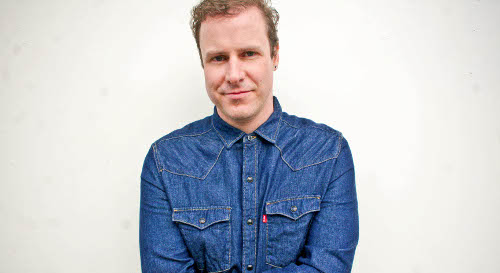
When I last spoke with filmmaker and Stanford assistant professor Jamie Meltzer, it was at the 2012 Guardian Local Outstanding Discovery (a.k.a. Goldie) awards ceremony. I selected him for that honor — the Goldies are meant to recognize up-and-coming artists who are making impressive work but haven’t yet gotten widespread recognition — based on the two documentaries of his I’d seen: 2003’s cult favorite Off the Charts: The Song-Poem Story, and 2012’s Informant, about a prickly activist-turned-FBI-informant-turned-Tea-Partier, which premiered at the 2012 San Francisco International Film Festival.

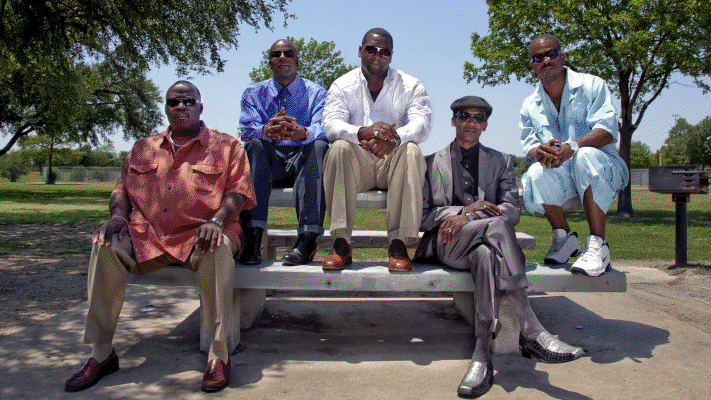
Well, chances are, that widespread recognition is soon to come Meltzer’s way. Informant was picked up by Music Box Films for distribution (look for it late summer or early fall in the Bay Area), and his latest project, Freedom Fighters, sounds highly promising: “The film follows three exonerated men from Dallas, with 57 years in prison served between them, as they start their own detective agency to look for innocent people who are still behind bars,” Meltzer wrote in an email late last week. “It’s a documentary detective film — a documentary noir, if you will.” (NPR broadcast a story about the men on April 16; listen here.)

I called him up to learn more, including details on the Kickstarter he just launched to help fund the next phase of shooting.

San Francisco Bay Guardian Sounds like you’ve been busy since the Goldies!

Jamie Meltzer I’m a little harried! Kickstarter is much more stressful than I realized. On top of teaching and actually trying to make the film, too, it’s like piling on this thing where you’re trying to promote the film. It’s a bit tricky.

SFBG Where are you in the process of making Freedom Fighters? What is the Kickstarter campaign for, exactly?

JM We’re a year into shooting. So that whole year was getting to know the guys, and them starting their first cases. And then, trying to come up with the trailer to fundraise, which is the Kickstarter.

The fun thing about it, and the challenge of it as a project, is that you’ve got to follow some cases all the way through. So, I think we have another year of shooting to be able to do that in a good way. The insurance of the project is that the [subjects] can kind of carry it on their own. Each of them has an amazing back story about they were wrongfully convicted, and about how they have transformed their lives since they got out — and they’ve only been out for a few years.

So I’m kind of relying in that, and realizing how big of a part of the story, at least the emotional part of the story, is: what does this do to you, to be in prison for 26 years, and how does that change you in negative and positive ways? I think that’s the kind of the core of the story.

SFBG After checking out the trailer, I got the sense that the subjects of Freedom Fighters were probably more amenable to being filmed than the subject of Informant was. Has it been a different experience getting to know them?

JM Totally. With almost every project I’ve done, I sort of gravitate to things early on and I’m not really sure why I’m gravitating toward it. In some senses, though, it’s always a reaction against the film that I did before. These guys are so fun to hang out with. Their lives are totally inspiring.

There’s some complexity to it that I hope to bring out in the story, but it’s also a very straightforward, inspirational story. It tells a lot of dark things about our justice system, but the guys themselves are super positive. That’s actually one of the things I responded to when I first met them. You’d think they’d be incredibly bitter after all this time in prison, but they figured out a way to turn this really bad situation into something that could be really positive: calling attention to the fact that this is a persistent problem, and trying to free people using their detective agency.

They do all sorts of other things, too, like they have an exoneree support group. When people come out in Dallas — which happens like once or twice a year, at least — these guys bring them into the fold. They support them when they come out, emotionally and sometimes financially, and they rely on one another, because no one else has had their experience.

The ideal of documentary is that you kind of parachute into these amazing circumstances among these amazing characters, and you just get to sort of be in their lives as long as you’re making the film. In the case of Informant, that had its challenges in terms of dealing with the subject. Other times, it’s just nothing but a pleasure, like with these guys.

SFBG When are you heading back down to Texas?

JM Well, there’s someone there [filming] right now; I’m pretty much going back and forth all the time. The reason we’re doing the Kickstarter right now is that they’re about to expand their roster of cases. We want to be able to follow all of those initially, and really hone in on the one most promising, interesting case that has something profound to say about wrongful convictions.

To me, it also doesn’t matter if they get someone off or not. That won’t be the point of the film. The point of the film is, by looking into these different cases, you kind of learn about how a wrongful conviction happens. Like, you see what happens to the eyewitness testimony. And through investigating these cases, you start to think about the larger problem. That said, I hope that they do get someone out!

SFBG Going back to Informant for a minute — it’s been exactly a year since the 2012 San Francisco International Film Festival, so getting picked up by a distributor must feel like coming full circle on that film.

JM It’s crazy how these deals can happen in so many different ways. The lifespan of a film is this weird thing that you don’t have a lot of control over. I’m really excited to bring Informant out to an audience in a theater — I think that’s the way films should be seen.

At the same time, I’m totally invested in this new film and kind of moving on. But obviously, I’m really excited about Informant being seen by more people.

Contribute to the Kickstarter (it ends May 10) and learn more about Freedom Fighters here!

At the hub

0

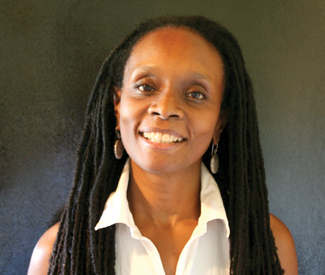
GREEN ISSUE Konda Mason is a yoga teacher, filmmaker, and producer. But above all she’s an activist, one of the most energetic Bay Area voices leading the effort to support sustainable practices in marginalized communities, and connect spiritual practice with real-world environmental action. Mason’s the co-director of the new HUB Oakland community-building center (www.huboakland.net), a partner in Earthseed Consulting, LLC (www.earthseedconsulting.com), which designs and promotes environmental projects with an emphasis on diversity, and a board member of the East Bay Meditation Center (www.eastbaymeditation.org). On Sat/20, she’s teaching at Spirit Rock Meditation Center’s Earth Day event, “Responses to Climate Change: Awareness, Action, and Celebration.” Last week, she spoke to me over the phone about connectivity, diversity, and the difference between “change” and “transformation.”

San Francisco Bay Guardian You’re both a yoga-meditation teacher and an environmental activist. How do these two aspects of your life intersect?

Konda Mason Yoga and meditation give you that time to pause and quiet the chatter in your head and connect to that place inside that is unchanging and feels connected to the whole. You feel the deep inner connectivity that you have with all things in those moments, that connection with all life.

SFBG One of your main efforts has been introducing the African American community to green practices.

KM Marginalized people in general are left out of every important conversation that affects them the most. It’s more about social economics than race. When we look at who is on the frontline of impact, it’s always the marginalized: women, children, youth, the poor, and people of color. I’m a filmmaker by trade, so when I became a part of Earthseed, the idea came to me to create an online series called “Green Street Loft,” a fun, accessible, and culturally relevant series for the African American audience. It hasn’t launched yet, but stay tuned.

SFBG Years ago, you were a founder of the International Association for Black Yoga teachers. Do you think diversity is increasing in the yoga community?

KM I do believe that people are seeing more and more diversity in general in areas around spiritual pursuits. These days, I also teach at Spirit Rock and help lead the annual People of Color meditation retreat. The thing to me that is lacking more than anything is men. Everything I do, the audience is always predominantly women! That is where the attention needs to be drawn.

SFBG And now you’re starting HUB Oakland. What is that?

KM The HUB is a global movement of people who are working on solutions to better the world. It’s a place where people can come and collaborate and meet each other and work together, a place for conversation and action to happen. It’s for social entrepreneurs, and for sustainable business ideas that need incubation to get to the next level. It exists on five different continents. San Francisco is the biggest and most successful HUB in the network. Now, HUB Oakland is starting.

SFBG How will HUB Oakland be different than other HUBs?

KM Every HUB takes on the personality of its city. HUB Oakland will probably be the most diverse HUB in the network in terms of ethnicity and ages. We will have workshops about personal growth and spiritual growth with people from Silicon Valley to Spirit Rock. Everybody is invited.

SFBG When will it open?

KM We have a building on Broadway between 23rd and 24th streets that we signed a lease on. We move there in October. It’s a 60,000-square foot space that is just beautiful. Until then, we’re in a pop-up place, a 2000-square foot old bank through the help of the City of Oakland and Popuphood (www.popuphood.com).

SFBG Tell us about the Earth Day event at Spirit Rock this weekend.

KM I’m looking forward to it. There will be some really key people there who are committed to environment and sustainability. The thing about this movement to “change the world” is that “change” and “transformation” are two different things. What’s lasting is transformation. It begins with the individual. We can window-dress something and make it look green, but if we haven’t transformed ourselves, it will revert back to the way it was. This is why the contemplative practices and wisdom traditions are so essential to sustainability. They foster change in the individual.

RESPONSES TO CLIMATE CHANGE

Sat/20, 9:30am-4:30pm, $25–$108 sliding scale

Spirit Rock

5000 Sir Francis Drake Blvd, Woodacre, Marin

www.spiritrock.org

Selector: April 17-23, 2013

0

WEDNESDAY 17

Night Beats

Seattle’s Night Beats has all of the fixings of a good psych-garage act; the lo-fi recordings, the raspy vocals with punctuated yelps, and the noisily manipulated guitar. But the band, which takes its name from Sam Cooke’s best record, has a direct link to the more soulful breeds of music the title suggests, such as R&B. “Dial 666” is simple, 12-bar blues, “High Noon Blues” borrows sentiment and structure from that genre, and “Puppet on a String” seems to call for some old-fashioned dance moves. With the combination of vigorous rock and sensuous roll, Night Beats’ show at Brick and Mortar promises to be satisfying. (Laura Kerry)

With Cool Ghouls, Primitive Hearts, Big Drag

9pm, $10

Brick and Mortar Music Hall

1710 Mission, SF

(415) 800-8782

www.brickandmortarmusic.com


Bad Religion

Mixing aggressive guitar riffs with politically-savvy lyrics and harmony-laden vocals — which the band refers to as “oozin’ aahs” in its liner notes — Southern California’s Bad Religion has been going strong for more than three decades. It just released latest album, True North on founding member Brett Gurewitz’ iconic independent label Epitaph Records last January. And the punk rock stalwarts continue to be driven by singer-author-professor Greg Graffin’s powerful songwriting, which touches on everything from global politics and religion to more personal experiences and emotions that just about anyone can relate to and share in a sense of powerful catharsis. (Sean McCourt)

With the Bronx, Polar Bear Club

8pm, $27.50–$30

Regency Ballroom

1300 Van Ness, SF

www.theregencyballroom.com


The 2 Bears

I don’t need caffeine. My computer just starts playing “Work” by the 2 Bears at 7am, complete with rising organ, a pulsing groove, and motivational chorus: “We’ve got to work harder, for the future, my love we got to work.” It might not even be the best song on Be Strong from the 2 Bears (Hot Chips’s Joe Goddard and the Raf Daddy), as it faces stiff competition from hilarious, cuddly club anthem “Bear Hug” and the uplifting, romantic space dub on “Church.” But, it does the job of getting me moving, and by the time the disco queen vocals kick in I’m likely showered and downstairs having breakfast. (Ryan Prendiville)

With Sleazemore, Richie Panic (Lights Down Low)

10pm, $15 presale

1015 Folsom, SF

www.1015.com


THURSDAY 18

“Touching Art: Tribute to Judith Scott”

Skin, the largest organ, keeps our insides safe from the perils of the outside, but it is also the membrane through which we experience the world. In its tribute to Judith Scott, swissnex will explore this, looking at touch’s role in the creation of art. Scott, who could neither speak nor hear and therefore relied heavily on her sense of touch, made beautiful cocoon structures at Oakland’s Creative Growth Art Center for 20 years. Swissnex, in conjunction with Switzerland’s L’Art Brut, will screen a film about the artist, showcase some of her work, and host a talk by Dr. Sandra Weiss on the connection between touch and emotion. The night promises be a touching intersection of art and science. (Kerry)

6pm, $10

swissnex

730 Montgomery, SF

(415) 912-5901

www.swissnexsanfrancisco.org


FRIDAY 19

An evening with Manlio Argueta

While a hard punishment, exile can also be the place where great works of art are born. “I left with a closed fist and came back with an open hand,” said Rafael Alberti returning to Spain after 38 years of exile. Ostracized in Mexico, Pablo Neruda finished one of his masterpieces Canto General. Exiled in Costa Rica, acclaimed Salvadorean poet Manlio Argueta wrote his most celebrated novel, One Day of Life (Vintage Book, 1983). In line with his mentor, poet Roque Dalton, Argueta vividly writes about the 12-year civil war through a peasant family’s eyes. The book, available in 15 languages, was named one of the best 10 novels in Spanish of the 20th century by NY’s Modern Library. (Fernando Andres Torres)

7pm $10

ANSWER

2969 Mission, SF

(415) 902-4754

www.manlioargueta.com


“We Are Winning, Don’t Forget: Short works by Jean-Gabriel Périot”

Jean-Gabriel Périot developed a painstaking approach to making films. By carefully stitching together archival images, both still and moving, he creates political narratives that are poignant despite (or because of) their brevity. As a part of a US tour that begins at New York’s Museum of Modern Art, the filmmaker comes to the Bay with nine short films, with subjects ranging from Hiroshima to “politics and tomatoes.” The evening at Artist’s Television Access presents a great opportunity to see these stunning films and the man behind the camera. (Kerry)

8pm, $10

Artist’s Television Access

992 Valenica, SF

(415) 824-3890

www.atasite.org


Sheetal Ghandi: Bahu Beti Biwis

Deconstructing cultural artifacts is just about today’s lingua franca. Sometimes you might wish that artists left well enough alone. Yet, at its best it shows creative minds at work that are willing to take the risks inherent in changing lenses. Sheetal Ghandi is one of them. Even though her performance practices are already exceptionally broad —Kathak, modern and West African dance, plus Broadway as well as Cirque du Soleil — she took a lot of imaginative leaps for her solo show Bahu Beti Biwis (Daughter-in-law, daughter, wife), a series of both humorous and poignant portraits of women and the roles traditionally assigned to them. It’s a piece that has been described as empathizing with “Indian women across time and space.” (Rita Felciano)

Fri/19-Sat/20, 8pm; Sun/21, 7pm, $20–$25

ODC Theater

3153 17th St., SF

(415) 863-9834

odctheater.org/buytickets.php


SATURDAY 20

Mishap Psychic Fair

Nothing will make sense on 420 anyway (unless you snagged tickets for Snoop Lion at the Fillmore, in which case: jealous), so you may as well go to the goofiest damn event you can find. Surely the Mishap Psychic Fair is in the running for the honorific — the (is it?) satirical set-up will feature tongue-in-cheek booths where you can align your crystals via rock opera, attune to your inner “sexy anger,” and temper it all with cocktails if you’re not too bleary-eyed from the traditional mode of celebration on this international holiday. Buy tix to the fair in advance and you’ll snag a complimentary photo of your aura, a so-called magic elixir, or henna tattoo. Heal thyself, hippie. (Caitlin Donohue)

Sat/20, 8pm, $10

Geoffrey’s Inner Circle

410 14th St., Oakl.

www.mishapproductions.com


The Last Unicorn screening and birthday celebration

And now for something completely magical: Peter S. Beagle, author of beloved 1968 fantasy novel The Last Unicorn (among dozens of other works), turns 74 today, and he’ll journey from his home in Oakland for a pair of birthday- and unicorn-themed San Francisco events. (Hooves up if you ever had a unicorn-themed birthday party! I know I did … maybe more than once.) First is a screening of the 1982 animated film adapted from the book, with voices by Mia Farrow, Jeff Bridges, and Alan Arkin; Beagle will be on hand to answer questions and sign books. Diehards can continue the festivities at the Cartoon Art Museum, which hosts a reading and further signings by the author, plus an auction of some mighty nifty original artwork to benefit the museum and Beagle’s imminent multi-city tour. Costumes are encouraged, obvi. (Cheryl Eddy)

Screening, noon-3pm, $8.50

Castro Theatre

429 Castro, SF

VIP reception, 6-8pm, $25

Cartoon Art Museum

655 Mission, SF

www.cartoonart.org


“Bill Frisell presents Hunter S. Thompson’s The Kentucky Derby

Jazz guitarist Bill Frisell has tackled many an avant-garde project in his 40-plus year career, and his latest foray beckons fans of music, stage, and literature. Bringing life to Hunter S. Thompson’s memorable “The Kentucky Derby is Decadent and Depraved” this weekend, Frisell will be joined by narrator Tim Robbins in a multimedia production featuring set design by the iconic writer’s longtime collaborator Ralph Steadman. Considered the first of Thompson’s pieces to truly reflect his “Gonzo” style of journalism, the story and production will no doubt envelop audience members in an aural and visual way never before experienced. Buy the ticket, take the ride. (McCourt)

Sat/20, 7:30pm; Sun/21, 4 and 7:30pm, $35–$80

SF Jazz Center

201 Franklin, SF

www.sfjazz.org


Maria Minerva

Minerva was the Roman goddess of wisdom. That’s what I’ve found out on Wikipedia. What I’ve found out about Estonian lo-fi electronic chanteuse Maria Minerva is that she’s an art school graduate/critic/glossolalia expert/comedy student. But, all I really know is that her Bless EP on 100% Silk is excellent. “Soulsearchin’,” focuses on the anxiety of options, built around George Carlin’s “Modern Man,” but it’s the laid-back guitar, slightly off-kilter percussion, and circling vocals on “Symbol of My Pleasure” that stay with me. (Prendiville)

With Butterclock (live), Marco De La Vega, and more

9pm, $10 presale

Public Works

161 Erie, SF

(415) 932-0955

www.publicsf.com


MONDAY 22

Oakland Veg Week

Perhaps you are deluged by the information regarding sustainable eating available today. This is completely understandable — at times, we feel as though we will surely perish under the mountainous weight of fair trade quinoa foisted upon us by Bay Area foodie culture. Luckily, Oakland Veg Week is going on, with its host of events meant to dispel myths about what to eat. Go on a farm field trip, take vegan cheese-making classes (both April 27), attend a talk by Paul Shapiro of the Humane Society on why eating animals is bad for the earth (April 25), snack your way through a delicious grand finale at the Lake Merritt Sailboat House (April 28), or check out the host of other, veg-friendly events this week. (Donohue)

Through April 28

Various Oakland locations

www.oaklandveg.com


The Guardian listings deadline is two weeks prior to our Wednesday publication date. To submit an item for consideration, please include the title of the event, a brief description of the event, date and time, venue name, street address (listing cross streets only isn’t sufficient), city, telephone number readers can call for more information, telephone number for media, and admission costs. Send information to Listings, the Guardian, 225 Bush, 17th Flr., SF, CA 94105; or e-mail (paste press release into e-mail body — no attachments, please) to listings@sfbg.com. Digital photos may be submitted in jpeg format; the image must be at least 240 dpi and four inches by six inches in size. We regret we cannot accept listings over the phone.

Let it roll

0

le.chicken.farmer@yahoo.com

It’s between the airport and the ballpark in Oakland: the Dry Ice Arena, home of the immediate Bay Area’s thrivingest inline roller hockey scene. There’s a parking lot in back, and a store where you can get you your gear: skates, shirts, helmets. They rent these, too.

Against the windowless outside wall of the building, as you walk along looking for a door, you will find an occasional walk-in rat trap, badly parked cars, and a plastic bag full of crackers, which I wanted very badly to stomp on but didn’t.

Inside, Giant Robot was squaring off with the first-place Gentlemen’s Club in the Sunday Silver League B2 semifinals. The Gentlemen’s Club, top seed going in, had beaten Giant Robot during the regular season. That’s all I knew.

It’s five on five — a goalie, two up, two back — and they have a rule that any player can only score three goals. Which rule came in handy for the Gentlemen’s Club, or they might have lost even worse than 12-3.

Giant Robot team captain Len Amaral, who missed the whole first period on account of Giants’ game traffic, said he didn’t feel comfortable with their lead until near the end of the game.

“They can score in a hurry,” he said. “They’re a fast, good team.”

When he saw 4-1 on the scoreboard coming into the arena, he said, he thought at first his team was losing.

Nah. It was never in doubt. Thanks to some great goalie work by LeMarr Mojica, who had about a gazillion saves, Giant Robot never let the Gentlemen’s Club feel anything other than frustrated.

They extended their lead to 5-1 early in the second period, and by the end of the period it was 8-3.

A nice thing about roller hockey: since it’s not on ice, the puck moves a little slower, or seems to at any rate, and is easier to follow.

Another nice thing: no fights.

Seriously, I don’t believe I’ve watched a whole hockey game since the USA vs. Russia in the 1980 Olympics. And one reason pro hockey has eluded me, fandomwise, is the fighting. Not that I’m a pacifist; it’s not even that I’m a “good sport.” It’s that most of the time, under all that armor, you can’t tell who’s winning.

I’ll have my boxing in a ring, thanks. Without shirts, when possible.

Amateur hockey, though. Roller hockey . . . fun to watch!

We decided to stay for the championship game, but were too hungry to sit through the other semi-final, which would determine Giant Robot’s opponent in the finals.

Dry Ice Arena has a snack bar, but all they have is frozen fried things and candy bars. In retrospect I wish we had stayed put, because the takeout Indian we scored down on International was even inedibler than chicken nuggets.

We should have known. There was a calendar on the wall next to the refrigerator of this joint (which shall remain nameless), and it was still set to March.

“I hope they pay better attention to expiration dates than they do calendar ones,” Hedgehog observed.

“Don’t worry,” I said. I’d seen him take our food out. Of the freezer. It wasn’t going to make us sick. It just wasn’t going to taste any good.

Plus we had to wait forever for it, so we missed the most exciting game of the tournament. Empty Net and Apuckalips went down to the wire, swapping goals in the closing minutes, and Empty Net won by one to advance.

Problem: they didn’t have any subs.

Roller hockey, like the icier kind, is an incredibly strenuous sport. They sub often, when they have them. And Empty Net went into the championship already exhausted.

Giant Robot scored first, and fast. Their initial goal came 14 seconds in, and that was all they’d need. For good measure, they added six more.

Final score: Giant Robot 7, Empty Net 0.

I was them, I’d give the game puck to Mojica. Not only did he pitch a shutout in the Championship game, but he’d skunked the Gentlemen’s Club the final period of the first game. Remember? That’s four straight scoreless quarters! For rec-league hockey, I think, that’s pretty impressive.

Can you skate?

The Dry Ice Arena has beginner leagues, youth and adult leagues, co-ed, and even pickup. Check it out.

Dry Ice Arena, www.dryicehockey.com

Indicator city

74

steve@sfbg.com

When biologists talk about the health of a fragile ecosystem, they often speak of an “indicator species.” That’s a critter — a fish, say, or a frog — whose health, or lack thereof, is a signal of the overall health of the system. These days, when environmentalists who think about politics as well as science look at San Francisco, they see an indicator city.

This progressive-minded place of great wealth, knowledge, and technological innovation — surrounded on three sides by steadily rising tides — could signal whether cities in the post-industrial world will meet the challenge of climate change and related problems, from loss of biodiversity to the need for sustainable energy sources.

A decade ago, San Francisco pioneered innovative waste reduction programs and set aggressive goals for reducing its planet-cooking carbon emissions. At that point, the city seemed prepared to make sacrifices and provide leadership in pursuit of sustainability.

Things changed dramatically when the recession hit and Mayor Ed Lee took office with the promise to focus almost exclusively on economic development and job creation. Today, even with the technology and office development sectors booming and employment rates among the lowest in California, the city hasn’t returned its focus to the environment.

In fact, with ambitious new efforts to intensify development along the waterfront and only lackluster support for the city’s plan to build renewable energy projects through the CleanPowerSF program, the Lee administration seems to be exacerbating the environmental challenge rather than addressing it.

According to conservative projections by the Bay Conservation and Development Commission, the Bay is expected to rise at least 16 inches by 2050 and 55 inches by the end of the century. BCDC maps show San Francisco International Airport and Mission Bay inundated, Treasure Island mostly underwater, and serious flooding the Financial District, the Marina, and Hunters Point.

Lee’s administration has commissioned a report showing a path to carbon reduction that involves promoting city-owned renewable energy facilities and radically reducing car trips — while the mayor seems content do the opposite.

It’s not an encouraging sign for Earth Day 2013.


HOW WE’RE DOING

Last year, the Department of the Environment hired McKinsey and Company to prepare a report titled “San Francisco’s Path to a Low-Carbon Economy.” It’s mostly finished — but you haven’t heard much about it. The department has been sitting on it for months.

Why? Some say it’s because most of the recommendations clash with the Lee administration’s priorities, although city officials say they’re just waiting while they get other reports out first. But the report notes the city is falling far short of its carbon reduction goals and “will therefore need to complement existing carbon abatement measures with a range of new and innovative approaches.”

Data presented in the report, a copy of which we’ve obtained from a confidential source, shows that building renewable energy projects through CleanPowerSF, making buildings more energy-efficient, and discouraging private automobile use through congestion pricing, variable-price parking, and building more bike lanes are the most effective tools for reducing carbon output.

But those are things that the mayor either opposes and has a poor record of supporting or putting into action. The easy, corporate-friendly things that Lee endorses, such as supporting more electric, biofuel, and hybrid vehicles, are among the least effective ways to reach the city’s goals, the report says.

“Private passenger vehicles account for two-fifths of San Francisco’s emissions. In the short term, demand-based pricing initiatives appear to be the biggest opportunity,” the report notes, adding a few lines later, “Providing alternate methods of transport, such as protected cycle lanes, can encourage them to consider alternatives to cars.”

Melanie Nutter, who heads the city’s Department of the Environment, admits that the transportation sector and expanding the city’s renewable energy portfolio through CleanPowerSF or some other program — both of which are crucial to reducing the city’s carbon footprint — are two important areas where the city needs to do a better job if it’s going to meet its environmental goals, including the target of cutting carbon emissions 40 percent from 1990 levels by the year 2025.

But Nutter said that solid waste reduction programs, green building standards, and the rise of the “shareable economy” — with Internet-based companies facilitating the sharing of cars, housing, and other products and services — help San Francisco show how environmentalism can co-exist with economic development.

“San Francisco is really focused on economic development and growth, but we’ve gone beyond the old edict that you can either be sustainable or have a thriving economy,” Nutter said.

Yet there’s sparse evidence to support that statement. There’s a two-year time lag in reporting the city’s carbon emissions, meaning we don’t have good indicators since Mayor Lee pumped up economic development with tax breaks and other city policies. For example, Nutter touted how there’s more green buildings, but she didn’t have data about whether that comes close to offsetting the sheer number of new energy-consuming buildings — not to mention the increase in automobile trips and other byproducts of a booming economy.

Tom Radulovich, executive director of Livable City and president of the BART board, told us that San Francisco seems to have been derailed by the last economic crisis, with economic insecurity and fear trumping environmental concerns.

“All our other values got tossed aside and it was all jobs, jobs, jobs. And then the crisis passed and the mantra of this [mayoral] administration is still jobs, jobs, jobs,” he said. “They put sustainability on hold until the economic crisis passed, and they still haven’t returned to sustainability.”

Radulovich reviewed the McKinsey report, which he considers well-done and worth heeding. He’s been asking the Department of the Environment for weeks why it hasn’t been released. Nutter told us her office just decided to hold the report until after its annual climate action strategy report is released during Earth Day event on April 24. And mayoral Press Secretary Christine Falvey told us, “There’s no hold up from the Mayor’s Office.”

Radulovich said the study highlights how much more the city should be doing. “It’s a good study, it asks all the right questions,” Radulovich said. “We’re paying lip service to these ideas, but we’re not getting any closer to sustainability.”

In fact, he said the promise that the city showed 10 years ago is gone. “Gavin [Newsom] wanted to be thought of as an environmentalist and a leader in sustainability, but I don’t think that’s important to Ed Lee,” Radulovich said.

Joshua Arce, who chairs the city’s Environmental Commission, agreed that there is a notable difference between Newsom, who regularly rolled out new environmental initiatives and goals, and Lee, who is still developing ways to promote environmentalism within his economic development push.

“Ed Lee doesn’t have traditional environmental background,” Arce said. “What is Mayor Lee’s definition of environmentalism? It’s something that creates jobs and is more embracing of economic development.”

Falvey cites the mayor’s recent move of $2 million into the GoSolar program, new electric vehicle charging stations in city garages, and his support for industries working on environmental solutions: “Mayor Lee’s CleantechSF initiative supports the growth of the already vibrant cleantech industry and cleantech jobs in San Francisco, and he has been proactive in reaching out to the City’s 211 companies that make up one of the largest and most concentrated cleantech clusters in the world.”

Yet many environmentalists say that simply waiting for corporations to save the planet won’t work, particularly given their history, profit motives, and the short term thinking of global capitalism.

“To put it bluntly, the Lee administration is bought and paid for by PG&E,” said Eric Brooks with Our City, which has worked for years to launch CleanPowerSF and ensure that it builds local renewable power capacity.

The opening of the McKinsey report makes it clear why the environmental policies of San Francisco and other big cities matter: “Around the globe, urban areas are becoming more crowded and consuming more resources per capita,” it states. “Cities are already responsible for roughly seventy percent of global carbon dioxide emissions, and as economic growth becomes more concentrated in urban centers, their total greenhouse gas emissions may double by 2050. As a result, tackling the problem of climate change will in large part depend on how we reduce the greenhouse gas emissions of cities.”

And San Francisco, it argues, is the perfect place to start: “The city now has the opportunity to crystallize and execute a bold, thoughtful strategy to attain new targets, continue to lead by example, and further national and global debates on climate change.”

The unwritten message: If we can’t do it here, maybe we can’t do it anywhere.


ON THE EDGE

San Francisco’s waterfront is where economic pressures meet environmental challenges. As the city seeks to continue with aggressive growth and developments efforts on one side of the line — embodied recently by the proposed Warriors Arena at Piers 30-32, 8 Washington and other waterfront condo complexes, and other projects that intensify building along the water — that puts more pressure on the city to compensate with stronger sustainability initiatives.

“The natural thing to do with most of our waterfront would be to open it up to the public,” said Jon Golinger, who is leading this year’s referendum campaign to overturn the approval of 8 Washington. “But if the lens you’re looking through is just the balance sheet and quarterly profits, the most valuable land maybe in the world is San Francisco’s waterfront.”

He and others — including SF Waterfront Alliance, a new group formed to oppose the Warriors Arena — say the city is long overdue in updating its development plan for the waterfront, as Prop. H in 1990 called for every five years. They criticize the city and Port for letting developers push projects without a larger vision.

“We are extremely concerned with what’s happening on our shorelines,” said Michelle Myers, director of the Sierra Club’s Bay Chapter, arguing that the city should be embracing waterfront open space that can handle storm surge instead of hardening the waterfront with new developments. “Why aren’t we thinking about those kinds of projects on our shoreline?”

David Lewis, director of Save the Bay, told us cities need to think less about the value of waterfront real estate and do what it can to facilitate the rising bay. “There are waterfront projects that are not appropriate,” Lewis said. Projects he puts in that category range from a scuttled proposal to build around 10,000 homes on the Cargill Salt Flats in Redwood City to the Warriors Arena on Piers 30-32.

“We told the mayor before it was even announced that it is not a legal use of the pier,” Lewis said, arguing it violated state law preserving the waterfront for maritime and public uses. “There’s no reason that an arena has to be out on the water on a crumbling pier.”

But Brad Benson and Diana Oshima, who work on waterfront planning issue for the Port of San Francisco, say that most of San Francisco’s shoreline was hardened almost a century ago, and that most of the planning for how to use it has already been done.

“You have a few seawall lots and a few piers that could be development sites, but not many. Do we need a whole plan for that?” Benson said, while Oshima praises the proactive transportation planning work now underway: “There has never been this level of land use and transportation planning at such an early stage.”

The Bay Conservation and Development Commission was founded almost 50 years ago to regulate development in and around the Bay, when the concern was mostly about the bay shrinking as San Francisco and other cities dumped fill along the shoreline to build San Francisco International Airport, much of the Financial District, and other expansive real estate plans.

Now, the mission of the agency has flipped.

“Instead of the bay getting smaller, the bay is getting larger with this thing called sea level rise,” BCDC Executive Director Larry Goldspan said as we took in the commanding view of the water from his office at 50 California Street.

A few years ago, as the climate change predictions kept worsening, the mission of BCDC began to focus on that new reality. “How do we create a resilient shoreline and protect assets?” was how Goldspan put it, noting that few simply accept the inundation that BCDC’s sea level rise maps predict. “Nobody is talking about retreating from SFO, or Oakland Airport, or BART.”

That means Bay Area cities will have to accept softening parts of the shoreline — allowing for more tidal marshes and open space that can accept flooding in order to harden, or protect, other critical areas. The rising water has to go somewhere.

“Is there a way to use natural infrastructure to soften the effect of sea level rises?” Goldspan asked. “I don’t know that there are, but you have to use every tool in the smartest way to deal with this challenge.”

And San Francisco seems to be holding firm on increased development — in an area that isn’t adequately protected. “The seawall is part of the historic district that the Port established, but now we’re learning the seawall is too short,” Goldspan said.

BCDC requires San Francisco to remove a pier or other old landfill every time it reinforces or rebuilds a pier, on a one-to-one basis. So Oshima said the district is now studying what it can remove to make up for the work that was done to shore up Piers 23-27, which will become a new cruise ship terminal once the America’s Cup finishes using it a staging ground this summer.

Yet essentially giving up valuable waterfront real estate isn’t easy for any city, and cities have both autonomy and a motivation to thrive under existing economic realities. “California has a history of local control. Cities are strong,” Goldspan said, noting that sustainability may require sacrifice. “It will be a policy discussion at the city level. It’s a new discussion, and we’re just in the early stages.”


NEW WORLD

Global capitalism either grows or dies. Some modern economists argue otherwise — that a sustainable future with a mature, stable economy is possible. But that takes a huge leap of faith — and it may be the only way to avoid catastrophic climate change.

“In the world we grew up in, our most ingrained economic and political habit was growth; it’s the reflex we’re going to have to temper, and it’s going to be tough.” Bill McKibben writes in Eaarth: Making a Life on a Tough New Planet. “Across partisan lines, for the two hundred years since Adam Smith, we’ve assumed that more is better, and that the answer to any problem is another burst of expansion.”

In a telephone interview with the Guardian, McKibben discussed the role that San Francisco could and should be playing as part of that awakening.

“No one knows exactly what economy the world is moving toward, but we can sense some of its dimensions: more localized, less material-based, more innovative; these are things that San Francisco is good at,” he told us, noting the shift in priorities that entails. “We need to do conservation, but it’s true that we also need to build more renewable power capacity.”

Right now, CleanPowerSF is the only mechanism the city has for doing renewable energy projects, and it’s under attack on several fronts before it even launches. Most of the arguments against it are economic — after all, renewable power costs more than coal — and McKibben concedes that cities are often constrained by economic realities.

Some city officials argue that it’s more sustainable for San Francisco to grow and develop than suburban areas — thus negating some criticism that too much economic development is bad for the environment — and Radulovich concedes there’s a certain truth to that argument.

“But is it as green as it ought to be? Is it green enough to be sustainable and avert the disaster? And the answer is no,” Radulovich said.

For example, he questioned, “Why are we building 600,000 square feet of automobile-oriented big box development on Hunters Point?” Similarly, if San Francisco were really taking rising seas seriously, should the city be pouring billions of dollars into housing on disappearing Treasure Island?

“I think it’s a really interesting macro-question,” Jennifer Matz, who runs the Mayors Office of Economic Development, said when we asked whether the aggressive promotion of economic development and growth can ever be sustainable, or whether slowing that rate needs to be part of the solution. “I don’t know that’s feasible. Dynamic cities will want to continue to grow.”

Yet that means accepting the altered climate of new world, including greatly reduced fresh water supplies for Northern California, which is part of the current discussions.

“A lot of the focus on climate change has moved to adaptation, but even that is something we aren’t really addressing,” Radulovich said.

Nutter agreed that adapting to the changing world is conversation that is important: “All of the development and planning we’re doing today needs to incorporate these adaptation strategies, which we’re just initiating.”

But environmentalists and a growing number of political officials say that San Francisco and other big cities are going to need to conceive of growth in new ways if they want to move toward sustainability. “The previous ethos was progress at any cost — develop, develop, develop,” Myers said, with the role of environmentalists being to mitigate damage to the surrounding ecosystem. But now, the economic system itself is causing irreversible damage on a global level. “At this point, it’s about more than conservation and protecting habitat. It’s about self-preservation.”

Alerts

0

WEDNESDAY 24

Forum: Art and politics with Rebar 518 Valencia, SF. rebargroup.org. 7:30-10:30pm, free. Operating in San Francisco since 2004, Rebar has been transforming cities with urban art and creative actions with an aim toward reclaiming the city by and for citizens themselves. Join founder and principal Blaine Merker for a discussion exploring how people both inside and outside positions of power can help the city benefit from urban art and other creative actions.

THURSDAY 25

Protest Gap sweatshops Gap Headquarters, 2 Folsom, SF. laborrights.org/gappetition. Noon, free. Call on the Gap to pay 10 cents more per garment and to join a fire safety agreement to improve conditions in their overseas garment factories. Sumi Abedin, a Bangladeshi garment worker who survived a factory fire that killed 112 workers producing garments for Walmart, and Bangladeshi labor organizer Kalpona Akter will attend this action. Sponsored by Corporate Action Network, International Labor Rights Forum, San Francisco Jobs with Justice, SumOfUs, SweatFree Communities, and United Students Against Sweatshops.

Muslim women’s transformative activism panel California Institute of Integral Studies, 1453 Mission, SF. tinyurl.com/ciismuslimwmn. 7-9pm, $15. RSVP. Facilitated by Dr. Anshu Chatterjee, this panel aims to spotlight the activism of Muslim women. Panelists include Samina Ali, a novelist, feminist organizer and curator of the International Museum of Women; Ghazala Anwar, a pioneer in the movement of LGBTIQ Muslims, and Jane Sloane, Vice President of Programs at Global Fund for Women.

FRIDAY 26

“Pipeline Paradigm” panel Commonwealth Club, 595 Market, SF. tinyurl.com/pipelinepdgm. 11:30am, $20 or $7 for students. Hosted by Climate One, this talk on the Keystone XL pipeline will focus on why the controversial oil pipeline project has inspired “the largest expression of civil disobedience since the Civil Rights movement of the 1960s.” Featuring Sam Avery, author of The Pipeline and the Paradigm, and others in a conversation about climate and activism.

Conference: Socialism versus capitalism Niebyl Proctor Marxist Library, 6501 Telegraph Ave. Oakl. sfsocialistaction@gmail.com, 510-268-9429. 7pm, $5-$10. This three day event will feature a host of speakers exploring socialist theory, attacks on civil liberties, and movements against the corporate elite.

SATURDAY 27

Annual Walk Against Rape The Women’s Building, 3543 18th St, SF. www.sfwar.org/walk. 11am, free. Registration required. Join the movement against sexual violence by participating in the Walk Against Rape. Registration begins at 10am. Followed by a festival from 1-3pm featuring dance, spoken word and musical performances.

SUNDAY 28

Public forum on education and the forces of gentrification San Francisco Community School, 125 Excelsior, SF. www.politicaleducation.org. 3-6pm, free. Pauline Lipman, an activist scholar and organizer with Teachers for Social Justice in Chicago, will lead a dialogue on the intersection between school closures, the attacks on City College of San Francisco, and the forces of gentrification.


Silent sting

12

rebecca@sfbg.com

If the FBI is trying to track down a suspect in your neighborhood, investigators could sweep up information from your mobile device just because you happen to be nearby.

It’s been going on for years with little public notice or attention.

Records obtained through the Freedom of Information Act request shed new light on a surveillance device known as a Stingray that allows law enforcement to automatically collect cell phone data from potentially hundreds of subscribers in a given area — even when the vast majority of those affected have nothing to do with the criminal investigation at hand.

The documents came in response to an FOIA request from the Bay Guardian and the Northern California Chapter of the American Civil Liberties Union.

Stingray is a brand name; the devices might also be known as a Triggerfish, a digital analyzer, a cell site emulator, or an IMSI catcher, the latter being a technical term describing the gadget’s ability to detect International Mobile Subscriber Identities. It essentially behaves like cell phone tower, putting out a strong signal that tricks mobile devices into connecting automatically.

If there are 200 cell phone customers in an area where it’s being deployed, all of their phones will automatically connect to the device.

Once cell phones are talking to the Stingray, the device scoops up digital information and uses it to help agents ferret out their target. Some Stingrays have the capability to capture actual content — texts or telephone conversations — while others act like eyes and ears that can guide police to the precise geographic location of a targeted suspect, even within a couple meters.

And it doesn’t even require a warrant.

“You can operate it without having to involve the cell phone providers at all,” Peter Scheer, executive director of the California First Amendment Coalition, told us. His organization helped a journalist obtain records about the Los Angeles Police Department’s use of Stingrays.

“The service providers, while they don’t stand as a major barrier, tend to insist on police having some kind of judicial authorization,” Scheer said. “It has been an important check on police use of these technologies.”

MANY AGENTS USING IT

The FBI initially refused to provide the documents, but after the ACLU filed suit, the U.S. Attorney for the Northern District of California finally released some information, including a particularly juicy set of internal emails documenting federal agents’ use of these devices.

In one of the emails, Criminal Division Chief Miranda Kane wrote: “Our office has been working closely with the magistrate judges in an effort to address their collective concerns regarding whether a pen register is sufficient to authorize the use of law enforcement’s WIT technology … to locate an individual.”

(“WIT technology” is described as a box that simulates a cell tower and can be placed inside a van to help pinpoint an individual’s location with some specificity.”)

Kane added: “Many agents are still using [this] technology in the field although the pen register application does not make that explicit.” In a clarifying email sent later on the same thread, Assistant U.S. Attorney Kyle Waldinger noted: “Just to be super clear, the agents may not use the term ‘WIT’ but rather may be using the term … ‘Stingray.'”

Kane’s reference to a “pen register application” describes a request for court approval to use an investigative tactic that can trace the outgoing numbers dialed from a particular phone. While Stingrays can potentially sweep in hundreds of cell phone customers’ information, pen-register wiretaps focus narrowly on the digits being punched in by one individual.

The US Supreme Court ruled in 1979 that the use of a pen register is “not a search under the Fourth Amendment,” Susan Freiwald, a law professor at the University of San Francisco, told us. That means law-enforcement agents don’t need a full-scale search warrant. And court orders permitting pen-register wiretaps are “really easy to get,” Friewald explained.

To secure a judge’s blessing, law enforcement agents need only to submit complete applications and show that the phone numbers dialed are “relevant” to an investigation.

Kane’s email, dated in 2011, is significant because it suggests that “many agents” were using Stingrays for investigations after clearing only the low hurdle of court approval for a pen register. “The federal government was routinely using Stingray technology in the field, but failing to make that explicit in its applications to the court to engage in electronic surveillance,” ACLU Staff Attorney Linda Lye wrote in a recent blog post. “When the magistrate judges in the Northern District of California finally found out what was happening, they expressed ‘collective concerns,’ according to the emails.”

The revelation is closely tied to an electronic surveillance case that’s currently making its way through court, most recently prompting the ACLU and the Electronic Frontier Foundation to file an amicus brief challenging the constitutionality of a Stingray use.

TRACKING A HACKER

It all began back in 2008, when FBI agents used the technology to track down a hacker and alleged fraudster named Daniel David Rigmaiden — a guy who sometimes goes by an alias, represented himself in court, and seems to possess enough technical savvy and disposable income to challenge his prosecutors at every turn.

Through discovery proceedings, Rigmaiden “managed to get the government to admit that it has used this location tracking technology to find him,” Lye noted. “That is quite extraordinary, because there have been suspicions that that this device has been around and in use for quite a long time, but there are really very few cases where we talk about it, and this is the only criminal case where the government has plainly admitted to using it to locate a suspect.”

Because FBI agents used a Stingray to locate Rigmaiden, they not only figured out that he was inside a Santa Clara apartment building, but successfully sniffed down to the level of his exact unit.

But the request for court orders that authorized this investigation made only a fleeting mention of a mobile tracking device, without conveying just how powerful the surveillance tool actually is. “When we read the orders, we were very, very surprised and troubled,” Lye said. “Because the government was arguing in the criminal proceeding in Rigmaiden, yes, we acknowledge that we’ve used this cell site emulator, and we’re even … acknowledging that the device is intrusive enough in the way it operates to constitute a search — which is a significant concession.”

In this case, the FBI agents obtained a court order to use a pen register, and separately obtained court approval to solicit Verizon’s help in locating Rigmaiden, which the government claims constituted a warrant (though this is a point of contention). But nowhere did agents make it clear to the judge that in order to work, this surveillance device vacuums up vast amounts of third-party data. The search potentially affected hundreds of subscribers in Rigmaiden’s apartment complex, none of whom were suspected of any involvement in wrongdoing. The government noted in court filings that it purged the third-party data after the fact, presumably as a way to deflect privacy concerns.

“It did not explain that the device broadcasts signals to all devices in the area, receives information about other devices in the possession of third parties, potentially disrupts the connections of third-party devices, and penetrates the walls of every private residence in the vicinity, not solely that of the target,” the ACLU-EFF brief argues.

At the end of March, Lye argued in an Arizona federal court hearing that evidence gathered using a Stingray should be suppressed in the Rigmaiden case, because the government used the tracking tool but failed to tell the federal magistrate judge that it was doing so. But in the course of that hearing, “the government stated … that ‘use of these devices is a very common practice,'” Lye note in an update following the hearing. “It also stated that there were many parts of the country in which the FBI successfully obtains authorization to use this device through a trap and trace [pen register] order.”

Nor is it just federal agencies that use these surveillance tools. The results of a FOIA request filed by a Los Angeles journalist with the assistance of the First Amendment Coalition revealed that LAPD used this technology in 21 out of 155 cell phone investigation cases — from June to September of last year alone. The devices were used to investigate five homicide cases and a roster of other offenses, including a burglary, a narcotics investigation, two suicides, a robbery and three kidnappings.

For civil liberties advocates, the aim is to require stronger judicial oversight and a warrant before this kind of surveillance practice can be used. “The argument here is about, well this technology is so powerful and so intrusive — it really needs to be under extensive oversight by members of the judiciary,” notes Friewald, the law professor. “And in order for that to happen, the judge needs to have that technology described to them.”

Rambling man

1

arts@sfbg.com

FILM Terrence Malick has had an extraordinary career for a Hollywood hermit making art-house films in an industry that finds him commercially irrelevant and artistically erratic at best. Even his consensus-agreed best movies are the kind that alienate many potential Oscar voters — too abstract, too ambiguous, too poetical, too “European” — so the potential prestige involved is of a marginal critical- and cineaste-appealing stripe no sane US producer would hitch his or her wagon to at this point. Yet Malick’s movies cost money — a lot of money — and it doesn’t all come from international companies willing to take a loss if they can take home some modest returns and major cred toward their next artistic investments.

In a way, it should be a source of joy that Malick keeps getting to make large, personal, indulgent, un-commercial movies when almost no one else does. Other mainstream US filmmakers have had their intellectually or artistically ambitious follies (see: 2006’s Southland Tales and The Fountain, or 1980’s Heaven’s Gate), but they’re generally allowed just one. No one else has had the long ride Malick has. He is indeed a poet, a visionary — but has he ever had more than passages of brilliance? Are the actors and producers who treat him with awe as some exotic shaman actually enabling art, or mostly high-flown pretensions toward the same?

To the Wonder does provide some answers to those thorny questions. But they’re not the answers you’ll probably want to hear if you thought 2011’s The Tree of Life was a masterpiece. If, on the other hand, you found it a largely exasperating movie with great sequences, you may be happy to be warned that Wonder is an entirely excruciating movie with pretty photography. For all but the diehards, it could be a deal-breaker — the experience that makes you think you might very possibly never want to see another by this filmmaker again.

The one movie in which Malick’s variably over-the-top compassion, philosophy, idolatry of nature, and generally spellbound-by-beauty instincts were best supported was 1998’s The Thin Red Line, an abrupt return to activity after two decades’ complete absence. No matter that the reeling narrative bore limited resemblance to James Jones’ novel, or that Adrien Brody’s leading role got almost entirely cut out — he wouldn’t be first or last to cry foul at a Malick edit drastically altered from the original screenplay. To the Wonder apparently employed the talents of Jessica Chastain, Michael Sheen, and Rachel Weisz — all of whom ended up on the cutting room floor. To make room for … what? A movie that could have been wholly shot by the second unit, for all its interest in actual character, narrative, insight, and acting.

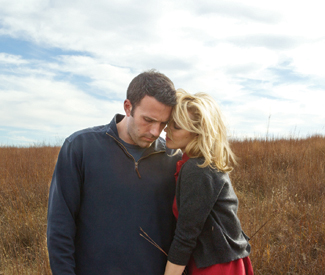
Instead, we get handsome shots of Ben Affleck and Olga Kurylenko (or sometimes Affleck and Rachel McAdams) wandering around picturesque settings either beaming beatifically at each other or looking “troubled” because “something is missing,” as one character puts it in a rare moment of actual dialogue. (Generally we get the usual Malick wall-to-wall whispered voiceover musings like “What is this love that loves us?” delivered by all lead actors in different languages for maximum annoyance.)

Just what is missing? Who the hell knows. Apparently it is too vulgar to spell out or even hint at what’s actually going on in these figures’ heads, not when you can instead show them endlessly mooning about as the camera follows them in a lyrical daze. The “plot” goes like this: Neil (Affleck) meets Parisienne Marina (Kurylenko) and her 10-year-old daughter from a failed marriage. They swan about Europe making goo-goo eyes at each other, then mother and child accompany him back to Oklahoma, but it doesn’t work out. Which allows him an interlude to get involved with old flame Jane (McAdams), but that doesn’t work out. Then Olga returns and … just guess. Meanwhile, Javier Bardem turns up as a Catholic priest, playing the Sean Penn Tree of Life role of a peripheral figure that does absolutely nothing but walk around looking bummed.

These people aren’t enigmas, they’re just blanks the actors can’t fill in because the writer-director won’t let them. He wants to express pure emotion, but emotions have contexts, too, much as Malick might like to think that women are all organic instinct. When Sissy Spacek spoke vacant “poetry” and ignored her (murderous) man Martin Sheen’s faults in 1973’s Badlands, it seemed her youthful inexperience was meant to be humorous. But since his career restarted, Malick has suggested dumb ‘n’ ethereal is his feminine ideal. Kurylenko is the apotheosis of that image: she’s part naked sex puppet; part indulged toddler who knows the adults think everything she does is adorable; part twirly-dancing girl at a Dead show; part family dog that only wants to be loved and played with.

Apparently, Malick thinks he’s celebrating femininity, but his appreciation omits the possibility of intelligence. He thinks women are marvelous, instinctual animals, while men bear the burden of emotional and intellectual complexity, even if they can’t articulate it. Could anything be more condescending? (To the Wonder was autobiographically inspired by his own failed marriage to a Frenchwoman; I’d rather see the movie she’d have made about it.)

No doubt some will find all this profound, because they’re primed to and the film certainly acts as though it is. But at some point you have to ask: if the artist can’t express his deep thoughts, just indicate that he’s having them, how do we know he’s a deep thinker at all? 


TO THE WONDER opens Fri/12 in Bay Area theaters.

Mayor Lee’s trip to China raises questions of ethics and influence

86

[UPDATED(x3)] Mayor Ed Lee barely had time to unpack from his recent political junket to Paris before he was off on his current trip to China – both of which were paid for and accompanied by some of his top political supporters and among the city’s most influential power brokers. No wonder Lee doesn’t have time to weigh in on Airbnb’s tax dodge, the condo conversion stalemate, or other important city issues.

Local good government advocate Charles Marsteller learned of the current China trip from Willie Brown’s column in Sunday’s San Francisco Chronicle, whose editors (including Editor Ward Bushee, who we’re still waiting to hear back from about this trip) consider it a “man about town” column immune from conflict-of-interest policies that normally require journalists to disclose who is paying them on the side.

“I’m here with Mayor Ed Lee for my seventh official visit,” Brown cheerfully wrote, although readers were left to wonder just what official business Brown might be conducting with our mayor and his entourage. So, being an expert on political disclosure laws, Marsteller went down to the Ethics Commission to pull the Form SFEC-3.216(d) that state law requires elected officials to file before leaving on trips paid for by outside interests.

But it wasn’t there, so Marsteller filed an official complaint with the commission, telling us, “I did so to impress upon our Elected and other City Officials the need to properly report gifts in a timely way and in the manner as called for by State law and on the forms provided by the SF Ethics Commission.” 

When we contacted mayoral Press Secretary Christine Falvey, she forwarded us a copy of the form that should have been filed before the trip and told us, “I’m not going to answer the question about why we failed to file the appropriate forms with the Ethics Commission, as we worked closely with the City Attorney’s office to exceed reporting requirements by all appropriate deadlines.” [UPDATE: The time stamp on the form indicated it was filed on May 25, before the trip, even though it wasn’t publicly available at the Ethics Commission office when Marsteller went down to look for it].

The form indicates that Lee’s portion of the trip was paid for by the San Francisco Chinese Chamber of Commerce, whose influential leader Rose Pak conspired with Brown to get Lee appointed mayor more than two years ago. This is also the same Rose Pak who was admonished by the state’s Fair Political Practices Commission for illegally funding another political junket to China in 2009 with Sups. David Chiu and Eric Mar and then-Sup. Carmen Chu, who Lee appointed as Assessor earlier this year.

Those officials were forced to repay the expenses after the FPPC found that Pak, that time acting under the auspices of the Chinese New Year Festival Committee, was not allowed to make gifts exceeding $420 per official that year. “Please be advised that since the Chinese New Year Festival Committee is not an organization that falls under Section 501(c)(3) of the Internal Revenue Code, no public official may accept gifts of any type from this organization valued in excess of the applicable limit,” FPPC counsel Zachary Norton wrote in an Aug. 22, 2011 enforcement letter to Pak.

In other words, because this committee and “other 501(c)(6) chamber of commerce organization[s]” are in the business of actively lobbying top elected officials for favorable policies, rulings, and projects, they are barred by ethics law from giving them the gifts of big overseas political junkets. As Marsteller noted in his complaint letter, violations are punishable by fines of $5,000 per violation, or if they are “willful violations of the law” – which doing the same thing you were sanctioned for just two years ago certainly might be considered – the criminal penalties are $10,000 per violation or up to a year in jail.

Mayor Lee’s portion of the trip cost the Chamber $11,970, according to the form. But this time, to get around the FPPC restrictions, Pak seems to have passed the hat among various business elites to fund the trip. The mayor’s form shows that 41 people paid up to the current gift limit of $440 “to defray the cost of the mayor’s trip.”

They include Pak, Brown, four people from Kwan Wo Construction, three from American Pacific International Capital, two each from Boyett Construction, Young Electric, and Bel Builders, Harbor View Holdings Director Gorretti Lo Lui, and SF Immigration Rights Commissioner Sonya Molodetskaya – most of whom were also part of the trip’s 43-member delegation.

Among others who tagged along for the trip are Public Works Director Mohammed Nuru (who has a history of political corruption under Mayors Brown and Newsom and no clear business being on a Chinese trade delegation, but who doesn’t love a free trip?!), Kofi Bonner from Lennar Home Builders, Harlan Kelly with the SFPUC, Jay Xu with the Asian Art Museum, the wives of Lee and Bonner, Kandace Bender with San Francisco International Airport, and Mark Chandler with the Mayor’s Office of International Trade and Commerce.

It’s not clear who paid for those other public officials or even what they were doing there. [UPDATE: Department of Public Works spokesperson Rachel Gordon told us that Nuru paid for the trip himself, but that he’ll be studying China’s instrastructure, from its separated bikesways to greening of public rights-of-way, as well as meeting with Chinese businesses involved in the redevelopment of Hunter’s Point. “He’s been looking at a lot of the infrastructure in China,” Gordon said. “I expect a dozen if not more ideas when he returns.”] Then again, it also wasn’t clear why venture capitalist Ron Conway – Lee’s top campaign fundraiser and possible reason for publicly subsidizing big tech companies, including many that Conway funds – joined and helped sponsor Lee’s recent trip to Paris. This is just how business gets done in San Francisco.

“Willie Brown is the former Mayor of San Francisco,” Falvey told us when we asked why Brown was on the trip and what its purpose was. “The purpose of the trip is to promote San Francisco, its local manufacturing, cultural exchanges, he is signing an MOU and meeting with high level, new Chinese government officials.”

[UPDATE 4/5: Marsteller has withdrawn his complaint from the Ethics Commission alleging the mayor’s form wasn’t filed on time, but he and another citizen have filed separate complaints with the FPPC alleging the trip and its funding mechanism may violate the agency’s 2011 ruling against Pak.]

Feds’ use of spy tools under scrutiny due to privacy concerns

If the FBI is trying to pinpoint the location of a suspect in your neighborhood, investigators could sweep up information from your mobile device just because you happen to be in proximity to their target. Civil liberties advocates are concerned that the practice is a major invasion of privacy.

The results of a Freedom of Information Act request filed by the Northern California chapter of the American Civil Liberties Union (ACLU) and the San Francisco Bay Guardian last year sheds new light on the federal government’s use of Stingrays, a surveillance technology that mimics a cellphone tower by automatically connecting with mobile devices in the area where a search is being conducted.

Stingray is a brand name, but the devices are sometimes called Triggerfish, digital analyzers, or cell site emulators. They’re known to technologists as IMSI catchers, meaning they can intercept a user’s International Mobile Subscriber Identity.

As the ACLU of Northern California noted recently in a blog post, Department of Justice emails obtained in response to the FOIA request, filed with the US Attorney’s Office of the Northern District of California, revealed that federal agents who sought authorization to conduct searches using this technology were “less than forthcoming” about what the devices actually do.

The issue stems from federal investigators’ request for a search warrant several years ago targeting Daniel Rigmaiden, a hacker accused of committing fraud. The search was authorized, but it seems agents never explained just how wide a net they intended to cast.

Because FBI agents used an IMSI catcher rather than, say, triangulation techniques that can utilize subscriber data to find their target, they were able to pinpoint Rigmaiden’s precise location – not only revealing that he was inside a Santa Clara apartment building, but sniffing down to the level of his exact unit. 

But when a search of this kind is conducted, a Stingray automatically connects with every other mobile device in the immediate vicinity that uses the same provider (in this case, Verizon). It works by masquerading as a cell phone tower, tricking mobile devices into automatically communicating with the spy device. So any other Verizon subscribers who happened to be nearby also had their information caught up in the FBI’s net.

There are various kinds of IMSI catchers, and some are capable of sweeping in the contents of communication, such as text messages. In the Rigmaiden case, investigators said were only able to access subscriber information. Investigators also reported that they “purged” unneeded data after the fact, according to ACLU staff attorney Linda Lye. But purging the data also makes it impossible to prove that the information of particular individuals was wrongfully swept up in a search. 

The FOIA request was filed in April of last year. Last July, after the government failed to provide the information, a lawsuit was filed to get the documents.  

The string of emails that was finally provided suggests that federal agents have been using this sort of technology in the field for some time, without clearly representing to judges that Stingrays can vacuum up third party communications data. Instead of being explicit on this point, agents from the Department of Justice merely stated that they wanted to use a mobile tracking device.

“It has recently come to my attention that many agents are still using [IMSI catchers] in the field although the pen register application does not make that explicit,” notes an internal Department of Justice email obtained through the FOIA request, referring to a different kind of search technique that is more narrowly targeted. 

Lye drilled down on this point in her blog post:

“The federal government was routinely using stingray technology in the field, but failing to ‘make that explicit’ in its applications to the court to engage in electronic surveillance. When the magistrate judges in the Northern District of California finally found out what was happening, they expressed ‘collective concerns,’ according to the emails. Notably, this email chain is dated May 2011, some three years after the Stingray’s use in Rigmaiden’s case – meaning the government was not ‘forthright’ in its applications to federal magistrate judges for at least three years.”

After battling for months in court in a separate proceeding, the ACLU of Northern California also succeeded in unsealing the Northern District DOJ orders that authorized use of the surveillance devices. Now, the civil liberties advocates are partnering with the Electronic Frontier Foundation and other groups to file an amicus brief concerning the constitutional implications of using a Stingray to collect evidence in the Rigmaiden case. “Their use implicates the privacy interests of the suspect, as well as untold numbers of third parties as to whom there is no probable cause,” the lawyers argue.

“When we read the orders, we were very, very surprised and troubled,” Lye noted in a recent conversation with the Guardian. “Because the government was arguing in the criminal proceeding in Rigmaiden, yes, we acknowledge that we’ve used this cell site emulator, and we’re even … acknowledging that the device is intrusive enough in the way it operates to constitute a search – which is a significant concession.”

For more on Stingrays, pick up next week’s issue of the SFBG.

Ennui and I

0

FILM Thai filmmaker Pen-ek Ratanaruang’s international breakthrough, Last Life in the Universe, came out 10 years ago, but its themes of isolation and loneliness still feel very much of the moment. Eternally cool Japanese star Tadanobu Asano plays librarian Kenji, whose Better Off Dead-style existential turmoil leads him to attempt suicide, or at least think long and hard about it, multiple times. His morbid fantasies are varied: hanging (with a note, “This is bliss,” later repurposed by his crass brother as scratch paper: “Gone jogging”); gunshot; bridge-jumping.

The latter brings him into contact with a pair of sisters, Nid and Noi (real-life siblings Laila and Sinitta Boonyasak); when Nid is suddenly killed in a car accident, Kenji and Noi form a cross-cultural attachment against the backdrop of the girls’ ramshackle Bangkok house — a riot of dirty dishes and slobbery that contrasts sharply with Kenji’s obsessively tidy apartment, though that space has been lately littered by two dead bodies, courtesy of some inconvenient yakuza-on-yakuza violence.

Working from a script by Thai writer Prabda Yoon, and benefiting from Christopher Doyle’s meticulous cinematography, Ratanaruang structures his film along a non-linear timeline, suggesting, as Doyle points out in Last Life‘s DVD commentary, the way the human mind jumps back and forth, mixing flashes of memories into perceptions of the present. It’s a film that will most benefit a viewer willing to pay close attention to its “implications, rather than explications, of ideas” (Doyle again), and certainly holds up under repeat viewings. Another added benefit of watching it again: appreciating the humor that Ratanaruang sneaks in on occasion, as when director Takashi Miike (whose Asano-starring 2001 Ichi the Killer is referenced early on), in a cameo as a gangster, tells a woman she has seaweed stuck in her teeth. (It’s all in the delivery.)

Director, writer, cinematographer, and star reunited in 2006 for the noirish Invisible Waves, which has its own moments of dark comedy, as Kyoji (Asano), a chef with underworld ties, murders his lover at the behest of her husband — his boss — before sailing on the world’s grimmest cruise ship from Macau to Phuket. Aboard, he meets a wistful single mother with the familiar name of Noi (Kang Hye-jung from 2003’s Oldboy); her baby’s named Nid. (Another connection to Last Life: a shady, karaoke-loving character who goes by Lizard, echoing a reptilian motif from that earlier film.)

Kyoji’s journey is complicated by his malfunctioning room, with its haywire shower head and temperamental front door. “I’m inside the room and I cannot get out,” the frustrated man explains over the phone to an unhelpful concierge. It’s clear long before he gets off the ship and begins fumbling around an unwelcoming Phuket, however, that the biggest trap Kyoji is caught in was set by his own dubious life choices. Not for nothing does someone dub him “the stupidest smart guy I ever met.”

Ratanaruang’s most recent film, 2011’s Headshot, makes its local debut as part of the Yerba Buena Center for the Arts’ “Thai Dreams: The Films of Pen-ek Ratanaruang.” Dubbed a “Buddhist neo-noir,” Headshot features a flashy poster and an even flashier tag line: “Bangkok’s most dangerous cop is about to have his world turned upside down.” This is meant literally; the film concerns cop-turned-assassin Tul (Nopporn Chaiyanam) who suffers an injury that inverts his eyesight. Thankfully, the film is shot right side up, for the most part — and in Ratanaruang’s hands, what could’ve been a cheap gimmick becomes an entry point into a surprisingly layered tale.

Ratanaruang will be at the YBCA in person — his first-ever visit to San Francisco — for screenings of Headshot (Thu/4) and 2009 ghost story Nymph (Sun/7), which both star Chaiyanam. The YBCA’s retrospective also includes Last Life and Invisible Waves, plus 2007’s Ploy, about an endangered marriage, and 1999’s loopy thriller 6ixtynin9. 

“THAI DREAMS: THE FILMS OF PEN-EK RATANARUANG”

April 4-21, $8–$10

Yerba Buena Center for the Arts

701 Mission, SF

ybca.org/thai-dreams-films-pen-ek-ratanaruang


Dirty war over clean power

10

tredmond@sfbg.com

It was supposed to be part of Ed Harrington’s legacy, and the chief of the city’s Public Utilities Commission delayed his retirement to make sure it happened.

But six months after the Board of Supervisors voted 8-3 to move forward with CleanPowerSF, the plan is under attack from all sides. Pacific Gas & Electric Company’s house union is spending big chunks of money to shoot it down. The press is loaded with accounts of how expensive it’s going to be for customers. Advocates on the left are blasting it as too limited.

Critics say Harrington’s replacement, Harlan Kelly, is far less interested in making a program work that clearly lacks the support of a PG&E-friendly mayor.

That’s left Sup. David Campos, City Hall’s chief proponent for CleanPowerSF, trying to move forward with a program that, for all its flaws, is the city’s best chance to put a crack in PG&E’s monopoly.

CleanPowerSF will offer San Franciscans a greener alternative to PG&E power, most of which comes from nonrenewable sources. The city will buy renewable power in bulk, through Shell Energy, and distribute it to customers along PG&E’s lines.

A similar system is working well in Marin County, and communities all over the state are looking to see if a city the size of San Francisco — where PG&E has kept out any hint of competition for a century — can pull it off.

Clean power is more expensive right now, and that’s one sticking point: City officials recognize that not all San Franciscans will be willing to pay a premium (of perhaps $10 to $20 a month) for the option. An SFPUC survey released March 25 showed that about 45 percent of the city’s customers would pay extra for clean power and stick with the new program. Earlier studies suggested that 90,000 customers will remain with CleanPowerSF — enough to make the system financially viable.

(Interestingly, the areas most likely to pay extra to avoid fossil fuels are not the wealthiest parts of town. Most of the customers would be on the Eastside, in communities like the Mission, Potrero Hill, the Haight, and Noe Valley.)

The bigger problem with the current debate is that advocates and city officials can’t agree how much money the city ought to spend, on what schedule, to build its own renewable generation system, which would eventually replace much of the power purchased by Shell.

“In the past we would have figures and claims from all sides, and Ed Harrington would look at the numbers and figure it all out, and everybody trusted him,” Campos said. “But we don’t have Ed any more, and Kelly doesn’t seem to be as strongly behind this.”

Building a green-power infrastructure was always a critical part of the CleanPowerSF plan. And once the city has a system up and running, it can use the revenue stream to float bonds to pay for building solar, wind, and cogeneration facilities.

Over time, the locally generated power would be far cheaper than what anyone can offer today, meaning rates would come down.

“We agreed to move the sales agreement forward to get the system started, then keep working on the build-out,” Campos explained.

But a campaign by International Brotherhood of Electrical Workers Local 1245, which represents PG&E employees and is historically allied with the company’s political goals, is trying to scare customers away with claims of high rates. And in fact, the first rate proposals were above what Campos and others were hoping for.

So the Local Agency Formation Commission, which oversees CleanPowerSF for the supervisors, and the SFPUC, have send staff back to try to find ways to cut rates.

Meanwhile, Kelly wants to de-couple the public build-out from the Shell agreement, in essence launching the program with the most expensive elements in place — and potentially undermining the future of a publicly owned energy infrastructure.

That has some clean-energy advocates furious — and they’ve threatened to withdraw their support for the program.

“Ever since Harlan Kelly took over, the PUC staff has been less supportive of a robust build-out,” Eric Brooks, who works with Our City has been a longtime supporter of CleanPowerSF, told us. “We’re not saying the city should stop moving forward with the Shell deal, but the city has to continue the planning work for the build-out. It can’t be a piecemeal thing.”

The SFPUC hired a Marin-based outfit called Local Power, led by longtime clean-energy advocate Paul Fenn, to do some preliminary work on how a build-out could proceed. Fenn’s conclusion: The city could create 1,500 to 3,000 jobs and build enough renewable energy to power much of the city, over a seven-year period — at a cost of about $1 billion.

That’s a huge tab — and almost certainly more ambitious than this SFPUC and Board of Supervisors could accept.

Fenn told us that his economic analysis, presented to the SFPUC’s Rate Fairness Board Feb. 18, indicates that the city’s cash flow from CleanPowerSF with a renewable build-out would more than cover the payments on the bonds. But he also agreed that he’s suggesting the best possible alternative — and he expects the city would go for a much smaller piece.

“The Board of Supervisors hasn’t made the decision to spend that kind of money,” he said.

Fenn’s contract expired April 1, and the SFPUC hasn’t renewed it. Instead, another consultant will review Local Power’s work, Campos said.

Part of the political challenge is that Local Power has proposed that much of the build-out include what’s known as “distributed generation” — small-scale solar, wind, and cogen projects on private houses and buildings.

Those installations would be “behind the meter” — that is, they would allow households and businesses to generate their own power without buying it through PG&E’s distribution system.

The build-out proposals that the SFPUC staff have discussed are primarily larger solar arrays, some on land the city owns in the East Bay.

“That’s the most expensive way to do this, and it allows PG&E to still control the transmission and distribution,” Brooks said.

[TK-SFPUC comment Monday.]

Meanwhile, PG&E is preparing to roll out its own competing “green energy” plan — while IBEW ramps up it assault on CleanPowerSF.

The IBEW campaign includes robo-calls, mailers, and advertising, all aimed at convincing customers to opt out of the city program.

And now, with advocates from the Sierra Club to Our City criticizing the program on the left, and IBEW trying to undermine it before it gets going, there’s a real chance that a plan more than 10 years in the making could be in trouble.

That concerns Campos. “All I’m hearing from the advocates is negative,” he said. “I want more build-out, too, but unless we move forward with the program, we won’t be able to do that.”

In fact, he said, “you could wind up killing it and have nothing to show for it at all.”

That, of course, would be PG&E’s preferred alternative.

Are you experimental?

0

cheryl@sfbg.com

FILM At 52, the San Francisco Cinematheque is nearly the same age as the San Francisco International Film Festival, which kicks off its 56th incarnation later this month. And though there’s bound to be some filmmaker overlap between SFIFF and SF Cinematheque’s fourth annual Crossroads festival,

fans of avant-garde, experimental, and non-commercial films won’t want to miss the latter, a weekend packed with works by 48 artists across eight esoterically-titled programs.

Crossroads, which is curated by Cinematheque artistic director Steve Polta, boasts several world premieres, including a pair worthy of particular attention: Jodie Mack’s Dusty Stacks of Mom: The Poster Project, and Scott Stark’s The Realist. At 40-something minutes each, these are among the longer works included in the program; both make the most of their running times to achieve artistically innovative and thematically complex results.

A partially animated, fully musical chronicle of the rise and fall of her mother’s mail-order poster shop, Mack’s Dusty Stacks of Mom lifts its tunes and certain motifs from Dark Side of the Moon. (Though the connection is never explained, it’s likely the Dark Side poster was a best-seller for the store, which specialized in dorm-room classics.) “Come and tour with me/my mother’s poster factory,” Mack sings by way of narration, as her camera discovers piles of cardboard tubes, stacks of handwritten invoices (which hint at why the business faltered in the Internet age), and images of stars like Leonardo DiCaprio and Johnny Depp frozen in time as their 1990s selves.

Stop-motion animation and eye-candy collages bring these paper performers to life, with Mack’s good-sport mother appearing periodically alongside what’s left of her inventory. Though some of the Pink Floyd covers-with-new-lyrics can skew a bit twee, Dusty Stacks‘ visuals never falter; this was clearly a labor-intensive labor of love for Mack, who teaches animation at Dartmouth. A particularly inspired sequence flashes between the holy trinity of college-dude decor: Che, Bob Marley, and Tony Montana.

Dusty Stacks anchors Crossroads’ “Gigs in the Sky: Let There Be More Light!”, which contains films tied together by music and “this post-Kenneth Anger kind of colorful thing,” as Polta calls it. Unlike more mainstream fests, which curate shorts programs with an eye for obvious links between the works, Polta tapped into a more intuitive process.

“The program ‘on the beach (at night)’ has a really interesting film by Jim Drain and Ben Russell called Ponce de León. It’s got these really strange camera techniques in it, and the way it deals with visual space is really interesting, outside of what it’s saying about the way people spend their time and the way generations look back and forth at each other,” he says. “When I saw the opening film of that program, Danielle Short’s Lost Ambulation, it was like, ‘Oh yeah. There’s this sort of depth and flatness going on.’ At a certain level there’s a whole thread in the avant-garde world about these issues; it’s just like talking about painting when you talk about depth and flatness.”

The programs began to take shape early on, while he was looking at all 400-something Crossroads submissions. “You start to take notes: here are some trends. This film and that film would look really interesting back to back. They start to assemble in these little sort of gravitational groups,” he says. “That’s the fun, or the challenge, of curatorial work. It’s like cooking: how can you get a certain kind of flavor, and what can you do to bring that flavor out? Here’s a really interesting film, and putting this other film next to it will sort of change the way you look at it.”

However, he adds, “I also think it’s worth leaving these connections a little bit mysterious. It’s interesting to kind of put these ideas out there and let the viewers sort of pick up on them, or not.”

Local filmmaker Scott Stark is the only artist in this year’s Crossroads to command a solo program (save the inclusion of a 1947 short by Fernand Léger). Stark’s latest, The Realist, uses flickering images of mannequins and consumer goods to investigate themes of “loneliness, desire, and presenting yourself in a certain way,” Polta says; it’s a mesmerizing work. But Polta is quick to note that, again, a sense of mystery is key to the viewing experience. “Part of the fun of The Realist is discovering, as you’re watching it, that there’s some suggestion of a narrative.”

A program of sorta-family-related films, “(as if clinging could save us),” contains another of Polta’s standouts: Jonathan Schwartz’s Animals Moving to the Sound of Drums.

“The film resonates with a well-known classical avant-garde film, [Jack Chambers’ 1970] The Hart of London, which also has to do with repetition of generational experiences through time, and relationships between animals and humans,” Polta says. More than that, though, “[Schwartz] makes films that are really bold in the ways they reach out and embrace sentimentality and emotionalism. They have a faith in sincere emotion that hasn’t been really hip in the last decade. I’d like to think that there’s a balance of that in this festival, between a certain kind of irony and a certain kind of sincerity. People are trying to work that out right now in the avant-garde world right now, whether to be sincere or ironic.”

Another emerging avant-garde star, Michael Robinson, has addressed this dichotomy in his work. His dreamy, glimmering 45-minute Circle in the Sand closes out Crossroads’ last program, “Slaves of Sleep”/”Destroy, She Said.”

“[Robinson has] made a lot of short films using found footage, stuff from video games, and music you’d hear on the radio — but in a way that sort of dares you to squeeze some real, serious emotion out of pop culture that most people would treat as this kind of ironic thing,” Polta says. “Circle in the Sand is mostly, if not completely, footage that he shot. It’s a science fiction film with a vague narrative; it feels like it’s set at a certain point in human evolution where the mundane world that we live in now isn’t going to matter anymore. It’s got a lot of mystery in it about what’s going to happen next to the human race — which is what we’re sort of leaving you with in the final program.” *

CROSSROADS 2013

Fri/5-Sun/7, $10 (festival pass, $50)

Victoria Theatre

2961 16th St, SF

www.sfcinematheque.org


Bow down to the robo-proletariat!

0

 
Radically refashioning a host of reactionary fashions, La Pocha Nostra Live Art Laboratory puts all borders up for grabs. The international performance art troupe returns to San Francisco Sat/30 for the US premiere of La Pocha Nostra’s latest creation, Corpo Insurrecto 3.0: The Robo-Proletariat.
 
A performance project by Guillermo Gómez-Peña, Roberto Sifuentes, and Erica Mott (with LPN associates Brittany Chavez, Rico Martin, Marcos Nájera, Esther Baker Tarpaga, and Allison Wyper), Corpo Insurrecto 3.0: The Robo-Proletariat asks the time-old question: What might you discover at the intersection of “an aging deviant shaman, a Neo-Aztec priest making romantic religious tableaux with a goat, a flamenco drag king, and an Oil Spill Madonna”?


 Audience members are invited to help figure this one out, in corporeal dialogue with the performers, in what LPN calls a “wonderfully clumsy but efficient form of radical democratic practice.” The piece will also be an exactingly strange multidisciplinary exploration of the forms ideology and power take on and through the body. LPN’s exuberant Chicano cyborg/cyberpunk sensibilities brilliantly limn the boundary lines defining the (secretly amorphous) “truths” and “identities” of masscult’s virtual reality show — those hipster beards concealing the voracious colonial maw of capitalist society.
 
In related news: In coming back from Mexico City to home-base San Francisco, LPN’s artistic director — artist/intellectual and border-crosser extraordinaire, Gómez-Peña — returns too from the border town of illness, from whence he is steadily extricating himself and about which he has written powerfully and eloquently here.

Corpo Insurrecto 3.0: The Robo-Proletariat

Sat/30th, 8pm, $15-20

435 23rd St, SF

http://theperformanceartinstitute.org, www.brownpapertickets.com/event/350355


Campaign to ban bottled water sales in national parks targets GGNRA

43

UPDATED A national campaign to ban the sale of disposal plastic water and soda bottles in our national parks – which is being actively opposed by Coca-Cola and others who bottle and sell water, that most basic of life-sustaining resources – has arrived in San Francisco as it targets Yosemite and the Golden Gate National Recreation Area.

“We have thousands of people in the area who are very supportive and working hard on this,” Alyse Opatowski, an organizer with Corporate Accountability International’s Think Outside the Bottle campaign, told the Guardian.

Opatowski and a host of local supporters – including Board of Supervisors President David Chiu, Sierra Club Chapter Executive Director Michelle Meyer, and Hans Florine, who holds a world record for speed climbing in Yosemite – will rally tomorrow (Wed/27) at 10:30am in Crissy Field to publicize the campaign and hold a blind taste tasting comparing San Francisco tap water to bottled waters.

And we know who wins that one, right? San Franciscans are justifiably proud of our water, the best urban water in the country, arriving to us through what’s essentially a gravity-fed straw from the Hetch Hetchy Reservoir adjacent to Yosemite. Even though that project broke famed naturalist John Muir’s heart a century ago, it was a engineering marvel and enduring source of clean power and water that we voted overwhelmingly to protect in November when voters rejected a study of the sentimentalists’ dream of removing it.

But back to the issue at hand: activists say that selling single-use water bottles in the national parks in antithetical to environmental stewardship. Health advocates have made some progress in curtailing our addiction to soda, but those crafty soda companies responded by commodifying that which is available basically for free in every locality in the country. And they aren’t about to give up that market without a fight.

Coca-Cola – whose spokespeople haven’t yet returned out calls for comment – gives lots of money to the National Parks Foundation and has used that influence to stall efforts to have the National Parks Service ban bottled water. So the campaign is targetting individual regions, including the GGNRA, which seems well positioned to advance the cause.

Cheers to that.

UPDATE 3/27: American Beverage Association spokesperson Chuck Finnie issued a prepared statement to us that began, “Eliminating plastic bottles altogether isn’t the answer because it limits personal choice and doesn’t address the bigger picture. People should have the choice to decide how they drink water in a National Park — from a bottle of water, from a water fountain, or from a refillable container. While making that choice, they should be educated on the benefits of recycling and ways to do so.”

Film listings

0

Film listings are edited by Cheryl Eddy. Reviewers are Kimberly Chun, Dennis Harvey, Lynn Rapoport, and Sara Maria Vizcarrondo. For rep house showtimes, see Rep Clock.

OPENING

From Up on Poppy Hill Hayao (dad, who co-wrote) and Goro (son, who directed) Miyazaki collaborate on this tale of two high-school kids — Umi, who does all the cooking at her grandmother’s boarding house, and Shun, a rabble-rouser who runs the school newspaper — in idyllic seaside Yokohama. Plans for the 1964 Olympics earmark a beloved historic clubhouse for demolition, and the budding couple unites behind the cause. The building offers a symbolic nod to Japanese history, while rehabbing it speaks to hopes for a brighter post-war future. But the past keeps interfering: conflict arises when Shun’s memories are triggered by a photo of Umi’s father, presumed lost at sea in the Korean War. There are no whimsical talking animals in this Studio Ghibli release, which investigates some darker-than-usual themes, though the animation is vivid and sparkling per usual. Hollywood types lending their voices to the English-language version include Jamie Lee Curtis, Christina Hendricks, Ron Howard, and Gilllian Anderson. (1:31) California, Embarcadero. (Eddy)

GI Joe: Retaliation Bruce Willis, Dwayne Johnson, and Channing Tatum star in this sequel to the 2009 toy-spawned action hit. (1:50) Marina.

The Host Twilight author Stephenie Meyer’s sci-fi novel gets the big-screen treatment, with a cast headed up by Saoirse Ronan (2011’s Hanna). (2:01) Presidio.

Mental Toni Collette is a batshit Mary Poppins in this side-splitting comedy about one family and Australia’s identity as the world’s Island of Misfit Toys. According to Shaz (Collette), she and her pit bull Ripper (pronounced “Reippah”) came to the town of Dolphin Head to fulfill their destiny. It’s there philandering Mayor Moochmore (a brilliant Anthony LaPaglia) employs her informally as a “babysitter” (the film’s biggest plot hole). Moochmore’s a pathetic excuse for a dad but he needs someone to take care of his five daughters, since he’s finally pushed his wife into nervous-breakdown mode. Everything in Dolphin Head exists on a fulcrum: when Shaz takes the girls to climb a mountain one asks, “What’s the point of climbing to the top?”, and Shaz answers, “Not being at the bottom.” Mental is not a far cry from the director’s last big import, Muriel’s Wedding, the 1994 film that made Collette a star. Everyone’s nuts here, the message goes, but if we’re confident enough in ourselves, we can sway the rest into seeing how our insanity is better than theirs — or at least strong enough to withstand sharks, knife fights, and pit bulls. Good times, mate, good times. (1:56) Sundance Kabuki. (Vizcarrondo)

The Sapphires The civil rights injustices suffered by these dream girls may be unique to Aboriginal Australians, but they’ll strike a chord with viewers throughout the world — at right about the same spot stoked by the sweet soul music of Motown. Co-written by Tony Briggs, the son of a singer in a real-life Aboriginal girl group, this unrepentant feel-gooder aims to make the lessons of history go down with the good humor and up-from-the-underdog triumph of films like The Full Monty (1997) — the crucial difference in this fun if flawed comedy-romance is that it tells the story of women of color, finding their voices and discovering, yes, their groove. It’s all in the family for these would-be soul sisters, or rather country cousins, bred on Merle Haggard and folk tunes: there’s the charmless and tough Gail (Deborah Mailman), the soulful single mom Julie (Jessica Mauboy, an Australian Idol runner-up), the flirty Cynthia (Miranda Tapsell), and the pale-skinned Kay (Shari Sebbens), the latter passing as white after being forcibly “assimilated” by the government. Their dream is to get off the farm, even if that means entertaining the troops in Vietnam, and the person to help them realize that checkered goal is dissolute piano player Dave (Chris O’Dowd). And O’Dowd is the breakout star to watch here — he adds an loose, erratic energy to an otherwise heavily worked story arc. So when romance sparks for all Sapphires — and the racial tension simmering beneath the sequins rumbles to the surface — the easy pleasures generated by O’Dowd and the music (despite head-scratching inclusions like 1970’s “Run Through the Jungle” in this 1968-set yarn), along with the gently handled lessons in identity politics learned, obliterate any lingering questions left sucking Saigon dust as the narrative plunges forward. They keep you hanging on. (1:38) (Chun)

The Silence See “Alternative Medicine.” (1:59) Opera Plaza, Shattuck.

The Spanish Mirth: The Comedic Films of Luis Garcia Berlanga Noted for his dexterity in outwitting the vigilant censors of Franco’s regime while getting away with subversive themes, Berlanga’s long career outlasted the despot’s by several decades. His social satires are showcased in this Pacific Film Archive retrospective of seven features that run a gamut from parodies of Spanish cultural stereotypes (as when villagers hungry for postwar economic-incentive dough try to look like the essence of tourist-friendly quaintness in 1953’s Bienvenido, Mr. Marshall!) to literal gallows humor (1964’s The Executioner) and kinky black comedy (Michel Piccoli as a mild-mannered dentist carrying on an “affair” with a realistic sex doll in Tamano Natural, a.k.a. Life Size). Once Franco finally kicked the bucket, the frequently prize-winning filmmaker let loose with 1978’s anarchic La Escopeta Nacional, a.k.a. The National Shotgun, leaving no formerly sacred cow unmilked. He remained active until a few years before his 2010 death at age 89. The PFA series (running March 29-April 17) offers archival 35mm prints of these movies that remain esteemed at home but are relatively little-known today abroad. Pacific Film Archive. (Harvey)

Starbuck See “Alternative Medicine.” (1:48) Embarcadero.

Tyler Perry’s Temptation: Confessions of a Marriage Counselor This is a PG-13 movie with the tag line “Seduction is the devil’s playground.” (2:06) Shattuck.

Wrong See “Mind-Doggling.” (1:34) Roxie.

ONGOING

Admission Tina Fey exposes the irritating underbelly of the Ivy League application process as Princeton admissions officer Portia Nathan. When her school falls to number two in U.S. News and World Report‘s annual ranking, Portia and her colleagues are tasked by their boss (Wallace Shawn) with boosting application numbers to bring the university back into the lead. Alterna-school headmaster John Pressman (Paul Rudd) has one more applicant to add to the pile: a charmingly gawky autodidact named Jeremiah (Nat Wolff), who John is convinced is the child Portia gave up for adoption back when they were both students at Dartmouth. Stuck in a dreary 10-year relationship with an English professor (Michael Sheen) whose bedtime endearments consist of absentmindedly patting her on the head while reading aloud from The Canterbury Tales, and seeming less than thrilled with the prospect of another season of sifting through the files of legacies and overachievers, Portia is clearly ripe for some sort of purgative crisis. When it arrives, the results are fairly innocuous, if ethically questionable. Directed by Paul Weitz, the man responsible for bringing Little Fockers (2010) into the world, but About a Boy (2002) as well, Admission is sweet and sometimes funny but unmemorable, even with Lily Tomlin playing Portia’s surly, iconoclast mother. (1:50) Marina, 1000 Van Ness, SF Center, Sundance Kabuki. (Rapoport)

Amour Arriving in local theaters atop a tidal wave of critical hosannas, Amour now seeks to tempt popular acclaim — though actually liking this perfectly crafted, intensely depressing film (from Austrian director Michael Haneke) may be nigh impossible for most audience members. Eightysomething former music teachers Georges and Anne (the flawless Jean-Louis Trintignant and Emmanuelle Riva) are living out their days in their spacious Paris apartment, going to classical concerts and enjoying the comfort of their relationship. Early in the film, someone tries to break into their flat — and the rest of Amour unfolds with a series of invasions, with Anne’s declining health the most distressing, though there are also unwanted visits from the couple’s only daughter (an appropriately self-involved Isabelle Huppert), an inept nurse who disrespects Anne and curses out Georges, and even a rogue pigeon that wanders in more than once. As Anne fades into a hollow, twisted, babbling version of her former self, Georges also becomes hollow and twisted, taking care of her while grimly awaiting the inevitable. Of course, the movie’s called Amour, so there’s some tenderness involved. But if you seek heartwarming hope and last-act uplift, look anywhere but here. (2:07) Four Star. (Eddy)

Barbara The titular figure (Nina Hoss) looks the very picture of blonde Teutonic ice princess when she arrives — exiled from better prospects by some unspecified, politically ill-advised conduct — in at a rural 1980 East German hospital far from East Berlin’s relative glamour. She’s a pill, too, stiffly formal in dealings with curious locals and fellow staff including the disarmingly rumpled, gently amorous chief physician Andre (Ronald Zehrfeld). Yet her stern prowess as a pediatric doctor is softened by atypically protective behavior toward teen Stella (Jasna Fritzi Bauer), a frequent escapee from prison-like juvenile care facilities. Barbara has secrets, however, and her juggling personal, ethical, and Stasi-fearing priorities will force some uncomfortable choices. It is evidently the moment for German writer-director Christian Petzold to get international recognition after nearly 20 years of equally fine, terse, revealing work in both big-screen and broadcast media (much with Hoss as his prime on-screen collaborator). This intelligent, dispassionate, eventually moving character study isn’t necessarily his best. But it is a compelling introduction. (1:45) Opera Plaza, Shattuck. (Harvey)

Birth Story: Ina May Gaskin and the Farm Midwives When Ina May Gaskin had her first child, the hospital doctor used forceps (against her wishes) and her baby was sequestered for 24 hours immediately after birth. “When they brought her to me, I thought she was someone else’s,” Gaskin recalls in Sara Lamm and Mary Wigmore’s documentary. Gaskin was understandably flummoxed that her first experience with the most natural act a female body can endure was as inhuman as the subject of an Eric Schlosser exposé. A few years later, she met Stephen Gaskin, a professor who became her second husband, and the man who’d go on to co-found the Farm, America’s largest intentional community, in 1971. On the Farm, women had children, and in those confines, far from the iron fist of insurance companies, Gaskin discovered midwifery as her calling. She recruited others, and dedicated herself to preserving an art that dwindles as the medical industry strives to treat women’s bodies like profit machines. Her message is intended for a larger audience than granola-eating moms-to-be: we’re losing touch with our bodies. Lamm and Wigmore bravely cram a handful of live births into the film; footage of a breech birth implies this doc could go on to be a useful teaching tool for others interested in midwifery. (1:33) New Parkway, Roxie. (Vizcarrondo)

The Call (1:34) 1000 Van Ness, Shattuck, SF Center.

The Croods (1:38) Balboa, Metreon, 1000 Van Ness, Presidio.

Dead Man Down Pee. Yew. This Dead Man reeks, though surveying the cast list and judging from the big honking success of director Niels Arden Oplev’s previous film, 2009’s The Girl With the Dragon Tattoo, one would hope the stench wouldn’t be quite so crippling. Crime boss (Terrence Howard) is running panic-stricken after a series of spooky mail-art threats — and it isn’t long before we realize why: his most handy henchman Victor (Colin Farrell) is the one out to destroy him after the death of his wife and daughter. The wrinkle in the plot is the moody, beautiful, and scarred French girl Beatrice (Noomi Rapace) who lives across the way from Victor’s apartment with her deaf mom (Isabelle Huppert) and has plans to extract her own kind of vengeance. Despite Rapace’s brooding performance (Oplev obviously hopes she’ll pull a Lisbeth Salander and miraculously hack this mess — unsure about whether it’s a shoot-’em-up revenge exercise or a Rear Window-ish misfit love story — into something worthwhile) and cameos by actors like Dominic Cooper and F. Murray Abraham, they can’t compensate for the weak writing and muddled direction, the fact that Victor conveniently dithers instead of putting an end to his victim’s (and our) agony, and that the entire mis-en-scene with its Czechs, Albanians, et al, which reads like a Central European blood feud played out in Grand Central Station — just a few components as to why Dead Man stinks. (1:50) Metreon, 1000 Van Ness. (Chun)

Emperor This ponderously old-fashioned historical drama focuses on the negotiations around Japan’s surrender after the bombings of Hiroshima and Nagasaki. While many on the Allied side want the nation’s “Supreme Commander” Emperor Hirohito to pay for war crimes with his life, experts like bilingual Gen. Bonners Fellers (Matthew Fox) argue that the transition to peace can be achieved not by punishing but using this “living god” to wean the population off its ideological fanaticism. Fellers must ultimately sway gruff General MacArthur (Tommy Lee Jones) to the wisdom of this approach, while personally preoccupied with finding the onetime exchange-student love (Kaori Momoi) denied him by cultural divisions and escalating war rhetoric. Covering (albeit from the U.S. side) more or less the same events as Aleksandr Sokurov’s 2005 The Sun, Peter Webber’s movie is very different from that flawed effort, but also a lot worse. The corny Romeo and Juliet romance, the simplistic approach to explaining Japan’s “ancient warrior tradition” and anything else (via dialogue routinely as flat as “Things in Japan are not black and white!”), plus Alex Heffes’ bombastic old-school orchestral score, are all as banal as can be. Even the reliable Jones offers little more than conventional crustiness — as opposed to the inspired kind he does in Lincoln. (1:46) Opera Plaza. (Harvey)

A Fierce Green Fire: The Battle for a Living Planet San Franciscan Mark Kitchell (1990’s Berkeley in the Sixties) directs this thorough, gracefully-edited history of the environmental movement, beginning with the earliest stirrings of the Audubon Society and Aldo Leopold. Pretty much every major cause and group gets the vintage-footage, contemporary-interview treatment: the Sierra Club, Earth Day, Silent Spring, Love Canal, the pursuit of alternative energy, Greenpeace, Chico Mendes and the Amazon rainforests, the greenhouse effect and climate change, the pursuit of sustainable living, and so on. But if its scope is perhaps overly broad, A Fierce Green Fire still offers a valuable overview of a movement that’s remained determined for decades, even as governments and corporations do their best to stomp it out. Celebrity narrators Robert Redford, Ashley Judd, and Meryl Streep add additional heft to the message, though the raw material condensed here would be powerful enough without them. (1:50) Smith Rafael. (Eddy)

The Gatekeepers Coming hard on the heels of The Law in These Parts, which gave a dispassionate forum to the lawmakers who’ve shaped — some might say in pretzel form — the military legal system that’s been applied by Israelis to Palestinians for decades, Dror Moreh’s documentary provides another key insiders’ viewpoint on that endless occupation. His interviewees are six former heads of the Shin Bet, Israel’s secret service. Their top-secret decisions shaped the nation’s attempts to control terrorist sects and attacks, as seen in a nearly half-century parade of news clips showing violence and negotiation on both sides. Unlike the subjects of Law, who spoke a cool, often evasive legalese to avoid any awkward ethical issues, these men are at times frankly — and surprisingly — doubtful about the wisdom of some individual decisions, let alone about the seemingly ever-receding prospect of a diplomatic peace. They even advocate for a two-state solution, an idea the government they served no longer seems seriously interested in advancing. The Gatekeepers is an important document that offers recent history examined head-on by the hitherto generally close-mouthed people who were in a prime position to direct its course. (1:37) Opera Plaza, Shattuck. (Harvey)

Ginger and Rosa It’s the 1960s, nuclear war is a real possibility, and nuclear-family war is an absolute certainty, at least in the London house occupied by Ginger (Elle Fanning), her emotionally wounded mother (Mad Men‘s Christina Hendricks), and her narcissistic-intellectual father (Alessandro Nivola). In this downbeat coming-of-age tale from Sally Potter (1992’s Orlando), Ginger’s teenage rebellion quickly morphs into angst when her BFF Rosa (Beautiful Creatures‘ Alice Englert) wedges her sexed-up neediness between Ginger’s parents. Hendricks (playing the accordion — just like Joan!) and Annette Bening (as an American activist who encourages Ginger’s political-protest leanings) are strong, but Fanning’s powerhouse performance is the main focus — though even she’s occasionally overshadowed by her artificially scarlet hair. For an interview with writer-director Potter, visit www.sfbg.com/pixel_vision. (1:30) Albany, Embarcadero, Smith Rafael. (Eddy)

A Good Day to Die Hard A Good Day to Die Hard did me wrong. How did I miss the signs? Badass daddy rescues son. Perps cover up ’80s era misdeeds. They’re in Russia&ldots;Die Hard has become Taken. All it needs is someone to kidnap Bonnie Bedelia or deflower Jai Courtney and the transformation will be complete. What’s more, A Good Day is so obviously made for export it’s almost not trying to court the American audience for which the franchise is a staple. In a desperate reach for brand loyalty director John Moore (2001’s Behind Enemy Lines) has loaded the film with slight allusions to McClane’s past adventures. The McClanes shoot the ceiling and litter the floor with glass. John escapes a helicopter by leaping into a skyscraper window from the outside. John’s ringtone plays “Ode to Joy.” The glib rejoinders are all there but they’re smeared by crap direction and odd pacing that gives ample time to military vehicles tumbling down the highway but absolutely no time for Bruce’s declarations of “I’m on VACATION!” Which may be just as well — it’s no “Yipee kay yay, motherfucker.” When Willis says that in A Good Day, all the love’s gone out of it. I guess every romance has to end. (1:37) Metreon. (Vizcarrondo)

Happy People: A Year in the Taiga The ever-intrepid Werner Herzog, with co-director Dmitry Vasyukov, pursues his fascination with extreme landscapes by chronicling a year deep within the Siberian Taiga. True to form, he doesn’t spend much time in the 300-inhabitant town nestled amid “endless wilderness,” accessible only by helicopter or boat (and only during the warmer seasons); instead, he seeks the most isolated environment possible, venturing into the frozen forest with fur trappers who augment their passed-down-over-generations job skills with the occasional modern assist (chainsaws and snowmobiles are key). Gorgeous cinematography and a curious, respectful tone elevate Happy People from mere ethnographic-film status, though that’s essentially what it is, as it records the men carving canoes, bear-proofing their cabins, interacting with their dogs, and generally being incredibly self-reliant amid some of the most rugged conditions imaginable. And since it’s Herzog, you know there’ll be a few gently bizarre moments, as when a politician’s summer campaign cruise brings a musical revue to town, or the director himself refers to “vodka — vicious as jet fuel” in his trademark droll voice over. (1:34) Roxie, Smith Rafael. (Eddy)

Identity Thief America is made up of asshole winners and nice guy losers — or at least that’s the thesis of Identity Thief, a comedy about a crying-clown credit card bandit (Melissa McCarthy) and the sweet sucker (Jason Bateman) she lures into her web of chaos. Bateman plays Sandy, a typical middle-class dude with a wife, two kids, and a third on the way. He’s always struggling to break even and just when it seems like his ship’s come in, Diana (McCarthy) jacks his identity — a crime that requires just five minutes in a dark room with Sandy’s social security number. Suddenly, his good name is contaminated with her prior arrests, drug-dealer entanglements, and mounting debt; it’s like the capitalist version of VD. But as the “kind of person who has no friends,” Diana is as tragic as she is comic, providing McCarthy an acting opportunity no one saw coming when she was dispensing romantic advice on The Gilmore Girls. Director Seth Gordon (2011’s Horrible Bosses) treats this comedy like an action movie — as breakneck as slapstick gets — and he relies so heavily on discomfort humor that the film doesn’t just prompt laughs, it pokes you in the ribs until you laugh, man, LAUGH! While Identity Thief has a few complex moments about how defeating “sticking it to the man” can be (mostly because only middle men get hurt), it’s mostly as subtle as a pratfall and just as (un-)rewarding. (1:25) Metreon. (Vizcarrondo)

The Incredible Burt Wonderstone Steve Carell dips into the men-at-work comic genre so associated with Will Ferrell: he’s Burt Wonderstone, who starts out as a picked-on kid discovering his powers via a kit by Las Vegas magician Rance Holloway (Alan Arkin). The ensuing years have not been kind to Burt, a relatively decent guy struggling to shed the douchey buildup of ego, corn, and dated moves à la David Copperfield (ta-da, who magically appears), while working for benevolently threatening casino boss Doug Munny (James Gandolfini) with his childhood best friend Anton (Steve Buscemi, reviving the naifitude of The Big Lebowski‘s Donny) and side fox Jane (Olivia Wilde). The shot of adrenalin to the moribund heart of Burt and Anton’s act: Jim Carrey’s “Brain Rapist,” who aims to ream his colleagues by cutting playing cards from his flesh and going to bed on fiery coals. How can the old-schoolers remain relevant? Hard work is key for Carell, who rolls out the straight-man sweetness that seem to make him a fit for romantic comedies — though his earnestness and need to be liked, as usual, err on the side of convention, while taking for granted the not-quite-there chemistry with, in this instance, Wilde. Fortunately whatever edge is lacking materializes whenever Carrey’s ridiculously ombré-tressed daredevil is on screen. Using his now-battered, still-malleable features to full effect, he’s a whole different ball of cheese, lampooning those who will go to any lengths — gouging, searing, and maiming — to entertain. (1:40) 1000 Van Ness, SF Center, Vogue. (Chun)

Jack the Giant Slayer (1:55) Metreon.

K-11 As her daughter’s middling On the Road adaptation cruises into theaters (see review, below), Jules Stewart’s directorial debut rolls out at the Roxie; it’s a high-camp-but-with-horrifying-rape-scenes drama set in a Los Angeles jail unit reserved for gay and transgender prisoners. The top bitch in the joint is Mousey (Kate del Castillo, one of several women-playing-men-playing-women), who struts around with Divine-style eyebrows, hurling threats (“You play with me, you get uglier“) through her heavily-lined lips. There’s also a sadistic guard with a Hitler haircut (D.B. Sweeney) who controls the prisoners’ much-needed drug supply; a massive bully (Tommy “What Bike?” Lister); a sinewy hustler (Kevin Smith pal Jason Mewes); and a baby-voiced innocent who calls herself Butterfly (Portia Doubleday). Into this lurid set-up stumbles Raymond (Goran Visnijc), who is straight, but is also coked-out and maybe a murderer, so perhaps that’s why he lands there — it’s never really clear. Nothing’s really clear here, not least how a movie that’s so unpleasant most of the time manages also to be puzzlingly entertaining some of the time. Props go to del Castillo, I suppose, for attacking her role with nothing less than Nomi Malone levels of commitment. (1:30) Roxie. (Eddy)

Life of Pi Several filmmakers including Alfonso Cuarón, Jean-Pierre Jeunet, and M. Night Shyamalan had a crack at Yann Martel’s “unfilmable” novel over the last decade, without success. That turns out to have been a very good thing, since Ang Lee and scenarist David Magee have made probably the best movie possible from the material — arguably even an improvement on it. Framed as the adult protagonist’s (Irrfan Khan) lengthy reminiscence to an interested writer (Rafe Spall) it chronicles his youthful experience accompanying his family and animals from their just shuttered zoo on a cargo ship voyage from India to Canada. But a storm capsizes the vessel, stranding teenaged Pi (Suraj Sharma) on a lifeboat with a mini menagerie — albeit one swiftly reduced by the food chain in action to one Richard Parker, a whimsically named Bengal tiger. This uneasy forced cohabitation between Hindu vegetarian and instinctual carnivore is an object lesson in survival as well as a fable about the existence of God, among other things. Shot in 3D, the movie has plenty of enchanted, original imagery, though its outstanding technical accomplishment may lie more in the application of CGI (rather than stereoscopic photography) to something reasonably intelligent for a change. First-time actor Sharma is a natural, while his costar gives the most remarkable performance by a wild animal this side of Joaquin Phoenix in The Master. It’s not a perfect film, but it’s a charmed, lovely experience. (2:00) Sundance Kabuki. (Harvey)

Lincoln Distinguished subject matter and an A+ production team (Steven Spielberg directing, Daniel Day-Lewis starring, Tony Kushner adapting Doris Kearns Goodwin, John Williams scoring every emotion juuust so) mean Lincoln delivers about what you’d expect: a compelling (if verbose), emotionally resonant (and somehow suspenseful) dramatization of President Lincoln’s push to get the 13th amendment passed before the start of his second term. America’s neck-deep in the Civil War, and Congress, though now without Southern representation, is profoundly divided on the issue of abolition. Spielberg recreates 1865 Washington as a vibrant, exciting place, albeit one filled with so many recognizable stars it’s almost distracting wondering who’ll pop up in the next scene: Jared Harris as Ulysses S. Grant! Joseph Gordon-Levitt as Robert Lincoln! Lena Dunham’s shirtless boyfriend on Girls (Adam Driver) as a soldier! Most notable among the huge cast are John Hawkes, Tim Blake Nelson, and a daffy James Spader as a trio of lobbyists; Sally Field as the troubled First Lady; and likely Oscar contenders Tommy Lee Jones (as winningly cranky Rep. Thaddeus Stevens) and Day-Lewis, who does a reliably great job of disappearing into his iconic role. (2:30) New Parkway. (Eddy)

No Long before the Arab Spring, a people’s revolution went down in Chile when a 1988 referendum toppled the country’s dictator, Augusto Pinochet, thanks in part to an ad exec who dared to sell the dream to his countrymen and women — using the relentlessly upbeat, cheesy language of a Pepsi Generation. In No‘s dramatization of this true story, ad man Rene Saavedra (Gael Garcia Bernal) is approached by the opposition to Pinochet’s regime to help them on their campaign to encourage Chile’s people to vote “no” to eight more years under the brutal strongman. Rene’s well-aware of the horrors of the dictatorship; not only are the disappeared common knowledge, his activist ex (Antonia Zegers) has been beaten and jailed with seeming regularity. Going up against his boss (Alfredo Castro), who’s overseeing the Pinochet campaign, Rene takes the brilliant tact in the opposition’s TV programs of selling hope — sound familiar? — promising “Chile, happiness is coming!” amid corny mimes, dancers, and the like. Director-producer Pablo Larrain turns out to be just as genius, shooting with a grainy U-matic ’80s video camera to match his footage with 1988 archival imagery, including the original TV spots, in this invigorating spiritual kin of both 2012’s Argo and 1997’s Wag the Dog. (1:50) Embarcadero, Piedmont, Shattuck. (Chun)

Olympus Has Fallen Overstuffed with slo-mo shots of the flag rippling (in breezes likely caused by all the hot air puffing up from the script), this gleefully ham-fisted tribute to America Fuck Yeah estimates the intelligence of its target audience thusly: an establishing shot clearly depicting both the Washington Monument and the US Capitol is tagged “Washington, DC.” Wait, how can you tell? This wannabe Die Hard: The White House follows the one-man-army crusade of secret service agent Mike Banning (Gerard Butler), the last friendly left standing when the President (Aaron Eckhart) and assorted cabinet members are taken hostage by North Korean terrorists. The plot is to ridiculous to recap beyond that, though I will note that Morgan Freeman (as the Speaker of the House) gets to deliver the line “They’ve just opened the gates of hell!” — the high point in a performance that otherwise requires him to sit at a table and look concerned for two hours. With a few more over-the-top scenes or slightly more adventurous casting, Olympus Has Fallen could’ve ascended to action-camp heights. Alas, it’s mostly just mildly amusing, though all that caked-on patriotism is good for a smattering of heartier guffaws. (2:00) 1000 Van Ness, Presidio, SF Center, Sundance Kabuki. (Eddy)

On the Road Walter Salles (2004’s The Motorcycle Diaries) engages Diaries screenwriter Jose Rivera to adapt Jack Kerouac’s Beat classic; it’s translated to the screen in a streamlined version, albeit one rife with parties, drugs, jazz, danger, reckless driving, sex, philosophical conversations, soul-searching, and “kicks” galore. Brit Sam Riley (2007’s Control) plays Kerouac stand-in Sal Paradise, observing (and scribbling down) his gritty adventures as they unfold. Most of those adventures come courtesy of charismatic, freewheeling Dean Moriarty (Garrett Hedlund of 2010’s Tron: Legacy), who blows in and out of Sal’s life (and a lot of other people’s lives, too, including wives played by Kristen Stewart and Kirsten Dunst). Beautifully shot, with careful attention to period detail and reverential treatment of the Beat ethos, the film is an admirable effort but a little too shapeless, maybe simply due to the peripatetic nature of its iconic source material, to be completely satisfying. Among the performances, erstwhile teen dream Stewart is an uninhibited standout. (2:03) Embarcadero, Shattuck, Smith Rafael, Sundance Kabuki. (Eddy)

Oz: The Great and Powerful Providing a backstory for the man behind the curtain, director Sam Raimi gives us a prequel of sorts to 1939’s The Wizard of Oz. Herein we follow the adventures of a Depression-era Kansas circus magician named Oscar (James Franco) — Oz to his friends — as he cons, philanders, bickers with his behind-the-scenes assistant Frank (Zach Braff), and eventually sails away in a twister, bound for a Technicolor land of massively proportioned flora, talking fauna, and witches ranging from dazzlingly good to treacherously wicked. From one of them, Theodora (Mila Kunis), he learns that his arrival — in Oz, just to clarify — has set in motion the fulfillment of a prophecy: that a great wizard, also named Oz, will bring about the downfall of a malevolent witch (Rachel Weisz), saving the kingdom and its cheery, goodhearted inhabitants. Unfortunately for this deserving populace, Oz spent his last pre-twister moments with the Baum Bros. Circus (the name a tribute to L. Frank Baum, writer of the Oz children’s books) demonstrating a banged-up moral compass and an undependable streak and proclaiming that he would rather be a great man than a good man. Unfortunately for the rest of us, this theme is revisited ad nauseam as Oz and the oppressively beneficent witch Glinda (Michelle Williams) — whose magic appears to consist mainly of nice soft things like bubbles and fog — stand around debating whether he’s the right man for the task. When the fog clears, though, the view is undeniably pretty. While en route to and from the Emerald City, Oz and his companions — among them a non-evil flying monkey (voiced by Braff) and a rather adorable china doll (Joey King) — wander through a deliriously arresting, Fantasia-esque landscape whose intricate, inventive construction helps distract from the plodding, saccharine rhetoric and unappealing story line. (2:07) Balboa, California, 1000 Van Ness, SF Center, Sundance Kabuki. (Rapoport)

Quartet Every year there’s at least one: the adorable-old-cootfest, usually British, that proves harmless and reassuring and lightly tear/laughter producing enough to convince a certain demographic that it’s safe to go to the movies again. The last months have seen two, both starring Maggie Smith (who’s also queen of that audience’s home viewing via Downton Abbey). Last year’s The Best Exotic Marigold Hotel, in which Smith played a bitchy old spinster appalled to find herself in India, has already filled the slot. It was formulaic, cute, and sentimental, yes, but it also practiced more restraint than one expected. Now here’s Quartet, which is basically the same flower arrangement with quite a bit more dust on it. Smith plays a bitchy old spinster appalled to find herself forced into spending her twilight years at a home for the elderly. It’s not just any such home, however, but Beecham House, whose residents are retired professional musicians. Gingerly peeking out from her room after a few days’ retreat from public gaze, Smith’s Jean Horton — a famed English soprano — spies a roomful of codgers rolling their hips to Afropop in a dance class. “This is not a retirement home — this is a madhouse!” she pronounces. Oh, the shitty lines that lazy writers have long depended on Smith to make sparkle. Quartet is full of such bunk, adapted with loving fidelity, no doubt, from his own 1999 play by Ronald Harwood, who as a scenarist has done some good adaptations of other people’s work (2002’s The Pianist). But as a generator of original material for about a half-century, he’s mostly proven that it is possible to prosper that long while being in entirely the wrong half-century. Making his directorial debut: 75-year-old Dustin Hoffman, which ought to have yielded a more interesting final product. But with its workmanlike gloss and head-on take on the script’s very predictable beats, Quartet could as well have been directed by any BBC veteran of no particular distinction. (1:38) Albany, Four Star, Clay, Smith Rafael. (Harvey)

Side Effects Though on the surface Channing Tatum appears to be his current muse, Steven Soderbergh seems to have gotten his smart, topical groove back, the one that spurred him to kick off his feature filmmaking career with the on-point Sex, Lies, and Videotape (1989) and went missing with the fun, featherweight Ocean’s franchise. (Alas, he’s been making claims that Side Effects will be his last feature film.) Here, trendy designer antidepressants are the draw — mixed with the heady intoxicants of a murder mystery with a nice hard twist that would have intrigued either Hitchcock or Chabrol. As Side Effects opens, the waifish Emily Taylor (Rooney Mara), whose inside-trading hubby (Tatum) has just been released from prison, looks like a big-eyed little basket of nerves ready to combust — internally, it seems, when she drives her car into a wall. Therapist Jonathan Banks (Jude Law), who begins to treat her after her hospital stay, seems to care about her, but nevertheless reflexively prescribes the latest anti-anxiety med of the day, on the advice of her former doctor (Catherine Zeta-Jones). Where does his responsibility for Emily’s subsequent actions begin and end? Soderbergh and his very able cast fill out the issues admirably, with the urgency that was missing from the more clinical Contagion (2011) and the, ahem, meaty intelligence that was lacking in all but the more ingenious strip scenes of last year’s Magic Mike. (1:30) Metreon, 1000 Van Ness, Shattuck. (Chun)

Silver Linings Playbook After guiding two actors to Best Supporting Oscars in 2010’s The Fighter, director David O. Russell returns (adapting his script from Matthew Quick’s novel) with another darkly comedic film about a complicated family that will probably earn some gold of its own. Though he’s obviously not ready to face the outside world, Pat (Bradley Cooper) checks out of the state institution he’s been court-ordered to spend eight months in after displaying some serious anger-management issues. He moves home with his football-obsessed father (Robert De Niro) and worrywart mother (Jacki Weaver of 2010’s Animal Kingdom), where he plunges into a plan to win back his estranged wife. Cooper plays Pat as a man vibrating with troubled energy — always in danger of flying into a rage, even as he pursues his forced-upbeat “silver linings” philosophy. But the movie belongs to Jennifer Lawrence, who proves the chops she showcased (pre-Hunger Games megafame) in 2010’s Winter’s Bone were no fluke. As the damaged-but-determined Tiffany, she’s the left-field element that jolts Pat out of his crazytown funk; she’s also the only reason Playbook‘s dance-competition subplot doesn’t feel eye-rollingly clichéd. The film’s not perfect, but Lawrence’s layered performance — emotional, demanding, bitchy, tough-yet-secretly-tender — damn near is. (2:01) Metreon, 1000 Van Ness, Piedmont, Presidio, Shattuck, Sundance Kabuki. (Eddy)

Somebody Up There Likes Me A textbook illustration of what’s so frequently right and wrong with Amerindie comedies today, Bob Byington’s feature starts out near-brilliantly in a familiar, heightened Napoleon Dynamite-type milieu of ostensibly normal people as self-absorbed, socially hapless satellites revolving around an existential hole at the center in the universe. The three main ones meet working at a suburban steakhouse: Emotionally nerve-deadened youth Max (Keith Poulson), the even more crassly insensitive Sal (Nick Offerman), and contrastly nice but still weird Lyla (Teeth‘s estimable Jess Weixler). All is well until the film starts skipping ahead five years at a time, growing more smugly misanthropic and pointless as time and some drastic shifts in fortune do nothing to change (or deepen) the characters. Still, the performers are intermittently hilarious throughout. (1:24) Roxie. (Harvey)

Spring Breakers The idea of enfant terrible emeritus Harmony Korine — 1997’s Gummo, 2007’s Mister Lonely, 2009’s Trash Humpers — directing something so utterly common as a spring break movie is head-scratching enough, even moreso compounded by the casting of teen dreams Vanessa Hudgens, Selena Gomez, and Ashley Benson as bikini-clad girls gone wild. James Franco co-stars as drug dealer Alien, all platinum teeth and cornrows and shitty tattoos, who befriends the lasses after they’re busted by the fun police. “Are you being serious?” Gomez’s character asks Alien, soon after meeting him. “What do you think?” he grins back. Unschooled filmgoers who stumble into the theater to see their favorite starlets might be shocked by Breakers‘ hard-R hijinks. But Korine fans will understand that this neon-lit, Skrillex-scored tale of debauchery and dirty menace is not to be taken at face value. The subject matter, the cast, the Britney Spears songs, the deliberately lurid camerawork — all carefully-constructed elements in a film that takes not-taking-itself-seriously, very seriously indeed. Korine has said he prefers his films to make “perfect nonsense” instead of perfect sense. The sublime Spring Breakers makes perfect nonsense, and it also makes nonsense perfect. (1:34) 1000 Van Ness, SF Center, Shattuck, Sundance Kabuki. (Eddy)

Stoker None of the characters in Park Chan-wook’s English-language debut, Stoker, devour a full plate of still-squirming octopus. (For that, see Park’s international breakthrough, 2003’s Oldboy; chances are the meal won’t be duplicated in the Spike Lee remake due later this year.) But that’s not to say Stoker — with its Hitchcockian script by Wentworth Miller — isn’t full of unsettling, cringe-inducing moments, as the titular family (Nicole Kidman as Evelyn, the dotty mom; Mia Wasikowska as India, the moody high-schooler) faces the sudden death of husband-father Richard (Dermot Mulroney, glimpsed in flashbacks) and the equally suddenly arrival of sleek, sinister Uncle Charles (Matthew Goode). Lensed with an eerie elegance and an exquisite attention to creepy details, this tale of dysfunctional ties that bind leads to a rather insane conclusion; whether that bugs you or not depends on how willing you are to surrender to its madness. (1:38) California, Metreon, Piedmont, Sundance Kabuki. (Eddy)

21 and Over (1:33) Metreon.

Warm Bodies A decade and a half of torrid, tormented vampire-human entanglements has left us accustomed to rooting for romances involving the undead and the still-alive. Some might argue, however, that no amount of pop-cultural prepping could be sufficient to get us behind a human-zombie love story for the ages. Is guzzling human blood really measurably less gross than making a meal of someone’s brains and other body parts? Somehow, yes. Recognizing this perceptual hurdle, writer-director Jonathan Levine (2011’s 50/50, 2008’s The Wackness) secures our sympathies at the outset of Warm Bodies by situating us inside the surprisingly active brain of the film’s zombie protagonist. Zombies, it turns out, have internal monologues. R (Nicholas Hoult) can only remember the first letter of his former name, but as he shambles and shuffles and slumps his way through the terminals of a postapocalyptic airport overrun by his fellow corpses (as they’re called by the film’s human population), he fills us in as best he can on the global catastrophe that’s occurred and his own ensuing existential crisis. By the time he meets not-so-cute with Julie (Teresa Palmer), a young woman whose father (John Malkovich) is commander-in-chief of the human survivors living in a walled-off city center, we’ve learned that he collects vinyl, that he has a zombie best friend, and that he doesn’t want to be like this. We may still be flinching at the thought of his and Julie’s first kiss, but we’re also kind of rooting for him. The plot gapes in places, where a tenuous logic gets trampled and gives way, but Levine’s script, adapted from a novel by Isaac Marion, is full of funny riffs on the zombie condition, which Hoult invests with a comic sweetness as his character staggers toward the land of the living. (1:37) Metreon, New Parkway. (Rapoport)

Zero Dark Thirty The extent to which torture was actually used in the hunt for Osama Bin Ladin may never be known, though popular opinion will surely be shaped by this film, as it’s produced with the same kind of “realness” that made Kathryn Bigelow’s previous film, the Oscar-winning The Hurt Locker (2008), so potent. Zero Dark Thirty incorporates torture early in its chronology — which begins in 2003, after a brief opening that captures the terror of September 11, 2001 using only 911 phone calls — but the practice is discarded after 2008, a sea-change year marked by the sight of Obama on TV insisting that “America does not torture.” (The “any more” goes unspoken.) Most of Zero Dark Thirty is set in Pakistan and/or “CIA black sites” in undisclosed locations; it’s a suspenseful procedural that manages to make well-documented events (the July 2005 London bombings; the September 2008 Islamabad Marriott Hotel bombing) seem shocking and unexpected. Even the raid on Bin Ladin’s HQ is nail-bitingly intense. The film immerses the viewer in the clandestine world, tossing out abbreviations (“KSM” for al-Qaeda bigwig Khalid Sheikh Mohammed) and jargon (“tradecraft”) without pausing for a breath. It is thrilling, emotional, engrossing — the smartest, most tightly-constructed action film of the year. At the center of it all: a character allegedly based on a real person whose actual identity is kept top-secret by necessity. She’s interpreted here in the form of a steely CIA operative named Maya, played to likely Oscar-winning perfection by Jessica Chastain. No matter the film’s divisive subject matter, there’s no denying that this is a powerful performance. “Washington says she’s a killer,” a character remarks after meeting this seemingly delicate creature, and he’s proven right long before Bin Ladin goes down. Some critics have argued that character is underdeveloped, but anyone who says that isn’t watching closely enough. Maya may not be given a traditional backstory, but there’s plenty of interior life there, and it comes through in quick, vulnerable flashes — leading up to the payoff of the film’s devastating final shot. (2:39) New Parkway. (Eddy)


The Pope’s political sins

1

news@sfbg.com

OPINION I still remember when I was removed from solitary confinement into the general inmate population of Tres Alamos — one of the infamous concentration camps of Chilean dictator Augusto Pinochet -– and the special welcome given to us 30 or so freshly arrived detainees by the commander of the camp, Conrado Pacheco.

He was dressed in his best military attire. I will never forget the clattering of his black shiny boots, his watery eyes, his mouth salivating like a predator before a feast.

The bloody military rule was in full swing. It was the end of 1975, a time when one of the fiercest repressions was unleashed against the left, the supporters of the ousted Salvador Allende’s government — and the progressive wing of the Catholic church, lead mostly by Jesuit priests.

Next to me was a tall dirty man with a somber yet authoritative look behind his glasses. A bold lawyer who later became president of Amnesty International, Jose Zalaquett’s unclenched look made Conrado Pacheco uneasy. The curas buenos — the good priests Patricio Gajardo and US citizen Daniel Panchot — were also standing in the line.

The roughed up lawyer and priests were from the Comité Pro Paz. Created a few months after the military coup of 1973 the Committee for Peace was the only organization that, under the protection of a sector of the Catholic Church, was defending and giving sanctuary to the thousands of victims of human rights violations.

The welcoming speech of the commander waxed Nazi-like verbose about nationalism, order, communist evil, Che Guevara, and sarcastic references about God. “Mister lawyer here,” I remember him saying while looking at Zalaquett, “since he should be outside and not inside … I’m not sure what he can do to defend you all.” And pointing at the priests, the scoundrel said, “since we have two distinguished representatives of God, you all now know where to go in case you have some pending debts with the Lord, you all fucking sinners!”

All these memories flooded back to me when I learned about the ascent of Jorge Mario Bergoglio as Pope Francis I, and the stories dripping out of Argentina about his collusion with the military during the guerra sucia, dirty war.

Horacio Verbinsky, an Argentinean investigative journalist who has written extensively about the church and the military, wrote in his 1995 book, The Silence, that Bergoglio gave information to the Argentinean secret police about the activities of the Jesuit priests Francisco Jalics and Orlando Yorio, after they refused to stop working with the poor in Buenos Aires’ shanty towns. Bergoglio dropped their protection, a sort of immunity offered to the Jesuit society by the military, which eventually lead to their arrest. Both were brutally tortured and dumped drugged and naked on a wasteland.

Bergoglio also befriended General Emilio Massera, a member of the Argentinean military junta, who was later accused of crimes against humanity and of stealing the babies of disappeared political prisoners to be raised by military families.

Jalics, Yorio, and those two fathers I came to know in prison, Gajardo and Panchot, were among those priests who followed to the letter the teachings of Christ to protect the helpless, to feed and be with the needy and did not capitulate in silence.

The Vatican has recognized that Bergoglio asked “a request for forgiveness of the Church in Argentina for not having done enough at the time of the dictatorship …” But the statement, read by Vatican spokesman Father Federico Lombardi March 15, falls short.

The Sumo Pontífice, the Pope Francis l, the one who will lead more than 1.1 billion people, must come clean and respond to all the testimony that is fogging his character. He must side with truth and justice; the only door that can lead us to reconciliation. After all, forgiveness, after the truth comes out, has always been an option in the Catholic Church.

Fernando Andrés Torres is a San Francisco writer

Keystone pipeline protesters bound for Pac Heights

Environmentalists opposing the Keystone XL oil pipeline are gearing up to protest in San Francisco’s wealthy Pacific Heights neighborhood on April 3, when President Barack Obama will dine with the city’s upper crust for a Democratic Party fundraiser.

Credo Action – the advocacy arm of telecom Credo Mobile – is mobilizing the protest in tandem with the Sierra Club, 350.org and Friends of the Earth. Credo Action political director Becky Bond says she expects around 1,000 protesters to turn out. Since the pipeline will traverse international boundaries, Obama has the power to reject permits for its construction, and environmentalists across the country are calling upon him to do so.

There have been protests outside the White House, but Bond says environmentalists’ goal is to follow the president wherever he goes to demonstrate Keystone XL opposition. “Everywhere he has a public appearance he’ll find protesters – even if he’s attending a [Democratic Congressional Campaign Committee] fundraiser in Pac Heights,” Bond told the Guardian. “Before we can get behind any part of his agenda, he needs to reject the Keystone XL pipeline. He doesn’t realize how much this will hurt him, both in his base and with his donors.”

According to a report in the Los Angeles Times, Obama will make two different stops in Pac Heights when he visits San Francisco early next month. The main attraction will be a $32,500-per-person dinner hosted by philanthropists Ann and Gordon Getty at their mansion, listed as 2870 Broadway on Credo Action’s event announcement. The Getty family fortune, as it happens, was originally derived from the oil industry. 

Obama’s other fundraising stop, meanwhile, raises some interesting questions. 

The LA Times reports that prior to dining with the Gettys, Obama will attend “a $5,000-per-person cocktail reception at the home of Kat Taylor and Tom Steyer, a former hedge fund manager.”

Steyer isn’t just any former hedge fund manager – he’s a billionaire and founder of Farallon Capital, one of the largest hedge funds in the world. Steyer is also a self-proclaimed environmentalist – he recently told the San Francisco Chronicle, “I believe global warming is the big moral issue of our time.” 

He made headlines earlier this week when he pledged to fund an opposition campaign challenging Congressional representative Stephen Lynch, a Massachusetts Democrat running for Senate, because Lynch supports the Keystone XL pipeline. Perhaps Obama will get an earful on Keystone inside Steyer’s mansion as well as from protesters out on the street.

As a side note, Steyer’s grave concern about climate change apparently hasn’t always prevented him from investing in the fossil fuel industry. According to this report, Farallon Capital bought up 1.8 million shares of BP stock in August of 2011 – after the Deepwater Horizon oil spill utterly devastated the Gulf of Mexico.

San Francisco female priest and gay Catholics react to selection of Pope Francis

Victoria Rue, a female Roman Catholic Priest, leads a small community of renegade Catholic worshipers in San Francisco. Ordained by a trio of female Bishops on a boat on the St. Lawrence Seaway in 2005, she’s part of a growing international movement to dismantle the longstanding ban on female clergy and push the Catholic Church in a more liberal direction. Although Rue was excommunicated shortly after her ordination, she continues to consider herself a Catholic.

Contacted by the Guardian shortly after Pope Benedict stepped down last month, Rue said, “It’s just as much my church as [former Pope Benedict] Cardinal Ratzinger’s church.” She regarded his resignation as a welcome, if limited, opportunity to push the church in the direction of inclusivity.

But that’s a tall order to say the least; the Pope selection process is fundamentally flawed, Rue says, since “women are left out completely from the process.”

And while Rue said the selection of Pope Francis showed some sensitivity to the church’s changing constituency — “The fact that he is Argentinian is definitely a positive sign” — the newly chosen pope also pushed for legislation to ban gay marriage and gay adoption in Argentina. The church’s conservative values are entrenched: When it comes to LGBT rights, female priests, and contraception, the incoming Pope isn’t likely to budge.

“There is extremely limited hope for a new direction in the Church,” said Tom Piazza, a member of Sophia in Trinity, a San Francisco Roman Catholic church.

Piazza, who is in his 70s, says he grew up Catholic but felt alienated by the Church’s conservative tone — and local Catholics like him are increasingly at odds with the Roman Catholic Church. While it continues to champion conservative social mores, the majority of local Catholics now support gay marriage, according to a recent Field Poll.

The San Francisco Archdiocese is currently headed by Salvatore Cordileone, a major proponent of Prop 8. Cordileone served as the chairman of The United States Conference of Catholic Bishops’ subcommittee for the defense of marriage, and his appointment to the San Francisco Archdiocese was widely understood as an effort to rein in the city’s diverse Catholic community.

The  ideological rift between parishioners and the hierarchy is most apparent at Most Holy Redeemer Church, in the Castro — home to San Francisco’s active gay-Catholic community. The parishioners at Most Holy Redeemer routinely clash with conservative church leadership. Bishop Cordileone has even suggested that the Church’s gay couples refrain from taking communion.  

Father Brian Costello, the priest at Most Holy Redeemer, recently removed a picture of former Pope Benedict XVI from the Church after parishioners raised concerns about the Pope’s homophobic leanings. In a letter to the community, Costello expressed hope that with the selection of a new Pope, gay Catholics could work to “embrace the Pope and the Church, even when they don’t accept us.”

Jesuit Priest Donal Godfrey, author of Gays and Grays, a history of the gay Catholic community at Most Holy Redeemer, sees the ascension of Francis as a welcome opportunity to change the relationship between San Francisco’s Catholics and the church leadership.

“I want to get away from the dynamic of always getting put in our place. Instead of being smacked on the head and being told we are not good Catholics, we should create a space where we aren’t frightened to share our truths,” he told the Guardian.

At Sophia in Trinity, Rue echoes Godfrey’s concerns and hopes that the new Pope Francis will allow local Catholics to collaborate more closely in her community. “In the future, if a parish wants to work with a woman priest, maybe they won’t get their hand slapped by the Church hierarchy.”