Google

The problem with the tax initiative

3

EDITORIAL The Occupy movement — despite police abuse, official hostility and dismissive media — is changing the mainstream of discussion in American politics. For the first time in years, it’s actually possible to talk about raising taxes on the very wealthy. All the polls show strong, and growing, public sentiment in favor of economic equality. It’s a great opportunity to reform California’s tax system — but Gov. Jerry Brown seems unwilling to take advantage of what could be the most important moment in his political career.

At least five groups are preparing tax-reform measures for the November, 2012 ballot. One of them — the so-called Think Long proposal supported by billionaire Nicolas Berggruen and Google executive Eric Schmidt — is largely regressive. Much of the $10 billion it would raise would come from sales taxes on services, which amounts to a whopping new tax on the middle class. Another, known as the Clean Energy Jobs Act (also backed by a billionaire, hedge fund manager Tom Steyer) would force corporations to pay taxes based on sales in the state, which in and of itself isn’t a terrible idea. But that’s the beginning and end of the measure, and half of the $1 billion it would raise would be earmarked for (private sector) clean energy projects.

Then there are the income tax proposals. One, sponsored by a Los Angeles attorney named Molly Munger (whose father happens to be a billionaire investor) would raise almost everyone’s income taxes, although the wealthy would pay more; every penny of the $10 billion in new revenue would be earmarked for education. The Courage Campaign and the California Federation of Teachers want to raise taxes on incomes of more than $1 million, with the money also dedicated to education.

Then there’s the governor’s plan. Brown’s offering a mix of a half-cent sales-tax hike and higher income taxes to raise about $7.5 billion. Some major labor groups are already on board — as are some business groups, which would rather see a tax on consumers than higher taxes on big corporations and the wealthy. His plan may seem pragmatic — but it’s hardly progressive and won’t solve the state’s $13 billion budget shortfall for this year, much less restore funding to the services that have been cut in past budget battles.

All of the plans have problems. While we’re much more aligned with the Courage Campaign’s goal of taxing the rich, and we agree that education is a critical need, there are other critical needs in the state, too (affordable housing, health and social services, for example) and we’re not sure the education earmark makes sense. And most of them don’t go beyond personal income taxes, when taxes on big businesses are often scandalously low.

Brown ought to be taking the best of the various proposals, adding other ideas that have been put forward by Democrats in the Legislature, and producing a final product that would shift the state’s tax burden onto those who can most afford it. That means scrapping the sales tax and replacing it with steeper income tax increases on the highest earners and an oil-severance tax (which could alone bring in as much as $8 billion a year). Higher taxes on financial institutions ought to be part of the deal, too.

With the presidential election driving a high turnout in California, and public anger at the greed of the top one percent defining the electoral debate, it’s foolish to put forward a half-assed measure that doesn’t amount to real reform. Brown and his team need to make some major changes before a tax measure heads to the Nov. 2012 ballot.

Guardian editorial: The problem with the tax initiatives

1

 The Occupy movement — despite police abuse, official hostility and dismissive media — is changing the mainstream of discussion in American politics. For the first time in years, it’s actually possible to talk about raising taxes on the very wealthy. All the polls show strong, and growing, public sentiment in favor of economic equality. It’s a great opportunity to reform California’s tax system — but Gov. Jerry Brown seems unwilling to take advantage of what could be the most important moment in his political career.

At least five groups are preparing tax-reform measures for the November, 2012 ballot. One of them — the so-called Think Long proposal supported by billionaire Nicolas Berggruen and Google executive Eric Schmidt — is largely regressive. Much of the $10 billion it would raise would come from sales taxes on services, which amounts to a whopping new tax on the middle class. Another, known as the Clean Energy Jobs Act (also backed by a billionaire, hedge fund manager Tom Steyer) would force corporations to pay taxes based on sales in the state, which in and of itself isn’t a terrible idea. But that’s the beginning and end of the measure, and half of the $1 billion it would raise would be earmarked for (private sector) clean energy projects.

Then there are the income tax proposals. One, sponsored by a Los Angeles attorney named Molly Munger (whose father happens to be a billionaire investor) would raise almost everyone’s income taxes, although the wealthy would pay more; every penny of the $10 billion in new revenue would be earmarked for education. The Courage Campaign and the California Federation of Teachers want to raise taxes on incomes of more than $1 million, with the money also dedicated to education.

Then there’s the governor’s plan. Brown’s offering a mix of a half-cent sales-tax hike and higher income taxes to raise about $7.5 billion. Some major labor groups are already on board — as are some business groups, which would rather see a tax on consumers than higher taxes on big corporations and the wealthy. His plan may seem pragmatic — but it’s hardly progressive and won’t solve the state’s $13 billion budget shortfall for this year, much less restore funding to the services that have been cut in past budget battles.

All of the plans have problems. While we’re much more aligned with the Courage Campaign’s goal of taxing the rich, and we agree that education is a critical need, there are other critical needs in the state, too (affordable housing, health and social services, for example) and we’re not sure the education earmark makes sense. And most of them don’t go beyond personal income taxes, when taxes on big businesses are often scandalously low.

Brown ought to be taking the best of the various proposals, adding other ideas that have been put forward by Democrats in the Legislature, and producing a final product that would shift the state’s tax burden onto those who can most afford it. That means scrapping he sales tax and replacing it with steeper income tax increases on the highest earners and an oil-severance tax (which could alone bring in as much as $8 billion a year). Higher taxes on financial institutions ought to be part of the deal, too.

With the presidential election driving a high turnout in California, and public anger at the greed of the top one percent defining the electoral debate, it’s foolish to put forward a half-assed measure that doesn’t amount to real reform. Brown and his team need to make some major changes before a tax measure heads to the Nov. 2012 ballot.


Dead horses and fool’s gold

1

arts@sfbg.com

HAIRY EYEBALL What more can art tell us about our culture’s conflicted relationship to celebrity, let alone its own conflicted relationship with celebrity? Not much, I suspect.

Kim Kardashian needs Barbara Kruger, who collaborated with the self-branding phenom on a now infamous cover portrait for W magazine’s 2010 art issue, like a fish needs a bicycle. And Warhol’s silk-screened Marilyns, or even Jeff Koons’ ceramic tribute to the King of Pop and his pet primate, seem positively quaint next to the hollow extravagance of Siren (2008), Marc Quinn’s life size statue of a yoga-posing Kate Moss cast in solid gold. I’m sure, though, that Kruger and Quinn appreciated the press their pieces netted them.

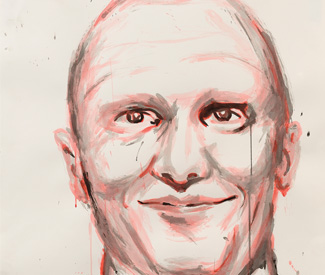
So, kudos to Bay Area artist Ray Beldner for attempting to scout some new routes through well-trod terrain. His two series of portraits at Catharine Clark Gallery are as much about the processes used to create them as they are the famous (and sometimes infamous) faces they depict. The results are decidedly mixed.

For the ghostly digital portraits in the first series, “101 Portraits,” Beldner overlaid the first 101 results that came up in a Google image search for a given subject, resulting in a hazy composite of that person’s publicly circulated image at a particular moment in time that reveals little of their actual likeness.

Some subjects are recognizable by a certain feature (Sarah Palin’s trademark up-do, Barack Obama’s prominent ears), whereas others (Michael Jackson, Britney Spears) are nearly unidentifiable, eraser-marks of their former selves.

The portraits invite allegorical speculation. Is the recognizability of Palin and Obama’s outlines a testament to the consistency of image in politics? Does the illegible smudginess of Jackson and Spears offer a formal comment on their respective falls from grace? But why over think things? Beldner’s composites are at their most intriguing when viewed as useless data sets; palimpsestic reminders that for all of the algorithms Google has churning out its top results, the internet is still something of an impenetrable jungle.

Gimmickry gets the better of Beldner’s other series, “Drawn by the hand of…,” hung in the gallery’s rear space. Wearing silicone gloves made from casts of other people’s hands, Beldner applied colored ink directly to paper. The resulting ventriloquized finger-paintings — whose sparse, monochromatic figurations recall Raymond Pettibon — are too stylistically uniform to say much about the potential affective affinities between the hand used and the person depicted.

Rather, the paintings come off as obvious and sometimes ghoulish sight gags: Jackson (again) was drawn using the hand of a young boy; for Jaycee Lee Dugard’s kidnapper Phillip Garrido, Beldner used the hand of a young girl. If the gesture seems familiar, it’s because it’s old news: another Young British Artist alum of Quinn’s, Marcus Harvey, caused much pearl-clutching with his 1995 portrait of British child murderer Myra Hindley, created by applying gray and black acrylic paint using a plaster cast of a child’s open palm.


ROCK TUMBLER


Leslie Shows’ large-scale mixed media portraits of the many faces of two pyrite chunks are the formidable and beguiling standouts of “Split Array,” her first solo exhibit at Haines Gallery. Despite Shows’ subject matter — fool’s gold — there is no joking around here. The pyrite portraits are the 2006 SECA Award recipient’s most technically finessed exploration of the parallels between geologic formation and the material process of painting to date.

Shows has worked layers of Plexiglas, colored ink, Mylar, crushed glass, metal dust, and mirrored shards onto thin, reflective aluminum panels (which she also engraves) to create trompe l’oeil effects that give her compositions dimensional heft despite their bas relief-like surfaces. When viewed head-on, a silvery pyramid-shaped outcrop seems to emerge from the upper left section of Face K (2011), pulling away from its striated Plexiglas backing. Similarly, Face P (2011) seems to extend infinitely back into the upper right hand corner of its aluminum “canvas” even as bloodied streaks (ink stains, perhaps?) in the lower half foreground the entire composition’s flatness.

However dazzling, the pyrite portraits are not merely the sum of such special effects. A deeper kind of alchemy is going on here beyond Shows’ transformation of industrial materials into representations of a mineral which is, by and large, useless to industry. I’m still trying to put my finger on it. Robert Smithson’s dictum “Nature is never finished” comes to mind as a signpost, although I’m guessing he would’ve had beef with the Faces series.

In Smithson’s gallery installations, the mirrors placed to infinitely reflect piles of shells or dirt were reminders of these natural components’ infinite variety and unknowable totality. Nature could be brought into the white cube but the white cube would never fully exhaust it. Show’s pyrite faces — with their man-made materials and Cubist collapsing of multiple perspectives — arrive at a similar conclusion, but through overt representation rather than presentation. To attempt the latter would risk evoking a naive transcendentalism which in this day and age could amount to a fool’s errand.

RAY BELDNER: PORTRAITS

Through Dec. 23

Catharine Clark Gallery

150 Minna, SF

(415) 399-1439

www.cclarkgallery.com

LESLIE SHOWS: SPLIT ARRAY

Through Dec. 24

Haines Gallery

49 Geary, Fifth Flr., SF

(415) 397-8114

www.hainesgallery.com

The Performant: Revenge of the nerds

0

Gaiman and Palmer, the Bay Area Science Festival, and a live game of Frogger

Nerd might still be a four-letter word in high school locker rooms (assuming these are still high school locker rooms to be found), but there’s really never been a better time in history to be an adult nerd. No matter if your inclinations lie in language, linux, or the laws of thermodynamics, a nerdish life lived well is truly the best revenge for all those real or imagined slings and arrows of awkward youth.

Epitomizing this truism, geek-elite power couple Neil Gaiman and Amanda Palmer launched a joint mini-tour across the West Coast entitled simply “An Evening with Neil Gaimna and Amanda Palmer,” which turned out to be exactly that, no more and no less.


Though shades of goth tinge both artists’ output, their overall aesthetic is more playful than grim. Neil Gaiman, a prolific writer in many mediums, will perhaps always be best known for his long-running graphic novel series The Sandman, while Amanda Palmer, first hit international acclaim as co-founder of the antique punk/Weimer cabaret act The Dresden Dolls. During a pleasurably meandering three-hour evening at the Brava Theatre (two days before their appearance at The Palace of Fine Arts), the two performed bits of their own work—Neil reading from his 2006 collection of short stories Fragile Things, she playing the ukulele and piano with her singular panache. The songs that they performed together were naturally the highlights. Who knew that Neil Gaiman had a torch singer tucked within his black garb and quiet English reserve? He also penned the lyrics for some of the more notable tunes, including a lovelorn lament “I Google You,” plus one of opening act The Jane Austen Argument’s tunes: “Holes.”

It was a brainiac weekend all around, thanks to the Bay Area Science Festival, which hosted a plethora of walking tours, lectures, exhibitions, and hands-on activities for all. Ducking into my friendly neighborhood Sci-Fi/Fantasy/Horror fiction bookshop, Borderlands, I got an earful from science fiction authors Scott Sigler, Mira Grant, and Jeff Carlson about the “Science of Science Fiction,” primarily about how much research goes into being able to create with a mostly scientific justification for “melting faces” and “zombification”.

Last but not least, the Come Out and Play Festival, wrapped up a week’s worth of street games with an intensely-packed weekend of battle-scaled dodgeball, cardboard tube fighting, city-wide scavenger hunts, and labyrinths. In Everett Middle School’s vast playground, about forty adults plus a handful of kids, showed up to play a few rousing rounds of Field Frogger, a completely analog twist on the classic arcade game of yore. Participants playing “froggers” sat on giant yoga balls and bounced through an obstacle course of banner-carrying “cars,” “turtles,” and ”logs.” By the end of the morning, there were six froggers hopping through the roads and rivers at the same time, which gave the playing field more of an appearance of a collision course than in the original Konami version, combining innovation with chaos and homage with humor.

http://www.youtube.com/watch?v=zDgqJjht2vQ

On the Cheap Listings

0

Submit items for the listings at listings@sfbg.com. For further information on how to submit items for the listings, see Picks.

WEDNESDAY 9

Food For Thought Dine-Out Various locations, SF. www.missiongraduates.org. 9 a.m. – 11 p.m., prices vary (check website for participating restaurants). Mission Graduates, a nonprofit working to boost the numbers of college-bound Mission youngsters, receives a sizeable chunk of participating diners’ bills tonight at eateries across town. Depending on your budget, today’s the day to either go all-out at Foreign Cinema or reignite your love affair with the humble Papalote burrito.

“Trading Ideas: Emerging Discourses on Asian Contemporary Art” Galley One, Yerba Buena Center for the Arts, 701 Mission, SF. www.ybca.org. 6:30 – 8:30 p.m., $7, free for members. YBCA and the Asian Art Museum team up to explore Asia’s role within the contemporary art picture.

“Unwrapped and Regifted: Stories about the Holidays” 111 Minna gallery, SF. (415) 974-1719, www.111minnagallery.com, free. The story-sharers at LitUp Writers know that it’s not even Thanksgiving, and on shopping center time that means the hour is nigh for Christmas and Chanukah tales. If you think you can take the heat, don your worst holiday sweater to compete for a cash prize.

THURSDAY 10

One and Only: the Untold Story of On the Road book reading Booksmith, 1644 Haight, SF. www.booksmith.com. 7:30 p.m., free. LuAnne Henderson rambled with Jack Kerouac and Neal Cassady for the entire length of that well-known Road. Her daughter, Anne Marie Santos, joins Kerouac expert Gerald Nicosia to discuss the journey’s underside.

Love Cake Reading Modern Times, 2919 24th St., SF. www.mtbs.com. 7 p.m., free. Leah Lakshmi Piepzna-Samarasinha may not be the easiest name to type into Google, but it merits a cramped finger or two. The activist and spoken-word poet reads from recent work addressing how queer people of color combat violence with compassion and sexuality.

Footloose Forays Talk Randall Museum, 199 Museum Way, SF. www.randallmuseum.org. 7:30 – 9 p.m., free. Michael Ellis’s bio photo shows the man in a backwards pink baseball cap, matching shirt, and dangling binoculars. This may aptly sum him up. Join the freewheeling botanist, Burner, world traveler, and radio host for a recounting of his best adventures.

FRIDAY 11

Legends of Hip-Hop book signing Booksmith, 1644 Haight, SF. www.booksmith.com. 6:30 p.m., free. With a lovingly-penned forward by Chuck D of Public Enemy, Justin Bua’s compilation of art honoring hip-hop’s greats breathes new life into the traditional coffee table book.

Celebration of Craftswomen Festival Pavilion, Fort Mason, SF. Also Sat/12 and Sun/13. www.celebrationofcraftswomen.org. 10 a.m. – 5 p.m., $9. The 33rd annual fair and celebration brings SF’s craftiest females and their wares out on display, accompanied by live music and dance. Proceeds benefit the Mission’s eye-poppingly beautiful Women’s Building.

SATURDAY 12

Green Festival Concourse Exhibition Center, 635 8th St., SF. Also Sun/13. www.greenfestivals.org. 10 a.m. – 7 p.m., free (see conditions below). Maybe the 12 pounds of organic garbanzo beans you just bought do have an immediate use, after all. Bring a Rainbow Grocery receipt (for a purchase of more than ten dollars), four cans of food, your bike, your Sierra Club card or a union card and get free admission to the green equivalent of a state fair. Food court, beer garden, yoga classes, business seminars, speakers, and exhibits await.

Paul Madonna book signing Museum Store, SFMOMA, 151 Third St., SF. www.sfmoma.org. 2 p.m., free. If this well-known SF cartoonist has luminously sketched your cupola, gable, or neighborhood pothole you know you have bragging rights. Everything Is Its Own Reward, Madonna’s latest compilation of SF streetscapes, roams from mundane telephone wires to noble turrets, all in pen and ink.

Writers with Drinks The Make Out Room, 3225 22nd St., SF. www.makeoutroom.com. 7:30 – 9:30 p.m., $5 sliding scale. Authors swig and shoot the breeze with their audience at this recurrent event, which benefits the Center for Sex and Culture this month. Befitting of the cause of the evening, tonight’s lineup includes writers responsible for an erotic novella, a transsexual showbiz memoir, and a treatise on dating as a feminist.

SUNDAY 13

“Man as Object” Peep Show Drawing Circle SOMArts Cultural Center, 934 Brannan, SF. www.somarts.org. Noon – 3 p.m., $8 suggested donation. All our welcome to take up their artistic tools and depict a live male model as part of SOMArts’ ongoing exhibit turning traditional gender roles upside down — although we tend to question the innovation of having a man treated like a piece of meat in this town.

MONDAY 14

Mere Future Reading and Signing Pegasus Books, 2349 Shattuck, Berk. www.pegasusbookstore.com. 7:30 p.m., free. To an audience familiar with paying astronomical rents, Sarah Schulman’s dystopian satire of a future New York will strike a chord. Schulman slyly invents a world where apartments go for forty bucks a month and the only possible jobs are in marketing.

TUESDAY 15

Ether Reading and Signing City Lights, 261 Columbus, SF. www.citylights.com. 7 p.m., free. Ben Ehrenreich once reimagined The Odyssey to critical acclaim, and his latest undertaking – the chronicle of an unnamed protagonist wandering through a city’s violent apocalypse – is no less involved of a literary feat.

Dam-Funk brings modern funk and futuristic shoulder synth to Mezzanine

0

The Mezzanine wasn’t packed to capacity Saturday night, but there was a point about a quarter into Dam-Funk’s set when things started to get electric on the dance floor. I was in a sort of self-imposed paralysis, but looking around, it seemed as if I was surrounded by about half a dozen people, each just completely going for it. Woman in a sundress, shaking it back and forth without spilling the second half of her drink; A couple of businessmen out for a night during a layover; Short brunette busting out some fly girl moves not seen since In Living Color; Some jaw-some kid with ass length blonde hair and a complete tie-died outfit (with matching head-band), popping, locking, sliding, swerving, and whatever, all in a way that screamed drugs; A skinny guy with a flat-top and glasses, dancing with two girls and doing the robot. The fucking robot.

Everyone was getting down to the best of their ability; they were getting down to the combined forced of Master Blazter: L.A. musicians Dam-Funk, Computer Jay, and J-1. I had told my friends that we were going to a funk show, which was true in one sense, but totally misleading. Sure, the show was part of the SF Funk Fest, but for a lot of people, the term funk conjures up images of a bygone era of music, now performed by revivalists. Early in, Dam-Funk (his music’s greatest defender) got on the mic to clear this up, saying that what they were playing wasn’t “retro funk” – pronouncing retro like his wanted to spit – it was “modern funk.”

Whatever it is (some call it boogie funk), it’s got a heavy electronic sound, built on Dam-Funk’s Roland keyboards and shoulder synth (he also doesn’t like to hear people call that a keytar), Computer Jay’s beat work, and J-1’s breaks on the drum kit. A little bit of George Clinton/Sun Ra styled spaciness, mixed with some West Coast G rap cool, with some Prince style stage presence, there’s a lot of references to pick up, but the end product seems slightly futuristic. Not the reincarnation of Stevie Wonder in the year 2077, but like 14 months into the future, when all known musical genres have completed melded.

As a group, Master Blazter can jam out on a track, building it up beyond what the audience thinks it can take and holding it there, but knows when to shift and refocus attention, leading to some fairly memorable solos: Dam-Funk taking over on the drums for a super-syncopated session. Or, Computer Jay letting go of his giant console and coaxing a big, bouncy beat out of a little tiny controller with the playfulness of a child with a Gameboy. And, of course, Dam-Funk bringing his keyt – shoulder synth down into the crowd, letting the mob join in and smack the keys. The fact that the last one didn’t devolve into noise is a testament to how well the rest of the group grounded the beat.

The only lull in the evening came right before the encore moment. I don’t know if somebody actually said anything to him to occasion it, or if it was just a standard part of the show (I’m leaning this way,) but Dam-Funk went into a fairly long interlude mid-track about being called “nigga.” The beat seemed to hang on endless symbol crashes as Dam Funk asked “What makes me different from (insert black figure)?” MLK Jr., Malcolm X, Colin Powell, Bill Cosby. (I started to nervously laugh when he got to Cosby, the intensity ratcheting up out of nowhere, along with the many possible absurd answers to that rhetorical question.) This was mixed with declarations that this wasn’t just a “coon show.”* Maybe part of getting people to take his music as more than just dance music involves provocation, but in an interesting twist, and showing that he wasn’t just covering Sly Stone’s “Don’t Call Me Nigger, Whitey,” Dam-Funk said at one point he was speaking to the black guys in the audience “I’m not your nigga, I’m your brother.” If he wanted to challenge people, he did, as the atmosphere definitely changed, and a few tired couples seemed to take it as a cue to leave.

The energy down, it wasn’t enough to totally derail the night. Mainly because even when the DJ (possibly just picking up clues from the crowd) started playing records, J-1 came to the front of the stage and – with some throat slicing motions – signaled both “cut that shit off” and “this shows not over.” Dam-Funk returned to the stage (and smaller crowd) for an encore, which included the single “Hood Pass Intact.” Among Dam-Funk’s catchiest, straightforward songs, it’s a celebration of keeping it real, and a good option for introducing people to his music. Typically one of the easiest songs to get into, on Saturday night it was also the hardest to get to.

*Google “Dam Funk Antoine Dodson” for more on this topic.

Going veg at the wing shop: Wing Wings’ deep-fried oyster mushrooms

1

Owner Christian Ciscle’s been trying to get me to come into his Lower Haight wings shop for a minute. I was always like “Christian (full disclosure: Ciscle took me on board as counterperson back in the days when he managed SoMa’s Little Skillet to-go window), they’re wings. I don’t eat meat.”

But then I went, and now I have to apologize because: Wing Wings‘ deep-fried oyster mushrooms.

When do you get to eat a whole tray of oyster mushrooms? And for $5? It’s improbable, really. Wing Wings’ side of them occupies a hefty paper tray. They’re crispy and just salty enough on the outside, juicy on the inside. Dunk them in some ranch dressing or Wing Wing remoulade and you’re good to go. I nearly took down the whole thing, but I had a friend there to fight me for the bottom of the tray (thank god).

They don’t really have anything to do with each other, but if you stop by for the oyster mushrooms you can also pick up a brown sugar-black pepper biscuit what that Ciscle has been baking since the Little Skillet days. Call it dessert if you’re a label person. 

Pairing suggestion: Wing Wings, limeade, and some headphones at nearby Rookie Ricardo’s LP listening stations

Of course, there’s no veggie entrees per se at Wing Wings – normally. But tomorrow, Tue/8, the counter shop will host a pop-up dinner by chef-about-town Dontaye Ball of Good Foods Catering, who has lent his culinary chops to everywhere from the kitchens at Google to Delfina and the Presidio Social Club.

Ball’s entrees will include, yes, pork belly and beef meatloaf ($15) and slow-braised chicken in a white wine-thyme gravy with cornbread dressing ($14), but also blackened tofu with roasted veggies and mashed yams ($12). Check out the evening’s menu here

A full vegetarian belly — at a wings shop. Will wonders never cease?


Good Foods Catering’s “Soulful Food” pop-up dinner 

Tue/8 6-9 p.m., check Good Foods website for prices

Wing Wings

422 Haight, SF

www.wingwingssf.com

www.goodfoodsonthego.blogspot.com

That’s amoré

0

caitlin@sfbg.com

HERBWISE The ever- unfolding swath of life’s problems that can be solved by cannabis has been extended the length of an aphrodisiac shot made from cannabis, cane syrup, glycerin, citric acid, and other supplements. Product name: Amoré. Don’t worry, it’s locally made.

Amoré is the brainchild of a one Ed Silva, a gregarious medical industry product developer (think defibrillators and glucose monitors) who started up his San Jose dispensary Sensi Herbal Care in November 2010. It sells topical cannabis treatments, lemonade, chocolates, and buds, but Silva says its “flagship product” is its insomnia-fighting cannabis shot called Indi.

“That product has literally helped thousands of people with their insomnia problems,” he told the Guardian in a phone interview. The dispensary also stocks an energy formula, of course Amoré, and has a pain reliever in the works.

Recent legislation posed at the city level in San Jose, where regulations that would limit the city’s number of dispensaries (now hovering around 900) to 10 businesses. Paid campaigners and volunteers say they turned in 48,598 petition signatures last week to halt the process. They only needed 29,653 to initiate a referendum on the new guidelines. The United Food and Commercial Workers union Local 5 donated $5,000 towards supporting the referendum to stop them.

The city’s new policies, an employee who answered the phone at Sansi said, could have shut down the dispensary — and community access to the Viagra of the cannabis world — down. Later, Silva sounded triumphant when he informed the Guardian reporter on the laws’ impending curtailing.

Without a medical background — besides developing defibrillators — Silva was a bit vague about his methods of creating cannabis formulas, but was confident in the way customers responded that they were doing their job. He’d submitted the product to lab quality assurance testing and informal focus groups.

The optimal way to use Amoré? Silva cautioned that the drink’s effect would vary among individuals. “It doesn’t work for everyone, that is true for every medication out there,” he said. But generally, “45 minutes before.” It was further clarified that he meant pre-sexual escapade.

Our Guardian tester, who took the “for her” variety of Amoré, found its power varied, a.k.a., got turned-on, then slightly nauseous, then turned-on. Tastes like a particularly gnarly 5-Hour Energy Drink, fades fast. A mixed bag. On a small “caution” panel, the label of Amoré prohibits the contents being taken with alcohol, other supplements, and heavy machinery.

When asked about one of the label’s more esoteric ingredients, the fo-ti root (also listed are dodder seed extract, kudzu root, and tribulus fruit), Silva semi-helpfully explains “It’s also called sho-wu. It means ‘black-haired Mr. Hee.’ It means that in Chinese, it’s a Chinese herb. That’s a name from someone in an old village in China. You can research that on Google, there’s a story behind that.”

So of course we do, and sure enough, it tends to be used to restore graying hair. So that’s fo-ti. But why is it in this cannabis aphrodisiac shot, whose silver hard plastic bottle clearly states “for her”?

Says Silva: “It’s also known as a happy herb. It has the effect of making you happy, which is always a good thing. There’s a few people who I’d like to give that regularly, like every hour.” Which left us still unconvinced regarding Amoré, but still a big fan of Silva.

Localized Appreesh: The Sandwitches

0

Localized Appreesh is our weekly thank-you column to the musicians that make the Bay. Each week a band/music-maker with a show, album release, or general good news is highlighted and spotlit. To be considered, contact emilysavage@sfbg.com.

The Sandwitches are all about high highs and low lows. The vocals of Heidi Alexander and Grace Cooper (both former back-up singers for Fresh & Onlys) defy the bounds of San Francisco garage, piping up from low and fuzzed out to high-pitched and near theatrical. The music strays similiarly from convention, with an underlying garage-pop root that sometimes hits close to country-folk, other times lends itself more toward dewy trophy love song/doo-wap. It’s a sound that takes a minute to digest – and that’s a good thing.

You can check it out for yourself. The trio’s upcoming seven-inch single The Pearl is streaming now, here. And then you can go see it live. The Sandwitches will fill the opening slot of a pretty righteous show this week at the Fillmore, with headliners/Australian indie poppers Architecture in Helsinki and lo-fi American rockers DOM.

You may protest, “but that’s not how you spell sandwiches!” Yes, spelling wizards, it’s a play on words. Sand-witches. Witches of bread. Meaning sourdough with warts, or something less gross. Spooky PB&J? Bubbling cauldrons of BLT? Or as you’ll see below, the name simply came from “a process of elimination.”  It’s also way easier to Google.

Year and location of origin: 2009, Frisco, baby.
Band name origin: A process of elimination
Band motto: “More feeling”
Description of sound in 10 words or less: dingy, pingy, bumpy, pumpy, lumpy, brash, sophisticated, and smooth.
Instrumentation: Mexican telecaster, Mexican stratocaster, drum set
Most recent release: The Pearl/Benny’s Memory Palace 7″, Hardly Art
Best part about life as a Bay Area band:  The buds [ed note — double entendre?]
Worst part about life as a Bay Area band: The fog?
First record/cassette tape/or CD ever purchased:  Queen Greatest Hits I & II, Blue Beatles hits collection on tape.
Most recent record/cassette tape/CD/or Mp3 purchased/borrowed from the Web: Jackie Gleason, Music for Lover’s Only.
Favorite local eatery and dish: Chevys and fried chicken.

Sandwitches
With Architecture in Helsinki and DOM
Thurs/3, 8 p.m., $20-$29
Fillmore
1805 Geary, SF
(415) 346-6000
www.livenation.com

Potrero Hill History Night: a special occasion for a special neighborhood

3

Scroll down for Potrero Hill History Night photos

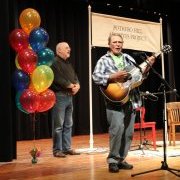
And so Country Joe McDonald ambled on to the stage Saturday night at the International Studies Academy on Potrero Hill and told an full auditorium full of history night groupies  that since he was playing in a school he would open with a spelling lesson.

“Give me an F,” he roared,  and the audience roared back with an F.

“Give me a U, give me a C, give me a K,” and the audience roared back again and again  with knowledge of the lyrics of the anti-war song “I Feel Like I’m Fixing To Die” that Country Joe made famous during the Vietnam war and has been singing as his trademark song ever since.

He would pause and the audience would continue on with the words. Country Joe was in top form, the audience loved him, and it was a stunning beginning to the 12th annual Potrero Hill History Night.  And the fact that Occupy SF and Occupy Oakland were fixing to explode sooner or later in nearby neighborhoods  only gave some timely poignancy to the occasion.

But Country Joe wasn’t at History NIght to perform as a singer or political activist. He explained that he was there as a turnaround artist to interview Joel Selvin, the veteran San Francisco Chronicle pop culture reviewer and author of “Smart Ass,” a collection of 40 years of Selvin’s music journalism. Significantly, Selvin also happens to be a longtime Potrero Hill resident. The latter phrase is the key, because the point of History Night is to focus on the rich history and colorful personalities of Potrero Hill and put them together into a lively program. In this segment, Joe the performer interviewed Joel the reviewer/reporter who had been writing about Joe for years.

The two made a splendid team and it turned out that Joel was as good onstage in this format as Country Joe. It was good fun, instructive at times, particularly with the stories about Bill Graham’s antics and angry outbursts and how each dealt with him. The audience had fun trying to figure out through questions just how rock n’ roll and Country Joe from Berkeley connected to the hill. Well, one answer was that Jann Wenner, the founder of Rolling Stone magazine, claimed three different addresses on Rhode Island Street.

The program this year was the best ever. A barbecue outside the building serviced by a platoon of History Night  groupies on a warm and wondrous Potrero Hill evening. And a program featuring a formal presentation of a chunk of goat hoofprints embedded in concrete, an interview with the woman who tended the goats decades ago, a surprise appearance by the lady who found and preserved the hoofprints for years, and a starring role by Phillip DeAndrade of Goat Hill Pizza who was given the goat hill hoofprints as a surprise gift because he once had goats in the back of his Goat Hill pizza parlor and because, well, he’s Phil DeAndrade.

DeAndrade is a Potrero Hill version of the Scarlett Pimpernel (he’s here, he’s there, he’s everywhere). For this evening, he was doing triple duty as the worthy receiver of goat hoofprints in concrete, as master of ceremonies, and as the Hot Interviewer of the Colorful Potrero Hill Veteran, the key finale of every history night event.

DeAndrade was specially eloquent in explaining the importance of history night. It is, he said, a special event (nobody else in town has one) that showcases Potrero Hill.as a special place and its people as special people who live in a special neighborhood with a special culture and a special history and such institutions as the Neighborhood House built in the 1920s  with Julia Morgan as the architect.

The goat hoofprints in cement  made his special point. The artifact dates from 1925 or so and was found and preserved by Rose Marie Ostler, a Potrero Hill native. She kept the hoofprints for years and then decided they should go to DeAndrade of Goat Hill for his historic connection with goats.  She presented them at the ceremony, with help from Dr. Frank Gilson, a local chiropractor wearing a Halloween type goat hill mask.

This year’s Potrero Hill veteran was Josephine Firpo Alioto, who was born on Potrero Hill 90 years ago, and now lives in San Jose.  She married Frank Alioto, son of Police Capt Calogero and Vincenza Alioto.  The Alioto family moved to 755 Carolina St. around 1930, just around the corner from Josephine’s house. There were no houses on the cornerin those days,  so they had a clear view of one another’s houses. Josephine and Frank were friends for 80 years and married for 65 and a half years.  They were married at nearby St. Theresa’s Church.  With expert coaching from DeAndrade, she was most articulate and provided the details of life and times of growing up on the hill in the 1920s and 1930s.

Perhaps the most “newsworthy” comment came when she took the audience by surprise when she mentioned that her cousin, Luis  Firpo, known as the Raging Bull of the Pampas in Argentina, knocked Jack Dempsey out of the ring in a  championship fight. (My google check showed she was right. Firpo did knock Dempsey out of the ring in the  famous 1923 heavyweight championship fight at the Polo Grounds in New York City and Dempsey’s head hit a reporter’s typewriter. But Dempsey got back in the ring on a contested long count and won the fight in the third round in what many think is the greatest fight of all time. It was Dempsey’s last successful defense of his title. The fight is on UTube and googleable under Firpo.)

As is the history night custom, there were lots of Firpos and Aliotos in the audience to help fill in Josephine Alioto’s story and answer questions from the audience and provide the evidence of a very special neighborhood.

All in all, it was a most memorable event and all to the credit of Peter Linenthal, the founder and impresario of Potrero Hill History Night. His event even got a nice writeup in Leah Garchik’s Chronicle column. UCSF at Mission Bay was the sponsor of the event and the Parkside, Chat’s Coffee, and Bottom of the Hill donated to the barbecue.  Linenthal  is also the curator of the Potrero Hill Archives project, assisted by Abigail Johnston. The two co-authored an excellent book on Potrero Hill.  For more on the archives project, go to potreroarchives.com.  You may find out more about Potrero Hill than you need to know.

I think Linenthal has done what every impresario dreams of doing:  making his event so special and so memorable that it will live on and on.  B3

history night 2

Rose Marie Ostler formally  presents the goat hoofprints in cement to Goat Hill Phi.

history night 4

The audience of History Night groupies.

history night 5

Selvin expands, Country Joe listen.

history night 6

Josephine and Phil,  a dynamic duo, 

history night 7

Josephine and Phil, getting ready for prime time.

history night 8

The Apollo  jazz group in concert at History Night.

history night 9

A student from the International Studies Academy selling tickets for the barbecue.  The money goes to the ISA student travel program.


Notes from the indie underground: the ATA Film Festival

0

For more reviews from the sixth ATA Film and Video Festival, check out this week’s film listings. The fest kicks off tonight with an opening reception.

Piena En Mi Alexandra Cuesta’s short film “Piena En Mi” is an impressionistic portrait of Los Angeles, where, in addition to Quito, Ecuador, the filmmaker lives and works. Primarily shot from a bus that traverses the sprawling metropolitan, the film is told with the the city’s different neighborhoods, its sounds, and its patchwork of ethnic groups. It’s an honest portrait of  LA — economically depressed in most places, polluted, congested – but beautiful, nonetheless, and unapologetic. Cuesta treats her city with tenderness and it renders her film graceful and intimate. It’s sensitive to the very subtlties that make LA radiate with character, whether it’s odd haircuts, dirty bus windows, or bells on an ice cream carriage. It’s in these shots that the filmmaker’s background in street photography shows, and make it a highlight of the ATA festival. Program One, “City Symphonies”
Imperceptihole Vivid and atmospheric, “Imperceptihole” is a high contrast, black & white film by Lori Felker and Robert Todd. Developed from a correspondence wherein the two filmmakers exchanged film rolls, “Imperceptihole” is shot between desolate woods, a hay bail structure, an ice skating rink, and several other seemingly random places. Using sychzophrenic pans, transparent shots, breathing and harsh grating sounds that gradually intensify, the film creates the sensation of a deep, hair-raising descent. It’s the camerawork that builds up this sensation, which is either swinging, crawling, sprinting or dead still. And it’s that very camerawork that is most impressive about the film. Vaguely disquieting, the film is initially very stimulating, but in light of its ambiguity, rather too long. Over the course of the fourteen minutes,  the visual experience is lost and you’re wondering what it’s all about. Program One, “City Symphonies”

Workers Leaving the Googleplex While working for a company called TransVideo, Andrew Wilson was subcontracted by Google to work at its Silicon Valley headquarters where he started an investigation into the company’s class structure and what the different colored badges worn by employees represented. “I found the social situation interesting,” he says in the film. He became particularly interested in the yellow badge wearers, employees who are denied most of the Google benefits such as bikes and gourmet meals. Wilson’s investigation led him into conflict with Google when he was caught filming the yellow badge wearers in the parking lot and trying to interview them. Ultimately, he was fired from TransVideo. Wilson’s film is an interesting look at class as well as an honest personal story, and an inside look at the workings of one of America’s most powerful companies. It’s a story you could very well have heard on “This American Life.” Program Two, “Sling-Shots”

“ATA Film and Video Festival”

Opening reception Wed/19, 7 p.m

Short film screenings Thurs/20 (“City Symphonies”) and Fri/21 (“Sling-Shots”), 8 p.m.

Super 8 film workshop, Sun/23 and Nov. 12, 1-4 p.m., free-$35

Artists’ Television Access
992 Valencia, SF
www.atasite.org

Breaking free

20

rebeccab@sfbg.com

An ordeal that began with a hiking trip on July 31, 2009 in Northern Iraq came to a close Sept. 21 when Shane Bauer and Josh Fattal were released from Tehran’s Evin Prison. They’d languished in an 8-by-13-foot cell for 781 days while their friends and supporters waged a creative, behind-the-scenes campaign to free them.

Bauer and Fattal were ferried out in a convoy with Swiss and Omani officials and flown to Oman, where news cameras captured their joyful reunion with loved ones. Waiting on the tarmac with their family members was Sarah Shourd, Bauer’s fiancée, who’d been arrested with them and was released last September after spending 410 days in solitary confinement. It was the first time since their arrest that “the hikers” — as the trio came to be labeled in the campaign calling for their release — were together outside prison walls, free at last.

Watching their reunion from Seattle, their friend Shon Meckfessel — who went to Northern Iraq with them but hadn’t felt up to hiking that day — was overjoyed. “It’s like I’ve collapsed from relief,” he told us by phone. “I just feel like I’ve been asphyxiated for the last two years, and suddenly I remember what air smells like.”

In the Bay Area, friends who’d pulled together to work toward their release breathed a huge, collective sigh of relief. “It was just a crazy, amazing adrenaline rush of happiness,” said Jennifer Miller, who befriended Shourd years earlier while doing human rights work focused on violence against women in Juarez.

Bauer and Fattal had stood trial only weeks earlier in an Iranian court, on charges of espionage and illegally crossing an unmarked border between Iraq and Iran. They were found guilty and sentenced to eight years each in prison. Their release coincided with Iranian President Mahmoud Ahmadinejad’s visit to the United States for the United Nations General Assembly conference.

As Bauer, Shourd, and Fattal remained isolated at the mercy of guards they could barely communicate with, their family and supporters kept up a steady drumbeat calling for their release. They recruited actors, intellectuals, and foreign diplomats to urge the Iranian government — which has not had diplomatic ties with the U.S. Since 1979 — to let the Americans go. Once Bauer and Fattal were free and wandering around New York City, they’d morphed into minor celebrities — strangers approached them in the streets to wish them well.

In the end, nobody can say just what persuaded the Iranian government to release Bauer and Fattal. “Sarah was talking with diplomats in all kinds of countries. The thing is, none of us really knows what the calculus was,” said Liam O’Donoghue, a friend who helped out with the campaign.

The campaign was multi-faceted, with friends and family coordinating parallel efforts from various locales. While Bauer and Fattal’s group of friends in the Bay Area are quick to note that their work reflected just one slice of the overall push for the young men’s freedom, the grassroots organizing effort they created clearly had some effect in the end.

“If Shane, Sarah, and Josh were just three random people who didn’t have this group of friends who were so proficient at organizing, I think they would have still been in jail,” O’Donoghue mused.

Shortly after Bauer and Fattal were freed, Iran’s foreign ministry issued a statement acknowledging the involvement of the Sultan of Oman, United Nations Secretary General Ban Ki-Moon, Iraqi President Jalal Talabani, and — more surprisingly, given his adversarial relationship with the U.S. — Venezuelan President Hugo Chavez, who enjoys a close relationship with Ahmadinejad.

Once reports surfaced emphasizing Chavez’s involvement, the news broke that actor Sean Penn had played a role, too — by flying to Venezuela to encourage Chavez to approach Ahmadinejad about the case.

Yet the stage had already been set by friends of the hiking trio, a small crew of passionate social justice activists based in San Francisco and Oakland. They possessed skills as organizers, but this time the goal was more personal — they wanted nothing more than for their friends to be free.


TIME TO ORGANIZE

Based on the 17 alarmed messages on his voicemail, David Martinez knew something terrible had happened involving Bauer and Shourd. An independent filmmaker, Martinez was close to both and had collaborated with Bauer in 2007 to produce a film about Darfur.

Soon after learning that they were being detained in Iran, he found himself swept into a whirlwind, ad-hoc grassroots organizing effort as friends and family of the hikers contacted one another, fired off rapid emails, and organized conference calls to try and determine how to respond.

“We created this working group, this conference group — we wanted everybody’s expertise,” explained attorney Ben Rosenfeld, who has known Shourd for more than a decade and offered free legal representation to Shourd’s mother. “We set out to build a brain trust, essentially, and we did that very, very quickly.”

Shourd and Bauer had been living in Damascus, Syria, at a Palestinian camp when they decided to take a short trip to Iraqi Kurdistan. Shourd was teaching English to Iraqi refugees, and Bauer — a photojournalist — was writing articles about the Middle East. Fattal, an environmental educator, was visiting them. They journeyed along with Meckfessel to Kurdistan, a forested region of Iraq known as a safe destination for U.S. citizens. But once they arrived, Meckfessel felt groggy, so he opted to stay behind while the other three went off in search of a waterfall.

“I was on a bus to meet them and got a call from Shane that they were being arrested by Iranian authorities,” Meckfessel told the Guardian. After notifying their families, he flew to Istanbul to stay with a friend.

Back in the Bay Area, word of the hikers’ plight was starting to make news. “I had producers from morning shows like Good Morning America ringing my doorbell from the beginning,” Rosenfeld said.

Martinez was on a conference call with the core group of organizers when Meckfessel contacted him via Skype from Istanbul — and by that point, the national media was hungry for a statement from the elusive fourth hiker. So the group worked with Meckfessel to craft a statement for the press.

The first challenge they faced was this: Should they emphasize that Bauer, Shourd, and Fattal were humanitarian activists, or should they downplay their political leanings by casting them as adventuresome Americans with a love of the outdoors? Both portrayals were true, but the most important audience, as Rosenfeld pointed out, was ultimately their captors.

Meckfessel said he thought highlighting their politics would help their case. “The first minute after I got the phone call [from Bauer] … I thought that basically our involvement in the region as journalists, as academics, and as educators, and our long public record speaking out for human rights and as critics of US foreign policy in the area … would get them out,” he said.

Meckfessel later created a website, FreeOurFriends.eu, to emphasize the humanitarian and journalistic work that the three were engaged in. In the summer of 2010, he maxed out two credit cards to go on a 30-city European tour to drum up support overseas.

Despite the group’s initial contact with the Committee to Protect Journalists as well as Bauer’s editors at The Nation and Mother Jones, some were opposed to emphasizing the journalism aspect. “Think back to July 2009 in Iran,” Martinez said, referencing the popular uprising known as the Green Revolution that had sent shockwaves through Iran just months earlier. “Our friends were and are journalists involved in social movements and people’s movements. I’m pretty sure if you did a Google search with ‘Iran, July, 2009, activists,’ you’d come up with something like torture, prison. That is why we thought … let’s just say they’re hikers.”

So they came to be known as “the hikers,” and a website was created to go along with the campaign, called Free the Hikers.

“We wanted to make sure we weren’t divulging details about them that they weren’t divulging to their interrogators,” Rosenfeld said. “We wanted to be careful not to piss off the U.S. or the State Department. And, if we seemed too orchestrated, it might feed into Iran’s paranoid theories that they were spies. So we had to try to solve for all of these variables at the same time.”

It began to dawn on them that they were contending not only with the soured relationship between the U.S. and Iran, but an internal power struggle within Iran that had intensified in the wake of mass internal dissent. “The government that grabbed Shane, Josh, and Sarah was at war with its own people,” Martinez reflected. “They were prisoners of the historical moment.”

Nor was the trio the first in their circle of friends to stumble into a horrendous situation overseas. Tristan Anderson, of Berkeley, was attending a nonviolent protest of the Israeli occupation in a Palestinian village at the beginning of 2009 when he was hit by a high-velocity teargas projectile fired by Israeli Defense Forces, and sustained serious brain injuries.

“Tristan’s like a minor celebrity in Iran,” Meckfessel noted. “He’s known not only for initially getting shot … but Tristan’s whole case got a lot of sympathetic media in Iran.” When his three friends were captured, “the first thought I had was, we have proof that we’re all friends with Tristan,” he said.

On Feb. 10, 2010, Anderson’s parents, Nancy and Mike Anderson, sent a letter to Ahmadinejad. “It pains us greatly, on top of the tragedy we have already suffered, to see Tristan’s close friends made to bear the burden of grievances between nations,” they wrote.


GAME OF DIPLOMACY

The idea to approach the Venezuelan government started when Raymor Ryan, an Irish author who lives in Chiapas, phoned Martinez. “He said, ‘The only thing that’s going to really affect them is state power — this is a game of diplomacy,'” Martinez recounted. He suggested Venezuela — a country that is not only on friendly terms with Iran, but has connections with social movements. Martinez liked the idea, but first he ran it by another friend, famed academic Immanuel Wallerstein.

In an email, Wallerstein summarized for the Guardian the advice he gave. “The Iranians are using this as part of their struggles with the United States,” he wrote. “The least likely way to obtain their release is to allow U.S.-Iranian relations to be the issue, or to allow the virtues of the Iranian regime to be the issue. I suggested that they try to work with various left-of-center governments in Latin America, which have friendly relations with Iran, and see if they will intervene with the Iranian government. I did not single out Venezuela. After that, I was out of the picture.”

In October of 2009, Rosenfeld reached out to an attorney he knew through the National Lawyers Guild, Eva Golinger, who’s authored seven books, lives in Caracas, and occasionally serves as an adviser to Chavez. She agreed to help.

Nicolas Maduro, Venezuela’s foreign minister, told her he thought Chavez would be open to helping. “The foreign minister went to Tehran, and they told me they were going to broach the subject,” Golinger said. “When they came back, they told me unfortunately, it wasn’t a topic that was received favorably by the Iranians.”

Rosenfeld and Martinez were crazed, but they had another idea. Perhaps Chavez would be more responsive to appeals from lefty luminaries. Thanks to behind-the-scenes arrangements made by campaign organizers working every connection they could muster, a letter dated Feb. 26, 2010 was sent to Chavez on behalf of Noam Chomsky, Angela Davis, and Harry Belafonte.

“All three of the hikers are dedicated to improving living conditions for poor and oppressed people throughout the world, and to fostering a better understanding among their fellow citizens of the U.S.’s hegemonic role in global politics and economic privation,” they wrote.

Soon after, Golinger had a chance to speak with Chavez directly, when she was invited to join him on a trip to Uruguay to attend the presidential inauguration. “He said, ‘do you think they’re spies?’ I said, look, I don’t think they’re spies. I think they were gringos in the wrong place at the wrong time,” she recounted. “Chavez said, yeah, no problem. I’ll help.”

Soon after, the campaign recruited anti-war activist Cindy Sheehan to write to Chavez, too. But the months rolled by without word of a trial date, let alone a release. Rosenfeld thought up a new way to reach Chavez — by encouraging actor Sean Penn to speak with him.

Penn enjoyed a good relationship with the Venezuelan president and had been regularly traveling to the region to aid in earthquake relief efforts in Haiti, which Venezuela was deeply involved in. Rosenfeld asked Matt Gonzalez, chief attorney of the San Francisco Public Defender’s Office and a friend of Penn’s, to mention it to him.

Within months, Penn discussed the hikers’ case with Chavez, according to Golinger. Then, in September of 2010, Shourd was finally released. Bay Area friends described it as a moment of sheer joy, but also bittersweet, because Bauer and Fattal remained behind bars. Miller invited friends and organizers over to her place in Oakland to join her in the surreal experience of watching their friend deliver a speech on television.

Meckfessel was in Rome as part of his “Free Our Friends” tour through Europe. “I got a text message from somebody that she had been released, and I burst into tears of relief,” he said. “Then, just as I was preparing to do my presentation in Rome, I got a call — and it was Sarah. I just shouted and cried in front of this big group of Romans, and everyone was applauding.”

Upon her return, Shourd wasted no time throwing herself into the campaign. “I just have so much admiration and respect for Sarah,” Miller said. “She went from coming out of prison, and needing time to heal from that, to becoming a full-force, 24/7 international diplomacy worker.”

Shourd, Bauer, and Fattal were unavailable for an interview for this article, but their families emailed a statement. “As Josh and Shane said when they got home, many of their friends put their own lives on hold to fight for their freedom,” they wrote. “We are grateful to the many people who worked in many different ways to help Shane and Josh. Every single effort mattered and made a difference.”


INEXCUSABLE ACTS

When the day of their release finally came, Golinger watched in Caracas as television broadcasts showed Bauer and Fattal bounding down the steps of the plane and leaping into the arms of their loved ones. She sent a text to Maduro, the Venezuelan foreign minister, who was in New York for the UN General Assembly. “I asked … were we involved?” Minutes later, she received a text in response. “He said, fundamentally, yes.” The Iranian foreign minister had told him that the release went through because of Chavez’s request.

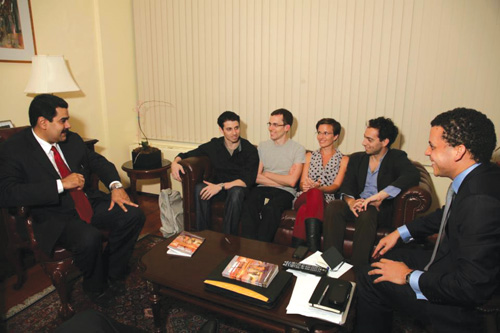
Days later, in New York, the hikers visited the Venezuelan consulate. And on the same trip, their first time back on U.S. soil, Bauer and Fattal held a press conference.

“The only explanation for our prolonged detention is the 32 years of mutual hostility between America and Iran,” Bauer said. “The irony is that Sarah, Josh, and I oppose U.S. policies towards Iran which perpetuate this hostility. We were convicted of espionage because we are American. It is that simple.”

He went on: “In prison, every time we complained about our conditions, the guards would immediately remind us of comparable conditions at Guantanamo Bay. They would remind us of CIA prisons in other parts of the world, and the conditions that Iranians and others experience in prisons in the U.S. We do not believe that such human rights violations on the part of our government justify what has been done to us, not for a moment. However, we do believe that these actions on the part of the U.S provide an excuse for other governments, including the governments of Iran, to act in kind.”


Green dreams

0

arts@sfbg.com

FILM Has the landfill, junkyard, and lowly dumpster supplanted the factory as a site of documentary interest and even inspiration? Yerba Buena Center for the Arts features two 2010 docs this week to add to the growing list of recent films centering on scavenging, gleaning, dumpster diving, trash humping, and scrapping — activities illustrating resourcefulness in the shadow of colossal waste.

Scrappers zeroes in on the workaday routines and liabilities facing two laboring subjects, Oscar and Otis, good men who cruise Chicago’s South Side for scrap metal. The film’s three directors spent a couple of years in the passenger seat, long enough for their verité portrait of the scrappers’ lives at work to be anchored in extenuating circumstances: a deportation scare for Oscar, a hospital stay for Otis, and most significantly the collapse of scrap prices as a result of dwindling home construction (the same ton of metal that sold for $200–<\d>$300 in 2007 only brought in 20 bucks in 2008).

Without recourse to a voice-over, Scrappers details economic unrest as well as the complex race and class hierarchies of Chicago’s scrap scene. This is all secondary, however, to the film’s enduring interest in learning how Oscar and Otis actually go about their work — noteworthy in a documentary field crowded with predigested arguments. The filmmakers take liberties in editing together the scrappers’ talk into poetic monologues, but it’s a small price for granting them autonomy in defining not only the necessities but also the dispensations of their work.

While Scrappers works to convey layers of ongoing experience, the Oscar-nominated Waste Land is witness to an exceptional intervention. The film follows Vik Muniz, a successful Brooklyn-based artist originally from São Paolo, as he spearheads a collaborative art project in Jardim Gramacho, a gigantic landfill outside Rio de Janeiro. Muniz first contemplates the site from his Brooklyn studio using land art’s modern surveying tools, Google Earth and YouTube. Once on the ground, his initial disbelief at the scale of the landfill gives way to the more modest realization that many of the pickers working there don’t view themselves as the wretched of the earth.

Waste Land director Lucy Walker omits Muniz’s selection of a handful of the pickers as collaborators and subjects — a thorny process, one imagines — instead fleshing out the backstories of the (admittedly remarkable) chosen ones. They gather material from the dump to help Muniz fashion their iconic portraits back in the studio, with the proceeds of the finished work benefiting the pickers’ labor association.

Muniz’s giving act is more personal and sustained than a benefit concert, but the difference is one of quality not kind. He repeatedly stresses the project as a joint effort in making art of garbage, but the real magic consists of turning garbage into something priced as art, a conversion which undoubtedly helps the pickers but also solidifies Muniz’s privileged position in the world marketplace. In view of this, it’s worth pointing out that many other artists have adapted scavenger aesthetics as a means of dissenting from patronage systems (art or otherwise). In 1965, for instance, Brazilian director Glauber Rocha issued his “Aesthetic of Hunger” manifesto to define Third Cinema’s difference. Some years later filmmakers associated with the Tropicália movement went a step further and called for an “Aesthetics of Garbage.” Needless to say, they envisioned something different than Waste Land‘s sympathetic detachment. It’s not a fair comparison perhaps, but days after seeing the film I’m still bothered by the way it maintains a wry distance from Muniz’s earnest struggle for moral clarity while itself indulging in artsy portraiture of the pickers at work (scored to death by Moby). In any case, magnificent unsigned art grows out of landfill closer to home at the Albany Bulb. There’s a documentary about that too — Bum’s Paradise (2003).

TRASHED: TWO FILMS ABOUT GARBAGE

Scrappers, Thurs/15, 7:30 p.m.; Waste Land, Sun/18, 2 p.m., $8

Yerba Buena Center for the Arts

701 Mission, S.F.

(415) 978-2787

www.ybca.org


Instant replaya

0

SUPER EGO Dear burners,

I am absolutely NOT BITTER that I couldn’t join you this year. And I certainly DID NOT wrap myself in a hot-pink bedsheet, spin around until I saw Ganesh, puke up 23 packets of Tasty Bites, and throw a fistful of chickpea flour in my roommate’s face, screaming “Rites of passage, bitch!” so that I could virtually burn. And then I didn’t fist-pump to vintage Bassnectar, nor construct a 12-foot flashing Alexander Wang Summer 2011 fun-fur ankle strap high-heeled sandal in our foyer out of wire hangers, chicken bones, old Dell motherboards, and tuck tape.

Does anyone have a couch I could crash on? Preferably one of those big red lips-shaped ones?

In a sort-of pathetic attempt to even things out a bit, here’s what you missed: a gaggle of the hottest nerds in the world cruising Zinefest; the best Bloody Mary ever at my new-old favorite bar, Little Shamrock; Optimo DJs blowing minds at Public Works by dropping one of the first industrial tracks, Liasons Dangereuses’ “Los Niños del Parque”; German frenzy-whipper Matthias Tanzmann slaying with Maxwell-sampling summer smash “Entrance Song” by Eats Everything at Mighty, the supernova heat-explosion of Oakland Pride … and I’m not even on Sunday evening yet. So, you know, nyah.

ARAABMUZIK AND DJ FUNK

Young Rhode Islander Abraham Orellano, a.k.a. Araabmuzik, is actually of Dominican-Guatemalan descent – his crew dubbed him Araab when he was a teen. (Why? Because he’s so fine like the rest of us Arab brothers?) But beyond the Google-gold moniker, Araab’s emblematic of a neat trend right now in our frantic niche-crossover times: he’s a hip-hop beatmaker (Cam’ron, Duke Da God) with a touching love for poppy old dance music, using his genius manual dexterity with big-buttoned, retro-looking Music Production Center devices in his live act to melt dance floors into stunned lumps of woah.

This year’s Electronic Dreams album subtly warps goofball “Night at the Roxbury”-type ’90s dance anthems like Future Breeze’s “Why Don’t You Dance With Me” and Starchaser’s “So High” – and even gabber-house noise-blast “Underground Stream” by Nosferatu – into haunting documents of a young man’s often-lonely street life. Araab’s polishing songs I spent a good part of my life running in terror from into weird mirrors of interiority, fusing futuristic bedroom-producer headspace with retro big-room boom. And the dude’s just getting started.

http://www.youtube.com/watch?v=QeJcUz7nSYk

Also headlining this month’s Lights Down Low party is DJ Funk, a Chicago booty-bass legend who pioneered the “ghetto house” sound that still holds the Midwest underground in its filthy, rump-slapping grip. Funk’ll get the panties wet; up to you to rip ’em off.

Fri/9, 9:30 p.m.-3 a.m., $15. SOM, 2925 16th St., SF. www.som-bar.com

VIRGO FOUR

The word “timeless” sure gets thrown around a lot in this retro-minded era. And I’m fine with that, as long as the hype keeps fuelling comebacks like Virgo Four’s. At the moment, timeless, in techno terms, is almost a spatial distinction – and records like the Chicago duo’s wonderful “Vision” from 1989 really do sound like something that steps swiftly out of the distant past and into tomorrow’s speakers.

Merwyn Sanders and Eric Lewis expertly stroked the house-techno-acid nexis of the time with a series of releases that now serve as a few vinyl collectors’ 401ks. They’ve been relatively silent in the 20-odd years since, but from what I’ve heard on the virtual grapevine, their reunion DJ sets are deep and smoking. Honey Soundsystem and the No Way Back boys are pairing up to present this one, so the party should be mixed-crowd, no-attitude bliss.

Fri/9, 10 p.m.-4 a.m., $15. Public Works, 161 Erie, SF. www.publicsf.com

TRUCK RELAUNCH WITH CHRISTEENE

One of San Francisco’s cutest macho gay bars is having a makeover-do-over, with new co-owner Matt Bearracuda from the West Coast’s insane Bearracuda bear dance parties joining already-owner Paul Miller at the helm. Apparently, a new menu, new parties, new faces are in store (and I bet a lot of those faces will be fuzzy in a good way).

http://www.youtube.com/watch?v=QkL9Fpp1FF4

First up, the actually insane trash drag rapper r&b clown-whore Christeene (www.christeene.org) performs some “opening” numbers. I don’t really “get” her, which just might be an endorsement!

Sat/10, 8 p.m., free. 1900 Folsom, SF. www.trucksf.com

Earth mover

1

arts@sfbg.com

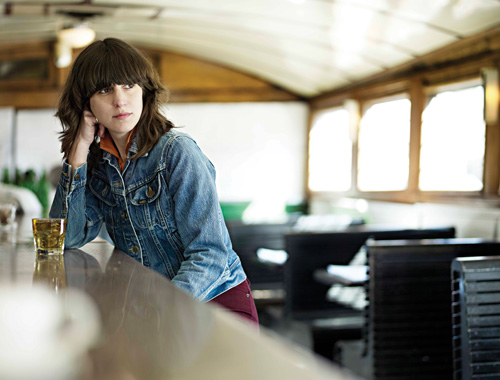
MUSIC I didn’t mean to bring the earthquake to Eleanor Friedberger’s Brooklyn — it just felt that way when I rang a few weeks ago, minutes after her ‘hood shivered and shook like it was attempting a weak imitation of, well, San Francisco. “Actually it sounded like someone was stomping on my roof,” she says wryly, phasing in and out over the line as if spirited away by unexplained forces.

A coincidence, too, that she closes her first, wonderful solo long-player, Last Summer (Merge), with a number titled “Early Earthquake,” a minimalist love song that evokes early solo Lou Reed and spins from those ground-bending emotions that hit far too soon, far too hard. “It was an early earthquake and my heart’s trembling just for you / And when the walls came crumbling down / You know I was waiting right here for you,” she sings with her charmingly verbose hipster-priest phrasing, in a feather-light voice.

“Early Earthquake” ends with a sliver of exotica culled from an optigan. “It’s almost like a toy for adults,” Friedberger says of the ’70s-era instrument. Her brother, Matthew, used one on a song for their band, the Fiery Furnaces, and, she adds, “I said if I ever found one I’d buy it.” That she did, from “an expensive music store in Brooklyn — not very cool,” she murmurs.

That brand of disarming, hyper-self-aware honesty — dotted with a dry, playful sense of irony — runs like a startling thread throughout Friedberger’s conversation, making me wanna be instant BFFs. I can see us now: telling the truth about birthdays (“Always bleak,” Friedberger declares of her Sept. 2 birthday, though she’ll be in the Bay Area that week, so bring her a gift), laughing that she’d make the perfect Patti Smith in the film version of Just Kids, scaring ourselves with the spooky effects in “Inn of the Seventh Ray,” pondering the puzzle of Google-ing dates in “Scenes from Bensonhurst,” and cruising through the borough with the rubbery-bass-bumping “Roosevelt Island” blaring. The latter is the closest thing to a genuine summer song on Last Summer; Friedberger agrees — it’s built to be pouring out of “a Buick, definitely an American car, if there are any of those left,” she says.

Last Summer is the solo record she’s always wanted to make — and when she had the time and summoned the confidence that comes with age and experience, she did, writing the songs last summer and recording them that fall, in Brooklyn. “I felt it was now or never. I always thought I’d regret if I didn’t do something myself,” Friedberger says. “There was no lightning bolt of inspiration—I don’t believe in that.

And in contrast to all those who refuse to ‘fess up to the autobiographical nature of their work, Friedberger offers, “All of it is drawn from my personal life — no imagination used. I’m trying to decide if it’s lazy or brave, I don’t know.”

In the same spirit of full disclosure, she opens the album with an infectious ditty called “My Mistakes,” climaxing with a gloriously cheesy tenor sax solo. “I was trying to copy a Van Morrison-sounding saxophone solo,” she freely admits, though it was a fight trying to get sax player Dylan Heaney to agree. “He has a jazz school background and wanted to do something new or original. I don’t believe in that, though — I’m all for copying.”

Yet Friedberger, whether solo or with the Fiery Furnaces, still manages to have one of the most original voices of her generation. Perhaps it stems from the creative support of a sib. “We have this musical language that I just don’t have with anybody else,” she says of Matthew. “But at the same time, we constantly feel like we need an excuse to do something together — because we’re not a normal band. There has to be an elaborate thought process that justifies it.”

“That’s getting tiring. So it’s liberating to make something that’s small and personal. For me, it’s more about expressing my tiny pathetic feelings.” Slight pause. “I’m kidding.”

ELEANOR FRIEDBERGER

With the Kills and Mini Mansions

Fri/9, 8:30 p.m., $29.50

Fox Theater

1807 Telegraph, Oakl.

(510) 302-2277

www.apeconcerts.com


Reprogramming the hardware

9

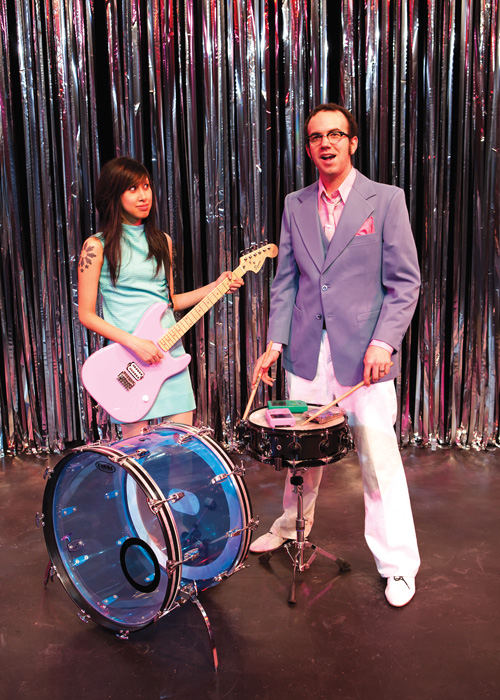
MUSIC Technology can be so existentially mystifying. One minute you’re a kid in the back seat of your parents’ car with thumbs aimed and eyes glued to the screen of your modern handheld gaming console, the next you’re on stage with blinding lights and an audience, smashing into a modified old-school Gameboy on a snare drum. One second you’re doubled over in bed with the stomach flu, the next you’re in a box on Google+, simultaneously interviewing two band members from their respective Bay Area cities.

It’s enough to melt your mind, and we haven’t even begun to discuss those Gameboy modifications. Chiptune or 8-bit music is nothing new — nerded out musicians have been tinkering with the sounds on gaming consoles since the products hit the shelves in the 1980s — but now the music has the distinction of being both technologically advanced by some standards, and vintage, given its nostalgic sound.

Plus, in these financially-strapped times, it’s an economical way of creating music. “You don’t need anything fancy to make it,” says drummer-synth programmer Matt Payne. “The equipment is dirt cheap and it’s so accessible.”

Chiptune community outreach is big for him, Payne adds from his home in Oakland, holding up a mutant Gameboy with a blinking fuzzed out screen. He and musician-@GAMER magazine associate editor Lizzie Cuevas make up Bay Area-based 8-bit band the Glowing Stars. Cuevas, joining us in the Google+ video chatroom from her office in Daly City, agrees that once people see a live chiptune band, they’re usually inspired to try out the technology themselves. “We always have people who come up at shows and ask, ‘how do you do it?'”

The duo has demonstrated just how they do that at the Maker Faire and Pulse Wave SF — a friendly monthly gathering for chiptune bands. Up next, they play the free CONVERGENCE International Alternative Music and Arts Festival at the Japantown Peace Plaza.

Cuevas and Payne met in 2005, each playing in different punk bands. Payne joined Cuevas’ band (Sputterdoll), which broke up a few years ago. “We knew we wanted to do something video game related, we just didn’t know exactly what,” says Cuevas.

Payne had futzed with a program called LSDJ (LittleSound DJ) when it first came out, but hadn’t been serious about it initially, he says. “There’s a learning curve, it’s one of those easy to learn, difficult to master things.” With the new band starting up in 2010, he began gathering Gameboys and filling them with his own sounds. Given Cuevas’ affinity for early Weezer, the music they make is poppy, but it also has that nostalgic synthesized MIDI sound.

“There’s a misconception about it, that we’re using samples from video game somehow or that we’re doing something using actual songs from video games,” says Payne. “But what we’re actually doing is basically stripping down the console to a little sound making computer and getting it to play back our music.”

The process works like this: Cuevas writes the first skeleton of a song on guitar then sends it to Payne. He then programs it using LSDJ and loads it onto the Gameboy for that 8-bit transformation. They ping it back and forth, adding layers to the song. Payne also just started making music with a Sega Genesis — you can make chiptune on any console — so that might come into play soon.

Live, Cuevas sings and play distorted guitar, and sometimes taps a fresh Gameboy, like in the song “Bounce Bounce” where she solos over the final instrumental part. Payne plays drums and, occasionally, picks up the keytar. He also keeps his modded Gameboy on his snare, which has only once caused significant damage.

“I hit it with the drum stick — it made a loud, awful noise,” he says.

Cuevas smiles and replies, “I think you lost a chunk of your Gameboy.”


CONVERGENCE FESTIVAL

The Glowing Stars

With the Bran Flakes, Planet Booty, Teenage Sweater

Sun/4, 12-5 p.m., free

Japantown Peace Plaza Post Street Between Webster and Laguna, SF www.convergencefest.com

Mayor’s race a tight pack, but Gascón lags in DA’s contest

25

Despite the hype and spin from various mayoral campaigns and newspapers, the big story in yesterday’s release of semi-annual campaign finance reports is that there isn’t much of a story: It’s pretty much what everyone has been expecting, a tight field of qualified mayoral candidates with comparable financial resources.

It was also no surprise that Progress for All, the deceptive committee behind the effort to draft Mayor Ed Lee into breaking his word and running to keep his job, was funded mostly by a narrow group of business interests connected to longtime power brokers Rose Pak and Willie Brown, mostly with $5,000 contributions, or 10 times the contribution limit for legitimate mayoral campaigns.

The real story in yesterday’s numbers was in the district attorney’s race where the conventional wisdom that incumbent George Gascón is the clear frontrunner (“wisdom” that we’ve always questioned given his lack of local roots) was cast into doubt by his lackluster fundraising, big spending for small results, and the fact that each of his two major challengers have twice as much money in the bank.

Alameda County prosecutor Sharmin Bock led the fundraising race this year with $240,337, about $6,000 more than Gascón. And after spending $156,916 in just six months, Gascón has just $77,570 in the bank. David Onek, who has been getting progressive support and retail campaigning up a storm, raised $126,386 this year, but his early start and frugal spending leaves him with $153,474 in the bank.

In the mayor’s race, while both the Chronicle and Examiner led with David Chiu’s impressive fundraising this year, leading the pack with almost $400,000, all that really did was put him into financial contention with the top-tier candidates who have been raising money since last year: Leland Yee, Dennis Herrera, Bevan Dufty, Joanna Rees, and Michela Alioto-Pier.

As of last month, their campaigns’ cash-on-hand was Herrera at $586,294, Dufty at $493,372, Yee at $444,820, Ress at $441,168, Alioto-Pier at $406,574, and Chiu at $396,754. On the next tier down, Phil Ting appears dead in the water, raising just $67,526 and having more debt than money in the bank, although his campaign consultant Eric Jaye said public funds are just starting to come in and the campaign is on track to meet its $300,000 fundraising goal.

Two other major candidates were also well behind the pack, but both are running with an outsiders’ appeal that should keep them in the running throughout the race. Tony Hall, a conservative with a strong independent appeal, raised $102,612, has $173,368, and will likely continue nipping at the heels of the mainstream pack.

And then there’s progressive favorite John Avalos, who has been running a visible, enthusiastic campaign with lots of volunteer support, although he raised just $86,882 this period and has about $100,000 in the bank (contrary the erroneous report in today’s Chronicle that he only had $500, apparently because the reporter looked at his supervisorial campaign report instead of his mayoral – whoops).

But Avalos supporter Chris Daly said the campaign has recently raised another $32,000 and is due to soon receive about $120,000 in matching funds, bringing them up to around $250,000. “That’s what [then-mayoral candidate Tom] Ammiano had in his entirety in ’99,” Daly said, noting that progressive mayoral favorites always get outspent and usually by margins greater than what Avalos now faces. “Our people don’t have as much money or city contracts.”

By contrast, Chiu has been raking in the dough this year, with lots of $500 contributions mostly from lawyers, bankers, developers, people with Chinese surnames, and employees of Google and other tech firms, with almost half of the contributions from out of town.

“We raised almost a hundred grand more than the closest competitor,” said Chiu campaign manager Nicole Derse. “We’re in a super strong position.”

In addition to the big money sources that usually gravitate to strong moderate candidates, Chiu also had some notable financial support from some progressive constituencies, including bicyclist activists (such as Gary Fisher, Dan Nguyen-Tan, Jason Henderson, architect David Baker, and MTA member Cheryl Brinkman), progressive activists Susan King and Amy Laitenen (Matt Gonzalez’s former board aide), and medical marijuana advocate Kevin Reed from Green Cross.

Jim Stearns, who is running the Yee and Bock campaigns, said the funding picture is about what he and others predicted would be the case given public financing (and its $1.475 million spending cap) and the large field of qualified candidates. “That’s the interesting thing about this race, it’s like the World Series of Poker with everyone getting the same stake,” he said. “This is unlike every other mayor’s race where there have been huge disparities in funding.”

Many political analysts privately fear that this dynamic, with nobody really pulling away from the pack of candidates, could encourage Lee to get into the race. But Stearns notes that Lee, despite the power of incumbency, will have a hard time catching up in fundraising and a huge target on his back because of breaking his word, the sleazy “Run Ed Run” campaign tactics, and just the fact that he would become the instant frontrunner.

“In the ranked choice voting scenario, if there’s someone who looks like he’s going to come in first, you don’t lose anything by attacking him because his second place votes aren’t going anywhere,” said Stearns, who said the current mayor’s race appears to be a game of inches. “It’s an infantry game rather than an air game, where the gains are slow and people are proceeding carefully.”


Our Weekly Picks: July 27-August 2, 2011

0

THURSDAY 28

FILM

“Marker XC: Three Times Thirty”

Chris Marker is a little older than his nouvelle vague contemporaries, though you wouldn’t know it from his fugitive art. His work is not a career but a universe, one that continues to expand like our own cosmos; at 90, the cat is still grinning. A few minutes of homework on the Internet turns up some of his latest illuminations, but this special birthday tribute focuses on three short films made in years sandwiching 1968, a revolutionary epoch Marker has spent a lifetime observing in quicksilver pasts and futures. Following Marker’s lead, the screening is free. (Max Goldberg)

7:30 p.m., free

McBean Theatre

Exploratorium

3601 Lyon, SF

415-561-0360

www.exploratorium.edu


MUSIC

Fresh Greens

They don’t play Equipto and Mike Marshall’s new booze banger “I Drink Fernet” in SF bars enough. C’mon city — the hook’s stuck in our gray matter all day and when we’re ready to order a beer and a shot of the herbal stuff, we wanna hear our jam. This is not going to be a problem at this week’s installation of Fresh Greens, Showdown’s hip-hop and bass night with DJs Mr. Lucky and Doc Fu. The duo has invited DJ Pause, progenitor of said Fernet anthem, to spin that night — and they’ve coordinated with Fernet Branca to the end that there will be drink giveaways galore. (Caitlin Donohue)

10 p.m.–2 a.m., free

Showdown

10 Sixth St., SF

(415) 503-0684

www.showdownsf.com


FRIDAY 29

MUSIC

Steve Arrington

In one of those head-scratching retro confluences that have been popping up on dance floors lately, two quite different soul-stomping records featuring Steve Arrington — his Wonder-full 1985 “Dancing in the Key of Life” solo release and the 1979 “Just a Touch of Love,” recorded with his classic disco-funk outfit Slave — have become local club hits again. Arrington’s in the air: the smooth-voiced Ohioan is working on a new album with steamy L.A. squelch-funk revivalist Dâm-Funk. And now here he comes live, helping to celebrate the third anniversary of retro-fun and “contemporary boogie” party Sweaterfunk. Sweat or funk? You’ll do both. (Marke B.)

9 p.m.–3 a.m., $15

Som.

2925 16th St., SF

www.stevearringtonsf.eventbrite.com


MUSIC

“Playback: AudioBus”

Every few years, the Soundwave festival inundates the Bay Area with adventurous sonic experiences, like watching tiny solar-powered speakers bloom like flowers on Civic Center trees, or hearing a concrete bunker in Marin reverberate with waves of bass. Missed last year’s Soundwave? The Playback series is giving your experiment-hungry ears another chance. This week, hop aboard the double-decker AudioBus (equipped with state-of-the-art Sennheiser headphones) and explore live music scores “routed to the scenery around you.” Music plus motion equals magic. Bay Area scratch guitarist the Genie guides you audibly through the Mission on Friday; Christopher Willets, who creates “patterns of vibrations with sound and light” takes over Saturday with a trip through Golden Gate Park. (Marke B.)

Fri/29–Sat/30, 7 p.m., $20–$200

Various locations, SF

www.me-di-ate.net


MUSIC

Mean Jeans

“This song is about the economy. It’s called: what the fuck is a 401(k)?!?!” The members of Mean Jeans wax philosophical about lots of things, but mostly they stick to partying and its many and varied intricacies. If you think punk has gotten too cerebral over the years and/or are able to argue with authority and aplomb the ups and downs of the different beers you can buy with pocket change, then Mean Jeans is the band for you. They’re the Ramones on speed, a raging house party manifest as a three piece from Portland, Ore. Pogo to your hearts content, just don’t tell them or the crowd to chill out and take it easy. It’s a punk show, you wimp — have some fun. (Cooper Berkmoyer)

With Black Jaspers, Guantanamo Baywatch, and Teutonics

9 p.m., $10

Thee Parkside

1600 17th St., SF

(415) 252-1330

www.theeparkside.com


PERFORMANCE

“Work MORE!”

Eleven drag queens, 165 costume changes, 60 minutes: put it all together and what do you get? One hell of a rendition of “Bohemian Rhapsody.” Kidding! (Kinda.) You get one of the most ambitious hours of deconstructed gender illusionism you’re likely to see in a while. “Work MORE!,” the brainchild of local firebrand VivvyAnne ForeverMORE!, has been a thrilling series of performances that dramatizes the art of drag by blending performance, storytelling, set design, music, and various challenges reminiscent of It’s a Mad, Mad, Mad, Drag World. This installment, running for two nights, calls on 11 performers to direct each other in interchangeable performance numbers — a kaleidoscope of queens engendering an evening-long mosaic of mimicry. And it might go on tour! (Marke B.)

Fri/29–Sat/30, 8 p.m., $20

CounterPULSE

1319 Mission, SF

(415) 626-2060

www.counterpulse.org


SATURDAY 30

MUSIC

MK at Icee Hot

One of the most astonishing production runs in dance music — or any music, really — occurred when young Detroit producer Marc Kinchen discovered he had a flair for combining cyber-melancholic Detroit techno beats with a soulful New York City garage house vibe. On the strength of his early, driving records, MK soon became one of techno’s first big-time remixers: his genius for chopping up a song’s vocals into completely different, in most cases more appealing, melodies filled floors from 1991-95. Since then, he’s moved on to producing Pitbull and Willow Smith, but he’s back to reap underground propers in the retro-1990’s house craze, DJing with equally famous brother Scott and fellow virtuoso vocal-hacker Todd Edwards at the monthly Icee Hot party. (Marke B.)

With Scottie Deep and Todd Edwards

10 p.m., $10

Public Works

161 Erie, SF

www.publicsf.com


EVENT

“Livin’ La Vida Lambada”

When I first started writing about Burning Man for the Guardian in 2004 — a process that this year culminated in the release of my book The Tribes of Burning Man — the two crews that I most deeply embedded myself with were Opulent Temple and the Flaming Lotus Girls. They each work out of the Box Shop on Hunters Point and were just beginning their meteoric rises to become the event’s premier fire arts collective (FLG) and more enduring large sound camp (OT). Now, as the FLGs work toward completion of its latest ridiculously ambitious project — Tympani Lambada, a representation of the inner ear translated into a massive sculpture of sound, fire, and light — the OT DJs, the burner artists of NIMBY, and others are pitching in to help their hermanas del fuego reach their goal. So come shake your asses and help bring an amazing artwork to life on the playa next month. (Steven T. Jones)

8 p.m.–2 a.m., $20

NIMBY Warehouse

8410 Amelia, Oakl.

www.flaminglotus.com/brownpapertickets


EVENT

Treasure Island Flea Market

Hey, you in the horn-rimmed glasses. You can’t really consider yourself a Bay Area vintage freak without making pilgrimages to all the area’s flea markets — Candlestick, Alameda, Alemany all rev up our barter skills — and as of Memorial Day this year there’s a new kid on the clothing rack-covered asphalt block: the Treasure Island Flea Market, where somewhere among the grassy aisle and hundreds of vendor booths, you are virtually assured of finding something with history and pizzazz. Gadabout spectator shoes, barely-used vintage road bicycles, rusty old bird cages for making garden lanterns — just make sure you can schlep it on the 108 Treasure Island Muni going home. (Donohue)

Through Sun/31

9 a.m.–4 p.m., free

(415) 898-0245

www.treasureislandflea.com


SUNDAY 30

MUSIC

Mattachine Dance Party

Around 2004, when celebrating gay history became all the rage in dance clubs, DJs naturally turned to previously buried disco sounds to accompany the onrush of post-AIDS-era curiosity. But of course gays existed before the 1970s — as recently discovered fossilized size-14 stripper heels and catty hieroglyphics about Top Chef judge selection have proved. Young, queer parties have noticed: our own Hard French reaches back to the 1950s for soul inspiration, while New York City’s Mattachine Dance Party adds 1960s rock and other queer-eared genres to the mix. Now filmmaker and sexual provocateur John Cameron Mitchell is bringing his buoyant Mattachine affair, named for the U.S.’s first gay rights organization, to El Rio for a special daytime installment that will resurrect the hot-pink spirits of yesteryear. (Marke B.)

3–8 p.m., $5

El Rio

3158 Mission, SF

(415) 282-3325

www.elriosf.com


MONDAY 1

COMEDY

Maria Bamford

One-quarter of the dream team Comedians of Comedy tour in 2004 (alongside Patton Oswalt, Zach Galifianakis, and Brian Posehn), Maria Bamford is about as unique a comedic personality as they come. She subscribes to the darker, more surrealist side of stand-up, forgoing traditional punch lines to put all her anxieties and neuroses on full-display through self-deprecation, twisted inner monologues, and a ton of barbed vocal impressions that send up her Minnesota-based family and friends. Yet for all her eccentricities, Bamford never delves into novelty or shtick. Her material is always smart, perfectly nuanced, and balanced with enough of her natural Midwest charm to make even the strangest moments relatable. (Landon Moblad)

With Robert Mac and Nato Green

Through Aug. 3

8 p.m., $22.50

Punch Line Comedy Club

444 Battery, SF

(415) 397-7573

www.punchlinecomedyclub.com


TUESDAY 2

MUSIC

Real Estate

The un-Google-able band name. Is it creative combativeness or audacity in the face of technology’s encroaching hand that led four like-minded musicians from New Jersey to name themselves Real Estate? Search engines aside, Real Estate isn’t an easy band to pin down. Reverb-heavy surf guitar with some folk mixed in begin to paint the picture, but it isn’t simply the sum of its parts. It sounds the way a drive to the beach looks: the stucco strip malls race past in a beige blur and soon recede as the scenery grows increasingly lush. Everyone else in the car is talking, but you’re too busy staring out the open window to notice. Real Estate is surf rock for city folks. (Berkmoyer)

With Dominant Legs and Melted Toys

8 p.m., $15

Independent

628 Divisadero, SF (415) 771-1421 www.theindependentsf.com 


The Guardian listings deadline is two weeks prior to our Wednesday publication date. To submit an item for consideration, please include the title of the event, a brief description of the event, date and time, venue name, street address (listing cross streets only isn’t sufficient), city, telephone number readers can call for more information, telephone number for media, and admission costs. Send information to Listings, the Guardian Building, 135 Mississippi St., SF, CA 94107; fax to (415) 487-2506; or e-mail (paste press release into e-mail body — no text attachments, please) to listings@sfbg.com. Digital photos may be submitted in jpeg format; the image must be at least 240 dpi and four inches by six inches in size. We regret we cannot accept listings over the phone.