Events

Come, as you are

0

YEAR IN MUSIC While thousands of shoppers — many appearing unfocused in their consumerist abandon — swarmed around me in the midst of Black Friday madness a couple of weeks ago, I knew exactly what I was looking for. Indeed, it was the only thing on my shopping list — the only thing that could make me get out of bed early the morning after Thanksgiving.

Capping off this fall’s many assorted special releases marking the 20th anniversary of Nirvana’s Nevermind, Universal Music was issuing a special, limited-edition, four record, 10-inch vinyl singles box set in conjunction with Record Store Day’s Black Friday festivities.

The re-release of these seminal singles — “Smells Like Teen Spirit,” “Come As You Are,” “Lithium” and “In Bloom”— probably only appeals to die-hard Nirvana fans or the completests; though possibly also to all those who were around when Nevermind first started making waves, and can vividly remember the impact of each single (and its accompanying music video) as they were released in the fall of 1991 and throughout 1992.

I fall into all of these categories, so it was with reverence and much anticipation that I braved the crowds of Union Square, walked briskly into Rasputin Music, found a set, and grabbed it off the shelf. There were no new tracks to discover, nothing that I hadn’t heard before — but the sense of excitement and joy from racing down to the record store was a welcome feeling, transporting me back to junior high, when Nirvana was exploding, and I was first exposed to a new world of music that would forever changed my life.

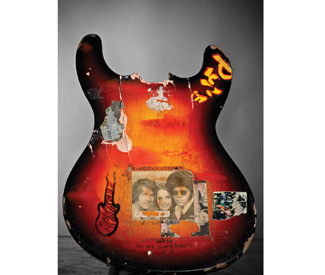
It was with these same highly-charged emotions (albeit months earlier) that I made the pilgrimage to Seattle in September to visit a new exhibit celebrating Nirvana’s legacy and impact on popular culture at the Experience Music Project museum. “Nirvana: Taking Punk To The Masses,” opened in April and features a treasure trove of artifacts and interactive installations telling the story behind Nirvana — how it became one of the most influential and beloved rock bands of the last quarter century.

Seeing the instruments that were used to create the music that has had such a profound effect on my life was awe-inspiring; as was gazing at hand-written lyric sheets, original demo tapes, artwork, family photos, stage props and more. Oral histories from band members Krist Novoselic and Chad Channing, along with others who had worked alongside them including producers Jack Endino and Butch Vig, and guitar tech Earnie Bailey, provided a personal look at the life of the band.

When coming to the end of the exhibit, my friend and I both commented that while it was a touching experience, it somehow seemed too brief, that there really should have been more to it. It was then that we looked at each other and came to what should have been an obvious realization; for all its influence and impact on our lives and the lives of millions of fans around the world, Nirvana only existed for a mere seven years. The band’s career, like Kurt Cobain’s life, was cut much too short.

In that time, however, the band made an incredible impression on its fans — and at the end of the exhibit there’s a video station where visitors are invited to share and record their memories of Nirvana — what the music has meant to them personally. After walking past the final panels and displays that recounted the events of April 8, 1994, though, I (and several other people nearby) was a little misty-eyed, and didn’t feel much like trying to sum up what Nirvana has meant to me all these years, on the spot, in front of a camera.

Instead, my friend and I proceeded to do what Nirvana had inspired us to do as teenagers; we went into one of the jam rooms in the museum, picked up a guitar, cranked up the volume, and played some tunes off Nevermind.

Plugging the flow

0

rebeccab@sfbg.com

When significant events related to the Occupy movement occur in the pre-dawn hours, it usually means a protest encampment has been raided. But on Dec. 12, Occupy protesters were the ones carrying out a strategic plan before sun up.

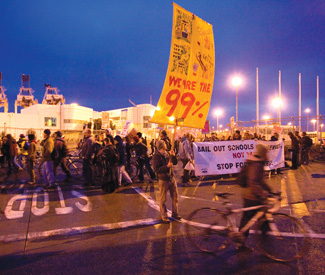
Activists organized by OccupyOakland effectively blocked cargo shipments from moving through several Port of Oakland terminals that day, as part of a coordinated West Coast Port Blockade that featured similar actions in other cities including San Diego, Portland, Seattle, and Longview, Washington.

About 150 longshore workers were sent home from their morning shifts at Oakland shipping terminals because protesters were marching in circular picket lines outside the gates.

The day began when more than 1,000 protesters met up at the West Oakland BART station at 5:30 a.m., sleepily raising signs and banners in the chilly morning air as they proceeded down 7th Street toward the port. Once they reached the sprawling shipping hub, they formed picket lines outside terminal entrances. Police were on the scene and clad in riot gear, but no clashes with protesters occurred early in the day.

Around 7 a.m., when the morning shift would have typically started, two International Longshore & Warehouse Union (ILWU) dockworkers — who declined to give their names — stood near the Hanjin Shipping gate at berths 55 and 56. Past the gate, a cargo vessel which had likely come from Japan was berthed and waiting to unload.

The men calmly surveyed the roughly 200 chanting Occupy activists as they marched around and around in a circular picket. “Ain’t nobody going to cross it,” one offered. The other gestured toward the protesters. “These are Americans wanting American jobs,” he said.

Around 10 a.m. outside the same terminal, protest organizer and Oakland hip-hop artist Boots Riley declared the first part of the port shutdown to be a victory. “Longshoremen are going home now,” he said. “Effectively, the Port of Oakland is shut down.” Later in the afternoon, protesters returned to prevent the start of an evening shift.

Until recently, the nationwide Occupy movement manifested as tent cities springing up everywhere in rebellion against the lopsided economic conditions. After a series of police raids cleared the tents away, however, organizers in the Bay Area and beyond took a different tack with the port blockade.

Working in tandem with allies from labor, occupiers from San Diego all the way up to Anchorage directed their gaze at international shipping hubs, critical infrastructure for multinational businesses importing and exporting goods between Asia and North America.

Cargo terminals make for heavyweight targets, as five of the nation’s 10 largest ports are located along the West Coast. The value of annually traded goods flowing in and out of Oakland alone is $34 billion, and authorities there estimate some $8 million could be lost if business were to be halted for a full day.


MAKING HISTORY

OccupyOakland unanimously approved the call for a coordinated West Coast port blockade at a Nov. 18 General Assembly.

“The ports play a pivotal role in the flow and growth of capital for the 1 percent in this country and internationally,” occupiers explained on a website announcing the port shutdown. “For that reason alone it is the ideal place to disrupt their profit machine.”

The ports weren’t selected as a target for that reason alone, but rather as an affront to specific corporations whose labor practices have sparked the ire of port workers. Export Grain Terminal (EGT) and its parent company, Bunge, Ltd., came into Occupy’s crosshairs because of their ongoing dispute with ILWU Local 21 in Longview, Wash., stemming from what longshoremen characterize as union-busting practices.

Port terminal operator Stevedoring Services of America (SSA Marine) and its parent company’s primary shareholder, Goldman Sachs, were also singled out in support of low-wage port truckers whose employment classification as independent contractors bars them from unionizing.

The third objective of the blockade, according to organizers, was to strike back against a series of police raids that dismantled Occupy encampments nationwide.

It wasn’t the first time cargo ships traversing the Pacific would be stalled by a politically motivated coast-wide port blockade. In 2008, ILWU members coordinated a West Coast port shutdown in dissent of the Iraq War.

In 1984, longshoremen and anti-apartheid activists blocked South African cargo to boycott the apartheid regime, noted ILWU member Stan Woods. Similar shutdowns, carried out in response to politically explosive issues going back to 1934, have been led by community activists forming picket lines at port entrances to prevent dockworkers from beginning their shifts.

Occupy’s call for a coordinated blockade brought an unprecedented twist to this historic trend, representing the first time a group unaffiliated with dockworkers had called for a shutdown spanning the entire West Coast. It left some seasoned organizers wondering anxiously how things would unfold, while others saw it as a gust of wind in the sails of the labor movement.

“One of the good things about the Occupy movement is that it’s challenging leaders of progressive institutions,” Woods said. “The old way … isn’t working. There’s been a one-sided class war, and there has to be a two-sided class war.”

Organizer Barucha Peller noted that the Occupy movement could be galvanizing for non-unionized workers, too. “Our movement is giving a framework for the 89 percent of workers who are not in unions,” she said.

For occupiers up and down the West Coast, the port shutdown also seemed to present a kind of test as to whether their young movement could successfully “exert its collective muscle,” as an OccupyOakland press statement put it, and effectuate a mass mobilization even after police raids flattened their encampments.


A ROUGH VOYAGE

In the weeks leading up to Dec. 12, even as Bay Area Occupy organizers plastered fliers about the blockade everywhere, met with union members, and organized outreach events to garner community support, they stumbled into challenges. Robert McEllrath, the president of the ILWU, publicly criticized the blockade plan, saying organizers had failed to reach out to union officials before unanimously approving the call to action.

“Any decisions made by groups outside of the union’s democratic process do not hold water, regardless of the intent,” McEllrath wrote. He seemed troubled that Occupy had attached itself to a union struggle without adequate communication, but an official endorsement of a third-party blockade by the ILWU would have landed the union in legal trouble.

“Whenever a group of people decide to march into a workplace in an effort to shut it without respecting the democratic decision-making process, it’s not an ideal situation,” ILWU spokesperson Craig Merrilees told the Guardian.

Some rank-and-file ILWU members saw things differently. “The rank and file do support the principles of the community, and Occupy,” said Anthony Lavierge, an ILWU steward. “Longshoremen had a good response to [the Nov. 2 port blockade]. It was empowering to a lot of people that so many came out.”

Another rank-and-file union member said, “the majority of ILWU workers are supportive of what’s going on, definitely.”

One rank-and-file ILWU member and self-described anarchist published a critique online raising concerns that OccupyOakland had failed to bring local union officials on board before approving the call to action.

In response, OccupyOakland organizer Mike King said, “We never brought it to them, because it’s not something they could endorse.” Yet he added that they had sought to include the rank-and-file from the start.

“We have done far more outreach for Dec. 12,” than in the days prior to the Nov. 2 port shutdown, which brought tens of thousands of activists to the street, King said. “Leading up to Nov. 2, we never expected half that many people would show up.”

Occupiers in San Diego, Los Angeles, Portland, Vancouver, Anchorage, and other cities all signed up to participate, and the idea drew support from activist groups as far away as Japan who vowed to perform solidarity actions in their own communities.

Nevertheless, the international union president’s statement prompted a flurry of mainstream news articles — along with some downright derisive columns — casting occupiers as out of sync with the very workers they claimed to stand with.

In Oakland, authorities of the targeted facility posed another obstacle. The Port of Oakland took out full-page ads in local daily newspapers and the New York Times urging the community to “Keep the Port Open.” The ads borrowed the language of the movement by proclaiming that the port “employs the 99 percent.” Port spokesperson Robert Bernardo emphasized this message in an interview with the Guardian. “When you shut down a port, you lose jobs,” he said. “Local jobs.”

Sue Piper, special assistant to Oakland Mayor Jean Quan, noted prior to Dec. 12 that the mayor was working with police and port officials to ensure that the port remained open for business. On the morning of the port blockade, however, police stood down and did not prevent protesters from circling up in front of terminal entrances.


BIG FISH TO FRY

Lost in much of the mainstream coverage of the port blockade were Occupy Oakland’s three main objectives. The protesters aimed to demonstrate solidarity with low-income port truckers laboring in service of the powerful SSA Marine; stand with ILWU Local 21 members in their face-off against EGT; and deliver a show of resistance against coordinated police raids of Occupy encampments nationwide.

In October, 26 Los Angeles truckers working for a port company called Toll Group were fired after wearing Teamsters truckers’ union jerseys to their shifts to demonstrate their wish to unionize. Because they’re classified as independent contractors instead of employees, it’s illegal for the truckers to join unions. They’re paid per shipment rather than per hour, which translates to hours of unpaid labor spent in the queue, and must cover their own job-related costs.

Occupy Los Angeles caught wind of the incident and began to talk about doing an action in solidarity with the truckers.

“The date of Dec. 12 was originally suggested by people in Los Angeles,” explained Dave Welsh, a delegate of the San Francisco Labor Council and secretary of the Committee to Defend the ILWU. “It’s also Our Lady of Guadalupe feast day, a Mexican holiday. Since many truckers of the Port of LA are Mexican, they picked that date. One focus [of the blockade] is support for truckers and their demand for better wages, working conditions, etc.”

On the day of the blockade, an open letter from port truckers was published on the website of the Coalition for Clean and Safe Ports, an advocacy group. “We are inspired that a non-violent democratic movement that insists on basic economic fairness is capturing the hearts and minds of so many working people,” the message read. “Thank you ’99 Percenters’ for hearing our call for justice. We are humbled and overwhelmed by recent attention. Normally we are invisible.”

The second major target of the blockade was EGT, which constructed a new grain terminal on Port of Longview property at the edge of the Columbia River in southern Washington, about an hour’s drive from Portland, Ore.

EGT’s parent company is Bunge, Ltd., a major agribusiness firm that has come under fire for everything from tax evasion, to rampant clearing of Amazon rainforest lands for soybean cultivation, to the use of slave labor in Brazil.

Although the terminal construction first brought hope to a small community inflicted with 15 percent unemployment , ILWU Local 21 President Dan Coffman says things soured when EGT brought in out-of-state laborers to build the facility, then refused to hire members of his union.

Coffman contends that EGT’s lease with the port means the company is required to hire Local 21 workers, but EGT disputes this, and has been locked in a federal court battle with the port. The dispute has prompted union members to stage port blockades of their own, resulting in some arrests.

Peller, the Occupy Oakland organizer, announced on a megaphone Dec. 12 that occupiers in southern Washington had shut down the Port of Longview, according to a text message from ILWU Local 21. Union members wanted to thank the movement for the show of support, she added.

“They thought they could just run over a small local,” Coffman told the Guardian, referencing EGT. “Well, David met Goliath. We’re going to fight them till the bitter end.”

Our Weekly Picks: December 14-20

0

WEDNESDAY 14

The Christmas Ballet

Not everyone is nutty enough to celebrate the nuclear family during the holidays. But that’s no reason not to go out and party. Smuin Ballet is a good place to start. The core of the late Michael Smuin’s The Christmas Ballet stays pretty much the same — classical music and (more or less) classical dancing in the first half, and a marvelous-fun, stylistically allover the place second half. Some ingredients have become classics: Santa Baby, Surfer, and Drummer Boy, among others. Every year, however, there are premieres. This December they are by Amy Seiwert and Robert Sund. (Rita Felciano)

Through Dec. 23, times vary

8 p.m., $25–$62

Yerba Buena Center for the Arts

701 Mission St. SF

415-556-5000

www.smuinballet.org


THURSDAY 15

Baths

Baths is 22-year-old electronic musician Will Wiesenfeld. Like many lumped into the chillwave category, Wiesenfeld recorded his debut album Cerulean (Anticon) in his bedroom. Cerulean is a soft and fuzzy collection of melodic, piano-driven love songs endowed with the contemporary flair of inventive rhythms and eclectic samples. The album features lots of strange, distant vocals and some unlikely cameos by clicking pens and rustling blankets. Weisenfeld’s music feels lukewarm, relaxing, laid-back. It’s like, well, warm baths. (Frances Capell)

With Dntel and Raliegh Moncrief

8 p.m., $18

Slim’s

333 11th St., SF

(415) 255-0333

www.slimspresents.com


Emmett Otter’s Jugband Christmas

With the Muppets currently making their highly anticipated comeback in movie theaters, Bay Area fans are in for a special treat, a trip down memory lane to Frogtown Hollow with screenings of 1977’s Emmet Otter’s Jug-Band Christmas. Featuring a cast of beloved furry and felt-covered magical creations of the Jim Henson Company, the film tells the tale of the adorable Ma Otter and her son, who both secretly enter a musical talent contest to win money to buy each other presents for Christmas. Hosted by Kermit the Frog, the talent show is propelled by a variety of foot-stomping musical numbers, and punctuated by the young otter’s heartwarming realization that family is the greatest gift of all. (Sean McCourt)

7:30 p.m.; Dec. 18, 2 p.m., $8

Yerba Buena Center for the Arts

701 Mission, SF

(415) 978-2787

www.ybca.org


Yip Deceiver

Think of Yip Deceiver as Of Montreal’s wicked cousin. Of Montreal multi-instrumentalist Davey Pierce has borrowed the band’s poppiest elements and let them run wild on his electronic side project. Lots of synthesizers and infectious hooks inform the retro dance blow-out that is Yip Deceiver. It’s like an Of Montreal that’s been fed party drugs and handed a glowstick. A naughtier, sweatier Of Montreal. “Dance like you’ve got no soul,” Pierce commands on Yip Deceiver’s “Sadie Hawkins Day.” (Capell)

With Shock, Loose Shus, and Tres Lingerie

8 p.m., $6

Milk Bar

1840 Haight, SF

(415) 387-6455

www.milksf.com


Loco Dice

Dusseldorfer techno DJ Loco Dice is kind of the alpha male of the underground dance scene. Not just because of his sculpted physique, impeccable five o’clock shadow, forceful opinions, and tendency to fill parties up with expensive sunglasses and hot chicks. No, it’s his refreshingly muscular style that elicits awe — he can make anybody’s record sound like his body-pumping own during a set, and his residencies on Ibiza helped add some speaker-engulfing German power to the island’s signature Spanish-samba techno sound. (The party line on this talent is that his years spent playing hip-hop cultivated a certain transformative energy.) Don’t write him off as some Jersey Shore Ibizan, though. Loco Dice also brings a roving ear and polished intelligence to the decks, as well as the kind of improvisatory magic only a live setting, and pulsing psychic conversation with the dancers, can provide. (Marke B.)

10 p.m., $15–$25

Vessel

85 Campton, SF

www.vesselsf.com


Dinosaur Jr.

Of all the pioneering alternative rock groups dragging out their old albums in their entirety, Dinosaur Jr. could easily have kept the past quarantined away. In the seven-odd years since J. Mascis and Lou Barlow put aside a long standing grudge, the band has been operating at peak form, releasing acclaimed albums including 2007’s Beyond and 2009’s Farm. The current tour, however, finds Dino looking back and performing 1988’s Bug, an album remembered for shredded guitars (“Freak Scene”) and destroyed vocal cords (“Don’t”) as much as a tour that resulted in the band’s unceremonious break-up. Former SST labelmate, Henry Rollins, will be on hand for a Q&A looking back on the era, and perhaps lay some issues to rest (Ryan Prendiville)

With Pierced Arrows

8 p.m., $32.50

Fillmore

1850 Geary, SF

(415) 346-6000

www.thefillmore.com


FRIDAY 16

Slow Hands

Slow food, slow cooking, slow money, slow living … why not a slow house movement? Well, at least “slow” in the non-metaphoric sense: NYC DJ Slow Hands was at the vanguard of a dance music moment that a couple of years ago began to slow house music tempos down to a sultry 100 beats per minute from the standard 120bpm. Sometimes he’d play slower tunes from outside the usual dance realm, sometimes he’d actually just slow down the records themselves. (The Moombahton genre followed the second method soon afterwards, slowing Dutch Euro-techno down to reggaeton speed.) But Slow Hands slow never equals boring. His mixes move with the hypnotic complexity of a dream machine, full of dubby effects, chugging momentum, and entrancing riffs. He may not even play slow at all, blasting off into wondrously ecstatic underground pop if the room feels it. Read my interview with him at www.sfbg.com/slowhands (Marke B.)

9 p.m., $15 before midnight, $20 after

Beat Box

314 11th St., SF.

www.ayli-sf.com


SATURDAY 17

A Child’s Christmas in Wales

Dylan Thomas’s prose poem A Child’s Christmas in Wales should stand alongside Dickens’ A Christmas Carol as one of the seasonal classics. It tells the story of a Welsh boy’s Christmas with witty anecdotes and rich language, reviving an earlier time “before the motor car” when everything — even the snow which “came shawling out of the ground and swam and drifted out of the arms and hands and bodies of the trees” — was unspoiled and dreamlike. Originally written for a BBC radio broadcast, the poem became a children’s book after Thomas’s death in 1953. This short film adaptation from 1963 was produced by Marvin Lightner and uses the bold and theatrical original recording by Thomas. (James H. Miller)

2 p.m., $15

Exploratorium

3601 Lyon, SF

(415) 561-0360

www.exploratorium.edu


“One-Minute Play Festival”

One of the shortest plays on record is Samuel Beckett’s Breath — it runs somewhere between 20 and 30 seconds and, from beginning to end, consists purely of sounds of a child crying, followed by heavy breathing, light changes, and a stage cluttered with trash. Not even Beckett attempted to put actors in the terse script. But at the One-Minute Play Festival, they do use actors. With more than 80 one-minute plays written specifically for the occasion, over 30 actors and five directors, the two-day festival provides quite the jarring experience. In 60 seconds, you can probably do little more than read this short article and blow your nose. But by that time at the festival, you would have already seen a contemporary drama. (Miller)

8 p.m.; Dec. 18, 2 and 7 p.m., $20

Thick House

1695 18th St., SF

(415) 626-2176

www.playwrightsfoundation.org


Lagwagon

Growing up, skate-punk trailblazer Lagwagon was a pretty big deal for me. In the band’s heyday, Lagwagon’s frontman Joey Cape was the poster boy for teenage fuck-ups everywhere. The band may have been made up of a bunch of slackers, but its music became the definitive sound of Fat Wreck Chords and inspired countless skate-punk bands to follow in its footsteps. I’d kind of forgotten about Lagwagon until I found out it was re-releasing five of its albums from the ’90s this year. For those of us who downloaded all its music on Napster and spent our allowance money on 40s, it’s payback time. (Frances Capell)

With Druglords of the Avenues and Heartsounds

9 p.m., $22

Slim’s

333 11th St., SF

(415) 255-0333

www.slimspresents.com


Pinback

Pinback tends not to burst into moments of wild intensity, but it doesn’t dwell on the lower end of things either. It finds, rather, a comfortable space between the two, much like the Sea and Cake, with whom it shares a similar texture and mood. Formed in the late 1990s as a side project by Zach Smith and Rob Crow after Smith’s band Three Mile Pilot went on hiatus, the San Diego band released its self-titled debut in 1999. In 2007, the band released Autumn of the Seraphs — an instant classic Pinback album that’s spearheaded by Smith and Crow’s complementary vocals and rhythmic guitar work. Since then, the band has been relatively quiet on the recording end, but it hasn’t yet renounced the tour bus. (Miller)

With Ghetto Blaster

10 p.m., $20

Bottom of the Hill

1233 17th St., SF

(415) 621-4455

www.bottomofthehill.com


SUNDAY 18

“Santa’s Cool Holiday Film Festival”

Something is happening to the children of Mars. Hooked on TV programs beamed from nearby Earth, they can’t eat or sleep — they’ve become fixated on foreign concepts like “playing with toys” and “Christmas.” After consulting with the planet’s resident 800-year-old wise man, Martian leaders come up with a solution: “We need a Santa Claus on Mars.” Interstellar kidnapping ahoy! Forget A Christmas Story (1983) — it’s all about 1965’s Santa Claus Conquers the Martians, an outrageously low-budget fruitcake of spunky kids, robot henchmen, bloop-bloop “space age” sound effects, zapping rays, a German-accented rocket expert, a villain with a mustache, and (naturally) a heartwarming final message about the true spirit of Christmas. This screening also features retro holiday cartoons and trailers, plus a toy drive hosted by the San Francisco Firefighter’s Toy Program. Hooray for Santy Claus! (Cheryl Eddy)

1:30 p.m., $7.50–$10 ($5 admission for children who contribute a new, unwrapped toy)

Castro Theatre

429 Castro, SF

(415) 621-6120

www.castrotheatre.com


TUESDAY 20

Zach Rogue

As an atheist gentile, I don’t know much about Judaism. But I do know that by the midpoint of December the bombardment of everything X-mas has me eyeing all the non-Christian events possible. Luckily, the Idelsohn Society has set up the Tikva Records pop-up shop, a non-red and white, non-ringing of the bells oasis. For the beginning of “the Festival of Lights” (Thanks Wikipedia!), local singing songwriter Zach Rogue, of indie-rock outfit Rogue Wave and recent project Release the Sunbird, will inaugurate the festivities with a performance and candle lighting. Candle lighting? I’ve got to see this. (Prendiville)

7 p.m., donation suggested (RSVP online)

Tikva Records

3191 Mission, SF

(415) 713-0649

www.tikvarecords.eventbrite.com  


The Guardian listings deadline is two weeks prior to our Wednesday publication date. To submit an item for consideration, please include the title of the event, a brief description of the event, date and time, venue name, street address (listing cross streets only isn’t sufficient), city, telephone number readers can call for more information, telephone number for media, and admission costs. Send information to Listings, the Guardian Building, 135 Mississippi St., SF, CA 94107; fax to (415) 487-2506; or e-mail (paste press release into e-mail body — no text attachments, please) to listings@sfbg.com. Digital photos may be submitted in jpeg format; the image must be at least 240 dpi and four inches by six inches in size. We regret we cannot accept listings over the phone.

Guardian editorial: And now we recommend a national Occupy Day

9

EDITORIAL In less than three months, the Occupy movement has changed the national political debate — and possibly the course of U.S. history. A small group of protesters, derided in the mainstream media, grew to a massive outpouring of anger at economic inequality. It’s no coincidence that politicans at all levels have begun to respond. At least five different measures aimed at raising taxes on the rich are in the works in California. In Kansas Dec. 6, President Obama made one of the most progressive speeches of his career, talking directly about the need for economic justice.

While even some supposed allies say the encampments weren’t effective, the truth is that the out-front, in-your-face tactic of holding nonstop protests in the financial heart of places like Manhattan and San Francisco got attention. The visibility of the Occupy camps forced everyone to pay attention. The U.S. economy is in a crisis; less disruptive tactics wouldn’t have worked. But now most of the emcampments are gone, broken up by police forces and scattered from the central areas of major cities. It’s crucial that this growing and powerful national movement not fall apart after the almost inevitable crackdown on one style of protest. Occupy needs to look forward and plan its next steps.

Some of that is already happening, with Occupy activists targeting home foreclosures and marching on West Coast ports. But it’s worth considering another tactic, too: Occupy ought to begin planning now for a massive spring mobilization in Washington and a series of nationwide actions that could bring millions more people into the movement.

Part of the strategy of the Occupy camps was to maintain a presence, day after day — and that made perfect sense when the movement was starting. But single-day events, if organized on a massive scale as part of a larger campaign, can have a profound and lasting impact.

The original Earth Day — April 22, 1970 — involved 20 million people across the United States. There were events in hundreds of cities and thousands of high school and college campuses. It brought together old-school, sometime stodgy conservation groups with radical young environmentalists, the United Auto Workers with people concerned about pollution from car exhaust. It was, by any reasonable account, the birth of the modern American environmental movement.

The other great thing about Earth Day — and the reason it makes a great model for the Occupy movement — is that it was largely a grassroots event. Although there was a national office, most of the work was done spontaneously, in local communities, with no top-down direction.

And everyone — from Washington D.C. to the state capitols and city halls — paid attention.

Mass marches and mobilizations helped end the Vietnam War, spark the Civil Rights Movement and fight the anti-labor politics of the Reagan Administration. None of those events took place in isolation, any more than a national Occupy Day would take place in isolation. The nation’s ready for major economic change — and organizing a national event alone could help make stronger connnections among the broad constituency that is the 99 percent.


Occupy’s next steps

6

EDITORIAL In less than three months, the Occupy movement has changed the national political debate — and possibly the course of U.S. history. A small group of protesters, derided in the mainstream media, grew to a massive outpouring of anger at economic inequality — and it’s no coincidence that politicians at all levels have begun to respond. At least five different measures aimed at raising taxes on the rich are in the works in California. In Kansas Dec. 6, President Obama made one of the most progressive speeches of his career, talking directly about the need for economic justice.

While even some supposed allies say the encampments weren’t effective, the truth is that the out-front, in-your-face tactic of holding nonstop protests in the financial heart of places like Manhattan and San Francisco got attention. The visibility of the Occupy camps forced everyone to pay attention. The U.S. economy is in a crisis; less disruptive tactics wouldn’t have worked. But now most of the encampments are gone, broken up by police forces and scattered from the central areas of major cities. It’s crucial that this growing and powerful national movement not fall apart after the almost inevitable crackdown on one style of protest. Occupy needs to look forward and plan its next steps.

Some of that is already happening, with Occupy activists targeting home foreclosures and marching on West Coast ports. But it’s worth considering another tactic, too: Occupy ought to begin planning now for a massive spring mobilization in Washington and a series of nationwide actions that could bring millions more people into the movement.

Part of the strategy of the Occupy camps was to maintain a presence, day after day — and that made perfect sense when the movement was starting. But single-day events, if organized on a massive scale as part of a larger campaign, can have a profound and lasting impact.

The original Earth Day — April 22, 1970 — involved 20 million people across the United States. There were events in hundreds of cities and thousands of high school and college campuses. It brought together old-school, sometime stodgy conservation groups with radical young environmentalists, the United Auto Workers with people concerned about pollution from car exhaust. It was, by any reasonable account, the birth of the modern American environmental movement.

The other great thing about Earth Day — and the reason it makes a great model for the Occupy movement — is that it was largely a grassroots event. Although there was a national office, most of the work was done spontaneously, in local communities, with no top-down direction.

And everyone — from Washington D.C. to the state capitols and city halls — paid attention.

Mass marches and mobilizations helped end the Vietnam War, spark the Civil Rights Movement and fight the anti-labor politics of the Reagan Administration. None of those events took place in isolation, any more than a national Occupy Day would take place in isolation. The nation’s ready for major economic change — and organizing a national event alone could help make stronger connections among the broad constituency that is the 99 percent.

Occupy shuts down morning shift at Port of Oakland

Usually, when significant events related to the Occupy movement occur in the pre-dawn hours, it means an encampment has been raided. But this morning, Occupy protesters were the ones carrying out a strategic plan before the sun came up.

A main objective of today’s Port of Oakland shutdown — the second in two months initiated by Occupy Oakland — was to strike back against the police raids that dismantled their camps.

Protesters led by Occupy Oakland effectively shut down the morning shift at the Port of Oakland today, Dec. 12, as part of a Coordinated West Coast Port Blockade that Occupy groups from San Diego to Anchorage have been planning since Nov. 18, when Occupy Oakland’s General Assembly unanimously approved the call to action.

Several hundred activists met up at the West Oakland BART station at 5:30 a.m. and proceeded to march down Seventh Street to the sprawling shipping hub, where they formed picket lines outside terminal entrances to prevent workers from entering the gates for the 7 a.m. shift. Shortly after they began picketing, truckers waiting to load or unload cargo began turning around to exit port property.

There were several busloads of protesters in addition to those who traveled to the port on foot, as well as a bicycle contingent. While most protesters filed through the streets in an uncharacteristically quiet march that seemed muted due to a lack of sleep, a few displayed gusto with a sound system, shiny homemade flags, and flashy outfits. Some showed up toting a life-sized cut-out of Lt. John Pike, the University of California Davis officer who became notorious for dispersing teargas into student protesters’ eyes, with the face cut out so people could pose for photos.

Police arrived on the scene clad in riot gear, but did not attempt to prevent protesters from circling up around the gate entrances and forming picket lines. They stood in formations in front of the gates weilding batons and teargas launchers, though protesters had no intention of entering the gates and only sought to block them. Alameda County Sheriff buses circled the area as well.

Around 7 a.m., when the morning shift would have typically started, two ILWU dockworkers (who declined to give their names) stood near the Hanjin Shipping gate at berths 55 and 56, surveying the picket line. Past the gate, a cargo vessel which had likely come from Japan was berthed and waiting to unload.

“Ain’t nobody going to cross it,” one of the men offered. The other gestured toward protesters and said, “These are Americans wanting American jobs.” Asked how he felt about the picket, he responded, “We don’t support it, because it’s not in our contract — but I do see some issues, like we’re hurting, too.” The ILWU members said longshoremen turned away because of the picket line wouldn’t be paid for the day, because they’re only registered as having reported to work if they’re physically on the terminal. They also noted that there was a relatively light workload at Oakland terminals on this particular day.

The official objectives of the port blockade, aside from showing resistance against crackdowns on Occupy encampments, were to demonstrate Occupy’s solidarity with longshore workers and port truckers. The International Longshore & Warehouse Union (ILWU) Local 21, based in Longview, Wash., has been locked in a legal dispute with Export Grain Terminal (EGT) stemming from what workers characterize as union-busting practices.

Port truckers, particularly in Los Angeles, have been unable to unionize due to their employment classification as independent contractors, and protesters sought to highlight their struggle as well. Picketers held signs declaring solidarity with the ILWU and truckers against the one percent — global shipping companies owned in part by agribusiness giant Bunge, Ltd. and Goldman Sachs, respectively, who profit from their labor.

Speaking into a megaphone, organizer Barucha Peller announced that occupiers in southern Washington had shut down the Port of Longview, according to a text message from ILWU Local 21. Union members wanted to thank the movement for the show of support.

By around 10 a.m., an independent arbitrator had ruled that the picket posed a health and safety risk to longshore workers, so the dockworkers were sent home, effectively halting port activity for the first part of the day. “I’m really impressed that so many people got up at five o’clock in the morning,” Anthony Lavierge, a steward with ILWU, said into the megaphone. “It’s officially shut down. The longhshore labor is officially going home.” However, protesters planned to return to the port later on to prevent the start of an evening shift.

Following the announcement that workers had gone home for the day, protesters marched back to West Oakland BART station. A second march to the port is planned for 4 p.m., leaving from 14th and Broadway streets in downtown Oakland following a 3 p.m. rally. A third march to the port is scheduled to leave the West Oakland BART station at 5 p.m.

Should Occupy pull back and reinvent itself?

14

Maybe it’s time for the Occupy movement to simply take a bow, step off the national stage for now, and start planning its next big production. Because at this point, Occupy has been a smashing success – winning over its audiences and key critics, influencing the national debate – but it’s in danger of losing that luster if its lingers too long in its current form.

Consider the events of this week. When OccupySF’s long-standing encampment was finally removed by police and city workers, the general public barely noticed or reacted. Unlike during previous police raids, hundreds of supporters didn’t pour in to defend the camp and social media sites didn’t light up with messages of indignation and solidarity.

Why? Well it’s not because people don’t support the movement. Polls have consistently shown most people back Occupy, and even higher percentages support its basic message that the 99 percent are being screwed over by the 1 percent. Top political leaders at every level – Mayor Ed Lee, Gov. Jerry Brown, and President Barack Obama – made statements and speeches this week that echo the themes and ideas that Occupy has injected into the national dialogue.

But the tactic of occupation was only going to get us so far. It was a great way to start a conversation and demonstrate a broad discontent with this country’s inequities and plutocratic excess. Finally, the people have started to challenge those who are exploiting them, and it’s been particularly exciting to see young people fighting to reclaim their stolen futures.

That energy hasn’t dissipated, and it’s interesting to see it morphing into other campaigns, such as the recent takeovers of vacant foreclosed homes, the human rights march planned for tomorrow, and West Coast port shutdown scheduled for Monday. But I predict the crowds blockading the Port of Oakland will be a fraction of the size of the tens of thousands who took to the streets during the Oakland General Strike on Nov. 2.

Then, people were reacting to police violently crushing Occupy Oakland’s peaceful political assembly on Oct. 25, a galvanizing event, much like the raid on Occupy Wall Street and the abusive police tactics against occupiers on the UC Berkeley and UC Davis campuses. Each example showcased the police state’s willingness to use a heavy hand against peaceful protesters, demonstrating for a global audience what an important struggle this is and what we’re up against.

Yet it was hard to summon up much indignation over this week’s raid on OccupySF, even as protesters complained about being given just five minutes to get out and having their belonging seized and destroyed. Mayor Lee had been threatening the raid for weeks and had offered the group a free new home in the Mission – an offer they probably should have taken, one that would have allowed the group to declare victory and have a base of operations throughout the winter.

But unlike my cranky, “you kids get off my lawn” colleagues in the mainstream press, who have consistently derided the movement and valued anti-camping laws over the core constitutional right to peaceably assemble to petition for a redress of grievances, I think Occupy has been extremely important and effective. My desire is to see it evolve and continue.

Mayor Lee and other city officials have praised the goals and worldview of Occupy at every turn, even as they oppose the tactic of camping. As Police Chief Greg Suhr raided OccupySF, he told reporters that “part of the 99 percent removed part of the 99 percent to give the other part of 99 percent some relief,” tipping his hat to Occupy’s basic paradigm. Gov. Brown echoed Occupy’s economic inequity language in his call for higher taxes on the rich this week.

“I’m here in Kansas to reaffirm my deep conviction that we’re greater together than we are on our own. I believe that this country succeeds when everyone gets a fair shot, when everyone does their fair share, when everyone plays by the same rules. These aren’t Democratic values or Republican values. These aren’t 1 percent values or 99 percent values. They’re American values. And we have to reclaim them,” Obama said in his big speech this week, embracing the Occupy paradigm even as he tried to transcend it. But go back and read the whole speech and you’ll see that it would have fit right in during any Occupy General Assembly, with its regular calls to tax the rich, something this movement has given him the political cover to more forcefully advocate.

So the conversation has now begun, thanks largely to this movement. But, as most supporters of Occupy already know, our elected officials won’t simply enact the reforms we need on their own. They will need to be pushed and prodded relentlessly by a restive public, so the supporters of Occupy still have a lot of work to do.

How will they do that and what will it look like? I don’t know, but after watching these smart, creative, courageous, and committed young people and their supporters change the political dynamics of this country over the last three months, I’m anxious to see what they come up with and I stand read to chronicle and support the next phase, whatever it’s called and whenever it begins.

OccupySF retakes plaza to debate whether to keep it

10

OccupySF and its supporters defended Justin Herman Plaza last night (Wed/7) in a strong display of nonviolent action, demonstrating a commitment to the movement. But the unfolding events also showed the group is at a crossroads as it debates its next moves, and whether to continue trying to occupy the plaza after the group’s tent city was removed by police and city workers.

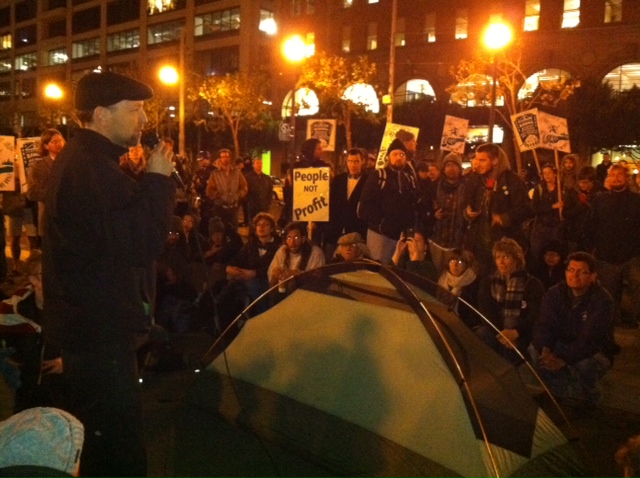
About 250 gathered for a rally at 5 pm at 101 Market Street, marching the half a block to Justin Herman Plaza an hour later. Since the plaza was cleared out that morning, it had been guarded on all sides by a line of police. But as they approached, improbably, the police line parted, letting protesters through.

The group began to hold a general assembly meeting, but after 20 minutes police issued an order to disperse. About 50 sat down in a show of civil disobedience while a couple hundred more surrounded the outskirts.

Clashes with police in the past have been characterized by tension and angry cries from protesters. This one was more peaceful. Protesters held their ground and refused to leave, but besides a few incidents in which police detained and shoved protesters, most supporters were restrained and calm.

At 8:50 pm, police suddenly began to clear out. Jubilant protesters rushed into the plaza, having won it once again. However, from the meeting that followed, it seemed clear that many are restless to put their energies into actions other than defending the plaza.

The meeting consisted of several announcements concerning upcoming actions, such as taking part in the local march in support of International Human Rights Day on Saturday and Monday’s West Coast port shutdown. Occupy groups from Anchorage to San Diego have pledged to shut down their cities’ ports on Dec. 12.

Representatives from Occupy Community College of San Francisco and Occupy SF State University, both of which have now created tent city occupations of their own, were also present. After announcements, the discussion turned to strategy. Many saw a great opportunity to pitch tents and try to take back Justin Herman Plaza. Numbers had dwindled somewhat, but there were at least 150 protesters still present for that discussion. Others argued that OccupySF had successfully shown they could retake the plaza and that they should try and avoid a police clash that night, and instead sleep at and near 101 Market Street, their other recently reclaimed protest site.

Many insisted that OccupySF would be strategically wise to allow their supporters to reserve their energy for upcoming marches and actions; nightly calls to defend camp, said one protester, were wearing many down. In the end it was clear that “OccupySF is a network of autonomous individuals. Some will stay in Justin Herman, some won’t—but we’re all in solidarity.”

All this discussion took place amid reports that police were massing in the garage underneath the nearby Hyatt Hotel and at the police tactical building on 16th and De Haro streets. Many believed that they were staging to come back and make arrests if protesters attempted to re-erect their tent city. During the meeting, protesters put up five tents, but by 11:20 pm, they had voluntarily taken down their tents.

The OccupySF general assembly consented last week to defend Justin Herman Plaza anytime it is threatened. Yet the events of the past few days, as well as the destruction of large Occupy sites throughout the country in the past weeks, many sense that strategy may now be shifting.

Gordon Mar, director of Bay Area Jobs With Justice and OccupySF supporter who risked arrest last night, told us, “There’s a lot of exciting ideas and debate about new directions, including reoccupying JHP, but also moving forward in different ways. Occupy our homes initiatives have taken off recently, as well as occupations on college campuses, different communities and neighborhoods. It’s a really exciting and hopeful moment.”

Shaw San Liu of the Chinese Progressive Alliance issued a public statement saying, “You can raid a camp, but you can’t raid a movement. The movement cannot be stopped. [The occupation] was just the tip of the iceberg.”


No more Scrooge: A list of nonprofits that still have holiday volunteer slots

1

Mincemeat, Christmas goose, Hannukah gelt, lush sprays of holly bedecking the proverbial halls – traditionally, the December holidays are all about richness, overeating, and expense. But — especially these days — not everyone will be blessed with bounty over the holidays. In trying economic times, the number of San Franciscans struggling to put food on the table let alone buy their loved ones presents is steadily growing. 

So volunteer. San Franciscans have a long-standing tradition of helping out come the holidays, and many of the traditional community meals and grocery hand-outs have filled up their guest lists like a Big Freedia show during Pride Week. Nevertheless, a bunch of opportunities remain for those looking to lend a last-minute hand.

San Francisco Food Bank

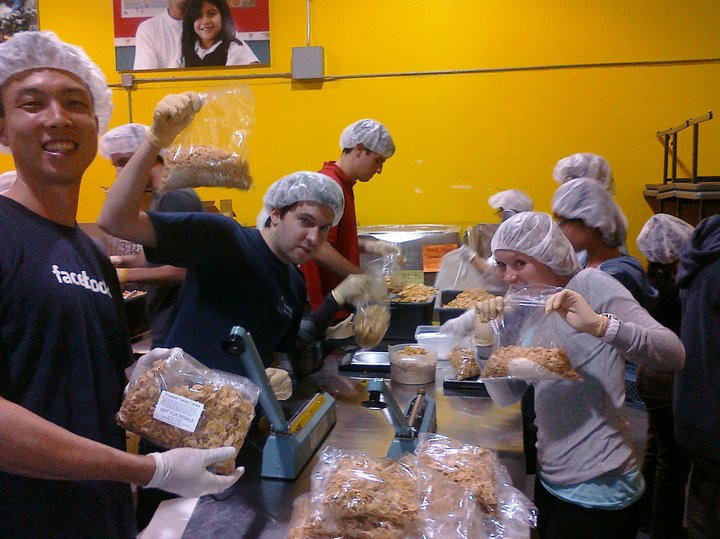
Given recent funding cuts to the organization, the San Francisco Food Bank is taking all the help it can get in its quest to feed an ever-growing number of hungry San Franciscans. An enviably efficient volunteer system relies on interested helpers to sign up on an online calendar before showing up for their shift of repackaging food for community distribution.

900 Pennsylvania, SF. www.sffoodbank.org


Glide Memorial Church

Signing up to volunteer with Glide is a bit like jockeying for the last square of fudge. But luckily the organization – a superpower of Samaritan spirit – has a few spots left for December. Chose between an early-morning grocery bag distribution gig or a toy sorting task.

330 Ellis, SF. www.glide.org


St. Anthony’s

Packed to the gills with volunteers for its main events, St. Anthony’s is still calling out for help with two upcoming items: managing curbside drop-offs on December 23rd and 24th and clothing collection throughout the month. Both duties require the volunteer to be at least somewhat physically fit and able to lift 25 pounds of goodies. Shifts are four to five hours long and can be signed up for via a voicemail message to the volunteer hotline (see below). 

150 Golden Gate, SF. (415) 592-2829, www.stanthonysf.org


Tenderloin Tessie

If you’re looking to participate in a volunteer-run, community-oriented holiday dinner, this is one of  the best bets as better-known options are already staffed out the wazoo. Tenderloin Tessie provides holiday meals to homeless, low-income, disabled, and elderly San Franciscans – and has a wide-open sign-up sheet for volunteers. December 24th shifts involve loading and unloading food from the truck while shifts on Christmas Day are dedicated to decorating the dining room, preparing and serving dinner, and cleaning up afterwards. 

First Unitarian Universalist Church, 1187 Franklin, SF. Call Michael Gagne at (415) 584-3252 to register, www.tenderlointessie.com


Meals on Wheels San Francisco

The nationwide organization that delivers healthy meals to homebound seniors is peddling its Chefs of the Bay Area calendar for the next few weeks at various locations throughout the city. Individual volunteers are needed to staff the tables and promote the calendars, the proceeds from which eventually translate into someone’s hot holiday dinner.

1375 Fairfax, SF. Contact Danie Belfield at dbelfield@mowsf.org or call (415) 343-1311, www.mowsf.org


Habitat For Humanity

Habitat Greater San Francisco holds an ongoing inter-faith build on one of their largest projects to date, a 36-unit condominium at 7555 Mission.  No construction experience is necessary, and December 21 marks the start of their Winter Solstice Build, a community-driven effort to get the Daly City residence available to low-income tenants as soon as possible.

7555 Mission, Daly City. Sign up online at www.habitatgsf.org


Little Brothers San Francisco

Not everyone has family around for the holidays, and older San Franciscans can be especially in need of some care and affection. Little Brothers organizes several opportunities for volunteers looking to befriend community elders, from Christmas Day house visits to phone check-ins to help at the office. 

Various locations, SF. Sign up online or at (415) 771-7957, www.littlebrotherssf.org


AIDS Emergency Fund

Unlimited slots for volunteers pretty much guarantees a perfect present of a Christmas Eve dinner for San Franciscans with HIV/AIDS and their families. Last year, more than 1,000 people ate; this year (the 24th such dinner), a similar turnout is expected. Load-in of supplies begins at 10 a.m. on December 23rd and shifts run all day on Christmas Eve, starting at 8 a.m.

War Memorial Veterans Building, 401 Van Ness, SF. www.aef-sf.org, sign up at aefxmas@aol.com.


Jewish Family and Children’s Services

Gather and deliver holiday treats to those who might not otherwise celebrate the holidays on December 16th and 18th at the JFCS. Individuals and groups of volunteers are both welcome; sign up by December 9.

2150 Post, SF. Call (415) 449-3832 or email loril@jfcs.org to sign up. 


SF SPCA

A sprinkling of volunteer spots remains (especially post-Christmas) at the SPCA’s annual window display at Macy’s Union Square. Staff the windows – full of then-and-there-adoptable creatures – to raise money for future SPCA programs. 

Email windowsvolunteer@sfspca.org, use the online calendar, or call (415) 554-3008 to register, www.sfspca.org 


Hayes Valley Farm

Always open to volunteers, Hayes Valley Farm, an off-ramp-turned-urban-ag-oasis, holds special holiday hours for those looking to weed away end-of-year poundage or just engage with some of the happiest plants and gardeners in San Francisco. December 27 marks the first post-holiday gardening session and is sure to host droves of veterans and newbies alike.

450 Laguna, SF. www.hayesvalleyfarm.org


Cruel revolution

0

cheryl@sfbg.com

LIT “As one survivor told me,” author Julia Scheeres writes in her introduction to A Thousand Lives: The Untold Story of Hope, Deception, and Survival at Jonestown (Free Press, 320 pp., $26), “nobody joins a cult.”

I remembered this refrain, possibly spoken by the same survivor, from Stanley Nelson’s 2006 Jonestown: The Life and Death of Peoples Temple. Recent works like Nelson’s film and Scheeres’ book suggest perceptions about Jonestown are shifting away from sensationalism. The broad strokes are well-known: a charismatic, maniacal preacher; a jungle settlement; over 900 people dead, including a Congressman; a vat of poisoned punch. But the story — explored in A Thousand Lives as a deeply disturbing human tragedy on a nearly unthinkable scale — neither starts nor ends there.

Scheeres, who keeps an office in the San Francisco Writers’ Grotto, pored through recently-released FBI files while researching A Thousand Lives. “The FBI released its files on three CDs, without a real index. So a letter that started on CD one, page 20, could end on CD three, page 350,” she remembers. “Organizing the material — 50,000 pages of documents — a lot of it was really boring shipping manifests. Crop reports. But then, oh, hey! Here’s a memo from the camp doctor discussing with [Jim] Jones how they’re gonna kill everyone.” Building from this material, the book focuses on five Peoples Temple members and views the experience of Jonestown through their eyes.

“[I chose my subjects] based on whether they were still alive, and I was able to interview them at length, or whether they had left a lot of primary source documents behind,” she says. “I also wanted to talk about the different demographics of the church, so you have old, young, black, white. A woman who has an MFA from San Francisco State, and a young black man with a GED from Oakland.”

Though A Thousand Lives does offer some background on Peoples Temple founder Jim Jones, “I wanted to know what it was like to be a rank-and-file member of the church,” Scheeres says. She uncovered powerful evidence that Jonestown was not a mass suicide, as the unfortunate phrase “drinking the Kool-Aid” suggests. Instead, she says, “it was a mass murder.”

As suggested by that sinister memo from the camp doctor, A Thousand Lives’ most startling revelation is that Jones had been fixated on killing his followers long before the events of November 18, 1978. According to Scheeres, he considered loading his congregation onto buses and plunging them off the Golden Gate Bridge, or onto a plane “and having someone shoot the pilot.” (Eerily, he even sent one of his followers to flight school in preparation.)

Soon, though, he was consumed by the idea of Jonestown: “a new society in the middle of the virgin jungle, a utopia that would be free of sexism, racism, elitism, and all other evil-isms,” Scheeres writes. The promises of Jonestown echoed Jones’ seemingly progressive message of equality, which is what attracted most Peoples Temple members to the church in the first place. It was also what had endeared Jones to San Francisco politicians, who were in awe of his ability to “mobilize thousands of people to vote,” according to Scheeres.

But in reality, “he had no desire to see his followers flourish in South America. He was already fantasizing about their deaths. Would his people die for him if he asked them to?” Turns out they had no choice. While she was writing A Thousand Lives, Scheeres took a trip to Guyana and visited what’s left of Jonestown.

“It’s remote, dense jungle,” she says. “Everything looks the same. It would be so easy to get lost. And as you’re walking through, you can hear things slithering in the leaves. Jim Jones told [his followers] that if they tried to escape, they’d be killed by ‘mercenaries’ — really, his sons that were [hiding and] shooting on the camp — or they would be killed by the jungle animals.”

Of course, when they left San Francisco, more or less willingly, Peoples Temple members — like Scheeres subject Hyacinth Thrash, an elderly African American woman who dreamed of a place where racism didn’t exist — expected to find a “utopia,” as they’d been promised.

“[Jones] was so suave and gentle in San Francisco, and would tell you what you wanted to hear, like the ultimate caring father figure. Then once he got down to Jonestown and had everyone trapped there, he just turned. You can hear him on those tapes just screaming, you know. ‘You old bitch, you’re gonna die!’,” Scheeres shudders. “The rank-and-file had no idea that he had this ideation of ‘revolutionary suicide’ until it was too late. They couldn’t escape. They were surrounded by guards holding crossbows, and behind them, a circle of guards with guns, and basically told, ‘If you don’t drink the poison, we’re going to shoot you.'”

Though she has no direct personal connection to Jonestown, Scheeres’ own background, detailed in her 2005 memoir Jesus Land, made her an unusually sympathetic outsider. “The interests aligned: race, religion, seclusion. When I was a teen, my brother and I were sent to this religious reform school in the Dominican Republic, where all of our communications with the outside world were censored, where all of these horrible things were happening that we couldn’t let anybody know about,” she says. “Obviously my situation wasn’t as bad [as Jonestown]. The head of the school wasn’t goading us toward revolutionary suicide. But the whole sense of powerlessness and feeling trapped and helpless — I could identify with that.”

Decades later, Jonestown continues to fascinate; dozens of books have been written by survivors, relatives of survivors, conspiracy theorists, cult experts, and scholars of macabre history. A Thousand Lives — meticulously researched, and written with clear-eyed, sensitive perspective — is a valuable resource for readers seeking truth, not misinformation, about the tragedy.

“Most people under 40 probably don’t remember Jonestown well, if at all. But most people have heard the phrase ‘drinking the Kool-Aid.’ I find that phrase very offensive, because they didn’t drink the Kool-Aid. First of all, it wasn’t Kool-Aid, it was Flavor Aid. Second of all, they were forced to drink the poison. ‘Drinking the Kool-Aid’ implies naïve, stupid, not thinking, kind of dumb, following the leader, and not questioning. And they were questioning. That’s what my book argues throughout,” the author says. “They argued with Jones: ‘We didn’t come down here to die. We came down here for a better life for ourselves and our kids.’ So I think ‘drinking the Kool-Aid’ needs to be excised from the cultural lexicon.”

What’s more, “I hope people will reconsider the conclusions of Jonestown after reading the book,” Scheeres says. “I think it’s a tremendously compelling tale; 918 people died that day, as a result of Jim Jones, and younger generations need to be cognizant of that. Again, he had his people trapped in Guyana, so by the time they were saying, ‘I want to go home’ — and that’s another heartbreaking thing, was finding all these notes from people to Jim Jones, saying ‘I want to go home. I want to go back to San Francisco. I hate it here. I’m miserable. My children are afraid and I don’t know how to tell them that death is a good thing’ — [it was too late]. Reading all of those notes, these voices have been silenced. Now, finally, I feel like I am the loudspeaker, or their medium for letting their voices be heard. It’s too late [to save them]. They’ve been dead for 33 years. But for the record — they did not want to die.”

www.juliascheeres.com


Michael Goldstein, 1953-2011

7

news@sfbg.com

San Francisco lost a valued champion of progressive causes on Dec. 2 when Michael Goldstein lost his battle with stage 4 lymphoma after surviving nearly 20 years living with HIV, a disease that helped awaken his political activism.

Michael was born in 1953 in New Mexico, where he was raised. His grandparents had come to New Mexico after surviving the Holocaust, and Michael came to the San Francisco in the early 1980s. Like many gay men of his generation, Michael came here to find community, to create family, and to be welcomed when much of the country was still hostile to the LGBT community.

He worked at Neiman Marcus, dressing “the San Francisco A list,” as he used to say. He studied at City College towards a paralegal certificate and was heavily involved in student politics. He landed a job at AIDS Legal Research Panel, where he worked when he was diagnosed HIV-positive in the mid-’80s.

The news hit hard, and the treatment he began took its toll. The HIV drugs were harsh then and there were many horrible side-effects with these early drugs. At that time, there was very little information or education about HIV/AIDS and there was even less support, from families and from the public.

Our San Francisco political community became Michael’s family. He was also blessed with an amazing friend in Lorae Lauritch. They worked together at NM, became roommates, and lived together with some incredible cats that were dear to him, including Paloma, Huey, Cadeau, and Missy.

Michael was a proud feminist who valued the women in his life and community, leading him to endorse a pair of successive female candidates for the Castro’s District 8 seat on the Board of Supervisors: Eileen Hansen in 2002 and Alix Rosenthal in 2006.

Over the years, Michael served as an elected member of the Democratic County Central Committee (serving as vice president), served as President of the Harvey Milk LGBT Democratic Club, and was appointed to a San Francisco City College citizen oversight board, where his questioning helped bring attention to mishandling of funds at that institution.

Michael was determined, opinionated, persistent, intolerant of bullshit, prickly, always questioning. He challenged us all to move a common agenda, come together beyond our own personal ambitions, but to also never back down out of convenience or feigned civility. “Civility doesn’t make change,” he often said.

I came to know Michael as many came to know him. Michael always showed up in support of every one of our causes. He not only showed up, he advised, opined, debated, argued, protested, got arrested, drafted policy, and so much more. Campaign after campaign, issue after issue — our friendships grew around our passion for politics, our deep concerns about everything, and a strong and unwavering belief that anyone can help make change.

Michael believed that and Michael lived that.

In the past few years, many of us noticed that Michael wasn’t feeling well. We pushed him to go to the doctor. This is a man who spent hours fighting to push through HIV/AIDS policy and funding, healthcare reform, Healthy SF — and he did not have healthcare, had not seen a doctor in nearly 10 years, and was not treating his HIV.

As many know, Michael and I were like brother and sister…often bickering back and forth on whatever was going on. We “debated” like the dear friends we had become. His lack of healthcare was one of the more important issues I would bring up often. As a long term survivor of this condition, Michael knew the score.

As the symptoms of this disease ravaged his body, he retreated from us and attempted to make sense of the unimaginable alone.

Finally at the end of September, Michael was admitted to General Hospital. With the amazing care of Ward 5A, Diane Jones, and all the amazing General Hospital workers, as well as Laguna Honda Staff and at his final resting place UCSF — his care, though coming too late, was the best in the world and gave Michael a fighting chance. He was clearly comforted and supported by his community in his final days, support that mattered so much to him.

If you knew Michael, you know there is a “what comes out of this” part. We all got to really see the results of the hard work we all participated in to rebuild General Hospital, to rebuild Laguna Honda, and to provide healthcare access to everyone, even the poorest among us. Michael, personally, was able to experience the fruits of our collective labor over these years.

He also experienced some areas where there really is a need for some work. We need to remember that AIDS/HIV is still killing people every day. We must improve people’s access to healthcare. We need to protect patients’ access to medical cannabis, even in General Hospital. We need services and we need housing, particularly affordable housing for those who need it, people struggling through this bad economy.

These are our issues and this is our agenda on the left that we have been fighting for.

I will never forget Michael. One of the last real discussions we had about politics was around election time, with Michael remembering the 2010 elections. Michael was probably more upset about what has come out of that election — the beginning of a political shift to the right in San Francisco — than many.

He has been such an integral part of the work that brought our progressive community together and he was devastated by the events tearing it apart. More than anything, he wanted to bring us together, but he ran out of time.

Michael had an agenda. His agenda was to move forward our agenda. It is time to come together and do that.

Debra Walker is an artist, activist, DCCC member, and city commissioner who ran for the District 6 seat on the Board of Supervisors last year.

Alerts

0

alert@sfbg.com

THURSDAY 8

Feminist Occupiers

Eyewitness accounts from women in the Bay Area and London have attested to sexual harassment in Occupy camps and struggles to be heard at Occupy General Assembly meetings. Join in a vibrant discussion about women’s issues within the Occupy and other protest movements.

Light supper served at 6:15 p.m. for a suggested $7.50 donation

747 Polk, SF

Contact: Norma Gallegos

415-864-1278

baradicalwomen@earthlink.net

www.radicalwomen.org


SATURDAY 10

Occupy Education organizing

Help plan the next steps in the campaign to get funding for the public university system at this organizing meeting for Occupy Education NorCal. The discussion will include the demands in an open letter to state officials approved Nov. 15 by Occupy Cal General Assembly and plans for a direct action campaign in the spring.

Noon, free

UAW Local 2865

2070 Allston #205, Berk

caloccupation@gmail.com


International Human Rights March

Participate in International Human Rights Day by marching from the OccupySF encampment to United Nations Plaza, where a series of speakers will address the need to strengthen efforts to protect and expand basic human rights at home and abroad.

3-5 p.m., free

Justin Herman/Bradley Manning Plaza

Market and Steuart, SF

www.occupysf.org


MONDAY 12

West Coast Port Shutdown

To hit business where it hurts and swat away union busting, OccupyOakland and OccupyLA are working hand-in-hand to protest EGT (an international grain exporter whose practices have detrimental effects on the working class) and Goldman Sachs (the investment banking giant that supports EGT and has fired port truckers) through a port blockade along the West Coast. Come help demonstrate the power of people to cut into the profits of entities hostile to the 99 percent.

5:30 am, West Oakland BART station, march to Port of Oakland

3 p.m., Rally at 14th and Broadway, Oakl, then march to Port

5 p.m., West Oakland BART station, march to Port

www.westcoastportshutdown.org

wcportshutdownmedia@gmail.com


TUESDAY 13

Steve Williams Roast

After 15 years of helping lead People Organized to Win Employment Rights (POWER), Steve Williams is moving on. But before he goes, he’ll be subjecting himself to the Steve Williams Roast & Toast, with the goal of raising more than $5,000 for POWER. To help meet that goal, the Unitarian Universalist Veatch Program has agreed to match every donated dollar up to that amount.

7-10 p.m., $25-$40

SEIU Local 1021 HQ

350 Rhode Island, SF

peopleorganized.givezooks.com/events/steve-williams-toast-roast


Mail items for Alerts to the Guardian Building, 135 Mississippi St., SF, CA 94107; fax to (415) 437-3658; or e-mail alert@sfbg.com. Please include a contact telephone number. Items must be received at least one week prior to the publication date.

Burning Man attendees anxious over new ticketing system

7

Burning Man attendees are feeling anxious over a new lottery-based ticketing system set up this year to address the growing popularity of the event, so much so that an unprecedented number of them are now registering for pre-sale tickets – which were originally intended as holiday gifts – that are being sold at the top-tier price of $420.

Black Rock City LLC, the San Francisco-based company that stages the annual late-summer event in Nevada’s Black Rock Desert, announced the new system last month, setting off a cascade of online denunciations and expressions of anxiety over whether burners will be able to secure enough tickets for their friends, family, and project partners.

“There’s been a strong reaction for all the reasons we thought would happen,” said Marian Goodell, one of six LLC board members responsible for the decision, who said they searched in vain for a better label for the new system. “The word ‘lottery’ is highly charged and unfortunately people equate a lottery with one in a million odds to win a fortune.”

But she said they needed to try something new after last year’s problems, when strong demand for tickets on the first day of sales repeatedly crashed the online ticketing system, and when the event sold out in late July for the first time in its 25-year history, causing scalpers to sell tickets for double-face-value in many cases.

The first round of ticket sales aren’t likely to ease people’s concerns – it could make them more nervous. As in previous years, the LLC is selling 3,000 tickets in December, and their high prices have previously kept demand at around that level. But not this year, as several thousand people have already registered for a lottery-based sale whose registration period ends Dec. 11.

“If 10,000 people apply for 3,000 tickets, I’ve got more unhappy people than I want,” Goodell said.

Those who don’t get tickets will automatically be registered for the main ticket sale in January, when everyone else will register at either the $240, $320, and/or $390 tiered pricing levels to buy up to two tickets from the 40,000 being sold then (10,000 at the lowest tier and 15,000 each at the next two). Notifications will go out on Feb. 1.

Then, in March, about 10,000 more tickets will be sold on a first come, first served basis. Goodell said the exact number of tickets sold then will depend on the permit that is issued by the U.S. Bureau of Land Management for next year’s Burning Man. The LLC has been seeking the negotiate a five-year permit that will allow the event to gradually grow up to 70,000 people.

“We’re looking at a five-year permit and the five-year permit has the potential to grow bigger. What that looks like in the first year isn’t clear yet,” Goodell said.

There are mixed views in the Burning Man community to growing Black Rock City far beyond its current size of just over 50,000 people. It would open the event to more people, but that presents challenges to acculturation and the logistics of getting people to and from a far-flung locale accessed only by a narrow highway with one lane in each direction.

Earlier this year, the LLC moved into a more high-profile headquarters space on mid-Market and set up a nonprofit called the Burning Man Project, which will eventually supplant the LLC in running the event and which is intended to pursue more projects off the playa.

“We’re all for Burning Man culture continuing to grow, and fortunately we have other avenues to grow, including the nonprofit and the regional events,” Goodell said. “The city has all kinds of other constraints.”

Critics last year complained about scalpers reselling Burning Man tickets at high prices, something frowned on in the community and discouraged by the LLC, although it did little to address the problem. An analysis done by the online ticket site Seat Geek found that the average resale price of $350 before the sellout increased to almost $700 afterward, with the highest price ticket going for $1,120.

Goodell said that the only way to minimize the scalping of Burning Man tickets would have been to create a system in which all buyers were identified by name and after-market ticket sales were regulated by the organization, “and that’s more than we were willing to do.” Instead, the LLC will be creating an online system for reselling tickets and guarding against counterfeits, with details to be announced later.

But she predicted the new system will work better than the old one and that most people’s anxieties are unfounded.

“Most people who think ahead are going to get a ticket,” Goodell said, later adding, “It’s a lot less scary than people think.”


Bay Guardian City Editor Steven T. Jones is the author of The Tribes of Burning Man: How an Experimental City in the Desert is Shaping the New American Counterculture (2011, CCC Publishing)

Sup. Elsbernd ducks more Impertinent Questions

4

Well, I am sad to report that my neighborhood supervisor, Sean Elsbernd, has once again refused to answer my Impertinent Questions and to say if he voted for Ed Lee for mayor. Perhaps I will tell you, he says, perhaps not and he chose to perhaps not. He has thus refused to shed light on his role in one of the most fateful nominations in San Francisco history.

 Here’s the latest version of the almost famous Que Syrah correspondence between Elsbernd and me on these critical Impertinent Questions. (As attentive readers of this blog know, I have been trying for months to get Elsbernd to meet me to talk about these questions at Que Syrah, a nifty little wine bar in the West Portal area of Elsbernd’s district. I am still trying.)

 When Willie Brown, Rose Pak, and the downtown gang were plotting their move  to outfox the progressives in City Hall in January  and install Ed Lee as the interim mayor, they chose Sean Elsbernd to take the lead and nominate Lee for this crucial job.

 He intoned at the time and later in writing to me that he was nominating Lee only on condition that Lee would serve as an interim mayor to fulfill the vacancy created by then Mayor Newsom who was off to Sacramento as the newly elected lieutenant governor. Lee, Elsbernd emphasized, thumping the lectern, would not run for mayor.

 Well, the Guardian and many progressives and I said at the time that this was just the Willie and Rose play, to get Lee in as interim mayor and then roll him over to run for mayor in the fall with the major advantage of incumbency.

 And so when Lee as we expected changed his mind and ran for mayor, Elsbernd was left in the position of being a key player in the plot to put Lee into the mayor’s office under false pretenses. And of course in the process he would ace out two more qualified candidates, former Mayor Art Agnos, and retiring sheriff Mike Hennessey.. Both were ready to serve as interim mayor and both pledged they would not run for mayor and most important neither would operate as enablers for Willie, Rose, and their undisclosed clients. (Willie, for starters, is on a  $200,000 plus a year retainer for PG&E, according to PG&E filings with the California Public Utilities Commission.)

 When the tide of sleaze started rising in the mayor’s office and Willie, Rose, and the gang were pounding on Lee to run, I asked Elsbernd another Impertinent Question: Would he have nominated Lee if he knew Lee was going to reverse field and run for mayor?

Elsbernd replied that he had not endorsed anyone, but that “I have been most attracted to the candidacies of City Attorney Dennis Herrera and former Supervisors Alioto-Pier and Bevan Dufty.” He said that these three have the “right combination of qualifications, experience, intelligence, skills and integrity to serve as mayor. Should Mayor Lee run for election, I would only consider endorsing his effort under one circumstance—if, and only if, I was convinced that without his candidacy, Sen. Leland Yee would be elected. That is, if I see that no one else can beat Sen, Yee other than Mayor Lee, then I would support a Mayor Lee campaign. At this point, I’m not convinced of that—I still think any one of the three I mentioned above could beat Sen.Yee.”

Just before election day when Lee was running solidly ahead in the polls, I posed more Impertinent Questions to Elsbernd: who did he support for mayor and why? He replied that he had not yet voted and had not endorsed a candidate and then stated, “Talk to me on November 9 and perhaps I’ll tell you who I voted for. Rest assured, the Bay Guardian’s endorsements will certainly influence my decision-making process.”

And again,  after Lee won handily thanks in large part to the decisive advantage that Elsbernd helped give him, I took Elsbernd up on his promises and emailed him more Impertinent Questions: Who  did he vote for and why? He ducked again and asked me to read his “original email” and to note the significance of the word “perhaps.”

Perhaps he would tell me, perhaps he wouldn’t tell me. He chose not to tell me, and the rest of his constituents,  why he made the nomination as a “neighborhood” supervisor  that helped return Willie, Rose, and the downtown gang to power in City Hall.

His explanation was classic Elsberndese and I quote it in full in all of its elegance.

”Another e-mail?  Another entry in your blog? And now a deadline?  At what point am I going to start receiving a byline in the “Guardian?” I am not going to share with you and your readers for whom I voted.  I’ll keep that one between me and my ballot.  I voted for 3 candidates who I believed had integrity, intelligence , and some grasp of the daunting fiscal challenges facing the State and the City.

“Am I happy with the results?  Again, I’m going to deflect that question because I have learned in the short time I’ve been around here, that focussing on wins and losses of past elections can take you down a rabbit hole from which you’ll never recover.  Rather, the most pragmatic thing I can do for my constituents, which is, after all, what I am here to do, is to recognize the result, accept it, and move forward with it.  Ed Lee is now San Francisco’s Mayor-elect, and I am very excited about being able to work with him during my remaining 13 months in office.  He and I worked extremely well together in developing Proposition C, which the voters overwhelmingly endorsed (and, yes, thank you to the Guardian for your endorsement – you actually got a few right this year).

“We have had some policy disagreements (e.g.  Proposition B), but I have always found him to be open to dialogue, extremely deliberate and thoughtful, and, most importantly, honest.  When we have disagreed, he has explained why and has done so with a logical argument.  While that may sound simple, I can assure you, that is a rare characteristic in this building and it is one I very much appreciate. Have fun parsing this e-mail apart.”

Final Impertinent Questions: If Elsbernd really finds Lee “open to dialogue, extremely deliberate and thoughtful and most importantly honest” and Lee explains his disagreements with Elsbernd with “a logical argument,” how in the world does Elsbernd explain the months of lies and deceptions by Lee before he decided, gosh, golly, gee, that he changed his mind and  was running for mayor after all? How does Elsbernd explain how the sleaze continues to rise in Lee’s office?  How does Elsbernd explain why, as a “neighborhood” supervisor, that he has once again followed the Willie Brown/RosePak/downtown gang agenda by introducing a June 2012 charter amendment to repeal rank choice voting, with public financing and perhaps even district elections in his gun sights? Wasn’t this all part of the master plan to gut progressive measures to level the playing field on local  elections?

Sean? Sean? Let’s talk about all of this this over flights of the wondrous wines from small, locally owned wineries and the Barcelona -style tapas served up  at Que Syrah. To that end, I will keep sending you the notices of Que Syrah special events. B3


UC’s pick of Bratton to investigate pepper spray incident isn’t reassuring

12

The video images are already iconic, a line of young students sit cross legged, arms linked, at the front edge of an Occupy UC Davis protest, nonviolently protesting the impacts of the economic crisis on the University of California and beyond. As police step forward students begin to chant “the whole world is watching,” and officers disperse fire extinguisher size canisters of pepper spray into the faces of the seated students.

As is turns out the students were right, the whole world was watching, leaving UC Davis with a public relations nightmare that has left the campus police chief and two officers on administrative leave. In the wake of the incident, UC President Mark G. Yudof established an independent review to be conducted within the next 30 days, naming former Los Angeles Police Chief, Bill Bratton, now chairman of Kroll Security, to lead the investigation.

“My intent,” Yudof said, “is to provide the chancellor and the entire University of California community with an independent, unvarnished report about what happened at Davis.”

While UC Davis touts Bratton as “a renowned expert in progressive community policing,” deep questions surround the choice of Bratton. The Council of University of California Faculty Associations (CUCFA) was quick to question the independence of the investigation of police violence at UC Davis, pointing out that Bratton, through Kroll, already holds contracts with the UC system.

“We already know that Kroll has provided security services to at least three UC campuses for the past several years. This in itself would disqualify Mr. Bratton from participating in the investigation,”said CUCFA president Robert Meister. “You would be illustrating the kinds of connection between public higher education and Wall Street that the Occupy UC movement is protesting.”

Bratton also served as president of the Police Executive Research Forum, the police non-profit that facilitated controversial phone discussions between major metropolitan police chiefs in the lead up to the crackdown on the Occupy movement across the nation, raising questions about his ability to lead the UC Davis investigation.

Bratton’s offical bio from the LAPD shows the depth of his involvement in PERF when it states, “He is also the only chief executive to serve two terms as the elected President of the Police Executive Research Forum (PERF).” Bratton was instrumental in the creation of PERF’s hardline 2006 report Police Management of Mass Demonstrations http://www.policeforum.org/library/critical-issues-in-policing-series/MassDemonstrations.pdf for which he receives special recognition in the acknowledgments section of.

“PERF gathered more than 100 invited practitioners and stakeholders at an international forum in San Diego in December 2004 to highlight issues related to mass demonstrations and use-of-force. At this event, Los Angeles Police Chief William J. Bratton set the scene for a lively interaction as he discussed the changing nature of protests and mass demonstration events. He recalled that in the 1960s the issues leading to demonstration events tended to be more community-centered and that the police focus was largely tactical. He noted that today, demonstrations are sometimes orchestrated by far-reaching national and international organizations, coalitions and informal groups subscribing to anarchistic methods,” reads the report.

The manual pays special attention to managing media messaging, devoting a section to media in the wake of a major demonstration: “An integrated media strategy seeks to manage and harness the media attention in order to help achieve the overall policing objectives. By partnering with the media, the potential increases for all parties to win, public confidence to be maintained and the reputation of the law enforcement agencies to be enhanced.”

Though Bratton has moved on as PERF’s president, he keeps close ties with the organization. In April , Bratton was the keynote speaker at a PERF conference on technology and policing held in Washington, DC, a subject Bratton is an expert on due to his role in developing the controversial CompStat system used to “predicatively model” crime in some metropolitan areas.

Bratton is widely recognized as the leading proponent of the “broken windows theory” of policing, which advocates a zero tolerance approach to petty crime. Speaking to the Telegraph(UK) this summer about the historically large youth riots in the UK, he said youth were “emboldened” by over-cautious policing.

“To be effective, a police force should have ‘a lot of arrows in the quiver,’ said Mr Bratton, advocating a doctrine of ‘escalating force’ where weapons including rubber bullets, Tasers, pepper spray and water cannon were all available to commanders,” the paper wrote on August, 12 2011.


More backroom policy talks with the California Public Utilities Commission

On Dec. 8 and 9, high-ranking state government officials will attend a private conference with executives from Pacific Gas & Electric Co. (PG&E), Chevron, AECOM, and other major energy industry players at Cavallo Point, a luxury resort in Marin County to talk about distributed generation, a decentralized system for renewable power. It’s a gathering of top governmental officials and industry leaders to talk about policy issues with far-reaching effects on California’s energy future, but members of the general public are not invited.

As officials pack their bags for the conference at the plush resort, California Sen. Leland Yee is preparing two separate pieces of legislation designed to promote transparency within the California Public Utilities Commission (CPUC) and to make it harder for energy company executives to transition seamlessly into posts at the CPUC, the governing body that regulates utilities.

The conference is being organized by the California Foundation for the Environment and the Economy (CFEE), a nonprofit funded by investor-owned utilities and other corporations that wield tremendous influence in the Bay Area.

The Guardian spotlighted CFEE in an article about California Public Utilities Commission (CPUC) President Michael Peevey, who regularly participates in educational travel excursions funded indirectly by the companies his commission oversees.

When CFEE spokesperson PJ Johnston was interviewed for that article, he justified CFEE events by saying, “The idea for us was that it made sense to have someplace where it was nonconfrontational to engage in policy, work-type discussions,” and added they’re “all about policy, on the 30,000-foot level.”

Peevey will be attending this conference, according to a list of participants posted on CFEE’s website. So will PUC commissioners Mark Ferron, Michael Florio, and Nancy Ryan. By press time, the CPUC had not returned calls seeking comment about why commissioners are participating.

More than a dozen California senators and assembly members are listed as conference participants, as are the director and deputy director of Gov. Jerry Brown’s Office of Planning and Research, Ken Alex and Wade Crowfoot. (Crowfoot previously served in former Mayor Gavin Newsom’s administration as an environmental advisor. Newsom now serves at the state’s lieutenant governor.) Executives from Shell Energy North America, the Alliance of Automobile Manufacturers, Southern California Edison, and other heavy hitters in the industry will attend the conference too.

The conference agenda features educational sessions on distributed generation and state renewable energy goals. Several environmental and consumer advocacy groups will be present as well.

Mark Toney, executive director of The Utility Reform Network (TURN), a consumer advocacy group, also plans to attend. “Events like this give the utility industry and energy regulators an opportunity to have policy discussions and to influence policy decisions outside of the political process. It’s a privileged space,” Toney acknowledged. “We don’t think this is a good way to make policy.”

Yet he said advocacy groups like his own face a dilemma when deciding whether to participate in such events. “On one hand, we could decide we want to have nothing to do with it. But if TURN isn’t represented, then the view of ratepayers and consumers won’t be represented by anybody.” He stressed that while TURN attends daylong conferences hosted by CFEE in order to gain access and hopefully have a positive influence within that priveleged space, the group does not participate in travel excursions organized by the organization, which have drawn controversy in the past. “It’s kind of a judgment call,” he added.

Closed-door, backroom policy discussions aren’t the only CPUC transparency problem drawing scrutiny lately. Recent press reports have spotlighted instances of the CPUC denying public access to safety reports, a highly sensitive issue given the fatal pipeline explosion that destroyed a neighborhood in San Bruno last year.

On Nov. 29, Sen. Yee announced he would introduce legislation in early 2012 to subject the CPUC to the California Public Records Act, by stripping away provisions that allow the commission to block the release of information. It would place the body on the same footing as other state agencies with regards to information sharing.

“If you want anything out of the PUC, it takes an affirmative vote of the commission,” explained Adam Keigwin, Yee’s legislative aide. Secretary of State and former Assembly Member Debra Bowen initiated a similar push for transparency at the CPUC in 2006, but the effort did not go anywhere. On Nov. 30, Yee sent a letter to Peevey, the CPUC president, asking for the results of a study on transparency issues that the commission was supposed to undertake nearly six years ago when Bowen was pushing for the bill.

Keigwin added that Yee is also looking at legislation that would bar utility executives from serving on the PUC for a certain length of time, so as to prevent undue influence.

Our Weekly Picks: November 23-29

0

WEDNESDAY 23

Immortal Technique

“So now that it’s proven, that a soldier of revolution/ Or head of an empire, disguised in a constitution/ Can not escape the retribution or manipulation/ Of the self-appointed rulers of the planet’s corporations.” So says Afro-Peruvian rapper Immortal Technique on new mixtape The Martyr (Viper Records). Born Felipe Coronel, Tech seizes every opportunity to eviscerate American class warfare and excoriate the United States government’s complicity. Tech’s angry sermons get a little lost in the first half of Martyr because of distracting riffs taken from the Beatles, Aerosmith, and The Goonies soundtrack, though there is a clever reworking of ABBA’s “Money, Money, Money” in reference to this generation’s “Rich Man’s World (1%).” Pure, undiluted Tech shines through on the mixtape’s second half. Swill with care. (Kevin Lee)

With Chino XL, Da Circle, DJ GI Joe

8 p.m., $32.50

Fillmore

1805 Geary, SF

(415) 346-6000

www.thefillmore.com


MOM’s Family Funk’tion

Before you indulge in caloric binges, first endear yourself to the soulful 1960s sound that has always sounded sweeter during the holidays: Motown. No one knows and appreciates this more than the masterminds behind MOM (Motown on Mondays) who bring originals, remixes, and “close relatives” of Motown label songs to venues and events across San Francisco, including Madrone Art Bar, Public Works, SF Funk Fest, even the Treasure Island Music Festival. The first MOM’s Family Funk’tion goes down the night before the turkey funeral that is Thanksgiving at Brick & Mortar, with DJs Gordo, Timo, Phleck, and Matteo spinning the tracks that get the tail-feathers shaking. The crew from MOM promises to provide “toasty soul and fresh funk jams.” (Emily Savage)

10 p.m., $5

Brick & Mortar Music Hall

1710 Mission, SF

(415) 800-8782

www.brickandmortarmusic.com


tUnE-YarDs

Before her set at Pitchfork Music Festival last summer, we were all given tubes of neon yellow warpaint so we could emulate tUnE-YarDs’ Merrill Garbus. Though we may have resembled her, it was no use. We would never be as badass as the woman on stage looping ukulele, smashing drums, and wailing something fierce. With help from additional saxophonists and drummers, the playful jams of Garbus’ quirky hit album w h o k i l l (4AD) burst forth into the calculated cacophony that is tUnE-YarDs. (Frances Capell)

With Pat Jordache

8 p.m., $23

Regency Ballroom

1300 Van Ness, SF

(415) 673-5716

www.theregencyballroom.com


FRIDAY 25

“Sing-A-Long Sound of Music”

Chances are “Sing-A-Long Sound of Music,” the classic musical from 1964 with lyric subtitles so the whole theater can burst into song, is your mother’s dream come true — unless I am the only one who has watched their mom caper around the house, singing “My Favorite Things” (a possibility). It’s fortunate that “Sing-A-Long Sound of Music” should show the weekend after Thanksgiving. If mom’s in town, it’s your best bet. Additionally, the theater hands out goody bags, holds a pre-film concert featuring organist David Hegarty, as well as a costume contest. Your mom can dress up as Maria, of course, and you can dress as one of the Von Trapp children. Come on, do it for family. (James H. Miller)

7 p.m., $15

Castro Theater

429 Castro, SF

(415) 621-6120

www.castrotheater.com


Nadastrom

Are there a lot of orphans in the DJ community? Why are they active the weekend after Thanksgiving, when touring bands are presumably in food comas? Thankfully, there’s still down and dirty shows like this to sweat the gravy out, featuring a big lineup of international and SF DJs including Nadastrom, the progenitors of the bastard toddler of Dutch house and reggaeton: moombahton. Put on by Soundpieces, Camp?, and Irie Cartel, the proceeds of the event will benefit DJs Bogl and Benjammin Taylor, who lost their home in the fire above the Haight and Fillmore Walgreens a couple months back.(Ryan Prendiville)

With Truth (NZ), Stylust Beats (CAN), Lorne B (CAN), Tuffist (SP), Dnae Beats and more

10 p.m., $15 advance

103 Harriet, SF

(415) 431-1200

www.1015.com


“Velveteen Rabbit”

There is a lovely tradition in English children’s books that dresses issues around growing up with imagination and a gentle but firm hold on reality. Winnie the Pooh and Wind in the Willows are two of them. Marjorie Williams’ 1922 The Velveteen Rabbit is another. ODC/Dance’s KT Nelson, a young mother at the time, choreographed it 24 years ago. Today, it’s as fresh and imaginative as ever, with wonderfully colorful costumes, Benjamin Britten’s splendid score and Geoff Hoyle’s intimate narration. The two-person high Nana has just a touch of Victorian strictness about cleaning up the nursery but her efficiency is more than held in check by the toys who have minds of their own. Opening performance is Grandparents’ (20 percent off) and photo day (Rita Felciano)

Through Dec. 11, times vary, $15–$45

Novellus Theater

Yerba Buena Center for the Arts

700 Howard, SF

(415) 978-2787

www.ybca.org


“Great Dickens Christmas Fair”

Do not discount the Dickens Fair’s potential for holiday weekend shenanigans. Opportunities for hijinx abound, and not just because the fair’s 800 performers — from dirty-overcoated “guvnah!” drunks to crinoline-encased ladies who tea — are encouraged to interact in character with passers-by (mess with them gently! They love it!) The fair fills the cavernous Cow Palace, and houses a corsetry with live models coordinated by local cinchers Dark Garden, an adventurer’s salon where you can share your rollicking tales of shot glass exploration with fantastically mustached gents — and yes, you can booze your face off. Four bars, people! Including an absinthery in an alley, where you can mix chemically-induced hallucinations in with your environment-induced ones. (Caitlin Donohue)

Through Dec. 18, $22–$25

Cow Palace

2600 Geneva, SF

1-800-510-1558

www.dickensfair.com


Boys Noize

Here’s a great way to shed those new extra turkey (or Tofurkey) pounds — waddle into the Mezzanine Saturday night in your most comfortable tight jeans and dance your ass off. Boys Noize throws down the kind of relentlessly squelchy music that might make pioneers of Detroit’s minimal techno scene wince. Noize, actually the moniker of German DJ Alex Ridha, has been busy as of late, pushing releases on his record label, BoysNoize Records and its digital offshoot BNR Trax. The label’s sounds range from acidy techno to sinister electro, with a sprinkle of wobbly dubstep and a dash of oddball, leftfield sounds — much like the label’s creator himself. (Lee)

10 p.m., $30

Mezzanine

444 Jessie, SF

415) 625-8880

www.mezzaninesf.com


SUNDAY 11/27

Jeffrey Luck Lucas and Nebulous Orchestra

The Mission District’s Episcopal Church of St. John the Evangelist is no ordinary church — sure, it holds regular worship services, but it is also highly progressive (vocally supportive of LGBT rights, for example), boasts a colorful mural on one of its exterior walls, and is staunchly community-oriented, welcoming the occasional secular event into its historic (circa 1910, after being rebuilt post-1906 quake) building. Tonight’s performance features Mission troubadour Jeffrey Luck Lucas, heading up an “orchestra” (pipe organ, oboes, clarinets, strings, and more) comprised of other local musicians. You can bet that the acoustics in the church — itself known for a strong music program — will render the experience even more amen-worthy. (Cheryl Eddy)

With Gloaming Boys

6 p.m., $8–$20 (no one turned away for lack of funds)

Episcopal Church of St. John the Evangelist

1661 15th St., SF

www.saintjohnsf.org


MONDAY 11/28

“You Are All Captains”

A beguiling and beautiful meta-fiction, You All Are Captains grew out of Oliver Laxe’s experience teaching film workshops to local kids in Tangiers. Everyone plays themselves in this reflexive movie, though Laxe casts himself as the fool — a presumptuous European director guiding students to his own ends. The disguise allows him to realize sly but substantive reflections upon the ontology and ethics of filming. It’s fitting that You All Are Captains is making its local premier in a classroom: a U.C. Berkeley student group flying under the banner of “Picturing Neo-Imperialism” has invited Laxe to present his debut in person more than a year after it won the FIPRESCI critics’ award at Cannes. (Max Goldberg)

7 p.m., free

UC Berkeley

Dwinelle B-4, Berk.

www.pnwg.wordpress.com/events


TUESDAY 11/29

Metal Mother

By some standards, Oakland’s Tara Tati came into music fairly late: she didn’t take up the piano seriously until she was 23. But you wouldn’t guess as much listening to her ethnic fusion project, Metal Mother. On the debut album Bonfire Diaries, the singer-songwriter builds up a bold and elemental sound. With its trudging percussion and distinctly dark temper, Metal Mother invokes ’80s goth rock, ethnic fusion bands like Dead Can Dance, and at times, world ambient soundscapes. And yet, at heart, Tati sounds like a pop artist in the same vein as Björk circa Homogenic, and that alone implies talent. (Miller)

With Horns of Happiness, Mortar and Pestle, Birdseye

8 p.m., $10

Cafe Du Nord

2170 Market, SF

(415) 861- 5061

www.cafedunord.com


Retox

Is the Locust a joke? With its speedy deliver, high vocals, beepy attack synth, and masked personas, I never could quite decide. And yet, who cares? The energy level was always high, the shows always masterful absurdist romps. Justin Pearson and Gabe Serbian from the screamy ’90s-born Three One G act have now formed Retox — like Locust 2.0. Masks now off, and sounds a bit filled in (but really, just a smidge — its new album clocks in at 13 minutes total), it’s shinier, thicker, less jokey. It’s helter-skelter rock’n’roll, minus the screeching buzz-saw, the painful intro to “Boredom is Counter-Revolutionary” notwithstanding. The band is matched well with frantic experimental Japanese noise-punk act Melt-Banana. Anticipate high-energy, non-medical spasms. (Savage)

With Melt-Banana, Peace Creep

9 p.m., $14

Bottom of the Hill

1233 17th St., SF

(415) 621-4455

www.bottomofthehill.com

Gifts with grace

1

culture@sfbg.com

HOLIDAY GUIDE 2011 It’s the gift-giving season, and each foil-wrapped bauble tells a tale. There’s the love-you-this-much of a parent’s infamous peach cobbler pie, the damn-I-just-took-your-breath-away of a winter getaway to the Bahamas. There is the who-are-you-again? of Aunt Shirley’s yearly package of black dress socks. But then there are the let’s-change-the-world gifts, the ones that are not just about the recipient but that nonetheless land in the giftee’s hands with a heft that speaks of their worth to the community. Toasty as a chestnut roasting on an open fire, no? Giving that warmth can be as simple as copping a T-shirt, book, or card from one of the do-gooder nonprofits and shops listed below. And remember, even if you’re not the thin sock-loafer type, you can always improve your own karma by snail-mailing a heartfelt thank you note to Shirley. 


NIROGA CENTER

Everyone seems to make the same tired New Year’s resolution: lose weight, live healthier, blah blah blah. At the Niroga Center, however, you can spring for a yoga package for that uncreative loved one that will not just help brighten their inner light, but will go to stoke the spark of others who are struggling to make ends meet. The center offers affordable, high-quality yoga instruction, and puts particular focus on at-risk and underserved individuals, teaching yoga to incarcerated youth, high school children, and cancer survivors. For the holidays, you can donate any amount of money to the center, which will fund their donation-based classes and classes that teach yoga to the underprivileged. You can also purchase yoga classes to start someone’s year anew for as low as $10.

1808 University, Berk. (510) 704-1330, www.nirogacenter.org


CASA BONAMPAK

With a salesfloor awash in papel picado and other crafts from Chiapas, Casa Bonampak believes in preserving Mexican traditions, and that reconnecting with culture can transform and heal. All in all, it’s a feel-good (and community-building) place to do your holiday shopping. The shop’s all-woman staff works directly with Mexican and Latin American artists to sell unique jewelry, luchador masks, and handmade cards, with most items ranging from $4 to $13. The store has also been dedicated to promoting local Latin artists in the Bay Area for 15 years. With so many gorgeous handicrafts crammed into the Valencia Street storefront, Casa Bonampark is a great place to support culture on either sides of the border.

1051 Valencia, SF. (415) 642-4079, www.casabonampak.com


GUARDSMEN CHRISTMAS TREE LOT

The Guardsmen, a group of Bay Area men who work together to help at-risk children and organize educational and outdoor activities for inner-city youth have organized this forest of fir every year since 1947. Now as way back then, the proceeds from the lot support the organization’s doing-good year-round. Post-Thanksgiving, a corner of Fort Mason is transformed into a winter wonderland with trees as tall as 15 feet decorated with ornaments and wreaths. The all-volunteer guardsmen staff can assist you in picking the perfect holiday tree with which to surprise your apartmentmates — you can even arrange to have one delivered to your home. Coupled with events like crab feeds, wine tastings, and opportunities to take photos with Santa, picking up some beautiful boughs for the family never felt so good.

Festival Pavilion, Fort Mason Center, 38 Fort Mason, SF. www.guardsmentreelot.com


LIBERATION INK

Do you have a friend who has been dying for a “Brown and Proud” T-shirt ($24)? Perhaps they’re jonesing for an organic tote with a picture of Assata Shakur ($16)? Liberation Ink, an all-volunteer, worker-owned apparel printing and design collective, believes in a sustainable movement for social justice that is funded from within. It prints revolutionary faces and sayings on shirts made organically and/or without the use of sweatshop labor. All profits go directly to support grassroots social justice organizations like the May 1st Alliance for Land, Work and Power, and the Deporten a la Migra Coalition. The brand’s comfy, stylin’ T-shirts will have your lucky giftee looking fly and spreading the word of social equality in one fell swoop.

www.liberationink.org


COMMUNITY THRIFT STORE

A nonprofit secondhand store, Community Thrift relies entirely upon donations of clothes, knick-knacks, kitchen supplies, and furniture to keep its doors open. And they stay open, too: the Mission District shop is open to browsing and donations from 10 a.m. to 5 p.m. daily. Shopping here — and if your boyfriend’s been searching for that perfect yet affordable leather bomber jacket or snazzy armchair, this should be your first stop — supports local non-profits like the San Francisco LGBT Center and the San Francisco Child Abuse Prevention Center, just two of almost 200 organizations that benefit from Community Thrift’s largess.

623 Valencia, SF. (415) 861-4910, www.communitythriftsf.org


SAN FRANCISCO ZOO

Has the kid you nanny been yapping about adopting a Magellanic penguin? Maybe your friend has always admired Chilean flamingos? You can sponsor their love of the wild by donating $50 in their name to the Adopt-an-Animal program at the San Francisco Zoo. The donation will help to provide veterinary care for the furred and feathered, not to mention support educational programs for tomorrow’s wildlife champions. Once you’ve dropped the dough your loved one will receive a certificate of adoption — very official! — as well as a fact sheet and photo of the critter they’re sponsoring. Feeling flush? Your other option is the zoo’s Guardian program, which for a minimum annual contribution of $1000 will help provide further support to the zoo. It supports high-quality animal care, and all kinds of incidentals that keep the family destination open to the public. Give the gift of Guardianship and your buddy will receive free admission, carousel rides, and free parking near their furry for an entire year.

San Francisco Zoo, 1 Zoo Road, SF. (415) 753-7080, www.sfzoo.org


THE BOOKMARK STORE

Sure, the money from your holiday purchase here will go to a good cause — but it’s also the perfect place to browse and spend your lunch hour while you shop down your holiday list. The Bookmark is a non-profit that’s run by the Friends of the Oakland Public Library. It houses everything from science fiction to cooking to non-fiction, an inexpensive place where you don’t have to scour shelves to find those hard-to-find, out-of-print books your favorite bibliophile will flip to receive. Plus, all proceeds from your sale will keep libraries in Oakland with their pages open to the public.

721 Washington, Oakl. (510) 444-0473, www.thebookmarkstore.org


Tradition!

3

emilysavage@sfbg.com

MUSIC Row after row of sentimental — sometimes kitschy, sometimes renowned — vinyl albums are lining pristine white walls in a small storefront, waiting for the opening of a record store that will exist for just one month.

Quite possibly the world’s first Jewish pop-up record shop, it’s in San Francisco on the edge of Mission and Bernal, in rotating art-music space, Queens Nails.

Like flashes of nostalgic dreams, each cardboard cover at the shop is its own piece of art: there’s the colorful impressionist style square enclosing Fred Katz’s trippy 1958 klezmer-meets-folk record Folk Songs for Far Out Folk, the shelf above holds Johnny Mathis’ breathtaking Kol Nidre, along with the campy Mickey Katz album, Mish Mosh — the cover of which depicts the artist as a (hopefully kosher) butcher posing with both meat-links and brass instruments.

There also are brand new copies of the recently released Songs for the Jewish American Jet Set, a compilation of wildly varying tracks (surf rock from the Sabras, deep soul Morrocan-born singer Jo Amar doing “Ani Ladodi”) culled from the archives of now-defunct Tikva Records, a Jewish label that was around from 1950 through 1973.

The Idelsohn Society for Musical Preservation released Songs for the Jewish American Jet Set, and is hosting the pop-up store, also dubbed Tikva Records. The group, whose mission focuses on preserving the 20th century Jewish experience through recorded sound, also has put out a number of reissues and hosted live music events in the past — this store will encompass both.

“When we initially did the reissues, we went out and found a lot of the artists on these records and we realized we really wanted to tell the stories of the music,” explains David Katznelson, the music biz veteran behind Birdman Records, president of the San Francisco Appreciation Society, and one of four Idelsohn Society co-founders.

So, in addition to selling vintage records and reissues, the store also will play host to a series of Jewish and Hebraic-themed live acts. Beginning Dec. 1 with the official opening party, artists will drop by for free, by donation performances: on Dec. 2, founding Los Lobos member Steve Berlin will original score a silent film, Los Angeles band Fool’s Gold will celebrate the release of its second LP with an in-store performance Dec. 7, classic duo the Burton Sisters will perform live for only the second time in the past five decades on Dec. 8, members of Dengue Fever will play live Dec. 10. And plenty more follow.

The Chanukah candle lighting ceremonies will begin with a performance by Zach Rogue — the leader of Oakland’s Rogue Wave who recently released Come Back To Us under the name Release the Sunbird. While some of the others acts were a natural fit in the Tikva lineup, Rogue was one that surprised me — his music has always seemed rather secular to me, so I asked him about it. Turns out, it will be his first time playing a Chanukah event. So will he play Rogue Waves songs, Release the Sunbird jams, or traditional Chanukah melodies? “I’m trying to figure that out now. I wouldn’t say that Chanukah songs are necessarily the top my repertoire.”

He explained his reasoning for participating in the event, “When I think back in terms of what got me into wanting to play the guitar, my parents raised me on psychedelic, ’60s British invasion stuff, but in terms of the actual acoustic guitar, a lot of it was Jewish summer camp — Camp Swig in Saratoga,” adding, “I was fascinated with the song leaders and the cadence of Jewish folk songs and Eastern European sound.”

Weaving around the ’50s epoch furniture (solid hand carved shelves and credenzas that look like wet bars, record players) of the newly constructed pop-up shop with “Tikva Records” in red lettering on the window front, I got a sense of a cozy, hangout for record lovers, Jewish or not, which lead me to again question: what exactly makes music Jewish?

Vibrant, and clearly enamored with these albums, Katznelson was on hand with some helpful thoughts. “I think, like all music, it’s open to interpretation. What we do is use this music to look at Jewish history — it’s beyond Jewish music, it’s music that has affected the Jewish experience.”

Jewlia Eisenberg, leader of SF group Charming Hostess, was also previewing the store — it was her first time taking a peek around too, and she seemed ecstatic, slipping records out of the shelves and commenting, “oh my god, look at this one!” Along with the help of a few volunteers, Eisenberg will be running the shop during the month of December.

Katznelson and Eisenberg pulled out records to examine, including the classic Fiddler on the Roof, but more so albums that recently came back to light, like the Latin-tinged Bagels and Bongos — another album the Idelsohn Society reissued. Says Katznelson, “Hybrids happened, and it created new sounds — so what are those new sounds called?”

An example of the modern Jewish hybrid: Jeremiah Lockwood, New York-based bandleader of the Sway Machinery and grandson of legendary cantor Jacob Konigsberg, who will light the final two nights of Chanukah candles at the store, and perform live.

During his second appearance, Ethan Miller of Howling Rain and Luther Dickinson of the North Mississippi All Stars will join Lockwood in performance. He met Dickinson back in 1998 when they worked on a friend’s album together. Says Lockwood. “It was my first trip to the South after spending my adolescence obsessed with country blues and it made a big impression on me.”

The rest of his performances will be a mixed bag, reflecting decades of the Jewish — and American — music experience. “I’m most comfortable playing blues-oriented material when I play solo, but I definitely plan to hit some tunes from the new Sway Machinery album,” he says, “I will certainly dig out some of my family’s Chanukah standards…very beautiful bits of Jewish folklore I grew up on and that were a part of the family Chanukah lighting ceremony.”

And just like that, after a month of record-selling and live performances culminating with holiday revelry, the pop-up will end, and it’ll be on to the next great idea for the Idelsohn Society. Like it was all some nostalgic, far-out folk dream. 

TIKVA JEWISH POP-UP RECORD STORE

Dec. 1-Dec. 28, times vary, free (donations suggested)

3191 Mission, SF

www.idelsohnsociety.com/tikvastore

www.tikvarecords.eventbrite.com


Occupy Wall Street, two months later

1

Today marks the two-month anniversary of the beginning of the Occupy Wall Street movement, which started when protesters began setting up tents in New York City Sept. 17. And following a police raid of Zucotti Park, renamed Liberty Square by activists, occupiers in the Big Apple are marching through the streets of Manhattan en masse right now, following an afternoon of demonstrations intended to shut down Wall Street that resulted in 175 arrests and numerous instances of police brutality. You can watch the livestream here. It’s an exciting, chaotic, and historic scene.

Meanwhile, here in the Bay Area, expectations are high that a police raid of the Occupy San Francisco encampment is imminent. Two events have been planned for tonight, according to a text update: a 7 p.m. mass nonviolent action training for responding to a raid, and 10 p.m. rally and dance party at Justin Herman Plaza.