Events

Obstructions of justice

4

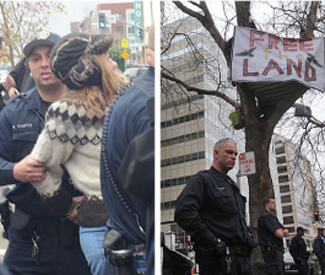
The uneasy relationship between OccupyOakland and the Oakland Police Department has resulted in a troubling spate of controversial arrests recently.

At a press conference last month, Police Chief Howard Jordan stated, “The plaza area outside of City Hall is a public area. We do not have any legal right to remove you if you’re standing there, at any time during the day, if you’re exercising you’re First Amendment rights. If you’re not breaking the laws, we’re not concerned about your presence.”

But now, Oakland police have arrested dozens of people who were doing little more than “standing there, exercising their First Amendment rights” — and one man even faces life in prison for it.

There have been 40 arrests in the last couple weeks, including two incidents at Frank Ogawa/Oscar Grant Plaza. In each episode, police say they were just doing their job, enforcing laws surrounding permit violations. But many supporters and lawyers associated with OccupyOakland say that police have created a targeted and discriminatory campaign to wipe out the movement.


VIGIL TURNS VIOLENT

About 100 protesters were present at a permitted vigil on Dec. 30. An OccupyOakland participant had been issued a permit for a teepee and one table, but police showed up at noon to explain that they were in violation of that permit, claiming people were sleeping, eating, bringing in trash cans, and storing belongings in the teepee

Protesters say they were cleaning up the plaza when police started making arrests; police say they refused to comply. But both parties say that the scene turned violent.

“Who instigates the violence? I don’t know,” Matt Perry, a movement supporter, told us. “A cop tells you to back up and you don’t back up, he’s gonna use his baton on you.”

But many of the arrests and citations had nothing to do with assault. Carly says she was arrested for “having a yoga mat under her arm.” She was later charged with obstruction of justice. In an even more puzzling case, 23-year-old Tiffany Tran was arrested and charged with “lynching.”

“The taking by means of a riot of any person from the lawful custody of any peace officer is a lynching,” reads California Penal Code 405a, a felony charge punishable by two to four years in prison.

The law attempts to prevent white mobs from forcibly taking African Americans from police custody to kill them, but police have a history of using it against protesters, stating that anyone trying to stop an arrest is guilty of lynching.

Tran says she was held in a pitch-dark police van for seven hours before she was booked at Santa Rita Jail, where she was held in 22-hour daily lockdown due to overcrowding. She was held for four days without being told why.

On the fourth day, she was finally arraigned, but prosecutors opted not to file charges and she was released. But Tran said the tactic left her uneasy because prosecutors said charges could still be filed until the statute of limitations expires in a year. As she told us, “Now I feel I can’t go out and express myself as I should be able to.”


ON THE GROUND

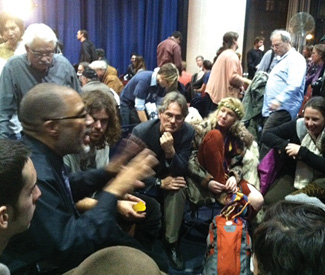
When I arrived at 10pm on Jan. 4 to investigate the situation at the vigil, the scene was calm. About 40 people sat and talked, a few worked on computers.

“Some of the people here were arrested mainly for contempt of cop, or being against the government. And then charges of lynching or obstruction of justice were brought after the fact to substantiate an unlawful arrest, to allow the wheels of so-called justice to turn a few more times,” Svend La Rose, an ordained minister and member of OccupyOakland’s tactical action committee, said of the Dec. 30 arrests.

Suddenly, the cry of “riot police!” rang out.

Police cars had pulled up on 14th street, and a line of police exited. In unison, they started advancing, brandishing batons. Many who were at the scene grabbed their possessions and fled. Most just backed away as the cops advanced. A handful stood in front of the teepee, and were arrested on the spot.

Twelve were arrested, including La Rose. Also arrested was Adam Katz, a photographer from the media committee who was documenting events. Katz said that police told him to back up, and when he complied and backed up “probably 50-60 feet,” he was still arrested.

“I took one picture and I was told to back up,” he said. “I repeatedly asked ‘Back up to where?’ as an army of police pushed me out of the plaza. They said, ‘Back up behind the line.’ I kept saying, ‘What line? I don’t see a line.'”

Then there’s Chris, another occupier arrested Jan. 4. According to Katz and other witnesses, Chris had already left the plaza and gone across the street when he was arrested for somehow delaying the police who were trying to clear the plaza.


DISCRETION

On Jan. 7, OccupyOakland held an “anti-repression march,” claiming that recent arrests are an overt attempt to repress the movement. The National Lawyers Guild issued a statement demanding an end to the “ongoing violence, harassment, and unconstitutional arrests of Occupy Oakland protesters.”

“There is evidence that would go to show that they were targeting people based on First Amendment activity, and not for illegal activity,” said attorney Mike Flynn, president of the NLG-SF. “Police charged into the plaza and grabbed whoever they could, and also targeted selective people who withdrew and didn’t even linger there.”

But OPD spokesperson Johnna Watson told us these arrests were perfectly legal. “The law allows us to use our discretion,” she said.

A person’s history with the movement is factored into this discretion. Many of those Perry deems “regulars” are, according to the police, “repeat offenders.” As Watson said, “There may be knowledge of a past history, like a repeat offender. If an officer has knowledge that a crime is occurring, has occurred, or is about to occur, we have the right to issue a citation or arrest. If we have someone constantly continuing to break the law, we may not issue a citation.”

In other words, involvement with this political movement can get people arrested who might otherwise not be.

“That police have escalated their attacks on people is pretty disturbing. It looks like they really think they can drive this movement out of Oakland with violence and repression,” said Dan Siegel, a former legal advisor to Mayor Jean Quan who resigned over her handling of OccupyOakland.

Siegel is now representing Marcel Johnson, aka Khali, one of the several protesters arrested Dec. 30, who faces life in prison. A homeless man who became an OccupyOakland regular, Khali was arrested when he tried to hold on to his blanket, which police wanted to throw away, saying that it was unpermitted property.

While in jail, he was charged with felony assault on a police officer, his third strike. A protester called Black Angel who knows Khali said he was transformed by the movement. “He came here and found a family,” he said. “He was like, I’m going to protect this. It gave me some sense of myself.”

But now, Siegel said, “He faces life in prison because of his status of being poor, homeless, and with mental health issues.”

Juries may decide whether OccupyOakland defendants are guilty, but Siegel said the arrests aren’t just: “You still have to ask yourself, why are the police doing this when we have 100 unsolved murders in Oakland?”

Film Listings

0

Film listings are edited by Cheryl Eddy. Reviewers are Kimberly Chun, Max Goldberg, Dennis Harvey, Lynn Rapoport, and Matt Sussman. For rep house showtimes, see Rep Clock.

OPENING

*Battle for Brooklyn Posed as neither a left nor a right issue (though George Will does drift into view at one improbable moment), Michael Galinsky’s powerful documentary does the exhaustive, long-haul work of charting the fight between residents and business owners in Brooklyn’s Prospect Heights as they oppose the condemnation of their property — oh-so-inconveniently in the way of the proposed Atlantic Yards, a mammoth Frank Gehry-designed development involving a basketball arena for the New Jersey Nets and more than a dozen skyscrapers. The scrappy residents and activists, led in part by graphic designer Daniel Goldstein, face seemingly unbeatable forces: developer Forest City Ratner, which looks to Eminent Domain to seize a community’s land, whether it likes it or not; a complicit and corrupt state and city government; and other members of a diverse, divided community who are clamoring for the jobs that Ratner’s PR machine promises. Galinsky imparts the impact of the project — and its devastating effects on the neighborhood, despite alternate proposals and the recent real estate bust — over the course of eight years, with hundreds of hours of footage, time-lapse images, and a fortunate focus on one every-guy hero: Goldstein, who loses a fiancé and finds love at the ramparts, while his home is shorn away, all around him. Along the way, the viewer gets an education on the infuriating ways that these sorts of boondoggles get pushed through all opposition — the corollaries between this struggle and, say, the building of the 49ers stadium in Santa Clara are there for the viewer to draw. (1:33) Roxie. (Chun)

Beauty and the Beast 3D Disney’s “tale as old as time” returns in spiffy 3D form. Dancing candelabra in yo’ face! (1:24)

Carnage Nancy (Kate Winslet) and Alan (Christoph Waltz) have arrived in the apartment of Penelope (Jodie Foster) and Michael (John C. Reilly) to discuss proper follow-up to a playground incident in which one of their children went ballistic on another. But this grownup discussion about conduct between children quickly degenerates into a four-way living room sandbox melee, as the couples reveal snobbish disdain toward one another’s presumed values and the cracks in each marriage are duly bared. Roman Polanski’s unnecessary screen translation of Yasmina Reza’s play remains awkwardly rooted to the stage, where its contrivances would have seemed less obvious, or at least apt for the medium. There’s some fun to be had watching these actors play variously self-involved, accusatory Manhattanites who enact a very lite Who’s Afraid of Virginia Woolf? amid way too much single-malt Scotch ingestion. But the text gets crudely farcical after a while, and its critiques of the characters’ shallow materialism, bad parenting, knee-jerk liberal empathy, privileged class indifference, etc. would resonate more if those faults weren’t so cartoonishly drawn. In the end, Carnage‘s high-profile talent obliterates rather than illuminates the material — it’s like aiming a bazooka at a napkin. (1:20) Balboa, Embarcadero, Shattuck. (Harvey)

Cleanflix See Trash. (1:32) Roxie.

Contraband A former smuggler (Mark Wahlberg) comes out of retirement to chase one last score. Don’t they always? (1:49)

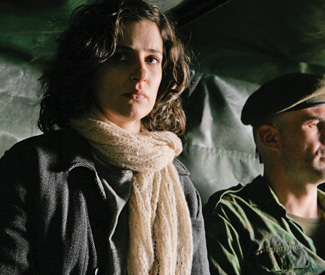
*Hipsters Though it might misleadingly draw a horde of Hipster Bingo look-alikes, the title of this goofy, passionate, generous-hearted Russian musical is fully earned. Director Valery Todorovsky’s let’s-put-on-a-show gumption, twinkly earnestness, and clownish costumes are likely drive today’s too-cool-for-schoolies out the theater, but if they stick around, the razzle-dazzle charm and cinematic flair that the filmmaker applies to this adaptation of Yuri Korotkov’s book, Boogie Bones, should win them over. The dateline is Moscow, 1955, and the scene is a West Side Story-style showdown between the hard-partying, rebellious boogie-woogie stilyagi, or hipsters, in love with American jazz and culture, and the terribly serious, grayed-out Communist hardliners who equate flashy fashion with individualistic decadence. Yet one comrade, Mels (Anton Shagin), finds himself crossing party lines after an encounter with fetching “Good Time” Polly (Oksana Akinshina of 2002’s Lilya 4-Ever) and slowly begins to assemble the look, the moves, the music, and the bad reputation that come with life as a hipster. A few of the film’s plot turns may be a bit tough to swallow, and some details, such as the music, don’t adhere strictly to era, but the affection Todorovsky feels for his characters, their plight, and musicals (particularly Baz Luhrmann’s) gleams through, especially when the director tracks alongside his freedom-loving protagonists as they occupy the streets with their subcultural kin of yesterday and today. (2:05) Lumiere, Shattuck, Smith Rafael. (Chun)

The Iron Lady Curiously like Clint Eastwood’s 2011 J. Edgar, this biopic from director Phyllida Lloyd and scenarist Abi Morgan takes on a political life of length, breadth and controversy — yet it mostly skims over the politics in favor of a generally admiring take on a famous narrow-minded megalomaniac’s “gumption” as an underdog who drove herself to the top. Looking back on her career from a senile old age spent in the illusory company of dead spouse Denis (Jim Broadbent), Meryl Streep’s ex-British Prime Minister Margaret Thatcher steamrolls past hurdles of class and gender while ironically re-enforcing the fustiest Tory values. She’s essentially a spluttering Lord in skirts, absolutist in her belief that money and power rule because they ought to, and any protesting rabble don’t represent the “real England.” That’s a mindset that might well have been explored more fruitfully via less flatly literal-minded portraiture, though Lloyd does make a few late, lame efforts at sub-Ken Russell hallucinatory style. Likely to satisfy no one — anywhere on the ideological scale — seriously interested in the motivations and consequences of a major political life, this skin-deep Lady will mostly appeal to those who just want to see another bravura impersonation added to La Streep’s gallery. Yes, it’s a technically impressive performance, but unlikely to be remembered as one of her more depthed ones, let alone among her better vehicles. (1:45) Albany. (Harvey)

Joyful Noise As heartfelt and anodyne as the singing underdogs at its center, Joyful Noise offers a spirited if ultimately hamstrung spin on a familiar set-up (anyone seen 1993’s Sister Act 2?). Queen Latifah and Dolly Parton (returning to the screen after a two decade hiatus) do most of the heavy lifting as working-class single mother Vi Rose Hill and flashy widow G.G. Sparrow, respectively, who find themselves locking horns as they strategize how to take the small-town Georgia church choir they both sing in to the big-time Gospel competition that gives the film its title. There’s also the matter of G.G.’s city-slicked grandson’s aggressive courting of Vi Rose’s precocious teenage daughter, who, it turns out, like many of the supporting players here, can out-belt most American Idol finalists. Writer-director Todd Graff’s script works in some genial digs at Parton’s fabulous artifice (“Who cares if I’ve had a few little nips and tucks? God didn’t make plastic surgeons so they could starve!” she proudly declares), but Parton’s singing often provides the emotional expressiveness that her face now has trouble conveying. Latifah’s performance is the biggest surprise in a movie that seems all but hatched from a Disney channel writers meeting: Vi Rose radiates both light and heat, tempering Joyful Noise‘s steady stream of homespun treacle with some much-needed righteousness and fury. (1:58) (Sussman)

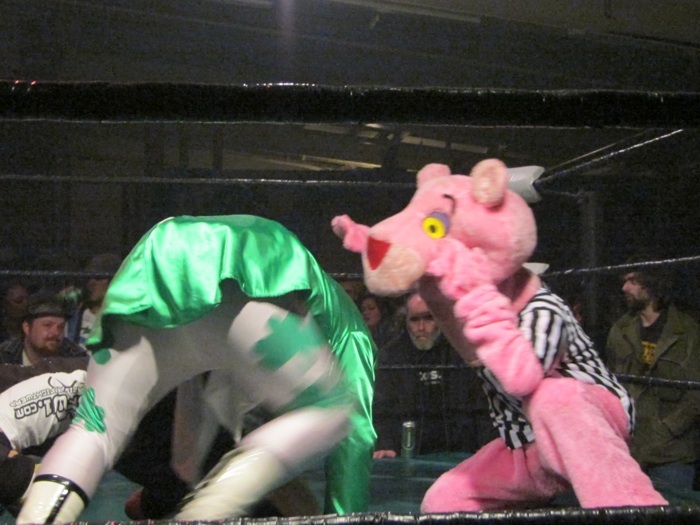
*Kill All Redneck Pricks: A Documentary About the Band Called KARP An isolated instance of gonzo male adolescent noise in the forest of Beat Happening-type indie twee and riot grrliness that dominated Olympia, Wash.’s fertile early 1990s music scene, KARP (originally known by this documentary’s moniker) was composed of three nerdy middle-school friends from bleak neighboring Tumwater. Granted purpose by the majestic sludge of the Melvins, they dropped out of high school to become primitive sound-alikes, then gradually found their own voice in heavy, aggressive music with some pop chops and silly attitude. (At one point they adopted wrestling superhero personae, including a drag one.) “So dark and so clowny at the same time,” this “really earnest-ridiculous teenage explosion” made a name for itself touring tirelessly and recording occasionally over the decade’s course. In classic rock-doc bio fashion, however, nothing ended happily ever after: Alcoholism, drug addiction, a suicide attempt, and yea greater tragedy in time befell these kids who were pretty much born to play with each other. Even if you’ve never heard (or heard of) KARP before, William Badley’s excellent feature — packed with performance footage and scenester recollections — will make you wistful for the band’s loss. (1:25) Roxie. (Harvey)

ONGOING

*The Adventures of Tintin Producer Peter Jackson and director Steven Spielberg join forces to adapt the work of Belgian comic creator Hergé, using performance-capture 3D animation (and featuring that new technology’s most prominent performer, Andy Serkis, in a key role). Hergé wrote over 20 volumes following the globe-trotting exploits of intrepid young reporter Tintin (Jamie Bell) and his canine companion, Snowy; The Adventures of Tintin draws from a trio of books dating from the early 1940s, tweaking the tales a bit but retaining the series’ ebullient energy and sharp humor. After he impulsively buys a model ship, Tintin is sucked into a mystery involving a long-lost pirate treasure sought by the sinister Sakharine (Daniel Craig) and, eventually, newfound Tintin ally Captain Haddock (Serkis). Fan favorites Thompson and Thomson (Simon Pegg and Nick Frost — frequent compadre Edgar Wright co-wrote the script) and a certain “Milanese Nightingale” make appearances in a story that careens between exotic locales and high-seas battles, and is packed with epic chase scenes that would leave Indiana Jones breathless. And in case you were worried, Tintin boasts the least creepy, least “uncanny valley” performance-capture animation I’ve seen to date. (1:47) 1000 Van Ness, Presidio. (Eddy)

Alvin and the Chipmunks: Chip-wrecked (1:27) 1000 Van Ness.

*The Artist With the charisma-oozing agility of Douglas Fairbanks swashbuckling his way past opponents and the supreme confidence of Rudolph Valentino leaning, mid-swoon, into a maiden, French director-writer Michel Hazanavicius hits a sweet spot, or beauty mark of sorts, with his radiant new film The Artist. In a feat worthy of Fairbanks or Errol Flynn, Hazanavicius juggles a marvelously layered love story between a man and a woman, tensions between the silents and the talkies, and a movie buff’s appreciation of the power of film — embodied in particular by early Hollywood’s union of European artistry and American commerce. Dashing silent film star George Valentin (Jean Dujardin, who channels Fairbanks, Flynn, and William Powell — and won this year’s Cannes best actor prize) is at the height of his career, adorable Jack Russell by his side, until the talkies threaten to relegate him to yesterday’s news. The talent nurtured in the thick of the studio system yearns for real power, telling the newspapers, “I’m not a puppet anymore — I’m an artist,” and finances and directs his own melodrama, while his youthful protégé Peppy Miller (Bérénice Béjo) becomes a yakky flapper age’s new It Girl. Both a crowd-pleasing entertainment and a loving précis on early film history, The Artist never checks its brains at the door, remaining self-aware of its own conceit and its forebears, yet unashamed to touch the audience, without an ounce of cynicism. (1:40) California, Embarcadero, 1000 Van Ness, Piedmont, Sundance Kabuki. (Chun)

The Conquest Yet another entry in the relatively new, burgeoning genre of mostly comic biopics portraying political figures still or at least recently in office, Xavier Durringer’s film chronicles conservative Nicolas Sarkozy’s rise to the French presidency. As cannily impersonated by Denis Podalydès, Sarkozy (a.k.a. the Midget, to his detractors) is a Napoleon complex-afflicted shark whose need for perpetual careerist motion cancels out enjoyment even for his triumphs — save, perhaps, a momentary gloat over enemies left trampled. At the start he’s already neared the top of the government ladder, albeit not nearly near enough. Several years’ further upward scrambling are framed by flash-forwards to 2007, when he’s on the verge of finally becoming president, albeit at the cost of “top advisor” and long-suffering first wife Cécilia (Florence Pernel) jumping ship. Her earlier lament “Our life has become a TV show” has been ignored by a spouse quite happy living an almost entirely public, media-hounded life. (Although as his popularity continues to sink, Sarkozy almost certainly doesn’t feel that way now.) Without depiction of or insight into the main figure’s background, The Conquest becomes an entertaining but superficial, near-farcical enterprise providing little insight into what makes him tick. But then, that’s the problem with instant biographies — it’s a lot easier to grasp a significant figure’s complexities when enough time has passed for hindsight to clear the immediate fog of scandal, spectacle, and grotesquerie. (1:45) Smith Rafael. (Harvey)

A Dangerous Method Cool and chatty (unsurprisingly, given its subject matter and the fact that it’s based on a play and a novel), David Cronenberg’s latest begins in 1904 Zurich as a shrieking patient (Keira Knightley) is escorted into the care of psychiatrist Carl Jung (Michael Fassbender). Dr. Jung, an admirer of Sigmund Freud, tests the “talking cure” on the woman, who turns out to be the fiercely intelligent and conveniently beautiful Sabina Spielrein. An attraction, both intellectual and sexual, soon develops, no matter that Jung is Sabina’s doctor, or that he happens to be married to a prim wife whose family wealth keeps him in boats and lake houses. Meanwhile, Jung and Freud (an excellent Viggo Mortensen) begin corresponding, eventually meeting and forming a friendship that’s tested first when Sabina comes between them, and later when Jung expresses a growing interest in fringe pursuits like parapsychology. The scenes between Freud and Jung are A Dangerous Method‘s most intriguing — save those brief few involving Vincent Cassel as a doctor-turned-patient who advises Jung to “never repress anything” — but the film is mostly concerned with Jung’s various Sabina-related dramas. Pity that this is a tightly-wound Fassbender’s least dynamic performance of the year, and that Knightley, way over the top in Sabina’s hysterical scenes, telegraphs “casting mistake” from the get-go. (1:39) Albany, Embarcadero, Sundance Kabuki. (Eddy)

The Darkest Hour (1:29) 1000 Van Ness.

*The Descendants Like all of Alexander Payne’s films save 1996 debut Citizen Ruth, The Descendants is an adaptation, this time from Kaui Hart Hemmings’ excellent 2007 novel. Matt King (George Clooney) is a Honolulu lawyer burdened by various things, mostly a) being a haole (i.e. white) person nonetheless descended from Hawaiian royalty, rich in real estate most natives figure his kind stole from them; and b) being father to two children by a wife who’s been in a coma since a boating accident three weeks ago. Already having a hard time transitioning from workaholic to hands-on dad, Matt soon finds out this new role is permanent, like it or not — spouse Elizabeth (Patricia Hastie, just briefly seen animate) will not wake up. The Descendants covers the few days in which Matt has to share this news with Elizabeth’s loved ones, mostly notably Shailene Woodley and Amara Miller as disparately rebellious teen and 10-year-old daughters. Plus there’s the unpleasant discovery that the glam, sporty, demanding wife he’d increasingly seemed “not enough” for had indeed been looking elsewhere. When has George Clooney suggested insecurity enough to play a man afraid he’s too small in character for a larger-than-life spouse? But dressed here in oversized shorts and Hawaiian shirts, the usually suave performer looks shrunken and paunchy; his hooded eyes convey the stung joke’s-on-me viewpoint of someone who figures acknowledging depression would be an undeserved indulgence. Payne’s film can’t translate all the book’s rueful hilarity, fit in much marital backstory, or quite get across the evolving weirdness of Miller’s Scottie — though the young actors are all fine — but the film’s reined-in observations of odd yet relatable adult and family lives are all the more satisfying for lack of grandiose ambition. (1:55) California, Piedmont, Presidio, SF Center, Sundance Kabuki. (Harvey)

The Devil Inside (1:27) 1000 Van Ness.

*Drive Such a lovely way to Drive, drunk on the sensual depths of a lush, saturated jewel tone palette and a dreamlike, almost luxurious pacing that gives off the steamy hothouse pop romanticism of ’80s-era Michael Mann and David Lynch — with the bracing, impactful flecks of threat and ultraviolence that might accompany a car chase, a moody noir, or both, as filtered through a first-wave music video. Drive comes dressed in the klassic komforts — from the Steve McQueen-esque stances and perfectly cut jackets of Ryan Gosling as the Driver Who Shall Remain Nameless to the foreboding lingering in the shadows and the wittily static, statuesque strippers that decorate the background. Gosling’s Driver is in line with Mann’s other upstanding working men who hew to an old-school moral code and are excellent at what they do, regardless of what side of the law they’re working: he likes to keep it clear and simple — his services as a wheelman boil down to five minutes, in and out — but matters get messy when he falls for sweet-faced neighbor Irene (Carey Mulligan), who lives down the hall with her small son, and her ex-con husband (Oscar Isaac) is dragged back into the game. Populated by pungent side players like Albert Brooks, Bryan Cranston, Ron Perlman, and Christina Hendricks, and scattered with readily embeddable moments like a life-changing elevator kiss that goes bloodily wrong-right, Drive turns into a real coming-out affair for both Danish director Nicolas Winding Refn (2008’s Bronson), who rises above any crisis of influence or confluence of genre to pick up the po-mo baton that Lynch left behind, and 2011’s MVP Ryan Gosling, who gets to flex his leading-man muscles in a truly cinematic role, an anti-hero and under-the-hood psychopath looking for the real hero within. (1:40) Lumiere. (Chun)

*Everyday Sunshine: The Story of Fishbone This doc offers a lively, revealing look at SoCal ska-punk rockers Fishbone, a band that formed circa 1979 in a San Fernando Valley junior high newly filled with bussed-in South Central kids. In its heyday, Fishbone enjoyed cult success with hits like “Party at Ground Zero” and the tune that gives the film its title; Everyday Sunshine speaks to Fishbone’s broad appeal, as famous faces chime in to reminisce (and longtime fan Laurence Fishburne narrates), but it also illuminates some of the reasons its members never became megastars. Codirectors Chris Metzler (a San Francisco resident best-known for 2004’s Plagues and Pleasures on the Salton Sea) and Lev Anderson spent months on the road with the band, capturing the infectious energy of its live shows in addition to behind-the-scenes tension. Past members add their voices, but the main protagonists are bassist-vocalist Norwood Fisher and lead vocalist-saxophone player Angelo Moore. Their intertwining stories offer a poignant portrait of creative soulmates who’ve weathered many storms (personality conflicts, legal and money troubles, an industry that didn’t know how to categorize them) without once giving up on their music. In addition to its compelling story, the film’s quirkier stylistic choices, including animation, lift Everyday Sunshine above the crowded field of traditional music docs. (1:47) Roxie. (Eddy)

*The Girl With the Dragon Tattoo The meeting of Stieg Larsson’s first “Millennium” book and David Fincher promised fireworks, as he’s a director who can be equally vivid and exacting with just the elements key to the series: procedural detail, obsession, violence, tweaked genre conventions, mind games, haunted protagonists, and expansive story arcs. But perhaps because this possible franchise launch had to be rushed into production to ride the Larsson wave, what should have been a terrific matchup turns out to be just a good one — superior in some stylistic departments (notably Trent Reznor and Atticus Ross’ pulsing score), but overall neither an improvement nor a disappointment in comparison to the uninspired but effective 2009 Swedish film version. Daniel Craig plays Mikael Blomkvist, the muckraking Stockholm journalist whose public disgrace after a failed expose of a suspect corporate tycoon makes him the perfect candidate for an unexpected assignment: staying sequestered in the wealthy, warring Vanger clan’s island home to secretly investigate a teenage girl’s disappearance and presumed murder 40 years ago. His testy helpmate is the singular Lisbeth Salander (Rooney Mara), antisocial hacker, researcher, and ex-mental patient par excellence. Nearly three hours long, the compressed, slightly altered (get over it) storyline nonetheless feels rushed at times; Fincher manages the rare feat of making mostly internet research exciting in filmic terms, yet oddly the book’s more shocking episodes of sex and/or mayhem don’t have the memorable impact one might expect from him. The leads are fine, as is the big support cast of recognizable faces (Christopher Plummer, Stellan Skarsgård, Robin Wright, etc.) But the knockout suspense, atmosphere, and urgency one hoped for isn’t present in this intelligent, not entirely satisfying treatment. On the other hand, maybe those who’ve already read the books and seen the prior films have already had so much exposure to this material that a revelatory experience is no longer possible. (2:38) Four Star, Marina, 1000 Van Ness, Sundance Kabuki, SF Center. (Harvey)

Le Havre Aki Kaurismäki’s second French-language film (following 1992’s La Vie de Boheme) offers commentary on modern immigration issues wrapped in the gauze of a feel good fairy tale and cozy French provincialism a la Marcel Pagnol. Worried about the health of his hospitalized wife (Kaurismäki regular Kati Outinen), veteran layabout and sometime shoe shiner Marcel (Andre Wilms) gets some welcome distraction in coming to the aid of Idrissa (Blondin Miguel), a young African illegally trying to make way to his mother in London while eluding the gendarmes. Marcel’s whole neighborhood of port-town busybodies and industrious émigrés eventually join in the cause, turning Le Havre into a sort of old-folks caper comedy with an incongruously sunny take on a rising European multiculturalism in which there are no real racist xenophobes, just grumps deserving comeuppance. Incongruous because Kaurismäki is, of course, the king of sardonically funny Finnish miserabilism — and while it’s charmed many on the festival circuit, this combination of his usual poker-faced style and feel-good storytelling formula may strike others as an oil-and-water mismatch. (1:43) Opera Plaza. (Harvey)

Hugo Hugo turns on an obviously genius conceit: Martin Scorsese, working with 3D, CGI, and a host of other gimmicky effects, creates a children’s fable that ultimately concerns one of early film’s pioneering special-effects fantasists. That enthusiasm for moviemaking magic, transferred across more than a century of film history, was catching, judging from Scorsese’s fizzy, exhilarating, almost-nauseating vault through an oh-so-faux Parisian train station and his carefully layered vortex of picture planes as Hugo Cabret (Asa Butterfield), an intrepid engineering genius of an urchin, scrambles across catwalk above a buzzing station and a hotheaded station inspector (Sacha Baron Cohen). Despite the special effects fireworks going off all around him, Hugo has it rough: after the passing of his beloved father (Jude Law), he has been stuck with an nasty drunk of a caretaker uncle (Ray Winstone), who leaves his duties of clock upkeep at a Paris train station to his charge. Hugo must steal croissants to survive and mechanical toy parts to work on the elaborate, enigmatic automaton he was repairing with his father, until he’s caught by the fierce toy seller (Ben Kingsley) with a mysterious lousy mood and a cute, bright ward, Isabelle (Chloe Grace Moretz). Although the surprisingly dark-ish Hugo gives Scorsese a chance to dabble a new technological toolbox — and the chance to wax pedantically, if passionately, about the importance of film archival studies — the effort never quite despite transcends its self-conscious dazzle, lagging pacing, diffuse narrative, and simplistic screenplay by John Logan, based on Brian Selznick’s book. Even the actorly heavy lifting provided by assets like Kingsley and Moretz and the backloaded love for the fantastic proponents at the dawn of filmmaking fail to help matters. Scorsese attempts to steal a little of the latters’ zeal, but one can only imagine what those wizards would do with motion-capture animation or a blockbuster-sized server farm. (2:07) 1000 Van Ness, Shattuck, Sundance Kabuki. (Chun)

In the Land of Blood and Honey The grudging, occasionally outright hostile tone some critics, culture vultures, and fan types have taken toward In the Land of Blood and Honey points toward a fundamental problem most of them have, though few admit it: the belief that Angelina Jolie is just too damn famous, too much a figure of public speculation and private fantasy, to be taken seriously — let alone to make a movie about rape and genocide during the Balkans Wars. But the fact is, her narrative debut as writer and director would probably be getting reviews in the respectable-to-rave range if created by anyone else. It’s certainly gotten some of those, but you’d be hard-pressed not to glimpse a certain “Who does she think she is?” resentment behind others who see the film as heavy-handed do-gooderism from a chick who should leave cinematic commentary about profoundly tragic historical events to people who are less … er, sexy. Not that Blood and Honey doesn’t have its genuine faults. There’s contrivance in the way that young Muslim painter Ajla (Zana Marjanovic) and Serb cop Danijel (Goran Kostic) have a first date just as the war reaches 1992 Sarajevo, then intersect again when she’s a POW and he’s an officer in the Serbian Army. This allows him to save her from the regular rapes other women prisoners suffer at the hands of guards, and eventually to set her up as his protected mistress, a breach of code that is unwelcome news to the ears of his powerful father General Nobosjsa (Rade Serbedzija), a fanatical “ethnic cleanser.” This premise is typical movie exceptionalism, even if it’s still a good step above the usual device of casting a Western character-star as our guide in unpleasant foreign affairs. While not a great movie, Blood and Honey is a very good one; an honorable achievement, not just a vehicle for honorable intentions. Of course the point is nothing more complicated than “War is hell,” but how often do movies actually punch that across, as opposed to pouting a bit while making war look exciting? (2:07) Opera Plaza, SF Center. (Harvey)

J. Edgar The usual polished, sober understatement of Clint Eastwood’s directing style and the highlights-compiling CliffsNotes nature of Dustin Lance Black’s screenplay turn out to be interestingly wrong choices for this biopic about one of the last American century’s most divisive figures. Interesting in that they’re perhaps among the very few who would now dare viewing the late, longtime FBI chief with so much admiration tempered by awareness of his faults — rather than the other way around. After all, Hoover (played by Leonardo DiCaprio) strengthened his bureau in ways that, yes, often protected citizens and state, but at what cost? The D.C. native eventually took to frequently “bending” the law, witch-hunting dubious national enemies (he thought the Civil Rights movement our worst threat since the bomb-planting Bolshevik anarchists of half a century earlier), blackmailing personal ones, weakening individual rights against surveillance, hoarding power (he resented the White House’s superior authority), lying publicly, and doing just about anything to heighten his own fame. A movie that internalized and communicated his rising paranoid megalomania (ironically Hoover died during the presidency of Nixon, his equal in that regard) might have stood some chance of making us understand this contradiction-riddled cipher. But J. Edgar is doggedly neutral, almost colorless (literally so, in near-monochrome visual presentation), its weird appreciation of the subject’s perfectionism and stick-to-it-iveness shutting out almost any penetrating insight. (Plus there’s Eastwood’s own by-now-de rigueur soundtrack of quasi-jazz noodling to make what is vivid here seem more dull and polite.) The love that dare not speak its name — or, evidently, risk more than a rare peck on the cheek — between Hoover and right-hand-man/life companion Clyde Tolson (Armie Hammer, very good if poorly served by his old-age makeup) becomes both the most compelling and borderline-silly thing here, fueled by a nervous discretion that seems equal parts Black’s interest and Eastwood’s discomfort. While you might think the directors polar opposites in many ways, the movie J. Edgar ultimately recalls most is Oliver Stone’s 1995 Nixon: both ambitiously, rather sympathetically grapple with still-warm dead gorgons and lose, filmmaker and lead performance alike laboring admirably to intelligent yet curiously stilted effect. (2:17) Opera Plaza, Shattuck. (Harvey)

King of Devil’s Island When teenaged Erling (Benjamin Helstad) arrives at Bastøy Prison — more labor camp than reform school — he’s more worldly than many of the other boys there, especially Olav (Trond Nilssen), though the newcomer and long-time inmate bond over a shared fascination with seafaring life. That’s about the only happy thing that happens in Bastøy; set in 1915, King of Devil’s Island is based on the Norwegian island prison’s troubled past, and a rebellion that erupts when the boys reach the breaking point. Surprisingly, it’s not the exhausting work (hauling rocks and trees as rain and snow whip across gloomy fjords) that leads to unrest — it’s the failure of the camp’s strict-but-not-sadistic overseer (go-to stern Scandinavian Stellan Skarsgård) to remove a “housefather” with rapey tendencies. An overlong running time enables a few too many climaxes (though the big uprising is well-earned, and cathartic), but director Marius Holst avoids melodrama, and powerful performances, particularly by the glowering Helstad, elevate the grim King above typical hell-is-for-children fare. (1:54) SFFS New People Cinema. (Eddy)

*Melancholia Lars von Trier is a filmmaker so fond of courting controversy it’s like he does it in spite of himself — his rambling comments about Hitler (“I’m a Nazi”) were enough to get him banned from the Cannes Film Festival earlier this year, where Melancholia had its debut (and star Kirsten Dunst won Best Actress). Oops. Maybe after the (here’s that word again) controversy that accompanied 2009’s Antichrist, von Trier felt like he needed a shocking context for his more mellow latest. Pity that, for Melancholia is one of his strongest, most thoughtful works to date. Split into two parts, the film follows first the opulent, disastrous, never-ending wedding reception of Justine (Dunst) and Michael (Alexander Skarsgard), held at a lavish estate owned by John (Kiefer Sutherland), the tweedy husband of Justine’s sister, Claire (Charlotte Gainsbourg). Amid the turmoil of arguments (John Hurt and Charlotte Rampling as Justine and Claire’s divorced parents), pushy guests (Stellan Skarsgard as Justine’s boss), livid wedding planner (Udo Kier, amazing), and hurt feelings (Michael is the least-wanted groom since Kris Humphries), it’s clear that something is wrong with Justine beyond just marital jitters. The film’s second half begins an unspecified amount of time later, as Claire talks her severely depressed, near-catatonic sister into moving into John’s mansion. As Justine mopes, it’s revealed that a small planet, Melancholia — glimpsed in Melancholia‘s Wagner-scored opening overture — is set to pass perilously close to Earth. John, an amateur astronomer, is thrilled; Claire, fearful for her young son’s future and goaded into high anxiety by internet doomsayers, is convinced the planets will collide, no matter what John says. Since Justine (apparently von Trier’s stand-in for himself) is convinced that the world’s an irredeemably evil place, she takes the news with a shrug. Von Trier’s vision of the apocalypse is somber and surprisingly poetic; Dunst and Gainsbourg do outstanding work as polar-opposite sisters whose very different reactions to impending disaster are equally extreme. (2:15) Lumiere, Shattuck. (Eddy)

Midnight in Paris Owen Wilson plays Gil, a self-confessed “Hollywood hack” visiting the City of Light with his conservative future in-laws and crassly materialistic fiancée Inez (Rachel McAdams). A romantic obviously at odds with their selfish pragmatism (somehow he hasn’t realized that yet), he’s in love with Paris and particularly its fabled artistic past. Walking back to his hotel alone one night, he’s beckoned into an antique vehicle and finds himself transported to the 1920s, at every turn meeting the Fitzgeralds, Gertrude Stein (Kathy Bates), Dali (Adrien Brody), etc. He also meets Adriana (Marion Cotillard), a woman alluring enough to be fought over by Hemingway (Corey Stoll) and Picasso (Marcial di Fonzo Bo) — though she fancies aspiring literary novelist Gil. Woody Allen’s latest is a pleasant trifle, no more, no less. Its toying with a form of magical escapism from the dreary present recalls The Purple Rose of Cairo (1985), albeit without that film’s greater structural ingeniousness and considerable heart. None of the actors are at their best, though Cotillard is indeed beguiling and Wilson dithers charmingly as usual. Still — it’s pleasant. (1:34) Shattuck. (Harvey)

Mission Impossible: Ghost Protocol No world landmark (the Kremlin, the Burj Khalifia) is too iconic and/or freaking tall for uber-adrenalized Impossible Missions Force agent Ethan Hunt (Tom Cruise) and his team (Jeremy Renner, Paula Patton, Simon “Comic Relief” Pegg) to infiltrate, climb, assume false identities in, use as a home base for unleashing futuristic spy technology that seems almost plausible (with the help of lots of iPads), race a BMW through, etc. One kind of gets the sense that Cruise and company sat down with a piece of paper and were like, “What stunts haven’t we done before, and how many of them can I do with my shirt off?” Celebrated animation director Brad Bird (2004’s The Incredibles) is right at home with Ghost Protocol as his first live-action effort — the film’s plot (set in the present day, it involves a positively vintage blend of Russians and nukes) and even its unmemorable villain take a back seat to Cruise’s secret-agent shenanigans, most of which take the form of a crazy plan that must be altered at the last minute, resulting in an even crazier plan, which must be implemented despite the sudden appearance of yet another ludicrously daunting obstacle, like, say, a howling sandstorm. For maximum big dumb fun, make sure you catch the IMAX version. A warning, though: any time the movie screeches to a halt to explore emotions or attempt characterization … zzz. (2:13) 1000 Van Ness, Presidio. (Eddy)

My Week With Marilyn Statuette-clutching odds are high for Michelle Williams, as her impersonation of a famous dead celebrity is “well-rounded” in the sense that we get to see her drunk, disorderly, depressed, and so forth. Her Marilyn Monroe is a conscientious performance. But when the movie isn’t rolling in the expected pathos, it’s having other characters point out how instinctive and “magical” Monroe is onscreen — and Williams doesn’t have that in her. Who could? Williams is remarkable playing figures so ordinary you might look right through them on the street, in Wendy and Lucy (2008), Blue Valentine (2010), etc. But as Monroe, all she can do is play the little-lost girl behind the sizzle. Without the sizzle. Which is, admittedly, exactly what My Week — based on a dubious true story — asks of her. It is true that in 1956 the Hollywood icon traveled to England to co-star with director Sir Laurence Olivier (Kenneth Branagh) in a fluff romance, The Prince and the Showgirl; and that she drove him crazy with her tardiness, mood swings, and crises. It’s debatable whether she really got so chummy with young production gofer Colin Clark, our wistful guide down memory lane. He’s played with simpering wide-eyed adoration by Eddie Redmayne, and his suitably same-aged secondary romantic interest (Emma Watson) is even duller. This conceit could have made for a sly semi-factual comedy of egos, neurosis, and miscommunication. But in a rare big-screen foray, U.K. TV staples director Simon Curtis and scenarist Adrian Hodges play it all with formulaic earnestness — Marilyn is the wounded angel who turns a starstruck boy into a brokenhearted but wiser man as the inevitable atrocious score orders our eyes to mist over. (1:36) Balboa, Clay, Marina, Shattuck. (Harvey)

*Pariah A teenage girl stands stock-still in a dark nightclub, gazing with desire and fear at the half-naked female dancers on the stage. Later, riding home on the bus, she slowly removes the layers of butch that held her together in the club, stripping down to some version of the person her parents need to see when she walks in the door. Nearly wordlessly, the opening scenes of Dee Rees’s Pariah poignantly depict the embattled internal life of Alike (Adepero Oduye), a 17-year-old African American girl living in Brooklyn with her family and struggling both to be seen as she is and to determine what that might look like. The battles are being waged externally, too, between Alike’s adoring father (Charles Parnell), living in willful ignorance, and angry, rigid mother (Kim Wayans), desperately enforcing a feminine dress code and steering Alike away from openly butch friend Laura (Pernell Walker). Rees’ script beautifully conveys a household of landmines and chasms, which widen as husband and wife and daughter struggle and fail to communicate, asking the wrong questions, fearfully skirting the truth about Alike’s sexuality and her parents’ crumbling marriage. And the world outside proves full of romantic pitfalls and the tensions of longtime friendship and peer pressure. The poems in which the talented Alike takes solace and makes her way toward a more truthful existence are beautiful, but at a certain point the lyricism overtakes the film, forcing an ending that is tidy but less than satisfying. (1:26) Embarcadero. (Rapoport)

*Shame It’s been a big 2011 for Michael Fassbender, with Jane Eyre, X-Men: First Class, Shame, and A Dangerous Method raising his profile from art-house standout to legit movie star (of the “movie stars who can also act” variety). Shame may only reach one-zillionth of X-Men‘s audience due to its NC-17 rating, but this re-teaming with Hunger (2008) director Steve McQueen is Fassbender’s highest achievement to date. He plays Brandon, a New Yorker whose life is tightly calibrated to enable a raging sex addiction within an otherwise sterile existence, including an undefined corporate job and a spartan (yet expensive-looking) apartment. When brash, needy, messy younger sister Cissy (Carey Mulligan, speaking of actors having banner years) shows up, yakking her life all over his, chaos results. Shame is a movie that unfolds in subtle details and oversized actions, with artful direction despite its oft-salacious content. If scattered moments seem forced (loopy Cissy’s sudden transformation, for one scene, into a classy jazz singer), the emotions — particularly the titular one — never feel less than real and raw. (1:39) Bridge, Embarcadero, Shattuck. (Eddy)

Sherlock Holmes: A Game of Shadows Maybe Guy Ritchie should’ve quit while he was ahead. Thanks to strong performances from Robert Downey Jr. and Jude Law, the British director’s first Holmes flick proved surprisingly fun. Two years later, it’s clear that Ritchie’s well of creatitivity has run dry. Sherlock Holmes: A Game of Shadows is cliched and overlong, burying a few good ideas under an avalanche of tired action movie stalwarts gone steampunk. To be fair, the set design and art direction are still sumptuous, creating a hyperbolic, detailed vision of Victorian Europe. New cast additions Jared Harris (as Moriarty, maliciously polite) and Stephen Fry (as Mycroft, eccentric and nude) do well with limited material. Noomi Rapace, playing a helpful gypsy, is superfluous. Downey Jr. and Law are still game for some amusing PG-13 homoeroticism, but it’s the former’s disinterested performance that ensures the movie’s downfall. Forced to make do without witty quips or interesting deductions, the Holmes of A Game of Shadows is part bruiser, part buffoon. The game’s a flop, Watson. (2:09) 1000 Van Ness, SF Center, Sundance Kabuki. (Ben Richardson)

The Skin I Live In I’d like to think that Pedro Almodóvar is too far along in his frequently-celebrated career to be having a midlife crisis, but all the classic signs are on display in his flashy, disjointed new thriller. Still mourning the death of his burn victim wife and removed from his psychologically disturbed daughter, brilliant-but-ethically compromised plastic surgeon Robert (played with smoldering creepiness by former Almodóvar heartthrob Antonio Banderas) throws himself into developing a new injury-resistant form of prosthetic skin, testing it on his mysterious live-in guinea pig, Vera (the gorgeous Elena Anaya, whose every curve is on view thanks to an après-ski-ready body suit). Eventually, all hell breaks loose, as does Vera, whose back story, as we find out, owes equally to 1960’s Eyes Without a Face and perhaps one of the Saw films. And that’s not even the half of it — to fully recount every sharp turn, digression and MacGuffin thrown at us would take the entirety of this review. That’s not news for Almodóvar, though. Much like Rainer Werner Fassbinder before him, Almodóvar’s métier is melodrama, as refracted through a gay cinephile’s recuperative affections. His strength as a filmmaker is to keep us emotionally tethered to the story he’s telling, amidst all the allusions, sex changes and plot twists torn straight from a telenovela. The real shame of The Skin I Live In is that so much happens that you don’t actually have time to care much about any of it. Although its many surfaces are beautiful to behold (thanks largely to cinematographer José Luis Alcaine), The Skin I Live In ultimately lacks a key muscle: a heart. (1:57) Opera Plaza. (Sussman)

*Sutro’s: The Palace at Land’s End Filmmaker Tom Wyrsch (2008’s Watch Horror Films, Keep America Strong and 2009’s Remembering Playland) explores the unique and fascinating history behind San Francisco’s Sutro Baths in his latest project, an enjoyable documentary that covers the stories behind Adolph Sutro, the construction of his swimming pools, and the amazingly diverse, and somewhat strange collection of other attractions that entertained generations of locals that came to Land’s End for amusement. Told through interviews with local historians and residents, the narrative is illustrated with a host of rarely-seen historic photographs, archival film footage, contemporary video, and images of old documents, advertisements and newspapers. The film should appeal not only to older viewers who fondly remember going to Sutro’s as children, and sadly recall it burning down in 1966, but also younger audiences who have wandered through the ruins below the Cliff House and wondered what once stood there. (1:24) Balboa. (Sean McCourt)

*Tinker Tailor Soldier Spy Tomas Alfredson (2008’s Let the Right One In) directs from Bridget O’Connor and Peter Straughan’s sterling adaptation of John le Carré’s classic spy vs. spy tale, with Gary Oldman making the role of George Smiley (famously embodied by Alec Guinness in the 1979 miniseries) completely his own. Your complete attention is demanded, and deserved, by this tale of a Cold War-era, recently retired MI6 agent (Oldman) pressed back into service at “the Circus” to ferret out a Soviet mole. Building off Oldman’s masterful, understated performance, Alfredson layers intrigue and an attention to weird details (a fly buzzing around a car, the sound of toast being scraped with butter) that heighten the film’s deceptively beige 1970s palette. With espionage-movie trappings galore (safe houses, code machines), a returned-to flashback to a surreal office Christmas party, and bang-on supporting performances by John Hurt, Mark Strong, Colin Firth, Toby Jones, and the suddenly ubiquitous Benedict Cumberbatch, Tinker Tailor epitomizes rule one of filmmaking: show me, don’t tell me. A movie that assumes its audience isn’t completely brain-dead is cause for celebration and multiple viewings — not to mention a place among the year’s best. (2:07) 1000 Van Ness, Piedmont, SF Center, Shattuck, Sundance Kabuki. (Eddy)

*War Horse If the idea of watching heroic horses getting slaughtered amid the brutal trench warfare of World War I fills your heart with disgust, then you might want to applaud Steven Spielberg and his relatively sensitive touch with that material in the heartrending War Horse. The PG-13 rating also gives you some idea that the director will be hewing to the movie’s origins as a children’s book. Spielberg paints this tale about loss of innocence, be it in the fields of the farm or the battle, in broad strokes, but here, you might feel a bit less manipulated by his prowess as a crowd-pleasing storyteller, less conscious about the legacy he draws on, and more immersed in a story that stays as close as it can to its animal protagonist’s point of view, short of pulling a Mr. Ed. War Horse opens with Joey’s birth and follows him as he’s sold to a struggling English farm run by traumatized war veteran Ted (Peter Mullan), his spunky wife Rose (Emily Watson), and his animal-loving son Albert (Jeremy Irvine). Circumstance — and an unyielding landlord (David Thewlis) — sends Joey off to the so-called Great War, first into the care of an honorable captain (Tom Hiddleston), later a French girl (Celine Buckens), and worst, into the arms of the German enemy, where he toils as a disposable beast of burden charged with hauling the literal machines of war uphill. Spielberg shields viewers both young and old from the more explicit horrors, though gracefully imparts war’s terrors, sending fresh chills through a viewer when, for instance, a child riding a horse disappears over a ridge and fails to return. No one’s immune from tears, and you have to wonder how much healing is actually possible at War Horse‘s conclusion, despite its stylized, symbolism-laden beauty. Nonetheless cinephiles will glean a certain pleasure from images that clearly nod to the blood-red skies of Gone With the Wind (1939), the ominous deep focus of Orson Wells, and the too-bright Technicolor clarity-slash-artifice of National Velvet (1944). (2:26) 1000 Van Ness, SF Center, Shattuck, Sundance Kabuki. (Chun)

We Bought A Zoo “If you could choose between animals or humans or animals, which would you choose?” is a standard question among passionate critter lovers, and Cameron Crowe and company go out of their way to outline which side of the divide they stand on. The result won’t please animal-centric fans of, say, Rise of the Planet of the Apes. Reporter Benjamin Mee (Matt Damon) has just lost his beloved wife and is so overwhelmed by all the solo dad time he’s had with his two cute kids, Dylan (Colin Ford) and Rosie (Maggie Elizabeth Jones), that he’s ready to do something rash. Despite the advice of his brother (Thomas Haden Church), he quits his newspaper job and throws his lot in with the ultimate child’s amusement: he buys a ramshackle zoo in the boonies and tries his darnedest to fix it. Coming with the property is the fetching if brusque zookeeper Kelly (Scarlett Johansson, slightly bushier of eyebrow — read: homelier — than usual) and a mixed bag of kooky workers (including Elle Fanning and Crowe fave Patrick Fugit). The challenge for Ben is to get the zoo up to speed, with zero previous experience and limited lucre. Unfortunately Crowe takes the human vs. animal choice to heart and errs on the side of the humanoids: there’s way too few animals here and far too little about the zoo itself. Much like an overbearing zookeeper, the filmmaker protects us from this semi-tame kingdom, when really a viewer wants to know is, when are we going to get more stories about the animals? Can we have a real tour of the grounds? Even the comic efforts of Haden Church and J.B. Smoove as Ben’s realtor aren’t enough to whisk away one’s impatience (or the unsettling feeling that Ben’s affinity for a elderly ailing tiger will end with an SF Zoo-style arm removal) with all these damn people standing between us and the creatures, like a crowd of gawkers hogging the view of the lions. (2:03) 1000 Van Ness. (Chun)

*Young Adult We first meet Mavis Gary (Charlize Theron) passed out next to last night’s bar pickup, whose name she won’t remember upon waking. You get the feeling this scenario happens a lot to Mavis — she’s the aging Manhattan model who seems like a trophy until the guy realizes she’s an even bigger asshole than he is. Plus, she’s in Minneapolis, on a house-grade scotch budget, where the denizens of the Midwestern home town she’s long abandoned assume she’s living a relatively glittering existence as swinging single and published author (albeit ghost author, of a petering-out tween fiction franchise). But no, her life is empty. Save your sympathy, however — Mavis might feel she’s missing something, but her consumerist values and incredible selfishness aren’t going to be sacrificed in finding it. After getting a courtesy baby announcement from old boyfriend Buddy (Patrick Wilson), she makes a determination as arbitrary as it is adamant: they were always meant to be together, and she needs to reclaim him so they can re-live their glory as King Jock and Queen Bitch of high school. Never mind that Buddy is quite happy where he is — let alone that new baby, and a wife (Elizabeth Reaser) less glam but cooler than Mavis will ever be. Acting as her confidant on this kamikaze mission is ex-classmate Matt (Patton Oswalt), who wants to reverse time about two decades for very different reasons. This reunion for the Juno (2007) duo of director Jason Reitman and writer Diablo Cody puts the latter’s facile wit to more complex, mature, organic use — though this ruthless yet quiet black character comedy is no uptempo crowd-pleaser. Rather, it’s an insidious, incisive commentary on such entertainments, as well as on juvie fiction like Sweet Valley High, whose adaptation is what Cody was developing before this tangent trumped it. It’s a surprisingly nervy movie, more like a 20-years-later sequel to Heathers (1988) than to Juno. (1:34) California, Four Star, 1000 Van Ness, Presidio, Vogue. (Harvey) *


 

Bikes and sailboats

8

OPINION I’m not much of a sailor. In fact, I’ve been known to turn more than a little green when venturing out on the bay under sail. So it may seem a little odd that I am excited about the America’s Cup regatta coming to San Francisco. This high-profile international yacht race has the potential to accomplish even more impressive feats on land than on water, ultimately leaving a legacy of safer streets and more accessible neighborhoods.

An anticipated five million spectators will put the city’s transportation infrastructure to the test. It starts this summer with the qualifying races, then ramps up in summer, 2013, when upward of a half million people are expected to travel to the waterfront on peak race days.

There’s no possible way to move all of these people around this tightly packed city in cars. For proof, talk to anyone who’s been near the waterfront during Fleet Week, a traffic nightmare at a fraction of the size of the America’s Cup.

The Mayor’s Office plan for the America’s Cup wisely puts bicycle transportation front and center. Event planners and politicians know that traffic and parking constraints will preclude many from driving, and transit capacity can be stretched only so far so fast.

Event organizers propose investing in a robust bike share program, park-and-ride lots where visitors can ditch their cars on the edge of the city and pedal the last few miles, and plenty of secure valet bike parking lots.

The most important component is ensuring that the city also invests in safe, comfortable routes welcoming the wide diversity of people who will be trying out two wheels — people who are likely to continue biking long after the events if they have a good experience.

A top priority must be the Embarcadero. Already an enormously popular — and overcrowded — bike route for locals and visitors, the Embarcadero should be made more welcoming to the huge numbers of people who will be drawn there on bikes and by foot.

On big event days, the plan calls for temporarily designating an existing travel lane as bicycle-only space and freeing up the pathway for walking — a more comfortable set-up for everyone.

I urge city leaders to take advantage of this opportunity to pilot a permanent, dedicated bikeway on the waterside of the roadway — the EmBIKEadero. It’s a low-cost, easy way to reconnect people with the waterfront and offer an unparalleled biking experience.

Imagine riding on a mini-version of Sunday Streets on the Embarcadero any day of the week. Imagine a New York City-style high line for S.F.’s waterfront, from Mission Bay to the Golden Gate Bridge. Imagine a way to connect diverse neighborhoods and draw people to local businesses…long after the yachts have left the bay.

The city should also use the momentum behind the America’s Cup to test other opportunities for safe, more welcoming streets, including Polk Street, a major connector to the northern waterfront and already an important route for the growing number of people biking in San Francisco.

Market Street should continue to be a site for innovation. Recent pilot programs prioritizing biking, walking, and transit are already proving to save bus riders time and the Muni system big dollars.

The America’s Cup is our opportunity not only to stage a world-class event, but to build toward a world-class bicycling city.

Leah Shahum is executive director of the San Francisco Bicycle Coalition. To learn more about the San Francisco Bicycle Coalition’s vision for the EmBIKEadero, see connectingthecity.org

How to celebrate Martin Luther King, Jr. Day in the Bay

0

Use your national day of service wisely —  jump in one of of the day’s volunteering fairs, take in a black history flick, catch some awe-inspiring youth spoken word, learn about colleges 

“In the Name of Love” MLK musical tribute

Mavis Staples, the Oakland Interfaith Gospel Choir, Youth Speaks (that group’s going to be busy! See below), and Oakland’s Children’s Community Choir occupy the deco wonderland of the Paramount for this stirring tribute to the great man’s work. Hyped as the only non-denominational musical tribute to MLK Jr. in Oakland, the program also features the presentation of humanitarian awards. 

Sun/15 7 p.m., $18 

Paramount Theatre

2025 Broadway, Oakl.

www.livingjazz.org


Freedom Trains

Planning on spending your MLK Day in the city? Every year, the Martin Luther King Jr. Association of Santa Clara sponsors the Freedom Trains so that everyone can afford to make it to the celebrations. Instead of paying $17.50 for a round-trip ticket on Caltrain, today it’s just $10 – and you’ll be treated to in-route presentations on the importance of the civil rights movement in our lives. 

Mon/16, $10

Departs San Jose 9:30 a.m., arrives in San Francisco 10:55 a.m. (see website for stops in-between)

Rod Diridon train station

65 Cahill, San Jose

www.scvmlk.org


“Renewing the Dream” MLK Jr. birthday celebration

A health fair, a civil rights film festival, children’s reading celebration, interfaith commemoration, special presentations, and free entry to the Contemporary Jewish Museum, Museum of the African Diaspora, and Children’s Creativity Museum give you and yours plenty to do if you feel like spending your Monday in San Francisco’s (greener, sorry Union Square) living room. Down to attend? Check your local transportation agency for possible discounts to the event.

Mon/16 11 a.m.-5 p.m., free

Yerba Buena Gardens

Mission between Third and Fourth Sts., SF

www.norcalmlk.com


“What is Your Dream?” MLK Jr. day of service

Soak in the spirit of the day by spending it at MoAD. The regular museum offerings (currently featuring “Collected: Stories of Acquisition and Reclamation,” about the contributions of people of African descent to the American zeitgeist) will be free to the public, there will be screenings of MLK films and a documentary on a barber who turned into a civil rights leader during the 2008 elections, chalk drawings outside on the sidewalk, and vision boarding galore. But the day’s not just for remembering and dreaming – the Historically Black Colleges and Universities Fair will be providing concrete information on education for tomorrow’s march-leaders and soul-freers. 

Mon/16 11 a.m.-5 p.m., free

Museum of the African Diaspora

685 Mission, SF

(415) 358-7200

www.moadsf.org


Parks Conservancy’s MLK Jr. day of service

Let the Parks Conservancy plug you into a wildlife restoration project – you’re too late to sign up for restoring the gardens on Alcatraz, but there’s still time to help out at Crissy Field, Fort Baker, Muir Woods, Ocean Beach, and the Presidio. Contact volunteer@parksconservancy.org to reserve your spot. 

Mon/16 various times, free

Various locations, SF

(415) 561-3077

www.parksconservancy.org


MLK Jr. Day service fair

Spend your day off work (if you have it off work) with your family making a difference in the Bay Area. Organizers of this event have made it easy for you: choose from over 25 different projects from serving food at shelters, planting trees – even making toys and biscuits for homeless puppies and kitties. All ages welcome. 

Mon/16 7:30 a.m.-4 p.m., free

Oshman Family Jewish Community Center

3921 Fabian Way, Palo Alto

www.paloaltojcc.org


Piedmont’s annual MLK Jr. Day celebration

First: eating. All comers are invited to bring a dish that reflects their own cultural heritage to this lunchtime potluck at the Piedmont Community Center. Once those pressing matters have been tended: music. Oaktown Jazz will provide some lilting melodies, and Piedmont students will make presentations on the significance of the day. Capping off the festivities, the 1993 movie At the River I Stand, which revolves around the 1968 Memphis sanitation workers’ strike and concurrent assasination of King. 

Mon/16 noon-3 p.m.

Piedmont Community Center

777 Highland, Piedmont

(510) 420-1534

loiscorrin@gmail.com


“Bringing the Noise for Dr. Martin Luther King, Jr.” 

If you haven’t been to a Youth Speaks spoken word event, pack tissues and your future-seeing 3-D goggles – the young people that the organization gives an opportunity to perform are the truth. On no other day of the year should this be more evident, because these kids are all about having a dream. Today’s event brings performers to the stage who have worked up pieces on what they’d like the future to bring, imbued as ever with the fire of Youth Speaks performances. Could there be a more relevant forum to attend on today’s holiday?

Mon/16 7 p.m., $16

Herbst Theatre

401 Van Ness, SF

(415) 621-6600

www.youthspeaks.org


“Martin Luther King Jr. Day Double Feature”

“All of us have something to say, but some are never heard” — Richard Pryor, Wattstax (1973). MLK Jr. Day calls into question how we remember the past. The Wattstax concert is sometimes recalled derivatively as “the black Woodstock.” But while soul music may have been the response, the event was put on by Stax Records to commemorate and come to terms with the seventh anniversary of the Watts Riots in LA, which challenged the limits of MLK Jr.’s nonviolent philosophy. As a double feature the Wattstax documentary will be shown with The Black Power Mixtape 1967-1975 (2011), a revelatory look at a movement’s era that sadly took the distance of continent and a few decades to make. 

Wattstax 3, 7p.m.; The Black Power Mixtape 4:55, 8:55 p.m., $7.50–$10

Castro Theatre

429 Castro, SF

(415) 621-6120

www.castrotheatre.com


Martin Luther

It’s the second coming! Not really, no relation actually. But this R&B-funk crooner spins out tunes appropriately uplifting for this day of rememberance and looking forward. Bliss out, eyes closed, mind on the change you want to make, at this smoothed-out groovefest. 

Mon/16 8-9:30 p.m., $15

Yoshi’s

510 Embarcadero, Oakl.

(510) 238-9200

www.yoshis.com

Ed Lee’s 100 percent

26

I expected a lot of talk about togetherness at the mayor’s inauguration, but Ed Lee went a step further: He acually announced that he wants to be the mayor “for the 100 percent.” That’s a remarkable statement when you think about it, and it indicates to me that Lee doesn’t want to be, and isn’t going to be, and activist leader.

It’s nice to talk at political events about how we’re all in this together, how everyone in San Francisco is part of the same nice big city family, how we all really love each other and can hold hands and build a better city and all that happy horsehit. But the truth is, we aren’t, and we can’t.

San Francisco is a divided city, increasingly split between the rich and the poor, the powerful and the powerless. The politics are bitterly divided — and not because the progressives fought with former mayor Gavin Newsom. No: There are people who are used to getting their way in this town, and they have been for years, and they make up an oligarchy that stands with big landlords, and big developers, and big corporations, often using terms like “job creation”  to disguise an agenda of tax breaks, minimal regulation and a disdain for social justice.

That’s not conspiracy theory; it’s fact, and anyone who has been a part of this city for a long as me knows it.

It’s about political power. An activist, progressive mayor would acknowlege that fact — and the fact that power is never surrendered voluntarily. Sorry to spoil your spirit of togetherness, Ed, but Willie Brown and his clients, including Pacific Gas and Electric Company, have very little in common with me; I want to kick PG&E out of San Francisco and replace it with a publicly-owned utility. There is no compromise here, no middle ground — PG&E has to lose for us to win.

Not every issue in San Francisco is like that — some of the 1 percenters are all in favor of bicycle lanes and same-sex marriage and a lot of other wonderful things. There are plenty of areas where everyone in San Francisco can work together for the glory of our collective greatness.

But there are also issues that involve, yes, class warfare. Ed Lee must know that; he’s been around long enough, fought enough bad guys, stood up for the poor people. But he also apparently thinks he can be mayor and be pals with Brown and the billionaires — and still be on the side of the 99 percent. And it doesn’t work that way. Not if you want to make economic justice a part of the local agenda.

I think Lee’s going to be a lot better than Gavin Newsom, who was intractable and a jerk. But this notion that you never have to pick sides, that there is no 99 percent on one side up against a 1 percent on the other, is either cluelessness or bullshit. And I don’t think Lee is clueless.

Hot sexy events: January 4-11

1

I had to share this link, because I think it just might be the first time I’ve heard of a reality TV series improving the lives of the subjects it covers. And the fact that those subjects are six UK transsexuals makes it all the more a. inspiring b. heartwarming and c. affirmative that perhaps the 1990s most salient contribution to popular culture can indeed be used for good.

The show, aired on England’s Channel Four, was called My Transexual Summer, and it followed its protagonists through their transition process. Although Ralph Fox, the author of the Original Plumbing blog post I linked to above, sounds a little disappointed in the binary way in which gender was dealt with on the show, he did mention that “The thing I most love is how it’s been a minimum effort, maximum result situation.” People in his life that he probably wouldn’t have had the talk with were able to learn about his world in a positive way.

Perhaps pin-up girl Cassandra Cass felt the same way about Wild Things?

Locally, we all have a great chance to celebrate transcendental community members at Original Plumbing’s Elbo Room dance party celebrating the zine’s issue No. 8 (10 p.m., $6), which comes to us with the theme “Family Matters.” OP’s shindigs are generally regarded as the place to be to scope trans hotties – perhaps you can arrange your own sex event once you’ve twirled to the polysexual beats of DJs Rapid Fire and Chelsea Starr. 

Now, sex events.


Humpday Happy Hour

As Good Vibrations continues to expand its empire (the chain will move into a Lake Merrit location later this month), its retinue of free-to-the-public events. Today, you will find your G-spot – with the help of seasoned GV professionals and a line of specifically-designed vibrators that you probably won’t be allowed to use on the spot because this is a free event after all – and if that’s not revolutionary enough, the first 10 people to show up get a free vibe of their own to use while doing their homework. 

Wed/8 6:30-7:30 p.m., free

Good Vibrations 

1620 Polk, SF

(415) 345-0500

www.goodvibes.com


Velvet

Just an FYI for those sultry lasses headed to the plush lair of Mission Control for this Friday night freakout: Mr. S is stocking hella cute wrestling singlets nowadays in their special “sports” section. I’m just saying, because the first Velvet of the year features tons of girl-on-girl sparring in addition to beats by Ships in the Night and Hella Gay’s DJ Durt. Not that you’ll be wearing any spandex and kneesocks for long once you see the talent at the event.

Fri/6 8 p.m.-2 a.m., $20 with membership

Mission Control

www.missioncontrolsf.org


Nasty

Project Inform is one HIV/AIDS advocacy organization that runs with some nasty company. This weekend, a go-go fest in its honor is being held at one of Folsom’s sleaziest post-ups, replete with those now-omnipresent horse-hung go-go studs, toy demonstrations, and lots of alcoholic lubrication. Go make a difference in your community!

Sat/7 10 p.m.-1 a.m., $5

Powerhouse

1347 Folsom, SF

(415) 552-8689

www.powerhouse-sf.com


“Luscious: A Celebration of Curves”

Sure, this BDSM play party welcomes pervs of all shapes and sizes – but tonight, the focus is on the Rubenesque among us. We’re talking luxuriously large thighs-in-fishnets, corsets pulled tight over ample waists, even a tassel-twirling contest that (fyi) will most certainly reward the well-endowed wiggler. Watch out for burlesque, snacks, and a live DJ. 

Sat/7 8 p.m.- 1 a.m., $25 with $10 SF Citadel membership

SF Citadel 

1277 Mission, SF

www.sfcitadel.org


Fat Dancey

Speaking of super-sexy fat girls, make sure you check out Fat Dancey at El Rio, another slammin’ soiree for the sizable – this one to benefit Portland’s plus-sized vintage community store Fat Fancy, a veritable treasure trove for those hoping to score one-of-a-kind togs in actual human sizes that hopes to open up to Internet sales with its current IndieGoGo campaign. The party’s also a great excuse to get sassy on the dancefloor on a Monday with all kinds of young queer DJ-arati, so check it out.

Mon/9 9 p.m.-1 a.m., $5-10

El Rio 

3158 Mission, SF 

(415) 282-3325

www.elriosf.com

Facebook: Fat Dancey


Bawdy Storytelling: Butch/Femme

Bawdy is advising attendees to pack hard for this storytelling event, where the onstage talent will be exploring the spectrum of lust. This month’s lineup will include Fairy Butch, Daddy Amelia Aviles, and more. 

Wed/18 7 p.m., $12-$15

The Blue Macaw

2565 Mission, SF

www.bawdystorytelling.com

Current events

0

arts@sfbg.com

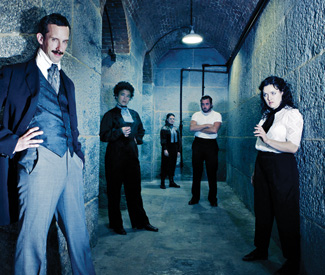
THEATER In early December, Christopher W. White, artistic director of Bay Area ensemble theater company Mugwumpin, showed me around the cool, slightly fusty basement rooms of San Francisco’s Old Mint. Used apparently for storage now, this large subterranean area beneath the Doric columns and Greco-Roman grandeur of “the Granite Lady” was where, beginning in the latter 19th century, the action really happened: the white-hot smelting of money, in one of the most active U.S. mints in its day. You wouldn’t know it now to look around at the gutted rooms with their odd detritus, dim walls, and sunken cement chambers, but in the 1930s one-third of the country’s gold was housed here. It’s a kind of catacomb of local and national history, and especially the history of money power.

Theater, by contrast, is not a moneymaking enterprise, generally speaking. For that matter, neither is free wireless energy from the air — one of the grandest ideas to motivate the stunningly brilliant and influential mind of Nikola Tesla, the little remembered Serbian-American inventor, Thomas Edison rival, and father of alternating current (AC). But the two come together quite naturally here, underground, where the spirits of industrial wealth and labor commingle so forcefully.

This weekend, which marks the anniversary of Nikola Tesla’s death in 1943, also marks the opening of Future Motive Power, an original ensemble-driven work that culminates a year of research and experimentation by one of the Bay Area’s foremost practitioners of devised theater. Mugwumpin’s production takes place in a section of this very basement, where audiences will alternately sit in and wander around a site-specific piece built from the ground up, with painstaking fidelity to historical details — and a commitment to reaching toward aesthetic and dramatic possibilities in concert with one of the most imaginative minds of the modern age.

His approach to science, like many a great innovator, had much in common with an artistic impulse. Exhibiting a transcendent creative ability, he worked with blueprints in his head, visualizing an idea for a new machine in unfathomable detail. He worked obsessively, often going with little or no sleep. His wide-ranging imagination was prodded by a consistent desire to serve humanity, but he had few close relationships and found everyday forms of physical contact unbearable. He’d probably merit a few psycho-clinical acronyms today, but let’s just say he was eccentric. Tesla’s brilliance, under-appreciated influence, idiosyncrasies, and sad fate have made him a compelling figure to artists and writers for years, even as his achievements remain historically obscured by, among other things, the legacy of savvy self-promoter Edison.

Alternately supported and bounded by the capitalist forces represented in these serious granite walls under the Old Mint, Tesla had a mind and heart remarkably free of the normal limits. His amazing career — balancing tenuously the forces of nature, social idealism, and the capitalist marketplace — speaks to some of the weightiest themes confronting the world today.

But those come later. Chris White — who plays the thin, fastidious inventor with a primly sympathetic mien, his eager certainty chastened by the half-lost alertness of the outsider — says the idea for the piece simply began with a song he couldn’t get out of his head: “Tesla’s Hotel Room,” by neo-country act the Handsome Family.


“In the last days of wonder

When spirits still flew

Where we sat holding hands

In half-darkened rooms

Nikola Tesla in the Hotel New Yorker

Nursing sick pigeons in the half-open window”


The song’s particular brilliance lies partly in connecting Tesla’s scientific genius with a spiritualist age, when science, philosophy, and religious mysticism commingled lustily in séances, theosophy, Swedenborgianism, and the like. It churns tragedy and prophesy in the tradition of the American ballad, channeling that “old weird America” Greil Marcus writes about. That deep stream of popular culture (as opposed to top-down manufactured mass culture) has inspired great things from Mugwumpin before (Frankie Done It 291 Ways, for instance, whose wildly disparate theatrical riffs on the “Frankie and Johnny” ballad was a highlight of the 2006 season.) This is Mugwumpin territory par excellence.

In keeping with Mugwumpin’s modus operandi, the yearlong process for Future Motive Power involved research and input from each member of the ensemble (Misti Boettiger, Joseph Estlack, Natalie Greene, Rami Margron, and White). By the time final rehearsals began inside the Mint, the piece contained a purposefully anti-linear, fragmented set of scenes very much in the vein of Mugwumpin’s past work — a kind of archeological approach to storytelling in which an intricately choreographed and physically dynamic set of vignettes and movement-designs extrapolate freely from certain evocative material fragments.

“At one point the J.P. Morgan character [I play] was just a table and tablecloth with my head sticking out of the top,” notes founding company member Estlack. “I’d move around everywhere with this table. I liked that a lot, but we can’t keep everything.”

The piece also has a director — something not every Mugwumpin production has used. Susannah Martin, an accomplished local director making her company debut, has come onboard to help guide the shaping of the piece, though she happily admits it’s not a typical gig working with such a highly collaborative, anti-hierarchical ensemble. Much initial time was spent, she says, “figuring out how I can be of best use to everybody. [Unlike productions with other companies,] it’s not my responsibility to hold the vision of this piece — it’s all our responsibility.”

It is rare to see so much discussion among all parties during a rehearsal, but it seems to contribute to the unusual dynamism of the results. To watch the actors rehearse, it’s as if the fluid staging aspired to Tesla’s own poetical, mercurial mind — represented here, aptly enough, not just by White but by three female characters (Boettiger, Greene, and Margron) personifying not muses so much as the willful, vaguely unhinged creative forces working with and through him.

Rehearsal continues with these three characters pulling a long electric cord into a square, as Tesla’s tussle with rival radio-technology pioneer Guglielmo Marconi (Estlack, who incarnates all Tesla’s principal antagonists including Edison) becomes a rumble inside a boxing ring. A moment later the boxing ring has morphed again into an image of Tesla raising Wardenclyffe, the wireless energy tower he partly erected on Long Island with Morgan’s money — that is, until Morgan discovered it was power to the people Tesla had in mind, and pulled the plug.

FUTURE MOTIVE POWER

Through Jan. 29

Previews Fri/6-Sat/7, 8 p.m.; opens Sun/8, 8 p.m.

Runs Fri.-Sun., 8 p.m., $15-$30 (previews, pay what you can)

Old Mint

88 Fifth St., SF www.mugwumpin.org

Lights, Jolie, action

0

arts@sfbg.com

FILM The grudging, occasionally outright hostile tone some critics, culture vultures, and fan types have taken toward In the Land of Blood and Honey points toward a fundamental problem most of them have, though few admit it: the belief that Angelina Jolie is just too damn famous, too much a figure of public speculation and private fantasy, to be taken seriously — let alone to make a movie about rape and genocide during the War in the Balkans.

That bleak historical chapter occurred about the same time that Jolie was a Beverly Hills goth teen into knife play, too many recreational drugs, and her brother (eww), with a fledgling professional resume consisting of modeling gigs, music videos, and an inglorious starring role in 1993’s Cyborg 2. Since then she has grown up a lot, and in ways that count (adopting children as well as bearing them, actually working at her “humanitarian causes” rather than using them as photo ops), is sort of a model world citizen as far as ginormous movie stars go. She also paired off with another such example, Brad Pitt — World’s Sexiest Woman, meet World’s Sexiest Man, cue celestial chorus — and while it may be a coincidence, shortly after that event he started consistently behaving onscreen like a real actor and less like an International Male model.

Jolie, too, can act, but since becoming a big star (circa 2001’s Lara Croft: Tomb Raider), it’s been disappointing how seldom she’s been called upon to do so — as opposed to bringing the near-cartoonish va-voom and ass-whup in movies like 2003’s Lara Croft Tomb Raider: The Cradle of Life, 2005’s Mr. & Mrs. Smith, 2008’s Wanted, and 2010’s Salt. Truth be told, when she has gotten a serious part in a serious film such as 2008’s Changeling or 2007’s A Mighty Heart, the stubborn glare of celebrity hobbles our ability to let her disappear into the role. It’s not fair, but there ya go. Those are highly competent, versatile performances that nonetheless might be more effective if delivered by someone whose first name alone seems to call for an exclamation point.

This is all beside the point when it comes to In the Land of Blood and Honey, or ought to be. But the fact is, her narrative debut as writer and director (she’s also credited with a little-seen 2007 documentary, A Place in Time) would probably be getting reviews in the respectable-to-rave range if created by anyone else. It’s certainly gotten some of those, but you’d be hard-pressed not to glimpse a certain “Who does she think she is?” resentment behind others who see the film as heavy-handed do-gooderism from a chick who should leave cinematic commentary about profoundly tragic historical events to people who are less … er, sexy.

Not that Blood and Honey doesn’t have its genuine faults. There’s contrivance in the way that young Muslim painter Ajla (Zana Marjanovic) and Serb cop Danijel (Goran Kostic) have a first date just as the war reaches 1992 Sarajevo — we never do find out how they met or how well they already know each other — then intersect again when she’s a POW and he’s an officer in the Serbian Army. This allows him to save her from the regular rapes other women prisoners suffer at the hands of guards, and eventually to set her up as his protected mistress, a breach of code that is unwelcome news to the ears of his powerful father General Nobosjsa (Rade Serbedzija), a fanatical “ethnic cleanser.” This premise is typical movie exceptionalism, even if it’s still a good step above the usual device of casting a Western character-star as our guide in unpleasant foreign affairs (see: Christian Bale in Zhang Yimou’s new Rape of Nanking drama The Flowers of War). The queasy but passionate love under impossible circumstances between Danijel and Ajla is compelling, but never as powerful as several instances of madness and cruelty that befall subsidiary characters, like the brutalization of a young woman who volunteers her sewing services, or an infant’s thoughtless fate simply for crying. The shocking senselessness of war atrocities depicted in scenes like these have some of the gut-punch impact of similar bits in Schindler’s List (1993). Keeping herself off camera (unlike many an actor turned director), Jolie also keeps stylistic flourishes likewise; Blood and Honey isn’t impersonal, but eschews any vestige of auteurist “personality.” (Comparisons may be odious, but it’s worth noting the seriousness Jolie achieves this way is the diametrical opposite of the superficial showiness displayed by Madonna’s directorial calisthenics to date.) It’s immaculately crafted, though, and the assurance with which the director tempers her own screenplay’s potential for excess suggests a refined intelligence beyond what can be condescendingly explained away by having the funds and ability to hire first-rate collaborators.

While not a great movie, Blood and Honey is a very good one; an honorable achievement, not just a vehicle for honorable intentions. Of course the point is nothing more complicated than “War is hell,” but how often do movies actually punch that across, as opposed to pouting a bit while making war look exciting?

Don’t hate her movie because she’s beautiful, rich, freaky, not Jennifer Aniston, or anything else related to the larger-than-lifeness of being Angelina Jolie. If someone else made In the Land of Blood and Honey, there would be little question about admiring its stark effectiveness. Of course, if someone else had made it, you probably wouldn’t be interested in seeing it, or even able to — the one positive her celebrity brings to bear here.

IN THE LAND OF BLOOD AND HONEY opens Fri/5 in San Francisco.

Events Listings

0

On the Cheap listings are compiled by Lucy Schiller and Caitlin Donohue. Submit items for the listings at listings@sfbg.com. For further information on how to submit items for the listings, see Picks.

WEDNESDAY 4

2012 showing Chinatown Meeting Room, Chinatown Library, 1135 Powell, SF; www.sfpl.org. 2:30-5:30pm, free. Ring in the purported year of our doom with a little cinematic apocalypse: John Cusack and Danny Glover battling mega-tsunamis, an irate Yellowstone super-volcano, and the inevitable detachment of California from the continental U.S.

BAY AREA

“Being and Ideal Grace: Love and Spirituality in Robert and Elizabeth Browning’s Letters” lecture Northbrae Community Church, 941 the Alameda, Berk; (510) 526-3805. 7:30pm, $5 donation suggested. Bay Area actor Julian Lopez-Morillas explores the written missives shot between Robert and Elizabeth Browning, two 19th century romantic poets who penned some of the steamiest pre-Victorian prose known to Fabio.

THURSDAY 5

Lands End restoration Lands End, Presidio, SF; www.parksconservancy.org. 1-4pm, free. The coastal bluffs of the Presidio are calling out for a little TLC. Help plant, water, and weed in a spot more naturally beautiful than any human-made garden.

FRIDAY 6

“Get Lucky” opening reception SOMArts Cultural Center, 934 Brannan, SF; www.somarts.org. 6-9pm, free. Celebrating experimental music pioneer and artist John Cage’s hundredth birthday, SOMArts stages an indeterminacy-themed evening, featuring the creation of a living tarot deck and an involved, improvised poem.

“Taking Stock’ opening reception Z Space, 450 Florida, SF; www.zspace.org. 6:30-8:30pm, free. Venturing daily into the packaged wilderness of grocery stores in San Francisco and Denver, artists Emily Heller and Leah Rosenberg took pains documenting and replicating how food is presented to the American public.

Sharon Lockhart’s pop-up “Lunch Break” SFMOMA, 151 Third St., SF; (415) 357-4035, www.sfmoma.org. 11:30 a.m.-1:30pm, free. An ongoing exhibition looking at the activities Americans pursue on our lunch breaks gets free and interactive today, hosting Vietnamese pop-up cafe Rice Paper Scissors, Blue Bottle Coffee, and a Skype chat with curator Sharon Lockhart. Share your lunch break traditions at a community table that will be set up to encourage conversation among fellow laborers.

“Working Conditions” closing reception Southern Exposure, 3030 20th St., SF; www.soex.org. 7-9pm, free. For almost two months, nine artists have worked in view of the public under the theme of labor and process, and with varying degrees of audience interaction. Jennie Ottinger’s method serves as one example; she promised a certificate of recognition to visitors willing to mix her paints and clean her brushes. Nathaniel Parsons is another; he bestowed a thoughtful woodcarving on every visitor who accompanied him on a walk-and-talk.

SATURDAY 7

Vintage Paper Fair Hall of Flowers, Golden Gate Park, SF; www.vintagepaperfair.com. Through Sun/8. 10am-6 pm, free. “Ephemera” can bring to mind molding moth wings and mildew spots as much as forgotten treasures of yesteryear. But Hal Lutsky’s annual vintage paper fair promises nothing but pristinely-preserved postcards, brochures — even stereoviews.

SUNDAY 8

Battle reenactment Frankenart Mart, 515 Balboa, SF; www.frankenartmart.com. Noon-6 pm, free. A hotdog-fixated art gallery in the Inner Richmond, Frankenart Mart staged a multi-month series of battles and battle-related artwork. Today’s reenactments (participant-led, nonviolent, and accompanied by hotdogs) are less Appomattox as they are Thanksgiving Day.

BAY AREA

“Hiram Johnson and Woman’s Suffrage Vote 1911” lecture Berkeley History Center, 1931 Center, Berk; www.lwvbae.org. 2pm, free. Sure, we’ve got the vote. But failing to learn about our dark(er) past will only doom us to repeat it – reason enough to head to this free lecture at the Berkeley History Center on the progressive revolution sparked by California governor Hiram Johnson. After you get your fill of the talk, all visitors are invited to tour the exhibit on our state’s voting women, which is stacked with memorabilia and facts from the last century.

TUESDAY 10

Word Is Out: A Queer Film Classic book launch SF Public Library, 100 Larkin, SF; www.sfpl.org. 6pm, free. In 1977, a documentary on the lives of gays and lesbians helped shift the political dialogue of the United States – or at least, so says author Greg Youmans, who recently penned a book exploring the significance of the film. At this roundtable discussion with Youmans, an original promoter of the film, and the Word Is Out‘s makers, rarely-seen footage of the video pre-interviews conducted for the documentary will be screened.

Alerts

0

news@sfbg.com

FRIDAY 6

Pathology of wealth

Progressive author and speaker Michael Parenti discusses this country’s dysfunctional political and economic systems during a lecture entitled “Democracy and the Pathology of Wealth,” describing how corporate capitalism has corrupted key institutions. In his books and talks, Parenti has covered a wide array of political topics, always with great passion and insights, and his perspective has never been more relevant than in the current political moment.

7:30, $12–$10

La Peña Cultural Center

3105 Shattuck, Berk.

(510) 849-2568

www.michaelparenti.org

lapena.org/event/1952


End torture now

A screening of the film Ending U.S.-Sponsored Torture Forever will be followed by a discussion led by members of the Bay Area Religious Campaign Against Torture. Berkeley Peace and Justice Commission member Rita Maran will also be honored for her efforts to get the Berkeley City Council to pass a resolution calling for President Barack Obama to honor commitments he made during his presidential campaign to close the prison at Guantanamo Bay, which became notorious for employing torture and other human rights violations.

7 p.m., $5–$10

Berkeley Fellowship of Unitarian Universalists’ Hall

1924 Cedar, Berk.

www.bfuu.org

(510) 841-4824


SATURDAY 7

Occupy and divest

Omar Barghouti, author of Boycott, Divestment, Sanctions: The Global Struggle for Palestinian Rights, gives a lecture entitled “Occupy Wall Street, Not Palestine!: BDS and the Global Struggle for Justice & Freedom.” Proceeds from the event, where Barghouti will be signing his book, benefit the Middle East Children’s Alliance and its Maia Project, which supplies clean drinking water to the children living in Gaza.

7:30, $10 (but no one turned away)

First Presbyterian Church of Oakland

2619 Broadway, Oakl.

events@mecaforpeace.org

(510) 548-0542

www.mecaforpeace.org


SUNDAY 8

Vigil for gun victims

Candlelight vigils remembers the victims of gun violence are being held around the country to mark the first anniversary for the shootings in Tuscon, Arizona that left six people dead and 13 injured, including U.S. Rep. Gabrielle Giffords. So come and light a candle to honor those affected by this senseless violence. Sponsored by Legal Community Against Violence.

6:30 p.m., free

Yerba Buena Gardens

Mission and Third St., SF

(415) 433-2062

ecartwright@lcav.org

www.bradycampaign.org/toomanyvictims


Mail items for Alerts to the Guardian Building, 135 Mississippi St., SF, CA 94107; fax to (415) 437-3658; or e-mail alert@sfbg.com. Please include a contact telephone number. Items must be received at least one week prior to the publication date.

The Performant: The Great Leap Forward

0

A year on the city’s wilder side, and looking ahead to more fine times

End-of-the-year roundups are all well and good, allowing us the opportunity to celebrate one last time the innovations of the past. But I’ve always preferred to look ahead into the future, so in that spirit here’s a shortlist of some of my fave Performant coverage from 2011 of ongoing and perennial events that you can still look forward to checking out in 2012—and beyond!


Sea Chantey Sing: The monthly Sea Chantey sing <www.nps.gov/safr/historyculture/chantey-sing.htm> at Hyde Street pier just turned thirty, but it feels utterly timeless, and is guaranteed the most fun you’ll ever have sober on a Saturday night, no contest. The multi-generational turnout always includes salty old pros benignly rubbing elbows with landlubbers who think the Pogues wrote “South Australia,” and just as no-one is turned away for lack of funds (it’s a free event), no-one is turned away from participating, even if “participating” means sitting in gap-mouthed awe of the regulars whose encyclopedic recall of dozens of Chanteys would make Alan Lomax weak at the knees.

Home Theatre Festival: It’s almost embarrassing how I can’t stop gushing about the homegrown phenomenon that is The Home Theatre Festival. Seriously, it’s like I’m a pre-pubescent girl at the Gymkhana, swooning over the stallions. But it’s hard not to be enamored of an event that took a devastatingly simple concept (hey artists, make art at home for fun and profit!) and turned it into a branded, annual festival whose participants span the globe and whose influence just keeps spreading. Don’t think art made at home is “legit”? You’re on the wrong side of history, friend.

Hoodslam: Real-life superhero training or reckless mayhem? This monthly amateur-wrestling tournament, currently located at the Oakland Metro Operahouse, is a rough-and-tumble turf war between spandex-clad Zombies, dubious family dynasties, videogame-inspired villains, mobsters, gimps, dark overlords, and carnivorous werewolves. Further cranking the sensory overload to eleven with acerbic commentators, an aggro-metal house band, fire-eating babes, a seven-foot tall Pink Panther referee, and the uber-suave ring announcer Ike Emilio Burner, whose booming introduction of each match rolls across the room like a tsunami of too cool, Hoodslam taps into an almost primal gladiatorial urge with an unmistakably Oakland swagger.

The Lost Church: Neither lost, nor a church, this hidden temple of tunesmiths and troubadours worships at the altar of Americana with offerings of the dirty blues, Appalachian-style folk, and alt-rock in a retro jewel-box theatre space. And speaking of theatre, they do that too on an occasional basis, and an evening at The Lost Church might turn out to be a combination of all of the above—an intriguing alchemy.

American Tripps: Spreading the gospel of Berlin-style Ping-pong since August 2011, American Tripps has attracted a cult following of sporty young things in sweatbands who gather every couple of weeks around a single ping-pong table for a rousing evening of rundlauf. Another deceptively simple concept just waiting for someone to come forward and run with it (in this instance, Allan Hough of Mission Mission) American Tripps is a perfect balance between being challenging enough to attract good players and easy enough to keep the uncoordinated masses in the game, whether it’s the first round, or the thirtieth.

Give The Performant a reason to Twit. Follow @enkohl for of-the-minute updates from the underground.

Our Weekly Picks: December 25-31

0

WEDNESDAY 28

Doe Eye

When Maryam Qudus — sole member of local indie-pop project, Doe Eye — sings “I Hate You,” it’s hard to believe her. It’s cute as hell. But the point of the song is indeed that. She doesn’t hate the faceless “you,” but is tortured by the affection. It’s that kind of thoughtfulness with an added ear for pop charm that makes Doe Eye a project you can espouse. Doe Eye released the EP, Run, Run, Run, in August, and sure, it’s about as radio-friendly as you can get. But the instrumentation, with its orchestral and wavy synth touches, is undoubtedly inspired by indie-rock acts around today, be it Beach House or St. Vincent. (James H. Miller)

With The Trims, Pounders, and Miles the DJ

9 p.m., $8

Bottom of the Hill

1233 17th St., SF

(415) 621-4455

www.bottomofthehill.com


Mara Hruby

Michael Jackson doing “Ain’t No Sunshine.” Al Green doing “Light My Fire.” Nina Simone doing “Rich Girl.” (Yeah, Hall and Oates, look it up.) While a cover rarely make the original irrelevant, a good one should make it the artist’s own. On From Her Eyes, a free EP she reportedly sang, arranged, recorded, and engineered, Oakland’s Mara Hruby lent her sweet, soulfully agile voice to tracks by Mos Def, Andre 3000, Bob Marley, Jamiroquai, and others, rendering each different and new. Since then Hruby has been at work on her debut album, teasing songs “Lucky (I Love You)” and “The Love Below” online, and will be including new material at this show. (Ryan Prendiville)

With Chris Turner

8 p.m., $15

Yoshi’s Oakland

510 Embarcadero West, Oakl.

(510) 238-9200

www.yoshis.com


THURSDAY 29

The Umbrellas of Cherbourg and A Woman is a Woman

A double bill of The Umbrellas of Cherbourg (1964) and A Woman is a Woman (1961) at the Castro is the stuff cinephilia is made of. Those sweet on The Artist should be sure to check in with these earlier Gallic interpretations of Hollywood razzle dazzle. The first, Jacques Demy’s Umbrellas is the purer confection in many ways, but the film’s tender sentimentalism and radiant color design flow towards a soulful poetry of the everyday. The second, by Jean-Luc Godard, is an early distillation of his complex movie love and a poignant offering to actress Anna Karina. Both films feature scores by Michel Legrand, so they carry their complex register of emotions with a lightness that escapes words. (Max Goldberg)

3:25 and 7 p.m., $10

Castro Theatre

429 Market, SF

(415) 621-6120

www.castrotheatre.com


Pictureplane

What do you get when you cross a gutter punk b-boy with a space goth? Sprinkle him with a little MDMA and you’ve got Travis Egedy, a.k.a. Pictureplane. Egedy works clubby ’90s vocal samples and celestial beats into infectious pop songs, which he sings over in a breathy, lusty moan. With effervescent dance anthems like “Black Nails” and “Trancegender,” Egedy gives goths something to freak to. And you’re just as likely to shake it as you are to wind up in the center of a mosh pit. We should all thank our lucky stars for the weird amalgam of personas that is Pictureplane. Speaking of stars, did I mention he’s really, really into space? (Frances Capell)

With Popscene DJs

10 p.m., $12

Rickshaw Stop

155 Fell, SF

(415) 861-2011

www.rickshawstop.com


Asher Roth

Let’s face it. A lot of us love rap, but many of us can’t relate to carrying guns or moving kilos of cocaine. Luckily there’s Asher Roth, a gifted 26-year-old MC who raps about things the everyman can identify with — like partying with friends and soaking up sunshine. Roth may be a college bro, but he’s legit enough to have earned props from the likes of Ludacris and Slick Rick. Roth prides himself on his live performances and makes them unforgettable by bringing along a full band. If that’s not incentive enough, Thursday is the release show for Roth’s fresh new Pabst & Jazz Sessions mixtape produced by Blended Babies. (Capell)

10 p.m., $25

330 Ritch, SF

(415) 542-9574

www.330ritch.com


FRIDAY 30

Wizard Of Oz

For more than 70 years and counting, The Wizard of Oz has entertained and fascinated viewers; at the time of its original release, the film’s breathtaking color sequences enthralled audiences still stuck on black and white, and the soundtrack’s beloved songs introduced the world to the talents of Judy Garland. For the majority of us who have grown up watching the movie on television, we are in for a special treat tonight when the grand old Paramount hosts a screening, a rare chance to see such a classic piece of cinema on the big screen, the way it was meant to be viewed. Just watch out for flying monkeys! (Sean McCourt)

8 p.m., $5

Paramount Theatre

2025 Broadway, Oakl.

(510) 465-6400

www.paramounttheatre.com


X

Taking the same searing energy that propelled its contemporary punk counterparts then add the rock solid drumming of DJ Bonebrake, the guitar virtuosity of Billy Zoom, and the poetic lyrics and intimate vocal interplay of John Doe and Exene Cervenka. Legendary Los Angeles punk rockers X have always distinguished themselves from the other bands of the genre. This holiday season finds the band celebrating with “The Xmas Traveling Rock & Roll Revival,” where fans are sure to hear all of their favorite iconic tunes, and probably a couple of revved-up holiday favorites as well. (McCourt)

With Sean Wheeler & Zander Schloss, and the Black Tibetans.

8 p.m. Fri.; 9 p.m. Sat/31, $33–$50

Slim’s, 333 11th St., SF

(415) 255-0333

www.slimspresents.com


Agent Orange

In the mid through late 1970s, Southern California was one of the hubs of hardcore punk, with bands like Black Flag, Circle Jerks, and Wasted Youth all forming in the region. It was also a center of skateboarding, thanks to — among other things — a newly developed polyurethane wheel and a drought that left scores of pools empty. The band Agent Orange was a by-product of both of these phenomenons. Formed in Orange County in 1979 by lead singer and guitar player Mike Palm, bassist James Levesque, and drummer Scott Miller, the band took a Dick Dale spin on hardcore and became synonymous with early incarnations of “skate punk.” Skateboarders needed an identity of their own, and Agent Orange helped with that task. Now, 30 years later, you don’t need to know how to do a kick flip to understand why they were so essential. (Miller)

With Inferno of Joy, Tokyo Raid, The Nerv, Suggies

8:30 p.m., $15

330 Ritch, SF

(925) 541-9574

www.330ritch.com


Gavin Russom

“I hear you’re buying a synthesizer and an arpeggiator.” James Murphy tipped his hand when he wrote that a decade ago, but while would-be musicians could have gone straight past the irony to eBay, one thing they wouldn’t have was Gavin Russom. The ace up the sleeve, Russom is the tech wizard, creating analog synths for LCD Soundsystem and others. But more guru than a Radio Shack hobbyist, Russon has performed, DJ’ed, and created music on his own and under the aliases of the Crystal Ark and Meteoric Black Star. His latest “Night Sky,” is an epic, speedily slow building, sexually suggestive track that proves, as usual, he knows what you really want. (Prendiville)

With LA Vampires, Bobby Browser, Magic Touch, and Pickpocket

9:30 p.m., $10

Public Works

161 Erie, SF

(415) 932-0955

www.publicsf.com


SATURDAY 31

Primus

Is one of your New Years’ resolutions to go Sailing The Seas Of Cheese? Do you plan on serving up some Frizzle Fry? Imbibing in some Pork Soda? Well, any way you look at it, the two club shows this week by musical boundary-busting Bay Area rock favorites Primus are a rare treat for local fans to see the band up close and personal. You can choose to ring in the New Year with Les Claypool and company on Saturday, or if you prefer, you can work off your holiday hangover on Sunday with the band, which will be performing two sets each night at its Hawaiian Hukilau-themed parties. (McCourt)

9 p.m.; 8 p.m. Sun/1, $50–$65

Great American Music Hall

859 O’Farrell St., SF

(415) 885-0750

www.slimspresents.com


Thee Oh Sees

There’s no shortage of New Year’s Eve events taking place in the city, but you’re hard-pressed to find a more definitively San Francisco way to spend the evening than with local psych-pop darlings Thee Oh Sees. Though many a band has hopped on the fuzzy garage train in recent years, these guys have been blazing the trail for well over a decade (under various monikers). Each new release, including the spanking new Carrion Crawler/The Dream (In The Red) finds Thee Oh Sees shredding harder and better, but its live shows will melt your face clean off. Enjoy some gnarly guitar riffage, kiss a stranger, and partake in the vices you’ve resolved to quit come sunrise. (Capell)

With The Fresh & Onlys and White Fence

9 p.m., $15–$20

Brick & Mortar Music Hall

1710 Mission, SF

(415) 371-1631

www.brickandmortarmusic.com


“Sea of Dreams NYE 2012”

Part carnivale, part circus, part burn, part Halloween, part massive: the annual Sea of Dreams event takes the promise of a wild New Year’s Eve and adds more. In part it has to do with the crowd, drawing some serious do-it-themself-ers with fantastically creative outfits. But whatever distractions are off stage, there will be hard competition from a triple bill of headliners including local favorites Beats Antique, infectious dance MC Santigold (who has new material to debut live), and the return of Amon Tobin’s deafening, eyeball melting ISAM set. (Prendiville)

With Claude VanStroke, MarchFourth Marching Band, An-ten-nae, Diego’s Umbrella, and more

8 p.m., $75–$145

SF Concourse Exhibition Center

635 8th St., SF

www.seaofdreamsnye.com


SUNDAY 1

Eliza Rickman

With her little toy piano Eliza Rickman makes bewitching alternative folk rock. Listening to her EP, Gild the Lily, is like walking through a life size dollhouse and feeling not sure whether to be frightened or enchanted. There’s something about the nature of the toy piano — its sparkling sound can be at once blood curdling and tender (like John Cages’ Suites for Toy Piano, which popularized the instrument). Similarly, Rickman’s voice has a plucked from the garden pleasantness, but her words tend toward the tragic. This balance between adorable and dreary can even be seen in the titles of her songs, like “Black Rose” and “Cinnamon Bone.” In any event, whether she’s cinnamon, bone, or both, the toy piano under her hands is more than a novelty. (Miller)

7 p.m., free

Amnesia

853 Valencia, SF

(415) 970-0012

www.amnesiathebar.com


The Guardian listings deadline is two weeks prior to our Wednesday publication date. To submit an item for consideration, please include the title of the event, a brief description of the event, date and time, venue name, street address (listing cross streets only isn’t sufficient), city, telephone number readers can call for more information, telephone number for media, and admission costs. Send information to Listings, the Guardian Building, 135 Mississippi St., SF, CA 94107; fax to (415) 487-2506; or e-mail (paste press release into e-mail body — no text attachments, please) to listings@sfbg.com. Digital photos may be submitted in jpeg format; the image must be at least 240 dpi and four inches by six inches in size. We regret we cannot accept listings over the phone. *

Pop your cork

0

Below are our picks to ring in the new. Events are listed alphabetically. Parties end at 2 a..m. except where noted. For more New Year’s parties, see This Week’s Picks. For New Year’s Day parties, click here. Lampshade hats not included.


1984

Light on the Orwellian totalitarianism and heavy on ceaselessly pumping ’80s music, longtime favorite retro night 1984 takes you back to the future once again. And it is free!

9 p.m.-2 a.m., free. Mighty, 119 Utah, SF. www.mighty119.com


ALL DAY PUNK ROCK NEW YEAR’S

Considering we’re about to embark upon another year full of economic gloom and doom, the band names from Eli’s lineup — World of Shit, Short Changed, Society Dog — aren’t too uplifting. But at least they’ll help you rage through.

2 p.m.–12:30 a.m., $10. Eli’s Mile High Club, 3629 Martin Luther King Jr. Blvd., Oakl. www.elismilehigh.com


BEARRACUDA

What could possibly say New Year more than a hunky mass of sweaty, hairy gay bears getting down until the wee hours? You in the middle! DJs Craig Gaibler and Brian Maier keep it steamy.

8 p.m.-3a.m., $25. Club 8, 1151 Folsom, SF. www.bearracuda.com


BOBB SAGGETH

Elbo Room’s NYE spectacular includes the West Coast’s greatest Black Sabbath cover band* Bobb Saggeth, featuring members of Saviours, Citay, 3 Leafs, Sean Smith. Plus, it’s dark metal lords Black Cobra’s homecoming show. *Note: the “greatest Black Sabbath cover band” descriptor is self-inflicted though accurate. With Black Cobra.

9 p.m., $20. Elbo Room, 647 Valencia, SF. www.elbo.com


BOOTIE

Mashup mayhem galore at the original bastard pop party, whose special NYE installment includes mashup band Smash-Up Derby performing live and DJs Adrian and Mysterious D., Mykill, and Dada. Plus: ballon drop!

9 p.m.-3 a.m., $25–$50. Mezzanine, 444 Jessie, SF. www.mezzaninesf.com


CALIFORNIA HONEYDROPS

With raucous group efforts towards blues, gospel, New Orleans jazz, and R&B, California Honeydrops tend bring the sonic party wherever they play — why should NYE be any different? Admission price gets you live Americana music and a drink of your choosing.

11 p.m., $40. Pizzaiolo, 5008 Telegraph, Oakl. (510) 652-4888, www.pizzaiolooakland.com


ECLECTIC FEVER

A glowing, global party to dive into, with the effervescent Zap Mama, plus Sila, Non Stop Bhangra, Sambaxe Dance, and DJs J-Boogie, Jimmy Love, DJ Jeremiah, and Matt Haze. A real ear-opener for 2012.

8:30-4 a.m., $65. 1290 Fillmore, SF. zapmama.eventbrite.com


EL SUPERRITMO!

We have a soft spot for this weekly throwdown of tuneful styles from Latin America — cumbia, baile funk, reggaeton, and more. This promises be a wild installment with residents El Kool Kyle and DJ Roger Más joined by Ricky Garay, aka Señor Mucho Musica.

9 p.m., $20. Makeout Room, 3225 22nd St., SF. www.makeoutroom.com


FOREVERLAND

The show stars 14-piece Michael Jackson tribute band Foreverland, but there also will be the frisky Kitty Kitty Bang Bang Burlesque, an appearance by “the girl in the fishbowl” (a vintage Bimbo’s tradition), complimentary bubbly, party favors, and a traditional balloon drop at countdown. With Slim Jenkins, the Cottontails.

8 p.m., $65. Bimbo’s, 1025 Columbus, SF. www.bimbos365club.com


GO BANG!

This awesome, mixed-crowd monthly disco party has zero attitude but all the glamour. It’s like a Studio 54 you can actually get into. Atlanta’s DJ Osmose will bring his scratching turntable technique to bear on some rare disco tracks this NYE, along with Doc Sleep, Eddie House, and hosts Sergio and Steve Fabus. Good times!

9 p.m.-late, $10. Deco Lounge, 510 Larkin, SF. wwwdecosf.com


KINK

The colorful boys behind two of the Bay’s most vital party machines — Honey Soundsystem and Pacific Sound (Sunset) — join forces to bring in hot and heavy Bulgarian techno hero KiNK. He’ll be playing live, with a few melted minds sure to follow. Eight other DJs on two floors will help it all out.

9 p.m.-5 a.m., $15-$30. Public Works, 161 Erie, SF. www.publicsf.com


KREAYSHAWN

Yep. The controversial, anti-Gucci mini-rapper in thick black frames is back, playing her biggest SF venue to date. The show is all ages and the event is titled “Never Coming Down.” With Wallpaper, Roach Gigz, Starting Six, DJ Amen.

9pm, $38. , Regency Ballroom, 1300 Van Ness, SF. www.theregencyballroom.com


LEA DELARIA

The much-lauded Broadway star, swingin’ jazz musician, and fabulously blue comedian is back in the town to ring in the new year with peals of laughter. Latest show “Last Butch Standing” promises to be a full-on entertaining eve, topped with some outrageous New Year’s surprises, of course.

7 p.m. and 9 p.m., $30–$35, Victoria Theatre, 2961 16th St., SF. www.therhino.org


LEXINGTON NYE BLACKOUT

If you can’t remember who you kissed at midnight, does it really count? Find out at SF’s favorite lesbian bar, when rockin’ DJs Andre and Jenna Riot and host Sara Goodman turn out your lights — and turn on the craziness. Oblivion awaits!

9 p.m., free. Lexington Club, 3464 19th St., SF. www.lexingtonclub.com


MAGIC LEAVES

Presented by Seaweed Sway, Loving Cup Presents, and Song Bird, the show boasts a glut of crunchy local freak-folk and a singular midnight champagne toast. Should be a delightfully analog evening. With Little Wings, Range of Light Wilderness, Au Dunes.

9 p.m., $15–$20. Amnesia, 853 Valencia, SF. www.amnesiathebar.com


MIDNIGHT NYE 2012

Get ready for a blast of warm tropicalia and clouds of fun, as Club Six rocks steady to reggae, dancehall, and global bass sounds, courtesy of the Daddy Rolo, Spicey, Dee Cee Shakedown crews. With DJs Shawn Reynaldo, Jah Warrior Shelter Hi-Fi, Pam the Funkstress, and many more on two floors.

8 p.m.-4 a.m., $20–$30. Club Six, 66 Sixth St., SF. www.clubsix1.com


“NEW YEAR’S EVE SHAKE”

This party is all about the shimmy-n-shake, soul, surf, and all other 1960s rock’n’roll sounds. There’ll be live music courtesy of the Barbary Coasters, the Ogres, and the TomorrowMen, along with go-go dancing by the Mini Skirt Mob (which features members of the Devile-Ettes. And of course, the requisite champagne and balloons.

9:30 p.m., $10–$15. Starry Plough, 3101 Shattuck, Berk. www.starryploughpub.com.


NEW YEAR’S FIREWORKS SHOW

The damp, strength-sapping chill of midnight on the Embarcadero is still worth the 15 minutes of promised pyrotechnic glory. Thousands of San Franciscans huddled together under the sky = magic.

12 a.m., free. Pier 14, Embarcadero, SF.


NYE CONFIDENCE STARTER 2012

A nice little bash on the edge of the Tenderloin with some quality local peeps. DJ Ed Dee Pee will play “down tempo, New neo-soultronica imports, and broken beat-ish styles.”

9 p.m.-3 a.m., $10. Siete Potencias Africanas Gallery, 777 O’Farrell, SF.


OLDIES NIGHT’S NASTY ASS LATE NEW YEAR’S EVE PARTY

The title is a mouthful, but it should be a good one. There’ll be a live performance by the Cuts along with Oldies Night regulars DJ Primo and Daniel spinning that twist-worthy doo-wop, one hit wonders, soul, and scratchy seven-inch rock ‘n roll.

9 p.m.-4 a.m., $10. Knockout, 3223 Mission, SF. www.theknockoutsf.com


OPEL NYE

The spiritually minded, breaks-oriented underground collective rises to the 2012 occasion with and a mad, possibly fire-twirling free-for-all with the UK’s Lee Coombs, plus members of the Strategik and Ambient Mafia crews.

9 p.m.-4 a.m., $25–$40. Mission Rock, 817 Terry Francois, SF. opelnye.eventbrite.com


SWEATERFUNK

Fuzzy local weekly party Sweaterfunk has kept the lights on for soulful boogie — and its more contemporary twists and turns — in this city for a wonderful while. For NYE, special Swedish future-funker guests Opolopo and Amalia should really turn you inside out.

9 p.m.-3 a.m., $20–$30. SOM, 2925 16th St., SF. www.som-bar.com


THE ITALIAN JOB

Get a little swanky at North Beach’s lovely Monroe club, with some pumpin’ house from Italy’s Rufus plus a “family” of DJs, including Stef “The Baron,” Francesco Signorile, and Carol.

10 p.m., $20–$25. Monroe, 473 Broadway, SF. www.monroesf.com


THIS MUST BE THE PLACE

This festive affair gives you a number of reasons to welcome 2012 into Oakland, among them a bang-up lineup of techno and house DJs from the Space Cowboys crew and an awesome onslaught of funk and hip-hop from the likes of Sake One, Platurn, and Joe Quixx. What up, East Bay!

9 p.m., $25–$85. Oakland Metro, 630 Third St., SF. stayeastbay.eventbrite.com


TRANNYSHACK NYE

Queens, queens, and more queens — they’ll be gushing out like a waterfall at this annual drag hoo-haw, with performances by Heklina, Suppositori Spelling, Holy McGrail, Honey Mahogany, Matthew Martin and a million more.

9:30 p.m.-3 a.m., $25–$39. DNA Lounge, 375 11th St., SF. www.trannyshack.com


VELVET TEEN

This is your twee, feel-good option, the soaring-sweet vocals and sharp riffs of perennial Bay Area indie rock favorites Velvet Teen will assure a night of arms slung around waists and peachy full body sways. With Happy Body Slow Brain, Fake Your Own Death.

10 p.m., $17. Bottom of the Hill, 1233 17th St., SF. www.bottomofthehill.com


WAX IDOLS AND TERRY MALTS

And then there are the new local favorites, Wax Idols and Terry Malts — both bands are part of an exciting, classic garage punk rock surge in the Bay Area music scene. And if punks indeed have no future, celebrate the end of times at the Hemlock. The show also includes champagne toast at midnight.

9 p.m., $10. Hemlock Tavern, 1131 Polk, SF. www.hemlocktavern.com

Money and values

0

steve@sfbg.com

Warren Hellman left a hole in the heart of San Francisco when he died on Dec. 18 at the age of 77. That’s where he existed, right in the city’s heart, keeping the lifeblood of money and values flowing when nobody else seemed up to that task. But as the outpouring of affection and appreciation that followed his death attests, he set an example for others to follow…and maybe they will.

Hellman was born into one of San Francisco’s premier wealthy families, a status he maintained by becoming a rich and famous investment banker. His great-grandfather founded Well Fargo, as well as the Congregation Emanu-El, the spectacular temple where Hellman’s memorial service was held Dec. 21, attended by a huge crowd ranging from Gov. Jerry Brown to young country music fans.

Hellman was more than just a philanthropist who funded key institutions such as the San Francisco Free Clinic, the Bay Citizen newsroom, and a variety of programs and bond measures benefiting local public schools. He was more than the go-to guy for mediating sticky political problems such as this year’s pension reform struggle.

Hellman was the conscience of San Francisco, reminding his rich friends of their obligations to fair play and the common good. And he was the rhythm of the city, single-handedly creating and funding the Hardly Strictly Bluegrass Festival, perhaps the greatest free music festival in the country. And he was so much more.

“What do banjos, garages, Levis, 50- and 100-mile runs, ride and tie, investment banking, public policy, ballot measures, free medical clinics, and a zest for women,” U.S. Sen. Dianne Feinstein said at his service, causing the room to erupt in laughter at the misstated last item, “for winning — correction, a zest for winning — have in common? The answer, of course, is simple: Warren Hellman.”

It was a gaffe that Hellman probably would have appreciated as much as anyone. Speaker after speaker attested to his marvelous, and often risqué, sense of humor. It was a theme that ran through the testimonials almost as strongly as two of his other key qualities: his competitiveness and his compassion.

For a charter member the 1 percent, Hellman had a deep appreciation for the average person of goodwill, and he found those people as often on the bottom of the socioeconomic ladder as he did on the top. While most of his contemporaries in San Francisco’s uber-wealthy class, such as Don Fisher and Walter Shorenstein, often used their money to wage class warfare on the 99 percent, Hellman used his wealth and influence to bridge the divide.

He generously gave to good causes and advocated for higher taxes on the wealthy to lessen the need for such charity. Hellman understood that we all help make San Francisco great, and that perspective animated his love of bluegrass music, which he called “the conscience of our country.”

As he told me in 2007, “A big passion of mine is to try to help — and people have defined it too narrowly — the kinds of music that I think have a hell of a lot to do with the good parts of our society.”

Hellman may have started the Hardly Strictly Bluegrass Festival because it was music he loved and played, but he turned it into such a major spectacle — booking some of the biggest acts from around the country, going as big as the city and space would allow — because he thought it was important to the soul of his city.

“I’m glad that we have first-rate opera, but it’s equally important that we foster the kind of music, lyrics, etc., that support all this,” Hellman told me. And by “all this,” he was talking about the grand social bargain, the fact that we’re all sharing this planet and we’ve got to understand and nurture one another.

At the memorial service, that attitude came through most strongly in the words — spoken with a country twang — of musician Ron Thomason, who became good friends with Hellman through their shared loves of bluegrass music and horseback riding, including the endurance rides in which they each competed.

“I know I’m amongst all good folks,” Thomason told the packed synagogue. “The plain truth is Warren didn’t tolerate the other kind.”

That was true. No matter your perspective or station in life, Hellman wanted to know and appreciate you if had a good heart and curious mind. And if not, he would let you know — or cut you off, as he did with the political group he helped start, SFSOS, after its director Wade Randlett launched nasty attacks on progressive politicians and advocates.

Thomason joked about how ridiculous much of this country has become. “It’s hard to believe that only half the people are dumber than average,” he said. “But I don’t think anyone ever saw Warren Hellman talk down to anybody.”

He told the story of meeting Hellman backstage at Hardly Strictly. Thomason knew Hellman from equestrian events and didn’t know that he was a wealthy banker or that he created and funded the festival. And Hellman didn’t immediately offer that information, telling his friend that he was just backstage because he knew someone in management.

“He knew everyone in management, and he expected them to do right,” Thomason said, later adding, “In his mind, there should not be any disenfranchised.”

It was a perspective that was echoed by people from all parts of Hellman’s life, from his family members to his business partners.

“He taught us to respect people from all walks of life,” said Philip Hammarskjold, the CEO of Hellman & Friedman and Hellman’s business partner of 17 years, describing how Hellman was as engaged with and curious about the firm’s low-level support staff as he was its top executives, an attitude that infected those around him. “His culture is now our culture. His values are now our values.”

“Money meant noting to Warren,” said his sister, Nancy Bechtle. “But in business, money was the marker that you won and Warren always wanted to win.”

He was a competitive athlete and an investment banker who wanted to give companies the resources they needed to succeed, rather than slicing and dicing them for personal gain. And he used the wealth he accrued in the process to make San Francisco a better place.

“He treated San Francisco as if it were part of his family, nurturing its health and education,” said his granddaughter, Laurel Hellman.

Personally, he was an iconoclast with a lively sense of play.

“He never worried about the things that most parents worried about,” said Frances Hellman, the eldest of Warren’s four children. Rather than getting good grades and staying out of trouble, Hellman wanted his children to be happy, hard-working, respectful of people, and always curious about the world.

She told stories about taking Hellman to his first Burning Man in 2006 (along with Rabbi Sydney Mintz, who led the service), an event he loved and returned to the next two years, and watching his childlike pleasure at leaving his painted footprints on a sail that was headed around the world, or with just sitting on the playa, picking his banjo, watching all the colorful people go by.

“I love him and I miss him more than I can express,” she said.

As Hellman told me in 2007, he just loved people and was genuinely curious about their perspectives.

“I’m so grateful for the friendship of Warren, to know this incredible man,” singer Emmylou Harris — one of Hellman’s favorite musicians — said before singing for a crowd of others who felt just the same way.

Chron picks up gay clergy story, without credit

1

The Chron just picked up the week-old story of how the Catholic archbishop kicked three gay clergy members out of an Advent celebration at Most Holy Redeemer Church in the Castro. John Wildermuth did a fine job getting the details, and while I don’t expect him to have the same approach to the story as I did, it would have been nice — and, I think, journalistically appropriate — to give credit to the publication that broke the story, the Bay Area Reporter.

This isn’t a huge deal, but it’s something of an issue in the media these days, and even the old, traditional New York Times, which never used to mention the names of competitors in news stories (unless they were the subject of the story) now makes it a point to note if a story that appears in the Times first appeared somewhere else.

It’s not hard, and it’s standard fare in the blogosphere. Just add a line that says “as the Bay Area Reporter noted Dec. 15….” A quick phrase, eight words, even if it’s buried in the story, and you’ve done your ethical duty.

I’m glad the story’s getting out, and the archdiocese is going to suffer further embarrassment for a stupid move, but Cynthia Laird, the news editor at the B.A.R., got the scoop on this, and now that it’s all over radio and TV, she’s been ignored.

I asked Wildermuth about it, and he had a thoughtful answer:

I don’t feel a need to credit news stories, i.e., pieces reporting on something that happened and that’s public in nature. Different, of course, with features and investigative pieces, which require credit for fairness sake. And if I had used anything from the BAR piece, I certainly would have credited them. For example, I did credit the California Catholic, since I used quotes from their original story, which predated both the local pieces.And actually, we heard about the incident on KQED, not from the BAR.
 
Anyway, as I’m sure you know, the question of attribution/credit and how/when/where it’s applied is a constantly moving target, particularly at the edges. As someone who has seen my stories grabbed and used without a mention over the years (and experienced the joy of hearing them read, word for word, on local radio stations in days gone by), I’ve got no problem about giving credit and have never had anyone from the Chron complain about giving credit. But my feeling is that news events are public and as long as the new reporting is original, credit isn’t necessary.

But this wasn’t a five-alarm fire or a sports event or a press conference; if Laird hadn’t picked up on the story and pushed it out there, nobody would have known about this. (KQED got it from her.) I realize those of us who are in the alternative press are a little sensitive, since this happens to us all the time, but still: Fair is fair.


Occupying the future

0

p { margin-bottom: 0.08in; }

It was a funny feeling, seeing so many faces from Occupy San Francisco and Occupy Oakland in the bright, clean “Gold Room” of San Francisco’s Commonwealth Club, particularly after spending so many nights camping with them and covering the movement.

But they were there on Dec. 15, just up Market Street from their old campsites, along with a couple hundred supporters and interested community members, attending a forum on “Occupy: What now? What’s next?” Facilitator Caroline Moriarty Sacks announced that she “expected a civic conversation.” What she got was a very Occupy answer to the question of the evening which, in typical style, redefined the very concept of “civic” conversation.

The forum involved voices from many different parts of the left. Jean Quan, the Oakland mayor with a progressive activist past. George Lakoff, an outspoken liberal professor of linguistics at UC Berkeley. In the audience, dozens of people who support or are interested in Occupy, the mostly leftist San Francisco political milieu. And, of course, representing most of the panel and a good chunk of the audience were the active occupiers: anarchists, peace activists, labor organizers, and everything in between.

During the panels, their perspectives clashed. Yet Occupy strives to be a coalition of everyone, and all of these voices will be important as it progresses. Sacks had planned a 90-minute forum, featuring a panel to answer both moderator and audience questions, a break-out session, and summary reports back.

In their quest to practice participatory democracy, Occupy protesters have become used to long meetings that strive for non-hierarchical structure and a platform to hear the voice of anyone who would like to speak. If there’s one thing they can all agree upon, it’s that they’re a little tired of waiting patiently for their voices to be heard.

During the panel discussion, a few Occupiers started a Peoples Mic, interrupting Mayor Quan. They were escorted out. This fazed no one, and by the time she left the panel, chants demanding her recall rang in the hall. At each disruption, some Occupy-involved folks would object, “Listen to her! I want to hear all viewpoints!”

The tone was rowdy, but not aggressive. Minutes after disrupting the forum, protesters were back on schedule, sitting in small groups engaged in dialogue with other audience members. Even Quan was fine with it; she told the Oakland Tribune, “It was a chance to talk and have dialogue…We fostered a debate.”

This event was a microcosm of the thorny but crucial way that Occupy is uniting the left. The people in the room had something in common: belief in the visions and goals of Occupy. They just disagreed on how to get there.

Discussing, debating, and creatively bridging these differences has been one of the movement’s greatest struggles. But the more Occupy succeeds on the thorny path to unity, the more its strength builds.

Misrepresenting anarchism

Civil disobedience, peace, non-violence—all of these are critical concepts for the Occupy movement, and wrestling with them frankly has been part of the long road towards unification.

This has been done through the application of what’s originally an anarchist concept: embracing a diversity of tactics.

This is what the Occupy protesters did at the Commonwealth Club Forum. Some disapproved of disruptions, others thought them necessary. Individuals acted as they felt was right.

The Occupy supporters who turned their backs on Quan and interrupted her didn’t do it because they are inexplicably rude. They gave their reasons, including still being hurt and angry after Quan unleashed police using tear gas, rubber bullets, and aggression to break up their encampment on Oct. 25.

Quan also was displeased about that night’s events, saying that “No one is happy about what happened around the tear gas and mutual aid.”

The second reason for the reactions was what an Occupy Oakland protester who mic-checked Quan called her “misrepresentation of anarchism.” This has been dismissed and mocked by many press outlets, as if to say: What’s the point of bothering to understand anarchism?

Many people who identify with anarchist principles and tactics are involved with Occupy groups. This has contributed to the growth and development of autonomous communities at camps, as many anarchists have extensive knowledge and practice in building alternative communities based on horizontalism and collective management of resources. Occupy’s anarchist roots go deep.

This has also created controversy when tactics like property destruction and the black bloc, both associated with anarchism, become a part of Occupy. One example was the bank windows smashed and vacant building occupied during Occupy Oakland’s General Strike on Nov. 2, and riot police again responded with tear gas that night. The next day, 700 attended a General Assembly meeting to focus on discussing violence, its nature, and the ethics surrounding it.

Many have been quick to characterize this ongoing debate as a division in the movement. But if unity is to be achieved, these tough conversations are necessary.

Bringing it home

Occupy has been criticized for its lack of leaders, but that has left it open to exciting possibilities. To start a new Occupy project, you just have to convince some people to help you out—you must gain approval from no one. Some have described the organization as a “do-ocracy.” Don’t ask for permission, they say, just do it.

As such, the ideas for moving forward span from handfuls of people on street corners to millions converging on Washington.

Lakoff presented one of these concepts to the group at the Commonwealth Club, what he called “Occupy Elections.” Lakoff said, “Join Democratic clubs, and insist on supporting those people with your general moral principles. If you join Democratic clubs soon, you decide who gets to run. This is how the Tea Party took over.”

Like most ideas floating around in Occupy, there’s already something similar underway. Berkeley resident Joshua Green started the Occupy the Congress initiative, which hopes to organize and fund efforts for candidates “who support the declaration of the occupation of Wall Street.” Congressional candidates such as Elizabeth Warren in Massachusetts and Norman Solomon here in California have expressed support for and goals similar to the Occupy movement.

Occupy Washington DC has taken the message to Congress in other ways. In an open forum with supporters and renowned economists, they developed their Budget Proposal for the 99 Percent and are coordinating with Occupy groups throughout the country to call for a National Occupation of Washington DC starting March 30.

A call to action like that has a chance of being huge. With the West Coast Port Shutdown on Dec. 12, Occupy has demonstrated an ability to coordinate nationally. Those actions also showed Occupy’s growing unity with labor groups, as ILWU members worked closely with Occupy to plan those actions.

On Dec. 6, Occupy demonstrated its dedication to yet another new frontier—occupying foreclosed homes. That was a national day of action called by Occupy Our Homes and Occupy groups in over two dozen cities participated, defending homeowners threatened with eviction and moving the homeless into empty properties.

Hibernation

By the time moderator Melissa Griffin asked her final question to the panel, it was clear that the “civic conversation” had not gone as planned. Two Occupy protesters had been escorted out for interrupting Jean Quan. A handful of others had stood and turned their backs when she spoke. The crowd was restless for their own chance to grill the panelists, and there were only a few minutes left. With a faint look of dismay and hopelessness, Griffin asked the question that had no chance of being quickly answered: What’s next for occupy?

She quoted Kalle Lasn, co-founder of Adbusters, the “culture-jamming” organization credited with prompting Occupy Wall Street. In a recent interview with NPR, Lasn said: “I think that we should hibernate for the winter. We should brainstorm with each other. We should network with each other and then come out swinging next spring.” Griffin asked the panelists if they agreed with that statement.

Of course, some did and some didn’t. In fact, some form of “hibernation” is what many plan to do. In San Francisco, Occupy reading groups, workshops, and educational circles are on the rise. Small actions happen almost daily, ranging from workshops to meetings to marches to pop-up occupations.

Occupiers who were kicked out of camps are sleeping in networks of squats, safe-houses, and what one long-time camper described as “little homeless encampments around the city. We don’t put up an Occupy banner, and police don’t arrest us.”

The forum was a microcosm of the debates and plans brewing within Occupy, and it ended like most Occupy events. New connections had been made. Most people trickled out while several Occupy campers stayed to help stack chairs and clean up from the event. They all eventually exited the warm building, with its empty lobby that could have slept at least 50 people. OccupySF and Oakland activists chatted and advised each other on where to go.

Occupy is a resurgence in the spirit and power of protest and peoples movements, a recognition that the personal is political, that individuals losing their jobs and their homes can have more power in numbers. Organizing and protest has become a lifestyle.

As the Occupiers left the Commonwealth Club building, the future seemed thrilling, although many still needed a place to sleep for the night while those possibilities continue to percolate.

High whore holy day: A San Francisco tradition turns nine

4

It was Saturday, December 17. A jazz funeral was being held for victims of violence against sex workers at the Center for Sex and Culture. Post-event, its message was still resonating in its attendees. “The holiday was beautiful,” sex activist and post-porn star Annie Sprinkle told the Guardian about the ninth year of the International Day to End Violence Against Sex Workers that she helped to found. 

The tradition goes back to 2003, when hundreds of sex workers and their allies came together on the steps of San Francisco’s City Hall. Gary Ridgeway, Seattle’s “Green River Killer,” had just been convicted, having confessed to murdering 90 women over 20 years before he was caught. Prostitutes, he said, “were easy to pick up without being noticed…I thought I could kill as many of them as I wanted without getting caught.”

Bay Area performance artist and long-time sex worker Sprinkle was incensed. She teamed up with Robyn Few of the Sex Workers Outreach Project (SWOP) to create an event that would raise awareness about the abuse experienced by workers in the sex industry. 

The event has now spread to the far corners of the earth. Last Saturday, vigils, marches, and educational events to commemorate the day took place from Chicago to Cape Town. 

Kitty Stryker, a local sex worker and performer who worked as stage manager for San Francisco’s event, said that the mood in 2011 was more celebratory this year. There were spoken word, humor and musical performances that “were celebratory and fierce and fighting back, and performances that were more introspective and hurt, understanding that these things come in balance,” she said.

“It wasn’t all angry activism or all sad crying,” continued Stryker. “We wanted the event to be a celebration of people who are still here with us, and support so we can continue to do this work.”

Sex workers rights groups decry coerced or forced prostitution, insisiting that many prostitutes have chosen their profession and deserve the same rights as other workers. This message conflicts with that of many anti-sex trafficking groups, who often conflate prostitution and sex trafficking, and depict all prostitutes as victims.

Sprinkle told the Guardian that the day is especially important because it is planned by and for sex workers and their allies. “It’s become a high holy day of whores. The one day that we all remember the real victims, not these made up situations. A lot of them are not victims, but people like to think we are.”

Sprinkle remembered the story of a friend who was raped and robbed while working as an escort in New York City. The friend reported the crime to the police, and the culprit was apprehended — along with the victim, who was arrested for being a prostitute. Many sex workers rights activists campaign for the decriminalization of sex work, arguing that if sex workers could report crimes against them to the police, it could help curb high rates of rape, robbery, assault and murder of sex workers. 

Sprinkle pointed out that sex work is not the only risky business out there. “Working in a convenience store or as a taxi driver is also very dangerous. Your risk being killed working at a 7/11.” 

The modern sex workers’ rights movement demanded the decrimalization of sex work, working to end the stigma against sex workers in the 1970s. San Francisco was the movement’s teeming center. Prostitutes marched on City Hall singing, “Everybody Needs a Hooker Once in Awhile.” Even Willie Brown attended the fabulous annual Hookers’ Ball.

And this year’s news stories provided a poignant reminder of the day’s importance. During last summer a serial killer targeting prostitutes in Long Island murdered eight women. He was the third Long Island-based serial killer in twenty years to target sex workers.

Sex workers may still be considered criminals. But if the now-decades-old sex workers rights movement has anything to say about it, that view will evolve in years to come. Hopefully someday we will all be able to walk the streets a little more safely.

Pre-Occupied

0

arts@sfbg.com

YEAR IN VISUAL ART “Occupy the Empty,” Amanda Curerri’s 2010 solo show at Ping Pong Gallery (now Romer Young Gallery), seems about as appropriate a tag line as any for this past year. It’s not just Curerri’s prescient title that resonated with the occupations at Zucotti Park, Frank Ogawa Plaza, and the Mario Savio steps at U.C. Berkeley’s Sproul Hall, as well as the populist expressions of protest seen throughout the Arab Spring that many involved with the Occupy movement looked to, not always unproblematically, as sympathetic precedents.

“Occupy the Empty” took seriously the question of how art and aesthetics can create a more democratic society, testing the tensions inherent within the question’s very terms by asking viewers who entered Curerri’s deconstructed courtroom to become witnesses. The efficacy of the entire enterprise was predicated on individuals taking the stand, but also placing their testimony against and alongside those who had spoken before about a form of speech no less personal and performative: last words.

Similarly, the tension of the individual voice in relation to the collective it contributed to has been the engine motor of the Occupy movement. At the encampments no one could speak for anyone else and yet everyone was, at the very least, in agreement on the necessity of being present, a message often relayed (without an apparent sense of irony) back to the assembled, via a re-presentational strategy known as “the human microphone.”

One could also point to the whimsical criers and peddlers of Allison Smith’s “Market Day,” a public performance event held on and around Market Street in June as part of her Southern Exposure exhibit “The Cries of San Francisco,” or Stephanie Syjuco’s “Shadow Shop,” a mom-and-pop-style art market that resided for five months at SFMOMA, as other examples of participatory artistic practice that aimed to insert alternative forms of democratic exchange into public life, in some ways anticipating much of the discussions around aesthetics and politics that Occupy generated.

Whether this exploratory, incessantly present dynamic will — or can — continue to “trickle up” further through the art world remains to be seen. Major museums largely played it safe this year going with tried and true blockbusters (locally, Picasso and Impressionism) or spectacular spectaculars that had critics alternately swooning or pointing at the naked emperor’s relentless march, as in the recent retrospectives of Mauricio Catalan and Carsten Höller in New York.

Certainly, the likes of Charles Saatchi grumpily lecturing about cultural capital and the “vulgarity” of new super-elite art collectors in the pages of the UK Guardian doesn’t make the one percent look necessarily any more “in touch.” (Not that any of the moneyed gawkers I encountered at Art Basel Miami would care.) On the other hand, Alice Walton’s recently opened Crystal Bridges Museum of American Art in Arkansas, funded with Wal-Mart cash, can be seen as presenting both a possible new model and a grim augury about how art’s public future will rely even more transparently but no less troublingly on private beneficence. Why must we travel to a major urban center to see outstanding art? Then again, why donate to a museum when you can build you own?

ADDENDA

Although I don’t do regrets, I believe that putting out something “for the record” should still count as as a positive — despite constant abuse of the phrase by those publicly scandalized for their private moral failings. So, following in the tradition of last year’s “year in art” column, here is an incomplete rundown of art, exhibits, and, institutions that didn’t entirely make it in for myriad reasons, none of which had to do with the work itself.


KATHYRN VANDYKE “PAINT” AT STEPHEN WIRTZ GALLERY, MAR. 16-APRIL 23

Who said non-representational collage was done for? VanDyke’s colorful, mixed media mash-ups of paint and paper flaunted the grain of their materials and the elegance of their compositional logics with the disciplined flourish of a master flamenco dancer.


SFMOMA PUBLIC PROGRAMMING

Whereas SFMOMA’s track record in regard to exhibitions has been mixed this year (cheers to the recent Richard Serra and Francesa Woodman retrospectives; good riddance to the slog that was “Exposed”), its public programming has brought an invigorating mix of poets, musicians, performers, and audiences to the institution, making that word seem an awfully staid descriptor for a venue that has consistently hosted such unexpectedly engaging and fun events.


“BALENCIAGA AND SPAIN” AT THE DE YOUNG MUSEUM OF FINE ART, MAR. 26-JULY 4

The sculptural, late 1960s pieces in this quiet stunner of a show highlighted the influence of Spain’s many forms of national costume upon its most gifted native sons, couturier Cristobal Balenciaga — and should shush the grousing of anyone upset over the rise of fashion and textile exhibits at major art institutions. To appropriate a nugget of praise once paid to Yves Saint Laurent, we can debate whether or not fashion is art until the cows come home, but there is no doubt that Balenciaga was an artist. Bring on the Gaultier!


DAVID IRELAND AT GALLERY PAULE ANGLIM, NOV. 2-26

Ireland’s early ’70s canvases of cement, dirt, and rock are slices of time, fragments of place. They are numinous, fragile reminders of being, as well one piece of the legacy of this late, great Bay Area artist.


PACIFIC STANDARD TIME, VARIOUS VENUES, LOS ANGELES

If you haven’t already planned a weekend around the Getty’s massive, multi-institution survey of postwar California art (www.pacificstandardtime.org), you owe it to yourself to head south ASAP. Many of the participating exhibits close in late January, so get!

Our Weekly Picks: December 21-27

0

WEDNESDAY 21

Krafty Kuts

Before closing out the year with the Sea of Dreams NYE blowout, the party people at Sunset Promotions (along with Metrowize.com) are throwing a community appreciation show and bringing out the U.K.’s Krafty Kuts. He’s best known for his 2006 album Freak Show and a Fabriclive release in 2007, but is largely building a reputation as an international, multiple award-winning breakbeat DJ and turntablist through live performances. Krafty Kuts’ most recent mix — for his November Canadian tour — unrelentingly shifts between the likes of Beastie Boys, Wolfgang Gartner, Fast Crew, and Bart B More. Like the best of breakbeat, Krafty Kuts plays a high wire act, always keeping energy up without growing tiresome nor ADD addled. (Ryan Prendiville)

With DJ Zeph, Motion Potion

9 p.m., free with RSVP; $5 at door

www.krafty-xmas.eventbrite.com

Mighty

119 Utah, SF

(415) 762-0151

www.mighty119.com


How The Grinch Stole Christmas: The Musical!

First published in 1957, Dr. Seuss” How The Grinch Stole Christmas was adapted into an animated film in 1966, featuring the unforgettable narration of Boris Karloff, and a bevy of now-classic songs such as “You’re A Mean One, Mr. Grinch,” belted out by Thurl Ravenscroft. Fans of all ages can relive the beloved holiday special this month when How The Grinch Stole Christmas: The Musical! brings the classic tale to life on stage with colorful costumes and amazing sets that recreate the magical world of Whoville and the inspirational events that transpire there. (Sean McCourt)

Through Dec. 29, times vary, $25–$85

Golden Gate Theatre

1 Taylor, SF

(888) 746-1799

www.shnsf.com


THURSDAY 22

“Nutcracker”

There is something about the shortest days of the year that invites you to become hopeful about what lies ahead. Perhaps it is that we know that the sun will be back. So you don’t have to be a Christian or hooked on family traditions to celebrate what is an extraordinary, though yearly occurring season. “Nutcracker,” often for sentimental reasons, is part of that feeling. Graham Lustig’s 2000 version, now part of Oakland Ballet Company, has plenty of sentiments but little sentimentality. No whiff of Victorian attitudes inhabits this family’s turn of the 20th century modernity. The home is what was considered high-tech at the time: tile, steel, concrete, and huge expanses of glass that invite the sunny, snow-covered outside in. The very fact that the Oakland Ballet Company exists again, is a sign of hope. (Rita Felciano)

Through Dec. 24; 2 and 7 p.m., $15–$59.50

Paramount Theater

2025 Broadway, Oakl.

(800) 745.3000

www.ticketmaster.com


“RitLab: Hanukkah-Houdini”

The Contemporary Jewish Museum’s RitLab (Ritual Laboratory) series stretches the idea of what can be done with such a space as the CJM. Often museums host children’s interactive events, but RitLab is more like afterschool activity time for adults too — I once learned how to make my own spicy pickles at a RitLab event, m’kay? For this Hanukkah-Houdini version, there will be very-mature holiday crafting (magic card wallets, monkey-fist key chains, thaumatropes), a dreidel spin-off, and perhaps most importantly, a performance by Conspiracy of Beards — a local a capella Leonard Cohen cover group. It’ll be fun for kids of all ages, especially those who dig magic and Cohen. (Emily Savage)

6-8 p.m., free with admission (admission is $5 after 5 p.m.)

Contemporary Jewish Museum

736 Mission, SF

(415) 655-7800

www.thecjm.org


Dan the Automator

Popscene is bringing home someone special for its Xmas Gala. An innovative hip-hop and electronic producer, Dan “the Automator” Nakamura needs little introduction. Collaborating with Kool Keith, Del the Homosapien, Prince Paul, Damon Albarn, and Mike Patton on projects such as Dr. Octagon, Deltron, Handsome Boy Modeling School, Gorillaz, and Lovage (to name a few), Automator always looms large. He’s recently produced albums for English rockers Kasabian and locals Dredg, while contributing to Albarn’s Kinshasa One Two charity project along with the likes of Totally Enormous Extinct Dinosaurs and Jneiro Jarel. (And yes, continuing to tease the long awaited follow-up, Deltron 3040.) (Prendiville)

With DJs Omar, Miles the DJ

10 p.m., $10–$12

Rickshaw Stop

155 Fell, SF

(415) 861-2011

www.rickshawstop.com


FRIDAY 23

Rare Exports: A Christmas Tale

“The Coca-Cola Santa Clause is a hoax,” little Pietari tells his friend. He hands him a picture he’s torn from an old book — St. Nicholas with goatish antlers, dropping a child into a boiling cauldron. “The real Santa Clause, he tears naughty kids to pieces.” Rare Exports: A Christmas Tale (2010) directed by Jalmari Helander and based on ancient Scandinavian mythology — might make the kids sooner want Freddy Kruger coming down the chimney on Christmas rather than Santa. When an archeology dig coincides with a bizarre series of events (slaughtered reindeer, missing children, stolen blow dryers), Pietari knows that the real Santa has been unearthed. Rare Exports is a dark tale that’s full of unsuspecting and outlandish surprises. You’ll never see Santa the same way again. (James H. Miller)

10:30 p.m., $9–$11

SF Film Society Cinema

1746 Post, SF

(415) 561-5000

www.sffs.org


Charlie Chaplin’s 1925 The Gold Rush

You loved The Artist, and now you’re obsessed with seeing every silent movie you can jam into your sockets. The San Francisco Silent Film Festival isn’t until next summer, but you can check out one of the genre’s very best this week at the Smith Rafael: Charlie Chaplin’s 1925 The Gold Rush, a delightful comedy even Buster Keaton 4-Lyfe Fan Club members can get behind. Unspooling in a snazzily restored 35mm print (with Chaplin’s own 1942 score as accompaniment, arranged by composer Timothy Brock), this film follows the Little Tramp as he tries his luck prospecting in the frozen Yukon. As the Smith Rafael notes point out, “it’s the one in which Chaplin eats his boot” and contains “The Dance of the Rolls,” an iconic bit of playing-with-one’s-food familiar to fans of 1993’s Benny & Joon — and the current Muppets movie. (Cheryl Eddy)

Through Dec. 29, call for times, $6.75–$10.25

Christopher B. Smith Rafael Film Center

1118 Fourth St., San Rafael

(415) 454-1222

www.cafilm.org


Jazz Mafia

Jazz Mafia is a Bay Area institution. With its eclectic influences, cutting edge genre crossovers are this musical collective’s forte. Jazz Mafia has featured a ton of talented players, with founding member and trombonist-bassist Adam Theis contributing to no less than 10 acts since its inception. The Shotgun Wedding Quintet is a dynamic hip-hop and jazz hybrid fronted by exceptionally cool lyricist Dublin. Brass Mafia is a weird and wonderful New Orleans-y brass ensemble that covers songs from the likes of Skatalites and the Rolling Stones. And, well, there are simply too many incredible acts to list. It’s Jazz Mafia’s 11th anniversary, and I’m sure this San Francisco family has plenty of surprises in store. (Frances Capell)

With Adam Theis and the Jazz Mafia String Quartet, Joe Bagale, and more

9 p.m., $8–$12

Brick & Mortar Music Hall

1710 Mission, SF

(415) 371-1631

www.brickandmortarmusic.com


“Kung Pao Kosher Comedy”

For those who don’t celebrate Christmas — or those who do, but could use a good laugh after spending the day with family — “The 19th Annual Kung Pao Kosher Comedy” show is a sure-fire bet for entertainment while much of the rest of the city shuts down for the holiday. With a line-up featuring Elayne Boosler, Avi Lieberman, Jeff Applebaum, and Lisa Geduldig, what better way to spend the night than with a bit a bit of Jewish comedy — and what better location than in a Chinese restaurant! (McCourt)

Through Sun/25; 6 and 9:30 p.m. Fri.-Sat.; 5 and 8:30 p.m. Sun.; $42–$62.

New Asia Restaurant

772 Pacific, SF

(415) 522-3737

www.koshercomedy.com


SATURDAY 24

Tony! Toni! Toné!

There’s no expression of love more pure than early 1990s-era R&B. And in the golden age of sensual R&B, few could compete with Oakland’s Tony! Toni! Toné!. During the late ’80s and early ’90s, this trio cranked out the jams, climbed the Billboard charts, and provided the soundtrack for countless moments of passion and romance. Did you slow dance with your high school sweetheart to “(Lay Your Head On My) Pillow?” Did you bump and grind to “Whatever You Want?” The holidays are a time for nostalgia; a time for showing our loved ones how much we care. Why not spend Christmas Eve with Tony! Toni! Toné!? (Frances Capell)

8 p.m., $26

Yoshi’s

510 Embarcadero West, Oakl.

(510) 238-9200

www.yoshis.com/oakland


SUNDAY 25

“Death Guild: X-Mess Night”

Undeniably, the holiday season is an adorable one — children point in store windows and glow; Dads are donned in gay apparel; It’s A Wonderful Life airs without end on basic cable; bells a-ringing, figgy pudding, fa la la la la and what have you. However, for some of us around this time of year, it feels like we’re being smothered by a hand knit stocking. Thankfully Death Guild’s “X-Mess Night” is here for anyone who prefers leather corsets instead of holiday turtle necks, The Sisters of Mercy over Bing Crosby, and of course, gin and tonics, not milk and cookies. DJs Decay, Melting Girl, Daniel Skellington, Sage, and Lexor spin gothic, industrial, synth pop and more. (Miller)

9 p.m., $5

DNA Lounge

375 Eleventh, SF

(415) 626-1409

www.dnalounge.com


“It’s a Jewish Christmas”

Christmas day falls on the fifth night of Hanukkah. It’s also the Make-Out Room’s “It’s a Jewish Christmas,” which means Jews and Gentiles both face a dilemma. In the case of us Jews, it comes down to either enduring Grandpa Eshkol, or shooting over to the Mission for a Woody Allen film festival, Chinese food, and a salacious game of strip dreidel. With all that being offered, I doubt old Eshkol would blame you for schlepping out without him. Hosted by none other than Broke-Ass Stuart, the travel writer behind the recent IFC documentary, Young, Broke & Beautiful, “It’s a Jewish Christmas” also features the sounds of DJs J Dub and M.O.T. Mazz. Ah Freilichen Chanukah! (Miller)

5 p.m., $10

Make-Out Room

3225 22nd St., SF

(415) 647-2888

www.makeoutroom.com


TUESDAY 27

Pal Joey

Set amongst the swingin’ nightclubs of San Francisco, 1957’s Pal Joey stars Frank Sinatra as a womanizing singer who dreams of one day owning his own club — and plans to seduce a wealthy widow (portrayed by Rita Hayworth) to secure the funding. Things begin to go awry, however, when he meets Kim Novak’s character, and starts to fall for her instead. Featuring the iconic tune “The Lady Is A Tramp,” the film earned Ol’ Blue Eyes a Golden Globe for Best Actor (in a Musical), and remains a shining example of why he was the king of the crooners. (McCourt)

Double feature with Bye Bye Birdie, which screens at 2:40 and 7 p.m.

4:45 and 9:05 p.m., $7.50–$10

Castro Theatre

429 Castro, SF.

(415) 621-6120

www.castrotheatre.com

On the Cheap Listings

0

Submit items for the listings at listings@sfbg.com. For further information on how to submit items for the listings, see Picks.

WEDNESDAY 21

Cartoonist-palooza gift sale and concert Mercury Café, 201 Octavia, SF. www.stevelafler.net. 6-9 p.m., free. Lloyd Dangle, a longtime deft lampooner of the one percent in his Troubletown comic strip, headlines a night of comic-oriented holiday offerings and live music. Mats!?, Jeff Roysdon, Steve Lafler, and the Dick Nixon Experience (responsible for the one-and-only “Oaxacabilly” sound) join.

Winter Solstice celebration Muir Woods Visitor Center, 1 Muir Woods Rd., Mill Valley. www.parksconservancy.org. 3-8 p.m., free. You can spend the longest night of the year spent underneath the longest trees around. Solstice crown-making, musical performances, and luminaria-guided jaunts along Muir Woods trails light up the night.

THURSDAY 22

Objectified screening Phyllis Wattis Theater, SFMOMA, 151 Third St., SF. www.sfmoma.org. 7 p.m., $5. From the very same folks who examined glyphs and serifs in the film Helvetica comes a film on the design of some of our most mundane objects. Potato peelers and toothbrushes will both be under discussion.

Animation Workshop Rock Paper Scissors Collective, 2278 Telegraph, Oakl. www.rpscollective.org. 6-8 p.m., sliding scale. Before gifs, there was the even simpler stuff: cut-out and stop-motion animation. Rock Paper Scissors holds monthly workshops on such styles of yore. Eager would-be animators are invited to come and create their own short films.

FRIDAY 23

Berlin-Style Ping-Pong Project One, 251 Rhode Island, SF. 9 p.m., $5. With two whole reasons to celebrate (the first being that it’s Friday, the second that it’s Christmas Eve-Eve), there’s absolutely no excuse to pass up the latest match of “Berlin-style” ping-pong, the paddled craze sweeping the city. Join the frantic runners-round-the-table.

SATURDAY 24

Mittens and Mistletoe Dance Mission Theater, 3316 24th St., SF. www.dancemission.org. Also Sun/25. 2 p.m. and 4 p.m., $7.50 on www.brownpapertickets.com. Directed by two bonafide clowns, Coventry and Kaluza, the winter-themed variety show re-imagines trashcans, brooms, and similarly ordinary objects with the help of slack lines, acrobatics, and the usual circus magic.

SUNDAY 25

Free admission day Contemporary Jewish Museum, 736 Mission, SF. www.thecjm.org. 11 a.m.-4 p.m., free. Sure, there’s Chinese food and the Cineplex. But for those Christmas Day wanderers looking for cultural enlightenment, the CJM opens its doors for a day of spinning top-making and guided tours (including one of that sweet Houdini exhibit).

“It’s a Jewish Christmas” Make-Out Room, 3225 22nd St., SF. www.makeoutroom.com. 5-11 p.m., $10. Strip dreidel, a real-deal Chanukah bush, alternating works of neurotic brilliance by Woody Allen and Larry David, and a lavish spread of chow mein make this the best un-Christmas ever.

Schlitz and free country music Bender’s, 806 South Van Ness, SF. www.bendersbar.com. 9 p.m., free. Two dollars for the beer that made Milwaukee famous is great enough, but add the twanging grooves of local group the Dead Westerns and you may never make it out of Bender’s.

MONDAY 26

Kwanzaa in San Francisco Through Jan. 1. Various times and places, SF. www.kwanzaasanfrancisco.com. Celebrate the African holiday of faith, self-determination, unity, and other universally clutch principles with these seven days of free events. Highlights: the Mon/26 keynote speech by City College trustee Dr. Brenda Wade, Dec. 28’s one-woman play on the life of Harriet Tubman, and feasts every night of the festivities.

Holiday Animation Film Festival McBean Theater, Exploratorium, 3601 Lyon, SF. www.exploratorium.edu. Noon, 2, and 4 p.m., free with museum admission. Even if you start watching a holiday-themed short screened as part of the holiday animation festival and it doesn’t tickle your fancy, chances are you’ve only got about a minute or two left to go before it’s over, Scrooge. Hand-painted paper scraps, stop-motion animation, and stuffed animals headline the show.

Hot sexy events: December 21-27

0

It’s been a minute since we’ve assembled the week’s sex events in this column. That’s our bad – we’ve been busy (mind yer business). But we’re back this week! And thank goodness because the week of Christmas and the beginning of Channukah has to be the least-happening week for sex events of the year. Which is why we’re including the following list of DIY sex events. 

1.Sperm donation. It is very, very chic now to give away for free what you once you were paid lots of money for. Just ask this guy. It’s very 99 percent.

2.Streaking. The city’s going to be way, way slowed down this week, and with all this legal nudity people have been getting way too complacent about their public bareassery. This is the perfect time to run it out down Divisadero in the middle of the day on the 25th, you’ll be glad you did. (Avoid frightening families, please) 

3.Slap-fighting. Not just for the I-don’t-want-to-get-expelled-from-school-but-I’m-still-really-mad-at-you high school kid set! 

4.Gear up for next month adult industry judge-a-rama, the AVN Awards. Read up on the favorites, celebrate the fact that 2010 and 2011’s “best female performer” Tori Black has a new free site. Of course, the only naked she’s getting is on her face — her makeup-less morning confessionals are an experiment in just how much pervs want to get to know their fave porn star. How many people will be getting off while reading how the young Miss Black enjoys her music? (Fyi, she finds it to be  “a way of life. More than that, it’s the feeling of life.”)

Or, just go to these sex events. Ambience is everything. 


Good Vibes customer appreciation days

You’ll be overloaded on nog anyways, so it’s probably best that the free tipples at Good Vibes are of the non-alcoholic variety. And who doesn’t love Martinelli’s? Certainly no one who needs a nice vibrator for that holiday-time lover. Sales associates will be extra-ready to guide you on your erotic shopping, and, free chocolate. Tip: we’re loving the OhMiBod Freestyle G wireless vibrator, which can hook up to your music system so you can pulse to the beat. Pair it with a homemade playlist and you’ll be making beautiful music for a lucky giftee.

Thu/22 6-9 p.m., free; Fri/23 6-8 p.m., free

Various Bay Area locations

www.goodvibes.com


Center for Sex and Culture holiday party

Revel in your sex-positive community with the center’s annual white elephant gift exchange. We’re betting there’s going to be a higher-than-average amount of naughty behavior here tonight, but keep your Santa hats on, people. Potlucking encouraged!

Fri/23 6-10 p.m., free

Center for Sex and Culture

1349 Mission, SF

www.sexandculture.org


Christmas weekend at KOK Bar

It’s just not Christmas without grinding your belly against a Folsom daddy. KOK Bar is keeping the cheap drinks flowing through the weekend and you should def reward the decision by ditching familial engagements for at least one or two Absolut SF-sodas. Free clothes check for your cruising pleasure. 

Fri/23 5 p.m., free

Sat/24 6 p.m., free

Sun/25 6 p.m., free

1225 Folsom, SF

www.kokbarsf.com


“Cigar Play: Mouth, Hands, Eyes, Spirit”

It seems appropriate, on the brink of New Year’s Eve 2011, to light a celebratory cigar. After all, when the world is going to end in mere months, who cares about the pinkness of one’s lungs? And in true decadent SF spirit, there is now a class especially for teaching erotic usage of the cigar. Teachers Konraad and Jazz will take the class through “titillating to tortuous” usages of stogies. First timers, don’t inhale!

Tue/27 8-10 p.m.

SF Citadel

www.sfcitadel.org