Ed Lee

Ed Lee’s State of the City: What evictions? What displacement?

196

Mayor Ed Lee punctuated his State of the City speech with a nice little quip: “Every San Franciscan deserves a clean, safe place to call home.” I agree.

So why, in a speech lasting more than an hour, did the mayor not once mention that thousands of San Franciscans are facing the loss of their homes — and will be forced out of the city — because of the same policies that he’s proudly promoting?

These things are always self-congratualtory and full of the requisite bullshit. But Lee’s description of the State of the City was nothing more than a fantasy to the two-thirds of San Franciscans who live in rental housing, many of whom are living with an unacceptable level of insecurity. Much of the city’s rental stock — and the effectiveness of rent control — is at risk at speculators are buying up properties, tossing the tenants out with the Ellis Act, and converting them to tenancies in common. This is a massive civic crisis, brought on in part by the boom in tech jobs and the consequent boom in high-paid young people who want to live in a city that has virtually no vacant housing.

We saw this before, under Mayor Willie Brown; we called it the Economic Cleansing of San Francisco. It was awful, and it’s happening again.

But you wouldn’t know that to hear the mayor completely ignore the issue.

Oh, Lee gave it a toss-off line; gee, the rent is too high, but we can’t ignore the laws of supply and demand. Gee, we’re going to build 45,000 new housing units, and that will fix everything.

But Lee, of all people, ought to know that housing in San Francisco has never followed the laws of supply and demand. This is a highly irregular market, because demand is essentially unlimited. Housing fills us as fast as you build it. And none of the new housing that’s currently under construction or in the pipeline will be affordable to current SF residents who live in rent-controlled units and are at risk for eviction.

When you’re evicted under the Ellis Act in San Francisco today, to make room for someone with more money, you wind up having to leave the city. That’s the bottom line. And everywhere you turn, tenants are facing that ugly prospect.

The mayor spent much of his time talking about jobs. That’s fine; he’s proud that the unemployment rate in the city has fallen to 6.5 percent, but he insists he won’t rest until everyone has a job. Actually, most economists would say that’s impossible; capitalism, by its nature, exists with a structural unemployment rate that rarely falls below 4 percent. In fact, 4 percent is generally considered “full employment.”

More important, the overall rate is 6.5 percent, but it’s way higher for people without college degrees, for youth, and for African Americans. (It’s above 50 percent for transgender people.) The tech boom isn’t providing jobs for all of the unemployed current San Francisco residents; a lot of the jobs are going to people who don’t live here and are moving here for employment. They are putting pressure on the existing housing stock. That always leads to displacement.

None of this is to say that tech jobs are bad or that we shouldn’t have companies that pay high wages locate in San Francisco. What it means is that the city first has to protect its existing vulnerable populations — and that’s not happening.

I would encourage Mayor Lee to talk to the Housing Rights Committee, or the Tenderloin Housing Clinic, or any of the other tenant lawyers who are fighting desperately every day to state off evictions. He’d get a very different picture of the state of the city.

Proposal to raze I-280 linked to train and real estate deals

61

It’s a bold idea, discussed for years behind closed doors and recently announced in a strangely understated and pro-growth way: Tear down the last mile of Interstate 280 and replace it with an wide boulevard – reminiscent of the removal of the Central and Embarcadero freeways – in order to facilitate the extension of electrified Caltrain and high-speed rail tracks into the Transbay Terminal.

For almost three years, city planners have been discussing the idea and drawing up closely guarded plans to tear down the freeway, discussions sparked by the state’s Environmental Impact Reports on electrifying the Caltrain tracks and bringing high-speed trains into town. With an increasing number of trains traveling those tracks, access to the rapidly growing Mission Bay area from the west on 16th Street would turn into a traffic nightmare, either with long waits for an at-grade train crossing or the creation of ugly and uninviting underpasses for cars and bikes.

Mayor Ed Lee and other top politicians have long sought to bring those trains downtown in Transbay Terminal through a still-unfunded tunnel, rather than having them stop at the existing Caltrain station at 4th and King streets. But the existence of the I-280 pilings made it structurally impossible to send the train underground before it got to 16th street.

So the idea was raised to raze the elevated 280 freeway and better integrate Mission Bay and the Potrero Hill/Showplace Square area, where Kaiser plans to build a huge new medical facility, creating a bike- and pedestrian-friendly corridor without the shadow of an antiquated freeway overhead.

“If you get the freeway out of the way, it’s a ton of space,” said Greg Riessen, the city planner who developed and studied the idea. “The whole corridor of the freeway is blocking the ability to do anything else.”

But it wasn’t until the political class and their capitalist partners also realized the enormous development potential of the idea – raising money that could be used to fund the train tunnel – that it was finally floated as a public trial balloon for the first time this week. The Chron’s Matier & Ross led their Sunday column with a short item on the idea, apparently tipped off to its quiet debut a couple weeks earlier.

The city’s Transportation Policy Director Gillian Gillett unveiled the idea in a Jan. 7 letter to the Municipal Transportation Commission, repeating it Jan. 10 at a forum on high-speed rail held at the San Francisco Planning and Urban Research Association. The letter was a response to the MTC’s request for information on “San Francisco’s policy goals and objectives regarding the much-needed electrification of Caltrain.”

Yet rather than deal directly with that issue, the letter said the answer “must be broadened to address the need for growth in the downtown and South of Market areas,” which it said requires funding to bring the trains into Transbay Terminal and to then let developers have at the 21 acres of land surrounding the existing Caltrain station, where transportation officials planned to store the trains.

“We need to create a faster and cheaper DTX [Downtown Extension project] alignment, realize the full value of the 4th & King Streets Railyard site, and eliminate the intrusiveness of I-280 in Mission Bay by terminating it at 16th Street and replacing it with a boulevard, based on the lessons learned from the removal of the Embarcadero Freeway to create a new Rincon Hill neighborhood, and the Central Freeway to create the new Market-Octavia neighborhood. Reenvisioning Caltrain electrification and the DTX could increase ridership, reduce costs considerably and create additional real estate value that would, in turn, provide for both more jobs to create revenue for both Caltrain and DTX and attract investment,” Gillett wrote.

She calls current plans to electrify Caltrain “shortsighted because it reduces the City’s ability to meet its regional job growth allocations, because more than 20 acres are covered with trains, and it eliminates an important opportunity to create real estate value which can be used to fund transit and Caltrain investments,” she wrote.

The letter doesn’t address where the increasing number of trains coming into San Francisco would be stored if the railyard is turned into luxury condos and commercial spaces, which has long been a goal of SPUR and other pro-development cheerleaders. High-speed rail officials have suggested Brisbane, but sources say city officials there have balked at the idea. Although Gillett hasn’t returned our calls with follow-up questions, the Mayor’s Office seems to see such logistical questions as secondary to this cash-cow idea.

So a staff-level proposal to solve a transportation challenge with an elegant multi-modal solution that follows in the city’s tradition of tearing down freeways has morphed into a real estate deal. Quentin Kopp, the father of high-speed rail in California, has already derided the Transbay Terminal project (which is funded by the sale of state land surrounding the site to office tower developers) as little more than a real estate deal, and now the city is apparently seeking to extend that deal further into Mission Bay.

Former Mayor Art Agnos, who worked on both the Embarcadero and Central freeway tear-downs, told us, “In general, I really support the concept of demolishing freeways that bisect the city.”

Yet he said there are many key details and questions that need to be addressed, particularly given the Mayor’s Office support for the new Warriors arena on the Central Waterfront, a project whose unaddressed traffic impacts would be exacerbated by an intensification of development at the Caltrain station, into Mission Bay, and further south.

“It could drown the city, this tsunami of cars, particularly with all the development planned all the way down to Hunters Point,” Agnos said. “I like the idea, but we need a serious discussion of the details, particularly with all these development proposals.”


Oakland to decide on controversial stop-and-frisk advocate Bill Bratton

On Tuesday, Oakland City Council will consider approving a $250,000 contract for an outside security consulting team, which could include controversial roving police chief and private security contractor William Bratton. With Oakland’s understaffed police department facing a 23 percent rise in violent crime over the past year, the Council’s Public Safety Committee unanimously recommended last week that the full Council approve a new round of funding for Boston-based police consultant Strategic Policy Partnership LLC. The firm intends to bring on Bratton as part of a new team of private policing experts to advise OPD.

At the five-hour Public Safety Committee meeting on Jan. 15, Oakland activists crowded into the chamber to voice concerns that Bratton—a nationally known proponent of “zero tolerance” policing and New York City’s extremely controversial stop-and-frisk policy—would be tapped as a member of the consulting team. Pressure from the community prompted committee members to tack on a provision suggesting that an alternative to Bratton be considered in the final contract.

Oakland Mayor Jean Quan and Police Chief Howard Jordan both voiced enthusiastic support for Bratton’s appointment.  In a letter sent last Wednesday urging the Council to approve the contract, Quan wrote: “Bratton is uniquely suited to helping us perfect how that system works here.” She went on to promise that racial profiling would not be tolerated in Oakland.

Oakland attorney Dan Siegel, a former legal advisor to Quan, expressed dismay over Bratton’s possible consultancy to a lively group of protesters outside last Tuesday’s meeting. “Stop-and-frisk does not work,” he said. “Bratton is exactly what we do not need in the city of Oakland.”

Although Bratton did not attend last Tuesday’s meeting, he has publicly expressed interest in working in Oakland, despite the vocal opposition.  “I’m still very desirous of working in Oakland … I think the assistance that I can provide will be of value to the city,” Bratton told the Oakland Tribune following Wednesday’s protests.

From Boston, to Los Angeles, to New York, Bratton has implemented and championed a controversial mix of anti-crime measures, making him one of the nation’s most divisive and visible law enforcement officials. 

Lauded by supporters as America’s “Top Cop,” he has twice served as president of the influential Police Executive Research Forum (PERF), which was responsible for coordinating a police response to the Occupy Wall Street Movement. He also serves as vice chair of the Homeland Security Advisory Council.

Serving as police chief in New York from 1994 to 1996 and Los Angeles from 2002 to 2009, Bratton built a national reputation as an outspoken proponent of stop-and-frisk, a tactic often linked with racial profiling. According to data compiled by the New York ACLU, the procedure disproportionally targets black and Latino residents. Earlier this month, a U.S. District Court Judge in New York deemed stop-and-frisk to be unconstitutional and issued an injunction limiting the policy in the Bronx. In July, when San Francisco Mayor Ed Lee suggested exploring stop-and-frisk in San Francisco, local civil liberties advocates balked.

Bratton is also an unabashed supporter of zero-tolerance policing, a method that stems from the “broken-windows theory” and encourages police to make arrests for minor infractions such as graffiti, litter, panhandling, prostitution or other petty offenses which are presumed to create an environment that breeds serious crime.

Bratton’s controversial tactics have been credited with reducing crime rates during his tenure in New York and Los Angeles. His work to diversify the LAPD and build closer ties between police and the community also drew praise from the Los Angeles chapter of the ACLU.

But in Oakland, local police reform advocates question the long-term efficacy of Bratton’s methods.

Rachel Herzing, co-director of Oakland-based Critical Resistance, an advocacy group that is part of a coalition of local organizations mobilizing against Bratton, charges that he deals in “quick fixes.” In the long run, she argues, his methods do not reduce crime but rather relocate it.

Bratton’s “all cops, no services approach does not work anywhere, and will not work in Oakland,” Herzing told the Guardian. “The aggressive sweeps Bratton is known for in New York ultimately just displace people, and drive them away from essential services. [These tactics] aren’t appropriate policing responses.”

The public outcry at last Tuesday’s Public Safety Committee meeting drew responses from new Council members Lynette Gibson McElhaney and Dan Kalb. McElhaney, whose District 3 includes some of the city’s lower-income neighborhoods plagued with high crime rates, told colleagues that Bratton may come with “too much baggage.” Ultimately, McElhaney said, his presence in Oakland might prove to be counterproductive.

Speaking to the Guardian on Jan. 21, McElhaney said she was not yet sure if she would vote to approve the contract. “We are wrestling with some very big issues here,” she said.  “I am clearly concerned about some of Bratton’s tactics but I am also interested in his results in some of the cities he has worked in. I do know he has lowered homicide rates.”

She added that the overarching goal of addressing crime in Oakland should not be lost in the debate surrounding Bratton. “There’s the totality of the contract I’m considering… in the end, I’m more interested in the outcome as opposed to the individuals.”

In an effort to diffuse controversy at the Jan. 15 meeting, McElhaney and Kalb successfully amended the committee recommendation to urge Strategic Policy Partnership to consider potential alternatives to Bratton.

But given Bratton’s national profile and controversial approach to policing, his inclusion in the consulting contract will likely take center stage at the full Council Meeting on Tuesday. Both Bratton’s opponents and supporters plan to arrive in force at Tuesday’s Council meeting, and as of yet it’s uncertain which side will prevail.

King’s ideals echoed in SF and DC events

2

Labor leaders and a plethora of elected officials from San Francisco – including almost the entire Board of Supervisors – began today at the San Francisco Labor Council’s annual Martin Luther King Jr. Breakfast. They heard inspiring words from speakers on hand, but not from President Barack Obama, whose inaugural address wasn’t broadcast at the event as planned due to technical difficulties.

Yet the ideals voiced here at the West Bay Conference Center on Fillmore Street echoed those sounded on Capitol Mall in Washington DC, channeling the spirit of Dr. King in calling for us to take bold collective action to better care for all people and the planet.

“My fellow Americans, we were made for this moment, and we will seize it as long as we seize it together,” Obama said in his speech. “For we, the people, understand that our country cannot succeed when a shrinking few do very well and a growing many barely make it.”

At his invocation here in San Francisco, Rev. Floyd Trammel, called for a “clarity of thought and unity of purpose” and cast Obama as the inheritor of King’s legacy. “In many ways, you sent one, Dr. Martin Luther King Jr., to pave the way for another, President Barack Hussein Obama,” Trammel said in his prayer.

Sen. Mark Leno – speaking in the place of Mayor Ed Lee, who is in DC for the inauguration – quoted the late Supreme Court Justice Louis Brandeis, who said, “We can have democracy in this country, or we can have great wealth concentrated in the hands of a few, but we can’t have both.” And while Leno praised those present for helping pass Prop. 30 to begin turning around California’s fiscal state with higher taxes on the rich, Leno also said, “The work is just beginning.”

It was a theme echoed by the most dynamic speaker on the program, Thurgood Marshall High School teacher Van Cedric Williams, who said the theme of both MLK Day and Obama’s inaugural address was that there is still much work to do to realize King’s dreams of social and economic justice.

“I believe community and labor are working on the unfinished business that Martin Luther King started,” Williams said, calling it a moral imperative to help create a better world for all. He called on those present to really “embrace your fellow community member,” those of all races and backgrounds, to pursue the solutions the world needs.

“They have to see the passion,” Williams said of young people today, “they have to know we got their backs.”

Obama also appealed to the obligation that we have to future generations. “We will respond to the threat of climate change, knowing the failure to do so would betray our children and future generations.”

It was a call for Americans to move beyond our narrow self-interest. As King once said, in a quote included at the MLK memorial in SF’s Yerba Buena Center, “An individual has not started living until he can rise above the narrow confines of his individualistic concerns to the broader concerns of all humanity.”

The (bad) Warriors deal, by the numbers

36

Rudy Nothenberg, who ran Muni and the city’s water system, was chief administrative officer, negotiated the deal for the Giants ballpark, and served under six San Francisco mayors, stopped by the office last week to talk to us about the Warriors Arena. We’ve had our fights with Nothenberg (as we would with anyone who was that close to Willie Brown and Dianne Feinstein) but the guy knows more about City Hall, public works, private development, and infrastructure finance than almost anyone alive. So we were happy to hear what he had to say.

Let’s be clear, here: Nothenberg lives near where the arena is slated to be built, and, as he was quick to tell us, he doesn’t want it in his backyard. But he also presented a compelling case that San Francisco is getting ripped off. And he had a few pointed things to say about the lack of negotiating skills among the members of Mayor Ed Lee’s administration.

Back when Nothenberg was talking to the Giants about a stadium at Third and King — at that point a district of dilapidated and underused warehouses — always kept a card in his back pocket. “I always knew that if things didn’t work out and we didn’t build the stadium, that would be okay too,” he said. In other words: You can’t get a good deal if you’re not prepared to walk away. And when it comes to the Warriors proposal, the mayor has made it so clear that this is his legacy that the team knows the city will never walk away. So one side of the talks can demand pretty much anything, and the other side has no leverage.

Oh, and it doesn’t hurt that just about every development lawyer, political consultant, and lobbyist in town is already working on the project. “They have co-opted everyone,” Nothenberg — no stranger to the dark side of politics — told us.

The exact terms of the deal are still not public, which is a bit odd since the city has already started its environmental review. (Can you really do an environmental impact report on a project when you don’t know what the project actually is? Two difference state courts have come to opposite conclusions, so for now the answer is: maybe.)

But there’s enough information out there for Nothenberg to give us a basic rundown on the financing — and it doesn’t look good. “The Port is really not getting anything out of the deal,” he said. The city will get some increased sales and business taxes, and the Warriors will have to pay housing and transit fees. But there won’t be a lot of new property tax revenue, since that will all go to pay for the arena.

Here’s how Nothenberg laid out his analysis:

The Warriors have to spend $120 million to replace Piers 30-32. (Costs a lot to build such a huge structure over the water.) To make the team whole, the city will sell the Warriors a seawall lot on the other side of the Embarcadero for $30 million, then give the $30 million right back to the team. Then the city will set up an Infrastructure Finance District — the 2013 equivalent of a redevelopment agency — use the future tax increments to fund a $50 million bond. The Warriors get the bond money; the city pays it back. Oh, and then the city gives the team $30 million worth of rent credits, meaning the Warriors will probably never pay any rent at all for the use of that public property. And to make it sweeter, San Francisco will pay the Warriors 13 percent interest on the rent-credit money.

Meanwhile, the local taxpayers will have to come up with a huge amount of money to increase Muni capacity, since the existing transit can’t possibly handle the load of the new arena. Yes, the Warriors, like any developer, will have to pay a modest transit impact fee — “but it’s laughable to thing that this will ever cover the capital and operating costs,” Nothenberg said.

To summarize: The wealthy owners of a professional sports team will get free waterfront land to build an immensely valuable new arena. The city will pay to bring the fans there and get them home, deal with the traffic impacts — and get almost nothing in return.

Good one, Mr. Mayor.

Spies on the corner

23

rebecca@sfbg.com

In the Netherlands city of Eindhoven, the streetlights lining a central commercial strip will glow red if a storm is coming. It’s a subtle cue that harkens back to an old phrase about a red sky warning mariners that bad weather is on the way. The automated color change is possible because satellite weather data flows over a network to tiny processors installed inside the lampposts, which are linked by an integrated wireless system.

Lighting hues reflecting atmospheric changes are only the beginning of myriad functions these so-called “smart streetlights” can perform. Each light has something akin to a smartphone embedded inside of it, and the interconnected network of lights can be controlled by a central command center.

Since they have built-in flexibility for multiple adaptations, the systems can be programmed to serve a wide variety of purposes. Aside from merely illuminating public space, possible uses could include street surveillance with tiny cameras, monitoring pedestrian or vehicle traffic, or issuing emergency broadcasts via internal speaker systems.

The smart streetlights aren’t just streetlights — they’re data collection devices that have the potential to track anything from pedestrian movements to vehicle license plate numbers. And, through a curious process distinctly lacking in transparency, these spylights are on their way to San Francisco.

BIG PLANS

On Minna between Fourth and Sixth streets in downtown San Francisco, the San Francisco Public Utilities Commission has installed a pilot project to test 14 streetlights that are connected by a wireless control system. The city agency plans to gauge how well this system can remotely read city-owned electric meters, wirelessly transmit data from tiny traffic cameras owned by the Municipal Transportation Agency, and transmit data from traffic signals.

The pilot grew out of San Francisco’s participation in an international program called the Living Labs Global Award, an annual contest that pairs technology vendors with officials representing 22 cities from around the world. At a May 2012 LLGA awards summit in Rio de Janeiro, far outside the scope of the city’s normal bidding processes, a Swiss company called Paradox Engineering won the right to start testing the high-tech lights in San Francisco. Within six months, Paradox Engineering and the SFPUC had the Minna streetlights test up and running.

Meanwhile, the city has issued a separate Request for Proposals for a similar pilot, which will test out “adaptive lighting” that can be dimmed or brightened in response to sensors that register pedestrian activity or traffic volume. The city is negotiating contracts with five firms that will test out this technology in three different locations, according to Mary Tienken, Project Manager for LED Streetlight Conversion Project for the SFPUC.

Under the program, five vendors will be chosen to demonstrate their wireless streetlights on 18 city-owned lights at three test sites: Washington Street between Lyon and Maple streets; Irving Street between 9th and 19th avenues; and Pine Street between Front and Stockton streets.

LED streetlights are energy-efficient and could yield big savings — but the lights do far more than shine. The RFP indicates that “future needs for the secure wireless transmission of data throughout the city” could include traffic monitoring, street surveillance, gunshot monitoring and street parking monitoring devices.

So far, the implications of using this technology for such wide-ranging objectives have barely been explored. “San Francisco thought they were upgrading their 18,000 lamps with LEDs and a wireless control system, when they realized that they were in fact laying the groundwork for the future intelligent public space,” LLGA cofounder Sascha Haselmeyer stated in an interview with Open Source Cities. “Eindhoven is pioneering this with … completely new, intelligent lighting concepts that adapt to the citizen not just as a utility, but a cultural and ambient experience. So many questions remain,” he added, and offered a key starting point: “Who owns all that data?”

LUMINARIES IN LIGHTING

Phillips Lighting, which was involved in installing the Eindhoven smart streetlights system, played a role in launching the San Francisco pilot. Paradox Engineering recently opened a local office. Oracle, a Silicon Valley tech giant, is also involved — even though it’s not a lighting company.

“Oracle, of course, manages data,” Haselmeyer explained to the Guardian when reached by phone in his Barcelona office. “They were the first to say, ‘We need to understand how data collected from lampposts will be controlled in the city.'”

According to a press release issued by Paradox Engineering, “Oracle will help managing and analyzing data coming from this ground-breaking system.” Oracle is also a corporate sponsor of the LLGA program. It has been tangentially involved in the pilot project “because of a longstanding relationship we had with the city of San Francisco,” Oracle spokesperson Scott Frendt told us.

Paradox was selected as the winner for San Francisco’s “sustainability challenge” through LLGA, which is now housed under CityMart.com, “a technology start-up offering a professional networking and market exchange platform,” according to the company website.

In May of 2012, the SFPUC sent one of its top-ranking officials, Assistant General Manager Barbara Hale, to Rio for the LLGA awards summit. There, technology vendors of all stripes showcased their products and mingled with local officials from Barcelona, Cape Town, Glasgow, Fukuoka and other international cities. San Francisco was the only US city in attendance. San Francisco will even host the next summit this coming May at Fort Mason.

In Rio, Paradox was lauded as the winning vendor for San Francisco’s LLGA streetlights “challenge.” It didn’t take long for the company to hit the ground running. “Soon after the Rio Summit on Service Innovation in Cities, where we were announced winners for San Francisco, we started discussing with the SFPUC the objectives and features of the pilot project,” Paradox announced on the LLGA website. “Working closely with the SFPUC, we also had the opportunity to build solid partnerships with notable industry players such as Philips Lighting and Oracle.”

WINNERS’ CIRCLE

On Nov. 15, Paradox hosted an invite-only “networking gala” titled “Smart Cities: The Making Of.” The event brought together representatives from Oracle, the SFPUC, Phillips, LLGA, and the Mayor’s Office of Civic Innovation, “to learn about the challenges of urban sustainability in the Internet of Things era,” according to an event announcement.

“The project we’re piloting with the SFPUC is highly innovative since it puts into practice the new paradigm of the ‘Internet of Things,’ where any object can be associated with an IP address and integrated into a wider network to transmit and receive relevant information,” Gianni Minetti, president and CEO at Paradox, stated in a press release.

The event was also meant to celebrate Paradox’s expansion into the North American urban lighting space, a feat that was greatly helped along by the LLGA endeavor. But how did a Swiss company manage to hook up with a San Francisco city agency in the first place — and win a deal without ever going through the normal procurement process?

San Francisco’s involvement in LLGA began with Chris Vein, who served as the city’s Chief Technology Officer under former Mayor Gavin Newsom. (Vein has since ascended to the federal government to serve as Deputy U.S. Chief Technology Officer for Government Innovation for President Barack Obama.)

To find the right fit for San Francisco’s wireless LED streetlights “challenge” under the LLGA program, a judging panel was convened to score more than 50 applicant submissions received through the program framework. Judges were selected “based upon knowledge and contacts of people in the SFPUC Power Enterprise,” Tienken explained. The scoring system, Haselmeyer said, measures sustainability under a rubric developed by the United Nations.

Jurists for San Francisco’s streetlight program were handpicked from the SFPUC, the San Francisco Department of Technology, Phillips, and several other organizations. An international jurist is designated by LLGA for each city’s panel of jurists, Haselmeyer said, “so as to avoid any kind of local stitch-up.”

He stressed that “the city is explicitly not committing to any procurement.” Instead, vendors agree to test out their technology in exchange for cities’ dedication of public space and other resources. Tienken, who manages the city’s LED Streetlight Conversion Project, noted that “Paradox Engineering is not supposed to make a profit” under the LLGA program guidelines. “We’ll pay them a $15,000 stipend,” she said, the same amount that will be awarded to the firms that are now in negotiation for pilot projects of their own.

“San Francisco is using this to learn about the solution,” Haselmeyer added. “This company will not have any advantage,” when it comes time to tap a vendor for the agency’s long-term goal of upgrading 18,500 of its existing streetlights with energy-saving LED lamps and installing a $2 million control system.

At the same time, the program clearly creates an inside track — and past LLGA participants have landed lucrative city contracts. Socrata, a Seattle-based company, was selected as a LLGA winner in 2011 and invited to run a pilot project before being tapped to power data.SFgov.org, the “next-generation, cloud-based San Francisco Open Data site” unveiled by Mayor Ed Lee’s office in March of 2012.

The mayor’s press release, which claimed that the system “underscores the Mayor’s commitment to providing state of the art access to information,” made no mention of LLGA.

PRIVACY AND PUBLIC SPACE

Throughout this process of attending an international summit in Rio, studying applications from more than 50 vendors, selecting Paradox as a winner, and later issuing an RFP, a very basic question has apparently gone unaddressed. Is a system of lighting fixtures that persistently collects data and beams it across invisible networks something San Franciscans really want to be installed in public space?

And, if these systems are ultimately used for street surveillance or traffic monitoring and constantly collecting data, who will have access to that information, and what will it be used for? Haselmeyer acknowledged that the implementation of such a system should move forward with transparency and a sensitivity to privacy implications.

“Many cities are deploying sensors that detect the Bluetooth signal of your mobile phone. So, they can basically track movements through the city,” Haselmeyer explained. “Like anything with technology, there’s a huge amount of opportunity and also a number of questions. … You have movement sensors, traffic sensors, or the color [of a light] might change” based on a behavior or condition. “There’s an issue about who can opt in, or opt out, of what.”

Tienken and Sheehan downplayed the RFP’s reference to “street surveillance” as a potential use of the wireless LED systems, and stressed that the pilot projects are only being used to study a narrow list of features. “The PUC’s interest is in creating an infrastructure that can be used by multiple agencies or entities … having a single system rather than have each department install its own system,” Tienken said. The SFPUC is getting the word out about the next batch of pilots by reaching out to police precinct captains and asking them to announce it in their newsletters, since “streetlighting is a public safety issue,” as Tienken put it.

Haselmeyer acknowledged that public input in such a program is important: “It’s very important to do these pilot projects, because it allows those community voices to be heard. In the end, the city has to say, look — is it really worth all of this, or do we just want to turn our lights on and off?”

LIGHTS, BUT NO SUNSHINE

One company that is particularly interested in San Francisco pilot is IntelliStreets, a Michigan firm that specializes in smart streetlights. IntelliStreets CEO Ron Harwood told the Guardian that his company was a contender for the pilot through LLGA; he even traveled to Rio and delivered a panel talk on urban lighting systems alongside Hale and a representative from Oracle.

A quick Google search for IntelliStreets shows that the company has attracted the attention of activists who are worried that these lighting products represent a kind of spy tool, and a spooky public monitoring system that would strip citizens of their right to privacy and bolster law enforcement activities.

“It’s not a listening device,” Harwood told the Guardian, when asked about speakers that would let operators communicate with pedestrians, and vice-versa. “So you can forget about the Fourth Amendment” issues.

Harwood seemed less concerned about the activists who’ve decried his product as a modern day manifestation of Big Brother, and more worried about why his company was not chosen to provide wireless LED streetlights in San Francisco. After being passed over in the LLGA process, Harwood said IntelliStreets responded to the RFP issued in the weeks following the Rio summit. Once again, Harwood’s firm didn’t make the cut.

Since his company provides very similar services to those described in the RFP, Harwood said he was “confused” by the outcome of the selection process. IntelliStreets’ Chief Administration Officer Michael Tardif was more direct. “Clearly we think this was an inside deal,” Tardif told the Guardian. Tienken, for her part, declined to discuss why San Francisco had rejected IntelliStreets’ application.

And when a public records request was submitted to the agency last August for details on San Francisco’s participation in LLGA, the response was opaque at best. “After a duly diligent search we find that there are no documents responsive to your request,” an SFPUC public records coordinator responded via email. “The San Francisco Public Utilities Commission is not a participant, nor is involved with Living Labs Global Award. Please know that we take our obligations under the Sunshine Ordinance very seriously.” That was just an honest mistake, Sheehan tells the Guardian now by way of explanation. In the public records division, “Clearly, nobody had any familiarity with LLGA.”

Editor’s notes

12

EDITOR’S NOTES The guy who runs the San Francisco Housing Authority is in pretty serious doo-doo: His agency has just been placed on the federal government’s “troubled” list, and he’s getting sued by his own lawyer, and he’s hiding from the press while tenants complain that they can’t get basic repairs.

Although Mayor Ed Lee has so far officially stuck by Henry Alvarez, he’s already backing off a bit, and it’s pretty likely Alvarez will be gone when his contract expires this summer. He may be gone even sooner than that; there’s a growing chorus of voices calling on the mayor to fire him.

So at some point we’ll get a new director, who will make a handsome salary (Alvarez gets $210,000 a year plus a car and seven weeks paid vacation) and live in a nice house and go into work every day to deal with problems that are pretty damn far from his or her life.

That’s always the case to some extent with the heads of agencies who deal with the poor, but it’s particularly dramatic when you talk about the Housing Authority. Public housing is never luxurious, but in San Francisco, it’s been riddled with problems for many years. And frankly, I’m much more concerned about the tenants than about Alvarez or his management style.

I get that the Housing Authority has financial problems. The federal government long ago abandoned any serious commitment to funding housing in American cities, and the authority only recently managed to pay off a multimillion-dollar judgment from a lawsuit filed by the families of a grandmother and five children killed in a fire on Housing Authority property.

Yet, tenant advocate continue to complain that it can be hard, even impossible to get a response from the agency. When critics complain, the agency goes after them: The Housing Rights Committee went after the Housing Authority over evictions, and wound up getting investigated by SFHA employees who wanted to gut their city funding. And while some say Alvarez is a hard-charging person who demands results (and thus pisses some people off), nobody has used the words open, accessible or compassionate to describe him.

I’ve got an idea for the next director (or for Alvarez, if he wants to stick around). Why not live in public housing?

Seriously: Why shouldn’t the person who controls the safety and welfare of tenants in more than 6,000 units spend a little time understanding what their lives are like? Why not spend, say, one night a week in one of those apartments?

In the old days, judges used to sentence slumlords to live in their own decrepit buildings, which seemed to work pretty well: Once the guy in charge has to deal with the rats and roaches and broken windows, he’s much more likely to expedite repairs.

But it wouldn’t have to be punitive — just a chance to get a first-hand look at how the agency policies are working on the ground. The city employee unions have had a lot of success asking members of the Board of Supervisors to do a union worker’s job for a day; the director of the San Francisco Housing Authority could certainly live like one of his tenants every now and then.

Think of it as a management tool: What better way to figure out whether his staff is doing the job than to look at the end product? Or figure it as a way to stop being an asshole and see what people who live on less than ten percent of his salary really think of his administration.


Herrera takes on restaurants that use bogus healthcare surcharges

66

City Attorney Dennis Herrera fired a warning shot across the bow of San Francisco restaurants that use a customer surcharge ostensibly to pay for employee health care – while in reality, many restaurateurs simply pocket the money and offer substandard health care options to employees – over the weekend when his office announced a settlement with Patxi’s Chicago Pizza.

The tone of the press release announcing the $320,000 settlement was generally positive, with Patxi’s claiming it was an innocent error and Herrera praising the owner’s cooperation in an agreement that improves the health care coverage of Patxi’s employees, compensates employees for the error, and ensures all surcharges tacked onto customers’ bills go to employee health care. Yet Herrera also included a warning to other restaurants.

“But today’s settlement should send a strong message that San Francisco is serious about making sure that restaurants keep their promises to their customers about health care surcharges. I look forward to announcing a larger, more global effort in the coming days to address this issue, to make sure health care surcharge money goes to the workers rather than being pocketed by business owners,” Herrera said in the release, signaling an effort to resolve with civil enforcement something that the political system has failed to do.

This became a hugely contentious issue in 2011 when the Golden Gate Restaurant Association (GGRA) and San Francisco Chamber of Commerce aggressively opposed reform legislation by Sup. David Campos that would have required that all surcharges be spent on health care and prevented employers from raiding health savings accounts at the end of each year. Mayor Ed Lee vetoed that measure but signed a watered down version by Sup. David Chiu – moves that Herrera criticized while running for mayor.

GGRA (whose Executive Director Rob Black didn’t return our call) aggressively fought the city’s Health Care Security Ordinance requirement that employers provide minimal health coverage to their workers, taking it all the way to the US Supreme Court. After losing that battle, many restaurants began adding a 3-5 percent surcharge of customers’ bills, even while offering employees what experts say is the worst form of health coverage, healthcare savings accounts, and often blocking their employees efforts to use them.

An investigative report in the Wall Street Journal showed how many San Francisco restaurants were essentially committing consumer fraud by pocketing the surcharges, elevating the issue, but the District Attorney’s Office has consistently refused to treat this as a criminal matter, despite calls for action by the Civil Grand Jury. So Herrera’s willingness to use civil sanctions, and his warning of more to come, was enthusiastically welcomed by Campos and other advocates.

“I’m very happy with what the City Attorney’s Office is doing,” Campos said. “It’s time for this kind of legal action.”

Campos had already pledged to reevaluate the issue later this year as data comes in about how the compromise regulations by Chiu and Lee are working, threatening to take it to the ballot if necessary and calling it an important issue for all San Franciscans.

“It’s not just about protecting workers and consumers, but also protecting businesses that play by the rules and comply with the law,” said Campos, noting that many restaurants have admirably refused to use the surcharge, shortchange their employees, or support GGRA’s litigation against the city. “It’s about fairness.”

SFBOS grab bag: Diva Breed, Yee’s jig, delayed Chiu, and more

10

Now that the dust has settled from this week’s San Francisco Board of Supervisors inauguration and presidential vote, I thought I’d return to a few random gems that were still stuck in my notebook, waiting to see the light of day.

Under the heading of There’s a New Diva under the Dome, new D5 Sup. London Breed didn’t wait for the official noon inauguration prescribed by the City Charter to take her oath of office, instead holding a packed event at 10am in the North Light Court, where her oath was administered by a key supporter, Attorney General Kamala Harris.

“I held a swearing in earlier to be able to have a large crowd of supporters,” was how Breed explained it to her colleagues later, and it’s certainly true that attendance at the official event was limited by the size of the room. But it’s equally true that gathering a who’s who list of local power brokers to applaud Breed’s ascendance as a key swing vote sends the signal that she expects to be at the table when the big deals get cut.

President David Chiu, who is also no stranger to political power plays, sounded a tone of humble leadership after maneuvering himself with closed-door negotiations into an unprecedented third consecutive term as president, noting that there is still much more work to do.

In fact, Chiu said he was almost late for Breed’s event because, “my bike light got stolen, the Muni bus was late, and then I had a hard time catching a cab.”

Sup. Eric Mar revisited his reelection race last year with a huge understatement – “In my campaign, I had to do a little more work than my colleagues did.” – noting that he and his supporters overcame an unprecedented $1 million in spending against them: “We sent a strong message that the Richmond District is not for sale and never will be.”

Sup. John Avalos gave credit for his surprisingly easy reelection campaign to a unlikely but deserving source: journalist Chris Roberts, who uncovered evidence that Avalos challenger Leon Chow didn’t really live in the district, which he reported in SF Appeal, forcing Chow to withdraw from the race. Avalos called Roberts “an honorary member of our campaign.”

Meetings like this are often just dripping in sanctimony, and this one was no exception, so it was nice to see a moment of genuine child-like exuberance from new D7 Sup. Norman Yee, who at 63 is about twice as old as most of his colleagues. As he thanked supporters and laid out his goals, Yee suddenly seemed overcome by this opportunity, smiling broadly, doing a little jig, and declaring, “Darn, I’m excited!”

I was less impressed by the rambling mini-lecture that Cohen gave on the topic of leadership before she withdrew her nomination as president. “That’s what leadership is about, stepping forward, outside your comfort zone, and doing things,” said the supervisor with a scant legislative record as she quit the race for president before her colleagues were even given the chance to vote on what she said was the importance of having a women of color in charge. “Every person here has that leadership quality within them.”

From both supervisors and the general public, there were also a number of statements made about the history of the board presidency that were not quite right, particularly as it pertained to Cohen and Jane Kim nominating one another for president and the issue women of color being nominated for that slot.

So, for the record, the last time a woman of color (former D10 Sup. Sophie Maxwell) was nominated for board president was 10 years ago. The last time a woman served as president was Barbara Kaufman (1997-99). And the last time there was a woman of color serving as president was Doris Ward, who served from 1991 to mid-1992 when she left to become Assessor. Also, the last three-term president was John Molinari, who served from 1979-83 and ’85-’87.

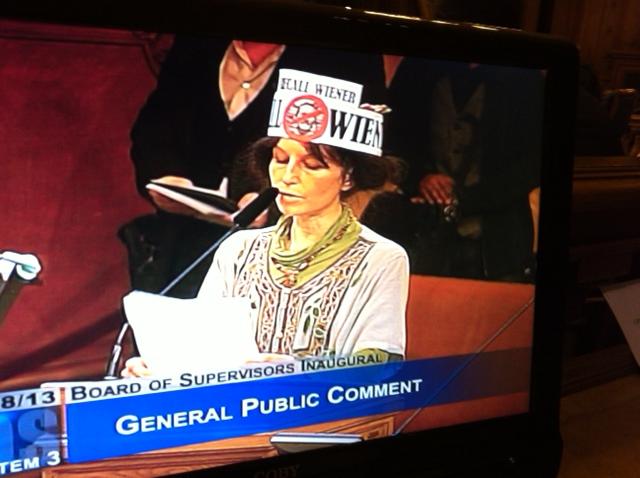
The most colorful moment in public comment was when nudism activist Gypsy Taub came clad in homemade hat that urged people to oppose and recall Sup. Scott Wiener. But because Wiener had already said he wouldn’t accept a nomination as president, she turned her criticism on Chiu, who was also slammed by another leftist speaker who told supervisors, “If you can’t prevent David Chiu from being president, we deserve to be slaves.”

Finally, the meeting included an unremarkable speech by Mayor Ed Lee, who pledged to work with each supervisor and offered this unsupported claim, “We continue to make sure this city is successful for everyone.”

Feds downgrade troubled Housing Authority

9

The federal government has declared the San Francisco Housing Authority a “troubled” agency and dispatched agents to review the agency’s finances and management failures.

The team of experts from the Department of Housing and Urban Development arrived Jan. 7 and has begun poring over the SFHA’s books.

The federal decision came in an October 31 letter to the city’s Housing Authority Board, with a copy to Mayor Ed Lee.

“The Board of Commissioners of the San Francisco Housing Authority should take immediate action to identify the sources of the performance deficiencies and develop and implement a plan to recover” at an “acceptable level of performance,” wrote HUD in its letter.

The troubled ranking is further bad news for Executive Director Henry Alvarez, who was hired in 2008 to help steady the agency’s management. He has since faced allegations of mistreatment and discrimination by some of his top staff, including the agency’s lawyer. He is the target of three lawsuits by his staff.

In addition to the “troubled” status for public housing, SFHA already faced stepped up monitoring if its Section 8 program that provides rental assistance for program participants in privately owned units. The agency scored zero points in its section 8 program because it failed to submit its report.

San Francisco’s “troubled” status was due to low scores for management of the agency and its finances. On financials, SFHA scored five points out of a possible 30, and on management it scored 12 points out of a possible 25. On physical conditions, SFHA squeaked above the cut-off with 27 out of 40 points. The agency’s total score was 54 out of a possible 100.

The score was a drop from score of 75 the prior year. The SFHA explains the change as new scoring criteria by HUD. The looming issue is the lack of effective management at the agency’s top level.

The arrival of a HUD team this week for a week-long examination of the Housing Authority will produce a plan for the agency to correct its management and financial practices with a set of deadlines and specific actions. Failure to implement the plan can bring new consequences with even tighter oversight.

“HUD is at SFHA offices starting today,” said Bill Ford, SFHA attorney speaking for the agency on Monday. “They are reviewing the situation related to the Troubled status. That’s why they are here. They will help develop a plan to pull the agency out of Troubled status.”

The agency had managed to stay off the troubled list — a designation for those scoring under 60 out of 100 points–for the previous two years. A troubled status can make San Francisco ineligible to compete for special funding beyond what it receives by formula.

HUD scoring lags by several months after the agency’s year-end as local officials and federal officials go through appeals and responses before settling on a final outcome. The current troubled status is for the SFHA year that ended September 30, 2011.

SFHA scores for the year ending September 30, 2012 are tentatively estimated also to be in the troubled category or possibly a point or two higher to earn it a “substandard” ranking. Those results are expected shortly to be followed by additional appeals and reviews.

Some one out of 10 San Francisco households receive some form of federal housing aid, not including those who benefit from lower mortgage interest rates under FHA and other federal homeownership mortgage programs.

SFHA earned high marks in the credit market for its HOPESF program that aims to replace decrepit public housing and expand the number if units. That process involves to outside managers to develop and operate and does not rely on SFHA management.

A tale of police priorities

116

By Anh Lê

On Friday afternoon, November 9th, as I was walking on Howard St. near 3rd, I was physically assaulted twice by a Caucasian man walking with an accomplice, an African American woman. I was punched in the jaw the first time while I was still on the sidewalk; the assailant followed me into the street traffic to punch me in the jaw again. Many people passed by, yet none stopped to help. 

I called 911 from the a nearby restaurant. The first oSan Francisco police officer to arrive ordered me to sit down, and then quickly left. Then two other officers arrived, one of whom told me that he was already on assignment at the Moscone Convention Center. Even though I had an eyewitness, and we both provided the officers with a description of the assailant and his accomplice, and I told the officers that the two were still in the vicinity on Howard St., the police did nothing. One of the cops told me, “I think the guy looks like someone from the Tenderloin.”

Compare that to another incident and you get a sense of the city’s police priorities.

On Thursday afternoon, December 13, at the Muni island bus stop on Market St. at 5th, I saw two young African American men in handcuffs. They were detained by an SFPD officer, and two Muni fare inspectors. Both African American men were calm, poised, and respectful in their behavior.

One of the handcuffed men had a cell phone in his mouth while the police officer was questioning him. I thought that it was an odd situation, since the officer could have assisted him by removing the cell phone from his mouth.  I also thought that the dynamics of the situation seemed degrading and demeaning to this young man.

Within five minutes, several additional SFPD officers arrived on the scene, and then several more arrived in an unmarked large black SUV. Nearly all of the police officers were Caucasian. None was African American. 

One of the officers unzipped the second detainee’s backpack.  He calmly said to the officer, “I don’t have any weapon in there.” I could see that the situation involved a simple Muni fare situation. Yet I saw more than ten SFPD officers responding.

I spoke with two of the passengers waiting at the bus stop to ask them what they had seen. Semetra Hampton and Laversa Frasier told me that they saw the two young males handcuffed, and that these young men never acted in any aggressive manner.

I spoke with the two young men, Wayne Price and Jamal Jones. Each received citations, one for paying a youth fare as an adult, the other for misuse of a Clipper card. Hardly serious crimes.

I contacted Officer Michael Andraychak in the Media Relations Unit at SFPD and Paul Rose, spokesperson for San Francisco Municipal Transit Authority to ask why so many officers were involved in such a minor incident.

Rose emailed to tell me that transit fare inspectors saw that the men were using youth passes and asked for identification. When they refused, the fare inspectors contacted police. Andraychack said a Muni fare inspector tried to detain the suspects, but they refused to comply and ran onto the Muni bus island. The inspectors flagged down a nearby police officer, who radioed his location and told dispatch that he was being summoned by Muni personnel for an undetermined problem. Additional officers heard this radio transmission and responded to the scene.

He noted that “Fifth Street / Market is on the border of Tenderloin and Southern Districts. Officers from both districts patrol this area and the MTA K9 officers routinely patrol the Market Street Muni Metro Stations and surface transit stops.”

I appreciate the efforts by Rose and Andraychack to provide me with the information requested.  However, their statements only tell part of the story. Some of their information does not match what I observed, nor what the eyewitnesses told me at the Muni bus stop.

I was there; I counted more than ten SFPD officers who descended on these two young men. Neither of them had done anything violent to anyone, yet their fare evasion elicited massive response.

On the other hand, there was no diligent effort by SFPD to locate, apprehend, and arrest the assailant who assaulted me, on November 9th when he and his accomplice were still in the vicinity of the attack.

Mayor Ed Lee recently proposed a policy permitting police officers to detain and search certain individuals on the street if police deemed it necessary. After vigorous protests from San Franciscans and the Board of Supervisors on the grounds that such a policy would encourage racial profiling, the mayor withdrew the plan.

Still, I have to wonder: Is sending that many officers to handle a simple Muni fare situation involving two young African American males necessary — or is it racial profiling at its extreme? Is this how we as San Franciscans want to see our tax dollars spent — and wasted?

Will narrow business interests continue to dominate SF’s political agenda?

44

Will the narrow, deceptive, and disempowering “jobs” rhetoric of the last two years continue to dominate San Francisco politics in 2013? Or can San Franciscans find the will and organizing ability to create a broader political agenda that includes livability, sustainability, and affordability?

If it’s up to the San Francisco Chamber of Commerce – whose perspective has been aired in both the Examiner and Chronicle over the last two days – private sector profits will continue to be our only metric of civic success.

Just take a look at the “Pinkslips and Paychecks Scorecard” that the Chamber released yesterday, rating members of the Board of Supervisors based on a series of 16 votes for tax cuts and public subsidies for businesses, approvals of projects serving the rich, rollbacks of government regulations, business surcharges on consumers, maintaining PG&E’s dirty energy monopoly, and blocking an expansion of developer fees to improve Muni.

That aggressive neoliberal agenda, which is shared by Mayor Ed Lee and his big corporate backers, was reinforced by Chamber VP Jim Lazarus in an op-ed in today’s Examiner. Ignoring the rising housing and other living costs that plague the average San Francisco, Lazarus uses hopeful language about how we’re all “poised for success in 2013,” burying the Chamber’s aggressive and exclusive agenda in the subtext.

At the top of his agenda are: “Approval of the California Pacific Medical Center rebuild, reforming San Francisco’s California Environmental Quality Act appeals process, and rule-making for the upcoming gross-receipts tax.” In other words, let CPMC have what it wants, make it more difficult to challenge developers on environmental grounds, and ensure business taxes remain as low as possible.

And to ensure supervisors get the message, he closes by noting that business leaders are “energized and ready” to push their agenda with tools such as the Alliance for Jobs and Sustainable Growth, which waged some of the nastiest and most deceptive political attack ads on progressive candidates in the last election cycle.

The progressive movement of San Francisco has its problems and issues, including a recently widening schism between environmental and transportation activists on one side and the nonprofit housing and social justice faction on the other. And in the current economic and political climate, both sides too often find themselves partnering with corporate and neoliberal interests to get things done.

But now, more than ever, San Francisco needs to broaden into political dialogue, and that means a reconstitution and expansion of its progressive movement. That’s something that the Guardian has long focused on facilitating and publicizing – something that will be my personal focus as well – and we have some idea percolating that we’ll discuss in the coming weeks and months.

Then maybe all San Franciscans can be poised for success in 2013 and beyond.

White men behaving (very) badly

69

Could it be — the worst year ever?

I keep asking. And every time the Offies come around, I find myself boggled yet again. Our awards for the very worst — the dumbest, the most tasteless, the most truly offensive acts of the year past — keep sinking lower and lower.

But what can we do? There are still Republicans, and this year a lot of them ran for high office, and every single one made a fool of himself. There are still politicians who think you can run for San Francisco supervisor even if you live in Walnut Creek, and elected leaders who find the courage deep in themselves to prevent a bunch of old men from walking around with their sagging asses and limp dicks out.

There are still entertainers who punch psychics, and gun nuts who blame mass murder on TV sex, and … well, a whole lot of people who have made this a banner year for the Offies.


SUPPORT OUR BRAVE, HEROIC TROOPS! (EXCEPT THE MEN WHO FUCK MEN)

The audience at a Republican presidential primary debate booed a gay solider who called in from Iraq with a question about don’t ask, don’t tell.


FROM A GUY WHO HAD TO BUY OXYCONTINS AND VIAGRA ON THE STREET, THIS SORT OF THING IS AN OBVIOUS CONCERN

Rush Limbaugh attacked law student Sandra Fluke, calling her a “slut” and a “prostitute” because she testified that health-care plans should cover contraceptives.


THERE ARE MEN SO BRILLIANT THAT WE STAND IN AWE OF THEIR INTELLECT

Mitt Romney said he really liked Michigan because the trees were all the right height.


GIVING NEW MEANING TO THE 1 PERCENT

Herman Cain proclaimed that for every woman who claimed he sexually harassed her, there were a thousand others who didn’t.


IF WE WANTED A DRESS CODE ON AIRLINES, WE’D START WITH THOSE DREARY PILOT UNIFORMS

An American Airlines pilot kicked a woman off a flight for wearing a shirt that said “if I wanted the government in my womb I’d fuck a senator.”


PROBLEM IS, BUSH MADE THAT ONE A CABINET-LEVEL POSITION

Rick Perry proclaimed in a debate that he was going to do away with three agencies of the federal government, but after listing Commerce and Education, he couldn’t remember what the third one was, identifying it only as “oops.”


FOR SOMEONE WHOSE NAME MEANS ASS-CUM JUICE, THAT’S A REALLY PRETTY PICTURE

Rick Santorum said that he’d listened to John F. Kennedy’s speech on the separation of church and state and it made him want to throw up.


LOOK! UP AT THE RAMPARTS! THE MAN WITH THE HAIR!

Donald Trump, mistakenly believing Romney won the popular vote but lost the election, called the election “a sham and travesty” and called for “revolution.”


BUT HE COULD HELP THEM OUT WITH A FEW BINDERS FULL OF WOMEN

Romney insulted the British by saying the nation didn’t appear ready to host the Olympics.


FINE, JUST TAKE RICK PERRY WITH YOU

More than 50 thousand people signed a White House petition asking for permission for Texas to secede.


GUNS DON’T KILL PEOPLE, ATHEISM AND OVERSTIMULATED GLANDS DO. HAPPY FRIDAY, SHOOTERS!

On the same day that a gunman opened fire at a showing of the Dark Knight movie in Colorado, the National Rifle Association’s magazine sent out a tweet that read: “Good morning, shooters! Happy Friday.”

A Congressman from Texas, Louie Gohmert, argued that the Dark Knight shootings happened because of “ongoing attacks on Judeo-Christian beliefs.”

Mike Huckabee blamed the massacre in Newtown, CT on atheism. “We ask why there is violence in our schools, but we have systematically removed God from our schools,” Huckabee said on Fox News. “Should we be so surprised that schools would become a place of carnage?”

Timothy Bordnow at Tea Party nation said the shooting was caused by too much sexual stimulation in the media . “There is a reason why young people commit these sorts of crimes, and sex plays no small part. Their passions are eternally inflamed, and they wander the Earth with no outlet for their overstimulated glands.”

Megan McArdle, the Daily Beast writer, urged the victims of mass shootings to gang-rush the shooter so he wouldn’t kill as many people.

The head of the National Rifle Association said the only way to stop mass murders of school children is to post armed guards in every school.


WOW — THE DISTRICT 8 SUPERVISOR HAS BEEN OVERWHELMED BY A COUPLE OF OLD MEN’S FLACCID DICKS

Sup. Scott Wiener promoted a ban on public nudity in San Francisco.


WHEN YOU’RE A MAJOR LOSER, EVEN MONEY CAN’T BUY YOU LOVE

Michael Breyer, who has never been elected to anything, spent roughly $1 million trying to win a state Assembly seat as the candidate of “traditional San Francisco values,” and lost badly.


AND THESE PEOPLE ARE COOPERATING WITH HOMELAND SECURITY?

Confetti thrown in the Giants parade turned out to be lightly shredded internal police documents that included home addresses and social security numbers of officers.


GUESS IT’S OKAY TO PERJURE YOURSELF IF YOU’RE THE MAYOR

Mayor Ed Lee testified under oath that he’d never discussed the Ross Mirkarimi case with members of the board of Supervisors, although friends of Sup. Christina Olague said she’d been open about her talks with the mayor on the topic.


NOW, WHICH ONES ARE THE IRON MONSTERS OF DEATH?

A San Francisco bicyclist who was allegedly trying to beat a speed record crashed into and killed a 71-year-old man in the Castro.


UNFORTUNATELY, THERE’S NO MALPRACTICE STATUTE GOVERNING THAT AUGUST PROFESSION

Political consultant Enrique Pearce oversaw perhaps the worst district election campaign in history, helping Olague become the first incumbent ever to lose in ranked-choice voting in SF.


SOMEHOW, REPRESENTING WALNUT CREEK AT CITY HALL DIDN’T SEEM LIKE SUCH A GOOD IDEA

Union official Leon Chow dropped his challenge to Sup. John Avalos when the SF Appeal revealed that he didn’t live in District 11, or even in San Francisco.


WHEN MEN ARE JUST TOTAL DICKS: THE GOP REDEFINES RAPE

1. Divine providence rape (Rick Santorum): “The right approach is to accept this horribly created .. gift of life, accept what God is giving to you.”

2. Honest Rape (Ron Paul): “If it was an honest rape, that individual should go immediately to the emergency room.”

3. Forcible Rape (Paul Ryan): Federal law should prevent abortion except in the case of “forcible rape.”

4. Emergency Rape (Linda McMahon): “It was really an issue about a Catholic Church being forced to issue those pills if a person came in with an emergency rape.”

5. Legitimate Rape: (Todd Akin): “If it was a legitimate rape, the female body has ways to try to shut that whole thing down.”


CALL IT BIEBER RAGE; IT’S DANGEROUS SHIT

After a Justin Bieber concert, Lindsay Lohan punched a psychic in the face at a New York nightclub, then threw her personal assistant out of the car.


YEP, AND IT DOESN’T LOOK ANY BETTER THE SECOND TIME

Romney’s campaign manager said that his candidate would change his right-wing positions for the fall campaign: “It’s almost like an Etch-A-Sketch. You can kind of shake it up and we start all over again.”


AND IF HE GOES WITH THEM, IT WILL ALL BE WORTH WHILE

Newt Gingrich proposed sending 13,000 Americans to the Moon and creating a new state there.


AND WE ALL WONDER WHY THE MEDIA IS DOING SO SMASHINGLY WELL THESE DAYS

After Gabby Douglas became the first black woman to win the Olympic gold medal in all-around gymnastics, the news media reported on problems with her hair.


AND YOUR VIEW OF THE WORLD IS OVER, OVER, OVER, OVER

Justice Antonin Scalia, in defending his argument that sodomy is legally equivalent to murder, told law students at Princeton that the Constitution is not a living document, it’s “dead, dead, dead, dead.”


MAKES YOU WONDER ABOUT THE POOR SOUL WHO CAME IN AT 99

Kim Kardashian fell 90 places, to 98, on AskMen Magazine’s list of the worlds 100 most desirable women.


SADLY, “GOTTA CATCH ‘EM ALL” DOESN’T MAKE SUCH A GREAT CAMPAIGN SLOGAN

Herman Cain said his life’s philosophy came from a Pokemon song.


WE’RE GLAD THAT HIS FAITH HAS GIVEN HIM SUCH AN UPLIFTING ATTITUDE

Romney said he’s “not concerned about the very poor.”


HE WAS PROBABLY SHITFACED, TOO, BUT SINCE HE DOESN’T DRINK HE CAN’T REMEMBER THAT EITHER

Romney said he didn’t remember beating up a gay student at his prep school and cutting off his long hair.


IT’S A GOOD THING MONDAY NIGHT FOOTBALL ISN’T LOOKING FOR ANOTHER JOHN MADDEN

A full 78 percent of Americans thought Ryan Seacrest was doing a good job broadcasting from the Olympics, although most of them couldn’t figure out what he was actually doing.


HE ALSO TOLD US THAT TAX CUTS AND DEREGULATION WOULD IMPROVE THE ECONOMY, SO HE’S GOT A WINNING RECORD HERE

Karl Rove on election night kept insisting the Romney still had a chance to win.


TALK ABOUT A BLOWN COVER

David Petraus resigned as CIA director after an affair with a woman who was threatening another woman who might have had a thing for him.


TOO BAD — HE MIGHT HAVE HAD TO SEEK ASYLUM IN THE NEW REPUBLIC OF TEXAS

A petition to allow every American to punch Grover Norquist in the dick was removed from the White House website.


WE’RE WITH THE GOVERNMENT OF BELIZE; THIS MAN IS “BONKERS”

One-time software mogul John McAfee fled Belize claiming the cops would persecute him after he was sought for questioning in the shooting death of his neighbor — using a body double, faking a heart attack, pretending he was crazy, and winding up in Miami.


IT SUCKS TO BE STINKING RICH AND OWN FOUR HOUSES AND HAVE TO LIVE WITH REJECTION

Ann Romney was deeply depressed that her husband didn’t win the election, telling friends she though it was their fate to move into the White House.


AND WHEN ASKED IF SOMEONE THAT MORONIC COULD ACTUALLY RUN FOR PRESIDENT, HE SAID “I’M A REPUBLICAN, MAN”

Marco Rubio, when asked about the age of the Earth, said “I’m not a scientist, man.”


EASY — THE ONES WHO ARE GETTING PAID ARE THE ONES PRETENDING TO BE INTERESTED IN NASTY OLD FRENCHMEN

After Dominique Strauss-Kahn was held overnight in Lille to be questioned about possible connections between a prostitution ring and orgies he attended in Paris and Washington, his lawyer said: “I challenge you to distinguish a naked prostitute from any other woman.”


DUDE — THAT’S THE TERRITORY OF SERIOUS LOSERS

Vice-presidential candidate Paul Ryan lied about his time in the marathon.


GO AHEAD, CLINT — MAKE OUR DAY

Surprise guest speaker Clint Eastwood addressed GOP convention delegates for 12 minutes, during which he carried on an imagined dialogue with an empty chair he identified as President Obama.


AND YES, HE DID GET A FAIR AMOUNT OF THE STUPIDITY VOTE

Santorum told a gathering of conservatives in Washington, “We will never have the elite, smart people on our side.”

Was it a great year?

149

At noon Dec. 19, a group of about 50 housing activists led by the Housing Rights Committee gathered at 18th and Castro, next to the giant Shopping Season Tree, to discuss the wave of evictions tenants are facing at the end of 2012. Tommi Avicolli Mecca held up a list of 26 buildings that are currently being clear of tenants under the Ellis Act, a state law that allows landlords to evict all their tenants and sell the property as a single-family home or tenancies in common. With him was a long line of tenants who are facing holiday homelessness thanks to landlord greed.

“There are too many tenants being evicted to fit in front of the tree,” he said.

We heard story after story: A man living with AIDS facing the loss of his home after 17 years. A family being forced out after 18 years. Seniors, kids, disabled people … all of them almost certainly displaced from San Francisco.

“San Francisco is becoming a city of the rich, and we are being pushed aside,” said Lisa Thornton, who works at Rainbow Grocery and is losing her home.

“This,” Mecca said, “is an epidemic of evictions.”

And we all know why: As the second tech boom roars in to San Francisco, high-paid young workers are able to afford to buy TICs or single-family homes, and long-term rent-control-protected tenants simply can’t compete. It’s not a pretty pciture.

So I almost barfed when I say Randy Shaw’s glowing paen to Mayor Ed Lee. “San Francisco had one of its greatest years in 2012, as the city’s job growth and vibrancy outpaced nearly everywhere else,” he wrote.

Oh, gee, he says, there are some problems:

Few want San Francisco to become a city where only the rich and subsidized poor can live. But these same fears were felt in the 1980’s. When I was moving to San Francisco in 1979, the lines for vacant apartments were just as long and the competition for vacant units as fierce as what we read about in 2012. We couldn’t believe we had to pay $375 for a Mission one bedroom apartment, a rate that is less than half the cost of an SRO room without private bathroom today. San Francisco has long been an expensive city that keeps getting pricier.

So what — because we were worried about displacement in the 1980s means we shouldn’t be worried today? Those worries were real — gentrification of San Francisco neighborhoods has been rampant for decades. It’s changed the city, for the worse.

In the 1980s, Shaw was part of a broad coalition that fought to get rent control laws and eviction protections and limits on condo conversions. Now he’s acting as if none of that was worth the fight, as if protecting affordable housing wasn’t, and isn’t, the most critical issue in the city today.

A great year? Fantastic vibrancy and job growth? Not if you’re one of the growing numbers of people who are losing their homes to Ed Lee’s vision of economic development.


No surprise: Your garbage rates are going up 23 percent

78

As expected, Recology sent in its application for a rate increase Dec. 11, and most residential customers will see a hike of 23.5 percent, or about $6.50 a month. The hikes will be more complicated for commercial operations and apartment buildings, depending largely on how much waste those outfits can divert into recycling or compost.

The proposal would change the way rates are charged: Residential customers, who now pay a fee for the black cans holding landfill-bound garbage, will start paying a monthly $5 fee overall and $2 for compost and recycling.

The most dramatic increases will fall on large apartment buildings, which under the current rate structure are heavily subsidized, Eric Potashner, a spokesperson for Recology, told me. “We needed to restructure so the larger residential sector was paying fairly,” he said.

Most large landlords absorb the cost of garbage service as part of the rent they charge. So the new costs may not get passed on to existing tenants.

Recology is facing a mandate to eliminate all landfill waste by 2020 — and that’s a bit of a problem: For years, the company only charged for black bins, which, if all goes according to plan, will eventually go away altogether. “And the trucks, the fuel costs, the drivers are all color-blind,” Potashner said. “It costs the same to pick up the blue bins as the black bins.”

The rate application is complicated, and I haven’t been able to analyze every page. The city has hired an outside contractor to do exactly that, and the process takes months. The current proposal would take effect in June, 2013.

It’s a significant increase, although not as high as some had predicted — and not as high as 2001, when the company asked for almost 50 percent. Back then city staffers recommended the hike be cut almost in half, but then-Public Works Director Ed Lee gave Recology most of what it wanted.

Some of the money will go to cover additional costs Recology faces since the city has asked the company to pick up large refuse (you know, those old couches) that are left on the street.

But overall, according to Recology’s application, the higher rates cover “increased costs and lower than anticipated revenues” — in other words, the sucess of the recycling program has meant less income for the garbage company. Still, while Recology is a private company that doesn’t release financial information, there’s no indication that it’s actually running in the red.


Lee ducks tough questions about Alvarez and diversifying SF’s economy

24

For a career bureaucrat who was appointed mayor supposedly as a sort of straight-shooting un-politician, Mayor Ed Lee today once again demonstrated a real talent for addressing tough questions with a whole lot of words that don’t seem to say much at all. First came his non-responsive answers during Question Time at the Board of Supervisors meeting, followed by the hollow filibuster with reporters asking about the Housing Authority scandal as he briskly walked back to his office.

Asked why he continued to stand by Housing Authority Director Henry Alvarez despite the scandals and accusations of mismanagement and unethical conduct on the job that have placed a cloud over the agency, Lee said he’s just waiting for the investigations and lawsuits to play out, dismissing “the so-called cloud that you referred to.”

Given the obvious problems that Alvarez is now having running an agency whose employees and clients have such a problem with his leadership, I asked whether Lee has considered suspending him, to which he responded that Alvarez hasn’t been convicted of any crimes. So, apparently professional misconduct is a personal matter, but personal misconduct unrelated to one’s job warrants suspension. This is all very confusing.

Even more bewildering was Lee’s answer to the question from Sup. John Avalos. He prefaced his question with one from constituent/comedian Nato Green asking what the city is doing to diversify its economy beyond “the highly paid finance or tech jobs and their low wage servants,” noting that City Economist Ted Egan also recently asked that question in a report calling for “a more balanced distribution of job opportunities.”

So Avalos asked, “What is your plan to create living wage jobs in local-serving industries to prevent the City’s working and middle classes from being displaced by people moving to the city for new upper income jobs in the creative (including high tech), financial, and professional services industries?”

It’s a great and important question that has been increasingly raised by those who understand the risks of placing all our eggs in one economic basket, particularly given this city’s experience with the last dot.com bubble bursting.

But even though Lee had plenty of time to think about the issue and develop an answer, he clearly didn’t have a good one, instead singing the praises of the booming tech industry and his Tech.SF program for training new tech workers, just like his main financier, tech mogul Ron Conway, wants.

Now, Lee did cite industry studies that every tech job sustains four other jobs in the city, mostly in restaurants and tourism-related sectors (ie the “low wage servants” Green mentioned). And Lee touted the construction jobs created by his developer buddies, praising Avalos for his local hire ordinance.

But even the much-praised local hire standard of 25 percent means that 75 percent of those workers are living outside the city. It’s a similar story for the restaurant, retail, and bar jobs that the influx of well-heeled new residents are creating demand for, none of which answers Avalos’ questions about how to diversify our economy and create good jobs for most San Franciscans.

“Trickle down economics can only get us so far and without a specific and far-reaching plan to create local living wage jobs for San Francisco’s working and middle classes, we’ll see us falling behind,” Avalos told the Guardian after hearing the mayor’s “answer.”

But instead of a plan or a direct answer, we got political platitudes from Lee such as, “We’ll be investing in the greatest asset of our city and that’s the residents, our people, and ensuring San Francisco stays a city for the 100 percent.”

To which Avalos responded, “His comment about the 100 percent really means that by favoring the 1 percent, the 99 percent benefit. Well, as a country, we’ve been doing that for years and wealth disparities have only widened.”

The Housing Authority mess

22

Mayor Ed Lee seems to think that the controversy over Housing Authority Director Henry Alvarez is just going to blow over, but he’s wrong. There’s too much here. And it’s not just about the lawsuits employees have filed or the sizable list of unhappy workers.

But before we get into any of that, I have to say: You can’t beat Willie Brown for putting it all in perspective. The former mayor announced in his Chron column Dec. 9 that the Housing Authority (including during his mayoral administration) has always been fundamentally screwed up:

What no one says publicly is that the tenants in public housing are never happy and that the Housing Authority workers usually aren’t all that interested in working. But as long as everyone gets something out of the deal, be it a public-housing unit for a relative or an absence of on-the-job oversight, everyone stays quiet.

So it’s basically structural corruption, all the time. Oh, and what a lovely thing to say about a large group of city employees who have the unenviable job of trying to keep substandard housing units in an underfunded agency somewhat habitable. Guess the problems aren’t at the top; it’s all lazy workers and uppity tenants.

The back story here has been well reported by Larry Bush as Citireport, who over the past year has outlined in detail how Alvarez tried to use his political clout to defund the Housing Rights Commitee, a nonprofit that helps public housing tenants. Turns out the HRC has been a bit of a pain for Alvarez because its staff is agressive about demanding that repairs are made on time and basic maintenance is done.

Alvarez went so far as to contact (presumably on city time) the Tides Foundation, which acts as HRC’s fiscal sponsor, demanding documents that aren’t public record (but that Tides provided anyway). In emails to the mayor’s housing advisor, Doug Shoemaker, Alvarez made clear that he wanted the city to cut of the $90,000 that HRC gets for code-enforcement work.

On April 7, Alvarez sent a rapid-fire series of questions and requests to Shoemaker at the Mayor’s Office of Housing, all apparently intended to uncover problems with the nonprofit and provide grounds for ending city funding. Shoemaker complied with the document requests while trying to cajole Alvarez away from a confrontation with HRC. “I realize that you don’t think I’m doing enough to keep HRC out of your hair,” Shoemaker wrote to Alvarez on April 7, “so I spent part of my evening last night getting the records request (from HRC) rescinded.”

So: The Housing Authority director thinks a widely-respected tenant rights group is “in his hair” and wants to cut off the group’s money because it’s doing its job of helping tenants deal with the HA bureacracy.

Oh, and it’s not as if HRC is making up the problems. Willie Brown can complain all he wants that the tenants are just annoying malcontents, but the record shows there are serious problems with the Housing Authority:

Hundreds of San Francisco families continue to live in tax-payer subsidized housing that fails minimum standards for health, safety, and sanitary conditions, according to recent inspections by the U.S. Department of Housing and Urban Development (HUD). San Francisco’s response is to defer compliance with housing codes “until replacement housing can be found.”

You want an idea of how serious? Check this out.

I’m glad Sup David Campos as asked for a compliance audit on the agency, because in the end, this is really about the tenants.

Oh, and just in case anyone has forgotten, this was the guy Willie Brown had running the Housing Authority.


Same-sex marriage: What they’re saying

4

Lots of statements getting issued on the Supreme Court’s decision, reflecting both the desire of many elected officials to weigh in on this momentus event and some interesting differences in tone.

Assembly Member Tom Ammiano:


“This doesn’t decide anything on its own, but it opens the door for the U.S. Supreme Court to acknowledge that people in every state of this union should be able to form marriage unions with the partner of their choosing and not be limited by outdated customs and laws.”

“It’s a bit disappointing that the Supreme Court isn’t already kicking Prop. 8 to the curb, but I’m hopeful that they will do that after hearing arguments. We can also hope that this court decides that it’s time to say, once and for all, that denying this right to same-sex couples is just as unconstitutional as denying marriage to mixed-race couples – a decision made decades ago.”

State Sen. Mark Leno:

“I am hopeful and encouraged about today’s decision from the U.S. Supreme Court to review the Proposition 8 case, which is one of the most significant equal rights issues to come before the court in many decades,” said Senator Leno. “For the past four years we have argued that Proposition 8 is not only unconstitutional, but that it also violates the basic principles of respect, dignity and validation that every American deserves. I am confident that the Supreme Court will reaffirm these fundamental freedoms and uphold that a person’s right to be treated equally does not vanish simply because of who they are or whom they love.


“The momentum for marriage equality has never been stronger in our country. We have support from President Obama, recent victories at the ballot box, and polls that show a majority of Americans are with us. In addition, federal courts continue to strike down laws that discriminate against lesbian, gay, bisexual and transgender people. I am convinced our triumphs will continue.”


Mayor Ed Lee:


“I am optimistic that the Supreme Court will reaffirm, as the Ninth Circuit Court did, that California’s Proposition 8 is unconstitutional.

“We remain as deeply committed today as we were nearly eight years ago when then Mayor Gavin Newsom jumpstarted one of the most important civil rights movements of our generation. I would like to thank City Attorney Dennis Herrera for his work on this important issue and bringing us to this point. I thank the legal team of Ted Olson and David Boies and the American Foundation for Equal Rights for defending equality in this legal pursuit. 

Same-sex marriage is legal, or will soon be, in nine states — Connecticut, Iowa, Maine, Maryland, Massachusetts, New Hampshire, New York, Vermont, Washington — and the District of Columbia. I look forward to the day when California joins this well-respected list.”


Lt. Gov. Gavin Newsom:


Today marks the beginning of the end for a California journey that started eight years ago when San Francisco issued same-sex marriage licenses. By agreeing to hear the Proposition 8  case the U.S. Supreme Court could end, once and for all, marriage inequity in California.

Forty-five years after the Supreme Court ruled that marriages between interracial couples were constitutional in Loving vs. Virginia, Justices can once again reaffirm the basic American principal of equality for all.

The singling out a class of Californians for discrimination violates the basic principles of who we are as a nation. It is important at this moment in time to recognize that individuals can be mightier together than apart, that there is strength in our diversity, power when we unite around our shared values and success when we advance together.

 Today’s announcement starts the clock towards the final decision for California. History will one day be divided into the time before marriage equality and the period that follows. And thankfully, we will be on the side of history worthy of being proud of.


Assembly Speaker John Perez:

“Today’s announcement that the Supreme Court will take up Hollingsworth v. Perry and the challenges to the Defense of Marriage Act is a reminder that the pathway to justice is long and difficult. The plaintiffs in the initial challenge to Proposition 8, Perry v. Schwarzenegger, presented a powerful and compelling argument that Proposition 8 is unconstitutional, which was eloquently recognized in Judge Vaughn Walker’s ruling in that case. I am very confident that the Supreme Court will rule in favor of our community in Hollingsworth v. Perry, as it is now known, and affirm that Proposition 8 is unconstitutional. But until that outcome is secured, our community must continue to fight for justice on every front, from working to secure the Employment Non-Discrimination Act to addressing the issues of homelessness among LGBT Youth.”

Rep. Nancy Pelosi:


With the Supreme Court’s decision, marriage equality will finally have its day in the highest court in the land. Americans will hear whether inequality and discrimination are consistent with the high standards and deepest values of our Constitution. We remain confident that the justices’ ruling will fall on the side of civil rights and discard DOMA and Prop 8 in the dustbin of history.

“From the start, Republicans have known that DOMA is unconstitutional, and that’s why Republicans have tried to pass legislation to prohibit judicial review of this disgraceful law. Speaker Boehner’s legal team repeatedly failed to convince the courts to keep denying basic rights to American families, all while wasting nearly $1.5 million in taxpayer funds. Now, the Supreme Court will decide whether Edie Windsor deserved to face a penalty of hundreds of thousands of dollars after her partner of four decades passed away. We believe Ms. Windsor and couples like hers will see justice done in this case.

“By taking up the Prop 8 case, the Supreme Court will have the opportunity to make a strong statement that laws, in California and nationwide, must not target the LGBT community unfairly and that families across our state and our country deserve fair and equal treatment under the law.

“We have now reached a landmark moment in the history of civil rights in our nation. Let’s end discrimination and ensure equality for all of America’s families. Let’s get this over with and on to the future!”

UPDATE:

Bay Guardian Controller Sandy Lange:

“Well, at least I don’t have to get married this weekend.”


What did the mayor know?

35

So let’s get this straight:

Three lawsuits have been filed against the head of the Housing Authority. Some 30 staffers have complained about Alvarez to senior mayoral staffers. The HA even hired former City Attorney Louise Renne to investigate problems with Alvarez.

And Mayor Lee says he wasn’t aware of the problems?

This is the kind of thing that used to happen under Willie Brown — the mayor would hire cronies for top dollar, and defend them and brush aside charges of misbehavior. And I hate to see the same style happening under Lee.

Clearly, the two are pals, and I understand the urge to stand by your friends in public life, and at this point, we just have allegations — maybe none of it is true, and maybe Renne will find that everything is just grand over at the Housing Authority. But the mayor ought to at least express concern.

And if this was all really happening without his knowledge, then his staff isn’t doing a very good job of keeping him informed.

Either way, not a good scene in Room 200.

Guns in Bayview

36

The National Rifle Association’s bid to kill two San Francisco gun control ordinances — which a federal judge initially rejected last week, although that legal process continues — highlights differing views on the issue in the violence-plagued Bayview, where two prominent activists have opposing viewpoints.

One ordinance requires guns in the home to be locked up when not on the owner’s person and the second bans the sale of fragmenting and expanding bullets, affecting only the city’s sole gun store: High Bridge Arms, in the Mission district.

The first ordinance was introduced in 2007 by then-Mayor Gavin Newsom and supported by Sheriff and then-Sup. Ross Mirkarimi and opposed by three supervisors: Ed Jew, Aaron Peskin, and Chris Daly. City Attorney Dennis Herrera was pleased at the judge’s ruling.

“The NRA took aim at San Francisco’s Police Code,” Herrera said in a press release. “I’m proud of the efforts we’ve made to beat back these legal challenges, and preserve local laws that can save lives.”

NRA attorney C.D. Michel told the San Francisco Examiner, “This is not over, not by a long shot…What if you’re old and need glasses in the middle of the night, or you have kids at home to protect? Why are they being forced to keep their guns locked up?”

Interestingly, its not the NRA’s name on the front of the lawsuit, entitled “Espanola Jackson v. City and County of San Francisco.”

Jackson, a San Francisco native and longtime Bayview Hunter’s Point civil rights activist, has been fighting for the rights of minorities since she was old enough to hold a picket sign. She was recognized last May by the San Francisco Human Rights Commission with a “Legacy Award for a Lifetime in Human Rights Advocacy.”

So why is she advocating for unlocked guns in the home, and more lethal bullets?

“I live in the Bayview and I’m 79 years old,” she told The Guardian. “We’re mostly single women, but we need to have protection.”

She cited a recent police report she’d read of an elderly woman being assaulted by several teenage girls, just blocks from her home, as one of the many reasons she feels she needs protection in her own neighborhood.

Jackson said she’s had a lifetime of training with her firearm, although she wouldn’t identify the kind of weapon she wield. Back in the ’60s, she said, “they were calling us pistol packing mamas.” It’s that history, she said, that makes her feel safest with a gun in her drawer, where she can easily get it in case of a robbery.

But Theo Ellington — a board member of the Bayview Opera House and the Southeast Community Facilities Commission — sees the issue differently. Notably, as a member of the Young Black Democrats, he led the opposition against Mayor Ed Lee’s proposal to introduce “Stop and Frisk” policing to San Francisco. Lee abandoned the idea after activists cited rampant civil rights abuses under the policy in New York City.

Ellington thinks that overturning the San Francisco’s gun ordinances would be a bad idea. “We face a much greater risk if we fail to take measures to prevent [gun] accidents,” Ellington told us. “The last thing we want is for any weapons to be in the hands of children or for potential misuse.”

He has reason to be worried about the Bayview. Recent city statistics show an upswing in most crime categories in the district from 2011 to 2012, from homicides and rape to vehicle theft and burglaries. National studies have shown gun owners or their family members are more likely to get shot by guns kept in homes than are intruders. Public safety means different things in different areas, Ellington said, especially “when we’re dealing with a population that is plagued by gun violence.”

Canned!

6

news@sfbg.com

So much for the holiday spirit.

In a win for the NIMBY neighbors of the Haight neighborhood, the Haight Ashbury Recycling Center was gifted with its final eviction notice, ordering it out on the street by the day this story goes to print, Dec. 5.

But those who hoped this eviction would rid the neighborhood of poor people recycling bottles and cans may be disappointed — and so might local small businesses that could face some unintended consequences of the move.

The site, run by the Haight Ashbury Neighborhood Council (HANC), houses a community garden, native plant nursery, and recycling center. HANC battled eviction for nearly a decade as newer neighborhood associations complained to the city, saying the center was too noisy and attracted too many homeless people.

The recycling center is located at the edge of Golden Gate Park behind Kezar stadium, and has been crushing cans and busting bottles since 1974.

The San Francisco Recreation and Park Department issued several eviction notices to HANC over the years, and the process seemed to drag on, but the eviction notice from the Sheriff’s Department on Nov. 28 is likely the last nail in the coffin.

“We’ve exhausted our legal options,” Ed Dunn, HANC’s director, told us.

Even Sup. Christina Olague, who has championed HANC as one of their few supporters on the current Board of Supervisors, said that the recycling center was done, although representatives from Sup. Eric Mar’s office told us they were still hopeful the eviction could be delayed long enough to relocate HANC somewhere else.

Olague told us that she’d talked to Mayor Ed Lee about the issue many times, and they discussed many options. But with the finality of the eviction notice, she said, “I just don’t know what we can do.”


COAL FOR CHRISTMAS

The recycling center’s employees will lose their jobs just at the start of the winter holiday season. “The notion that they’d put people out of work before Christmas was horrendous,” Dunn said.

What will happen to HANC’s 10 employees is up in the air. “I have no idea what I’ll do,” HANC employee Brian McMahon told us, lowering his orange protective headphones to talk. He’s worked there since 1989, and his last job was at a Goodwill store. “The quote under my high school yearbook picture says ‘take it as it comes,’ and that’s what I’m going to do.”

Susan Fahey, the sheriff’s media relations officer, declined to discuss the details of how the officers would handle the eviction, saying only that “we plan accordingly.”

A staff report prepared for the Recreation and Park Commission’s Nov. 20 meeting estimated that just 0.1 percent of San Francisco’s recycling tonnage is processed at HANC, according to a report by citizen journalist Adrian Rodriguez. The agenda also said that the Department of Environment was confident that recyclers would use other nearby sites instead.

But the customers at HANC that we talked to didn’t agree.

“I think it’s necessary they have the [recycling center] here,” HANC customer Eugene Wong told us. Wong lives in the Haight, and hauls in his recyclables every six months or so for some extra pocket money. As Wong and his friend Bob Boston spoke, one of their Haight Ashbury neighbors, Rory O’Connor, surprised them as he walked up.

“Just droppin’ off my beer cans, man,” O’Connor said. Asked if he would make his way out to the Bayview recycling center when HANC closed, he said, “You’ll spend more on gas than you would even get back.”

There were quite a few neighborhood locals there that day, and more people drove into the recycling center than there were people pushing shopping carts. But it’s the folks with the shopping carts that had HANC’s opponents up in arms.

And though some — like Chronicle columnist C.W. Nevius, a regular critic of HANC — are celebrating HANC’s demise, the unintended consequences should have all small businesses in the Haight Ashbury worried.


CLASS WARFARE BACKFIRES

State law requires that Californians have easy access to a “convenience zone,” basically somewhere nearby that they can collect the five-cent deposit all consumers pay for cans and bottles. HANC served that purpose for a half mile radius around its location on Frederick, near Stanyan.

“Whole Foods and Andronico’s were serviced by HANC’s existence,” Regina Dick-Endrizzi, the director of San Francisco’s Office of Small Business, told us. With HANC gone, “They will be required to buy back [bottles and cans] from local stores.”

San Francisco’s Department of Environment oversees recycling policy in the city, but did not respond to calls or emails.

The reason that HANC was being pushed out was due to a vocal few, like the Haight Ashbury Improvement Association, complaining that HANC was a magnet to the homeless population looking to sell bottles and cans collected in shopping carts. That group didn’t respond by press time. Now those same poor folks may take their business from Golden Gate Park to the Haight neighborhood itself by recycling at the local Whole Foods, the new legal alternative to HANC.

Sometimes local grocery stores defy the state mandate, and instead choose to pay a state-mandated fee, Dick-Endrizzi said. If Whole Foods chooses not buy back recyclables, small businesses all over the Haight will be required by state law to do it themselves.

Suhail Sabba has owned Parkview Liquors on Stanyan Street, just two blocks from HANC, for nine years. He said that he doesn’t have the employees, storage, or scale “to handle even a portion of HANC’s customers.”

He may not have much of a choice. If small businesses don’t buy back the recyclables, they would face charges of $100 a day under California state law. A year gone without complying would lead to charges up to $36,000, an amount that large-scale businesses often factor into their budgets, but which could bankrupt a small store.

When contacted, Whole Foods representative Adam Smith said that the company was aware of the issue and was still deciding on a course of action.

The company has a 60-day grace period to make a decision that, for good or ill, would ripple through the Haight neighborhood. “I might go out of business,” Sabba said.

Store owners can apply for an exemption, but the process can be as lengthy as a few months and fines could still accrue, Dick-Endrizzi said. The Office of Small Business will soon reach out to the affected store owners, but she encourages them to contact her office directly at 415-554-6134.


GARDEN FOR A GARDEN

The HANC site houses more than the recycling center. It also encompasses a native plant nursery, run for the past decade by caretaker Greg Gaar, who we’ve profiled before (“Reduce, reuse, replace,” 5/30/12). Gaar raises Dune Tansy, Beach Sagewort, Coast Buckwheat and Bush Monkey — all native plants bred from the dunes of old San Francisco, which Golden Gate Park used to be.

Adjacent to the nursery is a community garden with 50 plots serving just more than 100 neighbors. But the odd part is, when the city is done tearing down the recycling center and gardens, it plans to put in, well, another community garden, at taxpayer expense.

The new plan does offer a few tweaks. There will be a small stone Greek-style amphitheater, and removing the recycling center will leave more green space for the site. The new community garden will feature 10 fewer plots. As of now, there is no formal plan to transfer the 100 gardeners from HANC’s community gardens to the new plots once they’ve been built.

Some of HANC’s current gardeners count among the local homeless population, said Soumyaa Behrens, HANC’s social media coordinator. Those few homeless use their plots to grow food.

“You meet people you wouldn’t meet anywhere else,” said Miriam Pinchuck, a writer who will soon lose her and her husband’s garden plot at HANC. “It’s very shortsighted, and it’d deprive us of a chance to meet our neighbors.”

Though Dunn and Gaar are in negotiations with city officials on their gardners’ behalf, at this point it looks like the current gardeners will need to sign up for the new plots, just like everybody else.

Gaar looks like he may be the only employee to work at the new garden site once it replaces the recycling center. He’d have to volunteer, but he said that doesn’t necessarily bother him.

“For me, gardening is a joy,” Gaar said, although he did voice one concern: “I just want the nursery to survive.” With HANC’s eviction, it seems like everyone has something to worry about.

Editor’s notes

0

tredmond@sfbg.com

EDITOR’S NOTES The San Francisco Local Agency Formation Commission is holding a hearing Dec. 7 on the Mayor’s Renewable Energy Task Force report. That may not sound like the most exciting moment in any of our lives — but it’s actually worth talking about, a lot. Because the city has a goal of reaching 100 percent renewable energy in just eight more years, and the task force think it can be done — and the report, while it has its moments, completely screws up the central tenet of any long-term renewables policy.

Background: Former Mayor Gavin Newsom, who was prone to making sweeping press statements about things he never really intended to do, proclaimed in 2010 that San Francisco would be free of all fossil fuel electricity in 10 years. Then he went on his merry way to the Lieutenant Governor’s Office.

It fell to his successor, Ed Lee, to figure out how to make this happen, so Lee appointed a task force to study the situation. A lot of the members were environmental activists; some were experts in solar energy. One, Ontario Smith, worked for Pacific Gas and Electric Co., hung up five minutes into the first phone-conference meeting, and took his name off the final report.

If you don’t think this is serious business, you haven’t been looking out the window this past week. Scientists are now saying that it’s already too late to prevent the surface temperature of the Earth from rising three degrees, which means volatile and dangerous weather patterns are going to be part of the future anyway, and things might get way, way worse. San Francisco’s energy policy isn’t going to prevent China from burning coal, but it’s a step — and a 100 percent renewable portfolio would be a signal to other cities (and countries) that this is economically and technically feasible.

The report has 39 recommendations, many of them simple, practical, and laudable. It talks (correctly) about the importance of distributed generation — that is, small-scale solar and other renewable systems on houses and commercial buildings. It gives a nod to CleanPowerSF, the city’s community-choice aggregation system.

And it never once mentions public power.

In fact, from the tone of the report, the city plans to get to 100 percent renewable generation with the support and assistance of PG&E.

Let me give you a ring on the clue phone, folks: It isn’t going to happen.

Private utilities don’t have any interest in distributed generation, because it, quite literally, destroys their business model. If I have solar panels on my roof that meet my family’s energy demands, I have no need for PG&E anymore (except to use the company’s grid as a storage battery system, but soon we won’t need that, either). The only functional path to 100 percent renewables in a dense city is small-scale generation — and PG&E stands directly in the way.

I’ve always been a proponent of public ownership of essential services — water, power, streets and roads, firefighting and police operations, broadband, etc. But when it comes to electricity, this is more than a financial and resource-control issue. I see no path to a carbon-free (and nuclear-free) future, in San Francisco or anywhere else, as long as private companies make profits generating power in one place, shipping it along their private lines, and selling it someplace else.

Public power is not sufficient to create Newsom’s energy dream — but it’s absolutely necessary. And I hope the members of LAFCO make that point — and suggest that the task force update its report to reflect economic and political reality.

Aggressive Warriors

0

steve@sfbg.com

No standard defensive strategy is likely to stop the Golden State Warriors, Mayor Ed Lee, and their huge team of partners and employees from dominating the game of approving construction of a new basketball and concert arena on San Francisco’s central waterfront. That became clear on Nov. 14, as the political operation overcame fire, darkness, and neighborhood-based opposition for the first big score.

The Board of Supervisors Budget and Finance Committee was set to consider declaring the project, which the Warriors want to build on Piers 30-32 by the 2017 basketball season, to be “fiscally feasible,” recommending it move forward with more detailed environmental studies and a term sheet nailing down myriad administrative details.

Before the 11am hearing, the project team held a packed press conference to announce that the Warriors had volunteered to abide by the city’s local-hire standards for public works projects, hiring San Francisco residents or military veterans for at least 25 percent of total construction jobs and 50 percent of apprenticeships. A beaming Lee praised the deal as an “unprecedented” indicator of the Warriors’ willingness to partner with the city.

The event overflowed with union members in hard hats and orange “Build It Now!” T-shirts, as well as a full range of local political pros, from former mayoral and current project spokespersons PJ Johnston and Nathan Ballard to former aides to progressive supervisors, David Owen and David Loyola. Among the agreement’s four signatories were Joshua Arce, the Brightline Defense Project head who last year crusaded for Sup. John Avalos’s local hire ordinance, and building trades chief Michael Theriault.

Strikingly missing at the press conference was Sup. Jane Kim, in whose District 6 the project would be built — over the objections of many residents who are raising concerns about the loss of waterfront views, huge crowds attending what is projected to be more than 200 events per year, high interest rates paid by city taxpayers, the project’s accelerated approval schedule, and other concerns.

Kim is one of the three members of the Budget Committee, which held its meeting despite an electrical fire in the basement of City Hall that knocked out power to the building. Portable photography lighting was brought in to supplement the emergency backup lights, making it bright enough so the televised show could go on but giving a strangely surreal feel to the proceedings and reinforcing the urgency project supporters feel to move this forward without delay.

Kim raised the concerns of her constituents, winning support for amending the resolution to ensure the Citizens Advisory Committee — whose chair was given two minutes to convey how its members feel steamrolled by the accelerated process, asking it be delayed by a month or two — will be given chances to weigh in and pushing the EIR scoping meetings back a few weeks to January.

In the end, Kim and the committee voted to move the project forward. A few days later, on Nov. 19, the process repeated itself with another flashy press conference in the Mayor’s Office — with another important union endorsing the project — followed by the Land Use Committee responding favorably to the project.

The full Board of Supervisors was scheduled to approve the project’s fiscal feasibility the next day, after Guardian press time, but there was little chance that the full board would take any other action than giving the Warriors, Lee, and their huge roster of teammates what they want.

This despite unusual financing and some very real concerns about waterfront development.


JOBS, MONEY, AND SUPPORT

Mayor Lee — who has placed a high priority on this project since announcing his deal with the team in May — emphasized its job creation and contribution to the local economy during the Nov. 19 press conference.

“I remind people, this is a private investment of hundreds of millions of dollars,” Lee said of a project pegged to cost around $1 billion. “It means a lot of jobs, and that is so important to all of us.”

The project is expected to directly create 4,300 jobs: 2,600 construction jobs and 1,700 permanent jobs, including those at the 17,000-seat sports and entertainment arena and the 250-room hotel and 100,000 square feet of retail and restaurants that would be built as part of the project.

“We’ve been spending a lot of these last many months describing what it is we want to build,” Warriors President Rick Welts said at the press conference before casting the project in grander terms. “That’s not really what we’re building. What we’re really building are memories.”

But city residents and workers are looking for more tangible benefits than just the highs of watching big games or concerts. The building trades were already expected to strongly support the project, which only got stronger with last week’s local-hire deal. Labor’s support for the project was broadened on Nov. 19 with the announcement that the Warriors agreed to card-check neutrality for the hotel, making it easier for its employees to join UNITE-HERE Local 2.

“Thank you for being a partner and we’re looking forward to working with you in the future,” Local 2 head Mike Casey, who notably also serves as president of the San Francisco Labor Council, said to Welts at the event before the two signed a formal agreement.

In addition to allowing the hotel workers to easily organize, the Warriors agreed to card-check neutrality for vendors at the arena with at least 15 employees and those outside the arena with more than 45 employees, as well as giving those who now work Warriors’ games at Oracle Arena first dibs on jobs at the new arena.

“I think that speaks a lot about what the project is. It’s not just a San Francisco project, but a Bay Area project,” Casey said. He also said, “I want to thank the mayor for bringing people together and laying all this out.”

While Lee and the Warriors do seem to have this deal pretty well wired, this is still a San Francisco project, a complex one on the politically and environmentally sensitive waterfront that city taxpayers are helping to pay for and one for which the residents there will bear the brunt of its impacts.


PAYING FOR IT

Lee, Office of Economic and Workforce Development head Jennifer Matz, and other key project supporters have repeatedly claimed this project is funded completely with private money, noting how rare that is for urban sports stadiums these days.

But in reality, city taxpayers are spending up to $120 million for the Warriors to rebuild the unstable piers on which the arena will be built, plus an interest rate of 13 percent, an arrangement that has drawn criticism from a key source.

Rudy Nothenberg, who served as city administrator and other level fiscal advisory roles to six SF mayors and currently serves as president of the city’s Bond Oversight Committee, wrote a Nov. 12 letter to the Board of Supervisors urging it to reject the deal.

“Quite simply, I would have been ashamed of such a recommendation,” Nothenberg wrote of the high interest rate. “In today’s markets it is incomprehensible to have such a stunning recommendation brought to your honorable Board in such haste.”

Johnston and Matz each disputed Nothenberg’s characterization, citing a report by the project consultants, the Berkeley-based Economic and Planning Systems Inc. (EPS), that 13 percent is a “reasonable and appropriate market based return.”

Matz told us the rate was based on the risky nature of rebuilding the piers, for which the Warriors are responsible for any cost overruns. And she compared the project to the massive redevelopment projects now underway on Treasure Island and Hunters Point, from which the city is guaranteeing powerful developer Lennar returns on investment of 18.5 percent and 20 percent respectively.

Johnston, who was press secretary to former Mayor Willie Brown and worked with Nothenberg on building AT&T Park and other projects, told us “I have great respect for Rudy.” But then he went on to criticize him for taking a self-interested stand to defend the views from the condo he owns nearby: “They don’t want anything built in their neighborhood. They would rather leave it a dilapidated parking lot.”

But Nothenberg told us his stand is consistent with the work he did throughout his public service career in trying to keep the waterfront open and accessible to the public, rather than blocking those views with a 14-story stadium and hotel complex.

“I have a self-interest as a San Franciscan, and after 20 years of doing the right thing, I don’t want to see this rushed through in an arrogant way that would have been unthinkable even a year ago,” Nothenberg told us. “I spent 20 years of my life trying to deal with waterfront issues.”

He is being joined in his opposition by other neighborhood residents, land use experts such as attorney Sue Hestor, some opponents of the 8 Washington project concerned with the creeping rollback of waterfront development standards, and members of the Citizens Advisory Committee who have felt steamrolled by the rapid process so far and unable to thoroughly discuss the project or the neighborhood’s concerns.

“We would like to slow this process down,” committee Chair Katy Liddell told supervisors on Nov. 14. “Things are going so quickly.”


DETAILS OF THE DEAL

The $120 million plus interest that the city will owe the Warriors would be offset by the $30 million the team would pay for Seawall Lot 330 (the property across from the piers where the hotel would be built), a one-time payment of $53.8 million (mostly in development impact fees), annual rent of nearly $2 million on its 66-year lease of Piers 30-32, and annual tax and mitigation payments to the city of between $9.8 million and $19 million.

Kim raised concerns at the Budget Committee hearing about the more than 200 events a year that the arena will host, but she was told by Matz that’s necessary to make the project pencil out for the Warriors.

Many of the project’s financial and administrative details are still being worked out as part of a term sheet going to the Board of Supervisors for approval, probably in April. Other details will be studied in the project Environmental Impact Report, which is expected to come back to the board in the fall.

The Department of Public Works, Police Department, and — perhaps most critically given its impact on Muni and roadways — Municipal Transportation Agency have yet to estimate their costs.

“We do have a lot of concerns in the neighborhood about this project,” Kim told the Land Use Committee, singling out impacts to the transportation system as perhaps the most important, followed by quality-of-life issues associated with huge crowds of sports fans.

Kim noted that the area already has a problematic transportation infrastructure, with some of the highest rates of motorist-pedestrian collisions in the city and a public transit system that reaches capacity at peak times, and said that many residents worry this project will make things worse. The EIR will deal with the transportation details. But Kim praised how about half the space on the piers, about seven acres, will be maintained as public open space: “I think the open space aspect is incredible and it could actually increase access to the waterfront.” In the end, Kim urged project proponents to heed the input of the CAC and other concerned parties because, “This could be a very valuable project, or it could also be a disaster.”