David Campos

Final step?

4

steve@sfbg.com

President Barack Obama is fond of reciting the Martin Luther King Jr. quote, “The arc of history is long, but it bends toward justice.” On the issue of marriage equality, that arc looks more like a zig-zagging path that began when San Francisco unilaterally began issuing marriage license to same-sex couples just before Valentines Day in 2004 and ending — its backers hope — in June 2013 with the US Supreme Court affirming the basic constitutional right of everyone to marry whomever they want and to have those marriages treated equally under the law.

“We’ve seen the ups and the downs, the highs and the lows,” said City Attorney Dennis Herrera, who has watched court injunctions blocking marriages by the city, the California Supreme Court ruling that the ban on same-sex marriage violated the state constitution, the 2008 vote amending the constitution through Proposition. 8, and the Ninth Circuit Court ruling that the measure violated federal equal protection standards.

Yet few officials or legal experts are willing to predict with any certainty that this long and winding road will end with a definitive conclusion in June. In fact, Herrera and other same-sex marriage supporters expressed disappointment Dec. 7 when the Supreme Court announced it had decided to review the Ninth Circuit Court ruling that Proposition 8 was unconstitutional.

Letting the ruling in Perry v. Brown stand would have re-legalized same-sex marriages in California, which would have joined the nine other states and the District of Columbia as places where it’s legal for gays and lesbians to get hitched. Yet in taking the case — along with U.S. v. Windsor, which challenges the Defense of Marriage Act and its prohibition on recognizing the inheritance law and tax code rights of same-sex spouses — the court could issue a landmark civil rights ruling striking down all laws that discriminate against same-sex couples.

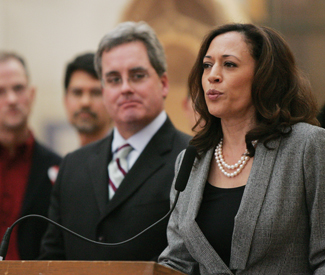
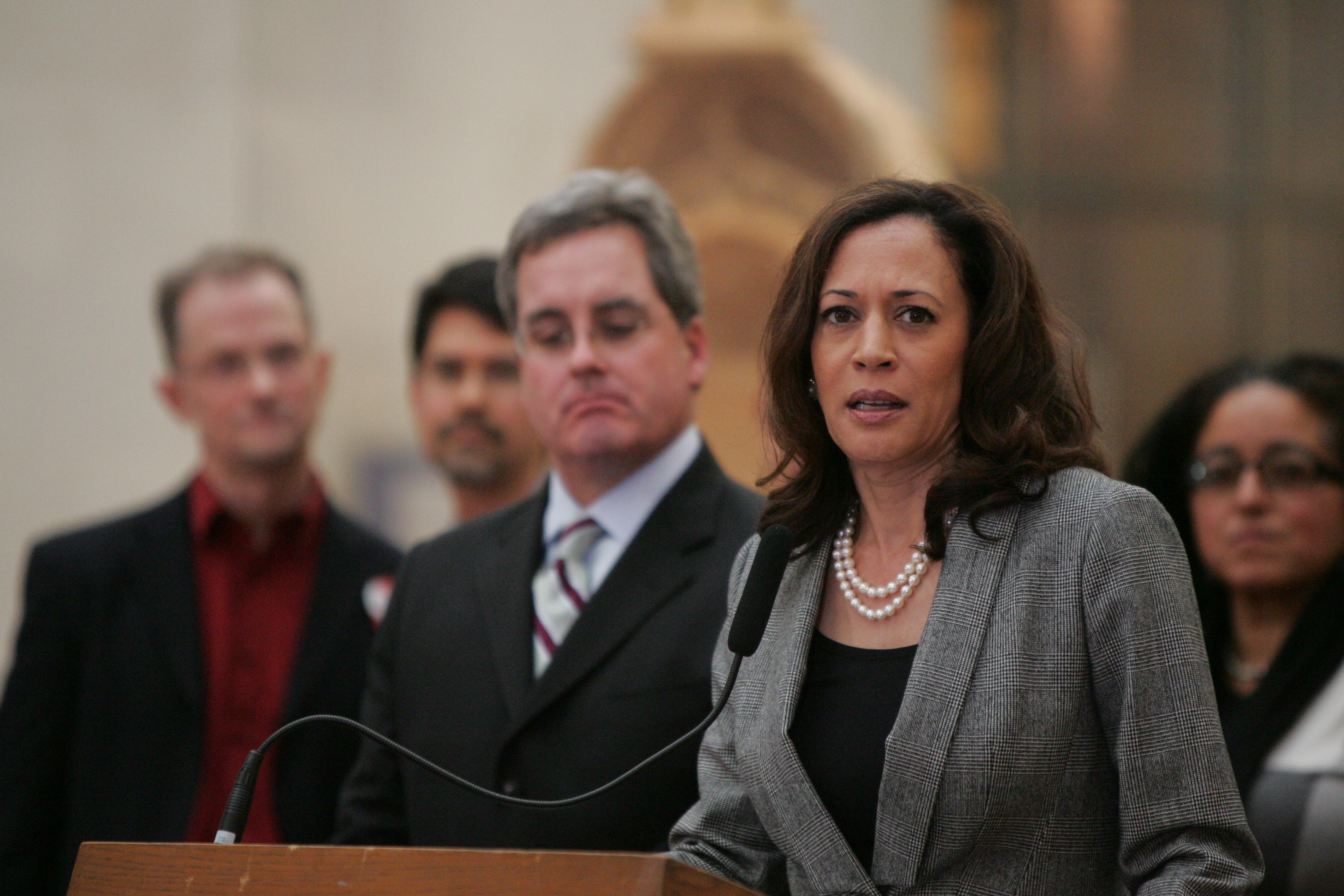
That’s the hope of California Attorney General Kamala Harris. “Are we a country that is true to its word and true to its spirit, or not?” was how Harris framed the question at a Dec. 7 press conference with Herrera. She focused on the basic equal protection argument and the need to “stand for the principle that we are equal and we will be treated that way.”

Herrera, who had just gotten off a conference call with lead attorneys Theodore Olson and David Boies and the rest of the advocates who are defending same-sex marriage, told reporters that the main goal was a broad ruling: “Ted Olson has made it clear he’s going to make a very broad argument.” Yet the Supreme Court could also issue a narrow ruling, extending the twisty path of this issue.

As for reading the tea leaves, Deputy City Attorney Terry Stewart, who has litigated the city’s position since the beginning, said she doesn’t think anyone knows how this case is going to be resolved — not even the Supreme Court justices themselves. “I don’t think they know, to be honest with you,” Stewart said when asked whether taking the Perry and DOMA cases indicate a willingness to finally settle the broad question of whether same-sex couples should be treated equally to heterosexual couples.

She noted that the Supreme Court waited until the last minute — its decision had initially been expected on Nov. 30 — to decide to take the cases: “They took a long time, so clearly they’re wrestling with it.”

Like many observers, Harris speculated that Justice Kennedy is the likely swing vote if the court reaches a 5-4 ruling on the issue, and some have speculated that Chief Justice Roberts could also be a surprisingly liberal vote on the issue, as he was earlier this year in upholding Obamacare. And the advocates say their optimism is reinforced by the long and meticulous case for marriage equality that advocates put together in the courtroom of federal Judge Vaughn Walker, whose 2010 ruling the Ninth Circuit upheld.

“We worked really hard to put in the best possible case,” Stewart said, while Herrera said, “I can think of no better case to take up than this case…The confidence level of all of us is high.”

Yet even if it turns out that there are a few more turns to navigate before justice prevails on what Harris called “the civil rights struggle of our time,” the advocates are pledging to win marriage equality in California next year, even if that means going back to the ballot. “We’re going to win this fight one way or another,” Sup. Scott Wiener said at the press conference, with Sup. David Campos later adding, “the question is whether the Supreme Court chooses to be on the right side or history or the wrong side of history.” It was a theme that Lt. Gov. Gavin Newsom — who started us down this path with his unilateral decision as mayor to issue marriage licenses to same-sex couples — echoed in public statement he released: “Today’s announcement starts the clock towards the final decision for California. History will one day be divided into the time before marriage equality and the period that follows. And thankfully, we will be on the side of history worthy of being proud of.”
The Housing Authority mess

22

Mayor Ed Lee seems to think that the controversy over Housing Authority Director Henry Alvarez is just going to blow over, but he’s wrong. There’s too much here. And it’s not just about the lawsuits employees have filed or the sizable list of unhappy workers.

But before we get into any of that, I have to say: You can’t beat Willie Brown for putting it all in perspective. The former mayor announced in his Chron column Dec. 9 that the Housing Authority (including during his mayoral administration) has always been fundamentally screwed up:

What no one says publicly is that the tenants in public housing are never happy and that the Housing Authority workers usually aren’t all that interested in working. But as long as everyone gets something out of the deal, be it a public-housing unit for a relative or an absence of on-the-job oversight, everyone stays quiet.

So it’s basically structural corruption, all the time. Oh, and what a lovely thing to say about a large group of city employees who have the unenviable job of trying to keep substandard housing units in an underfunded agency somewhat habitable. Guess the problems aren’t at the top; it’s all lazy workers and uppity tenants.

The back story here has been well reported by Larry Bush as Citireport, who over the past year has outlined in detail how Alvarez tried to use his political clout to defund the Housing Rights Commitee, a nonprofit that helps public housing tenants. Turns out the HRC has been a bit of a pain for Alvarez because its staff is agressive about demanding that repairs are made on time and basic maintenance is done.

Alvarez went so far as to contact (presumably on city time) the Tides Foundation, which acts as HRC’s fiscal sponsor, demanding documents that aren’t public record (but that Tides provided anyway). In emails to the mayor’s housing advisor, Doug Shoemaker, Alvarez made clear that he wanted the city to cut of the $90,000 that HRC gets for code-enforcement work.

On April 7, Alvarez sent a rapid-fire series of questions and requests to Shoemaker at the Mayor’s Office of Housing, all apparently intended to uncover problems with the nonprofit and provide grounds for ending city funding. Shoemaker complied with the document requests while trying to cajole Alvarez away from a confrontation with HRC. “I realize that you don’t think I’m doing enough to keep HRC out of your hair,” Shoemaker wrote to Alvarez on April 7, “so I spent part of my evening last night getting the records request (from HRC) rescinded.”

So: The Housing Authority director thinks a widely-respected tenant rights group is “in his hair” and wants to cut off the group’s money because it’s doing its job of helping tenants deal with the HA bureacracy.

Oh, and it’s not as if HRC is making up the problems. Willie Brown can complain all he wants that the tenants are just annoying malcontents, but the record shows there are serious problems with the Housing Authority:

Hundreds of San Francisco families continue to live in tax-payer subsidized housing that fails minimum standards for health, safety, and sanitary conditions, according to recent inspections by the U.S. Department of Housing and Urban Development (HUD). San Francisco’s response is to defer compliance with housing codes “until replacement housing can be found.”

You want an idea of how serious? Check this out.

I’m glad Sup David Campos as asked for a compliance audit on the agency, because in the end, this is really about the tenants.

Oh, and just in case anyone has forgotten, this was the guy Willie Brown had running the Housing Authority.


Herrera and other officials disappointed but hopeful as Supreme Court takes marriage equality case

7

City Attorney Dennis Herrera, Deputy City Attorney Theresa Stewart, California Attorney General Kamala Harris, and other officials who held a press conference at City Hall today admitted they were disappointed that the US Supreme Court has decided to review the Ninth Circuit Court ruling that Proposition 8, the 2008 measure banning same-sex marriage in California, was unconstitutional.

“But we can’t let that obscure the tremendous progress that we’ve made in California on marriage equality,” said Herrera, who has been at the center of a struggle that began in 2004 when then-Mayor Gavin Newsom decided the city should begin unilaterally issuing marriage licenses to same-sex couples, in defiance of state and federal law.

“I’d be lying if I didn’t say I was a little disappointed,” said Stewart, who has been the city’s main litigator on the issue as it moved through court injunctions blocking marriages by the city, the California Supreme Court ruling the ban on same-sex marriage violated the state constitution, the vote amending the constitution through Prop. 8, and the Ninth Circuit ruling Prop. 8 violated federal equal protection standards.

Herrera and Stewart both expressed confidence that the Prop. 8 case that the Supreme Court will review, Perry v. Brown, was put together in a solid, meticulous way that will make it difficult for the US Supreme Court to disagree with the Ninth Circuit conclusion. “We worked really hard to put in the best possible case,” Stewart said, while Herrera said, “I can think of no better case to take up than this case…The confidence level of all of us is high.”

They also expressed hopes that the strategy of lead attorney Theodore Olsen to make broad arguments that any legal distinctions denying rights to homosexuals are unconstitutional – as opposed to the city’s more narrow approach that Prop. 8 doesn’t pass legal muster, which Herrera called “complementary” to Olsen’s approach – would be successful in making this case a definitive civil rights victory.

“Are we a country that is true to its word and true to its spirit, or not?” is how Harris framed the question, focusing on the basic equal protection argument and the need to “stand for the principle that we are equal and we will be treated that way.”

She and others called this “the civil rights struggle of our time,” and they pledged to win this issue now, no matter what. “I am optimistic that we’re going to win at the Supreme Court,” Sup. Scott Wiener said, pledging to win the right to marry at the ballot box even if the court doesn’t affirm that right. “We’re going to win this fight one way or another.”

Sup. David Campos, who is also gay, agreed that same-sex marriage will again be legal in California and “the question is whether the Supreme Court chooses to be on the right side or history or the wrong side of history.”

Free Muni for youth a rare progressive victory

18

The left isn’t winning all that much these days, but Sup. David Campos had a huge victory with the passage of a plan to offer free Muni to some 40,000 low-income kids. The challenges aren’t over — it’s still not clear, for example, how the actual clipper cards will be distributed — but this is a big step forward.

And it didn’t come easily. Campos worked with a coalition of low-income advocates that refused to give up despite two years of setbacks.

“We were relentless, even when we lost,” Campos told me.

It’s no secret that I’ve supported this plan all along (I actually like free Muni for all youth). And I think we’ll get there. In the meantime, for low-income middle-school and high-school kids, most of whom don’t get school bus rides any more, this is a big deal. The price of taking Muni to school ($1 a day for youth fares) is a significant amount of money, particularly for families with several kids who are struggling to make rent and eat. Yeah, there are cheaper youth passes — but you have to go to a Muni office in the middle of the day and bring proof of your kid’s age and it’s a pain in the ass for working parents.

So now it’s up to the MTA to figure out how to make it easy for families, some of them with limited English proficiency and virtually no time to wait in lines at Muni offices, to take advantage of the program. “We’re going to spend a lot of time doing outreach,” Campos said. “We’re working with Muni and with community-based organizations. We’re going to make this as easy as possible.”

The obvious solution, in my mind, is to distribute the passes at public schools. The school district already has income information on the kids, through the free and reduced-price lunch program; in theory, all anyone would have to do is take that list, adjust it a bit (because the eligibility for lunches and Muni passes is a little different) and hand out the passes at middle-school and high-school campuses. (You’d miss low-income kids who go to parochial schools, and a few others, but SFUSD wouldn’t be the only provider, just the first.)

And it’s education-related, since most of these kids take Muni to and from school — or should.

Problem is, there are legal rules about the use of the lunch data (although there must be a way to get around it) and SFUSD doesn’t seem terribly interested. (More work, more hassles for an already overworked and underfunded district.) But you could station one Muni worker at each school to hand out the passes, right? Or Muni could use some of the outreach money to pay for the SFUSD staff time.

At any rate, those are details. The main point is that Campos and his allies managed to beat back the opposition and make this actually happen. Good job.

(Oh, and the same day, Sup. Jane Kim managed to get $1.7 million for the schools to help with graduation rates — without raiding the Rainy Day Fund. Two progressive wins and it’s only the 5th of December.)

Funding SFUSD’s graduation rescue

45

The San Francisco school district’s achievement gap exploded into the news when district officials learned that as many as 1,900 High School juniors — the vast majority of them students of color — aren’t on track to meet the new graduation standards.

It’s a crisis: The district several years ago mandated that every high school graduate complete the A to G classes required by the California State University system — essentially a requirement that every graduate be prepared for college. It was going to be a tough standard to meet — and that was before the state whacked $77 million out of the SFUSD budget.

Now, with the new standards on the books, the class of 2014 is nowhere near ready. The city’s laudatory 82 percent graduation rate is at risk — and more important, there’s a real possibility that hundreds of kids won’t get a high school diploma, which will severely damage their employment opportunities.

To make things worse, the district’s funding for after-school classes to help students who are behind catch up — known as “credit recovery” — is ending in December.

The statistics are alarming: More than 80 percent of African American kids and 70 percent of Latinos aren’t on track to graduate. And while Prop. 30 passed, preventing any more cuts, it doesn’t add to the district’s funding.

So Sup. Jane Kim is asking the city to pick up the $2.7 million tab for the credit recovery program, which makes perfect sense: If 1,900 kids don’t graduate from high school, the impacts on the city, from crime, unemployment, and social-service needs to homelessness, will vastly exceed that number. 

“It’s part of violence and crime prvention,” School Board member Sandra Fewer explained.

It’s also an issue of civic responsibility — we, as San Franciscans, can’t just let those kids fail. “Remember, these are the ones who stuck it out, who are really trying,” Kim told me. “They aren’t the drop-outs.”

There is, of course, the question of whether this is going to be an ongoing problem — what about the class of 2015? Fewer thinks the numbers will be a lot lower then: “”We’ve learned a lot,” she said. “We’ve had early warning indicators and I don’t think we’ll see these numbers again.”

Kim said that at first she thought the appropriation request would be noncontroversial — it is, after all, a fairly modest amount of money, and the city’s budget picture is improving. “We’re doing fairly well,” Kim said. “One of the promises of all this tech growth was that we’d get some more revenue, and I think we need to spread that wealth.”

But the Mayor’s Office and some of her colleagues weren’t ready to go along. So, as often happens in these situations, somebody found some fiscal magic — the Mayor’s Office folks “discovered” that the city had put an additional $1.5 million into the school district’s allocation from the Rainy Day Fund. Gee, maybe that could cover part of the cost.

Now it gets tricky.

The Rainy Day Fund, which Assemblymember Tom Ammiano created when he was supervisor, requires the city to set aside cash in flush years to use when times are tigher — and part of it goes to the school district. That money has been used in the past few years to prevent teacher layoffs. (Another whole crazy issue — the district has to issue layoff notices in the spring, and then rescind them, which sucks for everyone, but at least the Rainy Day Fund money has made most of the recissions possible).

So the teachers union isn’t thrilled with the idea of taking money that would prevent layoffs and using it for another worthy program. “We’re in support of the $2.7 million allocation,” union staffer Ken Tray told me. “We can’t fail these kids. But we’re afraid that the money that would go for this very good thing would lead to teacher layoffs.”

Sup. David Campos has concerns, too: “I think the Rainy Day Fund should stand on its own terms,” he said. “If any time something comes up we say let’s take it from the Rainy Day Fund, it can become a problem.”

He supports spending city money to help the students: “If it’s a crisis, we should handle it as a crisis.”

Which makes perfect sense to me. This IS a crisis, and Kim has properly identified a small amount of money for a one-time effort to address it, and in the end, her allocation would save the city way more than it costs. I can’t see why the mayor and the supervisors have to play games here; this is serious, serious stuff, and if the district thinks it can address it in a serious way for a modest amount of money at a time when the economy is picking up and the city budget is improving, why not just do it?

Supervisors approve nudity ban on close vote

139

Over the objections of progressive supervisors and under threats of a lawsuit from nudists and civil liberties advocates, the San Francisco Board of Supervisors today voted 6-5 to outlaw public nudity in the city. Supervisors voting against the ban were David Campos, Christina Olague, John Avalos, Eric Mar, and Jane Kim.

Sup. Scott Wiener, who sponsored the measure, cast it as a last resort to deal with what has become daily displays of nudity in the Castro district he represents (and most recently around City Hall as his legislation was being considering in committees), noting that, “Public nudity is part of San Francisco and is appropriate in some circumstances.” His legislation makes exceptions for permitted events such as the Folsom Street Fair and Bay-to-Breakers.

But Wiener said that “public nudity can go too far,” as he says it has over the last two years in the Castro’s Jane Warner Plaza, and that “freedom of expression and acceptance does not mean you can do whatever you want.”

Campos echoed some of the legal concerns that critics of the legislation have raised, noting that, “As a lawyer, I do worry about when you ban specific conduct and then you have exceptions to that.” He also questioned whether Wiener has done enough to try to mediate the increasingly divisive conflict he’s been having with the nudist community and whether this was an appropriate use of scarce police resources.

“I don’t believe we’re at the point of saying this becomes a priority over violent crime,” Campos said, noting that he’s been unable to get more police foot patrols to deal with a recent spate of violent crimes in the Mission, which shares a police station with the Castro.

Avalos said it was absurd to focus city resources on this victimless issue when the city is wrestling with far more serious problems, such as poverty and violence, and he played a clip from the film Catch 22 where a soldier goes naked to a ceremony to highlight that absurdity. “I will refuse to put on this fig leaf, I just can’t do it,” Avalos said.

Mar said he sympathized with Wiener’s concerns, but agreed with Campos that Wiener could have done more to mediate this situation before both sides dug in: “I really don’t think we need citywide legislation, particularly overbroad legislation, to deal with a problem isolated to one neighborhood.”

Wiener seemed stung by the comments and said he could cite example of each supervisor pushing resolutions or ordinances that dealt with similarly trivial issues, comparing it to refusing to deal with a constituent’s pothole complaint until that supervisor fixed Muni and solved the city’s housing problem. But Campos pushed back, calling the comparison ridiculous and saying there was no reason for a citywide ban to deal with such an isolated issue.

Nudists at the hearing reacted angrily to the approval and started to disrobe before President David Chiu ordered deputies to intervene and abruptly recessed the hearing. Now, it will likely be up to the courts to decide whether Wiener’s concerns about weiners can withstand legal scrutiny.

Shit happened

0

CASH FOR TRASH

Recology, the city’s garbage monopoly, has a problem: It charges residential customers only for the black cans full of unrecyclable material headed for the landfill — but thanks to city policy and environmental consciousness, there’s less and less traditional trash out there. Ultimately, the company wants to get rid of the big black cans altogether.

So a business model based on offering free recycling and compost doesn’t work any more — and everyone has known for some time that it had to change.

But there was no discussion of rate changes earlier this year; in fact, Recology folks said there were no plans for an immediate rate hike in the works. That’s because the June ballot included a measure that would have created competitive bidding for the city’s garbage contract — and the last thing Recology wanted was the threat of a rate hike to drive voters toward amending the 1932 City Charter provision that gives just one company complete control over the lucrative waste franchise.

Ah, but the June election is long over, and Recology beat back that effort — so the rate hike we all expected is now on the table.

On Sept. 11, Recology informed the city that it intends to apply for a new rate structure — and while the process is long and convoluted, we’ll see the details in a few weeks, and you can expect to start paying more for your service by next summer.

There’s no formal proposal yet — that will come in December. The director of the Department of Public Works has to approve it, and so does a Rate Board made up of the city administration, the controller and the head of the Public Utilities Commission. But both Recology and the city say there will be some significant changes in the way San Franciscans pay to have their refuse removed.

“We can’t focus our financial operations on a black can if we’re trying to get rid of it,” Recology spokesperson Eric Potashner told us.

Douglas Legg, the finance director at the Department of Public Works agrees. “As we’ve been pushing diversion, the blue and green cans have been pretty heavily subsidized.”

But shouldn’t good habits, like recycling, be subsidized? Should people who recycle and compost more be penalized? “That’s the challenge,” Potashner said.

And in the end, it’s going to be more than a shift in which bins cost how much. There’s no doubt that your bills will be rising, perhaps by a significant amount. “I assume it will go up,” Legg said. “There hasn’t been a cost-of-living increase since 2010.”

Which, of course, brings back the competitive bidding point. If others had a chance to make a play for the city contract, might rates be lower? Or might the city get more out of the deal?

Retired Judge Quentin Kopp, who helped spearhead the campaign for competitive bidding, thinks so. “If we had competitive bidding,” he told us, “these rate hikes would be more moderate.”

OPENING THE LAST CLOSET DOOR

While most everyone’s attention was focused on electoral politics in late October, Supervisors David Campos and Christina Olague were talking about a different level of political issue, one that’s still a huge taboo: Gay men in professional sports. At an Oct. 30 press conference, the two LGBT supes joined with representatives of The Last Closet, an SF-based campaign that’s trying to get gay professional athletes to come out.

It’s remarkable (or maybe, sadly, it isn’t) that in 2012, not one openly gay man has played in any of the Big Five pro sports (football, basketball, hockey, baseball and soccer). There are, everyone knows, plenty of gay athletes, and the NFL, NBA, NHL, MLB and various soccer associations all have gay players. Some of them have come out after they’ve retired. But on the field (or on the floor, or on the ice)? No way.

Why does anyone care? Because youth sports are still, even in this town, full of homophobic language and homophobic attitudes, and it’s hard to imagine what young LGBT football or basketball players have to endure. Even one gay player could make a world of difference.

“What I saw with the San Francisco Giants, all of the Latino players, was such a source of pride to Latino boys and girls,” Campos told us. “We can’t feel that in the LGBT community. We know there are gay baseball players, but the LGBT youth don’t have those role models to look up to.”

The Last Closet campaign emerged out of a documentary film project that sought to look at homophobia in pro sports. “It became clear that some members of the sports hierarchy were not going to make themselves available to speak about this taboo subject,” the group’s website notes.

In fact, Fawn Yacker, one of the project directors, told us that nobody in a senior position in any sports organization was willing to talk — and that’s turned the movie into a political campaign. “We want the fans to push the sports leaders to address this,” she said.

In fact, all The Last Closeters want right now is for the commissioners of the major sports leagues to make a statement that homophobia is unacceptable and that the leagues will do everything possible to make sure that out gay players are accepted. Seems like a pretty simply no-brainer — but so far, not one sports official has gone along.

It’s pretty crazy, considering that it’s almost inevitable that a few major sports athletes will come out in the next few years — and the leagues are going to look foolish if they pretend it’s not going to happen. Any bets on which sport is going to be the first? “I don’t know,” Yackey said. “I think it might be hockey.” 

Out of the last closet

20

It got pretty well buried in the last-minute election madness, but Sups. David Campos and Christina Olague did a very cool thing Oct. 31 — they helped create some press, and some possible national buzz, for a small San Francisco organization that’s taking on a very big issue.

The Last Closet is trying to get someone — anyone — in the senior hierarchy of male professional sports to talk about homophobia and the fact that there are no out gay men in any of the five major pro sports (football, basketball, baseball, hockey and soccer). When Olague and Campos held a press conference to introduce a resolution endorsing the group’s aims, it got at least passing mention on sfgate. And that’s a start.

Everyone knows there are gay men in the NFL, and in the NBA, and in MLB, and on the ice playing professional hockey. Yet even in 2012, when retired tough-guy athletes can talk about homophobia and the need for equality, not one active player has come out of the closet.

Who cares? Well, if you’re a young LGBT person involved in sports, you care — and you care a lot. Middle-school and high-school locker rooms (male locker rooms, particularly) are still pretty homophobic places and can be scary for gay kids. And there’s nobody for them to see as a role model.

As Campos told me, “What I was with the San Francisco Giants, all the Latino players, was such a source of pride to Latino boys and girls. We can’t feel that in the LGBT community. We know there are gay baseball players, but the LGBT youth don’t have those rold models to look up to.”

Not that sports figures are great role models, but still: One badass NFL player — I envision a linebacker — comes out, and a generation of LGBT youth can say: He’s gay. He’s tougher than any of you assholes who are teasing me.

And it would change lives.

All the Last Closeters want right now is for the commissioners of the five major sports to speak out, to make a statement, to say that out gay players would be welcomed and protected in their leagues and that homophobia would not be tolerated. Doesn’t seem like much to ask.

And yet: Not one will do it.

Maybe Larry Baer can bring it up at the next owner’s meeting.


Election makes the Board of Supervisors tougher to predict

20

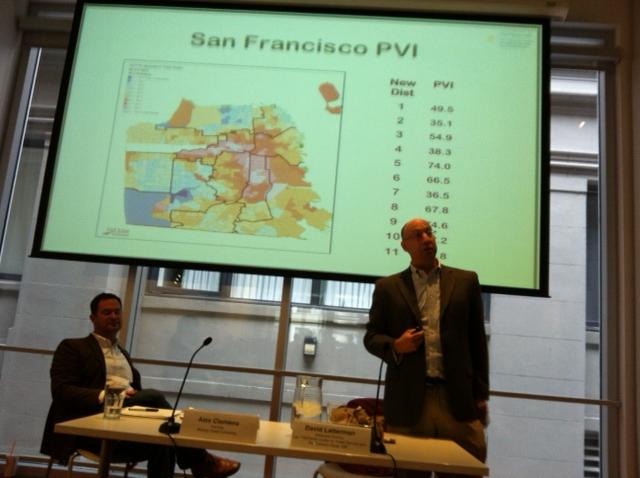
I’m still a bit too bleary-eyed for serious political analysis on D5 or other races today, but I’ll offer a few of my own post-election observations and those that politicos Alex Clemens and David Latterman delivered during their usual political wrap-up at the SPUR office this afternoon, noting how this election has altered local political dynamics.

“The Board of Supervisors as a whole is becoming a helluva lot more interesting,” Clemens said, noting that progressive District 5 just elected London Breed, the most moderate candidate in that race, while conservative District 7 gave the most progressive candidates, Norman Yee and FX Crowley, its top two spots (with Crowley the likely winner once ranked choices ballots are tallied).

The result is that both the progressive and moderate blocs lost their most reliable votes to the squishy center, so that “determining what’s going to happen before it happens just got more difficult,” a dynamic that could play out most strongly on land use issues.

“I think land use politics is going to be even more interesting,” Clemens said, with Latterman adding, “In this city, all politics really comes down to land use.”

Assessor Phil Ting’s election to the Assembly also now paves the way for Mayor Ed Lee to appoint his replacement, with Sup. Carmen Chu widely considered the clear favorite, which would in turn give Lee an appointment to her District 4 seat on the board.

Yet Clemens speculated that Lee may wait to replace Chu until after the next Board of Supervisors is seated in early January – which would allow that person to finish her final two years and still run for an additional two full terms, whereas the Charter would otherwise limit that person to one more term – which could complicate an already complicated election for board president. Sups. Jane Kim and Scott Wiener are the likeliest contenders, but anything could happen.

“Counting to six from 10 is going to be so much fun to watch,” Clemens said, although he added, “I believe in the era of Ed Lee, it’ll all be worked out beforehand.”

Neither Clemens nor Latterman agreed that the overwhelming expenditures on political hit pieces (mostly against D1 Sup. Eric Mar, who won a surprisingly big margin of victory) by allies of Lee, or the fact that they turned on Sup. Christina Olague in nasty fashion, would diminish Lee’s public standing or the aura of civility he’s tried to cultivate.

Personally, I don’t agree, and it think progressives have been given an opportunity to highlight the money-driven nature of the agenda that Lee and his billionaire backer Ron Conway have for San Francisco. It’s also significant that the most anti-progressive candidates – Lee’s City College appointee Rodrigo Santos, D1’s David Lee, and D7’s Mike Garcia – all fell far short of victory.

Progressives now have a chance to set a positive, proactive agenda for the city, of the kind eloquently voiced by new school board member Matt Haney, whom Clemens thanked for running such a strong and positive campaign, as well as top City College finisher Steve Ngo and Sup. David Campos, who shared an election night campaign party and positive message about progressive prospects.

“That’s what me, Steve, and David were saying here tonight,” Haney told me, calling for an end to the adversarial style of practicing politics. “Our values are love and compassion.”

Latterman and Clemens did acknowledge that that record-breaking spending against Mar may have backfired, but they gave more credit to Mar’s campaign. “You don’t bet against [Mar campaign manager] Nicole Derse in a ground game in the last week of the campaign,” Latterman said.

Derse, who was there, noted its innovative voter identification efforts and strong grassroots volunteer push, a drive partially helped by those reacting to the big-money attacks. Latterman also acknowledges that the strange and controversial videos attacking Mar didn’t help, telling the crowd, “And tactically, don’t have the Realtors make the videos.”

As for District 5, neither politico claimed to fully understand the complex variables that shaped the race.

“It’s hard to unravel what happened here,” Latterman said of the D5 race, noting the complicated dynamics created by Olague’s mayoral appointment, her vote to reinstate Sheriff Ross Mirkarimi, Julian Davis’ problems, and the outside spending. He praised Breed’s campaign, calling it a “a solid win,” but he also said Breed’s independence helped her and she might have suffered the same fate as Olague if she had gotten the appointment from Lee back in January: “I think Supervisor Breed doesn’t win this race; challenger Breed did.”

Matt Haney jumping for joy over school board results

1

At a party at the Brick and Mortar club in the Mission — a combined celebration for David Campos, Matt Haney, and Steve Ngo —  school board nominee Matt Haney currently stands at 13.29% of the vote, enough to get him on the board. And he was jumping up and down with delight when he saw the numbers were turning in his favor.

After he calmed down (a bit) he talked to us about the teachers union boycotting endorsements for sitting members of the board. “For me, it was never a negative dynamic. I got along with everyone on the board, and I respect the teachers union and what they do.

“They just want better education here in San Francisco, and I’m going to try my best to help with that.”

I talked to David Campos about Measure C, the affordable housing trust fund proposal. “I’m very excited, I always knew that we needed a secure source for affordable housing. It’s not fully what we need, but it’s going in the right direction.”

He went on to say that we shouldn’t settle for less and when it comes to these measures, “the devil is in the details.”

Campos was also happy for Haney: “Matt ran a strong campaign, and I personally think his voice is needed on the board.”

Haney said about winning, “I’m very excited. I have a job where I am responsible to the youth and students. I couldn’t wish for a more humbling position.”

he said about his campaign, “It was tough today, because a lot of people didn’t make their decision until the end, so it’s hard to assess where you stand. But we had a grassroots campaign that went door to door, and that may have been the difference.”

Steve Ngo, who was the top finisher in his reelection to the City College of San Francisco Board of Trustees, talked to us about his priority, now that he’s serving again: “To save City College. To do that we have to stick to the plan we put together in September. To reassure the opportunities for our students.” 


So-called DV group doing PG&E’s dirty work

34

Any pretense that the group called San Francisco Women for for Responsibility and an Accountable Supervisor is anything more than a downtown sham vanished with the arrival in District 5 mailboxes Nov. 3 of a mailer attacking Sup. Christina Olague for supporting public power.

The mailer uses pictures of Olague and Julian Davis — and that alone is a not-so-subtle attack on Olague. Davis has lost all credibility in the race, thanks to a string of allegations that he groped women.

It then goes after the two for “support [ing] a $20 million taxpayer giveaway to Big Oil.” The utterly misleading line is based on Olague’s vote to support Clean Power SF, a community choice aggregation program that has the support of public power advocates all over California.

Olague’s not supporting Shell Oil; she just realized, as did a supermajority of the board (including both left stalwarts David Campos and John Avalos and the far more conservative Scott Wiener) that the program makes sense for San Francisco and will lead in the long term to much greater energy self-reliance. The only ones putting out the Shell Oil line are PG&E and its house union, IBEW Local 1245.

Oh, and now a group that supposedly advocates for domestic violence victims.

This is a disgrace, an embarassment to the district and the city. Ron Conway and Thomas Coates are attacking Olague because they’re afraid she’ll vote against their development and landlord interests, not because they care about domestic violence.

This election matters, a lot. It’s clear where the big-money interests are; I hope D5 residents reject this attempt to buy the election.


Giants’ revelers who crossed the line face charges

17

Yesterday’s parade celebrating the Giants’ World Series sweep almost went down without a hitch, no thanks to a handful of inebriated miscreants. Among the estimated one million revelers that attended, the SFPD reports that 22 were arrested, including 13 for public drunkenness. Others were charged for robbery, battery and unlawful possession of a loaded firearm.

Yesterday’s violations, however, paled in comparison to the chaos that ensued after the final game on Sunday night, when even more arrests were made and major damage was done to the city. District Attorney George Gascón is prosecuting nine individuals detained in connection to the shenanigans that occurred around the city last weekend. 

“What occurred last Sunday was inexcusable,” Gascón at a press conference Tuesday afternoon. “We want to send a clear message that we will prosecute all the cases presented to us, to the fullest extent of the law.”

The nine charged so far include eight men and one woman, all of them locals. “So far I believe everyone we have are San Francisco residents,” says Gascón.

Seven are charged with assaulting or threatening a peace officer. SFPD Officer Carlos Manfredi says two officers – whose names he could not release – suffered injuries after confrontations with rioters. “One suffered a hand injury and one suffered lacerations to the leg from a glass bottle that was thrown.”

Tomas Lunsford was arrested on charges of robbery after he allegedly stole a phone from a woman who was filming the celebration. He then allegedly punched her female friend while attempting to evade capture. Additional charges include resisting arrest with force, battery and arson of property.

The latest arrest associated with the carnage occurred Tuesday after police identified a man who was photographed shattering a Muni bus window. Gregory Tyler Grannis, 22, of San Francisco was detained on felony charges of vandalism and destroying a passenger transit vehicle. Police were led to him after tips from social media sites.  Grannis is scheduled to be arraigned Friday.

The DA’s office has been presented with several other individuals who have yet to be reviewed.  Gascón anticipates more violators will be charged in the coming days: “We expect additional cases, including cases involving damage to city vehicles.”

SFPD is currently investigating the torched Muni bus incident.  On Wednesday, Police Chief Greg Suhr released cell phone video and photographs of two suspects wanted in connection with the arson of the bus. “We are now asking for public assistance in identifying these two arsonists and bringing them to justice,” Suhr said.  Photos and video can be viewed at sf-police.org

It is unknown what the ultimate cost of the damage from Sunday night’s chaos will be. City Attorney Dennis Herrera said that in addition to being charged criminally, public offenders will receive civil fines commensurate with their offenses.  “I’m here to tell folks that you will be hit in your pocket book,” he says. “If you damage the city we will seek retribution and damages.”

Celebrations turned chaotic in North Beach and Downtown, but it was the Mission District that saw the most damage. Along Mission Street, 24th Street and Valencia Street vandals tagged several businesses, damaged public property and set fires.  In a statement Monday, Mission District Supervisor David Campos said, “I have been in communication with the Department of Public Works and we are working closely to clean up the streets and help affected businesses.”

Why free Muni for kids makes sense

13

For a moment this morning, Mission Street looked the way it might in a world where the city actually got beyond cars. About a million people were a block away, on Market, and everyone with an ounce of sense knew not to try to drive downtown. So I rode my bike along a busy city street that was given over entirely to pedestrians, bicycles and Muni buses. The buses moved at a rapid clip with no traffic to slow them down. And despite the parade a few hundred feet to the north, it felt … quiet. Peaceful. Yes, Mission Street.

How totally cool.

Imagine how easy it would be for transit to serve the downtown corridor if nobody drove cars. Imagine how comfortable people would be biking and walking to work. It just takes a Giants World Series (and a huge regional parade) to show us that a different urban world is possible.

Which brings me to free Muni for kids.

There’s enough money now, from a federal grant, to do a pilot program in San Francisco. Except that Sup. Scott Wiener thinks the money should go to general system improvements. I get it — Muni has lots of problems and Wiener thinks we should fix the system for everyone before we make it free for some.

I admit I’m biased — I have two kids who go to public school, and ride Muni. The school bus system is nearly gone; most kids can’t get an old-fashioned yellow bus in the morning or at night. So their only option is the have parents or friends drive them, or to ride Muni. Yeah, it would save me a little money if my kids didn’t have to pay, but it’s not making me choose between food and rent.

For a lot of low-income familes, the cost of Muni fare is a real issue — and it’s difficult getting a reduced-fare youth pass. (Among other things, you need a birth certificate or passport to prove your age; you think immigrant families including some members without documents are going to go to a government agency and present that sort of information?) It seems to me it’s the city’s responsibility to help young people get to school, and since we can’t afford school buses, this is one of the best options.

There’s another side of the story, though. Getting kids to ride Muni as a matter of normal course — showing them that it’s the best way to get around town — is a huge investment in the future. We can’t keep going on the way we are with personal automobiles, particularly in urban areas. We want to get to the point where just about everyone uses Muni or rides a bike or walks — and I say, start young.


CELLSpace becomes Inner Mission

1

steve@sfbg.com

For the last 17 years, CELLspace has been a hub for unique cultural, artistic, and community events in the heart of the Mission. The bad news is that CELLspace is losing its lease, but the good news is it’s being taken over by creative, resourceful people from its community who plan maintain and expand its mission.

In the process, CELLspace is undergoing a renovation and, beginning in early December, getting a new name: Inner Mission.

"We’re calling it an evolution, and we’re trying to hold to that because the CELLspace has an important history and community," says Eric Reid, one of the four new owners. "We’re drawing from a well that we didn’t dig, so we’re trying to keep the neighborhood involved."

So Inner Mission will continue to offer community-based classes such as tango, Aztec dance, and yoga; and evening gatherings by community groups. But along with its recently upgraded sound and lighting systems and well-done new bar, Inner Mission will draw from the creative projects of its new owners and become a nightclub available to host events by outside promoters.

Reid (who sometimes dons clown makeup as his alter ego Manaze) runs Mad Cap Productions, while co-owner Adrian Zelkski runs New Earth Music, co-owner Zach Carson directs the Sustainable Living Road Show, and co-owner Mike Gaines heads the Vau de Vire Society (see "Cue the clowns," 12/3/08), which has been rehearsing and performing at CELLspace in recent years.

"We want to be a constantly throbbing venue as far as the art is concerned, a place for people to explore their creativity," Gaines told us. "We’ve always had the intention of opening up a venue for ourselves, and we want to really accommodate the community as well."

They plan to activate the space for longer hours, including more active curation of the art gallery space in the front of the venue and adding a daytime smoothie and kombucha bar, while also making the overall venue a better nightclub with more regular events — including experimental dinner theater that Reid is excited about producing — rather than the isolated special events that CELLspace has generally done.

While Inner Mission won’t have the nonprofit designation that CELLspace does, the new owners have incorporated as a Certified B Corporation, or Benefit Corporation, a new designation that carries the expectation of greater environmental sustainability, stronger worker protections, and returning more profits and benefits to the community.

"We are going to be the first B Corporation nightclub in the country," Reid said. "We think this is the way things are going."

Gaines also cited the work that Carson does with Sustainable Living Road Show — entertainers and educators in an "old timey carnival road show" that tour in renewable fuel vehicles to teach sustainability — as a key part of their new ethos.

The stated mission of CELLspace is "to provide a safe and supportive public environment for the exploration of art, education, performance and community building. Through cooperative relationships, CELLspace encourages the celebration of intergenerational, cross-cultural collaborations and the promotion of social justice."

Reid and Gaines say they are committed to that same mission even as they seek to make the space more vibrant and accessible, and with a greater focus on the emerging new global consciousness.
Sup. David Campos, who represents the Mission, said CELLspace is an important community institution and he’s happy to hear the new owners plan to continue its current programming. "It sounds like it’s a positive thing, we’ll reach out to them and get more specifics and see how we can work with them."

Dick Meister: Labor’s wise election choices

2

By Dick Meister

Dick Meister, former labor editor of the SF Chronicle and KQED-TV Newsroom, has covered labor and politics for more than a half-century. Contact him through his website, www.dickmeister.com, which includes more than 350 of his columns.

No issue on the November election ballot anywhere is of greater importance to working people and their unions than Proposition 32 on the California ballot.

As the State AFL-CIO notes in its call for an all-out campaign against Prop 32, it’s “a brazen power play” by billionaire corporate interests and other anti-union forces to all but silence labor’s political voice, while at the same time greatly increasing the political strength of labor’s wealthy opponents.

Prop 32’s corporate sponsors deceptively call their measure an even-handed attempt to limit campaign spending. Yet it would only limit – and severely limit – the political spending of unions. There would be no limit on the political spending of corporations and other wealthy interests.

A Prop 32 victory would have a serious national impact, since passage of the measure in the country’s largest state would certainly lead to attempts to enact similar measures elsewhere.

California Propositions 30 and 38 also could have major, though less direct, effects nationally.  Both measures would raise badly needed new funds for education.

Prop 30, which is widely supported by unions and a broad base of community organizations, would do it through a tax increase that would be levied on wealthy Californians with annual incomes of $250,000 or more.

But Prop 38, bankrolled by some of the same billionaire interests that are contributing heavily to the Yes on 32 campaign, would raise money by taxing everyone, including the poor. And while Prop 30 specifically calls for added education funds to go to schools at all levels, including the community colleges that train workers for jobs that are heavily unionized, Prop 38 does not apply to community colleges.

There are, of course, other state as well as local and national issues and candidates that are of particular interest to labor. That includes, as it very well should, labor-friendly President Obama and just about any other Democrat.

Although the odds are heavily against Democrats regaining control of the House or adding to their narrow margin in the Senate, that has not kept labor and its supporters from trying to beat the odds.

National Democratic strategists are relying on California to be a leader in raising funds to make that happen. They’re sending out an unprecedented barrage of requests to Californians for money for Democratic candidates in general and especially for candidates in battleground states.

Unions are playing an important role in that effort and in many local elections as well. That naturally includes the voting in San Francisco, long one of the country’s premier labor cities and national pacesetter for labor.

As usual, the SF Labor Council and SF unions generally have endorsed all of the Democrats running for national and state offices. It would be hard to quarrel with that or with most of labor’s other choices of who and what to back and oppose on the city’s election ballot.

Locally, labor is backing incumbent Supervisors Eric Mar (District One) and David Campos (District Nine) and newcomer F.X. Crowley, a longtime union leader and activist who’s running in District Seven. All have consistently supported labor.

Labor is rightly eager to defeat Crowley’s opponent, Mike Garcia, a candidate of the downtown interests that have consistently opposed labor.

Voters would be wise to follow the guidance of the teachers union on candidates for the SF Board of Education. The union has endorsed Matt Haney, Beverly Popek, Sam Rodriguez and Shamann Walton. All would be new to the board.

The teachers union and the Service Employees Union local that represent SF City College workers agree that the best candidates for the Community College Board that governs City College are Hanna Leung, Rafael Mandelman and incumbents Natalie Berg and Chris Jackson.

As far as local propositions go, labor’s support for a parcel tax to raise badly needed funds for City College (Prop A) and for a trust fund to help lower and middle income families secure affordable housing (Prop C) makes very good sense.

Unfortunately, labor did not take an official position on Prop G, the policy statement that calls for a Constitutional amendment to reverse the U.S. Supreme Court’s Citizens United decision that has allowed unlimited political spending by corporations and wealthy individuals.

Otherwise, however, labor has provided voters with an invaluable election guide.

Dick Meister, former labor editor of the SF Chronicle and KQED-TV Newsroom, has covered labor and politics for more than a half-century. Contact him through his website, www.dickmeister.com, which includes more than 350 of his columns.

Agnos and other progressives rally for Olague

72

A string of prominent local progressive leaders today offered their support to Sup. Christina Olague – including former Mayor Art Agnos, who announced his endorsement of her in the District 5 supervisorial race – in a rally on the steps of City Hall.

In the process, many voiced a need to broaden and redefine progressivism as valuing independence and diversity of perspective more than just stands on specific issues, traits they said Olague embodies. But more than anything, the rally seemed aimed to consolidating progressive support around Olague as the best hope to beat moderate London Breed in one of the city’s most progressive districts.

“District 5 is often referred to as the most progressive of San Francisco’s supervisorial districts. It includes a diversity of views and opinions on how to meet the challenges all our communities face,” Agnos said. “And it takes a supervisor who know how to listen, to hear and respect those differing views, while working for a resolution that moves us forward.”

Sup. David Campos made only a veiled, indirect reference to the problems some progressives (himself among them) have had with some of Olague’s stands since she was appointed to the job by Mayor Ed Lee, but he said, “Those of us who have worked with her know what’s in her heart…She has been the independent person we always knew she would be and I’m proud to stand with her today.”

Several speakers made reference to Olague’s working class roots, her perspective as a Latina and member of the LGBT community, and her history of progressive activism in San Francisco. Cleve Jones, Gabriel Haaland, Sandra Fewer, and Sup. Eric Mar were among those there to offer support.

“It was a big give by the Mayor’s Office to appoint someone who wasn’t always going to agree with him,” said Sup. Jane Kim, but that was about the only positive reference to the Mayor’s Office, which turned on Olague after she voted to reinstate Sheriff Ross Mirkarimi, setting the stage for her return to the progressive fold.

“To be a progressive is to share an ideology that understands and believes that the best decisions for our city require the participation of all of us, no matter who we are, where we live, or how big our checkbook is,” Agnos said. “As with so many who have endorsed her, that progressive label says she is a politician who understand this fundamental truth.”

SF Rising board member Alicia Garza kicked off the rally by saying, “We are here to set the record straight that the progressive movement is alive and well in San Francisco.” Later, she praise Olague’s history as a community organizer, saying that, “She understands deeply what it means to empower communities.”

Sup. John Avalos, another supervisor who hasn’t always agreed with Olague in the last nine months and just endorsed last week, commended her for the courage it takes to assert her values instead of simply supporting the mayor who appointed her. He said Olague recognizes that, “We live in a city of extremes, with extreme differences between the haves and have-nots.”

Another new progressive endorsement, coming in the wake of one-time progressive favorite Julian Davis’ troubles, was Quintin Mecke, who said he first worked with Olague on anti-gentrification issues 13 years ago. “I trusted her work then and I trust her work today,” he said. Activist Lisa Feldstein – like Mecke, a former D5 candidate – echoed the sentiment.

“I’m here because I really trust Christina and want to fight for her,” Feldstein said. “She comes from a place of integrity and compassion.”

When Olague finally took the podium, she said, “I am humbled by the heartfelt words of my colleagues.” She also tried to help define progressivism in San Francisco, said that it “isn’t about a cult of personality.”

Instead, she said it’s about working to building people’s capacity to create an inclusive and just city. “It’s about building a movement that can weather any storm,” Olague said, closing by saying she’ll ensure “the progressive voice is always strong in District 5 and I’ll keep working to make it heard until I’m blue in the face…I am the most progressive person in the race.”

D5 shakeups flip the dynamics of that wild race

110

[UPDATED AND CORRECTED] Wild and unsettling political dynamics have rocked the District 5 supervisorial race, with three major candidates having prominent endorsements withdrawn, the most significant being this week’s mass exodus of support from the campaign of Julian Davis following his bad handling of allegations that he has mistreated women.

Those withdrawing their endorsements of Davis since Saturday include Sups. John Avalos, David Campos, and Jane Kim, Assembly member Tom Ammiano, the Bay Guardian, the Examiner, and the League of Pissed-Off Voters. The Harvey Milk LGBT Democratic Club has scheduled a vote for Monday on whether to withdraw its sole endorsement of Davis.

Avalos gave his endorsement to Sup. Christina Olague over the weekend, and she seems to be getting more progressive support in the wake of Davis’ flame-out and her Oct. 9 vote in favor of reinstating Sheriff Ross Mirkarimi. That vote triggered a strong backlash against Olague from Mayor Ed Lee and his allies, with San Francisco Police Officers Association withdrawing its endorsement.

But former Mayor Art Agnos reached out to Olague – who he didn’t know previously – after the Mirkarimi vote and is rumored to be considering offering her his endorsement and support. Agnos didn’t confirm or deny the rumor, but he did tell us, “I was very impressed by her commitment to the progressive issues we share.”

Olague has a long history of progressive activism and was a consistently good vote during her tenure on the Planning Commission, but many progressives were concerned by her early support for Lee, who then appointed her to the District 5 seat vacated by Mirkarimi’s election as sheriff, and by some of her votes and behaviors since then.

But now that she’s been viciously attacked by Lee’s staffers and allies over the Mirkarimi vote – and iced out by Lee himself, who she says won’t return her calls and who bailed out on a planned campaign appearance – Olague seems to have a newfound independence. “At the end of the day, we serve constituents and the city, and that’s who we should answer to,” Olague told us, agreeing that she feels freed up by recent developments, as difficult as they’ve been. “You don’t become an indentured servant.”

She told us that her decision last year to co-chair the “Run, Ed, Run” campaign to convince Lee to break his promise and run for a full term to the office he’d been appointed to was based on her belief that “we’d see an infusion of new energy and some more diversity” of both ideology and demographics in the Mayor’s Office.

“Sadly, I’m not seeing those changes happening really. I didn’t sign up for another four years of Gavin Newsom and those thugs, and I’ve seen a lot of that same behavior,” she said. “People who played prominent roles in the Newsom administration continue to play prominent roles in this administration.”

Olague said the schism with the administration began this summer when she supported Avalos in trying to bring in new revenue as part of the business tax reform measure that became Prop. E, which Lee had insisted be revenue neutral before compromising with progressives. That was when Olague said she got her first nasty message from Tony Winnicker, the former Newsom press secretary who now works for Lee and wrote Olague a text during the Mirkarimi hearing telling her “you disgust me and I will work night and day to defeat you.”

Some prominent progressives privately worried that schism was an election ploy designed to help Olague win the race for this progressive district given that Davis had captured most of the influential progressive endorsements. But with Lee and his allies continuing to be openly livid over the Mirkarimi vote – and with solid progressive John Rizzo running a lackluster campaign that has less than $5,000 in the bank – there is growing progressive support for Olague.

The big fear among many progressives is that London Breed will win the race, a concern that has been exacerbated by the support that Breed has been receiving from real estate and development interests, both directly and in independent expenditures by the Association of Realtors, which has spent more than $225,000 in this election cycle hoping to knock out progressives in Districts 1 and 5 and tip the balance of power on the board.

Breed told us that she doesn’t know the Realtors or why they’re offering such strong support, pledging to be an independent vote. “I’ve never made any promises to anyone that I would help anyone or that I would be this way or that,” she told us. “I’m not here to do anyone’s bidding, whether it’s Aaron Peskin or Willie Brown or anyone else.”

Brown helped launch Breed’s political career by [CORRECTED recommending then-Mayor Gavin Newsom] appoint her to the Redevelopment Commission, where Breed supported Lennar and other big developers, but she had a falling out with him earlier this year and made impolitic comments about him to the Fog City Journal, causing US Sen. Dianne Feinstein to withdraw her endorsement of Breed.

Brown, Lee, and Chinatown power broker Rose Pak helped raise money for Olague, who has received the maximum $500 donation from such powerful inside players as venture capitalist Ron Conway (and his wife, Gayle), Michael Cohen, Victor Makras, Lawrence Nibbi, Mark Mosher, and John Whitehurst.

But that was before the Mirkarimi vote, which Lee’s allies seem to see as a litmus test on Olague’s loyalty to them. As Tenderloin Housing Clinic director Randy Shaw, who helped engineer the progressive split that brought Lee to power, put it on his Beyond Chron blog, “Olague’s vote was an act of profound disloyalty not only to the mayor who appointed her, but also to those who pushed the mayor to do so.”

Olague says she’s disturbed by that viewpoint, and by those so blinded by their efforts to demonize Mirkarimi “and exploit and politicize issues around domestic violence” that they have failed to consider the price he has already paid for his actions or the legal standards for removing an elected official. “On something like this, it’s not a question of loyalty. It’s about principles,” she said.

Breed says that she has seen an increase in support since the Mirkarimi vote and the Davis meltdown, but she said that she doesn’t want to talk about those cases or exploit them politically. “I don’t take pleasure in the misery of someone else,” she said, adding her hope that the furor about Mirkarimi will die down. “The decision has been made and it’s time for the city to come together.”

Progressive leaders have made similar calls, but Mirkarimi’s critics are showing no signs of letting the issue go. San Francisco Democratic County Central Committee members Zoe Dunning and Matt Dorsey have put forward a resolution condemning the reinstatement vote and calling for Mirkarimi’s ouster, which the DCCC will consider on Wednesday evening, Oct. 24.

[CORRECTED At that meeting, the DCCC will also consider a motion] to reopen the D5 endorsement process, hoping to change the DCCC’s previous “no endorsement” vote, and sources tell us there is currently a strong backroom effort to give the endorsement to Breed. That vote will be a big test for progressives, which lost their majority control over the DCCC in the June elections.

Meanwhile, D5 candidate Thea Selby – who snagged one of the three endorsements by both the Guardian and the Examiner – continues to run a strong and well-funded campaign that has avoided the carnage taking place in the other campaigns. “I feel like I’m in the middle watching out for flying beams,” she told us, adding that both she and Rizzo have been “the grown-ups in the room, so there’s an opportunity there and I’m hopeful.”

But unlike Rizzo, who has seems strangely absent and didn’t return Guardian phone calls [see UPDATE below], Selby has plenty of money in the bank – nearly $60,000 as of the last official report two weeks ago – and could benefit from voter disgust with the ugly politics at play. “It’s my experience that is driving this,” says this small-businessperson, “and not my lifelong desire to be a politician, and that may ring some bells.”

How the ranked-choice voting system will play out in this mess is anyone’s guess, and even Davis seems to be hoping that he still has a shot, resisting calls by the Guardian and others to withdraw from the race. Poorly funded candidates Andrew Resignato and Hope Johnson this week announced they were joining forces for the “People’s Ticket” after being excluded from a University of San Francisco candidates forum.

But most political observers seem to think this race will come down to a two-person contest between Breed and Olague – who each have more than $45,000 in the bank with which to make a strong final push – and the distinctions between them are becoming clearer as more progressives get behind Olague and the moderates and monied interests get behind Breed.

Olague said she’s still “willing to work with anybody,” but that, “I’m worried that moderate forces will seize this moment to try to destroy us.”

UPDATE 4:45: Rizzo just got back to us and said he’s been actively campaigning and feeling good about his chances. “We have a great team and we’ll have enough resources to reach voters,” Rizzo said. He said that he’s had a stong fundraising push in the last couple weeks since the last campaign financing statement was released, and he noted his endorsements and active support by influential progressives including Ammiano, Campos, and Carole Migden. “We’re doing a lot of retail campaigning, meeting voters and getting the message out.”

Davis should drop out

49

EDITORIAL Kay Vasilyeva, a member of the San Francisco Women’s Political Caucus, has come forward with the allegation that District Five candidate Julian Davis grabbed her and put his hand down her pants at a political bar crawl in 2006. That was six years ago, but it’s still important — and more than the incident itself, the response we’ve seen from Davis is highly disturbing. He’s utterly denying that it ever happened, and retained a lawyer to send Vasilyeva a letter threatening her with legal action if she continues to talk.

While we endorsed Davis for supervisor, we take these charges very, very seriously — particularly coming at a time when relations between men and women in the progressive movement are badly strained.

Since the SF Weekly, which broke the story, suggested that we knew something about Davis’s behavior, we need to state, for the record: When we endorsed Davis, we had heard nothing even remotely close to this type of allegation. Yes, we knew that in his 20s he was a bit of an arrogant ass. We knew that at one point, he actually got into a tugging match with another person over the ridiculous question of who got to hold a campaign sign. We’d heard that, in the past, at somewhat debauched parties, he’d made advances toward women who weren’t interested in his affections.

Those could be the acts of an immature man who has since grown up. And since, on a level of policy, knowledge, and positions, he was by far the best and strongest progressive in the race in District 5, we — along with much of the local progressive leadership — thought he was demonstrating enough maturity that he was worthy of our support.

But this new information, and his response to it, is alarming.

We don’t take last-minute allegations about a front-running candidate lightly; people have been known to dump all sorts of charges into heated races. When we learned about Vasilyeva’s allegations on Oct. 13, we did our own research. We spent two hours with Davis and his supporter and advisor, former D5 Supervisor Matt Gonzalez. We realized that allegations without corroboration are just charges, so we tracked down everyone we could find who might know anything about this incident — and, as we discovered, other similar events. And we have to say: Vasilyeva’s account rings true. Davis’s categorical denial does not.

More than that, we were offended that he in effect threatened with a lawsuit a woman who, at some peril to herself, came forward to tell the public information about someone who is running for elected office. What was the point of that, if not to intimidate her? It’s highly unlikely he’s going to sue (and drag this whole mess into court). He says he was just trying to send a message that he has a legal right to respond to defamation, but this is a political campaign; if he didn’t want to deal publicly with what he must have known were these sorts of potential allegations, he shouldn’t have run for office.

This is a bad time for progressives in San Francisco. The Mirkarimi case has brought to the fore some deep and painful rifts; a lot of women feel that (mostly male) progressive leaders have pushed their issues to the side. For the future of the movement and the city, the left has to come together and try to heal. This situation isn’t helping a bit.

Davis needs to face facts: Supervisors John Avalos and David Campos have withdrawn their endorsements. Assembly member Tom Ammiano is almost certain to do the same. With his inability to handle the very credible charge that he not only groped a woman but lied about it, Davis no longer has a viable campaign in the most progressive district in the city, and we can’t continue to support him.

We have said it many times before: People on the left need to be able to put their own ambitions aside sometimes and do what’s right for the cause. Davis can’t win. He’s embarrassing his former allies. He needs to focus on coming to terms with his past and rebuilding his life. And for the good of the progressive movement, he needs to announce that he’s ending his campaign, withdrawing from the race, and urging his supporters to vote for another candidate.

Davis needs to drop out

246

EDITORIAL Kay Vasilyeva, a member of the San Francisco Women’s Political Caucus, has come forward with the allegation that District Five candidate Julian Davis grabbed her and put his hand down her pants at a political bar crawl in 2006. That was six years ago, but it’s still important — and more than the incident itself, the response we’ve seen from Davis is highly disturbing. He’s utterly denying that it ever happened, and retained a lawyer to send Vasilyeva a letter threatening her with legal action if she continues to talk.

While we endorsed Davis for supervisor, we take these charges very, very seriously — particularly coming at a time when relations between men and women in the progressive movement are badly strained.

Since the SF Weekly, which broke the story, suggested that we knew something about Davis’s behavior, we need to state, for the record: When we endorsed Davis, we had heard nothing even remotely close to this type of allegation. Yes, we knew that in his 20s he was a bit of an arrogant ass. We knew that at one point, he actually got into a tugging match with another person over the ridiculous question of who got to hold a campaign sign. We’d heard that, in the past, at somewhat debauched parties, he’d made advances toward women who weren’t interested in his affections.

Those could be the acts of an immature man who has since grown up. And since, on a level of policy, knowledge, and positions, he was by far the best and strongest progressive in the race in District 5, we — along with much of the local progressive leadership — thought he was demonstrating enough maturity that he was worthy of our support.

But this new information, and his response to it, is alarming.

We don’t take last-minute allegations about a front-running candidate lightly; people have been known to dump all sorts of charges into heated races. When we learned about Vasilyeva’s allegations on Oct. 13, we did our own research. We spent two hours with Davis and his supporter and advisor, former D5 Supervisor Matt Gonzalez. We realized that allegations without corroboration are just charges, so we tracked down everyone we could find who might know anything about this incident — and, as we discovered, other similar events. And we have to say: Vasilyeva’s account rings true. Davis’s categorical denial does not.

More than that, we were offended that he in effect threatened with a lawsuit a woman who, at some peril to herself, came forward to tell the public information about someone who is running for elected office. What was the point of that, if not to intimidate her? It’s highly unlikely he’s going to sue (and drag this whole mess into court). He says he was just trying to send a message that he has a legal right to respond to defamation, but this is a political campaign; if he didn’t want to deal publicly with what he must have known were these sorts of potential allegations, he shouldn’t have run for office.

This is a bad time for progressives in San Francisco. The Mirkarimi case has brought to the fore some deep and painful rifts; a lot of women feel that (mostly male) progressive leaders have pushed their issues to the side. For the future of the movement and the city, the left has to come together and try to heal. This situation isn’t helping a bit.

Davis needs to face facts: Supervisors John Avalos and David Campos have withdrawn their endorsements. Assembly member Tom Ammiano is almost certain to do the same. With his inability to handle the very credible charge that he not only groped a woman but lied about it, Davis no longer has a viable campaign in the most progressive district in the city, and we can’t continue to support him.

We have said it many times before: People on the left need to be able to put their own ambitions aside sometimes and do what’s right for the cause. Davis can’t win. He’s embarrassing his former allies. He needs to focus on coming to terms with his past and rebuilding his life. And for the good of the progressive movement, he needs to announce that he’s ending his campaign, withdrawing from the race, and urging his supporters to vote for another candidate.

Avalos, Campos, Kim, Olague: Four profiles of courage at City Hall

30

Supervisors John Avalos, David Campos, Jane Kim, and Christina Olague earned profiles of courage for their votes to reinstate suspended Sheriff Ross Mirkarimi up against enormous pressure for a political assassination, accelerated by Mayor Lee’s demand for a pre-election vote.

And the other seven supervisors, well, they helped answer the question, who’s afraid of Willie Brown? Who’s afraid of Rose Pak?

Note to Mirkarimi: It’s time to repair the damage and get back to work implementing the ambitious program of rehabilitation outlined in your splendid inaugural address as Sheriff.

Unsolicited advice to mayor Ed Lee: Stop taking bad advice.

See my “Profiles of courage” blog for the context of this crucial vote.

Mirkarimi case — the aftermath

98

So many things to think about after last night’s Board of Supervisors vote on Ross Mirkarimi. It was a dramatic moment in local politics, a clear rejection of the mayor by four supes, including one of his appointees, a show of political courage by some and weakness by others.

But before I get into that, let me say:

I argued against removing Mirkarimi, for a lot of reasons. One of the most important is the precedent here — the City Charter gives the mayor too much power, the ability to singlehandedly remove an elected official for what the city attorney’s office concluded was pretty much any reason at all. There is no definition of “official misconduct” — and the way this case was presented, it could be interpreted really broadly. That’s dangerous, and the supervisors (or four of them, anyway) knew it.

I’m also a believe in restorative justice, in redemption, in the idea that people can do bad things and turn themselves and their lives around.

Still, it’s important to remember that what Mirkarimi did on New Year’s Eve, 2011, was awful, unacceptable. He was, at the very least, a total asshole and a jerk, treating his wife in a way that was — again, at the very least — psychologically abusive. Some of the comments at the board meeting were way off base; some speakers attacked the domestic violence community and made it sound as if Mirkairmi’s crime was pretty minimal.

I agree with David Chiu that the city’s going to have to come together after this — and the progressives who supported Mirkarimi are going to have to reach out to, and work with, the DV advocates. Because domestic violence is no joke, is no “private matter,” is still a major, serious issue in this city, and the worst possible outcome would be a reversal in San Francisco’s progressive policy on handling these cases.

I wish the audience hadn’t erupted in cheers when the final votes were cast. I heard Mirkarimi on Forum this morning, and when Michael Krasny asked if he was “elated,” he indicated that he was. Wrong answer: Nobody should be happy about what happened here. Mirkarimi’s biggest political and personal flaw has always been his ego, which at times bordered on arrogance, and that has to end, today. The sheriff needs to be humble about what happened to him, recognize that nobody “won” this ugly chapter in city history, and get back to work trying to mend fences with his critics. He’s facing the very real possibility of a recall election, and if he acts like he’s been totally vindicated, it’s going to happen.

This is a chance for Mirkarimi to take the notion of restoration and redemption seriously — by doing what Sup. John Avalos suggested at the hearing. He has to become a changed man. He has to show the world that he really, really gets it. Starting now.

Speaking of change …. the Number One Profile in Courage Award goes to Sup. Christina Olague. Olague was under immense pressure from the mayor, who wanted her vote badly. And because of the rotation of the votes, she had to go early, when it wasn’t clear at all which way this was going to turn out. And she came through, 100 percent solid. She made all the right points, and once she said she was going to vote against the mayor’s charges, the whole thing was over. At that point, there was no way David Campos or John Avalos could or would go the other way, so Mirkarimi had his three votes. I have been critical of Olague, but in this case, I want to give full credit: She did the right thing, when it wasn’t easy. She may have just won the election. (Let me clarify that — she may have kept herself from losing the election.)

Sup. Jane Kim was brilliant in her questioning of the mayor’s representatives and her analysis of the case. She showed real leadership and helped set the stage for what happened by pointing out the flaws in the mayor’s case.

And of course, Campos and Avalos, the undeniable, solid left flank of the board, came through.

It wasn’t easy for any of these four supervisors, and they all deserve immense credit.

Not so Eric mar, who I realize is in a tough race, but … when Olague, who has been accused of being too close to the mayor, had the courage to stand up, Mar, who has nearly universal progressive support, did not.

This is a great opportunity for the city to start talking about restorative justice in a serious way. Let’s get started.