David Campos

Supervisors reinstate Mirkarimi, rejecting Lee’s interpretation of official misconduct

181

The Board of Supervisors has voted to reinstate Sheriff Ross Mirkarimi and reject the official misconduct charges that Mayor Ed Lee brought against Mirkarimi for grabbing and bruising his wife’s arm during a New Year’s Eve argument, for now ending an ugly saga that has polarized San Franciscans.

The vote was 7-4, two votes shy of the nine needed to sustain the charges and remove Mirkarimi, who now resumes the position voters elected him to in November with back pay going back to March when Lee suspended him. Sups. Christina Olague, David Campos, John Avalos, and Jane Kim voted in Mirkarimi’s favor, condemning the domestic violence incident but saying that it didn’t meet what is and should be a high and clear standard for overruling the will of voters, a concern also voiced by Sup. Mark Farrell. 

“I do take this job seriously, that we are public policy makers,” said Kim, a lawyer who emphasized their duty to set clear standards for officials during these unprecedented proceedings rather than being swayed by emotional responses to conduct by Mirkarimi that she called “incredibly egregious.”

But for most of the supervisors, that was enough. Sup. Eric Mar, who is in the middle of difficult reelection campaign against the more conservative and well-financed David Lee, said he thought is was important to have “zero tolerance” for domestic violence and his vote was “in the service of justice and a belief it will combat domestic violence.”

Earlier in the hearing, Kim had led the questioning of Deputy City Attorney Sherri Kaiser, whose broad interpretation of official misconduct standards and inability to set clear guidelines troubled Kim, just as it had earlier to Ethics Commission Chair Benedict Hur, the sole vote on that body against removal after it conducted six months worth of hearings.

“I agree with Chairman Hur, I think we need to take the most narrow view of official misconduct,” Kim said, echoing a point that had also been made by Campos, who quoted Hur’s comment from the Aug. 16 hearing where the commission voted 4-1 to recommend removal: “I have a lot of concern about where you draw the line if you don’t relate this to official duties.”

Farrell also shared that concern, which he raised in questioning Kaiser and during the final board deliberations almost seven grueling hours later. 

“I worry a great deal about the potential for abuse in this charter section,” Farrell said, warning this and future mayors to use great caution and restraint before bringing official misconduct charges. Yet he still found that the “totality of the circumstances” warranted removal because Mirkarimi had compromised his ability to be the top law enforcement officer.

Each supervisor expressed what a difficult and joyless decision this was, and even those who supported Mirkarimi strongly condemned his actions and the efforts by some of his supporters to minimize the seriousness of his actions and the need for him to change.

“I have tremendous mixed feelings about Ross Mirkarimi,” Avalos said, noting his many proud progressive accomplishments but adding, “I’ve always seen Ross as someone who has deep flaws….[This saga] offers a chance for personal transformation and I think that’s something Ross really needs to do.”

Mirkarimi seems humbled by the hearing, and the stinging criticism of his former colleagues and his one-time allies in the domestic violence community, and he pledged to work on “regaining their trust” as he tries to embody the city’s long-held value on redemption.

“I appreciate all the comments of by the Board of Supervisors and I hear the message. The next step is mending fences and moving forward,” Mirkarimi said. Later, he told reporters, “We’re absorbing all the comments that were made by the Board of Supervisors. They are my former colleagues and I take it very seriously.”

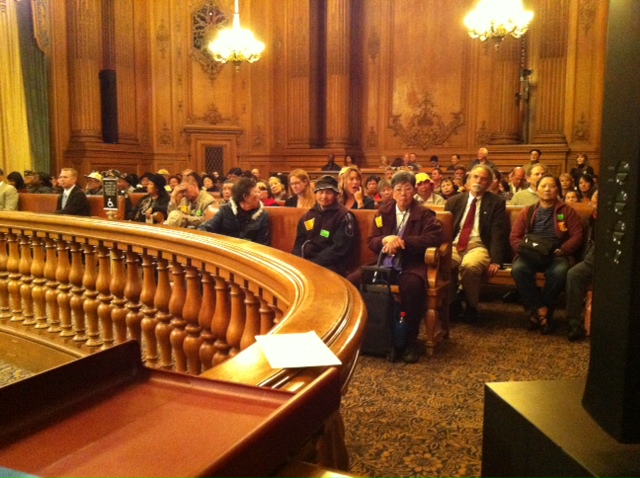
That need to heal the deep and emotional divide between San Franciscans who see this case in starkly different ways – which was on vivid display during the hours of public testimony – was sounded by several supervisors. “We will need to come together as a city on this,” Board President David Chiu said.

Most of those who spoke during the nearly four hours in public comments favored Mirkarimi and condemned the efforts to remove him as politically motivated, overly judgmental, and setting a dangerous precedent rather than resorting to usual method for removing politicians after a scandal: recall elections.

“If anything happens to the man, it should come back to me to make that decision. Don’t do their dirty work for them,” one commenter said.

The most politically significant person to speak during public comment was former Mayor Art Agnos, who said he was a friend and supporter of Mirkarimi, but he was more concerned with the scary implications of this decision. “I respectfully urge that this Board protect all elected officials from the dangerous discretion used in this case and reinstate Sheriff Ross Mirkarimi.”

Most of those who spoke against Mirkarimi were domestic violence advocates, who were adamant that Mirkarimi be removed, casting it as a litmus test for whether the city takes their issue seriously. “This is a disciplinary proceeding, it is not election stealing,” said Beverly Upton, head of the Domestic Violence Consortium, who has lead the campaign to oust Mirkarimi since the incident was made public.

But the two sides seemed to be speaking past one another, each expressing righteous indignation that people didn’t see the issue like they did, indicating how polarizing these long-lingering proceedings have become and how difficult to heal that rift may be.

“It made my stomach turn to hear some of the comments that were made,” Sup. Carmen Chu said, condemning the actions of Mirkarimi supporters in vocally or visibly supporting one another. “That was wrong, this is not a joyous event.”

Yet Farrell said he was also concerned that Mirkarimi’s opponents would go after supervisors who made a principled stand against removing him. “I hope no one takes pot shots at the people who voted against this,” he said.

That principled stand – condemning Mirkarimi’s behavior but having a high standard for removing an elected official – was a trail blazed by Hur, who opened the hearing by presenting the Ethics Commission’s findings and a decision that he was the sole vote against. He noted the “challenge of my presentation” but made careful efforts to accurately represent the views of the commission majority.

Yet he ended up using almost half of his time at the podium — his allotted 10 minutes plus a few extra minutes to respond to questions from supervisors — to stress the danger of broadly interpreting the city’s official misconduct language and not requiring direct connection to an official’s duties.

“Public policy suggests we should interpret this more narrowly than proposed by the majority,” Hur said, later adding that his colleagues on the commission “did not provide a clear basis for how official misconduct is delineated.”

When Sup. Malia Cohen asked what he meant by the “public policy” interest at stake here, he replied, “The need to have policies that are clear…It does benefit the public when the laws are clear.” (Cohen later voted to remove Mirkarimi, stating with little explanation, “I believe the reading of the charter is narrow and appropriately applied in this case.”)

The issue of what qualifies as official misconduct — and whether there is a predictable way for officials to know where that line is drawn, or whether it’s entirely up to the discretion of mayors — was also highlighted by Kaiser’s long presentation, but probably not in the way she intended.

Kaiser appealed to people’s sense of outrage about the initial arm-grab and subsequent guilty plea — claiming Mirkarimi “attacked his wife” and “this conduct was serious!” — and seemed to think that was an adequate test of whether bad behavior by an elected official warrants his unilateral removal from office.

Kaiser took issue with Hur’s contention that a lack of clear, limiting standards gives too much power to future mayors to remove their political enemies for minor incidents.

“The mayor certainly does not agree with Hur’s argument for a bright line rule,” Kaiser said. She mocked the notion that mayors would abuse this expanded power. “The check on that is the Ethics Commission, and the check on that is this body.” Kaiser’s position was that the statute should be read as broadly as possible and that the process should be trusted to protect against political manipulations.

But Chiu also took issue with that standard, saying “having clarity in the law seems to make sense” and asking Kaiser how officials can know what standards they’re expected to meet.

“I don’t agree and I didn’t mean to convey the standard is murky,” Kaiser replied, but as she tried to elaborate, her standard began to seem ever murkier.

“It depends on the circumstance,” Kaiser said. “But that doesn’t make it too vague to apply. It makes it more nimble.”

A nimble standard might suit mayors just fine, but the idea seemed to bother the supervisors, even Farrell, who told Kaiser that her position “seems to me very contradictory.”

At the end of the hearing, Campos returned to Kaiser’s “nimble” comment as a reason for rejecting that argument and Lee’s charges: “I don’t think the analysis made me comfort. She said the interpretation was nimble, but I don’t know the difference between nimble and vague, and I think they are one in the same.”

“Most cases will be clear, but there are decisions on the periphery,” Kaiser told Farrell during the earlier questioning, not making it clear which category she’d put the Mirkarimi case into.

Kim was the next to try to pin Kaiser down on whether there’s a discernible standard for the city to apply to this and future cases, saying she’d like to see a “bright line rule or a test.” Kaiser said that it depends on the office, but that a law enforcement officer shouldn’t commit a crime.

“Then any misdemeanor the sheriff pleads to is official misconduct, is that right?” Kim asked.

No, she said, the conduct must be while someone is in office — seemingly contradicting her earlier point – and found to be so by the board and commission. But then she said, “It is true that any misdemeanor relates to the duties of a sheriff.”

Kim persisted: “This is where I get stuck. When does it fall below the standard of decency?”

“The charter doesn’t answer that question. It’s a case-by-case determination,” Kaiser said.

“What’s to guide us in the future?” Kim asked.

But again, there was no clear answer, it’s simply for mayors to decide. “It is a discretionary decision,” Kaiser said.

Kim, a lawyer, questioned whether the stance by Kaiser and Lee could lead the courts to strike down the city’s untested statute. “Does that open us up to the vagueness issue, which would make the clause unconstitutional?” Kim asked.

But Kaiser said San Francisco voters wanted to give the mayor wide power to interpret misconduct when they approved the broad new official misconduct language in 1995, part of a complete overhaul of the City Charter.

“Voters made a considered choice to put suspend and remove procedures in the charter,” she said, trying to counter the argument that recall elections should be used to remove elected officials. “These suspension and removal procedure is more nimble. It’s less expensive than a recall.”

Yet with a final price tag expected to be in the millions of dollars and proceedings lasting seven months, it’s debatable whether this process was really cheaper and more nimble.

Mirkarimi attorney David Waggoner began his presentation by saying, “There’s no question that on Dec. 31, 2011, Ross Mirkarimi made a terrible mistake.”

But it was a mistake that Mirkarimi admitted to, accepted the criminal punishment that followed his guilty plea, endured a forced six-month separation from his family, had his job and salary taken from him, was the target of a media and political campaigns that have deeply damaged his reputation, “his entire life’s work was destroyed almost in an instant.” All for pleading to a low-level misdemeanor.

“At the end of the day, the punishment does not fit the crime,” Waggoner said.

He noted that just three elected officials have been removed for official misconduct in the city’s history, each time for serious felonies. But now, it’s being applied to a misdemeanor with arguments that broaden a mayor’s ability to remove political adversaries.

“You must decide whether to uphold or overturn the will of the voters,” Waggoner told the supervisors.

He even took a swipe at the domestic violence advocates who have led the campaign to remove Mirkarimi: “Ironically, the very advocates who should be defending Eliana Lopez have been attacking her.”

Taking over from Waggoner, Mirkarimi’s other attorney, Shepard Kopp, said Mirkarimi had no official duties before taking the oath of office, and the charter makes clear there needs to be connection. “It says misconduct has to occur while an official is in office.”

Kopp also brought the focus back to the precedent in this historic case. “The other problem with the mayor’s position is it doesn’t give you any guidance or future mayors any guidance,” Kopp said, later adding, “To follow the mayor’s position is not workable policy and it doesn’t have any support under the law.”

Supervisors questioned Kopp and Waggoner, but it didn’t seem to reveal any new insights, simply reinforcing their points that official misconduct should be a rarely used tool applied only to serious crimes.

In her final five-minute final rebuttal, rather than letting her co-counsel Peter Keith speak or trying to mitigate some of the damage from her earlier testimony, Kaiser seemed to double-down on her tactic of using emotional arguments rather than addressing legal standards for removal.

She alleged Mirkarimi’s team offered “a theory that domestic violence doesn’t matter if you’re sheriff,” prompting an audible negative reaction from the crowd that Chiu gaveled down. That reaction was even louder and more outraged when Kaiser implied Mirkarimi “threatens the life of a family member.”

Those sorts of characterizations fed much of the crowd’s stated belief that this case was a “political witchhunt” designed to destroy a progressive leader, and the opposition expressed to some domestic violence advocates testimony could be used against the larger progressive community.

But Agnos, who sat in the audience throughout the long hearing, told us the frustration was understandable. “The crowd, after nine months of agony, expressed a lot of emotions, and that is inherent in mass crowds,” he said. “They didn’t mean ill will to the domestic violence community. There was no malevolent intent there.”

Supervisors who voted to reinstate Mirkarimi said they want to make clear their commitment to combating domestic violence. “I worry that this case has set us back because of the tensions around how we responded,” Avalos said.

“I think it’s important that no matter how we feel about this that we come together as a city,” Campos said. “People on both sides have legitimate viewpoints on this issue.”

Credit to the supervisors. Seriously.

35

Politicians get a lot of shit, and they generally deserve it. But I have to say: After listening to almost all of the debate over the removal of Ross Mirkarimi — and watching the 4-7 vote to keep him in office — I was impressed by the supervisors who got it right, took it seriously and provided thoughful and credible debate.

Profiles in Courage Awards to John Avalos, David Campos, Jane Kim and Christina Olague. I haven’t always agreed with all of them, and Randy Shaw said that Olague would never vote with Mirkarimi because his supporters were dissing her, but she stood up to immense pressure and did the right thing. Jane Kim was very lawyerly, but came to the right conclusion. Avalos and Campos were articulate and pointed out the problems with giving the mayor this much power.

David Chiu was a disappointment, Eric Mar even more so. I expected more of both of them. But Chiu handled a tough meeting very well, giving all sides a chance and showing immense patience. Credit for running the show well, even if he voted the wrong way.

But overall, an intelligent discussion with the right outcome. More tomorrow.

City to cease using condoms as evidence in prostitution cases

25

The San Francisco Police Department announced today that they will stop using condoms as evidence in prostitution cases.

This will address the issue of police searching prostitution suspects for packaged condoms and wrappers. Under current city policy, police cannot confiscate condoms to be used as evidence. They can, however, photograph condoms. But recent reports form the Bay Area Reporter found that police sometimes broke the policy, and did confiscate condoms. 

The SFPD, the District Attorney, the office of the Public Defender, and the office of Sup. David Campos spoke with groups that work with sex workers in meetings that led to the new policy, which will be in place for a three to six month trial period.

Public defenders also agreed to not use lack of condoms as proof of innocence for people facing prostitution charges.

A July report from Human Rights Watch criticized San Francisco, along with New York, Washington, DC and Los Angeles, for using condoms as evidence. Local sex worker health clinic the St. James Infirmary has also implored the police department to stop the practice.

It discourages sex workers from carrying condoms, they say, exposing prostitutes and clients to sexually transmitted diseases

“Cops in four of the major cities that we documented in this report are stopping sex workers on the street and harassing them for carrying too many condoms, and threatening to arrest them,” said Megan McLemore, senior health researcher at Human Rights Watch, in an interview about the report. “And this is a problem because it’s making sex workers less willing to carry and use condoms while they’re working.”

The Human Rights Watch report emphasized that many sex workers, as well as women and transgender people, fear carrying more than one or two condoms with them in public.

“Transgender people have terrible problems with being profiled by the police, being arrested falsely for prostitution, and just being equated with sex work in the mind of many, many police officers,” said McLemore. 

The San Francisco Department of Public Health actually distributes condoms to sex workers as part of the fight against HIV/AIDS and other STDs—and police then photograph and even take them, to use against them in court.

In 1994, city departments agreed on a similar trial period to test the policy of not confiscating condoms. After the trial period, then-District Attorney Arlo Smith declared that condoms could no longer be confiscated for use as evidence.

This trial period could lead to a similar policy change, which would permanently ban the use of condoms, physical of photographed, as evidence in prostitution cases.

Supervisors advised against Mirkarimi recusals, essentially removing their gags

76

It’s looking increasingly unlikely that any members of the Board of Supervisors will be recused from next week’s big vote on whether to sustain the official misconduct charges against suspended Sheriff Ross Mirkarimi, particularly given an advice letter written today by attorney Scott Emblidge, who is advising the board.

Mirkarimi and his attorneys were hoping some supervisors would admit discussing the case with Mayor Ed Lee or others – particularly Sup. Christina Olague, who is at the center of the controversy about whether Lee committed perjury when he denied, while testifying under oath, ever consulting with any supervisors about the case – and they were disappointed with Emblidge’s advice.

“Scott Emblidge parrots the language of the City Attorney in his recommendation against recusal,” Mirkarimi attorney David Waggoner told us, taking issue with the relationship Emblidge and his firm have with the city and the fact that he also served as legal counsel to the Ethics Commission, some of whose members were unaware of that dual role and expressed concern. “The board must appoint independent counsel.”

In his advice letter, Emblidge did take a similar position to that urged by the City Attorney’s Office, which argued that supervisors are assumed to be politicians who have some relationship with the person that they’re being asked to judge and that analogizing it to a jury in a criminal case isn’t accurate.

“That analogy is misguided. The Charter does not provide for resolution of official misconduct charges by a body unfamiliar with the parties or the facts of the dispute. Rather, it specifically entrusts that decision to the Board of Supervisors, a body composed of individuals who almost certainly would have had dealings with anyone charged with official misconduct,” Emblidge wrote in a letter requested by Board President David Chiu. “Rather than a jury trial, this proceeding is more like an administrative hearing involving employee discipline or other important rights.”

Emblidge said the legal standards indicate that a supervisor must have a financial interest in the decision or be so “personally embroiled” in the case that he/she would have already demonstrated a strong bias or animus against Mirkarimi. And even then, it would be up to a majority vote by the board to excuse a supervisor from the vote.

Such recusal votes are usually mere formalities once a supervisor claims a conflict-of-interest, as then-Sup. Gavin Newsom sometimes did on votes involving landlord-tenant relations. But given that it takes nine of the 11 votes to remove Mirkarimi – with each recusal effectively being a vote in his favor – claims of a conflict will be carefully scrutinized, which Emblidge thinks is appropriate.

“The bar should be high for recusal because of the three-fourths requirement,” Emblidge told the Guardian, making clear that was his personal rather than legal opinion.

The City Attorney’s Office strongly advised the supervisors earlier this year not to discuss the Mirkarimi case with anyone, and they have all heeded that advice and refused to discuss the case with reporters, adding to the drama surrounding a high-profile decision with huge potential long-term ramifications.

Unlike other big decisions, in which supervisors will publicly stake out positions before the vote, often making clear the political dynamics and swing votes, nobody really knows where any of the supervisors stand right now. It’s widely believed that progressive Sups. John Avalos and David Campos – both of whom have unexpectedly easy paths to reelection in November – are the most likely votes for Mirkarimi, with just one more vote needed to reinstate him.

Olague will be in a tough spot politically, torn between supporting the mayor who appointed her and a district that Mirkarimi once represented, where opposition to his removal seems strongest. Ditto with Sup. Jane Kim, a fellow former Green long allied with Mirkarimi, but also someone who backed Lee last year and has ambitions to be the next board president.

This is also a board filled with Ivy League lawyers, and it’s hard to say what aspect of this complex case will draw their focus. Will they side with those who say the decision is simply about showing zero tolerance for domestic violence, or will they share the concerns of Ethics Chair Benedict Hur, who calls this a potentially dangerous precedent that gives too much power to the mayor.

It’s even possible that someone from the board’s conservative bloc of Sups. Sean Elsbernd, Mark Farrell, and Carmen Chu might object to this costly and distracting move by government to go after one individual, making this more about limited government and deferring to voters rather than the fate of an individual for whom they have no particular fondness.

Until now, it’s been difficult to read these tea leaves, but that might be about to change. Emblidge argues that the grounds for recusal are so narrow and restrictive that even if supervisors make public statements about their thoughts on the case, that wouldn’t present a conflict-of-interest that would prevent them from voting on it, particularly now that they’re actively reviewing the record.

So, are we about to start getting some hints from under the dome about how this is going to play out? We’re listening and we’ll let you know.

Mission residents connect at community meeting

7

Police hosted a Mission community meeting yesterday in response to the Sept. 16 death of Jesus Solis, 20, who was shot at Treat Ave and 26th St. But before the meeting could take place on its scheduled date, another shooting took place; police officers shot Oscar Barceñas, 22, Sept. 20. Barceñas has survived his injuries.

The second shooting sparked two nights of late-night demonstrations during which protesters broke the windows of banks and a local business and painted “killers” on the Mission police station.

At last night’s meeting, Police Chief Greg Suhr, district Captain Robert Moser, and district Sup. David Campos spoke to a group of more than 100, then listened as the group asked questions, commented on their experiences and made suggestions. Ricardo Garcia-Acosta, regional director of the Community Response Network, took a seat next to the city officials about halfway through the meeting to address the community as well.
 
Suhr said that Barceñas may have been planning to act in revenge for the death of Solis.

Many at the meeting spoke of their mourning process for Solis, known as Chuy. He had been working, employed with help from the office of Sup. David Campos, before he was killed last week.

“This individual was trying go change his life. He was going to work, we was trying to turn his life around,” Campos said during the meeting.

Long-time Mission resident Roberto Hernandez said that he has been to 50 meetings after deaths of people in the community.

“I’ve buried too many kids in this barrio,” said Hernandez.

How to help?

Some residents at the meeting called for increased police presence, and one requested mounted police at Garfield Park. Others, such as Yaron Milgram, owner of two upscale restaurants in the 24th street area, expressed a desire to be more involved in the community.

“I know that there’s been a lot of change, and I know I’m considered part of that change,” said Milgram.

Many at the meeting had suggestions of how other residents could help.

Some advocated getting to know neighbors.

“For some of you hear who are quick to call the cops, when’s the last time you went outside and said how, how are you guys doing? What are your names?” said Garcia-Acosta.

“It really hurts when you hear people ask for these youth to be pushed out of the neighbrohood,” said Susana Rojas, director of the Mission Clubhouse. “Never forget they’re somebody’s son, they’re somebody’s brother, they might be somebody’s dad.”

She said that, if residents didn’t want to talk to the kids themselves, “talk to the people that are working with them” to learn more about them. She recommended donating to local community centers like the Mission Boys and Girls Club and the Good Samaritan Family Resource Center, where the meeting was held.

“A lot of the people I work with, they’re angry,” said Jae Maldonado, Community School Coordinator at Buena Vista/ Horace Mann. “The community is changing at a pace they don’t have any control over.”

Maldonado suggested that local business owners play an active role in getting resources and jobs to youth, offering Mission Pie as an example of a company that employs local youth and helps prepare employees for careers in catering or baking.

One resident, Anabelle Bolaños, decided to help set up a police and community meeting in Spanish, which she hopes can take place monthly. According to staff at the Mission Police Department, the first such meeting is tentatively scheduled to take place at some point in November. Tonight, police will host their regular community meeting at Mission Police Station meeting, which occur the last Tuesday of every month at 6pm.

Rojas also announced a “peace march,” to leave Thursday from 24th and Mission at 4pm.

The gloves are coming off in competitive D5

52

Candidates in the District 5 supervisorial race – where one recent poll showed almost half of voters undecided about a field of imperfect candidates seeking to represent the city’s most progressive district – have been sharpening their attacks on one another, learning lessons about hardball politics, and fighting over key endorsements.

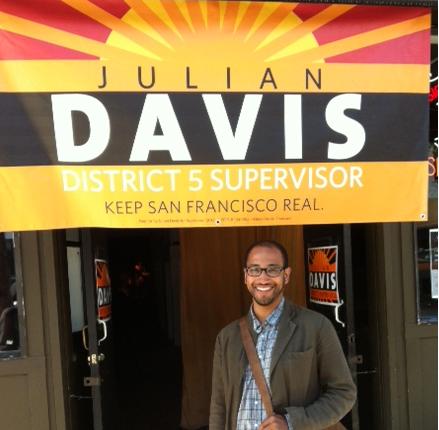
Christina Olague, the incumbent appointed by Mayor Ed Lee earlier this year, has been taking flak in recent debates from competitors who are highlighting the schism between her progressive history and her more conservative recent votes and alliances. That gulf was what caused Matt Gonzalez to pull his endorsement of Olague this summer and give it to Julian Davis.

London Breed has now suffered a similar setback when US Sen. Dianne Feinstein revoked her endorsement following colorful comments Breed made to the Fog City Journal, which were repeated in the San Francisco Chronicle, blasting her one-time political patron Willie Brown. Breed, whose politics have been to the right of the district, seemed to be trying to assert her independence and win over progressive voters who have different worldviews than her more conservative endorsers.

But she may have gone a bit too far when she told Fog City Journal’s Luke Thomas: “You think I give a fuck about a Willie Brown at the end of the day when it comes to my community and the shit that people like Rose Pak and Willie Brown continue to do and try to control things. They don’t fucking control me – you go ask them why wouldn’t you support London because she don’t do what the hell I tell her to do. I don’t do what no motherfucking body tells me to do.”

Shortly thereafter, Breed said she got a call from Feinstein’s people withdrawing the endorsement. “There were just some concerns about the kind of language I used in the article,” Breed told us.

Sources say Brown has been in payback mode ever since, urging Feinstein and others to stop supporting Breed and switch to Olague. Neither Brown nor Feinstein returned our calls. On the record, Breed was contrite when we spoke with her and reluctant to say anything bad about Brown or Feinstein, except to offer us the vague, “There are a lot of people who respect and like me, and they don’t like what they see happening.”

Breed went after Olague hard during a Sept. 18 debate sponsored by the Haight-Ashbury Neighborhood Council and other groups, blasting Olague for her ties to Brown, Lee, and Chinatown power broker Rose Pak, claiming Olague is too beholden to that crew and D5 needs a more independent supervisor.

Asked to respond to the attack during the debate, Olague said, “I won’t dignify that with a response.” But it seems clear to anyone watching the race that Olague has been getting lots of support from Lee, Pak, and Brown and the political consultants who do their bidding, David Ho and Enrique Pearce, which is one reason many progressives have been withholding their support.

The Breed campaign this week trumpeted its endorsement by three prominent progressive activists: Debra Walker, Roma Guy, and Alix Rosenthal. But it has been Davis that has captured the endorsements of the most progressive individuals and organizations, including a big one this week: the Harvey Milk LGBT Democratic Club, which gave Davis is sole endorsement even though he’s straight and Olague is from the LGBT community.

Davis also snagged the number one endorsement of the San Francisco Tenants Union, a big one for D5, as well as the sole endorsements of Gonzalez, former Democratic Party Chair Aaron Peskin, and Sup. John Avalos. Assembly member Tom Ammiano also endorsed the Davis campaign, adding that to Ammiano’s earlier endorsement of John Rizzo, the other solid progressive in the race. Rizzo also got the Sierra Club and the number one ranking by San Francisco Tomorrow.

But Olague is enjoying quite a bit of union support, including snagging the sole endorsement of the San Francisco Labor Council, whose members in the trades like her controversial vote on the 8 Washington project more than progressives or her competitors, who all opposed the deal. Olague was also endorsed by the United Educators of San Francisco and California Nurses Association.

The biggest union of city workers, SEIU Local 1021, gave its unranked endorsements to Davis, Olague, and Rizzo, as did Sup. David Campos. Sup. Jane Kim – who has also occasionally parted ways with progressives after Ho and Pearce ran her campaign against Walker – gave Olague an early endorsement, but late this week also extended an endorsement to Davis.

“As someone who has championed rank-choice voting, it is important for me that progressives are thoughtful about how we strategize for victory.  I have known Julian Davis a long time, and I believe that he would be a strong leader that fights for progressive values that District 5 cares about, including sustainable streets and livable neighborhoods,” Kim said in a statement given to the Davis campaign.

Another important endorsement in D5 is that of the San Francisco Bicycle Coalition, which carried a faint whiff of controversy this year. The group gave Olague its number one endorsement and Davis its number two, but some SFBC members have secretly complained to us that the fix was in and that Davis actually got more votes from SFBC members, which most people thought was how its endorsements are decided.

SFBC Executive Director Leah Shahum told us she wouldn’t reveal who got the most member votes, but she did say that the SFBC Board of Directors actually decides the endorsements based on several factors. “The member vote is one of the factors the board took into consideration,” she said, listing a candidate’s record, relationship with SFBC, personal history, and other factors. “Nothing special was done in that vote, by any means.”

SFBC has been playing nice with Mayor Lee in the last couple years, despite his broken promise of getting the critical yet controversial Fell/Oak separated bike lanes approved by the SFMTA, which he first said would be done by the end of 2011, then by the end of 2012, but which lately seemed to be dragging into 2013.

At SFBC’s urging, Olague recently wrote a pair of letters to the SFMTA urging quicker action on the project, and it seems to have worked: Shahum said a vote on that project has now been scheduled for Oct. 16, and she’s hopeful that it might now be underway by the end of the year after all. As she said, “We’re thrilled.”

BTW, in case you’re curious, the Guardian’s endorsements come out on Oct. 3.

Stop the presses: CleanPowerSF 8, PG&E 3

19

Sometimes, the good guys (and gals) win.

And so, after the Guardian started the public power movement in 1969  with the pioneering Joe Neilands expose of the PG&E/Raker Act scandal, after three  initiative campaigns to kick PG&E put of City Hall and enforce the public power mandates of the federal Raker Act and bring our own Hetch Hetchy public power to our own people, after hundreds of people worked for years inside and outside City Hall for public power and clean energy,  the San Francisco Board of Supervisors voted 8-3 Tuesday  to formally launch a CleanPowerSF project that would for the first time challenge the decades-old power monopoly of the Pacific Gas & Electric Company.

It was a historic moment. And it was a historic veto proof vote that Ed Lee, the PG&E- friendly mayor, and his ally and mentor, former mayor Willie Brown, the unregistered $200,000 a year PG&E lobbyist, will have difficulty snuffing out this time around.

The CleanPowerSF 8 were Sups. David Campos, who sponsored the legislation, Scott Weiner, who cast the deciding swing vote, David Chiu, Eric Mar, Christina Olague, Jane Kim, Malia Cohen, and John Avalos, all of whom made helpful remarks during the debate. They also voted down an attempt by the PG&E bloc to continue the vote for a week and voted against crippling amendments.

The PG&E 3 were Sups.Mark Farrell and Carmen Chiu, who tried to dilute the legislation with the crippling amendments, and Sean Elsbernd, who was strangely silent during the debate. 

I use the phrase CleanPowerSF  8 and PG&E 3 to dramatize the crucial political point and toss in a bit of Guardian history on the story.  For years, as clean energy/public power proposals were routinely voted down as a result of PG&E political muscle and power lobbying, the Guardian would use variations of the phrase. PG&E l0, San Francisco l or whatever was the PG&E margin of victory. The phrase was accurate, pin-pointed the good and bad guys and gals, lifted our spirits, and sent the message that the battle was far from over.

The hero of the afternoon was Ed Harrington, the general manager of the San Francisco Public Utilities Commission who delayed his retirement to complete the project. He got a standing ovation after his testimony backing up his legislation and deft handling of  all questions.  As Campos said, Harrington’s legislation  was as “good as you are going to get.”  No one seriously questioned his plan, figures,  marketing strategy, or key argument that his plan was fiscally and environmentally sound.

PG&E was never mentioned during the discussion and it was difficult to determine its lobbying strategy. After the vote, I asked Eric Brooks, the crafty clean power leader at the meeting,  what happened to PG&E and  its strategy. He said that PG&E, after the San Bruno disaster and other notable mishaps, was not the monopoly power it once was and that perhaps the company had decided it would rather face the slower pace of  CleanPowerSF rather than another clean energy initiative it would have a good chance of losing 

Thanks and congratulations to the CleanPowerSF 8, David Campos, Scott Weiner, John Avalos, David Chiu, Eric Mar, Chritina Olague, Jane Kim, and Malia Cohen, who voted themselves into San Francisco history.  Five of them will face the electorate and PG&E in the November election (Campos, Avalos,  Chiu, Mar, and Olague.) and they acted and spoke as if voting for CleanPowerSF would be a significant advantage to their campaigns in their districts. And thanks and congratulatons to former Sup. Ross Mirkarimi, who carried the public power flag as the unpaid campaign manager during the first two unsuccessful public power campaigns and then carried the CCA plan inside City Hall during his seven years as supervisor.  When he was voted in as sheriff last November, he handed the CCA baton to Campos who pushed the proposal through with style and solid argument that the issue was choice and providing necessary competition to PG&E’s monopoly.

The vote to start public power in San Francisco comes none too soon. The tear-down-tne-Hetch Hetchy dam forces have put the nice-sounding Proposition F to study draining the Hetch Hetch reservoir.on the fall ballot. This is the first step toward tearing down the dam.  The problem for the city is that it could ultimately lose the dam, if it isn’t moving to public power, because the Raker Act mandates that San Francisco have a municipal  system to distribute public power to its residents and businesses because the act allowed San Francisco to dam Hetch Hetchy Valley in Yosemite National Park. The Guardian’s position is that the dam is in place and  should only be torn down after the city has real public power and is able to find and afford an adequate new source for the city’s water and power supply. And that, let me emphasize,  will be a massive undertaking involving billions of dollars and incredible political challenges.   .

Much more to come in this saga that never ends,  b3

Here is Guardian City Editor  Steve Jones’ account of the vote: : http://www.sfbg.com/politics/2012/09/18/historic-veto-proof-vote-launches-cleanpowersf

And some Guardian background on the PG&E/Raker Act Scandal in my advance story: http://www.sfbg.com/bruce/2012/09/17/historic-pgeclean-energy-vote-today

Historic, veto-proof vote launches CleanPowerSF

24

The San Francisco Board of Supervisors today cast an historic vote that was more than a decade in the making, approving the CleanPowerSF program – which challenges PG&E’s monopoly by offering 100 percent renewable energy directly to city residents – on an 8-3 vote that would be enough to override an implied veto threat by Mayor Ed Lee.

The outcome was far from certain throughout the two-hour hearing as conservative Sups. Mark Farrell and Carmen Chu led efforts to undermine the program, which was the final work product of retiring San Francisco Public Utilities Commission Executive Director Ed Harrington, who previously served as the city’s controller for 17 years.

The pair of supervisors offered a series of amendments challenging the state requirement that city residents must proactively opt-out of such community choice aggregation (CCA) programs if they want to remain with PG&E, offering convoluted language that would have required people to opt-in to the program before its launch, and requiring that the $13 million in reserve funds from the SFPUC be covered entirely by CleanPowerSF customers, which could increase its rates.

“It looks like the amendments would be harmful to the success of the program,” Sup. Eric Mar observed, prompting Farrell and Chu to flash broad conspiratorial smiles at one another.

Sup. Scott Wiener, who was undecided and considered a key swing vote in reaching a veto-proof majority, said he also had concerns about the opt-out requirement and wanted to better understand how the amendments would work and whether they were legal. “For me, I’m not interested in putting any poison pills in here,” he said.

Wiener posed questions about the amendments to Farrell and to Harrington, who said it was possible for the SFPUC to have CleanPowerSF customers repay the initial allocation of reserve funds over time but that he wasn’t sure how the opt-in change would work without sabotaging the program.

“It harms the ability to have an intelligent conversation with people,” Harrington said, noting that rates are based on the number of customers in the program, so it would be nearly impossible to survey everyone’s potential interest without being able to tell them how their bills would be affected.

As it is, the SFPUC has already done extensive surveys of which neighborhoods and demographics are likely to be interested in taking part in CleanPowerSF, initially paying about $10 more per month for 100 percent renewable energy (PG&E’s portfolio includes less than 30 percent renewable). “We’ve done extensive surveys already,” Harrington said. Based on that research, the city is initially rolling out the program to less than a third of city residents, who will be repeatedly notified about how to opt-out, anticipating about 90,000 customers remain in the initial program. 

The program has been repeatedly tweaked over the last eight years that it’s been in development, during which time Marin County launched a successful version of the CCA concept that was developed in San Francisco by legislators Tom Ammiano, Carole Migden, and Mark Leno.

“I feel pretty comfortable trusting Ed Harrington on whether the numbers add up,” said the measure’s chief sponsor, Sup. David Campos, arguing against the Farrell/Chu amendments, later adding, “With Ed Harrington leading this charge, this is as good as it gets. If you don’t like CCA under Ed Harrington, you’re not going to like CCA.”

Farrell claimed to support CCA in concept, but he strenuously objected to the opt-out requirements that Migden included in the enabling state legislation, which she had argued was the only way to make CCAs viable against PG&E’s proven willingness to spend tens of millions of dollars to sabotage would-be competitors.

“It’s the wrong way to legislate, the opt-out. It smells of coercion,” Farrell said. Campos countered that, “The best thing we can give the consumers in San Francisco is a choice, a meaningful choice.”

Wiener ultimately made a motion to delay the item by a week, something Mayor Lee yesterday told the Chronicle he wanted, in order to further study the opt-out issue, telling Farrell that his amendment “feels a little seat of the pants to me.”

Campos and other progressive supervisors who were supporting CleanPowerSF argued against the continuance, noting that it has been years in development and sitting in board committees since January, while the Farrell/Chu amendments weren’t offered until this meeting had already begun.    

“This is not going to change because we wait a week to make a decision,” Campos said. “The terms of this deal are not going to change.”

The motion for a continuance failed on a 4-7 vote, with Wiener joined by Farrell, Chu, and Sup. Sean Elsbernd (who offered no comments throughout the hearing).

Then, as the vote on the Farrell/Chu opt-in amendment came up for vote, Wiener said, “I don’t feel comfortable voting for amendments that I don’t know what they’ll do,” and it failed on a 3-8 vote.

Sup. Malia Cohen had earlier indicated a willingness to support the other Farrell/Chu amendment: saddling CleanPowerSF customers with paying the SFPUC back for reserve fund costs – which Harrington indicated could be dragged out over many years to minimize the impact on rates, and which might not be necessary at all if the initial program exceeds expectations.

That amendment was then approved on an 8-3 vote, with Sups. Jane Kim, Christina Olague, and John Avalos opposed. Another set of amendments that would keep low-income city residents out of the initial rollout and take other steps to reduce their rates if they opted in – which was developed by Kim, Cohen, and Sup. Eric Mar – was unanimously approved by the board.

Then it was time for the big vote on creating the CleanPowerSF program, approving the contract with Shell Energy Northern California to administer it, and authorizing the initial $19.5 million expenditure. Would there be eight votes to override a veto by Mayor Lee, who has been under pressure by PG&E and their downtown allies to kill the program?

“To be perfectly candid, I struggled mightily with this contract,” Wiener said, reiterating his concern about its opt-in requirement, noting that the measure wasn’t perfect, even though it was significantly improved from earlier versions. It sounded as if he were about to vote against it.

“What we have the opportunity to do is move forward with clean power,” Wiener said, noting that even Marin County supervisors who initially opposed its CCA have come around to supporting it. “This is something I believe we should try.”

And with that, the board voted 8-3 to launch the program in mid-2013, with Chu, Farrell, and Elsbernd opposed.

Campos said he was “pleasantly surprised” by the vote, while key supporters say they are cautiously hopeful it will stand up during next week’s final supervisorial approval on second reading and in a veto override vote, if that becomes necessary. Campos said he was thankful for the work of Harrington, who got a standing ovation after the vote as the board recognized him for his long service to the city.

Earlier in the meeting, Harrington told supervisors that while the program isn’t perfect, and it contains some risks that he considers reasonable, there is no other way the city has identified to meet ambitious greenhouse gas reduction goals it has set for itself over the last decade. It is city policy to reduce emissions by 25 percent below 1990 levels by 2017 and 80 percent below those levels by 2050.

“This program before you has the only chance of reaching those goals. There’s nothing else,” Harrington said. He also said “it’s an incredibly efficient way to spend money,” noting that the city has spent $90 million on solar and other renewable energy projects that power fewer than 7,000 homes, whereas this $19.5 million will power 90,000 households, possibly without ever tapping into that $13 million reserve fund set aside to cover any losses by Shell, which will buy renewable energy, a role the city hopes to eliminate as it develops its own projects.

Harrington said the ultimate goal of CleanPowerSF is to develop a large enough customer base that the city could use revenue bonds to finance a wide variety of renewable energy projects – many using solar arrays along city-owned property connected to its water system stretching all the way to Hetch Hetchy Valley – that would pay for themselves.

“The real issue is can you build a facility that will have this rate structure support it?” Harrington said.

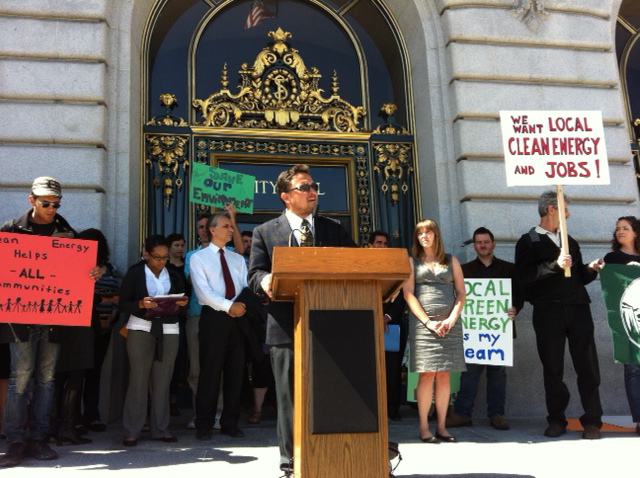
That’s the real power and potential of CleanPowerSF – finally taking action to address global warming, which will have a huge impact on San Francisco and future generations – as supporters noted in a rally outside City Hall before the meeting. Sen. Mark Leno said that he doesn’t usually weigh in on proposals before the board, but that, “This is an exceptional time and this is an exceptional vote. This is the time that we need to address our inconvenient truth.”

The historic PG&E/clean energy vote today

35

And so, after a Guardian campaign that started in 1969 to kick PG&E out of City Hall and bring the city’s own Hetch Hetchy public power to San Francisco residents and businesses, the San Francisco Chronicle reported  in Monday’s edition ( 9/17/2012)  that San Francisco “is on the threshold of taking a major step into the public power realm.”

The lead story by John Cote, under a big front page head “Clean power plan would skirt PG&E,”  nicely laid out the CleanPowerSF program and even said that the plan “would effectively break Pacific Gas and Electric Company’s decades-old monopoly on the consumer power market in its headquarters city.”

He quoted Sup. David Campos, sponsor of the legislation, as saying that “This is about giving consumers a choice. And for the choice to be meaningful, it can’t be dependent on one company deciding the energy future of this city.”  The plan goes before the board on Tuesday (9/18/2012) and public power advocates say they have the votes for passage, despite PG&E’s furious lobbying inside and outside City Hall.

What Cote didn’t say, and what the Chronicle has been blacking out for decades, is the crucial point that this clean energy/ public power plan is no ordinary vote on an ordinary issue.  It is an extraordinary vote that would  start the process to enforce the federal Raker Act of 1913 that mandates that San Francisco have a public power system because the city dammed Hetch Hetchy Valley in Yosemite National Park for its cheap public water and cheap public power.  The city got the cheap Hetch Hetchy water, but it never got the cheap Hetch Hetchy power because PG&E stole it and forced the city to buy PG&E’s expensive private power all these years. The cost: billions of dollars for decades to the taxpayers and enduring structural corruption at City Hall. The Guardian has called this PG&E/Raker Act scandal the biggest urban scandal in U.S. history. It still is.

It’s quite a story and I urge you to check out the hundreds of investigations, stories, editorials, cartoons, and graphics the Guardian has used for years to illuminate the scandal and fight to enforce  the Raker Ac t and bring our own Hetch Hetchy power to our own people in San Francisco.

Buried in the Cote story is a key political point: Mayor Ed Lee, the man who became interim mayor on a phony premise and then lied his way into a full term as mayor, reiterated his “concerns” through a spokesperson that he is, gosh, golly, gee, “concerned about the opt-out provisions, the risks associated with the contract and the cost to residents.”

Marvelous. Simply marvelous. Lee is once again enunciating the PG&E line that mayors before him, notably Willie Brown and Gavin Newsom, have used to keep City Hall safe for PG&E and undercut the threat of public power coming to San Francisco and disturbing PG&E’s questionably legal monopoly. Brown, let me emphasize, was under PG&E’s thumb before, during, and after his mayoral tenure and now operates as an unregistered, $200,000-a -year PG&E lobbyist, Chronicle columnist, and key Lee confidant  and ally.

The current public power proposal isn’t as strong as the three public power initiatives that PG&E spent tens of millions of dollars to defeat.  PG&E would still own the lines and network, handle maintenance, and send out the bills.

But the proposal would provide l00 per cent renewable power to residents who want to pay a bit more for it, build a customer base and revenue stream for city-owned renewable power generation, advance the city’s greenhouse-gas reduction goals, and set aside $2 million to study public power options.  Most important, it would be a helluva good first step toward enforcing the public power provisions of the Raker Act and kicking PG&E out of City Hall.

The supervisors and Lee should approve the legislation and move it forward vigorously and without delay.

This is a historic moment and a historic vote in San Francisco history.  The question is, who is going to be on the right side of history and who is going to be on the wrong side of history with a PG&E vote that will live in infamy?  B3

P.S. A tip of the clean energy hat to Ed Harrington, who successfully wrestled  the proposal through the sea of crocodiles and hippos at City Hall.  He delayed his retirement as general manager of the San Francisco Public Utilities Commission to finish up the proposal.  “This is the single biggest program that is even on the  horizon within the city and county of San Francisco to make any difference toward any of the goals that you have set as board members in terms of having a change in greenhouse gas emissions and climate change in San Francisco,” he told the supervisors’ budget committee last week as reported by Cote.  “This program can make a dramatic change.”  

And a tip of the clean energy hat to Sup. Campos, who put the proposal forward up against  fortress PG&E,  More: a tip of the clean energy hat and a  bow to all the many public power advocates who have fought for years to bring clean energy and public power out of the wilderness and to this position. Furthermore, I salute  Sheriff Ross Mirkarimi, who led the first  two public power initiative campaigns as the unpaid manager and then took on the herculean job of orchestrating the clean energy/cca proposal inside City Hall .when he became a supervisor. Mirkarimi is now paying the price for, among other things, successfully taking on PG&E and the PG&E establishment. His was an enormously courageous and important public service.  On guard,   B3


Committee approves CleanPowerSF over downtown opposition

51

The question of whether San Francisco creates a renewable energy program that offers an alternative to Pacific Gas & Electric got its first major hearing at City Hall today, with the business community claiming it’s too expensive and supporters arguing that the time has come for the city to address climate change and the long-term energy needs of city residents and businesses.

The Board of Supervisors Budget & Finance Committee voted 2-1 in favor creating CleanPowerSF, entering into a contract with Shell Energy Northern California to administer the program, and devoting $19.5 million from the San Francisco Public Utility Commission’s water fund to help launch it and buy clean power for city residents.

Sups. John Avalos and Jane Kim supported the project, while Sup. Carmen Chu was opposed. It now goes to the full Board of Supervisors next week, where it is expected to have progressive support and be opposed by the fiscal conservatives.

“I do think we will have the necessary majority to get this through,” the measure’s sponsor, Sup. David Campos, told us. But one open question is whether Mayor Ed Lee will veto a measure that his SFPUC appointees developed but his downtown allies are trying to kill, and if so, whether there are eight supervisors willing to override a veto.

But Campos noted that SFPUC officials testified today that CleanPowerSF is the only way they’ve identified to meet the city’s ambitious official goals for reducing greenhouse gas emissions, which call for a reduction of 20 percent below 1990 levels by the end of this year and an 80 percent reduction by 2050.

Supporters who testified today included environmentalists, progressive groups, and young people who cast addressing climate change as the defining struggle of their generation. “This, not to go overboard, is the most important vote you’ll ever do,” said the Sierra Club’s Arthur Feinstein.

Those who spoke against the program included the usual array of downtown groups that have traditionally defended PG&E’s interests – including the Committee on Jobs, Golden Gate Restaurant Association, and Plan C – and they were joined by an unusually large number of elderly Asian individuals wearing stickers opposing the project.

“It’s a bad program that doesn’t meet even the basic elements of its original promise,” said Chris Wright, executive director of the Committee on Jobs, which PG&E has helped fund since its inception. Like most CleanPowerSF opponents, they have long opposed even the concept of community choice aggregation (CCA), the state law that allowed the city to create CleanPowerSF.

PG&E’s longtime support by local politicians has eroded in recent years because of its overkill campaigns against public power initiatives and supporters and its negligence in the deadly San Bruno pipeline explosion.

Even GGRA Executive Director Rob Black told the committee, “PG&E, a local company, candidly has its problems.” But he and other project opponents – and even a few supporters of the project – centered much of their opposition on the involvement of Shell, which has a bad reputation and environmental record, like almost every other multinational energy company.

“I have the same qualms about Shell that everyone else does,” said Katherine Roberts, who said that she nonetheless supports the project, calling it the only way for most San Franciscans to directly support the development of renewable energy sources. Shell was the sole bidder on a project that requires enormous financial wherewithal.

Campos calls the focus on Shell a diversionary tactic: “PG&E already buys energy from Shell. To the extent people don’t want Shell in the picture, Shell is already in the picture.”

Both the supervisors and the mayor will be under intense pressure to derail CleanPowerSF, with that campaign led by downtown groups and IBEW Local 1245, the union that represents PG&E workers. Sup. Scott Wiener, who says he’s still undecided, told us that his office was flooded with phone calls today, mostly in opposition to the project.

PG&E union mounts attack on Clean Power SF

31

The union that represents PG&E workers — and has opposed every single public-power initiative in modern San Francisco history — just launched an attack on Clean Power SF. And the union’s business representative is having a hard time explaining exactly why he’s working with PG&E to try to undermine this modest step toward public power.

Hunter Stern, with IBEW Local 1245, sent a press release out Sept. 11 announcing the start of a campaign to convince the supervisors not to approve the Clean Power SF plan. The line of attack: Shell Energy, which got the contract to supply sustainable energy to customers in the city, in competition with PG&E. The pitch:

San Francisco city government is considering a proposal to partner with Shell Energy of North America to inaugurate SF’s so-called “clean power” program. If the Board of Supervisors approves the proposal, San Francisco would pay millions to Shell, one of the most notorious environmental violators in business today.

Shell’s a pretty bad company. So is PG&E. So is just about everyone in the energy business. Not justifying Shell’s behavior, just noting: If you want a contractor to deliver electricty to San Francisco, you aren’t going to get a cool independent small business. You aren’t even going to get Google. These folks are evil, all of them.

Oh, and by the way: Shell Energy also sells power to PG&E (pdf). Stern’s boss has a contract similar to what the city is going to get. So the PG&E power we all pay for today is in part Shell power. And as Sup. David Campos points out, it wasn’t as if the city chose Shell over some better competitors: There was no other company out there anywhere in the world that responded to the city’s bid process and offered to work with Clean Power SF.

The key point here is that Clean Power SF is going to use Shell as a bridge — the private outfit will deliver power generated at renewable facililities to the city’s power operation, which will resell it to customers … for a while. The goal is to use the revenue stream from the sales of power to back bonds that will allow the city to build its own renewable energy system. Five, maybe ten years down the road, San Francisco will have solar generators on city property (including large swaths of Public Utilities Commission property in the East Bay), wind generators, maybe at some point tidal generators, and will be able to sell cheap, clean, local power to customers. Shell will be gone.

Let’s face it: this is a step on the path to creating a city-owned and city-run power system — that is, a step to eliminating PG&E as a player in San Francisco’s energy future. Public power will be cheaper and cleaner — and it’s going to take a while to get there. Which is why we need to start now.

PG&E knows this, too, and is fighting to block Clean Power SF, which comes before the board’s Budget and Finance Committee Sept. 12. Now IBEW is allied, as usual, with the giant company.

The Stern press release talks about how Clean Power SF will be expensive:

The average home can expect to see a rate increase of 77% over their current PG&E electricity generation rates. That comes out to an increase of over $200 per year.  The higher cost of power would eat up more and more of the City budget, forcing service reductions and costing San Francisco vitally needed jobs. Our local economy would take a multi-million dollar hit.

Actually, not true: The only people who will pay for Clean Power SF are the ones who want it. The idea is that a significant number of San Franciscans will be willing to pay a little more — maybe $10 a month — to help save the planet. The ones who want to stick with PG&E wil have every opportunity to do so. The city budget isn’t taking a hit — municipal services already use the city’s Hetch Hetchy hydropower. This doesn’t cost the city money or jobs.

It will, of course, hurt PG&E.

I called Hunter Stern to talk about all of this, and we had a long conversation. He was polite and answered all of my questions. Sort of.

He insisted that IBEW isn’t against community choice aggregation, that he’s only worried about the city budget and the impacts on ratepayers. And Shell. So we started going around in circles, like this:

Me: So you don’t oppose Clean Power SF?

Stern: We are not opposed to community choice aggregation. Just to this contract with Shell.

Me: I’m told Shell is the only contractor willing to fulfill this role.

Stern: That’s what I’m told, too.

Me: So if you support CCA, what should the city do?

Stern: Find somebody else.

Me: The city has made it clear there IS nobody else.

Stern: We should put this on hold and wait around until there is.

Me: Why is IBEW unhappy with Shell?

Stern: This is contracting out.

Me: Is Shell Energy a nonunion company?

Stern: They don’t generate power, they just buy and sell, so they don’t really have any employees who could be in IBEW.

Me: So what if they city can use this revenue to build its own renewables, with union labor?

Stern: We aren’t opposed to the city building its own renewables.

Me: But the idea here is to use the revenue stream from Clean Power SF to raise money for local renewables.

Stern: You don’t need revenue to build local renewables. Just creativity.

Me: But the city has a huge budget problem now. There’s no money to build local generation unless you have a revenue stream to bond against.

Stern: There are creative ways to do it.

Me: So you support CCA. You support building local renewables.Clean Power SF is a CCA program to build local renewables. Shell is the only company that answered the city’s call for bids for this project. You don’t have any labor issues with Shell. I don’t understand where you’re coming from.

Stern: I don’t disagree with your checklist.

Me: So why are you against this project?

Stern: We don’t think this is good for the city or for the ratepayers.

Me: But the ratepayers don’t have to be a part of it if they don’t want to.

Stern: I think the way the city is approaching that is a good strategy.

Round and round and round. It was making my head hurt. I wish I’d put it on tape so you could all listen.

I passed the press release along to Tyrone Jue at the SFPUC. He had a pretty clear response:

This attack is not surprising. IBEW is one of the largest unions at PG&E. They historically side with PG&E on all their issues. The fact is CleanPowerSF will not cost IBEW workers jobs. Ironically, the local renewable build out phase will be creating even more green union jobs. This happens while we weaning ourselves off dirty fossil fuel sources.San Franciscans want the choice to embrace a clean energy future. While PG&E shareholders stand to lose with CleanPowerSF, the consumer and environment stand to win.

He added:

Our ‘little creativity’ involves reinvesting revenue into aggressive energy efficiency and local renewable generation projects.  We’re simply not motivated to maximize profit at the expense of our customers or the environment.   Our common sense goal is to reinvest revenue into real projects that will reduce San Francisco’s carbon footprint, create local jobs, and build a sustainable energy future that is better for the environment and our customers.

Ugh. This is going to be a battle royal. I hope there are six votes on the board for Clean Power SF, which is imperfect but important. And then Mayor Lee will have to decide whether to side with his highly respected SFPUC general manager, Ed Harrington, who wants to make this happen, and PG&E, which doesn’t.

Oh, by the way: PG&E pays Willie Brown about $250,000 a year as a “legal retainer.” And I hear the mayor takes his phone calls.

The park bond battle

17

yael@sfbg.com

Recreation and Parks clubhouses are privatized and cut off from public access. Public spaces like the Botanical Gardens and the Arboretum in Golden Gate Park are closed to people who can’t pay the price of admission. Event fees and permit processes have become so onerous that they’ve squeezed out grassroots and free events.

It’s been enough to infuriate a long list of neighborhood groups who have been complaining about the San Francisco Recreation and Park  Department for years.

And now those complaints have led to a highly unusual coalition of individuals and groups across the political spectrum coming together to do what in progressive circles was once considered unthinkable: They’re opposing a park bond.

From environmentalists, tenant advocates, labor leaders, and Green Party members to West Side Republicans and fiscal conservatives,  activists are campaigning to try to defeat Proposition B, the Clean and Safe Neighborhood Parks Bond. 

The bond would allow the city to borrow $195 million for capital projects in several parks around the city. It comes five years after the voters passed a $185 million park bond. 

Environmental groups like San Francisco Tomorrow and SF Ocean Edge oppose the bond, and even the Sierra Club doesn’t support it because “In recent years, we have had many concerns with management of the city’s natural places,” as Michelle Meyers, director of the Sierra Club’s Bay Chapter, told us.  

Matt Gonzalez, the only Green Party member ever to serve as Board of Supervisors president, is part of the opposition, as is progressive leader Aaron Peskin.  Joining them is retired Judge Quentin Kopp, darling of the city’s fiscal conservatives.

The San Francisco Tenants Union wrote a ballot argument opposing Prop. B. The left-leaning Haight Ashbury Neighborhood Council and the more centrist Coalition of San Francisco Neighborhoods both want the bond defeated.

Many of the people opposing Prop. B have never before opposed a city bond act. “This is very difficult for me,” said labor activist Denis Mosgofian. “Some of us always support public infrastructure spending.”

When we called Phil Ginsburg, the director of Rec-Park, for comment, his office referred us to Maggie Muir, who’s running the campaign for Yes on B. She sent a statement saying: “Unfortunately, a small group of individuals are opposing Proposition B because they disapprove of Recreation and Park Department efforts to improve our parks and better serve San Francisco’s diverse communities.” The statement refers to Prop B’s opponents as “single issue activists”

 So who are these activists, and why have they come together to oppose the parks bond?

 Many started with, as Muir put it, a single issue.  Journalist Rasa Gustaitis  didn’t want to see fees to enter the Botanical Gardens and Arboretum in Golden Gate Park.  West of Twin Peaks resident George Wooding was upset that Rec-Park has been leasing public clubhouses to private interests. Landscape Architect Kathy Howard took issue with a plan to renovate Beach Chalet soccer fields, complete with artificial turf and stadium lighting.

After a few years of fighting these small battles, people like Gustaitis, Wooding, and Howard started to see a pattern.  Park property was being privatized.

THE ENTERPRISE

Some city departments, like the airport and the port, are so-called enterprise agencies. They don’t receive allocations from the city’s general fund, and operate entirely on money they charge users. In the case of the airport, most of the money comes from landing fees paid by airlines. The port charges ships that dock here, and takes in rent from its real-estate holdings.

Other departments, like Recreation and Parks, provide free services, funded by taxpayer money. In theory, the department creates and maintains open spaces for public use. The recreation side offers services like classes and after-school activities, many of which are centered in recreation centers and clubhouses in parks throughout the city. 

These have been staffed in the past by recreation directors, adults who coordinated and supervised play, in many cases becoming beloved community figures.

But some city officials want that mission to change. In a time of tight budgets (and facing significant cuts to its operating funds), Rec-Park has been looking for ways to increase revenue by charging fees for what was once free.

In fact, in a 2010 Rec-Park Commission meeting, interim General Manager Jared Rosenfeld said, “the sooner we become an enterprise agency, the better off we will be.”

In August 2010, the department fired 48 recreation directors.  In their place, Rec-Park hired part-time workers who were paid to put on programs but not to staff neighborhood rec centers. The department also hired six more employees in the Property Management Division, tasked with leasing out and renting parks property.

In 2010, the commission also approved a plan to impose a fee for non-residents and require residents to show ID to enter the Arboretum. The once-free public garden was on its way to becoming a cash cow (operated in part by the private San Francisco Botanical Society).

A fledgling group formed to fight the fees – and its members soon connected People from SF Ocean Edge, the Parks Alliance and SPEAK who were not pleased with a proposal to install artificial turf and floodlights at the Beach Chalet soccer field and people who opposed the leasing of clubhouses.

 Mosgofian, a member of the Labor Council and worker with Graphic Communications International Union Local 4-N, helped bring together many disparate groups who, they realized, have a common goal in halting the privatization of the parks system.

“It started with a number of different people who were involved in a number of different efforts to get the Rec and Park Department to do the right thing running into each other and eventually getting together,” said Mosgofian “People from these groups found themselves listening to each other’s efforts and got together.”

Subhed: The empty clubhouse

One of the turning points was the fight over J.P. Murphy Clubhouse in the Sunset.

 In July 2010, Rec-Park quietly began taking clubhouses, previously free and open to anyone in the neighborhood, and putting them up for lease. Nonprofits, some of them offering expensive programs,  took exclusive control of public facilities.

For Rec-Park, it was more money. For neighborhood residents, it was a sign they were being cut off from the resources their tax dollars built and funded.

“They would put a notice on the clubhouse door for a hearing, they would have four or five concerned mothers show up, and they would lease the facility,” said George Wooding, then-president of the West of Twin Peaks neighborhood group that got involved in opposing the clubhouse privatization.

The J.P. Murphy clubhouse in the inner sunset had benefitted from the 2008 bond. The building was renovated at a cost of $3.8 million. But when the shiny new rec center was finished, Rec-Park tried to put it up for lease.

Wooding helped organize strong opposition to the lease. They had already paid for the clubhouse through taxes and bond money, the opposition figured—why shouldn’t it be kept open to the public, free? 

 “I’d had enough. We felt, this is our park,  they just spent a ton of money. They fired the rec director. When Rec-Park came to rent out the facility, we just said no way,” Said Wooding.

The department gave up, and J.P. Murphy wasn’t leased. But without a lessee, the department simply closed the center. It’s empty and dark – although it’s available for $90 an hour rent.

Other similarly frustrating battles were going on around the city. 

Muir called the opposition “short-sighted.” 

“This opposition is punishing the people who use the facilities across the city, children who need safe parks to play in, seniors, and those who are disabled who need ADA compliance,” said Muir.

But Friends of Ethics, another group opposing the bond, argues that Rec-Park shouldn’t get another cent until the agency cleans up its act. In a paid ballot argument against Prop B, the group brought up the controversial process of leasing out the Stowe Lake Boathouse last year. The move to put Bruce McLellan, longtime operator of the family business that sold snacks and rented paddle boats, on a month-to-month lease before auctioning a new lease to the highest bidder created a serious backlash.

 On top of that, commission officials were accused of bias when they recommended a lobbyist, Alex Tourk, to one of the companies vying for the contract. 

 “It’s unseemly and it clouds public trust,” said No on Prop B proponent Larry Bush,  who publishes Citireport. 

The boathouse isn’t the only much-beloved tradition ended under the current Rec-Park administration’s reign. The Power the Peaceful festival, which brought big name musicians and thousands of attendants, all for free, has been priced out due to dramatic increases in fees. So has the Anarchist Book Festival. 

 Bob Planthold, a disability rights advocate who is also a member of Friends of Ethics, says that there are issues in the ADA compliance plans for the Parks Bond as well. Planthold says that money from the last bond measure in 2008 was misspent in terms of disability access.

 “Trails weren’t graded properly. There was no attention to whether there were tree roots that might be rising above the level of the trail that could trip somebody,” said Planthold. “They didn’t do a good, proper, fair job on making trails accessible.”

 The bond got unanimous support from the Board of Supervisors. That’s because it earmarks money for parks that desperately need it throughout the city. 

 But that doesn’t mean all the supervisors are pleased with the way Rec- is being run, either. In July 2010, Sup.  David Campos and then-Sup.  Ross Mirkarimi tried to pass a Charter Amendment to split the appointments to the commission among the mayor and the supervisors. 

 But they couldn’t get the measure through, and the commission remains entirely composed of mayoral appointees.  

So now the voters have a choice: Give more money to what  many say is a badly managed department moving toward the privatization of public property – or shoot down what almost everyone agrees is badly needed maintenance money. Of course, the critics say, Rec-Park can always change its direction then come back and try again in a year or two – but once public facilities become pay-per-use private operations, they tend to never come back. 

The darn thing’s got wings

0

marke@sfbg.com

SUPER EGO And thus the epic saga of the Eagle Tavern, legendary drunken gay leather biker den of iniquity (which secretly boasted one of the best DJs in the city, Don Baird, on Sundays), closed for a year and a half, ravenously beset upon by upscale restaurant developers, canonized by the Sisters of Perpetual Indulgence, radicalized by queer activists desperate to preserve the scared space around which were scattered the ashes of some of our ancestors, transformed into a symbol of contemporary gentrification, gutted by real estate agents, tossed around by the Board of Supervisors like a hot potato, has finally entered another stage.

Please welcome new gay proprietors Mike Leon and Alex Montiel, who told me they hope to open the SF Eagle (www.sf-eagle.com) by Halloween, they’ll still hold charitable events, they’re looking forward to hosting live music nights again, and they’ll be doing their best to preserve that precious Eagle ambiance. You can read the whole story here, but little patent leather caps off to Glendon Anna Conda Hyde, David Campos, Jane Kim, El Rio (which hosted the Eagle’s wonderfully pervy Sunday beer busts in exile), and everyone else who pushed for the preservation of queer nightlife space in SoMa.

Says Glendon, who really led the push, “People thought we couldn’t preserve queer nightlife in this city — but that’s just a lazy excuse for gentrification. we should all be proud of what happens when we come together. Our nightlife history is a powerful force.”

That’s great. Now if we could only get the EndUp back on track, I could do my old Sunday bar (literally) crawl: Eagle, Lone Star, EndUp. Except for those times when I simply curled up beneath a parked car on Harrison. She was hella classy in the ’00s.


SF ELECTRONIC MUSIC FESTIVAL

There’s a lot going on at this annual feast of nifty experimentation — Negativwobblyland, William Basinski, Dieter Moebius, Cheryl E. Leonard, Guillermo Galindo, soddering trio Loud Objects, Machine Shop’s amplified gongs — kind of freaking out about it, ready for scary beautiful.

Wed/5-Sun/9, various times, prices, and locations. www.sfemf.org


NEW WAVE CITY 20TH ANNIVERSARY

Holy Echo and the Bunnymen! San Francisco’s longest-running party is celebrating two decades? Somebody call Square Pegs. I adore DJs Skip and Shindog — they started being retro about the ’80s almost before the ’80s were over. And their selections (Bauhaus, New Order, the Cure, Depeche Mode) somehow transcend the casket of ubiquity, possibly because of the lively and actually old-school cool crowd still riding the brave new waves of aural devotion. Here’s to 20 more years of Tears for Fears, at which point it will be like listening to Elvis in the ’90s. Or something. Prefab Sprout had a song about it. Just go.

Fri/7, 9pm-3am, $12. DNA Lounge, 375 11th St., SF. www.newwavecity.com


PUSH THE FEELING: LES SINS

Underground indie impresario Kevin Meenan’s monthly Push the Feeling parties are a hot ticket already — but add in Les Sins and we’re entering another dimension? Who are Les Sins? Oh, just chillwave-plus genius Toro Y Moi dropping a DJ set. For an intimate crowd in Lower Haight. For $5. And you’re one of the only people who know about it.

Fri/7, 9pm, $5. Underground SF, 424 Haight, SF. www.epicsauce.com


DARK ENTRIES THIRD ANNIVERSARY

Speaking of New Wave Cities — Josh Cheon’s Dark Entries label has kept the Bay Area at the forefront of the minimal and dark wave movement, which mines overlooked bands of the synth music past and reverential present acts that are direct descendents of those slightly sinister new waves. (Recent signee Linea Aspera is to die for.) This dark celebration features a live performance by Max + Mara plus a glowering set by Cheon himself, with Nihar, Jason P, and Dreamweapon.

Sat/8, 10pm, $5. SubMission, 2183 Mission, SF. www.darkentriesrecords.com


SOUL CLAP AND DANCE OFF

Considering the garage powerhouse that is Oakland, it’s weird to me that we don’t have a huge dirty-funk, pervy girl group, kooky Hairspray 1960s dance-party scene here. (Hard French and any concert by Shannon and the Clams come close.) NYC DJ Jonathan Toubin was set to bring his great Night Train party here last year, but he was almost killed by a freak accident in Portland that made national headlines (a car drove into his hotel room and ran over him in bed). Well, he’s recovered enough now to get the party going again, and this groovy dance-off will also be an all-ages celebration of life. Celebrity judges and the cream of our underground garage crop will be in attendance.

Sun/9, 7pm, $13, all ages. Great American Music Hall, 859 O’Farrell, SF. www.gamh.com


OPERA IN THE PARK

Dearest drama queens, have you had a hard night out on the town? Do you need your over-the-top batteries recharged? How about just a lovely day on the lawn to check out other cute arts enthusiasts — like me! — swooning along to our hometown opera company’s overwhelming melodiousness? Bring a little (secret) wine, and let’s sing along.

Sun/9, 1:30pm, free. Sharon Meadow, Golden Gate Park, SF. www.sfopera.org


Nite Trax: The Eagle flies again

41

I hung out yesterday evening with the new occupants of the Eagle Tavern (now known as the SF Eagle, apparently) at a celebration of the lease-signing at the Lone Star Saloon. Alex Montiel and Mike Leon seem perfect to replace the former Eagle operators Joe and John: Tough-looking and leather-bearish, a tad gruff at first but friendly once they warm to you, and a wee bit shy of the press right now.

They’ll be releasing their full plans for the storied queer bar in a couple weeks, but I did manage to squeeze some juicy info out of Alex. They hope to open the bar in time for Halloween, the liquor license has indeed been secured (in fact, they have two!), and they’ll be doing their best to return some of the Eagle’s ambiance to the now-pretty-much-gutted space, with a few slight modifications to the bar layout for code and traffic flow reasons.   

It’s certainly been a long, winding, super-convoluted road to get to this point!

I’m not sure anyone can convey all the twists and turns and backroom mechanations of the whole thing — Jay Barmann at Grubstreet has done some excellent reporting on it all, but there were still many, many balls in the air, shall we say, and the shady politics got slightly out of control. The fight to keep a historically queer space queer — despite the previous occupants’ quasi-abandonment, despite the lucrative offers from upscale restaurants, despite the limited power and will of the city to legislate such things — was a bit of a hot gay potato for the past year. (The Eagle’s infamous, charitable Sunday Beer Busts lived on in monthly form at El Rio in the Mission, at least.)

Even the idea of a “historic queer space” was questioned: if the Sisters of Perpetual Indulgence had sanctified it, and the ashes of multiple queer people were scattered about a place that raised tens of throusands of dollars for amazing local causes and was regarded as the heart of the old school gay leather rock ‘n roll biker community, was it important enough to fight for?

Hats off to Milk Club president and outspoken queer activist Glendon Anna Conda Hyde for saying, “Hell yes!”

Glendon (identified slightly incorrectly in a recent Chron story as the Norm of the Eagle’s “Cheers” — that was actually the frizzy-haired dear in the thong and flip-flops who stood around clutching a goblet of piss) kept the Eagle issue at the forefront of the city’s debate about gentrification and the loss of queer nightlife spaces, angering some fussy queens with his usual passion and stridency, but in the end succeeding in rallying an assortment of powerful players to the Eagle’s defense.

I talked to Glendon today about how the whole thing went down. His basic summation was that Supervisors David Campos and Jane Kim did excellent jobs of making sure the Eagle stayed queer (Sup. Scott Weiner does not get very high marks from him in this regard), and that dubious dealings by the person supposedly representing the owner of the building — who lives north of the city, and who Glendon said had indeed wanted to welcome in new queer owners all along — were what kept screwing everything up. Finally the building owner (actually, the manager of a trust that includes several elderly owners) awarded the lease to Mike and Alex after he realized what was happening with his representation and the reaction of the community.

“I think it’s so great,” Glendon told me. “People keep saying that you can’t revitalize queer nightlife in SoMa — but that’s just a lazy excuse for gentrification. I’m glad we could band together to ensure a future for queer spaces in this city. We should be proud of what happened here. Our shared queer history is a powerful force. 

“We’re still fighting for an officially recognized queer historical district in SoMa that will honor those who came before us, and also help preserve lively alternative queer spaces. Supervisor Christina Olague and CMAC [California Music and Culture Association] is working hard on that. One of the major problems is that it’s illegal to say something has to be or remain ‘gay.’ I think we saw here that it can be done within the limits of current boundaries.”

As for the future of the Eagle? “Mike and Alex have indicated that while they’ll still be preserving the main traditions and atmosphere — as well as probably hiring some of the old staff back — they are hoping it will be a much more open space. Already the Lexington Club is planning to host a fundraiser to help them remodel, so that suggests the Eagle will be more women-friendly, and there may be new parties there from some of the city’s younger promoters as well.”

My favorite part of this whole thing — besides the colorful faux-funeral outside Foreign Cinema restaurant, or the “assless chaps” takeover of the Skylark bar (both at one point identified as villains in the Eagle saga)? Beyond the banding together of the community to save an actually cool place that is a huge and drunken part of my life (also, DJ Don Baird on Sundays was secretly the best DJ in the city)?

At one point it was announced that the Eagle was to become a fancy pizza place with a wood-fired oven on the back patio. Glendon turned to me and hissed: “I always knew the straights wanted to put us in the oven!” 

Parting gift

0

news@sfbg.com

Retirement is knocking at Ed Harrington’s door. But the San Francisco Public Utilities Commission general manager is hesitating, not quite able to muster the will needed to walk out the door. He has something that he wants to finish first.

The sage city veteran has labored for years to launch an historic program so transformative that it would finally allow city residents and businesses to reject a homicidal utility monopoly and the dirty electricity that it sells. Success could be mere weeks away; failure would be a bitter blow.

Twice in the past 27 months, Harrington and his staff have fumbled efforts to launch the city’s long-promised community choice aggregation (CCA) program. The program, CleanPowerSF, would give Pacific Gas & Electric (PG&E) customers the option of switching over to a publicly backed electricity provider selling green, climate-friendly power.

The energy would continue to be ferried into homes and other buildings over PG&E’s electrical grid, and customers who switch would continue to receive their bills from PG&E. Those gas and electricity bills could initially swell by an average of one quarter, but the mix of power that they pay for would jump from 20 percent renewable up to 100 percent renewable.

Harrington’s previous CleanPowerSF launch schemes collapsed in mid-2010 and again early last year without getting off of the ground, largely because nobody — neither the city nor private industry — would shoulder the large financial risks. Unlike those failed efforts, which would have offered a private company virtual carte blanche to sell power to as many PG&E customers as possible, the latest CCA proposal resembles a successful program operating in Marin County. The Marin program started small in early 2010 and is already growing at a rapid clip as it pursues true energy independence.

For the next few weeks, despite having previously planned to retire in August, Harrington will oversee a last-ditch effort to drive approval of his latest iteration of CleanPowerSF by the Board of Supervisors. “I’ve offered to stay into September so that we can have the CCA discussions at the board,” Harrington told the Bay Guardian.

Harrington declined to discuss the latest version of CleanPowerSF, the real and perceived financial risks of which will be hashed out by the Budget and Finance Committee, referring questions to a spokesperson.

But environmentalists and local “green jobs” advocates who just 12 months ago were panning CleanPowerSF, ready to block its passage through the board, are now lauding it. They say the change came about after Harrington met directly with them and seemingly changed his own mind about how the program should be run.

The program would initially see Shell Corp. sell 20 to 30 megawatts of renewable electricity generated in far-flung places to fewer than 100,000 residential customers. Instead of fostering new supplies of renewable energy, San Francisco residents may initially buy power at premium prices from existing wind, solar, and other green facilities. That might make San Franciscans feel warm and fuzzy, but it wouldn’t necessarily reduce the nation’s overall carbon footprint.

The activists agree that it’s a crying shame to get into bed with an evil multinational oil company. But they say it’s an acceptable start, as long as the program evolves into something far more meaningful — into something resembling the Marin Clean Energy model. Like in Marin, the activists want San Francisco to use CleanPowerSF revenues to help build its own solar, wind, and other renewable energy and energy efficiency projects, many of them right here in city limits. They want the city to sell those power and the energy efficiency gains directly to CleanPowerSF customers.

Over the coming years, the SFPUC could gradually add enough clean electricity at competitive rates into the CleanPowerSF mix, generated by its own facilities and purchased off the open energy market, to meet the needs of all the city’s residents and businesses.

The build-out of solar power plants and other renewable energy facilities has always been imagined as an integral element of CleanPowerSF. But until last October, critics say SFPUC officials were treating the build-out as an afterthought, making little effort to lock in plans to move forward with the construction as a structured part of a CCA program.

“The SFPUC staff decided they wanted to do this the easy way and just buy energy,” said Eric Brooks, a regular at City Hall hearings who chairs the San Francisco Green Party’s sustainability committee and has spent years working with the SFPUC on CleanPowerSF. “They wanted to do that because it was easy — you can just declare victory.”

Once the general manager started to meet directly with local activists, Brooks says, “Harrington started hearing what we had been saying to the staff for all these years about how important the build-out is.” Harrington began to understand the importance of a renewable energy build-out that begins as soon as the new program launches. In turn, the activists threw their support behind Harrington and the program.

Brooks said that the build-out of city-owned renewable energy facilities could create thousands of jobs. It could also lead to energy independence in a city where environmentalism is a badge of honor, but where PG&E continues to sell nuclear and polluting fossil fuel energy without facing any competition.

“This is the perfect solution to the climate crisis and the economic crisis,” Brooks said. “We need to create a green New Deal. That’s the depth of crisis that we’re in, economically and environmentally.”

Such a build-out is also expected to build support for the program at the Board of Supervisors. Without it, the City Controller’s Office calculated that the city’s economy could take a hit to the tune of $8 million over five years after CleanPowerSF launches in the spring in additional electricity expenses, potentially jeopardizing about 100 jobs. But that analysis failed to consider the thousands of jobs that could be created laying panels, installing turbines, and performing other tasks if the city develops its own renewable energy supplies as a part of the program.

It’s impossible right now to say precisely what type of renewable energy facilities would be built by San Francisco: A $2 million study that would paint that picture is planned. But Paul Fenn, president of Local Power Inc., which is helping the SFPUC prepare to call for bids from companies interested in building the facilities, said they could include everything from solar panel arrays to customers’ energy efficiency gains to a wave energy plant.

The first CleanPowerSF committee hearing is scheduled Sept. 12, followed at some point thereafter by an historic board vote that will almost certainly prove contentious, likely pitting the board’s progressive members who have long supported public power against some of its fiscal conservatives.

Much of the debate will focus on an initial $19.5 million investment by the city. Of that money, about one-third would be used as collateral — a pool of cash held in escrow and available to reimburse Shell if the program flops. SFPUC spokesperson Charles Sheehan said the $7 million in collateral would gradually be recouped by San Francisco if the program moves forward successfully.

Another $2 million would fund CleanPowerSF customers’ energy efficiency programs; $2 million would help customers install solar panels; and $2 million would be spent on the study to determine how best to build out the portfolio of renewable energy plants owned by San Francisco. The rest of the money would cover operating and startup expenses, and it could be recouped later through power sales.

In a town where PG&E wields tremendous political and financial influence, proposing to gamble public funds establishing a competitor to the company is always sure to be thoroughly scrutinized, if not outright opposed and criticized. Supporters of the program, however, say that the gamble is a safe and necessary one that could have sweeping workforce and economic benefits.

“I don’t think that we can afford not to do CCA,” said Sup. David Campos, the program’s most active supporter on the Board of Supervisors. “So long as something like CCA is not in place, PG&E will continue to be the only game in town. I think it’s important for us to give consumers in San Francisco an alternative to PG&E.”

CleanPowerSF has long suffered an identity crisis that has harmed its prospects of legislative approval. Opponents deride it as a public power scheme and they work on behalf of PG&E to quash it. But ardent public power supporters do not see it that way: They consider CleanPowerSF to be little more than a minor stepping stone toward public power, and they have not rallied around it nearly as much as they have rallied around some of the storied yet unsuccessful public power campaigns of years past.

If Harrington can clinch lawmaker approval for CleanPowerSF before he retires, he will have provided city residents with a lasting choice in what kind of electricity they buy.

“I think that any effort to compete with PG&E is seen as public power,” Campos said. “But this is really about providing a choice.”


Guess who’s unopposed for supervisor?

34

Here’s an interesting fact to think about: There are exactly two people running unopposed for the SF Board of Supervisors, two people whose constituents support them strongly enough that nobody thinks a challenge would be effective (or necessary). And those are two supes who have consistently stuck to the progressive agenda and uncompromising progressive politics. They’ve done exactly what they promised to do four years ago; they haven’t moved to the center, haven’t tried to redefine their politics … they are who they are. And that works.

Just worth noting.

Why?

44

steve@sfbg.com

Just a couple years ago, it seemed like the golden age of marijuana in San Francisco, the birthplace of the movement to legalize medical pot and a national leader in creating an effective regulatory framework to govern an industry that had become a legitimate, respected member of the business community.

More than two dozen patient cooperatives jumped through a variety of bureaucratic hoops to become licensed dispensaries, most of them opening storefront businesses that were often the most attractive, clean, and secure retail outlets on their blocks, sometimes in gritty stretches of SoMa, the Tenderloin, or the Mission.

“Pretty much everyone involved agrees that San Francisco’s system for distributing marijuana to those with a doctor’s recommendation for it is working well: the patients, growers, dispensary operators, doctors, politicians, police, and regulators with the planning and public health departments,” I wrote in “Marijuana goes mainstream” (1/28/10).

Since then, San Francisco’s medical marijuana industry has only become more established and professional, complying with new city regulations (such as changing how edibles are packaged to avoid tempting children), paying taxes and fees — and making very few waves. According to city officials, there have been almost no complaints from anyone about the dispensaries — and in San Francisco, people complain about everything.

But in the last six months, the full force of the federal government has brought the hammer down hard on this budding business sector, forcing the closure of eight brick-and-mortar dispensaries and instilling paranoia and insecurity in those that remain.

In just the past few weeks, two of the city’s oldest and most respected dispensaries –- HopeNet and the Vapor Room -– were forced to close their doors.

There’s been little rhyme or reason to which clubs get those dreaded letters warning operators and landlords to shut it down or be subject to asset forfeiture and prison time — and the officials involved have refused to explain their actions, except with moralistic anti-drug statements or unsupported accusations.

“These are people who played by the rules and paid their taxes, and now they’re being punished for it,” said Assembly member Tom Ammiano, a leader in creating a state regulatory framework to govern the distribution of medical marijuana, which California voters legalized in 1996. “This is pure thuggery. They are ignoring due process out of blind prejudice and ambition.”

Ammiano met with Melinda Haag, the US Attorney for the Northern District of California, who has coordinated the local crackdown from her 11th floor office in the Federal Building near City Hall, shortly after she announced her intentions to go after medical marijuana. He said she was like a throwback to a less enlightened era.

“In talking to Haag, not only is she a bit of a bully, but she’s totally uneducated about the issue,” Ammiano told us. When she told him that her office has received many complaints about the dispensaries, he asked to see them -– even making a formal Freedom of Information Act document request –- but she has yet to produce them. “Her duplicity is very moralistic, it’s like going back 100 years.”

Neither Haag nor anyone from the White House or Justice Department would grant an interview to the Guardian to discuss the reasons for and implications of the crackdown, or to answer the list of written questions her office asked us to submit. Instead, Haag gave the Guardian this statement and refused to respond to our follow-up questions:

“Although all marijuana stores are illegal under federal law, I decided to use our limited resources to address those that are in close proximity to schools, parks and playgrounds and operations so large that they constitute marijuana superstores. I hope that those who believe marijuana stores should be left to operate without restriction can step back for a moment and understand that not everyone shares their point of view, and that my office has received many phone calls, letters and emails from people who are deeply troubled by the tremendous growth of the marijuana industry in California and its influence on their communities.”

But in San Francisco, where more than 80 percent of residents consistently support medical marijuana in polls and at the ballot box, most people don’t share Haag’s point of view. And city officials contest many of her claims, from saying the dispensaries are “left to operate without restriction” to her implication that they promote crime or endanger children to the haphazard way she has targeted dispensaries to the characterization that many people are “deeply troubled by the tremendous growth of the marijuana industry.”

In fact, to talk to city officials, virtually nothing Haag says is true.

“We’re not getting nuisance complaints [about the dispensaries],” Dr. Rajiv Bhatia, the city’s medical director who oversees regulation of the dispensaries by the Department of Public Health, told the Guardian. “We’ve had very few complaints over the years and good cooperation with the storefront part of the regulations.”

Almost across the board, city officials and club operators praise one another and the cooperative relationship they’ve established over the last four years. Some of San Francisco’s biggest dispensaries have somehow avoided Haag’s wrath, but their once-open operators are now afraid to speak publicly, warily checking the mailbox each day. A thriving industry eager to pay its taxes and submit to regulation is being driven back underground, with all the uncertainty and hazards that creates.

“The question everyone is asking: Why here, why now, why these businesses? Nobody knows the answer,” Bhatia said. “We’re left to speculate and guess about motives.”

MULTI-AGENCY ATTACK

The federal crackdown has been stunning in both its speed and breadth, with various federal agencies coordinating their attacks. The IRS is auditing the biggest clubs and denying write-offs for routine business expenses, the DEA is threatening asset forfeiture efforts, and Haag and the DOJ are threatening prison time and court injunctions.

Underlying all of that is President Barack Obama, who pledged not to use federal resources to go after those in compliance with state law in the 17 states where medical marijuana is legal. Then, last year, Attorney General Eric Holder suddenly announced a new policy: “It will not be a priority to use federal resources to prosecute patients with serious illnesses or their caregivers who are complying with state laws on medical marijuana, but we will not tolerate drug traffickers who hide behind claims of compliance with state law to mask activities that are clearly illegal.”

When we sought an explanation and clarification from the White House Communications Office about why well-established medical marijuana collectives carefully operating under California law were suddenly deemed “drug traffickers” that wouldn’t be tolerated, they refused to answer and referred us to a statement Obama made to Rolling Stone magazine.

“What I specifically said was that we were not going to prioritize prosecutions of persons who are using medical marijuana. I never made a commitment that somehow we were going to give carte blanche to large-scale producers and operators of marijuana -— and the reason is, because it’s against federal law. I can’t nullify congressional law,” Obama told the magazine.

That simplistic explanation – which conveniently ignores how people are supposed to get this medicine – has infuriated local growers and patients. It’s particularly galling for those who supported Obama and took him at his word in the last election, and who don’t understand why he is suddenly escalating the federal war on drugs, ignoring local laws and values, and re-criminalizing their communities.

FUNERAL PROCESSION

Hundreds of medical marijuana supporters gathered on Aug. 1 for a New Orleans-style funeral procession at the Lower Haight intersection near where Vapor Room had operated -– without incident and with praise as a model business from three successive district supervisors –- from 2004 until the previous day.

The mood was festive and defiant on that sunny afternoon, where advocates from both sides of the bay gathered to express solidarity with the closed clubs and resolve to battle through the recent setbacks.

“I’m feeling the fight,” Steve DeAngelo, star of the reality television show Weed Wars and head of Oakland’s Harborside Health Center, which received Haag’s shut-down-or-else letter last month, told the Guardian. “I don’t think we can allow taking a few hits to break our spirit….We started this struggle to win it and we’re not going to stop until we do.”

Local politicians and business leaders also came to offer their support.

“As president of the Lower Haight Merchants Association, I’m upset that Vapor Room had to shut down,” Thea Selby, who is also running for the District 5 supervisorial seat, told us. “The Vapor Room did a lot of good for this neighborhood and was a great business.”

Marchers, most clad in black, carried “Cannabis is Medicine: Let States Regulate” and other signs -– as well as a makeshift coffin and massive puppet depicting a scowling Haag -– and danced down the middle of the street as Brass Mafia horns belted out lively jazz tunes. By the time the procession reached Haag’s office at the Federal Building, a chill fog had darkened the skies and the mood.

DeAngelo took the bullhorn first and called out Obama directly: “Either you were lying, sir, or your employees are out of step with your policies.” Steph Sherer, executive director of the DC-based Americans for Safe Access, told the crowd, “We need to tell Obama to lose Haag or lose California.”

Ammiano and the other mostly Democratic Party politicians who spoke tried to avoid putting Obama directly into the crosshairs of the angry activists, although he did say those executing this crackdown “are harming Obama’s chances of winning.” He also urged activists to put the pressure on politicians in Sacramento and Washington DC: “We need to be a voice in reshaping what’s happened in these last few months.”

Ammiano said the crackdown “empowers the cartels and the people who use violence,” contrasting that with San Francisco’s civilized approach to regulating marijuana.

“We in San Francisco have been a model for how to regulate this industry and we have been successful. We are not going to let the federal government interfere with our rights in this city,” Sup. David Campos told the crowd.

Cathy Smith, the founder of HopeNet, who was still reeling from watching her club gutted and shuttered the day before, also sounded an angry and defiant tone, urging supporters to make their voices heard by Haag and others.

“Everybody that’s here needs to go up to this evil woman’s office tomorrow and tell them what we think,” Smith said.

The general feeling was that if the feds can target model clubs like HopeNet and Vapor Room –- which had deep community roots and generous compassionate care programs for low-income patients -– then all clubs are in danger.

“I’m very upset that we’re losing two great medical marijuana dispensaries where patients could medicate on site,” said David Goldman, a local ASA activist and member of the city’s Medical Cannabis Task Force, noting how important that is for patients who live in apartments that ban smoking.

HopeNet and Vapor Room were some of the only dispensaries in town where smoking was allowed on site, because they were more than 1,000 feet from schools, playgrounds, or day care facilities, the city’s standard. Bhatia said that’s a very strict standard in a city as dense as San Francisco, which is why only four clubs ever met it.

Yet the feds saw things differently, ostensibly targeting HopeNet because a small private school opened two blocks away last year, and the Vapor Room because the feds didn’t use the city’s standard of being more than 1,000 feet from the playground at Duboce Park, instead deciding the dispensary was a community menace because it was a little under 1,000 feet from that dog-friendly park’s nearest patch of grass.

LAST DAYS

Vapor Room founder Martin Olive was a bundle of complicated emotions on the club’s last day in business (it will still operates as delivery-only, just like HopeNet, Medithrive, and a few other shuttered clubs have done). Initially, he didn’t want to talk to us: “I’m trying to keep a lower profile because it’s scary out there now.”

But he slowly opened up and tried to describe the feeling of watching his proudest accomplishment so rapidly undone by the one-two punch of a letter from the merchant services company cutting off credit card access (just like every dispensary in the city, returning pot sales to a cash-only status) followed days later by Haag’s shut-down letter.

“It’s complicated emotions that I’m feeling -– let down, confused. At the end of the day, I don’t understand why this is happening,” Olive said. “It’s a community tragedy, it really is.”

Vapor Room was a welcoming gathering place for its members and a supporter of a variety of community events and causes.

“I’ve always treated this as if it were just a nice coffee house. I’m not an outlaw,” Olive said. “I almost forgot I was breaking federal law. It was so normal, so legitimate.”

In fact, some club owners say their establishments helped clean up rough streets. “We took care of the entire block. Before us, it was all dealers, so there’s a safety issue,” HopeNet’s Smith told me as the once-welcoming club on 9th Street near Howard was reduced to bare walls.

Patients were also feeling the pain, including a 48-year-old ex-con who said he was paroled two years ago after serving 25 years in prison for attempted murder. “I have anger issues, big time. The only thing that keeps me calm and quiet and not blowing up is medical marijuana,” he told us, seething, before praising HopeNet’s “homelike environment” and supportive community. “It’s important to sit and relax in an environment that is comfortable and safe. All this is doing is pushing us into the streets.”

DRIVEN UNDERGROUND

Before going through his latest official misconduct battles and fighting to return to his job as the elected sheriff, Ross Mirkarimi was the District 5 supervisor who sponsored the creation of the city’s medical marijuana regulatory system, the product of a long and arduous legislative process.

“We developed the system out of stark necessity because neither local government nor state government gave a roadmap to the dispensaries,” Mirkarimi said. “Prop. 215 legalized medical marijuana, but there were no rules around it.”

After an intensely collaborative process that lasted more than a year, the city in 2005 adopted a process for licensing dispensaries that balanced the needs of this nascent industry with concerns by police, patients, disability rights activists, neighborhood groups, and health officials. Mirkarimi said that maybe it’s time for city officials to consider an idea he floated a few years ago of having the city itself directly distribute medical marijuana through General Hospital.

“I still think that’s a good idea, particularly if the feds are going to force medical marijuana dispensaries back into the dark ages.” For all his praise of the city’s dispensaries, Dr. Bhatia will admit that the industry still needed better oversight -– dealing with issues such as standards for growing and transporting cannabis, fiscal transparency, and potency and dosage standards –- but the federal crackdown has scuttled his efforts to expand the city’s regulatory system.

“This DEA action stops us from making progress on the regulation of clubs that we need to make,” Bhatia said. “There are lots of issues, but we had just finished getting the clubs into their housing.” Now the industry is being driven back underground.

Ironically, Haag and other federal officials have accused dispensary operators of profiteering, which they’ll certainly be more free to do now that local officials have lost their leverage to begin regulating the finances of the supposedly nonprofit patient collectives that officially operate each dispensary.

“That was one of the areas that we never developed the tools or capacity to look at,” said Bhatia, who proposed more transparent record-keeping by dispensaries last year, only to have the operators express concern about how the feds might use that information, which turned out to be an understandable fear.

Davis snags a trio of top progressive endorsements

36

District 5 supervisorial candidate Julian Davis is emerging as the progressive standard-bearer in that competitive race after today receiving the endorsements of a trio of top progressive politicians: Sups. John Avalos and David Campos and attorney Matt Gonzalez, the former board president, mayoral candidate, and D5 supervisor.

Gonzalez had endorsed appointed incumbent Sup. Christina Olague – who he appointed to the Planning Commission in 2004 – but he withdrew that endorsement last month after being frustrated by a series of actions in which she sided with Mayor Ed Lee, moderates, and developers over her longtime progressive colleagues and constituents.

Avalos and Gonzalez are endorsing just Davis, at least for now, while Campos added to his early endorsement of Olague by today endorsing Davis and John Rizzo, who had earlier snagged the other prized progressive endorsement by winning the support of Assembly member Tom Ammiano.

Davis, who was already endorsed by former supervisor and local Democratic Party chair Aaron Peskin, said he’s thrilled with today’s triple endorsement. While some have questioned his anemic fundraising so far, raising less than $10,000 as of June 30, Davis notes that he had been in the race for less than a month before that deadline and that he expects to have more than $150,000 to get his message out.

“What these endorsements signal is a confidence from San Francisco’s progressive leaders, not only in the vision of this campaign, but in our capacity to win,” Davis told us.

Avalos said that he has confidence in Davis’ values, experience, and his ability to run a strong race that will help to reinvigorate the progressive movement.

“Julian is a solid candidate who has been around for years on a number of progressive causes. Running for mayor, I was impressed with his connection to neighborhood issues ranging from small business development to urban cycling and youth and worker rights. His campaign has a good buzz about it, one that I expect will resonate with District 5 residents,” Avalos told us.

Antonini, quarterback for development interests, wins the game

20

If there was any doubt about the loyalty to developers of Planning Commissioner Michael Antonini, he put them to rest yesterday shortly after finally winning reappointment to a fourth, four-year on a 6-5 vote by the Board of Supervisors. Afterward, in comments to Examiner reporter Joshua Sabatini, Antonini likened his role on the commission to that of a successful football team’s quarterback.

“You want to knock out the quarterback for the other team,” Antonini said. “It’s a tribute in a way – backhanded.”

The five supervisors who opposed Antonini – Sups. David Chiu, John Avalos, David Campos, Eric Mar, and Jane Kim, the board’s most progressive members – seemed to understand that Antonini saw himself playing for the developers and big corporations that see San Francisco mostly as a place to make money, even at the expense of eastern neighborhoods and the city’s long-term interests.

The voting record of this Republican dentist – an elected member of the San Francisco Republican County Central Committee who advocates for right-wing causes (such as crackdowns on the homeless) and candidates – makes clear which team Antonini plays for, and it isn’t the same team as the vast majority of people in San Francisco, where Republicans constitute less than 10 percent of the electorate.

It says a great deal about the corporatist politics of Mayor Ed Lee for re-appointing him, as well as the politics and integrity of the swing votes, Sups. Malia Cohen and Christina Olague, the Lee appointee now running for election in District 5, one of the city’s most progressive districts.

Both supervisors mouthed meaningless platitudes and justifications for their votes, but in reinstating the developers’ quarterback just as the progressives were about to remove him from the game, one wonders what team they’re playing for – or whether they even understand the dimensions of the game they have unexpectedly found themselves playing.

But Antonini clearly understands. And despite the ridiculous statements that Cohen and Olague made about holding him “accountable,” Antonini now has four more years to continue leading a team that is rapidly gentrifying San Francisco, making it more inviting to the Google-busers and Twitterati and their landlords, but less so for the average teacher, clerk, and social worker.

Compromise measures

3

news@sfbg.com

San Franciscans are poised to vote this November on two important, complicated, and interdependent ballot measures — one a sweeping overhaul of the city’s business tax, the other creating an Affordable Housing Trust Fund that relies on the first measure’s steep increase in business license fees — that were the products of intense backroom negotiations over the last six months.

Mayor Ed Lee and his business community allies sought a revenue-neutral business tax reform measure that might have had to compete against an alternative proposal developed by Sup. John Avalos and his labor and progressive allies, who sought around $40 million in new revenue, although both sides wanted to avoid that fight and find a compromise measure.

Meanwhile, Mayor Lee was having trouble securing business community support for the housing trust fund that he pledged to create during his inaugural address in City Hall in January. So he modified his business tax proposal to bring in $13 million that would be dedicated to the Affordable Housing Trust Fund, but that didn’t satisfy the Avalos camp, who insisted the city needed more general revenue to offset cuts to city services and help with the city’s structural budget deficit.

Less than a day before the competing business reform measures came before the Board of Supervisors on July 24, a compromise was finally struck that would bring $28.5 million a year, with $13 million of that set aside for the affordable housing fund, tying the fate of the two measures together and creating a kumbaya moment at City Hall that was reminiscent of last year’s successful pension reform deal between labor and the business community.

But there was one voice raised at that July 24 meeting, that of Sup. David Campos, who asked questions and expressed concerns over whether this deal will adequately address the “crisis” faced by the working class in a city that will continue to gentrify even if both of these measures pass. Affordable housing construction still won’t meet the long-term needs outlined in the city’s Housing Element that indicates 60 percent of housing construction would need public subsidies to be affordable to current city residents.

It’s also worth asking why a business tax reform measure that doubles the tax base — just 8.4 percent of businesses in San Francisco now pay the payroll tax, whereas 16.4 percent would pay the gross receipts tax that replaces it — doesn’t increase its current funding level of $410 million (the $28.5 million comes from increased business license fees). Some industries — most notably the technology and restaurant industries that have strongly supported Mayor Lee’s political ambitions — could receive substantial tax cuts.

Politics is about compromise, and Avalos tells us that in the current political climate, these measures are the best that we can hope for and worthy of progressive support. And that may be true, but it also indicates that San Francisco will continue to be more welcoming to businesses than the working class residents struggling to remain here.


SOARING HOUSING COSTS

As Mayor Lee acknowledged during his inaugural speech, the boom times in the technology industry has also been driving up commercial and residential rents, he sought to create “housing for the 100 percent.”

The median rent in San Francisco has been steadily rising, jumping again in June an astounding 12.9 percent over June of last year, according to real estate monitor RealFacts, leaving renters shelling out on average an extra $350 a month to landlords.

Driven by a booming tech industry and a lag in new housing, the average San Francisco apartment now rents for $2,734. That’s an annual increase of $4,000 per unit over last year, in a city that saw the highest jumps in rent nationally in the first quarter of 2012. Even prices for the average studio apartment have edged up to $1,800 a month.

The affordability gap between housing and wages in the city is stark. Somebody spending a quarter of their income on rent would need to be making $85,000 a year just to keep up with the average studio. With a mean wage of $64,820 in the San Francisco metro area, even middle class San Franciscans have a difficult time affording a modest apartment. For the city’s lowest paid workers, even earning the country’s highest minimum wage of $10.25 an hour, even devoting every earned dollar to rent still wouldn’t pay for the average small studio apartment.

For those looking to buy a home in the city, it can be a huge hurdle to put aside a down payment while keeping up with the city’s high rents. Almost 90 percent of San Franciscans cannot afford a market rate home in the city. The average San Francisco home price was up 1.9 percent in June over May, climbing to $713,500, or a leap of $50,000 per unit over last year’s prices.

In the 2010 census, before the recent boom in the local real estate market, San Francisco already ranked third in the nation for worst ratio between income and home ownership prices, behind Honolulu and Santa Cruz.

But as the city leadership grapples to mitigate the tech boom’s effects, the lingering recession and conservative opposition to new taxes have gutted state and federal funds for affordable housing. Capped off last December by the California Legislature’s decision to dissolve the State Redevelopment Agency, a major source of money for creating affordable housing, San Francisco has seen a drop of $56 million in annual affordable housing funds since 2007.

Trying to address dwindling funding for affordable housing, the Board of Supervisors voted 8-2 on July 24 to place the Affordable Housing Trust Fund measure on the fall ballot. Only the most conservative supervisors, Sups. Sean Elsbernd and Carmen Chu, opposed the proposal. Sup. Mark Farrell, who has signaled his support for the measure, was absent.

“Creating a permanent source of revenue to fund the production of housing in San Francisco will ensure that San Francisco is a viable place to live and work for everyone, at every level of the economic spectrum. I applaud the Board of Supervisors,” Mayor Lee said in response.

At the heart of the program, the city hopes to create 9,000 new units of affordable housing over 30 years. The measure would set aside money to help stabilize the ongoing foreclosure crisis and replenish the funds of a down payment assistance program for those earning 80 to 120 percent of the median income.

To do so, the city anticipates spending $1.2 billion over the 30-year lifespan of the program, with a $20 million annual contribution the first year increasing $2.5 million annually in subsequent years. It would fold some existing funding in with new revenue sources, including $13 million yearly from the business tax reform measure. Language in the housing fund measure would allow Mayor Lee to veto it is the business tax reform measure fails.

The board was forced to delay consideration of the business tax measure until July 31 because of changes in the freshly merged measures. That meeting was after Guardian press time, although with nine co-sponsors on the board, its passage seemed assured even before the Budget and Legislative Analysts Office had not yet assessed its impacts, as Campos requested on July 24.

“I do believe that we have to ask certain questions when a proposal of this magnitude comes forward,” Campos said at the hearing, later adding, “When you have a proposal of this magnitude, you’re not going to be able to adjust it for some time, so you want it to be right.”

The report that Campos requested, which came out in the late afternoon before the next day’s hearing, agreed that it would stabilize business tax revenue, but it raised concerns that some small businesses exempt from the payroll tax would pay more under the proposal and that it would create big winners and losers compared to the current system.

For example, it calculated that between the gross receipts tax and business license fee, a sample full service restaurant would pay 69 percent less taxes and a supermarket 33 percent less taxes, while a commercial real estate leasing firm would pay 46.7 percent more tax and a large engineering firm would see its business tax bills more than double.

Board President David Chiu, who has co-sponsored the business tax reform measure with Mayor Lee since its inception, agreed that it is a “once in a decade reform,” calling it a “compromise that reflects the best sense of that word.” And that view, that this is the best compromise city residents can expect, seems to be shared by leaders of various stripes.


BACKING THE COMPROMISE

The business community and fiscally conservative politicians have long called for the replacement of the city payroll tax — which they deride as a “job killer” because it uses labor costs to gauge the size of company’s size and ability to pay taxes — with a gross receipts tax that uses a different gauge. But the devil has been in the details.

Chiu praised the “dozens and dozens and dozens of companies that have worked with us to fine-tune this measure,” and press reports indicate that representatives of major corporations and economic sectors have all spent hours in the closed door meetings shaping the complicated formulas for how they will be taxed, which vary by industry.

When the Guardian made a Sunshine Ordinance request to the Mayor’s Office for a list of all the business representatives that have been involved in the meetings, its spokespersons said no such list exists. They have also asked for a time extension in our request to review all documents associated with the deliberations, delaying the review until next week at the earliest, after the board approves the measure.

But the business community seems to be on board, even though some economic sectors — including real estate firms and big construction companies — are expected to face tax hikes.

“The general reaction has been neutral to favorable, and I expect we’ll be supportive,” Jim Lazarus, the vice president of public policy for the San Francisco Chamber of Commerce, who participated in crafting the proposal but who said the Chamber won’t have an official position until it votes later this week.

Lazarus noted the precipitous rise in annual business license fees — the top rate for the largest companies would go from just $500 now to $35,000 under the proposal, going up even more in the future as the Consumer Price Index rises — “but some of it will be offset by a drop in the payroll tax,” Lazarus said.

He also admitted that the new tax system will be “hugely complicated” compared to the payroll tax, with complex formulas that differ by sector and where economic transactions take place. But he said the Chamber has long supported the switch and he was happy to see a compromise.

“I’m assuming it will pass. I don’t believe there will be any major organized opposition to the measure,” Lazarus said.

Labor and progressive leaders also say the measure — which exempts small businesses with less than $1 million in revenue and has a steeply progressive business license fee scale — is a good proposal worth supporting, even if they didn’t get everything they wanted.

“We fared pretty well, the royal ‘we,’ with the mayor starting off from the position that he wanted a revenue-neutral proposition,” Chris Daly, who unsuccessfully championed affordable housing ballot measures as a supervisor before leaving office and becoming the political director for SEIU Local 1021, the largest union of city employees.

Both sides say they gave considerable ground to reach the compromise.

“Did we envision $28.5 million in new revenue? No,” said Lazarus, who had insisted from the beginning that the tax measure be revenue-neutral. “But we also didn’t envision the Affordable Housing Trust Fund.”

Daly and Avalos also said the measures need to be considered in the context of current political and economic realities.

“We were never going to be able to pass — or even to craft — a measure to meet all of the unmet needs in San Francisco,” Daly said. “Given the current political climate, we did very well.”

“If we had a different mayor who was more interested in serving directly the working class of the city, rather than supporting a business class that he hopes will serve all the people, the result might have been different,” Avalos said. “But what’s significant is we have a tax measure that really is progressive.”

Given that “we have an economic system that is based on profits and not human needs,” Avalos said, “This is a good step, better that we’ve had in decades.”


THE HOUSING CRISIS

The tax and housing measures certainly do address progressive priorities — bringing in more revenue and helping create affordable housing — even if some progressives express concerns that conditions in San Francisco could get worse for their vulnerable, working class constituents.

“I don’t know if the proposal before us is aggressive enough in terms of dealing with a crisis,” Campos told his colleagues on July 24 as they discussed the housing measure, later adding, “As good as this is, we are truly facing a crisis and a crisis requires a level of response that I unfortunately don’t think we are providing at this point.”

Not wanting to let “the perfect be the enemy of the good,” Campos said he still wanted to be able to support both measures, urging the board to have a more detailed discussion of their impacts.

“I wish this went further and created even more funding for critically needed affordable housing,” Sup. Eric Mar said before joining Campos in voting for the proposal anyway. “I think they need to build 60 percent of those units as below market rate otherwise we face more working families leaving the city, and the city becoming less diverse.”

Yet affordable housing advocates are desperate for something to replace the $56 million annual loss in affordable housing the city has faced in recent years, creating an immediate need for action and potentially allowing Lee to drive a wedge between the affordable housing advocates and labor if the latter held out for a better deal.

Many have heralded the mayor’s process in bringing together developers, housing advocates, and civic leaders to build a broad political consensus for the measure, particularly given the three affordable housing measures crafted by progressives over the last 10 years were all defeated by voters.

“One of the goals of any measure like this is for it to gain broad enough support to actually pass,” Sup. Scott Wiener said at a Rules Committee hearing on the measure.

In the measure’s grand bargain, developers receive a reduction in the percentage of on-site affordable housing units they are required to build, from 15 percent of units to 12 percent. The city will also buy some new housing units in large projects, paying market rate and then holding them as affordable housing — the buying power of which could be a boon to developers while creating affordable housing units.

At its root, the measure shifts some of the burden of funding affordable housing from developers to a broader tax base and locks in that agreement for 30 years, which could also spur market rate housing development in the process.

A late addition to the proposal by Farrell would create funding to help emergency workers with household earnings up to 150 percent of average median income buy homes in the city, citing a need to have these workers close at hand in the event of an earthquake or other emergency.

While some progressives have grumbled about the givebacks to developers and the high percentage of money going to homebuyer assistance in a city where almost two-thirds of residents rent, affordable housing advocates are pleased with the proposal.

“Did we gain out of this local package? Yes, we got 30 years of local funding. We came out net ahead in an environment where cities are crashing. We essentially caught ourselves way early from the end of redevelopment funds,” said Peter Cohen, executive director of the San Francisco Council of Community Housing Organizations.

Without it, Cohen says many affordable housing projects in the existing pipeline would be lost. “This last year was a bumpy year, and we will not be back to the same operation level for a number of years,” Cohen said. “There was a dip and we are coming out of that dip. It will take us a while to get back up to speed.”

The progressive side was also able to eliminate some of the more controversial items in the original proposal, including provisions that would expand the number of annual condo conversions allowed by the city and encourage rental properties to be converted into tenancies-in-common.

With ballot measures notoriously hard to amend, the Affordable Housing Trust Fund measure is a broad outline with many of the details of how the fund would be administered yet to be filled in. If passed, it will be up to Olson Lee, head of the Mayors Office on Housing and former local head of the demised redevelopment agency, to fill in the details, folding what was essential two partnered affordable housing agencies into a single local unit.

But even the most progressive members of the affordable housing community said there was no other alternative to addressing affordable housing in the wings — which is indeed a crisis now that redevelopment funds are gone — making this measure essential.

As Sara Shortt of the Housing Rights Committee of San Francisco told the Rules Committee, “We lost a very important funding mechanism. We have to replace it. We have no choice.”

Two calls to investigate SF restaurant surcharges as consumer fraud

49

The surcharges that many San Francisco restaurants charge their customers – ostensibly to help cover their employee health care obligations, although in practice it has often just padded their profits – should be investigated by the District Attorney’s Office as consumer fraud, according to Sup. David Campos and San Francisco’s Civil Grand Jury, which recently issued a scathing report scrutinizing the practice.

Campos raised the issue during Tuesday’s Board of Supervisors meeting, calling for a criminal investigation and City Hall hearing. He even questioned whether businesses that have been so hostile to city’s Health Care Security Ordinance – the landmark 2008 measure that created the Health San Francisco universal care program and required businesses to help pay for their employees’ health coverage – should benefit from the tax cuts it would receive under a business tax reform ballot measure the board also considered that day.

“In the restaurant industry, we have an issue that remains unresolved,” Campos said during the business tax debate, after earlier in the meeting calling for the DA “to begin an investigation for fraud against the people of San Francisco by businesses that use this surcharge.”

DA’s Office spokesperson Stephanie Ong Stillman confirmed that the office is looking at the issue: “The Grand Jury report was just released and we are in the process of evaluating the results.”

Mayor Ed Lee last year vetoed legislation by Campos that would have banned the practice and prevented businesses from simply pocketing money from Employer Health Reimbursement Accounts they create to comply with the mandate (federal law bars the city from dictating how businesses cover employee health care) at the end of each year. Lee later signed a watered down version sponsored by Board President David Chiu requiring employers to keep the money in the fund for two years, to let their employees know about the fund on a quarterly basis, and to dedicate surcharge revenue to employee health care.

Rob Black, executive director of Golden Gate Restaurant Association – which unsuccessfully sued the city over the employer mandate and appealed the case all the way to the US Supreme Court – criticized Campos and the Grand Jury, saying they were relying on data from last year and that the situation has improved since Chiu’s legislation went into effect (Chiu told us data collection from his legislation will allow the city to better assess what’s happening).

“Supervisor Campos know this information is based on data that was prior to the new ordinance,” Black told us, acknowledging that many restaurants profited from the surcharges “but that was before the law was changed.” Campos responded by saying the grand jury concluded that the Chiu legislation didn’t go far enough the prevent the abuses, which are tough to detect because they are based on self reporting by the businesses.

The Grand Jury looked at 38 restaurants, of which 25 used the surcharges and 22 use the reimbursement accounts rather than either health insurance or Healthy San Francisco, which health care experts uniformly say are better options for employees. It analyzed data submitted to the city by these 22 restaurants with a total of 1,562 employees, finding that of the more than $2 million earmarked for the health reimbursement funds, just $123,612 was paid to employees and $1.9 million was kept by the employers.

Black said the quarterly noticing requirement in the Chiu legislation is already helping with the low reimbursement rate: “My hope is, and my belief is, we’re going to see significant…improvements in utilization rates in people taking advantage of their benefits, and that’s great.”

The grand jury also looked specifically at the health care surcharges collected by 18 restaurants with almost $64 million in gross revenue. Despite collecting almost $2.2 million in the surcharges it placed on customers bills, they reimbursed their employees for $1.16 million medical expenses and kept the more than $1 million that remained as profits.

Black criticized the grand jury for selectively picking the restaurants in its study and for targetting private sector businesses rather than the public agencies it traditionally investigates. “They’re outside of what the government charter calls for,” he said.

But Mark Busse, the chair of the Grand Jury Health Committee that led the study, told the Guardian that while it’s unusual to look at the private sector, there was a legitimate public policy interest here and its work was approved and overseen by Presiding Judge Katherine Feinstein (who happens to be the daughter of US Sen. Dianne Feinstein, San Francisco’s former mayor).

He also denies hand-picking the restaurants, saying he asked jurors to simply keep the receipts from all restaurants they frequented. While that may not be representative of all restaurants, he said it was a large enough sample to draw some conclusions and that he was more surprised than anyone at their findings.

“I thought our results would be totally different. I didn’t think they would be that abusive, I really didn’t. I thought we would find we have some outstanding restaurants and entrepreneurs,” Busse said, adding that he was alarmed by their actual findings. “It turned our stomachs. It makes us sick. It is not a level playing field. There are legitimate businesses that accept the spirit of the law and are taking care of their employees, but a lot of them aren’t.”

Given that these employees handle the food of city residents, he said that they should get the health care to which they’re entitled. As Busse told us, “The intention of the jury was to make sure the workers are getting health care and the customers aren’t getting deceived.”

7/27 Update: We heard back from the Mayor’s Office, whose Chief Deputy Communications Director Francis Tsang wrote: “Mayor Lee is a strong supporter of the Healthcare Security Ordinance. The Civil Grand Jury surveyed only 38 restaurants and its report restates facts we already know – some businesses add a surcharge and in the past, it was not well regulated.  Working with Supervisors, Mayor Lee strengthened practices effective January 2, 2012 to ensure employees could make better use of the program.  We will know the results in 2013, when we collect and report on 2012 data informed by the new regulations.”

The future of St. Luke’s Hospital

8

The CPMC hospital-rebuild deal is on life support — and some say, to use the harsh medical code, it’s CTD. Stands for Circling the Drain.

IF the arrogant leadership at CPMC and Sutter Health comes back in two weeks with a radically improved plan, and IF community groups get behind it, and IF the supervisors can trust Sutter enought to even consider it, then there’s a chance this creature can be electroshocked back into the land of the living. But that’s a lot of ifs. It’s entirely possible at this point that the city and CPMC are so far away from agreement that the billion-dollar proposal for a fancy spankin new hospital on Van Ness will never happen.

We’re all hopeful. As Emily Lee, an organizer with the Chinese Progressive Association, put it, “we’re hearing a very different tone than they took before.” CPMC is in something of a bind: Its existing main hospital on California St. doesn’t meet state seismic standards, and has to be replaced or upgraded by 2015. And this isn’t a typical business that can just pack up and move out of the city — CPMC would lose far too many patients and too much money. So the crew there has to do business with San Francisco.

But it also has leverage over the city. Everyone in San Francisco agrees that St. Luke’s Hospital in the Mission is a critical part of the city’s health-care infrastucture. Everyone agrees that it has to remain open as a full-service hospital with emergency and acute-care facilities. And everyone agrees that it also has to be rebuilt (at a cost of about $250 million) and that it loses money every year.

Oh, and CPMC owns it. And threatens to close it down if the city won’t move on the Van Ness palace.

 So Sup. David Campos has authored a resolution calling on city officials to start looking into Plan B: What do we do to save St. Luke’s if CPMC won’t put up the money to rebuild and operate it?

It’s a tough question. CPMC, owned by Sutter Health, is a private nonprofit. The city could, in theory, seize the facility under eminent domain, and float a bond to pay for the rebuild and come up with $25 million a year in General Fund money to cover its operating loses, but that seems a stretch, particularly since the taxpayers have already approved a much bigger bond to rebuild SF General.

There are other health-care providers in the city, though — and some argue that St. Luke’s is only a money-loser because CPMC keeps shrinking its operations. “It’s become too small to survive without a subsidy,” Chuck Idelson, from the California Nurses Association, told me. And in theory, Dignity Health or even Kaiser could decide it was worth the investment to assume operations, particularly if the city joined in some sort of partnership to help. UCSF runs a big ol’ hospital on Parnassus Heights, and already helps staff SF General with attending physicians and residents; maybe St. Luke’s could be integrated into the university’s medical training program.

“We need to explore what it would be like if St. Luke’s was operated by someone who cared about the hospital for itself,” Lee said. Unlike CPMC, which seems to care about it largely as a bargaining chip.

Joanne Jung, also with CNA, told me that “there has to be a St. Luke’s. It’s just too important to the city.” And if CPMC doesn’t want to keep it going, “clearly there has to be another operator., someone who has some decency and respect for the community St. Luke’s serves.”

Of course, nobody can force CPMC to sell the hospital or give it to another (competing) provider (although I suspect CPMC would be glad to get rid of it) — and nobody can force Dignity or Kaiser to take it on.

The wildest idea I’ve heard is for the city to use bond money for the rebuild — then let the health-care unions run it. A hospital run by hospital workers. Hospitals used to be run by doctors. But Idelson says CNA doesn’t have anywhere near the kind of money that would be needed to upgrade and expand services — and managing a hospital is a huge undertaking.

Chinese Hospital has its own nonprofit; maybe one gets created for St. Luke’s.

But something has to happen, and we have to start thinking about it now. Otherwise, CPMC can continue to hold the city hostage.


High noon for CPMC

7

CPMC, the health-care giant owned by Sutter Health, has two weeks to convince some very reluctant city officials that its plan to build a flashy new hospital on Van Ness Avenue is at least marginally acceptable.

It might not be possible.

CPMC and Mayor Ed Lee had a deal back in June — a bad deal for the city, but one that the mayor was ready to push. Then internal documents showed that the hospital folks weren’t telling the truth and were looking for ways to shut down St. Luke’s, which provides care to the underserved population in the southeast part of the city.

The actual deal is in some kind of suspension now, since CPMC and the mayor aren’t anywhere near close to agreement — but the environmental impact report on the development came up on appeal to the supervisors, and it was clear that there weren’t enough votes to approve the document. Rejecting it would have set the project back at least 18 months, probably two years — and that would spell doom. CPMC is under a state mandate to upgrade the seismic safety of its facilities by 2015, and this Van Ness super-hospital is supposed to replace that aging California St. campus, which doesn’t meet state codes.

At the end of a seven-hour hearing, the supes agreed to continue the matter for two weeks after Michael Duncheon, Sutter’s general counsel, promised to maybe, sorta, kinda try to reopen talks with the city:

“In the intervening two weeks, CPMC commits to work with the mayor’s office and with you. … CPMC is ready to talk about a structure for future discussions as we all put our heads together.”

I other words, we’re ready to consider the shape of the bargaining table.

That doesn’t go very far, particularly since CEO Warren Browner has been a complete asshole throughout this process. He acts as if he’s entitled to do anything he wants with this project and he dismisses community benefits as nonsense. Oh, and guess what? He’s not even around right now. He’s on vacation.

Sup. Jane Kim made a good point in her remarks:

“The fundamental issue in certifying this EIR, in my humble opinion, is the elephant in the room, which is that there is no proposed project.  The only sponsor of this project, has himself stated that there is currently no project without greater assurance and agreement to stronger language from project sponsor on a commitment to the operation of St. Luke’s.”

And she said that if the matter hadn’t been continued, she would have voted not to certify the EIR. Sup. David Campos told me that he agreed: “We sent a very clear message that we can kill this thing if we want to,” he said.

So now we wait two weeks to see if Browner and his crew will come to their senses. “There’s hope,” Campos said, “but who knows?” And if CPMC doesn’t come back very quickly with a much-better plan, it will be time to start thinking about other options for saving St. Luke’s.