Coffee

Mean Greens

0

culture@sfbg.com

THE BLOB Good green goddess, we’re only midway through the season but your Blob is getting asparagused out! This year, that delectable spring stalk seems especially abundant on menus about the Bay, from the warming canh cua mang tay (crab and asparagus soup) at PPQ Dungeness Island (www.ppqcrab.com) in the Outer Richmond to the verdant asparagus ice cream served at a Blob friend’s garden party. Along the way: zingy asparagus lemon pizzetta with prosciutto at Per Diem (www.perdiem.com) in the FiDi, using Zuckerman Farm in Stockton’s trademark purple variety, and the snap of a Shattuck tempura roll with battered yam at Mission vegan Japanese go-to Cha-Ya (762 Valencia, SF).

The following treats are deliberately void of nubby spears — you can asparaguess why. Yet they’re pretty veg-tacular all the same.


WOLFGANG SALAD AT MARKET AND RYE

As the Blob was rolling through the diner-riffic wonderland that is West Portal — seriously, the bottomless coffee per square footage of this neighborhood is out of countrol — she remembered a sustainable, construct-your-own salad green spot had sprung up among the laden hash brown platters: Market and Rye. (There’s also one on Potrero Hill.) With choices like strawberries, flax seeds, crispy onions, and, yes, roasted asparagus, it was a lunch lock. It was also lunch rush, and the supercute staff seemed a might stretched to put together everyone’s picky orders, so the Blob chose a signature Wolfgang salad ($10.50) instead. It’s a twist on your old school Asian chicken salad, loaded with roasted chicken, red cabbage, carrots,

toasted sesame seeds, mandarin oranges, crunchy Asian trail mix, and hot mustard soy vinaigrette.

The dressing was just a might too creamy-thick for the Blob’s taste. But if there’s one thing

she loves, it’s a twisted Asian chicken salad. So she sat right down at the rustic space’s communal table with her Mason jar of strawberry water — and Wolfganged that ish right down. You can also order yummy premade salads like spring pea with lemon dressing or broccolini Waldorf by the scoop, like ice cream, which is neat.

68 West Portal and 300 De Haro, www.marketandrye.com


HAYES VALLEY FARM COCKTAIL AT ORBIT ROOM

The Orbit Room is such a special splice of atmospheric Europe cafe into artisanal SF cocktailia that the Blob hates to risk ruining it by overpromotion. Its spring drink menu is stunning ($10 each — add egg white for two more dollars, cluck cluck). The Blob stopped in with tasty amiga the Tablehopper (www.tablehopper.com), who recounted her scandalous Coachella exploits while enthusing over a Koriander — practically a salad in a glass, with leafy cilantro, tequila, ginger syrup, lime, and celery bitters. A Spring Shrub shapes a traditional American shrub (a colonial-era cocktail using sweetened vinegar syrup) with strawberry balsamic and black peppercorn base, vodka, lemon, a splash of rosé, and mint seltzer.

But the delicious Hayes Valley Farm coated the Blob’s gullet. It’s a classic bee’s knees cocktail, popular during Prohibition, with honey from the farm down the street, gin, lemon, celery juice, and rose water — all romantically garnished with dried rose petals. Sweet, but also bittersweet: sweet because the Hayes Valley farm honey came back after a massive bee die-off in 2010, bitter(ish) because the farm itself will be demolished next month for pricey condos. (The stalwart farmers claim to be OK with this, appreciating the brief time they had.) In 50 years, will people believe there was once a thriving farm there, not in 1813 but in 2013?

1900 Market, SF. www.orbitroomcafe.com


“LA FESTA DI TUTTE LE FESTE” AT CUPOLA

If you’re going to name something “the feast of all feasts” and price it at $30 per person, you know the Blob’s gonna check it out — even if it’s at a mall (in this case under the dome, thus “cupola,” at the Westfield Center). And yes, even though it does that awful phony four percent HealthySF surcharge thing, which the Blob didn’t know until she got the bill. Up to that point, she would have recommended it profligately.

Strap yourself in for eight or so random courses from handsome Lark Creek offshoot Cupola’s impressive Italian menu, decided by the kitchen. (A complementary “Festa Di Bacchus” wine journey can be had for $17.) As in: two-plus hours of well-portioned food — no flighty tasting menu flim-flam here, these are actual dishes. As in: the Blob and her companion Pinky received two whole Neapolitan pizzas (margherita and spice sopressata), a gloriously delicate handkerchief pasta with simple red sauce, a butter lettuce and gorgonzola salad, another salad of chopped veggies and wine-marinated croutons, an al dente squash and (sorry) asparagus dish, and frothy strawberry tiramisu. The highlight? A somehow feather-light artichoke lasagna — they do pasta soft here — accompanied by an arugula-cashew salad. Finally, the Blob was stuffed!

Westfield Center, 845 Market Street, fourth floor, www.cupolasf.com


On the Cheap listings

0

Submit items for the listings at listings@sfbg.com. For further information on how to submit items for listings, see Picks.

WEDNESDAY 24

LGBT Career Fair SF LGBT Center, 1800 Market, SF. lgbtcareerfair2013.eventbrite.com. Noon, free. RSVP online. Head over to the LGBT Center today to check out some leading Bay Area employers dedicated to diversity and inclusion in the workplace. The fair provides the LGBT community and allied job seekers the opportunity to network and discover new careers.

THURSDAY 25

Green fashion show and discussion SkunkFunk, 1475 Waight, SF www.efactor.com/greenclothessf. 7-9pm, free. Check out a fashion show with a focus on sustainable, eco-friendly clothing. After you’re wooed by all the green style Oceana Lott, a human resource manager, magazine editor, and teacher will speak about how to create a lifestyle that is both fulfilling and economically minded.

The Bone Room Presents The Bone Room, 1573 Solano, SF. www.boneroompresents.com. 7pm, free. Head to the Bone Room this evening to uncover the mysteries behind the human nose. Neuroscientist Leslie Vosshall will give an in-depth presentation on the biology and possibility of genetic basis for the human sense of smell.

“How to Move a Mountain” Southern Exposure, 3030 20th St., SF. www.soex.org. 7-9pm, free. At this eclectic three-pack of presentations on the power of collaborations you’ll be able to learn about the sexual life of slime mold, robots that can improvise music, and how to draw collectively.

FRIDAY 26

Body image workshop AHP Services Center, 1930 Market, SF. www.ucsf-ahp.org. 6:30-9:30pm, free. Call (415) 476-6448 x1 to register. Join tonight’s discussion about the way gay and bisexual men see their bodies. The evening will cover ways to improve body image and how it can affect your relationships and sex life.

Natural Poetry Month book party Pegasus Downtown, 2349 Shattuck, Berk. www.omnidawn.com. 7pm, free. Celebrate National Poetry Month with Omnidawn Publishing. Writers George Albon, Norma Cole, Alice Jones, and more will give brief readings from their own Omnidawn books. Hors d’oeuvres, desserts, wine, and fizzy water will be provided to sip and snack on.

SATURDAY 27

Public Square: Future soul edition YBCA Forum and Galleries, 701 Mission, SF. www.ybca.org. 11am-1am. Check website for specific event prices. Join the YBCA for a full day of classes, performances, and exhibits. Some events on the schedule include the 50 Cent Tabernacle, which — for a mere 50 cents — will give you access to up to six of the offered dance and movement classes. Hang out at an event put on by art group Field of Inquiry afterward, which answers the question “What will soul look like in the year 2038?” The group will respond with performances, food, design, murals, and technology. Check the site for a full schedule of events for the day.

Same-Sex Ballroom Competition Just Dance Ballroom, 2500 Embarcadero, Oakl. www.aprilfollies.com. 10am-11pm, $15 for daytime events only, $25 for evening events only, $35 for entire day. Now in its 11th year, the annual and longest running same-sex dance competition will include international Latin, American smooth, and American rhythm divisions. New to the competition this year are tango and country western dances. The day includes dance lessons for beginners, A-level finals, performances by top rated couples in the evening, and an open social dance for all.

9th Annual Golden Gate Sacred Harp Singing Potrero Hill Neighborhood House, 953 De Haro, SF. www.bayareasacredharp.org. 9am-3:30pm, free. Experience the raw power and moving poetry of the sacred harp in an authentic singing ritual — a centuries-old tradition of singing early American hymns in shape note style. A dinner will be held at noon on the grounds, so bring a dish to share.

SUNDAY 28

People’s Park Anniversary People’s Park, 2556 Haste, Berk. www.peoplepark.org. Noon-6pm, free. The politically driven, community-run park is celebrating its 44th anniversary today. The day will consist of live performances by The Fvah Squad Band, Junior Toots, and more. There will be tables for community organizations, workshops, free vegan meals from Food not Bombs, and a drum circle.

Pinhole Photograph Day RayKo, 428 Third St., SF. www.raykophoto.com. Noon-5pm, free. In honor of worldwide Pinhole Photography Day, RayKo is hosting a special exhibition of this throwback, analogue art. Pinhole artist Jo Babcok will be exhibiting his images and cameras made from everything from a suitcase to coffee pots to a bowling ball case. Babcock will also be teaching pinhole amateurs how to make their own camera from supplies provided by RayKo. Check the website to enroll in this quick-and-easy seminar.

How Weird Street Faire Howard and New Montgomery, SF. www.howweird.org. Noon-8pm, $10 donation requested. The 14th annual street faire is back with the theme “Weirdi Gras.” The fair will include marching bands, parades, art, performances, 10 stages of world-class electronic music, and vendors from around the world. Expect to see costumes, and dancing reminiscent of New Orlean’s Mardi Gras style. Even more exciting, five New Orleans marching bands will roam the fair grounds this year, in accordance with the theme.

Festival of Mandolins Croatian American Cultural Center, 60 Onondage, SF. www.croationamericanweb.org. 11am-5pm, $10 advance, $15 door, children free. The 13th annual San Francisco Festival of the Mandolins will include five diverse performances ranging from bluegrass to classical. Before the show mandolin workshops will be held. Ethnic Bulgarian food will also be available.


Red all over

0

SUPER EGO “I’ve been listening a lot to Hulk Hogan’s new comedy album. I hear he has an acid jazz album coming out soon, too — can’t wait for that.” I’m being treated to some good ol’ deadpan Native American leg-pulling from DJ Bear Witness of A Tribe Called Red, performing at Thee Parkside on Fri/19.

Well, more accurately it’s First Nations leg-pulling, as the fascinating and super-fun ATCR DJs — Bear Witness, NDN, and Shub — are of indigenous Canadian descent, calling me from Ottawa, where their monthly party Electric Pow Wow has been slaying for almost five years now. The trio mixes electronic dance beats with contemporary aboriginal tribal drumming and singing, plus a healthy dose of aural and visual sampling both historical (early field recordings of powwow chants and 20th-century sound bites) and ironic (cringe-worthy Hollywood redskin whoops and awkward pop culture quotes ranging from John Wayne to Back to the Future III) to create a deliciously subversive club experience.

The result is what the three call “pow wow step” — a banging, trancey sound mostly rooted in the bass-heavy drops and meticulously constructed plateaus of dubstep, but transcending that too-trendy sound by virtue of the trio’s innumerable global dance music influences. And it’s finally giving a contemporary electronic voice to aboriginal groups from Ojibwe to Nippising.

Bear Witness points out that in Canada and much of the United States, indigenous people are now “urban aboriginals — we’re the people in the hoodies and baseball caps living downtown,” so a distinct, urban musical expression could only come naturally.

“We’re one of the fastest growing demographics, yet we’re still pretty invisible,” NDN added. “It’s a lot different from when our great-great grandparents came off the reservations looking for work. Our grandparents became integrated as much as they were allowed in 1950s and ’60s culture until some of them joined radical movements like Black Power. Then our parents grew up in this kind of unique urban environment full of little telltale signs that they were aborigines.

“And now we come along, raised on tribal identification, but also hip-hop and everything else you got growing up in the city. Including the fact that the whole world’s structured to be against you, from the moment you step out of the house in the morning to get a cup of coffee.

“So we’re representing, while also trying to move it all forward. We want to decolonize some of the references and stereotypes while having a lot of fun with it.”

For all the political subtext and critical theory red meat, ATCR’s emphasis is always on the party. “We’re three energetic DJs up there playing off each other in a totally spontaneous fashion, having a blast with the crowd,” says DJ Shub. Shub’s status as an insanely talented, vinyl-shredding winner of the Canadian DMC DJ championship makes him a star on his own.

When tripled with NDN and Bear, the quick-witted referents from Nusrat Fateh Ali Khan to Q-Tip fly — the group credits mashup culture, a breakdancing revival, and kooky Brit electro duo Radioclit among its inspirations. (And yes, when it comes to the sometimes awkward, culturally-appropriative legacy of tribal house, jungle, and New Age ambient, they love to flip it all back on itself, reclaiming it.)

A Tribe Called Red often draws hundreds to its touring powwow parties in the Great White North and the East Coast, sometimes featuring live drum circles and hoop dancers. Last year’s electrifying self-titled free-download album snagged them a pretigious Polaris prize nomination. The trio works with several organizations to promote aboriginal causes. New album Nation II Nation drops May 7, a cheeky collab with Das Racist, “Indian From All Directions,” just debuted on Pitchfork. And they’ve been buzzing for years. (I first became aware of them after a trip to Navajo Nation, when the morning radio pumped the spacey electro-tribal sounds of what my traveling companion instantly dubbed “tech-navajo.”) But this will be their first full-on West Coast tour.

No qualms about reception in unfamiliar territory, though: “There are aboriginal people everywhere, just like there are party people everywhere,” DJ Shub says. “Word gets out, and people will come for a good time.”

A Tribe Called Red Fri/19, 9pm, $10. Thee Parkside, 1600 17th St., SF. www.theeparkside.com, www.electricpowwow.com


TUBESTEAK CONNECTION NINTH ANNIVERSARY

There’s some kind of size queen joke about this seminal bathhouse disco party finally reaching the big nine, but damned if I know what it is. Let bearded clan king DJ Bus Station John lay it all out for you, as his intimate weekly Tenderloin bacchanal keeps alive the down and dirty spirit of gay San Francisco. Free mustache rides!

Thu/18, 10pm, $5. Aunt Charlie’s Lounge, 133 Turk, SF. www.auntcharlieslounge.com

SIMIAN MOBILE DISCO

Has it really been 10 years since club Mezzanine first mezzed up downtown? Celebrate in wild style with beloved big-room Brit electro duo SMD and a couple thousand others.

Thu/18, 9pm, $25. Mezzanine, 444 Jessie, SF. www.mezzaninesf.com

JOE CLAUSELL

One of the best deep and Latin house DJs of all time, fiddling knobs on one of the best sound systems in the country. That is all.

Fri/19, 10pm-late, $20. Mighty, 119 Utah, SF. www.mighty119.com

TINARIWEN

Gorgeously trance-like, guitar driven tunes from the global nomad reps of Tuareg rock.

Fri/19, doors 8pm, show 9pm, $55. The Chapel, 777 Valencia, SF. www.thechapelsf.com

SILENT SERVANT

Great, dark and dubby techno from a contemporary master will lay waste to one of the city’s most colorful dance floors at Honey Soundsystem. Who will survive? Anyone willing to plumb the secret depths of sound. And do some high kicks.

Sun/21, 10pm, $10. Holy Cow, 1535 Folsom, SF. www.honeysoundsystem.com

New forms

0

caitlin@sfbg.com

STREET SEEN What’s in a lookbook? When you’re a styling collective that works with one-of-a-kind vintage items, the question is somewhat challenging. Only one person can buy each outfit in Retrofit Republic‘s newest “Tastemakers” style book, after all.

But co-founder Julia Rhee explains to me in an email that her brand is about way more than call-and-response trend manufacturing. “We could’ve exclusively sourced from the big box stores when we started our business,” she writes. “But we wanted to show clients that we don’t have to live in a throwaway culture that constantly churns out fast fashion with no regard to the environment.”

Rhee and co-founder Jenny Ton counsel clients who make appointments at their private showroom for styling tips that unique pieces that don’t quite fit can be adjusted. “When in doubt, roll it, cuff it, belt it,” she says.


“Tastemakers” lookbook: Brown Boi Project founder B. Cole


>>CLICK HERE TO READ LAST YEAR’S SFBG PROFILE ON RETROFIT’S STYLE 

Angie Chang, founder of Women 2.0 and Bay Area Geek Girl dinners

 Given the preponderance of grown-and-sexy types at the release party for their newest lookbook on April 13 at the SoMa-sleek Tank18 tasting room, it would seem that SF (a town whose picked-over thrift stores should tip you off on our luv for secondhand) is down for the Retrofit message.

Or maybe there’s another message the party people were responding to. Because instead of populating their campaigns with traditional models, Retrofit is known for making mannequins out of the Bay’s social changers. “Tastemakers” features food justice activist-sustainable chef Bryant Terry, feminist tech networker Angie Chang, founder of genderqueer youth leadership advocates Brown Boi Project B. Cole. Past books have included Supervisors Jane Kim and David Chiu.

Founder of Four Barrell Coffee Jeremy Tooker

“As people of color, we’re not often given the space to be positively highlighted and affirmed that we are beautiful,” Ton writes. “So instead of waiting for that space and change to happen, we decided to take it into own hands, on our terms, to be the change we want to see in fashion and in this world.”

CAN YOU SAY Мишка?

Мишка lookbook photos by Chris Brennan

Five-panel ball caps printed with fresh fruit, outer galaxy scenes, or Harvey Comics panels. A cutely patterned cut-and-sew collection that includes button-downs speckled with astrological signs, classical sculptures interspersed with spray paint bursts, pot leaves and one-eyed skeleton heads arranged in Nordic ski sweater patterns. This is the look of Мишка (pronounced “Mishka,” in case your Cyrillic skills are rusty), the Brooklyn brand that opens its first SF store this week.

Are we really becoming the outer borough to Silicon Valley’s Manhattan? The fact that Мишка, a Greenpoint brand, is opening up its first store in the city next to a tattoo shop on 25th Street in the Mission is one sign that: yep, maybe. Or maybe it says more about how the Internet is globalizing hipster culture — the brand already has stores in Tokyo and Los Angeles.

Мишка is the kind of low brow movie-inspired streetwear brand (read: many hats and t-shirts) that inspires hordes of young enthusiasts so gung ho that the brand’s national marketing coordinator Leigh Barton tells me, her bloodshot eyeball-adorned fingernails lightly gripping a cappuccino cup in a Haight Street coffee shop a few blocks from where she was hosting last week’s warehouse sale, kids will show up to stores ready to work for free, just for good vibes and freebies to further their sartorial addiction.

The company already has a passionate Bay Area fan base, and co-founder Mikhail Bortnik tells me in an email the feeling is mutual. “The art, music, and culture that has been oozing out of the city for decades has influenced our brand and art greatly,” he writes.

SF store manager Chris Brennan actually shot a lookbook last summer featuring the Bay’s new crop of hip-hop heartthrobs: Chippy Nonstop, Antwon, and Trill Team 6 were among the models — which makes sense given that Мишка’s a hybrid project — Bortnik and co-founder Greg Rivera also run Мишка Records, which recently released Cakes Da Killa’s rad sophomore effort The Eulogy and had its hand in Das Racist’s early mixtape glory as well. Keep an eye out to see how the company will be contributing to the ongoing rhythms and melodies here in the Bay.

Мишка SF opening party Fri/12, 7-9pm, free. Мишка, 3422 25th St., SF. www.mishkasf.com


On the Cheap listings

0

Submit items for the listings at listings@sfbg.com. For further information on how to submit items for the listings, see Picks.

WEDNESDAY 3

The Great Debate: Should marijuana be legalized? Commonwealth Club, 595 Market, second floor, SF. www.commonwealthclub.org. 11:30am-1pm, $20. Tonight Kevin Sabet, a drug researcher who has served on the Clinton, Bush II, and Obama administrations, will debate Clint Werner, author of Marijuana Gateway to Health. The two will discuss the potential impact of marijuana on youth, driving laws, mental health, and medical industry.

THURSDAY 4

“The Art of Baseball” George Krevsky Gallery, 77 Geary No. 205, SF. www.georgekrevskygallery.com. Through May 25. Opening reception: 5:30-7:30pm. See America’s favorite pastime depicted by more than 40 artists from across the country in this exhibit at the George Krevsky Gallery’s 16th annual “Art of Baseball” exhibition. Head over tonight for the opening reception and come back May 2 for a night of poetry, literature, music, and short films inspired by the game.

Free rock wall climbing class Lombardi Sports, 1600 Jackson, SF. www.outdooradventureclub.com. 6-7:45pm, free. RSVP required. Take a break from your usual gym routine and give the 25-foot climbing wall at Lombardi Sports a go. The free class is put on by the Outdoor Adventure Club, which provides expert instruction and gear to new and seasoned climbers.

FRIDAY 5

“Hand to Mouth Comedy” The Dark Room Theater, 2263 Mission, SF. 10pm, $5–$8. A unique comedy show that asks comedians to write and perform all new material on a specific social, cultural, or political issue. This month’s topic: crime. Local comedians Bucky Sinister, Kevin Munroe, Clare O’Kane, and more will add a humorous spin to a felonious topic. The evening will also include a performance by bluegrass band The Creak and a burlesque routine by Rosey Booticelli.

SF Ballet School Rotunda Dance Series SF City Hall, 1 Dr. Carlton Goodlett, SF. Noon, free. Take a lunch break and peek into City Hall for a free lunchtime performance presented by the San Francisco Ballet trainee program. The event is part of the Rotunda Dance series, put on by the Dancers’ Group, an organization dedicated to helping artists produce work, build audiences, and connect with the community. World Arts West, which has supported and presented world dance artists throughout the San Francisco Bay Area for over three decades, also had a hand in the afternoon’s creation.

Guardian Presents: Another World deYoung Museum, 50 Hagiwara Tea Garden, SF. www.famsf.org. 5-9pm, free. Check out our ode to the peacemaking power of drag, in homage to the “Eye Level in Iraq” photography exhibit on display at the deYoung. Radical queens Lil’ Miss Hot Mess, Phatima and the League of Burnt Children, Miss Rahni, Rheal Tea, Mother Chucka, and more bring their fabulous freaky view of social change to the stage. Plus, a craft table and a panel discussion by the photogs whose work is on display in the museum.

SATURDAY 6

Yellowbike Project’s Upcycle Ball SOMArts Cultural Center, 934 Brannan, SF. www.sfyellowbike.org. 6pm-midnight, $10 door, presale available online. The second annual Upcycle Ball will rally cyclists from across the Bay Area to support local bicycle culture and nonprofit organizations. The evening will begin with a silent auction and workshops and finish out with a dance social with DJ Jays One.

Eileen Fisher Fashion Tips Macy’s, 170 O’Farrell, SF. www.macys.com/flowershow. As part of Macy’s annual flower show, fashion designer Eileen Fisher will be hosting a fashion show and behind-the-scenes event. Sip on refreshments and enjoy some snacks while you check out what’s in store for fall style.

SUNDAY 7

Fierce Fat Girls book signing Curvy Girl Lingerie, 1535 Meridian, San Jose. www.curvygirlinc.com. 2-4pm, $15. RSVP required. Plus-size lingerie company Curvy Girl celebrates the grand opening of its Willow Glen location with author of Hot and Heavy: Fierce Fat Girls on Life, Love, and Fashion Virgie Tovar. The author and sex educator will speak with guests while signing copies of her book.

Free hot dog day at Frankenart Mart Gallery Frankenart Mart Gallery, 515 Balboa, SF. www.frankenartmart.com. 1-6pm, free. Art and free food collide today as part of the quirky gallery’s monthly tradition. Check out some sweet interactive art projects currently on display at the 200 square foot gallery and chow down on either a beef or veggie dog.

MONDAY 8

The Shout: Life’s True Stories Grand Lake Coffee House, 440 Grand, Oakl. www.theshoutstorytelling.com. $5-20 donation accepted. The Shout is a monthly event where invited storytellers tell amazing but true 10-minute stories plucked from their daily lives. Audience members have the opportunity to put their name in a hat in hopes of being picked for a six-minute wild-card turn. Head over to the coffeehouse to hear stories about anything from a soft-core pore actress who stared in a sexy version of Don Quixote to a young man’s discovery that he was part of the witness protection program as a child.

TUESDAY 9

Lost Cat: A True Story of Love, Desperation, and GPS Technology Booksmith, 1644 Haight, SF. www.booksmith.com. 7:30pm, free. When author Caroline Paul and illustrator Wendy MacNaughton lost their kitty Tibia they thought she was gone for good. Five weeks later she came home. The two became curious as to where their cat was spending her days so they turned to technology. Join Paul and MacNaughton as they share their brief stint in the pet detective business.

Film Trivia Pub Quiz The New Parkway, 474 24th St., Oakl. www.thenewparkway.com. 7-9pm, free. Head over to New Parkway for a pub quiz that’s not actually in a pub but a movie theater. Test your knowledge of movie history, famous characters, and classic film titles. Those with the highest cinema IQ will win prizes like free beer and movie passes.


Foxygen works its uncanny magic at Brick and Mortar Music Hall

0

I experienced a strange phenomenon in the few days leading up to Tuesday’s sold out concert at Brick and Mortar Music Hall. The first in a series of strange events occurred in a coffee shop. I overheard one barista say to another, “Put on that Foxygen song.”

“Who?” she asked.

“It’s like ‘oxygen’ but with an ‘F.’”

The next day, one of my favorite websites listed Foxygen’s “Shuggie” as the “Song of the Day,” and later that evening, a friend mentioned the band in a conversation that had very little to do with music.

These coincidences probably mean nothing other than the fact that the band, whose second album, We Are the 21st Century Ambassadors of Peace & Magic, came out in January, are taking off. But I found something strange in the repetitions, maybe a reflection of the fact that there seems to be a certain uncanniness to Foxygen in the first place.

http://www.youtube.com/watch?v=KtdWGGpvY1s

At first listen, the band struck me as an almost unsettling echo of classic psychedelic rock. Even the album title bears striking resemblance to the names of 45-year-old concept albums such as The Kinks are the Village Green Preservation Society and Sgt. Pepper’s Lonely Hearts Club Band. And the parallels to the Kinks and the Beatles do not stop there. “San Francisco,” with its sparkling circus instrumentals and soft tinny vocals sounds like any song off of Village Green, and a line about introductions in the album opener “In The Darkness” feels like a direct nod to the album opener of Sgt. Pepper’s.

And while this makes for a pleasant listening experience – who doesn’t want more of the Kinks and the Beatles? – I found the derivativeness slightly problematic.

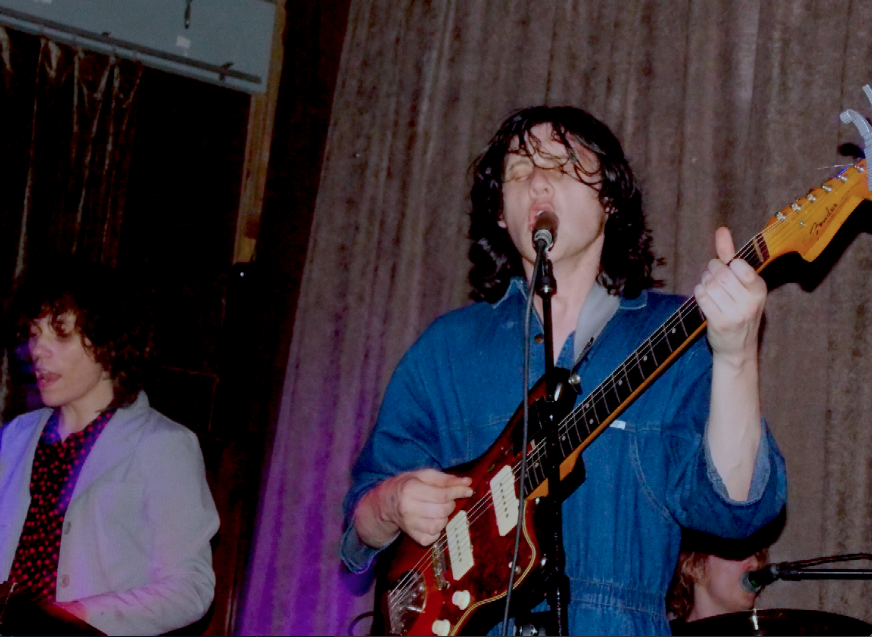
As soon as the band came onto the small stage at Brick and Mortar, though, that didn’t matter. Wearing embroidered frocks, suede coats, and ruffled blouses, costumes to complement the sound, the band played through a long set that, for all of its performative aspects, never felt forced. Each tune, from the feverishly noisy title track to the wistful “No Destruction,” poured out of the five-member band with ease.

Sam France, the diminutive frontperson, is a rockstar from a bygone era. Within the first few songs he had descended into the audience, shed his fur-lined coat to reveal a jean jumpsuit, and invited us all bowling. With beady eyes that shifted their focus in a manner reminiscent of the quietly plotting villain in any psychological thriller and fingers that moved as if he was casting a spell, he exhibited an oddly magnetic breed of charisma. And he had done all this while showing expert vocal range and control. He had the unique ability to sound both like Lou Reed to Nico.

And although the band’s music and style would seemingly make them untouchable, the venue and the familiarity on stage gave the performance an air of intimacy. While France’s swagger commanded the show, Jonathan Rado, with whom France formed the first incarnation of the band at age 15 (seven years ago – these guys are young), played a quietly endearing counterpart. Their interactions, including Rado muttering “asshole” into his mic, reminded us that though they perform like rock stars, they’re also kids that want to have a good time. And that kind of fun is contagious.

At the end of the night, Rado thanked the audience. “We have so many friends here,” he said and then corrected himself. “I mean, you’re all our friends.” And, with the help of that uncanny magic that seems to characterize the group, that felt true; for reasons that go beyond its restitching of classic rock, Foxygen feels like a band you’ve known and loved for a long time.

FEAST: 5 stoner cookbooks

0

culture@sfbg.com

FEAST If that joint’s got you jonesin’ for some serious grub, look no further. We’ve rolled up the latest and greatest in stoner cookbooks, perfect for any discerning bud lover’s taste test. No, we didn’t include any weed-infused recipes in this list, but hey, feel free to augment the recipes in the brownie cookbook. Whether you’re a marathon midnight toker or a one hitter-and-quitter, we understand your need for accessibility, availability, and general ease in eating after that smoke sesh. But move beyond Pop Tarts — even the most gourmand of pot heads could use some guidelines for grilling up goodies every once in awhile.

THE MAC AND CHEESE COOKBOOK BY ALLISON AREVALO AND ERIN WADE

Get your mac on. Allison Areval and Erin Wade, co-owners and authors of The Mac and Cheese Cookbook dish out 117 pages dedicated to one of America’s most beloved dishes, based on the crowd pleasing specialties dished up in their Oakland restaurant Homeroom. The book is an homage to Homeroom’s endless variations on the classic orange variety. That’s good news if your cravings leave you hankering for a variety of tastes. Basic bechamel sauces figure on the pages alongside smoky bacon, blue cheese, sriracha, and jalapeno poppers. There’s even a section on desserts suitable for your post-mac munch.

Ten Speed Press, $16.99

FIFTY SHADES OF BACON BY JENNA JOHNSON AND BEN MYHRE

This self-proclaimed “erotic” cookbook sinks its teeth into all things bacon. Bacon au gratin, bacon-wrapped asparagus, bacon Alfredo (just to name a few) — this pork-inspired parody cookbook has all the seductive appeal of its sexy, silly source material. But instead of a half baked S&M narrative, Johnson and Myhre’s book gets you off with five different carnivorous sections of easy-to-follow recipes. A seductive succession of events unfolds with chapters entitled “Foreplay,” “Multiple Orgasms,” “Morning Wood,” and “Bondage”, where bacon bits, bacon jam, bacon martinis, and bacon peanut stoke your stoner flames. And even if pig parts don’t get you off, they’ll almost certainly taste better when you’re high.

CreateSpace Independent Publishing Platform, $19.95

TRY THIS AT HOME: RECIPES FROM MY HEAD TO YOUR PLATE BY RICHARD BLAIS

We’ve all done it. Remember that time when you were so high, you thought putting chocolate sauce on canned jalapeños was the most genius concept ever? Until, of course, you made that dream reality and were left with a wounded mouth and sobering regret. It turns out, however, that unlikely pairings aren’t always painful. Top Chef: All Stars winner Richard Blais proves it to us in this cookbook. From root-beer basted lamb-shanks to coffee butter pancakes, the chef’s recipes do flavor exploration the right way — 125 right ways, to be precise. Go forth and concoct creatively.

Clarkson Potter Publishers, $30

MAD HUNGRY CRAVINGS BY LUCINDA SCALA QUINN

Lucinda Scala Quinn takes on take-out. Her mission in Mad Hungry Cravings is to reconcile the almost unbeatable deliciousness of fast food with the nourishment and nutrition that a home kitchen can produce, without a lot of work. Can good for you also be good for munchies? Damn straight. While raising three boys in NYC, where street food beats about anything found in the fridge (particularly if you’re a ravenous adolescent), Quinn had to create home-cooked meals capable of competition with street dogs and shawarmas.

Artisan, $27.95

BRILLIANT BROWNIES AND BARS: 25 FAVORITE BROWNIE AND BAR RECIPES BY COOKING PENGUIN

Stoners, perhaps more than most, know that not all brownies are created equal. If you have ever tried to make a batch of brownies with your favorite herb, you know it requires a careful balance of elements and timing. This book’s sugary-sweet offerings are winners, and recipes are composed with chocolate and without for more innovative pastry pleasure. The pages start with the standards and segue into non-traditional options, like cocoa-avocado, pumpkin pie, and nonpareil brownies. If you’d rather stick to the classics, try whipping up chocolate walnut brownies or Cooking Penguin’s ace pecan blondies.

168 Publishing, $12.95

Art: It’s like money in the bank

3

The panic that grips you in those moments when you need to open a new checking account, but really needed a double shot of espresso are over. Yes, my moneyed mates, greetings and welcomes to the Financial District’s somewhat recently opened Capital One 360 Cafe.

Within the gleaming walls, one can perform banking transactions and caffiene transactions with well trained bank staff-baristas. You can plan ahead and reserve a workspace at which you will enjoy free WiFi thanks to corporate America’s largess. And for a limited time on those gleaming walls, you can enjoy artist Nick Mancilla‘s commentary on the transience of wealth while you bask in the endless future of your own, unfurling before you like a expensive, woven, cheerful, infinite Stars and Stripes.

Yes, Mancillas’ portraits of our nation’s money men — Lincoln and the rest of his dollar bill brothers — on recycled cardboard from his “Cardboard Currency” series will star in a Capital One 360 Cafe art show that opens on March 28. We got in touch with the Sonoma art teacher via email to chat about how weird the whole thing is.

The cafe bank art gallery art bank cafe. Photo by Yelp user Luis C.

SFBG How did this show come about? Did Capital One contact you or vice versa?

NM It was serendipitous, because a friend told me about an interesting new financial institution in downtown SF (which fit my theme) with a gallery space for artists. I’ve been Sonoma County art educator for over 19 years by day and working artist by night — who’s just completed my MFA – so I’m always looking for venues to show. I went and walked through the space and immediately loved the concept of the marriage of a show like mine about money being at a big bank. Contacted them, gave them my website, and a few months later they gave me the green light.

This is exactly my message — because I have a Capital One account, I’m involved with capitalism, I’m just like every other American … we have to believe in money to live. The pieces are meant to tell the story about the fact that although trying, we have to have faith that even though money is no longer really backed by gold and is re-printed by the government by the billions we still believe (to live our lives) that this money we have in our pockets and bank accounts will still continue to hold value. This act of faith which is so scary is part of what inspired my “Cardboard Currency” collection.

SFBG Have you spent time in the cafe?

NM Yes, before I approached them and I’ve been back several time since to both measure the space and sit for a cup of coffee to witness how folks interact with the space.

SFBG When you were making these pieces, did you have intentions for them to be shown in a bank?

NM The collection was created before the show was booked – it was inspired by the financial calamities of 2007, 2008, 2009, 2010, 2011 … and on. When I saw the space in a bank I thought, “wow that would be an thought-provoking message to have the ‘Cardboard Currency’ show at a banking institution.”

SFBG Do you think that their intended message will come across in that setting?

NM Not sure. People have a variety of responses to seeing them. What’s interesting is two pieces that already sold, both to financial industry professionals.

It’s a subtle yet powerful message. The paintings are on cardboard commercial packaging — [they talk about] the ethereal, transient nature of money.

Ultimately I think the work will be appreciated. If you look closely you can see the message in the materials and work. The cardboard on which each piece is created for example still shows the bar codes, packaging instructions, and transit information that delineates the origins of the piece of cardboard.

This is a message onto itself which I’m very fond of. That these boxes come from Thailand, Malaysia, Mexico, and all across the world in the flow of global commerce. These cardboard boxes in my small town from across the world brings to light how interconnected (our) money is with the world and world-wide economy and community. The vast expansiveness of our world and yet how small a world it is. More importantly, how connected we all are on this very basic level as humans, the human race, and as financial partners. When one family loses a home in California, it’s intrinsically connected to other financial tragedies across the globe and back again. I’ve also got plans for collections depicting presidents/figure heads on other nations currency’s in the near future. 

“Cardboard Currency”

Through April 4

Capital One 360 Cafe

101 Post, SF

cafes.capitalone360.com/san_francisco

www.nickmancillas.com

Localized Appreesh: Swells

0

Localized Appreesh is our thank-you column to the musicians that make the Bay. To be considered, contact emilysavage@sfbg.com. 

When you grow up around surfers (I didn’t), you often hear talk of swells (or so I’m told). The swell conjures dreamy images of magical, mythical, perfectly curled waves and poses struck on glossy retro surfboards with the sunset soft and orangey behind it all. When you hear San Francisco trio, Swells, you might feel the same. 

The relatively new garage rock act may be based in the Mission, but up here (points to brain), the band is forever floating out at Ocean Beach, or likely some warmer coastal region. Check indie love story “Ships Set Sail,” with its bouncy drums, surf guitar riffs, and Strokes-like vocals, or reverby “Lost at Sea” for a peek into that state of mind. 

This week, Swells – made up of vocalist-bassist Ian Bruce, guitarist Diana Salier, drummer Rob Justesen – plays the Hemlock. But first, the band (which, full disclosure, is friendly with recent Localized Appreeshers Magic Fight) took our survey: 


Year and location of origin: October 2011, San Francisco.

Band name origin: Rob suggested Swells and everybody vetoed…then he brought it up again and we forgot that we’d vetoed. I think we were almost called Merchants or Polar Ghost. But Swells was a cool blend of our retro thing and beachiness. 

Band motto: “It’s not whatever, but fuck it.”  

Description of sound in 10 words or less: Chilled out garage rock with said retro and beachiness.

Instrumentation: Ian “Dad” Bruce – vocals, bass, soccer mom; Diana Salier – guitar player with mystique; Rob Justesen –  just plays drums.

Most recent release: We wrote a Christmas song called “Xmas Lights” and released it back in December. We’re planning to record some of our newer tunes this spring. 

 Best part about life as a Bay Area band: Lots of great venues to play in a small area. Also Karl the Fog

Worst part about life as a Bay Area band: Planning a West Coast tour is like doing figure eights across state lines — whereas Northwest bands can just straight shoot down to LA and back, and vice versa. 

First album ever purchased: Ian — Tom Petty Greatest Hits; Led Zeppelin II (on the same day); Diana — Green Day, NimrodRob — Outkast, Aquemini.

Most recent album purchased/downloaded: Ian — Mike Hurley, First SongsDiana — Beach Fossils, Clash the TruthRob– Local Natives, Hummingbird.

Favorite local eatery and dish: St. Francis! Ian — hog cakes; Diana — two egg breakfast+coffee; Rob — country breakfast.

Swells
With Torn ACLs, Sunrunner
Thu/21, 8:30pm, $6
Hemlock Tavern
1131 Polk, SF
www.hemlocktavern.com


Triggers

0

arts@sfbg.com

THEATER An average of 22 veterans a day committed suicide in the United States in 2010, according to a report last year by the U.S. Department of Veteran Affairs. Chris Kyle, however, was not likely to be one of them. The former Navy SEAL and author of a best-selling memoir had returned from military deployment in Iraq with a bounding enthusiasm for succeeding in civilian life, not least by helping other veterans with war-related trauma. Last month, on a shooting range in North Texas, a fellow vet apparently suffering from PTSD shot and killed Kyle, by then renowned as the U.S. military’s all-time deadliest sniper.

Irony like this defies fiction. But then that’s something George F. Walker understands. When the acclaimed Canadian playwright levels his pen at his primary target — he cruelly exploitative class system we inhabit back here on the “civilized” and oblivious home front —the result is dark and powerful comedy. A case in point is Dead Metaphor, his new play about a well-intentioned former army sniper facing a dismal job market and family pressures back home who goes to work for a right-wing candidate of the Michele Bachmann stripe. The world premiere comes to the Bay Area courtesy of an admirable production by American Conservatory Theater under the astute direction of Irene Lewis. As very serious as it is very funny, Dead Metaphor rings like the report from a not-so-distant battlefield.

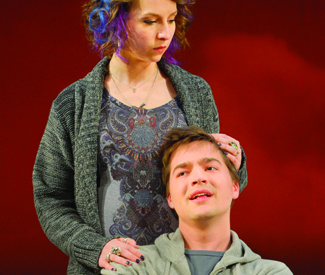
Five months back from military duty, and despite hearing nothing good about the government’s job placement services, Dean Trusk (a winningly cheerful, subtly shaded George Hampe) finally puts himself before the local job counselor (a dryly comical, increasingly disconcerted Anthony Fusco). After all, Dean has to consider his pregnant ex-wife (a smart, scrappy Rebekah Brockman) now that he’s defied expectations by coming back home alive and she’s accordingly re-marrying him. He also has an increasingly erratic and absent-minded father (a charmingly earthy, alarmingly volcanic Tom Bloom) coming unhinged by an as yet undiagnosed disease, and his brave but reeling mother (a heartbreakingly genuine Sharon Lockwood) who is faced with the prospect of having to soon place him in an expensive managed care facility.

The job counselor is unsettled by Dean’s ingenuous highlighting of his “high-level kills” on the battlefield as testament to his employable “efficiency” but, finally disarmed by the young man’s honorable sincerity, gets him a position as a coffee-fetching assistant to his politician-wife—a coldly calculating true believer of the now-mainstream Far Right (played with just the right mixture of acumen, conviction and parodic excess by an excellent René Augesen). The job exposes a rather blasé Dean to some campaign shenanigans his wife quickly deciphers as illicit, leading to a crisis for the couple as his moral compass swings first away from such dirty work and then back toward a desperate deal that might save his family from destitution.

Cast on a rotating set that moves an assortment of indoor and outdoor furnishing into and out of focus (against scenic designer Christopher Barreca’s semi-circular panorama of cloud-flecked sky), the story is a merry-go-round of insiders and outsiders, wheeling and dealing, war and peace, loyalty and opportunity, and truth and appearances. Act one in particular carries real force in the shrewd balance it strikes between razor-sharp comic dialogue and all-too-believable situations. This force attenuates somewhat in act two’s increasingly far-fetched details and strident humor. Nevertheless, the story remains anchored to a clear-sighted purpose, manifested in an unnerving and thought-provoking ending. Moreover, every scene along the way is engaging and often a sheer delight, propelled by fine acting, consistently hilarious and caustic dialogue, unexpected pangs of heartache, and a devilishly intriguing plot.

There seems to be a new raft of war-related dramas on stages lately (Word for Word’s You Know When the Men Are Gone being among the more recent, as ACT itself gets ready to bring in the internationally acclaimed Scottish production, Black Watch), but few use humor so powerfully to indict the hypocrisy and self-destruction of a society committed to permanent war. When tragedy repeats itself this long, suggests Dead Metaphor, it can only be played as farce.

DEAD METAPHOR

Wed/20-Sat/23, 8pm (also Sat/23, 2pm); Sun/24, 2 and 7pm, $20-$95

Geary Theater

415 Geary, SF

www.act-sf.org


Film listings

0

Film listings are edited by Cheryl Eddy. Reviewers are Kimberly Chun, Dennis Harvey, Lynn Rapoport, and Sara Maria Vizcarrondo. For rep house showtimes, see Rep Clock.

OPENING

Admission Paul Weitz directs Tina Fey in this comedy about a Princeton admissions officer who tracks down the son she gave up for adoption years before. (1:50) Marina.

The Croods DreamWorks’ latest animated tale is about prehistoric cave-people, with the requisite array of celebrity voices (Nicolas Cage, Emma Stone, Ryan Reynolds, etc.) (1:38) Balboa, Presidio.

Ginger and Rosa It’s the 1960s, nuclear war is a real possibility, and nuclear-family war is an absolute certainty, at least in the London house occupied by Ginger (Elle Fanning), her emotionally wounded mother (Mad Men‘s Christina Hendricks), and her narcissistic-intellectual father (Alessandro Nivola). In this downbeat coming-of-age tale from Sally Potter (1992’s Orlando), Ginger’s teenage rebellion quickly morphs into angst when her BFF Rosa (Beautiful Creatures‘ Alice Englert) wedges her sexed-up neediness between Ginger’s parents. Hendricks (playing the accordion — just like Joan!) and Annette Bening (as an American activist who encourages Ginger’s political-protest leanings) are strong, but Fanning’s powerhouse performance is the main focus — though even she’s occasionally overshadowed by her artificially scarlet hair. For an interview with writer-director Potter, visit www.sfbg.com/pixel_vision. (1:30) Albany, Embarcadero, Smith Rafael. (Eddy)

Hitler’s Children What’s in a name? A lot, when it’s Himmler, Goering, Hoess, or Goeth. Chanoch Ze’evi’s doc — comprised of interviews with direct descendants of high-ranking Nazis, all of whom condemn the actions of their relatives — unearths universally strong emotions and plenty of psychological baggage. Various coping mechanisms abound: Hermann Goering’s great-niece moved to rural New Mexico and casually remarks that both she and her brother voluntarily sterilized themselves, so there’d be "no more Goerings." Amon Goeth’s daughter recalls being kept in the dark about her father’s true role in the Holocaust — until she went to see Schindler’s List (1993), and realized he’d been a sadistic monster. The film’s most stirring sequence follows Rainer Hoess, look-alike grandson of Auschwitz commandant Rudolf, as he nervously journeys to the concentration camp-turned-museum for the first time. There, he encounters an elderly Auschwitz survivor who assures him, "You didn’t do it." But Hitler’s Children — which offers a unique, inspired angle on World War II — doesn’t allow itself a tidy last act. Hoess’ travel companion, a journalist who (like filmmaker Ze’evi) is a third-generation Holocaust survivor, remarks to the camera that he doesn’t believe there can be ever be closure to Hoess’ story, or by extension any of these stories — too much history, too much horror. (1:23) Yerba Buena Center for the Arts. (Eddy)

K-11 As her daughter’s middling On the Road adaptation cruises into theaters (see review, below), Jules Stewart’s directorial debut rolls out at the Roxie; it’s a high-camp-but-with-horrifying-rape-scenes drama set in a Los Angeles jail unit reserved for gay and transgender prisoners. The top bitch in the joint is Mousey (Kate del Castillo, one of several women-playing-men-playing-women), who struts around with Divine-style eyebrows, hurling threats ("You play with me, you get uglier") through her heavily-lined lips. There’s also a sadistic guard with a Hitler haircut (D.B. Sweeney) who controls the prisoners’ much-needed drug supply; a massive bully (Tommy "What Bike?" Lister); a sinewy hustler (Kevin Smith pal Jason Mewes); and a baby-voiced innocent who calls herself Butterfly (Portia Doubleday). Into this lurid set-up stumbles Raymond (Goran Visnijc), who is straight, but is also coked-out and maybe a murderer, so perhaps that’s why he lands there — it’s never really clear. Nothing’s really clear here, not least how a movie that’s so unpleasant most of the time manages also to be puzzlingly entertaining some of the time. Props go to del Castillo, I suppose, for attacking her role with nothing less than Nomi Malone levels of commitment. (1:30) Roxie. (Eddy)

The Manson Family See "The Devil’s Business." (1:35) Clay.

Olympus Has Fallen Gerard Butler, Morgan Freeman, and Aaron Eckhart (as the POTUS) star in this action thriller set amid White House intrigue. (2:00) Presidio.

On the Road Walter Salles (2004’s The Motorcycle Diaries) engages Diaries screenwriter Jose Rivera to adapt Jack Kerouac’s Beat classic; it’s translated to the screen in a streamlined version, albeit one rife with parties, drugs, jazz, danger, reckless driving, sex, philosophical conversations, soul-searching, and "kicks" galore. Brit Sam Riley (2007’s Control) plays Kerouac stand-in Sal Paradise, observing (and scribbling down) his gritty adventures as they unfold. Most of those adventures come courtesy of charismatic, freewheeling Dean Moriarty (Garrett Hedlund of 2010’s Tron: Legacy), who blows in and out of Sal’s life (and a lot of other people’s lives, too, including wives played by Kristen Stewart and Kirsten Dunst). Beautifully shot, with careful attention to period detail and reverential treatment of the Beat ethos, the film is an admirable effort but a little too shapeless, maybe simply due to the peripatetic nature of its iconic source material, to be completely satisfying. Among the performances, erstwhile teen dream Stewart is an uninhibited standout. (2:03) Embarcadero, Shattuck. (Eddy)

Somebody Up There Likes Me A textbook illustration of what’s so frequently right and wrong with Amerindie comedies today, Bob Byington’s feature starts out near-brilliantly in a familiar, heightened Napoleon Dynamite-type milieu of ostensibly normal people as self-absorbed, socially hapless satellites revolving around an existential hole at the center in the universe. The three main ones meet working at a suburban steakhouse: Emotionally nerve-deadened youth Max (Keith Poulson), the even more crassly insensitive Sal (Nick Offerman), and contrastly nice but still weird Lyla (Teeth‘s estimable Jess Weixler). All is well until the film starts skipping ahead five years at a time, growing more smugly misanthropic and pointless as time and some drastic shifts in fortune do nothing to change (or deepen) the characters. Still, the performers are intermittently hilarious throughout. (1:24) Roxie. (Harvey)

Spring Breakers See "The Devil’s Business." (1:34) Shattuck.

The We and the I See "Emotion in Motion." (1:43) Opera Plaza, Shattuck.

ONGOING

Amour Arriving in local theaters atop a tidal wave of critical hosannas, Amour now seeks to tempt popular acclaim — though actually liking this perfectly crafted, intensely depressing film (from Austrian director Michael Haneke) may be nigh impossible for most audience members. Eightysomething former music teachers Georges and Anne (the flawless Jean-Louis Trintignant and Emmanuelle Riva) are living out their days in their spacious Paris apartment, going to classical concerts and enjoying the comfort of their relationship. Early in the film, someone tries to break into their flat — and the rest of Amour unfolds with a series of invasions, with Anne’s declining health the most distressing, though there are also unwanted visits from the couple’s only daughter (an appropriately self-involved Isabelle Huppert), an inept nurse who disrespects Anne and curses out Georges, and even a rogue pigeon that wanders in more than once. As Anne fades into a hollow, twisted, babbling version of her former self, Georges also becomes hollow and twisted, taking care of her while grimly awaiting the inevitable. Of course, the movie’s called Amour, so there’s some tenderness involved. But if you seek heartwarming hope and last-act uplift, look anywhere but here. (2:07) Four Star, Smith Rafael. (Eddy)

Barbara The titular figure (Nina Hoss) looks the very picture of blonde Teutonic ice princess when she arrives — exiled from better prospects by some unspecified, politically ill-advised conduct — in at a rural 1980 East German hospital far from East Berlin’s relative glamour. She’s a pill, too, stiffly formal in dealings with curious locals and fellow staff including the disarmingly rumpled, gently amorous chief physician Andre (Ronald Zehrfeld). Yet her stern prowess as a pediatric doctor is softened by atypically protective behavior toward teen Stella (Jasna Fritzi Bauer), a frequent escapee from prison-like juvenile care facilities. Barbara has secrets, however, and her juggling personal, ethical, and Stasi-fearing priorities will force some uncomfortable choices. It is evidently the moment for German writer-director Christian Petzold to get international recognition after nearly 20 years of equally fine, terse, revealing work in both big-screen and broadcast media (much with Hoss as his prime on-screen collaborator). This intelligent, dispassionate, eventually moving character study isn’t necessarily his best. But it is a compelling introduction. (1:45) Opera Plaza, Shattuck. (Harvey)

Birth Story: Ina May Gaskin and the Farm Midwives When Ina May Gaskin had her first child, the hospital doctor used forceps (against her wishes) and her baby was sequestered for 24 hours immediately after birth. "When they brought her to me, I thought she was someone else’s," Gaskin recalls in Sara Lamm and Mary Wigmore’s documentary. Gaskin was understandably flummoxed that her first experience with the most natural act a female body can endure was as inhuman as the subject of an Eric Schlosser exposé. A few years later, she met Stephen Gaskin, a professor who became her second husband, and the man who’d go on to co-found the Farm, America’s largest intentional community, in 1971. On the Farm, women had children, and in those confines, far from the iron fist of insurance companies, Gaskin discovered midwifery as her calling. She recruited others, and dedicated herself to preserving an art that dwindles as the medical industry strives to treat women’s bodies like profit machines. Her message is intended for a larger audience than granola-eating moms-to-be: we’re losing touch with our bodies. Lamm and Wigmore bravely cram a handful of live births into the film; footage of a breech birth implies this doc could go on to be a useful teaching tool for others interested in midwifery. (1:33) New Parkway, Roxie. (Vizcarrondo)

The Call (1:34) 1000 Van Ness, Shattuck, SF Center.

Dead Man Down Pee. Yew. This Dead Man reeks, though surveying the cast list and judging from the big honking success of director Niels Arden Oplev’s previous film, 2009’s The Girl With the Dragon Tattoo, one would hope the stench wouldn’t be quite so crippling. Crime boss (Terrence Howard) is running panic-stricken after a series of spooky mail-art threats — and it isn’t long before we realize why: his most handy henchman Victor (Colin Farrell) is the one out to destroy him after the death of his wife and daughter. The wrinkle in the plot is the moody, beautiful, and scarred French girl Beatrice (Noomi Rapace) who lives across the way from Victor’s apartment with her deaf mom (Isabelle Huppert) and has plans to extract her own kind of vengeance. Despite Rapace’s brooding performance (Oplev obviously hopes she’ll pull a Lisbeth Salander and miraculously hack this mess — unsure about whether it’s a shoot-’em-up revenge exercise or a Rear Window-ish misfit love story — into something worthwhile) and cameos by actors like Dominic Cooper and F. Murray Abraham, they can’t compensate for the weak writing and muddled direction, the fact that Victor conveniently dithers instead of putting an end to his victim’s (and our) agony, and that the entire mis-en-scene with its Czechs, Albanians, et al, which reads like a Central European blood feud played out in Grand Central Station — just a few components as to why Dead Man stinks. (1:50) Metreon, 1000 Van Ness. (Chun)

Django Unchained Quentin Tarantino’s spaghetti western homage features a cameo by the original Django (Franco Nero, star of the 1966 film), and solid performances by a meticulously assembled cast, including Jamie Foxx as the titular former slave who becomes a badass bounty hunter under the tutelage of Dr. Schultz (Christoph Waltz). Waltz, who won an Oscar for playing the evil yet befuddlingly delightful Nazi Hans Landa in Tarantino’s 2009 Inglourious Basterds, is just as memorable (and here, you can feel good about liking him) as a quick-witted, quick-drawing wayward German dentist. There are no Nazis in Django, of course, but Tarantino’s taboo du jour (slavery) more than supplies motivation for the filmmaker’s favorite theme (revenge). Once Django joins forces with Schultz, the natural-born partners hatch a scheme to rescue Django’s still-enslaved wife, Broomhilda (Kerry Washington), whose German-language skills are as unlikely as they are convenient. Along the way (and it’s a long way; the movie runs 165 minutes), they encounter a cruel plantation owner (Leonardo DiCaprio), whose main passion is the offensive, shocking "sport" of "Mandingo fighting," and his right-hand man, played by Tarantino muse Samuel L. Jackson in a transcendently scandalous performance. And amid all the violence and racist language and Foxx vengeance-making, there are many moments of screaming hilarity, as when a character with the Old South 101 name of Big Daddy (Don Johnson) argues with the posse he’s rounded up over the proper construction of vigilante hoods. It’s a classic Tarantino moment: pausing the action so characters can blather on about something trivial before an epic scene of violence. Mr. Pink would approve. (2:45) Metreon. (Eddy)

Don’t Stop Believin’: Everyman’s Journey The director of 2003’s Imelda returns with this portrait of a way more sympathetic Filipino celebrity: Arnel Pineda, plucked from obscurity via YouTube after Journey’s Neil Schon spotted him singing with a Manila-based cover band. Don’t Stop Believin‘ follows Pineda, who openly admits past struggles with homelessness and addiction, from audition to 20,000-seat arena success as Journey’s charismatic new front man (he faces insta-success with an endearing combination of nervousness and fanboy thrill). He’s also up-front about feeling homesick, and the pressures that come with replacing one of the most famous voices in rock (Steve Perry doesn’t appear in the film, other than in vintage footage). Especially fun to see is how Pineda invigorates the rest of Journey; as the tour progresses, all involved — even the band’s veteran members, who’ve no doubt played "Open Arms" ten million times — radiate with excitement. (1:45) Sundance Kabuki. (Eddy)

Emperor This ponderously old-fashioned historical drama focuses on the negotiations around Japan’s surrender after the bombings of Hiroshima and Nagasaki. While many on the Allied side want the nation’s "Supreme Commander" Emperor Hirohito to pay for war crimes with his life, experts like bilingual Gen. Bonners Fellers (Matthew Fox) argue that the transition to peace can be achieved not by punishing but using this "living god" to wean the population off its ideological fanaticism. Fellers must ultimately sway gruff General MacArthur (Tommy Lee Jones) to the wisdom of this approach, while personally preoccupied with finding the onetime exchange-student love (Kaori Momoi) denied him by cultural divisions and escalating war rhetoric. Covering (albeit from the U.S. side) more or less the same events as Aleksandr Sokurov’s 2005 The Sun, Peter Webber’s movie is very different from that flawed effort, but also a lot worse. The corny Romeo and Juliet romance, the simplistic approach to explaining Japan’s "ancient warrior tradition" and anything else (via dialogue routinely as flat as "Things in Japan are not black and white!"), plus Alex Heffes’ bombastic old-school orchestral score, are all as banal as can be. Even the reliable Jones offers little more than conventional crustiness — as opposed to the inspired kind he does in Lincoln. (1:46) Embarcadero, Sundance Kabuki. (Harvey)

Escape from Planet Earth (1:35) Metreon.

A Fierce Green Fire: The Battle for a Living Planet San Franciscan Mark Kitchell (1990’s Berkeley in the Sixties) directs this thorough, gracefully-edited history of the environmental movement, beginning with the earliest stirrings of the Audubon Society and Aldo Leopold. Pretty much every major cause and group gets the vintage-footage, contemporary-interview treatment: the Sierra Club, Earth Day, Silent Spring, Love Canal, the pursuit of alternative energy, Greenpeace, Chico Mendes and the Amazon rainforests, the greenhouse effect and climate change, the pursuit of sustainable living, and so on. But if its scope is perhaps overly broad, A Fierce Green Fire still offers a valuable overview of a movement that’s remained determined for decades, even as governments and corporations do their best to stomp it out. Celebrity narrators Robert Redford, Ashley Judd, and Meryl Streep add additional heft to the message, though the raw material condensed here would be powerful enough without them. (1:50) Shattuck, Smith Rafael. (Eddy)

56 Up The world may be going to shit, but some things can be relied upon, like Michael Apted’s beloved series that’s traced the lives of 14 disparate Brits every seven years since original BBC documentary 7 Up in 1964. More happily still, this latest installment finds nearly all the participants shuffling toward the end of middle-age in more settled and contented form than ever before. There are exceptions: Jackie is surrounded by health and financial woes; special-needs librarian Lynn has been hit hard by the economic downturn; everybody’s favorite undiagnosed mental case, the formerly homeless Neil, is never going to fully comfortable in his own skin or in too close proximity to others. But for the most part, life is good. Back after 28 years is Peter, who’d quit being filmed when his anti-Thatcher comments provoked "malicious" responses, even if he’s returned mostly to promote his successful folk trio the Good Intentions. Particularly admirable and evidently fulfilling is the path that’s been taken by Symon, the only person of color here. Raised in government care, he and his wife have by now fostered 65 children — with near-infinite love and generosity, from all appearances. If you’re new to the Up series, you’ll be best off doing a Netflix retrospective as preparation for this chapter, starting with 28 Up. (2:24) Magick Lantern. (Harvey)

The Gatekeepers Coming hard on the heels of The Law in These Parts, which gave a dispassionate forum to the lawmakers who’ve shaped — some might say in pretzel form — the military legal system that’s been applied by Israelis to Palestinians for decades, Dror Moreh’s documentary provides another key insiders’ viewpoint on that endless occupation. His interviewees are six former heads of the Shin Bet, Israel’s secret service. Their top-secret decisions shaped the nation’s attempts to control terrorist sects and attacks, as seen in a nearly half-century parade of news clips showing violence and negotiation on both sides. Unlike the subjects of Law, who spoke a cool, often evasive legalese to avoid any awkward ethical issues, these men are at times frankly — and surprisingly — doubtful about the wisdom of some individual decisions, let alone about the seemingly ever-receding prospect of a diplomatic peace. They even advocate for a two-state solution, an idea the government they served no longer seems seriously interested in advancing. The Gatekeepers is an important document that offers recent history examined head-on by the hitherto generally close-mouthed people who were in a prime position to direct its course. (1:37) Embarcadero, Shattuck. (Harvey)

A Good Day to Die Hard A Good Day to Die Hard did me wrong. How did I miss the signs? Badass daddy rescues son. Perps cover up ’80s era misdeeds. They’re in Russia&ldots;Die Hard has become Taken. All it needs is someone to kidnap Bonnie Bedelia or deflower Jai Courtney and the transformation will be complete. What’s more, A Good Day is so obviously made for export it’s almost not trying to court the American audience for which the franchise is a staple. In a desperate reach for brand loyalty director John Moore (2001’s Behind Enemy Lines) has loaded the film with slight allusions to McClane’s past adventures. The McClanes shoot the ceiling and litter the floor with glass. John escapes a helicopter by leaping into a skyscraper window from the outside. John’s ringtone plays "Ode to Joy." The glib rejoinders are all there but they’re smeared by crap direction and odd pacing that gives ample time to military vehicles tumbling down the highway but absolutely no time for Bruce’s declarations of "I’m on VACATION!" Which may be just as well — it’s no "Yipee kay yay, motherfucker." When Willis says that in A Good Day, all the love’s gone out of it. I guess every romance has to end. (1:37) Metreon. (Vizcarrondo)

Happy People: A Year in the Taiga The ever-intrepid Werner Herzog, with co-director Dmitry Vasyukov, pursues his fascination with extreme landscapes by chronicling a year deep within the Siberian Taiga. True to form, he doesn’t spend much time in the 300-inhabitant town nestled amid "endless wilderness," accessible only by helicopter or boat (and only during the warmer seasons); instead, he seeks the most isolated environment possible, venturing into the frozen forest with fur trappers who augment their passed-down-over-generations job skills with the occasional modern assist (chainsaws and snowmobiles are key). Gorgeous cinematography and a curious, respectful tone elevate Happy People from mere ethnographic-film status, though that’s essentially what it is, as it records the men carving canoes, bear-proofing their cabins, interacting with their dogs, and generally being incredibly self-reliant amid some of the most rugged conditions imaginable. And since it’s Herzog, you know there’ll be a few gently bizarre moments, as when a politician’s summer campaign cruise brings a musical revue to town, or the director himself refers to "vodka — vicious as jet fuel" in his trademark droll voice over. (1:34) Magick Lantern, Roxie, Smith Rafael. (Eddy)

Identity Thief America is made up of asshole winners and nice guy losers — or at least that’s the thesis of Identity Thief, a comedy about a crying-clown credit card bandit (Melissa McCarthy) and the sweet sucker (Jason Bateman) she lures into her web of chaos. Bateman plays Sandy, a typical middle-class dude with a wife, two kids, and a third on the way. He’s always struggling to break even and just when it seems like his ship’s come in, Diana (McCarthy) jacks his identity — a crime that requires just five minutes in a dark room with Sandy’s social security number. Suddenly, his good name is contaminated with her prior arrests, drug-dealer entanglements, and mounting debt; it’s like the capitalist version of VD. But as the "kind of person who has no friends," Diana is as tragic as she is comic, providing McCarthy an acting opportunity no one saw coming when she was dispensing romantic advice on The Gilmore Girls. Director Seth Gordon (2011’s Horrible Bosses) treats this comedy like an action movie — as breakneck as slapstick gets — and he relies so heavily on discomfort humor that the film doesn’t just prompt laughs, it pokes you in the ribs until you laugh, man, LAUGH! While Identity Thief has a few complex moments about how defeating "sticking it to the man" can be (mostly because only middle men get hurt), it’s mostly as subtle as a pratfall and just as (un-)rewarding. (1:25) Metreon, 1000 Van Ness. (Vizcarrondo)

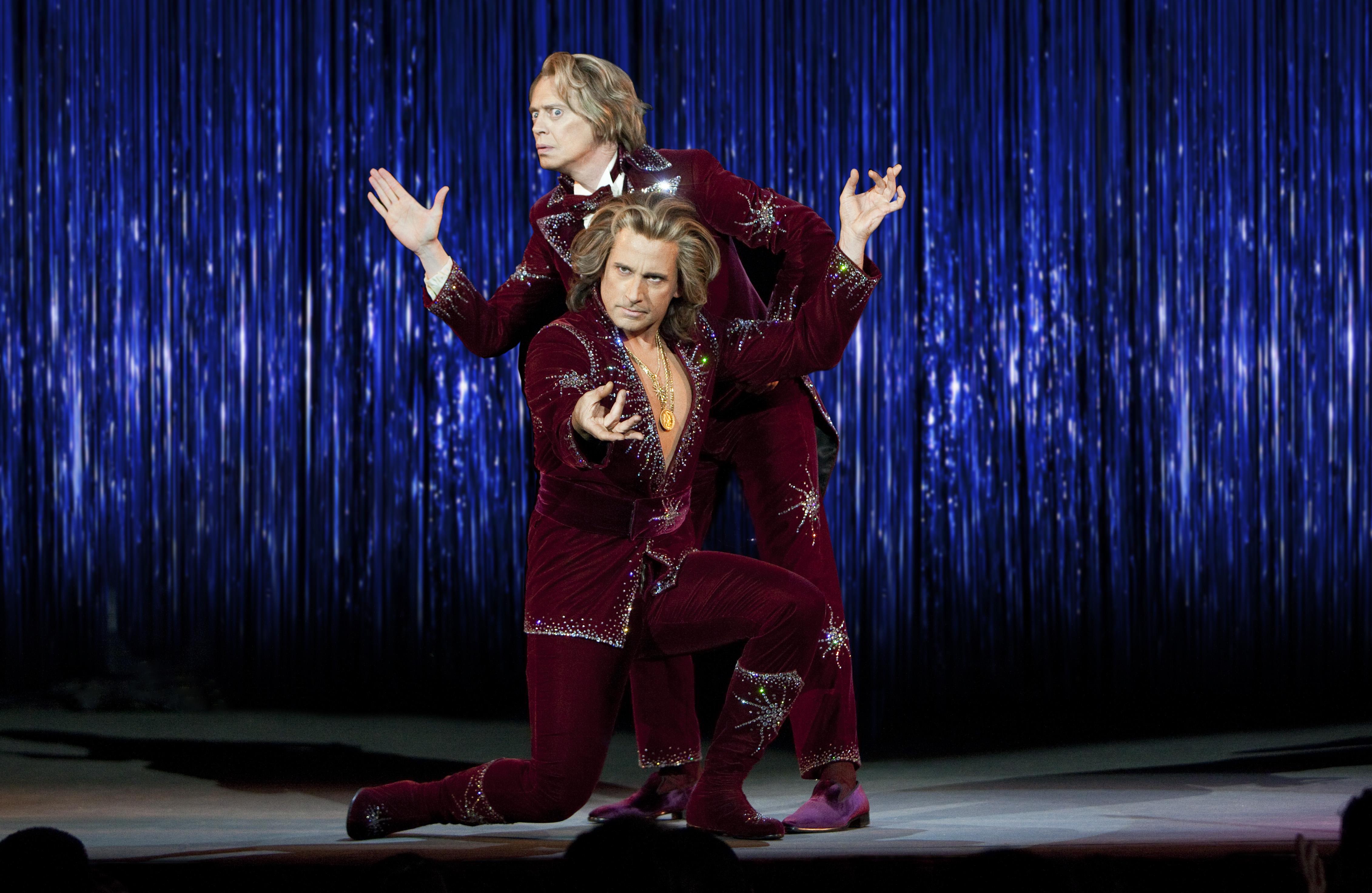
The Incredible Burt Wonderstone Steve Carell dips into the men-at-work comic genre so associated with Will Ferrell: he’s Burt Wonderstone, who starts out as a picked-on kid discovering his powers via a kit by Las Vegas magician Rance Holloway (Alan Arkin). The ensuing years have not been kind to Burt, a relatively decent guy struggling to shed the douchey buildup of ego, corn, and dated moves à la David Copperfield (ta-da, who magically appears), while working for benevolently threatening casino boss Doug Munny (James Gandolfini) with his childhood best friend Anton (Steve Buscemi, reviving the naifitude of The Big Lebowski‘s Donny) and side fox Jane (Olivia Wilde). The shot of adrenalin to the moribund heart of Burt and Anton’s act: Jim Carrey’s "Brain Rapist," who aims to ream his colleagues by cutting playing cards from his flesh and going to bed on fiery coals. How can the old-schoolers remain relevant? Hard work is key for Carell, who rolls out the straight-man sweetness that seem to make him a fit for romantic comedies — though his earnestness and need to be liked, as usual, err on the side of convention, while taking for granted the not-quite-there chemistry with, in this instance, Wilde. Fortunately whatever edge is lacking materializes whenever Carrey’s ridiculously ombré-tressed daredevil is on screen. Using his now-battered, still-malleable features to full effect, he’s a whole different ball of cheese, lampooning those who will go to any lengths — gouging, searing, and maiming — to entertain. (1:40) Marina, 1000 Van Ness, SF Center, Vogue. (Chun)

Jack the Giant Slayer (1:55) Metreon, 1000 Van Ness.

Life of Pi Several filmmakers including Alfonso Cuarón, Jean-Pierre Jeunet, and M. Night Shyamalan had a crack at Yann Martel’s "unfilmable" novel over the last decade, without success. That turns out to have been a very good thing, since Ang Lee and scenarist David Magee have made probably the best movie possible from the material — arguably even an improvement on it. Framed as the adult protagonist’s (Irrfan Khan) lengthy reminiscence to an interested writer (Rafe Spall) it chronicles his youthful experience accompanying his family and animals from their just shuttered zoo on a cargo ship voyage from India to Canada. But a storm capsizes the vessel, stranding teenaged Pi (Suraj Sharma) on a lifeboat with a mini menagerie — albeit one swiftly reduced by the food chain in action to one Richard Parker, a whimsically named Bengal tiger. This uneasy forced cohabitation between Hindu vegetarian and instinctual carnivore is an object lesson in survival as well as a fable about the existence of God, among other things. Shot in 3D, the movie has plenty of enchanted, original imagery, though its outstanding technical accomplishment may lie more in the application of CGI (rather than stereoscopic photography) to something reasonably intelligent for a change. First-time actor Sharma is a natural, while his costar gives the most remarkable performance by a wild animal this side of Joaquin Phoenix in The Master. It’s not a perfect film, but it’s a charmed, lovely experience. (2:00) 1000 Van Ness, SF Center, Sundance Kabuki. (Harvey)

Like Someone in Love A student apparently moonlighting as an escort, Akiko (Rin Takanashi) doesn’t seem to like her night job, and likes even less the fact that she’s forced into seeing a client while the doting, oblivious grandmother she’s been avoiding waits for her at the train station. But upon arriving at the apartment of the john, she finds sociology professor Takashi (Tadashi Okuno) courtly and distracted, uninterested in getting her in bed even when she climbs into it of her own volition. Their "date" extends into the next day, introducing him to the possessive, suspicious boyfriend she’s having problems with (Ryo Kase), who mistakes the prof for her grandfather. As with Abbas Kiarostami’s first feature to be shot outside his native Iran — the extraordinary European coproduction Certified Copy (2010) — this Japan set second lets its protagonists first play at being having different identities, then teases us with the notion that they are, in fact, those other people. It’s also another talk fest that might seem a little too nothing-happening, too idle-intellectual gamesmanship at a casual first glance, but could also grow increasingly fascinating and profound with repeat viewings. (1:49) Opera Plaza. (Harvey)

Lincoln Distinguished subject matter and an A+ production team (Steven Spielberg directing, Daniel Day-Lewis starring, Tony Kushner adapting Doris Kearns Goodwin, John Williams scoring every emotion juuust so) mean Lincoln delivers about what you’d expect: a compelling (if verbose), emotionally resonant (and somehow suspenseful) dramatization of President Lincoln’s push to get the 13th amendment passed before the start of his second term. America’s neck-deep in the Civil War, and Congress, though now without Southern representation, is profoundly divided on the issue of abolition. Spielberg recreates 1865 Washington as a vibrant, exciting place, albeit one filled with so many recognizable stars it’s almost distracting wondering who’ll pop up in the next scene: Jared Harris as Ulysses S. Grant! Joseph Gordon-Levitt as Robert Lincoln! Lena Dunham’s shirtless boyfriend on Girls (Adam Driver) as a soldier! Most notable among the huge cast are John Hawkes, Tim Blake Nelson, and a daffy James Spader as a trio of lobbyists; Sally Field as the troubled First Lady; and likely Oscar contenders Tommy Lee Jones (as winningly cranky Rep. Thaddeus Stevens) and Day-Lewis, who does a reliably great job of disappearing into his iconic role. (2:30) Metreon, New Parkway. (Eddy)

No Long before the Arab Spring, a people’s revolution went down in Chile when a 1988 referendum toppled the country’s dictator, Augusto Pinochet, thanks in part to an ad exec who dared to sell the dream to his countrymen and women — using the relentlessly upbeat, cheesy language of a Pepsi Generation. In No‘s dramatization of this true story, ad man Rene Saavedra (Gael Garcia Bernal) is approached by the opposition to Pinochet’s regime to help them on their campaign to encourage Chile’s people to vote "no" to eight more years under the brutal strongman. Rene’s well-aware of the horrors of the dictatorship; not only are the disappeared common knowledge, his activist ex (Antonia Zegers) has been beaten and jailed with seeming regularity. Going up against his boss (Alfredo Castro), who’s overseeing the Pinochet campaign, Rene takes the brilliant tact in the opposition’s TV programs of selling hope — sound familiar? — promising "Chile, happiness is coming!" amid corny mimes, dancers, and the like. Director-producer Pablo Larrain turns out to be just as genius, shooting with a grainy U-matic ’80s video camera to match his footage with 1988 archival imagery, including the original TV spots, in this invigorating spiritual kin of both 2012’s Argo and 1997’s Wag the Dog. (1:50) Embarcadero, Piedmont, Shattuck. (Chun)

Oz: The Great and Powerful Providing a backstory for the man behind the curtain, director Sam Raimi gives us a prequel of sorts to 1939’s The Wizard of Oz. Herein we follow the adventures of a Depression-era Kansas circus magician named Oscar (James Franco) — Oz to his friends — as he cons, philanders, bickers with his behind-the-scenes assistant Frank (Zach Braff), and eventually sails away in a twister, bound for a Technicolor land of massively proportioned flora, talking fauna, and witches ranging from dazzlingly good to treacherously wicked. From one of them, Theodora (Mila Kunis), he learns that his arrival — in Oz, just to clarify — has set in motion the fulfillment of a prophecy: that a great wizard, also named Oz, will bring about the downfall of a malevolent witch (Rachel Weisz), saving the kingdom and its cheery, goodhearted inhabitants. Unfortunately for this deserving populace, Oz spent his last pre-twister moments with the Baum Bros. Circus (the name a tribute to L. Frank Baum, writer of the Oz children’s books) demonstrating a banged-up moral compass and an undependable streak and proclaiming that he would rather be a great man than a good man. Unfortunately for the rest of us, this theme is revisited ad nauseam as Oz and the oppressively beneficent witch Glinda (Michelle Williams) — whose magic appears to consist mainly of nice soft things like bubbles and fog — stand around debating whether he’s the right man for the task. When the fog clears, though, the view is undeniably pretty. While en route to and from the Emerald City, Oz and his companions — among them a non-evil flying monkey (voiced by Braff) and a rather adorable china doll (Joey King) — wander through a deliriously arresting, Fantasia-esque landscape whose intricate, inventive construction helps distract from the plodding, saccharine rhetoric and unappealing story line. (2:07) Balboa, California, 1000 Van Ness, Presidio, SF Center, Sundance Kabuki. (Rapoport)

Quartet Every year there’s at least one: the adorable-old-cootfest, usually British, that proves harmless and reassuring and lightly tear/laughter producing enough to convince a certain demographic that it’s safe to go to the movies again. The last months have seen two, both starring Maggie Smith (who’s also queen of that audience’s home viewing via Downton Abbey). Last year’s The Best Exotic Marigold Hotel, in which Smith played a bitchy old spinster appalled to find herself in India, has already filled the slot. It was formulaic, cute, and sentimental, yes, but it also practiced more restraint than one expected. Now here’s Quartet, which is basically the same flower arrangement with quite a bit more dust on it. Smith plays a bitchy old spinster appalled to find herself forced into spending her twilight years at a home for the elderly. It’s not just any such home, however, but Beecham House, whose residents are retired professional musicians. Gingerly peeking out from her room after a few days’ retreat from public gaze, Smith’s Jean Horton — a famed English soprano — spies a roomful of codgers rolling their hips to Afropop in a dance class. "This is not a retirement home — this is a madhouse!" she pronounces. Oh, the shitty lines that lazy writers have long depended on Smith to make sparkle. Quartet is full of such bunk, adapted with loving fidelity, no doubt, from his own 1999 play by Ronald Harwood, who as a scenarist has done some good adaptations of other people’s work (2002’s The Pianist). But as a generator of original material for about a half-century, he’s mostly proven that it is possible to prosper that long while being in entirely the wrong half-century. Making his directorial debut: 75-year-old Dustin Hoffman, which ought to have yielded a more interesting final product. But with its workmanlike gloss and head-on take on the script’s very predictable beats, Quartet could as well have been directed by any BBC veteran of no particular distinction. (1:38) Albany, Four Star, Clay, Smith Rafael. (Harvey)

Side Effects Though on the surface Channing Tatum appears to be his current muse, Steven Soderbergh seems to have gotten his smart, topical groove back, the one that spurred him to kick off his feature filmmaking career with the on-point Sex, Lies, and Videotape (1989) and went missing with the fun, featherweight Ocean’s franchise. (Alas, he’s been making claims that Side Effects will be his last feature film.) Here, trendy designer antidepressants are the draw — mixed with the heady intoxicants of a murder mystery with a nice hard twist that would have intrigued either Hitchcock or Chabrol. As Side Effects opens, the waifish Emily Taylor (Rooney Mara), whose inside-trading hubby (Tatum) has just been released from prison, looks like a big-eyed little basket of nerves ready to combust — internally, it seems, when she drives her car into a wall. Therapist Jonathan Banks (Jude Law), who begins to treat her after her hospital stay, seems to care about her, but nevertheless reflexively prescribes the latest anti-anxiety med of the day, on the advice of her former doctor (Catherine Zeta-Jones). Where does his responsibility for Emily’s subsequent actions begin and end? Soderbergh and his very able cast fill out the issues admirably, with the urgency that was missing from the more clinical Contagion (2011) and the, ahem, meaty intelligence that was lacking in all but the more ingenious strip scenes of last year’s Magic Mike. (1:30) Metreon, 1000 Van Ness, Shattuck, Sundance Kabuki. (Chun)

Silver Linings Playbook After guiding two actors to Best Supporting Oscars in 2010’s The Fighter, director David O. Russell returns (adapting his script from Matthew Quick’s novel) with another darkly comedic film about a complicated family that will probably earn some gold of its own. Though he’s obviously not ready to face the outside world, Pat (Bradley Cooper) checks out of the state institution he’s been court-ordered to spend eight months in after displaying some serious anger-management issues. He moves home with his football-obsessed father (Robert De Niro) and worrywart mother (Jacki Weaver of 2010’s Animal Kingdom), where he plunges into a plan to win back his estranged wife. Cooper plays Pat as a man vibrating with troubled energy — always in danger of flying into a rage, even as he pursues his forced-upbeat "silver linings" philosophy. But the movie belongs to Jennifer Lawrence, who proves the chops she showcased (pre-Hunger Games megafame) in 2010’s Winter’s Bone were no fluke. As the damaged-but-determined Tiffany, she’s the left-field element that jolts Pat out of his crazytown funk; she’s also the only reason Playbook‘s dance-competition subplot doesn’t feel eye-rollingly clichéd. The film’s not perfect, but Lawrence’s layered performance — emotional, demanding, bitchy, tough-yet-secretly-tender — damn near is. (2:01) 1000 Van Ness, Piedmont, Presidio, SF Center, Shattuck, Sundance Kabuki. (Eddy)

Stoker None of the characters in Park Chan-wook’s English-language debut, Stoker, devour a full plate of still-squirming octopus. (For that, see Park’s international breakthrough, 2003’s Oldboy; chances are the meal won’t be duplicated in the Spike Lee remake due later this year.) But that’s not to say Stoker — with its Hitchcockian script by Wentworth Miller — isn’t full of unsettling, cringe-inducing moments, as the titular family (Nicole Kidman as Evelyn, the dotty mom; Mia Wasikowska as India, the moody high-schooler) faces the sudden death of husband-father Richard (Dermot Mulroney, glimpsed in flashbacks) and the equally suddenly arrival of sleek, sinister Uncle Charles (Matthew Goode). Lensed with an eerie elegance and an exquisite attention to creepy details, this tale of dysfunctional ties that bind leads to a rather insane conclusion; whether that bugs you or not depends on how willing you are to surrender to its madness. (1:38) California, Metreon, Piedmont. (Eddy)

21 and Over (1:33) Metreon, 1000 Van Ness.

Upside Down This sci-fi romance from Argentine-French director Juan Solanas is one of those movies that would look brilliant as a coffee-table photo book — nearly every shot is some striking mix of production design, CGI, color grading, and whatnot. Too bad, though, that it has to open its mouth and ruin everything. Jim Sturgess and Kirsten Dunst play star-crossed lovers who live on adjacent twin planets with their own opposing gravitational forces. Nonetheless, they somehow manage to groove on one another until the authorities — miscegenation between the prosperous residents of "Up Top" and the exploited peasants of "Down Below" being forbidden — interfere, resulting in a ten-year separation and one case of amnesia. But the course of true love cannot be stopped by evil energy conglomerates, at least in the movies. Sturgess’ breathless narration starts things off with "The universe…full of wonders!" and ends with "Our love would change the entire course of history," so you know Solanas has absolutely no cliché-detecting skills. He does have a great eye — but after a certain point, that isn’t enough to compensate for his awful dialogue, flat pacing, and disinterest in exploring any nuances of plot or character. Dunst is stuck playing a part that might as well simply be called the Girl; Sturgess is encouraged to overact, but his ham is prosciutto beside the thick-cut slabs of thespian pigmeat offered by Timothy Spall as the designated excruciating comic relief. If the fact that our lovers are called "Adam" and "Eden" doesn’t make you groan, you just might buy this ostentatiously gorgeous but gray-matter-challenged eye candy. If you think Tarsem is a genius and 1998’s What Dreams May Come one of the great movie romances, you will love, love, love Upside Down. (1:53) Opera Plaza. (Harvey)

War Witch They should give out second-place Oscars. Like, made of silver instead of gold. In that alternate-universe scenario, Canadian writer-director Kim Nguyen’s vivid, Democratic Republic of the Congo-shot drama might’ve picked up some hardware (beyond its many film-fest accolades) to go with its Best Foreign Language Film nomination. War Witch couldn’t stop the march of Amour, but it’s deeply moving in its own way — the story of Komona (played by first-time actor Rachel Mwanza), kidnapped from her village at 12 and forced to join the rebel army that roams the forests of her unnamed African country. Her first task: machine-gunning her own parents. Her ability to see ghosts (portrayed by actors in eerie body paint) elevates her to the status of "war witch," and she’s tasked with using her sixth sense to aid the rebel general’s attacks against the government army. But even this elevated position can’t quell the physical and spiritual unease of her situation; idyllic love with a fellow teenage soldier (Serge Kanyinda) proves all too brief, and as months pass, Komona remains haunted by her past. The end result is a brutal yet poetic film, elevated by Mwanza’s thoughtful performance. (1:30) Roxie. (Eddy)

Warm Bodies A decade and a half of torrid, tormented vampire-human entanglements has left us accustomed to rooting for romances involving the undead and the still-alive. Some might argue, however, that no amount of pop-cultural prepping could be sufficient to get us behind a human-zombie love story for the ages. Is guzzling human blood really measurably less gross than making a meal of someone’s brains and other body parts? Somehow, yes. Recognizing this perceptual hurdle, writer-director Jonathan Levine (2011’s 50/50, 2008’s The Wackness) secures our sympathies at the outset of Warm Bodies by situating us inside the surprisingly active brain of the film’s zombie protagonist. Zombies, it turns out, have internal monologues. R (Nicholas Hoult) can only remember the first letter of his former name, but as he shambles and shuffles and slumps his way through the terminals of a postapocalyptic airport overrun by his fellow corpses (as they’re called by the film’s human population), he fills us in as best he can on the global catastrophe that’s occurred and his own ensuing existential crisis. By the time he meets not-so-cute with Julie (Teresa Palmer), a young woman whose father (John Malkovich) is commander-in-chief of the human survivors living in a walled-off city center, we’ve learned that he collects vinyl, that he has a zombie best friend, and that he doesn’t want to be like this. We may still be flinching at the thought of his and Julie’s first kiss, but we’re also kind of rooting for him. The plot gapes in places, where a tenuous logic gets trampled and gives way, but Levine’s script, adapted from a novel by Isaac Marion, is full of funny riffs on the zombie condition, which Hoult invests with a comic sweetness as his character staggers toward the land of the living. (1:37) Metreon, New Parkway, 1000 Van Ness. (Rapoport)

Zero Dark Thirty The extent to which torture was actually used in the hunt for Osama Bin Ladin may never be known, though popular opinion will surely be shaped by this film, as it’s produced with the same kind of "realness" that made Kathryn Bigelow’s previous film, the Oscar-winning The Hurt Locker (2008), so potent. Zero Dark Thirty incorporates torture early in its chronology — which begins in 2003, after a brief opening that captures the terror of September 11, 2001 using only 911 phone calls — but the practice is discarded after 2008, a sea-change year marked by the sight of Obama on TV insisting that "America does not torture." (The "any more" goes unspoken.) Most of Zero Dark Thirty is set in Pakistan and/or "CIA black sites" in undisclosed locations; it’s a suspenseful procedural that manages to make well-documented events (the July 2005 London bombings; the September 2008 Islamabad Marriott Hotel bombing) seem shocking and unexpected. Even the raid on Bin Ladin’s HQ is nail-bitingly intense. The film immerses the viewer in the clandestine world, tossing out abbreviations ("KSM" for al-Qaeda bigwig Khalid Sheikh Mohammed) and jargon ("tradecraft") without pausing for a breath. It is thrilling, emotional, engrossing — the smartest, most tightly-constructed action film of the year. At the center of it all: a character allegedly based on a real person whose actual identity is kept top-secret by necessity. She’s interpreted here in the form of a steely CIA operative named Maya, played to likely Oscar-winning perfection by Jessica Chastain. No matter the film’s divisive subject matter, there’s no denying that this is a powerful performance. "Washington says she’s a killer," a character remarks after meeting this seemingly delicate creature, and he’s proven right long before Bin Ladin goes down. Some critics have argued that character is underdeveloped, but anyone who says that isn’t watching closely enough. Maya may not be given a traditional backstory, but there’s plenty of interior life there, and it comes through in quick, vulnerable flashes — leading up to the payoff of the film’s devastating final shot. (2:39) Metreon, 1000 Van Ness. (Eddy)

On the Cheap listings

0

Submit items for the listings at listings@sfbg.com. For further information on how to submit items for the listings, see Picks.

WEDNESDAY 20

1960’s Go-Go Groove Make-out Room, 3225 22nd St., SF. www.1960sgo-go.com. 7pm, free. Bust out those white go-go boots and learn some standard ’60s dance moves like the twist, jerk, pony, watusi, hully gully — even the tighten up! If you’re in need of some liquid courage before you shake it, head over to the Make-out Room at 6pm for some sweet happy hour deals.

THURSDAY 21

“Bold Local NightLife” California Academy of Sciences, 55 Music Concourse, SF. www.calacademy.org. 6-10pm, $12. Art and science converge as the Bold Italic website takes over this week’s Nightlife at the Academy of Sciences. Meet the local merchants, designers, artists, and producers from the ‘hoods we know and love. Folks from Misdirections Magic Shop, bakery co-op Arizmendi, wine delivery service Rewinery, and more will all have tables alongside the alligators, jellyfish, and penguins.

“Growing Pains, The Business of Cannabis in San Francisco” San Francisco Planning and Urban Research Association, 654 Mission, second floor, SF. www.visityerbabuena.org/events 6:30-7:30pm, free. RSVP suggested. SF Appeal editor Eve Batey and writers Heather Donahue and Chris Roberts will explore the state of marijuana in SF, and possible impacts of proposed cannabis legislative reforms. If you have a specific topic or question you would like addressed, email growingpains@sfappeal.com before tonight’s talk.

FRIDAY 22

“Dance Anywhere” Various locations throughout the Bay Area. www.danceanywhere.org. Noon, free. Why wait until tonight to get your groove on? In this global event — offshoots are taking place in major cities around the globe — participants are encouraged to stop whatever they’re doing when the clock strikes 12, and bust a move. Performances by professional dancers will take place at the SFMOMA, City Hall, and Yerba Buena Center.

“PhotographsPlus” Dogpatch Café and Art Gallery, 2295 Third St., SF. www.dogpatchcafe.com. Through May 10. Opening reception 6-8pm, free. This exhibit features local artist Shawn Ray Harris includes three distinct series of works created over the last 15 years. Endowed with a whimsical charm, Harris’ work offers a look into urban landscapes and the creatures that inhabit them.

“Game On” 1AM Gallery, 1000 Howard, SF. www.1amsf.com. Through April 20. Opening reception: 6:30-9:30pm, free. We need not remind you that nerds are the new cool kids. Instead, we’ll let the new show at street art-centric 1AM Gallery lend more evidence to prove the point. Its new group show highlights videogame characters rendered in vinyl doll and canvas by graf artists like Vogue TDK, Estria, and Mike “Bam” Tyau.

SATURDAY 23

Easter egg hunt for dogs Golden Gate Park, Marx Meadow, SF. www.waghotels.com. Noon-2pm, $15. Purchase tickets online. Help your pup sniff out some of the 2,000-plus plastic eggs containing treats and prizes at dog and cat resort, Wag Hotel’s fourth annual fundraiser benefiting local animal rescue organizations. Attendees will also enjoy complimentary hor d’oeuvres and beverages, have a chance to see how their doggie bud feels about the Easter Bunny.

Art Explosion spring open studio Art Explosion Studios, 2425 17th St., SF. www.artexplosionstudios.com. 7-11pm, free. Also Sun/24, noon-5pm. One of San Francisco’s largest art collectives will be holding its 13th annual spring open studio this weekend. Check out work from over 140 artist, painters, photographers, fashion designers, jewelers, and textile designers from around the city.

SUNDAY 24

Backyard Foraging book signing Omnivore Books, 3885A Cesar Chavez, SF. www.omnivorebooks.com. 3-4pm, free. You don’t need to trek into the forest to forage edible plants. Ideal for first-time foragers, Backyard Foraging: 65 Familiar Plants You Didn’t Know You Could Eat by Ellen Zachos features 70 edible weeds, flowers, mushrooms, and ornamental plants typically found in urban or suburban neighborhoods. Head over to Omnivore Books today to meet Zachos, listen to her speak about her book, and get a signed copy.

SF Mixtape Society exchange The Make-Out Room, 3225 22nd St., SF. www.sfmixtapesociety.com. 4-6pm, free. The San Francisco Mixtape Society is dedicated to the art of making and exchanging music mixes. Attendees are invited to assemble a mix according to the theme (this month is “anchors and sails”) in cassette, CD, or USB form. Come ready for newness: a magically random raffle will send you home with someone else’s mix at the end of the night. Record yours in cassette form and score yourself a free drink.

MONDAY 25

Izzies Awards Ceremony Z Space, 450 Florida, SF. www.zspace.org. 6-8pm, free. The Oscars may be over but award season has not come to a close just yet. The 27th Annual Izzies awards will take place tonight, honoring outstanding achievements in dance across the Bay Area. Hosting the ceremony is AileyCamp director David McCauley, and CounterPULSE executive and artistic director Jessica Robinson. After the ceremony, mingle with some dance big shots over dessert and coffee.

TUESDAY 26

French cinema class Alliance Française, 1345 Bush, SF. alliance-francaise-sf.weebly.com. 6:45pm, $5. To help non-French speakers discover French cinema, the Alliance Française of San Francisco is offering this weekly Tuesday night class, which includes a French film screening followed by a discussion. The class will take place in the Alliance Française’s intimate theatre where free wine, refreshments, popcorn (and English subtitles) will be provided.

“Remnants of San Francisco: Pieces of the Bygone City” St. Philip’s Catholic Church, 725 Diamond, SF. www.sanfranciscohistory.org. 7:30pm, $5. San Francisco’s architecture is decorative, meticulous, and often begs the question of passers-by: “what is the story here?” Get that tale tonight as historian Christopher Pollock will present before and after photos of significant architecture around the city, explaining the buildings’ significance and why they were built the way they were.


Magic, madness, witches, and holdin’ on to that feeeeeling: new movies!

0

The newly-renamed CAAMfest (the film festival formerly known as the San Francisco International Asian American Film Festival) opens tonight with its own slice of March Madness: basketball-themed doc Linsanity. For more on that film and other CAAMfest documentaries, go here. You’ll find a rundown of films focusing on troubled family ties here.

Also this week: Park Chan-wook’s first English-language film, Stoker, opens tomorrow — it’s a creepy delight, and I spoke with Park about Hitchcock and more in this interview.

For those so inclined, Hollywood rolls out Halle Berry thriller The Call (make your own “phoning in her performance” joke here) and Steves Carell and Buscemi, plus Jim Carrey, as battling magicians in comedy The Incredible Burt Wonderstone.

Read on for short takes on a new horror omnibus, a stirring tale from Romania, the Oscar-nominated War Witch, two music docs (Journey + Snoop Lion), and more.

http://www.youtube.com/watch?v=LiZr4VFmcpk

The ABCs of Death Variety is the spice of life, yet this international omnibus with 26 directors contributing elaborate micro-shorts on various methods of death — one per alphabetical letter — is like eating dried dill or cilantro for two-plus hours. It’s pungent, but what might color a complex stew proves insufferable in this narrow one. Just why it seems narrow is anyone’s guess — this should have been a genius idea. Yet there are almost no outstanding or memorable contributions, despite the wide-open invitation to extreme content. Filmmakers include Jorge Michel Grau (2010’s We Are What We Are), Simon Rumley (of brilliant 2006 feature The Living and the Dead), Srdjan Spasojevic (2010’s A Serbian Film), cult-favorite actress Angela Bettis, and many more. Nearly all seem to have spent far more than their allotted $5000 budget. There are segments parodying exploitation cinema and video games; offering hyperbolic Terminator-style sci-fi; line-drawing and claymation segments; plus plenty of gross-out narratives. Yet it’s all surprisingly crappy (not least an episode called “Toilet”), with precious few more than halfway decent episodes. The sum impact is of a mean-spirited project that brings out the vacuously shock-value prone worst in everyone involved. (2:03) (Dennis Harvey)

http://www.youtube.com/watch?v=HiJRGbCKCu0

Beyond the Hills Cristian Mungiu — one of the main reasons everyone’s all excited about the Romanian New Wave — follows up his Palme d’Or winner, 2007’s 4 Months, 3 Weeks and 2 Days, with another stark look at a troubled friendship between two women. Beyond the Hills‘ Voichita and Alina (Cosmina Stratan and Cristina Flutur, who shared the Best Actress prize at the 2012 Cannes Film Festival; for his part, Mungiu won Best Screenplay) were BFFs and, we slowly realize, lovers while growing up at a Romanian orphanage. When they aged out of the facility, the reserved Voichita moved to a rural monastery to become a nun, and the outburst-prone Alina pinballed around, doing a stint as a barmaid in Germany before turning up in Voichita’s village, lugging emotional baggage of the jealous, needy, possibly mentally ill, and definitely misunderstood variety. It can’t end well for anyone, as all involved — dismissive local doctors, Alina’s no-longer-accomodating foster family, the priest (Valeriu Andriuta), and the other nuns —  would rather not spend any time or energy caring for a troubled, destitute outsider. Even Voichita can only look on helplessly as an exorcism, a brutal and cruel procedure, is decided upon as Alina’s last, best hope. Based on a real 2005 incident in Moldavia, Mungiu’s unsettling film is a masterpiece of exquisitely composed shots, harsh themes, and naturalistic performances. Check out an interview with Mungiu here. (2:30) (Cheryl Eddy)

http://www.youtube.com/watch?v=Z0cIj3OPM2k

Don’t Stop Believin’: Everyman’s Journey The director of 2003’s Imelda returns with this portrait of a way more sympathetic Filipino celebrity: Arnel Pineda, plucked from obscurity via YouTube after Journey’s Neil Schon spotted him singing with a Manila-based cover band. Don’t Stop Believin’ follows Pineda, who openly admits past struggles with homelessness and addiction, from audition to 20,000-seat arena success as Journey’s charismatic new frontman (he faces insta-success with an endearing combination of nervousness and fanboy thrill). He’s also up-front about feeling homesick, and the pressures that come with replacing one of the most famous voices in rock (Steve Perry doesn’t appear in the film, other than in vintage footage). Especially fun to see is how Pineda invigorates the rest of Journey; as the tour progresses, all involved — even the band’s veteran members, who’ve no doubt played “Open Arms” ten million times — radiate with excitement. (1:45) (Cheryl Eddy)

http://www.youtube.com/watch?v=94zbq5Vaod0

A Fierce Green Fire: The Battle for a Living Planet San Franciscan Mark Kitchell (1990’s Berkeley in the Sixties) directs this thorough, gracefully-edited history of the environmental movement, beginning with the earliest stirrings of the Audubon Society and Aldo Leopold. Pretty much every major cause and group gets the vintage-footage, contemporary-interview treatment: the Sierra Club, Earth Day, Silent Spring, Love Canal, the pursuit of alternative energy, Greenpeace, Chico Mendes and the Amazon rainforests, the greenhouse effect and climate change, the pursuit of sustainable living, and so on. But if its scope is perhaps overly broad, A Fierce Green Fire still offers a valuable overview of a movement that’s remained determined for decades, even as governments and corporations do their best to stomp it out. Celebrity narrators Robert Redford, Ashley Judd, and Meryl Streep add additional heft to the message, though the raw material condensed here would be powerful enough without them. (1:50) (Cheryl Eddy)

http://www.youtube.com/watch?v=MTqyV5Kw9Ss

Reincarnated Reinvention is the name of the game for some mercurial, inventive pop artists, but for rapper Snoop Dogg, now going by the moniker Snoop Lion — you get the scoop on the name change in this doc — transformation turns out to be unexpectedly serious, earnest business. Flirting with Cheech and Chong travelogue comedy, Reincarnated ostensibly spins off the making of the hip-hop artist’s forthcoming 12th album of the same name in Jamaica, with smokin’ production help from Diplo’s Major Lazer gang. The camera is there for many standard behind-the-music moments — sessions with family and adulation in the musical-fertile Trenchtown — along with many not-quite-ready-for-prime-times spent lighting up with other musicians, growers up in the mountains, and reggae forebears like Bunny Wailer. But there’s more going on beneath the billowing smoke: providing the context for today’s high times and ultimately chronicling the rhyme-slinger’s life and times and his path to Jamaica, reggae, and Rastafari spirituality and culture, Vice Films director Andy Capper lays the foundation for Snoop’s shift from rap to Rastafari by revisiting his gangster youth, the rise and fall of Death Row Records, the passing of 2Pac and Nate Dogg, and the music that made the man’s name —and continues to give us a reason to care. The easy, sexy charisma that made Snoop a star is on full display here, and doubtless his latest experiences on reality TV have made Capp’s job that much easier when it came to digging deeper, while the clouds of herb, Cali and Jamaican alike, give viewers a taste of the fun, and possibly healing, attendant with life with the Doggfather. (1:36) (Kimberly Chun)

http://www.youtube.com/watch?v=XtixqUXid9A

Upside Down This sci-fi romance from Argentine-French director Juan Solanas is one of those movies that would look brilliant as a coffee-table photo book — nearly every shot is some striking mix of production design, CGI, color grading, and whatnot. Too bad, though, that it has to open its mouth and ruin everything. Jim Sturgess and Kirsten Dunst play star-crossed lovers who live on adjacent twin planets with their own opposing gravitational forces. Nonetheless, they somehow manage to groove on one another until the authorities — miscegenation between the prosperous residents of “Up Top” and the exploited peasants of “Down Below” being forbidden — interfere, resulting in a ten-year separation and one case of amnesia. But the course of true love cannot be stopped by evil energy conglomerates, at least in the movies. Sturgess’ breathless narration starts things off with “The universe…full of wonders!” and ends with “Our love would change the entire course of history,” so you know Solanas has absolutely no cliché-detecting skills. He does have a great eye — but after a certain point, that isn’t enough to compensate for his awful dialogue, flat pacing, and disinterest in exploring any nuances of plot or character. Dunst is stuck playing a part that might as well simply be called the Girl; Sturgess is encouraged to overact, but his ham is prosciutto beside the thick-cut slabs of thespian pigmeat offered by Timothy Spall as the designated excruciating comic relief. If the fact that our lovers are called “Adam” and “Eden” doesn’t make you groan, you just might buy this ostentatiously gorgeous but grey-matter-challenged eye candy. If you think Tarsem is a genius and 1998’s What Dreams May Come one of the great movie romances, you will love, love, love Upside Down. (1:53) (Dennis Harvey)

http://www.youtube.com/watch?v=BKXEh_kfPCY

War Witch They should give out second-place Oscars. Like, made of silver instead of gold. In that alternate-universe scenario, Canadian writer-director Kim Nguyen’s vivid, Democratic Republic of the Congo-shot drama might’ve picked up some hardware (beyond its many film-fest accolades) to go with its Best Foreign Language Film nomination. War Witch couldn’t stop the march of Amour, but it’s deeply moving in its own way — the story of Komona (played by first-time actor Rachel Mwanza), kidnapped from her village at 12 and forced to join the rebel army that roams the forests of her unnamed African country. Her first task: machine-gunning her own parents. Her ability to see ghosts (portrayed by actors in eerie body paint) elevates her to the status of “war witch,” and she’s tasked with using her sixth sense to aid the rebel general’s attacks against the government army. But even this elevated position can’t quell the physical and spiritual unease of her situation; idyllic love with a fellow teenage soldier (Serge Kanyinda) proves all too brief, and as months pass, Komona remains haunted by her past. The end result is a brutal yet poetic film, elevated by Mwanza’s thoughtful performance. (1:30) (Cheryl Eddy)

Film Listings

0

Film listings are edited by Cheryl Eddy. Reviewers are Kimberly Chun, Dennis Harvey, Lynn Rapoport, and Sara Maria Vizcarrondo. For rep house showtimes, see Rep Clock.

CAAMFEST

The Center for Asian American Media Fest runs March 14-24. Venues include the Castro Theatre, 429 Castro, SF; New People Cinema, 1746 Post, SF; Great Star Theater, 636 Jackson, SF; Pacific Film Archive, 2575 Bancroft, Berk; and Sundance Kabuki Cinemas, 1881 Post, SF. For tickets (most films $12) and complete schedule, visit www.caamedia.org. For commentary, see "Truth and Daring" and "In the Blood."

OPENING

The ABCs of Death Variety is the spice of life, yet this international omnibus with 26 directors contributing elaborate micro-shorts on various methods of death — one per alphabetical letter — is like eating dried dill or cilantro for two-plus hours. It’s pungent, but what might color a complex stew proves insufferable in this narrow one. Just why it seems narrow is anyone’s guess — this should have been a genius idea. Yet there are almost no outstanding or memorable contributions, despite the wide-open invitation to extreme content. Filmmakers include Jorge Michel Grau (2010’s We Are What We Are), Simon Rumley (of brilliant 2006 feature The Living and the Dead), Srdjan Spasojevic (2010’s A Serbian Film), cult-favorite actress Angela Bettis, and many more. Nearly all seem to have spent far more than their allotted $5000 budget. There are segments parodying exploitation cinema and video games; offering hyperbolic Terminator-style sci-fi; line-drawing and claymation segments; plus plenty of gross-out narratives. Yet it’s all surprisingly crappy (not least an episode called "Toilet"), with precious few more than halfway decent episodes. The sum impact is of a mean-spirited project that brings out the vacuously shock-value prone worst in everyone involved. (2:03) Clay. (Harvey)

Beyond the Hills Cristian Mungiu — one of the main reasons everyone’s all excited about the Romanian New Wave — follows up his Palme d’Or winner, 2007’s 4 Months, 3 Weeks and 2 Days, with another stark look at a troubled friendship between two women. Beyond the Hills‘ Voichita and Alina (Cosmina Stratan and Cristina Flutur, who shared the Best Actress prize at the 2012 Cannes Film Festival; for his part, Mungiu won Best Screenplay) were BFFs and, we slowly realize, lovers while growing up at a Romanian orphanage. When they aged out of the facility, the reserved Voichita moved to a rural monastery to become a nun, and the outburst-prone Alina pinballed around, doing a stint as a barmaid in Germany before turning up in Voichita’s village, lugging emotional baggage of the jealous, needy, possibly mentally ill, and definitely misunderstood variety. It can’t end well for anyone, as all involved — dismissive local doctors, Alina’s no-longer-accommodating foster family, the priest (Valeriu Andriuta), and the other nuns — would rather not spend any time or energy caring for a troubled, destitute outsider. Even Voichita can only look on helplessly as an exorcism, a brutal and cruel procedure, is decided upon as Alina’s last, best hope. Based on a real 2005 incident in Moldavia, Mungiu’s unsettling film is a masterpiece of exquisitely composed shots, harsh themes, and naturalistic performances. For an interview with Mungiu, visit www.sfbg.com/pixel_vision. (2:30) Embarcadero, Shattuck. (Eddy)

The Call Brad Anderson (2004’s The Machinist) directs Halle Berry as a 911 operator who has to save a girl (Abigail Breslin) from a killer. (1:34) Shattuck.

Don’t Stop Believin’: Everyman’s Journey The director of 2003’s Imelda returns with this portrait of a way more sympathetic Filipino celebrity: Arnel Pineda, plucked from obscurity via YouTube after Journey’s Neil Schon spotted him singing with a Manila-based cover band. Don’t Stop Believin‘ follows Pineda, who openly admits past struggles with homelessness and addiction, from audition to 20,000-seat arena success as Journey’s charismatic new front man (he faces insta-success with an endearing combination of nervousness and fanboy thrill). He’s also up-front about feeling homesick, and the pressures that come with replacing one of the most famous voices in rock (Steve Perry doesn’t appear in the film, other than in vintage footage). Especially fun to see is how Pineda invigorates the rest of Journey; as the tour progresses, all involved — even the band’s veteran members, who’ve no doubt played "Open Arms" ten million times — radiate with excitement. (1:45) Sundance Kabuki. (Eddy)

A Fierce Green Fire: The Battle for a Living Planet San Franciscan Mark Kitchell (1990’s Berkeley in the Sixties) directs this thorough, gracefully-edited history of the environmental movement, beginning with the earliest stirrings of the Audubon Society and Aldo Leopold. Pretty much every major cause and group gets the vintage-footage, contemporary-interview treatment: the Sierra Club, Earth Day, Silent Spring, Love Canal, the pursuit of alternative energy, Greenpeace, Chico Mendes and the Amazon rainforests, the greenhouse effect and climate change, the pursuit of sustainable living, and so on. But if its scope is perhaps overly broad, A Fierce Green Fire still offers a valuable overview of a movement that’s remained determined for decades, even as governments and corporations do their best to stomp it out. Celebrity narrators Robert Redford, Ashley Judd, and Meryl Streep add additional heft to the message, though the raw material condensed here would be powerful enough without them. (1:50) Opera Plaza, Shattuck, Smith Rafael. (Eddy)

The Incredible Burt Wonderstone Steve Carell, Steve Buscemi, and Jim Carrey star in this comedy about rival Las Vegas magicians. (1:40) Presidio.

Reincarnated Reinvention is the name of the game for some mercurial, inventive pop artists, but for rapper Snoop Dogg, now going by the moniker Snoop Lion — you get the scoop on the name change in this doc — transformation turns out to be unexpectedly serious, earnest business. Flirting with Cheech and Chong travelogue comedy, Reincarnated ostensibly spins off the making of the hip-hop artist’s forthcoming 12th album of the same name in Jamaica, with smokin’ production help from Diplo’s Major Lazer gang. The camera is there for many standard behind-the-music moments — sessions with family and adulation in the musical-fertile Trenchtown — along with many not-quite-ready-for-prime-times spent lighting up with other musicians, growers up in the mountains, and reggae forebears like Bunny Wailer. But there’s more going on beneath the billowing smoke: providing the context for today’s high times and ultimately chronicling the rhyme-slinger’s life and times and his path to Jamaica, reggae, and Rastafarian spirituality and culture, Vice Films director Andy Capper lays the foundation for Snoop’s shift from rap to Rastafari by revisiting his gangster youth, the rise and fall of Death Row Records, the passing of 2Pac and Nate Dogg, and the music that made the man’s name —and continues to give us a reason to care. The easy, sexy charisma that made Snoop a star is on full display here, and doubtless his latest experiences on reality TV have made Capp’s job that much easier when it came to digging deeper, while the clouds of herb, Cali and Jamaican alike, give viewers a taste of the fun, and possibly healing, attendant with life with the Doggfather. (1:36) Opera Plaza. (Chun)

Stoker See "Family Plot." (1:38) California.
Upside Down This sci-fi romance from Argentine-French director Juan Solanas is one of those movies that would look brilliant as a coffee-table photo book — nearly every shot is some striking mix of production design, CGI, color grading, and whatnot. Too bad, though, that it has to open its mouth and ruin everything. Jim Sturgess and Kirsten Dunst play star-crossed lovers who live on adjacent twin planets with their own opposing gravitational forces. Nonetheless, they somehow manage to groove on one another until the authorities — miscegenation between the prosperous residents of "Up Top" and the exploited peasants of "Down Below" being forbidden — interfere, resulting in a ten-year separation and one case of amnesia. But the course of true love cannot be stopped by evil energy conglomerates, at least in the movies. Sturgess’ breathless narration starts things off with "The universe…full of wonders!" and ends with "Our love would change the entire course of history," so you know Solanas has absolutely no cliché-detecting skills. He does have a great eye — but after a certain point, that isn’t enough to compensate for his awful dialogue, flat pacing, and disinterest in exploring any nuances of plot or character. Dunst is stuck playing a part that might as well simply be called the Girl; Sturgess is encouraged to overact, but his ham is prosciutto beside the thick-cut slabs of thespian pigmeat offered by Timothy Spall as the designated excruciating comic relief. If the fact that our lovers are called "Adam" and "Eden" doesn’t make you groan, you just might buy this ostentatiously gorgeous but gray-matter-challenged eye candy. If you think Tarsem is a genius and 1998’s What Dreams May Come one of the great movie romances, you will love, love, love Upside Down. (1:53) Embarcadero. (Harvey)

War Witch They should give out second-place Oscars. Like, made of silver instead of gold. In that alternate-universe scenario, Canadian writer-director Kim Nguyen’s vivid, Democratic Republic of the Congo-shot drama might’ve picked up some hardware (beyond its many film-fest accolades) to go with its Best Foreign Language Film nomination. War Witch couldn’t stop the march of Amour, but it’s deeply moving in its own way — the story of Komona (played by first-time actor Rachel Mwanza), kidnapped from her village at 12 and forced to join the rebel army that roams the forests of her unnamed African country. Her first task: machine-gunning her own parents. Her ability to see ghosts (portrayed by actors in eerie body paint) elevates her to the status of "war witch," and she’s tasked with using her sixth sense to aid the rebel general’s attacks against the government army. But even this elevated position can’t quell the physical and spiritual unease of her situation; idyllic love with a fellow teenage soldier (Serge Kanyinda) proves all too brief, and as months pass, Komona remains haunted by her past. The end result is a brutal yet poetic film, elevated by Mwanza’s thoughtful performance. (1:30) Elmwood, Roxie. (Eddy)

ONGOING

Adventures of Serial Buddies (1:31) 1000 Van Ness.

Amour Arriving in local theaters atop a tidal wave of critical hosannas, Amour now seeks to tempt popular acclaim — though actually liking this perfectly crafted, intensely depressing film (from Austrian director Michael Haneke) may be nigh impossible for most audience members. Eightysomething former music teachers Georges and Anne (the flawless Jean-Louis Trintignant and Emmanuelle Riva) are living out their days in their spacious Paris apartment, going to classical concerts and enjoying the comfort of their relationship. Early in the film, someone tries to break into their flat — and the rest of Amour unfolds with a series of invasions, with Anne’s declining health the most distressing, though there are also unwanted visits from the couple’s only daughter (an appropriately self-involved Isabelle Huppert), an inept nurse who disrespects Anne and curses out Georges, and even a rogue pigeon that wanders in more than once. As Anne fades into a hollow, twisted, babbling version of her former self, Georges also becomes hollow and twisted, taking care of her while grimly awaiting the inevitable. Of course, the movie’s called Amour, so there’s some tenderness involved. But if you seek heartwarming hope and last-act uplift, look anywhere but here. (2:07) Four Star, Smith Rafael. (Eddy)

Argo If you didn’t know the particulars of the 1979 Iranian Revolution, you won’t be an expert after Argo, but the film does a good job of capturing America’s fearful reaction to the events that followed it — particularly the hostage crisis at the US embassy in Tehran. Argo zeroes in on the fate of six embassy staffers who managed to escape the building and flee to the home of the sympathetic Canadian ambassador (Victor Garber). Back in Washington, short-tempered CIA agents (including a top-notch Bryan Cranston) cast about for ways to rescue them. Enter Tony Mendez (Ben Affleck, who also directs), exfil specialist and father to a youngster wrapped up in the era’s sci-fi craze. While watching 1973’s Battle for the Planet of the Apes, Tony comes up with what Cranston’s character calls "the best bad idea we have:" the CIA will fund a phony Canadian movie production (corny, intergalactic, and titled Argo) and pretend the six are part of the crew, visiting Iran for a few days on a location shoot. Tony will sneak in, deliver the necessary fake-ID documents, and escort them out. Neither his superiors, nor the six in hiding, have much faith in the idea. ("Is this the part where we say, ‘It’s so crazy it just might work?’" someone asks, beating the cliché to the punch.) Argo never lets you forget that lives are at stake; every painstakingly forged form, every bluff past a checkpoint official increases the anxiety (to the point of being laid on a bit thick by the end). But though Affleck builds the needed suspense with gusto, Argo comes alive in its Hollywood scenes. As the show-biz veterans who mull over Tony’s plan with a mix of Tinseltown cynicism and patiotic duty, John Goodman and Alan Arkin practically burst with in-joke brio. I could have watched an entire movie just about those two. (2:00) SF Center, Sundance Kabuki. (Eddy)

Barbara The titular figure (Nina Hoss) looks the very picture of blonde Teutonic ice princess when she arrives — exiled from better prospects by some unspecified, politically ill-advised conduct — in at a rural 1980 East German hospital far from East Berlin’s relative glamour. She’s a pill, too, stiffly formal in dealings with curious locals and fellow staff including the disarmingly rumpled, gently amorous chief physician Andre (Ronald Zehrfeld). Yet her stern prowess as a pediatric doctor is softened by atypically protective behavior toward teen Stella (Jasna Fritzi Bauer), a frequent escapee from prison-like juvenile care facilities. Barbara has secrets, however, and her juggling personal, ethical, and Stasi-fearing priorities will force some uncomfortable choices. It is evidently the moment for German writer-director Christian Petzold to get international recognition after nearly 20 years of equally fine, terse, revealing work in both big-screen and broadcast media (much with Hoss as his prime on-screen collaborator). This intelligent, dispassionate, eventually moving character study isn’t necessarily his best. But it is a compelling introduction. (1:45) Opera Plaza, Shattuck. (Harvey)

Birth Story: Ina May Gaskin and the Farm Midwives When Ina May Gaskin had her first child, the hospital doctor used forceps (against her wishes) and her baby was sequestered for 24 hours immediately after birth. "When they brought her to me, I thought she was someone else’s," Gaskin recalls in Sara Lamm and Mary Wigmore’s documentary. Gaskin was understandably flummoxed that her first experience with the most natural act a female body can endure was as inhuman as the subject of an Eric Schlosser exposé. A few years later, she met Stephen Gaskin, a professor who became her second husband, and the man who’d go on to co-found the Farm, America’s largest intentional community, in 1971. On the Farm, women had children, and in those confines, far from the iron fist of insurance companies, Gaskin discovered midwifery as her calling. She recruited others, and dedicated herself to preserving an art that dwindles as the medical industry strives to treat women’s bodies like profit machines. Her message is intended for a larger audience than granola-eating moms-to-be: we’re losing touch with our bodies. Lamm and Wigmore bravely cram a handful of live births into the film; footage of a breech birth implies this doc could go on to be a useful teaching tool for others interested in midwifery. (1:33) New Parkway, Roxie. (Vizcarrondo)

Dead Man Down Pee. Yew. This Dead Man reeks, though surveying the cast list and judging from the big honking success of director Niels Arden Oplev’s previous film, 2009’s The Girl With the Dragon Tattoo, one would hope the stench wouldn’t be quite so crippling. Crime boss (Terrence Howard) is running panic-stricken after a series of spooky mail-art threats — and it isn’t long before we realize why: his most handy henchman Victor (Colin Farrell) is the one out to destroy him after the death of his wife and daughter. The wrinkle in the plot is the moody, beautiful, and scarred French girl Beatrice (Noomi Rapace) who lives across the way from Victor’s apartment with her deaf mom (Isabelle Huppert) and has plans to extract her own kind of vengeance. Despite Rapace’s brooding performance (Oplev obviously hopes she’ll pull a Lisbeth Salander and miraculously hack this mess — unsure about whether it’s a shoot-’em-up revenge exercise or a Rear Window-ish misfit love story — into something worthwhile) and cameos by actors like Dominic Cooper and F. Murray Abraham, they can’t compensate for the weak writing and muddled direction, the fact that Victor conveniently dithers instead of putting an end to his victim’s (and our) agony, and that the entire mis-en-scene with its Czechs, Albanians, et al, which reads like a Central European blood feud played out in Grand Central Station — just a few components as to why Dead Man stinks. (1:50) Metreon, 1000 Van Ness, Presidio, Shattuck. (Chun)

Django Unchained Quentin Tarantino’s spaghetti western homage features a cameo by the original Django (Franco Nero, star of the 1966 film), and solid performances by a meticulously assembled cast, including Jamie Foxx as the titular former slave who becomes a badass bounty hunter under the tutelage of Dr. Schultz (Christoph Waltz). Waltz, who won an Oscar for playing the evil yet befuddlingly delightful Nazi Hans Landa in Tarantino’s 2009 Inglourious Basterds, is just as memorable (and here, you can feel good about liking him) as a quick-witted, quick-drawing wayward German dentist. There are no Nazis in Django, of course, but Tarantino’s taboo du jour (slavery) more than supplies motivation for the filmmaker’s favorite theme (revenge). Once Django joins forces with Schultz, the natural-born partners hatch a scheme to rescue Django’s still-enslaved wife, Broomhilda (Kerry Washington), whose German-language skills are as unlikely as they are convenient. Along the way (and it’s a long way; the movie runs 165 minutes), they encounter a cruel plantation owner (Leonardo DiCaprio), whose main passion is the offensive, shocking "sport" of "Mandingo fighting," and his right-hand man, played by Tarantino muse Samuel L. Jackson in a transcendently scandalous performance. And amid all the violence and racist language and Foxx vengeance-making, there are many moments of screaming hilarity, as when a character with the Old South 101 name of Big Daddy (Don Johnson) argues with the posse he’s rounded up over the proper construction of vigilante hoods. It’s a classic Tarantino moment: pausing the action so characters can blather on about something trivial before an epic scene of violence. Mr. Pink would approve. (2:45) Metreon, Sundance Kabuki. (Eddy)

Emperor This ponderously old-fashioned historical drama focuses on the negotiations around Japan’s surrender after the bombings of Hiroshima and Nagasaki. While many on the Allied side want the nation’s "Supreme Commander" Emperor Hirohito to pay for war crimes with his life, experts like bilingual Gen. Bonners Fellers (Matthew Fox) argue that the transition to peace can be achieved not by punishing but using this "living god" to wean the population off its ideological fanaticism. Fellers must ultimately sway gruff General MacArthur (Tommy Lee Jones) to the wisdom of this approach, while personally preoccupied with finding the onetime exchange-student love (Kaori Momoi) denied him by cultural divisions and escalating war rhetoric. Covering (albeit from the U.S. side) more or less the same events as Aleksandr Sokurov’s 2005 The Sun, Peter Webber’s movie is very different from that flawed effort, but also a lot worse. The corny Romeo and Juliet romance, the simplistic approach to explaining Japan’s "ancient warrior tradition" and anything else (via dialogue routinely as flat as "Things in Japan are not black and white!"), plus Alex Heffes’ bombastic old-school orchestral score, are all as banal as can be. Even the reliable Jones offers little more than conventional crustiness — as opposed to the inspired kind he does in Lincoln. (1:46) Albany, Embarcadero, Piedmont, Sundance Kabuki. (Harvey)

Escape from Planet Earth (1:35) Metreon.

56 Up The world may be going to shit, but some things can be relied upon, like Michael Apted’s beloved series that’s traced the lives of 14 disparate Brits every seven years since original BBC documentary 7 Up in 1964. More happily still, this latest installment finds nearly all the participants shuffling toward the end of middle-age in more settled and contented form than ever before. There are exceptions: Jackie is surrounded by health and financial woes; special-needs librarian Lynn has been hit hard by the economic downturn; everybody’s favorite undiagnosed mental case, the formerly homeless Neil, is never going to fully comfortable in his own skin or in too close proximity to others. But for the most part, life is good. Back after 28 years is Peter, who’d quit being filmed when his anti-Thatcher comments provoked "malicious" responses, even if he’s returned mostly to promote his successful folk trio the Good Intentions. Particularly admirable and evidently fulfilling is the path that’s been taken by Symon, the only person of color here. Raised in government care, he and his wife have by now fostered 65 children — with near-infinite love and generosity, from all appearances. If you’re new to the Up series, you’ll be best off doing a Netflix retrospective as preparation for this chapter, starting with 28 Up. (2:24) Magick Lantern, Opera Plaza. (Harvey)

The Gatekeepers Coming hard on the heels of The Law in These Parts, which gave a dispassionate forum to the lawmakers who’ve shaped — some might say in pretzel form — the military legal system that’s been applied by Israelis to Palestinians for decades, Dror Moreh’s documentary provides another key insiders’ viewpoint on that endless occupation. His interviewees are six former heads of the Shin Bet, Israel’s secret service. Their top-secret decisions shaped the nation’s attempts to control terrorist sects and attacks, as seen in a nearly half-century parade of news clips showing violence and negotiation on both sides. Unlike the subjects of Law, who spoke a cool, often evasive legalese to avoid any awkward ethical issues, these men are at times frankly — and surprisingly — doubtful about the wisdom of some individual decisions, let alone about the seemingly ever-receding prospect of a diplomatic peace. They even advocate for a two-state solution, an idea the government they served no longer seems seriously interested in advancing. The Gatekeepers is an important document that offers recent history examined head-on by the hitherto generally close-mouthed people who were in a prime position to direct its course. (1:37) Embarcadero, Shattuck. (Harvey)

A Good Day to Die Hard A Good Day to Die Hard did me wrong. How did I miss the signs? Badass daddy rescues son. Perps cover up ’80s era misdeeds. They’re in Russia&ldots;Die Hard has become Taken. All it needs is someone to kidnap Bonnie Bedelia or deflower Jai Courtney and the transformation will be complete. What’s more, A Good Day is so obviously made for export it’s almost not trying to court the American audience for which the franchise is a staple. In a desperate reach for brand loyalty director John Moore (2001’s Behind Enemy Lines) has loaded the film with slight allusions to McClane’s past adventures. The McClanes shoot the ceiling and litter the floor with glass. John escapes a helicopter by leaping into a skyscraper window from the outside. John’s ringtone plays "Ode to Joy." The glib rejoinders are all there but they’re smeared by crap direction and odd pacing that gives ample time to military vehicles tumbling down the highway but absolutely no time for Bruce’s declarations of "I’m on VACATION!" Which may be just as well — it’s no "Yipee kay yay, motherfucker." When Willis says that in A Good Day, all the love’s gone out of it. I guess every romance has to end. (1:37) Metreon. (Vizcarrondo)

Happy People: A Year in the Taiga The ever-intrepid Werner Herzog, with co-director Dmitry Vasyukov, pursues his fascination with extreme landscapes by chronicling a year deep within the Siberian Taiga. True to form, he doesn’t spend much time in the 300-inhabitant town nestled amid "endless wilderness," accessible only by helicopter or boat (and only during the warmer seasons); instead, he seeks the most isolated environment possible, venturing into the frozen forest with fur trappers who augment their passed-down-over-generations job skills with the occasional modern assist (chainsaws and snowmobiles are key). Gorgeous cinematography and a curious, respectful tone elevate Happy People from mere ethnographic-film status, though that’s essentially what it is, as it records the men carving canoes, bear-proofing their cabins, interacting with their dogs, and generally being incredibly self-reliant amid some of the most rugged conditions imaginable. And since it’s Herzog, you know there’ll be a few gently bizarre moments, as when a politician’s summer campaign cruise brings a musical revue to town, or the director himself refers to "vodka — vicious as jet fuel" in his trademark droll voice over. (1:34) Magick Lantern, Smith Rafael. (Eddy)

Harvest of Empire This feature spin-off from Juan Gonzalez’s classic nonfiction tome aims to temper anti-immigration hysteria with evidence that the primarily Latino populations conservatives are so afraid of were largely invited or driven here by exploitative US policies toward Latin America. Dutifully marching through countries on a case-by-case basis, Peter Getzels and Eduardo Lopez’s documentary covers our annexing much of a neighboring country (Mexico) and using its citizens as a "reserve labor force;" encouraging mainland immigration elsewhere to strengthen a colonial bond (Puerto Rico); covertly funding overthrow of progressive governments and/or supporting repressive ones, creating floods of political asylum-seekers (Guatemala, Cuba, Nicaragua, El Salvador); and so on and so forth. Our government’s policies were often justified in the name of "fighting the spread of Communism," but usually had a more pragmatic basis in protecting US business interests. The movie also touches on NAFTA’s disastrous trickle-up effect on local economies (especially agricultural ones), and interviews a number of high achievers from immigrant families (ACLU chief Anthony Romero, Geraldo Rivera) as well as various activists and experts, including Nobel Peace Prize winner Rigoberta Menchu, while sampling recent years’ inflammatory anti-immigrant rhetoric. There’s a lot of important information here, though one might wish it were packaged in a documentary with a less primitive, classroom-ready episodic structure and less informercial-y style. (1:30) Shattuck. (Harvey)

Identity Thief America is made up of asshole winners and nice guy losers — or at least that’s the thesis of Identity Thief, a comedy about a crying-clown credit card bandit (Melissa McCarthy) and the sweet sucker (Jason Bateman) she lures into her web of chaos. Bateman plays Sandy, a typical middle-class dude with a wife, two kids, and a third on the way. He’s always struggling to break even and just when it seems like his ship’s come in, Diana (McCarthy) jacks his identity — a crime that requires just five minutes in a dark room with Sandy’s social security number. Suddenly, his good name is contaminated with her prior arrests, drug-dealer entanglements, and mounting debt; it’s like the capitalist version of VD. But as the "kind of person who has no friends," Diana is as tragic as she is comic, providing McCarthy an acting opportunity no one saw coming when she was dispensing romantic advice on The Gilmore Girls. Director Seth Gordon (2011’s Horrible Bosses) treats this comedy like an action movie — as breakneck as slapstick gets — and he relies so heavily on discomfort humor that the film doesn’t just prompt laughs, it pokes you in the ribs until you laugh, man, LAUGH! While Identity Thief has a few complex moments about how defeating "sticking it to the man" can be (mostly because only middle men get hurt), it’s mostly as subtle as a pratfall and just as (un-)rewarding. (1:25) 1000 Van Ness, SF Center. (Vizcarrondo)

Jack the Giant Slayer (1:55) Metreon, 1000 Van Ness.

The Jeffrey Dahmer Files Chris James Thompson’s The Jeffrey Dahmer Files, a documentary with narrative re-enactments, is savvy to the fact that lurid outrageousness never gets old. It also plays off the contrast between Dahmer’s gruesome crimes and his seemingly mild-mannered personality; as real-life Dahmer neighbor Pamela Bass recalls here, the Jeff she knew ("kinda friendly, but introverted," Bass says) hardly seemed like a murdering cannibal. Though homicide detective Pat Kennedy and medical examiner Dr. Jeffrey Jentzen both share compelling details about the case, Bass’ participation is key. Not only did she have to deal with the revelation that she’d been living next to a killer ("I remember a stench, an odor"), she found herself surrounded by a media circus, harassed by gawkers, and blamed by strangers for "not doing anything." Even after she’d moved, the stigma of having been Dahmer’s neighbor lingered — lending a different meaning to the phrase "serial-killer victim." Essental viewing for true-crime fiends. (1:16) Roxie. (Eddy)

The Last Exorcism Part II When last we saw home-schooled rural Louisiana teen Nell (Ashley Bell), she had just given birth to a demon baby in an al fresco Satanic ritual that also saw the violent demise of her father and brother, not to mention the visiting preacher and film crew who’d hoped to debunk exorcisms by recording a fake one. (They were mistaken on many levels.) We meet her again now … about five minutes later, as a traumatized survivor placed in a New Orleans halfway house for girls in need of a "fresh start." Encouraged to view her recent past as the handywork of cult fanatics rather than supernatural forces, she’s soon adjusting surprisingly well to independence, secular humanism, and life in the big city. But of course malevolent spirit "Abalam" isn’t done with her yet. This sequel eschews the original’s found-footage conceit, stoking up a goodly fire of more traditional atmospherics and scares, albeit at the cost of simplified character and plot arcs. As PG-13 horror goes, it’s quite creepy — even if the finale paints this series into a corner from which it will require considerable future writing ingenuity to avoid pure silliness. (1:28) 1000 Van Ness, SF Center. (Harvey)

Life of Pi Several filmmakers including Alfonso Cuarón, Jean-Pierre Jeunet, and M. Night Shyamalan had a crack at Yann Martel’s "unfilmable" novel over the last decade, without success. That turns out to have been a very good thing, since Ang Lee and scenarist David Magee have made probably the best movie possible from the material — arguably even an improvement on it. Framed as the adult protagonist’s (Irrfan Khan) lengthy reminiscence to an interested writer (Rafe Spall) it chronicles his youthful experience accompanying his family and animals from their just shuttered zoo on a cargo ship voyage from India to Canada. But a storm capsizes the vessel, stranding teenaged Pi (Suraj Sharma) on a lifeboat with a mini menagerie — albeit one swiftly reduced by the food chain in action to one Richard Parker, a whimsically named Bengal tiger. This uneasy forced cohabitation between Hindu vegetarian and instinctual carnivore is an object lesson in survival as well as a fable about the existence of God, among other things. Shot in 3D, the movie has plenty of enchanted, original imagery, though its outstanding technical accomplishment may lie more in the application of CGI (rather than stereoscopic photography) to something reasonably intelligent for a change. First-time actor Sharma is a natural, while his costar gives the most remarkable performance by a wild animal this side of Joaquin Phoenix in The Master. It’s not a perfect film, but it’s a charmed, lovely experience. (2:00) 1000 Van Ness, SF Center, Sundance Kabuki. (Harvey)

Like Someone in Love A student apparently moonlighting as an escort, Akiko (Rin Takanashi) doesn’t seem to like her night job, and likes even less the fact that she’s forced into seeing a client while the doting, oblivious grandmother she’s been avoiding waits for her at the train station. But upon arriving at the apartment of the john, she finds sociology professor Takashi (Tadashi Okuno) courtly and distracted, uninterested in getting her in bed even when she climbs into it of her own volition. Their "date" extends into the next day, introducing him to the possessive, suspicious boyfriend she’s having problems with (Ryo Kase), who mistakes the prof for her grandfather. As with Abbas Kiorostami’s first feature to be shot outside his native Iran — the extraordinary European coproduction Certified Copy (2010) — this Japan set second lets its protagonists first play at being having different identities, then teases us with the notion that they are, in fact, those other people. It’s also another talk fest that might seem a little too nothing-happening, too idle-intellectual gamesmanship at a casual first glance, but could also grow increasingly fascinating and profound with repeat viewings. (1:49) Opera Plaza. (Harvey)

Lincoln Distinguished subject matter and an A+ production team (Steven Spielberg directing, Daniel Day-Lewis starring, Tony Kushner adapting Doris Kearns Goodwin, John Williams scoring every emotion juuust so) mean Lincoln delivers about what you’d expect: a compelling (if verbose), emotionally resonant (and somehow suspenseful) dramatization of President Lincoln’s push to get the 13th amendment passed before the start of his second term. America’s neck-deep in the Civil War, and Congress, though now without Southern representation, is profoundly divided on the issue of abolition. Spielberg recreates 1865 Washington as a vibrant, exciting place, albeit one filled with so many recognizable stars it’s almost distracting wondering who’ll pop up in the next scene: Jared Harris as Ulysses S. Grant! Joseph Gordon-Levitt as Robert Lincoln! Lena Dunham’s shirtless boyfriend on Girls (Adam Driver) as a soldier! Most notable among the huge cast are John Hawkes, Tim Blake Nelson, and a daffy James Spader as a trio of lobbyists; Sally Field as the troubled First Lady; and likely Oscar contenders Tommy Lee Jones (as winningly cranky Rep. Thaddeus Stevens) and Day-Lewis, who does a reliably great job of disappearing into his iconic role. (2:30) Metreon, Sundance Kabuki. (Eddy)

Lore Set in Germany amid the violent, chaotic aftermath of World War II, Lore levels some brutally frank lessons on its young protagonist. Pretty, smart 14-year-old Lore (Saskia Rosendahl) is tasked with caring for her twin brothers, sister, and infant brother when her SS officer father (Hans-Jochen Wagner) and true-believer mother (Ursina Lardi) depart. Her seemingly hopeless mission is to get what’s left of her family across a topsy-turvy countryside to her grandmother’s house, a journey that’s less a fairy tale than a kind of inverted nightmare — yet another dystopic vision — as seen by children who must beg, barter, and scrounge to survive when they aren’t singing songs in praise of the Third Reich. Enter magnetic mystery man Thomas (Kai Malina), who offers Lore life lessons about the assumed enemy. Tarrying briefly to savor the sensual pleasure of a river bath or the beauty of a spring landscape, albeit one riddled with bodies, director and co-writer Cate Shortland rarely averts her eyes from the sexual and psychological dangers of her charges’ circumstances, making us not only care for her players but also imparting the dark magic of a world destroyed then born anew. (1:48) Embarcadero, Shattuck. (Chun)

No Long before the Arab Spring, a people’s revolution went down in Chile when a 1988 referendum toppled the country’s dictator, Augusto Pinochet, thanks in part to an ad exec who dared to sell the dream to his countrymen and women — using the relentlessly upbeat, cheesy language of a Pepsi Generation. In No‘s dramatization of this true story, ad man Rene Saavedra (Gael Garcia Bernal) is approached by the opposition to Pinochet’s regime to help them on their campaign to encourage Chile’s people to vote "no" to eight more years under the brutal strongman. Rene’s well-aware of the horrors of the dictatorship; not only are the disappeared common knowledge, his activist ex (Antonia Zegers) has been beaten and jailed with seeming regularity. Going up against his boss (Alfredo Castro), who’s overseeing the Pinochet campaign, Rene takes the brilliant tact in the opposition’s TV programs of selling hope — sound familiar? — promising "Chile, happiness is coming!" amid corny mimes, dancers, and the like. Director-producer Pablo Larrain turns out to be just as genius, shooting with a grainy U-matic ’80s video camera to match his footage with 1988 archival imagery, including the original TV spots, in this invigorating spiritual kin of both 2012’s Argo and 1997’s Wag the Dog. (1:50) Embarcadero, Piedmont, Shattuck. (Chun)

Oz: The Great and Powerful Providing a backstory for the man behind the curtain, director Sam Raimi gives us a prequel of sorts to 1939’s The Wizard of Oz. Herein we follow the adventures of a Depression-era Kansas circus magician named Oscar (James Franco) — Oz to his friends — as he cons, philanders, bickers with his behind-the-scenes assistant Frank (Zach Braff), and eventually sails away in a twister, bound for a Technicolor land of massively proportioned flora, talking fauna, and witches ranging from dazzlingly good to treacherously wicked. From one of them, Theodora (Mila Kunis), he learns that his arrival — in Oz, just to clarify — has set in motion the fulfillment of a prophecy: that a great wizard, also named Oz, will bring about the downfall of a malevolent witch (Rachel Weisz), saving the kingdom and its cheery, goodhearted inhabitants. Unfortunately for this deserving populace, Oz spent his last pre-twister moments with the Baum Bros. Circus (the name a tribute to L. Frank Baum, writer of the Oz children’s books) demonstrating a banged-up moral compass and an undependable streak and proclaiming that he would rather be a great man than a good man. Unfortunately for the rest of us, this theme is revisited ad nauseam as Oz and the oppressively beneficent witch Glinda (Michelle Williams) — whose magic appears to consist mainly of nice soft things like bubbles and fog — stand around debating whether he’s the right man for the task. When the fog clears, though, the view is undeniably pretty. While en route to and from the Emerald City, Oz and his companions — among them a non-evil flying monkey (voiced by Braff) and a rather adorable china doll (Joey King) — wander through a deliriously arresting, Fantasia-esque landscape whose intricate, inventive construction helps distract from the plodding, saccharine rhetoric and unappealing story line. (2:07) California, 1000 Van Ness, Presidio, SF Center, Sundance Kabuki. (Rapoport)

Quartet Every year there’s at least one: the adorable-old-cootfest, usually British, that proves harmless and reassuring and lightly tear/laughter producing enough to convince a certain demographic that it’s safe to go to the movies again. The last months have seen two, both starring Maggie Smith (who’s also queen of that audience’s home viewing via Downton Abbey). Last year’s The Best Exotic Marigold Hotel, in which Smith played a bitchy old spinster appalled to find herself in India, has already filled the slot. It was formulaic, cute, and sentimental, yes, but it also practiced more restraint than one expected. Now here’s Quartet, which is basically the same flower arrangement with quite a bit more dust on it. Smith plays a bitchy old spinster appalled to find herself forced into spending her twilight years at a home for the elderly. It’s not just any such home, however, but Beecham House, whose residents are retired professional musicians. Gingerly peeking out from her room after a few days’ retreat from public gaze, Smith’s Jean Horton — a famed English soprano — spies a roomful of codgers rolling their hips to Afropop in a dance class. "This is not a retirement home — this is a madhouse!" she pronounces. Oh, the shitty lines that lazy writers have long depended on Smith to make sparkle. Quartet is full of such bunk, adapted with loving fidelity, no doubt, from his own 1999 play by Ronald Harwood, who as a scenarist has done some good adaptations of other people’s work (2002’s The Pianist). But as a generator of original material for about a half-century, he’s mostly proven that it is possible to prosper that long while being in entirely the wrong half-century. Making his directorial debut: 75-year-old Dustin Hoffman, which ought to have yielded a more interesting final product. But with its workmanlike gloss and head-on take on the script’s very predictable beats, Quartet could as well have been directed by any BBC veteran of no particular distinction. (1:38) Albany, Clay, Marina, Smith Rafael. (Harvey)

Safe Haven Over a decade and a half, as one Nicholas Sparks novel after another has hit the shelves and inexorably been adapted for the big screen, we’ve come to expect a certain kind of end product: a romantic drama that manages, in its treacly messaging and relentless arc toward emotional resonance, to give us second thoughts about the redemptive power of love. The latest, Safe Haven, directed by Lasse Hallström (2011’s Salmon Fishing in the Yemen, 1993’s What’s Eating Gilbert Grape), follows the formula fairly dutifully. Julianne Hough (2012’s Rock of Ages) plays Katie, a Boston woman on the run from the kind of terrifying event that causes a person to dye their hair platinum blond and board a Greyhound in the middle of the night, a trauma whose details are doled out to us in a series of flashbacks. Winding up in a small coastal town in North Carolina, she meets handsome widower and father of two Alex (Josh Duhamel), who runs the local general store and takes a shine to the unfriendly new girl. Viewers of last year’s Sparks adaptation The Lucky One will find some familiar elements (the healing balm of a good man’s love, cloying usage of the paranormal), as will viewers of 1991’s Sleeping with the Enemy, another film that presents the fantasy of a fresh start in Smalltown, U.S.A. (1:55) Metreon. (Rapoport)

Side Effects Though on the surface Channing Tatum appears to be his current muse, Steven Soderbergh seems to have gotten his smart, topical groove back, the one that spurred him to kick off his feature filmmaking career with the on-point Sex, Lies, and Videotape (1989) and went missing with the fun, featherweight Ocean’s franchise. (Alas, he’s been making claims that Side Effects will be his last feature film.) Here, trendy designer antidepressants are the draw — mixed with the heady intoxicants of a murder mystery with a nice hard twist that would have intrigued either Hitchcock or Chabrol. As Side Effects opens, the waifish Emily Taylor (Rooney Mara), whose inside-trading hubby (Tatum) has just been released from prison, looks like a big-eyed little basket of nerves ready to combust — internally, it seems, when she drives her car into a wall. Therapist Jonathan Banks (Jude Law), who begins to treat her after her hospital stay, seems to care about her, but nevertheless reflexively prescribes the latest anti-anxiety med of the day, on the advice of her former doctor (Catherine Zeta-Jones). Where does his responsibility for Emily’s subsequent actions begin and end? Soderbergh and his very able cast fill out the issues admirably, with the urgency that was missing from the more clinical Contagion (2011) and the, ahem, meaty intelligence that was lacking in all but the more ingenious strip scenes of last year’s Magic Mike. (1:30) Four Star, Metreon, 1000 Van Ness, Presidio, Shattuck, Sundance Kabuki. (Chun)

Silver Linings Playbook After guiding two actors to Best Supporting Oscars in 2010’s The Fighter, director David O. Russell returns (adapting his script from Matthew Quick’s novel) with another darkly comedic film about a complicated family that will probably earn some gold of its own. Though he’s obviously not ready to face the outside world, Pat (Bradley Cooper) checks out of the state institution he’s been court-ordered to spend eight months in after displaying some serious anger-management issues. He moves home with his football-obsessed father (Robert De Niro) and worrywart mother (Jacki Weaver of 2010’s Animal Kingdom), where he plunges into a plan to win back his estranged wife. Cooper plays Pat as a man vibrating with troubled energy — always in danger of flying into a rage, even as he pursues his forced-upbeat "silver linings" philosophy. But the movie belongs to Jennifer Lawrence, who proves the chops she showcased (pre-Hunger Games megafame) in 2010’s Winter’s Bone were no fluke. As the damaged-but-determined Tiffany, she’s the left-field element that jolts Pat out of his crazytown funk; she’s also the only reason Playbook‘s dance-competition subplot doesn’t feel eye-rollingly clichéd. The film’s not perfect, but Lawrence’s layered performance — emotional, demanding, bitchy, tough-yet-secretly-tender — damn near is. (2:01) Marina, 1000 Van Ness, Piedmont, SF Center, Shattuck, Sundance Kabuki. (Eddy)

Snitch (1:35) Metreon.

21 and Over (1:33) Metreon, 1000 Van Ness.

Warm Bodies A decade and a half of torrid, tormented vampire-human entanglements has left us accustomed to rooting for romances involving the undead and the still-alive. Some might argue, however, that no amount of pop-cultural prepping could be sufficient to get us behind a human-zombie love story for the ages. Is guzzling human blood really measurably less gross than making a meal of someone’s brains and other body parts? Somehow, yes. Recognizing this perceptual hurdle, writer-director Jonathan Levine (2011’s 50/50, 2008’s The Wackness) secures our sympathies at the outset of Warm Bodies by situating us inside the surprisingly active brain of the film’s zombie protagonist. Zombies, it turns out, have internal monologues. R (Nicholas Hoult) can only remember the first letter of his former name, but as he shambles and shuffles and slumps his way through the terminals of a postapocalyptic airport overrun by his fellow corpses (as they’re called by the film’s human population), he fills us in as best he can on the global catastrophe that’s occurred and his own ensuing existential crisis. By the time he meets not-so-cute with Julie (Teresa Palmer), a young woman whose father (John Malkovich) is commander-in-chief of the human survivors living in a walled-off city center, we’ve learned that he collects vinyl, that he has a zombie best friend, and that he doesn’t want to be like this. We may still be flinching at the thought of his and Julie’s first kiss, but we’re also kind of rooting for him. The plot gapes in places, where a tenuous logic gets trampled and gives way, but Levine’s script, adapted from a novel by Isaac Marion, is full of funny riffs on the zombie condition, which Hoult invests with a comic sweetness as his character staggers toward the land of the living. (1:37) Metreon, 1000 Van Ness. (Rapoport)

Zero Dark Thirty The extent to which torture was actually used in the hunt for Osama Bin Ladin may never be known, though popular opinion will surely be shaped by this film, as it’s produced with the same kind of "realness" that made Kathryn Bigelow’s previous film, the Oscar-winning The Hurt Locker (2008), so potent. Zero Dark Thirty incorporates torture early in its chronology — which begins in 2003, after a brief opening that captures the terror of September 11, 2001 using only 911 phone calls — but the practice is discarded after 2008, a sea-change year marked by the sight of Obama on TV insisting that "America does not torture." (The "any more" goes unspoken.) Most of Zero Dark Thirty is set in Pakistan and/or "CIA black sites" in undisclosed locations; it’s a suspenseful procedural that manages to make well-documented events (the July 2005 London bombings; the September 2008 Islamabad Marriott Hotel bombing) seem shocking and unexpected. Even the raid on Bin Ladin’s HQ is nail-bitingly intense. The film immerses the viewer in the clandestine world, tossing out abbreviations ("KSM" for al-Qaeda bigwig Khalid Sheikh Mohammed) and jargon ("tradecraft") without pausing for a breath. It is thrilling, emotional, engrossing — the smartest, most tightly-constructed action film of the year. At the center of it all: a character allegedly based on a real person whose actual identity is kept top-secret by necessity. She’s interpreted here in the form of a steely CIA operative named Maya, played to likely Oscar-winning perfection by Jessica Chastain. No matter the film’s divisive subject matter, there’s no denying that this is a powerful performance. "Washington says she’s a killer," a character remarks after meeting this seemingly delicate creature, and he’s proven right long before Bin Ladin goes down. Some critics have argued that character is underdeveloped, but anyone who says that isn’t watching closely enough. Maya may not be given a traditional backstory, but there’s plenty of interior life there, and it comes through in quick, vulnerable flashes — leading up to the payoff of the film’s devastating final shot. (2:39) Metreon, 1000 Van Ness, Presidio, Sundance Kabuki. (Eddy)

Stardust tea in Japantown: Crown and Crumpet re-opens in a quicker format

0

The beloved tearoom Crown and Crumpet Tea Room – which closed down its previous Ghirardelli Square location nine months ago – reopened in the first floor lobby of Japanatown’s New People entertainment hub and shopping center.

After deciding not to renew the lease on their waterfront space, Crown and Crumpet owners, husband and wife team Amy and Chris Dean were asked to open up a Japantown location by the folks behind New People. To the Deans the neighborhood seemed like a natural fit.

“We partner with the J-Pop festival and have a lot of fans like Lolita girls who love Crown and Crumpet and Japantown as well,” Amy Dean tells me on my trip to the shop on its first day up and running. “Because we collaborate with them a lot they asked if we would open up a Crown and Crumpet here.”

The new space is significantly smaller than its old location, which is why it has appropriately enough, been packaged a “tea stop café” as opposed to a tearoom. Dean explains, “we wanted to make it a little different so that people would know it is a casual, quicker version of our old shop. It’s a quicker experience but you still get afternoon tea.”

Crown and Crumpet is currently working to create cinema snacks and bento boxes for the movie theater in New People’s basement. The casual vibe is reflected in the shop’s prominent positioning of its to-go service, and it’s on the way to selling Blue Bottle coffee. (As of right now, Amy and Chris are working to get their degree from Blue Bottle’s training program before they can start brewing).

But though the small space might not allow for as much lingering as the Ghirardelli Square location, but that doesn’t mean vistors won’t want to stick around. From the giant teacup clock hanging on the wall to trademark floral-and-polka-dot tablecloths to the staff’s coordinating aprons, Crown and Crumpet’s a sweet sight.

The three-tiered afternoon tea was the standard order among customers on the afternoon I visited. Amy Dean personally explained each item on the plates as she simultaneously ran around working out some standard opening day kinks. The service was stacked: petit fours on top, crumpets and a scone in the middle, and sandwiches on the bottom level of the tray.

I opted to try out their signature stardust black tea, which was delightfully sweet but more importantly, sparkled! The blend has tiny silver shimmering specks in it.

Crown and Crumpet is still working to open up a bigger location, similar to its former site. The Deans aim to open that up before Christmas in the Union Square neighborhood. “We tentatively have a space where we hope to include a library area for the men as well as a party room,” Dean says.

There is no denying Crown and Crumpet’s Tea Stop Café offers a different experience compared to the old shop. But with 110 reservations on the books for its second day of service, and 62 visitors by the time I visited on Friday, it would seem customers still have a sweet spot for the place. “It’s really amazing that we have so many people that love us,” says Dean. “There are other tearooms in San Francisco but we really pay attention to details, the charm, and whimsicalness of it all.”

Crown and Crumpet Tea Room 1746 Post, SF. (415) 771-4252, www.crownandcrumpet.com


Wiener’s dance mix: more DJs mixed with fines for “bad actors”

7

DJs could proliferate in San Francisco’s bars, restaurants, coffee shops, and plazas under legislation that Sup. Scott Wiener introduced today to include DJs under the city’s limited live music permits, but the legislation also includes new enforcement powers to crackdown on underground parties and other unpermitted events.

Limited live music permits – which are far cheaper and easier to obtain than the city’s full-blown Place of Entertainment permits ($385 compared to around $2,000 for the POE permits) – were created in 2011 by legislation sponsored by then-Sup. Ross Mirkarimi, allowing amplified performances until a 10pm curfew. But DJs were left out, despite their prevalence in San Francisco, something Wiener is now trying to correct.

“Entertainment and nightlife are an essential part of San Francisco’s cultural and economic vibrancy,” Wiener said today in a press release announcing the proposal. “This legislation fosters live entertainment while also heightening our ability to monitor and regulate bad actors.”

It’s that last part that doesn’t sit well with everyone, particularly given San Francisco’s pervasive culture of throwing underground parties, which are key fundraising tools for grassroots efforts such as Burning Man camps but which are the targets of periodic crackdowns by the SFPD and other agencies. It seems that when it comes to nightlife, we always have to take some medicine whenever City Hall offers a spoonful of sugar.

The legislation would give the Entertainment Commission the authority to levy $100 fines to those involved with unpermitted parties, either in established clubs or underground warehouses, whereas now the commission only has the authority to punish those who have permits for violating them.

“Punishing a DJ playing at a party in which the promoter didn’t get the proper permits (perhaps unbeknownst to the DJ), would be unfair and inappropriate, in my opinion,” was how DJ/Promoter Syd Gris from Opel Productions and Opulent Temple reacted to the legislation.

But Entertainment Commission Executive Director Jocelyn Kane told us she doesn’t expect to fine an DJs. While she asked Wiener for those enforcement powers, they are simply a way of encouraging promoters and business owners to get permits. “We’re not into punishment, we’re into compliance,” she said, adding that this is simply seeking authority to do administratively what the SFPD and California Alcoholic Beverage Control Administration can now to criminally and civilly.

Tom Temprano, president of the Harvey Milk LGBT Democratic Club and a DJ/promoter at the popular Hard French parties, told us “where I really want clarification is on the new enforcement powers for the commission,” although he agreed with Kane that the commission generally works cooperatively with the nightlife community, far more than either the SFPD or ABC.

“All in all, it’s a really good step in the right direction,” Temprano said of the Wiener legislation. “It seems really positive. As a DJ, allowing DJs to be used for limited live performances is just common sense.”

Kane said the legislation will allow music to flourish in the city, from outdoor plazas to small venues, many of which have used DJs illegally. “We’ll be able to legalize that and bring them into the fold,” she said. “There always have been places that use a DJ like a jukebox.”

In addition to the relatively cheap application cost compared to POE permits, limited live music perhaps are quick and easy to obtain and don’t necessarily require city inspections paid for by the applicant.

In his press release, Wiener praised the importance of nightlife to the city economy and cited a city study he commissioned last year which found that nightlife has a $4.2 billion impact on San Francisco, employing 48,000 people and furnishing the City with $55 million in tax revenue annually.

“We need to encourage a flourishing nightlife that not only marks San Francisco as a cultural capital, but also creates jobs and brings in revenue for essential City services,” Wiener said. “These amendments are part of that broader strategy.”

Up the game

0

le.chicken.farmer@gmail.com

CHEAP EATS K-3PO lives right in the neighborhood and claims to have played ping-pong with me in the ’90s. He also claims to have photographed my old band, and on this score I believe him.

We write at the same coffee shop. Right now, for example, I’m writing about him and he’s sitting across the room from me, either oblivious or not. Who knows?

He doesn’t have a cell phone. He has a weekly planner, with a black cover.

“Remember these?” he said, trying to make a dinner plan with me.

“Oh yeah. You’re old-fashioned,” I said, and he feigned offense. “I mean that as a compliment.” (The truth.)

Anyway, yeah, we had tried to go eat barbecue one night last week at the new neighborhood smokehouse, Hi-Lo, and luckily for all of us — but especially Hi-Lo, I’m thinking — they were closed for a private function.

I buy my pork steaks at that divey little market, 19th and Mission, and my bread at Duc Loi, so I walk past Hi-Lo pretty often, “doing the block.” There’s always some kind of friendliness marking the spot, lately. Like, a couple weeks ago a guy was standing outside and Hedgehog had already told me that barbecue was going in there, so I said: “Open?”

“Not yet,” he said, “but go on in and look around.”

I did. It must have been like a dress rehearsal, or something. Waitresspersonpeople were everywhere, the kitchen was all a-bustle, smelled like smoke . . . The one thing missing was customers. Of which I would have gladly been one, if they were open open.

I also wish they would have showed me to the basement, where they keep their three-ton smoker, but that didn’t seem to be going to happen, so I went on ahead to the market and got my pork steaks, and to Duc Loi, and home.

Then, when we tried to go with K-3PO, there was a sign on the door saying closed for private function. I must have looked sad, cause someone came out and gave me a little paper bag of cookies.

Those cookies were good! They were not barbecue, but they were sweet and salty. And buttery. I ate them at Baobab, while we were waiting for our red curry prawns, red curry chicken, and some other kind of chicken. With black-eyed peas.

None of which was barbecue, either. But: good. But, according to K-3PO, overpriced. I give up on anything ever being cheap anymore, in the Mission. I just wish that places would step up their game a little, to earn it. In addition to going, OK, it’s the Mission so let’s charge 20 to 30 percent more, go: it’s the Mission so let’s also make our food 20 to 30 percent more amazing.

It’s too close: I will, eventually, give Hi-Lo a chance, but people on Yelp are saying 15 clams for three to five slices of pretty dry brisket, without any sides. So they better step up their game. I can get friendliness and cookies for a lot cheaper than that, even without leaving the ‘hood, and I have a smoker of my own. Albeit not a three-ton one.

Wait. Why would you want a giant smoker? If the idea of barbecue is to impart smoke to meat (and it is) . . . seems to me that smaller spaces full of smoke would make meat smokier than bigger ones. But there’s probably something I’m not factoring in.

Anyway, this isn’t a review of Hi-Lo.

It’s a character study of K-3PO, who — this is what he’s been up to: “watching hundreds of archived mental hygiene films from the ’40s and ’50s,” he said.

Because that’s what he does. Here in the teens. He makes mentally hygienic films, hisself. I saw one, one time. It was freakin’ beautiful.

Another thing we talked about was almost dying, and how each of us has done it, in life. K-3PO told the story of a hike he took in Israel, in the desert, when he and a friend got stuck on the trail overnight and almost froze to death.

Hedgehog, turns out, just missed being torpedoed by an exploding fire extinguisher while she was in film school.

And I … I ate too many pancakes.

Fresh sips

2

virginia@bayguardian.com

APPETITE In my endless treks ’round the city for the best partnerships of drink and food, here are a few notable current menu offerings.

MEZCAL AND COFFEE

Easily one of our city’s best bars, Comstock Saloon maintains historical reverence to SF’s Barbary Coast days without being stuffy. Old World decor, live jazz, and bartenders who know how to make a proper cocktail make it one of the most blessedly grown-up watering holes, particularly in partying North Beach. If this weren’t enough, it’s a top notch restaurant. Chef Carlo Espinas churns out dishes better than your typical gastropub “upscale comfort food” fare.

Mostly classic cocktails ($8-12) are often best ordered as a “Barkeep’s Whimsy” option (let the bartender decide how to make it, $12), like a gorgeous Smith & Cross Sour, showing off the musky-elegant-spicy notes of Smith & Cross rum with lemon, sugar, and frothy egg white. Another “whimsy” from the talented Ethan Terry: a stunner of smoky mezcal weaving with Firelit Coffee liqueur, Oloroso sherry and orange bitters. Menu classics remain, like an ever-drinkable Cherry Bounce: bourbon, cherry brandy, lemon, Angostura, Champagne.

Eat: I can’t resist melting soft, mashed potato fritters ($9) dipped in “loaded baked potato dip” (essence of bacon and chives in sour cream — I had to ask for more). Salads are refined yet comforting, whether the austere green of raw kale ($9) tossed with little gems, Parmesan and watermelon radishes in bright lemon dressing, or chunks of fresh crabmeat and smoked trout in a lentil, baby chicories salad ($12). Good thing I can contrast that healthy eating with bacon-wrapped meatloaf ($16), bearing a caramelized “skin” of ridiculously fine house ketchup (of brown sugar, tomato, chili, and more) alongside dreamy coleslaw.

Comstock Saloon 155 Columbus Ave., (415) 617-0071, www.comstocksaloon.com

MINI-MARTINIS AND G&TS

Consider leisurely Brasserie S&P, inside the Mandarin Oriental hotel, your gin and tonic haven. But not just any G&T. Though cocktails fall on the pricey side ($12-16), beverage manager Priscilla Young oversees a robust gin collection, blends tonic waters in house, and presents mix-and-match G&T options via iPad. Her sommelier’s palate ensures tonics align with botanical profiles of gins like local Old World Spirits’ Blade Gin, its Asian botanicals dancing with Young’s citrus-tinged Sensei #1 tonic, orange, and Thai chilies. There’s an earthier G&T of St. George’s Dry Rye Gin with Sensei #1 tonic, orange, black pepper. In a “Dirty” G&T, Scottish Botanist Gin flows with celery brine and Q Tonic, decorated with salt-pepper rim. Outside of G&Ts, Fresno chilis and bacon make the Diablo’s Whisper a refreshingly savory cocktail of Don Julio reposado tequila, blackcurrant hibiscus, and lime.

Bonus: A new (and genius) offering is mini-martinis available all day at $5, like First Word, a twist on a classic Last Word cocktail, with Beefeater Gin, Green Chartreuse, lime and grapefruit. Imbibing guilt free, the diminutive size makes you want to order another.

Eat: Conveniently open 11am-11pm, the Bar at Brasserie S&P is an all day, downtown drink option, though it’s also a smart, non-trendy power lunch spot. Light, clean kanpachi crudo ($17) nods to Hawaii with Kona fish and macadamia nuts, drizzled in sesame oil and Fresno chilis. Also light yet laden with Dungeness crab is a Louie salad ($19) stacked with butter lettuce, sieved egg, avocado. I often glaze over chicken, but Mary’s chicken paillard ($18) is a highlight breaded in anchovy garlic crumbs over marcona almond pesto.

Brasserie S&P Mandarin Oriental, 222 Sansome, (415) 986-2020, www.mandarinoriental.com

CILANTRO DAIQUIRIS AND CIDER SOURS

Rock-star cool and sexy describe Chambers’ record-lined dining room, one of the most striking in the city. Cocktails ($11) are improved from early days when it opened in 2011. Straightforward and unfussy, the drinks are well-made and thirst-quenching. Playing off one of the greats, a whiskey sour, the Whiskey Cider Sour combines house-made cider, whiskey, egg, and fresh-grated nutmeg. A garden-fresh cilantro daiquiri blends silver rum, Cointreau, and lime with plenty of muddled cilantro.

Eat: Appreciating executive chef Trevor Ogden’s unique presentation of smoked fish (salmon) in the past, now it’s tea-smoked tombo tuna ($15), slowly smoking over a grate tableside. Despite pork belly burnout years ago, I hadn’t tried smoking pork belly ($13) until recently, soft fat releasing its aromas as it burns before you, accompanied by Early Girl tomato kimchee. How could I resist? But salads unexpectedly steal the show. Winter is exemplified in an artistic display of fuyu persimmons ($10) happily partnered with burrata and toasted oat toffee, dotted with Angostura bitters (you heard right), olive oil, sea salt, and garam masala spices. Salade Lyonnaise ($12) is artfully deconstructed: grapefruit wedges, pork biscotti, lardons (thin strips of pork fat), and candied pomelo splay out spoke-like from a sous vide egg resting atop a mound of frisée in the center.

Chambers 601 Eddy St., (415) 829-2316, www.chambers-sf.com

Subscribe to Virgina’s twice-monthly newsletter, The Perfect Spot, www.theperfectspotsf.com

Small space, big ideas: New City Company debuts

0

Ten years ago, Kim Jiang-Dubaniewicz sat outside the Chinatown gates nursing an existential crisis; she had serious doubts about pursuing her longtime dream of a career in acting. Just then, she looked up and saw a familiar face drinking coffee next to her. It was Sean Penn, and she asked him for a cigarette even though she didn’t smoke. He told her to stick with acting.

Apparently one doesn’t ignore the advice of Sean Penn.

After several years of acting, the discovery of a store that sold 25-cent paperbacks (including the works of playwrights William Saroyan and Eugene O’Neill), and a move to San Francisco, Jiang-Dubaniewicz wanted to try something new. Last October, she embarked on her first production as a director. The resulting work, The Saroyan O’Neill Project, just finished a twoweekend run at the Postage Stamp Theater in the Potrero Hill Neighborhood House.

In a room that hosts senior lunches by day in a building that has served as a community gathering place for a almost a century, her New City Company staged an energetic piece that worked best in the narrowly focused and understated moments when the play made no attempts to disguise the modesty of the production (the simplicity of the set in the second of two one-acts, a panel of bars in the center of the stage, was probably a reflection both of artistic choice and of the fact that practicing for free in the community room of a police station tends to impose some limits). Hello Out There, the starker of the plays with two characters continuing a mostly linear dialogue that builds into romance, came across beautifully. Gift Harris gave a tight and compelling performance as Photo-Finish, taking us with him through the varying shades of desperation, loneliness, and hope in the repeated cry, “Hello out there!” from which the play earns its name. 

The director cast the play well. In the script of Hello Out There, Saroyan describes Photo-Finish simply as “A Young Man,” a phrase that certainly contained an internal set of assumptions about race and ethnicity in 1941 when the play was written. Jiang-Dubaniewicz chose Harris, an African American man who has performed a number of roles on television and stage, because he just seemed to fit. Similarly, she decided to cast The Long Voyage Home, an Irish play from 1917, without regards to race or other qualities that typically account for typecasting in theater.

Discussing what she refers to as “inclusive casting,” the director cites her own experiences struggling with the scarcity of roles for Asian American actors. The same is true with other racial minorities, she says. Many of the African American actors in her cast have opted not to join Actor’s Equity because the number of available roles doesn’t justify the union fee. Not only does Jiang-Dubaniewicz view this as an injustice, but she also sees it as a failure to mirror the reality of the world around us, an aim of theater. “This is our city,” she says. “This is what we look like.”

The “we” implicates the audience, merging the play and the community. The direction of the show emphasized this. Little separated the two rows of guests and the stage, and while this was sometimes unsettling —  the larger cast and chaotic drunken merriment of A Long Voyage Home at times felt too big for the space and distanced the audience — it mostly added to the feeling of intimacy. In the quieter, more finely tuned Hello Out There, the characters spoke facing outward toward the audience, inviting us into the burgeoning love between outcasts.

And the audience participation did not end with the bows. At the end of the performance, Lewis Campbell, the indispensable executive producer, addressed the audience with a half-joking plea for help transforming the space back to its daytime function. In 30 minutes, it would become a senior lunch room once again. 

Will the senior lunch room ever transform back into The Postage Stamp Theater? Jiang-Dubaniewicz is considering a number of future projects for the New City Company, including more of the rich anti-hero tales of Saroyan and O’Neill. After the success of this first project, hopefully she won’t need a fortuitous Sean Penn run-in to make it happen.

On the Cheap Listings

0

Submit items for the listings at listings@sfbg.com. For further information on how to submit items for listings, see Picks.

WEDNESDAY 13

“Art, Money Politics: Making it as an Artist” Pro Arts, 150 Frank H. Ogawa Plaza, Oakl. www.proartsgallery.org. 6pm, free. Supporting yourself as an artist can be hard. Head over to this panel discussion and get some advice from digital artist Camille Utterback, multimedia artist and designer Favianna Rodriguez, and muralist Eduardo Pineda. They’ll share tips on how to make a living in a creative field, bring your hope, dreams, and of course, questions.

“Waypost: Unconventional Travel Stories” Stanza Coffee Bar, 3126 16th St., SF. www.meetup.com/traveltalks. 7-8:30pm, free. A blacked-out Vegas weekend can be a good time but if you’re looking to go somewhere that stimulates a… different side of your spirit on your next vacation you might find the inspiration you’ve been looking for at this series of storytellers reflecting on the meaningful swirls of journeys they’ve taken. If you can’t make it to the event in person, no sweat — you can still participate via Google Hangout.

THURSDAY 14

One Billion Rising performance ritual Presbyterian Church, 2619 Broadway, Oakl. www.bayarearising.org. 7-8:30pm, $10-100 donation suggested. Free for youth under 17. Dedicate your Valentine’s Day to a good cause this year at this fundraiser for International Development Exchange (IDEX), an organization working to empower impoverished women across the globe. The evening will be a mix of spirituality, politics, and performances (flash mob, anyone?) from local groups such as Youth Speaks and Mission Dance Brigade.

Dogpatch Wine Works date night Dogpatch Wine Works, 2455 Third St., SF. www.dogpatchwineworks.com. 6-8pm, $40. Few things spell out romance quite like wine and chocolate. Stroll around Dogpatch Wine Works’ tasting room sipping on some vino and snacking on locally-crafted Recchiuti chocolate. After your palette is satisfied you can tour the 15,000-square foot working winery.

“Returning Cupid’s Fire” Cartoon Art Museum, 655 Mission, SF. www.cartoonart.org. 7-9pm, $10. Valentine-less and planning on having a night in with Ben and Jerry? Change of plans. San Francisco comedians Ivan Hernandez, Colleen Watson, and Mike Capozzola feel your pain and will be performing anti-Valentine’s Day themed stand-up routines tonight. Refreshments will be served.

Tout Sweet Pâtisserie tasting Tout Sweet Pâtisserie in Macy’s Union Square, 170 O’Farrell, third floor, SF. (415) 385-1679, www.toutsweetsf.com. 7-8:30pm, $55 per person. Reservations recommended. Yigit Pura, chef and owner of this sweet shop, is celebrating V-Day with a three-course dessert menu featuring a rotating selection of seasonal offerings, each paired with local artisanal wine and beer. If you already have some sweet Valentine’s Day plans don’t fret, Pura has more tastings scheduled for March 14 and April 11.

Hella Vegan Eats V-Day pop-up dinner Dear Mom, 2700 16th St., SF. www.dearmomsf.com. 5pm-midnight, free. The Oakland–based traveling food vendor will be in the city to once again take over Mission bar Dear Mom. We are hoping their doughnut burger with secret sauce will be on tonight’s menu <3 <3

Valentine’s Day at the Armory The Armory, 1800 Mission, SF. tickets.armorystudios.com. 7:30 and 9:30, $55. Start the evening off on the upper floor of the Kink.com porn palace, then head to a workshop led by porn starlet Rain DeGrey that focuses on teaching couples how to make fantasies reality. Afterward, enjoy specialty cocktails and aphrodisiac-themed appetizers at the luxe Armory Club across the street.

FRIDAY 15

SFIndieFest Roller Disco Party Women’s Building, 3543 18th St., SF. www.sfindie.com. 8pm-midnight, $10. Grab your striped socks and short-shorts because the ’70s are back tonight at this fundraiser for film festival organization SF IndieFest. If your skating skills are rusty, don’t sweat. Prizes will be awarded for best costumes, not for slickest moves.

46th California International Antiquarian Book Fair Concourse Exhibition Center, 635 Eighth St., SF. www.sfbookfair.com. Through February 17. 3-8pm, $25 for a weekend pass, $15 for a Saturday and Sunday pass. The world’s largest rare book fair returns to San Francisco this weekend. You will find one-of-a-kind pieces such as sketches by John Lennon, the first edition of the Federalist Papers, and a Mark Twain autographed manuscript. Before you try to snatch up a John Lennon original, be warned — treasures as fine as these can cost you a pretty penny (up to $362,000 to be exact).

SATURDAY 16

“Opera on Tap” Café Royale, 800 Post, SF. www.caferoyale-sf.com. 8pm, free. Nonprofit organization Opera on Tap wants to prove that opera can be awesome — and not just for those who can afford the cushiony box seats. In Café Royale’s intimate and relaxed space, this group will bust out some popular and some more esoteric pieces for an all-new kind of operatic experience.

Family Lunar New Year Celebration San Francisco Botanical Garden, SF. www.sfbotanicalgarden.org. 9-11:30am, free. In celebration of the Year of the Snake and the abundance of magnolias blooming in the gardens, lion and folk dancers will be performing today. While watching the SF Sunset Recreation Center Dance Troupe bust some moves you can pot a plant or make lanterns using magnolia petals.

SUNDAY 17

Urban bicycling workshop San Francisco Jewish Community Center, 3200 California, SF. www.sfbike.org. 10am-2pm, free. RSVP required. The San Francisco Bike Collation wants you to bike and bike safe — which is why it offers a range of course on everything from urban cycling to how to bike safely with your family. Today’s topic: traffic 101. Beginners welcome, and participants don’t need to bring a bike (though one may be helpful after the class when it comes to putting your newfound knowledge into action.)

TUESDAY 19

Literary salon with Rosie Schaap and Robin Ekiss Tosca Café, 242 Columbus, SF. www.toscacafesf.com. 7-8pm, $5-10 donation suggested. In Rosie Schaap’s memoir Drinking with Men she shares her unending quest for the perfect local haunt, which took her everywhere from LA to Dublin to Manhattan. Robin Ekiss writes the “Drink” column for the NY Times, and is the founder of the Ladies Liquor Union, the first fully female intemperance league for ladies who love books and booze. If you too consider yourself a cocktail connoisseur with a literary edge, head over Tosca Café to hear what the two have to say at this Litquake event.